Review

Agrivoltaic Systems as Socio-Ecological Infrastructure for Mitigating Abiotic Stress Under Climate Change


by
Antigolena Folina
1,*,
Christos-Spyridon Karavas
2,
Chrysanthos Maraveas
3,
Ioanna Kakabouki
4 and
Dimitrios Bilalis
4
1
Laboratory of Non-Parasitic Diseases, Soil Resources, and Geoinformatics, Scientific Directorate of Phytopathology, Benaki Phytopathological Institute, 8 Stef. Delta, 14561 Kifissia, Greece
2
Laboratory of Farm Machine Systems, Department of Natural Resources Development and Agricultural Engineering, Agricultural University of Athens, 75 Iera Odos Street, 11855 Athens, Greece
3
Laboratory of Farm Structures, Department of Natural Resources Development and Agricultural Engineering, Agricultural University of Athens, 75 Iera Odos Street, 11855 Athens, Greece
4
Laboratory of Agronomy, Department of Crop Science, Agricultural University of Athens, 75 Iera Odos Street, 11855 Athens, Greece
*
Author to whom correspondence should be addressed.
Sustainability 2026, 18(10), 4819; https://doi.org/10.3390/su18104819
Submission received: 15 March 2026 / Revised: 17 April 2026 / Accepted: 27 April 2026 / Published: 12 May 2026
(This article belongs to the Section Social Ecology and Sustainability)

Abstract

Photovoltaic systems are usually considered technologies used exclusively for energy production. However, when examined more comprehensively, they may also provide environmental and agronomic benefits under specific system designs and crop–climate conditions. In agrivoltaic systems, the same area of land is used simultaneously for agricultural production and solar energy generation, creating opportunities for more efficient and sustainable resource use. Photovoltaic installations can alter the microclimate around crops and reduce key abiotic stress factors, such as heat stress and water loss, which often contribute to declines in crop yields. Thus, they may contribute to improved production stability and more efficient use of natural resources under certain conditions. Agrivoltaics can also be considered through a social ecology framework for adapting to new weather conditions. Its social dimension lies in the way agrivoltaic systems reshape land-use governance, influence farmer adoption and stakeholder participation, and affect how economic and environmental benefits are distributed within rural communities. This review goes beyond conventional assessments focused mainly on land-use efficiency by integrating microclimatic, agronomic, and socio-economic dimensions of agrivoltaic systems. It also identifies key research gaps, particularly regarding long-term and multi-site evidence, crop-specific system design, landscape-scale impacts, and socio-economic resilience. Overall, agrivoltaics can constitute a socio-ecological infrastructure that contributes to the mitigation of abiotic stress and the adaptation of agriculture to climate change.

1. Introduction

Climate change is widely recognized as one of the most significant drivers of abiotic stress in agricultural systems, reshaping the environmental conditions under which crops are cultivated and fundamentally challenging the stability of global food production. Rising temperatures, prolonged droughts, increasing salinity in soils, and heightened variability in solar radiation regimes collectively undermine agricultural productivity and threaten the long-term sustainability of food systems [1]. These stressors typically do not act in isolation but interact in complex and often non-linear ways, creating conditions that amplify their individual effects. As a result, agriculture faces reduced yields, degraded soil health, and increased pressures from pests and plant diseases, all of which contribute to growing uncertainty in food supply chains [2,3].
More frequent and intense heat waves, changes in rainfall patterns and longer periods of drought are occurring in many and diverse rural areas and agricultural systems. This poses a significant challenge to global food security, as these changes directly affect crop physiology, growth dynamics and yield stability [4]. Specifically, heat stress disrupts essential physiological processes of the plant such as photosynthesis, respiration and reproductive growth. Crops are particularly sensitive at specific phenological stages, including flowering and grain filling, where even short-term exposure to extreme temperatures can significantly reduce productivity [5,6]. Also, water stress, a result of changing precipitation regimes and increased evapotranspiration, reduces biomass accumulation and water use efficiency in a wide range of cropping systems [7,8]. Furthermore, excessive solar radiation can further intensify stress conditions by causing sunburn, photoinhibition, and oxidative damage, particularly when combined with heat and drought [9].
Importantly, the effects of abiotic stress are not only limited to reductions in average yields. They are increasingly reflected in greater production volatility, with yields varying significantly from year to year. This heightens crop risk and leads to substantial differences between consecutive seasons, making it more difficult for farmers to adapt and reducing the resilience of agricultural systems [10]. This shift from stable and predictable production to more uncertain and volatile outcomes has serious implications for rural livelihoods, food prices, and the overall stability of the food system. As extreme weather events become more frequent and intense, it is increasingly clear that agricultural systems must be designed not only to achieve high yields under favorable conditions but also to withstand environmental stress and continue functioning under challenging circumstances. For this reason, there is growing interest in adaptation strategies that combine ecological practices, new technologies and socio-economic factors. At the same time, the global shift towards renewable energy sources is changing the way land is used and creating new pressures on already limited terrestrial resources. The rapid growth of photovoltaic installations is important for reducing emissions and producing cleaner energy. But it has increased competition for land use, especially in areas with high solar potential and fertile agricultural land. Large photovoltaic parks are usually located on flat and easily accessible land, which is often productive agricultural land. This creates conflicts between food production, energy production and environmental protection [11,12]. These new land-use conflicts demonstrate that energy and food systems are closely linked and highlight the need for integrated solutions that can balance different needs and demands.
The literature on the relationship between energy and food shows that these conflicts are not merely technical or spatial problems. They are also linked to broader political, economic and institutional issues [13]. Decisions about how land is used and distributed are influenced by how a system is governed, market economic incentives, and societal priorities. This raises questions about equity, who has access to resources, and whether these choices are sustainable in the long term [14]. Climate change makes this relationship even more complex. On the one hand, it increases the demand for energy, for example, for cooling during heat waves. On the other hand, it reduces agricultural production, as extreme weather events affect crops. This combination of pressures makes land-use decisions even more critical and shows how urgent it is to find solutions that support both the energy transition and food security [15].
In this context, agrivoltaic systems have emerged as a promising solution that is increasingly being studied. They aim to address both the stress caused by climate change on crops and the competition for land use [16]. By allowing agricultural production and solar energy production to occur simultaneously in the same field, agrivoltaics make better use of land. At the same time, they create different microclimates (e.g., more shade and less heat), which can reduce key environmental stress factors for crops. Photovoltaic panels placed on or in crop fields change the microclimate conditions. They reduce the intensity of solar radiation, very high soil and air temperatures, and evapotranspiration. This creates a milder environment for plant growth. These changes can improve plant function in hot and dry conditions, increase their resilience, and, in some cases, stabilize crop yields [17,18,19,20].
In addition to regulating the microclimate, agrivoltaic systems have other environmental benefits. Reduced evaporation and better soil moisture retention can make water use more efficient, which is especially important in arid and semi-arid regions where water is limited. In addition, photovoltaic structures can create habitats for pollinators and other beneficial organisms, thus aiding biodiversity and ecosystem functions within rural landscapes [21,22]. By simultaneously generating renewable energy and maintaining agricultural production, agrivoltaics are a multifunctional way of using land, contributing to broader sustainability goals.
However, the implementation of agrivoltaic systems also presents several challenges. High initial costs, regulatory uncertainty, and the need for site-specific design can limit their widespread adoption. In addition, their success depends on local social and economic conditions, farmer acceptance, and how they are organized and regulated by governments. These factors ultimately influence how benefits and costs are distributed. Initial research on agrivoltaics focused primarily on how efficiently land is used, using metrics that combine energy production and crop production. While these metrics remain important, more recent scientific research shows that the value of agrivoltaics goes beyond increasing productivity.
The socio-ecological framework offers this perspective because it recognizes that environmental stress, vulnerability, and adaptation arise from the interaction of nature with human systems. In this review, the socio-ecological framing follows a social-ecological systems (SES) perspective, which links ecological processes with governance, technology, and stakeholder decisions. This framework was selected because agrivoltaic systems must be assessed not only through energy and crop productivity but also through land-use governance, farmer adoption, and rural resilience. These include political decisions, technologies, and land-use practices [23]. From this perspective, agrivoltaics can be considered as socio-ecological systems, because they change the relationship between climate stress, agricultural production and life in rural areas. In this process, the participation of stakeholders, such as farmers, local communities and policymakers, is very important, because they influence the design, implementation and management of these systems. Participatory approaches can help ensure that agrivoltaic projects adapt to the needs of the local community, take into account equity issues and contribute to a sustainable and inclusive development of rural areas [24].
From a socio-ecological perspective, agrivoltaic systems appear to offer significant potential for advancing sustainability. By integrating renewable energy production with climate-adaptive agricultural practices, these systems can help reduce greenhouse gas emissions, enhance ecosystem functions, and diversify economic opportunities in rural areas. At the same time, they raise important questions regarding land ownership, access to technology, and the distribution of economic benefits. This underscores the need for policies that not only support innovation but also address issues of social equity and justice.
Based on this knowledge, this review compiles and presents what we know today about agrivoltaic systems, examining them in relation to abiotic stress reduction and social ecology. Specifically, it studies how agrivoltaics change the microclimate (such as temperature, water and radiation) and how they affect crop production and stability under climate change conditions and places them within a broader socio-ecological context. In this context, issues such as land-use governance, the differential vulnerability of groups and the impacts on sustainability are also examined. By combining agricultural, energy and socio-ecological approaches, agrivoltaic systems can be considered as infrastructures that help reduce environmental stress. They can thus support the adaptation of agriculture to climate change while also helping to address land-use conflicts arising from the relationship between energy production and food production.
In an era where climate change is accelerating and natural resources are becoming increasingly scarce, it is essential to develop multifunctional ways of using land. These strategies are important to ensure the resilience of both food and energy systems. Agrivoltaic crops are an example of this approach, as they bring together sectors that were previously treated separately, such as agriculture and energy. In this way, they offer a solution for more integrated and adaptive land management. Their continued development and evaluation will be very important for creating a sustainable agricultural future, in an era of major environmental change.
Accordingly, the objective of this review is to synthesize current knowledge on agrivoltaic systems as a multifunctional response to climate-related abiotic stress in agriculture. Specifically, the review examines: (i) how agrivoltaic systems modify key microclimatic drivers, including radiation, temperature, evapotranspiration, and soil moisture; (ii) how these changes affect crop performance, water-related responses, and production stability; and (iii) how socio-economic, governance, and land-use factors influence the adoption and broader relevance of agrivoltaic systems. The novelty of this review lies in its integrative perspective, which brings together biophysical, agronomic, and socio-economic dimensions of agrivoltaics, moving beyond conventional assessments focused mainly on land-use efficiency and combined energy–crop productivity. By altering microclimatic conditions and influencing how plants respond to stress, agrivoltaics can act as an adaptation solution, helping agriculture become more resilient to climate change.

2. Materials and Methods

This study conducts a structured literature review, following PRISMA principles for structured and transparent screening, to synthesize the scientific literature on the role of agrivoltaic systems in reducing abiotic stress in agriculture under climate change. The review is based mainly on scientific studies published between 2010 and 2026, a period in which research on agrivoltaics has developed very rapidly, while also taking into account earlier important studies on the concept of dual-use solar land systems.

2.1. Search Strategy and Database Selection

2.1.1. Database Selection

The literature search was conducted in major academic databases, which are often used for scientific research. Specifically, Scopus, Google Scholar, Taylor & Francis, MDPI, Springer and IEEE Xplore were used because they include many peer-reviewed scientific publications in the fields of agriculture, energy, environmental science and climate research. The selection of these databases helps the review to cover as many relevant studies from different scientific fields as possible, reducing the possibility of bias and ensuring a more comprehensive picture of agrivoltaic research.

2.1.2. Literature Search Strategy

The search strategy employed a systematic approach to keyword development, incorporating three main conceptual domains: (1) Agrivoltaic systems, (2) Abiotic stress and climate change, and (3) Socio-ecological infrastructure. The literature search was conducted using a combination of keywords and Boolean operators:
  • Agrivoltaic-related terms: “agrivoltaic*” OR “APV” OR “agri-voltaic*” OR “agriphotovoltaic” OR “agri-photovoltaic” OR “AgriPV” OR “solar sharing” OR “dual-use solar” OR “co-location solar energy and agriculture” OR “photovoltaic agriculture”),
  • Abiotic stress terms: (“abiotic stress*” OR “drought stress*” OR “heat stress*” OR “water stress*” OR “temperature stress*” OR “climate stress*”),
  • Climate change terms: (“climate change” OR “global warming” OR “climate variability” OR “extreme weather” OR “climate adaptation” OR “climate resilience”),
  • Socio-ecological terms: (“socio-ecological” OR “social-ecological” OR “ecosystem services” OR “sustainable agriculture” OR “climate-smart agriculture”).
The search strategy utilized truncation (*) to capture variations in root terms and Boolean operators (AND, OR) to combine concepts appropriately.
The review included peer-reviewed scientific articles, as well as conference proceedings and technical reports published from 2010 to 2026, that were directly related to agrivoltaic systems, abiotic stress mitigation, climate change adaptation, or the socio-ecological dimensions of dual land use. This time period was selected to show how research on agrivoltaics has evolved, from its early stages of development to modern applications for climate change adaptation. The inclusion of conference proceedings and technical reports, along with scientific articles, helped to better cover new and emerging research, as well as practical applications that may not yet have been published in scientific journals. The literature covers multiple scientific fields, and therefore, the review emphasized methodological clarity and consistency of findings across studies in order to produce a comprehensive synthesis across agronomic, environmental, and socio-ecological domains.

2.2. Inclusion and Exclusion Criteria

2.2.1. Inclusion Criteria

Studies were included if they met one or more of the following criteria:
  • Study Focus: Peer-reviewed journal articles, review papers, conference proceedings and book chapters focusing on agrivoltaic systems and their relationship with abiotic stress mitigation, climate change adaptation, or socio-ecological benefits.
  • Methodological Rigor: Studies employing quantitative, qualitative, or mixed-methods approaches with clear methodological descriptions.
  • Geographic Scope: Global coverage with no geographic restrictions to capture diverse agrivoltaic applications across different climate zones and agricultural systems.
  • System Scale: Field, farm, regional, or landscape scales research examining agrivoltaic implementations.

2.2.2. Exclusion Criteria

Studies were excluded if they met any of the following criteria:
  • Irrelevant focus: Studies examining only solar energy systems without agricultural integration or only agricultural systems without solar integration or addressing renewable energy systems unrelated to solar photovoltaics or dual land-use agricultural applications.
  • Insufficient detail: Publications lacking sufficient methodological detail or results to enable quality assessment.
  • Duplicate publications: Multiple reports of the same study; only the most comprehensive version was retained.

2.3. Study Selection Process

The study selection process followed a PRISMA structured screening procedure. After removal of duplicate records and records excluded for other reasons, the remaining publications underwent an initial title and abstract screening to identify studies that were clearly relevant to agrivoltaic systems and their agricultural, environmental, or socio-economic implications. This stage served as a preliminary relevance filter only. Studies considered potentially relevant, including those for which eligibility could not be determined with certainty from the title and abstract alone, were retained for full-text assessment. Final inclusion was based on full-text evaluation against the predefined inclusion and exclusion criteria. Additional relevant studies were also identified through reference list checking and citation tracking of key publications. The study did not include duplicate independent reviewer screening or a formal risk-of-bias assessment tool.
A total of 575 articles were initially retrieved from the various databases, and 130 duplicate articles and another 47 articles were excluded due to reasons such as being unpublished manuscripts or published in non-peer-reviewed academic journals, leaving 398 articles for title and abstract screening. Following this screening step, 48 articles were excluded, leaving 350 articles for full-text assessment, and then 76 articles were excluded after the full-text screening. This left 274 articles that proceeded to a thorough screening for eligibility criteria, resulting in the exclusion of 95 more articles. Ultimately, 179 articles satisfied the eligibility criteria and were considered for review. The selection procedure is illustrated in Figure 1, outlining the steps taken to identify relevant articles.

3. Conceptual Framework: Abiotic Stress in Socio-Ecological Systems

3.1. Abiotic Stress as a Climate-Driven but Socially Mediated Phenomenon

Climate change is one of the main factors affecting modern agricultural systems. Rising temperatures, changing rainfall patterns, more frequent extreme weather events and prolonged droughts are creating new conditions for crop growth. These changes are increasing the occurrence of abiotic stresses, such as heat stress, water scarcity, excessive solar radiation and soil moisture degradation. These factors directly affect key physiological functions of plants, such as photosynthesis, transpiration and root development, resulting in reduced productivity and greater yield volatility.
However, abiotic stresses are not only a result of climatic conditions. Their intensity and impacts are also shaped by the way people manage agricultural systems and the natural environment [25,26]. Practices such as overexploitation of soil resources, monoculture, inappropriate water management and degradation of soil organic matter can increase the vulnerability of crops to abiotic stresses. Therefore, environmental pressures and human practices combine to determine the overall level of risk faced by agricultural systems.
In this context, a form of mediation between natural processes and human interventions becomes necessary. In other words, humans are called upon to adapt the way they manage agriculture to reduce the impacts of abiotic factors and enhance the resilience of crops. The implementation of sustainable agricultural practices, improved soil and water management, the selection of appropriate varieties and the adoption of innovative production systems can contribute significantly in this direction [27].
At the same time, the development of new technological and agroecological approaches can act as a tool for adapting to changing climate conditions. Systems that combine different land uses or that make better use of natural resources can reduce the intensity of abiotic stresses and improve the stability of production. Therefore, addressing abiotic factors depends not only on climate developments but also on the choices and strategies that societies adopt for managing agriculture and the environment [28,29,30,31].
This perspective highlights the importance of innovations capable of simultaneously reducing system sensitivity and strengthening adaptive capacity. Agrivoltaic systems represent an example, as they can modify microclimatic conditions, reducing physiological stress at the crop level and increasing agricultural income through energy production. In this way, agrivoltaics operate at the nexus of environmental regulation and socio-economic adaptation, illustrating how infrastructural interventions can reshape vulnerability pathways.

3.2. From Plant Physiology to Socio-Ecological Resilience

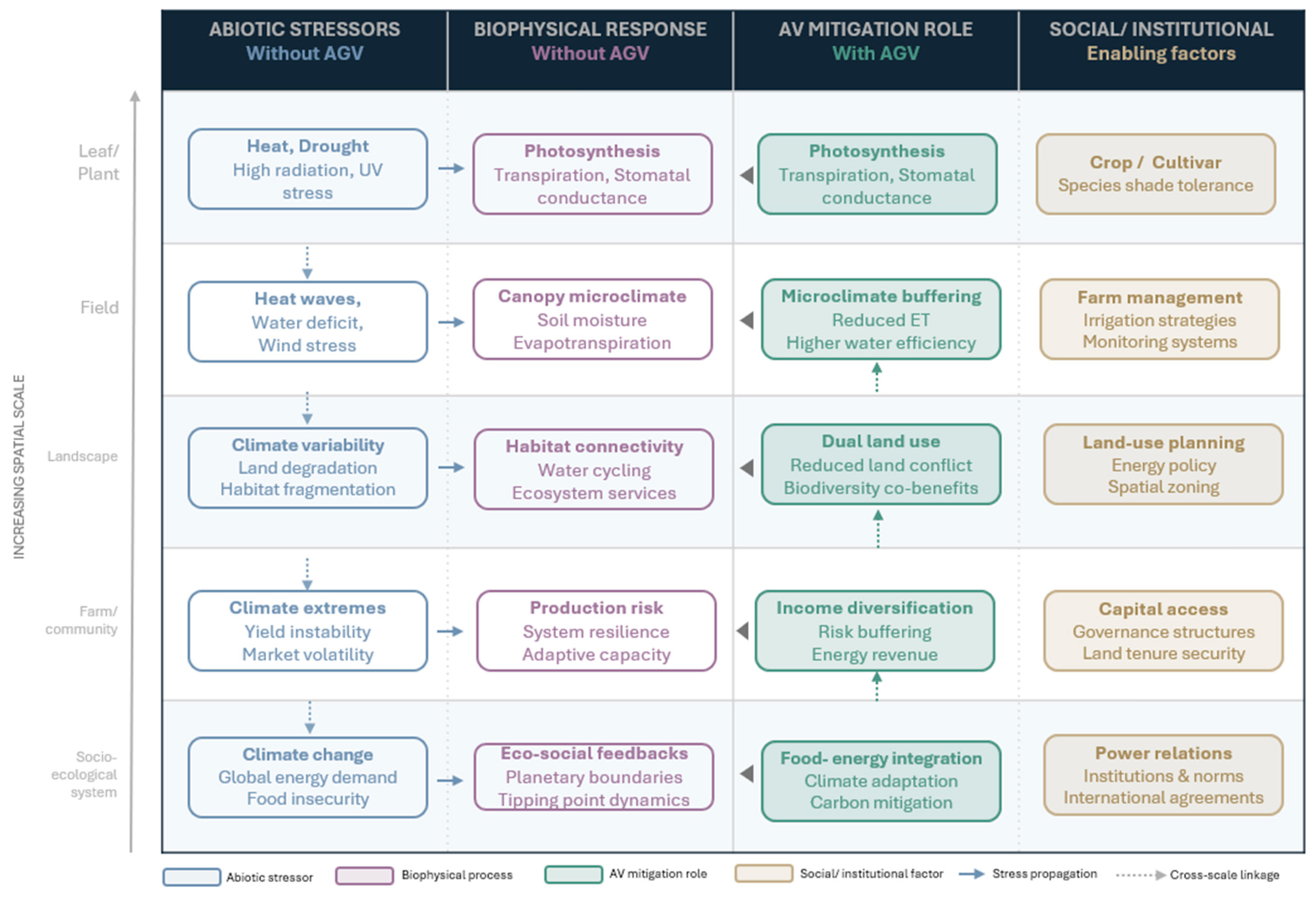
At the fundamental level, plant responses to abiotic stress are related to their physiology. Environmental stresses directly affect the metabolic and regulatory functions of plants. For example, heat stress can affect enzyme function and reduce the efficiency of photosynthesis, while water scarcity limits stomatal function and carbon uptake, ultimately affecting plant growth and production [32]. Similarly, excessive solar radiation can cause photoinhibition and oxidative stress. These processes constitute the first stage at which climatic stresses affect agricultural production. However, these effects are not limited to the plant level. At the field level, the overall plant responses affect overall production, yield stability, and resource use efficiency. Microclimatic variation within the field, such as differences in soil moisture, shading, or temperature, can either enhance or reduce the effects of stress, depending on the design and management of the system (Figure 2) [33,34].
At a larger scale, the effects of abiotic stress occur at the landscape level. At this level, land use, infrastructure placement, and ecological connectivity affect ecosystem functioning and the distribution of environmental risk. Land-use decisions affect the water cycle, biodiversity, and ecosystem vulnerability. Thus, agricultural practices are directly linked to broader environmental impacts.
Combining agriculture with energy production through agrivoltaic systems can help reduce the pressure to convert agricultural land while maintaining its productive capacity. This creates landscapes that are more multifunctional and use resources more efficiently. At the same time, increasing habitat heterogeneity and reducing microclimatic extremes can enhance ecological stability and support important ecosystem services for the long-term sustainability of agriculture.
The impacts of abiotic stress are even more visible at the community level, as they affect people’s livelihoods, food security and the stability of societies. Instability in production and the risk of loss of production particularly affect smallholder farmers and areas that are most vulnerable to climate change [35]. Conversely, systems that reduce environmental stress and make production more stable can help rural communities have greater economic stability and security.
Understanding abiotic stress at all levels, from plant function to social and economic systems, indicates the need for more integrated approaches that link ecological processes to societal impacts. Social-ecological systems theory provides such a framework, as it emphasizes the relationship between environmental processes and human interventions. In this context, resilience is not only about the ability of crops to withstand stress but also about the ability of societies and ecosystems to adapt and continue to function.
If we view abiotic stress as a socio-ecological phenomenon, then we are looking not only at the climatic impacts but also at the broader systems in which they occur. This shows that resilience depends not only on how resilient plants are but also on the organization of society, technological innovation and management policies. Agrivoltaic systems are a good example of this approach, because they link the reduction in stress in plants with the regulation of the microclimate in the field, thereby helping the agricultural landscape to function better and strengthening the resilience of rural communities. In an environment where the climate is becoming increasingly unstable, such integrated solutions are very important for the future of agriculture.

4. Agrivoltaic Systems: Design, Typologies, and Functional Principles

4.1. Definition and Conceptual Evolution

Agrivoltaic systems allow for the simultaneous production of crops and solar energy in the same field. They were initially proposed as a solution to reduce competition for land use between food production and energy production. Early studies evaluated their effectiveness by examining how much productivity is improved, using indicators that combine energy production and crop production. Over time, the concept of agrivoltaics has expanded beyond land efficiency. It is now seen as a system where photovoltaic panels interact with agricultural processes. According to recent studies, agrivoltaics can change the conditions of a field, such as light distribution and water cycle, thus affecting plant growth, production stability and ecosystem functioning [36]. Field experiments and simulation studies show that the shadow from photovoltaic panels can allow enough light for plant photosynthesis, depending on the system design and the type of crop, while simultaneously generating electricity [37]. Therefore, agrivoltaic systems can contribute to managing the interconnected water–energy–food system. In addition to reducing land-use tensions, these systems are increasingly viewed as climate adaptation strategies that strengthen resilience by tempering extreme heat, stabilizing yields across seasons, and promoting more efficient water use [38].

4.2. Agrivoltaic System Architecture

In agrivoltaic systems, photovoltaic panel configuration regulates shading intensity, thereby shaping the microclimate and influencing crop yield and quality. Concurrently, crop selection determines the extent to which plants can exploit the modified microclimatic conditions beneath the structures. Studies indicate that system performance is highly context-dependent on the environment, requiring alignment between panel geometry, crop light requirements, and local climatic conditions [39]. The successful design of agrivoltaic installations typically requires coordination between agronomists and engineers, as well as a design approach that takes into account structural, technological, safety, and economic considerations. Key steps are selecting the crop types and PV technologies that suit local site conditions, modeling shading patterns that affect both vegetation and nearby PV modules, and installing robust mounting structures. System layouts must also be engineered to tolerate wind and snow loads and to accommodate varying soil characteristics, whether moist, saturated, or dry, where conventional foundations may not always be practical. To reduce soil disturbance and maintain permeability in the root zone, many projects now favor elevated single-axis tracking systems or ground-screw anchors instead of conventional concrete bases [40]. Aluminum is widely used for structural components due to its corrosion resistance; it is relatively lightweight and can be recycled, although assessments of its environmental footprint must consider the energy required for its production [41,42].
The open-field agrivoltaic system configurations can be categorized into inter-row systems, elevated systems with spacing between rows of panels, vertical mounting systems and tracking systems [16]. In Table 1, the strengths and weaknesses of the four typical agrivoltaic system configurations are presented.

4.2.1. Overhead Agrivoltaic Systems

Overhead or elevated agrivoltaic systems represent the most common agrivoltaic design. In these systems, photovoltaic (PV) modules are installed on elevated support structures, typically positioned 2–5 m above cropland or pasture. The rows of PV panels are arranged with relatively large spacing, resulting in a moderate ground coverage ratio (GCR) generally ranging from about 20% to 50%. This spacing ensures that sufficient solar radiation reaches the underlying vegetation while allowing agricultural activities to continue beneath the array. The elevated clearance also enables conventional farm machinery, such as tractors, seeders, and harvesters, to operate normally, thereby preserving standard cultivation practices. In this sense, overhead installations function similarly to distributed artificial shading structures throughout the agricultural field. A frequently cited reference example is the Heggelbach research farm in Germany, where bifacial PV modules installed at approximately 5 m above ground with a row spacing of 6.3 m achieved a GCR of roughly 32%, resulting in about 30% reduction in photosynthetically active radiation (PAR) reaching the crops below, while still permitting the normal cultivation of crops including wheat, potatoes, and clover [43,44]. The observed reduction in PAR is particularly relevant because it falls within a range that can be beneficial for certain crops in temperate and semi-arid environments. Rather than consistently reducing yields, moderate shading may improve crop performance under specific climatic conditions by moderating thermal and water stress [45,46]. Experimental studies involving crops such as celeriac and rice grown under agrivoltaic systems have shown that moderate shading levels could maintain acceptable yields while providing additional microclimatic benefits [47,48].
Overhead agrivoltaic systems typically use photovoltaic panels with a fixed tilt. The density of the panels is kept moderate so as not to create excessive shade on the crops below. A north–south orientation with a fixed tilt is considered a good balance, as it allows for the production of sufficient solar energy while at the same time distributing light more evenly across the field. North–south-oriented photovoltaic arrays create more uniform shade throughout the day, thus avoiding areas in the field with permanently low light, which could negatively affect crop growth [49]. The use of fixed-tilt PV avoids the complexity and maintenance required by sun-tracking systems while achieving high energy production, around 80–90% compared to single-axis tracking systems [50].

4.2.2. Inter-Row Agrivoltaic Systems

Unlike elevated agrivoltaics, where the panels are placed high enough above the crops to allow light and space for machinery, between-row agrivoltaics use the classic infrastructure of solar parks. The panels are usually placed at a height of about 1–1.5 m, while larger gaps are left between the rows so that plants can be grown between them [16,51,52]. This arrangement allows crops and photovoltaics to coexist without requiring major structural changes. This makes it suitable for integrating agriculture into existing ground-mounted solar parks. The areas directly under the panels have intense and permanent shade and much less light for photosynthesis, while the gaps between the rows of panels receive full sunlight [53,54]. This difference in light creates different microclimate zones within the same field. There are sunny spots, where regular or more hardy crops can be grown, and shaded areas, which are more suitable for plants that tolerate less light. However, these systems are not equally suitable for all crops. Sun-loving crops may experience substantial yield penalties under persistent or heterogeneous shade, whereas shade-tolerant crops are generally more compatible with such environments. In addition, where large photovoltaic installations are located on sloping, hilly, or otherwise difficult-to-access land, the practical agricultural use of the area beneath the panels may be limited by uneven terrain, transport constraints, and restricted mechanization. Under such conditions, the nominal dual use of land does not always translate into effective agricultural utilization. Research has shown that crops such as lettuce, spinach, herbs and other leafy vegetables can grow well in these partially shaded conditions, especially in hot and dry areas, where the shade from the panels reduces evaporation and water stress [55,56]. Despite the advantages, agrivoltaics with panels between the rows also have some limitations. The low-lying panels interrupt the continuity of the field and make it more difficult to use conventional agricultural machinery, such as large tractors and harvesters. Thus, in many cases more manual labor or smaller and specialized equipment is required. This limitation can increase operational costs and reduce the practicality of such systems for large-scale mechanized agriculture. Consequently, most recent agrivoltaic projects have shifted toward overhead designs that maintain full ground accessibility and promote more uniform light distribution through optimized panel spacing and orientation [40,57]. Nevertheless, with thousands of hectares of conventional ground-mounted solar farms already deployed globally, the ability to introduce agricultural activity into these sites without dismantling existing infrastructure represents a low-barrier entry point for agrivoltaics.

4.2.3. Vertically Mounted Agrivoltaic Systems

Vertically oriented agrivoltaic systems consist of PV panels installed upright in rows resembling fence structures across agricultural fields. These panels are often bifacial PV modules aligned in north–south rows, facing east and west to capture solar radiation during the morning and afternoon hours. Vertical arrays cast almost no shadow at solar noon, when panels face the sun edge-on, so crops between the panels receice nearly full midday light. Most shading therefore occurs during the early morning and late afternoon, when the sun is at a lower angle and intercepted by the panels [49,58]. This distinctive temporal shading pattern creates a microclimatic environment that can be beneficial for certain crops. Plants affected by excessive heat or dryness during the hours of intense sunlight benefit from receiving enough midday light, which is essential for photosynthesis. At the same time, light shade in the morning and afternoon can reduce water evaporation and limit stress on the plants [34]. This is especially important in areas where the days are very long in the summer, and the sun is very high at noon. In these areas, the many hours of sunlight can compensate for a less-than-ideal orientation of the panels. Thus, the vertical placement of the panels can in some cases produce energy at a level equal to or even higher than that produced by panels installed with the classic southerly inclination [59]. In addition to affecting light and energy production, vertical photovoltaics can have other benefits for agriculture. The arrangement of panels in rows acts as a windbreak, reducing wind speed in the field. This reduces soil erosion, limits water loss from plants, and protects crops from wind damage. For this reason, they are particularly suitable for open-field horticultural crops and other specialty crop systems [60]. From a grid perspective, east–west-oriented vertical PV panels have a significant advantage over traditional south-facing panels. Instead of producing a lot of energy only at noon, they create a more balanced generation pattern, with more energy in the morning and afternoon. This helps reduce the problem of the so-called “duck curve” in the grid [61]. This distribution of energy production throughout the day better matches typical electricity demand patterns, thus making the system more useful and efficient for the electricity grid [61]. Although annual energy yields per unit of installed capacity are generally 15–30% lower than those of optimally tilted south-facing systems in mid-latitude regions, the reduced interference with agricultural activity, wind protection benefits, and improved alignment with electricity demand can make vertical agrivoltaic systems a viable design option where agricultural productivity remains the primary priority [62,63].

4.2.4. Dynamic Agrivoltaic Systems

Dynamic agrivoltaic systems include tracking technologies, typically single-axis trackers, that allow the PV panels to rotate and modify the distribution of sunlight reaching the ground. In these systems, the photovoltaic panels do not provide constant shading, but their orientation can be adjusted throughout the day to balance electricity production with the lighting requirements of the crops. These systems can be programmed to remain in a more vertical position during periods of low solar intensity, thereby limiting shading of crops. When solar radiation is highest, the panels may adopt flatter angles that simultaneously improve power generation and provide partial shading that can reduce heat stress on plants [64]. The most modern applications use sensors and automated control systems to monitor crop conditions. They measure factors related to plant stress, such as radiation, temperature and soil moisture. This data is processed by a control system, which automatically adjusts the orientation of the panels in real time to maintain good conditions for plant growth, while at the same time generating electricity [65]. Other more sophisticated configurations include systems that follow the movement of the sun on two axes [66]. Unlike single-axis tracking systems, which only move in one direction, dual-axis systems can change both the direction and tilt of the panels. This allows for more precise control of the solar radiation reaching the crops and better light management. Experiments have shown that crop yields can remain similar to those in full sun, even when total solar radiation is reduced by about 50% [67]. Tracking technologies can be incorporated into all three of the above configurations (overhead, inter-row, and vertical agrivoltaic systems). Despite these advantages, the large-scale deployment of dynamic agrivoltaic systems remains constrained by economic and technical factors. Tracking mechanisms require motors, actuators, and sophisticated control electronics, which increase capital costs compared with fixed installations. In addition, the presence of moving components introduces higher maintenance requirements and potential reliability concerns in agricultural environments characterized by dust and humidity. As a result, these systems are currently most often implemented in contexts involving high-value or climate-sensitive crops, where the ability to mitigate heat stress, excessive radiation, or extreme weather events can justify the additional investment [60].

4.3. Agrivoltaic System Performance Metrics

Agrivoltaic systems are characterized by a set of indicators that describe the interactions between photovoltaic infrastructure and agricultural processes. These metrics enable evaluation of the agrivoltaic system taking into account the energy generation and crop production. A central parameter is the GCR, defined as the proportion of land area occupied by PV modules. Higher GCR values generally increase electricity production but reduce transmitted radiation to crops. The relative PAR is a direct field-measurable indicator of this light limitation. Research has demonstrated that the spatial and temporal distribution of this shading is highly dynamic, varying with solar position, panel tilt, azimuth, row spacing, and height [54].
From the energy production perspective, efficiency is measured by typical PV indices that adapt to dual land use.
The annual specific efficiency (kWh/kWp·year) shows how efficient the PV system itself is. Energy production per land area (kWh/ha·year) shows how much energy is produced on a specific land surface and is more useful for spatial planning [66]. A simplified equation for calculating electricity generation, often used in many evaluation studies, is presented in Equation (1) [68].
E P V = G P V × A P V × η P V
where G P V is irradiance on the PV surface, A P V is the PV area, and η P V module efficiency (noting that practical yield calculations also account for temperature, mismatch, and system losses).
The microclimate created by crops can help cool photovoltaic panels. Lower operating temperatures make the panels work more efficiently. This creates a positive partnership, where agriculture directly helps energy production [69]. Studies have shown that this cooling effect can lead to greater electricity production, compared to a conventional ground-mounted photovoltaic system in the same area.
The crop, evapotranspiration, and water-use metrics are equally critical. Although crop yield is the principal agronomic indicator, it results from the integration of various plant physiological processes that respond to the modified conditions created by agrivoltaic systems. The modification of the radiation, temperature, and wind regimes beneath the panels directly affects the crop’s evapotranspiration rate [70]. In particular, studies from dryland areas show that the partial shading created by agrivoltaic systems can reduce both soil evaporation and plant transpiration, resulting in improved soil moisture conservation [34]. The retention of soil water under these conditions can enhance water use efficiency (WUE), commonly defined as the amount of biomass or crop yield produced per unit of water consumed or transpired. In water-scarce regions, improvements in WUE may represent a more significant agronomic benefit than small reductions in total crop yield [71]. This leads directly to the microclimate and surface-energy balance metrics. The presence of the PV array fundamentally alters the local energy budget, described by Equation (2) [70].
R n = H + λ E + G
where net radiation R n is partitioned into sensible heat flux H , latent heat flux λ E , and soil heat flux G . Reduced net radiation and altered turbulence beneath panels typically lower canopy/soil temperatures and can reduce evaporative demand.
In addition, the integrated land-productivity index, most commonly the Land Equivalent Ratio (LER), provides a system-level summary of performance, and can be described with the following equation [72,73].
L E R = G A P V × ( 1 L ) Y r e f + E A P V E r e f
where G A P V is the crop yield (t/ha), Y r e f is the crop yield in an open-field setup (t/ha) (single use of land), L is the land loss because of the PV system (%), E A P V is the energy yield of the PV system (kWh/ha) and E r e f is the energy yield of the reference PV system (kWh/ha) (single use of land).
An LER greater than 1.0 signifies a net land-use efficiency gain, demonstrating the core value proposition of agrivoltaics. Several field trials across diverse climates and with various crops such as wheat and sugar beet in Belgium [74], kiwifruit in China [71], and dryland crops in the US Southwest [34] have reported LER values exceeding 1.0, validating the concept’s potential. However, it is essential to interpret LER critically. A high LER (land-use efficiency index) may not be economically advantageous if it is achieved with a crop of very low value or very reduced quality. Therefore, LER should always be considered alongside economic analyses and crop-specific quality metrics.

5. Microclimatic Modifications and Abiotic Stress Mitigation

Agrivoltaic systems alter the microclimate at the field scale through structural interactions between photovoltaic panels, radiation fluxes, and surface energy exchange. These systems influence multiple environmental drivers simultaneously, including light distribution, thermal regimes, atmospheric demand, and soil water balance [20]. Rather than simply making fields cooler or more shaded, agrivoltaics change how temperature, light, and moisture vary across space and time, influencing how crops experience stress [75]. Because crop productivity is closely linked to short-term environmental fluctuations, particularly during extreme climatic events, microclimate modification represents the primary biophysical pathway through which agrivoltaics influence crop physiology, yield formation, and production stability [76]. The following subsections examine the key microclimate drivers individually while recognizing that their effects operate interactively at the canopy and field scales.

5.1. Shading Dynamics

Solar radiation is a primary factor in both crop productivity and yield and abiotic stress, affecting photosynthesis, canopy temperature, and evaporative demand [77]. Under open-field conditions, excessive radiation, combined with high temperatures and water shortage, can lead to photoinhibition, stomatal closure, and reduced carbon assimilation [78]. Agrivoltaic systems intercept incoming solar radiation, creating partial and spatially heterogeneous shading at the crop level [79]. Unlike uniform shading structures, photovoltaic panels generate dynamic shade patterns that vary diurnally and seasonally depending on panel orientation, spacing, and mobility [49,80]. Thus, the radiation distribution can reduce high incoming radiation during periods of high solar intensity, while maintaining sufficient daily PAR for crop growth. Although shading can alleviate heat and water stress, reduced PAR may negatively affect yields in most staple crops, highlighting the need for careful system design and site-specific evaluation.
From a physiological perspective, moderate radiation loads drastically reduce the likelihood of photosystem II overstimulation, thereby reducing photoinhibition and supporting the maintenance of photosynthetic function during periods of midday stress [81]. Several studies have shown that moderate shading can improve radiation-use efficiency under high-temperature and water-limited conditions [70,82,83,84]. To prevent short-term detuning of photosynthesis, shading helps maintain more stable carbon assimilation rates throughout the day. In an agrivoltaic experiment in arid regions, shading reduced plant water stress and improved growth conditions, leading to higher food production compared to open-field cultivation [34] (Table 2). Similarly, vegetation under photovoltaic panels in pasture systems produced up to 90% more biomass at the end of the season, due to improved soil moisture and the microclimate conditions created [85]. The agronomic benefits of shading, however, depend largely on crop characteristics, with phenological stage and local climate strongly influencing the results. Shade-tolerant species and stress-prone species tend to benefit the most. However, if shading is excessive or poorly distributed, cropping systems may experience negative impacts and yield may be significantly reduced.
A key design implication is therefore the need to align the agrivoltaic configuration with the crop characteristics. The height and spacing of the panels determine the shadow footprint, the row orientation controls the shadow movement, and monitoring systems can modulate the shading time [86]. Through appropriate design, shading can be optimized to reduce peak stress while maintaining sufficient light for photosynthesis. How shading is varied may represent a central mechanism through which agrivoltaic systems can reduce exposure to abiotic stress. By reducing excessive solar radiation and stabilizing plant functions, dynamic shading primarily helps to make production more stable and resilient. That is, it does not always increase maximum yield, but it helps to maintain more stable production.

5.2. Radiation Spectra

Excessive solar radiation is also a major source of abiotic stress in crop systems, particularly when combined with elevated temperature and water deficit. In these conditions, plants receive more energy from the sun than they can use for photosynthesis. This can cause photoinhibition and oxidative stress. That is, the photosynthetic system is overloaded, resulting in the production of reactive oxygen species (ROS) that can damage plant cells, even important parts of photosynthesis such as photosystem II (PSII) [87,88]. Therefore, radiation stress does not only depend on how intense the light is. It occurs when there is an imbalance between the energy absorbed by the plant and the amount of carbon it can use for photosynthesis. This situation is made worse when the stomata of the leaves close due to drought, because then the uptake of CO2 is reduced and the plant cannot properly utilize the sunlight. As a result, radiation stress often peaks at midday or during heatwave conditions, when radiation, temperature and atmospheric demand act simultaneously [89,90,91]. Plants respond to excessive radiation through various photoprotective mechanisms such as non-photochemical quenching, antioxidant activity, and adaptations to leaf orientation or canopy structure [92]. While these responses can limit damage, they also divert resources away from growth, leading to reduced radiation use efficiency and potentially lower productivity [93].
Agrivoltaic systems can reduce stress from very strong sunlight by changing not only how much light reaches plants but also the type and direction of the light. Solar panels change the light that reaches the crop canopy, often increasing the amount of diffuse light. Diffuse light spreads more evenly and can reach deeper parts of the canopy. This helps prevent the upper leaves from receiving too much light and improves overall photosynthesis and the efficiency with which plants use light [60,66,94]. Changes in the light spectrum can also affect plant morphology and growth through photoreceptor-mediated responses, influencing leaf angle, internode length, and biomass allocation [95]. These structural adaptations can help plants capture more light in the canopy and increase productivity when light conditions change. In greenhouse-integrated photovoltaic systems, turning fluctuating shade into more diffuse light kept lettuce dry weight and growth rate similar to the control conditions [96].
Similarly, experiments with spectrally selective translucent photovoltaic membranes showed that lettuce biomass increased by about 10% under some light-filtering conditions. This shows that light quality can help reduce stress from intense radiation and improve plant growth, even when there is very strong light [97].
Overall, the effect of light on plants depends on the environment, crop type, leaf shape and density, and climatic conditions. However, in areas with very intense solar radiation, diffused light can help reduce the negative effects of excessive radiation. This can maintain more stable photosynthesis, increase biomass production, and in some cases improve crop yield. From a sustainability perspective, changing the characteristics of light is an important way in which agrivoltaics can improve resource use. They help plants photosynthesize without needing more water or fertilizer. This allows them to increase production with the same resources while simultaneously generating renewable energy, enhancing their multifunctional role in climate-adapted agriculture.

5.3. Canopy Temperature

Another major limiting factor for agricultural production is heat stress, particularly in temperate and Mediterranean regions. High air and leaf temperatures affect essential plant functions, such as photosynthesis, respiration and reproduction, often leading to permanent reductions in production [2,4]. When leaf temperatures exceed optimal limits, the balance between carbon assimilation and metabolic demand is compromised, resulting in reduced growth and lower yield potential [98]. High temperatures reduce the efficiency of photosystem II, increase photorespiration, and destabilize cell membranes, thereby reducing net carbon assimilation and accelerating senescence [99,100]. Heat stress is particularly detrimental during sensitive phenological stages, such as flowering and grain filling, where even short-term extreme temperatures can significantly reduce reproduction and final yield [5]. Consequently, heat stress not only reduces productivity but also increases yield variability and production risk.
Agrivoltaic systems can mitigate the stress of high temperatures by modifying the radiation balance and airflow in the field. Photovoltaic panels reduce direct solar radiation, leading to lower canopy temperatures, especially during periods of intense solar loading [67,101]. This form of cooling, i.e., the reduction in field temperature, how much the temperature will drop, and how it will be spatially distributed in the field, depends on the system design, the height and spacing of the panels [102]. Rather than creating uniformly cooler environments, agrivoltaics mitigate exposure to peak temperatures, which are often the main factor in heat-induced damage. In a dry-field agrivoltaic experiment, daytime air temperatures under PV arrays were on average 1.2 ± 0.3 °C lower than under open-field conditions, along with reduced atmospheric dryness and improved crop yield [34]. Similarly, in pasture agrivoltaic systems, slightly lower field temperatures under the panels (e.g., 18.03 °C vs. 18.32 °C at 1.2 m height) coincided with significantly higher late-season biomass (Table 2), suggesting that even moderate or minor thermal regulation when combined with improved water availability can enhance plant growth [85].
It is important to note that temperature regulation in agrivoltaic systems is dependent on the environment and interacts with other microclimate factors such as humidity, wind speed and soil moisture. Therefore, agrivoltaic systems create a system that mitigates abiotic temperature stress but does not create a uniformly cooler environment. So the greatest benefits occur during extreme heat events, when crops are most vulnerable. From a sustainability perspective, canopy cooling helps plants adapt better to the climate, reducing how often and how severely crops fail due to heat. By stabilizing physiological processes during critical growth stages, agrivoltaic systems enhance yield reliability, reduce the risk of yield declines and can make some agricultural systems more resilient to increasing climate variability.

5.4. Soil Temperature

Soil temperature is also an important factor for crop production and various crop interventions, because it affects root growth, nutrient availability, and soil microbial activity [103]. In the open field, intense solar radiation can increase soil temperature and cause large temperature fluctuations during the day and create abiotic stress in plants. This causes the soil to lose water more quickly and creates stress on the roots. Very high temperatures in the root zone can affect root respiration, reduce water absorption, and limit nutrient availability, resulting in reduced plant growth and productivity [104]. From a physiological point of view, roots are very sensitive to thermal stress. High soil temperatures can disrupt the function of root membranes, reduce root growth, and affect microbial processes that control nutrient cycling. These changes can also affect the above-ground part of the plant, as water and nutrient availability is reduced, drought sensitivity is increased, and photosynthetic efficiency is reduced. Thus, soil temperature plays an important role in the resilience of crops to climate change [105,106,107].
Agrivoltaic systems can reduce these pressures by shading the soil surface and affecting its energy balance. The lower incoming radiation consequently reduces the soil surface temperature and its large daily fluctuations, creating a more stable environment for the root zone [108]. Cooler soils also reduce evaporation and thus create more favorable conditions for microbial activity and nutrient availability, thereby enhancing root function and plant water status [109]. In agrivoltaic field trials, the average soil temperature under photovoltaic panels was approximately 0.6 °C lower compared to control plots for soybeans. At the same time, slightly higher soil water content was observed, indicating a more favorable environment for the root zone [110]. Similarly, in agrivoltaic systems in vineyards, shading from the panels reduced maximum soil temperature by 1–2 °C. This was associated with measurable changes in the physiological activity of the vines, indicating reduced heat stress [111].
It is therefore noted that even a small decrease in soil temperature can affect crop performance by improving water status and stabilizing root processes. By reducing heat between the soil and the plant, agrivoltaic systems help plants maintain their normal function when it is hot, supporting growth and production. Temperature regulation in the rhizosphere helps crops better withstand climate change and improve the efficient use of resources. Through their effects on soil–plant interactions, agrivoltaic systems enhance the stability of the agroecosystem while at the same time allowing the production of renewable energy on the same area of land.

5.5. Evapotranspiration

Water stress is a growing constraint on agricultural productivity under climate change, driven not only by reduced precipitation in many regions but also by increasing atmospheric evaporative demand associated with rising temperatures. As a result, even areas with stable rainfall may experience greater drought, as the demand for water by plants and the loss of water to the atmosphere increase. These conditions highlight the importance of agricultural systems that help to use water more efficiently and protect crops from periods of water scarcity [109,110,111]. Evapotranspiration (ET) is the total loss of water from the soil and plants through evaporation and transpiration. It is therefore an important indicator of how stressed plants are by water scarcity. When the demand for evaporation is high, plants often partially close their stomata to reduce water loss. Although this reaction helps plants conserve water, it also reduces CO2 uptake and photosynthesis, resulting in slower growth and potentially lower production [112,113,114].
Agrivoltaic systems can mitigate this stress pathway by modifying the energy balance at the field scale. By reducing incoming solar radiation, lowering canopy temperature, and reducing wind speed, agrivoltaic shading reduces plant evaporative demand and transpiration rates [115,116]. Lower ET helps maintain plant water status, allowing crops to maintain stomatal conductance and photosynthesis for longer periods of time under water-limited conditions [107]. Using a combined crop-water balance model, researchers reported that irrigation water requirements for lettuce grown under photovoltaic panels were reduced by approximately 20%, reflecting lower evapotranspiration under shaded conditions [117]. At the ecosystem scale, ecohydrological modeling showed that annual evapotranspiration in grasslands was reduced by approximately 33% (−142.6 mm yr−1) under fixed-panel agrivoltaic configurations and by 24% (−109.4 mm yr−1) under monitoring systems compared to open-field conditions [118].
From an agronomic perspective, reduced evapotranspiration often translates into improved water-use efficiency and lower irrigation requirements, which are critical for sustaining crop production in water-scarce environments. Agrivoltaic systems help stabilize biomass production and reduce yield variability, delaying the onset of drought stress and extending the period of normal plant activity. Therefore, reducing evapotranspiration under agrivoltaic systems could be a way to manage climate change, agricultural production, and resources.

5.6. Soil Moisture Dynamics

Drought is one of the most important abiotic stress factors for plants and is associated with reduced soil moisture, which limits the availability of water for the root system. Lack of water reduces the water potential and cell turgor, leading to a limitation of cell elongation and growth. At the same time, it causes stomatal closure, which reduces transpiration and CO2 uptake, resulting in a decrease in the rate of photosynthesis [106,119]. Because soil moisture directly determines plant water status, it plays a central role in crop resilience to climatic stress [120,121]. In addition, drought affects the absorption and transport of nutrients, alters hormonal balance (e.g., increase in abscisic acid–ABA) and can lead to oxidative stress, affecting overall plant physiology, growth and productivity.
Agrivoltaic systems can mitigate these stress pathways by improving soil moisture retention through several mechanisms. Shading from photovoltaic panels lowers soil surface temperatures, reducing evaporation from the soil profile, while modified wind regimes decrease convective drying. In addition, panel structures can redistribute rainfall through runoff and drip patterns, enhancing localized infiltration [122]. Although this redistribution may create spatial variability in soil water content, the net system effect is typically an increase in root-zone water availability during dry periods. Pasture agrivoltaic experiments have documented sustained soil moisture retention beneath panels throughout the growing season, contributing to improved plant water status and increased biomass yield [85]. Higher soil moisture helps plants continue photosynthesis and stomatal function even in drought conditions, reducing stress and aiding growth. However, care must be taken, as shade can sometimes have the opposite effect: the soil does not dry out enough, which can create excess moisture in the soil, which is also a stress factor for plants.
Improved soil moisture dynamics enhance water use efficiency and reduce irrigation requirements, particularly in semi-arid and water-limited environments [123,124]. While local heterogeneity in soil moisture distribution may require tailored water management strategies, the overall result of agrivoltaic systems is a more stable soil water environment. Improved soil moisture retention is a key way in which agrivoltaics can help agriculture better withstand the impacts of climate change. Consequently, agrivoltaic systems can contribute to reducing the impacts of drought by retaining more water in the agricultural ecosystem. In this way, the stability of production is enhanced.

5.7. Wind, Humidity, and Boundary-Layer Effects

Strong wind is an abiotic stress factor for plants—perhaps more secondary because it does not cause direct symptoms in plants like high temperature—as it affects both their mechanical stability and basic physiological processes. High wind speeds increase heat exchange and transpiration, intensifying water loss and accelerating the drying of foliage. Under dry and hot conditions, this can aggravate xeric stress, increasing evaporative demand and reducing the water status of plants [125,126,127]. From a physiological point of view, increased exposure to wind can disrupt the energy balance of leaves and increase transpiration rates, forcing plants to close their stomata to save water. In this way, water loss is reduced, and CO2 uptake and photosynthetic activity are also limited, which may limit growth and yield. In contrast, modest reductions in wind speed can stabilize the canopy microclimate and improve water use efficiency by plants [128,129,130,131].
Agrivoltaic systems modify these processes by acting as partial windbreaks. PV panels reduce wind speed under and around the structures, reducing convective drying and helping to maintain a more stable canopy environment [132]. Reduced airflow can also increase relative humidity within the canopy, improving stomatal function and reducing water stress on plants under dry conditions. However, these effects are highly dependent on the local environment because in humid climates, for example, reduced air circulation can increase the risk of fungal diseases. Therefore, proper design (panel height, spacing, and orientation) must be in place so that airflow patterns result in reduced wind and thus provide net benefits, rather than creating management challenges.
Although wind and humidity effects are less frequently quantified than radiation or temperature, they are an integral part of the overall microclimatic response induced by agrivoltaic systems. By stabilizing the boundary layer environment, agrivoltaic systems contribute to reduced water loss and more favorable physiological conditions for plants [75,76]. Reductions in wind-induced evapotranspiration and plant stress support improved water use efficiency and resilience to climate variability. When integrated with other microclimate effects, boundary layer regulation enhances the role of agrivoltaic systems as a multifunctional infrastructure for climate-resilient agriculture [54].
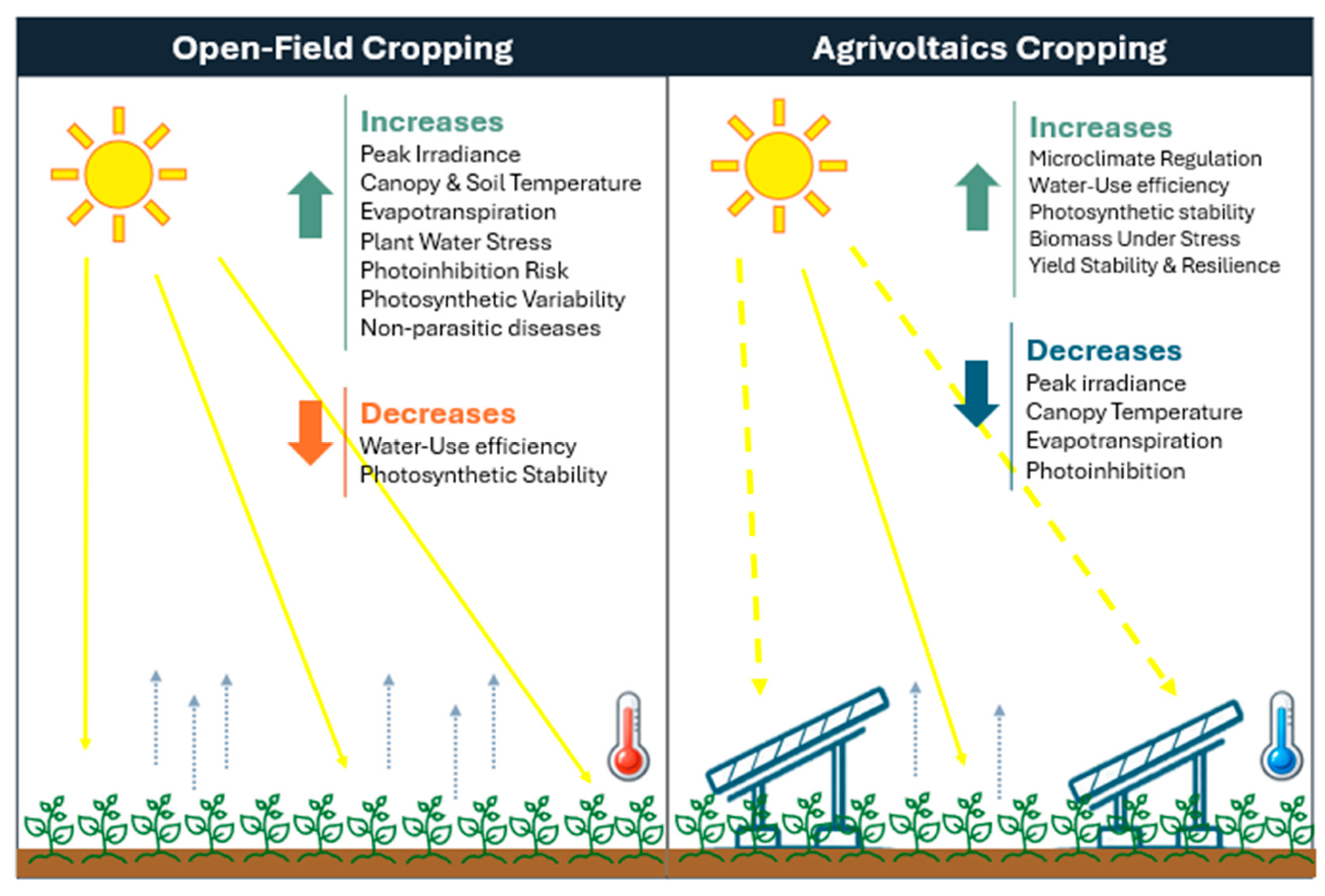
Even though individual microclimate factors, such as radiation, temperature, soil moisture and wind, can be studied separately, in practice in agrivoltaic systems they interact and together shape the environment for crop growth. The reduction in incoming radiation leads to lower leaf temperature and lower evaporative demand from the atmosphere. This results in a reduction in evapotranspiration and greater soil moisture retention (Figure 3).
These interactions create an overall regulatory effect, which limits both the intensity and duration of plant exposure to abiotic stresses during the growing season. The aggregated data presented in Table 2 show that agrivoltaic systems can reduce some key stress indicators, such as heat load, water loss and atmospheric demand, while improving biomass stability. This combined effect contributes to maintaining the normal functioning of plants in conditions that, in conventional open-field systems, would limit their growth.
The performance of agrivoltaic systems depends largely on PV system type and design, climatic conditions, crop category, and study scale. Field studies generally report increased yield and improved water-related performance and soil moisture under moderate shading, whereas modeling and simulation studies emphasize the importance of system configuration and the broader socio-economic context. Table 2 summarizes findings by system type, climate zone, crop category, and study scale while distinguishing field evidence from modeling and conceptual studies.
Table 2. Agrivoltaic effects on abiotic stress and crop productivity.
Abiotic Stress ProxyCrop/SystemChange (AGV vs. Control)InterpretationRef
Shading
dynamics
Chiltepin pepper+33% CO2 uptake;
×3 fruit yield
Moderate shade reduces heat and atmospheric stress, improving photosynthesis and yield[34,85]
Tomato (wild cherry type)+65% CO2 uptake;
+65% WUE;
×2 fruit production
Cooling and lower VPD reduce heat–drought stress
Jalapeño pepperSimilar yield;
+157% WUE;
−65% transpirational
Same yield with much lower water loss
Unirrigated pasture~+90% late-season biomass Shade and moisture retention extend growth period
Radiation spectraLettuce (spectral PV)~+10% biomassLight filtering reduces excess radiation stress[96,133]
Lettuce under PV with diffusion filmBiomass & RGR similar to controlDiffuse light improves canopy light distribution
Canopy
Temperature/air
microclimate
Dryland crops (field AV)Daytime air temp −1.2 ± 0.3 °C; nighttime +0.5 ± 0.4 °CLower daytime heat stress[34]
Dryland crops (field AV)VPD −0.52 ± 0.15 kPaReduced atmospheric water stress
Soil
temperature
Soybean (on-farm AV trials)Soil temp −0.6 °C; soil water +0.7%Cooler and slightly wetter root zone[110,134,135]
Vineyard/vinesMax air & soil temp −1–2 °CReduced soil heat extremes
Soybean (tropics APV)Soil temp −0.8 °C; soil moisture +2.3%Improved soil moisture and root environment
Evapotranspiration (ET)Grasslands (Mediterranean basin, model)ET −32.57% (fixed)/−24.24% (rotating)Lower atmospheric water loss[34,117,118]
Grasslands (Mediterranean, model)WUE +52–66%Higher water productivity
Lettuce (irrigated)Water use ~−20%Reduced transpiration demand
Jalapeño pepper−65% transpirational water lossStrong reduction in plant
water loss
Soil moisture dynamicsField AV (drylands; 2-day irrigation)Soil moisture ~+15% (+3.2% vol. units)Better water retention between irrigations[34,85]
Field AV (drylands; daily irrigation)Soil moisture +5% (~+1.0 vol. units)Persistent moisture advantage
Unirrigated pasture~+90% late-season biomassMoisture retention sustains growth
WindVertical agrivoltaicsWind speed −29% avg (up to −88%)Reduced convective drying and ET[39,136]
Systematic reviewWind speed −24%; RH +5%Wind reduction buffers microclimate

6. Social, Economic, and Policy Factors

6.1. Economic Viability and Adoption Potential

Economic viability is the primary determinant of whether agrivoltaic systems move from demonstration projects to widespread agricultural adoption. The main economic difficulty is that agrivoltaic installations have significantly higher initial costs compared to conventional agriculture or a simple photovoltaic system alone. In most commercial agrivoltaic systems, photovoltaic electricity generation constitutes the primary and more predictable source of income and is therefore often the determining factor in overall project feasibility. Agricultural production remains a critical component of the system, not because it contributes equally to direct revenue in all cases, but because it preserves the dual-use function of the land and supports environmental co-benefits. A major reason for these higher costs is that agricultural use beneath the panels requires adequate spacing and clearance, which often necessitate taller mounting structures, more construction materials, and higher installation and labor costs. These added upfront investments are not easily offset by agricultural output alone, especially in lower-value cropping systems. Energy revenue is usually more stable over the lifetime of the photovoltaic system, while agricultural profit can be reduced due to shading. However, in some cases it can be stabilized or even increased, because agrivoltaics improve the microclimate and reduce the need for inputs, such as water [137]. Whether agrivoltaics are economically viable depends on many factors, such as the type of farm, the crops chosen, the quality of the land, and the conditions of the local energy market. Cereal and feed crops, which are more shade-tolerant and can be easily cultivated with machinery under elevated panels, usually have better economic results. In contrast, specialized crops that require many inputs are more affected by shading and may be less economically viable [138]. In contrast, high-value horticultural crops in water-scarce areas can achieve better overall results with agrivoltaics. This is because agrivoltaics reduce the need for irrigation and can extend the growing season. Studies in Germany show that agrivoltaics have great potential to help meet electricity demand with little land use. However, there are still challenges, such as the need for large-scale installations to reduce costs and the need for strong political support so that they can compete with conventional ground-mounted photovoltaic parks [139,140]. The economic viability of agrivoltaics often depends on the type of land. On abandoned agricultural lands they can have competitive returns, because they utilize land that would otherwise be unused. Conversely, in active agricultural areas they can be difficult, because the installation of panels can reduce crop income.

6.2. Policy Frameworks and Regulatory Barriers

The political and institutional framework is perhaps the most important factor influencing how quickly agrivoltaic systems are adopted. This operates at many levels simultaneously, from national energy legislation and agricultural support programs to local land-use regulations and licensing procedures. In many jurisdictions, existing regulatory frameworks were not designed to accommodate dual-use land systems, and agrivoltaic installations are subject to legal ambiguities that create delays, increase transaction costs, and deter investment [141]. Zoning laws that classify land as either agricultural or industrial can prevent agrivoltaic development outright, while building codes that govern PV installations may not account for the elevated structures required for crop compatibility. Feed-in tariff schemes that treat PV installations uniformly, without distinguishing configurations that maintain agricultural productivity, provide no incentive for developers to accept the additional costs of agrivoltaic design. The most comprehensive policy frameworks to date, such as Japan’s solar sharing program [142], which requires installations to maintain at least 80% of the reference crop yield [143], and Germany’s dedicated agrivoltaic tender category, demonstrate that targeted regulatory instruments can successfully stimulate sector growth while protecting the agricultural function of dual-use land [140,144]. In the United States, the regulatory framework remains patchy. The development of agrivoltaics is constrained by restrictive local zoning regulations, the lack of specific federal incentives for agrivoltaics, and different state-by-state policies for energy offsetting and grid interconnection. These differences create unequal economic conditions across regions [145]. Cross-sector policies and the alignment of agricultural and energy planning with climate change adaptation goals, within a common governance framework, are necessary prerequisites for the systematic development of agrivoltaics. In this way, they can contribute substantially to national renewable energy goals without degrading farmland. The research shows that interdisciplinary approaches and greater attention to social and political aspects are needed to advance the development of agrivoltaic systems.

6.3. Farmer Adoption and Social Acceptance

The success of agrivoltaic systems depends largely on whether farmers accept them and participate. This is influenced by factors such as economic viability, whether they fit with existing agricultural practices, and the risks they perceive may exist [146,147]. Farmers typically do not see agrivoltaics primarily as an investment in energy, but rather as a change in the way they farm their land. As a result, they are often more concerned about crop management and the long-term health of their land than about the additional income from energy production. The uncertainty about how shading will affect crop production, coupled with the lack of long-term data, makes it difficult for farmers to confidently assess agricultural risk. For this reason, agricultural advisors and agricultural extension services have a very important role, because they help to translate research results into practical guidelines for farmers. Their participation is often essential for the effective adoption of agrivoltaic systems. Furthermore, research shows that for them to truly function as dual-use systems (agriculture and energy), appropriate incentives are needed so that farmers continue farming and do not abandon crops within agrivoltaic systems [148]. The relationship between people and technology in agrivoltaic systems shows that there are different perceptions and levels of acceptance by the stakeholders involved. Although agrivoltaics can offer significant socio-economic benefits, such as greater energy independence and financial stability, their implementation faces several challenges. These include regulatory uncertainty, investment risks, and cultural concerns. To be successfully implemented, appropriate incentives, collaborative models, and strong institutional support are needed [149,150].

7. Research Gaps and Future Directions

Agrivoltaic systems are emerging as a crucial solution for addressing global challenges related to food security, energy demand, and land-use competition, especially under accelerating climate change [34,36,38,39,63,132,151,152,153,154,155,156,157,158,159,160]. The rapid expansion of agrivoltaic research and the increasing number of pilot installations worldwide highlight the potential of agrivoltaics to simultaneously support agricultural production and renewable energy generation and illustrate that agrivoltaic systems can function as socio-ecological infrastructure for abiotic stress mitigation, modifying field-scale microclimates in ways that reduce crop exposure to heat, water deficit, and radiation extremes. However, while experimental data demonstrates that agrivoltaic systems can improve land-use efficiency and protect crops from extreme environmental conditions through microclimate regulation, several critical knowledge gaps remain to be filled before agrivoltaic systems can be reliably implemented at large-scale as a climate change adaptation strategy. Particular gaps appear regarding the timescale of empirical data, crop responses to multiple stressors, crop-specific system design, landscape-scale complexity, long-term environmental impacts, socioeconomic resilience, and standardization [159,161]. Therefore, the available literature indicates that agrivoltaic systems can provide important agronomic and microclimatic benefits, particularly under conditions of high radiation, heat, or limited water availability, especially for irrigation applications. However, further multi-year and multi-site research is needed to evaluate their long-term agronomic, social, and economic benefits.

7.1. Long-Term and Multi-Location Data Needs

Studies have shown that agrivoltaic systems can mitigate the negative effects of drought on crop growth and increase resilience by reducing water loss from evapotranspiration and mitigating midday depression in photosynthesis, particularly in arid regions [162]. However, validating these benefits under diverse and fluctuating climatic conditions requires long-term and multi-site experiments. Therefore, a critical limitation in agrivoltaics research is the temporal scope of empirical evidence [159]. The majority of published field studies cover one to two growing seasons, providing data on system performance under a narrow range of climatic conditions [163]. This limited duration cannot be used for a comprehensive assessment of system performance in terms of the impact of long-term climate variability and extreme weather events, such as droughts and heat waves [156,162,163]. Using a single favorable season does not provide sufficient evidence to demonstrate the ongoing stability of performance. Instead, multi-year and multi-site experiments covering different climatic conditions, including drought years, unusually warm seasons, and years with normal rainfall, are therefore a research priority. This data will also allow for more reliable predictions of system profitability over the 25–30-year lifetime of the PV installations and can be used for more reliable system life cycle assessments considering variability in both energy efficiency and crop income. In addition, long-term monitoring programs should be designed to track not only crop yield and energy production but also evolving soil conditions, plant community dynamics, and system-level water balances, all of which may shift substantially over decadal timescales [164].

7.2. Multi-Stressor Crop Responses and Modeling

Existing research on agrivoltaic technology tends to analyze factors, such as shading effects or water use efficiency, in isolation, without considering how these factors may interact in combination to shape crop physiology [36]. This approach ignores the complexity of plant physiology, as crops are often exposed to more than one stressor at the same time. This can lead to erroneous conclusions. In practice, crop performance does not depend on a single stressor but on the combination of many factors acting simultaneously. Agrivoltaic systems simultaneously change various microclimate conditions, such as air and soil temperature and soil moisture. These changes affect important plant functions, such as transpiration and reproductive growth, which ultimately determine how well plants withstand stress and how much they produce. However, the combined effects of these microclimate changes have not yet been adequately studied and measured.
Research shows that the shade from photovoltaic panels can reduce daytime temperatures, reduce atmospheric dryness and increase soil moisture. This reduces water stress in plants and improves water use efficiency, especially in arid and semi-arid areas. This reduces water stress in plants and improves water use efficiency, especially in arid and semi-arid areas [165,166,167]. However, these benefits are highly dependent on the environment and may vary depending on the type of crop, the design of the agrivoltaic system, and local climatic conditions. Addressing this knowledge gap requires experimental designs and process-based modeling approaches that explicitly represent coupled energy, water, and carbon fluxes within agrivoltaic microclimates [165,168]. Advances in high-resolution plant phenotyping, thermal imaging, and dense environmental sensor networks provide new opportunities to capture these interacting dynamics in situ. Integrating field-measured physiological indicators with crop and microclimate models would enable predictive evaluation of agrivoltaic system designs across diverse crops, climates, and stress scenarios. Beyond these well-known microclimate effects, greater attention should be given to compound stress modeling methods that assess the combined influence of multiple abiotic factors under agrivoltaic systems. Experimental design protocols should also incorporate multi-factor, long-term, and field-based approaches to better evaluate system performance under realistic conditions.

7.3. Crop-Specific Design and Growth-Stage Management

The current guidelines for the design of agrivoltaic systems often rely on generalized assumptions about shade tolerance and productivity trade-offs, overlooking the significant variability across species, cultivars, and developmental stages [163]. The same shading configuration that benefits a drought-stressed crop in an arid region may affect the production of another crop. The literature linking the panel configuration variables, such as height, spacing, tilt angle, transparency, and tracking, to crop phenological sensitivity and stress thresholds remains limited [51,53,54,63,169,170]. Although modeling approaches have begun to explore these relationships, such as three-dimensional light simulation frameworks developed to optimize agrivoltaic layouts for perennial crops such as pear orchards [171], the direct empirical connection between design parameters and crop-specific physiological responses remains insufficient. Dynamic agrivoltaic systems capable of adjusting shading intensity in response to real-time plant stress indicators represent a promising direction, but their agronomic validation is still in early stages. Future research should therefore integrate plant physiological knowledge with precision agriculture technologies, sensor networks, and control algorithms to develop phenology-aligned shading strategies.

7.4. Landscape Impacts and Spatial Planning

The transition from experimental agrivoltaic installations to large-scale commercial installations introduces landscape-scale dynamics that have been unstudied in the existing literature. Extensive deployment of agrivoltaic can modify the hydrological horizon, fragment or enhance habitat, and create cumulative land-use pressures in ways not captured at small scales [172]. Agrivoltaic installations may also generate ecological trade-offs, especially at large scale or in sensitive landscapes such as mountainous areas. Possible impacts include changes in local hydrology and reductions in ground vegetation cover under certain site and management conditions. These risks highlight the need for site-specific environmental assessment and long-term ecological monitoring. These emergent properties cannot be detected through site-level research alone. Landscape-scale assessments, integrating spatial modeling, remote sensing, and ecosystem service valuation, are essential to assess cumulative impacts on biodiversity, the water cycle, and regional energy balances, and to identify configurations that minimize conflicts between food production, ecological conservation, and renewable energy infrastructure. Future work should develop spatially explicit modeling frameworks that link system design parameters to distributed field-scale outcomes, allowing optimization across the full range of relevant ecological and agronomic objectives simultaneously [173].

7.5. Long-Term Environmental Footprint and Ecosystem Co-Benefits

The long-term impacts of agrivoltaic infrastructure on soil health, nutrient cycling, microbial communities, and carbon dynamics are not yet well understood and require further study. Although reductions in soil temperature and evaporation have been documented in the short term, it remains unclear to what extent these changes cumulatively affect soil parameters related to crop yields, such as soil organic matter turnover, microbial biodiversity-activity, and rhizosphere chemistry [174]. Local effects are also significantly affected. Some studies report that increased pollinator activity and greater habitat heterogeneity under panels, while others point to potential risks, such as changes in soil flora due to shading and variation in pest dynamics. These conflicting results indicate the need for comprehensive and multi-year ecological monitoring programs. These programs should record biodiversity and soil ecosystem processes, alongside agronomic and energy measurements [41]. This will also enable a clearer assessment of the role of agrivoltaic systems in sustainability and climate change mitigation. Life cycle assessment methodologies, particularly those addressing the carbon footprint associated with photovoltaic construction and infrastructure, require further development. This will support a more comprehensive evaluation of the overall environmental performance of agrivoltaic systems and their contribution to agricultural production.

7.6. Socio-Economic Resilience and Fair Benefit Sharing

Economic research on agrivoltaic systems has traditionally focused on profitability metrics such as payback periods, net present value, and internal rates of return, while giving limited attention to how agrivoltaic systems affect the distribution and variability of farm income across climatic scenarios [175]. However, income stabilization by diversifying revenue streams from crop production and electricity generation, agrivoltaic systems have the potential to protect farm income against climatic change and market volatility [176]. Empirical evidence quantifying this resilience effect remains scarce. Future studies should examine how agrivoltaic systems influence the distribution and variability of farm income across different climatic scenarios and how costs and benefits are shared among farmers, developers, utilities, and local communities. Such comparative analyses would help clarify how benefits and risks are distributed across stakeholders and whether dominant business models risk concentrating financial returns among large capital interests at the expense of rural communities. Understanding the distribution of benefits and impacts is essential for designing policies that provide appropriate and equitable incentives.

7.7. Standards, Metrics, and Decision-Support Tools

The literature on agrivoltaics is currently fragmented, due to the lack of common definitions, common reference standards and uniform performance evaluation indicators [177]. The wide variety of agrivoltaic systems—such as elevated installations, vertical panels, solar greenhouses and tracker systems—together with the different methods used by studies, makes it difficult to directly compare results and limits the overall exploitation of available data [178]. Therefore, there is a need to develop standardized and reliable monitoring protocols and reporting systems. These should include measurements of microclimate conditions, crop yield assessments, water use monitoring, biodiversity indicators, and socio-economic outcomes. In addition, shared databases and open-access repositories could support the collection and comparison of data across different contexts. Beyond establishing common standards, decision-support tools that integrate simulations, economic evaluation, and spatial analysis can help farmers, investors, and policymakers make more informed decisions about the adoption of agrivoltaic systems. Such tools can facilitate the selection of suitable locations and the design of systems tailored to local environmental, agricultural, and social conditions.

8. Conclusions

In conclusion, agrivoltaic systems can be a promising socio-ecological infrastructure for mitigating abiotic stresses in agricultural crops. Through the modification of the microclimate, they can limit key abiotic factors, thus contributing to the improvement of the physiological stability of plants and the more efficient use of resources. These benefits are increasingly supported by field-based data, particularly for abiotic stress reduction and water-related performance under moderate shading. However, long-term resilience, socio-economic benefits, and large-scale climate adaptation remain less certain, because much of the current literature studies are still based on short-term trials or modeling studies. This review highlights the key role of compound stresses in driving production volatility, contributing to a more integrated understanding of climate-related risks in agricultural systems, while also acknowledging limitations related to data availability and heterogeneity across studies. Future research should prioritize context-specific applications by aligning mitigation and adaptation strategies with distinct agro-climatic zones and production systems to enhance practical relevance and implementation.
In agrivoltaic systems, agricultural processes, technological design and social governance come together. Collaboration between agronomists, engineers, ecologists, economists and social scientists is required. In order to fully exploit the potential of agrivoltaic systems, data needs to be generated that demonstrates the positive results of the studies through practical applications and combines the data of these sectors. In this way, a proposal can be created that supports the sustainable food and energy systems that are needed today. Therefore, agrivoltaics should not be viewed solely as a technological energy generation solution but as a comprehensive adaptation strategy that can support more resilient and sustainable food and energy systems. As the agricultural and energy sectors change, empirical data needs to be generated and integrated to provide a framework for evaluating agrivoltaics.

Author Contributions

Conceptualization, A.F. and C.-S.K.; methodology, A.F. and C.-S.K.; software, C.-S.K. and C.M.; validation, D.B., I.K. and A.F.; formal analysis, A.F. and C.-S.K.; investigation, A.F., C.-S.K. and D.B.; resources, A.F. and C.-S.K.; data curation, C.-S.K., I.K. and D.B.; writing—original draft preparation, A.F. and C.-S.K.; writing—review and editing, I.K., D.B. and C.M.; visualization, A.F. and C.-S.K.; supervision, I.K., D.B. and C.M.; project administration, A.F. and C.-S.K. All authors have read and agreed to the published version of the manuscript.

Funding

This research received no external funding.

Institutional Review Board Statement

Not applicable.

Informed Consent Statement

Not applicable.

Data Availability Statement

Not applicable.

Conflicts of Interest

The authors declare no conflicts of interest.

Abbreviations

The following abbreviations are used in this manuscript:
WUEWater Use Efficiency
LERLand Equivalent Ratio
GCRGround Coverage Ratio
PVPhotovoltaic panel
PARPhotosynthetically Active Radiation
AGVAgrivoltaics

References

  1. Oshunsanya, S.O.; Nwosu, N.J.; Li, Y. Abiotic stress in agricultural crops under climatic conditions. In Sustainable Agriculture, Forest and Environmental Management; Springer: Cham, Switzerland, 2019; pp. 71–100. [Google Scholar]
  2. Feller, U.; Vaseva, I.I. Extreme climatic events: Impacts of drought and high temperature on physiological processes in agronomically important plants. Front. Environ. Sci. 2014, 2, 39. [Google Scholar] [CrossRef]
  3. Dhankher, O.P.; Foyer, C.H. Climate resilient crops for improving global food security and safety. Plant Cell Environ. 2018, 41, 877–884. [Google Scholar] [CrossRef]
  4. Lesk, C.; Anderson, W.; Rigden, A.; Coast, O.; Jägermeyr, J.; McDermid, S.; Davis, K.F.; Konar, M. Compound heat and moisture extreme impacts on global crop yields under climate change. Nat. Rev. Earth Environ. 2022, 3, 872–889. [Google Scholar] [CrossRef]
  5. Ullah, A.; Nadeem, F.; Nawaz, A.; Siddique, K.H.; Farooq, M. Heat stress effects on the reproductive physiology and yield of wheat. J. Agron. Crop Sci. 2022, 208, 1–17. [Google Scholar] [CrossRef]
  6. Farooq, M.; Nadeem, F.; Gogoi, N.; Ullah, A.; Alghamdi, S.S.; Nayyar, H.; Siddique, K.H. Heat stress in grain legumes during reproductive and grain-filling phases. Crop Pasture Sci. 2017, 68, 985–1005. [Google Scholar] [CrossRef]
  7. Berauer, B.J.; Steppuhn, A.; Schweiger, A.H. The multidimensionality of plant drought stress: The relative importance of edaphic and atmospheric drought. Plant Cell Environ. 2024, 47, 3528–3540. [Google Scholar] [CrossRef]
  8. Daryanto, S.; Wang, L.; Jacinthe, P.-A. Global synthesis of drought effects on maize and wheat production. PLoS ONE 2016, 11, e0156362. [Google Scholar] [CrossRef] [PubMed]
  9. Choudhary, R.; Rajput, V.D.; Ghodake, G.; Ahmad, F.; Meena, M.; Rehman, R.u.; Prasad, R.; Sharma, R.K.; Singh, R.; Seth, C.S. Comprehensive journey from past to present to future about seed priming with hydrogen peroxide and hydrogen sulfide concerning drought, temperature, UV and ozone stresses—A review. Plant Soil 2024, 500, 351–373. [Google Scholar] [CrossRef]
  10. Arif, M.; Fiaz, S.; Kandegama, W.; Sheth, S.; Li, L. Evaluating the impacts of environmental stresses on agriculture in the context of climate resilience. Plant Mol. Biol. 2025, 115, 73. [Google Scholar] [CrossRef] [PubMed]
  11. Turney, D.; Fthenakis, V. Environmental impacts from the installation and operation of large-scale solar power plants. Renew. Sustain. Energy Rev. 2011, 15, 3261–3270. [Google Scholar] [CrossRef]
  12. Gorjian, S.; Campana, P.E. Solar Energy Advancements in Agriculture and Food Production Systems; Academic Press: London, UK, 2022. [Google Scholar]
  13. Wiegleb, V.; Bruns, A. What is driving the water-energy-food nexus? Discourses, knowledge, and politics of an emerging resource governance concept. Front. Environ. Sci. 2018, 6, 128. [Google Scholar] [CrossRef]
  14. Gupta, J.; Lebel, L. Access and allocation in earth system governance: Lessons learnt in the context of the Sustainable Development Goals. Int. Environ. Agreem. Politics Law Econ. 2020, 20, 393–410. [Google Scholar] [CrossRef]
  15. Nhamo, L.; Mpandeli, S.; Liphadzi, S.; Mabhaudhi, T. Securing land and water for food production through sustainable land reform: A nexus planning perspective. Land 2022, 11, 974. [Google Scholar] [CrossRef]
  16. Sarr, A.; Soro, Y.M.; Tossa, A.K.; Diop, L. Agrivoltaic, a synergistic co-location of agricultural and energy production in perpetual mutation: A comprehensive review. Processes 2023, 11, 948. [Google Scholar] [CrossRef]
  17. Bugała, D.; Bugała, A.; Trzmiel, G.; Tomczewski, A.; Kasprzyk, L.; Jajczyk, J.; Kurz, D.; Głuchy, D.; Chamier-Gliszczynski, N.; Kurdyś-Kujawska, A. Application of Agrivoltaic Technology for the Synergistic Integration of Agricultural Production and Electricity Generation. Energies 2025, 19, 102. [Google Scholar] [CrossRef]
  18. Mehta, K.; Zörner, W. Optimizing Agri-PV System: Systematic Methodology to Assess Key Design Parameters. Energies 2025, 18, 3877. [Google Scholar] [CrossRef]
  19. Disciglio, G.; Stasi, A.; Tarantino, A.; Frabboni, L. Microclimate modification, evapotranspiration, growth and essential oil yield of six medicinal plants cultivated beneath a dynamic agrivoltaic system in southern Italy. Plants 2025, 14, 2428. [Google Scholar] [CrossRef]
  20. Kolega, Š.; Zdrilić, A.; Kos, T.; Zorica, M.; Zebec, V.; Ravlić, J.; Lisjak, M. Agrivoltaics Revisited: Critical Insights into Shading-Induced Microclimate Change, Yield and Quality, Biodiversity Shifts and Socio-Economic Limitations. AgriEngineering 2026, 8, 69. [Google Scholar] [CrossRef]
  21. Semeraro, T.; Pomes, A.; Del Giudice, C.; Negro, D.; Aretano, R. Planning ground based utility scale solar energy as green infrastructure to enhance ecosystem services. Energy Policy 2018, 117, 218–227. [Google Scholar] [CrossRef]
  22. Doedt, C.; Tajima, M.; Iida, T. A Social Media Analysis of the Agrivoltaics Discourse in Japan. In Proceedings of the AgriVoltaics Conference Proceedings, Denver, CO, USA, 11–13 June 2024. [Google Scholar]
  23. Fischer-Kowalski, M.; Haberl, H. Socioecological Transitions and Global Change: Trajectories of Social Metabolism and Land Use; Edward Elgar Publishing: Cheltenham, UK, 2007. [Google Scholar]
  24. Quarshie, P.K. Effect of Photovoltaic Panel Shading on the Growth of Ginger and Kale. Master’s Thesis, Ohio University, Athens, OH, USA, 2023. [Google Scholar]
  25. Calanca, P.P. Effects of abiotic stress in crop production. In Quantification of Climate Variability, Adaptation and Mitigation for Agricultural Sustainability; Springer: Cham, Switzerland, 2016; pp. 165–180. [Google Scholar]
  26. Rodríguez-Díaz, P.; Marchant, C.; Oyarzo, C.; Ibarra, J.T. Social-ecological vulnerability of small-scale farming in the southern Andes: The role of Indigenous and Local Ecological Knowledge in adaptation to climate variability. Front. Sustain. Food Syst. 2025, 9, 1601566. [Google Scholar] [CrossRef]
  27. Serkendiz, H.; Tatli, H. Assessment of multidimensional drought vulnerability using exposure, sensitivity, and adaptive capacity components. Environ. Monit. Assess. 2023, 195, 1154. [Google Scholar] [CrossRef]
  28. Casadebaig, P.; Zheng, B.; Chapman, S.; Huth, N.; Faivre, R.; Chenu, K. Assessment of the potential impacts of wheat plant traits across environments by combining crop modeling and global sensitivity analysis. PLoS ONE 2016, 11, e0146385. [Google Scholar] [CrossRef]
  29. Dixon, J.L.; Stringer, L.C.; Challinor, A.J. Farming system evolution and adaptive capacity: Insights for adaptation support. Resources 2014, 3, 182–214. [Google Scholar] [CrossRef]
  30. Elias, E.H.; Flynn, R.; Idowu, O.J.; Reyes, J.; Sanogo, S.; Schutte, B.J.; Smith, R.; Steele, C.; Sutherland, C. Crop vulnerability to weather and climate risk: Analysis of interacting systems and adaptation efficacy for sustainable crop production. Sustainability 2019, 11, 6619. [Google Scholar] [CrossRef]
  31. Taheri Hosseinkhani, N. Global food security amid geopolitical tensions and climate risk: Trade governance and adaptive strategies. SSRN 2025, 1–185. [Google Scholar] [CrossRef]
  32. Chaudhry, S.; Sidhu, G.P.S. Climate change regulated abiotic stress mechanisms in plants: A comprehensive review. Plant Cell Rep. 2022, 41, 1–31. [Google Scholar] [CrossRef]
  33. Singh, R.; Singh, S.; Kumar, N.; Singh, A. Maximization of nutrient use efficiency and yield through application of biofertilizers in field pea (Pisum sativum L.). Legume Res. 2023, 46, 1475–1482. [Google Scholar] [CrossRef]
  34. Barron-Gafford, G.A.; Pavao-Zuckerman, M.A.; Minor, R.L.; Sutter, L.F.; Barnett-Moreno, I.; Blackett, D.T.; Thompson, M.; Dimond, K.; Gerlak, A.K.; Nabhan, G.P. Agrivoltaics provide mutual benefits across the food–energy–water nexus in drylands. Nat. Sustain. 2019, 2, 848–855. [Google Scholar] [CrossRef]
  35. Rizal, G.; Karki, S. Climate-Resilient Agricultural Interventions for Crop Production: From a Global Perspective to Local Solutions. In Plant Breeding Technology: Future Trends and Challenges; CABI GB: Wallingford, UK, 2025; pp. 216–230. [Google Scholar]
  36. Omer, A.A.A.; Li, M.; Zhang, F.; Hassaan, M.M.E.; El Kolaly, W.; Zhang, X.; Lan, H.; Liu, J.; Liu, W. Impacts of agrivoltaic systems on microclimate, water use efficiency, and crop yield: A systematic review. Renew. Sustain. Energy Rev. 2025, 221, 115930. [Google Scholar] [CrossRef]
  37. Priya, K.; Rani, J.; Gwal, S. Transforming agricultural residues to value-added products: Waste to wealth. In Sustainable Management of Agro-Food Waste; Elsevier: Amsterdam, The Netherlands, 2025; pp. 69–85. [Google Scholar]
  38. Widmer, J.; Christ, B.; Grenz, J.; Norgrove, L. Agrivoltaics, a promising new tool for electricity and food production: A systematic review. Renew. Sustain. Energy Rev. 2024, 192, 114277. [Google Scholar] [CrossRef]
  39. Renno, C.; Di Marino, O. Agrivoltaics Across Crops and Technologies: A Systematic Review of Experimental Tests on Yield, Microclimate, and Energy Performance. Energies 2026, 19, 539. [Google Scholar] [CrossRef]
  40. Lee, S.; Lee, J.-h.; Jeong, Y.; Kim, D.; Seo, B.-h.; Seo, Y.-j.; Kim, T.; Choi, W. Agrivoltaic system designing for sustainability and smart farming: Agronomic aspects and design criteria with safety assessment. Appl. Energy 2023, 341, 121130. [Google Scholar] [CrossRef]
  41. Ravilla, A.; Shirkey, G.; Chen, J.; Jarchow, M.; Stary, O.; Celik, I. Techno-economic and life cycle assessment of agrivoltaic system (AVS) designs. Sci. Total Environ. 2024, 912, 169274. [Google Scholar] [CrossRef]
  42. Krexner, T.; Bauer, A.; Gronauer, A.; Mikovits, C.; Schmidt, J.; Kral, I. Environmental life cycle assessment of a stilted and vertical bifacial crop-based agrivoltaic multi land-use system and comparison with a mono land-use of agricultural land. Renew. Sustain. Energy Rev. 2024, 196, 114321. [Google Scholar] [CrossRef]
  43. Trommsdorff, M.; Kang, J.; Reise, C.; Schindele, S.; Bopp, G.; Ehmann, A.; Weselek, A.; Högy, P.; Obergfell, T. Combining food and energy production: Design of an agrivoltaic system applied in arable and vegetable farming in Germany. Renew. Sustain. Energy Rev. 2021, 140, 110694. [Google Scholar] [CrossRef]
  44. Weselek, A.; Ehmann, A.; Zikeli, S.; Lewandowski, I.; Schindele, S.; Högy, P. Agrophotovoltaic systems: Applications, challenges, and opportunities. A review. Agron. Sustain. Dev. 2019, 39, 35. [Google Scholar] [CrossRef]
  45. Agostini, A.; Colauzzi, M.; Amaducci, S. Innovative agrivoltaic systems to produce sustainable energy: An economic and environmental assessment. Appl. Energy 2021, 281, 116102. [Google Scholar] [CrossRef]
  46. Al-Agele, H.; Proctor, K.; Murthy, G.; Higgins, C. A case study of tomato (Solanum lycopersicon var. Legend) Production and Water Productivity in Agrivoltaic Systems. Sustainability 2021, 13, 2850. [Google Scholar] [CrossRef]
  47. Weselek, A.; Bauerle, A.; Zikeli, S.; Lewandowski, I.; Högy, P. Effects on crop development, yields and chemical composition of celeriac (Apium graveolens L. var. rapaceum) cultivated underneath an agrivoltaic system. Agronomy 2021, 11, 733. [Google Scholar] [CrossRef]
  48. Gonocruz, R.A.; Nakamura, R.; Yoshino, K.; Homma, M.; Doi, T.; Yoshida, Y.; Tani, A. Analysis of the rice yield under an agrivoltaic system: A case study in Japan. Environments 2021, 8, 65. [Google Scholar] [CrossRef]
  49. Tahir, Z.; Butt, N.Z. Implications of spatial-temporal shading in agrivoltaics under fixed tilt & tracking bifacial photovoltaic panels. Renew. Energy 2022, 190, 167–176. [Google Scholar] [CrossRef]
  50. Riaz, M.H.; Imran, H.; Younas, R.; Alam, M.A.; Butt, N.Z. Module technology for agrivoltaics: Vertical bifacial versus tilted monofacial farms. IEEE J. Photovolt. 2021, 11, 469–477. [Google Scholar] [CrossRef]
  51. Sarr, A.; Soro, Y.; Tossa, A.K.; Diop, L. A new approach for modelling photovoltaic panel configuration maximizing crop yield and photovoltaic array outputs in agrivoltaics systems. Energy Convers. Manag. 2024, 309, 118436. [Google Scholar] [CrossRef]
  52. Coşgun, A.E.; Endiz, M.S.; Demir, H.; Özcan, M. Agrivoltaic systems for sustainable energy and agriculture integration in Turkey. Heliyon 2024, 10, e32300. [Google Scholar] [CrossRef]
  53. Pulido-Mancebo, J.S.; López-Luque, R.; Fernández-Ahumada, L.M.; Ramírez-Faz, J.C.; Gómez-Uceda, F.J.; Varo-Martínez, M. Spatial distribution model of solar radiation for agrivoltaic land use in fixed PV plants. Agronomy 2022, 12, 2799. [Google Scholar] [CrossRef]
  54. Prakash, V.; Lunagaria, M.M.; Trivedi, A.; Upadhyaya, A.; Kumar, R.; Das, A.; Gupta, A.K.; Kumar, Y. Shading and PAR under different density agrivoltaic systems, their simulation and effect on wheat productivity. Eur. J. Agron. 2023, 149, 126922. [Google Scholar] [CrossRef]
  55. Reeza, A.A.; Noor, N.F.M.; Ahmed, O.H.; Masuri, M.A. Shading effect of photovoltaic panels on growth of selected tropical vegetable crops. Sci. Hortic. 2024, 324, 112574. [Google Scholar] [CrossRef]
  56. Semeraro, T.; Scarano, A.; Curci, L.M.; Leggieri, A.; Lenucci, M.; Basset, A.; Santino, A.; Piro, G.; De Caroli, M. Shading effects in agrivoltaic systems can make the difference in boosting food security in climate change. Appl. Energy 2024, 358, 122565. [Google Scholar] [CrossRef]
  57. Campana, P.E.; Stridh, B.; Amaducci, S.; Colauzzi, M. Optimisation of vertically mounted agrivoltaic systems. J. Clean. Prod. 2021, 325, 129091. [Google Scholar] [CrossRef]
  58. Szarek, M.; Jouttijärvi, S.; Karttunen, L.; Hynnä, T.; Ranta, S.; Miettunen, K. Performance evaluation of high latitude agrivoltaic systems with vertically mounted bifacial panels. Appl. Energy 2026, 402, 127022. [Google Scholar] [CrossRef]
  59. Tina, G.M.; Osama, A.; Cazzaniga, R.; Cicu, M.; Hancock, J.; Howlin, E.; Rosa-Clot, M.; Rosa-Clot, P. PVSails: Harnessing innovation with vertical bifacial PV modules in floating photovoltaic systems. Prog. Photovolt. Res. Appl. 2024, 32, 872–888. [Google Scholar] [CrossRef]
  60. Magarelli, A.; Mazzeo, A.; Ferrara, G. Fruit crop species with agrivoltaic systems: A critical review. Agronomy 2024, 14, 722. [Google Scholar] [CrossRef]
  61. Reker, S.; Schneider, J.; Gerhards, C. Integration of vertical solar power plants into a future German energy system. Smart Energy 2022, 7, 100083. [Google Scholar] [CrossRef]
  62. Bahrami, A.; Okoye, C.O.; Atikol, U. Technical and economic assessment of fixed, single and dual-axis tracking PV panels in low latitude countries. Renew. Energy 2017, 113, 563–579. [Google Scholar] [CrossRef]
  63. Asa’a, S.-N.; Lu, S.M.; Kaaya, I.; Dupon, O.; de Jong, R.; van der Heide, A.; Bouguerra, S.; Radhakrishnan, H.S.; Poortmans, J.; Campana, P.E. Evaluating the influence of different agrivoltaic topologies on PV energy, crop yields and land productivity in a temperate climate. Renew. Energy 2025, 252, 123528. [Google Scholar] [CrossRef]
  64. Alam, H.; Butt, N.Z. How does module tracking for agrivoltaics differ from standard photovoltaics? Food, energy, and technoeconomic implications. Renew. Energy 2024, 235, 121151. [Google Scholar] [CrossRef]
  65. Yano, A.; Li, Z. Application of a Dynamic Semitransparent Agrivoltaic Panel for Controlling Sunlight Allocation to Solar Cells and Crops. Adv. Sustain. Syst. 2025, 9, e00603. [Google Scholar] [CrossRef]
  66. Toledo, C.; Scognamiglio, A. Agrivoltaic systems design and assessment: A critical review, and a descriptive model towards a sustainable landscape vision (three-dimensional agrivoltaic patterns). Sustainability 2021, 13, 6871. [Google Scholar] [CrossRef]
  67. Amaducci, S.; Yin, X.; Colauzzi, M. Agrivoltaic systems to optimise land use for electric energy production. Appl. Energy 2018, 220, 545–561. [Google Scholar] [CrossRef]
  68. Kedar, M.; Rushabh, J.; Wilfried, Z. Agrivoltaics Around the World: Potential, Technology, Crops and Policies to Address the Energy–Agriculture Nexus for Sustainable and Climate-Resilient Land Use. Energies 2025, 18, 6417. [Google Scholar]
  69. Williams, H.J.; Hashad, K.; Wang, H.; Zhang, K.M. The potential for agrivoltaics to enhance solar farm cooling. Appl. Energy 2023, 332, 120478. [Google Scholar] [CrossRef]
  70. Marrou, H.; Guilioni, L.; Dufour, L.; Dupraz, C.; Wery, J. Microclimate under agrivoltaic systems: Is crop growth rate affected in the partial shade of solar panels? Agric. For. Meteorol. 2013, 177, 117–132. [Google Scholar] [CrossRef]
  71. Jiang, S.; Tang, D.; Zhao, L.; Liang, C.; Cui, N.; Gong, D.; Wang, Y.; Feng, Y.; Hu, X.; Peng, Y. Effects of different photovoltaic shading levels on kiwifruit growth, yield and water productivity under “agrivoltaic” system in Southwest China. Agric. Water Manag. 2022, 269, 107675. [Google Scholar] [CrossRef]
  72. Berrian, D.; Chhapia, G.; Linder, J. Performance of land productivity with single-axis trackers and shade-intolerant crops in agrivoltaic systems. Appl. Energy 2025, 384, 125471. [Google Scholar] [CrossRef]
  73. Folina, A.; Stavropoulos, P.; Mavroeidis, A.; Roussis, I.; Kakabouki, I.; Tsiplakou, E.; Bilalis, D. Optimizing Fodder Yield and Quality Through Grass–Legume Relay Intercropping in the Mediterranean Region. Plants 2025, 14, 877. [Google Scholar] [CrossRef]
  74. Reher, T.; Lavaert, C.; Willockx, B.; Huyghe, Y.; Bisschop, J.; Martens, J.A.; Diels, J.; Cappelle, J.; Van de Poel, B. Potential of sugar beet (Beta vulgaris) and wheat (Triticum aestivum) production in vertical bifacial, tracked, or elevated agrivoltaic systems in Belgium. Appl. Energy 2024, 359, 122679. [Google Scholar] [CrossRef]
  75. Weselek, A.; Bauerle, A.; Hartung, J.; Zikeli, S.; Lewandowski, I.; Högy, P. Agrivoltaic system impacts on microclimate and yield of different crops within an organic crop rotation in a temperate climate: Agrivoltaic system impacts on microclimate and yield of different crops within an organic crop rotation in a temperate climate. Agron. Sustain. Dev. 2021, 41, 59. [Google Scholar] [CrossRef]
  76. Ismael, C. Deconstructing Agrivoltaic Microclimates: A Critical Review of Inherent Complexity and a Minimum Viable Monitoring Framework. Agronomy 2025, 15, 2829. [Google Scholar] [CrossRef]
  77. Holzman, M.E.; Carmona, F.; Rivas, R.; Niclòs, R. Early assessment of crop yield from remotely sensed water stress and solar radiation data. ISPRS J. Photogramm. Remote Sens. 2018, 145, 297–308. [Google Scholar] [CrossRef]
  78. Ferrante, A.; Mariani, L. Agronomic management for enhancing plant tolerance to abiotic stresses: High and low values of temperature, light intensity, and relative humidity. Horticulturae 2018, 4, 21. [Google Scholar] [CrossRef]
  79. De Ruijter, F.; Maestrini, B.; Meurs, E.; Hermelink, M.; Helsen, H. Measurement of Light Interception by Crops under Solar Panels using PARbars. In Proceedings of the AgriVoltaics Conference Proceedings, Daegu, Republic of Korea, 12–14 April 2023. [Google Scholar]
  80. Tahir, M.; Li, C.; Zeng, T.; Xin, Y.; Chen, C.; Javed, H.H.; Yang, W.; Yan, Y. Mixture composition influenced the biomass yield and nutritional quality of legume–grass pastures. Agronomy 2022, 12, 1449. [Google Scholar] [CrossRef]
  81. Middleton, E.M.; Huemmrich, K.F.; Zhang, Q.; Campbell, P.K.; Landis, D.R. Photosynthetic efficiency and vegetation stress. In Biophysical and Biochemical Characterization and Plant Species Studies; CRC Press: Boca Raton, FL, USA, 2018; pp. 133–179. [Google Scholar]
  82. Sahoo, R.; Samanta, D.; Sow, S.; Ranjan, S.; Nath, D.; Sadhu, S.; Kumar, N.; Rana, L.; Kumar, A.; Roy, D.K. Nexus between photosynthesis and radiation use efficiency towards achieving sustainability in the era of climate change: An overview. Discov. Environ. 2025, 3, 67. [Google Scholar] [CrossRef]
  83. Digrado, A.; Ainsworth, E.A.; Change, G. Modifying canopy architecture to optimize photosynthesis in crops. In Understanding and Improving Crop Photosynthesis; Taylor & Francis Group: Milton Park, UK, 2023; pp. 159–200. [Google Scholar]
  84. Marrou, H.; Dufour, L.; Wery, J. How does a shelter of solar panels influence water flows in a soil–crop system? Eur. J. Agron. 2013, 50, 38–51. [Google Scholar] [CrossRef]
  85. Hassanpour Adeh, E.; Selker, J.S.; Higgins, C.W. Remarkable agrivoltaic influence on soil moisture, micrometeorology and water-use efficiency. PLoS ONE 2018, 13, e0203256. [Google Scholar] [CrossRef] [PubMed]
  86. Lama, R.K.; Jeong, H. Design and performance analysis of foldable solar panel for agrivoltaics system. Sensors 2024, 24, 1167. [Google Scholar] [CrossRef]
  87. Didaran, F.; Kordrostami, M.; Ghasemi-Soloklui, A.A.; Pashkovskiy, P.; Kreslavski, V.; Kuznetsov, V.; Allakhverdiev, S.I. The mechanisms of photoinhibition and repair in plants under high light conditions and interplay with abiotic stressors. J. Photochem. Photobiol. B Biol. 2024, 259, 113004. [Google Scholar] [CrossRef]
  88. Gururani, M.A.; Venkatesh, J.; Tran, L.S.P. Regulation of photosynthesis during abiotic stress-induced photoinhibition. Mol. Plant 2015, 8, 1304–1320. [Google Scholar] [CrossRef] [PubMed]
  89. Cordero, I.; Jiménez, M.D.; Delgado, J.A.; Balaguer, L.; Pueyo, J.J.; Rincón, A. Local adaptation optimizes photoprotection strategies in a Neotropical legume tree under drought stress. Tree Physiol. 2021, 41, 1641–1657. [Google Scholar] [CrossRef]
  90. Lopes-Oliveira, P.J.; Oliveira, H.C.; Kolbert, Z.; Freschi, L. The light and dark sides of nitric oxide: Multifaceted roles of nitric oxide in plant responses to light. J. Exp. Bot. 2021, 72, 885–903. [Google Scholar] [CrossRef]
  91. Amitrano, C.; Rouphael, Y.; Pannico, A.; De Pascale, S.; De Micco, V. Reducing the evaporative demand improves photosynthesis and water use efficiency of indoor cultivated lettuce. Agronomy 2021, 11, 1396. [Google Scholar] [CrossRef]
  92. Khan, I.; Sohail; Zaman, S.; Li, G.; Fu, M. Adaptive responses of plants to light stress: Mechanisms of photoprotection and acclimation. A review. Front. Plant Sci. 2025, 16, 1550125. [Google Scholar] [CrossRef] [PubMed]
  93. Sadras, V.O.; Villalobos, F.J.; Fereres, E. Radiation interception, radiation use efficiency and crop productivity. In Principles of Agronomy for Sustainable Agriculture; Springer: Cham, Switzerland, 2017; pp. 169–188. [Google Scholar]
  94. Stallknecht, E.J.; Herrera, C.K.; Yang, C.; King, I.; Sharkey, T.D.; Lunt, R.R.; Runkle, E.S. Designing plant–transparent agrivoltaics. Sci. Rep. 2023, 13, 1903. [Google Scholar] [CrossRef]
  95. Montgomery, B.L. Spatiotemporal phytochrome signaling during photomorphogenesis: From physiology to molecular mechanisms and back. Front. Plant Sci. 2016, 7, 480. [Google Scholar] [CrossRef]
  96. Tani, A.; Shiina, S.; Nakashima, K.; Hayashi, M. Improvement in lettuce growth by light diffusion under solar panels. J. Agric. Meteorol. 2014, 70, 139–149. [Google Scholar] [CrossRef]
  97. Zotti, M.; Mazzoleni, S.; Mercaldo, L.V.; Della Noce, M.; Ferrara, M.; Veneri, P.D.; Diano, M.; Esposito, S.; Cartenì, F. Testing the effect of semi-transparent spectrally selective thin film photovoltaics for agrivoltaic application: A multi-experimental and multi-specific approach. Heliyon 2024, 10, e26323. [Google Scholar] [CrossRef]
  98. Dusenge, M.E.; Duarte, A.G.; Way, D.A. Plant carbon metabolism and climate change: Elevated CO2 and temperature impacts on photosynthesis, photorespiration and respiration. New Phytol. 2019, 221, 32–49. [Google Scholar] [CrossRef]
  99. Djanaguiraman, M.; Boyle, D.; Welti, R.; Jagadish, S.; Prasad, P. Decreased photosynthetic rate under high temperature in wheat is due to lipid desaturation, oxidation, acylation, and damage of organelles. BMC Plant Biol. 2018, 18, 55. [Google Scholar] [CrossRef]
  100. Xu, Z.; Jiang, Y.; Zhou, G. Response and adaptation of photosynthesis, respiration, and antioxidant systems to elevated CO2 with environmental stress in plants. Front. Plant Sci. 2015, 6, 701. [Google Scholar] [CrossRef] [PubMed]
  101. Bernacchi, C.J.; Ruiz-Vera, U.M.; Siebers, M.H.; DeLucia, N.J.; Ort, D.R. Short-and long-term warming events on photosynthetic physiology, growth, and yields of field grown crops. Biochem. J. 2023, 480, 999–1014. [Google Scholar] [CrossRef] [PubMed]
  102. Smith, S.E.; Viggiano, B.; Ali, N.; Silverman, T.J.; Obligado, M.; Calaf, M.; Cal, R.B. Increased panel height enhances cooling for photovoltaic solar farms. Appl. Energy 2022, 325, 119819. [Google Scholar] [CrossRef]
  103. Sharma, P.K.; Kumar, S. Soil temperature and plant growth. In Soil Physical Environment and Plant Growth: Evaluation and Management; Springer: Cham, Switzerland, 2023; pp. 175–204. [Google Scholar]
  104. Xia, Z.; Gong, Y.; Yang, Y.; Wu, M.; Bai, J.; Zhang, S.; Lu, H. Effects of root-zone warming, nitrogen supply and their interactions on root-shoot growth, nitrogen uptake and photosynthetic physiological characteristics of maize. Plant Physiol. Biochem. 2024, 214, 108887. [Google Scholar] [CrossRef]
  105. González-García, M.P.; Conesa, C.M.; Lozano-Enguita, A.; Baca-González, V.; Simancas, B.; Navarro-Neila, S.; Sánchez-Bermúdez, M.; Salas-González, I.; Caro, E.; Castrillo, G. Temperature changes in the root ecosystem affect plant functionality. Plant Commun. 2023, 4, 100514. [Google Scholar] [CrossRef] [PubMed]
  106. Bhattacharya, A. Effect of soil water deficit on growth and development of plants: A review. In Soil Water Deficit and Physiological Issues in Plants; Springer: Singapore, 2021; pp. 393–488. [Google Scholar]
  107. Zahra, N.; Hafeez, M.B.; Kausar, A.; Al Zeidi, M.; Asekova, S.; Siddique, K.H.; Farooq, M. Plant photosynthetic responses under drought stress: Effects and management. J. Agron. Crop Sci. 2023, 209, 651–672. [Google Scholar] [CrossRef]
  108. Naorem, A.; Jayaraman, S.; Dang, Y.P.; Dalal, R.C.; Sinha, N.K.; Rao, C.S.; Patra, A.K. Soil constraints in an arid environment—Challenges, prospects, and implications. Agronomy 2023, 13, 220. [Google Scholar] [CrossRef]
  109. Kalra, A.; Goel, S.; Elias, A.A. Understanding role of roots in plant response to drought: Way forward to climate-resilient crops. Plant Genome 2024, 17, e20395. [Google Scholar] [CrossRef]
  110. Maruyama, N.; Nozawa, M.; Tomioka, H.; Tachibana, K.; Magami, T.; Kurasaka, H.; Akimoto, M.; Fukano, Y. On-farm agrivoltaic impacts on main crop yield: The roles of shade avoidance, cultivation practices, and varieties. npj Sustain. Agric. 2026, 4, 12. [Google Scholar] [CrossRef]
  111. Wu, S.; Chen, W.; Lu, S.; Zhang, H.; Yin, L. Metabolic engineering of shikimic acid biosynthesis pathway for the production of shikimic acid and its branched products in microorganisms: Advances and prospects. Molecules 2022, 27, 4779. [Google Scholar] [CrossRef]
  112. Tausz, M.; Tausz-Posch, S.; Norton, R.M.; Fitzgerald, G.J.; Nicolas, M.E.; Seneweera, S. Understanding crop physiology to select breeding targets and improve crop management under increasing atmospheric CO2 concentrations. Environ. Exp. Bot. 2013, 88, 71–80. [Google Scholar] [CrossRef]
  113. Zhang, D.; Yang, H.; Chen, X.; Li, Y.; Li, Y.; Liu, H.; Wu, X.; Wei, M. VPD modifies CO2 fertilization effect on tomato plants via abscisic acid and jasmonic acid signaling pathways. Hortic. Plant J. 2024, 10, 1165–1176. [Google Scholar] [CrossRef]
  114. Jia, Q.; Liu, Z.; Guo, C.; Wang, Y.; Yang, J.; Yu, Q.; Wang, J.; Zheng, F.; Lu, X. Relationship between photosynthetic CO2 assimilation and chlorophyll fluorescence for winter wheat under water stress. Plants 2023, 12, 3365. [Google Scholar] [CrossRef] [PubMed]
  115. Abuolwan, M.J. Assessing the Potential of Agrivoltaic in Arid Regions Through Long-Term Soil Moisture Balance Simulation. Master’s Thesis, Khalifa University of Science, Abu Dhabi, United Arab Emirates, 2022. [Google Scholar]
  116. Jung, D.; Schönberger, F.; Spera, F. Effects of agrivoltaics on the microclimate in horticulture: Enhancing resilience of agriculture in semi-arid zones. In Proceedings of the AgriVoltaics Conference Proceedings, Daegu, Republic of Korea, 12–14 April 2023. [Google Scholar]
  117. Elamri, Y.; Cheviron, B.; Lopez, J.-M.; Dejean, C.; Belaud, G. Water budget and crop modelling for agrivoltaic systems: Application to irrigated lettuces. Agric. Water Manag. 2018, 208, 440–453. [Google Scholar] [CrossRef]
  118. Paschalis, A.; Bonetti, S.; Fatichi, S. Controls of ecohydrological grassland dynamics in agrivoltaic systems. Earth’s Future 2025, 13, e2024EF005183. [Google Scholar] [CrossRef]
  119. Gonzalez-Dugo, V.; Durand, J.-L.; Gastal, F. Water deficit and nitrogen nutrition of crops. A review. Agron. Sustain. Dev. 2010, 30, 529–544. [Google Scholar] [CrossRef]
  120. Liu, J.; Fu, Z.; Liu, W. Impacts of precipitation variations on agricultural water scarcity under historical and future climate change. J. Hydrol. 2023, 617, 128999. [Google Scholar] [CrossRef]
  121. Fu, Z.; Ciais, P.; Wigneron, J.-P.; Gentine, P.; Feldman, A.F.; Makowski, D.; Viovy, N.; Kemanian, A.R.; Goll, D.S.; Stoy, P.C. Global critical soil moisture thresholds of plant water stress. Nat. Commun. 2024, 15, 4826. [Google Scholar] [CrossRef]
  122. Omer, A.A.A.; Liu, W.; Li, M.; Zheng, J.; Zhang, F.; Zhang, X.; Mohammed, S.O.H.; Fan, L.; Liu, Z.; Chen, F. Water evaporation reduction by the agrivoltaic systems development. Sol. Energy 2022, 247, 13–23. [Google Scholar] [CrossRef]
  123. Wilke, A.K. Spatially Heterogeneous Water Distribution Within an Agrivoltaic System and Its Significance for Winter Wheat. Master’s Thesis, University of Hohenheim, Stuttgart, Germany, 2022. [Google Scholar]
  124. Aurelia, S.; Curci, L.M.; Teodoro, S.; Antonio, C.; Lenucci, M.S.; Angelo, S.; Basset, A.; Monica, D.C. Agrivoltaics as a Sustainable Strategy to Enhance Food Security Under Water Scarcity. Horticulturae 2025, 11, 401. [Google Scholar] [CrossRef]
  125. Sikma, M.; Ouwersloot, H.; Pedruzo-Bagazgoitia, X.; Van Heerwaarden, C.; de Arellano, J.V.-G. Interactions between vegetation, atmospheric turbulence and clouds under a wide range of background wind conditions. Agric. For. Meteorol. 2018, 255, 31–43. [Google Scholar] [CrossRef]
  126. Lipiec, J.; Doussan, C.; Nosalewicz, A.; Kondracka, K. Effect of drought and heat stresses on plant growth and yield: A review. Int. Agrophysics 2013, 27, 463–477. [Google Scholar] [CrossRef]
  127. Dos Santos, T.B.; Ribas, A.F.; de Souza, S.G.H.; Budzinski, I.G.F.; Domingues, D.S. Physiological responses to drought, salinity, and heat stress in plants: A review. Stresses 2022, 2, 113–135. [Google Scholar] [CrossRef]
  128. Schymanski, S.J.; Or, D. Wind increases leaf water use efficiency. Plant Cell Environ. 2016, 39, 1448–1459. [Google Scholar] [CrossRef]
  129. Tausz-Posch, S.; Tausz, M.; Bourgault, M. Elevated [CO2] effects on crops: Advances in understanding acclimation, nitrogen dynamics and interactions with drought and other organisms. Plant Biol. 2020, 22, 38–51. [Google Scholar] [CrossRef]
  130. Flexas, J.; Niinemets, Ü.; Gallé, A.; Barbour, M.M.; Centritto, M.; Diaz-Espejo, A.; Douthe, C.; Galmés, J.; Ribas-Carbo, M.; Rodriguez, P.L. Diffusional conductances to CO2 as a target for increasing photosynthesis and photosynthetic water-use efficiency. Photosynth. Res. 2013, 117, 45–59. [Google Scholar] [CrossRef] [PubMed]
  131. Smith, E.N.; van Aalst, M.; Tosens, T.; Niinemets, Ü.; Stich, B.; Morosinotto, T.; Alboresi, A.; Erb, T.J.; Gómez-Coronado, P.A.; Tolleter, D. Improving photosynthetic efficiency toward food security: Strategies, advances, and perspectives. Mol. Plant 2023, 16, 1547–1563. [Google Scholar] [CrossRef]
  132. Zahrawi, A.A.; Aly, A.M. A review of agrivoltaic systems: Addressing challenges and enhancing sustainability. Sustainability 2024, 16, 8271. [Google Scholar] [CrossRef]
  133. Lu, S.M.; Amaducci, S.; Gorjian, S.; Haworth, M.; Hägglund, C.; Ma, T.; Zainali, S.; Campana, P.E. Wavelength-selective solar photovoltaic systems to enhance spectral sharing of sunlight in agrivoltaics. Joule 2024, 8, 2483–2522. [Google Scholar] [CrossRef]
  134. Ferrara, G.; Boselli, M.; Palasciano, M.; Mazzeo, A. Effect of shading determined by photovoltaic panels installed above the vines on the performance of cv. Corvina (Vitis vinifera L.). Sci. Hortic. 2023, 308, 111595. [Google Scholar] [CrossRef]
  135. Yoon, S.; Kim, M.; Han, S.; Lee, J.-Y. Agrivoltaics in the Tropics: Soybean Yield Stability and Microclimate Buffering Across Wet and Dry Seasons. Agronomy 2026, 16, 116. [Google Scholar] [CrossRef]
  136. Hustad Honningdalsnes, E.; Marstein, E.S.; Lindholm, D.; Bonesmo, H.; Nygard Riise, H. Wind sheltering in vertical agrivoltaics can increase crop yields: A modeling study for Northern Europe. Energy Nexus 2025, 19, 100516. [Google Scholar] [CrossRef]
  137. Feuerbacher, A.; Laub, M.; Högy, P.; Lippert, C.; Pataczek, L.; Schindele, S.; Wieck, C.; Zikeli, S. An analytical framework to estimate the economics and adoption potential of dual land-use systems: The case of agrivoltaics. Agric. Syst. 2021, 192, 103193. [Google Scholar] [CrossRef]
  138. Arenas-Corraliza, M.G.; Rolo, V.; López-Díaz, M.L.; Moreno, G. Wheat and barley can increase grain yield in shade through acclimation of physiological and morphological traits in Mediterranean conditions. Sci. Rep. 2019, 9, 9547. [Google Scholar] [CrossRef] [PubMed]
  139. Rösch, C.; Fakharizadehshirazi, E. The spatial socio-technical potential of agrivoltaics in Germany. Renew. Sustain. Energy Rev. 2024, 202, 114706. [Google Scholar] [CrossRef]
  140. Feuerbacher, A.; Herrmann, T.; Neuenfeldt, S.; Laub, M.; Gocht, A. Estimating the economics and adoption potential of agrivoltaics in Germany using a farm-level bottom-up approach. Renew. Sustain. Energy Rev. 2022, 168, 112784. [Google Scholar] [CrossRef]
  141. Pascaris, A.; Swanson, T.; Seay-Fleming, C.; Gerlak, A.; McCall, J.; Barron-Gafford, G.; Macknick, J. Exploring the effects of policy on stakeholder adoption and deployment of agrivoltaics: A case study of Massachusetts. Energy Policy 2025, 208, 114921. [Google Scholar] [CrossRef]
  142. Dupraz, C. Assessment of the ground coverage ratio of agrivoltaic systems as a proxy for potential crop productivity. Agrofor. Syst. 2024, 98, 2679–2696. [Google Scholar] [CrossRef]
  143. Doedt, C.; Tajima, M.; Iida, T. The socio-technical dynamics of agrivoltaics in Japan. In Proceedings of the AgriVoltaics Conference Proceedings, Daegu, Republic of Korea, 12–14 April 2023. [Google Scholar]
  144. Vollprecht, J.; Trommsdorff, M. New legal framework of agrivoltaics in Germany. In Proceedings of the AgriVoltaics Conference Proceedings, Daegu, Republic of Korea, 12–14 April 2023. [Google Scholar]
  145. Pascaris, A.S.; Schelly, C.; Pearce, J.M. Advancing agrivoltaics within the US legal framework: A multidimensional assessment of barriers & opportunities. In AIP Conference Proceedings; AIP Publishing LLC: Melville, NY, USA, 2022. [Google Scholar]
  146. Torma, G.; Aschemann-Witzel, J. Social acceptance of dual land use approaches: Stakeholders’ perceptions of the drivers and barriers confronting agrivoltaics diffusion. J. Rural Stud. 2023, 97, 610–625. [Google Scholar] [CrossRef]
  147. Pascaris, A.S.; Schelly, C.; Burnham, L.; Pearce, J.M. Integrating solar energy with agriculture: Industry perspectives on the market, community, and socio-political dimensions of agrivoltaics. Energy Res. Soc. Sci. 2021, 75, 102023. [Google Scholar] [CrossRef]
  148. Arredondo, C.; Arredondo, A.G.; Gonzalez, C.A.; Rajamani, V.; Sarkar, S. Agrivoltaics: A paradigm for sustainable dual land use-an overview. Agron. Res. 2025, 23, 1436–1464. [Google Scholar]
  149. Abubakar, S.I.; See, C.H.; Sukki, F.M.; Mahendiran, R.; Sundaram, S.; Abidin, M.I.Z.; Kamarudin, M.K.A. Deploying agrivoltaics in sub-saharan africa: A sustainable pathway towards energy-food security-challenges and opportunities: A review. IEEE Access 2025, 13, 87810–87833. [Google Scholar] [CrossRef]
  150. de Falco, M.; Rodríguez-Segura, F.J.; Rizzoli, V.; Frolova, M.; Sarrica, M.; Scognamiglio, A.; Fasanelli, R. SWOT reimagined: Unraveling the human-technology nexus in agrivoltaic transitions. Qual. Quant. 2026, 1–19. [Google Scholar] [CrossRef]
  151. Priya, M.; Sandler, H.A.; Jeranyama, P.; Nayyar, H.; Mupambi, G. Connecting Agriculture and Renewable Energy: Insights into Microclimatic Changes, Physiological, Biochemical, and Yield Responses under Agrivoltaics. A Review. Front. Hortic. 2026, 5, 1645374. [Google Scholar] [CrossRef]
  152. Lepley, K.; Fields, H.; Choi, C.S.; Hickey, T.; Towner, B.; Staie, B.; McCall, J.; Chamberland, J.; Macknick, J. Comprehensive evaluation of agrivoltaics research: Breadth, depth, and insights for future research. Energies 2025, 18, 4776. [Google Scholar] [CrossRef]
  153. Lepley, K. Precision Agrivoltaics: An Integrated Framework of Technology-Supported Agrivoltaics for Improved Crop Water-Use Efficiency, Real-Time Monitoring, and Predictive Modeling. Ph.D. Thesis, The University of Arizona, Tucson, AZ, USA, 2025. [Google Scholar]
  154. Vaverková, M.D.; Kousal, M.; Kosakiewicz, M.; Krysińska, K.; Winkler, J. Agrivoltaics for sustainable land use: A critical review of synergistic and antagonistic effects. Renew. Sustain. Energy Rev. 2026, 226, 116482. [Google Scholar] [CrossRef]
  155. Manito, A.R.; Lambais, G.R.; Menillo, R.B.; de Alencar, A.A.; Vieira, B.J.; Fedrizzi, M.C.; Almeida, M.P.; de Moraes, M.T.; Ferreira, T.O.; Cerri, C.E.P. What to expect from agrivoltaic systems? A comprehensive review of experimental findings and field applications. Renew. Sustain. Energy Rev. 2026, 225, 116137. [Google Scholar] [CrossRef]
  156. Schweiger, A.H.; Pataczek, L. How to reconcile renewable energy and agricultural production in a drying world. Plants People Planet 2023, 5, 650–661. [Google Scholar] [CrossRef]
  157. Asa’a, S.; Reher, T.; Rongé, J.; Diels, J.; Poortmans, J.; Radhakrishnan, H.S.; van der Heide, A.; Van de Poel, B.; Daenen, M. A multidisciplinary view on agrivoltaics: Future of energy and agriculture. Renew. Sustain. Energy Rev. 2024, 200, 114515. [Google Scholar] [CrossRef]
  158. Mahim, T.M.; Rahman, M.M.; Huda, A.N. Review of the Challenges and Prospects in Agrivoltaics. Adv. Energy Sustain. Res. 2026, 7, e202500227. [Google Scholar] [CrossRef]
  159. Gomez-Casanovas, N.; Mwebaze, P.; Khanna, M.; Branham, B.; Time, A.; DeLucia, E.H.; Bernacchi, C.J.; Knapp, A.K.; Hoque, M.J.; Du, X. Knowns, uncertainties, and challenges in agrivoltaics to sustainably intensify energy and food production. Cell Rep. Phys. Sci. 2023, 4, 101518. [Google Scholar] [CrossRef]
  160. Jamil, U.; Pearce, J.M. Regenerative agrivoltaics: Integrating photovoltaics and regenerative agriculture for sustainable food and energy systems. Sustainability 2025, 17, 4799. [Google Scholar] [CrossRef]
  161. Miljkovic, N.; Du, X.; Solecki, A.; Garimella, V.S.; Jia, M.; Peng, B.; Mwebaze, P.; McCall, J.; Majeed, F.; Time, A. Advancing agrivoltaics through a systematic design framework: Guidelines for integration and informed decision-making. Preprint 2024. [Google Scholar] [CrossRef]
  162. Barron-Gafford, G.A.; Murphy, P.; Salazar, A.; Lepley, K.; Rouini, N.; Barnett-Moreno, I.; Macknick, J.E. Agrivoltaics as a climate-smart and resilient solution for midday depression in photosynthesis in dryland regions. npj Sustain. Agric. 2025, 3, 32. [Google Scholar] [CrossRef]
  163. Zhang, W.; Hendriks, P.-W.; Uchanski, M.; Page, S.; Renwick, A.; Maxwell, T.; Kaiser, C.; Dong, J.; De Koning, W. Climatic and design tipping points in agrivoltaic crop production systems. A meta-analysis. Agron. Sustain. Dev. 2025, 45, 69. [Google Scholar] [CrossRef]
  164. Oliva, S.; Passey, R.; Abdullah, M.A. A semi-empirical financial assessment of combining residential photovoltaics, energy efficiency and battery storage systems. Renew. Sustain. Energy Rev. 2019, 105, 206–214. [Google Scholar] [CrossRef]
  165. Zainali, S.; Lu, S.M.; Fernández-Solas, Á.; Cruz-Escabias, A.; Fernández, E.F.; Zidane, T.E.K.; Honningdalsnes, E.H.; Nygård, M.M.; Leloux, J.; Berwind, M. Modelling, simulation, and optimisation of agrivoltaic systems: A comprehensive review. Appl. Energy 2025, 386, 125558. [Google Scholar] [CrossRef]
  166. Khele, I.; Szabó, M. Microclimatic and Energetic Feasibility of Agrivoltaic Systems: State of the Art. Hung. Agric. Eng. Period. Comm. Agric. Biosyst. Eng. Hung. Acad. Sci. 2021, 102–115. [Google Scholar] [CrossRef]
  167. Giudice, B.D.; Stillinger, C.; Chapman, E.; Martin, M.; Riihimaki, B. Residential agrivoltaics: Energy efficiency and water conservation in the urban landscape. In Proceedings of the 2021 IEEE Green Technologies Conference (GreenTech), Denver, CO, USA, 7–9 April 2021. [Google Scholar]
  168. Jia, M.; Peng, B.; Guan, K.; Lawrence, D.M.; DeLucia, E.H.; Lombardozzi, D.L.; Sturchio, M.A.; Kannenberg, S.A.; Knapp, A.K.; Du, X. Assessing the impact of agrivoltaics on water, energy, and carbon cycles using the Community Land Model version 5. J. Adv. Model. Earth Syst. 2026, 18, e2025MS005092. [Google Scholar] [CrossRef]
  169. Fernández-Solas, Á.; Fernandez-Ocana, A.M.; Almonacid, F.; Fernandez, E.F. Potential of agrivoltaics systems into olive groves in the Mediterranean region. Appl. Energy 2023, 352, 121988. [Google Scholar] [CrossRef]
  170. Mengi, E.; Samara, O.A.; Zohdi, T.I. Crop-driven optimization of agrivoltaics using a digital-replica framework. Smart Agric. Technol. 2023, 4, 100168. [Google Scholar] [CrossRef]
  171. Reher, T. Design and evaluation of an agrivoltaic system for a pear orchard. Appl. Energy 2024, 353, 122166. [Google Scholar]
  172. Sponagel, C.; Weik, J.; Feuerbacher, A.; Bahrs, E. Exploring the climate change mitigation potential and regional distribution of agrivoltaics with geodata-based farm economic modelling and life cycle assessment. J. Environ. Manag. 2024, 359, 121021. [Google Scholar] [CrossRef]
  173. Zainali, S.; Lu, S.M.; Bellone, Y.; Campana, P.E. Optimisation of agrivoltaic systems within the water-energy-food nexus. J. Clean. Prod. 2026, 538, 147275. [Google Scholar] [CrossRef]
  174. Zhang, S.; Gong, J.; Zhang, W.; Dong, X.; Hu, Y.; Yang, G.; Yan, C.; Liu, Y.; Wang, R.; Zhang, S. Photovoltaic systems promote grassland restoration by coordinating water and nutrient uptake, transport and utilization. J. Clean. Prod. 2024, 447, 141437. [Google Scholar] [CrossRef]
  175. Jung, D.; Salmon, A.; Gese, P. Agrivoltaics for farmers with shadow and electricity demand: Results of a Pre-feasibility Study under Net Billing in Central Chile. In AIP Conference Proceedings; AIP Publishing LLC: Melville, NY, USA, 2021. [Google Scholar]
  176. Bosman, L.; Kádár, J.; Yonnie, B.; LeGrande, A. How market transformation policies can support agrivoltaic adoption. Sustainability 2024, 16, 11172. [Google Scholar] [CrossRef]
  177. Fan, L.; Zhang, X.; Liu, W.; Omer, A.A.A.; Liu, W. Research on evaluation indicators of agrivoltaics. In Proceedings of the AgriVoltaics Conference Proceedings, Daegu, Republic of Korea, 12–14 April 2023. [Google Scholar]
  178. Victoria, M.; Pullens, J.W.M.; Torma, G.; Lindhardt, M.K.K.; Niazi, K.A.K.; Jahangirlou, M.R.; El Khoury, Y.V.; Aschemann-Witzel, J.; Ottosen, C.-O.; Jørgensen, U. Vertical agrivoltaics in a temperate climate: Exploring technical, agricultural, meteorological, and social dimensions. Energy Nexus 2025, 19, 100526. [Google Scholar] [CrossRef]
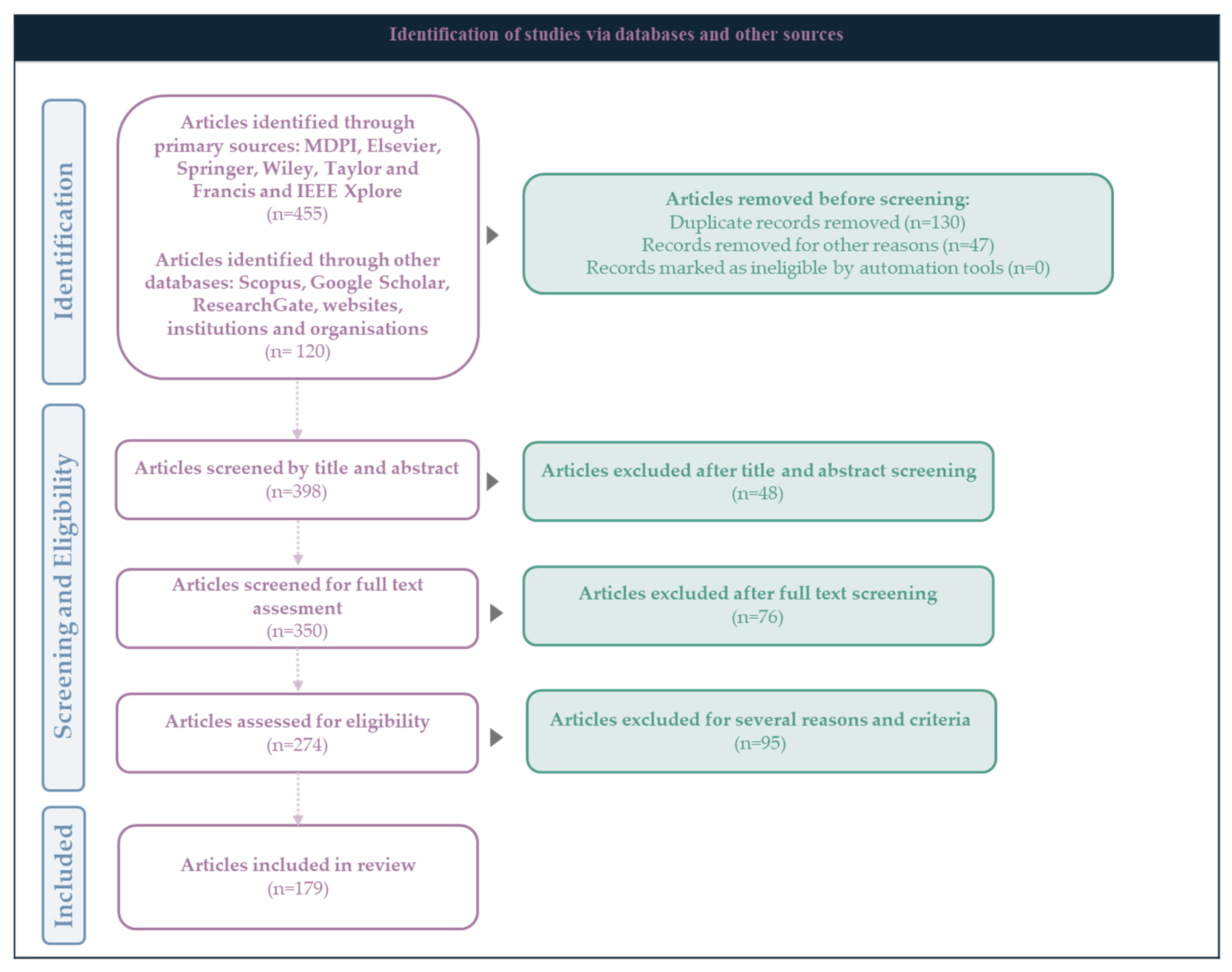
Figure 1. PRISMA flow diagram summarizing study selection process.
Sustainability 18 04819 g001
Figure 2. Abiotic stress at different levels of social and ecological systems.
Sustainability 18 04819 g002
Figure 3. Microclimate and crop responses in open-field vs. agrivoltaic cropping systems.
Sustainability 18 04819 g003
Table 1. Key Characteristics and Performance Factors of Major Agrivoltaic System Configurations.
Inter-Row SystemsElevated Systems with Spacing Between Rows of PanelsVertical Mounting
Systems
Tracking Systems
Key CharacteristicsConventional ground-mounted PV arrays (≈1–1.5 m height) with crop cultivation in wide strips between panel rows.PV panels mounted on elevated structures (≈2–5 m height) allowing crops and machinery to operate underneath.Bifacial panels mounted vertically in north–south rows, capturing morning and afternoon sunlight.PV modules rotate to follow the sun and dynamically regulate shading.
Light
Distribution
Highly heterogeneous; deep shade under panels and full sun between rowsModerately uniform shading depending on panel spacing and orientationMinimal shading at midday; shading occurs morning and afternoonAdjustable; shading can be optimized during crop growth stages
Agricultural CompatibilityModerate; suitable mainly for small machinery or manual cultivationHigh; allows use of standard agricultural machineryHigh; easy machinery movement between rowsHigh; particularly for sensitive crops
Technological ComplexityLowMediumLow–MediumHigh
Typical Investment LevelLowMedium–HighMediumHigh
Key AdvantagesEasy integration into existing solar farms; Low installation cost; Simple design; Can retrofit existing solar farmsMaintains normal farming operations; Potential crop protection from heat and radiation; Good balance between energy and agricultureUniform midday light for crops; Windbreak function; Windbreak effect; Electricity generation aligned with morning/evening demandOptimized solar generation; Dynamic control of crop shading; Potential protection against extreme heat or radiation
Main LimitationsFragmented field layout; Limited mechanization; Uneven crop growth due to light contrastsHigh structural cost; Reduced energy density due to wider spacingLower annual energy yield compared to optimally tilted systems; Requires adequate spacing to maintain crop productivityHigh CAPEX and maintenance requirements; Mechanical complexity; Reliability concerns in agricultural environments
Disclaimer/Publisher’s Note: The statements, opinions and data contained in all publications are solely those of the individual author(s) and contributor(s) and not of MDPI and/or the editor(s). MDPI and/or the editor(s) disclaim responsibility for any injury to people or property resulting from any ideas, methods, instructions or products referred to in the content.