Systematic Review

Adaptive Leadership and Governance Mechanisms in Sustainability-Oriented Inter-Organizational Networks: A Systematic Review and Qualitative Narrative Synthesis


by
António Sacavém
1,2,
Andreia de Bem Machado
3,
João Rodrigues dos Santos
1,2,4,
Ana Palma-Moreira
1 and
Manuel Au-Yong-Oliveira
5,6,*
1
Faculty of Social Sciences and Technology, Universidade Europeia, 1500-210 Lisbon, Portugal
2
Centre for Transdisciplinary Development Studies (CETRAD), University of Trás-os-Montes e Alto Douro (UTAD), 5000-801 Vila Real, Portugal
3
Department of Engineering and Knowledge Management, Universidade Federal de Santa Catarina, Florianópolis 88040-900, Brazil
4
Centro de Estudos e Sondagens de Opinião (CESOP), Universidade Católica Portuguesa (UCP), 1649-023 Lisbon, Portugal
5
Institute for Systems and Computer Engineering, Technology and Science (INESC TEC), University of Porto (FEUP), 4200-465 Porto, Portugal
6
Research Unit on Governance, Competitiveness and Public Policies (GOVCOPP), Department of Economics, Management, Industrial Engineering and Tourism (DEGEIT), University of Aveiro, 3810-193 Aveiro, Portugal
*
Author to whom correspondence should be addressed.
Sustainability 2026, 18(10), 4764; https://doi.org/10.3390/su18104764 (registering DOI)
Submission received: 25 February 2026 / Revised: 21 April 2026 / Accepted: 5 May 2026 / Published: 11 May 2026

Abstract

Background: Leadership in sustainability-oriented inter-organizational networks is increasingly enacted through governance-related practices rather than firm-centric or individualized constructs, reflecting distributed authority, shared accountability, and plural sustainability objectives. Yet scholarship remains conceptually fragmented across adjacent constructs such as orchestration, meta-governance, and brokerage. Objective: This systematic review synthesizes how leadership is conceptualized and enacted through governance mechanisms in inter-organizational networks pursuing sustainability goals. Methods: Peer-reviewed journal articles in English were included; non-peer-reviewed publication types and studies lacking substantive inter-organizational and leadership/governance relevance were excluded. Structured searches were conducted in Scopus and Web of Science Core Collection (last searched 11 February 2026). Results were synthesized through qualitative narrative synthesis using iterative thematic coding and narrative integration. Risk of bias was not formally assessed because the review aimed at conceptual mechanism integration rather than effect estimation; interpretive adequacy safeguards guided inclusion and synthesis. Results: Thirty-one peer-reviewed journal articles were included. Across the corpus, leadership is primarily theorized as (i) orchestration and meta-governance; (ii) governance mechanisms as the formal and informal infrastructure enabling and constraining network leadership; and (iii) brokerage and boundary-spanning practices that align actors and mediate institutional tensions. These dimensions operate as mutually reinforcing layers of coordination capacity, shaping how sustainability trade-offs become governable in the absence of hierarchy. Limitations: Evidence is limited by database-only searching, English-language restriction, and the absence of a formal risk-of-bias appraisal; findings are therefore interpretive and mechanism-oriented rather than effect-based. Conclusions: The review advances a conceptual reframing: leadership in sustainability-oriented inter-organizational networks is best understood not as an actor property but as a systemic coordination capacity embedded in governance architecture. By articulating meta-governance as a design layer, orchestration as a coordination layer, and brokerage as a translation and legitimacy layer, the study develops a multilevel analytical model integrating leadership and governance at the network level, with implications for innovation ecosystems, strategic collaboration, and sustainability transitions.

1. Introduction

In today’s competitive environment, innovation has become a central pillar of strategic management, particularly as organizations face persistent disruption and escalating sustainability expectations [1]. Yet many sustainability-oriented innovations and ESG outcomes cannot be delivered by single organizations acting alone. They increasingly depend on inter-organizational networks (IONs) and collaborative arrangements that mobilize diverse capabilities across firms, public agencies, and civil society [2,3], requiring coordination without a unified hierarchy and under conditions of goal plurality and heightened legitimacy demands [4].
While research on network governance has advanced understanding of how such collaborations are structured and stabilized [2,5], leadership in IONs remains conceptually fragmented, often discussed through adjacent constructs such as orchestration, meta-governance, brokerage, boundary spanning, and network management [6,7,8,9]. This dispersion constrains cumulative theory-building and weakens practical guidance for strategic management in networked settings, particularly where coordination is shaped by rapid technological change, digital transformation, and shifting institutional demands [10,11].
Addressing this gap, this study systematically reviews how leadership is conceptualized and enacted through governance mechanisms in sustainability-oriented IONs, following established guidance for evidence-informed management review [12] and PRISMA 2020 reporting [13]. Through a qualitative narrative synthesis, the review clarifies core mechanisms and supports future theory development at the intersection of governance, networks, and strategic management. Accordingly, this research addresses the following problem: how is leadership conceptualized and enacted through governance mechanisms in inter-organizational networks pursuing sustainability goals, and what does this imply for building coordination capacity when authority is distributed and sustainability objectives are plural? The objective of the study is to systematically review and conceptually integrate the literature at the intersection of network governance, strategic management, and sustainability studies, clarifying the governance mechanisms through which leadership is enacted and developing an integrative multilevel model that reframes leadership as a systemic coordination capacity embedded in governance architecture.
The remainder of the article is organized as follows. Section 2 develops the theoretical background by situating leadership in sustainability-oriented networks as coordination without hierarchy and discussing orchestration, meta-governance, and relational work, alongside the formal and informal governance infrastructures that condition network leadership. Section 3 details the systematic review methodology and the qualitative narrative synthesis approach. Section 4 presents and discusses the results, reports the selection process, and synthesizes the evidence into three integrative themes that underpin the proposed framework. Section 4.8 outlines the theoretical and practical implications for research on innovation ecosystems, strategic collaboration, and sustainability transitions. Section 4.9 discusses limitations and proposes directions for future research. Section 5 concludes by summarizing the main contributions and the value of an integrated governance perspective on leadership in sustainability-oriented inter-organizational networks.

2. Theoretical Background

2.1. Leadership in Sustainability-Oriented Inter-Organizational Networks: Coordination Without Hierarchy

Sustainability-oriented inter-organizational networks (SIONs) represent collaborative arrangements in which multiple organizations jointly pursue environmental, social, and governance objectives that extend beyond the boundaries of each company [2]. Unlike traditional hierarchical organizations, these networks operate under distributed authority, in which decision-making power is shared among network participants, without relying on a single central actor [14]. This structural feature reflects the multi-stakeholder nature of sustainability initiatives, often involving public institutions, private companies, non-governmental organizations, and communities, each with distinct interests, capacities, and legitimacy [1]. Practical experience shows that strategic alliances can integrate environmental and social objectives in innovative ways, as evidenced by the Cleveland Ecovillage, where different organizations collaborated to develop green, affordable housing, demonstrating that network coordination enables simultaneous resource efficiency and social impact [15].
A defining feature of SIONs is their plurality of objectives. Network actors pursue overlapping yet potentially divergent goals, including carbon emission reduction, transitioning to a circular economy, social inclusion, and ethical supply chain practices [10]. This multiplicity of objectives creates coordination challenges, requiring actors to negotiate trade-offs and reconcile conflicting priorities without resorting to formal hierarchical authority [3]. In practice, these challenges manifest themselves as tensions between short-term operational goals and long-term sustainability commitments, differences in organizational resources and capabilities, and the need to balance efficiency with inclusion in decision-making [4]. Interorganizational learning is also a critical component of these networks, as knowledge sharing between organizations facilitates adaptation to complex challenges and promotes best practices in sustainability [1], while strengthening the network’s capacity for innovation and resilience [2,16].
Scholarly attention to SIONs has evolved substantially over the past two decades. Early research (late 1990s–2000s) emphasized structural and transactional aspects of network governance, focusing on modes, boundaries, and hierarchical vs. market alternatives [2,17]. From the 2010s onward, the literature shifted toward relational, processual, and practice-based perspectives, recognizing that sustainability goals rarely fit pre-designed structures and that coordination depends on both formalized structures (e.g., steering committees, memoranda of understanding, contractual agreements) and informal practices (trust building, shared norms, peer influence) [9,18]. More recently, research published in the 2020s has foregrounded hybrid coordination under conditions of digital transformation, transition pressures, and ESG accountability, with growing attention to how circular economy configurations and blockchain-based governance reshape the mechanisms through which sustainable innovation is coordinated [10,11]. This evolution sets the stage for examining leadership not as a stable positional attribute but as a practice embedded in an increasingly hybrid and digitally mediated governance infrastructure.

2.2. Leadership in Inter-Organizational Networks as Practice: Orchestration, Meta-Governance, and Relational Work

Leadership in IONs differs significantly from company-centered models. Rather than emanating from a single hierarchical position, leadership in networks is exercised through practices that shape coordination, influence, and collaboration [6,7]. Three interrelated leadership logics stand out in sustainability-oriented networks: orchestration, meta-governance, and relational work.
Orchestration refers to the facilitative coordination of network activities, aligning actors, resources, and processes around shared goals. Orchestrators, often referred to as network managers or coordinators, play a central role in setting agendas, designing collaborative routines, and monitoring progress, without relying on formal authority. By selectively mobilizing resources and expertise, orchestrators create conditions for joint problem-solving and promote adaptive learning within the network [18,19]. Leadership in networks also fosters co-creation of value among actors, enabling participating organizations to develop stronger strategic relationships and increase their collective competitiveness, as evidenced in inter-organizational networks in the nautical industry [20].
Meta-governance broadens this perspective by emphasizing the design and management of governance structures that balance autonomy and accountability among actors. Meta-governors exercise leadership by establishing norms, rules, and boundaries that guide interactions, mediate conflicts, and promote alignment with overall sustainability goals [5,21]. Unlike orchestration, which focuses on specific projects or activities, meta-governance addresses the broader architecture of network functioning, ensuring that coordination mechanisms are coherent and resilient in the face of changes in participation or context [5,22]. Relational work, which includes boundary spanning and brokerage practices, encompasses interpersonal and inter-organizational activities through which leaders build trust, manage conflicts, and integrate diverse perspectives [8,23]. Boundary spanning connects actors across institutions, sectors, and regions, facilitating knowledge exchange, legitimacy building, and coordinated mobilization of multiple stakeholders [9]. Brokerage practices enable leaders to identify structural holes in the network and strategically connect otherwise disconnected actors, thereby facilitating knowledge exchange and resource mobilization [21,24].
The conceptualization of leadership in IONs has itself evolved over time. Heroic, firm-centric models dominant in earlier strategic management research gave way, from the mid-2000s onward, to distributed, shared, and relational accounts of leadership [25,26]. Network-focused scholarship in the 2010s consolidated orchestration and meta-governance as leadership logics appropriate for distributed authority [5,9], while the 2020s have extended this trajectory by reframing leadership as a collective and governance-embedded practice operating across interorganizational, digital, and multi-level sustainability contexts [6,7]. Collectively, these shifts highlight the performative, distributed, and emergent nature of leadership in sustainability-oriented IONs.

2.3. Leadership Enactment Through Governance Mechanisms in IONs: Formal and Informal Infrastructures

Governance mechanisms constitute the structural and procedural infrastructure through which leadership in inter-organizational networks is operationalized. These mechanisms range from formal instruments, such as contracts, governance boards, reporting standards, and performance metrics, to informal practices, such as norms, routines, shared language, and trust building [27]. By structuring interactions, distributing responsibilities, and clarifying expectations, governance mechanisms enable leaders to coordinate activities and manage sustainability trade-offs without resorting to hierarchical control [28,29].
Formal mechanisms offer predictability and accountability, ensuring that roles, procedures, and performance benchmarks are clear to all actors. They are especially relevant in collaborations between different sectors, where legal, financial, and regulatory obligations need to be harmonized [30]. Informal mechanisms, on the other hand, promote adaptive coordination, relational embeddedness, and collective meaning-making. Through repeated interactions, socialization, and negotiation, actors develop shared interpretations of goals, acceptable behaviors, and viable commitments, strengthening network cohesion and flexibility, while emerging tools such as blockchain can assist in mitigating dysfunctional effects and reinforcing relational transparency, trust, and resilience [2,5,17].
The interaction between leadership practices and governance mechanisms is central to understanding network performance. Orchestration, meta-governance, and relational work are performed through these mechanisms: formal structures codify responsibilities and monitor results, while informal infrastructures facilitate trust, alignment, and conflict resolution [31]. This capacity for multi-layered coordination allows networks to navigate the complexity of sustainability goals, enabling collective action in contexts characterized by distributed authority, plurality of objectives, and inter-organizational diversity [32]. Building on this, the theoretical literature positions leadership in IONs as practice-based, relational, and embedded in governance, while governance mechanisms function both as enabling infrastructure and as the means through which leadership influence becomes effective [33]. This integrated perspective provides the conceptual basis for analyzing how inter-organizational networks operationalize sustainability goals in complex, multi-actor environments [7,33].

3. Methodology

3.1. Review Design and Research Question

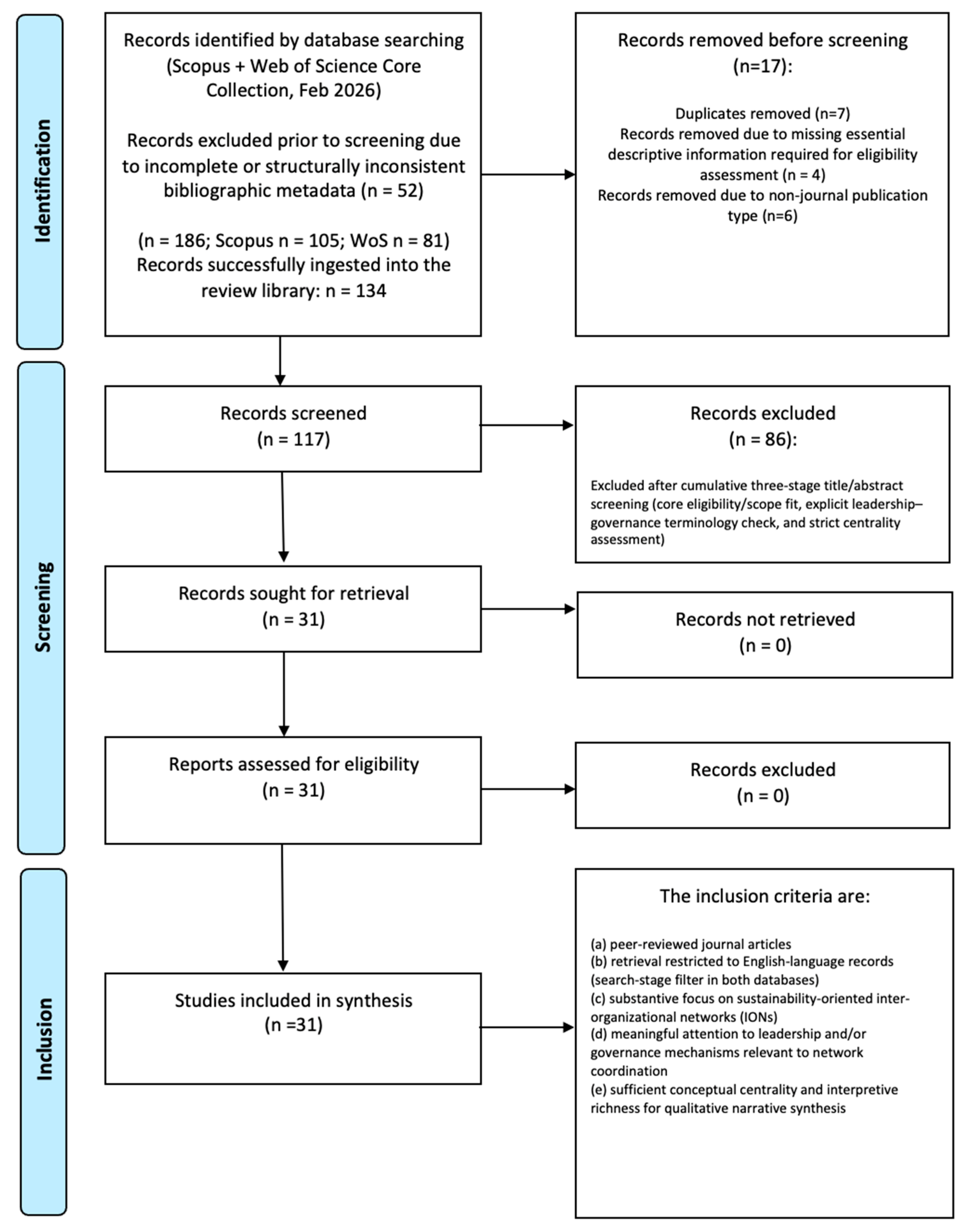
This study reports a systematic review designed to consolidate and conceptually integrate research on leadership and governance in sustainability-oriented inter-organizational networks. The review is reported in conformity with PRISMA 2020 guidance [13] and adopts a qualitative, narrative (conceptual) synthesis approach, reflecting the conceptual heterogeneity of the field and the tendency for leadership in networks to be articulated through adjacent constructs (e.g., orchestration, coordination, facilitation, boundary spanning, brokerage, network management, and meta-governance) rather than a single stable label. The PRISMA flow diagram is presented in Figure 1 and provided in the Supplementary Materials together with the completed reporting checklist, documenting the study-selection process. The review protocol was not prospectively registered (e.g., PROSPERO/OSF), and no standalone protocol document was publicly deposited. However, the core methodological decisions (research question, eligibility criteria, search strategy logic, staged screening rules, extraction framework, and synthesis approach) were specified a priori and applied consistently throughout the review process. Given the review’s aim, the synthesis targets conceptual integration and mechanism-oriented insights rather than effect estimation or causal claims. The review was guided by the following research question: How is leadership conceptualized and enacted through governance mechanisms in inter-organizational networks pursuing sustainability goals? To minimize construct under-detection, leadership was operationalized broadly to include both explicit leadership framings and network-relevant functional equivalents that organize joint activity in settings with distributed authority.

3.2. Information Sources and Search Strategy

The evidence base was retrieved using structured searches in Scopus and Web of Science Core Collection. These databases were selected for their broad coverage of peer-reviewed management, governance, and sustainability scholarship and for their suitability for systematic retrieval using structured Boolean logic. Searches were conducted on 11 February 2026. No date-range restrictions were applied. Database-specific Boolean expressions were used, combining three concept blocks: inter-organizational networks; leadership and leadership-adjacent governance constructs; and sustainability. Queries were applied to standard topical discovery fields (title, abstract, and keywords), using a TITLE-ABS-KEY configuration in Scopus and a TS configuration in Web of Science Core Collection. To support reproducibility, the database-specific Boolean search strings applied to title/abstract/keyword discovery fields were reported in full, line-by-line, as follows. In Scopus (Document Search), the query was executed using: TITLE-ABS-KEY (“interorganizational network*” OR “inter-organisational network*” OR “interfirm network*” OR “network governance”) AND TITLE-ABS-KEY (leadership OR governance OR orchestration) AND TITLE-ABS-KEY (sustainability OR “sustainable development” OR ESG). In Web of Science Core Collection, the query was executed using: TS = ((“interorganizational network*” OR “network governance”) AND (leadership OR governance OR orchestration) AND (sustainability OR ESG)). Given the risk of over-restriction inherent in multi-block Boolean search designs, adjacent constructs such as brokerage, boundary spanning, and meta-governance were not included as independent search blocks. Instead, they were intentionally captured through the leadership and governance terms and subsequently identified during inclusive screening to avoid premature exclusion due to terminological variation across studies. Search-stage language filters were applied in both databases to restrict retrieval to English-language records. In addition, search-stage document-type limits were applied in both databases to restrict retrieval to peer-reviewed journal articles. No additional information sources (e.g., trial/study registers, organizational websites, or systematic grey literature repositories) were searched; this decision reflects the review’s focus on peer-reviewed conceptual and empirical scholarship, and is acknowledged as a potential source of retrieval bias in the limitations.

3.3. Eligibility Criteria

Eligibility criteria were defined a priori. Studies were included if they were peer-reviewed journal articles with a substantive focus on inter-organizational networks pursuing sustainability goals and with meaningful attention to leadership and/or governance mechanisms relevant to network coordination. Studies were excluded if they did not meet the predefined eligibility criteria, including non–peer-reviewed publication types (e.g., books, book chapters, conference proceedings, editorials) or studies lacking substantive inter-organizational and governance relevance. For synthesis purposes, all included studies contributed to a single qualitative narrative synthesis. To support systematic cross-study comparison and integrative theme development, studies were organized into analytically coherent clusters based on shared conceptual focus and comparable coordination/governance logics, guided by the review question and the predefined extraction framework.

3.4. Selection Process

Records were exported in RIS format, consolidated into a single review library, and cleaned prior to screening (deduplication and removal of records with insufficient bibliographic metadata, alongside verification of document type where needed) to ensure consistent record counting and traceability. An AI-assisted tool was used solely to facilitate operational tasks (e.g., record handling, field structuring, and first-pass extraction suggestions). Importantly, this support was strictly assistive: the authors retained full responsibility for the identification log, all record-management decisions (including deduplication choices), all eligibility and inclusion decisions, and the interpretive synthesis. The tool did not make inclusion/exclusion decisions and was not used to generate the synthesis. In PRISMA terms, the tool functioned as workflow support rather than an automation tool for study selection: all screening and inclusion/exclusion judgments were made by human reviewers. Title/abstract screening was intentionally inclusive to avoid premature exclusions given construct ambiguity and terminological dispersion. The final synthesis set was identified through a staged, author-led narrowing procedure implemented via three successive decision columns: a scope-fit assessment (core eligibility), a terminology-based specificity check assessing whether papers used explicit leadership–governance constructs relevant to network coordination (e.g., leadership, governance mechanisms, orchestration, meta-governance, brokerage, boundary spanning), irrespective of whether these constructs were central to the paper’s main argument; and a final strict centrality step assessing whether leadership–governance dynamics were the primary analytical focus and conceptually rich enough to support qualitative narrative synthesis (final core, strict). Two reviewers independently screened each record and report; screening disagreements were resolved through discussion until consensus was reached. Full texts were retrieved only for the studies retained after the cumulative three-stage title/abstract screening (n = 31). All reports sought for retrieval were obtained (reports not retrieved = 0), as shown in Figure 1. Because conceptual centrality had already been determined at the abstract level, full-text review served primarily to support extraction and interpretive accuracy rather than to apply additional eligibility filters. Eligibility criteria remained unchanged; full-text assessment verified eligibility and interpretive adequacy rather than introducing new exclusion rules. Nevertheless, each retrieved full text was assessed for eligibility and interpretive adequacy against the predefined inclusion criteria; no additional exclusions were made at full-text stage (as reported in the PRISMA flow diagram—Figure 1).

3.5. Data Extraction

Data extraction prioritized analytically central fields capturing leadership conceptualization, governance mechanisms, network characteristics, and sustainability goals, supported by short contribution summaries that facilitated thematic coding. The data extraction template/codebook was piloted on 10 included studies and refined before full extraction to improve consistency and reduce ambiguity in field definitions. Data extraction was performed by one reviewer and verified by a second reviewer; disagreements were resolved by discussion. No study investigators were contacted to obtain or confirm information. Data items were defined a priori and operationalized in the piloted extraction template. As the review did not aim to estimate effects, no outcome domains or effect measures were specified; extraction instead focused on study descriptors and the conceptual evidence needed to characterize leadership–governance coordination mechanisms in sustainability-oriented inter-organizational networks, including relevant contextual qualifiers and boundary statements. Accordingly, no effect measures were computed. Where multiple eligible passages existed within a report, the most central were prioritized and logged with brief justification notes to preserve traceability.

3.6. Synthesis Approach and Interpretive Adequacy

Synthesis followed an iterative thematic coding and narrative integration approach consistent with established qualitative synthesis methods [34,35,36], involving full-text familiarization, inductive coding, consolidation into higher-order themes, and integrative narrative development; constant comparison and attention to deviant cases refined theme boundaries and minimized over-generalization. To reduce interpretive subjectivity in a conceptually heterogeneous field, two reviewers independently conducted screening, with disagreements resolved by discussion until consensus; data extraction was performed by one reviewer and verified by a second; the extraction template was piloted on ten studies and refined before full extraction; and the criterion of conceptual centrality was operationalized through the three-stage screening logic (scope fit, explicit leadership–governance terminology, and strict centrality) rather than left as an open judgment call. These procedural safeguards aimed to make reviewer judgment traceable and inter-subjectively reproducible across the conceptual heterogeneity of the corpus. Consistent with established guidance on narrative synthesis and evidence-informed systematic reviews, risk-of-bias tools are primarily intended to appraise threats to causal inference and effect estimation, whereas this review integrates conceptually heterogeneous evidence to generate mechanism-oriented propositions rather than pooled effects. Therefore, instead of applying a formal risk-of-bias tool, the review operationalized “interpretive adequacy” safeguards embedded in the staged screening and extraction logic: (i) peer-reviewed journal status; (ii) clear identification of the inter-organizational network context and unit of analysis; (iii) explicit conceptualization of leadership/governance mechanisms relevant to coordination; and (iv) sufficient conceptual centrality and interpretive richness to support qualitative narrative synthesis. These safeguards are consistent with narrative synthesis guidance and systematic review methodology adapted to management and organizational evidence [12,37,38]. No formal assessment of reporting bias due to missing results (e.g., publication bias, selective reporting) was performed, as the synthesis was non-quantitative and did not rely on effect-size aggregation; however, potential retrieval and publication biases (database-only searching, English-language restriction, peer-reviewed-only inclusion) are acknowledged as limitations. Likewise, no formal certainty-of-evidence system (e.g., GRADE) was applied because the review aim was conceptual mechanism integration rather than outcome certainty grading. In theory-building and interpretive systematic reviews, appraisal tools designed for empirical effect estimation are not methodologically aligned with the objectives of mechanism-oriented synthesis [39]. All extracted fields were manually reviewed and corrected by the authors to ensure that synthesis inputs reflected the full-text meaning rather than metadata-only interpretations. No amendments were made to the review methods after initiation. As the review was not registered and no protocol was deposited, no protocol/registration amendments apply.

4. Results and Discussion

The results are presented in line with the PRISMA 2020 reporting structure to ensure full disclosure and traceability of the study-selection process. Figure 1 summarizes the record journey from identification to inclusion, including pre-screening cleaning steps and the staged, author-led narrowing procedure applied to isolate conceptually central evidence. The final synthesis set comprises 31 studies, listed in Table 1, whose distribution across domains, geographies, and time is described in Section 4.3 and whose contributions are synthesized across the three integrative themes developed in the subsequent subsections.

4.1. Identification

Database searching returned 186 records in total (105 from Scopus and 81 from Web of Science Core Collection). Records were exported in RIS format and consolidated into a single review library. Following export and consolidation, records with incomplete or structurally inconsistent bibliographic metadata were excluded prior to screening (n = 52) (see Figure 1). This resulted in 134 records being successfully ingested into the review library. The remaining records were then cleaned and prepared for screening. Prior to title/abstract screening, 7 duplicates were manually removed, 4 records were excluded due to missing essential descriptive information required for eligibility assessment, and 6 records were removed because they were not peer-reviewed journal articles (e.g., book chapters and conference proceedings) despite the search-stage restrictions. Residual non-journal records were removed during cleaning due to database indexing inconsistencies. This resulted in 117 records being retained for title/abstract screening. An AI-assisted tool supported record handling and structuring during this phase; however, the authors remained responsible for the identification log and all record-management decisions.

4.2. Screening and Eligibility

The 117 records retained after initial cleaning were screened at the title/abstract level through a staged, author-led narrowing procedure. Screening was intentionally inclusive at the outset to avoid premature exclusion due to construct ambiguity, given that leadership in inter-organizational networks is frequently articulated through adjacent terminology (e.g., orchestration, coordination, brokerage, boundary spanning, and meta-governance). Three sequential screening criteria were applied cumulatively to ensure conceptual precision while retaining potentially relevant studies. First, a core eligibility (scope-fit) assessment was conducted to verify whether the study addressed inter-organizational networks in a sustainability context and contained relevant leadership and/or governance content (41 records excluded; 76 remaining). Second, an explicit leadership–governance terminology check assessed whether the paper used identifiable constructs relevant to network coordination (e.g., leadership, governance mechanisms, orchestration, meta-governance, brokerage, boundary spanning), irrespective of whether these constructs were yet central to the argument (16 records excluded; 60 remaining). Third, a strict centrality assessment retained only those studies in which leadership–governance dynamics constituted the primary analytical focus and were sufficiently conceptually developed to support qualitative narrative synthesis (29 records excluded; 31 studies retained). Eligibility judgments at each stage were conducted manually by the authors. This cumulative screening design was intended to preserve conceptual richness while progressively reducing false positives, particularly in cases where sustainability networks were present but leadership–governance integration was peripheral, implicit, or insufficiently developed. In line with PRISMA 2020 reporting, full texts were then sought for retrieval for the 31 records retained after screening (reports sought for retrieval, n = 31). All reports were successfully retrieved (reports not retrieved, n = 0) and assessed at full text for eligibility and interpretive adequacy (reports assessed for eligibility, n = 31). No further exclusions occurred at the full-text stage (reports excluded, n = 0) (see Figure 1). These 31 studies therefore constituted the final analytical corpus. Structured data extraction was conducted to support accurate interpretation and thematic integration. Extraction was organized using predefined analytical fields capturing: (i) leadership conceptualization; (ii) governance mechanisms and coordination modes; (iii) network characteristics and structural features; and (iv) sustainability objectives and performance framings. Short analytical summaries were prepared for each study to facilitate cross-case comparison and the identification of thematic patterns. These extraction fields served solely for analytical purposes and did not serve as additional eligibility filters. An AI-assisted tool supported workflow organization and first-pass extraction structuring; however, all interpretive judgements, coding decisions, and thematic synthesis were conducted manually by the authors.

4.3. Inclusion

The final inclusion criteria, operationalized through the staged screening procedure, required that studies: (a) be peer-reviewed journal articles; (b) be published in English (as restricted at the search stage); (c) substantively address sustainability-oriented inter-organizational networks as the primary unit of analysis; (d) demonstrate meaningful engagement with leadership and/or governance mechanisms relevant to network coordination; and (e) exhibit sufficient conceptual centrality and interpretive richness to support qualitative narrative synthesis. The 31 retained studies formed the evidentiary basis for qualitative narrative synthesis. As no additional exclusions occurred following full-text review, inclusion corresponded directly to the final screening outcome (see Figure 1). Synthesis proceeded through iterative comparison of leadership conceptualizations, governance mechanisms, coordination configurations, and sustainability framings across cases. Rather than aggregating findings quantitatively, the analysis sought to identify recurring patterns, conceptual convergences, and explanatory complementarities. This interpretive integration enabled the development of the three integrative themes presented in Section 4.4, Section 4.5, Section 4.6 and Section 4.7 and the articulation of leadership as a systemic coordination capacity embedded in governance architecture. Table 1 provides the full list of included studies to ensure transparency and traceability of the evidence base.
A substantive implication of the selection process is that leadership in sustainability-oriented inter-organizational networks is seldom conceptualized as a firm-centric or individualized leadership construct. Instead, across the screened literature, leadership predominantly appears as a relational and governance-embedded set of practices and mechanisms that enable collective action in the absence of hierarchical authority. The narrowing steps were therefore calibrated to detect leadership both when explicitly labelled and when operationalized through network-specific constructs, while progressively tightening the inclusion boundary to ensure that governance and leadership were analytically central rather than incidental. As a result, the final corpus is positioned to illuminate how governance arrangements and leadership practices co-produce coordination capacity, legitimacy, and sustained collaboration in the context of sustainability complexity.
Before proceeding to the integrative themes, a descriptive overview of the corpus clarifies how the 31 included studies distribute across domains, geographies, and time, and how they were analytically clustered for synthesis. Table 2 summarises this characterisation across two panels (geographic distribution and temporal distribution), while the sectoral distribution is described narratively below. Geographically, the corpus spans all inhabited continents: Europe is the most represented region (approximately one-third of studies, including the Netherlands, Denmark, Sweden, Spain, the UK, Scotland, Germany, and Italy), followed by Asia (China, India, Iran, Cambodia, Indonesia, Azerbaijan), the Americas (Brazil, USA, Chile), Africa (South Africa), and Oceania (Australia), complemented by a notable subset of cross-regional or global studies (e.g., soy–meat commodity chains, SDG-oriented digital networks, comparative circular economy analyses). Sectorally, the studies cluster into six recurrent domains: environmental and natural-resource governance (water, conservation, rivers, climate, energy); health and care networks; circular economy, supply chains, and digital platforms; agricultural, rural and local development; public administration, entrepreneurial ecosystems, and social innovation; and cross-cutting and comparative governance studies. Temporally, publications concentrate in the last decade (2015–2026), with a marked acceleration from 2019 onward, reflecting intensified scholarly attention to sustainability-oriented coordination and to the integration of leadership and governance constructs. Recurrent keywords across the corpus include network governance, orchestration, meta-governance, brokerage, boundary spanning, collaborative capacity, circular economy, and sustainability transitions—consistent with the terminological dispersion that motivated this review.
To support cross-case analysis, studies were analytically clustered along three complementary dimensions derived from the predefined extraction framework: (i) dominant leadership construct (orchestration, meta-governance, brokerage/boundary spanning, or hybrid combinations); (ii) governance mechanism emphasis (predominantly formal, predominantly informal, or explicitly hybrid); and (iii) network setting (intra-sector, cross-sector, digitally mediated, or multi-level/polycentric). These clusters were not treated as mutually exclusive categories but as analytical lenses that enabled systematic comparison across cases, surfaced patterns of convergence and divergence, and traced how each study (listed in Table 1 and distributed as shown in Table 2) contributed to one or more of the three synthesis themes developed below. Across the corpus, most studies contributed to more than one theme. Orchestration and meta-governance (Theme 1) figured centrally in polycentric and transition settings, including water security [41], climate governance [21], shale-gas policy [48], circular economy [44,55], smart governance [46], and digital innovation networks [57,58]. Governance mechanisms as infrastructure (Theme 2) featured most strongly in healthcare and care networks [42,49,63,64], conservation [43], river corridor governance [68], and public-service collaborations [49,59,60], where formal arrangements and informal trust mechanisms jointly sustain coordination. Brokerage and boundary spanning (Theme 3) emerged as pivotal in multi-level, cross-sector, and digitally mediated contexts where legitimacy and translation across institutional logics are contested, including agri-environment innovation [40], social innovation [67], voluntary environmental collaboration [61], supply chains [52,56], and transition intermediation [57,58]. The cross-case pattern is one of recurrent co-occurrence rather than clean partition: the same studies often illustrate more than one theme, which is consistent with the recursive interaction among design, coordination, and boundary-spanning layers discussed in Section 4.7.
The qualitative narrative synthesis generated three integrative themes that collectively explain how leadership is conceptualized and enacted through governance mechanisms in sustainability-oriented inter-organizational networks. Together, these themes organize the included evidence into a coherent explanatory architecture aligned with the review question and provide the conceptual foundation for the integrative framework developed in the subsequent section.

4.4. Theme 1—Leadership as Orchestration and Meta-Governance in Sustainability-Oriented Networks

Across the corpus, leadership in sustainability-oriented inter-organizational networks is consistently conceptualized not as positional authority but as an orchestrating and meta-governing capacity to convene autonomous actors, align problem interpretations, and stabilize coordination under distributed authority and contested sustainability objectives [14,38,39,68]. This framing appears across domains, from agriculture and biodiversity conservation to water security and climate governance, where sustainability outcomes depend on cross-boundary coordination [21,40,41,53]. Leadership is operationalized as creating the conditions for collective action: establishing shared frames, workable decision pathways, and coordination processes that preserve actor autonomy while enabling mutual adjustment [41,42,43]. Orchestration constitutes a practice-based repertoire through which leadership reduces ambiguity by structuring interaction and sequencing activity. In environmental innovation networks, leaders connect participants, broker knowledge, and frame interaction processes to transform heterogeneous actors into a minimally coherent innovation system [40]. Social-innovation networks similarly depict orchestrators as designing collaborative arenas, translating problems across stakeholder groups, and legitimizing initiatives to sustain participation [67]. In formal partnerships and service networks, orchestration involves sustaining network functioning through dedicated managerial roles and ongoing coordination [49,53]. Health and care networks illustrate how sequencing meetings, maintaining documentation, and organizing feedback loops enable collaboration to withstand operational pressures while remaining oriented toward integrated outcomes [63,64]. Across cases, orchestration is where leadership becomes visible in distributed authority contexts: configuring attention, interaction, and workflow rather than issuing directives [40,63,67]. Meta-governance complements orchestration by capturing leadership’s capacity to design, combine, and recalibrate governance arrangements when sustainability goals span institutional spheres and policy domains. In water security, leadership is framed as “metagovernance of modes,” coordinating hierarchical, market, and network governance to sustain adaptive capacity under uncertainty [41]. SDG-era health governance similarly emphasizes stewardship coupled with policy brokerage to align ministries, sectors, and stakeholders around intersectoral objectives [42]. In sustainability transitions, political leadership is conceptualized as steering legitimate multi-actor processes toward climate objectives [21], while in resource-intensive regional economies, mixed public–private steering configurations illustrate how state authority and private influence interact through market design and framing strategies [48]. Collectively, these studies position meta-governance as leadership that steers the conditions of network governance—selecting tools, shaping decision-making processes, and balancing governance modes so that sustainability remains attainable amid complexity [21,41,48,69]. A further dimension concerns agenda-setting and framing, through which leadership aligns interpretations of sustainability problems and manages trade-offs among plural objectives. Leadership often begins by defining “what the network is for,” via early objective-setting and selective design activities that provide direction but may narrow participation if not reflexively managed [40]. In conservation networks, a lead organization can anchor collaboration and align landscape-level governance with ecological realities across administrative boundaries [42]. Circular economic initiatives show that mobilizing actors around a coherent strategic vision is critical; weak mobilization risks symbolic rather than transformative outcomes [43]. Digital platform-based orchestration embeds agenda-setting in inclusive governance and knowledge-management arrangements that coordinate heterogeneous actors under regulatory constraints [55]. In supply-chain contexts, leadership recalibrates alignment across tiers to integrate resilience and responsibility into shared governance beyond firm boundaries [56]. Framing is therefore both infrastructural and interpretive, translating goals into participation rules, monitoring systems, and coordination structures that render trade-offs governable [21,41,63]. Throughout, orchestration and meta-governance operate through a hybrid governance infrastructure that combines formal structures—decision rights, agreements, steering bodies, and monitoring routines—with informal mechanisms—trust, norms, legitimacy work, and socialization—to sustain coordination over time. This hybridity is visible across conservation, care, community, and rural governance contexts [43,62,64,65,66]. In market-dominated commodity chains, overcoming gridlock depends on leadership capacities to reframe problems and recombine governance mechanisms so that information, resources, and trust circulate across fragmented constellations [52]. These practices operate within and through governance infrastructure, which is examined more explicitly in Theme 2.

4.5. Theme 2—Governance Mechanisms as the Infrastructure That Enables and Constrains Network Leadership

Across the included studies, governance is best understood as the structural and relational infrastructure that makes leadership possible in sustainability-oriented networks under distributed authority, because it defines how actors coordinate, who can decide, how accountability operates, and how legitimacy and commitment are sustained over time [38,49,59]. This infrastructure is consistently hybrid, combining formal mechanisms—decision rights, accountability arrangements, procedural routines, monitoring systems, formal agreements—with informal mechanisms—trust, norms, socialization, and legitimacy work—so that leadership operates through steering rather than command [40,43,45,64]. In complex cross-sector settings, the governance mix itself becomes a leadership object. Water security governance demonstrates that effective steering requires combining hierarchical, market, and network modes, as no single mode can address uncertainty and interdependence alone [41]. Meta-governance research similarly describes repertoires of authority-based, informational, and economic instruments, coupled with process design, that condition how leadership operates indirectly through governance configurations [69]. Leadership effectiveness thus depends on whether governance infrastructure provides sufficient “minimum structure” (clear roles, decision pathways, monitoring) while preserving adaptive capacity for contested and evolving sustainability goals [42,46,65]. Formal governance elements enable leadership by clarifying responsibilities and reducing ambiguity. Conservation collaboration institutionalizes coordination through agreements and explicit decision rights [43]; health and care networks rely on structured agendas, documentation, and coordinating bodies to sustain long-term collaboration [63,64]; public service partnerships show that resourcing network infrastructure itself stabilizes leadership continuity [49]. Yet formalization alone may constrain leadership when inclusiveness, adaptability, or deliberative quality weaken. Climate governance illustrates how strong accountability may coexist with limited voice [21]; narrow early design in agro-ecosystem networks can undermine mobilization [40]; and circular economy initiatives risk ceremonial outcomes where governance fails to mobilize participants [44]. Leadership is thus enabled when governance creates a credible basis for joint action—clarity, resources, routines—but constrained when formal structures lack relational grounding [21,40,44]. The informal dimension—trust, norms, and legitimacy work—recurrently stabilizes cooperation where authority is distributed. Conservation networks emphasize ethical conduct and open communication [43]; science and technology networks require adaptive communication processes to sustain orchestration [45]; river corridor governance highlights informal collaboration and shared legitimacy norms [68]; and social innovation networks foreground relational acceptance as central to participation [67]. These findings align with broader network governance accounts in polycentric contexts [41]. Governance infrastructure varies with network form and challenge complexity, reinforcing contingency rather than universal design. Multi-level policy domains require adaptive structures, brokerage capacity, and monitoring platforms [41,42]. Local transition networks depend on intermediaries and learning capacity [59]; knowledge brokerage initiatives combine local champions with top-down support [60]; voluntary environmental collaboration distributes leadership across state and non-state actors [61]; market-dominated supply chains risk gridlock without credible information exchange and shared-vision work [52]; and sustainability standards embedded in governance routines enable coordinated redesign [55]. Digital-era networks further illustrate inclusive governance and knowledge infrastructures that support circular and SDG-oriented innovation [55,57], while comparative circular economy research highlights alignment between public capacity and transformation complexity [53]. In sum, governance infrastructure both enables and constrains network leadership. When decision rights, accountability, monitoring, and relational foundations align with network form and challenge complexity, leadership can translate sustainability intentions into coordinated action; when misaligned, networks risk drift, ceremonialism, conflict, or gridlock [21,40,41,44,46,51,69]. Governance mechanisms not only enable leadership but are themselves reshaped through leadership practices over time.

4.6. Theme 3—Brokerage and Boundary Spanning as Leadership Practices for Alignment, Legitimacy, and Conflict Management

If Theme 1 emphasized how leadership structures coordination and Theme 2 how governance infrastructure enables it, Theme 3 shows how leadership sustains alignment across institutional boundaries. Brokerage operates at the interface of institutional difference and conflict, emerging as a core leadership practice through which sustainability-oriented networks remain workable despite heterogeneous mandates and interpretations of sustainability performance [21,41,48]. Because actors are interdependent yet autonomous, coordination relies on boundary-spanning roles that cross institutional spheres and stabilize action amid ambiguity [41,47]. Brokerage is enacted through connecting, framing, and knowledge-transfer practices that align dispersed actors around workable objectives [40,67]. Agri-environment innovation networks, social-innovation collaborations, and policy domains illustrate brokerage as sustaining shared direction, mobilizing resources, and mediating trade-offs [40,42,67]. In polycentric water governance, a meta-governor spans governance modes and administrative levels rather than leading through command [41]. Conservation networks show boundary spanning, aligning ecological realities with fragmented jurisdictions while sustaining legitimacy through trust and ethical conduct [43]. Health and care collaborations further demonstrate brokerage as stabilizing legitimacy and participation beyond formal routines [63,64]. Knowledge-based improvement networks rely on local champions who translate program intent into local practice [60], while transition intermediaries foster learning and shift decision-making rights in municipal sustainability change [59]. Brokerage thus reduces coordination failure risk by translating broad ambitions into workable routines [59,60]. Under asymmetric power, brokerage becomes central to managing legitimacy. Climate governance highlights the challenge of reconciling democratic expectations with effective steering [21]. Voluntary environmental collaborations illustrate facilitative brokerage within enabling state contexts [61], while collaborative delivery settings require managing unity–diversity tensions to avoid fragmentation [62]. Digitally mediated and multi-tier contexts extend brokerage beyond interpersonal mediation. Circular economy platforms embed bridging in socio-technical infrastructures [55]; multi-tier supply chains require aligning resilience and responsibility expectations across stakeholders [57]; and transnational SDG-oriented digital networks rely on digital trust infrastructures translating global missions into locally legitimate practices under dispersed authority [58]. Taken together, brokerage and boundary spanning function as practical leadership mechanisms through which sustainability-oriented networks achieve alignment, legitimacy, and conflict management. They translate across institutional logics, embed bridging roles within governance infrastructure, and sustain coordinated action under distributed authority and contested sustainability objectives [21,41,42,43,48,55,56,60,61,64].

4.7. Integrative Synthesis of the Themes

Taken together, the three themes describe a tightly coupled and mutually conditioning system in which leadership in sustainability-oriented inter-organizational networks emerges from governance design, is enacted through coordination practices, and is sustained through boundary-spanning work under conditions of distributed authority and sustainability complexity [41,47,69]. Rather than operating as a positional attribute, leadership appears across the corpus as an interdependent set of practices embedded in governance arrangements that structure collective action across institutional and sectoral boundaries. Theme 1 specifies what leadership does: it orchestrates participation, frames shared agendas, sequences interaction, and meta-governs by deliberately configuring and recalibrating the modes through which collective decisions are shaped and enforced [21,40,48]. Across domains—including water security, climate governance, health collaboration, and biodiversity conservation—leadership is operationalized as the practical work of organizing interaction so that interdependent, yet autonomous actors can coordinate without hierarchical command [42,43,64]. Orchestration and meta-governance thus constitute the coordination dimension of leadership in distributed sustainability settings. Theme 2 clarifies how such leadership becomes feasible. Governance infrastructure provides the “minimum viable structure” required for sustained coordination—through decision rights, procedural routines, monitoring systems, and accountability arrangements—while informal mechanisms such as trust, norms, and legitimacy work stabilize cooperation over time [43,45,65,68]. Across the corpus, leadership effectiveness depends on the alignment between governance infrastructure and network form: insufficient formalization risks drift or symbolic compliance, whereas overly rigid arrangements may constrain inclusiveness and adaptive capacity in the face of evolving sustainability challenges [21,40,44,46]. Governance mechanisms, therefore, both enable and delimit the scope of leadership action. Theme 3 identifies where leadership is most consequential: at institutional interfaces characterized by plural logics, power asymmetries, and contested definitions of sustainability. Brokerage and boundary spanning translate across professional languages, governance modes, and evaluative criteria, enabling alignment and mediating conflict when trade-offs cannot be resolved through formal authority alone [38,42,60,67]. In these contexts, leadership sustains legitimacy by embedding bridging roles—intermediaries, champions, committees, and digital platforms—within governance infrastructure [43,56,59]. Brokerage thus constitutes the translation and legitimacy dimension of leadership in institutionally plural sustainability systems. Crucially, the interaction among these dimensions is recursive rather than sequential. Orchestration reshapes governance infrastructure by instituting procedures, allocating responsibilities, and configuring participation arenas [41,49]. Governance infrastructure conditions brokerage by authorizing boundary-spanning roles, formalizing deliberative forums, and structuring accountability arrangements [63,64]. Brokerage, in turn, stabilizes orchestration by sustaining legitimacy, mitigating escalation, and maintaining alignment across institutional boundaries [21,60]. Leadership and governance are empirically intertwined and dynamically co-constitutive. A central integrative insight emerging from the corpus is that meta-governance constitutes the design layer, orchestration the coordination layer, and brokerage the translation and legitimacy layer of leadership in sustainability-oriented networks. Coordination capacity is strengthened when these layers are mutually aligned and weakened when misalignment generates fragmentation, symbolic compliance, or gridlock [41,67,69]. In polycentric and multi-level governance settings, leadership operates through the deliberate combination of hierarchical, market, and network modes to sustain adaptive capacity under uncertainty [41,48]. Where legitimacy remains contested despite formal authority, leadership effectiveness depends on governance arrangements that combine meaningful voice with accountability [21,68].
In systems prone to lock-in, such as global commodity chains, leadership is constrained when governance incentives fragment coordination, rendering brokerage and reframing essential for reopening pathways to collective action [40,52].
At the same time, the corpus does not converge uniformly on the three-layer model, and several tensions and divergences deserve explicit acknowledgment. First, the balance between the three layers is uneven across domains: health and care networks [42,49,63,64] foreground governance infrastructure and sequencing routines, whereas agri-environment and social-innovation settings [38,65] foreground orchestration and relational brokerage, suggesting that the model may describe emphasis rather than uniform presence across contexts. Second, studies disagree on how much formalization helps or hinders leadership: some emphasize accountability and decision rights as preconditions for coordination [43,49], while others caution that formal structures can coexist with weak voice, ceremonial compliance, or lock-in if they are not reflexively managed [21,44,52]. Third, the meaning of “conceptual centrality” of leadership is itself unstable across the corpus: in some studies leadership is explicitly theorized as meta-governance or orchestration [6,21,41,69], whereas in others it is inferred from governance and coordination language rather than named directly [51,52,53]; this terminological dispersion is a feature of the field, not only of the review. Fourth, the model’s fit is weaker in settings where authority is strongly centralized or where governance is thinly institutionalized, suggesting that it applies most clearly to polycentric, multi-actor configurations with a minimum of shared coordination infrastructure rather than to all inter-organizational arrangements involving sustainability objectives. These divergences do not dissolve the three-layer synthesis, but they qualify it: the model is best read as an analytical scaffold for comparing how design, coordination, and brokerage are configured in specific networks, rather than as a universal template.
Viewed holistically, the synthesis indicates that leadership in sustainability-oriented inter-organizational networks is conceptualized and enacted through governance mechanisms rather than reducible to individual agency.
The synthesis consolidates a governance-embedded understanding of leadership, operating through design choices (meta-governance), coordination practices (orchestration), and boundary-spanning mechanisms (brokerage) that collectively configure alignment, legitimacy, and sustained collaboration. Such an understanding is particularly suited to sustainability systems, where coordination challenges are structural, multi-level, and shaped by institutional plurality.

4.8. Theoretical and Practical Implications

This systematic review advances theoretical and practical understanding of how leadership is conceptualized and enacted through governance mechanisms in sustainability-oriented inter-organizational networks. References cited in this section serve to contextualize and extend the discussion, and some do not form part of the systematic review corpus defined in Table 1. Rather than conceptualizing leadership as an individual attribute or a positional property of a focal actor, the findings indicate that, in contexts of distributed authority and structural interdependence, leadership is best understood as a systemic coordination capacity institutionalized within governance architectures. This conceptual shift resonates with relational and processual approaches to leadership [25,26], while extending them by explicitly anchoring leadership capacity in the formal and informal mechanisms that structure collective action across organizational boundaries. First, the synthesis integrates research on network governance [2,70] with meta-governance scholarship [5,69], demonstrating that leadership in sustainability-oriented networks emerges from the deliberate combination of hierarchical, market, and network modes. This integration addresses conceptual fragmentation in prior literature, where leadership is often examined separately from governance or reduced to individual orchestration roles [40,67]. By articulating meta-governance as a design layer, orchestration as a coordination layer, and brokerage as a translation and legitimacy layer, the study advances a multilevel analytical model that connects structure and practice. This perspective is particularly relevant for innovation ecosystems and strategic networks, where coordination across organizational boundaries becomes central to sustainable value creation and long-term competitiveness. Second, the reinterpretation contributes to debates on distributed and collective leadership [26,71] by showing that, in networks oriented toward plural sustainability objectives, leadership resides less in who leads than in how coordination is architected. Leadership becomes an emergent property of institutional arrangements that configure decision rights, accountability mechanisms, deliberative arenas, and collective learning infrastructures [41,63]. This insight reinforces arguments that, in polycentric governance and socio-ecological transition contexts, adaptive capacity depends less on formal authority and more on the quality and alignment of coordination infrastructures [47,72]. For strategic management scholarship, this implies that competitive advantage in sustainability transitions may increasingly depend on governance design capabilities rather than solely on firm-level leadership traits. Third, by highlighting the central role of brokerage and boundary spanning in mediating conflicts, power asymmetries, and competing definitions of sustainable performance, the review integrates relational leadership and institutional mediation literature [42,73] with collaborative governance approaches [74,75]. Leadership, in this view, is inseparable from practices of translation across institutional logics, legitimacy construction, and the management of tensions inherent in complex socio-economic systems. These dynamics are particularly salient in innovation networks and cross-sector alliances, where divergent interests must be aligned to enable coordinated experimentation and implementation.
Fourth, the reframing of leadership as a systemic coordination capacity extends beyond the boundaries of management and governance scholarship and connects with broader institutional-economic arguments concerning the locus of agency in capitalist coordination. In particular, it aligns with the position that the enterprise, rather than the pure entrepreneur, constitutes the relevant unit of institutional analysis, and that entrepreneurs and leaders are participants in, rather than sole authors of, the coordination process [76]. This parallel is conceptually consequential because entrepreneurship and leadership are frequently conflated in both scholarly and practitioner discourse, and because sustainability-oriented inter-organizational networks are, almost by definition, contexts in which no single individual can be meaningfully credited with coordinating outcomes. By situating leadership within governance architectures rather than within individual actors, the synthesis presented here resonates with the broader institutional turn in the theory of economic coordination and strengthens the case for treating leadership in sustainability transitions as an emergent, infrastructure-embedded property of inter-organizational systems.
Collectively, these contributions shift the analytical focus from an actor-centered ontology toward a governance-architecture-centered perspective, offering an integrative foundation for future research on leadership in sustainability and innovation contexts characterized by interdependence, plural objectives, and the absence of unified hierarchy. From a practical standpoint, the findings suggest that strengthening leadership in sustainability-oriented inter-organizational networks requires investment not only in individual leadership development but, more fundamentally, in the design and alignment of governance infrastructures. Practitioners should ensure the presence of “minimum viable structure” [2], including clear role definitions, transparent decision pathways, monitoring routines, and accountability mechanisms capable of sustaining coordination over time [43,63]. Where such structural elements are weak or misaligned, sustainability initiatives risk fragmentation or ceremonial compliance, particularly in circular economy networks and global value chains [44,52]. At the same time, effective leadership depends on balancing formalization and relational legitimacy. Overly centralized or closed governance arrangements may undermine inclusion and deliberate quality, while excessively fluid structures may weaken accountability and collective discipline [21]. Practitioners should therefore cultivate governance architectures that combine procedural clarity with meaningful voice, fostering trust-based collaboration, inter-organizational learning, and innovation capacity [74]. Finally, in contexts marked by power asymmetries, conflicting incentives, and multi-level complexity, brokerage and boundary-spanning capacities become decisive. Investing in intermediaries, facilitative leadership roles, and inclusive digital or institutional platforms can help facilitate cross-sector translation, align divergent interests, and prevent coordination breakdowns [55,59]. Strengthening these bridging mechanisms connects governance design with day-to-day coordination, enhances adaptive capacity, and reduces the risk of systemic gridlock in sustainability and innovation networks.

4.9. Limitations and Future Research

Evidence is limited by database-only searching (Scopus and Web of Science Core Collection), English-language restriction, and the application of search-stage document-type limits to peer-reviewed journal articles. In addition, no formal risk-of-bias appraisal was conducted because the review aimed at conceptual mechanism integration rather than effect estimation; accordingly, the synthesis should be interpreted as mechanism-oriented and conceptually integrative rather than effect-based. Although the review adopted interpretive adequacy safeguards (peer-reviewed status, conceptual centrality, and interpretive richness), future work could broaden information sources (e.g., additional databases and selected grey literature) and examine whether alternative appraisal approaches for heterogeneous designs yield convergent or divergent interpretive patterns. A further interpretive limitation concerns the relationship between the theoretical background and the synthesis: because the review operates within an a priori framing that positions leadership as practice-based, relational, and governance-embedded, the synthesis should be read as an informed interpretive consolidation rather than as an uncommitted inductive discovery. This is consistent with narrative synthesis methodology, where conceptual framing guides the reading of heterogeneous evidence, but it also means that the proposed three-layer model is best treated as an analytical scaffold whose fit and scope warrant further examination through complementary designs, including more inductively oriented studies and empirical work that tests specific configurations of meta-governance, orchestration, and brokerage against observable coordination outcomes. The concept of adaptive leadership capacity and its evolution in sustainability-oriented inter-organizational networks warrants further empirical investigation. Promising research directions include the conditions under which collective sustainability claims translate into substantive outcomes rather than symbolic compliance, the governance mechanisms through which sustainability objectives are maintained as strategic priorities under competitive pressures, and the interactional and procedural conditions under which trust accumulates and learning orientations displace blame attribution in networked settings. Fast-learning networks, which prioritize partner involvement and collective capacity-building, warrant further academic and practitioner attention, particularly as coordinated inter-organizational arrangements appear increasingly relevant for addressing complex sustainability challenges. It would be interesting to empirically study how this occurs in various parts of the globe—with differing national and organizational cultures—which need to come together and coordinate actions even in view of institutional shortcomings and barriers. Leadership in this modern era will require novel capabilities which certainly exist in practice—but need to be studied further to establish effective identity-construction mechanisms.

5. Conclusions

Leadership Evolving as a Systemic Coordination Capacity

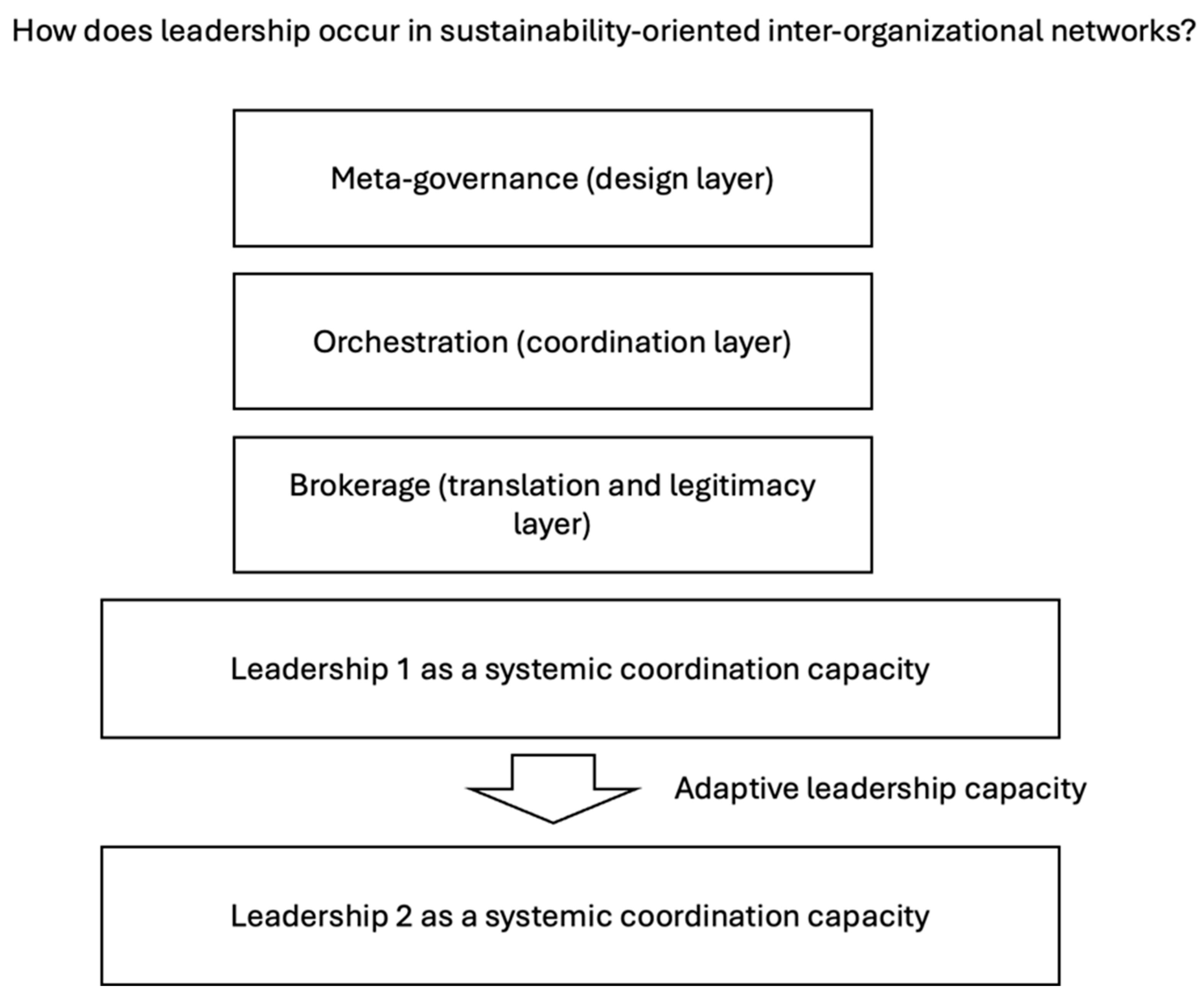
The conclusions set out below should be read as a conceptual interpretation grounded in a qualitative narrative synthesis rather than as settled empirical generalizations, given the interpretive character of the review, its database-only retrieval base, its English-language restriction, and its explicit choice not to apply a formal risk-of-bias appraisal. Within this interpretive frame, our core question concerns how leadership occurs in sustainability-oriented inter-organizational networks and how it is best understood. Our analysis suggests that leadership in these settings is best conceptualized as a systemic coordination capacity rather than as an individual trait or a positional authority. Governance architectures may institutionalize, with respect to leadership, distributed authority and interdependence, in settings where coordinated inter-organizational arrangements are increasingly required to address sustainability challenges that exceed the reach of any single organization acting alone. The deliberate combination of hierarchical, market, and network coordination modes, integrated through network governance and meta-governance perspectives, appears central to how leadership is enacted in these settings. We propose a multilevel model: meta-governance (design layer), orchestration (coordination layer), and brokerage (translation and legitimacy layer). How is coordination structured and architected? This will be more relevant than who leads. In rapidly evolving technological environments, adaptive capacity appears to depend more on well-aligned coordination infrastructures than on formal authority. The conventional emphasis on firm-level leadership traits may be productively complemented by attention to governance design capabilities, which our synthesis suggests are particularly consequential for competitive positioning in sustainability transitions. Brokerage and boundary-spanning roles are essential for managing conflicts, power asymmetries, and competing sustainability goals. Effective leadership requires investing in minimum viable governance structures, including clear roles, transparent decisions, monitoring, and accountability mechanisms. Accountability mechanisms that clarify partner obligations support sustained commitment to network objectives and mitigate the risk of opportunistic disengagement. Strong sustainability networks balance formal structure with relational legitimacy, fostering trust, inclusion, learning, and innovation. Coordination failures such as fragmentation and systemic gridlock represent important risks to be managed. Effective leadership in these settings depends on the capacity to reallocate roles as networks evolve, incorporate lessons from prior coordination difficulties, and maintain alignment with agreed strategic objectives. The effective role of institutions should also not be underestimated. Figure 1 sums up our research findings.
Figure 2 elucidates how various layers are involved and how leadership will evolve as it adapts to new circumstances in the sustainability-oriented inter-organizational network. Leadership 1 and Leadership 2 may differ in form but share the same orientation: a systemic coordination capacity that sustains partner commitment to joint goals and outcomes. Conflict management will thus be optimized and energy channeled to positive outcomes in what is a distributed authority environment (relative absence of hierarchy).

Supplementary Materials

The following supporting information can be downloaded at: https://www.mdpi.com/article/10.3390/su18104764/s1, Table S1: PRISMA 2020 Checklist.

Author Contributions

Conceptualization, A.S., A.d.B.M., J.R.d.S., A.P.-M. and M.A.-Y.-O.; software, A.S., A.d.B.M., J.R.d.S., A.P.-M. and M.A.-Y.-O.; validation, A.S., A.d.B.M., J.R.d.S., A.P.-M. and M.A.-Y.-O.; investigation, A.S., A.d.B.M., J.R.d.S., A.P.-M. and M.A.-Y.-O.; resources, A.S., A.d.B.M., J.R.d.S., A.P.-M. and M.A.-Y.-O.; writing—original draft preparation, A.S., A.d.B.M., J.R.d.S., A.P.-M. and M.A.-Y.-O.; writing—review and editing, A.S., A.d.B.M., J.R.d.S., A.P.-M. and M.A.-Y.-O.; visualization, A.S., A.d.B.M., J.R.d.S., A.P.-M. and M.A.-Y.-O.; supervision, A.S., A.d.B.M., J.R.d.S., A.P.-M. and M.A.-Y.-O.; project administration, A.S., A.d.B.M., J.R.d.S., A.P.-M. and M.A.-Y.-O.; funding acquisition, M.A.-Y.-O. All authors have read and agreed to the published version of the manuscript.

Funding

This research received no external funding.

Institutional Review Board Statement

Not applicable.

Informed Consent Statement

Not applicable.

Data Availability Statement

The PRISMA checklist and flow diagram are available in Supplementary Materials.

Conflicts of Interest

The authors declare no conflicts of interest.

References

  1. Dzhengiz, T. A Literature Review of Inter-Organizational Sustainability Learning. Sustainability 2020, 12, 4876. [Google Scholar] [CrossRef]
  2. Provan, K.G.; Kenis, P. Modes of network governance: Structure, management, and effectiveness. J. Public Adm. Res. Theory 2008, 18, 229–252. [Google Scholar] [CrossRef]
  3. Agranoff, R. Managing Within Networks: Adding Value to Public Organizations; Georgetown University Press: Washington, DC, USA, 2007. [Google Scholar]
  4. Baur, D.; Schmitz, H.P. Corporations and NGOs: When accountability leads to co-optation. J. Bus. Ethics 2012, 106, 9–21. [Google Scholar] [CrossRef]
  5. Sørensen, E.; Torfing, J. Making governance networks effective and democratic through metagovernance. Public Adm. 2009, 87, 234–258. [Google Scholar] [CrossRef]
  6. Dai, F.; Eddie, I.; Odhiambo, G.; Hastings, A. Coordination, Cooperation, Ambivalence Leadership of Inter-Organizational Technology Collaborations. 2025. Available online: https://ssrn.com/abstract=5093112 (accessed on 20 January 2026).
  7. Akerboom, M.; Groeneveld, S.; Kuipers, B. Leadership in public sector interorganizational networks: A synthesis of the literature and propositions based on a multiple case study. Perspect. Public Manag. Gov. 2024, 7, 113–131. [Google Scholar] [CrossRef]
  8. Fleming, L.; Waguespack, D. Brokerage, boundary spanning, and leadership in open innovation communities. Organ. Sci. 2007, 18, 165–180. [Google Scholar] [CrossRef]
  9. Reypens, C.; Lievens, A.; Blazevic, V. Hybrid orchestration in multi-stakeholder innovation networks: Practices of mobilizing multiple, diverse stakeholders across organizational boundaries. Organ. Stud. 2019, 42, 61–83. [Google Scholar] [CrossRef]
  10. Nygaard, A. From Linear to Circular Economy: A Transaction Cost Approach to the Ecological Transformation of the Firm. Circ. Econ. Sust. 2022, 2, 1127–1142. [Google Scholar] [CrossRef]
  11. Mishra, D.; Kukreja, R.K.; Mishra, A.S. Blockchain as a governance mechanism for tackling dark side effects in interorganizational relationships. Int. J. Organ. Anal. 2021, 30, 340–364. [Google Scholar] [CrossRef]
  12. Tranfield, D.; Denyer, D.; Smart, P. Towards a Methodology for Developing Evidence-Informed Management Knowledge by Means of Systematic Review. Br. J. Manag. 2003, 14, 207–222. [Google Scholar] [CrossRef]
  13. Page, M.J.; McKenzie, J.E.; Bossuyt, P.M.; Boutron, I.; Hoffmann, T.C.; Mulrow, C.D.; Shamseer, L.; Tetzlaff, J.M.; Akl, E.A.; Brennan, S.E.; et al. The PRISMA 2020 statement: An updated guideline for reporting systematic reviews. BMJ 2021, 372, 71. [Google Scholar] [CrossRef]
  14. Crane, A.; Palazzo, G.; Spence, L.J.; Matten, D. Contesting the Value of “Creating Shared Value”. Calif. Manag. Rev. 2014, 56, 130–153. [Google Scholar] [CrossRef]
  15. Kellogg, W.A.; Keating, W.D. Cleveland’s Ecovillage: Green and affordable housing through a network alliance. Hous. Policy Debate 2011, 21, 69–91. [Google Scholar] [CrossRef]
  16. Casper, S. The Organization of Collaboration for Non-Market Technology Development: Network Dynamics Within Global Health Drug Development. 2025. Available online: https://ssrn.com/abstract=5166511 (accessed on 20 January 2026).
  17. O’Toole, L.J. Treating networks seriously: Practical and research-based agendas in public administration. Public Adm. Rev. 1997, 57, 45–52. [Google Scholar] [CrossRef]
  18. Torfing, J.; Sørensen, E.; Røiseland, A. Transforming the public sector into an arena for co-creation: Barriers, drivers, benefits, and ways forward. Adm. Soc. 2016, 51, 795–825. [Google Scholar] [CrossRef]
  19. Purdy, J.M.; Gray, B. Conflicting logics, mechanisms of diffusion, and multilevel dynamics in emerging institutional fields. Acad. Manag. J. 2009, 52, 355–380. [Google Scholar] [CrossRef]
  20. Polese, F.; Russo, G.; Carrubbo, L. Service logic, value co-creation and networks: Three dimensions fostering inter-organisational relationships: Competitiveness in the boating industry. In Proceedings of the 12th QMOD and Toulon-Verona Conference, Verona, Italy, 27–29 August 2009; pp. 27–29. [Google Scholar]
  21. Ottens, M.; Edelenbos, J. Political leadership as meta-governance in sustainability transitions: A case study analysis of meta-governance in the case of the Dutch National Agreement on Climate. Sustainability 2019, 11, 110. [Google Scholar] [CrossRef]
  22. Tahirkheli, S. Can leadership possess a virtual pair of eyes? Organizational networks to address cultural differences moderated by e-leadership. Int. J. Innov. Digit. Econ. 2022, 13, 1–28. [Google Scholar] [CrossRef]
  23. Dworkin, T.M.; Ramaswami, A.; Schipani, C.A. The role of networks, mentors and the law in overcoming barriers to organizational leadership for women with children. Mich. J. Gend. Law 2013, 20, 83–128. [Google Scholar] [CrossRef]
  24. Burt, R.S. Structural Holes: The Social Structure of Competition; Harvard University Press: Cambridge, MA, USA, 1992; Available online: https://www.jstor.org/stable/j.ctv1kz4h78 (accessed on 20 January 2026).
  25. Uhl-Bien, M. Relational leadership theory: Exploring the social processes of leadership and organizing. Leadersh. Q. 2006, 17, 654–676. [Google Scholar] [CrossRef]
  26. Denis, J.L.; Langley, A.; Sergi, V. Leadership in the plural. Acad. Manag. Ann. 2012, 6, 211–283. [Google Scholar] [CrossRef]
  27. Sydow, J.; Braun, T. Governance of inter-organizational project networks. In Research Handbook on the Governance of Projects; Edward Elgar Publishing: Cheltenham, UK, 2023; pp. 356–365. [Google Scholar] [CrossRef]
  28. Agranoff, R.; McGuire, M. Collaborative Public Management: New Strategies for Local Governments; Georgetown University Press: Washington, DC, USA, 2003. [Google Scholar]
  29. Gold, A.H.; Malhotra, A.; Segars, A.H. Knowledge management: An organizational capabilities perspective. J. Manag. Inf. Syst. 2001, 18, 185–214. [Google Scholar] [CrossRef]
  30. Howard, M.; Roehrich, J.K.; Lewis, M.A.; Squire, B. Converging and diverging governance mechanisms: The role of (dys)function in long-term inter-organizational relationships. Br. J. Manag. 2019, 30, 624–644. [Google Scholar] [CrossRef]
  31. Zylbersztajn, D.; Farina, Q.M. Dynamics of network governance: A contribution to the study of complex forms. REAd-Rev. Eletrônica Adm. 2010, 16, 1–19. [Google Scholar] [CrossRef]
  32. Hill, T.; Svystunova, L.; Du, X. Orchestration from Below: Uncovering the Micro-Process Mechanisms of Shared Governance of a Global Inter-Organizational Network. 2024. Available online: https://ssrn.com/abstract=5031871 (accessed on 20 January 2026).
  33. Maron, A.; Benish, A. Power and conflict in network governance: Exclusive and inclusive forms of network administrative organizations. Public Manag. Rev. 2021, 24, 1758–1778. [Google Scholar] [CrossRef]
  34. Barnett-Page, E.; Thomas, J. Methods for the synthesis of qualitative research: A critical review. BMC Med. Res. Methodol. 2009, 9, 59. [Google Scholar] [CrossRef] [PubMed]
  35. Elo, S.; Kyngäs, H. The qualitative content analysis process. J. Adv. Nurs. 2008, 62, 107–115. [Google Scholar] [CrossRef]
  36. Thomas, J.; Harden, A. Methods for the thematic synthesis of qualitative research in systematic reviews. BMC Med. Res. Methodol. 2008, 8, 45. [Google Scholar] [CrossRef]
  37. Popay, J.; Roberts, H.M.; Sowden, A.; Petticrew, M.; Arai, L.; Rodgers, M.; Britten, N.; Roen, K.; Duffy, S. Guidance on the Conduct of Narrative Synthesis in Systematic Reviews: A product from the ESRC Methods Programme; Lancaster University: Lancaster, UK, 2006. [Google Scholar]
  38. Grant, M.J.; Booth, A. A typology of reviews: An analysis of 14 review types and associated methodologies. Health Inf. Libr. J. 2009, 26, 91–108. [Google Scholar] [CrossRef]
  39. Snyder, H. Literature review as a research methodology: An overview and guidelines. J. Bus. Res. 2019, 104, 333–339. [Google Scholar] [CrossRef]
  40. Berthet, E.T.; Hickey, G.M. Organizing collective innovation in support of sustainable agro-ecosystems: The role of network management. Agric. Syst. 2018, 165, 44–54. [Google Scholar] [CrossRef]
  41. Julio, N.; Figueroa, R.; Ponce Oliva, R.D. Advancing toward water security: Addressing governance failures through a metagovernance of modes approach. Sustain. Sci. 2022, 17, 1911–1920. [Google Scholar] [CrossRef]
  42. Mondal, S.; Van Belle, S. India’s NCD strategy in the SDG era: Are there early signs of a paradigm shift? Glob. Health 2018, 14, 39. [Google Scholar] [CrossRef] [PubMed]
  43. Frederiksen, M.; Currie, B.; Sekonya, J.G.; Coetzer, K. Exploring collaborative conservation across a multifunctional landscape in the Boland Mountain Complex, South Africa. Conserv. Sci. Pract. 2025, 8, e70213. [Google Scholar]
  44. Frederiksen, N.; Gottlieb, S.C.; de Gier, A.; Koch, C.; Buser, M. Orchestrating for the Circular Economy in Interorganizational Networks: Between Change and Ceremony. J. Environ. Manag. 2025, 396, 128032. [Google Scholar] [CrossRef]
  45. Shahabi, A.; Azar, A.; Radfar, R.; Asadifard, R.A. Combining soft systems methodology with interpretive structural modeling and system dynamics for network orchestration: Case study of the formal science and technology collaborative networks in Iran. Syst. Pract. Action Res. 2020, 33, 453–478. [Google Scholar] [CrossRef]
  46. Yin, J.H.; Song, H.Y.; Zhu, H. Smart governance for sustainable development: Stage-specific effects and regional heterogeneity in a global empirical framework. Struct. Change Econ. Dyn. 2026, 77, 43–61. [Google Scholar] [CrossRef]
  47. Termeer, C.J.; Dewulf, A. Towards theoretical multiplicity for the governance of transitions: The energy-producing greenhouse case. Int. J. Sustain. Dev. 2012, 15, 37–53. [Google Scholar] [CrossRef]
  48. Wilson, C.E.; Morrison, T.H.; Everingham, J.A.; McCarthy, J. Steering social outcomes in America’s energy heartland: State and private meta-governance in the Marcellus Shale, Pennsylvania. Am. Rev. Public Adm. 2017, 47, 929–944. [Google Scholar] [CrossRef]
  49. Lewis, J.M.; Baeza, J.I.; Alexander, D. Partnerships in primary care in Australia: Network structure, dynamics and sustainability. Soc. Sci. Med. 2008, 67, 280–291. [Google Scholar] [CrossRef]
  50. Nave, E.; Torres, P.; Querido, A.R.; Ferreira, J.J.; Fernandes, G. Entrepreneurial ecosystems governance: Critical perspectives and steps forward. J. Technol. Transf. 2025, 50, 2135–2230. [Google Scholar] [CrossRef]
  51. Iao-Jörgensen, J. Networking in action: Taking collaborative capacity development seriously for disaster risk management. Prog. Disaster Sci. 2024, 21, 100311. [Google Scholar] [CrossRef]
  52. Virah-Sawmy, M.; Duran, A.P.; Green, J.M.; Guerrero, A.M.; Biggs, D.; West, C.D. Sustainability gridlock in a global agricultural commodity chain: Reframing the soy–meat food system. Sustain. Prod. Consum. 2019, 18, 210–223. [Google Scholar] [CrossRef]
  53. Cramer, J. Effective governance of circular economies: An international comparison. J. Clean. Prod. 2022, 343, 130874. [Google Scholar] [CrossRef]
  54. Shaw, D.R. Manchester united football club: Developing a network orchestration model. Eur. J. Inf. Syst. 2007, 16, 628–642. [Google Scholar] [CrossRef]
  55. Prisco, A.; Rey, A.; Sciarelli, M.; Tuccillo, D. Linking Loops: How Digital Platforms Orchestrate Circular Economy Networks. Sustain. Dev. 2026. [Google Scholar] [CrossRef]
  56. Patrucco, A.S.; Roath, A.S.; Richey, R.G., Jr.; Mathiyazhagan, K.; Shankar, R. From Triple-A to AAA+: Recalibrating Agility, Adaptability, and Alignment for Digital, Responsible, and Resilient Supply Chains. J. Bus. Logist. 2026, 47, e70049. [Google Scholar] [CrossRef]
  57. Albareda, L.; Waddock, S. Networked CSR governance: A whole network approach to meta-governance. Bus. Soc. 2018, 57, 636–675. [Google Scholar] [CrossRef]
  58. Li, W. Digital Innovation Networks for the SDGs: A Research Agenda for Higher Education Transformation. Eur. J. Educ. 2025, 60, e70292. [Google Scholar] [CrossRef]
  59. Soberón, M.; Ezquerra-Lázaro, I.; Sánchez-Chaparro, T.; Moreno-Serna, J.; Dóci, G.; Kordas, O. Supporting municipalities to develop collaboration capability to facilitate urban transitions and sustainability: Role of transition intermediaries in Madrid. J. Clean. Prod. 2023, 426, 138964. [Google Scholar] [CrossRef]
  60. Connolly, J.; Reid, G.; Knoll, M.; Halliday, W.; Windsor, S. The sustainability of knowledge brokerage of the mental health improvement outcomes framework in Scotland: A follow-up analysis. Evid. Policy 2020, 16, 177–195. [Google Scholar] [CrossRef]
  61. Vitiea, K.; Lim, S. Voluntary environmental collaborations and corporate social responsibility in Siem Reap city, Cambodia. Sustain. Account. Manag. Policy J. 2019, 10, 451–475. [Google Scholar] [CrossRef]
  62. Muradli, N.; Ahmadov, F. Managing contradiction and sustaining sustainability in inter organizational networks through leadership: A case study. Entrep. Sustain. Issues 2019, 6, 1255. [Google Scholar] [CrossRef] [PubMed]
  63. Lopes, L.F.; Loggetto, P.; de Oliveira, A., Jr.; Farias, B.; Nunes, C.; de Almeida, A.E.A.; Amaral, A.B.C.N.D.; Frisanco, A.; Fiori, C.M.C.M.; Santana, D.; et al. Aliança AMARTE: A Collaborative Network to Improve Oncologic Pediatric Care in Brazil. Pediatr. Blood Cancer 2025, 72, e31986. [Google Scholar] [CrossRef]
  64. Hallberg, A.; Winblad, U.; Fredriksson, M. Balancing pragmatism and sustainability: A case study of an interorganisational network to improve integrated care for the elderly. Int. J. Integr. Care 2021, 21, 14. [Google Scholar] [CrossRef] [PubMed]
  65. Rahmasary, A.N.; Koop, S.H.; Leeuwen, C.J. Assessing Bandung’s governance challenges of water, waste, and climate change: Lessons from urban Indonesia. Integr. Environ. Assess. Manag. 2021, 17, 434–444. [Google Scholar] [CrossRef]
  66. Liu, Y.; Yang, W. Leadership and governance tools for village sustainable development in China. Sustainability 2019, 11, 5553. [Google Scholar] [CrossRef]
  67. Wegner, D.; Hölsgens, R.; Bitencourt, C.C. Orchestrating collaborative networks for social innovation: Orchestrators’ roles in socially innovative initiatives. Technol. Forecast. Soc. Change 2023, 195, 122786. [Google Scholar] [CrossRef]
  68. Holt, A.R.; Moug, P.; Lerner, D.N. The network governance of urban river corridors. Ecol. Soc. 2012, 17, 25. [Google Scholar] [CrossRef]
  69. Gjaltema, J.; Biesbroek, R.; Termeer, K. From government to governance … to meta-governance: A systematic literature review. Public Manag. Rev. 2020, 22, 1760–1780. [Google Scholar] [CrossRef]
  70. Klijn, E.H.; Koppenjan, J.; Spekkink, W.; Warsen, R. Governance Networks in the Public Sector; Routledge: Oxford, UK, 2025. [Google Scholar]
  71. Raelin, J.A. Imagine there are no leaders: Reframing leadership as collaborative agency. Leadership 2016, 12, 131–158. [Google Scholar] [CrossRef]
  72. Folke, C.; Hahn, T.; Olsson, P.; Norberg, J. Adaptive governance of social-ecological systems. Annu. Rev. Environ. Resour. 2005, 30, 441–473. [Google Scholar] [CrossRef]
  73. Williams, P. Collaboration in Public Policy and Practice: Perspectives on Boundary Spanners; Policy Press: Bristol, UK, 2012. [Google Scholar]
  74. Ansell, C.; Gash, A. Collaborative governance in theory and practice. J. Public Adm. Res. Theory 2008, 18, 543–571. [Google Scholar] [CrossRef]
  75. Emerson, K.; Nabatchi, T.; Balogh, S. An integrative framework for collaborative governance. J. Public Adm. Res. Theory 2012, 22, 1–29. [Google Scholar] [CrossRef]
  76. Braun, E. The entrepreneurial function as an element of the institutional framework of capitalism: The enterprise, not the pure entrepreneur, is relevant. J. Econ. Issues 2022, 56, 741–757. [Google Scholar] [CrossRef]
Figure 1. PRISMA 2020 flow diagram of the study selection process.
Sustainability 18 04764 g001
Figure 2. Leadership in various layers and requiring adaptive leadership capacity.
Sustainability 18 04764 g002
Table 1. Analyzed articles.
No.TitleAuthor(s)Indexation
1Organizing collective innovation in support of sustainable agro-ecosystems: The role of network management[40]Scopus + Web of Science
2Advancing toward water security: addressing governance failures through a metagovernance of modes approach[41]Web of Science
3India’s NCD strategy in the SDG era: are there early signs of a paradigm shift?[42]Scopus + Web of Science
4Exploring collaborative conservation across a multifunctional landscape in the Boland Mountain Complex, South Africa[43]Scopus + Web of Science
5Orchestrating for the circular economy in interorganizational networks: Between change and ceremony[44]Web of Science
6Combining Soft Systems Methodology with Interpretive Structural Modeling and System Dynamics for Network Orchestration: Case Study of the Formal Science and Technology Collaborative Networks in Iran[45]Scopus + Web of Science
7Smart governance for sustainable development: Stage-specific effects and regional heterogeneity in a global empirical framework[46]Scopus + Web of Science
8Towards theoretical multiplicity for the governance of transitions: The energy-producing greenhouse case[47]Scopus
9Political leadership as meta-governance in sustainability transitions: A case study analysis of meta-governance in the case of the Dutch national agreement on climate[21]Scopus + Web of Science
10Steering Social Outcomes in America’s Energy Heartland: State and Private Meta-Governance in the Marcellus Shale, Pennsylvania[48]Scopus + Web of Science
11Partnerships in primary care in Australia: Network structure, dynamics and sustainability[49]Scopus + Web of Science
12Entrepreneurial ecosystems governance: critical perspectives and steps forward[50]Scopus + Web of Science
13Networking in action: Taking collaborative capacity development seriously for disaster risk management[51]Scopus + Web of Science
14Sustainability gridlock in a global agricultural commodity chain: Reframing the soy–meat food system[52]Scopus + Web of Science
15Effective governance of circular economies: An international comparison[53]Scopus
16Manchester United Football Club: Developing a network orchestration model[54]Scopus + Web of Science
17Linking Loops: How Digital Platforms Orchestrate Circular Economy Networks[55]Scopus + Web of Science
18From Triple-A to AAA+: Recalibrating Agility, Adaptability, and Alignment for Digital, Responsible, and Resilient Supply Chains[56]Scopus
19Networked CSR Governance: A Whole Network Approach to Meta-Governance[57]Scopus + Web of Science
20Digital Innovation Networks for the SDGs: A Research Agenda for Higher Education Transformation[58]Scopus + Web of Science
21Supporting municipalities to develop collaboration capability … in Madrid[59]Scopus + Web of Science
22The sustainability of knowledge brokerage of the mental health improvement outcomes framework in Scotland: A follow-up analysis[60]Scopus + Web of Science
23Voluntary environmental collaborations and corporate social responsibility in Siem Reap city, Cambodia[61]Scopus + Web of Science
24Managing contradiction and sustaining sustainability in interorganizational networks through leadership: A case study[62]Web of Science
25Aliança AMARTE: A Collaborative Network to Improve Oncologic Pediatric Care in Brazil[63]Scopus + Web of Science
26Balancing pragmatism and sustainability: A case study of an interorganizational network to improve integrated care for the elderly[64]Scopus + Web of Science
27Assessing Bandung’s Governance Challenges of Water, Waste, and Climate Change: Lessons from Urban Indonesia[65]Scopus + Web of Science
28Leadership and Governance Tools for Village Sustainable Development in China[66]Scopus + Web of Science
29Orchestrating collaborative networks for social innovation: Orchestrators’ roles in socially innovative initiatives[67]Scopus + Web of Science
30The network governance of urban river corridors[68]Scopus + Web of Science
31From government to governance … to meta-governance: a systematic literature review[69]Web of Science
Table 2. Descriptive characterization of the 31 included studies across geography and time.
Panel A—Geographic distribution
RegionnStudies (reference numbers)
Europe10[21,44,47,54,55,59,60,64,67,68]
Asia6[42,45,61,62,65,66]
Americas3[41,48,63]
Africa1[43]
Oceania1[49]
Cross-regional/global10[40,46,50,51,52,53,56,57,58,69]
Panel B—Temporal distribution
PeriodnPattern
2007–20144Early network governance and orchestration foundations
2015–202012Consolidation of relational and practice-based perspectives
2021–202615Acceleration: hybrid coordination, digital platforms, ESG and circular economy
Disclaimer/Publisher’s Note: The statements, opinions and data contained in all publications are solely those of the individual author(s) and contributor(s) and not of MDPI and/or the editor(s). MDPI and/or the editor(s) disclaim responsibility for any injury to people or property resulting from any ideas, methods, instructions or products referred to in the content.