Article

Carbon Emission Trading System, Digital Finance and Individual Health: Evidence from China

1
School of Business, Suzhou University, Suzhou 234000, China
2
School of Economics and Management, Shanghai Institute of Technology, Shanghai 200235, China
*
Author to whom correspondence should be addressed.
Sustainability 2026, 18(10), 4765; https://doi.org/10.3390/su18104765 (registering DOI)
Submission received: 29 March 2026 / Revised: 29 April 2026 / Accepted: 2 May 2026 / Published: 11 May 2026
(This article belongs to the Section Health, Well-Being and Sustainability)

Abstract

In the context of increasing concern about carbon neutrality, public health, and global sustainability, based on the micro-individual data of the China Family Panel Studies (CFPS) from 2010 to 2022, this paper adopts the staggered difference-in-differences (DID) model to analyze the impact of the carbon emission trading system (CETS) on individual health and the moderating role of digital finance. The results show that the CETS significantly improves individual health. Robustness tests, including propensity score matching, placebo analyses, addressing heterogeneous treatment effects, alternative specifications and samples, and excluding contemporaneous policies, confirm the validity of the results. Mechanism analysis shows that the development of digital finance, including the breadth of coverage, depth of use and degree of digitalization, can amplify the health promotion effect of the system, highlighting the key role of digital financial inclusion in the transmission of environmental policy dividends. Further analysis reveals that the moderating effect of digital finance exhibits significant heterogeneity: its enabling role in health dividends is more pronounced among females, individuals with lower education levels, and non-elderly populations. Spatially, this synergistic effect is more evident in the central and western regions, highlighting how digital inclusion helps overcome traditional socioeconomic and geographical barriers. The study concludes with policy implications emphasizing regionally tailored implementation, strengthening digital finance infrastructure, and maintaining long-term commitment to maximize the health, social welfare, and long-term sustainability benefits of carbon market policies.

1. Introduction

Under the background of low-carbon economic transition and the continuous upgrading health needs of the public, finding a way to evaluate the comprehensive impact of environmental governance policies on public health has become an important issue in the field of health economics, environmental economics, and sustainability science [1,2,3]. As an environmental governance policy based on market incentives, the Carbon Emission Trading System (CETS) sets carbon emission quota for enterprises and introduces a market trading mechanism [4]. The CETS aims to encourage the development and application of low-carbon technology through a market regulation mechanism [5], thereby achieving the reduction of carbon emissions [4,6] and ultimately realizing the strategic goal of environmental protection and ecological sustainability [7]. Compared with the traditional command-and-control system, the CETS not only has a strong incentive effect on emission reduction, but also may further translate into the improvement of public health by improving air quality [8], reducing environmental exposure risk [9] and optimizing resource allocation efficiency [10]. Therefore, whether and how the CETS generates health dividend is not only related to the performance evaluation of environmental policies, but also directly related to public health governance and sustainable social welfare improvement.
However, the existing research focuses more on the impact of the CETS on corporate emission reduction performance [6,7,10,11], corporate green innovation [12,13,14] and economic growth [4], and its spillover effects on public health are still not fully discussed. In the limited early research, Guo et al. (2022) used provincial macro aggregate data and took disease incidence as the proxy variable of health to preliminarily examine the impact of the CETS on residents’ health in China [15]. Although Guo et al. (2022) have made a useful attempt to reveal the macro link between the CETS and public health, due to the inherent aggregation bias of macro data, it is not only difficult to accurately identify the real causal net effect of the CETS on individual health, but also impossible to further describe the heterogeneous distribution pattern of policy dividends within different social groups [15]. In other words, the academic community is still in urgent need of empirical evidence to systematically examine the health effects and heterogeneity of the CETS based on large-scale micro-individual data, particularly to explore whether such market-based mechanisms can effectively decouple economic growth from its inherent health penalties.
In addition, the impact of the CETS on individual health is not achieved with the same intensity in all scenarios, and its policy effect depends to a large extent on the external institutional environment and technical conditions. Digital finance, characterized by the integration of advanced digital technologies (such as mobile internet, big data, and cloud computing) with traditional financial services, is reshaping the allocation of financial resources [16]. Compared with traditional finance, digital finance has significant advantages in service coverage, depth of use and degree of digitalization [17], which can alleviate information asymmetry and financing constraints [18], and enhance the ability of enterprises and residents to cope with risk shocks. This creates a potential “dual empowerment” pathway. For enterprises, digital finance helps to improve the availability of funds for green investment and low-carbon transformation [19], thus amplifying the emission reduction and environmental improvement effects brought by the carbon emission trading system [18]. For individuals, digital finance acts as an “inclusive buffer” that can improve consumption smoothing, medical expenditure payment and health risk management ability [20], so that environmental quality improvement can be more effectively translated into health gains [21]. It can be seen that, by leveraging digital technologies to expand financial inclusion, the high accessibility and differentiated service capabilities of digital finance are likely to become an important boundary condition affecting whether the health effects of environmental policies can be fully released. However, the existing research on digital finance pays more attention to its promoting effect on economic growth [22,23], industrial upgrading [24] and financing constraints [25], as well as household consumption [26], and rarely integrates it into the analysis framework of the relationship between the CETS and individual health.
To fill the above research gap, this paper focuses on the impact of the CETS on individual health, and further examines the moderating role of digital financial inclusion in this relationship. Based on the quasi-natural experiment of China’s regional CETS pilot, this paper uses the staggered difference-in-differences (DID) model to carry out the empirical test with the large-sample micro tracking data of China Family Panel Studies (CFPS) from 2010 to 2022. It is found that the CETS can significantly improve individual health status. The test of moderating mechanism shows that the development of digital finance, specifically characterized by the jump in its coverage breadth, usage depth and digitalization degree, as a key catalyst, significantly amplifies the health improvement effect of the CETS. Furthermore, further analysis reveals that the synergistic moderating effect of digital finance is not uniformly distributed. At the demographic level, the enabling role of digital financial inclusion is significantly stronger among females, non-elderly populations, and individuals with lower education levels. Spatially, compared with the eastern region, this synergistic effect is more pronounced in the central and western regions, demonstrating the crucial function of digital inclusion in overcoming traditional socioeconomic and geographical frictions.
The marginal contributions of this study are threefold. First, this paper systematically identifies the health effects of the CETS from the micro-individual level, which expands the micro analysis level and identification depth of the research on the health effects of environmental governance policies. The existing studies mostly focus on emission reduction performance, green innovation or macroeconomic effects of the CETS, while the few studies on health consequences are also limited by the aggregate data at the provincial level (such as the incidence rate and other macro indicators), making it difficult to accurately identify the real impact of the policy on the health of micro-individuals. In contrast, this paper provides more discriminating causal empirical evidence based on large-sample micro individual survey data, which not only makes up for the deficiency of existing research in data granularity, but also provides a new research perspective for evaluating the comprehensive welfare effects of carbon market policies at the individual level. More importantly, it provides a novel perspective on how market-based environmental regulations can act as a structural anchor to break the “health penalty” typically associated with rapid economic expansion. Second, this paper incorporates digital finance into the analytical framework, revealing its key moderating role between environmental policy and health outcomes, thereby deepening the understanding of the synergies between digital finance and environmental governance. Existing literature mainly discusses the impact of digital finance on economic growth, industrial upgrading, financing constraints, and household consumption, and rarely examines it in the framework of “environmental regulation–public health.” By conceptualizing digital finance as an “inclusive buffer” and mapping a “dual empowerment” causal chain, this study demonstrates that digital finance is not only a tool for economic transformation, but also an important contextual factor to systematically strengthen the health dividend of environmental policies, thus expanding the theoretical boundary of interdisciplinary research between digital finance, environmental governance, and sustainability. Third, through multi-dimensional analysis, this paper reveals the distribution characteristics of digital finance’s moderating mechanism, which enriches research on the welfare distribution effect of environmental policy. The existing literature mostly focuses on the average treatment effect when evaluating the policy effect, and pays insufficient attention to the heterogeneity between different social groups and regions. This paper confirms that the synergistic amplification effect of digital finance is not evenly distributed, identifying a stark “digital divide” (e.g., the marginalization of the elderly) alongside significant gender and regional inclusive dividends. This finding not only profoundly reveals the distributional consequences of environmental policies, but also provides more targeted policy implications for promoting the coordinated development of environmental governance, digital financial inclusion, and public health in the digital era.

2. Institutional Background and Theoretical Hypotheses

2.1. Carbon Emission Trading System

The CETS is an important market-oriented environmental governance policy for dealing with climate change [27,28]. Operating on a strict cap-and-trade mechanism, the government sets a regional carbon emission ceiling and allocates allowances to relevant enterprises primarily through free distribution based on historical carbon intensity or baseline methods, supplemented by auctions [29]. Based on these allocated allowances, enterprises engage in trading. Specifically, if an enterprise’s actual emissions exceed its quota, it must purchase additional allowances to meet compliance requirements or face severe regulatory penalties [7,12,13]. If its emissions are below its allowances, it can sell the surplus in the market for economic gains [30]. Compared with the traditional command-and-control regulation, the CETS, this market-oriented approach internalizes the negative externalities of carbon emissions, fundamentally changing the cost–benefit accounting of high-polluting industries and encouraging them to increase R&D investment and transition toward cleaner production [31,32].
As the world’s largest emitter of greenhouse gases, China faces the unprecedented dual pressure of domestic environmental degradation and international climate governance, particularly in the context of the Paris Agreement [15]. While contributing substantially to global economic growth, China’s rapid industrialization has challenged the sustainable development of its urban areas and public health [33,34]. To tackle these issues and meet its carbon neutrality goals, the Chinese government shifted away from strict command-and-control rules, moving instead toward market-based regulations [7]. In October 2011, the National Development and Reform Commission officially greenlit regional CETS pilots in seven diverse regions (including provinces, directly administered municipalities, and a special economic zone): Beijing, Tianjin, Shanghai, Chongqing, Hubei, Guangdong, and Shenzhen [35]. Since 2013, carbon emission trading markets in these pilot provinces and municipalities have been launched, covering a wide range of steel, power, heat, manufacturing, mining and other industries. Subsequently, in April 2016, Fujian was officially added to the program, forming the eight carbon-trading pilot regions. The strategic selection of these eight pilot regions was not random but carefully designed to represent the vast economic, institutional, and environmental heterogeneity across China. Institutionally and economically, Beijing, Shanghai, and Shenzhen represent highly developed, service-oriented megacities with robust administrative capacities. Guangdong, Tianjin, and Fujian serve as critical coastal economic powerhouses and manufacturing hubs with massive energy consumption. Meanwhile, Hubei and Chongqing represent inland developing regions transitioning from traditional heavy industries. Environmentally, these regions exhibit significantly different historical carbon intensities and baseline pollution exposure levels. This strategic diversity ensures that the pilot programs operate as a comprehensive microcosm of China, providing an ideal quasi-natural experimental setting to evaluate the socioeconomic and health impacts of environmental regulations across different developmental stages.
In addition to the above eight pilot regions, the national carbon emission trading market was officially launched in July 2021, building on the experience of the regional pilot markets. The implementation of the pilot policy not only significantly promoted carbon emission reduction in key industries, but also had a profound impact on the adjustment of regional industrial structure and the improvement of energy efficiency. With the continuous improvement of the carbon market, its impact is no longer limited to production decisions at the firm level, but is gradually transmitted to the welfare level of residents. Based on the logic of health production function [36], the CETS reduces environmental health risks faced by residents by curtailing pollution emissions and improving air quality, which is an important institutional factor affecting individual health. Furthermore, the adjustment of industrial structure and green transformation may further promote the improvement of residents’ health level by improving the employment environment. Therefore, the CETS not only yields environmental effects but also has potential health implications, both of which are critical pillars of social sustainability.

2.2. Theoretical Framework and Hypotheses

2.2.1. CETS and Individual Health

The overarching policy objective of the CETS is to address global climate change by meaningfully cutting greenhouse gas emissions. However, due to the high degree of homology between carbon dioxide and traditional local air pollutants (such as PM2.5, SO2 and NOx) in the process of fossil fuel combustion and industrial production [37,38], carbon emission reduction actions are bound to be accompanied by a significant improvement of local air quality. This phenomenon has been profoundly conceptualized as “Co-benefits” in environmental economics [39]. Based on this, this paper holds that the CETS deeply reshapes the health level of micro individuals mainly through the following three mechanisms:
First, direct environmental and health capital effects. Carbon markets force companies to scale back polluting activities and adopt cleaner technologies by making it more expensive to emit greenhouse gases. From an epidemiological perspective, long-term exposure to these air pollutants is a key determinant of respiratory disease, cardiovascular disease, and premature death [40,41]. According to the classic Grossman health demand model, environmental pollution, as a negative exogenous shock, will significantly accelerate the depreciation rate of individual health capital [42]. Coordinated emission reductions induced by the CETS systematically improve regional air quality, thus effectively blocking the rapid depreciation of health capital [38]. This environmental quality dividend at the macro level not only directly translates into a substantial jump in the physical and mental health level of local residents, but also significantly reduces the defensive medical expenditure of households due to pollution resistance [43].
Secondly, indirect structure and employment environment effects. As a powerful market-oriented regulation tool, the CETS has effectively promoted a deep reshuffle of regional industrial structure and a green evolution of energy consumption structure [44]. By reducing the path dependence of macro economy on industries with high pollution and high energy consumption, the system optimizes the overall production and living environment of residents in a longer-term dimension [30]. More importantly, with the transformation of enterprises to the green and low-carbon mode and the accelerated elimination of backward production capacity, the overall working conditions in the regional labor market have improved, effectively reducing the baseline environmental health risks associated with traditional heavy industries [45]. Thus, this structural optimization builds an important defense line for public health.
Finally, resource allocation and socio-economic effects. Relying on the flexible price signal guidance mechanism, the carbon market promotes the accelerated flow of production factors such as capital and technology from inefficient and high-carbon sectors to efficient and low-carbon sectors, and realizes the Pareto improvement of macro resource allocation efficiency [46,47]. This resource reorganization process not only drives the overall improvement of the quality of regional economic development, but also indirectly promotes the health of residents through a complex socio-economic network. Specifically, high-quality economic growth is often accompanied by the increase in residents’ disposable income, the optimization of employment structure, and the enhancement of the supply capacity of local public services (especially public medical and health resources). Improvements in these fundamental socioeconomic factors provide a solid material foundation for the long-term accumulation of public health. Ultimately, by shifting the economic paradigm, the CETS acts as a crucial institutional anchor that helps decouple regional economic growth from its inherent health penalties. Based on the above analysis, this paper proposes the following hypothesis:
Hypothesis 1.
The implementation of the carbon emission trading system can significantly improve the individual health level.

2.2.2. The Moderating Role of Digital Finance

Although the CETS can promote individual health by improving environmental quality, the realization of such health effect does not occur automatically but is instead shaped by factors such as the level of financial development and resource allocation capacity. In this process, digital financial inclusion may serve as a key boundary condition, strengthening the transmission of environmental policies to health outcomes [48].
On the one hand, at the firm level, digital finance helps alleviate financing constraints faced by firms during green transformation by enhancing the accessibility of financial services and reducing financing costs, thereby facilitating investments in clean technologies and the adoption of low-carbon production methods [49,50]. Supported by digital technologies, digital finance can achieve more accurate credit allocation through big data analysis, so as to improve the financing efficiency of green projects [51], and amplify the emission reduction effect and environmental improvement degree of the CETS.
On the other hand, at the individual level, digital finance expands the coverage of inclusive finance and strengthens households’ consumption-smoothing ability and risk resilience, which helps to enhance their ability to cope with health shocks [26]. Specifically, digital finance can reduce medical financing constraints, improve the accessibility of medical services, and enhance the family health risk management ability through insurance and credit product innovation, so that the health benefits derived from environmental improvements can be more effectively transformed into tangible gains in individual health.
While direct micro-accounting data on firm-level green investments and continuous household medical invoices are limited in large-scale household surveys, recent empirical literature robustly bridges this theoretical gap. At the firm level, existing studies confirm that digital finance acts as a critical catalyst for corporate green innovation by mitigating information asymmetry and alleviating strict financing constraints [19,50,52]. At the micro-individual level, empirical evidence demonstrates that the adoption of digital payments and credit significantly relaxes household liquidity constraints, directly increasing healthcare expenditures and enhancing health-risk management capabilities [20,26]. These empirically validated mechanisms provide a solid foundation for treating digital financial inclusion as a vital institutional moderator.
Building upon these empirical foundations, we argue that digital finance acts as a crucial boundary condition that strengthens the environment–health transmission mechanism through a dual empowerment pathway (macro-environmental synergy and micro-inclusive buffering). On the macro-supply side, digital finance fundamentally alleviates the severe financing constraints faced by enterprises, effectively empowering them to undertake green technology innovations. This financial support significantly amplifies the actual pollution reduction efficacy of the CETS (e.g., accelerating the reduction in ambient pollutants like SO2), thereby fundamentally lowering the baseline environmental health risks for residents. On the micro-demand side, the rapid penetration of digital credit and micro-insurance acts as an “inclusive buffer.” It relaxes the liquidity constraints of vulnerable households during the economic transition, enabling them to smooth consumption, maintain necessary healthcare investments, and improve their risk-coping capacities. Through these dual pathways, digital finance ensures that the macro-policy dividends of the CETS are effectively translated into micro-individual health improvements. Therefore, we propose the following hypothesis:
Hypothesis 2.
Digital finance positively moderates the relationship between the CETS and individual health. Specifically, a higher level of regional digital finance significantly amplifies the health-promoting effects of the CETS.

3. Specifications

3.1. Baseline Model

To rigorously evaluate the impact of the CETS on individual health, our empirical design must isolate policy-induced changes from confounding factors. Given the staggered rollout of the CETS pilot across different provinces at different times, we employ a staggered DID framework. This design exploits the exogenous variation in policy timing across regions as a quasi-natural experiment, enabling the identification of the causal effect of environmental regulation. Specifically, we utilize a linear probability model estimated via ordinary least squares. This approach not only facilitates the interpretation of interaction terms but also effectively circumvents the incidental parameter problem commonly associated with non-linear models (such as Logit or Probit) when extensive fixed effects are included. By incorporating individual fixed effects to absorb time-invariant unobservable characteristics and year fixed effects to control for nationwide macroeconomic shocks, this two-way fixed effects specification provides a robust framework for causal inference. The model is specified as follows:
H e a l t h i j t = a 0 + a 1 C E T S i j t + γ X i t + δ Z j t + μ i + λ t + ε i j t
where H e a l t h i j t represents the health status of individual i in province j at year t . C E T S i j t is the CETS dummy variable. The coefficient a 1 is our primary parameter of interest, measuring the net causal effect of the CETS on the probability of individual health improvement. X i t and Z j t denote the vectors of individual-level and regional-level control variables, respectively. μ i represents individual fixed effects, which absorb all time-invariant unobservable individual characteristics (e.g., genetic predispositions or innate health baselines). λ t denotes year fixed effects, controlling for macroeconomic or health shocks common to all individuals in a given year (e.g., national health policy shifts). ε i j t is the random error term. Standard errors are clustered at the provincial level to account for potential serial correlation within the same policy jurisdiction.

3.2. Mechanism Testing Model

To further investigate whether digital finance amplifies the health benefits of the CETS (Hypothesis 2), we introduce an interaction term between the CETS dummy and the proxy for digital finance (i.e., Ln(DFII)). The augmented model is constructed as:
H e a l t h i j t = β 0 + β 1 C E T S i j t + β 2 C E T S i j t × L n ( D F I I j t ) + β 3 L n ( D F I I j t ) + γ X i t + δ Z j t + μ i + λ t + ε i j t
In this equation, the coefficient of the interaction term, β 2 , captures the moderating effect. If β 2 is statistically significantly positive, it can support Hypothesis 2, that is, the individual health dividend released by the CETS is more significant in the regions with a higher digital financial development level. In addition, this paper also uses three dimensions of coverage breadth, usage depth and digitalization level to replace the composite index, so as to test the moderating effect of different dimensions.

3.3. Variable Measurement

3.3.1. Explained Variable

The dependent variable in this paper is individual health (Health). Following the practices of relevant empirical research literature [53,54,55], this paper primarily uses respondents’ self-reported health status from the CFPS questionnaire as a measure. Specifically, the questionnaire asks respondents to answer, “How do you feel about your health status compared to a year ago?” The answer options are “worse,” “no change,” and “better.” Based on this, this paper constructs a binary dummy variable: if the respondent answers “better,” it is assigned a value of 1; otherwise, it is assigned a value of 0. This variable can effectively capture the dynamic marginal changes in micro-level individual health outcomes. Compared to objective health indicators, self-reported health status can comprehensively reflect an individual’s physical health, psychological state, and functional capabilities, and has been widely used in health economics research.

3.3.2. Key Explanatory Variable

The key explanatory variable in this paper is the CETS (CETS). Based on the implementation time of the CETS pilot in each region of China, we construct the policy variables required for DID. Specifically, the dummy variable for the CETS takes the value of 1 if the respondent’s region has implemented the system in the corresponding year, and 0 otherwise. This variable describes the policy coverage of the CETS to the region where the individual lives, and thus is used to identify the differences in individual health changes before and after the implementation of the policy.

3.3.3. Moderating Variable

The moderating variable in this paper is digital finance. To establish clear conceptual boundaries, we define digital finance as the delivery of traditional financial services (including payments, credit, insurance, and wealth management) through advanced digital technologies and infrastructures, such as mobile internet, big data, and cloud computing [50]. Compared to traditional finance, which heavily relies on physical branches and collateral, digital finance utilizes data-driven algorithms to significantly lower transaction costs, mitigate information asymmetry, and extend financial access to historically underserved or vulnerable populations [56]. Therefore, the development of digital finance at the regional level practically reflects the degree of financial inclusion driven by digital transformation.
To make this conceptual definition empirically operational, we employ the widely recognized Peking University Digital Financial Inclusion Index as our proxy indicator, denoted as Ln(DFII) [57]. This index systematically measures the development of digital finance in China through three core dimensions: coverage breadth, usage depth, and digitization level. These dimensions precisely capture how digital technologies transform financial services into an accessible, low-cost “inclusive buffer” for households. Furthermore, to examine the heterogeneous moderating effects of digital finance across its different functionalities, the three sub-dimensions are also logarithmically transformed and denoted as Ln(Breadth), Ln(Depth), and Ln(Digitization), respectively.

3.3.4. Control Variables

According to the existing literature [1,58], this paper introduces a series of control variables at the individual level and the regional level to minimize the interference of missing variable bias on the estimation results. Specifically, the individual-level control variables include age (Age) and its square, which is rescaled by dividing by 100 (Age_square/100) to prevent coefficient truncation and facilitate the identification of the turning point, thereby accounting for potential non-linear life cycle effects on health status, gender (Gender), marital status (Married) and bedtime (Bedtime). Among them, bedtime is processed in a unified manner on the basis of the original data, including the correction of false positive samples of the 12 h system and the delayed adjustment of the cross-midnight time (for example, the unified coding of 1:00 am as 25.0), so as to effectively eliminate the statistical error caused by the cross-night measurement. In addition, this paper also controls for individual educational attainment, categorized into primary (Primary), secondary (Middle), and higher education levels (College) to capture the effect of educational differences on health outcomes. Regional-level control variables include the logarithm of gross regional product (Ln(GDP)), gross regional product per capita (Ln(pGDP)), and population density (Ln(density)). Moreover, considering the important impact of medical resource allocation and environmental governance capacity on individual health, we further introduce indicators related to medical and health care and environmental infrastructure. It includes the number of licensed doctors per 10,000 residents (Doctor), the logarithm of daily urban sewage treatment capacity (Ln(Water)), the harmless treatment rate of household garbage (Garbage), and the logarithm of investment in solid waste treatment (Ln(solid)).
In addition, this paper controls individual fixed effects and time fixed effects in all regressions to absorb unobservable individual heterogeneity and macro time shocks respectively, so as to improve the reliability of estimation results.

3.4. Data Sources

The micro-individual-level data in this study are derived from the CFPS database. The CFPS project, implemented by the Institute of Social Science Survey of Peking University, is a large-scale comprehensive and longitudinal social tracking survey covering 31 provinces in China. CFPS adopts a multi-stage stratified probability sampling design, which comprehensively covers the information of core dimensions such as individual health status and demographic characteristics, and has strong national representativeness. This paper selects seven waves of tracking survey data from 2010 to 2022 (i.e., 2010, 2012, 2014, 2016, 2018, 2020 and 2022) to construct an unbalanced panel data set at the individual level. The choice of this time window is mainly based on the following considerations: first, CFPS provides continuous and intertemporally comparable health measurement indicators during this period; second, this interval coincides with the launch time of the CETS pilot in China, thus providing ideal data support for accurately identifying the individual health effects of the impact of the CETS. During the data cleaning phase, this paper unifies the intertemporal caliber of key variables and strictly eliminates the samples with missing core variables to ensure the reliability and robustness of subsequent empirical estimates.
The data sources related to the CETS come from the official policy documents and announcements of the pilot provinces. Based on the years when the carbon market was officially launched in each region, this paper manually collects and constructs the policy dummy variables to describe the implementation of the CETS. The digital finance data come from the Digital Inclusive Finance Index compiled by the Institute of Digital Finance of Peking University. The index constructs China’s digital inclusive finance index system from the three dimensions of coverage breadth, depth of use and digitalization degree of digital financial services at the provincial level. At present, the index has been widely used in research related to digital finance, which objectively measures the development level of digital finance in China. Additionally, provincial-level control variables such as regional GDP, population density and public medical infrastructure are obtained by referring to the China Statistical Yearbook over the years.
Finally, through rigorous cross-layer matching of the aforementioned multi-source provincial macro-level characteristic data with micro-level individual samples, this study consolidates a large-scale comprehensive panel dataset spanning the period 2010–2022, covering 31 provinces in mainland China, and comprising 166,044 individual observations. It should be noted that, as the compilation of the Digital Financial Inclusion Index began in 2011, this study implements targeted treatment in sample matching: the baseline regression employs the full sample of the CFPS from 2010 to 2022 to maximize estimation accuracy and statistical power, while all empirical tests involving the moderating effect of digital finance are conducted using the CFPS subsample spanning 2011 to 2022.

3.5. Descriptive Statistics

Table 1 reports the descriptive statistical results of the variables. In terms of the explained variable, the mean value of individual health (Health) is 0.114, indicating that about 11.4% of individuals reported an improved health status during the sample period, and its standard deviation is 0.318, reflecting that there is a certain degree of difference in health changes among individuals. This provides the micro-variation basis necessary to identify the health effects of environmental policies. Regarding the key explanatory variable, the mean value of the CETS is 0.157, indicating that during 2010–2022, about 15.7% of the observed values are in the region–year combination where the system has been implemented, reflecting the gradual promotion and expansion of the CETS in the sample period. This spatio-temporal difference provides a key condition for the effective identification of the DID method.
With respect to the moderating variable, the mean value of digital finance (Ln(DFII)) is 5.359, and the standard deviation is 0.483, with a wide range of values (2.936 to 6.133), indicating that there is a significant imbalance in the development of digital finance among different regions. From the perspective of sub-dimensions, Ln(Breadth), Ln(Depth) and Ln(Digitization) all show obvious dispersion, among which the mean value of digitization is relatively high, reflecting the high penetration degree of digital technology in financial services. However, there are still regional gaps in coverage and usage. This multi-dimensional difference provides an empirical basis for further examining the moderating effect of digital finance at different development levels. The overall distribution of control variables is reasonable. Individual characteristics (such as age, gender and educational level) are basically consistent with existing micro survey data, and the samples are fully heterogeneous in terms of age structure and human capital. Regional-level variables (such as GDP, population density and medical resource allocation) also show obvious regional differences, reflecting the imbalance of economic development and public service supply in different regions of China. Therefore, it is necessary to control the above factors in the empirical analysis.
Overall, all variables exhibit reasonable ranges without apparent outliers, and sufficient variation exists at both the individual and regional levels. This provides a solid data foundation for subsequently identifying the health effects of the CETS and the heterogeneous moderating role of digital finance.

4. Empirical Results

4.1. Basic Regression

Table 2 reports the results of the baseline regression of the impact of the CETS on individual health. All specifications control for individual and year fixed effects, with standard errors clustered at the provincial level to effectively mitigate potential biases arising from unobserved individual heterogeneity and temporal shocks. Regarding the key explanatory variable, the estimated coefficients of the CETS are positive and statistically significant across different model specifications. Specifically, in the baseline model that only controls fixed effects (Column 1), the coefficient of the CETS is 0.018 and is significant at the 1% level. After sequentially incorporating individual- and regional-level control variables (Columns 2 to 4), the coefficient remains stable between 0.017 and 0.019, maintaining its significance throughout. This result shows that, compared with the regions without the CETS, the probability of individuals reporting health improvement is significantly increased after the implementation of the system. H1 is supported. In terms of economic significance, the estimated coefficient of the CETS (ranging from 0.017 to 0.019) implies that the implementation of the policy increases the absolute probability of individual health improvement by approximately 1.7 to 1.9 percentage points. While this absolute marginal effect may initially appear modest, it is highly economically meaningful when evaluated against the baseline health dynamics. Given that the baseline sample mean of self-reported health improvement is only 11.4% (as shown in Table 1), this absolute increase translates to a substantial relative improvement of approximately 14.9% to 16.7% (e.g., 0.017/0.114).
Furthermore, this economic magnitude is highly consistent with the established benchmarks in the micro-welfare evaluation of macro-environmental policies. In health economics studies using discrete micro-survey data [1], environmental regulation shocks typically induce an absolute change of 1 to 3 percentage points in individual health probabilities. Concurrently, when evaluated in relative terms, classic empirical studies on China’s environmental governance [3] commonly report relative health improvements in the range of 10% to 20%. Compared to direct public health interventions, market-based environmental regulations operate through indirect transmission channels (i.e., incentivizing corporate emission reductions before altering ambient air quality). According to the Grossman health demand model [42], human health is a cumulative capital stock characterized by significant rigidity. Therefore, achieving a nearly 15% relative improvement in health outcomes (relative to the sample mean) provides empirical evidence that market-based environmental policies can generate measurable health dividend. However, whether these dividends are uniformly distributed or contingent upon institutional conditions requires further investigation, which we address in the subsequent mechanism and further analyses.
The robustness of our central findings is strongly corroborated by the stable estimates across various model specifications. Furthermore, the performance of the control variables aligns closely with established theoretical predictions. Notably, age and its adjusted quadratic term (Age_square/100) exhibit a profound influence on health outcomes. Specifically, the coefficient of Age is significantly negative (−0.013), while the coefficient of Age_square/100 is significantly positive (0.010), mapping a distinct U-shaped trajectory for individual health over the life course. Derived from these parameters, the turning point (vertex) emerges at exactly 65 years of age (0.013/[2 × (0.010/100)] = 65). This captures a non-linear life cycle pattern, implying that personal health tends to deteriorate until around the traditional retirement age of 65, after which it plateaus or marginally rebounds. In summary, our primary empirical analysis firmly substantiates the positive health externalities of the CETS, delivering granular, micro-level proof that environmental regulations yield tangible physiological dividends. Crucially, establishing this main effect provides a necessary analytical stepping stone for exploring the moderating mechanisms of digital finance in the subsequent sections.

4.2. Validation of the Parallel Trend Assumption

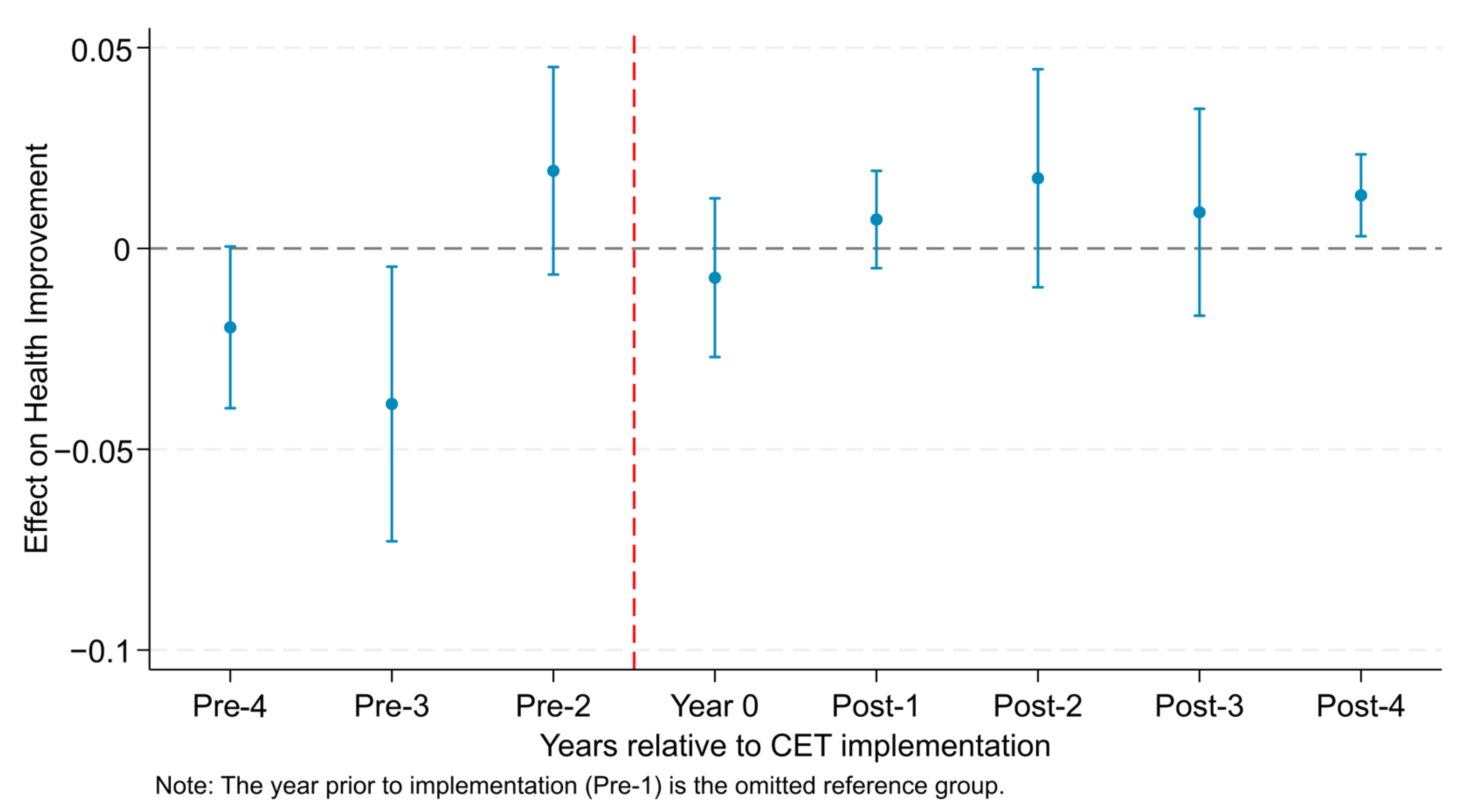
The validity of the DID estimation relies on the parallel trend assumption. To test this hypothesis and characterize the temporal evolution of the effects of the CETS, this paper adopts an event study approach to decompose the policy variables into a series of relative time dummy variables, covering the four years before the implementation of the policy to the four years after the implementation of the policy, and takes the year before the implementation of the policy (Pre-1) as the baseline group.
Figure 1 illustrates the dynamic effects of the CETS on individual health. According to the estimation results before the implementation of the policy, the coefficients of Pre-4 and Pre-3 stages are negative and statistically significant. This indicates that the pilot regions have a certain disadvantage in health improvement compared with the control group 3 to 4 years before CETS implementation of the policy. This phenomenon may reflect that the pilot regions faced more severe environmental pressure or industrial structure characteristics before the implementation of the system.
However, rather than invalidating our empirical design, this pre-existing downward trajectory actually implies that our baseline DID estimates serve as a conservative lower bound. Since the treatment group was on a deteriorating health trajectory prior to the policy, overcoming this momentum to achieve the positive health dividends observed in the post-treatment periods requires an exceptionally strong policy intervention. Furthermore, as the policy implementation approached (Pre-2 and Year 0), the coefficients ceased to diverge and converged toward zero, indicating no continuously widening gap immediately before the shock. To rigorously address any residual concerns regarding this pre-existing selection bias, we subsequently rely on propensity score matching and the inclusion of region-specific linear time trends in the following robustness checks, which effectively neutralize these pre-treatment baseline differences.
In terms of dynamic effects, in the year of policy implementation (Year 0) and the short-term period thereafter (Post-1 to Post-3), the estimated coefficients gradually converge to positive values but are mostly insignificant, reflecting the progressive accumulation process required for macro-environmental improvements to translate into measurable micro-health dividends. This result is consistent with the fact that market-based environmental regulation requires certain adjustments and with the characteristics of the transmission process [59,60]. It is worth noting that in the longer term after the implementation of the policy (Post-4), the estimated coefficient turns significantly positive, confirming that the policy’s health-promoting effect strengthens cumulatively over time. Overall, the dynamic estimation results not only support the conservative nature of our baseline estimates, but also empirically reveal the cumulative nature and progressive realization of the health dividends induced by environmental policies.

4.3. Robustness Checks

4.3.1. Propensity Score Matching-Difference-in-Differences

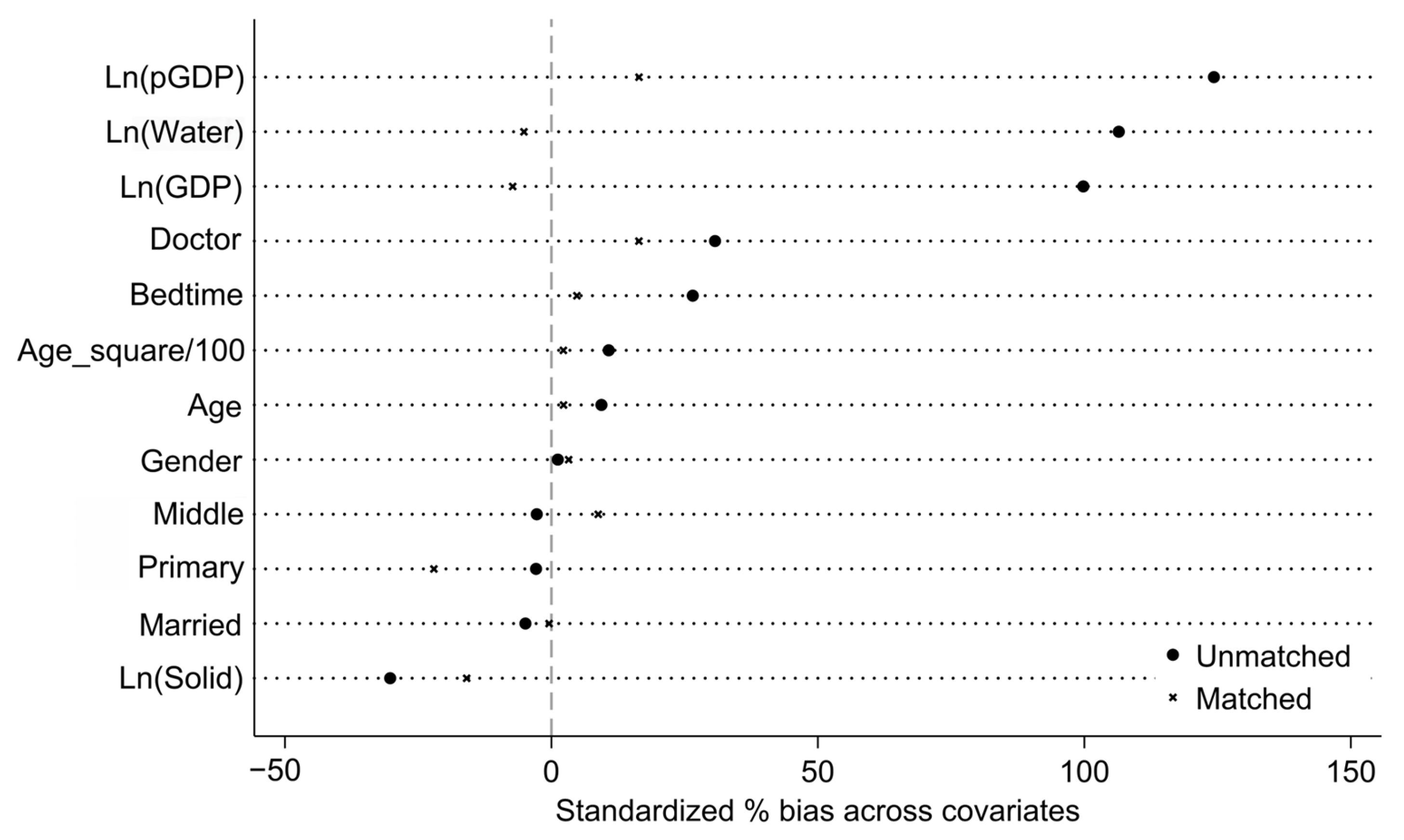
In order to further alleviate the sample selection bias caused by the possible systematic differences between pilot and non-pilot regions prior to policy implementation, this paper uses the propensity score matching and difference-in-differences (PSM-DID) method to test the robustness of the baseline results. Specifically, the Logit model is first constructed based on the covariates at the individual and regional levels to estimate the propensity scores of the samples, and the kernel-matching method is used to match the control group samples with similar characteristics for the individuals in the treatment group, so as to construct a more comparable counterfactual scenario. As illustrated in the covariate balance test in Figure 2, after matching, the standardized bias of each covariate decreases significantly and is controlled within the commonly accepted threshold range (10–15%). This indicates that the matching process effectively satisfies the balancing property and improves the comparability between two groups.
Subsequently, we re-estimate the two-way fixed effects DID model using the matched sample. The results are shown in Column (1) of Table 3, and the estimated coefficient of the CETS is 0.017, which is statistically significant at the 5% level. The estimated results are highly consistent with the baseline regression in terms of sign, magnitude and significance, suggesting that the basic conclusions are robust to the sample selection problem. Moreover, the sample size after matching is still large (N = 164,611), indicating that most of the observed values are within the common support region, which further enhances the reliability of the estimation results. Overall, the PSM-DID results further support the basic conclusion of this paper that the CETS has a significant promotion effect on individual health.

4.3.2. Validity of the Placebo Test

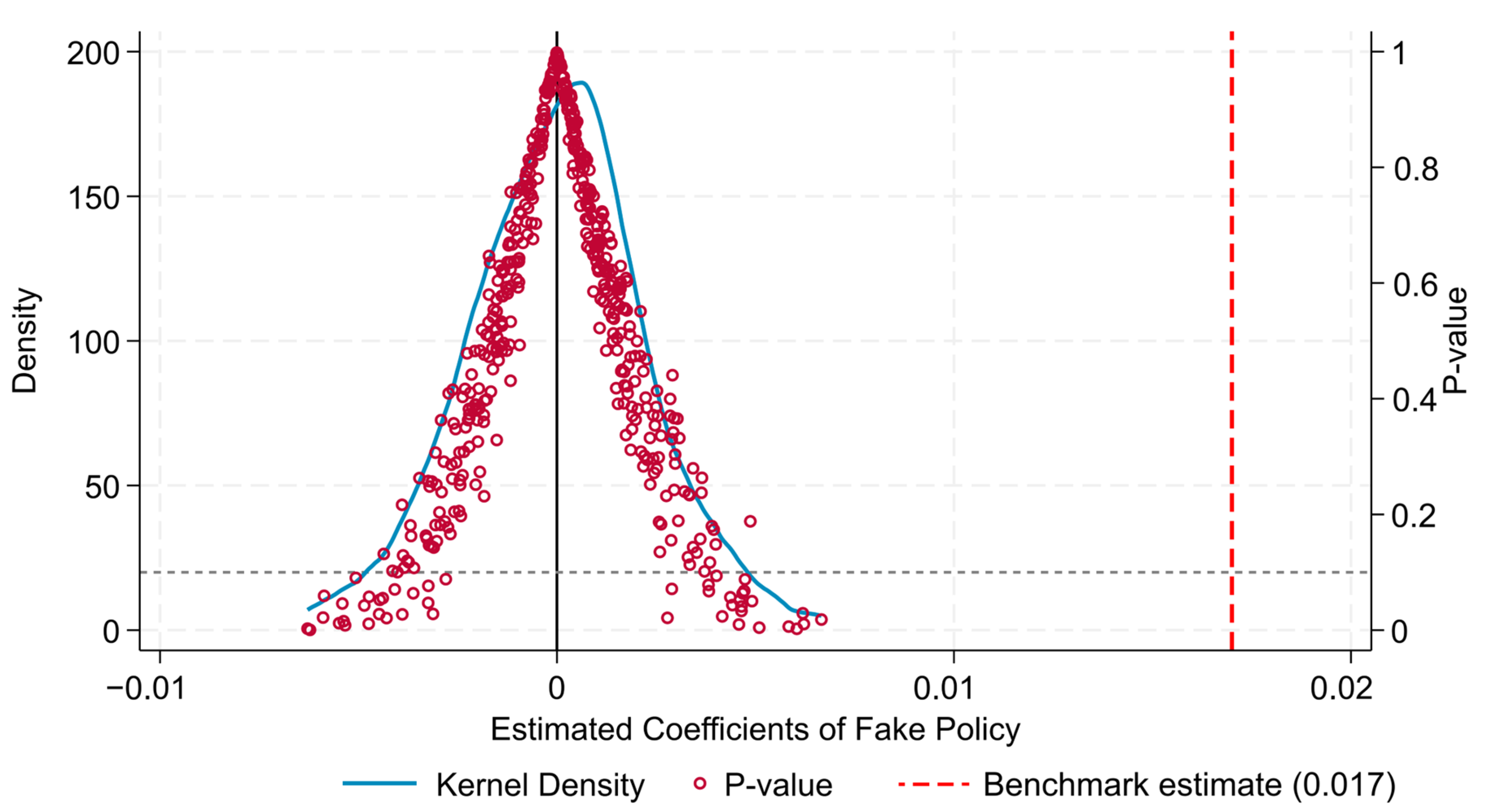
To further rule out that the benchmark estimation results may be affected by unobservable time-varying regional factors or random noise, this paper uses the random assignment method to carry out the placebo test. Specifically, the implementation status of the CETS is randomly assigned among different provinces and years, so as to construct a “pseudo” policy variable and re-estimate the baseline model. The above randomization process was repeated 500 times, with the DID model incorporating both individual and year fixed effects estimated under the same specification each time.
Figure 3 reports the distribution of the coefficients and their corresponding p-values obtained from the 500 placebo regressions. As shown, the kernel density distribution of the estimated placebo coefficients is tightly centered around zero, and most of the estimated results are statistically insignificant (p values are generally higher than 0.10). In stark contrast, the actual benchmark estimate of the CETS (0.017) significantly deviates from the main distribution of the placebo estimates, falling in the extreme right tail. These findings indicate that the randomly generated policy variables cannot replicate the significant positive effects in the baseline regression, thus supporting the causal interpretation of the core conclusions of this paper. In other words, the promotion effect of the CETS on individual health is unlikely to be driven by random factors or unobservable omitted variables.

4.3.3. Addressing Heterogeneous Treatment Effects in the Staggered DID Framework

Recent econometric literature highlights that traditional two-way fixed effects (TWFE) estimators may suffer from negative weighting bias in staggered DID designs [55,61], particularly when earlier-treated units implicitly act as invalid controls for later-treated units. Theoretically, however, the institutional rollout of China’s regional CETS serves as a structural advantage that inherently mitigates this bias. Unlike policies with highly dispersed implementation timelines, the CETS intervention was heavily concentrated in a narrow time window, with seven of the eight pilots initiated almost simultaneously between 2013 and 2014. This structural concentration fundamentally minimizes the problematic “later versus earlier treated” comparisons from the root.
To empirically verify this institutional intuition and formally rule out the potential impact of heterogeneous treatment effects, we employ the twowayfeweights diagnostic method developed by de Chaisemartin and D’Haultfœuille (2020) [62]. Recognizing that CETS intervention varies at the provincial level, we aggregated the micro-samples into a balanced province-level panel to align the diagnostic test with the actual dimension of the policy shock and satisfy the decomposition algorithm’s strict requirements.
The diagnostic results formally confirm our theoretical expectations: out of the 41 effective group-time unit comparisons (Average Treatment Effects on the Treated, ATTs) receiving non-zero weights, the vast majority (38) receive positive weights, with the sum of positive weights equaling 1.0031. Conversely, only 3 ATTs receive negative weights, and the sum of these negative weights is infinitesimally small at −0.0031. As these results demonstrate, the proportion of negative weights is extremely minuscule. Therefore, even after rigorously accounting for heterogeneous treatment effects, the baseline TWFE estimates of our staggered DID remain highly robust and reliable.

4.3.4. Alternative Specifications and Samples

To further test the robustness of the baseline results and eliminate the interference of specific sample selection and potential heterogeneity trends, this paper conducts supplementary analysis from the two dimensions of sample processing and model specification. First, considering the significant particularity of China’s four municipalities (Beijing, Shanghai, Tianjin and Chongqing) in terms of institutional environment and economic development level, their health conditions and environmental governance pathways may be different from those of general provinces. In order to avoid the potential impact of such regions on the estimation results, we exclude the observations from these municipalities in Column (2) and re-estimate the baseline model. The results show that the estimated coefficient of the key explanatory variable CETS is still 0.018, which is significant at the statistical level of 5%, indicating that the baseline conclusion does not depend on the samples of specific regions. Secondly, to alleviate the interference of possible unobservable heterogeneous development trends in different provinces on the identification results, we further incorporate the province-specific linear time trend in Column (3). The results show that after controlling the region-specific time trend, the estimated coefficient of the CETS remains significantly positive (0.014, p < 0.05). This finding suggests that the core conclusion of this paper is not driven by pre-existing regional development paths, but has strong robustness.
Overall, no matter when the sample scope is adjusted or the model specification is strengthened, the positive impact of the CETS on individual health remains stable, which further supports the core findings of this paper.

4.3.5. Excluding Contemporaneous Policies

During our sample period, China has implemented several environmental regulation policies, which may work simultaneously with the CETS, thus potentially interfering with the identification of its health effects. In order to separate the independent impact of the CETS as much as possible, this paper adopts a stepwise control approach by incorporating major concurrent policy variables into the regression model. Specifically, this paper successively controls the three policy shocks—the energy-consuming right-trading system, the low-carbon province pilot, and the environmental protection tax—and further constructs an extended model that includes all policy variables simultaneously. The corresponding results are reported in Columns (4) to (7) of Table 3. It can be observed that under the different specifications that progressively introduce and simultaneously control for multiple policies, the estimated coefficients of the CETS remain consistent in terms of sign, magnitude and significance. In the model that includes all contemporaneous policies at the same time (Column 7), the estimated coefficient of the CETS is 0.016 and remains statistically significant at the 5% level. The above results show that the core conclusion of this paper is not significantly affected by the overlapping effect of other environmental regulation policies, and the positive effect of the CETS on individual health is robust.

5. Mechanism Analysis and Validation

5.1. Mechanism Analysis: The Moderating Role of Digital Finance

While the baseline results demonstrate the overall positive health effects of the CETS, the materialization of these environmental health dividends at the micro level fundamentally depends on residents’ capacity to smooth consumption and invest in health capital. As hypothesized, the rapid proliferation of digital finance, increasingly underpinned by digital technologies and big data, serves as a crucial boundary condition. By utilizing algorithmic credit assessments to mitigate information asymmetry, digital finance significantly relaxes household liquidity constraints. This equips vulnerable populations to weather transitional income or employment shocks induced by regional industrial restructuring, allowing them to fully capitalize on the favorable macro-environmental shock.
To empirically test this mechanism (H2), we introduce the interaction term between the CETS and the logarithmic Digital Financial Inclusion Index (Ln(DFII)) into the baseline model. Table 4 reports the moderating effect results. As shown in Column (1), the coefficient of the interaction term (CET × Ln(DFII)) is 0.029 and is statistically significant at the 5% level. This significantly positive interaction coefficient confirms our hypothesis: higher levels of regional digital finance amplify the policy’s synergistic health benefits. The economic intuition perfectly aligns with our theoretical framework—robust digital financial infrastructures provide critical credit support for micro-households, enabling them to maintain stable nutritional intake and purchase advanced healthcare services during the low-carbon transition, thereby maximizing the policy’s health dividends.
To further unpack this mechanism, we decompose the DFII into three sub-dimensions: coverage breadth, usage depth, and digitization level, corresponding to Columns (2) through (4). The interaction terms across all three sub-dimensions are statistically positive, underscoring the multidimensional robustness of this moderating effect. Specifically, the interaction coefficient for Coverage Breadth (Column 2) is the largest at 0.031 (p < 0.05), highlighting that expanding financial access to previously unbanked or vulnerable households is the most potent driver in bridging the environment–health nexus. Furthermore, the deepening of Usage Depth (Column 3, coefficient = 0.022, p < 0.10) implies that diversified financial instruments, such as digital credit and insurance, effectively help families hedge against specific health or income risks. Finally, a higher Digitization Level (Column 4, coefficient = 0.025, p < 0.10) reflects how alternative data profiling reduces transaction frictions, enabling timely financial support. Together, these technology-empowered enhancements in digital finance act as a vital positive moderator, empowering micro-households to smoothly navigate the transition and secure health improvements.
In terms of economic significance, the moderating effect of digital finance is not only statistically robust but also highly impactful in magnitude. Based on the estimated interaction coefficient of 0.029 for the overall digital financial inclusion index (as shown in Column 1), a one-standard-deviation increase in regional digital finance development (which is 0.483) amplifies the marginal health dividend of the CETS by approximately 1.4 percentage points (i.e., 0.029 × 0.483). When evaluated against the baseline sample mean of self-reported health improvement (11.4%), this technological empowerment translates to a substantial additional relative improvement of roughly 12.3% (e.g., 0.014/0.114). This significant magnitude quantitatively confirms that digital finance acts as a powerful macro-level catalyst, rather than a mere supplementary tool, effectively magnifying the policy’s environmental and health co-benefits. Overall, the above results show that digital finance plays a significantly positive role in regulating the relationship between the CETS and individual health, thus providing new empirical evidence for understanding the mechanism of the CETS.
Finally, it is worth noting the unexpected but theoretically profound performance of the regional economic development variable (Ln(GDP)). Across the specifications in Table 4, the coefficient of Ln(GDP) exhibits a marginally significant negative sign (e.g., −0.028, p < 0.10). While seemingly counterintuitive, this finding perfectly captures the “health penalty of rapid economic growth” extensively documented in environmental and health economics [33,34]. During the sample period, the rapid macroeconomic expansion of many regions was heavily reliant on carbon-intensive and highly polluting industrial structures, leading to severe environmental trade-offs. The negative health externalities caused by industrial pollution, coupled with the intense occupational stress (e.g., overwork) and widening inequalities prevalent in high-growth urban centers, can temporarily offset the marginal medical benefits brought by aggregate wealth accumulation. This empirical phenomenon further underscores the urgency of implementing the CETS—highlighting that without forceful, market-based environmental regulations to decouple economic growth from pollution, traditional GDP expansion risks severely compromising public health.

5.2. Mechanism Validation: The Macro-Environmental Synergy Effect

To test this pathway empirically, we substitute the dependent variable with the natural logarithm of regional sulfur dioxide emissions (Ln(SO2)). As shown in Column (5) of Table 4, the coefficient of the interaction term (CETS × Ln(DFII)) is significantly negative (−1.245, p < 0.10). This empirical finding confirms a strong environmental synergy. In terms of economic magnitude, the negative interaction coefficient implies that for regions implementing the CETS, a 1% increase in the digital financial inclusion index further amplifies the sulfur dioxide emission reduction effect by approximately 1.245%. This indicates that digital finance is not merely a passive financial infrastructure, but an active catalyst that accelerates the retirement of outdated industrial capacity and the adoption of desulfurization technologies among regional enterprises.
Crucially, this macro-level environmental synergy serves as the fundamental prerequisite for micro-level health improvements. According to the Grossman health demand model, ambient air pollutants such as SO2 act as exogenous shocks that sharply accelerate the depreciation rate of human health capital. By facilitating corporate green transitions and accelerating the reduction in these targeted pollutants, digital finance substantially lowers the baseline environmental exposure risks for local residents. Consequently, this macro-environmental validation firmly bridges the missing link between institutional policies and individual health dividends, corroborating the macro-environmental synergy side of our dual-empowerment hypothesis. Together with the micro-inclusive buffering effect previously analyzed in Section 5.1 and the subsequent heterogeneity tests of the moderating mechanism of digital finance in Section 6, these findings provide comprehensive empirical evidence for the multi-dimensional empowerment role of digital finance in the environment–health nexus.

6. Further Analysis

To further identify the distribution characteristics of the moderating mechanism of digital finance and verify its inclusive nature, this section conducts a cross-sectional heterogeneity analysis from the four dimensions: education level, gender, age and region. By introducing the interaction term between the CETS and the logarithmic Digital Financial Inclusion Index (CETS × Ln(DFII)) into different subsamples, the relevant results are reported in Table 5.
Firstly, from the perspective of education level, the moderating effect of digital finance exhibits a distinct pro-vulnerable bias. As shown in columns (1) and (2) of Table 5, for the non-college education group, the estimated coefficient of the interaction term (CETS × Ln(DFII)) is 0.030, which is significant at the statistical level of 5%. However, for the group with college education and above, although the coefficient is positive (0.032), it is statistically insignificant. This result suggests that the enabling effect of digital finance on the CETS’s health dividends is more pronounced among lower education groups. One possible explanation is that highly educated individuals typically possess abundant traditional social capital and sophisticated financial literacy, making them more inclined to mitigate environmental risks through defensive health investment (e.g., purchasing air purifiers or securing superior medical services) [63]. Conversely, less educated groups face severe financial exclusion within the traditional banking system and rely more heavily on improvements in public environmental quality [64]. Digital finance substantially lowers the barriers to financial access, playing a crucial “timely assistance” role that enables these populations to smooth consumption and undertake necessary health investments during the environmental policy transition.
Second, from the gender dimension, digital finance shows a strong inclusive effect in alleviating the gender inequality of traditional finance. According to the results in Columns (3) and (4) of Table 5, the coefficient of the interaction term (CETS × Ln(DFII)) in the female sample is 0.043, and it is significantly positive at the level of 1%. However, the coefficient in the male sample is 0.014, which is statistically insignificant. In traditional financial markets, women often face higher credit constraints due to lack of collateral or relatively low income levels. Digital finance precisely breaks down these traditional gender barriers through mobile payment and big data-driven credit profiling, providing women with readily accessible digital credit and micro-insurance [65]. The development of such inclusive finance significantly improves the nutritional level and risk-coping ability of households, thus becoming an important mechanism to amplify their health dividends under environmental regulation.
Third, from the age dimension, the moderating effect of digital finance highlights a profound “digital divide.” As shown in Columns (5) and (6) of Table 5, the estimated coefficient of the interaction term for the non-elderly cohort (under 60 years old) is 0.038 and significant at the 5% level. However, for the elderly group, the coefficient is statistically insignificant. This striking contrast implies that while elderly populations are physiologically more vulnerable to environmental risks, their lack of digital literacy and lower smartphone penetration prevent them from fully utilizing digital financial tools as a liquidity buffer. Consequently, the synergistic health dividends are largely captured by the non-elderly populations who possess the capability to navigate digital financial services.
Finally, in terms of regional differences, the moderating effect of digital finance shows significant spatial heterogeneity, confirming its ability to overcome geographical frictions. As shown in Columns (7) to (9) of Table 5, the interaction term is completely insignificant in the eastern region. However, in the central and western regions, the coefficients of the interaction term are 0.054 and 0.072 respectively, both of which are significantly positive at the level of 5%. The underlying logic of this spatial divergence rests on the fact that the eastern coastal areas of China already have highly developed traditional financial infrastructure, rendering the marginal contribution of digital finance relatively limited. On the contrary, the central and western regions are subject to severe geographical barriers and insufficient supply of traditional finance [66]. Digital finance overcomes these spatial frictions, providing inland residents with indispensable financial resilience to navigate the transition costs induced by the policy and ultimately achieve health improvements.
Overall, the results of further analysis indicate that the moderating mechanism of digital finance is not uniformly distributed but rather precisely targets marginalized populations—specifically, less educated individuals, women, non-elderly cohorts, and inland residents. This evidence comprehensively dispels concerns that digital finance merely serves as a proxy for broad macroeconomic wealth, offering a profound theoretical insight: digital finance acts as an indispensable “inclusive buffer,” ensuring that macro-environmental governance policies are implemented in a more socially equitable and micro-accessible manner.

7. Discussion and Conclusions

7.1. Discussion

Building on the empirical results presented above, this section provides an interpretive discussion of the findings and situates them within the broader context of institutional frameworks and public health. Firstly, our findings challenge the conventional wisdom that environmental improvements mechanically translate into health benefits, offering a profound “new view” on the decoupling of economic growth and health depreciation. As evidenced by the unexpected but theoretically vital negative correlation between regional macroeconomic expansion (Ln(GDP)) and individual health in our mechanism analysis, traditional economic growth in developing stages often carries a severe “health penalty” driven by industrial pollution and structural transition stress [33]. The true institutional value of the CETS lies not merely in reducing pollution emission intensity, but in acting as a structural anchor that forcibly decouples regional economic development from this inherent health penalty. By endogenizing carbon costs, the CETS systematically lowers baseline environmental exposure risks, generating vital health co-benefits that traditional economic growth fails to provide, which is consistent with prior studies highlighting the health gains from pollution reduction policies [1,40].
Secondly, digital finance operates as a critical “dual empowerment” catalyst rather than a mere supplementary financial tool. Our mechanism analysis reveals that the materialization of environmental health dividends depends strictly on the inclusive institutional environment. At the macro level, digital finance effectively alleviates corporate financing constraints, synergizing with the CETS to promote corporate green transitions and directly reduce ambient pollutant exposure (e.g., accelerating SO2 reduction). Simultaneously, at the micro level, it acts as an indispensable “inclusive buffer” that relaxes household liquidity constraints. It is precisely through this dual pathway that digital finance empowers populations to weather economic transition shocks, echoing recent research on the role of digital finance in promoting green transformation and inclusive welfare improvement [26,49].
Thirdly, our further analysis profoundly illustrates that the moderating role of digital finance in releasing health dividends is deeply stratified by socioeconomic and technological boundaries. The empirical evidence suggests that the “enabling” effect of digital finance is not universal but exhibits significant contextual dependence, in line with studies emphasizing the distributional consequences of environmental regulation [65,66]. Specifically, our findings uncover a stark “digital divide”: while digital finance significantly amplifies the health benefits for less educated populations, females, and inland residents by lowering financial access barriers, the elderly cohort remains marginalized from this synergistic effect due to a lack of digital literacy. From a public health and sustainability perspective, this implies that the actual effectiveness of environmental policy in promoting equity depends on the accessibility of its supporting technological enablers. A genuine improvement in overall social welfare requires policymakers to recognize that institutional pressures (like the CETS) must be matched with age-friendly and inclusive digital financial tools to prevent the unintended exacerbation of health inequalities.

7.2. Conclusions and Contributions

Based on the quasi-natural experiment of China’s CETS pilot and micro-panel data, this study systematically investigates the impact of the CETS on individual health and the moderating role of digital finance. The empirical results first demonstrate that the CETS yields significant individual health dividends, confirming its fundamental positive main effect. Building upon this, through rigorous mechanism analysis, this study maps a complete and robust dual empowerment causal chain. At the macro level, digital finance effectively alleviates corporate financing constraints, synergizing with the CETS to promote corporate green transitions and directly reduce ambient pollutant exposure (e.g., accelerating SO2 reduction), thereby lowering the baseline environmental health risks. At the micro level, digital finance acts as an ‘inclusive buffer’ that relaxes household liquidity constraints and enhances risk-coping capacities. It is precisely through this synergistic causal pathway—where institutional pressure meets technological enablement—that residents can successfully convert macro-environmental improvements into measurable micro-health gains. Furthermore, this synergistic moderating mechanism exhibits significant distributional heterogeneity across different demographic groups and regions, profoundly benefiting less educated populations, females, and inland residents, while exposing a critical “digital divide” among the elderly.
This study contributes to the existing literature in three main ways. First, it advances the literature on environmental health economics by offering a novel perspective on the decoupling of economic growth and health depreciation. Moving beyond previous research that mainly focuses on corporate emission reductions or macro-economic performance, this paper reveals the profound health synergistic effects of market-based regulations. Crucially, it provides empirical micro-evidence showing how the CETS acts as a structural anchor to break the inherent “health penalty” typically associated with rapid economic expansion in developing stages.
Second, this study pioneers the integration of digital financial inclusion into the environment–health analytical framework, mapping a complete “dual empowerment” causal chain. By conceptualizing digital finance not merely as a financing tool but as an indispensable “inclusive buffer,” this paper explains the institutional complementarity required to translate macro-environmental policies into micro-welfare. It clarifies how technological enablement at the micro level is a prerequisite for realizing the health dividends of institutional pressures at the macro level.
Third, it deeply unpacks the distributional consequences of environmental policies in the digital era by uncovering underlying socioeconomic and technological stratifications. Rather than treating heterogeneity as a mere statistical variation, this research identifies a stark “digital divide” (particularly the marginalization of the elderly) alongside significant gender-inclusive and regional dividends. This provides a highly nuanced understanding of how technological boundaries shape sustainable development, offering targeted theoretical support for designing more equitable public health and environmental policies.

7.3. Policy Implications

Based on the nuanced empirical findings and heterogeneity analyses, this paper derives the following specific practical implications: First, bridging the “elderly digital divide” in environmental welfare. Our heterogeneity results reveal a striking contrast: while the non-elderly cohort benefits significantly from the synergistic effects of digital finance, the elderly group—who are physiologically more vulnerable to pollution—fails to capture these dividends due to a lack of digital literacy. Therefore, policymakers must not rely solely on digital transitions for welfare distribution. We recommend developing “age-friendly” green digital healthcare products (e.g., simplified interfaces or voice-assisted claims) and maintaining robust offline financial assistance channels to ensure the elderly are not left behind during the low-carbon transition.
Second, targeting the Gender Dividend through inclusive green credit. Given our empirical evidence that women experience a significantly larger health dividend via digital financial inclusion compared to men, policy designs should capitalize on this gender inclusivity. Financial institutions in the CETS pilot regions should be encouraged to design targeted micro-insurance and digital health-credit products specifically for female-headed households or female entrepreneurs, further amplifying the gender-inclusive dividends of environmental policies.
Third, implementing a regional cross-subsidization mechanism for inland areas. Finding that the synergistic effect of digital finance is exclusively significant in the Central and Western regions (where traditional financial infrastructure is scarce), we suggest a structural policy integration. Policymakers should consider utilizing a specific portion of the CETS allowance auction revenues to explicitly subsidize digital financial infrastructure (e.g., rural 5G networks and big data centers) in inland China, creating a sustainable closed-loop system where “carbon revenues fund digital inclusion”.

7.4. Limitations and Future Research

Although this paper has conducted multiple tests in terms of identification strategy and empirical analysis, there are still some limitations. First, this study primarily relies on self-rated health metrics, which may not fully capture objective health status. Subsequent research could incorporate more comprehensive measures such as medical data, morbidity rates, or pollution-related mortality. Second, this study primarily focuses on policy impacts within pilot regions without formally modeling potential spatial spillover effects (e.g., pollution havens). While spatial models like SDM-DID are theoretically valuable, constructing them requires macro-level data aggregation, which would obscure the granular individual heterogeneity central to our micro-level identification. Future research utilizing geocoded administrative datasets could explicitly explore these cross-regional spatial dynamics. Third, due to substantial missing values and the lack of granular occupational identifiers in the CFPS panel, we could not rigorously explore income and occupational heterogeneity. Future studies utilizing more complete administrative records could further examine these socioeconomic dimensions. Finally, as the research sample is limited to the Chinese context, the external applicability of the relevant conclusions still needs to be further tested.

Author Contributions

Conceptualization, Y.Z. and Q.W.; methodology, Y.Z.; software, Y.G.; validation, Y.Z. and Y.G.; formal analysis, Y.Z.; data curation, Y.G.; writing—original draft preparation, Y.Z.; writing—review and editing, Q.W.; visualization, Y.G.; supervision, Q.W. All authors have read and agreed to the published version of the manuscript.

Funding

This research was supported by the Anhui Provincial Department of Education Research Project [Grant Number 2025AHGXSK40267, Grant Number 2025AHGXSK10009, Grant Number 2025AHGXSK40214, Grant Number 2025AHGXSK50082], the Anhui Province Scientific Research Program Planning Project [Grant Number 2024AH053368], the Suzhou University Research Platform Project [Grant Number 2024PTPY05], the Anhui Provincial Higher Education Scientific Research Project [Grant Number 2023AH040309], the Youth Project of Anhui Philosophy and Social Science Planning [Grant Number AHSKQ2025D179] and the Youth Project of Shanghai Planning Office of Philosophy and Social Science Planning [Grant Number 2023EGL001].

Institutional Review Board Statement

Not applicable.

Informed Consent Statement

Not applicable.

Data Availability Statement

The raw data supporting the conclusions of this article will be made available by the authors on request.

Conflicts of Interest

The authors declare no conflicts of interest.

References

  1. Wang, C.; Liao, L.; Zhang, X.; Lin, L.; Chen, B. The Health and Welfare Effects of Environmental Governance: Evidence from China. Environ. Int. 2024, 185, 108579. [Google Scholar] [CrossRef]
  2. McGartland, A.; Revesz, R.; Axelrad, D.A.; Dockins, C.; Sutton, P.; Woodruff, T.J. Estimating the Health Benefits of Environmental Regulations. Science 2017, 357, 457–458. [Google Scholar] [CrossRef]
  3. Tanaka, S. Environmental Regulations on Air Pollution in China and Their Impact on Infant Mortality. J. Health Econ. 2015, 42, 90–103. [Google Scholar] [CrossRef] [PubMed]
  4. Li, Y.; Zhao, J. The Effectiveness of Carbon Emission Trading System: Evidence from China’s Regional Markets. J. Dev. Econ. 2025, 179, 103631. [Google Scholar] [CrossRef]
  5. Lyu, X.; Shi, A.; Wang, X. Research on the Impact of Carbon Emission Trading System on Low-Carbon Technology Innovation. Carbon Manag. 2020, 11, 183–193. [Google Scholar] [CrossRef]
  6. Xuan, D.; Ma, X.; Shang, Y. Can China’s Policy of Carbon Emission Trading Promote Carbon Emission Reduction? J. Clean. Prod. 2020, 270, 122383. [Google Scholar] [CrossRef]
  7. Chen, L.; Wang, D.; Shi, R. Can China’s Carbon Emissions Trading System Achieve the Synergistic Effect of Carbon Reduction and Pollution Control? Int. J. Environ. Res. Public Health 2022, 19, 8932. [Google Scholar] [CrossRef]
  8. Fan, Y.; Chen, Z.; He, T. The Impact of Carbon-Emission Trading Scheme Policies on Air Quality in Chinese Cities. Sustainability 2024, 16, 10023. [Google Scholar] [CrossRef]
  9. Huang, Y.; Li, S. Can Marketization of Environmental Governance Improve Public Health?—Empirical Analysis Based on the Emission Trading System. Int. J. Environ. Res. Public Health 2022, 19, 15518. [Google Scholar] [CrossRef] [PubMed]
  10. Xian, B.; Wang, Y.; Xu, Y.; Wang, J.; Li, X. Assessment of the Co-Benefits of China’s Carbon Trading Policy on Carbon Emissions Reduction and Air Pollution Control in Multiple Sectors. Econ. Anal. Policy 2024, 81, 1322–1335. [Google Scholar] [CrossRef]
  11. Weng, Z.; Cheng, C.; Xie, Y.; Ma, H. Reduction Effect of Carbon Emission Trading Policy in Decreasing PM2.5 Concentrations in China. Int. J. Environ. Res. Public Health 2022, 19, 16208. [Google Scholar] [CrossRef]
  12. Zhang, L.; Cao, C.; Tang, F.; He, J.; Li, D. Does China’s Emissions Trading System Foster Corporate Green Innovation? Evidence from Regulating Listed Companies. Technol. Anal. Strateg. Manag. 2019, 31, 199–212. [Google Scholar] [CrossRef]
  13. Liu, M.; Li, Y. Environmental Regulation and Green Innovation: Evidence from China’s Carbon Emissions Trading Policy. Financ. Res. Lett. 2022, 48, 103051. [Google Scholar] [CrossRef]
  14. Cheng, Z.; Wang, L. The Impact of Carbon Emission Trading Schemes on Corporate Green Innovation. J. Clean. Prod. 2025, 514, 145792. [Google Scholar] [CrossRef]
  15. Guo, B.; Feng, Y.; Wang, Y.; Lin, J.; Zhang, J.; Wu, S.; Jia, R.; Zhang, X.; Sun, H.; Zhang, W.; et al. Influence of Carbon Emission Trading Policy on Residents’ Health in China. Front. Public Health 2022, 10, 1003192. [Google Scholar] [CrossRef] [PubMed]
  16. Li, C.; Wang, H.; Jiang, S.; Gu, B. The Effect of AI-Enabled Credit Scoring on Financial Inclusion: Evidence from an Underserved Population of over One Million. MIS Q. 2024, 48, 1803–1834. [Google Scholar] [CrossRef]
  17. Chong, H.; Wang, H. Digital Finance and the Agribusiness Paradox: Insurance-Induced Credit Constraints and the Transparency Trap in Low-Marketization Regions. Front. Sustain. Food Syst. 2026, 10, 1746476. [Google Scholar] [CrossRef]
  18. Zhang, X.; Fan, D. Research on the Synergistic Emission Reduction Effect of Carbon Emission Trading and Green Financial Policy. J. Environ. Manag. 2024, 367, 121924. [Google Scholar] [CrossRef]
  19. Ding, Q.; Huang, J.; Chen, J. Does Digital Finance Matter for Corporate Green Investment? Evidence from Heavily Polluting Industries in China. Energy Econ. 2023, 117, 106476. [Google Scholar] [CrossRef]
  20. Li, C.; Li, D.; He, S.; Sun, S.; Tian, Y.; Wang, Z. The Effect of Big Data-Based Digital Payments on Household Healthcare Expenditure. Front. Public Health 2022, 10, 922574. [Google Scholar] [CrossRef]
  21. Messer, L.C.; Jagai, J.S.; Rappazzo, K.M.; Lobdell, D.T. Construction of an Environmental Quality Index for Public Health Research. Environ. Health 2014, 13, 39. [Google Scholar] [CrossRef] [PubMed]
  22. Liu, T.; Hu, M.; Elahi, E.; Liu, X. Does Digital Finance Affect the Quality of Economic Growth? Analysis Based on Chinese City Data. Front. Environ. Sci. 2022, 10, 951420. [Google Scholar] [CrossRef]
  23. Liu, Y.; Luan, L.; Wu, W.; Zhang, Z.; Hsu, Y. Can Digital Financial Inclusion Promote China’s Economic Growth? Int. Rev. Financ. Anal. 2021, 78, 101889. [Google Scholar] [CrossRef]
  24. Zhu, H.; Qi, X.; Xu, M.; Su, J.; Wang, Z. Digital Finance, Industrial Structure Upgrading, and Energy Efficiency in China: A Provincial-Level Empirical Analysis. Humanit. Soc. Sci. Commun. 2025, 12, 1259. [Google Scholar] [CrossRef]
  25. Li, C.; Wang, Y.; Zhou, Z.; Wang, Z.; Mardani, A. Digital Finance and Enterprise Financing Constraints: Structural Characteristics and Mechanism Identification. J. Bus. Res. 2023, 165, 114074. [Google Scholar] [CrossRef]
  26. Li, J.; Wu, Y.; Xiao, J.J. The Impact of Digital Finance on Household Consumption: Evidence from China. Econ. Model. 2020, 86, 317–326. [Google Scholar] [CrossRef]
  27. Colmer, J.; Martin, R.; Muûls, M.; Wagner, U.J. Does Pricing Carbon Mitigate Climate Change? Firm-Level Evidence from the European Union Emissions Trading System. Rev. Econ. Stud. 2025, 92, 1625–1660. [Google Scholar] [CrossRef]
  28. Narassimhan, E.; Gallagher, K.S.; Koester, S.; Alejo, J.R. Carbon Pricing in Practice: A Review of Existing Emissions Trading Systems. Clim. Policy 2018, 18, 967–991. [Google Scholar] [CrossRef]
  29. Zhang, D.; Karplus, V.J.; Cassisa, C.; Zhang, X. Emissions Trading in China: Progress and Prospects. Energy Policy 2014, 75, 9–16. [Google Scholar] [CrossRef]
  30. Hu, Y.; Ren, S.; Wang, Y.; Chen, X. Can Carbon Emission Trading Scheme Achieve Energy Conservation and Emission Reduction? Evidence from the Industrial Sector in China. Energy Econ. 2020, 85, 104590. [Google Scholar] [CrossRef]
  31. Chen, Z.; Zhang, X.; Chen, F. Do Carbon Emission Trading Schemes Stimulate Green Innovation in Enterprises? Evidence from China. Technol. Forecast. Soc. Change 2021, 168, 120744. [Google Scholar] [CrossRef]
  32. Liu, Z.; Cai, L.; Zhang, Y. Co-Benefits of China’s Carbon Emissions Trading Scheme: Impact Mechanism and Spillover Effect. Int. J. Environ. Res. Public Health 2023, 20, 3792. [Google Scholar] [CrossRef]
  33. He, L.; Zhang, X. Assessing the Impact of Pollution on Urban Scale in China: A New Perspective from Residents’ Health. Sustainability 2023, 15, 15984. [Google Scholar] [CrossRef]
  34. Wu, H.; Gai, Z.; Guo, Y.; Li, Y.; Hao, Y.; Lu, Z.-N. Does Environmental Pollution Inhibit Urbanization in China? A New Perspective through Residents’ Medical and Health Costs. Environ. Res. 2020, 182, 109128. [Google Scholar] [CrossRef] [PubMed]
  35. Chen, Z.; Yuan, X.-C.; Zhang, X.; Cao, Y. How Will the Chinese National Carbon Emissions Trading Scheme Work? The Assessment of Regional Potential Gains. Energy Policy 2020, 137, 111095. [Google Scholar] [CrossRef]
  36. Thornton, J. Estimating a Health Production Function for the US: Some New Evidence. Appl. Econ. 2002, 34, 59–62. [Google Scholar] [CrossRef]
  37. Chen, Z.; He, Y.; Liao, N. Can Carbon Emission Trading Policy Enhance the Synergistic Emission Reduction of Carbon Dioxide and Air Pollutants? A Comparative Study Considering Different Pollutants. Energy 2024, 305, 132364. [Google Scholar] [CrossRef]
  38. Mao, Y.; Gu, X. China’s Emissions Trading Scheme in PM2.5 Reduction: A Meteorology-Based Hybrid Model. J. Environ. Eng. Sci. 2026, 21, 58–71. [Google Scholar] [CrossRef]
  39. Nam, K.-M.; Waugh, C.J.; Paltsev, S.; Reilly, J.M.; Karplus, V.J. Synergy between Pollution and Carbon Emissions Control: Comparing China and the United States. Energy Econ. 2014, 46, 186–201. [Google Scholar] [CrossRef]
  40. Ebenstein, A.; Fan, M.; Greenstone, M.; He, G.; Zhou, M. New Evidence on the Impact of Sustained Exposure to Air Pollution on Life Expectancy from China’s Huai River Policy. Proc. Natl. Acad. Sci. USA 2017, 114, 10384–10389. [Google Scholar] [CrossRef]
  41. Fang, Y.; Naik, V.; Horowitz, L.; Mauzerall, D.L. Air Pollution and Associated Human Mortality: The Role of Air Pollutant Emissions, Climate Change and Methane Concentration Increases from the Preindustrial Period to Present. Atmos. Chem. Phys. 2013, 13, 1377–1394. [Google Scholar] [CrossRef]
  42. Grossman, M. On the Concept of Health Capital and the Demand for Health. J. Political Econ. 1972, 80, 223–255. [Google Scholar] [CrossRef]
  43. Xu, Z.; He, H.; Qin, Y.; Li, S.; Wang, C.; Li, M. Is Environmental Regulation Conducive to the Reduction of Residents’ Health Costs?—Evidence from the Chinese Family Panel Survey. Ecol. Process. 2024, 13, 59. [Google Scholar] [CrossRef]
  44. Zhao, Z.; Zhou, S.; Wang, S.; Ye, C.; Wu, T. The Impact of Carbon Emissions Trading Pilot Policy on Industrial Structure Upgrading. Sustainability 2022, 14, 10818. [Google Scholar] [CrossRef]
  45. Chang, S.; Yang, X.; Zheng, H.; Wang, S.; Zhang, X. Air Quality and Health Co-Benefits of China’s National Emission Trading System. Appl. Energy 2020, 261, 114226. [Google Scholar] [CrossRef]
  46. Zhang, W.; Li, J.; Li, G.; Guo, S. Emission Reduction Effect and Carbon Market Efficiency of Carbon Emissions Trading Policy in China. Energy 2020, 196, 117117. [Google Scholar] [CrossRef]
  47. An, Q.; Zhu, K.; Xiong, B.; Shen, Z. Carbon Resource Reallocation with Emission Quota in Carbon Emission Trading System. J. Environ. Manag. 2023, 327, 116837. [Google Scholar] [CrossRef]
  48. Khan, K.; Luo, T.; Ullah, S.; Rasheed, H.M.W.; Li, P.-H. Does Digital Financial Inclusion Affect CO2 Emissions? Evidence from 76 Emerging Markets and Developing Economies (EMDE’s). J. Clean. Prod. 2023, 420, 138313. [Google Scholar] [CrossRef]
  49. Li, B.; Liu, Z.; Jia, X.; Ma, F. Digital Finance, Financing Constraints, and Green Technological Innovation: A Spatial Analysis. Glob. Financ. J. 2024, 61, 100988. [Google Scholar] [CrossRef]
  50. Lin, B.; Ma, R. How Does Digital Finance Influence Green Technology Innovation in China? Evidence from the Financing Constraints Perspective. J. Environ. Manag. 2022, 320, 115833. [Google Scholar] [CrossRef]
  51. Ma, K. Digital Inclusive Finance and Corporate Green Technology Innovation. Financ. Res. Lett. 2023, 55, 104015. [Google Scholar] [CrossRef]
  52. Li, X.; Shao, X.; Chang, T.; Albu, L.L. Does Digital Finance Promote The Green Innovation Of China’s Listed Companies? Energy Econ. 2022, 114, 106254. [Google Scholar] [CrossRef]
  53. Finkelstein, A.; Taubman, S.; Wright, B.; Bernstein, M.; Gruber, J.; Newhouse, J.P.; Allen, H.; Baicker, K. Oregon Health Study Group. The Oregon Health Insurance Experiment: Evidence from the First Year. Q. J. Econ. 2012, 127, 1057–1106. [Google Scholar] [CrossRef]
  54. Idler, E.L.; Benyamini, Y. Self-Rated Health and Mortality: A Review of Twenty-Seven Community Studies. J. Health Soc. Behav. 1997, 38, 21–37. [Google Scholar] [CrossRef] [PubMed]
  55. Baker, A.C.; Larcker, D.F.; Wang, C.C. How Much Should We Trust Staggered Difference-In-Differences Estimates? J. Financ. Econ. 2022, 144, 370–395. [Google Scholar] [CrossRef]
  56. Ozili, P.K. Impact of Digital Finance on Financial Inclusion and Stability. Borsa Istanb. Rev. 2018, 18, 329–340. [Google Scholar] [CrossRef]
  57. Guo, F.; Wang, J.; Wang, F.; Kong, T.; Zhang, X.; Cheng, Z. Measuring China’s Digital Financial Inclusion: Index Compilation And Spatial Characteristics. China Econ. Q. Int. 2020, 1, 40–52. [Google Scholar]
  58. Becker, G.S. Human Capital: A Theoretical and Empirical Analysis with Special Reference to Education, 3rd ed.; University of Chicago Press: Chicago, IL, USA, 2009. [Google Scholar]
  59. Calel, R.; Dechezleprêtre, A. Environmental Policy and Directed Technological Change: Evidence from the European Carbon Market. Rev. Econ. Stat. 2016, 98, 173–191. [Google Scholar] [CrossRef]
  60. Martin, R.; Muûls, M.; De Preux, L.B.; Wagner, U.J. Industry Compensation under Relocation Risk: A Firm-Level Analysis of the EU Emissions Trading Scheme. Am. Econ. Rev. 2014, 104, 2482–2508. [Google Scholar] [CrossRef]
  61. Goodman-Bacon, A. Difference-In-Differences with Variation In Treatment Timing. J. Econom. 2021, 225, 254–277. [Google Scholar] [CrossRef]
  62. de Chaisemartin, C.; D’Haultfœuille, X. Two-Way Fixed Effects Estimators with Heterogeneous Treatment Effects. Am. Econ. Rev. 2020, 110, 2964–2996. [Google Scholar] [CrossRef]
  63. Ito, K.; Zhang, S. Willingness to Pay for Clean Air: Evidence from Air Purifier Markets in China. J. Political Econ. 2020, 128, 1627–1672. [Google Scholar] [CrossRef]
  64. Deschenes, O.; Greenstone, M.; Shapiro, J.S. Defensive Investments and the Demand for Air Quality: Evidence from the NOx Budget Program. Am. Econ. Rev. 2017, 107, 2958–2989. [Google Scholar] [CrossRef]
  65. Suri, T.; Jack, W. The Long-run Poverty and Gender Impacts of Mobile Money. Science 2016, 354, 1288–1292. [Google Scholar] [CrossRef]
  66. Zhao, Y.; Goodell, J.W.; Dong, Q.; Wang, Y.; Abedin, M.Z. Overcoming Spatial Stratification of Fintech Inclusion: Inferences from across Chinese Provinces to Guide Policy Makers. Int. Rev. Financ. Anal. 2022, 84, 102411. [Google Scholar] [CrossRef]
Figure 1. Parallel trend test.
Sustainability 18 04765 g001
Figure 2. PSM balance test.
Sustainability 18 04765 g002
Figure 3. Placebo test.
Sustainability 18 04765 g003
Table 1. Summary statistics.
Variables N M e a n S D M i n M a x
H e a l t h 166,0440.1140.3180.0001.000
C E T S 166,0440.1570.3640.0001.000
L n ( D F I I ) 138,7605.3590.4832.9366.133
L n ( B r e a d t h ) 138,7605.2610.5661.6076.122
L n ( D e p t h ) 138,7605.3200.4582.5466.192
L n ( D i g i t i z a t i o n ) 138,7605.6380.4402.0266.147
A g e 166,04445.99716.43416.000110.000
G e n d e r 166,0440.4900.5000.0001.000
M a r r i e d 166,0440.7970.4020.0001.000
B e d t i m e 166,04422.0671.16518.00029.500
P r i m a r y 166,0440.4000.4900.0001.000
M i d d l e 166,0440.4380.4960.0001.000
C o l l e g e 166,0440.1620.3690.0001.000
L n ( G D P ) 166,04410.0810.7817.67911.795
L n ( p G D P ) 166,04410.7170.4999.47812.185
L n ( D e n s i t y ) 166,0448.0210.3867.0358.669
D o c t o r 166,04423.0465.42910.00046.000
L n ( W a t e r ) 166,0446.2970.7853.7937.997
G a r b a g e 166,04489.31615.06038.000100.000
L n ( S o l i d ) 166,0447.4712.1460.00012.248
Table 2. Baseline regression results.
Variables(1)(2)(3)(4)
HealthHealthHealthHealth
CETS0.018 ***
(0.006)
0.017 ***
(0.005)
0.019 ***
(0.007)
0.017 **
(0.007)
Age −0.013 ***
(0.004)
−0.013 ***
(0.004)
Age_square/100 0.010 ***
(0.002)
0.010 ***
(0.002)
Gender −0.035
(0.036)
−0.034
(0.036)
Married −0.017 **
(0.007)
−0.017 **
(0.007)
Bedtime −0.002
(0.001)
−0.002
(0.001)
Primary 0.018 **
(0.009)
0.018 **
(0.009)
Middle 0.009
(0.009)
0.010
(0.009)
College omitted omitted
Ln(GDP) −0.012
(0.014)
−0.010
(0.014)
Ln(pGDP) 0.002
(0.024)
0.009
(0.023)
Ln(Density) −0.009
(0.021)
−0.006
(0.020)
Doctor −0.000
(0.001)
−0.000
(0.001)
Ln(Water) 0.005
(0.010)
0.007
(0.009)
Garbage −0.000
(0.000)
−0.000
(0.000)
Ln(Solid) 0.001
(0.001)
0.001
(0.001)
Constant0.111 ***
(0.001)
0.519 ***
(0.146)
0.276
(0.343)
0.540
(0.357)
Individual FEYesYesYesYes
Year FEYesYesYesYes
N166,044166,044166,044166,044
Adj. R-squared0.1460.1480.1460.148
Note: Robust standard errors clustered at the provincial level are reported in parentheses. All specifications control for individual and year fixed effects; ** p < 0.05, *** p < 0.01.
Table 3. Robustness test results.
Variables(1)(2)(3)(4)(5)(6)(7)
PSM DIDExcl.
Municipalities
Provincial
Trends
+
ECRT
+
LCCP
+
EPT
All
Policies
CETS0.017 **
(0.007)
0.018 **
(0.008)
0.014 **
(0.006)
0.016 **
(0.007)
0.017 **
(0.007)
0.017 **
(0.007)
0.016 **
(0.007)
ECRT 0.006
(0.004)
0.005
(0.004)
LCCP −0.014
(0.014)
−0.011
(0.014)
EPT 0.003
(0.005)
0.003
(0.005)
Age−0.013 ***
(0.004)
−0.014 ***
(0.003)
−0.013 ***
(0.004)
−0.013 ***
(0.004)
−0.013 ***
(0.004)
−0.013 ***
(0.004)
−0.013 ***
(0.004)
Age_square/1000.010 ***
(0.002)
0.010 ***
(0.002)
0.010 ***
(0.002)
0.010 ***
(0.002)
0.010 ***
(0.002)
0.010 ***
(0.002)
0.010 ***
(0.002)
Gender−0.033
(0.037)
−0.047
(0.037)
−0.035
(0.036)
−0.034
(0.036)
−0.034
(0.036)
−0.034
(0.036)
−0.034
(0.036)
Married−0.018 **
(0.007)
−0.020 ***
(0.007)
−0.018 **
(0.007)
−0.017 **
(0.007)
−0.017 **
(0.007)
−0.017 **
(0.007)
−0.017 **
(0.007)
Bedtime−0.002
(0.001)
−0.002 *
(0.001)
−0.002
(0.001)
−0.002
(0.001)
−0.002
(0.001)
−0.002
(0.001)
−0.002
(0.001)
Primary0.018 **
(0.009)
0.019 *
(0.009)
0.019 **
(0.009)
0.018 **
(0.009)
0.018 **
(0.009)
0.018 **
(0.009)
0.018 **
(0.009)
Middle0.010
(0.008)
0.012
(0.009)
0.010
(0.009)
0.009
(0.009)
0.009
(0.009)
0.010
(0.009)
0.009
(0.009)
Collegeomittedomittedomittedomittedomittedomittedomitted
Ln(GDP)−0.010
(0.014)
−0.013
(0.022)
0.060
(0.086)
−0.009
(0.014)
−0.008
(0.014)
−0.011
(0.014)
−0.009
(0.014)
Ln(pGDP)0.009
(0.024)
0.011
(0.042)
−0.046
(0.107)
0.011
(0.023)
0.009
(0.023)
0.010
(0.023)
0.011
(0.023)
Ln(Density)−0.005
(0.020)
0.001
(0.022)
−0.000
(0.026)
−0.005
(0.020)
−0.005
(0.020)
−0.007
(0.020)
−0.005
(0.020)
Doctor−0.000
(0.001)
0.001
(0.002)
−0.000
(0.001)
−0.000
(0.001)
−0.000
(0.001)
−0.000
(0.001)
−0.000
(0.001)
Ln(Water)0.007
(0.009)
0.010
(0.011)
0.008
(0.011)
0.005
(0.009)
0.008
(0.009)
0.007
(0.009)
0.006
(0.008)
Garbage−0.000
(0.000)
−0.000
(0.000)
−0.000
(0.000)
−0.000
(0.000)
−0.000
(0.000)
−0.000
(0.000)
−0.000
(0.000)
Ln(Solid)0.001
(0.001)
0.001
(0.001)
0.001
(0.001)
0.001
(0.001)
0.001
(0.001)
0.001
(0.001)
0.001
(0.001)
Constant0.536
(0.364)
0.534
(0.449)
0.373
(0.603)
0.521
(0.351)
0.511
(0.357)
0.547
(0.355)
0.506
(0.348)
Individual FEYesYesYesYesYesYesYes
Year FEYesYesYesYesYesYesYes
N164,485151,440166,044166,044166,044166,044166,044
Adj. R-squared0.1470.1470.1480.1480.1480.1480.148
Notes: Robust standard errors clustered at the provincial level are reported in parentheses. All specifications control for individual and year fixed effects; * p < 0.10, ** p < 0.05, *** p < 0.01. A plus sign (+) indicates the inclusion of the variable; ECRT, LCCP, and EPT denote the Energy-Consuming Right Trading System, the Low-Carbon Province Pilot, and the Environmental Protection Tax, respectively.
Table 4. Moderating effect of digital finance.
Variables(1)(2)(3)(4)(5)
HealthHealthHealthHealthLn(SO2)
CETS × Ln(DFII)0.028 **
(0.011)
−1.245 *
(0.666)
CETS × Ln(Breadth) 0.031 **
(0.012)
CETS × Ln(Depth) 0.022 *
(0.011)
CETS × Ln(Digitization) 0.025 *
(0.014)
CETS−0.153 **
(0.063)
−0.166 **
(0.066)
−0.116 *
(0.060)
−0.138 *
(0.081)
6.510 *
(3.693)
Ln(DFII)−0.004
(0.031)
−1.138
(1.221)
Ln(Breadth) 0.002
(0.013)
Ln(Depth) −0.012
(0.030)
Ln(Digitization) 0.013
(0.023)
Age−0.009 **
(0.004)
−0.009 **
(0.004)
−0.009 **
(0.004)
−0.009 **
(0.004)
0.012
(0.009)
Age_square/1000.008 ***
(0.002)
0.008 ***
(0.002)
0.008 ***
(0.002)
0.008 ***
(0.002)
−0.010
(0.007)
Gender−0.044
(0.030)
−0.044
(0.030)
−0.044
(0.030)
−0.044
(0.030)
0.003
(0.024)
Married−0.014 **
(0.006)
−0.014 **
(0.006)
−0.014 **
(0.006)
−0.014 **
(0.006)
−0.010
(0.007)
Bedtime−0.002 *
(0.001)
−0.002 *
(0.001)
−0.002 *
(0.001)
−0.002 *
(0.001)
0.003
(0.002)
Primary0.009
(0.009)
0.009
(0.009)
0.009
(0.009)
0.009
(0.009)
−0.015
(0.017)
Middle0.004
(0.009)
0.004
(0.009)
0.004
(0.009)
0.004
(0.009)
0.041 *
(0.021)
Collegeomittedomittedomittedomittedomitted
Ln(GDP)−0.028 *
(0.014)
−0.028 **
(0.014)
−0.028 *
(0.014)
−0.028 **
(0.013)
0.737 ***
(0.269)
Ln(pGDP)−0.001
(0.019)
−0.003
(0.016)
0.003
(0.019)
0.001
(0.013)
−0.418
(0.490)
Ln(Density)−0.013
(0.011)
−0.014
(0.011)
−0.013
(0.011)
−0.011
(0.010)
0.353
(0.305)
Doctor0.001
(0.001)
0.001
(0.001)
0.000
(0.001)
0.001
(0.001)
−0.071 ***
(0.020)
Ln(Water)0.022 *
(0.012)
0.022 *
(0.012)
0.022 *
(0.012)
0.022 *
(0.012)
0.003
(0.291)
Garbage−0.000
(0.000)
−0.000
(0.000)
−0.000
(0.000)
−0.000
(0.000)
0.010 *
(0.006)
Ln(Solid)0.001
(0.001)
0.001
(0.001)
0.001
(0.001)
0.001
(0.001)
−0.001
(0.018)
Constant0.668 **
(0.294)
0.668 **
(0.287)
0.669 **
(0.286)
0.539 *
(0.317)
4.063
(4.581)
Individual FEYesYesYesYesYes
Year FEYesYesYesYesYes
N135,676135,676135,676135,676135,676
Adj. R-squared0.1570.1570.1570.1570.939
Notes: Robust standard errors clustered at the provincial level are reported in parentheses. All specifications control for individual and year fixed effects; * p < 0.10, ** p < 0.05, *** p < 0.01.
Table 5. Heterogeneity analysis results.
Variables(1)(2)(3)(4)(5)(6)(7)(8)(9)
Non-CollegeCollegeMaleFemaleNon-ElderlyElderlyEastCentralWest
CETS−0.166 **
(0.069)
−0.161
(0.226)
−0.076
(0.114)
−0.234 ***
(0.080)
−0.204 **
(0.096)
−0.126
(0.107)
−0.005
(0.074)
−0.321 ***
(0.086)
−0.411 **
(0.135)
Ln(DFII)−0.012
(0.028)
0.033
(0.102)
−0.014
(0.048)
0.006
(0.031)
0.021
(0.032)
−0.051
(0.036)
−0.015
(0.036)
−0.015
(0.061)
−0.188 *
(0.099)
CETS × Ln(DFII)0.030 **
(0.012)
0.032
(0.040)
0.014
(0.020)
0.043 ***
(0.014)
0.038 **
(0.017)
0.024
(0.020)
0.002
(0.013)
0.054 **
(0.016)
0.072 **
(0.024)
Age−0.007 **
(0.003)
−0.032 **
(0.012)
−0.012 ***
(0.004)
−0.004
(0.011)
−0.007
(0.004)
−0.001
(0.013)
−0.003
(0.007)
−0.010
(0.007)
−0.015 ***
(0.004)
Age_square/1000.005 ***
(0.001)
0.018 ***
(0.004)
0.012 ***
(0.002)
0.003
(0.002)
0.014 ***
(0.002)
0.001
(0.005)
0.007 ***
(0.002)
0.004 *
(0.002)
0.012 ***
(0.002)
Gender−0.042
(0.050)
−0.049
(0.041)
−0.057 *
(0.033)
−0.002
(0.055)
−0.040
(0.034)
−0.045
(0.091)
−0.037
(0.029)
Married−0.016 **
(0.008)
−0.018
(0.014)
−0.008
(0.007)
−0.019 **
(0.008)
−0.009
(0.007)
−0.019
(0.015)
−0.003
(0.012)
−0.024 *
(0.011)
−0.020 ***
(0.006)
Bedtime−0.000
(0.001)
−0.009 *
(0.005)
−0.003 *
(0.002)
−0.000
(0.002)
−0.002
(0.001)
−0.001
(0.002)
−0.002
(0.002)
−0.001
(0.001)
−0.002
(0.002)
Primaryomittedomitted0.015
(0.013)
0.000
(0.013)
0.008
(0.009)
−0.019
(0.077)
0.024 *
(0.011)
0.014
(0.009)
−0.026 **
(0.008)
Middleomittedomitted0.001
(0.009)
0.005
(0.012)
0.001
(0.010)
0.007
(0.067)
0.010
(0.016)
0.017 **
(0.006)
−0.028 **
(0.011)
College omittedomittedomittedomittedomittedomittedomitted
Ln(GDP)−0.028
(0.018)
−0.015
(0.028)
−0.017
(0.015)
−0.044 **
(0.020)
−0.032 **
(0.013)
0.049
(0.045)
−0.010
(0.015)
0.122 *
(0.057)
−0.056
(0.042)
Ln(pGDP)0.017
(0.023)
−0.039
(0.049)
0.015
(0.031)
−0.014
(0.023)
−0.001
(0.019)
−0.029
(0.053)
0.041
(0.037)
−0.227 ***
(0.064)
0.130 *
(0.062)
Ln(Density)−0.011
(0.012)
−0.015
(0.025)
−0.013
(0.018)
−0.014
(0.012)
−0.007
(0.013)
−0.031
(0.028)
−0.025
(0.021)
0.004
(0.030)
−0.013
(0.022)
Doctor0.000
(0.001)
−0.000
(0.003)
0.000
(0.002)
0.001
(0.001)
0.001
(0.001)
0.004 *
(0.002)
−0.001
(0.001)
−0.000
(0.002)
−0.001
(0.004)
Ln(Water)0.021
(0.015)
0.021
(0.019)
0.017
(0.014)
0.028 *
(0.015)
0.024 **
(0.011)
0.018
(0.029)
0.017
(0.020)
−0.012
(0.012)
0.053 *
(0.024)
Garbage−0.000
(0.000)
−0.001
(0.000)
−0.000
(0.000)
−0.000
(0.001)
−0.000
(0.000)
−0.000
(0.000)
−0.000
(0.000)
−0.000
(0.000)
0.001 **
(0.000)
Ln(Solid)0.001
(0.001)
0.001
(0.001)
0.001
(0.001)
0.001
(0.001)
0.001
(0.001)
0.001
(0.001)
0.002 *
(0.001)
0.001
(0.001)
0.000
(0.002)
Constant0.465
(0.303)
1.622 ***
(0.485)
0.519
(0.418)
0.738
(0.485)
0.366
(0.252)
0.288
(0.859)
−0.085
(0.515)
1.829 **
(0.538)
0.569
(0.554)
Individual FEYesYesYesYesYesYesYesYesYes
Year FEYesYesYesYesYesYesYesYesYes
N109,81923,46366,52969,017101,91430,89355,82140,80637,489
Adj. R-squared0.1490.1730.1780.1380.1630.1350.1650.1590.147
Notes: Robust standard errors clustered at the provincial level are reported in parentheses. All specifications control for individual and year fixed effects; * p < 0.10, ** p < 0.05, *** p < 0.01.
Disclaimer/Publisher’s Note: The statements, opinions and data contained in all publications are solely those of the individual author(s) and contributor(s) and not of MDPI and/or the editor(s). MDPI and/or the editor(s) disclaim responsibility for any injury to people or property resulting from any ideas, methods, instructions or products referred to in the content.