Article

Toward Sustainable Financial Behavior: The Role of Financial Socialization and FinTech in Enhancing Green Financial Literacy

by
Şafak Sönmez Soydaş
1,*,
Adem Özbek
2,
Alper Veli Çam
3,
Magdalena Radulescu
4,5,6 and
Hind Alofaysan
7
1
Department of Property Protection and Security, Irfan Can Köse Vocational School of Higher Education, Baglarbasi District Gumushane University, Gumushane 29100, Türkiye
2
Department of Management and Organization, School of Social Sciences, Baglarbasi District Gumushane University, Gumushane 29100, Türkiye
3
Department of Health Management, Faculty of Health Sciences, Baglarbasi District Gumushane University, Gumushane 29100, Türkiye
4
Department of Finance, Accounting and Economics, National University of Science and Technology Politehnica Bucharest, 060042 Bucharest, Romania
5
UNEC Research Methods Application Center, Azerbaijan State University of Economics (UNEC), Istiqlaliyyat Str. 6, Baku 1001, Azerbaijan
6
ARUCAD Research Centre, Arkin University of Creative Arts and Design, Northern Cyprus, via Mersin 10, Kyrenia 99428, Türkiye
7
Department of Economics, College of Business Administration, Princess Nourah bint Abdulrahman University, P.O. Box 84428, Riyadh 11671, Saudi Arabia
*
Author to whom correspondence should be addressed.
Sustainability 2026, 18(10), 4621; https://doi.org/10.3390/su18104621
Submission received: 13 April 2026 / Revised: 29 April 2026 / Accepted: 30 April 2026 / Published: 7 May 2026

Abstract

This study examines how financial literacy and financial socialization influence green financial literacy through the mediating role of FinTech usage within a sustainability-oriented framework. Green financial literacy is treated as a proxy for sustainable financial behavior rather than a direct behavioral measure. Based on financial socialization theory, the study proposes an integrated model linking individual competencies, social learning processes, and digital financial technologies. Data were collected from 539 individuals using a structured questionnaire and analyzed with structural equation modeling (SEM) employing a robust weighted least squares estimator. The findings show that financial literacy (β = 0.76, p < 0.001) and financial socialization (β = 0.23, p < 0.001) significantly increase FinTech usage. While financial literacy does not directly affect green financial literacy (β = −0.13, p > 0.05), FinTech usage has a strong positive impact (β = 0.88, p < 0.001), indicating a full mediation effect. Bootstrapping results further confirm the robustness of the mediation effects. Financial socialization also has a direct positive effect (β = 0.20, p < 0.01). The results suggest that financial knowledge alone is insufficient to support sustainability-oriented financial awareness unless it is supported by digital financial technologies. The study highlights the key role of FinTech in facilitating the integration of financial knowledge and social learning into sustainability-oriented financial awareness and decision-making and offers practical implications for promoting sustainable finance.

1. Introduction

Individuals’ financial decision-making processes are closely related not only to their level of financial knowledge but also to the social contexts in which this knowledge is acquired and how it is internalized. Financial literacy is defined as the ability of individuals to understand and evaluate financial concepts and to use this knowledge effectively in their daily lives; it is considered a fundamental element in terms of increasing individual well-being and ensuring economic stability [1], and it is increasingly recognized as a key driver of sustainable financial behavior. However, in recent years, approaches emphasizing that financial literacy is not merely a cognitive competency but also a behaviorally and socially constructed structure phenomenon have gained increasing traction. In this context, financial socialization has emerged as a fundamental concept that refers to the process by which individuals learn financial knowledge, attitudes, and behaviors through family, peer groups, and social interactions [2]. According to the financial socialization approach, financial behaviors are shaped through interactions within the family as well as broader social environments; patterns such as saving, spending, borrowing, and risk-taking are developed through both parental influence and social learning processes [3]. These early learnings have lasting effects on individuals’ lifelong financial decision-making patterns [4,5].
The accelerated environmental degradation, climate change and re-source depletion in the last decades have made the need for sustainable development at the global and local levels more pressing. The United Nations Sustainable Development Goals (SDGs) highlight the need for incorporating environmental aspects into financial decision-making processes, especially SDG 12 (Responsible Consumption and Production) and SDG 13 (Climate Action) [6]. In this context, the notion of sustainable financial behaviour has become essential. It is the ability of an individual to act in line with the environmental and sustainability goals of financial decisions. Individual financial decisions, such as investment preferences, consumption choices, and green financial products adoption, are key to influencing environmental results and sustainable development.
The distinction between formal and informal sources of financial knowledge points to the multiple dimensions of financial literacy. Formal financial knowledge is systematic information learned through school-based education and structured programmes, while informal financial knowledge is practical and behavioural learning from family, social environment and personal experiences. Mandell and Klein [7] demonstrate that while formal financial education enhances knowledge, its impact on individuals’ financial behaviour might be limited; knowledge acquired from family and social environment has stronger and more lasting behavioural effects. Similarly, Norvilitis and MacLean [8] emphasise the importance of the financial attitudes and behaviours of parents in the financial decision-making processes of young people. These social learning processes are even more important in today’s environment of rapid digitisation of financial markets. With digitalisation, financial services are mostly carried out through technology-based platforms. Mobile banking, digital payment systems and online investment tools are transforming the way individuals interact with financial systems. This transformation process is discussed in the literature under the concept of FinTech, which stands for innovative financial services de-veloped via information technologies [9]. FinTech applications enhance the user experience [10,11,12] in providing access to financial services, reducing transaction costs and improving financial inclusion. However, the adoption and effective use of FinTech are not homogeneous among individuals. The literature reveals that FinTech usage behaviors differ depending on the quality of financial knowledge individuals possess and the social origin of this knowledge. It is noted that individuals who are better financially socialized trust digital financial tools more, use them more consciously, and adapt more easily to new financial technologies [13,14]. In the context of global sustainability challenges, individual financial decisions play a crucial role in shaping environmental outcomes and supporting sustainable development goals (SDGs). In particular, the integration of financial literacy and digital financial technologies into sustainability-oriented decision-making processes has become increasingly important. Therefore, understanding how financial knowledge acquired through socialization translates into environmentally responsible financial behavior is essential for promoting sustainable finance at the individual level.
When viewed from the perspective of sustainability and environmental awareness, this behavior-transforming mechanism offered by financial technologies brings the concept of green financial literacy to the fore. Increasing environmental problems and sustainable development goals on a global scale have brought to the forefront the capacity of individuals to make financial decisions that take environmental impacts into account. Green financial literacy refers to individuals’ ability to recognize environmentally friendly financial instruments, integrate environmental risks into financial decision-making processes, and evaluate sustainable investment products [15] and is therefore considered a core component of sustainable financial behavior. In this sense, green financial literacy goes beyond traditional financial literacy and encompasses financial behaviors integrated with environmental awareness.
The literature shows that studies on green financial literacy have largely been addressed within the framework of individual knowledge levels and financial awareness; however, the ways in which this knowledge is shaped through family and social circles and translated into behavior through digital financial tools have been examined to a limited extent [16,17,18]. However, the process of financial socialization plays a critical role in the development of individuals’ capacity to reflect environmental sensitivity in their financial choices [19]. The values, norms, and financial attitudes acquired within the family form a fundamental reference point for individuals to develop sustainable and environmentally friendly financial behaviors.
Building on this gap in the literature, this study develops a comprehensive framework centered on financial socialization to examine how financial literacy and social learning processes translate into sustainable financial behavior through the use of FinTech. Unlike previous studies, this research explicitly integrates sustainability by linking financial socialization and FinTech usage with green financial literacy, thereby addressing the gap between financial behavior and environmental responsibility in the literature. Within this framework, FinTech usage is conceptualized as a mediating mechanism that facilitates the transformation of socially acquired financial knowledge into green financial literacy and environmentally responsible financial decision-making.

2. Research Model, Research Questions, and Hypotheses

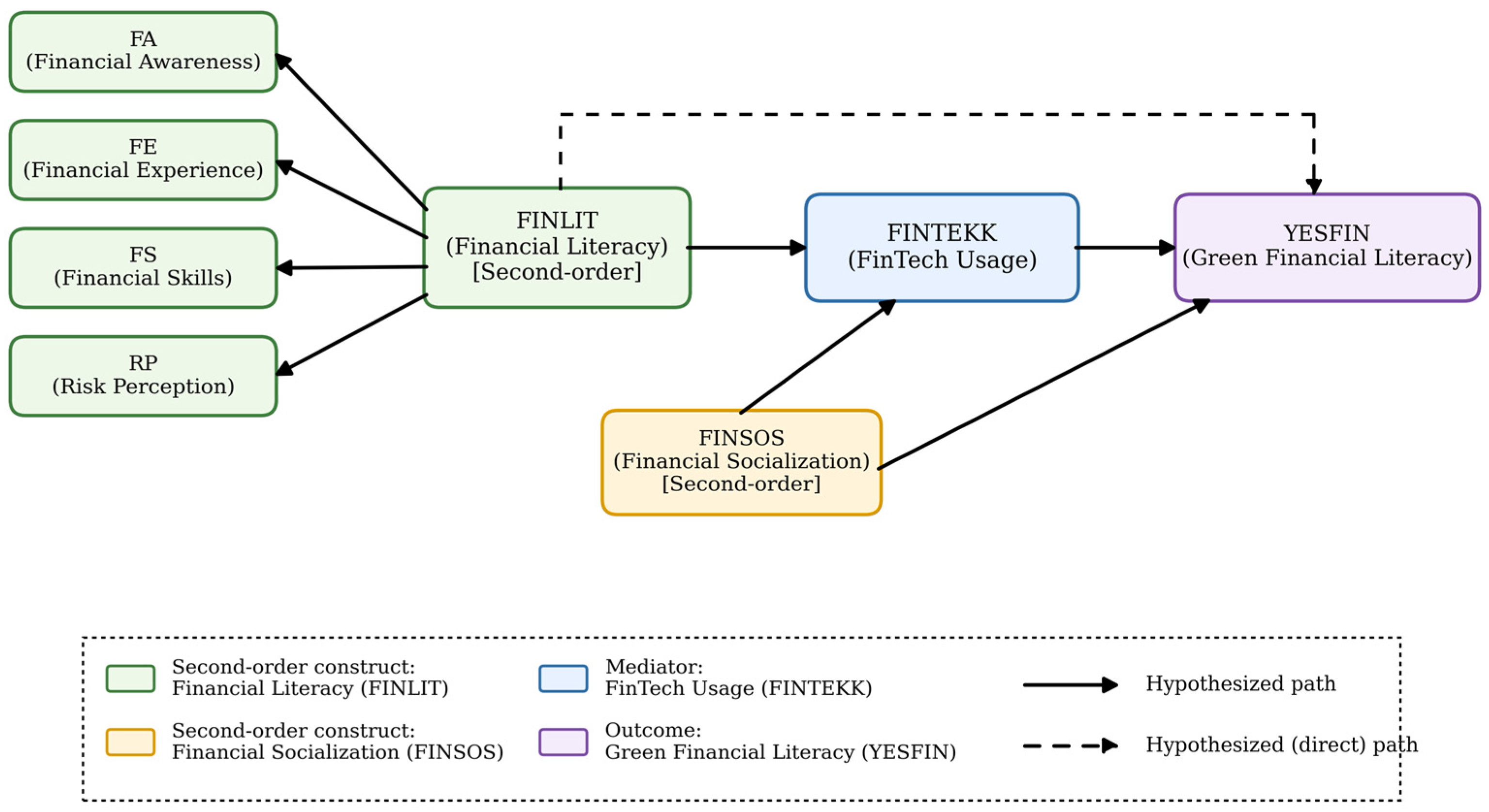
The theory of financial socialization suggests that individuals’ financial knowledge, attitudes, and behaviors are shaped through interactions within family and social environments and that this process continues throughout the life course. In the context of increasing environmental challenges and sustainability concerns, financial socialization also plays a critical role in fostering sustainable financial behavior. In today’s digital financial ecosystem, understanding how socially acquired financial knowledge is transformed into sustainable financial behavior through financial technologies has become an important research area. Accordingly, this study examines how financial literacy and financial socialization influence FinTech usage and green financial literacy, with particular emphasis on their role in shaping environmentally responsible financial decision-making. The conceptual research model is presented in Figure 1.
In line with the purpose of the study, several research questions and hypotheses derived from these questions were developed, which are described below.

2.1. Financial Socialization, Financial Literacy, and FinTech Use

The impact of financial knowledge acquired through family and social environments on individuals’ attitudes and usage behaviors toward digital financial tools is gaining increasing attention in the literature. In this context, the first research question of the study is formulated as follows:
RQ1. 
How are financial literacy and financial socialization related to individuals’ FinTech usage behaviors?
H1. 
Financial literacy is positively related to FinTech usage.
H2. 
Financial socialization is positively related to FinTech usage.
H3. 
Financial literacy has a significant effect on green financial literacy.
H4. 
Financial socialization is positively related to green financial literacy.
H5. 
FinTech usage is positively related to green financial literacy.
It is stated that individuals with a high level of financial literacy use financial technologies more consciously and effectively; this use also increases awareness and knowledge of green financial products. In this context, financial literacy is considered a fundamental determinant that directly and indirectly influences green financial literacy [20,21]. Financial awareness refers to an individual’s knowledge of financial concepts and products and their ability to use this knowledge in decision-making processes. The literature indicates that individuals with high financial awareness evaluate digital financial services more positively and are therefore more likely to adopt financial technologies [22,23]. Financial experience refers to the practical financial knowledge individuals have acquired through past savings, investments, borrowing, and payment transactions. Prior research suggests that individuals with greater financial experience are better able to make rational decisions under uncertainty and are more willing to adopt digital financial tools [24,25]. Individuals with higher levels of financial literacy tend to use digital financial tools more effectively and adapt more readily to emerging financial technologies [26,27]. Risk perception refers to the ways in which individuals assess financial uncertainties and develop attitudes toward them. Individuals with lower or manageable levels of perceived risk are more inclined to adopt financial technologies [28]. Financial socialization develops individuals’ financial decision-making competencies and plays an important role in the adoption of digital financial services [4,5]. Financial knowledge and experiences acquired from the social environment increase individuals’ trust in financial technologies and encourage their use.

2.2. FinTech Usage and Green Financial Literacy

Financial technologies play an important role in facilitating individuals’ access to sustainability-oriented financial products and incorporating environmental considerations into financial decision-making processes. In this context, the second research question of the study is defined as follows:
RQ2. 
How does FinTech usage influence individuals’ level of green financial literacy?
Based on this research question, the following hypotheses are proposed:
H6. 
FinTech usage mediates the relationship between financial literacy and green financial literacy.
H7. 
FinTech usage mediates the relationship between financial socialization and green financial literacy.
FinTech usage facilitates individuals’ access to information about financial products that consider environmental impacts through digital financial platforms and supports the understanding of these products, thereby contributing to the development of sustainable financial behavior. Digital financial tools enhance individuals’ environmental financial knowledge by providing transparency on green investment funds, sustainability-oriented financial products, and environmentally friendly payment systems.
The literature indicates that FinTech usage supports sustainable finance practices and increases individuals’ environmentally focused financial awareness [29,30]. It is also noted that digital financial services contribute to the development of green financial literacy by encouraging sustainable investment decisions [12,13,14,15,16]. In this context, FinTech usage is considered a key mechanism that enhances individuals’ level of green financial literacy.

2.3. The Mediating Role of FinTech Use

The theory of financial socialization suggests that financial knowledge acquired through family and social environments is transformed into behavior through specific mechanisms, particularly in the context of sustainability-oriented financial outcomes. In this study, FinTech usage is conceptualized as a key mechanism that facilitates the transformation of financial literacy and financial socialization into green financial literacy and sustainable financial behavior. Accordingly, the third research question is formulated as follows:
RQ3. 
Does FinTech usage play a mediating role in the relationship between financial literacy, financial socialization, and green financial literacy?
To test this relationship, the mediating hypotheses (H6–H7) are examined. Financial literacy enhances individuals’ ability to understand and effectively use digital financial tools, thereby improving their evaluation of sustainable financial products [15]. FinTech applications reduce individuals’ risk perceptions regarding green financial products by increasing transparency and access to information [31,32]. Furthermore, financial socialization contributes to the development of awareness regarding sustainable financial products [8]. This framework indicates that the effect of financial literacy and financial socialization on green financial literacy operates primarily through FinTech usage, underscoring its central mediating role.

3. Materials and Methods

3.1. Research Design

This study was designed as a cross-sectional quantitative study examining the relationships between financial literacy, financial socialization, FinTech usage, and green financial literacy. It also aims to understand how these factors contribute to sustainable financial behavior and environmentally responsible financial decision-making. Based on the conceptual model developed in line with the theory of financial socialization, the research aims to test the direct and indirect relationships between the variables. In this regard, the study aims to reveal the relational structure between the variables and focuses on empirically testing theoretically grounded relationships rather than causal inferences.

3.2. Population and Sample

The population of the study consists of adults living in Türkiye who actively participate in financial decision-making processes. The sample consists of 539 individuals who voluntarily agreed to participate in the study. Although demographic variables such as age, gender, education, and income were collected, they were not incorporated into the structural model in order to preserve model parsimony and avoid unnecessary model complexity, consistent with recommendations in the SEM literature [33]. Nevertheless, their potential influence is acknowledged and considered in the interpretation of the findings. The formula proposed by Cochran [34] is widely used to determine the sample size in survey-based quantitative research. Based on calculations made under a 95% confidence level and a 5% sampling error assumption, the minimum sample size was determined to be 384. The sample size meets the minimum sample requirements recommended for SEM analyses and is considered statistically sufficient considering the number of variables in the model. The fact that the sample consists of adults is consistent with the literature indicating that financial socialization is a lifelong process, not limited to childhood and adolescence. It is emphasized that financial norms acquired through family and social environments have meaningful effects on adult individuals’ investment literacy and financial decision-making processes [35]. It is accepted that financial norms acquired through family and social environments also shape individuals’ financial behaviors and technology usage preferences in adulthood. In this context, the sample structure covering adult individuals is consistent with the theoretical framework of the study. Participants were recruited using a non-probabilistic convenience sampling approach through online survey distribution. The survey link was disseminated via digital platforms, and individuals who were actively involved in financial decision-making processes were invited to participate voluntarily.

3.3. Data Collection Process

Research data were collected through a structured questionnaire. The questionnaire consisted of scales related to financial literacy, financial socialization, FinTech usage, and green financial literacy. During the data collection process, participants were informed about the purpose of the research; it was clearly stated that participation was voluntary, and participants’ identity information was not requested. Informed consent was obtained from all participants, and data were collected anonymously and used solely for scientific purposes. The research process was conducted in accordance with ethical principles.

3.4. Measurement Tools

The scales used in the study were adapted from studies in the literature that had previously tested their validity and reliability [1,2,15]. Each construct was measured using multiple items adapted from prior studies. Financial literacy was modeled as a higher-order construct composed of financial awareness, financial experience, financial skills, and risk perception [1,15,20]. These dimensions collectively reflect individuals’ capacity to understand, evaluate, and apply financial knowledge in a multidimensional manner. The financial socialization scale aims to measure individuals’ financial learning experiences acquired through family and social environments [2,3,4]. This scale covers financial norms acquired through intra-family financial communication, parental role modeling behaviors, and social interactions. FinTech usage was measured through items reflecting individuals’ frequency of use of digital financial tools and their perceptions of these tools [9,10,13]. Green financial literacy was assessed through items measuring individuals’ knowledge of environmentally sustainable financial products and their ability to incorporate this knowledge into decision-making processes [12,13,14,15,16].
The construct was operationalized as a knowledge-based dimension rather than an attitudinal or intentional one. Specifically, the items capture individuals’ ability to recognize, understand, and evaluate environmentally sustainable financial products and to incorporate such knowledge into financial decision-making. In this way, green financial literacy is conceptually distinguished from general financial literacy, which reflects broader financial knowledge and competencies without an explicit sustainability focus. This approach reflects individuals’ cognitive capacity to integrate sustainability considerations into financial decision-making processes. In this study, green financial literacy is conceptualized as a cognitive component of sustainable financial behavior rather than behavior itself. Financial literacy consisted of four dimensions with multiple indicators for each construct. Financial socialization, FinTech usage, and green financial literacy were also measured using multi-item scales. Sample items include statements such as “I can evaluate financial products effectively” and “I am aware of environmentally sustainable financial products.” All items were measured using a Likert-type scale. The original sources of the measurement scales are reported in the reference list. All latent constructs in the SEM were modeled as reflective constructs, consistent with the theoretical assumption that the observed indicators represent manifestations of the underlying latent variables. The observed indicators associated with each first-order latent construct are explicitly described in the Results section, where the corresponding questionnaire items for each construct are identified. All measurement items were specified as reflective indicators, consistent with the theoretical conceptualization of the constructs. Accordingly, the direction of the arrows from FINLIT to its dimensions (FA, FE, FS, and RP) in Figure 1 reflects a reflective measurement specification.

3.5. Data Analysis Method

SEM was used to test the research model. SEM was chosen as the analysis method suitable for the theoretical structure of this study because it allows for the simultaneous testing of relationships between multiple latent variables and enables the evaluation of both direct and indirect effects. During the analysis process, the validity and reliability of the measurement model were first tested using confirmatory factor analysis. Then, the structural model was established, and the hypotheses were tested. Model fit indices were evaluated considering the threshold values recommended in the literature. In the model, financial literacy and financial socialization were defined as external variables, FinTech usage as a mediating variable, and green financial literacy as an internal variable. The mediating role of FinTech usage was tested through the significance of indirect effects, and confidence intervals were estimated using bootstrapping procedures. The analysis was conducted using SEM with a robust weighted least squares estimator (DWLS), which is appropriate for ordinal Likert-type data [36]. Prior to testing the structural model, a confirmatory factor analysis (CFA) was conducted to assess the measurement model. Factor loadings, composite reliability (CR), and average variance extracted (AVE) were calculated to evaluate convergent validity. Discriminant validity was assessed using the Fornell–Larcker criterion and heterotrait–monotrait ratio (HTMT).
Given the high correlations observed among financial literacy subdimensions, an alternative higher-order financial literacy model was estimated to address potential multicollinearity and construct overlap. This approach aims to reveal the transformative role of FinTech usage in the relationships between the sub-dimensions of financial socialization and financial literacy and green financial literacy. In addition to the proposed model, an alternative first-order model was also estimated to compare model performance. The higher-order financial literacy model provided better interpretability and reduced multicollinearity among the subdimensions while maintaining comparable fit indices. Therefore, the higher-order specification was retained as the final model.
To assess potential common method bias (CMB) arising from the use of self-reported data, Harman’s single-factor test and a common latent factor approach were employed. The results indicated that a single factor did not account for the majority of the variance, and the inclusion of a common latent factor did not significantly alter the standardized loadings. These findings suggest that common method bias is unlikely to pose a serious concern in this study. Although SEM allows for simultaneous estimation of multiple relationships and reduces measurement error through latent variable modeling, the cross-sectional observational design does not eliminate the possibility of endogeneity arising from omitted variables or reverse causality. Therefore, the reported relationships should be interpreted as associative rather than strictly causal.
All first-order latent constructs were operationalized through multiple observed indicators derived from the survey instrument, with each construct measured by a set of items reflecting its underlying conceptual domain. Financial awareness was assessed using items Q5–Q8, capturing individuals’ comprehension of financial concepts and their ability to interpret financial information. Financial experience was measured through items Q9–Q12, reflecting participants’ prior engagement in financial activities such as saving, borrowing, and investment decision-making. Financial skills were evaluated using items Q13–Q16, representing individuals’ capacity to manage financial resources effectively and to make informed financial decisions. Risk perception was operationalized via items Q17–Q19, capturing subjective evaluations of financial uncertainty and risk-related judgments. Financial socialization was measured using items Q24–Q29, reflecting financial learning processes shaped by family interactions and broader social influences. FinTech usage was assessed through items Q20–Q23, representing the extent to which individuals engage with and utilize digital financial technologies. Finally, green financial literacy was measured using items Q30–Q33, capturing individuals’ ability to recognize, comprehend, and evaluate environmentally sustainable financial products.

4. Findings

4.1. Sociodemographic Findings

Table 1 shows the sociodemographic characteristics of the 539 individuals who participated in the study.
63.4% of participants were female, and 36.6% were male. When examining the age distribution, it is seen that a large portion of the sample is in the 18–30 age range (77.7%), followed by the 31–42 age group (13.4%) and the 43–55 age group (7.8%). In terms of education level, the majority of participants were associate/bachelor’s degree graduates (66.6%), followed by high school graduates (18.6%), while individuals with postgraduate education represented 8.5%. When examining income distribution, it was found that the majority of participants had a monthly income between $600 and $900 (67.9%), while higher income groups were represented at relatively lower rates. Overall, the sample consists of young individuals with a relatively high level of education and active financial decision-making potential; this structure is consistent with the theoretical framework of the study in terms of examining the relationships between financial socialization, FinTech usage, and green financial literacy.

4.2. Measurement Model Assessment

The measurement model was evaluated using confirmatory factor analysis (CFA) [33]. All factor loadings were statistically significant and exceeded the recommended threshold of 0.70, indicating strong item reliability. Composite reliability (CR) values ranged between 0.83 and 0.92, exceeding the recommended threshold of 0.70, confirming internal consistency [37]. Average variance extracted (AVE) values ranged between 0.62 and 0.73, supporting convergent validity [38]. Discriminant validity was assessed using the Fornell–Larcker criterion. However, high correlations among financial literacy subdimensions suggested potential construct overlap. Discriminant validity was further assessed using the HTMT criterion. All HTMT values were below the recommended threshold of 0.85, confirming adequate discriminant validity. To address this issue, a higher-order financial literacy construct was specified. The second-order factor loadings were all above 0.90, supporting the conceptualization of financial literacy as a unified multidimensional construct. The results of the measurement model, including factor loadings, composite reliability (CR), and average variance extracted (AVE), are presented in Table 2.
These results indicate that all constructs demonstrate satisfactory reliability and validity.

4.3. Model Fit Values

General fit and comparative indices for the structural model are presented in Table 3.
General fit and comparative indices for the structural model are presented in Table 3. The SRMR value is quite low (0.011), indicating that the difference between observed and estimated covariances is minimal. The RMSEA value (0.078) falls within acceptable limits and, with a 95% confidence interval (0.038, 0.124), suggests that the model works with a reasonable margin of error in the population; the p-close value (0.113) indicates that the close fit assumption cannot be rejected. Comparative fit indices also reveal that the model fits the data at a high level (CFI = 0.991, TLI = 0.966, NNFI = 0.966, RNI = 0.991, NFI = 0.989, RFI = 0.958, IFI = 0.991). The relatively low PNFI value (0.270) indicates that the model is robust in terms of fit but has a complex structure. Overall, these findings provide supporting evidence indicating that the structural model exhibits both a consistent fit with the data and a theoretically defensible fit. Although the RMSEA value is close to the upper acceptable threshold, this can be attributed to the small degrees of freedom and the complexity of the higher-order model, as noted in SEM literature. Given that CFI, TLI, and SRMR indicate excellent fit, the overall model fit can be considered robust.

4.4. Structural Model Results

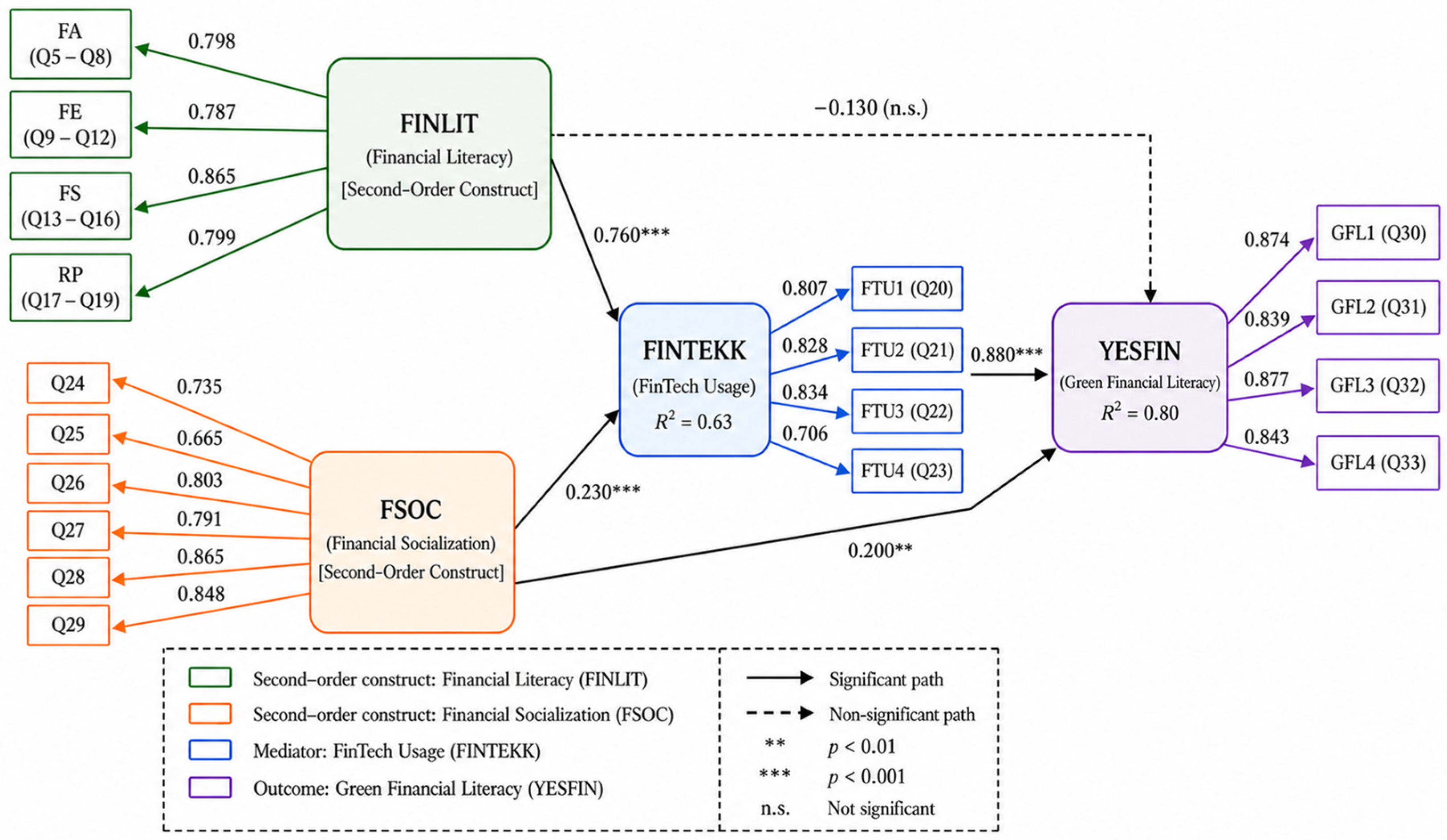
The findings obtained from the structural equation modeling analysis reveal a pattern of relationships among the study variables. The results indicate that financial literacy has a strong and statistically significant effect on FinTech usage (β = 0.76, p < 0.001). Similarly, financial socialization positively influences FinTech usage (β = 0.23, p < 0.001), highlighting the importance of both individual competencies and social learning processes in the adoption of digital financial technologies. In contrast, financial literacy does not have a direct significant effect on green financial literacy (β = −0.13, p > 0.05). However, FinTech usage exerts a strong and positive effect on green financial literacy (β = 0.88, p < 0.001). Additionally, financial socialization maintains a direct and significant impact on green financial literacy (β = 0.20, p < 0.01). Indirect effects were estimated using bootstrapping procedures with 5000 resamples, consistent with SEM-based mediation analysis approaches [33]. The mediation analysis reveals that FinTech usage fully mediates the relationship between financial literacy and green financial literacy. The indirect effect of financial literacy on green financial literacy via FinTech usage was positive and statistically significant (indirect effect = 0.66, 95% CI [0.42, 0.91]). Similarly, the indirect effect of financial socialization through FinTech usage was also significant (indirect effect = 0.20, 95% CI [0.11, 0.32]). The structural model results and indirect effects are presented in Table 4 and Table 5. These results provide strong support for the mediating role of FinTech usage. To further assess the robustness of the proposed model, additional analyses were conducted by including demographic variables (age, gender, education, and income) as control variables using regression-based models. The results indicated that age, gender, and income did not have significant effects on FinTech usage (p > 0.05), while education showed a significant positive effect (β = 0.13, p < 0.001). However, when green financial literacy was considered the dependent variable, none of the demographic variables were statistically significant (p > 0.05). In addition, the explanatory power of the models remained high (R2 = 0.728 for FinTech usage and R2 = 0.691 for green financial literacy), further supporting the stability of the findings. Importantly, the inclusion of control variables did not alter the direction or significance of the core structural relationships, which is consistent with established SEM and regression-based robustness approaches [33,37]. These findings confirm the robustness of the proposed model. Therefore, demographic variables were not included in the final SEM specification in order to preserve model parsimony. This finding suggests that financial literacy alone is insufficient to enhance sustainability-oriented financial awareness unless supported by digital financial technologies. The structural model results are also illustrated in Figure 2.
Overall, the findings highlight that FinTech usage plays a central role in the model, exhibiting a strong and statistically significant effect on green financial literacy (β = 0.88, p < 0.001). In contrast, financial literacy does not have a significant direct effect on green financial literacy, indicating that its influence operates primarily through FinTech usage. These results emphasize that digital financial technologies act as a critical mechanism in transforming financial literacy into environmentally responsible financial decision-making.

5. Conclusions and Discussion

This study examines the relationships between financial literacy, financial socialization, and FinTech usage and how these relationships contribute to green financial literacy as a cognitive component of sustainability-oriented financial decision-making. By integrating financial socialization theory with digitalization and sustainability perspectives, the study provides a comprehensive framework explaining how socially acquired financial knowledge evolves into environmentally responsible financial decision-making. The findings reveal that financial literacy and financial socialization have significant and positive effects on FinTech usage. In particular, the strong effects of financial skills and financial socialization indicate that financial behavior is not solely determined by individual knowledge but is deeply embedded in social learning processes. This finding is consistent with prior studies emphasizing the role of family and social environments in shaping financial behavior [2,4,5,35,36]. The results also support the argument that the behavioral effects of formal financial education may be limited, while experiential and family-based learning processes produce more persistent impacts [7,8,39].
A coefficient-based interpretation provides deeper insight into the structural relationships. Financial literacy exhibits a strong effect on FinTech usage (β = 0.76), while financial socialization also contributes significantly (β = 0.23). The comparatively larger coefficient for financial literacy indicates that individual competencies, particularly financial skills, play a dominant role in facilitating the adoption of digital financial technologies. Consistent with the present findings, prior research has identified financial literacy as a critical determinant of FinTech adoption and an important contributor to sustainability-oriented financial outcomes [40]. However, the significant effect of financial socialization confirms that financial behavior is not solely an individual-level phenomenon but is deeply embedded in social learning processes. Individuals who acquire financial norms through family and social environments are more likely to trust and engage with digital financial tools. Although the RMSEA value is relatively close to the upper acceptable threshold, this can be attributed to the complexity of the higher-order model structure and the use of ordinal data [33]. Given that other fit indices such as CFI, TLI, and SRMR indicate excellent fit, the overall model can be considered robust and theoretically consistent.
Importantly, financial literacy does not have a direct significant effect on green financial literacy (β = −0.13), whereas FinTech usage demonstrates a very strong positive effect (β = 0.88). This pattern provides clear evidence of a full mediation mechanism. The indirect effect analysis further supports that the influence of financial literacy and financial socialization on green financial literacy operates primarily through FinTech usage. In this sense, FinTech functions as a behavioral transmission channel that converts financial knowledge into environmentally responsible financial decision-making. It should be noted that these findings reflect changes in financial knowledge and awareness rather than directly observed behavior.
The strength of financial literacy and financial socialization as predictors of FinTech usage can be explained through behavioral and cognitive mechanisms. Financial competencies enhance individuals’ ability to navigate complex digital financial environments, while financial socialization fosters trust, reduces uncertainty, and shapes attitudes toward financial technologies. Together, these factors create a favorable psychological and behavioral context for FinTech adoption, which in turn facilitates engagement with sustainability-oriented financial products. Another key finding is the strong and positive effect of FinTech usage on green financial literacy. This suggests that FinTech applications are not merely tools that facilitate access to financial services but also mechanisms that transform financial knowledge into sustainability-oriented financial awareness, supporting sustainable development through digital financial innovation [41,42]. Digital investment platforms and sustainability-oriented financial products enable individuals to incorporate environmental considerations into their financial decisions [12,16]. Recent evidence further suggests that digital financial literacy and FinTech-enabled financial services may contribute to broader sustainability-oriented financial outcomes across applied financial contexts [43].
This interpretation is consistent with previous studies showing that financially socialized individuals use digital financial tools more effectively and develop higher levels of trust in these technologies [13,14]. It should be noted that the sample is predominantly composed of younger individuals, which may have influenced the strength of the observed relationships. Younger populations are generally more inclined to adopt digital financial technologies, which may amplify the effect of FinTech usage on green financial literacy. At the same time, this demographic structure may limit the generalizability of the findings, particularly for older populations with different financial behaviors and technology adoption patterns. The findings further demonstrate that FinTech usage plays a central mediating role in the relationship between financial literacy, financial socialization, and green financial literacy. This indicates that financial knowledge acquired through family and social environments does not directly translate into sustainable financial behavior but operates through digital financial tools. Therefore, FinTech can be considered a digital extension of the financial socialization process, in line with studies emphasizing the role of technology in shaping financial behavior [44,45].
From a practical perspective, the results suggest that policies aimed at enhancing financial literacy should extend beyond formal education and incorporate family-based financial socialization processes. Strengthening financial communication within families and supporting intergenerational financial learning may play a critical role in promoting sustainable financial behavior [4,46]. In addition, integrating sustainability-oriented features into FinTech applications can facilitate individuals’ engagement with environmentally friendly financial products [17,18]. Overall, the study demonstrates that financial knowledge acquired through family and social environments can be reflected in sustainability-oriented financial awareness through digital financial technologies. Therefore, the results should be interpreted as evidence of cognitive and knowledge-based change rather than direct behavioral outcomes. These findings highlight the transformative role of FinTech in advancing green financial literacy and contributing to sustainable development, consistent with recent studies emphasizing the role of FinTech in achieving environmental sustainability [47].
Despite its contributions, this study has several limitations that should be taken into account when interpreting the findings. Although demographic variables such as age, gender, education, and income were not included in the final structural model in order to preserve model parsimony, additional robustness analyses showed that these variables did not have a consistent or substantial effect on the main relationships. Therefore, their exclusion does not weaken the validity of the results; however, their potential influence should still be considered, as these factors may systematically shape financial behavior and technology adoption patterns [2,3,4]. First, the cross-sectional design limits the ability to draw causal conclusions about the relationships among the variables. Future research based on longitudinal data could provide a clearer understanding of how financial socialization, FinTech usage, and sustainable financial behavior evolve over time. Second, the study relies on self-reported data, which may be affected by response bias. Another limitation relates to the sample, which is drawn from a single country and therefore limits the generalizability of the findings. In addition, because the study employed a voluntary, non-probabilistic convenience sampling approach, the sample may be subject to self-selection bias. Individuals with a greater interest in financial issues, digital technologies, or sustainability-related topics may have been more likely to participate, which may further limit the external validity of the findings. Moreover, the sample is predominantly composed of younger individuals (18–30), which may influence the results. Younger respondents are more likely to use FinTech services, which may strengthen the observed role of FinTech in the model, while potentially reducing the relative importance of family-based financial socialization. Future studies should aim to include more balanced age distributions to enhance generalizability. Finally, although green financial literacy is used as a proxy for sustainable financial behavior, it may not fully capture all aspects of sustainability-oriented financial decision-making. Future research could incorporate additional behavioral measures to provide a more comprehensive perspective.

Author Contributions

Ş.S.S.: Conceptualization, Methodology, Writing—Original Draft, Supervision; A.Ö.: Data Curation, Formal Analysis, Software, Visualization; A.V.Ç.: Investigation, Validation, Resources, Writing—Review & Editing; M.R.: Methodology, Formal Analysis, Writing—Review & Editing, Funding Acquisition; H.A.: Data Curation, Validation, Writing—Review & Editing. All authors have read and agreed to the published version of the manuscript.

Funding

This research was funded by Princess Nourah bint Abdulrahman University Researchers Supporting Project number (PNURSP2026R548), Princess Nourah bint Abdulrahman University, Riyadh, Saudi Arabia.

Institutional Review Board Statement

The study was conducted in accordance with the Declaration of Helsinki and approved by the Ethics Committee of Gumushane University (Approval No: E-95674917-108.99-340153; date of approval: 25 June 2025).

Informed Consent Statement

Informed consent was obtained from all subjects involved in the study.

Data Availability Statement

The data supporting the findings of this study are available from the corresponding author upon reasonable request.

Acknowledgments

The authors extend their appreciation to Princess Nourah bint Abdulrahman University for funding this research through the Researchers Supporting Project (PNURSP2026R548), Riyadh, Saudi Arabia. AI-assisted tools were used only to improve language clarity and translation. No AI tools were used for data analysis, interpretation, or content generation. All intellectual contributions belong to the authors.

Conflicts of Interest

The authors declare no conflicts of interest.

References

  1. Lusardi, A.; Mitchell, O.S. The economic importance of financial literacy: Theory and evidence. J. Econ. Lit. 2014, 52, 5–44. [Google Scholar] [CrossRef] [Scilit]
  2. Gudmunson, C.G.; Danes, S.M. Family financial socialization: Theory and critical review. J. Fam. Econ. Issues 2011, 32, 644–667. [Google Scholar] [CrossRef] [Scilit]
  3. Xiao, J.J. Applying behavior theories to financial behavior. In Handbook of Consumer Finance Research; Springer: New York, NY, USA, 2008. [Google Scholar]
  4. Shim, S.; Barber, B.L.; Card, N.A.; Xiao, J.J.; Serido, J. Financial socialization of first-year college students. J. Youth Adolesc. 2010, 39, 1457–1470. [Google Scholar] [CrossRef] [Scilit]
  5. Sohn, S.H.; Joo, S.H.; Grable, J.E.; Lee, S.; Kim, M. Financial literacy among adolescents. J. Adolesc. 2012, 35, 969–980. [Google Scholar] [CrossRef] [Scilit]
  6. Lee, B.X.; Kjaerulf, F.; Turner, S.; Cohen, L.; Donnelly, P.D.; Muggah, R.; Gilligan, J. Transforming our world: Implementing the 2030 agenda through sustainable development goal indicators. J. Public Health Policy 2016, 37, 13–31. [Google Scholar] [CrossRef] [Scilit]
  7. Mandell, L.; Klein, L.S. Financial literacy education. J. Financ. Couns. Plan. 2009, 20, 15–24. [Google Scholar]
  8. Norvilitis, J.M.; MacLean, M.G. The role of parents. J. Econ. Psychol. 2010, 31, 55–63. [Google Scholar] [CrossRef] [Scilit]
  9. Puschmann, T. Fintech. Bus. Inf. Syst. Eng. 2017, 59, 69–76. [Google Scholar] [CrossRef] [Scilit]
  10. Gomber, P.; Kauffman, R.J.; Parker, C.; Weber, B.W. On the fintech revolution. J. Manag. Inf. Syst. 2018, 35, 220–265. [Google Scholar] [CrossRef] [Scilit]
  11. Farida, M.N.; Soesatyo, Y.; Aji, T.S. Influence of financial literacy and use of financial technology on financial satisfaction through financial behavior. Int. J. Educ. Lit. Stud. 2021, 9, 86–95. [Google Scholar] [CrossRef] [Scilit]
  12. Zhang, Y. Green finance and fintech. Econ. Change Restruct. 2023, 56, 2069–2086. [Google Scholar] [CrossRef] [Scilit]
  13. Jünger, M.; Mietzner, M. Banking goes digital. Financ. Res. Lett. 2020, 34, 101260. [Google Scholar] [CrossRef] [Scilit]
  14. Nguyen, T.A.N. FinTech usage. Sustainability 2022, 14, 5083. [Google Scholar] [CrossRef] [Scilit]
  15. OECD. OECD/INFE Toolkit for Measuring Financial Literacy and Financial Inclusion 2022; OECD Publishing: Paris, France, 2022. [Google Scholar]
  16. Duchêne, S. Review of green finance. Ecol. Econ. 2020, 177, 106766. [Google Scholar] [CrossRef] [Scilit]
  17. Croutzet, A.; Dabbous, A. Do FinTech trigger renewable energy use? Evidence from OECD countries. Renew. Energy 2021, 179, 1608–1617. [Google Scholar] [CrossRef] [Scilit]
  18. Udeagha, M.C.; Ngepah, N. Environmental sustainability. World Dev. Sustain. 2023, 3, 100096. [Google Scholar] [CrossRef] [Scilit]
  19. Berg, F.; Kölbel, J.F.; Rigobon, R. Aggregate confusion: The divergence of ESG ratings. Rev. Financ. 2022, 26, 1315–1344. [Google Scholar] [CrossRef] [Scilit]
  20. Huston, S.J. Measuring financial literacy. J. Consum. Aff. 2010, 44, 296–316. [Google Scholar] [CrossRef] [Scilit]
  21. Ansar, S.; Klapper, L.; Singer, D. The importance of financial education for the effective use of formal financial services. J. Financ. Lit. Wellbeing 2023, 1, 28–46. [Google Scholar] [CrossRef] [Scilit]
  22. Atkinson, A.; Messy, F. Measuring financial literacy: Results of the OECD/INFE pilot study. In OECD Working Papers on Finance, Insurance and Private Pensions, No. 15; OECD Publishing: Paris, France, 2012. [Google Scholar]
  23. Demirguc-Kunt, A.; Klapper, L.; Singer, D.; Ansar, S.; Hess, J. The Global Findex Database 2017; World Bank: Washington, DC, USA, 2018. [Google Scholar]
  24. Xiao, J.J.; Chen, C.; Sun, L. Financial capability. Int. J. Consum. Stud. 2015, 39, 387–395. [Google Scholar] [CrossRef] [Scilit]
  25. Fernandes, D.; Lynch, J.G.; Netemeyer, R.G. Financial literacy, financial education, and downstream financial behaviors. Manag. Sci. 2014, 60, 1861–1883. [Google Scholar] [CrossRef] [Scilit]
  26. Fu, C.; Lu, L.; Pirabi, M. Advancing green finance: A review of sustainable development. Digit. Econ. Sustain. Dev. 2023, 1, 20. [Google Scholar] [CrossRef] [Scilit]
  27. Kass-Hanna, J.; Lyons, A.C.; Liu, F. Building financial resilience through financial and digital literacy. Emerg. Mark. Rev. 2022, 51, 100846. [Google Scholar] [CrossRef] [Scilit]
  28. Ramadhona, N.; Rohman, A.; Wahyudi, S. Financial behavior and literacy. Econ. Educ. Anal. J. 2023, 12, 73–82. [Google Scholar] [CrossRef] [Scilit]
  29. Tang, P.; Zhang, Y.; Li, X. FinTech and sustainability. Resour. Policy 2024, 94, 105115. [Google Scholar] [CrossRef] [Scilit]
  30. Sachs, J.D.; Woo, W.T.; Yoshino, N.; Taghizadeh-Hesary, F. Why Is Green Finance Important? Asian Development Bank Institute: Tokyo, Japan, 2019. [Google Scholar]
  31. Slovic, P. The Perception of Risk; Routledge: London, UK, 2016. [Google Scholar]
  32. Kou, G.; Akdeniz, Ö.O.; Dinçer, H.; Yüksel, S. FinTech investments. Financ. Innov. 2021, 7, 39. [Google Scholar] [CrossRef] [Scilit]
  33. Kline, R.B. Principles and Practice of Structural Equation Modeling; Guilford Press: New York, NY, USA, 2023. [Google Scholar]
  34. Cochran, W.G. Sampling Techniques; Wiley: New York, NY, USA, 1977. [Google Scholar]
  35. Legenzova, R.; Leckė, G. Financial socialization and investment literacy. J. Fam. Econ. Issues 2025, 46, 525–544. [Google Scholar] [CrossRef] [Scilit]
  36. Bandura, A. Social Foundations of Thought and Action: A Social Cognitive Theory; Prentice Hall: Englewood Cliffs, NJ, USA, 1986. [Google Scholar]
  37. Hair, J.F.; Black, W.C.; Babin, B.J.; Anderson, R.E. Multivariate Data Analysis, 8th ed.; Cengage Learning: Singapore, 2019. [Google Scholar]
  38. Fornell, C.; Larcker, D.F. Evaluating structural equation models with unobservable variables and measurement error. J. Mark. Res. 1981, 18, 39–50. [Google Scholar] [CrossRef] [Scilit]
  39. Sharma, M.; Sahoo, S.; Singh, A. Financial literacy and fintech adoption. Asia-Pac. Financ. Mark. 2025; in press. [CrossRef] [Scilit]
  40. Mohapatra, N.; Das, M.; Shekhar, S.; Singh, R.; Khan, S.; Tewari, L.M.; Félix, M.J.; Santos, G. Assessing the Role of Financial Literacy in FinTech Adoption by MSEs: Ensuring Sustainability through a Fuzzy AHP Approach. Sustainability 2025, 17, 4340. [Google Scholar] [CrossRef] [Scilit]
  41. Hasan, M.; Hoque, A.; Abedin, M.Z.; Gasbarro, D. FinTech and sustainable development. Int. Rev. Financ. Anal. 2024, 95, 103473. [Google Scholar] [CrossRef] [Scilit]
  42. Khan, I.; Shahid, M.S. FinTech and green finance. Discov. Sustain. 2026, 7, 49. [Google Scholar] [CrossRef] [Scilit]
  43. Purnamasari, E.D.; Anggraini, L.D.; Faradillah. Influence of FinTech Paylater, Financial Well-Being, Behavioral Finance, and Digital Financial Literacy on MSME Sustainability in South Sumatera. J. Risk Financ. Manag. 2025, 18, 682. [Google Scholar] [CrossRef] [Scilit]
  44. Thakor, A.V. FinTech and banking: What do we know? J. Financ. Intermed. 2020, 41, 100833. [Google Scholar] [CrossRef] [Scilit]
  45. Dhungana, M.; Shrestha, N. Financial socialization. J. Emerg. Manag. Stud. 2025, 3, 88–105. [Google Scholar] [CrossRef] [Scilit]
  46. Peeters, H. Sustainable development. Environ. Dev. Sustain. 2003, 5, 197–230. [Google Scholar] [CrossRef] [Scilit]
  47. Chueca Vergara, C.; Ferruz Agudo, L. FinTech and sustainability. Sustainability 2021, 13, 7012. [Google Scholar] [CrossRef] [Scilit]
Figure 1. Research Model. Note: All latent constructs are modeled as reflective, and arrows represent relationships from latent variables to their indicators.
Sustainability 18 04621 g001
Figure 2. Structural model results. Note: Standardized path coefficients are reported. Solid lines indicate significant relationships (** p < 0.01, *** p < 0.001), while dashed lines indicate non-significant paths (n.s. = not significant).
Sustainability 18 04621 g002
Table 1. Sociodemographic characteristics of participants (n = 539).
VariableCategoryFrequency%
GenderMale19736.6
Female34263.4
Age18–3041977.7
31–427213.4
43–55427.8
56 and above61.1
EducationPrimary346.3
High School10018.6
Associate’s Degree/Bachelor’s Degree35966.6
Graduate468.5
Income ($)600–90036667.9
901–12007113.2
1201–15005410.0
1500 and above488.9
Table 2. Measurement model results.
ConstructItemsLoadingsCRAVE
Financial Awareness (FINFARK)Q5–Q80.80–0.860.900.69
Financial Experience (FINDEN)Q9–Q120.78–0.870.910.71
Financial Skill (FINBEC)Q13–Q160.74–0.860.880.66
Risk Perception (RISKAL)Q17–Q190.75–0.810.830.62
Financial Socialization (FINSOS)Q24–Q290.66–0.860.910.62
FinTech Usage (FINTEKK)Q20–Q230.71–0.830.870.63
Green Financial Literacy (YESFIN)Q30–Q330.84–0.880.920.74
Table 3. General fit statistics for the structural model.
Fit MeasureValue
χ2 (User Model)12.90
Degrees of Freedom (df)3
p0.002
χ2 (Baseline Model)1311.00
Degrees of Freedom (df)11
p<0.001
SRMR0.011
RMSEA0.078
RMSEA 95% (Lower–Upper)(0.038–0.124)
RMSEA p-close0.113
CFI0.991
TLI/NNFI0.966
RNI0.991
NFI0.989
RFI0.958
IFI0.991
PNFI0.270
Table 4. Structural model results.
Pathβp
Financial Literacy (FINLIT) → FinTech Usage (FINTEKK)0.76<0.001
Financial Socialization (FINSOS) → FinTech Usage (FINTEKK)0.23<0.001
Financial Literacy (FINLIT) → Green Financial Literacy (YESFIN)−0.13n.s. (p > 0.05)
Financial Socialization (FINSOS) → Green Financial Literacy (YESFIN)0.20<0.01
FinTech Usage (FINTEKK) → Green Financial Literacy (YESFIN)0.88<0.001
Table 5. Indirect effects.
PathIndirect Effect95% CI
Financial Literacy (FINLIT) → FinTech Usage (FINTEKK) → Green Financial Literacy (YESFIN) →0.66[0.42, 0.91]
Financial Socialization (FINSOS) → FinTech Usage (FINTEKK) → Green Financial Literacy (YESFIN) →0.20[0.11, 0.32]
Disclaimer/Publisher’s Note: The statements, opinions and data contained in all publications are solely those of the individual author(s) and contributor(s) and not of MDPI and/or the editor(s). MDPI and/or the editor(s) disclaim responsibility for any injury to people or property resulting from any ideas, methods, instructions or products referred to in the content.