Article

Integration of Remote Sensing Vegetation Indices into a Structural Model for Sustainable Biomass Monitoring in Protected Mountain Areas: A Case Study in the Southern Carpathians (Romania)


by
Mihai Valentin Herbei
1,2,
Csaba Lorinț
3,4,
Loredana Copăcean
1,*,
Roxana Claudia Herbei
5,
Sorin Mihai Radu
6,
Luminiţa L. Cojocariu
7,8,
Radu Bertici
1,
Paul Sestras
9,10 and
Florin Sala
11,12
1
Department of Sustainable Development and Environmental Engineering, Faculty of Agriculture, University of Life Sciences “King Mihai I” from Timisoara, 300645 Timisoara, Romania
2
Doctoral School, University of Petroșani, 332006 Petrosani, Romania
3
Department of Environmental Engineering and Geology, Mining Faculty, University of Petroșani, 332006 Petrosani, Romania
4
Scientific Council of Grădiştea Muncelului Cioclovina Natural Park, 337205 Grădiștea de Munte, Romania
5
Department of Mining, Surveying and Construction Engineering, Mining Faculty, University of Petroșani, 332006 Petrosani, Romania
6
Department of Mechanical, Industrial and Transportation Engineering, Mechanical and Electrical Engineering Faculty, University of Petroșani, 332006 Petrosani, Romania
7
Department of Agricultural Technologies, Faculty of Agriculture, University of Life Sciences “King Mihai I” from Timisoara, 300645 Timisoara, Romania
8
Laboratory for Pratology and Forage Crop Improvement, Agricultural Research and Development Station Lovrin, 307250 Lovrin, Romania
9
Department of Land Measurements and Exact Sciences, Faculty of Forestry and Cadastre, University of Agricultural Sciences and Veterinary Medicine Cluj-Napoca, 400372 Cluj-Napoca, Romania
10
Academy of Romanian Scientists, Ilfov 3, 050044 Bucharest, Romania
11
Department of Soil Science, Faculty of Agriculture, University of Life Sciences “King Mihai I” from Timisoara, 300645 Timisoara, Romania
12
Laboratory of Plants Biotechnology, Agricultural Research and Development Station Lovrin, 307250 Lovrin, Romania
*
Author to whom correspondence should be addressed.
Sustainability 2026, 18(1), 213; https://doi.org/10.3390/su18010213
Submission received: 27 November 2025 / Revised: 18 December 2025 / Accepted: 20 December 2025 / Published: 24 December 2025

Abstract

Monitoring vegetation biomass dynamics is essential for assessing ecosystem functioning and biodiversity pressures in protected mountain areas, where reduced accessibility limits in situ data collection. This study investigates the multitemporal variation in vegetation biomass within the Cioclovina–Șura Mare–Piatra Roșie strictly protected area of the Grădiștea Muncelului–Cioclovina Natural Park (Southern Carpathians, Romania), using vegetation indices derived from Sentinel-2 imagery for the 2018–2022 period. Four complementary indices (NDVI, SAVI, MSAVI, and LAI) were computed and normalized, then integrated into an original synthetic indicator (BCIS—Biomass Change Integrated Score) for quantifying biomass changes. The results indicate an overall reduction in vegetation biomass, with 89.49% of the area classified under degradation trends, while 4.53% shows regeneration processes. Grasslands and mixed agricultural–natural lands are the most affected habitats, where degradation is linked to anthropogenic pressures and ecotonal vulnerability, whereas broadleaf forests display a high degree of resilience, maintaining substantial proportions of stable or regenerating surfaces. The multispectral integration through the BCIS indicator enabled a more robust detection of critical zones, supporting sustainable vegetation management and biodiversity monitoring in protected mountain ecosystems.

1. Introduction

Monitoring vegetation condition and biomass dynamics has become a central component in assessing ecosystem functioning, ecosystem services, and biodiversity pressures, particularly in the context of climate change and increasing land-use intensity [1,2]. Numerous studies show that land-cover and land-use changes represent an important proxy for biodiversity pressures, especially within protected area networks, where periodic reporting on conservation status is both a legal and scientific requirement [3,4,5,6,7]. In this context, remote sensing techniques combined with geospatial datasets such as Corine Land Cover (CLC) [8], provide an objective basis for spatio-temporal assessment of land-cover changes and for understanding their effects on protected ecosystems and habitats [9,10,11,12].
The use of open-access multispectral sensors such as Sentinel-2 has revolutionized vegetation analysis at both regional and local scales [13,14,15], due to the combination of 10–20 m spatial resolution, high revisit frequency, and the availability of vegetation-specific spectral bands (including the red-edge) [16,17]. Recent studies have demonstrated the potential of these data for estimating above-ground biomass in forest and agro-ecosystems by integrating multispectral bands, vegetation indices, and derived biophysical parameters [18,19,20,21,22]. This approach is particularly relevant in protected mountain areas, where difficult accessibility limits systematic in situ data collection, and satellite observations become the primary source of information for detecting vegetation degradation or regeneration [23,24,25].
The Normalized Difference Vegetation Index (NDVI) remains the most widely used global indicator for assessing vegetation greenness, photosynthetic vigor, and primary productivity [26]. Synthesis studies confirm its applicability in habitat monitoring, forest condition assessment, drought effects, landscape fragmentation, and biodiversity impact analyses [27,28]. However, NDVI is affected by saturation in dense canopies and is sensitive to soil reflectance in areas with sparse vegetation, which may lead to under- or overestimation of biomass in ecologically complex environments such as forest–grassland ecotones and mountain terrains with bare soil [29].
To mitigate soil influence, adjusted vegetation indices have been developed, such as SAVI (Soil Adjusted Vegetation Index) and its modified variant MSAVI (Modified SAVI), which introduce a correction factor adapted to environments with low or mixed vegetation cover [29]. These indices have proven effective for vegetation analysis in semi-arid lands, grasslands, and agricultural areas, where soil contribution to the spectral signal is substantial and can obscure actual vegetation variation. Therefore, SAVI and MSAVI offer a complementary perspective to NDVI, especially in open areas and transition zones, which are often dominant in extensively used mountain landscapes.
The Leaf Area Index (LAI), derived from Sentinel-2 biophysical algorithms, adds a structural dimension to the analysis, representing the total leaf area per unit ground area and being strongly related to above-ground biomass, primary production, and the carbon storage potential of ecosystems [30]. Recent studies have used LAI to assess Mediterranean forests, agricultural crops, and mountain grasslands, demonstrating its sensitivity to disturbances, climate variability, and changing management conditions [20,31,32,33,34,35]. Integrating LAI with classical spectral indices (NDVI, SAVI, MSAVI) enables a shift from simple “greenness” measurements to quantitative evaluation of biomass and canopy structure.
In the context of this study, vegetation degradation is understood in a functional and ecological sense, referring to a relative decline in biomass and vegetation structure, reflected by a decrease in remotely sensed vegetation indices. This approach does not imply a complete loss of vegetation cover, but rather describes a progressive reduction in photosynthetic vigor and in the functionality of mountain ecosystems [27,29].
Despite the accelerated development of these remote sensing tools, many applied studies in protected areas and the Natura 2000 network focus either on a single vegetation index or on general thematic classifications (land cover), without coherently integrating multiple indices or explicitly addressing biomass dynamics at fine spatial resolutions [3,4,24]. Moreover, there is a clear lack of research focused on protected mountain areas in Romania, especially in Natura 2000 sites of the Southern Carpathians, where the combination of forests, grasslands, and mixed agricultural–natural land generates a complex vegetation and biomass dynamic.
In this context, the objective of the present study is to evaluate vegetation biomass dynamics in the Cioclovina–Şura Mare–Piatra Roşie strictly protected area (case study), part of the Grădiştea Muncelului–Cioclovina Natural Park, using vegetation indices derived from Sentinel-2 imagery and a composite biomass-change indicator (Biomass Change Integrated Score—BCIS). Specifically, the study aims to: characterize land-use structure as the ecological support for vegetation; perform multitemporal analysis of NDVI, SAVI, MSAVI, and LAI for the 2018–2022 period; integrate these indices into a synthetic biomass change score and map spatial patterns of degradation, stability, and regeneration; and assess these changes across different land-use categories. The central research question is to what extent multitemporal integration of vegetation indices into a composite indicator can provide a more robust and sensitive evaluation of biomass dynamics in protected mountain ecosystems, compared with the isolated use of each index. Our working hypothesis is that such an integrated indicator (BCIS), based on NDVI, SAVI, MSAVI, and LAI, can more accurately highlight areas of biomass degradation and regeneration—particularly in forest–grassland ecotones and mixed agricultural–natural terrains—thus offering improved support for sustainable vegetation and biodiversity management.
The originality of the study lies in the integrated application of vegetation indices and biophysical parameters derived from Sentinel-2 imagery, synthesized into a composite indicator of biomass changes and analyzed in relation to land-use structure within a protected mountain area, in line with current research directions on biomass estimation and vegetation dynamics [16,20,21].

2. Materials and Methods

2.1. Study Area

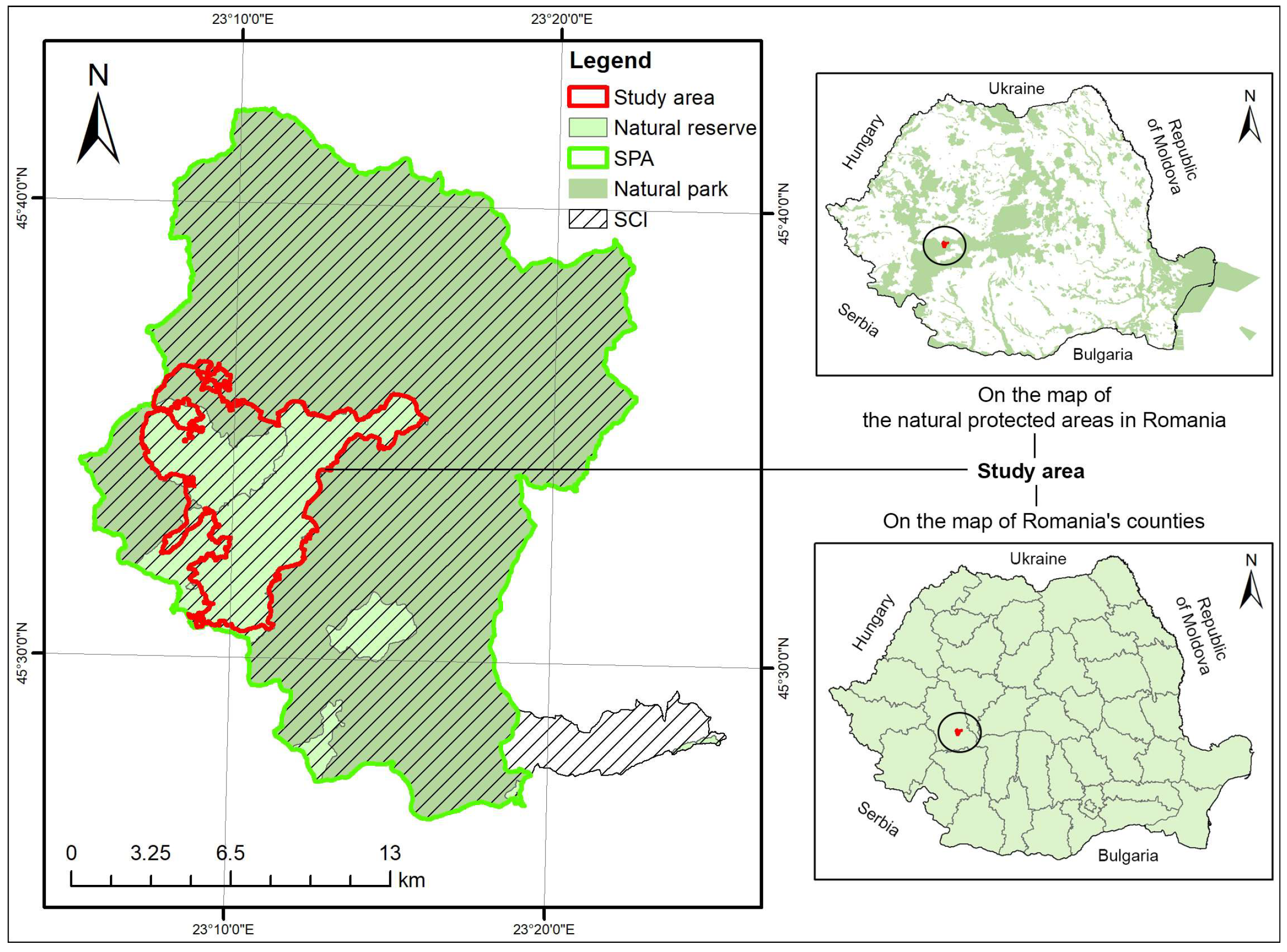
The study area is located in the southeastern part of Hunedoara County, Romania, within the Southern Carpathians, specifically in the Șureanu Mountains [36], approximately between 45°29′–45°38′ N latitude and 23°06′–23°16′ E longitude. The analyzed surface covers 5176 ha and lies entirely within the boundaries of the Grădiștea Muncelului–Cioclovina Natural Park (RONPA0015) [37], a nationally protected area characterized by karst landscapes, well-preserved forest ecosystems, and outstanding natural and cultural heritage features (Figure 1).
The Cioclovina–Șura Mare–Piatra Roșie strictly protected area (Figure 1), representing the case study of this article, overlaps two Natura 2000 sites: ROSPA0045 Grădiștea Muncelului–Cioclovina (Special Protection Area for birds) and ROSCI0087 Grădiștea Muncelului–Cioclovina (Site of Community Importance), highlighting the high ecological significance of its component zones for the conservation of priority habitats and species of community interest. The area also includes the Ponorîci–Cioclovina Karst Complex and Șura Mare Cave Nature Reserves, illustrating the geodiversity and the uniqueness of its speleological heritage [37,40].
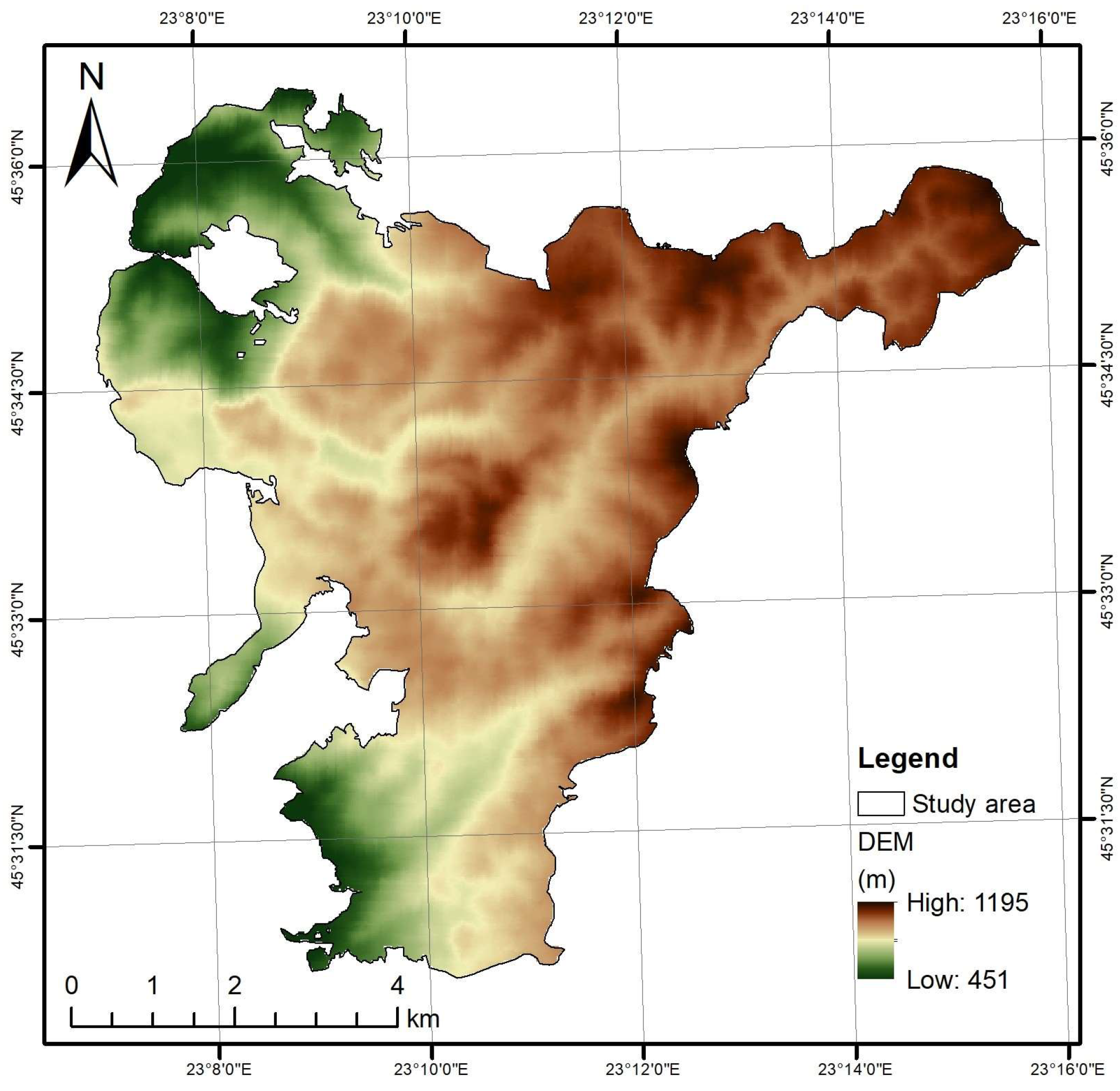
From a physical–geographical perspective, the relief is predominantly mountainous, with elevations ranging from 451 to 1195 m and an average altitude of 921 m (Figure 2).
The hypsometric structure generates significant variability in microclimatic conditions, soil types, and consequently vegetation patterns. The area includes deciduous forests, coniferous forests, and mountain grasslands within transition zones. Deciduous forests are mainly dominated by beech (Fagus sylvatica), locally associated with hornbeam (Carpinus betulus) and oak species (Quercus spp.) at lower altitudes, while coniferous forests are largely composed of spruce (Picea abies), reflecting the potential natural vegetation characteristic of the Șureanu Mountains. In open areas and on calcareous slopes, colline–montane xerothermic grasslands and mesophilous grasslands occur, along with herbaceous communities characteristic of the specific biotic context of this protected natural park [37].
The selection of this subzone within the natural park was based both on its high ecological value and on the presence of contact areas between forests and grasslands, where processes of biomass degradation and regeneration are more dynamic and more difficult to capture using conventional methods. In this context, the strictly protected area includes both well-defined forest ecosystems and transitional surfaces between distinct vegetation types, providing a representative framework for monitoring subtle vegetation changes in complex mountain landscapes.

2.2. Data and Preprocessing

This study employed exclusively open-source geospatial datasets, consistent with principles of sustainability and methodological replicability:
  • Sentinel-2A satellite images, provided through the Copernicus programme [42], were used for the years 2018, 2019, 2020, 2021, and 2022. Images were selected for the month of July, a period that generally corresponds to the peak of the vegetation season in temperate mountain ecosystems of the Southern Carpathians, when above-ground biomass and photosynthetic activity reach their maximum or near-maximum values. Using the same phenological window for all analyzed years ensures interannual comparability of vegetation indices and reduces the influence of seasonal variability on the results. The selection of July was also conditioned by the availability of images with low cloud cover, which is essential in mountainous areas. For the calculation of vegetation indices, spectral bands with a spatial resolution of 10 m were used, allowing a detailed analysis of biophysical parameters in fragmented and heterogeneous mountain ecosystems;
  • Digital Elevation Model (DEM) with 25 m resolution, used for physical-geographical characterization of the area [41];
  • vector data for protected area boundaries, sourced from official databases [39];
  • Corine Land Cover dataset (2018 edition) [12], for land-use/land-cover assessment;
  • auxiliary geospatial layers: county administrative boundaries, national borders, and relief units, used for contextualization and spatial analyses [38].
All datasets were processed using ESA SNAP 9.0.0 [43] and ArcGIS Desktop 10.8 [44], and integrated into a standardized GIS (Geographic Information System) database under the international coordinate reference system WGS 84. The statistical processing of the data was performed using PAST software, version 4.03 [45].

2.3. Working Methodology

The research methodology was designed as a transferable and replicable model for protected areas with complex relief conditions.
The proposed workflow integrates:
(1)
land-use analysis;
(2)
derivation and assessment of vegetation indices;
(3)
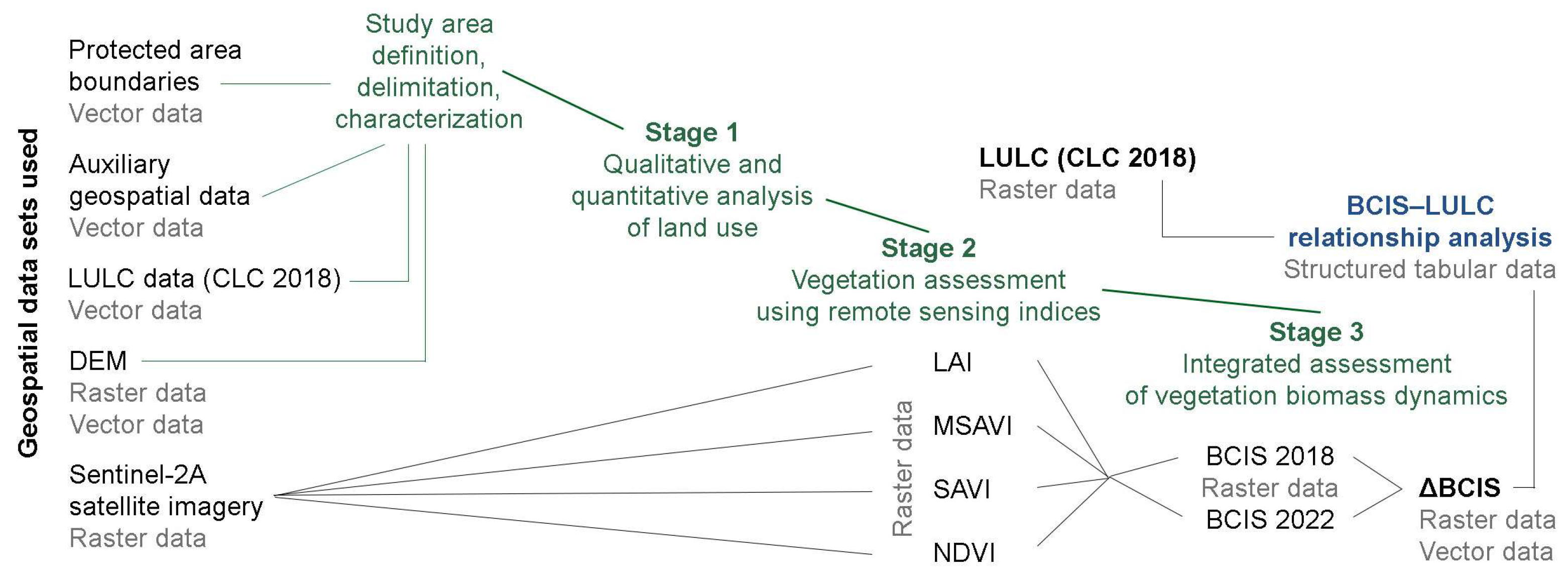
multitemporal biomass change evaluation, the integration of vegetation indices into a multidimensional structural model, and a differentiated interpretation of biomass dynamics relative to land-use classes (Figure 3).
Structuring the methodological workflow into a staged sequence of GIS procedures ensures the reproducibility of the results and provides full traceability of each operational step, from raw data preprocessing to the final mapping of ecological trends.

2.3.1. Delimitation of the Area of Interest, Physical–Geographical Analysis and Land Use Assessment

To scientifically ground the analytical framework of the study, the first methodological step consisted in precisely defining and delineating the area of interest (Figure 3), namely the Cioclovina–Șura Mare–Piatra Roșie strictly protected area. Its extent includes sectors of high ecological value, overlapping two Natura 2000 sites as well as speleological and forest nature reserves, confirming the major importance of this area for the conservation of mountain habitats of community interest.
The physical–geographical analysis was performed based on the DEM (Figure 2), processed in a GIS environment, and complemented with information from the scientific literature.
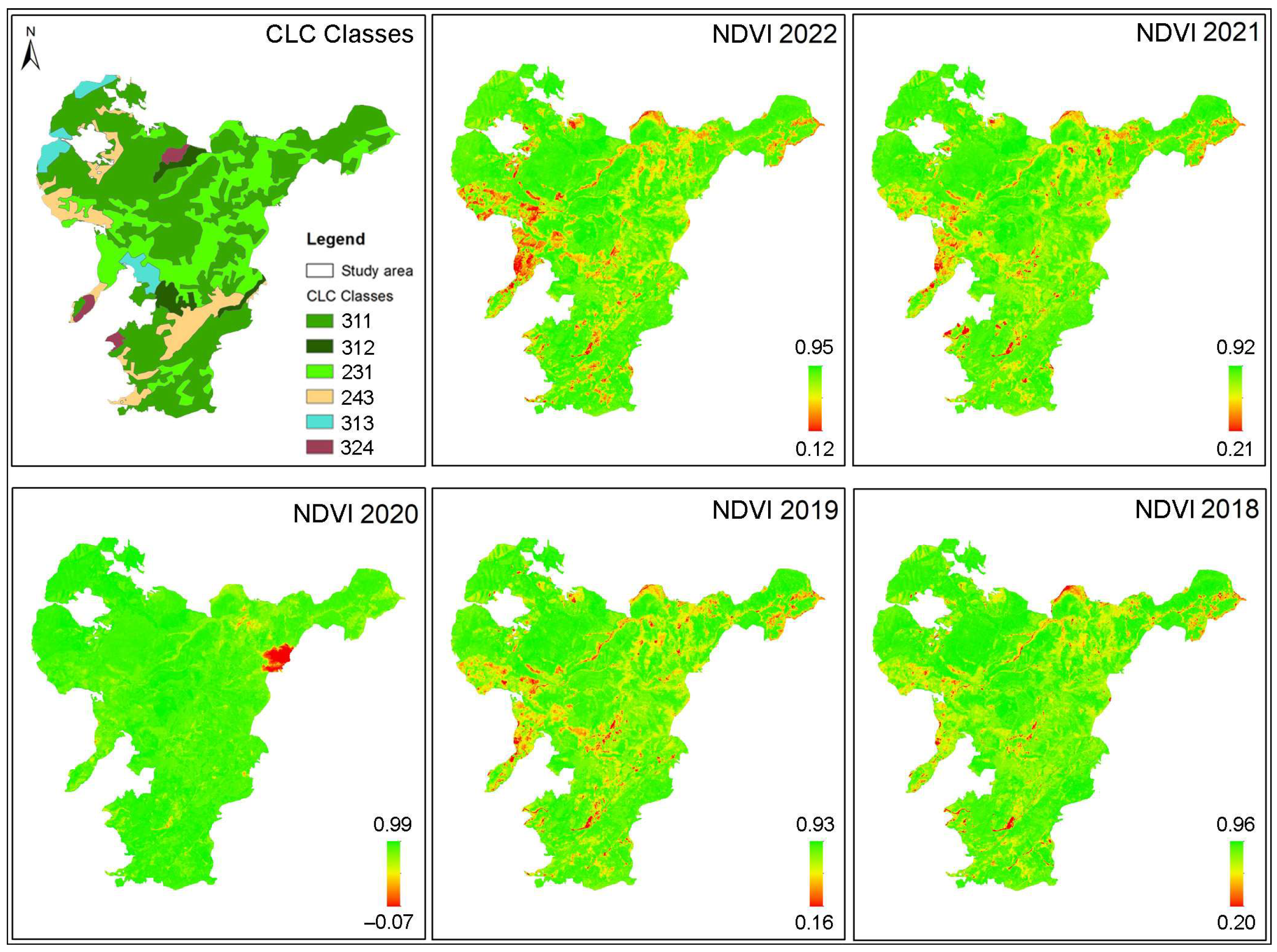
Land use analysis was conducted based on the Corine Land Cover 2018 dataset [12], which was extracted, reclassified into thematic categories, and subsequently converted into raster format at a 10 m resolution to ensure compatibility with Sentinel-2 data. The territory was subdivided according to the following CLC classes: deciduous forests, coniferous forests, mixed forests, grasslands, mixed agricultural–natural areas, and transitional vegetation zones such as shrublands and young forests. This classification formed the basis for the spatial analysis of biomass dynamics and enabled a differentiated assessment of vegetation index variations in relation to the main land-use and land-cover types within the studied area.

2.3.2. Vegetation Indices Analysis and Trends (2018–2022)

To characterize the condition of the phytomass and its evolution during the study period, four vegetation indices derived from Sentinel-2 imagery were computed, namely LAI, MSAVI, SAVI and NDVI (Table 1). These indices were selected because they provide complementary information on vegetation: NDVI reflects the intensity of photosynthetic activity; SAVI and MSAVI reduce soil reflectance influence in areas with sparse or mixed vegetation cover; and LAI captures canopy structure and leaf biomass, which are essential indicators for heterogeneous mountain ecosystems such as those occurring in the study area.
To ensure spatial and temporal comparability of the results, all vegetation index values were normalized using the min–max method to the [0–1] interval, compensating for interannual differences induced by atmospheric conditions or satellite acquisition variability.
For each index, annual maps were generated for the 2018–2022 period using July imagery, when vegetation reaches its maximum development stage. These cartographic products served an exploratory purpose, enabling visual inspection of spatial variations and the detection of possible seasonal anomalies or satellite acquisition errors. In parallel, for the quantitative assessment of biomass evolution, vegetation indices were strictly compared between the initial and final years (2018 and 2022), through the creation of transition matrices and by mapping the differences between vegetation classes in order to highlight real ecosystem changes. This differentiated approach (multiannual visualization combined with two-time-step analysis) was chosen to enhance methodological robustness: annual representations allow validation of data coherence and monitoring of local trends, whereas the 2018–2022 comparison removes interannual variability that does not reflect a persistent ecological process. Thus, vegetation biomass dynamics could be evaluated with greater confidence by capturing only ecologically meaningful medium-term changes.

2.3.3. Vegetation Biomass Dynamics Assessment Using BCIS

To quantify vegetation biomass changes during the study period, the four calculated and normalized vegetation indices (NDVI, SAVI, MSAVI, and LAI) were integrated into a synthetic indicator named Biomass Change Integrated Score (BCIS). BCIS was computed separately for 2018 and 2022 as the arithmetic mean of the normalized values of the four indices (Equation (5)), aiming to reduce the uncertainty associated with their individual use and to increase detection sensitivity in mosaic-like mountain landscapes. This integrated approach represents an original methodological contribution of the study, as it enables a more robust characterization of biomass in heterogeneous ecosystems, where soil reflectance variability and canopy discontinuities can affect the performance of traditional spectral indicators.
B C I S = N D V I + S A V I + M S A V I + L A I 4
To capture the actual trend and magnitude of ecosystem transformations, the BCIS2022 raster was subtracted from the BCIS2018 raster, resulting in the differential product ΔBCIS (2022–2018). This step is essential because BCIS2018 and BCIS2022 describe static vegetation states, whereas ΔBCIS expresses the ecological process of biomass degradation, stability, or regeneration over the medium term, eliminating interannual fluctuations that are not statistically significant.
The differential result (ΔBCIS) was reclassified into five ordered categories using the Natural Breaks (Jenks) algorithm, which maximizes between-class differences and allows an objective delineation of ecologically meaningful biomass change thresholds (Table 2). This classification method is particularly suitable for datasets with non-uniform distributions, such as those derived from mountain ecosystems where changes are spatially and temporally heterogeneous.
In this study, the term degradation is used to describe a relative decline in vegetation condition, expressed by a reduction in vegetation index signals and the structural component between the two analyzed time points (2018–2022). This usage does not imply complete vegetation loss, land-use conversion, or irreversible degradation, but rather reflects changes in biomass, vigor, or vegetation structure. The severity of degradation (severe, strong, moderate) refers exclusively to the magnitude of the ΔBCIS change.
The final product was represented cartographically and complemented by a quantitative analysis of the surface area corresponding to each dynamic class, in order to determine the proportion of the territory affected by degradation or regeneration. In the final stage, the classified ΔBCIS raster was correlated with land-use structure through a Tabulate Area analysis, with the aim of identifying the habitat types most vulnerable or most resilient to recent vegetation changes. This correlation enables an ecologically meaningful interpretation of the synthetic indicator and supports decision-making for conservation management and intervention prioritization within the protected area.
Thus, the use of the BCIS indicator, together with differential analysis and the integration of results with land-use data, provides a comprehensive and accurate assessment of vegetation biomass evolution in the study area, contributing to an advanced understanding of degradation and regeneration processes in protected mountain ecosystems.

2.3.4. Statistical Validation and Uncertainty Assessment of the BCIS Indicator

Considering that the BCIS indicator integrates several vegetation indices partially derived from the same Sentinel-2 spectral bands, a statistical validation step was carried out to assess informational redundancy, formulation robustness, and the uncertainty associated with the detection of biomass changes.
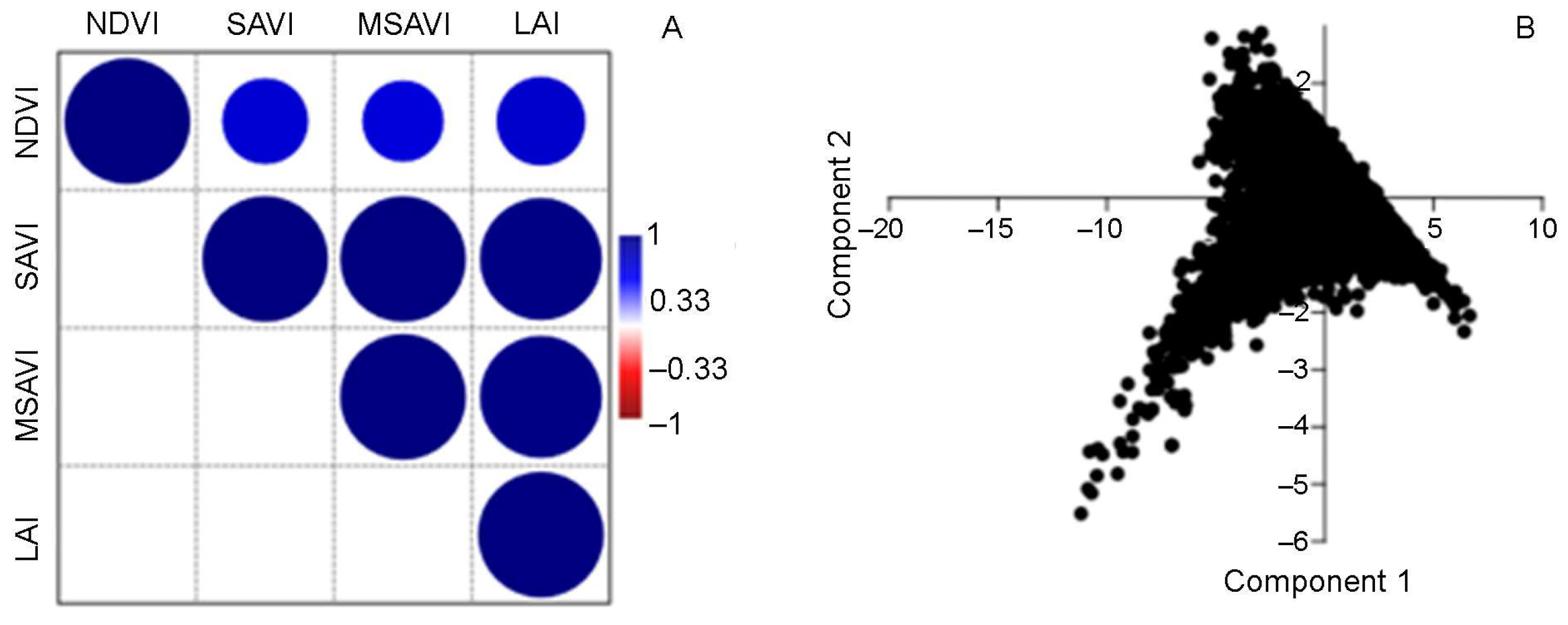
In the first stage, a pixel-by-pixel (20,000 pixels) correlation analysis was performed among the normalized indices NDVI, SAVI, MSAVI, and LAI. The results highlight very high correlations between SAVI and MSAVI (r ≈ 0.998), as well as moderate to high correlations between NDVI and the other indices (r ≈ 0.64–0.70), and between LAI and the soil-adjusted indices (r ≈ 0.97). These relationships confirm the existence of partial redundancy in the spectral information, which is theoretically expected, but explicitly quantified within this study. The correlation structure and the results of the Principal Component Analysis (PCA) are illustrated in Figure 4.
The application of PCA to the set of four normalized indices showed that the first principal component explains approximately 87.6% of the total variance (eigenvalue ≈ 3.5), indicating the dominance of a common latent gradient associated with biomass and vegetation vigor. This result supports the use of a synthetic score to integrate multispectral information, without assuming strict independence of the input indices.
The robustness of the BCIS formulation was evaluated through a leave-one-out sensitivity analysis, in which the indicator was recalculated by successively excluding one index at a time. The correlation between the original BCIS and the version without NDVI is r = 0.992, while the correlation between BCIS and the version without LAI is r = 0.998, indicating that the composite indicator is not dominated by a single index and exhibits high result stability.
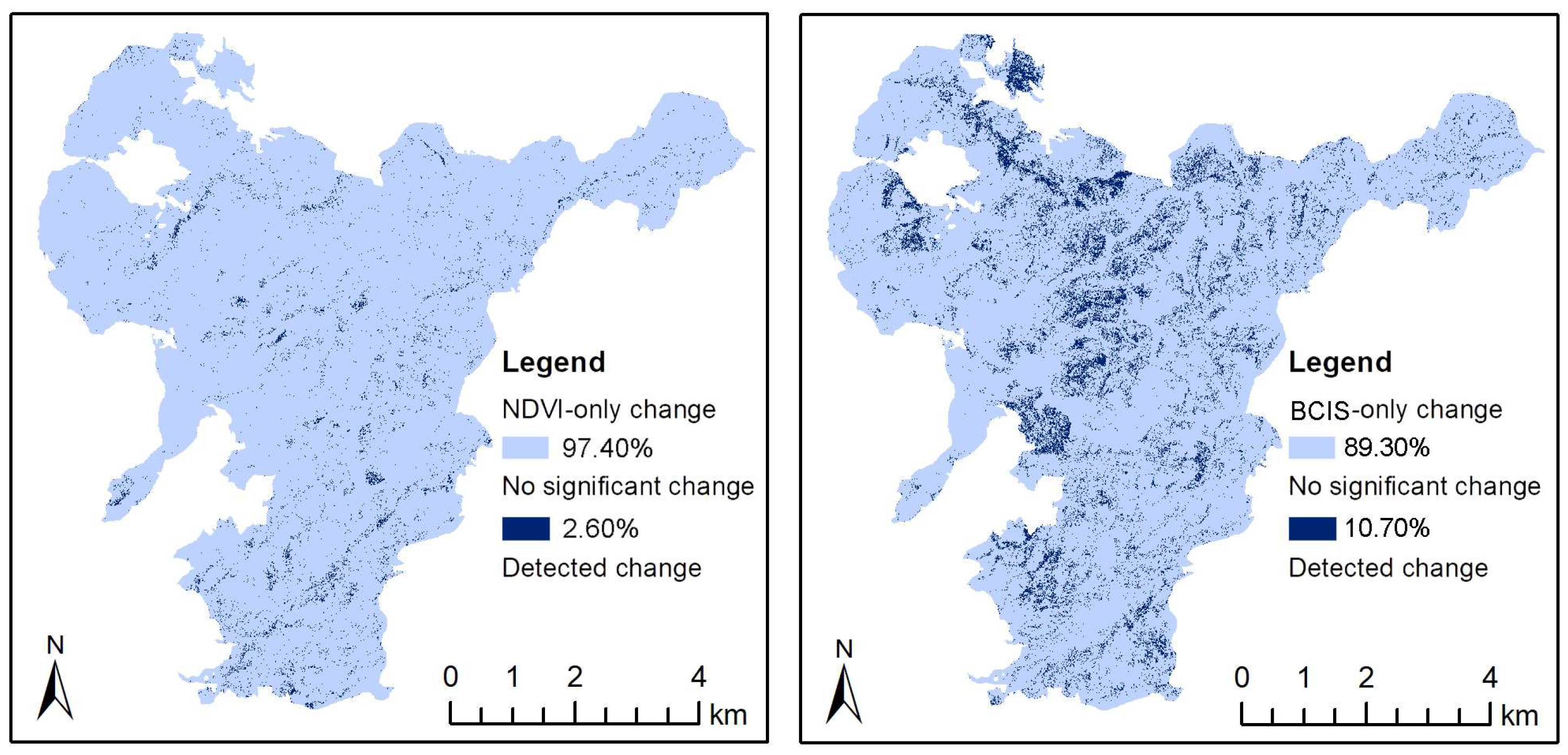
To assess the added value of the multi-index approach, a direct comparison was conducted between changes detected exclusively based on NDVI (ΔNDVI) and those obtained using the BCIS indicator (ΔBCIS). Pixel-by-pixel analysis indicates a high correlation between the two approaches (r ≈ 0.95), along with a greater capacity of BCIS to highlight spatial changes in heterogeneous mountain landscapes, where soil influence and canopy discontinuities may affect the performance of individual indices (Figure 5).
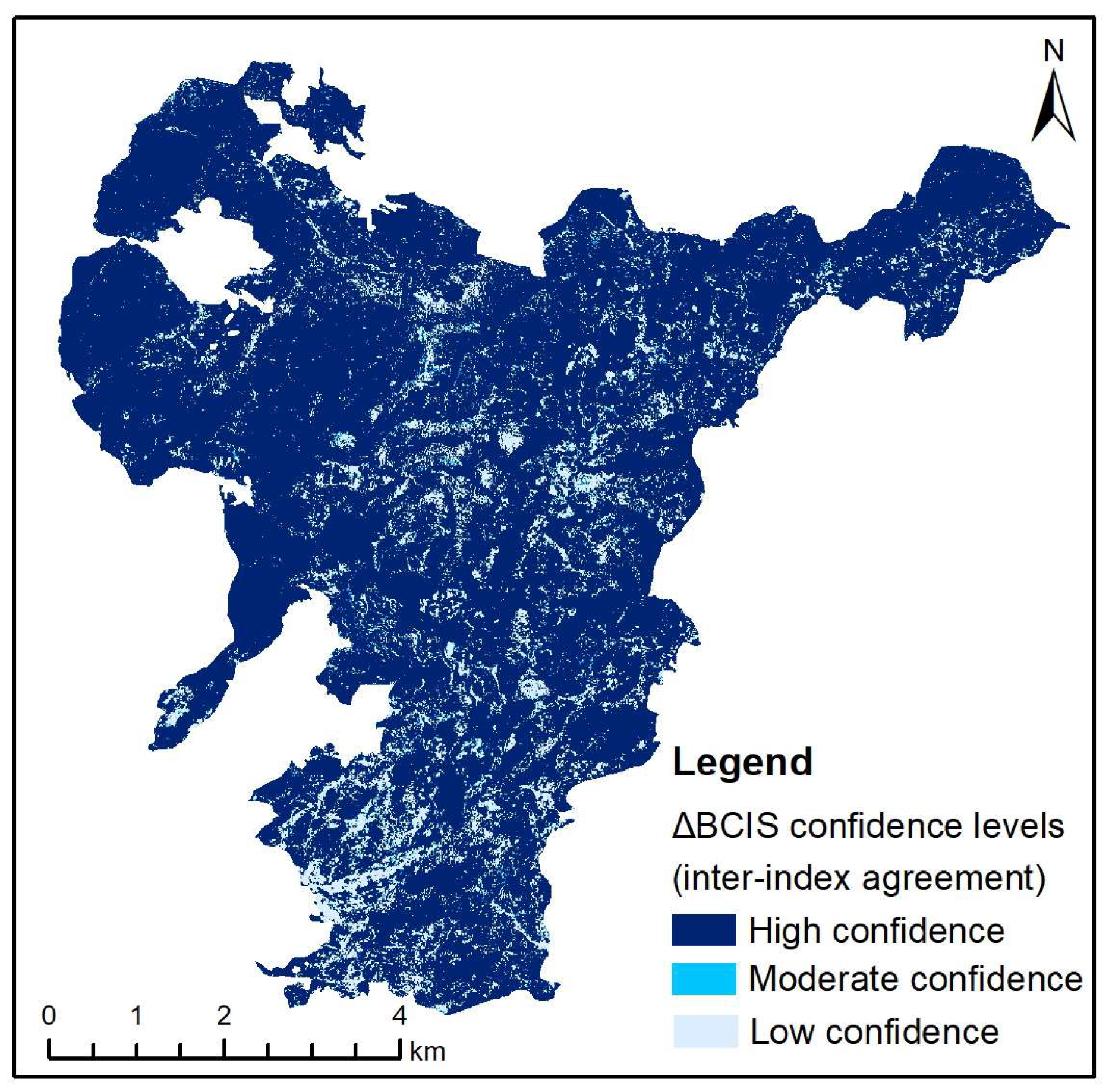
The assessment of spatial uncertainty in biomass change detection was carried out through an inter-index agreement analysis. For each pixel, the direction of change between 2018 and 2022 (increase or decrease) was determined separately for NDVI, SAVI, MSAVI, and LAI, and the number of indices indicating the same direction of change was summed, resulting in an agreement map with values ranging from 0 to 4. Based on this score, a confidence map of the ΔBCIS indicator was derived by classifying pixels into low-confidence (0–1 concordant indices), moderate-confidence (2 concordant indices), and high-confidence (3–4 concordant indices) classes. The results indicate that approximately 87% of the analyzed area falls within the high-confidence class, while low-confidence areas account for about 11% of the territory (Figure 6).
By integrating these stages of statistical validation and uncertainty assessment, the BCIS indicator is methodologically grounded as an exploratory and comparative tool for analyzing relative changes in vegetation biomass, aimed at the coherent identification of spatio-temporal trends of degradation, stability, or regeneration. BCIS does not seek to provide an absolute quantitative estimation of biomass, but rather delivers a robust synthesis of multispectral and structural information, statistically validated through controlled redundancy, internal consistency, and multi-index convergence.

3. Results

3.1. Land Use Structure

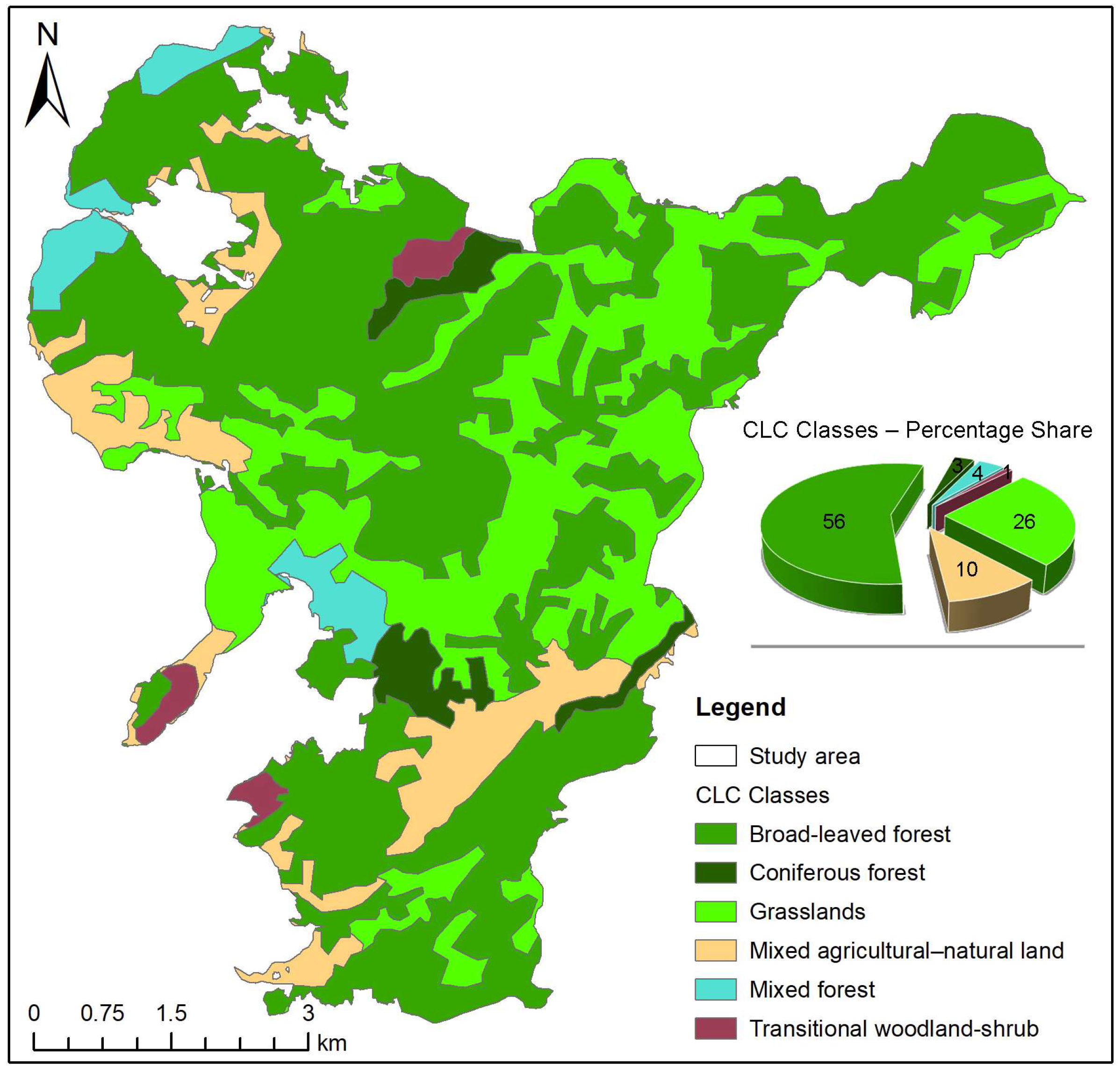
According to the CORINE Land Cover (2018) data processed in this study, the analyzed area is dominated by forest formations, followed by grasslands and agricultural areas with natural vegetation, while mixed forests, coniferous forests, and transitional shrub vegetation have smaller proportions (Figure 7).
Deciduous forests represent the dominant land use category, covering approximately 56% of the total area of the study region. Grasslands account for about 26% of the territory and are predominantly distributed in the central and southern parts of the area. Agricultural lands with natural vegetation make up approximately 10% of the surface, being mainly located at the periphery of forested massifs.
The remaining land use categories have smaller proportions: coniferous forests cover around 3% of the area, mixed forests about 4%, and transitional shrub vegetation toward forest stages approximately 1% of the total analyzed area.

3.2. Vegetation Index Trends Between 2018 and 2022

The evaluation of vegetation biomass dynamics in the study area was performed through the analysis of the temporal evolution of four vegetation indices derived from Sentinel-2 imagery: LAI, MSAVI, SAVI and NDVI. These indices provide complementary characterization of vegetation structure, from canopy density to leaf layer thickness and soil reflectance influence.

3.2.1. Vegetation Structural Changes Assessed Through LAI

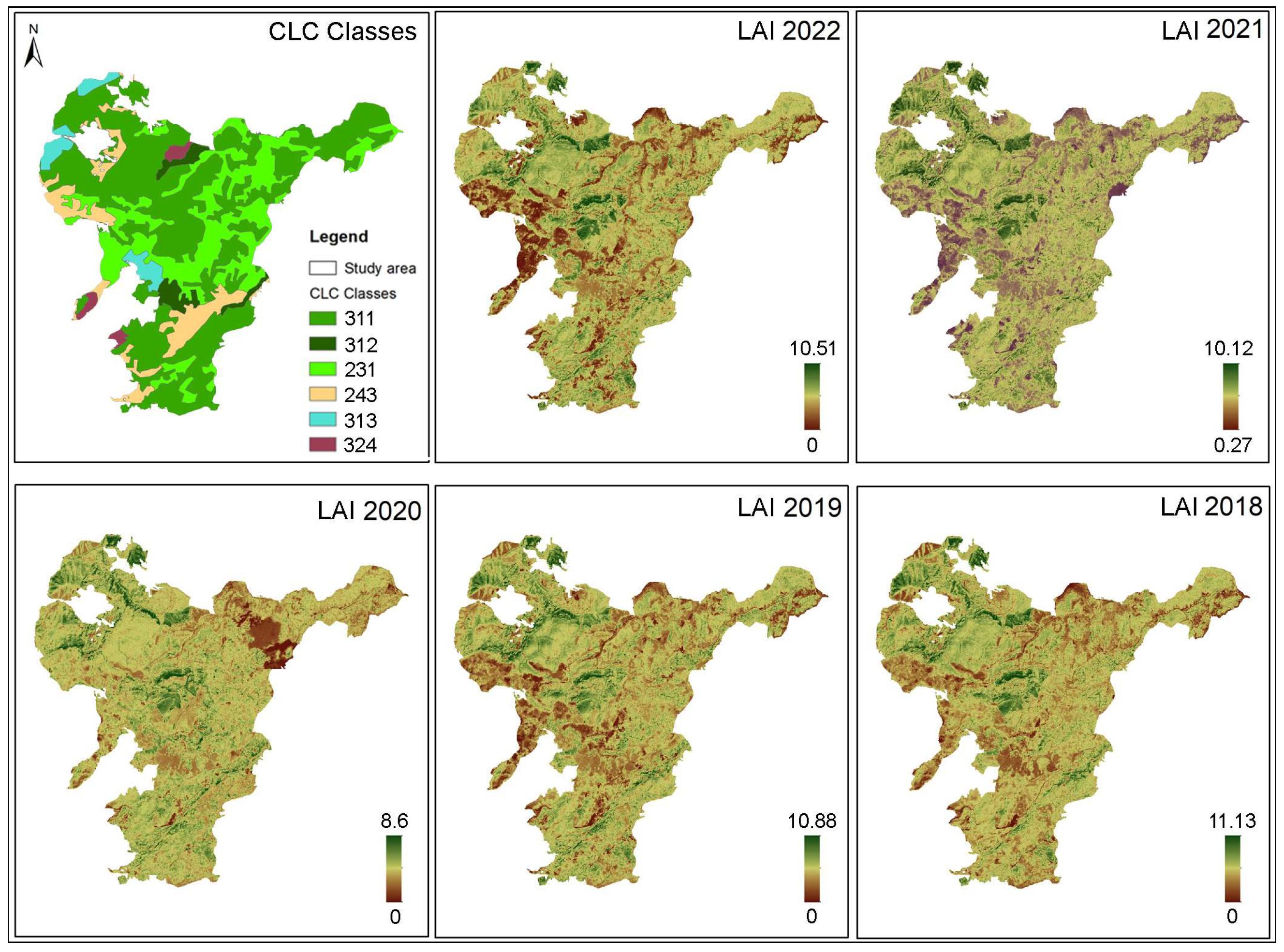
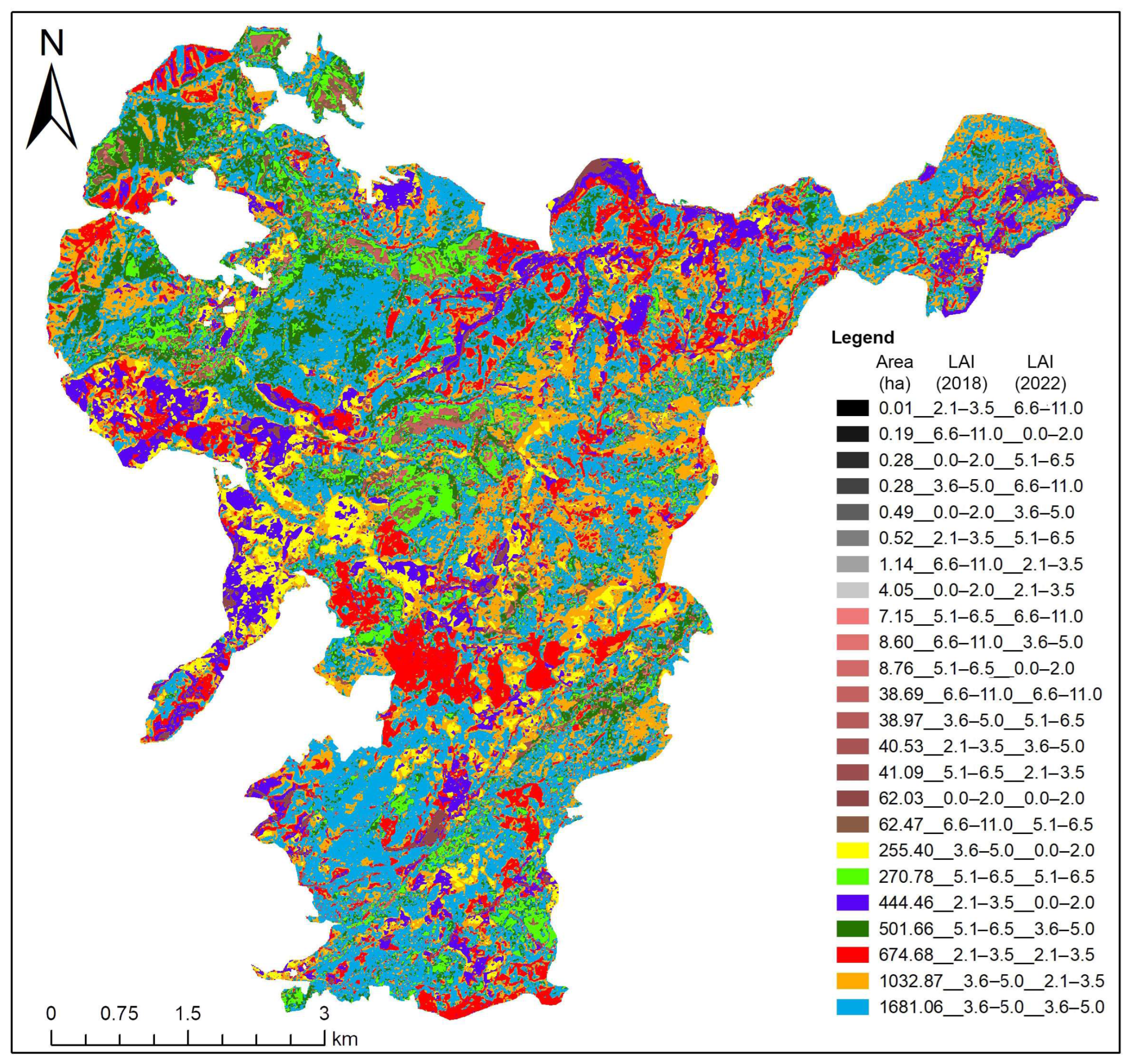
During the analyzed period (2018–2022), LAI values exhibited an overall decreasing trend across the study area, both in terms of mean values and the spatial distribution of higher leaf density classes (Figure 8).
In 2018, LAI values ranged between 0 and 11.13, with a mean value of 4.16, indicating dense and healthy vegetation across most of the forested areas and productive grasslands. By 2022, the value range narrowed to 0–10.51, and the mean decreased to 3.38, representing an approximately 18.8% reduction in leaf biomass. This percentage difference is significant, especially considering that the study area is located within a protected region where minimal anthropogenic disturbance is expected.
The transition matrix (Table 3) accurately reflects the intensity of this ecological decline. An area of 1033 ha recorded a shift from the 3.6–5.0 class to the 2.1–3.5 class, meaning a loss of biomass over about 20% of the analyzed territory. A similarly notable transition occurred over 502 ha, which dropped from the 5.1–6.5 class to the 3.6–5.0 class. Both changes are characteristic of forest ecosystems, where a reduction in leaf biomass is a sensitive indicator of biological stress.
The spatial distribution of changes (Figure 9) shows that the most affected areas are located in the central and eastern sectors of the protected area, where forests and forest–grassland ecotones exhibit signs of structural decline. In addition, in the north-western part, dominated by deciduous forests, a consistent reduction in LAI is observed.
Over the 2018–2022 interval, LAI values indicate a decrease in foliar biomass over an area of approximately 1530 ha, representing about 30% of the analyzed area, with a higher frequency in forested areas and in forest–grassland contact zones.

3.2.2. Vegetation Structural Changes Assessed Through MSAVI

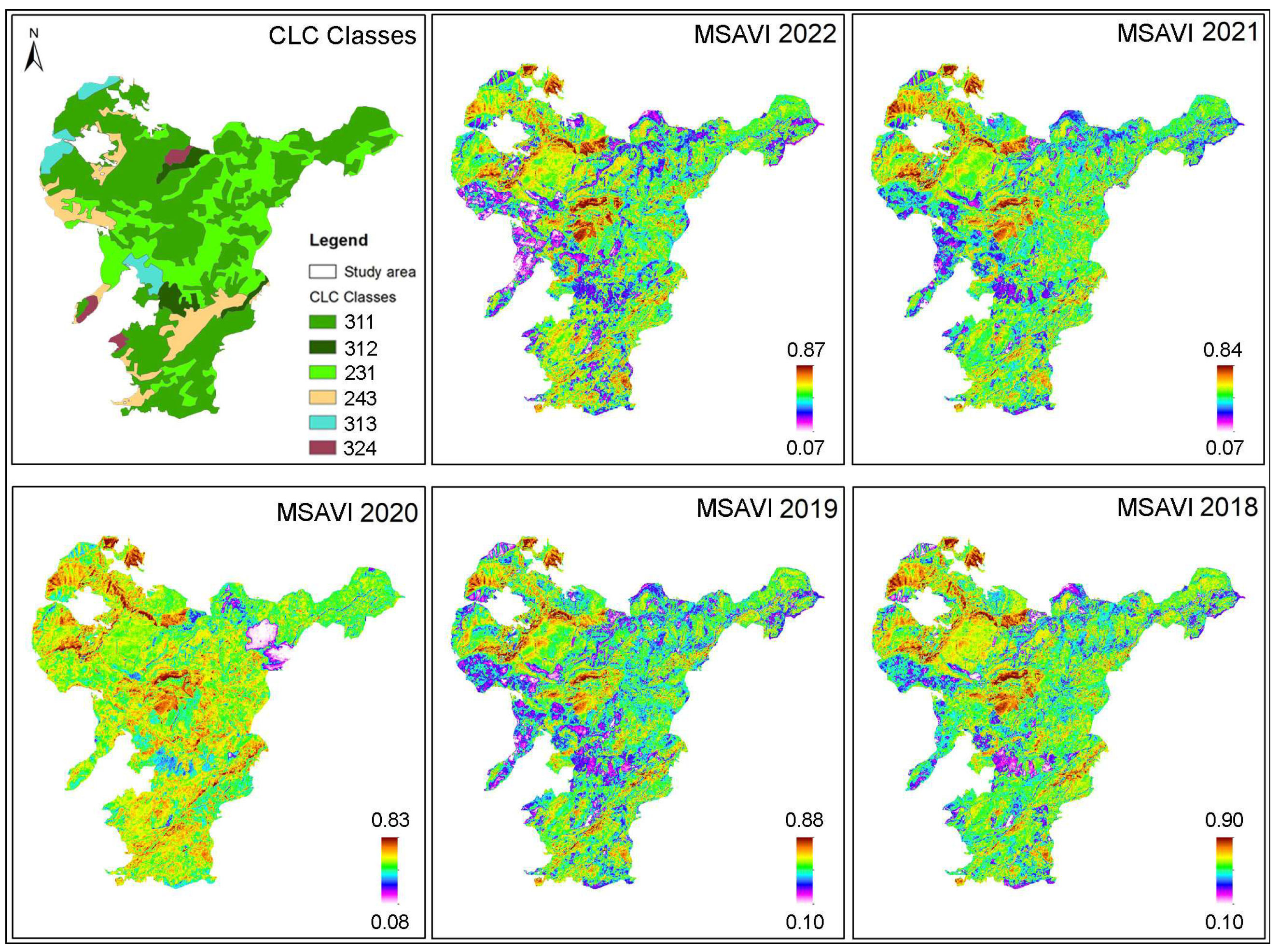
In 2018, MSAVI values ranged between 0.10 and 0.90, with a mean value of 0.60, indicating well-developed vegetation across most of the protected area. In 2022, the value range changed slightly, between 0.07 and 0.87, and the mean value decreased to 0.52, corresponding to an approximate 13.3% reduction in vegetation biomass as reported by this index (Figure 10).
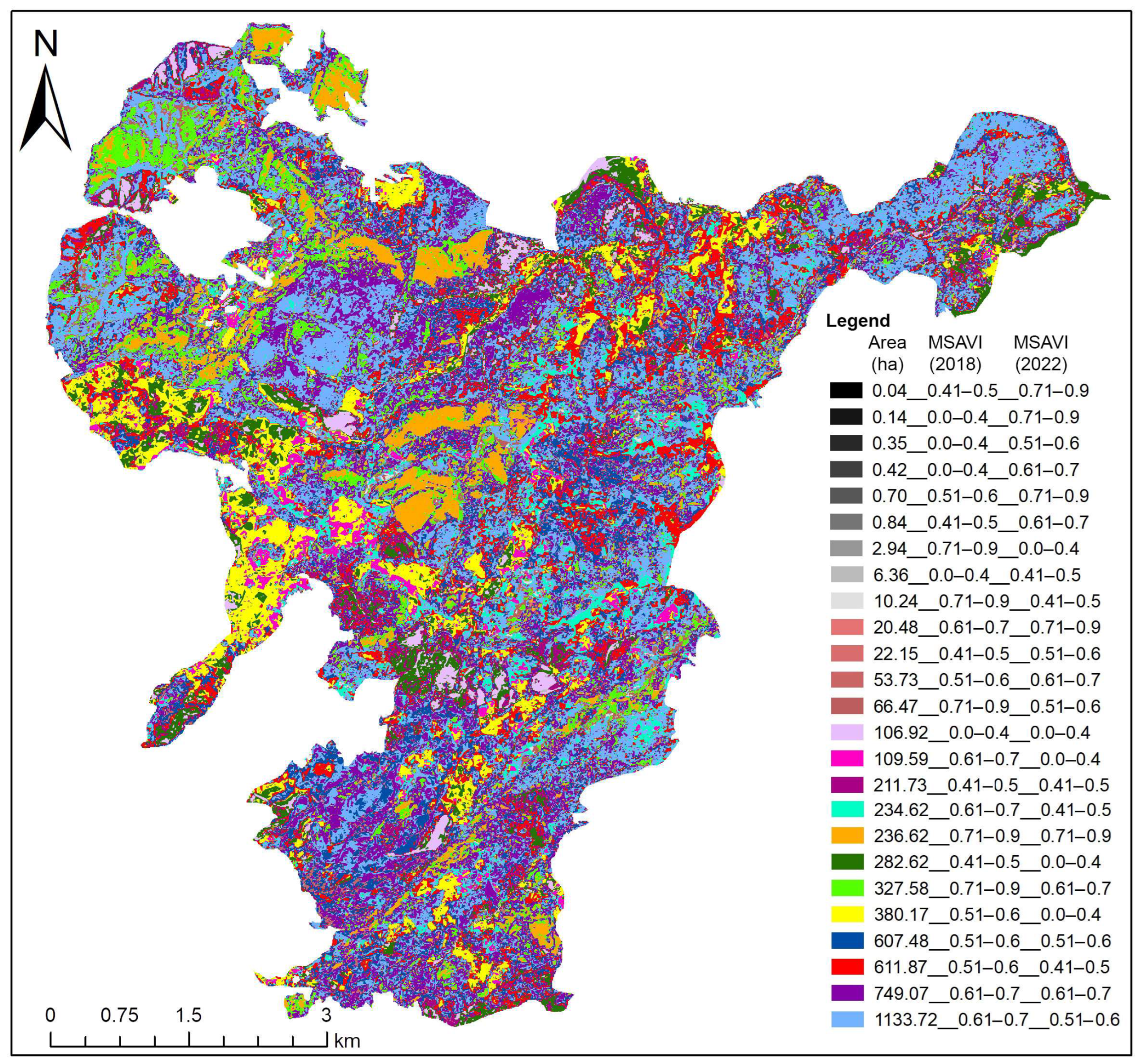
The transition matrix between MSAVI classes (Table 4) confirms this downward trend. An area of 1134 ha shifted from the 0.61–0.70 class to the 0.51–0.60 class, representing 21.9% of the entire analyzed area. This is the most structurally significant change, as it indicates a progressive degradation of vegetation with high biomass. In addition, a further migration is observed from the 0.51–0.60 class to the 0.41–0.50 class, confirming a continuous and cascading decrease in biomass, rather than an isolated fluctuation.
The spatial distribution of these changes (Figure 11) shows that transitions toward lower MSAVI classes are concentrated in the central and north-eastern sectors of the study area, as well as in the western zones, corresponding to the main land-use types identified.
During the 2018–2022 period, MSAVI values indicate a transition toward lower classes over an area of more than 1130 ha, with a higher frequency in areas occupied by deciduous forests and low-intensity grasslands.

3.2.3. Vegetation Structural Changes Assessed Through SAVI

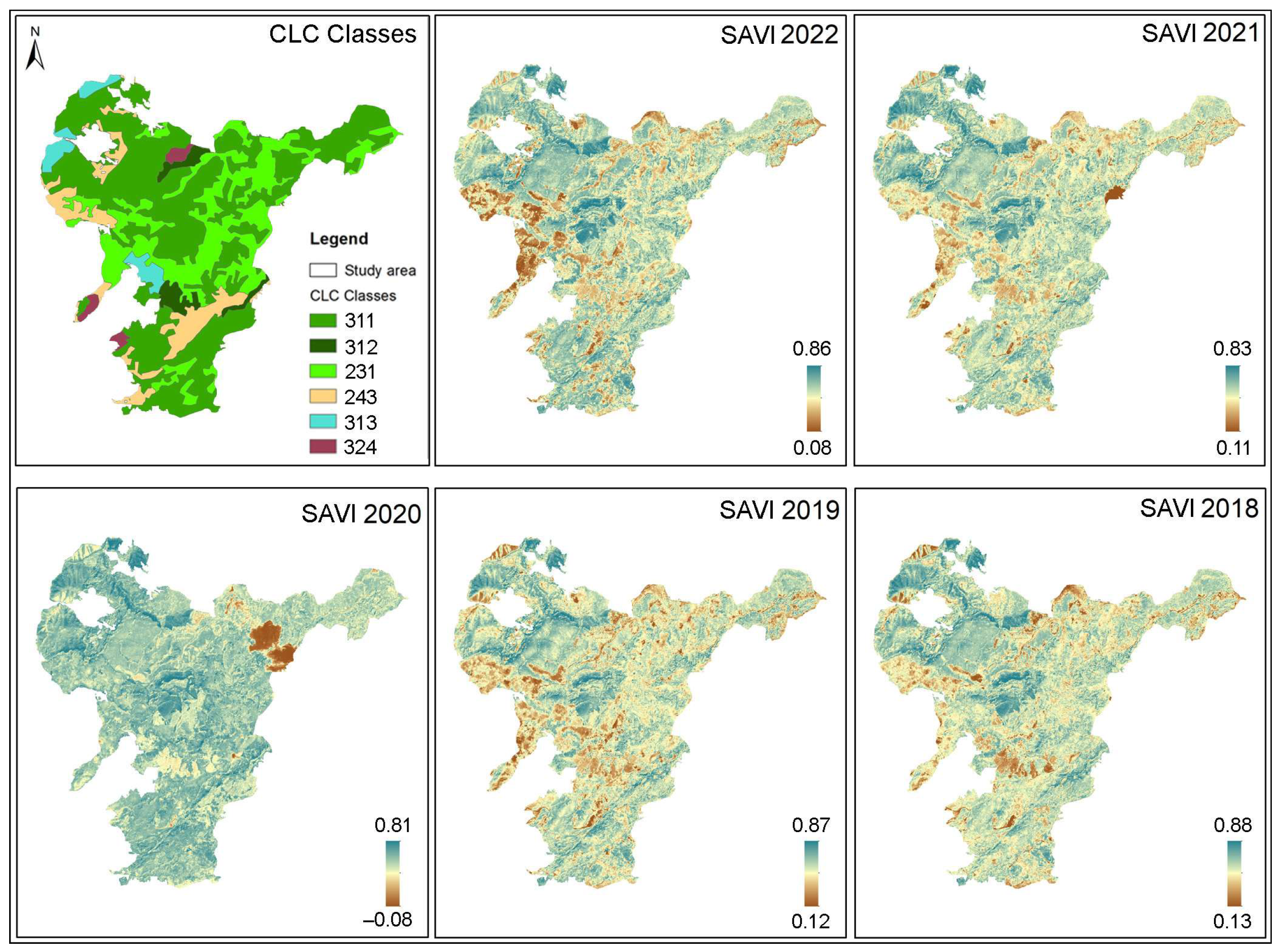
In 2018, SAVI values ranged between 0.13 and 0.88, with a mean value of 0.62, characteristic of stable and well-developed vegetation. In 2022, the value range varied between 0.08 and 0.86, and the mean value decreased to 0.55, indicating an 11.3% reduction in the overall vegetation condition (Figure 12).
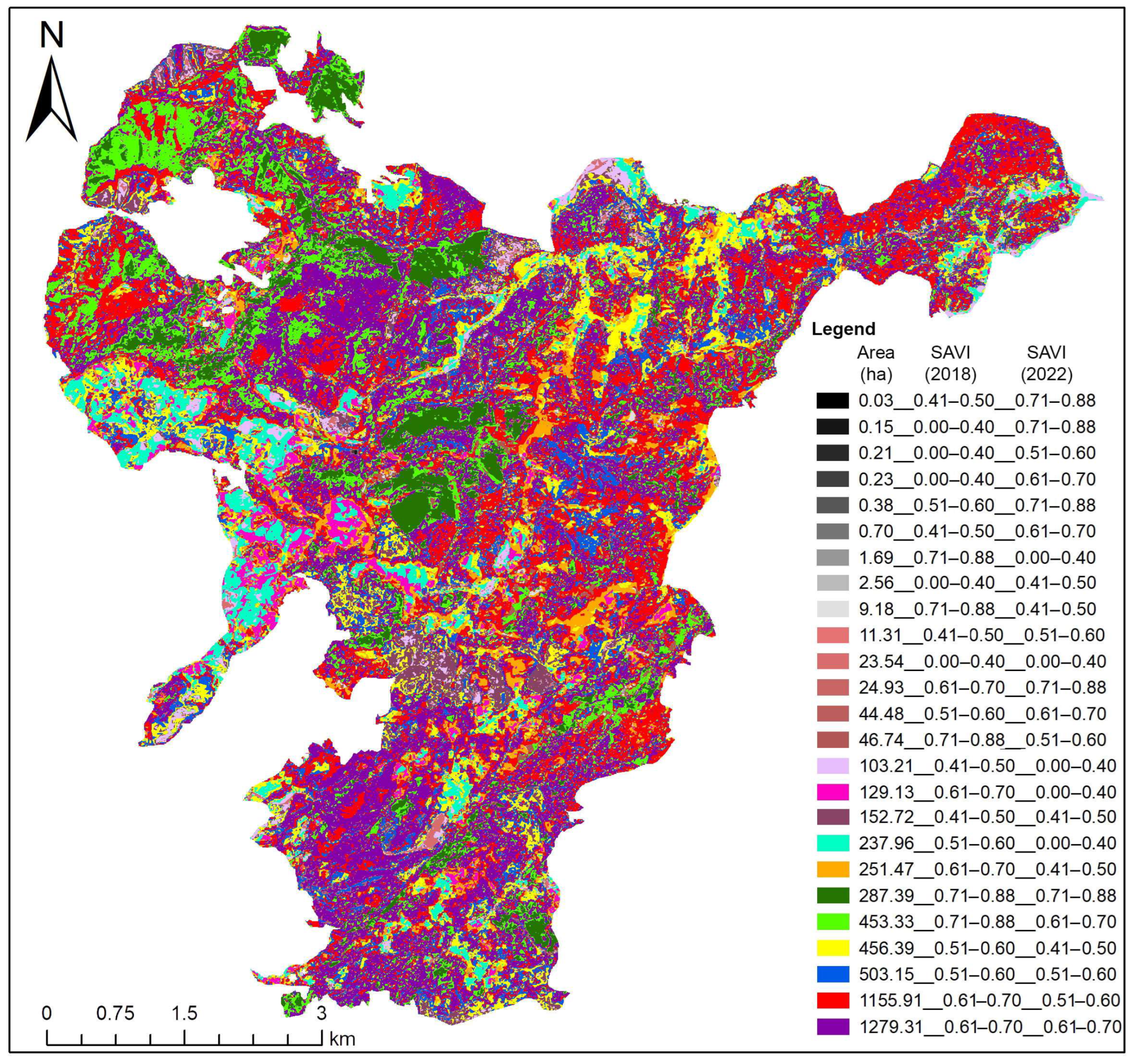
The spatial transition analysis (Table 5) confirms this degradation. Thus, 1156 ha shifted from the 0.61–0.70 class to the 0.51–0.60 class, representing 22.3% of the total study area. Additionally, a migration is observed from high-biomass surfaces (0.71–0.80 class) towards a lower class, which indicates a continuous process of reduced vegetation productivity, rather than seasonal or localized variations.
The spatial distribution of these transitions (Figure 13) shows that shifts toward lower SAVI values are concentrated in open areas and in contact zones between different land-use types, corresponding to the main CORINE Land Cover classes identified within the study area.
During the analyzed period, SAVI values exhibited transitions toward lower classes over an area of at least 1156 ha within the study area, with a higher frequency in forested areas and in those used as grasslands.

3.2.4. Vegetation Structural Changes Assessed Through NDVI

In 2018, NDVI values ranged between 0.20 and 0.96, with a high mean value of 0.87, reflecting healthy and well-developed vegetation characteristic of compact forests and productive grasslands. In 2022, the value range shifted toward lower limits, between 0.12 and 0.95, and the mean decreased to 0.81, representing an overall 6.9% reduction in vegetation canopy density (Figure 14).
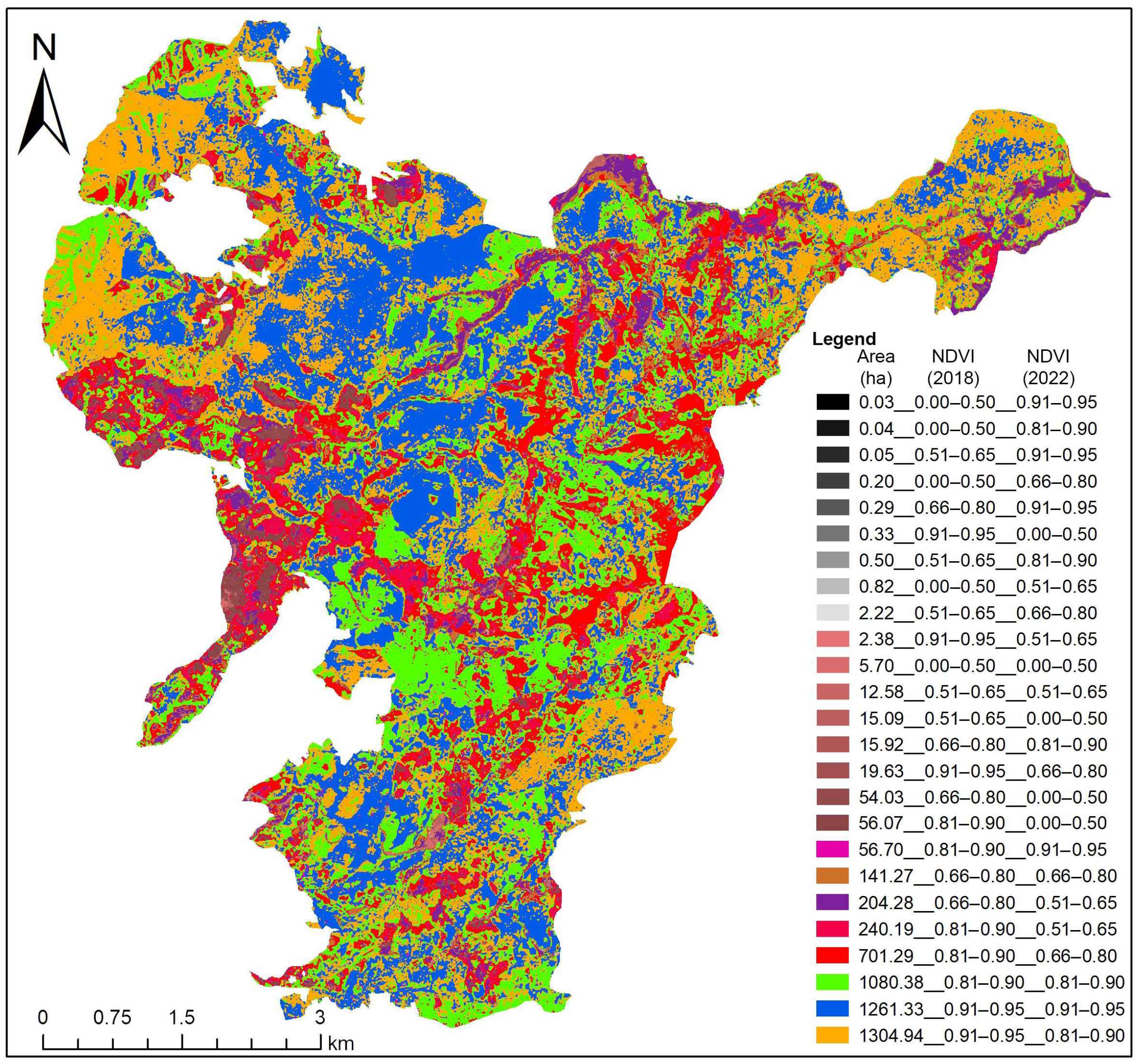
Changes in NDVI classes are significant both in terms of affected surface areas and geographic distribution. The transition matrix (Table 6) reveals that 1305 ha (≈25.2% of the study area) shifted from the 0.91–0.95 class to the 0.81–0.90 class, indicating a reduction in vegetation density of a magnitude that may be associated with the onset of structural degradation processes in mature forest ecosystems. Another relevant transformation concerns 701 ha that transitioned from the 0.81–0.90 class to the 0.66–0.80 class, confirming the expansion of areas with vegetation in a lower developmental stage.
The spatial distribution of these transitions (Figure 15) shows that shifts toward lower NDVI values are concentrated in forested areas and grasslands, as well as in contact zones between different land-use types identified within the study area.
Over the 2018–2022 period, NDVI values exhibited transitions toward lower classes over an area of more than 2000 ha within the analyzed area, with a predominant distribution in forested zones in the eastern and north-western parts of the study perimeter.
To synthesize the information obtained from the individual analysis of vegetation indices and to facilitate their comparability, Table 7 presents a summary of mean values, relative changes, and areas affected by downward transitions for each analyzed index (LAI, MSAVI, SAVI, and NDVI) over the 2018–2022 period.
The comparative presentation in Table 7 highlights differences in the sensitivity of the indices to vegetation structure and density, as well as the convergence of spatial patterns observed in relation to the main land-use types.

3.3. Vegetation Biomass Dynamics Assessment Using BCIS (2018–2022)

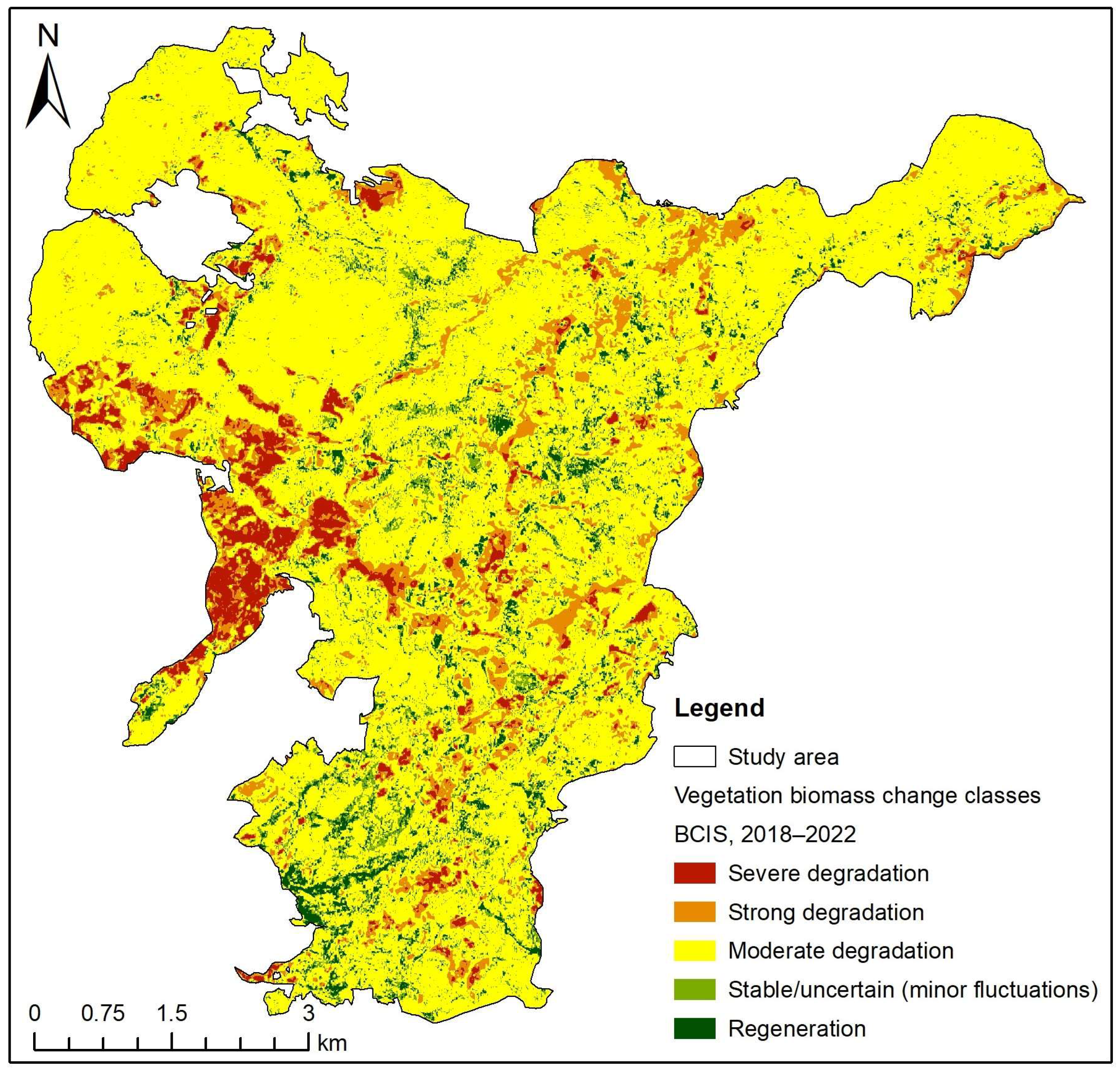
The Biomass Change Integrated Score (BCIS) was used to analyze the spatial distribution of vegetation biomass changes over the 2018–2022 period across the entire study area. The difference between the two reference moments (ΔBCIS) was classified into five thematic classes: severe degradation, strong degradation, moderate degradation, stable/uncertain (minor fluctuations), and regeneration (Figure 16, Table 8).
The results show that moderate degradation is the dominant class, covering 73.84% of the analyzed area (≈3827 ha). Strong degradation affects 10.61% (≈550 ha), while severe degradation is limited to 5.03% (≈261 ha) of the territory. The stable/uncertain class, characterized by minor fluctuations in ΔBCIS values, occupies 5.98% (≈310 ha) of the total area. Regeneration, defined by positive ΔBCIS values, is present on 4.53% (≈235 ha) of the study area.
From a spatial perspective, areas classified as severe and strong degradation are mainly concentrated in grasslands and in mixed agricultural–natural areas, with a pronounced distribution in the central and western sectors of the study perimeter, as well as in certain localized areas in the north-west (Figure 14). Areas classified as stable/uncertain or undergoing regeneration are predominantly associated with forested areas.
The combined BCIS–CLC analysis (Table 9) highlights significant differences among land-use categories. Grasslands show the greatest extent of degradation classes, with over 90% of their area classified as degraded. Moreover, grasslands concentrate the largest absolute areas of severe and strong degradation across the entire analyzed region. The mixed agricultural–natural land category exhibits a similar pattern, with most of its area falling into degradation classes and regeneration having a limited spatial extent.
Deciduous forests are mainly characterized by moderate degradation; however, they also concentrate the largest absolute areas classified as stable/uncertain and regeneration, reflecting their high share in the land-use structure. Coniferous and mixed forests show lower proportions of degradation classes compared to other land-cover types, along with limited but detectable areas of regeneration. In the case of the transitional woodland–shrub class, the distribution of BCIS classes indicates the concurrent presence of both degradation and regeneration.

4. Discussion

4.1. The Relevance of Land-Use Structure in Vegetation Biomass Modeling

Land use structure represents one of the main controlling factors of vegetation biomass distribution, influencing both ecosystem productivity and their capacity to respond to anthropogenic pressures and climatic variability [49,50]. Numerous studies have shown that land-cover type directly conditions biomass accumulation potential through differences related to floristic composition, vertical vegetation structure, intensity of human intervention, and vegetation succession dynamics [51,52,53,54,55,56].
In mountain ecosystems, forest formations, particularly deciduous forests, play an essential role in carbon storage and biodiversity maintenance, and are often considered nuclei of ecological stability in landscapes characterized by fragmented relief and variable climatic conditions [57,58,59]. In contrast, grasslands and agricultural lands with natural vegetation, although of major importance for the conservation of open habitats and the maintenance of traditional cultural landscapes, exhibit higher vulnerability to degradation processes as a result of undergrazing, abandonment, or land use conversion [60].
The results obtained in this study confirm these structural differences. Deciduous forests dominate the analyzed area (approximately 56%), providing a relatively stable ecological support for maintaining vegetation biomass in the Șureanu Mountains. By contrast, grasslands (about 26%) and mixed agricultural–natural lands (approximately 10%) represent the most structurally vulnerable categories, being associated with open or transitional ecosystems where the influence of anthropogenic and natural factors is more pronounced.
This spatial configuration has direct implications for vegetation biomass modeling using remote sensing. The continuity of forested surfaces contributes to the stabilization of spectral signals and regional biomass trends, while grasslands and transitional zones amplify the variability detected by satellite sensors due to canopy discontinuity and soil influence. Consequently, the interpretation of any multitemporal analysis of vegetation indices must be carried out in close correlation with land-use structure, which constitutes the functional framework within which processes of vegetation biomass degradation, stability, or regeneration occur.

4.2. Dynamics of Vegetation Indices and Implications for Mountain Ecosystem Health

Vegetation indices derived from multispectral imagery (NDVI, SAVI, MSAVI, and LAI) represent essential tools for assessing ecosystem condition, providing consistent information on vegetation biomass and functionality, particularly in contexts where direct field access is limited [61,62,63]. The scientific literature indicates that decreases in the values of these indices are associated with reductions in above-ground biomass, leaf density, and photosynthetic activity, and are frequently correlated with factors such as anthropogenic pressure, climatic stress, and habitat degradation processes [27,29].
The results obtained in this study highlight a general downward trend in the values of the analyzed indices over the 2018–2022 period, suggesting a relative and progressive degradation of vegetation condition within the analyzed protected mountain area. NDVI, the most widely used indicator of vegetation vigor and photosynthetic activity [64,65,66,67], indicates a decrease in mean values, signaling a reduction in the intensity of photosynthetic processes at the regional scale. This trend is supported by the behavior of the SAVI and MSAVI indices, which confirm vegetation degradation in areas where soil influence becomes more pronounced, a signal characteristic of degraded grasslands and surfaces transitioning toward shrub or forest stages [47,48,68].
The LAI, considered a robust descriptor of biomass and canopy structure, provides a complementary perspective on these dynamics [69,70,71]. The reduction in LAI values between 2018 and 2022 reflects a decrease in active leaf area, particularly in deciduous forests and in contact zones between forests and open lands. This evolution is consistent with observations reported at the European scale regarding the sensitivity of mountain ecosystems to drought episodes and increasing mean temperatures—factors that directly influence biomass dynamics and vegetation structure [13,72].
The spatial distribution of changes in vegetation indices indicates that the most affected sectors are grasslands and areas located mainly in the central and western parts of the analyzed region. These spaces concentrate both structural discontinuities in vegetation and multiple anthropogenic pressures, such as grazing, higher accessibility, or the decline of traditional management practices. The high vulnerability of mountain grasslands under such conditions is also supported by the results of other studies, which highlight the sensitivity of this ecosystem type to socioeconomic and climatic changes [73].
Overall, the convergent behavior of the analyzed vegetation indices confirms the existence of coherent trends of decreasing biomass and vegetation vigor, underscoring the usefulness of multi-index approaches for assessing mountain ecosystem health. However, these results must be interpreted in relation to land-use structure and the ecological specificity of the mountain landscape, issues that are discussed in detail in the following sections.

4.3. Usefulness of Integrating Multispectral Indices into a Composite Score for Detecting Biomass Changes (BCIS)

Integrating multiple vegetation indices into a composite score represents an increasingly used methodological direction in biomass assessment, based on the premise that each index captures a distinct component of vegetation structure and functioning: photosynthetic vigor (NDVI), soil influence in areas with discontinuous vegetation cover (SAVI, MSAVI), and leaf density as a structural element of biomass (LAI). The scientific literature emphasizes that the simultaneous use of these multispectral products contributes to a more robust biomass evaluation in complex environments, such as mountain ecosystems, where terrain slope and surface heterogeneity can affect the performance of individually used indices [10].
The results obtained in this study support the usefulness of such an integrated approach. The synthetic BCIS indicator enabled a more coherent identification of areas characterized by relative stability, degradation, or trends of vegetation biomass regeneration, compared to the separate interpretation of each index. This synthesis capability is particularly relevant in heterogeneous mountain landscapes, where vegetation spectral response is simultaneously influenced by canopy structure, edaphic conditions, and land-use context.
Although the indices used in constructing BCIS are partially derived from the same Sentinel-2 spectral bands, the statistical analyses conducted in this study show that their integration into a composite score reflects a common vegetation biomass gradient, without being dominated by a single index. Thus, BCIS does not assume strict independence of the input variables, but rather capitalizes on their informational complementarity, reducing the influence of limitations specific to each index when used in isolation.
An additional advantage of the BCIS indicator lies in its applicability to areas with difficult access or over large spatial extents, where systematic field data collection is limited. This aspect is frequently highlighted in the recent literature on biomass and ecosystem service monitoring, which emphasizes the role of satellite products in supporting spatio-temporal assessments at regional scales [74]. The use of open-source Sentinel-2 data with a 10 m spatial resolution provides the method with high potential for integration into operational vegetation monitoring programs and sustainable land management practices [13,75].
At the same time, the use of a composite score such as BCIS helps mitigate the effects of local spectral variability and seasonality, which are limitations often associated with the exclusive use of NDVI in mountain ecosystems [27]. Therefore, BCIS should be interpreted as an integrative and exploratory tool aimed at coherently identifying spatial and temporal trends in vegetation biomass, rather than as an absolute biomass estimator. In this sense, the study highlights both the dynamics of vegetation condition within the analyzed area and the methodological potential of the composite indicator to be applied, with minimal adaptations, in other protected areas or vulnerable agro-ecological systems.

4.4. Differential Impact of Biomass Degradation Across Land Use Categories

Differences in vegetation biomass dynamics are strongly influenced by the characteristics of each land-use type, particularly in mountain ecosystems, where natural and anthropogenic pressures are spatially uneven [76]. The scientific literature highlights that grasslands and marginal areas exhibit higher vulnerability to degradation compared to forest ecosystems, in the context of changes in agricultural management and climatic variability [77,78].
The results of the present study confirm this trend. Grasslands represent the most affected category, with approximately 68% of their area classified within relative biomass degradation classes according to the BCIS indicator. The spatial distribution of these trends, concentrated mainly in the central and western sectors of the study area, suggests the cumulative influence of undergrazing, habitat fragmentation, and the decline of traditional management practices, phenomena frequently reported in European mountain grasslands over recent decades [79,80,81,82].
Mixed agricultural–natural lands also show a high level of vulnerability, with about 55% of their area associated with biomass degradation classes. This behavior reflects their transitional character, located at the interface between natural ecosystems and areas directly influenced by anthropogenic activities. Contact zones between agricultural lands and forests are recognized in the literature as hotspots of rapid biomass change, sensitive both to land-use pressures and to variable climatic conditions [83].
In contrast, deciduous forests, which dominate the analyzed area (approximately 56%), exhibit a high proportion of surfaces characterized by structural biomass stability, along with sectors where relative positive trends are observed. This distribution suggests greater ecological resilience of forest ecosystems, explainable through the structural continuity of the canopy and the adaptive capacity of dominant species to respond to environmental fluctuations [59,84]. At the same time, these trends should be interpreted as processes of relative biomass stability or recovery, without necessarily implying accelerated regeneration or major structural changes in forest ecosystems.
Transitional vegetation shows a mixed dynamic, with approximately 36% of its area associated with degradation classes and 28% classified within stable or positive trend classes. This distribution reflects a fragile balance between natural succession processes toward forest stages and the impact of external pressures—a pattern frequently documented in mountain landscapes affected by agricultural abandonment [85].
Overall, these results highlight the complexity of the relationship between land-use structure and vegetation biomass evolution, emphasizing that ecosystem responses to recent pressures are not uniform. Grasslands and agro-forestry transition zones emerge as priorities for adaptive management interventions, while forest ecosystems may play an important role in maintaining ecological stability at the scale of the protected mountain landscape.

4.5. Methodological Contributions and Applicability for Sustainable Biomass Monitoring in Mountain Ecosystems

Monitoring vegetation biomass in mountain ecosystems and protected natural areas is often constrained by limited accessibility, the lack of consistent in situ data series, and the structural complexity of the terrain. In this context, the use of multispectral remote sensing and GIS tools represents an efficient operational solution with a favorable cost–benefit ratio, in line with current research directions on the sustainable assessment of natural resources [13,75].
The main methodological contribution of this study lies in the development and application of the synthetic Biomass Change Integrated Score (BCIS), based on the integration of normalized NDVI, SAVI, MSAVI, and LAI indices. The results show that this multi-index approach reduces uncertainties associated with the use of a single spectral indicator and enables a more robust detection of relative vegetation biomass changes, particularly in heterogeneous mountain landscapes. The integration of multispectral and structural information helps mitigate the effects of seasonal and local variability, which are commonly reported limitations when using classical indices alone.
Another relevant methodological aspect is the exclusive use of open-source Sentinel-2 data, which ensures a high degree of replicability and transferability of the method, both in Romania and in other regions characterized by similar mountain conditions. The 10 m spatial resolution proved suitable for identifying areas with significant biomass changes at a sub-parcel scale, in accordance with recommendations from the literature on landscape-level ecological monitoring and applications oriented toward sustainable management [86].
Although the proposed methodology is based on indices derived from optical reflectance, the results suggest that future integration of other data sources, such as SAR radar, LiDAR, or UAV imagery, could improve biomass estimation, particularly in areas with closed canopies or pronounced altitudinal gradients [87]. Similarly, the application of machine learning techniques could support the development of predictive models for the early identification of degradation trends, with relevance for the adaptive management of protected areas.
Overall, the proposed methodology provides an applicable and scalable framework for analyzing relative changes in vegetation biomass in mountain ecosystems, with potential use as a monitoring and decision-support tool in conservation and sustainable development contexts, without replacing the need for validation using field data or detailed ecological assessments.

4.6. Study Limitations and Perspectives for Sustainable Vegetation Monitoring in Mountain Areas

Although the results highlight the usefulness of the composite BCIS indicator in detecting relative changes in vegetation biomass, their interpretation must take into account certain methodological limitations. First, the estimates are based exclusively on spectral indices derived from optical remote sensing, which can be influenced by illumination conditions, topographic shadows, and canopy structure, factors well known in mountain environments. The 10 m spatial resolution, while suitable for landscape-scale analysis, may not capture localized vegetation changes or fine-scale micro-structures.
An important limitation is the absence of an in situ dataset for the direct calibration of above-ground biomass. In this context, the results should be interpreted as relative estimates of biomass change, useful for identifying spatial and temporal trends, rather than as absolute values of biomass loss or gain. The scientific literature indicates that the integration of field observations or LiDAR data can significantly improve the accuracy of such estimates [87].
In addition, the analysis is based on Sentinel-2 imagery from a single phenological window (July), selected to ensure interannual comparability and to reduce the influence of seasonal variability. However, this approach does not fully capture seasonal vegetation dynamics, and extending the analysis to multi-seasonal time series could provide a more comprehensive perspective on the functioning of mountain ecosystems.
Despite these limitations, the proposed methodology proves to be robust and easily replicable, as it is based exclusively on open-source Sentinel-2 data and vegetation indices validated in the scientific literature. Although the BCIS indicator is not internationally standardized, its multispectral and multitemporal foundation recommends it as an effective exploratory tool for sustainable vegetation monitoring and for supporting management decisions in protected mountain areas, particularly in regions with limited access and diffuse ecological pressures.

5. Conclusions

This study highlights the potential of Sentinel-2 imagery and the integration of vegetation indices into a composite score (BCIS) for the relative assessment of vegetation biomass dynamics in a protected mountain area. The multitemporal analysis of the NDVI, SAVI, MSAVI, and LAI indices indicates a general trend of declining vegetation vigor and structure over the 2018–2022 period, reflected by a consistent decrease in the mean values of all analyzed indices: NDVI from 0.87 to 0.81, SAVI from 0.62 to 0.55, MSAVI from 0.60 to 0.52, and LAI from 4.16 to 3.38.
The BCIS based results show that approximately 89.5% of the analyzed area falls within biomass degradation classes, with a pronounced impact on grasslands and mixed agricultural–natural lands, while regeneration processes are spatially limited (about 4.5%) and are mainly associated with broadleaf forests, which exhibit a higher capacity for ecological stability. The multispectral integration of vegetation indices reduces the influence of their individual limitations and allows a more coherent delineation of areas sensitive to change in heterogeneous mountain landscapes.
The proposed methodology, based exclusively on open-source data, represents a robust and easily replicable tool for sustainable vegetation monitoring and can support adaptive management and decision-making processes in biodiversity conservation within mountain ecosystems, with the caveat that the results should be interpreted as comparative estimates of biomass change.

Author Contributions

Conceptualization, M.V.H., L.C., L.L.C. and R.C.H.; methodology, M.V.H., L.C. and P.S.; software, M.V.H. and L.C.; validation, L.C., R.C.H. and S.M.R.; formal analysis, C.L., R.B. and P.S.; investigation, R.C.H., L.C. and F.S.; resources, M.V.H., L.L.C., C.L. and S.M.R.; data curation, R.B., P.S. and F.S.; writing—original draft preparation, M.V.H., L.C. and L.L.C.; writing—review and editing, L.C., L.L.C., R.C.H. and P.S.; visualization, M.V.H., C.L., L.C., S.M.R., L.L.C. and P.S.; supervision, M.V.H., L.C. and L.L.C.; project administration, M.V.H., L.C. and L.L.C.; funding acquisition, C.L., S.M.R., R.B. and F.S. All authors have read and agreed to the published version of the manuscript.

Funding

This research received no external funding.

Institutional Review Board Statement

Not applicable.

Informed Consent Statement

Not applicable.

Data Availability Statement

The raw data supporting the conclusions of this article will be made available by the authors on request.

Acknowledgments

The authors thank the GEOMATICS Research Laboratory, University of Life Sciences “King Mihai I” from Timişoara, for the facility of software used for this study.

Conflicts of Interest

The authors declare no conflicts of interest.

References

  1. Phiri, D.; Morgenroth, J.; Xu, C. Long-term land cover change in Zambia: An assessment of driving factors. Sci. Total Environ. 2019, 697, 134206. [Google Scholar] [CrossRef]
  2. Ferreira, A.F.; Zimmermann, H.; Santos, R.; von Wehrden, H. Biosphere Reserves’ Management Effectiveness—A Systematic Literature Review and a Research Agenda. Sustainability 2020, 12, 5497. [Google Scholar] [CrossRef]
  3. Ecologic Institute. Remote Sensing Techniques for Monitoring Biodiversity and Ecosystem Services in Protected Areas; Ecologic Institute/European Commission: Ispra, Italy, 2021; Available online: https://www.ecologic.eu/sites/default/files/publication/2021/A2_Remote-sensing-techniques.pdf (accessed on 22 November 2025).
  4. Borre, V.; Paelinckx, J.; Mücher, S.; Kooistra, L.; Haest, B.; De Blust, G.; Schmidt, A.M. Integrating remote sensing in Natura 2000 habitat monitoring: Prospects on the way forward. J. Nat. Conserv. 2011, 19, 116–125. [Google Scholar] [CrossRef]
  5. Ravetto Enri, S.; Nucera, E.; Lonati, M.; Probo, M.; Cernusca, A. The biodiversity promotion areas: Effectiveness of agricultural direct payments on plant diversity conservation in the semi-natural grasslands of the Southern Swiss Alps. Biodivers. Conserv. 2020, 29, 4155–4172. [Google Scholar] [CrossRef]
  6. Komba, A.W.; Watanabe, T.; Kaneko, M.; Chand, M.B. Monitoring of Vegetation Disturbance around Protected Areas in Central Tanzania Using Landsat Time-Series Data. Remote Sens. 2021, 13, 1800. [Google Scholar] [CrossRef]
  7. Kpienbaareh, D.; Batung, E.S.; Luginaah, I. Spatial and Temporal Change of Land Cover in Protected Areas in Malawi: Implications for Conservation Management. Geographies 2022, 2, 68–86. [Google Scholar] [CrossRef]
  8. Rusu, A.; Ursu, A.; Stoleriu, C.C.; Groza, O.; Niacșu, L.; Sfîcă, L.; Minea, I.; Stoleriu, O.M. Structural changes in the Romanian economy reflected through Corine Land Cover datasets. Remote Sens. 2020, 12, 1323. [Google Scholar] [CrossRef]
  9. Feranec, J.; Hazeu, G.W.; Christensen, S.; Jaffrain, G. Corine land cover change detection in Europe: Case studies of the Netherlands and Slovakia. Land Use Policy 2007, 24, 234–247. [Google Scholar] [CrossRef]
  10. Li, L.; Xin, X.; Zhao, J.; Yang, A.; Wu, S.; Zhang, H.; Yu, S. Remote Sensing Monitoring and Assessment of Global Vegetation Status and Changes during 2016–2020. Sensors 2023, 23, 8452. [Google Scholar] [CrossRef]
  11. Gigante, D.; Angelucci, S.; Bonini, F.; Caruso, F.; Di Cecco, V.; Donnini, D.; Morbidini, L.; Pauselli, M.; Valenti, B.; Tassi, A.; et al. Seminatural grasslands: An emblematic challenge for nature conservation in protected areas. Land 2024, 13, 386. [Google Scholar] [CrossRef]
  12. Copernicus Land Monitoring Service. Corine Land Cover—CLC. 2025. Available online: https://land.copernicus.eu/pan-european/corine-land-cover (accessed on 15 March 2025).
  13. Immitzer, M.; Vuolo, F.; Atzberger, C. First Experience with Sentinel-2 Data for Crop and Tree Species Classifications in Central Europe. Remote Sens. 2016, 8, 166. [Google Scholar] [CrossRef]
  14. Ayvazyan, G.; Muradyan, V.; Medvedev, A.; Khlghatyan, A.; Asmaryan, S. Exploring Multisource Remote Sensing for Assessing and Monitoring the Ecological State of the Mountainous Natural Grasslands in Armenia. Appl. Sci. 2024, 14, 10205. [Google Scholar] [CrossRef]
  15. Panek-Chwastyk, E.; Ozbilge, C.N.; Dąbrowska-Zielińska, K.; Wróblewski, K. Assessment of Grassland Biomass Prediction Using AquaCrop Model: Integrating Sentinel-2 Data and Ground Measurements in Wielkopolska and Podlasie Regions, Poland. Agriculture 2024, 14, 837. [Google Scholar] [CrossRef]
  16. Arekhi, M.; Goksel, C.; Balik Sanli, F.; Senel, G. Comparative Evaluation of the Spectral and Spatial Consistency of Sentinel-2 and Landsat-8 OLI Data for Igneada Longos Forest. ISPRS Int. J. Geo-Inf. 2019, 8, 56. [Google Scholar] [CrossRef]
  17. Netsianda, A.; Mhangara, P. Aboveground biomass estimation in a grassland ecosystem using Sentinel-2 satellite imagery and machine learning algorithms. Environ. Monit. Assess. 2025, 197, 138. [Google Scholar] [CrossRef] [PubMed]
  18. Frappart, F.; Wigneron, J.-P.; Li, X.; Liu, X.; Al-Yaari, A.; Fan, L.; Wang, M.; Moisy, C.; Le Masson, E.; Aoulad Lafkih, Z.; et al. Global Monitoring of the Vegetation Dynamics from the Vegetation Optical Depth (VOD): A Review. Remote Sens. 2020, 12, 2915. [Google Scholar] [CrossRef]
  19. Pang, H.; Zhang, A.; Kang, X.; He, N.; Dong, G. Estimation of the grassland aboveground biomass of the Inner Mongolia Plateau using the simulated spectra of Sentinel-2 images. Remote Sens. 2020, 12, 4155. [Google Scholar] [CrossRef]
  20. Muhe, S.; Argaw, M. Estimation of above-ground biomass in tropical afro-montane forest using Sentinel-2 derived indices. Environ. Syst. Res. 2022, 11, 5. [Google Scholar] [CrossRef]
  21. Peng, J.; Zeiner, N.; Parsons, D.; Féret, J.-B.; Söderström, M.; Morel, J. Forage Biomass Estimation Using Sentinel-2 Imagery at High Latitudes. Remote Sens. 2023, 15, 2350. [Google Scholar] [CrossRef]
  22. Poudel, A.; Shrestha, H.L.; Mahat, N.; Sharma, G.; Aryal, S.; Kalakheti, R.; Lamsal, B. Modeling and mapping of aboveground biomass and carbon stock using Sentinel-2 imagery in Chure Region, Nepal. Int. J. For. Res. 2023, 2023, 5553957. [Google Scholar] [CrossRef]
  23. Cojocariu, L.; Copăcean, L.; Popescu, C. Conservation of grassland habitats biodiversity in the context of sustainable development of mountain area of Romania. Appl. Ecol. Environ. Res. 2019, 17, 8877–8894. [Google Scholar] [CrossRef]
  24. Ursu, A.; Stoleriu, C.C.; Ion, C.; Jitariu, V.; Enea, A. Romanian Natura 2000 Network: Evaluation of the Threats and Pressures through the Corine Land Cover Dataset. Remote Sens. 2020, 12, 2075. [Google Scholar] [CrossRef]
  25. Jiang, H.; Yao, M.; Guo, J.; Zhang, Z.; Wu, W.; Mao, Z. Vegetation Monitoring of Protected Areas in Rugged Mountains Using an Improved Shadow-Eliminated Vegetation Index (SEVI). Remote Sens. 2022, 14, 882. [Google Scholar] [CrossRef]
  26. Milazzo, F.; Brocca, L.; Vanwalleghem, T. NDVI prediction of Mediterranean permanent grasslands using soil moisture products. Agronomy 2024, 14, 1798. [Google Scholar] [CrossRef]
  27. Pettorelli, N. The Normalized Difference Vegetation Index; Oxford University Press: Oxford, UK, 2013; Available online: https://api.pageplace.de/preview/DT0400.9780191512711_A23533411/preview-9780191512711_A23533411.pdf (accessed on 22 November 2025).
  28. Wang, Z.; Wang, J.; Wang, W.; Zhang, C.; Mandakh, U.; Ganbat, D.; Myanganbuu, N. An explanation of the differences in grassland NDVI change in the eastern route of the China–Mongolia–Russia economic corridor. Remote Sens. 2025, 17, 867. [Google Scholar] [CrossRef]
  29. Xue, J.; Su, B. Significant remote sensing vegetation indices: A review of developments and applications. J. Sens. 2017, 2017, 1353691. [Google Scholar] [CrossRef]
  30. Mngadi, M.; Odindi, J.; Mutanga, O. The Utility of Sentinel-2 Spectral Data in Quantifying Above-Ground Carbon Stock in an Urban Reforested Landscape. Remote Sens. 2021, 13, 4281. [Google Scholar] [CrossRef]
  31. Verrelst, J.; Malenovský, Z.; Van der Tol, C.; Camps-Valls, G.; Gastellu-Etchegorry, J.-P.; Lewis, P.; North, P.; Moreno, J. Quantifying vegetation biophysical variables from imaging spectroscopy data: A review on retrieval methods. Surv. Geophys. 2019, 40, 589–629. [Google Scholar] [CrossRef]
  32. Bajocco, S.; Ginaldi, F.; Savian, F.; Morelli, D.; Scaglione, M.; Fanchini, D.; Raparelli, E.; Bregaglio, S.U.M. On the Use of NDVI to Estimate LAI in Field Crops: Implementing a Conversion Equation Library. Remote Sens. 2022, 14, 3554. [Google Scholar] [CrossRef]
  33. Măgureanu, M.; Sfîrcoci, M.; Copăcean, L.; Cojocariu, L. Monitoring the vegetation coverage of the grasslands in the Poiana Ruscă Mountains using different remote sensing indices. Present Environ. Sustain. Dev. 2023, 17, 189–199. [Google Scholar] [CrossRef]
  34. Sebastiani, A.; Salvati, R.; Manes, F. Comparing leaf area index estimates in a Mediterranean forest using field measurements, Landsat-8, and Sentinel-2 data. Ecol. Process. 2023, 12, 28. [Google Scholar] [CrossRef]
  35. Wu, D.; Bao, S.; Tong, Y.; Fan, Y.; Lu, L.; Liu, S.; Li, W.; Xue, M.; Cao, B.; Li, Q.; et al. Leaf Area Index Estimation of Grassland Based on UAV-Borne Hyperspectral Data and Multiple Machine Learning Models in Hulun Lake Basin. Remote Sens. 2025, 17, 2914. [Google Scholar] [CrossRef]
  36. Posea, G.; Badea, I. România. Unitățile de Relief (Regionarea Geomorfologică) (Relief Units—Geomorphological Region); Editura Științifică și Enciclopedică: București, Romania, 1984. [Google Scholar]
  37. Administrația Parcului Natural Grădiștea Muncelului–Cioclovina. Planul de Management al Parcului Natural Grădiștea Muncelului–Cioclovina și al Ariilor Naturale Protejate Suprapuse cu Acesta; Hunedoara, Romania. 2023. Available online: https://www.gradiste.ro/static/Planul%20de%20management%20al%20PNGMC%20%C8%99i%20al%20ariilor%20naturale%20protejate%20suprapuse%20cu%20acesta.pdf (accessed on 22 November 2025).
  38. Geospatial. România: Seturi de Date Vectoriale Generale. 2021. Available online: http://geo-spatial.org/vechi/download/romania-seturi-vectoriale (accessed on 12 December 2021).
  39. Ministerul Mediului, Apelor și Pădurilor. Arii Naturale Protejate de Interes Național și Internațional. Available online: https://mmediu.ro/portal-gis/date-spatiale/arii-naturale-protejate-de-interes-national-si-international/ (accessed on 14 September 2025).
  40. Agenția Națională Pentru Arii Naturale Protejate. Parcul Natural Grădiștea Muncelului–Cioclovina. Available online: https://ananp.gov.ro/parcul-natural-gradistea-muncelului-cioclovina/ (accessed on 10 April 2024).
  41. European Environment Agency. EU-DEM–European Environment Agency Dataset. 2021. Available online: https://www.eea.europa.eu/en/datahub/datahubitem-view/d08852bc-7b5f-4835-a776-08362e2fbf4b (accessed on 10 December 2015).
  42. Copernicus Open Access Hub. Copernicus Open Access Hub Portal. 2025. Available online: https://browser.dataspace.copernicus.eu/?zoom=5&lat=50.16282&lng=20.78613&themeId=DEFAULT-THEME&visualizationUrl=U2FsdGVkX19XI%2Bls%2F9TJ0saMORiS%2FAlqcIILvajhHO%2FqusLpCEfyjAFqeQ1KYxN1WnVjZ8XB%2FOhENHtYmh5RWb0QpjYYjyC7%2BKEF%2FiV90AMtswvUhTMT%2BGzheqxuUO1W&datasetId=S2_L2A_CDAS&demSource3D=%22MAPZEN%22&cloudCoverage=30&dateMode=SINGLE (accessed on 30 April 2025).
  43. European Space Agency (ESA). SNAP Documentation. 2025. Available online: https://step.esa.int/main/doc/ (accessed on 11 November 2025).
  44. Esri. ArcGIS Desktop Documentation: ArcMap (Including ArcCatalog, ArcScene, ArcGlobe). Available online: https://desktop.arcgis.com/en/documentation/ (accessed on 15 June 2025).
  45. Hammer, Ø.; Harper, D.A.T.; Ryan, P.D. PAST: Paleontological Statistics Software Package for Education and Data Analysis. Palaeontol. Electron. 2001, 4, 9. Available online: https://past.en.lo4d.com/download (accessed on 30 April 2024).
  46. Delegido, J.; Verrelst, J.; Rivera-Caicedo, J.P.; Ruiz-Verdú, A.; Moreno, J. Brown and green LAI mapping through spectral indices. Int. J. Appl. Earth Obs. Geoinf. 2015, 35, 350–358. [Google Scholar] [CrossRef]
  47. Qi, J.; Chehbouni, A.; Huete, A.R.; Kerr, Y.H.; Sorooshian, S. A modified soil adjusted vegetation index. Remote Sens. Environ. 1994, 48, 119–126. [Google Scholar] [CrossRef]
  48. Huete, A.R. A soil-adjusted vegetation index (SAVI). Remote Sens. Environ. 1988, 25, 295–309. [Google Scholar] [CrossRef]
  49. Reinermann, S.; Asam, S.; Kuenzer, C. Remote sensing of grassland production and management—A review. Remote Sens. 2020, 12, 1949. [Google Scholar] [CrossRef]
  50. Su, J.; Zhao, Y.; Xu, F.; Bai, Y. Multiple global changes drive grassland productivity and stability: A meta-analysis. J. Ecol. 2022, 110, 2850–2869. [Google Scholar] [CrossRef]
  51. Xiong, Q.; Xiao, Y.; Halmy, M.W.A.; Dakhil, M.A.; Liang, P.; Liu, C.; Zhang, L.; Pandey, B.; Pan, K.; El Kafraway, S.B.; et al. Monitoring the impact of climate change and human activities on grassland vegetation dynamics in the northeastern Qinghai-Tibet Plateau of China during 2000–2015. J. Arid Land 2019, 11, 637–651. [Google Scholar] [CrossRef]
  52. Bian, J.; Zhao, J.; Li, A. Remote sensing monitoring of mountain sustainable development goals (SDG 15.4): A systematic review. Int. J. Digit. Earth 2025, 18, 2448216. [Google Scholar] [CrossRef]
  53. Horablaga, A.; Şibu, A.; Megyesi, C.I.; Gligor, D.; Bujancă, G.S.; Velciov, A.B.; Morariu, F.E.; Hădărugă, D.I.; Mişcă, C.D.; Hădărugă, N.G. Estimation of the Controlled Release of Antioxidants from β-Cyclodextrin/Chamomile (Matricaria chamomilla L.) or Milk Thistle (Silybum marianum L.), Asteraceae, Hydrophilic Extract Complexes through the Fast and Cheap Spectrophotometric Technique. Plants 2023, 12, 2352. [Google Scholar] [CrossRef] [PubMed]
  54. Gordan, M.-I.; Popescu, C.A.; Călina, J.; Adamov, T.C.; Mănescu, C.M.; Iancu, T. Spatial Analysis of Seasonal and Trend Patterns in Romanian Agritourism Arrivals Using Seasonal-Trend Decomposition Using LOESS. Agriculture 2024, 14, 229. [Google Scholar] [CrossRef]
  55. Gil-Leguizamón, P.A.; Pereña-Ortiz, J.F.; Sánchez-Mata, D.; Salvo-Tierra, Á.E.; Mercado-Gómez, J.D.; Morales-Puentes, M.E. Spatial and Temporal Dynamics of the Vegetation Cover from the Bijagual Massif, Boyacá, Colombia, during the 1986–2021 Period. Plants 2024, 13, 948. [Google Scholar] [CrossRef]
  56. Tian, X.; Li, J.; Zhang, F.; Zhang, H.; Jiang, M. Forest Aboveground Biomass Estimation Using Multisource Remote Sensing Data and Deep Learning Algorithms: A Case Study over Hangzhou Area in China. Remote Sens. 2024, 16, 1074. [Google Scholar] [CrossRef]
  57. Călușeru, L.A.; Cojocariu, L.; Borlea, F.; Bordean, D.M.; Horablaga, A. Rural development of mountain areas in Romania: Challenges and targets for the year 2020. In Proceedings of the SGEM 2015 Conference Proceedings, Albena, Bulgaria, 18–24 June 2015; Volume 5, pp. 791–798. Available online: https://www.proquest.com/docview/3127386671?pq-origsite=gscholar&fromopenview=true&sourcetype=Conference%20Papers%20&%20Proceedings (accessed on 22 November 2025).
  58. Jucker, T.; Caspersen, J.; Chave, J.; Antin, C.; Barbier, N.; Bongers, F.; Dalponte, M.; Van Ewijk, K.Y.; Forrester, D.I.; Haeni, M.; et al. Allometric equations for integrating remote sensing imagery into forest monitoring programmes. Glob. Change Biol. 2017, 23, 177–190. [Google Scholar] [CrossRef] [PubMed]
  59. Khan, M.N.; Tan, Y.; Gul, A.A.; Abbas, S.; Wang, J. Forest Aboveground Biomass Estimation and Inventory: Evaluating Remote Sensing-Based Approaches. Forests 2024, 15, 1055. [Google Scholar] [CrossRef]
  60. Ali, I.; Cawkwell, F.; Dwyer, E.; Green, S. Modeling managed grassland biomass estimation by using multitemporal remote sensing data—A machine learning approach. IEEE J. Sel. Top. Appl. Earth Obs. Remote Sens. 2017, 10, 3254–3264. [Google Scholar] [CrossRef]
  61. Andreatta, D.; Gianelle, D.; Scotton, M.; Dalponte, M. Estimating grassland vegetation cover with remote sensing: A comparison between Landsat-8, Sentinel-2 and PlanetScope imagery. Ecol. Indic. 2022, 141, 109102. [Google Scholar] [CrossRef]
  62. Wang, Z.; Ma, Y.; Zhang, Y.; Shang, J. Review of remote sensing applications in grassland monitoring. Remote Sens. 2022, 14, 2903. [Google Scholar] [CrossRef]
  63. Yan, K.; Si, G.; Yan, G.; Ma, X.; Chen, X.; Zhu, P.; Li, J.; Gao, S.; Gastellu-Etchegorry, J.-P.; Myneni, R.; et al. A global systematic review of the remote sensing vegetation indices. Int. J. Appl. Earth Obs. Geoinf. 2025, 139, 104560. [Google Scholar] [CrossRef]
  64. Prăvălie, R.; Sirodoev, I.; Niță, I.-A.; Patriche, C.; Dumitrașcu, M.; Roșca, B.; Tișcovschi, A.; Bandoc, G.; Săvulescu, I.; Manoiu, V.-M.; et al. NDVI-based ecological dynamics of forest vegetation and its relationship to climate change in Romania during 1987–2018. Ecol. Indic. 2022, 136, 108629. [Google Scholar] [CrossRef]
  65. Serrano, J.; Shahidian, S.; Paixão, L.; Marques da Silva, J.; Paniágua, L.L. Pasture quality assessment through NDVI obtained by remote sensing: A validation study in the Mediterranean silvo-pastoral ecosystem. Agriculture 2024, 14, 1350. [Google Scholar] [CrossRef]
  66. Sfîrcoci, M.; Copăcean, L.; Cojocariu, L. The effect of the altitude gradient on the vegetation of the grasslands in the Poiana Ruscă Mountains based on NDVI. Sci. Pap. Ser. E Land Reclam. Earth Obs. Surv. Environ. Eng. 2024, XIII, 841–850. Available online: https://www.landreclamationjournal.usamv.ro/pdf/2024/Art102.pdf (accessed on 2 November 2025).
  67. Zhao, Q.; Qu, Y. The retrieval of ground NDVI (normalized difference vegetation index) data consistent with remote sensing observations. Remote Sens. 2024, 16, 1212. [Google Scholar] [CrossRef]
  68. Balata, D.; Gama, I.; Domingos, T.; Proença, V. Using Satellite NDVI Time-Series to Monitor Grazing Effects on Vegetation Productivity and Phenology in Heterogeneous Mediterranean Forests. Remote Sens. 2022, 14, 2322. [Google Scholar] [CrossRef]
  69. Fang, H.; Baret, F.; Plummer, S.; Schaepman-Strub, G. An overview of global leaf area index (LAI): Methods, products, validation, and applications. Rev. Geophys. 2019, 57, 739–799. [Google Scholar] [CrossRef]
  70. Wang, J.; Xiao, X.; Bajgain, R.; Starks, P.; Steiner, J.; Doughty, R.; Chang, Q. Estimating leaf area index and aboveground biomass of grazing pastures using Sentinel-1, Sentinel-2 and Landsat images. ISPRS J. Photogramm. Remote Sens. 2019, 154, 20–35. [Google Scholar] [CrossRef]
  71. Xu, J.; Quackenbush, L.J.; Volk, T.A.; Im, J. Forest and Crop Leaf Area Index Estimation Using Remote Sensing: Research Trends and Future Directions. Remote Sens. 2020, 12, 2934. [Google Scholar] [CrossRef]
  72. Forzieri, G.; Girardello, M.; Ceccherini, G.; Spinoni, J.; Feyen, L.; Hartmann, H.; Beck, P.S.; Camps-Valls, G.; Chirici, G.; Mauri, A.; et al. Emergent vulnerability to climate-driven disturbances in European forests. Nat. Commun. 2021, 12, 1081. [Google Scholar] [CrossRef]
  73. Yan, Y.; Wang, G.; Zhang, Q. Habitat fragmentation reduced plant functional diversity in the agro-pastoral ecotone of Inner Mongolia. Ecol. Indic. 2024, 169, 112975. [Google Scholar] [CrossRef]
  74. Xu, X.; Yang, J.; Qi, S.; Ma, Y.; Liu, W.; Li, L.; Lu, X.; Liu, Y. Estimation of Forest Aboveground Biomass Using Sentinel-1/2 Synergized with Extrapolated Parameters from LiDAR Data and Analysis of Its Ecological Driving Factors. Remote Sens. 2025, 17, 2358. [Google Scholar] [CrossRef]
  75. Gorelick, N.; Hancher, M.; Dixon, M.; Ilyushchenko, S.; Thau, D.; Moore, R. Google Earth Engine: Planetary-scale geospatial analysis for everyone. Remote Sens. Environ. 2017, 202, 18–27. [Google Scholar] [CrossRef]
  76. Călușeru, A.L.; Cojocariu, L.; Horablaga, M.N.; Bordean, D.M.; Horablaga, A.; Cojocariu, A.; Borozan, A.B.; Iancu, T. Romanian national strategy for the conservation of biodiversity 2013–2020: Integration of European environmental policies. In Proceedings of the SGEM 2013 Conference Proceedings, Albena, Bulgaria, 16–22 June 2013; Volume 2, pp. 723–728. Available online: https://www.proquest.com/docview/1462397524?pq-origsite=gscholar&fromopenview=true&sourcetype=Conference%20Papers%20&%20Proceedings (accessed on 24 November 2015).
  77. Török, P.; Janišová, M.; Kuzemko, A.; Rūsiņa, S.; Dajić Stevanović, Z. Grasslands, their threats and management in Eastern Europe. In Grasslands of the World: Diversity, Management and Conservation; Squires, V.R., Dengler, J., Hua, L., Feng, H., Eds.; CRC Press: Boca Raton, FL, USA, 2018; pp. 64–88. [Google Scholar] [CrossRef]
  78. Bangira, T.; Mutanga, O.; Sibanda, M.; Dube, T.; Mabhaudhi, T. Remote Sensing Grassland Productivity Attributes: A Systematic Review. Remote Sens. 2023, 15, 2043. [Google Scholar] [CrossRef]
  79. Baur, B.; Cremene, C.; Groza, G.; Rakosy, L.; Schileyko, A.A.; Baur, A.; Stoll, P.; Erhardt, A. Effects of abandonment of subalpine hay meadows on plant and invertebrate diversity in Transylvania, Romania. Biol. Conserv. 2006, 132, 261–273. [Google Scholar] [CrossRef]
  80. Samuil, C.; Stavarache, M.; Sîrbu, C.; Vîntu, V. Influence of sustainable fertilization on yield and quality food of mountain grassland. Not. Bot. Horti Agrobot. Cluj-Napoca 2018, 46, 410–417. [Google Scholar] [CrossRef]
  81. Vaida, I.; Păcurar, F.; Rotar, I.; Tomoș, L.; Stoian, V. Changes in Diversity Due to Long-Term Management in a High Natural Value Grassland. Plants 2021, 10, 739. [Google Scholar] [CrossRef]
  82. Cojocariu, L.L.; Copăcean, L.; Ursu, A.; Sărăţeanu, V.; Popescu, C.A.; Horablaga, M.N.; Bordean, D.-M.; Horablaga, A.; Bostan, C. Assessment of the Impact of Population Reduction on Grasslands with a New “Tool”: A Case Study on the “Mountainous Banat” Area of Romania. Land 2024, 13, 134. [Google Scholar] [CrossRef]
  83. Gao, X.; Cao, C.; Xu, M.; Yang, X.; Li, J.; Duerler, R.; Wang, K.; Guo, H.; Yang, Y. Ecological risk assessment of grassland vegetation change based on Bayesian model in Xilin Gol League, China. Ecol. Indic. 2023, 157, 111199. [Google Scholar] [CrossRef]
  84. Istrate, G.-A.; Istrate, V.; Ursu, A.; Ichim, P.; Breabăn, I.-G. Using diachronic cartography and GIS to map forest landscape changes in the Putna-Vrancea Natural Park, Romania. Land 2023, 12, 1774. [Google Scholar] [CrossRef]
  85. Navarro, L.; Pereira, H. Rewilding abandoned landscapes in Europe. Ecosystems 2012, 15, 900–912. [Google Scholar] [CrossRef]
  86. Belgiu, M.; Drăguț, L. Random forest in remote sensing: A review of applications and future directions. ISPRS J. Photogramm. Remote Sens. 2016, 114, 24–31. [Google Scholar] [CrossRef]
  87. Wang, E.; Huang, T.; Liu, Z.; Bao, L.; Guo, B.; Yu, Z.; Feng, Z.; Luo, H.; Ou, G. Improving Forest Above-Ground Biomass Estimation Accuracy Using Multi-Source Remote Sensing and Optimized Least Absolute Shrinkage and Selection Operator Variable Selection Method. Remote Sens. 2024, 16, 4497. [Google Scholar] [CrossRef]
Figure 1. Location of the study area (processing after [38,39]).
Sustainability 18 00213 g001
Figure 2. Digital Elevation Model (DEM) of the study area (processing after [41]).
Sustainability 18 00213 g002
Figure 3. Workflow diagram of the geospatial data and methodology used in the study.
Sustainability 18 00213 g003
Figure 4. Correlation matrix (A) and PCA (B) for the normalized vegetation indices NDVI, SAVI, MSAVI, and LAI, used to evaluate informational redundancy and the latent structure of variation integrated into the BCIS indicator.
Sustainability 18 00213 g004
Figure 5. Comparison between changes detected using the composite indicator ΔBCIS and those derived exclusively from NDVI (ΔNDVI), used to assess the added value of the multi-index approach in biomass change detection.
Sustainability 18 00213 g005
Figure 6. Inter-index agreement map and confidence levels of the ΔBCIS indicator, derived from the number of vegetation indices (NDVI, SAVI, MSAVI, and LAI) indicating the same direction of change, classified into low, moderate, and high confidence.
Sustainability 18 00213 g006
Figure 7. Land use types in the study area (processed after [12]).
Sustainability 18 00213 g007
Figure 8. Representation of the analyzed territory for the 2018–2022 interval based on LAI values.
Sustainability 18 00213 g008
Figure 9. Spatial distribution of changes during the 2018–2022 period reflected by LAI values.
Sustainability 18 00213 g009
Figure 10. Representation of the analyzed territory for the 2018–2022 period based on MSAVI values.
Sustainability 18 00213 g010
Figure 11. Spatial distribution of changes during the 2018–2022 period as reflected by MSAVI values.
Sustainability 18 00213 g011
Figure 12. Representation of the analyzed territory for the 2018–2022 period based on SAVI values.
Sustainability 18 00213 g012
Figure 13. Spatial distribution of changes during the 2018–2022 period as reflected by SAVI values.
Sustainability 18 00213 g013
Figure 14. Representation of the analyzed territory for the 2018–2022 period based on NDVI values.
Sustainability 18 00213 g014
Figure 15. Spatial distribution of changes during the 2018–2022 period as reflected by NDVI values.
Sustainability 18 00213 g015
Figure 16. Spatial distribution of vegetation biomass change (BCIS) between 2018 and 2022 in the study area.
Sustainability 18 00213 g016
Table 1. List of the vegetation indices used in this study.
IndexEcological RelevanceFormulaReference
LAI—Lef area indexLeaf biomass/canopy structure L A I = 0.57 × e x p ( 2.33 × N D V I ) (1)[46]
Modified soil adjusted
vegetation index (MSAVI)
Mixed vegetation/reduced soil reflectance M S A V I = 1 2 × ( 2 N I R + 1 s q r t 2 × N I R + 1 2 8 × N I R R E D ) / 2 (2)[47]
Soil adjusted
vegetation index (SAVI)
Sparse vegetation with high soil influence S A V I = N I R + R E D N I R + R E D + L × 1 + L (3)[18,48]
Normalized diference
vegetation index (NDVI)
Photosynthetic activity/vegetation density N D V I = N I R R E D N I R + R E D (4)[10]
NIR—reflectance in the near-infrared band; RED—reflectance in the red band; L—soil adjustment factor (value: 0.5).
Table 2. Classification of ΔBCIS values and ecological interpretation of vegetation biomass dynamics (2018–2022).
ClassΔBCIS IntervalEcological Interpretation
1≤−0.262Severe degradation
2−0.262–−0.151Strong degradation
3−0.151–−0.01Moderate degradation
4−0.01–0.01Stable/uncertain (minor fluctuations)
5>0.01Regeneration
Table 3. Transition matrix of LAI values for the 2018–2022 period.
20220.0–2.02.1–3.53.6–5.05.1–6.56.6–11.0Total (ha)
2018
0.0–2.062400067
2.1–3.544467541101160
3.6–5.0255103316813903009
5.1–6.59415022717829
6.6–11.00196239111
Total (ha)77117542232373465176
The cells highlighted in green represent the diagonal of the transition matrix and indicate the areas where LAI values remained within the same class between 2018 and 2022.
Table 4. Transition matrix of MSAVI values for the 2018–2022 period.
20220.0–0.40.41–0.50.51–0.60.61–0.70.71–0.9Total (ha)
2018
0.0–0.41076000113
0.41–0.52832122210518
0.51–0.63806126075411654
0.61–0.71102351134749202248
0.71–0.931066328237644
Total (ha)8831075182911322585176
The cells highlighted in green represent the diagonal of the transition matrix and indicate the areas where MSAVI values remained within the same class between 2018 and 2022.
Table 5. Transition matrix of SAVI values for the 2018–2022 period.
20220.00–0.400.41–0.500.51–0.600.61–0.700.71–0.88Total (ha)
2018
0.00–0.4024300027
0.41–0.501031531110268
0.51–0.602384565034401242
0.61–0.7012925111561279252841
0.71–0.882947453287798
Total (ha)496872171717783135176
The cells highlighted in green represent the diagonal of the transition matrix and indicate the areas where SAVI values remained within the same class between 2018 and 2022.
Table 6. Transition matrix of NDVI values during the 2018–2022 period.
20220.00–0.500.51–0.650.66–0.800.81–0.900.91–0.95Total (ha)
2018
0.00–0.50610007
0.51–0.65151321031
0.66–0.8054204141160415
0.81–0.90562407011080572134
0.91–0.950220130512612588
Total (ha)131460864240213185176
The cells highlighted in green represent the diagonal of the transition matrix and indicate the areas where NDVI values remained within the same class between 2018 and 2022.
Table 7. Comparative summary of vegetation index dynamics (2018–2022) by land-use type.
Vegetation IndexMean Value (2018)Mean Value (2022)Relative Change (%)Area with Downward Transitions (ha)Dominant Land-Use Types Affected
LAI4.163.38−18.8%~1530Broadleaf forests, forest–grassland contact areas
MSAVI0.600.52−13.3%~1130Broadleaf forests, semi-natural grasslands
SAVI0.620.55−11.3%~1156Forested areas, grasslands used for fodder production
NDVI0.870.81~6.9%≥2000Forested sectors (eastern and north-western areas)
Table 8. Surface area and percentage of biomass change classes (BCIS) in the study area (2018–2022).
BCIS ClassClass DescriptionArea (ha)Percentage of Total Area (%)
−0.646–−0.262Severe degradation260.875.03
−0.262–−0.151Strong degradation549.9510.61
−0.151–−0.01Moderate degradation3827.2073.84
−0.01–0.01Stable/uncertain (minor fluctuations)309.995.98
0.01–0.534Regeneration234.774.53
Total 5176100
Table 9. Cross-tabulation of biomass change classes (BCIS) and land cover categories (CLC) in the study area (2018–2022).
CLC Code/CLC ClassBCIS ClassTotal(ha)
Severe DegradationStrong DegradationModerate DegradationStable/UncertainRegeneration
231—Grasslands182.65367.29722.9049.7847.361369.98
243—Mixed agricultural–natural land58.0798.04284.3828.7124.4493.60
311—Broad leaved forest16.3273.872410.65230.21154.182885.23
312—Coniferous forest0.252.44134.6514.728.9160.96
313—Mixed forest1.593.81171.7510.133.78191.06
324—Transitional woodland shrub2.336.6357.46.891.9275.17
Total (ha)261.21552.083781.73340.44240.545176
Disclaimer/Publisher’s Note: The statements, opinions and data contained in all publications are solely those of the individual author(s) and contributor(s) and not of MDPI and/or the editor(s). MDPI and/or the editor(s) disclaim responsibility for any injury to people or property resulting from any ideas, methods, instructions or products referred to in the content.