Parametric Characterization and Multi-Objective Optimization of Low-Pressure Abrasive Water Jets for Biofouling Removal from Net Cages Using Response Surface Methodology and the Entropy Method

 ,
,
Abstract
1. Introduction
2. Methods
2.1. CFD Method
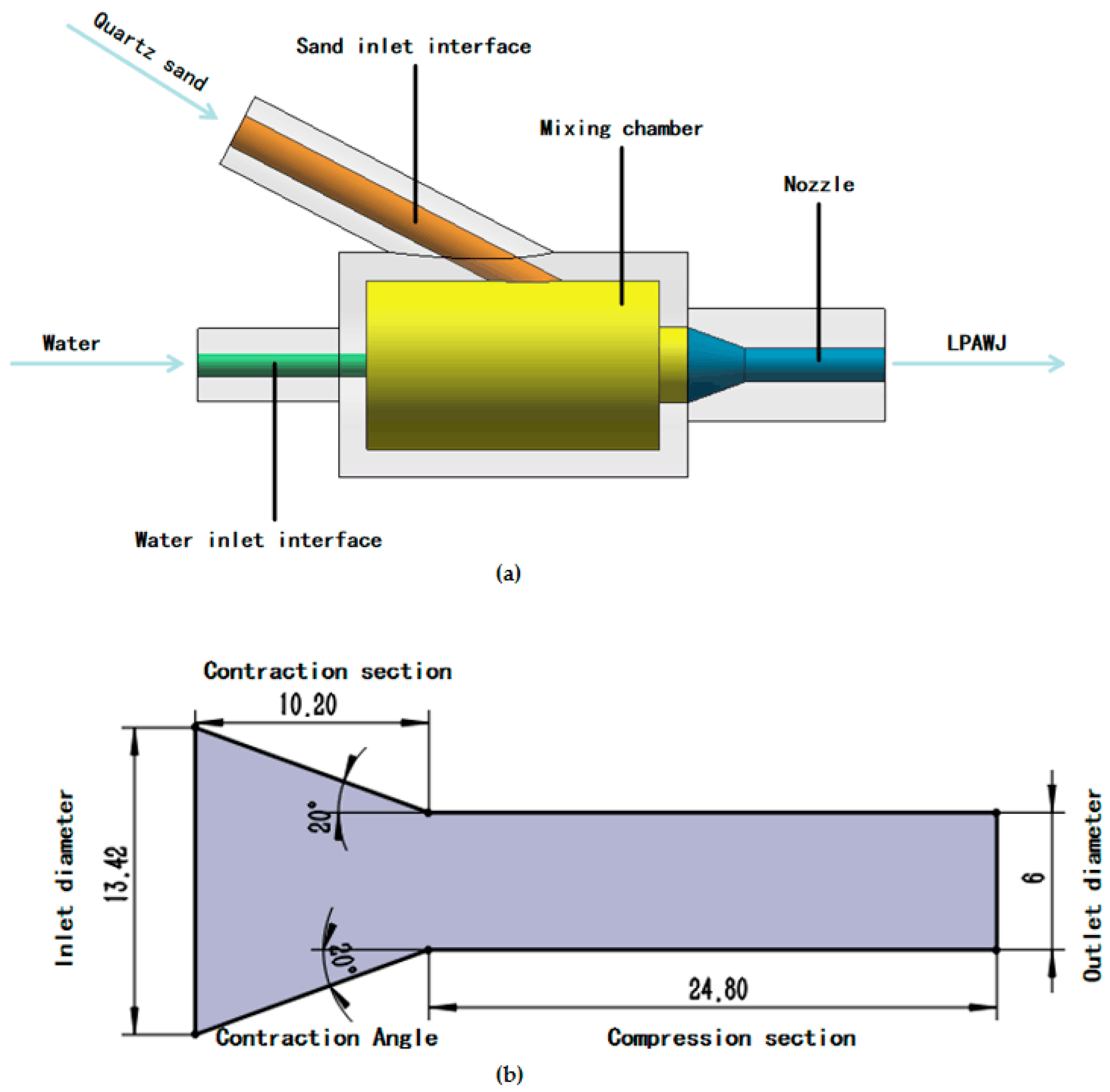
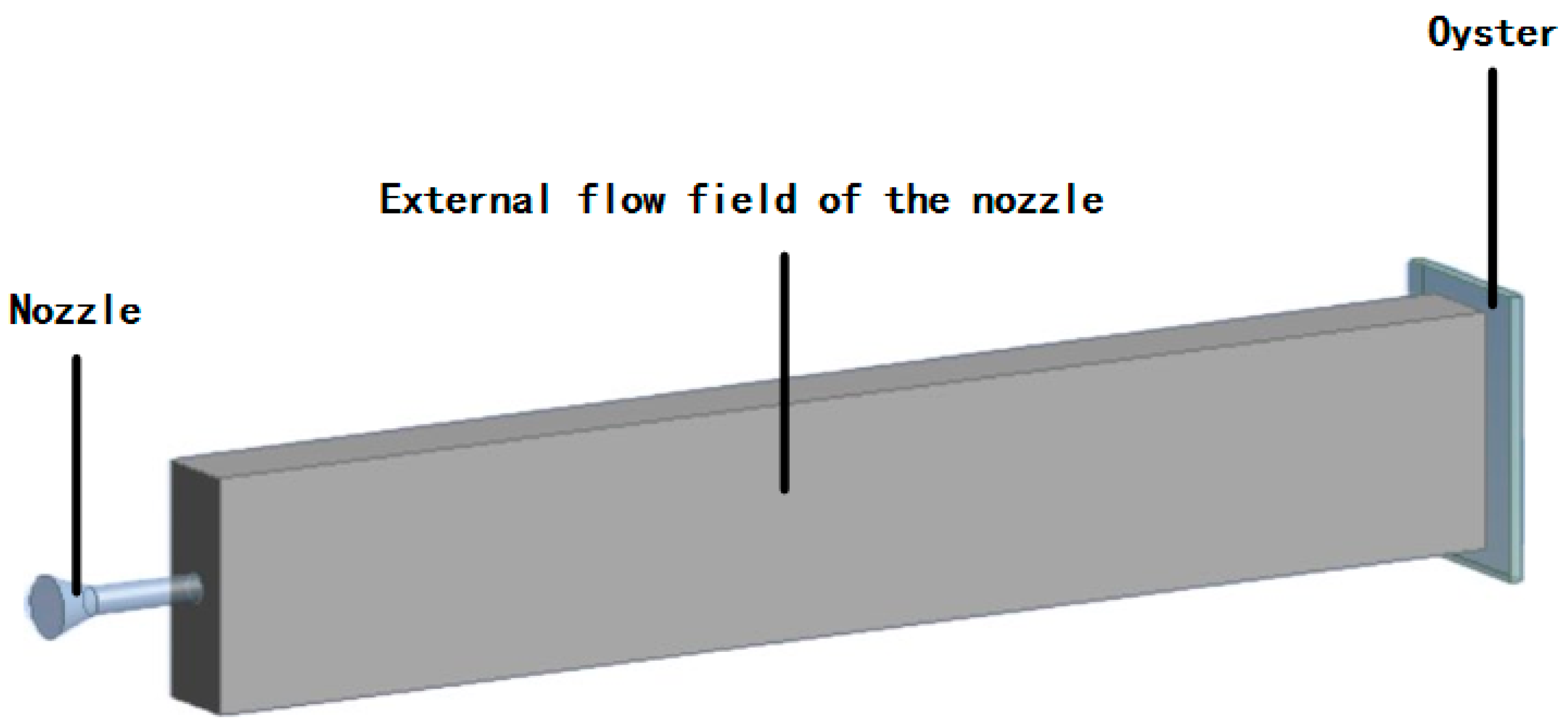
2.1.1. Geometric Model
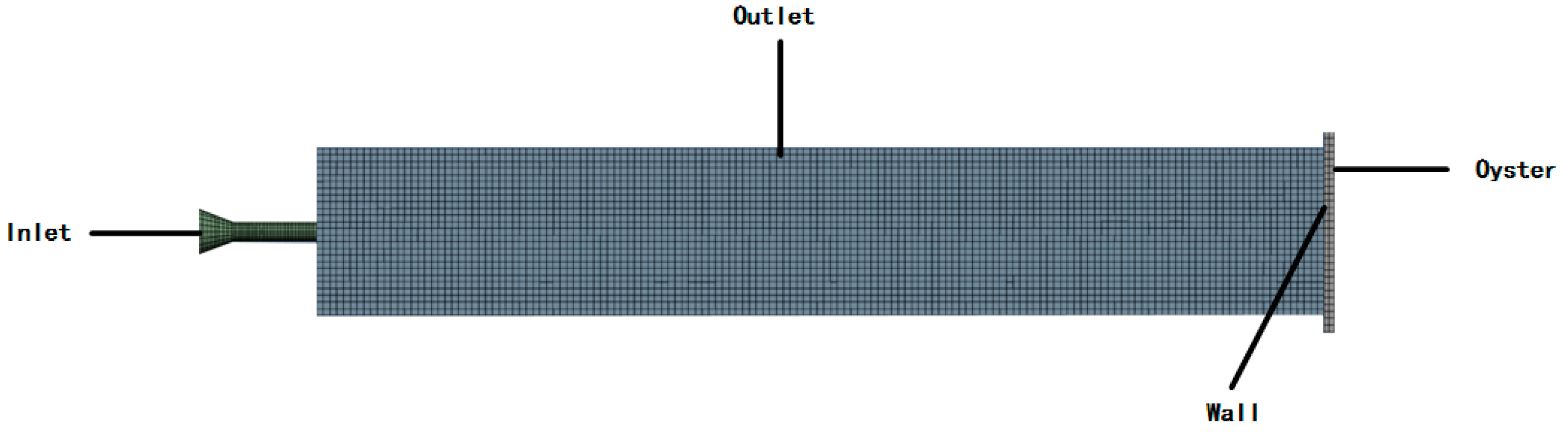
2.1.2. Boundary Conditions and Solution Settings
2.1.3. Mesh Independence Verification
2.2. Multi-Parameter Optimization Design Method
2.2.1. Selection of Optimization Parameters
2.2.2. Selection of Target Response
3. Results and Discussion
3.1. Regression Equation
3.2. Analysis of Variance (ANOVA)
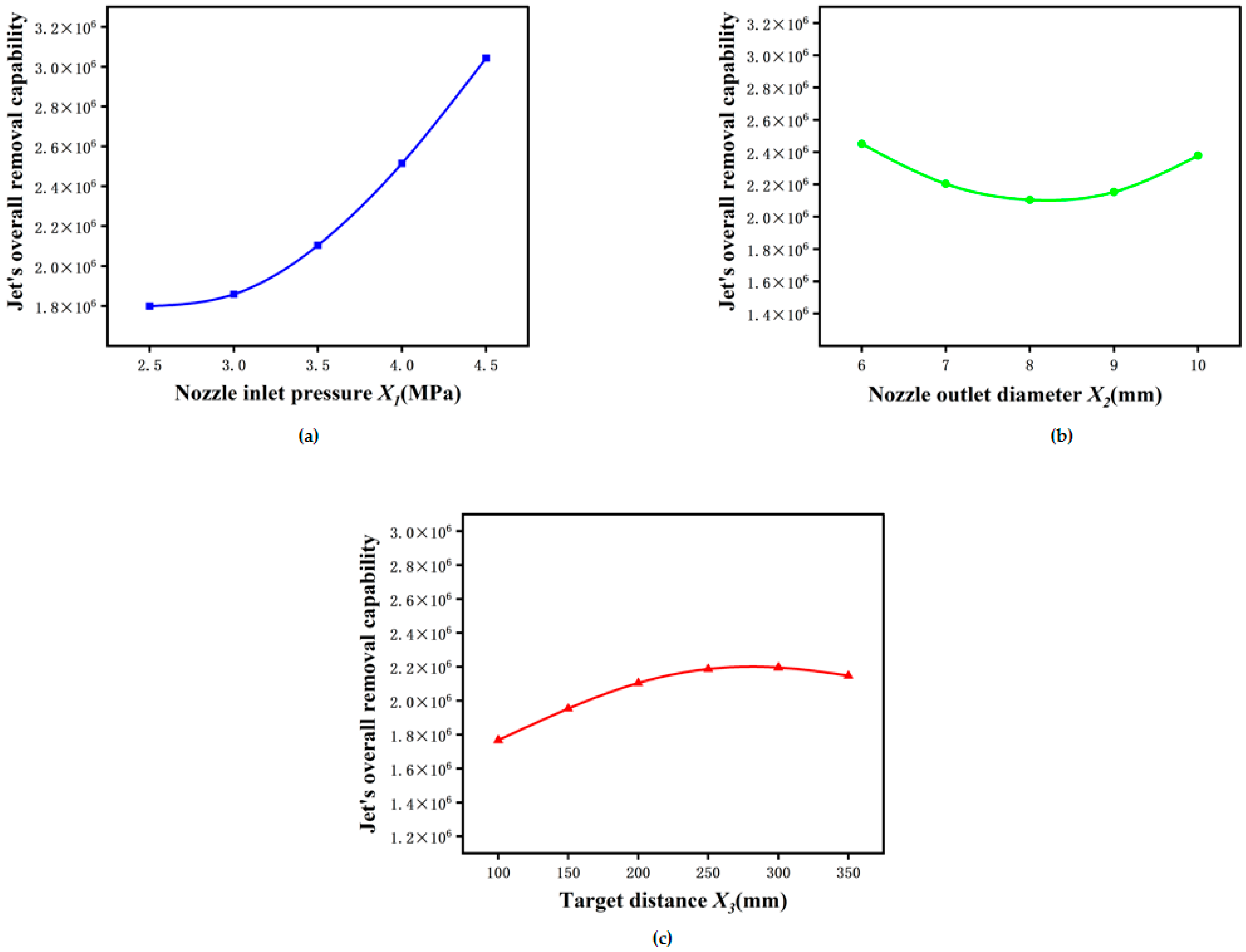
3.3. Single Parameter Analysis
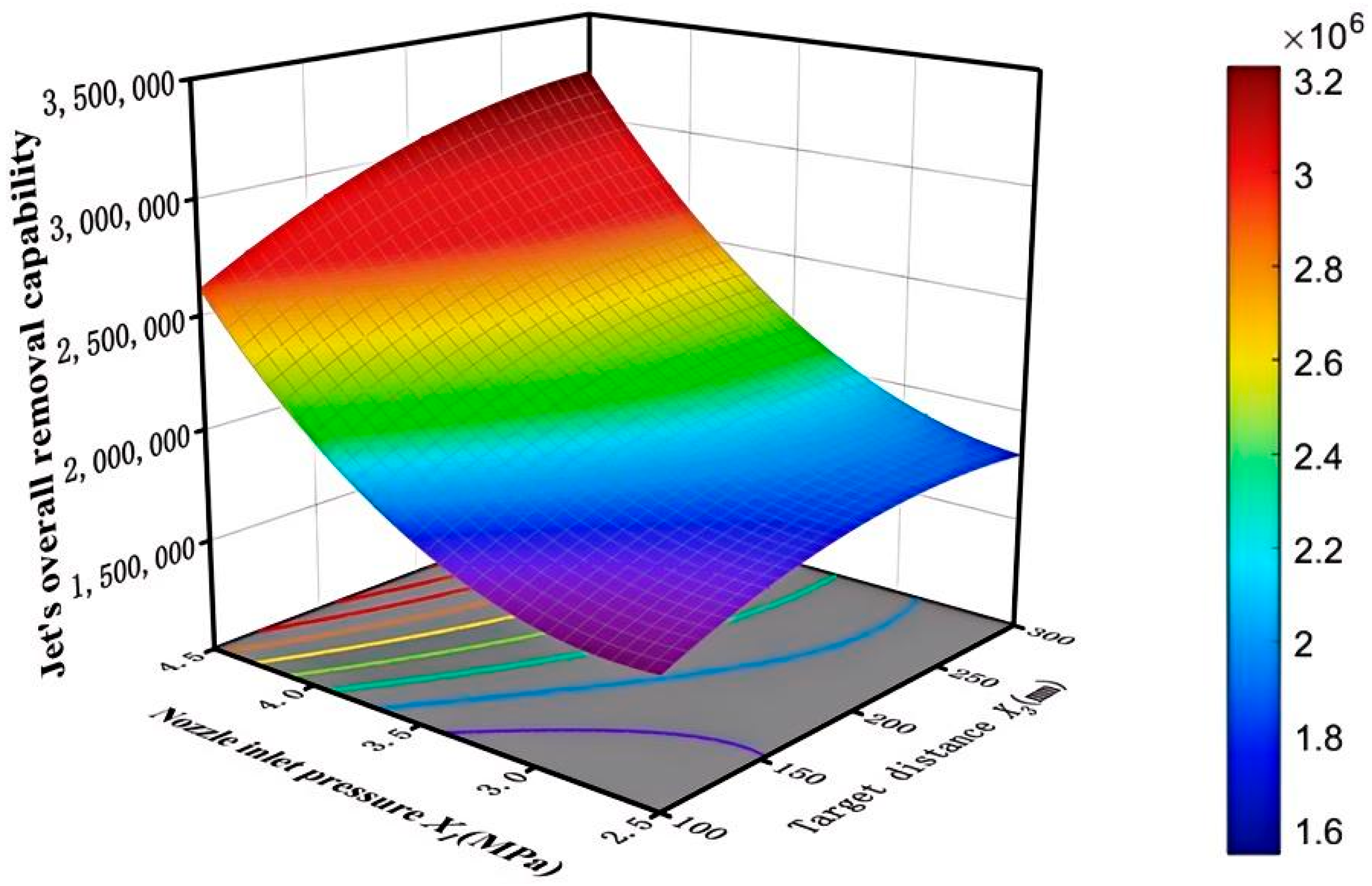
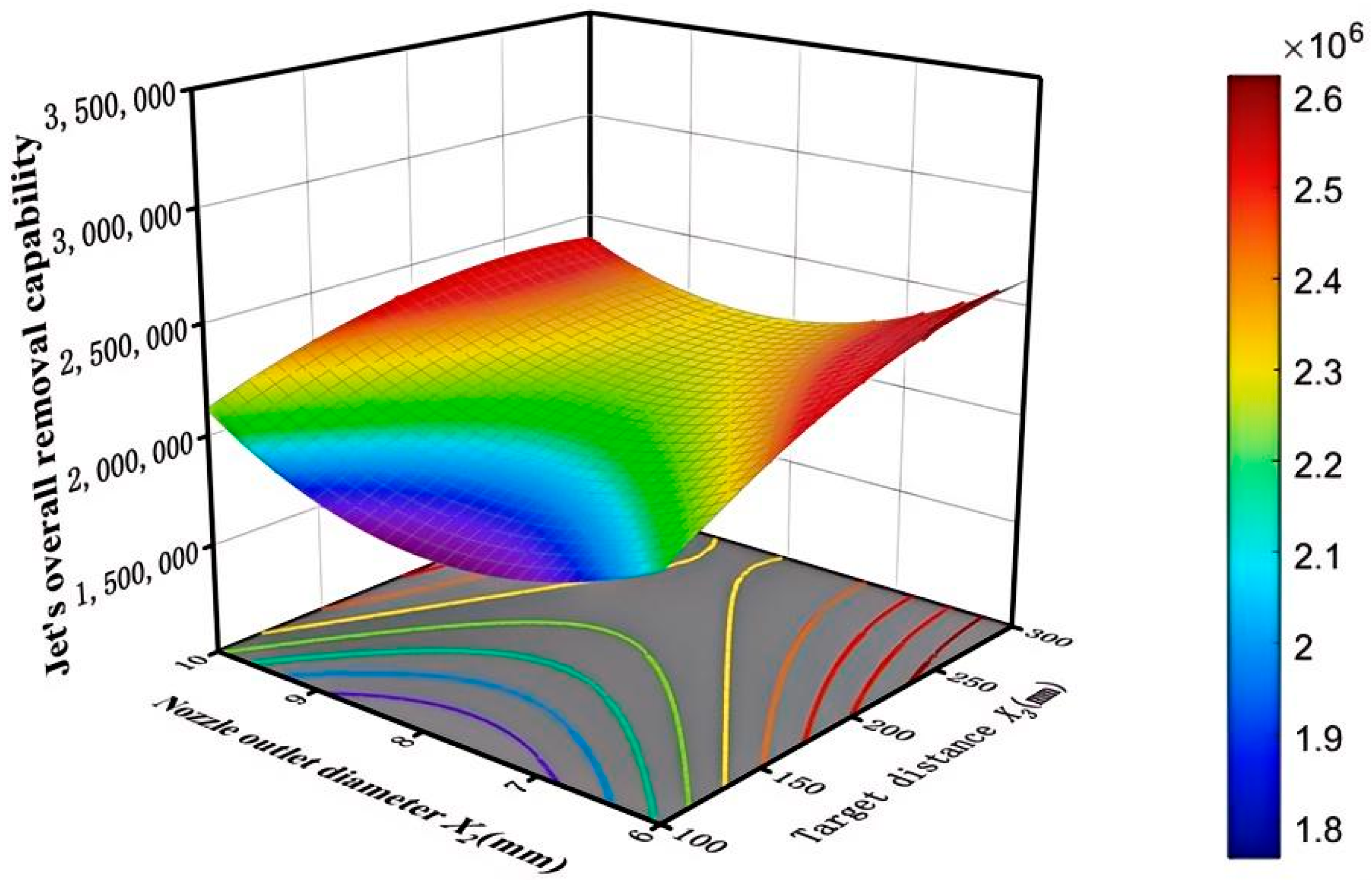
3.4. Two-Parameter Analysis
3.5. Multi-Parameter Optimization Design and Optimization Results
4. Test
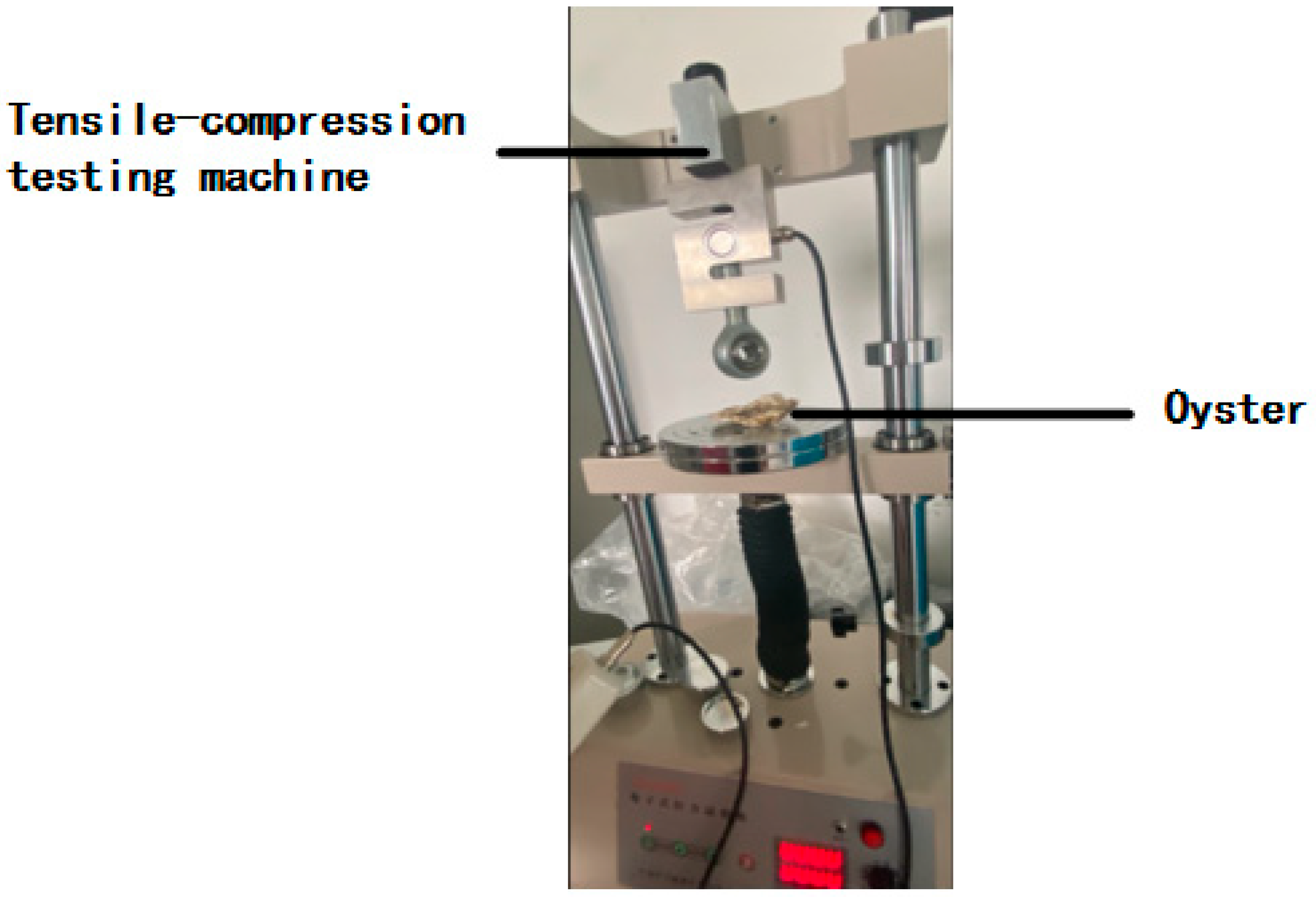
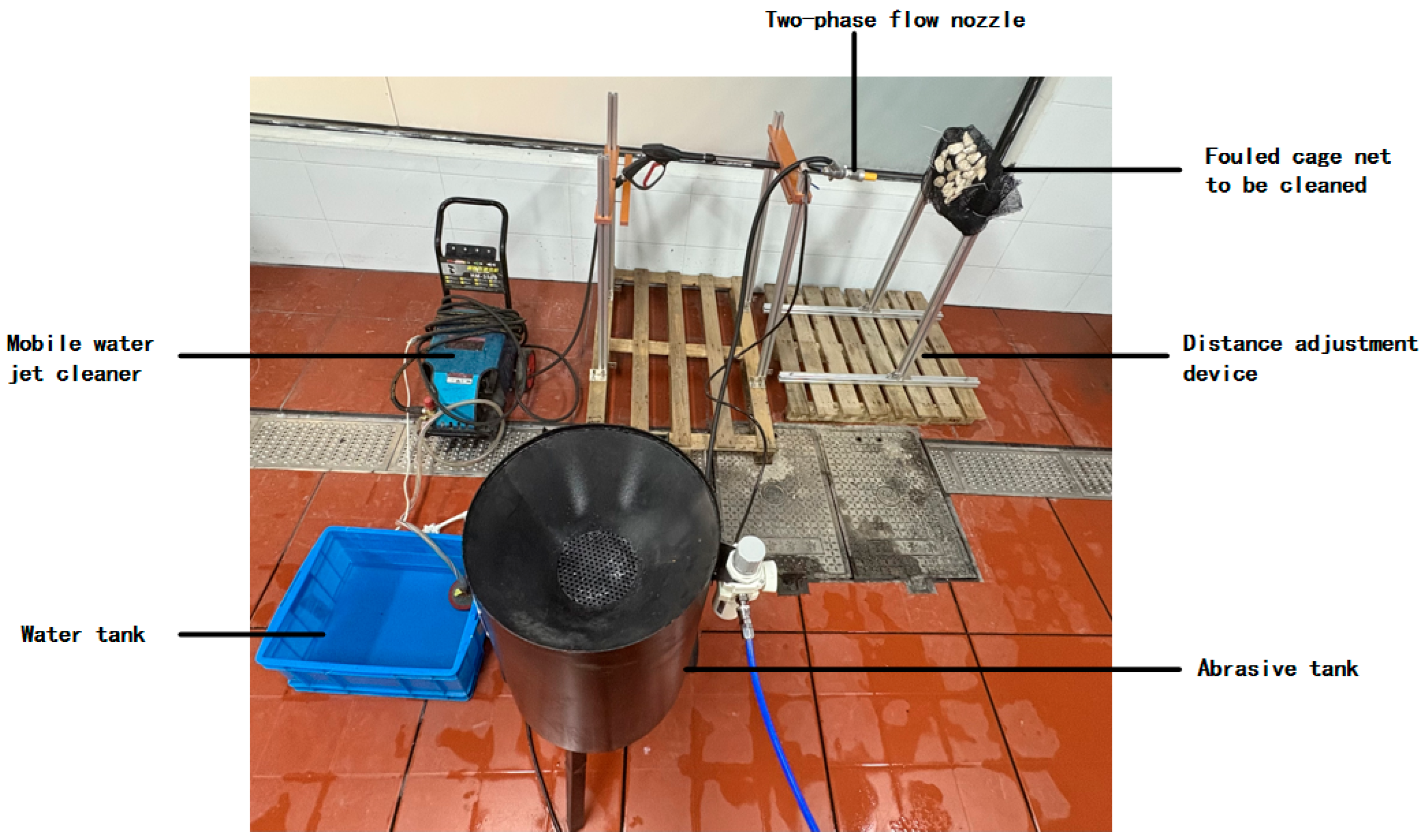
4.1. Test Platform
4.2. Experimental Results and Analysis
5. Conclusions
- (1)
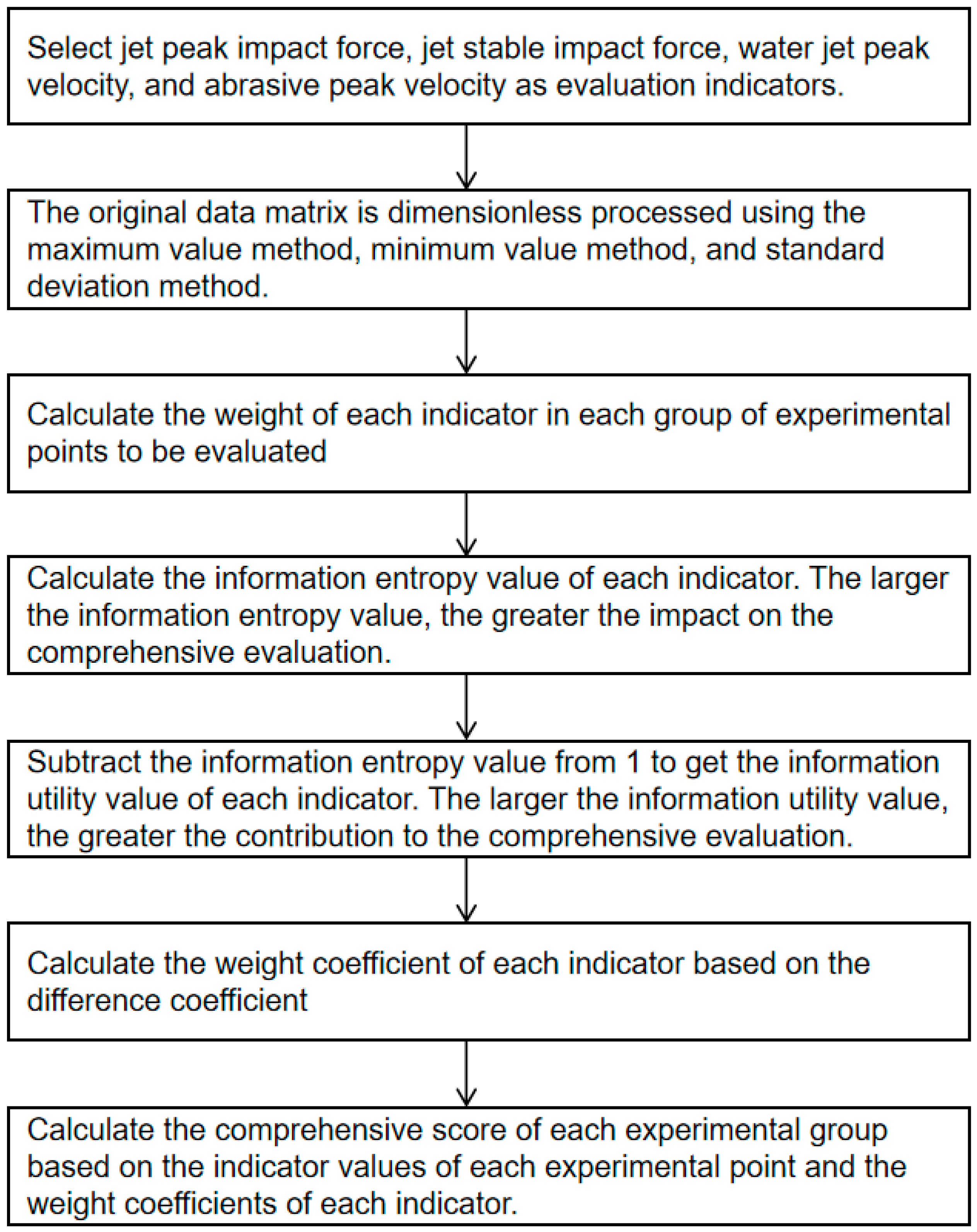
- Evaluation Indicators and Weighting: Four indicators were selected to evaluate the jet’s overall removal capability: peak jet impact force Z1, stable jet impact force Z2, peak abrasive water jet velocity Z3, and peak abrasive particle velocity Z4. Using the entropy method, the weights of these indicators were determined. Results showed that their contributions to removal capability ranked as follows: Z2 > Z1 > Z3 > Z4.
- (2)
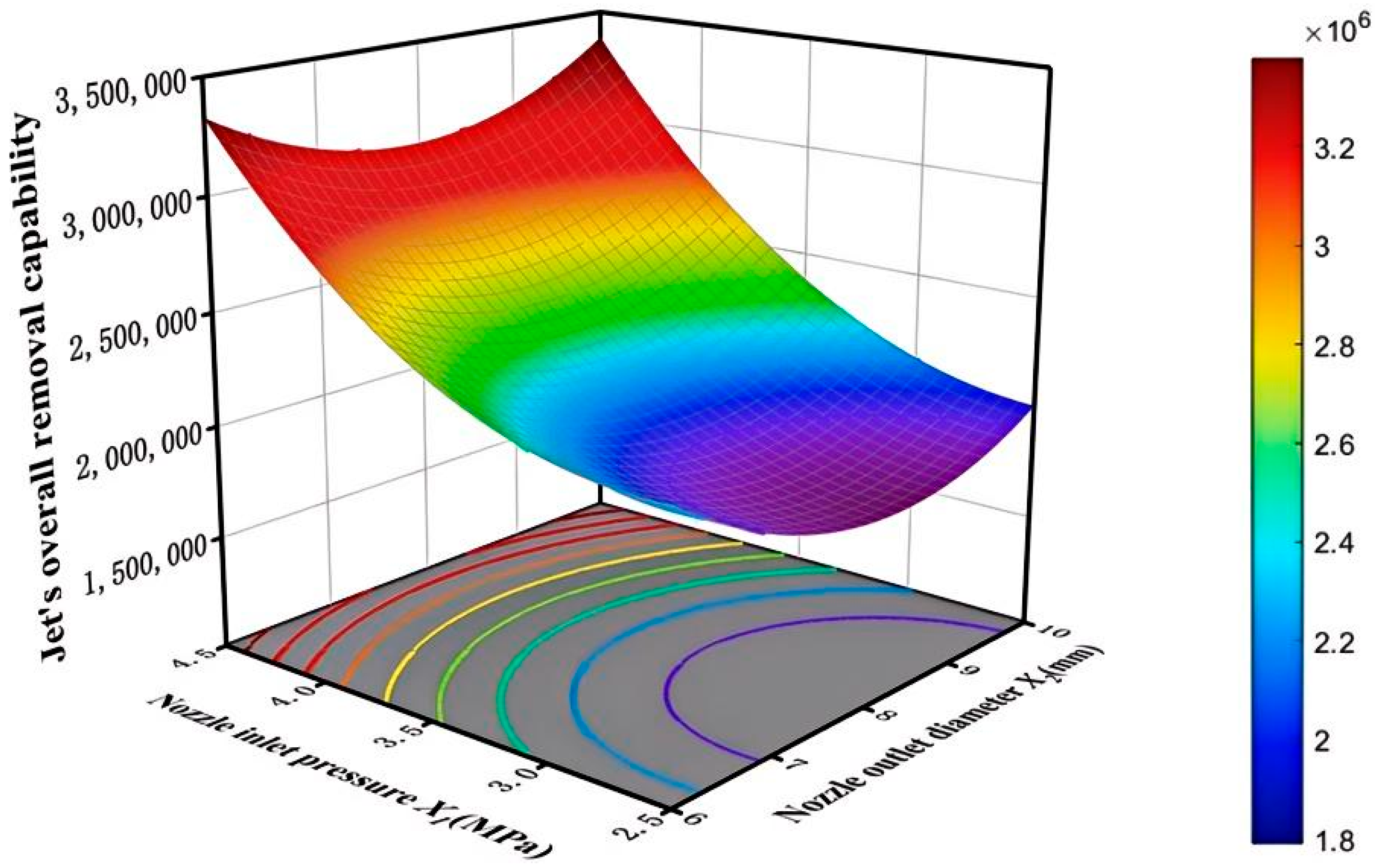
- Significance Analysis: Analysis of variance and parameter analysis revealed that all three optimization parameters significantly influenced the jet’s overall removal capability. The order of influence was: nozzle inlet pressure > target distance > nozzle outlet diameter. Furthermore, significant interaction effects were observed between parameters, particularly between nozzle inlet pressure and target distance, and between nozzle outlet diameter and target distance.
- (3)
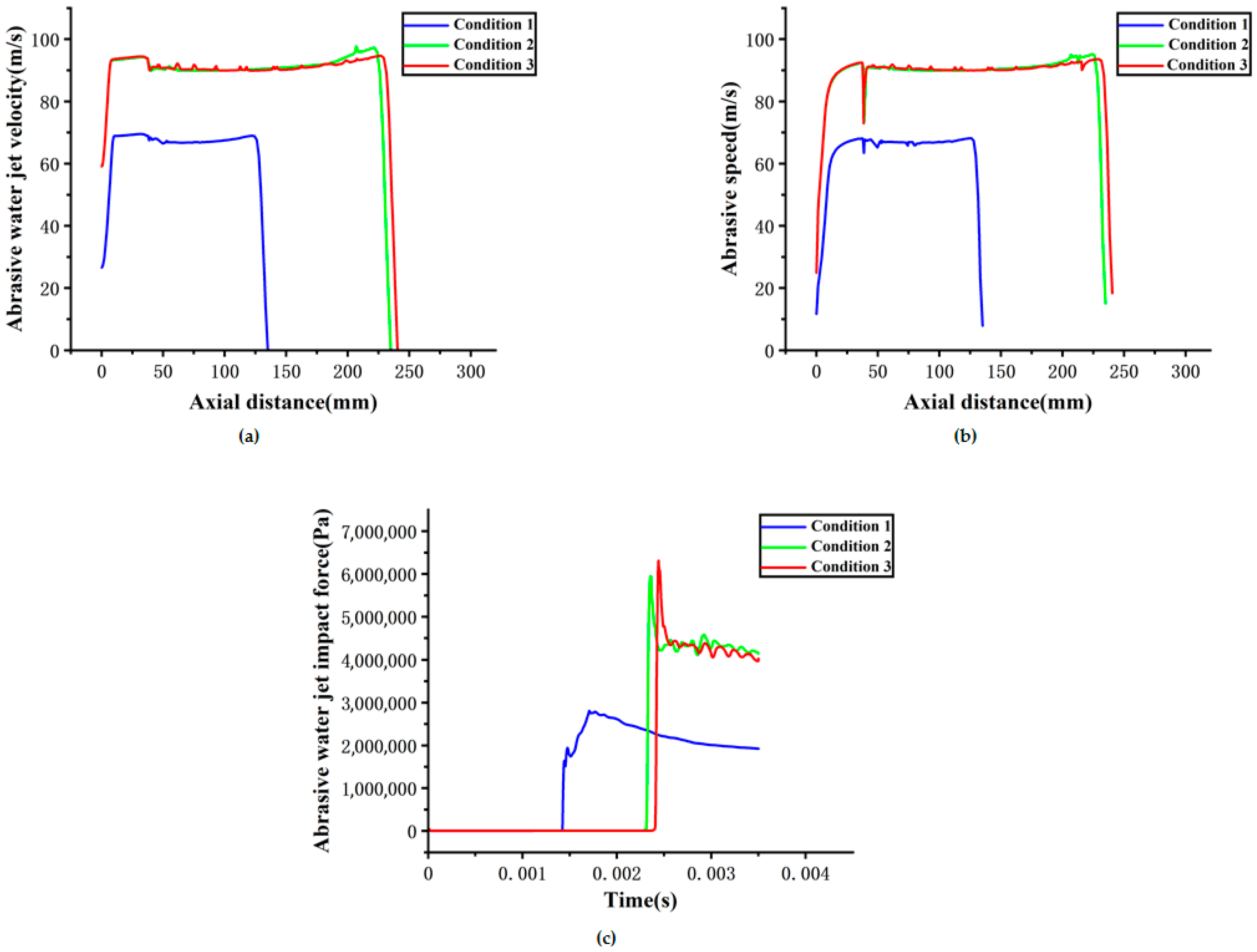
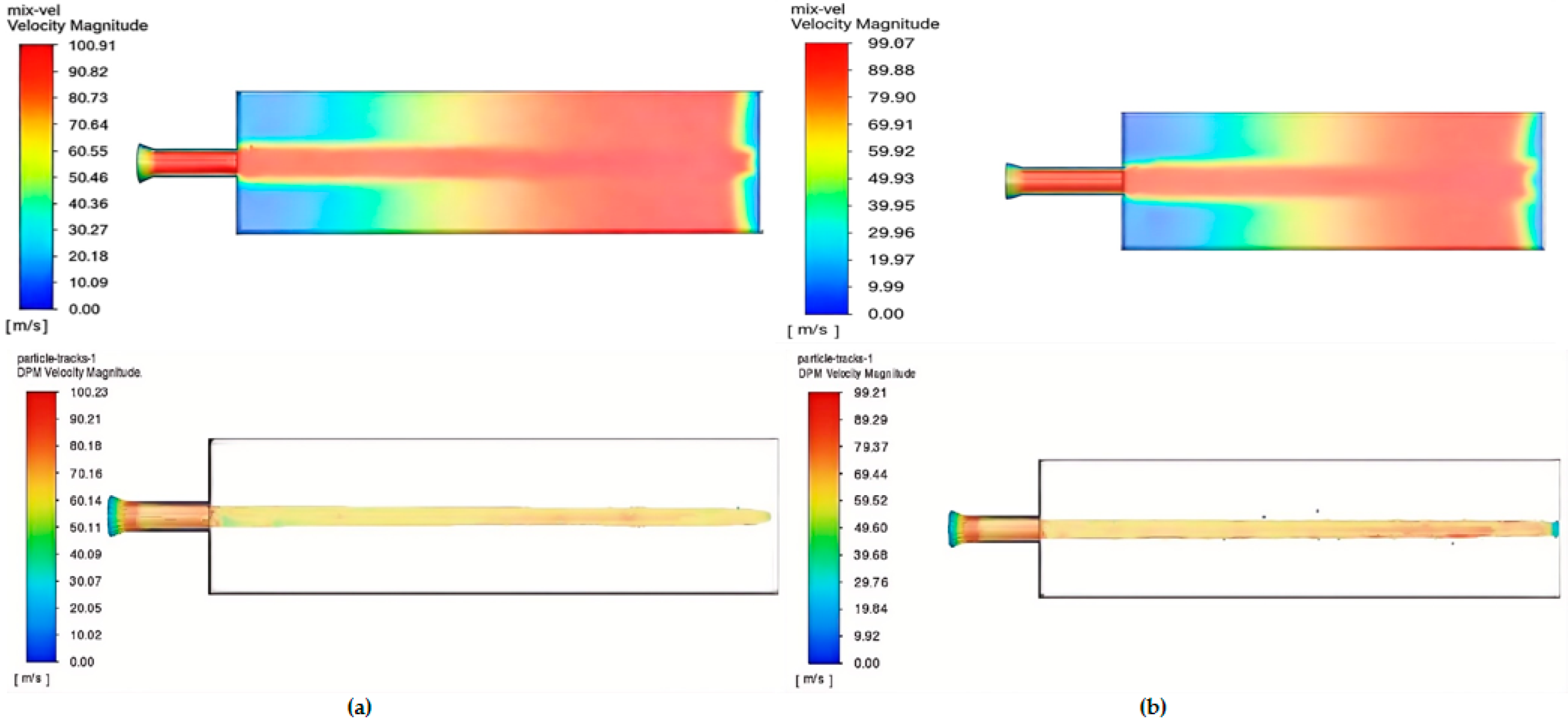
- Optimization Results: Optimization based on the response surface regression model yielded the optimal parameter combination: nozzle inlet pressure X1 = 4.5 MPa, nozzle outlet diameter X2 = 10 mm, and target distance X3 = 205.396 mm. Under this parameter combination, the water jet and abrasive particles can simultaneously act on the oyster surface, increasing the jet’s peak impact force. Consequently, the jet’s overall removal capability obtained under this combination is 101.35% higher than that of Condition 1.
- (4)
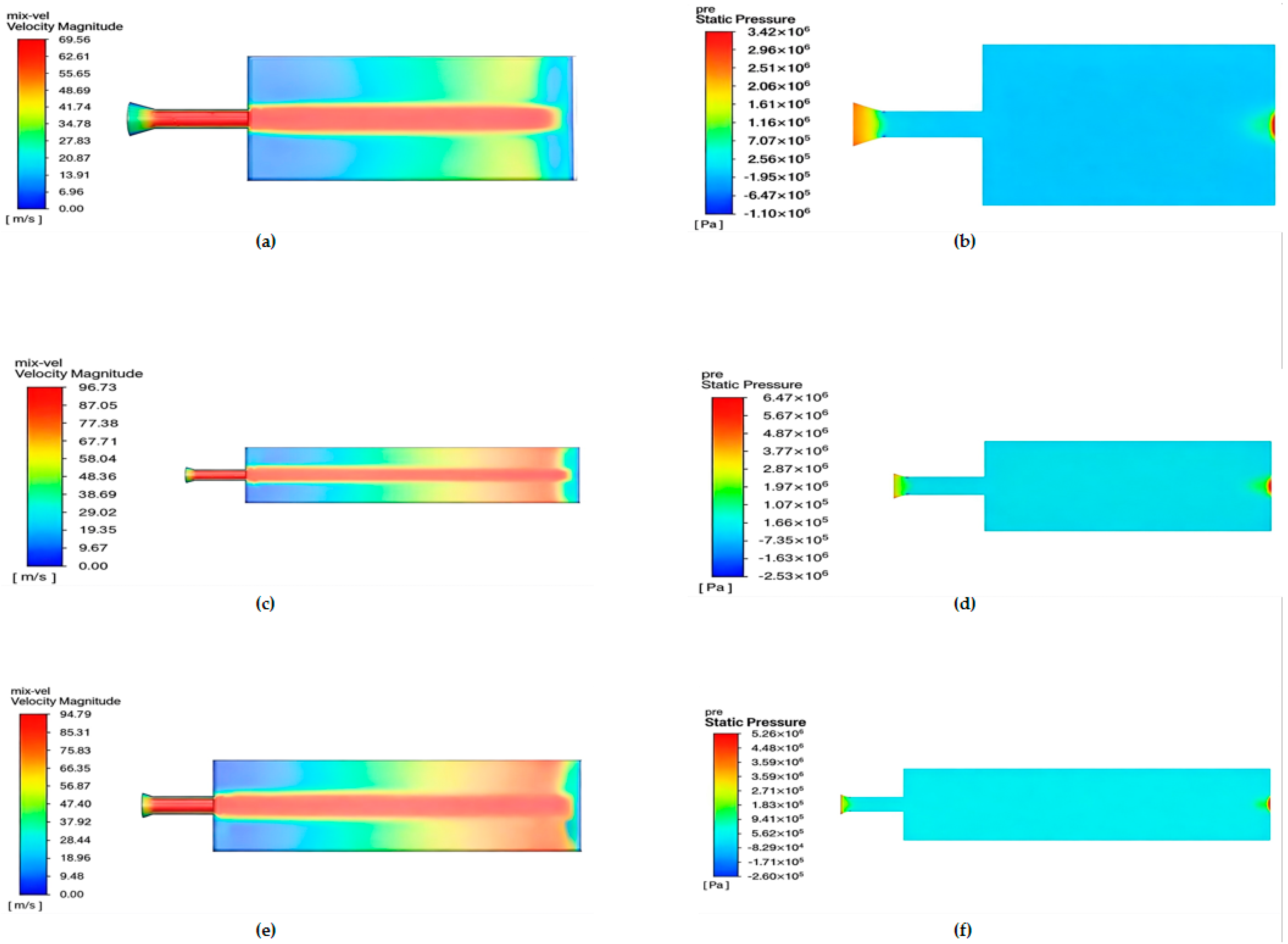
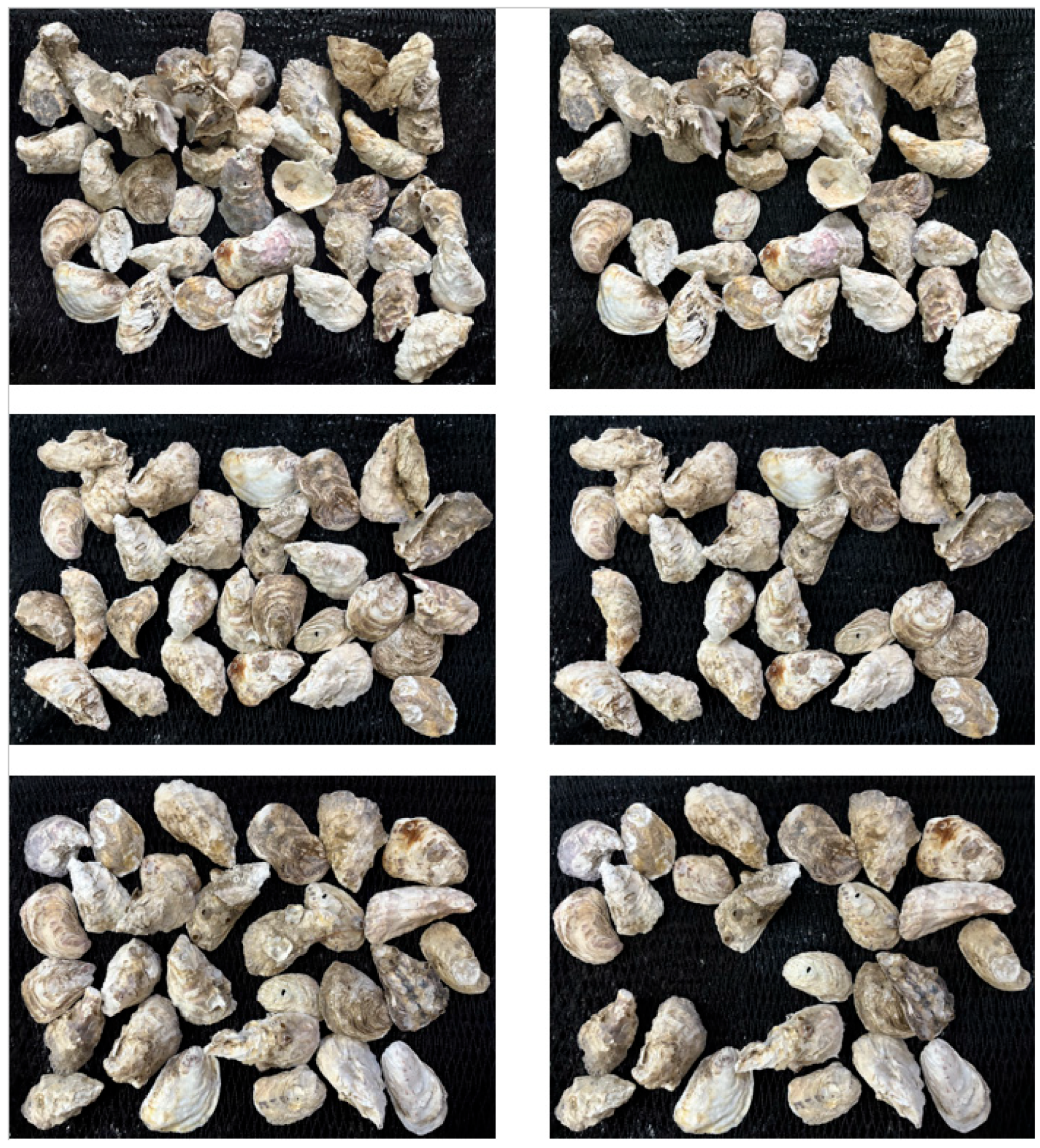
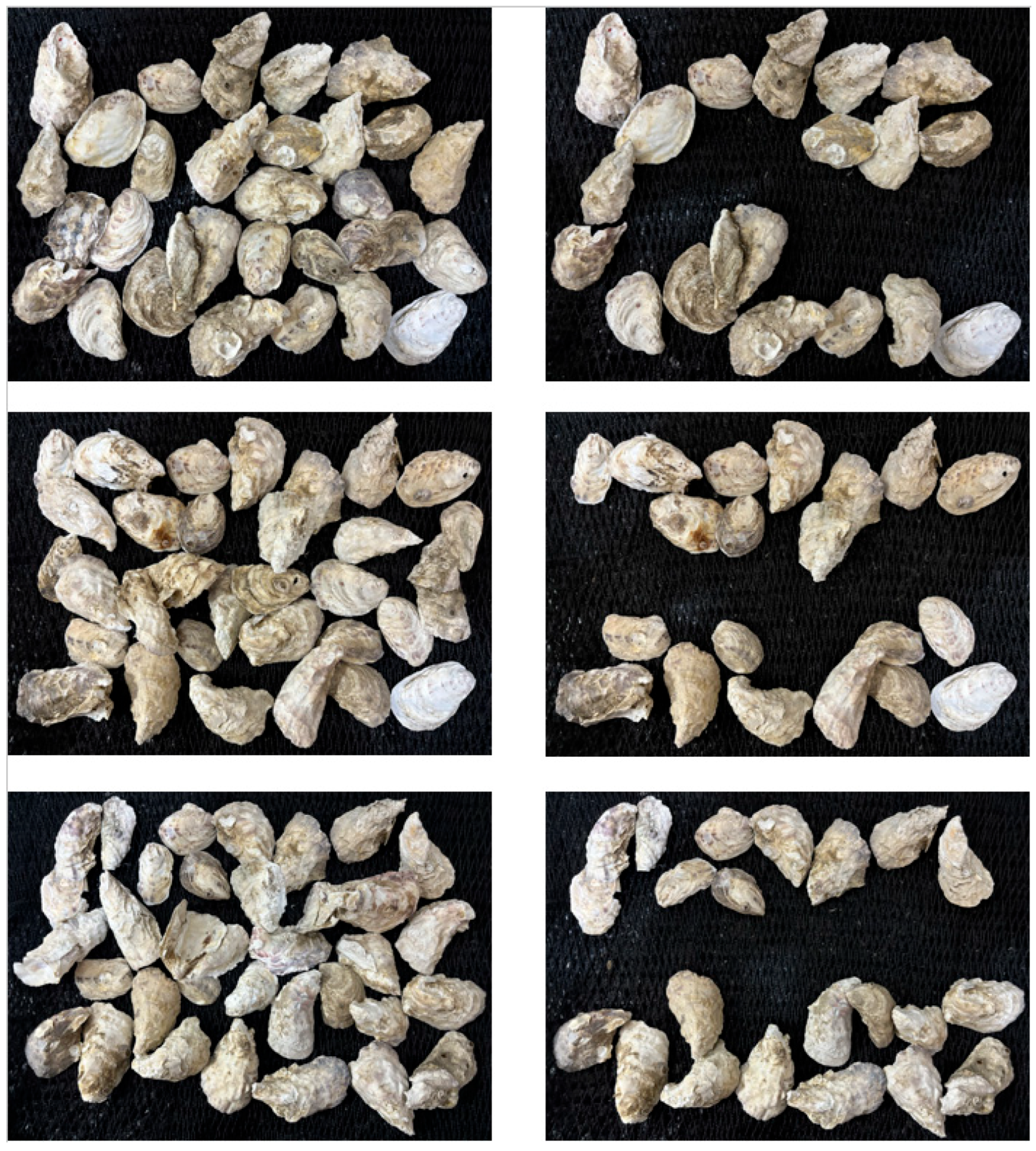
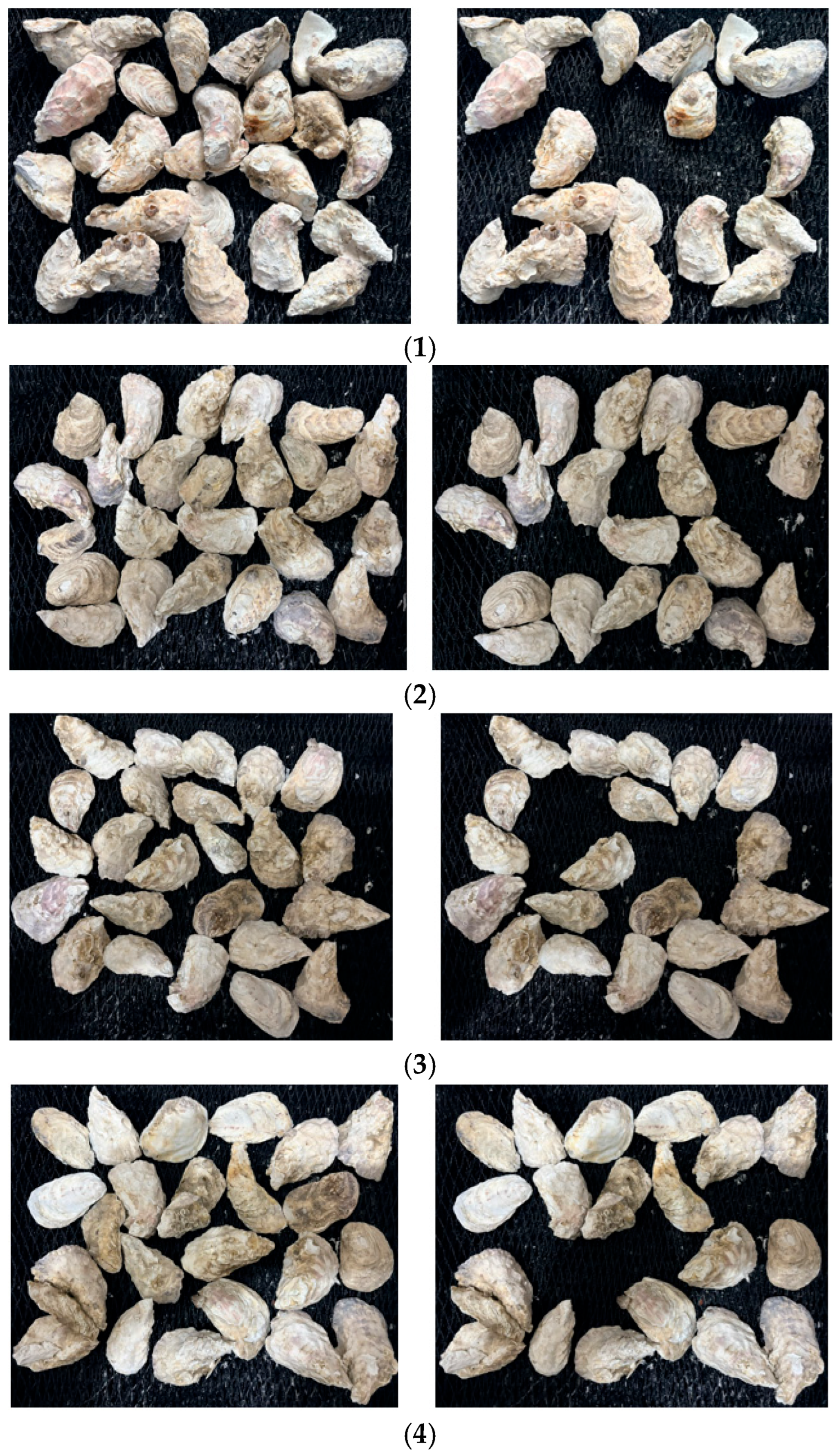
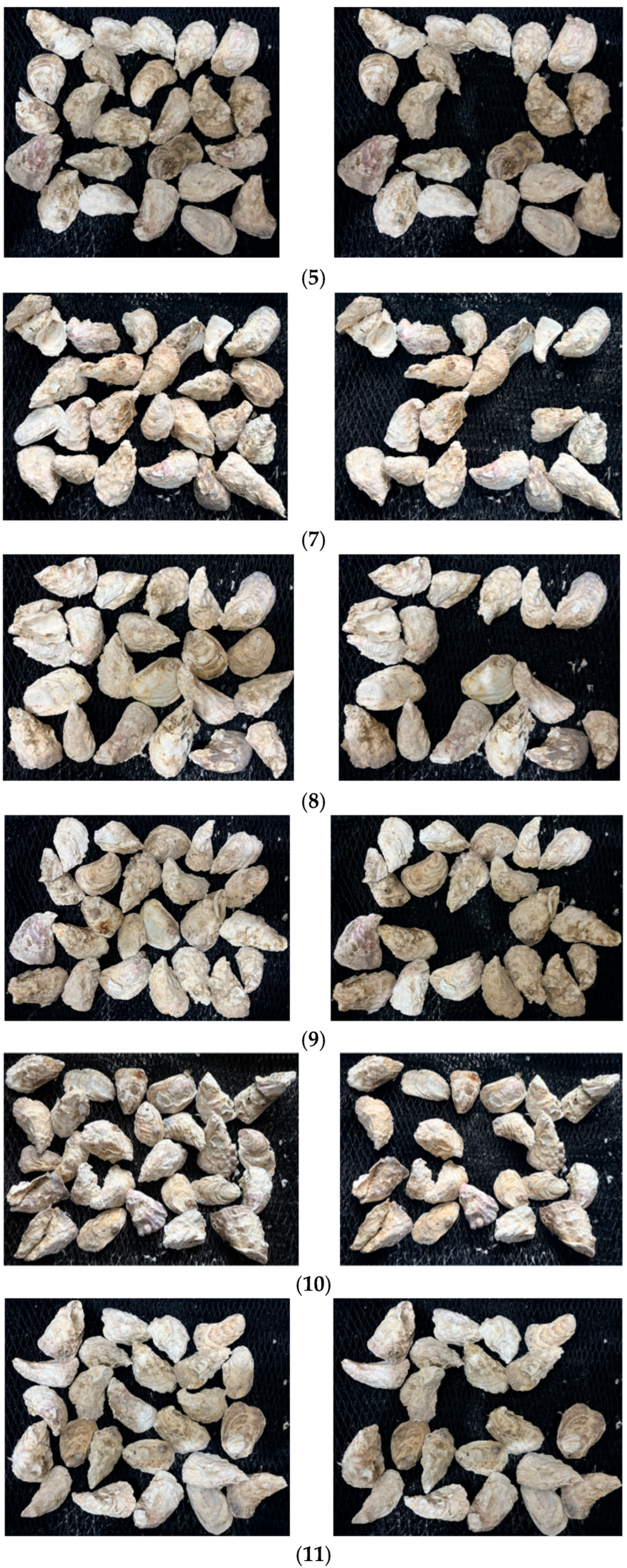
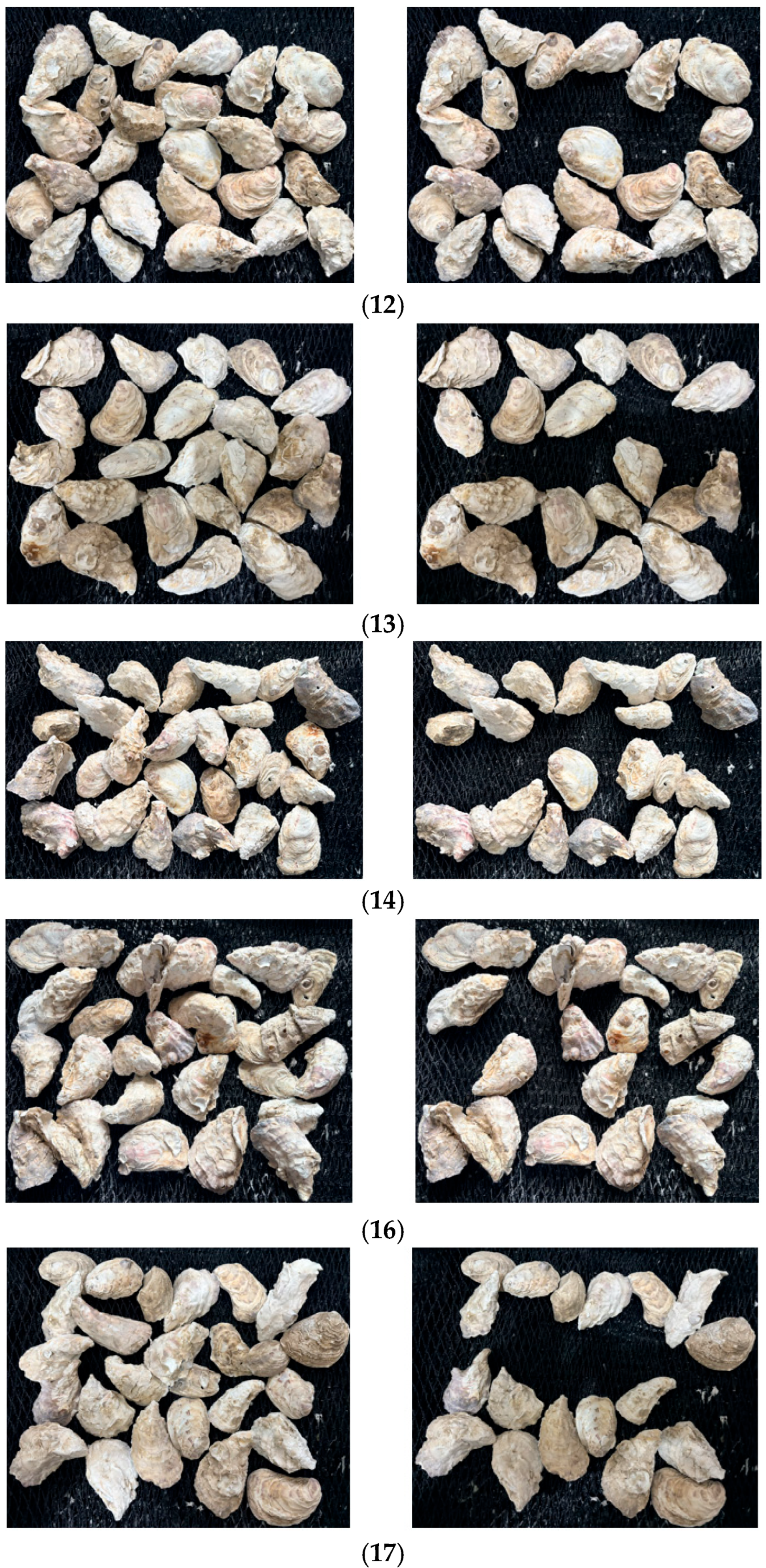
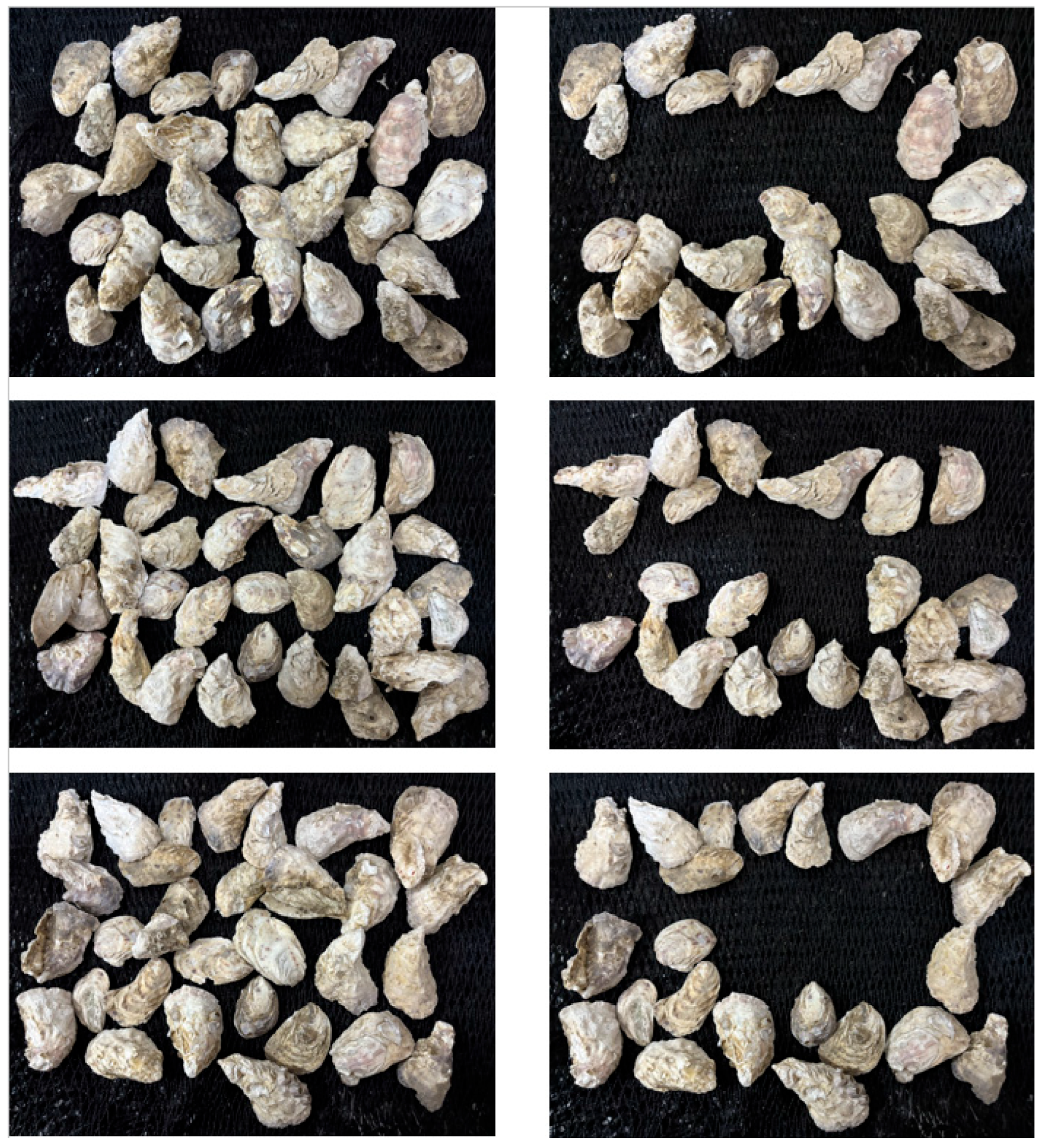
- Experimental Results: Along the cleaning path of the water-jet cleaning system, under condition 1, the abrasive jet could only remove small-sized oysters or those with highly curved shell surfaces. Under condition 2, the adhesion of oysters on the net was noticeably reduced after cleaning, and the abrasive jet was able to detach some larger oysters. Under Condition 3, almost no oysters remain attached to the netting after cleaning, and the average oyster removal rate is 100.55% higher than that of Condition 1.
- (5)
- Application Scenarios: The results demonstrated that the optimized parameter combination significantly enhances the jet’s comprehensive removal capability, and the validated response surface model can serve as a predictive tool for estimating the cleaning performance under different operating conditions. These findings provide a theoretical basis and technical reference for the design and optimization of automated net-cleaning systems or net-cleaning robots equipped with low-pressure abrasive jets. By integrating the proposed model and operating parameters, future robotic systems can predict and adaptively adjust jet conditions according to fouling characteristics, thereby improving the efficiency, economy, and sustainability of marine aquaculture maintenance operations.
- (6)
- Study’s Limitations and Potential Directions: Although this study offers valuable insights, certain limitations remain. The parametric model considers only three factors—nozzle inlet pressure, standoff distance, and abrasive mass flow rate—while practical net cage cleaning may also be affected by nozzle geometry, abrasive particle characteristics, jet incidence angle, and surface conditions, which were not included in the present analysis. In addition, the jet’s overall removal capability is evaluated using four indicators (peak jet impact force, stable jet impact force, peak abrasive water jet velocity, and peak abrasive particle velocity). These metrics capture the primary detachment mechanisms but may not fully reflect the complex adhesion behavior and heterogeneous fouling structures encountered in real applications. Incorporating additional hydrodynamic and particle–surface interaction parameters could further improve model completeness.
Author Contributions
Funding
Institutional Review Board Statement
Informed Consent Statement
Data Availability Statement
Conflicts of Interest
Appendix A
- (1)
- Fluid Flow Equation
- (2)
- Particle Trajectory Calculation Equation
Appendix B

| Run | X1 (MPa) | X2 (mm) | X3 (mm) | D+ | D− | C | Ranking Results |
|---|---|---|---|---|---|---|---|
| 1 | 3.5 | 8 | 200 | 0.361 | 0.159 | 0.306 | 8 |
| 2 | 3.5 | 8 | 200 | 0.373 | 0.152 | 0.290 | 12 |
| 3 | 2.5 | 8 | 300 | 0.441 | 0.102 | 0.156 | 16 |
| 4 | 3.5 | 10 | 100 | 0.370 | 0.150 | 0.289 | 13 |
| 5 | 4.5 | 6 | 200 | 0.257 | 0.282 | 0.524 | 5 |
| 6 | 4.5 | 10 | 200 | 0.081 | 0.477 | 0.855 | 1 |
| 7 | 3.5 | 6 | 300 | 0.238 | 0.342 | 0.590 | 3 |
| 8 | 3.5 | 8 | 200 | 0.372 | 0.153 | 0.292 | 11 |
| 9 | 3.5 | 8 | 200 | 0.372 | 0.153 | 0.292 | 10 |
| 10 | 4.5 | 8 | 100 | 0.214 | 0.303 | 0.586 | 4 |
| 11 | 3.5 | 6 | 100 | 0.433 | 0.110 | 0.188 | 15 |
| 12 | 2.5 | 10 | 200 | 0.435 | 0.081 | 0.203 | 14 |
| 13 | 3.5 | 8 | 200 | 0.372 | 0.153 | 0.292 | 9 |
| 14 | 3.5 | 10 | 300 | 0.265 | 0.250 | 0.486 | 6 |
| 15 | 2.5 | 8 | 100 | 0.509 | 0.009 | 0.017 | 17 |
| 16 | 2.5 | 6 | 200 | 0.336 | 0.199 | 0.372 | 7 |
| 17 | 4.5 | 8 | 300 | 0.079 | 0.460 | 0.853 | 2 |
| Run | X1 (MPa) | X2 (mm) | X3 (mm) | Y | Ranking Results |
|---|---|---|---|---|---|
| 1 | 3.5 | 8 | 200 | 2,131,847 | 8 |
| 2 | 3.5 | 8 | 200 | 2,092,102 | 12 |
| 3 | 2.5 | 8 | 300 | 1,772,445 | 16 |
| 4 | 3.5 | 10 | 100 | 2,071,570 | 13 |
| 5 | 4.5 | 6 | 200 | 2,622,321 | 5 |
| 6 | 4.5 | 10 | 200 | 3,399,931 | 1 |
| 7 | 3.5 | 6 | 300 | 2,671,069 | 3 |
| 8 | 3.5 | 8 | 200 | 2,098,607 | 11 |
| 9 | 3.5 | 8 | 200 | 2,098,607 | 10 |
| 10 | 4.5 | 8 | 100 | 2,642,102 | 4 |
| 11 | 3.5 | 6 | 100 | 1,921,461 | 15 |
| 12 | 2.5 | 10 | 200 | 1,926,242 | 14 |
| 13 | 3.5 | 8 | 200 | 2,098,607 | 9 |
| 14 | 3.5 | 10 | 300 | 2,502,358 | 6 |
| 15 | 2.5 | 8 | 100 | 1,688,578 | 17 |
| 16 | 2.5 | 6 | 200 | 2,184,601 | 7 |
| 17 | 4.5 | 8 | 300 | 3,090,652 | 2 |
Appendix C
Appendix D
| Run | X1 (MPa) | X2 (mm) | X3 (mm) | Y | Average Oyster Removal Rate (%) |
|---|---|---|---|---|---|
| 1 | 3.5 | 8 | 200 | 2,131,847 | 20.05 |
| 2 | 3.5 | 8 | 200 | 2,092,102 | 19.80 |
| 3 | 2.5 | 8 | 300 | 1,772,445 | 17.73 |
| 4 | 3.5 | 10 | 100 | 2,071,570 | 19.46 |
| 5 | 4.5 | 6 | 200 | 2,622,321 | 24.04 |
| 7 | 3.5 | 6 | 300 | 2,671,069 | 25.02 |
| 8 | 3.5 | 8 | 200 | 2,098,607 | 19.76 |
| 9 | 3.5 | 8 | 200 | 2,098,607 | 19.54 |
| 10 | 4.5 | 8 | 100 | 2,642,102 | 24.80 |
| 11 | 3.5 | 6 | 100 | 1,921,461 | 18.85 |
| 12 | 2.5 | 10 | 200 | 1,926,242 | 18.71 |
| 13 | 3.5 | 8 | 200 | 2,098,607 | 20.69 |
| 14 | 3.5 | 10 | 300 | 2,502,358 | 23.29 |
| 16 | 2.5 | 6 | 200 | 2,184,601 | 20.24 |
| 17 | 4.5 | 8 | 300 | 3,090,652 | 29.39 |


References
- Huang, X.; Pang, G.; Yuan, T.; Hu, Y.; Wang, S.; Guo, G.; Tao, Q. Review of Engineering and Equipment Technologies for Deep-Sea Cage Aquaculture in China. Prog. Fish. Sci. 2022, 43, 121–131. [Google Scholar]
- Song, X.; Sun, Y.; He, J.; Chu, Y.; Sun, Z. Research progress of deep-water cage cleaning technology and devices. Fish. Mod. 2021, 48, 1–9. [Google Scholar]
- Frazer, L.N. Sea-cage aquaculture, sea lice, and declines of wild fish. Conserv. Biol. 2009, 23, 599–607. [Google Scholar] [CrossRef]
- Zhang, X.; Guo, G.; Tao, Q.; Huang, X.; Hu, Y. Design of high-pressure water-jet manifold underwater net-washing machine. South China Fish. Sci. 2010, 6, 46–51. [Google Scholar]
- Zhuang, J.; Pang, H.; Liu, Z.; Zhang, D.; Jiang, J. Design of a New Deep-sea Net Cage Cleaning Robot. Machinery 2018, 45, 72–75. [Google Scholar]
- Song, Y.; Zheng, X. Design and study of the clean equipments of deep-sea net cage. Mech. Res. Appl. 2012, 25, 41–43+46. [Google Scholar]
- Li, J.; Kuru, E.; Li, W.; Guo, C.; Li, G.; Huang, Z. The flow field characteristics and rock breaking ability of cone-straight abrasive jet, rotary abrasive jet, and straight-rotating mixed abrasive jet. Pet. Sci. 2025, 22, 2457–2464. [Google Scholar] [CrossRef]
- Xiong, S.; Jia, X.; Wu, S.; Li, F.; Ma, M.; Wang, X. Parameter Optimization and Effect Analysis of Low-Pressure Abrasive Water Jet (LPAWJ) for Paint Removal of Remanufacturing Cleaning. Sustainability 2021, 13, 2900. [Google Scholar] [CrossRef]
- Qiu, Y.; Lan, X.; Liu, J.; Wang, G.; Huang, Z. Optimization design of nozzle parameters under the condition of submerged water jet breaking soil based on response surface method. Appl. Ocean. Res. 2025, 154, 104369. [Google Scholar] [CrossRef]
- Qiu, X.; Wang, M.; Chen, B.; Ai, Y. A Study on the Optimization of Water Jet Decontamination Performance Parameters Based on the Response Surface Method. Appl. Sci. 2024, 14, 7409. [Google Scholar] [CrossRef]
- Wang, P.; Wu, G.; Tian, C.; Liu, R.; Gao, R. Structural parameters optimization of internal mixing air atomizing nozzle based on orthogonal experiment. Coal Sci. Technol. 2023, 51, 129–139. [Google Scholar]
- Sun, P.; Zhou, Z.; Chen, Y.; Jiang, Z.; Luo, G.; Wang, B. Parametric Study on Self-excited Vibration Cavitation Jet Nozzles based on the CFD Method. Fluid Mach. 2019, 47, 1–7+19. [Google Scholar]
- Liu, Y.; Chen, X.; Zhang, J.; Feng, L.; Liu, H.; Hao, C. Structural optimization design of ice abrasive water jet nozzle based on multi-objective algorithm. Flow Meas. Instrum. 2024, 97, 102586. [Google Scholar] [CrossRef]
- Wang, B.; Chen, Q.; Yun, M.; Huang, J.; Sun, J. Development of a comprehensive pollution evaluation system based on entropy weight-fuzzy evaluation model for urban rivers: A case study in North China. J. Water Process Eng. 2024, 67, 106192. [Google Scholar] [CrossRef]
- Hu, K.; Ai, Z.; Yu, J. Study for Cylindrical Nozzle Structure Optimization Based on Response Surface Method. Mach. Tool Hydraul. 2014, 42, 27–30. [Google Scholar]
- Lin, X.; Liu, H.; Wang, G.; Jian, K.E.; Yu, L. Study of Low-pressure Jet Characteristic of Fan Nozzle. Mach. Tool Hydraul. 2015, 43, 164–167. [Google Scholar]
- Lai, Y.; Zhao, X.; Lai, W.; Lu, X. Experimental Study on the Jet Characteristic of Non-circle Jet Nozzle. Light Ind. Mach. 2005, 4, 23–25. [Google Scholar]
- Zhong, L.; Deng, J.; Zuo, J.; Huang, C.; Chen, B.; Lei, L.; Lei, Z.; Lei, J.; Zhao, M.; Hua, Y. Simulation analysis and evaluation of decontamination effect of different abrasive jet process parameters on radioactively contaminated metal. Nucl. Eng. Technol. 2023, 55, 3940–3955. [Google Scholar] [CrossRef]
- Cai, C.; Huang, Z.; Li, G.; Gao, F. Particle velocity distributions of abrasive liquid nitrogen jet and parametric sensitivity analysis. J. Nat. Gas Sci. Eng. 2015, 27, 1657–1666. [Google Scholar] [CrossRef]
- Jerman, M.; Orbanić, H.; Valentinčič, J. CFD analysis of thermal fields for ice abrasive water jet. Int. J. Mech. Sci. 2022, 220, 107154. [Google Scholar] [CrossRef]
- Garoosi, F.; Hooman, K. Numerical simulation of multiphase flows using an enhanced Volume-of-Fluid (VOF) method. Int. J. Mech. Sci. 2022, 215, 106956. [Google Scholar] [CrossRef]
- Kraposhin, M.; Bovtrikova, A.; Strijhak, S. Adaptation of Kurganov-Tadmor Numerical Scheme for Applying in Combination with the PISO Method in Numerical Simulation of Flows in a Wide Range of Mach Numbers. Procedia Comput. Sci. 2015, 66, 43–52. [Google Scholar] [CrossRef]
- Gan, J.; Zhong, S.; Cao, Y.; Xiao, Z.; Zhu, X. Applicability research and experimental verification based on the coupling of turbulence model and mesh types to capture jet characteristics. Flow Meas. Instrum. 2024, 98, 102597. [Google Scholar] [CrossRef]
- Fu, G.; Jiang, J.; Ni, L. Research-scale three-phase jet foam generator design and foaming condition optimization based on Box-Behnken design. Process Saf. Environ. Prot. 2020, 134, 217–225. [Google Scholar] [CrossRef]
- Zou, Y.; Qiu, C.; Yuan, N.; Shi, H.; Kong, B.; Jiang, Y. Optimization of water spray parameters for an infrared suppression (IRS) device based on regression orthogonal design and AHP-entropy method. Int. Commun. Heat Mass Transf. 2025, 167, 109378. [Google Scholar] [CrossRef]
- Dong, Z.; Hu, Z.; Hou, J.; Lu, S.; Ding, Y.; Liu, W.; Liu, Y. Parameter identification and real-time motion prediction for a water-jet unmanned surface vehicle based on online sparse least squares support vector machine algorithm. Control. Eng. Pract. 2025, 164, 106508. [Google Scholar] [CrossRef]
- Ramesh, M.; Jafrey, D.J.D.; Mohan, S.; Panneerselvam, K. Evaluation and study of PBI reinforced with HDPE on abrasive wear using ANOVA and CODAS approach for protective shell applications. J. Pipeline Sci. Eng. 2025, 100279, in press. [Google Scholar] [CrossRef]
- De Carvalho, H.D.P.; de Oliveira, J.F.L.; de A. Fagundes, R.A. Dynamic selection of ensemble-based regression models: Systematic literature review. Expert Syst. Appl. 2025, 290, 128429. [Google Scholar] [CrossRef]
- Sutowski, P.; Zieliński, B.; Nadolny, K. Advanced regression model fitting to experimental results in case of the effect of grinding conditions on a cutting force with the planer technical knives. Measurement 2025, 241, 115717. [Google Scholar] [CrossRef]
- Li, B.; Gao, J.; Wang, C.; Han, H.; Wang, X.; Li, S. Fluid-Structure interaction analysis of a 1000 MW supercritical Coal-Fired boiler Water-Cooled wall based on Multi-parameter simulation. Appl. Therm. Eng. 2025, 274, 126668. [Google Scholar] [CrossRef]
- López, A.; Nicholls, W.; Stickland, M.T.; Dempster, W.M. CFD study of Jet Impingement Test erosion using Ansys Fluent® and OpenFOAM®. Comput. Phys. Commun. 2015, 197, 88–95. [Google Scholar] [CrossRef]
- Cheng, W.; Fan, H.; Cheng, W.; Shao, C. Investigation on wear induced by solid-liquid two-phase flow in a centrifugal pump based on EDEM-Fluent coupling method. Flow Meas. Instrum. 2024, 96, 102542. [Google Scholar] [CrossRef]





| Particle Density (kg/m3) | Particle Size (mm) | Particle Mass Flow Rate (kg/s) |
|---|---|---|
| 2600 | 0.6 | 0.075 |
| Inlet Pressure (MPa) | Theoretical Water Jet Velocity (m/s) | Simulated Water Jet Velocity (m/s) | Error |
|---|---|---|---|
| 2.5 | 70.70 | 70.77 | 0.099% |
| 3.5 | 83.66 | 83.74 | 0.096% |
| 4.5 | 94.86 | 94.95 | 0.095% |
| Solution | W1 | W2 | W3 | W4 |
|---|---|---|---|---|
| Mesh cell | 15,547 | 19,413 | 22,586 | 27,306 |
| Fluid outlet velocity (m/s) | 60.2347 | 76.6049 | 76.5471 | 76.5427 |
| Peak jet impact force (Pa) | 3,643,625 | 4,145,702 | 4,148,243 | 4,149,645 |
| Optimization Parameter | Parameter Code | Unit | Lower Level (−1) | Zero Level (0) | Upper Level (1) |
|---|---|---|---|---|---|
| Nozzle inlet pressure | X1 | MPa | 2.5 | 3.5 | 4.5 |
| Nozzle outlet diameter | X2 | mm | 6 | 8 | 10 |
| Target distance | X3 | mm | 100 | 200 | 300 |
| Run | X1 (MPa) | X2 (mm) | X3 (mm) | Z1 (Pa) | Z2 (Pa) | Z3 (m/s) | Z4 (m/s) | Y |
|---|---|---|---|---|---|---|---|---|
| 1 | 3.5 | 8 | 200 | 3,772,636 | 2,563,217 | 83.436 | 83.873 | 2,131,847 |
| 2 | 3.5 | 8 | 200 | 3,807,649 | 2,421,355 | 83.400 | 83.815 | 2,092,102 |
| 3 | 2.5 | 8 | 300 | 2,791,840 | 2,438,962 | 80.937 | 80.836 | 1,772,445 |
| 4 | 3.5 | 10 | 100 | 3,487,516 | 2,650,094 | 83.885 | 82.853 | 2,071,570 |
| 5 | 4.5 | 6 | 200 | 5,034,319 | 2,574,198 | 90.678 | 88.586 | 2,622,321 |
| 6 | 4.5 | 10 | 200 | 5,950,920 | 4,146,674 | 97.620 | 95.164 | 3,399,931 |
| 7 | 3.5 | 6 | 300 | 4,073,072 | 3,795,392 | 105.510 | 78.577 | 2,671,069 |
| 8 | 3.5 | 8 | 200 | 3,810,632 | 2,436,794 | 83.396 | 83.815 | 2,098,607 |
| 9 | 3.5 | 8 | 200 | 3,810,632 | 2,436,794 | 83.396 | 83.815 | 2,098,607 |
| 10 | 4.5 | 8 | 100 | 4,491,512 | 3,341,128 | 93.687 | 91.643 | 2,642,102 |
| 11 | 3.5 | 6 | 100 | 3,659,127 | 2,079,154 | 79.694 | 78.368 | 1,921,461 |
| 12 | 2.5 | 10 | 200 | 3,300,805 | 2,412,436 | 74.987 | 73.879 | 1,926,242 |
| 13 | 3.5 | 8 | 200 | 3,810,632 | 2,436,794 | 83.396 | 83.815 | 2,098,607 |
| 14 | 3.5 | 10 | 300 | 4,281,541 | 3,139,775 | 87.091 | 86.871 | 2,502,358 |
| 15 | 2.5 | 8 | 100 | 2,870,546 | 2,135,317 | 69.499 | 68.141 | 1,688,578 |
| 16 | 2.5 | 6 | 200 | 3,938,491 | 2,561,902 | 94.761 | 84.247 | 2,184,601 |
| 17 | 4.5 | 8 | 300 | 5,158,842 | 3,993,358 | 108.082 | 107.420 | 3,090,652 |
| Item | Information Entropy Value | Information Utility Value | Weight Coefficient |
|---|---|---|---|
| Z1 (Pa) | 0.888 | 0.112 | 32.091 |
| Z2 (Pa) | 0.875 | 0.125 | 35.937 |
| Z3 (m/s) | 0.94 | 0.06 | 17.145 |
| Z4 (m/s) | 0.948 | 0.052 | 14.828 |
| Source | Sum of Squares | df | Mean Squares | F-Value | p-Value |
|---|---|---|---|---|---|
| Model | 4.912 × 10¹² | 9 | 5.458 × 10¹¹ | 245.36 | <0.0001 |
| X1 | 3.439 × 10¹² | 1 | 3.439 × 10¹² | 1545.99 | <0.0001 |
| X2 | 2.042 × 10¹⁰ | 1 | 2.042 × 10¹⁰ | 9.18 | 0.0191 |
| X3 | 4.371 × 10¹¹ | 1 | 4.371 × 10¹¹ | 196.49 | <0.0001 |
| X1X2 | 1.487 × 10¹⁰ | 1 | 1.487 × 10¹⁰ | 6.69 | 0.0362 |
| X1X3 | 3.324 × 10¹⁰ | 1 | 3.324 × 10¹⁰ | 14.94 | 0.0062 |
| X2X3 | 4.657 × 10¹⁰ | 1 | 4.657 × 10¹⁰ | 20.94 | 0.0026 |
| X12 | 4.618 × 10¹¹ | 1 | 4.618 × 10¹¹ | 207.61 | <0.0001 |
| X22 | 3.693 × 10¹¹ | 1 | 3.693 × 10¹¹ | 166.02 | <0.0001 |
| X32 | 7.868 × 10¹⁰ | 1 | 7.868 × 10¹⁰ | 35.37 | 0.0006 |
| Residual | 1.557 × 10¹⁰ | 7 | 2.224 × 10⁹ | ||
| Lack of Fit | 1.457 × 10¹⁰ | 3 | 4.856 × 10⁹ | ||
| Pure Error | 0 | 4 | 0 | ||
| Cor. Total | 4.928 × 10¹² | 16 |
| R2 | Adj R2 | Pred R2 | Adeq Precision | C.V |
|---|---|---|---|---|
| 0.9968 | 0.9928 | 0.9524 | 52.447 | 2.02% |
| Z1 (Pa) | Z2 (Pa) | Z3 (m/s) | Z4 (m/s) | Actual Y Value | Predicted Y Value |
|---|---|---|---|---|---|
| 6,313,952 | 4,029,857 | 93.9754 | 93.6029 | 3,474,450 | 3,408,646 |
| Condition 1 | Condition 2 | Condition 3 | |||||||
|---|---|---|---|---|---|---|---|---|---|
| Rb (%) | Ra (%) | R (%) | Rb (%) | Ra (%) | R (%) | Rb (%) | Ra (%) | R (%) | |
| Group 1 | 61.43 | 51.38 | 16.35 | 54.64 | 38.18 | 30.11 | 61.95 | 41.59 | 32.85 |
| Group 2 | 57.26 | 47.94 | 16.27 | 54.35 | 38.01 | 30.05 | 62.31 | 42.14 | 32.37 |
| Group 3 | 61.27 | 51.43 | 16.06 | 53.91 | 37.77 | 29.93 | 59.16 | 39.97 | 32.44 |
Disclaimer/Publisher’s Note: The statements, opinions and data contained in all publications are solely those of the individual author(s) and contributor(s) and not of MDPI and/or the editor(s). MDPI and/or the editor(s) disclaim responsibility for any injury to people or property resulting from any ideas, methods, instructions or products referred to in the content. |
© 2025 by the authors. Licensee MDPI, Basel, Switzerland. This article is an open access article distributed under the terms and conditions of the Creative Commons Attribution (CC BY) license.
Share and Cite
Wu, Y.; Tu, Y.; Deng, B.; Li, H.; Xiao, G.; Chen, H. Parametric Characterization and Multi-Objective Optimization of Low-Pressure Abrasive Water Jets for Biofouling Removal from Net Cages Using Response Surface Methodology and the Entropy Method. Sustainability 2026, 18, 215. https://doi.org/10.3390/su18010215
Wu Y, Tu Y, Deng B, Li H, Xiao G, Chen H. Parametric Characterization and Multi-Objective Optimization of Low-Pressure Abrasive Water Jets for Biofouling Removal from Net Cages Using Response Surface Methodology and the Entropy Method. Sustainability. 2026; 18(1):215. https://doi.org/10.3390/su18010215
Chicago/Turabian StyleWu, Yingjie, Yongqiang Tu, Bin Deng, Hui Li, Guohong Xiao, and Hu Chen. 2026. "Parametric Characterization and Multi-Objective Optimization of Low-Pressure Abrasive Water Jets for Biofouling Removal from Net Cages Using Response Surface Methodology and the Entropy Method" Sustainability 18, no. 1: 215. https://doi.org/10.3390/su18010215
APA StyleWu, Y., Tu, Y., Deng, B., Li, H., Xiao, G., & Chen, H. (2026). Parametric Characterization and Multi-Objective Optimization of Low-Pressure Abrasive Water Jets for Biofouling Removal from Net Cages Using Response Surface Methodology and the Entropy Method. Sustainability, 18(1), 215. https://doi.org/10.3390/su18010215