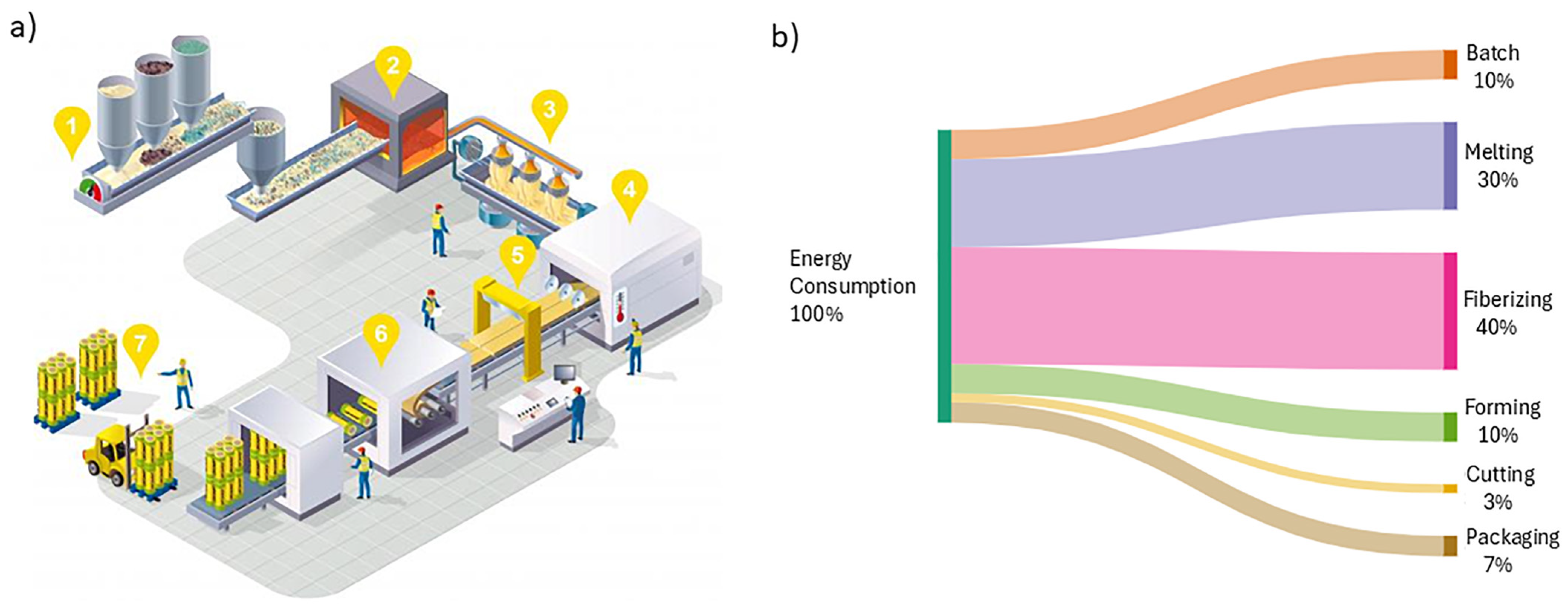
Energy Efficiency and Circular Economy in Glass Wool Fiberizing: Impact of Lightweight Refractory Design



Abstract
1. Introduction
2. Materials and Methods
2.1. Refractory Performance Analysis
2.2. Evaluation of Machine Efficiency
2.3. Data Collection and Analysis
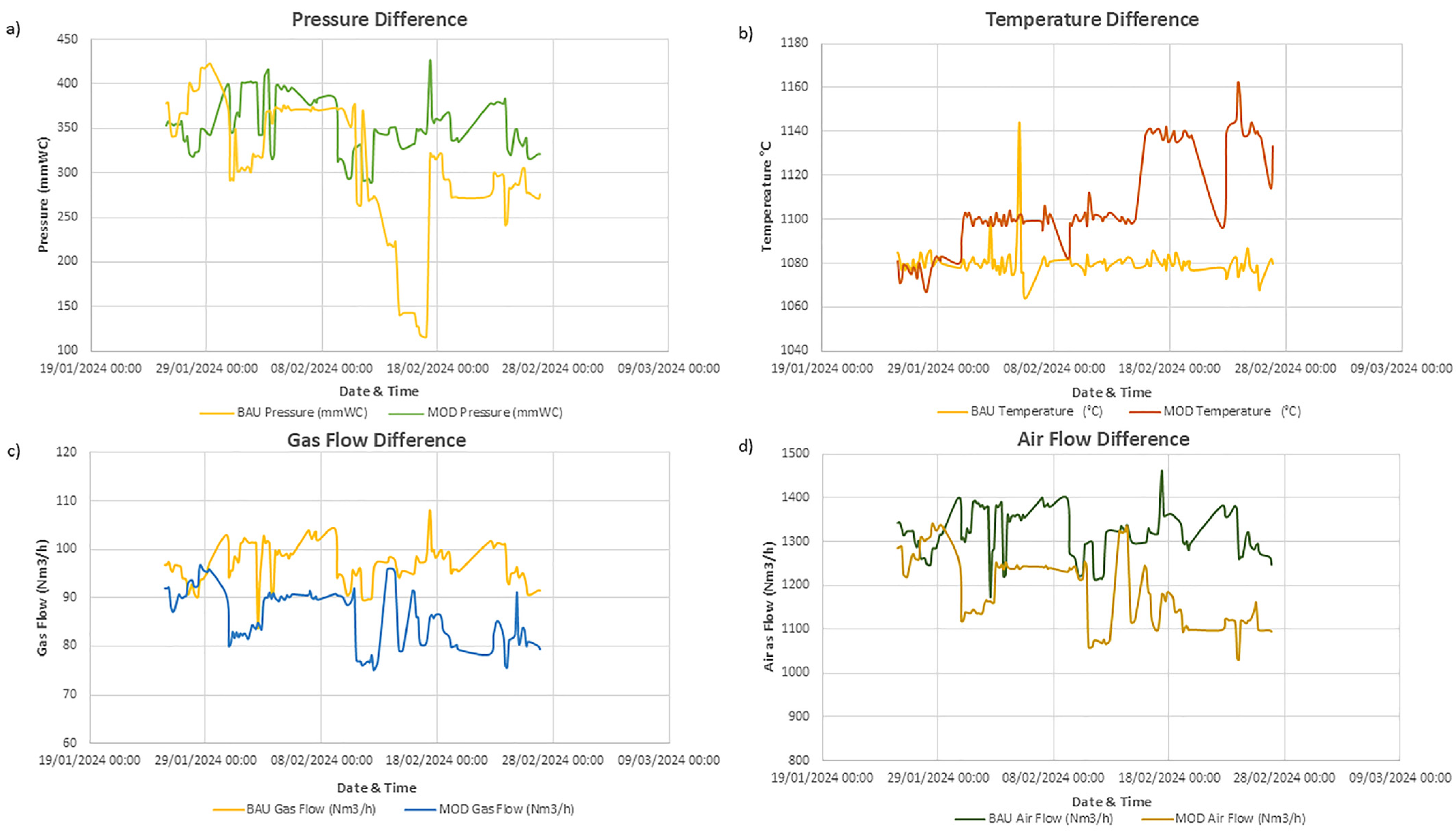
- Pressure (mmWC): represents the burner pressure that pushes the fibers downwards, expressed in millimeters of water column (1 mm WC= 0.0098 mPa).
- Temperature (°C): represents the burner and fiberizing machine temperature.
- Gas Flow (Nm3h−1): represents fuel consumption by the burner in terms of gas.
- Air Flow (Nm3h−1): represents compressed air supplied at 3 bar for combustion in the fiberizing machine.
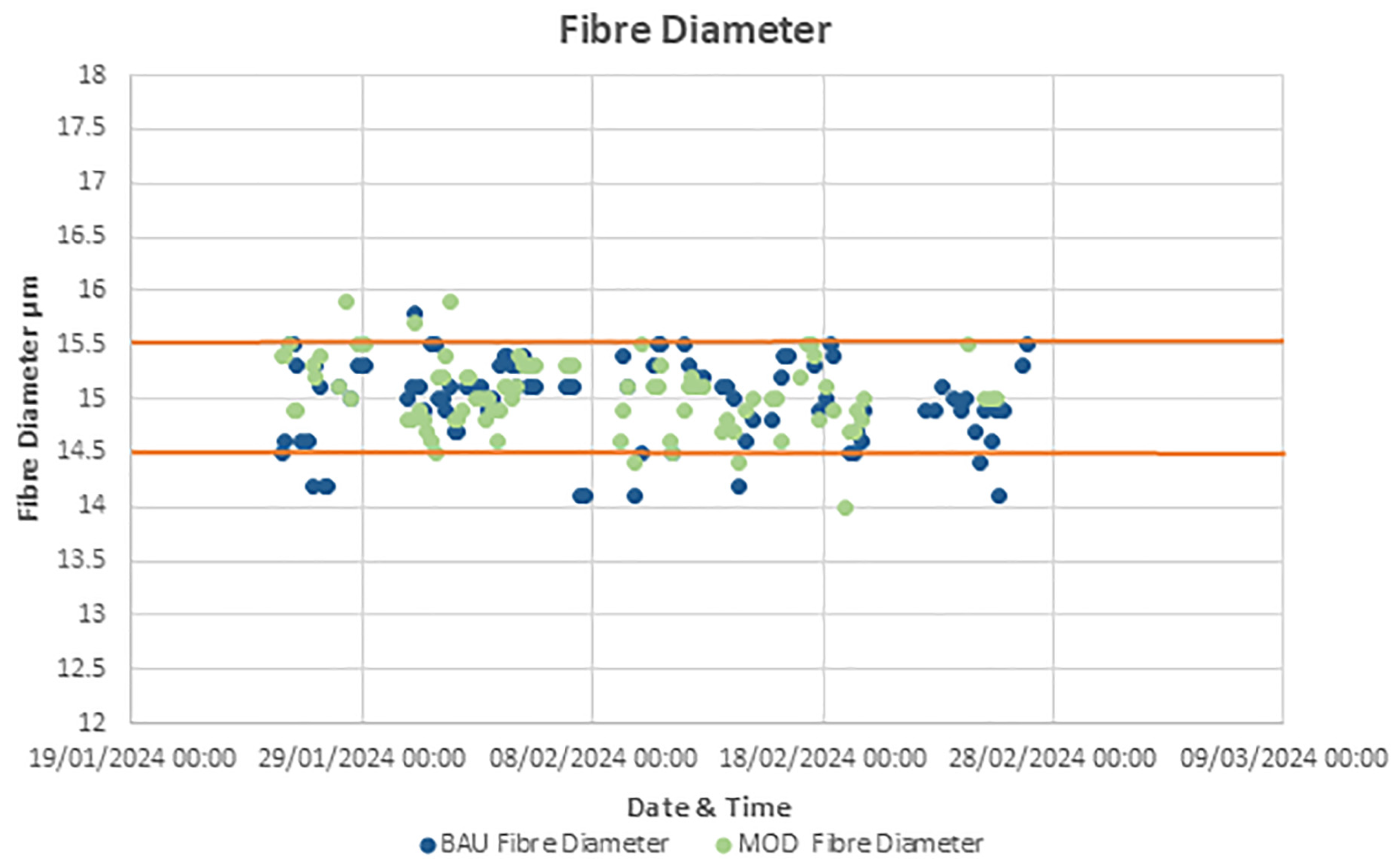
- Fiber Diameter: represents the output glass fiber diameter (range 14.5–15.5 µm).
3. Results and Discussion
3.1. Performance Monitoring Trends
3.2. Efficiency Analysis
3.3. Recovery Potential of Refractory External Burner
- Refractory cost estimation: Procurement costs are charged on a dry mass basis. Procurement records (provided by Saint-Gobain, ISOVER) indicate a unit price of £5260 per ton on a dry mass basis for the MOD refractory used in the trials. The burner casting procedure requires 100 kg dry mix (4 × 25 kg bags of dry mix per burner, equivalent to 0.1 ton). Considering six burners, this would equate to a mass of 0.6 ton and the corresponding cost would be £3156 on a dry weight basis. However, the material specification involved 48–55% added water, resulting in a cast mass after mixing of approximately 200 kg, equivalent to 0.2 ton. This would lead to a total mass of 1.2 tons for the six burners and a corresponding total cost of £6312. At the end of life, the full installed mass of 1.2 tons is physically available for recycling. Accordingly, all material recovery and circular-economy calculations in this study are expressed on a post-mix (installed-mass equivalent) basis.
- Environmental and Economic assessment: The following assumptions were made regarding reusability of the spent refractory:
- i.
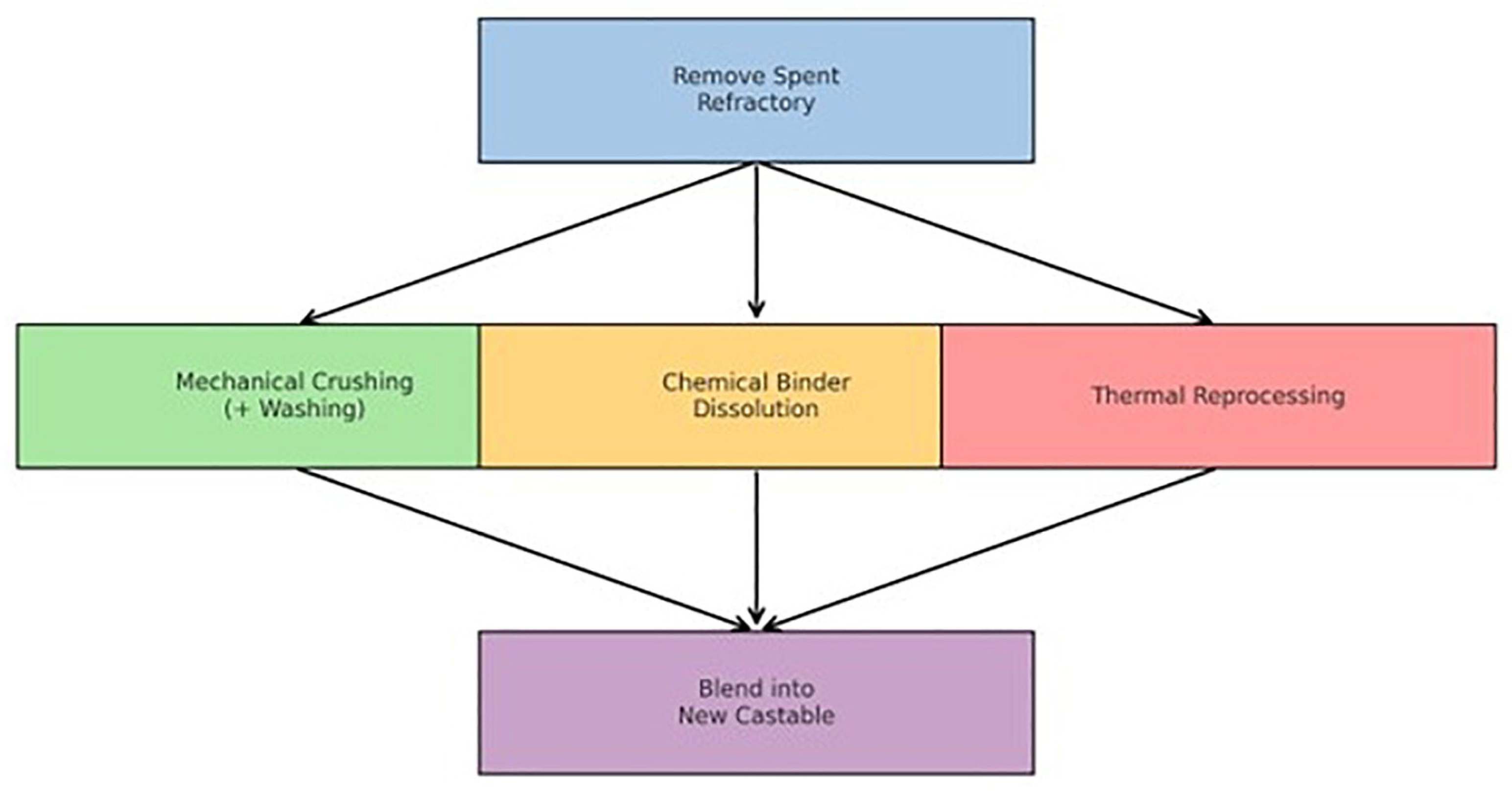
- Internal reuse: The recovered refractory material can be blended with fresh alumina to cast new burner linings. Industry practice suggests a safe recycling content of up to 30%, ensuring that the mechanical and thermal performance of the castable is maintained [15].
- ii.
- Selling to cement companies: Selling the aggregate to other cement industries to reduce the operational cost and support a broader circular economy.
- iii.
- Reuse in the construction sector: The reclaimed refractory can be used as insulating castable formulations in the construction sector, such as ducts and roofs, promoting environmental sustainability [20].
- CO2 Emissions Reduction: As these recycling methods are avoiding the production of 0.78 ton of new castable refractory material that would otherwise require high temperature firing of new castable material, it would effectively be saving 1.2 tons of CO2 emissions generated per ton of produced castable material [20]. Therefore, total (1.2 × 0.78 =) 0.93 ton of CO2 emissions can be reduced per 3-year campaign.
4. Conclusions
Author Contributions
Funding
Institutional Review Board Statement
Informed Consent Statement
Data Availability Statement
Acknowledgments
Conflicts of Interest
References
- Klemczak, B.; Kucharczyk-Brus, B.; Sulimowska, A.; Radziewicz-Winnicki, R. Historical evolution and current developments in building thermal insulation materials—A review. Energies 2024, 17, 5535. [Google Scholar] [CrossRef]
- Gobain, S. Glass Wool. 2024. Available online: https://www.isover-technical-insulation.com/glass-wool (accessed on 6 June 2025).
- Vivaldini, D.O.; Mourão, A.A.C.; Salvini, V.R.; Pandolfelli, V.C. Review: Fundamentals and Materials for the Microstructure Design of High Performance Refractory Thermal Insulating. Cerâmica 2014, 60, 297–309. [Google Scholar] [CrossRef]
- Bayoumi, I.M.I.; Ewais, E.M.M.; El-Amir, A.A.M. Rheology of Refractory Concrete. Boletín de la Sociedad Española de Cerámica y Vidrio 2022, 61, 453–469. [Google Scholar] [CrossRef]
- Vitiello, D.; Nait-Ali, B.; Tessier-Doyen, N.; Tonnesen, T.; Laím, L.; Rebouillat, L.; Smith, D.S. Thermal Conductivity of Insulating Refractory Materials: Comparison of Steady-State and Transient Measurement Methods. Open Ceram. 2021, 6, 100118. [Google Scholar] [CrossRef]
- Nemaleu, J.G.D.; Savemane, A.A.; Tome, M.; Mboussa, J.; Fabbri, L.; Tchamba, C.M.; Nzengwa, R.; Russias, J. Low-Temperature High-Strength Lightweight Refractory Matrices with a Reduced Environmental Footprint. Ceram. Int. 2023, 49, 27654–27661. [Google Scholar] [CrossRef]
- Guo, L.; Wang, X.; Li, Y.; Mu, Y.; Jia, Q.; Wang, G.; Chen, L. Evolution in properties of high-alumina castables containing basic zinc carbonate. Ceram. Int. 2021, 47, 19019–19025. [Google Scholar] [CrossRef]
- Giovannelli Maizo, I.D.; Luz, A.P.; Pagliosa, C.; Pandolfelli, V.C. Boron sources as sintering additives for alumina-based refractory castables. Ceram. Int. 2017, 43, 10207–10216. [Google Scholar] [CrossRef]
- Luz, A.P.; Lopes, S.J.S.; Gomes, D.T.; Pandolfelli, V.C. High-alumina refractory castables bonded with novel alumina–silica-based powdered binders. Ceram. Int. 2018, 44, 9159–9167. [Google Scholar] [CrossRef]
- Salomão, R.; Arruda, C.C.; Pandolfelli, V.C.; Fernandes, L. Designing High-Temperature Thermal Insulators Based on Densification-Resistant In Situ Porous Spinel. J. Eur. Ceram. Soc. 2021, 41, 2923–2937. [Google Scholar] [CrossRef]
- Xin, Y.; Jian, Y.; Yin, H.; Tang, Y.; Yuan, H.; Liu, Y. The Influence of Alumina Bubbles on the Properties of Lightweight Corundum–Spinel Refractory. Materials 2023, 16, 5908. [Google Scholar] [CrossRef] [PubMed]
- Bhatia, A. Overview of Refractories: Dense versus Insulating Refractory Castables—Processing, Properties, and Applications; CED Engineering Technical Report; Continuing Education and Development, Inc.: Woodcliff Lake, NJ, USA, 2019; Available online: https://www.cedengineering.com/userfiles/Overview%20of%20Refractories-R1.pdf (accessed on 24 November 2025).
- Department for Environment; Food & Rural Affairs (DEFRA). UK Government GHG Conversion Factors for Company Reporting. 2025. Available online: https://www.gov.uk/government/collections/government-conversion-factors-for-company-reporting (accessed on 7 December 2025).
- Muñoz, I.; Soto, A.; Maza, D.; Bayón, F. Life cycle assessment of refractory waste management in a Spanish steel works. Waste Manag. 2020, 111, 1–9. [Google Scholar] [CrossRef] [PubMed]
- Spyridakos, A.; Alexakis, D.E.; Vryzidis, I.; Tsotsolas, N.; Varelidis, G.; Kagiaras, E. Waste Classification of Spent Refractory Materials to Achieve Sustainable Development Goals Exploiting Multiple Criteria Decision Aiding Approach. Appl. Sci. 2022, 12, 3016. [Google Scholar] [CrossRef]
- Colla, V.; Matino, I.; Rinaldi, M.; Baragiola, S.; Strohmeyer, M.; Ibañez, M.; Machado, J. Future Research and Developments on Reuse and Recycling of Refractories in the Steel Industry. Metals 2023, 13, 676. [Google Scholar] [CrossRef]
- Fang, H.; Zang, Y.; Li, H.; Xiong, S. Study of Spent Refractory Waste Recycling from Metal Industries. Resour. Conserv. Recycl. 1999, 28, 239–246. [Google Scholar] [CrossRef]
- Horckmans, L.; Nielsen, P.; Dierckx, P.; Ducastel, A. Recycling of Refractory Bricks Used in Basic Steelmaking: A Review. Resour. Conserv. Recycl. 2019, 140, 297–304. [Google Scholar] [CrossRef]
- Smith, J.D.; Fang, H.; Peaslee, K.D. Characterization and Recycling of Spent Refractory Wastes from Metal Manufacturers in Missouri. Resour. Conserv. Recycl. 1999, 25, 151–169. [Google Scholar] [CrossRef]
- Badioli, S.; Jubayed, M.; Dargaud, M.; Siebring, R.; Léonard, A. Environmental performance of refractories: A state-of-the-art review on current methodological practices and future directions. Environ. Sustain. Indic. 2025, 27, 100868. [Google Scholar] [CrossRef]
- Feucht, F.; Moderegger, R.; Neuhold, S.; Sedlazeck, K.P. Analysing material flows and final fate distribution of spent refractories from steel casting ladles and cement rotary kilns in Europe. Resour. Conserv. Recycl. 2025, 215, 108158. [Google Scholar] [CrossRef]
- Boenzi, F.; Ordieres-Meré, J.; Iavagnilio, R. Life Cycle Assessment Comparison of Two Refractory Brick Product Systems for Ladle Lining in Secondary Steelmaking. Sustainability 2019, 11, 1295. [Google Scholar] [CrossRef]
- Seco, A.; del Castillo, J.M.; Perlot, C.; Marcelino, S.; Espuelas, S. Recycled granulates manufacturing from spent refractory wastes and magnesium based binder. Constr. Build. Mater. 2023, 365, 130087. [Google Scholar] [CrossRef]
- Grieves, M.; Vickers, J. Digital Twin: Mitigating Unpredictable, Undesirable Emergent Behavior in Complex Systems. In Transdisciplinary Perspectives on Complex Systems; Kahlen, F.-J., Flumerfelt, S., Alves, A., Eds.; Springer: Cham, Switzerland, 2017; pp. 85–113. [Google Scholar] [CrossRef]



| Category | Parameter | Value/Formula | Purpose |
|---|---|---|---|
| Energy Conversion | Gas Flow → kWh | Nm3/h × 10.55 | Converts gas volume to energy |
| Air Flow → kWh | Nm3/h × 0.0248 | Converts blower air flow to energy (electricity) | |
| Runtime Adjustment | Total hours in trial | 31 days × 24 h | Converts hourly flow to monthly energy |
| Machine efficiency | (e.g., 91% 1st trial) | Adjusts for real runtime after downtime | |
| Energy used in trial | kWh Used = (Avg Flow in kWh) × (31 × 24) × Efficiency | Calculates real consumed energy | |
| Tariff Rates | Gas cost | £0.0799 per kWh | Used to calculate gas cost savings |
| Electricity cost (air) | £0.1848 per kWh | Used to calculate blower energy cost savings | |
| CO2 price | £75 per ton | Used to calculate CO2 cost savings | |
| CO2 Calculation | CO2 emissions | (Avg Gas Flow × 35.66 × (31 × 24) × Efficiency)/1,000,000 × 56.8732 | Converts gas flow into CO2 tons (standard plant formula) |
| CO2 cost | CO2 (tons) × £75 | Calculates CO2 cost reduction | |
| Per-Trial Savings | Gas savings | Cost (BAU)—Cost (MOD) | Difference in gas usage cost |
| Air electricity savings | Cost (BAU)—Cost (MOD) | Difference in electricity use | |
| CO2 savings | CO2 BAU—CO2 MOD | Difference in emissions cost |
| Trial # | Gas (kWh)—BAU | Gas (kWh)—MOD | Gas Reduction (kWh) | Reduction (%) |
|---|---|---|---|---|
| 1 | 690,349 | 614,491 | 75,859 | 11% |
| 2 | 434,792 | 385,240 | 49,552 | 11% |
| 3 | 380,440 | 329,016 | 51,424 | 14% |
| 4 | 489,576 | 471,255 | 18,321 | 4% |
| Average reduction in energy consumption | 10% | |||
| BAU | MOD | |
|---|---|---|
| Pressure (mm WC) | 354.24 | 327.22 |
| Temperature (°C) | 1080.45 | 1107.22 |
| Gas Flow (Nm3h−1) | 96.97 | 86.31 |
| Air Flow (Nm3h−1) | 1321.35 | 1191.08 |
| Fiber Diameter (µm) | 14.99 | 15.04 |
| Trial # | Trial Period (Days) | Machine Efficiency (%) | Reduced Air Cost (£) | Reduced Gas Cost (£) | Reduced CO2 Cost (£) | Reduction in CO2 (tons) | Total Actual Savings (£) |
|---|---|---|---|---|---|---|---|
| 1 | 31 | 91 | 403 | 6061 | 1141 | 15 | 7605 |
| 2 | 20 | 81 | 354 | 3959 | 745 | 10 | 5058 |
| 3 | 30 | 52 | 317 | 4109 | 773 | 10 | 5199 |
| 4 | 30 | 72 | 109 | 1464 | 276 | 4 | 1848 |
| Total | 111 | - | 1183 | 15,593 | 2935 | 39 | 19,710 |
| Method | Process Description | Yield Range (%) | Reclaimed Mass (kg)# | Applications [Ref. Source] |
|---|---|---|---|---|
| Mechanical Crushing and Screening | 1. Remove refractory large debris 2. Crush it to less than 10 mm 3. Screen into > 3 mm (coarse) and < 3 mm (fine) elements 4. Wash to remove the dust. | 60–70 | 720–840 | New solid mixes, back-fill and furnace furnishings [15] |
| Chemical Binder Dissolution | 1. Crush the used castable 2. Soak in warm water with pH 10 (mild alkali) to dissolve phosphate 3. Rinsing Process 4. Recover high-purity compound | 50–60 | 600–720 | High alumina castable, refractory plaster [16] |
| Thermal Reprocessing | 1. Refire crushed refractory power at 1200 °C to remove organics and remaining binder 2. Regrind to obtain required particle sizes 3. Blend with fresh cement | 45–55 | 540–660 | Secondary mixes for less critical hot zones [17] |
| Patch and Repair | 1. Clean crack faces and remove broken refractory pieces 2. Apply rapid patch mix contains high alumina 3. Return machine to production without full relining | - | - | Extends refractory life to 6–12 months without recycle [18] |
Disclaimer/Publisher’s Note: The statements, opinions and data contained in all publications are solely those of the individual author(s) and contributor(s) and not of MDPI and/or the editor(s). MDPI and/or the editor(s) disclaim responsibility for any injury to people or property resulting from any ideas, methods, instructions or products referred to in the content. |
© 2025 by the authors. Licensee MDPI, Basel, Switzerland. This article is an open access article distributed under the terms and conditions of the Creative Commons Attribution (CC BY) license.
Share and Cite
Afzal, J.; Forgerit, B.; Tiwary, A. Energy Efficiency and Circular Economy in Glass Wool Fiberizing: Impact of Lightweight Refractory Design. Sustainability 2026, 18, 135. https://doi.org/10.3390/su18010135
Afzal J, Forgerit B, Tiwary A. Energy Efficiency and Circular Economy in Glass Wool Fiberizing: Impact of Lightweight Refractory Design. Sustainability. 2026; 18(1):135. https://doi.org/10.3390/su18010135
Chicago/Turabian StyleAfzal, Junaid, Baptiste Forgerit, and Abhishek Tiwary. 2026. "Energy Efficiency and Circular Economy in Glass Wool Fiberizing: Impact of Lightweight Refractory Design" Sustainability 18, no. 1: 135. https://doi.org/10.3390/su18010135
APA StyleAfzal, J., Forgerit, B., & Tiwary, A. (2026). Energy Efficiency and Circular Economy in Glass Wool Fiberizing: Impact of Lightweight Refractory Design. Sustainability, 18(1), 135. https://doi.org/10.3390/su18010135