Article

Optimal Incentive Strategy of Technology Information Sharing in Power Battery Recycling Supply Chain

School of Economics and Management, Anhui Polytechnic University, Wuhu 241000, China
*
Author to whom correspondence should be addressed.
Sustainability 2026, 18(1), 144; https://doi.org/10.3390/su18010144
Submission received: 21 November 2025 / Revised: 10 December 2025 / Accepted: 16 December 2025 / Published: 22 December 2025

Abstract

With the rapid development of the new energy vehicle industry, the efficiency of information sharing in the power battery recycling supply chain greatly affects resource utilization and sustainability. This paper examines battery manufacturers and third-party recyclers as game participants. We analyze incentive mechanisms for sharing technical information, considering both information quality and leakage risks. This study constructs three types of Stackelberg game models: contract mechanisms, profit-sharing mechanisms, and cost-sharing mechanisms. We analyze the impact of technical information quality and leakage costs on supply chain decisions. Results show that manufacturer profits increase with growing leakage costs, following optimal transitions through profit-sharing, contract, and cost-sharing mechanisms. Recycler profits are influenced by both the quality of technical information and leakage costs. Overall supply chain profits trend toward cost-sharing mechanisms when technical information quality is low and favor profit-sharing mechanisms when quality is high. Under low leakage risk, cost-sharing mechanisms dominate at the technological level and in terms of recycling quantity. Under high leakage risk, profit-sharing mechanisms share leakage costs and lead in technology investment and recycling quantity. Contract mechanisms consistently have the lowest levels and volumes because they lack cost sharing and profit compensation. This study provides a theoretical foundation and practical guidance for information-sharing strategies in power battery recycling supply chains.

1. Introduction

With the rapid development of the new energy vehicle industry, the industry has become the core driving force for green transformation in the transportation sector. As a key component, power batteries face resource constraints and environmental risks throughout their lifecycle. In reality, battery manufacturers often delegate recycling tasks to third-party recyclers after completing the manufacturing of power batteries. Industry research and market data show that sharing technical information (such as battery structure parameters, disassembly processes, and testing standards) from manufacturers to recyclers helps improve recycling efficiency, reduce testing and classification costs, and accelerate the process of resource regeneration. However, this potential value is often difficult to fully realize in practice: on one hand, differences in the quality of technical information weaken the actual effects of sharing; on the other hand, concerns about information leakage risks make manufacturers worry about core technology spillover, leading to a sharing deficiency dilemma. Therefore, motivating manufacturers to actively share information while reducing risks and safeguarding profits becomes an important issue that urgently needs to be addressed.
In practice, the effectiveness of information-sharing practices in the power battery recycling industry exhibits substantial variation. Regarding contract mechanisms, BYD Company Limited, as reported in its 2024 Social Responsibility Report, signs strict contractual agreements with certain 4S stores. These contracts explicitly define the recycling process and include reward and penalty clauses. A reward of 200–800 yuan is provided for each batch of qualified batteries recycled, while a penalty is imposed if the quarterly recycling volume falls below 80% of the target or if the non-conformance rate exceeds 10%. This mechanism increases recycling volume by 40% in certain regions within six months and improves the pass rate from 75% to 85%, effectively ensuring channel stability and battery quality. In terms of profit-sharing mechanisms, Contemporary Amperex Technology Company Limited (CATL) and GEM Company Limited (GEM) implement a technology-licensing combined with a revenue-sharing model, in which CATL provides battery traceability code and disassembly technologies, and GEM pays a technology usage fee ranging from 8% to 12% of recycling revenue. In scenarios with over 90% technical compatibility and signing strict confidentiality agreements to minimize leakage risks, this model results in a 35% increase in recycling volume and a 20% improvement in return on R&D investment, demonstrating clear mutual benefits [1]. Additionally, BYD’s pilot program with THTI Environment employs a cost-sharing combined with a technology co-management model, where recyclers bear R&D costs ranging from 30% to 50% while manufacturers provide continuous guidance. When technical information quality is low (approximately 70% technical maturity), it can reduce technology investment costs by up to 25%. However, in scenarios with high leakage risk due to inadequate risk-mitigation measures, manufacturer profits fluctuate by up to 18%, which is substantially higher than under the profit-sharing model (8%) [2]. Overall, the quality of technical information and the cost of information leakage are key factors affecting the effectiveness of recycling supply-chain information sharing. Consequently, choosing an appropriate incentive mechanism is the core path to solving this dilemma.
In the power battery-recycling supply chain, information sharing is essential for achieving coordination and value co-creation; however, different incentive mechanisms are constrained by variations in information quality and the risk of information leakage. Three representative mechanisms—contract, profit-sharing, and cost-sharing—demonstrate distinct differences in their depth of information exchange and risk control effectiveness. The contract mechanism relies on explicit reward–penalty clauses to standardize information transmission and ensure traceability. It performs well in low-trust or low-information-quality environments by substituting institutional constraints for relational trust [3]. Nevertheless, its rigidity often limits sharing to compliance-level information, and when contractual terms fail to address potential leakage risks, opportunistic behavior may emerge [4]. The revenue-sharing mechanism, which links information and profit, can significantly improve overall profitability and transparency under conditions of high information quality and low leakage risk [5]. However, in highly competitive markets or under weak confidentiality protection, manufacturers may reduce information input due to concerns about technology spillover [6]. The cost-sharing mechanism encourages joint R&D and data investment, making it suitable for early cooperation stages or incomplete information scenarios [7]. While it fosters mutual trust and risk co-bearing, its high transparency increases the likelihood of information leakage and “free-riding” behavior [8,9]. Overall, the contract mechanism emphasizes stability and control, the revenue-sharing mechanism focuses on incentive alignment, and the cost-sharing mechanism highlights risk co-management.
Motivated by the above practice, this article mainly discusses the following three issues: (1) How do the quality of technical information and the cost of information leakage affect contract, profit-sharing, and cost-sharing mechanisms? (2) Under different mechanisms, how do key exogenous variables adjust equilibrium result strategies? (3) What systematic differences in supply chain technology level, recycling quantity, and profit structure are present under the three types of mechanisms?
To answer these, this article starts from the entire lifecycle of new energy vehicles and constructs three types of Stackelberg game models: contract mechanism, profit-sharing mechanism, and cost-sharing mechanism. The results show that (1) in scenarios with low technical information quality and low leakage costs, the cost-sharing mechanism performs the best; in scenarios with high technical information quality and moderate leakage costs, the profit-sharing mechanism is optimal; contract mechanisms can only maintain basic efficiency in situations of extremely high leakage costs and low technical information quality. (2) Increasing information leakage costs inhibits manufacturers’ technology investment and selling prices, reducing recycling efficiency; improving technical information quality increases recycling efficiency and recyclers’ profits, driving manufacturers to increase technology investment under profit-sharing mechanisms to form a positive feedback loop. (3) Under conditions of low technical information quality and low leakage costs, the cost-sharing mechanism has advantages in terms of technology level, recycling quantity, and overall profits; under conditions of high technical information quality and high leakage costs, profit-sharing mechanisms are optimal. Manufacturer profits show a trend of transitioning from profit-sharing to contracts to cost-sharing mechanisms as leakage costs change, while recycler profits are mainly driven by the quality of technical information.
The innovations of this paper are mainly reflected in the following three aspects. First, unlike the traditional Stackelberg framework that treats information sharing as an exogenous variable, this paper is the first to endogenize both the quality level of technical information γ and its leakage risk λ into the game model of the reverse supply chain for power batteries, constructing a unified analytical structure under the “ γ λ ” coupling mechanism. This structure not only reveals how information quality and leakage risk jointly influence manufacturers’ pricing and technology investment decisions but also provides a highly realistic contextual basis for examining incentive mechanism choices. Second, based on this coupling framework, this paper systematically compares three types of incentive mechanisms: contract, profit-sharing, and cost-sharing; it derives a set of endogenous critical thresholds with clear economic meanings (such as key values of λ and γ ), thereby distinguishing itself from the existing literature that commonly compares mechanisms pairwise and clearly delineates the boundaries of advantages among different mechanisms. Finally, the model further uncovers a practically insightful pattern: as information leakage risk λ increases, the manufacturer’s profit-optimal mechanism dynamically shifts from profit-sharing mechanisms to contract mechanisms and then to cost-sharing mechanisms. This sequence of mechanism transitions arises from the complex interactions between γ and λ with related parameters ( ρ , α , r ) in incentive mechanisms, providing feasible decision-making guidance for designing mechanisms in real-world supply chains under varying informational environments.
The structure of this article is as follows: The literature review in Section 2 lays the foundation for the research. Section 3 introduces the relevant models and their core assumptions. In Section 4, we develop and solve models concerning the manufacturers and recyclers. The optimal results are analyzed in Section 5, along with an investigation of threshold values across different scenarios. We conduct a sensitivity analysis of key parameters to assess their impact in Section 6. A summary of the key findings is provided in Section 7, with all proofs included in Appendix A and Appendix B.

2. Literature Review

In recent years, driven by the goal of achieving sustainable development of new energy vehicles, the recycling supply chain of power batteries has become a key link in the industry’s sustainable development. Research mainly focuses on two major directions: the recycling and utilization of power batteries and mechanisms for sharing technical information.

2.1. The Recycling and Utilization of Power Batteries

Research on the recycling and utilization of power batteries has focused on designing recycling policies and decision-making mechanisms to improve the overall performance of electric vehicle battery recycling systems.
Research on the recycling and utilization of power batteries in electric vehicle battery recycling has focused on designing policies and mechanisms to enhance overall system performance. Alamerew & Brissaud (2020) [10] modeled the reverse supply chain using system dynamics, highlighting how structural adjustments can enhance the transition to a circular economy. Chen et al. (2022) [1] examined multi-channel supply chains and optimal pricing under revenue-sharing contracts, emphasizing the role of contract design in aligning incentives and maximizing profits. Qian et al. (2025) [11] developed a Stackelberg game model to examine how product innovation and process innovation for recycling interact to shape optimal strategies and performance in EV battery supply chains. Zhang et al. (2025) [12] proposed battery reuse rate and market competition into an analytical framework to optimize new and reused battery production under producer responsibility scenarios. Jia et al. (2024) [13] constructed closed-loop supply chain models to evaluate how blockchain technology adoption and cost-sharing schemes affect profitability, traceability, and sustainability in EV battery recycling. Parsaeifar et al. (2019) [14] applied game-theoretic approaches to coordinate pricing, recycling, and green product decisions, demonstrating the benefits of structured coordination mechanisms. Gong et al. (2024) [15] developed a dual-channel reverse supply chain model with government subsidy and penalty interventions to examine how policy influences competition, cooperation, and environmental performance in EV battery recycling. Li et al. (2023) [16] developed a game-theoretic model to evaluate optimal joint recycling strategies for electric vehicle manufacturers under different alliance structures and recycling competition intensities. Wang et al. (2018) [3] designed reward–penalty mechanisms in a two-period closed-loop supply chain to ensure compliance with recycling targets. Wang et al. (2024) [17] developed a Hotelling model to analyze cooperation strategies between formal and informal recyclers under different market structures in the EV battery recycling sector. Wu et al. (2025) [18] investigated decision optimization for new energy vehicle supply chains. Zhu et al. (2020) [19] examined optimal channel selection and battery capacity allocation for EV manufacturers in a competitive setting, analyzing how upstream battery supply decisions affect equilibrium outcomes, profits, and social welfare. Xiao et al. (2024) [2] studied the impact of information sharing and government subsidies on competitive battery recycling, showing that coordinated cooperation and policy support can significantly improve economic and environmental performance. Some studies also focused on the impact of multiple recycling entities and competitive structures on supply chain performance. Qi et al. (2024) [20] used a Stackelberg game model to analyze equilibrium strategies under carbon emission constraints for multiple recycling entities and different recycling channels, finding that digital technology significantly influenced market pricing, multi-entity participation could enhance firms’ recycling enthusiasm, and joint recycling models enabled battery suppliers to achieve higher profits. Wei & Qi (2025) [21] constructed a closed-loop supply chain model led by battery manufacturers, including automobile manufacturers and third-party recyclers, to study recycling competition under government reward and punishment mechanisms. The results showed that increasing the intensity of rewards and punishments could raise both the recycling rate and price, while recycling competition might reduce corporate profits; cooperation could increase individual recycling volumes and highlight the important role of supply chain leaders. Unlike these studies, this research not only considered competition and cooperation among multiple entities but also incorporated the quality of technological information sharing and leakage risks into the analysis, systematically revealing optimal recycling strategies under different information and risk conditions, thereby providing new insights for information-driven supply chains.
Overall, the current focus of optimizing retired new energy vehicle battery collection operations primarily revolves around mode selection, along with its environmental impact, whereas technical information-sharing strategies within battery retrieval supply chains remain scarce.

2.2. Technical Information Sharing

Research on technical information-sharing mechanisms emphasizes the importance of information quality, leakage prevention, and the application of digital technologies such as blockchain and big data to enhance supply chain coordination and sustainability.
Research on technical information-sharing mechanisms in electric vehicle battery recycling supply chains has focused on improving decision-making, coordination, and sustainability through high-quality information flows and digital technologies. Dai et al. (2022) [8] proposed a two-way information-sharing model for uncertain demand forecasts in dual-channel supply chains. Feng et al. (2024) [22] examined battery recycling model selection and contractual incentives from an information-sharing perspective, highlighting the alignment of technical and policy incentives. Rahmani et al. (2021) [23] integrated recycling technology and product design choices to improve producer responsibility-based recycling performance. Kankam et al. (2023) [24] highlighted how information quality mediates supply chain decision-making and performance. Kshetri (2021) [4] and Sahoo et al. (2024) [7] explored blockchain applications for transparency and traceability in sustainable supply chains. Li et al. (2022) [5] and Li, Ji & Huang (2022) [25] analyzed information leakage strategies and their impact on operational decisions. Nie et al. (2023) [9] examined how incorporating remanufactured products alters retailers’ incentives to share demand information, showing that remanufacturing can enable a triple win for retailers, manufacturers, and the environment. Teng et al. (2022) [6] emphasized how IS capabilities and collaboration moderate performance outcomes. Kong et al. (2013) [26] analyzed how revenue-sharing contracts can encourage information sharing and mitigate information leakage risks in competitive supply chains. Xu et al. (2022) [27] studied innovation information sharing between competitive supply chains. Yi et al. (2024) [28] explored blockchain-enabled coordination under information leakage prevention. Zhang et al. (2012) [29] developed a two-tier supply chain model to assess and mitigate information leakage risks, proposing supplier-selection optimization as a strategy to reduce potential competitive disadvantages. Niu et al. (2022) [30] showed that technology leakage hurts battery manufacturers. Recent research has further highlighted the strategic role of governance and stakeholder-driven sustainability in supply chain decision-making. Xiang et al. (2025) [31] demonstrate that governance structures significantly shape firms’ incentives to share information, providing conceptual support for analyzing information-sharing contracts in recycling supply chains. Wu et al. (2024) [32] demonstrate that ESG-driven behavioral pressures improve green supply chain performance, highlighting the importance of incentive-compatible information-sharing mechanisms in sustainability-oriented industries. These insights reinforce the motivation behind this study and situate our model within the broader literature on sustainability and governance.
In conclusion, the progress in optimizing the retired new energy vehicle battery recycling operations and technology information-sharing strategies in the supply chain has laid a solid foundation for this study. There is still significant research space in studying information-sharing strategies in battery recycling supply chains, especially considering the risk of information leakage, which urgently needs further exploration. Therefore, starting from the risk of information leakage when sharing technical information with the manufacturer, three incentive mechanism game models were established to study incentive mechanisms for technical information sharing, considering information quality. The research findings reveal the mechanism of technical information-sharing strategies in the new energy vehicle recycling supply chain, elucidate the conditions corresponding to optimal decisions, and provide new theoretical support and management insights for practitioners and industry policymakers in the new energy vehicle recycling industry.

3. Model Description

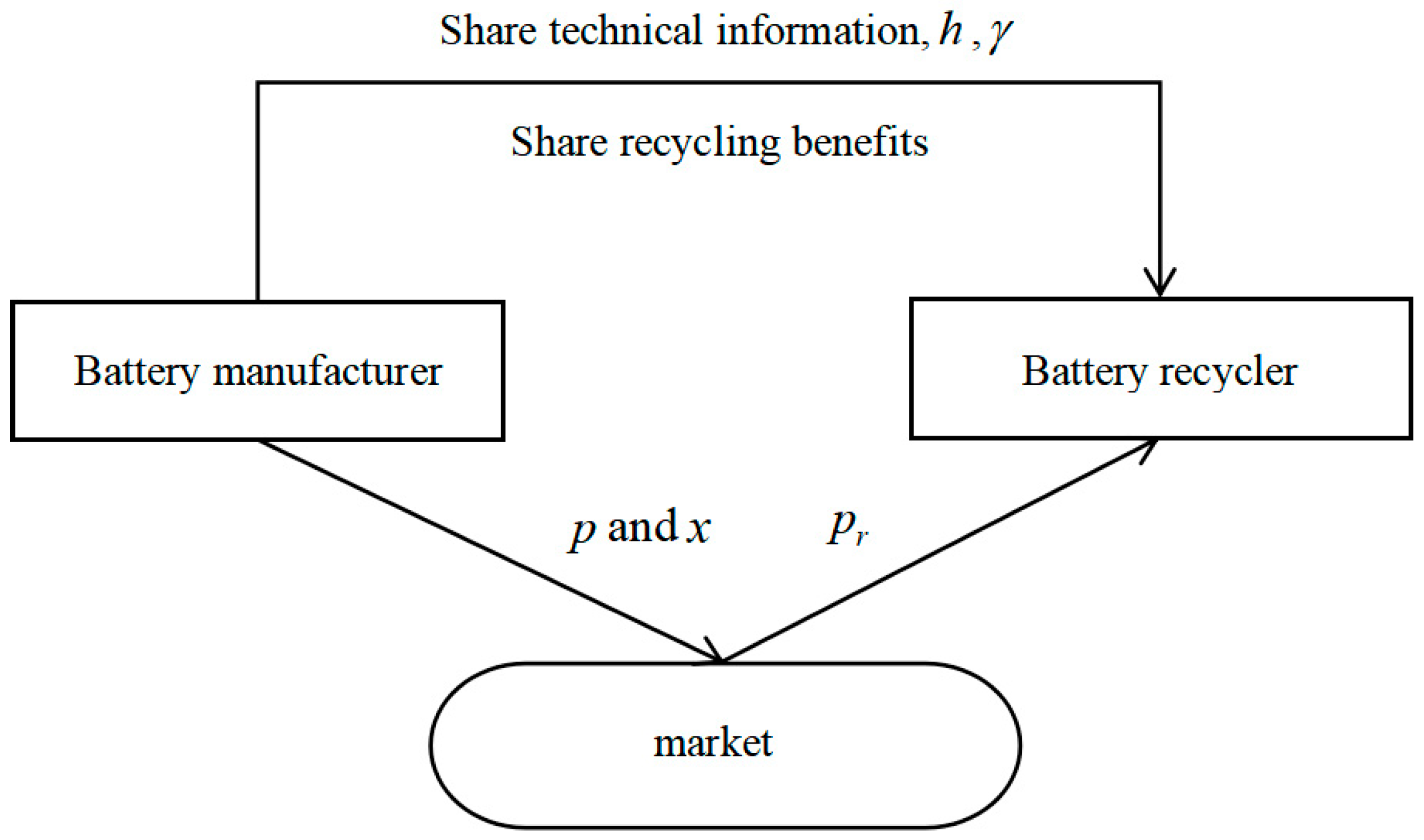
This article examines how technical information is shared in power battery recycling for new energy vehicles. It constructs a recycling supply chain that consists of battery manufacturers and third-party recyclers. In this system, manufacturers control and disseminate core technical information, and the quality of this information directly determines both the efficiency and the volume of recycling performed by recyclers. To clarify how information sharing operates among supply chain members under different mechanisms, this paper develops three types of game models: contract, profit-sharing, and cost-sharing mechanisms. These models are employed to analyze the differences between manufacturers and recyclers in terms of information flow, decision-making processes, and profit–cost structures. The logical framework of the game is illustrated in Figure 1.

3.1. Model Assumptions

To ensure the model has good interpretability and remains consistent with the existing literature on closed-loop supply chains and information sharing, this paper proposes several basic assumptions based on the general practices of previous studies. These assumptions provide necessary support for describing the decision-making behavior of supply chain members and constructing the model framework. The assumptions are as follows:
(i)
Based on the common practices in the closed-loop supply chain literature, such as Li et al. (2023) [16] and Parsaeifar et al. (2019) [14], this study assumes that the demand function for new energy vehicle power batteries is D = a b p + β x . Since the specific values of parameters a and b do not affect the main conclusions and numerical results of the model, they are standardized to 1, simplifying the demand function to D = 1 p + β x .
(ii)
Drawing on Alamerew & Brissaud (2020)’s multiplicative formulation of the impact of technological level on recycling efficiency in system dynamics models, this paper assumes that the recycling quantity function of recyclers is Q = γ A + k p r + h x [10].
(iii)
According to Rahmani et al. (2021) [23], this paper assumes that the investment cost for a manufacturer investing in technology level x is c x 2 2 .
(iv)
Drawing on Kankam et al. (2023)’s empirical measurement of information quality [24], this paper assumes that the technical information quality γ follows a uniform distribution in the interval [0, 1].
(v)
Referring to Gong et al. (2024) [15] on the handling of contract mechanisms, suppose the manufacturer sets a minimum recycling rate θ ¯ , and the actual recycling rate of the recycler is θ . The recycler receives rewards or penalties based on the deviation from the target performance, with a reward or penalty intensity coefficient r . For ease of analysis, let the performance function be T = θ ¯ θ ; then, the recycler’s reward or penalty amount can be expressed as r T .
Referring to existing analytical studies on battery recycling and closed-loop supply chains, this paper adopts linearized demand functions and recycling response functions. Within a linear Stackelberg framework, such settings are not only mainstream practices but also ensure the model’s interpretability without affecting the directionality of conclusions, enabling the analysis to obtain clear and verifiable closed-form solutions.
The symbols and explanations mentioned in this article are shown in the Nomenclature Section.

3.2. Battery Recycler

The new energy vehicle battery manufacturer decides the selling price and technological level of the new battery, while the recycler decides the recycling price after the manufacturer makes a decision. To characterize the recycling behavior of retired new energy vehicle batteries and make the model description clearer, relevant variables are systematically defined. Let Q be the recycling quantity of the retired new energy vehicle battery; γ represents the quality level of technical information, which is used to measure the extent to which information provided by manufacturers improves recycling efficiency; h is the impact coefficient of technical information on recycling quantity, indicating how strongly technical information enhances recycling efficiency; p r denotes the unit recycling price of the retired new energy vehicle battery; k is the consumer sensitivity coefficient to recycling price; A represents the baseline recycling quantity, i.e., natural recycling volume without any efforts. Based on these variables, the recycling quantity can be expressed as Q = γ A + k p r + h x , where x is the investment level of battery technology. Since sharing technical information can improve technology selection for recycling, reduce costs, and increase recovery rates, it is necessary for the recycling quantity to reflect this influence [22]. To simplify derivation without loss of generality, let A = 0 ; then Q can be further written as Q = γ k p r + h x . Recycling and reusing the retired new energy vehicle battery brings economic benefits but also incurs unit recovery and processing costs. Recycling and reusing the retired new energy vehicle battery generate economic benefits but also incur unit recovery and processing costs. Profits from recycling are represented by Z , while unit retrieval and processing costs are denoted by c r , with I representing the unit revenue from recycling the retired new energy vehicle battery ( I = Z c r ). Based on this, this article constructs three types of technical information-sharing incentive mechanisms. In the contract mechanism, manufacturers reward or punish recyclers based on their actual recycling performance. Let the minimum recovery rate be θ ¯ , the actual recovery rate be θ , and the reward and punishment coefficient be r . For simplified calculation, let the performance function T = θ ¯ θ , then the amount of reward or punishment received by recyclers can be expressed as r T . In the profit-sharing mechanism, manufacturers share technical information with recyclers, while battery recyclers share a portion ρ γ k p r + h x of recycling revenue with manufacturers, where ρ is the unit information-sharing fee, reflecting the distribution relationship of gains brought by information sharing [24]. In the cost-sharing mechanism, manufacturers also share technical information, but recyclers bear a proportion 1 α of the technical investment costs. Correspondingly, manufacturers bear a technical investment cost of α x 2 2 , where α is the cost-sharing ratio. Based on these variable definitions and mechanism settings, we further construct three decision-making models to analyze optimal strategies for manufacturers and recyclers under different information-sharing mechanisms.

3.3. Battery Manufacturer

The new energy vehicle battery manufacturer decides the selling price and technological level of the new battery, while the recycler decides the recycling price after the manufacturer makes a decision. In this article, the market demand function for new energy vehicle batteries is characterized as follows: D = a b p + β x , where D represents the demand for new energy vehicle batteries, p is the selling price, x is the technology level, a is market potential demand, b is consumers’ sensitivity coefficient to selling price, and β is the impact coefficient of technical information on sales. For simplicity in calculation without loss of generality, we normalize a and b to be equal to one, simplifying the demand function to D = 1 p + β x . The manufacturer needs to pay manufacturing costs, technology investment costs, and information leakage costs in order to obtain sales profits. The technology investment cost for battery manufacturers is a quadratic function of technological level represented by c x 2 2 . To simplify calculations without affecting final conclusions, we normalize the cost coefficient c to be equal to one and simplify the manufacturing cost c m to zero. λ represents the cost coefficient of information leakage; h represents the impact coefficient of technical information on recycling quantity; the information leakage cost is represented by λ h x [25].

4. Model Setup

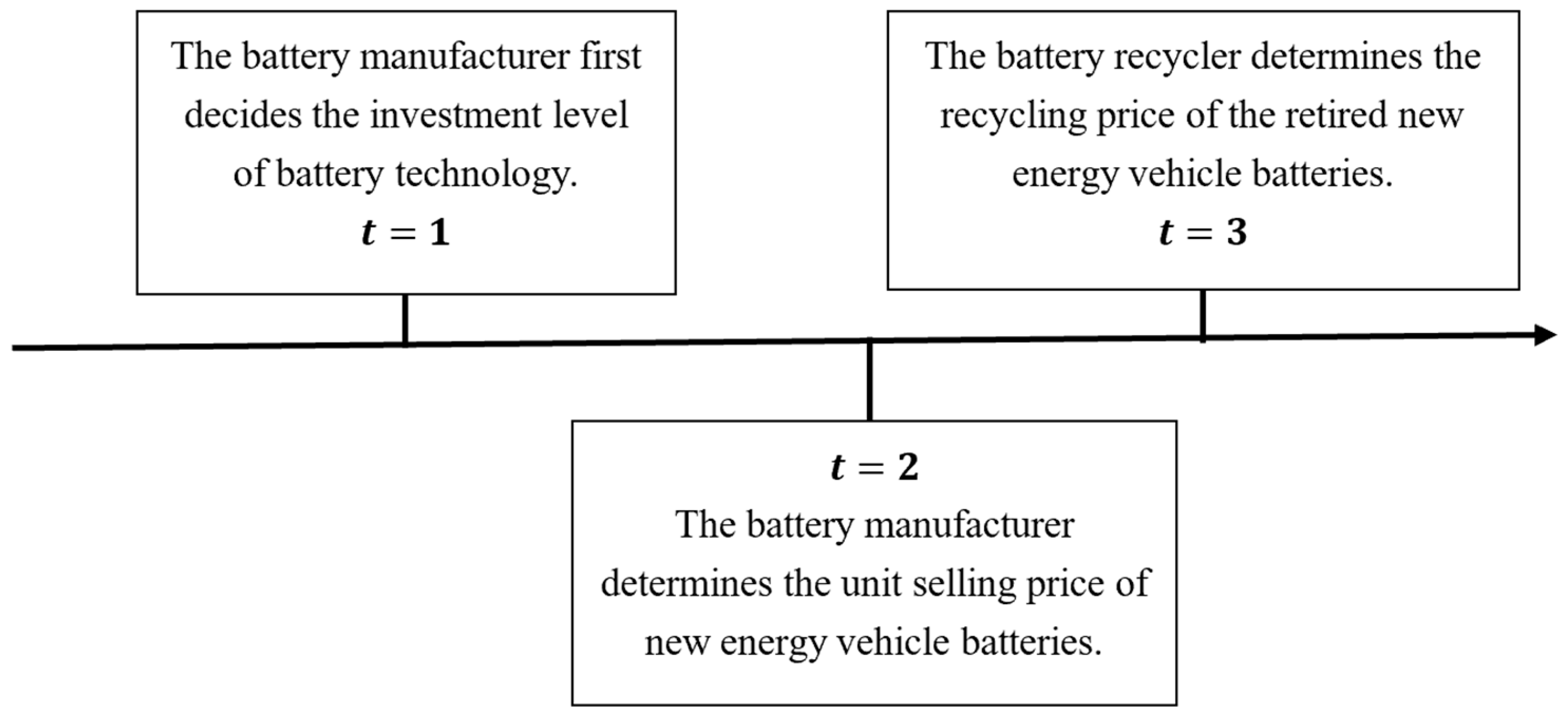
Figure 2 illustrates the event sequence in the reverse supply chain, where manufacturers collaborate with recyclers in the recycling process of the retired new energy vehicle battery, with the manufacturer acting as the leader in a Stackelberg game. In the first stage, the manufacturer decides the investment level of battery technology, which directly affects its costs and product competitiveness. In the second stage, the manufacturer determines the unit selling price of the new energy vehicle battery to balance costs and market demand. Finally, the recycler decides on the unit recycling price of the retired new energy vehicle battery to ensure economically efficient and sustainable recycling. Based on the actual recycling of the new energy vehicle battery and the assumptions outlined earlier, this study models three scenarios separately and derives the equilibrium results by using backward induction.
All equilibrium results are obtained and verified in Mathematica 13.3 using backward induction. For each mechanism, the first-order optimality conditions are solved, and the negative definiteness of the Hessian matrix is checked to ensure global concavity.

4.1. Scenario 1: Contract Mechanism (Model C )

In this case, the battery manufacturer shares relevant technical information with the recycler and constrains the recycler’s behavior through the contract. The contract sets minimum recycling rate standards, and the manufacturer implements corresponding rewards or penalties based on whether the recycler reaches the agreed level, which incentivizes the recycler to improve recycling performance and ensure overall recycling goals are met. The battery manufacturer acts as a leader in the game, while the recycler acts as a follower. The decision sequence is as follows: The battery manufacturer first determines the selling price and technology level; based on this, the recycler reacts according to the contract mechanisms and uses information obtained from the battery manufacturer to determine the recycling price. The profit functions of both manufacturers and recyclers are
π M C = p 1 p + β x x 2 2 λ h x + r T
π R C = γ I p r k p r + h x r T
In the contract mechanism, according to the profit function of the battery recycler (2), we first calculate the derivative with respect to p r , obtaining d π R C d p r = ( h x + k ( 2 p r + I ) ) γ , then we compute its second derivative as d 2 π R C d p r 2 = 2 k γ < 0 and solve for the first-order condition to get p r = h x + k I 2 k . We substitute p r = h x + k I 2 k into the profit function of the battery manufacturer (1), and then simultaneously determine the Hessian matrix for p and x as H = 2 π M C p 2 2 π M C p x 2 π M C x p 2 π M C x 2 = ( 2 β β 1 ) , with a negative determinant for the first-order condition and positive determinant for the second-order condition, indicating a unique optimal solution. By solving π M C p = 0 and π M C x = 0 simultaneously, we obtain p C = 1 h β λ 2 β 2 , x C = β 2 h λ 2 β 2 . Then we substitute x C = β 2 h λ 2 β 2 into recycling prices, which gives p r C = 2 k I h β k I β 2 + 2 h 2 λ 2 k ( 2 β 2 ) . Then, substituting the optimal recycling price and technical level back into the function of recycling quantity, the optimal recycling quantity can be obtained as Q C = γ 2 k I + h β k I β 2 2 h 2 λ 2 2 β 2 . Finally, substitute the equilibrium results solution into the profit functions of manufacturers and recyclers to obtain the battery manufacturer’s profit and the battery recycler’s profit:
π M C = 1 + 2 r T 2 β 2 2 h λ β h λ 2 2 β 2
π R C = γ k I 2 β 2 + h β 2 h λ 2 4 k 2 β 2 2 r T
Therefore, the supply chain profit is
π S C C = k 2 I 2 2 β 2 2 γ + h 2 γ β 2 h λ 2 + 2 k 2 β 2 1 + h I β γ 2 β + h I γ λ + 2 h λ 2 4 k 2 β 2 2 .
Details are provided in Appendix A.

4.2. Scenario 2: Profit-Sharing Mechanism (Model S )

In this case, battery manufacturers share technical information with battery recyclers to improve their recycling efficiency and recovery rate. Simultaneously, recyclers share a portion of the recycling profits with manufacturers to achieve profit redistribution. The battery manufacturer acts as the leader in the game, while the recycler acts as a follower. The decision sequence is as follows: the battery manufacturer first determines the selling price and technology level; based on this, recyclers react according to the profit-sharing mechanism and use the technical information obtained from the battery manufacturer to determine the recycling price. The profit functions of manufacturers and recyclers are
π M S = p 1 p + β x x 2 2 λ h x + ρ γ k p r + h x
π R S = γ I p r ρ k p r + h x
The solving process of this model is analogous to Model C . The optimal decisions obtained using the reverse solution method are p S = 2 2 h β λ + h β γ ρ 2 2 β 2 , x S = β 2 h λ + h γ ρ 2 β 2 , p r S = k 2 β 2 I ρ h β 2 h λ + h γ ρ 2 k 2 β 2 , Q S = γ k 2 β 2 I ρ + h β 2 h λ + h γ ρ 2 2 β 2 . Then substitute the equilibrium results solution into the profit functions of manufacturers and recyclers to obtain the battery manufacturer’s profit and the battery recycler’s profit:
π M S = 2 + 2 k 2 β 2 γ I ρ ρ h β 4 λ 2 γ ρ + h 2 2 λ γ ρ 2 4 2 β 2
π R S = γ k 2 β 2 I ρ + h β 2 h λ + h γ ρ 2 4 k 2 β 2 2
Therefore, the supply chain profit is
π S C S = k 2 2 β 2 2 γ I 2 ρ 2 + h 2 γ β 2 h λ + h γ ρ 2 + k 2 β 2 2 + 2 h β I γ 2 λ h 2 2 I γ 2 λ γ ρ 2 λ γ ρ 4 k 2 β 2 2 .

4.3. Scenario 3: Cost-Sharing Mechanism (Model K )

In this case, battery manufacturers share technical information with battery recyclers to enhance their recycling capacity and efficiency. However, recyclers bear a portion of the manufacturer’s technical investment costs. Through a cost-sharing mechanism, manufacturers and recyclers can share risks and maintain stable cooperation, promoting the optimization of the entire recycling system. Battery manufacturers act as leaders in the game, while recyclers act as followers. The decision sequence is as follows: battery manufacturers first determine the selling price and technology level; based on this, recyclers react according to the cost-sharing mechanism and use the technology information obtained from battery manufacturers to determine the recycling price. The profit functions of manufacturers and recyclers are
π M K = p 1 p + β x α x 2 2 λ h x
π R K = γ I p r k p r + h x 1 α x 2 2
The solving process of this model is analogous to model C and model S . The optimal decisions obtained using the reverse solution method are p K = α h β λ 2 α β 2 , x K = β 2 h λ 2 α β 2 , p r K = 2 k I α h β k I β 2 + 2 h 2 λ 2 k 2 α β 2 , Q K = γ k I 2 α β 2 + h β 2 h λ 4 α 2 β 2 . Then substitute the equilibrium results solution into the profit functions of manufacturers and recyclers to obtain the battery manufacturer’s profit and the battery recycler’s profit:
π M K = α + 2 h λ β + h λ 4 α 2 β 2
π R K = 2 k 1 + α β 2 h λ 2 + γ k I 2 α β 2 + h β 2 h λ 2 4 k 2 α β 2 2
Therefore, the supply chain profit is
π S C K = k 2 z 2 2 α + β 2 2 γ + h 2 γ β 2 h λ 2 + 2 k 2 α 2 β 2 + 2 h z α γ β 2 h λ + 2 h 2 + β 2 λ β h λ + 8 h α λ β + h λ + h z β 2 γ β + 2 h λ 4 k 2 α β 2 2 .

5. Comparison Analysis

5.1. Comparison

This section focuses on the three incentive mechanism models established earlier and conducts a comparative analysis of equilibrium results one by one. By systematically comparing the equilibrium results, strategies, and profit outcomes under the contract mechanism, profit-sharing mechanism, and cost-sharing mechanism, we explore the impact of different incentive arrangements on the behavioral choices of battery manufacturers and recyclers. Details are provided in Appendix B.
Proposition 1.
Comparison of selling prices in three scenarios.
(1) 
When λ is at a low level ( 0 < λ < β 2 h ( 2 α β 2 ) γ ρ 1 α ), p K > p S > p C ;
(2) 
When λ is at a high level ( β 2 h ( 2 α β 2 ) γ ρ 1 α λ β 2 h ), p S p K p C .
The result of Proposition 1 shows that the selling price in three scenarios depends on the critical value of the information leakage cost coefficient. When the cost coefficient of information leakage is lower than the critical value, the selling price under the cost-sharing mechanism is higher than the selling price under the profit-sharing mechanism, while the selling price under the contract mechanism is the lowest. When the cost coefficient of information leakage is higher than the critical value, the selling price under the contract mechanism remains the lowest, but the selling price under the profit-sharing mechanism is higher than that under the cost-sharing mechanism.
The results show that in situations with a low risk of information leakage, manufacturers have strong pricing power because they share some of the technical investment costs with recyclers, leading them to set higher selling prices to increase revenue. In contrast, in situations with a high risk of information leakage, profit-sharing mechanisms allow manufacturers to offset potential losses by transferring some recycling profits from recyclers to manufacturers and raising selling prices. The contract mechanism is constrained by minimum recovery rates, limiting the manufacturer’s ability to adjust selling prices, and resulting in lower overall selling prices.
Proposition 2.
Comparison of technical levels in three situations.
(1) 
When λ is at a low level ( 0 < λ < β 2 h ( 2 α β 2 ) γ ρ 1 α ), x K > x S > x C ;
(2) 
When λ is at a high level ( λ β 2 h ( 2 α β 2 ) γ ρ 1 α ), x S x K > x C .
According to Proposition 2, under three types of incentive mechanisms, the significant differences in optimal technology levels among manufacturers are related to the critical value of the cost coefficient of information leakage. When the cost coefficient of information leakage is low, the cost-sharing mechanism has the highest technology level, followed by the profit-sharing mechanism, while the contract mechanism has the lowest level. When the cost coefficient of information leakage exceeds the critical value, the profit-sharing mechanism surpasses the cost-sharing mechanism in the technology level, while the contract mechanism remains the lowest.
The results reflect the differential impact of incentive mechanisms on technology investment costs and risk sharing. Under low leakage risk, cost-sharing mechanisms reduce manufacturer input pressure by allowing recyclers to share R&D costs, thereby incentivizing technological advancement; profit-sharing mechanisms result in slightly lower technological levels due to limited compensation effects. Under high leakage risk, profit-sharing mechanisms provide additional cash flow to buffer risks, prompting manufacturers to increase technology investment to expand profits and maintain dominance. Contractual mechanisms neither share costs nor compensate for profits, with manufacturers bearing R&D costs and risks alone, resulting in the most conservative technological decisions and consistently lower levels.
Proposition 3.
Comparison of recycling prices in three scenarios.
(1) 
When λ is at a low level ( 0 < λ < 2 h ( 1 α ) β ( 2 α β 2 ) ( k ( 2 β 2 ) + h 2 γ ) ρ 4 h 2 ( 1 α ) ), p r C > p r S > p r K ;
(2) 
When λ is at a high level ( λ 2 h ( 1 α ) β ( 2 α β 2 ) ( k ( 2 β 2 ) + h 2 γ ) ρ 4 h 2 ( 1 α ) ), p r C p r K p r S .
Proposition 3 shows that when the cost coefficient of information leakage is low, the contract mechanism has the highest recycling price, followed by profit-sharing mechanisms, while the cost-sharing mechanism has the lowest; when the cost coefficient of information leakage exceeds a critical value, the contract mechanism remains the highest, and the cost-sharing mechanism has a higher price than the profit-sharing mechanism.
The contract mechanism forms direct constraints through recycling rate rewards and penalties, with recyclers raising the recycling price to meet standards under low leakage risk, hence the highest price. The profit-sharing mechanism requires recyclers to share part of the recycling revenue, suppressing their pricing enthusiasm and resulting in a recycling price lower than that under the contract mechanism. In the cost-sharing mechanism, recyclers bear technical investment costs that are not directly related to the amount of recycling. When risks are low, they tend to control prices to balance costs and profits, resulting in the lowest unit recycling price. Under high leakage risk, a decrease in technological level leads to reduced efficiency in recycling. Recyclers under cost-sharing mechanisms need to raise prices to maintain recycling levels, while profit-sharing mechanisms are constrained by revenue and lack pricing flexibility, resulting in lower unit recycling prices.
Proposition 4.
Comparison of the retired new energy vehicle battery recycling quantity in three scenarios.
(1) 
When γ is at a lower level ( 0 < γ < 2 k k β 2 h 2 ), Q K > Q C > Q S ;
(2) 
When γ is at a higher level ( γ 2 k k β 2 h 2 ), if λ < 2 h ( 1 α ) β + ( 2 α β 2 ) ( k ( 2 β 2 ) h 2 γ ) ρ 4 h 2 ( 1 α ) , Q K > Q S > Q C ; if λ 2 h ( 1 α ) β + ( 2 α β 2 ) ( k ( 2 β 2 ) h 2 γ ) ρ 4 h 2 ( 1 α ) , Q S > Q K > Q C .
According to Proposition 4, equilibrium results analysis shows that the amount of retired new energy vehicle recycling is jointly influenced by the quality of technical information and the cost of information leakage. When the quality of technical information is low, under a cost-sharing mechanism, the recycling quantity is maximized, followed by the contract mechanism, with the profit-sharing mechanism being minimal; when the quality of technical information reaches a certain level and leakage costs are low, it remains unchanged; under high leakage cost conditions, the profit-sharing mechanism exceeds the cost-sharing mechanism in recycling quantity due to risk-buffering effects, while contract mechanisms consistently have the lowest recycling quantity.
The analysis of equilibrium results shows that the amount of retired new energy vehicle recycling is jointly influenced by the quality of technical information, information leakage costs, and incentive mechanisms. Under low technical information quality, the cost-sharing mechanism promotes manufacturers to enhance their technological level by sharing the cost of technical investment, significantly increasing the recycling quantity; the contract mechanism relies on incentives for recycling rates to stimulate unit recycling prices but with limited technological levels, resulting in moderate recycling quantity; the profit-sharing mechanism has the lowest recycling quantity due to revenue constraints inhibiting pricing and technological input. Under high technical information quality conditions and low leakage cost conditions, the technical advantages dominated by cost-sharing still prevail; under high leakage cost conditions, the profit-sharing mechanism maintains technological levels through revenue sharing and enhance marginal effects on recycling prices, exceeding the cost-sharing mechanism in terms of recycling quantity; the contract mechanism has limited potential for increasing recycling quantity due to a lack of technological support.
Proposition 5.
Comparison of profits of battery manufacturers in three scenarios.
(1) 
When 0 < λ < λ 1 , π M C < π M S ; when λ λ 1 , π M C π M S ;
(2) 
When 0 < λ < λ 2 , π M K < π M C ; when λ λ 2 , π M K π M C ;
(3) 
When 0 < λ < λ 3 , π M K < π M S ; when λ λ 3 , π M K π M S .
Where λ 1 = γ ρ ( 2 k ( 2 β 2 ) ( I ρ ) + h ( 2 β + h γ ρ ) ) 4 r T ( 2 β 2 ) 4 h 2 γ ρ , λ 2 = h β ( 1 α ) + 2 h 2 r T ( 1 α ) ( 2 α β 2 ) ( 2 β 2 ) 2 h 2 ( 1 α ) and λ 3 = 2 h ( 1 α ) β h 2 ( 2 α β 2 ) γ ρ + h 2 ( 2 β 2 ) ( 2 α β 2 ) γ ρ ( 4 k ( 1 α ) ( I ρ ) + h 2 γ ρ ) 4 h 2 ( 1 α ) .
According to Proposition 5, equilibrium result analysis shows that manufacturer profits are influenced by the joint impact of incentive mechanisms and information leakage cost. Under low information leakage risk, the profit-sharing mechanism provides additional profits through revenue sharing, with limited leakage losses, and its sharing effect is significantly better than the recovery rate reward–penalty earnings of the contract mechanism, resulting in maximum profit; the cost-sharing mechanism results in the lowest profit due to weak marginal effects of cost sharing compared to the profit-sharing effect. When information leakage cost exceeds the first critical value, the profit-sharing mechanism is unable to fully offset losses, while the contract mechanism indirectly reduces risks by relying on minimum recovery rate constraints, resulting in profits that exceed those of the profit-sharing mechanism. When information leakage cost exceeds the second critical value, the cost-sharing mechanism hedges against information leakage losses by sharing technical investment costs, reducing profit fluctuations beyond what contract mechanisms achieve. After reaching the third critical value for information leakage cost, cost-saving effects from the cost-sharing mechanism completely cover revenue from the profit-sharing mechanism, making it the optimal choice for manufacturer profits and highlighting the role of cost allocation as a guarantee for profitability in high-risk environments.
Proposition 6.
Comparison of profits of battery recyclers in three scenarios.
(1) 
When 0 < γ < k ( 2 β 2 ) h 2 , if 0 < λ < λ 4 , then π R C > π R S ; if λ λ 4 , then π R C π R S ; when γ k ( 2 β 2 ) h 2 , if 0 < λ < λ 4 , then π R C < π R S ; if λ λ 4 , then π R C π R S ;
(2) 
When 0 < γ < γ 1 , π R K < π R C ; when γ γ 1 , π R K π R C ;
(3) 
When Q S Q K , π R K > π R S ; if Q S < Q K and 0 < γ < 2 ( 2 α β 2 ) 2 ( Q 2 2 Q 3 2 ) k ( 1 + α ) ( β 2 h λ ) 2 , then π R K > π R S ; if Q S < Q K and γ 2 ( 2 α β 2 ) 2 ( Q 2 2 Q 3 2 ) k ( 1 + α ) ( β 2 h λ ) 2 , then π R K π R S ,
  • where γ 1 = k ( 2 + β 2 ) 2 ( 2 r T ( 2 α + β 2 ) 2 + ( 1 + α ) ( β 2 h λ ) 2 ) 2 h ( 1 + α ) ( β + 2 h λ ) ( k I ( 2 α β 2 ) ( 2 + β 2 ) + h ( 1 α + β 2 ) ( β 2 h λ ) ) and λ 4 = k ( 2 β 2 ) ( 2 I + 4 r T 2 β 2 γ k 2 + β 2 + h 2 γ ρ ρ ) + h ( 2 β + h γ ρ ) 4 h 2 .
Proposition 6 shows that the profit of recyclers is influenced by incentive mechanisms, technical quality, and information leakage costs. Under the contract mechanism, recycler profits are directly constrained by recycling rate rewards and penalties: low technical quality and low information leakage costs result in high recycling prices, leading to profits exceeding costs when reward covers costs; profits decrease with higher information leakage costs as lower technical levels increase compliance costs. With high technical quality and low information leakage costs, profit exceeds sharing costs due to increased recycling quantity; under high information leakage costs, contractual constraints weaken the impact of technology on profit. The cost-sharing mechanism only shares fixed technical costs without direct revenue sharing: insufficient recycling quantity leads to lower profits with low technical quality; synergistic technology increases recycling quantity, surpassing contract mechanism profits with high technical quality. Compared to the profit-sharing mechanism, its profit advantage depends on recycling quantity—when not ahead in recycling quantity, the cost savings from sharing effects become more significant.
Proposition 7.
Comparison of supply chain profits in three scenarios.
(1) 
When 0 < λ < 2 h 3 β γ + k ( 2 β 2 ) γ ( 2 I ρ ) k 2 ( 2 β 2 ) 2 ρ + h 4 γ 2 ρ 4 h 4 γ , π S C C < π S C S ; when λ 2 h 3 β γ + k ( 2 β 2 ) γ ( 2 I ρ ) k 2 ( 2 β 2 ) 2 ρ + h 4 γ 2 ρ 4 h 4 γ , π S C C π S C S ;
(2) 
When γ = k ( 1 α ) ( 2 β 2 ) h 2 ( 1 + α β 2 ) , π S C K > π S C C ; when 0 < γ < k ( 1 α ) ( 2 β 2 ) h 2 ( 1 + α β 2 ) and 0 < λ < h 2 β 1 + α β 2 γ k ( 2 β 2 ) ( β α β 2 h I α γ + h I β 2 γ ) 2 h k ( 1 + α ) ( 2 β 2 ) + 2 h 3 ( 1 + α β 2 ) γ , π S C K > π S C C ; when λ h 2 β 1 + α β 2 γ k ( 2 β 2 ) ( β α β 2 h I α γ + h I β 2 γ ) 2 h k ( 1 + α ) ( 2 β 2 ) + 2 h 3 ( 1 + α β 2 ) γ , π S C K π S C C . When γ > k ( 1 α ) ( 2 β 2 ) h 2 ( 1 + α β 2 ) and 0 < λ < h 2 β 1 + α β 2 γ k ( 2 β 2 ) ( β α β 2 h I α γ + h I β 2 γ ) 2 h k ( 1 + α ) ( 2 β 2 ) + 2 h 3 ( 1 + α β 2 ) γ , π S C K < π S C C ; when λ h 2 β 1 + α β 2 γ k ( 2 β 2 ) ( β α β 2 h I α γ + h I β 2 γ ) 2 h k ( 1 + α ) ( 2 β 2 ) + 2 h 3 ( 1 + α β 2 ) γ , π S C K π S C C ;
(3) 
When 0 < γ < 4 ( 2 α β 2 ) 2 ( 2 + β 2 ) ( Q 2 2 Q 3 2 ) k L , π S C K > π S C S ; when γ 4 ( 2 α β 2 ) 2 ( 2 + β 2 ) ( Q 2 2 Q 3 2 ) k L , π S C K π S C S ,
  • where L = 4 ( 1 α ) 2 ( β 2 h λ ) 2 + 2 α β 2 2 γ ρ 2 k 2 β 2 z ρ + h 2 β 4 h λ + h γ ρ > 0 .
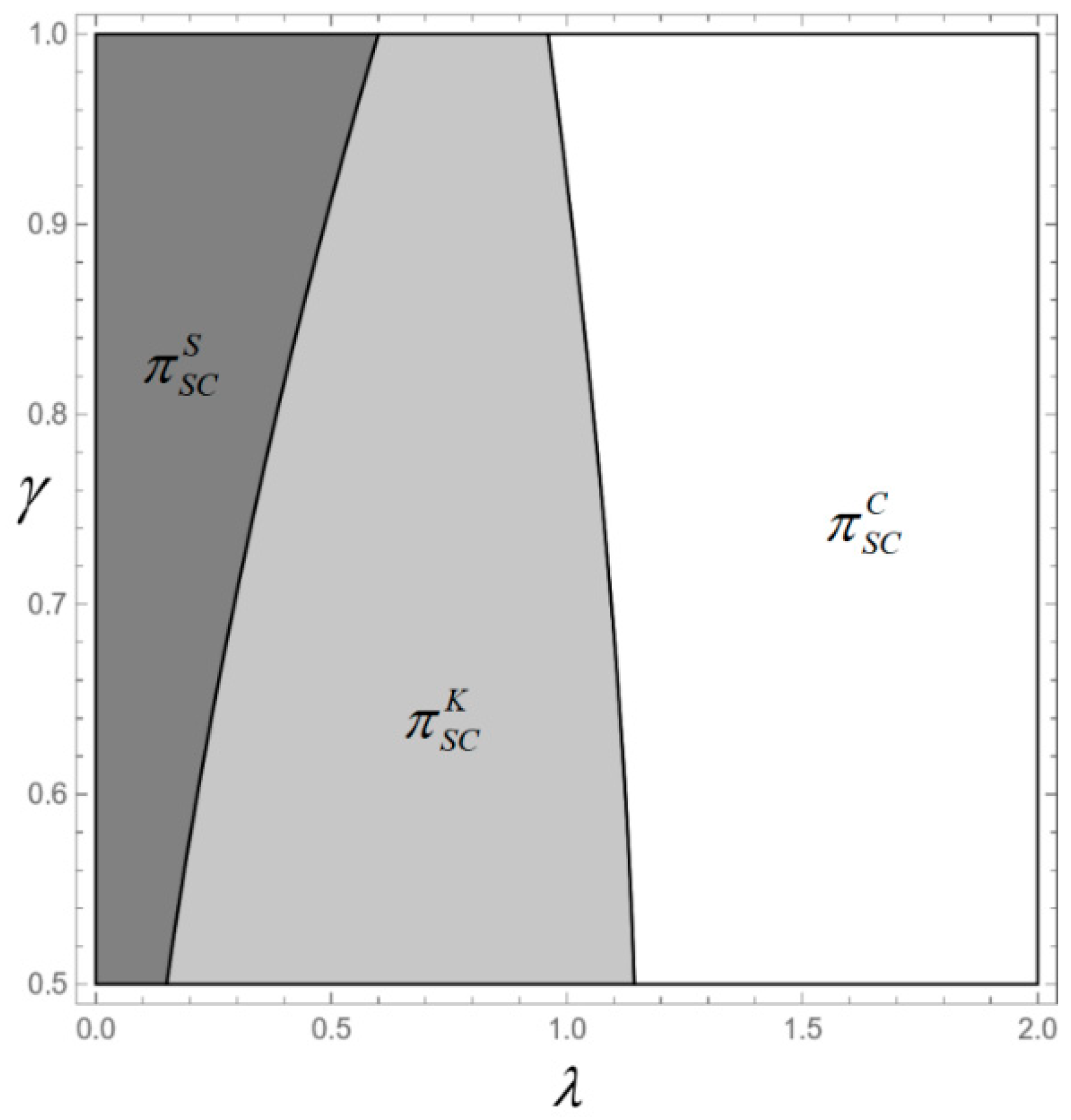
According to Proposition 7, supply chain profits are mainly affected by the joint effects of information leakage costs and technical information quality. In a low leakage cost scenario, the profit-sharing mechanism outperforms the contract mechanism, while in high leakage cost scenarios, it is the opposite. The cost-sharing mechanism is always superior to the contract mechanism under specific technical quality conditions: profits are highest with low technical quality and low information leakage costs; profits are moderate with low technical quality and high information leakage costs or high technical quality and low information leakage costs; profits significantly increase with high technical quality and high information leakage costs. Specifically, under low technical quality, cost-sharing mechanisms break through R&D bottlenecks through technological synergies and drive efficiency improvements in recovery processes, leading to profit advantages; under high technical quality, the profit-sharing mechanism covers income distribution costs through increased recoveries, gaining profit advantages. Additionally, under low information leakage costs, the profit-sharing mechanism promotes information-sharing through income redistribution, which offsets internal consumption increases; under high information leakage costs, the contract mechanism maintains basic efficiency through rigid constraints, while cost-sharing mechanisms enhance profit stability further through risk-sharing effects.
In summary, the cost-sharing mechanism has prominent technical synergy advantages in low technical quality situations; the profit-sharing mechanism has a superior recovery effect in high technical quality situations. In conditions of high leakage risk, the cost-sharing mechanism becomes preferred due to the risk-sharing effect, while the contract mechanism can also maintain stability in high technical quality situations. This forms an optimization rule of choosing cost-sharing for low technical quality and low information leakage, choosing profit-sharing for high technical quality and low information leakage, and switching between cost-sharing and contract mechanisms under high information leakage costs based on technical quality.

5.2. Numerical Analysis

To further examine the equilibrium structure of the proposed model and the performance differences under various incentive mechanisms, as well as to assess its feasibility in practical power battery recycling supply chains, this paper constructs a representative numerical case based on real industry data. Through parameter calibration, equilibrium solving, and sensitivity analysis, it systematically demonstrates the optimal decision-making behaviors and profit performances of manufacturers and recyclers under different incentive mechanisms. To ensure that the numerical calculations have realistic interpretability, key parameters are strictly defined in accordance with industry standards and relevant references. Specifically, the recycling value of the retired new energy vehicle battery is set at $30/kWh, drawing on metal recovery value estimates summarized by Pražanová et al. (2022) [33] and a review by Harper et al. (2019) [34] on secondary use battery module values—balancing rationality and robustness in recycler profits. Technical information-related parameters are set according to studies on information quality and supply chain collaboration as γ = 0.65 [35] and h = 0.6 [10], while the cost coefficient of information leakage λ is set at 0.8 following research on technology spillover in supply chains [25], reflecting moderate-to-high sensitivity within the power battery industry. The recycling demand function refers to the study by Parsaeifar et al. [14], with k = 1 and I = 2 . Regarding incentive parameters, information-sharing fee ρ is set at 10%, referencing supply chain profit-sharing studies [36], with a cost-sharing ratio established at 30% based on the research of Ma et al. (2020) [37]. Demand-side parameters, a = 800 , b = 2 , β = 1.2 , are derived from the research of Sheldon & Dua (2019) [38], which discuss battery demand scale, price sensitivity, and technology premium effects. Furthermore, to depict the impact of recycling rate constraints under the contract mechanism on the behavior of recyclers, this paper incorporates the reward–punishment intensity (reward–penalty strength) r T into the parameter system, where r reflects the reward or punishment level for battery manufacturers regarding recycling rates, and T represents the difference between the recycling rate set in a cooperation agreement and the actual recycling rate. Referring to existing policy incentives in recycling systems (such as EU battery regulations requiring a penalty coefficient structure for gradually increasing recycling rates to 70–80%), this paper sets r = 0.5 and T = 0.1 as baseline values to reflect industry practices that constrain recycling volume through reward–punishment measures under conditions lacking cost sharing and profit sharing in contracts. Based on these parameter settings, the numerical case can realistically simulate the decision-making behaviors of manufacturers and recyclers, as well as their market responses, under different incentive mechanisms.
Based on the above parameters, this paper incorporates the objective functions of manufacturers and recyclers under three types of incentive mechanisms into the model and solves for the equilibrium solution of the Stackelberg game using backward induction. First, by substituting parameters into the recycler’s profit function, its optimal recycling price is obtained; then this optimal equilibrium result is substituted back into the manufacturer’s profit function to determine its optimal sales price and technology level. Numerical results show that under the contract mechanism, due to a lack of profit-sharing or cost-sharing mechanisms, the marginal return on manufacturers’ technological investment is low. The resulting equilibrium solution is a sales price of $156/kWh, a recycling price of $28/kWh, a technology investment level of 0.58, with a corresponding recycling volume of approximately 420 units, and supply chain profit of about $148,000. After introducing a profit-sharing mechanism with ρ = 0.1 , the marginal return on technological investment increases; thus, the manufacturer’s optimal technology level rises to 0.72, the optimal sales price increases to $162/kWh, the recycling price is $80/kWh, the recycling quantity grows to 460 units, and supply chain profits reach approximately $161,000. Under the cost-sharing mechanism where recyclers bear 30% of technology investment costs, manufacturers’ effective input costs decrease further; their optimal technology level improves further to 0.80, sales price is $161/kWh, recycling price is $72/kWh, recycling quantity reaches 485 units, and supply chain profits are also about $161,000. These results indicate that both profit-sharing and cost-sharing mechanisms significantly enhance technological investment levels and recycling performance by improving profit or cost structures, respectively—thereby validating the important role incentive mechanism selection plays in promoting waste power battery recycling utilization.
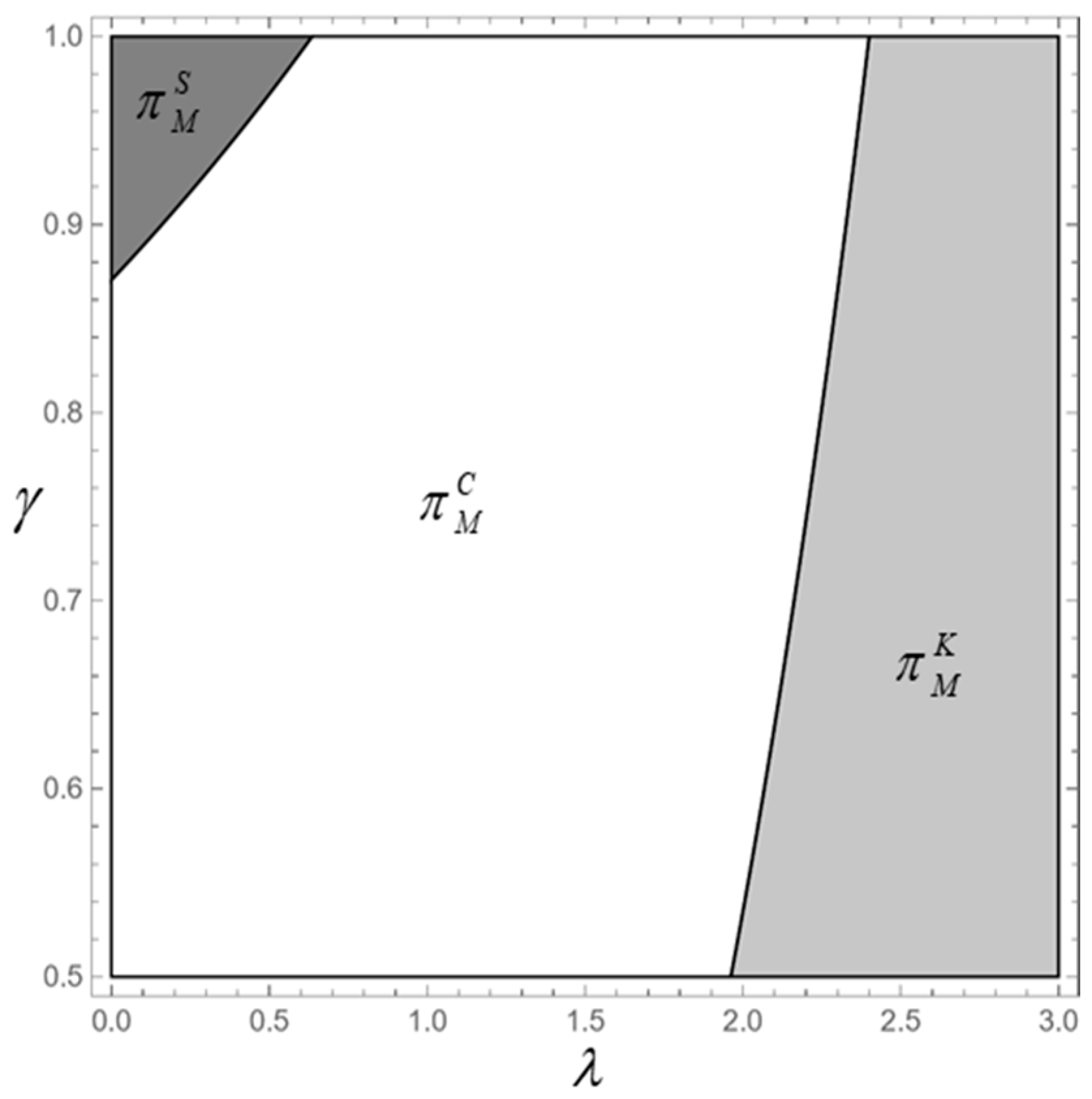
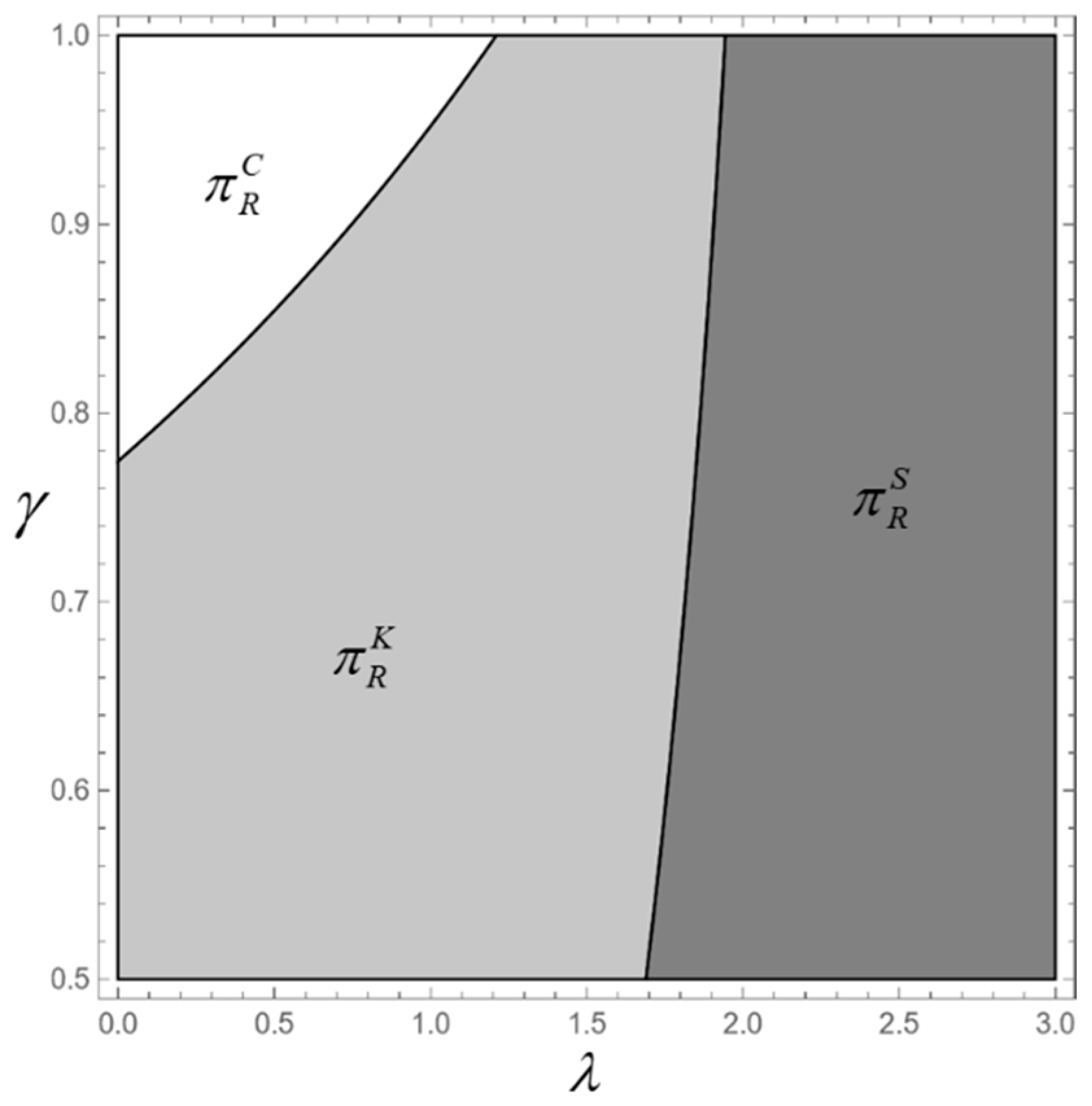
To further test the robustness of the model, this paper conducts a sensitivity analysis within the ranges γ [ 0.5 , 1.0 ] and λ [ 0 , 3.0 ] and plots two-dimensional region diagrams of manufacturer profit, recycler profit, and overall supply chain profit. As shown in Figure 3, Figure 4 and Figure 5, the results indicate that when information quality is low and information leakage costs are high, due to insufficient marginal returns on technological investment, contract mechanisms may have an advantage because of their simpler cost structure; when information quality is at a medium level, profit-sharing mechanisms perform best as they enhance incentives without additional upfront costs; when information quality is high and information leakage costs are moderate, cost-sharing mechanisms become optimal by reducing effective input costs; whereas when information leakage costs are extremely high, since cost-sharing mechanisms are more sensitive to input risks, profit-sharing mechanisms demonstrate greater robustness. More importantly, within the most practically representative industrial parameter range ( γ [ 0.6 , 0.8 ] , λ [ 0.5 , 1.5 ] ), both incentive mechanisms significantly outperform contract mechanisms—with cost-sharing performing most prominently under conditions of high information transparency.
Overall, from parameter settings and equilibrium solutions to sensitivity analyses, all numerical case evidence consistently shows that profit-sharing and cost-sharing mechanisms can effectively alleviate information asymmetry in the power battery recycling supply chain and strengthen manufacturers’ incentives for technological investment—thereby achieving higher recycling quantity and total supply chain profits. Furthermore, although this study uses representative industry benchmark parameters, future research could consider incorporating differentiated data for various battery types, conducting multi-stage dynamic decision analyses, or combining real enterprise cases for semi-empirical validation to further improve the model’s industrial applicability and external validity.

6. Result Analysis

The discussion examines how key parameters—information disclosure cost coefficient, technical information quality, and the coefficient of technical information’s impact on recycling quantity—affect equilibrium results in three scenarios. See Appendix B for details.

6.1. The Impact of the Cost Coefficient of Information Leakage on the Optimal Solutions

Given that the cost coefficient of information leakage plays a key regulatory role in decision-making behavior [30], this section conducts a sensitivity analysis on its changes to examine the impact of parameter fluctuations on the optimal strategy.
Proposition 8.
The impact of the cost coefficient of information leakage on the equilibrium results as follows:
(1) 
p C λ < 0 , x C λ < 0 , p r C λ > 0 , Q C λ < 0 , π M C λ < 0 , π R C λ < 0 .
(2) 
p S λ < 0 ,  x S λ < 0 ,  p r S λ > 0 ,  Q S λ < 0 , π M S λ < 0 , π R S λ < 0 .
(3) 
p K λ < 0 , x K λ < 0 , p r K λ > 0 , Q K λ < 0 , π M K λ < 0 . When γ < 2 k ( 1 α ) h 2 , π R K λ > 0 When 0 < λ < 2 k ( 1 + α ) β + h ( h β + k I ( 2 α β 2 ) ) γ 4 h k ( 1 + α ) + 2 h 3 γ ; π R K λ < 0 When λ 2 k ( 1 + α ) β + h ( h β + k I ( 2 α β 2 ) ) γ 4 h k ( 1 + α ) + 2 h 3 γ . When γ 2 k ( 1 α ) h 2 , π R K λ < 0 When 0 < λ < 2 k ( 1 + α ) β + h ( h β + k I ( 2 α β 2 ) ) γ 4 h k ( 1 + α ) + 2 h 3 γ ; π R K λ > 0 When λ 2 k ( 1 + α ) β + h ( h β + k I ( 2 α β 2 ) ) γ 4 h k ( 1 + α ) + 2 h 3 γ .
Proposition 8 shows that the cost coefficient of information leakage has a significant impact on optimal decision-making. Under the contract mechanism (model C ) and profit-sharing mechanism (model S ), the selling price of power batteries, technological level, recycling quantity of the retired new energy vehicle battery, and manufacturer and recycler profits all decrease as the cost coefficient of information leakage increases, while the unit recycling price of the retired new energy vehicle battery increases with it. The cost-sharing mechanism (model K ) exhibits a similar trend, but changes in recycler profits are influenced by both the level of technical information quality and the critical value of the cost coefficient of information leakage: when technical information quality is below the critical value, profits increase with an increase in leakage costs below this threshold but decrease above it; when above this threshold, the trend is reversed. An increase in information leakage costs leads to a decrease in manufacturers’ technological investment, which lowers sales prices to stimulate demand and thereby reduces recycling efficiency; although recyclers may raise their recycling prices to maintain recycling quantity collected, marginal effects are limited, resulting in decreased recycling quantity and profit ultimately. Under the cost-sharing mechanism, special changes in recycler profits stem from bearing technology investment costs; a dynamic balance between cost burden pressure and recycling income is determined by critical relationships between technical information quality and information leak costs.

6.2. The Impact of the Quality Level of Technical Information on the Optimal Solutions

After analyzing the impact of the cost coefficient of information leakage on the results, this section focuses on analyzing the impact of the quality level of technical information on the results in order to evaluate its impact on recycling quantity and provide a reference for pricing strategies.
Proposition 9.
The impact of the quality level of technical information on the equilibrium results is as follows:
(1) 
Q C γ > 0 , π R C γ > 0 .
(2) 
p S γ > 0 ,  x S γ > 0 ,  p r S γ < 0 ,  Q S γ > 0 , π M S γ > 0 , π R S γ > 0 .
(3) 
Q K γ > 0 , π R K γ > 0 .
Proposition 9 shows that the quality of technical information has a significant impact on the performance of all parties in the supply chain. As the quality of technical information improves, recycling efficiency increases, recyclers’ profits increase, and both recycling quantity and recycler profits also rise. Under the profit-sharing mechanism (model S ), improving the quality of technical information enhances the value of recycling revenue sharing, incentivizing manufacturers to increase their technological input to expand revenue sharing, while also increasing sales profits by raising selling prices. An increase in recycling quantity reduces recyclers’ dependence on high recycling prices, which leads to a decrease in unit recycling prices. The contract mechanism (model C ) and cost-sharing mechanism (model K ) do not directly link technological inputs with revenue sharing for recyclers; thus, only recyclers benefit from this system. Therefore, as the level of technical information quality improves, both recycling quantity and recycler profits increase significantly, while other indicators show no significant changes.

6.3. The Impact Coefficient of Technical Information on Recycling Quantity

Proposition 10.
The impact coefficient of technical information on recycling quantity affects the equilibrium results as follows:
(1) 
p C h < 0 , x C h < 0 , π M C h < 0 ; When 0 < h < β 4 λ , p r C h < 0 , Q C h > 0 , π R C h > 0 . When h β 4 λ , p r C h > 0 , Q C h < 0 , π R C h < 0 .
(2) 
When 0 < γ < 2 λ ρ ,  p S h < 0 x S h < 0 . When γ 2 λ ρ , p S h > 0 , x S h > 0 . When 0 < h < β 2 λ γ ρ , π M S h > 0 . When h β 2 λ γ ρ , π M S h < 0 . When 0 < h < β 2 ( 2 λ γ ρ ) , p r S h < 0 , Q S h > 0 , π R S h < 0 . When h β 2 ( 2 λ γ ρ ) , p r S h > 0 , Q S h < 0 , π R S h > 0 .
(3) 
p K h < 0 , x K h < 0 , π M K h < 0 . When 0 < h < β 4 λ , p r K h < 0 , Q K h > 0 . When h β 4 λ , p r K h > 0 , Q K h < 0 . When 0 < h β 4 λ , π R K h > 0 . When h > β 4 λ and 0 < γ < 4 k ( 1 α ) λ ( β 2 h λ ) ( 4 h λ β ) ( k I ( 2 α β 2 ) + h ( β 2 h λ ) ) , π R K h > 0 . When h > β 4 λ and γ 4 k ( 1 α ) λ ( β 2 h λ ) ( 4 h λ β ) ( k I ( 2 α β 2 ) + h ( β 2 h λ ) ) , π R K h < 0 .
Proposition 10 shows that technical information significantly affects the coefficient of impact on recycling quantity, influencing optimal decision-making in the supply chain. Under the contract mechanism (model C ), unit selling price, technological level, and manufacturer’s profit decrease as this coefficient increases; in the low-coefficient stage, the recycling price decreases while the recycling quantity and profits of recyclers increase, with the trend reversed in high-coefficient stages. In the profit-sharing mechanism (model S ), the quality level of technical information shapes performance between manufacturers and recyclers through unit information-sharing costs: in low-quality information stages, unit selling prices and technological levels decrease, while the trend reverses in high-quality information stages. The manufacturer’s profit and recycling quantity show different changes based on critical coefficients, with recycling prices decreasing or increasing; high-quality information can mitigate risks of information leakage through revenue sharing to incentivize manufacturers to increase technology input. Under the cost-sharing mechanism (model K ), unit selling prices, technological levels, and manufacturer’s profit decrease as coefficients increase; in the low-coefficient stages, recyclers’ recycling quantity and profits increase, with the trend reversed in high-coefficient stages where changes in recycler profits are influenced by both quality level of technical information and critical coefficients, which capture the dynamic balance between cost allocation and recycling income. Overall, during the low-coefficient stages, shared information significantly enhances recycling efficiency, leading to increased recyclers’ profits; however, during the high-coefficient stages, the risks of information leakage inhibit technology investment and efficiency, causing decreases in both the recycling quantity and overall profits.

7. Conclusions and Outlook

7.1. Conclusions

This article, based on the power battery recycling supply chain of new energy vehicles, develops three Stackelberg game models with manufacturers and recyclers as the principal participants, incorporating contract mechanisms, profit-sharing mechanisms, and cost-sharing mechanisms. The impact of technical information quality and information leakage costs on supply chain decisions and profits is systematically studied. By solving the models backwards to obtain equilibrium results and comparing the solutions under the three mechanisms, the study reveals differences in incentive mechanisms in terms of technology investment, recycling efficiency, price, and profit distribution, along with their optimal boundaries. The research conclusions are as follows.
This study reveals the critical roles of technical information quality and information leakage costs in the selection of three types of incentive mechanisms and supply chain performance. The results show that when technical information quality is low and information leakage costs are low, the cost-sharing mechanism effectively improves technology levels and increase recovery quantity by sharing technology investment costs, thereby achieving optimal overall supply chain performance; when technical information quality is high and information leakage costs are moderate, the profit-sharing mechanism alleviates risks through revenue distribution, incentivizing manufacturers to increase technology investment, which results in advantages for both overall supply chain performance and manufacturer profits; in contrast, due to a lack of cost-sharing and revenue compensation, the contract mechanism only maintains basic efficiency under extreme conditions where information leakage costs are very high and technical information quality is low, with its overall supply chain performance being the most limited. Further analysis indicates that increasing information leakage costs suppresses technology investment and recovery efficiency, while improving technical information quality not only enhances recovery efficiency and recycler profits but also creates positive feedback under the profit-sharing mechanism that further encourages manufacturers to increase technology investment. In summary, supply chain managers should dynamically select the optimal incentive mechanism based on actual information quality and the risks of information leakage to achieve an optimal balance among technology investment, recovery efficiency, and profit distribution—thereby enhancing the strategic value and sustainable management level of an information-driven supply chain.
The above conclusions mainly emphasize the advantages and applicable conditions of various incentive mechanisms, but in practical application, each mechanism may be accompanied by potential risks. The contract mechanism may lead to moral hazard issues such as data manipulation or selective recycling (only recycling easily processed batteries to meet recycling rate requirements) by recyclers; the profit-sharing mechanism may encounter disputes during profit accounting and auditing processes, and there is a risk of core technical information leakage to other parts of the supply chain in a highly competitive market environment; the cost-sharing mechanism may face a “free-rider” problem, where some participants invest insufficiently in shared technology development. These potential drawbacks not only remind managers to guard against them in mechanism design and implementation but also to provide directions for future research to further optimize incentive mechanisms and risk management.

7.2. Managerial Implications

Based on the conclusions, the key managerial implications are categorized into two perspectives: policymakers and industry practitioners, with specific insights as follows.
Policymakers should design differentiated subsidy schemes tailored to information quality levels. When recycling technologies are immature and information quality is low, cost-sharing subsidies can effectively alleviate manufacturers’ investment burden and enhance the overall efficiency of the recycling system. In contrast, when information quality is high, regulators should encourage profit-sharing arrangements by providing tax incentives or by strengthening intellectual property protection frameworks to reduce the risk of information leakage ( λ ). Additionally, promoting the adoption of digital traceability technologies—such as blockchain, secure coding, and standardized certification systems—can further lower information leakage costs and facilitate more efficient information sharing across the supply chain. Moreover, in the face of potential risks associated with various incentive mechanisms, policymakers can establish a systematic top-level framework for risk control. Specifically, a credit supervision system based on digital traceability throughout the battery’s entire lifecycle should be established to address moral hazards that may arise from contract mechanisms; standardized contract templates and third-party audit mechanisms should be promoted to resolve potential disputes and information leakage issues within profit-sharing mechanisms; a targeted subsidy mechanism based on R&D investment and knowledge output should be constructed to curb free-riding behaviors in cost-sharing mechanisms, and tiered or menu-style policy tools should be provided to flexibly support cooperation models with different risk characteristics, guiding the industry toward forming a healthy and sustainable cooperative ecosystem.
Manufacturers should prioritize cost-sharing contracts when confronting low information quality or early-stage recycling technologies, as these mechanisms mitigate unilateral investment pressure and stabilize return on investment. When information quality is high, profit-sharing mechanisms become more advantageous, as they amplify the value of shared information through rational revenue redistribution. Recyclers should strategically adjust recycling prices based on predicted information leakage costs ( λ ) and negotiate contract terms—such as minimum recycling rate thresholds or cost-sharing ratios—that align with their capacity to process and utilize high-quality technical information. In addition, in response to the potential risks associated with different incentive mechanisms, manufacturers and recyclers should implement refined governance in supply chain cooperation. Under the contract mechanisms, manufacturers enhance performance assessment through process transparency and joint audits to reduce moral hazard, while recyclers cooperate with relevant processes to enhance their reputation and their willingness to fulfill obligations; under the profit-sharing mechanisms, manufacturers incentivize recyclers through clear rules, data co-management, and structured information hierarchy, while recyclers follow norms to improve the quality of information sharing and reduce disputes; under the cost-sharing mechanisms, manufacturers quantify the contributions of recyclers through milestone agreements and dynamic equity adjustments to prevent insufficient investment, while recyclers adjust their investments according to agreements and signal long-term cooperative intentions. This transforms potential risks into opportunities for deepening mutual trust and strengthening cooperation.

7.3. Research Limitations and Future Research Directions

This study still has some limitations. Firstly, while linear demand and a uniform distribution of information quality enable closed-form equilibrium solutions and are commonly used in Stackelberg analyses, they may not adequately reflect the diversity of consumer preferences or the actual distribution of technical information quality in practice. Nonetheless, these simplifications may primarily affect the magnitude but not the direction of comparative statics. Future work could refine the model by using nonlinear demand or a beta-distributed information quality framework, potentially revealing richer dynamics while preserving core insights on mechanism selection. Secondly, this study excludes technological evolution and external shocks, focusing only on information-sharing decisions under a fixed technology level. Future research could incorporate factors such as technological change rates, policy shifts, and market demand volatility to uncover new equilibrium characteristics, thus yielding management insights of greater practical value.

Author Contributions

Conceptualization, J.C. and J.J.; methodology, J.C.; software, J.J.; validation, J.C. and J.J.; formal analysis, J.C.; investigation, J.J.; resources, J.C.; data curation, J.J.; writing—original draft preparation, J.J.; writing—review and editing, J.C.; visualization, J.J.; supervision, J.C.; project administration, J.C.; funding acquisition, J.C. All authors have read and agreed to the published version of the manuscript.

Funding

This work is supported by the Philosophy and Social Science Planning Project of Anhui Province (NO. AHSKY2021D18), and the University Synergy Innovation Program of Anhui Province (NO. GXXT-2023-093).

Institutional Review Board Statement

Not applicable.

Informed Consent Statement

Not applicable.

Data Availability Statement

The original contributions presented in this study are included in the article. Further inquiries can be directed to the corresponding author.

Conflicts of Interest

The authors declare no conflict of interest.

Nomenclature

Parameters
β Impact coefficient of technical information on sales
k Consumer sensitivity coefficient to recycling price
h Impact coefficient of technical information on recycling quantity
I Unit revenue of the retired new energy vehicle battery
γ The quality level of technical information
λ Cost coefficient of information leakage
D Demand for the new energy vehicle battery
Q Recycling quantity of the retired new energy vehicle battery
ρ Unit information-sharing fee
θ Recovery rate of the retired new energy vehicle battery
r The reward or punishment level for battery manufacturers regarding recycling rates
α The proportion of shared costs for technical information
π M The profit of the manufacturer
π R The profit of the recycler
π SC Supply chain profit
Decision variables
p Unit selling price of the new energy vehicle battery
p r Unit recycling price of the retired new energy vehicle battery
x The investment level of battery technology
Superscripts
C Contract mechanism
S Profit-sharing mechanism
K Cost-sharing mechanism

Appendix A. Proofs of the Derivation of Equilibrium Results

The following appendix contains the detailed proofs of the key results presented in this paper.
Proof. 
In the contract mechanism (model C ), according to the profit function of the battery recycler (2), we first calculate the derivative with respect to p r , obtaining d π R C d p r = ( h x + k ( 2 p r + I ) ) γ , then we compute its second derivative as d 2 π R C d p r 2 = 2 k γ < 0 , and solve for the first-order condition to get p r = h x + k I 2 k . We substitute p r = h x + k I 2 k into the profit function of the battery manufacturer (1), and then simultaneously determine the Hessian matrix for p and x as H = 2 π M C p 2 2 π M C p x 2 π M C x p 2 π M C x 2 = ( 2 β β 1 ) , with a negative determinant for the first-order condition and positive determinant for the second-order condition, indicating a unique optimal solution. By solving π M C p = 0 and π M C x = 0 simultaneously, we obtain p C = 1 h β λ 2 β 2 , x C = β 2 h λ 2 β 2 . Then we substitute x C = β 2 h λ 2 β 2 into recycling prices, which gives p r C = 2 k I h β k I β 2 + 2 h 2 λ 2 k ( 2 β 2 ) . Finally, substituting p C = 1 h β λ 2 β 2 , x C = β 2 h λ 2 β 2 , and p r C = 2 k I h β k I β 2 + 2 h 2 λ 2 k ( 2 β 2 ) into both profit functions of battery manufacturers and recyclers yields optimal recycling quantity Q C = γ 2 k I + h β k I β 2 2 h 2 λ 2 2 β 2 , optimal manufacturer π M C = 1 + 2 r T 2 β 2 2 h λ β h λ 2 2 β 2 , recycler π R C = γ k I 2 β 2 + h β 2 h λ 2 4 k 2 β 2 2 r T , thus obtaining an optimal supply chain profit π C = k 2 I 2 2 β 2 2 γ + h 2 γ β 2 h λ 2 + 2 k 2 β 2 1 + h I β γ 2 β + h I γ λ + 2 h λ 2 4 k 2 β 2 2 . The proof process for the profit-sharing mechanism (model S ) and the cost-sharing mechanism (model K ) can be similarly obtained. □

Appendix B. Proofs of Proposition in the Main Text

In this appendix, we provide detailed proofs for the propositions and theorems presented in the main text.
Proof of Propositions 1 and 2.
p C p S = h β γ ρ 2 ( 2 + β 2 ) , according to the optimal result analysis, 2 + β 2 < 0 , 2 α β 2 > 0 , β 2 h λ > 0 , 1 α > 0 , so p C < p S . p K p C = 1 α β β 2 h λ 2 α β 2 2 β 2 > 0 , so p K > p C , p K p S ( 2 β 2 + 2 α β 2 + 4 h β λ 4 h α β λ + 2 h α β γ ρ h β 3 γ ρ ) 2 ( 2 α β 2 ) ( 2 β 2 ) because 2 α β 2 > 0 . Therefore, we only need to judge its numerator. Solving for the numerator yields that when 0 < λ < β 2 h ( 2 α β 2 ) γ ρ 1 α then p K > p S , and when λ β 2 h ( 2 α β 2 ) γ ρ 1 α then p K p S . Thus when 0 < λ < β 2 h ( 2 α β 2 ) γ ρ 1 α then p K > p S > p C , and when λ β 2 h ( 2 α β 2 ) γ ρ 1 α then p C p K p S . Proposition 1 is proven and similarly Proposition 2 can be proven as well. □
Proof of Proposition 3.
According to the calculation results and model assumptions, p r C p r S = 1 2 ( 1 + h 2 γ 2 k k β 2 ) ρ > 0 , so p r C > p r S . p r K p r C = h 1 + α β 2 h λ k 2 + β 2 2 α + β 2 < 0 , p r K < p r C . p r K p r S = 2 h ( 1 + α ) ( β 2 h λ ) + ( 2 α β 2 ) ( k ( 2 β 2 ) + h 2 γ ) ρ 2 k ( 2 α β 2 ) ( 2 β 2 ) , where the denominator is greater than 0; the numerator can be obtained by solving the numerator, when 0 < λ < 2 h ( 1 α ) β ( 2 α β 2 ) ( k ( 2 β 2 ) + h 2 γ ) ρ 4 h 2 ( 1 α ) , p r K < p r S ; when λ 2 h ( 1 α ) β ( 2 α β 2 ) ( k ( 2 β 2 ) + h 2 γ ) ρ 4 h 2 ( 1 α ) , p r K p r S . Thus Proposition 3 is proven. □
Proof of Proposition 4.
Q C Q S = γ ( 2 k k β 2 h 2 γ ) ρ 2 ( 2 β 2 ) , solving for the numerator, when 0 < γ < 2 k k β 2 h 2 , Q C > Q S , when γ 2 k k β 2 h 2 , Q C Q S . Q K Q C = h ( 1 + α ) γ ( β + 2 h λ ) ( 2 + β 2 ) ( 2 α + β 2 ) > 0 , so Q K > Q C . Q K Q S = 2 h ( 1 α ) γ ( β 2 h λ ) ( 2 α β 2 ) γ ( k ( 2 + β 2 ) + h 2 γ ) ρ 2 ( 2 α β 2 ) ( 2 β 2 ) ; determining the numerator yields that when γ 2 k k β 2 h 2 , k ( 2 β 2 ) h 2 γ 0 , then Q K > Q S ; when γ 2 k k β 2 h 2 is considered as a function of λ and solved, it becomes λ < 2 h ( 1 α ) β + ( 2 α β 2 ) ( k ( 2 β 2 ) h 2 γ ) ρ 4 h 2 ( 1 α ) , then Q K > Q S and λ 2 h ( 1 α ) β + ( 2 α β 2 ) ( k ( 2 β 2 ) h 2 γ ) ρ 4 h 2 ( 1 α ) , then Q K Q S . Thus Proposition 4 is proven. □
Proof of Propositions 5 and 6.
π M C π M S = ( 8 r T + 4 r T β 2 + 4 k I γ ρ + 2 h β γ ρ 2 k I β 2 γ ρ 4 h 2 γ λ ρ 4 k γ ρ 2 + 2 k β 2 γ ρ 2 + h 2 γ 2 ρ 2 ) 4 ( 2 β 2 ) , where the denominator is greater than 0; determine the size of the numerator. Consider the numerator as a function of λ for solving. When 0 < λ < λ 1 , π M C < π M S ; when λ λ 1 , π M C π M S ; where λ 1 = γ ρ ( 2 k ( 2 β 2 ) ( I ρ ) + h ( 2 β + h γ ρ ) ) 4 r T ( 2 β 2 ) 4 h 2 γ ρ . π M K π M C = 2 r T ( 2 α β 2 ) ( 2 + β 2 ) ( 1 + α ) ( β 2 h λ ) 2 2 ( 2 + β 2 ) ( 2 α + β 2 ) , where the denominator is greater than 0, determine the numerator. The numerator can be seen as a one-variable quadratic equation in terms of λ . a = 4 h 2 ( 1 α ) > 0 , b = 4 h ( 1 α ) β < 0 , c = ( 1 α ) β 2 + 2 r T ( 2 α β 2 ) ( 2 + β 2 ) because r T belongs to a relatively large subsidy amount and ( 1 α ) belongs to relatively small coefficients so Δ = b 2 4 a c > 0 is obtained (one positive solution and one negative solution). Solving it gives 0 < λ < λ 2 , then π M K < π M C ; when λ λ 2 , then π M K π M C ; λ 2 = h β ( 1 α ) + 2 h 2 r T ( 1 α ) ( 2 α β 2 ) ( 2 β 2 ) 2 h 2 ( 1 α ) > 0 . π M K π M S = 2 ( 1 α ) ( β 2 h λ ) 2 + 2 ( 2 α β 2 ) γ ( k I ( 2 + β 2 ) + h ( β + 2 h λ ) ) ρ + ( 2 α β 2 ) γ ( 2 k ( 2 β 2 ) h 2 γ ) ρ 2 4 ( 2 α β 2 ) ( 2 β 2 ) , where the denominator is greater than 0; determine the numerator. When 0 < λ < λ 3 , then π M K < π M S ; when λ λ 3 , then π M K π M S . Prove Proposition 5 by rearranging. Similarly Proposition 6 can be proven. □
Proof of Proposition 7.
π S C C < π S C S = γ ρ ( 2 h 3 β γ + h 2 k ( 2 + β 2 ) γ ( 2 I ρ ) + k 2 ( 2 β 2 ) 2 ρ + h 4 γ ( 4 λ γ ρ ) ) 4 k ( 2 β 2 ) 2 , where the denominator is greater than 0; judge the size of the numerator only and solve it accordingly. When 0 < λ < 2 h 3 β γ h 2 k ( 2 + β 2 ) γ ( 2 I ρ ) k 2 ( 2 β 2 ) 2 ρ + h 4 γ 2 ρ 4 h 4 γ , π S C C < π S C S ; when λ 2 h 3 β γ h 2 k ( 2 + β 2 ) γ ( 2 I ρ ) k 2 ( 2 β 2 ) 2 ρ + h 4 γ 2 ρ 4 h 4 γ , π S C C π S C S . Similarly, it can be proven that π S C K and π S C C as well as π S C K and π S C S have a relationship in size. Proposition 7 is proven. □
Proof of Proposition 8–10.
According to the analysis of the optimal result, 2 + β 2 < 0 , 2 α β 2 > 0 , β 2 h λ > 0 , 1 α > 0 , Q C λ = h 2 γ 2 β 2 < 0 , Q C γ = 2 k z + h β k z β 2 2 h 2 λ 2 ( 2 β 2 ) > 0 . When 0 < h < β 4 λ , Q C h = γ ( β 4 h λ ) 2 ( 2 β 2 ) > 0 . When h β 4 λ , Q C h = γ ( β 4 h λ ) 2 ( 2 β 2 ) < 0 . Similarly, Propositions 8–10 are proven. □

References

  1. Chen, Z.S.; Wu, S.; Govindan, K.; Wang, X.J.; Chin, K.S.; Martíınez, L. Optimal pricing decision in a multi-channel supply chain with a revenue-sharing contract. Ann. Oper. Res. 2022, 318, 67–102. [Google Scholar] [CrossRef]
  2. Xiao, M.; Xu, C.; Xie, F. Research on the impact of information sharing and government subsidy on competitive power battery recycling. J. Clean. Prod. 2024, 467, 142989. [Google Scholar] [CrossRef]
  3. Wang, W.; Ding, J.; Sun, H. Reward-penalty mechanism for a two-period closed-loop supply chain. J. Clean. Prod. 2018, 203, 898–917. [Google Scholar] [CrossRef]
  4. Kshetri, N. Blockchain and sustainable supply chain management in developing countries. Int. J. Inf. Manag. 2021, 60, 102376. [Google Scholar] [CrossRef]
  5. Li, X.; Liu, R.; Hu, Z.; Dong, J. Information sharing in two-tier supply chains considering cost reduction effort and information leakage. J. Ind. Manag. Optim. 2022, 19, 645–674. [Google Scholar] [CrossRef]
  6. Teng, T.; Tsinopoulos, C.; Tse, Y.K. IS capabilities, supply chain collaboration and quality performance in services: The moderating effect of environmental dynamism. Ind. Manag. Data Syst. 2022, 122, 1592–1619. [Google Scholar] [CrossRef]
  7. Sahoo, S.; Kumar, S.; Sivarajah, U.; Lim, W.M.; Westland, J.C.; Kumar, A. Blockchain for sustainable supply chain management: Trends and ways forward. Electron. Commer. Res. 2024, 24, 1563–1618. [Google Scholar] [CrossRef]
  8. Dai, Y.; Dou, L.; Song, H.; Zhou, L.; Li, H. Two-way information sharing of uncertain demand forecasts in a dual-channel supply chain. Comput. Ind. Eng. 2022, 169, 108162. [Google Scholar] [CrossRef]
  9. Nie, J.; Wang, Q.; Li, G.; Liu, D. To share or not to share? When information sharing meets remanufacturing. Ann. Oper. Res. 2023, 329, 815–846. [Google Scholar] [CrossRef]
  10. Alamerew, Y.A.; Brissaud, D. Modelling reverse supply chain through system dynamics for realizing the transition towards the circular economy: A case study on electric vehicle batteries. J. Clean. Prod. 2020, 254, 120025. [Google Scholar] [CrossRef]
  11. Qian, Z.; Ignatius, J.; Chai, J.; Valiyaveettil, K.M.T. To Cooperate or Not: Evaluating process innovation strategies in battery recycling and product innovation. Int. J. Prod. Econ. 2025, 283, 109559. [Google Scholar] [CrossRef]
  12. Zhang, Q.; Jin, W.; Tsao, Y.C. Optimal decisions of power battery production and repurposing rate under different repurposed battery markets and repurposing parties. Int. J. Prod. Res. 2025, 63, 10075–10090. [Google Scholar] [CrossRef]
  13. Jia, J.; Chen, W.; Wang, Z.; Shi, L.; Fu, S. Blockchain’s role in operation strategy of power battery closed-loop supply chain. Comput. Ind. Eng. 2024, 198, 110742. [Google Scholar] [CrossRef]
  14. Parsaeifar, S.; Bozorgi-Amiri, A.; Naimi-Sadigh, A.; Sangari, M.S. A game theoretical for coordination of pricing, recycling, and green product decisions in the supply chain. J. Clean. Prod. 2019, 226, 37–49. [Google Scholar] [CrossRef]
  15. Gong, B.; Gao, Y.; Li, K.W.; Liu, Z.; Huang, J. Cooperate or compete? A strategic analysis of formal and informal electric vehicle battery recyclers under government intervention. Int. J. Logist. Res. Appl. 2024, 27, 149–169. [Google Scholar] [CrossRef]
  16. Li, X.; Du, J.; Liu, P.; Wang, C.; Hu, X.; Ghadimi, P. Optimal choice of power battery joint recycling strategy for electric vehicle manufacturers under a deposit-refund system. Int. J. Prod. Res. 2023, 61, 7281–7301. [Google Scholar] [CrossRef]
  17. Wang, Z.; Wang, Y.; Gong, Y.; Zhan, J. Cooperate or not? Strategic analysis of formal and informal recyclers under different retired power battery recycling market structures. Comput. Ind. Eng. 2024, 193, 110294. [Google Scholar] [CrossRef]
  18. Wu, D.; Qiu, Y.; Xue, M. Decision optimization of new energy vehicle supply chain considering information sharing for perceived quality under dual credit policy. J. Ind. Manag. Optim. 2025, 21, 4536–4559. [Google Scholar] [CrossRef]
  19. Zhu, M.; Liu, Z.; Li, J.; Zhu, S.X. Electric vehicle battery capacity allocation and recycling with downstream competition. Eur. J. Oper. Res. 2020, 283, 365–379. [Google Scholar] [CrossRef]
  20. Qi, Y.; Yao, W.; Zhu, J. Study on the Selection of Recycling Strategies for the Echelon Utilization of Electric Vehicle Batteries under the Carbon Trading Policy. Sustainability 2024, 16, 7737. [Google Scholar] [CrossRef]
  21. Wei, H.; Qi, Z. Pricing Strategy for Sustainable Recycling of Power Batteries Considering Recycling Competition Under the Reward–Penalty Mechanism. Sustainability 2025, 17, 7224. [Google Scholar] [CrossRef]
  22. Feng, L.; Qu, M.; Ng, A.K.; Jia, P.; Kuang, H. Battery recycling models selection and contractual incentives: From an information sharing perspective. J. Clean. Prod. 2024, 462, 142701. [Google Scholar] [CrossRef]
  23. Rahmani, M.; Gui, L.; Atasu, A. The implications of recycling technology choice on extended producer responsibility. Prod. Oper. Manag. 2021, 30, 522–542. [Google Scholar] [CrossRef]
  24. Kankam, G.; Kyeremeh, E.; Som, G.N.K.; Charnor, I.T. Information quality and supply chain performance: The mediating role of information sharing. Supply Chain Anal. 2023, 2, 100005. [Google Scholar] [CrossRef]
  25. Li, Q.X.; Ji, H.M.; Huang, Y.M. The information leakage strategies of the supply chain under the block chain technology introduction. Omega 2022, 110, 102616. [Google Scholar] [CrossRef]
  26. Kong, G.; Rajagopalan, S.; Zhang, H. Revenue sharing and information leakage in a supply chain. Manag. Sci. 2013, 59, 556–572. [Google Scholar] [CrossRef]
  27. Xu, H.; Liu, X.; Huang, H.; Zhou, Y.; Wei, Y. Innovation information sharing between two competitive supply chains. Int. Trans. Oper. Res. 2022, 29, 471–495. [Google Scholar] [CrossRef]
  28. Yi, Y.; Fu, A.; Li, Y.; Zhang, A. Battery recycling and coordination in information leakage prevention under blockchain technology in a new energy vehicles supply chain. Energy Econ. 2024, 139, 107862. [Google Scholar] [CrossRef]
  29. Zhang, D.Y.; Cao, X.; Wang, L.; Zeng, Y. Mitigating the risk of information leakage in a two-level supply chain through optimal supplier selection. J. Intell. Manuf. 2012, 23, 1351–1364. [Google Scholar] [CrossRef]
  30. Niu, B.; Dai, Z.; Chen, L. Information leakage in a cross-border logistics supply chain considering demand uncertainty and signal inference. Ann. Oper. Res. 2022, 309, 785–816. [Google Scholar] [CrossRef]
  31. Xiang, Y.; Liu, Y. Global sustainable supply chain governance, effectiveness of social responsibility, and performance in emergent markets: An exploratory multiple case study. Rev. Adm. Empresas 2025, 65, e2024-0587. [Google Scholar]
  32. Wu, B.; Ren, K.; Fu, Y.; He, D.; Pan, M. Institutional investor ESG activism and green supply chain management performance: Exploring contingent roles of technological interdependences in different digital intelligence contexts. Technol. Forecast. Soc. Change 2024, 209, 123789. [Google Scholar] [CrossRef]
  33. Pražanová, A.; Knap, V.; Stroe, D.I. Literature review, recycling of lithium-ion batteries from electric vehicles, part I: Recycling technology. Energies 2022, 15, 1086. [Google Scholar] [CrossRef]
  34. Harper, G.; Sommerville, R.; Kendrick, E.; Driscoll, L.; Slater, P.; Stolkin, R.; Walton, A.; Christensen, P.; Heidrich, O.; Lambert, S.; et al. Recycling lithium-ion batteries from electric vehicles. Nature 2019, 575, 75–86. [Google Scholar] [CrossRef] [PubMed]
  35. Tao, J.; Wang, S.; Cao, W.; Takyi-Aninakwa, P.; Fernandez, C.; Guerrero, J.M. A comprehensive review of state-of-charge and state-of-health estimation for lithium-ion battery energy storage systems. Ionics 2024, 30, 5903–5927. [Google Scholar] [CrossRef]
  36. Kuchesfehani, E.K.; Parilina, E.M.; Zaccour, G. Revenue and cost sharing contract in a dynamic closed-loop supply chain with uncertain parameters. Ann. Oper. Res. 2023, 322, 851–877. [Google Scholar]
  37. Ma, N.; Gao, R.; Wang, X.; Li, P. Green supply chain analysis under cost sharing contract with uncertain information based on confidence level. Soft Comput.-Fusion Found. Methodol. Appl. 2020, 24, 2617–2635. [Google Scholar] [CrossRef]
  38. Sheldon, T.L.; Dua, R. Measuring the cost-effectiveness of electric vehicle subsidies. Energy Econ. 2019, 84, 104545. [Google Scholar] [CrossRef]
Figure 1. Game logic framework diagram.
Sustainability 18 00144 g001
Figure 2. Timeline of events.
Sustainability 18 00144 g002
Figure 3. Comparison of manufacturer profits in three scenarios.
Sustainability 18 00144 g003
Figure 4. Comparison of recycler profits in three scenarios.
Sustainability 18 00144 g004
Figure 5. Comparison of supply chain profits in three scenarios.
Sustainability 18 00144 g005
Disclaimer/Publisher’s Note: The statements, opinions and data contained in all publications are solely those of the individual author(s) and contributor(s) and not of MDPI and/or the editor(s). MDPI and/or the editor(s) disclaim responsibility for any injury to people or property resulting from any ideas, methods, instructions or products referred to in the content.