Selection of Medical Waste Disposal Method for a University Hospital Using Hybrid Multi-Criteria Decision-Making Methods: A Case Study in Adana Province, Turkey


Abstract
1. Introduction
Original Contributions of Research
2. Materials and Methods
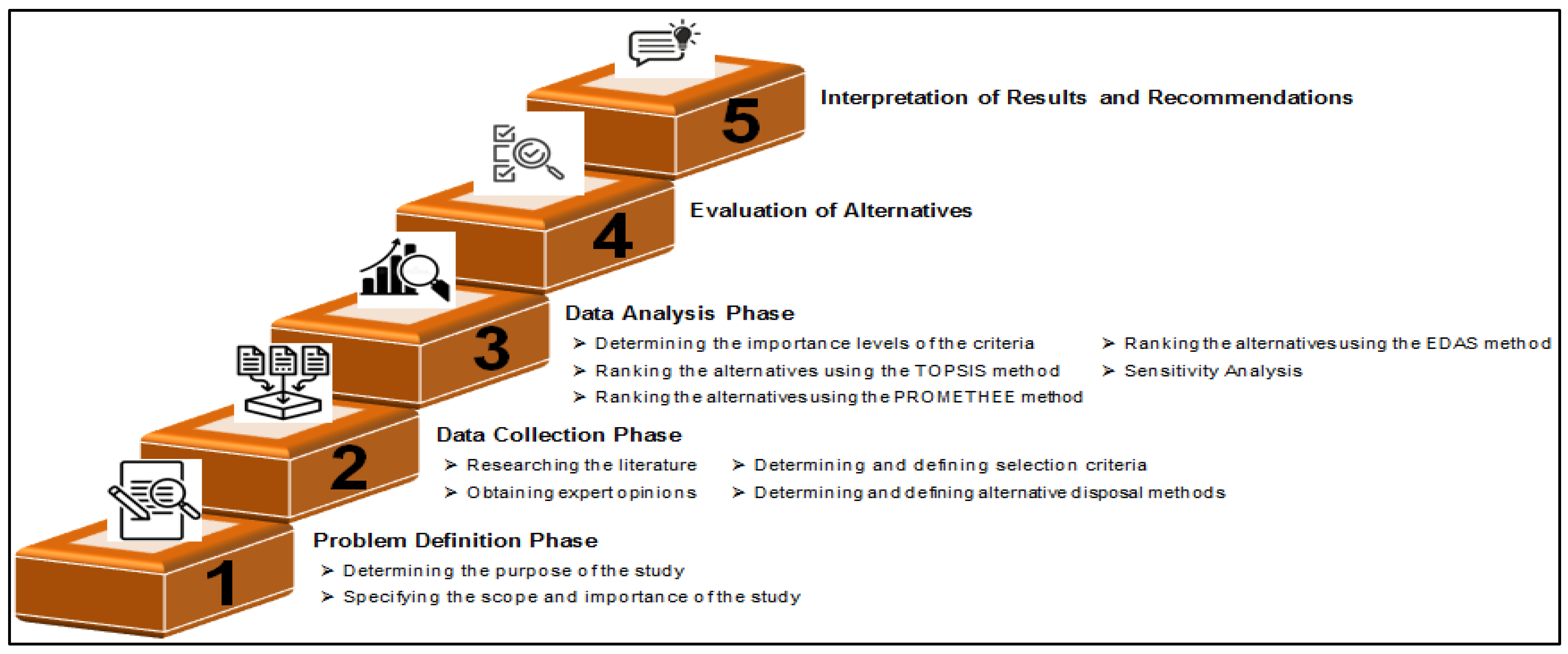
2.1. Methodology of Research
2.2. Data Collection
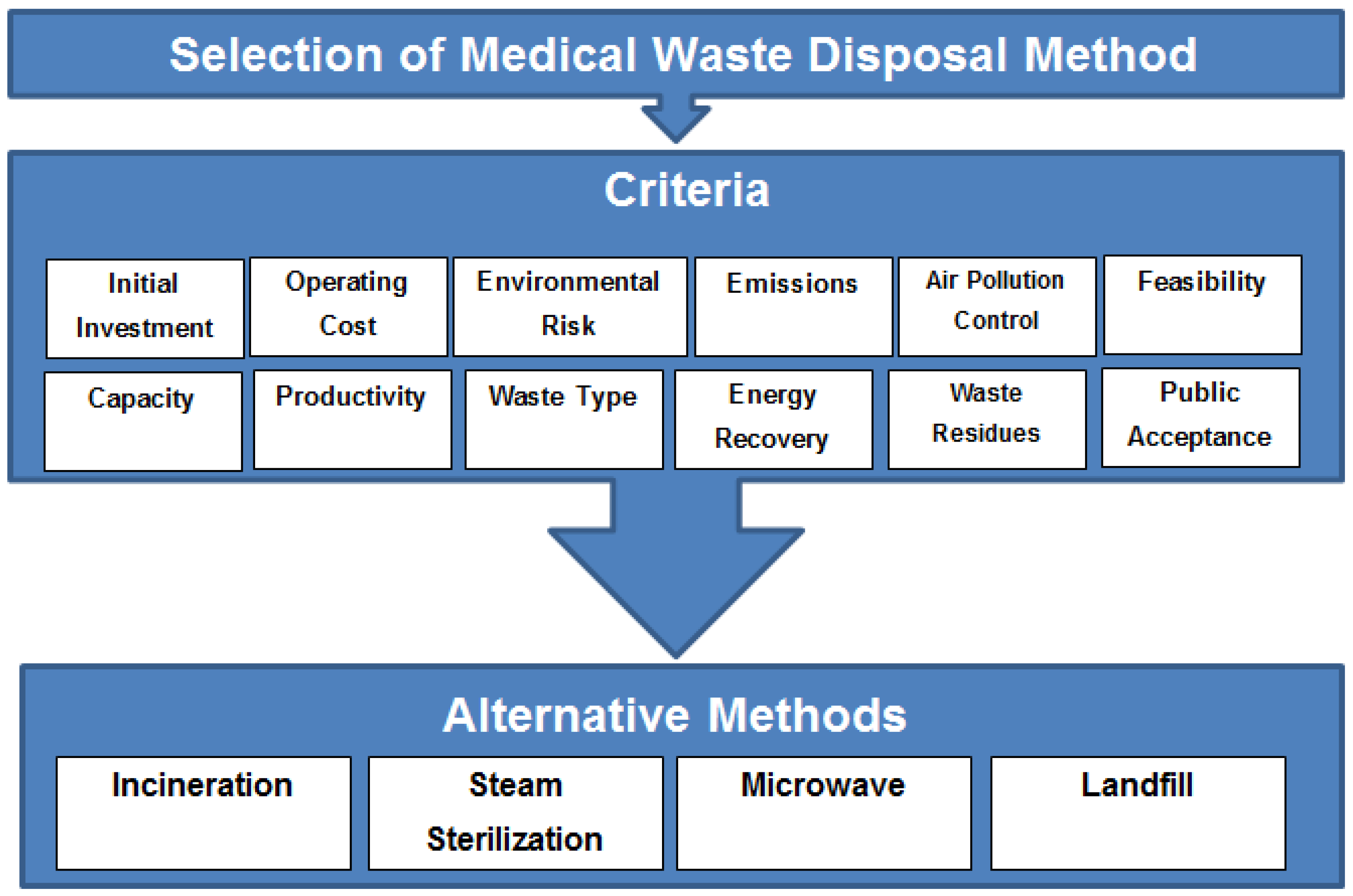
2.2.1. Defining the Method Selection Problem for Medical Waste Disposal
2.2.2. Defining Criteria for Selection of Medical Waste Disposal Method
- Initial Construction Cost (ICC)
- Operating Costs (OC)
- Environmental Risk (Public health and safety) (ER)
- Emissions (E)
- Air Pollution Control (APC)
- Feasibility (F)
- Capacity (C)
- Productivity (P)
- Types of Waste That Can Be Disposed of (TOW)
- Energy Recovery (ERE)
- Waste Residue (WR)
- Public Acceptance (PA)
2.2.3. Defining the Alternative Medical Waste Disposal Methods
- Dual-chamber starved-air incinerators: This method consists of a primary and a secondary chamber. The primary chamber: While decomposing waste through an oxygen-poor, medium-temperature combustion process (800–900 °C), it produces solid ashes and gases. The secondary chamber performs high-temperature incineration (1100–1600 °C) using excess air to minimize gases, smoke, carbon monoxide, and odors. These facilities are designed to incinerate infectious medical waste.
- Multiple Chamber Incinerators: These types include in-line incinerators and retort incinerators and are used for pathological waste. These facilities operate in excess-air mode and use supplemental fuel to reach temperatures of approximately 800–1000 °C.
- Rotary Kilns: These facilities have a rotating furnace and a post-combustion chamber. They can typically reach temperatures between 900 °C and 1200 °C. Because they can reach high temperatures capable of degrading genotoxic substances and heat-resistant chemicals, they can be designed specifically for the incineration of chemical waste. When appropriate combustion conditions and effective flue gas cleaning systems are used, they can be used in large-scale regional medical waste incineration facilities or for the disposal of other hazardous/toxic wastes.
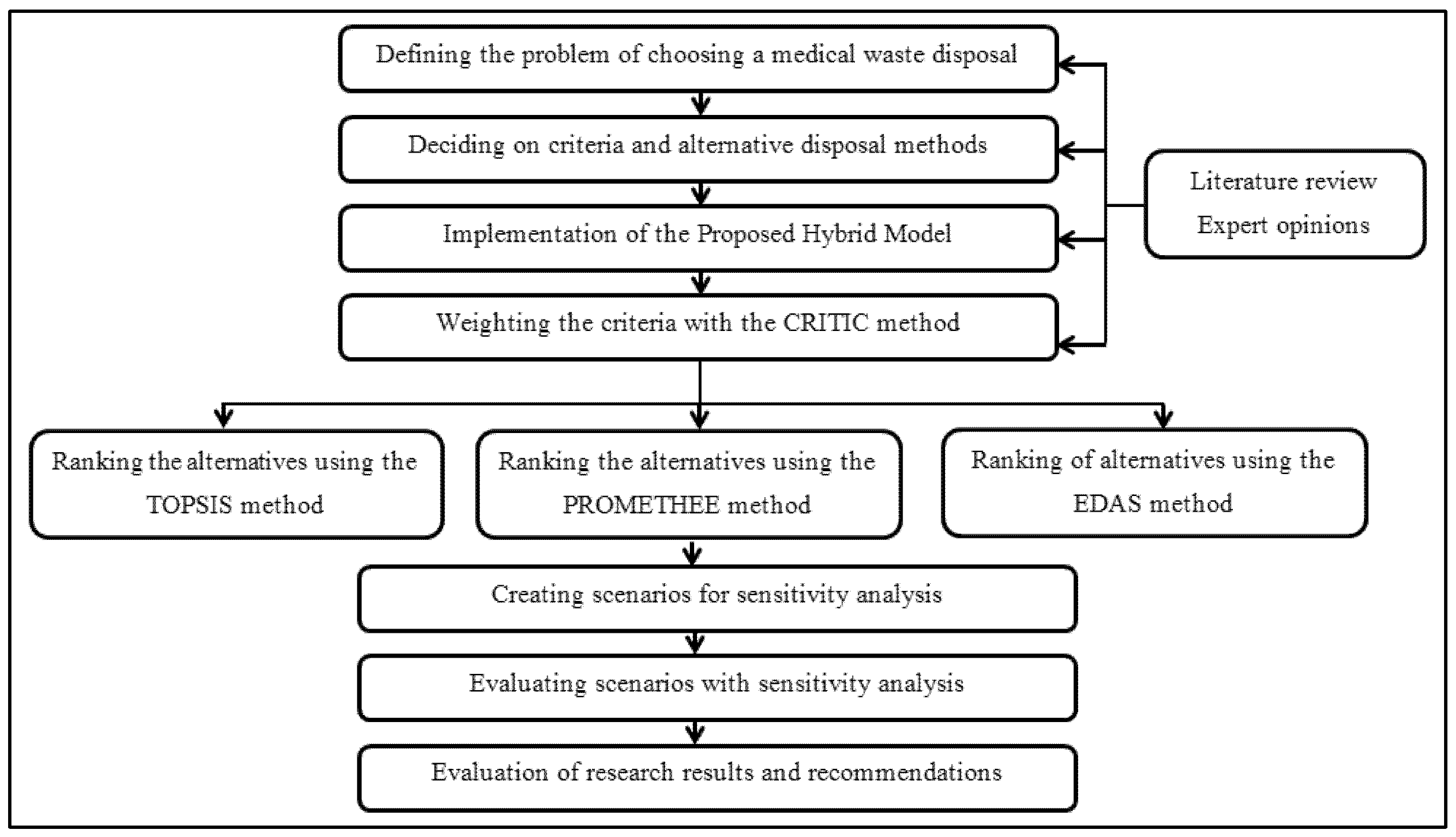
2.2.4. Proposed Model for Medical Waste Disposal Method Selection Problem
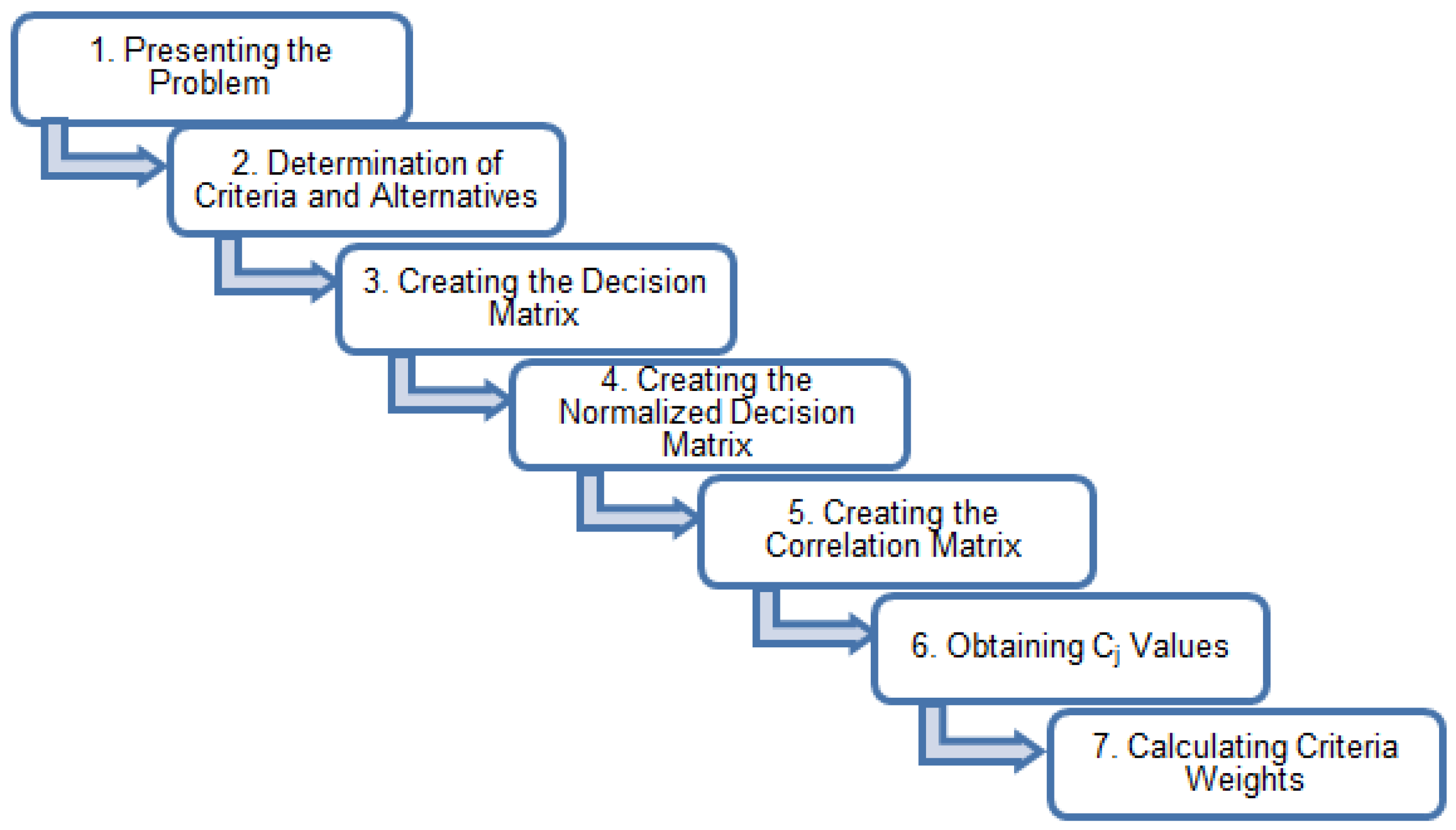
2.3. CRITIC Method
2.4. TOPSIS Method
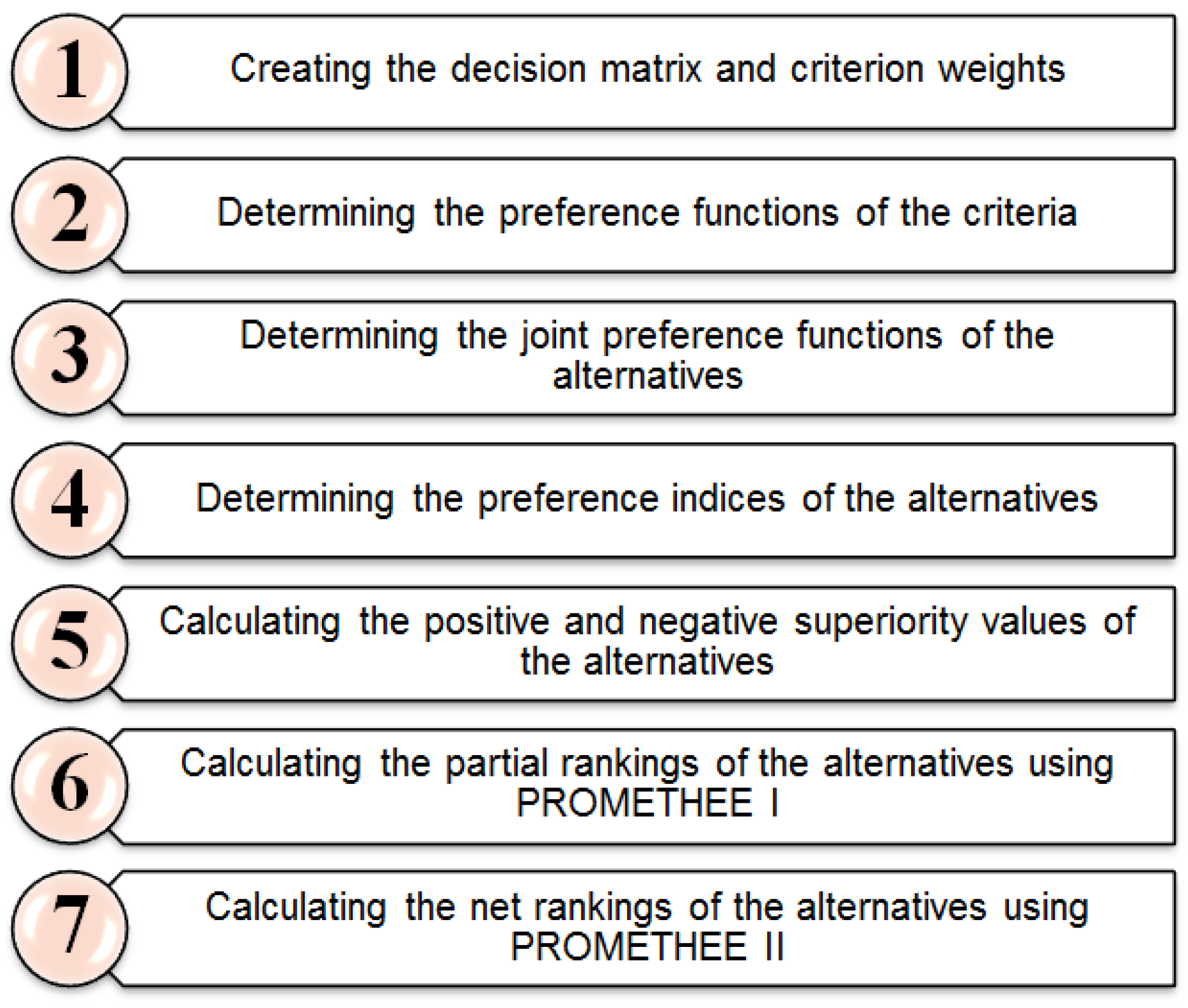
2.5. Promethee Method
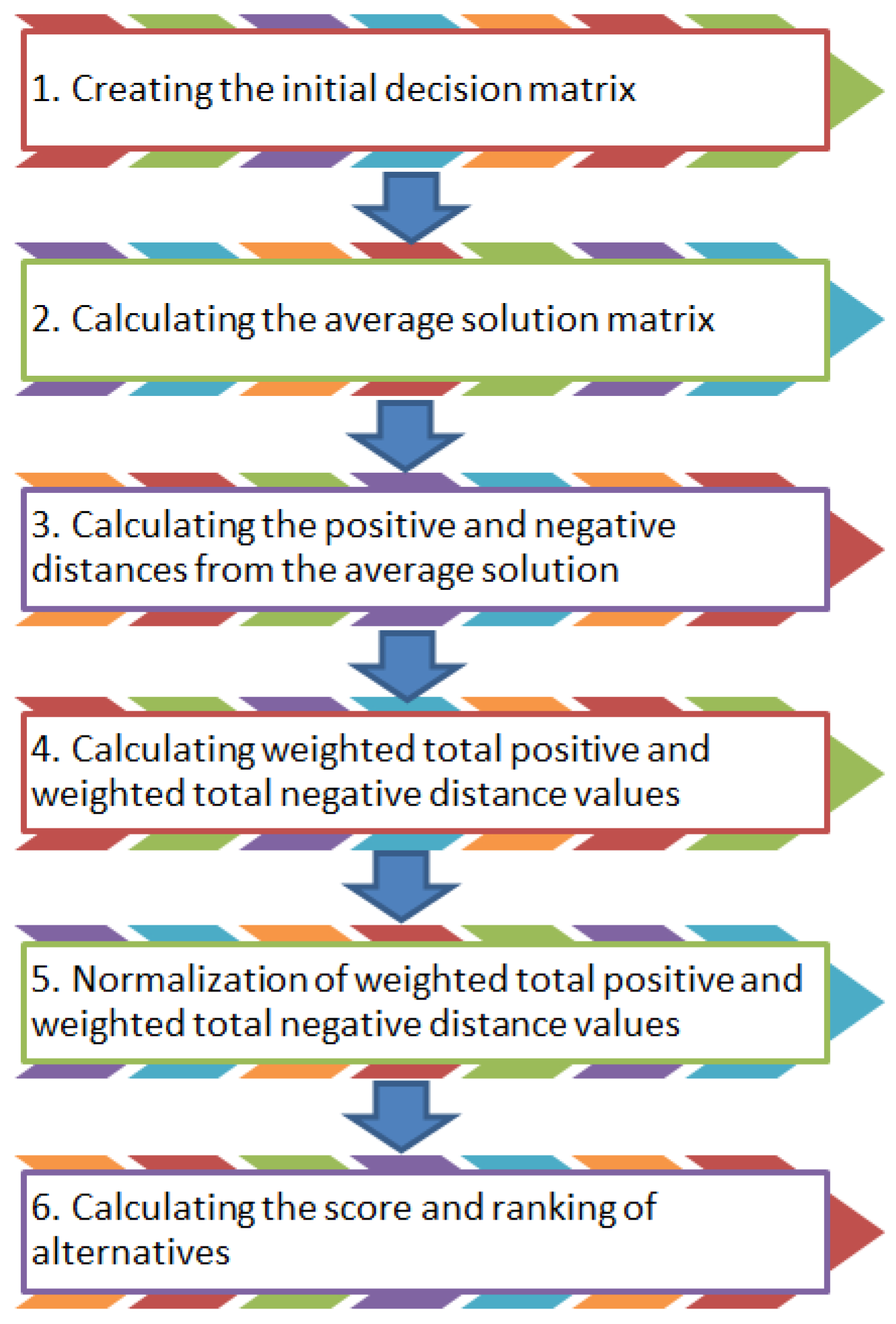
2.6. EDAS Method
3. Findings and Discussion
3.1. Using the CRITIC Method for the Weighting of Criteria for Selection of Medical Waste Method
3.2. Evaluating Alternatives for Selection of Medical Waste Method
3.2.1. Evaluating Alternative Medical Waste Disposal Methods by TOPSIS Method
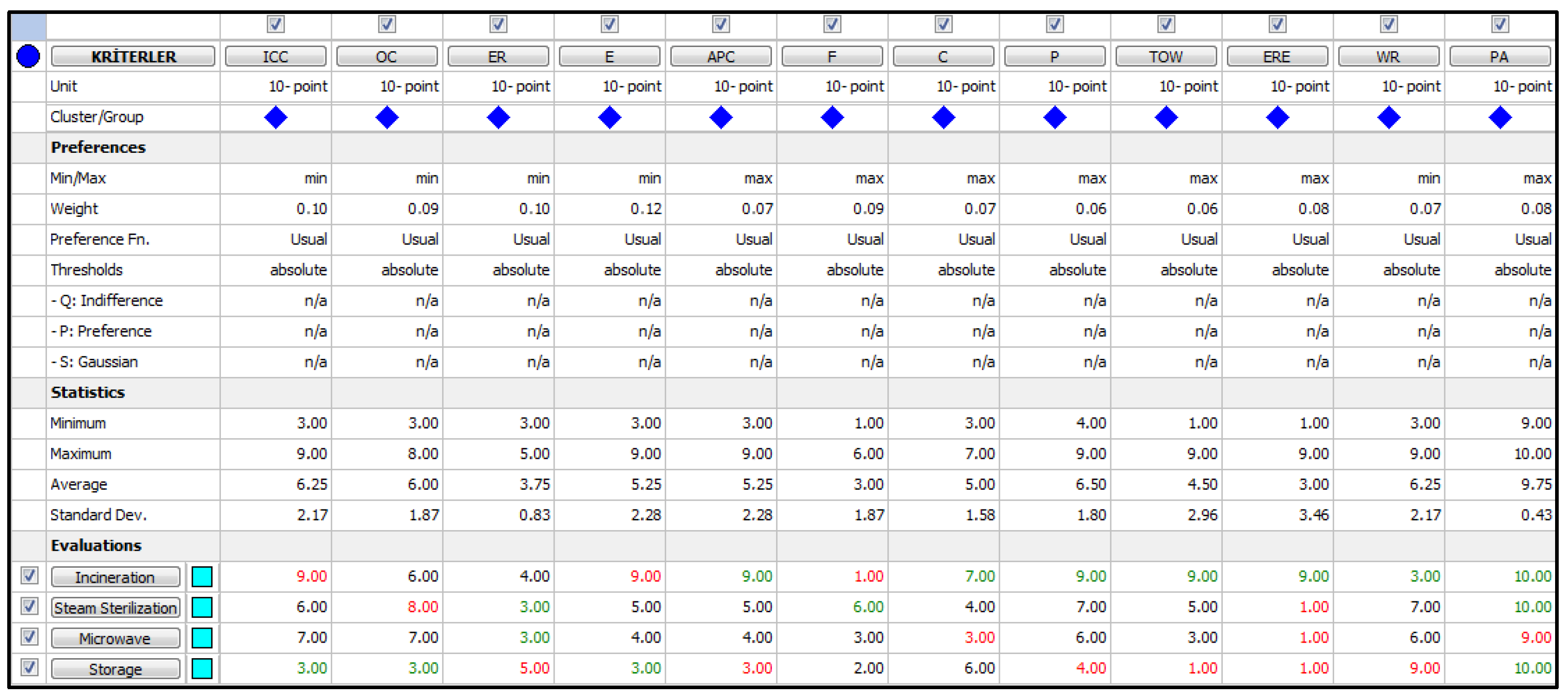
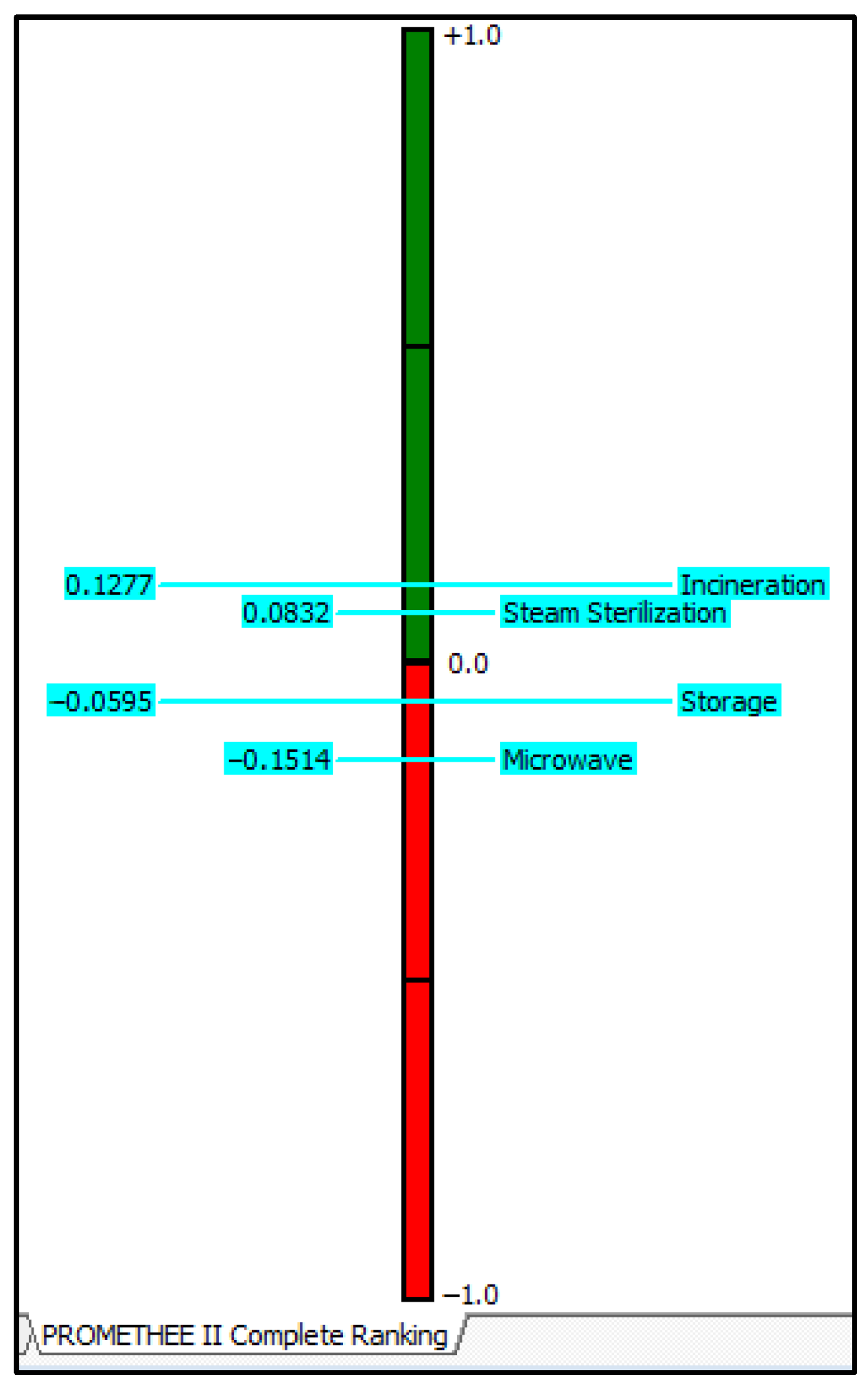
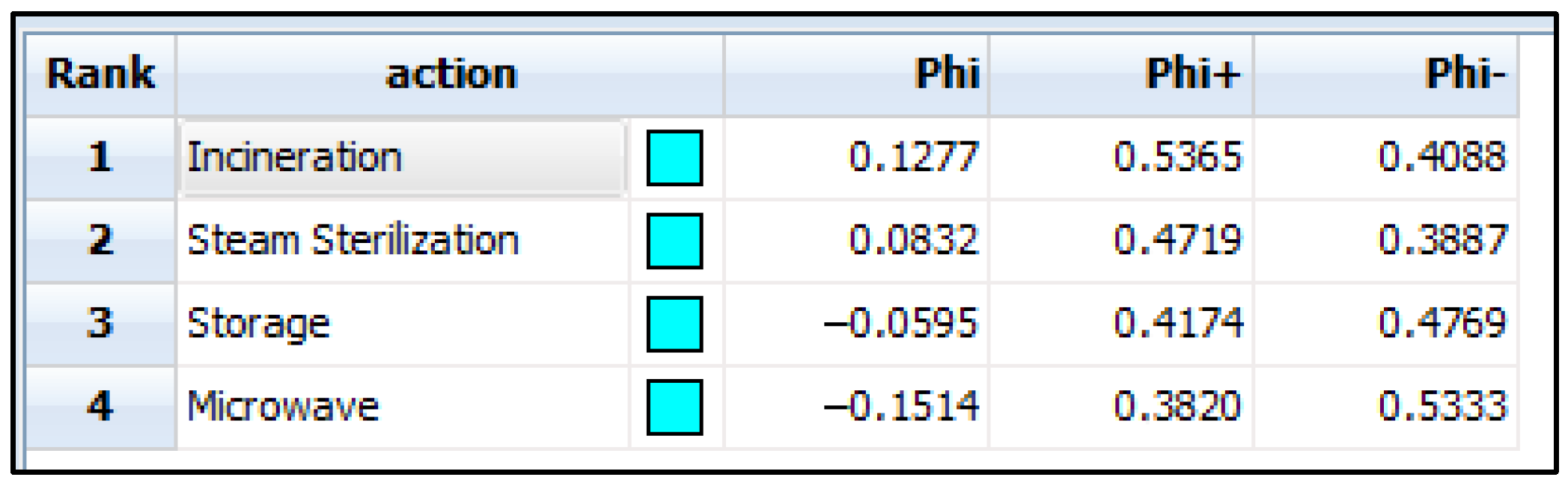
3.2.2. Evaluating Alternative Medical Waste Disposal Methods by PROMETHEE Method
3.2.3. Evaluating Alternative Medical Waste Disposal Methods by EDAS Method
3.3. Sensitivity Analysis
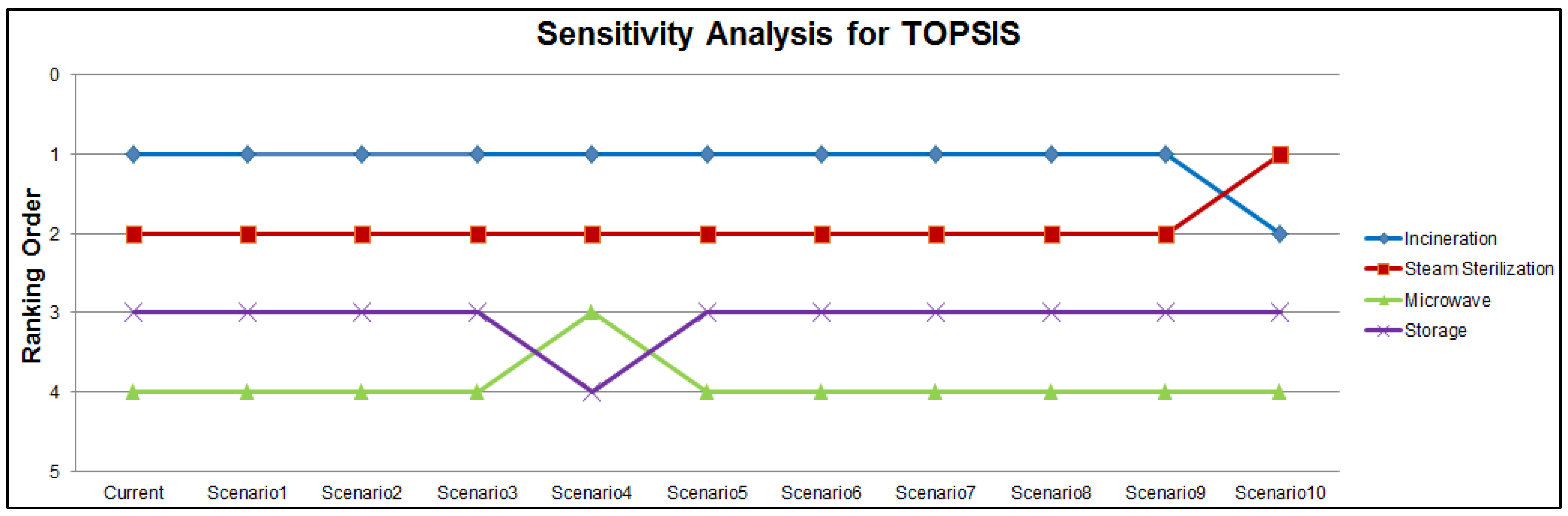
3.3.1. Sensitivity Analysis for TOPSIS
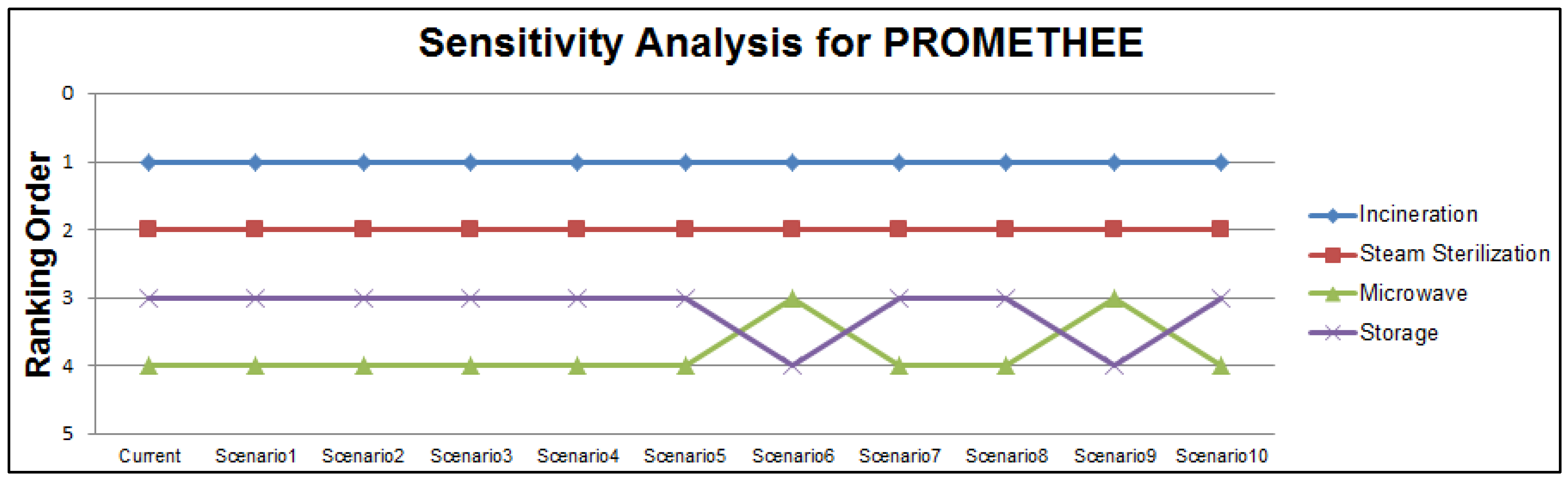
3.3.2. Sensitivity Analysis for PROMETHEE
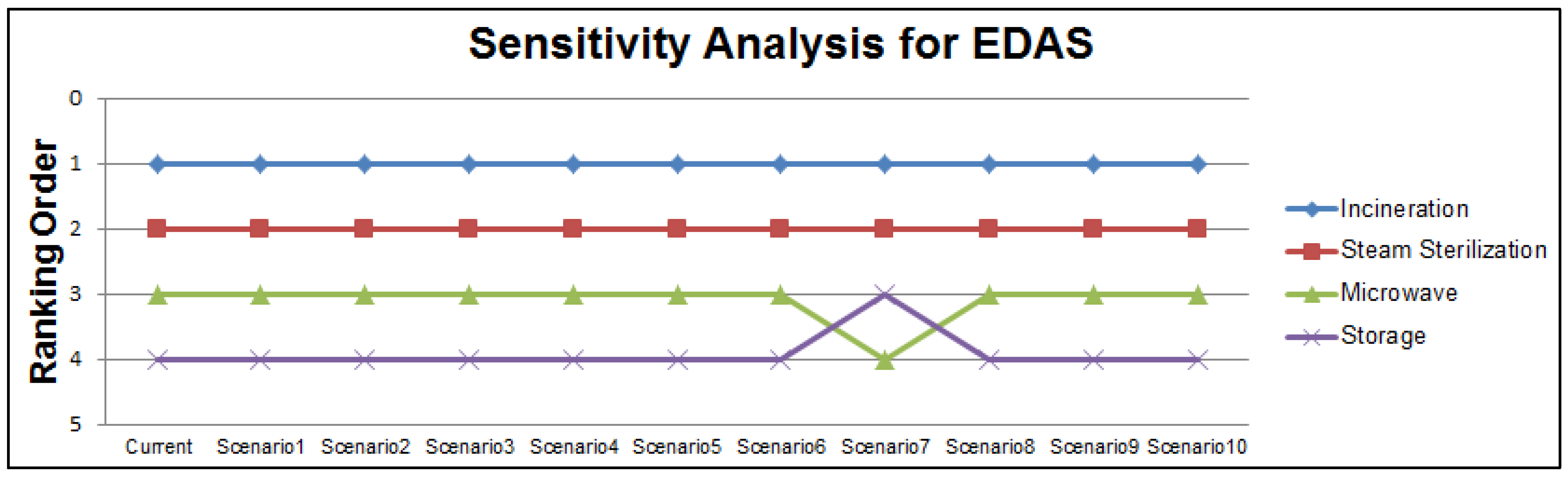
3.3.3. Sensitivity Analysis for EDAS
3.4. Possible Political Implications of the Findings
- From an infrastructure and investment perspective:
- From an environmental management and public health perspective:
- Regarding Legal Framework and Technology Incompatibility:
4. Conclusions and Recommendations
4.1. Reasons of Method Selection
4.2. Original Contributions of the Study
- Innovative and proven hybrid methodology: The study presents a robust hybrid framework that combines the CRITIC method for criteria weighting and three different ranking methods: TOPSIS, PROMETHEE, and EDAS for ranking alternatives. While most of the literature [17,31] relies on subjective opinions of experts for weighting, this study used CRITIC to objectively derive weights based on intercriterion correlation and information content. This reduces the risk of the results being influenced by personal biases or subjective judgments. The simultaneous validation of the incineration result by three different mathematical principle-based methods—TOPSIS (closeness to ideal solution), PROMETHEE (predominance flow), and EDAS (deviation from mean distance)—is a significant novelty, demonstrating the robust methodological stability and reliability of the decision. This approach minimizes the risk of potential ranking inconsistencies among studies ranking using only one method (e.g., PF-SWARA-ARAS, DE-MATEL-MULTIMOORA).
- Conclusion contradictory to literature and emphasizing local conditions: The study’s conclusion that incineration is the most suitable alternative in Adana contradicts the dominant trend in the international and national literature (autoclaving/steam sterilization). This contradiction is one of the study’s major theoretical contributions. The results demonstrate that criteria such as absolute technical capacity, volume reduction efficiency, and comprehensive waste disposal capabilities favor incineration technology (e.g., for chemical and pharmaceutical wastes where non-incineration technologies such as autoclaves and microwaves are inadequate), despite environmental and cost concerns. This finding demonstrates that the optimal solution for medical waste disposal is not universal, but rather depends on the local and operational constraints of a large metropolitan area (Adana) or a university hospital with a complex waste stream (e.g., the need for single-center disposal of high-volume hazardous waste).
- Perspective on Turkish studies literature: Studies on medical waste disposal method selection in Turkey have generally favored autoclave/steam sterilization in regions such as Erzurum [7] or Sivas [11]. This study is among the first to show how the technical advantages of incineration, combined with the objectivity of CRITIC, became the primary decision driver in a large metropolitan area close to the Mediterranean region.
4.3. Limitations of the Study
- Methodological limitations and data constraints: While the CRITIC method objectively determines criterion weights, the evaluation of alternatives against criteria (decision matrices used in the TOPSIS, PROMETHEE, and EDAS methods) is based entirely on expert opinions. There are several important reasons for this:
- ✓
- Institutional information such as operational data, costs, waste processing performance, sterilization efficiency, or emission measurements in healthcare institutions in Turkey is not open to external sharing due to legal, ethical, and institutional confidentiality reasons.
- ✓
- Due to relevant regulations, the hospital management did not approve of reporting the numerical data requested within the scope of the study. Therefore, the study had to rely solely on the knowledge, field experience, and professional judgment of experts.
- ✓
- Expert assessments are also widely used in the international literature (such as Demir & Moslem 2024 [11]), where similar data limitations exist.
- Data uncertainty and lack of fuzzy modeling: A second important limitation of the study is that the methods used are MCDM methods that work with precise values. This leads to the following conclusions:
- ✓
- Hesitation, indecision, uncertainty, or evaluation intervals in the experts’ evaluations are not directly represented in the structure of the methods.
- ✓
- Experts’ uncertainty about some criteria cannot be numerically reflected in the scoring.
- ✓
- Medical waste management is an inherently risky, uncertain, multi-stakeholder, and multivariate field. Therefore, uncertainty modeling is crucial for realistic decision support.
- Application and contextual limitations and limited variety of alternatives: The study evaluated only four disposal methods. This limitation is not a direct methodological choice; it stems from regulatory, infrastructure, and institutional capacity constraints in the application area:
- ✓
- Only certain disposal methods are technically applicable in the university hospital under study.
- ✓
- Current legislation in Turkey limits the use of medical waste disposal methods.
- ✓
- Many methods, such as plasma pyrolysis, certain types of chemical oxidation, or advanced microwave systems, were excluded due to their infeasibility both institutionally and in terms of technical infrastructure.
- Therefore, although the number of alternatives appears small, the selected methods represent all applicable options for the hospital. However,
- ✓
- The limited diversity of alternatives hinders the comparison of new technologies or different regional solutions.
- ✓
- The study’s focus on a single university hospital in Adana limits the generalizability of the results.
- ✓
- As emphasized by Anjum et al. (2024), waste types, waste volume, personnel structure, and management strategies can vary considerably across different healthcare institutions [22].
- Inability to dynamically model socioeconomic and environmental externalities: Although environmental criteria were evaluated within the scope of the study, the evolution of externalities over time was not examined comprehensively enough:
- ✓
- Incineration, in particular, involves high emissions, high investment costs, and long-term operating expenses. The long-term sustainability of these costs may vary depending on economic fluctuations and energy costs.
- ✓
- Elements such as public health, public perception, and social acceptance can vary over time, and the current model does not dynamically represent these components.
4.4. Future Research Directions
- Advanced fuzzy integration: CRITIC and PROMETHEE methods could be integrated with interval-valued, Pythagorean, or T-Spherical Fuzzy sets (e.g., as in Anafi et al. [15]). This would increase methodological robustness by combining objective criterion weighting (CRITIC) with uncertainty modeling (Fuzzy).
- Fuzzification of compromise methods: The advantages of incineration could be retested under uncertain conditions using fuzzy versions of PROMETHEE and EDAS.
- Dynamic modeling of decision criteria: DEMATEL or ANP (Analytical Network Processing) could be used in conjunction with CRITIC to model the interdependencies between criteria. As highlighted in Liu et al. (2015), feedback between criteria plays a critical role in medical waste disposal selection [3].
- Expansion of social criteria: For the sub-criteria of the social dimension highlighted by Demir and Moslem (2024) (social acceptance, risk perception, occupational safety), more precise scales, perhaps supported by geospatial data (GIS), could be developed [11].
- Multi-region scope and life cycle assessment: The incineration outcome in Adana could be retested in other major Turkish metropolitan areas (İzmir, Ankara) with different demographic and waste profiles, thus further generalizing the findings.
- Life cycle analysis (LCA): Instead of just the immediate cost and environmental impact, the environmental and cost impacts of incineration and autoclaving alternatives throughout their entire life cycle (from installation to final disposal) could be integrated into the MCDM model.
Author Contributions
Funding
Institutional Review Board Statement
Informed Consent Statement
Data Availability Statement
Conflicts of Interest
Appendix A

| Authors | Methods | Main Criteria | Alternative Disposal Methods | Results | Country/ Location |
|---|---|---|---|---|---|
| Liu et al. (2015) [3] | A novel Hybrid 2-tuple DEMATEL-Fuzzy MULTIMOORA | Economic, Environmental, Technical, Social | Incineration, Steam Sterilization, Microwave, Landfill | Steam Sterilization | Shanghai, China |
| Kalhor et al. (2016) [17] | AHP-TOPSIS | Cost, solid residuals and environmental impacts, water residuals and environmental impacts, air residuals and environmental impacts, odor, release with health effects, reliability, treatment effectiveness, level of automation, occupational hazards occurrence frequency, public acceptance obstacles, land requirement | Irradiation, Microwave, Steam Sterilization, Chemical disinfection, Sanitary Landfill, Incineration | Irradiation and Microwave. | Qazvin |
| Lee et al. (2016) [31] | AHP | Legal and compliance, guidelines, environmental, sustainability and carbon, cost | Deep Landfill, Incineration, Alternative Technology (autoclaving) | Deep Landfill | East Midlands region of England |
| Lu et al. (2016) [8] | 2-tuple TOPSIS | Cost per ton, waste residues, release with health effects, reliability, treatment efficiency, public acceptance | Incineration, Steam Sterilization, Microwave, Landfill | Steam Sterilization | Shanghai, China |
| Shi et al. (2017) [4] | Cloud model-MABAC method | Cost per ton, waste residues, release with health effects, reliability, treatment efficiency, public acceptance | Incineration, Steam Sterilization, Microwave, Landfill | Steam Sterilization | Shanghai, China |
| Adar and Delice (2019) [7] | Hesitant fuzzy linguistic term set; MABAC, MAIRCA, VIKOR, TOPSIS | Economic, social, environmental, technical, ergonomic | Incineration, Steam Sterilization, Microwave, Landfill | Steam Sterilization | Erzurum, Turkey |
| Badi et al. (2019) [18] | Grey systems theory | Waste residues, release with health effects, treatment efficiency, net cost per ton, public acceptance | Incineration, Steam Sterilization, Microwave, Landfill | Microwave | Libya |
| Geetha et al. (2019) [12] | Intuitionistic hesitant fuzzy set, MULTIMOORA, TOPSIS | Automation, safety systems, cost, noise, stink, solid dregs, water residues, air pollution, land requirement, workers | Incineration, Landfill, Deep burial, Autoclave, Microwave, Chemical disinfection | Deep burial | General |
| Ju et al. (2020) [16] | EDAS (multi-granular linguistic distribution assessment) | Public attitude, processing cost, waste residuals, health effects of emissions, treatment effectiveness, advancement of processing technology | Incineration, Steam Sterilization, Landfill, Chemical disinfection | Steam Sterilization | Beijing, China |
| Li et al. (2020) [19] | Interval-valued fuzzy DEMATEL-TOPSIS | Economic sustainability, environmental sustainability, social sustainability, technical sustainability, resource sustainability | Incineration, Steam Sterilization, Landfill, Microwave | Steam Sterilization | Beijing, China |
| Mishra et al. (2020) [10] | Intuitionistic fuzzy EDAS | Cost, waste residuals, release with health effects, reliability, treatment effectiveness, | Microwave, Incineration, Steam Sterilization, Landfill | Steam Sterilization | HimachalPradesh, India |
| Makan and Fadili (2021) [9] | PROMETHEE | Environmental, financial/economic, social, technical | Municipal Landfill, Inertization, Encapsulation, Rotary kiln | Rotary kiln | General |
| Chaurasiya and Jain (2022) [20] | Pythagorean fuzzy COPRAS | Cost, disposal cost, energy consumption, treatment effectiveness, level of automation, need for skilled operators, public acceptance, land requirement | Steam Sterilization, Microwave, Plasma pyrolysis, Chemical disinfection, Incineration | Steam Sterilization | India |
| Rani et al. (2022) [13] | Pythagorean fuzzy SWARA-ARAS | Cost, waste residuals, energy consumption, treatment effectiveness, level of automation, need for skilled operators, public acceptance, land requirement | Steam Sterilization, Microwave, Plasma pyrolysis, Chemical disinfection, Incineration | Steam Sterilization | India |
| Salimian and Mousavi (2022) [21] | Intuitionistic Fuzzy Sets (IFS) | Cost of net per ton, residuals of the waste, health effect release, reliability, effectiveness of the treatment, admission of the society | Incineration, Steam Sterilization, Microwave, Landfill | Incineration | Shanghai, China |
| Anafi et al. (2023) [15] | T-Spherical Fuzzy CRITIC-MAUT | Cost, waste residuals, release with health effects, energy consumption, reliability, volume reduction, treatment effectiveness, public acceptance | Steam Sterilization, Incineration, Chemical disinfection, Microwave, Landfill disposal | Landfill disposal | China |
| Beheshtinia et al. (2023) [6] | Fuzzy AHP-Fuzzy VIKOR | Economic, Environmental, Technical, Social | Sanitary Landfill, Incineration, Microwave, Sterilization by autoclave, Chemical disinfection, Radiation, Treatment by NEWater process, Encapsulation, Compaction, Reverse polymerization, Plasma pyrolysis | Microwave, Sterilization by autoclave and Reverse polymerization | Tehran |
| Menekşe and Akdağ (2023) [5] | Spherical Fuzzy CRITIC-WASPAS | Waste residuals, infrastructure requirement, annual operating cost, treatment systems capacity, reliability, health effects, treatment efficiency, human resource requirement | Chemical disinfection, Encapsulation, Landfill, Electromagnetic Wave Sterilization, Incineration | Incineration | General |
| Anjum et al. (2024) [22] | Q-rung Fuzzy AROMAN-CRITIC | Cost, environmental impact, technological feasibility, compliance with regulations, safety and health | Incineration, Microwaving, Autoclaving, Landfilling, Recycling | Recycling | General |
| Kirişçi (2024) [14] | Interval-Valued Fermatean Fuzzy-Entropy, MARCOS, PIPRECIA | Waste residuals, infrastructure requirement, annual operating cost, treatment systems capacity, reliability, health effects, treatment efficiency, human resource requirement | Incineration, Encapsulation, Landfill, Electromagnetic Wave Sterilization, Disinfection with chemicals | Incineration | General |
| Demir and Moslem (2024) [11] | F-MCDM Hibrit (F-DBM, F-PSI, F-CRADIS) | Environmental, economic, technology, social | Incineration, Chemical disinfection, Autoclave, Encapsulation, Distillation, Ozonation, UV ray exposure, Chlorination, Rendering inert | Autoclave | Sivas, Turkey |
Appendix B
| CRITIC Method | ||
|---|---|---|
| Steps | Formula | Explanation |
| Step 1: Identifying the problem: | - | The structure of the addressed MCDM problem is revealed. Both its scope and purpose are determined. |
| Step 2: Determining criteria and alternatives: | - | Criteria suitable for the set purpose as well as alternatives for evaluation are determined. |
| Step 3: Creating the decision matrix: | X = = (A1) | refers to the value of alternative i. according to criterion j. |
| Step 4: Creating the normalized decision matrix: | j = 1, 2,…, n (A2) = j = 1, 2,…, n (A3) | After the decision matrix normalized in the range [0,1]. Equation (A2) is used in the maximization criteria, and Equation (A3) is used for the criteria in the minimization criteria. |
| Step 5: Creating the correlation matrix: | (A4) | The relationship coefficient matrix between the evaluation criteria is created by the formula provided in Equation (A4). |
| Step 6: Obtaining values: | (A5) (A6) | that the total information value of each criterion j is calculated by the formula in Equations (A5) and (A6). |
| Step 7: Calculating criterion weights: | (A7) | of each criterion, are calculated as in Equation (A7). |
| TOPSIS Method | ||
|---|---|---|
| Steps | Formula | Explanation |
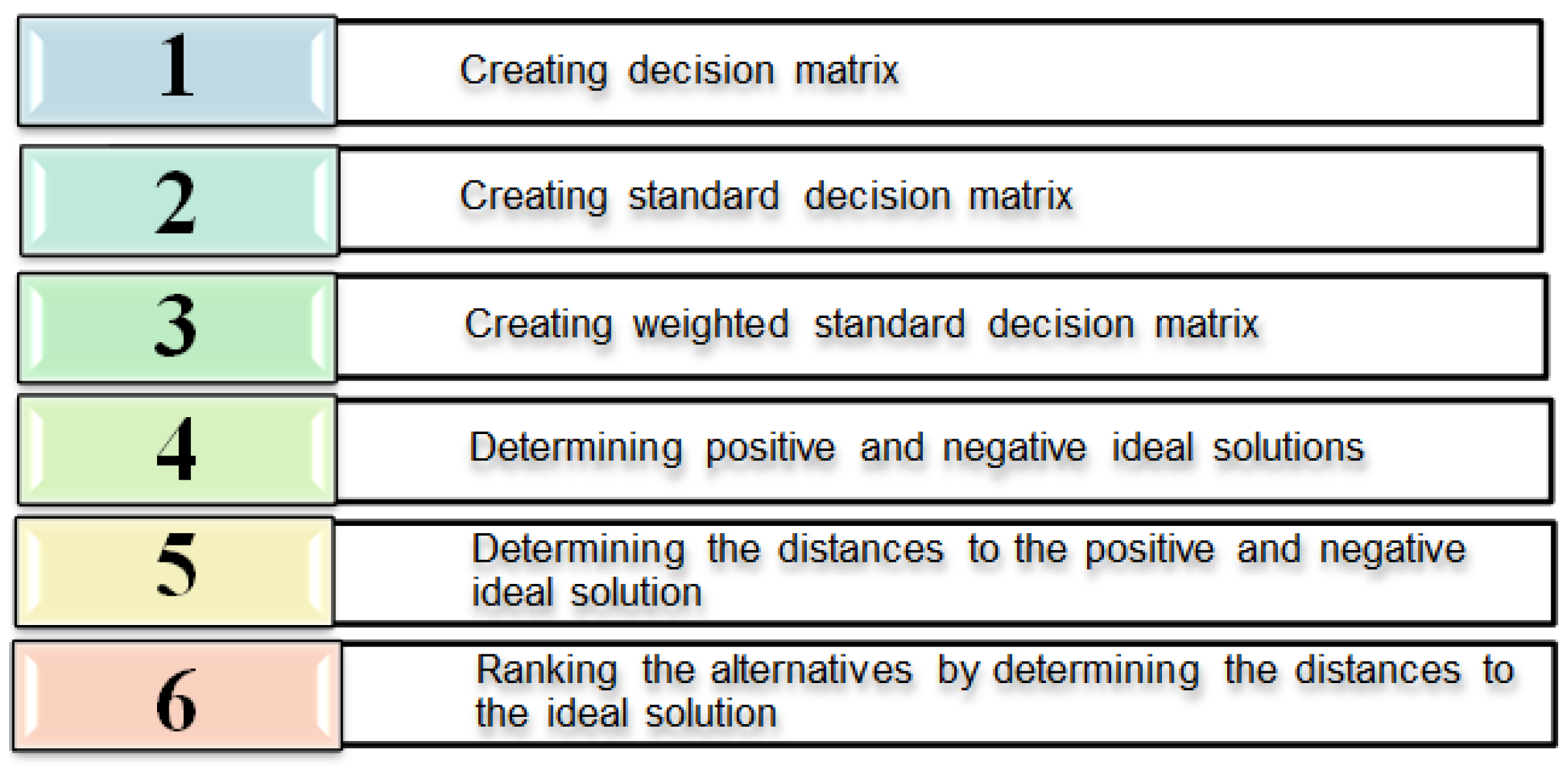
| Step 1: Creating the decision matrix: | (A8) | Firstly, decision matrix A is created by decision-makers in Equation (A8). |
| Step 2: Creating the standard decision matrix: | (A9) X = = (A10) | value is standardized in the range [0,1] by the formula in Equation (A9) and standard decision matrix is obtained in Equation (A10). |
| Step 3: Creating the weighted standard decision matrix: | = (A11) | ) shown in Equation (A11) is obtained by multiplying the values in the standard decision matrix with the weights. |
| Step 4: Determining positive and negative ideal solution: | (A12) (A13) | Positive and negative ideal solution values are determined from the matrix Wij created in the previous step. The positive ideal solution value is calculated as in Equation (A12). The negative ideal solution value is calculated as in Equation (A13). |
| Step 5: Determining distances to the positive and negative ideal solution: | (A14) (A15) | The distance to the positive ideal solution is calculated as in Equation (A14) while the distance to the negative ideal solution is calculated as in Equation (A15) using the Euclidean distance approach. |
| Step 6: Ranking alternatives by determining distances to the ideal solution: | (A16) | value is close to ‘0’, it is considered as the worst alternative, and if it is close to ‘1’, it is rated as the best alternative. |
| PROMETHEE Method | |||||||
|---|---|---|---|---|---|---|---|
| Steps | Formula | Explanation | |||||
| Step 1: Creating the decision matrix and criteria weights: | Criteria | Firstly, the decision matrix is formed together with the criteria weights. | |||||
| f1 | f2 | … | fk | ||||
| Alternatives | A1 | f1(A1) | f1(A1) | … | fk(A1) | ||
| A2 | f1(A1) | f1(A1) | … | f1(A1) | |||
| … | … | … | … | … | |||
| An | f1(An) | f2(An) | … | fk(An) | |||
| Weights | wi | w1 | w2 | wk | |||
| Step 2: Determining preference functions of criteria: | In this step, preference functions are determined in order to show the structure of the criteria and their relationship with each other. Then, pairwise comparisons of the alternatives according to the criteria are analyzed, and the preference degree of the best alternative is determined. The chosen preference function is denoted by P and takes values between 0 and 1. There are six preference functions as regular, U-type, V-type, gradual, linear, and gaussian. These preference functions are determined by the decision-maker. | ||||||
| Step 3: Determining common preference functions of alternatives: | P () = (A17) | After, the common preference functions of the alternatives are calculated for each criterion. When comparing two alternatives such as a and b, common preference functions are calculated by the formula in Equation (A17). | |||||
| Step 4: Determining preference indices of alternatives: | = (A18) | Then, preference indices for the compared alternatives are determined using Equation (A18). | |||||
| Step 5: Calculating positive and negative superiority values of alternatives: | = (A19) = (A20) | Then, the positive and negative superiority values for the alternatives are calculated with Equations (A19) and (A20). (n is the total number of alternatives and x is the set of alternatives other than A) | |||||
| Step 6: Calculating partial ranking of alternatives with PROMETHEE I: | (A1) (A2) and (A1) (A2), or (A1) (A2) and (A1) (A2), or (A1) (A2) and (A1) (A2), then alternative A1 is superior to alternative A2. (A1) (A2) and (A1) (A2), alternative A1 is the same as alternative A2. (A1) (A2) and (A1) (A2), or (A1) (A2) and (A1) (A2), then alternative A2 is superior to alternative A1. | In this step, PROMETHEE I partial ranking is determined. There are six different cases in comparisons. | |||||
| Step 7: Calculating net rankings of alternatives with PROMETHEE II: | (A) (A) (A) (A21) = 0 (A2), alternative A1 is superior to alternative A2. (A2), alternative A1 and alternative A2 are the same | In the last step, net superiority values of the alternatives are determined by PROMETHEE II using the formula in Equation (A21). They are calculated by computing the difference between the positive superiority value and the negative superiority value for each alternative. | |||||
| EDAS Method | ||
|---|---|---|
| Steps | Formula | Explanation |
| Step 1: Creating the initial decision matrix: | X = = (A22) | The decision matrix consisting of m alternatives and n criteria is created as in Equation (A22). |
| Step 2: Creating the average solution matrix: | AV = (A23) = (A24) | In this step, the average solution matrix (AV) containing values for each criterion is calculated by using Equations (A23) and (A24). |
| Step 3: Calculating positive and negative distances from the average solution: | (A25) (A26) = (A27) = (A28) | In this step, positive (PDA) and negative distance (NDA) matrices are obtained. If there is a benefit-side criterion, the values of are calculated as in Equation (A25) and the values of are calculated as in Equation (A26), but if there is a cost-side criterion, the values of are calculated as in Equation (A27) and the values of are calculated as in Equation (A28). |
| Step 4: Calculating weighted total positive and weighted total negative distances: | = (A29) = (A30) | In this step, the total positive and total negative distance values are multiplied by the criteria weights () to calculate the weighted total positive values as in Equation (A30) and weighted total negative values ) as in Equation (A31). |
| Step 5: Normalizing weighted sum positive and weighted sum negative distance values: | = (A31) = 1 − (A32) | In this step, the value calculated in the previous step is normalized using Equations (A31) and (A32). |
| Step 6: Calculating and ranking of the score of alternatives: | = (A33) | Finally, the evaluation scores ( for each alternative are calculated as in Equation (A33). |
| Assessments of Expert 1 | ||||||||||||
| Alternatives/Criteria | ICC | OC | ER | E | APC | F | C | P | TOW | ERE | WR | PA |
| Incineration | 10 | 7 | 5 | 10 | 8 | 1 | 6 | 10 | 8 | 9 | 4 | 10 |
| Steam Sterilization | 7 | 9 | 4 | 6 | 4 | 5 | 5 | 8 | 6 | 1 | 8 | 10 |
| Microwave | 8 | 8 | 4 | 5 | 5 | 2 | 4 | 7 | 4 | 1 | 7 | 10 |
| Storage | 4 | 4 | 6 | 4 | 2 | 2 | 7 | 5 | 1 | 1 | 10 | 10 |
| Assessments of Expert 2 | ||||||||||||
| Alternatives/Criteria | ICC | OC | ER | E | APC | F | C | P | TOW | ERE | WR | PA |
| Incineration | 8 | 6 | 3 | 9 | 10 | 1 | 8 | 8 | 10 | 8 | 3 | 10 |
| Steam Sterilization | 6 | 7 | 3 | 5 | 6 | 6 | 3 | 6 | 4 | 1 | 7 | 10 |
| Microwave | 7 | 7 | 3 | 4 | 4 | 2 | 3 | 6 | 3 | 1 | 6 | 9 |
| Storage | 3 | 3 | 5 | 3 | 4 | 3 | 6 | 4 | 1 | 1 | 9 | 10 |
| Assessments of Expert 3 | ||||||||||||
| Alternatives/Criteria | ICC | OC | ER | E | APC | F | C | P | TOW | ERE | WR | PA |
| Incineration | 9 | 5 | 4 | 8 | 9 | 1 | 7 | 9 | 9 | 10 | 2 | 10 |
| Steam Sterilization | 5 | 8 | 2 | 4 | 5 | 7 | 4 | 7 | 5 | 1 | 6 | 10 |
| Microwave | 6 | 6 | 2 | 3 | 3 | 5 | 2 | 5 | 2 | 1 | 5 | 8 |
| Storage | 2 | 2 | 4 | 2 | 3 | 1 | 5 | 3 | 1 | 1 | 8 | 10 |
References
- Tıbbi Atıkların Kontrol Yönetmeliği. Resmi Gazete (Sayı: 29959). 2017. Available online: https://www.resmigazete.gov.tr/eskiler/2017/01/20170125-2.htm (accessed on 17 November 2025).
- Dönmez, Y.C.; Aslan, A.; Van Giersbergen, M.Y. Environment-friendly practices in operating rooms in Turkey. J. Nurs. Res. 2019, 27, e18. [Google Scholar] [CrossRef]
- Liu, H.C.; You, J.X.; Lu, C.; Chen, Y.Z. Evaluating health-care waste treatment technologies using a hybrid multi-criteria decision making model. Renew. Sustain. Energy Rev. 2015, 41, 932–942. [Google Scholar] [CrossRef]
- Shi, H.; Liu, H.C.; Li, P.; Xu, X.G. An integrated decision making approach for assessing healthcare waste treatment technologies from a multiple stakeholder. Waste Manag. 2017, 59, 508–517. [Google Scholar] [CrossRef] [PubMed]
- Menekşe, A.; Akdağ, H.C. Medical waste disposal planning for healthcare units using spherical fuzzy CRITIC-WASPAS. Appl. Soft Comput. 2023, 144, 110480. [Google Scholar] [CrossRef]
- Beheshtinia, M.A.; Jafari Kahoo, S.; Fathi, M. Prioritizing healthcare waste disposal methods considering environmental health using an enhanced multi-criteria decision-making method. Environ. Pollut. Bioavailab. 2023, 35, 2218568. [Google Scholar] [CrossRef]
- Adar, T.; Delice, E.K. New integrated approaches based on MC-HFLTS for healthcare waste treatment technology selection. J. Enterp. Inf. Manag. 2019, 32, 688–711. [Google Scholar] [CrossRef]
- Lu, C.; You, J.X.; Liu, H.C.; Li, P. Health-care waste treatment technology selection using the interval 2-tuple induced TOPSIS method. Int. J. Environ. Res. Public Health 2016, 13, 562. [Google Scholar] [CrossRef]
- Makan, A.; Fadili, A. Sustainability assessment of healthcare waste treatment systems using surrogate weights and PROMETHEE method. Waste Manag. Res. 2021, 39, 73–82. [Google Scholar] [CrossRef]
- Mishra, A.R.; Mardani, A.; Rani, P.; Zavadskas, E.K. A novel EDAS approach on intuitionistic fuzzy set for assessment of health-care waste disposal technology using new parametric divergence measures. J. Clean. Prod. 2020, 272, 122807. [Google Scholar] [CrossRef]
- Demir, A.T.; Moslem, S. A novel fuzzy multi-criteria decision-making for enhancing the management of medical waste generated during the coronavirus pandemic. Eng. Appl. Artif. Intell. 2024, 133, 108465. [Google Scholar] [CrossRef]
- Geetha, S.; Narayanamoorthy, S.; Kang, D.; Kureethara, J.V. A novel assessment of healthcare waste disposal methods: Intuitionistic hesitant fuzzy MULTIMOORA decision making approach. IEEE Access 2019, 7, 130283–130299. [Google Scholar] [CrossRef]
- Rani, P.; Mishra, A.R.; Krishankumar, R.; Ravichandran, K.S.; Gandomi, A.H. A new Pythagorean fuzzy based decision framework for assessing healthcare waste treatment. IEEE Trans. Eng. Manag. 2022, 69, 2915–2929. [Google Scholar] [CrossRef]
- Kirisci, M. Medical waste management based on an interval-valued Fermatean fuzzy decision-making method. J. Math. Sci. Model. 2024, 7, 127–144. [Google Scholar] [CrossRef]
- Anafi, J.; Khan, A.A.; Dong, K. Enhancing medical waste management using T-spherical fuzzy CRITIC-MAUT methodology. J. Green Econ. Low-Carbon Dev. 2023, 2, 137–152. [Google Scholar] [CrossRef]
- Ju, Y.; Liang, Y.; Luis, M.; Gonzalez, E.D.S.; Giannakis, M.; Dong, P.; Wang, A. A new framework for health-care waste disposal alternative selection under multi-granular linguistic distribution assessment environment. Comput. Ind. Eng. 2020, 145, 106489. [Google Scholar] [CrossRef]
- Kalhor, R.; Kiaei, M.Z.; Mohebbifar, R.; Shah Bahrami, E.; Mafi, L.; Kalhor, L.; Azmal, M. Prioritizing the options for health-care waste management in qazvin: Using a multi-criteria decision making approach. J. Biol. Today’s World 2016, 5, 101–106. [Google Scholar]
- Badi, I.; Shetwan, A.; Hemeda, A. A grey-based assessment model to evaluate health-care waste treatment alternatives in Libya. Oper. Res. Eng. Sci. Theory Appl. 2019, 2, 92–106. [Google Scholar] [CrossRef]
- Li, H.; Li, J.; Zhang, Z.; Cao, X.; Zhu, J.; Chen, W. Establishing an interval-valued fuzzy decision-making method for sustainable selection of healthcare waste treatment technologies in the emerging economies. J. Mater. Cycles Waste Manag. 2020, 22, 501–514. [Google Scholar] [CrossRef]
- Chaurasiya, R.; Jain, D. Pythagorean fuzzy entropy measure-based complex proportional assessment technique for solving multi-criteria healthcare waste treatment problem. Granul. Comput. 2022, 7, 917–930. [Google Scholar] [CrossRef]
- Salimian, S.; Mousavi, S.M. The selection of healthcare waste treatment technologies by a multi-criteria group decision-making method with intuitionistic fuzzy sets. J. Ind. Syst. Eng. 2022, 14, 205–220. [Google Scholar]
- Anjum, M.; Min, H.; Ahmed, Z. Healthcare waste management through multi-stage decision-making for sustainability enhancement. Sustainability 2024, 16, 4872. [Google Scholar] [CrossRef]
- Çevre, T.C.; Bakanlığı, O. Çevresel Etki Değerlendirmesi Sektörel Rehberleri. 2014. Available online: https://share.google/Et4SjVYW4aAoSeqDr (accessed on 16 October 2025).
- Atık Yönetimi Yönetmeliği. Resmi Gazete (Sayı: 29959). 2015. Available online: https://www.resmigazete.gov.tr/eskiler/2015/04/20150402-2.htm (accessed on 17 November 2025).
- Chartier, Y. (Ed.) Safe Management of Wastes from Health—Care Activities; World Health Organization: Geneva, Switzerland, 2014. [Google Scholar]
- Diakoulaki, D.; Mavrotas, G.; Papayannakis, L. Determining objective weights in multiple criteria problems: The critic method. Comput. Oper. Res. 1995, 22, 763–770. [Google Scholar] [CrossRef]
- Ayçin, E. Çok Kriterli Karar Verme: Bilgisayar Uygulamalı Çözümler; Nobel Akademik Yayıncılık: Ankara, Türkiye, 2019. [Google Scholar]
- Hwang, C.L.; Yoon, K. Multiple Attributes Decision Making Methods and Applications; Springer: Berlin/Heidelberg, Germany, 1981. [Google Scholar]
- Brans, J.P.; Mareschal, B. Promethee Methods. In Multiple Criteria Decision Analysis; Figueira, J., Ed.; Springer: Berlin/Heidelberg, Germany, 2005. [Google Scholar]
- Keshavarz Ghorabaee, M.; Zavadskas, E.K.; Olfat, L.; Turskis, Z. Multi-criteria inventory classification using a new method of evaluation based on distance from average solution (EDAS). Informatica 2015, 26, 435–451. [Google Scholar] [CrossRef]
- Lee, S.; Vaccari, M.; Tudor, T. Considerations for choosing appropriate healthcare waste management treatment technologies: A case study from an East Midlands NHS Trust, in England. J. Clean. Prod. 2016, 135, 139–147. [Google Scholar] [CrossRef]






| Experts | Title | Experience | Contribution to the Study |
|---|---|---|---|
| Expert 1 | Hospital Medical Waste Specialist | 15 years | Determining criteria, alternatives and criteria weights, creating the decision matrix |
| Expert 2 | Hospital Chief Physician | 20 years | Creating the decision matrix |
| Expert 3 | Environmental Engineer (Academic) | 22 years | Creating the decision matrix |
| Decision Matrix | ||||||||||||
|---|---|---|---|---|---|---|---|---|---|---|---|---|
| Alternatives/Criteria | ICC | OC | ER | E | APC | F | C | P | TOW | ERE | WR | PA |
| Min | Min | Min | Min | Max | Max | Max | Max | Max | Max | Min | Max | |
| Incineration | 9 | 6 | 4 | 9 | 9 | 1 | 7 | 9 | 9 | 9 | 3 | 10 |
| Steam Sterilization | 6 | 8 | 3 | 5 | 5 | 6 | 4 | 7 | 5 | 1 | 7 | 10 |
| Microwave | 7 | 7 | 3 | 4 | 4 | 3 | 3 | 6 | 3 | 1 | 6 | 9 |
| Storage | 3 | 3 | 5 | 3 | 3 | 2 | 6 | 4 | 1 | 1 | 9 | 10 |
| Normalized Decision Matrix | ||||||||||||
|---|---|---|---|---|---|---|---|---|---|---|---|---|
| Alternatives/Criteria | ICC | OC | ER | E | APC | F | C | P | TOW | ERE | WR | PA |
| Incineration | 0.000 | 0.400 | 0.500 | 0.000 | 1.000 | 0.000 | 1.000 | 1.000 | 1.000 | 1.000 | 1.000 | 1.000 |
| Steam Sterilization | 0.500 | 0.000 | 1.000 | 0.667 | 0.333 | 1.000 | 0.250 | 0.600 | 0.500 | 0.000 | 0.333 | 1.000 |
| Microwave | 0.333 | 0.200 | 1.000 | 0.833 | 0.167 | 0.400 | 0.000 | 0.400 | 0.250 | 0.000 | 0.500 | 0.000 |
| Storage | 1.000 | 1.000 | 0.000 | 1.000 | 0.000 | 0.200 | 0.750 | 0.000 | 0.000 | 0.000 | 0.000 | 1.000 |
| Correlation Matrix (ρjk) | ||||||||||||
|---|---|---|---|---|---|---|---|---|---|---|---|---|
| Criteria/Criteria | ICC | OC | ER | E | APC | F | C | P | TOW | ERE | WR | PA |
| ICC | 1 | 0.617 | −0.522 | 0.849 | −0.849 | 0.185 | −0.073 | −0.929 | −0.878 | −0.733 | −0.973 | 0.200 |
| OC | 0.617 | 1 | −0.967 | 0.293 | −0.293 | −0.643 | 0.592 | −0.593 | −0.452 | 0.000 | −0.432 | 0.309 |
| ER | −0.522 | −0.967 | 1 | −0.099 | 0.099 | 0.645 | −0.763 | 0.418 | 0.255 | −0.174 | 0.313 | −0.522 |
| E | 0.849 | 0.293 | −0.099 | 1 | −1.000 | 0.352 | −0.555 | −0.944 | −0.983 | −0.951 | −0.925 | −0.317 |
| APC | −0.849 | −0.293 | 0.099 | −1.000 | 1 | −0.352 | 0.555 | 0.944 | 0.983 | 0.951 | 0.925 | 0.317 |
| F | 0.185 | −0.643 | 0.645 | 0.352 | −0.352 | 1 | −0.676 | −0.074 | −0.181 | −0.617 | −0.370 | 0.000 |
| C | −0.073 | 0.592 | −0.763 | −0.555 | 0.555 | −0.676 | 1 | 0.263 | 0.428 | 0.730 | 0.292 | 0.730 |
| P | −0.929 | −0.593 | 0.418 | −0.944 | 0.944 | −0.074 | 0.263 | 1 | 0.985 | 0.801 | 0.929 | 0.160 |
| TOW | −0.878 | −0.452 | 0.255 | −0.983 | 0.983 | −0.181 | 0.428 | 0.985 | 1 | 0.878 | 0.917 | 0.293 |
| ERE | −0.733 | 0.000 | −0.174 | −0.951 | 0.951 | −0.617 | 0.730 | 0.801 | 0.878 | 1 | 0.867 | 0.333 |
| WR | −0.973 | −0.432 | 0.313 | −0.925 | 0.925 | −0.370 | 0.292 | 0.929 | 0.917 | 0.867 | 1 | −0.067 |
| PA | 0.200 | 0.309 | −0.522 | −0.317 | 0.317 | 0.000 | 0.730 | 0.160 | 0.293 | 0.333 | −0.067 | 1 |
| Relationship Coefficient Matrix (1 − ρjk) | ||||||||||||
|---|---|---|---|---|---|---|---|---|---|---|---|---|
| Criteria/Criteria | ICC | OC | ER | E | APC | F | C | P | TOW | ERE | WR | PA |
| ICC | 0 | 0.383 | 1.522 | 0.151 | 1.849 | 0.815 | 1.073 | 1.929 | 1.878 | 1.733 | 1.973 | 0.800 |
| OC | 0.383 | 0 | 1.967 | 0.707 | 1.293 | 1.643 | 0.408 | 1.593 | 1.452 | 1.000 | 1.432 | 0.691 |
| ER | 1.522 | 1.967 | 0 | 1.099 | 0.901 | 0.355 | 1.763 | 0.582 | 0.745 | 1.174 | 0.687 | 1.522 |
| E | 0.151 | 0.707 | 1.099 | 0 | 2.000 | 0.648 | 1.555 | 1.944 | 1.983 | 1.951 | 1.925 | 1.317 |
| APC | 1.849 | 1.293 | 0.901 | 2.000 | 0 | 1.352 | 0.445 | 0.056 | 0.017 | 0.049 | 0.075 | 0.683 |
| F | 0.815 | 1.643 | 0.355 | 0.648 | 1.352 | 0 | 1.676 | 1.074 | 1.181 | 1.617 | 1.370 | 1.000 |
| C | 1.073 | 0.408 | 1.763 | 1.555 | 0.445 | 1.676 | 0 | 0.737 | 0.572 | 0.270 | 0.708 | 0.270 |
| P | 1.929 | 1.593 | 0.582 | 1.944 | 0.056 | 1.074 | 0.737 | 0 | 0.016 | 0.199 | 0.071 | 0.840 |
| TOW | 1.878 | 1.452 | 0.745 | 1.983 | 0.017 | 1.181 | 0.572 | 0.016 | 0 | 0.122 | 0.083 | 0.707 |
| ERE | 1.733 | 1.000 | 1.174 | 1.951 | 0.049 | 1.617 | 0.270 | 0.199 | 0.122 | 0 | 0.133 | 0.667 |
| WR | 1.973 | 1.432 | 0.687 | 1.925 | 0.075 | 1.370 | 0.708 | 0.071 | 0.083 | 0.133 | 0 | 1.067 |
| PA | 0.800 | 0.691 | 1.522 | 1.317 | 0.683 | 1.000 | 0.270 | 0.840 | 0.707 | 0.667 | 1.067 | 0 |
| Total | 14 | 13 | 12 | 15 | 9 | 13 | 9 | 9 | 9 | 9 | 10 | 10 |
| Criteria | ICC | OC | ER | E | APC | F | C | P | TOW | ERE | WR | PA |
|---|---|---|---|---|---|---|---|---|---|---|---|---|
| Standard Deviation | 0.361 | 0.374 | 0.415 | 0.380 | 0.380 | 0.374 | 0.395 | 0.361 | 0.370 | 0.433 | 0.361 | 0.433 |
| 5.090 | 4.703 | 5.107 | 5.800 | 3.310 | 4.764 | 3.746 | 3.260 | 3.237 | 3.861 | 3.437 | 4.141 |
| Criteria | ICC | OC | ER | E | APC | F | C | P | TOW | ERE | WR | PA |
|---|---|---|---|---|---|---|---|---|---|---|---|---|
| 0.101 | 0.093 | 0.101 | 0.115 | 0.066 | 0.094 | 0.074 | 0.065 | 0.064 | 0.077 | 0.068 | 0.082 | |
| Ranking | 3 | 5 | 2 | 1 | 10 | 4 | 8 | 11 | 12 | 7 | 9 | 6 |
| Normalization Process | ||||||||||||
|---|---|---|---|---|---|---|---|---|---|---|---|---|
| Alternatives/Criteria | ICC | OC | ER | E | APC | F | C | P | TOW | ERE | WR | PA |
| Incineration | 81 | 36 | 16 | 81 | 81 | 1 | 49 | 81 | 81 | 81 | 9 | 100 |
| Steam Sterilization | 36 | 64 | 9 | 25 | 25 | 36 | 16 | 49 | 25 | 1 | 49 | 100 |
| Microwave | 49 | 49 | 9 | 16 | 16 | 9 | 9 | 36 | 9 | 1 | 36 | 81 |
| Storage | 9 | 9 | 25 | 9 | 9 | 4 | 36 | 16 | 1 | 1 | 81 | 100 |
| 13.229 | 12.570 | 7.681 | 11.446 | 11.446 | 7.071 | 10.488 | 13.491 | 10.770 | 9.165 | 13.229 | 19.519 | |
| Standard Decision Matrix | ||||||||||||
|---|---|---|---|---|---|---|---|---|---|---|---|---|
| Alternatives/Criteria | ICC | OC | ER | E | APC | F | C | P | TOW | ERE | WR | PA |
| Incineration | 0.680 | 0.477 | 0.521 | 0.786 | 0.786 | 0.141 | 0.667 | 0.667 | 0.836 | 0.982 | 0.227 | 0.512 |
| Steam Sterilization | 0.454 | 0.636 | 0.391 | 0.437 | 0.437 | 0.849 | 0.381 | 0.519 | 0.464 | 0.109 | 0.529 | 0.512 |
| Microwave | 0.529 | 0.557 | 0.391 | 0.350 | 0.350 | 0.424 | 0.286 | 0.445 | 0.279 | 0.109 | 0.454 | 0.461 |
| Storage | 0.227 | 0.239 | 0.651 | 0.262 | 0.262 | 0.283 | 0.572 | 0.297 | 0.093 | 0.109 | 0.680 | 0.512 |
| Criteria Weights | 0.101 | 0.093 | 0.101 | 0.115 | 0.066 | 0.094 | 0.074 | 0.065 | 0.064 | 0.077 | 0.068 | 0.082 |
| Weighted Standard Decision Matrix | ||||||||||||
|---|---|---|---|---|---|---|---|---|---|---|---|---|
| Alternatives/Criteria | ICC | OC | ER | E | APC | F | C | P | TOW | ERE | WR | PA |
| Incineration | 0.069 | 0.045 | 0.053 | 0.090 | 0.052 | 0.013 | 0.050 | 0.043 | 0.054 | 0.075 | 0.015 | 0.042 |
| Steam Sterilization | 0.046 | 0.059 | 0.040 | 0.050 | 0.029 | 0.080 | 0.028 | 0.034 | 0.030 | 0.008 | 0.036 | 0.042 |
| Microwave | 0.053 | 0.052 | 0.040 | 0.040 | 0.023 | 0.040 | 0.021 | 0.029 | 0.018 | 0.008 | 0.031 | 0.038 |
| Storage | 0.023 | 0.022 | 0.066 | 0.030 | 0.017 | 0.027 | 0.043 | 0.019 | 0.006 | 0.008 | 0.046 | 0.042 |
| Criteria | ICC | OC | ER | E | APC | F | C | P | TOW | ERE | WR | PA |
|---|---|---|---|---|---|---|---|---|---|---|---|---|
| Positive Ideal Solution | 0.023 | 0.022 | 0.040 | 0.030 | 0.052 | 0.080 | 0.050 | 0.043 | 0.054 | 0.075 | 0.015 | 0.042 |
| Negative Ideal Solution | 0.069 | 0.059 | 0.066 | 0.090 | 0.017 | 0.013 | 0.021 | 0.019 | 0.006 | 0.008 | 0.046 | 0.038 |
| Calculation of Positive Ideal Distance | ||||||||||||||
|---|---|---|---|---|---|---|---|---|---|---|---|---|---|---|
| Alternatives/Criteria | ICC | OC | ER | E | APC | F | C | P | TOW | ERE | WR | PA | TOTAL | |
| Incineration | 0.002 | 0.001 | 0.000 | 0.004 | 0.000 | 0.005 | 0.000 | 0.000 | 0.000 | 0.000 | 0.000 | 0.000 | 0.011 | 0.104 |
| Steam Sterilization | 0.001 | 0.001 | 0.000 | 0.000 | 0.001 | 0.000 | 0.001 | 0.000 | 0.001 | 0.005 | 0.000 | 0.000 | 0.009 | 0.094 |
| Microwave | 0.001 | 0.001 | 0.000 | 0.000 | 0.001 | 0.002 | 0.001 | 0.000 | 0.001 | 0.005 | 0.000 | 0.000 | 0.011 | 0.107 |
| Storage | 0.000 | 0.000 | 0.001 | 0.000 | 0.001 | 0.003 | 0.000 | 0.001 | 0.002 | 0.005 | 0.001 | 0.000 | 0.013 | 0.114 |
| Calculation of Negative Ideal Distance | ||||||||||||||
|---|---|---|---|---|---|---|---|---|---|---|---|---|---|---|
| Alternatives/Criteria | ICC | OC | ER | E | APC | F | C | P | TOW | ERE | WR | PA | Total | |
| Incineration | 0.000 | 0.000 | 0.000 | 0.000 | 0.001 | 0.000 | 0.001 | 0.001 | 0.002 | 0.005 | 0.001 | 0.000 | 0.011 | 0.103 |
| Steam Sterilization | 0.001 | 0.000 | 0.001 | 0.002 | 0.000 | 0.005 | 0.000 | 0.000 | 0.001 | 0.000 | 0.000 | 0.000 | 0.008 | 0.092 |
| Microwave | 0.000 | 0.000 | 0.001 | 0.003 | 0.000 | 0.001 | 0.000 | 0.000 | 0.000 | 0.000 | 0.000 | 0.000 | 0.005 | 0.069 |
| Storage | 0.002 | 0.001 | 0.000 | 0.004 | 0.000 | 0.000 | 0.001 | 0.000 | 0.000 | 0.000 | 0.000 | 0.000 | 0.008 | 0.088 |
| Results | ||
|---|---|---|
| Alternatives | Rankings | |
| Incineration | 0.498 | 1 |
| Steam Sterilization | 0.493 | 2 |
| Microwave | 0.392 | 4 |
| Storage | 0.435 | 3 |
| Decision Matrix | ||||||||||||
|---|---|---|---|---|---|---|---|---|---|---|---|---|
| Alternatives/Criteria | ICC | OC | ER | E | APC | F | C | P | TOW | ERE | WR | PA |
| Min | Min | Min | Min | Max | Max | Max | Max | Max | Max | Min | Max | |
| Incineration | 9 | 6 | 4 | 9 | 9 | 1 | 7 | 9 | 9 | 9 | 3 | 10 |
| Steam Sterilization | 6 | 8 | 3 | 5 | 5 | 6 | 4 | 7 | 5 | 1 | 7 | 10 |
| Microwave | 7 | 7 | 3 | 4 | 4 | 3 | 3 | 6 | 3 | 1 | 6 | 9 |
| Storage | 3 | 3 | 5 | 3 | 3 | 2 | 6 | 4 | 1 | 1 | 9 | 10 |
| Average Solution Vector | ||||||||||||
| AVj | 6.25 | 6 | 3.75 | 5.25 | 5.25 | 3 | 5 | 6.5 | 4.5 | 3 | 6.25 | 9.75 |
| Positive Distance Matrix | ||||||||||||
|---|---|---|---|---|---|---|---|---|---|---|---|---|
| Alternatives/Criteria | ICC | OC | ER | E | APC | F | C | P | TOW | ERE | WR | PA |
| Min | Min | Min | Min | max | Max | Max | Max | Max | Max | Min | Max | |
| Incineration | 0.000 | 0.000 | 0.000 | 0.000 | 0.714 | 0.000 | 0.400 | 0.385 | 1.000 | 2.000 | 0.520 | 0.026 |
| Steam Sterilization | 0.040 | 0.000 | 0.200 | 0.048 | 0.000 | 1.000 | 0.000 | 0.077 | 0.111 | 0.000 | 0.000 | 0.026 |
| Microwave | 0.000 | 0.000 | 0.200 | 0.238 | 0.000 | 0.000 | 0.000 | 0.000 | 0.000 | 0.000 | 0.040 | 0.000 |
| Storage | 0.520 | 0.500 | 0.000 | 0.429 | 0.000 | 0.000 | 0.200 | 0.000 | 0.000 | 0.000 | 0.000 | 0.026 |
| Negative Distance Matrix | ||||||||||||
|---|---|---|---|---|---|---|---|---|---|---|---|---|
| Alternatives/Criteria | ICC | OC | ER | E | APC | F | C | P | TOW | ERE | WR | PA |
| Min | Min | Min | Min | Max | Max | Max | Max | Max | Max | Min | Max | |
| Incineration | 0.440 | 0 | 0.067 | 0.714 | 0 | 0.667 | 0 | 0 | 0 | 0 | 0 | 0 |
| Steam Sterilization | 0 | 0.333 | 0 | 0 | 0.048 | 0 | 0.200 | 0 | 0 | 0.667 | 0.120 | 0 |
| Microwave | 0.120 | 0.167 | 0 | 0 | 0.238 | 0 | 0.400 | 0.077 | 0.333 | 0.667 | 0 | 0.077 |
| Storage | 0 | 0 | 0.333 | 0 | 0.429 | 0.333 | 0 | 0.385 | 0.778 | 0.667 | 0.440 | 0 |
| Weighted Positive Distance Matrix | ||||||||||||||
|---|---|---|---|---|---|---|---|---|---|---|---|---|---|---|
| Alternatives/Criteria | ICC | OC | ER | E | APC | F | C | P | TOW | ERE | WR | PA | ||
| Min | Min | Min | Min | Max | Max | Max | Max | Max | Max | Min | Max | Spi | NSPi | |
| Incineration | 0 | 0 | 0 | 0 | 0.047 | 0 | 0.030 | 0.025 | 0.064 | 0.153 | 0.035 | 0.002 | 0.356 | 1 |
| Steam Sterilization | 0.004 | 0 | 0.020 | 0.005 | 0 | 0.094 | 0 | 0.005 | 0.007 | 0 | 0 | 0.002 | 0.138 | 0.389 |
| Microwave | 0 | 0 | 0.020 | 0.027 | 0 | 0 | 0 | 0 | 0 | 0 | 0.003 | 0 | 0.050 | 0.141 |
| Storage | 0.052 | 0.047 | 0 | 0.049 | 0 | 0 | 0.015 | 0 | 0 | 0 | 0 | 0.002 | 0.165 | 0.464 |
| Weighted Negative Distance Matrix | ||||||||||||||
|---|---|---|---|---|---|---|---|---|---|---|---|---|---|---|
| Alternatives/Criteria | ICC | OC | ER | E | APC | F | C | P | TOW | ERE | WR | PA | ||
| Min | Min | Min | Min | Max | Max | Max | Max | Max | Max | Min | Max | SNi | NSNi | |
| Incineration | 0.044 | 0 | 0.007 | 0.082 | 0 | 0.063 | 0 | 0 | 0 | 0 | 0 | 0 | 0.196 | 0.212 |
| Steam Sterilization | 0 | 0.031 | 0 | 0 | 0.003 | 0 | 0.015 | 0 | 0 | 0.051 | 0.008 | 0 | 0.108 | 0.565 |
| Microwave | 0.012 | 0.016 | 0 | 0 | 0.016 | 0 | 0.030 | 0.005 | 0.021 | 0.051 | 0 | 0.006 | 0.157 | 0.371 |
| Storage | 0 | 0 | 0.034 | 0 | 0.028 | 0.031 | 0 | 0.025 | 0.050 | 0.051 | 0.030 | 0 | 0.249 | 0 |
| Evaluation Scores | Ranking | |
|---|---|---|
| Incineration | 0.606 | 1 |
| Steam Sterilization | 0.477 | 2 |
| Microwave | 0.256 | 3 |
| Storage | 0.232 | 4 |
| ICC | OC | ER | E | APC | F | C | P | TOW | ERE | WR | PA | |
|---|---|---|---|---|---|---|---|---|---|---|---|---|
| Importance Weights | 0.101 | 0.093 | 0.101 | 0.115 | 0.066 | 0.094 | 0.074 | 0.065 | 0.064 | 0.077 | 0.068 | 0.082 |
| Scenario 1 | 0.082 | 0.068 | 0.077 | 0.115 | 0.066 | 0.094 | 0.074 | 0.065 | 0.064 | 0.101 | 0.093 | 0.101 |
| Scenario 2 | 0.083 | 0.083 | 0.083 | 0.083 | 0.083 | 0.083 | 0.083 | 0.083 | 0.083 | 0.083 | 0.083 | 0.083 |
| Scenario 3 | 0.082 | 0.093 | 0.101 | 0.115 | 0.066 | 0.094 | 0.074 | 0.065 | 0.064 | 0.077 | 0.068 | 0.101 |
| Scenario 4 | 0.064 | 0.065 | 0.066 | 0.068 | 0.074 | 0.077 | 0.082 | 0.093 | 0.094 | 0.101 | 0.101 | 0.115 |
| Scenario 5 | 0.101 | 0.093 | 0.131 | 0.105 | 0.066 | 0.084 | 0.074 | 0.055 | 0.064 | 0.077 | 0.068 | 0.082 |
| Scenario 6 | 0.000 | 0.093 | 0.101 | 0.011 | 0.066 | 0.094 | 0.179 | 0.115 | 0.114 | 0.077 | 0.068 | 0.082 |
| Scenario 7 | 0.111 | 0.113 | 0.111 | 0.115 | 0.006 | 0.114 | 0.104 | 0.005 | 0.004 | 0.107 | 0.108 | 0.102 |
| Scenario 8 | 0.093 | 0.085 | 0.093 | 0.105 | 0.061 | 0.086 | 0.068 | 0.060 | 0.059 | 0.154 | 0.062 | 0.075 |
| Scenario 9 | 0.093 | 0.085 | 0.129 | 0.105 | 0.084 | 0.086 | 0.068 | 0.059 | 0.059 | 0.070 | 0.087 | 0.075 |
| Scenario 10 | 0.099 | 0.091 | 0.099 | 0.124 | 0.071 | 0.092 | 0.073 | 0.064 | 0.063 | 0.076 | 0.067 | 0.081 |
| TOPSIS Method | PROMETHEE Method | EDAS Method | |
|---|---|---|---|
| Incineration | 1 | 1 | 1 |
| Steam Sterilization | 2 | 2 | 2 |
| Microwave | 4 | 4 | 3 |
| Storage | 3 | 3 | 4 |
| TOPSIS | PROMETHEE | EDAS | |
|---|---|---|---|
| TOPSIS | 1.00 | 1.00 | 0.80 |
| PROMETHEE | 1.00 | 1.00 | 0.80 |
| EDAS | 0.80 | 0.80 | 1.00 |
Disclaimer/Publisher’s Note: The statements, opinions and data contained in all publications are solely those of the individual author(s) and contributor(s) and not of MDPI and/or the editor(s). MDPI and/or the editor(s) disclaim responsibility for any injury to people or property resulting from any ideas, methods, instructions or products referred to in the content. |
© 2025 by the authors. Licensee MDPI, Basel, Switzerland. This article is an open access article distributed under the terms and conditions of the Creative Commons Attribution (CC BY) license (https://creativecommons.org/licenses/by/4.0/).
Share and Cite
Kalan, O.; Antmen, Z.F.; Akbaba, S. Selection of Medical Waste Disposal Method for a University Hospital Using Hybrid Multi-Criteria Decision-Making Methods: A Case Study in Adana Province, Turkey. Sustainability 2025, 17, 11378. https://doi.org/10.3390/su172411378
Kalan O, Antmen ZF, Akbaba S. Selection of Medical Waste Disposal Method for a University Hospital Using Hybrid Multi-Criteria Decision-Making Methods: A Case Study in Adana Province, Turkey. Sustainability. 2025; 17(24):11378. https://doi.org/10.3390/su172411378
Chicago/Turabian StyleKalan, Olcay, Zahide Figen Antmen, and Sıla Akbaba. 2025. "Selection of Medical Waste Disposal Method for a University Hospital Using Hybrid Multi-Criteria Decision-Making Methods: A Case Study in Adana Province, Turkey" Sustainability 17, no. 24: 11378. https://doi.org/10.3390/su172411378
APA StyleKalan, O., Antmen, Z. F., & Akbaba, S. (2025). Selection of Medical Waste Disposal Method for a University Hospital Using Hybrid Multi-Criteria Decision-Making Methods: A Case Study in Adana Province, Turkey. Sustainability, 17(24), 11378. https://doi.org/10.3390/su172411378