Office Activity Taxonomy in the Digital Transition Era: Towards Situationally Aware Buildings

 ,
,  , ,
, ,  , and
, and 
Abstract
1. Introduction
2. Motivation and Purpose of the Study
- (a)
- To identify and classify recurring working activities in office environments based on critical measurable parameters.
- (b)
- To define a shared vocabulary that standardizes terms for activity recognition across diverse office contexts.
- (c)
- To support and validate the proposed activity classification through real-world case studies.
3. Materials and Methods
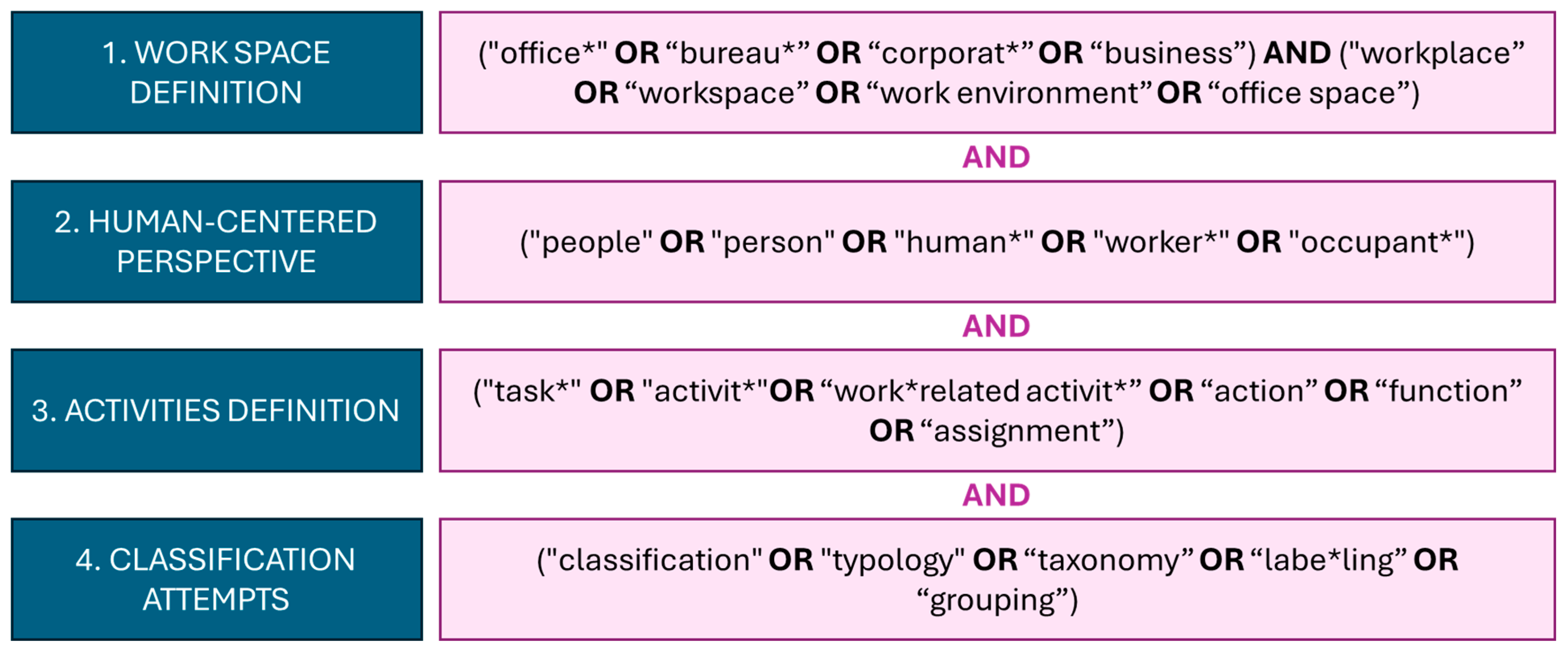
3.1. Definition of the Study Query
3.2. Data Selection and Activity Classification Criteria
- (a)
- Studies not conducted in office environments
- (b)
- Studies that do not relate to any form of work activity performed in office settings
- (c)
- Studies focusing solely on individuals with pre-existing health conditions or diseases unrelated to their work activities or office environments
- (d)
- Studies addressing general workplace design strategies without linking these to specific, measurable office activities
- (e)
- Studies that only differentiate between sedentary and non-sedentary behavior without further classification or contextualization of work-related activities.
3.3. Real-World Observational Studies in Office Environments
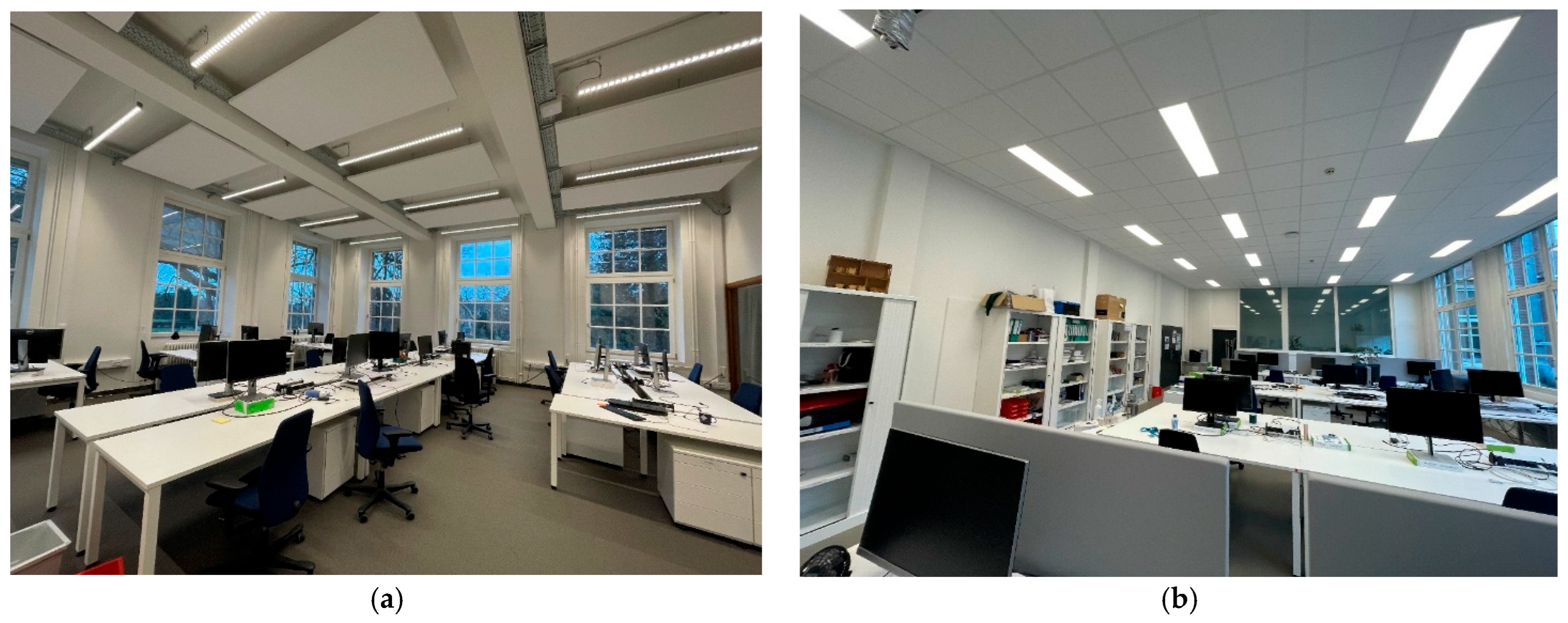
3.3.1. Characterization of Case Studies
3.3.2. Field Study Data Collection
- Participant observation
- Semi-structured interviews
- Questionnaire
- Diary logs
- Informed consent
4. Results
4.1. Describing the Dataset
4.2. Conceptual Boundaries of the Investigation
4.2.1. Office Spaces
“Viewing the office as a place where white collar work is conducted or as a set of functions and activities whose output is written and oral communication is likely to lead to an unacceptably narrow focus”
4.2.2. Office Activities
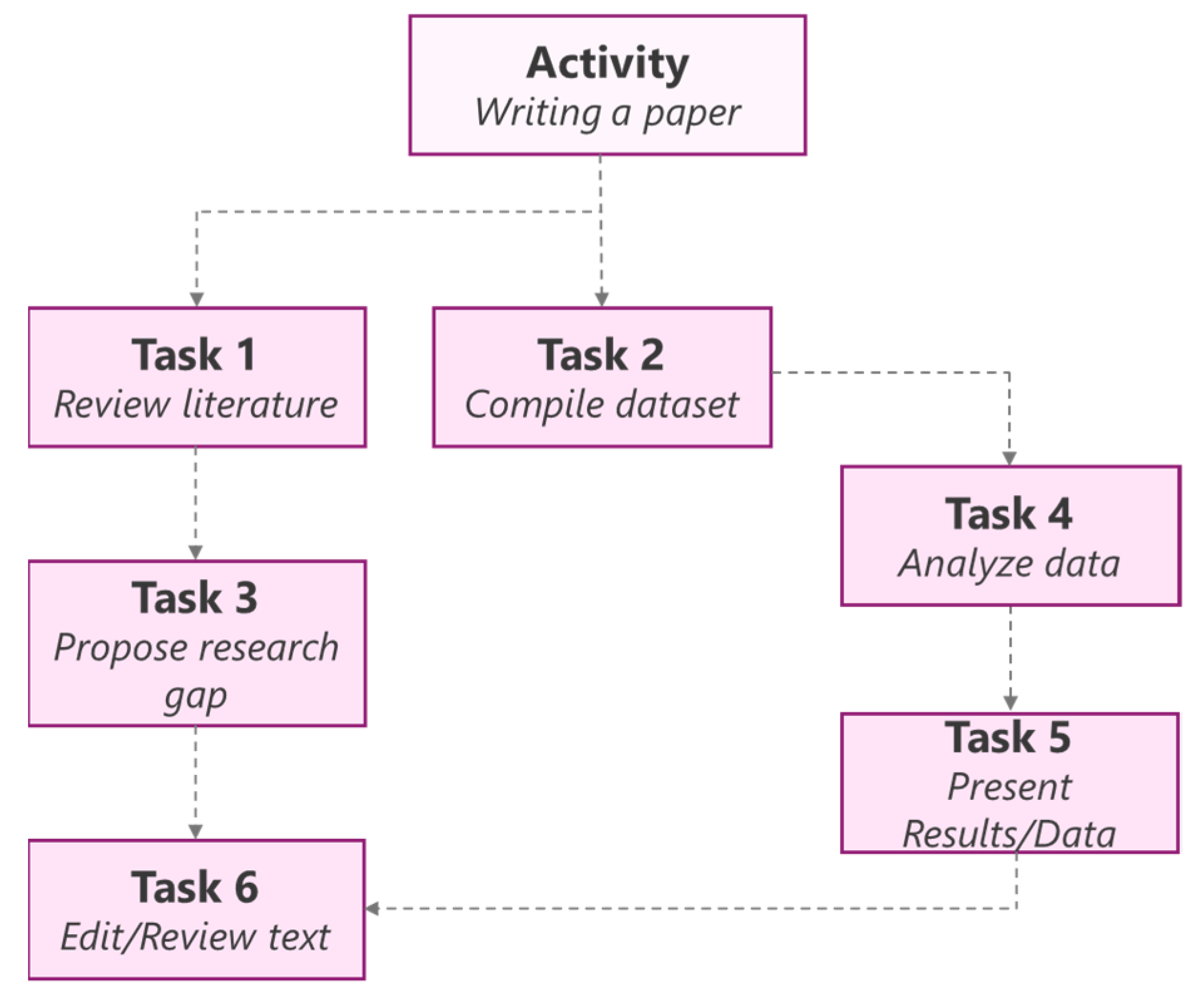
4.2.3. Observational Study Considerations: Diary Logs, Semi-Structured Interviews, and Active Participant Observation
5. Determination of Office Activity Taxonomy: Classes and Subclasses
5.1. Definition of Office Activity Attributes
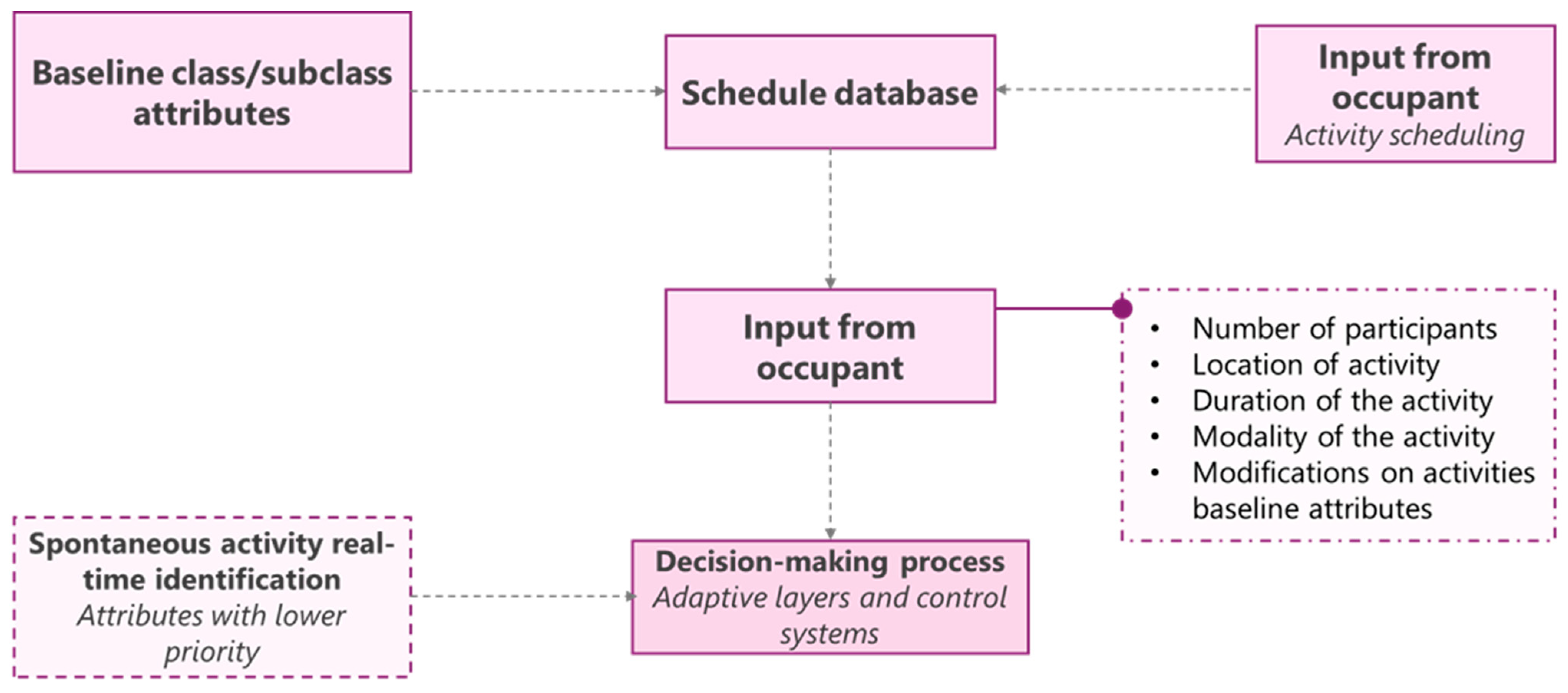
- Plannability: refers to the degree to which an activity can be anticipated and scheduled in advance. Activities may be broadly categorized as schedulable, i.e., those planned with prior notice, or spontaneous, which occur without pre-established timing. This attribute plays a crucial role in determining the priority level of activities for the coordination of BMS. Schedulable activities allow for proactive adjustments in environmental settings (e.g., lighting, moveable panels, shading systems), while spontaneous activities, due to their irregular and unpredictable nature, present challenges for pre-emptive system responses. However, when supported by intelligent automation, spontaneous activities can be detected in real-time, to then be validated through occupant feedback with short surveys or prompts, enabling adaptive calibration and data enrichment for future occurrences.
- Social interaction: activities can be classified as individual or collective. For collective tasks, the number of participants that are physically involved (not online, in the case of meetings, for example) should be specified to ensure appropriate spatial configuration, including adequate furniture and physical space. Individual activities may require higher levels of concentration and, consequently, lower tolerance for disturbances or background noise.
- Modality: refers to the mode of participation in an activity and is particularly relevant for collective tasks. It determines whether the activity is conducted physically, online, or in a hybrid (mixed) format, where some participants are present in person while others join remotely. This classification informs the necessary spatial and technological configurations required to support the activity. For instance, online activities typically demand minimal physical preparation—limited to accommodating the individual respondent with appropriate digital tools (e.g., computer, internet access). In contrast, physical and hybrid modalities necessitate the arrangement of suitable environments, including adequate seating, equipment, and acoustics, to ensure effective interaction among participants. Understanding the modality of activities allows Building Management Systems (BMS) to tailor environmental responses in alignment with the actual spatial demands of occupants.
- Posture: This refers to the body position adopted during the activity and can be categorized as seated, standing, or flexible. Seated activities typically demand ergonomic furniture and workspace accommodations, whereas standing or flexible positions may place fewer requirements on the physical environment. Activities classified as flexible are generally adaptable to the available space and do not impose specific spatial or furnishing demands. Offices equipped with movable desks should be considered “flexible” for individual activities.
- Duration: refers to the expected time frame of the activity, including its start and end times. This attribute is essential for scheduling building systems (e.g., lighting, ventilation, thermal control) in alignment with occupancy patterns. When possible, durations should be specified to support predictive system responses and efficient resource allocation.
- Complexity: indicates the cognitive or operational demand required to perform the activity. It can be classified as low, moderate, high, low to moderate, moderate to high, or not specified. Higher complexity levels may imply the need for enhanced environmental support (e.g., optimal lighting, minimal distractions, or ergonomic conditions) and lower tolerance for disturbances or background noise.
- Privacy: indicates the degree of confidentiality or seclusion required for the activity. It is similarly classified as low, moderate, high, low to moderate, moderate to high, or not specified. Activities with higher privacy needs may require acoustic insulation, restricted visibility, or spatial separation from other occupants.
5.2. Assigning Activity Subclasses and Their Attributes
5.3. Key Stressors in Office Environments and Their Impact on Everyday Work Activities
- Noise
- Air quality
- Temperature
- Glare
6. Conclusions
Supplementary Materials
Author Contributions
Funding
Institutional Review Board Statement
Informed Consent Statement
Data Availability Statement
Conflicts of Interest
References
- Mantesi, E.; Chmutina, K.; Goodier, C. The office of the future: Operational energy consumption in the post-pandemic era. Energy Res. Soc. Sci. 2022, 87, 102472. [Google Scholar] [CrossRef]
- Chafi, M.B.; Hultberg, A.; Yams, N.B. Post-Pandemic Office Work: Perceived Challenges and Opportunities for a Sustainable Work Environment. Sustainability 2022, 14, 294. [Google Scholar]
- Ng, P.M.L.; Lit, K.K.; Cheung, C.T.Y. Remote work as a new normal? The technology-organization-environment (TOE) context. Technol. Soc. 2022, 70, 102022. [Google Scholar] [CrossRef] [PubMed]
- Charalampous, M.; Grant, C.A.; Tramontano, C.; Michailidis, E. Systematically reviewing remote e-workers’ well-being at work: A multidimensional approach. Eur. J. Work. Organ. Psychol. 2018, 28, 51–73. [Google Scholar] [CrossRef]
- Shifrin, N.V.; Michel, J.S. Flexible work arrangements and employee health: A meta-analytic review. Work Stress 2021, 36, 60–85. [Google Scholar] [CrossRef]
- Kolade, O.; Owoseni, A. Employment 5.0: The work of the future and the future of work. Technol. Soc. 2022, 71, 102086. [Google Scholar] [CrossRef]
- Gnecco, V.M.; Pigliautile, I.; Pisello, A.L. Empowering human–environment well-being through wearable sensing: Unveiling trends and addressing gaps in the energy transition. WIREs Energy Environ. 2024, 13, e518. [Google Scholar] [CrossRef]
- Mansi, S.A.; Barone, G.; Forzano, C.; Pigliautile, I.; Ferrara, M.; Pisello, A.L.; Arnesano, M. Measuring human physiological indices for thermal comfort assessment through wearable devices: A review. Measurement 2021, 183, 109872. [Google Scholar] [CrossRef]
- Gnecco, V.M.; Chiucchiu, A.; Mansi, S.A.; Pigliautile, I.; Cosoli, G.; Arnesano, M.; Pisello, A.L. Exploring acclimation time in test-room environments via physiological indicators: Evolving human-centric personalized comfort measurement procedures. Build. Environ. 2025, 277, 112924. [Google Scholar] [CrossRef]
- Nazarian, N.; Liu, S.; Kohler, M.; Lee, J.K.W.; Miller, C.; Chow, W.T.L.; Alhadad, S.B.; Martilli, A.; Quintana, M.; Sunden, L.; et al. Project Coolbit: Can your watch predict heat stress and thermal comfort sensation? Environ. Res. Lett. 2021, 16, 34031. [Google Scholar] [CrossRef]
- Gnecco, V.M.; Pigliautile, I.; Pisello, A.L. Exploring office comfort and productivity in living labs: A yearlong structural equation modeling study. Build. Environ. 2024, 250, 111147. [Google Scholar] [CrossRef]
- Babapour, M.; Cordero, A.C.; Karlsson, M. Activity Theory. A framework for understanding the interrelations between users and workplace design. In A Handbook of Theories on Designing Alignment Between People and the Office Environment; Routledge: Abingdon, UK, 2021. [Google Scholar]
- Mateescu, M.; Schulze, H.; Kauffeld, S. Choosing where to work: An empirical study of collaborative activities’ impact on workspace choice behavior. J. Corp. Real Estate 2025, 27, 47–68. [Google Scholar] [CrossRef]
- Reder, S.; Schwab, R.G. The temporal structure of cooperative activity. In Proceedings of the CSCW ’90: Proceedings of the 1990 ACM Conference on Computer-Supported Cooperative Work, Los Angeles, CA, USA, 7–10 October 1990. [Google Scholar]
- Soriano, A.; Kozusznik, M.W.; Peiro, J.M.; Mateo, C. The Role of Employees’ Work Patterns and Office Type Fit (and Misfit) in the Relationships Between Employee Well-Being and Performance. Environ. Behav. 2018, 52, 111–138. [Google Scholar] [CrossRef]
- Abdelrahman, M.M.; Chong, A.; Miller, C. Personal thermal comfort models using digital twins: Preference prediction with BIM-extracted spatial–temporal proximity data from Build2Vec. Build. Environ. 2022, 207, 108532. [Google Scholar] [CrossRef]
- Gnecco, V.M.; Vittori, F.; Pisello, A.L. Digital twins for decoding human-building interaction in multi-domain test-rooms for environmental comfort and energy saving via graph representation. Energy Build. 2023, 279, 112652. [Google Scholar] [CrossRef]
- Manioudis, M.; Meramveliotakis, G. Broad strokes towards a grand theory in the analysis of sustainable development: A return to the classical political economy. New Political Econ. 2022, 27, 866–878. [Google Scholar] [CrossRef]
- Klarin, T. The Concept of Sustainable Development: From its Beginning to the Contemporary Issues. Zagreb Int. Rev. Econ. Bus. 2018, 21, 67–94. [Google Scholar] [CrossRef]
- Mokhtarian, P.L.; Salomon, I.; Handy, S.L. A Taxonomy of Leisure Activities: The Role of ICT; Institute of Transportation Studies: Davis, CA, USA, 2004. [Google Scholar]
- Higgins, C.A.; Safayeni, F.R. A Critical Appraisal of Task Taxonomies as a Tool for Studying Office Activities. ACM Trans. Off. Inf. Syst. 1984, 2, 331–339. [Google Scholar] [CrossRef]
- Appel-Meulenbroek, H.A.J.A.; Kemperman, A.D.A.M.; Liebregts, M.M.M.; Oldman, T. Helping Corporate Real Estate Management with the implementation of a modern work environment that supports employees and their activities: An analysis of different preferences in 5 European countries. In Proceedings of the 21st Congress of the European Real Estate Society, Bucharest, Romania, 25–28 June 2014. [Google Scholar]
- Gnecco, V.M.; Kousis, I.; Pigliautile, I.; Pisello, A.L. Decoding Living Lab sensing system through Bayesian networks: The preferable working space targeting comfort and productivity. J. Build. Eng. 2025, 101, 111913. [Google Scholar] [CrossRef]
- Kottek, M.; Grieser, J.; Beck, C.; Rudolf, B.; Rubel, F. World Map of the Köppen-Geiger climate classification updated. Meteorol. Z. 2006, 15, 259–263. [Google Scholar] [CrossRef]
- Colenberg, S.; Appel-Meulenbroek, R.; Herrera, N.R.; Keyson, D. Conceptualizing social well-being in activity-based offices. J. Manag. Psychol. 2021, 36, 327–343. [Google Scholar] [CrossRef]
- Dodswell, A. Office Automation; John Wiley & Sons: Hoboken, NJ, USA, 1983. [Google Scholar]
- Mariotti, I.; Tomaz, E.; Micek, G.; Méndez-Ortega, C. Introduction to the Evolution of New Working Spaces. In Evolution of New Working Spaces; Springer: Berlin/Heidelberg, Germany, 2024; pp. 1–4. [Google Scholar]
- Hirschheim, R.A. Understanding the Office: A Social-Analytic Perspective. ACM Trans. Off. Inf. Syst. 1986, 4, 331–344. [Google Scholar] [CrossRef]
- de Lucas Ancillo, A.; Gavrila, S.G.; del Val Nunez, M.T. Workplace change within the COVID-19 context: The new (next) normal. Technol. Forecast. Soc. Change 2023, 194, 122673. [Google Scholar] [CrossRef]
- Aranega, A.Y.; del Val Nunez, M.T.; Sanchez, R.C. Mindfulness as an intrapreneurship tool for improving the working environment and self-awareness. J. Bus. Res. 2020, 115, 186–193. [Google Scholar] [CrossRef]
- Appel-Meulenbroek, R.; Kemperman, A.; van de Water, A.; Weijs-Perrée, M.; Verhaegh, J. How to attract employees back to the office? A stated choice study on hybrid working preferences. J. Environ. Psychol. 2022, 81, 101784. [Google Scholar] [CrossRef]
- Neufert, E. Arte de Proyectar en Arquitectura; Ediciones Gustavo Gill SA de CV: Mexico City, Mexico, 1995. (In Spanish) [Google Scholar]
- Fast, K.; Jansson, A. Working in the comfort zone: Understanding coworking spaces as post-digital, post-work and post-tourist territory. Digit. Geogr. Soc. 2024, 7, 100103. [Google Scholar] [CrossRef]
- Vasconcelos, P.; Furtado, E.; Pinheiro, P.R. An approach of multidisciplinary criteria for modeling alternatives of flexible working. Comput. Hum. Behav. 2015, 51, 1054–1060. [Google Scholar] [CrossRef]
- Oldenburg, R. Our Vanishing “Third Places”. Plan. Comm. J. 1997, 25, 6–10. [Google Scholar]
- Oldenburg, R. Great Good Place: Cafés, Coffee Shops, Bookstores, Bars, Hair Salons, and Other Hangouts at the Heart of a Community; Marlowe & Company: New York, NY, USA, 1989. [Google Scholar]
- Aristizabal, S.; Byun, K.; Porter, P.; Clements, N.; Campanella, C.; Li, L.; Mullan, A.; Ly, S.; Senerat, A.; Nenadic, I.Z.; et al. Biophilic Office Design: Exploring the Impact of a Multisensory Approach on Human Well-Being. J. Environ. Psychol. 2021, 77, 101682. [Google Scholar] [CrossRef]
- U.S. Green Building Council. Press Room: Benefits of Green Building. Available online: https://www.usgbc.org/press/benefits-of-green-building (accessed on 1 October 2025).
- Bergefurt, L.; Weijs-Perrée, M.; Appel-Meulenbroek, R.; Arentze, T. The physical office workplace as a resource for mental health—A systematic scoping review. Build. Environ. 2022, 207, 108505. [Google Scholar] [CrossRef]
- Tahernejad, S.; Choobineh, A.; Razeghi, M.; Abdoli-Eramaki, M.; Parsaei, H.; Daneshmandi, H.; Seif, M. Investigation of office workers’ sitting behaviors in an ergonomically adjusted workstation. Int. J. Occup. Saf. Ergon. 2022, 28, 2346–2354. [Google Scholar] [CrossRef] [PubMed]
- van den Berg, J.; Appel-Meulenbroek, R.; Kemperman, A.; Sotthewes, M. Knowledge workers’ stated preferences for important characteristics of activity-based workspaces. Build. Res. Inf. 2020, 48, 703–718. [Google Scholar] [CrossRef]
- Raymond, S. Tomorrow’s Office: Creating Effective and Humane Interiors; E & FN Spon: London, UK, 2000. [Google Scholar]
- Mustafa, F.A.; Azeez, S.A. Role of office layout typology in saving time and distance spent by users: Case of office buildings in Erbil city. Ain Shams Eng. J. 2022, 13, 101742. [Google Scholar] [CrossRef]
- Newport, C. Deep Work: Rules for Focused Success in a Distracted World; Hachette: London, UK, 2015. [Google Scholar]
- Drucker, P. The Landmarks of Tomorrow; Harper and Row: New York, NY, USA, 1959. [Google Scholar]
- Cayir, S.; Basoglu, N.; Daim, T.U. A study on the relationship between task, information, and individual performance. Technol. Soc. 2016, 46, 1–9. [Google Scholar] [CrossRef]
- Danielsson, C.B. 26—Office Experiences. In Product Experience; Elsevier: Amsterdam, The Netherlands, 2008; pp. 605–628. [Google Scholar]
- Bystrom, K.; Hansen, P. Conceptual framework for tasks in information studies. J. Am. Soc. Inf. Sci. Technol. 2005, 56, 1050–1061. [Google Scholar] [CrossRef]
- Tabak, V.; de Vries, B. Methods for the prediction of intermediate activities by office occupants. Build. Environ. 2010, 45, 1366–1372. [Google Scholar] [CrossRef]
- Duffy, F.; Powell, K. The New Offices; Conran Octopus: London, UK, 1997. [Google Scholar]
- Hascher, R.; Arnold, T.; Jeska, S.; Birgit, K. Office Buildings: A Design Manual; Princeton Architectural Press: New York, NY, USA, 2002. [Google Scholar]
- Cha, S.H.; Seo, J.; Baek, S.H.; Koo, C. Towards a well-planned, activity-based work environment: Automated recognition of office activities using accelerometers. Build. Environ. 2018, 144, 86–93. [Google Scholar] [CrossRef]
- Kuster, R.P.; Huber, M.; Hirschi, S.; Siegl, W.; Baumgartner, D.; Hagstromer, M.; Grooten, W. Measuring Sedentary Behavior by Means of Muscular Activity and Accelerometry. Sensors 2018, 18, 4010. [Google Scholar] [CrossRef] [PubMed]
- Burns, J.; Forde, C.; Dockrell, S. Energy Expenditure of Standing Compared to Sitting While Conducting Office Tasks. Hum. Factors 2017, 59, 1078–1087. [Google Scholar] [CrossRef]
- Wohlers, C.; Hertel, G. Choosing where to work at work—Towards a theoretical model of benefits and risks of activity-based flexible offices. Ergonomics 2017, 60, 467–486. [Google Scholar] [CrossRef]
- Lee, Y.; Aletta, F. Acoustical planning for workplace health and well-being: A case study in four open-plan offices. Building Acoustics 2019, 26, 207–220. [Google Scholar] [CrossRef]
- Felipe Contin de Oliveira, S.; Aletta, F.; Kang, J. Self-rated health implications of noise for open-plan office workers: An overview of the literature. Build. Acoust. 2023, 30, 105–125. [Google Scholar] [CrossRef]
- Colenberg, S.; Herrera, N.R.; Keyson, D. Interior design features predicting satisfaction with office workspace privacy and noise. In The 21st EuroFM Research Symposium; EUROFM: Breda, The Netherlands, 2022. [Google Scholar]
- Mansor, A.A.; Abdullah, S.; Ahmad, A.N.; Ahmed, A.N.; Zulkifli, M.F.R.; Jusoh, S.M.; Ismail, M. Indoor air quality and sick building syndrome symptoms in administrative office at public university. Dialogues Health 2024, 4, 100178. [Google Scholar] [CrossRef] [PubMed]
- Licina, D.; Langer, S. Indoor air quality investigation before and after relocation to WELL-certified office buildings. Build. Environ. 2021, 204, 108182. [Google Scholar] [CrossRef]
- Seppanen, O.; Fisk, W.J.; Lei, Q.H. Effect of Temperature on Task Performance in Office Environment; Lawrence Berkeley National Laboratory: Berkeley, CA, USA, 2006. [Google Scholar]
- Wyon, D.P.; Wargocki, P. Room Temperature Effects on Office Work. In Creating the Productive Workplace; Taylor & Francis: Abingdon, UK, 2006. [Google Scholar]
- Wolkoff, P.; Azuma, K.; Carrer, P. Health, work performance, and risk of infection in office-like environments: The role of indoor temperature, air humidity, and ventilation. Int. J. Hyg. Environ. Health 2021, 233, 113709. [Google Scholar] [CrossRef]
- Hamedani, Z.; Solgi, E.; Skates, H.; Hine, T.; Fernando, R.; Lyons, J.; Dupre, K. Visual discomfort and glare assessment in office environments: A review of light-induced physiological and perceptual responses. Build. Environ. 2019, 153, 267–280. [Google Scholar] [CrossRef]
- Usanova, K.I.; Kodali, A.; Rajendra, P.; Ayush, G.; Girish, K.; Ashita, P. Incorporating Sustainable Development Goals (SDGs) into Building Environment-Related Business Models: A Comprehensive Review. E3S Web Conf. 2024, 588, 01005. [Google Scholar] [CrossRef]
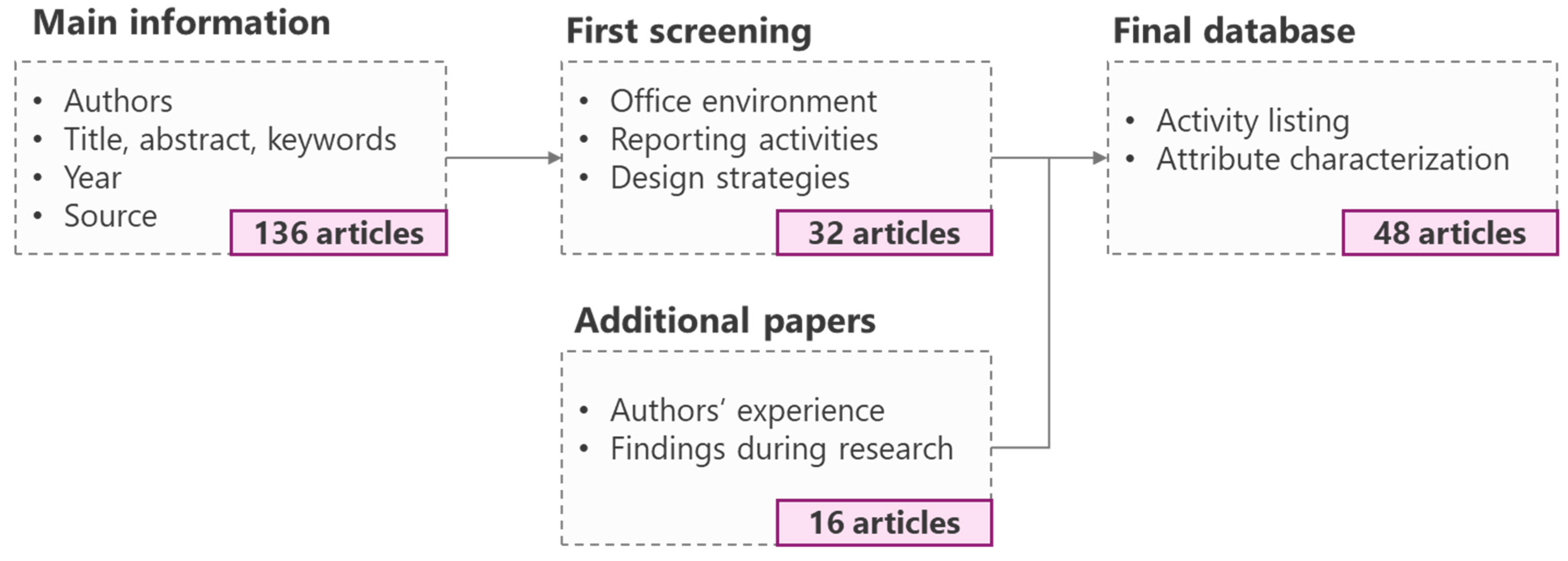
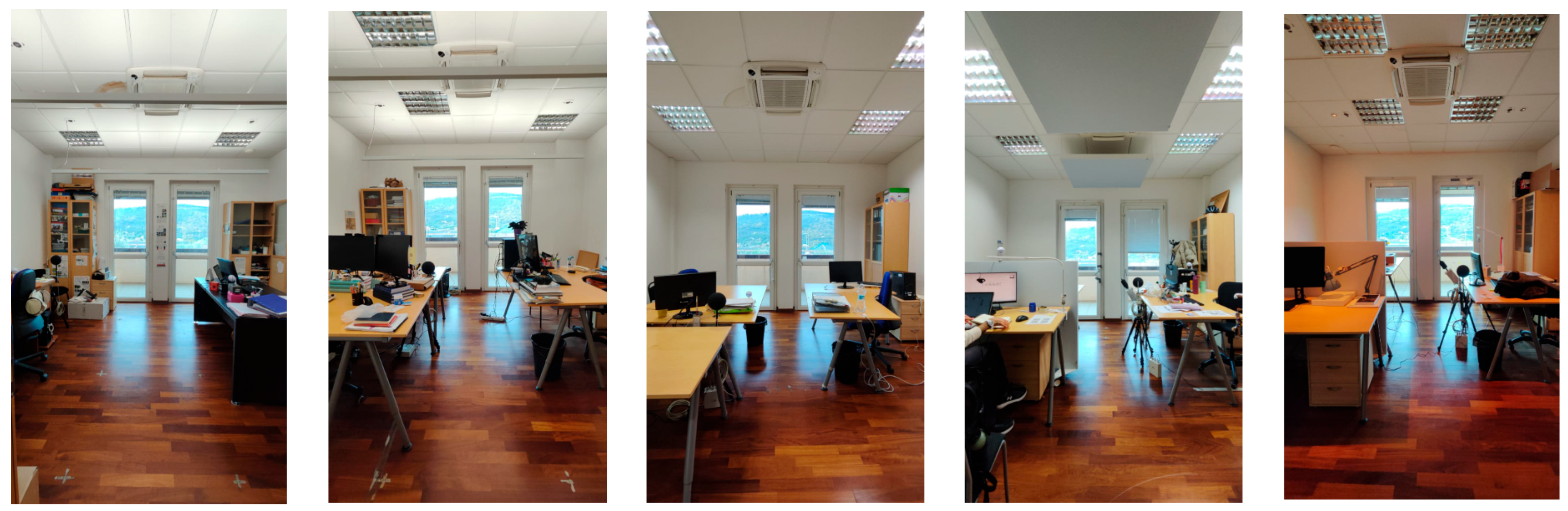


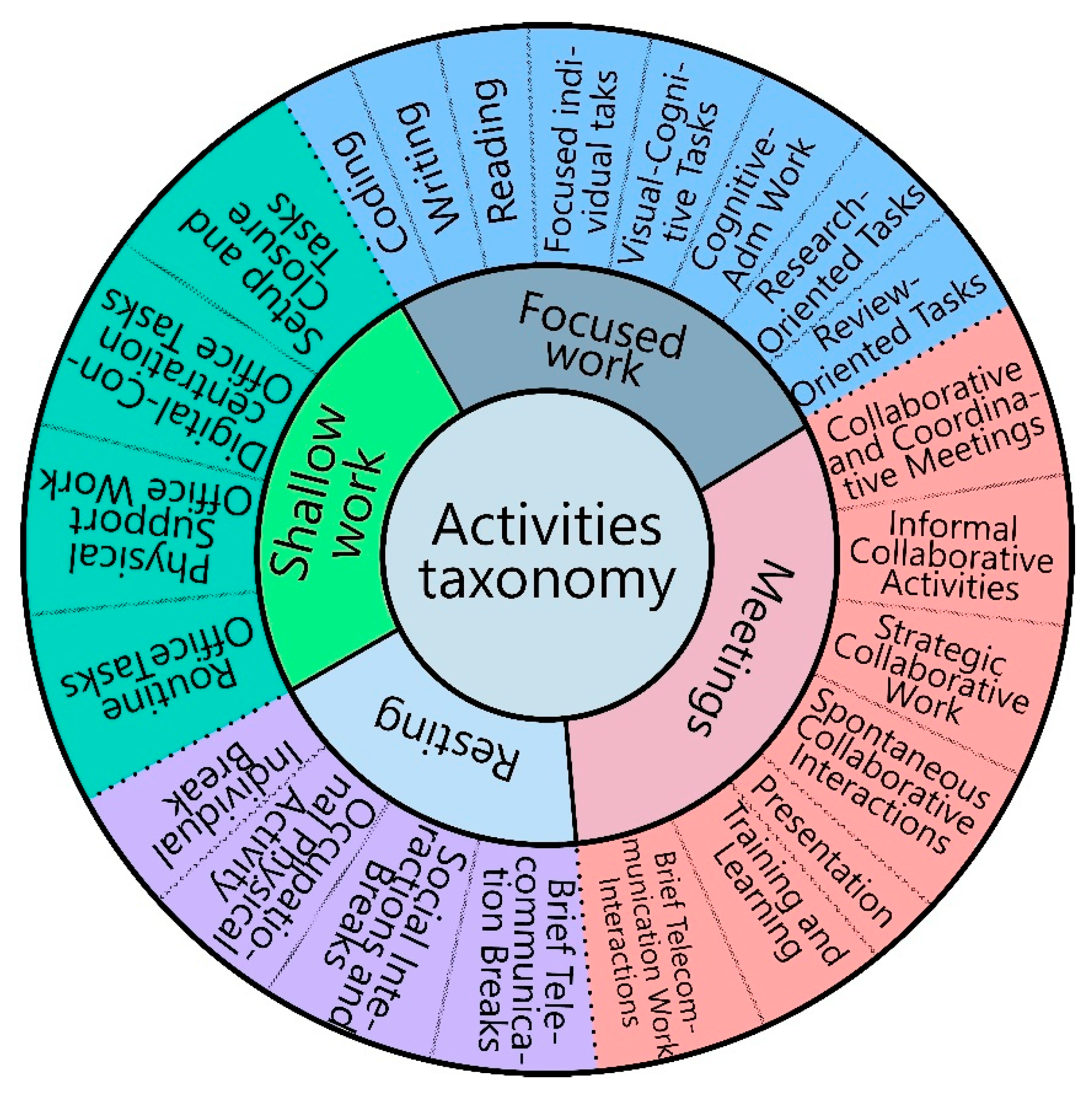


| General Classification | Definition |
|---|---|
| Focused Work | Period dedicated to activities that require concentration on a specific task, ideally free from interruptions or distractions. Often defined by single-minded attention to complete complex, detail-oriented, or creative tasks |
| Meetings | Online or in-person interactions involving two or more individuals, typically within a professional or organizational context, aiming to exchange information, discuss ideas, make decisions, or foster collaboration |
| Shallow work | Non-cognitively demanding, logistical-style tasks, often performed while distracted. These efforts tend not to create much new value in the world and are easy to replicate. |
| Relaxing | Informal and low-pressure breaks that give employees a mental and physical interruption from work tasks. These activities are important to maintain well-being, reduce stress, promote team-bonding, and enhance overall productivity. |
| General Class | Subclass | Activities Gathered in the Literature Reviewed | Activities Gathered in the Observational Study |
|---|---|---|---|
| Focused Work | Coding | Write code; write script; write tool | Coding; simulation/technical activities; data analysis; catch-up results annotation; work desk time; data processing and visualization |
| Writing | Writing; Write an essay; generate text; sitting/standing and typing | Writing master’s thesis; working on literature review; writing a journal paper; report writing; research writing and documentation; research writing; research documentation | |
| Reading | Reading; sitting/standing and reading | Reading review papers | |
| Focused Individual Tasks | Private work; individual work; individual low/high concentration work; retreating alone; individual work tasks requiring concentration | Testing sensors; practicing a presentation; focused time | |
| Visual–Cognitive Tasks | Creative work | Preparing a presentation; graphic edits; making slides (presentation) | |
| Cognitive–Administrative Work | Coordinative activities | Engaging in administrative tasks; contract reading | |
| Research-Oriented Tasks | Gathering info | Formalizing/working on research outline proposal; working on a PhD | |
| Review-Oriented Tasks | - | Correcting tables of a review paper; correcting journal paper proof | |
| Shallow work | Routine Office Tasks | Behind the computer; routine at the computer; general desk work | Office work behind desk/laptop/screen; checking calendar; making poll; sending emails; answering surveys |
| Physically Supported Office Work | Archiving; sitting/standing and sorting paper; print; staple | - | |
| Digital-Concentration Office Tasks | Document management | Correcting minutes | |
| Setup and Closing Tasks | - | Cleaning up desk; packing to leave; locking my bag in my drawer; setting up desk, laptop, and peripherals; wrapping up work | |
| Meetings—In-person/Online/Virtual meeting | Collaborative and Coordinative Meetings | Formal meeting; coordinative activities; ad hoc collaborative activities; mandatory collaborative activities; collaborating | Catch-up with supervisor; meeting with experts; checking purchases with a co-worker; discussing purchases/contracts |
| Informal Collaborative Activities | Informal meeting; group work; answering questions; creative work; called collaborative activities; teamwork; help finding information/giving info; informal meeting; conversation at the meeting table | Brief consultation with a colleague | |
| Strategic Collaborative Work | Deep collaboration; | Project alignment; meeting with a colleague about joint collaboration/project | |
| Spontaneous Collaborative Interactions | Spontaneous communication/meeting; on-demand meeting; change meeting; unplanned meeting; job networking | - | |
| Presentation Activities | Presenting; presentation | Presenting my work | |
| Training and Learning Sessions | Workshop meeting; learning activities | Book club; conference meeting; online journal club | |
| Brief Telecommunication Work Interactions | Phone conversation; telephone use; phone calls; video calls | ||
| Resting | Social Interactions and Breaks | Internal conversations; conversations at the entrance; conversations between two far apart offices; informal talk; desk work interaction; spontaneous communication; self-reported leisure time; Intermediate activities that interrupt work (lunch, break, drink, toilet, printer, mailbox, smoke, sport, etc.); lunch; coffee | Social break; informal chatting |
| Brief Telecommunication Breaks | Phone conversation; telephone use; phone calls; video calls | - | |
| Occupational Physical Activity | Sport/exercise; occupational physical activity | - | |
| Individual Break | Sitting/standing quietly | - |
| General Classification | Subclass | Social Interaction | Plannability | Posture | Complexity |
|---|---|---|---|---|---|
| Focused Work | Coding | Individual | Schedulable | Seated | High |
| Writing | Individual | Schedulable | Seated | High | |
| Reading | Individual | Schedulable | Seated | High | |
| Focused Individual Tasks | Individual | Schedulable | Seated | High | |
| Visual–Cognitive Tasks | Individual | Schedulable | Seated | High | |
| Cognitive–Administrative Work | Individual | Schedulable | Seated | High | |
| Research-Oriented Tasks | Individual | Schedulable | Seated | High | |
| Review-Oriented Tasks | Individual | Schedulable | Seated | High | |
| Shallow work | Routine Office Tasks | Individual | Spontaneous | Seated | Low |
| Physically Supported Office Work | Individual | Spontaneous | Flexible | Low | |
| Digital-Concentration Office Tasks | Individual | Schedulable | Seated | Low | |
| Setup and Closing Tasks | Individual | Spontaneous | Flexible | Low | |
| Meetings—In-person/Online/Virtual meeting | Collaborative and Coordinative Meetings | Collective | Schedulable | Seated | High |
| Informal Collaborative Activities | Collective | Schedulable | Flexible | Moderate | |
| Strategic Collaborative Work | Collective | Schedulable | Seated | High | |
| Spontaneous Collaborative Interactions | Collective | Spontaneous | Flexible | Moderate | |
| Presentation Activities | Collective | Schedulable | Flexible | Moderate | |
| Training and Learning Sessions | Collective | Schedulable | Seated | Moderate | |
| Brief Telecommunication Work Interactions | Individual | Spontaneous | Flexible | Moderate | |
| Resting | Social Interactions and Breaks | Collective | Spontaneous | Flexible | Low |
| Brief Telecommunication Breaks | Individual | Spontaneous | Flexible | Low | |
| Occupational Physical Activity | Individual | Spontaneous | Flexible | Low | |
| Individual Break | Individual | Spontaneous | Flexible | Low |
Disclaimer/Publisher’s Note: The statements, opinions and data contained in all publications are solely those of the individual author(s) and contributor(s) and not of MDPI and/or the editor(s). MDPI and/or the editor(s) disclaim responsibility for any injury to people or property resulting from any ideas, methods, instructions or products referred to in the content. |
© 2025 by the authors. Licensee MDPI, Basel, Switzerland. This article is an open access article distributed under the terms and conditions of the Creative Commons Attribution (CC BY) license (https://creativecommons.org/licenses/by/4.0/).
Share and Cite
Martins Gnecco, V.; Pogladič, A.; Chiucchiù, A.; Pigliautile, I.; Arko, S.; Pisello, A.L. Office Activity Taxonomy in the Digital Transition Era: Towards Situationally Aware Buildings. Sustainability 2025, 17, 11376. https://doi.org/10.3390/su172411376
Martins Gnecco V, Pogladič A, Chiucchiù A, Pigliautile I, Arko S, Pisello AL. Office Activity Taxonomy in the Digital Transition Era: Towards Situationally Aware Buildings. Sustainability. 2025; 17(24):11376. https://doi.org/10.3390/su172411376
Chicago/Turabian StyleMartins Gnecco, Veronica, Anja Pogladič, Agnese Chiucchiù, Ilaria Pigliautile, Sara Arko, and Anna Laura Pisello. 2025. "Office Activity Taxonomy in the Digital Transition Era: Towards Situationally Aware Buildings" Sustainability 17, no. 24: 11376. https://doi.org/10.3390/su172411376
APA StyleMartins Gnecco, V., Pogladič, A., Chiucchiù, A., Pigliautile, I., Arko, S., & Pisello, A. L. (2025). Office Activity Taxonomy in the Digital Transition Era: Towards Situationally Aware Buildings. Sustainability, 17(24), 11376. https://doi.org/10.3390/su172411376