Does the Urban Nighttime Tourism Experiencescape Enhance Tourist Loyalty? The Mediating Role of Place Attachment

Abstract
1. Introduction
2. Literature Review
2.1. Servicescape and Nighttime Tourism Experiencescape
2.2. Tourist Loyalty
3. Research Model and Hypotheses
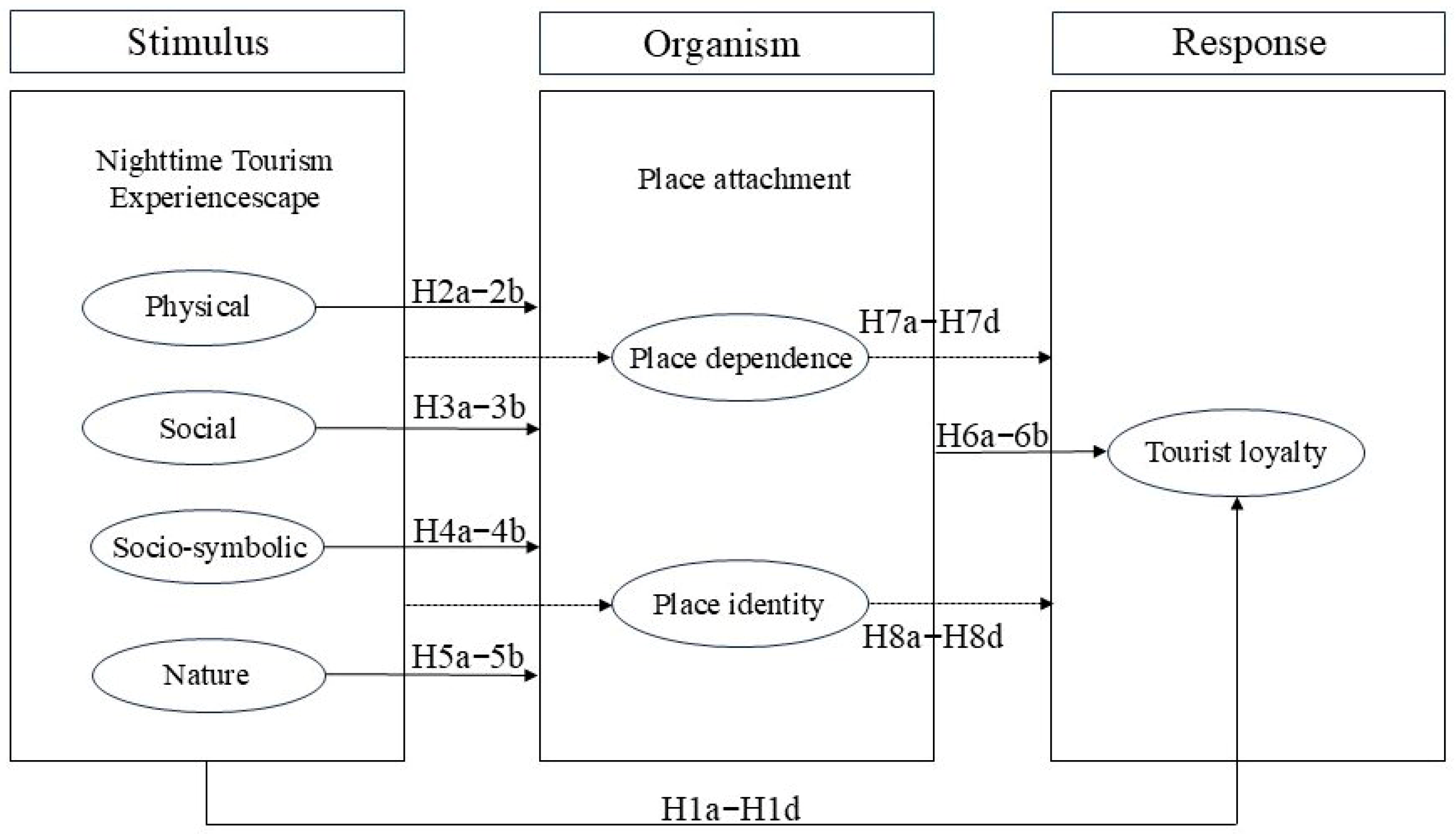
3.1. Theoretical Model
3.2. Research Hypothesis
3.2.1. Nighttime Tourism Experiencescapes and Tourist Loyalty
3.2.2. Nighttime Tourism Experiencescape and Place Attachment
3.2.3. Place Attachment and Tourist Loyalty
3.2.4. Mediating Role of Place Attachment
4. Materials and Methods
4.1. Research Site
4.2. Variables Measurement
4.3. Data Collection and Sample Structure
4.4. Data Analysis Methods
5. Results
5.1. Common Method Bias Test
5.2. Normal Distribution Test
5.3. Reliability and Validity Test
5.4. Model Fitting Indicators
5.5. Path Analysis
5.6. Mediating Effect Test
6. Discussions
7. Conclusions and Limitations
7.1. Conclusions
7.2. Theoretical Contributions
7.3. Limitations and Future Research
Author Contributions
Funding
Institutional Review Board Statement
Informed Consent Statement
Data Availability Statement
Conflicts of Interest
Appendix A
| Variables | Items |
| Physical | PH1. The lighting here at night is very distinctive. |
| PH2. The overall color here at night is harmonious. | |
| PH3. The background music playing at night here is very harmonious. | |
| PH4. The smell of the snacks here at night is very attractive. | |
| PH5. The sanitary environment at night here is clean and tidy. | |
| PH6. The street decoration design at night is distinctive. | |
| PH7. The cruise programs and supporting facilities at night are well laid out. | |
| PH8.The tourist signage system here conveys a clear message at night. | |
| PH9. The facilities open at night are functional and well-maintained. | |
| PH10. The architectural landscape is distinctive at night. | |
| Social | SO1. The density of tourists at night is moderate. |
| SO2. I can interact with each other as equals. | |
| SO3. I can relate to each other casually. | |
| SO4. I can interact with each other without worrying about anything. | |
| SO5. The service staff here is hospitable, polite and friendly. | |
| Socio-symbolic | SY1. The night scene here shows the historical flavor. |
| SY2. The souvenirs here are distinctive | |
| SY3. The cruise programs and performances at night are distinctive. | |
| SY4. I am attracted to the overall cultural atmosphere at night. | |
| SY5. I am familiar with the cultural symbols displayed here. | |
| Natural | NA1. I can escape from the world by traveling here at night. |
| NA2. The night scene here is fascinating. | |
| NA3. The night cruise scene here is compatible with my personality. | |
| Place dependence | PD1. I prefer the nighttime atmosphere here to other destinations. |
| PD2. This place satisfies my nightlife needs better than other destinations. | |
| PD3. It gives me a sense of satisfaction that I can’t get anywhere else. | |
| Place identity | PI1. Here nighttime experience is unique. |
| PI2. I have a strong sense of identity here. | |
| PI3. I like it so much that I don’t want to leave too soon. | |
| Tourist loyalty | TL1. I would recommend this place to my family and friends. |
| TL2. I would like to bring more companions to this place. | |
| TL3. I would like to visit this place again in the future. |
References
- Eldridge, A.; Smith, A. Tourism and the night: Towards a broader understanding of nocturnal city destinations. J. Policy Res. Tour. Leis. Events 2019, 11, 371–379. [Google Scholar] [CrossRef]
- Zhang, R.; Chen, S.; Xu, S.; Law, R.; Zhang, M. Research on the sustainable development of urban night tourism economy: A case study of Shenzhen City. Front. Sustain. Cities 2022, 4, 870697. [Google Scholar] [CrossRef]
- Zhang, J.; Zhang, Y. Does tourism contribute to the nighttime economy? Evidence from China. Curr. Issues Tour. 2022, 26, 1295–1310. [Google Scholar] [CrossRef]
- Jiang, G.X.; Li, Y.Q.; Ruan, W.Q.; Zhang, S.N. Night tourscape in streets: Scale development and validation. J. Hosp. Tour. Manag. 2024, 61, 350–360. [Google Scholar] [CrossRef]
- Li, R.; Li, Y.Q.; Liu, C.H.; Ruan, W.Q. How to create a memorable night tourism experience: Atmosphere, arousal and pleasure. Curr. Issues Tour. 2021, 25, 1817–1834. [Google Scholar] [CrossRef]
- Edensor, T. The gloomy city: Rethinking the relationship between light and dark. Urban Stud. 2013, 52, 422–438. [Google Scholar] [CrossRef]
- Huang, W.J.; Wang, P. All that’s best of dark and bright: Day and night perceptions of Hong Kong cityscape. Tour. Manag. 2018, 66, 274–286. [Google Scholar] [CrossRef]
- Ruan, W.Q.; Jiang, G.X.; Li, Y.Q.; Zhang, S.N. Night tourscape: Structural dimensions and experiential effects. J. Hosp. Tour. Manag. 2023, 55, 108–117. [Google Scholar] [CrossRef]
- Zhang, H.; Fu, X.; Cai, L.A.; Lu, L. Destination image and tourist loyalty: A meta-analysis. Tour. Manag. 2014, 40, 213–223. [Google Scholar] [CrossRef]
- Wang, L.; Li, X. The five influencing factors of tourist loyalty: A meta-analysis. PLoS ONE 2023, 18, e0283963. [Google Scholar] [CrossRef] [PubMed]
- Bitner, M.J. Servicescapes: The impact of physical surroundings on customers and employees. J. Mark. 1992, 56, 57–71. [Google Scholar] [CrossRef]
- Baker, J.; Grewall, D.; Parasuraman, A. The influence of store environment on quality inferences and store image. J. Acad. Mark. Sci. 1994, 22, 328–339. [Google Scholar] [CrossRef]
- Tombs, A.; McColl-Kennedy, J.R. Social-servicescape conceptual model. Mark. Theor. 2003, 3, 447–475. [Google Scholar] [CrossRef]
- Rosenbaum, M.S.; Massiah, C. An expanded servicescape perspective. J. Serv. Manag. 2011, 22, 471–490. [Google Scholar] [CrossRef]
- O’Dell, T. Experiencescapes: Blurring Borders and Testing Connections. In Experiencescapes: Tourism, Culture & Economy; O’Dell, T., Billing, P., Eds.; Frederiksberg Copenhagen Business School Press: Copenhagen, Denmark, 2005; pp. 11–33. [Google Scholar]
- Mossberg, L. A marketing approach to the tourist experience. Scand. J. Hosp. Tour. 2007, 7, 59–74. [Google Scholar] [CrossRef]
- Hu, T.; Chen, H. Destination experiencescape for coastal tourism: A social network analysis exploration. J. Outdoor Recreat. Tour. 2024, 46, 100747. [Google Scholar] [CrossRef]
- Radic, A.; Lück, M.; Al-Ansi, A.; Chua, B.L.; Seeler, S.; Han, H. Cruise ship dining experiencescape: The perspective of female cruise travelers in the midst of the COVID-19 pandemic. Int. J. Hosp. Manag. 2021, 95, 102923. [Google Scholar] [CrossRef] [PubMed]
- Zong, Y.; Tsaur, S. Destination Experiencescape for Hanfu Tourism: An Exploratory Study. J. China Tour. Res. 2023, 20, 144–166. [Google Scholar] [CrossRef]
- Oliver, R.L. Whence consumer loyalty? J. Mark. 1999, 63, 33–44. [Google Scholar] [CrossRef]
- Baker, D.A.; Crompton, J.L. Quality, satisfaction and behavioral intentions. Ann. Tour. Res. 2000, 27, 785–804. [Google Scholar] [CrossRef]
- Chen, J.S.; Gursoy, D. An investigation of tourists’ destination loyalty and preferences. Int. J. Contemp. Hosp. Manag. 2001, 13, 79–85. [Google Scholar] [CrossRef]
- Lee, S.; Jeon, S.; Kim, D. The impact of tour quality and tourist satisfaction on tourist loyalty: The case of Chinese tourists in Korea. Tour. Manag. 2011, 32, 1115–1124. [Google Scholar] [CrossRef]
- Jiang, J.; Yan, B. From soundscape participation to tourist loyalty in nature-based tourism: The moderating role of soundscape emotion and the mediating role of soundscape satisfaction. J. Destin. Mark. Manag. 2022, 26, 100730. [Google Scholar] [CrossRef]
- Akroush, M.N.; Jraisat, L.E.; Kurdieh, D.J.; Al-Faouri, R.N.; Qatu, L.T. Tourism service quality and destination loyalty-the mediating role of destination image from international tourists’ perspectives. Tour. Rev. 2016, 71, 18–44. [Google Scholar] [CrossRef]
- Blasco López, M.F.; Virto, N.R.; Manzano, J.A.; García-Madariaga, J. Archaeological tourism: Looking for visitor loyalty drivers. J. Herit. Tour. 2019, 15, 60–75. [Google Scholar] [CrossRef]
- Kong, W.H.; Loi, K.I.; Xu, J. Investigating destination loyalty through tourist attraction personality and loyalty. J. China Tour. Res. 2020, 18, 397–418. [Google Scholar] [CrossRef]
- Lin, M.; Lin, C.; Llonch-Molina, N.; Marine-Roig, E. The impact of olive oil tourism on multisensory experiences and tourist loyalty. Int. J. Gastron. Food Sci. 2025, 40, 101195. [Google Scholar] [CrossRef]
- Andersen, C.; Engeset, M.G.; Nyhus, E.K. Tourist involvement in vacation planning and booking: Impact on word of mouth and loyalty. Tour. Rev. 2024, 79, 428–444. [Google Scholar] [CrossRef]
- Rasoolimanesh, S.M.; Noor, S.M.; Schuberth, F.; Jaafar, M. Investigating the effects of tourist engagement on satisfaction and loyalty. Serv. Ind. J. 2019, 39, 559–574. [Google Scholar] [CrossRef]
- Mehrabian, A.; Russell, J.A. An Approach to Environmental Psychology; M.I.T. Press: Cambridge, MA, USA, 1974. [Google Scholar]
- Tuncer, I.; Unusan, C.; Cobanoglu, C. Service quality, perceived value and customer satisfaction on behavioral intention in restaurants: An integrated structural model. J. Qual. Assur. Hosp. Tour. 2020, 22, 447–475. [Google Scholar] [CrossRef]
- Knoferle, K.M.; Spangenberg, E.R.; Herrmann, A.; Landwehr, J.R. It is all in the mix: The interactive effect of music tempo and mode on in-store sales. Mark. Lett. 2012, 23, 325–337. Available online: https://www.jstor.org/stable/41488784 (accessed on 15 October 2025). [CrossRef]
- Yang, Y.; Qin, Y.; Wang, Z.; Sun, A. The Influence of emotional labor of service employees on customer service misbehavior and repurchase intention: The role of face. Psychol. Res. Behav. Manag. 2023, 16, 1109–1124. [Google Scholar] [CrossRef] [PubMed]
- Line, N.D.; Hanks, L.; Kim, W.G. An expanded servicescape framework as the driver of place attachment and word of mouth. J. Hosp. Tour. Res. 2015, 42, 476–499. [Google Scholar] [CrossRef]
- Venkatraman, M.; Nelson, T. From servicescape to consumption scape: A photo-elicitation study of Starbucks in the New China. J. Int. Bus. Stud. 2008, 39, 1010–1026. [Google Scholar] [CrossRef]
- Frumkin, H. Healthy places: Exploring the evidence. Am. J. Public Health 2003, 93, 1451–1456. [Google Scholar] [CrossRef]
- Rosenbaum, M.S. Restorative servicescape: Restoring directed attention in third places. J. Serv. Manag. 2009, 20, 173–191. [Google Scholar] [CrossRef]
- Vanessa, A.; Patrick, H.; Cristobal, F.R.; Diego, Y. Natural plants in hospitality servicescapes: The role of perceived aesthetic value. Int. J. Contemp. Hosp. Manag. 2020, 32, 665–682. [Google Scholar] [CrossRef]
- Kou, L.; Wei, C.; Chi, C.G.; Xu, H. Understanding sensescapes and restorative effects of nature-based destinations: A mixed-methods approach. J. Sustain. Tour. 2025, 33, 243–264. [Google Scholar] [CrossRef]
- Boley, B.B.; Strzelecka, M.; Yeager, E.P.; Ribeiro, M.A.; Aleshinloye, K.D.; Woosnam, K.M.; Mimbs, B.P. Measuring place attachment with the Abbreviated Place Attachment Scale (APAS). J. Environ Psychol. 2021, 74, 101577. [Google Scholar] [CrossRef]
- Bernardo, F.; Hanne, P.L.; Jonathan, B. The cosmopolitan servicescape. J. Retail. 2021, 97, 267–287. [Google Scholar] [CrossRef]
- Zhang, H.; Xu, H.G. The effects of tourscape and destination familiarity on tourists’ place attachment. Tour. Tri. 2023, 38, 122–135. [Google Scholar] [CrossRef]
- Kaplan, S. The restorative benefits of nature: Toward an integrative framework. J. Environ. Psychol. 1995, 15, 169–182. [Google Scholar] [CrossRef]
- Tuan, Y.F. Place: An experiential perspective. Geogr. Rev. 1975, 65, 151–165. [Google Scholar] [CrossRef]
- Hu, H.; Jasper, C.R. A cross-cultural examination of the effects of social perception styles on store image formation. J. Bus. Res. 2007, 60, 222–230. [Google Scholar] [CrossRef]
- Zou, W.; Wei, W.; Ding, S.; Xue, J. The relationship between place attachment and tourist loyalty: A meta-analysis. Tour. Manag. Perspect. 2022, 43, 100983. [Google Scholar] [CrossRef]
- Jia, Y.G.; Lin, D.R. Tourists’ perception of urban service, place attachment and loyal behaviors: A case study of Xiamen. Geogr. Res. 2016, 35, 390–400. (in Chinese). [Google Scholar] [CrossRef]
- Patwardhan, V.; Ribeiro, M.A.; Payini, V.; Woosnam, K.M.; Mallya, J.; Gopalakrishnan, P. Visitors’ place attachment and destination loyalty: Examining the roles of emotional solidarity and perceived safety. J. Travel Res. 2019, 59, 3–21. [Google Scholar] [CrossRef]
- Jiao, L.; Ren, Z.; Guo, Z.; Gao, S.; Xu, Y. Individual differences in place attachment and pro-environmental behavior: Pride as an emotional tie. Personal. Individ. Differ. 2023, 214, 112357. [Google Scholar] [CrossRef]
- Nasir, M.N.M.; Mohamad, M.; Ghani, N.I.A.; Afthanorhan, A. Testing mediation roles of place attachment and tourist satisfaction on destination attractiveness and destination loyalty relationship using phantom approach. Manag. Sci. Lett. 2020, 10, 443–454. [Google Scholar] [CrossRef]
- Dong, P.; Siu, N.Y. Servicescape elements, customer predispositions and service experience: The case of theme park visitors. Tour. Manag. 2013, 36, 541–551. [Google Scholar] [CrossRef]
- Pizam, A.; Tasci, A.D.A. Experienscape: Expanding the concept of servicescape with a multi-stakeholder and multi-disciplinary approach. Int. J. Hosp. Manag. 2019, 76, 25–37. [Google Scholar] [CrossRef]
- Verma, A.; Rajendran, G. The effect of historical nostalgia on tourists’ destination loyalty intention: An empirical study of the world cultural heritage site—Mahabalipuram, India. Asia Pac. J. Tour. Res. 2017, 22, 977–990. [Google Scholar] [CrossRef]
- Assiouras, I.; Skourtis, G.; Giannopoulos, A.; Buhalis, D.; Koniordos, M. Value co-creation and customer citizenship behavior. Ann. Tour. Res. 2019, 78, 102742. [Google Scholar] [CrossRef]
- Kock, F.; Berbekova, A.; Assaf, A.G. Understanding and managing the threat of common method bias: Detection, prevention and control. Tour. Manag. 2021, 86, 104330. [Google Scholar] [CrossRef]
- Fornell, C.; Larcker, D. Evaluating structural equation models with unobservable variables and measurement error. J. Mark. Res. 1981, 18, 39–50. [Google Scholar] [CrossRef]
- Purnomo, Y.W. A scale for measuring teachers’ mathematics-related beliefs: A validity and reliability study. Int. J. Instr. 2017, 10, 23–38. [Google Scholar] [CrossRef]
- Henseler, J.; Dijkstra, T.K.; Sarstedt, M.; Ringle, C.M.; Diamantopoulos, A.; Straub, D.W.; Ketchen, D.J., Jr.; Hair, J.F.; Hult, G.T.M.; Calantone, R.J. Common beliefs and reality about PLS: Comments on Rönkkö and Evermann (2013). Organ. Res. Methods 2014, 17, 182–209. [Google Scholar] [CrossRef]
- Henseler, J.; Ringle, C.M.; Sarstedt, M. A new criterion for assessing discriminant validity in variance-based structural equation modeling. J. Acad. Mark. Sci. 2015, 43, 115–135. [Google Scholar] [CrossRef]
- Voorhees, C.M.; Brady, M.K.; Calantone, R.; Ramirez, E. Discriminant validity testing in marketing: An analysis, causes for concern, and proposed remedies. J. Acad. Mark. Sci. 2016, 44, 119–134. [Google Scholar] [CrossRef]
- Line, N.D.; Hanks, L. A holistic model of the servicescape in fast casual dining. Int. J. Contemp. Hosp. Manag. 2020, 32, 288–306. [Google Scholar] [CrossRef]
- Reese, G.; Oettler, L.; Katz, L.C. Imagining the loss of social and physical place characteristics reduces place attachment. J. Environ. Psychol. 2019, 65, 101325. [Google Scholar] [CrossRef]
- Zhang, H.; Xu, H.G. A structural model of liminal experience in tourism. Tour. Manag. 2019, 71, 84–98. [Google Scholar] [CrossRef]
- Torres-Moraga, E.; Rodriguez-Sanchez, C.; Alonso-Dos-Santos, M.; Vidal, A. Tourscape role in tourist destination sustainability: A path towards revisit. J. Destin. Mark. Manag. 2024, 31, 100863. [Google Scholar] [CrossRef]
- Zahnow, R. Place type or place function: What matters for place attachment? Am. J. Commun. Psychol. 2024, 73, 446–460. [Google Scholar] [CrossRef] [PubMed]


| Variable | Value | Frequency | Percentage (%) |
|---|---|---|---|
| Gender | Male | 150 | 41.3 |
| Female | 213 | 58.7 | |
| Age | Under 25 | 133 | 36.6 |
| 25–45 | 142 | 39.1 | |
| 46–65 | 66 | 18.2 | |
| Above 65 | 22 | 6.1 | |
| Education | Junior school or below | 41 | 11.3 |
| High school | 66 | 18.2 | |
| Bachelor’s Degree | 197 | 54.3 | |
| Master or above | 59 | 16.3 | |
| Occupation | Government/institution employees | 42 | 11.6 |
| Enterprise employees | 115 | 31.7 | |
| Self-employed | 19 | 5.2 | |
| Farmers | 16 | 4.4 | |
| Freelancers | 34 | 9.4 | |
| Students | 89 | 24.5 | |
| Retirees | 15 | 4.1 | |
| Others | 33 | 9.1 | |
| Income | below ¥ 3000 | 112 | 30.9 |
| ¥ 3001–5000 | 89 | 24.5 | |
| ¥ 5001–10,000 | 115 | 31.7 | |
| Above ¥ 10,000 | 47 | 12.9 |
| Variable | Item | Mean | SE | Skewness | Kurtosis |
|---|---|---|---|---|---|
| Physical | PH1 | 4.34 | 0.031 | −0.224 | −0.655 |
| PH2 | 4.29 | 0.031 | −0.236 | −0.106 | |
| PH3 | 4.03 | 0.035 | −0.148 | −0.335 | |
| PH4 | 3.83 | 0.043 | −0.018 | −0.859 | |
| PH5 | 4.06 | 0.035 | −0.344 | 0.118 | |
| PH6 | 4.21 | 0.032 | −0.233 | −0.190 | |
| PH7 | 4.11 | 0.033 | −0.219 | 0.062 | |
| PH8 | 4.13 | 0.033 | −0.170 | −0.196 | |
| PH9 | 4.18 | 0.033 | −0.295 | 0.029 | |
| PH10 | 4.29 | 0.032 | −0.229 | −0.598 | |
| Social | SO1 | 3.47 | 0.042 | 0.070 | −0.092 |
| SO2 | 4.13 | 0.035 | −0.320 | −0.077 | |
| SO3 | 3.96 | 0.036 | −0.257 | −0.048 | |
| SO4 | 3.84 | 0.038 | −0.267 | −0.101 | |
| SO5 | 4.05 | 0.035 | −0.342 | 0.223 | |
| Socio-symbolic | SY1 | 4.27 | 0.034 | −0.440 | −0.065 |
| SY2 | 4.05 | 0.039 | −0.406 | 0.028 | |
| SY3 | 4.27 | 0.032 | −0.236 | −0.604 | |
| SY4 | 4.20 | 0.034 | −0.264 | −0.357 | |
| SY5 | 4.02 | 0.036 | −0.130 | −0.490 | |
| Natural | NA1 | 3.49 | 0.036 | 0.334 | 0.103 |
| NA2 | 4.02 | 0.032 | −0.161 | 0.295 | |
| NA3 | 3.73 | 0.035 | −0.059 | −0.195 | |
| Place dependence | PD1 | 4.05 | 0.033 | −0.373 | 0.696 |
| PD2 | 4.12 | 0.034 | −0.298 | 0.137 | |
| PD3 | 3.94 | 0.038 | −0.218 | −0.293 | |
| Place identity | PI1 | 3.90 | 0.039 | −0.375 | 0.254 |
| PI2 | 3.94 | 0.037 | −0.470 | 0.651 | |
| PI3 | 3.95 | 0.036 | −0.640 | 1.548 | |
| Tourist loyalty | TL1 | 4.20 | 0.030 | −0.126 | 0.125 |
| TL2 | 4.23 | 0.034 | −0.440 | 0.173 | |
| TL3 | 4.26 | 0.034 | −0.736 | 1.569 |
| Variable | Cronbach’s α | CR | AVE | Item | Normalize Factor Load |
|---|---|---|---|---|---|
| Physical | 0.869 | 0.8731 | 0.4087 | PH1 | 0.664 |
| PH2 | 0.612 | ||||
| PH3 | 0.654 | ||||
| PH4 | 0.552 | ||||
| PH5 | 0.615 | ||||
| PH6 | 0.731 | ||||
| PH7 | 0.661 | ||||
| PH8 | 0.600 | ||||
| PH9 | 0.656 | ||||
| PH10 | 0.632 | ||||
| Social | 0.803 | 0.8121 | 0.4664 | SO1 | 0.545 |
| SO2 | 0.693 | ||||
| SO3 | 0.717 | ||||
| SO4 | 0.686 | ||||
| SO5 | 0.755 | ||||
| Socio-symbolic | 0.839 | 0.8416 | 0.5161 | SY1 | 0.707 |
| SY2 | 0.671 | ||||
| SY3 | 0.723 | ||||
| SY4 | 0.792 | ||||
| SY5 | 0.693 | ||||
| Natural | 0.728 | 0.7334 | 0.4809 | NA1 | 0.622 |
| NA2 | 0.663 | ||||
| NA3 | 0.785 | ||||
| Place dependence | 0.792 | 0.7942 | 0.5631 | PD1 | 0.728 |
| PD2 | 0.797 | ||||
| PD3 | 0.724 | ||||
| Place identity | 0.784 | 0.7847 | 0.5488 | PI1 | 0.733 |
| PI2 | 0.775 | ||||
| PI3 | 0.713 | ||||
| Tourist loyalty | 0.826 | 0.8297 | 0.6194 | TL1 | 0.799 |
| TL2 | 0.731 | ||||
| TL3 | 0.828 |
| Variable | 1 | 2 | 3 | 4 | 5 | 6 | 7 |
|---|---|---|---|---|---|---|---|
| 1. Physical | — | ||||||
| 2. Social | 0.568 | — | |||||
| 3. Socio-symbolic | 0.577 | 0.728 | — | ||||
| 4. Natural | 0.573 | 0.588 | 0.628 | — | |||
| 5. Place dependence | 0.739 | 0.691 | 0.749 | 0.636 | — | ||
| 6. Place identity | 0.721 | 0.658 | 0.741 | 0.698 | 0.68 | — | |
| 7. Tourist loyalty | 0.784 | 0.646 | 0.771 | 0.703 | 0.814 | 0.786 | — |
| Test Statistics | χ2/df | RMSEA | IFI | TLI | CFI | PGFI |
|---|---|---|---|---|---|---|
| Cutoff Criteria | <3 | <0.08 | >0.9 | >0.9 | >0.9 | >0.5 |
| Model Measurement Values | 2.175 | 0.057 | 0.907 | 0.895 | 0.906 | 0.721 |
| Hypothesis | Path | Estimate | SE | p | Result |
|---|---|---|---|---|---|
| H1a | Physical → Tourist loyalty | 0.153 | 0.124 | 0.089 | Not supported |
| H1b | Social → Tourist loyalty | −0.228 | 0.109 | 0.009 | Not supported |
| H1c | Socio-symbolic → Tourist loyalty | 0.219 | 0.106 | 0.017 | Supported |
| H1d | Natural → Tourist loyalty | 0.114 | 0.074 | 0.114 | Not supported |
| H2a | Physical → Place dependence | 0.328 | 0.124 | *** | Supported |
| H2b | Physical → Place identity | 0.261 | 0.120 | 0.006 | Supported |
| H3a | Social → Place dependence | 0.227 | 0.110 | 0.013 | Supported |
| H3b | Social → Place identity | 0.140 | 0.106 | 0.133 | Not supported |
| H4a | Socio-symbolic → Place dependence | 0.228 | 0.107 | 0.018 | Supported |
| H4b | Socio-symbolic → Place identity | 0.261 | 0.105 | 0.009 | Supported |
| H5a | Natural → Place dependence | 0.161 | 0.070 | 0.024 | Supported |
| H5b | Natural → Place identity | 0.276 | 0.072 | *** | Supported |
| H6a | Place dependence→ Tourist loyalty | 0.405 | 0.100 | *** | Supported |
| H6b | Place identity→ Tourist loyalty | 0.322 | 0.100 | *** | Supported |
| Hypothesis | Path | Estimate | 95% Confidence Interval | |
|---|---|---|---|---|
| Lower Bound | Upper Bound | |||
| H7a | Physical →Place dependence → Tourist loyalty | 0.197 | 0.116 | 0.281 |
| H8a | Physical →Place identity → Tourist loyalty | 0.176 | 0.100 | 0.250 |
| H7b | Social →Place dependence → Tourist loyalty | 0.228 | 0.144 | 0.312 |
| H8b | Social →Place identity → Tourist loyalty | 0.192 | 0.123 | 0.267 |
| H7c | Socio-symbolic →Place dependence → Tourist loyalty | 0.191 | 0.117 | 0.267 |
| H8c | Socio-symbolic → Place identity → Tourist loyalty | 0.165 | 0.094 | 0.240 |
| H7d | Natural → Place dependence → Tourist loyalty | 0.178 | 0.113 | 0.250 |
| H8d | Natural → Place identity → Tourist loyalty | 0.157 | 0.096 | 0.225 |
Disclaimer/Publisher’s Note: The statements, opinions and data contained in all publications are solely those of the individual author(s) and contributor(s) and not of MDPI and/or the editor(s). MDPI and/or the editor(s) disclaim responsibility for any injury to people or property resulting from any ideas, methods, instructions or products referred to in the content. |
© 2025 by the authors. Licensee MDPI, Basel, Switzerland. This article is an open access article distributed under the terms and conditions of the Creative Commons Attribution (CC BY) license (https://creativecommons.org/licenses/by/4.0/).
Share and Cite
Cai, K.; Cheng, Y.; Guo, L.; Luo, L.; Chen, J. Does the Urban Nighttime Tourism Experiencescape Enhance Tourist Loyalty? The Mediating Role of Place Attachment. Sustainability 2025, 17, 11312. https://doi.org/10.3390/su172411312
Cai K, Cheng Y, Guo L, Luo L, Chen J. Does the Urban Nighttime Tourism Experiencescape Enhance Tourist Loyalty? The Mediating Role of Place Attachment. Sustainability. 2025; 17(24):11312. https://doi.org/10.3390/su172411312
Chicago/Turabian StyleCai, Kexin, Yuqin Cheng, Ling Guo, Liangwei Luo, and Jiao Chen. 2025. "Does the Urban Nighttime Tourism Experiencescape Enhance Tourist Loyalty? The Mediating Role of Place Attachment" Sustainability 17, no. 24: 11312. https://doi.org/10.3390/su172411312
APA StyleCai, K., Cheng, Y., Guo, L., Luo, L., & Chen, J. (2025). Does the Urban Nighttime Tourism Experiencescape Enhance Tourist Loyalty? The Mediating Role of Place Attachment. Sustainability, 17(24), 11312. https://doi.org/10.3390/su172411312