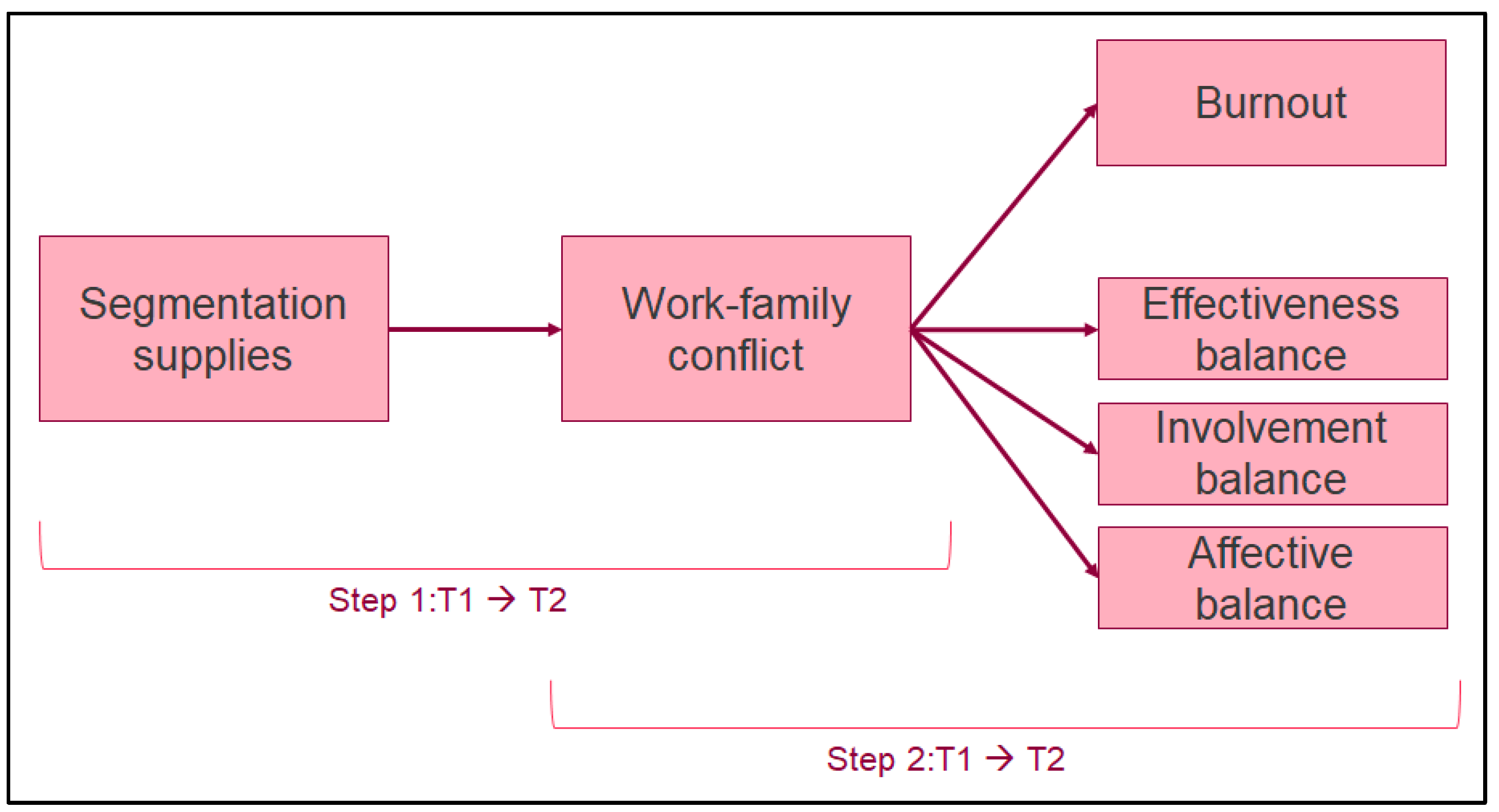
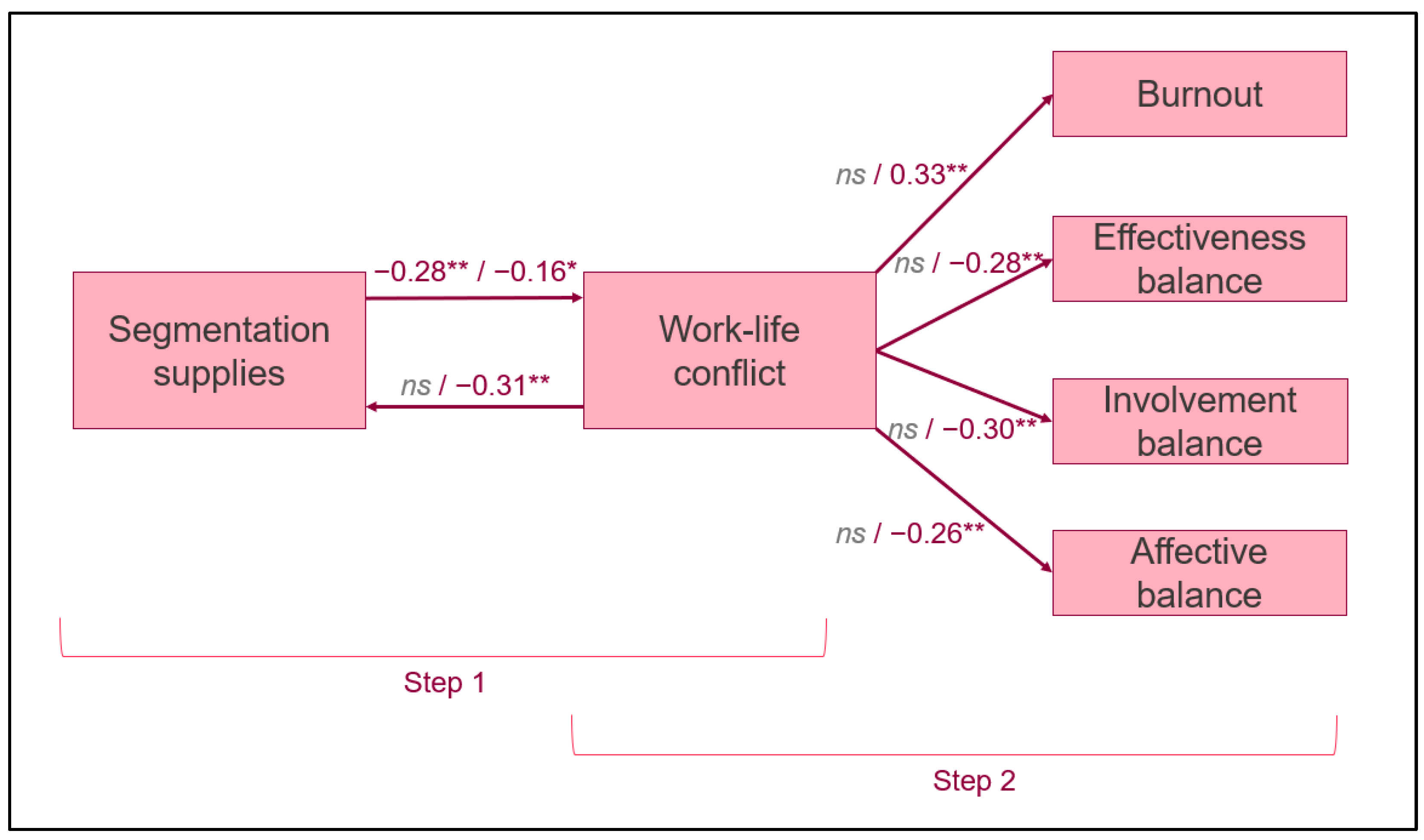
Segmentation Supplies and Work–Life Conflict in Sustainable Future Work: Longitudinal Evidence from Teleworkers and Office Workers

Abstract
1. Introduction
2. Theory and Hypotheses Development
2.1. Work–Life Conflict and Its Implications
2.2. The Relationship Between Segmentation Supplies and Work–Life Conflict
2.3. Work–Life Conflict, Burnout, and Work–Nonwork Balance
2.4. Segmentation Supplies, Work–Life Conflict, Burnout, and Work–Life Balance When Teleworking
3. Materials and Methods
3.1. Participants and Procedure
3.2. Measures
3.3. Data Analyses
4. Results
5. Discussion
5.1. Practical Implications
5.2. Limitations and Future Directions
Author Contributions
Funding
Institutional Review Board Statement
Informed Consent Statement
Data Availability Statement
Conflicts of Interest
Abbreviations
| WLC | Work–life conflict |
| COR | Conservation of resources theory |
Appendix A

| M for Office Workers | SD for Office Workers | M for Teleworkers | SD for Teleworkers | |
|---|---|---|---|---|
| 1. Segmentation preference T1 | 3.94 | 0.75 | 3.95 | 0.73 |
| 2. Segmentation supplies T1 | 3.30 | 0.99 | 3.38 | 0.90 |
| 3. Segmentation supplies T2 | 3.21 | 0.87 | 3.45 | 0.89 |
| 4. Work–life conflict T1 | 2.39 | 0.98 | 2.26 | 0.86 |
| 5. Work–life conflict T2 | 2.32 | 0.87 | 2.08 | 0.82 |
| 6. Burnout T1 | 2.36 | 0.56 | 2.27 | 0.53 |
| 7. Burnout T2 | 2.37 | 0.53 | 2.26 | 0.52 |
| 8. Involvement balance T1 | 3.71 | 0.65 | 3.76 | 0.63 |
| 9. Involvement balance T2 | 3.58 | 0.66 | 3.76 | 0.65 |
| 10. Effectiveness balance T1 | 3.76 | 0.66 | 3.75 | 0.66 |
| 11. Effectiveness balance T2 | 3.65 | 0.69 | 3.69 | 0.61 |
| 12. Affective balance T1 | 3.72 | 0.70 | 3.79 | 0.74 |
| 13. Affective balance T2 | 3.64 | 0.76 | 3.77 | 0.59 |
References
- Greenhaus, J.H.; Beutell, N.J. Sources of Conflict between Work and Family Roles. Acad. Manag. Rev. 1985, 10, 76. [Google Scholar] [CrossRef]
- Allen, T.D.; French, K.A. Work-family Research: A Review and next Steps. Pers. Psychol. 2023, 76, 437–471. [Google Scholar] [CrossRef]
- Shields, B.; Chen, C. Examining the Relationship between Work-Life Conflict and Burnout. J. Natl. Inst. Career Educ. Couns. 2024, 47, 67–76. [Google Scholar] [CrossRef]
- Sirgy, M.J.; Joshanloo, M.; Yu, G.B. How Does Work-Life Conflict Influence Wellbeing Outcomes? A Test of a Mediating Mechanism Using Data from 33 European Countries. Appl. Res. Qual. Life 2025, 20, 193–216. [Google Scholar] [CrossRef]
- Lott, Y.; Wöhrmann, A.M. Spillover and Crossover Effects of Working Time Demands on Work–Life Balance Satisfaction among Dual-Earner Couples: The Mediating Role of Work–Life Conflict. Curr. Psychol. 2023, 42, 12957–12973. [Google Scholar] [CrossRef] [PubMed]
- European Commission. EU Strategic Framework on Health and Safety at Work 2021–2027; Publications Office of the European Union: Luxembourg, 2021. Available online: https://eur-lex.europa.eu/legal-content/EN/ALL/?uri=CELEX:52021DC0323 (accessed on 29 October 2025).
- Wang, F.; Zhang, Z.; Shi, W. Relationship between Daily Work Connectivity Behavior after Hours and Work–Leisure Conflict: Role of Psychological Detachment and Segmentation Preference. PsyCh J. 2023, 12, 250–262. [Google Scholar] [CrossRef] [PubMed]
- Oseghale, O.R.; Pepple, D.; Brookes, M.; Lee, A.; Alaka, H.; Nyantakyiwaa, A.; Mokhtar, A. COVID-19, Working from Home and Work–Life Boundaries: The Role of Personality in Work–Life Boundary Management. Int. J. Hum. Resour. Manag. 2024, 35, 3556–3592. [Google Scholar] [CrossRef]
- Althammer, S.E.; Wöhrmann, A.M.; Michel, A. Meeting the Challenges of Flexible Work Designs: Effects of an Intervention Based on Self-Regulation on Detachment, Well-Being, and Work–Family Conflict. J. Happiness Stud. 2025, 26, 18. [Google Scholar] [CrossRef]
- Reinke, K.; Ohly, S. Examining the Training Design and Training Transfer of a Boundary Management Training: A Randomized Controlled Intervention Study. J. Occup. Organ. Psychol. 2024, 97, 864–888. [Google Scholar] [CrossRef]
- Thompson, R.J.; Payne, S.C.; Alexander, A.L.; Gaskins, V.A.; Henning, J.B. A Taxonomy of Employee Motives for Telework. Occup. Health Sci. 2022, 6, 149–178. [Google Scholar] [CrossRef]
- Laß, I.; Wooden, M. Working from Home and Work–Family Conflict. Work Employ. Soc. 2023, 37, 176–195. [Google Scholar] [CrossRef]
- Abendroth, A.-K.; Reimann, M. Chapter 15 Telework and Work–Family Conflict across Workplaces: Investigating the Implications of Work–Family-Supportive and High-Demand Workplace Cultures. In Contemporary Perspectives in Family Research; Blair, S.L., Obradović, J., Eds.; Emerald Publishing Limited: Leeds, UK, 2018; Volume 13, pp. 323–348. [Google Scholar] [CrossRef]
- Organisation for Economic Co-operation and Development. Dealing with Digital Security Risk During the Coronavirus (COVID-19) Crisis; OECD Policy Responses to Coronavirus (COVID-19); OECD: Paris, France, 2020. [Google Scholar] [CrossRef]
- Eurofound. Right to Disconnect: Implementation and Impact at Company Level; Publications Office of the European Union: Luxembourg, 2023; Available online: https://eurofound.link/ef23002 (accessed on 29 October 2025).
- Department of Economic And Social Affairs. The Sustainable Development Goals Report 2025; United Nations Research Institute for Social Development: New York, NY, USA, 2025; Available online: https://unstats.un.org/sdgs/report/2025/ (accessed on 29 October 2025)ISBN 978-92-1-107159-7.
- Hobfoll, S.E. Conservation of Resources: A New Attempt at Conceptualizing Stress. Am. Psychol. 1989, 44, 513–524. [Google Scholar] [CrossRef]
- Hobfoll, S.E.; Halbesleben, J.; Neveu, J.-P.; Westman, M. Conservation of Resources in the Organizational Context: The Reality of Resources and Their Consequences. Annu. Rev. Organ. Psychol. Organ. Behav. 2018, 5, 103–128. [Google Scholar] [CrossRef]
- Clark, S.C. Work/Family Border Theory: A New Theory of Work/Family Balance. Hum. Relat. 2000, 53, 747–770. [Google Scholar] [CrossRef]
- Ashforth, B.E.; Kreiner, G.E.; Fugate, M. All in a Day’s Work: Boundaries and Micro Role Transitions. Acad. Manag. Rev. 2000, 25, 472. [Google Scholar] [CrossRef]
- Basile, K.; Beauregard, T.A. Oceans Apart: Work-Life Boundaries and the Effects of an Oversupply of Segmentation. Int. J. Hum. Resour. Manag. 2021, 32, 1139–1170. [Google Scholar] [CrossRef]
- Brauner, C.; Wöhrmann, A.M.; Michel, A. Congruence Is Not Everything: A Response Surface Analysis on the Role of Fit between Actual and Preferred Working Time Arrangements for Work-Life Balance. Chronobiol. Int. 2020, 37, 1287–1298. [Google Scholar] [CrossRef] [PubMed]
- Greenhaus, J.H.; Allen, T.D. Work–family balance: A review and extension of the literature. In Handbook of Occupational Health Psychology, 2nd ed.; Quick, J.C., Tetrick, L.E., Eds.; American Psychological Association: Washington, DC, USA, 2011; pp. 165–183. [Google Scholar] [CrossRef]
- Casper, W.J.; Vaziri, H.; Wayne, J.H.; DeHauw, S.; Greenhaus, J. The Jingle-Jangle of Work–Nonwork Balance: A Comprehensive and Meta-Analytic Review of Its Meaning and Measurement. J. Appl. Psychol. 2018, 103, 182–214. [Google Scholar] [CrossRef] [PubMed]
- Geurts, S.A.E.; Taris, T.W.; Kompier, M.A.J.; Dikkers, J.S.E.; Van Hooff, M.L.M.; Kinnunen, U.M. Work-Home Interaction from a Work Psychological Perspective: Development and Validation of a New Questionnaire, the SWING. Work Stress 2005, 19, 319–339. [Google Scholar] [CrossRef]
- Thompson, M.J.; Carlson, D.S.; Kacmar, K.M.; Vogel, R.M. The Cost of Being Ignored: Emotional Exhaustion in the Work and Family Domains. J. Appl. Psychol. 2020, 105, 186–195. [Google Scholar] [CrossRef] [PubMed]
- Michel, J.S.; Clark, M.A.; Beiler, A.A. Work–Life Conflict and Its Effects. In Handbook of Work–Life Integration Among Professionals; Major, D.A., Burke, R.J., Eds.; Edward Elgar Publishing: Cheltenham, UK, 2013; ISBN 978-1-78100-929-1. [Google Scholar]
- Urbanavičiūtė, I.; Lazauskaitė-Zabielskė, J.; Žiedelis, A. Re-drawing the Line: Work-home Boundary Management Profiles and Their Dynamics during the Pandemic. Appl. Psychol. 2023, 72, 1506–1527. [Google Scholar] [CrossRef]
- Nippert-Eng, C. Calendars and Keys: The Classification of “Home” and “Work”. Sociol. Forum 1996, 11, 563–582. [Google Scholar] [CrossRef]
- Allen, T.D.; Cho, E.; Meier, L.L. Work–Family Boundary Dynamics. Annu. Rev. Organ. Psychol. Organ. Behav. 2014, 1, 99–121. [Google Scholar] [CrossRef]
- Allen, T.D.; Merlo, K.; Lawrence, R.C.; Slutsky, J.; Gray, C.E. Boundary Management and Work-Nonwork Balance While Working from Home. Appl. Psychol. 2021, 70, 60–84. [Google Scholar] [CrossRef]
- Foucreault, A.; Ollier-Malaterre, A.; Ménard, J. Organizational Culture and Work–Life Integration: A Barrier to Employees’ Respite? Int. J. Hum. Resour. Manag. 2018, 29, 2378–2398. [Google Scholar] [CrossRef]
- Kossek, E.E.; Ruderman, M.N.; Braddy, P.W.; Hannum, K.M. Work–Nonwork Boundary Management Profiles: A Person-Centered Approach. J. Vocat. Behav. 2012, 81, 112–128. [Google Scholar] [CrossRef]
- Michaelides, G.; Niven, K.; Wood, S.; Inceoglu, I. A Dual-process Model of the Effects of Boundary Segmentation on Work–Nonwork Conflict. J. Occup. Organ. Psychol. 2024, 97, 1502–1525. [Google Scholar] [CrossRef]
- Kerman, K.; Korunka, C.; Tement, S. Work and Home Boundary Violations during the COVID-19 Pandemic: The Role of Segmentation Preferences and Unfinished Tasks. Appl. Psychol. 2022, 71, 784–806. [Google Scholar] [CrossRef]
- Kreiner, G.E. Consequences of Work-home Segmentation or Integration: A Person-environment Fit Perspective. J. Organ. Behav. 2006, 27, 485–507. [Google Scholar] [CrossRef]
- Wang, F.; Zhang, Z.; Shi, W. Effects of Segmentation Supply and Segmentation Preference on Work Connectivity Behaviour after Hours: A Person–Environment Fit Perspective. Curr. Psychol. 2023, 42, 28146–28159. [Google Scholar] [CrossRef]
- Kocalevent, R.; Pinnschmidt, H.; Selch, S.; Nehls, S.; Meyer, J.; Boczor, S.; Scherer, M.; Van Den Bussche, H. Burnout Is Associated with Work-Family Conflict and Gratification Crisis among German Resident Physicians. BMC Med. Educ. 2020, 20, 145. [Google Scholar] [CrossRef]
- Gynning, B.E.; Christiansen, F.; Lidwall, U.; Brulin, E. Impact of Work–Life Interference on Burnout and Job Discontent: A One-Year Follow-up Study of Physicians in Sweden. Scand. J. Work. Environ. Health 2024, 50, 519–526. [Google Scholar] [CrossRef]
- Reichl, C.; Leiter, M.P.; Spinath, F.M. Work–Nonwork Conflict and Burnout: A Meta-Analysis. Hum. Relat. 2014, 67, 979–1005. [Google Scholar] [CrossRef]
- Song, D.; Zhao, J.; Wu, H.; Ji, X. The Impact of Work-Family Conflict on Job Burnout among Community Social Workers in China. PLoS ONE 2025, 20, e0301614. [Google Scholar] [CrossRef]
- Zábrodská, K.; Mudrák, J.; Šolcová, I.; Květon, P.; Blatný, M.; Machovcová, K. Burnout among University Faculty: The Central Role of Work—Family Conflict. Educ. Psychol. 2018, 38, 800–819. [Google Scholar] [CrossRef]
- Wayne, J.H.; Vaziri, H.; Casper, W.J. Work-Nonwork Balance: Development and Validation of a Global and Multidimensional Measure. J. Vocat. Behav. 2021, 127, 103565. [Google Scholar] [CrossRef]
- Vaziri, H.; Wayne, J.H.; Casper, W.J.; Lapierre, L.M.; Greenhaus, J.H.; Amirkamali, F.; Li, Y. A Meta-analytic Investigation of the Personal and Work-related Antecedents of Work–Family Balance. J. Organ. Behav. 2022, 43, 662–692. [Google Scholar] [CrossRef]
- Pattusamy, M.; Jacob, J. A Test of Greenhaus and Allen (2011) Model on Work-Family Balance. Curr. Psychol. 2017, 36, 193–202. [Google Scholar] [CrossRef]
- Wayne, J.H.; Matthews, R.; Crawford, W.; Casper, W.J. Predictors and Processes of Satisfaction with Work–Family Balance: Examining the Role of Personal, Work, and Family Resources and Conflict and Enrichment. Hum. Resour. Manag. 2020, 59, 25–42. [Google Scholar] [CrossRef]
- Wayne, J.H.; Michel, J.S.; Matthews, R.A. Balancing Work and Family: A Theoretical Explanation and Longitudinal Examination of Its Relation to Spillover and Role Functioning. J. Appl. Psychol. 2022, 107, 1094–1114. [Google Scholar] [CrossRef]
- Wan, M.; Shaffer, M.A.; Singh, R.; Zhang, Y. Spoiling for a Fight: A Relational Model of Daily Work-family Balance Satisfaction. J. Occup. Organ. Psychol. 2022, 95, 60–89. [Google Scholar] [CrossRef]
- Dong, J.; Tan, Z.; Zhang, Y.; Sun, Y.; Huang, Y. Work from Home and Employee Well-Being: A Double-Edged Sword. BMC Psychol. 2025, 13, 748. [Google Scholar] [CrossRef] [PubMed]
- Cho, E. The Origins of Emerging Adults’ Work–Family Balance Self-Efficacy: A Dyadic Study. J. Career Dev. 2024, 51, 183–197. [Google Scholar] [CrossRef]
- Giovanis, E. The Relationship between Flexible Employment Arrangements and Workplace Performance in Great Britain. Int. J. Manpow. 2018, 39, 51–70. [Google Scholar] [CrossRef]
- Giauque, D.; Renard, K.; Cornu, F.; Emery, Y. Engagement, Exhaustion, and Perceived Performance of Public Employees Before and During the COVID-19 Crisis. Public Pers. Manag. 2022, 51, 263–290. [Google Scholar] [CrossRef]
- Booker, L.; Mowbray, P.K.; Townsend, K.; Chan, X.W. Connectivity Agency in Telework: A Qualitative Analysis of Facilitators and Barriers. Empl. Relat. Int. J. 2025, 47, 24–44. [Google Scholar] [CrossRef]
- Haun, V.C.; Remmel, C.; Haun, S. Boundary Management and Recovery When Working from Home: The Moderating Roles of Segmentation Preference and Availability Demands. Ger. J. Hum. Resour. Manag. Z. Für Pers. 2022, 36, 270–299. [Google Scholar] [CrossRef]
- Delanoeije, J.; Verbruggen, M.; Germeys, L. Boundary Role Transitions: A Day-to-Day Approach to Explain the Effects of Home-Based Telework on Work-to-Home Conflict and Home-to-Work Conflict. Hum. Relat. 2019, 72, 1843–1868. [Google Scholar] [CrossRef]
- Brislin, R.W. Translation and Content Analysis of Oral and Written Materials. In Handbook of Cross-Cultural Psychology; Allyn & Bacon: Boston, MA, USA, 1980; Volume 2, Methodology; pp. 389–444. [Google Scholar]
- Schaufeli, W.B.; De Witte, H.; Desart, S. Burnout Assessment Tool (BAT)—Test Manual; Internal Report; KU Leuven: Leuven, Belgium, 2019. [Google Scholar]
- Cole, D.A.; Maxwell, S.E. Testing Mediational Models With Longitudinal Data: Questions and Tips in the Use of Structural Equation Modeling. J. Abnorm. Psychol. 2003, 112, 558–577. [Google Scholar] [CrossRef]
- Taris, T.W.; Van Beek, I.; Schaufeli, W.B. The Motivational Make-Up of Workaholism and Work Engagement: A Longitudinal Study on Need Satisfaction, Motivation, and Heavy Work Investment. Front. Psychol. 2020, 11, 1419. [Google Scholar] [CrossRef]
- Hu, L.-T.; Bentler, P.M. Evaluating model fit. In Structural Equation Modeling: Concepts, Issues, and Applications; Hoyle, R.H., Ed.; Sage Publications, Inc.: Thousand Oaks, CA, USA, 1995; pp. 76–99. [Google Scholar]
- Byrne, B.M. Structural Equation Modeling with Mplus: Basic Concepts, Applications, and Programming, 1st ed.; Routledge: London, UK, 2013; ISBN 978-0-203-80764-4. [Google Scholar]
- Žiedelis, A.; Lazauskaitė-Zabielskė, J.; Urbanavičiūtė, I. Reconciling Home and Work During Lockdown: The Role of Organisational Segmentation Supplies for Psychological Detachment and Work-Home Conflict. Psichologija 2021, 64, 86–93. [Google Scholar] [CrossRef]
- Lazauskaite-Zabielske, J.; Ziedelis, A.; Urbanaviciute, I. When Working from Home Might Come at a Cost: The Relationship between Family Boundary Permeability, Overwork Climate and Exhaustion. Balt. J. Manag. 2022, 17, 705–721. [Google Scholar] [CrossRef]
- Derks, D.; Bakker, A.B.; Peters, P.; Van Wingerden, P. Work-Related Smartphone Use, Work–Family Conflict and Family Role Performance: The Role of Segmentation Preference. Hum. Relat. 2016, 69, 1045–1068. [Google Scholar] [CrossRef]
- Wang, B.; Liu, Y.; Qian, J.; Parker, S.K. Achieving Effective Remote Working During the COVID-19 Pandemic: A Work Design Perspective. Appl. Psychol. 2021, 70, 16–59. [Google Scholar] [CrossRef]
- Bakker, A.B.; Demerouti, E. Job Demands–Resources Theory: Taking Stock and Looking Forward. J. Occup. Health Psychol. 2017, 22, 273–285. [Google Scholar] [CrossRef] [PubMed]
- Zhao, K.; Zhang, M.; Kraimer, M.L.; Yang, B. Source Attribution Matters: Mediation and Moderation Effects in the Relationship between Work-to-family Conflict and Job Satisfaction. J. Organ. Behav. 2019, 40, 492–505. [Google Scholar] [CrossRef]
- Darouei, M.; Delanoeije, J.; Verbruggen, M. When Daily Home-to-Work Transitions Are Not All Bad: A Multi-Study Design on the Role of Appraisals. Work Stress 2024, 38, 24–43. [Google Scholar] [CrossRef]
- Vassiley, A.; Shafaei, A.; Nejati, M.; Onnis, L.; Bentley, T. The Autonomy Paradox, Working from Home and Psychosocial Hazards. J. Ind. Relat. 2025, 67, 356–385. [Google Scholar] [CrossRef]
- Oakman, J.; Kinsman, N.; Stuckey, R.; Graham, M.; Weale, V. A Rapid Review of Mental and Physical Health Effects of Working at Home: How Do We Optimise Health? BMC Public Health 2020, 20, 1825. [Google Scholar] [CrossRef]
- Steffens, K.; Sutter, C.; Sülzenbrück, S. The Concept of “Work-Life-Blending”: A Systematic Review. Front. Psychol. 2023, 14, 1150707. [Google Scholar] [CrossRef]
- Von Bergen, C.; Bressler, M. Work, non-work boundaries and the right to disconnect. J. Appl. Bus. Econ. 2019, 21, 51–69. [Google Scholar] [CrossRef]
- Huyghebaert-Zouaghi, T.; Berjot, S.; Gillet, N. Benefits of Psychological Detachment from Work in a Digital Era: How Do Job Stressors and Personal Strategies Interplay with Individual Vulnerabilities? Scand. J. Psychol. 2022, 63, 346–356. [Google Scholar] [CrossRef]
- Kossek, E.E.; Porter, C.M.; Rosokha, L.M.; Wilson, K.S.; Rupp, D.E.; Law-Penrose, J. Advancing Work–Life Supportive Contexts for the “Haves” and “Have Nots”: Integrating Supervisor Training with Work–Life Flexibility to Impact Exhaustion or Engagement. Hum. Resour. Manag. 2024, 63, 397–411. [Google Scholar] [CrossRef]
- Kangas, H.; Pensar, H.; Rousi, R. I Wouldn’t Be Working This Way If I Had a Family—Differences in Remote Workers’ Needs for Supervisor’s Family-Supportiveness Depending on the Parental Status. J. Vocat. Behav. 2023, 147, 103939. [Google Scholar] [CrossRef]
- Adisa, T.A.; Antonacopoulou, E.; Beauregard, T.A.; Dickmann, M.; Adekoya, O.D. Exploring the Impact of COVID-19 on Employees’ Boundary Management and Work–Life Balance. Br. J. Manag. 2022, 33, 1694–1709. [Google Scholar] [CrossRef]
- De Gieter, S.; De Cooman, R.; Bogaerts, Y.; Verelst, L. Explaining the Effect of Work–Nonwork Boundary Management Fit on Satisfaction and Performance at Home through Reduced Time- and Strain-based Work–Family Conflict. Appl. Psychol. 2022, 71, 129–153. [Google Scholar] [CrossRef]
- Thomas, C.L.; Murphy, L.D.; Billeaud, M.L.; Strasburg, A.E.; Cobb, H.R. Supported Here and Supported There: Understanding Family-Supportive Supervisor Behaviors in a Telework Context. Community Work Fam. 2024, 27, 339–350. [Google Scholar] [CrossRef]
- Basile, K.A.; Beauregard, T.A. Boundary Management: Getting the Work-Home Balance Right. In Agile Working and Well-Being in the Digital Age; Grant, C., Russell, E., Eds.; Springer International Publishing: Cham, Switzerland, 2020; pp. 35–46. ISBN 978-3-030-60282-6. [Google Scholar]


| M (SD) | 1 | 2 | 3 | 4 | 5 | 6 | 7 | 8 | 9 | 10 | 11 | 12 | 13 | |
|---|---|---|---|---|---|---|---|---|---|---|---|---|---|---|
| 1. Segmentation preference T1 | 3.95 (0.75) | (0.74) | 0.13 * | 0.00 | 0.05 | 0.08 | 0.25 *** | 0.23 ** | −0.06 | −0.10 | 0.01 | −0.16 * | −0.07 | −0.09 |
| 2. Segmentation supplies T1 | 3.30 (0.96) | (0.91) | 0.66 *** | −0.52 *** | −0.43 *** | −0.33 *** | −0.23 ** | 0.30 *** | 0.14 | 0.24 *** | 0.14 | 0.26 *** | 0.08 | |
| 3. Segmentation supplies T2 | 3.32 (0.90) | (0.91) | −0.36 *** | −0.50 *** | −0.28 *** | −0.37 *** | 0.27 *** | 0.27 *** | 0.26 ** | 0.15 | 0.22 ** | 0.17 * | ||
| 4. Work–life conflict T1 | 2.34 (0.94) | (0.87) | 0.65 *** | 0.58 *** | 0.44 *** | −0.43 *** | −0.27 *** | −0.32 *** | −0.31 *** | −0.31 *** | −0.23 ** | |||
| 5. Work–life conflict T2 | 2.21 (0.85) | (0.85) | 0.43 *** | 0.58 *** | −0.42 *** | −0.45 *** | −0.31 *** | −0.35 *** | −0.26 *** | −0.34 *** | ||||
| 6. Burnout T1 | 2.32 (0.55) | (0.84) | 0.71 *** | −0.44 *** | −0.36 *** | −0.41 *** | −0.39 *** | −0.47 *** | −0.41 *** | |||||
| 7. Burnout T2 | 2.32 (0.53) | (0.84) | −0.46 *** | −0.38 *** | −0.39 *** | −0.39 *** | −0.42 *** | −0.45 *** | ||||||
| 8. Involvement balance T1 | 3.73 (0.64) | (0.84) | 0.51 *** | 0.62 *** | 0.32 *** | 0.55 *** | 0.44 *** | |||||||
| 9. Involvement balance T2 | 3.68 (0.65) | (0.85) | 0.41 *** | 0.62 *** | 0.39 *** | 0.65 *** | ||||||||
| 10. Effectiveness balance T1 | 3.76 (0.65) | (0.91) | 0.43 *** | 0.62 *** | 0.36 *** | |||||||||
| 11. Effectiveness balance T2 | 3.67 (0.65) | (0.90) | 0.43 *** | 0.56 *** | ||||||||||
| 12. Affective balance T1 | 3.76 (0.71) | (0.90) | 0.47 *** | |||||||||||
| 13. Affective balance T2 | 3.70 (0.69) | (0.90) |
| Model | χ2 # | df | Scaling Correction Factor | CFI | TLI | RMSEA | Model Comparisons | T | Δdf |
|---|---|---|---|---|---|---|---|---|---|
| Step 1: predictor → mediator | |||||||||
| S1-Stability | 48.779 | 20 | 0.9425 | 0.87 | 0.83 | 0.090 | - | - | - |
| S1-Forward | 35.445 | 18 | 0.9445 | 0.92 | 0.89 | 0.073 | S1-Stability vs. S1-Forward | 13.52 ** | 2 |
| S1-Reverse | 31.855 | 18 | 0.9810 | 0.94 | 0.91 | 0.065 | S1-Stability vs. S1-Reversed | 24.71 *** | 2 |
| S1-Reciprocal | 20.141 | 16 | 0.9866 | 0.98 | 0.97 | 0.038 | S1-Stability vs. S1-Reciprocal; S1-Reversed vs. S1-Reciprocal | 34.07 *** 12.15 ** | 4 2 |
| Step 2a: mediator → outcome 1—Burnout | |||||||||
| S2a-Stability | 34.048 | 20 | 0.9652 | 0.94 | 0.93 | 0.063 | - | - | - |
| S2a-Forward | 20.780 | 18 | 0.9621 | 0.99 | 0.98 | 0.029 | S2a-Stability vs. S2a-Forward | 12.96 ** | 2 |
| S2a-Reverse | 33.429 | 18 | 0.9766 | 0.94 | 0.91 | 0.069 | S2a-Stability vs. S2a-Reversed | 0.25 | 2 |
| S2a-Reciprocal | 20.169 | 16 | 0.9786 | 0.98 | 0.97 | 0.038 | S2a-Stability vs. S2a-Reciprocal; S2a-Forward vs. S2a-Reciprocal | 14.40 ** 0.31 | 4 2 |
| Step 2b: mediator → outcome 2—Effectiveness balance | |||||||||
| S2b-Stability | 33.056 | 20 | 1.0125 | 0.90 | 0.87 | 0.060 | - | - | - |
| S2b-Forward | 27.305 | 18 | 1.0189 | 0.93 | 0.90 | 0.054 | S2b-Stability vs. S2b-Forward | 5.91 ◊ | 2 |
| S2b-Reverse | 31.781 | 18 | 1.0107 | 0.90 | 0.85 | 0.065 | S2b-Stability vs. S2b-Reversed | 1.31 | 2 |
| S2b-Reciprocal | 26.338 | 16 | 1.0164 | 0.92 | 0.87 | 0.060 | S2b-Stability vs. S2b-Reciprocal | 6.72 | 4 |
| Step 2c: mediator → outcome 3—Involvement balance | |||||||||
| S2c-Stability | 35.322 | 20 | 0.9480 | 0.90 | 0.87 | 0.065 | - | - | - |
| S2c-Forward | 27.777 | 18 | 0.9724 | 0.94 | 0.91 | 0.055 | S2c-Stability vs. S2c-Forward | 8.89 * | 2 |
| S2c-Reverse | 31.013 | 18 | 0.9322 | 0.92 | 0.88 | 0.063 | S2c-Stability vs. S2c-Reversed | 4.20 | 2 |
| S2c-Reciprocal | 24.612 | 16 | 0.9575 | 0.95 | 0.91 | 0.055 | S2c-Stability vs. S2c-Reciprocal; S2c-Forward vs. S2c-Reciprocal | 10.90 * 3.16 | 4 2 |
| Step 2d: mediator → outcome 4—Affective balance | |||||||||
| S2d-Stability | 35.370 | 20 | 0.9693 | 0.90 | 0.87 | 0.065 | - | - | - |
| S2d-Forward | 26.309 | 18 | 0.9949 | 0.94 | 0.92 | 0.051 | S2d-Stability vs. S2d-Forward | 10.97 ** | 2 |
| S2d-Reverse | 34.908 | 18 | 0.9782 | 0.89 | 0.84 | 0.072 | S2d-Stability vs. S2d-Reversed | 0.15 | 2 |
| S2d-Reciprocal | 25.742 | 16 | 1.0078 | 0.94 | 0.89 | 0.058 | S2d-Stability vs. S2d-Reciprocal; S2d-Forward vs. S2d-Reciprocal | 10.23 * 0.26 | 4 2 |
Disclaimer/Publisher’s Note: The statements, opinions and data contained in all publications are solely those of the individual author(s) and contributor(s) and not of MDPI and/or the editor(s). MDPI and/or the editor(s) disclaim responsibility for any injury to people or property resulting from any ideas, methods, instructions or products referred to in the content. |
© 2025 by the authors. Licensee MDPI, Basel, Switzerland. This article is an open access article distributed under the terms and conditions of the Creative Commons Attribution (CC BY) license (https://creativecommons.org/licenses/by/4.0/).
Share and Cite
Jakštienė, R.; Lazauskaitė-Zabielskė, J.; Žiedelis, A.; Urbanavičiūtė, I. Segmentation Supplies and Work–Life Conflict in Sustainable Future Work: Longitudinal Evidence from Teleworkers and Office Workers. Sustainability 2025, 17, 11302. https://doi.org/10.3390/su172411302
Jakštienė R, Lazauskaitė-Zabielskė J, Žiedelis A, Urbanavičiūtė I. Segmentation Supplies and Work–Life Conflict in Sustainable Future Work: Longitudinal Evidence from Teleworkers and Office Workers. Sustainability. 2025; 17(24):11302. https://doi.org/10.3390/su172411302
Chicago/Turabian StyleJakštienė, Rita, Jurgita Lazauskaitė-Zabielskė, Arūnas Žiedelis, and Ieva Urbanavičiūtė. 2025. "Segmentation Supplies and Work–Life Conflict in Sustainable Future Work: Longitudinal Evidence from Teleworkers and Office Workers" Sustainability 17, no. 24: 11302. https://doi.org/10.3390/su172411302
APA StyleJakštienė, R., Lazauskaitė-Zabielskė, J., Žiedelis, A., & Urbanavičiūtė, I. (2025). Segmentation Supplies and Work–Life Conflict in Sustainable Future Work: Longitudinal Evidence from Teleworkers and Office Workers. Sustainability, 17(24), 11302. https://doi.org/10.3390/su172411302