Intergovernmental Transfers as Determinants of Municipal Fiscal Sustainability: A Review of Theory and Empirical Evidence from Polish Municipalities



Abstract
1. Introduction
2. Research and Literature Review
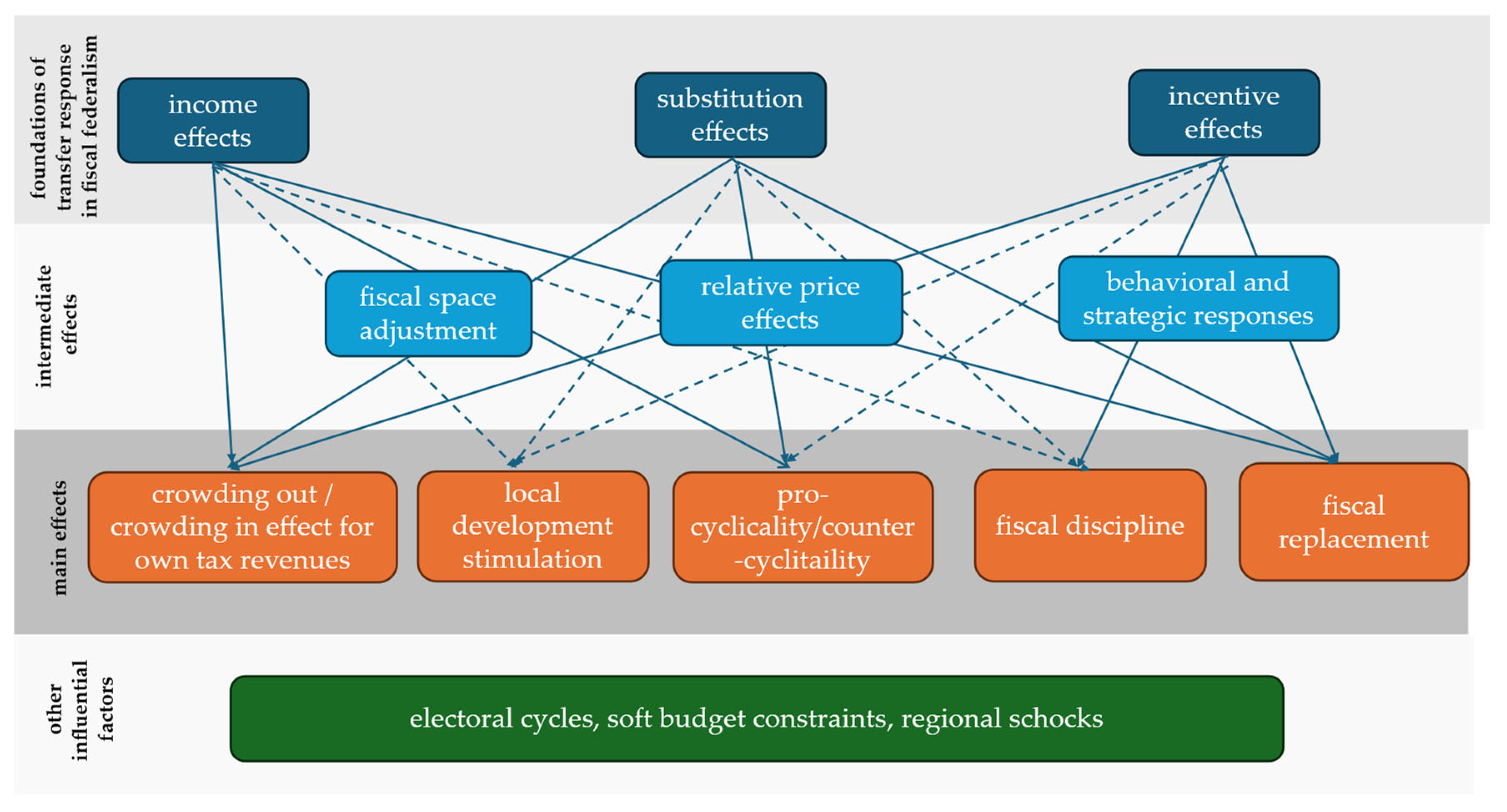
- the crowding-out/fungibility effect, whereby financial support from the central budget can lead to a ‘crowding out’ of municipalities’ own tax revenues, discouraging local governments from improving tax efficiency because it is politically easier to rely on transfers;
- the flypaper effect, whereby an increase in transfers to municipalities leads to a greater increase in local government expenditure than if there is a corresponding increase in own revenues;
- the possibility of using fiscal transfers to stimulate local and regional development;
- the pro-cyclicality of fiscal transfers, as they increase when the economy is growing and decrease when it is contracting;
- the weakening of fiscal discipline, as transfers can lead to overspending, lower local tax efficiency, operating deficits and debt (Kornai’s ‘soft budget constraint’ hypothesis [16] and the ‘tragedy of the commons’);
- the fiscal replacement effect, which manifests itself in the asymmetric response of local governments to increases or decreases in transfers. According to this concept, local governments tend to compensate for possible cuts in transfers by increasing local taxes in order to maintain the existing level of local government expenditure. As a result, reductions in local government expenditure following a reduction in the level of transfers will be much smaller than increases in such expenditure when central budget support is increased [17].
3. Institutional Background of Intergovernmental Fiscal Transfers in Poland
4. Methods
- Compilation of a panel of data, including elimination of 7 units where territorial conversions and two outliers occurred. For comparability of LGUs, all financial categories have been expressed on a per capita basis.
- Preliminary assessment of descriptive statistics, correlations and stationarity. Due to the non-stationarity of the series, all variables were transformed to their first differences.
- Conducting a collinearity analysis using variance inflation factors (VIF) and the Belsley–Kuh–Welsch method [47]. The variables (their first differences) showed no collinearity.
- Model construction for panel data. For each group of models 1–4, models were constructed according to two specifications (see equations I and II below). Each was then recalculated for all LGUs and separately for each LGU category, resulting in the estimated 10 models in each group (50 models in total). In addition, for group 5, models were also constructed for all LGUs and for their subcategories (5 models in total) according to the specifications in point III below.
- I.
- Equation formula—Models 1–4 with aggregate subsidies:
- II.
- Equation formula—Models 1–4 with decomposed subsidies:
- III.
- Equation formula—Model 5 (Fiscal Replacement Effect):
- e.
- Choice of model type between Fixed Effects, Random Effects and Pooled OLS based on tests for the combined significance of inequalities in group means (F-test for fixed effects in panels) and Hausman tests. The tests indicated the choice of Pooled OLS.
- f.
- Verification of the validity of the models obtained—both White and Wald tests showed a heteroskedasticity problem.
- g.
- Test of the nature of the variance of the OLS residuals in the above models.
- i.
- extracting the residuals from the OLS models,
- ii.
- running the regressions between independent variables (GS, TG, and other respective independent variables) and a logarithm of the squared residuals as dependent variable,
- iii.
- verifying statistical significance of regression coefficients.
- h.
- Final estimation of models from Equations (1)–(3) using WLS. When applying WLS, the models’ forms remain the same, but the estimation of coefficients take into account the weights. The weights are applied to minimize the weighted sum of squared residuals. We calculated the weights based on per-unit error variances rather than for the entire set, in order to capture the characteristics of individual entities more precisely. The general formula for estimating coefficients is then:
5. Results and Discussion
6. Conclusions
Supplementary Materials
Author Contributions
Funding
Institutional Review Board Statement
Informed Consent Statement
Data Availability Statement
Conflicts of Interest
References
- Oates, W.E. Decentralization of the Public Sector: An Overview. In Decentralization, Intergovernmental Relations and Markets: Towards a Post-Welfare Agenda; Clarendon Press: Oxford, UK, 1990; pp. 43–58. [Google Scholar]
- Poniatowicz, M. Wpływ Kryzysu Gospodarczego na Systemy Finansowe Jednostek Samorządu Terytorialnego na Przykładzie Największych Miast w Polsce; CeDeWu: Warszawa, Poland, 2014. [Google Scholar]
- Dougherty, S.; Biase, P. Who Absorbs the Shock? An Analysis of the Fiscal Impact of the COVID-19 Crisis on Different Levels of Government. Int. Econ. Econ. Policy 2021, 18, 517–540. [Google Scholar] [CrossRef]
- De Mello, L.; Ter-Minassian, T. Improving Subnational Governments’ Resilience in the Wake of the COVID-19 Pandemic. In OECD Working Papers on Fiscal Federalism; OECD Publishing: Paris, Framce, 2022; Volume 37, pp. 1–29. [Google Scholar] [CrossRef]
- Yilmaz, S.; Zahir, F. Issues in Intergovernmental Fiscal Transfers: Public Finance and Political Economy Considerations. In Intergovernmental Transfers in Federations; Yilmaz, S., Zahir, F., Eds.; Edward Elgar Publishing: Cheltenham, UK, 2020; pp. 21–40. [Google Scholar]
- Lago, M.E.; Lago-Peñas, S.; Martinez-Vazquez, J. On the Effects of Intergovernmental Grants: A Survey. Int. Tax Public Finance 2024, 31, 856–908. [Google Scholar] [CrossRef]
- Shah, A. Grant Financing of Metropolitan Areas. In Financing Metropolitan Governments in Developing Countries; Bahl, R., Linn, J., Wetzel, D., Eds.; Lincoln Institute of Land Policy: Cambridge, MA, USA, 2013. [Google Scholar]
- Blöchliger, H.; Égert, B. Fiscal Consolidation Across Government Levels—Part 3: Intergovernmental Grants, Pro- or Counter-Cyclical? OECD Economics Department Working Papers; OECD: Paris, France, 2013. [Google Scholar]
- Jaenchen, I. Fiscal Equalization Systems for European States—Possibilities and Restrictions for the Arrangements in Germany and Poland. Wroclaw Rev. Law Adm. Econ. 2017, 7, 85–96. [Google Scholar] [CrossRef]
- Baretti, C.; Huber, B.; Lichtblau, K. A Tax on Tax Revenue: The Incentive Effects of Equalizing Transfers—Evidence from Germany. Int. Tax Public Finance 2002, 9, 631–649. [Google Scholar] [CrossRef]
- Bucovetsky, S.; Smart, M. The Efficiency Consequences of Local Revenue Equalization: Tax Competition and Tax Distortions. J. Public Econ. Theory 2006, 8, 119–144. [Google Scholar] [CrossRef]
- Martinez-Vazquez, J.; Lago-Peñas, S.; Sacchi, A. The impact of fiscal decentralization: A survey. J. Econ. Surv. 2017, 31, 1095–1129. [Google Scholar] [CrossRef]
- Mogues, T.; Benin, S. Do External Grants to District Governments Discourage Own Revenue Generation? A Look at Local Public Finance Dynamics in Ghana. World Dev. 2012, 40, 1054–1067. [Google Scholar] [CrossRef]
- Hines, J.R.; Thaler, R.H. Anomalies: The Flypaper Effect. J. Econ. Perspect. 1995, 9, 217–226. [Google Scholar] [CrossRef]
- Qian, Y.; Roland, G. Federalism and the Soft Budget Constraint. SSRN Electron. J. 1999, 1–39. [Google Scholar] [CrossRef]
- Kornai, J. Resource-Constrained versus Demand-Constrained Systems. Econometrica 1979, 47, 801–819. [Google Scholar] [CrossRef]
- Gramlich, E.M. Federalism and Federal Deficit Reduction. Natl. Tax J. 1987, 40, 299–313. [Google Scholar] [CrossRef]
- Yuan, M.; Yang, T. Fostering Sustainable Development: How Local Fiscal Sustainability Enhances High-Quality Corporate Innovation in China. Sustainability 2025, 17, 9427. [Google Scholar] [CrossRef]
- Veiga, L.G.; Veiga, F.J. Political Business Cycles at the Municipal Level. Public Choice 2007, 131, 45–64. [Google Scholar] [CrossRef]
- Kluza, K.; Czekaj, M.; Filipiak, B.Z. The Electoral Cycle and Changes in the Off-Budget Debt of Municipalities. Cities 2024, 155, 105478. [Google Scholar] [CrossRef]
- Miyazaki, T. Intergovernmental Fiscal Transfers and Tax Efforts: Regression-Discontinuity Analysis for Japanese Local Governments. Reg. Sci. Urban Econ. 2020, 84, 103554. [Google Scholar] [CrossRef]
- Esteller-Moré, A.; Solé-Ollé, A. Tax Setting in a Federal System: The Case of Personal Income Taxation in Canada. Int. Tax Public Finance 2002, 9, 235–257. [Google Scholar] [CrossRef]
- Rauch, A.; Hummel, C.-A. How to Stop the Race to the Bottom: Empirical Evidence from North Rhine-Westphalia. Int. Tax Public Finance 2016, 23, 911–933. [Google Scholar] [CrossRef]
- Ferede, E. The Incentive Effects of Equalization Grants on Tax Policy: Evidence from Canadian Provinces. Public Finance Rev. 2017, 45, 723–747. [Google Scholar] [CrossRef]
- Masaki, T. The Impact of Intergovernmental Transfers on Local Revenue Generation in Sub-Saharan Africa: Evidence from Tanzania. World Dev. 2018, 106, 173–186. [Google Scholar] [CrossRef]
- Banaszewska, M. Equalisation Grants and Local Taxation: The Case of Poland. Gospod. Nar. 2023, 314, 47–65. [Google Scholar] [CrossRef]
- Köthenbürger, M.; Loumeau, G. Tax Responses in Local Public Finance: The Flypaper Effect at Work. SSRN Electron. J. 2023. [Google Scholar] [CrossRef]
- Kluza, K.; Wójtowicz, K. The Impact of Intergovernmental Transfers on Municipal Finances in Poland: 2007–2023. Optim. Econ. Stud. 2025, 2, 142–159. [Google Scholar] [CrossRef]
- Aritenang, A.F. The Effect of Intergovernmental Transfers on Infrastructure Spending in Indonesia. J. Asia Pac. Econ. 2020, 25, 571–590. [Google Scholar] [CrossRef]
- Kańduła, S. The Efficiency of Fiscal Equalization. The Case Study of Municipalities in Poland. Lex Localis J. Local Self Gov. 2017, 15, 803–825. [Google Scholar] [CrossRef]
- Banaszewska, M. The Determinants of Local Public Investments in Poland. Equilib. Q. J. Econ. Econ. Policy 2018, 13, 105–121. [Google Scholar] [CrossRef]
- Pettersson-Lidbom, P. Dynamic Commitment and the Soft Budget Constraint: An Empirical Test. Am. Econ. J. Econ. Policy 2010, 2, 154–179. [Google Scholar] [CrossRef]
- Gamkhar, S.; Shah, A. The Impact of Intergovernmental Fiscal Transfers: A Synthesis of the Conceptual and Empirical Literature. In Intergovernmental Fiscal Transfers: Principles and Practice; Boadway, R., Shah, A., Eds.; World Bank: Washington, DC, USA, 2007; pp. 225–528. [Google Scholar]
- Shani, R.; Reingewertz, Y.; Vigoda-Gadot, E. Intergovernmental Grants and Local Public Finance: An Empirical Examination in Israel. Eur. J. Polit. Econ. 2023, 79, 102420. [Google Scholar] [CrossRef]
- Deller, S.C.; Maher, C.S. Categorical Municipal Expenditures with a Focus on the Flypaper Effect. Public Budg. Finance 2005, 25, 73–90. [Google Scholar] [CrossRef]
- Makreshanska-Mladenovska, S.; Petrevski, G. Decentralisation and Fiscal Performance in Central and Eastern Europe. Post Communist Econ. 2021, 33, 614–636. [Google Scholar] [CrossRef]
- Bracco, E.; Lockwood, B.; Porcelli, F.; Redoano, M. Intergovernmental Grants as Signals and the Alignment Effect: Theory and Evidence. J. Public Econ. 2015, 123, 78–91. [Google Scholar] [CrossRef]
- Allers, M.A.; Vermeulen, W. Capitalization of Equalizing Grants and the Flypaper Effect. Reg. Sci. Urban Econ. 2016, 58, 115–129. [Google Scholar] [CrossRef]
- Akai, N.; Sato, M. The Role of Matching Grants as a Commitment Device in the Federation Model with a Repeated Soft Budget Setting. Econ. Gov. 2019, 20, 23–39. [Google Scholar] [CrossRef]
- Martínez-López, D. Subnational Borrowing and Bailouts: When the Federal Government Looks at the Votes (Differently) and Its Borrowing Matters. J. Public Econ. Theory 2022, 24, 609–633. [Google Scholar] [CrossRef]
- Rios, V.; Hortas-Rico, M.; Pascual, P. What Shapes the Flypaper Effect? The Role of the Political Environment in the Budget Process. Local Gov. Stud. 2022, 48, 793–820. [Google Scholar] [CrossRef]
- Samal, A. An Empirical Analysis of Asymmetry and Threshold Effect of Intergovernmental Grants in India: A Panel Data Analysis. Glob. Bus. Rev. 2020, 21, 458–472. [Google Scholar] [CrossRef]
- Act of 13 November 2003 on Revenues of Local Government Units. J. Laws Repub. Pol. 2003. No. 203, item 1966, as amended.
- Hybka, M.; Kaczyńska, A. Financing Primary Education in Poland—Challenges and Controversies. In Proceedings of the 2nd International Conference on Institutional Leadership, Learning & Teaching (ILLT), Cambridge, UK, 19–20 September 2016. [Google Scholar]
- Act of 1 November 2024 amending the Act on Revenues of Local Government Units. J. Laws Repub. Pol. 2024. item 1572.
- Hajdys, D. The Scope and Direction of Changes in the Revenues of Local Government Units in Poland in the New Act of October 1, 2024. J. Finance Financ. Law 2024, 4, 129–144. [Google Scholar] [CrossRef]
- Belsley, D.A.; Kuh, E.; Welsch, R.E. Regression Diagnostics: Identifying Influential Data and Sources of Collinearity, 1st ed.; Wiley Series in Probability and Statistics; Wiley: Hoboken, NJ, USA, 1980; ISBN 978-0-471-05856-4. [Google Scholar]
- Wooldridge, J.M. Introductory Econometrics A Modern Approach, 5th ed.; South-Western Pub: Mason, OH, USA, 2013. [Google Scholar]
- Dash, B.B.; Raja, A.V. Intergovernmental Transfers and Tax Collection in India: Does the Composition of Transfers Matter? Public Budg. Finance 2013, 33, 93–116. [Google Scholar] [CrossRef]
- Liu, C.; Ma, G. Taxation without Representation: Local Fiscal Response to Intergovernmental Transfers in China. Int. Tax Public Finance 2016, 23, 854–874. [Google Scholar] [CrossRef]
- Mohanty, A.; Sethi, D.; Mohanty, A.R. Central Transfer—A Curse or Blessing? Evidence from the Relative Revenue Effort of Indian States. Aust. Econ. Rev. 2020, 53, 214–227. [Google Scholar] [CrossRef]
- Aragon, F.; Gayoso, V. Intergovernmental Transfers and Fiscal Effort in Peruvian Local Governments. MPRA Pap. 2005, 2108, 1–33. [Google Scholar] [CrossRef][Green Version]
- Taiwo, K. Intergovernmental transfers and own revenues of subnational governments in Nigeria. Hacienda Pública Esp. Rev. Public Econ. 2022, 240, 31–59. [Google Scholar] [CrossRef]
- Yousaf, T.; Ul Ain, Q.; Akhtar, Y. The Crowding in (out) Effect of Intergovernmental Transfers on Local Government Revenue Generation: Evidence from Pakistan. Hacienda Pública Esp. Rev. Public Econ. 2022, 242, 3–28. [Google Scholar] [CrossRef]
- Rougier, E.; Combarnous, F.; Fauré, Y.-A. The “Local Economy” Effect of Social Transfers: An Empirical Assessment of the Impact of the Bolsa Família Program on Local Productive Structure and Economic Growth. World Dev. 2018, 103, 199–215. [Google Scholar] [CrossRef]
- Mookherjee, D.; Ray, D. A Dynamic Incentive-Based Argument for Conditional Transfers. Econ. Rec. 2008, 84, S2–S16. [Google Scholar] [CrossRef]
- Tang, C.-T.; Wong, C.Y.; Alas, O.B.D. Effect of Intergovernmental Transfers on Income and Poverty Rates: Evidence from the Philippines. World Dev. 2024, 173, 106420. [Google Scholar] [CrossRef]
- Lago-Peñas, S.; Vaquero García, A.; Cadaval Sampedro, M.; Sanchez-Fernandez, P. The Effects of Capital Grants to Subnational Governments under Fiscal Stress: Evidence from the Spanish Regions. Appl. Econ. Anal. 2025, 33, 165–183. [Google Scholar] [CrossRef]
- Adanu, K. Intergovernmental Transfers and Local Revenues Again—A Relook at the Ghanaian Local Government Case. State Local Gov. Rev. 2024, 56, 157–183. [Google Scholar] [CrossRef]
- Carvalho Filho, I.; Litschig, S. Long-Run Impacts of Intergovernmental Transfers. J. Hum. Resour. 2022, 57, 868–917. [Google Scholar] [CrossRef]
- Dellmuth, L.M.; Stoffel, M.F. Distributive Politics and Intergovernmental Transfers: The Local Allocation of European Union Structural Funds. Eur. Union Polit. 2012, 13, 413–433. [Google Scholar] [CrossRef]
- Manasan, R.G. Local Public Finance in the Philippines: Lessons in Autonomy and Accountability; Philippine Institute for Development Studies: Quezon City, Philippines, 2005. [Google Scholar]
- Baskaran, T.; Brender, A.; Blesse, S.; Reingewertz, Y. Revenue Decentralization, Central Oversight and the Political Budget Cycle: Evidence from Israel. Eur. J. Polit. Econ. 2016, 42, 1–16. [Google Scholar] [CrossRef]
- Inman, R.P. The Flypaper Effect; NBER Working Paper No. 14579; National Bureau of Economic Research: Cambridge, MA, USA, 2008. [Google Scholar] [CrossRef]
- Dietrichson, J.; Ellegård, L.M. Assist or Desist? Conditional Bailouts and Fiscal Discipline in Local Governments. Eur. J. Polit. Econ. 2015, 38, 153–168. [Google Scholar] [CrossRef]
- da Cruz, C.F.; da Silva Macedo, M.Á.; Sauerbronn, F.F. Responsabilidade fiscal de grandes municípios brasileiros: Uma análise de suas características. Rev. Adm. Pública 2013, 47, 1375–1399. [Google Scholar] [CrossRef]
- Rodden, J. Reviving Leviathan: Fiscal Federalism and the Growth of Government. Int. Organ. 2003, 57, 695–729. [Google Scholar] [CrossRef]
- Iacuzzi, S.; Padovani, E.; Canestrini, P. Does Fiscal Autonomy Always Fuel Financial Health in Local Governments? A Cross-Country Analysis. J. Public Budg. Account. Financ. Manag. 2025, 37, 370–392. [Google Scholar] [CrossRef]
- Goodspeed, T.J. Coping with Extreme Events: On Solving Decentralised Budgetary Crises. Reg. Stud. 2023, 59, 2247016. [Google Scholar] [CrossRef]



| Effects of Transfers | Authors | Variables Studied | Transfer Type | Findings |
|---|---|---|---|---|
| crowding out/crowding in effect for own tax revenues | Mogues & Benin [13] | Own revenues (districts: Ghana) | Conditional grants | crowding out |
| Masaki [25] | Own revenue less agricultural taxes (Boroughs: Tanzania) | General transfers, conditional grants | crowding out | |
| Banaszewska [26] | Fiscal effort in property tax (Polish municipalities) | Equalization transfers | crowding out (increased subsidies reduce the fiscal effort of municipalities) | |
| flypaper effect | Koethenbuerger & Loumeau [27] | Local government expenditures, effective PIT rate (municipalities: Switzerland) | General transfers | confirmation of the flypaper effect |
| Kluza &Wójtowicz [28] | Local government expenditures (Polish municipalities) | General subsidy and targeted grants | Confirmation of the flypaper effect in the case of targeted grants | |
| local development stimulation | Aritenang [29] | Investment expenditures per capita (municipalities: Indonesia) | Targeted grants | Stimulation of development, especially in poorer regions |
| Kańduła [30] | Total expenditures and investment expenditures (selected municipalities) | General subsidy and its components | Income equalization for municipalities is not a sufficient condition for their sustainable development | |
| Banaszewska [31] | Investment expenditures per capita (Polish municipalities) | General subsidies and targeted grants | Positive impact of transfers on investments | |
| pro-cyclicality/counter-cyclicality of fiscal transfers | Blöchliger & Égert [8] | business cycle variable (OECD countries) | Conditional grants | Grants influence the procyclicality of expenditures |
| fiscal discipline | Pettersson-Lidbom [32] | public debt per capita (municipalities: Sweden) | Equalization transfers | Increased debt |
| fiscal replacement | Gamkhar & Shah [33] | Road expenditures per capita (states: USA) | Road grants | No asymmetry in response to changes in expenditures |
| Shani et al. [34] | tax revenues and budget deficit (municipalities: Israel) | Unconditional grants | A decrease in grants causes taxes to rise twice as much as they decrease after a grant increase | |
| Deller &Maher [35] | Local government expenditures per capita (Wisconsin cities) | Intergovernmental transfers | Municipalities heavily dependent on shared revenues are most likely to cut spending when these revenues decrease |
| Model Group No. | Effects of Intergovernmental Transfers to Be Verified | Dependent Variables (Y) in Each Model | Rationale for Variable Selection |
|---|---|---|---|
| 1 | Crowding-out/crowding-in effect | Local tax revenues (excl. PIT and CIT) | Measure of local fiscal effort; PIT and CIT excluded due to lack of any tax autonomy granted to LGUs. |
| 2 | Local development stimulation | LGU investment | A quantifiable indicator of local development; local investment directly reflects the impact of LGUs on growth, as it results from their policy decisions and financial priorities |
| 3 | Pro-cyclicality/counter-cyclicality of fiscal transfers | Number of business entities within given LGU | Proxy of economic growth fluctuations (the Polish national statistical office—Statistics Poland—does not provide GDP growth data for boroughs, only for the provinces) |
| 4a & 4b | Improving/weakening fiscal discipline | a. LGU outstanding debt b. Operating balance (surplus/deficit) in LGU | a. Reflects changes in the ability to service long-term obligations b. Reflects compliance with the golden budget rule, which requires current revenues to cover current expenditures |
| 5 | Fiscal replacement effect | LGU total expenditures | A measure of overall fiscal policy response; reflects LGUs spending adjustments |
| All LGUs | MB | MRB | RB | TCR | |
|---|---|---|---|---|---|
| General subsidy (PLN mln) | 71,510 | 8181 | 16,168 | 22,705 | 24,457 |
| Local taxes (PLN mln) | 37,204 | 5566 | 9506 | 9921 | 12,212 |
| The 3-year cumulative impact of a PLN 100 million increase in general subsidies on local taxes: | |||||
| Change of local taxes in PLN mln | −10.8 | −23.5 | −13.6 | −7.2 | −9.1 |
| Effect magnitude relative to local taxes | −21% | −35% | −23% | −17% | −18% |
| Models Based on Equation (1) | Models Based on Equation (2)—(Only Estimates for Subsidies Are Presented) | ||||||||||||||
|---|---|---|---|---|---|---|---|---|---|---|---|---|---|---|---|
| predictors ⟶ | GS | GS-1 | GS-2 | TG | TG-1 | TG-2 | SEQ | SEQ-1 | SEQ-2 | SCO | SCO-1 | SCO-2 | SED | SED-1 | SED-2 |
| LGU category ↓ | |||||||||||||||
| Group 1: ‘crowding out’/’crowding in’ effect; (Y: change in LGU own tax revenues, excluding PIT and CIT shares, per capita) | |||||||||||||||
| all LGUs | −0.019 *** | −0.035 *** | −0.059 *** | 0.016 *** | 0.000 | 0.001 | −0.005 *** | −0.019 *** | −0.016 *** | −0.002 * | 0.004 *** | −0.003 ** | 0.004 *** | −0.005 *** | 0.000 |
| MB | −0.021 | −0.129 *** | −0.097 *** | 0.034 *** | −0.010 | 0.008 | −0.018 ** | −0.030 *** | −0.019 ** | −0.000 | 0.002 | −0.014 * | 0.010 | −0.003 | −0.018 ** |
| MRB | −0.022 *** | −0.039 *** | −0.082 *** | 0.018 *** | −0.000 | −0.016 *** | −0.011 *** | −0.015 *** | −0.016 *** | −0.007 *** | 0.000 | −0.006 *** | 0.006 * | −0.007 ** | −0.001 |
| RB | −0.013 *** | −0.021 *** | −0.042 *** | 0.007 *** | 0.009 *** | 0.004 ** | −0.001 | −0.012 *** | −0.007 *** | −0.002 | 0.002 | −0.002 * | 0.001 | −0.010 *** | −0.002 |
| TCR | −0.026 * | −0.032 | −0.038 * | 0.003 | −0.013 | 0.018 | −0.001 | −0.069 *** | −0.025 | 0.003 | 0.011 ** | −0.005 | 0.012 | −0.019 ** | 0.001 |
| Group 2: impact of transfers on economic development; (Y: change in per capita investment expenditure) | |||||||||||||||
| all LGUs | 0.020 *** | −0.019 *** | 0.082 *** | 0.620 *** | 0.044 *** | −0.004 | 0.023 *** | 0.007 ** | −0.001 | −0.003 | 0.007 ** | 0.005 * | −0.005 | 0.010 ** | 0.004 |
| MB | 0.069 ** | −0.019 | −0.004 | 0.680 *** | 0.045 *** | −0.006 | 0.005 | 0.023 | −0.002 | −0.029 ** | 0.030 ** | −0.010 | 0.020 | −0.006 | −0.014 |
| MRB | 0.041 *** | −0.006 | 0.055 *** | 0.634 *** | 0.041 *** | −0.027 ** | 0.026 *** | 0.006 | −0.004 | −0.003 | −0.006 | 0.019 *** | 0.004 | 0.010 | 0.006 |
| RB | 0.019 *** | 0.012 | 0.042 *** | 0.609 *** | 0.023 *** | −0.010 | 0.019 *** | 0.010 ** | −0.002 | −0.010 ** | 0.009 ** | −0.002 | −0.003 | 0.012 ** | −0.005 |
| TCR | −0.076 ** | 0.081* | 0.041 | 0.668 *** | 0.109 *** | −0.121 *** | 0.004 | 0.038 | −0.070 | 0.011 | 0.012 | 0.003 | −0.037 * | 0.025 | 0.006 |
| Group 3: counter-cyclicality/pro-cyclicality; (Y: annual change in the number of enterprises) | |||||||||||||||
| all LGUs | 0.0001 | −0.0003 *** | −0.0004 *** | 0.0000 | −0.0001 *** | 0.0000 | 0.00012 | −0.0008 *** | −0.0002 | −0.0017 | −0.0029 * | −0.0064 *** | 0.0037 *** | −0.0008 *** | −0.0015 *** |
| MB | 0.0012 ** | 0.0002 | −0.0001 | 0.0001 | 0.0001 | 0.0002 | −0.0024 ** | −0.0021 * | −0.0005 | 0.0416 *** | −0.0111 | 0.0030 | 0.0075 *** | −0.0018 | −0.0021 |
| MRB | 0.0004 ** | −0.0001 | 0.0000 | 0.0000 | −0.0001 ** | 0.0000 | 0.0004 | 0.0000 | 0.0003 | 0.0027 | −0.0056 * | −0.0116 *** | 0.0038 *** | −0.0011 ** | −0.0010 * |
| RB | 0.0000 | −0.0006 *** | −0.0009 *** | −0.0001 * | −0.0002 *** | 0.0000 | 0.0001 | −0.0013 *** | −0.0009 *** | −0.0053 *** | −0.0017 | −0.0065 *** | 0.0036 *** | −0.0005 * | −0.0016 *** |
| TCR | 0.0001 | −0.0022 *** | −0.0016 ** | −0.0001 | 0.0000 | 0.0001 | −0.0029 | −0.0092 *** | −0.0053 ** | −0.0061 | −0.0103 | −0.0062 | 0.0050 *** | −0.0015 | −0.0035 ** |
| Models Based on Equation (1) | Models Based on Equation (2)—(Only Estimates for Subsidies Are Presented) | ||||||||||||||
|---|---|---|---|---|---|---|---|---|---|---|---|---|---|---|---|
| predictors ⟶ | GS | GS-1 | GS-2 | TG | TG-1 | TG-2 | SEQ | SEQ-1 | SEQ-2 | SCO | SCO-1 | SCO-2 | SED | SED-1 | SED-2 |
| LGU category ↓ | |||||||||||||||
| Group 4.a: Impact of debt; (Y: Change of LGU outstanding debt per capita) | |||||||||||||||
| all LGUs | −0.021 *** | −0.025 *** | −0.081 *** | 0.051 *** | 0.043 *** | 0.039 *** | −0.032 *** | −0.022 *** | −0.026 *** | −0.010 *** | 0.004 | 0.004 | 0.023 *** | 0.017 *** | 0.023 *** |
| MB | −0.035 | −0.003 | 0.026 | 0.087 *** | 0.068 *** | 0.029 | −0.041 ** | −0.009 | 0.002 | −0.061 *** | −0.004 | −0.013 | 0.027 | 0.001 | 0.034 * |
| MRB | 0.003 | −0.026 * | −0.058 *** | 0.111 *** | 0.084 *** | 0.081 *** | −0.023 *** | −0.014 * | −0.020 *** | −0.001 | 0.004 | 0.004 | 0.019 ** | 0.011 | 0.012 |
| RB | −0.036 *** | 0.029 *** | −0.072 *** | 0.036 *** | 0.034 *** | 0.031 *** | −0.026 *** | −0.020 *** | −0.020 *** | −0.012 *** | 0.002 | 0.006 | 0.008 | 0.007 | 0.011 ** |
| TCR | −0.144 ** | −0.205 *** | −0.053 | 0.241 *** | 0.293 *** | 0.132 *** | −0.054 | −0.126 ** | −0.183 *** | −0.010 | 0.034 * | 0.025 | −0.011 | −0.044 | 0.059 |
| Group 4.b: Operating balance impact; (Y: Change of operating balance per capita) | |||||||||||||||
| all LGUs | 0.008 * | 0.109 *** | −0.010 * | 0.034 *** | −0.026 *** | −0.029 *** | 0.115 *** | −0.013 *** | 0.003 | 0.003 | 0.000 | −0.006 ** | 0.068 *** | −0.022 *** | −0.008 ** |
| MB | 0.127 *** | −0.083 *** | −0.024 | 0.024 ** | −0.018 | −0.011 | 0.085 *** | −0.008 | −0.011 | 0.041 *** | −0.027 ** | 0.004 | 0.059 *** | −0.013 ** | −0.027 |
| MRB | 0.065 *** | 0.081 *** | −0.020 * | 0.045 *** | −0.028 *** | −0.047 *** | 0.102 *** | −0.014 *** | −0.001 | −0.001 | 0.004 | 0.001 | 0.066 *** | −0.011 ** | 0.003 |
| RB | 0.067 *** | 0.055 *** | 0.002 | 0.016 *** | −0.023 *** | −0.023 *** | 0.129 *** | −0.016 *** | −0.002 | 0.006 ** | −0.004 | −0.001 | 0.077 *** | −0.032 *** | 0.000 |
| TCR | 0.174 *** | 0.136 *** | −0.106 *** | 0.026 | −0.011 | 0.055 ** | 0.099 *** | 0.039 | −0.020 | 0.019 * | 0.013 | −0.012 | 0.087 *** | −0.022 | −0.039 ** |
| Models Based on Equation (3) | Coefficients for 0–1 Variables Describing the Strength of Change in Transfers in Equation (3) | |||||||||||||
|---|---|---|---|---|---|---|---|---|---|---|---|---|---|---|
| predictors ⟶ | GS | GS-1 | GS-2 | TG | TG-1 | TG-2 | ch_GS_min10 | ch_GS_min5 | ch_GS_plus5 | ch_GS_plus10 | ch_TG_min10 | ch_TG_min5 | ch_TG_plus5 | ch_TG_plus10 |
| LGU category ↓ | ||||||||||||||
| all LGUs | 0.0142 *** | 0.0667 *** | 0.0762 *** | 0.6674 *** | 0.0341 *** | −0.0005 | −0.0622 *** | −0.0465 *** | 0.0555 *** | 0.1055 *** | −0.0077 | −0.0017 | −0.0114 | −0.0158 ** |
| MB | 0.1078 *** | 0.0455 | −0.008 | 0.725 *** | 0.0453 *** | 0.0435 *** | −0.0681 | −0.1059 *** | 0.0161 | 0.0271 | −0.02 | −0.0013 | −0.0003 | −0.002 |
| MRB | 0.0362 *** | 0.0737 *** | 0.0668 *** | 0.6695 *** | 0.0446 *** | −0.0101 | 0.0045 | 0.002 | 0.0264 ** | 0.0845 *** | −0.0287 * | −0.0015 | −0.0053 | −0.01 |
| RB | 0.0078 | 0.0556 *** | 0.0587 *** | 0.6571 *** | 0.0245 *** | −0.0048 | −0.0899 *** | −0.0488 *** | 0.0771 *** | 0.1078 *** | 0.0164 | 0.0093 | −0.0104 | −0.0217 ** |
| TCR | −0.0843 ** | 0.0872 ** | 0.1214 *** | 0.6479 *** | 0.1083 *** | −0.101 ** | −0.0466 | −0.1096 | 0.0489 | 0.2082 *** | −0.0178 | −0.0297 | −0.0988 * | −0.0191 |
| Group 1—‘Crowding Out’/’Crowding In’ Effect | Group 2—Impact on Economic Development | Group 3—Counter-Cyclicality/Pro-Cyclicality | ||||||||||
|---|---|---|---|---|---|---|---|---|---|---|---|---|
| Beta | std. err. | t | p > t | Beta | std. err. | t | p > t | Beta | std. err. | t | p > t | |
| GS | −0.0194 | 0.0020 | −9.61 | 0.000 | 0.0203 | 0.0060 | 3.40 | 0.001 | 0.0058 | 0.0040 | 1.46 | 0.146 |
| GS−1 | −0.0297 | 0.0019 | −15.58 | 0.000 | −0.0159 | 0.0058 | −2.74 | 0.006 | −0.0137 | 0.0040 | −3.43 | 0.001 |
| GS−2 | −0.0392 | 0.0020 | −19.94 | 0.000 | 0.0549 | 0.0047 | 11.66 | 0.000 | −0.0155 | 0.0038 | −4.06 | 0.000 |
| TG | 0.0165 | 0.0021 | 7.77 | 0.000 | 0.6203 | 0.0055 | 112.42 | 0.000 | −0.0001 | 0.0024 | −0.03 | 0.974 |
| TG-1 | −0.0004 | 0.0016 | −0.26 | 0.796 | 0.0367 | 0.0049 | 7.45 | 0.000 | −0.0082 | 0.0031 | −2.64 | 0.008 |
| TG-2 | 0.0009 | 0.0015 | 0.63 | 0.528 | −0.0034 | 0.0045 | −0.75 | 0.452 | 0.0015 | 0.0027 | 0.56 | 0.574 |
| Model Group No. | Theory | Results |
|---|---|---|
| 1 | Crowding-out/crowding-in effect | Crowding out effect confirmed for general subsidies; the most visible for equalization subsidy and compensatory subsidy. Crowding in effect confirmed for targeted grants. |
| 2 | Local development stimulation | Stimulation effect confirmed for targeted grants (strong impact) and general subsidies (modest impact), mostly visible for equalization subsidy. |
| 3 | Pro-cyclicality/counter-cyclicality of fiscal transfers | Counter cyclicality effect of intergovernmental transfers with some mitigating effect of educational subsidy in current year. |
| 4a & 4b | Improving/weakening fiscal discipline | Effect of improved fiscal discipline for all kinds of general subsidies. Targeted grants causing higher debt and lower operating balance. |
| 5 | Fiscal replacement effect | Fiscal replacement effect confirmed for general subsidies. |
Disclaimer/Publisher’s Note: The statements, opinions and data contained in all publications are solely those of the individual author(s) and contributor(s) and not of MDPI and/or the editor(s). MDPI and/or the editor(s) disclaim responsibility for any injury to people or property resulting from any ideas, methods, instructions or products referred to in the content. |
© 2025 by the authors. Licensee MDPI, Basel, Switzerland. This article is an open access article distributed under the terms and conditions of the Creative Commons Attribution (CC BY) license (https://creativecommons.org/licenses/by/4.0/).
Share and Cite
Kluza, K.; Wójtowicz, K. Intergovernmental Transfers as Determinants of Municipal Fiscal Sustainability: A Review of Theory and Empirical Evidence from Polish Municipalities. Sustainability 2025, 17, 11284. https://doi.org/10.3390/su172411284
Kluza K, Wójtowicz K. Intergovernmental Transfers as Determinants of Municipal Fiscal Sustainability: A Review of Theory and Empirical Evidence from Polish Municipalities. Sustainability. 2025; 17(24):11284. https://doi.org/10.3390/su172411284
Chicago/Turabian StyleKluza, Krzysztof, and Katarzyna Wójtowicz. 2025. "Intergovernmental Transfers as Determinants of Municipal Fiscal Sustainability: A Review of Theory and Empirical Evidence from Polish Municipalities" Sustainability 17, no. 24: 11284. https://doi.org/10.3390/su172411284
APA StyleKluza, K., & Wójtowicz, K. (2025). Intergovernmental Transfers as Determinants of Municipal Fiscal Sustainability: A Review of Theory and Empirical Evidence from Polish Municipalities. Sustainability, 17(24), 11284. https://doi.org/10.3390/su172411284