Article

Effect of Basaltic Pumice Powder on the Mechanical and Thermal Resistance Properties of Sustainable Alkali-Activated Mortars


by
Taha Salah Wahhab Al-Antaki
and
Anıl Niş
*
Department of Civil Engineering, Istanbul Gelisim University, Istanbul 34315, Türkiye
*
Author to whom correspondence should be addressed.
Sustainability 2025, 17(24), 11281; https://doi.org/10.3390/su172411281
Submission received: 22 November 2025 / Revised: 10 December 2025 / Accepted: 13 December 2025 / Published: 16 December 2025

Abstract

In the research, the effect of basaltic pumice powder on the mechanical and thermal resistance properties of alkali-activated mortars (AAM) was studied. The class F fly ash, basaltic pumice powder (BPP), and ground granulated blast furnace slag were utilized as sustainable binder materials. The BPP was incorporated instead of fly ash and slag at concentrations of 10, 20, 30, 40, and 50%. In addition, the effects of different sodium hydroxide (NaOH) molarities (8, 12, 16 M) were investigated on the thermal resistance properties. The influence of curing time and its effects on different elevated temperatures (200, 400, and 600 °C) were also studied together at 7, 28, and 56 days on the AAMs. Flexural strength, compressive strength, weight change, and ultrasonic pulse velocity tests were carried out at the macro-scale. The microstructures of the AAM samples were analyzed using SEM and EDX spectroscopy. The results showed that dissolution of basaltic pumice particles requires a longer curing time. The 50% pumice-incorporated 8 M samples at 7 d exhibited the worst, whereas 16 M samples without pumice at 56 d performed the best in terms of mechanical strength and thermal durability. The optimal formulation for the best elevated temperature resistance is the 30% BPP and 16 M NaOH molarity.

1. Introduction

The manufacturing process of Ordinary Portland cement (OPC) results in a significant release of CO2 into the air. According to estimates, for every ton of Portland cement produced, a ton of CO2 is emitted, contributing significantly to greenhouse gas emissions and the phenomenon of global warming. The detrimental impacts of OPC have prompted the extensive adoption of alternative binders, including agricultural, industrial, and municipal wastes with pozzolanic properties. One of these alternative binder materials, known as geopolymers or alkali-activated materials, was initially pioneered by Joseph Davidovits in the 1970s. Then, the fundamental elements of alkali-activated materials and their structure, gel formations, and materials were investigated [1,2,3,4].
Sustainable and environmentally friendly geopolymer binders are manufactured by the reactions of alumina–silicate precursors with alkali activators (commonly sodium-based), resulting in building materials with excellent mechanical properties, durability, and reduced environmental impact. Since the alkali activation process between the waste binders and alkali activators is green and sustainable, the final product becomes a greener solution for the construction industry. The importance of AAMs lies in their potential to address several challenges faced by the construction industry: reduced CO2 emissions compared to conventional cement production, enhanced durability in aggressive environments, and improved mechanical performance and fire resistance [5,6]. The geopolymerization reactions yield a three-dimensional structure having SiO4 and AlO5 tetrahedral connected at the corners by shared O atoms, forming novel alumina–silicate molecules.
Numerous factors and environments, such as binder content and type, alkali solution type and its concentration, curing techniques, temperature, and period can influence the fresh and hardened state of AAMs. According to Panias et al. [7] exceptionally great sodium hydroxide molarity decreased compressive strength of the specimens. Additionally, Palomo et al. [8] stated that excessive alkali concentration caused efflorescence on the surface of the samples. Researchers have also been interested in the influence of the silica modulus (MS) (SiO2/Na2O ratio) and sodium oxide (Na2O) concentration on the properties of geopolymers. Lemougna et al. [9] studied the influence of molar ratio on the water absorptions of geopolymer samples. Outcomes showed that exceeding the optimal SiO2/Na2O ratio increased water absorption, with the optimum value noted as 0.25. Chi and Huang [10] also highlighted that Na2O and MS ratio were found to be crucial factors for the slag-based AAMs. Allahverdi et al. [11] assessed the influence of Na2O on the fresh and hardened performance of AAMs. They reported that workability and setting time decreased with higher sodium oxide content, yet compressive strength increased. Yadollahi et al. [12] examined the influences of Na2O and MS on the compressive strengths of AAMs, revealing that higher sodium oxide levels enhanced the compressive strength. Additionally, a rise in silica modulus with constant sodium oxide levels increased compressive strength.
Pumice, a natural substance formed from volcanic eruptions, is widely accessible in districts with volcanic activity. It does not require chemical processing, reducing the environmental impact; hence, it can be regarded as a sustainable binder material. Pumice shows pozzolanic characteristics when it is available in the powder forms. It is an abundant material, and its physical and chemical properties are very similar from region to region, which is of crucial importance for the standardization process of geopolymers for the structural utilization. Additionally, it requires a smaller quantity of calcium-based binders and lower production heat compared to Ordinary Portland cement, making the pumice a sustainable binder material [11,13,14]. The previous studies showed that adding pumice powder to AAM could potentially enhance the workability of fresh mortar, strengthen the hardened material, improve its resistance to thermal stresses, and contribute to a more sustainable product by utilizing a natural and abundant resource [15,16,17,18,19,20]. The more amorphous alumina–silica contents enhance the reactivity, leading to the higher thermal and chemical resistance [21,22,23,24,25].
Allahverdi et al. [11] explored the potential of pumice utilization as a pozzolanic material in AAMs. They reported that pumice can exhibit suitable performance with the appropriate alkaline activator types and dosages. Yadollahi et al. [26] investigated the influence of Na2O at various Ms factors on the properties of pumice-incorporated geopolymer pastes at high temperature levels. They found that compressive strength losses were higher as the temperature level increased. Also, they reported that pumice utilization is beneficial for decreasing compressive strength losses due to exposure to elevated temperature. It was noted in another study [27] that adding a clinker with a high calcium oxide content to the pumice-incorporated geopolymer could reduce the setting time.
Hamid et al. [28] studied the mechanical and durability properties of fly ash-based geopolymer pastes incorporating pumice. Their study examined the alkali activator-to-binder ratio, six different percentages of pumice mixed with fly ash, and three curing intervals in a furnace at 60 °C for 2, 4, and 6 days. The findings indicated that when the pumice powder content in the fly ash-based geopolymer paste is below 60%, compressive strength and flexural strength increase significantly, reaching to 69.90 and 9.40 MPa, respectively. However, at a pumice replacement level of 60%, both compressive and flexural strengths of the samples exhibited a notable decline. Additionally, it was found that the alkaline liquid/binder content ratio was suggested to be equal or lower than 0.45 to achieve superior compressive strength. [28,29].
Another parameter influencing the resulting performance of AAMs is the sodium hydroxide (NaOH) molarity. In general, the most used sodium hydroxide (NaOH) molarities are in the range of 8 M to 16 M. Safari et al. [18] investigated mechanical characteristics of pumice-based geopolymer pastes. They tried to find the optimum NaOH molarity by fixing the sodium silicate to sodium hydroxide ratio and alkali activator/binder content ratio to 2.50 and 0.35, respectively. Various sodium hydroxide molarities (8, 10, 12, 14, 16, and 18 M) were tested and cured at room temperature and at 60, 80, and 100 °C for 24, 48, 72, and 120 h. They found that the optimal flexural and compressive strengths were achieved at 60 °C for 120 h with a 12 M NaOH concentrations. They also reported that compressive strength increased with NaOH concentration from 8 M to 12 M, while a further increase from 12 M to 18 M leads to a decline in compressive strength [18]. In another study, Ekinci [30] investigated the effect of NaOH concentration on geopolymer sample performance and three NaOH solutions with concentrations of 8, 10, and 12 M were prepared. It was found that the NaOH concentration significantly influences the compressive strength of geopolymer specimens. The highest compressive strength values were achieved with geopolymer samples having 8 M NaOH concentration. However, it was observed that increasing the NaOH concentration led to a reduction in compressive strength, and higher NaOH concentrations (12 M and 16 M) inhibited the dissolution of calcium, which in turn resulted in a decline in mechanical properties [30]. On the other hand, Khattab et al. [31] investigated the influence of NaOH concentration (10, 16, and 20 M) on the mechanical performance of geopolymer concretes. They stated that the best mechanical performances were obtained on the geopolymer concretes having 16 M NaOH molarity. The ongoing studies showed that further research is required to obtain adequate knowledge about the effect of NAOH molarity on geopolymer samples.
Researchers often focus on the mechanical and durability properties of ground granulated blast furnace slag and low-calcium fly ash-based alkali-activated materials (AAMs). However, issues with composition, accessibility, and uniformity complicate standardization. Additionally, there is a shortage of fly ash and slag in Türkiye. To address these challenges, using natural and reliable sources like pumice powder, which has pozzolanic properties, could be beneficial. However, the impact of pumice powder on AAMs’ mechanical and durability properties remains underexplored [29].
Investigating the impact of high temperatures on alkali-activated materials (AAM) containing pumice powder is essential for various reasons. Many structures, such as industrial facilities and power plants, may encounter elevated temperatures during their operational life, making it crucial to understand their thermal behavior for assessing fire resistance. Elevated temperatures can significantly change the microstructure and properties of the materials, and the interaction between pumice powder and the alkali-activated matrix under thermal stress is not fully understood.
In general, strength gain or strength loss for geopolymers after exposure to high temperatures can be attributed to two contrasting procedures: further geopolymerization or sintering yields improvement in mechanical strengths (200–300 °C) and the degradation resulted from the thermal incompatibility due to non-uniform temperature distribution. The compressive strength variations in geopolymers in the range of 400 °C and 500 °C becomes similar. However, sudden change occurs at elevated temperatures around 600 °C or more due to the free water evaporation, matrix dehydration, and cavity formation after thermal reaction mechanism [5,12].
The innovative contribution of this research primarily lies in its in-depth and systematic exploration of basaltic pumice powder (BPP) application in alkali-activated mortars (AAM), particularly under various elevated temperatures (200, 400, and 600 °C). This addresses a notable gap in the existing literature. The examination of the synergistic effects between BPP content (0–50% with 10% increments) and different sodium hydroxide molar concentrations (8 M, 12 M, and 16 M) under different curing time and elevated temperature is one of the novelties of the research. The comprehensive approach, combining both macroscopic and microscopic analyses, also lends considerable credibility to their mechanistic explanations of how BPP and NaOH molar concentration influence AAM performance. The value of this research is substantial, especially in advancing the development of sustainable construction materials. It offers a viable pathway for utilizing industrial by-products and natural volcanic materials to produce environmentally friendly building materials. By elucidating the intricate relationship between BPP content, SH molar concentration, and AAM durability, this study provides crucial experimental data and theoretical guidance for optimizing AAM formulations in practical engineering applications. The identification of the optimal formulation (30% BPP and 16 M SH molar concentration) for performance under elevated temperature is a significant practical outcome. Enhancing the material’s resistance against fire resistance directly contributes to extending structural service life. Furthermore, the utilization of BPP, a more reliable and abundantly available natural material, holds promise for simplifying the standardization process of AAM, thereby facilitating its broader adoption.

2. Experimental Program

2.1. Materials and Mix Design

In the production of the AAM series, basaltic pumice powder (P), F-type fly ash, and ground granulated blast furnace slag were utilized as binders. Basaltic pumice powder was used instead of F-type (low-calcium) fly ash and slag at replacement rates of 0%, 10%, 20%, 30%, 40%, and 50%. An equal amount of slag and fly ash is replaced by the pumice powder. For instance, the binder materials include 35% fly ash, 35% slag, and 30% basaltic pumice powder for 30% pumice powder-incorporated specimens. The basaltic pumice powder, F-type fly ash, and ground granulated blast furnace slag materials were obtained from a local supplier. Natural sand having a Dmax of 4 mm was used. The specific gravity and Blaine fineness of pumice are 2.5 g/cm3 and 3700 cm2/g, respectively. Aggregate grading curves were similar to the previous studies [32,33]. Table 1 illustrates the properties of ground granulated blast furnace slag, basaltic pumice powder, and F-type fly ash.
The used alkali activator was composed of a mixture of sodium silicate (Na2SiO3) and sodium hydroxide (NaOH) solutions. In addition, three different sodium hydroxide molarities of 8 M, 12 M, and 16 M were used in the study to investigate the influence of sodium hydroxide concentration on the resulting mechanical properties and high temperature resistance. The sodium silicate solution (Na2O: 13.4%, SiO2: 32.5, water: 54.1% by mass) and the sodium hydroxide (NaOH) pellets with 97–98% purity were obtained from a local firm. The alkali solution was prepared one day before its use to prevent the adverse effects of overheating solutions on the specimens. A polycarboxylate ether-based superplasticizer (Sika Plastiment-15) was used for workability improvement. To obtain superior mechanical strength, a sodium silicate to sodium hydroxide ratio of 2.5 and an alkali activator/binder ratio of 0.45 were chosen based on the previous investigations [34,35]. The specimens without basaltic pumice powder are labeled as control and shown as P0. The P0-8M, P0-12M, and P0-16M indicated the control (without pumice) specimens having 8 M, 12 M, and 16 M sodium hydroxide concentrations. For the basaltic pumice powder-incorporated specimens, the specimens are labeled as P10, P20, P30, P40, and P50, implying the 10%, 20%, 30%, 40%, and 50% basaltic pumice powder-incorporated AAM mixes, respectively. For instance, P50-12M indicated the specimens that used 50% pumice-incorporated AAMs with 12 M NaOH concentration.

2.2. Specimen Preparation, Casting, and Curing

Pumice powder-based geopolymer mortars samples were produced similar to concrete production. The alkaline solution was prepared the day before and cooled for 24 h in the laboratory environment. First, dry materials (sand, slag, ash, and pumice, if available) were mixed in the mixer for 2 min to ensure homogeneity. Then, the previously prepared alkaline activator solution was added to the mixer and mixed for another 2 min. Then, the superplasticizer was added to the mixture and mixing was carried out for an additional 2 min. The mixing process of pumice-based geopolymer mortars took 6 min in total.
For the compressive strength test, 50 × 50 × 50 mm cube samples were produced and tested according to ASTM C39 standard [36]. For the bending strength test, 40 × 40 × 160 mm prismatic specimens were produced, and their bending strength was determined using the EN1015-11 standard [37]. Immediately after the samples were produced, they were covered with plastic bags to prevent the alkaline solution from evaporating, and oven-curing was applied at 65 °C for 48 h for geopolymerization. After the oven-curing, the geopolymer samples were left in the lab environment (23 ± 2 °C) up to the testing period.
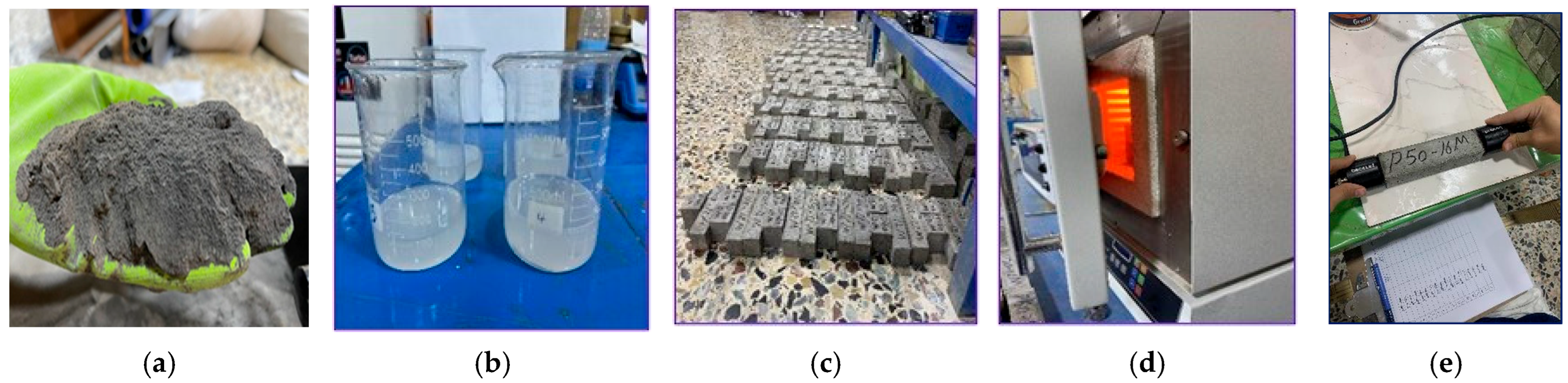
During the elevated temperature tests, specimens were placed directly on the inner base of the furnace, and the cubic and prismatic specimens were subjected to a gradual temperature increase in an electric furnace at a pace of 5 °C/min up to the target temperature. After reaching peak temperatures, they were held at the target temperature for 48 h to reach the target temperature on the inside of the specimens. Then, the furnace door was opened slowly to cool down the specimens to room temperature. This heating process aligns closely with the RILEM recommendation [38]. Figure 1 illustrates the basaltic pumice powder, used alkali activators, produced samples, elevated temperature, and UPV tests. It should be noted that UPV readings are taken from the longitudinal direction (16 cm). Table 2 presents the amounts of materials used in the production of pumice powder-based AAMs.

3. Results and Discussion

3.1. Mechanical Strengths and UPV Results

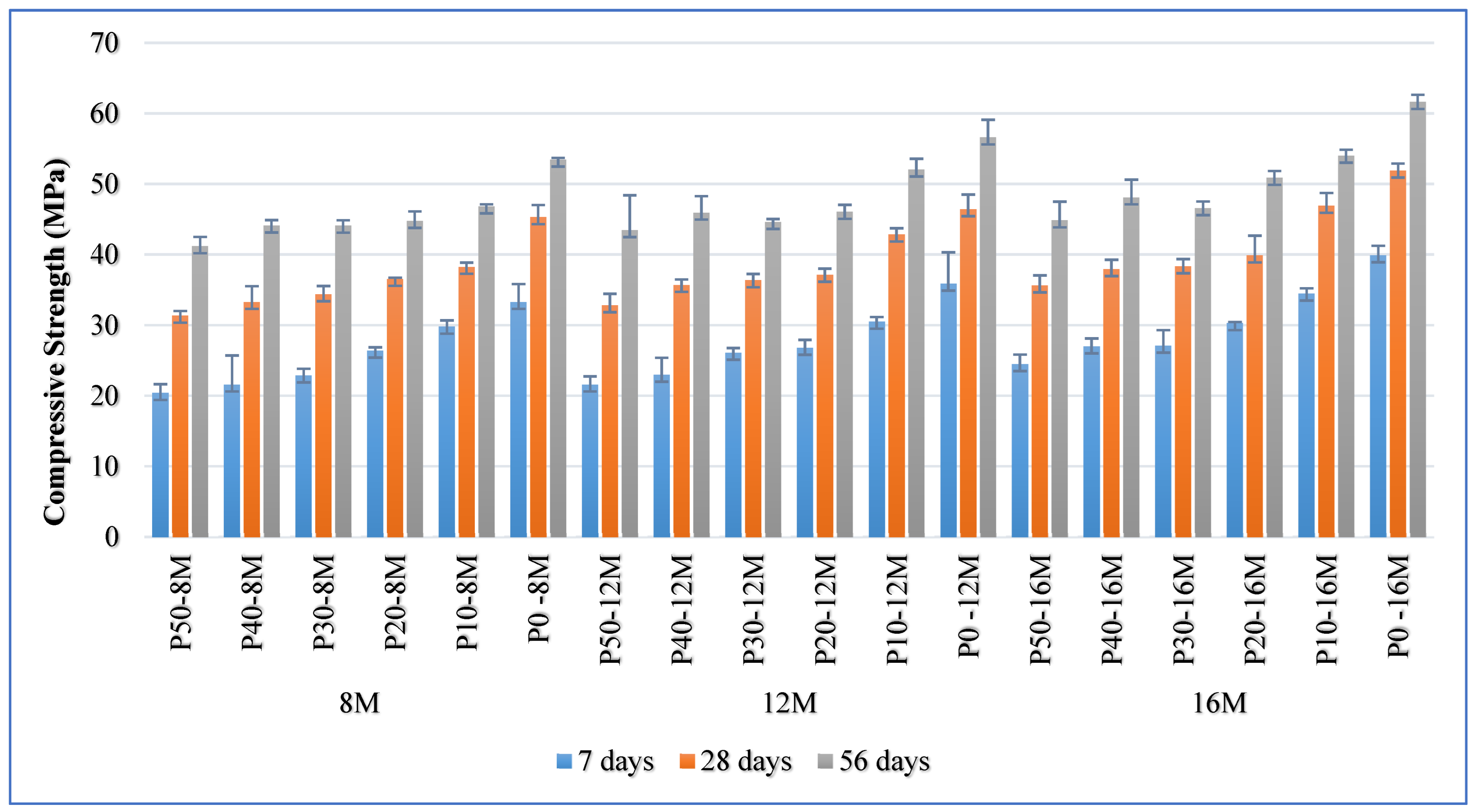
Figure 2 and Table 3 present the average compressive strength results of pumice-based AAMs at 7, 28, and 56 days. Although oven-curing at 65 °C for 48 h was applied on the pumice-based AAMs, the compressive strength of the samples increased with time. The 56-day compressive strengths of the samples were found to be the highest compressive strength. This can be attributed to the ongoing geopolymerization reactions following the initial oven-curing [39,40]. Wardhono et al. [41] studied the long-term compressive strength performance of slag and fly ash-based AAMs. The initial oven-curing at 80 °C for 24 h was applied to the AAMs and the specimens were left for up to 540 days in a laboratory environment. They reported that fly ash-based geopolymer concrete performed a 48.2% compressive strength development from 28 days to 540 days, and a 2.3% compressive strength development was obtained in the slag-based AAMs in the same period after the initial oven-curing period. The ongoing geopolymerization reaction is responsible for the strength enhancement after the initial oven-curing application [41]. In this study, similar results were obtained that the compressive strength of the specimens with and without pumice enhanced from 7 days to 56 days after initial oven-curing.
The results revealed that pumice incorporation reduced the compressive strength, which was more with a high pumice incorporation, and the lowest compressive strength was obtained in the samples having 50% pumice incorporations, Figure 2. However, this strength difference reduced with time. For instance, the average compressive strength differences between the specimens without pumice and with 50% pumice were 39% at 7 days, 31% at 28 days, and 24% at 56 days. Similar but a lower difference was also obtained in the other pumice-incorporated specimens. For the 40% pumice incorporations, strength differences were 34%, 25%, and 19% at 7, 28, and 56 days, respectively. They were 30%, 24%, and 21% for the 30% pumice incorporations, 23%, 21%, and 17% for the 20% pumice additions, 13%, 11%, and 10% for the 10% pumice incorporations at 7, 28, and 56 d, respectively. The outcomes discovered that a long period at ambient temperature is required after a short period of oven-curing for a higher strength in the pumice-incorporated AAMs, which can be attributed to the slower dissolution of pumice particles.
Meanwhile, the strength reduction due to the pumice replacement can be attributed to the reduced amount of CaO content, which is beneficial to produce C-S-H gels in addition to N-A-S-H gels. The findings of the study are in agreement with the results of the earlier investigation of Mohammed and Yaltay [42], who studied the compressive strength variation in acidic pumice powder incorporations in the slag-based geopolymer paste. They reported that increasing the pumice content up to 40% in the slag-incorporated geopolymer paste caused a reduction in compressive strength regardless of the range of NaOH molarity, curing types, and age of the samples at testing date. They found that the lowest compressive strength was obtained with higher acidic pumice incorporation of 40% in the slag-added geopolymer paste. Another reason for strength reduction, as well as the slower dissolution of pumice and lower CaO content, can be the increase in hydroxide ion concentrations in the system. It was stated that at the initial phases the rises in OH led to precipitation of the alumina–silicate gels, and subsequent geopolymerization was obstructed [43].
In addition, the influence of sodium hydroxide molarity was investigated in this study. It was found that an increase in the sodium hydroxide molarity enhanced the compressive strengths of the AAMs regardless of pumice incorporations. The specimens having 16 M sodium hydroxide molarity showed superior compressive strength, while the samples with 8 M performed the poorest compressive strength performance. This strength enhancement may be due to the extra Na coming from the NaOH solutions, forming C-(N)-A-S-H gels which yield to a compact microstructure and greater mechanical strengths. Erol et al. [34] studied the influence of sodium hydroxide concentrations on the strength performances of alkali-activated mortars, and found that the greater strength was found on 16 M samples. Also, they added that this increment could be due to the increased C–N-A-S-H gels by them acting as a charge balancer in [AlO4]. Therefore, a dense microstructure with higher strengths was obtained. Kupaei et al. [44] also stated that an increased NaOH concentration proportionally yielded greater mechanical strengths.
When the findings of the compressive strength were evaluated (Table 3), the highest compressive strengths were 39.9, 51.90, and 61.62 MPa (16 M—without pumice), while the lowest ones were 20.4, 31.36, and 41.19 MPa (8 M—50% pumice) at 7, 28, and 56 days, respectively. Most of the structural codes (EN 206 [45], EN 1992 [46], TS 500 [47]) ordered that the minimum compressive strength is C25/30 for structural utilization. Thus, 50% pumice-incorporated slag/fly ash AAMs can be utilized as a structural member element.
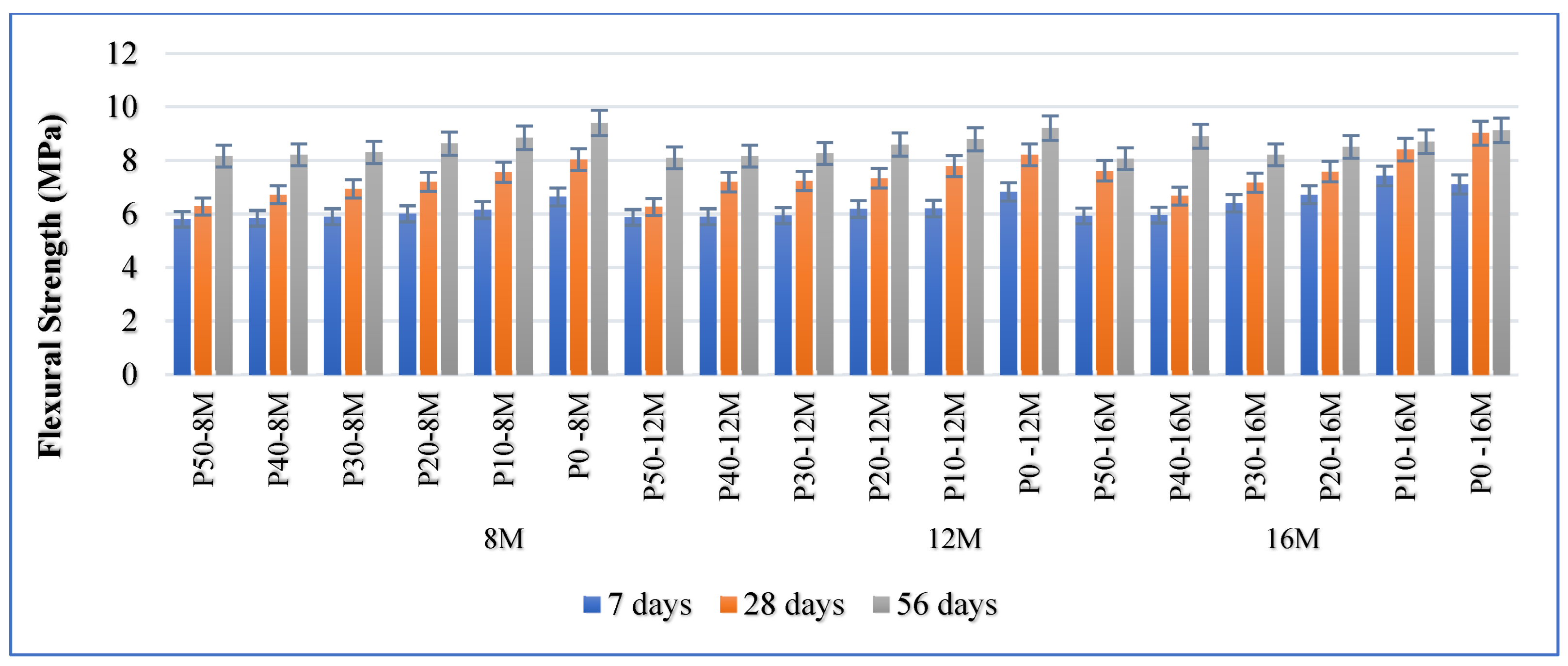
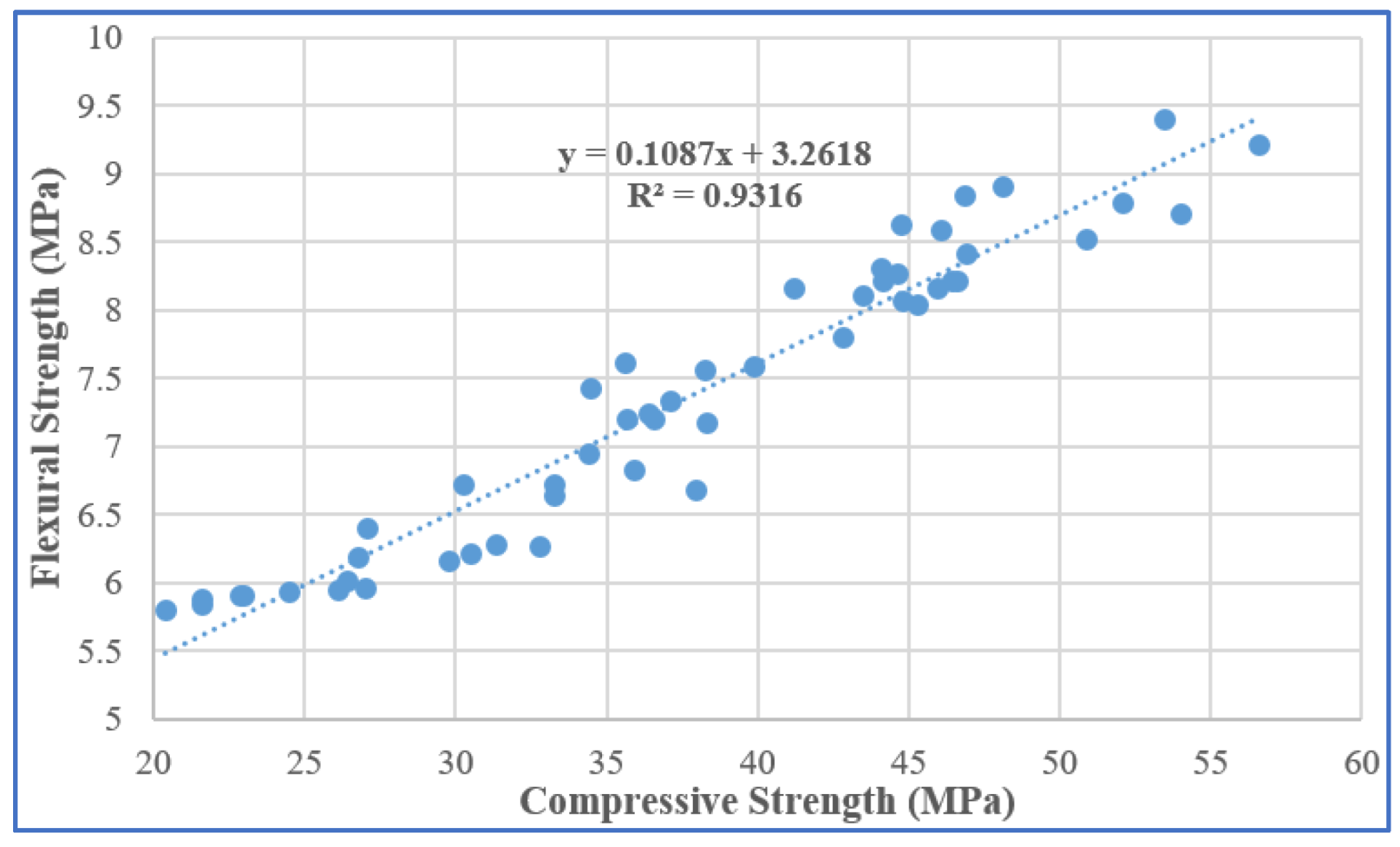
Figure 3 illustrates the average flexural strengths of the pumice-incorporated AAMs. The outcomes displayed that the flexural strengths of the AAMs was found to be higher with time, which can be due to the continuing geopolymerization reactions following the initial oven-curing [39,40,41]. In addition, sodium hydroxide molarity influenced the flexural strengths of the AAMs. The outcomes pointed out that an increase in the sodium hydroxide molarity from 8 M to 16 M increased the flexural strengths. However, the strength increment due to NaOH molarity increase after 28 days was found to be stabilized, and almost similar flexural strengths were obtained at 56 days in the AAMs. Figure 4 presents the relationship between flexural strength and compressive strength. It was found that there is a perfect relationship between flexural strength and compressive strength (R2 = 0.93) of the AAMs, indicating that the value of the flexural strength of the AAMs can be predicted by using the compressive strength of the AAMs.
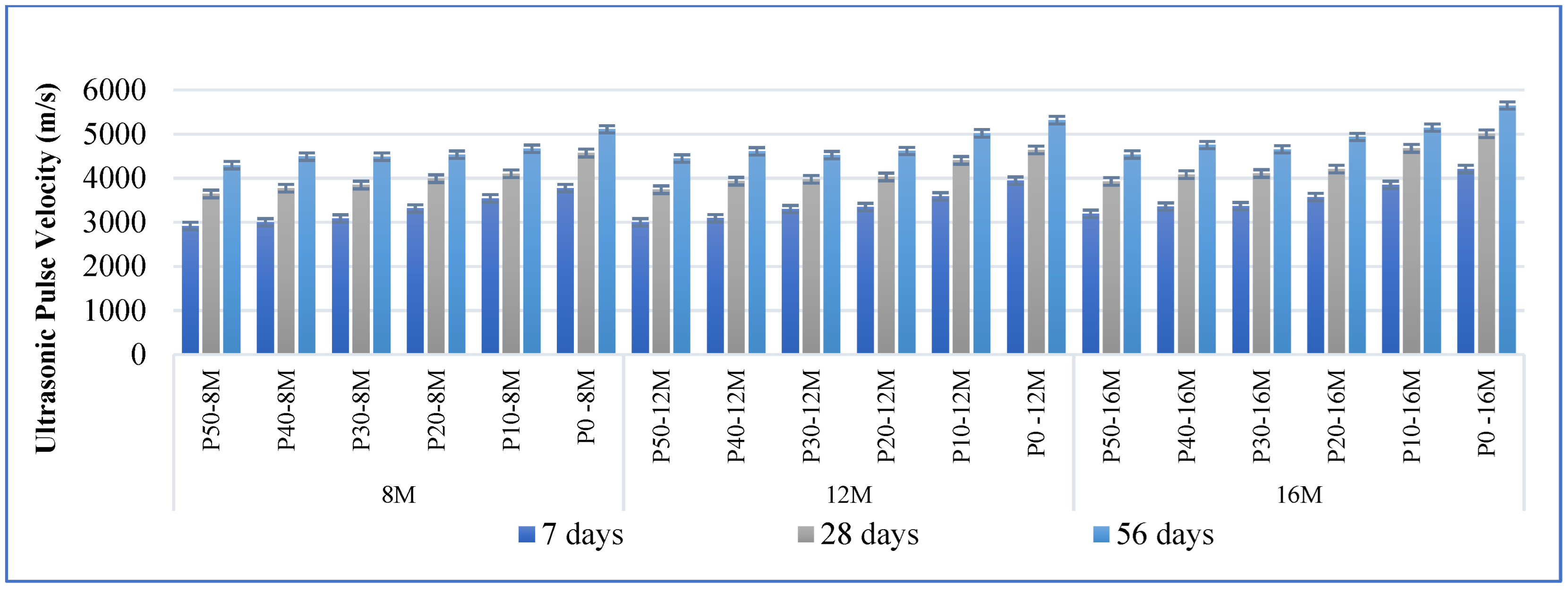
Figure 5 illustrates the ultrasonic pulse velocity (UPV) values of the AAMs at 7 days, 28 days, and 56 days. The outcomes revealed that the UPV values enhanced with time/age, and the highest velocities were reached at 56 d, which might be stated by more geopolymerization with time by the development of the N-A-S-H and C-S-H gels. The dense microstructure resulted in a delay in the wave propagation [48]. The UPV values were classified based on the velocity value of the specimens in the earlier investigations (very low velocity: UPV < 2500 m/s, low velocity: 2500 < UPV < 3500 m/s, middle velocity: 3500 < UPV < 4000 m/s, high velocity: 4000 < UPV < 5000 m/s, and very high velocity UPV > 5000 m/s) [49,50]. The obtained results showed that the UPV values varied from 2919 m/s to 4211 m/s at 7 d, from 3647 m/s to 5007 m/s at 28 d, and from 4298 m/s to 5650 m/s at 56 d. Meanwhile, the average velocity results were 3416 m/s at 7 d, 4150 m/s at 28 d, and 4768 m/s at 56 d. Based on the above classifications, specimens were located in the low velocity region at 7 d and the high velocity region at both 28 and 56 days. Similar UPV results were obtained in the previous study that the UPV values of the specimens were around 4000 m/s at 7 d, around 4500 m/s and 5000 m/s at 28 d and 56 days, respectively. The highest UPV values were found to be 5224 m/s and 5084 m/s in the geopolymer mortar specimens [51].
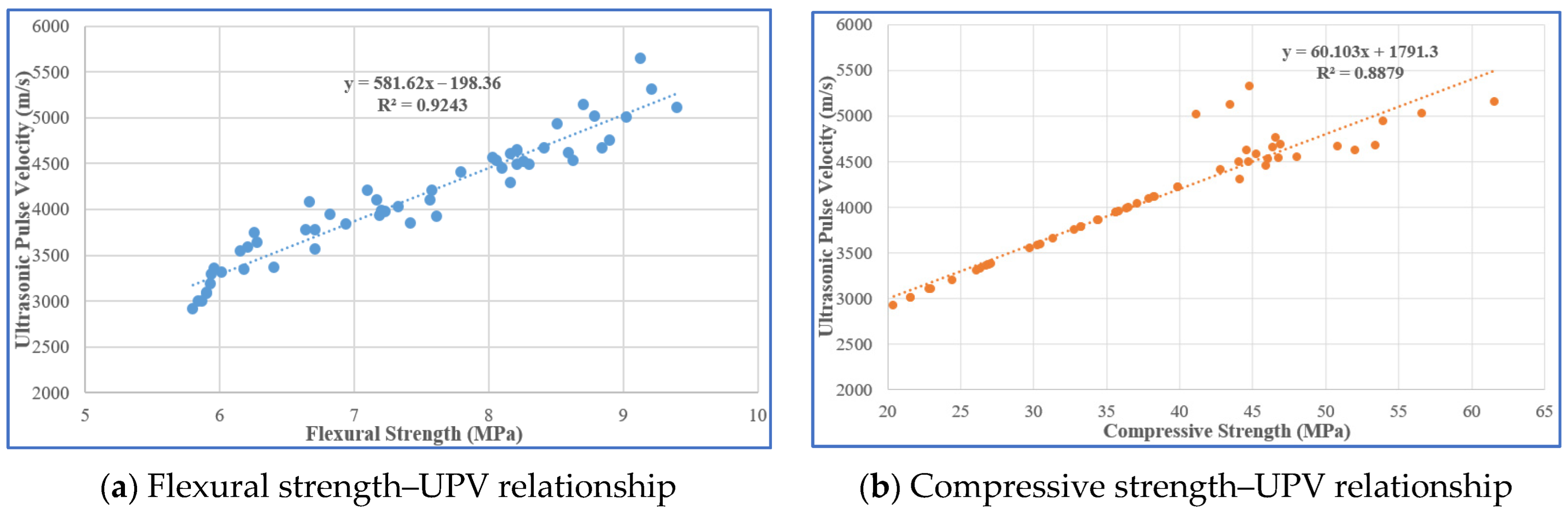
Meanwhile, an increase in sodium hydroxide molarity from 8 M to 12 M and 16 M improved the UPV results. This may be resulted from the additional C-(N)-S-A-H type gel formation with higher NaOH concentrations, leading to a dense internal structure and yielding a delay in UPV outcomes. A delay in the UPV values due to the increase in the sodium hydroxide molarity from 8 M to 16 M was also reported in the previous investigation [34]. In this study, the maximum UPV results were also found on the samples with 16 M sodium hydroxide molarity, while the lowest ones were found on the samples with 8 M. In addition, as the pumice replacement ratio increased, the UPV values were reduced. The lowest UPV value was reached for the 50% pumice-added specimens with 8 M NaOH concentration. Meanwhile, Figure 6 shows the relationships between flexural/compressive strengths and UPV outcomes of the AAMs. It was found that there are good relationships between flexural strength and UPV (R2 = 0.92) and compressive strength and UPV (R2 = 0.89), indicating that UPV values are directly correlated with compressive and flexural strengths of the specimens. The prediction of the mechanical strengths of the AAMs can be possible using UPV values.

3.2. Assessment of Compressive Strengths After Elevated Temperature

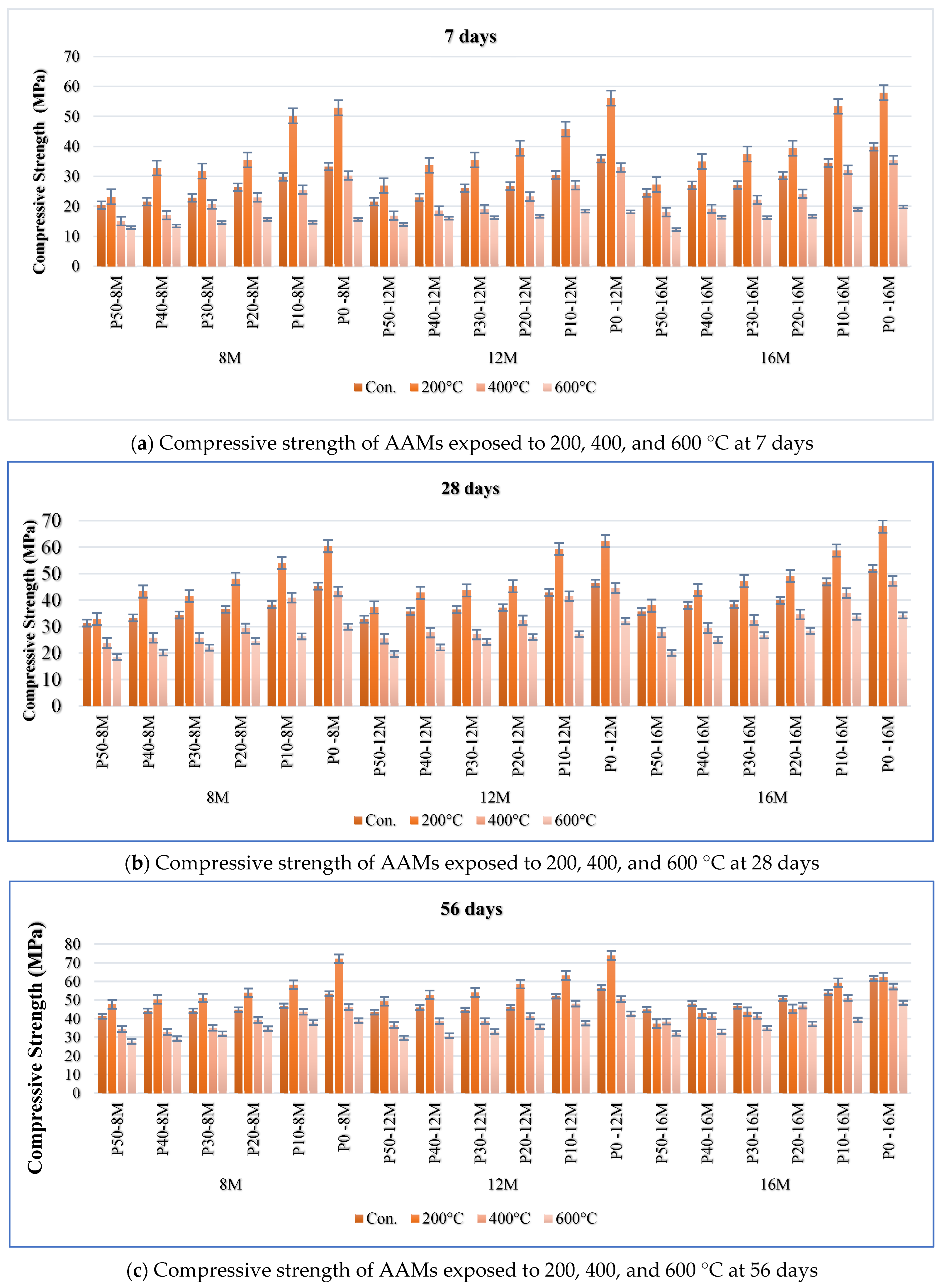
Table 4 and Figure 7 present the residual average compressive strengths of the AAMs exposed to 200, 400, and 600 °C at 7, 28, and 56 days. The results showed that curing time, NaOH molarity, and pumice incorporations significantly affected the residual compressive strength of the AAMs. In general, the compressive strength of the AAMs increased up to 200 °C, then it reduced with increasing temperature, and the lowest compressive strengths were obtained at 600 °C.
At 200 °C, the compressive strengths of the AAMs improved slightly due to the ongoing geopolymerization reactions. The findings are in line with the previous investigations [5,34,52]. This strength increment at 200 °C can be attributed to the internal autoclaving process and filling up of the voids with more C-S-H and N-A-S-H gels, resulting in a dense microstructure with higher mechanical properties [53,54]. In addition, a dense microstructure may be due to the accelerated geopolymerization reactions between alkali activators and used binders at high temperatures [55].
At 400 °C, further loss of crystalline water caused further volume shrinkage, and the colors of the specimens turned yellow, which can be attributed to the loss of internal free water and crystalline water. In most of the specimens, small micro cracks were observed on the surfaces at 400 °C. Thus, compressive strength reduction can be attributed to the micro-crack development as well as possible phase-change transition in geopolymers and differential thermal expansion. The outcomes showed that compressive strength losses were reduced with the curing time. Similar compressive strength losses were obtained on the AAMs irrespective of NaOH concentrations. At 600 °C, higher strength losses were obtained, which can be due to the evaporation of free water, matrix dehydration, and thermal reaction mechanism at 600 °C [56].
Also, the influence of NaOH concentration on the residual compressive strengths after elevated temperature was observed. An increase in the NaOH molarity enhanced the residual compressive strength of the AAMs after elevated temperature, and the samples having 16 M NaOH concentration exhibited better residual compressive strength performance than the 12 M and 8 M samples, respectively. This could be attributed to the additional sodium coming from the sodium hydroxide solution, resulting in a more compact microstructure due to more C-(N)-A-S-H gel formations at 200 °C. When pumice incorporations were evaluated after the effect of elevated temperatures on the compressive strength of the AAMs, the compressive strength losses were found to be almost similar up to 30% pumice incorporations compared to specimens without pumice. After that, the losses became higher for the 40% and 50% pumice incorporations. For the high temperature resistance, it is beneficial to use 30% pumice powder utilization in slag/fly ash-based AAMs.

3.3. Assessment of Flexural Strengths After Elevated Temperature

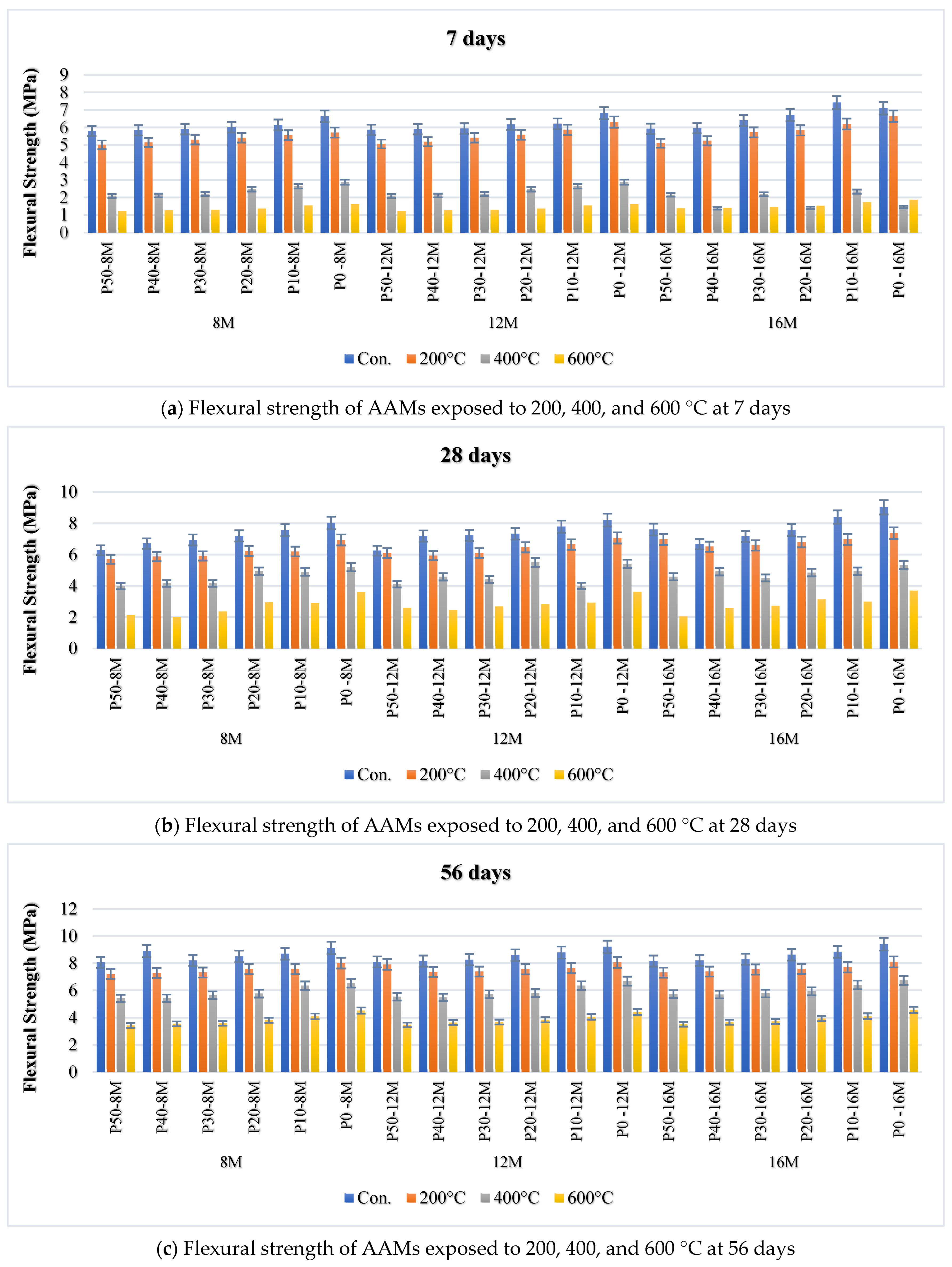
Table 5 and Figure 8 present the residual average flexural strengths of the AAMs exposed to 200, 400, and 600 °C at 7, 28, and 56 days. The results revealed that curing time, NaOH molarity, and pumice incorporations significantly affected the residual flexural strength of the AAMs. The results pointed out that as the curing time increased, the residual flexural strength also increased after elevated temperature exposure, which can be attributed to the denser microstructure with time due to the ongoing geopolymerization reactions.
At 200 °C, a reduction in the flexural strength was observed although there was an increment in the compressive strengths. This may be because flexural strength is more sensitive to microstructural defects, crack formations, and propagations [57]. The higher flexural strength loss at early ages (at 7 d) can be attributed to the lack of inadequate geopolymeric C-S-H and N-A-S-H gels, which are responsible for the strength and durability. Such high strength losses may be attributed to the steam effects that occurred at an elevated temperature. The free waters turn into steam at higher temperatures, resulting in more tensile loads/stresses to the matrix; hence, cracking emerges if the steam pressures exceed the tensile strengths of the matrices. After thermal crack formation, both rigidity and compactness decrease, yielding mechanical strength losses. Also, the higher mechanical strength loss due to the elevated temperature was attributed to the evaporation of free water, dehydration of the matrix, and thermal reactions [56].
When pumice incorporations were evaluated after the effect of elevated temperatures on the flexural strength of the AAMs, similar to the compressive strength losses, approximately similar flexural strength losses were obtained for up to 30% pumice incorporations compared to specimens without pumice, after that, the losses became higher for the 40% and 50% pumice incorporations. For the high temperature resistance, it is beneficial to use 30% pumice powder utilization in the AAMs. In addition, pumice has low energy costs since it only requires extraction, crushing, and grinding into a fine powder, leading to a lower production costs. Moreover, pumice is a lighter material, allowing for less concrete and steel to be used in the structure. In summary, basaltic pumice powder is generally economical because it is a low-energy, naturally abundant material that provides direct material substitution savings and long-term operational savings (through lighter weight and better insulation).
After comprehensive evaluation of the test results, it can be concluded that AAM can be used as a construction material in the RC structural design. However, the standardization process of the AAM is still difficult due to the various factors, i.e., alkali activator type, NaOH molarity, Na2SiO3 chemical composition, Na2SiO3/NaOH ratio, additional water, binder type and its composition, curing regime and duration, superplasticizer type and content, and their multiple interactions.

3.4. Assessment of Ultrasonic Pulse Velocity (UPV) After Elevated Temperature

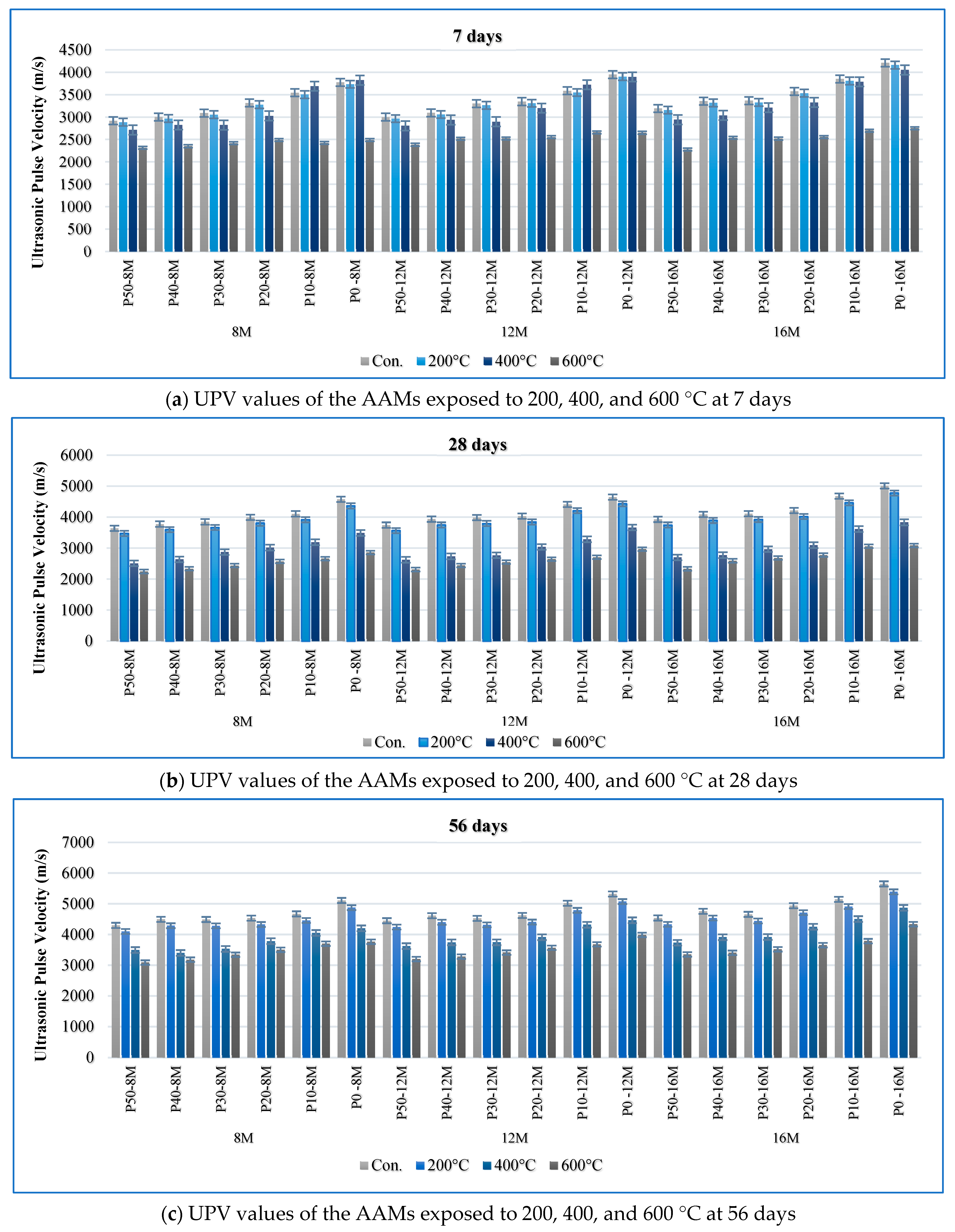
Table 6 gives the ultrasonic pulse velocity (UPV) results for the AAMs after elevated temperature exposure. The outcomes showed that UPVs reduced with increasing temperature, and the lowest UPVs were found in the samples exposed to 600 °C. The cracks, defects, and voids adversely affected the velocity values. After high temperatures, pores occur due to the water evaporation, leading to a decrement in UPV outcomes. The results also showed that velocity values decreased slightly at 200 °C, while they reduced seriously at 400 and 600 °C. Figure 9 illustrates the UPV variations in specimens exposed to 200, 400, and 600 °C at 7 d, 28 d, and 56 d, respectively. The lowest UPV values were obtained at 7 d due to the incomplete geopolymerization, leading to pores in the microstructure, resulting in low UPV values. The curing period favorably affected the UPV values due to the fewer defects and pores, and the maximum UPVs were reached at 56 days. The longer the curing period, the more there will be improvement in the thermal stability and internal structure integrity. After a 600 °C exposure, 56-day specimens have UPV values in the range of 3089–4338 m/s, which is much higher than those of the 7-day and 28-day specimens. With the elevation of temperature, the reduced UPV values are mainly due to the formation of micro cracks, widening of pores, and reduction in the binding matrix because of dehydration and thermal decomposition. The serious reduction at 600 °C shows that there are serious damages at a high temperature of 600 °C. The UPV results were found parallel with the mechanical strength results. The specimens having 16 M NaOH concentration yielded better performance than the specimens having 12 M and 8 M NaOH concentrations, respectively.

3.5. Assessment of Weight Loss at High Temperature

Table 7 presents the average weight loss (%) of the specimens after exposure to elevated temperature. The results pointed out that as temperature increases the weight losses also increase. In addition, 16 M specimens exhibited less weight losses than the 12 M and 8 M specimens. As the temperature increases, a dehydration reaction emerges, and moisture moves from the inner parts to the outer parts, leading to deterioration and weight loss [58]. In the beginning phase of the heating process, weight losses occur rapidly because of the bound water resulting from the alkali activations and water evaporation [59].

3.6. Microstructural Assessment of the Specimens Before Elevated Temperature

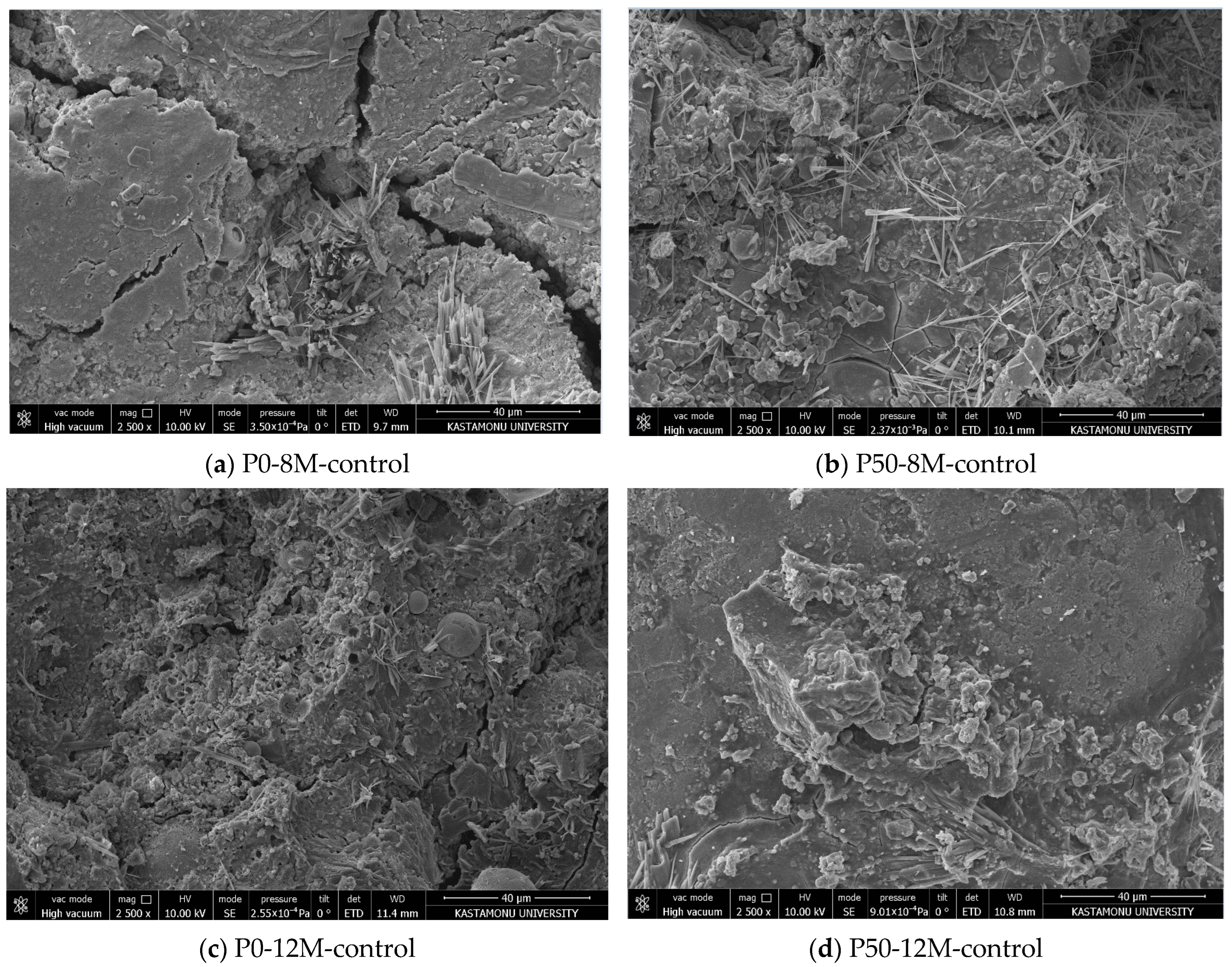
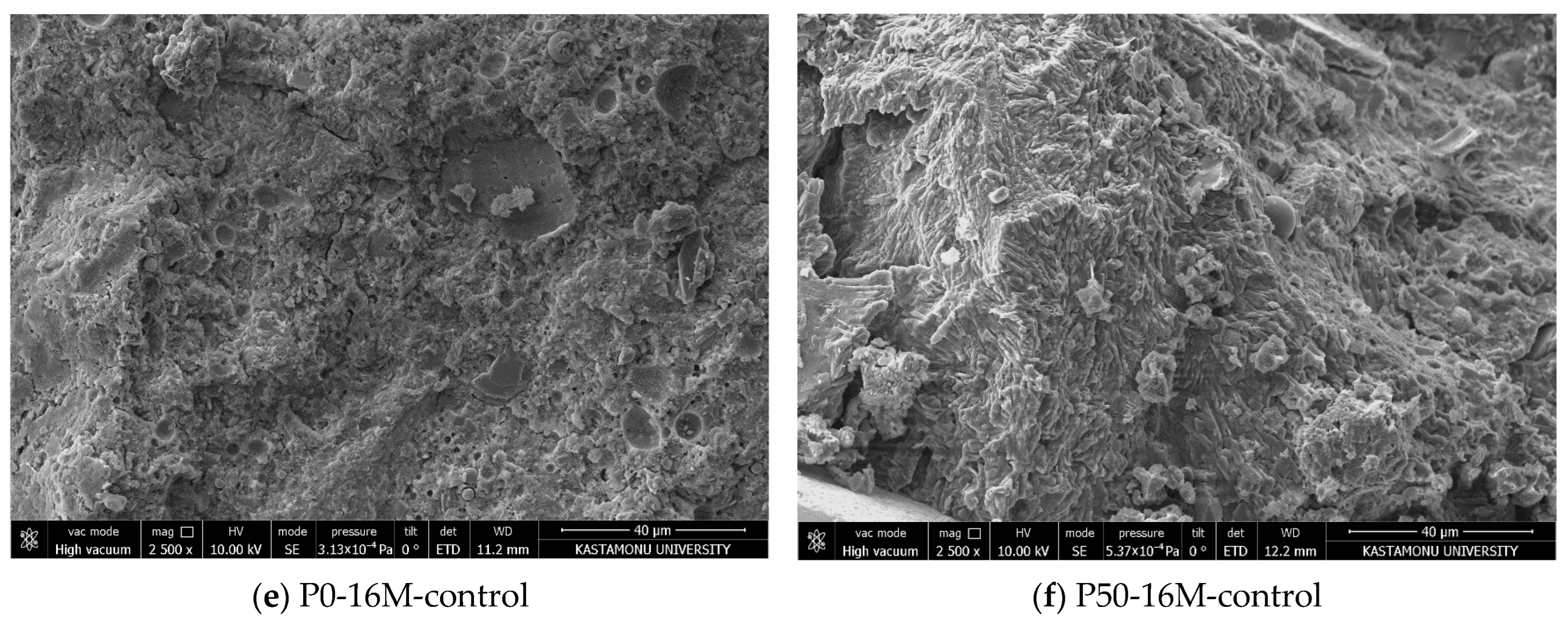
Figure 10 illustrates Scanning Electron Microscopy (SEM) micrographs of the AAMs without pumice incorporations on the left (P0) and with 50% pumice incorporations on the right (P50) having 8 M, 12 M, and 16 M NaOH concentrations. Also, Table 8 summarizes the energy-dispersive X-ray spectroscopy (EDS) results of the AAMs at 56 days. In the SEM micrographs, pores, geopolymeric gels, micro cracks, and unreacted and partially reacted alumina–silicate particles can be easily visible. The differences in SEM micrographs due to the variation in NaOH concentration and 50% pumice inclusion were noticeable, see Figure 10. With the increasing NaOH molarity from 8 M to 12 M and 16 M, the crack density significantly reduced according to 56-day SEM micrographs. Also, unreacted grains, pores, voids, and needle-type geopolymer products were reduced with higher NaOH molarities. A dense microstructure was obtained with higher molarities. The SEM micrograph results were similar to the mechanical strength results in that higher mechanical strengths were obtained on the AAMs having 16 M NaOH concentrations.
Figure 10b,d,f illustrate 50% pumice-incorporated AAMs having 8 M, 12 M, and 16 M NaOH concentrations, respectively. The SEM micrographs of pumice-added AAMs revealed that an inhomogeneous and porous microstructure with a higher number of cracks was obtained. The crack density and the number of unreacted and partially reacted pumice grains reduced with higher NaOH molarity. Also, almost all of the sodium crystals were consumed in the geopolymerization reactions for the higher NaOH molarity. When compared to control specimens, weaker microstructures were observed for 50% pumice incorporations. A weaker internal structure and a higher number of voids and unreacted particles resulted in a consequent decrease in strength values after pumice incorporations. Meanwhile, the observed micro cracks in the micrographs of the AAMs can be attributed to the shrinkage cracks during geopolymeric gel formation [60].
Table 8 presents the energy-dispersive spectroscopy (EDS) characterizations of the AAMs without pumice (P0) and with 50% pumice incorporations (P50) at 56 d. The main elemental compositions of the pumice are Na, Al, and Si, which can contribute further additional geopolymeric products of N-A-S-H. The binder of the AAMs is composed of slag (rich in Ca and Si), fly ash, and pumice (rich in Si and Al). When the pumice is incorporated, calcium oxide content in the binder reduces, and this reduction becomes highest when 50% pumice is incorporated instead of the fly ash/slag system. The calcium-rich systems form C-A-S-H gels, which contain a high Al content with a low Ca/Si ratio. On the other hand, silica-rich systems form calcium-containing N-(C)-A-S-H gels [61]. Table 8 shows that the peak elements are Na, Al, Si, and Ca. It is stated in a recent study that the concentration of Si-OH bonds decreases as the Ca/Si ratio rises, while the concentration of Ca-OH bonds increases. Also, the number of defects (i.e., voids, pores) rises as the Ca/Si ratio is increased [62]. In addition, another study revealed that the micromechanical properties of the Ca/Si ratio of 0.8 are 10–30% superior to that of 1.2 due to fewer defects in the silica chain, lower polymerization, and large gel pore volume [63]. The EDS results revealed that the Ca/Si ratio was 1.29 for 8 M, 0.95 for 12 M, and 0.74% for 16 M specimens without pumice, while the Ca/Si ratio was 1.31 for 8 M, 1.30 for 12 M, and 0.81 for 16 M with 50% pumice-added AAMs. The Ca/Si ratio reduced as the NaOH molarity increased for with/without pumice-added AAMs, indicating that the lowest defects were obtained on the AAMs having 16 M NaOH concentrations. The EDS results also support SEM findings that pumice particles are close to each other, which makes voids and several weak interfaces in the geopolymers that lead to easier fractures and lower strength.
Apart from the Ca/Si atomic ratio, the Si/Na atomic ratio also affected the compressive strength results. It was reported that compressive strength increases with the increase in the Si/Na ratio up to a specific ratio [64]. In this study, the Si/Na ratio was found to be 1.04 for 8 M, 1.37 for 12 M, and 3.21 for 16 M specimens without pumice. This ratio for the 50% pumice-added specimens was 1.38 for 8 M, 1.42 for 12 M, and 1.59 for 16 M AAMs. This finding is also parallel with the compressive strength results that as the compressive strength of the AAMs increases with an increase in Si/Na ratio with and without pumice incorporations. EDS findings revealed that the Ca/Si and Si/Na atomic ratios of the AAMs with/without pumice were close to each other. However, Si/Al and Na/Al atomic ratios were found higher for the 50% pumice-added AAMs. This may be attributed to the higher Na2O content of pumice. The EDS findings revealed that an inverse relationship exists between compressive strength and Si/Al and Na/Al atomic ratios. As the Si/Al and Na/Al atomic ratios reduced, the compressive strengths of the AAMs increased.

3.7. Microstructural Assessment of the Specimens After Elevated Temperature

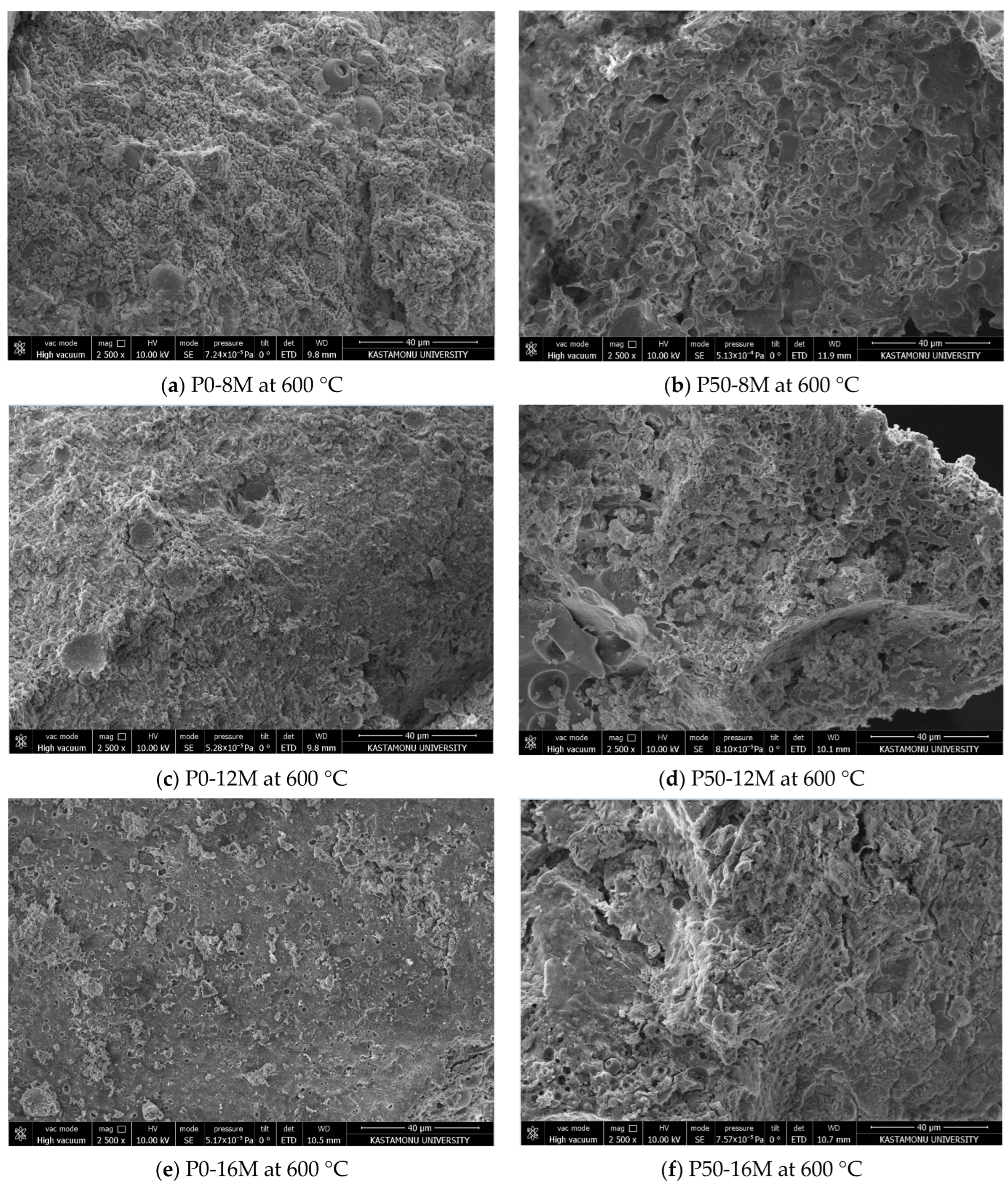
Figure 11 illustrates the SEM micrographs of the different AAMs at 600 °C. In Figure 11, the left parts show the samples without pumice, while the right parts present the samples with 50% pumice incorporations. The SEM micrographs revealed that oval cavities were formed at 600 °C, which was caused by the large volume expansion due to the viscous sintering of the geopolymer matrix at elevated temperatures [26,65]. The formed cavities reduced the mechanical strength of the AAMs. In addition, the partial melting of the geopolymer matrix and the spherical pore formation were observed on the SEM images, and the availability of these pores facilitates the vapor movement away from the samples, therefore reducing the damage at elevated temperature, resulting in a superior temperature resistance. It is obvious that the AAMs having lower strength are more porous, and these pores make available more space for steam to escape. Thus, the internal pressure discharges resulting in less damage to the matrix [66]. This situation was also observed in SEM micrographs. These spherical pores may be attributed to the rapid water evaporation in the structure. When the samples with/without pumice were evaluated, samples without pumice showed better microstructure than the samples having 50% pumice. The molten parts and the spherical voids and pores were observed more in the 50% pumice-incorporated samples. In addition, a dense internal structure was observed on the samples having a higher NaOH concentration, and the number of cavities formed due to the elevated temperature was found to be less for higher NaOH molarity, which explains the higher compressive strengths of the AAMs with a high NaOH concentration.
Table 9 gives the EDS results of the AAMs at 600 °C. The results showed that after exposure to 600 °C, the basic elements were found as C, O, Na, Al, Si, and Ca. As the Ca/Si ratio is increased the number of defects (i.e., voids, pores) rises. After exposure to 600 °C, the Ca/Si ratio increased from 1.29 to 1.59 for 8 M, 0.95 to 2.06 for 12 M, and 0.74 to 1.12 for 16 M samples without pumice. The EDS results prove the findings that more defects were obtained after exposure to 600 °C. However, the Ca/Si ratio reduced from 1.31 to 0.80 for 8 M, from 1.30 to 0.38, and from 0.81 to 0.79 for 50% pumice-incorporated samples. For the 50% pumice-incorporated samples, the Ca/Si ratio reduced after exposure to high temperatures. The possible reason being that the pumice-based matrix partially melted and repaired some of the pores that were not previously filled with geopolymerization products. In addition, the increase in Si/Na ratio up to a specific point yielded a higher compressive strength. Due to the elevated temperature, the Na/Si ratio decreased from 1.04 to 0.53 for 8 M and from 3.21 to 1.94 for 16 M samples without pumice. For 50% pumice-incorporated samples, the Si/Na ratio reduced from 1.42 to 1.00 for 12 M and from 1.59 to 1.17 for 16 M samples due to elevated temperature. These results were found consistent with the compressive strength results. Also, an inverse relationship of Si/Al and Na/Al atomic ratio with compressive strength was obtained after elevated temperature for samples without pumice. A reduction in the Si/Al and Na/Al atomic ratios improved the compressive strength. However, this trend was not clear for the pumice-based AAMs after elevated temperature. A similar result was also obtained in the earlier investigation that after high temperature Si/Al atomic ratio increased, reducing the compressive strength of geopolymers [67]. In another study [68], it was reported that the high value of Si/Al in the geopolymer gel leads to the densification and sintering process in the geopolymers. A higher variation in Si/Al ratio (1.43–6.50) was reported in the same study due to the elevated temperature, similarly to this study.

4. Conclusions

In this study, the following results were obtained:
  • The compressive strength (CS) and flexural strength (FS) of the AAMs increased with time due to the ongoing geopolymerization reactions.
  • The basaltic pumice powder incorporation reduced both CS and FS due to the lack of CaO content, and the lowest CS was obtained in the samples having the 50% pumice powder incorporations. However, this strength difference reduced with time due to the slower dissolution of pumice particles. For instance, the average CS differences were 39% at 7 days, 31% at 28 days, and 24% at 56 days for AAMs without and with 50% pumice. A similar but lower CS difference was also obtained in the other pumice-added AAMs, indicating that a long curing period is required for higher mechanical strength in the pumice-incorporated AAMs.
  • An increase in the NaOH molarity improved both CS and FS of the AAMs. The 16 M samples performed the highest, while 8 M samples exhibited the lowest strength due to the additional sodium coming from the NaOH solution, resulting in a formation of C-(N)-A-S-H gels, leading to a dense microstructure and higher mechanical strength. The highest CS were 39.9, 51.90, and 61.62 MPa (16 M-without pumice), while the lowest CS were 20.4, 31.36, and 41.19 MPa (8 M-50% pumice) at 7, 28, and 56 days.
  • The UPV values varied from 2919 m/s to 4211 m/s at 7 d, from 3647 m/s to 5007 m/s at 28 d, and from 4298 m/s to 5650 m/s at 56 d. UPV results confirmed the CS and FS findings that the highest UPV values were obtained for the AAMs with 16 M, while the lowest ones were found for the AAMs with 8 M. The dense microstructure resulted in a delay in the wave propagation.
  • At 200 °C, the CS of the AAMs slightly improved due to the ongoing geopolymerization reactions. On the other hand, the FS of the AAMs slightly reduced at 200 °C since FS is more sensitive to microstructural defects, crack formations, and propagations.
  • At 400 °C, the CS slightly reduced due to micro-crack development, phase-change transition, and differential thermal expansion. The average CS losses were 16.85% at 7 d, 15.03% at 28 d, and 12.72% at 56 d at 400 °C. Meanwhile, the average FS reductions were 64.54% at 7 d, 36.40% at 28 d, and 30.70% at 56 d at 400 °C.
  • At 600 °C, the CS moderately reduced due to the evaporation of free water, matrix dehydration, and thermal reaction mechanism. The CS losses were 41.88% at 7 d, 34.57% at 28 d, and 27.29% at 56 d. Additionally, the average FS decrements were 77.02% at 7 d, 62.48% at 28 d, and 54.93% at 56 d due to exposure to 600 °C.
  • Lower or similar mechanical strength losses were obtained for up to 30% pumice incorporations; after that, the losses became higher for the 40% and 50% pumice incorporations. For the high temperature resistance, it is beneficial to use 30% pumice powder utilization in slag/fly ash-based AAMs.

Author Contributions

T.S.W.A.-A.: Conceptualization, Methodology, Data curation, Writing—Original draft preparation. A.N.: Visualization, Investigation, Supervision, Writing—Original draft preparation, Writing—Reviewing and Editing. All authors have read and agreed to the published version of the manuscript.

Funding

The APC was funded by Istanbul Gelisim University.

Institutional Review Board Statement

Not applicable.

Informed Consent Statement

Not applicable.

Data Availability Statement

Data is available (https://www.scidb.cn/en/s/y2A36n, accessed on 1 November 2025).

Conflicts of Interest

The authors declare that they have no known competing financial interests or personal relationships that could have appeared to influence the work reported in this paper.

References

  1. Lv, Y.; Wang, C.; Han, W.; Li, X.; Peng, H. Study of the mechanical properties and microstructure of alkali-activated fly ash–slag composite cementitious materials. Polymers 2023, 15, 1903. [Google Scholar] [CrossRef]
  2. Zhang, J.; Shang, S.; Huo, Z.; Chen, J.; Wang, Y. Elemental Design of Alkali-Activated Materials with Solid Wastes Using Machine Learning. Materials 2024, 17, 4573. [Google Scholar] [CrossRef]
  3. Yuan, Z.; Jia, Y.; Sun, J.; Zhang, X.; Hu, Y.; Han, X. Study on the Properties of High Fly Ash Content Alkali-Activated Fly Ash Slag Pastes and Fiber-Reinforced Mortar Under Normal Temperature Curing. Materials 2024, 17, 5668. [Google Scholar] [CrossRef]
  4. Ślosarczyk, A.; Klapiszewska, I.; Jędrzejczak, P.; Jędrzejczak, W.; Klapiszewski, Ł. Synthesis and characterization of eco-efficient alkali-activated composites with self-cleaning properties for sustainable construction. Molecules 2023, 28, 6066. [Google Scholar] [CrossRef]
  5. Dai, W.; Wang, Y. Silica Fume Enhances the Mechanical Strength of Alkali-Activated Slag/Fly Ash Pastes Subjected to Elevated Temperatures. Fire 2023, 6, 252. [Google Scholar] [CrossRef]
  6. Hasar, U.C.; Eren, N.A.; Ozturk, H.; Izginli, M.; Korkmaz, H.; Cevik, A.; Nis, A.; Irshidat, M.R. Mechanical and electromagnetic properties of self-compacted geopolymer concretes with nano silica and steel fiber additives. IEEE Trans. Instrum. Meas. 2022, 71, 1–8. [Google Scholar] [CrossRef]
  7. Panias, D.; Giannopoulou, I.P.; Perraki, T. Efect of synthesis parameters on the mechanical properties of fly ash-based geopolymers. Colloids Surf. A 2007, 301, 246–254. [Google Scholar] [CrossRef]
  8. Palomo, A.; Grutzeck, M.; Blanco, M. Alkali-activated fy ashes: A cement for the future. Cem. Concr. Res. 1999, 29, 1323–1329. [Google Scholar]
  9. Lemougna, P.N.; Mackenzie, K.J.; Melo, U.C. Synthesis and thermal properties of inorganic polymers (geopolymers) for structural and refractory applications from volcanic ash. Ceram. Int. 2011, 37, 3011–3018. [Google Scholar] [CrossRef]
  10. Chi, M.; Huang, R. Effects of dosage and modulus ratio of alkali-activated solution on the properties of slag mortars. Adv. Sci. Lett. 2012, 16, 7–12. [Google Scholar] [CrossRef]
  11. Allahverdi, A.; Shaverdi, B.; Najaf, K.E. Infuence of sodium oxide on properties of fresh and hardened paste of alkali-activated blastfurnace slag. Int. J. Civ. Eng. 2010, 8, 304–314. [Google Scholar]
  12. Yadollahi, M.M.; Benli, A.; Demirboğa, R. The effects of silica modulus and aging on compressive strength of pumice-based geopolymer composites. Constr. Build. Mater. 2015, 94, 767–774. [Google Scholar] [CrossRef]
  13. Hossain, K.M.A. Blended cement using volcanic ash and pumice. Cem. Concr. Res. 2003, 33, 1601–1605. [Google Scholar] [CrossRef]
  14. Kabay, N.; Tufekci, M.M.; Kizilkanat, A.B.; Oktay, D. Properties of concrete with pumice powder and fly ash as cement replacement materials. Constr. Build. Mater. 2015, 85, 1–8. [Google Scholar] [CrossRef]
  15. Magbool, H.M.; Zeyad, A.M. The effect of varied types of steel fibers on the performance of self-compacting concrete modified with volcanic pumice powder. Mater. Sci.-Pol. 2021, 39, 172–187. [Google Scholar]
  16. Zeyad, A.M.; Magbool, H.M.; Tayeh, B.A.; de Azevedo, A.R.G.; Abutaleb, A.; Hussain, Q. Production of geopolymer concrete by utilizing volcanic pumice dust. Case Stud. Constr. Mater. 2022, 16, e00802. [Google Scholar] [CrossRef]
  17. Djobo, J.N.Y.; Elimbi, A.; Tchakouté, H.K.; Kumar, S. Mechanical properties and durability of volcanic ash based geopolymer mortars. Constr. Build. Mater. 2016, 124, 606–614. [Google Scholar] [CrossRef]
  18. Safari, Z.; Kurda, R.; Al-Hadad, B.; Mahmood, F.; Tapan, M. Mechanical characteristics of pumice-based geopolymer paste. Resour. Conserv. Recycl. 2020, 162, 105055. [Google Scholar] [CrossRef]
  19. Karaaslan, C.; Yener, E.; Bağatur, T.; Polat, R.; Gül, R.; Alma, M.H. Synergic effect of fly ash and calcium aluminate cement on the properties of pumice-based geopolymer mortar. Constr. Build. Mater. 2022, 345, 128397. [Google Scholar] [CrossRef]
  20. Zeyad, A.M.; Johari, M.A.M.; Tayeh, B.A.; Yusuf, M.O. Pozzolanic reactivity of ultrafine palm oil fuel ash waste on strength and durability performances of high strength concrete. J. Clean. Prod. 2017, 144, 511–522. [Google Scholar] [CrossRef]
  21. Bondar, D.; Lynsdale, C.J.; Milestone, N.B.; Hassani, N.; Ramezanianpour, A.A. Effect of type, form, and dosage of activators on strength of alkali-activated natural pozzolans. Cem. Concr. Compos. 2011, 33, 251–260. [Google Scholar] [CrossRef]
  22. Firdous, R.; Stephan, D.; Djobo, J.N.Y. Natural pozzolan based geopolymers: A review on mechanical, microstructural and durability characteristics. Constr. Build. Mater. 2018, 190, 1251–1263. [Google Scholar] [CrossRef]
  23. Davidovits, J. Geopolymers: Inorganic polymeric new materials. J. Therm. Anal. Calorim. 1991, 37, 1633–1656. [Google Scholar] [CrossRef]
  24. Kurtoglu, A.E.; Alzeebaree, R.; Aljumaili, O.; Nis, A.; Gulsan, M.E.; Humur, G.; Cevik, A. Mechanical and durability properties of fly ash and slag based geopolymer concrete. Adv. Concr. Constr. 2018, 6, 345. [Google Scholar]
  25. Niş, A.; Çevik, A. Seawater resistance of alkali-activated concrete. In Handbook of Advances in Alkali-Activated Concrete; Woodhead Publishing: Cambridge, UK, 2022; pp. 451–469. [Google Scholar]
  26. Yadollahi, M.M.; Benli, A.; Demirboğa, R. Effects of elevated temperature on pumice based geopolymer composites. Plast. Rubber Compos. 2015, 44, 226–237. [Google Scholar] [CrossRef]
  27. Yener, E.; Karaaslan, C. Effect of Clinker Additive on Pumice-based Geopolymer Properties. In Proceedings of the 4th International Conference on Advances in Natural & Applied Sciences, Agri, Turkey, 19–22 June 2019. [Google Scholar]
  28. Hamid, M.A.; Yaltay, N.; Türkmenoğlu, M. Properties of pumice-fly ash based geopolymer paste. Constr. Build. Mater. 2022, 316, 125665. [Google Scholar] [CrossRef]
  29. Al-Antaki, T.S.W.; Niş, A. The influences of sulfuric acid and magnesium sulfate attacks on pumice powder incorporated alkali-activated mortars with different sodium hydroxide molarities. Constr. Build. Mater. 2025, 493, 143136. [Google Scholar] [CrossRef]
  30. Ekinci, E. The effects of different production parameters (NaOH concentration, curing regime and replacement ratio of recycled aggregate) on fresh, hardened and elevated temperature performance of geopolymer mortar samples. J. Build. Eng. 2023, 76, 107052. [Google Scholar] [CrossRef]
  31. Khattab, S.A.; Elshikh, M.M.Y.; Elemam, W.E.; Elshami, A.A.; Youssf, O. Effect of magnetized water-based alkaline activator on geopolymer concrete mechanical performance and durability. Sustainability 2023, 15, 16315. [Google Scholar] [CrossRef]
  32. Vafaei, M.; Allahverdi, A. Influence of calcium aluminate cement on geopolymerization of natural pozzolan. Constr. Build. Mater. 2016, 114, 290–296. [Google Scholar] [CrossRef]
  33. Niş, A.; Antaki, A.; Wahhab, T.S. Pumice aggregate based lightweight concretes under sulfuric acid environment. Rev. Romana De Mater./Rom. J. Mater. 2022, 52, 194–202. [Google Scholar]
  34. Erol, F.; Al-mashhadani, M.M.; Aygörmez, Y.; Niş, A. Effect of ceramic waste powder content and sodium hydroxide molarity on the residual mechanical strength of alkali-activated mortars. Mater. Chem. Phys. 2023, 309, 128403. [Google Scholar] [CrossRef]
  35. Olivia, M.; Nikraz, H. Properties of fly ash geopolymer concrete designed by Taguchi method. Mater. Des. (1980–2015) 2012, 36, 191–198. [Google Scholar] [CrossRef]
  36. ASTM C39/C39M-17b; Standard Test Method for Compressive Strength of Cylindrical Concrete Specimens. ASTM International: West Conshohocken, PA, USA, 2017.
  37. EN1015-11: 1999; Methods of Test for Mortar for Masonry–Part 11: Determination of Flexural and Compressive Strength of Hardened Mortar. British Standards Institution: London, UK, 1999.
  38. Rilem, T.C. 129-MHT, “Test methods for mechanical properties of concrete at high temperatures”, Part 1: Introduction, Part 2: Stress-strain relation, Part 3: Compressive strength for service and accident conditions. Mater. Struct 1995, 28, 410–414. [Google Scholar]
  39. Bakharev, T. Geopolymeric materials prepared using Class F fly ash and elevated temperature curing. Cem. Concr. Res. 2005, 35, 1224–1232. [Google Scholar] [CrossRef]
  40. Niş, A.; Altındal, İ. Compressive strength performance of alkali activated concretes under different curing conditions. Period. Polytech. Civ. Eng. 2021, 65, 556–565. [Google Scholar] [CrossRef]
  41. Wardhono, A.; Gunasekara, C.; Law, D.W.; Setunge, S. Comparison of long term performance between alkali activated slag and fly ash geopolymer concretes. Constr. Build. Mater. 2017, 143, 272–279. [Google Scholar] [CrossRef]
  42. Mohammed, D.T.; Yaltay, N. Strength and elevated temperature resistance properties of the geopolymer paste produced with ground granulated blast furnace slag and pumice powder. Ain Shams Eng. J. 2024, 15, 102483. [Google Scholar] [CrossRef]
  43. Memon, F.A.; Nuruddin, M.F.; Khan, S.; Shafiq, N.A.S.I.R.; Ayub, T. Effect of sodium hydroxide concentration on fresh properties and compressive strength of self-compacting geopolymer concrete. J. Eng. Sci. Technol. 2013, 8, 44–56. [Google Scholar]
  44. Kupaei, R.H.; Alengaram, U.J.; Jumaat, M.Z. The effect of different parameters on the development of compressive strength of oil palm shell geopolymer concrete. Sci. World J. 2014, 2014, 898536. [Google Scholar] [CrossRef]
  45. EN 206 (2000); Concrete—Part 1: Specification, Performance, Production and Conformity. British Standards Institution: London, UK, 2000.
  46. EN 1992-1-1 (2004); Eurocode 2: Design of Concrete Structures—Part 1-1: General Rules and Rules for Buildings. European Committee for Standardization: Brussels, Belgium, 2004.
  47. TS 500; Requirements for Design and Construction of Reinforced Concrete Structures. TSE (Turkish Standards Institute): Ankara, Turkey, 2000.
  48. Wardhono, A.; Law, D.W.; Molyneaux, T.C.K. Long term performance of alkali activated slag concrete. J. Adv. Concr. Technol. 2015, 13, 187–192. [Google Scholar] [CrossRef]
  49. Güllü, H.; Agha, A.A. The rheological, fresh and strength effects of cold-bonded geopolymer made with metakaolin and slag for grouting. Constr. Build. Mater. 2021, 274, 122091. [Google Scholar] [CrossRef]
  50. Abed, M.H.; Abbas, I.S.; Hamed, M.; Canakci, H. Rheological, fresh, and mechanical properties of mechanochemically activated geopolymer grout: A comparative study with conventionally activated geopolymer grout. Constr. Build. Mater. 2022, 322, 126338. [Google Scholar] [CrossRef]
  51. Yılmaz, A.; Ergün, S.; Uysal, M.; Aygörmez, Y.; Aygun, B.F. Exploration of fiber-reinforced geopolymer mortars containing recycled aggregates and marble powder. Arab. J. Sci. Eng. 2024, 49, 5179–5202. [Google Scholar] [CrossRef]
  52. Kadhim, S.; Çevik, A.; Niş, A.; Bakbak, D.; Aljanabi, M. Mechanical behavior of fiber reinforced slag-based geopolymer mortars incorporating artificial lightweight aggregate exposed to elevated temperatures. Constr. Build. Mater. 2022, 315, 125766. [Google Scholar] [CrossRef]
  53. El-Gamal, S.M.A.; El-Hosiny, F.I.; Amin, M.S.; Sayed, D.G. Ceramic waste as an efficient material for enhancing the fire resistance and mechanical properties of hardened Portland cement pastes. Constr. Build. Mater. 2017, 154, 1062–1078. [Google Scholar] [CrossRef]
  54. Selim, F.A.; Amin, M.S.; Ramadan, M.; Hazem, M.M. Effect of elevated temperature and cooling regimes on the compressive strength, microstructure and radiation attenuation of fly ash–cement composites modified with miscellaneous nanoparticles. Constr. Build. Mater. 2020, 258, 119648. [Google Scholar] [CrossRef]
  55. Bingöl, Ş.; Bilim, C.; Atiş, C.D.; Durak, U. Durability properties of geopolymer mortars containing slag. Iran. J. Sci. Technol. Trans. Civ. Eng. 2020, 44, 561–569. [Google Scholar] [CrossRef]
  56. Zhang, Y.J.; Li, S.; Wang, Y.C. Microstructural and strength evolutions of geopolymer composite reinforced by resin exposed to elevated temperature. J. Non-Cryst. Solids 2012, 358, 620–624. [Google Scholar] [CrossRef]
  57. Zhang, H.Y.; Kodur, V.; Wu, B.; Cao, L.; Qi, S.L. Comparative thermal and mechanical performance of geopolymers derived from metakaolin and fly ash. J. Mater. Civ. Eng. 2016, 28, 04015092. [Google Scholar] [CrossRef]
  58. Kong, D.L.; Sanjayan, J.G.; Sagoe-Crentsil, K. Comparative performance of geopolymers made with metakaolin and fly ash after exposure to elevated temperatures. Cem. Concr. Res. 2007, 37, 1583–1589. [Google Scholar] [CrossRef]
  59. Wang, K.T.; He, Y.; Song, X.L.; Cui, X.M. Effects of the metakaolin-based geopolymer on high-temperature performances of geopolymer/PVC composite materials. Appl. Clay Sci. 2015, 114, 586–592. [Google Scholar] [CrossRef]
  60. Alehyen, S.; Achouri, M.E.L.; Taibi, M. Characterization, microstructure and properties of fly ash-based geopolymer. J. Mater. Environ. Sci 2017, 8, 1783–1796. [Google Scholar]
  61. Srividya, T.; Kannan Rajkumar, P.R.; Sivasakthi, M.; Sujitha, A.; Jeyalakshmi, R. A state-of-the-art on development of geopolymer concrete and its field applications. Case Stud. Constr. Mater. 2022, 16, e00812. [Google Scholar]
  62. Duque-Redondo, E.; Yamada, K.; Manzano, H. Cs retention and diffusion in CSH at different Ca/Si ratio. Cem. Concr. Res. 2021, 140, 106294. [Google Scholar] [CrossRef]
  63. Wang, J.; Hu, Z.; Chen, Y.; Huang, J.; Ma, Y.; Zhu, W.; Liu, J. Effect of Ca/Si and Al/Si on micromechanical properties of C (-A)-SH. Cem. Concr. Res. 2022, 157, 106811. [Google Scholar] [CrossRef]
  64. Küçükyıldırım, E.; Yorulmaz, H.; Durak, U.; Ilkentapar, S.; Uzal, B.; Karahan, O.; Atis, C.D. Reaction kinetics and properties of pumice-based geopolymer systems cured at room temperature. Constr. Build. Mater. 2023, 409, 134074. [Google Scholar] [CrossRef]
  65. He, P.; Jia, D.; Lin, T.; Wang, M.; Zhou, Y. Effects of high-temperature heat treatment on the mechanical properties of unidirectional carbon fiber reinforced geopolymer composites. Ceram. Int. 2010, 36, 1447–1453. [Google Scholar] [CrossRef]
  66. Gultekin, A.; Ramyar, K. Investigation of high-temperature resistance of natural pozzolan-based geopolymers produced with oven and microwave curing. Constr. Build. Mater. 2023, 365, 130059. [Google Scholar] [CrossRef]
  67. Kucukgoncu, H.; Özbayrak, A. Microstructural analysis of low-calcium fly ash-based geopolymer concrete with different ratios of activator and binder under high temperatures. Arab. J. Sci. Eng. 2025, 50, 8197–8223. [Google Scholar] [CrossRef]
  68. Abdulkareem, O.A.; Al Bakri, A.M.; Kamarudin, H.; Nizar, I.K.; Saif, A.E.A. Effects of elevated temperatures on the thermal behavior and mechanical performance of fly ash geopolymer paste, mortar and lightweight concrete. Constr. Build. Mater. 2014, 50, 377–387. [Google Scholar] [CrossRef]
Figure 1. Basaltic pumice powder-incorporated AAMs. Part (a) of the figure shows the basaltic pumice powder, part (b) of the figure shows alkali activators, part (c) of the figure shows the produced samples, part (d) of the figure shows the elevated temperature tests, while part (e) of the figure shows UPV readings.
Sustainability 17 11281 g001
Figure 2. Compressive strengths of the pumice-incorporated AAMs at different ages. Figure shows the compressive strengths of the AAMs at 7, 28, and 56 days.
Sustainability 17 11281 g002
Figure 3. Flexural strengths of the pumice-incorporated AAMs at different ages. Figure shows the flexural strengths of the AAMs at 7, 28, and 56 days.
Sustainability 17 11281 g003
Figure 4. Relationship between flexural and compressive strength of the pumice-added AAMs. Figure shows the relationships between the flexural and compressive strengths.
Sustainability 17 11281 g004
Figure 5. Ultrasonic pulse velocity outcomes of the pumice-incorporated AAMs at different times. Figure shows the ultrasonic pulse velocities of the AAMs at 7, 28, and 56 days.
Sustainability 17 11281 g005
Figure 6. Flexural strength–UPV and compressive strength–UPV relationships of the AAMs. Part (a) of the figure shows the flexural strength and UPV relationship, while part (b) of the figure shows the compressive strength and UPV relationship.
Sustainability 17 11281 g006
Figure 7. Compressive strength variation in AAMs exposed to 200, 400, and 600 °C at different days. Part (ac) of the figure show the compressive strength of the specimens after elevated temperature at 7, 28, and 56 days, respectively.
Sustainability 17 11281 g007
Figure 8. Flexural strength variation in AAMs exposed to 200, 400, and 600 °C at different days. Part (ac) of the figure show the flexural strength of the specimens after elevated temperature at 7, 28, and 56 days, respectively.
Sustainability 17 11281 g008
Figure 9. UPV values of the AAMs exposed to 200, 400, and 600 °C at different days. Part (ac) of the figure show the UPV values of the specimens after elevated temperature at 7, 28, and 56 days, respectively.
Sustainability 17 11281 g009
Figure 10. SEM micrographs of the AAMs at 56 days. Part (a) of the figure shows SEM micrographs of P0-8M-control, part (b) of the figure shows SEM micrographs of P50-8M-control, part (c) of the figure shows SEM micrographs of P0-12M-control, part (d) of the figure shows SEM micrographs of P50-12M-control, part (e) of the figure shows SEM micrographs of P0-16M-control, while part (f) of the figure shows SEM micrographs of P50-16M-control specimens.
Sustainability 17 11281 g010aSustainability 17 11281 g010b
Figure 11. SEM micrographs of the AAMs after being exposed to 600 °C. Part (a) of the figure shows SEM micrographs of P0-8M at 600 °C, part (b) of the figure shows SEM micrographs of P50-8M at 600 °C, part (c) of the figure shows SEM micrographs of P0-12M at 600 °C, part (d) of the figure shows SEM micrographs of P50-12M at 600 °C, part (e) of the figure shows SEM micrographs of P0-16M at 600 °C, while part (f) of the figure shows SEM micrographs of P50-16M at 600 °C.
Sustainability 17 11281 g011
Table 1. The properties of the fly ash, basaltic pumice powder, and slag [29].
MaterialsSiO2 (%)Al2O3 (%)CaO (%)Fe2O3 (%)MgO (%)SO3 (%)Na2O (%)K2O (%)Cl (%)LOISpecific Gravity
(g/cm3)
Specific Surface
(cm2/g)
Basaltic Pumice452111.47770.415.161.86-1.682.53700
Slag37.9713.2737.921.165.640.230.840.560.0150.012.95131
F-type Fly Ash51.4928.371.8114.791.900.0441.13.80.092.22.053870
Table 2. Mix ingredients of pumice powder-based AAMs (g/L) [29].
MaterialsP0P10P20P30P40P50
Sand160816031598159215871582
Pumice powder053107159212264
Slag268240213186159132
Fly ash268240213186159132
Sodium silicate172172172172172172
Sodium hydroxide696969696969
Superplasticizer222222
Table 3. Compressive, flexural strengths, and velocities of pumice-based AAMs at different ages.
SpecimenCompressive Strength (MPa)Flexural Strength (MPa)Ultrasonic Pulse Velocity (m/s)
7 d28 d56 d7 d28 d56 d7 d28 d56 d
P50-8M20.431.3641.195.806.288.16291936474298
P40-8M21.633.3044.145.846.718.21300237754493
P30-8M22.934.4044.115.906.948.30309038484491
P20-8M26.436.5644.776.017.208.63331739914535
P10-8M29.838.2746.856.157.568.84354441054672
P0-8M33.345.3253.466.648.039.40377645715110
P50-12M21.632.8243.485.876.268.10300137444450
P40-12M23.035.7145.955.907.198.16309439354613
P30-12M26.136.3844.635.947.238.26330139804525
P20-12M26.837.1446.066.187.338.59334740304620
P10-12M30.542.8652.076.217.798.79358944085018
P0-12M35.946.4356.616.828.219.21394946455319
P50-16M24.535.6544.855.937.618.06319439314540
P40-16M27.037.9548.115.966.678.90335740834756
P30-16M27.138.3546.606.407.178.21336741104656
P20-16M30.339.8950.886.717.588.51357442124939
P10-16M34.546.9254.017.428.418.70385246775146
P0-16M39.951.9061.627.109.029.13421150075650
Table 4. Compressive strength of the AAMs at 200, 400, and 600 °C (MPa).
Sample7 Days28 Days56 Days
Con.200 °C400 °C600 °CCon.200 °C400 °C600 °CCon.200 °C400 °C600 °C
P50-8M20.423.215.112.931.3632.8023.8118.4941.1947.6734.4427.66
P40-8M21.632.817.113.533.3043.2725.7720.1844.1450.3032.8229.21
P30-8M22.931.820.714.634.4041.5225.7422.0944.1151.1035.0431.87
P20-8M26.435.523.015.736.5648.1129.3224.5844.7753.9039.2134.54
P10-8M29.850.225.614.738.2754.0340.9526.2846.8558.2343.6737.87
P0-8M33.352.930.315.745.3260.3843.2829.9953.4672.2546.1638.90
P50-12M21.626.916.914.032.8237.2825.4319.6843.4849.2936.5529.56
P40-12M23.033.718.616.135.7142.8127.7322.1345.9552.8038.5530.83
P30-12M26.135.519.116.236.3843.7027.0324.1644.6354.0538.5933.05
P20-12M26.839.423.316.737.1445.2532.3626.0146.0658.5741.3635.64
P10-12M30.545.827.118.442.8659.3441.4927.1252.0763.2448.1037.49
P0-12M35.956.133.018.246.4362.3544.5532.0556.6173.9650.5642.62
P50-16M24.527.318.112.335.6537.9727.8120.1144.8537.2838.3632.03
P40-16M27.035.019.216.437.9543.8229.5025.0048.1142.8141.3632.92
P30-16M27.137.522.216.238.3547.2132.5226.7046.6043.7041.4934.81
P20-16M30.339.424.216.739.8949.1734.5928.4350.8845.2547.0437.09
P10-16M34.553.432.219.046.9258.7742.6733.7654.0159.3451.1939.26
P0-16M39.957.935.519.851.9067.8547.3034.2761.6262.3557.2548.43
Table 5. Flexural strength of the AAMs exposed to 200, 400, and 600 °C at 7, 28, and 56 days.
Sample7 Days28 Days56 Days
Con.200 °C400 °C600 °CCon.200 °C400 °C600 °CCon.200 °C400 °C600 °C
P50-8M5.805.012.091.206.285.703.982.138.067.205.413.42
P40-8M5.845.142.111.266.715.874.162.018.907.275.423.55
P30-8M5.905.302.201.296.945.924.162.368.217.325.643.59
P20-8M6.015.412.461.367.206.234.932.948.517.585.763.81
P10-8M6.155.562.641.537.566.204.892.908.707.586.344.09
P0-8M6.645.712.871.618.036.945.203.609.138.016.534.51
P50-12M5.875.062.111.226.266.104.112.598.107.915.533.47
P40-12M5.905.192.131.287.195.944.582.458.167.355.483.64
P30-12M5.945.412.221.317.236.104.422.688.267.395.713.68
P20-12M6.185.582.481.387.336.475.502.828.597.565.803.85
P10-12M6.215.872.661.557.796.654.002.928.797.646.354.06
P0-12M6.826.312.891.638.217.075.413.619.218.066.684.40
P50-16M5.935.102.161.387.616.974.592.038.167.315.723.52
P40-16M5.965.241.381.416.676.514.922.578.217.395.693.67
P30-16M6.405.722.191.467.176.594.512.738.307.545.773.73
P20-16M6.715.841.411.537.586.814.853.128.637.595.933.94
P10-16M7.426.202.341.728.416.974.932.998.847.716.404.10
P0-16M7.106.641.461.879.027.385.343.709.408.106.744.56
Table 6. The average ultrasonic pulse velocity (UPV) of samples exposed to 200, 400, and 600 °C at 7, 28, and 56 days.
Sample7 Days28 Days56 Days
Con.200 °C400 °C600 °CCon.200 °C400 °C600 °CCon.200 °C400 °C600 °C
P50-8M291928862713231436473479251222494298410034973089
P40-8M300229672825235137753602264023394493428733993182
P30-8M309030542823241838483671287624414491428535333343
P20-8M331732793028248839913808302325734535432637843503
P10-8M354435033691242441053916319426644672445740523703
P0-8M377637333824248945714361349528625110487542013765
P50-12M300129662806238437443571262523124450424536243203
P40-12M309430582937251739353754273724434613440137443280
P30-12M330132642897252339803797277325514525431737463413
P20-12M334733093201255340303845304226494620440839133569
P10-12M358935483722266044084205328827085018478743183680
P0-12M394939043896265046454431367129715319507444663988
P50-16M319431572942227739313750270323354540433137323352
P40-16M335733193038253740833895277525964756453739133405
P30-16M336733283210252041103921296926864656444239203519
P20-16M357435333328255542124018309927784939471242543656
P10-16M385238083789269846774462362030625146491045033786
P0-16M421141624053275250074777383230895650539048684338
Table 7. The average weight loss (%) of the specimens exposed to 200, 400, and 600 °C.
Specimens200 °C400 °C600 °C
P50-8M1.82 ± 0.784.87 ± 1.168.95 ± 1.92
P40-8M1.79 ± 1.385.17 ± 1.397.95 ± 1.81
P30-8M1.76 ± 0.545.47 ± 1.737.43 ± 2.18
P20-8M2.10 ± 1.075.42 ± 2.146.96 ± 1.85
P10-8M2.08 ± 1.825.00 ± 2.776.52 ± 2.71
P0-8M2.08 ± 1.464.61 ± 2.866.12 ± 2.49
P50-12M1.81 ± 1.924.83 ± 0.938.88 ± 1.54
P40-12M1.77 ± 0.715.13 ± 1.087.89 ± 1.24
P30-12M1.75 ± 0.345.43 ± 1.337.38 ± 1.02
P20-12M2.08 ± 2.525.38 ± 2.176.91 ± 2.56
P10-12M2.06 ± 1.674.95 ± 2.266.45 ± 1.49
P0-12M2.05 ± 2.224.20 ± 2.546.05 ± 3.75
P50-16M1.79 ± 1.474.80 ± 0.768.81 ± 2.32
P40-16M1.75 ± 2.235.07 ± 1.087.81 ± 1.50
P30-16M1.72 ± 1.075.36 ± 1.417.27 ± 2.51
P20-16M2.05 ± 0.695.30 ± 2.086.81 ± 2.14
P10-16M2.03 ± 0.724.88 ± 3.656.36 ± 2.03
P0-16M2.36 ± 2.484.48 ± 2.575.94 ± 3.62
Table 8. The EDS outcomes of AAMs at 56 days.
ElementP0-8M-CP0-12M-CP0-16M-CP50-8M-CP50-12M-CP50-16M-C
Atomic %Atomic %Atomic %Atomic %Atomic %Atomic %
C K14.8917.5214.4020.3726.1830.18
O K47.5951.2252.1449.6947.2243.18
NaK7.795.973.345.775.125.25
MgK0.560.600.510.320.300.59
AlK2.763.766.121.161.512.41
SiK8.088.1910.737.987.298.34
S K5.623.543.143.371.992.03
K K0.450.300.360.140.220.29
CaK10.427.807.9710.499.476.72
TiK0.380.320.350.140.160.24
PmL0.370.200.230.140.150.23
MnK0.190.130.120.110.120.11
FeK0.910.450.610.310.260.45
Si/Na1.041.373.211.381.421.59
Si/Al2.932.181.756.884.833.46
Na/Al2.821.590.554.973.392.18
Ca/Si1.290.950.741.311.300.81
Table 9. The EDS outcomes of AAMs exposed to 600 °C.
ElementP0-8M-TP0-12M-TP0-16M-TP50-8M-TP50-12M-TP50-16M-T
Atomic %Atomic %Atomic %Atomic %Atomic %Atomic %
C K18.6318.1615.595.0419.0112.37
O K47.2153.3647.2653.2043.3750.90
NaK10.453.124.976.6211.648.98
MgK0.640.590.730.990.240.57
AlK3.182.224.093.581.453.64
SiK5.555.679.6614.4611.6510.54
S K4.363.814.782.987.253.5
K K0.210.230.430.370.300.31
CaK8.8111.6910.8111.524.48.34
TiK0.190.300.350.190.150.19
PmL0.180.210.380.110.110.13
MnK0.110.150.240.160.150.11
FeK0.490.480.740.780.270.43
Si/Na0.531.821.942.181.001.17
Si/Al1.752.552.364.048.032.90
Na/Al3.291.411.221.858.032.47
Ca/Si1.592.061.120.800.380.79
Disclaimer/Publisher’s Note: The statements, opinions and data contained in all publications are solely those of the individual author(s) and contributor(s) and not of MDPI and/or the editor(s). MDPI and/or the editor(s) disclaim responsibility for any injury to people or property resulting from any ideas, methods, instructions or products referred to in the content.