Exploring Effective Supply Chain Readiness and Resilience Within the Marine Renewable Energy Sector: A Future Reality Tree Approach




Abstract
1. Introduction
2. Literature Review
2.1. Literature Review Design
2.2. A Review of the MRE Literature
3. Research Methodology and Conceptual Research Framework
3.1. Design of the ToC Methodology
3.2. Primary Data Analysis
4. Results
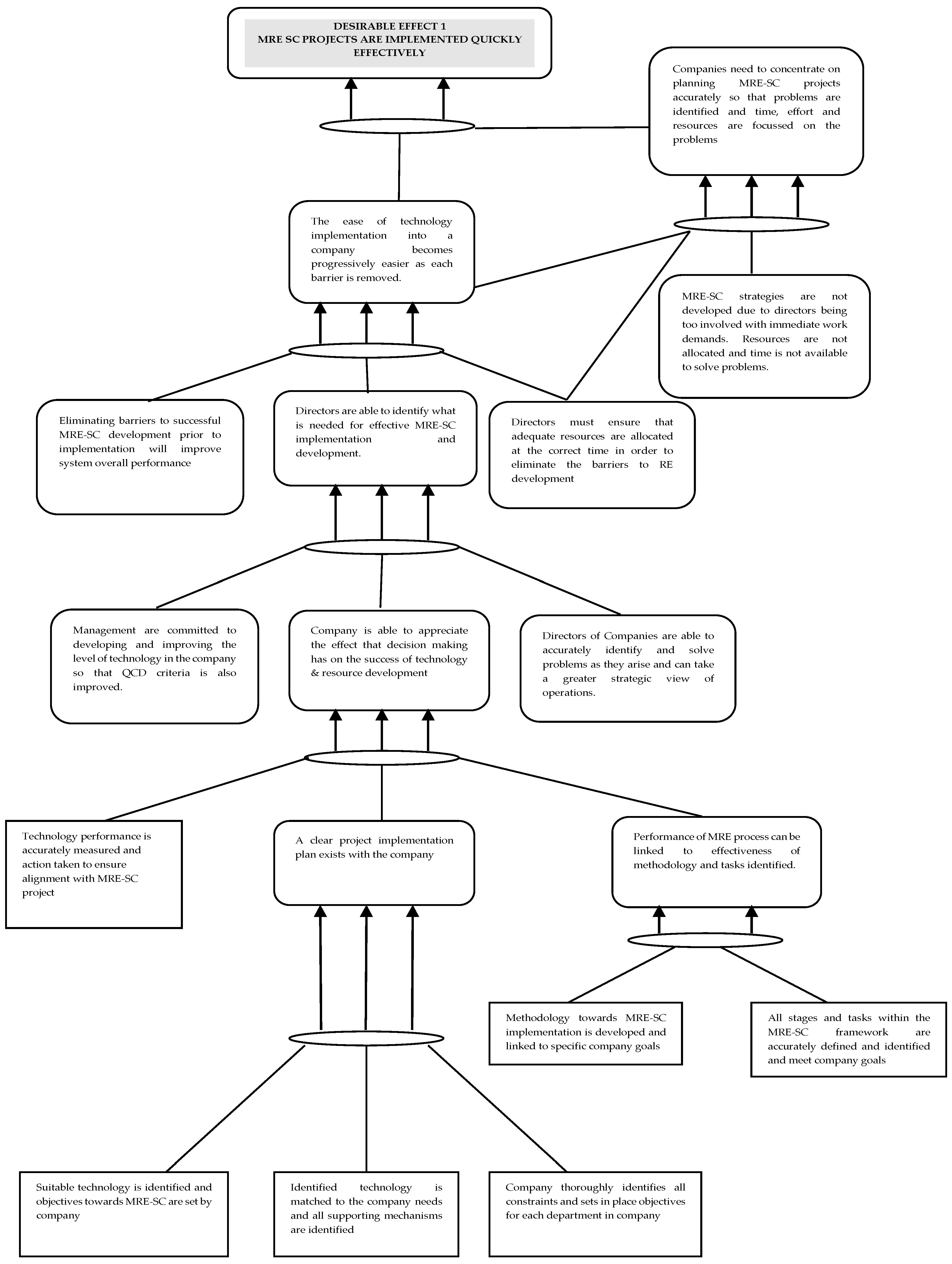
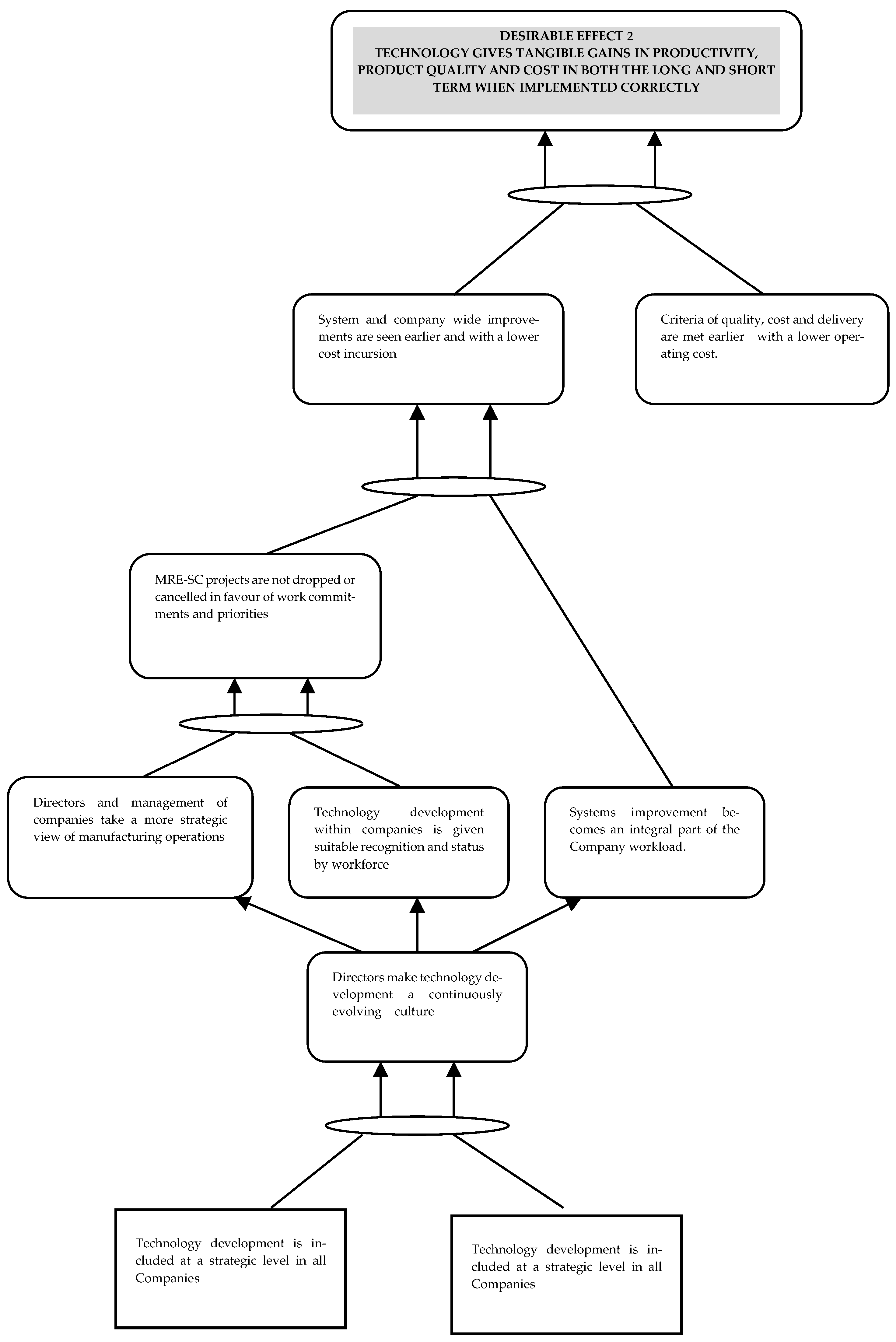
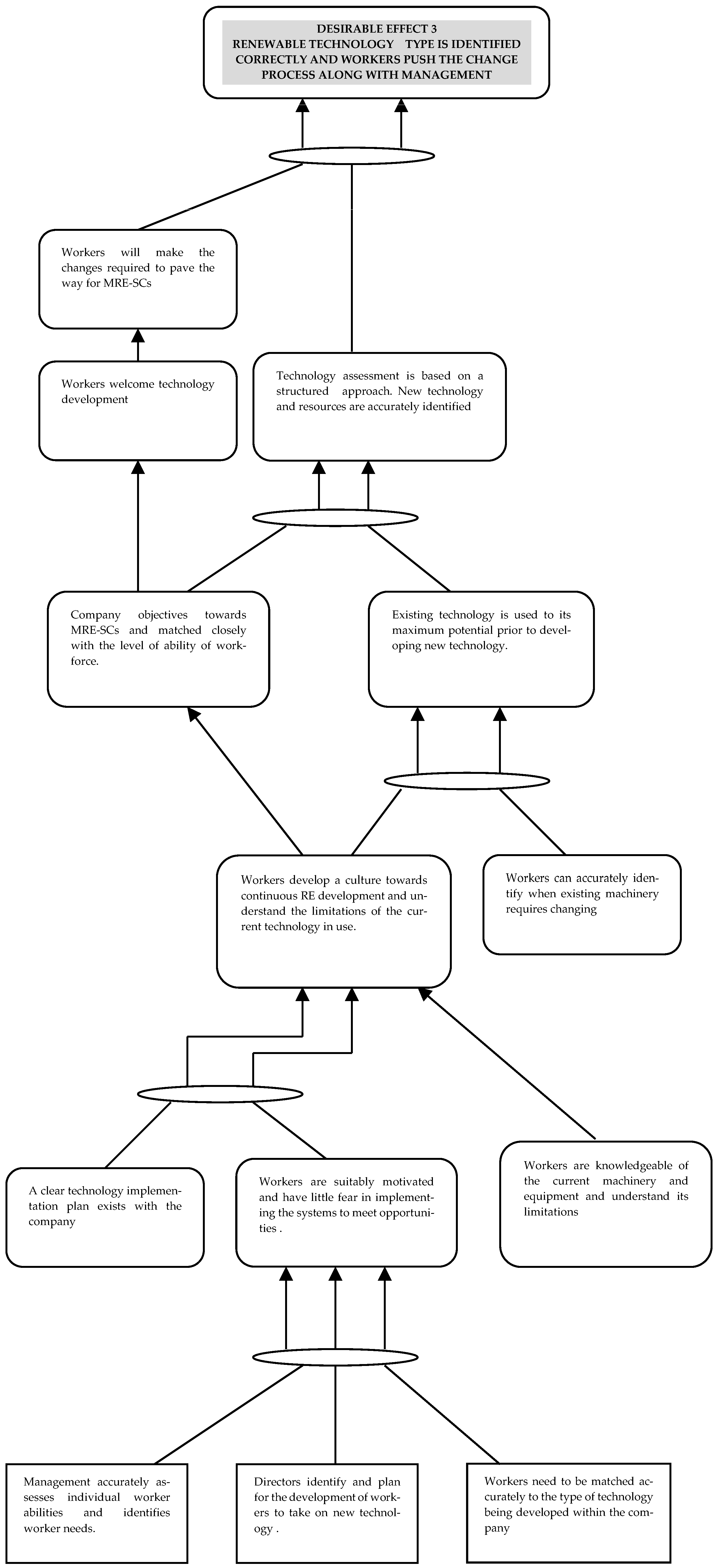
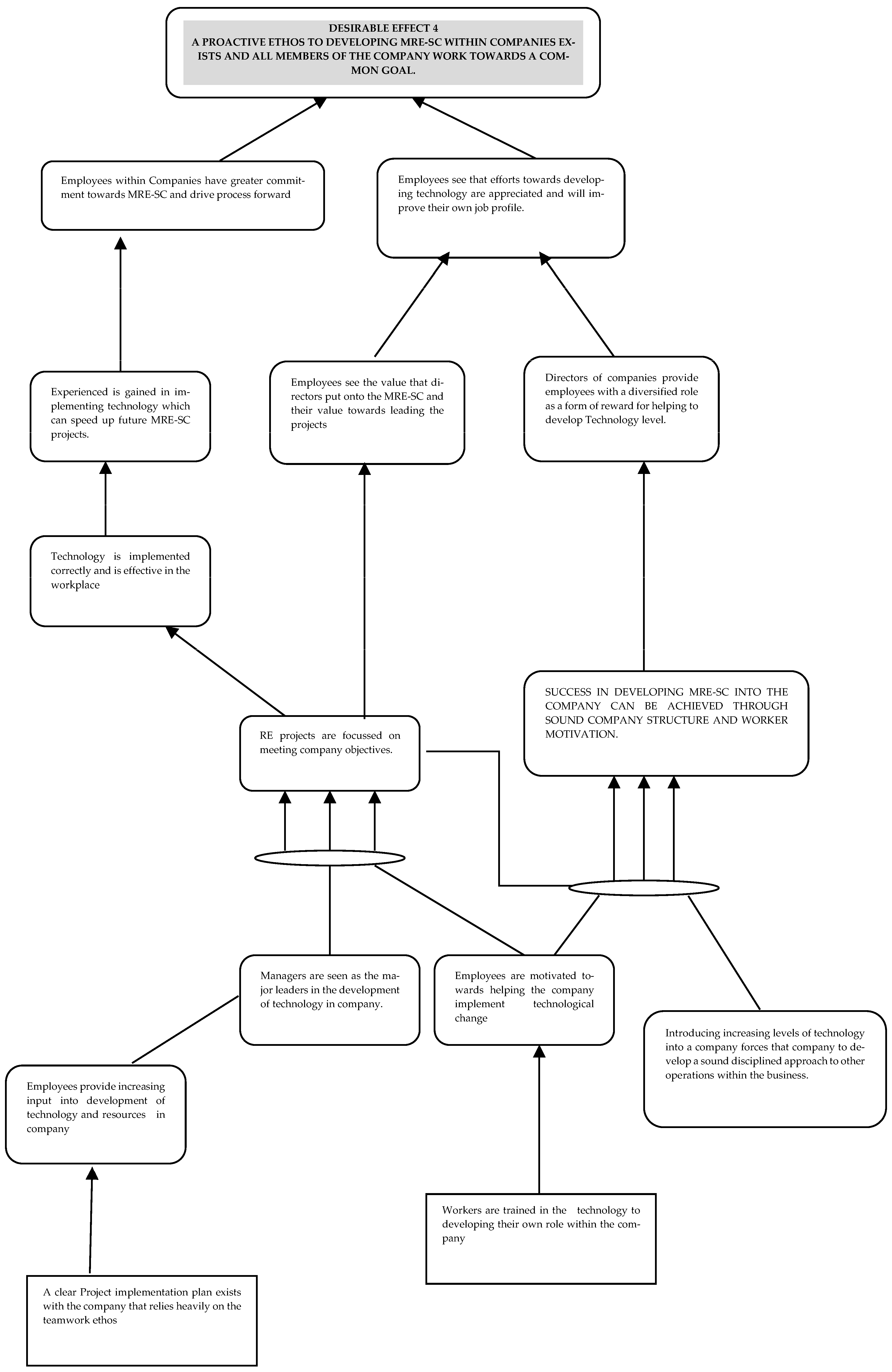
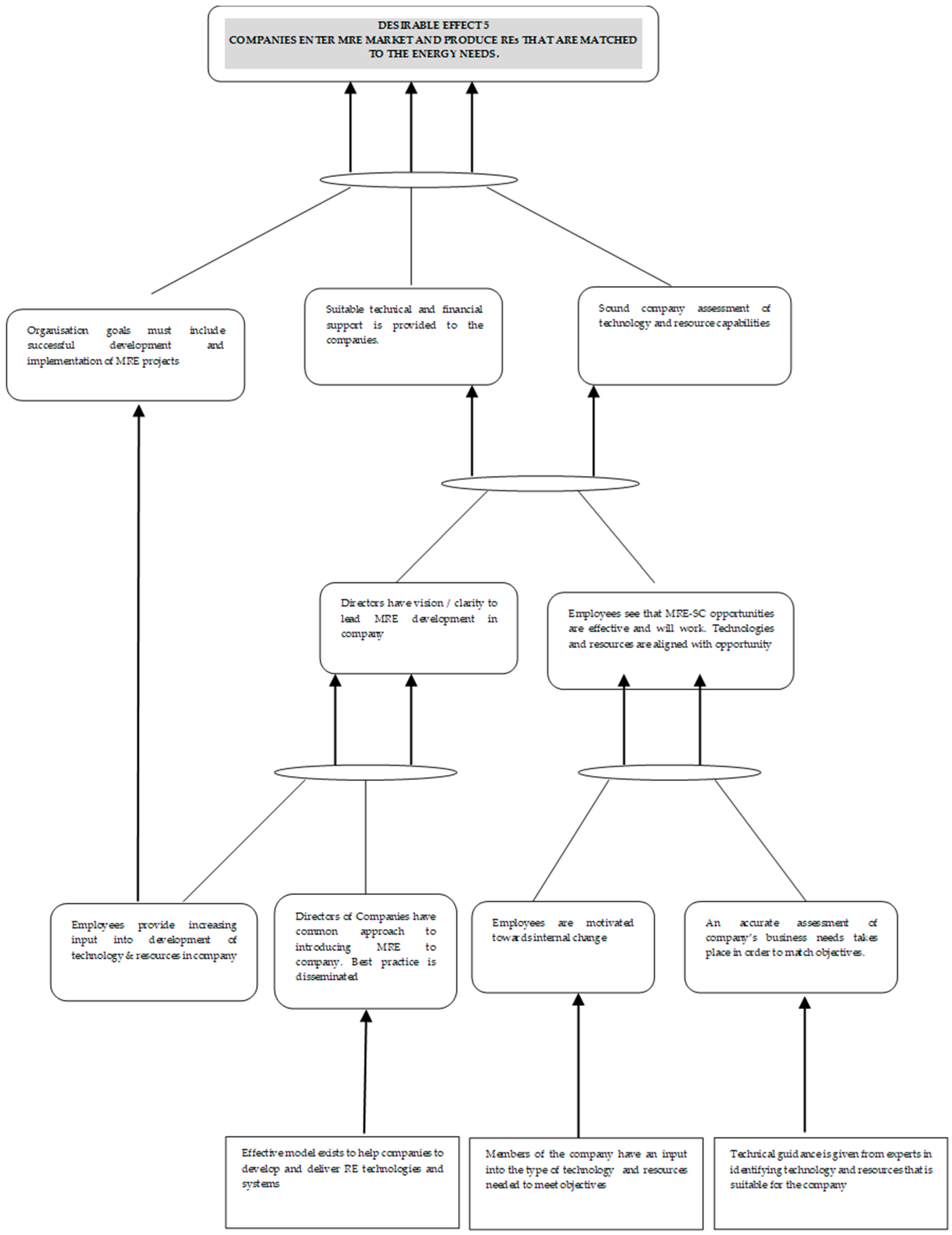
- Start with the desirable effects above as the terminal nodes;
- Work backward to identify the necessary conditions or injections that would cause these effects;
- Use cause–effect logic to connect injections to intermediate outcomes and ultimately to the Des;
- Ensure logical consistency and test for negative branches or unintended consequences.
5. Discussion
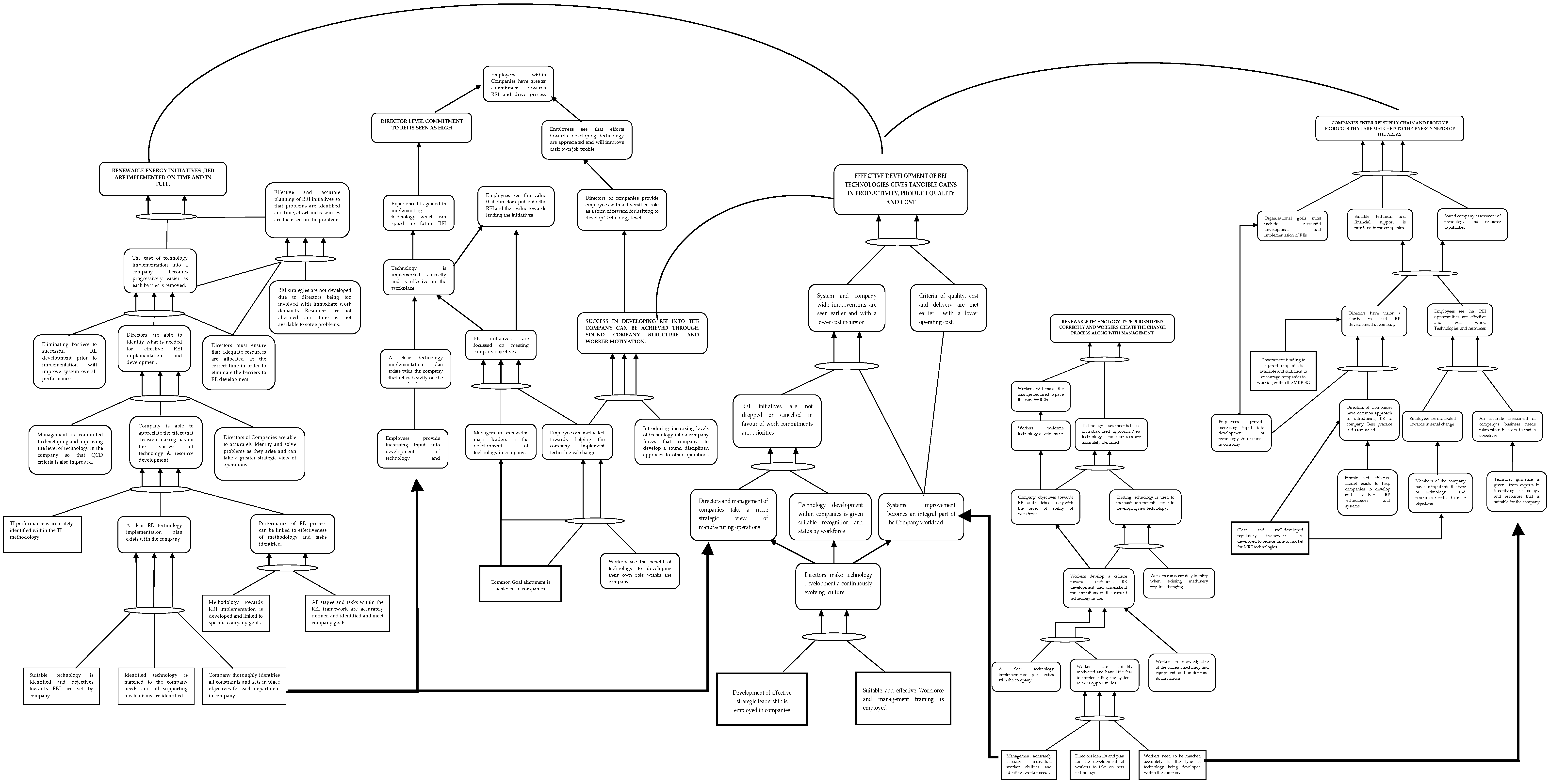
Future Reality Tree: A Strategic Roadmap for MRE-SC Entry
6. Conclusions and Recommendations
6.1. Key Conclusions Drawn from the Analysis
6.2. Further Policy and Research Implications
6.3. Recommendations
6.4. Implications for Future Research Design
Author Contributions
Funding
Institutional Review Board Statement
Informed Consent Statement
Data Availability Statement
Conflicts of Interest
Appendix A. Comprehensive Semi-Structured Interview Questionnaire
Appendix A.1. General Questions
- What is your current role and organization?
- Which sector do you represent? (Industry/Academia/Government)
- How long have you been involved in marine energy or related fields?
- How would you describe the current status of marine renewable energy technologies in your region or globally?
- What do you see as the main drivers for development in this sector?
- What are the biggest technical or non-technical challenges currently facing marine renewable energy?
- How mature do you think the supply chain for marine renewable energy is today?
- Which components or services in the supply chain are most critical for scaling up marine energy technologies?
- Are there any gaps or bottlenecks in the supply chain that need urgent attention?
- How do you see the role of collaboration between industry, academia, and government in advancing marine renewable energy?
- What policies or incentives do you think are most effective for supporting technology development and supply chain growth?
- Are there examples of successful partnerships or initiatives you can share?
- What is your vision for marine renewable energy in the next 10–15 years?
- Which emerging technologies or innovations excite you most in this space?
- What skills or workforce capabilities will be essential for future supply chain development?
Appendix A.2. Industry-Specific Questions
- Do you currently work in the marine renewable energy (MRE) sector? (Yes/No)
- If yes: Approximately what percentage of your organization’s work is related to MRE? (0–10%, 11–25%, 26–50%, 51–75%, 76–100%)
- What are the main products, services, or capabilities your organization provides to the MRE sector?
Appendix A.3. Academia-Specific Questions
- What is your primary area of research related to marine renewable energy (MRE)?
- How long has your institution been involved in MRE research or related fields?
- What percentage of your research portfolio currently focuses on MRE? (0–10%, 11–25%, 26–50%, 51–75%, 76–100%)
- Which MRE technologies (e.g., tidal, wave, floating offshore wind) are you most actively researching?
- What do you see as the most promising innovations or breakthroughs in MRE over the next decade?
- Are there any critical technical challenges your research aims to address?
- How effective do you think current collaboration between academia, industry, and government is in advancing MRE technologies?
- What barriers exist to transferring research outcomes into commercial applications?
- Are there examples of successful knowledge transfer or joint projects you can share?
- How adequate is current funding for MRE research in your region?
- What types of funding mechanisms or policy support would most benefit academic research in this field?
- Do you see gaps in government policy that hinder academic contributions to MRE development?
- What skills or expertise do you believe future graduates need to support MRE technology and supply chain growth?
- How is your institution preparing students for careers in the marine energy sector?
- What role do you envision academia playing in shaping the future of MRE technologies and supply chains?
- Are there emerging interdisciplinary areas (e.g., AI, materials science, robotics) that you think will significantly impact MRE research?
Appendix A.4. Government-Specific Questions
- What is your role in shaping or implementing policies related to marine renewable energy (MRE)?
- How would you assess the current regulatory environment for MRE development in your region?
- Are there specific regulations or permitting processes that you believe hinder or accelerate MRE deployment?
- What are the government’s main priorities for marine renewable energy over the next 5–10 years?
- How does MRE fit into broader energy transition and decarbonization strategies?
- Are there national or regional targets for MRE capacity or technology development?
- What types of financial support or incentives does the government currently provide for MRE technologies and supply chain development?
- Do you see gaps in funding or investment that need to be addressed?
- How does the government plan to attract private investment into the MRE sector?
- How does the government facilitate collaboration between industry, academia, and other stakeholders?
- Are there existing programs or initiatives that have successfully supported MRE development?
- What mechanisms could improve stakeholder engagement and accelerate technology adoption?
- How important is local content or domestic supply chain development in government policy for MRE?
- What steps are being taken to build workforce skills and capabilities for the marine energy sector?
- Are there plans to support training or education programs aligned with MRE growth?
- What role do you see government playing in ensuring the long-term sustainability and competitiveness of MRE technologies?
- Are there emerging policy areas (e.g., environmental standards, digitalization, resilience) that will impact MRE development?
- How does the government plan to balance environmental protection with accelerated deployment of marine energy projects?
References
- Cabrerizo-Morales, M.Á.; Molina, R.; Rojas, L.P. Small-Scale Study of Mooring Line Tension Thresholds Based on Impulsive Load Analysis during Big Floating Structure Operation and Commissioning. Water 2021, 13, 1056. [Google Scholar] [CrossRef]
- Jelti, F.; Allouhi, A.; Büker, M.S.; Saadani, R.; Jamil, A. Renewable Power Generation: A Supply Chain Perspective. Sustainability 2021, 13, 1271. [Google Scholar] [CrossRef]
- Westwood, A. Ocean power. Refocus 2004, 5, 50. [Google Scholar] [CrossRef]
- Apolonia, M.; Fofack-Garcia, R.; Noble, D.R.; Hodges, J.; da Fonseca, F.X.C. Legal and Political Barriers and Enablers to the Deployment of Marine Renewable Energy. Energies 2021, 14, 4896. [Google Scholar] [CrossRef]
- Seabased. Ocean Energy’s Role in Realizing the UN’s Sustainable Development Goals. 2020. Available online: https://seabased.com/news-insights/ocean-energy-unsdgs (accessed on 14 November 2025).
- Wu, J.J.; Vijayamohan, V.; Field, R.W. On the potential of ocean energy technologies to contribute to future sustainability. Discov. Sustain. 2025, 6, 741. [Google Scholar] [CrossRef]
- UN. International Renewable Energy Agency (IRENA) Input to 2022 Report of the Secretary General on Oceans and the Law of Sea; United Nations: Aby Dhabi, United Arab Emirates, 2022. [Google Scholar]
- Tang, E.; Gao, J.; Huang, W.; Qian, Y. Marine renewable energy: Progress, challenges, and pathways to scalable sustainability. Energy 2025, 335, 138083. [Google Scholar] [CrossRef]
- Kihlström, V.; Elbe, J. Constructing Markets for Solar Energy—A Review of Literature about Market Barriers and Government Responses. Sustainability 2021, 13, 3273. [Google Scholar] [CrossRef]
- Baziar, A.; Parsa, N. Legal Challenges in Renewable Energy Development: A Comparative Study of China and Selected Countries. arXiv 2024, arXiv:2412.10203. [Google Scholar] [CrossRef]
- Weiss, C.; Bonvillian, W.B. Legacy sectors: Barriers to global innovation in agriculture and energy. Technol. Anal. Strateg. Manag. 2013, 25, 1189. [Google Scholar] [CrossRef]
- Horváth, D.; Szabó, R.Z. Evolution of photovoltaic business models: Overcoming the main barriers of distributed energy deployment. Renew. Sustain. Energy Rev. 2018, 90, 623. [Google Scholar] [CrossRef]
- Mason-Jones, R.; Davies, P.G.; Thomas, A. Applying the Theory of Constraints to Explore the UK Renewable-Energy Supply Chain. Sustainability 2022, 14, 13307. [Google Scholar] [CrossRef]
- Onuh, P.; Ejiga, J.O.; Abah, E.; Onuh, J.O.; Idogho, C.; Omale, J. Challenges and Opportunities in Nigeria’s Renewable Energy Policy and Legislation. World J. Adv. Res. Rev. 2024, 23, 2354. [Google Scholar] [CrossRef]
- Seetharaman Moorthy, K.; Patwa, N.; Saravanan; Gupta, Y.P. Breaking barriers in deployment of renewable energy. Heliyon 2019, 5, e01166. [Google Scholar] [CrossRef] [PubMed]
- Gabriel, C.-A. What is challenging renewable energy entrepreneurs in developing countries? Renew. Sustain. Energy Rev. 2016, 64, 362. [Google Scholar] [CrossRef]
- Relva, S.G.; Silva, V.O.; da Gimenes, A.L.V.; Udaeta, M.E.M.; Ashworth, P.; Peyerl, D. Enhancing developing countries’ transition to a low-carbon electricity sector. Energy 2020, 220, 119659. [Google Scholar] [CrossRef]
- Hutchinson, N.; Dennis, M.; Grann, E.D.; Clevenger, T.; Manion, M.; Bøggild, J.; Layke, J. Unlocking a Renewable Energy Future. 2021. Available online: https://www.wri.org/research/unlocking-renewable-energy-future (accessed on 21 November 2025).
- Braun, A.; Kleine-Möllhoff, P.; Reichenberger, V.; Seiter, S. Case Study Analysing Potentials to Improve Material Efficiency in Manufacturing Supply Chains, Considering Circular Economy Aspects. Sustainability 2018, 10, 880. [Google Scholar] [CrossRef]
- Cui, Y.; Zhao, H. Marine renewable energy project: The environmental implication and sustainable technology. Ocean Coast. Manag. 2024, 232, 106415. [Google Scholar] [CrossRef]
- Asante, D.; He, Z.; Adjei, N.O.; Asante, B. Exploring the barriers to renewable energy adoption utilising MULTIMOORA- EDAS method. Energy Policy 2020, 142, 111479. [Google Scholar] [CrossRef]
- Painuly, J.P.; Wohlgemuth, N. Renewable energy technologies: Barriers and policy implications. In Renewable-Energy-Driven Future; Academic Press: Cambridge, MA, USA, 2021; pp. 539–562. [Google Scholar] [CrossRef]
- Fernández-Miguel, A.; Riccardi, M.P.; Veglio, V.; Muiña, F.E.G.; del Hoyo, A.P.F.; Settembre-Blundo, D. Disruption in Resource-Intensive Supply Chains: Reshoring and Nearshoring as Strategies to Enable Them to Become More Resilient and Sustainable. Sustainability 2022, 14, 10909. [Google Scholar] [CrossRef]
- Ottinger, R.L.; Bowie, J. Innovative Financing for Renewable Energy. Pace Environ. Law Rev. 2015, 32, 701. [Google Scholar] [CrossRef]
- Xu, X.; Chen, X.; Xu, Y.; Wang, T.; Zhang, Y. Improving the Innovative Performance of Renewable Energy Enterprises in China: Effects of Subsidy Policy and Intellectual Property Legislation. Sustainability 2022, 14, 8169. [Google Scholar] [CrossRef]
- Márton, M.; Paulová, I. Applying the Theory of Constraints in the Course of Process Improvement. Res. Pap. Fac. Mater. Sci. Technol. Slovak Univ. Technol. 2010, 18, 71–76. [Google Scholar] [CrossRef][Green Version]
- Goodier, C.I.; Austin, S.A.; Soetanto, R.; Dainty, A. Causal mapping and scenario building with multiple organisations. Futures 2009, 42, 219. [Google Scholar] [CrossRef]
- Shim, H.; Kim, T.; Choi, G. Technology Roadmap for Eco-Friendly Building Materials Industry. Energies 2019, 12, 804. [Google Scholar] [CrossRef]
- Goldratt, E.M. Theory of Constraints. 1990. Available online: https://www.academia.edu/7095271/Theory_of_Constraints_Eliyahu_M_Goldratt (accessed on 21 November 2025).
- Goldratt, E.M. Theory of Constraints: What Is This Thing Called and How Should It Be Implemented; North River Press: Great Barrington, MA, USA, 1990. [Google Scholar]
- Scoggin, J.M.; Segelhorst, R.J.; Reid, R.A. Applying the TOC thinking process in manufacturing: A case study. Int. J. Prod. Res. 2003, 41, 767–797. [Google Scholar] [CrossRef]
- Rahadi, K.B.; Setyanto, A.; Rohmansyah, D. Application of Theory of Constraints (TOC) in Power Generation to Increase Overhaul Maintenance Performance and to Strengthen Overhaul Management Process. In IOP Conference Series: Materials Science and Engineering, the 6th International Conference on Industrial, Mechanical, Electrical and Chemical Engineering—ICIMECE 2020, 20th October 2020; IOP: Solo, Indonesia, 2021; Volume 1096, p. 12130. [Google Scholar]
- Shoemaker, T.E.; Reid, R.A. Using the Theory of Constraints to focus organizational improvement efforts: Part 2-Determining and implementing the solution. Am. Water Work. Assoc. J. 2006, 98, 83–96. [Google Scholar] [CrossRef]
- Dettmer, H.W. The Logical Thinking Process. A Systems Approach to Complex Problem Solving; American Society for Quality Press: Milwaukee, WI, USA, 2007. [Google Scholar]
- Ikeziri, L.M.; Souza, F.B.; de Gupta, M.C.; de Camargo Fiorini, P. Theory of constraints: Review and bibliometric analysis. Int. J. Prod. Res. 2018, 57, 5068–5102. [Google Scholar] [CrossRef]
- MEW. State of the Sector Report. 2024. Available online: https://www.marineenergywales.co.uk/ (accessed on 21 November 2025).
- Gupta, A.K.; Bhardwaj, A.; Kanda, A. Fundamental Concepts of Theory of Constraints: An Emerging Philosophy. World Acad. Sci. Eng. Technol. 2010, 46, 686–692. [Google Scholar] [CrossRef]
- Modi, K.; Lowalekar, H.; Bhatta, N. Revolutionizing supply chain management the theory of constraints way: A case study. Int. J. Prod. Res. 2018, 57, 3335. [Google Scholar] [CrossRef]
- Jaegler, A.; Burlat, P. What is the impact of sustainable development on the re-localisation of manufacturing enterprises? Prod. Plan. Control 2013, 25, 902. [Google Scholar] [CrossRef]
- Banerjee, D.; Lowalekar, H. Communicating for change: A systems thinking approach. J. Organ. Change Manag. 2021, 34, 101. [Google Scholar] [CrossRef]
- Banerjee, A.; KMukhopadhyay, K. A contemporary TOC innovative thinking process in the backdrop of leagile supply chain. J. Enterp. Inf. Manag. 2016, 29, 400–443. [Google Scholar] [CrossRef]
- IRENA. Offshore Renewables: Powering the Blue Economy; International Renewable Energy Agency: Abu Dhabi, United Arab Emirates, 2020. [Google Scholar]
- Rahim, Z.A.; Bakar, N.A. Technology Development and Assessment to Market Using TRIZ. Int. J. Bus. Anal. 2016, 3, 83. [Google Scholar] [CrossRef]
- Rometius, S.; Wei, X. Blue Horizons for Resilient Islands: Legal–Technological Synergies Advancing SDG 7 and 13 Through the UNCLOS–Paris Agreement Integration in SIDS’ Energy Transitions. Sustainability 2025, 17, 6011. [Google Scholar] [CrossRef]
- Hung, Y.-H.; Yang, F.-C. Toward Integrated Marine Renewables: Prioritizing Taiwan’s Offshore Wind Projects for Wave Energy Compatibility Through a Cross-Efficiency Data Envelopment Analysis Approach. Sustainability 2025, 17, 2151. [Google Scholar] [CrossRef]



| Thematic Areas | Key UDEs Identified |
|---|---|
| Supply Chain Readiness |
|
| Policy and Investment |
|
| Skills |
|
Disclaimer/Publisher’s Note: The statements, opinions and data contained in all publications are solely those of the individual author(s) and contributor(s) and not of MDPI and/or the editor(s). MDPI and/or the editor(s) disclaim responsibility for any injury to people or property resulting from any ideas, methods, instructions or products referred to in the content. |
© 2025 by the authors. Licensee MDPI, Basel, Switzerland. This article is an open access article distributed under the terms and conditions of the Creative Commons Attribution (CC BY) license (https://creativecommons.org/licenses/by/4.0/).
Share and Cite
Mason-Jones, R.K.; Davies, P.G.; Thomas, A.J.; Griffiths, C.A. Exploring Effective Supply Chain Readiness and Resilience Within the Marine Renewable Energy Sector: A Future Reality Tree Approach. Sustainability 2025, 17, 11275. https://doi.org/10.3390/su172411275
Mason-Jones RK, Davies PG, Thomas AJ, Griffiths CA. Exploring Effective Supply Chain Readiness and Resilience Within the Marine Renewable Energy Sector: A Future Reality Tree Approach. Sustainability. 2025; 17(24):11275. https://doi.org/10.3390/su172411275
Chicago/Turabian StyleMason-Jones, Rachel K., Paul G. Davies, Andrew J. Thomas, and Christian A. Griffiths. 2025. "Exploring Effective Supply Chain Readiness and Resilience Within the Marine Renewable Energy Sector: A Future Reality Tree Approach" Sustainability 17, no. 24: 11275. https://doi.org/10.3390/su172411275
APA StyleMason-Jones, R. K., Davies, P. G., Thomas, A. J., & Griffiths, C. A. (2025). Exploring Effective Supply Chain Readiness and Resilience Within the Marine Renewable Energy Sector: A Future Reality Tree Approach. Sustainability, 17(24), 11275. https://doi.org/10.3390/su172411275