Towards Smart and Sustainable Last Mile Delivery Systems: A Scoping Review and Conceptual Framework




Abstract
1. Introduction
2. Methodology
2.1. Research Design
2.1.1. The Significance of the Method
2.1.2. Research Questions
- (1)
- What are the most important sustainable and technological trends modeling last-mile delivery systems?
- (2)
- In what ways are digital and simulation-driven technologies (e.g., SUMO, AI, IoT, and digital twins) being incorporated within LMD research?
- (3)
- How can conceptual and systematic framework gaps be addressed to contribute towards developing a unified framework for SSLMD?
2.2. Data Collection and Screening
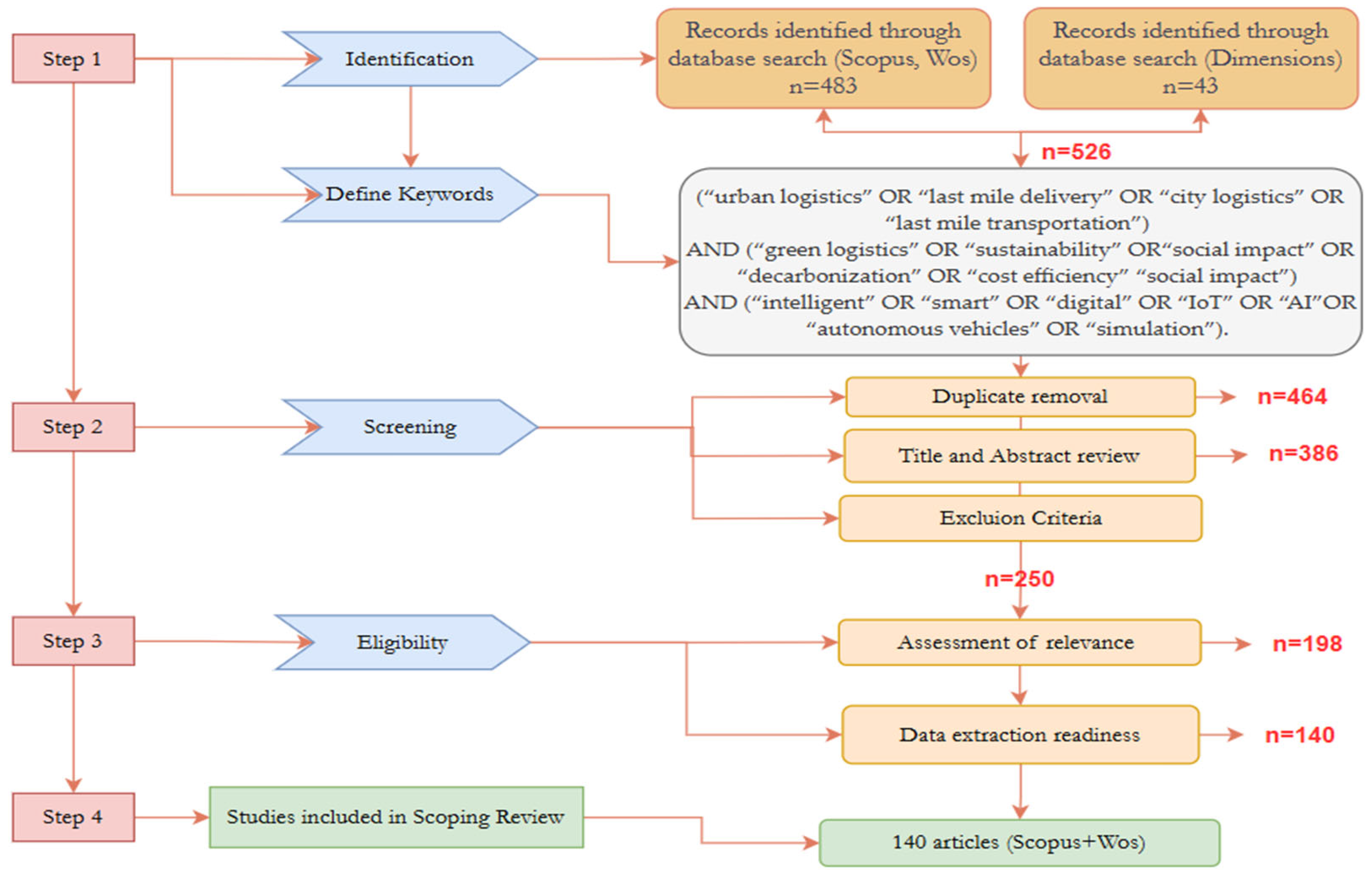
- Peer-reviewed papers published in English between 2015 and 2025;
- Papers explicitly studying LMD in urban logistics;
- Papers providing empirical, conceptual, or simulation frameworks.
- Studies on non-urban logistics or non-urban freight transport;
- Non-English publications;
- Studies not relevant to sustainability or smart technologies.
3. Results and Discussions
3.1. Data Extraction and Categorization
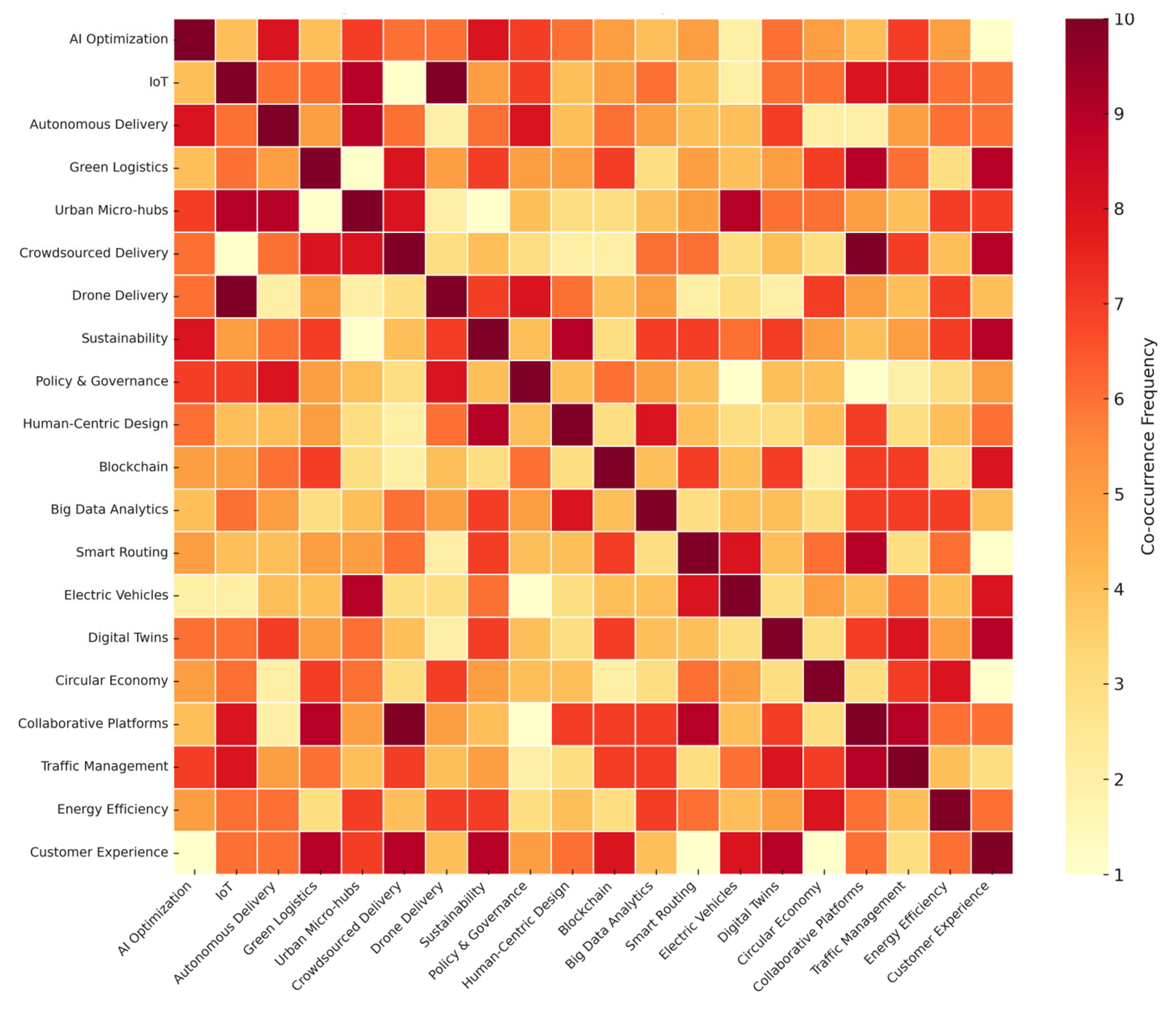
3.2. Data Analysis and Synthesis
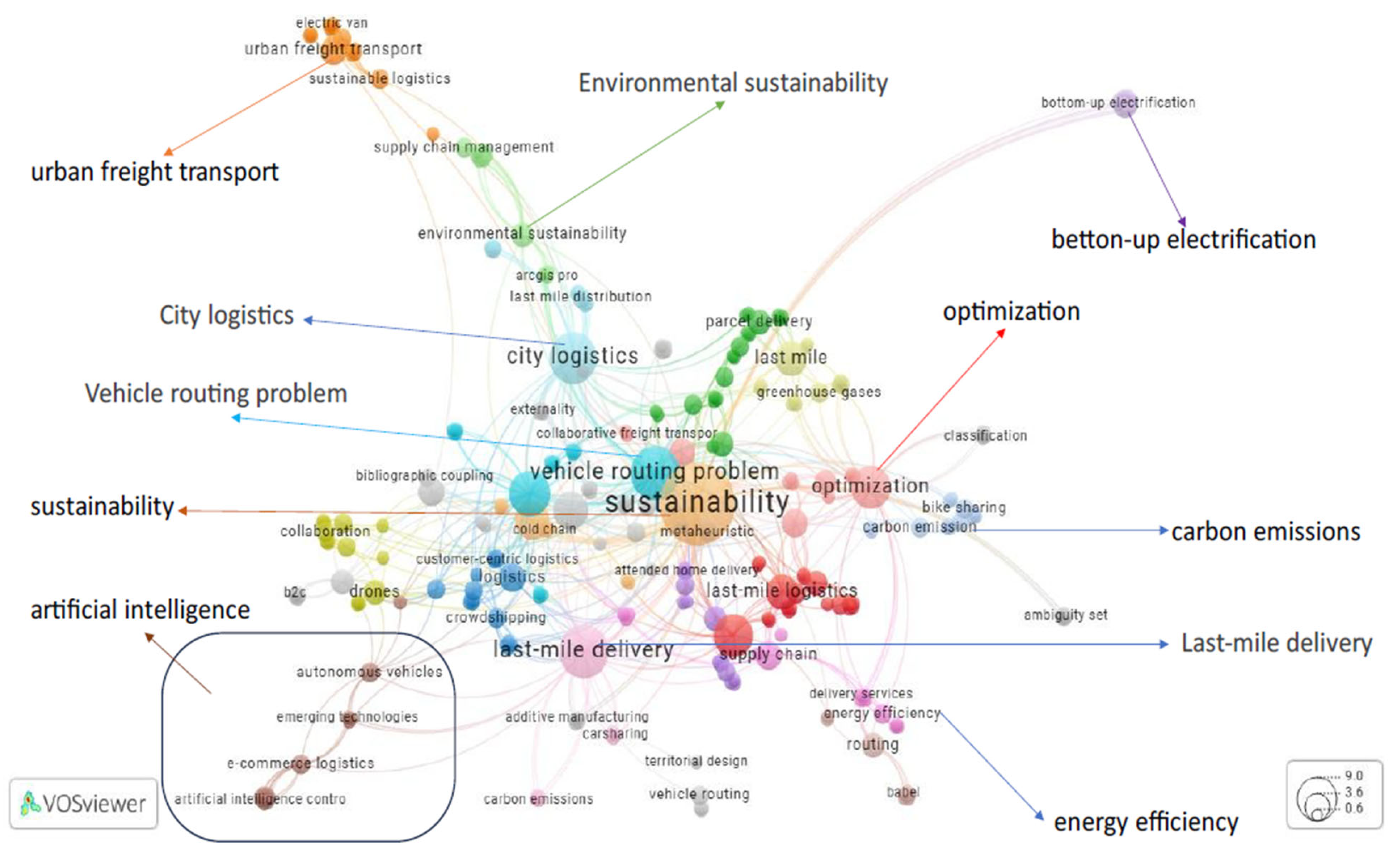
- A strong co-occurrence between innovation technologies and sustainability, signaling that most of the research on LMDs focus on efficiency and emission reduction.
- A modest co-occurrence between human-centered issues and digital technologies, indicating the limited integration of social dimensions.
- A lack of co-occurrence between policies/regulations and digital twin/simulation-driven approaches, suggesting that the data-based testing of policies is understudied in the current literature.
3.3. Discussions: Challenges and Opportunities
- Technological integration: One of the main challenges identified in this study is the segmented nature of digital technology deployment in city logistics networks. Despite extensive research on AI, IoT, and simulation tools, these technologies still work in isolated ways and not as part of an interconnected data ecosystem. The current research focuses on the optimization of special items (e.g., distribution modes and fleet planning) without taking into account the systemic connectivity between data flows, urban infrastructure, and logistics actors [10,11,18]. There are opportunities in exploiting digital twin environments to integrate different data sources [31]. Also, AI-driven analytics and machine learning optimization offer the important potential for collaborative decision-making, particularly once coupled with cutting-edge computing for decentralized intelligent delivery operations [32,33].
- Sustainability: The second key challenge is finding trade-offs in sustainable LMD. Although many studies focus on environmental performance, like reducing CO2 emissions and electrifying vehicles, few studies consider economic feasibility or social inclusivity [34]. Thus, the building of integrated sustainability assessment frameworks that balance the three dimensions offers new opportunities. Additionally, approaches such as multicriteria decision-making and life-cycle sustainability assessments can offer integrated evaluations of innovations like drone deliveries and crowdshipping models [35].
- Complexity of governance and policy: This study outlines an important gap between the speed of technological advances and the slowness of policy adaptation [36]. Current urban freight regulations often remain behind developments such as self-driving delivery vehicles, algorithm-based vehicle routing, and platforms for data sharing. This gap generates uncertain conditions for regulation and restricts the evolution of sustainable solutions [36]. There are opportunities in adaptive governance models, in which policies develop dynamically through data feedback loops generated by intelligent systems [37].
- Human-centric transformation: Despite the growing use of automation, the human-centric aspect is still the least explored part of research on SSLMD. There are few studies examining the way end users, riders, and citizens experience and deal with the changing technology in delivery systems [38]. However, the current transition to Industry 5.0 offers an opportunity to refocus on people in the innovative process [39].
- Fragmentation in the integration of the smart and sustainable aspects: most studies focus on technology or sustainability separately.
- Limitations in inter-field modeling: only a few models combine simulation results with socioeconomic parameters.
- Lack of policy-oriented frameworks: often, urban logistics evolve more rapidly than policy.
- Unexplored human-centered evaluation measures, such as the perceivability of fairness, inclusiveness, and accessibility.
4. Conceptual Framework for SSLMD
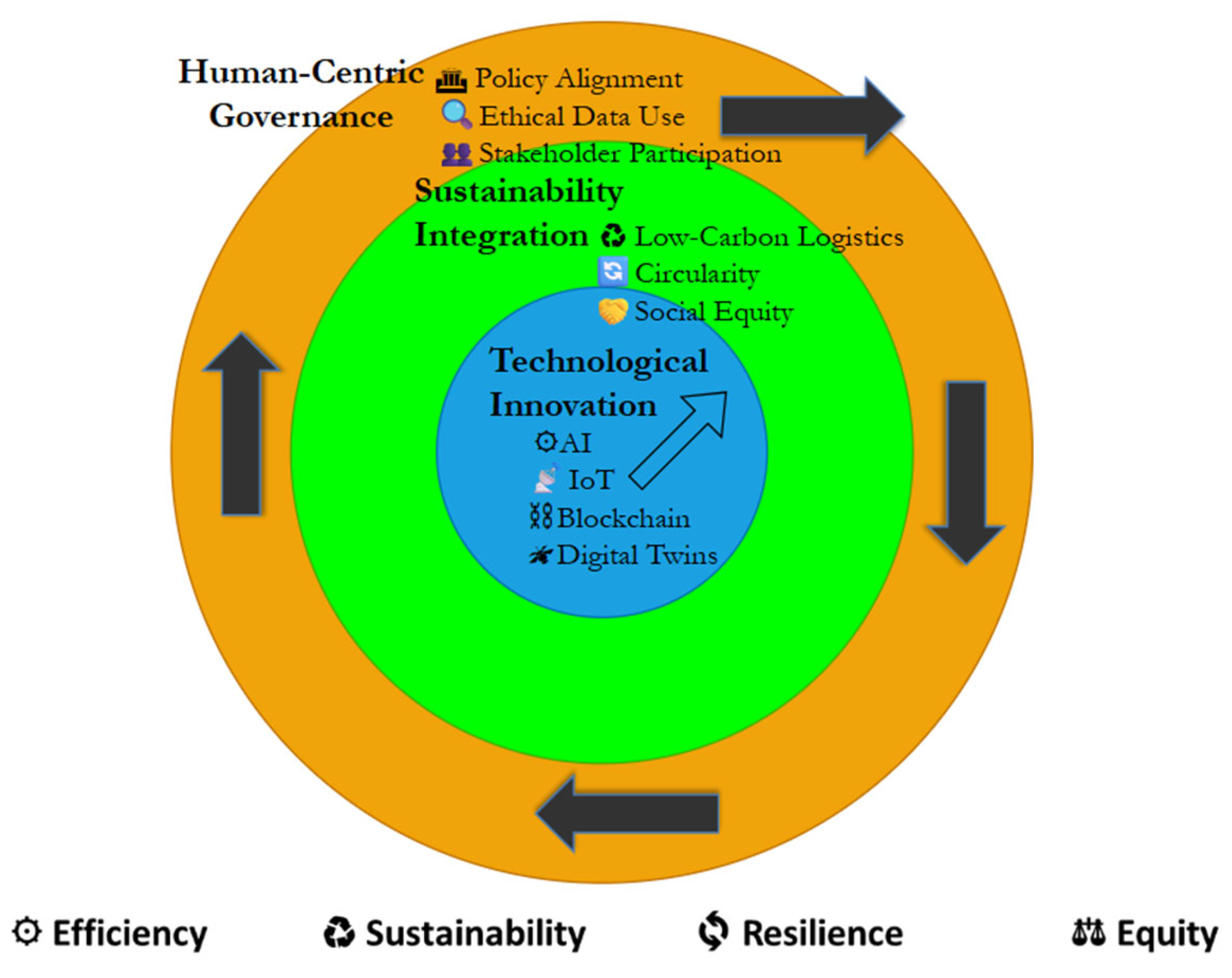
4.1. Framework Overview
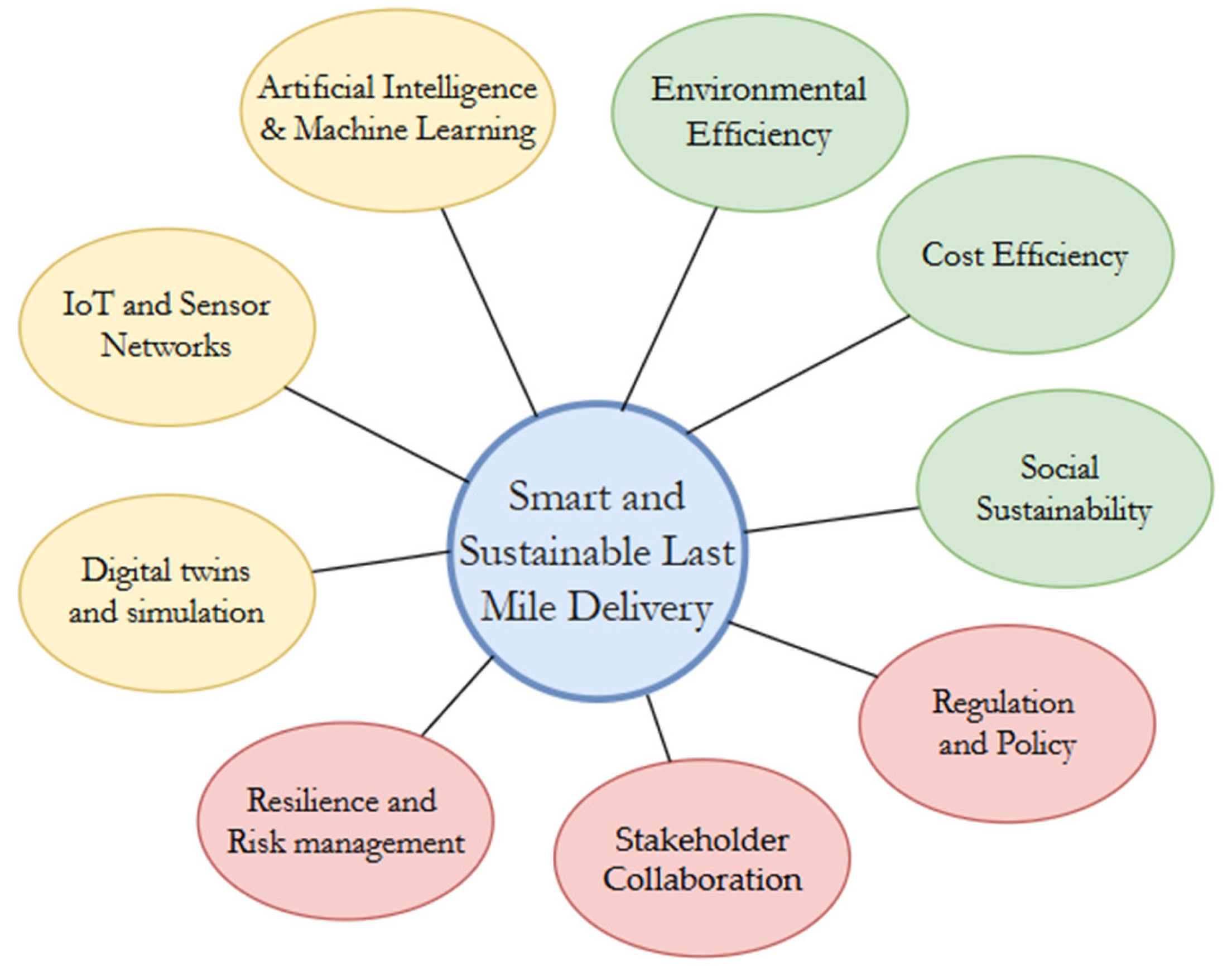
- Technological innovation layer: This represents the digital infrastructure that enables the system’s intelligence. It incorporates technologies such as artificial intelligence, blockchain, the Internet of Things, and digital twins, allowing for advanced optimization, data analytics, and self-governed decision-making. Such technologies jointly improve the efficiency of routing and cargo sharing and reduce emissions, thereby building the technical groundwork for intelligent logistics operations.
- Sustainability integration layer: The intermediate layer focuses on the three dimensions: environmental protection, economic efficiency, and equity. It is in alignment with the United Nations’ Sustainable Development Goals (SDGs 9, 11, and 12) and the European Green Deal [40] by encouraging low-carbon, cost-effective, and responsible delivery models. The main means involve assessing eco-efficiency, adopting renewable energy, electrifying vehicles, and implementing reverse logistics, which guarantee that the operational enhancements will contribute to a wider transition towards sustainability.
- Human-centric governance layer: Externally, human-centric governance and organizational vision establish the regulatory and policy framework for implementing the SSLMD. This will include policy alignment, stakeholder engagement, and ethics-based data management. The human-centered approach is designed to guarantee that innovative technologies are compatible with privacy, workers’ well-being, and inclusiveness, by aligning supply-chain innovation with community values and the principles of urban equity.
- Techno-sustainability feedback loop: Advances in technology help to assess sustainability using real-time performance data (e.g., carbon emissions and energy consumption), and sustainability constraints encourage systems to be cleaner and more efficient. For example, the electric cargo bikes in Amsterdam adjust delivery sequences dynamically to minimize emissions during peak congestion hours [41].
- Techno-human feedback loop: Human contributions (e.g., user feedback and behavioral data) drive AI tuning and design, at the same time as automatization and advanced decision-making tools reinforce user safety, satisfaction, and confidence. For example, in Singapore, real-time feedback from citizens on sidewalks allows for real-time adjustments of drone landing zones or micro-hub shipping schedules [42].
- Governance–sustainability feedback loop: Policy interventions drive sustainable delivering behaviors, which in turn inform sustainability outcomes allowing for adaptive regulations and continuous strategic alignment. For example, Los Angeles has implemented adaptive time slot restrictions for deliveries, using simulation results to reduce traffic congestion while maintaining service levels [43].
4.2. Implementation Conditions
- Collaborative governing models: the involvement of a variety of stakeholders, including policymakers, drivers, and residents, by means of co-design and living workshops to achieve social acceptance and inclusivity in the system.
- Digital twins and simulation: the use of policy simulation design, where regulations are encoded into digital twin models for testing delivery operational impacts, optimizing routing, and testing regulated actions in virtual worlds before their deployment in the real world. The Singapore case study shows how simulation supports policy adaptation in last-mile urban logistics [46].
- Interoperability and data integration: the harmonizing of information from logistics companies and urban infrastructure to enable transparent coordination.
- Ethical and legal frameworks: the establishment of clear guidance on data sharing, professional transitions, and programmatic transparency to enhance reliability and transparency in intelligent logistics systems.
- AI-based decision-making assistance: the use of machine learning for forecasting demand, preventative maintenance, and adaptive fleet management to improve both environmental performance and efficiency.
4.3. Implications and Outcomes
- Efficiency: reducing operating costs and travel times through AI-based optimization.
- Sustainability: reducing environmental impacts and improving circular logistics practices.
- Equity: Human-centered innovations guaranteeing equitable access, work protection, and integrative governance.
- Resilience: adapting responses to perturbations through data-based anticipation and redundancy.
5. Conclusions and Future Directions
Supplementary Materials
Author Contributions
Funding
Institutional Review Board Statement
Informed Consent statement
Data Availability Statement
Conflicts of Interest
Abbreviations
| LMD | Last-Mile Delivery |
| SSLMD | Smart and Sustainable Last-Mile Delivery |
| AI | Artificial Intelligence |
| IoT | Internet of Things |
| PRISMA | Preferred Reporting Items for Systematic Reviews and Meta-Analyses |
| PRISMA-ScR | PRISMA Scoping Review |
| SUMO | Simulation of Urban MObility |
| AV | Autonomous Vehicles |
| LEZ | Low-Emission Zone |
Appendix A

| Code | Theme/ Subtheme | Definition | Inclusion Criteria | Exclusion Criteria | Example | Double-Coding Notes | Cohen’s Kappa |
|---|---|---|---|---|---|---|---|
| T1 | Technological Innovation | Adoption and deployment of digital and automation technologies in last-mile delivery. | AI, IoT, autonomous vehicles, robotics | Macro-level transportation without last-mile focus | “AI-driven routing reduces urban congestion” | Double-coded on 50 studies | 0.85 |
| T1.1 | IoT and Sensor Networks | Integration of IoT devices for monitoring, tracking, and optimization | Sensor-based tracking, smart lockers, connected vehicles | Non-digital monitoring systems | “Smart parcel lockers using IoT connectivity” | Reviewed for consistency | 0.83 |
| T1.2 | Autonomous Vehicles | Use of self-driving vehicles for delivery | Pilot tests, simulations, or real-world deployments | Human-driven logistics only | “Autonomous delivery vans in urban centers” | Included in high-priority nodes | 0.87 |
| T2 | Sustainability | Practices addressing environmental, social, or economic sustainability | Emission reduction, energy efficiency, circular economy | Generic efficiency improvements | “Electric cargo bikes for zero-emission delivery” | Double-coded subset | 0.82 |
| T2.1 | Green Logistics | Emission reduction, low-carbon vehicles, eco-friendly packaging | Implementation or evaluation of green solutions | Studies not targeting environmental outcomes | “Replacing diesel vans with e-cargo bikes” | Monitored for coding clarity | 0.84 |
| T2.2 | Circular Economy and Waste Reduction | Practices reducing packaging waste, promoting recycling | Reusable packaging, reverse logistics | Generic recycling unrelated to delivery | “Reverse logistics for reusable containers” | Reviewed in calibration | 0.80 |
| T3 | Human-Centric Governance | Policies, regulations, or strategies emphasizing user participation and behavior | Governance models, e-governance, behavioral studies | Studies without human governance focus | “Citizen engagement platforms for delivery scheduling” | Double-coded on all high-importance nodes | 0.81 |
| T3.1 | E-Governance and Digital Participation | Digital platforms enabling stakeholder participation | Apps, portals for governance/feedback | Private IT solutions without governance aspect | “Online portal for reporting delivery bottlenecks” | Reviewed for overlap with T3.2 | 0.82 |
| T3.2 | User Acceptance and Behavioral Adaptation | Behavioral response and acceptance of new technologies | Surveys, interviews, experiments | Technical performance only | “Survey on consumer willingness to use autonomous lockers” | Monitored for ambiguous cases | 0.79 |
| T3.3 | System Resilience | Ability of delivery systems to adapt to disruptions | Risk management, redundancy, adaptive logistics | Operational efficiency without resilience focus | “Resilient micro-hub networks during peak demand” | Double-coded for reliability | 0.83 |
| T4 | Shared Logistics Models | Collaborative delivery among multiple stakeholders | Crowdsourced delivery, shared fleet, partnerships | Single-operator logistics only | “Shared micro-fulfillment centers among retailers” | High-priority node | 0.84 |
| T5 | Urban Micro-Hubs | Small-scale urban facilities optimizing delivery | Last-mile hubs, mini-distribution centers | Centralized logistics far from city | “City micro-hubs reduce van travel distance” | Double-coded subset | 0.82 |
| T6 | Cross-Cutting/Multi-Dimensional | Studies addressing multiple top-level themes simultaneously | Integration of technology, sustainability, and governance | Studies focusing on a single dimension | “AI-powered electric vehicles with citizen feedback” | Monitored during coding harmonization | 0.86 |
| City Typology | Framework Adaptation | Guidelines | Illustrative Cases | Ref |
|---|---|---|---|---|
| European cities |
|
| Amsterdam, Barcelona: micro-consolidation zones, extensive cargo-bike adoption. | [16,47] |
| North American urban regions |
|
| Phoenix, Austin: sidewalk robots, drone corridors, suburban micro-depots to handle sprawling geography. | [48] |
| Emerging cities |
|
| Delhi, Jakarta: modular micro-hubs; digital routing optimization integrated with informal moto-logistics. | [2] |
| Intermediate and transition cities |
|
| Casablanca, Warsaw: hybrid models combining platform-based delivery with emerging environmental regulations. | [49,50] |
References
- Kellner, F. Exploring the impact of urbanization on consumer goods distribution networks. J. Asian Bus. Econ. Stud. 2020, 28, 101–120. [Google Scholar] [CrossRef]
- Mutambik, I. Foresight for Sustainable Last-Mile Delivery: A Delphi-Based Scenario Study for Smart Cities in 2030. Sustainability 2025, 17, 6660. [Google Scholar] [CrossRef]
- Li, F.; Fan, Z.-P.; Cao, B.-B.; Lv, H.-M. The Logistics Service Mode Selection for Last Mile Delivery Considering Delivery Service Cost and Capability. Sustainability 2020, 12, 8080. [Google Scholar] [CrossRef]
- Wang, Q.; Li, D.; Zeng, J.; Peng, X.; Wei, L.; Du, W. A diagnostic method of freight wagons hunting performance based on wayside hunting detection system. Measurement 2024, 227, 114274. [Google Scholar] [CrossRef]
- Gund, H.P.; Daniel, J. Q-commerce or E-commerce? A systematic state of the art on comparative last-mile logistics greenhouse gas emissions literature review. Int. J. Ind. Eng. Oper. Manag. 2023, 6, 185–207. [Google Scholar] [CrossRef]
- Golinska-Dawson, P.; Sethanan, K. Sustainable Urban Freight for Energy-Efficient Smart Cities—Systematic Literature Review. Energies 2023, 16, 2617. [Google Scholar] [CrossRef]
- Mkhalfi, J.; Jawab, F.; El Mhamedi, A.; Moufad, I. Urban Last-Mile Delivery: Environmental Challenges and Expertise—A Comprehensive Literature Review. In Proceedings of the 2025 IEEE 16th International Colloquium on Logistics and Supply Chain Management (LOGISTIQUA), Casablanca, Morocco, 28–30 May 2025. [Google Scholar] [CrossRef]
- El Yadari, M.; Moufad, I.; Jawab, F.; Arif, J. Logistic 4.0 Implementation for Efficient Urban Freight Transport: A Systematic Literature Review. In Proceedings of the 2024 IEEE 15th International Colloquium on Logistics and Supply Chain Management (LOGISTIQUA), Sousse, Tunisia, 2–4 May 2024; pp. 1–8. [Google Scholar]
- Liu, Y. Cognitive Smart City Logistics: A New Approach for Sustainable Last Mile in the Era of Digitization. Business Administration. Université Paris Sciences et Lettres. 2022, pp. 1–183. Available online: https://share.google/ObQn1Nf3bogZtwbB1 (accessed on 15 October 2025).
- Ferreira, J.C.; Esperança, M. Enhancing Sustainable Last-Mile Delivery: The Impact of Electric Vehicles and AI Optimization on Urban Logistics. World Electr. Veh. J. 2025, 16, 242. [Google Scholar] [CrossRef]
- Giuffrida, N.; Fajardo-Calderin, J.; Masegosa, A.D.; Werner, F.W.; Steudter, M.; Pilla, F. Optimization and Machine Learning Applied to Last-Mile Logistics: A Review. Sustainability 2022, 14, 5329. [Google Scholar] [CrossRef]
- Andreas, K. Sustainability and New Technologies: Last-Mile Delivery in the Context of Smart Cities. Sustainability 2024, 16, 8037. [Google Scholar] [CrossRef]
- Teixeira, L.; Ramos, A.L.; Costa, C.; Pedrosa, D.; Faria, C.; Pimentel, C. SOLFI: An Integrated Platform for Sustainable Urban Last-Mile Logistics’ Operations—Study, Design and Development. Sustainability 2023, 15, 2613. [Google Scholar] [CrossRef]
- Khanda, A.; Satpathy, A.; Jha, A.; Das, S.K. CARGO: A Co-Optimization Framework for EV Charging and Routing in Goods Delivery Logistics. In Proceedings of the IEEE 50th Conference on Local Computer Networks (LCN), Sydney, Australia, 13–16 October 2025; pp. 1–9. [Google Scholar] [CrossRef]
- Grotto, A.; Casas, P.F.I.; Zubaryeva, A.; Sparber, W. Formalizing Sustainable Urban Mobility Management: An Innovative Approach with Digital Twin and Integrated Modeling. Logistics 2024, 8, 117. [Google Scholar] [CrossRef]
- Sawik, B. Optimizing last-mile delivery: A multi-criteria approach with automated smart lockers, capillary distribution and crowdshipping. Logistics 2024, 8, 52. [Google Scholar] [CrossRef]
- Wang, J. Smart City Logistics: Leveraging AI for Last-Mile Delivery Efficiency. In Proceedings of the 4th International Symposium on Computer Applications and Information Technology (ISCAIT), Xi’an, China, 21–23 March 2025; pp. 1196–1199. [Google Scholar] [CrossRef]
- Popoola, R.; Aisosa, O.F.; Abiodun, L.S.; David, O.A.; Mbamalu, P.O.; Rachael, A.A.; Chinonyerem, C.A. Artificial Intelligence-driven Supply Chain Optimization for Sustainable Last-mile Delivery in Smart Cities: An Electric Vehicle Routing Approach. Asian J. Adv. Res. Rep. 2025, 19, 16–31. [Google Scholar] [CrossRef]
- Shuaibu, A.S.; Mahmoud, A.S.; Sheltami, T.R. A Review of Last-Mile Delivery Optimization: Strategies, Technologies, Drone Integration, and Future Trends. Drones 2025, 9, 158. [Google Scholar] [CrossRef]
- Bertolini, M.; De Matteis, G.; Nava, A. Sustainable Last-Mile Logistics in Economics Studies: A Systematic Literature Review. Sustainability 2024, 16, 1205. [Google Scholar] [CrossRef]
- Samuels, A.; Takawira, B.; Mbhele, T. Resilience in the last mile: A systematic literature review of sustainable logistics in South Africa. Int. J. Res. Bus. Soc. Sci. 2024, 13, 1–16. [Google Scholar] [CrossRef]
- Hadie, S.N.H. ABC of a scoping review: A simplified JBI scoping review guideline. Educ. Med. J. 2024, 16, 185–197. [Google Scholar] [CrossRef]
- Tricco, A.C.; Lillie, E.; Zarin, W.; O’Brien, K.K.; Colquhoun, H.; Levac, D.; Moher, D.; Peters, M.D.J.; Horsley, T.; Weeks, L.; et al. PRISMA Extension for Scoping Reviews (PRISMA-ScR): Checklist and Explanation. Ann Intern Med. 2018, 169, 467–473. [Google Scholar] [CrossRef]
- Kumar, I.; Chidambara. A systematic literature review and bibliometric analysis of last-mile e-commerce delivery in urban areas. Urban Plan. Transp. Res. 2024, 12, 2357577. [Google Scholar] [CrossRef]
- Tetteh, F.K.; Owusu Kwateng, K.; Mensah, J. Transport sustainability—A bibliometric, systematic methodological review and future research opportunities. Smart Resilient Transp. 2024, 7, 74–94. [Google Scholar] [CrossRef]
- Purba, H.; Hutabarat, F. Last Mile Delivery: Research Trends Using Bibliometric Analysis. Amkop Manag. Account. Rev. 2025, 5, 445–461. [Google Scholar] [CrossRef]
- Ridaoui, H.; Moufad, I.; Jawab, F.; Arif, J. Artificial Intelligence: A Key to Smart and Sustainable Urban Freight Transport. In Proceedings of the 2024 IEEE 15th International Colloquium on Logistics and Supply Chain Management (LOGISTIQUA), Sousse, Tunisia, 2–4 May 2024; pp. 1–8. [Google Scholar] [CrossRef]
- El Yadari, M.; Jawab, F.; Moufad, I.; Arif, J. Logistics Sprawl and Urban Congestion Dynamics Toward Sustainability: A Logistic Regression and Random-Forest-Based Model. Sustainability 2025, 17, 5929. [Google Scholar] [CrossRef]
- Amini, S.; Zhang, T. Human-centric smart logistics. Sustainability 2024, 16, 1458. [Google Scholar]
- Monferdini, L.; Tebaldi, L.; Bottani, E. From Industry 4.0 to Industry 5.0: Opportunities, Challenges, and Future Perspectives in Logistics. Procedia Comput. Sci. 2025, 253, 2941–2950. [Google Scholar] [CrossRef]
- Vashishth, T.K.; Sharma, V.; Sharma, K.K.; Kumar, B.; Chaudhary, S.; Panwar, R. Digital twins solutions for smart logistics and transportation. In Digital Twins for Smart Cities and Villages; Elsevier: Amsterdam, The Netherlands, 2025; pp. 353–376. [Google Scholar]
- Shuaibu, A.S.; Mahmoud, A.S.; Sheltami, T.R. Last-Mile Delivery Optimization: Recent Approaches and Advances. Transp. Res. Procedia 2025, 84, 299–306. [Google Scholar] [CrossRef]
- Yerra, S. Optimizing supply chain efficiency using AI-driven predictive analytics in logistics. Int. J. Sci. Res. Comput. Sci. Eng. Inf. Technol. 2025, 11, 1212–1220. [Google Scholar] [CrossRef]
- Kin, B.; Quak, H. The impacts of alternative last mile delivery networks: Exploring the options besides zero emission technology. Res. Transp. Bus. Manag. 2025, 59, 101303. [Google Scholar] [CrossRef]
- Bao, D.; Yan, Y.; Li, Y.; Chu, J. The Future of Last-Mile Delivery: Lifecycle Environmental and Economic Impacts of Drone-Truck Parallel Systems. Drones 2025, 9, 54. [Google Scholar] [CrossRef]
- Paddeu, D. Decarbonising last-mile deliveries: When the national strategy fails to meet local needs and expectations. Transp. Res. Part A Policy Pract. 2025, 195, 104435. [Google Scholar] [CrossRef]
- Wu, D.; Zheng, A.; Yu, W.; Cao, H.; Ling, Q.; Liu, J.; Zhou, D. Digital twin technology in transportation infrastructure: A comprehensive survey of current applications, challenges, and future directions. Appl. Sci. 2025, 15, 1911. [Google Scholar] [CrossRef]
- Keshmiry, A.; Hassani, S. Human-Centric Design Principles in Industry 4.0 and Industry 5.0. In Computational Intelligence for Analysis of Trends in Industry 4.0 and 5.0; Auerbach Publications: New York, NY, USA, 2025; pp. 275–290. [Google Scholar]
- Mavlutova, I.; Atstaja, D.; Grasis, J.; Kuzmina, J.; Uvarova, I.; Roga, D. Urban transportation concept and sustainable urban mobility in smart cities: A review. Energies 2023, 16, 3585. [Google Scholar] [CrossRef]
- Yumnam, G.; Gyanendra, Y.; Singh, C.I. A systematic bibliometric review of the global research dynamics of United Nations Sustainable Development Goals 2030. Sustain. Futures 2024, 7, 100192. [Google Scholar] [CrossRef]
- Kramarz, M.; Dohn, K.; Przybylska, E.; Jonek-Kowalska, I. Logistics Innovation in Smart Cities. In Urban Logistics in a Digital World: Smart Cities and Innovation; Springer International Publishing: Cham, Switzerland, 2022; pp. 85–111. [Google Scholar]
- Rojas Lopez, M.C.; Loh, H.S. Last-Mile Delivery Innovations for Parcels Collection in Singapore. In Sustainability, Economics, Innovation, Globalisation and Organisational Psychology Conference; Springer Nature: Singapore, 2023; pp. 385–398. [Google Scholar]
- Bhat, V.; Rincon-Guio, C.; Rabelo, L.; Elkamel, M.; Laynes, V.; Gutierrez-Franco, E. Last-Mile Delivery in High-Density Emerging Economy Cities Using Crowd-Generated Data and Artificial Intelligence. In North American Conference on Industrial Engineering and Operations Management-Computer Science Tracks; Springer Nature: Singapore, 2025; pp. 55–70. [Google Scholar]
- Ciliberto, C.; Mathiyazhagan, K. The Green Circuit: Integrating Last Mile and Reverse Logistics for Circular Supply Chain Excellence. In Sustainable Operations of Logistics and Supply Chain Management; Scrivener Publishing LLC: Salem, MA, USA, 2025; pp. 321–355. [Google Scholar] [CrossRef]
- Venumuddala, V.R.; Prakash, A.; Chaudhuri, B.; Venumuddala, V.R.; Prakash, A.; Chaudhuri, B. Governing Smart City IoT Interventions. A Complex Adaptive Systems Perspective. Digit. Gov. Res. Pract. 2024, 5, 1–24. [Google Scholar] [CrossRef]
- Wang, Q.; Lyu, G.; He, L.; Teo, C.P. Does the Locker Alliance Network Improve Last Mile Delivery Efficiency? Manag. Sci. 2025. [Google Scholar] [CrossRef]
- Tran, T.P.A.; Gavade, S.A. Evaluating sustainable last mile delivery solutions: A multi-criteria decision analysis. J. Supply Chain. Manag. Sci. 2025, 6, 1–2. [Google Scholar] [CrossRef]
- Perboli, G.; Rosano, M. A taxonomic analysis of smart city projects in North America and Europe. Sustainability 2020, 12, 7813. [Google Scholar] [CrossRef]
- El Amrani, A.M.; Fri, M.; Benmoussa, O.; Rouky, N. A Deep Reinforcement Learning Framework for Last-Mile Delivery with Public Transport and Traffic-Aware Integration: A Case Study in Casablanca. Infrastructures 2025, 10, 112. [Google Scholar] [CrossRef]
- Kmiecik, M.; Wierzbicka, A. Enhancing smart cities through third-party logistics: Predicting delivery intensity. Smart Cities 2024, 7, 541–565. [Google Scholar] [CrossRef]


| Method | Objective | Data Type | Transparency | Use Case | Ref |
|---|---|---|---|---|---|
| Systematic Review | Answer a specific research question with critical synthesis | Qualitative and/or quantitative | Very high | When evaluating the effectiveness of solutions or strategies | [6,7,8,20,21] |
| Scoping Review | Investigate wide-ranging and quickly evolving fields | Qualitative and/or quantitative | Very high | When concepts are still developing | [19,22,23] |
| Meta-Analysis | Quantitatively combine results from multiple studies | Quantitative only | Very high | When comparing intervention outcomes | [23,24] |
| Bibliometric Analysis | Analyze trends, networks, and influential publications | Bibliographic metadata only | Moderate | When identifying key authors, keywords, and topic trends | [25,26] |
| Database | Search String (Exact Query Used) | Fields | Filters | Results |
|---|---|---|---|---|
| Scopus | TITLE-ABS-KEY(“last mile deliver *” OR “last-mile deliver *” OR “urban logistics” OR “urban freight” OR “city logistics”) AND TITLE-ABS-KEY(“smart cit *” OR “smart logistics” OR “intelligent transportation” OR “IoT” OR “Internet of Things” OR “AI” OR “artificial intelligence” OR “digital twin *” OR “autonomous deliver *” OR “robotic deliver *”) AND TITLE-ABS-KEY(“sustainab *” OR “green logistics” OR “environmental impact” OR “low emission *” OR “decarbon *” OR “energy efficien *”) | Title, Abstract, Keywords | English; Article + Conference Paper | 302 |
| Web of science | TS = ((“last mile deliver *” OR “last-mile deliver *” OR “urban logistics” OR “city logistics” OR “urban freight”) AND (“smart cit *” OR “smart logistics” OR “intelligent transportation system *” OR “ITS” OR “IoT” OR “Internet of Things” OR “AI” OR “artificial intelligence” OR “digital twin *” OR “autonomous vehic *” OR “autonomous deliver *”) AND (“sustainab *” OR “green logistics” OR “low carbon” OR “decarbon *” OR “energy efficien *” OR “environmental impact”)) | Topic (Title, Abstract, Author Keywords, Keywords Plus) | English;Article + Proceedings Paper | 181 |
| Dimensions | (“last-mile delivery” OR “last mile logistics” OR “urban freight” OR “urban logistics” OR “city logistics” OR “sustainable logistics” OR “green logistics” OR “smart logistics”) AND (“AI” OR “artificial intelligence” OR “machine learning” OR “IoT” OR “industry 4.0” OR “industry 5.0” OR “autonomous vehicles” OR “digital twins” OR “smart city” OR “intelligent transport systems”) | Title, Abstract, Concepts, FOR codes | English; Articles, Conference proceedings. | 43 |
| Main Dimension | Categories | Focus/ Technology | Nb Studies | Ref |
|---|---|---|---|---|
| Technological | Artificial Intelligence and Machine Learning | Dynamic routing, anticipatory demand, optimization methodologies | 31 | [9,10,11,12] |
| IoT and Sensor Networks | Real-time tracking, intelligent storage solutions, connected vehicles | 22 | [19,27,28] | |
| Digital Twins and Simulation | AnyLogic, multi-agent systems, SUMO, digital twins for logistics | 17 | [15,23] | |
| Sustainability | Environmental Efficiency | Reduction in CO2 emission, eco-routing, green vehicles | 21 | [2,3,4,5,6,7,8,13,17,18,20,24] |
| Cost Efficiency | Sharing logistics, cost optimization, resource allocation | 15 | ||
| Social Sustainability | User accessibility, acceptance, equity, and inclusivity | 14 | ||
| Human-Centric | Regulation and Policy | Data governance, public–private partnerships, urban freight policies | 9 | [16] |
| Stakeholder Collaboration | Collaborative design, logistics integration, sharing infrastructure | 7 | [21,22] | |
| Risk Management and Resilience | Disruption management, adapting to climate change, redundancy strategies | 4 | [29,30] | |
| Total | 140 |
| Framework Component | Evidence Strength | Type of Support | Studies Ref |
|---|---|---|---|
| Autonomous Vehicles and AI | WE | Empirical, simulation | [41] |
| IoT and Sensors | WE | Empirical, simulation | [19] |
| Blockchain | WE | Simulation, conceptual | [19] |
| Digital Twins | EM | Conceptual, limited situations | [15] |
| Low-Carbon Logistics | WE | Simulation, conceptual | [10] |
| Circularity | EM | Simulation, case studies | [44] |
| Social Equity | SP | Survey-based empirical studies | [29] |
| Ethics-Based Data Management | SP | Conceptual discussion, conceptual frameworks | [45] |
| Industry 5.0–Human-Centric Automation | SP | Conceptual discussion, conceptual frameworks | [38] |
| E-Governance and Digital Participation | EM | Conceptual, limited projects | [24] |
Disclaimer/Publisher’s Note: The statements, opinions and data contained in all publications are solely those of the individual author(s) and contributor(s) and not of MDPI and/or the editor(s). MDPI and/or the editor(s) disclaim responsibility for any injury to people or property resulting from any ideas, methods, instructions or products referred to in the content. |
© 2025 by the authors. Licensee MDPI, Basel, Switzerland. This article is an open access article distributed under the terms and conditions of the Creative Commons Attribution (CC BY) license (https://creativecommons.org/licenses/by/4.0/).
Share and Cite
Moufad, I.; Frichi, Y.; Jawab, F.; Mkhalfi, J. Towards Smart and Sustainable Last Mile Delivery Systems: A Scoping Review and Conceptual Framework. Sustainability 2025, 17, 11270. https://doi.org/10.3390/su172411270
Moufad I, Frichi Y, Jawab F, Mkhalfi J. Towards Smart and Sustainable Last Mile Delivery Systems: A Scoping Review and Conceptual Framework. Sustainability. 2025; 17(24):11270. https://doi.org/10.3390/su172411270
Chicago/Turabian StyleMoufad, Imane, Youness Frichi, Fouad Jawab, and Jihad Mkhalfi. 2025. "Towards Smart and Sustainable Last Mile Delivery Systems: A Scoping Review and Conceptual Framework" Sustainability 17, no. 24: 11270. https://doi.org/10.3390/su172411270
APA StyleMoufad, I., Frichi, Y., Jawab, F., & Mkhalfi, J. (2025). Towards Smart and Sustainable Last Mile Delivery Systems: A Scoping Review and Conceptual Framework. Sustainability, 17(24), 11270. https://doi.org/10.3390/su172411270