Impact of Managerial Environmental Concerns on Environmental Performance: Mediating Role of Green Entrepreneurship Orientation


Abstract
1. Introduction
2. Literature Review
2.1. Integration of the Natural Resource-Based View (NRBV) and the Dynamic Capability View (DCV)
2.2. Green Absorptive Capacity and Managerial Environmental Concerns as NRBV Capabilities
2.3. Green Entrepreneurial Orientation as a Dynamic Capability
2.4. Integrating GAC, MECs, and GEO: Advancing the Model
2.5. Environmental Justice and SME Environmental Performance
2.6. Green Absorptive Capacity and Green Entrepreneurship Orientation
2.7. Effect of Managerial Environmental Concern on Green Entrepreneurship Orientation
2.8. Green Absorptive Capacity and Environmental Performance
2.9. Managerial Environmental Concerns and Environmental Performance
2.10. Green Entrepreneurship Orientation and Environmental Performance
2.11. Mediating Role of Green Entrepreneurship Orientation, Green Absorptive Capacity, and Environmental Performance
2.12. Mediating Role of Green Entrepreneurship Orientation, MECs, and Environmental Performance
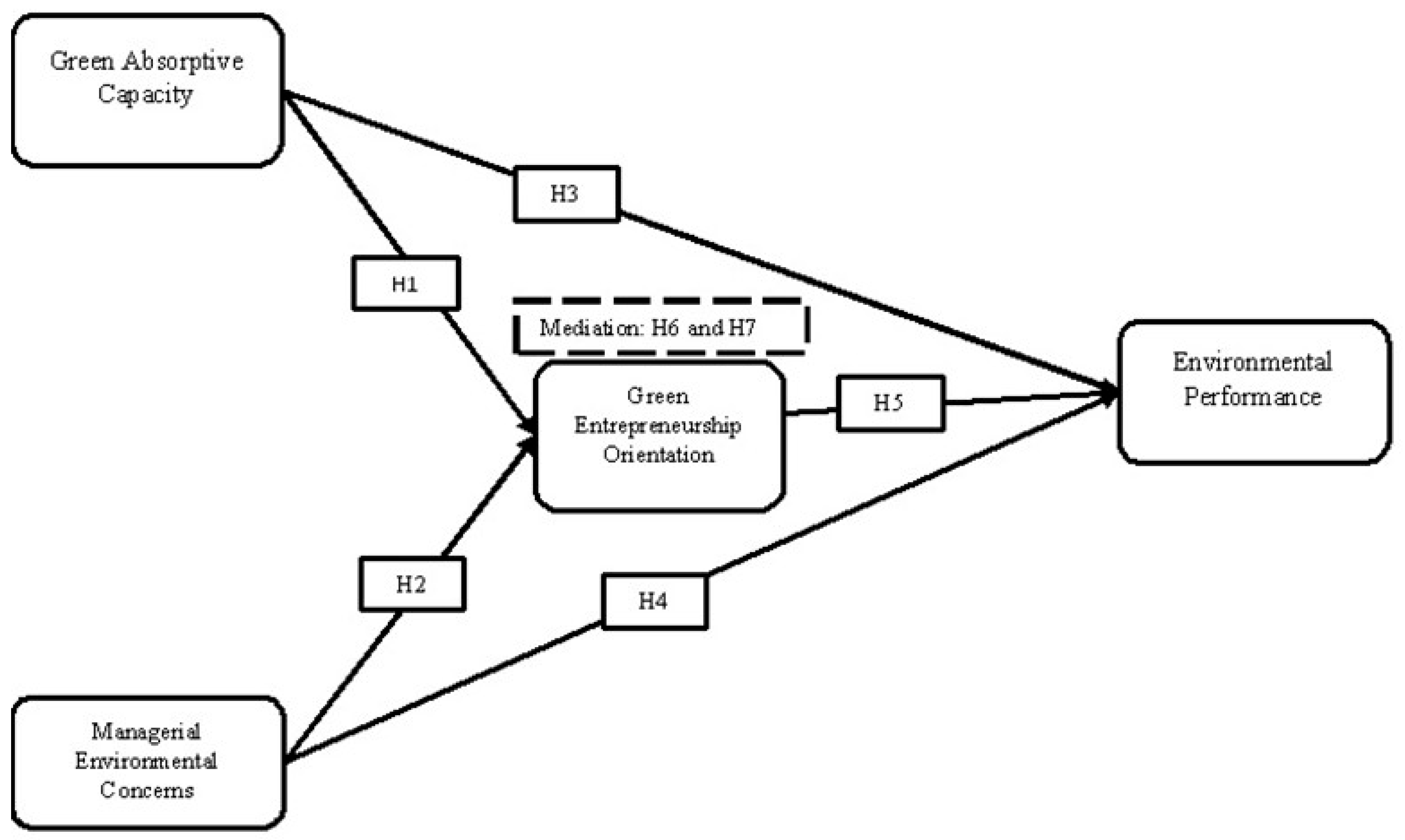
2.13. Theoretical Framework
3. Methods
3.1. Sample and Data Survey
3.2. Measures
3.2.1. Green Absorptive Capacity
3.2.2. Green Entrepreneurial Orientation
3.2.3. Environmental Performance
3.2.4. Managerial Environmental Concerns
4. Data Analysis and Results
5. Discussion and Conclusions
5.1. Theoretical Implications
5.2. Practical Implications
6. Directions for Future Research
Author Contributions
Funding
Institutional Review Board Statement
Informed Consent Statement
Data Availability Statement
Conflicts of Interest
References
- Zhang, J.; Adu Sarfo, P.; Adjorlolo, G.; Appiah, A.; Nyantakyi, G.; Bonzo, J.K.; Alam, S. Leveraging knowledge sharing for circular economy practices in small and medium-sized enterprises (SMEs): A pathway to achieving SDGs in Sub-Saharan Africa. J. Enterp. Inf. Manag. 2025. ahead of print. [Google Scholar] [CrossRef]
- Patel, M. Mapping the Evolution of Green Entrepreneurship: A Bibliometric Analysis. Environ. Dev. Sustain. 2025, 22, 5–26. [Google Scholar] [CrossRef]
- Khan, N.R.; Ameer, F.; Bouncken, R.B.; Covin, J.G. Corporate sustainability entrepreneurship: The role of green entrepreneurial orientation and organizational resilience capacity for green innovation. J. Bus. Res. 2023, 169, 114296. [Google Scholar] [CrossRef]
- Akhtar, S.; Li, C.; Sohu, J.M.; Rasool, Y.; Hassan, M.I.U.; Bilal, M. Unlocking green innovation and environmental performance: The mediated moderation of green absorptive capacity and green innovation climate. Environ. Sci. Pollut. Res. 2024, 31, 4547–4562. [Google Scholar] [CrossRef]
- Hart, S.L. A natural-resource-based view of the firm. Acad. Manag. Rev. 1995, 20, 986–1014. [Google Scholar] [CrossRef]
- Soomro, B.A.; Moawad, N.F.; Saraih, U.N.; Abedelwahed, N.A.A.; Shah, N. Going green with the green market and green innovation: Building the connection between green entrepreneurship and sustainable development. Kybernetes 2024, 53, 1484–1504. [Google Scholar] [CrossRef]
- Teece, D.J. The foundations of enterprise performance: Dynamic and ordinary capabilities in an (economic) theory of firms. Acad. Manag. Perspect. 2014, 28, 328–352. [Google Scholar] [CrossRef]
- Teece, D.J.; Pisano, G.; Shuen, A. Dynamic capabilities and strategic management. Strateg. Manag. J. 1997, 18, 509–533. [Google Scholar] [CrossRef]
- Ullah, S.; Khan, F.U.; Saeed, I. Promoting green growth through identification of sustainable strategies: A hybrid approach. Int. J. Emerg. Mark. 2025, 20, 3581–3606. [Google Scholar] [CrossRef]
- Ahmad, S.J.M. The role of government support in advancing green innovation and achieving SDGs in SMEs: Evidence from GCC nations. Manag. Sustain. Arab. Rev. 2025. ahead of print. [Google Scholar] [CrossRef]
- Cheng, H.; Li, Y.; Pang, Y.; Zhao, J.; Fu, K. Can digital transformation change a firm’s green innovation strategy? Evidence from China’s heavily polluting industries. Heliyon 2024, 10, e24676. [Google Scholar] [CrossRef]
- Xue, M.; Boadu, F.; Xie, Y. The penetration of green innovation on firm performance: Effects of absorptive capacity and managerial environmental concern. Sustainability 2019, 11, 2455. [Google Scholar] [CrossRef]
- Sherazi, K.; Zhang, P.; Ghazanfar, F.; Khan, Q.-T.-A. Management Why is institutional pressure insufficient to develop green innovation in manufacturing firms? The role of green high-performance work systems and managerial environmental concern. J. Environ. Plan. Manag. 2025, 68, 1622–1647. [Google Scholar] [CrossRef]
- Cohen, W.M.; Levinthal, D.A. Absorptive capacity: A new perspective on learning and innovation. Adm. Sci. Q. 1990, 35, 128–152. [Google Scholar] [CrossRef]
- Song, Y.; Wang, Z. Green entrepreneurial orientation, green marketing orientation, SMEs resilience amidst COVID-19: The moderation role of network ties. Curr. Psychol. 2024, 43, 33763–33782. [Google Scholar] [CrossRef]
- Shehzad, M.U.; Jianhua, Z.; Naveed, K.; Zia, U.; Sherani, M. Sustainable transformation: An interaction of green entrepreneurship, green innovation, and green absorptive capacity to redefine green competitive advantage. Bus. Strat. Environ. 2024, 33, 7041–7059. [Google Scholar] [CrossRef]
- Rehman, F.U. Environmental innovation and SDGs among the production SMEs: The mediating role of green branding. Manag. Environ. Qual. Int. J. 2025, 36, 510–538. [Google Scholar] [CrossRef]
- Aboelmaged, M.; Hashem, G.J. Absorptive capacity and green innovation adoption in SMEs: The mediating effects of sustainable organisational capabilities. J. Clean. Prod. 2019, 220, 853–863. [Google Scholar] [CrossRef]
- Engelen, A.; Kube, H.; Schmidt, S.; Flatten, T.C. Entrepreneurial orientation in turbulent environments: The moderating role of absorptive capacity. Res. Policy 2014, 43, 1353–1369. [Google Scholar] [CrossRef]
- Zhang, X.; Le, Y.; Meng, Q.; Teng, X. Green entrepreneurial orientation and financial performance in Chinese firms: The role of stakeholder engagement and green absorptive capacity. Corp. Soc. Responsib. Environ. Manag. 2023, 30, 1082–1095. [Google Scholar] [CrossRef]
- Marzouk, J.; El Ebrashi, R. The interplay among green absorptive capacity, green entrepreneurial, and learning orientations and their effect on triple bottom line performance. Bus. Strategy Environ. 2024, 33, 1962–1976. [Google Scholar] [CrossRef]
- Makhloufi, L.; Zhou, J.; Siddik, A.B. Why green absorptive capacity and managerial environmental concerns matter for corporate environmental entrepreneurship? Environ. Sci. Pollut. Res. 2023, 30, 102295–102312. [Google Scholar] [CrossRef]
- Guo, H.; Dong, M.; Tsinopoulos, C.; Xu, M. The influential capacity of carbon neutrality environmental orientation in modulating stakeholder engagement toward green manufacturing. Corp. Soc. Responsib. Environ. Manag. 2024, 31, 292–310. [Google Scholar] [CrossRef]
- Coelho, A.; Ferreira, J.; Proença, C. The impact of green entrepreneurial orientation on sustainability performance through the effects of green product and process innovation: The moderating role of ambidexterity. Bus. Strategy Environ. 2024, 33, 3184–3202. [Google Scholar] [CrossRef]
- Anwar, S.U.; Xu, J.; Yuan, P.Z.; Su, K.; Ur Rehman, S.; Hameed, M.; Wen, M.; Li, F. Green entrepreneurial orientation and environmental performance a moderated mediation perspective of perceived environmental innovation and stakeholder pressure. Sci. Rep. 2024, 14, 30266. [Google Scholar] [CrossRef] [PubMed]
- Liu, T.; Cao, X. Going green: How executive environmental awareness and green innovation drive corporate sustainable development. J. Knowl. Econ. 2025, 16, 6577–6604. [Google Scholar] [CrossRef]
- Makhloufi, L.; Djermani, F.; Meirun, T. Mediation-moderation model of green absorptive capacity and green entrepreneurship orientation for corporate environmental performance. Manag. Environ. Qual. Int. J. 2024, 35, 139–157. [Google Scholar] [CrossRef]
- Ibrahim, M.; Mahmood, R.; Som, H.M. Green absorptive capacity and environmental performance: A perspective of SMEs’ relational capability and green supply chain management practices. Environ. Dev. Sustain. 2025, 27, 13947–13971. [Google Scholar] [CrossRef]
- Zhao, X.; Lynch, J.G., Jr.; Chen, Q. Reconsidering Baron and Kenny: Myths and truths about mediation analysis. J. Consum. Res. 2010, 37, 197–206. [Google Scholar] [CrossRef]
- Zhang, X.; Zhang, X.-e.; Yang, L. Does green entrepreneurial orientation improve the sustainable performance of agribusiness? Evidence from China. Sage Open 2024, 14, 21582440241271110. [Google Scholar] [CrossRef]
- Bresciani, S.; Rehman, S.U.; Giovando, G.; Alam, G.M. The role of environmental management accounting and environmental knowledge management practices influence on environmental performance: Mediated-moderated model. J. Knowl. Manag. 2023, 27, 896–918. [Google Scholar] [CrossRef]
- Appannan, J.S.; Mohd Said, R.; Ong, T.S.; Senik, R. Promoting sustainable development through strategies, environmental management accounting and environmental performance. Bus. Strat. Environ. 2023, 32, 1914–1930. [Google Scholar] [CrossRef]
- Awewomom, J.; Dzeble, F.; Takyi, Y.D.; Ashie, W.B.; Ettey, E.N.Y.O.; Afua, P.E.; Sackey, L.N.; Opoku, F.; Akoto, O. Addressing global environmental pollution using environmental control techniques: A focus on environmental policy and preventive environmental management. Discov. Environ. 2024, 2, 8. [Google Scholar] [CrossRef]
- Idrees, H.; Xu, J.; Andrianarivo Andriandafiarisoa Ralison, N.A. Green entrepreneurial orientation and knowledge creation process as enablers of green innovation performance: The moderating role of resource orchestration capability. Eur. J. Innov. Manag. 2025, 28, 754–782. [Google Scholar] [CrossRef]
- Wang, H.; Zeng, Y.; Zhang, J.; Yu, S.; Wang, Z.; Deng, Y. Sustainable performance analysis and environmental protection optimization of green entrepreneurship-driven energy enterprises. Humanit. Soc. Sci. Commun. 2025, 12, 104. [Google Scholar] [CrossRef]
- Martínez-Falcó, J.; Sánchez-García, E.; Marco-Lajara, B.; Zaragoza-Sáez, P. Green intellectual capital and sustainable competitive advantage: Unraveling role of environmental management accounting and green entrepreneurship orientation. J. Intellect. Cap. 2025, 26, 104–129. [Google Scholar] [CrossRef]
- Canbul Yaroğlu, A. Firm performance through green orientation, environmental culture and green absorptive capacity. Manag. Decis. 2025. ahead of print. [Google Scholar] [CrossRef]
- Figiel, A.; Badar, A. Effect of Green Entrepreneurial Orientation and Absorptive Capacity on Green Innovation and Environmental Orientation Among Educated Gen Z’s in Europe. Sustainability 2025, 17, 593. [Google Scholar] [CrossRef]
- Shivani, S.; Sharma, S.; Singh, S. Linking Green Entrepreneurial Orientation to Sustainable Firm Performance: Insights from a mixed method study. Bus. Strat. Environ. 2025. ahead of print. [Google Scholar] [CrossRef]
- Momayez, A.; Rasouli, N.; Alimohammadirokni, M.; Rasoolimanesh, S.M. Green entrepreneurship orientation, green innovation and hotel performance: The moderating role of managerial environmental concern. J. Hosp. Mark. Manag. 2023, 32, 981–1004. [Google Scholar] [CrossRef]
- Ahmed, T.; Yousaf, A.; Clavijo, R.C.; Sanders, K. Entrepreneurial pathways to sustainability: A theoretical paper on green human resource management, green supply chain management, and entrepreneurial orientation. Sustainability 2024, 16, 6357. [Google Scholar] [CrossRef]
- Gazi, M.A.I.; Hossain, M.M.; Islam, S.; Al Masud, A.; Amin, M.B.; Senathirajah, A.R.b.S.; Abdullah, M. Effect of corporate social responsibility on sustainable environmental performance: Mediating effects of green capability and green transformational leadership; moderating effects of top management environmental concern and perceived organizational support. Environ. Dev. Sustain. 2025, 27, 1–34. [Google Scholar] [CrossRef]
- Krejcie, R.V.; Morgan, D.W. Determining sample size for research activities. Educ. Psychol. Meas. 1970, 30, 607–610. [Google Scholar] [CrossRef]
- Lorenzo-Seva, U.; Ferrando, P.J. Determining sample size requirements in EFA solutions: A simple empirical proposal. Multivar. Behav. Res. 2024, 59, 899–912. [Google Scholar] [CrossRef]
- Gluch, P.; Gustafsson, M.; Thuvander, L. An absorptive capacity model for green innovation and performance in the construction industry. Constr. Manag. Econ. 2009, 27, 451–464. [Google Scholar] [CrossRef]
- Jiang, W.; Chai, H.; Shao, J.; Feng, T. Green entrepreneurial orientation for enhancing firm performance: A dynamic capability perspective. J. Clean. Prod. 2018, 198, 1311–1323. [Google Scholar] [CrossRef]
- Saudi, M.H.M.; Sinaga, O.; Gusni; Zainudin, Z. The effect of green innovation in influencing sustainable performance: Moderating role of managerial environmental concern. Int. J. Supply Chain. Manag. 2019, 8, 303–310. [Google Scholar]
- Hair, J.F.; Ringle, C.M.; Sarstedt, M. PLS-SEM: Indeed a silver bullet. J. Mark. Theory 2011, 19, 139–152. [Google Scholar] [CrossRef]
- Sarstedt, M.; Ringle, C.M.; Smith, D.; Reams, R.; Hair, J.F., Jr. Partial least squares structural equation modeling (PLS-SEM): A useful tool for family business researchers. J. Fam. Bus. Strategy 2014, 5, 105–115. [Google Scholar] [CrossRef]
- Hair, J.; Hollingsworth, C.L.; Randolph, A.B.; Chong, A.Y.L. An updated and expanded assessment of PLS-SEM in information systems research. Ind. Manag. Data Syst. 2017, 117, 442–458. [Google Scholar] [CrossRef]
- Hair, J.F. Multivariate Data Analysis; Pearson: London, UK, 2009. [Google Scholar]
- Fornell, C.; Larcker, D.F. Structural equation models with unobservable variables and measurement error: Algebra and statistics. J. Mark. Res. 1981, 18, 382–388. [Google Scholar] [CrossRef]
- Henseler, J.; Ringle, C.M.; Sarstedt, M. A new criterion for assessing discriminant validity in variance-based structural equation modeling. J. Acad. Mark. Sci. 2015, 43, 115–135. [Google Scholar] [CrossRef]
- McNeish, D. Thanks coefficient alpha, we’ll take it from here. Psychol. Methods 2018, 23, 412. [Google Scholar] [CrossRef]
- Nosek, B.A.; Alter, G.; Banks, G.C.; Borsboom, D.; Bowman, S.; Breckler, S.; Buck, S.; Chambers, C.; Chin, G.; Christensen, G.; et al. Promoting an open research culture. Author guidelines for journals could help to promote transparency, openness, and reproducibility. Science 2015, 348, 1422–1425. [Google Scholar] [CrossRef]
- Bagozzi, R.P.; Bergami, M.; Marzocchi, G.L.; Morandin, G. Customer–organization relationships: Development and test of a theory of extended identities. J. Appl. Psychol. 2012, 97, 63. [Google Scholar] [CrossRef]
- Hair, J.F., Jr.; Black, W.C.; Babin, B.J. Multivariate Data Analysis: A Global Perspective, 7th ed.; Pearson Education: London, UK, 2010. [Google Scholar]
- Falk, R.F.; Miller, N.B. A Primer for Soft Modeling; University of Akron Press: Akron, OH, USA, 1992. [Google Scholar]
- Craney, T.A.; Surles, J.G. Model-dependent variance inflation factor cutoff values. Qual. Eng. 2002, 14, 391–403. [Google Scholar] [CrossRef]
- Preacher, K.J.; Hayes, A.F. Asymptotic and resampling strategies for assessing and comparing indirect effects in multiple mediator models. Behav. Res. Methods 2008, 40, 879–891. [Google Scholar] [CrossRef] [PubMed]
- Riaz, M.; Jie, W.; Ali, S.; Chang, S. Assessing the role of organizational strategic factors in stimulating green innovation performance: Moderating effects of green absorptive capacity. Bus. Process Manag. J. 2024, 30, 1013–1043. [Google Scholar] [CrossRef]
- Dantas, D.; Ferreira, J.J.; Jayantilal, S. Green absorptive capacity and environmental management: The main challenges, gaps and research agenda. Manag. Environ. Qual. Int. J. 2025, 36, 1372–1391. [Google Scholar] [CrossRef]
- Makhloufi, L.J.I.M.; Systems, D. Do knowledge sharing and big data analytics capabilities matter for green absorptive capacity and green entrepreneurship orientation? Implications for green innovation. Ind. Manag. Data Syst. 2024, 124, 978–1004. [Google Scholar] [CrossRef]
- Esangbedo, C.O.; Zhang, J.; Perez, P.B.; Skitmore, M. Sustainable performance and supply chain leadership in logistic firms: The role of corporate sustainability strategies and digital supply chain. Supply Chain. Manag. Int. J. 2024, 29, 963–977. [Google Scholar] [CrossRef]
- Feng, T.; Qamruzzaman, M.; Sharmin, S.S.; Karim, S. Bridging environmental sustainability and organizational performance: The role of green supply chain management in the manufacturing industry. Sustainability 2024, 16, 5918. [Google Scholar] [CrossRef]
- Hart, S.L.; Dowell, G. Invited editorial: A natural-resource-based view of the firm: Fifteen years after. J. Manag. 2011, 37, 1464–1479. [Google Scholar] [CrossRef]
- Difrancesco, R.M.; Luzzini, D.; Patrucco, A.S. Purchasing realized absorptive capacity as the gateway to sustainable supply chain management. Int. J. Oper. Prod. Manag. 2022, 42, 603–636. [Google Scholar] [CrossRef]
- Hui, G.; Al Mamun, A.; Masukujjaman, M.; Makhbul, Z.K.M.; Ali, M.H. The relationship between mass customization and sustainable performance: The role of firm size and global E-commerce. Heliyon 2024, 10, e27726. [Google Scholar] [CrossRef] [PubMed]
- Adiguzel, Z.; Sonmez Cakir, F. Empowering sustainability: Green entrepreneurial orientation, innovative strategies, culture and operational performance. Manag. Decis. 2025. ahead of print. [Google Scholar] [CrossRef]
- Zarghami, S.A. The role of economic policies in achieving sustainable development goal 7: Insights from OECD and European countries. Appl. Energy 2025, 377, 124558. [Google Scholar] [CrossRef]
- Pinedo-López, J.; Baena-Navarro, R.; Carriazo-Regino, Y.; Urrea-Ortiz, A.; Reyes-Guevara, D. Sustainability strategies: A proposal for food sector SMEs, based on the integration of life cycle assessment and ESG strategies. J. Infrastruct. Policy Dev. 2024, 8, 8934. [Google Scholar] [CrossRef]



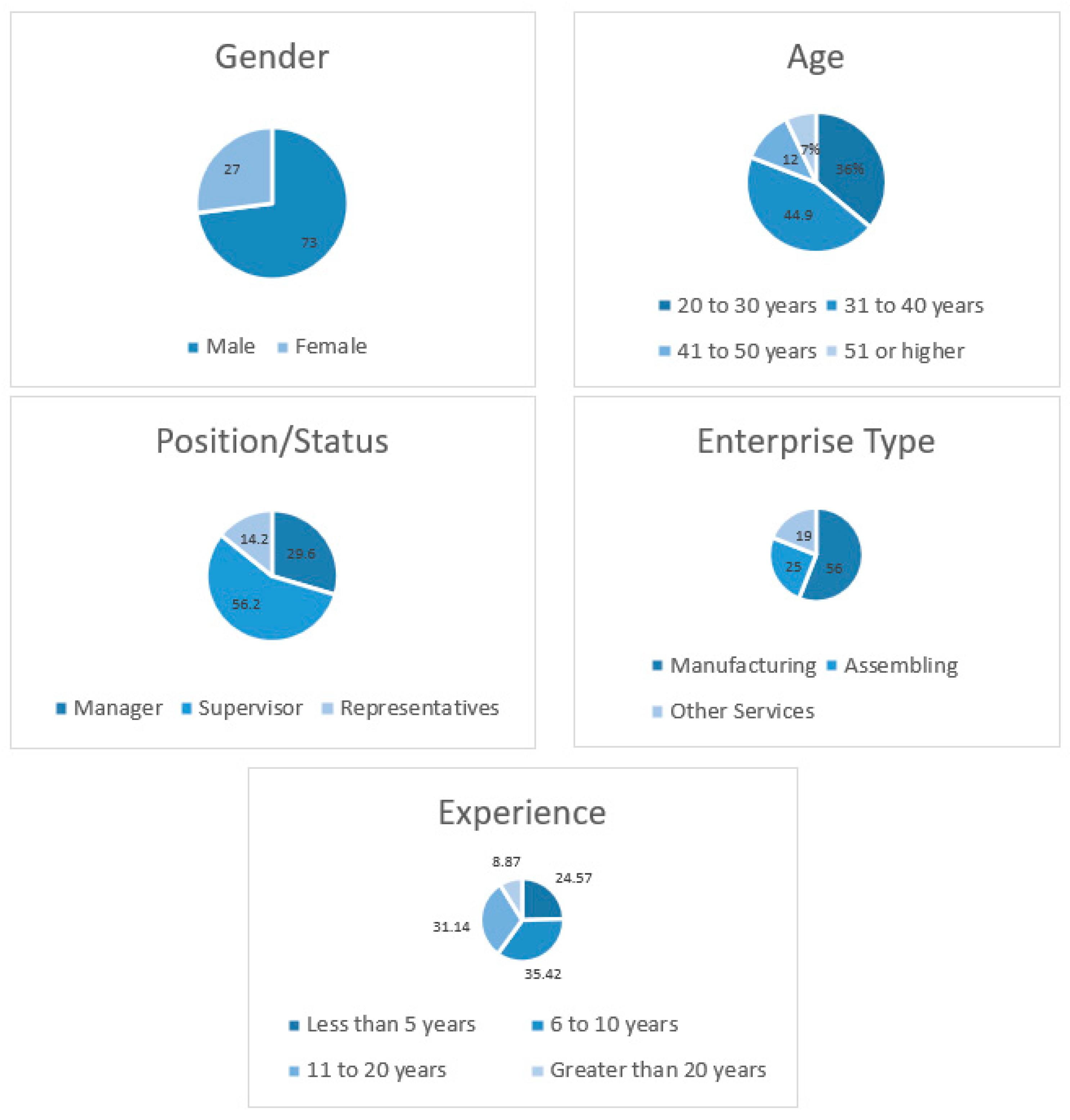
| Category | Subcategory | Frequency | Percent |
|---|---|---|---|
| Gender | Male | 256 | 73 |
| Female | 94 | 27 | |
| Total | 350 | 100 | |
| Age | 20 to 30 years | 126 | 36 |
| 31 to 40 years | 157 | 44.9 | |
| 41 to 50 years | 42 | 12 | |
| 51 or higher | 25 | 7.1 | |
| Total | 350 | 100 | |
| Position/Status | Manager | 105 | 29.6 |
| Supervisor | 96 | 56.2 | |
| Representatives | 52 | 14.2 | |
| Total | 350 | 100 | |
| Enterprise Type | Manufacturing | 196 | 56 |
| Assembling | 88 | 25 | |
| Other Services | 66 | 19 | |
| Total | 350 | 100 | |
| Experience | Less than 5 years | 86 | 24.57 |
| 6 to 10 years | 124 | 35.42 | |
| 11 to 20 years | 109 | 31.14 | |
| Greater than 20 years | 31 | 8.87 | |
| Total | 350 | 100 |
| Variables: CMIN = 623.918; p-Value = 0.000; CMIN/DF = 2.862; SRMR = 0.072; GFI = 0.868; NFI = 0.921; TLI = 0.939; CFI = 0.947; RMSEA = 0.073; PCLOSE = 0.104; | Factor Loadings | VIF |
|---|---|---|
| Green Absorptive Capacity (GAC): CA = 0.959; CR = 0.957; AVE = 0.691 | 1.428 | |
| GAC1 | 0.814 | |
| GAC2 | 0.798 | |
| GAC3 | 0.833 | |
| GAC4 | 0.775 | |
| GAC5 | 0.876 | |
| GAC6 | 0.824 | |
| GAC7 | 0.831 | |
| GAC8 | 0.837 | |
| GAC9 | 0.829 | |
| GAC10 | 0.887 | |
| Managerial Environmental Concerns (MECs): CA = 0.862; CR = 0.864; AVE = 0.614 | 1.183 | |
| MEC1 | 0.743 | |
| MEC2 | 0.811 | |
| MEC3 | 0.789 | |
| MEC4 | 0.791 | |
| Green Entrepreneurial Orientation (GEO): CA = 0.937; CR = 0.939; AVE = 0.756 | ||
| GEO1 | 0.915 | |
| GEO2 | 0.883 | |
| GEO3 | 0.824 | |
| GEO4 | 0.855 | |
| GEO5 | 0.869 | |
| Environmental Performance (EP): CA = 0.930; CR = 0.926; AVE = 0.757 | ||
| EP1 | 0.915 | |
| EP2 | 0.883 | |
| EP3 | 0.824 | |
| EP4 | 0.855 | |
| EP5 | ─ | |
| EP6 | ─ |
| Constructs | 1 | 2 | 3 | 4 |
|---|---|---|---|---|
| Green Absorptive Capacity | 0.831 | - | - | - |
| Managerial Environmental Concerns | 0.347 | 0.800 | - | - |
| Green Entrepreneurial Orientation | 0.440 | 0.247 | 0.869 | - |
| Environmental Performance | 0.520 | 0.616 | 0.452 | 0.870 |
| Note: √AVE indicates diagonal italic values. | ||||
| Hypothesis | Relationship | Estimate (β) | S.E. | p-Value | Decision |
|---|---|---|---|---|---|
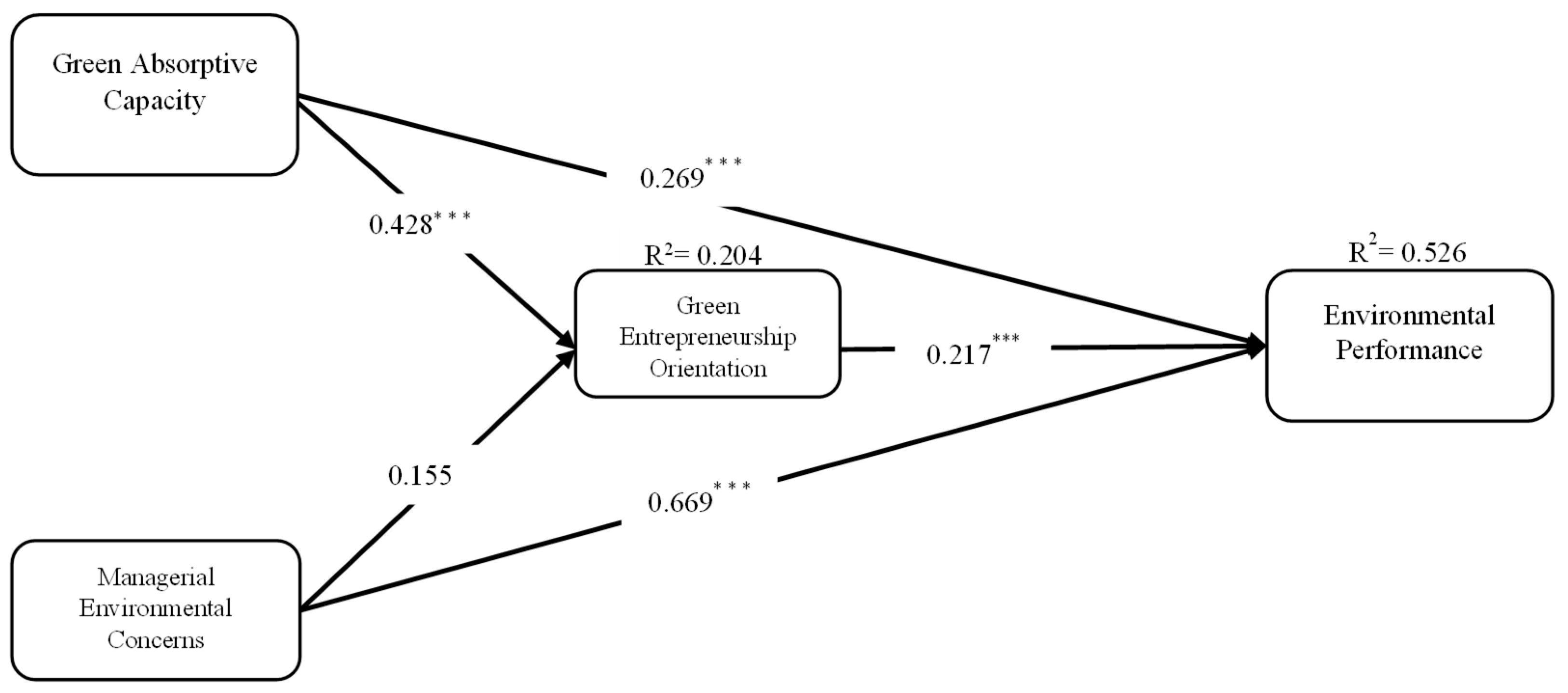
| H1 | GAC ⟶ GEO | 0.428 *** | 0.062 | 0.000 | Supported |
| H2 | MEC ⟶ GEO | 0.155 | 0.084 | 0.065 | Not supported |
| H3 | GAC ⟶ EP | 0.269 *** | 0.053 | 0.000 | Supported |
| H4 | MEC ⟶ EP | 0.669 *** | 0.076 | 0.000 | Supported |
| H5 | GEO ⟶ EP | 0.217 *** | 0.048 | 0.000 | Supported |
| Indirect Effects | |||||
| H6 | GAC ⟶ GEO ⟶ EP | 0.093 *** | 0.027 | 0.001 | Mediation exists |
| H7 | MEC ⟶ GEO ⟶ EP | 0.034 *** | 0.023 | 0.001 | Mediation exists |
Disclaimer/Publisher’s Note: The statements, opinions and data contained in all publications are solely those of the individual author(s) and contributor(s) and not of MDPI and/or the editor(s). MDPI and/or the editor(s) disclaim responsibility for any injury to people or property resulting from any ideas, methods, instructions or products referred to in the content. |
© 2025 by the authors. Licensee MDPI, Basel, Switzerland. This article is an open access article distributed under the terms and conditions of the Creative Commons Attribution (CC BY) license (https://creativecommons.org/licenses/by/4.0/).
Share and Cite
Zafar, S.; Huang, Q.; Zafar, Z.; Haq, M.A.U. Impact of Managerial Environmental Concerns on Environmental Performance: Mediating Role of Green Entrepreneurship Orientation. Sustainability 2025, 17, 11242. https://doi.org/10.3390/su172411242
Zafar S, Huang Q, Zafar Z, Haq MAU. Impact of Managerial Environmental Concerns on Environmental Performance: Mediating Role of Green Entrepreneurship Orientation. Sustainability. 2025; 17(24):11242. https://doi.org/10.3390/su172411242
Chicago/Turabian StyleZafar, Shoaib, Qifa Huang, Zuhaib Zafar, and Mirza Amin Ul Haq. 2025. "Impact of Managerial Environmental Concerns on Environmental Performance: Mediating Role of Green Entrepreneurship Orientation" Sustainability 17, no. 24: 11242. https://doi.org/10.3390/su172411242
APA StyleZafar, S., Huang, Q., Zafar, Z., & Haq, M. A. U. (2025). Impact of Managerial Environmental Concerns on Environmental Performance: Mediating Role of Green Entrepreneurship Orientation. Sustainability, 17(24), 11242. https://doi.org/10.3390/su172411242