A Hybrid SSA-VMD-GRU Model for Real-Time Traffic-Related Air Quality Index Prediction: Development and Validation


Abstract
1. Introduction
2. Methods
2.1. Theoretical Analysis of Influencing Factors
2.2. Correlation Analysis of Grey Association
2.3. SSA-VMD-GRU Prediction Model
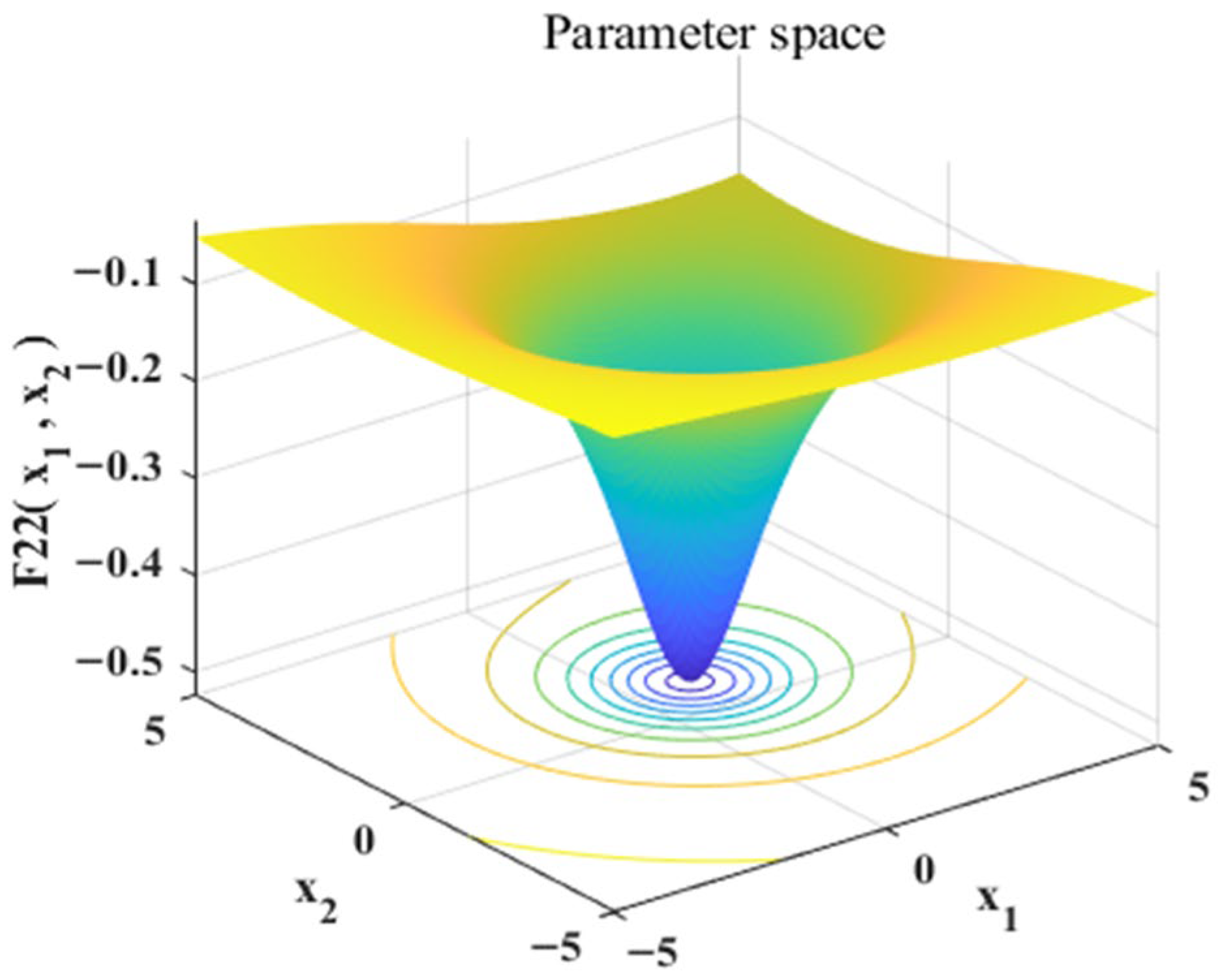
2.3.1. Sparrow Search Algorithm (SSA)
2.3.2. The Producer’s Location Update Strategy
2.3.3. The Position Update Strategy for Followers
2.3.4. The Position Update Strategy of the Vigilante
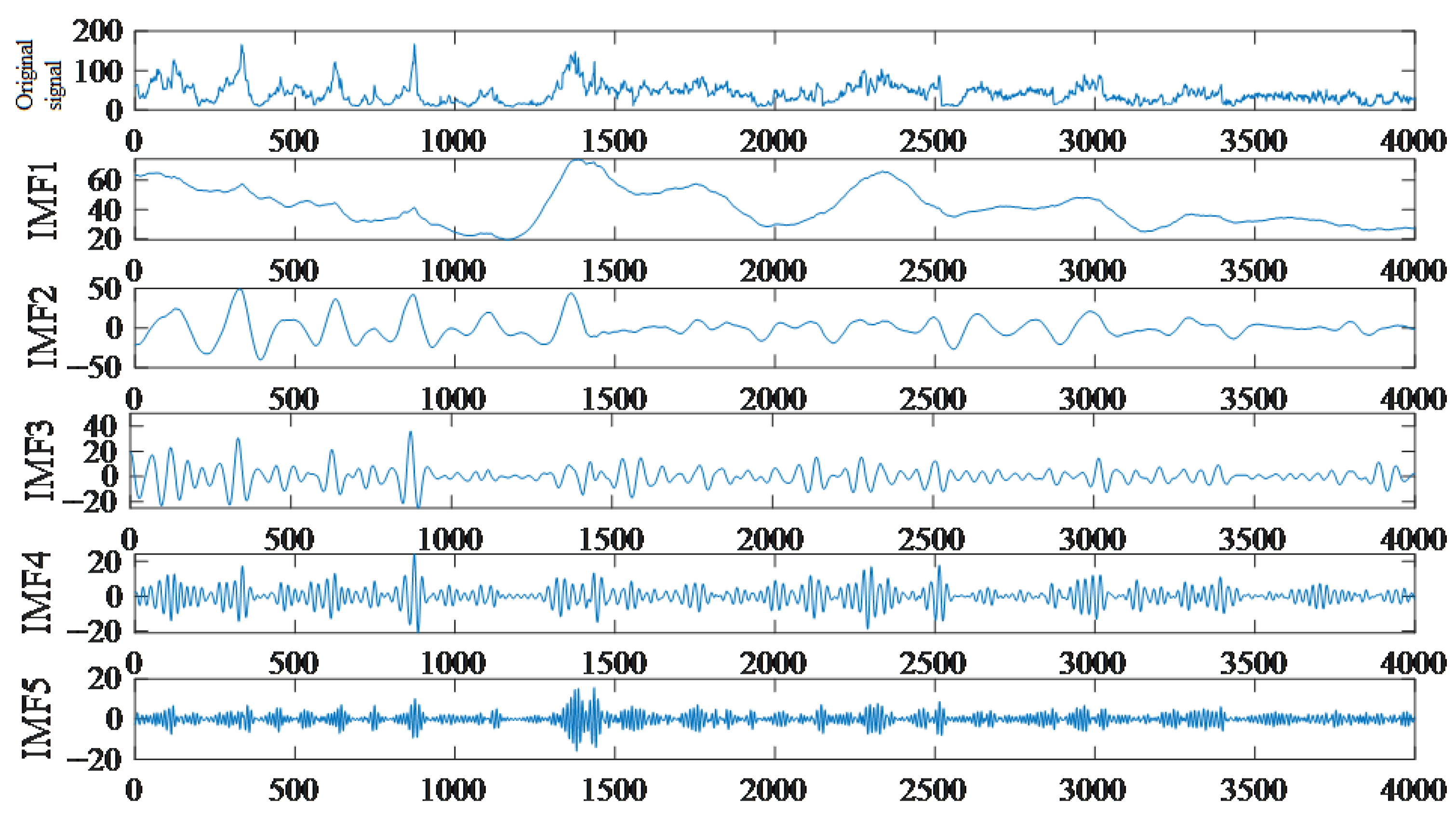
2.4. Variational Mode Decomposition
2.4.1. Construct Variational Problems
2.4.2. Solve the Variational Problem
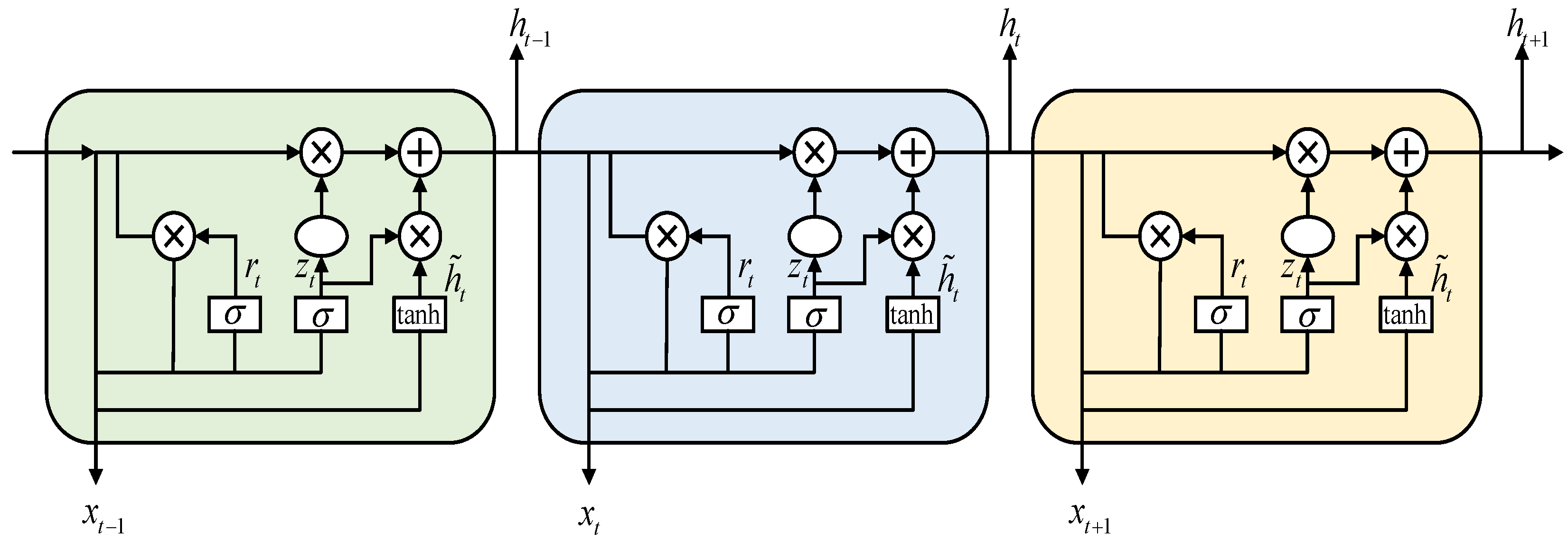
2.5. Gated Recurrent Unit Model
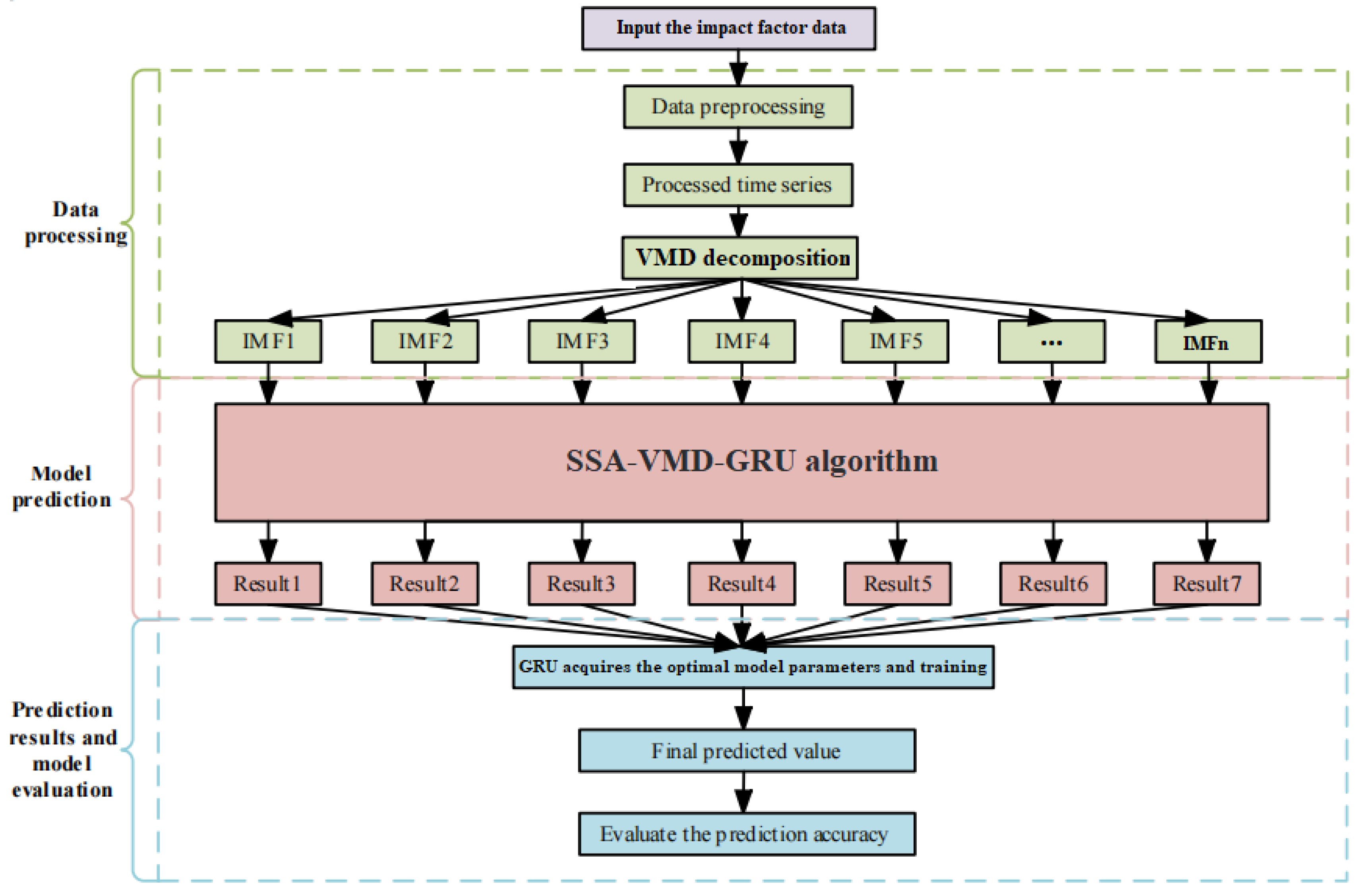
3. Construction of the SSA-VMD-GRU Model
4. Discussions
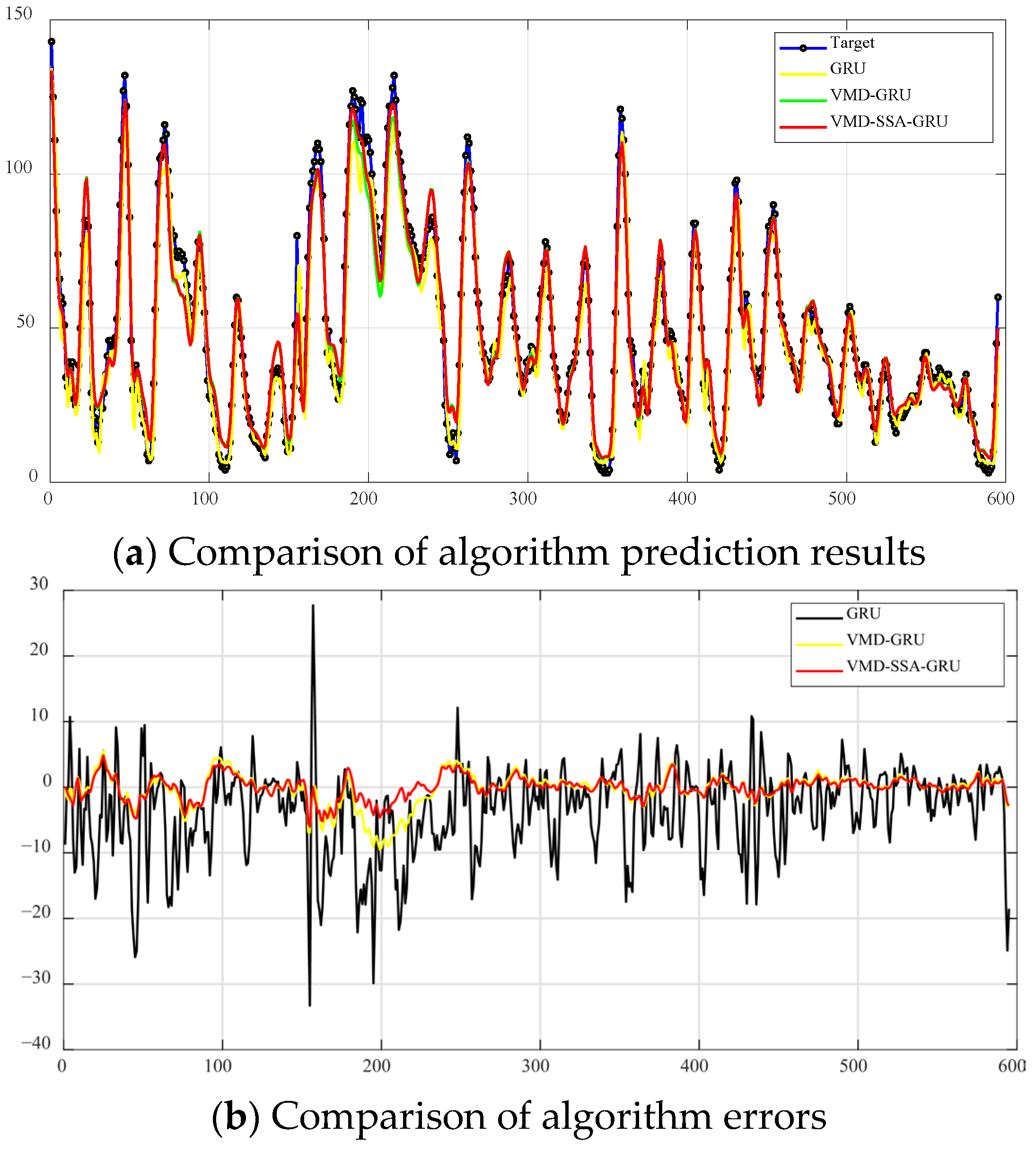
4.1. Relevant Evaluation Metrics and AQI Prediction Results of the Test Set and Training Set for the First-Quarter AQI Prediction
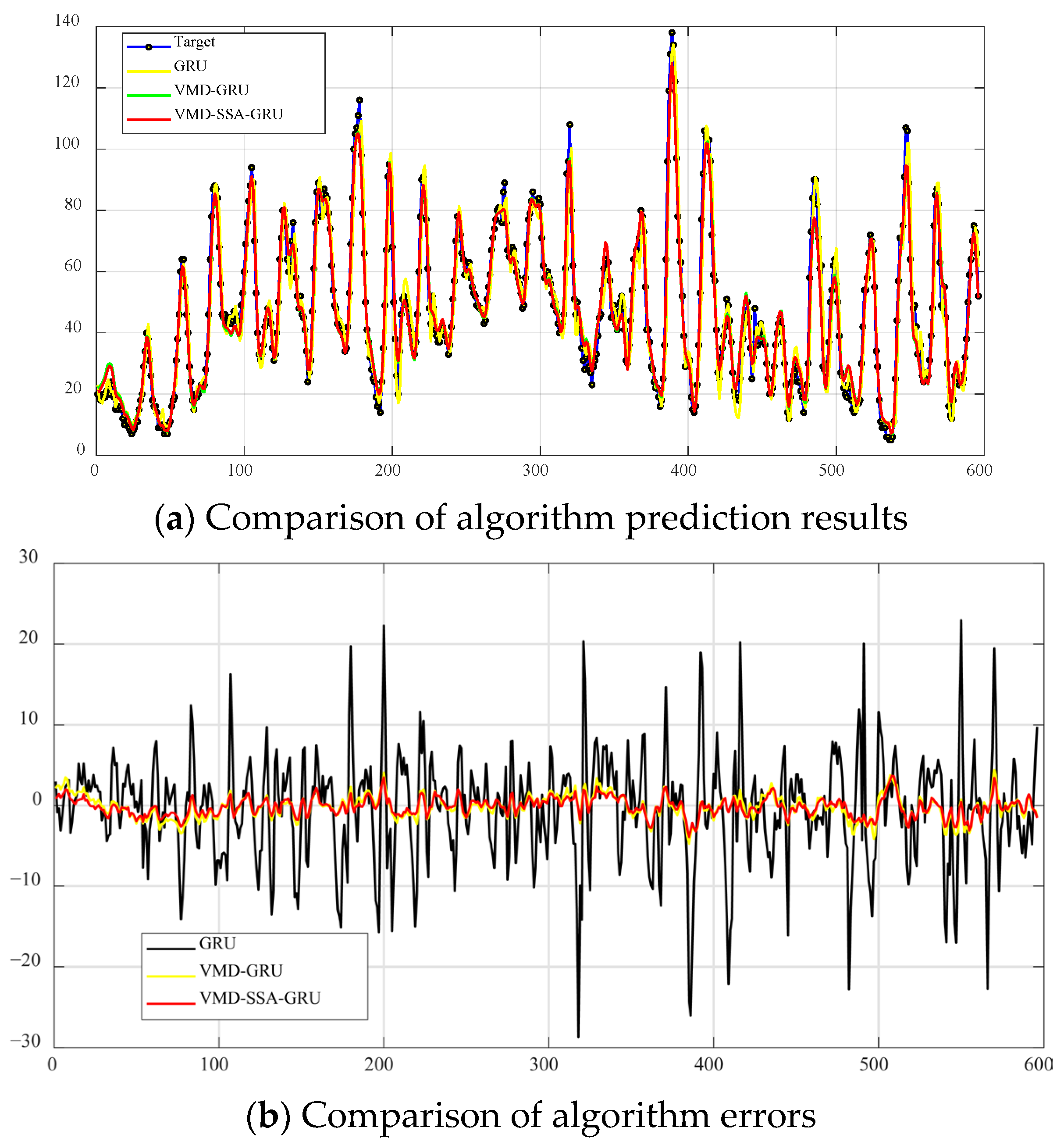
4.2. Relevant Evaluation Metrics and AQI Prediction Results of the Test Set and Training Set for the Second-Quarter AQI Prediction
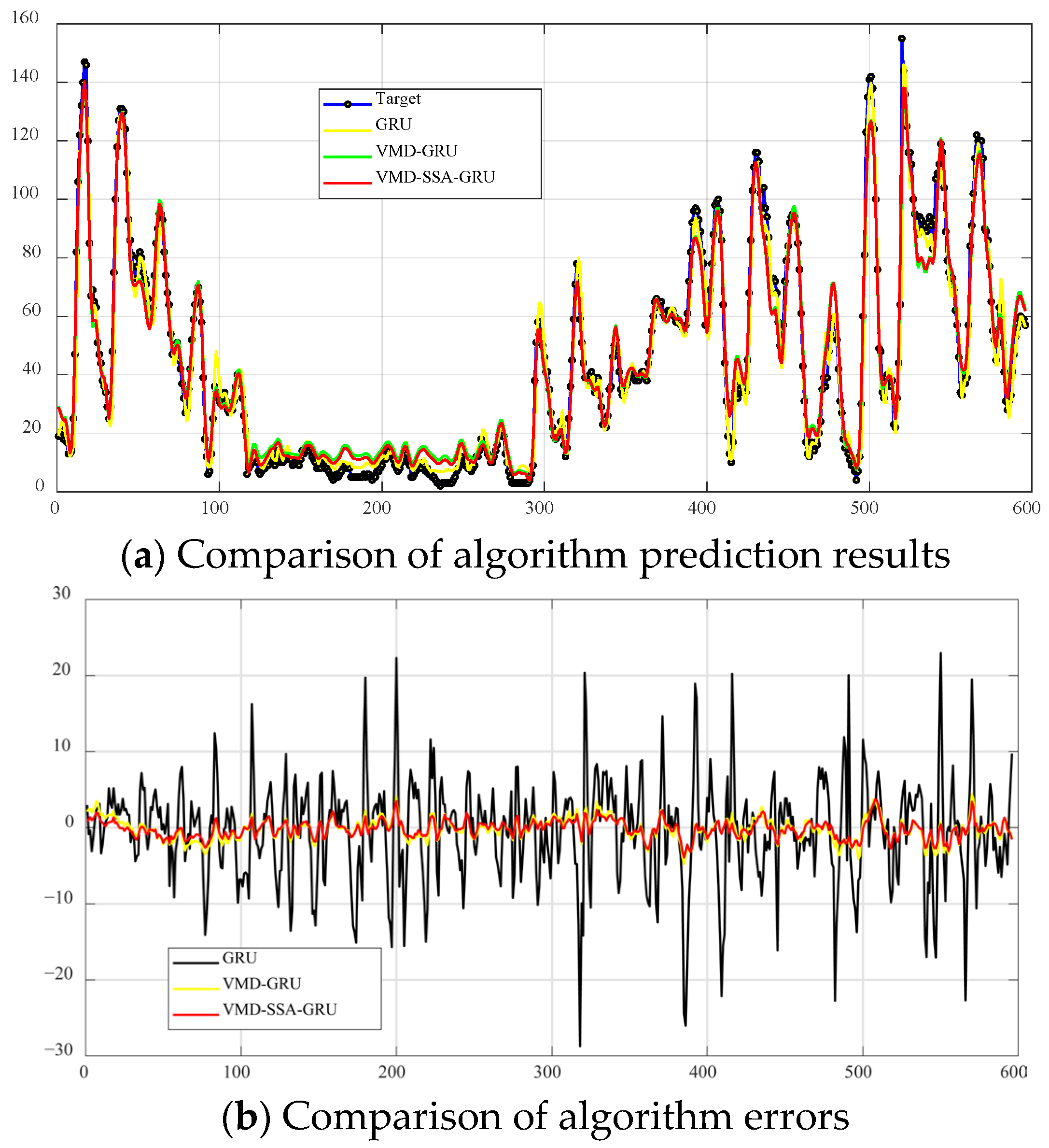
4.3. Relevant Evaluation Metrics and AQI Prediction Results of the Test Set and Training Set for the Third-Quarter AQI Prediction
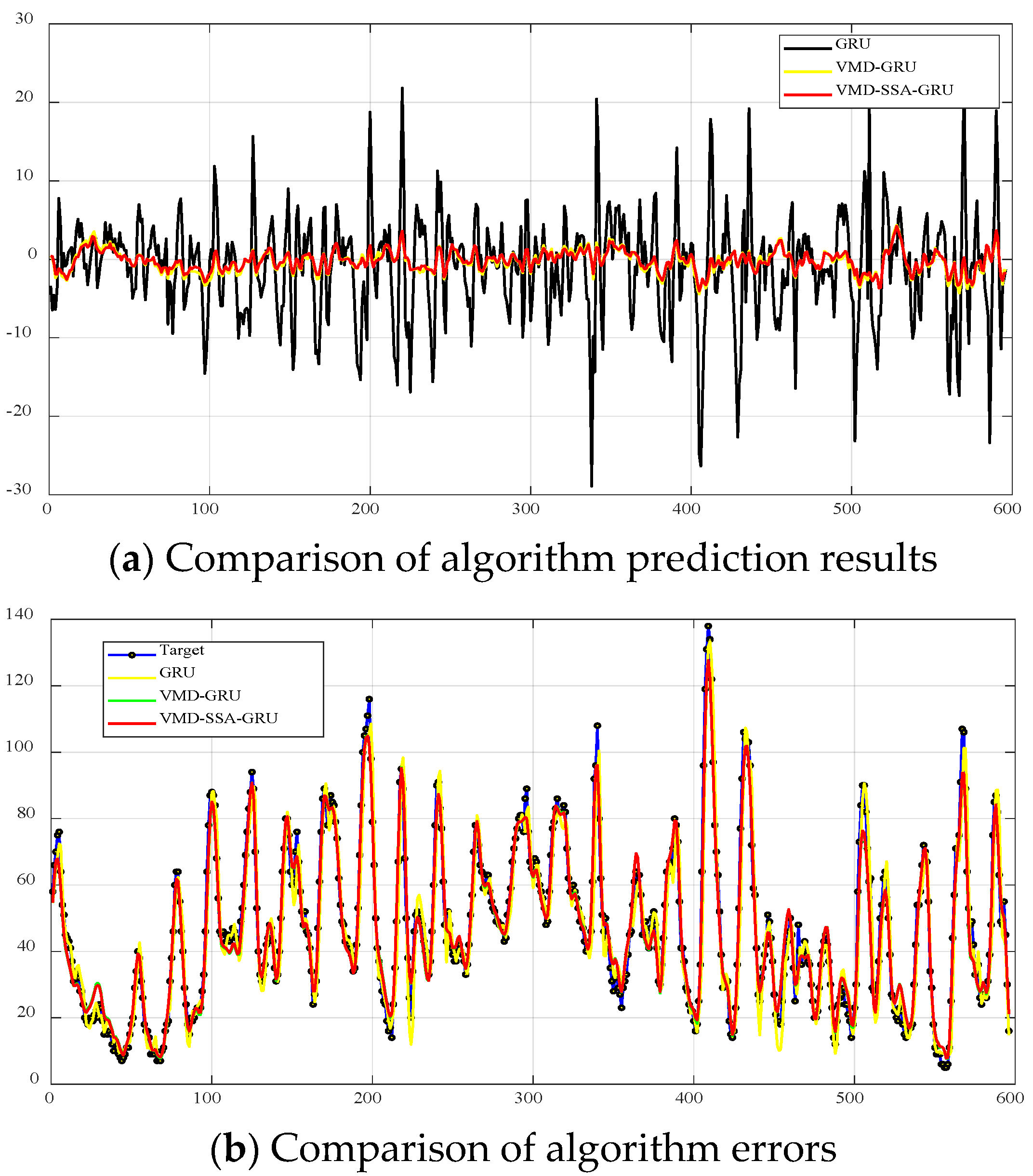
4.4. Relevant Evaluation Metrics and AQI Prediction Results of the Test Set and Training Set for the Fourth-Quarter AQI Prediction
5. Conclusions
Author Contributions
Funding
Institutional Review Board Statement
Informed Consent Statement
Data Availability Statement
Conflicts of Interest
Abbreviations
| AQI | Air quality index |
| SSA | Sparrow search algorithm |
| VMD | Variational mode decomposition |
| GRU | Gated recurrent unit |
References
- Mogollón-Sotelo, C.; Casallas, A.; Vidal, S.; Celis, N.; Ferro, C.; Belalcazar, L. A support vector machine model to forecast ground-level PM2.5 in a highly populated city with a complex terrain. Air Qual. Atmos. Health 2020, 14, 399–409. [Google Scholar] [CrossRef]
- Yu, Y.; Yu, J.J.Q.; Li, V.O.K.; Lam, J.C.K. A Novel Interpolation-SVT Approach for Recovering Missing Low-Rank Air Quality Data. IEEE Access 2020, 8, 74291–74308. [Google Scholar] [CrossRef]
- Park, S.; Woo, S.; Lim, C.W. Predicting PM10 and PM2.5 Concentration in Container Ports: A Deep Learning Approach. Transp. Res. Part D Transp. Environ. 2023, 115, 103601. [Google Scholar] [CrossRef]
- Byun, D.W. Dynamically consistent formulations in meteorological and air quality models for multiscale atmospheric studies. part i: Governing equations in a generalized coordinate system. J. Atmos. Sci. 1999, 56, 3789–3807. [Google Scholar] [CrossRef]
- Huang, Y.; Yu, J.; Dai, X.; Huang, Z.; Li, Y. Air-Quality Prediction Based on the EMD-IPSO-LSTM Combination Model. Sustainability 2022, 14, 4889. [Google Scholar] [CrossRef]
- Wu, Y.; Qian, C.; Huang, H. Enhanced Air Quality Prediction Using a Coupled DVMD Informer-CNN-LSTM Model Optimized with Dung Beetle Algorithm. Entropy 2024, 26, 534. [Google Scholar] [CrossRef]
- Reddy, K.Y.; Krishna, K.V.S.G.M. Vehicular pollution prediction using HWTO-ANFIS model in urban areas of Hyderabad City. Environ. Prog. Sustain. Energy 2023, 42, 1. [Google Scholar] [CrossRef]
- Zhang, J.; Luo, Z.; Yang, Z. Research on Air Quality Prediction Based on LSTM-Transformer with Adaptive Temporal Attention Mechanism. In Proceedings of the 2023 2nd International Conference on Artificial Intelligence and Intelligent Information Processing (AIIIP), Hangzhou, China, 27–29 October 2023; IEEE: New York, NY, USA. [Google Scholar] [CrossRef]
- Li, H.; Wang, J.; Li, R.; Lu, H. Novel analysis–forecast system based on multi-objective optimization for air quality index. J. Clean. Prod. 2019, 208, 1365–1383. [Google Scholar] [CrossRef]
- Yan, R.; Liao, J.; Yang, J.; Sun, W.; Nong, M.; Li, F. Multi-hour and multi-site air quality index forecasting in Beijing using CNN, LSTM, CNN-LSTM, and spatiotemporal clustering. Expert Syst. Appl. 2020, 169, 114513. [Google Scholar] [CrossRef]
- Huang, W.; Wang, H.; Wei, Y. Endogenous or Exogenous? Examining Trans-Boundary Air Pollution by Using the Air Quality Index (AQI):A Case Study of 30 Provinces and Autonomous Regions in China. Sustainability 2018, 10, 4220. [Google Scholar] [CrossRef]
- Laudan, J.; Banzhaf, S.; Khan, B.; Nagel, K. Air Quality-Driven Traffic Management Using High-Resolution Urban Climate Modeling Coupled with a Large Traffic Simulation. Atmosphere 2025, 16, 128. [Google Scholar] [CrossRef]
- Wang, Z.; Chen, L.; Zhu, J.; Chen, H.; Yuan, H. Double decomposition and optimal combination ensemble learning approach for interval-valued aqi forecasting using streaming data. Environ. Sci. Pollut. Res. Int. 2020, 27, 37802–37817. [Google Scholar] [CrossRef] [PubMed]
- Xie, J.; Liu, F.; Liu, S.; Jiang, X. An Approach to Spatiotemporal Air Quality Prediction Integrating SwinLSTM and Kriging Methods. Sustainability 2025, 17, 2918. [Google Scholar] [CrossRef]
- Yang, Z.C. DCT-based Least-Squares Predictive Model for Hourly AQI Fluctuation Forecasting. J. Environ. Inform. 2020, 36, 58–69. [Google Scholar] [CrossRef]
- Yuan, G.; Yang, W. Evaluating China’s Air Pollution Control Policy with Extended AQI Indicator System: Example of the Beijing-Tianjin-Hebei Region. Sustainability 2019, 11, 939. [Google Scholar] [CrossRef]
- Zhou, W.; Sun, X.; Wan, J. Air Quality Index Prediction Based on IAO Optimized HKELM. Intell. Comput. Appl. 2023, 13, 50–56+66. [Google Scholar]
- Sharma, E.; Deo, R.C.; Prasad, R.; Parisi, A.V.; Raj, N. Deep Air Quality Forecasts: Suspended Particulate Matter Modeling With Convolutional Neural and Long Short-Term Memory Networks. IEEE Access 2020, 8, 209503–209516. [Google Scholar] [CrossRef]
- Wang, Y.; Li, H.; Dai, X.; Zhou, L. An interval AQI combination prediction model based on multiple data decomposition and information aggregation operator. Environ. Sci. Pollut. Res. 2024, 31, 14284–14302. [Google Scholar] [CrossRef]
- Ahmad, S.; Ahmad, T. AQI prediction using layer recurrent neural network model: A new approach. Environ. Monit. Assess. 2023, 195, 1180. [Google Scholar] [CrossRef]
- Sarkar, N.; Keserwani, P.K.; Govil, M.C. Prediction of AQI for Urban Metropolis Using MLSTM-GRU Model. In The Future of Artificial Intelligence and Robotics; International Conference on Deep Learning. Artificial Intelligence and Robotics; Springer: Berlin/Heidelberg, Germany, 2024; pp. 483–492. [Google Scholar]
- Manna, T.; Anitha, A. Hybridization of rough set-wrapper method with regularized combinational LSTM for seasonal air quality index prediction. Neural Comput. Appl. 2024, 36, 2921–2940. [Google Scholar] [CrossRef]
- Nguyen, A.T.; Pham, D.H.; Oo, B.L.; Ahn, Y.; Lim, B.T.H. Predicting air quality index using attention hybrid deep learning and quantum-inspired particle swarm optimization. J. Big Data 2024, 11, 71. [Google Scholar] [CrossRef]
- Natarajan, S.K.; Shanmurthy, P.; Arockiam, D.; Balusamy, B.; Selvarajan, S. Optimized machine learning model for air quality index prediction in major cities in India. Sci. Rep. 2024, 14, 1. [Google Scholar] [CrossRef]
- Hu, Y.; Ding, Y.; Jiang, W. Geographically Aware Air Quality Prediction Through CNN-LSTM-KAN Hybrid Modeling with Climatic and Topographic Differentiation. Atmosphere 2025, 16, 513. [Google Scholar] [CrossRef]
- Kim, K.E.; Ma, M.R.; Lee, K.W. Prediction of spatio-temporal AQI data. Commun. Stat. Appl. Methods 2023, 30, 119–133. [Google Scholar] [CrossRef]
- Ketu, S. Spatial Air Quality Index and Air Pollutant Concentration prediction using Linear Regression based Recursive Feature Elimination with Random Forest Regression(RFERF):a case study in India. Nat. Hazards 2022, 114, 2109–2138. [Google Scholar] [CrossRef]
- Shivram, U.; Murugesan, E.; Jones, G.F.; Vijayakumar, D. Breathing Smart: Advanced Models and Metrics for Accurate Air Quality Prediction and Health Impact Analysis. Int. Res. J. Adv. Eng. Hub (IRJAEH) 2025, 3, 190–199. [Google Scholar] [CrossRef]
- Zhang, J.; Ding, W. Prediction of Air Pollutants Concentration Based on an Extreme Learning Machine: The Case of Hong Kong. Int. J. Environ. Res. Public Health 2017, 14, 114. [Google Scholar] [CrossRef]
- Deng, Y.; Xu, T.; Sun, Z. A hybrid multi-scale fusion paradigm for AQI prediction based on the secondary decomposition. Environ. Sci. Pollut. Res. 2024, 31, 32694–32713. [Google Scholar] [CrossRef]
- Kataria, A.; Puri, V. AI- and IoT-based hybrid model for air quality prediction in a smart city with network assistance. IET Netw. 2022, 11, 221–233. [Google Scholar] [CrossRef]
- Mo, X.; Zhang, L.; Li, H.; Qu, Z. A Novel Air Quality Early-Warning System Based on Artificial Intelligence. Int. J. Environ. Res. Public Health 2019, 16, 3505. [Google Scholar] [CrossRef]
- Sun, W.; Huang, C. A hybrid air pollutant concentration prediction model combining secondary decomposition and sequence reconstruction. Environ. Pollut. 2020, 266, 115216. [Google Scholar] [CrossRef]
- Zheng, H.; Liu, J.; Tang, X.; Wang, Z.; Wu, H.; Yan, P.; Wang, W. Improvement of the Real-time PM2.5 Forecast over the Beijing-Tianjin-Hebei Region using an Optimal Interpolation Data Assimilation Method. Aerosol Air Qual. Res. 2018, 18, 1305–1316. [Google Scholar] [CrossRef]
- Zamani, M. PM2.5 Prediction Based on Random Forest, XGBoost, and Deep Learning Using Multisource Remote Sensing Data. Atmosphere 2019, 10, 373. [Google Scholar] [CrossRef]
- Li, Y.; Jiang, P.; She, Q.; Lin, G. Research on air pollutant concentration prediction method based on self-adaptive neuro-fuzzy weighted extreme learning machine. Environ. Pollut. 2018, 241, 1115–1127. [Google Scholar] [CrossRef]
- Shang, Z.; Deng, T.; He, J.; Duan, X. A novel model for hourly PM2.5 concentration prediction based on CART and EELM. Sci. Total Environ. 2018, 651, 30433052. [Google Scholar] [CrossRef]





| Items | Correlation Ranking |
|---|---|
| PM2.5 | 0.951 |
| PM10 | 0.941 |
| NO2 | 0.891 |
| CO | 0.811 |
| Average temperature | 0.792 |
| Air velocity | 0.721 |
| Average relative humidity | 0.478 |
| Average air pressure | 0.357 |
| GRU Layers | TN | MAPE/% |
|---|---|---|
| 1 | 70 | 7.69 |
| 2 | 70 | 5.83 |
| 3 | 70 | 6.35 |
| 4 | 70 | 8.67 |
| Model Method | Training Set | Testing Set | ||||
|---|---|---|---|---|---|---|
| RMSE | MAE | MAPE | RMSE | MAE | MAPE | |
| GRU | 4.6520 | 2.9703 | 8.86% | 7.6095 | 5.4520 | 10.58% |
| VMD-GRU | 1.1004 | 0.2919 | 2.23% | 2.4664 | 1.6726 | 3.42% |
| SSA-VMD-GRU | 0.9479 | 0.2192 | 1.91% | 1.6572 | 1.2246 | 1.83% |
| Model Method | Training Set | Testing Set | ||||
|---|---|---|---|---|---|---|
| RMSE | MAE | MAPE | RMSE | MAE | MAPE | |
| GRU | 6.3172 | 4.5558 | 6.51% | 6.7171 | 4.9314 | 9.71% |
| VMD-GRU | 1.9013 | 1.4773 | 2.12% | 1.4684 | 1.1633 | 2.04% |
| SSA-VMD-GRU | 1.4411 | 1.1074 | 1.64% | 1.1589 | 0.90237 | 1.60% |
| Model Method | Training Set | Testing Set | ||||
|---|---|---|---|---|---|---|
| RMSE | MAE | MAPE | RMSE | MAE | MAPE | |
| GRU | 4.9193 | 3.6706 | 5.96% | 6.3594 | 4.1386 | 7.36% |
| VMD-GRU | 1.2829 | 1.0101 | 1.59% | 3.1635 | 2.4505 | 2.91% |
| SSA-VMD-GRU | 1.0244 | 0.7978 | 1.30% | 2.4797 | 1.8438 | 2.38% |
| Model Method | Training Set | Testing Set | ||||
|---|---|---|---|---|---|---|
| RMSE | MAE | MAPE | RMSE | MAE | MAPE | |
| GRU | 6.5206 | 4.6010 | 6.82% | 6.7597 | 4.9046 | 9.72% |
| VMD-GRU | 1.9135 | 1.4849 | 2.81% | 1.4641 | 1.1548 | 2.03% |
| SSA-VMD-GRU | 1.5876 | 1.2262 | 1.79% | 1.3094 | 1.0253 | 1.81% |
Disclaimer/Publisher’s Note: The statements, opinions and data contained in all publications are solely those of the individual author(s) and contributor(s) and not of MDPI and/or the editor(s). MDPI and/or the editor(s) disclaim responsibility for any injury to people or property resulting from any ideas, methods, instructions or products referred to in the content. |
© 2025 by the authors. Licensee MDPI, Basel, Switzerland. This article is an open access article distributed under the terms and conditions of the Creative Commons Attribution (CC BY) license (https://creativecommons.org/licenses/by/4.0/).
Share and Cite
Huang, W.; Huang, X.; Zhang, Y.; Zhu, H. A Hybrid SSA-VMD-GRU Model for Real-Time Traffic-Related Air Quality Index Prediction: Development and Validation. Sustainability 2025, 17, 11233. https://doi.org/10.3390/su172411233
Huang W, Huang X, Zhang Y, Zhu H. A Hybrid SSA-VMD-GRU Model for Real-Time Traffic-Related Air Quality Index Prediction: Development and Validation. Sustainability. 2025; 17(24):11233. https://doi.org/10.3390/su172411233
Chicago/Turabian StyleHuang, Wenzhe, Xiaoping Huang, Yaqiong Zhang, and Haoming Zhu. 2025. "A Hybrid SSA-VMD-GRU Model for Real-Time Traffic-Related Air Quality Index Prediction: Development and Validation" Sustainability 17, no. 24: 11233. https://doi.org/10.3390/su172411233
APA StyleHuang, W., Huang, X., Zhang, Y., & Zhu, H. (2025). A Hybrid SSA-VMD-GRU Model for Real-Time Traffic-Related Air Quality Index Prediction: Development and Validation. Sustainability, 17(24), 11233. https://doi.org/10.3390/su172411233