1. Introduction
Reliable operation of sewer systems is fundamental to urban environmental safety and public health. Sewer failures encompassing structural breaks, collapses, and recurrent blockages arise from the combined influence of material degradation, pipe aging, soil–pipe interaction, hydraulic loads, corrosion, and operational factors [
1,
2,
3]. In temperate climates, cyclic changes in temperature and soil moisture can intensify these processes by inducing ground heave, frost penetration, and freeze–thaw fatigue, which elevate mechanical stress at joints and pipe walls [
4,
5,
6].
Although temperature fluctuations, precipitation, and other meteorological conditions influence the performance of buried infrastructure, the present study focuses exclusively on operational failure data. Meteorological aspects are considered only as contextual interpretation, supporting the discussion of seasonal contrasts in failure occurrence. This approach isolates intrinsic temporal regularities and enables transparent identification of cyclic patterns directly from the recorded operational behaviour of the sewer system.
Previous research has documented that seasonal forcing is observable in both hydraulic performance and failure occurrence of sewer systems. Freeze–thaw related ground movements, frost heave, and seasonal infiltration or inflow variability are recognized as key mechanisms that increase winter failure risk and affect system hydraulics [
4,
5,
6]. Practical mitigation strategies such as insulation, heat tracing, and targeted interventions during cold periods have been shown to reduce failure incidence and operational disruptions [
7,
8,
9]. These findings emphasize that diagnostics based on seasonal indicators such as SI, WSI, A
S, and ACF can be directly applicable to asset management planning and maintenance scheduling.
The observed annual recurrence of failures reported in many Central European networks [
10,
11,
12] justifies the application of a seasonality-centred, data-driven methodology based on time-series indicators such as STL decomposition, autocorrelation (ACF), Seasonal Index (SI), and Winter–Summer Index (WSI). These methods allow quantification of periodic and long-term components without the need for external climatic datasets, providing utilities with a practical and transferable analytical framework for diagnosing failure dynamics and planning preventive maintenance.
State of Research and Research Gap
Recent studies on the temporal behaviour of buried water and sewer infrastructure have increasingly employed advanced statistical and machine-learning approaches that integrate external regressors such as temperature, precipitation, or soil conditions to model climate-induced deterioration [
13,
14]. Examples include SARIMA-X and Generalized Additive Models (GAMs), which enable explanatory or predictive inclusion of environmental variables. However, these models require long, homogeneous, and multi-source datasets that are not always available to utilities, and they often face limitations in parameter interpretability and transferability across different systems [
15,
16]. At the same time, despite this progress, the explicit quantification of seasonal dynamics in sewer failures across long observation periods remains comparatively under-investigated, particularly relative to water-supply systems, where winter peaks and temperature-driven bursts are well documented [
17,
18].
In contrast, decomposition-based and indicator-based methods such as STL [
16,
19], ACF [
20,
21], SI [
22,
23], and WSI [
4,
6] offer a transparent, data-driven way to extract seasonal and trend components directly from operational failure records. Such approaches allow the identification of intrinsic periodicity and amplitude without relying on additional climatic covariates. They are therefore particularly valuable for utilities operating under data constraints, where meteorological information is incomplete or aggregated, and where the primary aim is to recognize internal cyclicity rather than to attribute causality to external drivers.
This study addresses this gap by providing a seasonality-centred assessment of sewer failure dynamics over a 15-year period (2010–2024), based solely on operational data from an urban sewer system in south-eastern Poland. The analysis employs STL decomposition, autocorrelation (ACF), and seasonal indicators (SI and WSI) to quantify periodicity, amplitude, and long-term variability in failure occurrence.
The main contribution of this work lies in demonstrating that intrinsic failure data alone are sufficient to reveal consistent annual cycles and long-term patterns, supporting the development of data-driven tools for infrastructure resilience assessment and maintenance planning. The proposed framework enhances methodological transparency and provides a practical basis for integrating seasonality diagnostics into asset management strategies, even in the absence of detailed meteorological information.
2. Materials and Methods
2.1. Study Area and Dataset
The analysis was conducted for the urban sewer system in one of the major cities in the Subcarpathian, located in south-eastern Poland (50°02′ N, 22°00′ E). The system operates under a temperate continental climate, characterized by cold winters and warm summers, with mean annual precipitation of approximately 650–700 mm and an average annual temperature of about 8.5 °C. The sewer network consists primarily of gravity sanitary sewers made of vitrified clay, PVC, and concrete, with total length exceeding 600 km.
The dataset comprised monthly counts of sanitary sewer failures recorded between January 2010 and December 2024. Failures included pipe breakages, collapses, and significant blockages causing flow disruption. The dataset covered 180 consecutive months and was aggregated from daily operational records provided by the local Waterworks and Sewerage Company [
24]. Data completeness exceeded 99%, and no artificial smoothing or imputation was applied. Only confirmed failure events (over fourteen thousand in total) were considered in the analysis.
2.2. Analytical Framework
The study applied a set of statistical and time-series techniques aimed at identifying seasonal patterns, periodicity, and long-term trends in sewer failure dynamics.
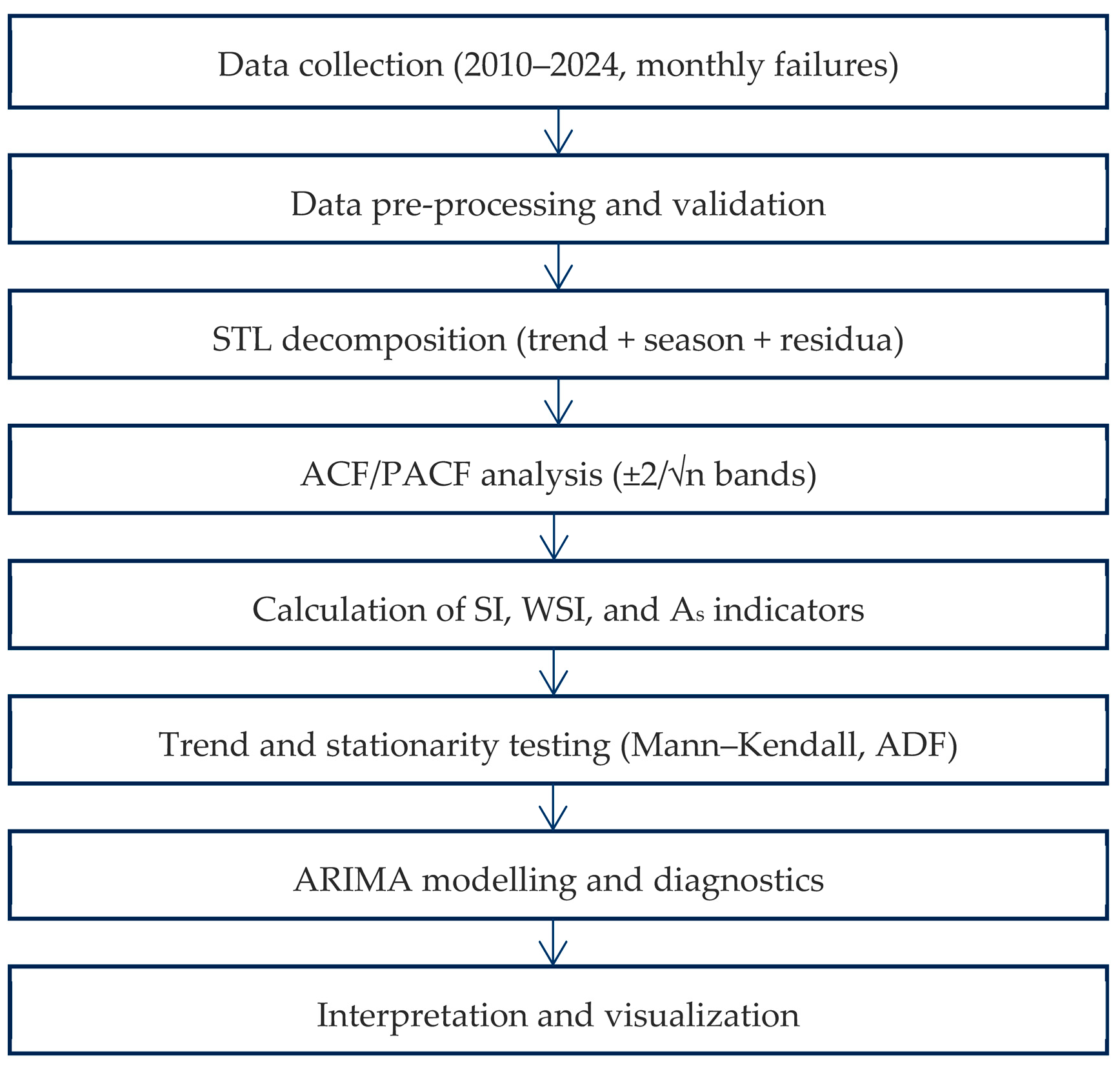
The overall workflow included the following stages:
Exploratory data analysis, as basic statistics (mean, variance, coefficient of variation) and visualization of monthly failure distributions;
Seasonal decomposition through extraction of seasonal, trend, and residual components using STL;
Autocorrelation and ARIMA analysis, as detection of periodicity and lag-dependent relationships;
Seasonal index computation (SI) quantification of relative monthly deviations;
Winter–Summer Index (WSI) measure of seasonal contrast between cold and warm periods;
Trend and amplitude evaluation through analysis of long-term stability of the seasonal component.
2.3. Seasonal Decomposition (STL Method)
Seasonal and trend decomposition was performed using the STL (Seasonal and Trend decomposition using LOESS) algorithm, which decomposes a time series into three additive components [
16,
19]:
where
Yt is the observed monthly number of failures,
Tt is a long-term trend component,
St is the seasonal (periodic) component, and
Rt is the random residual term.
The decomposition was implemented with a seasonal period of 12 months. The amplitude of the seasonal component AS was defined as the difference between maximum and minimum values of St within each year, providing a measure of the strength of seasonality.
2.4. Autocorrelation Analysis Using ACF and PACF
The Autocorrelation Function (ACF) and Partial Autocorrelation Function (PACF) were computed to assess the persistence and periodicity of the failure monthly frequency.
For a lag
k, the autocorrelation coefficient
ρk was calculated as [
20,
21]:
where
ρk is the autocorrelation at lag
k;
Yt is the value of the time series at time
t;
is the mean of the series; and
n is the number of observations.
A significant positive correlation at lag = 12 months indicates a repeating annual pattern, confirming seasonality. Confidence intervals of ±2/√n were applied to determine statistical significance.
2.5. ARIMA Modelling
The Autoregressive Integrated Moving Average (ARIMA) model is a stochastic process used to analyse and forecast time-dependent data by combining autoregressive (AR) and moving average (MA) components with differencing operations to achieve stationarity.
The seasonal extension of this model, known as Seasonal ARIMA (SARIMA), incorporates periodic patterns by adding seasonal terms with a defined period
s, making it suitable for datasets exhibiting annual or monthly cycles [
25,
26].
Mathematically, the general SARIMA model is denoted as:
where
B is the backshift operator;
p,
d,
q are non-seasonal autoregressive, differencing, and moving-average orders;
P,
D,
Q are the seasonal autoregressive, differencing, and moving-average orders;
s is the seasonal period (12 months);
Yt is the observed time series;
εt is the white-noise error term;
Φ,
Θ are seasonal AR and MA operators; and
ϕ,
θ are non-seasonal AR and MA operators.
2.6. Seasonal Index (SI) Definition and Computation
The Seasonal Index (SI) was used to express the relative monthly deviation from the overall mean failure rate [
22,
23]:
where
Yi is the average number of failures in month
i (averaged across years), and
is the grand mean across all months.
Values SI > 100 indicate months with above-average failure frequency (typically winter), while SI < 100 indicates below-average failure frequency (summer).
2.7. Winter–Summer Index (WSI) Calculation and Thresholds
To quantify seasonal asymmetry, the Winter–Summer Index (WSI) was computed as:
To facilitate the interpretation of seasonal asymmetry in failure occurrence, the Winter–Summer Index (WSI) was categorized into four qualitative levels based on the magnitude of the winter-to-summer ratio. For analytical consistency, the thresholds were adopted as calibration-based ranges, derived from the empirical distribution of WSI values for 2010–2024. The classification was defined as follows:
WSI < 0.9 → summer predominance (fewer winter failures);
0.9 ≤ WSI ≤ 1.1 → balanced seasonality (no distinct dominance);
1.1 < WSI ≤ 1.3 → moderate winter effect (noticeable, yet limited winter excess);
WSI > 1.3 → strong winter dominance (≥30% higher winter failure rate).
These ranges were originally proposed to distinguish between balanced, moderate, and strong winter dominance in Central European sewer systems, where climatic conditions drive frost- and thaw-related failure mechanisms. The qualitative scaling allows for direct comparison across years and supports the identification of periods characterized by enhanced seasonal contrast or its mitigation due to climatic or operational factors [
27].
2.8. Trend Assessment and Long-Term Variability Metrics
The long-term trend of monthly failures was estimated using a locally weighted regression (LOESS) smoothing applied to the trend component Tt.
The Mann–Kendall test was also used to statistically evaluate monotonic trends in the deseasonalized series [
28,
29].
Changes in seasonal amplitude across years were analysed to detect potential reductions in the severity of seasonal fluctuations, indicating possible improvements in network resilience.
2.9. Reproducibility and Software Details
STL decomposition employed a seasonal window of 13 and a trend window of 31, with LOESS degree = 1 and robust iterations enabled to reduce the influence of outliers.
Autocorrelation (ACF) and partial autocorrelation (PACF) functions were computed with 95% confidence bands set at ±2/√
n, where
n = 180 represents the total number of monthly observations. Random perturbations used in sensitivity tests (
Section 3.7) applied a fixed random seed (seed = 123) to ensure repeatability.
A comprehensive overview of analytical steps, parameter settings, and diagnostic results is provided in
Appendix A.
The entire workflow from data pre-processing through STL decomposition, ACF/PACF diagnostics, seasonal index (SI, WSI) computation, and trend testing is summarized in
Figure 1, ensuring full methodological reproducibility.
3. Results
3.1. General Overview of Failure Dynamics
The monthly number of sewer failures between 2010 and 2024 exhibited clear temporal variability with recurrent peaks and troughs corresponding to seasonal transitions.
The dataset comprised 180 monthly observations, with the annual total number of failures ranging from 653 (2014) to 1305 (2020).
The overall mean monthly number of failures was 78.4, with a standard deviation of ±29.5, indicating considerable intra-annual variability (
Table 1).
Visual inspection of the time series revealed a pronounced cyclic pattern, characterized by elevated failure counts during winter months (from December to February) and a marked decline during summer (from June to August). An exceptional maximum of 292 failures was recorded in June 2020 (
Table 1). This anomaly corresponds to a documented large-scale rehabilitation and cleaning campaign conducted by the water utility during that month. The operational intervention temporarily increased the number of recorded failures but did not alter the general seasonal dynamics.
To provide a transparent assessment of the influence of extreme operational events, a dedicated sensitivity analysis was performed. The June-2020 peak (292 failures) corresponds to 7.25 standard deviations above the long-term mean, representing the highest leverage point in the dataset. Two reduced datasets were also analysed: without the June-2020 outlier and without four extreme months exceeding 137 failures. Extreme months were defined a priori using two standard statistical criteria: the 98th percentile of the monthly failure distribution (P98 = 135) and the μ + 2σ rule (137.4 failures). The comparison showed that the overall seasonal structure remained stable across all datasets, with the June-related WSI changing only slightly (from 1.02 in the full dataset to 1.09 without June-2020 and 1.05 without the four extremes) and the STL seasonal amplitude varying by −0.64% (without June-2020) and +5.59% (without four extremes). These results confirm that unusual operational episodes temporarily inflate variance but do not modify the underlying seasonal pattern.
A robustness test was performed by recalculating the indicators after excluding the June 2020 data point. The results demonstrated negligible differences in the calculated metrics: the mean WSI changed from 1.05 to 1.04, the Mann–Kendall τ remained essentially unchanged at ≈0.33 (p < 0.001), and the seasonal amplitude changed by less than 2%. These outcomes confirm that the observed trends and seasonal structures are robust and not affected by this single operational outlier.
The four removed values correspond to operationally documented events (winter bursts and large-scale cleaning campaigns) that temporarily inflated monthly totals. The sensitivity scenario demonstrates robustness of the seasonal structure and ensures that conclusions are not driven by episodic, non-climatic anomalies.
The analysis presented in
Section 3.1 highlighted a visible upward movement in raw annual failure totals. However, interpreting these values without reference to changes in network size or service coverage may lead to misleading conclusions regarding the underlying reliability of the system. Because the sewer network, population served, and number of service connections expanded over the study period, an exposure-adjusted assessment is required to determine whether the increase in raw totals reflects intrinsic failure intensity or is influenced by demographic changes, operational variability, or reporting completeness. To address this issue,
Section 3.2 introduces three exposure-normalized indicators that allow failure dynamics to be evaluated independently of such external factors.
3.2. Exposure-Normalized Failure Indicators
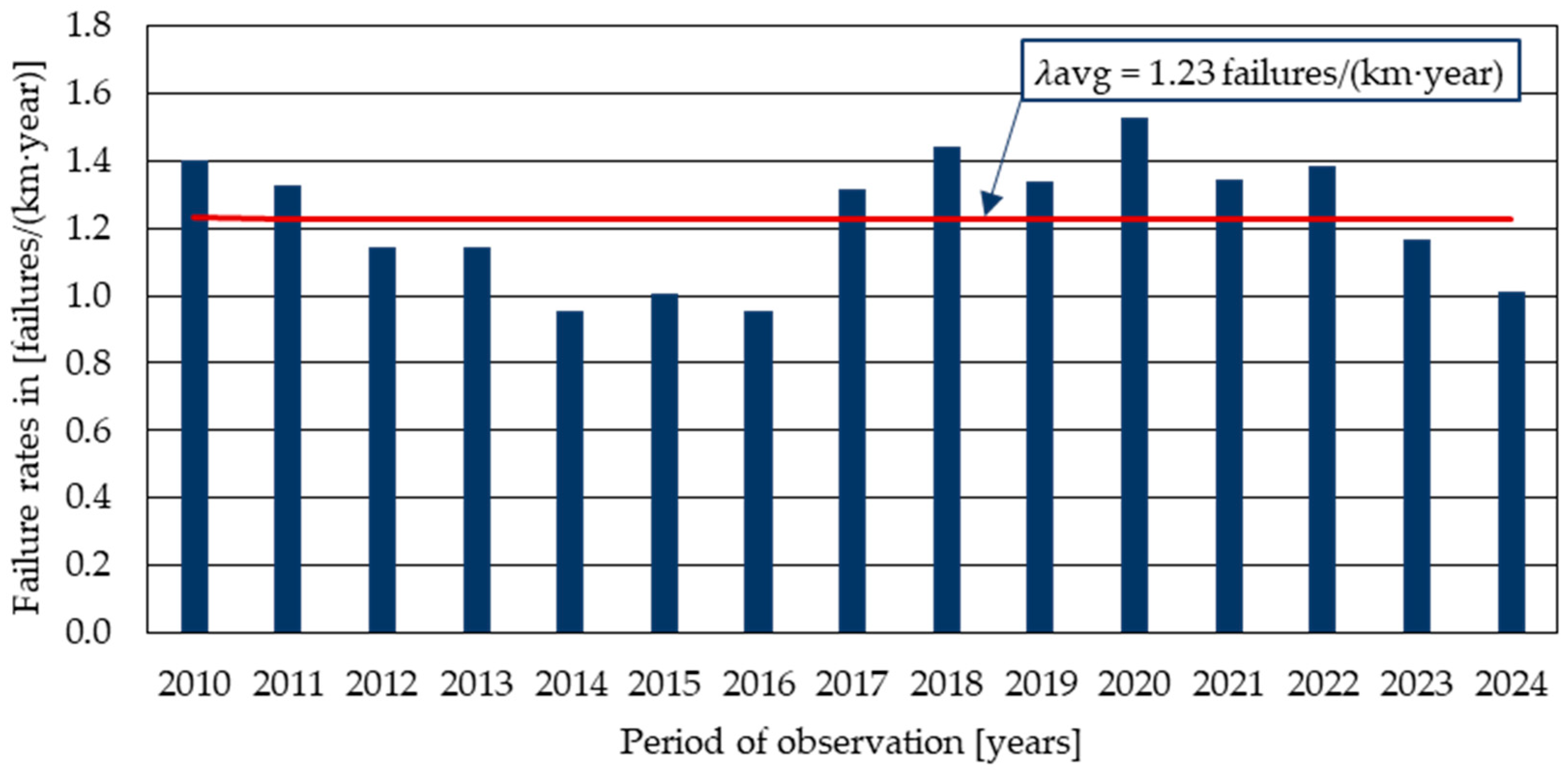
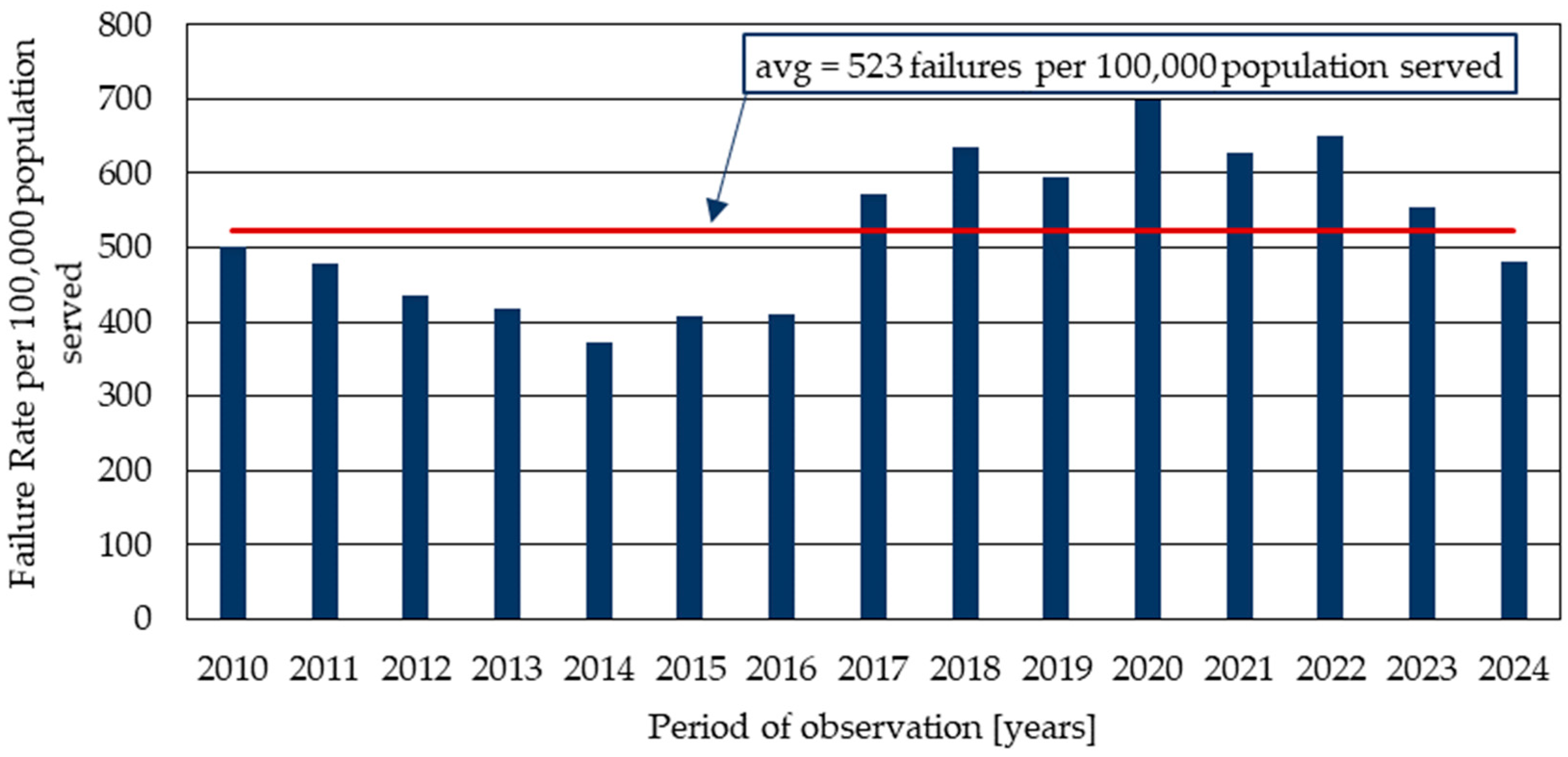
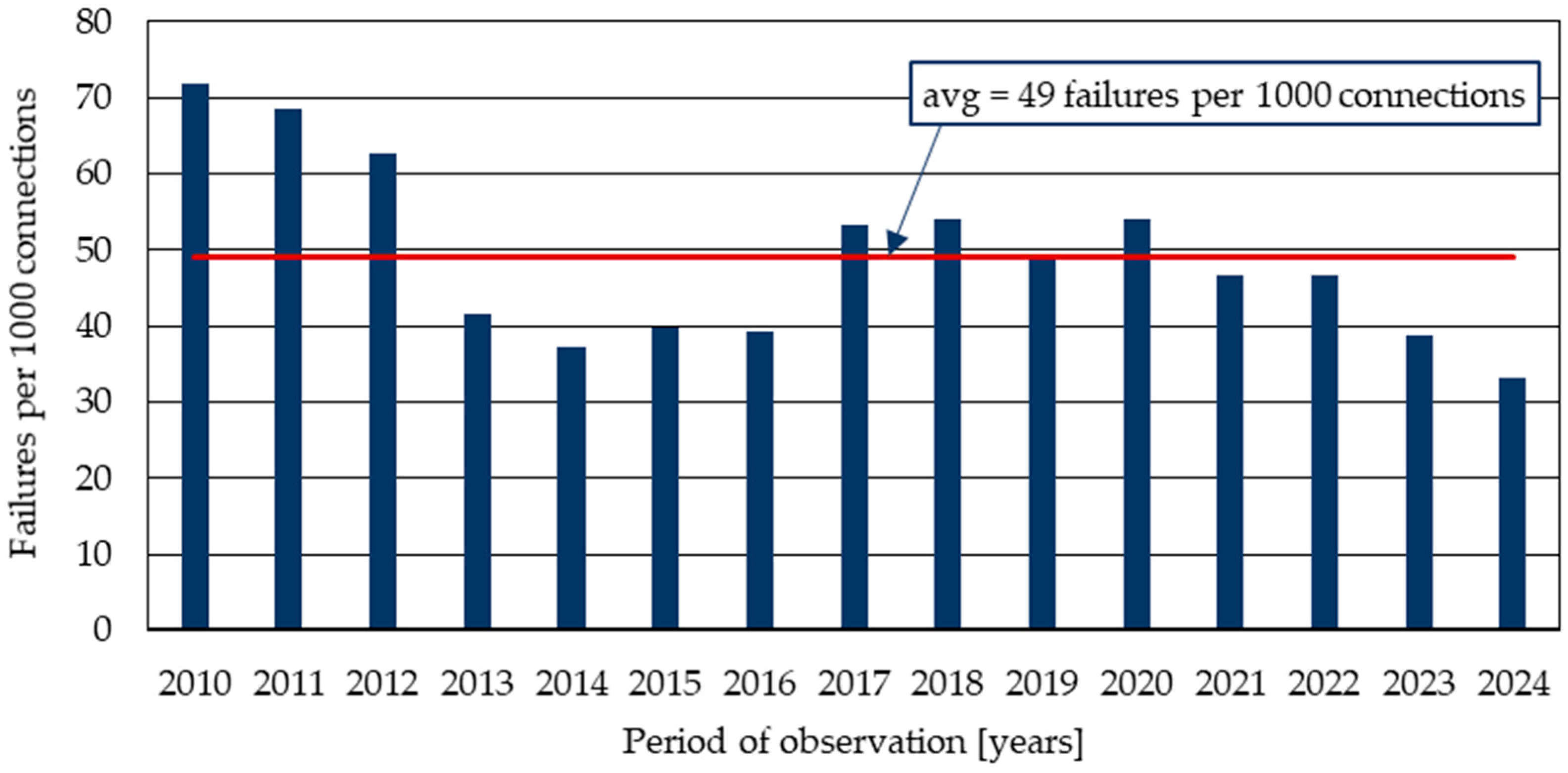
To ensure that the interpretation of temporal patterns in sewer failures is not confounded by changes in system scale or demographic coverage, three exposure-normalized indicators were computed: failures per kilometre of sewer network, failures per 100,000 inhabitants served, and failures per 1000 service connections. These indicators provide an exposure-adjusted assessment of intrinsic failure intensity, allowing genuine reliability changes to be distinguished from effects unrelated to failure intensity, such as demographic changes.
Failures per kilometre of network (
Figure 2) ranged between 0.95 and 1.53 failures/(km·year). Although the values exhibit short-term variability particularly in 2017–2020 no sustained upward trend is observed across the study period. The finding demonstrates that the increase in raw annual failure totals is not caused by a higher intrinsic failure rate, but by operational variability.
Failures per 100,000 population served (
Figure 3) likewise show no monotonic increase. The indicator fluctuated between 372 and 699 failures per 100,000 population served. The decline after 2020 further indicates that demographic growth contributes to the rising totals in the unadjusted series. Importantly, population-normalized rates do not suggest any deterioration in service performance.
Failures per service connection (
Figure 4) display the most pronounced long-term pattern. The rate decreased substantially from 71.9 failures per 1000 connections in 2010 to 33.2 in 2024. Despite short-lived increases during 2017–2020, the overall downward trajectory confirms that the system’s reliability at the connection level has improved over time. This indicator, which directly reflects customer-level exposure, strongly reinforces the conclusion that intrinsic failure intensity has not increased.
Taken together, the three exposure-normalized metrics provide convergent evidence that the upward movement observed in raw failure totals is not indicative of declining infrastructure condition.
The Mann–Kendall (MK) test was applied to the three exposure-normalized indicators to verify the presence of any monotonic trends. No significant trend was detected for failures per kilometre (Z = 0.396, p = 0.692, τ = 0.086) nor for failures per 100,000 inhabitants (Z = 1.584, p = 0.113, τ = 0.314). In contrast, failures per 1000 connections exhibited a statistically significant decreasing trend (Z = −1.98, p = 0.048, τ = −0.390).
3.3. Seasonal Index (SI) Observed Pattern
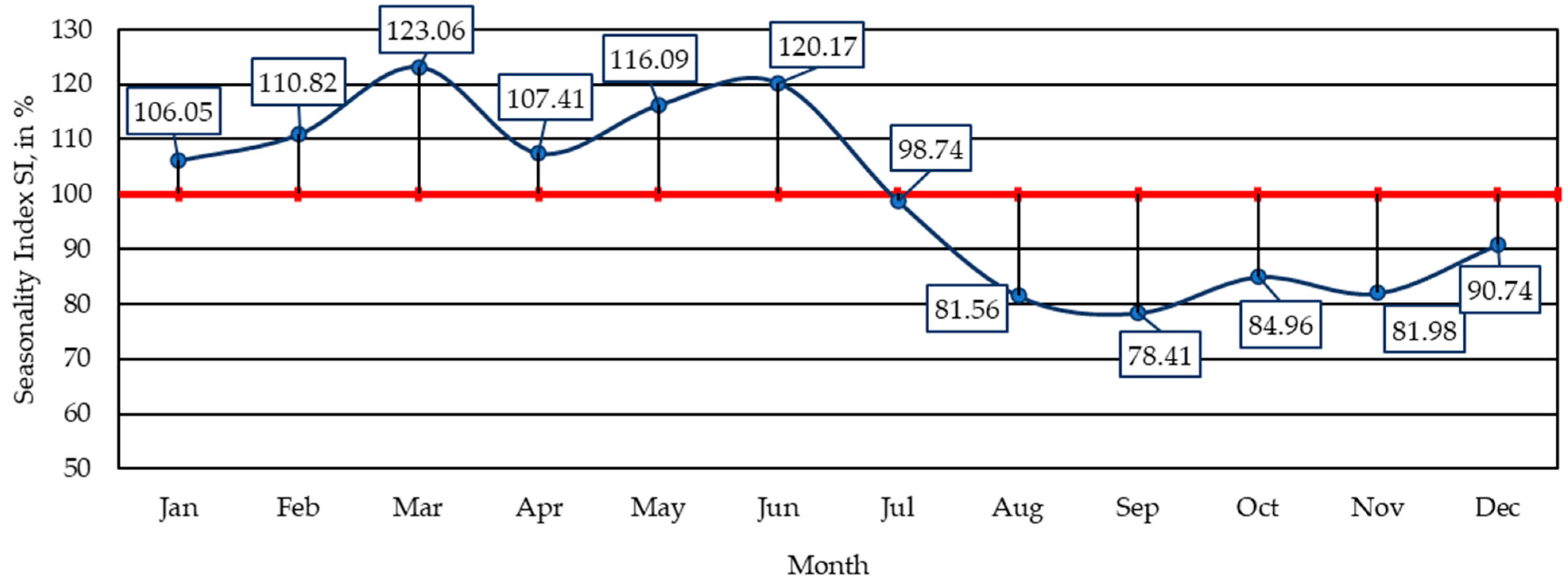
The computed Seasonal Index (SI) confirmed a distinct and repeatable annual cycle of sewer failures.
Average SI values for the 2010–2024 period ranged from 106 to 123% during the winter–spring months (January–March), indicating approximately 6–23% higher failure frequencies relative to the long-term monthly mean.
A clear decline was observed in August and September, with SI values notably below 100%, indicating fewer failures compared with the long-term monthly mean.
Intermediate values were found in April, May, and October, which are typically associated with transitional temperature phases and freeze–thaw activity, both contributing to pipe stress and joint failures.
Overall, the SI curve delineates a typical winter–summer contrast, consistent with climate-related mechanical stresses in buried sewer networks (
Figure 5).
3.4. Autocorrelation Analysis Based on ACF and PACF Results
The autocorrelation analysis was carried out to examine the persistence and cyclical structure of the monthly sewer failure frequency.
Table 2 presents the ACF and PACF coefficients for lags 1–12.
The Autocorrelation Function (ACF) exhibits a strong positive peak at lag = 12 months (r ≈ 0.45), confirming the existence of a pronounced annual cycle in the failure pattern.
Moderate secondary peaks are visible at lags = 6 and 24 months, indicating semi-annual and biannual components, though their amplitude is considerably lower.
This behaviour reflects the repetitive influence of seasonal environmental forcing, such as freeze–thaw alternations, precipitation dynamics, and ground saturation patterns.
The Partial Autocorrelation Function (PACF) shows significant short-term memory up to lag = 2, suggesting that consecutive winter months are interrelated due to persistent climatic and hydraulic stress conditions.
Beyond lag = 3, PACF values rapidly decline and remain statistically insignificant, implying that the system’s response is dominated by short-term and seasonal processes rather than long-term inertia.
The combined ACF-PACF structure thus indicates that seasonality, rather than trend, governs the cyclic behaviour of sewer failures.
The recurrence at 12-month intervals represents the dominant annual forcing typical for temperate-climate networks, where environmental stresses cyclically affect buried pipelines and joints.
Autocorrelation decreases gradually from r = 0.53 at lag 1 to r = 0.45 at lag 12, while PACF values decline more sharply after the second lag.
This confirms that most of the serial dependence arises from the yearly repetition of similar seasonal conditions, with limited multi-year persistence.
Model diagnostics including the residual autocorrelation (ACF), partial autocorrelation (PACF), and normal Q–Q plots are provided in
Supplementary Materials. Figures S1–S3 in the Supplementary Materials show the ACF, PACF and Q–Q plots of residuals from the ARIMA (2,0,1)(1,0,0)
\12 model. All parameters remain statistically significant (
p < 0.001), but the Ljung–Box test yields
p-values well below 0.05, indicating that residuals still exhibit significant autocorrelation and the model does not fully meet the white-noise assumption.
A complementary outlier-sensitivity analysis demonstrated that the removal of extreme months improves residual diagnostics but does not alter the identification of the 12-month seasonal cycle. Removing the June-2020 outlier and the four most extreme months slightly improved the diagnostic statistics (p ≈ 0.00015 and p ≈ 0.005, respectively), but the residuals still failed to reach the 0.05 threshold for the Ljung–Box test.
Additional residual diagnostics for the reduced datasets (without June 2020 and without the four extreme months) are provided in
Figures S4–S9 and Table S2.
3.5. ARIMA Model Identification and Estimation Procedure
Model identification followed the Box–Jenkins approach, consisting of the following steps: stationarity assessment, parameter identification, model estimation and selection, and diagnostic checking. The series was examined using the Augmented Dickey–Fuller (ADF) test. The Augmented Dickey–Fuller test applied to the raw monthly failure series indicated non-stationarity (ADF statistic = −1.04, lag = 12, p = 0.737). The number of observations used by the test was 167 due to automatic lag selection. This behaviour is expected for a series with a strong seasonal component. After removing seasonality through STL decomposition, the deseasonalized series met the stationarity requirement for trend testing and ARIMA modelling. The ADF test indicated that the original monthly series was non-stationary (p = 0.73). Stationarity was achieved only after seasonal adjustment, and the deseasonalized series was subsequently used for ARIMA modelling.
Parameter estimates, standard errors, AIC/BIC values and residual diagnostics for the ARIMA (2,0,1)(1,0,0)
\12 model are summarised in
Table S1. A comparison with alternative models is provided in
Table S3.
Autocorrelation (ACF) and partial autocorrelation (PACF) functions were used to determine the structure of autoregressive and moving average components. A distinct peak in ACF at lag = 12 indicated annual seasonality, while PACF values up to lag = 2 revealed short-term dependencies.
Several candidate models were evaluated, including ARIMA(1,0,0)(1,0,0)\12, ARIMA(1,0,1)(1,0,1)\12, and ARIMA(2,0,1)(1,0,0)\12. The optimal model was selected based on the lowest Akaike Information Criterion (AIC) and Bayesian Information Criterion (BIC) values. The residuals were analysed using the Ljung–Box Q-test and autocorrelation plots of residuals.
Residual diagnostics showed that the Ljung–Box Q-test indicated significant autocorrelation (
p < 0.05) and modest deviations from normality. Consequently, the ARIMA (2,0,1)(1,0,0)
\12 model was used for descriptive and diagnostic purposes only; more flexible models (with seasonal differencing or log-transformation) are discussed in the
Supplementary Materials, Table S3.
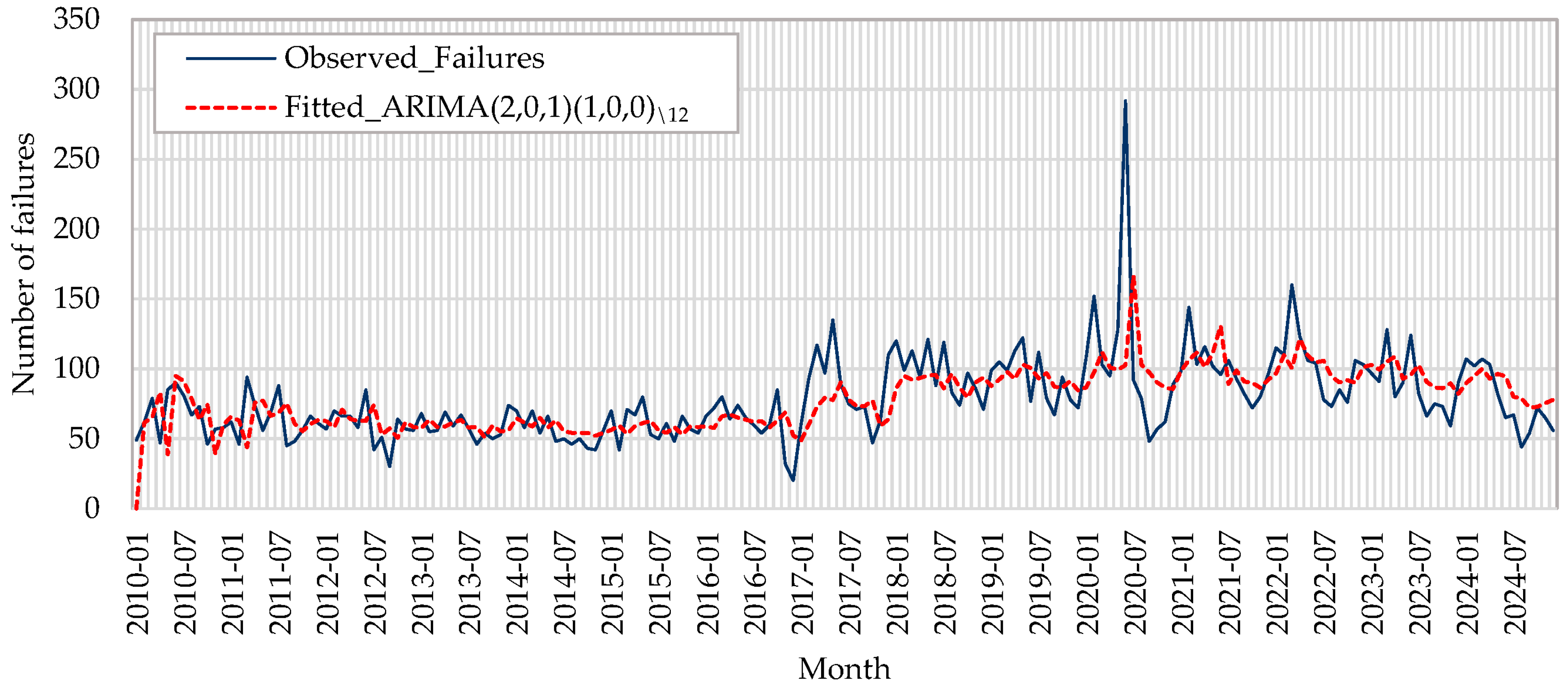
In this study, the ARIMA(2,0,1)(1,0,0)
\12 model was used solely for descriptive and diagnostic purposes, i.e., to characterize temporal dependencies and validate the consistency of the seasonal cycle within the analysed period. No out-of-sample forecasting was performed, as the primary objective was to confirm the internal stability of the failure dynamics rather than to predict future values. This diagnostic interpretation aligns with the methodological scope of the study, emphasizing model adequacy and seasonal structure rather than predictive performance (
Figure 6).
3.6. Seasonal Decomposition (STL Analysis)
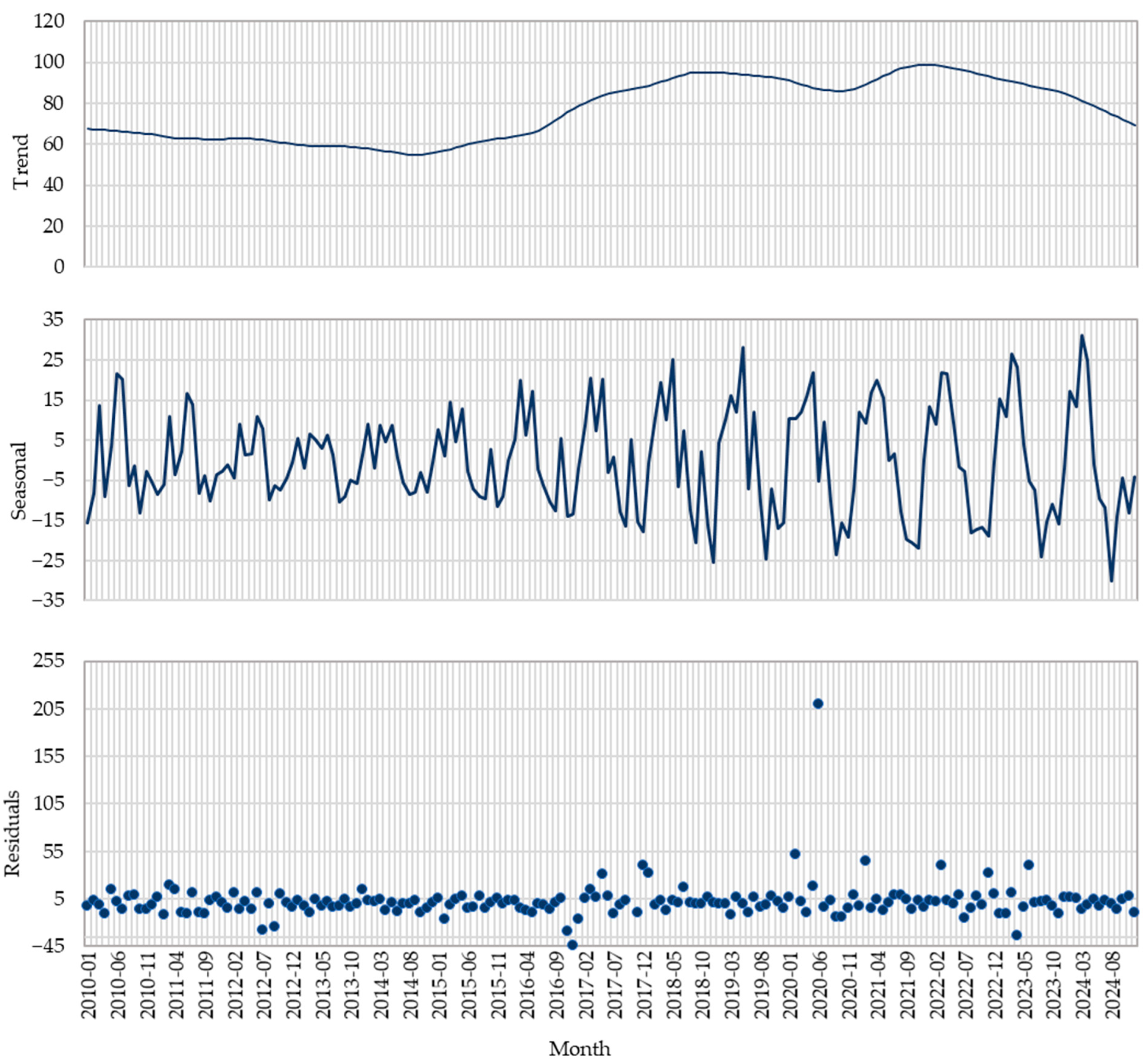
The STL decomposition separated the failure monthly frequency into trend, seasonal, and residual components (
Figure 7).
The seasonal component revealed a distinct and repeatable annual cycle, with stable amplitude and consistent phase across the 2010–2024 period. Peaks were systematically observed in March, reflecting late-winter freeze–thaw stress, whereas minima occurred in September, when hydraulic and thermal loads were lowest. The difference between seasonal extremes reached approximately 61 failures per month, indicating a pronounced winter predominance.
The trend component exhibited moderate variability, with a gradual increase between 2010 and 2020, reflecting network aging and cumulative stress factors (e.g., groundwater infiltration, material fatigue). After 2020, the trend stabilized and slightly declined, likely associated with rehabilitation works and possibly milder winter conditions in recent years. Overall, the long-term trend indicates partial improvement of system reliability following infrastructure renewal measures.
The residual component represented short-term irregularities and extreme events, including episodic winter peaks (e.g., 2010, 2012, 2021) that exceeded seasonal expectations. These fluctuations accounted for less than 15% of the total variance, confirming that the majority of temporal variability is explained by predictable seasonal and trend-related dynamics.
The extreme peak in June 2020 corresponds to a documented maintenance and cleaning campaign that temporarily increased recorded failures. Although this observation temporarily distorts the scale of visualization, it reflects a genuine operational anomaly rather than a data artefact. The STL method, being robust to outliers, maintains stable estimates of the underlying seasonal and trend components despite this event.
The STL results confirm a strong and consistent seasonal signature in sewer failures, dominated by winter effects, while long-term stabilization trends suggest adaptive management and infrastructure improvements in the studied system.
The STL decomposition was additionally recomputed for the two reduced datasets. Despite minor differences in residual scale, the seasonal shape and phase remained unchanged, and the annual amplitude varied within a narrow range (61.03 in the full dataset; 60.64 without June-2020; 64.44 without four extremes). This confirms that the intrinsic seasonal component is structurally stable even after removing statistically influential months.
3.7. Winter–Summer Index (WSI) Interannual Variability
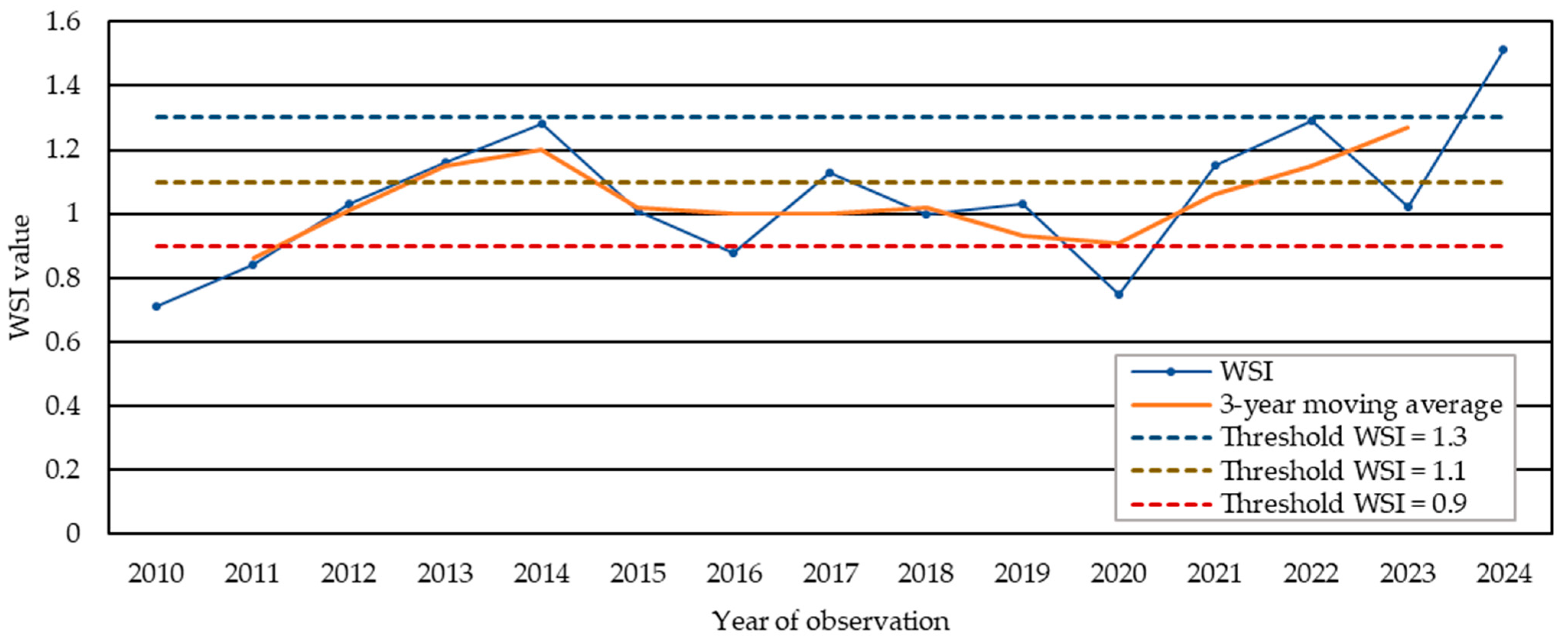
The WSI values calculated for individual years ranged between 0.71 and 1.51, with a mean of 1.05, indicating a nearly balanced seasonal behaviour and only a slight predominance of winter failures.
After 2020, a moderate increase in WSI values suggests the re-emergence of winter-related stress effects, although the overall seasonal asymmetry remains lower than in earlier periods (
Figure 8).
To reduce short-term variability and highlight the underlying trend, a 3-year moving average was applied to the WSI time series, which smooths single-year anomalies and reveals gradual changes in the winter–summer contrast.
The gradual stabilization of WSI and the moderate increase in the amplitude of seasonal variation indicate that seasonal contrasts have remained persistent and have slightly strengthened over time, likely reflecting the combined influence of climatic variability and systematic network rehabilitation.
Nevertheless, the intra-annual variability remains statistically significant (p < 0.05), confirming that temperature- and load-dependent mechanisms continue to shape sewer failure dynamics.
Table 3 presents the annual mean number of failures in winter (Dec–Feb) and summer (Jun–Aug), the computed Winter–Summer Index (WSI), and its categorical interpretation.
The results show that most annual WSI values oscillated around unity, suggesting a generally balanced seasonal pattern, with only slight winter predominance in certain years.
Periods such as 2024 exhibited strong winter dominance (WSI > 1.3), whereas years like 2010 and 2020 showed reversed (summer-biased) behaviour.
The mean WSI = 1.05 indicates that, over the 15-year observation period, the system maintained near-balanced but still climate-sensitive seasonal dynamics.
A sensitivity test was conducted by introducing ±10% random perturbations to monthly failure counts. The recalculated WSI values did not change the category assignment in any year (2010–2024), confirming the robustness and stability of the adopted classification thresholds.
3.8. Trend Results and Long-Term Variability
The smoothed trend component derived from STL decomposition and LOESS regression revealed moderate interannual variability, with higher annual totals in 2011, 2017, and 2020, and relatively low counts in 2014 and 2015.
The Mann–Kendall test applied to the deseasonalized monthly failure series returned Z ≈ 0.89, p = 0.37, confirming the absence of a statistically significant monotonic trend after removing seasonal effects. In contrast, the same test performed on the raw monthly series yielded τ ≈ 0.33, p < 0.001, indicating a weak but statistically significant upward tendency. For clarity, the raw series shows a weak but statistically significant monotonic trend (τ ≈ 0.33, p < 0.001), whereas the deseasonalized series shows no monotonic trend (Z ≈ 0.89, p = 0.37).
Table 4 summarizes the results of all trend tests performed for the analysed time series, including raw failures, deseasonalized values, and seasonal indicators. The standardized presentation enables direct comparison of trend direction and significance across series. The monthly trend tests were based on 180 observations (2010–2024), whereas annual indicators such as WSI and A
S were derived from 15 yearly values.
The lack of a significant trend in the deseasonalized series suggests that the underlying frequency of failures remained stable once cyclic effects were removed. The statistically significant upward trend observed in the raw series indicates a cumulative increase in recorded events. The seasonal amplitude exhibited a statistically significant increasing tendency over 2010–2024; therefore, this indicator alone does not provide evidence of enhanced resilience but rather points to a moderate strengthening of the winter–summer contrast.
4. Discussion
4.1. Interpretation of Seasonal Patterns
The SI, ACF, and STL results confirm a distinct annual cycle, with elevated winter levels peaking in March and the lowest values observed in September. Temperature-related mechanisms, principally freeze–thaw transitions, frost penetration, and associated soil–pipe interaction, remain the dominant drivers shaping this seasonal pattern.
Freeze–thaw cycles cause volumetric soil expansion and localized mechanical stresses on pipe walls and joints, particularly affecting older vitrified clay and early-generation PVC pipes. The pronounced ACF peak at a 12-month lag (r = 0.45) illustrates the regularity of these climatic influences.
The mean Winter–Summer Index (WSI = 1.05) indicates a nearly balanced pattern with only slight winter predominance, while the STL seasonal amplitude remained close to approximately 61 failures, and the annual amplitude showed a modest but statistically significant increasing tendency.
Trend analysis clarifies that no significant monotonic trend is present in the deseasonalized series (Z ≈ 0.89, p = 0.37), whereas the raw monthly counts exhibit a weak but statistically significant upward tendency (τ ≈ 0.33, p < 0.001).
A dedicated sensitivity analysis demonstrates that extreme operational months, including the June-2020 outlier, do not alter the core seasonal structure. Seasonal indicators (WSI, SI) and the STL seasonal shape remain stable across all reduced variants, confirming that the winter–summer contrast reflects intrinsic system behaviour rather than artefacts generated by episodic events.
4.2. Relationship to Climatic Conditions and Infrastructure Resilience
Although the analysis is based solely on operational failure data, the seasonal behaviour clearly reflects regional climatic variability, particularly air and soil temperature fluctuations typical for south-eastern Poland. The seasonal amplitude showed a consistent seasonal structure but displayed a statistically significant increasing tendency throughout the study period, indicating a moderate strengthening of seasonal contrasts despite year-to-year climatic fluctuations and rehabilitation programs.
This indicates partial adaptation of the sewer system to changing climatic conditions. At the same time, the statistically significant upward trend in raw failures (τ ≈ 0.33, p < 0.001) indicates persistent influence of asset aging and cumulative operational stress, rather than climatic intensification. These combined effects reduced climatic sensitivity but increasing overall failure counts suggest that modernization efforts have improved thermal resilience but have not offset long-term material degradation.
Monitoring seasonal indicators such as SI, WSI, and AS therefore remains essential for evaluating how climatic variability interacts with operational and aging-related stresses and for supporting adaptive maintenance strategies.
4.3. Comparison with Previous Studies
The seasonal structure identified in this study is consistent with patterns reported for sewer and water distribution networks operating in temperate-climate regions. The clear annual cycle and the predominance of winter failures correspond to findings from the Netherlands [
30], Norway [
31], Denmark [
32], and Poland [
33,
34,
35], where cold-season occurrences are typically 40–60% higher due to temperature variability and freeze–thaw processes.
Early regional analyses also highlighted the influence of climatic forcing. Królikowska [
5] demonstrated the spatial and structural heterogeneity of sewer failures in southern Poland, showing strong sensitivity to seasonal ground movements. Similar cyclic behaviour driven by temperature fluctuations was reported by Iwanek et al. [
3] and Hluštík and Zeleňáková [
36] for Central European systems, emphasizing the combined effect of climate and construction features (e.g., pipe material, soil type).
International research further supports the strong climatic dependency of failure dynamics. Wols and Van Thienen [
32] and Wols et al. [
30] documented statistically significant relationships between minimum air temperature, precipitation, and pipe failure rates, with lagged responses comparable to the 12-month autocorrelation identified in this study. Bruaset and Sægrov [
31] confirmed reduced mechanical reliability during cold periods, while Kho et al. [
37] warned that increasing temperature variability under climate change may intensify infrastructure vulnerability.
Comparable patterns have been observed in drinking water systems. Żywiec et al. [
33] and Pietrucha-Urbanik et al. [
34] showed strong increases in failure rates during negative temperatures, consistent with global findings by Fan et al. [
38] indicating that temperature fluctuations are key predictors of pipe bursts. These parallels reinforce that temperature-dependent stresses, rather than hydraulic loads alone, are central to the seasonal performance of buried pipelines.
From a reliability engineering standpoint, Miszta-Kruk [
39] and Ghavami et al. [
40] emphasized the need to incorporate climatic factors into probabilistic and GIS-based operational risk models. Kwietniewski [
41] similarly observed that both sewer and water-supply networks show elevated winter failure intensity in Poland, highlighting the universality of seasonal forcing across infrastructure types.
Collectively, these studies corroborate the findings of this analysis: sewer failures in temperate climates exhibit a robust annual periodicity driven primarily by freeze–thaw processes and soil–pipe interaction. While the seasonal contrast remained relatively stable and even showed a moderate increase in amplitude, the overall rise in total failure counts (τ ≈ 0.33, p < 0.001) suggests that cumulative aging increasingly influences system reliability.
4.4. Practical Implications for Network Management
Recognizing and quantifying seasonal patterns provides a valuable basis for operational planning and resilience monitoring. The identified annual cycle enables utilities to anticipate periods of elevated failure risk and adjust maintenance strategies accordingly. Given the moderate winter predominance (WSI = 1.05) and the relatively stable, though slightly increasing, seasonal amplitude, preparatory actions should be concentrated in early autumn to reduce vulnerability to winter-related stresses.
The statistically significant upward trend in total failures (τ ≈ 0.33, p < 0.001) indicates that aging and cumulative material fatigue remain key long-term challenges, even though seasonal contrasts have not weakened and instead show a moderate strengthening over time. This highlights the need to integrate seasonal diagnostics with deterioration modelling and transition from reactive repairs toward predictive, data-driven asset management.
Emerging climatic conditions in Central Europe may gradually shift dominant stressors from temperature-driven mechanisms toward hydraulically induced risks, such as infiltration, surcharge, or surface inflow during high-intensity rainfall. Monitoring indicators such as SI, WSI and seasonal amplitude can support early detection of this shift and guide adaptation of maintenance priorities.
Long-term operational datasets remain essential for tracking these evolving patterns and enabling climate-aware, risk-based management of sewer networks.
4.5. Limitations and Future Outlook
While the analysis successfully captured robust seasonal dynamics using only failure data, certain limitations must be acknowledged.
The lack of daily resolution prevents identification of short-term weather–failure interactions (e.g., after frost or intense rain events).
Furthermore, the approach does not distinguish between pipe materials or diameters, which may exhibit different susceptibility to temperature stress.
Future research should integrate high-resolution meteorological data, material inventory databases, and machine learning models (e.g., GAM, XGBoost) to quantify non-linear interactions and enhance predictive capability.
Nevertheless, the consistency and clarity of the detected seasonal signal confirm that long-term failure records alone are sufficient to characterize intrinsic cyclical behaviour and evaluate the resilience of sewer infrastructure in changing climatic conditions.
4.6. Operational Guidance
The results of the seasonal indicators (SI, WSI, and As) allow the development of practical decision rules supporting maintenance planning and resource allocation.
If the WSI ≥ 1.3, the system shows a clear winter predominance, indicating an increased likelihood of pipe blockages or collapses related to freeze–thaw stress and hydraulic overloads. In such conditions, preventive cleaning, CCTV inspection, and rehabilitation works should be scheduled between September and October, before the onset of low-temperature periods.
If the WSI ≤ 0.9, summer effects dominate and failures are often linked to infiltration, corrosion, or biofilm development. In these cases, inspection and repair of joints and service connections should be prioritized in May–June, before the dry-season low flows.
For balanced conditions (0.9 < WSI < 1.1), utilities should maintain regular inspection intervals and use trend information to optimize the timing of interventions. The operational thresholds transform statistical findings into clear preventive-maintenance strategies that can be directly adopted by water and sewerage companies.
4.7. External Validity
The seasonal patterns observed in this study reflect the climatic and operational context of the city in southern Poland, where cold winters and moderate summers strongly influence sewer failure dynamics. Although only operational failure data were analysed, structural characteristics such as pipe material, age, and diameter may affect the magnitude of seasonal indicators (SI, WSI, As) and should be considered when applying the methodology to other systems.
In milder or maritime climates, seasonal amplitude is expected to be lower and WSI values closer to unity due to limited freeze–thaw stress. Conversely, in colder continental regions, stronger temperature variability may increase seasonal contrast and shift the practical threshold for winter predominance above 1.3. Network-specific features can further modify seasonal sensitivity: older clay or concrete pipes typically show greater vulnerability to temperature-related loads compared with modern PVC or PE systems.
These factors constitute contextual limitations but also demonstrate that the analytical framework remains adaptable across climatic zones and construction typologies. Similar regional contrasts in climatic forcing, pipe material behaviour, and freeze–thaw exposure were previously reported by Wols et al. [
30] and Bruaset and Sægrov [
31].
5. Conclusions
The study presented a data-driven analysis of the seasonal behaviour of sewer network failures based on a long-term operational dataset (2010–2024). The research, conducted exclusively on failure records without meteorological covariates, demonstrated that intrinsic time-series characteristics are sufficient to reveal the cyclical and trend components of sewer system performance.
The key findings and implications are as follows:
A distinct annual seasonality was confirmed, with pronounced peaks in March and minima in September.
The 12-month autocorrelation peak (r ≈ 0.45) and the STL seasonal component (≈61 failures) confirm a strong annual cycle; furthermore, the annual seasonal amplitude shows a statistically significant increasing trend (slope ≈ 1.79 failures per year, p < 0.001), indicating a moderate strengthening of seasonal contrasts over the study period.
The mean Winter–Summer Index (WSI = 1.05) reflects an almost balanced seasonal pattern with a slight predominance of winter failures.
The STL seasonal amplitude averaged about 61 failures but increased modestly over time. Removing the June 2020 outlier and the four most extreme months had negligible effect on this amplitude, indicating that seasonal contrasts were not driven by episodic anomalies and that the observed increase reflects the combined influence of climatic variability and rehabilitation efforts rather than sampling artefacts.
Trend analysis clearly distinguished between raw and deseasonalized series. The Mann–Kendall test for the raw monthly counts (τ ≈ 0.33, p < 0.001) indicated a weak but statistically significant upward tendency, whereas the deseasonalized series exhibited no monotonic trend (Z ≈ 0.89, p = 0.37).
Exposure-normalised indicators failures per kilometre, per 100,000 population served, and per 1000 service connections likewise showed no sustained upward trend, with failures per connection demonstrating a statistically significant decreasing trend.
These results confirm that the increase in raw failure totals does not reflect a deterioration of infrastructure condition but is instead linked to short-term operational variability.
The seasonal structure remains dominated by temperature-related mechanisms, including frost penetration, freeze–thaw fatigue, and soil-pipe interaction, although their influence appears to have moderated in recent years.
Diagnostic checks revealed that residuals from the ARIMA (2, 0, 1)(1, 0, 0)\12 model exhibited significant autocorrelation (Ljung–Box p < 0.05). Consequently, the model was used for descriptive purposes only, and further research should test models incorporating seasonal differencing or log transformations to obtain residuals closer to white noise.
The findings are consistent with studies from other temperate European regions, supporting the broader applicability of the results.
From a practical standpoint, quantifying seasonal failure patterns provides a basis for optimising maintenance scheduling, resource allocation, and risk-based asset management. Preventive inspections and cleaning operations should be prioritised in autumn to mitigate elevated winter failure risk.
This study demonstrates that long-term operational failure records can effectively capture both intrinsic seasonality and long-term variability in sewer systems. The proposed analytical framework is transferable to other utilities seeking to evaluate infrastructure resilience, assess climatic sensitivity, and develop predictive maintenance strategies based on existing operational data.
Future research should not only integrate climatic predictors, high-resolution meteorological datasets and AI-based analytical tools but also explore refined time-series models (e.g., SARIMA with seasonal differencing, SARIMAX with temperature and precipitation as exogenous regressors, or log-transformed ARIMA) to improve residual diagnostics and capture non-stationary dynamics. Incorporating seasonal indicators (SI, WSI, AS) into early-warning and asset-management systems will support utilities in developing climate-adaptive maintenance strategies and improving long-term system resilience.