Article

Shallow Groundwater Pollution Risk Assessment in the Plain Area of Baoji City, China


1
School of Water and Environment, Chang’an University, Xi’an 710054, China
2
Key Laboratory of Subsurface Hydrology and Ecological Effects in Arid Region (Ministry of Education), Chang’an University, Xi’an 710054, China
3
Key Laboratory of Eco-Hydrology and Water Security in Arid and Semi-Arid Regions of the Ministry of Water Resources, Chang’an University, Xi’an 710054, China
4
Shaanxi Institute of Engineering Prospecting Co., Ltd., Xi’an 710068, China
5
China Certification & Inspection Northwest Ecological Technology (Shaanxi) Co., Ltd., Xi’an 710018, China
*
Author to whom correspondence should be addressed.
Sustainability 2025, 17(24), 11213; https://doi.org/10.3390/su172411213
Submission received: 25 October 2025 / Revised: 22 November 2025 / Accepted: 9 December 2025 / Published: 15 December 2025

Abstract

Groundwater pollution risk assessment is crucial for sustainable groundwater management. However, accurately evaluating groundwater pollution risk presents significant challenges due to the complexity and multitude of influencing factors. In this study, the traditional DRASTIC model for groundwater vulnerability assessment was improved. By integrating groundwater vulnerability, pollution load, and value function, a holistic assessment framework was developed to analyze pollution risks of shallow groundwater across the plain region of Baoji City. The analytic hierarchy process method was used to determine indicator weights. Results indicate that the general level of groundwater pollution risk in the Baoji Plain is comparatively low. Compared with the traditional DRASTIC model, the proportion of high and relatively high pollution risk areas based on the improved DRSTICW model superimposed pollution risk model accounts for 3.72%, which is reduced by 12.57% but is more reasonable. These high and relatively high pollution risk areas are predominantly located in the western floodplain area, where the groundwater vulnerability, pollution load, and value function are all high. Although the distribution range is limited, they are located in densely populated and industrial agglomeration areas. Accurately identifying such high-risk areas and implementing priority control are of great significance for curbing pollution diffusion, safeguarding groundwater resources, and guiding future land use development and management.

1. Introduction

Alongside the rapid growth of the world economy, groundwater resources are facing significant pressure and challenges. Groundwater makes up nearly 99% of liquid freshwater on Earth, supplying drinking water for half of the global population and meeting more than 40% of the global demand for agricultural irrigation water and about one-third of the water used by industrial sectors [1,2,3]. However, due to population growth, accelerated industrialization, and increased agricultural activities, groundwater contamination has become very serious [4,5]. As reported by the United Nations World Water Development Report, nearly 2.2 billion individuals worldwide are without safely managed drinking water [6]. In the arid and semi-arid regions of northwest China, groundwater is not only a vital water source for maintaining ecosystem stability but also a strategic resource underpinning regional socioeconomic development [7]. However, under the synergistic impacts of climate change, economic development, and population growth, the imbalance in groundwater supply versus demand is becoming progressively acute [8,9,10]. Long-term over-extraction of groundwater has caused sustained drawdown of the water table, triggering many issues including aquifer depletion, land subsidence, and ecological degradation [11]. Meanwhile, industrial wastewater discharge, agricultural pollution, and rapid urbanization have collectively induced continuous degradation of groundwater quality [12]. Against this background, taking effective measures to prevent and control groundwater pollution has emerged as a critical challenge for sustainable water resource management and ecological civilization construction [13]. Scientifically establishing a groundwater pollution risk evaluation system can effectually pinpoint high-risk areas and provide important references for the formulation of protection strategies [14].
Groundwater pollution risk assessment originates from groundwater vulnerability. Groundwater vulnerability was first introduced by Margat in 1968 [15]. It reflects the possibility and tendency of the groundwater system to be polluted. Early definitions of groundwater vulnerability primarily focused on intrinsic hydrogeological factors such as the groundwater table, the average groundwater flow velocity, and the permeability of surface sediments [16]. Commonly used evaluation models include DRASTIC, GOD, SI, SINTACS, and PLEIK. With the deepening of research, people have begun to pay attention to the impact of external factors such as human activities and pollution sources on groundwater vulnerability [17]. For example, S. Forster pointed out that the risk of groundwater contamination stems from the aquifer’s inherent vulnerability and the contamination load induced by anthropogenic activities [18]. In the study of the shallow aquifer vulnerability of the Cap Bon peninsula in northeastern Tunisia, the land use type indicator was introduced to represent the pollution caused by human activities [19]. In the study of a typical Chinese karst area, the PLEIK model was coupled with pollution load (considering pollutant toxicity, release probability, and quantity) to rate groundwater contamination risk [20]. In the study of Spain’s Gallocanta basin, a Nitrogen Input Hazard Index assessment model was combined with an optimized DRASTIC model to assess groundwater pollution risk [21]. While considering the possibility of groundwater pollution events, attention should also be paid to the study of disaster loss of a pollution risk receptor—groundwater [22]. Therefore, the change in groundwater value function is also included in the groundwater contamination risk assessment to better inform the urgency of protection measures. For instance, the groundwater pollution risk at oilfield drilling sites in Yitong County, Jilin Province, China, was identified and characterized based on assessments of groundwater contamination hazards, aquifer vulnerability, and groundwater resource value [23]. In the study of the Chengdu Plain, the overlay index method was applied to quantify key indicators (groundwater vulnerability, contaminant load, and the resource’s value) and construct a comprehensive model for evaluating groundwater pollution risk [24].
The plain area of Baoji City, located in the western Guanzhong Plain of Shaanxi Province, China, is an important industrial, agricultural, and densely populated region. Its shallow groundwater is chronically threatened by industrial wastewater, agricultural pollution, and domestic sewage seepage [25]. Although some studies have addressed groundwater quality changes within this region [26,27], systematic and high-precision groundwater pollution risk assessment remains insufficient. Therefore, this study aims to perform the following: (1) construct a groundwater vulnerability assessment model considering typical hydrogeological characteristics; (2) develop a shallow groundwater pollution risk assessment system for the plain area of Baoji City by integrating groundwater vulnerability, pollution load, and groundwater value function; (3) analyze the distribution features of pollution risk to supply references for regional groundwater contamination prevention and sustainable groundwater resource management.

2. Study Area

The plain area of Baoji City lies in the western part of the Guanzhong Plain in Shaanxi Province, China, with Xianyang City to the east and the Qinling Mountains to the south. It spans approximately east longitude 107°02′–108°03′ and north latitude 34°07′–34°38′, with an east–west width of about 93 km and a variable north–south width. Its area is approximately 2780 km2 (Figure 1). The study region exhibits a warm temperate semi-humid climate. Temperature on average throughout the year ranges from 7.6 °C to 12.9 °C. Precipitation during the year averages between 600 mm and 700 mm, concentrated mainly from June to September [28].
The study region is surrounded by mountains to the south, north, and west. Landform types include river floodplain, terrace, alluvial fan, and loess platform. The terrain in floodplain and terrace areas is generally flat, with elevations ranging from 450 m to 800 m. The loess tableland areas have slightly undulating terrain, with elevations between 600 m and 1000 m. The northern and southern alluvial fans have marginally higher elevations, varying between 1000 m and 1202 m. The surface water system primarily consists of the Wei River along with its tributaries. The Wei River, the largest tributary of the Yellow River, flows eastward through Baoji City. The groundwater systems mainly include four types: the alluvial plain pore aquifer system, loess platform fissure–pore aquifer system, piedmont alluvial plain pore aquifer system, and the karst aquifer system [29,30]. The study region is situated within the Weihe fault basin. The Weihe fault basin is located between the Ordos platform syncline and the Qinling fold system, overlain by Quaternary deposits, and forms the Weihe Plain and loess platform. The lithology of the stratum gradually transits from gravel pebbles to sand, silty clay, silt, and loess soil [31]. The water abundance of the phreatic aquifer group is closely related to the thickness of the aquifer, burial conditions, and recharge conditions. The well yield and groundwater runoff modulus of each water-bearing formation are derived from the phreatic hydrogeological map of the Guanzhong Basin. The thickness of the aquifer in river floodplain and low terrace areas is large, and the lithology of the aquifer is mainly sandy gravel, so the water abundance is strong. Alluvial fan areas have aquifers consisting mainly of interbedded sandy gravel layers and cohesive soil with strong structural heterogeneity and limited recharge sources, leading to moderate water abundance. Aquifers in the loess platform areas are primarily composed of fine-grained loess and paleosol layers with poor permeability, deep groundwater levels, and poor recharge conditions, resulting in weak water abundance. The main recharge sources for shallow groundwater are precipitation infiltration, river lateral seepage, irrigation infiltration, and groundwater inflow from the north and south. The general flow direction of the phreatic water is from west to east. Discharge occurs mainly through agricultural extraction, leakage to shallow confined aquifers, and outflow as groundwater flow [32].

3. Research Methods and Data Sources

3.1. Groundwater Pollution Risk Assessment Model

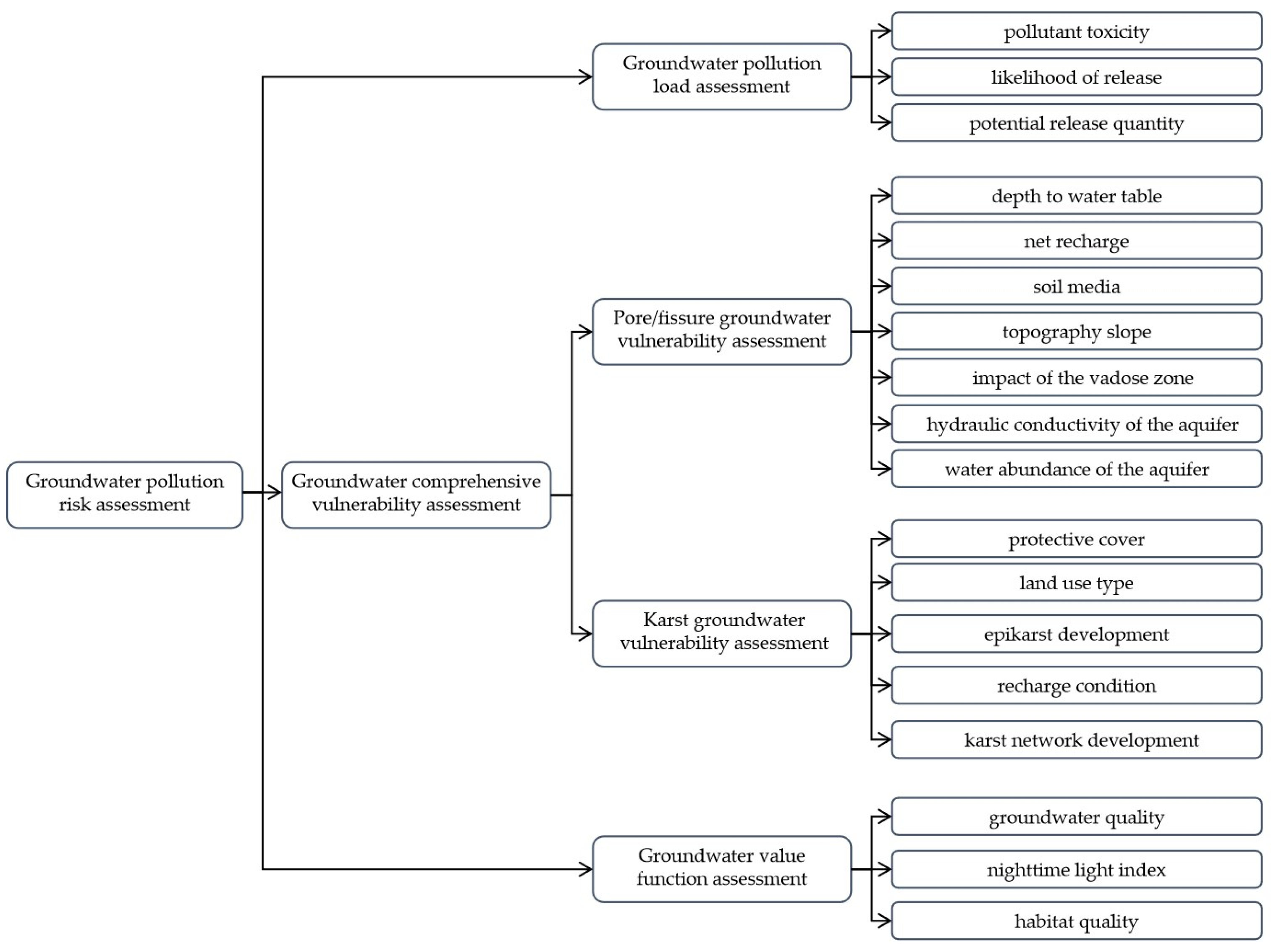
The core of the groundwater pollution risk assessment lies in assessing the likelihood and adverse impacts of groundwater quality deterioration caused by anthropogenic activities or natural factors. The possibility of groundwater quality deterioration can be characterized by assessments of groundwater vulnerability and pollution load. The potential harm of groundwater pollution can be reflected by groundwater value function assessment [33]. Therefore, this study selected these three major factors to construct a groundwater pollution risk evaluation model (Figure 2). The data required for the model and its sources are listed in Table A1. The calculation equation of the model is as follows:
R I = D I × W D + P I × W P + F I × W F
where RI designates the groundwater pollution risk index. DI designates the groundwater vulnerability index. PI represents the groundwater pollution load index. FI is the groundwater value function. WD, WP, and WF are the weight coefficients for DI, PI, and FI, respectively. The groundwater pollution risk increases as the RI value rises.

3.2. Groundwater Vulnerability Assessment

3.2.1. Pore/Fissure Groundwater Vulnerability Assessment

The common models for groundwater vulnerability assessment are GOD, SI, SINTACS, DRASTIC, and PLEIK. The GOD model requires less data and is easy to calculate, but the accuracy of the results is low [34]. The SI model focuses on agricultural pollution and introduces land use type into the evaluation. But it is not applicable to regions with complex pollution sources [3]. PLEIK models are designed for the karst area [35]. The SINTACS model optimizes the weights based on the DRASTIC model and is better suited for the region with a Mediterranean climate [3]. The DRASTIC model, proposed by the United States Environmental Protection Agency (USEPA) in 1987 [36], is commonly used for assessing groundwater vulnerability worldwide because of its low data requirements, efficient analysis, and flexibility [37]. The differences of each model are shown in Table A2. This study adopted the DRASTIC model to assess pore and fissure groundwater vulnerability. To better fit the hydrogeological conditions of the Baoji Plain, this study improved the traditional DRASTIC model. The aquifer media and their hydraulic conductivity provide overlapping or redundant information in the traditional model [38]. The aquifer water abundance index was used to replace the aquifer medium index, and the water abundance was quantified by the well yield. The well yield is a comprehensive indicator that reflects the recharge of the aquifer, the intensity of groundwater runoff, and the water conveyance capacity of the aquifer. The water conveyance capacity of the aquifer is also known as transmissivity (Formula (3)), which is defined as the seepage flow through the aquifer thickness of 1 m in unit time under the condition of the unit hydraulic gradient [39]. The well yield formulas of the diving complete well are shown in Formula (4) [40]. Elevated water abundance correlates with reduced aquifer vulnerability [41]. In addition, the vertical net recharge was optimized by integrating both precipitation infiltration and irrigation return flow (Formula (5)). The modified DRSTICW model equation is as follows:
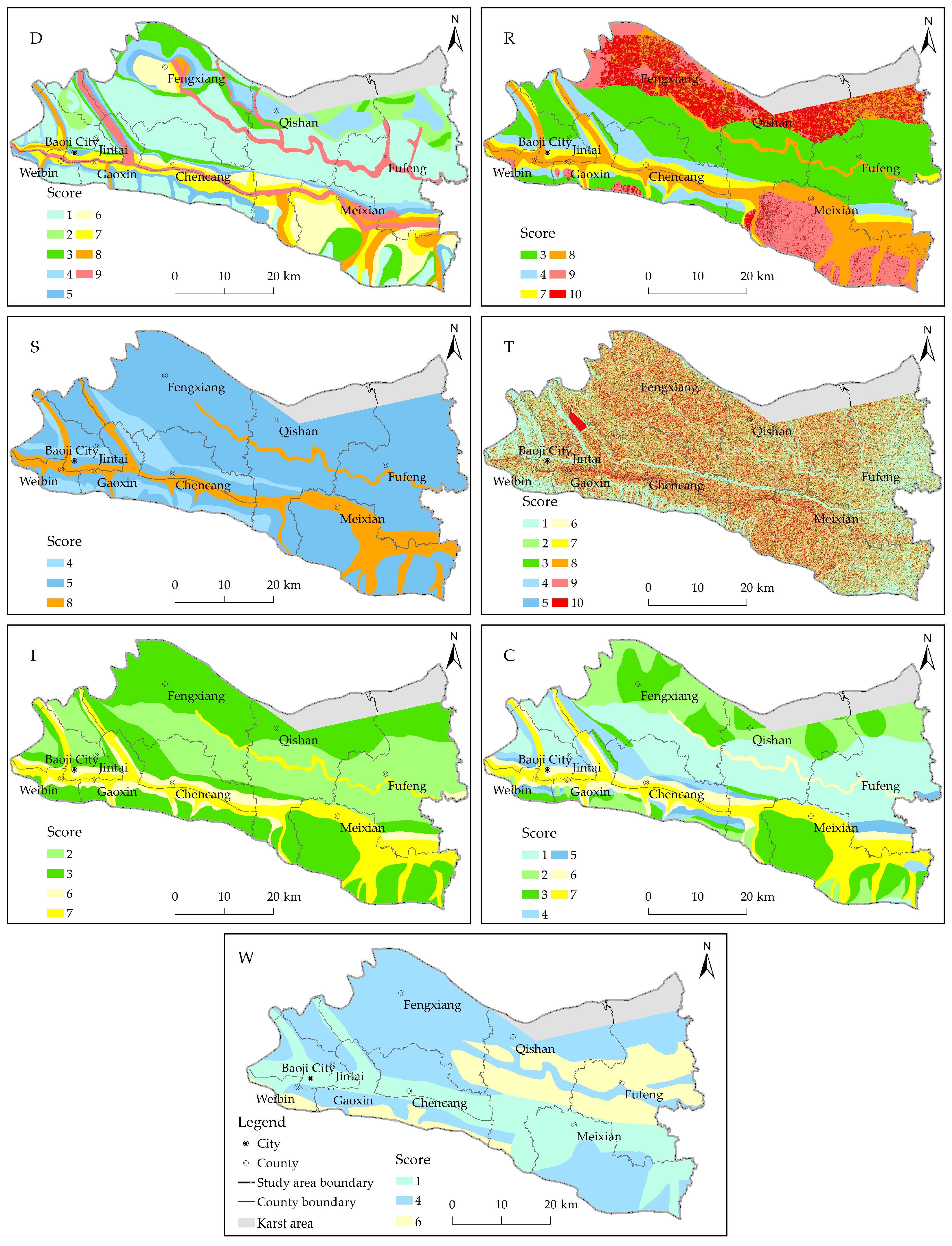
D I 1 = D w D r + R w R r + S w S r + T w T r + I w I r + C w C r + W w W r
where DI1 indicates the vulnerability index of pore/fissure groundwater. A higher value of DI1 indicates higher vulnerability. D, R, S, T, I, C, and W indicate hydrogeological indicators: depth to water table, net recharge, soil media, topography slope, impact of the vadose zone, hydraulic conductivity of the aquifer, and water abundance of the aquifer, respectively. The subscript w denotes the weight coefficients. The subscript r denotes the indicators’ scores. The classification criteria and rating standards for each parameter are given in Table A3.
T = C × M
W = C s ( 2 M s ) 0.732 ( lg R lg r ) , R = 2 s M C
where T′ represents transmissivity, C denotes aquifer hydraulic conductivity, W denotes the well yield, R′ denotes the influence radius, r′ denotes the radius of the pumping well, s represents the depth of water level drop, and M represents phreatic aquifer thickness.
R = α × P 1 + β × P 2
where R represents the net recharge, α represents the infiltration coefficient of precipitation, β represents the coefficient of irrigation recharge into ground water, P1 represents precipitation, and P2 represents irrigation norm.

3.2.2. Karst Groundwater Vulnerability Assessment

The karst area often shows the characteristics of a surface-ground bilayer structure. In the northern karst area of the Baoji Plain, the protective cover is thin, and there are channels such as dissolution fissures, dissolution pores and dissolution caves, which make it easy for pollutants to infiltrate the aquifer. Given that groundwater contamination is challenging to control and often costly to remediate, conducting accurate vulnerability assessments is critical for effective prevention. The PLEIK model is suitable for karst groundwater vulnerability assessment. By introducing land use type factors, it comprehensively considers the effects of natural and anthropogenic factors (Table A2), which makes up for the deficiency of the DRASTIC model in describing karst structures [42]. The PLEIK model equation is as follows:
D I 2 = P w P r + L w L r + E w E r + I w I r + K w K r
where DI2 is the vulnerability index of karst groundwater. A higher DI2 value indicates higher karst groundwater vulnerability. P, L, E, I, and K represent the following parameters: protective cover, land use type, epikarst development, recharge condition, and karst network development, respectively. The subscript w designates the weight coefficients. The subscript r designates parameters’ scores. The classification criteria and scoring standards for each parameter are provided in Table A4.

3.3. Groundwater Pollution Load Assessment

Groundwater pollution load assessment quantifies potential risk to groundwater resources from anthropogenic pollutants [43]. This study developed an assessment index system for individual pollution sources based on three factors: pollutant toxicity, the likelihood of release, and the potential release quantity. The calculation equation of the single-source pollutant load index is as follows:
P i = T i × L i × Q i
where Pi signifies the load index of the ith pollution source. Ti denotes the pollutant toxicity. Li denotes the likelihood of release. Qi signifies the quantity of pollutants potentially emitted. Based on the weights for each type of groundwater contamination source, the assessment results of individual pollution loads were overlaid to generate a comprehensive pollution source load zoning map. The calculation equation of the comprehensive pollution load index is as follows:
P I = W i × P i
where PI is the comprehensive pollution load index. Pi is the pollution load index of the ith potential pollution source. Wi is the weight coefficient corresponding to the ith potential pollution source. A higher PI value corresponds to an increased groundwater pollution load.
Through the field investigation, the groundwater pollution sources in the plain area of Baoji City were mainly classified into four types: industrial pollution sources, landfill sites, gas stations, and agricultural pollution sources. Agricultural pollution sources include large-scale livestock farms and agricultural cultivation zones. The toxicity of pollutants produced by different pollution sources is different, and their physicochemical properties, degradation and adsorption processes, and migration properties are distinct, which have different effects on the groundwater environment. According to the Integrated Risk Information System and Health Effects Assessment Summary Tables [44,45], this study classified pollutant toxicity and determined the corresponding buffer zone radius. The buffer zone radius refers to the radius range within which pollutants may migrate and diffuse based on the distribution area of pollution sources. Empirical toxicity scores and buffer zone radii for different pollution source types are provided in Table A5. The likelihood of pollution release is related to the protective measures of the pollution sources. Generally, if the pollution sources have adequate protection and a shorter period of existence, the pollutants are less likely to be released. Conversely, pollution sources with poor protection and longer existence periods have higher release possibility. In the absence of protective measures, the score of the pollutant release possibility defaults to 1 (Table A6). The quantity of pollutants that may be released relates to factors like pollution source scale and pollutant discharge volume. Larger-scale pollution sources with higher pollutant discharge volume receive higher scores. Specific scoring criteria are provided in Table A7.

3.4. Groundwater Value Function Assessment

Identification and quantification of groundwater value function are essential for groundwater effective protection and management. The value of groundwater includes in situ value, economic value, and ecological value. The in situ value can be characterized by groundwater quality indicators. In accordance with the National Groundwater Quality Standard of China (GB/T14848-2017), groundwater quality was classified using the single-factor evaluation method [46]. Class I groundwater denotes groundwater with excellent quality that is appropriate for various purposes. Class II groundwater represents groundwater with good quality, also appropriate for a wide range of applications. Class III groundwater refers to groundwater with moderate quality, primarily intended for centralized drinking-water sources, industrial use, and agricultural irrigation. Class IV groundwater indicates groundwater with poor quality, which may still be used in agriculture and certain industrial processes and can serve as drinking water following adequate treatment. Class V groundwater is characterized as groundwater with very poor quality and is generally not appropriate for use as drinking water. Lower water quality classes (e.g., Class I, II) indicate better groundwater quality and higher in situ value for maintaining ecological balance and ensuring water supply safety. For economic value, nighttime light index data is selected as the evaluation indicator. Nighttime light data, acquired by remote sensing satellites, captures radiation information from artificial light sources on Earth’s surface at night [47]. The study confirms that there is a significant correlation between nighttime light index and GDP, population density, energy consumption, and other socioeconomic indicators, which can effectively reflect the regional demand for groundwater [48,49]. Furthermore, the nighttime light data is continuous, objective, and has wide coverage. It can effectively make up for the shortcomings of traditional statistical data in spatial details and provide a stable and reliable basis for regional assessment of groundwater economic value [50]. Geospatial analysis technique was applied to process the nighttime light index data of 2022. Higher index values indicate higher groundwater economic value. The ecological value of groundwater refers to the service value offered to the ecological environment by participating in the hydrological cycle. Its core lies in supporting the stability of the ecosystem [51]. Habitat quality is closely related to the stability of the regional ecosystem [52]. So, the habitat quality was selected as an indicator to characterize the ecological value of groundwater. The Integrated Valuation of Ecosystem Services and Tradeoffs (InVEST) model serves as an effective tool for quantifying and mapping ecosystem services [53,54]. Its habitat quality module can assess the status of regional habitat quality via the analysis of land use categories and provide a scientific basis for identifying key protection areas and formulating land use strategies [52]. Based on this, the habitat quality module of the InVEST model was applied to assess habitat quality across the study area, and the simulation result was corrected by the mean normalized difference vegetation index (NDVI) over the growing season (May to September). The larger the habitat quality index, the stronger the supporting ability of groundwater to the ecosystem, and the higher the ecological value of groundwater [55]. The groundwater value function index is calculated as follows:
F I = Q w Q r + H w H r + E w E r
where FI is groundwater value function. A higher FI value indicates higher groundwater value function. Q, H, and E represent the following parameters: groundwater quality class, nighttime light index, and habitat quality index, respectively. Qw, Hw, and Ew are the weights assigned to the above parameters. Qr, Hr, and Er are the above parameters’ scores. The classification criteria and scoring standards for each parameter are provided in Table A8.

3.5. Determination of Weight

At present, the commonly used weighting approaches primarily comprise the entropy weight method, principal component analysis, and analytic hierarchy process (AHP). Considering the hydrogeological conditions of the plain area of Baoji City, the analytic hierarchy process (AHP) was applied to compute the index weights. By constructing a hierarchical structure containing “goal layer–criteria layer–indicator layer”, the approach uses the 1–9 scale system to weigh the relative importance of various factors in pairs, realizing a scientific transition from expert judgment to quantitative calculation [56]. The weight ai is calculated using Equations (10) and (11). The calculated weights for each indicator are shown in Table 1. To guarantee logical coherence during the judgment process, a rigorous consistency check was applied to validate the judgment matrix, which avoids subjective arbitrariness [57]. The consistency ratio is calculated using Equation (12):
a i j = a i j 1 n a i j f o r i , j = 1 n
w i = 1 n a i j n f o r i = 1 n
C R = C I / R I , C I = λ max N N 1
where wi signifies ith indicator weight, aij and a′ij are the elements in the pairwise comparison matrix, n signifies the count of indicators, and CI signifies the consistency index quantifying matrix deviation. RI signifies the mean random consistency index. CR denotes the consistency ratio of the matrix. λmax denotes the matrix’s maximum eigenvalue. N signifies the matrix order. If CR < 0.1, the matrix exhibits acceptable consistency.

3.6. Sensitivity Analysis

In the improved DRSTICW and PLEIK models, it is difficult to avoid the subjectivity of weight distribution. The single-parameter sensitivity analysis was proposed by Napolitano and Fabbri in 1996 [58]. The SPSA can analyze the rationality of weight distribution and improve the accuracy of the evaluation model by comparing the theoretical weight used in the models with the calculated effective weight [59]. Effective weight is calculated using Equation (13).
W i = P r P w D I
where Wi is the effective weight of indicator i, Pr is the score of indicator i, Pw is the weight coefficient of indicator i, and DI is the vulnerability index.

4. Results and Analysis

4.1. Groundwater Vulnerability Assessment Results

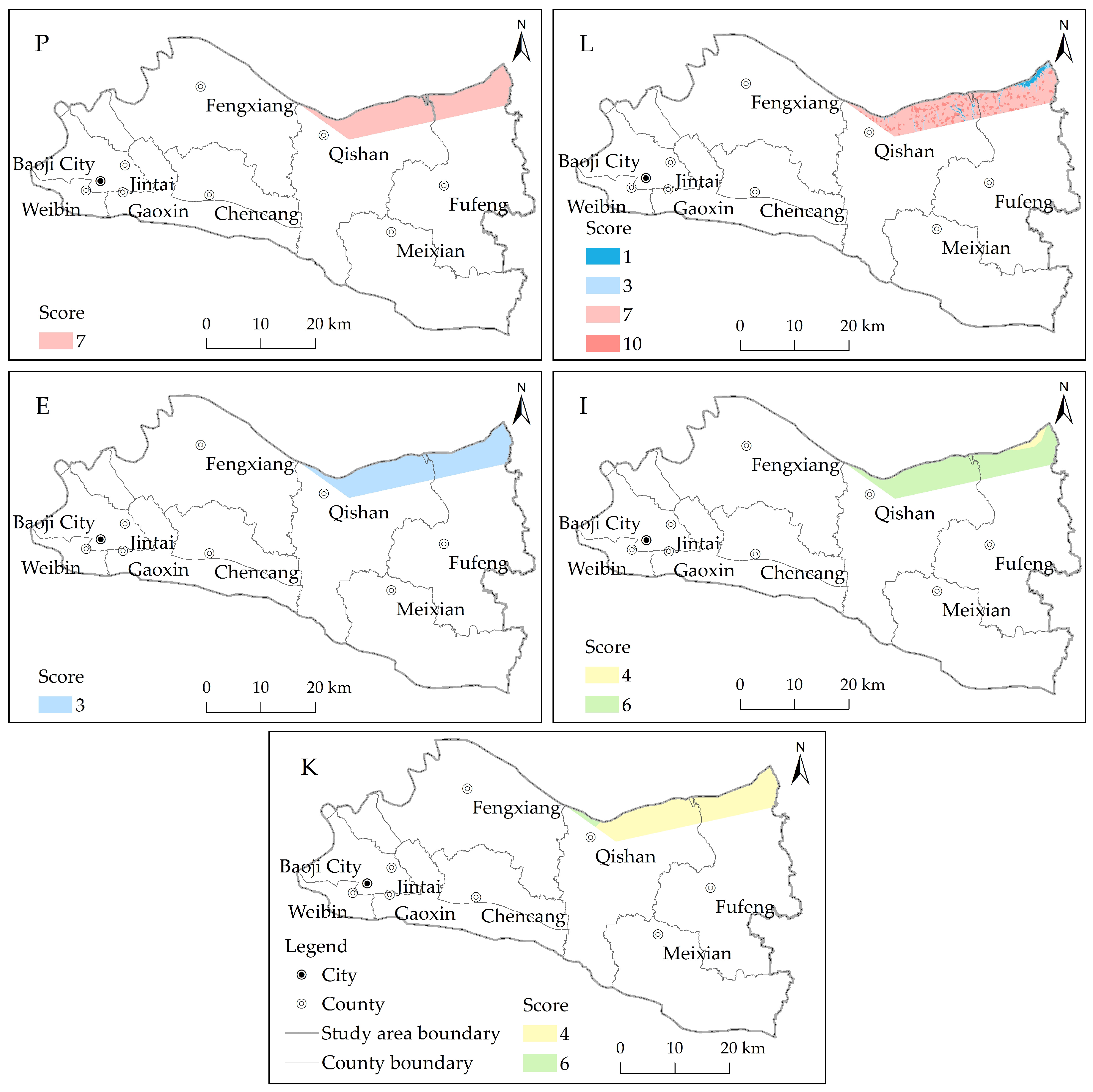
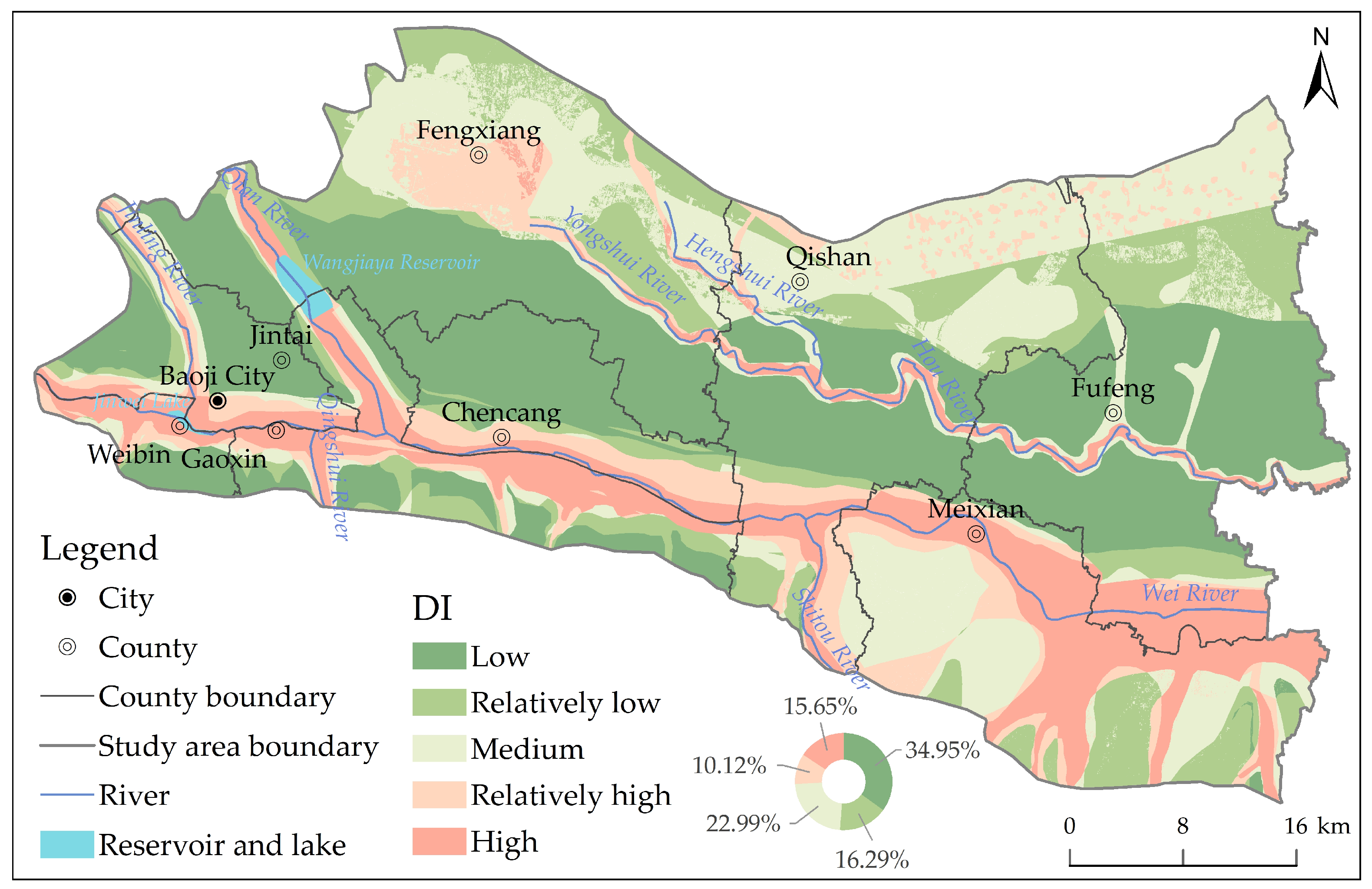
Based on modified DRSTICW and PLEIK models index scores (Figure A1 and Figure A2), the pore/fissure groundwater vulnerability index and the karst groundwater vulnerability index were calculated using Equations (2)–(6). Based on the natural breaks (Jenks) classification method, the results were rated into five distinct categories, high, relatively high, medium, relatively low, and low (Table 2), with corresponding areal percentages of 15.65%, 10.12%, 22.99%, 16.29%, and 34.95% (Figure 3). High vulnerability zones are predominantly located in the floodplain areas of the Wei River and its tributaries, largely due to shallow groundwater level, a highly permeable vadose zone, and high aquifer hydraulic conductivity, which provide excellent pathways for the rapid infiltration and migration of pollutants. Relatively high vulnerability zones are primarily concentrated in the central alluvial fan areas in the Fengxiang District, as well as the low-terrace regions along the Wei River. Meanwhile, it is also sporadically distributed in the karst regions on the northern bank of the Wei River. In the northern karst areas, due to widespread villages, towns, and industrial activities, coupled with the relatively thin protective cover, pollutants are relatively easy to infiltrate into the aquifer. In the central alluvial fan areas in the Fengxiang District and the low terrace areas along the Wei River, the aquifer has relatively poor antifouling performance due to shallow groundwater table, substantial net recharge, and high aquifer hydraulic conductivity. The medium and relatively low vulnerability areas are predominantly located in the north of the Fengxiang District, Qishan County, and Fufeng County and the south of Meixian County. In the northern Fengxiang District and southern Meixian County, the media of aquifer and vadose zone exhibit poor permeability. In the north of Qishan County and Fufeng County, the epikarst develops modestly and the karst network develops weakly, making it relatively difficult for pollutants to infiltrate. The low vulnerability zones are predominantly located in the loess tableland. In these areas, the diving water level is deep, the net recharge is small, and the permeability of the vadose zone and aquifer is poor. This makes it very difficult for contaminants to infiltrate the aquifer, so the aquifer exhibits very low vulnerability.

4.2. Groundwater Pollution Load Assessment Results

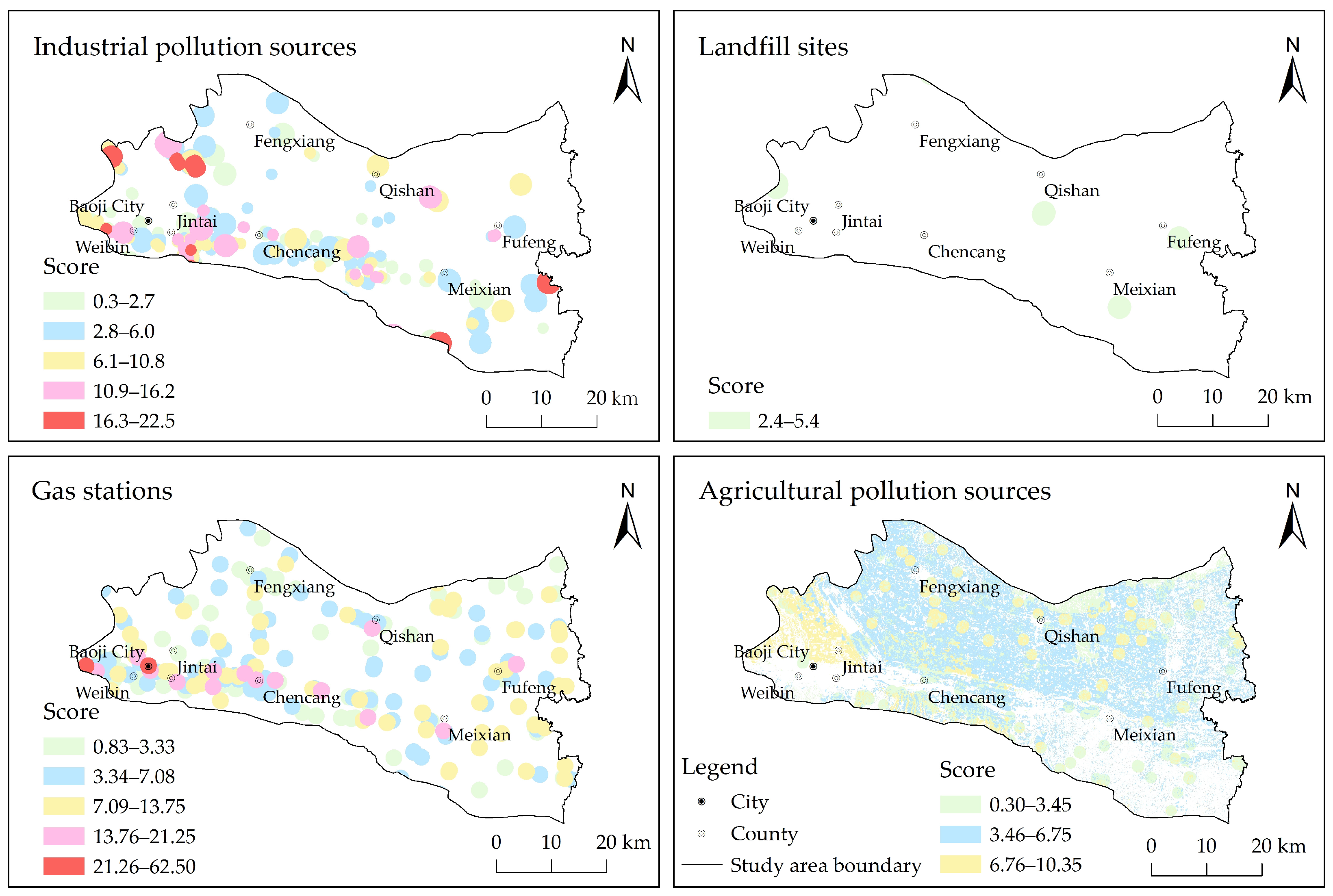
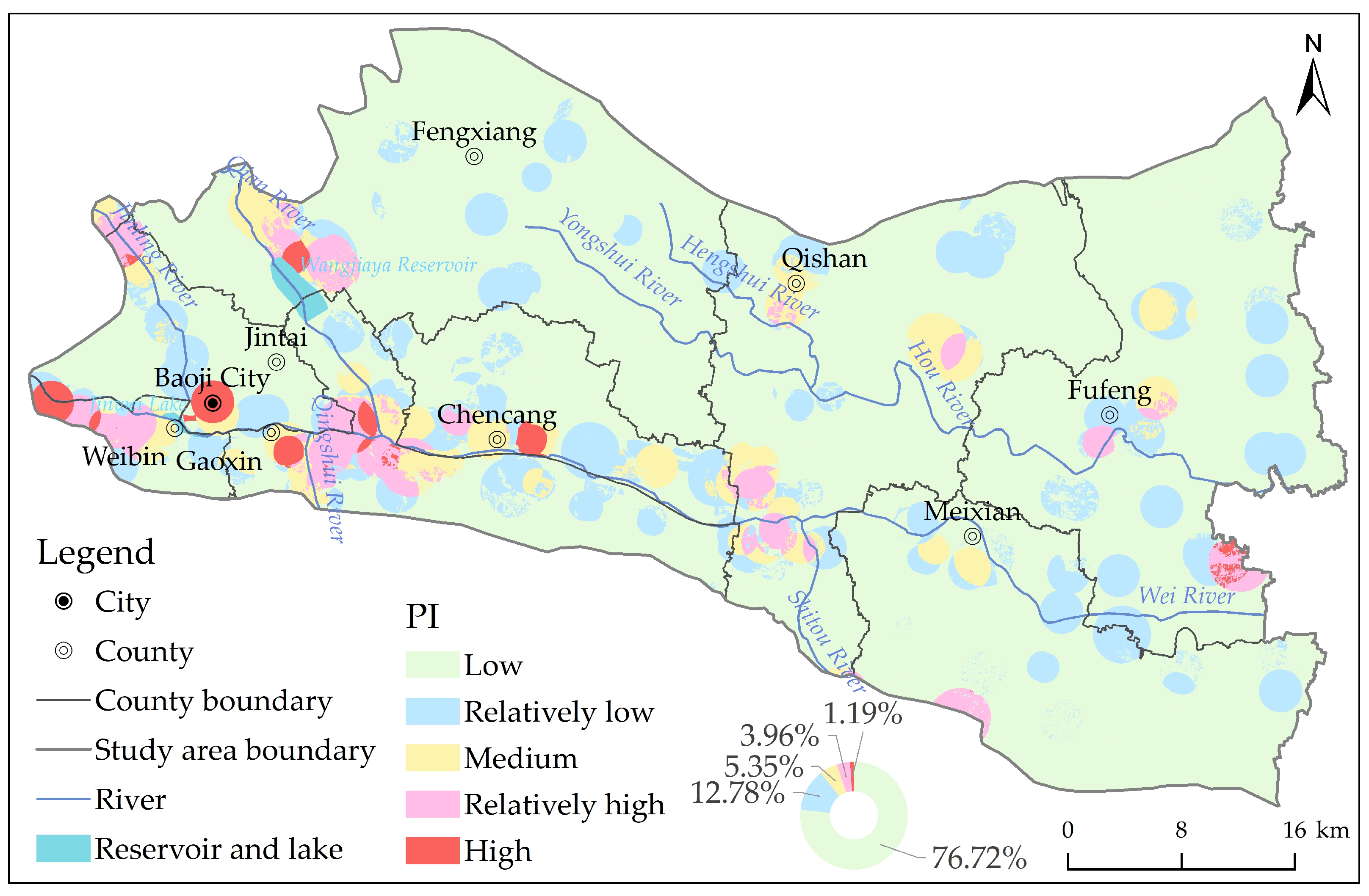
Single pollution source load (Figure A3) and comprehensive pollution source load (Figure 4) zoning maps were generated by Equations (7) and (8), and the results were categorized. Figure 4 shows that 1.19% and 3.96% of groundwater are at high and relatively high levels of contamination, respectively, while 5.35% is at a moderate level, 12.78% is at relatively low level, and 76.72% is at a low level of contamination. High and relatively high pollution load zones show high spatial correlation and are mainly distributed along the banks of the Wei River and its tributaries, mainly due to the dense distribution of industrial pollution sources and gas stations. Industrial pollution primarily stems from non-ferrous metal smelting, petroleum processing, and the manufacturing of chemical raw materials and products, which can generate highly toxic heavy metals and refractory organic pollutants. Meanwhile, gas stations can release pollutants like petroleum hydrocarbons and polycyclic aromatic hydrocarbons, which can easily enter groundwater through rainfall runoff or leak from underground storage tanks. Combined pollution leads to a higher groundwater pollution load in these areas.

4.3. Groundwater Value Function Assessment Results

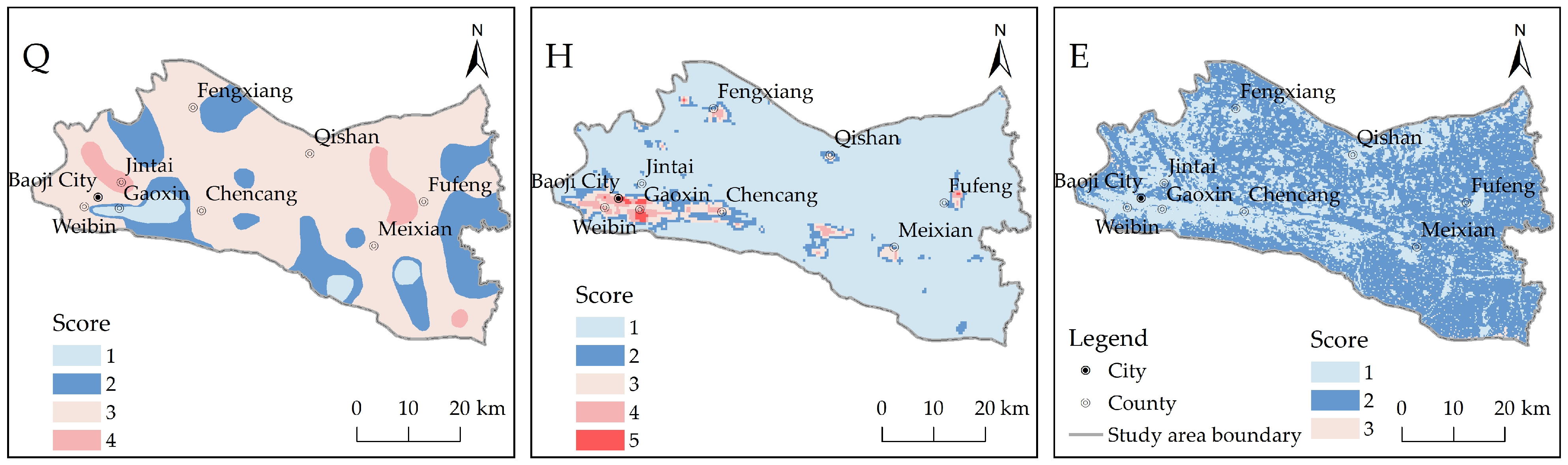
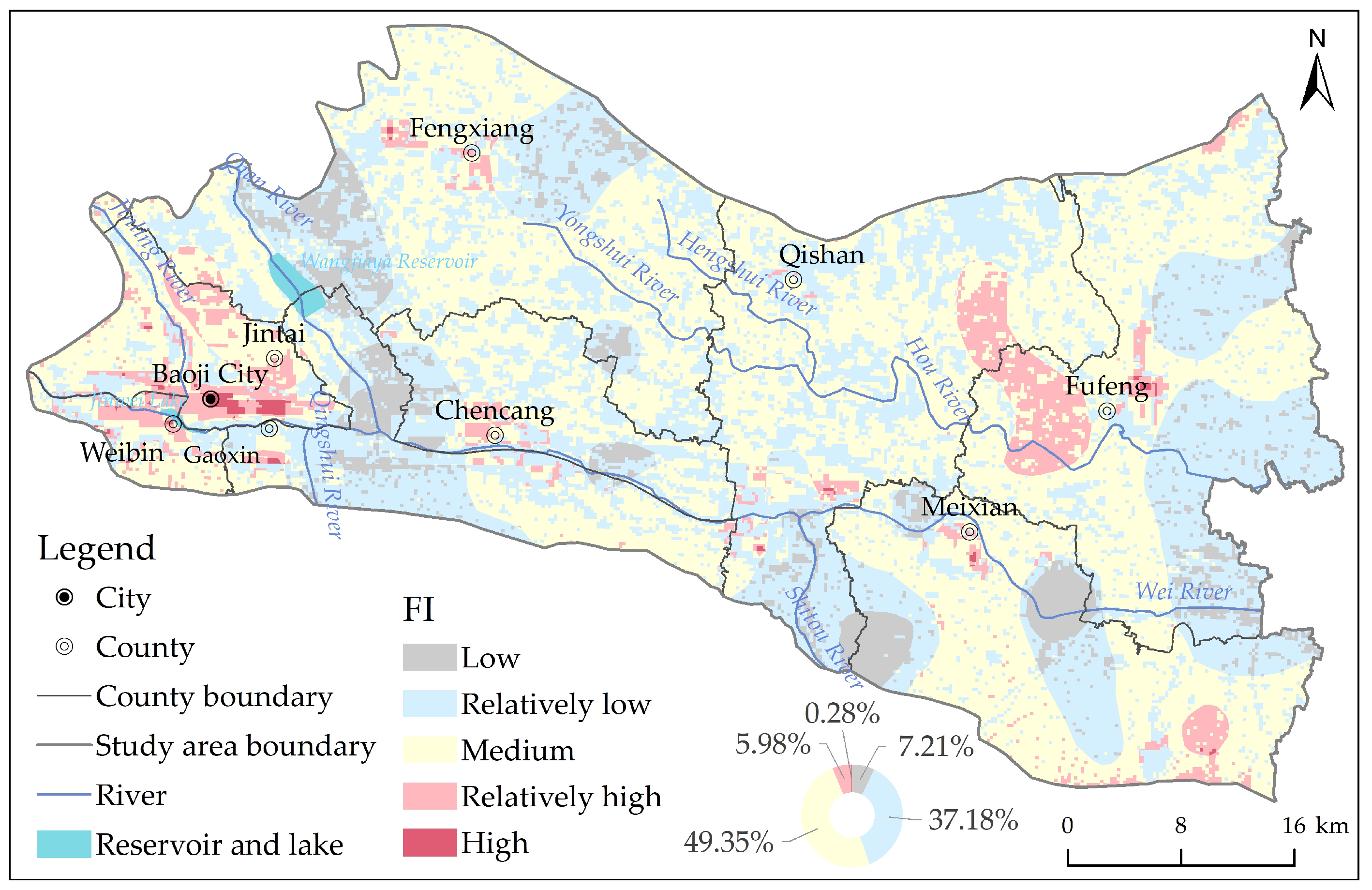
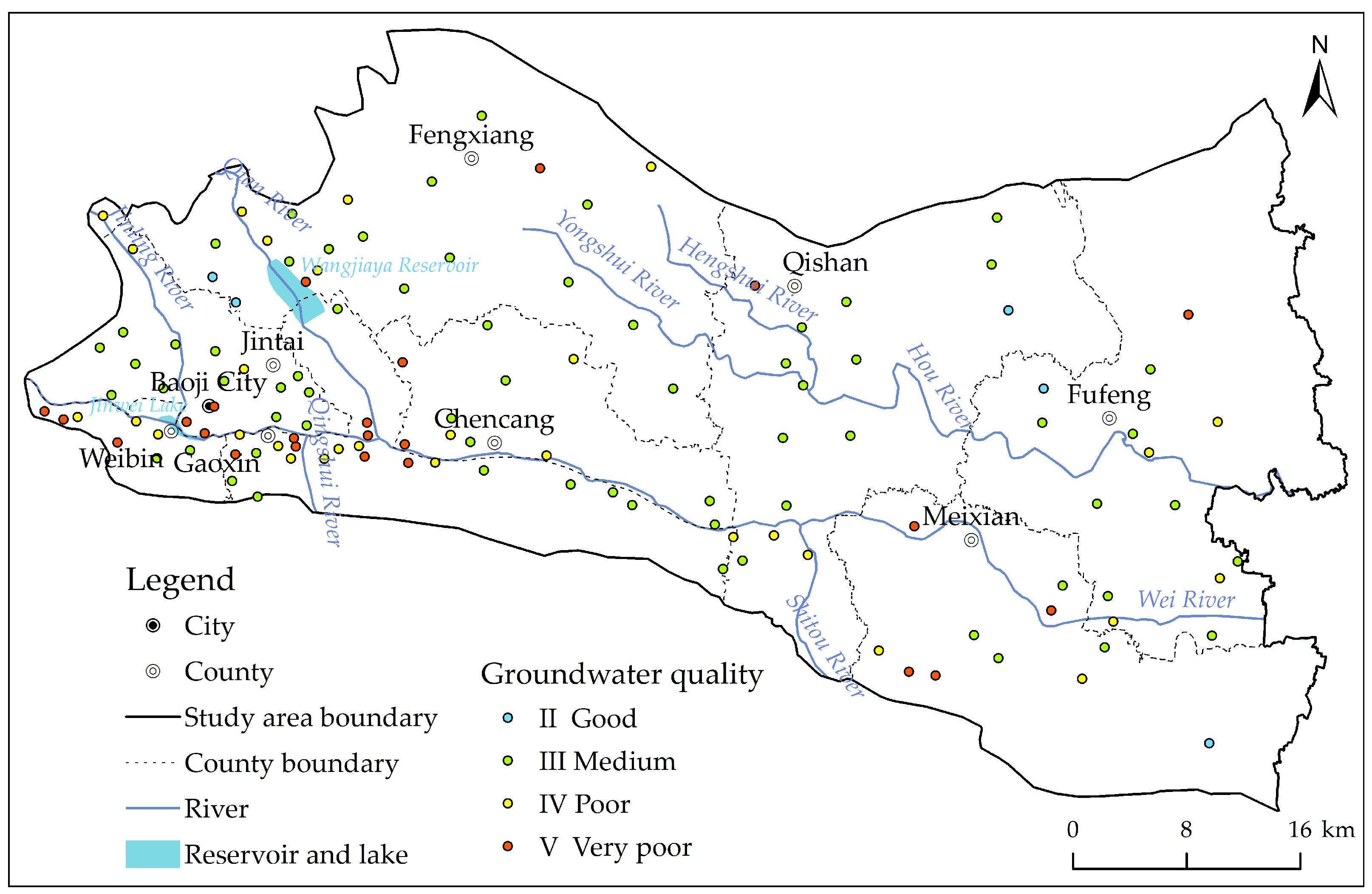
The value function results based on groundwater quality, nighttime light index, and habitat quality (Figure A4) are shown in Figure 5. High, relatively high, medium, relatively low, and low value function zones account for 0.28%, 5.98%, 49.35%, 37.18%, and 7.21% of the study area, respectively. High and relatively high value function zones are primarily located in the western floodplain areas, eastern Qishan County, western Fufeng County, and southern Mei County. In the western floodplain areas, the groundwater quality is relatively poor (mostly Class IV and V). However, due to its location within an economic development zone, the groundwater value function is high. In contrast, in the northeastern Qishan County, western Fufeng County, and southeastern Mei County, although the groundwater economic value is low, the groundwater quality is better (predominantly Class II and III) (Figure A5), so the groundwater value function is considerable. The low and relatively low value function zones are mainly distributed in the northern Gaoxin District, southern and central Fengxiang District, southern Qishan County, northern Mei County, and southeastern Fufeng County. Affected by geological conditions and agricultural non-point source pollution, the groundwater quality in these areas is poor, mainly classified as IV or V. Additionally, these areas feature relatively low-intensity economic activities (nighttime light index < 5) and low vegetation coverage (habitat quality index < 0.3), consequently exhibiting lower groundwater functional value levels.

4.4. Groundwater Pollution Risk Assessment Results

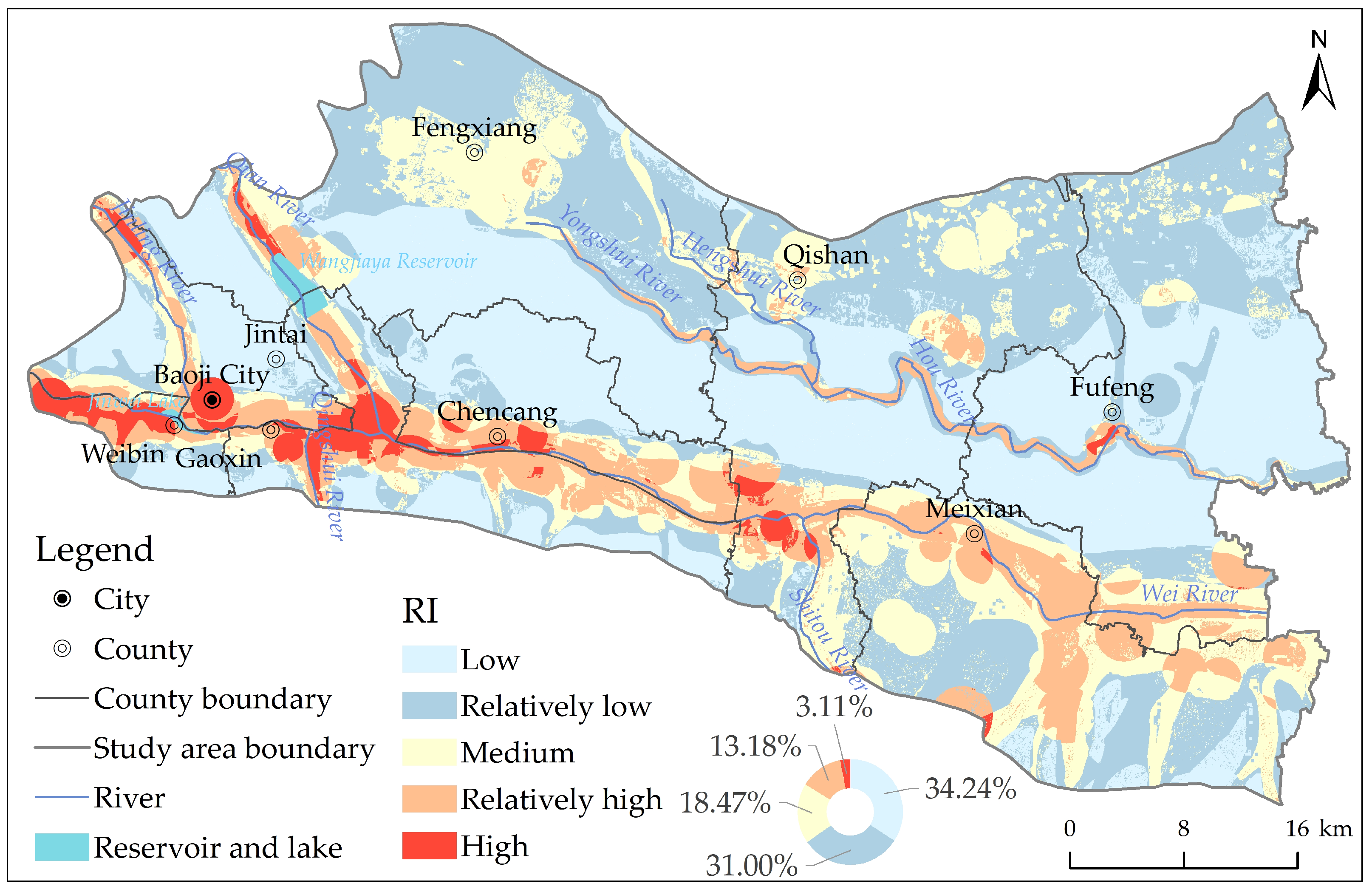
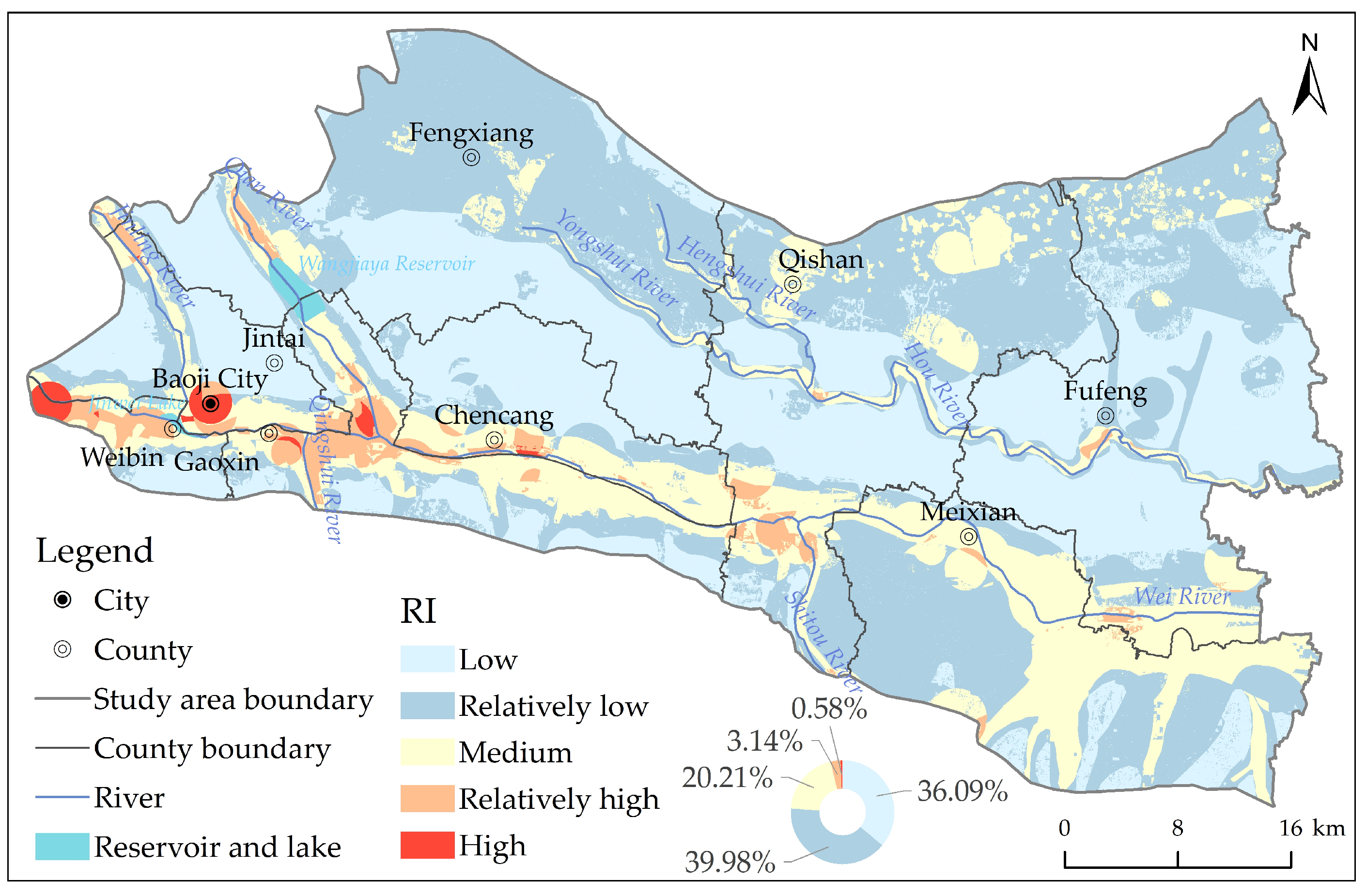
Using Equation (1), the outcomes of groundwater vulnerability, pollution load, and value function were overlaid to form a groundwater pollution risk zoning map (Figure 6). Based on the natural breaks (Jenks) method, the outcomes were categorized into five grades, high, relatively high, medium, relatively low, and low, accounting for 0.58%, 3.14%, 20.21%, 39.98%, and 36.09% of the study area, respectively. Zones with high and relatively high pollution risk are concentrated predominantly in western floodplain areas of the Baoji Plain, mainly due to high groundwater vulnerability, large pollution load, and high groundwater value function. Medium pollution risk zones are predominantly distributed across the central and eastern floodplain areas of the Baoji Plain, as well as in portions of the alluvial fans within the Fengxiang District, Qishan County, and Fufeng County. In these regions, although groundwater vulnerability is high, the overall groundwater pollution risk is reduced because both the groundwater pollution load and functional value are at medium or lower levels. Low and relatively low pollution risk zones are predominantly located in the alluvial fans, loess platforms, and high terraces, where groundwater vulnerability, pollution load, and value function are all low.

4.5. Model Comparison

The water abundance of the aquifer can affect groundwater vulnerability. To verify the improved DRSTICW model’s validity, the traditional DRASTIC model superimposed pollution risk model was used for comparative analysis (Figure 7). The weight of the aquifer medium index is the same as that of water abundance, and the weight coefficients of the remaining indicators are unchanged. As shown in Figure 7, the traditional model shows that the proportion of high and relatively high pollution risk zones is 16.29%. Compared with the traditional model, the proportion of high and relatively high pollution risk areas based on the improved model accounts for 3.72%, which is reduced by 12.57%. Both models show that the pollution risk of the western floodplain of the study area is relatively high. The improved model shows more reasonable evaluation results in the floodplain and low terrace area in the Chencang District, Qishan County, and Meixian County. The pollution risk level of these areas is reduced from the original relatively high level to medium. Field investigation, pumping test, and water quality monitoring data show that these areas are rich in water, where the aquifer has a strong dilution ability for pollutants. Water quality data shows that compared with the floodplain in the west, the concentrations of chemical oxygen demand (COD), total dissolved solids (TDS), nitrate, sulfate, heavy metals, and other pollutants in these areas are significantly reduced, and the groundwater quality can actually meet the requirements of centralized drinking water sources. The introduction of the water abundance index can better reflect the actual pollution status of groundwater, and the prediction accuracy of the model is effectively improved.

4.6. Single-Parameter Sensitivity Analysis

The calculated effective weights are shown in Table 3. In the DRSTICW model, the average effective weight of the net recharge (23.5%) is significantly higher than its theoretical weight (16.5%). This is mainly due to the study area’s location within the Weine fault basin and the influence of irrigation practices. The average effective weight of the impact of the vadose zone (20.9%) is lower than its theoretical weight (26.7%), indicating that the actual importance of the parameter may be overestimated in the model. The effective weight and theoretical weight of groundwater depth, soil medium, topography slope, hydraulic conductivity of the aquifer, and water abundance of the aquifer are similar.
In the PLEIK model, the mean effective weight of the protective cover (42.2%) is significantly higher than the theoretical weight (36.1%), and the maximum value reaches 60.9%, indicating that this parameter exerts a leading influence on the actual vulnerability assessment in karst areas. The average effective weight of the epikarst development (14.1%) is lower than its theoretical weight (17.7%). The discrepancy between effective weights and theoretical weights of the remaining indicators is not significant.

5. Discussion

In view of the hydrogeological conditions and the features of groundwater storage in the Baoji Plain, this study constructed a groundwater vulnerability assessment system. The modified DRSTICW model and PLEIK model were applied to evaluate the vulnerability of shallow pore/fissure water and karst water, respectively. Through the analytic hierarchy process (AHP) method, the weight of each evaluation indicator was scientifically determined. The sensitivity analysis results show that the effective weight and theoretical weight of indexes are roughly similar. By comparison with the results of the traditional model, this study finds that the improved DRSTICW model can effectively improve the accuracy of the pollution risk results in the floodplain zones. Aquifers in the floodplain zones generally exhibit high water abundance. Compared with the aquifer medium, water abundance can more effectively reflect actual dilution capacity and diffusion potential of aquifers to pollutants. The PLEIK model demonstrates unique advantages for karst groundwater vulnerability assessment. Its core indicators can effectively characterize karst structures [60]. Although there are differences in parameters between DRSTICW and PLEIK, the core logic is consistent: each hydrogeological parameter is scored (1–10 scores) and weighted (AHP method) to obtain the comprehensive vulnerability indexes. Finally, these indices are classified into different grades with clear hydrogeological implications (e.g., ‘medium vulnerability’ represents the aquifer has medium antifouling performance). By integrating the two assessment results into a unified map, this paper not only maintains the accuracy and applicability of the two models but also facilitates the unified management of groundwater in the plain area of Baoji City.
Groundwater pollution risk is influenced not only by the aquifer’s intrinsic vulnerability but also by pollution sources. Considering that although an aquifer might be very vulnerability, the risk of pollution may be low when no significant pollutants enter the aquifer. Therefore, this study comprehensively considered pollutant toxicity, the probability of release, and potential release quantity, establishing a pollution load assessment model. At the same time, in order to quantify the harm of groundwater contamination, this research evaluates groundwater value function from three dimensions: in situ value, economic value, and ecological value. Groundwater value function assessment can effectively identify groundwater systems with important ecological service functions and socioeconomic value. Once the groundwater in these areas is polluted, it will cause serious health risks and economic losses. Integrating groundwater value assessment with vulnerability assessment and pollution load assessment allows for a more scientific determination of groundwater protection priorities [61]. The results indicate that although the groundwater vulnerability in the alluvial fan areas of the Fengxiang District, the floodplain areas along the Hou River, and the floodplain areas in the Chencang District and Mei County is relatively high, the pollution risk is medium or relatively low because the pollution load is at a relatively low level and the functional value is at a medium or lower level. However, due to the sensitivity of aquifers in these areas to pollution sources, it is still necessary to reduce future land development, large-scale construction projects, drilling production, and the development of high-load pollution sources. In the floodplain areas of the Weibin District, Gaoxin District, and Jintai District, not only is the vulnerability of groundwater is high, but the functional value of groundwater and the pollution loads generated by industry, gas stations, and agriculture are also large, so the risk of groundwater pollution is at a high level. It is recommended to implement high-priority management policies in these areas, strictly limit the discharge of industrial wastewater, and upgrade and transform underground oil storage tanks and oil pipelines. In addition, strict regional environmental protection regulations should be formulated, penalties for illegal sewage discharge should be increased, and groundwater quality should be monitored regularly to curb further deterioration and spread of groundwater pollution. The results of this research offer critical insights for groundwater protection and risk management in the plain area of Baoji City. In the future, the model can be extended to the whole Guanzhong Basin to carry out a wide range of regional pollution risk assessments and offer valuable insights for groundwater pollution prevention.
However, although the method of combining groundwater value function assessment with vulnerability and pollution load assessments is theoretically reasonable, it still faces challenges in practice. On the one hand, there is significant heterogeneity in hydrogeological conditions and human activity intensity in different regions, which makes it difficult to establish a unified assessment standard suitable for multiple scenarios. On the other hand, groundwater pollution load, groundwater functional value, and groundwater vulnerability may change with hydrogeological conditions, climate change, and human activities [62,63]. Therefore, it is necessary to update the groundwater pollution risk map in time or establish a dynamic assessment mechanism to ensure the accuracy and timeliness of groundwater pollution risk assessment results and provide a reliable basis for long-term groundwater protection decisions.

6. Conclusions

This study integrated key indicators of groundwater vulnerability, groundwater pollution load, and groundwater value function to analyze the shallow groundwater pollution risk in the plain area of Baoji City. The main conclusions are as follows:
(1)
The study area’s groundwater vulnerability is low overall. Areas with high and relatively high vulnerability account for approximately 25.77% of the Baoji Plain and are predominantly located in the floodplain areas along the Wei River and its tributaries, largely due to the shallow groundwater level, highly permeable vadose zone, and high aquifer hydraulic conductivity.
(2)
The study area’s groundwater pollution load is generally at a low level. High and relatively high pollution load areas account for approximately 5.15% of the Baoji Plain and are mainly distributed in the banks of the Wei River and its tributaries, primarily due to the superposition of pollutants from industrial activities and gas stations.
(3)
The study area’s groundwater value function level is mainly medium or relatively low. Approximately 6.26% of the study area exhibits high and relatively high value function. Zones along the Wei River are attributed to dense populations and intense economic activities, while those in the northeastern Qishan County, western Fufeng County, and southeastern Mei County are mainly attributable to good water quality.
(4)
Compared with the traditional DRASTIC model, the evaluation results of the improved DRSTICW superimposed pollution risk model are more in line with the actual pollution status of groundwater. The optimized assessment shows that the proportion of high and relatively high pollution risk areas accounts for 3.72%, which is 12.57% lower than that of the traditional model. These high and relatively high pollution risk areas are predominantly located in the western floodplain area, where both the groundwater vulnerability and pollution load levels are high. Furthermore, the groundwater here possesses considerable value. If no measures are taken to prevent and control groundwater pollution, it will cause serious health risks and economic losses.
For the high-vulnerability regions above, it is recommended to reduce future land development, large-scale construction projects, drilling production, and the development of high-load pollution sources. For the high-pollution-risk regions above, management policies should be prioritized. Recommendations include strictly controlling groundwater extraction, strengthening supervision of surrounding pollution sources, upgrading underground oil storage tanks and oil pipelines, and strictly restricting future land development. The findings of this research offer a scientific basis for formulating strategies and policies aimed at preventing and controlling groundwater contamination.

Author Contributions

Conceptualization, Z.J.; methodology, Z.J., J.C., J.P. and L.Z.; software, J.C., H.L., L.Z. and T.Z.; validation, Z.J. and J.C.; investigation, Z.J., J.C., J.P., T.L., Y.R., H.L., L.Z., T.Z. and J.Z.; resources, T.L. and Y.R.; data curation, T.L., Y.R. and H.L.; writing—original draft preparation, Z.J. and J.C.; writing—review and editing, Z.J., J.C. and J.P.; supervision, Z.J.; project administration, Z.J.; funding acquisition, Z.J. All authors have read and agreed to the published version of the manuscript.

Funding

This work was supported by the Fundamental Research Funds for the Central Universities, CHD (300102293209).

Institutional Review Board Statement

Not applicable.

Informed Consent Statement

Not applicable.

Data Availability Statement

Data are available by contacting the corresponding author with a reasonable request.

Conflicts of Interest

Author Ting Li was employed by the Shaanxi Institute of Engineering Prospecting Co., Ltd. Author Yuze Ren was employed by the China Certification & Inspection Northwest Ecological Technology (Shaanxi) Co., Ltd. The remaining authors declare that the research was conducted in the absence of any commercial or financial relationships that could be construed as a potential conflict of interest.

Appendix A

Table A1. Data sources.
Evaluation TypeData NameSources
Pore/fissure groundwater vulnerability assessment (DI1)Depth to water table (D)
  • Groundwater monitoring well data (2023): the groundwater ecological environment survey and assessment project in Baoji.
Net recharge (R)
  • Precipitation (2001–2023) “https://data.tpdc.ac.cn/ (accessed on 3 January 2024)”;
  • The irrigating norm: Baoji water resources bulletin (2011–2023);
  • Infiltration coefficient and irrigation coefficient: the data are derived from literature [32];
  • Distribution of watered land (2023): Resources and Environmental Science Data Center “https://www.resdc.cn/ (accessed on 5 January 2024)”.
Soil media (S)
  • Harmonized World Soil Database [HWSD 2023 (Scale 1:1,000,000)] “http://data.tpdc.ac.cn (accessed on 6 January 2024)”.
Topographic slope (T)
  • GDEMV3 30 m digital elevation data (2022): Geospatial Data Cloud “https://www.gscloud.cn (accessed on 6 January 2024)”
Impact of the vadose zone (I)
  • Borehole data (2023): the groundwater ecological environment survey and assessment project in Baoji
Hydraulic conductivity of the aquifer (C)
  • The third groundwater resources investigation report of Shaanxi Province (2017) “https://www.sxigs.cn/ (accessed on 12 January 2024)”.
Water abundance of the aquifer (W)
  • Phreatic hydrogeological map of Guanzhong Basin (2002) (Scale 1:250,000);
  • The third groundwater resources investigation report of Shaanxi Province, China (2017) “https://www.sxigs.cn/ (accessed on 12 January 2024)”.
Karst groundwater vulnerability assessment (DI2)Protective cover (P)
  • Harmonized World Soil Database [HWSD 2023 (Scale 1:1,000,000)] “http://data.tpdc.ac.cn (accessed on 6 January 2024)”.
Land use type (L)
  • Land use type (2023): Resource and Environment Science Data Platform “http://www.resdc.cn (accessed on 17 January 2024)”.
Epikarst development (E)
  • Hydrogeological map of karst groundwater in Guanzhong Basin (2001) (Scale 1:2,500,000);
  • The third groundwater resources investigation report of Shaanxi Province, China (2017) “https://www.sxigs.cn/ (accessed on 12 January 2024)”.
Recharge condition (I)
1.
Isoline map of annual maximum 24 h point rainfall mean in China (2022) (Scale 1:15,300,000)
Karst network development (K)
  • Karst hydrogeological map of central Weibei exploration area in Shaanxi Province, China (2001) (Scale 1:250,000);
  • The third groundwater resources investigation report of Shaanxi Province (2017) “https://www.sxigs.cn/ (accessed on 12 January 2024)”.
Groundwater pollution load assessment (PI)Groundwater pollution sources data
  • Groundwater pollution sources data (2023): Official website of Ecology and Environment Department in Shaanxi Province, China “https://sthjt.shaanxi.gov.cn (accessed on 18 January 2024)”.
Groundwater value function assessment (FI)Groundwater quality (Q)
  • The groundwater ecological environment survey and assessment project in Baoji (2023)
Nighttime light index (H)
  • Nighttime light index (2022): National Earth System Science Data Center “https://www.geodata.cn (accessed on 20 January 2024)”.
Habitat quality index (E)
  • 250 m NDVI data (2022): Resource and Environment Science Data Platform “http://www.resdc.cn (accessed on 22 January 2024)”.
Table A2. Comparison of groundwater vulnerability assessment models.
ModelsIndicatorsApplicationAdvantageDisadvantage
DRASTICDepth to water table,
net recharge, aquifer medium
soil media, topography slope, impact of vadose zone, hydraulic conductivity of aquifer
Common groundwater vulnerability assessment models
  • Multi-factor comprehensive evaluation;
  • Flexible and simple operation;
  • Low data demand and efficient analysis.
The indicators are fixed and require improvement based on the regional hydrogeological conditions.
GODGroundwater occurrence, overall lithology of the unsaturated zone, depth to water tableRegions with limited data
  • Low data demand;
  • Easy to calculate and implement.
Less accurate than DRASTIC.
SIDepth to water table, net recharge, aquifer medium, topography slope, land useRegions with agricultural contamination such as nitrate
  • The assessment incorporates the effect of both natural conditions and anthropogenic influence on aquifer vulnerability.
This method omits the effect of groundwater circulation on the accumulation or diffusion of pollutants.
SINTACSSINTACS model adopts identical parameters as DRASTICSuitable for Mediterranean conditions and has five diverse weighting methods depending on hydrogeological conditions
  • More flexible than DRASTIC in the definition of weights.
More complex than DRASTIC and requires detailed input data.
PLEIKProtective cover, land use type, epikarst development, recharge condition, karst network developmentKarst groundwater vulnerability assessment
  • Focuses on the unique geological features in karst regions;
  • Takes into account both natural and human activity factors.
Not applicable to non-karst areas.
Table A3. Classification and scoring criteria of pore/fissure groundwater vulnerability index.
D/mR/mm·a−1ST/(°)IC/mm·d−1W/m3·d−1Score
>300Bedrock>10Clay(0,4](1000,5000]1
(25,30](0,51]Clay(9,10]Sub-clay(4,12]-2
(20,25](51,71]Silty loam(8,9]Sub-sand(12,20]-3
(15,20](71,92]Loam(7,8]Silty sand(20,30](100,1000]4
(10,15](92,117]Sandy loam(6,7]Silty fine sand(30,35]-5
(8,10](117,147]Swelling or aggregated clay(5,6]Fine sand(35,40](10,100]6
(6,8](147,178]Silty sand, fine sand(4,5]Medium sand(40,60]-7
(4,6](178,216]Gravel/medium sand, coarse sand(3,4]Coarse sand(60,80]<108
(2,4](216,235]Pebble gravel(2,3]Sandy gravel(80,100]-9
≤2>235Thin or missing≤2Pebble gravel>100-10
Table A4. Classification and scoring criteria of karst groundwater vulnerability index.
IndexesClassProtective Cover ThicknessesScore Matrix (CEC (meq/100 g))
A 1B 2<1010–100100–200>200
PP10–20 cm0–20 cm10864
P220–100 cm20–100 cm9753
P3100–150 cm100 cm8642
P4>150 cm>100 cm or non-karst strata7531
LClassLand useScore
L1Forest1
L2Grass land3
L3Garden land5
L4Farmland7
L5Bare land9
L6Urban and industrial land10
EClassEpikarst developmentScore
E1Strongly developed epikarst zone10
E2Highly developed epikarst zone8
E3Moderately developed epikarst zone6
E4Mildly developed epikarst zone4
E5Modestly developed epikarst zone2
IClassInfiltration conditionsScore matrix (rain intensity (mm/d))
<1010–25>25
I1500 m area around the sinkhole or subterranean stream4[5,9]10
I2500 m–1000 m area around the sinkhole or subterranean stream, farming area with confluence slope > 10%, grass area with slope > 25%3[4,7]8
I3500 m–1000 m area around the sinkhole or subterranean stream, farming area with confluence slope > 10%, grass area with slope > 25%2[3,5]6
I4The rest of the catchment1[2,3]4
KClassKarst networkModuli (L·s−1·km−2)Score
K1Strongly developed karst network>15[8,10]
K2Moderately developed karst network7~15[6,7]
K3Weakly developed karst network1~7[4,5]
K4Mixed and fractured aquifers<1[1,3]
1 A is the soil covered on the limestone; 2 B is the soil covered on the low-permeability bottom.
Table A5. Toxicity scores and buffer radii of different pollution sources.
Pollution SourceToxicity CategoryScore (Ti)Buffer Radius/km
Industrial pollution sourceIndustry of oil processing and cooking, industry of nuclear fuel processing2.51.5
Industry of colored metals smelting and pressing31
Industry of black metals smelting and pressing21
Chemicals and chemical products2.52
Industry of spinning12
Industry of leather, fur, feathers, and their products12
Fabricated metal products1.51
Other industry0.21
Landfill siteDomestic waste1.52
Gas stationPetroleum hydrocarbon, polycyclic aromatic hydrocarbon2.51.5
Agricultural pollution sourceAgricultural cultivation zoneFertilizer, pesticide, heavy metals1.51.5
Large-scale livestock farmsAntibiotic drugs11
Table A6. Classification and scoring criteria of likelihood of release for different pollution sources.
Pollution SourcesLikelihood of ReleaseScore (Li)
Industrial pollution source (build time of the factory)>20110.2
1998–20110.6
<1998 or no protective measures1.0
Landfill site (operation period and standard)≤5 years, formal qualification of class I0.1
>5 years, formal qualification of class I0.2
≤5 years, formal qualification of class II0.2
>5 years, formal qualification of class II0.4
≤5 years, formal qualification of class III0.4
>5 years, formal qualification of class III0.5
Informal, simple protection (class IV)0.6
Informal, no protection (class IV)1
Gas station (operation period and
protection measures)
≤5 years, dual tanks or anti-seepage pool0.1
(5,15] years, dual tanks or anti-seepage pool0.2
>15 years, dual tanks or anti-seepage pool0.5
≤5 years, single tank without anti-seepage pool0.2
(5,15] years, single tank without anti-seepage pool0.6
>15 years, single tank without anti-seepage pool1.0
Agricultural pollution sourceAgricultural cultivation zonePaddy field0.3
Irrigated land0.5
Dry land0.7
Large-scale livestock farmsWith protective measures0.3
No protective measures1.0
Table A7. Classification and scoring criteria of potential release quantity for different pollution sources.
Pollution SourcesClassScore (Qi)
Industrial pollution source (discharge quantity of wastewater; unit: 103 t/a)≤11
(1,5]2
(5,10]4
(10,50]6
(50,100]8
(100,500]9
(500,1000]10
>100012
Landfill site (capacity of the landfill; unit: 103 m3)≤10004
(1000,5000]7
>50009
Gas station (the number of tanks with the capacity of 30 m3)11
Agricultural pollution sourceAgricultural cultivation zone (amount of fertilizer; unit: kg/ha)≤1801
(180,225]3
(225,400]5
>4007
Large-scale livestock farms (COD emissions; unit: t/a)≤21
(2,10]2
(10,50]4
(50,100]6
(100,150]8
(150,200]9
>20010
Table A8. Classification and scoring criteria of groundwater value function index.
Groundwater Quality Class (Q)Nighttime Light Index (H)Habitat Quality (E)
RangeScoreRangeScoreRangeScore
V10–4.7810–0.141
VI24.78–12.0820.14–0.292
III312.08–22.8230.29–0.443
II422.82–40.304
I540.30–75.925

Appendix B

Figure A1. Classification map of each evaluation factor of DRSTICW model.
Sustainability 17 11213 g0a1
Figure A2. Classification map of each evaluation factor of PLEIK model.
Sustainability 17 11213 g0a2
Figure A3. Zoning map of single pollution source load.
Sustainability 17 11213 g0a3
Figure A4. Zoning map of groundwater value function evaluation index.
Sustainability 17 11213 g0a4
Figure A5. Groundwater quality map.
Sustainability 17 11213 g0a5

References

  1. Anonymous. World Water Day—making the invisible visible. Civ. Eng. Mag. South Afr. Inst. Civ. Eng. 2022, 30, 50. [Google Scholar]
  2. Fannakh, A.; Károly, B.; Farsang, A.; Ben Ali, M. Evaluation of index-overlay methods for assessing shallow groundwater vulnerability in southeast Hungary. Appl. Water Sci. 2025, 15, 118. [Google Scholar] [CrossRef]
  3. Kirlas, M.C.; Karpouzos, D.K.; Georgiou, P.E.; Katsifarakis, K.L. A comparative study of groundwater vulnerability methods in a porous aquifer in Greece. Appl. Water Sci. 2022, 12, 123. [Google Scholar] [CrossRef]
  4. Kuang, X.X.; Liu, J.G.; Scanlon, B.R.; Jiao, J.J.; Jasechko, S.; Lancia, M.; Biskaborn, B.K.; Wada, Y.; Li, H.L.; Zeng, Z.Z.; et al. The changing nature of groundwater in the global water cycle. Science 2024, 383, eadf0630. [Google Scholar] [CrossRef]
  5. Swain, S.; Mishra, S.K.; Pandey, A.; Kalura, P. Inclusion of groundwater and socio-economic factors for assessing comprehensive drought vulnerability over Narmada River Basin, India: A geospatial approach. Appl. Water Sci. 2022, 12, 14. [Google Scholar] [CrossRef]
  6. UNICEF; World Health Organization. Progress on Household Drinking Water, Sanitation and Hygiene 2000–2022: Special Focus on Gender; World Health Organization: Geneva, Switzerland, 2024.
  7. Adimalla, N.; Qian, H. Groundwater quality and contamination: An application of GIS. Environ. Earth Sci. 2023, 82, 423. [Google Scholar] [CrossRef]
  8. Aslam, R.A.; Shrestha, S.; Pandey, V.P. Groundwater vulnerability to climate change: A review of the assessment methodology. Sci. Total Environ. 2018, 612, 853–875. [Google Scholar] [CrossRef] [PubMed]
  9. Chen, J.; Huang, Q.W.; Lin, Y.L.; Fang, Y.; Qian, H.; Liu, R.P.; Ma, H.Y. Hydrogeochemical Characteristics and Quality Assessment of Groundwater in an Irrigated Region, Northwest China. Water 2019, 11, 96. [Google Scholar] [CrossRef]
  10. Haied, N.; Khadri, S.; Foufou, A.; Azlaoui, M.; Chaab, S.; Bougherira, N. Assessment of Groundwater Pollution Vulnerability, Hazard and Risk in a Semi-Arid Region. J. Ecol. Eng. 2021, 22, 1–13. [Google Scholar] [CrossRef]
  11. El Osta, M.; Niyazi, B.; Masoud, M. Groundwater evolution and vulnerability in semi-arid regions using modeling and GIS tools for sustainable development: Case study of Wadi Fatimah, Saudi Arabia. Environ. Earth Sci. 2022, 81, 248. [Google Scholar] [CrossRef]
  12. Sarwar, A.; Ali, M. GIS-DRASTIC integrated approach for groundwater vulnerability assessment under soil erosion hot spot areas in Northern Pakistan. Environ. Earth Sci. 2024, 83, 532. [Google Scholar] [CrossRef]
  13. Gómez-Mena, B.; Morán-Ramírez, J.; Almanza-Tovar, O.G.; López-Alvarez, B.; Martínez-Morales, M.; Ramos-Leal, J.A. Aquifer vulnerability assessment in the oaxacan complex: Integrating the DRASTIC methodology, TEM, and water quality analysis. Environ. Earth Sci. 2024, 83, 667. [Google Scholar] [CrossRef]
  14. Zhao, Y.S.; Zhang, J.W.; Chen, Z.; Zhang, W.H. Groundwater contamination risk assessment based on intrinsic vulnerability, pollution source assessment, and groundwater function zoning. Hum. Ecol. Risk Assess. 2019, 25, 1907–1923. [Google Scholar] [CrossRef]
  15. Margat, J. Vulnérabilité des Nappes D’eau Souterraine à la Pollution; BRGM Publication: Orleans, France, 1968; Volume 68. [Google Scholar]
  16. Machiwal, D.; Jha, M.K.; Singh, V.P.; Mohan, C. Assessment and mapping of groundwater vulnerability to pollution: Current status and challenges. Earth-Sci. Rev. 2018, 185, 901–927. [Google Scholar] [CrossRef]
  17. Zhao, X.N.; Wang, D.Q.; Xu, H.L.; Ding, Z.B.; Shi, Y.; Lu, Z.; Cheng, Z.J. Groundwater pollution risk assessment based on groundwater vulnerability and pollution load on an isolated island. Chemosphere 2022, 289, 133134. [Google Scholar] [CrossRef]
  18. Wachniew, P.; Zurek, A.J.; Stumpp, C.; Gemitzi, A.; Gargini, A.; Filippini, M.; Rozanski, K.; Meeks, J.; Kværner, J.; Witczak, S. Toward operational methods for the assessment of intrinsic groundwater vulnerability: A review. Crit. Rev. Environ. Sci. Technol. 2016, 46, 827–884. [Google Scholar] [CrossRef]
  19. Anane, M.; Abidi, B.; Lachaal, F.; Limam, A.; Jellali, S. GIS-based DRASTIC, Pesticide DRASTIC and the Susceptibility Index (SI): Comparative study for evaluation of pollution potential in the Nabeul-Hammamet shallow aquifer, Tunisia. Hydrogeol. J. 2013, 21, 715–731. [Google Scholar] [CrossRef]
  20. Xiong, Y.N.; Liu, J.C.; Yuan, W.C.; Liu, W.J.; Ma, S.B.; Wang, Z.Y.; Li, T.T.; Wang, Y.W.; Wu, J. Groundwater Contamination Risk Assessment Based on Groundwater Vulnerability and Pollution Loading: A Case Study of Typical Karst Areas in China. Sustainability 2022, 14, 9898. [Google Scholar] [CrossRef]
  21. Orellana-Macías, J.M.; Roselló, M.J.P. Assessment of Risk and Social Impact on Groundwater Pollution by Nitrates. Implementation in the Gallocanta Groundwater Body (NE Spain). Water 2022, 14, 202. [Google Scholar] [CrossRef]
  22. Zabeo, A.; Pizzol, L.; Agostini, P.; Critto, A.; Giove, S.; Marcomini, A. Regional risk assessment for contaminated sites Part 1: Vulnerability assessment by multicriteria decision analysis. Environ. Int. 2011, 37, 1295–1306. [Google Scholar] [CrossRef]
  23. Fang, Z.; Liu, Z.G.; Zhao, S.Y.; Ma, Y.L.; Li, X.; Gao, H. Assessment of Groundwater Contamination Risk in Oilfield Drilling Sites Based on Groundwater Vulnerability, Pollution Source Hazard, and Groundwater Value Function in Yitong County. Water 2022, 14, 628. [Google Scholar] [CrossRef]
  24. Wang, Y.Y.; Fu, K.; Zhang, H.; He, G.Y.; Zhao, R.; Yang, C. A GIS-based analysis of intrinsic vulnerability, pollution load, and function value for the assessment of groundwater pollution and health risk. Hum. Ecol. Risk Assess. 2022, 28, 1–21. [Google Scholar] [CrossRef]
  25. Feng, W.W.; Qian, H.; Xu, P.P.; Hou, K. Hydrochemical Characteristic of Groundwater and Its Impact on Crop Yields in the Baojixia Irrigation Area, China. Water 2020, 12, 1443. [Google Scholar] [CrossRef]
  26. Dong, L.; Zhang, J.; Guo, Z.Z.; Li, M.; Wu, H.M. Distributions and interactions of dissolved organic matter and heavy metals in shallow groundwater in Guanzhong basin of China. Environ. Res. 2022, 207, 112099. [Google Scholar] [CrossRef]
  27. Nsabimana, A.; Li, P.Y.; Wang, Y.H.; Alam, S.M.K. Variation and multi-time series prediction of total hardness in groundwater of the Guanzhong Plain (China) using grey Markov model. Environ. Monit. Assess. 2022, 194, 899. [Google Scholar] [CrossRef]
  28. Lu, X.; Wang, L.; Lei, K.; Huang, J.; Zhai, Y. Contamination assessment of copper, lead, zinc, manganese and nickel in street dust of Baoji, NW China. J. Hazard. Mater. 2009, 161, 1058–1062. [Google Scholar] [CrossRef]
  29. Wan, H.L.; Song, H.L.; Zhu, C.C.; Zhang, B.B.; Zhang, M. Spatio-temporal evolution of drought and flood disaster chains in Baoji area from 1368 to 1911. J. Geogr. Sci. 2018, 28, 337–350. [Google Scholar] [CrossRef]
  30. Li, L.; Xu, C.; Xu, X.; Zhang, Z.; Cheng, J. Inventory and Distribution Characteristics of Large-Scale Landslides in Baoji City, Shaanxi Province, China. ISPRS Int. J. Geo-Inf. 2022, 11, 10. [Google Scholar] [CrossRef]
  31. Gao, Y.Y.; Qian, H.; Huo, C.C.; Chen, J.; Wang, H.K. Assessing natural background levels in shallow groundwater in a large semiarid drainage Basin. J. Hydrol. 2020, 584, 124638. [Google Scholar] [CrossRef]
  32. Xu, P.P.; Feng, W.W.; Qian, H.; Zhang, Q.Y. Hydrogeochemical Characterization and Irrigation Quality Assessment of Shallow Groundwater in the Central-Western Guanzhong Basin, China. Int. J. Environ. Res. Public Health 2019, 16, 1492. [Google Scholar] [CrossRef]
  33. Huan, H.; Zhang, B.T.; Kong, H.M.; Li, M.X.; Wang, W.; Xi, B.D.; Wang, G.Q. Comprehensive assessment of groundwater pollution risk based on HVF model: A case study in Jilin City of northeast China. Sci. Total Environ. 2018, 628–629, 1518–1530. [Google Scholar] [CrossRef]
  34. Shrestha, S.; Kafle, R.; Pandey, V.P. Evaluation of index-overlay methods for groundwater vulnerability and risk assessment in Kathmandu Valley, Nepal. Sci. Total Environ. 2017, 575, 779–790. [Google Scholar] [CrossRef]
  35. Zhu, Z.; Wang, J.; Hu, M.; Jia, L. Geographical detection of groundwater pollution vulnerability and hazard in karst areas of Guangxi Province, China. Environ. Pollut. 2019, 245, 627–633. [Google Scholar] [CrossRef]
  36. Aller, L.; Bennett, T.; Lehr, J.; Petty, R.; Hackett, G. Drastic: A Standardized System for Evaluating Ground Water Pollution Potential Using Hydrogeologic Settings; EPA/60012-87/035; US Environmental Protection Agency: Washington, DC, USA, 1987; Volume 455.
  37. Zhang, J.J.; Zhai, Y.Z.; Xue, P.W.; Huan, H.; Zhao, X.B.; Teng, Y.G.; Wang, J.S. A GIS-based LVF model for semiquantitative assessment of groundwater pollution risk: A case study in Shenyang, NE China. Hum. Ecol. Risk Assess. 2017, 23, 276–298. [Google Scholar] [CrossRef]
  38. E, J.; Sun, A.; Zhong, X. Inadequacies of DRASTIC model and discussion of improvement. Hydrogeol. Eng. Geol. 2010, 37, 102–107. [Google Scholar] [CrossRef]
  39. Muhammad, S.; Khalid, P.; Ehsan, M.I.; Qureshi, J.; Farooq, S. Evaluation of aquifer parameters through integrated approach of geophysical investigations, pumping test analysis and Dar-Zarrouk parameters in the central part of Bari Doab, Punjab, Pakistan. Environ. Monit. Assess. 2023, 195, 1435. [Google Scholar] [CrossRef] [PubMed]
  40. Dupuit, J.É.J. Études Théoriques et Pratiques sur le Mouvement des Eaux Dans les Canaux Découverts et à Travers les Terrains Perméables: Avec des Considérations Relatives au Régime des Grandes Eaux, au Débouché à Leur Donner, et à la Marche des Alluvions Dans les Rivières à Fond Mobile; Dunod Éditeur: Paris, France, 1863. [Google Scholar]
  41. Zhang, Q.X.; Li, P.Y.; Lyu, Q.F.; Ren, X.F.; He, S. Groundwater contamination risk assessment using a modified DRATICL model and pollution loading: A case study in the Guanzhong Basin of China. Chemosphere 2022, 291, 132695. [Google Scholar] [CrossRef] [PubMed]
  42. Liu, J.; Wu, J.; Rong, S.; Xiong, Y.; Teng, Y. Groundwater Vulnerability and Groundwater Contamination Risk in Karst Area of Southwest China. Sustainability 2022, 14, 14483. [Google Scholar] [CrossRef]
  43. Liu, M.; Huan, H.; Li, H.X.; Liu, W.J.; Li, J.; Zhao, X.B.; Zhou, A.X.; Xie, X.J. Quantitative Assessment and Validation of Groundwater Pollution Risk in Southwest Karst Area. Expo. Health 2025, 17, 81–96. [Google Scholar] [CrossRef]
  44. US EPA. Integrated Risk Information System. 2018. Available online: https://www.epa.gov/iris (accessed on 16 February 2025).
  45. US EPA. Health Effects Assessment Summary Tables (Heast); US Environmental Protection Agency: Washington, DC, USA, 1997.
  46. GB/T 14848-17; National Standard of the People’s Republic of China: Quality Standard for Groundwater. Bureau of Quality and Technical Supervision of China: Beijing, China, 2017. (In Chinese)
  47. Bian, J.H.; Khan, T.A.; Li, A.N.; Zhao, J.P.; Deng, Y.; Lei, G.B.; Zhang, Z.J.; Nan, X.; Naboureh, A.; Khan, M.U. A new spatiotemporal fusion model for integrating VIIRS and SDGSAT-1 Nighttime light data to generate daily SDGSAT-1 like observations. Int. J. Digit. Earth 2025, 18, 2472912. [Google Scholar] [CrossRef]
  48. Rafael, C.; Martin, D.A.; Vargas, J.F. Measuring the size and growth of cities using nighttime light. J. Urban Econ. 2021, 125, 103254. [Google Scholar] [CrossRef]
  49. Zheng, Q.M.; Seto, K.C.; Zhou, Y.Y.; You, S.X.; Weng, Q.H. Nighttime light remote sensing for urban applications: Progress, challenges, and prospects. ISPRS-J. Photogramm. Remote Sens. 2023, 202, 125–141. [Google Scholar] [CrossRef]
  50. Bruederle, A.; Hodler, R. Nighttime lights as a proxy for human development at the local level. PLoS ONE 2018, 13, e0202231. [Google Scholar] [CrossRef] [PubMed]
  51. Ge, L.-q.; Cheng, Y.-p.; Yi, Q.; Wen, X.-r.; Dong, H.; Liu, K.; Zhang, J.-k. Research on groundwater ecological environment mapping based on ecological service function: A case study of five Central Asian countries and neighboring regions of China. J. Groundw. Sci. Eng. 2024, 12, 339–346. [Google Scholar] [CrossRef]
  52. Huang, H.; Xiao, Y.Z.; Ding, G.C.; Liao, L.Y.; Yan, C.; Liu, Q.Y.; Gao, Y.L.; Xie, X.C. Comprehensive Evaluation of Island Habitat Quality Based on the Invest Model and Terrain Diversity: A Case Study of Haitan Island, China. Sustainability 2023, 15, 1293. [Google Scholar] [CrossRef]
  53. Zhang, R.; Shao, H.Y.; Lim, H. Analysis of Water Conservation Mechanisms in the River Source Area of Northwest Sichuan from the Perspective of Vegetation Cover Zoning. Water 2025, 17, 54. [Google Scholar] [CrossRef]
  54. Lüke, A.; Hack, J. Comparing the Applicability of Commonly Used Hydrological Ecosystem Services Models for Integrated Decision-Support. Sustainability 2018, 10, 346. [Google Scholar] [CrossRef]
  55. Liu, Y.; Zeng, Y.Y.; Zhou, J.L.; Yan, Z.Y.; Bai, F. Groundwater Pollution Risk Assessment in Plain Area of Barkol-Yiwu Basin. Environ. Sci. 2023, 44, 6778–6789. [Google Scholar] [CrossRef]
  56. Patoni, K.; Esteller, M.V.; Expósito, J.L.; Fonseca, R.M.G. Spatial design of groundwater quality monitoring network using multicriteria analysis based on pollution risk map. Environ. Earth Sci. 2024, 83, 286. [Google Scholar] [CrossRef]
  57. Chorol, L.; Gupta, S.K. Evaluation of groundwater heavy metal pollution index through analytical hierarchy process and its health risk assessment via Monte Carlo simulation. Process Saf. Environ. Protect. 2023, 170, 855–864. [Google Scholar] [CrossRef]
  58. Napolitano, P.; Fabbri, A. Single-parameter sensitivity analysis for aquifer vulnerability assessment using DRASTIC and SINTACS. IAHS Publ.-Ser. Proc. Rep.-Intern Assoc Hydrol. Sci. 1996, 235, 559–566. [Google Scholar]
  59. Hu, X.J.; Ma, C.M.; Huang, P.; Guo, X. Ecological vulnerability assessment based on AHP-PSR method and analysis of its single parameter sensitivity and spatial autocorrelation for ecological protection ? A case of Weifang City, China. Ecol. Indic. 2021, 125, 107464. [Google Scholar] [CrossRef]
  60. Naranjo, E.; Conicelli, B.; Moulatlet, G.M.; Hirata, R. Comparative analysis of EPIK, DRASTIC, and DRASTIC-LUC methods for groundwater vulnerability assessment in karst aquifers of the Western Amazon Basin. Environ. Earth Sci. 2025, 84, 80. [Google Scholar] [CrossRef]
  61. Li, X.Y.; Wu, H.; Qian, H. Groundwater contamination risk assessment using intrinsic vulnerability, pollution loading and groundwater value: A case study in Yinchuan plain, China. Environ. Sci. Pollut. Res. 2020, 27, 45591–45604. [Google Scholar] [CrossRef] [PubMed]
  62. Li, H.J.; Yu, X.P.; Zhang, W.J.; Huan, Y.; Yu, J.; Zhang, Y. Risk Assessment of Groundwater Organic Pollution Using Hazard, Intrinsic Vulnerability, and Groundwater Value, Suzhou City in China. Expo. Health 2018, 10, 99–115. [Google Scholar] [CrossRef]
  63. Soliman, K.; Amin, D. Vulnerability of groundwater quantity for an arid coastal aquifer under the climate change and extensive exploitation. Appl. Water Sci. 2025, 15, 93. [Google Scholar] [CrossRef]
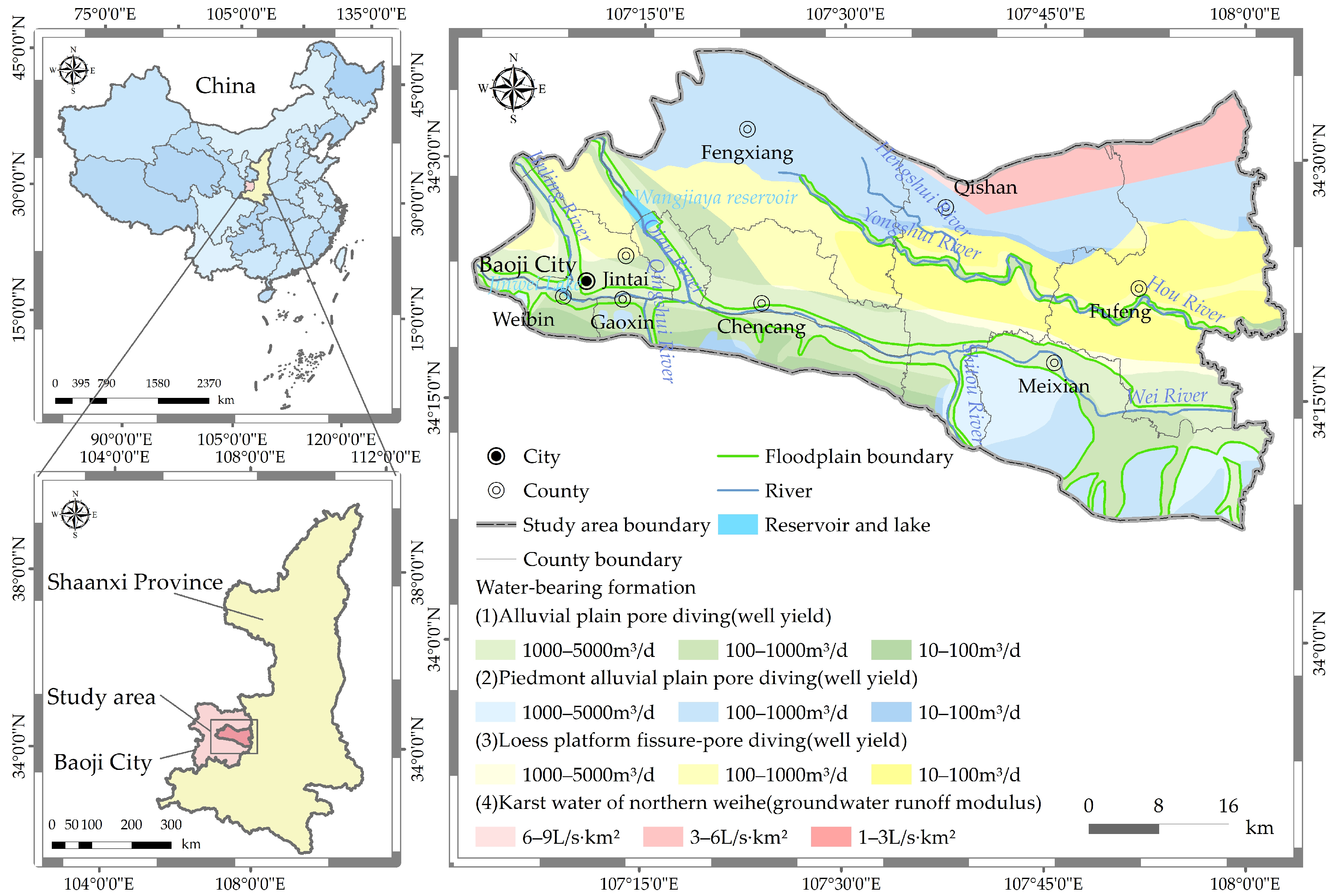
Figure 1. Overview map of the study area.
Sustainability 17 11213 g001
Figure 2. Groundwater pollution risk assessment framework.
Sustainability 17 11213 g002
Figure 3. Groundwater comprehensive vulnerability zoning map based on DRSTICW and PLEIK models.
Sustainability 17 11213 g003
Figure 4. Groundwater comprehensive pollution load zoning map.
Sustainability 17 11213 g004
Figure 5. Groundwater value function zoning map.
Sustainability 17 11213 g005
Figure 6. Groundwater pollution risk zoning map.
Sustainability 17 11213 g006
Figure 7. Groundwater pollution risk zoning map based on traditional DRASTIC model.
Sustainability 17 11213 g007
Table 1. Weights of indicator factors.
IndicatorWeightIndicatorWeight
Groundwater pollution risk index RIGroundwater vulnerability index DI0.580Pore/fissure groundwater vulnerability index DI1D0.267
R0.165
S0.061
T0.040
I0.267
C0.100
W0.100
Karst groundwater vulnerability index DI2P0.361
L0.253
E0.177
I0.123
K0.086
Groundwater pollution load index PI0.240Groundwater pollution load index PIIndustrial pollution source0.392
Landfill site0.248
Gas station0.237
Agricultural pollution source0.123
Groundwater value function index FI0.190Groundwater value function index FIQ0.320
H0.270
E0.410
Note. The consistency ratio (CR) of all the judgment matrices constructed in this paper is less than 0.10, which has satisfactory consistency.
Table 2. Classification of assessment results.
Pore/Fissure Groundwater Vulnerability Index (DI1)Karst Groundwater Vulnerability Index (DI2)Groundwater Pollution Load Index (PI)Groundwater Value Function Index (FI)Groundwater Pollution Risk Index (RI)Grade
1.96–3.43-0.00–2.271–1.410.31–2.71Low
3.43–4.32-2.27–4.441.41–1.912.71–4.10Relatively low
4.32–5.154.00–6.004.44–6.921.91–2.274.10–5.50Medium
5.15–6.096.00–8.006.92–10.212.27–2.645.50–6.91Relatively high
6.09–7.60-10.21–16.812.64–3.136.91–8.62High
Table 3. Sensitivity analysis of indicators.
IndicatorsTheoretical Weight (%)Effective Weights (%)
MeanMinimumMaximumStandard Deviation
DI1D26.724.44.954.612.0
R16.523.510.448.88.6
S6.17.14.515.61.6
T4.05.62.215.12.2
I26.720.911.238.25.6
C10.07.41.918.83.3
W10.011.11.413.34.6
DI2P36.142.236.956.98.3
L25.322.65.639.413.1
E17.714.17.816.81.8
I12.312.77.715.72.8
K8.68.45.211.31.7
Disclaimer/Publisher’s Note: The statements, opinions and data contained in all publications are solely those of the individual author(s) and contributor(s) and not of MDPI and/or the editor(s). MDPI and/or the editor(s) disclaim responsibility for any injury to people or property resulting from any ideas, methods, instructions or products referred to in the content.