_Li.png)
Made-to-Measure in the Industry 4.0 Era: Barriers, Workflow, and an Operational Prototype for the Apparel Sector (MtM Lusitano 4.0)





Abstract
1. Introduction
2. Apparel Industry and Made-to-Measure in Industry 4.0 Context
2.1. Apparel Industry Specifics
2.2. Industry 4.0 in Apparel Industry
3. Barriers and Challenges of the Apparel Industry for the Future
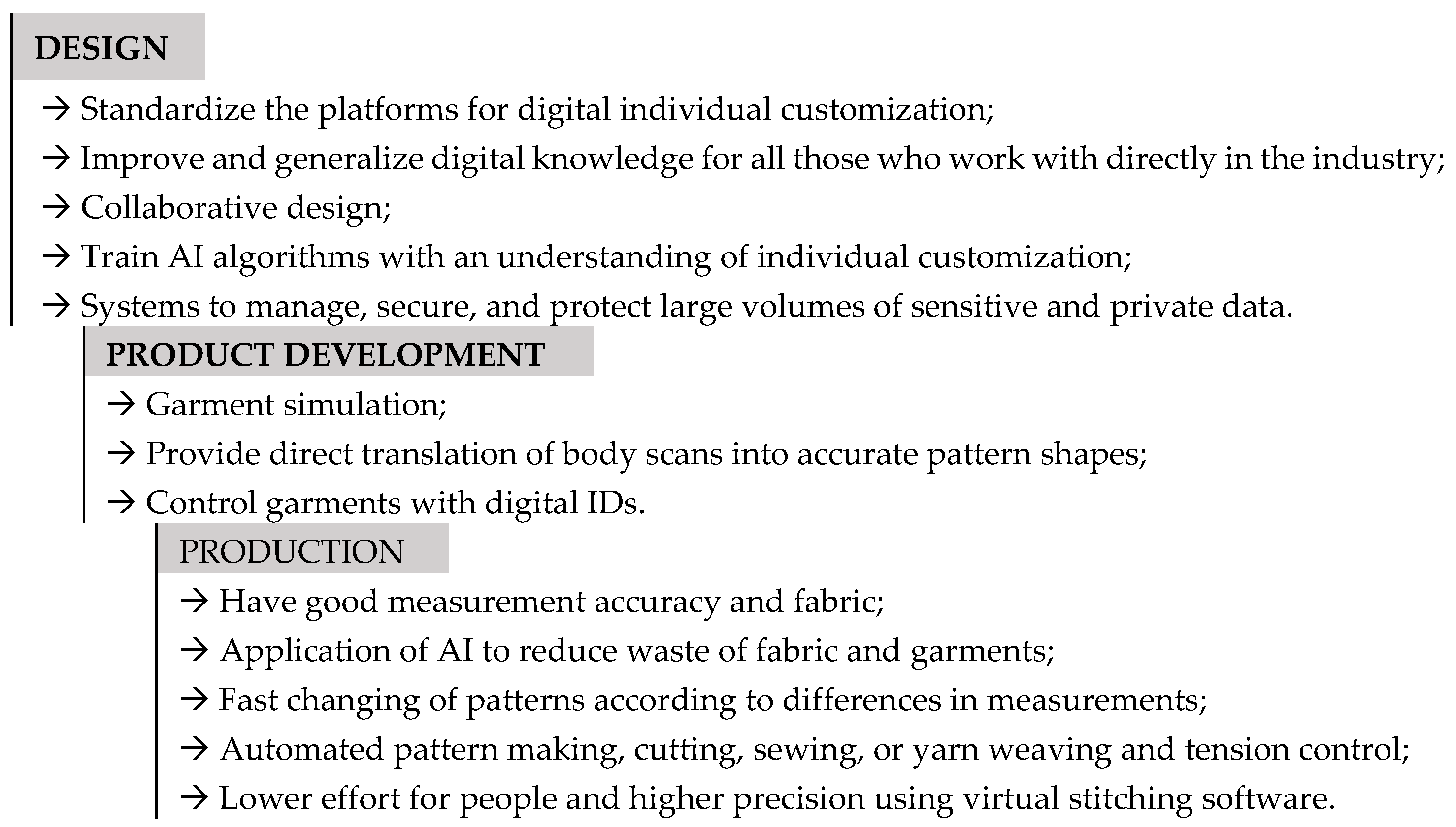
4. Conceptual Framework: A Workflow for MtM 4.0
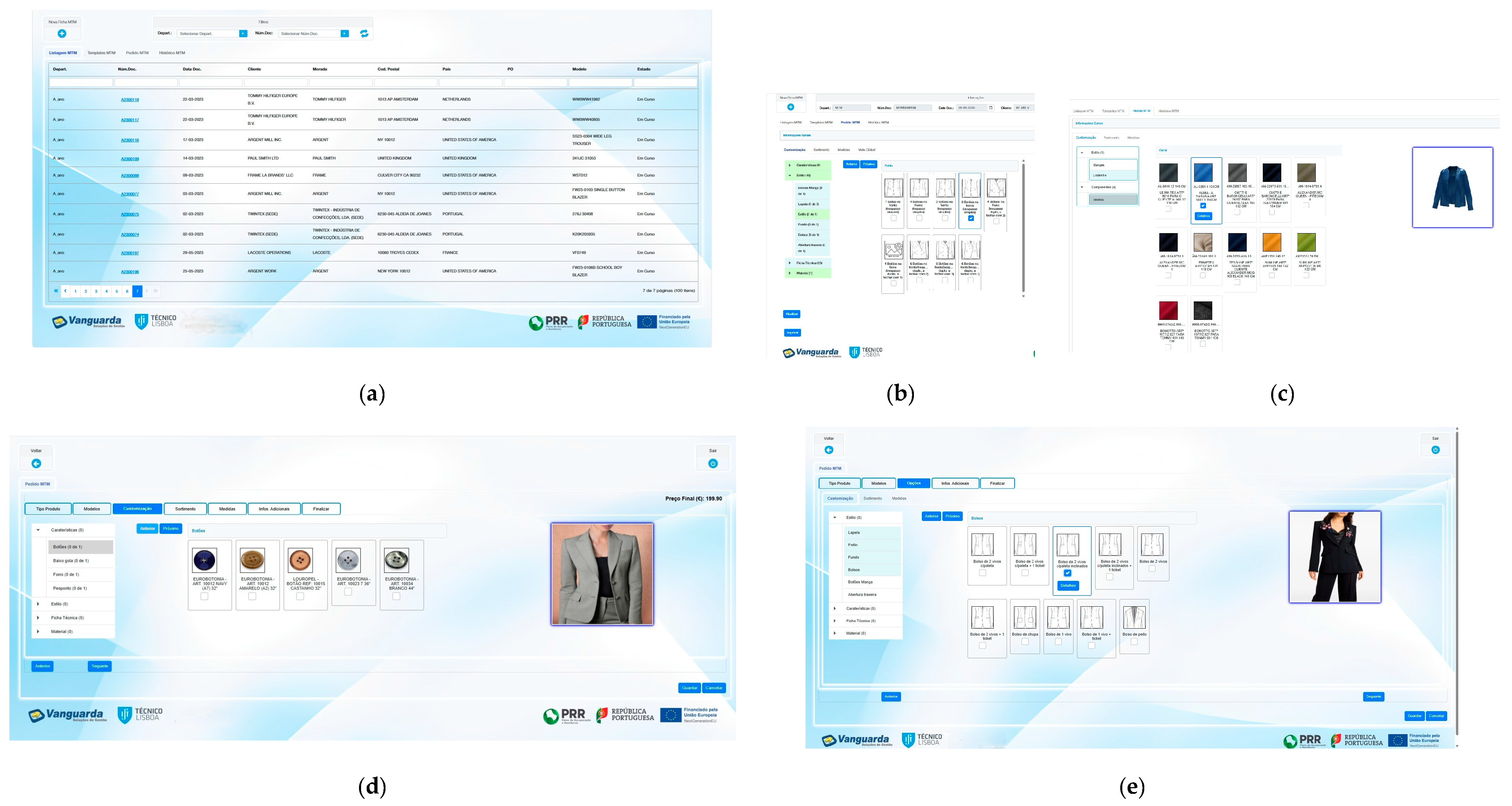
5. MtM Lusitano 4.0—An Innovative Solution for the Apparel Industry
5.1. Context and Motivation
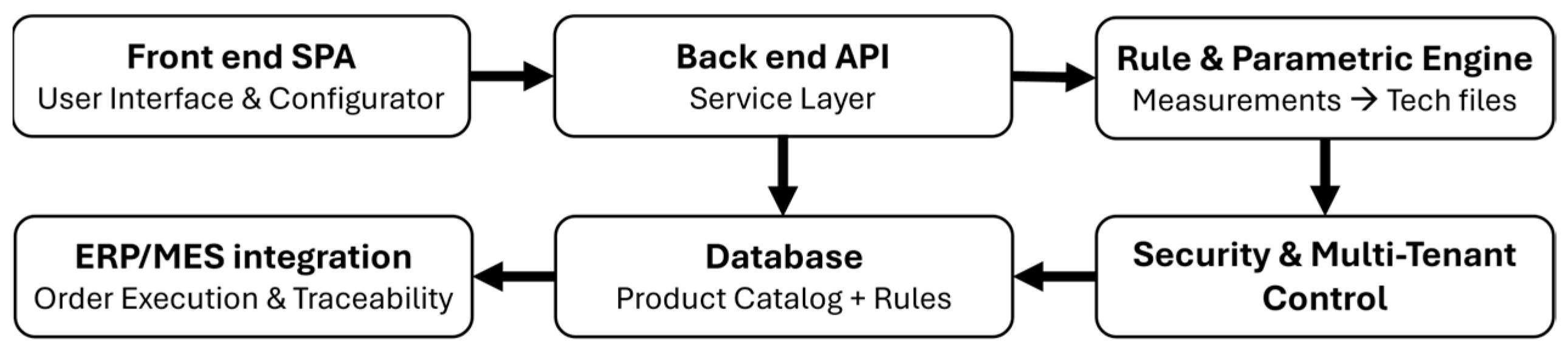
5.2. Functional Architecture and Innovation
- Front end: responsive single-page application providing garment configuration, visual feedback (2D/3D), and production tracking.
- Back end: API REST/GraphQL enabling multi-tenant management of product rules, materials, variants, and workflow logic.
- Parametric rule engine: core component translating customer measurements and stylistic selections into automatically generated technical files (BOMs, routing instructions).
- Integration layer: connectors for synchronizing data with ERP/MES/PLM systems, ensuring traceability across design–planning–manufacturing flow.
- Scalability and security:cloud infrastructure with isolated multi-tenant data domains and authentication via OAuth2/SSO.
5.3. Operational Impact and Sustainability Performance
6. Conclusions
Author Contributions
Funding
Institutional Review Board Statement
Informed Consent Statement
Data Availability Statement
Conflicts of Interest
References
- John, L.; Sampayo, M.; Peças, P. Lean & Green on Industry 4.0 Context—Contribution to Understand L & G Drivers and Design Principles. Int. J. Math. Eng. Manag. Sci. 2021, 6, 1214–1229. [Google Scholar] [CrossRef]
- Peças, P.; Encarnação, J.; Gambôa, M.; Sampayo, M.; Jorge, D. PDCA 4.0: A new conceptual approach for continuous improvement in the industry 4.0 paradigm. Appl. Sci. 2021, 11, 7671. [Google Scholar] [CrossRef]
- Ahmad, S.; Miskon, S.; Alabdan, R.; Tlili, I. Towards sustainable textile and apparel industry: Exploring the role of business intelligence systems in the era of industry 4.0. Sustainability 2020, 12, 2632. [Google Scholar] [CrossRef]
- Kaur, G.; Dey, B.K.; Pandey, P.; Majumder, A.; Gupta, S. A Smart Manufacturing Process for Textile Industry Automation under Uncertainties. Processes 2024, 12, 778. [Google Scholar] [CrossRef]
- Guo, Z.; Wong, W.; Leung, S.; Li, M. Applications of artificial intelligence in the apparel industry: A review. Text. Res. J. 2011, 81, 1871–1892. [Google Scholar] [CrossRef]
- Lorente-Leyva, L.L.; Alemany, M.M.E.; Peluffo-Ordóñez, D.H. A conceptual framework for the operations planning of the textile supply chains: Insights for sustainable and smart planning in uncertain and dynamic contexts. Comput. Ind. Eng. 2024, 187, 109824. [Google Scholar] [CrossRef]
- Caballero-Morales, S.-O.; Cuautle-Gutiérrez, L.; Cordero-Guridi, J.-J.; Alvarez-Tamayo, R.-I. Six-Sigma Reference Model for Industry 4.0 Implementations in Textile SMEs. Sustainability 2023, 15, 12589. [Google Scholar] [CrossRef]
- Bao, N.; Zheng, X.; Fan, Y.; Simeone, A.; Bao, R. Enhancing garment manufacturing efficiency through human-centered scheduling. Prod. Eng. 2025, 19, 885–898. [Google Scholar] [CrossRef]
- Glogar, M.; Petrak, S.; Naglić, M.M. Digital Technologies in the Sustainable Design and Development of Textiles and Clothing—A Literature Review. Sustainability 2025, 17, 1371. [Google Scholar] [CrossRef]
- Li, J.; Su, X.; Liang, J.; Mok, P.Y.; Fan, J. Tailoring Garment Fit for Personalized Body Image Enhancement: Insights from Digital Fitting Research. J. Theor. Appl. Electron. Commer. Res. 2024, 19, 942–957. [Google Scholar] [CrossRef]
- Bandara, D.T.; Senanayake, C. Digital Twin Technology in Apparel Industry: Potential for Rebalancing of Manual Assembly Lines. In Proceedings of the 2024 Moratuwa Engineering Research Conference (MERCon), Moratuwa, Sri Lanka, 8–10 August 2024; pp. 366–369. [Google Scholar] [CrossRef]
- Longo, F.; Padovano, A.; Cimmino, B.; Pinto, P. Towards a mass customization in the fashion industry: An evolutionary decision aid model for apparel product platform design and optimization. Comput. Ind. Eng. 2021, 162, 107742. [Google Scholar] [CrossRef]
- Deng, M.; Liu, Y.; Chen, L. AI-driven innovation in ethnic clothing design: An intersection of machine learning and cultural heritage. Electron. Res. Arch. 2023, 31, 5793–5814. [Google Scholar] [CrossRef]
- Abdelmeguid, A.; Afy-Shararah, M.; Salonitis, K. Towards circular fashion: Management strategies promoting circular behaviour along the value chain. Sustain. Prod. Consum. 2024, 48, 143–156. [Google Scholar] [CrossRef]
- Liu, N.; Chow, P.-S.; Zhao, H. Challenges and critical successful factors for apparel mass customization operations: Recent development and case study. Ann. Oper. Res. 2020, 291, 531–563. [Google Scholar] [CrossRef]
- Wang, H. Rule-free sewing pattern adjustment with precision and efficiency. ACM Trans. Graph. 2018, 37, 1–13. [Google Scholar] [CrossRef]
- Guo, S.; Istook, C.L. Evaluation of 2D CAD Technology for Garments Customized for Body Shape. Fash. Pract. 2023, 15, 136–162. [Google Scholar] [CrossRef]
- Chen, C.-L. Value Creation by SMEs Participating in Global Value Chains under Industry 4.0 Trend: Case Study of Textile Industry in Taiwan. J. Glob. Inf. Technol. Manag. 2019, 22, 120–145. [Google Scholar] [CrossRef]
- Ferreira, D.V.; de Gusmão, A.P.H.; de Almeida, J.A. A multicriteria model for assessing maturity in industry 4.0 context. J. Ind. Inf. Integr. 2024, 38, 100579. [Google Scholar] [CrossRef]
- Bertola, P.; Teunissen, J. Fashion 4.0. Innovating fashion industry through digital transformation. Res. J. Text. Appar. 2018, 22, 352–369. [Google Scholar] [CrossRef]
- Oosterom, E.B.; Baytar, F.; Akdemir, D.; Kalaoglu, F. Predicting consumers’ garment fit satisfactions by using machine learning. AUTEX Res. J. 2024, 24, 20230016. [Google Scholar] [CrossRef]
- Yang, Y.-I.; Yang, C.-K.; Chu, C.-H. A virtual try-on system in augmented reality using RGB-D cameras for footwear personalization. J. Manuf. Syst. 2014, 33, 690–698. [Google Scholar] [CrossRef]
- Sterev, N.; Milusheva, V. Competitiveness of Textile Producers in Digital Business Era. Strateg. Policy Sci. Educ. Strateg. Obraz. Nauchnata Polit. 2024, 32, 29–41. [Google Scholar] [CrossRef]
- Nouinou, H.; Asadollahi-Yazdi, E.; Baret, I.; Nguyen, N.Q.; Terzi, M.; Ouazene, Y.; Yalaoui, F.; Kelly, R. Decision-making in the context of Industry 4.0: Evidence from the textile and clothing industry. J. Clean. Prod. 2023, 391, 136184. [Google Scholar] [CrossRef]
- Deepthi, B.; Bansal, V. Industry 4.0 in Textile and Apparel Industry: A Systematic Literature Review and Bibliometric Analysis of Global Research Trends. Vis. J. Bus. Perspect. 2024, 28, 157–170. [Google Scholar] [CrossRef]
- Bai, C.; Dallasega, P.; Orzes, G.; Sarkis, J. Industry 4.0 technologies assessment: A sustainability perspective. Int. J. Prod. Econ. 2020, 229, 107776. [Google Scholar] [CrossRef]
- Sampayo, M.; Peças, P. CPSD2: A new approach for cyber-physical systems design and development. J. Ind. Inf. Integr. 2022, 28, 100348. [Google Scholar] [CrossRef]
- Martinho, R.; Lopes, J.; Jorge, D.; de Oliveira, L.C.; Henriques, C.; Peças, P. IoT Based Automatic Diagnosis for Continuous Improvement. Sustainability 2022, 14, 9687. [Google Scholar] [CrossRef]
- Hidayatno, A.; Rahman, I.; Irminanda, K.R. A Conceptualization of Industry 4.0 Adoption on Textile and Clothing Sector in Indonesia. In Proceedings of the 2019 5th International Conference on Industrial and Business Engineering, Hong Kong, China, 27 September 2019; ACM: New York, NY, USA, 2019; pp. 339–343. [Google Scholar] [CrossRef]
- Marshall, J.; Thompson-Whiteside, S.; Jan, T. Barriers to the adoption of industry 4.0 technologies within the Australian fashion industry. Int. J. Fash. Des. Technol. Educ. 2025, 18, 321–331. [Google Scholar] [CrossRef]
- Falani, L.A.; de Aguiar, C.R.L.; Forno, A.J.D. Initial overview of industry 4.0 in textile companies from Santa Catarina. In Proceedings of the International Conference on Industrial Engineering and Operations Management, Sao Paulo, Brazil, 5–8 April 2021; IEOM Society International: Southfield, MI, USA, 2021; pp. 551–562. [Google Scholar] [CrossRef]
- Jahromi, G.S.; Ghazinoory, S. Clothing industry in transition from Industry 4.0 to Industry 5.0. J. Text. Inst. 2025, 116, 365–379. [Google Scholar] [CrossRef]
- Monteiro, R.A.; Junior, D.S.G.; Sobral, E.F.M.; de Barros Falcão, P.H.; de Melo, F.J.C.; Bastos-Filho, C. Global Trends and Practices of Industry 4.0 Applications in the Clothing Sector: A Systematic Literature Review. Adm. Sci. 2024, 14, 258. [Google Scholar] [CrossRef]
- Mim, I.Z.; Rayhan, M.G.S.; Syduzzaman, M. Prospects and current scenario of industry 4.0 in Bangladeshi textile and apparel industry. Heliyon 2024, 10, e32044. [Google Scholar] [CrossRef]
- Van Ta, C.; Jin, B.E.; Cho, H.J. Examining the relationship between firm characteristics and Industry 4.0 technology adoption in Vietnam’s apparel industry. Int. J. Fash. Des. Technol. Educ. 2024, 17, 404–419. [Google Scholar] [CrossRef]
- Hillaire, J.M.; Baytar, F. All-3D apparel development: Establishing the rules to enable 3D weaving from 3D digital garments. J. Eng. Fiber. Fabr. 2024, 19, 1–12. [Google Scholar] [CrossRef]
- Dove, T. Facilitating Teaching and Learning with Made to Measure Fashion Design and Creation MOOC Courses. Int. J. Inf. Educ. Technol. 2020, 10, 792–796. [Google Scholar] [CrossRef]
- Majumdar, A.; Garg, H.; Jain, R. Managing the barriers of Industry 4.0 adoption and implementation in textile and clothing industry: Interpretive structural model and triple helix framework. Comput. Ind. 2021, 125, 103372. [Google Scholar] [CrossRef]



| [7] | [8] | [9] | [15] | [18] | [20] | [25] | [26] | [29] | [31] | [32] | [33] | |
|---|---|---|---|---|---|---|---|---|---|---|---|---|
| Artificial intelligence (AI) | X | X | X | X | X | X | ||||||
| Additive manufacturing (3D printing) | X | X | X | X | X | |||||||
| Autonomous robots (robotics) | X | X | X | X | X | |||||||
| Augmented/virtual reality (AR/VR) | X | X | X | X | X | X | X | |||||
| Big data and analytics | X | X | X | X | X | X | X | X | ||||
| Blockchain | X | X | X | |||||||||
| CAD/CAM (3D design and manufacturing) | X | X | ||||||||||
| Cloud computing | X | X | X | X | X | X | X | X | ||||
| Cybersecurity systems | X | X | ||||||||||
| Enterprise resource planning (ERP)/system integration | X | X | X | |||||||||
| Internet of Things (IoT) | X | X | X | X | X | X | X | X | X | X | ||
| Global positioning system (GPS) | X | |||||||||||
| Mobile technology | X | X | ||||||||||
| Nanotechnology | X | |||||||||||
| Simulation and digital twins | X | X | X | X | ||||||||
| Sensors and actuators | X | X | X | X | ||||||||
| Unmanned aerial vehicle (drones) | X | |||||||||||
| Radio-frequency identification (RFID) | X | X | X | |||||||||
| QR codes | X | X | X |
| Barrier | Description | Source |
|---|---|---|
| Investment in technologies | I4.0 requires investments in infrastructure, equipment, and training, which represents a high implementation cost. | [7,8,31] |
| Qualified labor | Misaligned knowledge and skills. Enhanced skill requirements for employees in the domain of I4.0 technologies. | [7,30,31,34,38] |
| Absence of infrastructure | Outdated machinery and systems that may not be compatible with newer I4.0 technologies which require an IT infrastructure and internet coverage. | [7,31,38] |
| Limited SC integration | SC collaboration, coordination, and network with a technologically complex task due to the different implementations of I4.0 technologies for each stakeholder. | [7,38] |
| Limited or no flexibility | Although I4.0 enables agility and flexibility in manufacturing processes, scaling these solutions across different production lines and factories can be a logistical and operational challenge. | [7,9] |
| Cybersecurity issues | With increased connectivity and data generation, it is necessary that companies obtain effective systems to manage and secure large volumes of data. Cybersecurity threats and data privacy concerns must be addressed to ensure the protection of sensitive information. | [7,38] |
| Strategic direction | The implementation of I4.0 technologies is dependent on the vision and commitment of top management. Leaders must be committed and not hesitate to make decisions. | [30,38] |
| Compliance with regulations and standards | A regulatory framework is needed for I4.0 technologies; this framework must ensure the safe, efficient, and ethical use of these technologies. | [3,7] |
| Processes changes/resistance to changes | It is difficult to implement I4.0 technologies when faced with changes to organization, processes, and standardization. | [31,38] |
| Energy consumption reduction | To be environmentally sustainable, it is important that I4.0 technologies also reduce the consumption of energy. | [29] |
| Innovating | The industry requires a complete rethink of how design, manufacture, and retail operate, and this starts with a new attitude towards innovation. The industry needs to address various aspects of I4.0 implementation. | [30,38] |
| New business model | The industry needs to view I4.0 as a new business model and, thus, must plan for the early adoption of I4.0 technologies. | [31,34] |
| Challenges | Description | Source |
|---|---|---|
| Customization processes | Conducting multiple fittings, evaluating body image, and adjusting original patterns are usually necessary for the customization process. Technology advancement is needed to develop an understanding of pattern theory for figure shape. | [8,9,10,17,37] |
| Platforms | Very few existing platforms’ design methods integrate fit, ergonomics, and body image in their formulation. | [10,12,22] |
| CAD software | This software is still expensive for many small and medium-sized companies because considerable expertise is required to set them up appropriately; also, much of this technology still works with the assumptions of the 2D-to-3D process. | [17,36] |
| Cloth measurement technology | There are no technological methods that can provide direct translation of body scans into accurate pattern shapes. | [37] |
| Body scanning system | It makes errors in locating specific landmarks on a body; landmarks used to help define the location of specific body measurements are managed differently by various scanning systems. | [17,37] |
| Garment simulator | Most garment simulators in computer graphics use implicit integration to avoid the numerical instability issue; thus, advances in cloth simulation techniques are needed. | [8,9,16] |
| Results | Results from software can be affected by measurement accuracy, alteration selection, and fabric. | [17] |
| Skills | Investing in digital knowledge, data analysis, and technological expertise to leverage the full potential of emerging technologies effectively. | [9,14] |
| Digital IDs | Incorporating digital IDs into garments to ensure accountability and transparency throughout the supply chain. | [14] |
| AI algorithms | Ensuring that the AI algorithms were trained with an authentic and respectful understanding of the individual customization. | [13] |
| Co-design systems | Making a collaborative customization is essential for processes to be innovative, and it might support future innovative processes and sustainable practices. | [17] |
| Sustainability | Promoting sustainability involves reducing the likelihood of garments ending up in landfills due to poor fit or design trends. | [9,36] |
| Barrier/Challenge Identified | MtM Lusitano 4.0 Contribution |
|---|---|
| Lack of integrated platforms for fit/ergonomics/body image considerations | Parametric model definition with adaptable sizing and tolerancing rules |
| Time-consuming pattern adjustment requiring expert knowledge | Automated rule-based technical file generation |
| Poor alignment between configuration and production execution | Full digital continuity across ERP/MES |
| Low flexibility for small lot customization | Automated routing and variant management with minimal setup change |
| Limited traceability in personalized orders | Real-time production dashboards and item-level tracking |
Disclaimer/Publisher’s Note: The statements, opinions and data contained in all publications are solely those of the individual author(s) and contributor(s) and not of MDPI and/or the editor(s). MDPI and/or the editor(s) disclaim responsibility for any injury to people or property resulting from any ideas, methods, instructions or products referred to in the content. |
© 2025 by the authors. Licensee MDPI, Basel, Switzerland. This article is an open access article distributed under the terms and conditions of the Creative Commons Attribution (CC BY) license (https://creativecommons.org/licenses/by/4.0/).
Share and Cite
Peças, P.; Duarte, S.; Cruz-Machado, V.; Soares, P. Made-to-Measure in the Industry 4.0 Era: Barriers, Workflow, and an Operational Prototype for the Apparel Sector (MtM Lusitano 4.0). Sustainability 2025, 17, 11176. https://doi.org/10.3390/su172411176
Peças P, Duarte S, Cruz-Machado V, Soares P. Made-to-Measure in the Industry 4.0 Era: Barriers, Workflow, and an Operational Prototype for the Apparel Sector (MtM Lusitano 4.0). Sustainability. 2025; 17(24):11176. https://doi.org/10.3390/su172411176
Chicago/Turabian StylePeças, Paulo, Susana Duarte, Virgílio Cruz-Machado, and Paulo Soares. 2025. "Made-to-Measure in the Industry 4.0 Era: Barriers, Workflow, and an Operational Prototype for the Apparel Sector (MtM Lusitano 4.0)" Sustainability 17, no. 24: 11176. https://doi.org/10.3390/su172411176
APA StylePeças, P., Duarte, S., Cruz-Machado, V., & Soares, P. (2025). Made-to-Measure in the Industry 4.0 Era: Barriers, Workflow, and an Operational Prototype for the Apparel Sector (MtM Lusitano 4.0). Sustainability, 17(24), 11176. https://doi.org/10.3390/su172411176