Article

The Impact of New Energy Demonstration Cities in China on Inclusive Green Growth: Evidence from Causal Inference Based on Double Machine Learning

School of Public Administration, Guilin University of Technology, 319 Yanshan Street, Yanshan District, Guilin 541006, China
*
Authors to whom correspondence should be addressed.
Sustainability 2025, 17(24), 11155; https://doi.org/10.3390/su172411155
Submission received: 7 November 2025 / Revised: 3 December 2025 / Accepted: 10 December 2025 / Published: 12 December 2025

Abstract

The construction of New Energy Demonstration Cities (NEDC) represents a crucial policy initiative in advancing China’s energy transition and serves as an institutional innovation to promote inclusive green growth (IGG) at the urban level. Based on panel data for 278 prefecture-level cities in China from 2011 to 2021, this study employs a double machine learning model to identify the causal impact of the NEDC on IGG and to further explore the underlying mechanisms. The empirical results show that the policy significantly enhances IGG overall. However, the positive effects are mainly observed in non-resource-based and non-old industrial cities, while the impacts in resource-based and old industrial cities are statistically insignificant. This finding indicates that structural constraints such as the resource curse and Dutch disease remain evident in these regions. Mechanism analysis reveals that the NEDC promotes IGG primarily through technological innovation and employment creation, forming a chained mediating pathway of ‘NEDC → technological innovation → employment creation → IGG.’ This study enriches the literature on the economic effects of energy reform pilot policies and provides empirical evidence and policy insights for achieving IGG goals in both China and other countries.

1. Introduction

Warned by the approaching tipping points of the Earth’s climate and natural systems, inclusive green growth (IGG) has emerged as a critical agenda for advancing global sustainable development. Energy, serving as a vital strategic resource for achieving economic growth, social stability, and environmental sustainability in regions [1,2], has rendered energy policy a key instrument for IGG [3]. Currently, nations worldwide are actively seeking to foster IGG through innovations in energy governance tools. For instance, the European Union, via the Green Deal, has designated policy instruments such as the Just Transition Fund to mitigate social inequality [4], while the United States has allocated 459.5 billion USD to environmental justice to prioritize the needs of low-income and disadvantaged communities [5].
As the world’s largest energy producer and carbon emitter [6,7], China has long depended on a high-carbon lock-in development model, resulting in simultaneous environmental degradation and income distribution gaps [8]. To innovatively pursue green and inclusive economic growth, regional energy policy pilots have constituted a distinctive policy practice in China. Within the evolution of China’s regional energy policies, the Chinese government initiated the New Energy Demonstration City (NEDC) in 2014, aiming to promote comprehensive sustainable energy transition through a more decentralized energy governance structure and progressively address inequality issues. Shuai Che [9] contends that energy transition policies reflect a unique characteristic of the Chinese government’s consideration of local socio-economic contexts, representing a significant attempt to shift from a centralized to a decentralized energy governance model. Advocates of decentralization assert that decentralized governance can improve the responsiveness and efficiency of local governments in tackling complex social issues [10] and generate more balanced and inclusive policy solutions [11]. A systematic examination of the NEDC indicates that this pilot construction concentrates on coordinating multiple dimensions, including economic development, resource utilization, environmental protection, and livelihood improvement, offering potential to harmonize green growth and inclusive objectives.
The construction of NEDC holds significant policy value, and a rigorous investigation into its actual effects carries considerable academic merit. Within academia, evidence regarding the NEDC’s role in driving IGG remains fragmented. Only a limited number of scholars have provided relevant insights, primarily examining the NEDC’s regulatory function from the perspectives of carbon emission reduction and energy poverty alleviation. Regarding carbon reduction, as an institutional experiment within the energy revolution, this pilot can compel enterprises to save energy and reduce emissions through environmental regulation mechanisms [12,13], enhance urban environmental governance during the spatial agglomeration of new energy industries [14,15], and promote green economic transformation via the innovation compensation effect [16,17], demonstrating significant dual benefits for both economy and ecology. Concerning energy poverty alleviation, given that China’s population affected by energy poverty accounts for up to 50% [18], local governments in pilot cities advocate developing clean energy to mitigate poverty in energy accessibility [19], enforce the implementation of energy poverty alleviation policies through administrative authority [20,21], or design monetary compensation mechanisms that also address energy poverty to promote welfare redistribution [22]. These studies suggest that the NEDC can drive IGG through multiple pathways. However, the transmission mechanism is not a simple linear process; rather, it operates through a chain-like cascade of resource and innovation synergies. This chain-like transmission is nonlinear, and the simultaneity of pathways can easily lead to estimation bias. Traditional policy evaluation methods struggle to accurately disentangle direct and indirect effects. The Double Machine Learning (DML) model, integrating Lasso regularization and random forest algorithms, effectively addresses issues of high-dimensional confounders, nonlinearity, and endogeneity. Its framework aligns well with the logic of chain-like transmission and has demonstrated robustness in the field of economic policy evaluation [23,24].
Furthermore, designation as a pilot city entails access to financial subsidies, tax relief, and other supportive policies [25]. However, the policy effects manifest significant heterogeneity [26]. Studies on China’s Low-Carbon City pilot policy [27], Smart City pilot policy [28], and NEDC [26] reveal that the performance of such initiatives is contingent upon local economic development levels, the resources available to local governments, and the implementation capacity of local actors. Synthesizing this literature, our exploratory research extends the inquiry in three directions. First, we investigate the direct impact of NEDC on IGG from an administrative regulation perspective, employing a DML model for causal estimation. Second, we unveil the mediating mechanisms through technology innovation (INNOL) and employment creation (EMPLOY), and further analyze the transmission pathways from a chain-mediation perspective. Third, we examine the spatial heterogeneous effects of the policy, with a focus on comparing its efficacy between resource-based and non-resource-based cities (RC & NRC), as well as between old industrial and non-old industrial cities (OIC & NOIC). This analysis aims to provide an evidence-based foundation for formulating differentiated strategies to advance NEDC development.

2. Research Hypotheses

2.1. The Direct Effect of NEDC on IGG

The concept of IGG integrates the dual development paradigms of green growth and inclusive development [29]. As an institutional framework designed to advance urban green development, the NEDC aims to optimize the energy structure and enhance sustainable urban development capacity. It emphasizes the widespread adoption of renewable energy technologies and increasing the share of new energy in urban energy consumption. To facilitate this initiative, the evaluation system for NEDC encompasses not only quantitative targets for new energy utilization but also incorporates aspects of inclusive development, such as fiscal subsidies, equitable access to public services, and benefit-sharing. Although the central government has not issued explicit policy targets directly linking NEDC to IGG, the dynamics of central–local relations and intergovernmental competition can still motivate local governments in pilot cities to employ a mix of environmental regulatory instruments [30,31]. These actions collectively influence urban environmental protection, economic growth, and social equity, thereby providing a guiding framework for achieving IGG. Statistics indicate that NEDC cover 52.6% of sub-provincial and above-level cities and over 10.2% of prefecture-level cities in China, establishing this pilot policy as a significant pathway for promoting urban IGG. Based on this analysis, this study proposes the following hypothesis:
H1: 
The NEDC promotes IGG at the urban level.

2.2. The Mediating Effects of NEDC on IGG

Within the measurement framework of IGG, green growth emphasizes the decoupling of economic growth from resource degradation through technological innovation [32], while inclusive growth focuses on ensuring disadvantaged groups can equitably benefit from green growth by providing employment and educational opportunities [33]. As an environmental regulation integrating economic development, livelihood improvement, and environmental governance, the NEDC also serves as a crucial platform for combining production factors like ‘technology’ and ‘labor.’ Specifically, the innovation mechanism in the technological dimension constitutes the foundational pathway for realizing NEDC goals, whereas the creation mechanism in the labor dimension acts as a key driver for their advancement. Consequently, this study examines the mediating effects of NEDC on IGG from the perspectives of INNOL and EMPLOY.
In terms of technological innovation, studies by Khan, NU [34] and Fu, HB and Rasiah, R [35] confirm its role as a crucial means to achieve urban IGG. In China, energy-biased technological progress is gradually enhancing the level of IGG [36]. This is facilitated by local governments, which typically emphasize strengthening the incentive functions of green development planning systems and financial support at the initial stage of NEDC. This approach guides enterprises to become the core agents of policy implementation and the primary force for proactive green decarbonization and innovation within the pilot areas. As the NEDC continues to be refined and deepened, local governments extensively disseminate green development concepts. Using policy support as a signal, they guide local financial institutions to lower the green credit financing thresholds for environmental protection enterprises, thereby alleviating the financing constraints these firms face in green technology innovation and R&D. From the perspective of government–enterprise coordination within the NEDC: (1) Stimulated by policy instruments such as tax reductions and subsidies for green technology innovation, enterprises proactively increase their R&D investment in green technologies. This accelerates innovation in energy conservation and environmental protection, forming a technical foundation for successfully reducing energy consumption and pollution emissions [37]. (2) The enhancement of green total factor productivity resulting from increased vitality and capability in corporate green innovation not only significantly improves corporate environmental performance but also promotes energy accessibility and helps mitigate energy poverty [38,39]. On the other hand, as the level of urban technological innovation rises, the socialization, mechanization, and intellectualization of productivity continuously improve. This gradually transforms residents’ work and lifestyles, contributing not only to stable economic growth but also to improved ecological and environmental quality [40]. Synthesizing the above analysis, urban technological innovation, by reshaping production methods, lifestyles, and governance models, emerges as a key driver for NEDC to achieve the goal of IGG. Building on the above analysis, we propose the following hypothesis:
H2: 
The NEDC fosters IGG through INNOL.
Regarding employment creation, scholars have primarily examined the IGG effects of NEDC indirectly, through the lens of its environmental regulation function and by engaging with theories such as the output view, the Porter Hypothesis, the factor substitution effect, and the skill premium thesis [41,42,43,44]. The output view posits that environmental regulations increase firms’ production costs and weaken their competitive advantage, compelling them to scale down operations and reduce employment [45]. In contrast, the Porter Hypothesis suggests that appropriate environmental regulation can compel firms to engage in innovative production activities through environmental investment. This not only leads firms to hire more employees for operating pollution control facilities as they expand market share but also creates more high-value-added jobs via the innovation compensation effect of technological upgrading [46]. The factor substitution effect theory argues that strengthening environmental regulation directly raises the price of resource-based production factors. Under cost constraints, firms tend to favor the relatively cheaper labor factor. Governments can reinforce this pro-employment effect by supporting the transfer of environmentally preferential labor [47]. The skill premium perspective emphasizes that environmental regulation strengthens the capital-skill complementarity between non-neutral technologies embedded in machinery and skilled labor. To pursue production innovation and transformation, firms increase their demand for skilled workers, thereby impacting the employment and income structure [48].
In China, environmental regulation exerts a constraining effect on social employment in the short term through the cost channel [49]. However, driven by mechanisms of technological innovation and industrial upgrading, China’s accelerated energy transition has not only created a substantial number of jobs but also significantly expanded employment at the provincial level [50]. A defining feature of the current Chinese labor market is the contraction of employment in polluting sectors alongside the expansion of employment in clean sectors [51]. This indirectly indicates that environmental regulation has manifested a significant Porter Effect in promoting China’s long-term energy transition, with its impact on the labor market currently in a phase of job absorption. Integrating theoretical analysis with practical context, the NEDC represents a significant innovation within the field of environmental regulation. Accordingly, this study proposes the following hypothesis:
H3: 
The NEDC advances IGG through EMPLOY.

2.3. Chain Mediating Effect of NEDC on IGG

Compared to simple or parallel mediation, a chain-mediating mechanism progressively delineates the internal ‘black box’ process through which an independent variable influences the dependent variable, revealing interlinking causal mechanisms. While the preceding analysis hypothesizes that NEDC can promote IGG through the mediating effects of INNOL and EMPLOY, the causal relationship between INNOL and EMPLOY is itself complex. A review of the literature on this relationship reveals divergent scholarly conclusions. The first perspective posits that INNOL can generate new industries and economic ecosystems, thereby creating novel employment opportunities [52]. A second view contends that innovation, through new technologies and equipment, effectively substitutes for traditional labor, leading to significant job displacement [53]. A third perspective argues against examining technological progress in isolation, emphasizing the need to account for the influence of national political institutions, policy regimes, and the broader economic environment [54]. Building on this third view and examining Low-Carbon City pilots as an environmental regulation tool, Bingtao Qin et al. [55] find that such policies can compel green technological innovation, subsequently alleviating employment pressures through ‘green-for-labor’ substitution. Building on the preceding theoretical hypotheses, environmental regulation exerts a significant Porter effect on China’s labor market through the channel of technological innovation. This implies that the NEDC, in transmitting its regulatory function, may also establish a ‘NEDC → INNOL → EMPLOY → IGG’ chain-mediation mechanism. Based on this reasoning, this study proposes the following hypothesis:
H4: 
The NEDC enhances IGG through chain effects of INNOL and EMPLOY.
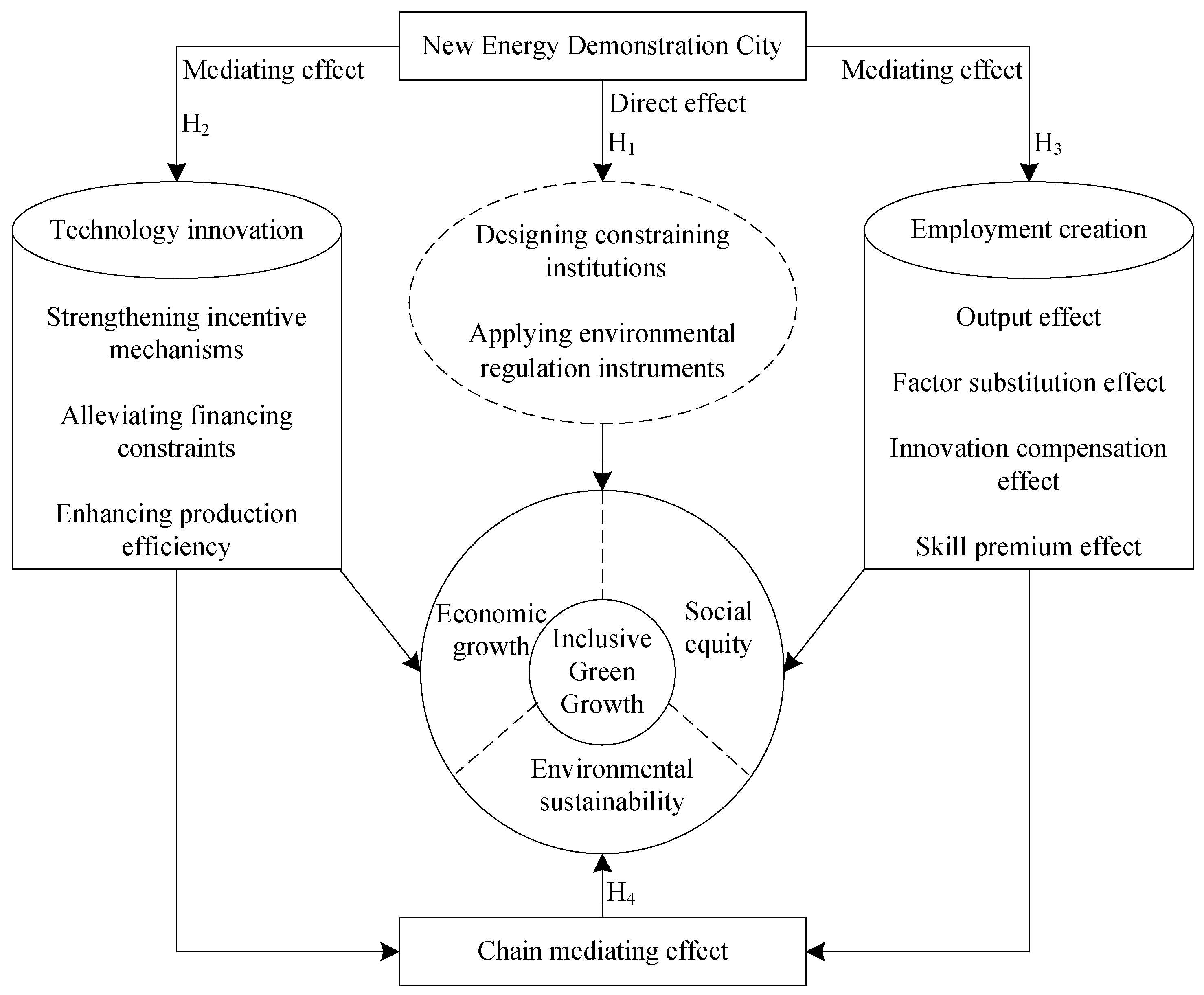
Building upon the aforementioned theoretical framework and research hypotheses, this study preliminarily posits that the NEDC promotes IGG. The conceptual framework is illustrated in Figure 1. In the following sections, an empirical analysis will be conducted to further investigate and validate this proposed hypothesis.

3. Research Design

3.1. Baseline Regression Model

This study applies the DML model to evaluate the impact of the NEDC on IGG at the urban level. Compared with traditional causal inference models such as difference-in-differences and regression discontinuity models, the DML provides distinct methodological advantages. First, by applying regularization algorithms, it effectively mitigates the curse of dimensionality and the limitation of key covariates [56], thereby enhancing the accuracy of policy effect identification. Second, the DML demonstrates strong capability in handling nonlinear relationships, reducing potential specification bias inherent in linear regression models [57]. Building on this foundation, the study adopts the DML model proposed by Chernozhukov [58] and specifies the following partially linear regression model:
IGG i , t + 1 = θ 0 NEDC i , t + g ( X i , t ) + U i , t s . t . E ( U i , t NEDC i , t , X i , t ) = 0
where IGG i , t + 1 represents the dependent variable, indicating the level of IGG in city i at year t + 1 . NEDC i , t denotes the treatment variable, which equals 1 if city i is included in the NEDC in year t, and 0 otherwise. θ 0 represents the coefficient of the policy effect. X i , t denotes the set of high-dimensional covariates, whose specific functional form g ( X i , t ) is estimated using machine learning algorithms. U i , t is the error term, assumed to be independently and identically distributed with a zero mean.
During the parameter estimation process, the coefficient estimator θ ^ 0 of NEDC i , t can effectively control the variance inflation caused by high-dimensional covariates after introducing regularization in the machine learning model. However, this procedure may induce a regularization bias in the function g ( X i , t ) , preventing the estimator from converging to the true value of θ 0 . To mitigate the influence of such biases on causal effect estimation, the DML model further introduces the following auxiliary equations:
NEDC i , t = m ( X i , t ) + V i , t s . t . E ( V i , t | X i , t ) = 0
where m ( X i , t ) represents the estimated function of the treatment variable with respect to high-dimensional control variables, whose specific form is inferred using machine learning algorithms. The term V i , t denotes the residual term, which satisfies the zero mean condition. In Equation (2), the function m ( X i , t ) is first estimated using a machine learning model to obtain its estimator. Subsequently, the residual term V i , t is evaluated as shown in Equation (3)
V ^ i , t = NEDC i , t m ^ ( X i , t ) .
Treating V i , t as an instrumental variable (IV) for NEDC i , t , the function g ( X i , t ) is estimated using a machine learning algorithm to obtain its estimator g ^ ( X i , t ) . Subsequently, the estimated value of θ 0 , denoted as θ ^ 0 , is calculated as shown in Equation (4):
θ ^ 0 = 1 n i I t T V ^ i , t NEDC i , t 1 1 n i I t T V ^ i , t IGG i , t + 1 g ^ ( X i , t ) .

3.2. Variables Definition and Description

3.2.1. Dependent Variable

Scholars have proposed different conceptual interpretations of IGG. From the perspective of sustainable development, some studies regard it as a development approach that integrates social equity with environmental sustainability [59,60]. From the viewpoint of welfare economics, other scholars argue that IGG represents a growth model aimed at enhancing social welfare and ensuring the transmission of well-being across generations [61]. IGG is therefore understood as the integration of inclusive development and green transformation [62], with its core objective being the coordinated advancement of economic development, social equity, and environmental protection. To systematically quantify this comprehensive concept, this study draws upon the framework for constructing an IGG indicator system outlined in the Asian Development Bank’s 2018 report, Inclusive Green Growth Index: A New Benchmark for Quality of Growth [63]. Adapting this framework to align with the sustainable development objectives of the NEDC, we construct a comprehensive evaluation index system encompassing three dimensions: Economic growth, social equity, and environmental sustainability.
The economic growth dimension serves as the material foundation for IGG. It is assessed from two aspects: The level and the momentum of economic growth, measured by per capita gross regional product and the regional GDP growth rate, respectively. The social equity dimension reflects the core value of IGG. An evaluation framework is constructed from three layers: Energy equity, equality of opportunity, and outcome sharing. Energy equity, fundamental to sustainable livelihoods and indicative of policy inclusiveness, is measured by liquefied petroleum gas consumption per 10,000 people and natural gas consumption per 10,000 people. Equality of opportunity emphasizes access to public services and the capacity for citizens to participate equally in development. It focuses on the accessibility of resources in education, healthcare, and employment, using indicators such as public library collections per 10,000 people, number of hospital beds, and unemployment insurance coverage rate. Outcome sharing reflects income distribution equality during economic growth, measured by the absolute values of per capita disposable income for urban and rural residents, as well as their ratio. The environmental sustainability dimension constitutes the fundamental principle of IGG. It is comprehensively evaluated from three aspects: Environmental pollution pressure, environmental governance capacity, and residential living environment quality. Pollution pressure is gauged by the emission intensity of key pollutants, including industrial sulfur dioxide and soot (dust). Governance capacity is measured by the centralized treatment rate of sewage and the harmless treatment rate of domestic waste. Living environment quality is indicated by the green coverage rate in built-up areas. To mitigate the influence of subjective weighting on the measurement results, this study employs the entropy weight method to comprehensively calculate an urban IGG index. Following established practice in the literature [64], this index is then mapped onto the interval [0, 10] to precisely quantify its dynamic characteristics. The specific measurement indicator system is presented in Table 1.

3.2.2. Explanatory Variables

This study matches city-level data with the list of the NEDC released by the National Energy Administration, identifying 61 cities in the treatment group and 217 cities in the control group. To capture the implementation of the policy, interaction terms between city type dummy variables and policy timing dummy variables are constructed to represent the explanatory variable of the NEDC.

3.2.3. Control Variables

To ensure the accuracy of policy effect evaluation and balance indicator validity with data availability, this study constructs a multidimensional system of control variables within the policy assessment framework. Drawing on previous research, the model controls for several potential confounding factors influencing economic transformation and growth. Population size (size) is measured by the natural logarithm of the year-end resident population. Household consumption level (hcl) is proxied by the ratio of total retail sales of consumer goods to gross domestic product. Industrial structure (ind) is captured by the ratio of value added in the tertiary sector to that in the secondary sector. Technological investment (tec) is represented by the ratio of expenditure on science and technology to gross domestic product. Educational investment (edu) is measured by the ratio of education expenditure to gross domestic product. Human capital (cap) is represented by the natural logarithm of the number of enrolled students in regular higher education institutions. Urbanization level (urb) is proxied by the natural logarithm of population density. Openness (open) is captured by the ratio of actual utilization of foreign direct investment to gross domestic product. Marketization (market) is represented by the ratio of private and self-employed workers to total urban employment. Financial development (fin) is measured by the ratio of the balance of financial institution deposits and loans at year-end to gross domestic product. Government intervention (gov) is proxied by the ratio of general budgetary expenditure to gross domestic product. Fiscal investment intensity (inv) is represented by the ratio of fixed asset investment to general budgetary expenditure. Environmental regulation (enr) is captured by the comprehensive utilization rate of general industrial solid waste. Transportation capacity is represented by the natural logarithm of highway passenger (pass) and freight traffic volumes (fre). In addition, the squared terms of all control variables are included to improve model precision.

3.2.4. Mechanism Variables

This study aims to elucidate the mechanisms through which the NEDC influences IGG, with a particular focus on INNOL and EMPLOY. INNOL is captured by the total number of green patent applications. EMPLOY is comprehensively assessed from both scale and wage dimensions, measured by the average number of employees and the average wage per worker.

3.3. Data Processing and Descriptive Statistics

This study employs the implementation of the NEDC as a quasi-natural experiment to evaluate its impact on IGG. The year 2011 is selected as the starting point for analysis based on two primary considerations. First, environmental pollution issues, notably smog, became increasingly prominent in China from this period. Second, key social variables, including enrollment rates for basic urban medical insurance, basic pension insurance, and unemployment insurance, became systematically available from 2011 onwards. Furthermore, the total number of green patent applications suffers from significant data gaps after 2022. To ensure data availability and completeness, a balanced panel dataset comprising 278 prefecture-level administrative units (excluding Hong Kong, Macao, Taiwan, and the Tibet Autonomous Region) from 2011 to 2021 is ultimately selected for analysis. To account for the potential lag in policy effects and to mitigate concerns of reverse causality between the control variables and the dependent variable, the dependent variable is lagged by one period, resulting in a data span from 2012 to 2022. The list of pilot cities was obtained from the official website of the National Energy Administration. Data for other variables were compiled from the China Energy Statistical Yearbook, the China City Statistical Yearbook, and local municipal statistical yearbooks. A limited number of missing values were handled using interpolation. As shown in Table 2, the mean value of IGG is 3.111 with a standard deviation (SD) of 0.801, indicating considerable regional disparities following the implementation of the NEDC. The descriptive statistics of the other variables are consistent with existing studies.

4. Empirical Analysis

4.1. Baseline Regression

This study employs a DML model to empirically examine the promotional effect of the NEDC on urban IGG. The model utilizes the Gradient Boosting algorithm, with the Mean Squared Error as the loss function, to predict both the main regression and the auxiliary regression. The sample split ratio is set at 1:4. To effectively mitigate the curse of dimensionality and endogeneity issues arising from limited key covariates, Columns (1) and (2) of Table 3 progressively introduce the linear and quadratic terms of the control variables, respectively. To address potential selection bias due to the non-random assignment of the NEDC, Columns (3) and (4) further incorporate time and city fixed effects, sequentially. The estimated coefficients in Columns (1), (2), and (3) are positive, statistically significant at the 5% level, and exhibit an increasing trend. Column (4), which includes linear and quadratic control variables, year fixed effects, and city fixed effects, reports a coefficient for NEDC that is positive and statistically significant at the 1% level. This confirms that NEDC can effectively promote urban IGG, thereby validating Hypothesis H 1 . Furthermore, in terms of economic magnitude, the result in Column (4) suggests that the implementation of the NEDC is associated with an 11.35% increase in IGG for pilot cities relative to non-pilot cities, underscoring the policy’s substantial catalytic effect.

4.2. Robustness Tests

4.2.1. Sample Adjustment

To ensure the robustness of the estimates, we conduct additional tests by adjusting the research sample in two ways. First, we exclude special cases. Resource-depleted cities face distinct pressures related to economic restructuring and ecological restoration, which may lead to systematic differences in their pathways, policy priorities and constraints for inclusive green development [65]. Similarly, municipalities with higher administrative status, such as Beijing, Tianjin, Shanghai and Chongqing, possess unique political roles and resource allocation capacities, and their green development patterns may not be broadly representative. Including these cities in the regression may introduce estimation bias. Therefore, we re-estimate the model after removing both categories of special cities. Second, descriptive statistics revealed that several continuous variables imputed by interpolation contained abnormal values, which could distort the estimates. To address this issue, the full sample continuous variables were winsorized at the 1% and 99% percentiles, as well as at the 5% and 95% percentiles, followed by re-estimation. The results reported in Columns (1)–(3) of Table 4 confirm that, regardless of excluding specific cities or controlling for outliers, the positive effect of the NEDC on IGG remains significant, supporting the robustness of the baseline findings.

4.2.2. Concurrent Policy Influence Exclusion

To accurately identify the net effect of the NEDC on IGG, it is necessary to account for potential interference arising from concurrent environmental regulation policies. During the sample period examined, environmental regulatory measures such as the low-Carbon City pilot (Low-Carbon) policy and the Carbon Emission Trading (Carbon-Trade) policy were successively implemented in China. Existing studies indicate that these policies significantly promote urban green development [8,66]. Ignoring these parallel policies may bias the estimated impact of the NEDC. Therefore, the study introduces policy dummy variables for the Low-Carbon and the Carbon-Trade and incorporates them as additional controls in the empirical model. Columns (2)–(4) of Table 4 show that, after excluding the influence of these policies, the estimated effect of the NEDC on IGG remains statistically significant, confirming the robustness of the findings.

4.2.3. Province–Year Interaction Fixed Effects

Although controlling for city and year fixed effects largely mitigates cross-city interference, cities within the same province often share institutional environments, geographic characteristics, and historical-cultural features. These commonalities may expose provincial city clusters to similar time-varying policy shocks. To address this, the baseline model incorporates interactions between provincial dummy variables and time trends to account for unobserved province-level effects that vary over time. As reported in Column (1) of Table 5, after accounting for intraprovincial heterogeneity, the positive effect of the NEDC on IGG remains statistically significant, thereby reinforcing the robustness of the original findings.

4.2.4. DML Model Resetting

To mitigate potential estimation bias arising from parameter settings or algorithm selection within the DML model, the robustness of our findings is verified through the following approaches. First, the sample splitting ratio is altered, adjusted from the initial 1:4 to 1:2 and 1:7. Second, alternative learning algorithms are employed. Beyond the Gradient Boosting algorithm, the DML model accommodates the Random Forest (Rf) algorithm and the Neural Network (Nnet) algorithm to circumvent bias associated with a single algorithmic choice. Herein, the Rf algorithm utilizes the Mean Squared Error as its splitting criterion, while the Nnet algorithm employs it as the loss function. Third, a more general interactive model specification replaces the partially linear model to reduce the influence of subjective factors in model design. The specific configuration is as follows:
IGG i , t + 1 = g ( NEDC i , t , X i , t ) + U i , t s . t . E ( V i , t NEDC i , t , X i , t ) = 0
NEDC i , t = m ( X i , t ) + V i , t s . t . E ( V i , t X i , t ) = 0
Under this model, the estimated coefficient of the policy treatment effect is
θ ^ 1 = E g ( NEDC i , t = 1 , X i , t ) g ( NEDC i , t = 0 , X i t )
Finally, to further address potential endogeneity arising from omitted variables, an instrumental variable (IV) approach is introduced. Specifically, classified road mileage is employed as the instrumental variable. The specification is detailed below.
IGG i , t + 1 = θ 0 NEDC i , t + g ( X i , t ) + U i , t
Instrument i , t + 1 = m ( X i , t ) + V i , t
As reported in Columns (2)–(7) of Table 5, the regression results remain consistent after adjusting the sample split ratio, changing machine learning algorithms, applying cross-validation, and addressing potential endogeneity. These findings confirm that the positive effect of the NEDC on IGG is robust, supporting the validity of the baseline hypothesis.

4.3. Heterogeneity Analysis

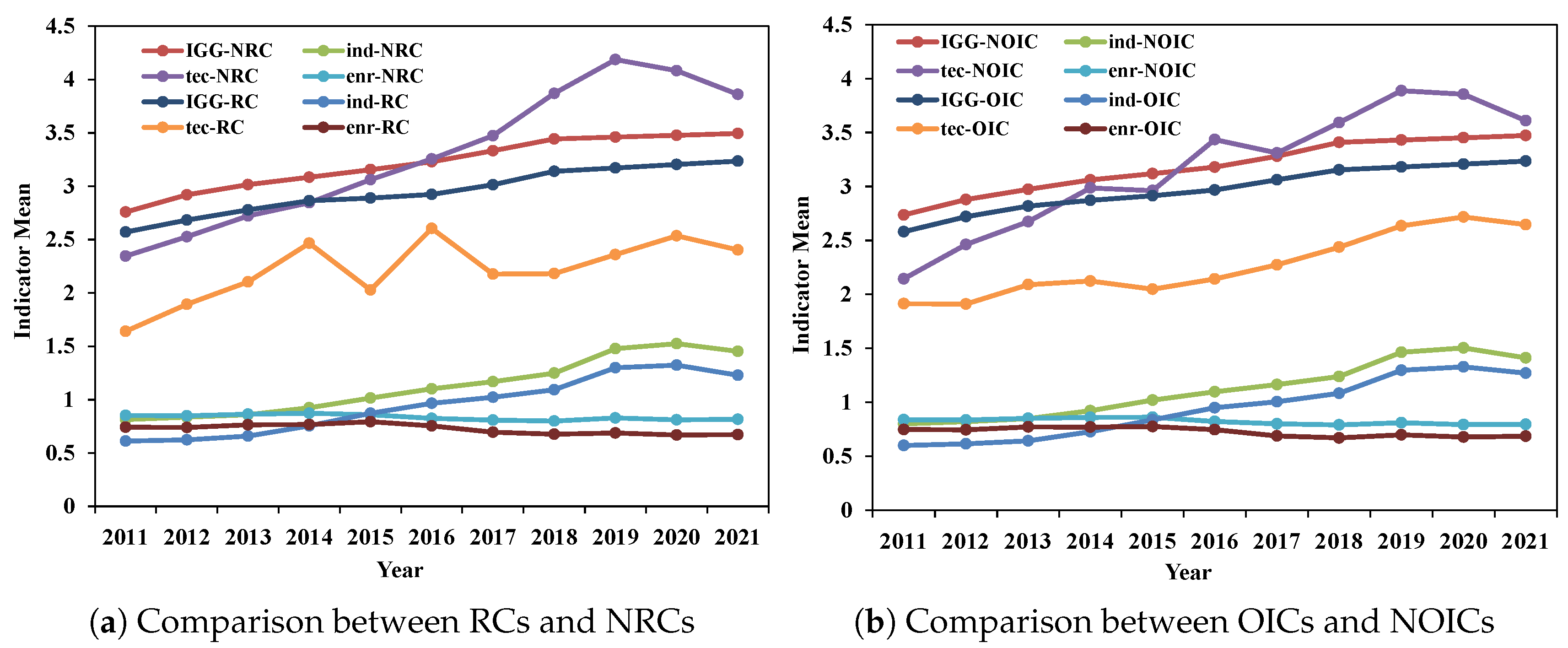
Pilot reforms are not only vertical, hierarchical policy experiments but also exhibit pronounced heterogeneity in effectiveness across regions due to differences in local implementation environments. Numerous studies on the heterogeneous outcomes of NEDC indicate that variations in resource endowments and stages of industrialization are the primary determinants of urban economic conditions [67,68]. Building on the descriptive statistics presented above, this study compares RC and NRC, as well as OIC and NOIC, across indicators such as the IGG index, industrial upgrading, environmental regulation stringency, and technological investment. Figure 2 reveals that NRC and NOIC generally outperform others in IGG, industrial upgrading, and technological investment, whereas RC and OIC exhibit higher levels of environmental regulation. RC often suffer from economic mono-structure and limited innovation and competitiveness due to excessive reliance on natural resources, resulting in the widely observed ‘resource curse’ [69,70]. OIC face constraints from heavy industry–driven lock-in effects and path dependency, with imbalanced investment structures increasing the likelihood of pilot cities experiencing ‘policy inertia’ [71,72]. In contrast, NOIC has not yet established rigid path dependencies and can leverage mechanisms that enhance the conversion of green innovation outcomes and the adaptation of labor factors to amplify the benefits of policy pilots, ultimately achieving synergistic outcomes across environmental protection, economic growth, and social equity [73].
Based on these considerations, the sample is divided into RC and NRC as well as OIC and NOIC. To ensure classification reliability, cities partially included in regional planning are excluded from the sample, with detailed results presented in Table 6. As shown in Column (1) of Table 6, the regression coefficient for NRC is significantly positive at the 1% level, whereas the coefficient for RC is positive but not statistically insignificant. This implies that the NEDC effectively promotes IGG in NRC but yields no significant impact in RC. Column (2) of Table 6 reports industrial foundation heterogeneity results, where the coefficient for NOIC exceeds that of OIC and achieves significance at the 5% level, demonstrating stronger policy effects in the former group. These findings suggest that RC and OIC face persistent Dutch disease effects from heavy resource dependence and encounter substantial economic transition obstacles due to the resource curse. Conversely, NRC and NOIC, with lower reliance on heavy industry and energy-intensive sectors, are better positioned to achieve IGG through the NEDC.

4.4. Mechanism Analysis

The baseline regression results have confirmed that the NEDC significantly contributes to IGG. Building on the theoretical discussion, this study follows the approach of He et al. [74] and applies a mediation factor test method based on the DML to examine the mediating mechanisms through which the NEDC influences IGG.

4.4.1. Technological Innovation

The regression results reported in Table 7 indicate that both the direct and indirect effects for the treatment and control groups are significantly positive at the 1% level. This suggests that INNOL induced by the establishment of NEDC substantially enhances IGG, thereby confirming H 2 . The finding corroborates the theoretical proposition that the NEDC fosters an institutional environment conducive to technological progress through a balanced combination of incentives and regulations. The joint effect of fiscal support and emission control not only compels firms to upgrade end-of-pipe treatment technologies but also drives systemic improvements in production processes, thereby enhancing green total factor productivity. By adopting green technological innovation, enterprises restructure their energy utilization systems, creating a virtuous cycle of reduced energy intensity and lower pollution control costs, which facilitates urban green transformation. Moreover, technological innovation improves resource use efficiency via a compensation effect, generating growth momentum that transcends traditional factor inputs and shifting economic growth from scale expansion to quality improvement.

4.4.2. Employment Creation

The results of the mechanism analysis for EMPLOY are reported in Table 8. Both the direct and indirect effects for the treatment and control groups are positive and statistically significant at the 1% level, confirming that EMPLOY generated by the NEDC effectively enhance IGG. Thus, H 3 is supported. Through the extension of industrial chains such as photovoltaic module manufacturing and energy storage system integration, the NEDC generates new occupations including installation, operation, maintenance, and intelligent monitoring, thereby expanding employment opportunities and absorbing labor from traditional industries in transition. The policy-guided closure and transition mechanism facilitates the reemployment of workers from conventional sectors, alleviating structural unemployment pressures in urban areas. In addition, the NEDC enhances optimization within the new energy industry, producing value-added effects and skill premiums that support income growth of employment and entrepreneurship. The expansion of employment scale and improvement of wage levels contribute to poverty alleviation and reduced inequality, thereby advancing IGG.

4.5. Chain Mediation Mechanism Analysis

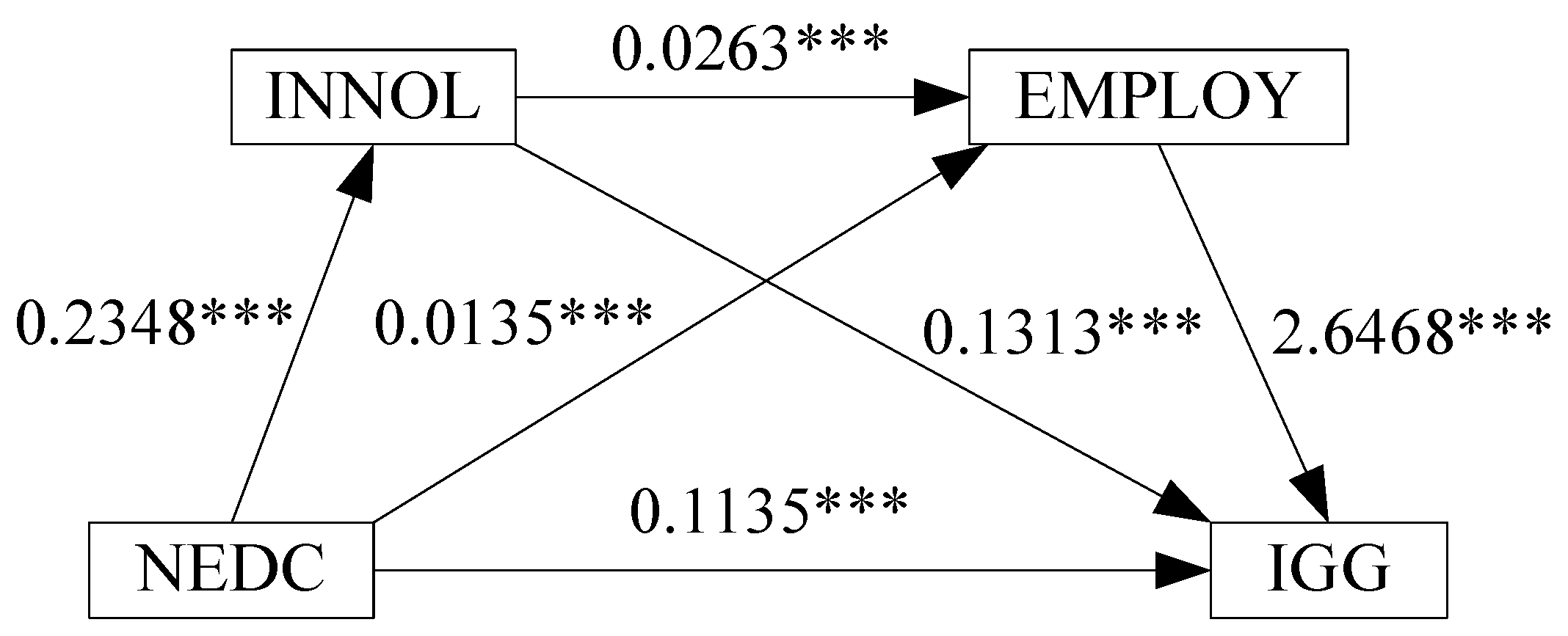
This study first evaluates whether the NEDC affects IGG through parallel mediating mechanisms. As shown in Columns (1)–(4) of Table 9, the standardized path coefficients indicate that the NEDC, INNOL, and EMPLOY are all significantly positive in relation to IGG. Moreover, the estimated effect of INNOL on EMPLOY is 0.0263, suggesting the robustness of the mediating channels involving INNOL and EMPLOY. This supports the existence of an ‘INNOL → EMPLOY’ chain mediation pathway through which the NEDC affects IGG. Column (5) of Table 9 applies the three-step method to test the chain mediation mechanism ‘NEDC → INNOL → EMPLOY → IGG’. The results confirm that the facilitating effect of the NEDC on IGG by influencing EMPLOY through INNOL is significantly positive at the statistical level. The cumulative effect of technological innovation in the chain mediation mechanism is 0.1030, thereby supporting H 4 . Integrating the findings of direct and mediating mechanisms, Figure 3 presents the structure of the chain mediation effect, while Table 10 summarizes four impact pathways of the NEDC on IGG: First, the direct effect of the NEDC. Second, the mediating effect through INNOL. Third, the mediating effect through EMPLOY. Fourth, the chain mediation effect through both INNOL and EMPLOY. The results from the chain-mediation analysis demonstrate that the NEDC generates employment absorption through the channel of INNOL. This finding further indicates the presence of a significant Porter effect in the policy’s process of driving IGG.

5. Conclusions and Policy Implications

Based on a three-dimensional evaluation framework integrating economic growth, social equity, and environmental sustainability, this study measures the level of IGG in 278 Chinese prefecture-level cities from 2011 to 2021. Using a DML model, the analysis investigates the impact of the NEDC and its underlying mechanisms. The empirical results demonstrate a significant promotional effect of the NEDC on IGG, a finding that remains robust after controlling for city and year fixed effects, other covariates, and a series of robustness and endogeneity tests. Heterogeneity analysis indicates that the NEDC’s positive effect is more pronounced in non-resource-based and non-old industrial cities, whereas its impact is limited in overcoming the IGG dilemma faced by resource-based and old industrial cities. Mechanism analysis confirms that INNOL and EMPLOY mediate the effect, with evidence of a chain mechanism from NEDC to INNOL, followed by EMPLOY, ultimately advancing IGG. Based on these findings and aligned with China’s dual carbon targets and international experiences in inclusive green development, this study proposes the following policy recommendations:
  • Promote differentiated strategies according to local conditions. Given the limited effectiveness of the NEDC in resource-based and old industrial cities, a one-size-fits-all approach should be avoided. For non-resource-based and non-old industrial cities, governments should strengthen top-level design in policy formulation, enhancing support by integrating fiscal, employment, industrial, and environmental policy tools. For resource-based and old industrial cities, the priority should be addressing alleviation such as the resource curse and Dutch disease effects. This involves implementing long-term industrial restructuring plans and improving public welfare governance to build local capacity for effectively adopting the NEDC, thereby facilitating a gradual transition towards an inclusive and green economic structure.
  • Strengthen green technological innovation and foster an integrated innovation ecosystem. Given the significant role of green technology innovation in transmitting the effects of the NEDC, complementary measures should be implemented. Establishing dedicated R&D funds and tax incentives for new energy and green technologies can encourage universities, research institutions, and enterprises to set up joint laboratories and commercialization bases within demonstration cities. This approach, which combines incentives with institutional support, will not only refine technology transfer mechanisms but also ensure the efficient diffusion of innovation outcomes across local industrial chains. Ultimately, such knowledge spillovers will elevate society-wide green productivity.
  • Enhance employment creation and improve the institutional environment for inclusive jobs. Since employment creation is another crucial mechanism, policies could draw inspiration from initiatives like Germany’s green jobs program. Local governments should guide firms to create employment opportunities in renewable manufacturing, operations, and related services, while expanding vocational training, certification, and re-employment services. To strengthen the chain effect of ‘technological innovation-employment creation’, governments also need to improve the employment promotion policies in pilot cities simultaneously. For example, employment policies that give priority to hiring local residents, short-term wage subsidies or job retention policies for low- and medium-skilled workers, and re-employment services and entrepreneurship support policies.
  • Expand chain effects through complementary governance and cross-regional cooperation. To achieve more widespread and equitable green growth, complementary governance and cross-regional collaboration should be prioritized as essential pathways for sustaining the policy effectiveness of pilot cities. In terms of complementary governance, a regular monitoring system based on economic growth, social equity, and environmental sustainability should be established, with periodic evaluations and differentiated performance assessments for demonstration cities. Regarding cross-regional collaboration, demonstration cities should be encouraged to form integrated development linkages with less developed surrounding areas through the coordination of technology, capital, and human resources, thereby promoting the nationwide diffusion of IGG.

6. Limitations and Future Research Directions

While this study strives for rigor, it acknowledges several limitations that also delineate clear pathways for future research.

6.1. Limitations

The first encompasses limitations in measurement indicators. Due to constraints in data availability, the comprehensive evaluation index system for IGG constructed in this study, while covering the three core dimensions of economy, society, and environment, still has room for improvement in the breadth and depth of specific indicators. For instance, the measurement of the social equity dimension could be enhanced by incorporating more granular indicators such as public service quality and digital inclusion. For the environmental sustainability dimension, the inclusion of richer ecological indicators like biodiversity and ecological carbon sinks could render the assessment framework more comprehensive and precise.
Second, there is insufficient discussion of the policy’s dynamic effects. This study assesses the overall effect of the NEDC but does not delve deeply into how its impact dynamically evolves over time. Specifically, the cumulative effects following policy implementation and the long-term lagged effects are not fully revealed. The positive influence of the policy may exhibit nonlinear strengthening or stabilization as the pilot duration extends, and its transformative dividends might only fully materialize beyond the sample observation period. In particular, future research could further develop multi-period dynamic models or introduce staged indicators for innovation variables to more precisely identify the lag structure inherent in the innovation process and its dynamic impact on policy effectiveness.
Third, boundaries in methodological application are also another limitation. While the DML model offers advantages in handling high-dimensional covariates and nonlinear relationships, the reliability of its estimates depends on model specifications and the core assumption of no unobserved confounding. We cannot entirely rule out endogenous bias stemming from unobservable time-varying confounding factors. Furthermore, constrained by the limited support for complex DML workflows in Stata software 18.0, this study could not implement a systematic set of ablation experiments to more thoroughly test model robustness. Such experiments aim to assess the sensitivity and dependence of core estimation results to various potential model misspecifications by sequentially removing key model specifications. Although we have indirectly addressed this issue through multiple robustness checks, conducting more refined ablation analysis in more flexible programming environments in future research would further solidify the reliability of the causal inference.

6.2. Future Research Directions

Building upon these limitations, future research could be expanded and deepened in the following aspects:
First, research should refine and extend the comprehensive evaluation index system. Subsequent studies should focus on constructing a more contemporary, multidimensional, and refined assessment framework. By incorporating richer statistical data, remote sensing data, and novel big data sources, existing indicators can be supplemented and optimized. This is particularly pertinent for areas such as the perception of social well-being, ecosystem service value, and the level of circular economy development, enabling a more holistic measurement of the substance and progress of IGG.
Second, studies should deepen the investigation into the dynamic mechanisms and long-term effects of policies. Future work should prioritize examining the dynamic impact trajectories of NEDC and other similar environmental regulations. By heeding relevant suggestions such as constructing multi-period dynamic models and applying staged treatments to key mediating variables (e.g., technological innovation), research can more thoroughly identify the cumulative pathways of policy effects, the duration of lag periods, and potential threshold or decay effects. This will furnish more timely evidence for policy evaluation and support the optimal adjustment of policy instruments.
Third, more rigorous causal inference analytical procedures should be established. To overcome the current methodological boundaries, future work could explore replicating and extending the analysis within more flexible open-source environments like R or Python. This would facilitate the implementation of a more systematic and transparent robustness testing framework, including comprehensive ablation experiments, to more rigorously verify the stability of causal estimates against model specifications. It also opens avenues for exploring and developing more standardized DML applications and diagnostic workflows tailored for policy evaluation.
Fourth, international comparison and external validation are also needed. The generalizability of conclusions derived from China’s policy practices and data requires testing within different institutional and cultural contexts. A significant direction for future research is to conduct cross-national comparative analyses. By comparing the effectiveness, transmission mechanisms, and constraints of policy tools across diverse political–economic systems, resource endowments, and developmental stages, such studies can not only test the external validity of this study’s findings but also distill more general empirical evidence and policy insights.


Author Contributions

Guiding the topic selection and revising the thesis, Y.H.; Data analysis and writing, B.S.; Writing and review, S.H. All authors have read and agreed to the published version of the manuscript.

Funding

This work was supported by The Guangxi Philosophy and Social Science Planning Project (Grant No. 24GLF030), Guangxi Philosophy and Social Science Research Project (Grant No. 23FGL044).

Institutional Review Board Statement

Not applicable.

Informed Consent Statement

Not applicable.

Data Availability Statement

The data in this paper are sourced from the China Energy Statistical Yearbook and the China City Statistical Yearbook. The data presented in this study are available upon request from the corresponding author.

Conflicts of Interest

The authors report there are no competing interests to declare.

References

  1. Apergis, N.; Payne, J.E. Renewable energy consumption and economic growth: Evidence from a panel of OECD countries. Energy Policy 2010, 38, 656–660. [Google Scholar] [CrossRef]
  2. Samant, S.; Thakur-Wernz, P.; Hatfield, D.E. Does the focus of renewable energy policy impact the nature of innovation? Evidence from emerging economies. Energy Policy 2020, 137, 111119. [Google Scholar] [CrossRef]
  3. Dong, Z.; Yin, C.; Zhang, L.; Zhang, Z.; Cui, H. Towards inclusive green growth: Synergistic effects of digital infrastructure and energy transition policies in China. J. Environ. Manag. 2025, 395, 127993. [Google Scholar] [CrossRef]
  4. Sarkki, S.; Ludvig, A.; Nijnik, M.; Kopiy, S. Embracing policy paradoxes: EU’s Just Transition Fund and the aim “to leave no one behind”. Int. Environ. Agreem. 2022, 22, 761–792. [Google Scholar] [CrossRef]
  5. Donoghoe, M. US Can’t Achieve Environmental Justice Through One Size Fits All Policy; Brookings Institution: Washington, DC, USA, 2023. [Google Scholar]
  6. Neij, L.; Heiskanen, E.; Strupeit, L. The deployment of new energy technologies and the need for local learning. Energy Policy 2017, 101, 274–283. [Google Scholar] [CrossRef]
  7. Matthews, H.D.; Gillett, N.P.; Stott, P.A.; Zickfeld, K. The proportionality of global warming to cumulative carbon emissions. Nature 2009, 459, 829–832. [Google Scholar] [CrossRef] [PubMed]
  8. Ai, M.; Wang, P.; Bu, Y. Climate policy and inclusive green growth: The role of China’s low-carbon city pilot policy. J. Clean. Prod. 2025, 519, 145959. [Google Scholar] [CrossRef]
  9. Che, S.; Wang, J.; Chen, H. Can China’s decentralized energy governance reduce carbon emissions? Evidence from new energy demonstration cities. Energy 2023, 284, 128665. [Google Scholar] [CrossRef]
  10. Faguet, J.P. Decentralization and Popular Democracy: Governance from Below in Bolivia; University of Michigan Press: Ann Arbor, MI, USA, 2012. [Google Scholar]
  11. de Vries, M. The rise and fall of decentralization: A comparative analysis of arguments and practices in European countries. Eur. J. Political Res. 2000, 38, 193–224. [Google Scholar] [CrossRef]
  12. Chai, J.; Tian, L.; Jia, R. New energy demonstration city, spatial spillover and carbon emission efficiency: Evidence from China’s quasi-natural experiment. Energy Policy 2023, 173, 113389. [Google Scholar] [CrossRef]
  13. Ding, Y.; Bi, C.; Qi, Y.; Han, D. Coordinated governance of energy transition policy and pollution and carbon reduction: A quasi-natural experiment based on new energy demonstration city policy. Energy Strategy Rev. 2024, 53, 101395. [Google Scholar] [CrossRef]
  14. Su, Y.; Yu, Y.Q. Spatial agglomeration of new energy industries on the performance of regional pollution control through spatial econometric analysis. Sci. Total Environ. 2020, 704, 135261. [Google Scholar] [CrossRef] [PubMed]
  15. Li, M.; Yang, M.; Xia, N.; Cai, S.; Tian, Y.; Li, C. Forging resilient urban ecosystems: The role of energy structure transformation under China’s new energy demonstration city pilot policy. Systems 2025, 13, 709. [Google Scholar] [CrossRef]
  16. Zhang, X.; Hou, Y.; Geng, K. Environmental Regulation, Green Technology Innovation, and Industrial Green Transformation: Empirical Evidence from a Developing Economy. Sustainability 2024, 16, 6833. [Google Scholar] [CrossRef]
  17. Lin, B.; Xu, C. Reaping green dividend: The effect of China’s urban new energy transition strategy on green economic performance. Energy 2024, 286, 129589. [Google Scholar] [CrossRef]
  18. Zhang, D.; Li, J.; Han, P. A multidimensional measure of energy poverty in China and its impacts on health: An empirical study based on the China family panel studies. Energy Policy 2019, 131, 72–81. [Google Scholar] [CrossRef]
  19. Ma, Y.; Wan, S.; Zhou, Y. Bridging energy gaps in urbanizing economies: Evidence from China’s new energy demonstration city policy on multidimensional energy poverty. Energy Econ. 2025, 149, 108767. [Google Scholar] [CrossRef]
  20. Chen, X.; Xie, Q.; Cao, X.; Li, Q. Examining the effectiveness of China’s energy poverty alleviation policies: A text analysis on inter-provincial panel data. Energy Policy 2024, 186, 113978. [Google Scholar] [CrossRef]
  21. Tao, Z.; Chen, Y.; Wang, Z.; Deng, C. The impact of climate change and environmental regulation on energy poverty: Evidence from China. Energy Sustain. Soc. 2024, 14, 54. [Google Scholar] [CrossRef]
  22. He, Y.; Zhu, Y.; Zhu, Y.; Han, D. Research on the impact of clean energy demonstration provincial policy on energy poverty: Empirical evidence from China. Energy Strategy Rev. 2025, 59, 101708. [Google Scholar] [CrossRef]
  23. Knaus, M.C. Double machine learning-based programme evaluation under unconfoundedness. Econom. J. 2022, 25, 602–627. [Google Scholar] [CrossRef]
  24. Dong, Y.; Gu, L. Can policy-based agricultural insurance promote agricultural carbon emission reduction? Causal inference based on double machine learning. Sustainability 2025, 17, 4086. [Google Scholar] [CrossRef]
  25. Bossink, B.A. Demonstrating sustainable energy: A review based model of sustainable energy demonstration projects. Renew. Sustain. Energy Rev. 2017, 77, 1349–1362. [Google Scholar] [CrossRef]
  26. Wang, Q.; Yi, H. New energy demonstration program and China’s urban green economic growth: Do regional characteristics make a difference? Energy Policy 2021, 151, 112161. [Google Scholar] [CrossRef]
  27. Dengke, S.H.Y. Assessment for the effect of government air pollution control policy: Empirical evidence from “Low-carbon City” construction in China. J. Manag. World 2019, 35, 95–108+195. [Google Scholar]
  28. Li, Y.; Chiu, Y.-h.; Lu, L.C. New energy development and pollution emissions in China. Int. J. Environ. Res. Public Health 2019, 16, 1764. [Google Scholar] [CrossRef] [PubMed]
  29. Sun, Y.; Ding, W.; Yang, Z.; Yang, G.; Du, J. Measuring China’s regional inclusive green growth. Sci. Total Environ. 2020, 713, 136367. [Google Scholar] [CrossRef] [PubMed]
  30. Jiang, Y.; Xiao, Y.; Zhang, Z.; Zhao, S. How does central-local interaction affect local environmental governance? Insights from the transformation of central environmental protection inspection in China. Environ. Res. 2024, 243, 117668. [Google Scholar] [CrossRef]
  31. Wu, J.; Zuidema, C.; Gugerell, K. Experimenting with decentralized energy governance in China: The case of new energy demonstration city program. J. Clean. Prod. 2018, 189, 830–838. [Google Scholar] [CrossRef]
  32. Alhaddad, H.; Talebzadehhosseini, S.; Garibay, I. Accelerating green growth: The effect of technological innovation on production capabilities spillovers in developing economies. J. Clean. Prod. 2024, 482, 144159. [Google Scholar] [CrossRef]
  33. Lee, N. Inclusive growth in cities: A sympathetic critique. Reg. Stud. 2019, 53, 424–434. [Google Scholar] [CrossRef]
  34. Khan, N.U.; Udemba, E.; Emir, F.; Hussain, S. A look into sustainable development goal amidst technological innovation, financial development and natural resources: A symmetry and asymmetry analyses. Environ. Dev. Sustain. 2023, 26, 11929–11956. [Google Scholar] [CrossRef]
  35. Fu, H.; Rasiah, R. Fostering inclusive green growth in Chinese cities: Investigating the role of artificial intelligence. Sustainability 2024, 16, 9809. [Google Scholar] [CrossRef]
  36. Qian, J.; Ji, R. Impact of energy-biased technological progress on inclusive green growth. Sustainability 2022, 14, 16151. [Google Scholar] [CrossRef]
  37. Wang, H.; Yang, J.; Zhu, N. Does tax incentives matter to enterprises’ green technology innovation? The mediating role on R&D investment. Sustainability 2024, 16, 5902. [Google Scholar] [CrossRef]
  38. Yang, S.; Wang, J.; Dong, K.; Jiang, Q. A path towards China’s energy justice: How does digital technology innovation bring about a just revolution? Energy Econ. 2023, 127, 107056. [Google Scholar] [CrossRef]
  39. Chen, H.; Niu, D.; Gao, Y. Research on the impact of energy transition policies on green total factor productivity of Chinese high-energy-consuming enterprises. Energy 2025, 319, 135066. [Google Scholar] [CrossRef]
  40. Danish; Ulucak, R. How do environmental technologies affect green growth? Evidence from BRICS economies. Sci. Total Environ. 2020, 712, 136504. [Google Scholar] [CrossRef]
  41. Yi, H. Clean energy policies and green jobs: An evaluation of green jobs in U.S. metropolitan areas. Energy Policy 2013, 56, 644–652. [Google Scholar] [CrossRef]
  42. Zheng, J.; He, J.; Shao, X.; Liu, W. The employment effects of environmental regulation: Evidence from eleventh five-year plan in China. J. Environ. Manag. 2022, 316, 115197. [Google Scholar] [CrossRef]
  43. Li, Z.; Li, Y. Environmental regulation and employment: Evidence from China’s new environmental protection law. Econ. Anal. Policy 2024, 82, 400–416. [Google Scholar] [CrossRef]
  44. Xiong, B.; Xie, X. Impact of environmental regulation on the employment effect of high-tech industries: Evidence from spatial durbin model. Sustainability 2024, 16, 7960. [Google Scholar] [CrossRef]
  45. Liu, M.; Tan, R.; Zhang, B. The costs of “blue sky”: Environmental regulation, technology upgrading, and labor demand in China. J. Dev. Econ. 2021, 150, 102610. [Google Scholar] [CrossRef]
  46. Shi, D.; Luo, C.; Zhang, K.; Bu, C. Does stringent environmental regulation improve labor force employment? Evidence from China. Environ. Dev. Sustain. 2025, 27, 17187–17213. [Google Scholar] [CrossRef]
  47. Bretschger, L.; Jo, A. Complementarity between labor and energy: A firm-level analysis. J. Environ. Econ. Manag. 2024, 124, 102934. [Google Scholar] [CrossRef]
  48. Wang, J.; Hu, Y.; Zhang, Z. Skill-biased technological change and labor market polarization in China. Econ. Model. 2021, 100, 105507. [Google Scholar] [CrossRef]
  49. Wang, X.; Yang, Q.; He, N. Research on the Influence of Environmental Regulation on Social Employment: An Empirical Analysis Based on the STR Model. Int. J. Environ. Res. Public Health 2020, 17, 622. [Google Scholar] [CrossRef] [PubMed]
  50. Chen, T.; Zhou, D.; Ding, H.; Shi, X. Implications of energy transition on regional employments in China. Energy Policy 2025, 206, 114742. [Google Scholar] [CrossRef]
  51. Li, J.; Li, X.; Gao, Y. Environmental regulation and dynamic structural changes in the labor market: Based on the perspective of search frictions and specific skill heterogeneity. J. Manag. World 2025, 41, 58–97. [Google Scholar] [CrossRef]
  52. He, Z.; Chen, Z.; Feng, X. The role of green technology innovation on employment: Does industrial structure optimization and air quality matter? Environ. Sci. Eur. 2023, 35, 59. [Google Scholar] [CrossRef]
  53. Subaveerapandiyan, A.; Shimray, S.R. The evolution of job displacement in the age of AI and automation: A bibliometric review (1984–2024). Open Inf. Sci. 2024, 8, 20240010. [Google Scholar] [CrossRef]
  54. Autor, D. The Labor Market Impacts of Technological Change: From Unbridled Enthusiasm to Qualified Optimism to Vast Uncertainty; NBER Working Paper 30074; National Bureau of Economic Research: New York, NY, USA, 2022. [Google Scholar] [CrossRef]
  55. Qin, B.T.; Yang, K.; Ge, L.M. Green for labor: Environmental regulation and employment of heavy polluting enterprises—Based on the green technology innovation in the whole production process. China Environ. Sci. 2023, 43, 1449–1459. [Google Scholar] [CrossRef]
  56. Farbmacher, H.; Huber, M.; Lafférs, L.; Langen, H.; Spindler, M. Causal mediation analysis with double machine learning. Econom. J. 2022, 25, 277–300. [Google Scholar] [CrossRef]
  57. Yang, J.C.; Chuang, H.C.; Kuan, C.M. Double machine learning with gradient boosting and its application to the Big N audit quality effect. J. Econom. 2020, 216, 268–283. [Google Scholar] [CrossRef]
  58. Chernozhukov, V.; Chetverikov, D.; Demirer, M.; Duflo, E.; Hansen, C.; Newey, W.; Robins, J. Double/debiased machine learning for treatment and structural parameters. Econom. J. 2018, 21, C1–C68. [Google Scholar] [CrossRef]
  59. World Bank. Inclusive Green Growth: The Pathway to Sustainable Development; The World Bank: Washington, DC, USA, 2012. [Google Scholar] [CrossRef]
  60. Zhang, X. Economy, environment, society and people: From sustainable development to inclusive green growth. Jiang-Huai Trib. 2014, 6, 93–98+61. [Google Scholar] [CrossRef]
  61. Bouma, J.; Berkhout, E. Inclusive Green Growth: A Reflection on the Meaning and Implications for the Policy Agenda of the Dutch Directorate-General of Foreign Trade and Development Cooperation; Report; PBL Netherlands Environmental Assessment Agency: The Hague, The Netherlands, 2015. [Google Scholar] [CrossRef]
  62. Zhou, X.; Wu, W. The measurement and analysis of the inclusive green growth in China. J. Quant. Technol. Econ. 2018, 35, 3–20. [Google Scholar] [CrossRef]
  63. Jha, S.; Sandhu, S.C.; Wachirapunyanont, R. Inclusive Green Growth Index: A New Benchmark for Quality of Growth; Asian Development Bank: Mandaluyong, Philippines, 2018. [Google Scholar] [CrossRef]
  64. Zhang, T.; Li, J. Network infrastructure, inclusive green growth, and regional inequality: From causal inference based on double machine learning. J. Quant. Technol. Econ. 2023, 40, 113–135. [Google Scholar] [CrossRef]
  65. Sun, T.; Lu, Y.; Cheng, L. Implementation effect of resource exhausted cities’ supporting policies, long-term mechanism and industrial upgrading. China Ind. Econ. 2020, 7, 98–116. [Google Scholar] [CrossRef]
  66. Bian, Z.; Liu, J.; Zhang, Y.; Peng, B.; Jiao, J. A green path towards sustainable development: The impact of carbon emissions trading system on urban green transformation development. J. Clean. Prod. 2024, 442, 140943. [Google Scholar] [CrossRef]
  67. Chen, B.; Jin, F.; Li, G.; Zhao, Y. Can the new energy demonstration city policy promote green and low-carbon development? Evidence from China. Sustainability 2023, 15, 8727. [Google Scholar] [CrossRef]
  68. Liu, X.; Wang, C.; Wu, H.; Yang, C.; Albitar, K. The impact of the new energy demonstration city construction on energy consumption intensity: Exploring the sustainable potential of China’s firms. Energy 2023, 283, 128716. [Google Scholar] [CrossRef]
  69. Cheng, Z.; Li, X.; Wang, M. Resource curse and green economic growth. Resour. Policy 2021, 74, 102325. [Google Scholar] [CrossRef]
  70. Gong, Q. Green transformation paths of resource-based cities in China from the configuration perspective. Reg. Sustain. 2024, 5, 100158. [Google Scholar] [CrossRef]
  71. Li, X.; Yang, T.; Song, X. The literature review of transformation and development of the old industrial base in northeast China. Reform Econ. Syst. 2016, 5, 42–49. [Google Scholar]
  72. Zhang, S. Path dependence, path locking and new breakthroughs of the northeast China’s revitalization. J. Harbin Inst. Technol. (Soc. Sci. Ed.) 2022, 24, 153–160. [Google Scholar] [CrossRef]
  73. Chen, J.; Shen, J.; Ke, N. Assessing the impact of new energy demonstration city policy on industrial carbon intensity using machine learning. Econ. Anal. Policy 2025, 87, 1690–1707. [Google Scholar] [CrossRef]
  74. He, J.; Peng, F.; Xie, X. Mixed ownership reform, political connections, and enterprise innovation: Based on double/unbiased machine learning methods. Sci. Technol. Manag. Res. 2022, 42, 116–126. [Google Scholar]
Figure 1. Theoretical mechanism framework.
Sustainability 17 11155 g001
Figure 2. Heterogeneity of city types. Note: To improve the comparability of variables with different scales, the variable tec is normalized to the range of [0, 10], and enr is normalized to the range of [0, 1]. This adjustment is applied solely for graphical visualization and does not influence the empirical results reported later.
Sustainability 17 11155 g002
Figure 3. Structure of the chain mediation effect. Note: *** indicates significance at the 1% level.
Sustainability 17 11155 g003
Table 1. IGG indicator system.
VariableDimensionsCalculation or Explanation
IGGEconomy growthGDP per capita (+)
GDP growth rate (+)
Society equityLiquefied petroleum gas consumption per 10,000 people (+)
Natural gas consumption per 10,000 people (+)
Urban basic medical insurance coverage rate (+)
Urban basic pension insurance coverage rate (+)
Unemployment insurance coverage rate (+)
Number of library books per 10,000 people (+)
Number of hospital and clinic beds (+)
Urban per capita disposable income (+)
Rural per capita disposable income (+)
Urban–rural income ratio (−)
Environment sustainabilityIndustrial SO 2 emissions per 10,000 people (−)
Industrial dust emissions per 10,000 people (−)
Centralized wastewater treatment rate (+)
Harmless treatment rate of household waste (+)
Green coverage ratio in built-up areas (+)
Note: + and − indicate positive indicator and negative indicator, respectively.
Table 2. Descriptive statistical results.
VariablesNMeanSDMinMax
IGG30583.1110.8011.0267.199
NEDC30580.1400.34701
size30585.9190.6862.9708.136
hcl30580.3870.1080.0001.013
ind30581.0580.5930.1755.348
tec30580.0030.0030.0000.063
edu30580.0350.0170.0080.148
cap305810.5971.3704.52213.957
urb30585.7860.8780.6837.882
open30580.0170.01900.229
market30581.4071.7910.01376.701
fin30582.5231.2230.58821.302
gov30580.2000.0960.0440.741
inv30584.8632.171017.168
enr305879.08122.7080.240146.490
pass30588.2101.1202.97812.566
fre30589.0480.8833.33513.225
INNOL30585.0431.660010.301
EMPLOY30580.5700.1000.2850.991
Table 3. Results of baseline regression.
Variables(1) IGG(2) IGG(3) IGG(4) IGG
NEDC0.0940 **0.0960 **0.0963 **0.1135 ***
(0.0379)(0.0379)(0.0389)(0.0367)
Controls (Linear)YesYesYesYes
Controls (Quadratic) YesYesYes
Year FE YesYes
City FE Yes
N3058305830583058
Note: *** and ** indicate significance at the 1% and 5% levels, respectively.
Table 4. Results of robustness test (I).
VariablesSample AdjustmentPolicy Controls
Excluding Cities 1% Winsor 5% Winsor Low-Carbon Carbon-Trade Both Exclusion
(1) (2) (3) (4) (5) (6)
NEDC0.1410 ***0.1132 ***0.0819 **0.1076 ***0.1162 ***0.1163 ***
(0.0372)(0.0363)(0.0342)(0.0367)(0.0368)(0.0368)
Low-Carbon Yes Yes
Carbon-Trade YesYes
Controls (Linear)YesYesYesYesYesYes
Controls (Quadratic)YesYesYesYesYesYes
Year FEYesYesYesYesYesYes
City FEYesYesYesYesYesYes
N275030583058305830583058
Note: *** and ** indicate significance at the 1% and 5% levels, respectively.
Table 5. Results of robustness test (II).
VariablesProvince-YearSample Split RatiosResetting ModelInteractiveIV
Interaction Kfolds = 3 Kfolds = 8 Rf Nnet Model Method
(1) (2) (3) (4) (5) (6) (7)
NEDC0.1096 ***0.0856 ***0.1048 ***0.0907 **1.0353 ***0.1146 ***3.1864 **
(0.0366)(0.0361)(0.0365)(0.0427)(0.3877)(0.0188)(1.4612)
Controls (Linear)YesYesYesYesYesYesYes
Controls (Quadratic)YesYesYesYesYesYesYes
Year FEYesYesYesYesYesYesYes
City FEYesYesYesYesYesYesYes
Province-Year FEYes
N3058305830583058305830583058
Note: *** and ** indicate significance at the 1% and 5% levels, respectively.
Table 6. Results of heterogeneity analysis.
VariablesNRCRCNOICOIC
(1) (2) (3) (4)
NEDC0.1832 ***0.01870.1145 **0.0059
(0.0517)(0.0488)(0.0512)(0.0600)
Controls (Linear)YesYesYesYes
Controls (Quadratic)YesYesYesYes
Year FEYesYesYesYes
City FEYesYesYesYes
N1848121020241034
Note: *** and ** indicate significance at the 1% and 5% levels, respectively.
Table 7. Results of mechanism analysis for technological innovation.
VariablesINNOLIGGIGG
(1) (2) (3)
NEDC0.2348 *** 0.0997 ***
(0.0376) (0.0372)
INNOL 0.1313 ***0.1294 ***
(0.0159)(0.0160)
Controls (Linear)YesYesYes
Controls (Quadratic)YesYesYes
Year FEYesYesYes
City FEYesYesYes
N305830583058
Note: *** indicates significance at the 1% level.
Table 8. Results of mechanism analysis for employment creation.
VariablesEMPLOYIGGIGG
(1) (2) (3)
NEDC0.0135 *** 0.1158 ***
(0.0021) (0.0368)
EMPLOY 2.6468 ***2.5985 ***
(0.3035)(0.3028)
Controls (Linear)YesYesYes
Controls (Quadratic)YesYesYes
Year FEYesYesYes
City FEYesYesYes
N305830583058
Note: *** indicates significance at the 1% level.
Table 9. Results of the chain mediation mechanism analysis.
VariablesIGGINNOLEMPLOYEMPLOYIGG
(1) (2) (3) (4) (5)
NEDC0.1135 ***0.2348 *** 0.0097 ***0.1030 ***
(0.0367)(0.0376) (0.0022)(0.0379)
INNOL 0.0263 ***0.0262 ***0.1155 ***
(0.0009)(0.0010)(0.0181)
EMPLOY 1.4061 ***
(0.3489)
Controls (Linear)YesYesYesYesYes
Controls (Quadratic)YesYesYesYesYes
Year FEYesYesYesYesYes
City FEYesYesYesYesYes
N30583058305830583058
Note: *** indicates significance at the 1% level.
Table 10. Summary of effects.
EffectsPathEffect SizeMediation EffectMediation Share
Direct EffectNEDC → IGG0.1135
Mediation EffectsNEDC → INNOL0.2348
INNOL → IGG0.1313
NEDC → INNOL → IGG 0.03080.2716
NEDC → EMPLOY0.0135
EMPLOY → IGG2.6468
NEDC → EMPLOY → IGG 0.03570.3148
Chain Mediation EffectsINNOL → EMPLOY0.0263
NEDC → INNOL → EMPLOY0.0097
NEDC → INNOL → EMPLOY → IGG0.1030
Disclaimer/Publisher’s Note: The statements, opinions and data contained in all publications are solely those of the individual author(s) and contributor(s) and not of MDPI and/or the editor(s). MDPI and/or the editor(s) disclaim responsibility for any injury to people or property resulting from any ideas, methods, instructions or products referred to in the content.