1. Introduction
Warned by the approaching tipping points of the Earth’s climate and natural systems, inclusive green growth (IGG) has emerged as a critical agenda for advancing global sustainable development. Energy, serving as a vital strategic resource for achieving economic growth, social stability, and environmental sustainability in regions [
1,
2], has rendered energy policy a key instrument for IGG [
3]. Currently, nations worldwide are actively seeking to foster IGG through innovations in energy governance tools. For instance, the European Union, via the Green Deal, has designated policy instruments such as the Just Transition Fund to mitigate social inequality [
4], while the United States has allocated 459.5 billion USD to environmental justice to prioritize the needs of low-income and disadvantaged communities [
5].
As the world’s largest energy producer and carbon emitter [
6,
7], China has long depended on a high-carbon lock-in development model, resulting in simultaneous environmental degradation and income distribution gaps [
8]. To innovatively pursue green and inclusive economic growth, regional energy policy pilots have constituted a distinctive policy practice in China. Within the evolution of China’s regional energy policies, the Chinese government initiated the New Energy Demonstration City (NEDC) in 2014, aiming to promote comprehensive sustainable energy transition through a more decentralized energy governance structure and progressively address inequality issues. Shuai Che [
9] contends that energy transition policies reflect a unique characteristic of the Chinese government’s consideration of local socio-economic contexts, representing a significant attempt to shift from a centralized to a decentralized energy governance model. Advocates of decentralization assert that decentralized governance can improve the responsiveness and efficiency of local governments in tackling complex social issues [
10] and generate more balanced and inclusive policy solutions [
11]. A systematic examination of the NEDC indicates that this pilot construction concentrates on coordinating multiple dimensions, including economic development, resource utilization, environmental protection, and livelihood improvement, offering potential to harmonize green growth and inclusive objectives.
The construction of NEDC holds significant policy value, and a rigorous investigation into its actual effects carries considerable academic merit. Within academia, evidence regarding the NEDC’s role in driving IGG remains fragmented. Only a limited number of scholars have provided relevant insights, primarily examining the NEDC’s regulatory function from the perspectives of carbon emission reduction and energy poverty alleviation. Regarding carbon reduction, as an institutional experiment within the energy revolution, this pilot can compel enterprises to save energy and reduce emissions through environmental regulation mechanisms [
12,
13], enhance urban environmental governance during the spatial agglomeration of new energy industries [
14,
15], and promote green economic transformation via the innovation compensation effect [
16,
17], demonstrating significant dual benefits for both economy and ecology. Concerning energy poverty alleviation, given that China’s population affected by energy poverty accounts for up to 50% [
18], local governments in pilot cities advocate developing clean energy to mitigate poverty in energy accessibility [
19], enforce the implementation of energy poverty alleviation policies through administrative authority [
20,
21], or design monetary compensation mechanisms that also address energy poverty to promote welfare redistribution [
22]. These studies suggest that the NEDC can drive IGG through multiple pathways. However, the transmission mechanism is not a simple linear process; rather, it operates through a chain-like cascade of resource and innovation synergies. This chain-like transmission is nonlinear, and the simultaneity of pathways can easily lead to estimation bias. Traditional policy evaluation methods struggle to accurately disentangle direct and indirect effects. The Double Machine Learning (DML) model, integrating Lasso regularization and random forest algorithms, effectively addresses issues of high-dimensional confounders, nonlinearity, and endogeneity. Its framework aligns well with the logic of chain-like transmission and has demonstrated robustness in the field of economic policy evaluation [
23,
24].
Furthermore, designation as a pilot city entails access to financial subsidies, tax relief, and other supportive policies [
25]. However, the policy effects manifest significant heterogeneity [
26]. Studies on China’s Low-Carbon City pilot policy [
27], Smart City pilot policy [
28], and NEDC [
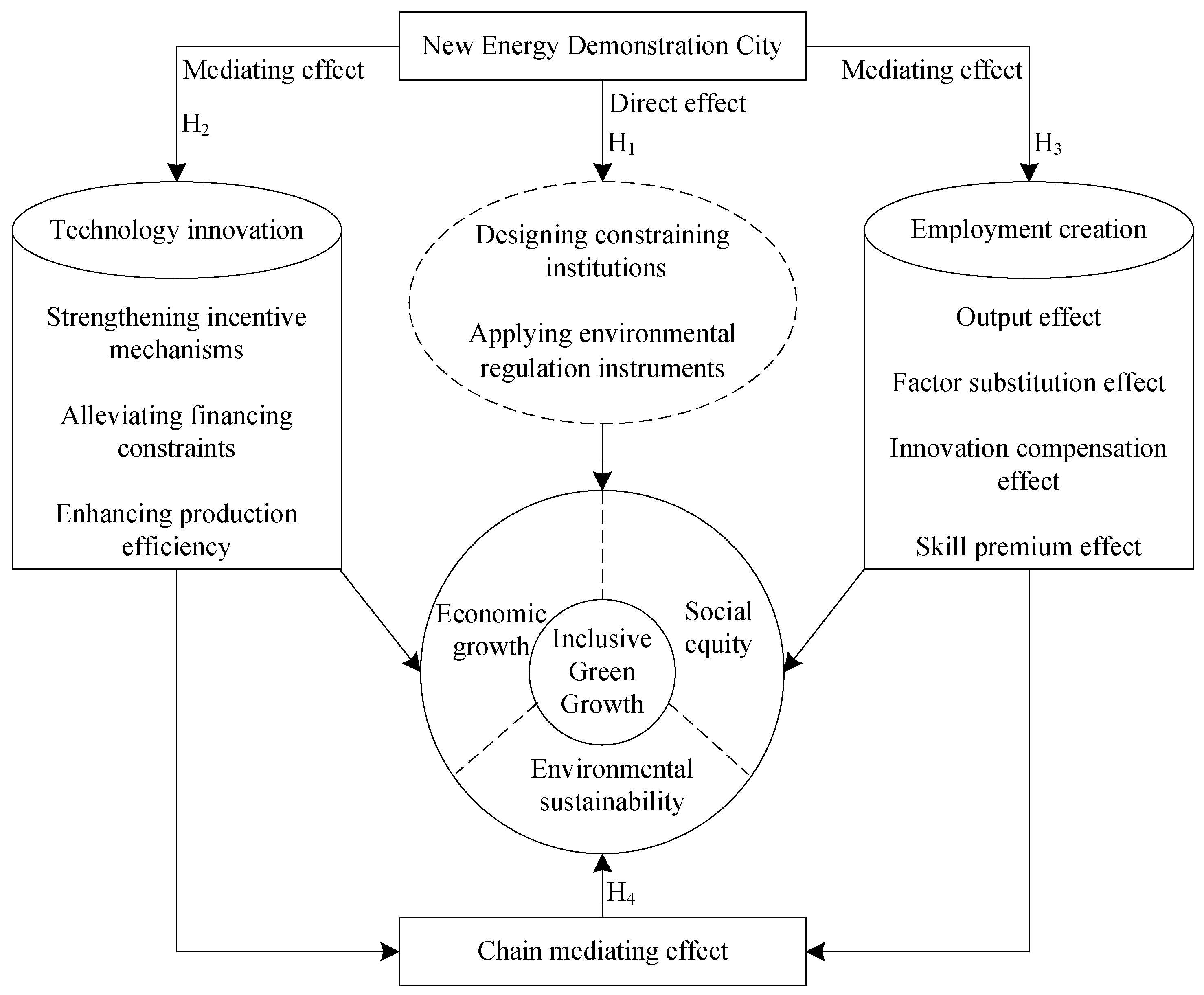
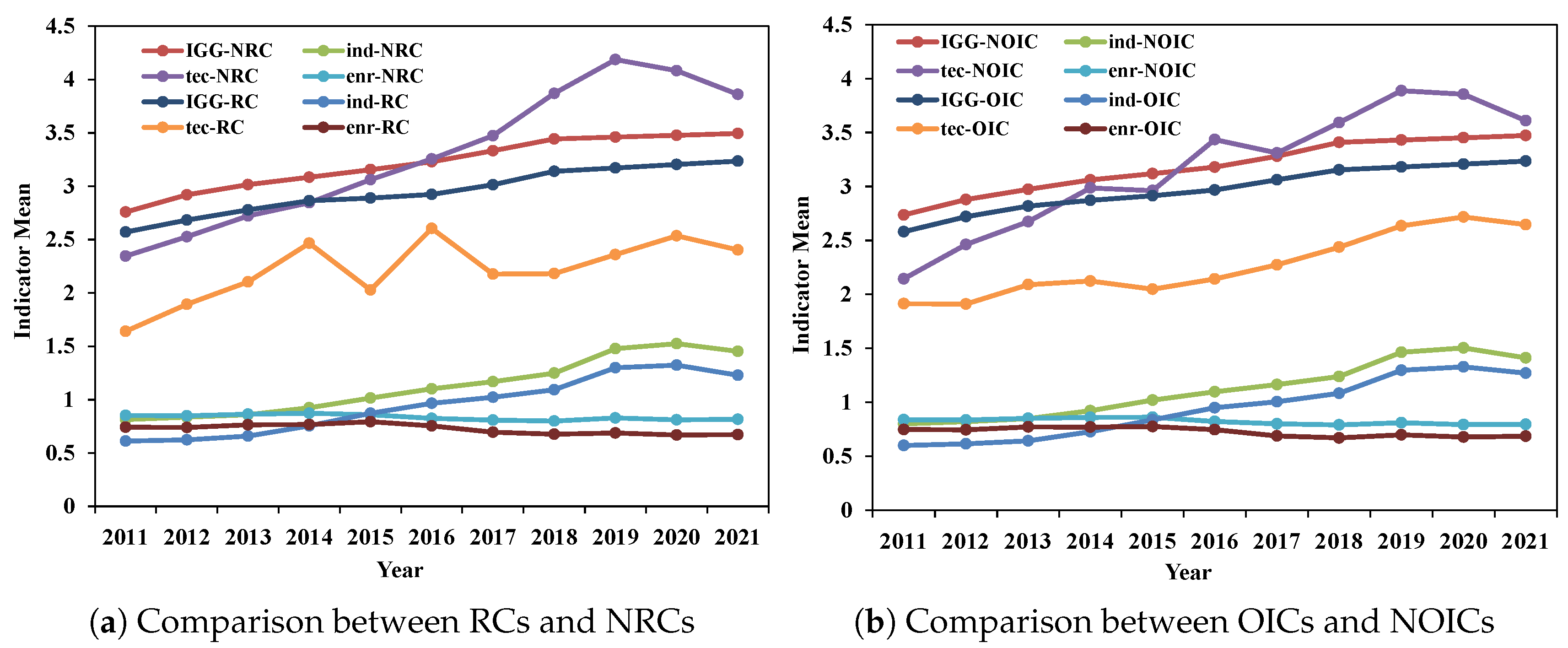
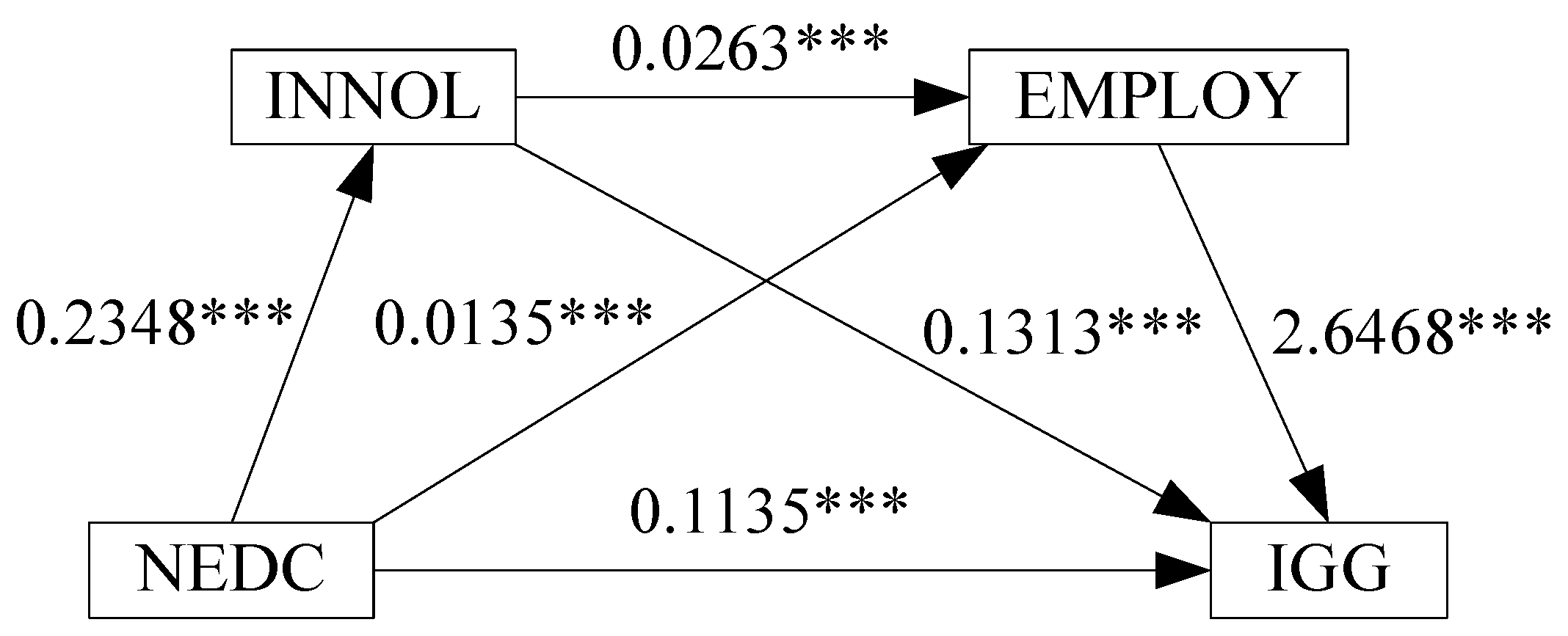
26] reveal that the performance of such initiatives is contingent upon local economic development levels, the resources available to local governments, and the implementation capacity of local actors. Synthesizing this literature, our exploratory research extends the inquiry in three directions. First, we investigate the direct impact of NEDC on IGG from an administrative regulation perspective, employing a DML model for causal estimation. Second, we unveil the mediating mechanisms through technology innovation (INNOL) and employment creation (EMPLOY), and further analyze the transmission pathways from a chain-mediation perspective. Third, we examine the spatial heterogeneous effects of the policy, with a focus on comparing its efficacy between resource-based and non-resource-based cities (RC & NRC), as well as between old industrial and non-old industrial cities (OIC & NOIC). This analysis aims to provide an evidence-based foundation for formulating differentiated strategies to advance NEDC development.
5. Conclusions and Policy Implications
Based on a three-dimensional evaluation framework integrating economic growth, social equity, and environmental sustainability, this study measures the level of IGG in 278 Chinese prefecture-level cities from 2011 to 2021. Using a DML model, the analysis investigates the impact of the NEDC and its underlying mechanisms. The empirical results demonstrate a significant promotional effect of the NEDC on IGG, a finding that remains robust after controlling for city and year fixed effects, other covariates, and a series of robustness and endogeneity tests. Heterogeneity analysis indicates that the NEDC’s positive effect is more pronounced in non-resource-based and non-old industrial cities, whereas its impact is limited in overcoming the IGG dilemma faced by resource-based and old industrial cities. Mechanism analysis confirms that INNOL and EMPLOY mediate the effect, with evidence of a chain mechanism from NEDC to INNOL, followed by EMPLOY, ultimately advancing IGG. Based on these findings and aligned with China’s dual carbon targets and international experiences in inclusive green development, this study proposes the following policy recommendations:
Promote differentiated strategies according to local conditions. Given the limited effectiveness of the NEDC in resource-based and old industrial cities, a one-size-fits-all approach should be avoided. For non-resource-based and non-old industrial cities, governments should strengthen top-level design in policy formulation, enhancing support by integrating fiscal, employment, industrial, and environmental policy tools. For resource-based and old industrial cities, the priority should be addressing alleviation such as the resource curse and Dutch disease effects. This involves implementing long-term industrial restructuring plans and improving public welfare governance to build local capacity for effectively adopting the NEDC, thereby facilitating a gradual transition towards an inclusive and green economic structure.
Strengthen green technological innovation and foster an integrated innovation ecosystem. Given the significant role of green technology innovation in transmitting the effects of the NEDC, complementary measures should be implemented. Establishing dedicated R&D funds and tax incentives for new energy and green technologies can encourage universities, research institutions, and enterprises to set up joint laboratories and commercialization bases within demonstration cities. This approach, which combines incentives with institutional support, will not only refine technology transfer mechanisms but also ensure the efficient diffusion of innovation outcomes across local industrial chains. Ultimately, such knowledge spillovers will elevate society-wide green productivity.
Enhance employment creation and improve the institutional environment for inclusive jobs. Since employment creation is another crucial mechanism, policies could draw inspiration from initiatives like Germany’s green jobs program. Local governments should guide firms to create employment opportunities in renewable manufacturing, operations, and related services, while expanding vocational training, certification, and re-employment services. To strengthen the chain effect of ‘technological innovation-employment creation’, governments also need to improve the employment promotion policies in pilot cities simultaneously. For example, employment policies that give priority to hiring local residents, short-term wage subsidies or job retention policies for low- and medium-skilled workers, and re-employment services and entrepreneurship support policies.
Expand chain effects through complementary governance and cross-regional cooperation. To achieve more widespread and equitable green growth, complementary governance and cross-regional collaboration should be prioritized as essential pathways for sustaining the policy effectiveness of pilot cities. In terms of complementary governance, a regular monitoring system based on economic growth, social equity, and environmental sustainability should be established, with periodic evaluations and differentiated performance assessments for demonstration cities. Regarding cross-regional collaboration, demonstration cities should be encouraged to form integrated development linkages with less developed surrounding areas through the coordination of technology, capital, and human resources, thereby promoting the nationwide diffusion of IGG.
6. Limitations and Future Research Directions
While this study strives for rigor, it acknowledges several limitations that also delineate clear pathways for future research.
6.1. Limitations
The first encompasses limitations in measurement indicators. Due to constraints in data availability, the comprehensive evaluation index system for IGG constructed in this study, while covering the three core dimensions of economy, society, and environment, still has room for improvement in the breadth and depth of specific indicators. For instance, the measurement of the social equity dimension could be enhanced by incorporating more granular indicators such as public service quality and digital inclusion. For the environmental sustainability dimension, the inclusion of richer ecological indicators like biodiversity and ecological carbon sinks could render the assessment framework more comprehensive and precise.
Second, there is insufficient discussion of the policy’s dynamic effects. This study assesses the overall effect of the NEDC but does not delve deeply into how its impact dynamically evolves over time. Specifically, the cumulative effects following policy implementation and the long-term lagged effects are not fully revealed. The positive influence of the policy may exhibit nonlinear strengthening or stabilization as the pilot duration extends, and its transformative dividends might only fully materialize beyond the sample observation period. In particular, future research could further develop multi-period dynamic models or introduce staged indicators for innovation variables to more precisely identify the lag structure inherent in the innovation process and its dynamic impact on policy effectiveness.
Third, boundaries in methodological application are also another limitation. While the DML model offers advantages in handling high-dimensional covariates and nonlinear relationships, the reliability of its estimates depends on model specifications and the core assumption of no unobserved confounding. We cannot entirely rule out endogenous bias stemming from unobservable time-varying confounding factors. Furthermore, constrained by the limited support for complex DML workflows in Stata software 18.0, this study could not implement a systematic set of ablation experiments to more thoroughly test model robustness. Such experiments aim to assess the sensitivity and dependence of core estimation results to various potential model misspecifications by sequentially removing key model specifications. Although we have indirectly addressed this issue through multiple robustness checks, conducting more refined ablation analysis in more flexible programming environments in future research would further solidify the reliability of the causal inference.
6.2. Future Research Directions
Building upon these limitations, future research could be expanded and deepened in the following aspects:
First, research should refine and extend the comprehensive evaluation index system. Subsequent studies should focus on constructing a more contemporary, multidimensional, and refined assessment framework. By incorporating richer statistical data, remote sensing data, and novel big data sources, existing indicators can be supplemented and optimized. This is particularly pertinent for areas such as the perception of social well-being, ecosystem service value, and the level of circular economy development, enabling a more holistic measurement of the substance and progress of IGG.
Second, studies should deepen the investigation into the dynamic mechanisms and long-term effects of policies. Future work should prioritize examining the dynamic impact trajectories of NEDC and other similar environmental regulations. By heeding relevant suggestions such as constructing multi-period dynamic models and applying staged treatments to key mediating variables (e.g., technological innovation), research can more thoroughly identify the cumulative pathways of policy effects, the duration of lag periods, and potential threshold or decay effects. This will furnish more timely evidence for policy evaluation and support the optimal adjustment of policy instruments.
Third, more rigorous causal inference analytical procedures should be established. To overcome the current methodological boundaries, future work could explore replicating and extending the analysis within more flexible open-source environments like R or Python. This would facilitate the implementation of a more systematic and transparent robustness testing framework, including comprehensive ablation experiments, to more rigorously verify the stability of causal estimates against model specifications. It also opens avenues for exploring and developing more standardized DML applications and diagnostic workflows tailored for policy evaluation.
Fourth, international comparison and external validation are also needed. The generalizability of conclusions derived from China’s policy practices and data requires testing within different institutional and cultural contexts. A significant direction for future research is to conduct cross-national comparative analyses. By comparing the effectiveness, transmission mechanisms, and constraints of policy tools across diverse political–economic systems, resource endowments, and developmental stages, such studies can not only test the external validity of this study’s findings but also distill more general empirical evidence and policy insights.