Article

Analysis of Factors Affecting the Results of the Embodied Environmental Footprint of a Built Environment Using a Selected Office Building as an Example


by
Aleksandra Pacholska
1,
Michał Pierzchalski
1 and
Anna Wojcieszek
2,*
1
Department of Pro-Environmental Design, Faculty of Architecture, Warsaw University of Technology, Koszykowa 55, 00-659 Warsaw, Poland
2
APA Wojciechowski sp. z o.o., Kamionkowska 32, 03-805 Warsaw, Poland
*
Author to whom correspondence should be addressed.
Sustainability 2025, 17(24), 11154; https://doi.org/10.3390/su172411154
Submission received: 7 November 2025 / Revised: 1 December 2025 / Accepted: 3 December 2025 / Published: 12 December 2025
(This article belongs to the Section Green Building)

Abstract

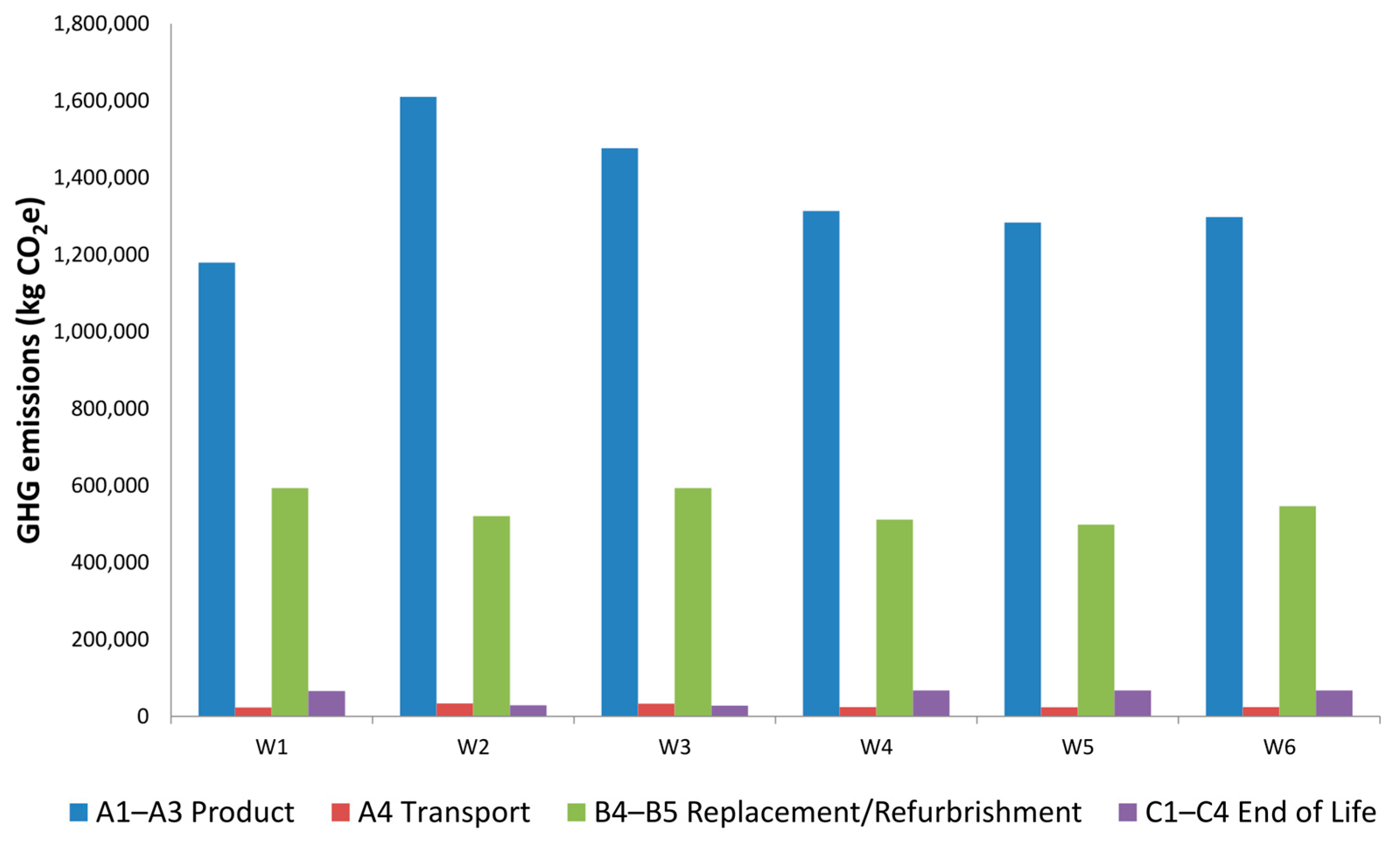
The huge impact of construction on the environment is becoming increasingly apparent, and it is unacceptable to many engineers and designers. A growing interest in sustainable construction has been observed for several years. This is especially true for commercial buildings, where achieving an appropriate standard is often the main criterion for investment. Many current publications deal with the topic of energy related to building use. In contrast, knowledge of the so-called embodied carbon footprint is not yet widespread but increasingly important in the context of low-carbon construction. The study created six different building types by juxtaposing different construction variants with different facade variants. The analysis was given to the “cradle to grave” phases, i.e., A1–A4, B4–B5 and C1–C4. Module D (material recycling) is omitted, as well as phases B1–B3 and B6–B7 related to use, maintenance, repair and energy and water consumption. Phases B1–B3 refer to maintenance repair and use activities that are the responsibility of the building manager, so they are taken as estimates at the concept stage. Phase B6 and B7 were excluded from the study, due to the fact that they are not responsible for the embodied carbon footprint, but the operational one. It was assumed that the values for B6 would be shown independently in the building’s energy performance and the final values would be comparable. The purpose of the study was to verify the factors that have the greatest impact on the results of the embodied environmental footprint. The study showed that changes in the building’s design and facade have the greatest impact on the embodied carbon footprint. Furthermore, not only the quantity of materials used but also their durability is crucial, so using durable finishes to minimize the need for repair and replacement can play a key role in reducing the building’s embodied carbon footprint. Differences between the variants reached approximately 107 kg CO2e/m2 (about 15%). The comparison of impact categories further indicates that solutions optimized for global warming potential are not necessarily favorable in other environmental dimensions. Finally, the relatively moderate spread between the most and least favorable variants within the analyzed scope indicates that material substitution alone is insufficient to achieve deep decarbonization of office buildings. Comprehensive strategies addressing material selection, durability, service life and design for disassembly and reuse are therefore required.
Keywords: embodied environmental footprint; life cycle assessment; building components; LCA embodied environmental footprint; life cycle assessment; building components; LCA