Article

Contradictory Stakeholder Pressures/Influences for the Oil and Gas Industry’s Environmental Performance-Implications for the Current Era

1
Accounting Department, College of Business Administration, Majmaah University, Al-Majmaah 11952, Saudi Arabia
2
School of Accounting, Information Systems and Supply Chain, RMIT University, Melbourne, VIC 3000, Australia
*
Author to whom correspondence should be addressed.
Sustainability 2025, 17(24), 11146; https://doi.org/10.3390/su172411146
Submission received: 18 August 2025 / Revised: 3 December 2025 / Accepted: 3 December 2025 / Published: 12 December 2025
(This article belongs to the Section Economic and Business Aspects of Sustainability)

Abstract

Due to immense pressure from various stakeholders, for better environmental performance from the oil and gas sector, oil and gas companies have been (at least) projecting an image of better environmental performance. More recently, due to political developments, for example, in the United States, government pressure seems to be lessening; on the contrary there seems to be increased support for the oil and gas sector, in the second largest polluting country, globally. As a timely focus, this study examines the impact of multiple stakeholders’ related independent variables, specifically government influence, on the environmental performance of the oil and gas sector. A survey approach has been adopted for data collection, and structural equation modelling (SEM) has been used to undertake factor analysis. Stakeholder theory has been employed to discuss the survey results. Results demonstrate that governmental, customer, and employee pressures have a significant positive effect on environmental performance in the oil and gas sector. Relaxed government approach thus poses as a major risk against the environmental performance of oil and gas companies. Government support of the oil and gas sector has a negative impact on the influence of other key stakeholders, for example NGOs. Due to the more dominant influence of the government, NGO pressure becomes weaker, and insignificant, as highlighted by our study. In circumstances like these, NGO pressure and investor pressure may not have a significant direct effect on improved environmental performance of oil and gas companies, due to a high level of government support for the sector. Originality/value: This study offers empirical insights into stakeholder pressures on the oil and gas sector, contributing to stakeholder theory by highlighting the fluidity of significant stakeholder influence on environmental governance.

1. Introduction

Fossil fuels have multiple uses, including for heating, transportation, road asphalt, propane, clothing, carpets, electronics, plastic, medicines and tools. According to BP [1], approximately 57% of global energy was sourced from oil and gas in 2018. Crude oil and natural gas (the two raw materials) are transformed into liquefied natural gas, gasoline, diesel, and a range of energy sources and petrochemical products [2]. Historically, oil and gas companies have been implicated in serious catastrophic events [3,4]. All industry processes from exploration to final product consumption are associated with serious risks and potentially serious environmental damages [2,3,4]. The oil and gas industry has been subject to constant criticism from environmental protection agencies, the media, communities, and other institutions and stakeholders [3,5] due to its environmental impacts.
During the pandemic’s peak, it was expected that post-pandemic, climate and environmental debate would not dissipate [6]. Innovations, which have led to lower costs for wind, solar, and batteries, will continue, and decarbonization will remain an imperative for the industry [6]. Opposing the pressure for better environmental performance (EP), the sector has been found to face increased demand for global gas, which is expected to peak in the late 2030s due to high customer demand. Despite the wave of bankruptcies and restructuring after 2014, a new wave of business and supply chain reconfiguration, technological acceleration, and customer partnerships [6] is expected in the post-pandemic era.
In early 2025, the United States President signed an executive order declaring a national energy emergency, with a directive to roll back regulations on the oil and gas sector [7]. The United States has been the world’s top crude oil and natural gas producer; this directive supports further drilling and production by the United States [7]. Nevertheless, this strong government support for the sector continues to meet resistance from environmental groups (NGOs) [7].
Resistance from environmental groups (NGOs) is based on multiple negative environmental impacts relating to fossil fuel consumption. According to IEA [8], from 1988 to 2015, the 60 largest oil and gas companies were responsible for more than 40% of the cumulative industrial emissions worldwide, and the ten largest oil and gas companies’ contribution was around 22% of global emissions. The pandemic resulted in a major reduction in petroleum consumption (by 25%), and it was expected that post-pandemic, in the long term, there would be 30% to 40% reduction in CAPEX and R&D investments in the Oil and Gas market [9]. Nevertheless, this outlook is expected to change. Due to increased power consumption, demand for natural gas is anticipated to rise significantly from 2024 [8]. Nations such as China and India accounted for over 90% of the total annual increase (of one percent) in coal consumption globally in 2024 [8]. An additional critical factor is political support for the sector, which bears a high risk of a lack of progress relating to the sector’s environmental performance.
In the recent past, there has been an increasing call from stakeholders, including NGOs, for policymakers to formulate judicial regulatory frameworks for oil and gas industry firms, to adopt environmental management systems (EMS) and to make their operations more environmentally friendly [10]. Various stakeholders continue to exert pressure for better environmental performance (EP) from oil and gas companies, including consumers, NGOs, the public [11], shareholders [11], and, to a lesser degree, employees. We aim to address types of stakeholder pressures/influences, considering that various stakeholder pressures/influences are applied for and against the oil and gas sector’s environmental performance. Our research questions based on this aim are: Which of the stakeholder pressures exert a significant influence on oil and gas companies regarding their EP (or lack of it)? And what are the potential implications of conflicting stakeholder pressures/influences on the oil and gas sector’s environmental performance? By providing our analysis of contradictory stakeholder pressures/influences, our article adds to the literature by shedding light on the complicated current state of stakeholder influence on the oil and gas sector. Since various stakeholder influences are opposing and not uniform in one direction (i.e., to improve environmental performance), our key finding highlights an uncertain path for the oil and gas sector regarding its environmental performance.
Our findings support a high risk of business as usual for the sector, continued greenwashing, while sustained global environmental damage from fossil fuel consumption continues to occur in the long run. Dominant governments, such as the United States, have a strong tendency to exacerbate oil and gas sector related climate risks. Our contribution to stakeholder theory, as contradictory and volatile significant stakeholder influence, serves as a novel contribution to relevant literature.
The article is organized as follows: in the next section, we review prior literature, with a general focus on EP, followed by a specific focus on the oil and gas industry. We also expand on our contribution to existing literature in this section. A coverage of stakeholder theory, methodology, findings, discussion and conclusion follows this section.

2. Literature Review

EP has three elements: strategy, implementation, and disclosures [12]. EP is a precursor to environmental disclosures [13]. EP encompasses the measurement of the level of pollution created by a business and its hazardous emissions [12,14]. Indicators of EP include reduced greenhouse gas emissions, energy efficiency, water efficiency, recycling, and resource consumption [13,15,16,17].
Numerous studies have employed a survey-based method to assess EP and environmental practices [18,19,20,21]. Key elements employed included reducing environmental accidents, implementing environmental improvements, promoting recycling, enhancing stakeholder perceptions, conducting independent audits, minimizing waste, reducing resource consumption, and achieving cost savings.
Researchers have investigated various implementations of practice, management projects, and performance, including those of environmentally sensitive industries (for example, the mining, oil, and chemical industries), which can be highly damaging to natural habitats [22,23].
There are multiple forms of pressure exerted on companies regarding their environmental performance. One potential form of pressure is international institutional pressure [21]. Another pressure comes from customers who can significantly influence green supply chain management [24]. This is referred to as normative pressure, which typically originates from suppliers, customers, the media, and other societal groups [25,26]. Pressure from media and financial investors is positively associated with carbon management efficiency [27].

2.1. Oil and Gas Sector Environmental Performance Overview

The oil and gas sector has been facing increased pressure regarding its environmental performance [23]. According to Simpa et al. [28], oil and gas companies have made significant strides towards environmental stewardship in recent years, mainly due to regulatory requirements, corporate initiatives, and stakeholder pressure. Key areas of improvement have included reducing greenhouse gas emissions related to processes, implementing carbon capture and storage technologies, investing in renewable energy sources, implementing energy efficiency measures, promoting more responsible water consumption, and implementing biodiversity conservation initiatives [28]. Nevertheless, environmental stewardship performance of the oil and gas sector remains poor.
The sector still faces serious environmental challenges, including environmental risks associated with fossil fuel extraction and transportation [29]. Another risk relates to stranded assets resulting from decarbonization efforts, which can nonetheless cause significant environmental damages [30]. The most prominent risk is the lack of uniform environmental standards and regulations across jurisdictions, combined with inadequate implementation due to corruption and weak governance, which creates inconsistencies in environmental performance (EP) and accountability [28,31] for the sector. United States currently presents a strong government support for the sector and its profitability, with absolute disregard for its environmental impacts.

2.2. Stakeholder Pressure and Environmental Performance

Stakeholder theory posits that firms must meet the demands of their stakeholders to ensure their continued existence [32,33]. Thus, stakeholder pressure can influence the procedures and practices of an organisation either directly or indirectly. Environmental concerns from stakeholders have necessitated greater responsibility from businesses towards the environment [34,35,36]. Government pressure, through enforced legislation and regulations, is one of the most apparent pressures that may influence a company to adopt responsible environmental practices [37]. He et al. [35] found that both external pressure (government pressure) and internal pressure (including pressure from management and employees) have a significant positive impact on corporate environmental behavior. The parent company (an internal stakeholder), the government, NGOs, and the media (external stakeholders) all wield significant positive influence over the environmentally responsible management of a multinational enterprise’s subsidiaries [38]. External and internal stakeholder pressure from shareholders, marketing departments, media, and communities has influenced environmental remediation carried out by manufacturing companies in the UK [19]. Foreign partner’s auditing pressure and NGO pressure have also been considered as main factors affecting a company’s sustainability practices [39].
Nevertheless, it is important to note that stakeholder pressure for better environmental performance is not a straightforward implementation. Political factors play a significant role in obstructing, hindering, or reversing the environmental performance and related accountabilities of companies. Thus, although a hypothesis may suggest a positive impact of a factor on environmental performance, in the real world, these pressures or impacts encompass variability, fluidity or reversibility, which are not captured in stakeholder theory, in its fundamental form.
Further expanding on the point of fluidity/volatility, we would like to highlight (and thus add to stakeholder theory), our related conceptualization that stakeholder pressure is not a constant. It can change, also in its direction, in some instances, quite dramatically. We provide the example of U.S government pressure, which has taken a 360 degrees turn in this respect. This dramatic shift from government pressure to government support has occurred abruptly for the oil and gas sector (although there were strong indicators of this occurring during the prior election campaign). In addition, the U.S. government’s current stance, demonstrated within a matter of weeks, represents a complete rapid dismissal of government effort towards tackling climate change and undertaking climate risk management.

2.3. Environmental Performance of the Oil and Gas Industry

Oil and gas companies are among the most polluting due to environmental damages from operations, emissions, and oil spills [4,5,34]. Harmful operations cause upstream and downstream impacts [17,40]. Upstream activities encompass all processes preceding refining oil, including drilling, exploration, production, and shipping, whereas downstream activities involve refining crude oil into usable products [40].
Catastrophic environmental oil and gas disasters, such as the Deepwater Horizon oil spill, have caught the attention of academics, researchers, and the public, who claim that the total cost of environmental and economic damage was approximately $36.9 billion in 2010 [41]. In South Louisiana, 4.9 million barrels were released into the Gulf of Mexico, marking one of the worst oil spills in U.S. history [41]. Environmental damage of this nature has led to demands from institutions and stakeholders for improvements in oil and gas sector practices. Patterson et al. [42] suggest that developing regulatory requirements for the sector can prevent or minimize severe environmental damage relating to upstream and downstream activities.
A controversial practice relating to upstream activities is hydraulic fracturing (fracking), which means injecting water and chemicals into oil and gas wells under high pressure for extraction, a practice with severe environmental implications [41]. This technique has been employed since 1947 and necessitates substantial amounts of water and chemical injections [41]. Oil and gas companies that use hydraulic fracturing in their extraction process can improve future production needs by refilling the wells using recycled wastewater rather than fresh water [43]. Sources of fresh water are currently under great stress worldwide, and this kind of improvement will help curtail environmentally harmful activities [43]. Hydraulic fracturing is predominantly used in the United States to produce shale gas or oil [44].
Numerous factors have been considered when developing EP measurements employed by oil and gas companies. For instance, a framework to assess EP in the oil and gas industry, comprises of five categories: environmental management, inputs, operations, outputs, and outcomes [45]. In another instance, EP in oil and gas companies has been measured using five indicators: greenhouse gas emissions, natural gas flaring, use of natural water, oil spills, and waste reduction [40].
A key element utilized as a measure of EP is carbon dioxide (CO2) emissions, which are a primary cause of climate change and global warming [46]. Oil and gas companies have attempted to develop new technologies to reduce carbon dioxide emissions. For example, ExxonMobil purports that it has developed new processes to reduce CO2 emissions associated with its gas production at the LaBarge Field in Wyoming, USA [47]. Due to strong political influence of the oil and gas sector, multiple instances of green washing from the sector remain. Please see Scanlan’s analysis of manipulations to downplay environmental risks and misleading positive representations of hydraulic fracturing by oil and gas companies [48]. Similar findings of green washing by oil and gas companies have been presented by Jamil et al. [49], and Cherry and Sneirson [50]. Political clout and leveraging of political ties by oil and gas companies have been discussed by different authors [51], also in the United States context [52].

3. Methodology

3.1. Hypotheses Development

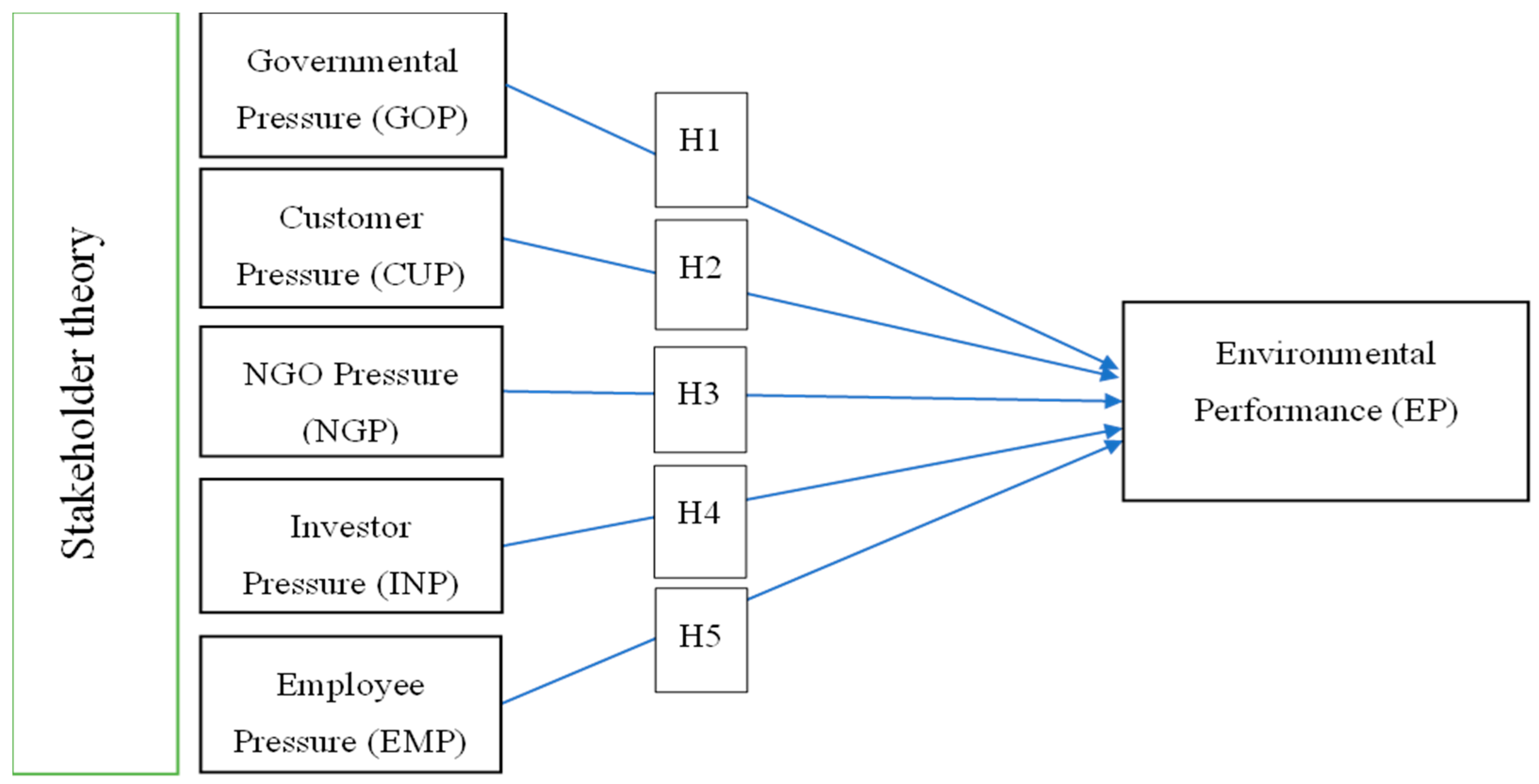
This section discusses relevant variables and the development of hypotheses. Figure 1 illustrates the conceptual framework.
Independent variables: Government pressure, Customer pressure, NGO pressure, Investor pressure, Employee pressure.
Dependent variable: Environmental performance.
Theoretical lens: Stakeholder theory.
H1. 
There is a positive relationship between governmental pressure and companies’ environmental performance.
H2. 
There is a positive relationship between customer pressure and companies’ environmental performance.
H3. 
There is a positive relationship between NGO pressure and companies’ environmental performance.
H4. 
There is a positive relationship between investor pressure and companies’ environmental performance.
H5. 
There is a positive relationship between employee pressure and companies’ environmental performance.

3.1.1. Governmental Pressure

Governmental pressure is considered as one of the primary factors influencing EP [19,26,35]. In the European Union (EU), companies continue to be subjected to numerous regulations, including those related to recycling activities, pollution reduction, and waste management and disposal. Different types of governmental pressure, including central government environmental regulations, emission standards, regional environmental regulations, special tax exemptions and environmental improvement initiatives have a positive impact on corporate EP (including environmental supply chain management) [19,53]. Penalties for firms’ environmental violations are critical for firms’ implementation of responsible environmental practices [20]. Prior research confirms that as a stakeholder, governments have the most prominent influence on an organization’s environmental practices [19,20,37,53]. Thus, we propose that:
H1. 
There is a positive relationship between governmental pressure and companies’ environmental performance.
On the contrary, government support of the oil and gas industry has a negative impact on the environmental performance of the oil and gas sector [7,28,31]. United States is currently a typical example of staunch government support for the sector. Since government is established as the main stakeholder to influence the sector, the reversal of regulatory requirements for the sector in United States represents a major risk of increased environmental related impacts associated with U.S. oil and gas companies.
Although top emitters as well, China and India are not a focus of analysis in this article, as United States is currently undertaking a major role in reversing pressure on the oil and gas sector for better environmental performance. The sector has resolute support from the current U.S. government. Prior to the Trump administration coming into power, in 2025, China and India were in the top five countries to provide fossil fuel subsidies [8]. This is a key point to take into consideration as these two countries are also top emitters, China being the most emitting country, followed by the United States and India being the third largest emitter. Nevertheless, it appears that in-spite of China’s push towards renewables, the demand for oil and gas is still strong in both China and India [8]. Thus, China’s support for the oil and gas sector has not shifted immensely since 2022. As a result, China and India, are not considered for deeper analysis in this article, as major (material) regulatory shift has not occurred for these two countries, in 2025, in relation to government pressure on or government support for the oil and gas sector [8].

3.1.2. Customer Pressure

Customers are key stakeholders who can affect a firm’s EP [20,54]. Numerous studies have noted that customer concerns motivate firms to adopt environmental initiatives [37,55]. Buying environmentally responsible products is becoming a priority for customers [56]. Client pressure has a significant effect on Chinese manufacturing organizations, leading towards better EP [21,55]. Customer pressure was found to directly impact green supply chain management in UK companies [22].
Social actors such as customers can wield normative pressure on organizations [22,25,26]. To enhance legitimacy, organizations tend to meet norms and social expectations [26,57]. Accordingly, we propose the following hypothesis:
H2. 
There is a positive relationship between customer pressure and companies’ environmental performance.

3.1.3. NGO Pressure

NGOs are self-governing, private, not-for-profit organizations that are geared towards implementing social and environmental accountabilities from corporations [58]. Since the 1990s, the influence of NGOs has increased dramatically [38]. Environmentally focused NGOs are critically important stakeholders whose main agenda is corporate accountability towards addressing environmental impacts [59].
NGOs can have significant influence in the business community by filing lawsuits against companies [37]. Thus, as supported by other studies, NGOs influence companies’ environmental practices [39,53]. We therefore propose the following hypothesis:
H3. 
There is a positive relationship between NGO pressure and companies’ environmental performance.

3.1.4. Investor Pressure

It is widely known that organizations face pressure from investors and shareholders [19,36]. Shareholders are significant stakeholders due to their financial impact [36], and they are in a strong position to impact a firm’s environmental policies and activities [37]. The impact of investors on EP has been investigated in several studies and a positive impact of investor influence on corporate environmental performance has been established [18,19,60,61]. It is established that shareholders can exert institutional pressure on companies’ environmental decisions and actions [37].
Thus, we propose the following hypothesis:
H4. 
There is a positive relationship between investor pressure and companies’ environmental performance.

3.1.5. Employee Pressure

Employees are a key primary internal stakeholder group in most private and public sector institutions; and they are the closest stakeholder associated with a firm’s environmental impacts [18,62,63]. Nowadays, employees are more aware of environmental issues and know more about the importance of cleaner production and green activities [63]. Thus, they can potentially exert pressure on firms to improve their EP.
Employee pressure on EP has been investigated in prior literature [19,60,61]. Employees of large companies are more likely to be listened to by senior executives [33]. Both management and lower-ranked employees play a vital role in a firm’s environmental strategy [37,60]. Prior research has found that employees in the marketing department wield the strongest influence on environmental practices [19]. We present the following associated hypothesis:
H5. 
There is a positive relationship between employee pressure and companies’ environmental performance.

3.2. Methodology

3.2.1. Constructs

Our constructs comprise of eight items to assess EP, based on previous studies [64]. We used a five-point Likert scale, where 1 is ‘strongly agree’ and 5 is ‘strongly disagree’. Table 1 lists the constructs for measuring the dependent variable, EP.
To assess the independent variables, the items are based on prior research and modified to be relevant for oil and gas companies. Table 2 below illustrates the items of every construct for the six independent variables and the source of the items. We used a five-point Likert scale where 1 is ‘strongly agree’ and 5 is ‘strongly disagree’.

3.2.2. Data Collection

We administered a survey in 2021 to collect data from targeted participants. While we acknowledge that the data collected is now a few years old, stakeholder influence nonetheless remains as critical today as it did a few years ago. Our findings regarding government influence are especially important in the current context, as they pose a bidirectional impact on the oil and gas sector’s environmental performance. While government pressure can force companies to undertake better environmental performance, government support, for example, for the oil and gas sector, can act as a hindrance to corporate environmental performance.
Participants were restricted to managers who make environmental-related decisions or employees involved in environmental-related practices. We used a purposive sampling technique to reach potential participants, which “involves choosing participants or other units of study, as the name implies, for a particular purpose” [70]. We recruited participants for our survey by emailing them directly at their company email addresses, publicly available on company websites, and via LinkedIn messages. We also utilized Prolific to target a larger pool of potential participants. Prolific is a paid recruitment website with a data panel of individuals interested in participating in academic research surveys [71]. These individuals have already provided their demographics (e.g., location, job role, experience, and profession type) to Prolific. Ultimately, 130 responses were received from 24 countries (Table 3). Sample size (n = 130), while acceptable for SEM, is relatively small for a multi-country study and may limit the generalizability of the findings.
Table 4 below shows the participants’ occupation profiles. 5.4% of participants were senior managers, 3 of whom were board members, 13.1% were middle managers, such as heads of environmental and sustainability departments. First-line managers, such as team leaders and supervisors, accounted for 14.6% of the survey participants. Engineers involved in environmental-related practices accounted for 40.8% of the participants. Lastly, employees engaged in environmental practices represented 26.2% of the participants.
Since this study considers the three main subgroups of oil and gas companies (those involved in upstream, midstream, and downstream activities), every participant was asked to specify their company’s main form of activity. The analysis shows that the largest group (26.9%) of participants were involved in upstream activities. See Table 5.

4. Results

4.1. Construct Reliability

Reliability is defined as ‘a measure of the degree to which a set of indicators of a latent construct is internally consistent based on how highly interrelated the indicators are with each other’ [72]. In other words, construct reliability refers to the consistency of the items in each construct used to measure a specific latent variable.
One of the main measurements of reliability is Cronbach’s alpha [73]. Cronbach’s alpha takes a value between 0 to 1, and closer to 1 indicates better reliability [72]. There are numerous opinions about the acceptable value of Cronbach’s alpha. However, several views indicate that a value above 0.71 is excellent [74].
In this study, SPSS 21 was used to calculate Cronbach’s alpha. Table 6 shows that individual constructs range from 0.768 to 0.945. This indicates a high level of construct reliability.

4.2. SEM Methods

WLSMV is suitable for variables measured using a Likert scale [75,76]. We applied the WLSMV estimation method using Mplus Version 8.8 software.
A minimum acceptable sample size of 100 is recommended [77] and it should not be less than 50 observations [77]. Five cases per item for all constructs, with a minimum of 100, is an adequate sample size [78]; 20 observations per latent variable are sufficient [79].
This study has collected 130 responses, which is 30% more than the minimum recommended [73,78,79]. When applying the ‘10-time rule’ [80] for non-normal distributed data, seven latent variables included in this study are multiplied by 10, resulting in 70 cases. Both the recommended minimum sample sizes (100 and 70) are significantly less than this study’s sample size of 130. Therefore, the sample size of this study is satisfactory for SEM analysis.

4.3. Measurement Model-Confirmatory Factor Analysis (CFA)

Each construct that includes several items is linked to the corresponding latent variable [72,81]. Although SEM software such as Mplus is mainly a statistical program, it allows for a simpler presentation using diagrams [72]. Table 7 defines the symbols.
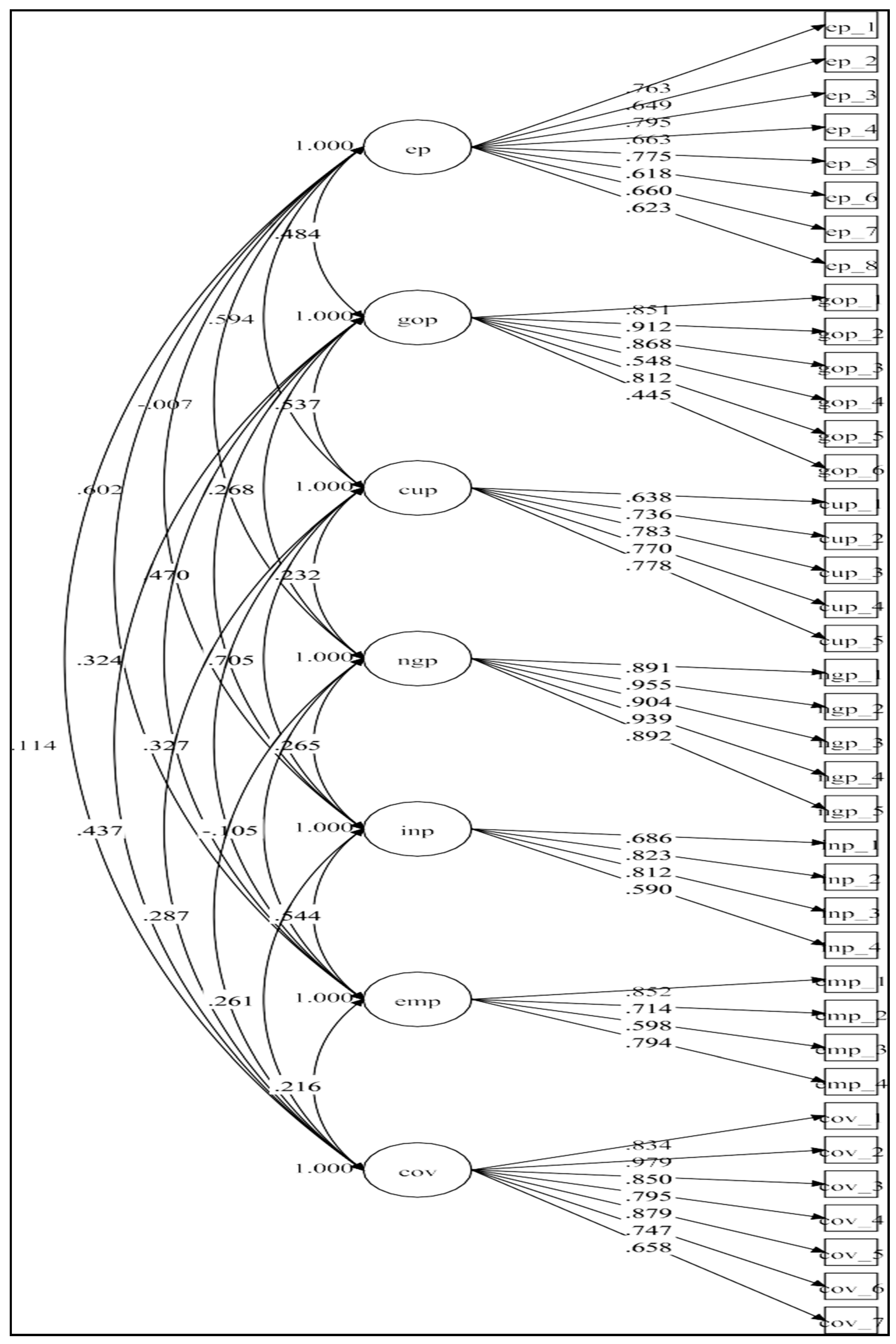
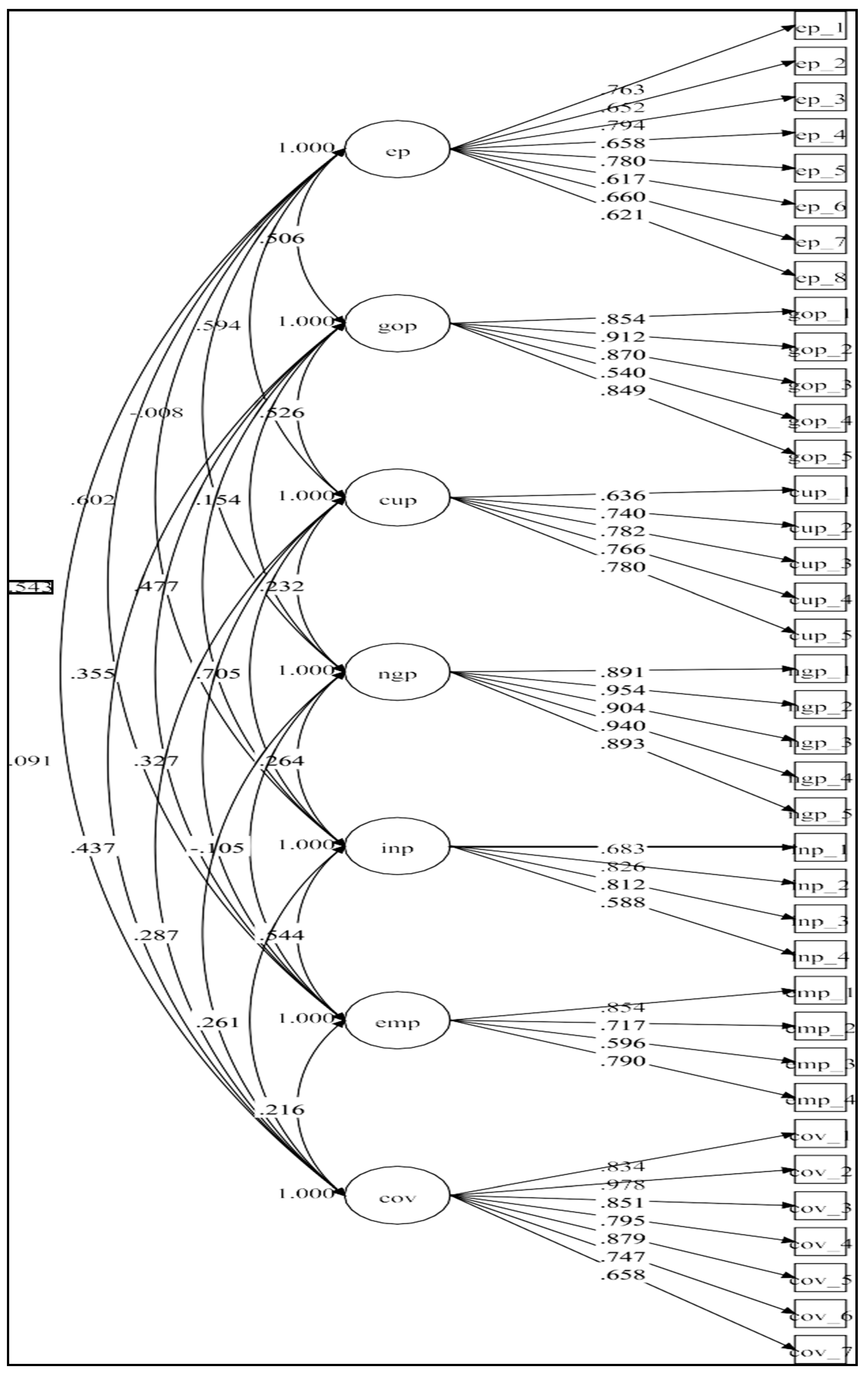
Figure 2 presents the measurement model, and the constructs used in this study before any modification. It shows seven constructs used to measure the variables. On the right-hand side of the diagram, the items of each construct are shown with the standardized factor loading, which represents how the latent variable explains the observed variable [77]. On the left-hand side, the diagram shows the values of the correlation estimates among the latent variables. Figure 3 presents the measurement model after modification.
The rule of thumb for the standardized factor loading is that it should be 0.5 or higher, and the ideal number is 0.7 or above. Thus, if the observed variable scores below 0.5, it is considered a poor score and might be deleted from the model [72].

4.4. Model Validity—CFA

After specifying the measurement model and collecting sufficient data, the researcher should assess whether the measurement model is valid. The validity of the theorized measurement model is checked through CFA, which enables the researcher to test the validity of the constructs. Validity of the measurement model relies on an acceptable level of goodness-of-fit (GOF) [72,83]. GOF examines the similarities between reality (using the observed covariance matrix) and theory (using the mated covariance matrix). The closer these values are to each other, the better the model fit [72,84] (Table 8).
The indices values were as following: χ2/df = 1.96, RMSEA = 0.086, TLI = 0.888, and CFI = 0.897, χ2/df value (1.96) is less than the cut-off threshold of 3, which indicates a good model fit [72,84].
Table 9 below illustrates the model fit indices for the study before and after modifications to improve goodness of fit. After further examination, we performed the convergent and discriminate validity tests [72,83] to assess the constructs’ validity.

4.5. Convergent Validity

Convergent validity is the extent to which two items of a specific construct share or converge and have a high proportion of the variance in common [72]. It measures the degree to which two measures of the same concept are correlated [72]. This test is used to examine the validity of the constructs.
Composite reliability is used to measure internal consistency and to evaluate convergent reliability [72]. Generally, the preferred composite reliability value should be above 0.70 [72,82]. Table 10 illustrates the AVE and composite reliability values for each construct. The numbers in the table indicate that the outcomes of the convergent validity test for all constructs meet the statistical requirement for reliability [72].

4.6. Discriminate Validity

After looking at the loading estimates and examining convergent validity [72] discriminant validity needs to be checked. Discriminate validity is ‘the extent to which a construct or variable is truly distinct from other constructs or variables’ [72] (p. 676). AVE’s square root value should be higher than the correlation values for the related constructs to achieve adequate discriminant validity [85].
Table 11 reveals that the AVE’s square root values were higher than the correlation values between the correlated constructs for all variables. Accordingly, the discriminate validity test shows satisfactory results for all constructs.

4.7. Structural Model Validity-Path Analysis

The final stage of SEM is assessing the structural model to evaluate its validity. Goodness-of-fit (GOF) indices are used to determine the structural model validity and its hypothesized theoretical relationships [72]. Table 12 shows the recommended GOF indices’ values and the structural model values of the study. All indices are in the satisfactory value ranges [72].
Mplus software provides four values for hypotheses testing: the standardized coefficient (Est.), standard error (SE), Est./SE, and the p-value [78]. The standardized path coefficient and the related p-value may be used to identify variables that contribute most to identifying the dependent construct [72]. They can identify the results of the path analysis [72,78].
In a path model, the path coefficient shows the direct effect of an independent variable on a dependent variable, whereas the p-value indicates the significance of the relationship [72,86]. In general, a p-value of less than 0.05 is considered statistically significant. Table 13 presents the standardized path coefficients and p-value for each variable of the survey-based phase.
The path analysis reveals that three independent variables are statistically significant. Table 14 shows that governmental pressure, customer pressure and employee pressure have a significant positive effect on EP at different levels of significance.
Table 14 shows that customer pressure (H2) has the highest standardized coefficient value of 0.356 and a p-value of 0.006. Employee pressure (H5) has the second largest standardized coefficient value of 0.286 and a p-value of 0.001. The least strong predictor is governmental pressure (H1), with a standardized coefficient value and p-value of 0.163 and 0.034, respectively.

5. Discussion and Conclusions

The study finds that governmental pressure has a significant impact on the EP of oil and gas companies. This result is confirmed by the findings of [26,35,87]. Companies tend to unconditionally comply with rules and regulations imposed by governments to avoid facing punishment/penalties. More recently, substantial steps towards making sustainability (including climate-related risks and opportunities) mandatory through legislation had been undertaken, prior to 2025. For example, the European Sustainability standards (ESRS) were adopted for use by companies subject to the Corporate Sustainability Reporting Directive (CSRD) [88]. Companies comply with governmental regulations and policies to gain benefits such as access to resources and tax deductions [26,52]. For the oil and gas sector, despite international calls, such as by the United Nations, to reduce subsidies for the oil and gas sector, the opposite has been occurring. For example, in Australia, subsidies for producers and users of fossil fuels have increased by 31% in 2022–2023 [89]. Globally, in 2022, subsidies for fossil fuel consumption exceeded $1 trillion U.S. [8]. Further measures to support the oil and gas sector are underway in the United States.
The study finds that customer pressure has a significant positive influence on EP. This finding is consistent with other studies [26,35,87]. However, this finding is inconsistent with the results of Cherry and Sneirson [50] who found no significant impact of customer pressure on EP. Customers can pressure companies to improve their environmental practices [90]. Reputational risk pressure can play an important role to influence minimization of the risk of harm and to promote redress in case of caused harm [11].
The study finds that NGO pressure has a nonsignificant impact on the EP of oil and gas companies. This result is in coherence with [35,69,91]. However, these findings are inconsistent with the results presented by [53,92]. Their findings supported the hypothesis that NGOs would have a significant impact on EP. NGOs undertake indirect approaches to influence a firm’s activities [19,92]. NGOs, as external stakeholders, tend to rely on developing public opinion to oppose an organization’s activities [93]. Their impact might not be directly noticeable to the decision-makers in companies. Nevertheless, NGOs might influence a company’s more influential stakeholders (such as investors) who could pressure companies to improve their EP.
Previous research has found that shareholders want more action from companies (especially in the Oil and Gas sector) to improve their environmental practices [19,94]. Thus, we hypothesized that investor pressure would significantly impact EP in oil and gas companies. Surprisingly, our results did not reveal a significant association between investor pressure and EP in the oil and gas industry. This finding is similar to [95,96]. However, this finding contradicts [19,26] who claim a significant positive association between investor pressure and environmental practices. In relation to high-polluting industries such as oil and gas, investors are more concerned with profitability than EP, and some shareholders might feel that environmental practices will negatively impact their financial wealth [97].
The study finds that employee pressure has the highest positive significant impact on EP in oil and gas companies. This finding is supported by [20,63,97]. However, it is inconsistent with the outcome of Studer et al. [98], who found a weak relationship between employees and EP. In the current (political) environment, this finding might not hold.
Employees are directly involved in the firm’s activities, including financial, environmental, and social practices. Employees are critical internal stakeholders who can significantly contribute to a firm’s success and are considered influential [93,99,100]. Nevertheless, corporate power may significantly dilute any employee’s say in relation to corporate activities and environmental impacts.
In relation to political influence, a major recent occurrence is the staunch support for the oil and gas sector by the United States government. There is a rapid reversal of environmental accountability (in the form of legislative measures) and thus a complete reversal of government pressure for better EP of United States’ Oil and Gas companies. Currently, a key aim is for the United States to be the major exporter of natural gas to Europe, thus weakening (and perhaps removing Russia) from the EU market. Not only that, strong ties between the U.S. government and the oil and gas sector are evident in administrative roles, including senior positions, being assigned to individuals who have worked for oil and gas companies [101,102]. These individuals are responsible for influencing U.S. environmental, climate and energy policies [101].
More recently, Trump has urged the World Bank to reverse the 2019 restrictions on financing of new fossil fuel projects [103]. Trump’s billions of dollars’ worth of handouts to the oil and gas sector are a form of policy reward for the sector’s $450 million contribution to Trump’s election [104]. These handouts comprise of increased depreciations (worth billions), tax exemptions, delays in fees, reduced royalties and waiver of climate related liabilities, amongst other handouts [104]. These current U.S. government practices are examples of reversal of government pressure, and greater corporate power/influence resulting in, in this case a win and gain situation for the U.S. oil and gas sector.
There has been conflicting pressure from governments, civil society, and international bodies on the oil and gas sector to improve its EP [28]. Governments (and legislators) seem to be demonstrating increased leniency towards the sector and NGO, and customer pressure seems to be weakening.
Our results suggest the need for differential strategies to effect meaningful changes in the oil and gas sector, such as implementing legislative measures to enhance the EP of oil and gas companies. Recent developments in the legislative space have included the implementation of ESG criteria, which require oil and gas companies to consider social and environmental factors in their decision-making in Europe [97]. Nevertheless, requirements by the EU are becoming more relaxed.
Regulations and policies aim to reduce greenhouse gas emissions, promote cleaner energy technologies, prevent accidents, manage risks, and ensure the responsible extraction of fossil fuels [105]. At the same time, there seem to be complexities around government pressure on oil and gas companies. For example, consider this quote from Environment Victoria [106]: “Amendments to the Offshore Petroleum and Greenhouse Gas Storage Legislation Amendment (Safety and Other Measures) Bill 2024 would effectively grant the offshore oil and gas industry a free pass from national environmental laws.” The implication is that of corporate lobbying, reverse pressure on governments from companies (corporate power), in this case, to relax legislative requirements for environmental protection.
In relation to our findings that government pressure has a significant influence on corporate EP, U.S represents a potential case of reverse causality, which adds further complexity to the understanding of government pressure. It also indicates the exercise of corporate power [107] over governments. The oil and gas sector has immense power in this regard. Corporate influence by the U.S. oil and gas sector, has resulted in current complete disregard for environment and climate change associated risks, by the U.S. government. The current situation is a quintessential example of reverse pressure on the U.S. government. Implications are dire in relation to the environmental performance of U.S. oil and gas companies. Resulting risk of irreversible environmental damage, not restricted to the United States, but in multiple parts of the world, from U.S. oil and gas companies, is extremely high.
Corporate power, as in this case, tends to weaken other stakeholders’ pressure for better corporate environmental performance, from a highly environmentally sensitive industry, such as the oil and gas sector. Such situations thus lead towards sole dominance of one stakeholder (such as government) and cause a chain reaction, not just restricted to one region. In the context under consideration, relaxing of environmental protection policies in other jurisdictions (such as currently in European Union) has commenced. It is possible that EU is following in the steps of U.S., not in entirety, definitely to a degree, where government pressure is facing counter industry lobbying from the oil and gas sector.
Although mandatory reporting on EP is necessary to demonstrate accountability in the oil and gas sector, governments’ current requirements for this form of accountability appear to be reversing, rapidly in some instances. Further research is required from the angles of EP, environmental reporting and accountability (including from policy and implementation perspectives) and strategizing for more effective NGO pressure for better corporate EP.


Author Contributions

Conceptualization, T.K. and T.A.; Methodology, T.K. and T.A.; Software, T.A., Validation, T.K.; Formal Analysis, T.A.; Investigation, T.A.; Resources, T.A.; Data Curation, T.A., Writing original draft—T.A. and T.K.; Writing review and editing—P.S.; Visualization, T.K.; Supervision, T.K. and P.S.; Project Administration, T.K. and P.S. All authors have read and agreed to the published version of the manuscript.

Funding

This research received no external funding.

Institutional Review Board Statement

The study was conducted in accordance with the Declaration of Helsinki, and the protocol was approved by the Ethics Committee of RMIT BLCHEAN (BLCHEAN 23021), Approval Date: 22 September 2020.

Informed Consent Statement

Informed consent was obtained from all subjects involved in the study.

Data Availability Statement

The original contributions presented in this study are included in the article. Further inquiries can be directed to the corresponding author.

Conflicts of Interest

The authors declare no conflicts of interest.

References

  1. BP. BP Statistical Review of World Energy. 2019. Available online: https://www.bp.com/content/dam/bp/business-sites/en/global/corporate/pdfs/energy-economics/statistical-review/bp-stats-review-2019-full-report.pdf (accessed on 10 September 2025).
  2. Fanchi, J.R.; Christiansen, R.L. Introduction to Petroleum Engineering; Wiley Online Library: Hoboken, NJ, USA, 2017. [Google Scholar]
  3. Alazzani, A.; Wan-Hussin, W.N. Global Reporting Initiative’s environmental reporting: A study of oil and gas companies. Ecol. Indic. 2013, 32, 19–24. [Google Scholar] [CrossRef]
  4. Gossen, L.; Velichkina, L. Environmental problems of the oil-and-gas industry. Pet. Chem. 2006, 46, 67–72. [Google Scholar] [CrossRef]
  5. Frynas, J.G. Corporate social responsibility in the oil and gas sector. J. World Energy Law Bus. 2009, 2, 178–195. [Google Scholar] [CrossRef]
  6. Barbosa, F.; Bresciani, G.; Graham, P.; Nyquist, S.; Yanosek, K. Oil and Gas After COVID-19: The Day of Reckoning or a New Age of Opportunity; McKinsey & Company: New York, NY, USA, 2020. [Google Scholar]
  7. Feingold, S. The US Enters its ‘Drill, Baby, Drill’ Era. Here’s What a Top Energy Leader Has to Say. World Economic Forum. 2025. Available online: https://www.weforum.org/stories/2025/03/us-enters-drill-era-top-energy-leader-oil-gas/ (accessed on 6 February 2025).
  8. IEA. Fossil Fuel Subsidies. 2025. Available online: https://www.iea.org/topics/fossil-fuel-subsidies (accessed on 10 September 2025).
  9. Norouzi, N. Post-COVID-19 and globalization of oil and natural gas trade: Challenges, opportunities, lessons, regulations, and strategies. Int. J. Energy Res. 2021, 45, 14338–14356. [Google Scholar] [CrossRef]
  10. Jain, N.K.; Panda, A.; Choudhary, P. Institutional pressures and circular economy performance: The role of environmental management system and organisational flexibility in oil and gas sector. Bus. Strategy Environ. 2020, 29, 3509–3525. [Google Scholar] [CrossRef]
  11. Spence, D.B. Corporate social responsibility in the oil and gas industry: The importance of reputational risk. Chic.-Kent Law Rev. 2011, 86, 59. [Google Scholar]
  12. Clarkson, P.M.; Overell, M.B.; Chapple, L. Environmental reporting and its relation to corporate environmental performance. Account. Forum 2011, 47, 27–60. [Google Scholar] [CrossRef]
  13. Clarkson, P.M.; Li, Y.; Richardson, G.D.; Vasvari, F.P. Revisiting the relation between environmental performance and environmental disclosure: An empirical analysis. Account. Organ. Soc. 2008, 33, 303–327. [Google Scholar] [CrossRef]
  14. Stanwick, P.A.; Stanwick, S. The relationship between corporate social performance, organisational size, financial performance, and environmental performance: An empirical examination. J. Bus. Ethics 1998, 17, 195–204. [Google Scholar] [CrossRef]
  15. Mia, P.; Hazelton, J.; Guthrie, A.M. The quality of energy efficiency disclosures: An exploratory study of Australian cities. Meditari Account. Res. 2024, 32, 487–511. [Google Scholar] [CrossRef]
  16. Green, W.; Taylor, S.; Wu, J. Determinants of greenhouse gas assurance provider choice. Meditari Account. Res. 2017, 25, 114–135. [Google Scholar] [CrossRef]
  17. Shah, K.U.; Rivera, J.E. Export processing zones and corporate environmental performance in emerging economies: The case of the oil, gas, and chemical sectors of Trinidad and Tobago. Policy Sci. 2007, 40, 265–285. [Google Scholar] [CrossRef]
  18. Mensah, I. Stakeholder pressure and hotel environmental performance in Accra, Ghana. Manag. Environ. Qual. Int. J. 2014, 25, 227–243. [Google Scholar] [CrossRef]
  19. Ramanathan, R.; Poomkaew, B.; Nath, P. The impact of organisational pressures on environmental performance of firms. Bus. Ethics A Eur. Rev. 2014, 23, 169–182. [Google Scholar] [CrossRef]
  20. Wang, Z.; Wang, Q.; Zhang, S.; Zhao, X. Effects of customer and cost drivers on green supply chain management practices and environmental performance. J. Clean. Prod. 2018, 189, 673–682. [Google Scholar] [CrossRef]
  21. Zhu, Q.; Sarkis, J. The moderating effects of institutional pressures on emergent green supply chain practices and performance. Int. J. Prod. Res. 2007, 45, 4333–4355. [Google Scholar] [CrossRef]
  22. Fernandez-Feijoo, B.; Romero, S.; Ruiz, S. Effect of stakeholders’ pressure on transparency of sustainability reports within the GRI framework. J. Bus. Ethics 2014, 122, 53–63. [Google Scholar] [CrossRef]
  23. Garcia, A.S.; Mendes-Da-Silva, W.; Orsato, R. Sensitive industries produce better ESG performance: Evidence from emerging markets. J. Clean. Prod. 2017, 150, 135–147. [Google Scholar] [CrossRef]
  24. Hoejmose, S.U.; Grosvold, J.; Millington, A. The effect of institutional pressure on cooperative and coercive ‘green’ supply chain practices. J. Purch. Supply Manag. 2014, 20, 215–224. [Google Scholar] [CrossRef]
  25. Scott, W.R. Institutional theory: Contributing to a theoretical research program. In Great Minds in Management: The Process of Theory Development; Oxford Academic: Oxford, UK, 2005; Volume 37, pp. 460–484. [Google Scholar]
  26. Wang, S.; Li, J.; Zhao, D. Institutional pressures and environmental management practices: The moderating effects of environmental commitment and resource availability. Bus. Strategy Environ. 2018, 27, 52–69. [Google Scholar] [CrossRef]
  27. Lee, S.-H.; Lee, S.-Y. An analysis of the effects of climate change policy, stakeholder pressure, and corporate carbon management on carbon efficiency in the Korean petrochemical industry. Sustainability 2018, 10, 4420. [Google Scholar] [CrossRef]
  28. Simpa, P.; Solomon, N.O.; Adenekan, O.A.; Obasi, S.C. Environmental stewardship in the oil and gas sector: Current practices and future directions. Int. J. Appl. Res. Soc. Sci. 2024, 6, 903–926. [Google Scholar] [CrossRef]
  29. Popoola, O.A.; Adama, H.E.; Okeke, C.D.; Akinoso, A.E. The strategic value of business analysts in enhancing organizational efficiency and operations. Int. J. Manag. Entrep. Res. 2024, 6, 1288–1303. [Google Scholar] [CrossRef]
  30. Akinsanya, M.O.; Ekechi, C.C.; Okeke, C.D. Data sovereignty and security in network engineering: A conceptual framework for compliance. Int. J. Sci. Res. Arch. 2024, 11, 1832–1847. [Google Scholar] [CrossRef]
  31. Morrison, L.J.; Alshamari, A.; Finau, G. Interrogating the environmental accountability of foreign oil and gas companies in Basra, Iraq: A stakeholder theory perspective. Meditari Account. Res. 2024, 32, 207–233. [Google Scholar] [CrossRef]
  32. Freeman, R.E.; Harrison, J.S.; Wicks, A.C.; Parmar, B.L.; De Colle, S. Stakeholder Theory: The State of the Art; Cambridge University Press: Cambridge, UK, 2010. [Google Scholar]
  33. Huang, C.-L.; Kung, F.-H. Drivers of environmental disclosure and stakeholder expectation: Evidence from Taiwan. J. Bus. Ethics 2010, 96, 435–451. [Google Scholar] [CrossRef]
  34. Eljayash, K.M.; James, K.; Kong, E. The quantity and quality of environmental disclosure in annual reports of national oil and gas companies in Middle East and North Africa. Int. J. Econ. Financ. 2012, 4, 201–217. [Google Scholar] [CrossRef]
  35. He, Z.-X.; Shen, W.-X.; Li, Q.-b.; Xu, S.-C.; Zhao, B.; Long, R.-Y.; Chen, H. Investigating external and internal pressures on corporate environmental behavior in paper-making enterprises of China. J. Clean. Prod. 2018, 172, 1193–1211. [Google Scholar] [CrossRef]
  36. Sarkis, J.; Gonzalez-Torre, P.; Adenso-Diaz, B. Stakeholder pressure and the adoption of environmental practices: The mediating effect of training. J. Oper. Manag. 2010, 28, 163–176. [Google Scholar] [CrossRef]
  37. Delmas, M.; Toffel, M.W. Stakeholders and environmental management practices: An institutional framework. Bus. Strategy Environ. 2004, 13, 209–222. [Google Scholar] [CrossRef]
  38. Choi, J.; Park, B. Environmentally responsible management of MNE subsidiaries: Stakeholder perspective. Multinatl. Bus. Rev. 2014, 22, 59–77. [Google Scholar] [CrossRef]
  39. Abdalla, Y.A.; Siti-Nabiha, A.K. Pressures for sustainability practices in an oil and gas company: Evidence from Sudan. Qual. Res. Account. Manag. 2015, 12, 256–286. [Google Scholar] [CrossRef]
  40. Elhuni, R.M.; Ahmad, M.M. Key performance indicators for sustainable production evaluation in oil and gas sector. Procedia Manuf. 2017, 11, 718–724. [Google Scholar] [CrossRef]
  41. Krupnick, A.J.; Gottlieb, M.; Kopp, R.J. Attaining Sustainable Development of Oil and Gas in North America; Resources for the Future: Washington, DC, USA, 2014. [Google Scholar]
  42. Patterson, L.A.; Konschnik, K.E.; Wiseman, H.; Fargione, J.; Maloney, K.O.; Kiesecker, J.; Nicot, J.-P.; Baruch-Mordo, S.; Entrekin, S.; Trainor, A. Unconventional oil and gas spills: Risks, mitigation priorities, and state reporting requirements. Environ. Sci. Technol. 2017, 51, 2563–2573. [Google Scholar] [CrossRef] [PubMed]
  43. Maloney, K.O.; Yoxtheimer, D.A. Production and disposal of waste materials from gas and oil extraction from the Marcellus Shale play in Pennsylvania. Environ. Pract. 2012, 14, 278–287. [Google Scholar] [CrossRef]
  44. McMahon, J. Six Reasons Why Fracking Has Flopped Overseas. Forbes, 2013. Available online: https://www.forbes.com/sites/jeffmcmahon/2013/04/07/six-reasons-fracking-has-flopped-overseas/ (accessed on 16 May 2022).
  45. Jung, E.J.; Kim, J.S.; Rhee, S.-K. The measurement of corporate environmental performance and its application to the analysis of efficiency in the oil industry. J. Clean. Prod. 2001, 9, 551–563. [Google Scholar] [CrossRef]
  46. Yoshimura, J.; Sugi, M. Tropical cyclone climatology in a high-resolution AGCM—impacts of SST warming and CO2 increase. Sola 2005, 1, 133–136. [Google Scholar] [CrossRef][Green Version]
  47. Parker, P.M.E.; Northrop, S.; Valencia, J.A.; Foglesong, R.E.; Duncan, W.T. CO2 management at ExxonMobil’s LaBarge field, Wyoming, USA. Energy Procedia 2011, 4, 5455–5470. [Google Scholar] [CrossRef]
  48. Scanlan, S.J. Framing fracking: Scale-shifting and greenwashing risk in the oil and gas industry. Local Environ. 2017, 22, 1311–1337. [Google Scholar] [CrossRef]
  49. Jamil, N.N.; Wahyuni, E.T. Do Some Sustainability Reporting Measures Enable ESG Greenwashing: A Case Study of Oil and Gas Industry in Malaysia. Glob. Bus. Manag. Res. 2024, 16, 123–128. [Google Scholar]
  50. Cherry, M.A.; Sneirson, J.F. Chevron, Greenwashing, and the Myth of “Green Oil Companies”. J. Energy Clim. Environ. 2012, 3, 133. [Google Scholar]
  51. Grasso, M. Oily politics: A critical assessment of the oil and gas industry’s contribution to climate change. Energy Res. Soc. Sci. 2019, 50, 106–115. [Google Scholar] [CrossRef]
  52. Downie, C. Ad hoc coalitions in the US energy sector: Case studies in the gas, oil, and coal industries. Bus. Politics 2018, 20, 643–668. [Google Scholar] [CrossRef]
  53. Mathiyazhagan, K.; Diabat, A.; Al-Refaie, A.; Xu, L. Application of analytical hierarchy process to evaluate pressures to implement green supply chain management. J. Clean. Prod. 2015, 107, 229–236. [Google Scholar] [CrossRef]
  54. Mathiyazhagan, K.; Govindan, K.; Noorul Haq, A. Pressure analysis for green supply chain management implementation in Indian industries using analytic hierarchy process. Int. J. Prod. Res. 2014, 52, 188–202. [Google Scholar] [CrossRef]
  55. Iranmanesh, M.; Fayezi, S.; Hanim, S.; Hyun, S.S. Drivers and outcomes of eco-design initiatives: A cross-country study of Malaysia and Australia. Rev. Manag. Sci. 2018, 13, 1121–1142. [Google Scholar] [CrossRef]
  56. Chithambo, L.; Tingbani, I.; Agyapong, G.A.; Gyapong, E.; Damoah, I.S. Corporate voluntary greenhouse gas reporting: Stakeholder pressure and the mediating role of the chief executive officer. Bus. Strategy Environ. 2020, 29, 1666–1683. [Google Scholar] [CrossRef]
  57. Berrone, P.; Fosfuri, A.; Gelabert, L.; Gomez-Mejia, L.R. Necessity as the mother of ‘green’ inventions: Institutional pressures and environmental innovations. Strateg. Manag. J. 2013, 34, 891–909. [Google Scholar] [CrossRef]
  58. Vakil, A.C. Confronting the classification problem: Toward a taxonomy of NGOs. World Dev. 1997, 25, 2057–2070. [Google Scholar] [CrossRef]
  59. Thijssens, T.; Bollen, L.; Hassink, H. Secondary stakeholder influence on CSR disclosure: An application of stakeholder salience theory. J. Bus. Ethics 2015, 132, 873–891. [Google Scholar] [CrossRef]
  60. Singh, N.; Jain, S.; Sharma, P. Determinants of proactive environmental management practices in Indian firms: An empirical study. J. Clean. Prod. 2014, 66, 469–478. [Google Scholar] [CrossRef]
  61. He, Z.-X.; Xu, S.-C.; Shen, W.-X.; Long, R.-Y.; Chen, H. Factors that influence corporate environmental behavior: Empirical analysis based on panel data in China. J. Clean. Prod. 2016, 133, 531–543. [Google Scholar] [CrossRef]
  62. Wang, L.; Li, W.; Qi, L. Stakeholder pressures and corporate environmental strategies: A meta-analysis. Sustainability 2020, 12, 1172. [Google Scholar] [CrossRef]
  63. Zhang, H.; Yang, F. On the drivers and performance outcomes of green practices adoption: An empirical study in China. Ind. Manag. Data Syst. 2016, 116, 2011–2034. [Google Scholar] [CrossRef]
  64. Chow, W.S.; Chen, Y. Corporate sustainable development: Testing a new scale based on the mainland Chinese context. J. Bus. Ethics 2012, 105, 519–533. [Google Scholar] [CrossRef]
  65. Murillo-Luna, J.L.; Garcés-Ayerbe, C.; Rivera-Torres, P. Why do patterns of environmental response differ? A stakeholders’ pressure approach. Strateg. Manag. J. 2008, 29, 1225–1240. [Google Scholar] [CrossRef]
  66. Den Hond, F.; de Bakker, F.G.; Doh, J. What prompts companies to collaboration with NGOs? Recent evidence from the Netherlands. Bus. Soc. 2015, 54, 187–228. [Google Scholar] [CrossRef]
  67. Dey, P.K.; Petridis, N.E.; Petridis, K.; Malesios, C.; Nixon, J.D.; Ghosh, S.K. Environmental management and corporate social responsibility practices of small and medium-sized enterprises. J. Clean. Prod. 2018, 195, 687–702. [Google Scholar] [CrossRef]
  68. Wu, J. Environmental compliance: The good, the bad, and the super green. J. Environ. Manag. 2009, 90, 3363–3381. [Google Scholar] [CrossRef]
  69. Darnall, N.; Henriques, I.; Sadorsky, P. Adopting proactive environmental strategy: The influence of stakeholders and firm size. J. Manag. Stud. 2010, 47, 1072–1094. [Google Scholar] [CrossRef]
  70. Leedy, P.; Ormrod, J. Practical Research: Planning and Design, Global Edition; Pearson Education Limited: London, UK, 2020; Available online: http://ebookcentral.proquest.com/lib/rmit/detail.action?docID=6142162 (accessed on 10 April 2022).
  71. Palan, S.; Schitter, C. Prolific.ac—A subject pool for online experiments. J. Behav. Exp. Financ. 2018, 17, 22–27. [Google Scholar] [CrossRef]
  72. Hair, J.F., Jr.; Matthews, L.M.; Matthews, R.L.; Sarstedt, M. PLS-SEM or CB-SEM: Updated guidelines on which method to use. Int. J. Multivar. Data Anal. 2017, 1, 107–123. [Google Scholar] [CrossRef]
  73. Bonett, D.G.; Wright, T.A. Cronbach’s alpha reliability: Interval estimation, hypothesis testing, and sample size planning. J. Organ. Behav. 2015, 36, 3–15. [Google Scholar] [CrossRef]
  74. Comrey, A.L.; Lee, H.B. A First Course in Factor Analysis; Psychology Press: Hove, UK, 2013. [Google Scholar]
  75. Beauducel, A.; Herzberg, P.Y. On the performance of maximum likelihood versus means and variance adjusted weighted least squares estimation in CFA. Struct. Equ. Model. 2006, 13, 186–203. [Google Scholar] [CrossRef]
  76. Li, C.-H. Confirmatory factor analysis with ordinal data: Comparing robust maximum likelihood and diagonally weighted least squares. Behav. Res. Methods 2016, 48, 936–949. [Google Scholar] [CrossRef] [PubMed]
  77. Boomsma, A. Nonconvergence, improper solutions, and starting values in LISREL maximum likelihood estimation. Psychometrika 1985, 50, 229–242. [Google Scholar] [CrossRef]
  78. Muthén, L.K.; Muthén, B.O. How to use a Monte Carlo study to decide on sample size and determine power. Struct. Equ. Model. 2002, 9, 599–620. [Google Scholar] [CrossRef]
  79. Costello, A.B.; Osborne, J. Best practices in exploratory factor analysis: Four recommendations for getting the most from your analysis. Pract. Assess. Res. Eval. 2005, 10, 7. [Google Scholar]
  80. Bentler, P.M.; Chou, C.-P. Practical issues in structural modelling. Sociol. Methods Res. 1987, 16, 78–117. [Google Scholar] [CrossRef]
  81. Schumacker, R.E.; Lomax, R.G. A Beginner’s Guide to Structural Equation Modeling; Psychology Press: Hove, UK, 2004. [Google Scholar]
  82. Hair, J.F.; Black, W.C.; Babin, B.J.; Anderson, R.E. Multivariate Data Analysis (Eighth Edition); Cengage: Boston, MA, USA, 2019. [Google Scholar]
  83. Byrne, B.M. Structural Equation Modeling with Mplus: Basic Concepts, Applications, and Programming; Routledge: Abingdon-on-Thames, UK, 2013. [Google Scholar]
  84. Schermelleh-Engel, K.; Moosbrugger, H.; Müller, H. Evaluating the fit of structural equation models: Tests of significance and descriptive goodness-of-fit measures. Methods Psychol. Res. Online 2003, 8, 23–74. [Google Scholar]
  85. Fornell, C.; Larcker, D.F. Evaluating structural equation models with unobservable variables and measurement error. J. Mark. Res. 1981, 18, 39–50. [Google Scholar] [CrossRef]
  86. Garson, G.D. Path Analysis; Statistical Associates Publishing: Asheboro, NC, USA, 2013. [Google Scholar]
  87. Zameer, H.; Wang, Y.; Saeed, M.R. Netzero emission targets and the role of managerial environmental awareness, customer pressure, and regulatory control toward environmental performance. Bus. Strategy Environ. 2021, 30, 4223–4236. [Google Scholar] [CrossRef]
  88. European Commission. The Commission Adopts the European Reporting Standards. 2023. Available online: https://finance.ec.europa.eu/news/commission-adopts-european-sustainability-reporting-standards-2023-07-31_en (accessed on 15 November 2024).
  89. Campbell, R.; Morison, L.; Verstegen, P.; Harrington, M.; Adhikari, A.; Scicluna, K.; Anderson, L. Fossil Fuel Subsidies in Australia; The Australia Institute: Griffith, Australia, 2024. [Google Scholar]
  90. Walker, H.; Di Sisto, L.; McBain, D. Drivers and barriers to environmental supply chain management practices: Lessons from the public and private sectors. J. Purch. Supply Manag. 2008, 14, 69–85. [Google Scholar] [CrossRef]
  91. Castka, P.; Prajogo, D. The effect of pressure from secondary stakeholders on the internalisation of ISO 14001. J. Clean. Prod. 2013, 47, 245–252. [Google Scholar] [CrossRef]
  92. Wichianrak, J.; Khan, T.; Teh, D.; Dellaportas, S. Critical perspectives of NGOs on voluntary corporate environmental reporting: Thai public listed companies. Sustainability 2023, 15, 6195. [Google Scholar] [CrossRef]
  93. Freeman, R.E. Strategic Management: A Stakeholder Approach; Cambridge University Press: Cambridge, UK, 1984. [Google Scholar]
  94. De Villiers, C.; Naiker, V.; Van Staden, C.J. The effect of board characteristics on firm environmental performance. J. Manag. 2011, 37, 1636–1663. [Google Scholar] [CrossRef]
  95. Boiral, O.; Heras-Saizarbitoria, I.; Testa, F. SA8000 as CSR-washing? The role of stakeholder pressures. Corp. Soc. Responsib. Environ. Manag. 2017, 24, 57–70. [Google Scholar] [CrossRef]
  96. Carballo-Penela, A.; Castromán-Diz, J.L. Environmental policies for sustainable development: An analysis of the drivers of proactive environmental strategies in the service sector. Bus. Strategy Environ. 2015, 24, 802–818. [Google Scholar] [CrossRef]
  97. Jiang, C.; Fu, Q. A win-win outcome between corporate environmental performance and corporate value: From the perspective of stakeholders. Sustainability 2019, 11, 921. [Google Scholar] [CrossRef]
  98. Studer, S.; Tsang, S.; Welford, R.; Hills, P. SMEs and voluntary environmental initiatives: A study of stakeholders’ perspectives in Hong Kong. J. Environ. Plan. Manag. 2008, 51, 285–301. [Google Scholar] [CrossRef]
  99. Fineman, S.; Clarke, K. Green stakeholders: Industry interpretations and response. J. Manag. Stud. 1996, 33, 715–730. [Google Scholar] [CrossRef]
  100. Clarkson, M.E. A stakeholder framework for analysing and evaluating corporate social performance. Acad. Manag. Rev. 1995, 20, 92–117. [Google Scholar] [CrossRef]
  101. Noor, D. More Than 40 Trump Administration Picks Tied Directly to Oil, Gas and Coal, Analysis Shows. 2025. Available online: https://www.theguardian.com/us-news/2025/oct/08/trump-administration-fossil-fuels-climate (accessed on 12 October 2025).
  102. Hughes, A.; Pskowski, M. New Report Shows Oil and Gas Influence Runs Deep in Trump Administration. 2025. Available online: https://www.corporateknights.com/category-climate/new-report-oil-and-gas-influence-runs-deep-in-trump-administration/ (accessed on 8 September 2025).
  103. Hidayat, M. Trump Calls on World Bank to Reconsider Oil and Gas Financing 2025. Available online: https://discoveryalert.com.au/news/trump-world-bank-fossil-fuel-financing-policy-2025/ (accessed on 5 July 2025).
  104. Peterson, L. President Trump’s Handouts to Fossil Fuel Industry Will Cost Public $80 Billion Over Next Decade. 2025. Available online: https://blog.ucs.org/laura-peterson/trumps-handouts-to-fossil-fuel-industry-will-cost-public-80-billion-over-next-decade/ (accessed on 5 July 2025).
  105. Fat Finger. Navigating Regulatory Changes in the Oil and Gas Sector. 2024. Available online: https://fatfinger.io/navigating-regulatory-changes-in-the-oil-and-gas-sector/ (accessed on 10 February 2025).
  106. Environment Victoria. Insidious Power Grab by the Gas Industry: Peak Environmental Bodies in Canberra to Oppose Offshore Petroleum Bill. 2024. Available online: https://environmentvictoria.org.au/2024/03/19/insidious-power-grab-by-the-gas-industry-peak-environmental-bodies-in-canberra-to-oppose-offshore-petroleum-bill/ (accessed on 10 February 2025).
  107. Cowling, K.; Tomlinson, P.R. Globalisation and corporate power. Contrib. Political Econ. 2005, 24, 33–54. [Google Scholar] [CrossRef]
Figure 1. Conceptual framework of various stakeholder pressures on environmental performance.
Sustainability 17 11146 g001
Figure 2. Measurement model before modification.
Sustainability 17 11146 g002
Figure 3. Measurement model after modification.
Sustainability 17 11146 g003
Table 1. EP measurements-based on ref. [64].
Indicators for Environmental Performance (During and Post Pandemic, 2020–2021)
Our company has reduced waste from operations in the last two years.
Our company has reduced emissions from operations in the last two years.
Our company has reduced the risk of environmental accidents, spills, and waste in the last two years.
Our company has reduced purchases of non-renewable materials, chemicals, and components in the last two years.
Our company has reduced the environmental impact of its products/services in the last two years.
Our company has reduced the impact on animal species and natural habitats in the last two years.
Our company undertook actions for environmental audit and public environmental disclosures in the last two years.
Our company undertook voluntary action (e.g., actions that are not required by regulations) for environmental restoration in the last two years.
Table 2. Construct items for the six independent variables and the source of the items.
Governmental Pressure (GOP)
Adapted from Refs. [21,26,54]
Our company faces government environmental regulations.
Our company faces emissions standards and regulations from the government.
Our company faces regional (state-level) environmental regulations.
There is a special tax exemption for environmental performance-related certifications (e.g., ISO 14001).
Our company has adopted environmentally friendly practices to avoid penalties such as environmental liabilities.
Several penalties have been imposed on our firms which violate environmental standards and regulations.
Customer Pressure (CUP)
Adapted from Refs. [54,65]
Our firm faces demand from its customers to increase its environmental protection strategy.
Our customers are looking for more environmentally friendly products.
Our major customers require us to achieve environmental-related certifications (e.g., ISO 14001).
Our major customers would withdraw our supply contract if we did not meet their environmental performance requirements.
Our firm periodically prepares a report about the company’s environmental performance for the customers.
Non-Governmental Organisation Pressure (NGO) (NOP)
Adapted from Ref. [66]
Our firm has been subject to criticism by NGOs relating to our environmental performance.
Our firm has been a target of NGO activism relating to our negative environmental performance.
Our firm has been subject to legal suits by NGOs relating to our environmental performance.
Our firm has been subject to protests by NGOs relating to our environmental performance.
Our firm has been subject to a boycott initiated by NGOs relating to our environmental performance.
Investor Pressure (INP)
Adapted from Refs. [65,67,68]
Shareholders put pressure on management to adopt environmentally friendly performance
Satisfying investor desires to reduce environmental risks and liabilities is a priority for our company.
Our firm annually prepares a report of the company’s environmental performance for the shareholders
Our main investors exert pressure on us to diversify our operations into renewable energy
Employee Pressure (EMP)
Adapted from Refs. [68,69]
Our company’s management staff supports protecting the environment.
Our company’s non-management employees support protecting the environment.
Being environmentally responsible attracts quality employees and decreases employee turnover.
Being environmentally responsible improves employee motivation and productivity.
Table 3. Company location and the number of survey participants.
CountryFrequency%CountryFrequency%CountryFrequency%
Saudi Arabia2922.3%Norway10.8%France10.8%
South Africa1713.1%US43.1%Italy43.1%
Canada1511.5%Oman43.1%Tunisia10.8%
Mexico75.4%Portugal43.1%UK10.8%
Poland64.6%Belgium21.5%UAE43.1%
Hungary75.4%Spain32.3%Czech10.8%
Greece64.6%Iraq21.5%Kuwait21.5%
Nigeria75.4%Pakistan10.8%India10.8%
Table 4. Occupation of participants.
OccupationNumber%
Senior managers (President, Vice President, Chief Executive Officer, Chief Environmental Officer, Chief Operating Officer, Chief Sustainability Officer, General Manager) and board members.85.4
Middle managers (Head of Environmental Department, Environmental, Risk Manager, Head of Sustainability Department, Production Manager, Site Manager, Public Relations Manager, Risk Manager, Marketing Manager, Research and Development Manager)1713.1
First line managers (team leader, foreman, supervisor)1914.6
Engineer5340.8
Others (employees involved in environmental related practices) 3426.2
Total130100.0
Table 5. Company sector.
Number%
Upstream3526.9
Midstream 2821.5
Downstream3426.1
Mixed (a company is involved in more than one sector)3325.4
Total130100.0
Table 6. Construct reliability-Cronbach’s alpha.
ConstructCronbach’s AlphaNo. of Items
Environmental performance0.8378
Governmental pressure0.7946
Customer pressure0.8245
NGO pressure0.9455
Investor pressure0.7864
Employee pressure0.7684
Table 7. Definition of diagram symbolism (adapted from Muthén and Muthén, 2002, Hair et al., 2019) [78,82].
SymbolDescription
Sustainability 17 11146 i001Observed variable (item)
Sustainability 17 11146 i002Latent variable
Sustainability 17 11146 i003Causal relationship
Sustainability 17 11146 i004Correlation (covariance)
Table 8. Model fit indices for the study and acceptable thresholds (Hair et al., 2019) [82].
GOF IndicesThresholds
χ2/df<3
RMSEA<0.08
TLI≥0.90
CFI≥0.90
Table 9. Model fit indices after modifications.
GOF IndicesThresholdsBefore Modifications After Modifications
χ2/df<31.961.69
RMSEA<0.080.0860.074
TLI≥0.900.8880.931
CFI≥0.900.8970.925
Table 10. Convergent validity of variables.
VariableAVEComposite Reliability
Environmental performance0.490.88
Governmental pressure0.670.91
Customer pressure0.550.86
NGO pressure0.840.96
Investor pressure0.540.82
Employee pressure0.560.83
Table 11. Discriminate validity of variables.
EPGOPCUPNGPINPEMP
EP0.697 *
GOP0.5060.816 *
CUP0.5940.5260.743 *
NGP−0.0080.1550.2320.917 *
INP0.6020.4770.7050.2650.734 *
EMP0.5440.3550.327−0.1060.5440.746 *
* Value of AVE’s square root.
Table 12. GOF indices for the structural model.
GOF IndicesRecommended ValueStructural Model Value
χ2/df<31.69
RMSEA<0.080.074
TLI≥0.900.931
CFI≥0.900.925
Table 13. The prediction power of each independent variable on the dependent variable (Environmental performance (EP)).
HypothesesPredictors Est.SEEst./SEp-Value
H1Governmental pressure (GOP)0.1630.0772.1150.034 *
H2Customer pressure (CUP)0.3560.1292.7670.006 *
H3NGO pressure (NGP)−0.1030.082−1.2450.213
H4Investor pressure (INP)0.1610.1421.1350.256
H5Employee pressure (EMP)0.2860.0903.1800.001 *
Notes: Dependent variable: EP; * significant when p-value < 0.05; p-value is one-tailed.
Table 14. Hypotheses and results.
HypothesisResult
H1.There is a positive relationship between governmental pressure and companies’ EP.Supported
H2.There is a positive relationship between customer pressure and companies’ EP.Supported
H3.There is a positive relationship between NGO pressure and companies’ EP.Not supported
H4.There is a positive relationship between shareholder pressure and companies’ EP.Not supported
H5.There is a positive relationship between employee pressure and companies’ EP.Supported
Disclaimer/Publisher’s Note: The statements, opinions and data contained in all publications are solely those of the individual author(s) and contributor(s) and not of MDPI and/or the editor(s). MDPI and/or the editor(s) disclaim responsibility for any injury to people or property resulting from any ideas, methods, instructions or products referred to in the content.