Ranking Port Criticality Under Climate Change: An Assessment of Greece

 ,
,  ,
,  , , , , , , ,
  ,
, 
Abstract
1. Introduction
2. Methodology
2.1. The Framework
2.2. Data Collation and Database
2.3. Port Exposure to Rising Sea Levels and Extreme Temperatures
2.4. Ranking Port Criticality Through Multicriteria Analysis
2.4.1. AHP Implementation
2.4.2. TOPSIS Implementation
2.4.3. PROMETHEE II Implementation
3. Results
3.1. SWOT Analysis and Selection of Indicators
3.2. Socio-Economic Indicators
3.3. Port Exposure to Climatic Factors
3.3.1. Rising Sea Level Exposure
3.3.2. Heat Exposure
3.4. Port Criticality Ranking
4. Discussion
5. Conclusions
Supplementary Materials
Author Contributions
Funding
Institutional Review Board Statement
Informed Consent Statement
Data Availability Statement
Conflicts of Interest
Abbreviations
| AHP | Analytic Hierarchy Process |
| ANP | Analytical Network Procedure |
| CORDEX | Coordinated Regional Downscaling Experiment |
| CORPAS | Complex Proportional Assessment |
| CR | Consistency Ratio |
| CRI | Criticality Index |
| CV & C | Climate Variability and Change |
| CVIs | Coastal Vulnerability Indexes |
| DEA | Data Envelopment Analysis |
| DEM | Digital Elevation Model |
| DRR | Disaster Risk Reduction |
| EI | Exposure Index |
| EIA | Environmental Impact Assessment |
| ELECTRE | Elimination and Choice Translating Reality |
| ESLs | Extreme Sea Levels |
| GHSL | Global Human Settlement Layer |
| GP | Goal Programming |
| LC/LU | Land Cover/Land Use |
| LSO | Large Scale Orthophoto |
| MAUT | Multi-Attribute Utility Theory |
| MCDM | Multi-Criteria Decision-Making |
| MOORA | Multi-objective Optimization on the basis of Ratio Analysis |
| PAs | Port Authorities |
| PROMYTHEE II | Preference Ranking Organization Method for Enrichment Evaluations |
| PVIs | Port Vulnerability Indexes |
| RCPs | Representative Concentration Pathways |
| RSLR | Relative Sea Level Rise |
| RVIs | Resilience Vulnerability Indexes |
| SDGs | Sustainable Development Goals |
| SEI | Socio-Economic Index |
| SFDRR | Sendai Framework for Disaster Risk Reduction |
| SMART | Simple Multi-Attribute Rating Technique |
| SURE | Simulated Uncertainty Range Evaluations |
| SWARA | Step-Wise Weight Assessment Ratio Analysis |
| SWOT | Strengths-Weaknesses-Opportunities-Threats |
| TOPSIS | Technique for Order of Preference by Similarity to Ideal Solution |
| UNFCCC | United Nations Framework Convention on Climate Change |
| VIKOR | VlseKriterijumska Optimizacija I Kompromisno Resenje |
| WPM | Weighed Product Model |
| WSM/SAW | Weighed Sum Model/Simple Addictive Weighting |
References
- Song, D.-W. Port Co-Opetition in Concept and Practice. Marit. Policy Manag. 2003, 30, 29–44. [Google Scholar] [CrossRef]
- Asariotis, R.; Monioudi, I.N.; Mohos Naray, V.; Velegrakis, A.F.; Vousdoukas, M.I.; Mentaschi, L.; Feyen, L. Climate Change and Seaports: Hazards, Impacts and Policies and Legislation for Adaptation. Anthr. Coasts 2024, 7, 14. [Google Scholar] [CrossRef]
- D’agostini, E.; Ryoo, D.-K. A Study on Socio-Economic Effects of Italian Ports. J. Navig. Port Res. 2017, 41, 243–250. [Google Scholar] [CrossRef]
- Notteboom, T.; Pallis, A.; Rodrigue, J.-P. Port Economics, Management and Policy, 1st ed.; Routledge: London, UK, 2022; ISBN 9780429318184. [Google Scholar]
- Ng, A.K.Y.; Jiang, C.; Li, X.; O’Connor, K.; Lee, P.T.-W. A Conceptual Overview on Government Initiatives and the Transformation of Transport and Regional Systems. J. Transp. Geogr. 2018, 71, 199–203. [Google Scholar] [CrossRef]
- UNCTAD. Review of Maritime Transport 2025: Staying the Course in Turbulent Waters; UNCTAD/RMT/2025; United Nations: New York, NY, USA, 2025. [Google Scholar]
- Sánchez-Arcilla, A.; Sierra, J.P.; Brown, S.; Casas-Prat, M.; Nicholls, R.J.; Lionello, P.; Conte, D. A Review of Potential Physical Impacts on Harbours in the Mediterranean Sea under Climate Change. Reg. Environ. Change 2016, 16, 2471–2484. [Google Scholar] [CrossRef]
- Monioudi, I.Ν.; Asariotis, R.; Becker, A.; Bhat, C.; Dowding-Gooden, D.; Esteban, M.; Feyen, L.; Mentaschi, L.; Nikolaou, A.; Nurse, L.; et al. Climate Change Impacts on Critical International Transportation Assets of Caribbean Small Island Developing States (SIDS): The Case of Jamaica and Saint Lucia. Reg. Environ. Change 2018, 18, 2211–2225. [Google Scholar] [CrossRef]
- Izaguirre, C.; Losada, I.J.; Camus, P.; Vigh, J.L.; Stenek, V. Climate Change Risk to Global Port Operations. Nat. Clim. Change 2021, 11, 14–20. [Google Scholar] [CrossRef]
- Monioudi, I.N.; Chatzistratis, D.; Moschopoulos, K.; Velegrakis, A.F.; Polydoropoulou, A.; Chalazas, T.; Bouhouras, E.; Papaioannou, G.; Karakikes, I.; Thanopoulou, H. Exposure of Greek Ports to Marine Flooding and Extreme Heat Under Climate Change: An Assessment. Water 2025, 17, 1897. [Google Scholar] [CrossRef]
- Verschuur, J.; Koks, E.E.; Hall, J.W. Systemic Risks from Climate-Related Disruptions at Ports. Nat. Clim. Change 2023, 13, 804–806. [Google Scholar] [CrossRef]
- Verschuur, J.; Koks, E.E.; Li, S.; Hall, J.W. Multi-Hazard Risk to Global Port Infrastructure and Resulting Trade and Logistics Losses. Commun. Earth Environ. 2023, 4, 5. [Google Scholar] [CrossRef]
- Becker, A.; Ng, A.K.Y.; McEvoy, D.; Mullett, J. Implications of Climate Change for Shipping: Ports and Supply Chains. WIREs Clim. Change 2018, 9, e508. [Google Scholar] [CrossRef]
- UNECE. Climate Change Impacts and Adaptation for Transport Networks and Nodes; ECE/TRANS/283; United Nations Publications: Geneva, Switzerland, 2020; ISBN 978-92-1-117237-9. [Google Scholar]
- Asariotis, R. Climate Change and Adaptation for Coastal Transport Infrastructure: A Sustainable Development Challenge for SIDS in the Caribbean and Beyond. In Coastal and Marine Environments; Wang, Y., Ed.; CRC Press: Boca Raton, FL, USA, 2020; Volume 5, pp. 253–264. [Google Scholar]
- UNFCCC. Policy Brief: Technologies for Averting, Minimizing and Addressing Loss and Damage in Coastal Zones; United Nations Framework Convention On Climate Change, Executive Committee of the Warsaw International Mechanism for Loss and Damage: Bonn, Germany, 2020. [Google Scholar]
- Ahmed, M.A.; Sridharan, B.; Saha, N.; Sannasiraj, S.A.; Kuiry, S.N. Assessment of Coastal Vulnerability for Extreme Events. Int. J. Disaster Risk Reduct. 2022, 82, 103341. [Google Scholar] [CrossRef]
- Tanim, A.H.; Goharian, E.; Moradkhani, H. Integrated Socio-Environmental Vulnerability Assessment of Coastal Hazards Using Data-Driven and Multi-Criteria Analysis Approaches. Sci. Rep. 2022, 12, 11625. [Google Scholar] [CrossRef] [PubMed]
- Roukounis, C.N.; Tsihrintzis, V.A. Indices of Coastal Vulnerability to Climate Change: A Review. Environ. Process. 2022, 9, 29. [Google Scholar] [CrossRef]
- Cruz-Ramírez, C.J.; Chávez, V.; Silva, R.; Muñoz-Perez, J.J.; Rivera-Arriaga, E. Coastal Management: A Review of Key Elements for Vulnerability Assessment. J. Mar. Sci. Eng. 2024, 12, 386. [Google Scholar] [CrossRef]
- Furlan, E.; Pozza, P.D.; Michetti, M.; Torresan, S.; Critto, A.; Marcomini, A. Development of a Multi-Dimensional Coastal Vulnerability Index: Assessing Vulnerability to Inundation Scenarios in the Italian Coast. Sci. Total Environ. 2021, 772, 144650. [Google Scholar] [CrossRef]
- León-Mateos, F.; Sartal, A.; López-Manuel, L.; Quintás, M.A. Adapting Our Sea Ports to the Challenges of Climate Change: Development and Validation of a Port Resilience Index. Mar. Policy 2021, 130, 104573. [Google Scholar] [CrossRef]
- Chalastani, V.I.; Pantelidis, A.; Feloni, E.; Papadimitriou, A.; Tsaimou, C.N.; Nisiforou, O.; Tsoukala, V.K. Development of a Complex Vulnerability Index for Fishing Shelters—The Case of Cyprus. J. Mar. Sci. Eng. 2023, 11, 1880. [Google Scholar] [CrossRef]
- Li, C.; Yang, X.; Yang, D. Port Vulnerability to Natural Disasters: An Integrated View from Hinterland to Seaside. Transp. Res. Part D Transp. Environ. 2025, 139, 104563. [Google Scholar] [CrossRef]
- Polydoropoulou, A.; Velegrakis, A.; Papaioannou, G.; Karakikes, I.; Bouhouras, E.; Thanopoulou, H.; Chatzistratis, D.; Monioudi, I.; Moschopoulos, K.; Chatzipavlis, A. A Composite Port Resilience Index Focused on Climate-Related Hazards: Results from Greek Ports’ Living-Labs. Marit. Transp. Res. 2025, 9, 100136. [Google Scholar] [CrossRef]
- McIntosh, R.D.; Becker, A. Expert Evaluation of Open-Data Indicators of Seaport Vulnerability to Climate and Extreme Weather Impacts for U.S. North Atlantic Ports. Ocean. Coast. Manag. 2019, 180, 104911. [Google Scholar] [CrossRef]
- Zhang, T.; Liu, H.; Lu, Y.; Wang, Q.; Loh, Y.C.; Li, Z. Impact of Climate Change on Coastal Ecosystem and Outdoor Activities: A Comparative Analysis Among Four Largest Coastline Covering Countries. Environ. Res. 2024, 250, 118405. [Google Scholar] [CrossRef]
- Fernandez-Perez, A.; Lara, J.L.; Lucio, D.; Losada, I.J. Compound Climate Change Risk Analysis for Port Infrastructures. Coast. Eng. 2024, 193, 104560. [Google Scholar] [CrossRef]
- Toimil, A.; Losada, I.J.; Díaz-Simal, P.; Izaguirre, C.; Camus, P. Multi-Sectoral, High-Resolution Assessment of Climate Change Consequences of Coastal Flooding. Clim. Change 2017, 145, 431–444. [Google Scholar] [CrossRef]
- Lucio, D.; Lara, J.L.; Tomás, A.; Losada, I.J. Probabilistic Assessment of Climate-Related Impacts and Risks in Ports. Reliab. Eng. Syst. Saf. 2024, 251, 110333. [Google Scholar] [CrossRef]
- Jenelius, E.; Petersen, T.; Mattsson, L.-G. Importance and Exposure in Road Network Vulnerability Analysis. Transp. Res. Part A Policy Pract. 2006, 40, 537–560. [Google Scholar] [CrossRef]
- Jafino, B.A.; Kwakkel, J.; Verbraeck, A. Transport Network Criticality Metrics: A Comparative Analysis and a Guideline for Selection. Transp. Rev. 2020, 40, 241–264. [Google Scholar] [CrossRef]
- Jenelius, E.; Mattsson, L.-G. Road Network Vulnerability Analysis: Conceptualization, Implementation and Application. Comput. Environ. Urban Syst. 2015, 49, 136–147. [Google Scholar] [CrossRef]
- Sullivan, J.L.; Novak, D.C.; Aultman-Hall, L.; Scott, D.M. Identifying Critical Road Segments and Measuring System-Wide Robustness in Transportation Networks with Isolating Links: A Link-Based Capacity-Reduction Approach. Transp. Res. Part A Policy Pract. 2010, 44, 323–336. [Google Scholar] [CrossRef]
- de Oliveira, E.L.; da Silva Portugal, L.; Porto Junior, W. Indicators of Reliability and Vulnerability: Similarities and Differences in Ranking Links of a Complex Road System. Res. Part A Policy Pract. 2016, 88, 195–208. [Google Scholar] [CrossRef]
- Yang, Z.; Ng, A.K.Y.; Wang, J. Prioritising Security Vulnerabilities in Ports. Int. J. Shipp. Transp. Logist. 2013, 5, 622–636. [Google Scholar] [CrossRef]
- Verschuur, J.; Koks, E.E.; Hall, J.W. Ports’ Criticality in International Trade and Global Supply-Chains. Nat. Commun. 2022, 13, 4351. [Google Scholar] [CrossRef]
- Velegrakis, A.F.; Monioudi, I.; Tzoraki, O.; Vousdoukas, M.I.; Tragou, E.; Hasiotis, T.; Asariotis, R.; Andreadis, O. Coastal Hazards and Related Impacts in Greece. In The Geography of Greece: Managing Crises and Building Resilience; Darques, R., Sidiropoulos, G., Kalabokidis, K., Eds.; Springer International Publishing: Cham, Switzerland, 2024; pp. 353–370. ISBN 978-3-031-29819-6. [Google Scholar]
- EEA. European Climate Risk Assessment; Publications Office of the European Union: Luxembourg, 2024. [Google Scholar]
- Hanson, S.E.; Nicholls, R.J. Demand for Ports to 2050: Climate Policy, Growing Trade and the Impacts of Sea-Level Rise. Earths Future 2020, 8, e2020EF001543. [Google Scholar] [CrossRef]
- Abdelhafez, M.A.; Ellingwood, B.; Mahmoud, H. Vulnerability of Seaports to Hurricanes and Sea Level Rise in a Changing Climate: A Case Study for Mobile, AL. Coast. Eng. 2021, 167, 103884. [Google Scholar] [CrossRef]
- Mora, C.; Dousset, B.; Caldwell, I.R.; Powell, F.E.; Geronimo, R.C.; Bielecki, C.R.; Counsell, C.W.W.; Dietrich, B.S.; Johnston, E.T.; Louis, L.V.; et al. Global Risk of Deadly Heat. Nat. Clim. Change 2017, 7, 501–506. [Google Scholar] [CrossRef]
- Dasgupta, S.; van Maanen, N.; Gosling, S.N.; Piontek, F.; Otto, C.; Schleussner, C.-F. Effects of Climate Change on Combined Labour Productivity and Supply: An Empirical, Multi-Model Study. Lancet Planet Health 2021, 5, e455–e465. [Google Scholar] [CrossRef] [PubMed]
- van Daalen, K.R.; Romanello, M.; Rocklöv, J.; Semenza, J.C.; Tonne, C.; Markandya, A.; Dasandi, N.; Jankin, S.; Achebak, H.; Ballester, J.; et al. The 2022 Europe Report of the Lancet Countdown on Health and Climate Change: Towards a Climate Resilient Future. Lancet Public Health 2022, 7, e942–e965. [Google Scholar] [CrossRef]
- Zavadskas, E.K.; Mardani, A.; Turskis, Z.; Jusoh, A.; Nor, K.M. Development of TOPSIS Method to Solve Complicated Decision-Making Problems—An Overview on Developments from 2000 to 2015. Int. J. Inf. Technol. Decis. Mak. 2016, 15, 645–682. [Google Scholar] [CrossRef]
- Bove, G.; Becker, A.; Sweeney, B.; Vousdoukas, M.; Kulp, S. A Method for Regional Estimation of Climate Change Exposure of Coastal Infrastructure: Case of USVI and the Influence of Digital Elevation Models on Assessments. Sci. Total Environ. 2020, 710, 136162. [Google Scholar] [CrossRef]
- Chrisafinos, D.; Kavvadas, I. Quality Assessment of the New Backgrounds LSO25. In Proceedings of the 14th National Conference on Chartography of the Greek Scientific Association of Chartography, Titled “The Chartography in a Changing World”, Thessaloniki, Greece, 2–4 November 2016; pp. 2–4. [Google Scholar]
- Monioudi, I.N.; Velegrakis, A.F.; Chatzistratis, D.; Vousdoukas, M.I.; Savva, C.; Wang, D.; Bove, G.; Mentaschi, L.; Paprotny, D.; Morales-Nápoles, O.; et al. Climate Change—Induced Hazards on Touristic Island Beaches: Cyprus, Eastern Mediterranean. Front. Mar. Sci. 2023, 10, 1188896. [Google Scholar] [CrossRef]
- Jevrejeva, S.; Jackson, L.P.; Riva, R.E.M.; Grinsted, A.; Moore, J.C. Coastal Sea Level Rise with Warming above 2 °C. Proc. Natl. Acad. Sci. USA 2016, 113, 13342–13347. [Google Scholar] [CrossRef]
- Vousdoukas, M.I.; Mentaschi, L.; Voukouvalas, E.; Verlaan, M.; Jevrejeva, S.; Jackson, L.P.; Feyen, L. Global Probabilistic Projections of Extreme Sea Levels Show Intensification of Coastal Flood Hazard. Nat. Commun. 2018, 9, 2360. [Google Scholar] [CrossRef] [PubMed]
- Campos, Á.; García-Valdecasas, J.M.; Molina, R.; Castillo, C.; Álvarez-Fanjul, E.; Staneva, J. Addressing Long-Term Operational Risk Management in Port Docks under Climate Change Scenarios—A Spanish Case Study. Water 2019, 11, 2153. [Google Scholar] [CrossRef]
- González-Marco, D.; Sierra, J.P.; Fernández de Ybarra, O.; Sánchez-Arcilla, A. Implications of Long Waves in Harbor Management: The Gijón Port Case Study. Ocean. Coast. Manag. 2008, 51, 180–201. [Google Scholar] [CrossRef]
- Sierra, J.P.; Casanovas, I.; Mösso, C.; Mestres, M.; Sánchez-Arcilla, A. Vulnerability of Catalan (NW Mediterranean) Ports to Wave Overtopping Due to Different Scenarios of Sea Level Rise. Reg. Environ. Change 2016, 16, 1457–1468. [Google Scholar] [CrossRef]
- Sierra, J.P.; Casas-Prat, M.; Virgili, M.; Mösso, C.; Sánchez-Arcilla, A. Impacts on Wave-Driven Harbour Agitation Due to Climate Change in Catalan Ports. Nat. Hazards Earth Syst. Sci. 2015, 15, 1695–1709. [Google Scholar] [CrossRef]
- Copernicus Climate Change Service Climate Data Store. CORDEX Regional Climate Model Data on Single Levels; Copernicus Climate Change Service (C3S) Climate Data Store (CDS). Available online: https://cds.climate.copernicus.eu/datasets/projections-cordex-domains-single-levels?tab=overview (accessed on 20 May 2025).
- Velegrakis, A.F.; Chatzistratis, D.; Chalazas, T.; Armaroli, C.; Schiavon, E.; Alves, B.; Grigoriadis, D.; Hasiotis, T.; Ieronymidi, E. Earth Observation Technologies, Policies and Legislation for the Coastal Flood Risk Assessment and Management: A European Perspective. Anthr. Coasts 2024, 7, 3. [Google Scholar] [CrossRef]
- EPPE Recommendations for Maritime Works. ROM 2.0-11, Volume I. Recommenda-Tions for the Design and Construction of Berthing and Mooring Structures. Translated Version of the Original Spanish Text, 1st ed.; Organismo Público Puertos del Estado: Madrid, Spain, 2019. [Google Scholar]
- Karditsa, A.; Roumpis, E.; Markozanes, F.; Lesioti, M.; Monioudi, I.; Poulos, S.; Hatzaki, M.; Vaggelas, G. The Impact of Sea Level Rise on the Port of Heraklio: Operational Risk Assessment and Economic Implications. Tech. Ann. 2024, 1. [Google Scholar] [CrossRef]
- Sierra, J.P.; Sánchez-Arcilla, A.; Gironella, X.; Gracia, V.; Altomare, C.; Mösso, C.; González-Marco, D.; Gómez, J.; Barceló, M.; Barahona, C. Impact of Climate Change on Berthing Areas in Ports of the Balearic Islands: Adaptation Measures. Front. Mar. Sci. 2023, 10, 1124763. [Google Scholar] [CrossRef]
- Leviäkangas, P.; Tuominen, A.; Molarius, R.; Schabel, J.; Toivonen, S.; Keränen, J.; Törnqvist, J.; Makkonen, L.; Vajda, A.; Tuomenvirta, H. Extreme Weather Impacts on Transport Systems; EWENT Project Deliverable D1; VTT: Espoo, Finland, 2011. [Google Scholar]
- Mentaschi, L.; Vousdoukas, M.; Voukouvalas, E.; Sartini, L.; Feyen, L.; Besio, G.; Alfieri, L. Non-Stationary Extreme Value Analysis: A Simplified Approach for Earth Science Applications. Hydrol. Earth Syst. Sci. 2016, 20, 3527–3547. [Google Scholar] [CrossRef]
- Adem Esmail, B.; Geneletti, D. Multi-Criteria Decision Analysis for Nature Conservation: A Review of 20 Years of Applications. Methods Ecol. Evol. 2018, 9, 42–53. [Google Scholar] [CrossRef]
- Abdullah, M.F.; Siraj, S.; Hodgett, R.E. An Overview of Multi-Criteria Decision Analysis (Mcda) Application in Managing Water-Related Disaster Events: Analyzing 20 Years of Literature for Flood and Drought Events. Water 2021, 13, 1358. [Google Scholar] [CrossRef]
- Saaty, T.L. Relative Measurement and Its Generalization in Decision Making Why Pairwise Comparisons Are Central in Mathematics for the Measurement of Intangible Factors The Analytic Hierarchy/Network Process. Rev. R. Acad. Cien. Ser. A Mat. 2008, 102, 251–318. [Google Scholar] [CrossRef]
- Mateo, J.R.S.C. Multi-Criteria Analysis in the Renewable Energy Industry; Springer: London, UK, 2012; Volume 83, ISBN 9781447123453. [Google Scholar]
- Saaty, T.L.; Vargas, L.G. Decision Making with the Analytic Network Process, 2nd ed.; International Series in Operations Research & Management Science; Springer: Boston, MA, USA, 2013; Volume 195, ISBN 978-1-4614-7278-0. [Google Scholar]
- Aruldoss, M.; Lakshmi, T.M.; Prasanna Venkatesan, V. A Survey on Multi Criteria Decision Making Methods and Its Applications. Am. J. Inf. Syst. 2013, 1, 31–43. [Google Scholar]
- Romero, C. A General Structure of Achievement Function for a Goal Programming Model. Eur. J. Oper. Res. 2004, 153, 675–686. [Google Scholar] [CrossRef]
- Qin, X.S.; Huang, G.H.; Chakma, A.; Nie, X.H.; Lin, Q.G. A MCDM-Based Expert System for Climate-Change Impact Assessment and Adaptation Planning—A Case Study for the Georgia Basin, Canada. Expert Syst. Appl. 2008, 34, 2164–2179. [Google Scholar] [CrossRef]
- Løken, E. Use of Multicriteria Decision Analysis Methods for Energy Planning Problems. Renew. Sustain. Energy Rev. 2007, 11, 1584–1595. [Google Scholar] [CrossRef]
- Velasquez, M.; Hester, P.T. An Analysis of Multi-Criteria Decision Making Methods. Int. J. Oper. Res. 2013, 10, 56–66. [Google Scholar]
- Behzadian, M.; Kazemzadeh, R.B.; Albadvi, A.; Aghdasi, M. PROMETHEE: A Comprehensive Literature Review on Methodologies and Applications. Eur. J. Oper. Res. 2010, 200, 198–215. [Google Scholar] [CrossRef]
- Hodgett, R.E.; Siraj, S. SURE: A Method for Decision-Making under Uncertainty. Expert Syst. Appl. 2019, 115, 684–694. [Google Scholar] [CrossRef]
- Radulescu, C.Z.; Radulescu, M. A Hybrid Group Multi-Criteria Approach Based on SAW, TOPSIS, VIKOR, and COPRAS Methods for Complex IoT Selection Problems. Electronics 2024, 13, 789. [Google Scholar] [CrossRef]
- Pérez-Domínguez, L.; Rodríguez-Picón, L.A.; Alvarado-Iniesta, A.; Luviano Cruz, D.; Xu, Z. MOORA under Pythagorean Fuzzy Set for Multiple Criteria Decision Making. Complexity 2018, 2018, 2602376. [Google Scholar] [CrossRef]
- Singh, R.; Pathak, V.K.; Kumar, R.; Dikshit, M.; Aherwar, A.; Singh, V.; Singh, T. A Historical Review and Analysis on MOORA and Its Fuzzy Extensions for Different Applications. Heliyon 2024, 10, e25453. [Google Scholar] [CrossRef]
- Hafezalkotob, A.; Hafezalkotob, A.; Liao, H.; Herrera, F. An Overview of MULTIMOORA for Multi-Criteria Decision-Making: Theory, Developments, Applications, and Challenges. Inf. Fusion 2019, 51, 145–177. [Google Scholar] [CrossRef]
- Miç, P.; Antmen, Z.F. A Decision-Making Model Based on TOPSIS, WASPAS, and MULTIMOORA Methods for University Location Selection Problem. Sage Open 2021, 11, 21582440211040116. [Google Scholar] [CrossRef]
- Stević, Ž.; Das, D.K.; Tešić, R.; Vidas, M.; Vojinović, D. Objective Criticism and Negative Conclusions on Using the Fuzzy SWARA Method in Multi-Criteria Decision Making. Mathematics 2022, 10, 635. [Google Scholar] [CrossRef]
- Keshavarz-Ghorabaee, M.; Amiri, M.; Zavadskas, E.K.; Turskis, Z.; Antucheviciene, J. An Extended Step-Wise Weight Assessment Ratio Analysis with Symmetric Interval Type-2 Fuzzy Sets for Determining the Subjective Weights of Criteria in Multi-Criteria Decision-Making Problems. Symmetry 2018, 10, 91. [Google Scholar] [CrossRef]
- Thakkar, J.J. Stepwise Weight Assessment Ratio Analysis (SWARA). In Multi-Criteria Decision Making; Thakkar, J.J., Ed.; Springer: Singapore, 2021; pp. 281–289. ISBN 978-981-33-4745-8. [Google Scholar]
- Wu, Z.; Abdul-Nour, G. Comparison of Multi-Criteria Group Decision-Making Methods for Urban Sewer Network Plan Selection. CivilEng 2020, 1, 26–48. [Google Scholar] [CrossRef]
- Brans, J.P.; Mareschal, B.; Vincke, P. PROMETHEE: A New Family of Outranking Methods in Multicriteria Analysis. In Operational Research ’84; Brans, J.P., Ed.; NorthHolland: Amsterdam, The Netherlands, 1984; pp. 477–490. [Google Scholar]
- Maity, S.R.; Chakraborty, S. Tool Steel Material Selection Using PROMETHEE II Method. Int. J. Adv. Manuf. Technol. 2015, 78, 1537–1547. [Google Scholar] [CrossRef]
- Chlomoudis, C.; Pallis, P.; Platias, C. Environmental Mainstreaming in Greek TEN-T Ports. Sustainability 2022, 14, 1634. [Google Scholar] [CrossRef]
- PPA S.A. The Port for All; PPA S.A.: Piraeus, Greece, 2018. [Google Scholar]
- Union of Greek Shipowners. Greek Shipping a Major EU Export Industry of Strategic Importance; Union of Greek Shipowners: Piraeus, Greece, 2019. [Google Scholar]
- PPA S.A. Quality, Environmental & Energy Policy; PPA S.A.: Piraeus, Greece, 2025. [Google Scholar]
- Kontopyrakis, K.E.; Velegrakis, A.F.; Monioudi, I.N.; Ćulibrk, A. Prioritizing Environmental Policies in Greek Coastal Municipalities. Anthr. Coasts 2024, 7, 1. [Google Scholar] [CrossRef]
- Pallis, A.A.; Vaggelas, G.K. Regulating and Financing Greek Ports. In Regulation and Finance in the Port Industry: Lessons from Worldwide Experiences; Ferrari, C., Haralambides, H., Prete, S., Tei, A., Eds.; Springer International Publishing: Cham, Switzerland, 2022; pp. 237–253. ISBN 978-3-030-83985-7. [Google Scholar]
- Argyriou, I.; Nisiforou, O.; Tsoutsos, T. Setting Sail for a Sustainable Growth in Small/Medium Ports. Sustainability 2025, 17, 3330. [Google Scholar] [CrossRef]
- Barona, J.; Ballini, F.; Canepa, M. Circular Developments of Maritime Industrial Ports in Europe: A Semi-Systematic Review of the Current Situation. J. Shipp. Trade 2023, 8, 25. [Google Scholar] [CrossRef]
- European Commission; Joint Research Centre; Christidis, P.; Mendoza Villafuerte, P.; Oliete Josa, S.; Jimenez Espadafor Sardon, E.; Hidalgo Gonzalez, I.; Dolci, F.; Grosso, M.; Suarez Bertoa, R.; et al. Global Gateway Green Shipping Corridors, Scoping Study for Port Identification; European Union: Seville, Spain, 2024. [Google Scholar]
- Paulauskas, V.; Paulauskas, D.; Markauskas, A. Port Green Transformation Factors Assessment. J. Mar. Sci. Eng. 2025, 13, 929. [Google Scholar] [CrossRef]
- Platias, C.; Spyrou, D. EU-Funded Energy-Related Projects for Sustainable Ports: Evidence from the Port of Piraeus. Sustainability 2023, 15, 4363. [Google Scholar] [CrossRef]
- Fabbrini, F. The Recovery and Resilience Facility as a New Legal Technology of European Governance. J. Eur. Integr. 2024, 47, 85–103. [Google Scholar] [CrossRef]
- Pallis, A.A.; Vaggelas, G.K. A Greek Prototype of Port Governance. Res. Transp. Bus. Manag. 2017, 22, 49–57. [Google Scholar] [CrossRef]
- Millefiori, L.M.; Braca, P.; Zissis, D.; Spiliopoulos, G.; Marano, S.; Willett, P.K.; Carniel, S. COVID-19 Impact on Global Maritime Mobility. Sci. Rep. 2021, 11, 18039. [Google Scholar] [CrossRef] [PubMed]
- UNCTAD. COVID-19 and Maritime Transport: Navigating the Crisis and the Lessons Learned; UNCTAD: Geneva, Switzerland, 2022. [Google Scholar]
- Węcel, K.; Stróżyna, M.; Szmydt, M.; Abramowicz, W. The Impact of Crises on Maritime Traffic: A Case Study of the COVID-19 Pandemic and the War in Ukraine. Netw. Spat. Econ. 2024, 24, 199–230. [Google Scholar] [CrossRef]
- Liu, Q.; Yang, Y.; Ke, L.; Ng, A.K.Y. Structures of Port Connectivity, Competition, and Shipping Networks in Europe. J. Transp. Geogr. 2022, 102, 103360. [Google Scholar] [CrossRef]
- Esteve-Pérez, J.; del Río-González, M. Assessment of the Centrality of the Cruise Ship Navigation Networks in Southern Europe through the Application of Social Network Analysis. J. Mar. Sci. Eng. 2022, 10, 1072. [Google Scholar] [CrossRef]
- Ferrari, C.; Parola, F.; Gattorna, E. Measuring the Quality of Port Hinterland Accessibility: The Ligurian Case. Transp. Policy 2011, 18, 382–391. [Google Scholar] [CrossRef]
- Wang, G.W.Y.; Zeng, Q.; Li, K.; Yang, J. Port Connectivity in a Logistic Network: The Case of Bohai Bay, China. Transp. Res. Part E Logist. Transp. Rev. 2016, 95, 341–354. [Google Scholar] [CrossRef]
- Jiang, M.; Lu, J.; Qu, Z.; Yang, Z. Port Vulnerability Assessment from a Supply Chain Perspective. Ocean. Coast. Manag. 2021, 213, 105851. [Google Scholar] [CrossRef]
- Poo, M.C.-P.; Yang, Z. Optimising the Resilience of Shipping Networks to Climate Vulnerability. Marit. Policy Manag. 2024, 51, 15–34. [Google Scholar] [CrossRef]
- Tsaimou, C.N.; Brouziouti, S.; Sartampakos, P.; Tsoukala, V.K. Enhanced Port Vulnerability Assessment Using Unmanned-Aerial-Vehicle-Based Structural Health Monitoring. Sustainability 2023, 15, 14017. [Google Scholar] [CrossRef]
- IPCC. Climate Change 2023: Synthesis Report; Contribution of Working Groups I, II and III to the Sixth Assessment Report of the Intergovernmental Panel on Climate Change; Core Writing Team, Lee, H., Romero, J., Eds.; IPCC: Geneva, Switzerland, 2023. [Google Scholar]
- van der Horst, M.R.; van der Lugt, L.M. Coordination Mechanisms in Improving Hinterland Accessibility: Empirical Analysis in the Port of Rotterdam. Marit. Policy Manag. 2011, 38, 415–435. [Google Scholar] [CrossRef]
- Yang, Z.; Ng, A.K.Y.; Lee, P.T.-W.; Wang, T.; Qu, Z.; Sanchez Rodrigues, V.; Pettit, S.; Harris, I.; Zhang, D.; Lau, Y. Risk and Cost Evaluation of Port Adaptation Measures to Climate Change Impacts. Transp. Res. Part D Transp. Environ. 2018, 61, 444–458. [Google Scholar] [CrossRef]
- Esteban, M.; Hiroshi, T.; Robert, J.N.; Dyah, F.; Munawir Bintang, P.; Shota, K.; Xiong, Y.; Izumi, I.; Takahito, M.; Paolo, V.; et al. Adapting Ports to Sea-Level Rise: Empirical Lessons Based on Land Subsidence in Indonesia and Japan. Marit. Policy Manag. 2020, 47, 937–952. [Google Scholar] [CrossRef]
- Jenkins, K.; Nicholls, R.J.; Sayers, P. Climate Change Adaptation in the Port Industry: Evaluating Evidence of Implemented Adaptation Using a National Adaptation Inventory. Earths Future 2025, 13, e2024EF005841. [Google Scholar] [CrossRef]
- Camus, P.; Tomás, A.; Díaz-Hernández, G.; Rodríguez, B.; Izaguirre, C.; Losada, I.J. Probabilistic Assessment of Port Operation Downtimes under Climate Change. Coast. Eng. 2019, 147, 12–24. [Google Scholar] [CrossRef]
- Liu, Q.; Yang, Y.; Ng, A.K.Y.; Jiang, C. An Analysis on the Resilience of the European Port Network. Transp. Res. Part A Policy Pract. 2023, 175, 103778. [Google Scholar] [CrossRef]
- Yang, Y.-C.; Ge, Y.-E. Adaptation Strategies for Port Infrastructure and Facilities under Climate Change at the Kaohsiung Port. Transp. Policy 2020, 97, 232–244. [Google Scholar] [CrossRef]
- Fernandez-Perez, A.; Losada, I.J.; Lara, J.L. A Framework for Climate Change Adaptation of Port Infrastructures. Coast. Eng. 2024, 191, 104538. [Google Scholar] [CrossRef]
- United Nations. Sendai Framework for Disaster Risk Reduction-2030. Available online: https://www.unisdr.org/files/43291_sendaiframeworkfordrren.pdf (accessed on 28 September 2025).
- United Nations. United Nations Framework Convention on Climate Change (UNFCCC). Available online: https://unfccc.int/resource/docs/convkp/conveng.pdf (accessed on 28 September 2025).
- Chatzistratis, D.; Velegrakis, A.F.; Chalazas, T.; Alves, B.; Schiavon, E.; Monioudi, I.N.; Armaroli, C. European Early Warning Systems for Coastal Floods: User Needs, System Availability and Pertinent Policy and Legislation. Int. J. Disaster Risk Reduct. 2025, 126, 105602. [Google Scholar] [CrossRef]
- EU. Forging a Climate-Resilient Europe—The New EU Strategy on Adaptation to Climate Change. COM:2021/82. Available online: https://eur-lex.europa.eu/legal-content/EN/TXT/?uri=COM:2021:82:FIN (accessed on 28 September 2025).
- EU. Action Plan on the Sendai Framework for Disaster Risk Reduction 2015–2030 A Disaster Risk-Informed Approach for All EU Policies. Available online: https://civil-protection-humanitarian-aid.ec.europa.eu/system/files/2016-06/1_en_document_travail_service_part1_v2.pdf (accessed on 28 September 2025).
- EU. Directive 2007/60/EC on the Assessment and Management of Flood Risks. Available online: https://eur-lex.europa.eu/legal-content/EN/ALL/?uri=CELEX:32007L0060 (accessed on 28 September 2025).
- EU. Directive 2014/52/EU 16/4/2014 Amending Directive 2011/92/EU on the Assessment of the Effects of Certain Public and Private Projects on the Environment (OJ L 124, 25.4.2014, p. 1–18). Available online: https://eur-lex.europa.eu/legal-content/EN/TXT/?uri=celex%3A32014L0052 (accessed on 28 September 2025).
- EU. European Climate Law. Regulation (EU) 2021/1119 30/6/2021 Amending Regulations (EC) No 401/2009 and (EU) 2018/1999. O.J. 9.7.2021 L 243/11. Available online: https://eur-lex.europa.eu/legal-content/EN/TXT/PDF/?uri=CELEX:32021R1119&from=EN (accessed on 28 September 2025).
- EU. Regulation (EU) 2024/1679 of the European Parliament and of the Council of 13 June 2024 on Union Guidelines for the Development of the Trans-European Transport Network, Amending Regulations (EU) 2021/1153 and (EU) No 913/2010 and Repealing Regulation (EU) No 1315/2013. Available online: https://eur-lex.europa.eu/eli/reg/2024/1679/oj/eng (accessed on 28 September 2025).
- EU. Directive (EU) 2022/2557 of the European Parliament and of the Council of 14 December 2022 on the Resilience of Critical Entities and Repealing Council Directive 2008/114/EC (Text with EEA Relevance) (OJ L 333, 27.12.2022, p. 164–198). Available online: https://eur-lex.europa.eu/legal-content/EN/TXT/PDF/?uri=CELEX:32022L2557&from=EN (accessed on 28 September 2025).
- Notteboom, T.E.; Haralambides, H.E. Port Management and Governance in a Post-COVID-19 Era: Quo Vadis? Marit. Econ. Logist. 2020, 22, 329–352. [Google Scholar] [CrossRef]
- Izaguirre, C.; Losada, I.J.; Camus, P.; González-Lamuño, P.; Stenek, V. Seaport Climate Change Impact Assessment Using a Multi-Level Methodology. Marit. Policy Manag. 2020, 47, 544–557. [Google Scholar] [CrossRef]
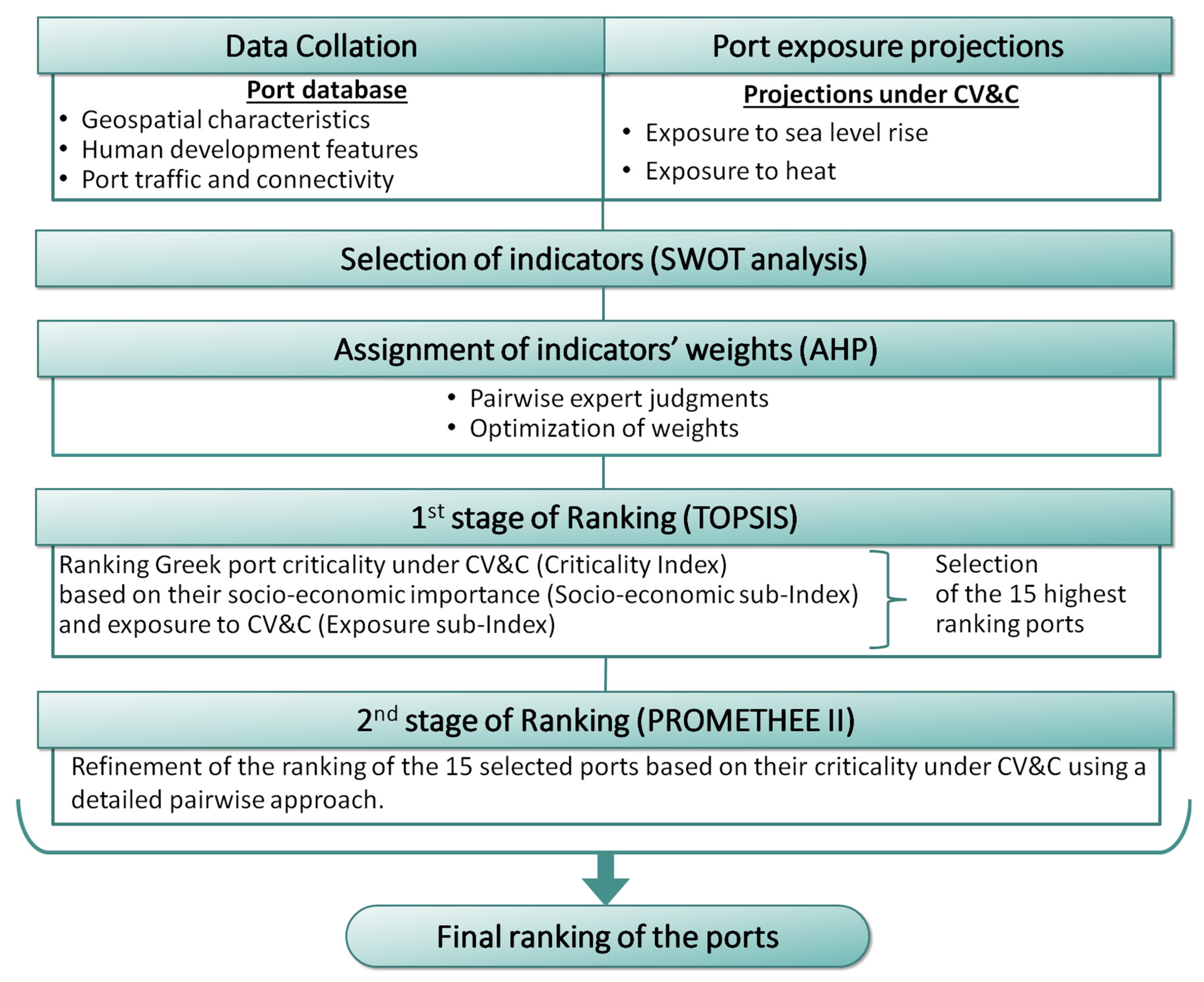
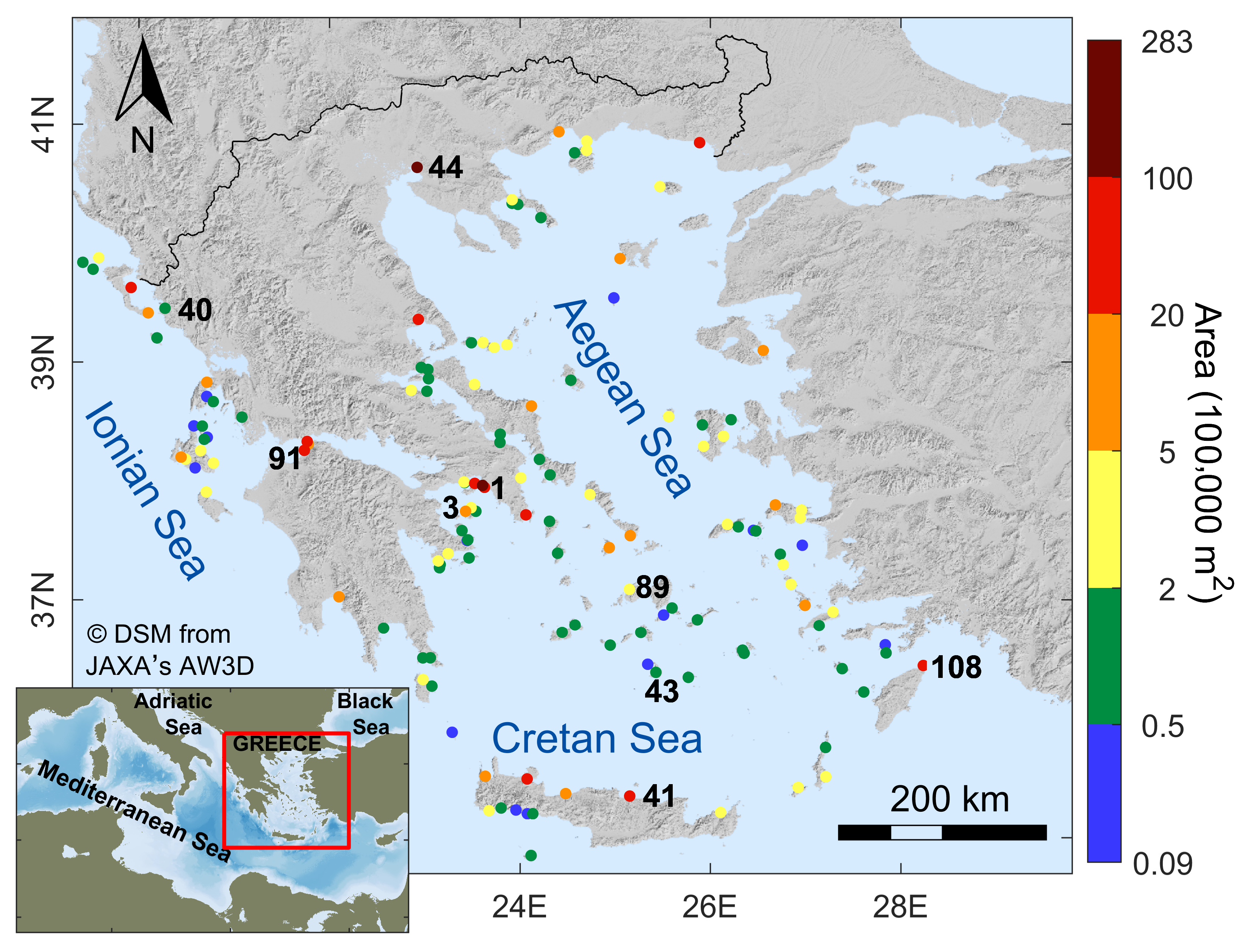

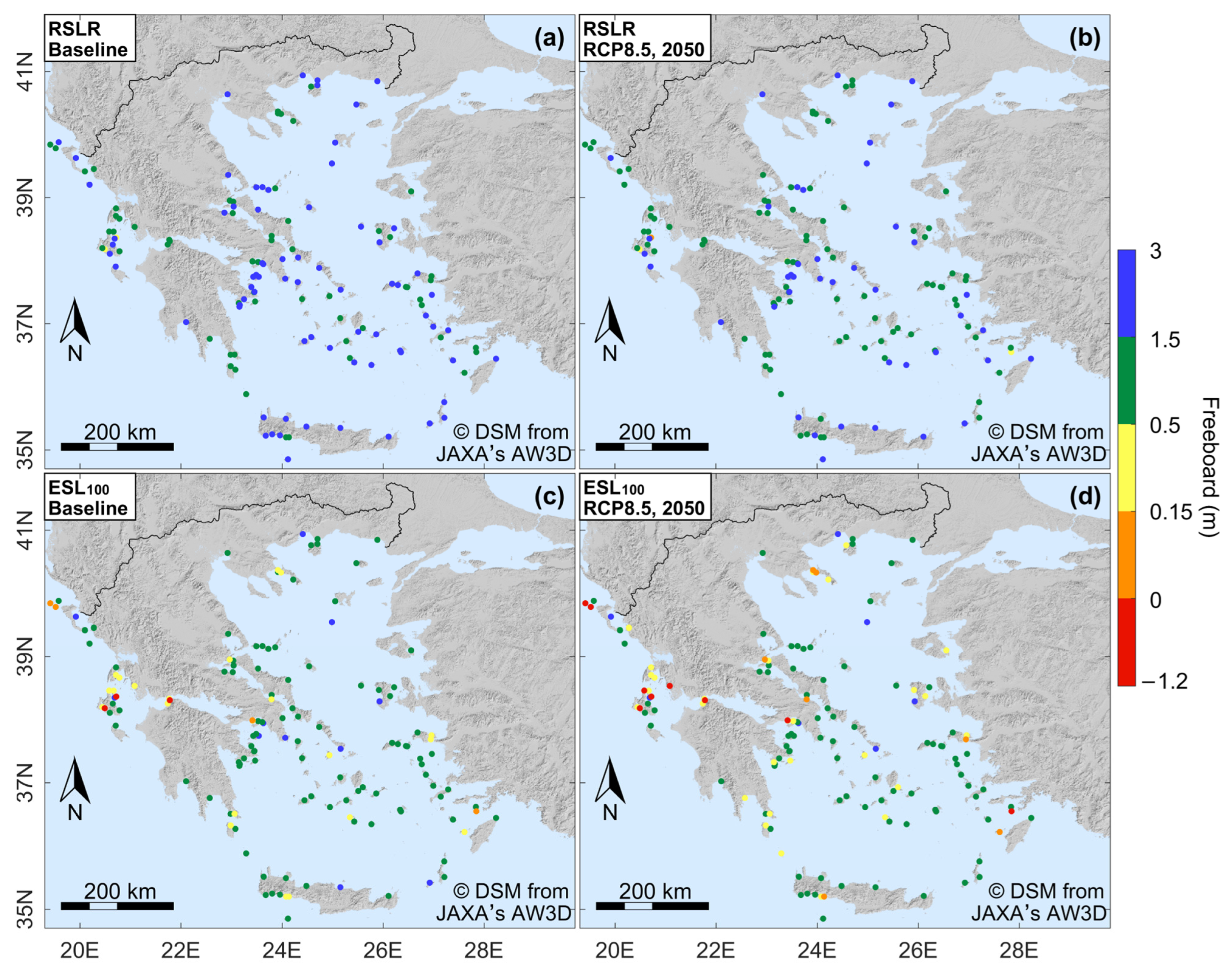



| Indicators | Description | Type of Data/Effect |
|---|---|---|
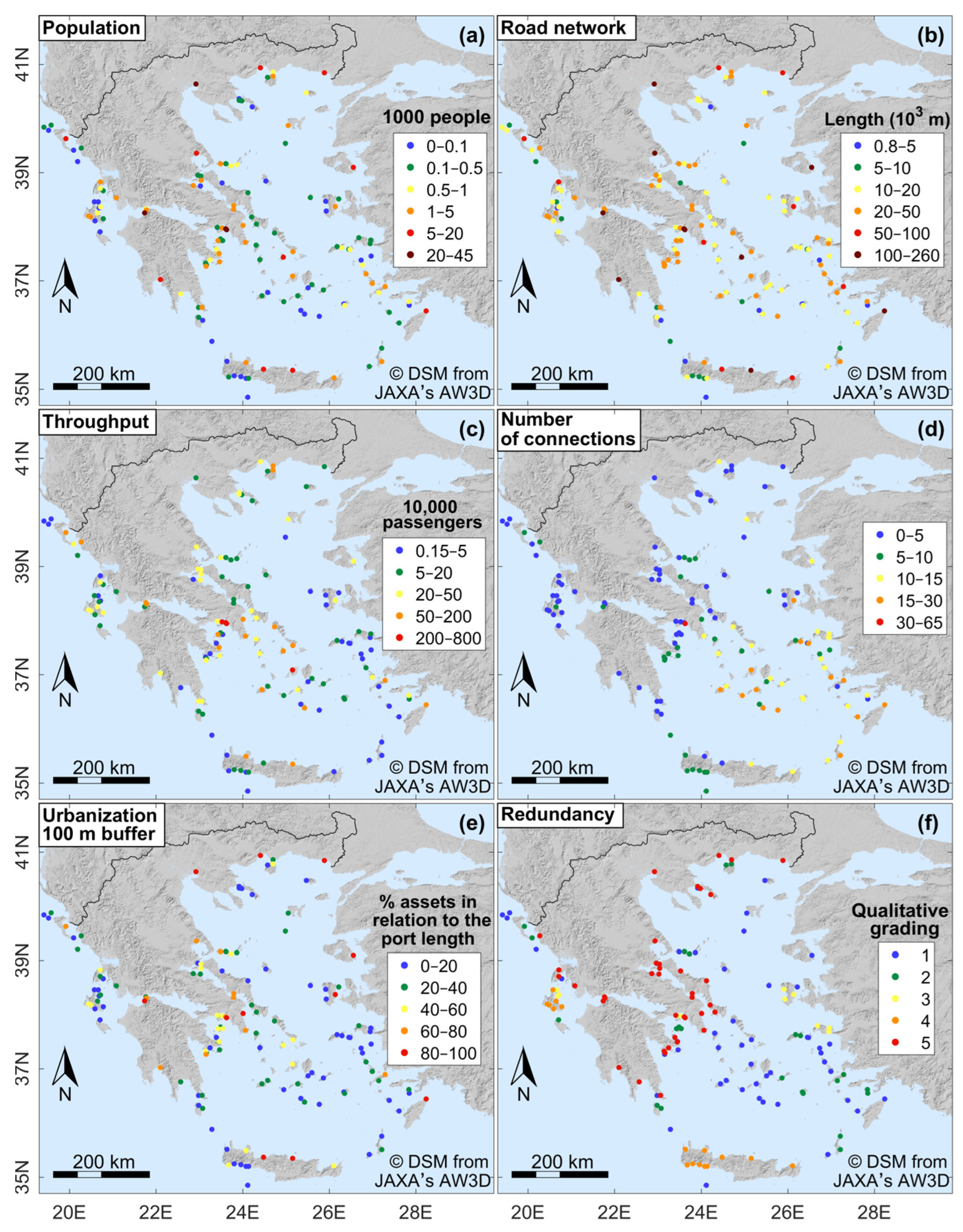
| 1. Port area (m2) | Calculated from digitized polygons derived from the Coastal Zone Land Cover Dataset of the Copernicus Land Monitoring Service, with manual corrections where necessary | Quantitative/Beneficial 1 |
| 2. Population | Defined as the permanent inhabitants within a 500 m radius from the port; (3) the length of road network, i.e., the total length of roads within a 1000 m radius around the port | Quantitative/Beneficial |
| 3. Road network length | The total length of roads within a 1000 m radius around the port | Quantitative/Beneficial |
| 4. Passenger throughput | Based on the number of boardings/disembarkations | Quantitative/Beneficial |
| 5. Port connectivity | Expressed as the number of domestic and international maritime connections | Quantitative/Beneficial |
| 6. Urban development | Measured as the building density behind the port, expressed as a percentage of the area of a 100 m buffer zone | Quantitative/Beneficial |
| 7. Redundancy | Reflects the dependence of an area on a single port, with higher values assigned to well-connected mainland ports and lower values assigned to island ports with limited alternatives (port grading scheme: mainland Greece = 5, islands with 5–6 ports = 4, medium-sized islands with >3 ports = 3, islands with 2 ports = 2, islands with 1 port = 1) | Qualitative/non-Beneficial 2 |
| 8. Flood exposure | The available freeboard threshold, derived from the comparison of quay elevation with the projected relative sea-level rise (RSLR) | Quantitative/Beneficial |
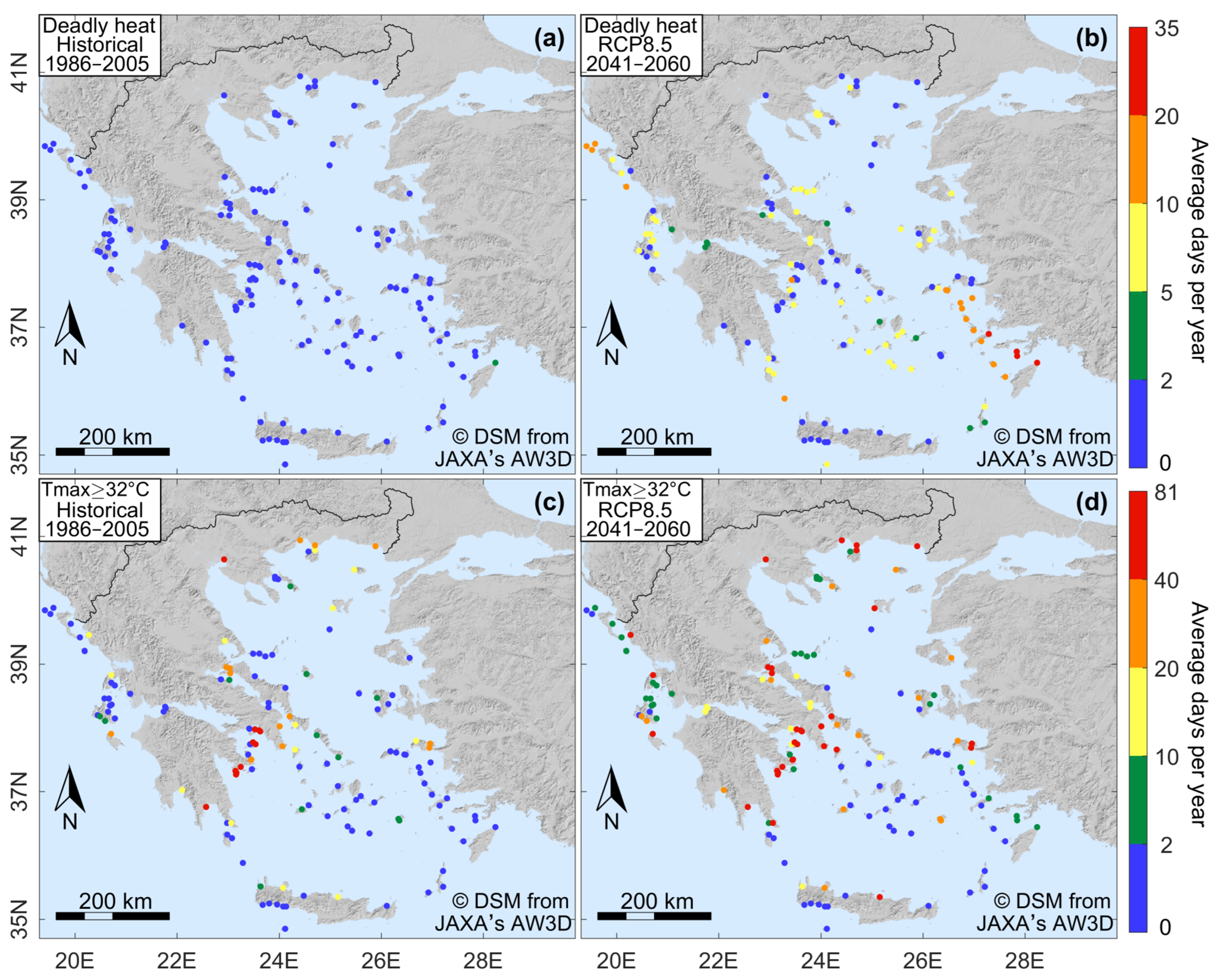
| 9. Deadly heat exposure | Calculated as the number of days when the combined effects of temperature and relative humidity are projected to exceed thresholds creating hazardous/lethal conditions for port personnel/passengers | Quantitative/Beneficial |
| 10. Heat risk to infrastructure | Defined as the number of days when extreme temperatures surpass thresholds, affecting operational functionality, safety and port infrastructure resilience | Quantitative/Beneficial |
| Number (and Percentage) of Ports | |||||||
|---|---|---|---|---|---|---|---|
| Sea-Level Rise | Freeboard (Based on the Max. Quay Elevation) | ||||||
| Year | RCP | (m) | <1.5 m | <0.5 m | <0.15 m | <0 m | |
| RSLR | Baseline | 0 | 63 (46%) | 2 (1%) | 0 | 0 | |
| 2050 | 4.5 | 0.13–0.15 | 94 (69%) | 4 (3%) | 1 (0.7%) | 0 | |
| 8.5 | 0.17–0.21 | 94 (69%) | 4 (3%) | 1 (0.7%) | 0 | ||
| 2100 | 4.5 | 0.46–0.53 | 121 (89%) | 26 (19%) | 4 (3%) | 2 (1.5%) | |
| 8.5 | 0.74–0.84 | 129 (95%) | 52 (38%) | 19 (14%) | 7 (5%) | ||
| ESL100 | Baseline | 0.42–0.81 | 125 (92%) | 29 (21%) | 7 (5%) | 3 (2%) | |
| 2050 | 4.5 | 0.55–0.92 | 129 (95%) | 36 (26%) | 13 (10%) | 7 (5%) | |
| 8.5 | 0.60–0.99 | 129 (95%) | 45 (33%) | 16 (12%) | 9 (7%) | ||
| 2100 | 4.5 | 0.86–1.35 | 133 (98%) | 80 (59%) | 38 (28%) | 28 (21%) | |
| 8.5 | 1.16–1.56 | 134 (99%) | 108 (79%) | 67 (49%) | 56 (41%) | ||
| Number (and Percentage) of Ports | |||||||
| Average Days per Year of Deadly Heat | |||||||
| Year | RCP | Tmean (°C) | RH | >5 | >10 | >30 | >50 |
| Historical | 12–19 | 70–83 | 0 | 0 | 0 | 0 | |
| 2050 | 4.5 | 13–20 | 69–82 | 46 (34%) | 12 (9%) | 1 (0.7%) | 0 |
| 8.5 | 14–21 | 68–82 | 67 (49%) | 20 (15%) | 1 (0.7%) | 0 | |
| 2100 | 4.5 | 14–21 | 69–82 | 79 (58%) | 64 (47%) | 3 (2.2%) | 0 |
| 8.5 | 16–23 | 68–82 | 127 (93%) | 115 (85%) | 77 (57%) | 27 (20%) | |
| Number (and Percentage) of Ports | |||||||
| Average Days per Year of Tmax ≥ 32 °C | |||||||
| Year | RCP | Tmax (°C) | >5 | >20 | >40 | >70 | |
| Historical | 28–43 | 48 (35%) | 25 (18%) | 11 (8%) | 0 | ||
| 2050 | 4.5 | 29–44 | 69 (51%) | 47 (35%) | 30 (22%) | 6 (4%) | |
| 8.5 | 30–46 | 74 (54%) | 49 (36%) | 32 (24%) | 9 (7%) | ||
| 2100 | 4.5 | 30–45 | 90 (66%) | 59 (43%) | 36 (26%) | 13 (10%) | |
| 8.5 | 31–48 | 114 (84%) | 84 (62%) | 54 (40%) | 24 (18%) | ||
| Sub Categories | Local Weights | Indicators | Local Weights | Global Weights |
|---|---|---|---|---|
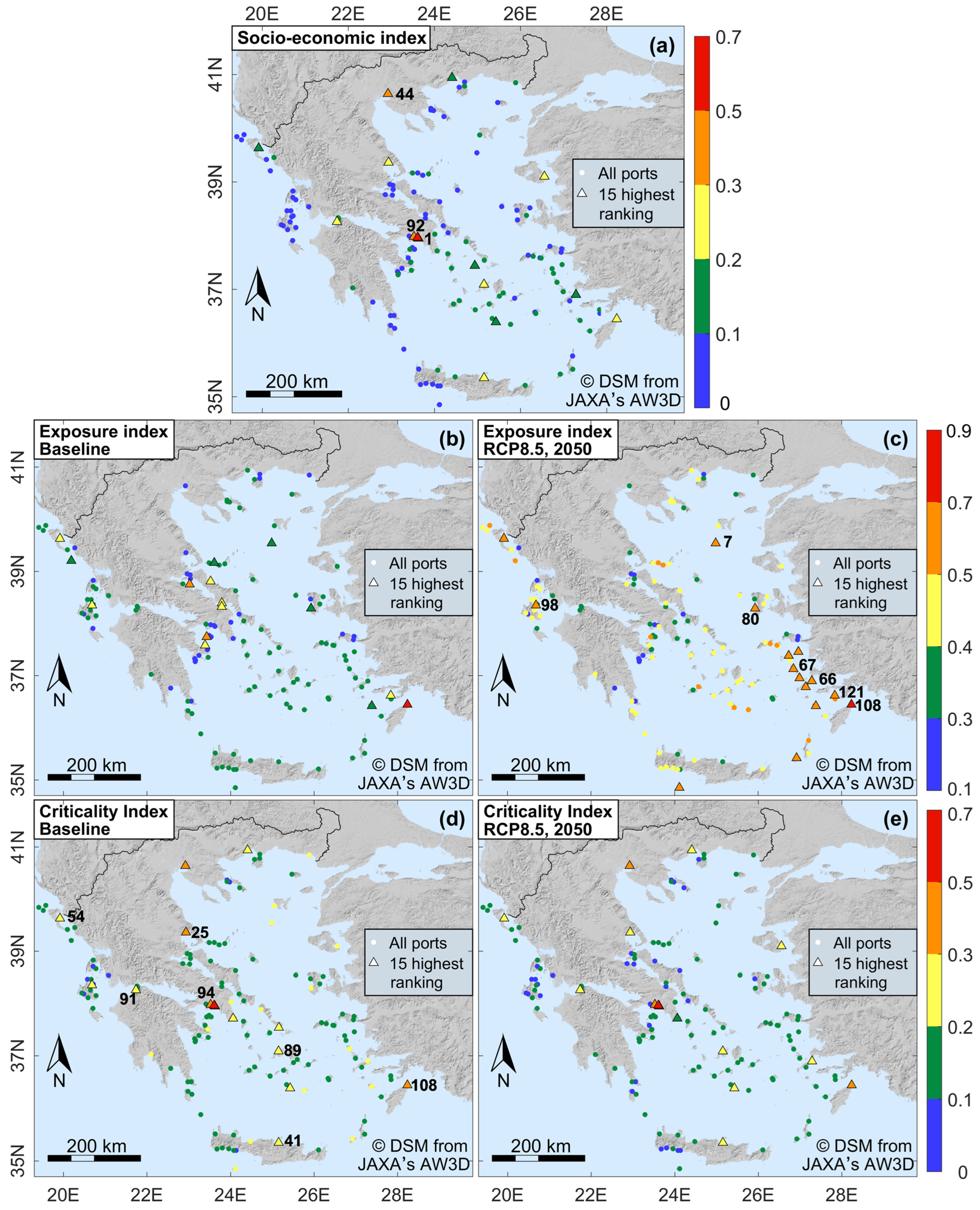
| Socio- economic | 0.6940 | 1. Port area (m2) | 0.1767 | 0.1227 |
| 2. Population (500 m radius) | 0.1123 | 0.0779 | ||
| 3. Road network length (1000 m radius) | 0.1427 | 0.0991 | ||
| 4. Passenger throughput | 0.1539 | 0.1068 | ||
| 5. Port connectivity | 0.1418 | 0.0984 | ||
| 6. Urban development (100 m radius) | 0.0827 | 0.0574 | ||
| 7. Redundancy | 0.1899 | 0.1318 | ||
| Exposure | 0.3060 | 8. Flood exposure | 0.4806 | 0.1470 |
| 9. Deadly heat exposure | 0.2322 | 0.0710 | ||
| 10. Heat risk to infrastructure | 0.2872 | 0.0879 |
| Port Name | Current | RCP4.5, 2050 | RCP8.5, 2050 | RCP4.5, 2100 | RCP8.5, 2100 |
|---|---|---|---|---|---|
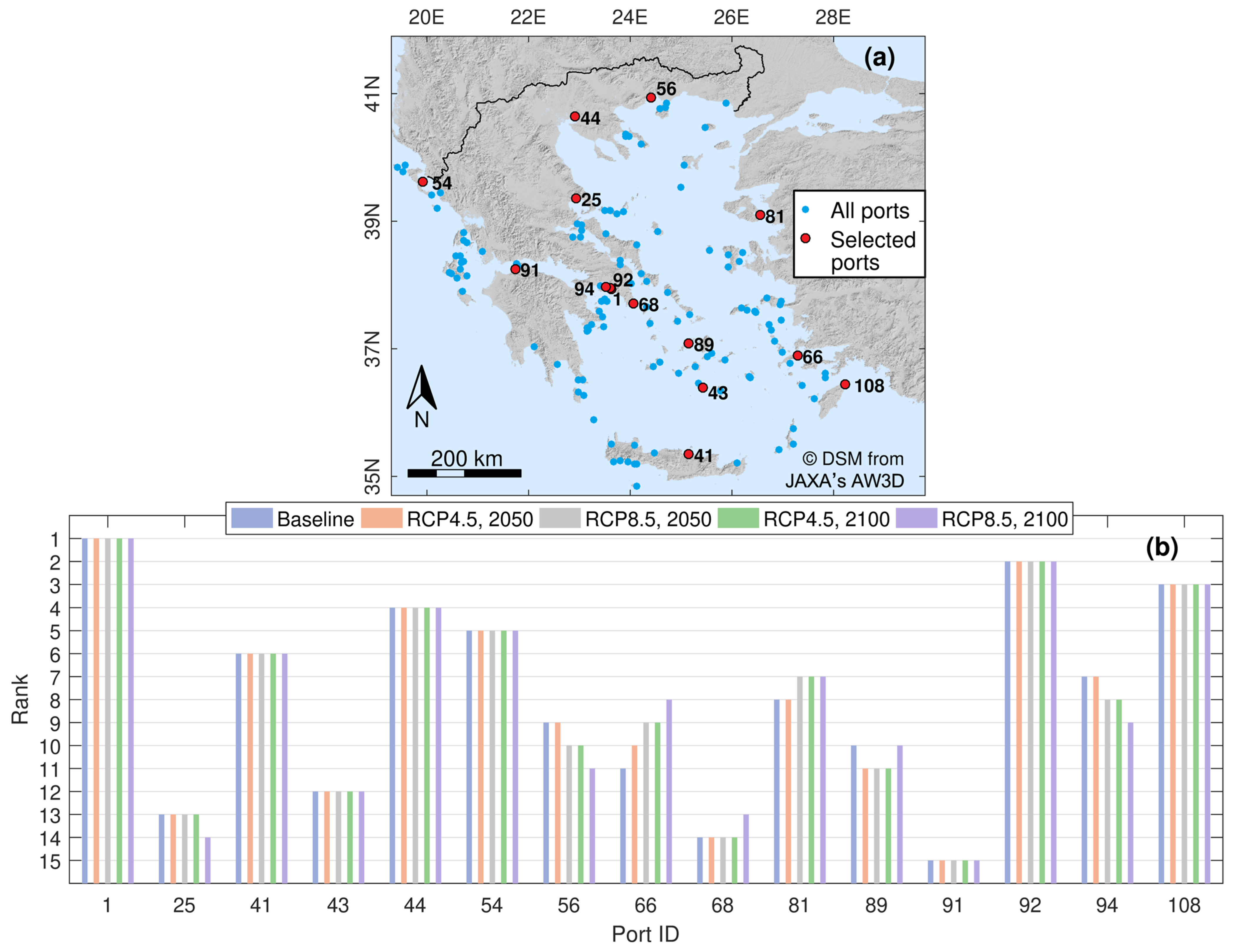
| 1-Piraeus | 0.384 | 0.376 | 0.375 | 0.371 | 0.363 |
| 25-Volos | −0.108 | −0.105 | −0.106 | −0.109 | −0.122 |
| 41-Heraklion | −0.018 | −0.011 | −0.007 | −0.011 | −0.012 |
| 43-Thira | −0.090 | −0.093 | −0.092 | −0.088 | −0.077 |
| 44-Thessaloniki | 0.059 | 0.053 | 0.048 | 0.048 | 0.039 |
| 54-Corfu | 0.023 | 0.017 | 0.017 | 0.022 | 0.025 |
| 56-Kavala | −0.061 | −0.055 | −0.058 | −0.059 | −0.074 |
| 66-Kos | −0.078 | −0.056 | −0.052 | −0.048 | −0.039 |
| 68-Lavrio | −0.117 | −0.115 | −0.118 | −0.117 | −0.114 |
| 81-Mytilene | −0.059 | −0.043 | −0.037 | −0.027 | −0.015 |
| 89-Paros | −0.077 | −0.084 | −0.084 | −0.083 | −0.073 |
| 91-Patra | −0.163 | −0.159 | −0.158 | −0.157 | −0.147 |
| 92-Perama | 0.203 | 0.194 | 0.193 | 0.188 | 0.180 |
| 94-Paloukia Salamina | −0.026 | −0.040 | −0.041 | −0.046 | −0.050 |
| 108-Rhodes | 0.129 | 0.121 | 0.121 | 0.117 | 0.118 |
Disclaimer/Publisher’s Note: The statements, opinions and data contained in all publications are solely those of the individual author(s) and contributor(s) and not of MDPI and/or the editor(s). MDPI and/or the editor(s) disclaim responsibility for any injury to people or property resulting from any ideas, methods, instructions or products referred to in the content. |
© 2025 by the authors. Licensee MDPI, Basel, Switzerland. This article is an open access article distributed under the terms and conditions of the Creative Commons Attribution (CC BY) license (https://creativecommons.org/licenses/by/4.0/).
Share and Cite
Monioudi, I.N.; Velegrakis, A.F.; Polydoropoulou, A.; Chatzistratis, D.; Moschopoulos, K.; Bouhouras, E.; Papaioannou, G.; Chalazas, T.; Vaggelas, G.K.; Chatzipavlis, A.E.; et al. Ranking Port Criticality Under Climate Change: An Assessment of Greece. Sustainability 2025, 17, 11113. https://doi.org/10.3390/su172411113
Monioudi IN, Velegrakis AF, Polydoropoulou A, Chatzistratis D, Moschopoulos K, Bouhouras E, Papaioannou G, Chalazas T, Vaggelas GK, Chatzipavlis AE, et al. Ranking Port Criticality Under Climate Change: An Assessment of Greece. Sustainability. 2025; 17(24):11113. https://doi.org/10.3390/su172411113
Chicago/Turabian StyleMonioudi, Isavela N., Adonis F. Velegrakis, Amalia Polydoropoulou, Dimitris Chatzistratis, Konstantinos Moschopoulos, Efstathios Bouhouras, Georgios Papaioannou, Theodoros Chalazas, George K. Vaggelas, Antonis E. Chatzipavlis, and et al. 2025. "Ranking Port Criticality Under Climate Change: An Assessment of Greece" Sustainability 17, no. 24: 11113. https://doi.org/10.3390/su172411113
APA StyleMonioudi, I. N., Velegrakis, A. F., Polydoropoulou, A., Chatzistratis, D., Moschopoulos, K., Bouhouras, E., Papaioannou, G., Chalazas, T., Vaggelas, G. K., Chatzipavlis, A. E., Nikolaou, A., & Thanopoulou, H. (2025). Ranking Port Criticality Under Climate Change: An Assessment of Greece. Sustainability, 17(24), 11113. https://doi.org/10.3390/su172411113