Article

Reimagining Heritage Tourism Through Co-Creation: Insights from Prenggan Tourism Village, Yogyakarta


1
Department of Hospitality Management, Faculty of Hospitality and Tourism, Universitas Pelita Harapan, Tangerang 15811, Indonesia
2
Department of Management, Faculty of Economics and Business, Universitas Tarumanagara, Jakarta 11440, Indonesia
*
Author to whom correspondence should be addressed.
Sustainability 2025, 17(24), 11112; https://doi.org/10.3390/su172411112
Submission received: 30 October 2025 / Revised: 5 December 2025 / Accepted: 5 December 2025 / Published: 11 December 2025
(This article belongs to the Special Issue Business Circular Economy and Sustainability)

Abstract

This mixed-methods study examines how cultural heritage identity and co-creation value influence the tourist heritage experience in Prenggan Tourism Village, Yogyakarta, particularly focusing on local wisdom’s role as a mediator of these effects. This study was conducted in two sequential phases: the qualitative phase explored community narratives, cultural practices, and co-creation activities through interviews and observations, while the quantitative phase validated these insights using survey data collected over the past year from 208 domestic tourists. Data were analyzed using Partial Least Squares–Structural Equation Modeling (PLS-SEM) to test the reliability and validity of the results and evaluate the hypothesized relationships. The findings reveal that both cultural heritage identity and co-creation value significantly strengthen local wisdom, which in turn enhances the depth and authenticity of the tourist heritage experience. This study demonstrates that local wisdom serves as a bridge between cultural identity and visitor engagement, promoting immersive and meaningful experiences. This research aligns with several United Nations Sustainable Development Goals (SDGs): it contributes to SDG 8 (Decent Work and Economic Growth) by supporting local livelihoods through tourism, SDG 11 (Sustainable Cities and Communities) by preserving cultural heritage and empowering local communities, and SDG 12 (Responsible Consumption and Production) by fostering sustainable and culturally respectful tourism practices. The findings contribute theoretical insights to the heritage-based experiential co-creation literature and offer practical implications for policymakers and destination managers aiming to enhance community-based tourism sustainability.

1. Introduction

Cultural tourism—one of the leading sectors in destination development—emphasizes the preservation of local identity and community participation, contributing to sustainable development initiatives [1,2,3]. In the midst of globalization and cultural homogenization, driven by technological advances and social media, tourism villages have emerged as important alternative spaces that offer authentic experiences rooted in local wisdom [4,5,6]. One such promising destination is Prenggan Tourism Village, located in Yogyakarta, Indonesia. This village possesses a rich tapestry of tangible and intangible heritage, including traditional ceremonies, batik craftsmanship, local culinary arts, and historical narratives deeply embedded within its community.
The main objective of this study is to explore the relationship between local cultural heritage identity and tourist experiences within the context of heritage-based tourism in Prenggan. The importance of this study stems from the rising demand for destinations that provide authentic, meaningful experiences based on local cultural values. However, there is limited understanding of how cultural identity shapes tourist experiences, resulting in suboptimal utilization of cultural heritage potential. This research is crucial to supporting sustainable tourism development by effectively integrating cultural heritage into the design of visitor experiences. Cultural heritage villages increasingly serve as living cultural landscapes where identity, ritual continuity, and symbolic meaning shape community–visitor interactions [7,8,9]. Likewise, the rise of participatory tourism strengthens the role of community knowledge systems in shaping visitor immersion and co-created experiences [10,11,12,13].
Tourism practices in Prenggan Village still face challenges in articulating and emphasizing heritage identity as a core element of the tourist experience. The lack of integration between local cultural richness and experience design reduces the village’s competitiveness in attracting and retaining visitors in the long-term [14,15,16]. Many tourism villages remain focused on physical infrastructure and cultural exploitation rather than on the symbolic meanings and local wisdom that should serve as the foundation of cultural tourism development [17,18,19]. The major challenge lies in preserving authenticity amid the pressures of modernization and commercialization. In recent years, many heritage villages have faced the dilemma between cultural preservation and commercial adaptation. Local traditions are often artificially reconstructed to suit visitor preferences, transforming cultural expressions into staged attractions that prioritize entertainment over meaning [7,8,9]. This phenomenon risks commodifying culture and marginalizing the intrinsic values and historical narratives that constitute its essence.
Therefore, heritage-based tourism development must adopt a contextual and participatory approach, ensuring that local identity is not merely preserved symbolically but continuously interpreted, practiced, and transmitted by the local community itself [3,4,6,20,21]. Without such an approach, the meaning of tourist experience risks becoming superficial, and the loss of cultural identity could threaten the foundation of sustainable tourism development [22,23,24,25,26]
Based on these conditions, this research is guided by the following questions:
  • How can the cultural heritage identity and characteristics of Prenggan Village be authentically integrated into meaningful tourist experiences?
  • How do tourists perceive and experience elements of local wisdom during their visits?
  • What local-wisdom-based management strategies can enhance tourist experience quality and support cultural preservation?
These research questions are derived from identified knowledge gaps regarding how cultural mechanisms translate into experiential outcomes. Existing studies do not yet fully explain how local wisdom mediates cultural structure within heritage tourism settings. Therefore, the research questions are grounded in these theoretical gaps.
This research aligns with several Sustainable Development Goals (SDGs), namely, SDG 11 (Sustainable Cities and Communities), SDG 8 (Decent Work and Economic Growth), and SDG 12 (Responsible Consumption and Production) [27]. Specifically, the study contributes to SDG 11 by emphasizing cultural preservation as a pillar of sustainable community development. By promoting and safeguarding Prenggan’s cultural identity within the framework of local-wisdom-based tourism, the research supports efforts to maintain cultural sustainability and strengthen community resilience in the face of modernization. Furthermore, this study addresses SDG 8 by encouraging sustainable tourism practices that create decent employment opportunities and support local products and culture. Through community empowerment and tourism management grounded in local values, Prenggan Village can stimulate inclusive and sustainable rural economic growth. The research also aligns with SDG 12 by advocating responsible tourism management practices that are culturally sensitive and environmentally conscious.
To address these issues, the study employs an exploratory sequential mixed-methods design [28,29]. The first (qualitative) phase seeks to understand local cultural heritage identity through in-depth interviews, participatory observation, and Focus Group Discussions (FGDs) with key stakeholders, including tourism managers, residents, and domestic as well as international tourists. The qualitative data are analyzed using qualitative content analysis to identify categories, patterns, and meanings emerging from interviews, observations, and FGD transcripts. The second (quantitative) phase tests the relationship between cultural heritage identity and tourist experience through a survey conducted with 208 domestic tourists visiting Prenggan. Data from the survey are analyzed using Structural Equation Modeling (SEM) to validate the key local wisdom factors that significantly enhance tourist experiences. Triangulation of both qualitative and quantitative findings ensures the validity and reliability of results [30,31,32,33].
In addition, the concept of experience co-creation is employed to examine how interactions between tourists and residents generate meaningful and context-specific tourism experiences [34,35,36]. The analysis focuses on key elements such as cultural symbolism, rituals, historical narratives, community participation, and spiritual values embedded in everyday local practices. The research further adopts the frameworks of Tourism Experience Design and Cultural Identity Theory to connect tourists’ perceptions, intrinsic cultural values, and social interaction mechanisms within the destination space [37,38,39,40].
Previous studies have highlighted the importance of local culture preservation in sustainable tourism development. Research by Ran et al. [41]; Zhao et al. [42] and Xia et al. [43] emphasizes that culturally embedded experiences create differentiation and provide a competitive advantage. Similarly, other studies [44,45] stress the need to understand cultural heritage as a central element in destination management strategies. However, while numerous studies address the preservation of local culture through sustainable tourism practices, few have empirically examined the holistic relationship between cultural heritage identity and tourist experience [46,47,48]
The novelty of this study is its integration of the concepts of cultural heritage identity and tourist experience through a multidisciplinary approach, combining cultural anthropology, tourist psychology, and destination management. Furthermore, prior studies have rarely explicitly applied the exploratory sequential mixed-methods design within a tourism village context—particularly in Prenggan Tourism Village. The findings are expected to contribute both theoretically and practically to the understanding of how managing local-wisdom-based cultural identity can enhance tourist experiences effectively and sustainably [25,37,38,40,49,50,51,52]

2. Literature Review

2.1. Cultural Heritage Identity

Cultural heritage identity refers to the collective meanings, values, and practices that embody a community’s sense of belonging and continuity over time [48,49]. It includes both tangible and intangible elements—such as architecture, rituals, oral traditions, language, and craftsmanship—that form the foundation of local distinctiveness [37,39]. In the tourism context, heritage identity plays a dual role: as a source of differentiation and as a medium through which cultural meaning is communicated to visitors [42,53]. In tourism destinations, the construction of cultural identity often emerges through the interplay between local narratives, symbolic representation, and visitor interpretation. According to Zhao et al. [42], the perception of authenticity and attachment among tourists visiting traditional villages is significantly influenced by the destination’s ability to project a coherent sense of cultural identity.
Cultural identity also mediates the relationship between emotional experiences and behavioral outcomes in heritage tourism [53,54]. Tourists who feel emotionally connected to a destination’s cultural symbols tend to express higher satisfaction and loyalty. Lin [55] further demonstrated that esthetic appreciation and involvement in heritage sites strengthen cultural identity through mental engagement and experiential immersion. Similarly, Zhang et al. [56] conceptualized cultural identity contributes significantly of sustainable heritage consumption, emphasizing its role in shaping tourists’ intention to revisit or recommend destinations. In this sense, cultural identity functions not only as a marker of authenticity but also as a psychological mechanism that drives meaningful connections between tourists and host communities.
The embodiment of cultural heritage identity in rural tourism, however, faces several challenges. Rapid commercialization often leads to the artificial reconstruction of cultural expressions, thereby diluting authenticity [57,58]. Refs. [59,60] warned that excessive performance-oriented interpretations of culture risk reducing heritage to mere entertainment. Tao et al. [61] addressed this concern by developing scales to measure tourists’ perceptions of authenticity in agricultural heritage villages, stressing the need for local participation in shaping authentic experiences. As Baan et al. [62], and Liu et al. [63] observed, the economic utilization of culture must balance preservation with creative adaptation to prevent cultural erosion. Thus, sustaining cultural heritage identity requires contextual strategies that respect the symbolic integrity of traditions while accommodating evolving tourist expectations.

2.2. Co-Creation of Tourist Experience

The concept of co-creation has become central to understanding value formation in contemporary tourism experiences [64,65]. Originating from service-dominant logic, co-creation emphasizes the active participation of multiple stakeholders, including tourists, residents, and managers—in the joint creation of experiential value [66,67]. In heritage tourism contexts, co-creation occurs when tourists engage with local culture not merely as spectators but as contributors to cultural storytelling and meaning making. Zhang et al. [47] proposed that co-created experiences transform tourists from passive consumers into active participants who interact with place, people, and tradition through sensory, emotional, and intellectual engagement.
Liu et al. [63] expanded this framework by introducing the role of resident–tourist value co-creation in intangible cultural heritage sites. Their findings demonstrated that emotional solidarity between residents and visitors fosters mutual respect and shared identity, enhancing overall satisfaction and loyalty. Duan et al. [60] also found that local residents’ contribution to experience co-creation is a significantly to variance of destination image and visitor attachment. In this way, co-creation is both an economic and a sociocultural process that bridges community empowerment with tourist fulfillment.
The co-creation framework has been widely applied in studies linking local wisdom and experiential design. In Prenggan Village, the interaction between tourists and residents through craft-making, storytelling, and rituals represents a living laboratory for co-creative engagement. As Purnawati et al. [57] argued, cultural symbolism and ritual practice function as pedagogical instruments for environmental and moral education, enabling a deeper form of experiential learning. These activities embody what [65] call “participatory authenticity,” wherein the value of experience arises not from passive observation but from relational exchange and emotional resonance.

2.3. Tourist Experience in Heritage-Based Destinations

Tourist experience in cultural heritage contexts is inherently multidimensional, encompassing sensory, emotional, cognitive, and spiritual dimensions [38]. Csurgo et al. [64] highlighted that cultural tourist experiences strongly predict recommendation intentions and destination loyalty. Gu et al. [68] reinforced this by demonstrating how the application of local wisdom in differentiation strategies enhances the sustainable competitive advantage of tourism businesses. Lin [55] similarly concluded that strong local wisdom values act as a unique differentiation strategy that enhances destination sustainability. Collectively, these studies affirm that the meaningfulness of cultural experiences is closely tied to the authenticity of local practices.
Tourist experience in heritage-based destinations is also recognized as a complex psychological and sociocultural construct that integrates emotion, cognition, and meaning-making processes [56,59]. Refs. [62,69] argues that the satisfaction of visitors at cultural heritage sites depends not only on service quality but also on the interpretive richness of guided experiences that connect visitors to place identity. Refs. [65,66] reinforces that intangible heritage—such as music, storytelling, and ritual—contributes significantly to the shaping of destination identity and the authenticity perceived by tourists.
In rural and heritage tourism, the interaction between cultural identity and experience design determines how tourists engage with local communities. Refs. [67,70] developed an empirical model demonstrating that cultural identity strongly influences affective and cognitive evaluations of heritage destinations, which in turn predict behavioral intentions. Refs. [44,45] found that enhancing residents’ competencies for co-creating meaningful cultural heritage experiences increases visitors’ perceived value and emotional connection to the destination. Such findings are consistent with the theoretical proposition of [48] who highlighted esthetics and tourist involvement as key mediators in cultural identity formation during heritage visits.
The emotional dimension of experience also plays a critical role in co-creating cultural meaning. As shown by [39,40] tourists’ emotional encounters within cultural heritage contexts influence both their identification with local culture and their post-visit behaviors. Refs. [15,54] proposed the “TIE model” (Tourism Involvement–Experience framework), suggesting that the degree of tourist involvement moderates how cultural tendencies are translated into memorable experiences. In line with these findings, [6,21] emphasized that residents’ emotional solidarity fosters community-based value co-creation, strengthening shared identity and sustainable engagement between hosts and visitors.

2.4. Sustainable Heritage Tourism and SDG Linkages

The sustainability of heritage tourism depends on its ability to balance cultural preservation with economic growth and social inclusion [71,72]. The United Nations [27] highlighted tourism’s strategic role in achieving SDG 8 (Decent Work and Economic Growth), SDG 11 (Sustainable Cities and Communities), and SDG 12 (Responsible Consumption and Production). Within this framework, cultural heritage is recognized as both a resource and a responsibility—its economic capitalization must not undermine its authenticity or social meaning.
Refs. [73,74] emphasized that cultural heritage stakeholders act as responsible agents in institutional tourism product management. Similarly, [75] observed that ineffective heritage management is often due to a lack of participatory planning mechanisms. In the Indonesian context, Lemy et al. [76] demonstrated that combining smart travel technology with cultural values can enhance satisfaction and loyalty, suggesting that digital innovation can coexist with local authenticity when guided by community participation.
Situated within this paradigm, Prenggan Village represents a living example of community-based sustainable tourism. Its development aligns with the global sustainability agenda by promoting inclusive economic participation while preserving cultural legacies. As Juliana et al. [26] argue, integrating Tourism Servicescape Satisfaction and Happiness in rural contexts contributes to local empowerment and long-term destination resilience. The evolution of research on Prenggan and similar villages also corresponds with broader national and institutional research roadmaps aimed at advancing hospitality and tourism management from behavioral exploration toward sustainable innovation [52].

2.5. Cultural Identity Theory and Tourism Experience Design

This study is theoretically grounded in Cultural Identity Theory (CIT) and the Tourism Experience Design (TED) framework [77,78,79,80]. CIT posits that cultural symbols, rituals, and traditions construct social identity, influencing how individuals interpret and interact with cultural environments. From a tourism perspective, this theory explains how heritage elements become mediators of emotional attachment and perceived authenticity. TED, on the other hand, provides a design-oriented approach that links environmental stimuli, sensory engagement, and co-created value in shaping memorable tourist experiences.
According to Juliana et al. [23] The integration of experiential commitment and behavioral intention reflects the psychological process of how tourists internalize destination meanings. Lemy et al. [76] and Juliana et al. [81] further demonstrate that environmental sustainability and community-based hospitality can enhance experiential quality and revisit intention when local identity is embedded within the service encounter. These studies reinforce the importance of experience economy principles in cultural tourism, where authenticity and emotion drive perceived value and satisfaction.
The convergence of CIT and TED offers a comprehensive lens for understanding how cultural identity shapes co-created experiences in heritage tourism. While CIT elucidates the symbolic and sociocultural foundations of meaning, TED operationalizes these elements into experiential design parameters—such as interaction, immersion, and interpretation. Through this dual framework, cultural heritage identity is no longer viewed as a static artifact but as a dynamic process co-produced by communities and visitors.
Although many prior studies have addressed sustainability and cultural preservation in tourism, empirical integration between heritage identity and co-created tourist experiences remains limited [82,83,84,85,86]. Most research has focused either on the preservation aspect or on visitor satisfaction, but few studies have connected the two within a quantitative–qualitative continuum that captures both local meaning systems and visitor perceptions. This study fills this gap by explicitly employing an exploratory sequential mixed-methods approach [87,88], where qualitative findings inform quantitative model validation through SEM-PLS analysis [89,90,91].
The novelty of this research lies in three aspects.
First, it operationalizes cultural heritage identity as a multidimensional construct (tangible, intangible, symbolic) directly linked to tourist experience co-creation within a rural village setting. Second, it contextualizes local wisdom as a mediating cultural mechanism that transforms identity into lived experience, aligning theoretical insights with practical community empowerment.
Third, it contributes methodologically by applying triangulated mixed methods to validate both narrative and numerical evidence, offering a holistic framework for future sustainable heritage management. This study advances existing models by conceptualizing local wisdom as a mediating cultural mechanism that transforms symbolic identity into experiential meaning. This offers a novel extension to heritage tourism theory by demonstrating how culturally embedded knowledge systems structure visitor co-creation and experiential interpretation.

2.6. Hypothesis Development

2.6.1. Cultural Heritage Identity and Local Wisdom

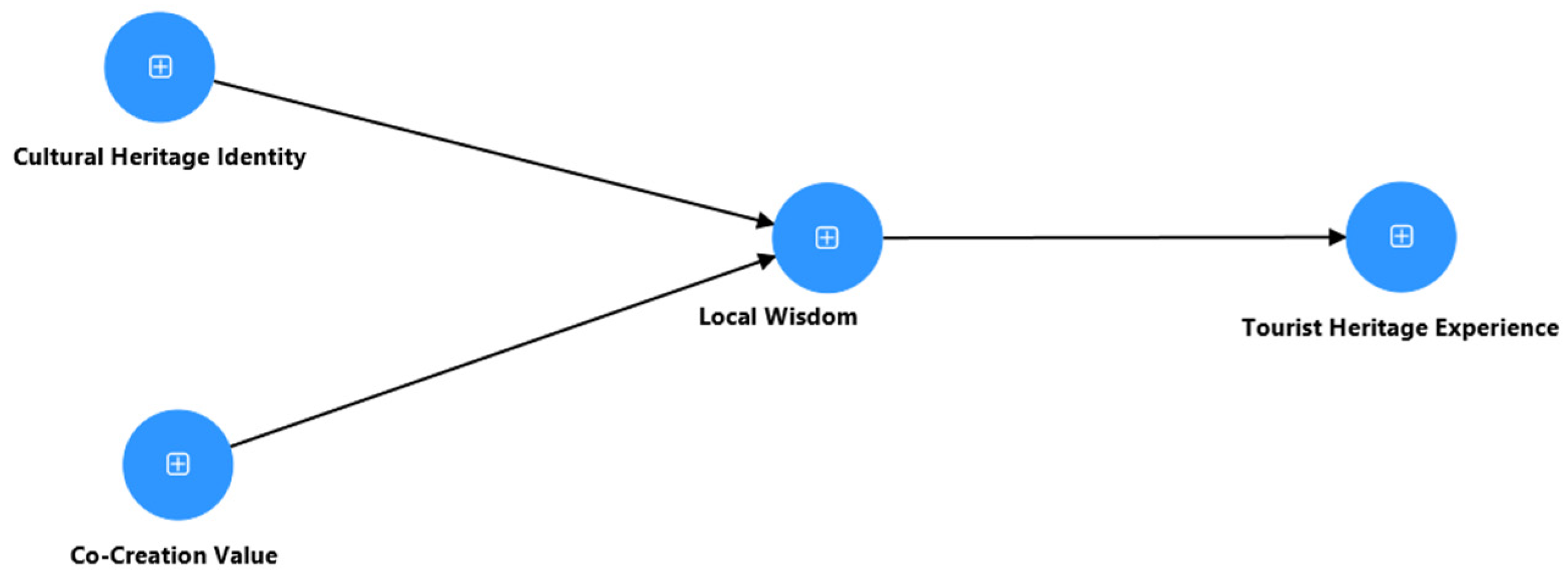
Cultural heritage identity represents the collective meanings, values, traditions, and symbolic expressions that define a community’s cultural uniqueness [59,68]. These culturally embedded meanings shape how local residents interpret their heritage and translate it into practices, norms, and shared understandings [55,56]. As a repository of inherited social knowledge, moral values, and traditional skills, local wisdom is deeply rooted in the community’s cultural identity [57,58]. A strong cultural identity reinforces local interpretive frameworks and guides how cultural values are transmitted to visitors through rituals, narratives, and shared practices [60,61]. Therefore, a strong cultural heritage identity is expected to enhance the role of local wisdom as a cultural mediator (Figure 1).
H1: 
Cultural heritage identity is positively associated with local wisdom.

2.6.2. Co-Creation Value and Local Wisdom

Co-creation value describes the extent to which visitors participate collaboratively with local communities in producing meaningful experiences [62,69]. In cultural tourism contexts, co-creation often occurs through interactive activities such as storytelling, craft-making, ritual participation, and collaborative interpretation of local traditions [63,64]. These collaborative engagements provide opportunities for visitors to directly encounter local wisdom—traditional knowledge, cultural symbols, ethical norms, and community practices [44,70]. As visitors increase their engagement in co-creative activities, they experience greater exposure to community values, strengthening the role of local wisdom in shaping the experiential process [37,48,49] (Figure 1).
H2: 
Co-creation value is positively associated with local wisdom.

2.6.3. Local Wisdom and Tourist Heritage Experience

Local wisdom plays a critical role in shaping authentic heritage experiences by providing meaning, emotional resonance, and experiential depth during interactions with the community [41,92,93]. It enhances authenticity by grounding visitor experiences in genuine cultural practices, interpersonal warmth, shared rituals, and traditional knowledge systems [14,15,16]. When visitors engage with these lived expressions of culture, their experience becomes more immersive, meaningful, and memorable [5,51]. Hence, local wisdom is expected to directly enhance the tourist heritage experience (Figure 1).
H3: 
Local wisdom is positively associated with tourist heritage experience.

2.6.4. Mediating Role of Local Wisdom

Both cultural heritage identity and co-creation value affect experiential outcomes, but their influence is often channeled through local wisdom as the community’s interpretive mechanism [10,51]. Cultural heritage identity shapes the cultural meanings embedded in local practices, while co-creation enables visitors to interact with and interpret those practices [6,20,21]. Local wisdom transforms these cultural and participatory elements into meaningful tourism experiences by facilitating learning, cultural immersion, and shared understanding [2,3]. Thus, local wisdom is expected to mediate the relationships between cultural heritage identity, co-creation value, and tourist heritage experience (Figure 1).
H4: 
Local wisdom mediates the relationship between cultural heritage identity and tourist heritage experience.
H5: 
Local wisdom mediates the relationship between co-creation value and tourist heritage experience.

3. Method

3.1. Research Design

This study employs an exploratory sequential mixed-methods (ESMM) design that combines qualitative and quantitative phases in a structured, complementary process [29]. This approach was selected because it enables the exploration of deeply embedded cultural meanings within local contexts and the subsequent validation of these findings using empirical data. The qualitative phase serves as a foundation for understanding the cultural identity dimensions of Prenggan Tourism Village, while the quantitative phase tests and confirms the conceptual relationships between cultural heritage identity (CHI) and tourist experience co-creation (TEC). This study makes a contextual methodological contribution by integrating qualitative themes into a quantitative measurement foundation. While similar approaches exist, few studies have applied this design to rural heritage tourism villages in Indonesia. However, the use of voluntary convenience sampling may limit generalizability beyond the study area. Future studies should consider probability or multi-site sampling.
The ESMM framework is particularly appropriate for heritage-based tourism research because it facilitates the integration of local narratives and measurable constructs, bridging interpretive cultural understanding with statistical validation. According to [30] this design is effective when the research aims to first explore a phenomenon qualitatively and then generalize its results quantitatively. Similarly, [94] emphasizes that exploratory mixed-methods approaches provide flexibility in identifying emergent variables before testing causal structures.
The study was conducted in Prenggan Tourism Village, located in Yogyakarta, Indonesia, which represents a living repository of tangible and intangible cultural heritage. Prenggan was chosen for its strong local identity, expressed through traditional crafts, rituals, culinary traditions, and community-driven tourism initiatives. The site exemplifies the balance between heritage preservation and visitor participation, as envisioned in sustainable tourism frameworks [95]
The participants include three key stakeholder groups:
  • Local community members and artisans involved in cultural preservation and tourism activities;
  • Village tourism managers and guides responsible for heritage interpretation and visitor engagement;
  • Domestic tourists (n = 208) who have visited Prenggan Village within the past 12 months.
The inclusion criteria were (a) age 17 years or above; (b) at least one prior visit to Prenggan Village; and (c) willingness to participate in interviews or surveys. Exclusion criteria included tourists with limited communication ability or those visiting only for transit without engaging in cultural activities.

3.2. Data Collection Procedures

The qualitative phase followed an auditable process involving purposive sampling of residents, artisans, and tourism actors. Interview and FGD guides were developed based on a preliminary screening of the literature [28]. Transcripts were analyzed through open, axial, and selective coding. Themes such as symbolic meaning, ritual continuity, and community hospitality informed the operationalization of items for cultural heritage identity, co-creation value, and local wisdom. Given the cross-sectional design, the relationships identified are associative rather than causal and should be interpreted accordingly.
The research process was divided into two major phases.
The first phase focused on identifying key elements of cultural heritage identity and the patterns of tourist experience co-creation in Prenggan Village. Data were collected through in-depth interviews with 15 key informants, including tourism managers, cultural practitioners, and tourists; Focus Group Discussions (FGDs) involving 10 community representatives and tourism stakeholders; and participant observation during local festivals, batik-making workshops, and traditional culinary sessions. All qualitative data were audio-recorded, transcribed verbatim, and analyzed using qualitative content analysis (QCA) [96]. The coding process involved categorizing themes such as cultural symbolism, community participation, authenticity perception, and emotional engagement. Thematic saturation was reached when no new categories emerged from the data.
The second phase aimed to validate the qualitative insights by testing the hypothesized relationships among the study variables. Based on the qualitative findings, a structured questionnaire was developed using Likert-scale items (1 = strongly disagree to 6 = strongly agree). The instrument measured dimensions of cultural heritage identity (tangible, intangible, symbolic) [58], co-creation of experience (interaction, participation, emotional engagement) [52], and overall tourist experience quality [97,98]. Survey items were developed from qualitative themes and adapted from validated constructs used in related experiential and cultural tourism research. Content validity was assessed through expert review (three academics, two practitioners). A pilot test with 30 respondents ensured clarity and reliability. The final instrument comprised Cultural Heritage Identity (CHI) (5 items) [4,21,39], Co-Creation Value (CCV) (5 items) [52,99,100], Local Wisdom (LW) (4 items) [23,101,102], and Tourist Heritage Experience (THE) (6 items) [23,25,103].
A total of 208 valid responses were obtained through purposive sampling. The survey data were analyzed using Partial Least Squares–Structural Equation Modeling (PLS-SEM) with SmartPLS 4.0, as recommended by Hair et al. [89,104,105,106,107]. PLS-SEM was chosen due to its suitability for exploratory research, its robustness to smaller sample sizes, and its ability to assess both measurement and structural models simultaneously.

3.3. Data Analysis Techniques

3.3.1. Qualitative Analysis

The qualitative analysis entailed data condensation, coding, and theme development. Using QCA, the researchers identified two primary categories of heritage identity—tangible (artifacts, architecture, crafts) and intangible (rituals, narratives, social values)—along with emerging themes of tourist engagement and authenticity. The analysis results informed the development of constructs and questionnaire indicators for the subsequent quantitative phase.

3.3.2. Quantitative Analysis

Data analysis in PLS-SEM proceeded in two stages:
  • Measurement Model Assessment
Reliability and validity were examined through indicator loadings (≥0.70), composite reliability (≥0.70), and Average Variance Extracted (AVE ≥ 0.50) [108]. Convergent and discriminant validity were determined from the HTMT result.
2.
Structural Model Assessment
Path coefficients, coefficients of determination (R2), predictive relevance (Q2), and effect sizes (f2) were calculated to evaluate the relationships between constructs. Bootstrapping with 5000 resamples was applied to test the significance of path coefficients at a 95% confidence level.

3.4. Triangulation and Validation

To ensure data credibility and reliability, triangulation was applied across methods, sources, and researchers. Data from interviews, FGDs, and surveys were compared to identify convergence or divergence of findings [28]. Qualitative and quantitative results were integrated using a meta-inference process, where the narratives from the qualitative phase were used to interpret the numerical outcomes of the SEM model. This combination enhanced the conclusions’ robustness by linking experiential meanings to measurable relationships.
Internal validity was strengthened through member checking, where key informants reviewed summaries of findings for accuracy. External validity was maintained through transparent sampling procedures and detailed contextual descriptions, allowing replication in similar cultural tourism settings.

4. Results and Discussion

The qualitative phase generated rich and nuanced insights into how residents, artisans, and tourists interpret cultural heritage identity within Prenggan Tourism Village. Through open and axial coding of interview and FGD transcripts, three dominant thematic clusters emerged: cultural symbolism, ritual continuity, and community-driven hospitality. These themes reflect the deep sociocultural embeddedness of heritage identity and align with contemporary findings that highlight the lived, relational nature of cultural authenticity in rural contexts [55,56,59]. Participants consistently described artifacts such as batik motifs, historical narratives, and ceremonial practices as the “core spirit” of the village, suggesting that cultural identity is sustained through everyday interactions rather than static heritage objects. Such insights reinforce the argument that heritage identity is dynamically constructed through local engagement [57,58,60].
Across FGDs, villagers emphasized that intangible cultural values—particularly mutual cooperation, intergenerational learning, and respect for elders—remain central to the village’s cultural ecosystem. These values shape how residents interact with visitors and create emotionally resonant experiences, a pattern also highlighted in recent culture tourism studies [62,69]. Tourists frequently expressed feeling “adopted as family,” especially when participating in rituals, storytelling, or craft-making sessions, reflecting the co-creative dimension of community hospitality [63,64,66]. Residents further indicated that involving visitors in cultural activities reinforces their own pride and strengthens cultural continuity, consistent with research showing that co-creation can empower communities and sustain intangible heritage [46,47,48]. These findings support the placement of local wisdom as a mediating construct within the conceptual model.
Participant observations confirmed that tourists actively engaged in participatory cultural experiences, such as batik workshops, cooking classes, and narrative encounters with community elders. These interactions fostered sensory immersion and emotional engagement—two factors recognized as essential for meaningful heritage-based experiences [54,93]. Many tourists reported that learning the symbolic meaning behind artifacts and rituals deepened their appreciation of local culture, strengthening authenticity perceptions [8,9]. Observations further revealed that residents deliberately positioned tourists as co-creators rather than passive spectators, demonstrating an intentional strategy to cultivate participatory authenticity [4,5]. This relational approach to visitor engagement aligns with global trends in experience-based cultural tourism.
The cross-case analysis also revealed variations in how demographic groups experienced and interpreted cultural identity. Younger tourists tended to favor hands-on, interactive activities, while older visitors showed stronger appreciation for historical narratives and ceremonial elements, echoing generational differences identified in recent experiential tourism studies [63,69]. Residents demonstrated flexibility by tailoring the depth of cultural interpretation, storytelling, and workshop facilitation to fit visitors’ backgrounds and expectations. This adaptive practice reflects a sophisticated form of experience management that strengthens visitor satisfaction and aligns with community-centered heritage tourism models [59,81,109]. These differentiated engagement patterns helped inform the operationalization of constructs in the quantitative phase.
The qualitative findings directly informed the development of measurement items used in the subsequent PLS-SEM analysis. The emergent themes—symbolic meaning, ritual participation, emotional resonance, and community interaction—were translated into structured indicators reflecting dimensions of cultural heritage identity, co-creation value, local wisdom, and tourist heritage experience. This integration follows recommended procedures for exploratory sequential mixed-methods research, ensuring strong content validity and alignment between qualitative insights and quantitative results [28,29]. The qualitative phase thus provides a robust contextual foundation for interpreting the quantitative results and strengthens the study’s overall methodological coherence. While the results indicate positive associative relationships, interpretations must consider the non-probabilistic sampling of visitors and community members.

4.1. Demographic Analysis

The quantitative phase involved 208 domestic tourists who had visited Prenggan Tourism Village within the past 12 months. The respondents were evenly distributed by gender, with 51% female and 49% male, indicating a balanced representation of visitors. In terms of age, the majority fell within the 21–40-year range, reflecting the dominant demographic of young and middle-aged adults who actively seek cultural and experiential travel in urban Indonesia. Regarding educational background, most participants held an undergraduate degree (67%), suggesting that higher education correlates with interest in cultural and heritage-based tourism. In describing their motivations, respondents reported visiting Prenggan primarily for cultural learning, authentic engagement, and interaction with the local community, emphasizing the village’s appeal as a destination for immersive and meaningful tourism experiences.

4.2. Measurement (Outer) Model Evaluation

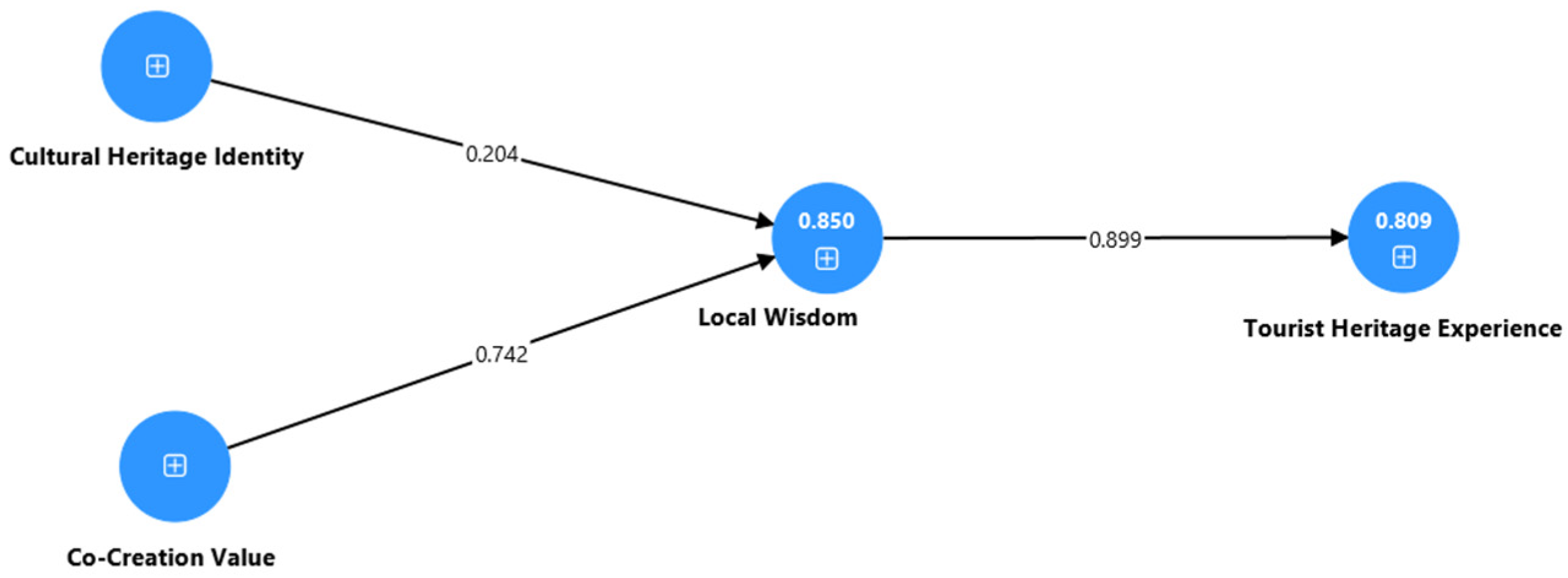
The outer model analysis assesses the measurement quality of the constructs by evaluating their reliability and validity before testing the structural relationships. In this study, each latent variable—cultural heritage identity, co-creation value, local wisdom, and tourist heritage experience—was measured using multiple reflective indicators. The indicator loadings exceeded the recommended threshold of 0.70, demonstrating strong indicator reliability. The composite reliability (CR) values for all constructs were above 0.80, indicating high internal consistency. Furthermore, the Average Variance Extracted (AVE) values surpassed 0.50, confirming satisfactory convergent validity, meaning that the indicators effectively represent the same underlying construct. Discriminant validity was verified through the HTMT ratio, with values below 0.85, suggesting that each construct is distinct from the others. Collectively, these results confirm that the outer model meets the statistical criteria for validity and reliability, allowing the structural (inner) model to be subsequently interpreted with confidence (Figure 2).
The R-square analysis shows the model’s strong explanatory power and internal consistency. The R-square value for local wisdom (0.850) and its adjusted R-square (0.849) indicate that cultural heritage identity and co-creation value together explain approximately 85% of the variance in local wisdom, with minimal adjustment difference (0.001), suggesting model stability and low sampling error. Similarly, the R-square value for tourist heritage experience (0.809) and its adjusted R-square (0.808) reveal that local wisdom accounts for about 81% of the variance in the tourist heritage experience, signifying that tourists’ engagement with and understanding of local wisdom play a dominant role in shaping meaningful cultural experiences. According to Hair et al. [105], R-square values above 0.75 represent substantial predictive accuracy, confirming that this structural model effectively captures the underlying relationships among constructs and provides a robust empirical foundation for explaining heritage-based tourism behavior in Prenggan Tourism Village (Table 1).
The reliability and validity analysis of the measurement model demonstrates that all constructs meet the recommended criteria for internal consistency and convergent validity. Cronbach’s alpha values range from 0.920 to 0.956, indicating excellent internal reliability across all variables. Similarly, the composite reliability (Rho aₐ and Rho c) values, which range from 0.940 to 0.965, exceed the threshold of 0.70 [105,107], confirming that the indicators consistently represent their respective constructs. The Average Variance Extracted (AVE) values for all variables are also above the minimum cutoff of 0.50, ranging between 0.759 and 0.851, signifying strong convergent validity, meaning that each construct explains more than 75% of the variance in its indicators. Among indicators, local wisdom (AVE = 0.851) and co-creation value (AVE = 0.828) demonstrate the highest convergence, reinforcing their strong conceptual coherence. Overall, the measurement model exhibits robust psychometric properties, confirming that the latent constructs are both reliable and valid for further structural analysis. (Table 2).
Discriminant validity was confirmed using HTMT ratios, which were all below the 0.85 threshold, with 95% CI intervals not exceeding 1.00 (Table 3). The model demonstrated strong predictive relevance (Q2 > 0) and acceptable out-of-sample prediction based on PLSpredict. Collinearity was assessed using variance inflation factors (VIFs). Full-collinearity VIFs ranged between 1.74 and 2.65, indicating no multicollinearity or common-method bias. The VIF values for the predictors of local wisdom (CCV → LW = 3.619; CHI → LW = 3.619) were below the recommended threshold of 5, indicating no critical multicollinearity issues. The VIF value for the path LW → THE (1.000) shows that local wisdom is a distinct and non-redundant predictor of tourist heritage experience. Overall, collinearity is within acceptable limits, although the moderate VIF levels for CCV and CHI reflect some conceptual overlap, consistent with the nature of heritage and co-creation constructs (Table 4).

4.3. Inner Model Evaluation

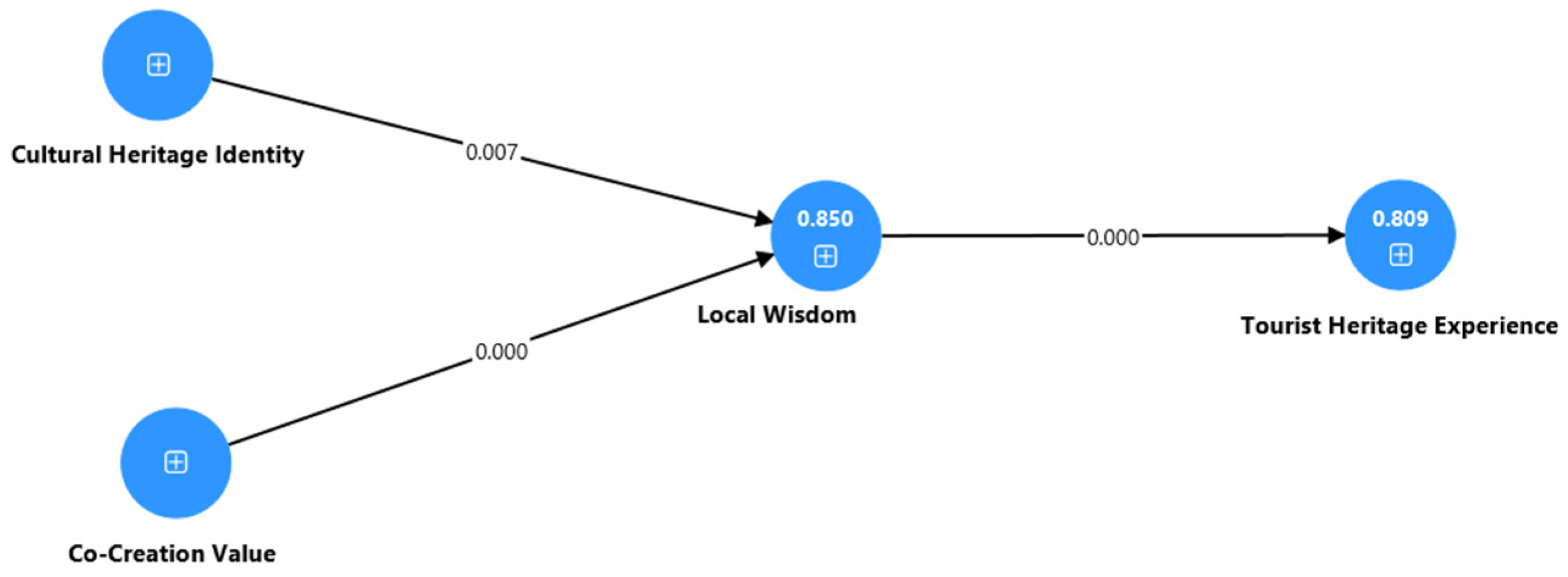
The inner model analysis evaluates the structural relationships among the latent constructs to determine the strength and significance of the hypothesized paths. In Figure 3, the path coefficients are accompanied by their p-values, which indicate the statistical significance of each relationship. The results show that the path from cultural heritage identity to local wisdom has a p-value of 0.007, which is statistically significant at the 0.01 level. This means that a stronger sense of cultural heritage identity significantly enhances the understanding and internalization of local wisdom among tourists. In contrast, the path from co-creation value to local wisdom has a p-value of 0.000, indicating a highly significant effect and confirming that participatory experiences and collaborative value creation play a major role in fostering local wisdom. Additionally, the path from local wisdom to tourist heritage experience also shows a p-value of 0.000, signifying a very strong and significant relationship; this result demonstrates that the deeper tourists engage with local wisdom, the more meaningful and memorable their heritage experience becomes (Table 5 and Figure 3).
The mediation results provide strong evidence that local wisdom fully mediates the relationships of both cultural heritage identity and co-creation value with tourist heritage experience. This finding significantly extends theoretical understanding of how cultural mechanisms operate in heritage tourism settings. The model indicates strong and significant indirect effects via Local Wisdom, suggesting that Local Wisdom acts as a central mediating mechanism in shaping heritage experience (Table 6).
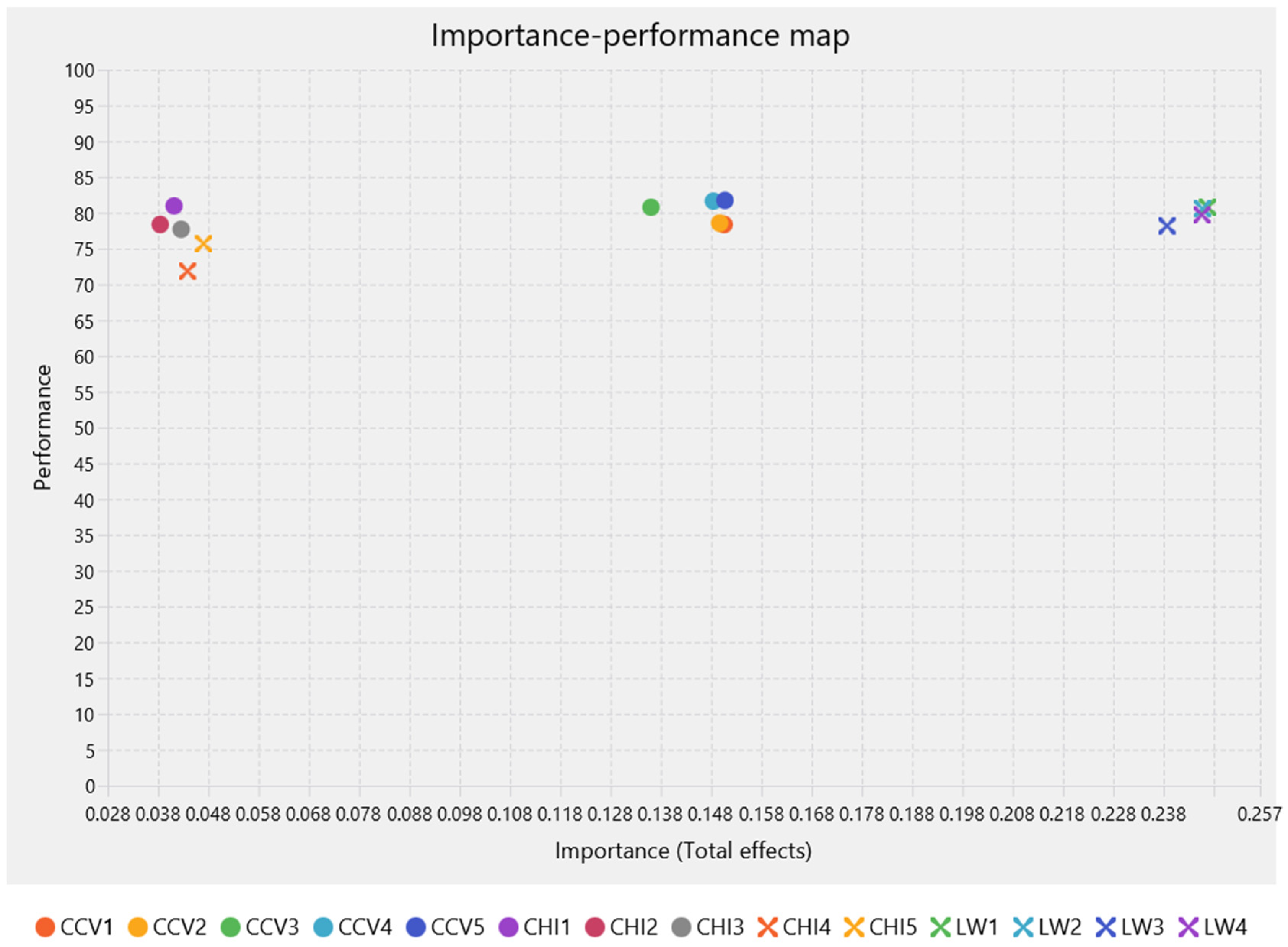
The IPMA results provide valuable insights into which indicators contribute most strongly (importance) to local wisdom and tourist heritage experience, and how well they currently perform (performance). The overall pattern indicates that LW1, LW2, LW3, and LW4 demonstrate the highest importance and relatively strong performance, making them the most influential indicators in driving experiential outcomes. The IPMA results highlight local wisdom indicators (LW1–LW4) as the most important contributors to the tourist heritage experience, demonstrating both high importance and strong performance. This indicates that improving traditional knowledge transmission, cultural interpretation, and community-led practices will yield the most substantial experiential benefits. Co-creation value indicators show moderate importance, with CCV1 and CCV2 requiring targeted enhancement to increase visitors’ meaningful participation. Cultural heritage identity indicators contribute indirectly through local wisdom, with CHI4 and CHI5 showing lower performance and representing areas for cultural strengthening. Overall, the IPMA results underscore local wisdom as the strategic focal point for managerial action and experience enhancement (Figure 4).

4.4. Discussion

The structural model results reveal that both the sense of cultural heritage identity and the value of co-creation experience significantly explain the construct of local wisdom, which in turn strongly drives tourist heritage experience. Specifically, the high R2 values (0.85 for local wisdom and 0.809 for tourist heritage experience) underscore the strong explanatory power of the model. In tourism and heritage studies, the concept of local wisdom has been increasingly recognized as a critical mediator between cultural identity and visitor outcomes: local wisdom—understood as the accumulated knowledge, values, practices, and traditions of a community—serves as a vital mechanism through which tourists engage with authenticity and meaning [110,111]. Local wisdom can act as a tourist attraction and provide educational value in village tourism development, reinforcing the finding that heritage identity alone is not sufficient unless local wisdom is activated [112,113,114].
Moreover, the significant effect of co-creation value on local wisdom corroborates the growing body of work on value co-creation in cultural heritage contexts. For instance, Mijnheer et al. demonstrated that co-creation between management, local stakeholders, and visitors enhances the visitor experience at heritage attractions [24,115]. Juliana et al. [26] argue that co-creation allows tourists to move from passive consumption to active participation, thereby enhancing experiential authenticity and meaning. In our model, the strong path (β = 0.742) from co-creation to local wisdom suggests that when visitors engage with locals, share in community practices, or participate in heritage activities, they internalize local wisdom more deeply than when they merely observe heritage identity.
The dominant path from local wisdom to tourist heritage experience (β = 0.899) highlights the pivotal role of local wisdom in shaping the visitor outcome. This aligns with recent investigations showing that embedding local wisdom through storytelling, rituals, craft processes, or community interaction enhances visitor satisfaction, emotional connection, and perceived authenticity [13,25,116]. For instance, research into tourism villages revealed that integrating local wisdom leads to more meaningful visitor encounters and sustainable outcomes [23].
From a theoretical perspective, these findings support a mediated-mechanism model: cultural heritage identity and co-creation experience do not directly produce heritage experience, but rather operate via local wisdom, which plays an intermediary role. This aligns with resource-based views in tourism research that conceptualize heritage identity as a resource, co-creation as a process, and visitor experience as an outcome but emphasize that capabilities (local wisdom) mediate the process [117]. Therefore, in practice, heritage tourism managers and destination developers should focus not only on preserving heritage identity but also on facilitating participative experiences (co-creation) and actively embedding local wisdom into tourist interactions. In this way, they translate static heritage symbols into dynamic lived experiences through local wisdom, thereby enhancing tourist engagement and value.
The strong explanatory power of the model invites reflection on sustainability and community implications. Local wisdom is beneficial not only for enhancing visitor experience but also for preserving intangible cultural heritage, supporting community identity, and promoting responsible tourism. Bibliometric study shows local wisdom integrated into tourism management is evolving from a theoretical interest to a practical necessity [118,119]. Therefore, this model offers both academic and practical relevance: academically, it positions local wisdom as a central mediator in heritage tourism value creation; practically, it suggests that destination planners should design co-creative interfaces and local-wisdom-sharing mechanisms to optimize heritage experiences in cultural tourism settings.
The effect of cultural heritage identity on local wisdom was positive and statistically significant (β = 0.204; p = 0.007). This confirms that communities with stronger cultural identity are more likely to preserve, practice, and transfer their local wisdom through rituals, narratives, symbolic practices, and daily cultural expression. This finding aligns with prior research asserting that cultural identity serves as the foundation for sustaining traditional knowledge and community-based values in heritage landscapes [118,119]. Studies on innovation and heritage ecosystems similarly emphasize that cultural identity reinforces collective norms and strengthens the transmission of intangible cultural knowledge across generations [98,120]. Thus, the result supports the argument that cultural heritage identity functions as an antecedent to local wisdom, enabling communities to embed their inherited values into visitor experiences.
Co-creation value showed a strong and significant positive effect on local wisdom (β = 0.742; p = 0.000), indicating that interactive, participatory visitor engagements enhance the visibility and activation of local wisdom in the tourism experience. This confirms previous research describing co-creation as a relational process that allows visitors to directly encounter cultural practices, traditional knowledge, and symbolic expressions of heritage communities [121,122,123]. Interactive activities—such as workshops, storytelling, and collaborative cultural production—allow community members to convey traditional skills, rituals, and ethical values in dynamic ways. Consistent with studies emphasizing the role of visitor participation in enriching cultural immersion [22,124]. This result demonstrates that co-creation not only enriches the experience but also strengthens the role of local wisdom as a cultural mechanism within the village context.
Local wisdom exhibited a strong and significant effect on tourist heritage experience (β = 0.899; p = 0.000), representing the most dominant pathway in the model. This confirms that local wisdom is central to shaping authentic, meaningful, and memorable heritage tourism experiences. Prior studies have emphasized that experiential depth and authenticity in heritage tourism depend heavily on exposure to community knowledge, traditional stories, interpersonal warmth, and rituals rooted in local culture [122,123]. The current finding supports the view that local wisdom enhances emotional, cognitive, and sensory immersion, enabling visitors to perceive the destination as more authentic and culturally rich. This is aligned with research linking heritage experiences to symbolic meaning, cultural knowledge transfer, and identity-based engagement [25,125].
The indirect effect of cultural heritage identity on tourist heritage experience via local wisdom was positive and statistically significant (β = 0.184, p = 0.007), confirming full mediation. This indicates that cultural heritage identity alone does not directly enhance the visitor’s heritage experience; rather, its influence is realized through the cultural knowledge, practices, and community values embedded within local wisdom.
This pattern aligns with past research that emphasizes the role of intangible cultural knowledge as the mechanism through which identity-based values shape visitor experience quality [97,125,126]. Cultural identity strengthens symbolic meaning, historical continuity, and collective memory, but these elements become experientially meaningful only when translated into local practices, rituals, and shared interactions [8,9,14,59,127]. Local wisdom, therefore, acts as the interpretive channel that makes cultural identity perceivable and emotionally resonant to visitors, consistent with models of experiential authenticity and cultural embodiment [62,63,69]. Thus, the full-mediation result highlights the necessity of community-driven cultural transmission in shaping authentic heritage experiences.
The indirect effect of co-creation value on tourist heritage experience through local wisdom was strong and highly significant (β = 0.667, p = 0.000), indicating full mediation. This suggests that visitor participation and collaborative engagement do not directly produce meaningful experiences unless these interactions are infused with local wisdom.
This is consistent with prior studies showing that co-creation activities—such as participatory workshops, storytelling, or joint creative tasks—become meaningful only when they convey traditional knowledge, symbolic values, and cultural interpretations rooted in the community’s worldview [37,48,49]. Existing research on immersive and memorable heritage experiences similarly concludes that cultural knowledge and emotional resonance emerge primarily through community-embedded practices rather than generic participatory activities [26,128,129]
The mediation result reinforces the idea that local wisdom is the “cultural core” of co-creation. Without the transmission of traditional values, ethical norms, and symbolic meaning, co-created experiences lack depth and authenticity, reducing their ability to generate memorable heritage experiences [5,51]. The mediation results indicate that local wisdom fully mediates the relationships between cultural heritage identity and tourist heritage experience and between co-creation value and tourist heritage experience. Cultural heritage identity enhances the cultural knowledge system but shapes the visitor’s experience only when transmitted through community practices and traditions embedded in local wisdom [22,25]. Likewise, co-creation activities become experientially meaningful when infused with local values, symbolic meaning, and traditional knowledge [45,46,65,67]. These results highlight that local wisdom is the central cultural mechanism that translates both identity and participatory engagement into authentic and memorable heritage experiences. Findings suggest that Local Wisdom plays a dominant role in transmitting the influence of identity and co-creation into experiential outcomes.

5. Conclusions

This study concludes that tourist heritage experiences in Prenggan Tourism Village are profoundly influenced by cultural heritage identity, co-creation value, and local wisdom. According to the findings, local wisdom functions as a vital mediating element by translating cultural values and collaborative engagement into meaningful and authentic visitor experiences. From a theoretical standpoint, the study advances the discourse on heritage-based tourism by emphasizing that authentic experiences emerge not merely from heritage preservation but also through the active participation of both visitors and local communities. From a practical perspective, the results highlight the importance of empowering residents to engage in value co-creation processes that reflect their traditions, beliefs, and cultural narratives. Strengthening local wisdom in tourism practices not only enhances experiential depth but also promotes cultural sustainability and community empowerment. Future research may explore the digital or cross-cultural dimensions of co-creation and local wisdom to better understand how heritage experiences evolve in an increasingly global and technology-driven tourism landscape.

5.1. Theoretical Contributions

This study makes several theoretical contributions to the cultural heritage and experiential tourism literature. First, it conceptualizes local wisdom as the central cultural mechanism linking cultural heritage identity and co-creation value to tourist heritage experience. While previous studies have examined cultural identity or experiential co-creation independently, the present model demonstrates that these constructs shape visitor experiences only when translated through local wisdom, positioning it as a mediating cultural integrator. This increases current understanding by showing that heritage experiences are not driven solely by structural identity or participatory engagement but also by the community’s interpretive knowledge system, which transforms cultural symbols into experiential meaning.
Second, the study advances theory by empirically demonstrating full mediation, providing evidence that tourist experiences in heritage villages are fundamentally culturally constructed, not mechanically determined by identity or co-creation interactions. This confirms that experiential authenticity arises through community-driven knowledge transmission, reinforcing theories of co-created cultural embodiment and intangible heritage frameworks. The study’s integration of qualitative insights into a quantitative foundation strengthens its theoretical rigor by grounding constructs in lived community narratives, enhancing cultural contextualization in rural heritage tourism research. This study empirically illustrates the mediating role of Local Wisdom within this cultural heritage village context. The study offers an empirically grounded contribution by clarifying and illustrating the role of Local Wisdom as an intermediary cultural mechanism in a rural heritage village context, strengthening rather than replacing prior theoretical models

5.2. Practical Implications

The findings have several practical implications for cultural tourism managers, village leaders, and policymakers. First, since local wisdom is the strongest predictor of tourist heritage experience, destination managers should prioritize activities that activate and showcase traditional knowledge, such as ritual demonstrations, storytelling sessions, local craft workshops, and community-led cultural interpretation. Programs that allow visitors to directly encounter community values will enhance experiential authenticity and satisfaction.
Second, strengthening cultural heritage identity among residents through cultural education, documentation, and intergenerational transfer will reinforce the cultural foundation that supports local wisdom. Heritage preservation programs should therefore integrate community participation to maintain cultural continuity. Third, co-creation initiatives should be designed to ensure that visitor participation is instilled with cultural meaning, rather than merely offering generic interactive activities. This can be achieved by training local facilitators to incorporate symbolic narratives and cultural interpretation into co-creation processes.
Policymakers should support capacity-building programs that empower residents to serve as cultural ambassadors, strengthen local pride, and ensure that sustainable tourism development is aligned with cultural preservation.

6. Limitations and Recommendations

This study has several limitations that should be considered when interpreting the findings. First, the research was conducted using a cross-sectional survey design, precluding conclusions regarding causal relationships between variables. As a result, the identified associations should be viewed as relational rather than causal. Second, a convenience sampling approach was used due to practical constraints in the field, which may limit the generalizability of the results to other tourism villages or cultural settings. Third, the use of self-reported questionnaires may introduce potential biases, such as social desirability or selective memory, which can influence the accuracy of the participants’ responses. Fourth, while the mixed-methods design enriched the study, the qualitative sample size and depth were limited, preventing detailed subgroup comparisons. The research was conducted in a single cultural tourism village, and the findings may not fully represent variations across different types of heritage tourism contexts. As the convenience sample was drawn from one cultural tourism village, the findings are context-specific and should not be generalized beyond similar rural heritage tourism environments.

7. Recommendations for Future Research

Future studies can build on these findings in several meaningful ways. First, longitudinal or multi-wave research designs would allow researchers to observe changes in cultural identity, co-creation, and tourist experience over time. Second, expanding the study across multiple heritage tourism villages or regions would enhance the transferability of the results and enable comparative analysis across diverse cultural settings. Third, future research could use alternative data collection methods, such as observational techniques, qualitative immersion, or digital tracking tools, to obtain more nuanced and behavioral insights. Fourth, researchers may explore additional mediating or moderating variables, such as cultural attachment, place emotion, or community engagement, to deepen the understanding of experiential processes. Practical research could focus on evaluating specific destination management strategies, community empowerment programs, or digital heritage initiatives to determine how these interventions can strengthen co-created experiences and support sustainable tourism development.

Author Contributions

Conceptualization, Methodology, Software, Validation, Supervision, resources, Project Administration, Visualization, Formal Analysis, Writing Original draft, Writing review and editing J.J.; Software, Visualization F.I.; Validation, Visualization R.S.; Formal analysis, Writing Original draft, writing review and editing A.D.; Investigation, Visualization L.E. All authors have read and agreed to the published version of the manuscript.

Funding

This research was supported by Universitas Pelita Harapan (UPH). The number is P-013-KDN-FHosPar/VII/2025.

Institutional Review Board Statement

The study was conducted in accordance with the Declaration of Helsinki, and approved by the Institutional Review Board of The Internal Review Board Universitas Pelita Harapan (IRB UPH) (protocol code 83/IRB-UPH/IX/2025 and date of approval 29 September 2025).

Informed Consent Statement

Informed consent was obtained from all subjects involved in the study.

Data Availability Statement

The raw data supporting the conclusions of this article will be made available by the authors on request.

Conflicts of Interest

The authors declare no conflict of interest.

References

  1. Arumugam, A.; Nakkeeran, S.; Subramaniam, R. Exploring the Factors Influencing Heritage Tourism Development: A Model Development. Sustainability 2023, 15, 11986. [Google Scholar] [CrossRef]
  2. Fiorentino, S.; Vandini, M. Resilience and Sustainable Territorial Development: Safeguarding Cultural Heritage at Risk for Promoting Awareness and Cohesiveness Among Next-Generation Society. Sustainability 2024, 16, 10968. [Google Scholar] [CrossRef]
  3. Gaonkar, S.; Sukthankar, S.V. Measuring and evaluating the influence of cultural sustainability indicators on sustainable cultural tourism development: Scale development and validation. Heliyon 2025, 11, e42514. [Google Scholar] [CrossRef]
  4. Dragan, A.; Creţan, R.; Jucu, I.S.; Oancea, O.A. Rural Landscapes as Cultural Heritage and Identity along a Romanian River. Heritage 2024, 7, 4354–4373. [Google Scholar] [CrossRef]
  5. Juliana, J.; Sihombing, S.O.; Antonio, F. Unveiling memorable tourism experiences effect on positive EWOM: Focus on the role of positive and negative emotion. Cogent Soc. Sci. 2025, 11, 2557073. [Google Scholar] [CrossRef]
  6. Nicu, I.C.; Fatorić, S. Climate change impacts on immovable cultural heritage in polar regions: A systematic bibliometric review. WIREs Clim. Change 2023, 14, 822. [Google Scholar] [CrossRef]
  7. Wu, M.-Y.; Tong, Y.; Li, Q.; Wall, G.; Wu, X. Interaction Rituals and Social Relationships in a Rural Tourism Destination. J. Travel Res. 2022, 62, 1480–1496. [Google Scholar] [CrossRef]
  8. Li, R.; Zhang, Y.; Li, W.; Xu, X. Identification Model of Traditional Village Cultural Landscape Elements and Its Application from the Perspective of Living Heritage—A Case Study of Chentian Village in Wuhan. Buildings 2024, 14, 3535. [Google Scholar] [CrossRef]
  9. Li, J.; Zhang, Y.; Jin, H. Integrating Community Fabric and Cultural Values into Sustainable Landscape Planning: A Case Study on Heritage Revitalization in Selected Guangzhou Urban Villages. Sustainability 2025, 17, 7327. [Google Scholar] [CrossRef]
  10. Juliana; Sihombing, S.O.; Antonio, F.; Sijabat, R.; Bernarto, I. The Role of Tourist Experience in Shaping Memorable Tourism Experiences and Behavioral Intentions. Int. J. Sustain. Dev. Plan. 2024, 19, 1319–1335. [Google Scholar] [CrossRef]
  11. Lemy, D.M.; Pramono, R. Juliana Acceleration of Environmental Sustainability in Tourism Village. Int. J. Sustain. Dev. Plan. 2022, 17, 1273–1283. [Google Scholar] [CrossRef]
  12. Lemy, D.M.; Pramezwary, A.; Juliana, P.R.; Qurotadini, L.N. Explorative Study of Tourist Behavior in Seeking Information to Travel Planning. Int. J. Sustain. Dev. Plan. 2021, 16, 1583–1589. [Google Scholar] [CrossRef]
  13. Juliana, J.; Pramezwary, A.; Djakasaputra, A.; Anwar, M.M.; Jie, F. The missing link in urban tourism: Connecting leisure, accessibility and resident participation for enhanced value. Cogent Soc. Sci. 2025, 11, 2556473. [Google Scholar] [CrossRef]
  14. Wei, H.; Yu, Y.; Yuan, Z. Heritage Tourism and Nation-Building: Politics of the Production of Chinese National Identity at the Mausoleum of Yellow Emperor. Sustainability 2022, 14, 8798. [Google Scholar] [CrossRef]
  15. Fang, Q.; Li, Z. Cultural ecology cognition and heritage value of huizhou traditional villages. Heliyon 2022, 8, e12627. [Google Scholar] [CrossRef] [PubMed]
  16. Cai, W.; Shu, Z.; Liu, Y. Exploring the role of place attachment in shaping sustainable behaviors toward marine cultural heritage: A case study of Dongmen village in Fujian Province, China. Front. Psychol. 2025, 16, 1476308. [Google Scholar] [CrossRef]
  17. Xu, Q.; Wang, J. Recognition of Values of Traditional Villages in Southwest China for Sustainable Development: A Case Study of Liufang Village. Sustainability 2021, 13, 7569. [Google Scholar] [CrossRef]
  18. Torres-Toukoumidis, A.; Marín-Gutiérrez, I.; Hinojosa-Becerra, M. Ancestral Rituals Heritage as Community-Based Tourism—Case of the Ecuadorian Andes. Sustainability 2022, 14, 12679. [Google Scholar] [CrossRef]
  19. Yang, I.-C.M.; French, J.A.; Lee, C.; Watabe, M. The symbolism of international tourism in national identity. Ann. Tour. Res. 2020, 83, 102966. [Google Scholar] [CrossRef]
  20. Schmidt, J.; Stoffelen, A.; Bolderman, L.; Groote, P. Place agency and visitor hybridity in place-making processes at sacred heritage sites. Tour. Geogr. 2025, 27, 191–212. [Google Scholar] [CrossRef]
  21. Chen, Y.; Lin, Y.; Su, X.; Chen, P.; Song, H. Multiple Effects of Agricultural Cultural Heritage Identity on Residents’ Value Co-Creation—A Host–Guest Interaction Perspective on Tea Culture Tourism in China. Agriculture 2024, 15, 57. [Google Scholar] [CrossRef]
  22. Juliana, I.; Hubner, B.; Sianipar, R.; Indra, F.; Djakasaputra, A. Systematic Literature Review: Combining Foodscape and Touristcape for International Tourism Marketing in Singapore and Batam. Stud. Syst. Decis. Control. 2024, 545, 969–980. [Google Scholar] [CrossRef]
  23. Juliana, J.; Pramezwary, A.; Lemy, D.M.; Teguh, F.; Djakasaputra, A.; Sianipar, R. Antecedents Experiential Commitment and Consequences in Willingness to Post Photo and Behavioral Intention Toward the Destination. Int. J. Des. Nat. Ecodyn. 2022, 17, 547–556. [Google Scholar] [CrossRef]
  24. Juliana, J.; Nagoya, R.; Bangkara, B.A.; Purba, J.T.; Fachrurazi, F. The role of supply chain on the competitiveness and the performance of restaurants. Uncertain Supply Chain Manag. 2022, 10, 445–452. [Google Scholar] [CrossRef]
  25. Juliana, J.; Sianipar, R.; Lemy, D.M.; Pramezwary, A.; Pramono, R.; Djakasaputra, A. Factors Influencing Visitor Satisfaction and Revisit Intention in Lombok Tourism: The Role of Holistic Experience, Experience Quality, and Vivid Memory. Int. J. Sustain. Dev. Plan. 2023, 18, 2503–2511. [Google Scholar] [CrossRef]
  26. Juliana; Hubner, I.B.; Lemy, D.M.; Pramezwary, A.; Djakasaputra, A. Antecedents of Happiness and Tourism Servicescape Satisfaction and the Influence on Promoting Rural Tourism. Int. J. Sustain. Dev. Plan. 2024, 19, 4041–4059. [Google Scholar] [CrossRef]
  27. United Nations. Transforming Our World: The 2030 Agenda for Sustainable Development; United Nations: New York, NY, USA, 2015. Available online: https://sdgs.un.org/2030agenda (accessed on 11 November 2025).
  28. Creswell, J.W.; Poth, C.N. Qualitative Inquiry & Research Design: Choosing Among Five Approaches, 5th ed.; Sage Publications: Thousand Oaks, CA, USA, 2016; 515p, Available online: https://worldcat.org/title/1414174647 (accessed on 13 November 2025).
  29. Creswell, J.W.; Poth, C.N. Research Design: Qualitative, Quantitative, and Mixed Methods Approaches, 6th ed.; Sage Publications: Thousand Oaks, CA, USA, 2017; 291p, Available online: https://worldcat.org/title/1334726603 (accessed on 15 November 2025).
  30. Ivankova, N.V.; Creswell, J.W.; Stick, S.L. Using Mixed-Methods Sequential Explanatory Design: From Theory to Practice. Field Methods 2006, 18, 3–20. [Google Scholar] [CrossRef]
  31. Creswell, J.W. Educational Research: Planning, Conducting, and Evaluating Quantitative and Qualitative Research, 4th ed.; Pearson: Boston, MA, USA, 2012. [Google Scholar]
  32. Creswell, J.W.; Creswel, J.D. Research Design. In Qualitative, Quantitative, and Mixed Methods Approaches, 5th ed.; Sage Publications: Thousand Oaks, CA, USA, 2018. [Google Scholar]
  33. Neuman, W.L. Social Research Methods: Qualitative and Quantitative Approaches, 6th ed.; Pearson: London, UK, 2013. [Google Scholar]
  34. Yılmaz, M.; Sezerel, H.; Uzuner, Y. Sharing experiences and interpretation of experiences: A phenomenological research on Instagram influencers. Curr. Issues Tour. 2020, 23, 3034–3041. [Google Scholar] [CrossRef]
  35. Rasoolimanesh, S.M.; Seyfi, S.; Rather, R.A.; Hall, C.M. Investigating the mediating role of visitor satisfaction in the relationship between memorable tourism experiences and behavioral intentions in heritage tourism context. Tour. Rev. 2021, 77, 687–709. [Google Scholar] [CrossRef]
  36. Buzinde, C.N. Theoretical linkages between well-being and tourism: The case of self-determination theory and spiritual tourism. Ann. Tour. Res. 2020, 83, 102920. [Google Scholar] [CrossRef]
  37. Cheng, Y.; Chen, W. Cultural Perception of Tourism Heritage Landscapes via Multi-Label Deep Learning: A Study of Jingdezhen, the Porcelain Capital. Land 2025, 14, 559. [Google Scholar] [CrossRef]
  38. Yeh, J.H.-Y.; Lin, S.-C.; Lai, S.-C.; Huang, Y.-H.; Yi-Fong, C.; Lee, Y.-T.; Berkes, F. Taiwanese Indigenous Cultural Heritage and Revitalization: Community Practices and Local Development. Sustainability 2021, 13, 1799. [Google Scholar] [CrossRef]
  39. Palacios, M.A.R.; Villalobos, L.G.; de Oliveira, C.P.T.; González, E.M.P. Cultural Identity: A Case Study in The Celebration of the San Antonio De Padua (Lajas, Perú). Heritage 2022, 6, 351–364. [Google Scholar] [CrossRef]
  40. Settimini, E. Cultural landscapes: Exploring local people’s understanding of cultural practices as “heritage”. J. Cult. Herit. Manag. Sustain. Dev. 2020, 11, 185–200. [Google Scholar] [CrossRef]
  41. Ren, X.; Singh, S.; Bhutoria, A.; Doğan, H.A. Placemaking Through Time in Nepal: Conceptualising the Historic Urban-Rural Landscape of Kathmandu. Urban Plan. 2025, 10, 8947. [Google Scholar] [CrossRef]
  42. Zhao, G.; Ryan, C.; Deng, Z.; Gong, J. Creating a softening cultural-landscape to enhance tourist experiencescapes: The case of Lu Village. Tour. Manag. Perspect. 2024, 53, 101245. [Google Scholar] [CrossRef]
  43. Xia, J.; Gu, X.; Fu, T.; Ren, Y.; Sun, Y. Trends and Future Directions in Research on the Protection of Traditional Village Cultural Heritage in Urban Renewal. Buildings 2024, 14, 1362. [Google Scholar] [CrossRef]
  44. Irwandi, E.; Sabana, S.; Kusmara, A.R.; Sanjaya, T. Urban villages as living gallery: Shaping place identity with participatory art in Java, Indonesia. Cogent Arts Humanit. 2023, 10, 2247671. [Google Scholar] [CrossRef]
  45. Gaddapati, J.R. Preserving Tradition Amidst Modern Schooling: The Interplay of Education and Cultural Identity in the Lisu (Yobin) Tribe. Int. J. Multidiscip. Res. 2025, 7, 35650. [Google Scholar] [CrossRef]
  46. Zhou, F.; Buranaut, I. Study on the Interaction Between Agricultural Practices, Religious Activities, and Cultural Relics. Nakhara J. Environ. Des. Plan. 2025, 24, 506. [Google Scholar] [CrossRef]
  47. Zhang, F.; Sun, X.; Liu, C.; Qiu, B. Effects of Urban Landmark Landscapes on Residents’ Place Identity: The Moderating Role of Residence Duration. Sustainability 2024, 16, 761. [Google Scholar] [CrossRef]
  48. Shrestha, R.; Shen, Z.; Bhatta, K.D. Cultural Heritage Deterioration in the Historical Town ‘Thimi’. Buildings 2024, 14, 244. [Google Scholar] [CrossRef]
  49. Liang, X.; Lu, Y.; Martin, J. A Review of the Role of Social Media for the Cultural Heritage Sustainability. Sustainability 2021, 13, 1055. [Google Scholar] [CrossRef]
  50. Parani, R. Juliana A Storytelling-Based Marketing Strategy Using the Sigale-Gale Storynomics as a Communication Tool for Promoting Toba Tourism. Int. J. Sustain. Dev. Plan. 2023, 18, 1209–1217. [Google Scholar] [CrossRef]
  51. Juliana; Sihombing, S.O.; Antonio, F. What Drives Memorable Rural Tourism Experience: Evidence from Indonesian Travelers. Int. J. Sustain. Dev. Plan. 2022, 17, 2401–2411. [Google Scholar] [CrossRef]
  52. Silitonga, P.; Juliana, J.; Rini, G.P.; Sitohang, A.P.S. Unveiling the Outcome of the Implementation of Experiential Value Co-Creation on the Behavioral Intention of Online Travelers. Tour. Hosp. 2025, 6, 157. [Google Scholar] [CrossRef]
  53. Tahara, T.; Al Isra, A.B.; Tiro, S. Cultural Resilience and Syncretism: The Towani Tolotang Community’s Journey in Indonesia’s Religious Landscape. J. Ethn. Cult. Stud. 2023, 10, 233–246. [Google Scholar] [CrossRef]
  54. Sung, M. Influences of Rural Heritage on Resident Participation in Community Activities: A Case Study of the Villages of Jeoji-ri and Handong-ri on Jeju Island, South Korea. J. People Plants Environ. 2022, 25, 177–194. [Google Scholar] [CrossRef]
  55. Lin, M. Understanding the influencing factors of tourists’ revisit intention in traditional villages. Heliyon 2024, 10, e35029. [Google Scholar] [CrossRef]
  56. Zhang, R.; Smith, L. Bonding and dissonance: Rethinking the Interrelations Among Stakeholders in Heritage Tourism. Tour. Manag. 2019, 74, 212–223. [Google Scholar] [CrossRef]
  57. Purnamawati, I.G.A.; Jie, F.; Hatane, S.E. Cultural Change Shapes the Sustainable Development of Religious Ecotourism Villages in Bali, Indonesia. Sustainability 2022, 14, 7368. [Google Scholar] [CrossRef]
  58. Zhang, Y. The use of heritage in the place-making of a culture and leisure community: Liangzhu Culture Village in Hangzhou, China. Int. J. Herit. Stud. 2024, 30, 1423–1437. [Google Scholar] [CrossRef]
  59. Yodsurang, P.; Kiatthanawat, A.; Sanoamuang, P.; Kraseain, A.; Pinijvarasin, W.; Hamid, N. Community-based tourism and heritage consumption in Thailand: An upside-down classification based on heritage consumption. Cogent Soc. Sci. 2022, 8, 2096531. [Google Scholar] [CrossRef]
  60. Duan, Y.; Chen, M.; Liu, Y.; Wang, Y.; Zhang, L. Research on the Cultural Landscape Features and Regional Variations of Traditional Villages and Dwellings in Multicultural Blending Areas: A Case Study of the Jiangxi-Anhui Junction Region. Appl. Sci. 2025, 15, 2185. [Google Scholar] [CrossRef]
  61. Tao, R.; Aoki, N.; Chen, P. Reappropriating the communal past: Lineage tradition revival as a way of constructing collective identity in Huizhou, China. Humanit. Soc. Sci. Commun. 2024, 11, 881. [Google Scholar] [CrossRef]
  62. Baan, A.; Allo, M.D.G.; Patak, A.A. The cultural attitudes of a funeral ritual discourse in the indigenous Torajan, Indonesia. Heliyon 2022, 8, e08925. [Google Scholar] [CrossRef]
  63. Liu, S.; Wu, L.; Xiang, C.; Dai, W. Revitalizing Rural Landscapes: Applying Cultural Landscape Gene Theory for Sustainable Spatial Planning in Linpu Village. Buildings 2024, 14, 2396. [Google Scholar] [CrossRef]
  64. Csurgó, B.; Smith, M.K. The value of cultural ecosystem services in a rural landscape context. J. Rural. Stud. 2021, 86, 76–86. [Google Scholar] [CrossRef]
  65. Brooks, C.; Waterton, E.; Saul, H.; Renzaho, A. Exploring the relationships between heritage tourism, sustainable community development and host communities’ health and wellbeing: A systematic review. PLoS ONE 2023, 18, e0282319. [Google Scholar] [CrossRef] [PubMed]
  66. Tenzer, M. Social Landscape Characterisation: A people-centred, place-based approach to inclusive and transparent heritage and landscape management. Int. J. Herit. Stud. 2023, 30, 269–284. [Google Scholar] [CrossRef]
  67. Hanif, M.; Parji; Maruti, E.S.; Wahyuni, R.S. Cultural resilience study: The role of the temanten mandi ritual in Sendang Modo on the survival of the surrounding community. Cogent Arts Humanit. 2024, 11, 2304401. [Google Scholar] [CrossRef]
  68. Gu, M.; Wang, Y.; Wu, Y.; Dai, Y.; Fan, W. Formulating sustainable planning for Goulan Yao Village based on the integration of cultural landscape gene theory and spatial analysis. Sci. Rep. 2025, 15, 29872. [Google Scholar] [CrossRef]
  69. Ariyasapwatthana, D. Study on Cultural Identity and Tourism Transformation in Santichon Village. Int. J. Educ. Cult. Soc. 2025, 10, 101–111. [Google Scholar] [CrossRef]
  70. Dimache, A.; Qiu, Z. Reading the Identity of Dark Heritage Sites: A Peircean Semiotic Methodology. J. Travel Res. 2023, 63, 1411–1425. [Google Scholar] [CrossRef]
  71. Zhu, J.; Yuan, X.; Yuan, X.; Liu, S.; Guan, B.; Sun, J.; Chen, H. Evaluating the sustainability of rural complex ecosystems during the development of traditional farming villages into tourism destinations: A diachronic emergy approach. J. Rural. Stud. 2021, 86, 473–484. [Google Scholar] [CrossRef]
  72. Presti, O.L.; Carli, M.R. Italian Catacombs and Their Digital Presence for Underground Heritage Sustainability. Sustainability 2021, 13, 12010. [Google Scholar] [CrossRef]
  73. Petti, L.; Trillo, C.; Makore, B.N. Cultural Heritage and Sustainable Development Targets: A Possible Harmonisation? Insights from the European Perspective. Sustainability 2020, 12, 926. [Google Scholar] [CrossRef]
  74. Mehta, S.; Kukreja, V.; Bordoloi, D. Heritage Coin Identification using Convolutional Neural Networks: A Multi-Classification Approach for Numismatic Research. In Proceedings of the 2023 Second International Conference on Augmented Intelligence and Sustainable Systems (ICAISS), Trichy, India, 23–25 August 2023; pp. 1–6. [Google Scholar] [CrossRef]
  75. Crăciun, A.M.; Dezsi, Ș.; Pop, F.; Cecilia, P. Rural Tourism—Viable Alternatives for Preserving Local Specificity and Sustainable Socio-Economic Development: Case Study—“Valley of the Kings” (Gurghiului Valley, Mureș County, Romania). Sustainability 2022, 14, 16295. [Google Scholar] [CrossRef]
  76. Lemy, D.M.; Juliana, J.; Pramezwary, A. Cultural Value in the Digital Age: Combining Smart Travel Technology with Traveler Satisfaction and Loyalty. Int. J. Sustain. Dev. Plan. 2025, 20, 607–621. [Google Scholar] [CrossRef]
  77. Favargiotti, S.; Pianegonda, A. The Foodscape as Ecological System. Landscape Resources for R-Urban Metabolism, Social Empowerment and Cultural Production. In Urban Services to Ecosystems; Springer: Berlin/Heidelberg, Germany, 2021; pp. 279–295. [Google Scholar] [CrossRef]
  78. Hussein, F.; Stephens, J.; Tiwari, R. Cultural Memories and Sense of Place in Historic Urban Landscapes: The Case of Masrah Al Salam, the Demolished Theatre Context in Alexandria, Egypt. Land 2020, 9, 264. [Google Scholar] [CrossRef]
  79. Daly, P.; Dias, A.L.; Patuleia, M. The Impacts of Tourism on Cultural Identity on Lisbon Historic Neighbourhoods. J. Ethn. Cult. Stud. 2020, 8, 516. [Google Scholar] [CrossRef]
  80. Kwan, M. Elevating Shunde cultural heritage through dining; A case study of Holiday Inn Shunde in Zhongshan, China. Gulf J. Adv. Bus. Res. 2024, 2, 238–243. [Google Scholar] [CrossRef]
  81. Juliana; Parani, R.; Sitorus, N.I.B.; Pramono, R.; Maleachi, S. Study of Community Based Tourism in the District West Java. Int. J. Sustain. Dev. Plan. 2021, 16, 277–285. [Google Scholar] [CrossRef]
  82. Deng, Y.; Zhang, X.; Zhang, B.; Zhang, B.; Qin, J. From digital museuming to on-site visiting: The mediation of cultural identity and perceived value. Front. Psychol. 2023, 14, 1111917. [Google Scholar] [CrossRef]
  83. Sangchumnong, A.; Kozak, M. Impacts of tourism on cultural infiltration at a spiritual destination: A study of Ban Wangka, Thailand. Int. J. Cult. Tour. Hosp. Res. 2021, 15, 477–493. [Google Scholar] [CrossRef]
  84. Gutberlet, M. Geopolitical imaginaries and Cultural Ecosystem Services (CES) in the desert. Tour. Geogr. 2019, 24, 549–577. [Google Scholar] [CrossRef]
  85. Silva, C.; Zagalo, N.; Vairinhos, M. Towards participatory activities with augmented reality for cultural heritage: A literature review. Comput. Educ. X Real. 2023, 3, 100044. [Google Scholar] [CrossRef]
  86. Burgess, C. Beyond cultural competence: Transforming teacher professional learning through Aboriginal community-controlled cultural immersion. Crit. Stud. Educ. 2019, 60, 477–495. [Google Scholar] [CrossRef]
  87. Gryllakis, N.; Matsiola, M. Digital audiovisual content in marketing and distributing cultural products during the COVID-19 pandemic in Greece. Arts Mark. 2023, 13, 4–19. [Google Scholar] [CrossRef]
  88. Pijet-Migoń, E.; Migoń, P. Geoheritage and Cultural Heritage—A Review of Recurrent and Interlinked Themes. Geosciences 2022, 12, 98. [Google Scholar] [CrossRef]
  89. Hair, C.M.R.M.S.; Ray, N.P.D.S. Review of Partial Least Squares Structural Equation Modeling (PLS-SEM) Using R: A Workbook; Springer: Berlin/Heidelberg, Germany, 2023; Volume 30. [Google Scholar] [CrossRef]
  90. Hair, J.F.; Risher, J.J.; Sarstedt, M.; Ringle, C.M. When to use and how to report the results of PLS-SEM. Eur. Bus. Rev. 2019, 31, 2–24. [Google Scholar] [CrossRef]
  91. Moriuchi, E.; Landers, V.M.; Colton, D.; Hair, N. Engagement with chatbots versus augmented reality interactive technology in e-commerce. J. Strateg. Mark. 2020, 29, 375–389. [Google Scholar] [CrossRef]
  92. Kang, N.; Xie, G.; Liu, C. Assessment of Society’s Perceptions on Cultural Ecosystem Services in a Cultural Landscape in Nanchang, China. Sustainability 2023, 15, 10308. [Google Scholar] [CrossRef]
  93. Nowicka, K. The Heritage Given: Cultural Landscape and Heritage of the Vistula Delta Mennonites as Perceived by the Contemporary Residents of the Region. Sustainability 2022, 14, 915. [Google Scholar] [CrossRef]
  94. Creswell, J.W.D.; Creswell, J.W.D.; Creswell, J.W.; Creswell, J.D. Research and Design Qualitative, Quantitative and Mixed Methods Approaches; Salmon, H., Ed.; SAGE Publications, Inc.: London, UK, 2018; ISBN 9781506386768. [Google Scholar]
  95. Sekaran, U.; Bougie, R. Research Method for Business Textbook: A Skill Building Approach; John Wiley & Sons: Hoboken, NJ, USA, 2016. [Google Scholar]
  96. Graneheim, U.H.; Lundman, B. Qualitative content analysis in nursing research: Concepts, procedures and measures to achieve trustworthiness. Nurse Educ. Today 2004, 24, 105–112. [Google Scholar] [CrossRef] [PubMed]
  97. Ghazali, R.M.; Radha, J.Z.R.R.R.; Mokhtar, M.F. Tourists’ Emotional Experiences At Tourism Destinations: Analysis of Social Media Reviews. J. Event Tour. Hosp. Stud. 2021, 1, 49–70. [Google Scholar] [CrossRef]
  98. Chi, X.; Lee, S.K.; Ahn, Y.-J.; Kiatkawsin, K. Tourist-Perceived Quality and Loyalty Intentions towards Rural Tourism in China. Sustainability 2020, 12, 3614. [Google Scholar] [CrossRef]
  99. Skavronskaya, L.; Moyle, B.; Scott, N.; Schaffer, V. Collecting Memorable Tourism Experiences: How Do ‘wechat’? J. China Tour. Res. 2020, 16, 424–446. [Google Scholar] [CrossRef]
  100. Cifci, I. Testing self-congruity theory in Bektashi faith destinations: The roles of memorable tourism experience and destination attachment. J. Vacat. Mark. 2022, 28, 3–19. [Google Scholar] [CrossRef]
  101. Widianingsih, I.; Abdillah, A.; Herawati, E.; Dewi, A.U.; Miftah, A.Z.; Adikancana, Q.M.; Pratama, M.N.; Sasmono, S. Sport Tourism, Regional Development, and Urban Resilience: A Focus on Regional Economic Development in Lake Toba District, North Sumatra, Indonesia. Sustainability 2023, 15, 5960. [Google Scholar] [CrossRef]
  102. Pramono, R.; Hidayat, J.; Dharmawan, C. Juliana Hybrid Bamboo and Batik Handicraft Development as Creative Tourism Product. Int. J. Des. Nat. Ecodyn. 2021, 16, 601–607. [Google Scholar] [CrossRef]
  103. Parani, R.; Hubner, I.B.; Juliana; Purba, H. The Kebo Ketan ritual art as a communication process in delivering the message of social cohesiveness in the Sekaralas village community, Ngawi, East-Java. Cogent Soc. Sci. 2024, 10, 2297724. [Google Scholar] [CrossRef]
  104. Hair, J., Jr.; Joseph, F. Essentials of Business Research Methods; Routledge Books: London, UK, 2015. [Google Scholar] [CrossRef]
  105. Sarstedt, J.F.; Ringle, C.M.; Hair, J.F. Partial Least Squares Structural Equation Modeling. In Handbook of Market Research; Homburg, C., Klarmann, M., Vomberg, A., Eds.; Springer: Cham, Swizerland, 2022. [Google Scholar] [CrossRef]
  106. Basco, R.; Hair, J.F.; Ringle, C.M.; Sarstedt, M. Advancing family business research through modeling nonlinear relationships: Comparing PLS-SEM and multiple regression. J. Fam. Bus. Strat. 2022, 13, 100457. [Google Scholar] [CrossRef]
  107. Hair, M.; Ringle, J.F.; Sarstedt, C.M. PLS-SEM: Indeed A Silver Bullet. J. Mark. Theory Pract. 2018, 19, 2. [Google Scholar] [CrossRef]
  108. Tomas, G.; Hult, M.; Hair, J.; Sarstedt, M.; Ringle, C.M. A Primer on Partial Least Squares Structural Equation Modeling (PLS-SEM); Sage Publishing: Thousand Oaks, CA, USA, 2022. [Google Scholar]
  109. Juliana; Hubner, I.B.; Pramono, R.; Lemy, D.M.; Pramezwary, A.; Djakasaputra, A. Ecotourism Empowerment and Sustainable Tourism BT—Opportunities and Risks in AI for Business Development: Volume 1; Alareeni, B., Elgedawy, I., Eds.; Springer Nature: Cham, Swizerland, 2024; pp. 161–172. ISBN 978-3-031-65203-5. [Google Scholar]
  110. Geçikli, R.M.; Turan, O.; Lachytová, L.; Dağlı, E.; Kasalak, M.A.; Uğur, S.B.; Guven, Y. Cultural Heritage Tourism and Sustainability: A Bibliometric Analysis. Sustainability 2024, 16, 6424. [Google Scholar] [CrossRef]
  111. Ramazanova, M.; Silva, F.M.; de Freitas, I.V. Tourists’ Views on Sustainable Heritage Management in Porto, Portugal: Balancing Heritage Preservation and Tourism. Heritage 2024, 8, 10. [Google Scholar] [CrossRef]
  112. Zhou, Z.; Liu, Z.; Wang, G. Driving Sustainable Cultural Heritage Tourism in China through Heritage Building Information Modeling. Buildings 2024, 14, 3120. [Google Scholar] [CrossRef]
  113. Bhogal, S.; Mittal, A.; Tandon, U. Accessing vicarious nostalgia and memorable tourism experiences in the context of heritage tourism with the moderating influence of social return. Int. J. Tour. Cities 2024, 10, 860–880. [Google Scholar] [CrossRef]
  114. Sthapit, E.; Garrod, B.; Coudounaris, D.N.; Seyfi, S.; Cifci, I.; Vo-Thanh, T. Antecedents of memorable heritage tourism experiences: An application of stimuli–organism–response theory. Int. J. Tour. Cities 2024, 10, 1469–1487. [Google Scholar] [CrossRef]
  115. Juliana, J.; Aditi, B.; Nagoya, R.; Wisnalmawati, W.; Nurcholifah, I. Tourist visiting interests: The role of social media marketing and perceived value. Int. J. Data Netw. Sci. 2022, 6, 469–476. [Google Scholar] [CrossRef]
  116. Juliana; Djakasaputra, A.; Pramezwary, A.; Lemy, D.M.; Hubner, I.B. Fachrurazi Halal Awareness and Lifestyle on Purchase Intention; Springer Nature: Cham, Switzerland, 2024; Volume 927. [Google Scholar]
  117. Goeltom, V.A.H.; Kristiana, Y.; Juliana; Pramono, R.; Purwanto, A. The influence of intrinsic, extrinsic, and consumer attitudes towards intention to stay at a Budget Hotel. Afr. J. Hosp. Tour. Leis. 2019, 8, 1–16. [Google Scholar]
  118. Parta, I.B.M.W.; Maharani, I.A.K. Cultural Tourism In Indonesia: Systematic Literature Review. Vidyottama Sanatana Int. J. Hindu Sci. Relig. Stud. 2023, 7, 189–204. [Google Scholar] [CrossRef]
  119. Su, M.M.; Sun, Y.; Wall, G.; Min, Q. Agricultural heritage conservation, tourism and community livelihood in the process of urbanization—Xuanhua Grape Garden, Hebei Province, China. Asia Pac. J. Tour. Res. 2019, 25, 205–222. [Google Scholar] [CrossRef]
  120. Wong, I.A.; Ma, J.; Xiong, X. Touristic experience at a nomadic sporting event: Craving cultural connection, sacredness, authenticity, and nostalgia. J. Hosp. Tour. Manag. 2020, 44, 70–78. [Google Scholar] [CrossRef]
  121. Li, Y.; Lu, C.; Bogicevic, V.; Bujisic, M. The effect of nostalgia on hotel brand attachment. Int. J. Contemp. Hosp. Manag. 2019, 31, 691–717. [Google Scholar] [CrossRef]
  122. Khan, A.; Bibi, S.; Lorenzo, A.; Lyu, J.; Babar, Z.U. Tourism and Development in Developing Economies: A Policy Implication Perspective. Sustainability 2020, 12, 1618. [Google Scholar] [CrossRef]
  123. Khan, A.; Bibi, S.; Lyu, J.; Alam, M.; Khan, M.M.; Nurunnabi, M. The quest of tourism and overall well-being: The developing economy of Pakistan. PSU Res. Rev. 2020, 5, 120–140. [Google Scholar] [CrossRef]
  124. Rachão, S.; Breda, Z.; Fernandes, C.; Joukes, V. Cocreation of tourism experiences: Are food-related activities being explored? Br. Food J. 2020, 122, 910–928. [Google Scholar] [CrossRef]
  125. Mittal, A.; Bhandari, H.; Chand, P.K. Anticipated positive evaluation of social media posts: Social return, revisit intention, recommend intention and mediating role of memorable tourism experience. Int. J. Cult. Tour. Hosp. Res. 2021, 16, 193–206. [Google Scholar] [CrossRef]
  126. Juliana; Sihombing, S.O.; Suwu, S.E. Community-Based Ecotourism in Sawarna Tourism Village. Enrich. J. Manag. 2023, 13, 258–269. [Google Scholar] [CrossRef]
  127. Katapidi, I. Heritage policy meets community praxis: Widening conservation approaches in the traditional villages of central Greece. J. Rural. Stud. 2021, 81, 47–58. [Google Scholar] [CrossRef]
  128. Juliana; Sihombing, S.O.; Antonio, F. Determinants and Consequences of Memorable Tourism Experiences: A Systematic Literature Review BT—Achieving Sustainable Business Through AI, Technology Education and Computer Science: Volume 1: Computer Science, Business Sustainability, and Competitive; Hamdan, A., Ed.; Springer Nature: Cham, Switzerland, 2025; pp. 311–324. [Google Scholar] [CrossRef]
  129. Purwanto, A.; Juliana, J. The effect of supplier performance and transformational supply chain leadership style on supply chain performance in manufacturing companies. Uncertain Supply Chain Manag. 2022, 10, 511–516. [Google Scholar] [CrossRef]
Figure 1. Conceptual framework.
Sustainability 17 11112 g001
Figure 2. Outer model.
Sustainability 17 11112 g002
Figure 3. Inner model evaluation.
Sustainability 17 11112 g003
Figure 4. IPMA indicator.
Sustainability 17 11112 g004
Table 1. R-square.
Table 1. R-square.
VariableR-SquareR-Square Adjusted
Local Wisdom 0.850 0.849
Tourist Heritage Experience 0.809 0.808
Table 2. Construct reliability and validity.
Cronbach’s AlphaComposite Reliability (rho_a)Composite Reliability (rho_c)Average Variance Extracted (AVE)
Co-Creation Value 0.948 0.949 0.960 0.828
Cultural Heritage Identity 0.920 0.924 0.940 0.759
Local Wisdom 0.942 0.942 0.958 0.851
Tourist Heritage Experience 0.956 0.956 0.965 0.820
Table 3. HTMT ratio.
Co-Creation ValueCultural Heritage IdentityLocal WisdomTourist Heritage Experience
Co-Creation Value
Cultural Heritage Identity 0.742
Local Wisdom 0.813 0.769
Tourist Heritage Experience 0.825 0.861 0.804
Table 4. VIF results.
VIF
CCV → LW 3.619
CHI → LW 3.619
LW → THE 1.000
Table 5. Hypothesis testing results.
Original Sample (O)Standard Deviation (STDEV)T Statistics (|O/STDEV|)p-ValuesResult
CCV → LW 0.742 0.080 9.321 0.000 Hypothesis Supported
CHI → LW 0.204 0.083 2.468 0.007 Hypothesis Supported
LW → THE 0.899 0.022 41.751 0.000 Hypothesis Supported
Table 6. Specific indirect effects and total effects.
Original Sample (O)Standard Deviation (STDEV)T Statistics (|O/STDEV|)p ValuesResult
CCVTHE 0.667 0.076 8.832 0.000 Hypothesis Supported
CHITHE 0.184 0.075 2.465 0.007 Hypothesis Supported
CCV → LW → THE 0.667 0.076 8.832 0.000 Hypothesis Supported
CHI → LW → THE 0.184 0.075 2.465 0.007 Hypothesis Supported
CCV → LW 0.742 0.080 9.321 0.000 Hypothesis Supported
CHI → LW 0.204 0.083 2.468 0.007 Hypothesis Supported
LW → THE 0.899 0.022 41.751 0.000 Hypothesis Supported
Disclaimer/Publisher’s Note: The statements, opinions and data contained in all publications are solely those of the individual author(s) and contributor(s) and not of MDPI and/or the editor(s). MDPI and/or the editor(s) disclaim responsibility for any injury to people or property resulting from any ideas, methods, instructions or products referred to in the content.