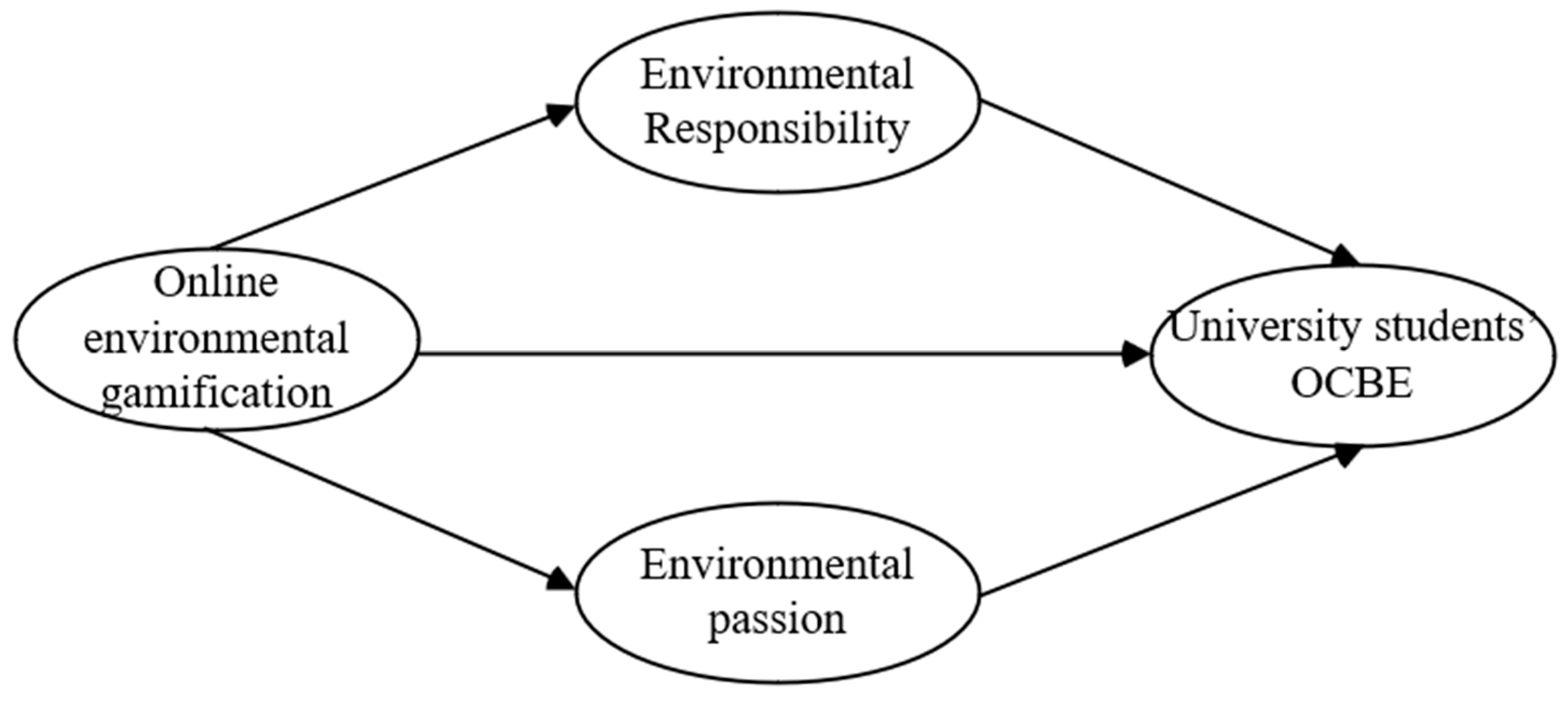
Online Environmental Gamification and University Students’ Pro-Environmental Organizational Citizenship Behaviour: Evidence for a Dual Motivational Mechanism


Abstract
1. Introduction
2. Theoretical Background and Research Hypotheses
2.1. Online Environmental Gamification
2.2. Online Environmental Gamification and OCBE
2.3. The Mediating Role of Environmental Responsibility
2.4. The Mediating Role of Environmental Passion
3. Method
3.1. Sample
3.2. Measures
3.2.1. Ant Forest Usage
3.2.2. Environmental Responsibility
3.2.3. Environmental Passion
3.2.4. Organizational Citizenship Behaviour for the Environment
3.2.5. Control Variables
3.3. Data Analysis Strategy
4. Results
4.1. Confirmatory Factor Analysis
4.2. Common Method Bias Analysis
4.3. Analysis of Descriptive Statistics and Correlations
4.4. Hypothesis Testing
5. Discussion
6. Conclusions
6.1. Theoretical Implications
6.2. Practical Implications
6.3. Limitations and Future Research
Supplementary Materials
Author Contributions
Funding
Institutional Review Board Statement
Informed Consent Statement
Data Availability Statement
Conflicts of Interest
References
- Zhou, Y.; Gu, B. The impacts of human activities on Earth Critical Zone. Earth Crit. Zone 2024, 1, 100004. [Google Scholar] [CrossRef]
- Aliu, O.; Sarumi, O. The Role of Circular Economy in Achieving Sustainability: A Case Study of Songhai Integrated Farming Initiatives. Int. J. Humanit. Soc. Sci. Manag. 2025, 5, 931–941. [Google Scholar]
- Mabkhot, H.; Semlali, Y.; Gelaidan, H.M.; Abdelwahed, N.A.A.; Shaari, H. Unveiling Green Entrepreneurial Intentions and Behaviour Among Saudi Arabian Youth: Insights and Implications. Discov. Sustain. 2024, 5, 480. [Google Scholar] [CrossRef]
- Qu, Y.; Xu, Z.; Sun, H.; Li, Q. The effect of self-sacrificial leadership on employees’ organisational citizenship behaviour for the environment: A moderated mediation model. Int. J. Environ. Res. Public Health 2022, 19, 7450. [Google Scholar] [CrossRef]
- Sahar, N.e.; Zawawi, D.; Jaharuddin, N.S.; Abbasi, M.A. Responsible leadership and organisational citizenship behaviour for the environment: Mediated by environmental corporate social responsibility. Int. J. Ethics Syst. 2025, 41, 353–371. [Google Scholar] [CrossRef]
- Chen, Y.-S.; Yan, X.; Liew, C.-B.A. University social responsibility in China: The mediating role of green psychological capital. Int. J. Environ. Res. Public Health 2023, 20, 3634. [Google Scholar] [CrossRef]
- Han, Z.; Jiang, C.; Li, J. Stimulating Chinese college students’ organizational citizenship behavior toward the environment: The role of pro-environmental organizational climate, green self-efficacy and intrinsic motivation. Int. J. Sustain. High. Educ. 2025. [Google Scholar] [CrossRef]
- Kalluri, B.; Vishnupriya, V.; Arjunan, P.; Dhariwal, J. Net-zero energy campuses in India: Blending education and governance for sustainable and just transition. Sustainability 2024, 16, 87. [Google Scholar] [CrossRef]
- Boncu, Ș.; Candel, O.-S.; Popa, N.L. Gameful green: A systematic review on the use of serious computer games and gamified mobile apps to foster pro-environmental information, attitudes and behaviors. Sustainability 2022, 14, 10400. [Google Scholar] [CrossRef]
- Georgiou, Y.; Hadjichambis, A.C.; Paraskeva-Hadjichambi, D.; Adamou, A. “From gamers into environmental citizens”: A systematic literature review of empirical research on behavior change games for environmental citizenship. Multimodal Technol. Interact. 2023, 7, 80. [Google Scholar] [CrossRef]
- Lim, W.M.; Das, M.; Sharma, W.; Verma, A.; Kumra, R. Gamification for sustainable consumption: A state-of-the-art overview and future agenda. Bus. Strategy Environ. 2025, 34, 1510–1549. [Google Scholar] [CrossRef]
- Mischel, W.; Shoda, Y. A cognitive-affective system theory of personality: Reconceptualizing situations, dispositions, dynamics, and invariance in personality structure. Psychol. Rev. 1995, 102, 246. [Google Scholar] [CrossRef] [PubMed]
- Ouariachi, T.; Li, C.-Y.; Elving, W.J. Gamification approaches for education and engagement on pro-environmental behaviors: Searching for best practices. Sustainability 2020, 12, 4565. [Google Scholar] [CrossRef]
- Sailer, M.; Hense, J.U.; Mayr, S.K.; Mandl, H. How gamification motivates: An experimental study of the effects of specific game design elements on psychological need satisfaction. Comput. Hum. Behav. 2017, 69, 371–380. [Google Scholar] [CrossRef]
- Zhang, H.; Jiang, X.; Cao, Y.; Ding, Z. Research on the influence of green gamification design on the pro-environmental behavior of the young generation. Coal Econ. Res. 2025, 45, 160–169. [Google Scholar] [CrossRef]
- Ji, L. Research on the Nudging Mechanism of Gamification Design Boosting Youths’ Participation in Public Welfare Activities: A Case Study of Ant Forest. Master’s Thesis, Jiangxi University of Finance and Economics, Nanchang, China, 2025. [Google Scholar]
- Chen, Y.; Cai, D. Ant forest through the haze: A case study of gamified participatory pro-environmental communication in China. J 2019, 2, 467–479. [Google Scholar] [CrossRef]
- Zhang, W.; Yang, J.; Zhang, Z. From Virtual Trees to Real Forests: Public Participation in Virtual Forest Realization Projects in China. Forests 2024, 15, 1741. [Google Scholar] [CrossRef]
- Zeng, Z.; Zhong, W.; Naz, S. Can environmental knowledge and risk perception make a difference? The role of environmental concern and pro-environmental behavior in fostering sustainable consumption behavior. Sustainability 2023, 15, 4791. [Google Scholar] [CrossRef]
- Saifulina, N.; Carballo-Penela, A.; Ruzo-Sanmartin, E. Harmonious environmental passion and voluntary pro-environmental behavior at home and at work: A moderated mediation model to examine the role of cultural femininity. Environ. Dev. Sustain. 2024, 1–21. [Google Scholar] [CrossRef]
- Boiral, O.; Paillé, P. Organizational citizenship behaviour for the environment: Measurement and validation. J. Bus. Ethics 2012, 109, 431–445. [Google Scholar] [CrossRef]
- Marković, E.; Krulj, J.; Lazović, N.; Simijonović, I. Educational and psychological aspects of developing of ecological identity. Sci. Int. J. 2024, 3, 97–100. [Google Scholar] [CrossRef]
- Wang, X.; Yao, X. Fueling pro-environmental behaviors with gamification design: Identifying key elements in ant forest with the kano model. Sustainability 2020, 12, 2213. [Google Scholar] [CrossRef]
- Kisurina, A. Gamifying Sustainability: Motivating Pro-Environmental Behavior Change Through Gamification. Case of JouleBug. Master’s Thesis, Lappeenranta University of Technology, Lappeenranta, Finland, 2017. [Google Scholar]
- Behroozi, A. Promoting Pro-Environmental Behavior for Sustainable Water Resource Management: A Social Exchange Perspective. In Promoting Pro-Environmental Behavior for Sustainable Water Resource Management: A Social Exchange Perspective; Qeios: London, UK, 2023. [Google Scholar]
- Si, W.; Jiang, C.; Meng, L. The relationship between environmental awareness, habitat quality, and community residents’ pro-environmental behavior—Mediated effects model analysis based on social capital. Int. J. Environ. Res. Public Health 2022, 19, 13253. [Google Scholar] [CrossRef] [PubMed]
- Sun, Y.; Xing, J. The impact of gamification motivation on green consumption behavior—An empirical study based on ant forest. Sustainability 2022, 15, 512. [Google Scholar] [CrossRef]
- Stern, P.C. New environmental theories: Toward a coherent theory of environmentally significant behavior. J. Soc. Issues 2000, 56, 407–424. [Google Scholar] [CrossRef]
- Schwartz, S.H. Normative influences on altruism. In Advances in Experimental Social Psychology; Elsevier: Amsterdam, The Netherlands, 1977; Volume 10, pp. 221–279. [Google Scholar]
- Fiorenza, M. Psychological Drivers of Environmental Action: From Attitudes and Identity to Readiness to Change. 2025. Available online: https://flore.unifi.it/handle/2158/1420792 (accessed on 23 October 2025).
- Vedantam, A.; Suresh, N.C.; Ajmal, K.; Shelly, M. Impact of China’s National Sword Policy on the U.S. Landfill and Plastics Recycling Industry. Sustainability 2022, 14, 2456. [Google Scholar] [CrossRef]
- Tchiroyan, Z. Improving Energy Efficiency at CSUN Through Data-Driven HVAC Optimization. Ph.D. Thesis, California State University, Northridge, CA, USA, 2025. [Google Scholar]
- Wittayakom, S. Gamification Strategies to Enhance Environmental Awareness in Sustainable Retail: A Systematic Literature Review. Pak. J. Life Soc. Sci. (PJLSS) 2025, 23, 8314–8342. [Google Scholar] [CrossRef]
- Gulliver, R.E.; Fielding, K.S.; Louis, W.R. An investigation of factors influencing environmental volunteering leadership and participation behaviors. Nonprofit Volunt. Sect. Q. 2023, 52, 397–420. [Google Scholar] [CrossRef]
- Gousse-Lessard, A.-S.; Vallerand, R.J.; Carbonneau, N.; Lafrenière, M.-A.K. The role of passion in mainstream and radical behaviors: A look at environmental activism. J. Environ. Psychol. 2013, 35, 18–29. [Google Scholar] [CrossRef]
- Shah, S.H.A.; Fahlevi, M.; Rahman, E.Z.; Akram, M.; Jamshed, K.; Aljuaid, M.; Abbas, J. Impact of green servant leadership in Pakistani small and medium enterprises: Bridging pro-environmental behaviour through environmental passion and climate for green creativity. Sustainability 2023, 15, 14747. [Google Scholar] [CrossRef]
- Yuan, B.; Li, J. Understanding the impact of environmentally specific servant leadership on employees’ pro-environmental behaviors in the workplace: Based on the proactive motivation model. Int. J. Environ. Res. Public Health 2023, 20, 567. [Google Scholar] [CrossRef]
- Lee, J.; Song, H.-D.; Hong, A.J. Exploring factors, and indicators for measuring students’ sustainable engagement in e-learning. Sustainability 2019, 11, 985. [Google Scholar] [CrossRef]
- Novo, C.; Zanchetta, C.; Goldmann, E.; de Carvalho, C.V. The use of gamification and web-based apps for sustainability education. Sustainability 2024, 16, 3197. [Google Scholar] [CrossRef]
- Cheng, X.; Long, R.; Wu, F. How symbols and social interaction influence the experienced utility of sustainable lifestyle guiding policies: Evidence from eastern China. Int. J. Environ. Res. Public Health 2022, 19, 4305. [Google Scholar] [CrossRef] [PubMed]
- Wang, J. The Motivations of Users to Participate in Sustainable Projects on Mobile Applications: The Case of Antforest. Master’s Thesis, Norwegian School of Economics, Bergen, Norway, 2023. [Google Scholar]
- Russell, S.V.; Ashkanasy, N.M. Pulling on heartstrings: Three studies of the effectiveness of emotionally framed communication to encourage workplace pro-environmental behavior. Sustainability 2021, 13, 10161. [Google Scholar] [CrossRef]
- Liu, Y.; Wang, S.; Yu, G. The nudging effect of AIGC labeling on users’ perceptions of automated news: Evidence from EEG. Front. Psychol. 2023, 14, 1277829. [Google Scholar] [CrossRef]
- Ren, X. From virtual to real media mobilization: An investigation into the impact of new media product usage on college students’ pro-environmental behavioral intentions. New Media Res. 2021, 7, 29–35. [Google Scholar] [CrossRef]
- Hu, Y.; Zhang, X. Gamification strategies of environmental communication in the Internet age: A case study of “Ant Forest”. J. Lover 2018, 2018, 74–77. [Google Scholar] [CrossRef]
- Stone, G.; Barnes, J.H.; Montgomery, C. Ecoscale: A scale for the measurement of environmentally responsible consumers. Psychol. Mark. 1995, 12, 595–612. [Google Scholar] [CrossRef]
- Robertson, J.L.; Barling, J. Greening organizations through leaders’ influence on employees’ pro-environmental behaviors. J. Organ. Behav. 2013, 34, 176–194. [Google Scholar] [CrossRef]
- Dumont, J.; Shen, J.; Deng, X. Effects of green HRM practices on employee workplace green behavior: The role of psychological green climate and employee green values. Hum. Resour. Manag. 2017, 56, 613–627. [Google Scholar] [CrossRef]
- Hu, L.-t.; Bentler, P.M. Cutoff criteria for fit indexes in covariance structure analysis: Conventional criteria versus new alternatives. Struct. Equ. Model. A Multidiscip. J. 1999, 6, 1–55. [Google Scholar] [CrossRef]
- Henseler, J.; Ringle, C.M.; Sarstedt, M. A new criterion for assessing discriminant validity in variance-based structural equation modeling. J. Acad. Mark. Sci. 2015, 43, 115–135. [Google Scholar] [CrossRef]
- Podsakoff, P.M.; MacKenzie, S.B.; Lee, J.-Y.; Podsakoff, N.P. Common method biases in behavioral research: A critical review of the literature and recommended remedies. J. Appl. Psychol. 2003, 88, 879. [Google Scholar] [CrossRef] [PubMed]
- Preacher, K.J.; Hayes, A.F. SPSS and SAS procedures for estimating indirect effects in simple mediation models. Behav. Res. Methods Instrum. Comput. 2004, 36, 717–731. [Google Scholar] [CrossRef]
- Jankelová, N.; Némethová, I.; Dabić, M.; Kallmuenzer, A. Enhancing organizational citizenship behavior towards the environment. Rev. Manag. Sci. 2025, 19, 899–930. [Google Scholar] [CrossRef]
- Liu, X.; Yu, X. Green transformational leadership and employee organizational citizenship behavior for the environment in the manufacturing industry: A social information processing perspective. Front. Psychol. 2023, 13, 1097655. [Google Scholar] [CrossRef]
- Seaborn, K.; Fels, D.I. Gamification in theory and action: A survey. Int. J. Hum. Comput. Stud. 2015, 74, 14–31. [Google Scholar] [CrossRef]
- Hamari, J.; Koivisto, J.; Sarsa, H. Does gamification work?—A literature review of empirical studies on gamification. In Proceedings of the 2014 47th Hawaii International Conference on System Sciences, Waikoloa, HI, USA, 6–9 January 2014; pp. 3025–3034. [Google Scholar]
- Mi, L.; Xu, T.; Sun, Y.; Zhao, J.; Lv, T.; Gan, X.; Shang, K.; Qiao, L. Playing Ant Forest to promote online green behavior: A new perspective on uses and gratifications. J. Environ. Manag. 2021, 278, 111544. [Google Scholar] [CrossRef]
- Obuobi, B.; Tang, D.; Awuah, F.; Nketiah, E.; Adu-Gyamfi, G. Utilizing Ant Forest technology to foster sustainable behaviors: A novel approach towards environmental conservation. J. Environ. Manag. 2024, 359, 121038. [Google Scholar] [CrossRef]
- Taşkın, N.; Kılıç Çakmak, E. Effects of gamification on behavioral and cognitive engagement of students in the online learning environment. Int. J. Hum. Comput. Interact. 2023, 39, 3334–3345. [Google Scholar] [CrossRef]


| Model | χ2 | df | χ2/df | CFI | TLI | RMSEA | SRMR |
|---|---|---|---|---|---|---|---|
| Four-factor model (AFU, ER, EP, OCBE) | 477.795 | 246 | 1.942 | 0.918 | 0.908 | 0.053 | 0.055 |
| Three-factor model (AFU + ER, EP, OCBE) | 713.936 | 249 | 2.867 | 0.836 | 0.818 | 0.075 | 0.082 |
| Two-factor model (AFU + ER + EP, OCBE) | 813.987 | 251 | 3.243 | 0.802 | 0.782 | 0.082 | 0.076 |
| Single-factor model (AFU + ER + EP + OCBE) | 999.211 | 252 | 3.965 | 0.737 | 0.712 | 0.095 | 0.084 |
| Construct | AFU | ER | EP | OCBE |
|---|---|---|---|---|
| AFU | 0.687 | |||
| ER | 0.338 | 0.614 | ||
| EP | 0.430 | 0.688 | 0.674 | |
| OCBE | 0.407 | 0.520 | 0.763 | 0.64 |
| Construct | AFU | ER | EP | OCBE |
|---|---|---|---|---|
| AFU | - | 0.434 | 0.317 | 0.421 |
| ER | 0.434 | - | 0.665 | 0.768 |
| EP | 0.317 | 0.665 | - | 0.514 |
| OCBE | 0.421 | 0.768 | 0.514 | - |
| Variables | M | SD | 1 | 2 | 3 | 4 | 5 | 6 |
|---|---|---|---|---|---|---|---|---|
| 1. Gender | 1.721 | 0.449 | ||||||
| 2. Edu | 2.090 | 0.476 | −0.023 | |||||
| 3. Grade | 3.168 | 0.865 | −0.042 | −0.190 ** | ||||
| 4. AFU | 4.230 | 0.500 | −0.062 | 0.137 * | −0.027 | |||
| 5. ER | 4.304 | 0.451 | −0.063 | 0.079 | −0.118 * | 0.234 ** | ||
| 6. EP | 3.904 | 0.582 | −0.190 ** | −0.034 | −0.099 | 0.348 ** | 0.517 ** | |
| 7. OCBE | 3.811 | 0.576 | −0.170 ** | −0.026 | −0.037 | 0.339 ** | 0.401 ** | 0.665 ** |
| Variables | OCBE | EP | ER | |||
|---|---|---|---|---|---|---|
| M1 | M2 | M3 | M4 | M5 | M6 | |
| Control variables | ||||||
| Gender | −0.173 ** | −0.153 ** | −0.135 ** | −0.048 | −0.176 ** | −0.053 |
| Grade | −0.052 | −0.051 | −0.014 | 0.025 | −0.118 * | −0.109 * |
| Education | −0.039 | −0.085 | −0.094 | −0.025 | −0.108 * | 0.026 |
| Independent Variable | ||||||
| AFU | 0.340 ** | 0.265 ** | 0.122 ** | 0.349 ** | 0.224 ** | |
| Mediators | ||||||
| ER | 0.336 ** | |||||
| EP | 0.614 ** | |||||
| R2 | 0.032 | 0.145 | 0.251 | 0.463 | 0.170 | 0.071 |
| Adjusted R2 | 0.023 | 0.135 | 0.239 | 0.453 | 0.160 | 0.059 |
| F | 3.659 * | 13.953 ** | 21.867 ** | 46.803 ** | 16.812 ** | 6.227 ** |
Disclaimer/Publisher’s Note: The statements, opinions and data contained in all publications are solely those of the individual author(s) and contributor(s) and not of MDPI and/or the editor(s). MDPI and/or the editor(s) disclaim responsibility for any injury to people or property resulting from any ideas, methods, instructions or products referred to in the content. |
© 2025 by the authors. Licensee MDPI, Basel, Switzerland. This article is an open access article distributed under the terms and conditions of the Creative Commons Attribution (CC BY) license (https://creativecommons.org/licenses/by/4.0/).
Share and Cite
Huang, Z.; Huang, J.; Han, Z. Online Environmental Gamification and University Students’ Pro-Environmental Organizational Citizenship Behaviour: Evidence for a Dual Motivational Mechanism. Sustainability 2025, 17, 11038. https://doi.org/10.3390/su172411038
Huang Z, Huang J, Han Z. Online Environmental Gamification and University Students’ Pro-Environmental Organizational Citizenship Behaviour: Evidence for a Dual Motivational Mechanism. Sustainability. 2025; 17(24):11038. https://doi.org/10.3390/su172411038
Chicago/Turabian StyleHuang, Ziwei, Jingjie Huang, and Zhiyong Han. 2025. "Online Environmental Gamification and University Students’ Pro-Environmental Organizational Citizenship Behaviour: Evidence for a Dual Motivational Mechanism" Sustainability 17, no. 24: 11038. https://doi.org/10.3390/su172411038
APA StyleHuang, Z., Huang, J., & Han, Z. (2025). Online Environmental Gamification and University Students’ Pro-Environmental Organizational Citizenship Behaviour: Evidence for a Dual Motivational Mechanism. Sustainability, 17(24), 11038. https://doi.org/10.3390/su172411038