Article

Identification of Organizational Efficiency Profiles Based on Human Capital Management: A Study Using Principal Component Analysis and Clustering Algorithms


by
Bill Serrano-Orellana
1,*,
Jessica Ivonne Lalangui Ramírez
2,
Néstor Daniel Gutiérrez Jaramillo
1,
Lia Rodríguez-Jaramillo
1 and
Johanna Lara-Guamán
1
1
Faculty of Business Sciences, Universidad Técnica de Machala, Machala 070102, Ecuador
2
Faculty of Economic and Business Sciences, Universidad Metropolitana, Guayaquil 070102, Ecuador
*
Author to whom correspondence should be addressed.
Sustainability 2025, 17(24), 11037; https://doi.org/10.3390/su172411037
Submission received: 10 November 2025 / Revised: 3 December 2025 / Accepted: 4 December 2025 / Published: 10 December 2025
(This article belongs to the Section Economic and Business Aspects of Sustainability)

Abstract

This study analyzes the determinants of organizational performance and efficiency in Ecuadorian banana-exporting firms, considering human capital management as a strategic axis of competitiveness. Based on a cross-sectional quantitative design, a structured questionnaire was administered to 513 employees from companies registered in the El Oro Chamber of Commerce. The survey evaluated indicators of human capital, organizational climate, leadership, and competencies. To reduce dimensionality and uncover latent patterns, a Principal Component Analysis (PCA) was performed, followed by unsupervised clustering algorithms (K-means and Ward’s method). The results identified three principal components: (i) specific human capital and job support, (ii) general human capital and inter-area coordination, and (iii) applied competencies and current performance, jointly explaining more than 54% of the total variance. The segmentation revealed two major efficiency profiles: one of high specific deployment, characterized by greater training, tenure, and managerial support; and another of low deployment, dependent on individual effort. The evidence confirms that organizational efficiency is grounded in the articulation between idiosyncratic learning, managerial accompaniment, and structured processes. The study extends the application of the Resource-Based View (VRIO framework) to the agro-export context and proposes a replicable multivariate analytics model for diagnosing and strengthening human capital management in labor-intensive sectors.

1. Introduction

T Organizational efficiency has become a strategic pillar of competitiveness among Ecuadorian banana-exporting companies, a sector that in 2024 accounted for more than USD 3.8 billion and 6.1 million tons—equivalent to 27% of the country’s total agricultural exports [1].
Although technological advances have optimized traceability and logistics, the labor-intensive nature of this production chain continues to position human capital as the main determinant of overall performance. From the perspective of the Resource-Based View (VRIO framework), workers who possess valuable, rare, inimitable, and organizable characteristics constitute a source of sustainable competitive advantage [2]. Nevertheless, empirical evidence suggests that many exporting companies still manage their human capital through traditional operational approaches, lacking standardized measurement tools and statistical analysis of performance determinants [3]. This lack of systematization creates gaps between day-to-day management and the high-performance practices recommended by the international literature, limiting the sector’s ability to respond to growing market pressures, social sustainability demands, and environmental certification requirements.
Recent literature highlights the need to understand organizational efficiency as a multidimensional interaction among human capital, organizational structure, and leadership [4,5]. Within this framework, efficiency ceases to be an exclusively technical or financial outcome and instead depends on the organization’s ability to develop, integrate, and retain talent. Tangible factors—such as experience, training, and job tenure—combine with intangible ones—such as organizational climate, soft skills, and satisfaction with leadership—to explain variability in productivity and organizational adaptability [6]. Comparative evidence demonstrates that systematic training programs reduce turnover and improve productivity, while participatory work environments and supportive structures enhance innovation and employee engagement [5,7]. However, most of these studies focus on industrial or service sectors, leaving agro-export contexts underexplored, where labor informality and reliance on manual work alter the classical dynamics of human capital [8].
At the regional level, Latin American research has shown limited progress in applying multivariate analytical models that integrate human capital, leadership, and organizational structure [9]. Descriptive or correlational diagnostics predominate and often fail to identify latent efficiency patterns, whereas data-analytic approaches—such as the combination of Principal Component Analysis (PCA) and clustering algorithms—have demonstrated, in other contexts, a strong capacity to uncover managerial typologies and predict performance outcomes [10,11]. Incorporating these techniques into the study of Ecuadorian banana-exporting firms not only fills an empirical gap but also enables the generation of replicable evidence to inform training policies and support the long-term sustainability of the agro-export sector.
Hence, the relevance of addressing organizational efficiency analysis from a multivariate empirical approach lies in its ability to reveal the combinations of human and structural factors that drive productivity in banana-exporting firms. This study specifically proposes to integrate human capital—both general and firm-specific—with leadership, climate, and structural variables through advanced statistical techniques that overcome the limitations of conventional linear models. The objective is to generate a map of efficiency profiles that identifies performance typologies and guides evidence-based strategies for training and management.
Based on this review and the identified gap, the present study aims to identify organizational efficiency profiles in Ecuadorian banana-exporting firms using indicators of human capital management, integrating quantitative and perceptual variables through multivariate techniques. Specifically, it seeks to (i) analyze the underlying dimensions of human capital, leadership, and organizational climate through Principal Component Analysis (PCA); (ii) classify workers into homogeneous efficiency groups using unsupervised clustering algorithms (K-means and Ward’s method); and (iii) interpret the resulting profiles according to their potential contribution to organizational efficiency and corporate sustainability.
This approach operationalizes the VRIO constructs within an agro-export context and provides three main contributions: a theoretical one, by expanding the understanding of the link between human capital and efficiency in traditional sectors; a methodological one, by proposing a replicable multivariate analysis model that combines objective data with subjective perceptions; and a practical one, by offering a diagnostic tool that facilitates the allocation of training resources, career planning, and talent optimization. Taken together, the results indicate that organizational efficiency in the banana sector does not depend solely on individual effort but on the systemic integration of learning, leadership, and processes, reinforcing the need for data-driven management oriented toward sustainable results.

1.1. Conceptual Foundations of Organizational Efficiency

Organizational efficiency is understood as an organization’s ability to achieve its objectives through the optimal use of available resources, combining productivity, quality, innovation, and sustainability [12]. From a systemic perspective, efficiency does not stem solely from technical or financial processes but from the comprehensive alignment among people, structures, and strategy [13,14]. This approach recognizes organizations as open systems in which collective performance emerges from the interaction of multiple human and contextual factors, including organizational culture, leadership, and employee competencies [15].
Within this framework, strategic human capital management (HCM) is consolidated as the central axis of organizational efficiency. Contemporary theories of talent management propose that organizational performance depends on a firm’s ability to attract, develop, and retain high-potential employees [16,17]. According to the Resource-Based View (VRIO framework), these employees become strategic assets when their knowledge and skills are valuable, rare, difficult to imitate, and properly organized [2]. Consequently, efficiency is not measured solely by operational outcomes but also by the organization’s ability to transform human capital into a source of sustainable competitive advantage [9].

1.2. Human Capital and Organizational Efficiency

The concept of human capital refers to the set of knowledge, skills, and attitudes that individuals apply in their work to create value [18]. In the contemporary literature, a distinction is made between general human capital—training and experience transferable across sectors—and specific (firm/industry-specific) human capital, which is linked to knowledge and skills valuable primarily within the organization [19,20]. Both types of capital influence efficiency; however, the latter tends to generate higher returns when combined with organizational structures that foster learning and coordination [21,22].
Recent studies emphasize that specific human capital acts as a buffer against environmental uncertainty by facilitating process adaptation and the resolution of operational problems [5,23,24]. In agro-exporting firms, where seasonality and labor intensity lead to high turnover rates, investment in specific human capital becomes crucial for maintaining productivity and reducing replacement costs [25,26]. Therefore, strengthening job-related competencies and consolidating continuous learning structures emerge as critical mechanisms for efficiency and sustainability.
Likewise, human capital does not operate in isolation; it requires an organizational environment that promotes internal coherence between strategy and management practices [4]. This coherence, known as organizational fit, ensures that human resources are aligned toward creating collective value and achieving sustainable outcomes. Empirical evidence across different sectors shows that firms with greater investment in employee development and with learning-supportive cultures achieve higher levels of financial and social performance [27,28].

1.3. Competencies, Leadership, and Organizational Climate

The analysis of contemporary human capital goes beyond the traditional notion of training or experience and incorporates the dimension of workplace competencies. These represent the integration of knowledge, skills, and attitudes that enable individuals to perform effectively in specific contexts [29,30]. Transversal competencies—such as communication, adaptability, and innovation—have become key predictors of organizational efficiency [12]. From a strategic perspective, competency development generates dynamic human capital, that is, the ability to learn and unlearn in response to environmental changes [9].
In turn, leadership plays a mediating role between talent and efficiency. Transformational and participative leadership models are associated with healthier organizational climates in which employees perceive support, fairness, and recognition [5,31]. These perceptions strengthen organizational trust and identification with institutional goals, thereby enhancing collective efficiency. In contrast, authoritarian or overly controlling leadership styles lead to demotivation and reduce organizational learning capacity—a critical factor in export-oriented contexts where adaptability is essential.
Organizational climate—understood as the set of shared perceptions regarding internal practices, policies, and processes—acts as a catalyst for the relationships among leadership, commitment, and performance [32,33]. Recent research has demonstrated that climates characterized by support, fairness, and open communication enhance operational efficiency and talent retention [8,11]. Thus, organizational climate functions as a mediator between human capital and efficiency, reinforcing the notion that people management cannot be detached from workplace culture and psychosocial working conditions.

1.4. Multivariate Approaches in the Study of Efficiency

The inherent complexity of organizational phenomena has driven the adoption of multivariate techniques that enable the simultaneous analysis of multiple interrelated variables. These tools are particularly useful for identifying hidden patterns and synthesizing information into latent dimensions [34]. Principal Component Analysis (PCA) is used to reduce data dimensionality and reveal the underlying factors that explain the system’s variance, thereby facilitating the structural interpretation of human capital and organizational practices. Subsequently, clustering algorithms—such as K-means or Ward’s hierarchical method—allow for the classification of individuals or firms according to similarities in their behavior or performance [10,35].
In recent organizational research, the combination of Principal Component Analysis (PCA) and clustering has proven to be a powerful strategy for generating efficiency typologies and managerial segmentations [36]. These methods capture the underlying structure of the data without imposing linear assumptions, allowing for the discovery of natural configurations among employees or organizational units. Their application in productive sectors has facilitated the identification of differentiated profiles based on human capital intensity, organizational maturity, and leadership type [11,35]. However, within the Latin American agro-export context, the use of multivariate techniques remains limited, which reinforces the relevance of the present study.

1.5. Conceptual Synthesis

In an integrative manner, the theoretical framework of this study assumes that organizational efficiency results from the interaction among three interdependent components: human capital, representing individual and collective capabilities; organizational conditions, encompassing leadership and workplace climate; and structural processes, responsible for coordination, innovation, and continuous learning.
Under this framework, firms with greater alignment among these three elements tend to exhibit higher profiles of organizational efficiency, measurable through indicators derived from multivariate techniques. The proposed model, grounded in the VRIO framework and human capital theory, establishes that efficiency does not depend on a single resource but on the coherence among human resources, structure, and strategy—forming a dynamic system of sustainable competitive advantage.
Despite these advances, the literature still reveals a notable gap in understanding the multidimensional nature of organizational efficiency within agro-exporting contexts. Most Latin American studies remain limited to descriptive or correlational approaches and rarely integrate human capital, leadership, and structural variables into a unified analytical model. As a result, there is insufficient empirical evidence to explain how these elements interact to shape efficiency patterns in export-oriented industries.
To address this gap, the present study aims to identify organizational efficiency profiles in Ecuadorian banana-exporting firms by integrating human capital, leadership, and organizational climate indicators through multivariate analysis techniques. Specifically, the research seeks to: (i) extract the underlying dimensions of human and organizational factors using Principal Component Analysis (PCA); (ii) classify employees into homogeneous efficiency groups through unsupervised clustering algorithms (K-means and Ward’s method); and (iii) interpret the resulting profiles according to their potential contribution to organizational efficiency and corporate sustainability.
This approach operationalizes the VRIO framework within an agro-export setting and provides three main contributions: (i) a theoretical contribution, by extending the understanding of how human capital and structural alignment generate efficiency in traditional sectors; (ii) a methodological contribution, by applying a replicable multivariate model that integrates objective and perceptual indicators; and (iii) a practical contribution, by offering a data-driven diagnostic tool for training allocation, career planning, and sustainable talent management.
Collectively, the study emphasizes that organizational efficiency in the banana-export sector depends not only on individual effort but on the systemic integration of learning, leadership, and structural processes, reinforcing the value of evidence-based management for sustainable outcomes.

1.6. Sectoral Context: The Ecuadorian Banana Export Industry

The Ecuadorian banana export industry plays a central role in the national economy, both as a major source of foreign exchange and as an important generator of employment along the entire value chain [1]. The sector is characterized by a strong international orientation, with firms competing in demanding external markets that impose strict quality, sustainability and traceability standards. At the same time, production is subject to fluctuations in international prices, phytosanitary risks and changing trade regulations, which create a highly competitive and uncertain environment for exporting companies.
From a labor-market perspective, banana export companies combine formal and informal employment arrangements and rely on a workforce that often faces vulnerabilities in terms of job stability, income levels and access to training opportunities. These conditions make the management of human capital a strategic challenge, as firms need to retain qualified workers, develop relevant skills and capabilities, and foster organizational climates that support productivity and innovation.
In this context, understanding how different configurations of human capital management practices, organizational climate, leadership and competencies are associated with organizational efficiency is particularly relevant. The identification of efficiency profiles based on these dimensions provides not only an analytical contribution but also a practical tool to guide managerial decisions and public policies aimed at strengthening the competitiveness and sustainability of the Ecuadorian banana export sector.

2. Materials and Methods

2.1. Study Design and Approach

The present study is framed within an empirical–analytical strategy, supported by the application of multivariate techniques aimed at identifying latent structures of organizational efficiency based on human capital management indicators.
The analytical approach combines Principal Component Analysis (PCA) and unsupervised clustering algorithms (K-means and Ward’s method) to condense information, reduce dimensionality, and generate an empirical typology of efficiency profiles. This methodological design makes it possible to explore interrelationships among individual, organizational, and structural variables without imposing linear assumptions, which is appropriate for complex phenomena such as organizational efficiency [36].
Thus, the methodology integrates quantitative rigor with an exploratory, pattern-based logic, providing replicable empirical evidence on the factors that shape efficiency in the Ecuadorian agro-export context.

2.2. Population, Sample, and Research Context

The study population consisted of employees and middle managers from banana-exporting companies located in the province of El Oro, Ecuador. This region concentrates one of the highest proportions of national production and exports, making it an ideal reference point for analyzing efficiency from a human capital perspective.
A non-probabilistic purposive sampling method was employed, selecting participants who met the following criteria: (i) belonging to a company with an active export certification; (ii) having at least one year of job tenure; and (iii) possessing experience in administrative or operational processes directly linked to the value chain. The final sample consisted of 513 employees, a figure that exceeds the minimum thresholds recommended for the reliable application of Principal Component Analysis (PCA) [37].
Data collection was carried out between May and July 2025 through a structured self-administered questionnaire. The instrument was previously validated by three experts in organizational management and applied statistics to ensure the relevance of the items and the clarity of the wording.

2.3. Instrument and Analytical Variable

The questionnaire was structured into three sections: (i) Sociodemographic data (age, gender, educational level, and job tenure); (ii) Indicators of human capital and organizational conditions, measured using five-point Likert scales (1 = strongly disagree, 5 = strongly agree); (iii) Perceptions of organizational efficiency, referring to performance, coordination, and outcomes.
The quantitative variables were grouped into conceptual dimensions derived from the theoretical framework (for a clearer understanding, see Table 1): (i) General Human: Total Years Worked, Age; (ii) Specific Human Capital: Annual Training Hours, Continuous Employment Months, Competency Mastery; (iii) Organizational Conditions: Work Environment, Satisfaction with Leadership, Support from Supervisors, Interdepartmental Coordination, Necessary Resources; (iv) Structural Processes: Internal Processes, Clear Instructions, Achievable Goals, Workload, Work Organization, Useful Feedback, Work Efficiency, Current Efficiency.
The internal consistency of each dimension was verified using Cronbach’s alpha coefficient, which yielded values between 0.78 and 0.86, considered satisfactory for exploratory studies [38]. The reliability of the scales was thus confirmed according to international methodological standards.
Prior to analysis, the data were cleaned and normalized using z-score transformation, ensuring comparability among variables and the removal of outliers.

2.4. Analytical Procedure

The statistical analysis was performed using R (version 4.3.3; R Core Team, Vienna, Austria) in the RStudio integrated development environment (version 2025.5.1.513; Posit Software, PBC, Boston, MA, USA), with the FactoMineR, NbClust, cluster, and ggplot2 packages.

2.4.1. Principal Component Analysis (PCA)

The Principal Component Analysis (PCA) was applied to identify the latent dimensions that explain the common variance of the indicators associated with human talent management. PCA is the most widely used data reduction technique for uncovering underlying structures among correlated variables [39]. Its purpose is to transform an original set of observed variables X1, X2,…, Xp —which may exhibit collinearity—into a new set of uncorrelated variables called principal components Z1, Z2, …, Zm, where m < pm.
Mathematically, PCA seeks a linear transformation:
Z = X A
where X is the standardized data matrix of dimension n × p and A is the eigenvector matrix associated with the covariance or correlation matrix S.
Each principal component Zj is defined as:
Zj = a1jX1 + a2jX2 + … + apj Xp
subject to the following constraints:
a′jaj = 1y a′iaj = 0 for i ≠ j
In this way, the components are ordered such that the first component Z1 captures the largest proportion of the total variance, the second component Z2 explains the maximum remaining variance, and so on. The eigenvalues (λj) associated with each component indicate the amount of variance explained, and their sum equals the total variance of the system.
To determine the optimal number of components, two complementary criteria were applied: (i) Kaiser criterion, which retains only the components with λj > 1; (ii) Scree plot, where the elbow of the curve indicates the inflection point beyond which the marginal gain in explained variance stabilizes.
The sampling adequacy of the model was verified using the Kaiser–Meyer–Olkin (KMO) index, which assesses the proportion of common variance among the variables, and Bartlett’s test of sphericity, which tests the null hypothesis that the correlation matrix is an identity matrix. Both indicators confirmed the suitability of the data for factor analysis.
To enhance interpretability, an orthogonal Varimax rotation was applied, maximizing the variance of factor loadings within each component and producing a simpler and conceptually consistent structure. Geometrically, this rotation is equivalent to rotating the axes in the factor space to achieve a clearer association between each variable and its dominant component, while preserving orthogonality among them.
From a visual perspective, the process can be represented through a graphical sequence: (i) The original variable space (X1, X2, X3, …) is projected onto an axis representing the greatest variance (Component 1); (ii) Subsequently, a second orthogonal axis is generated to explain the remaining variance (Component 2); (iii) Each observation is represented as a point in this factorial plane, where the dispersion of points reflects the similarity or dissimilarity among individuals based on the latent factors.
The final outcome of the PCA consists of a factor loading matrix (aij), which indicates the weight of each variable in the retained components, together with a factor score matrix (Zij) that summarizes the coordinates of each individual in the factor space. These scores were subsequently used as input for the clustering analysis to identify profiles of organizational efficiency.

2.4.2. Cluster Analysis

Subsequently, clustering procedures were performed to classify individuals into homogeneous profiles of organizational efficiency. In the first stage, the Ward’s hierarchical method (Ward.D2) was applied to explore the data structure and estimate the preliminary number of clusters. In the second stage, the k-means algorithm was implemented iteratively until the optimal partition of the sample was achieved.
The validation of the number and stability of the groups was conducted using the Silhouette and Calinski–Harabasz indices, along with visual inspection of the dendrogram. These procedures ensured the internal consistency of the clusters and the interpretive robustness of the model.
Cluster analysis is an unsupervised technique aimed at classifying observations into groups that are internally homogeneous and externally heterogeneous, based on the similarity of their characteristics. Mathematically, the procedure seeks a partition of the set of individuals X = {x1, x2,…, xn} into K clusters C1, C2,…, Ck that minimizes within-group variation while maximizing between-group differences.
The optimization criterion can be formally expressed as:
min C 1 , , C K k = 1 K x i C k | x i μ k | 2
where μk represents the centroid of cluster Ck, defined as the vector mean of the observations belonging to that group, and ‖xi − μk2 is the squared Euclidean distance between individual xi and its centroid.
The process is based on the standard Euclidean metric, although it can be generalized to Minkowski or Mahalanobis metrics depending on the nature of the data.
In the first stage, the Ward’s hierarchical method (Ward.D2) was applied to explore the latent structure of the data. This method is grounded in a minimum-loss-of-inertia criterion, where, at each step, two clusters are merged if such a union produces the smallest possible increase in the within-group sum of squares.
Formally, the distance between two clusters A and B is defined as:
D A , B = A B A + B | | x A ¯ x B ¯ | | 2
where ∣A∣ and ∣B∣ denote the cardinalities of the groups, and x A ¯   x B ¯ are their respective centroids.
Ward’s logic preserves internal homogeneity and produces clusters of balanced size—an especially useful property for medium-sized samples such as that of the present study.
The result of the hierarchical procedure is graphically represented through a dendrogram, where the vertical axis reflects the fusion distance and the horizontal axis groups the individual observations. The cut-off point in the dendrogram determines the preliminary number of clusters (k), which was subsequently validated using non-hierarchical methods.
In the second stage, the k-means algorithm was applied, which is widely used for the optimal partitioning of multivariate data. This algorithm begins with an initial assignment of K centroids—obtained from the hierarchical analysis—and iterates through the following steps until convergence: (i) Assign each observation xi to the cluster Ck whose centroid μk minimizes the Euclidean distance d(xi, μk); (ii) recalculate the centroids as the mean of the individuals assigned to each group:
μ k = 1 C k x i C k x i
and (iii) repeat the process until the assignments no longer change significantly or the total inertia criterion reaches a stable local minimum.
The algorithm ensures a reproducible and easily interpretable partition, in which each group can be characterized by its centroid—the mean vector of the factor scores derived from the PCA. The centroids represent the typical profiles of organizational efficiency, while the dispersion within each group reflects individual variability.
Evaluation of Clustering Quality
The consistency and stability of the clustering model were evaluated using both internal and external validity indicators.
For internal validity, the average Silhouette and Calinski–Harabasz (CH) indices were employed, which respectively measure intra-group compactness and inter-group separation [40,41].
Complementarily, the stability of the number of clusters was examined through the visual inspection of the dendrogram and the Elbow plot, where the inflection point indicates the number of groups that best balances internal coherence and parsimony.
From a graphical perspective, the process can be represented in two visual phases:
  • Hierarchical phase. An ascending dendrogram in which the progressive fusions reveal the similarities among individuals and the overall pattern of homogeneity.
  • Non-hierarchical phase. A factorial plane (PCA Component 1 × Component 2) where individuals appear grouped around centroids, and the distance between clusters reflects structural differences in the profiles of organizational efficiency.
The final result of the cluster analysis is a partition of the factorial space into well-defined regions, each associated with an efficiency profile characterized by specific combinations of human capital, leadership, and organizational structure. These groups constitute the empirical basis for the interpretation of results and the formulation of differentiated talent management strategies.

3. Results

3.1. Sample Description

The average age of participants was 36.37 years (SD = 8.64; range: 21–65), and their Total Years Worked averaged 12.53 years (SD = 8.21; range: 1–35). Regarding job tenure, employees reported an average of 42.41 Continuous Employment Months (SD = 44.05; range: 0–250), and Annual Training Hours averaged 58.18 (SD = 44.71; range: 5–276), indicating a heterogeneous investment in training across workers (see Table 2).
For Likert-type variables (1–5), perceptions were moderate to high and generally above the midpoint. The highest scores were observed for Work Organization (M = 3.96; SD = 0.75), Competency Mastery (M = 3.92; SD = 0.70), Internal Processes (M = 3.90; SD = 0.80), Clear Instructions (M = 3.89; SD = 0.81), Satisfaction with Leadership (M = 3.88; SD = 0.88), Achievable Goals (M = 3.88; SD = 0.84), Support from Supervisors (M = 3.87; SD = 0.79), Current Efficiency (M = 3.87; SD = 0.77), and Work Efficiency (M = 3.85; SD = 0.84).
Other positively rated factors included Useful Feedback (M = 3.85; SD = 0.80), Workload (M = 3.78; SD = 0.78), Necessary Resources (M = 3.77; SD = 0.89), and Interdepartmental Coordination (M = 3.80; SD = 0.84). The lowest score corresponded to Achievable Goals (M = 3.46; SD = 1.14), which also exhibited the highest dispersion, suggesting heterogeneity in employee perceptions regarding goal feasibility and organizational alignment.

3.2. Principal Component Analysis (PCA)

The PCA conducted on the 18 standardized variables revealed a structure dominated by three components explaining 54.41% of the total variance (PC1 = 34.80%; PC2 = 12.25%; PC3 = 7.36%). PC4 adds 5.53% (cumulative = 59.94%). The scree plot exhibits a clear elbow between PC3 and PC4, and the Kaiser criterion (λ ≥ 1) supports retaining three components (PC4: λ = 0.997, borderline). For a more nuanced operational interpretation, it is informative to also consider PC4 (see Table 3: eigenvalues, and Figure 1: scree plot—Kaiser criterion).
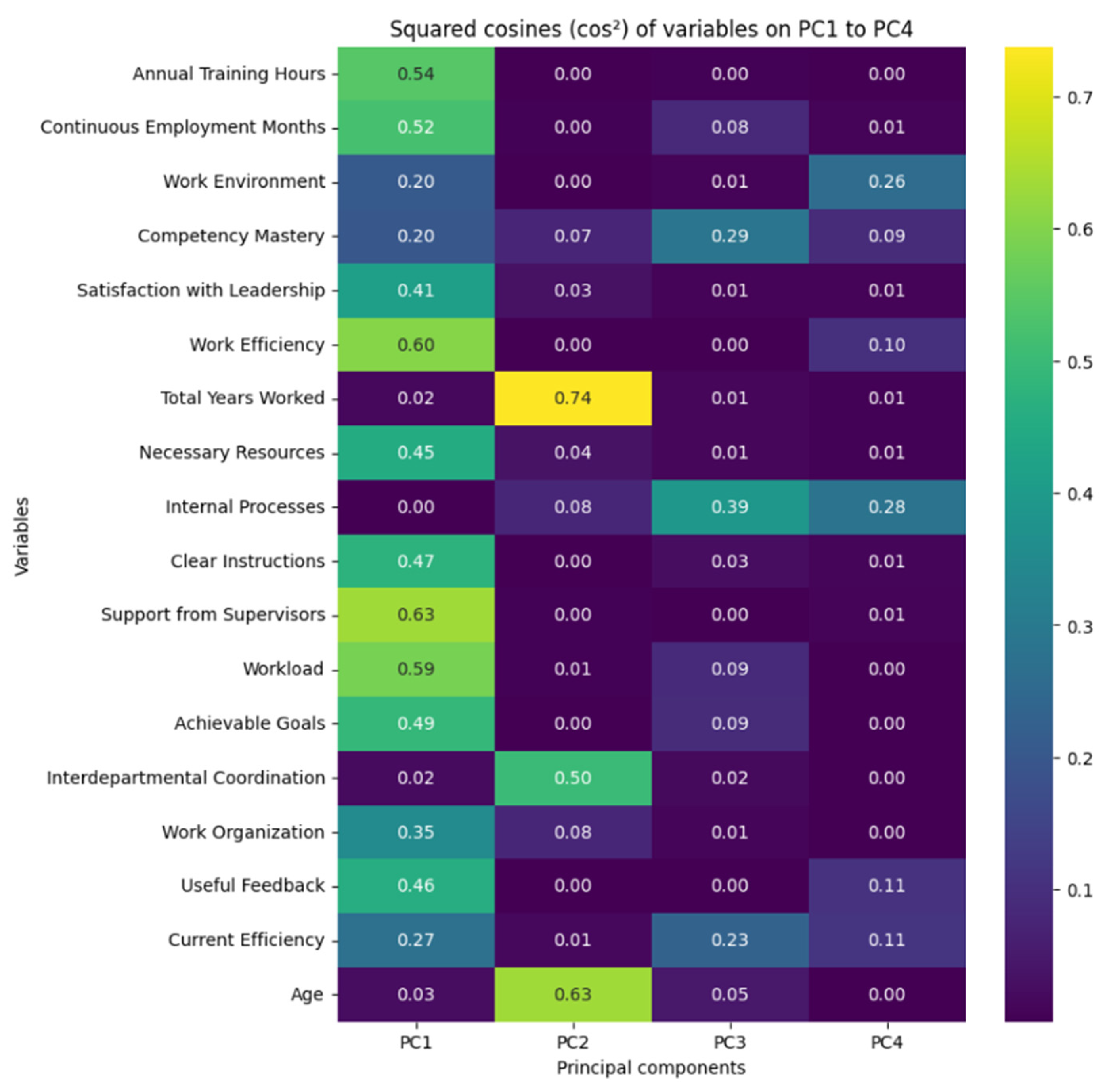
PC1—Deployed Specific Human Capital and Job Support (34.8%): This axis combines (i) firm- or job-specific human capital—annual training hours and months of continuous employment—with (ii) micro-organizational support practices (supervisory support, clear instructions, achievable goals, useful feedback, necessary resources, work organization, workload) that enable the deployment of such capital. The positive and consistent loadings, together with high cos2 values, indicate an operational factor also associated with work efficiency. Substantively, daily productivity increases when idiosyncratic job learning is complemented by managerial guidance and adequate resources (see Table 4: factor loadings, and Figure 2: heatmap of cos2 values).
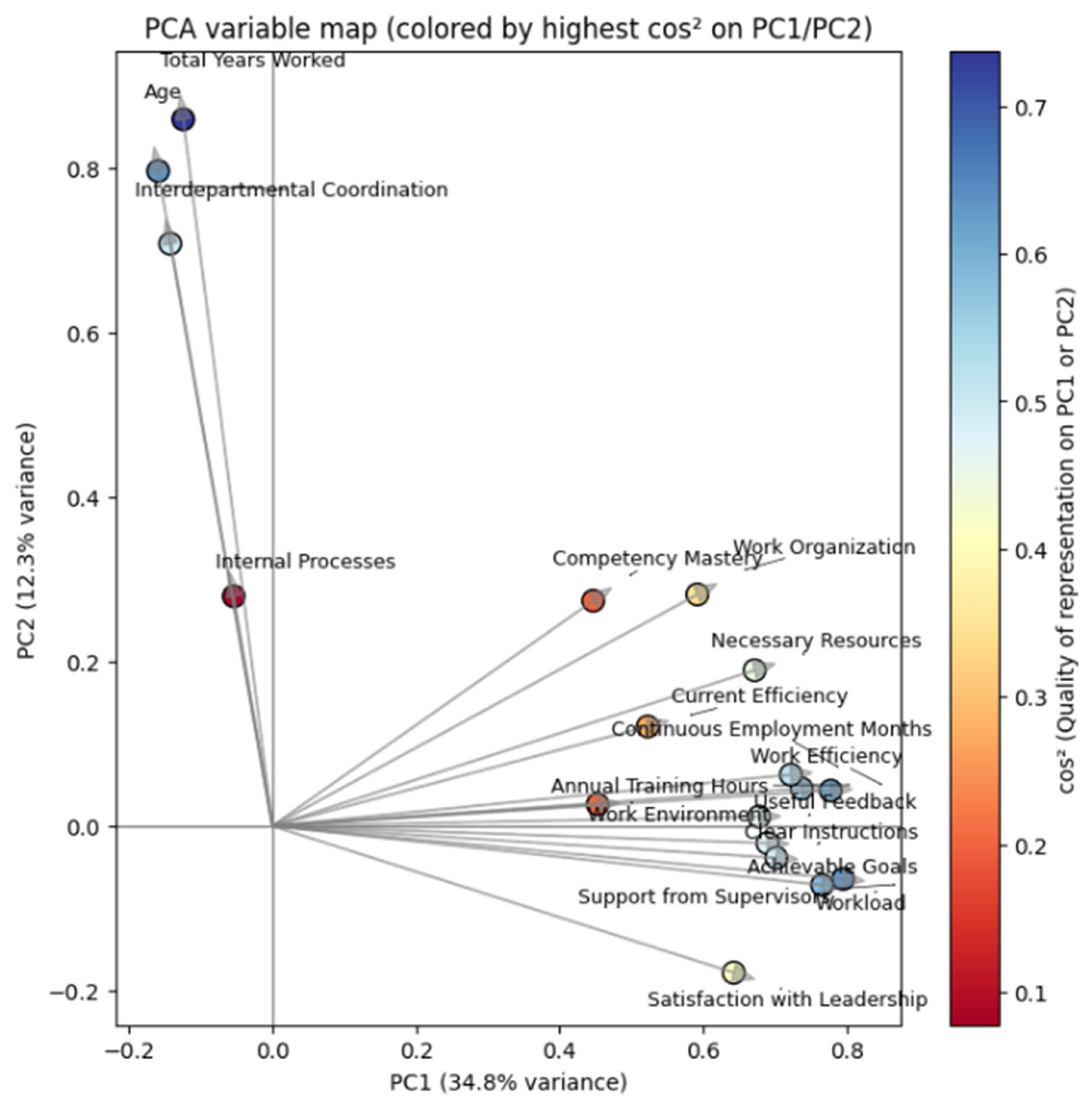
PC2—General Human Capital and Interdepartmental Coordination (12.3%): This component groups total work experience and age (representing transferable general human capital) together with interdepartmental coordination. It reflects a demographic–organizational axis that operates independently from the micro-level support captured by PC1: accumulated career experience facilitates cross-unit articulation, but by itself does not guarantee improved execution conditions (see Table 4 and Figure 3: Variable Map for PC1–PC2).
PC3—Applied Competencies and Current Performance (7.4%): This component shows strong loadings on competency mastery and current efficiency, capturing how specific know-how translates into immediate performance. Internal processes also contribute to this axis, suggesting that the conversion of competencies into performance is enhanced when standardized practices are in place (see Table 3).
PC4—Process Standardization and Work Organization (5.5%): This axis reinforces the operational–structural dimension through internal processes and work organization, which display higher contributions and better representation on the PC3–PC4 plane than on PC1–PC2. Unlike the interpersonal or climate-related dimensions, this component reflects the quality of procedures and structural clarity that reduce dependence on individual effort (see Figure 3).
PC5—Psychosocial Factor (Work Environment): Finally, PC5 isolates a psychosocial trait—work environment—with marginal variance yet relevant as a multiplier of the other dimensions. Taken together, these axes distinguish between firm-specific learning and applied competencies (PC1, PC3), general career trajectory (PC2), and structural conditions enabling execution (PC4/PC5). The resulting factor scores (PC1–PC3, with PC4 included when explicitly capturing “processes”) were subsequently used as inputs for the identification of efficiency profiles through clustering algorithms, presented in the next section.

3.3. Identification of Profiles Through Clustering Algorithms

3.3.1. Selection of the Number of Clusters

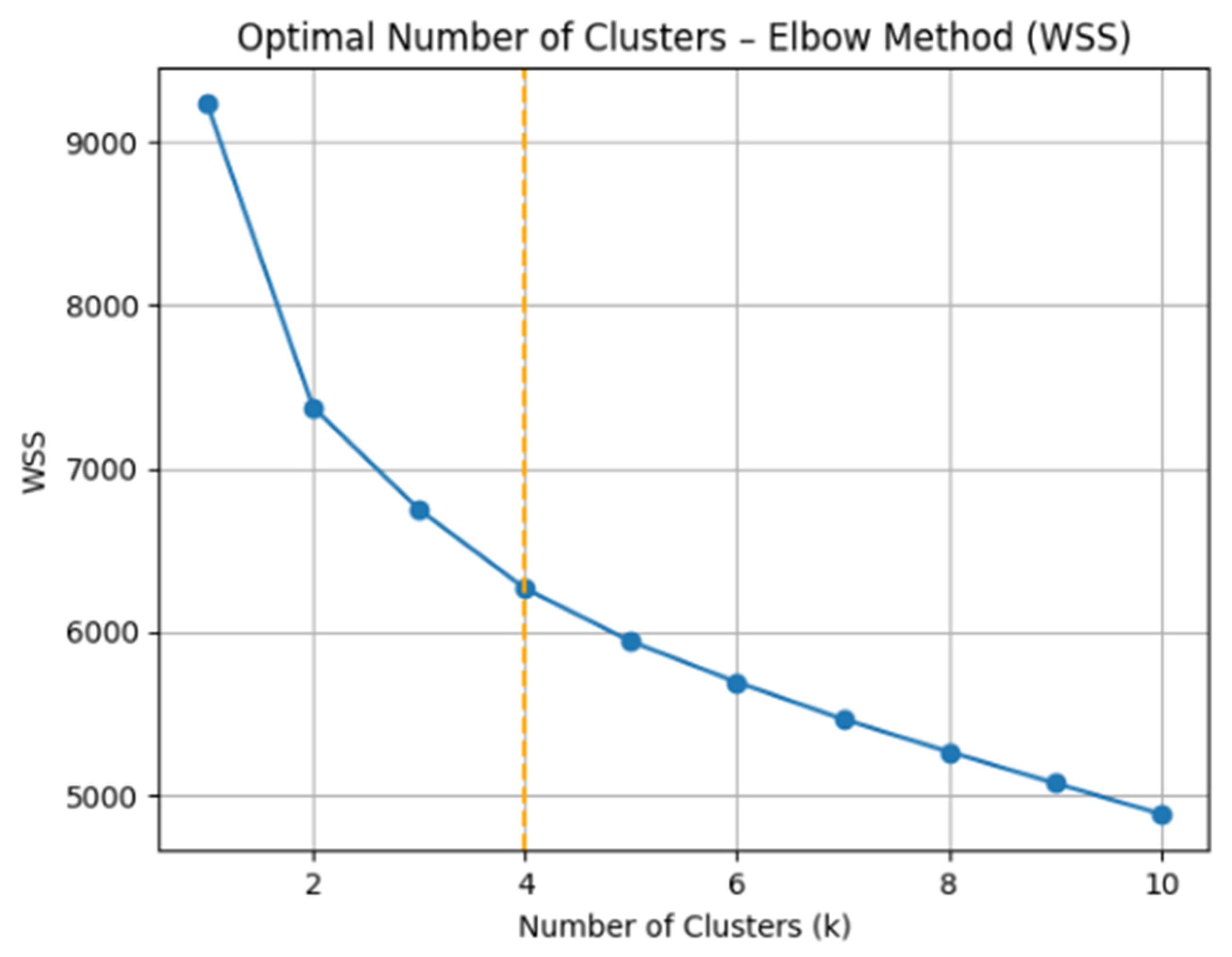
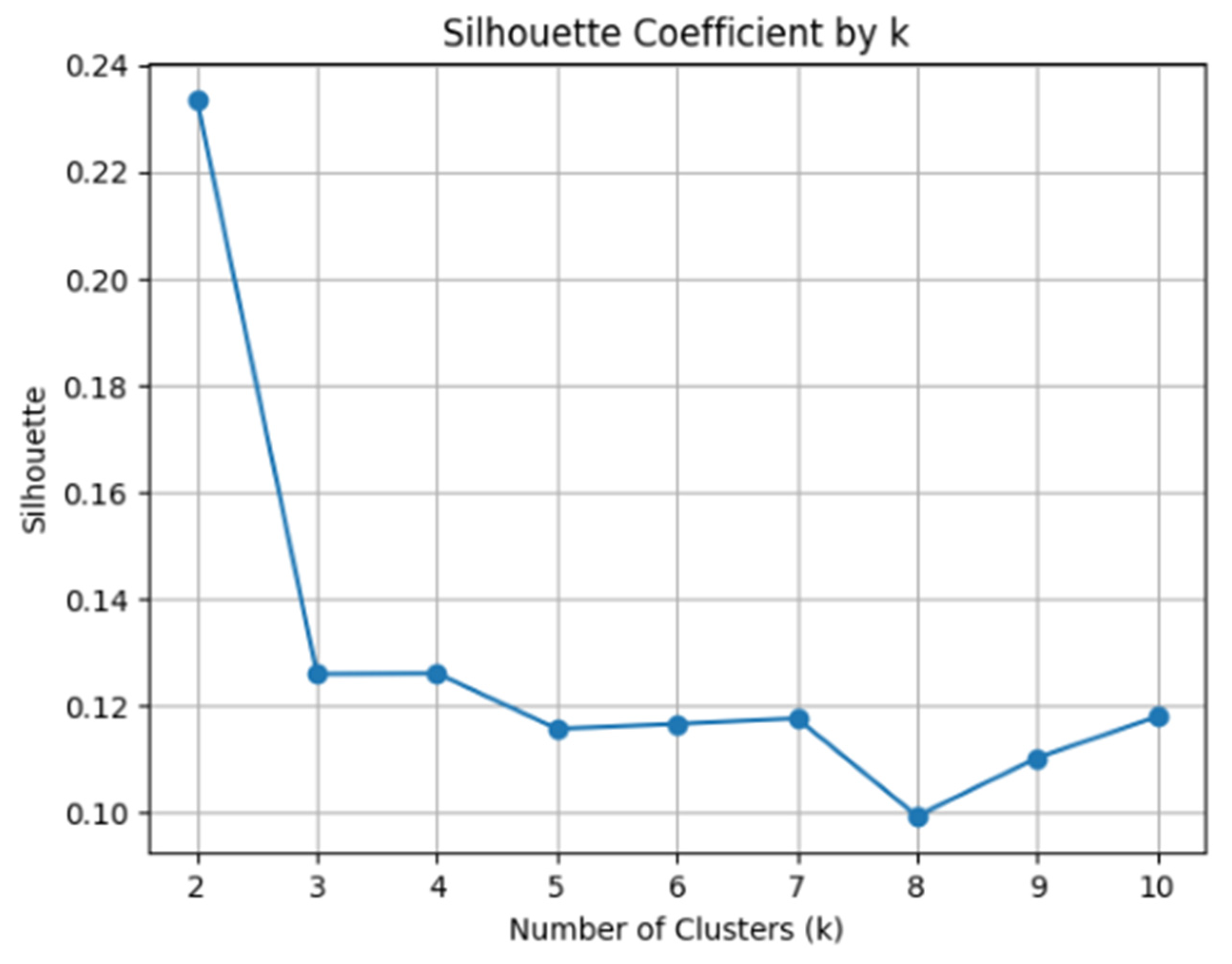
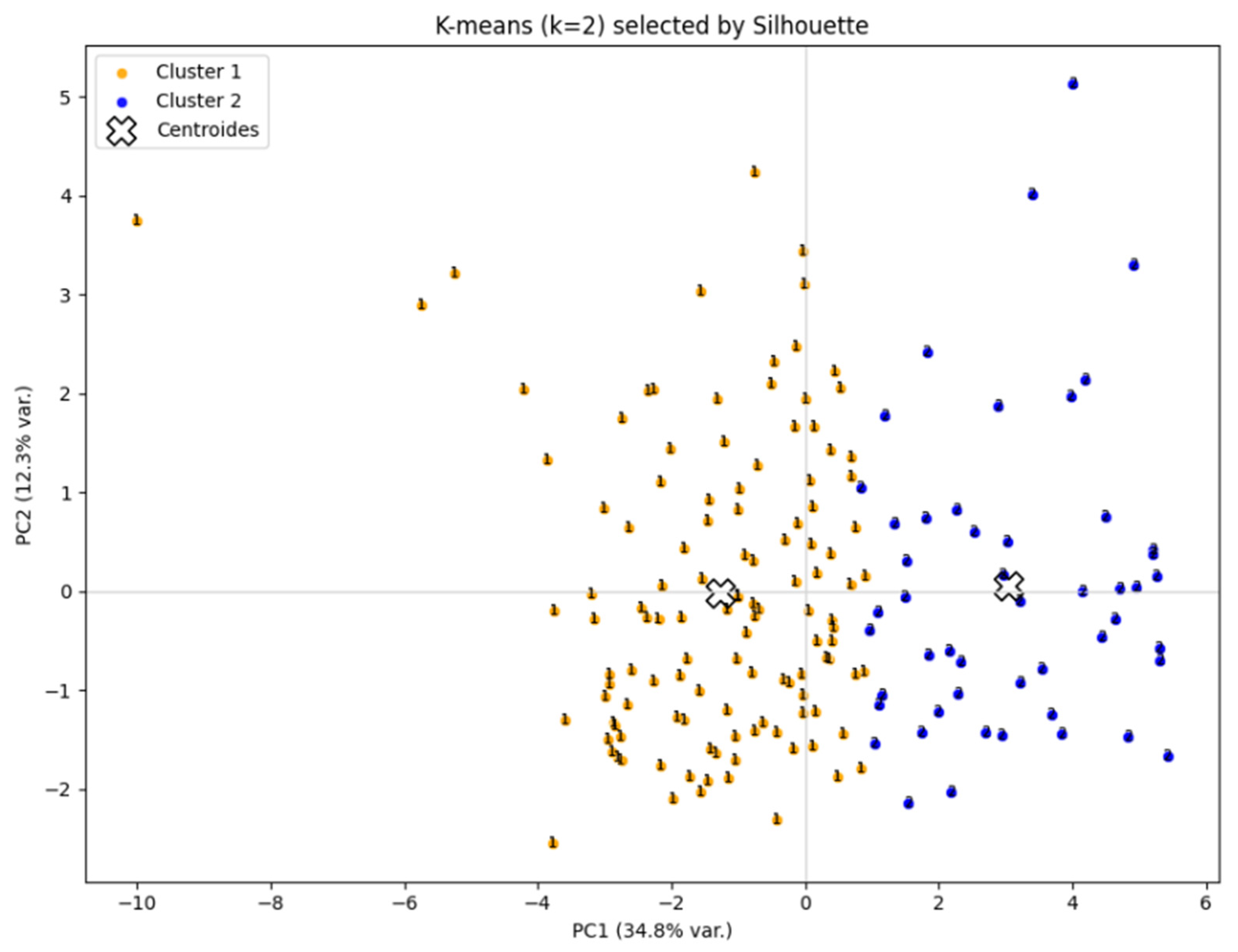
The inspection of the Elbow method (WSS) suggests an inflection point at k = 4, while the Silhouette coefficient reaches its maximum value at k = 2 (0.23), followed by subsequent declines that indicate increasing overlap between groups.
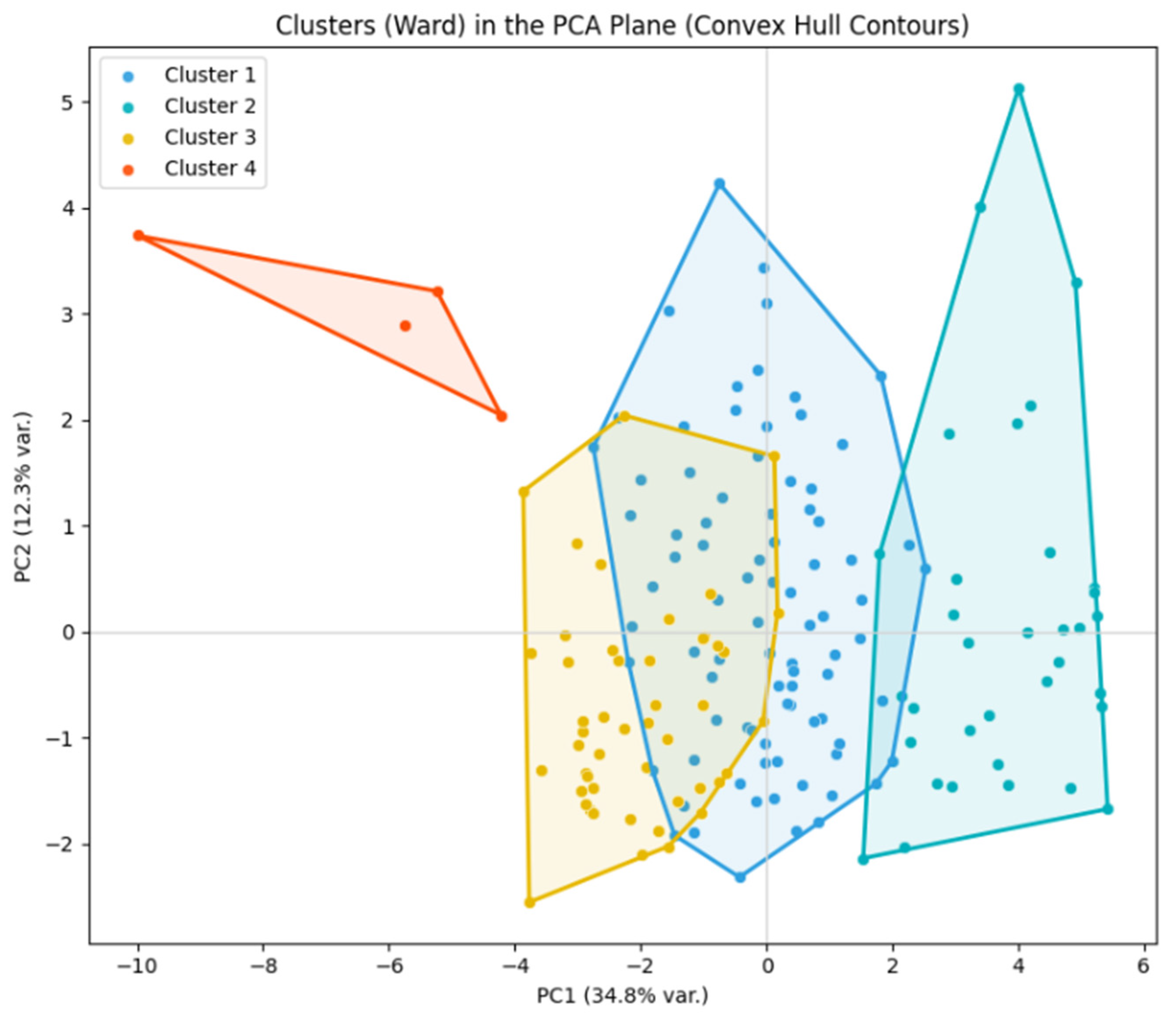
Given that our objective is to prioritize profile compactness and separability—and considering the inherently diffuse nature of organizational phenomena—K-means with k = 2 was adopted as the main partition, while Ward’s method with k = 4 was used as a complementary analysis to capture additional granularity (see Figure 4 and Figure 5: Optimal Number of Clusters—Elbow Method and Silhouette Coefficient; and Figure 6: Maps in the PC1–PC2 Plane).

3.3.2. Main Partition (K-means, k = 2)

The centroids (visualized in the PC1–PC2 plane; see Figure 6) show that the separation between groups occurs primarily along PC1—the axis representing deployed specific human capital and job support—with a lower contribution from PC2 (general human capital and coordination). This pattern allows the characterization of two synthetic profiles:
  • Profile 1: Low Specific/Support (PC1 < 0). Workers with lower values in annual training hours and months of continuous employment (specific human capital), as well as relatively lower perceptions of supervisory support, clear instructions, achievable goals, feedback, resources, and work organization. By construction of the PCA, these individuals are expected to show lower scores in work efficiency, and, through PC3, more moderate levels of current efficiency.
  • Profile 2: High Specific/Support (PC1 > 0). This group concentrates workers with greater tenure and internal training, together with stronger micro-organizational conditions (support, resources, and work organization). The deployment of firm-specific human capital in this cluster is associated with higher perceived efficiency and stronger applied competencies (PC3), thus anticipating higher current performance.
The global Silhouette coefficient (0.23) is moderate, consistent with partially overlapping clusters typical of human resource management contexts. In terms of internal validity, the choice of k = 2 maximizes relative separation compared to alternatives with k ≥ 3 (see Table 5).

3.3.3. Complementary Partition (Ward, k = 4)

The four-group partition provides managerial granularity and aligns with the geometry of the PC1–PC2 space (see Figure 7):
  • C1—High PC1, Medium PC2 (“Specific Deployment with Support”). Strong combination of tenure and training with solid supervisory and organizational support; candidates for sustained high performance.
  • C2—High PC1, High PC2 (“Coordinating Maturity”). In addition to specific deployment, this cluster highlights seniority/age and interdepartmental coordination; represents bridging profiles between functional units.
  • C3—Low PC1, Medium PC2 (“Operation by Individual Effort”). Lower levels of support and process standardization; efficiency depends primarily on personal effort rather than structured processes.
  • C4—Low PC1, High PC2 (“Isolated Seniority”, small group). High experience/age combined with limited specific support; at risk of inefficiencies unless training and job conditions are strengthened.
Based on the Elbow criterion (k = 4) and the Silhouette coefficient (maximum at k = 2), K-means with k = 2 was adopted as the parsimonious solution, and Ward with k = 4 as the managerial disaggregation. The separation occurs primarily along PC1 (specific human capital + job support), distinguishing between a high-deployment and a low-deployment profile; the four-cluster solution further refines these profiles according to seniority/coordination (PC2).

4. Discussion

The results confirm that the organizational efficiency of Ecuadorian banana-exporting firms largely depends on the deployment of firm-specific human capital and the micro-organizational support that enables its day-to-day application. The first component (PC1)—which integrates variables such as training hours, tenure within the company, supervisory support, and work organization—explains the largest proportion of variance and demonstrates that investment in idiosyncratic learning and managerial accompaniment constitutes the main determinant of performance. This finding is consistent with the arguments of Minbaeva [4], who suggest that efficiency emerges when acquired capabilities translate into high-performance behaviors under adequate leadership and support conditions. Similarly, Fegade and Sharma [6] demonstrated that continuous training exerts a multiplying effect on productivity by strengthening applied competencies—an outcome that is replicated in the “high specific-deployment” profile identified in this study.
The second component (PC2), associated with general human capital—total work experience and age—together with interdepartmental coordination, introduces a demographic–organizational dimension that reflects the relevance of maturity and internal articulation in agro-industrial contexts.
This result aligns with the evidence reported by Coolen et al. [8] who note that longer career trajectories enhance efficiency only when accompanied by collaboration mechanisms and cross-functional information flows. In the analyzed firms, employees with greater seniority exhibit stronger coordination capabilities; however, their performance does not necessarily exceed that of those who combine tenure with training and structural support, reinforcing the notion that experience alone does not ensure sustained efficiency [3].
The third component (PC3), linked to applied competencies and current performance, highlights the direct conversion of know-how into observable results. This axis underscores the importance of human capital deployment, that is, the effective utilization of skills within standardized processes [34].
The positive loadings on competencies, internal processes, and current efficiency suggest that the alignment between technical skills and organizational practices enhances productivity. This finding is consistent with recent studies integrating talent analytics and operational performance, showing that the combination of data-driven HR practices and job-oriented training improves the return on human capital [10,27,42].
The fourth component (PC4), related to process standardization and work organization, complements the previous dimensions by showing that efficiency also depends on clear structures that reduce variability and individual effort. As noted by Masa [43], the formalization of procedures and process digitalization enable firms to capitalize on tacit knowledge and minimize dependence on idiosyncratic behaviors. In this regard, companies with a higher degree of structural organization gain a sustainable competitive advantage, consistent with the VRIO logic proposed by Barney [2].
The segmentation using K-means (k = 2) made it possible to distinguish two major profiles: one of high specific deployment, characterized by workers with longer tenure, continuous training, and managerial support; and another of low deployment, where efficiency depends more on individual effort than on institutional conditions. These results are consistent with the findings of Sieranoja and Fränti [35] and Ikotun et al. [36], who demonstrated that clustering algorithms can identify performance typologies that are not evident in linear analyses. The complementary Ward solution (k = 4) provides a more managerial interpretation, distinguishing subgroups according to the interaction between experience and support, thereby offering useful insights for talent planning and training resource allocation [44]. Taken together, the results show that organizational efficiency does not depend solely on individual human capital, but rather on the degree of integration among capabilities, processes, and leadership, confirming the relevance of multivariate analytical approaches in human talent management.

5. Conclusions

First, this research provides empirical evidence that organizational efficiency in the agro-export sector is primarily explained by the interaction between firm-specific human capital, managerial support, and process structuring. Workers who combine idiosyncratic learning, managerial accompaniment, and organized environments exhibit higher levels of productivity and satisfaction, confirming that talent management is a strategic determinant of business competitiveness [44,45,46,47].
Second, from a theoretical perspective, the findings extend the application of the Resource-Based View (VRIO) to the agro-export domain, demonstrating that human resources—when valuable, rare, inimitable, and well-organized—function as true vectors of competitive advantage. Furthermore, the study confirms the usefulness of multivariate methods (PCA + clustering) for uncovering latent efficiency patterns, providing a replicable framework for future research in labor-intensive sectors [10,11].
From a methodological standpoint, the integration of quantitative and perceptual indicators enabled the construction of a robust internal diagnostic model that surpasses the limitations of traditional linear approaches and strengthens human resource analytics (HR analytics). Future research could complement this approach through supervised techniques or predictive performance models to further enhance data-driven talent management [8,34].
From a practical perspective, the efficiency profiles identified in this study allow us to formulate specific recommendations for different groups of firms. Companies located in the low-efficiency profiles should prioritize the formalization of basic human resource practices, including clear job descriptions, transparent recruitment procedures, and systematic training programs aimed at closing critical skill gaps. Firms in intermediate profiles could focus on strengthening performance evaluation systems, aligning incentives with organizational goals, and investing in targeted upskilling and reskilling initiatives. By contrast, organizations belonging to the high-efficiency profiles are encouraged to consolidate their strategic human capital management practices, using the profiles as internal and sectoral benchmarks for continuous improvement. To communicate these recommendations to a broader audience, the results can be disseminated through sectoral reports, executive summaries and infographics for non-technical readers, as well as workshops and webinars in collaboration with business associations and public agencies supporting enterprise development.
From a sectoral perspective, the findings of this study can be interpreted in terms of a simplified SWOT framework for the Ecuadorian banana export industry. On the one hand, the profiles associated with higher efficiency capture strengths such as accumulated export experience, relatively structured human resource management practices and more favourable organisational climates. On the other hand, the low-efficiency profiles reveal weaknesses related to the limited formalisation of human capital practices, insufficient investment in training and development, and less effective leadership and communication. At the same time, the sector faces important opportunities, including the adoption of sustainability and quality certifications, the diffusion of new technologies and growing international demand for differentiated products, which can be leveraged through more strategic human capital management. Finally, persistent challenges such as price volatility, phytosanitary risks and increasing international competition constitute threats that may aggravate existing weaknesses if firms do not invest in their human capital and organisational capabilities. By linking the empirical efficiency profiles to these SWOT dimensions, the study provides a more complete and actionable picture of the sectoral situation.
In order to synthesise the main practical implications of the study, Table 6 presents a simplified problem–goal scheme linking the human capital management challenges identified in the empirical analysis with strategic objectives and illustrative managerial actions. The scheme focuses on three core domains—human capital practices, organisational climate and leadership, and competencies and productivity—and shows how specific problems in each domain can be addressed through targeted interventions aimed at improving organisational efficiency in Ecuadorian banana export companies.
From a policy perspective, the findings of this study suggest that organisational efficiency in banana-exporting firms can be strengthened through sector-wide initiatives that promote continuous learning, standardised processes and participatory leadership. Public programmes that support training and upskilling for workers in agro-export activities, the diffusion of quality and process-management standards, and the development of leadership and supervisory skills at the firm level are consistent with the objectives of Sustainable Development Goal (SDG) 8 on decent work and economic growth. In addition, policies that foster innovation and the adoption of new technologies in human capital management and production processes are aligned with SDG 9 on industry, innovation and infrastructure. By linking firm-level human capital practices with these broader policy agendas, the study highlights how improvements in organisational efficiency can contribute to more inclusive and sustainable development in labour-intensive export sectors.
This study has several limitations that open up avenues for future research. First, the analysis is based on cross-sectional data and focuses on the identification of organisational efficiency profiles using unsupervised methods. Future studies could build on our work by incorporating predictive analytics, such as regression models or machine learning algorithms, to forecast organisational performance and transitions between efficiency profiles on the basis of human capital and organisational indicators. Second, although the survey includes measures of organisational climate and leadership, psychosocial aspects such as employee well-being, stress, perceptions of fairness and deeper elements of workplace culture are only partially captured. Further research could adopt mixed-methods designs that combine additional quantitative indicators with qualitative techniques to provide a richer understanding of psychosocial dynamics. Third, while our indicators can be used as the basis for a Human Talent Management Indicator Dashboard, the present article does not implement such a tool. Future applied work could translate the variables and profiles identified here into dashboards or monitoring systems to support real-time, evidence-based decision-making. Finally, the study does not explicitly consider external factors such as environmental sustainability requirements, market volatility, technological change or workforce diversity (e.g., age, gender and educational background). Incorporating these dimensions into future models would allow researchers to examine how they interact with human capital management and leadership practices in shaping organisational efficiency in labour-intensive sectors.
Finally, from a practical perspective, it is recommended that banana-exporting firms develop continuous, job-specific training strategies, systematic feedback programs, and periodic assessments of organizational climate and interdepartmental coordination. The implementation of Human Talent Management Indicator Dashboards (HTMID) will facilitate the identification of high-performance profiles and allow for a more efficient allocation of training resources [42]. Moreover, firms are encouraged to institutionalize standardized processes and promote participatory leadership as enabling conditions for sustaining long-term efficiency. By doing so, organizations will not only enhance their operational performance but also contribute to a more sustainable, people-centered agro-export development model.

Author Contributions

Conceptualization, B.S.-O.; methodology, B.S.-O., J.I.L.R. and N.D.G.J.; formal analysis, B.S.-O.; investigation, L.R.-J. and J.L.-G.; data curation, L.R.-J. and J.L.-G.; visualization, B.S.-O.; writing—original draft preparation, B.S.-O.; writing—review and editing, B.S.-O., J.I.L.R., N.D.G.J., L.R.-J. and J.L.-G.; supervision, B.S.-O. All authors have read and agreed to the published version of the manuscript.

Funding

This research received no external funding. The Article Processing Charge (APC) was partially funded by Universidad Técnica de Machala, and the remaining amount was covered by the authors.

Institutional Review Board Statement

According to Ecuadorian national research guidelines and international standards (including the Declaration of Helsinki, 2013 revision), studies that use anonymous, non-interventional survey data and do not collect personal or sensitive information are exempt from formal Ethics Committee or Institutional Review Board approval.

Informed Consent Statement

Informed consent for participation was obtained from all subjects involved in the study.

Data Availability Statement

The data presented in this study are available from the corresponding author on reasonable request.

Conflicts of Interest

The authors declare no conflict of interest.

References

  1. FAO. Banana Market Review: Preliminary Results 2024; Food and Agriculture Organization of the United Nations: Rome, Italy, 2025. [Google Scholar]
  2. Barney, J. Firm resources and sustained competitive advantage. J. Manag. 1991, 17, 99–120. [Google Scholar] [CrossRef]
  3. Giermindl, L.M.; Strich, F.; Christ, O.; Leicht-Deobald, U.; Redzepi, A. The dark sides of people analytics: Reviewing the perils for organisations and employees. Eur. J. Inf. Syst. 2022, 31, 410–435. [Google Scholar] [CrossRef]
  4. Minbaeva, D.B. Building credible human capital analytics for organizational competitive advantage. Hum. Resour. Manag. 2018, 57, 701–713. [Google Scholar] [CrossRef]
  5. Zhu, C.; Liu, A.; Chen, G. High performance work systems and corporate performance: The influence of entrepreneurial orientation and organizational learning. Front. Bus. Res. China 2018, 12, 4. [Google Scholar] [CrossRef]
  6. Fegade, T.K.; Sharma, P. Exploring the impact of employee training and development on organizational efficiency: A systematic literature review. IOSR J. Bus. Manag. 2023, 25, 56–63. [Google Scholar]
  7. Crook, T.R.; Todd, S.Y.; Combs, J.G.; Woehr, D.J.; Ketchen, D.J., Jr. Does human capital matter? A meta-analysis of the relationship between human capital and firm performance. J. Appl. Psychol. 2011, 96, 443–456. [Google Scholar] [CrossRef] [PubMed]
  8. Coolen, P.; Van den Heuvel, S.; Van de Voorde, K.; Paauwe, J. Understanding the adoption and institutionalization of workforce analytics: A systematic literature review and research agenda. Hum. Resour. Manag. Rev. 2023, 33, 100985. [Google Scholar] [CrossRef]
  9. Boon, C.; Den Hartog, D.N.; Lepak, D.P. A systematic review of human resource management systems and their measurement. J. Manag. 2019, 45, 2498–2537. [Google Scholar] [CrossRef]
  10. Shafie, M.R.; Khosravi, H.; Farhadpour, S.; Das, S. A cluster-based human resources analytics for predicting employee turnover using optimized artificial neural networks and data augmentation. Decis. Anal. J. 2024, 11, 100461. [Google Scholar] [CrossRef]
  11. Binanto, I.; Tumanggor, A. Comparison of the K-Means method with and without Principal Component Analysis (PCA) in predicting employee resignation. In E3S Web of Conferences, Proceedings of the 1st International Conference on Applied Sciences and Smart Technologies, Yogyakarta, Indonesia, 18–19 October 2023; EDP Sciences: Les Ulis, France, 2024; Volume 475, p. 02009. [Google Scholar] [CrossRef]
  12. Kamanlı, A.İ.; Balcıoğlu, Y.S. Human Capital Deployment and Organizational Efficiency: A Cross-National Benchmarking Analysis of Global Workforce Distribution Patterns. Int. J. Account. Econ. Stud. 2025, 12, 351–362. [Google Scholar] [CrossRef]
  13. Paredes-Saavedra, M.; Vallejos, M.; Huancahuire-Vega, S.; Morales-García, W.C.; Geraldo-Campos, L.A. Work Team Effectiveness: Importance of Organizational Culture, Work Climate, Leadership, Creative Synergy, and Emotional Intelligence in University Employees. Adm. Sci. 2024, 14, 280. [Google Scholar] [CrossRef]
  14. Mai, N.K. The impact of leadership competences, organizational culture and performance. Bus. Process Manag. J. 2022, 28, 1391–1411. [Google Scholar] [CrossRef]
  15. Kim, J.; Jung, H.-S. The effect of employee competency and organizational culture on employees’ perceived stress for better workplace. Int. J. Environ. Res. Public Health 2022, 19, 4428. [Google Scholar] [CrossRef]
  16. Jooss, S.; Collings, D.G.; McMackin, J.; Dickmann, M. A skills-matching perspective on talent management: Developing strategic agility. Hum. Resour. Manag. 2024, 63, 141–157. [Google Scholar] [CrossRef]
  17. Kravariti, F.; Tasoulis, K.; Scullion, H.; Alali, M.K. Talent management and performance in the public sector: The role of organisational and line managerial support for development. Int. J. Hum. Resour. Manag. 2023, 34, 1782–1807. [Google Scholar] [CrossRef]
  18. Becker, G.S. Human Capital: A Theoretical and Empirical Analysis, with Special Reference to Education, 3rd ed.; University of Chicago Press: Chicago, IL, USA, 1993. [Google Scholar]
  19. Lazear, E.P. Firm-Specific Human Capital: A Skill-Weights Approach. J. Political Econ. 2009, 117, 914–940. [Google Scholar] [CrossRef]
  20. Neal, D. Industry-specific human capital: Evidence from displaced workers. J. Labor Econ. 1995, 13, 653–677. [Google Scholar] [CrossRef]
  21. Hatch, N.W.; Dyer, J.H. Human capital and learning as a source of sustainable competitive advantage. Strateg. Manag. J. 2004, 25, 1155–1178. [Google Scholar] [CrossRef]
  22. Ichniowski, C.; Shaw, K.; Prennushi, G. The effects of human resource management practices on productivity: A study of steel finishing lines. Am. Econ. Rev. 1997, 87, 291–313. [Google Scholar]
  23. Hitka, M.; Kucharčíková, A.; Štarchoň, P.; Balážová, Ž.; Lukáč, M.; Stacho, Z. Knowledge and Human Capital as Sustainable Competitive Advantage in Human Resource Management. Sustainability 2019, 11, 4985. [Google Scholar] [CrossRef]
  24. Bendickson, J.; Gur, F.A.; Taylor, E.C. Reducing environmental uncertainty: How high performance work systems moderate the resource dependence–firm performance relationship. Can. J. Adm. Sci. 2018, 35, 252–264. [Google Scholar] [CrossRef]
  25. Lappi, E. New hires, adjustment costs, and knowledge transfer—Evidence from the mobility of entrepreneurs and skills on firm productivity. Ind. Corp. Change 2024, 33, 712–737. [Google Scholar] [CrossRef]
  26. Suzuki, A.; Mano, Y.; Abebe, G. Earnings, savings, and job satisfaction in a labor-intensive export sector: Evidence from the cut flower industry in Ethiopia. World Dev. 2018, 110, 176–191. [Google Scholar] [CrossRef]
  27. Garavan, T.N.; McCarthy, A.; Lai, Y.; Murphy, K.; Sheehan, M.; Carbery, R. Training and organisational performance: A meta-analysis of temporal, institutional and organisational context moderators. Hum. Resour. Manag. J. 2021, 31, 93–119. [Google Scholar] [CrossRef]
  28. Osagie, E.R.; Wesselink, R.; Blok, V.; Mulder, M. Learning organization for corporate social responsibility implementation: Unravelling the intricate relationship between organisational and operational LO characteristics. Organ. Environ. 2022, 35, 130–153. [Google Scholar] [CrossRef]
  29. Campion, M.A.; Fink, A.A.; Ruggeberg, B.J.; Carr, L.; Phillips, G.M.; Odman, R.B. Doing competencies well: Best practices in competency modeling. Pers. Psychol. 2011, 64, 225–262. [Google Scholar] [CrossRef]
  30. Sanchez, J.I.; Levine, E.L. What is (or should be) the difference between competency modeling and traditional job analysis? Hum. Resour. Manag. Rev. 2009, 19, 53–63. [Google Scholar] [CrossRef]
  31. Cho, J.; Dansereau, F. Are transformational leaders fair? A multi-level study of transformational leadership, justice perceptions, and organizational citizenship behaviors. Leadersh. Q. 2010, 21, 409–421. [Google Scholar] [CrossRef]
  32. Schneider, B.; Ehrhart, M.G.; Macey, W.H. Organizational climate and culture. Annu. Rev. Psychol. 2013, 64, 361–388. [Google Scholar] [CrossRef] [PubMed]
  33. Berberoglu, A. Impact of organizational climate on organizational commitment and perceived organizational performance: Empirical evidence from public hospitals. BMC Health Serv. Res. 2018, 18, 399. [Google Scholar] [CrossRef]
  34. Jiang, K.; Takeuchi, R.; Lepak, D.P. Where do we go from here? New perspectives on the black box in strategic human resource management research. J. Manag. Stud. 2013, 50, 1448–1480. [Google Scholar] [CrossRef]
  35. Sieranoja, S.; Fränti, P. Adapting k-means for graph clustering. Knowl. Inf. Syst. 2022, 64, 115–142. [Google Scholar] [CrossRef]
  36. Ikotun, A.M.; Ezugwu, A.E.; Abualigah, L.; Abuhaija, B.; Heming, J. K-means clustering algorithms: A comprehensive review, variants analysis, and advances in the era of big data. Inf. Sci. 2023, 622, 178–210. [Google Scholar] [CrossRef]
  37. Hair, J.F.; Black, W.C.; Babin, B.J.; Anderson, R.E. Multivariate Data Analysis, 9th ed.; Cengage Learning: Andover, MA, USA, 2022. [Google Scholar]
  38. Nunnally, J.C.; Bernstein, I.H. Psychometric Theory, 3rd ed.; McGraw-Hill: New York, NY, USA, 1994. [Google Scholar]
  39. Jolliffe, I.T.; Cadima, J. Principal component analysis: A review and recent developments. Philos. Trans. R. Soc. A Math. Phys. Eng. Sci. 2016, 374, 20150202. [Google Scholar] [CrossRef] [PubMed]
  40. Rousseeuw, P.J. Silhouettes: A graphical aid to the interpretation and validation of cluster analysis. J. Comput. Appl. Math. 1987, 20, 53–65. [Google Scholar] [CrossRef]
  41. Caliński, T.; Harabasz, J. A dendrite method for cluster analysis. Commun. Stat. Theory Methods 1974, 3, 1–27. [Google Scholar] [CrossRef]
  42. Marler, J.H.; Boudreau, J.W. An evidence-based review of HR analytics. Int. J. Hum. Resour. Manag. 2017, 28, 3–26. [Google Scholar] [CrossRef]
  43. Massa, S.; Annosi, M.C.; Marchegiani, L.; Messeni Petruzzelli, A. Digital technologies and knowledge processes: New emerging strategies in international business. J. Knowl. Manag. 2023, 27, 330–387. [Google Scholar] [CrossRef]
  44. Ellström, D.; Holtström, J.; Berg, E.; Josefsson, C. Dynamic capabilities for digital transformation. J. Strategy Manag. 2022, 15, 272–286. [Google Scholar] [CrossRef]
  45. Baiyegunhi, L.J.S. Examining the impact of human capital and innovation on farm productivity in the KwaZulu-Natal North Coast, South Africa. Agrekon 2024, 63, 51–64. [Google Scholar] [CrossRef]
  46. Costa, L.B.M.; Godinho Filho, M.; Fredendall, L.D.; Gómez Paredes, F.J. Lean, Six Sigma and Lean Six Sigma in the food industry: A systematic literature review. Trends Food Sci. Technol. 2018, 82, 122–133. [Google Scholar] [CrossRef]
  47. de Boon, A.; Sandström, C.; Rose, D.C. Governing agricultural innovation: A comprehensive framework to underpin sustainable transitions. J. Rural. Stud. 2022, 89, 407–422. [Google Scholar] [CrossRef]
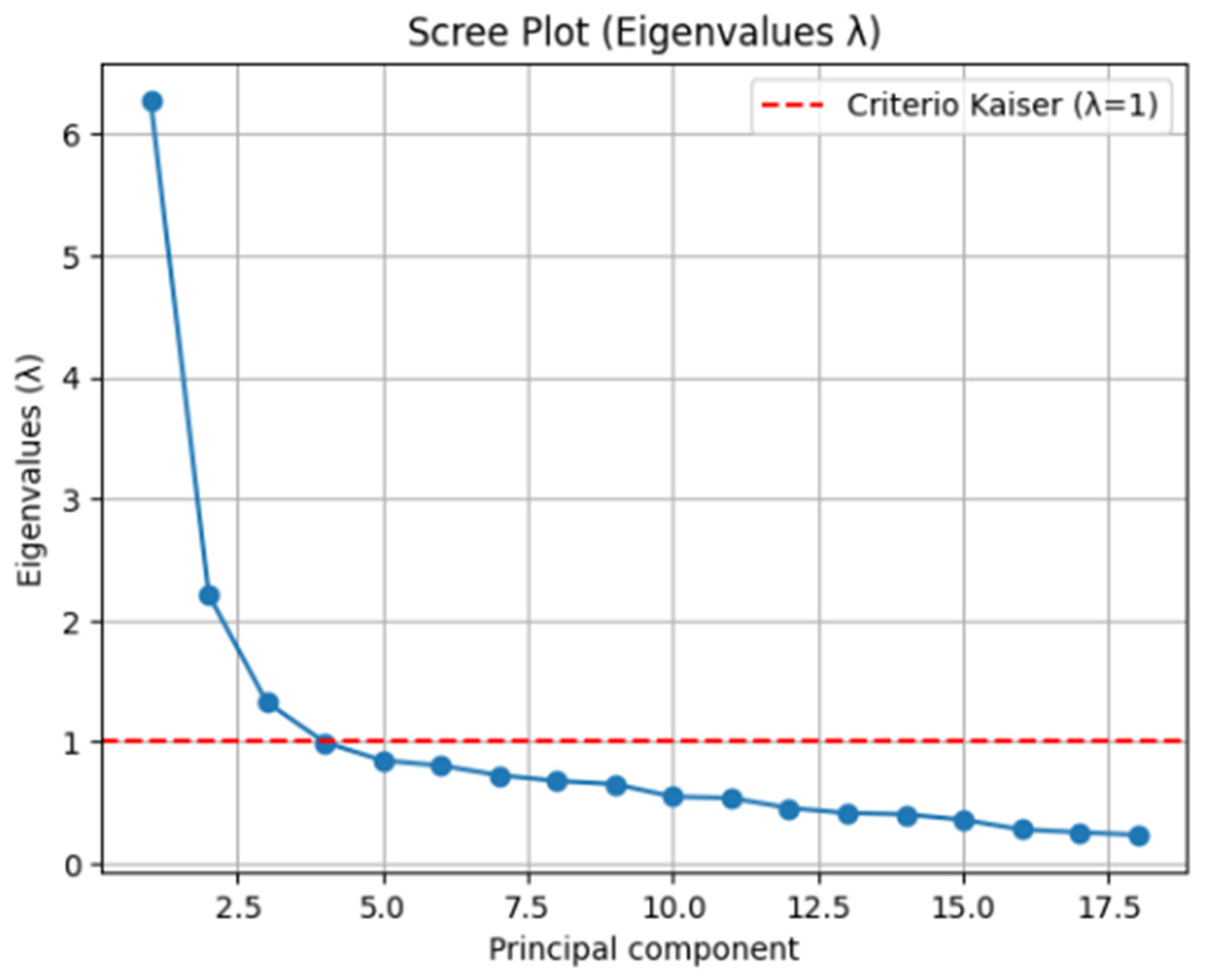
Figure 1. Scree Plot—Kaiser Criterion.
Sustainability 17 11037 g001
Figure 2. Heatmap of cos2 Values.
Sustainability 17 11037 g002
Figure 3. Variable Map for PC1–PC2.
Sustainability 17 11037 g003
Figure 4. Optimal Number of Clusters—Elbow Method.
Sustainability 17 11037 g004
Figure 5. Silhouette Coefficient.
Sustainability 17 11037 g005
Figure 6. Cluster Map in the PC1–PC2 Plane (selected by Silhouette).
Sustainability 17 11037 g006
Figure 7. Ward Cluster (k = 4) in the PCA Plane.
Sustainability 17 11037 g007
Table 1. Description of the Model Variables.
VariableDescriptionScale
General Human Capital
Total Years WorkedTotal years of work experience accumulated throughout the employee’s career.Number of years working
AgeEmployee’s age (related to job maturity and knowledge accumulation).Employee’s age
Specific Human Capital
Annual Training HoursParticipation in training programs organized by the company during the last year.Number of training hours received in the last year
Continuous Employment MonthsSpecific tenure within the organization.Number of months employed in the company
Competency MasteryLevel of mastery of the technical and soft skills required for the position.Likert scale: 1 (very low)–5 (very high)
Organizational Conditions
Work EnvironmentPerception of the work environment and workplace relationships.Likert scale: 1 (very unsatisfactory)–5 (very satisfactory)
Satisfaction with LeadershipEvaluation of immediate leadership.Likert scale: 1 (very unsatisfactory)–5 (very satisfactory)
Support from SupervisorsDegree of support received from supervisors and coordinators.Likert scale: 1 (strongly disagree)–5 (strongly agree)
Interdepartmental CoordinationQuality of collaboration across departments.Likert scale: 1 (strongly disagree)–5 (strongly agree)
Necessary ResourcesAvailability of tools and materials required for work.Likert scale: 1 (strongly disagree)–5 (strongly agree)
Structural Processes
Internal ProcessesLevel of standardization and clarity in organizational processes.Likert scale: 1 (strongly disagree)–5 (strongly agree)
Clear InstructionsPrecision and clarity of the directives received.Likert scale: 1 (strongly disagree)–5 (strongly agree)
Achievable GoalsPlanning and realism of operational objectives.Likert scale: 1 (strongly disagree)–5 (strongly agree)
WorkloadVolume of assigned tasks and work–life balance.Likert scale: 1 (strongly disagree)–5 (strongly agree)
Work OrganizationStructure and distribution of job functions.Likert scale: 1 (strongly disagree)–5 (strongly agree)
Useful FeedbackQuality of feedback received to improve performance.Likert scale: 1 (strongly disagree)–5 (strongly agree)
Work EfficiencyPerception of the degree of efficiency with which the employee meets objectives and goals within their work area.Likert scale: 1 (very low)–5 (very high)
Current EfficiencyAbility to work efficiently given the company’s current conditions.Likert scale: 1 (strongly disagree)–5 (strongly agree)
Table 2. Descriptive Statistics.
VariablesCountMediaSDMinMax
Annual Training Hours51358.1844.715276
Continuous Employment Months51342.4144.050250
Work Environment5133.461.1415
Competency Mastery5133.920.725
Satisfaction with Leadership5133.880.8815
Work Efficiency5133.850.8415
Total Years Worked51312.538.21135
Necessary Resources5133.770.8915
Internal Processes5133.90.815
Clear Instructions5133.890.8115
Support from Supervisors5133.870.7915
Workload5133.780.7815
Achievable Goals5133.880.8415
Interdepartmental Coordination5133.80.8415
Work Organization5133.960.7515
Useful Feedback5133.850.815
Current Efficiency5133.870.7715
Age51336.378.642165
Table 3. Eigenvalues.
ComponentEigenvalue (λ)Explained VarianceCumulative Variance
PC16.27550.34800.3480
PC22.20960.12250.4705
PC31.32740.07360.5441
PC40.99720.05530.5994
PC50.84870.04710.6464
PC60.80670.04470.6912
PC70.72670.04030.7314
PC80.68030.03770.7692
PC90.65410.03630.8054
PC100.55180.03060.8360
PC110.53890.02990.8659
PC120.45760.02540.8913
PC130.41580.02310.9143
PC140.40600.02250.9368
PC150.36140.02000.9569
PC160.28200.01560.9725
PC170.25840.01430.9869
PC180.23710.01311.0000
Table 4. Factor Loadings.
ComponentesPC1PC2PC3PC4
VariablesContcos2CFContbcos2CFContcos2CFContcos2CF
Support from Supervisors0.1010.9800.795
Work Efficiency0.0960.8480.778 0.1040.1460.322
Workload0.0930.8630.766 0.0660.1280.295
Annual Training Hours0.0870.9890.737
Continuous Employment Months0.0830.8450.722
Total Years Worked 0.3340.9550.859
Age 0.2870.8970.797
Interdepartmental Coordination 0.2270.9280.708
Work Organization 0.0360.1790.282
Internal Processes 0.0350.1040.2790.2950.5210.6260.2810.3720.529
Competency Mastery 0.2170.4410.537
Current Efficiency 0.1750.3660.4830.1150.1810.339
Achievable Goals 0.0680.1540.300
Work Environment 0.2590.5480.508
Useful Feedback 0.1070.1880.327
Table 5. Silhouette by Number of Clusters (k).
Number of Clusters (k)Silhouette Score
20.2087
30.1367
40.1317
50.1318
60.1339
70.1323
Table 6. Problem–goal scheme for human capital management and organisational efficiency in banana export companies.
Problem DomainMain Problems IdentifiedStrategic GoalsIllustrative Managerial Actions
Human capital management practicesLimited formalisation of HR procedures; weak recruitment and selection criteria; insufficient investment in training and development.To professionalise human resource management and ensure that HR practices support organisational efficiency.Design and implement formal recruitment and selection processes; establish clear job descriptions; create annual training plans focused on critical skills.
Organisational climate and leadershipLow levels of participation and communication; limited feedback; leadership styles not fully aligned with collaboration and learning.To foster an organisational climate that supports commitment, communication and collaborative problem-solving.Introduce regular team meetings and feedback mechanisms; develop leadership training programmes; promote participatory decision-making practices.
Competencies and productivityGaps in technical and soft skills; difficulties in adapting to new technologies and standards; heterogeneous performance across teams.To strengthen individual and collective competencies linked to productivity and quality requirements.Implement targeted upskilling and reskilling initiatives; link performance evaluation to development plans; provide on-the-job coaching and mentoring.
Disclaimer/Publisher’s Note: The statements, opinions and data contained in all publications are solely those of the individual author(s) and contributor(s) and not of MDPI and/or the editor(s). MDPI and/or the editor(s) disclaim responsibility for any injury to people or property resulting from any ideas, methods, instructions or products referred to in the content.