Article

A Life-Cycle Cost Analysis on Photovoltaic (PV) Modules for Türkiye: The Case of Eskisehir’s Solar Market Transactions


by
Hakan Acaroğlu
1,*,
Mevlana Celalettin Baykul
2 and
Ömer Kara
1
1
Department of Economics, Faculty of Economics and Administrative Sciences, Eskisehir Osmangazi University, 26480 Eskisehir, Türkiye
2
Department of Metallurgical and Materials Engineering, Faculty of Engineering and Architecture, Eskisehir Osmangazi University, 26480 Eskisehir, Türkiye
*
Author to whom correspondence should be addressed.
Sustainability 2025, 17(24), 11023; https://doi.org/10.3390/su172411023
Submission received: 14 October 2025 / Revised: 2 December 2025 / Accepted: 7 December 2025 / Published: 9 December 2025

Abstract

Solar energy systems have increasingly replaced conventional energy systems, driving global efforts to combat climate change and promote sustainability. This study conducts a comprehensive life-cycle cost analysis (LCCA) of photovoltaic (PV) modules, with a focus on the solar market in Eskisehir, Türkiye. Unlike prior research, this work integrates financial analysis with ecological benefits, offering a localized case study. By leveraging primary data from surveys and government sources, the analyses display that investing in PV equipment generates €883.75 in Net Present Value (NPV) savings through the business-as-usual scenario (−€392 under the worst-case and €2350 under the optimistic scenarios) over a 30-year lifespan, demonstrating the financial viability of these systems. Despite high initial costs, PV modules provide ecological and economic advantages that outweigh maintenance expenses, making them a viable solution for reducing fossil fuel dependence. The findings serve as a guideline for decision-makers, consumers, and producers to foster a sustainable solar energy market in Türkiye and similar developing economies by enabling feasible PV investments through appropriate Feed-in tariff mechanisms.

1. Introduction

The mainstream influence shaping countries in competitive energy markets is a functioning economy supported by science and innovation, which collectively influences and reshapes energy production and consumption habits through the effective use of renewable energy [1], as well as transmission, telecommunication, and information (i.e., artificial intelligence) technologies [2,3]. As a result, this phenomenon compels countries and Türkiye to reconsider their energy agenda to position themselves within the global energy platform by focusing on affordability, energy security, and decarbonization [4,5]. Governments are responsible for improving citizens’ living standards by implementing necessary arrangements, legislation, and adaptations. In doing so, they explore global interactions, leverage know-how, and draw insights from scientific research. While over 1.3 billion individuals worldwide still lack access to electricity [6], developing countries can utilize renewable energy in alignment with their geographic and institutional capabilities. This shift can create jobs, reduce trade deficits, and balance energy deficits by cutting energy imports, as seen in Türkiye. Türkiye’s strategic geographic location is a crucial priority for regional cooperation [7], with significant potential for renewable energy sources, such as solar [8]. In particular, solar PV technology has seen growing adoption [9,10,11], deployment [12], and importance in both developed and developing countries [13,14,15]. Achieving a sustainable energy transition requires effective governmental management and strategic planning to secure a cleaner future [16].
The economic aspects and government policies (specifically, the Feed-in Tariffs (FiTs) policy for Türkiye, as elaborated in detail in reference [8]) concerning renewable energy in Türkiye are discussed in reference [17]. Developments in renewable energy legislation have accelerated growth in the country and expanded investment alternatives in the field. However, the effectiveness of these economic instruments has been increasingly challenged by policy inconsistencies and regulatory barriers. While these limitations have slowed broader adoption of renewable energy technologies, significant progress has nonetheless been achieved in the solar energy sector. Statistical data illustrate a notable shift in Türkiye’s energy landscape: as of 2013, the country had no installed solar energy capacity, yet this figure rose sharply to 6.667 GW by 2020 [18] and reached 11.3 GW in 2023, representing a 20% year-on-year increase from 2022, demonstrating the rapid expansion of solar technology.
Global interest in renewable energy technologies continues to grow, and solar energy systems, in particular, have become central to the energy transition due to declining costs and ongoing technological advancements. In recent years, a substantial increase in photovoltaic (PV) manufacturing capacity has been observed. According to reports published by international organizations, global solar power manufacturing capacity was expected to exceed 1100 GW by the end of 2024; however, as final official data have not yet been fully released, these figures should be regarded as estimates [19]. This upward trend highlights the increasing economic and environmental significance of solar energy and reinforces the relevance of the analyses presented in this study.
This transformation underscores the importance of renewable energy legislation in driving the transition from fossil fuels to renewable sources, motivated by the need to reduce greenhouse gas emissions, enhance energy security, and achieve long-term economic benefits. In this context, a life-cycle cost analysis of producing and consuming energy through local resources (i.e., renewable energy, “solar energy”) is conducted in this study with a particular focus on one of Türkiye’s cities: Eskisehir. Eskisehir is located in Central Anatolia at an elevation of 788 m and has a continental climate with cold winters and hot, dry summers. The average annual global horizontal irradiation (GHI) is approximately 1550–1600 kWh/m2/year, which is slightly higher than the national average. These climatic conditions provide a favorable environment for PV electricity generation and enhance the accuracy of long-term savings estimates. The inclusion of these geographical indicators enables comparison with other Turkish regions or international locations with similar solar potentials.
This analysis evaluates the rationality of consumers’ energy consumption preferences and tests various decision-making scenarios to enhance resource efficiency in competitive energy markets. Additionally, the study introduces current active renewable energy policies and provides a detailed examination of those implemented in Türkiye. Financial analyses are conducted based on Eskisehir’s current economic conditions and Türkiye’s active renewable energy policies. The effective implementation of these policies is closely tied to Türkiye’s level of development, and as national development progresses, the likelihood of successfully adopting and sustaining both new and existing policies is expected to increase.
Transitioning from conventional fossil-fuel-based energy systems to solar energy systems is a necessary choice for consumers and aligns with the global environmental protection measures emphasized in this study. In line with this rationale, reference [20] notes that transitioning from conventional to non-conventional energy sources is essential in today’s world. Solar energy systems can significantly reduce fuel expenditures, particularly when using PV modules [21]. However, a fundamental principle concerns these systems and their acceptance and adaptation in practical life. This principle can be explained in economic terms: although PV systems have operating costs, their most substantial burden is the high initial costs. Thus, the economic rationale behind adopting these systems, and the basis of a rational consumer decision, is that the value of reduced bills or saved energy should exceed the total initial and operational costs over the system’s life cycle.
This choice represents a long-term investment strategy and can be justified by economic principles of the time value of money. According to this study, achieving the status of a developed country, such as ensuring energy self-sufficiency, maintaining a clean environment, producing and using advanced technologies, and achieving lower unemployment rates through qualified labor, depends strongly on such strategic decisions. At the global level, these strategies are promoted and supported by international organizations such as the Renewable Energy Policy Network for the 21st Century (REN21) and the International Energy Agency (IEA), which facilitate a rapid transition to solar energy through knowledge exchange and policy development [22].
This study implements an economic inquiry into PV modules. Solar energy directly produces electrical energy with PV modules. For a consensus on a crucial matter, the term “PV module” (i.e., the terminological definition in the study [23]) is used to refer to the combination of both modules and the platform on which they are mounted. Along with that explanation, the study aims to produce an economic analysis of 30 years (there are studies, i.e., [24,25], which take the lifetime of PV modules as 30 years, like our approach) of producing PV modules, serving them to consumers in the Eskisehir economy, and evaluating their contribution to the city and country. If these contributions are rational and significant, starting to produce PV modules in different Turkish cities will allow consumers the choice of cheaper, environmentally friendly, clean, and secure energy systems. This study takes a regional approach to demonstrate that it is viable for the social welfare of a developing country to remain within the main agenda by producing electricity with PV modules. Throughout the process of making these events possible, this study aims to serve as a guideline for all consumers, producers, and stakeholders, outlining which cases the government should prioritize to achieve practical outcomes from this development strategy. The demographic characteristics of Eskisehir, the currently used fuel in the city, and its total consumption, along with expenses, income tax savings, property taxes, mortgage payments, maintenance and insurance, parasitic energy costs, and initial investment costs, are considered in this economic plan.
The PV system analyzed in this study consists of mono-crystalline silicon photovoltaic modules with an average module efficiency of 20.4%, which is representative of the 2023–2024 Turkish residential PV market. The module temperature coefficient is −0.36%/°C, and the overall system performance ratio (PR) is assumed to be 0.80, accounting for inverter losses, temperature effects, shading, soiling, and wiring losses. The system includes a high-efficiency string inverter with a nominal efficiency of 97%, mounted using aluminum rails and standard rooftop mounting hardware. The DC system capacity is 3 kW, with AC capacity adjusted through the inverter to match residential consumption and grid export requirements. All specifications were selected to reflect current market conditions and installation practices in Türkiye.
There are several methodological similarities between this study’s approach and the literature referenced in [26,27,28,29,30,31]. However, this work distinguishes itself from those studies by contributing to the growing body of research on photovoltaic (PV) systems through a region-specific life-cycle cost analysis (LCCA) tailored to the economic and environmental context of Eskisehir, Türkiye. While prior research, such as [32], has focused on performance and degradation predictions for PV systems in other regions, this study uniquely integrates financial analysis with ecological impacts. The use of primary data collected from Eskisehir households through an original 2013 survey, combined with secondary data from Turkish governmental institutions such as TurkStat and CBRT in 2024, provides a comprehensive understanding of PV adoption barriers and opportunities in developing countries.
Unlike global-level analyses or case studies conducted in high-income economies, this research highlights the practical implications of transitioning to renewable energy in an emerging economy. It aligns with the Sustainable Development Goals by demonstrating the economic viability of PV systems and their potential to mitigate climate change. Furthermore, the study addresses a critical gap in the literature by combining localized data with a long-term financial evaluation, thereby offering actionable insights for policymakers, consumers, and producers in Türkiye and comparable contexts.
Unlike earlier works such as [21] on solar engineering and [24] on energy payback time, this study expands the scope of LCCAs by incorporating financial scenarios tailored to Türkiye’s economic policy environment. The results underscore the importance of policy interventions, such as Feed-in Tariffs, tax incentives, and localized production, to ensure the sustainable adoption of PV technology. Furthermore, while previous works have examined PV system economics or regional solar potential in Turkey, none have combined localized hourly irradiance data for Eskisehir with a 30-year life-cycle cost analysis, degradation-adjusted yield modeling, and multi-scenario policy evaluation. Additionally, earlier studies have not quantified CO2-emission reductions within an economic framework for residential PV systems in this region. These distinctions clarify the novelty of this work and highlight its unique contribution to the existing literature.
The remainder of this paper is organized as follows: Section 2 discusses the economics of PV modules in the current conditions of the Turkish Economy. Section 3 presents the methodology, introducing the data and economic applications. The results and discussion follow the methodology in Section 4. Finally, Section 5 provides conclusions and proposes some policy implications.

2. Economics of PV Modules in the Conditions of the Turkish Economy, as Well as in the World

2.1. Renewable Energy Targets: The Case of Solar Energy

In Türkiye, a large share of electricity is generated from fossil fuels (i.e., natural gas). However, some problems occur, such as a lack of domestic natural gas reserves, and population growth increases consumption, leading to a trade deficit for the country. On the other hand, Türkiye is expanding its interest in renewable energy in line with the global trend. Renewable energy’s share in Türkiye’s total electricity power reached around 52% in 2021, and the same statistic worldwide in the indicated period is around 38% [33]. To reduce the dependence on energy imports, the Turkish Government expressed its energy targets for 2023. Some of these targets that are related to our subject are also mentioned in [34,35,36]. This can be achieved by increasing the country’s domestic energy potential. Some incentive mechanisms have been put in place to encourage investment in renewables. For example, licensing obligations, fees, and reduced permissions are provided. Besides, the government has guaranteed to buy electricity obtained from solar energy.
For Türkiye and the rest of the world, if total consumption of scarce and relevant materials for renewable energy systems grows, the PV module market will improve in terms of the availability of needed raw materials at suitable prices for manufacturing. These exciting challenges make the PV module industry economically more viable for future business scenarios [37].

2.2. Renewable Energy in Intended Nationally Determined Contributions (INDC) or Nationally Determined Contributions (NDC)

Renewable energy is a crucial factor in solving Türkiye’s energy problems. This phenomenon can be summarized as Türkiye’s heavy reliance on energy imports, finite fossil fuel reserves, high energy price inflation, environmental concerns, and challenges [38]. On the other hand, utilization of Türkiye’s solar energy could reduce dependence on imported fossil fuels and help meet environmental commitments. On the other hand, the lack of financial support and regulatory instruments for developing solar energy systems has considerably delayed the utilization of the country’s extensive solar potential [39].

2.3. Regulatory Policies

Various regulatory policies have been preferred to promote and encourage renewable energy. These instruments are fundamentally set out as laws governing pricing, production incentives, quota requirements, tax credits, and trading systems [40]. Specifically, the Turkish government’s basic policy on solar energy is to support domestic solar panel production and to add 3000 MW of solar capacity by 2023 ([36,41]).

2.3.1. Feed-In Tariff (FiT)/Premium Payment

The FiT mechanism aims to lessen the cost of renewables. In other words, governments pay for renewable energy at a price above its market price through tariff applications [36,42]. Currently, FiT regulations for renewable energy (i.e., solar energy) exist in more than 40 countries worldwide, across both residential and commercial sectors [43,44]. The FiT mechanism is affected by many factors and depends on a country’s technology level. For instance, countries with high levels of installed solar capacity could have lower incentives than those without. PV module producers are financially protected by applying fixed market prices through tariffs. They can adjust and forecast their cash flows over extended periods and make healthier decisions about their solar investments [45]. For instance, Italian markets have experienced a boom in PV module installations since the introduction of the first FiT in 2005 (see [46] for details). Concerning this, reference [47] proposed that it is very important to choose a suitable tariff scheme that opens the pathway of competitive markets and is necessary to avoid financial disturbances in this way. Another example is Germany, where a FiT system has proved successful, and, according to [48], this success can be applied elsewhere in the world. For instance, appropriate FiT mechanisms could achieve cost savings and improved cost-effectiveness, as shown in [49] for South Africa. As another example, reference [50] conducted an econometric analysis and found a positive correlation between the production of incentivized renewable energy and subsidies. Their estimates suggested that a 1% increase in FiT leads to an increase in PV module generation at around 0.4–1% in European countries (i.e., France, Germany, Italy, Spain, and the United Kingdom) from 2000 to 2010. Reference [51] presented an overview of the FiT policy’s strength in the country and its necessity for Pakistan. Reference [52] showed that renewable energy (i.e., PV power systems) would not be economically feasible, even though a reasonable FiT mechanism exists in Algeria. This could be changed by increasing energy efficiency.
On the other hand, the FiT mechanism in Türkiye started in 2005 and is referred to as Phase I. However, it reached its final form with the 2010 Amendment Law, known as Phase II. It covers all renewable energy sources, including solar. Developing domestic manufacturing sectors and skills [8], and domestic equipment use is the priority for tariff supplements (one can reach Turkish government supplementary subsidies for PV systems in the price-energy unit ($/kWh) for differentiated sub-products in the studies of [34,39,53]. However, despite its effectiveness, the FiT mechanism could face some criticism, especially in one of the world’s leading PV module markets (i.e., China). The main argument was that its implementation restricted the cost and innovation by removing incentives to reduce costs [54].
Feed-in Premiums (FiPs) are financial incentives that support renewable electricity production by providing a premium above the current market price. Unlike Feed-in Tariffs (FiTs), which guarantee a fixed price per unit of electricity, FiPs allow producers to sell electricity at market rates while receiving additional income for each unit generated. Therefore, it establishes both the sale of energy in the electrical market and the receipt of the premium, which are two sources of income for producers. The premium differs from FiT premiums based on the norms applied in each country (i.e., plant size, electricity generation costs, and technology type or energy source) [55].

2.3.2. Electric Utility Quota Obligation/Renewable Portfolio Standard (RPS)

A predetermined obligation imposed by the government regarding the use of a targeted minimum renewable energy share of installed capacity or of electricity generation provided by consumers or companies [56] is called an obligation. In addition, the RPS is likely the renewable obligation instrument. The government fixes the share of renewable energy produced in the energy portfolio in the indicated period. Compared to obligation, this instrument seems more efficient [57]; the energy policy triggers the rationale for the competition between PV module technologies. On the other hand, reference [58] noted that these instruments entail high negotiation and administrative costs [59].

2.3.3. Net Metering

Net metering is a billing method with fast growth of renewable energy investments for the last few years, such as residential PV module installations, primarily seen in the United States (for instance, reference [60] showed that net metering had significantly effect on PV module installations when the optimal amount was concerned by both monthly and annually for United States cities (Chicago, Phoenix and Seatle)) and Germany. This energy policy provides a cross-subsidy to distributed solar generation, paid for by all ratepayers [61]. In this method, electricity generated by PV modules in a residence is billed by a suitable meter. For example, as shown in Figure 1, if the total energy consumption at a residence is 100 kWh per month, and the energy produced and distributed to the grid is 30 kWh per month. The net bill at that residence would be 100 kWh − 30 kWh = 70 kWh × (electricity price/h). This example may change from region to region and period to period. However, governments are encouraging this environmentally friendly energy production method and offering promotions and incentives to reduce fossil fuel imports and CO2 emissions. Figure 1 shows how net metering works through a PV module example: (1), solar panels convert energy from the sun into electricity (represented by number 2); (2), an inverter converts the electricity produced by the solar panels from direct current to alternating current for use in the house, school or business (represented by number 2); (3) The energy is used in the house, school or business (represented by number 3 and 4); (4) A bi-directional meter measures energy used and excess energy produced (represented by number 1).
This process not only promotes renewable energy usage but also provides financial incentives to reduce dependence on fossil fuels. Net metering contributes significantly to the growth of distributed solar energy worldwide, especially in regions with supportive policies.
A theoretical economic model by [62] showed that, for residential use, the social welfare effects of both net-metering and FiT mechanisms, in the case of reduced electricity consumption, were either relatively small or relatively large. As an applied example, under the new Italian regulatory framework, reference [63] showed that, under net-metering conditions, a larger optimal PV plant size could be supplied, increasing PV energy surplus. As a result, the refund for the economic value of the electricity brought from the grid would increase. In this way, they found that the net-metering service served as an incentive scheme and a growth booster for the PV market in Italy. In their tariff-oriented microeconomic model, reference [64] showed that net-metering promoted greater environmental benefits and social welfare than other tariff schemes for residential PV modules.
It is important to mention that although net metering policies facilitate distributed solar PV adoption, their practical implementation depends on the technical acceptance and operational constraints of the local grid operator. Economic considerations or grid infrastructure restrictions may limit two-way electricity transmission. In periods of high solar irradiation and low household demand, reverse power flow from residential PV systems can exceed the distribution lines’ hosting capacity, requiring curtailment or temporary disconnection for safety and stability. While such limitations are currently uncommon in Türkiye, they may become more pronounced over the 30-year operating horizon of PV systems as penetration increases. These factors highlight the importance of grid integration capacity when evaluating long-term economic feasibility under net-metering schemes.

2.3.4. Heat Obligation/Mandate

Consumers, producers, and generators of renewable energy, as parties, must set a minimum target and usually increase it over time. This is called a mandate or obligation. A percentage of supply, the amount of capacity, and the need for specific renewable technology can serve as examples of this issue. Mandates can sometimes include renewable portfolio standards (RPS), such as the obligation to deploy power technologies or to install renewable heat, with requirements for renewable heat purchases [56].

2.3.5. Tradable REC

Tradable REC is a renewable energy certificate that provides an instrument for trading and for accommodating renewable energy obligations among producers and consumers. It is crucial for voluntary green power purchases. Energy producers principally offer “green certificates” in kWh or MWh units. These certificates can be traded on the energy market and are added to the fundamental payment for electricity generated by renewable energy sources [65].

2.3.6. Tendering

Tendering is also called an auction or reverse auction. It’s a mechanism for obtaining renewable energy capacity or supply through competitive bidding. Bids are offered at the lowest price and may be assessed based on non-price and price factors [56]. Regarding price measures, tenders are an indispensable part of support mechanisms for renewable energy electricity production. Governments and regulatory authorities are requesting bids for electrical energy supply in this system concerning a definite technology at a considerable (i.e., competitive) price. It is expected to develop the indicated technology. Once a fixed amount of capacity from renewable energy sources has been installed and connected to the electricity network, bidding among participants is conducted. The bids are determined as a fixed amount for a given location, technology, and capacity. The government establishes criteria for selecting a winning bid and aims to improve the location [55].

2.4. Fiscal Incentives and Public Financing

If contributions to the public treasury are reduced through income or taxes, the incentive applied to households (i.e., individuals) or companies is called a fiscal incentive. On the other hand, grants or loans, often provided by governments to support the deployment of solar energy technologies, are considered public financing [56].
This mechanism creates policies that primarily focus on advancing PV module competitiveness and reducing costs. The preferred reason for these instruments is the advantage of lower marginal costs of nonconventional systems compared to conventional ones (e.g., natural gas, hydro generation, thermal coal generation). Many countries (e.g., Türkiye) have therefore used these instruments, or combinations of them (i.e., both conventional and non-conventional), to facilitate their development [44], as discussed in our study.

2.4.1. Investment or Production Tax Credits

The expectation of future values or returns from the purchase of goods and services (e.g., manufacturing PV modules, researching PV module technology) is called an investment. On the other hand, when an inventor or property owner is subsidized by a tax incentive based on the amount of renewable energy generated (e.g., electricity produced by PV modules), it is called a production tax credit [56].

2.4.2. Reductions in Sales, Energy, CO2, VAT, or Other Taxes

These instruments enable a reduction in the outgoing taxes, and this mechanism works through the profits earned from renewable energy projects. For instance, infrastructure projects can be exempt from income tax for a defined period [66].

2.4.3. Energy Production Payment

Energy production payments can be summarized as incentives for businesses, farmers, and homeowners to become producers of renewable energy or increase their production. According to [65], the energy production payment is defined as: “Direct payment of the government per unit of renewable energy produced”.

2.4.4. Public Investment, Loans, Grants, Capital Subsidies, or Rebates

Public investment, loans, grants, and capital subsidies or rebates often rely on supporting mechanisms to finance PV module investments [67]. Specifically, an incentive exists to install hardware at inflated costs with capital subsidies [68,69]. These investments can take the form of government regulation or monetary assistance that reduces consumers’ and producers’ prices, or the initial investment in production costs for PV modules, which are sometimes not required to be repaid [56,66].

2.5. The Current Situation of the PV Modules Market in Türkiye and Eskisehir

Renewable energy was supported by various mixed technological developments and policies in most countries at the end of 2016, and the deployment continues. Türkiye is also affected by these global improvements and is working to implement the necessary policies, as shown in Table 1 below. These policies can be categorized by targeting economic development (i.e., falling costs or financial implications), national security (i.e., penetration of new technology or advancing domestic markets), and environmental protection (i.e., reducing CO2 emissions or a clean environment) by supplying both direct and indirect supports [56]. Table 1 summarizes these support policies for Türkiye as an upper-middle-income country (i.e., the same table is available for the other countries in the Renewables 2017—Global Status Report in detail).
The more the indicated energy support policies or regulations are implemented in Table 1, the more a country will become familiar with solar energy systems and be able to take a development path. Reference [70] argued that, in the province of Burkina Faso, PV module markets are not functioning as expected (i.e., continuously or sustainably) in the absence of promoting policies, programs, or regulations. To support this argument, reference [71] mentioned a dramatic decrease in Türkiye’s self-sufficiency ratios in electricity usage, which was 77% in 1980 and dropped to 37% in 2014 and this tremendous change depended on high energy demand with increasing population, increased rate of fossil fuels (i.e., natural gas and hard coal), and insufficient utilization of renewable energy sources. Ozcan suggested using the energy policy as an instrument to address this decline and achieve energy independence. Table 1 shows that several policy instruments, such as direct investment subsidies, low-interest financing, or long-term tax exemptions, are either absent or only partially implemented for residential PV systems in Türkiye. Highlighting these gaps helps illustrate why additional policy support may be necessary to accelerate household solar energy adoption.

2.6. The Role of Local Governments and Their Effects on Cities

Sample countries and their government can examine the role of local governments and their effects on cities. For instance, local governments in China saw PV modules as an industrial opportunity in the last decade. This would pave the way for increased local employment and tax revenues in China [72]. A statistical study that includes models of US cities showed that strategic government interventions could be an effective policy instrument for promoting PV modules [73]. The economic viability of residential and commercial PV modules was analyzed for 314 districts of Chile in [74]. Their results showed that the feasibility of PV module installations increases as installation costs decrease, given the Chile’s regulatory framework.

2.7. Technical Details and Financial Issues About PV Modules

To ensure terminological precision, the manuscript now consistently distinguishes among PV cells, PV modules, and the complete PV system. In this context, ‘PV cells’ refer to individual semiconductor units, ‘PV modules’ denote the assembled panels containing multiple cells, and ‘PV system’ refers to the full rooftop installation including modules, inverter, wiring, mounting hardware, and balance-of-system components.
Solar PV technology permits the direct conversion of sunlight into electricity through semiconductor devices called solar cells. Solar cells are interconnected and hermetically sealed to set up a PV module. PV modules are combined with other components, such as storage batteries, to form solar PV systems. PV systems are highly safe and interchangeable [75]. A PV system is made of cells, modules, inverters, etc. [28]. In this study, a PV module is referred to as a combination of those parts (as stated in the introduction). There are several options for installing PV modules; ground-mounted and rooftop systems are two widespread types [26].
In the global market, solar module improvements are driven by technological advances, with 90% of modules in 2014 using wafer-based crystalline silicon. PV module production was approximately 45 GWp in 2014; multi-crystalline-Si (mc-Si), mono-Si, and thin film accounted for 55%, 35%, and 9%, respectively. C-Si technology offers long-term durability and ample raw material availability; therefore, it has high solar cell efficiency [76]. In this study, the initial investment cost of a 3 kW residential PV system is taken as €7500, based on 2024 market prices.
The economic model is based on crystalline silicon PV panels, which account for approximately 90% of the Turkish and global residential PV market. In particular, multi-crystalline Si modules were assumed, with an efficiency range of 17–20%, consistent with the most commonly available PV modules in Türkiye’s residential sector. Cost estimations—including installation, inverter replacement, and maintenance—were derived using this technology type as the reference case.
Based on data from the Turkish State Meteorological Service and PVGIS (Photovoltaic Geographical Information System), Eskisehir receives approximately 1550–1600 kWh/m2/year of Global Horizontal Irradiation (GHI). Under these conditions, a typical 3 kW south-facing, optimally tilted crystalline silicon PV system in Eskisehir generates: 3900–4300 kWh/year of electricity (capacity factor ≈ 15%). This value is fully aligned with national PV yield data. It confirms that Eskisehir performs close to the Turkish national average and significantly higher than northern European countries (e.g., Norway ≈ 900–1100 kWh/kW/year).

3. Methodology: A Life-Cycle Cost Analysis with the Survey and Institutional Data

3.1. The Obtained Data from the Survey, Various Sources, Restrictions, and Assumptions for the Variables

Our data was obtained from a 2013 survey conducted in Eskisehir, Türkiye. The questions were randomly distributed to residents of Eskisehir. We began by identifying the total number of households and computing the average number of nuclear families in our sample, which provided an overall profile of the survey. We also considered climatic factors that could affect household energy consumption.
Both open-ended and multiple-choice questions were included in the survey, and 154 respondents were invited to answer the questionnaire. The respondents had different incomes and had several other occupations (i.e., academic staff, engineers, employees, officers, and teachers). We used this data to help support our theoretical findings. In other words, our study could have been conducted without this self-administered survey; however, we believe it added originality to our work. One can find detailed information about the survey, including tables and statistics (e.g., Table 6a,b in [77]).
We designed the survey for multiple purposes since we had various hypotheses about solar energy systems. However, this study primarily focused on a household’s energy consumption. The total energy consumption of each household was measured and summed because household energy demand was directly related to electricity consumption, and PV modules generated that electricity. Additionally, respondents were asked about their type of residence and the electrical appliances they owned. Beyond electricity usage, data on energy consumption for cooling, heating, and lighting were collected through related questions.
In earlier versions of this study, a 2013 household survey was referenced to provide contextual insight into historical perceptions of solar technologies in Eskisehir. However, this survey is no longer used as a primary empirical input in the economic model. Instead, the analysis has been updated to rely on recent national and regional datasets (2021–2023), including household electricity consumption statistics from TÜİK, current PV installation cost reports from EPC providers, and contemporary market data. These updates ensure that the parameters used in the life-cycle cost analysis reflect present-day conditions. The 2013 survey is now cited only as background information rather than as representative data for 2024.
All variables included in the life-cycle cost analysis operate under explicitly defined constraints. Inflation and discount rates are assumed to remain stable within the 9–10% range, in line with CBRT’s long-term macroeconomic projections. Fuel price inflation is restricted to the 9% baseline scenario unless otherwise stated. PV system lifetime is fixed at 30 years, with replacement costs allocated after year 15. Property taxes, maintenance, and parasitic energy costs are assumed to increase at a controlled rate of 7%. These restrictions reflect realistic boundary conditions for the Turkish economy and ensure analytical consistency across all presented scenarios.

3.2. Methods: Time Versus Money Dimension

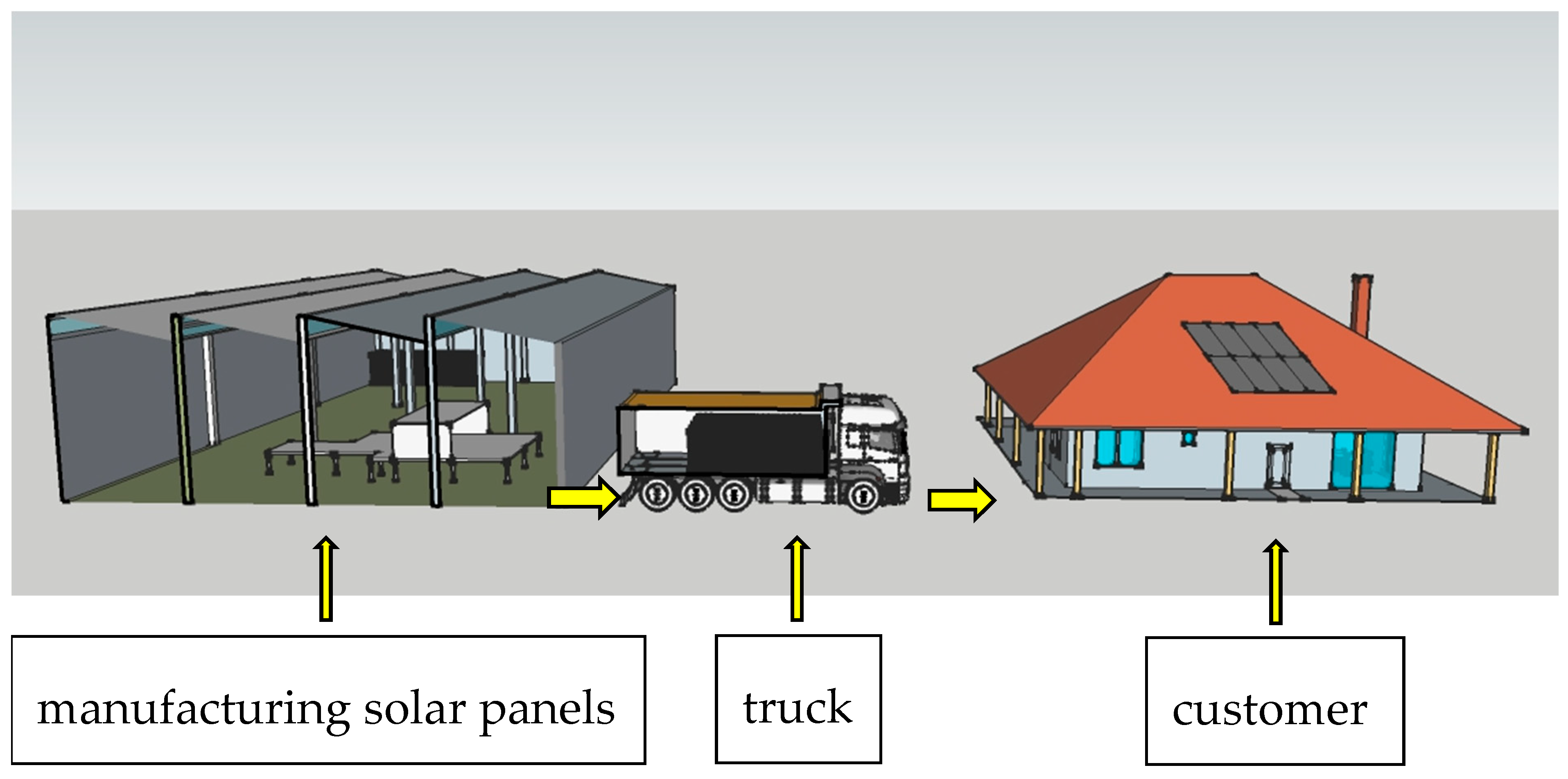
The most effective way to connect consumers with technologically advanced, environmentally friendly PV modules is to address the nation’s energy needs using its domestic resources. Figure 2 demonstrates the concept of this study through consumers and producers. The fundamental issue with consumers buying these devices and feeling safe is that the utility of their payments should outweigh all the included costs. This can be solved by each consumer who knows their investment payback period. According to this study, the consumer will have a 30-year investment plan for these devices, which includes financial and cost conditions, with constraints on inflation and interest rates in the Turkish Economy, along with net present value calculations. The value-added tax issues are also included in these calculations. To ensure the widespread adoption of these domestically manufactured devices, consumer demand is strongly dependent on maintaining stable inflation and interest rates and providing government-controlled tax incentives. These controlled market dynamics are a crucial event for the Turkish Government.
Figure 2 outlines the core relationship between consumers, producers, and government incentives in the adoption of PV systems. It highlights the role of financial planning, tax benefits, and stable market dynamics in fostering renewable energy adoption, emphasizing a 30-year investment horizon.
Building on this concept with more technical terminology, this study employs life-cycle cost analysis for economic evaluation. This method focuses on the time value of money while accounting for various cost categories. Our analysis follows [21,78,79] by adapting the mentioned arguments to the Turkish economy. In the following subsections, some pricing methods will be explained and given with practical life examples.

3.2.1. Cost of PV Modules

The primary challenge in manufacturing solar PV modules is determining the optimal panel size that minimizes energy costs. However, this size is typically selected at random from a local free-market firm in Türkiye. Additionally, the purchase and installation of a residential grid-connected PV system involves investment components such as PV modules, mounting structures, inverters, wiring, protection devices, and the grid connection interface. In addition to the equipment purchase price, installation costs should be considered. The installation costs of a PV module can be seen in Equation (1) as:
Cp = Ca × Ap + Ce
where
  • Cp: Total cost of installed PV equipment (€)
  • Ca: Total area-dependent costs (€/m2)
  • Ap: Panel area (m2)
  • Ce: Total cost of PV equipment, which is independent of panel area (€).
Here, Ca includes purchasing and installing the module, as well as storage costs. In the context of a PV system, Ce represents the installation-related expenses that depend on the installed capacity. This includes the cost of PV modules and mounting structures, which scale directly with the panel area, as well as wiring, protection devices, and DC/AC inverters, which scale indirectly with system power output (kW), and are therefore also influenced by the deployed PV area.
In a general form, that explains both non-solar and solar energy systems in one equation can be shown with Equation (2) which provides the detailed formulation of the module-related cost term that appears in the installation cost expression of Equation (1). Thus, Equation (2) should be interpreted as a component-level breakdown that feeds directly into Ce in Equation (1), linking the panel area and unit cost assumptions to the total installation cost of the PV system.
Yc = Fe + Mp + Mi + PEC + PT − ITS
where
  • Yc: Yearly cost
  • Fe: Fuel expense
  • Mp: Mortgage payment
  • Mi: Maintenance and insurance
  • PEC: Parasitic energy costs
  • PT: Property taxes
  • ITS: Income tax savings.
Here, Fe represents the conventional system. MP denotes the payment required to install the PV cell system, including both interest and principal payments on any loans used to purchase solar energy equipment. Mi refers to the costs necessary to maintain the system in good working condition. PEC refers to the auxiliary energy consumed by system components, such as inverters and cooling mechanisms, during operation. PT is the tax imposed on installations. ITS is categorized into two systems. The first category pertains to non-income-producing systems and can be expressed in Equation (3) as:
ITS = ETR × IP + PT
Here, ETR represents the effective tax rate, and IP denotes the interest payment.
The second category refers to income-generating installations, such as systems producing electricity for sale to the grid, and can be expressed in Equation (4) as:
ITS = ETR × (IP + PT + Fe + Mi + PEC − depreciation)
The Effective Tax Rate (ETR), calculated using Equation (5), accounts for both federal and local taxation, adjusted to reflect value-added tax (VAT) in the Turkish context:
ETR = FTR + STR − FTR × STR
While FTR stands for the federal tax rate, STR represents the state tax rate (i.e., Türkiye has not contained any states; she has only contained cities, and Eskisehir is one of them. So, in our analysis, the federal or state tax is changed with “value-added tax” (VAT).
The concept of solar savings is well argued by [21,80]. This concept can be given in Equation (6) as:
Solar savings = Costs of conventional energy − costs of solar energy
Solar savings are defined as the difference between the costs incurred using conventional energy systems and the reduced costs achieved through solar energy systems.
One can express Equation (6) in common terms for both conventional and non-conventional systems, as it is stated in Equation (7):
Solar savings = fuel savings + income tax savings − incremental property tax − incremental mortgage payment − incremental parasitic energy cost − incremental insurance and maintenance
Equations (6) and (7) are different expressions for solar savings. Since energy is the purpose and savings are the vehicle for consuming energy effectively, the transformation from Equation (6) to Equation (7) helps readers express solar savings as net savings, equal to positive savings minus the energy system’s costs.
Now, it is time to make analogies between Equations (3) and (4), and between Equations (8) and (9) to express ITS for both non-income-producing and income-producing solar energy systems.
ITS = ETR × (incremental interest payment + incremental property tax)
ITS = ETR + (incremental parasitic energy cost + incremental property tax + incremental maintenance and insurance + incremental depreciation + incremental interest payment − the value of fuel saved)

3.2.2. Design for the Lowest Cost

The primary objective in designing solar energy systems is to minimize the overall cost. System efficiency is closely related to the PV module’s area. Given a load with storage capacity, the other variable for the system is the module area. Economic analyses strongly depend on the module area and the system’s performance.

3.3. Economic Approaches for Optimal Design

There are many economic approaches for implementing the optimal designs for solar energy systems. Each system has its advantages, but there is no strict consensus on which is most suitable. Let’s define the most popular ones.

3.3.1. Least Cost Solar Energy

Minimizing operational costs over the system’s lifecycle is called the least-cost solar energy approach. This method considers only solar energy; in other words, it does not account for conventional energy sources.

3.3.2. Life-Cycle Cost (LCC)

Once an energy system is installed, the energy provided over its operational lifespan during a specified analysis period is referred to as LCC. This concept encompasses costs and accounts for the time value of money. The principle involves applying a market discount rate (reflecting the rate of return on the best alternative investment) to convert future costs to present value and determine the required investment amount. In addition, this method can estimate future expenses by incorporating current economic inflation rates.

3.3.3. Life-Cycle Savings (LCS) (Net Present Worth)

LCS represent the net financial benefit of using a solar-plus-conventional system compared to a conventional fuel-only system. It is calculated as the difference between the Life-Cycle Cost (LCC) of the two systems. LCS depends on the cash flow (net payments) of the right-hand side variables in Equation (2).

3.3.4. Annualized Life-Cycle Cost (ALCC)

ALCC stands for the average annual cash flow. The same procedure can be applied to annualized life-cycle savings (ALCS).

3.3.5. Payback Time

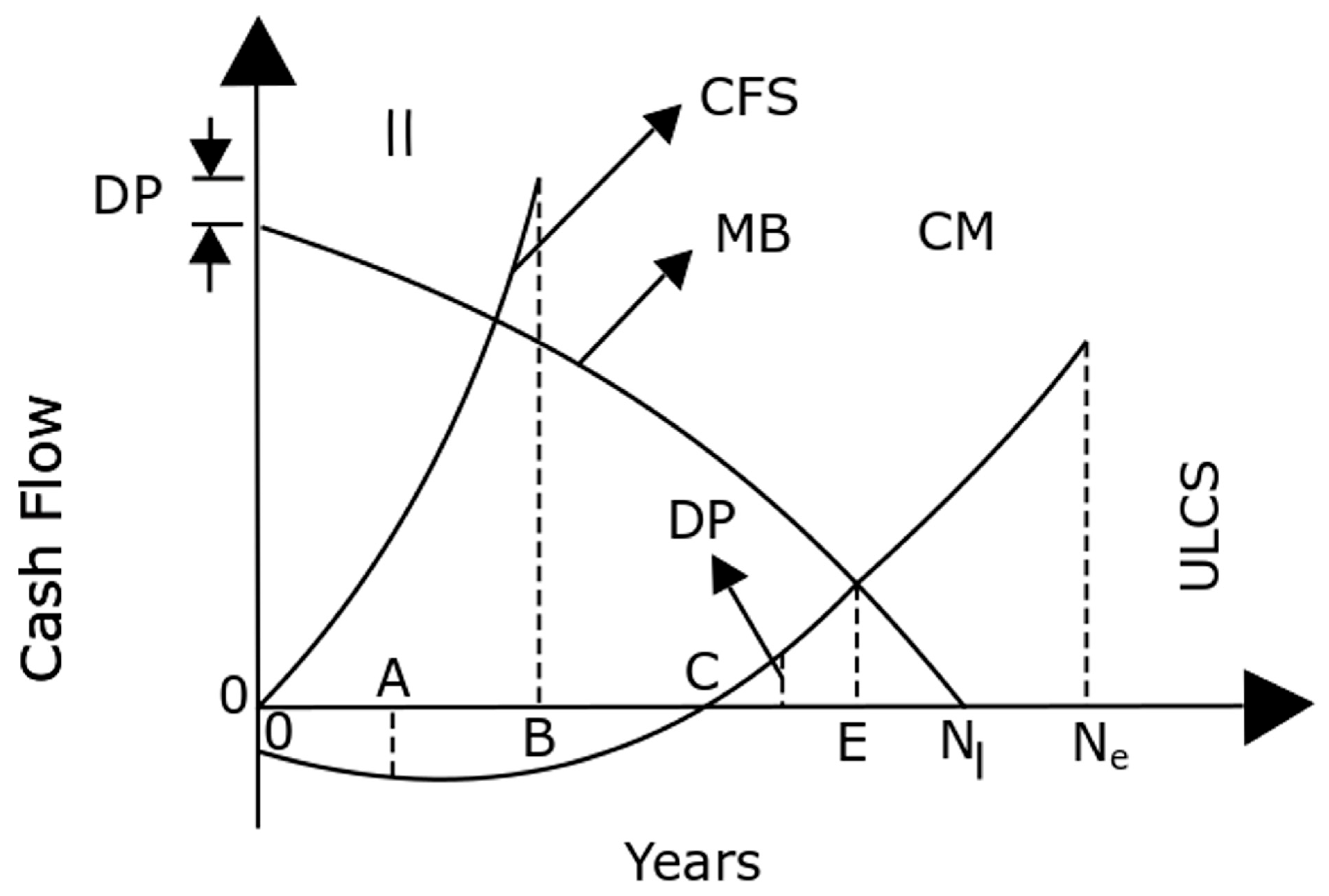
There are various definitions of payback time, but the most common is the time required for the equity of the total initial investment to equal the total fuel savings. The Energy Payback Time (EPBT) of PV systems, which measures the time required to recover the energy invested in their production through energy generation, was calculated to range from 8 to 16 years in a cost analysis conducted in India [81]. Figure 3 shows this phenomenon. In Figure 3, while the abscissa includes time (years), the ordinate consists of cash flow (€). Points A, B, C, D, and E refer to the time needed for a positive cash flow, for getting an investment back by saving fuel, for the cumulative savings to end up with zero, for the cumulative savings to be the same as with the down payment for the solar energy system, for the cumulative savings to be same as with the remaining debt principal on the solar energy system, respectively. According to this Figure, the most general definition of payback time corresponds to point B.
This figure demonstrates the financial impact of PV system investments over time, illustrating milestones such as achieving positive cash flow, recovering investment costs, and breaking even with cumulative savings.

3.3.6. Return on Investment (ROI)

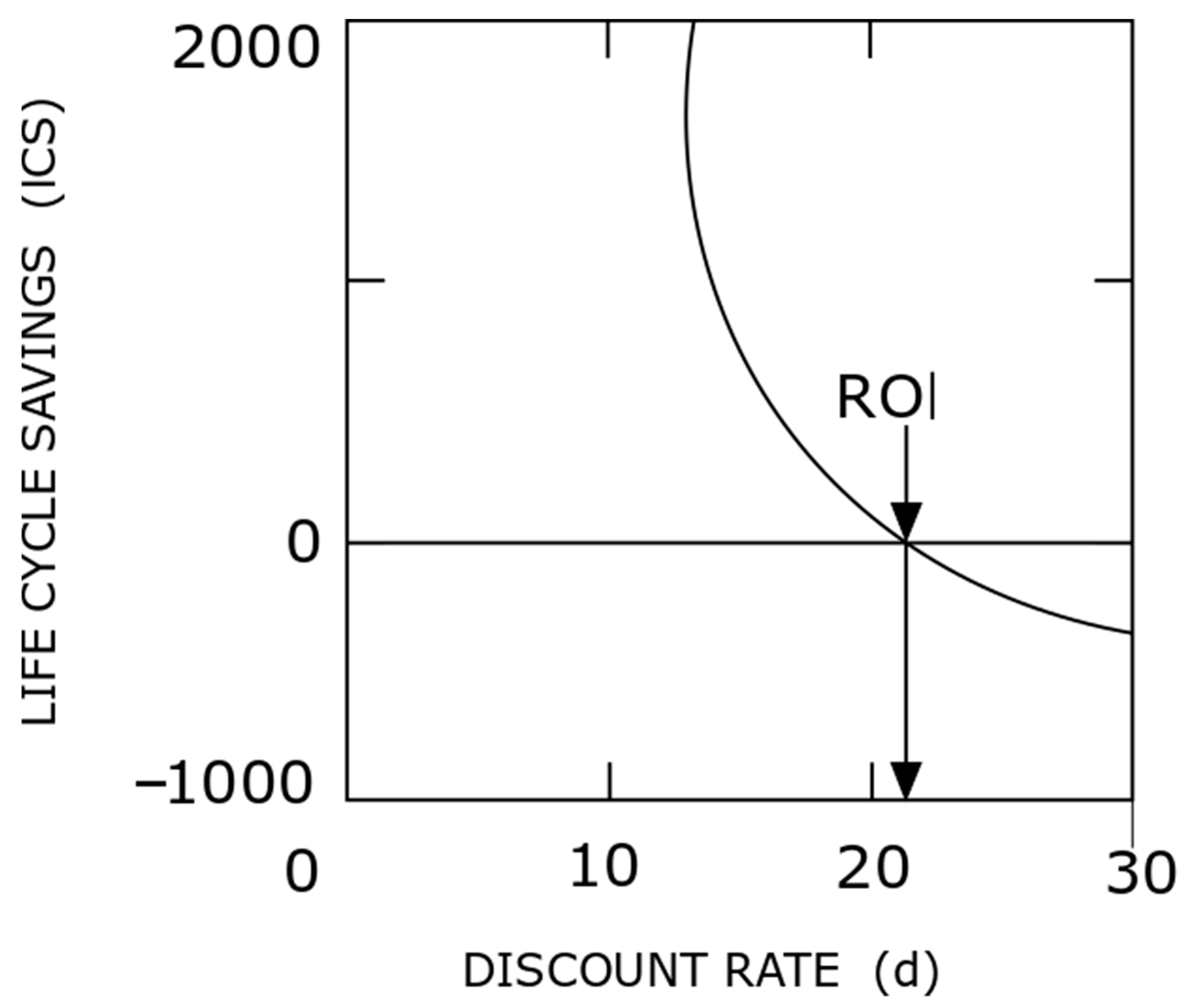
The ROI is the given discount rate, which makes the present worth’s of solar and non-solar alternatives equal, as shown in Figure 4 below. In Figure 4, while the apsis includes discount rates, the ordinate includes LCS. This Figure shows an example of life-cycle savings as a function of the market discount rate.
This figure highlights the relationship between market discount rates and the net present value (NPV) of savings, offering insights into the financial feasibility of PV systems under varying economic conditions.

3.4. Discounting Factors and Inflation Rates

The life-cycle method considers future expenses with today’s costs. The present worth of future expenses is calculated based on predictions of a country’s economic conditions, such as inflation rates and discount rates. The most effective alternative can be determined by calculating the present values of all future costs for both solar and non-solar cases, yielding the lowest life-cycle cost. Time plays a vital role in relation to the value of money and the rational decisions consumers make. Therefore, the investment’s cash flow must be discounted to a reliable amount. The relationship between “present worth” of 1€ and a given market discount rate “d” for the indicated life span of N (years) is calculated by Equation (10), seen below as:
PW = 1/(1 + d)N
Since we consider a particular lifetime, we can assume that in each period, costs would inflate or negatively inflate (deflate) at a fixed percentage. This relationship is shown in Equation (11) as follows:
CN = A × (1 + i)N−1
where CN is the cost value at the Nth period, A is the initial payment or cost, and i is the inflation rate (if negative, it is the deflation rate).
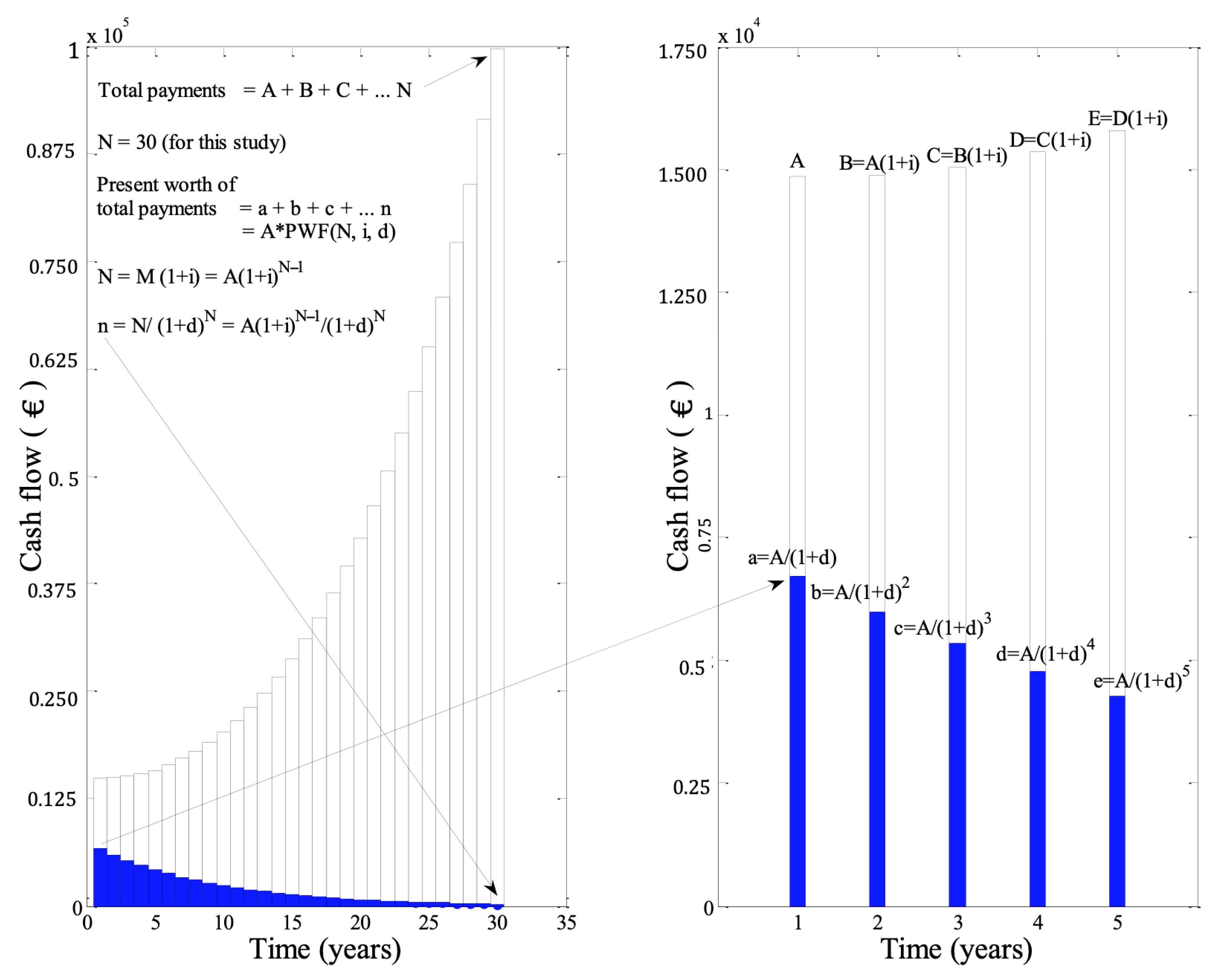
Given an interest rate i, one can understand the idea behind total payments during the N period or lifetime of the investment and the present worth of the total payments in Figure 5 as follows:
Figure 5 visualizes the cash flow associated with PV module investments, comparing the present value of payments over the investment lifetime. The representation underscores the importance of time value in financial decision-making.
As illustrated in Figure 5, the shaded portions of the bars represent the present value of the anticipated payments. In contrast, the full height of the bars reflects the total payments over the investment’s lifetime. Besides, at the end of the lifetime, the cost is A × (1 + i)N−1, and the present worth of the Nth payment is calculated from Equation (12) as follows:
PWN = (A × (1 + i)N−1)/(1 + d)N
Figure 5 assumes that the payments are made at the end of each period. Of course, there is another possibility: payments are made at the beginning of each period. In this case, Equation (11) can be described as: CN = A′ × (1 + i) and Equation (12) can be expressed as: PWN = A′ × ((1 + i)/(1 + d)N).

3.5. The Definition and Use of “Present-Worth Factor”

We need a general mathematical function that determines the Nth present-worth factor (PWF). The formula can be seen in Equation (13) with a given inflation rate i and discount rate d below:
PWF ( N ,   i ,   d )   =   J = 1 N ( i + i ) j 1 ( 1 + d ) j   =   1 d i   1 1 + i 1 + d N   i f   i   d   N 1 + i   i f   i = d
With some mathematical manipulation, PWF can be used to determine the periodic payment for the loan. It is assumed that all mortgage payments remain unchanged under a stable inflation rate of “0”. Along with these assumptions, “d” in Equation (13) becomes a mortgage interest rate, and the Periodic payment of a loan for N periods is then calculated from Equation (14) as follows:
PP L   =   M P W F   ( N L ,   0 ,   m )
where M is the mortgage principal, NL is the mortgage period, and m is the mortgage interest rate.
The total present worth of all the mortgage payments can be calculated much more easily with the following formula. Equation (15) includes the PWF for this calculation as follows:
PW int   =   M   ×   [ P W F   ( N m i n ,   0 ,   d ) P W F   ( N L ,   0 ,   m ) +   P W F   ( N m i n ,   m ,   d )   ( m     1 P W F   ( N L ,   0 ,   m ) ) ]
where M is the initial mortgage principle, NL is the mortgage term, Ne is the term for economic analysis, Nmin is the lesser of NL or Ne, and m is the mortgage interest rate.

3.6. Life-Cycle Savings Method for Practical Applications

The ideas obtained by discounting future costs will now be used and applied through our concept in various examples. One can also define these examples as scenarios for Eskisehir. Besides, the costs used can vary from location to location due to economic conditions, government legislation, and global developments closely related to energy prices.

4. Results and Discussion

4.1. Results

We start with a basic example of an installed solar system and gradually improve our analysis by adding details. It is anticipated that the PV module system will require replacement after years (i.e., the replacement period for these solar energy systems has been extended from 10 to 15 years in recent times). Because the quality of the used materials and their technology has been highly improved. For instance, new materials are generated between glass and metal for insulation which have very long durable capacity and sensitiveness to both hot and cold.), with a replacement cost of €250 (i.e., the life time of the system is 30 years and the total price is €7500 (see Appendix A Note 1). So, at the end of 1 year the cost would be €250) at that time. Given a 9% inflation rate and a 10% discount rate [77], let’s calculate the present worth of replacing the PV module system using Equation (12) (see Appendix A Note 2). Therefore, under the specified economic conditions, the present value of replacing the PV module system after 15 years (PW15) is calculated as €200.
As a second step, we need to calculate the present value of a series of 30 annual payments (cumulative over the lifetime of the energy system), starting with €250. These payments are expected to increase by 9% per year due to inflation, while the market discount rate remains 10% per year, consistent with the previous calculation (Equation (13)). From Equation (13), the present worth of the 30-year series is €5991.25 (see Appendix A Note 3).
As a third step, we first need to calculate the yearly periodic payment and yearly interest charge for a €7500 PV module installation, financed with a 15% down payment and the remaining balance borrowed at an annual interest rate of 10% for 30 years. Payments will be made at the end of each year, with a market discount rate of 10%. Then, let’s calculate the present worth of the series of interest payments (Table 2).
For the calculation of the annual periodic payment, we can use Equation (14). The mortgage or the present worth of the sum of all payments is equal to (i.e., 0.85 × €7500 = €6375) €6375. The yearly periodic payment is then calculated at €678.25 (see Appendix A Notes 4 and 5).
An alternative solution for the total present worth of all mortgage interest payments can be calculated using Equation (15) in Appendix A Note 6.

4.2. Application of Life-Cycle Saving Methods in Eskisehir’s Economy

In this part of the study, we provide examples intended to illustrate the method of life-cycle saving. The various costs used in these examples refer to Eskisehir’s economy. However, these costs tend to vary widely from location to location, depending on the time-money dimension and related government legislation. The prices would vary depending on the prevailing market conditions.
First, we start with a non-solar energy system, with a given financial scenario, and try to calculate the present worth of the fuel cost for a non-solar energy system using fuel only, over 30 years if the first year’s cost is (i.e., (€33.5 + €5.5) × 12 years = €39 × 12 years = €468) €468 [82]. The market discount rate is 10% per year, and the fuel cost inflation rate is 9% per year. The current fuel cost value in column 2 of Table 3 is obtained by multiplying each previous year’s fuel cost by (1 + i), and each row of the present worth of fuel cost is calculated by using Equation (10) or multiplying the first year’s fuel cost by PWF(30, 0.9, 0.1). Under the baseline scenario, a conventional energy system reliant on natural gas, the total fuel expenditure is projected to be €11,215.50 over 30 years, based on Eskisehir’s economic conditions.
Now we illustrate a similar scenario, but in this case, fuel costs are expected to rise at rates that depend on the country’s economy over the life-cycle of a non-solar energy system. The basic idea here is the fluctuation in energy cost. A stable economy can enable more efficient market transactions, and this can be achieved through a strong government that pays close attention to energy policy. If we want to calculate the present worth of fuel cost for a non-solar energy system, using fuel only, over 15 years, if the first year’s cost is €468, it inflates at 8% per year for five years, and then it inflates at 5% per year, with a market discount rate of 7% per year. Table 4 shows the fuel cost and present worth of the fuel cost using Equation (10). With varying inflation rates, the sum of expected payments is 77% greater than the present worth of the payments. As someone can easily notice in the condition of i > d, the present worth increases, and the opposite happens when i < d.

4.3. A Critical Discussion: Combination of Solar and Conventional Energy Systems by Considering Future Savings or Costs in the Financial Conditions in the City of Eskisehir

The same methods are now applied to assess combined solar and conventional energy systems, accounting for future savings and associated costs. As mentioned in the concept of our study, a combined solar and fuel system to meet the previously mentioned energy needs is to be considered. The suggested PV modules and related equipment are projected to reduce fuel consumption by 60%, for €7500. This system will be financed at 90% over a 30-year term with an interest rate of 10% [77]. For a system lacking solar components, the fuel cost in the first year would amount to €468, with an anticipated annual increase of 9% [77]. It is projected that the equipment will retain 40% (i.e., €7500 × 0.4 = €3000) of its initial value at the end of the 30 years (i.e., €7500 × 0.4 = €3000). Additional costs in the first year, including insurance, maintenance, and parasitic energy, are estimated at €1000, with extra property taxes amounting to €1250 (i.e., €7500 × 18% VAT = €1350 ≈ €1250). These costs are expected to rise at an inflation rate of 7% annually (note that when these calculations were made, the general inflation rate was 9%; however, it is expected to decrease with political stability). Notably, extra property taxes and mortgage interest are excluded from taxable income; thus, the effective income tax rate is expected to be around 45% [83] throughout the life-cycle analysis. Therefore, our critical question is: What is the present value of the solar savings over 30 years, assuming a 10% discount rate?
Table 5 shows the incremental yearly savings and costs. Year 1 includes estimates of the first year’s cost, and the detailed information and calculation steps for years 1 and 2 are provided below. The annual payment on the €6750 mortgage (i.e., €7500 × 0.9 = €6750) is calculated (i.e., €6750/PWF(30,0,0.10) = €715.75) as €715.75. The steps in the tax savings are outlined in Equation (3) (see Appendix A Note 7). Solar savings are obtained by summing each year’s columns from column 2 to column 6. Each year’s solar savings is calculated by using a market discount rate of 10%. The down payment is €750, and it is entered in the table in year “0” in columns 7 and 8, which show the equality between solar savings and the present worth of solar savings, but with a negative sign. The resale value is also included in Table 5 and appears as a second entry the following year, “30”, with a value of €3000 (i.e., €7500 × 0.4 = €3000), which contributes to savings at the end of 30 years. With the inclusion of resale value, the sum of the last column is €883.75. This value corresponds to the total present worth of the gains from the solar energy system compared to the fuel-only system. The life-cycle solar savings of the PV module for 30 years in Eskisehir, and this finding is validated by the International Renewable Energy Agency (IRENA), in 2024 [84]. IRENA reports that the global capacity-weighted average total installed cost of PV projects commissioned in 2023 was around €720/kW (i.e., $758/kW), 86% lower than in 2010 and 17% lower than in 2022. It should be underlined that this value is around 23% lower than our finding.
PV module technology is developing fast. In line with this development, the role of low-cost PV systems in addressing the world’s environmental and energy-related crises is likely to be crucial [85]. On the other hand, the use of PV modules is insufficient compared to Türkiye’s potential. The reasons behind this fact are closely related to a low level of consciousness and awareness of renewable energy resources and their applications in society [36,86]. In addition, selecting the appropriate incentive type given the country’s current condition is crucial. Decision-makers in governments should be informed about the proper incentive scheme, as is done in this research!

4.4. Evaluation of Results for Different Scenarios

To address long-term uncertainty over the 30-year operational period of the PV system, a scenario analysis was conducted based on three alternative policy and economic trajectories: (i) a worst-case scenario assuming the removal of all subsidies and reduced net-metering benefits, (ii) a business-as-usual scenario reflecting current policy and economic conditions, and (iii) an optimistic scenario incorporating stronger environmental regulations such as potential CO2-pricing and future declines in PV technology costs. These scenarios, which are presented in Table 6, enable a more comprehensive assessment of the robustness of the life-cycle cost and NPV outcomes under plausible future developments.
The scenario analysis highlights how strongly the long-term economic performance of a 3 kW residential PV system depends on policy conditions, market stability, and technological progress. Under the worst-case scenario, where incentives are removed, net-metering benefits are significantly reduced, and installation costs increase, the system yields a negative NPV (−€392), demonstrating that unfavorable regulatory or economic developments can render the investment uneconomical over a 30-year horizon. The business-as-usual scenario, which reflects current market and policy conditions, aligns with the study’s original findings and yields a moderately positive NPV (€884), indicating that PV adoption is economically feasible under current circumstances. In contrast, the optimistic scenario, which assumes improved environmental policies, more substantial financial incentives, and further declines in PV technology costs, produces a substantially higher NPV (€2350), underscoring the potential economic benefits that supportive policy interventions can unlock. Overall, the results demonstrate that residential PV investments are susceptible to future policy and economic trajectories, and they highlight the value of scenario-based evaluation for long-term decision-making.
Furthermore, the environmental benefits of the PV system were quantified by calculating the avoided CO2 emissions associated with displaced grid electricity. Annual avoided emissions were computed as in Equation (16):
CO2,avoided = EPV × EFgrid
where EPV is the annual electricity generated by the PV system (adjusted for degradation), and EFgrid is the Turkish grid emission factor. Based on recent IEA and national reports, an emission factor of 0.358 kg CO2/kWh was used. Under the business-as-usual scenario, the PV system avoids approximately 1.47 tons of CO2 per year, resulting in a cumulative avoidance of 44.1 tons of CO2 over 30 years. These results demonstrate that, beyond economic viability, residential PV adoption in Eskisehir provides meaningful environmental co-benefits through reduced reliance on fossil-based grid electricity.
In this study, the technical, economic, and policy dimensions jointly shape the long-term feasibility of residential PV systems in Eskisehir. From a technical perspective, the assumed performance parameters, such as the 0.7% annual degradation rate, the performance ratio of 0.80, and system component replacement cycles, directly determine lifetime energy output and thus influence the economic metrics of the LCCA. These technical factors, in turn, interact with key economic outcomes, including the 30-year NPV savings of €883.75, the sensitivity of project viability to discount and inflation rates, and the magnitude of fuel savings. However, these outcomes are highly dependent on Türkiye’s evolving regulatory environment. Policies such as net metering, VAT regulations, FiT/FIP mechanisms, and local manufacturing incentives can either amplify or to diminish the financial attractiveness of PV investments by altering both upfront costs and long-term cash flows. The scenario analysis further demonstrates that even modest policy changes can shift the investment from a negative NPV (worst-case scenario) to a significantly favorable one (optimistic scenario). Taken together, these findings show that PV adoption cannot be evaluated through a single lens: technical performance determines the system’s physical potential, economic analysis reveals its financial rationality, and policy design provides the enabling framework that ultimately governs consumer adoption. A more integrated approach that links these three dimensions is therefore essential for understanding how residential PV systems can contribute to Türkiye’s broader goals of energy security, decarbonization, and sustainable urban development.

4.5. Sensitivity Analysis and Robustness Check

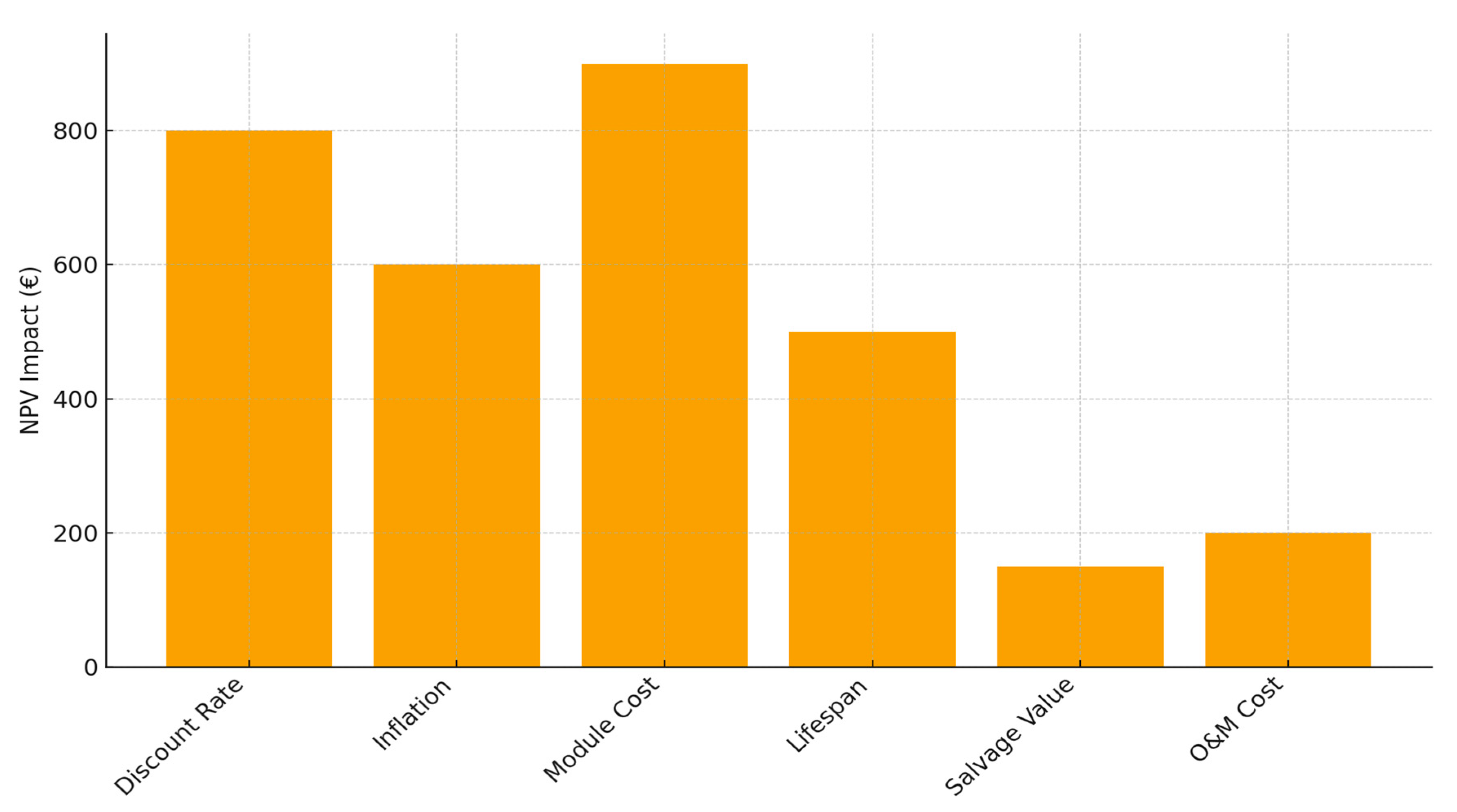
To evaluate the robustness of the economic results, a comprehensive sensitivity analysis was performed on key financial and technical parameters, including discount rate, inflation/electricity price growth, module cost trajectories, system lifespan, end-of-life salvage value, and O&M costs. The results, as displayed in Table 7 and Figure 6, indicate that NPV is most sensitive to discount rate, module cost, and electricity price growth. At the same time, O&M and salvage value have comparatively minor effects. These findings show that supportive financing mechanisms, technological cost reductions, and stable tariff policies can significantly enhance the economic viability of residential PV systems. In contrast, improvements in O&M efficiency yield smaller marginal gains.

4.6. PV Performance Degradation

To accurately represent long-term energy generation, an annual linear degradation rate of 0.7% per year was applied to the PV output. This value is consistent with recent empirical studies on mono-crystalline silicon modules deployed in climates similar to those of central Anatolia. The yearly energy output was therefore calculated as in Equation (17) as follows:
Et = E0 × (1 − d)t−1
where E0 is the first-year electricity production, d = 0.007 is the degradation rate, and t is the operational year. This approach ensures that cumulative lifetime yields reflect realistic long-term system performance.

4.7. System Boundaries

The life-cycle cost analysis (LCCA) conducted in this study focuses on the economic performance of a 3 kW grid-connected residential photovoltaic system installed in Eskisehir. The system boundaries are defined to include all economic flows directly associated with the installation and operation of the PV system over a 30-year lifetime.
Included processes comprise the acquisition of PV modules, inverters, mounting structures, wiring, balance-of-system components, installation labor, inverter replacement, periodic maintenance, and all economic interactions with the grid through net-metering. The operational electricity yield is adjusted for both system performance losses and annual degradation.
Excluded processes include upstream manufacturing impacts of PV components, embodied carbon emissions, transportation-related emissions, end-of-life decommissioning, and recycling processes. These aspects are outside the scope of an economic LCCA but are acknowledged as environmental considerations. The study, therefore, reflects a clearly defined ‘cradle-to-operation’ boundary, focusing exclusively on operational financial performance.

5. Conclusions

This study provides a comprehensive life-cycle cost analysis (LCCA) of photovoltaic (PV) systems within the specific economic and environmental context of Eskisehir, Türkiye, addressing a critical gap in regional analyses of renewable energy adoption in developing countries. Unlike prior studies that often focus on generalized global trends or developed economies, this work incorporates first-hand survey data collected in 2013 alongside updated governmental statistics from TurkStat and CBRT in 2024 to evaluate the long-term financial and ecological feasibility of PV systems. The analysis reveals that PV systems are a rational investment, yielding net present value (NPV) savings of €883.75 over 30 years, despite the initial high costs of installation and maintenance. Beyond the financial advantages, the adoption of PV systems aligns with sustainable development by reducing greenhouse gas emissions, decreasing dependency on fossil fuels, and supporting a cleaner energy transition. This study also emphasizes the importance of government policies, such as feed-in tariffs, tax incentives, and public financing mechanisms, to overcome barriers to adoption and foster the development of a sustainable energy market in Türkiye. Decision-makers are encouraged to use these findings as a guide to enhance renewable energy penetration in local markets while simultaneously addressing energy security and climate goals. This study shows that as a country develops, PV investment costs decline. For instance, with a remarkable difference (around 23% lower than our finding but convenient with our insights), NPV savings of €883.75 through the business-as-usual scenario (however, −€392 under the worst-case and €2350 under the optimistic scenarios) is validated by the 2024 reports of International Renewable Energy Agency (IRENA) which means that this cost difference is needed to be compensated by Turkish Government through an encouragement Feed-in tariff policy for a fair competition with the global weighted average of total installed cost for PV modules.
Future research can explore regional scalability, the integration of alternative renewable energy sources, and the implications of emerging technologies, such as improved energy storage systems, on the financial and environmental performance of PV systems. By contributing to the localized understanding of renewable energy systems, this study provides actionable insights for developing countries aiming to align with global sustainability goals and transition to clean energy. The number of this kind of novel and unique research using economic and financial indicators needs to be increased.
While the present study focuses on the economic dimension of a life-cycle cost analysis, we acknowledge that a full environmental LCCA, covering embodied emissions, CO2 payback time, and end-of-life ecological impacts, is beyond the scope of the current analysis. Nevertheless, based on established LCCA literature, a 3 kW PV system in Türkiye typically offsets its embodied emissions within 1.5–2 years and reduces lifetime CO2 emissions by approximately 55–65 tons compared to a natural gas-based energy mix. These environmental benefits complement the economic advantages demonstrated in this study. Future research will integrate environmental LCCA modules directly into the quantitative model.

Author Contributions

Conceptualization, H.A. and M.C.B.; methodology, H.A.; software, H.A. and Ö.K.; validation, H.A., M.C.B. and Ö.K.; formal analysis, H.A. and Ö.K.; investigation, H.A.; resources, H.A. and M.C.B.; data curation, H.A. and M.C.B.; writing—original draft preparation, H.A., M.C.B. and Ö.K.; writing—review and editing, H.A., M.C.B. and Ö.K.; visualization, H.A., M.C.B. and Ö.K.; supervision and preparation of the architectural drawings, M.C.B. All authors have read and agreed to the published version of the manuscript.

Funding

This research received no external funding.

Institutional Review Board Statement

According to the Scientific Research and Publication Ethics Directive of Eskişehir Osmangazi University (available at https://ogu.edu.tr/Icerik/Index/309/bilimsel-arastirma-ve-yayin-etigi-kurulu, accessed 5 December 2025, and its full text published in the Turkish Higher Education Council database at https://kms.kaysis.gov.tr/Home/Goster/172919, accessed 5 December 2025), ethical approval is not required for social science studies that collect anonymous, voluntary, and non-institutional survey data.

Informed Consent Statement

Informed consent was obtained from all subjects involved in the study.

Data Availability Statement

The raw data supporting the conclusions of this article will be made available by the authors on request.

Acknowledgments

The authors have reviewed and edited the output and take full responsibility for the content of this publication.

Conflicts of Interest

The authors declare no conflicts of interest.

Nomenclature

The following abbreviations are used in this manuscript:
AInitial payment or cost
ALCCAnnualized Life-Cycle Cost
ALCSAnnualized Life-Cycle Savings
ApPanel area (m2)
BAUBusiness-as-Usual
CaTotal area-dependent costs (€/m2)
CBRTCentral Bank of the Republic of Türkiye
CeTotal cost of PV equipment which is independent of panel area (€)
CNCost value at Nth period
CpTotal cost of installed PV equipment (€)
dDiscount rate
ECREEEECOWAS Centre for Renewable Energy and Energy Efficiency
EFgridGrid emission factor
EPBTEnergy Payback Time
EPVElectricity generated by the PV system
FeFuel expense
FiPsFeed-in Premiums
FiTsFeed-in Tariffs
GHIGlobal Horizontal Irradiation
iInflation rate
INDCIntended Nationally Determined Contribution
ITSIncome tax savings
LCCALife-Cycle Cost Analysis
LCSLife-Cycle Savings
mMortgage interest rate
MInitial mortgage principle
MMortgage principle
MiMaintenance and insurance
MpMortgage payment
NDCNationally Determined Contribution
NeTerm for economic analysis
NLPeriod of mortgage
NLMortgage term
NminLesser of NL or Ne
NPVNet present value
O&MOperation and Maintenance
PECParasitic energy costs
PPLPeriodic payment of a loan
PTProperty taxes
PVPhotovoltaic
PVGISPhotovoltaic Geographical Information System
PWFPresent-worth factor
PWNPresent worth of the Nth payment
RECRenewable Energy Certificate
ROIReturn on Investment
RPSRenewable Portfolio Standard
TurkStatTurkish Statistical Institute
TÜİKTürkiye İstatistik Kurumu
VATValue-Added Tax
YcYearly cost

Appendix A

  • Note 1:
  • For 1 kW/h of energy, 6 modules are needed. Since 1 panel (180 W) is 1.58 m × 0.808 m dimensions and 1.27664 m2 area, a 6-module area is equal to (i.e., 6 × 1.27664 m2 = 7.7 m2) 7.7 m2. The price of this PV module, which has modules and the necessary equipment, is €2000. A 1 m2 PV module price is (i.e., from; (€2000 × 1)/7.7 m2 = €256.7 ≈ €260) €260. The 3 kW PV module area is 23.1 m2 (i.e., 7.7 m2 × 3 = 23.1 m2). Since a 1 kW system needs €250 maintenance cost 3 kW system needs (i.e., from; €250 × 3 = €750) €750 maintenance cost and since 1 kW system needs €200 inverter cost, 3 kW system needs (i.e., €200 × 3 = €600) €600 inverter cost. Thus, according to Equation (1), the total cost of equipment is approximately €7500 (i.e., €260 × 23.1 + (€750 + €600) = €7356 ≈ €7500).
  • Note 2:
  • PW15= €250 × (1 + 0.09)14/(1 + 0.10)15 ≈ €200
  • Note 3:
  • From Equation (13),
  • PW = €250 × (1/(0.10 − 0.09)) × (1 − (1.09/1.10)30) ≈ €5991.25
  • So, the present worth of the 30-year series is €5991.25.
  • Note 4:
  • €6375/PWF(30, 0, 0.10) ≈ €6375/9.43 ≈ €678.25
  • Note 5:
  • One should remember that the interest charge varies over time, because the mortgage payment includes both principal and interest. For our example, the interest payment for the first year is (i.e., 0.1 × €6375 = €637.5) €637.5. The annual payment is €678.25; thus, the principal payment is reduced by (i.e., €678.25 − €637.5 = €40.75) €40.75 to (i.e., €6334.25 × 0.10 = €633.425 ≈ €633.5) €633.5 and the principal payment is reduced by (i.e., €678.25 − €633.5 = €44.75) €44.75 to (i.e., €6334.25 − €44.75 = €6289.5) €6289.5. These are indicated in the following Table 2 (to the nearest €).
  • Note 6:
  • Here NL = Ne = 30 years, m = 0.1, d = 0.1, Nmin = Lesser of NL or Ne, M = €6375, PWF(Nmin, 0, d) → PWF(30, 0, 0.1) ≈ 9.4, PWF(NL, 0, m) → PWF(30, 0, 0.1) ≈ 9.4, PWF(Nmin, m, d) → PWF(30, 0.1, 0.1) ≈ 27.3.
  • PWint = €6375 × 9.4 9.4 + 27.3 ×   0.1   1 9.4   → €6375 × [0.83] ≈ €5291.25
  • Note that, while the worth of the interest payments is €5283.25 in Table 2, it is algebraically found as €5291.25. These two values are very close numerically. We can accept that the worth of the interest payment is around €5250. However, the sensitivity of digits, in other words, following the nearest first digit logic, creates this small difference!
  • Note 7:
  • year 1:
  • Interest = 0.10 × €6750 = €675
  • Principal payment = €715.75 − €675 = €40.75
  • Principal balance = €6750 − €40.75 = €6709.25
  • Tax savings = 0.45 × (€675 + €41.75) ≈ €322.5
  • year 2:
  • Interest = 0.10 × €6709.25 ≈ €671
  • Principal payment = €715.75 − €671 = €44.75
  • Principal balance = €6709.25 − €44.75 = €6664.5
  • Tax savings = 0.45 × (€671 + €41.75 × (1.07)1 ≈ €322

References

  1. Chang, Z.; Jia, K.; Han, T.; Wei, Y.-M. Towards more reliable photovoltaic energy conversion systems: A weakly-supervised learning perspective on anomaly detection. Energy Convers. Manag. 2024, 316, 118845. [Google Scholar] [CrossRef]
  2. Liu, J.; Hu, J.; Wan, Q.; Ming, J.; Shuai, C. Energy services for solar PV projects: Exploring the accessibility and affordability of clean energy for rural China. Energy 2024, 299, 131442. [Google Scholar] [CrossRef]
  3. Marinna, P.; Laís, V.; Fernando, O.R.P.; Ricardo, R. Circular solar economy: PV modules decision-making framework for reuse. J. Clean. Prod. 2025, 493, 144941. [Google Scholar] [CrossRef]
  4. Parra, D.; Patel, M.K. Effect of tariffs on the performance and economic benefits of PV-coupled battery systems. Appl. Energy 2016, 164, 175–187. [Google Scholar] [CrossRef]
  5. Xue, L.; Liu, J.; Lin, X.; Li, M.; Kobashi, T. Assessing urban rooftop PV economics for regional deployment by integrating local socioeconomic, technological, and policy conditions. Appl. Energy 2024, 353, 122058. [Google Scholar] [CrossRef]
  6. Yu, H.J.J. Virtuous cycle of solar photovoltaic development in new regions. Renew. Sustain. Energy Rev. 2017, 78, 1357–1366. [Google Scholar] [CrossRef]
  7. Cayir Ervural, B.; Zaim, S.; Demirel, O.F.; Aydin, Z.; Delen, D. An ANP and fuzzy TOPSIS-based SWOT analysis for Turkey’s energy planning. Renew. Sustain. Energy Rev. 2018, 82, 1538–1550. [Google Scholar] [CrossRef]
  8. Ari, I.; Sari, R. The role of feed-in tariffs in emission mitigation: Turkish case. Renew. Sustain. Energy Rev. 2015, 48, 768–775. [Google Scholar] [CrossRef]
  9. Agdas, D.; Barooah, P. On the economics of rooftop solar PV adoption. Energy Policy 2023, 178, 113611. [Google Scholar] [CrossRef]
  10. Shakeel, S.R.; Yousaf, H.; Irfan, M.; Rajala, A. Solar PV adoption at household level: Insights based on a systematic literature review. Energy Strategy Rev. 2023, 50, 101178. [Google Scholar] [CrossRef]
  11. Tinta, A.A.; Sylla, A.Y.; Lankouande, E. Solar PV adoption in rural Burkina Faso. Energy 2023, 278, 127762. [Google Scholar] [CrossRef]
  12. Elshurafa, A.M.; Hasanov, F.J.; Hunt, L.C. Macroeconomic, energy, and emission effects of solar PV deployment at utility and distributed scales in Saudi Arabia. Energy Strategy Rev. 2024, 53, 101423. [Google Scholar] [CrossRef]
  13. Peprah, F.; Aboagye, B.; Amo-Boateng, M.; Gyamfi, S.; Effah-Donyina, E. Economic evaluation of solar PV electricity prosumption in Ghana. Sol. Compass 2023, 5, 100035. [Google Scholar] [CrossRef]
  14. Saddari, N.; Derkyi, N.S.A.; Peprah, F. Towards sustainable and affordable energy for isolated communities: A technical and economic comparative assessment of grid and solar PV supply for Kyiriboja, Ghana. Sol. Compass 2024, 10, 100072. [Google Scholar] [CrossRef]
  15. Villena-Ruiz, R.; Martín-Martínez, S.; Honrubia-Escribano, A.; Ramírez, F.J.; Gómez-Lázaro, E. Solar PV power plant revamping: Technical and economic analysis of different alternatives for a Spanish case. J. Clean. Prod. 2024, 446, 141439. [Google Scholar] [CrossRef]
  16. Hirt, L.F. Technocratic, techno-economic, and reactive: How media and parliamentary discourses on solar PV in Switzerland have formed over five decades and are shaping the future. Energy Res. Soc. Sci. 2024, 108, 103378. [Google Scholar] [CrossRef]
  17. Simsek, H.A.; Simsek, N. Recent incentives for renewable energy in Turkey. Energy Policy 2013, 63, 521–530. [Google Scholar] [CrossRef]
  18. Soylu, O.B.; Turel, M.; Balsalobre-Lorente, D.; Radulescu, M. Evaluating the impacts of renewable energy action plans: A synthetic control approach to the Turkish case. Heliyon 2024, 10, e25902. [Google Scholar] [CrossRef]
  19. IEA. Renewables 2024; IEA: Paris, France, 2024; Available online: https://www.iea.org/reports/renewables-2024 (accessed on 1 December 2025).
  20. Dawn, S.; Tiwari, P.K.; Goswami, A.K.; Mishra, M.K. Recent developments of solar energy in India: Perspectives, strategies and future goals. Renew. Sustain. Energy Rev. 2016, 62, 215–235. [Google Scholar] [CrossRef]
  21. Duffie, J.A.; Beckman, W.A. Solar Engineering of Thermal Processes; Wiley: New York, NY, USA, 2013. [Google Scholar]
  22. Ozoegwu, C.G.; Mgbemene, C.A.; Ozor, P.A. The status of solar energy integration and policy in Nigeria. Renew. Sustain. Energy Rev. 2017, 70, 457–471. [Google Scholar] [CrossRef]
  23. Tsai, S.-B.; Yu, J.; Ma, L.; Luo, F.; Zhou, J.; Chen, Q.; Xu, L. A study on solving the production process problems of the photovoltaic cell industry. Renew. Sustain. Energy Rev. 2018, 82, 3546–3553. [Google Scholar] [CrossRef]
  24. Bhandari, K.P.; Collier, J.M.; Ellingson, R.J.; Apul, D.S. Energy payback time (EPBT) and energy return on energy invested (EROI) of solar photovoltaic systems: A systematic review and meta-analysis. Renew. Sustain. Energy Rev. 2015, 47, 133–141. [Google Scholar] [CrossRef]
  25. Silva, S.M.; Mateus, R.; Marques, L.; Ramos, M.; Almeida, M. Contribution of the solar systems to the nZEB and ZEB design concept in Portugal—Energy, economics and environmental life cycle analysis. Sol. Energy Mater. Sol. Cells 2016, 156, 59–74. [Google Scholar] [CrossRef]
  26. Lakhani, R.; Doluweera, G.; Bergerson, J. Internalizing land use impacts for life cycle cost analysis of energy systems: A case of California’s photovoltaic implementation. Appl. Energy 2014, 116, 253–259. [Google Scholar] [CrossRef]
  27. Talavera, D.L.; Muñoz-Cerón, E.; Ferrer-Rodríguez, J.P.; Nofuentes, G. Evolution of the cost and economic profitability of grid-connected PV investments in Spain: Long-term review according to the different regulatory frameworks approved. Renew. Sustain. Energy Rev. 2016, 66, 233–247. [Google Scholar] [CrossRef]
  28. Camilo, H.F.; Udaeta, M.E.M.; Veiga Gimenes, A.L.; Grimoni, J.A.B. Assessment of photovoltaic distributed generation—Issues of grid connected systems through the consumer side applied to a case study of Brazil. Renew. Sustain. Energy Rev. 2017, 71, 712–719. [Google Scholar] [CrossRef]
  29. Sagani, A.; Mihelis, J.; Dedoussis, V. Techno-economic analysis and life-cycle environmental impacts of small-scale building-integrated PV systems in Greece. Energy Build. 2017, 139, 277–290. [Google Scholar] [CrossRef]
  30. Tam, V.W.Y.; Le, K.N.; Zeng, S.X.; Wang, X.; Illankoon, I.M.C.S. Regenerative practice of using photovoltaic solar systems for residential dwellings: An empirical study in Australia. Renew. Sustain. Energy Rev. 2017, 75, 1–10. [Google Scholar] [CrossRef]
  31. Ilham, N.I.; Dahlan, N.Y.; Hussin, M.Z. Optimizing solar PV investments: A comprehensive decision-making index using CRITIC and TOPSIS. Renew. Energy Focus 2024, 49, 100551. [Google Scholar] [CrossRef]
  32. Kumar, N.M.; Gupta, R.P.; Mathew, M.; Jayakumar, A.; Singh, N.K. Performance, energy loss, and degradation prediction of roof-integrated crystalline solar PV system installed in Northern India. Case Stud. Therm. Eng. 2019, 13, 100409. [Google Scholar] [CrossRef]
  33. Acikgoz, F.; Yorulmaz, O. Renewable energy adoption among Türkiye’s future generation: What influences their intentions? Energy Sustain. Dev. 2024, 80, 101467. [Google Scholar] [CrossRef]
  34. Dursun, B.; Gokcol, C. Impacts of the renewable energy law on the developments of wind energy in Turkey. Renew. Sustain. Energy Rev. 2014, 40, 318–325. [Google Scholar] [CrossRef]
  35. Atilgan, B.; Azapagic, A. Renewable electricity in Turkey: Life cycle environmental impacts. Renew. Energy 2016, 89, 649–657. [Google Scholar] [CrossRef]
  36. Yousefi-Sahzabi, A.; Unlu-Yucesoy, E.; Sasaki, K.; Yuosefi, H.; Widiatmojo, A.; Sugai, Y. Turkish challenges for low-carbon society: Current status, government policies and social acceptance. Renew. Sustain. Energy Rev. 2017, 68, 596–608. [Google Scholar] [CrossRef]
  37. Sica, D.; Malandrino, O.; Supino, S.; Testa, M.; Lucchetti, M.C. Management of end-of-life photovoltaic panels as a step towards a circular economy. Renew. Sustain. Energy Rev. 2018, 82, 2934–2945. [Google Scholar] [CrossRef]
  38. Tükenmez, M.; Demireli, E. Renewable energy policy in Turkey with the new legal regulations. Renew. Energy 2012, 39, 1–9. [Google Scholar] [CrossRef]
  39. Topkaya, S.O. A discussion on recent developments in Turkey’s emerging solar power market. Renew. Sustain. Energy Rev. 2012, 16, 3754–3765. [Google Scholar] [CrossRef]
  40. Gozen, M. Renewable Energy Support Mechanism in Turkey: Financial Analysis and Recommendations to Policymakers. Int. J. Energy Econ. Policy 2014, 4, 274–287. [Google Scholar]
  41. Basaran, S.T.; Dogru, A.O.; Balcik, F.B.; Ulugtekin, N.N.; Goksel, C.; Sozen, S. Assessment of renewable energy potential and policy in Turkey—Toward the acquisition period in European Union. Environ. Sci. Policy 2015, 46, 82–94. [Google Scholar] [CrossRef]
  42. Alizamir, S.; de Véricourt, F.; Sun, P. Efficient Feed-In-Tariff Policies for Renewable Energy Technologies. Oper. Res. 2016, 64, 52–66. [Google Scholar] [CrossRef]
  43. Hernandez, R.R.; Easter, S.B.; Murphy-Mariscal, M.L.; Maestre, F.T.; Tavassoli, M.; Allen, E.B.; Barrows, C.W.; Belnap, J.; Ochoa-Hueso, R.; Ravi, S.; et al. Environmental impacts of utility-scale solar energy. Renew. Sustain. Energy Rev. 2014, 29, 766–779. [Google Scholar] [CrossRef]
  44. de Faria, H.; Trigoso, F.B.M.; Cavalcanti, J.A.M. Review of distributed generation with photovoltaic grid connected systems in Brazil: Challenges and prospects. Renew. Sustain. Energy Rev. 2017, 75, 469–475. [Google Scholar] [CrossRef]
  45. Punda, L.; Capuder, T.; Pandžić, H.; Delimar, M. Integration of renewable energy sources in southeast Europe: A review of incentive mechanisms and feasibility of investments. Renew. Sustain. Energy Rev. 2017, 71, 77–88. [Google Scholar] [CrossRef]
  46. Tudisca, S.; Di Trapani, A.M.; Sgroi, F.; Testa, R.; Squatrito, R. Economic analysis of PV systems on buildings in Sicilian farms. Renew. Sustain. Energy Rev. 2013, 28, 691–701. [Google Scholar] [CrossRef]
  47. Antonelli, M.; Desideri, U. Do feed-in tariffs drive PV cost or viceversa? Appl. Energy 2014, 135, 721–729. [Google Scholar] [CrossRef]
  48. Chowdhury, S.; Sumita, U.; Islam, A.; Bedja, I. Importance of policy for energy system transformation: Diffusion of PV technology in Japan and Germany. Energy Policy 2014, 68, 285–293. [Google Scholar] [CrossRef]
  49. Numbi, B.P.; Malinga, S.J. Optimal energy cost and economic analysis of a residential grid-interactive solar PV system- case of eThekwini municipality in South Africa. Appl. Energy 2017, 186, 28–45. [Google Scholar] [CrossRef]
  50. Nicolini, M.; Tavoni, M. Are renewable energy subsidies effective? Evidence from Europe. Renew. Sustain. Energy Rev. 2017, 74, 412–423. [Google Scholar] [CrossRef]
  51. Zafar, U.; Ur Rashid, T.; Khosa, A.A.; Khalil, M.S.; Rashid, M. An overview of implemented renewable energy policy of Pakistan. Renew. Sustain. Energy Rev. 2018, 82, 654–665. [Google Scholar] [CrossRef]
  52. Koussa, D.S.; Koussa, M. A feasibility and cost benefit prospection of grid connected hybrid power system (wind–photovoltaic)—Case study: An Algerian coastal site. Renew. Sustain. Energy Rev. 2015, 50, 628–642. [Google Scholar] [CrossRef]
  53. Ozturk, M.; Yuksel, Y.E. Energy structure of Turkey for sustainable development. Renew. Sustain. Energy Rev. 2016, 53, 1259–1272. [Google Scholar] [CrossRef]
  54. Rigter, J.; Vidican, G. Cost and optimal feed-in tariff for small scale photovoltaic systems in China. Energy Policy 2010, 38, 6989–7000. [Google Scholar] [CrossRef]
  55. Pablo-Romero, M.d.P.; Sánchez-Braza, A.; Salvador-Ponce, J.; Sánchez-Labrador, N. An overview of feed-in tariffs, premiums and tenders to promote electricity from biogas in the EU-28. Renew. Sustain. Energy Rev. 2017, 73, 1366–1379. [Google Scholar] [CrossRef]
  56. REN21. Renewables 2017 Global Status Report; REN21 Secretariat: Paris, France, 2017; Available online: https://www.ren21.net/wp-content/uploads/2019/05/GSR2017_Full-Report_English.pdf (accessed on 1 December 2025).
  57. Menanteau, P.; Finon, D.; Lamy, M.-L. Prices versus quantities: Choosing policies for promoting the development of renewable energy. Energy Policy 2003, 31, 799–812. [Google Scholar] [CrossRef]
  58. Finon, D. Incentives to invest in liberalised electricity industries in the North and South. Differences in the need for suitable institutional arrangements. Energy Policy 2006, 34, 601–618. [Google Scholar] [CrossRef]
  59. Thiam, D.R. An energy pricing scheme for the diffusion of decentralized renewable technology investment in developing countries. Energy Policy 2011, 39, 4284–4297. [Google Scholar] [CrossRef]
  60. Janko, S.A.; Arnold, M.R.; Johnson, N.G. Implications of high-penetration renewables for ratepayers and utilities in the residential solar photovoltaic (PV) market. Appl. Energy 2016, 180, 37–51. [Google Scholar] [CrossRef]
  61. Comello, S.; Reichelstein, S. Cost competitiveness of residential solar PV: The impact of net metering restrictions. Renew. Sustain. Energy Rev. 2017, 75, 46–57. [Google Scholar] [CrossRef]
  62. Yamamoto, Y. Pricing electricity from residential photovoltaic systems: A comparison of feed-in tariffs, net metering, and net purchase and sale. Sol. Energy 2012, 86, 2678–2685. [Google Scholar] [CrossRef]
  63. Lazzeroni, P.; Olivero, S.; Repetto, M. Economic perspective for PV under new Italian regulatory framework. Renew. Sustain. Energy Rev. 2017, 71, 283–295. [Google Scholar] [CrossRef]
  64. Boero, R.; Backhaus, S.N.; Edwards, B.K. The microeconomics of residential photovoltaics: Tariffs, network operation and maintenance, and ancillary services in distribution-level electricity markets. Sol. Energy 2016, 140, 188–198. [Google Scholar] [CrossRef]
  65. ECREEE. ECOWAS Centre for Renewable Energy and Energy Efficiency (ECREEE); ECREEE: Praia, Cabo Verde, 2015; Available online: https://www.ecreee.org/2015/ (accessed on 1 December 2025).
  66. Thapar, S.; Sharma, S.; Verma, A. Economic and environmental effectiveness of renewable energy policy instruments: Best practices from India. Renew. Sustain. Energy Rev. 2016, 66, 487–498. [Google Scholar] [CrossRef]
  67. Rydehell, H.; Lantz, B.; Mignon, I.; Lindahl, J. The impact of solar PV subsidies on investment over time—The case of Sweden. Energy Econ. 2024, 133, 107552. [Google Scholar] [CrossRef]
  68. Hsu, C.-W. Using a system dynamics model to assess the effects of capital subsidies and feed-in tariffs on solar PV installations. Appl. Energy 2012, 100, 205–217. [Google Scholar] [CrossRef]
  69. Talavera, D.L.; Nofuentes, G.; Aguilera, J. The internal rate of return of photovoltaic grid-connected systems: A comprehensive sensitivity analysis. Renew. Energy 2010, 35, 101–111. [Google Scholar] [CrossRef]
  70. Bensch, G.; Grimm, M.; Huppertz, M.; Langbein, J.; Peters, J. Are promotion programs needed to establish off-grid solar energy markets? Evidence from rural Burkina Faso. Renew. Sustain. Energy Rev. 2018, 90, 1060–1068. [Google Scholar] [CrossRef]
  71. Ozcan, M. The role of renewables in increasing Turkey’s self-sufficiency in electrical energy. Renew. Sustain. Energy Rev. 2018, 82, 2629–2639. [Google Scholar] [CrossRef]
  72. Huang, P.; Negro, S.O.; Hekkert, M.P.; Bi, K. How China became a leader in solar PV: An innovation system analysis. Renew. Sustain. Energy Rev. 2016, 64, 777–789. [Google Scholar] [CrossRef]
  73. Kwan, C.L. Influence of local environmental, social, economic and political variables on the spatial distribution of residential solar PV arrays across the United States. Energy Policy 2012, 47, 332–344. [Google Scholar] [CrossRef]
  74. Ramírez-Sagner, G.; Mata-Torres, C.; Pino, A.; Escobar, R.A. Economic feasibility of residential and commercial PV technology: The Chilean case. Renew. Energy 2017, 111, 332–343. [Google Scholar] [CrossRef]
  75. Varun; Prakash, R.; Bhat, I.K. Energy, economics and environmental impacts of renewable energy systems. Renew. Sustain. Energy Rev. 2009, 13, 2716–2721. [Google Scholar] [CrossRef]
  76. Kar, S.K.; Sharma, A.; Roy, B. Solar energy market developments in India. Renew. Sustain. Energy Rev. 2016, 62, 121–133. [Google Scholar] [CrossRef]
  77. Acaroğlu, H.; Baykul, M.C. Economic guideline about financial utilization of flat-plate solar collectors (FPSCs) for the consumer segment in the city of Eskisehir. Renew. Sustain. Energy Rev. 2018, 81, 2045–2058. [Google Scholar] [CrossRef]
  78. White, J.A.; Case, K.E.; Pratt, D.B. Principles of Engineering Economic Analysis; Wiley: New York, NY, USA, 2012. [Google Scholar]
  79. DeGarmo, E.P.; Sullivan, W.G.; Canada, J.R. Engineering Economy; Macmillan: London, UK, 1984. [Google Scholar]
  80. Beckman, W.A.; Klein, S.A.; Duffie, J.A. Solar Heating Design, by the F-Chart Method; Wiley: New York, NY, USA, 1977. [Google Scholar]
  81. Tripathy, M.; Joshi, H.; Panda, S.K. Energy payback time and life-cycle cost analysis of building integrated photovoltaic thermal system influenced by adverse effect of shadow. Appl. Energy 2017, 208, 376–389. [Google Scholar] [CrossRef]
  82. Acaroğlu, H.; Baykul, M.C. Economic analysis of flat-plate solar collectors (FPSCs): A solution to the unemployment problem in the city of Eskisehir. Renew. Sustain. Energy Rev. 2016, 64, 607–617. [Google Scholar] [CrossRef]
  83. Anwar, Y.; Mulyadi, M.S. Income tax incentives on renewable energy industry: Case of USA, China, and Indonesia. Bus. Rev. Camb. 2011, 17, 153–159. [Google Scholar]
  84. IRENA. Renewable Power Generation Costs in 2023; International Renewable Energy Agency (IRENA): Abu Dhabi, United Arab Emirates, 2024; Available online: https://www.irena.org/Publications/2024/Sep/Renewable-Power-Generation-Costs-in-2023 (accessed on 1 December 2025).
  85. Meneguzzo, F.; Ciriminna, R.; Albanese, L.; Pagliaro, M. The great solar boom: A global perspective into the far reaching impact of an unexpected energy revolution. Energy Sci. Eng. 2015, 3, 499–509. [Google Scholar] [CrossRef]
  86. Tortop, H.S. Awareness and Misconceptions of High School Students about Renewable Energy Resources and Applications: Turkey Case. Energy Educ. Sci. Technol. Part B Soc. Educ. Stud. 2012, 4, 1829–1840. Available online: https://eric.ed.gov/?id=ED558211 (accessed on 1 December 2025).
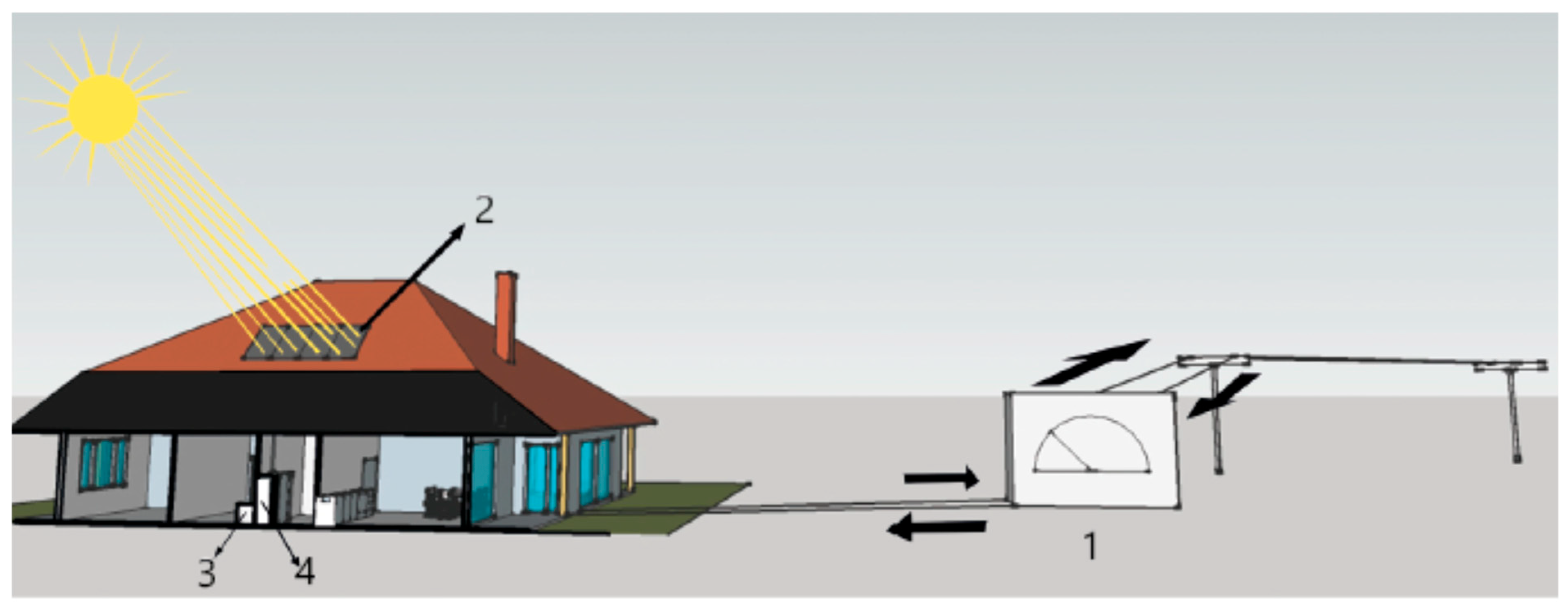
Figure 1. How net metering works (a PV module example). Note: This figure is initially drawn by the author using AutoCAD 2016 and SketchUp 8.
Sustainability 17 11023 g001
Figure 2. Schematic diagram illustrating the concept of this study. Solar modules are produced in factories, loaded onto trucks, and shipped to customers. Note: This figure is initially drawn by the author using AutoCAD 2016 and SketchUp 8.
Sustainability 17 11023 g002
Figure 3. Changes in mortgage balance, cumulative savings, and cumulative fuel savings, as a function of time. Note: This figure was originally adapted from [21] using AutoCAD 2016.
Sustainability 17 11023 g003
Figure 4. An example of life-cycle savings as a function of market discount rate. Note: This figure was originally adapted from [21] using AutoCAD 2016.
Sustainability 17 11023 g004
Figure 5. Time-money phenomenon of total payments for the lifetime of a PV module investment in the Turkish Economy. Note: This figure is drawn by the authors based on Equations (12) and (13). The MATLAB R2019b code for producers, consumers, and the government for any year’s lifetime can be provided upon request.
Sustainability 17 11023 g005
Figure 6. NPV sensitivity chart. Note: This figure is generated by the authors using the sensitivity analysis results presented in Section 4.5.
Sustainability 17 11023 g006
Table 1. Renewable Energy Support Policies for Türkiye.
Regulatory PoliciesFiscal Incentives and
Public Financing
CountryRenewable energy targetsRenewable energy in INDC or NDCFeed-in tariff/
premium payment
Electric utility quota obligation/RPSNet meteringTransport obligation/mandateHeat obligation/mandateTradable RECTenderingInvestment or production tax creditsReductions in sales, energy, CO2, VAT, or other taxesEnergy production paymentPublic investment, loans, or grants, capital subsidies or rebates
TürkiyeOOR O H O
O—existing national (could also include sub-national)
R—Revised (one or more policies of this type)
H—Tenders held in 2016, as in past years
Source: [56]—Renewables 2017—Global Status Report.
Table 2. Progression of payments, remaining principal, interest payment, and present worth of the interest payment (€).
YearMortgage PaymentRemaining PrincipleInterest
Payment
Present Worth
of Interest Payment
16786334638580
26786290634524
36786240629473
46786186624426
56786127619384
66786061613346
76785989606311
86785910599280
96785823591251
106785727582225
116785621573201
126785505562179
136785377551160
146785237538142
156785082524125
166784912508111
17678472549197
18678452047385
19678429345274
20678404542964
21678377140555
22678347037746
23678313834739
24678277431432
25678237327826
26678193223720
27678144719315
2867891414510
29678327926
30678−319332
The worth of the interest payments5283.25
Note: This table is generated by applying the equations in the theoretical framework to Türkiye’s financial inputs. Therefore, the unit of economic values is €. However, one can be curious about a specific country or a region. In that case, the algorithm for the designed table can be provided upon request, provided the initial solar investment payment and the location’s financial structure are specified.
Table 3. Progression of fuel cost, present worth of fuel cost, and the cumulative worth of the fuel cost (€).
YearFuel (Natural Gas) CostPresent Worth of Fuel
(Natural Gas) Cost
1468426
2510422
3556418
4606414
5661410
6720407
7785403
8856399
9933396
101017392
111108388
121208385
131316381
141435378
151564375
161705371
171858368
182025364
192208361
202406358
212623355
222859351
233116348
243397345
253703342
264036339
274399336
284795333
295226330
305697327
The worth of fuel (natural gas) cost11,215.5
Note: This table is designed by applying the equations given in the theoretical framework to the financial inputs for Eskisehir. Therefore, the unit of economic values is €. However, one can be curious about a specific city or a region. In that case, the algorithm for the designed table can be provided upon request, provided the initial solar investment payment and the location’s financial structure are specified.
Table 4. Progression of fuel cost, present cost of fuel, and the cumulative cost of the fuel with a changing inflation rate (€).
YearFuel (Natural Gas)
Cost
Present Worth of Fuel
(Natural Gas) Cost
1468438
2506442
3546446
4590450
5637454
6688458
7722450
8758441
9796433
10836425
11878417
12922409
13968402
141016394
151067387
Total11,394.756443.5
Note: This table is designed by applying the equations given in the theoretical framework to the financial inputs for Eskisehir. Therefore, the unit of economic values is €. However, one can be curious about a specific city or a region. In that case, the algorithm for the designed table can be provided upon request, specifying the initial payment for the solar investment and the financial structure (varying inflation rates and a constant discount rate) for the location.
Table 5. Solar savings from a PV module in Eskisehir in a 30-year lifetime period (€).
YearsFuel
Savings
Extra Mortgage PaymentExtra Insurance Maintenance
Energy
Extra Property TaxIncome Tax SavingsSolar SavingsPresent Worth of Solar Savings
0-----−750−750
1281−716−33−42323−188−171
2306−716−36−45322−168−139
3334−716−38−48322−147−110
4364−716−41−51321−123−84
5396−716−44−55320−98−61
6432−716−47−59319−70−40
7471−716−50−63318−40−20
8513−716−54−67317−6−3
9560−716−57−723153013
10610−716−61−773147027
11665−716−66−8231211340
12725−716−70−8830916051
13790−716−75−9430721262
14861−716−80−10130426971
15938−716−86−10830133079
161023−716−92−11529739887
171115−716−98−12329347193
181215−716−105−13228955199
191325−716−113−141284639105
201444−716−120−151278735109
211574−716−129−162272839114
221715−716−138−173264953117
231870−716−147−1852561078120
242038−716−158−1982471214123
252222−716−169−2122371362126
262421−716−181−2272251524128
272639−716−193−2432131701130
282877−716−207−2601991894131
293136−716−221−2781832104133
303418−716−237−2971652334134
30 3000172
Total present worth of solar savings =883.75
Note: This table is designed by applying the equations given in the theoretical framework to the financial inputs for Eskisehir. Therefore, the unit of economic values is €. However, one can be curious about a specific city or a region. In that case, the algorithm for the designed table can be provided upon request, provided the initial solar investment payment and the financial structure of the location (predicted inflation rates and a constant discount rate) are specified.
Table 6. Scenario analysis results table.
ScenarioKey Assumptions (Summary)Scaling
Factor
Present Worth of PV BenefitsChange in Initial Investment CostEstimated NPV
(Approx.)
Worst-case−10% annual PV yield; net-metering benefits reduced by 50%; −10% present-worth effect; +10% installation cost0.405€357.92+€750€−392.08
Business-as-Usual (BAU)Baseline policy and economic assumptions (original model)1.00€883.75€0€883.75
Optimistic+10% PV yield; +20% policy/environmental incentive effect; +5% discount-rate effect; −15% installation cost1.386€1224.88−€1125€2349.88
Note: Scenario values are computed by the authors based on the assumptions detailed in Section 4.4.
Table 7. Sensitivity analysis.
ParameterVariation
Range
Low Case
NPV (€)
Base Case
NPV (€)
High Case
NPV (€)
Impact
Level
Discount Rate7–12%4308841560High
Inflation7–12%6108841480High
Module Cost Change−20% to +10%2308841540High
System Lifespan25–35 years6508841130Medium
Salvage Value0–10%860884925Low
O&M Costs±30%7608841020Low
Note: Sensitivity analysis results are calculated by the authors using parameter ranges defined in Section 4.5.
Disclaimer/Publisher’s Note: The statements, opinions and data contained in all publications are solely those of the individual author(s) and contributor(s) and not of MDPI and/or the editor(s). MDPI and/or the editor(s) disclaim responsibility for any injury to people or property resulting from any ideas, methods, instructions or products referred to in the content.