You are currently viewing a new version of our website. To view the old version click .
Sustainability
  • Article
  • Open Access

9 December 2025

Distribution of the Land Value Increment in the Context of Rural Tourism

,
,
,
and
1
College of City Construction, Jiangxi Normal University, Nanchang 330022, China
2
Yiwu International Land Port Group Co., Ltd., Jinhua 322001, China
3
Library, Jiangxi Normal University, Nanchang 330022, China
*
Author to whom correspondence should be addressed.

Abstract

The rapid development of rural tourism has become a significant force in promoting rural revitalization. However, the unbalanced distribution of value increment generated by the land tourism-oriented transformation has led to various conflicts and has affected the sustainable development of rural tourism. This study selected Zhongyuan Township, Jing’an County, Jiangxi Province, China, as the research site. Data were collected through semi-structured interviews and questionnaire surveys from government entities, village collectives, and investors, yielding 24 interview transcripts and 665 valid questionnaires. By integrating the Shapley value method, grounded theory, structural equation modeling, and the analytic hierarchy process, this study was conducted according to the frame-work of “tracing influencing factors, deconstructing influence mechanisms, and optimizing the distribution model”. The data were analyzed using grounded theory and structural equation modeling. The results indicated that, in addition to the factors influencing land value increment, policy drivers and risk factors also exerted a direct and significant impact on value increment distribution. Based on these findings, the traditional Shapley value model was optimized to produce a more equitable and efficient distribution framework. The optimized value increment distribution model overcomes the limitations of the traditional Shapley value method in addressing complex multi-stakeholder interests, not only making the distribution of land value increment in rural tourism contexts more equitable and efficient but also providing a scientific decision-making tool for balancing economic development, social equity, and ecological protection—laying a solid foundation for the sustainable development of rural tourism destinations. This study provides a scientific decision-making tool for balancing stakeholder interests in rural tourism development and contributes to the theoretical refinement of benefit distribution mechanisms in sustainable tourism.

1. Introduction

With the acceleration of urbanization, the growing desire among urban residents for pastoral lifestyles has driven the rapid development of rural tourism, making it a major driver of rural economic and social development as well as an important force in achieving rural revitalization [1]. The growth of rural tourism depends heavily on land resources. During tourism development, some agricultural land is converted to tourism-related uses. This process is defined as rural land tourismization, which entails the transformation of rural land from traditional agricultural production or residential use into tourism development, operation, and related service functions. This concept encompasses not only changes in land use but also multidimensional shifts in land function and ownership relations. As rural tourism develops, the economic value of land rises due to multiple influences, rendering land value increment distribution a central issue in rural tourism development. Significant imbalances in land value increment distribution among stakeholders (government, village collectives, villagers, and developers) have triggered frequent conflicts, which not only disrupt local social stability but also impair the sustainable development of rural tourism destinations—such as weakening community participation willingness, damaging ecological environments due to excessive development, and reducing the long-term competitiveness of tourism destinations. For example, cases such as Likeng Village in Wuyuan County, Jiangxi Province [2], Zhaoxing Dong Village in Liping County, Guizhou Province [3], and the Puzhehei Tourist Area in Qiubei County, Yunnan Province [4] in China have all experienced conflicts over value increment distribution that have affected tourism operations. Therefore, addressing the issue of Rural Land Tourismization Value Increment Distribution (RLTVID) is crucial for promoting the high-quality and sustainable development of rural tourism and for contributing to socioeconomic stability [5].
Rural tourism development is a vital component of the rural revitalization strategy. By optimizing the distribution of land resources, it can not only promote diversified rural economic growth but also facilitate comprehensive social progress in rural areas. However, a pivotal challenge remains: the lack of a scientifically grounded and equitable distribution model that is specifically tailored to the multi-stakeholder, cooperative context of rural tourism. While existing research has qualitatively documented the conflicts and institutional frameworks related to land value distribution [6,7], and quantitative studies have applied game theory or price estimation models in fields such as rural land marketization and land expropriation [8,9,10,11], limited studies have specifically focused on RLTVID, and no universally applicable framework has been established to address its context-specific complexity. This gap hinders the resolution of stakeholder conflicts and the alignment of tourism development with the broader goals of sustainable destination management.
To address this challenge, this study aims to develop an optimized model for RLTVID by integrating the Shapley value method from cooperative game theory with grounded theory, structural equation modeling (SEM), and the Analytic Hierarchy Process (AHP). Specifically, it seeks to answer the following research questions: (1) What are the key factors and mechanisms influencing the distribution of land value increment in the context of rural tourism? (2) How can a traditional cooperative game theory model be adapted to incorporate these context-specific factors to achieve a fairer and more efficient distribution?
The theoretical contribution of this paper lies in improving the traditional Shapley value model by systematically integrating key non-marginal contribution factors of value contribution, policy influence, and risk, thereby providing a novel integrated framework for analyzing value distribution in multi-stakeholder tourism settings. Practically, the optimized model is designed to serve as a decision-making tool for rural tourism planners and policymakers, facilitating a more equitable and efficient distribution of benefits among the government, local communities, and developers.

2. Literature Review

The development of rural tourism has evolved from an initial focus on economic diversification to a recognized strategy for rural revitalization. Since its official promotion in 2006, the sector has experienced rapid growth, with academic research expanding from conceptual debates to examining its broader socio-ecological impacts [12]. This research has documented that while rural tourism generates economic benefits, it also creates complex challenges, including stakeholder conflicts over resources [6], profound changes in land use patterns [13], and significant pressures on local communities, particularly regarding livelihoods [14].
Concurrently, the distribution of land value increment represents a well-established domain within land economics, characterized by theoretical debates between public appropriation, private appropriation, and balanced public–private approaches [15,16,17,18,19]. Extensive empirical research has examined value distribution in contexts such as rural land marketization [20,21,22,23,24], homestead acquisition and compensation [9,10,25], and land expropriation for urban development [26,27]. These studies typically focus on contexts with clear binary relationships, such as state versus individual interests, often in scenarios involving compulsory acquisition or straightforward market transactions.
Despite the significance of tourism-driven land transformation, research specifically addressing land value increment distribution in rural tourism contexts remains limited [28]. More broadly, the wider literature on land value increment distribution has primarily employed qualitative methods to explore institutional frameworks [7,29] and distribution conflict trajectories [30]. While this qualitative work successfully identifies key issues, it provides limited operational solutions for quantifying and allocating value among stakeholders.
In quantitative land research, various methods have been applied, including game theory models for analyzing benefit distribution in contexts like post-mining land redevelopment [8,31], multi-scale comparative analysis based on price estimation [24], and case studies integrated with mathematical models to analyze optimal payment methods for land value capture [32], and spatiotemporal analysis of macro-level data [22]. However, these quantitative approaches have not been adequately adapted to the tripartite (government-community-developer) and cooperative nature of rural tourism development. Applications of methods like the Shapley value in land studies demonstrate their utility but also reveal a critical limitation: the traditional framework focuses predominantly on marginal contributions while neglecting other crucial contextual factors like policy influence and asymmetric risk burdens that are particularly relevant in tourism projects [11,33].
While rural tourism literature identifies distribution conflicts, it lacks operational quantitative models for resolution. Conversely, traditional land value distribution research possesses sophisticated methodological tools but has not adequately addressed the complex, multi-stakeholder context of rural tourism. To bridge this divide, this study proposes to develop an integrated analytical framework by refining cooperative game theory through a mixed-methods approach. This endeavor seeks to provide a contextualized and operable solution for land value distribution in rural tourism, thereby addressing a critical limitation in the existing literature.

3. Materials and Methods

3.1. Theoretical Mechanism and Research Design

3.1.1. Theoretical Mechanism

(1)
Model Selection
The Shapley value method utilized in this research was introduced by Lloyd Shapley in 1953 [34]. It offers a solution to value increment distribution challenges within cooperative game settings. This approach allocates benefits according to each member’s marginal contributions to the coalition, thereby ensuring fairness and rationality in the distribution outcomes. To justify its selection for rural tourism, we compare it with alternative frameworks. Negotiation models, which rely on stakeholders’ bargaining power, are problematic as they can perpetuate the inherent power imbalance between village collectives/villagers and governments/developers. Distributive justice models, while strong on ethical principles, often lack operational quantitative methods. In contrast, the Shapley value method quantifies each stakeholder’s marginal contribution, creating a direct link between input and reward. This approach avoids the arbitrariness of negotiation models and overcomes the operational deficit of distributive justice models. Its transparent calculation process enhances the acceptability of the results, which is crucial for maintaining stable multi-stakeholder cooperation. Therefore, the Shapley value provides a superior foundational framework, which we further enhance by integrating key factors like policy drivers and risk.
(2)
Distribution Principles and Their Operationalization
Theoretical discussions on land value increment distribution have formed three core principles: public appropriation, private appropriation, and a balanced approach between public and private interests. The public appropriation principle holds that the government should obtain most of the land value increment due to its leading role in urbanization [15]. The private appropriation principle argues that landowners, meaning village collectives or individual farmers, should be the main beneficiaries as they provide the core production factor of land [16,17,18]. However, traditional literature often adheres to a single principle, leading to an imbalance between public welfare and private interests.
In contrast, the public–private balance principle advocated in this study emphasizes that distribution should fully consider the contributions of all stakeholders while also accommodating broader public interests, while ensuring fairness and maintaining the long-term stability of cooperative development [19]. This principle is quantitatively operationalized by translating it into specific weights within the distribution model. To achieve this, we integrate three key dimensions, including land value increment contribution, policy drivers, and risk factors, into the distribution framework. The weights for these dimensions are then determined by applying the Analytic Hierarchy Process. These weights, which reflect the relative importance of public and private interests, are then used to adjust the initial Shapley distribution results. This approach ensures the distribution accounts not only for marginal contributions but also for policy guidance and risk-sharing, thereby making the public–private balance principle measurable and implementable.

3.1.2. Research Design

This study was conducted following a four-step conceptual framework. First, an initial land value increment distribution model was established using the traditional Shapley value method. Second, an influence mechanism model for the RLTVID was constructed. Key factors influencing RLTVID were extracted through the three-level coding technique of grounded theory, forming the initial model of the RLTVID influence mechanism and leading to the formulation of corresponding research hypotheses. Third, the influence mechanism model was refined. Empirical validation was performed using data collected from questionnaire surveys, and SEM was applied to test the hypothesized influence paths, thereby verifying the research hypotheses and optimizing the influence mechanism model. Finally, the RLTVID initial model was optimized. By integrating the Shapley value method with the refined RLTVID influence mechanism model, an indicator system was developed. The AHP was employed to calculate and adjust the weights, resulting in the finalized optimized RLTVID model. The overall research design is illustrated in Figure 1.
Figure 1. Research technology roadmap.

3.2. Study Area

Zhongyuan Township, situated in Jing’an County, Jiangxi Province, China, represents a prominent case of successful rural tourism development, owing to its array of natural advantages. We selected this site because it clearly embodies the core research phenomenon: the transition of land use towards tourism and the ensuing distribution challenges among multiple stakeholders. Its altitude, latitude, temperature, humidity, and air quality collectively support a thriving wellness tourism and homestay sector [35]. With over two decades of development, the township had 721 registered homestays (30,000 beds) by 2023, hosting about 1.2 million tourists annually. Tourism has created over 3000 local jobs, generates over 180 million CNY in annual revenue, and serves as the cornerstone of rural revitalization. Consequently, tourism has emerged as the cornerstone of rural revitalization in Zhongyuan Township. To realize its vision of a high-quality tourism town characterized by scenic landscapes and year-round accessibility, Zhongyuan Township has proactively integrated and optimized its idle and fragmented land resources. Through active investment promotion, the township has introduced diverse tourism projects—such as alpine skiing, wind power sightseeing, and hot spring resorts—thereby fostering the in-depth development and comprehensive utilization of local tourism assets.
The clear structure and interactions between the local government, village communities, and developers against the backdrop of significant land use transformation at this mature stage make Zhongyuan Township an ideal context for investigating the RLTVID mechanism. While the specific quantitative outcomes are context-dependent, the identified influencing factors, analytical framework, and methodology have broader applicability to rural tourism destinations facing similar multi-stakeholder value distribution challenges, particularly those undergoing land use transition. Furthermore, as a well-documented case of tourism-driven rural revitalization, findings from Zhongyuan Township can offer valuable insights for similar regions in China and beyond, which enhances the generalizability of our study. These attributes establish the township as a viable and appropriate research site for conducting questionnaire surveys, collecting pertinent data, and constructing and refining distribution models.

3.3. Data Collection

A focused field survey was conducted from 18 to 28 July 2023, which coincided with the peak summer tourism season. This timing was critical for data collection. Based on our team’s long-term engagement with the area, we knew that during the off-season, a substantial portion of tourism operators migrate for temporary work elsewhere. The remaining population largely consists of elderly residents who are not directly involved in tourism; consequently, they are not well positioned to provide the specific insights on land value distribution that our study seeks, which would compromise the sample’s representativeness. Conducting the survey in the peak season ensured that our target population was present and accessible, thereby safeguarding the sample size and the quality of questionnaire responses. The survey covered seven representative villages within Zhongyuan Township—including Sanping, Hegang, and Qiujia Villages—which are actively engaged in rural tourism development. The survey employed a stratified sampling approach, targeting four key stakeholder groups: homestay operators, other villagers, grassroots administrative staff, and cultural tourism investment developers.
To ensure data quality and internal validity, our research team implemented a rigorous protocol. We trained all investigators in a standardized interview protocol and questionnaire procedure to minimize interviewer bias. Crucially, prior to the formal survey, all team members were involved in the development, revision, and proofreading of the questionnaire, ensuring each member was thoroughly familiar with its content and the intent behind every item. We then conducted two dedicated training sessions to systematically equip the team with the necessary theoretical knowledge. This was followed by a pilot survey, which served as practical, hands-on training to refine their interviewing skills. Our pilot survey revealed that the potential respondent pool had limited formal education, which prevented them from completing the questionnaire independently. To ensure a high response rate under these constraints, the research team implemented an interview-based questionnaire approach for data collection. By providing timely explanations, the team ensured that respondents accurately understood the survey content, thereby guaranteeing the completeness and validity of the data. We also assured respondents of anonymity and confidentiality at the start of each interview to mitigate potential social desirability bias.
We distributed and collected 680 questionnaires in total. After excluding 15 invalid questionnaires due to repetitive responses, patterns, or incompleteness, we retained 665 valid questionnaires for analysis, achieving an effective response rate of 97.8%. This final sample comprised strategically selected subsets from each of the four key stakeholder groups. From the total population of 721 registered homestay operators in Zhongyuan Township, we drew a random sample of 250, which constituted approximately 34.7% of this core stakeholder population. Given the operators’ limited and predictable daily availability, surveys were scheduled during their designated free periods. Surveys for the remaining stakeholder groups were administered separately. Regarding other villagers, surveys were conducted in villages with well-developed homestay tourism, such as Sanping Village. As Sanping Village is a core area for tourism development in Zhongyuan Township, most villagers engage in homestay operations; therefore, door-to-door visits were made to households not operating homestays. For the other six villages, villager groups were randomly selected proportionally, and visits were conducted to non-homestay-operating households within these groups. Convenience sampling was used for the survey of government staff and investment developers.

4. Model Construction

4.1. RLTVID Initial Model Construction

The transformation and development of rural land for tourism is a collaborative process involving multiple stakeholders. This study regards RLTVID as a cooperative game among three primary entities: the local government (i = A), the village collective and villagers (i = B), and the investment developer (i = C). The cooperative game is represented as (I, V), where I = {A, B, C} and V denotes the characteristic function of the game. These three stakeholders can form seven possible coalitions: individual participation by A, B, or C; two-party coalitions such as (A, B), (A, C), or (B, C); and the three-party coalition (A, B, C). The value increment associated with each coalition is denoted as V(A), V(B), V(C), V(A, B), V(A, C), V(B, C), and V(A, B, C). To calculate the Shapley value, the net gain of each subset (denoted as S) must first be determined. Based on this, we sequentially analyze the gain scenarios for all seven coalition types.
(1)
S = {A}: Government participation alone. Since land ownership belongs to the village collective, the government cannot undertake the project without the collective’s cooperation. Therefore, the value increment V(A) = 0.
(2)
S = {B}: The village collective and villagers contribute land and labor, obtaining value increment V(B) through transfer, circulation, or self-operation.
(3)
S = {C}: Developer participation alone. Without the cooperation of the village collective and government support, the developer cannot obtain land use rights. Therefore, the value increment V(C) = 0.
(4)
S = {A, B}: The local government coordinates and collaborates with the village collective and villagers. The collective provides land for tourism development, while the government offers policy guidance and infrastructure support. The resulting value increment is denoted as V(A, B).
(5)
S = {A, C}: The local government cooperates with the investment developer. Without the participation of the land-owning village collective, land use rights cannot be obtained. Therefore, the land value increment V(A, C) = 0.
(6)
S = {B, C}: The village collective and villagers cooperate with the developer. The villagers and the collective provide land and labor, while the developer supplies capital and technology. Although government support is absent, cooperation between land and capital still takes place. Therefore, the land value increment is V(B, C).
(7)
S = {A, B, C}: Three-party cooperation. The government provides policy support; the villagers and the collective provide land; and the developer provides capital and technology. The land value increment is denoted as V(A, B, C).
From the above analysis, it is evident that cooperation among the three parties is essential for maximizing value increment. If any party refuses to cooperate, the cost of tourism development will increase, and the value increment will decrease. Therefore, only effective cooperation among all three parties can achieve the optimal value increment, with the cooperative gain exceeding that of other scenarios. This demonstrates that the context of the RLTVID issue satisfies the application conditions of the Shapley value method.
Based on the fundamental principle of the Shapley value method, the incremental value to be allocated to the i-th participant can be calculated as shown in Formula (1):
φ i V = i S I w S V S V S \ i , i = 1 , 2 , 3
In Formula (1), i denotes the i-th participant; |S| represents the number of elements in subset S, i.e., the number of participants in this subset; V(S\{i}) represents the benefits after removing participant i from subset S, i.e., the benefits that the other participants can generate without i; V(S) − V(S\{i}) represents the marginal contribution of participant i to subset S, i.e., the additional benefits brought by the participation of participant i; w(|S|) is a weighting factor used to measure the importance of each subset in the game, calculated as follows:
w S = n S ! S 1 ! n !
In Formula (2), n represents the number of entities participating in the distribution of land value increment within the rural land tourism-oriented transformation cooperation alliance. In this paper, n = 3.
Based on the constructed model, a quantitative analysis was conducted on the distribution of land value increment among various stakeholders. The calculation results of local governments’ land value increment distribution under different cooperation models are presented in Table 1.
Table 1. The calculation of value increment revenue distribution by local governments.
The value increment due to local governments can be calculated from Table 1 as follows:
φ A V = 1 6 V A ,   B V B + 1 3 V A ,   B ,   C V B ,   C
Similarly, the due value increment for village collectives can be calculated as follows:
φ B V = 1 3 V B + V A ,   B ,   C + 1 6 V A ,   B + V B ,   C
The appropriate value increment for investment developers is:
φ C V = 1 6 V C ,   B V B + 1 3 V A ,   B ,   C V A ,   B
Using vectors, the value increment distribution ratios among various entities can be represented as:
R 1 = φ A V V A , B , C ,   φ B V V A , B , C ,   φ C V V A , B , C

4.2. Construction and Revision of the RLTVID Influence Mechanism Model

4.2.1. Identification of Influencing Factors for Value Increment Distribution

The distribution of land value increment discussed in this study specifically refers to the distribution of value increment generated from land use transformation during rural tourism development among three primary entities: the government, village collectives (including individual farmers), and developers. To modify the land value increment distribution model based on the Shapley value method, it is essential first to identify the factors, beyond marginal contributions, that influence the distribution of land value increment. Systematically identifying these factors and constructing a mechanism model are critical prerequisites for optimizing the value increment distribution model.
This study employs a grounded theory approach to develop a model of the RLTVID influence mechanism. Literature published over the past two decades was retrieved from the China National Knowledge Infrastructure (CNKI) and Web of Science (WOS) databases using the keywords “rural tourism,” “land tourism transformation,” and “land value increment distribution.” Highly relevant studies were selected for in-depth review, and pertinent content was extracted to create an integrated corpus comprising 96 documents. In May and August 2023, the research team conducted semi-structured interviews with 24 participants from the study area (the interview protocol is provided in Appendix A), including government officials, investment developers, village cadres, tourism operators among villagers, and general villagers. The interview recordings were transcribed into 24 texts. Grounded theory coding analysis was applied to both the literature and interview texts. Following the procedures of open coding, axial coding, selective coding, and saturation testing, key themes were organized into a “storyline” to outline the overall framework, thereby establishing an initial model of the RLTVID influence mechanism.
(1)
Open Coding Results
We randomly selected and reserved 8 interview transcripts and 32 journal articles for saturation testing. We applied open coding to the remaining literature and interview texts, initially extracting 178 preliminary concepts. Based on the intrinsic relationships among these concepts, we further integrated them into categories, ultimately refining 20 initial categories.
(2)
Axial Coding Results
We conducted an in-depth comparative analysis on the 20 initial categories to explore potential relationships. Based on their inherent and logical connections, we reorganized and summarized these categories, forming 6 core categories. Table 2 presents the results of axial coding.
Table 2. Axial coding results.
(3)
Selective Coding Results
Using the research theme “distribution of land value increment” as the core category, we explored the intrinsic relationships between the core category and other categories. We constructed a holistic framework in the form of a “storyline.” Table 3 shows the results of selective coding.
Table 3. Selective coding results.
(4)
Saturation Testing
Following the same procedure, coding analysis was performed on the retained textual data. The results indicate that the extracted concepts and categories are all contained within the existing theoretical framework, with no new concepts or categories emerging. Therefore, it can be concluded that the coding results of this study have reached theoretical saturation.

4.2.2. Construction of the Initial RLTVID Influence Mechanism Model and Research Hypotheses

Based on the theoretical framework derived from the preceding coding analysis, this study further develops a conceptual model of the influence mechanism and proposes corresponding research hypotheses. The research hypotheses in this study are not derived from a single pre-existing mature theory but are inductively generated from the empirical data collected in the field. This approach allows the theoretical framework to emerge directly from the realities of rural tourism land value distribution, addressing a gap in the literature where such a context-specific theory was lacking. The theoretical foundation for our hypotheses is the conceptual model derived from the preceding grounded theory analysis. The core categories and their relational paths identified through open coding, axial coding, and selective coding form the logical basis for our conceptual model and subsequent hypotheses. For instance, the axial coding results (Table 2) established core categories such as “Inputs of production factors” and “Land value increment,” while the selective coding (Table 3) articulated the nature of their relationship, forming a “storyline” that explains how the value is created and distributed.
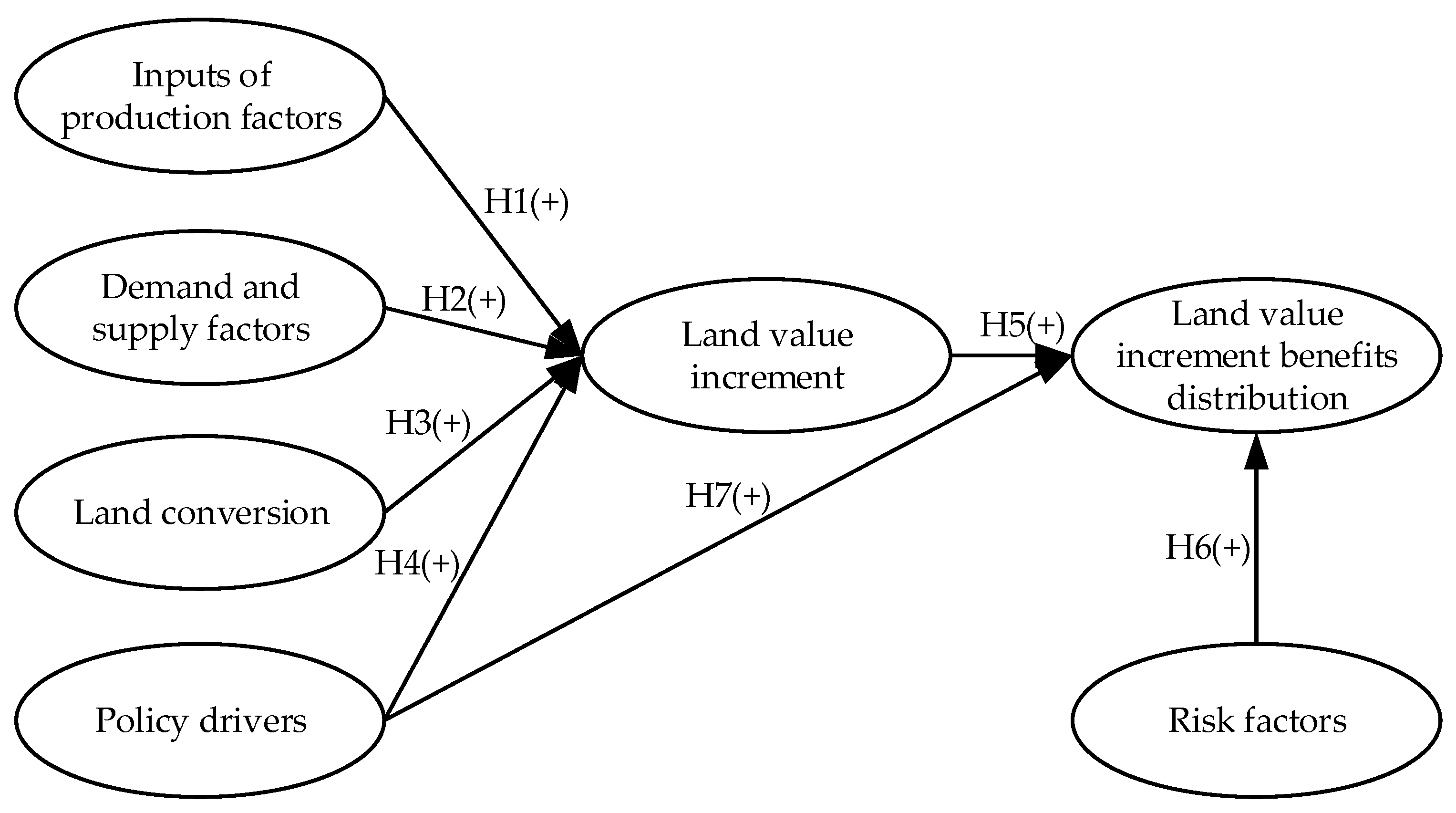
Drawing on the logical relationships revealed by the final coding results, an initial model of the RLTVID influence mechanism is constructed, as illustrated in Figure 2.
Figure 2. The initial model of the RLTVID impact mechanism. Note: + indicates positive significant effect.
Based on the logical relationships among the elements, the following hypotheses are proposed:
H1. 
The input of production factors during the transformation of rural land for tourism can significantly increase land value.
H2. 
Demand and supply factors during the process of rural land tourism transformation can significantly increase land value.
H3. 
Changes in land use during the transformation of rural land for tourism can significantly increase land value.
H4. 
Policy drivers during the process of rural land tourism transformation can significantly promote the increase in land value.
H5. 
Land value increment has a significant positive effect on the distribution of land value increment.
H6. 
Risk factors have a significant positive effect on promoting the distribution of land value increment.
H7. 
Policy drivers have a significant positive effect on promoting the distribution of land value increment.

4.2.3. Questionnaire Design

Through a systematic review and synthesis of relevant literature, the dimensions of the questionnaire scale and their specific items were refined, as detailed in Table 4. The survey questionnaire employed a five-point Likert scale, ranging from “1” (strongly disagree) to “5” (strongly agree).
Table 4. RLTVID impact factor measurement scale.
To ensure the scientific rigor and validity of the questionnaire, this study adopted an iterative refinement process involving expert consultations and a small-scale pilot survey. The initial questionnaire was revised based on the experts’ suggestions. Subsequently, a small-scale pilot survey was administered before the formal investigation to identify any residual issues, including ambiguous wording, comprehension challenges, or discrepancies with actual contexts. The questionnaire was further refined based on the responses and feedback gathered from the pilot survey, culminating in the final version deployed for the formal data collection.

5. Results

5.1. Descriptive Statistics

A total of 680 questionnaires were distributed and collected in this study. After excluding 15 invalid questionnaires due to repeated responses, incomplete answers, and patterned responses, the effective response rate was 97.8%. The basic characteristics of the valid sample are presented in Table 5.
Table 5. Sample descriptive statistics (N = 665).

5.2. Measurement Model Analysis

Before constructing the SEM, this research followed established empirical research conventions by systematically conducting reliability, validity, and normality tests on the measurement model.
To test for the presence of serious common method bias in the sample data, this study adopted a dual-test strategy [48]. First, the Harman’s Single-Factor Test was conducted. Results of the exploratory factor analysis showed that the variance explanation rate of the first factor was 22.497%, far below the critical threshold of 50%. Second, the latent method factor approach was implemented. After adding a method factor to the original measurement model, the changes in fit indices were ΔRMSEA = 0.006, ΔSRMR = 0.012, ΔCFI = 0.03, and ΔTLI = 0.023. None of these changes exceed the specified critical criteria (ΔRMSEA/SRMR < 0.05 and ΔCFI/TLI < 0.1), indicating that there is no serious common method bias in this study, and the data quality meets the requirements of empirical analysis. Scale reliability was assessed using SPSS 26.0. Cronbach’s α coefficients were computed for all dimensions and the overall scale. The results demonstrated that both the dimensional and total scale alpha values exceeded 0.8, indicating high internal consistency and affirming the reliability of the data collection procedure. Furthermore, normality tests were performed on the observed variables. Results indicated that all metrics for the observed variables satisfied acceptable criteria, suggesting the sample data approximated a normal distribution.
To ensure the robustness of the measurement model, validity was verified using a sample-splitting methodology. The 665 valid samples were randomly divided into two subsets: Sample Set A (n = 328) was used for exploratory factor analysis to assess the scale’s validity, while Sample Set B (n = 337) was used for confirmatory factor analysis to evaluate model fit, convergent validity, and discriminant validity. This dual-sample validation strategy strengthens the robustness and generalizability of the study’s findings.

5.2.1. Exploratory Factor Analysis

This study utilized SPSS 26.0 to perform exploratory factor analysis on Sample Set A. The results indicated that the Kaiser–Meyer–Olkin measure of sampling adequacy was 0.811, surpassing the acceptable threshold of 0.7, and Bartlett’s test of sphericity was significant (p < 0.05). These statistical indicators confirmed that the sample data were appropriate for factor analysis. Following the confirmation of data suitability, factor extraction and rotation were conducted.
Using principal component analysis, seven common factors with eigenvalues greater than 1 were extracted. These seven factors collectively accounted for 68.988% of the total variance, indicating that the extracted factors effectively captured the variance in the original variables and were suitable for further analysis.
An orthogonal rotation with Kaiser normalization was applied, converging after six iterations and yielding seven distinct factors. As shown in Table 6, all 29 measurement items had communalities above the critical threshold of 0.4, indicating that the extracted common factors effectively explained the variance in the measurement indicators. Furthermore, all items exhibited factor loadings greater than 0.5 on their respective factors, with no significant cross-loadings observed. These results confirm that the factor structure is interpretable and demonstrates strong discriminant validity, accurately reflecting the underlying concepts or dimensions represented by the factors.
Table 6. Rotated factor loadings.

5.2.2. Confirmatory Factor Analysis

This study utilized AMOS 24.0 and sample dataset B to conduct confirmatory factor analysis to assess the construct validity of the measurement scale. The maximum likelihood method was applied to evaluate the goodness-of-fit indices of the structural equation model [49]. The initial results indicated that the model fit was unsatisfactory, necessitating the screening and removal of certain items. Items with standardized factor loadings below the threshold of 0.6, those exhibiting non-independent residuals, and those showing collinearity issues were eliminated. The removal of items IP5 and LC3 was further supported by theoretical considerations. Item IP5 was deleted because it suffered from conceptual ambiguity by blending the distinct concepts of community governance and commercial environment regulation. Item LC3 was removed due to its strong conceptual overlap with other items in the same dimension, specifically LC1 and LC4, which focus more precisely on specific types of land use changes. Subsequently, the model fit improved significantly, and all remaining items met the established standards.
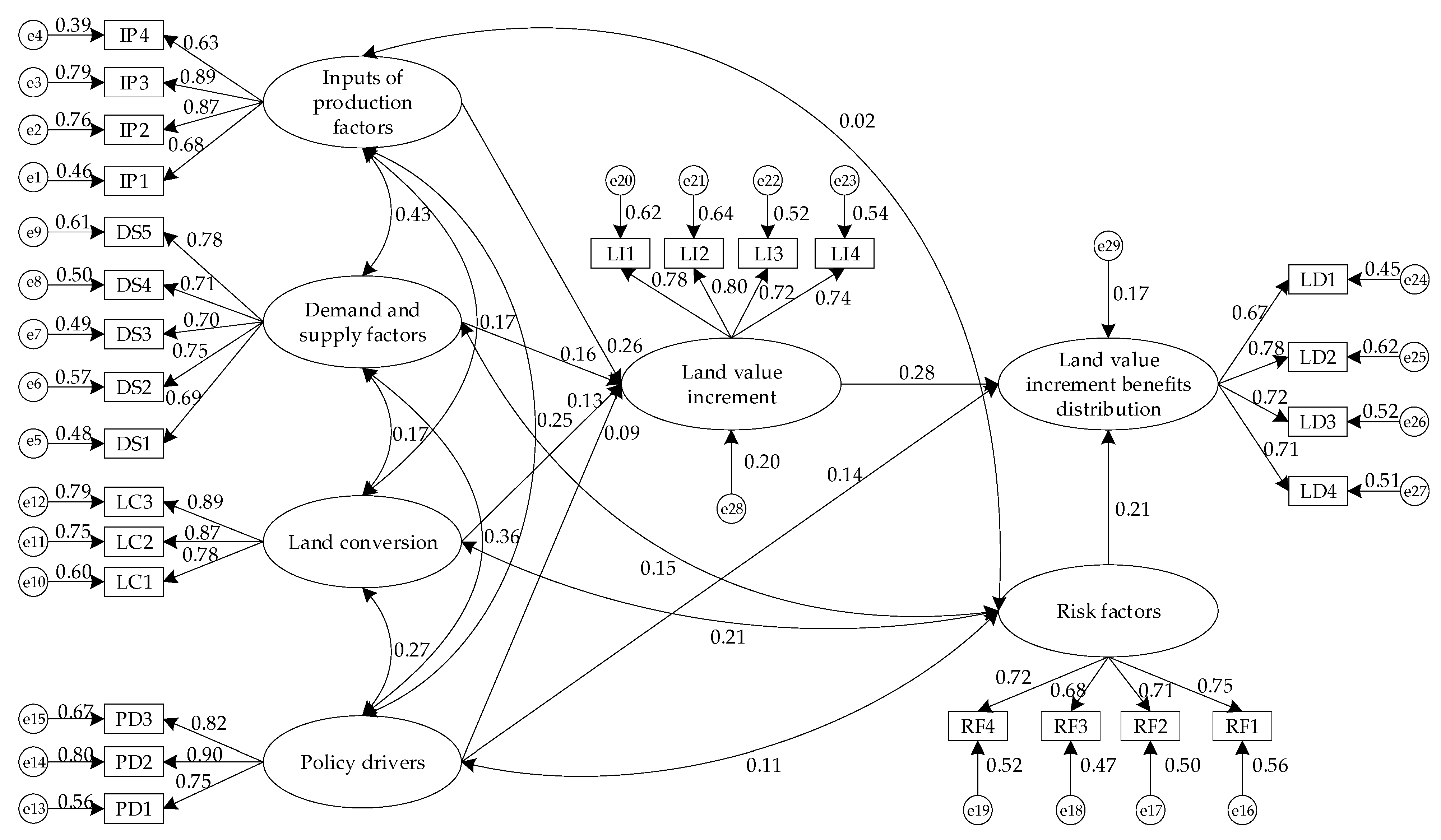
The fitting results of the initial model are shown in Figure 3, and the performance of the fit indices is presented in the measurement model results in Table 7. All indicators meet or exceed the standard values. These results indicate that the hypothesized model of factors influencing land value increment distribution provides a good representation of the actual data collected from the field. In other words, the model’s structure is consistent with the real-world observations, giving us confidence that it is a valid tool for understanding the relationships between the key variables in our study. In conclusion, the fit indices of the measurement model in this study all comply with the standards, indicating that the model has good overall model fit and reliability.
Figure 3. Initial structural equation model fit results.
Table 7. Results of the fitting analysis of each model.
Furthermore, using 0.6 as the critical value for standardized factor loadings, the convergent validity of the scale questionnaire was examined with AMOS 24.0 to investigate the correlations among observed variables. The detailed results of the convergent validity analysis are presented in Table 8. All measured items had standardized factor loadings greater than 0.6; the composite reliability (CR) values of the seven latent variables were all above 0.7; meanwhile, the average variance extracted (AVE) for each latent variable exceeded the minimum threshold of 0.5. These results collectively confirm that the measurement model exhibits good convergent validity. For a rigorous assessment, the square root of the AVE for each construct was compared to its correlations with other constructs. As shown in Table 9, the square root of the AVE for each construct is greater than its correlation coefficient with any other construct, thereby conclusively confirming that the measurement model exhibits good discriminant validity.
Table 8. Results of convergent validity analysis.
Table 9. Results of discriminant validity analysis.

5.3. Structural Model Analysis

5.3.1. Initial Construction of the Structural Equation Model and Fit Analysis

Based on the initial influence mechanism model presented in Figure 2, this study used AMOS 24.0 to analyze the path relationships among the model’s various elements. As shown in the initial model results in Table 7, all fit indices for the RLTVID influence mechanism met the standard criteria, indicating that the model demonstrates a good fit.
According to the path relationship test results in Table 10, the t-value for the path from policy driving to land value increase was 1.339, which did not exceed the critical value of 1.96. Therefore, it failed to reach the 0.05 significance level and did not pass the test. The t-values for the other paths were all greater than 1.96, passing the test at various significance levels.
Table 10. Initial model path relationship test results.

5.3.2. Model Modification

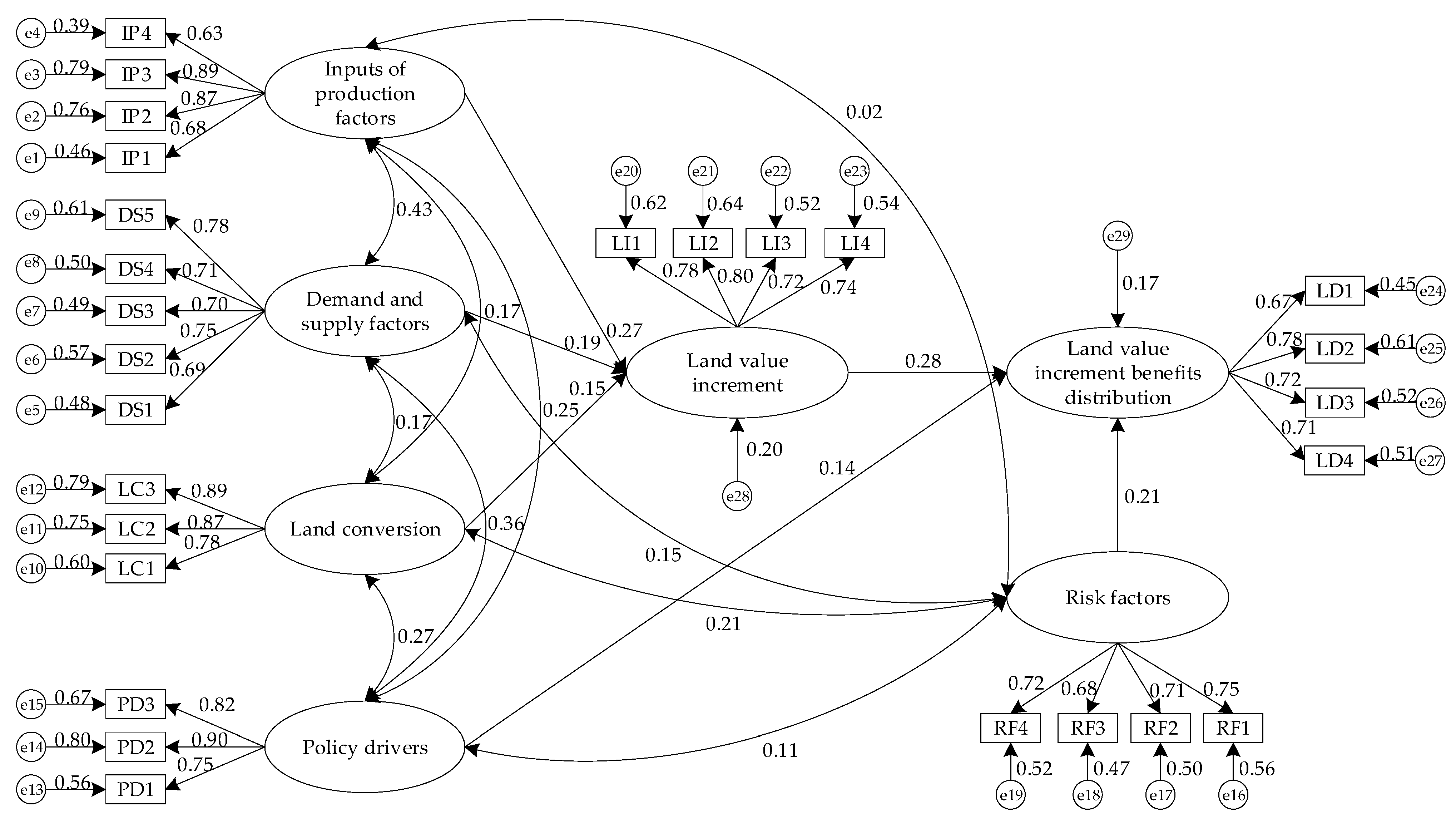
Based on the path relationship testing results of the initial model, this study refined the model by removing the non-significant path from policy drivers to land value increment in Figure 2. The revised SEM was subsequently tested using the same methodology. The analysis results, as shown in Figure 4 and the revised model outcomes in Table 7, indicate that all indices meet the standard thresholds, demonstrating a good model fit for the refined model.
Figure 4. Modified structural equation model fit results.
According to the path relationship test results of the revised structural equation model shown in Table 11, the t-values for all paths exceeded 1.96, and the p-values met the significance threshold (p < 0.05). This indicates that the modified model fits the data well and is suitable for further analysis.
Table 11. Modified model path relationship test results.

5.3.3. Hypothesis Testing

The empirical results demonstrate that factors including input of production factors, changes in supply and demand, and land conversion exert significant positive effects on the process of land value appreciation, thereby supporting research hypotheses H1, H2, and H3. Similarly, the degree of land value appreciation, risk factors, and policy-driven effects also demonstrate significant positive impacts on land value increment distribution, confirming hypotheses H5, H6, and H7. However, the pathway representing the influence of policy drivers on land value appreciation was not statistically significant; thus, hypothesis H4 is not supported. This lack of significance may be attributed to several potential reasons: inefficiencies in policy implementation, leading to a gap between institutional design intentions and practical outcomes; limited comprehension of policy implications among respondents, potentially diminishing perceived effectiveness; or the presence of market self-regulation mechanisms that may counteract the intended effects of policy interventions. Furthermore, the unique socio-economic and environmental heterogeneity of the study area may also contribute to the observed variability in the policy driver pathway.
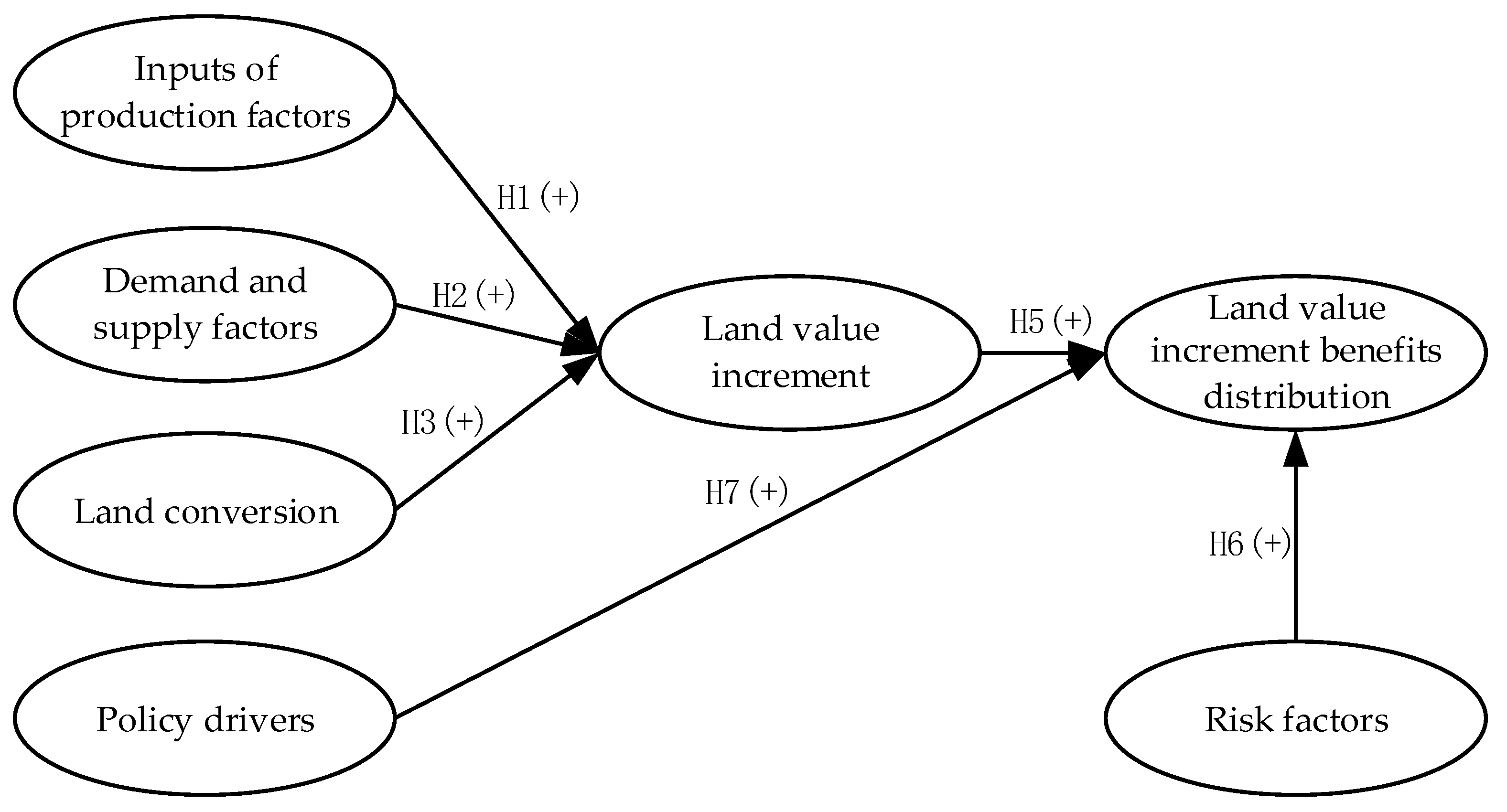
Based on the empirical analysis results, the RLTVID influence mechanism model was refined. The optimized model is shown in Figure 5.
Figure 5. The Optimized RLTVID Influence Mechanism Model. Note: + indicates positive significant effect.

5.4. Optimization of Value Increment Distribution Model Based on Shapley Value Method

Previous research has systematically identified and clarified various factors influencing the distribution of land value increment and their mechanisms of action. This study employs the Shapley value method in combination with the AHP and expert consultations to comprehensively determine the weights of these influencing factors. These indicator weights are then used to adjust and optimize the baseline RLTVID model, aiming to develop a more scientific and equitable distribution scheme.

5.4.1. Weight Determination Based on AHP

(1)
Constructing the Hierarchical Structure Model
Based on the optimization results of the influence mechanism model from previous studies, it can be observed that factors such as the input of production factors, changes in demand and supply, and land use alterations primarily exert an indirect impact on the distribution of value increment by promoting the increase in land value. Accordingly, this study integrates these three factors to construct a comprehensive indicator termed “Land Value-Increment Contribution.” Building on this, the study establishes an RLTVID evaluation indicator system, incorporating key variables such as policy orientation, risk factors, and the marginal contributions of alliance members, as detailed in Table 12.
Table 12. RLTVID indicator system.
(2)
Constructing the Judgment Matrix
To determine the indicator weights, it is necessary to further construct judgment matrices for each indicator layer. Using the 1–9 scaling method, the importance of indicators at each level is quantitatively evaluated through pairwise comparisons, thereby forming the judgment matrices.
(3)
Calculation of Indicator Weights and Consistency Check
The core of the AHP lies in the calculation and application of eigenvectors, which reflect the weight distribution of indicators at each level relative to the higher level. The indicator weights are determined by solving for the maximum eigenvalue (λmax) and its corresponding eigenvector of the judgment matrix. Additionally, a consistency check must be performed on the maximum eigenvalue to assess the rationality of the judgment matrix. If the check results meet the consistency requirement, the eigenvector is normalized to obtain the indicator weights; if not, the judgment matrix must be appropriately adjusted.
The calculation of the judgment matrix’s maximum eigenvalue (λmax) is shown in Formula (7):
λ m a x = i = 1 n A W i n W i
In the equation, A is the judgment matrix, W is the weight vector, n is the dimension of the matrix, and i denotes the i-th element.
And that of the consistency index (CI) is shown in Formula (8):
C I = λ m a x n n 1
A higher CI value indicates lower consistency of the judgment matrix.
In practical applications, the CI value is typically evaluated in conjunction with the consistency ratio (CR) to determine whether the consistency of the judgment matrix is acceptable. A CR value less than 0.1 indicates that the consistency of the judgment matrix meets the requirement. The standard values of the random consistency index (RI) are presented in Table 13. The calculation of the CR value is shown in Formula (9):
C R = C I R I
Table 13. Randomized consistency indicator (RI) standard value.

5.4.2. Calculation of Indicator Weights Using the Sum-Product Method

This study designed a survey to determine the indicator weights of factors influencing RLTVID and employed the Delphi method, inviting 15 domain experts to evaluate these weights. Judgment matrices were constructed based on expert ratings, and individual weights were calculated using the sum-product method. The calculation process for Expert 1’s indicator weights is illustrated in Formula (10) as an example.
  A = 1 2 1 5 1 / 2 1 1 / 2 3 1 2 1 5 1 / 5 1 / 3 1 / 5 1 n o r m a l i z a t i o n C o l u m n   v e c t o r 0.37 0.38 0.37 0.36 0.19 0.19 0.19 0.21 0.37 0.38 0.37 0.36 0.07 0.06 0.07 0.07 a n d   n o r m a l i z a t i o n r o w   s u m m a t i o n   0.368 0.193 0.368 0.071 = W
Calculate the maximum eigenvalue:
  λ m a x = i = 1 n A W i n W i = 4.00416
Calculate the Consistency Index (CI):
C I = λ m a x n n 1 = 4.004 4 4 1 = 0.00139
The order of the judgment matrix is 4, and according to Table 13, the RI value is 0.90. Calculate the consistency ratio (CR):
C R = C I R I = 0.00139 0.90 = 0.002 < 0.10
CR < 0.1, indicating that the consistency test was passed. Using the same method and procedure, the matrix weights for each expert across all indicator levels were calculated. Based on the weights provided by each expert, the arithmetic mean was applied to the indicators at each level to obtain comprehensive weight values. All judgment matrices had CR values strictly controlled within the 0.1 threshold, confirming consistency in the weighting system.
The weights for the distribution of land value increment are as follows:
W 1 = 0.321 ,   0.209 ,   0.392 ,   0.078
The weights assigned to the indicators of land value increment contribution are as follows:
W 2 = 0.149 ,   0.083 ,   0.175 ,   0.208 ,   0.077 ,   0.074 ,   0.234
The weights assigned to the indicators of policy-driven factors are as follows:
W 3 = 0.180 ,   0.084 ,   0.229 ,   0.507
The weights assigned to the indicators of risk factors are as follows:
W 4 = 0.207 ,   0.269 ,   0.369 ,   0.155

5.4.3. Determination of Indicator Threshold Values

Given that RLTVID involves multiple stakeholders with significantly different contributions and interests, the distribution of value increment becomes highly complex. To achieve a more equitable distribution, it is necessary to adjust the indicator weights.
The same panel of 15 experts was reconvened and, based on practical research findings, independently assessed the responsibility weights and contribution rates of three key stakeholders—local government, village collective, and investment developer—across detailed indicators within three dimensions: land value increment contribution, policy drive, and risk factors. This process resulted in the creation of an original scoring matrix, Fijbc.
The arithmetic means of the scores assigned by the 15 experts for each indicator, denoted as Fibc, were calculated. This value represents the assessment score of a specific participating entity for a specific indicator, as shown in Formula (14):
F i b c = F i k b c n
The variables are defined as follows: i ∈ {A, B, C} corresponds to the three core participating entities: local government, village collective, and investment developer, respectively; k ∈ [1, n] represents the serial number of experts, with “n” denoting the total number of experts on the panel; b ∈ {2, 3, 4} corresponds to the dimensions within the criteria level: land value increment contribution, policy drive, and risk factors, respectively; “c” represents the serial number of specific evaluation indicators at the indicator level. Fikbc denotes the score assigned by the k-th expert to the c-th indicator under the b-th dimension for the i-th entity.
Accordingly, the distribution proportion of a participating entity at the criteria level can be calculated using the following formula:
R i b = W i × F i b c
The judgment matrix, constructed based on the value increment distribution proportion vector, is:
R = R 1 R 2 R 3 R 4
As mentioned earlier, when b = 1, it represents the marginal contribution of each member at the criteria level; that is, the distribution proportion R 1 = φ A V V A ,   B ,   C ,   φ B V V A ,   B ,   C ,   φ C V V A ,   B ,   C calculated using the Shapley value method. When b = 2, 3, and 4, it corresponds to the distribution proportions R b = R A b ,   R B b ,   R C b of the three entities under different criteria levels, respectively.

5.4.4. Modification of the Value Increment Distribution Model

Based on the RLTVID theoretical framework, this study first established a multi-level evaluation system for influencing factors and determined the initial weights of indicators at each criterion level using the AHP, forming the weight matrix W1. Subsequently, the initial weight coefficients were optimized and adjusted by integrating real-world contexts and expert evaluations, ultimately constructing the value increment distribution proportion judgment matrix R. Through this analysis, the value increment distribution proportion for each stakeholder in tourism-oriented land development, denoted as P, can be calculated. Its specific expression is as follows:
C = W 1 × R = P A , P B , P C

6. Discussion and Conclusions

6.1. Discussion

6.1.1. Further Discussion of Results

This study clearly demonstrates that land value increment distribution in rural tourism is a complex process influenced synergistically by multi-dimensional factors closely linked to destination sustainability. The SEM test results show that the input of production factors, changes in supply and demand, and land conversion all exert significant positive driving effects on land value increment—consistent with classical land economics theory and highlighting that the economic development potential of destinations is rooted in multi-factor synergy.
However, the direct influence path of policy drivers on land value increment did not pass the significance test. While policies are widely recognized as crucial for steering tourism development, their direct translation into land value can be attenuated by implementation gaps or market mechanisms. This aligns with the concept of the “implementation deficit,” where policy outcomes are mediated by local contexts [50]. In our case, land value increment in rural tourism areas relies more on intrinsic market demand and social capital drivers, where the self-regulating role of the market mechanism somewhat weakens the direct impact of policy intervention.
Furthermore, this study verifies that the level of land value increment, risk factors, and policy-driven effects have direct and significant impacts on the final distribution outcome. Our optimized model, by integrating marginal contribution, land value-increment contribution, policy adjustment, and risk-sharing, directly engages with core propositions in distributive justice theory, which emphasizes balancing contributions, needs, and procedural fairness [51]. By moving beyond a purely contribution-based framework to incorporate policy considerations and risk factors, the model provides an empirical basis for operationalizing distributive justice in rural tourism land transactions.
The model’s incorporation of environmental and social risk factors aligns with the core principle of regenerative tourism, a paradigm that advocates for tourism development to generate net positive benefits for local communities and ecosystems [52]. By ensuring that distribution outcomes internalize potential damages, our model provides a mechanism to safeguard against short-term economic gains undermining long-term sustainability.
Finally, the tripartite structure of our model, which integrates the government, village collective, and developers, resonates with the principles of cooperative governance. This governance approach emphasizes collaborative decision-making among diverse stakeholders [50]. The model’s quantifiable framework for balancing the interests and inputs of these three key actors provides empirical support for the practical feasibility of cooperative governance in rural tourism land management.
For instance, the Jing’an International Ski Resort project involved converting 19,891.74 square meters of collective forest land in Naoshang Village into state-owned construction land. The land use rights were auctioned to Jiangxi Jingxue Sports Tourism Co., Ltd. for 15.77 million yuan in 2024, yet the farmers only received one-time land acquisition subsidies. Applying our model to this negotiation context would involve quantifying the village collective’s land contribution, the developer’s capital and technology input, and the government’s policy support and infrastructure investment. The goal is to determine a reasonable long-term distribution ratio instead of relying on a one-time payment, thereby balancing efficiency and equity. Our model could facilitate tripartite negotiations by clarifying each party’s rights and obligations: the government would oversee policy implementation and risk regulation; the village collective would represent the farmers in claiming long-term value increment shares; and the developer would secure reasonable returns while assuming environmental and operational risks. This approach would create a more transparent and collaborative negotiation mechanism.

6.1.2. Theoretical Implications

This study makes three distinct theoretical contributions to the fields of land governance, tourism development, and distributive justice research.
From a methodological perspective, the research advances the study of complex socio-economic issues in tourism by developing a novel mixed-methods framework that integrates grounded theory, SEM, and the Shapley value method. Unlike single-method approaches that often suffer from limitations in either qualitative exploration or quantitative validation, this integrated methodology bridges the gap between theoretical insights and empirical testing. It enables the systematic identification of influencing factors, verification of causal relationships, and quantification of stakeholder contributions. This methodological innovation not only provides a rigorous analytical tool for land value increment distribution research but also offers a replicable reference for studying other complex multi-stakeholder interaction issues in tourism and rural development.
In the field of distributive justice, the study enriches distributive justice theory by challenging the dominance of contribution-based frameworks and proposing a multi-dimensional operationalization of fairness. By quantitatively incorporating policy adjustment mechanisms and risk-sharing factors alongside marginal contributions, the research refines distributive justice from an abstract concept to a measurable and actionable framework rooted in three core pillars: contribution equity, regulatory equity, and risk equity. This extension addresses the criticism that traditional distributive justice research often fails to account for contextual factors such as policy constraints and asymmetric risks in practical distribution scenarios, providing a new theoretical perspective for balancing interests in multi-stakeholder cooperative governance—particularly in rural tourism where market mechanisms, policy interventions, and social equity goals intersect.
For tourism destination governance literature, the research expands the field by shifting the analytical focus from dyadic stakeholder interactions to a tripartite framework that explicitly models the interplay between the government, village collectives, and developers. By clarifying the complementary roles and interest demands of the three actors, the study provides a more comprehensive theoretical basis for understanding how to reconcile diverse stakeholder inputs and advance sustainable destination management, offering implications for not only rural tourism but also other forms of rural land use transition involving multi-stakeholder collaboration.

6.1.3. Managerial Implications

The findings offer concrete pathways for implementing cooperative governance and regenerative tourism principles. Optimize the core mechanism for land value increment distribution to anchor destination sustainability. It is recommended that local governments utilize the RLTVID model framework constructed in this study to comprehensively consider the contributions and risks of various stakeholders in the land value increment process. A reasonable value increment distribution ratio should be assigned for government infrastructure investment and policy support; corresponding value increment should be secured for village collectives and villagers regarding their land resource and labor input; and reasonable returns should be ensured for investment developers regarding their capital and technology input, thereby motivating all parties to participate in rural tourism development.
Strengthen policy guidance, framing policies not just as top-down directives but as tools to enable collaborative governance. Policy drivers play a key regulatory role in value increment distribution. The government is advised to improve the policy support system for rural tourism development, attracting social capital through preferential policies such as tax reductions and financial subsidies; enhance policy guidance on land transfer and efficient utilization to ensure distribution fairness; and simultaneously standardize rural tourism project management to promote transparency in the value increment distribution process, preventing unfair distribution from hindering tourism development or affecting rural community stability.
Emphasize dynamic regulation of risk factors. Emphasize dynamic regulation of risk factors. Establishing risk early-warning and assessment mechanisms, and incorporating risk-bearing into distribution, is essential for building the resilience required by regenerative tourism. Given the significant impact of risk factors on value increment distribution, it is recommended that the government establish a sound mechanism for risk early-warning, assessment, and regulation during rural tourism development, focusing on managing environmental, economic, and social risks associated with land development. As risks cannot be eliminated entirely, it is necessary to scientifically assess the intensity of risk borne by each entity and incorporate this into value increment distribution considerations.
Enhance community governance and multi-stakeholder interest coordination. To address the interest conflicts among multiple stakeholders during the rural land tourismization transition, the government is advised to strengthen community governance, actively foster collaborative governance structures, and establish efficient interest coordination mechanisms. This can be achieved by guiding villagers to participate in project planning and decision-making, thereby enhancing their acceptance of the distribution scheme; encouraging village collectives and developers to sign long-term cooperation agreements that clearly define the rights and obligations of all parties, ensuring transparency and fairness in distribution.
Promote dynamic adaptation and adjustment of land value increment distribution. As the environment for rural tourism development evolves, it is recommended that the government establish a dynamic adjustment system for the distribution mechanism. This involves regularly evaluating key influencing factors and optimizing the value increment distribution ratio based on the actual situation. Moreover, the transferability of this model should be considered. While formulated and empirically grounded in a specific case study, its core logic holds promise for adaptation in other rural tourism settings. The key lies in the contextual recalibration of the AHP weights. For instance, applying this model to an ecologically sensitive area would necessitate increasing the weight of “risk factors,” particularly ecological conservation risk, while in a heritage tourism context, greater emphasis might be placed on “policy drivers” or “community contribution.” The model’s value lies not in providing universal weights, but in offering a structured yet adaptable decision-support framework that allows planners to prioritize context-specific criteria.

6.1.4. Limitations and Future Research Prospects

This study has certain limitations that should be acknowledged and addressed in future research. These limitations, along with their corresponding research prospects, are outlined as follows:
(1)
Limited generalizability due to a single case study. This research selected only Zhongyuan Township as the study area. While representative, China’s vast territory exhibits significant differences in regional economic development levels, land policy systems, and rural tourism models; thus, the generalizability of the findings needs further verification with broader samples. Future research should test the model’s stability and transferability by applying it to multiple case studies across diverse contexts within and beyond China, which would also reveal how varying institutional and cultural settings influence the distribution outcomes.
(2)
Inability to capture dynamic processes. The reliance on cross-sectional data means this study provides a static snapshot, unable to observe how distribution relationships and stakeholder perceptions evolve as a tourism destination matures. Future research would benefit from longitudinal studies tracking the dynamics of land value distribution over time.
(3)
Potential for methodological biases. Firstly, the face-to-face interview approach, though necessary for our respondent pool, carries a risk of social desirability bias. Future work could mitigate this by employing mixed methods, such as anonymous surveys combined with qualitative interviews. Secondly, the reliance on the AHP for weight determination introduces an element of subjectivity. Enhancing this with objective data, like regional economic indicators or historical land value data, would improve the model’s robustness.
(4)
Simplified treatment of complex factors. The model’s quantification of policy drivers is relatively simplified, whereas actual policy implementation is complex. Future research could combine more granular policy data and in-depth field investigations to deeply analyze the mechanism of policy in value increment distribution and further optimize the model.

6.2. Conclusions

This study enriches the theoretical research framework for RLTVID by innovatively integrating the Shapley value method, grounded theory, SEM, and AHP. It not only addresses the limitations of the traditional Shapley value method in handling complex distribution problems but also provides a scientific and systematic solution for land value increment distribution in the context of rural tourism. Through model optimization, this study provides quantitative support for the distribution principle of “a balanced approach between public and private interests” and facilitates its operational implementation. The research, through field investigation, reveals the key influencing factors and their internal mechanisms affecting the distribution of value increment from rural tourism land, emphasizing the regulatory value of policy, risk, and land value increment contribution. It offers new analytical perspectives and theoretical support for subsequent related research.

Author Contributions

Conceptualization, P.Z. and T.Z.; methodology, J.L.; software, R.L.; validation, P.Z., T.Z. and R.L.; formal analysis, J.L. and J.W.; investigation, P.Z., T.Z., J.L., R.L. and J.W.; resources, T.Z.; data curation, J.L. and J.W.; writing—original draft preparation, P.Z., J.L. and J.W.; writing—review and editing, P.Z., T.Z., J.L., R.L. and J.W.; visualization, J.L.; supervision, P.Z.; project administration, T.Z.; funding acquisition, P.Z., R.L. and J.L. All authors have read and agreed to the published version of the manuscript.

Funding

This research was funded by the National Natural Science Foundation of China (No. 72064020), the Jiangxi Provincial Association of Social Sciences (No. 23GL11), and Jiangxi Education Department Graduate Student Innovation Fund Project (No. YC2025-S043).

Institutional Review Board Statement

The study was conducted in accordance with the ethics protocol approved by the College of City Construction, Jiangxi Normal University Ethics Committee (IRB No. 2023005, 3 April 2023).

Data Availability Statement

The data presented in this study are publicly available at https://doi.org/10.6084/m9.figshare.30746831 (accessed on 30 November 2025).

Acknowledgments

We would like to thank the students from the research team who participated in the survey for their contributions to the data collection in this study.

Conflicts of Interest

Author Jia Wang was employed by the company Yiwu International Land Port Group Co., Ltd. The remaining authors declare that the research was conducted in the absence of any commercial or financial relationships that could be construed as a potential conflict of interest.

Appendix A

Table A1. Interview protocol.
Interview TopicsInterview Questions
Perceptions regarding the development of rural tourism in rural areasIn your opinion, what specific contributions and efforts have the government, villagers, and investor-developers, respectively, made towards the development of rural tourism?
What positive and negative impacts do you believe the development of rural tourism in rural areas has brought to local regional development, individual villagers, village collectives, and the government?
Perceptions regarding rural land transfer for developing rural tourismTo date, how much land in Zhongyuan Township has been transferred for developing rural tourism, and what are the specific processes involved in this land transfer?
What positive impacts do you think the transfer of rural land for developing rural tourism has had on individuals and local social development?
What risks and pressures do you believe the local government, villagers, and developers need to bear during the process of transferring rural land for tourism development?
Perceptions regarding the development of rural tourism in rural areasIn your view, what factors contribute to the generation of land value increment during the development of rural tourism?
How is the value increment generated by rural tourism development currently distributed? Do you consider this distribution model and its outcomes to be reasonable?
Whose interests do you think should be prioritized in the distribution of value increment from rural tourism development, and how should the interests of all parties be balanced?
What other important influencing factors do you believe should be considered to achieve a fair distribution of land value increment?

References

  1. Qi, P.W.; Sun, Y.Y.; Chen, P. Evaluation of Farmers’ Livelihood Vulnerability in Border Rural Tourism Destination and Its Influencing Factors-Take Tumen City, Yanbian Korean Autonomous Prefecture, Jilin Province, as an Example. Sustainability 2025, 17, 7942. [Google Scholar] [CrossRef]
  2. Zhu, Y.; Zou, Y.G.; Chai, S.S.; Chen, P.Y. The Evolution Mechanism of Implicit Conflict in Rural Tourism Communities: From the Perspective of Community Residents. Tour. Trib. 2022, 37, 52–63. (In Chinese) [Google Scholar] [CrossRef]
  3. Zhang, J.; Zhao, Z.B.; Liu, Y.; Li, X.Y. The Spatial Characteristics and Formation Mechanism of Conflicts in Tourism Community Under the Background of Landscape-village Integration: A Case Study of Dong Village in Zhaoxing. Econ. Geogr. 2022, 42, 216–224. (In Chinese) [Google Scholar] [CrossRef]
  4. Tian, L.; Liu, L. Evolution Mechanism of Tourism Islanding Effect: A Case Study of Puzhehei Tourist Attraction. Geogr. Sci. 2021, 41, 22–32. (In Chinese) [Google Scholar] [CrossRef]
  5. Sun, P.F.; Cao, H. Tourism Development and Rural Land Transfer-Out: Evidence from China Family Panel Studies. Land 2024, 13, 426. [Google Scholar] [CrossRef]
  6. Ma, X.L.; Dai, M.L.; Fan, D.X.F. Cooperation or Confrontation? Exploring Stakeholder Relationships in Rural Tourism Land Expropriation. J. Sustain. Tour. 2020, 28, 1841–1859. [Google Scholar] [CrossRef]
  7. Li, Q. Legal System for the Value-Added Income Distribution of Rural Homesteads from the Perspective of Common Prosperity—Taking the Theory of Sharing Land Development Rights as an Analytical Framework. Henan Soc. Sci. 2024, 32, 85–96. (In Chinese) [Google Scholar] [CrossRef]
  8. Yue, Y.B.; Liu, X.M. Discussion on Value-added Income Distribution of Collective Operational Construction Land’s Entering the Market: Taking the Pilot Reform of Rural Land System as Example. Contemp. Econ. Manag. 2018, 40, 41–45. (In Chinese) [Google Scholar] [CrossRef]
  9. Zhu, C.M.; Yuan, S.F.; Li, S.N.; Xia, H. Study on Incremental Revenue Distribution of Rural Residential Land based on Land Development Right and Function Loss: Taking the “Land Coupons” in Yiwu as an Example. China Land Sci. 2017, 31, 37–44. (In Chinese) [Google Scholar] [CrossRef]
  10. Li, L.L.; Dong, Q.Y.; Li, C.J. Research on Realization Mechanism of Land Value-Added Benefit Distribution Justice in Rural Homestead Disputes in China-Based on the Perspective of Judicial Governance. Land 2023, 12, 1305. [Google Scholar] [CrossRef]
  11. Wang, H.; Kan, X.; Jiang, X.R. Imbalance and Balance: The Distribution of Land Value-added Benefits in Postmining Land Use. Extr. Ind. Soc. 2023, 13, 101220. [Google Scholar] [CrossRef]
  12. Gao, S.L.; Huang, S.S.; Huang, Y.C. Rural Tourism Development in China. Int. J. Tour. Res. 2009, 11, 439–450. [Google Scholar] [CrossRef]
  13. Xi, J.C.; Zhao, M.F.; Ge, Q.S.; Kong, Q.Q. Changes in Land Use of a Village Driven by over 25 Years of Tourism: The Case of Gougezhuang Village, China. Land Use Policy 2014, 40, 119–130. [Google Scholar] [CrossRef]
  14. Stone, M.T.; Nyaupane, G.P. Protected areas, tourism and community livelihoods linkages: A comprehensive analysis approach. J. Sustain. Tour. 2016, 24, 673–693. [Google Scholar] [CrossRef]
  15. He, X.F. The Logic of Land Rights: Where Is China’s Rural Land System Heading; China University of Political Science & Law Press: Beijing, China, 2010. [Google Scholar]
  16. Cai, J.M. On the Reform of China’s Land System; China Financial & Economic Publishing House: Beijing, China, 2009. [Google Scholar]
  17. Kong, Z.X. A Study on the Operation Mechanism and Social Effects of Farmers’ Professional Cooperatives in China; China Agriculture Press: Beijing, China, 2012. [Google Scholar]
  18. Guo, L. The Practice and Dilemmas of “Profit from Appreciation to the Public”: From Ideal to Reality. Sociol. Stud. 2021, 36, 23–46+225–226. (In Chinese) [Google Scholar]
  19. Li, J.G. On the Principle of Value Added Income Distribution in Real Estate Land. Acad. J. Zhongzhou 2018, 3, 32–37. (In Chinese) [Google Scholar] [CrossRef]
  20. Wang, X.Y.; He, M.Y.; Gao, Y. An Empirical Study on Land Revenue Distribution in Agricultural Land Conversion in China: A Sampling Survey Analysis Based on Kunshan, Tongcheng, and Xindu. J. Manag. World 2006, 10, 62–68. (In Chinese) [Google Scholar] [CrossRef]
  21. Wang, X.Y. On the Distribution of Revenue from the Market Entry and Circulation of Rural Collective Business Construction Land. Rural. Econ. 2014, 10, 3–7. (In Chinese) [Google Scholar]
  22. Lin, R.R.; Zhu, D.L. A Spatial and Temporal Analysis on Land Incremental Values Coupled with Land Rights in China. Habitat Int. 2014, 44, 168–176. [Google Scholar] [CrossRef]
  23. Liu, H.B.; Zhou, Y.P. The Marketization of Rural Collective Construction Land in Northeastern China: The Mechanism Exploration. Sustainability 2021, 13, 276. [Google Scholar] [CrossRef]
  24. Xie, X.X.; Dries, L.; Heijman, W.; Zhang, A.L. Land Value Creation and Benefit Distribution in the Process of Rural-urban Land Conversion: A Case Study in Wuhan City, China. Habitat Int. 2021, 109, 102335. [Google Scholar] [CrossRef]
  25. Song, G.; Xu, S.G.; Gao, J. Value-added Income Distribution of Homestead Exit Compensation in Major Grain Producing Areas in Northeast China from the Perspective of Land Development Right. J. Nat. Resour. 2017, 32, 1883–1891. (In Chinese) [Google Scholar] [CrossRef]
  26. Fang, J.; Shen, K.J. Just Compensation and Distribution of Land Added Value in Eminent Domain. J. Beijing Inst. Technol. (Soc. Sci. Ed.) 2017, 19, 142–149. (In Chinese) [Google Scholar] [CrossRef]
  27. Du, J.F.; Thill, J.C.; Feng, C.C.; Zhu, G.Y. Land Wealth Generation and Distribution in the Process of Land Expropriation and Development in Beijing, China. Urban Geogr. 2017, 38, 1231–1251. [Google Scholar] [CrossRef]
  28. Zhang, F. The Current Status and Causes of Farmers’ Sharing in Land Appreciation Benefits in Rural Tourism Development. Soc. Sci. 2020, 1, 72–76. (In Chinese) [Google Scholar] [CrossRef]
  29. Wu, Z.J. Land Value Increment Distribution of Collective Operational Construction Land: Summary of Pilot Projects and Design of System. Law Sci. Mag. 2019, 40, 45–56. (In Chinese) [Google Scholar] [CrossRef]
  30. Li, H.; Wan, J. Distribution of Rural Land Appreciation Gains from the Perspective of “Empowerment and Restriction”: Evolutionary Trajectory and Basic Experience. Contemp. Econ. Res. 2023, 335, 120–128. (In Chinese) [Google Scholar] [CrossRef]
  31. Xu, B.; Li, Y.F.; Li, S.J. Empirical Study of Distribution of Incremental Land Revenue: Case Study of Jiutai District in Northeast China. J. Urban Plan. Dev. 2021, 147, 05021037. [Google Scholar] [CrossRef]
  32. Yan, L.; Hong, K.R.; Li, H. Transfer of Land Use Rights in Rural China and Farmers’ Utility: How to Select an Optimal Payment Mode of Land Increment Income. Land 2021, 10, 450. [Google Scholar] [CrossRef]
  33. Li, J.; Hu, Y. Tourism—Based Community: A New Perspective of the Justice of the Distribution of Tourism—Based Interests in Traditional Villages. J. Yunnan Minzu Univ. (Philos. Soc. Sci. Ed.) 2021, 38, 100–109. [Google Scholar] [CrossRef]
  34. Solan, E.; Vieille, N. Stochastic Games. Proc. Natl. Acad. Sci. USA 2015, 112, 13743–13746. [Google Scholar] [CrossRef] [PubMed]
  35. Zhang, P.W.; Guo, S.F.; Zeng, L.; Li, X.Y. Formation Mechanisms of Rural Summer Health Destination Loyalty: Exploration and Comparison of Low- and High-Aged Elderly Leisure Vacation Tourists. Behav. Sci. 2022, 12, 367. [Google Scholar] [CrossRef] [PubMed]
  36. Li, T.; Tao, Z.M.; Liu, J.M.; Tao, H.; Lu, M.; Song, H.F. Spatial Characteristics of Rural Tourism Employment Promotion in Mountainous Areas. China Popul. Resour. Environ. 2021, 31, 153–161. (In Chinese) [Google Scholar]
  37. Yu, F.W.; Huang, X.; Yue, H. The High-quality Development of Rural Tourism: Connotative Features, Key Issues and Countermeasures. Chin. Rural. Econ. 2020, 8, 27–39. (In Chinese) [Google Scholar]
  38. Kumar, S.; Valeri, M.; Shekhar. Understanding the Relationship Among Factors Influencing Rural Tourism: A Hierarchical Approach. J. Organ. Change Manag. 2022, 35, 385–407. [Google Scholar] [CrossRef]
  39. Cunha, C.; Kastenholz, E.; Carneiro, M.J. Entrepreneurs in Rural Tourism: Do Lifestyle Motivations Contribute to Management Practices that Enhance Sustainable Entrepreneurial Ecosystems? J. Hosp. Tour. Manag. 2020, 44, 215–226. [Google Scholar] [CrossRef]
  40. Gao, C.L.; Cheng, L. Tourism-driven Rural Spatial Restructuring in the Metropolitan Fringe: An Empirical Observation. Land Use Policy 2020, 95, 104609. [Google Scholar] [CrossRef]
  41. Wang, T.; Wang, W.; Wu, Z.J.; Su, C.H.; Chen, M.H. Understanding Farm Households’ Participation in Nong Jia Le in China. Sustainability 2019, 11, 1282. [Google Scholar] [CrossRef]
  42. Li, J.; Yang, Y.; Ye, Y. Rural Tourism, Economic Growth, and Environmental Sustainability: Empirical Evidence Based on County-Level Data in China. Sustainability 2025, 17, 9215. [Google Scholar] [CrossRef]
  43. Tang, C.J. Performance Evaluation of Rural Tourism Land Transfer Based on DEA Model. Agro Food Ind. Hi-Tech 2017, 28, 347–351. [Google Scholar]
  44. Wu, J.Y.; Hu, Y.J.; Wang, Q.X.; Chen, Y.W.; He, Q.S.; Ta, N. Exploring Value Capture Mechanisms for Heritage Protection under Public Leasehold Systems: A Case Study of West Lake Cultural Landscape. Cities 2019, 86, 198–209. [Google Scholar] [CrossRef]
  45. Sözen, B.; Kiliç, S.E. Tourism-Led Rural Gentrification in Multi-Conservation Rural Settlements: Yazıköy/Datça Case. Sustainability 2025, 17, 8439. [Google Scholar] [CrossRef]
  46. Zhou, C.; Liang, Y.J.; Fuller, A. Tracing Agricultural Land Transfer in China: Some Legal and Policy Issues. Land 2021, 10, 58. [Google Scholar] [CrossRef]
  47. Xu, J.C.; Xu, Y.H.; Pang, X.C.; Yao, X.J.; Hao, M.J.; Jin, C.Y. Study on Land Incremental Value Distribution based on Contribution-Risk Analysis of Farmland Acquisition. China Land Sci. 2017, 31, 28–35. (In Chinese) [Google Scholar]
  48. Podsakoff, P.M.; MacKenzie, S.B.; Lee, J.Y.; Podsakoff, N.P. Common method biases in behavioral research: A critical review of the literature and recommended remedies. J. Appl. Psychol. 2003, 88, 879–903. [Google Scholar] [CrossRef]
  49. Wu, M.L. Structural Equation Modeling: Operations and Applications of AMOS; Chongqing University Press: Chongqing, China, 2010. [Google Scholar]
  50. Ansell, C.; Gash, A. Collaborative Governance in Theory and Practice. J. Public Adm. Res. Theory 2008, 18, 543–571. [Google Scholar] [CrossRef]
  51. Rawls, J.R. A Theory of Justice; Harvard University Press: Boston, MA, USA, 1971. [Google Scholar]
  52. Bellato, L.; Pollock, A. Regenerative tourism: A state-of-the-art review. Tour. Geogr. 2025, 27, 558–567. [Google Scholar] [CrossRef]
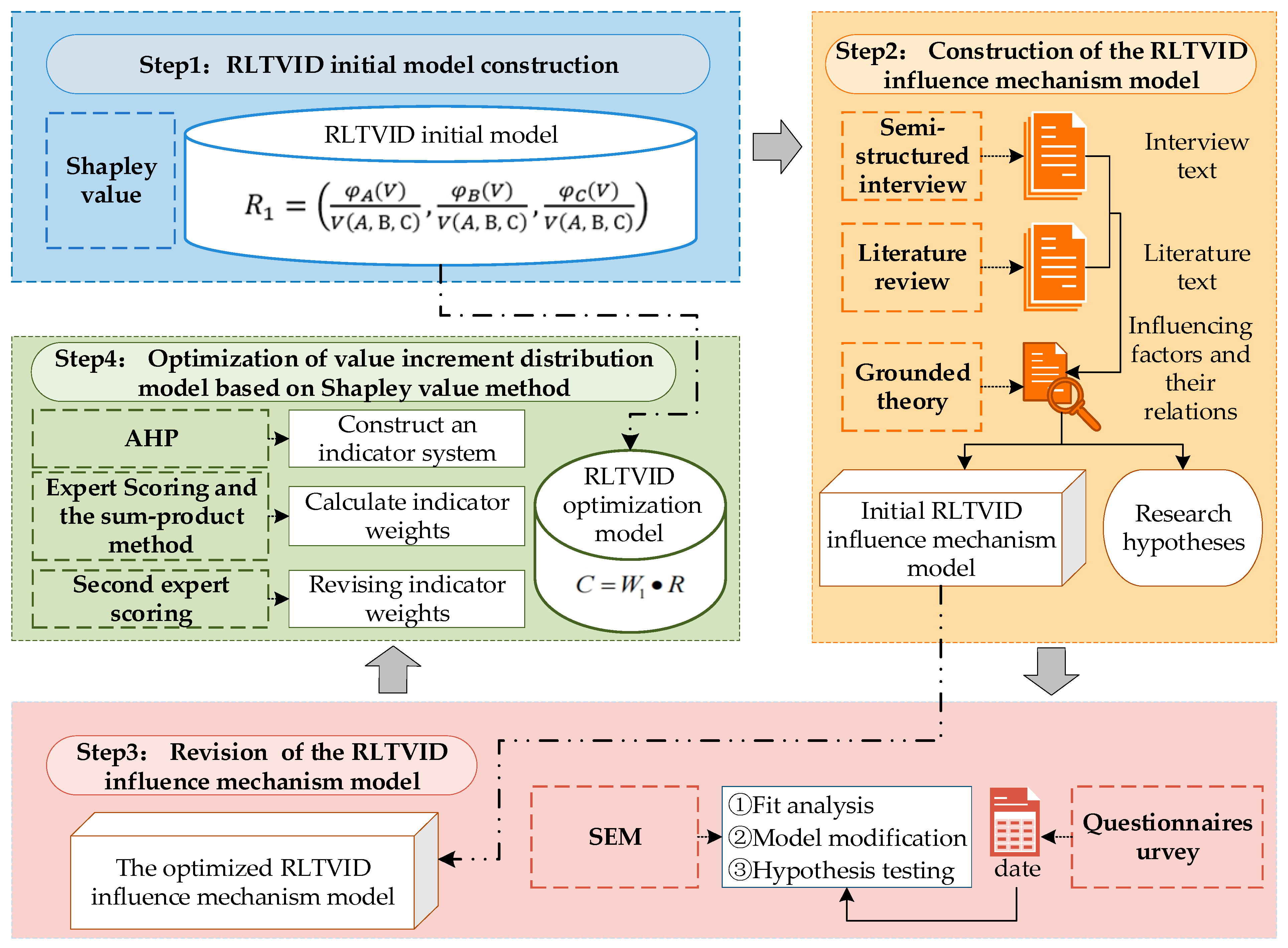
Disclaimer/Publisher’s Note: The statements, opinions and data contained in all publications are solely those of the individual author(s) and contributor(s) and not of MDPI and/or the editor(s). MDPI and/or the editor(s) disclaim responsibility for any injury to people or property resulting from any ideas, methods, instructions or products referred to in the content.

Article Metrics

Citations

Article Access Statistics

Multiple requests from the same IP address are counted as one view.