1. Introduction
A Product–Service System (PSS) is a business model that delivers value through an integrated combination of products and services positioned along a continuum that ranges from pure product offerings to pure service solutions [
1,
2]. Servicizing is a type of PSS in which a firm sells the use or functionality of a product rather than the product itself [
3]. The term “servicizing” is also referred to as “servitization” in the literature; we use “servicizing” throughout for consistency. Under this business model, a firm retains the ownership of the product, is responsible for the operating cost (e.g., repair and maintenance cost), and charges a customer based on a pay-per-usage (PPU) pricing.
The appeal of IoT technology is increasing for industrial digital transformation. This particularly holds true for digitalized PSSs where the integration of IoT technology into physical products allows remote access to the product status and its operating conditions, and enables firms to offer smart product–service bundles [
4]. Smart PSSs require innovative pricing models, such as PPU in which customers are charged based on their amount of usage, and IoT technology is the key enabler [
5].
The propagation of IoT technology along with servicizing business models is being recognized as a promising innovative business model. In recent years, many manufacturers have adopted the servicizing business model. For example, Xerox offers cost-per-page plans through its “Managed Print Services (MPS)” solutions [
6]. Xerox also provides a “Metered Supplies Replenishment” program for eligible devices, where customers are billed on a cost-per-copy basis. This program includes automatic toner supply delivery, supplies monitoring, and account management. Xerox retains ownership of the supplies until consumed [
7]. Winterhalter provides industrial dishwashers and washing machines under a “pay-per-wash” model [
8]. Car-sharing services such as Zipcar [
9] and Free2Move [
10] adopt a servicizing model, where customers are charged only for the time or distance they use the vehicle. Moreover, there are several companies that operate as third parties and offer servicizing of other manufacturers’ product(s). For example, Bundles and Homie provide home appliances (e.g., washing machines, dishwashers, and coffee makers) manufactured by Miele and Zanussi, respectively [
11,
12].
Economic growth and environmental sustainability are of central concern in the servicizing business model. From an economic perspective, recent attention to access rather than ownership provides a business opportunity for manufacturing firms: By adopting servicizing business model, manufacturers can leverage the growing demand for access to a product to strengthen their position on the market [
13]. From an environmental perspective, servicizing, when aligned with the principles of circular economy, encourages firms to produce more durable and efficient products [
14,
15]. Moreover, as manufacturers retain ownership of the product, they are motivated to optimize maintenance, extend product life, and reduce waste generation [
16,
17]. Additionally, customers are encouraged to reduce usage, as they are typically charged per unit of use [
18,
19,
20,
21]. These mechanisms jointly contribute to the sustainability of the servicizing.
However, the economic and environmental benefits of servicizing can be jeopardized by product misuse due to a lack of customer sense of ownership. A consumer who buys only the functionality of a product may not consider the economic and sustainability impacts of their behavior when the manufacturer maintains ownership of the product and is responsible for its operating costs [
22]. Thus, a customer may choose a usage pattern that increases the operating costs (e.g., repair and maintenance costs) and negatively affects the environment. This is a major risk that can reduce the profitability of servicizing compared to traditional sales, especially when the product’s operating cost is relatively high [
20]. This argument offers one plausible explanation as to why many manufacturers hesitate to adopt servicizing or, in some instances, have stopped its implementation. For example, in June 2018, BMW shut down its car-sharing services, ReachNow, in Brooklyn due to high operating costs, including vehicle damage and high maintenance costs [
23].
In reference to the above shortcoming, ref. [
24] considered product misuse in servicizing as a moral hazard that stems from two sources: customers’ opportunism and information asymmetry. To mitigate the negative effects of customers’ self-interest and opportunism, firms can share with customers the savings in operating costs originating from their improved usage patterns. Moreover, to reduce information asymmetry, they can use IoT technology to closely monitor their products and determine when and how they are used by customers. By collecting data on customers’ usage behavior, firms can adopt a pricing strategy that charges customers based on how responsibly they use a product. Usage behavior refers to observable actions such as intensity, duration, and frequency of product use, which the firm can monitor through IoT and can influence both maintenance costs and environmental impact. For example, Homie benefits from IoT technology by applying a specific pricing scheme to stimulate customers’ better usage behavior. Under this pricing model, customers pay a price commensurate with their usage settings, such as temperature or time settings [
12,
25]. Bundles applies IoT to monitor how their appliances are used, analyze energy usage, and optimize maintenance schedules [
11]. However, Bundles still charge customers with a price that is independent of their behavior.
In practice, existing servicizing models can be broadly grouped into two categories: (i) behavior-linked pricing models such as Homie, which directly connect customer usage patterns to pricing, and (ii) pay-per-use models without behavioral linkage, such as Bundles, Winterhalter, and Free2move, where customers are charged solely based on amount of usage. The absence of explicit behavioral integration in the latter category underscores the need to address the risk of product misuse and motivates our study.
In this paper, we consider the opportunity of encouraging customers to use a product in a more sustainable way by providing them with price incentives that reflect the care with which they use the product. Building on this idea, our study aims to examine whether and under what conditions a BDP strategy can improve both the firm’s economic and environmental performance by mitigating product misuse in servicizing contexts. Specifically, we consider a monopolist firm that adopts only a servicizing business model. By applying IoT technology, the firm collects data on customers’ actual behavior and aggregates these data into a behavior score that represents the quality of their behavior. Although other monitoring technologies such as smart sensors, AI-enabled systems, and mobile applications can perform similar functions either within or outside an IoT network, we focus on IoT due to its prevalence and practical relevance in servicizing contexts. The developed framework, however, is generalizable and can be applied to other monitoring technologies that provide similar capabilities.
We allow the firm to choose between two pricing models: behavior-independent pricing (BIP) and BDP. Under the BIP, the firm charges customers a price per unit of usage regardless of their usage behavior, whereas under the BDP, customers are charged a price per unit of usage that corresponds to their behavior. Because BDP relies on monitoring and evaluating user behavior, it may raise ethical and equity concerns. Users with consistently higher effort costs, such as due to personal circumstances or limited accessibility, could be disadvantaged. Although modeling these effects is beyond the scope of this study, acknowledging them is important and firms should consider governance, informed consent, and equitable practices to support sustainable implementation. We develop both pricing models and characterize the firm’s and customers’ optimal decisions under each pricing model. We analyze the conditions under which the BDP model is superior from an economic or environmental perspective.
Our results indicate that when the behavior score of customers is relatively low or the firm’s operating cost is relatively high, it is more profitable for the firm to adopt the BDP model. By providing customers with monetary incentives to use the product more sustainably, the firm’s revenue per unit of usage decreases, but the operating cost is also reduced. We show that the benefits of adopting the BDP decrease at higher monitoring costs. The same result is realized when it is more cumbersome for customers to improve their behavior since the firm needs to provide higher discounts to affect customers’ usage behavior. We find that when a firm adopts the BDP, production quantity and customers’ aggregate usage are higher than when the firm adopts the BIP. Despite the higher aggregate usage and production quantity, we find conditions under which the BDP is environmentally superior to the BIP. In particular, we find that when the BDP is more profitable, it is environmentally superior only for products that have the majority of their environmental impact in the use phase as opposed to the production phase. Therefore, the BDP can be a win–win–win strategy that benefits all three parties: the firm, the customers, and the environment. Finally, although our analytical prescriptions are derived for a model in which customers are homogeneous in their usage behavior, we study the robustness of our prescriptions when customers have heterogeneous usage patterns.
Our findings provide servicizing firms with insights into whether and when they can benefit from adopting a BDP strategy to simultaneously reduce operating costs and environmental impacts through opportunities for mutual gains with customers. As the BDP relies on IoT technology, our results also have policy implications for promoting sustainable practices, such as by offering subsidies or incentive programs aimed at offsetting technology and monitoring costs and encouraging firms to adopt BDP models.
This study also contributes to the literature on sustainable business models by offering a theoretical framework that explains how BDP incentives can promote sustainability objectives in servicizing contexts. Specifically, this study makes a unique contribution as the first analytical study to address the issue of product misuse under servicizing, providing a BDP model that integrates customer behavior into the firm’s economic and environmental performance.
In the remainder of the paper, we review the current related literature in
Section 2, and discuss our assumptions and develop our model in
Section 3. In
Section 4, we characterize a servicizing firm’s decisions in equilibrium and analyze the profitability and environmental impact of adopting the BDP model. We then examine the robustness of our analytical results in the presence of heterogeneous customers in
Section 5, and finally present our concluding remarks in
Section 6.
2. Literature Review
Our study relates to four different streams of literature: the research on the PSS, sustainability of the servicizing business model, price differentiation in new business models, and the application of the IoT in sharing economy business models.
There are three distinct categories of PSSs that have been discussed in the literature: (i) the product-oriented PSS (involves the selling of products and the offer of accompanying extra services, e.g., after-sales services); (ii) the results-oriented PSS (the consumer and the provider agree on a defined result without the involvement of any predetermined product, e.g., cleaning services); (iii) the use-oriented PSS (the ownership of the tangible product is retained by the provider who sells the functionality of the product, e.g., car rentals) [
1,
2,
3,
26]. Our paper is concerned with the servicizing business model and thus contributes to the studies on use-oriented PSSs.
A stream of emerging studies in servicizing has mainly focused on the positive impacts of servicizing on sustainability. Through multiple case studies, ref. [
27] argued that to achieve a sustainable society, we need to reduce consumption through servicizing. Some studies analytically investigated the potential of servicizing to provide sustainability benefits. They analyzed the joint effects of product design and business model choices on the firm’s economic and environmental performance and determined the conditions under which servicizing decreases the level of product usage while increasing product efficiency [
18,
19] or durability [
20]. Furthermore, servicizing has been identified as a critical enabler of the circular economy, supporting closed-loop systems by maintaining ownership and extending the life cycle of products [
16], particularly by leveraging IoT technologies to retain control over products [
28]. Recent literature on servicizing and circular economy suggests that when firms transition from product ownership models to service-based offerings, such as servicizing, they retain control over product flows, thereby facilitating repair, reuse, and remanufacturing activities [
29]. There are a few empirical works that explore the environmental impacts of adopting PPU pricing by servicizing companies. For instance, ref. [
12] conducted a longitudinal case study and investigated how the PPU model offered by Homie improves customers’ consumption patterns and stimulates sustainable usage behavior. Under this pricing model, Homie offers a lower price per washing cycle for the lower temperature settings. Ref. [
12] showed that this pricing model could be a promising way to reduce the average washing temperature. They suggest that if a firm with a servicizing business model adopts a pricing model that stimulates sustainable consumption, it will attract a wider, potentially less environmentally conscious group of customers toward sustainable washing behavior.
Our work borrows some modeling elements from this literature but differs with respect to two main aspects. First, the majority of these studies compare the environmental and economic benefits of servicizing with selling the product. In contrast, we focus on servicizing and study two distinct pricing models under servicizing. Second, these studies assume that the operating cost is independent of customer behavior. Thus, they consider a fixed PPU price for servicizing models. However, under servicizing, customer behavior plays a critical role in the operating and maintenance costs and consequently affects the environmental and economic benefits of servicizing. In our paper, we explicitly model the impacts of customer behavior on the operating cost and discuss how a firm can benefit from a BDP model that encourages its customers to contribute to decreasing the operating cost.
There is substantial literature on price differentiation in different contexts. In the marketing literature, behavior-based price discrimination is defined as charging customers differently based on their past purchase history (see [
30] for an overview of behavior-based price discrimination and [
31,
32,
33] for analytical models). In communication networks and data services, usage-based pricing is discussed as a pricing model that charges customers with a price proportional to the allocated resource [
34,
35]. Our paper is distinguished from these studies, as we consider a pricing model that charges each customer with a price corresponding to how they use the product. In the literature on new business models, there are a number of studies that incorporate dynamic pricing into their analytical models (e.g., [
36,
37,
38,
39]). These studies consider a platform with an on-demand business model that offers ride-sharing services via a pool of independent providers (e.g., Uber and Lyft) and adopts dynamic pricing to differentiate among customers. We contribute to this stream of research by introducing a pricing model under servicizing that is underpinned by a firm’s technological capability in gathering and analyzing the data on customer behavior.
The conceptual and case studies on the IoT have been very useful in shedding light on the potential of IoT technologies. Refs. [
40,
41] provided surveys on industrial applications of the IoT. Ref. [
42] discussed IoT applications in the sharing economy, and refs. [
13,
43,
44,
45] studied the applications of IoT in PSSs. In particular, ref. [
44] shows that the digital PSS enabled by the IoT allows firms to monitor product usage and provide performance-based services that align with sustainability goals. Moreover, ref. [
45] discussed how IoT and machine learning technologies can provide alternative usage metrics (e.g., customer behavior) for PPU pricing models. These metrics assess the value that a customer captures from using a product and facilitate the calculation of the product’s depreciation cost. This supports our study by showing how real-time behavioral data, made possible through IoT, can be leveraged to design pricing strategies that incentivize sustainable customer behavior while enhancing firm profitability. In line with this stream of research, we analytically show the benefits of incorporating the customer behavior metric, enabled by the IoT, in a PPU pricing model.
Furthermore, there are a growing number of papers exploring the contribution of IoT technologies toward increasing environmental sustainability [
44,
46,
47,
48,
49]. We contribute to this literature by analyzing an IoT-powered pricing model that reinforces both economic and environmental sustainability aspects of servicizing.
3. Model
We consider a firm focused on servicizing its product to customers. Our model captures general features that apply to many servicizing firms where usage behavior affects operating and maintenance costs, such as home appliances firms and car-sharing service providers. However, for the sake of clarity of the discussion, we refer to the car-sharing service providers, which motivated this research, and its corresponding features as examples throughout the rest of the paper.
We assume that the expected lifetime of each product is fixed. However, a product that is not used properly needs more frequent maintenance and replacement of its components. For instance, a customer’s driving behavior, such as sudden acceleration, harsh braking, and rapid cornering, can affect the deterioration rate of different parts of a car and force the firm to replace those parts more frequently to keep the product operating within its expected lifetime.
The firm utilizes IoT (e.g., sensors installed in the car or mobile applications) and collects data on customer behavior (e.g., acceleration, braking, cornering). By analyzing these data, the firm assigns a behavior score to each customer commensurate with their usage behavior. We let denote the behavior score, where the higher value of f implies a better customer behavior: corresponds to the least desirable usage behavior from the firm’s perspective, and corresponds to the most desirable.
We develop a sequential firm–customer game in which a monopolist firm moves first and chooses the pricing model , where i stands for the behavior-independent (BIP) model and d for the BDP model. Under the BIP model, the firm offers a PPU price per unit of usage (e.g., per mile or per hour) regardless of customer behavior.
Under the BDP, the firm still charges customers per unit of usage, but the fee depends on their behavior. Under this pricing model, the PPU price is , where is the starting price for a customer with the worst behavior (i.e., with a behavior score of ), and represents the maximum discount offered to a customer with perfect behavior (i.e., behavior score of ).
Observing the offered price, a customer decides on their amount of usage,
q, and their behavior,
f. We assume that in the absence of monetary incentives (i.e., under the BIP), a customer keeps their usage behavior at its baseline
and does not invest in improving it. In contrast, customers spend extra effort in improving their usage behavior under the BDP model. This additional effort represents the physical, cognitive, or time-related cost incurred when a customer chooses to use the product more responsibly or sustainably than their baseline behavior. To capture the fact that the improvement becomes more difficult as the behavior score increases, we model the customer effort cost by a quadratic cost function that is widely used in the literature of incentive contracts [
50,
51]. A customer who chooses to improve their behavior from
to
incurs the effort cost of
, where
is the magnitude of effort cost required to improve their behavior from the least desirable to the most desirable one.
We assume that customers have the same baseline behavior,
. Our assumption of homogeneous baseline behavior does not imply that all the markets are characterized by the same baseline usage behavior. The geographical feature of a market, customers’ culture, and environmental consciousness, etc., affect customers’ baseline behavior. However, customers’ baseline behavior in one region may differ from another region within a country or across different countries, but our assumption of homogeneity implies that customers are relatively homogeneous in their baseline behavior within a particular market and our model can be solved using the parameter values from any market. Despite this, we numerically examine the robustness of our analytical results in the presence of heterogeneous customer behavior in a particular market in
Section 5; the problem for a market with customers who are heterogeneous in their baseline behavior is analytically intractable.
Customers are price-sensitive and heterogeneous in their usage needs. We denote the customer’s usage need by
k, which is uniformly distributed between 0 and 1. We assume a uniform distribution of
k for analytical tractability and clarity of exposition. Alternative non-uniform distributions, such as beta or triangular, would mainly shift the weight of customers across the usage spectrum without altering the fundamental structure of the model. Hence, the main qualitative insights regarding pricing effects and behavioral responses are expected to remain robust under these alternative distributions. Similarly to ref. [
18], we define the gross utility of a customer with demand level
k who is using
units under the pricing model
as
where
b is the price elasticity, which is the change in the level of usage per unit of change in the usage cost. Note that the marginal gross utility of using a product decreases by the amount of usage (as in [
18,
20,
52]), and it becomes negative if a customer’s usage exceeds their need.
Following the common practice in servicizing businesses, we assume the firm is responsible for the operating cost (e.g., repair and maintenance, insurance, and deterioration). A desirable customer behavior lowers the operating cost [
53,
54]. However, this effect has diminishing returns and the marginal cost saving decreases with the behavior score,
f. We denote the operating cost per unit of usage by
, where
is the base operating cost, which is the cost of serving a customer with perfect behavior
, and
is the maximum extra operating cost that can occur due to improper usage of the product. While the firm’s operating cost under the BIP is fixed at
per unit of usage, it decreases under the BDP as customers improve their behavior score,
f.
We assume a firm incurs a production cost
per product, which is independent of how it will be used. Note that in the case of a third-party company,
represents purchasing cost. We also assume that under the BDP, the firm incurs a total monitoring cost
, where
denotes a monitoring cost per unit of usage to track and analyze customers’ behavior. The total monitoring cost is increasing in amount of aggregate usage because increased data size results in higher computational loads and complexity, which in turn lead to higher tracking, computing, and analyzing costs. This assumption is supported by the discussions in the studies on IoT applications (See [
55,
56]).
3.1. Customer’s Problem
Let
represent the net utility of a customer under the pricing model
: the gross utility from using the product, defined in (
1), minus the total price she pays. Under the BIP, the firm charges a fixed fee
per unit of usage, so we have
Under the BDP, a customer with behavior score
f incurs
as the usage cost and
as the effort cost per unit of usage. Hence, their net utility is given by
It follows from the definition of the net utility in (
2) and (
3) that the net utility is strictly concave in the level of usage and the behavior score. Therefore, for each customer, we can determine the amount and quality of usage that maximize their net utility under each pricing model.
Proposition 1. A customer with demand level k maximizes their net utility as follows:
Under the BIP, at price per unit of usage, a user keeps their behavior at the baseline level and useswhere . Under the BDP, at price and maximum discount α per unit of usage, the behavior is set atand defining , the level of usage is
Proposition 1 shows that a customer’s behavior improves with the provided discount (remains at the baseline when no discount is offered). Intuitively, the optimal amount of usage increases in the demand and decreases in the PPU price and the effort cost.
Substituting a customer’s optimal response from Proposition 1 into their net utility function under the BIP yields
and under BDP yields
It follows from Proposition 1 that the firm does not have any incentive to provide a discount of
, as the customer behavior cannot be improved further than
. Therefore, without loss of generality, we assume the firm always chooses a discount level of
and simplify the optimal behavior score as
. Substituting
into (
8) yields
3.2. Firm’s Problem
While each customer decides individually on their optimal level of usage, the firm needs to consider the big picture, i.e., the total number of products to be produced and the aggregate usage of all the customers. Under a given pricing model , we define as the number of customers who buy the functionality of the product. Since each customer is provided with a dedicated product, also represents the quantity of products to be produced. Without loss of generality, we normalize the population size to one, so . We let represent the total usage aggregated over all the customers who buy the functionality of the product under pricing model .
The optimal net utility of a customer, as defined in (
7) and (
9), is strictly increasing in the demand level
k. We normalize the utility of an outside option to zero [
20]. Therefore, a customer purchases the functionality of the product when their demand level
k is high enough to make their optimal net utility positive. Thus, under the BIP, customers with
will purchase the functionality of the product, and the resulting quantity of the products and aggregate usage are defined as
Similarly, under the BDP, customers with
will purchase the functionality of the product, and the resulting quantity of the products and aggregate usage are defined as
Note that Equations (
10) to (
13) provide the total cost a customer incurs per unit of usage (
in the BIP and
in the BDP model), which cannot exceed
. This is in line with the definition of price elasticity
b and the assumption
.
Utilizing the aggregate usage of customers and the quantity of products, we write the firm’s profit maximization problem under the BIP as
where
captures the firm’s operational profit per unit of usage and
represents the production cost per customer.
Similarly, under the BDP model, the firm seeks to maximize its total profit given by
where the firm’s operational profit depends on customers’ behavior through the provided discount,
, and the portion of the operational cost, which depends on the quality of usage
.
3.3. Environmental Impacts
To measure the total environmental impacts of our pricing models, we consider both the production and use phases of the product life cycle. Let denote the undesirable environmental impacts of producing one unit of the product. Therefore, the environmental impacts of the production phase under the BIP and BDP are and , respectively.
In the use phase, in addition to the amount of usage, we should also consider the usage quality, as it can significantly affect the resulting environmental impacts. In particular, we assume that negative environmental impacts decrease convexly in the quality of usage [
12]. Let
denote the environmental impacts of one unit of usage with a behavior score of
f, where
corresponds to the case with the lowest behavior score,
, and the impact is normalized to zero at the highest behavior score,
. Thus, the environmental impacts of the use phase under the BIP (where the usage quality remains at
) and under BDP (where customers improve their behavior score to
f) are
and
, respectively.
We define
as the total environmental impacts under model
. Under the BIP model, we have
and under the BDP model, we have
This formulation captures both production- and use-phase environmental effects and reflects how improved customer behavior under the BDP model can reduce total impacts. It also allows for assessing conditions under which either the production or use phase becomes the dominant contributor to overall environmental performance (e.g., if
kg CO
2 per unit,
kg CO
2 per typical usage, and
, then
, indicating that the use phase contributes half as much as production to total environmental impact. Under the BDP model, if customer behavior improves to
, the use-phase impact reduces to
kg CO
2 per usage). This approach is consistent with prior analytical models that capture environmental performance through production and use phases [
18,
20].
4. Analysis
We analyze our problem as a Stackelberg game between the firm and customers by applying backward induction. Considering customers’ best response to the firm’s offerings (as determined in Proposition 1), we first determine the optimal price and (if applicable) the behavior-based discount that should be offered by the firm. Then, by comparing the total profit under each pricing model, we determine the optimal pricing model for the firm and how this affects customers’ utility and the environment.
4.1. Firm’s Optimal Decisions
In this section, we study the firm’s profit maximization problem. Since significantly high operating and production costs can make either the BIP or BDP (or both) models unprofitable, in Proposition 2, we first determine the feasible price range for each model and then find the firm’s optimal pricing decisions.
Proposition 2. Assume customers follow their best response as in Proposition 1.
Under the BIP, it is profitable to operate only ifUnder this condition, the firm should set such that its operational profit per unit of usage becomes Under the BDP, it is profitable to operate only ifUnder this condition, the firm should set and such that its operational profit per unit of usage becomeswhere
Under BIP, the firm’s only solution for high operating costs is to increase the PPU price. Thus, the optimal price strictly increases in the operating cost. In contrast, under the BDP, a firm can decrease its operating cost by providing a higher discount rate to encourage customers to behave more responsibly. While both and increase in the operating cost, their slopes are different. Therefore, the price customers are charged per unit of usage, including the behavior discount, , which initially increases in operating cost but decreases at higher levels of . In that range, the firm provides more aggressive discounts, and customers improve the quality of their usage by spending more on the effort cost, resulting in a reduced usage cost .
We conclude our backward induction by comparing the total profits under BIP and BDP models to determine which pricing model should be offered by the firm.
Proposition 3. If both pricing models are profitable (conditions (18) and (20) hold), it is optimal for the firm to adopt the BDP and provide discounts to improve customer behavior if, and only if, Intuitively, it is optimal for the firm to offer the BDP to reduce the operating cost if it is relatively high. Proposition 3 determines the threshold for the portion of the operating cost that can be controlled by behavior-based incentives: If condition (
23) holds, the firm should try to decrease the operating cost by providing customers with incentives to improve their usage behavior. This is in line with the literature in which high operating cost is recognized as an important factor in reducing the attractiveness of servicizing business models [
20].
Equation (
23) indicates that higher monitoring or effort cost decreases the appeal of the BDP model: A higher monitoring cost discourages the firm from applying the BDP, and a higher customer effort cost makes it more difficult for the firm to encourage customers to improve their behavior score. Therefore, at higher values of
or
, the BDP becomes optimal only at higher operating costs. Similarly, we can show that the threshold increases with
. When customers hold a better baseline behavior, the firm is less in need of improving their usage quality to reduce the operating cost.
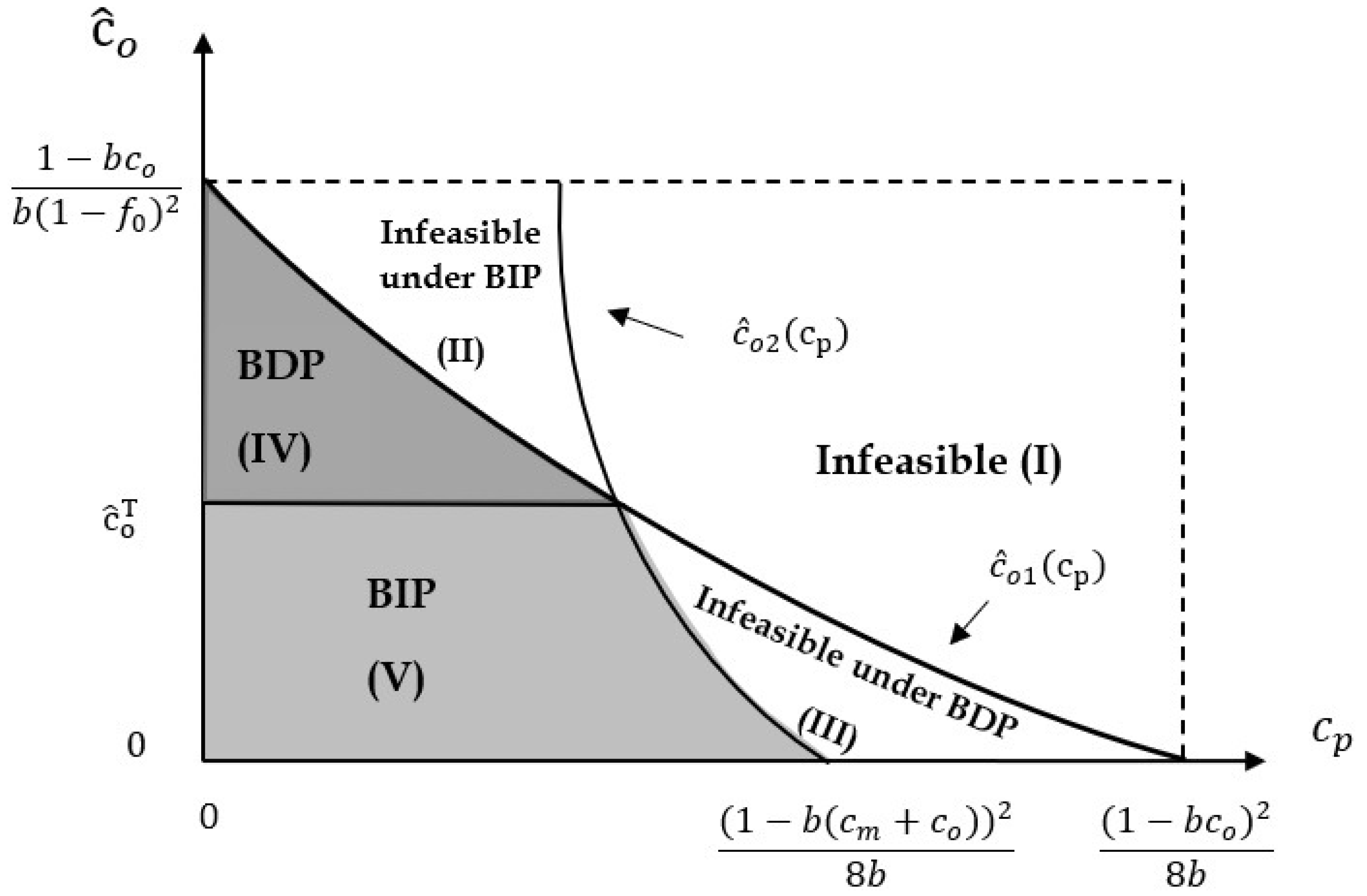
The Profitability conditions indicated in Proposition 2 and the optimal model determined by Proposition 3 are summarized in
Figure 1. In area I, servicizing is not profitable under any of our pricing models due to the combination of high operating and production costs.
In area II, the BIP is not profitable due to the high operating cost; however, under the BDP model, the firm can decrease the operating cost by incentivizing customers to improve their behavior. In particular, the firm can provide enough incentives so that customers choose to improve their quality of usage to
if the customer’s maximum effort cost
. Under this condition, the controllable portion of the operating cost
can be reduced to zero and the BDP can be profitable at any
value, as shown in
Figure 1. Note that if the aforementioned condition does not hold, (
20) and the
axis intersect, and the size of area II decreases as
increases.
In area III, the operating cost is not large enough to justify the cost of monitoring the quality of usage. Therefore, while it is profitable to operate under the BIP model, the firm cannot offer BDP. As advancement in IoT decreases the monitoring cost , area III diminishes and it disappears when is negligible.
Finally, while both pricing models are profitable in areas IV and V, it is optimal to offer the BDP in area IV and the BIP in area V. The operating cost threshold in Proposition 3 is depicted by the line that separates areas IV and V. This threshold is independent of the production cost and increases in , , and . Therefore, area IV decreases as the monitoring or effort cost increases, or if the baseline behavior of customers improves, as discussed earlier.
4.2. Environmental Implications of Two Pricing Models
The problem discussed in
Section 4.1 maximizes the firm’s profit by stimulating the customers’ demand through providing a pricing model that increases their utility, as presented in Corollary 1.
Corollary 1. The optimal pricing model, prescribed by Proposition 3, maximizes customers’ net utility and thus the quantity of products and aggregate usage.
Having the firm’s and customers’ incentives aligned facilitates the implementation of our optimal pricing model. However, along with maximizing the firm’s profit, this model increases both the aggregate usage and the number of products to be produced. Therefore, the optimal model may have a negative impact on the environment.
The total environmental impacts of the BIP and BDP models (defined in (
16) and (
17)) consist of both production and use phase impacts. We define
as the relative use impact of a product to be able to compare the environmental impacts of different pricing models. The high (low) value of
indicates that the environmental impacts of the use phase are more (less) significant than those of the production phase.
In the next proposition, we determine when the environmental concerns are aligned with the firm’s optimal decisions prescribed in
Section 4.1Proposition 4. Consider the range of parameter values where both models are profitable.
- (a)
If , it is optimal for the firm to offer the BIP, but it has larger negative environmental impacts.
- (b)
Otherwise, it is optimal for the firm to offer the BDP. This model can be environmentally superior or inferior to the BIP as follows:
- 1.
If , then offering the BDP has larger negative environmental impacts.
- 2.
Otherwise, offering the BDP is environmentally superior if the relative use impact of the product where satisfies
The condition in Part (a) of Proposition 4 is a rearrangement of Equation (
23) with respect to customers’ baseline behavior
. The firm does not need to provide discounts to improve customer behavior if the baseline usage quality is relatively high. This threshold increases in the monitoring cost as well as customers’ effort cost. At high enough monitoring or effort cost, the right hand side of the condition becomes zero and the BIP is the optimal model for any
. As discussed in Corollary 1, this pricing model yields a higher quantity of products and higher aggregate usage. Since the quality of usage is also lower than the BDP, this pricing model has larger negative environmental impacts. Under these conditions, the policy maker (e.g., the government) may provide the firm with some incentives (e.g., to bring down the monitoring cost
) to choose the BDP that is environmentally superior to the BIP but not optimal for the firm.
In contrast to Part (a), at a lower baseline behavior score, the BDP is optimal and affects the environment in two opposite directions: (i) increasing the aggregate amount of usage and quantity of products (as shown in Corollary 1), and (ii) improving the quality of usage, f. If the baseline behavior quality is lower than the threshold in Part (b1), then even the improved usage quality is not enough to compensate the usage and the production growth under the BDP.
However, at a moderate baseline behavior (as in Part (b2) ), the BDP can become environmentally superior if the relative use impact, , is sufficiently large, such that the environmental impacts of the use phase outweigh those of production. Under these conditions, a sufficiently high behavior score not only offsets the environmental impacts of higher aggregate usage but also compensates for the additional impacts from increased production (For illustration, consider a washing machine servicizing firm. Under BIP, 120 customers use the service for a total of 15,000 cycles, while under BDP, 100 customers use it for 10,000 cycles. Let the baseline behavior score be , effort cost , and operating cost per unit of usage , with and . Using Proposition 4, if the relative use-phase impact exceeds the threshold , BDP is environmentally superior. This shows that even with higher production (n) and usage (Q), incentivizing better user behavior can sufficiently reduce per-use impacts () to outweigh production impacts ().). Consequently, adopting the BDP constitutes a win–win–win strategy, simultaneously increasing the firm’s profits, reducing environmental impacts, and enhancing consumers’ utility compared to the conventional BIP model.
5. Extension: Heterogeneous Customers’ Behavior
In this section, we study the accuracy of our model in determining the optimal pricing model in the presence of heterogeneous customers. The analytical results we have derived in
Section 4 are based on the assumption that customers are homogeneous in their usage behavior, represented by the baseline behavior score
. In this section, we study the robustness of our analytical results in the presence of heterogeneous customer behavior in a specific market.
Instead of a common behavior score of for all customers, we assume each customer has a behavior score that is uniformly distributed in . These heterogeneous customers also follow the optimal behavior prescribed in Proposition 1, as each customer individually maximizes their net utility based on their behavior score .
In contrast, the firm needs to consider all possible baseline behavior scores in determining the production (Equations (
10) and (
12)), aggregate demand (Equations (
11) and (
13)), and profit functions (Equations (
14) and (
15)) under the BIP and the BDP models. Therefore, the firm’s profit maximization function under the BIP becomes
and under the BDP, it becomes
where
and
represent the customer’s cost and the firm’s revenue per unit of usage by a customer with the baseline behavior score of
, respectively, and are defined as
and
The optimal price under the BIP model can be obtained from (
26), similar to Proposition 2. However, the optimization problem (
27) for the BDP model cannot be solved analytically to find closed-form solutions for
and
. Hence, in this section, we solve Equation (
27) numerically and discuss conditions under which assuming homogeneous customer behavior yields near-optimal decisions for the underlying model with heterogeneous customers.
Intuitively, the accuracy of the homogeneity assumption decreases in the variation of the customers’ behavior scores. We consider different possible scenarios. We start from the lowest possible variation, assuming , where customers are virtually homogeneous. Then, we expand the range of possible behavior scores to increase the standard deviation while keeping the average behavior score fixed at . We continue until reaching the case where behavior scores are uniformly distributed between the lowest and the highest possible score (i.e., between 0 and 1). Finally, we compare the results to a system with homogeneous customers with a baseline behavior score of .
We set , , , , and and consider three different values of . While the parameter values are chosen arbitrarily, they generate different optimal pricing models (as discussed in the paragraphs below). For each of these three sets of parameter values, we consider 11 different ranges of . We start from and increase the length of the interval in increments of 0.1: .
At the policy level, under the homogeneous customers assumption, the firm should adopt the BIP if equals 0.4 or 0.5 and the BDP if . This prescription matches the one with heterogeneous customers when or . However, when , the optimal pricing model for heterogeneous customers changes from the BIP, when the standard deviation is low or moderate, to the BDP for more diverse customers (for ).
At the operation level, ignoring heterogeneous customers yields an underestimation of the optimal price per unit of usage under the BIP model. For the BDP, the situation is more complex. By assuming customers are homogeneous, we underestimate
. However, part of the effect of the lower price is canceled out by providing fewer discounts. Therefore, instead of individually comparing
and
, we capture their opposing effects by comparing the average price per unit of usage
.
Table 1 presents the error of the optimal price per unit of usage for an average customer with
. It is not surprising that the estimation error generally increases with customer heterogeneity. However, it is worth noting that as customers become more diverse, the effect of underestimating
dominates the effect of underestimating
, resulting in an overestimation of the optimal price per unit of usage.
Table 1 shows that our analytical prescriptions from
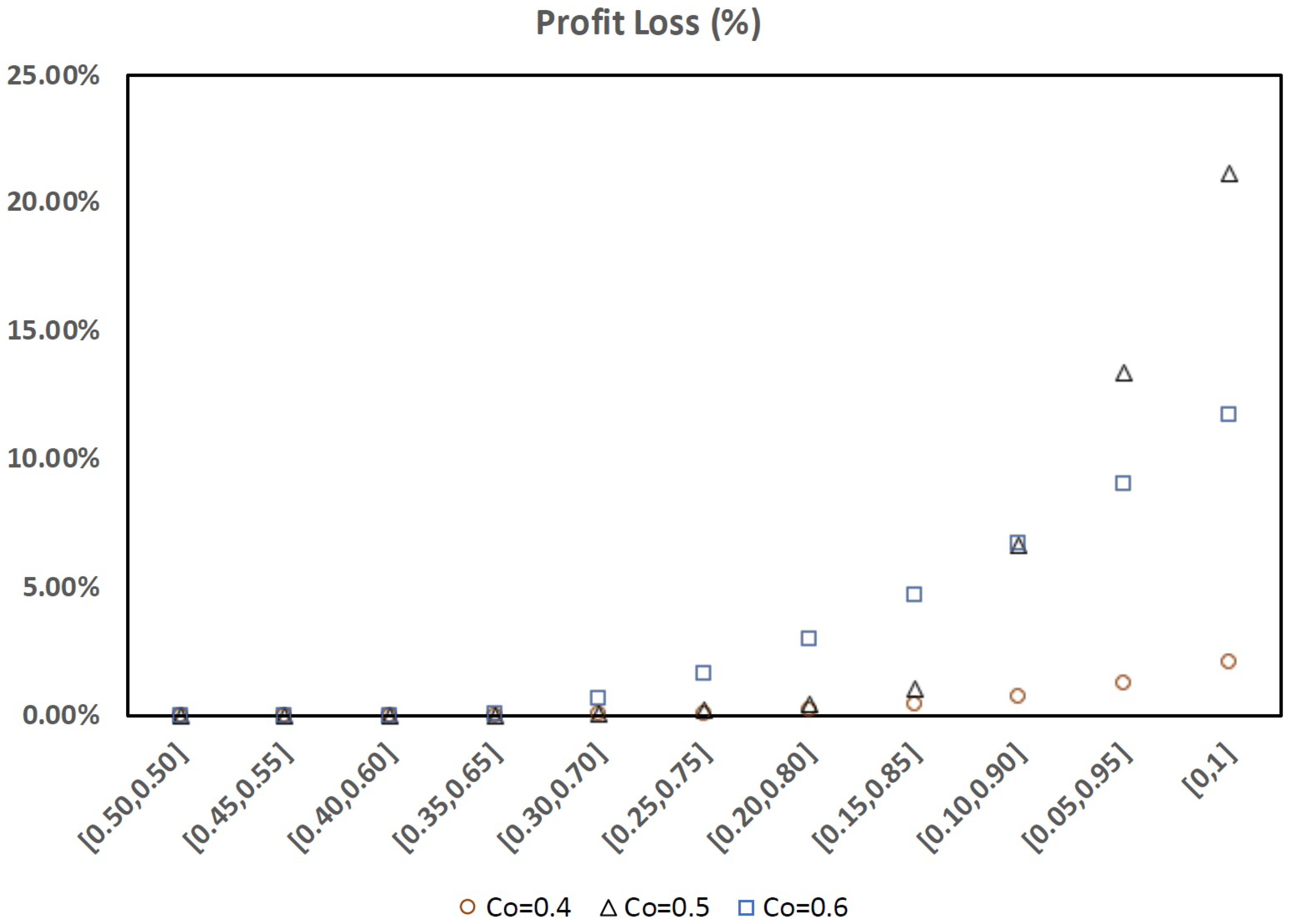
Section 4.1 are near-optimal, especially when the variation in the customer behavior scores is low or moderate. Applying these prescriptions to a model with heterogeneous customers yields lower-than-optimal profit. The percentage profit loss for all instances is shown in
Figure 2.
The profit loss increases with customer heterogeneity at all operating cost levels. It remains lower than 2% for , where the firm adopts the BIP and customers react through their amount of usage. At , the firm adopts the BDP, and customers optimize both their amount and the quality of usage. Therefore, ignoring customer heterogeneity yields higher profit loss, although it remains lower than 12% even for the most diverse customers with . Studying the case of is more interesting because the profit loss is relatively low when the standard deviation is small and the optimal pricing model is the BIP. However, for the last four instances, ignoring heterogeneous customers results in a sub-optimal pricing model (BIP instead of BDP). Therefore, the percentage profit loss jumps to higher values compared to the previous two cases.
Our numerical example shows that the behavior of systems with a moderate level of heterogeneity can be well approximated by our analytical model in
Section 3. However, one should be cautious in applying the prescriptions of
Section 4 for models with highly diverse customers, especially if the analytical model prescribes the BIP model.
6. Conclusions
The studies on servicizing business models have mainly focused on the environmental and economic benefits provided by lower product usage and higher product durability/efficiency under this business model. However, the servicizing business model might transfer a major risk to the firm and the environment due to the lack of customers’ ownership. Feeling less responsibility toward the product, customers may misuse it and burden the firm with high operating and maintenance costs. The major role that customers’ behavior plays in maintenance and operating costs underscores the importance of incorporating customer behavior as a metric in the PPU pricing models.
Our paper studies whether and when a servicizing firm benefits from a pricing model that motivates customers to use the product in a more sustainable way. We assign a behavior score to each customer commensurate with their usage behavior. We propose a BDP model in which the firm provides discounts to customers with a better behavior score. This incentive can grow the firm’s profit by increasing both the quantity and the quality of the usage in comparison to the BIP model.
Our analysis allows us to capture the conditions under which adopting each pricing strategy would benefit the firm, customers, and the environment. We determine the threshold for the firm’s operating cost, over which the firm benefits more from providing the BDP than the BIP. In doing so, the firm improves customers’ usage behavior and reduces its operating cost. Equivalently, we determine the threshold for the customers’ average behavior score below which the firm should adopt the BDP to improve the customers’ usage behavior. By encouraging better usage behavior, the firm enjoys lower operating costs and higher aggregate usage, and customers benefit from lower prices, thus resulting in higher utility.
We further show that although higher profitability of the BDP corresponds to higher production and usage, it still can be the preferred approach from the sustainability prospective since it improves customers’ behavior and reduces the corresponding negative effects. Particularly, we discuss that for products with the majority of their environmental impact in the use phase, such as cars, washing machines, and dishwashers, offering the BDP model can result in a win–win–win situation: higher profit for the firm, higher utility for customers, and lower environmental impacts.
The dropping cost of IoT sensors and advances in machine learning in handling large amounts of real-time data facilitate the incorporation of the BDP in a wider range of applications. Our results indicate that lower implementation costs make BDP a more promising strategy for firms. Moreover, it is expected that an increase in a customer’s awareness with respect to the environmental impacts of their behavior attenuates their effort cost and makes the BDP more applicable in the real world.
From a managerial point of view, our findings provide guidance for firms in designing pricing models that incentivize responsible usage while maintaining profitability. The results of our study help firms to better understand how servicizing, as an alternative outlet for the product, could be less vulnerable to the product misuse risk that might prevent them from operating profitably. In particular, our results show whether and when a servicizing firm can benefit from implementing the BDP strategy to encourage customers to act responsibly toward environmental sustainability concerns while helping to reduce its operating costs. In practice, firms can estimate the model parameters using operational data. The effort cost parameter (), while not directly observable, can be inferred indirectly from customer response patterns to behavioral incentive programs, such as changes in usage behavior in response to different discount levels or reward schemes. A weaker behavioral response to incentives suggests a higher implicit effort cost, whereas stronger responsiveness indicates a lower . The base and incremental operating cost parameters ( and ) can be calibrated from service and maintenance records that capture how improper or sub-optimal usage increases energy consumption, repair frequency, or warranty costs. The monitoring cost parameter () can be estimated from IoT deployment and maintenance costs associated with data collection and analysis. The selection of the maximum discount level () should consider both technological constraints (e.g., monitoring capabilities) and financial constraints that define feasible incentive budgets. Firms may use simulation or empirical calibration to balance the trade-offs between environmental benefits and the costs of implementing BDP. Moreover, since the proposed pricing model relies on IoT technology, the results have policy implications for promoting sustainable practices, for example, through subsidies or incentives that support firms in implementing such digitalized pricing models.
From a theoretical perspective, our study contributes to the literature on sustainable business models by incorporating BDP into servicizing contexts and demonstrating how digital monitoring can shape responsible usage and strengthen the sustainability of servicizing operations. Our study also opens new avenues for future research on employing the BDP strategy to different servicizing settings.
In this paper, our analysis focuses on the setting in which a firm only offers a servicizing business model, whereas there is another setting in which a firm adopts a hybrid business model, where a firm offers products under servicizing in conjunction with another business model (e.g., selling, leasing, or renting). Therefore, beyond our analysis of addressing risks under a specific setting (i.e., servicizing), further research can be performed under various hybrid settings. Moreover, we consider a single service-provider and normalize customers’ utility of an outside option to zero. If customers have multiple options, a firm providing BDP may lose some of its customers (mainly with lower behavior scores) to a competitor who is providing BIP. This natural segmentation of the market affects the optimal decision of both firms. A fruitful stream of research would be to consider competition among multiple providers.
We also assumed that a customer incurs an effort cost whenever the additional effort a customer incurs when using the product in a more sustainable or responsible way than their baseline behavior. However, in the real world, a customer’s baseline behavior evolves over time, and they adapt to the improved usage patterns. Future research could extend our framework to a dynamic principal-agent model, where changes in a customer’s baseline score influence their future usage and behavior, thereby affecting both economic and environmental outcomes.
Additionally, since the number of servicizing firms is expected to increase in the near future, conducting empirical research could be a valuable way to validate the analytical insights developed in this study.
Our results shed light on the importance of including customers’ usage behavior in market segmentation criteria. One promising line of research, at the interface of marketing and operations, is to study how such criteria would affect marketing decisions. For example, depending on the level of heterogeneity in customers’ behavior, the firm may incorporate alternative pricing strategies, such as selling or leasing, and provide customers with a menu of options. Because customers’ effort costs are private information, the firm must ensure incentive compatibility to prevent choices that could reduce its profit.