Article

Hydrogen–Electricity Cooperative Mode Switching Mechanism and Optimization Based on Economic Trade-Off Index and Adaptive Threshold


1
School of Finance, Hubei University of Economics, Wuhan 430205, China
2
School of Automation, China University of Geosciences, Wuhan 430074, China
*
Author to whom correspondence should be addressed.
Sustainability 2025, 17(24), 10987; https://doi.org/10.3390/su172410987
Submission received: 13 October 2025 / Revised: 28 November 2025 / Accepted: 3 December 2025 / Published: 8 December 2025

Abstract

Aiming at the economic optimization problem in the coupling application of intermittent renewable energy and electrolytic hydrogen production equipment, this paper proposes a dual-mode dynamic switching mechanism. This mechanism breaks through the limitations of the fixed operation mode and realizes intelligent switching between the two modes of hydrogen energy driven power dispatching (HDPD) and power-driven hydrogen production (PDHP) through a decision index and adaptive threshold that integrates multiple factors. The simulation results show that the proposed method achieves a total cost which is 10.6% and 16.3% lower than that of PDHP and HDPD modes, respectively. The levelized cost of hydrogen is optimized to 0.25 USD/kg, which is 34.2% lower than that of HDPD mode. Moreover, the proposed method increases hydrogen production by 14.4% compared to PDHP mode. The system maintains a high renewable energy utilization rate of 96.34% and achieves carbon emission reduction of 3.25 million kg CO2. The counterfactual test verifies the effectiveness of the switching mechanism and quantifies the opportunity cost related to decision-making. This study provides key decision-making tools and methodological references for the deployment of efficient, flexible, and economically sustainable green hydrogen energy systems.

1. Introduction

The global energy structure is undergoing a profound transformation, and the scale of renewable energy installed capacity, represented by wind and solar energy, continues to expand, becoming a key support for achieving the goal of carbon neutrality. However, the intermittency and volatility of renewable energy increasingly conflict with rigid power system demand, resulting in severe curtailment that restricts efficient utilization. Green hydrogen has emerged as a promising solution through its advantages in energy storage, cross-sectoral coupling, and low-carbon fuel substitution [1,2].
Meanwhile, hydrogen production technologies continue to evolve, with emerging pathways such as photocatalysis offering new possibilities for green hydrogen generation [3]. However, water electrolysis remains the mainstream solution for large-scale hydrogen production coupled with renewable energy due to its high technical maturity, making its operational optimization critically important. This paper therefore focuses on the coordinated optimization of water electrolysis hydrogen production systems. This technology converts surplus electricity into chemical energy, enabling long-term energy storage while promoting deep decarbonization across multiple sectors, including power generation, industry, and transportation. However, directly coupling intermittent renewable energy to electrolysis equipment presents significant challenges: input uncertainty leads to frequent start–stop cycles and accelerating equipment degradation; simultaneously, the limited efficient operating range and continuous adjustment operations both reduce the overall system efficiency [4,5,6].
In response to the above challenges, scholars proposed two typical operating modes: hydrogen-driven power dispatch (HDPD) and power-driven hydrogen production (PDHP) [7,8]. In electric drive mode, the system dynamically adjusts the number of electrolyzers in operation based on wind and solar power output forecasts to maximize renewable energy utilization and engage in power arbitrage. In hydrogen drive mode, the system prioritizes meeting hydrogen demand, dynamically adjusting hydrogen production capacity based on electricity cost analysis to meet the set daily hydrogen production target and reduce electricity costs in the hydrogen production process. These two modes optimize the power supply side and demand side, respectively, reflecting the bidirectional coupling and synergistic interaction between hydrogen and electricity. However, extensive research indicates that regardless of which fixed pattern is emphasized, achieving a dynamic equilibrium among multiple objectives (such as economy, equipment life, and energy consumption) and the optimization paradigm has inherent limitations.
Specifically, for studies on the PDHP model, Ref. [9] proposed a multi-timescale robust optimization strategy accounting for the multi-state start–stop characteristics of electrolysis. This effectively reduced start–stop cycles and lowered operating costs by 5–6%. However, its core approach focused on tracking power supply output without considering the stability requirements of downstream hydrogen loads, thereby compromising hydrogen supply reliability. For HDPD mode, numerous studies incorporate hydrogen load requirements as an objective. For instance, Ref. [10] employs an adaptive simulated annealing particle swarm optimization method to achieve power balancing, accounting for time-of-use electricity pricing plans, hydrogen load demands, and the intermittency of renewable energy sources. Ref. [11] constructs a day-ahead output planning model incorporating start–stop characteristics to avoid peak-price electricity procurement yet fails to account for equipment lifespan degradation, thereby increasing full lifecycle operational costs.
In order to cope with the limitations of the above single model, the academic community has also developed some multi-objective optimization or hybrid scheduling strategies. For example, Ref. [12] discusses a hybrid scheduling framework using weighted indicators for hydrogen and electricity hybrid energy management; Ref. [13] developed a multi-objective optimization model considering energy self-sufficiency rate and carbon emission expenditure and discussed and verified the feasibility and economy of an offshore wind power hydrogen production energy sharing strategy. However, its core depends on the preset static weight coefficient to coordinate different goals, and it is difficult to objectively and dynamically balance the rapidly changing market goals and environmental goals. In addition, Ref. [14] proposed adaptive weighted dynamic point sampling to model uncertainty, which can adjust sample points and weights according to the variability of parameters to enhance the adaptability of the system. However, its response is essentially lagging behind, and it is impossible to actively predict market trends to capture the best decision-making time, thereby missing potential arbitrage opportunities or avoiding risks.
In order to further improve the adaptability of the system, the current research introduces reinforcement learning and stochastic optimization techniques to deal with the uncertainty in the dynamic environment. In Ref. [15], a stochastic framework based on multi-state decision process is proposed, which ensures efficiency and improves hydrogen production under variable load by coordinating resources. Ref. [16] used reinforcement learning to manage hybrid power–heat–hydrogen energy systems with demand response functions to improve efficiency and reduce emissions. However, reinforcement learning needs to rely on historical data to train the model. In the actual hydrogen power system, emergencies such as extreme weather and policy adjustment often exceed the scope of training samples, which can easily lead to decision bias. At the same time, reinforcement learning needs to preset weights in multi-objective optimization, and the model decision-making process lacks interpretability, so it is difficult for engineers to trace the adjustment logic.
Moreover, many studies have focused on cost optimization in integrated energy systems [17]. As calculated in Refs. [18,19], the profit margin of renewable energy hydrogen production systems has been estimated. Refs. [20,21] discussed the impact of various operating modes and time-of-use electricity prices on economy. These studies lay the theoretical foundation for the commercial deployment of hydrogen power systems, but they are mostly limited to static cost calculations under single operating conditions and lack a systematic analysis of the economic efficiency of mode switching under dynamic operating conditions.
Meanwhile, as hydrogen energy expands into integrated energy systems such as electricity–hydrogen–natural gas as a coupling hub [22], the system imposes higher demands on the dynamic economic efficiency and responsiveness of the hydrogen-to-electricity conversion process. The key to the dynamic response of hydrogen production systems lies in the coordinated control and optimization of multiple electrolyzers. Ref. [23] established an optimal scheduling model for a renewable energy hydrogen production system that considers system hydrogen production efficiency and employed a particle swarm optimization algorithm to solve for the optimal hydrogen production power. Ref. [24] applied a strength Pareto evolutionary algorithm to solve the multi-objective optimization problem of energy management for a multi-electrolyzer renewable energy hydrogen production system. The studies mentioned above primarily rely on traditional algorithms for static optimization, overlooking dynamic uncertainties and long-term trade-offs in equipment lifespan. Ref. [25] proposed a control strategy for multi-electrolyzer systems to optimize wind energy utilization and extend equipment lifespan, paying particular attention to the minimum operating power threshold. It indicated that switching strategies could be based on fluctuations in electricity prices or hydrogen demand. Ref. [26] introduced segmented equal distribution and segmented cyclic equal distribution strategies, addressing the issue of the minimum operating power threshold for electrolyzers. These strategies achieved renewable energy utilization rates of 95.39% and 95.38% through dynamically optimized switching cycles. However, traditional scheduling only focuses on the scheduling results obtained by the actual path and pays insufficient attention to the counterfactual path other than the decision. It lacks the analysis of the opportunity cost, and it is difficult to quantify the advantages and disadvantages of the decision factors.
In summary, the current research on hydrogen–electricity collaborative systems mainly suffers from the following shortcomings: (1) fixed operational strategies or decision rules based on single economic indicators struggle to adapt to complex and volatile external environments, leading to reduced system economy and reliability. (2) Traditional multi-objective decision-making methods rely on subjectively predetermined fixed weights, making it difficult to simultaneously account for instantaneous market price fluctuations, internal system physical states, and future trend predictions. This results in insufficient adaptability and a lack of interpretability in the decision-making process. (3) There is insufficient attention given to counterfactual paths at decision points, along with a lack of opportunity cost analysis. This makes it challenging to quantify the actual contribution of decision factors, thereby limiting the realization of holistic multi-objective decision-making under complex conditions and hindering quantitative decision-making for practical engineering deployment.
In response to the aforementioned issues, this paper proposes a hydrogen–electricity collaborative optimization system that incorporates dynamic decision factors for mode switching. The main innovations include the following: (1) for the two basic modes of HDPD and PDHP, a dynamic switching framework centered on the hydrogen–electricity economic trade-off index (HEETI) has been established, replacing fixed operational strategies or single indicators. This framework comprehensively responds to multi-dimensional real-time states, enabling proactive adaptation to complex and volatile environments and providing a new pathway for the deep integration of hydrogen energy and renewable energy. (2) A market-oriented natural weighting mechanism and adaptive switching thresholds have been introduced, avoiding the issue of subjectively preset fixed weights. Additionally, cost penalties effectively suppress frequent switching that is detrimental to equipment, balancing short-term economic gains with long-term equipment lifespan. (3) By calculating the potential opportunity costs of current decisions through counterfactual testing, detailed analysis of the indicators contributing to opportunity costs is conducted, providing a quantitative basis for strategy evaluation and optimization, thereby enhancing the overall economic and technical performance of the system.

2. System Architecture and Component Modeling

2.1. Core Component Composition

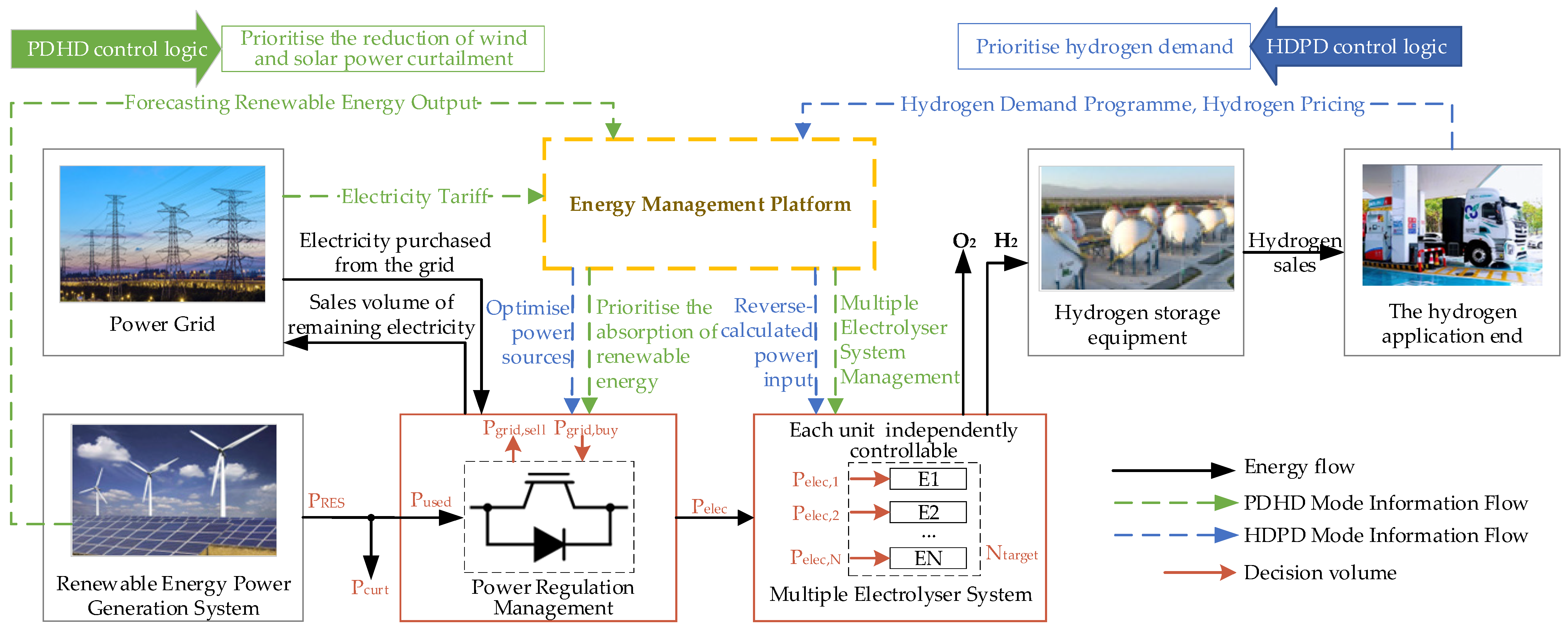
This paper constructs a hydrogen–electricity synergistic optimization system energy management platform that considers economic indicator mode switching, as shown in Figure 1 (the meaning of variable symbols in the figure can be found in Table 1,which defines all symbols used in the optimization framework.). The system consists of an energy management platform and basic equipment for grid-assisted renewable energy electrolysis hydrogen production. The management platform collects forecast information on wind and solar power output, hydrogen demand plans, and market electricity and hydrogen prices and arranges grid interaction strategies and electrolyzed operation plans. The electrolysis hydrogen production section uses electrical energy flow as input, and the hydrogen gas output flows through hydrogen storage equipment to the application end.
Specifically, the power grid and the wind–solar power generation system are dual power inputs. The volatility of renewable energy will significantly affect the switching decision of operating conditions, and the power grid can provide stable power when the wind–solar output does not meet the constant power of electrolysis and prolong the service life of the hydrogen equipment [27,28]. The power supply regulation and control center is responsible for managing and coordinating energy flows. Multiple electrolysis unit systems are optimally combined to adjust hydrogen production. Hydrogen storage equipment is used to store the produced hydrogen, decoupling production from demand to smooth supply. The hydrogen application end is connected to the H2 base or used remotely.
This study focuses on the economic dispatch optimization methodology of the hydrogen–electricity cooperative system and adopts the following technical assumptions: the alkaline electrolytic unit technology has been commercialized, and the rated power of a single unit has reached MW level; the scheduling time scale adopts hour-level discrete optimization, which is suitable for day-ahead and intra-day scheduling scenarios, without considering the second/minute dynamic response. The system boundary does not include auxiliary equipment, such as electrical energy storage and gas turbines, to highlight the essential characteristics of hydrogen–electricity conversion, and the actual project can be expanded according to demand.

2.2. Core Component Modeling

This section establishes mathematical models of the system’s core physical components to quantify hydrogen–electricity conversion dynamics and enable economic mode switching decisions. The models are designed to achieve two primary objectives: maximize economic value by capturing electrolyzer degradation, modular operation, and grid price signals to minimize the levelized cost of hydrogen (LCOH); ensure operational efficiency by representing renewable intermittency and storage dynamics to maximize utilization and minimize curtailment. These component-level equations form the foundation for the dual-mode optimization strategy in Section 3.

2.2.1. Renewable Energy System Modeling

This subsection establishes the energy balance framework for renewable energy generation, explicitly separating utilized power from curtailed power to enable subsequent optimization of absorption capacity. The total renewable energy output can be expressed as:
P RES ( t ) = P u s e d ( t ) + P curt ( t )
where P RES ( t ) is the total amount of renewable energy at time t , MW, which fluctuates due to weather variability and diurnal patterns. P u s e d ( t ) represents the actual utilized renewable power, and P curt ( t ) denotes the curtailed power.
Within the modeling framework, the renewable curtailment P curt ( t ) is formulated as an optimized variable. Curtailment occurs when renewable energy output exceeds the system’s immediate consumption capacity, which is constrained by multiple factors, including electrolyzer operational limits, ramp rates, hydrogen storage capacity, and economic considerations. This approach allows the system to explicitly minimize energy waste, thereby maximizing utilization.

2.2.2. Multiple-Electrolyzer System Modeling

This subsection represents the N units electrolyzer array with individual operating bounds, startup logic, ramping constraints, and efficiency degradation to balance hydrogen output with equipment health and longevity.
The system is configured with N electrolyzer units. Given the research focus on large-scale hydrogen production scenarios, alkaline electrolyzer technology was selected as the default electrolysis method. This choice is based on its advantages: lower investment cost, longer service life, and mature industrial applications.
The parameter settings are detailed in Table 2, all based on the typical range of current commercial alkaline electrolyzer technology, ensuring consistency between the model and industrial practice. Industry data indicates that large-scale alkaline electrolyzer units typically operate at rated powers between 1 and 20 MW, with hydrogen production efficiencies ranging from 12.8 to 20 kg H2/MWh. These units require operation at 15–40% above rated power to maintain stable performance [29,30,31].
The power of each electrolytic unit is subject to the following constraints:
P elec , i , min P elec , i ( t ) u i ( t ) P elec , i , max , i 1 , 2 , , N
where u i ( t ) 0 , 1 indicates the operating status of the i -th electrolytic unit (1 indicates operating, 0 indicates shut down); P elec , i , min is the minimum operating power at time t , MW; and P elec , i , max  is the rated power at time t , MW.
Total power of the electrolytic unit system:
P elec   ( t ) = i = 1 N P elec   , i ( t )
Hydrogen production is directly proportional to the power of the electrolytic unit:
H 2 , p r o d ( t ) = i = 1 N η H 2 , i ( t ) P e l e c , i ( t ) Δ t
where H 2 , p r o d ( t ) is hydrogen production at time t , kg; η H 2 , i ( t ) is the electrolysis efficiency kg   H 2 / MWh , calculated using a multi-factor efficiency decay model that comprehensively considers operating time, start-stop cycles, current density, and temperature deviation. The current unit efficiency is calculated as follows:
η e l e c , i ( t ) = η e l e c , 0 1 α t i m e T i ( t ) 1000 α c y c l e N c y c l e s 1000 α d e n s i t y j a v g j n o m α t e m p ( T e m p T e m p o p t ) 10
where η e l e c , 0 represents the initial electrolysis efficiency, T i ( t ) is cumulative operating time, h. N c y c l e s is the number of start–stop cycles, j a v g is average current density (A/cm2), j n o m is nominal current density (e.g., 0.3 A/cm2 for alkaline), T e m p is operating temperature (K), and T e m p o p t is optimal temperature (e.g., 333 K). The degradation coefficients are calibrated based on the literature: the time degradation coefficient α t i m e = 0.015, the start–stop cycle coefficient α c y c l e = 0.02, the current density coefficient α d e n s i t y = 0.01, and the temperature coefficient α t e m p = 0.015 [32].
To ensure logical consistency in equipment state transitions, the following constraints apply to the startup and shutdown of electrolytic units:
u i ( t ) u i ( t 1 ) y i ( t )
where u i ( t ) is the operating status of the electrolytic unit i at time t , with a value range of {0, 1}. y i ( t ) is the command to start the electrolytic unit i at time t , with a value range of {0, 1}.
Frequent start–stop will significantly increase maintenance costs and shorten life, which is a physical limitation that must be considered in optimal scheduling. In order to characterize the minimum on/off time protection mechanism set to prevent equipment damage in industrial practice, the minimum running time constraint is set:
τ = t T m i n + 1 t y i ( τ ) u i ( t )
where τ is the time window traversal variable.
In order to simulate the physical characteristic that the power of the electrolytic unit cannot change instantaneously, ensure the smooth execution of the scheduling plan, and avoid the impact on the power grid and equipment, the ramp rate constraint is set:
R i P e l e c , i t P e l e c , i t 1 R i
where R i is the maximum ramp rate of a single electrolytic unit, MW/h.

2.2.3. Modeling of Hydrogen Storage Systems

Hydrogen storage decouples production from demand, smoothing variability and ensuring continuous supply. This study adopts high-pressure gaseous hydrogen storage, the most mature and widely used technology in this field. The dynamics of the hydrogen storage system are described by the state transition equation in Equation (9), while Equation (10) defines its capacity constraints.
The state change equation of hydrogen storage system:
H 2 , s t o r e d t = H 2 , s t o r e d t 1 + H 2 , p r o d t H 2 , d e m a n d t
where H 2 , s t o r e d t is the hydrogen storage level at time t (kg), and H 2 , d e m a n d t is the basic hydrogen demand at time t (kg).
Hydrogen storage capacity constraints:
H 2 , min H 2 , s t o r e d t H 2 , max
where H 2 , min and H 2 , max are the upper and lower limits of the hydrogen storage system capacity, kg. The lower limit is the minimum inventory to ensure the reliability of the downstream application, and the upper limit is determined by the physical design pressure of the storage tank. For specific values, see Table 2.

2.2.4. Grid Interaction Modeling

As an important flexible adjustment resource, the power grid can stabilize the power supply when the wind and solar output is insufficient or consume the surplus electricity when the wind and solar are surplus, which is the key to improving the overall economy and reliability of the system.
To realistically capture grid interaction, Equations (11)–(14) enforce mutual exclusivity between purchasing and selling modes and incorporate ramping limits that reflect real-world connection constraints.
Interactive power balance equation between the system and the power grid:
P g r i d t = P g r i d , b u y t P g r i d , s e l l t
where P g r i d , b u y t and P g r i d , s e l l t represent the power purchased from and sold to the grid at time t , MW, respectively, satisfying:
P g r i d , b u y t P g r i d , s e l l t = 0
0 P g r i d , b u y t P g r i d , c a p v b u y t 0 P g r i d , s e l l t P g r i d , s e l l v s e l l t v b u y t + v s e l l t 1
where P g r i d , c a p is the upper limit of grid interaction capacity, MW, which is usually determined by the capacity of the line or transformer, and v b u y t and v s e l l t are 0–1 variables, representing the status of electricity purchase or sale.
Grid interaction ramp rate constraint:
R g r i d P g r i d t P g r i d t 1 R g r i d
where R g r i d is the grid interaction ramp rate limit, MW/h.
These formulations allow the system to engage in energy arbitrage while respecting operational boundaries, thereby improving overall cost-effectiveness and supporting the integration of variable renewable generation.

3. Hydrogen–Electricity Synergistic Optimization Decision-Making Strategy

In order to deeply study the economy and applicable conditions of the two basic operating modes of HDPD and PDHP, this chapter first performs cost quantification and mathematical modeling of the two modes, then proposes HEETI as the core decision factor for mode switching, and introduces an adaptive threshold mechanism to prevent frequent switching. The framework is independent of specific case parameters and aims to provide common decision support for hydrogen–electricity systems of different sizes and configurations.

3.1. Mathematical Modeling of Operation Mode

This section defines two basic operating modes, which represent the extreme operating points of the system under different target priorities. The modeling and systematic comparison presented in Table 3 quantify the cost structures and operational boundaries of both modes, providing a foundational benchmark for the dynamic switching strategy in Section 3.

3.1.1. HDPD Mode

The HDPD mode prioritizes hydrogen supply reliability, formulated as an MILP minimizing total operating costs (Equation (15)) subject to demand satisfaction (Equation (16)) and renewable-first constraints (Equations (18) and (19)). Electrolyzer power is determined by hydrogen targets, with grid purchase as backup. See Table 3 for detailed comparison.
Optimize HDPD mode using linear programming methods, with the objective function being to minimize total operating costs:
min J H 2 = t = 1 T C g r i d t + C c u r t t + C s t a r t t + C s t o r a g e t + C s l a c k t + C s t a b t R H 2 t R g r e e n t R c a r b o n t
where C g r i d t is the cost of purchasing electricity from the grid at time t ; C c u r t t is the cost of abandoning electricity at time t ; C s t a r t t is the startup cost of the electrolytic unit at time t ; C storage   t is the cost of hydrogen storage at time t ; C s l a c k t is the hydrogen demand gap penalty at time t C s t a b t is the cost of power stability at time t R H 2 t is hydrogen sales revenue at time t , R g r e e n t is the green hydrogen premium income at time t ; R grid , sell   t is the grid’s electricity sales revenue at time t ; R c a r b o n t is carbon emission reduction revenue at time t .
Under known hydrogen demand conditions, this model requires that hydrogen demand be met first to ensure supply:
H 2 , p r o d ( t ) H 2 , d e m a n d t
In addition to the basic constraints on core equipment Equations (1)–(14), energy balance constraints must also be satisfied during operation. The input–output balance of the electrolytic unit is as follows:
P elec t = P used ( t ) + P grid , buy t P grid , sell t
The input power of the electrolytic unit includes two types: renewable energy and grid-purchased electricity. In order to save on the cost of electricity used for hydrogen production, a renewable energy priority constraint is set. If Equation (18) is satisfied, then Equation (19) applies:
P R E S t P elec , i , min
P grid , buy t = P elec t + P grid , sell t P u s e d ( t )

3.1.2. PDHP Mode

The PDHP mode prioritizes renewable absorption and grid arbitrage, formulated as a heuristic maximizing net revenue (Equation (20)) under power balance (Equation (21)). Electrolyzer units are adjusted dynamically based on forecasted P R E S ( t ) (Equations (22)–(24)), prioritizing utilization over fixed hydrogen output. See Table 3 and Figure 2 for logic flowchart.
max J E = t = 1 T R g r i d , s e l l t + R H 2 t + R g r e e n t + R c a r b o n t C g r i d , b u y t C c u r t t C s t a r t t C s t a b t C storage   t
Compared to the HDPD model, the cost–benefit components of the PDHP model are identical, but the penalty cost weights are slightly different. The core objective of this model has shifted from the demand side to the power generation side. Under the condition of known wind and solar power generation forecasts, the model prioritizes meeting wind and solar utilization rates, with two consumption pathways: selling electricity to the grid and producing hydrogen through an electrolysis system.
When the electrolyzer capacity cannot adequately absorb the renewable energy generation, the system can combine market electricity price signals for arbitrage, at which point the power balance constraint must be satisfied:
P R E S t + P g r i d , b u y t = P e l e c t + P g r i d , s e l l t + P c u r t t  
For hydrogen production using electrolysis units to reduce wind and solar power curtailment, the system optimizes the number of electrolysis units in operation based on the power generation curve. Therefore, the target power can be calculated based on the predicted power generation:
P target t = P u s e d t P g r i d , s e l l t + P g r i d , b u y t α t
where P target t is the total power input; α t is the adjustment coefficient for short-term forecasts. There are two adjustment strategies: first, predict the trend for the next four hours, and when a clear upward or downward trend is detected, increase or decrease the electrolyzer capacity in advance; second, when a peak value 30% higher than the current value or a trough value 30% lower than the current value is detected within two hours, significantly increase or decrease the electrolyzer capacity; otherwise, when the trend is stable, maintain the electrolyzer configuration.
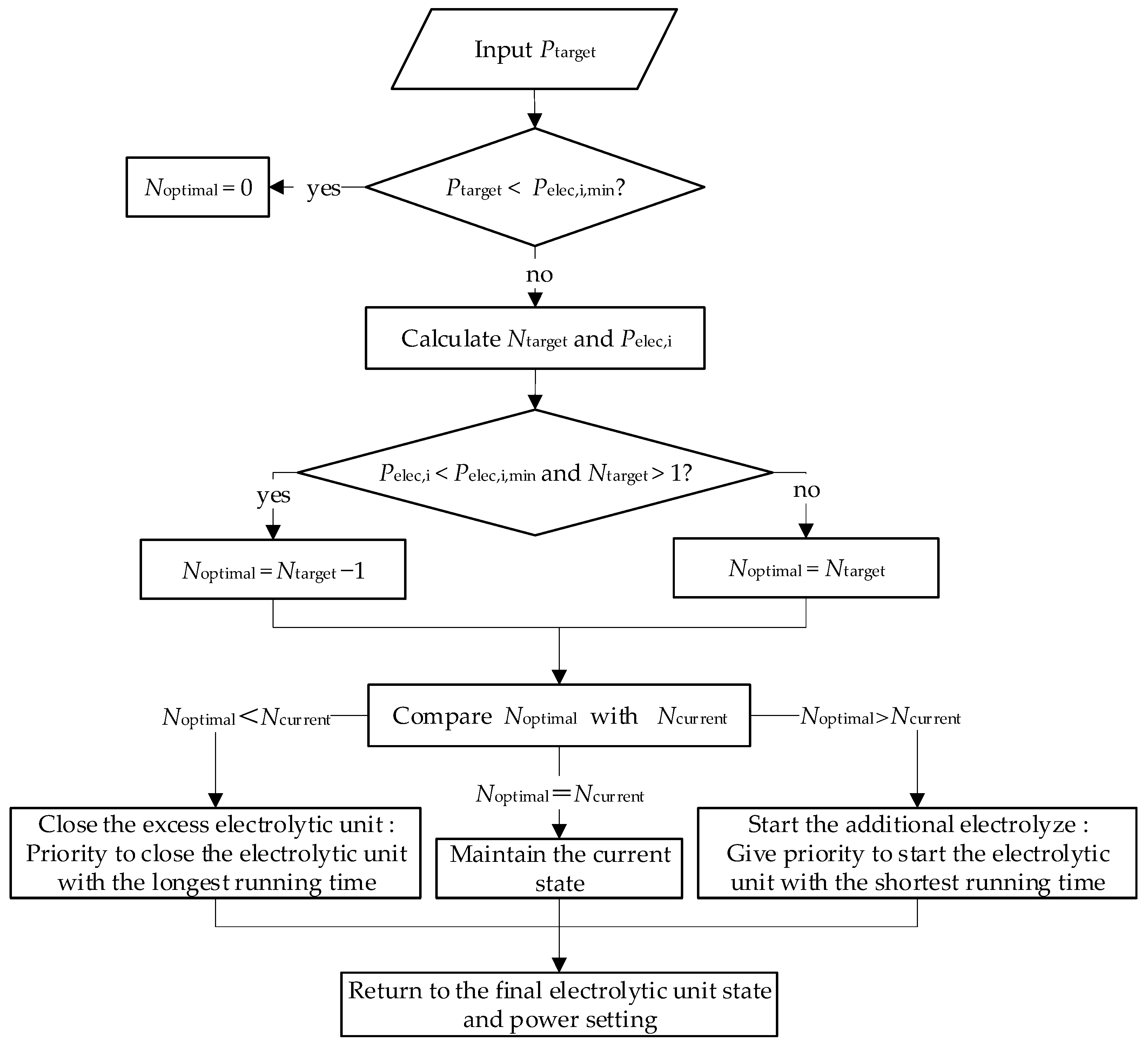
Based on the target power, the optimal number of electrolytic units is determined so that the unit power is configured in an efficient range. The flowchart is shown in Figure 2.
Calculate the theoretically required number of electrolytic units, and determine the actual operating power allocated to each electrolytic cell unit:
N target t = P target t P elec , i , max
P elec , i = P target t N target t
where N target t is the theoretically required number of electrolytic units, which is determined by total power input and the rated power of a single unit, with calculations rounded up to the nearest whole number.
When the number of targets is consistent with the current number, maintain the status quo; when increasing the number of electrolyzers, it is necessary to check whether there is sufficient renewable energy support. The priority is to close the electrolytic unit with a long cumulative operation time to extend its service life; give priority to starting the electrolytic unit with short cumulative running time, and balance the use of each electrolytic unit. The minimum running time protection is used to avoid frequent start and stop of the electrolytic unit and to reduce the start and stop loss by enforcing the minimum running time.

3.2. Mode Switching Decision Mechanism

The existing optimization methods based on a single fixed operation mode are difficult to adapt to the fluctuation of hydrogen and electricity market prices and the uncertainty of renewable energy output, resulting in economic loss by the system under multi-objective trade-offs. Therefore, this paper proposes a mode intelligent decision-making mechanism that integrates economic switching index and dynamic threshold to improve the comprehensive response ability and economy of the system.

3.2.1. HEETI

The mechanism prioritizes overall system benefit maximization by introducing a quantitative metric, the HEETI, to compare revenues and risks across operational modes. HEETI integrates multiple real-time factors, including hydrogen value, grid sales revenue, storage levels, renewable utilization, carbon reduction benefits, and price trends [33].
It is mathematically defined as:
E switch t = E B t + S F H 2 t + R F t + C F t + P T F t S C t
To ensure transparency and avoid the subjectivity of manual weighting in traditional multi-objective decision-making, the six components in Equation (28) are systematically decomposed in Table 4. Each factor is endogenously determined based on real-time system state, market signals, and forecasted trends, enabling the index to adapt dynamically to changing operational conditions. A positive HEETI value indicates that switching to HDPD mode offers comprehensive economic advantages, while a negative value favors PDHP operation.
The following subsections elaborate on the calculation of each component, explaining the economic rationale and parameter calibration.
(1) Basic economic comparison value E B t : reflects the economic comparison between hydrogen production and electricity sales.
E B t = p H 2 t η e l e c p s e l l t
where p H 2 t is the price of hydrogen ( USD / kg ), η e l e c is the efficiency of the electrolytic unit ( kgH 2 / MWh ), and p s e l l t is the electricity price ( USD / MWh ). When E B t > 0 is true, hydrogen production is more economical than selling electricity, and the system tends to favor HDPD mode; otherwise, it tends to favor PDHP mode.
(2) Hydrogen storage state factor S F H 2 t : Quantify the economic risks associated with different hydrogen storage levels through risk–cost analysis, and adjust the mode preference according to the hydrogen storage level to improve the reliability of hydrogen supply.
To avoid hydrogen supply interruptions, when hydrogen storage is low, HDPD mode is selected, which stabilizes hydrogen production. Weight values are assigned in segments based on the hydrogen storage ratio. When the hydrogen storage level is >85%, there is a strong tendency towards PDHP mode; when the hydrogen storage level is <25%, there is a strong tendency towards HDPD mode. In intermediate ranges, asymmetric adjustment is applied: mild positive or negative weighting is implemented in the moderately low or high zones, respectively. When the hydrogen ratio remains within the 40–60% safety interval, a neutral weight is maintained.
(3) Renewable energy consumption factor R F t : guide the system to choose the operation mode that can maximize the consumption of renewable energy.
Let the renewable energy power ratio be:
r R E S t = P R E S t P elec , max   + P grid , cap    
where P elec , max   represents the capacity of the entire electrolytic unit system to consume electricity for hydrogen production; P grid , cap   is the maximum value of grid interaction. According to the comparison between r R E S t and absorptive capacity, R F t is assigned positively or negatively.
(4) Carbon emission reduction value C F t : Quantifying low-carbon benefits through carbon trading prices. The calculation first converts traditional hydrogen production carbon emissions into an equivalent benchmark per unit of electricity generation. It then calculates the difference between this and grid carbon emissions to derive marginal abatement potential. Finally, this is monetized by multiplying by the carbon price and standardized by dividing through a scaling factor to unify the metric’s magnitude.
C F t = e H 2 ,   conv   η elec   / 1000 e grid   p carbon   8  
where e H 2 ,   conv   is the traditional hydrogen production emission factor (tones of CO2/tone of H2), e grid   is the carbon emission factor of the power grid (tones of CO2/MWh), and p carbon   is the carbon price (USD/ton of CO2).
(5) Price trend factor P T F t : based on the forecast trend of electricity price and hydrogen price. A negative value is assigned when the electricity price rises to suppress switching; when the hydrogen price rises, a positive value is assigned to promote hydrogen storage or delay sales.
P T F ( t ) = P T F ( t 1 ) + δ E Δ E + δ H Δ H
(6) Switching costs S C t : including the basic switching cost and duration penalty, inhibiting frequent switching and reducing equipment wear. There is no cost for the first start and no switching, only the basic cost is included in the normal switching, and the cost is doubled when the duration is not satisfied, that is, when the switching is premature.
S C t = δ t C switch   k t  
δ t = 1   if   t > 0   and   M t M t 1 0   otherwise    
k t = 2   if   δ t = 1   and   d mode t < T mode , min   1   otherwise  
where δ t is the switching event indicator function; C switch   is the basic mode switching penalty value; k t   is the duration penalty factor; M t is the operation mode of time t ; d mode t is the duration of the current pattern; T mode , min   is the minimum mode duration requirement.

3.2.2. Dynamic Economic Threshold

In the field of renewable energy hydrogen production systems or similar energy management, adaptive threshold models are often used to deal with dynamic uncertainties, such as output fluctuations, market price changes, or equipment switching, to balance stability and responsiveness [34]. The dynamic threshold is usually dynamically calibrated based on the signal standard deviation and volatility of the past period [35], integrating historical data and equipment cost penalties to balance hydrogen production and economy [36].
In order to balance the sensitivity and stability of the method designed in this paper, a dynamic economic threshold K t is designed:
K t = K base   + K freq   n switch   t 12 , t + K var   σ p t 12 , t + K r σ r t β stor   t β util   t
where K base   is the basic threshold coefficient, which represents the typical market opportunity cost between electricity and hydrogen sales, based on the system size; K freq   is the switching frequency penalty coefficient, which is estimated according to the equipment degradation cost, and n switch   t 12 , t is the number of switches within the past 12 time periods; K var   is the price volatility sensitivity coefficient, which is normalized based on the historical price standard deviation, and σ p t 12 , t is the standard deviation of prices over the past 12 periods. This item reflects the economic impact of market volatility, which makes the system raise the threshold when the market volatility is large. K r represents the punishment of abandoning wind and light, based on industry standards and policy data values, and σ r t is the predicted volatility of future renewable energy. This makes the threshold level increase when the resource is unstable. β stor   t is the hydrogen storage correction factor, which guides the system to reduce the threshold to promote switching at extreme hydrogen storage levels. According to the setting of the equipment safety limit, the value is within the range of [0.8, 1.2]. β util   t is the absorption rate correction factor, which guides the system to reduce the threshold to improve the consumption when the abandonment rate is high. According to the industrial standard of regeneration utilization rate, the value is within the range of [0.85, 1.1].
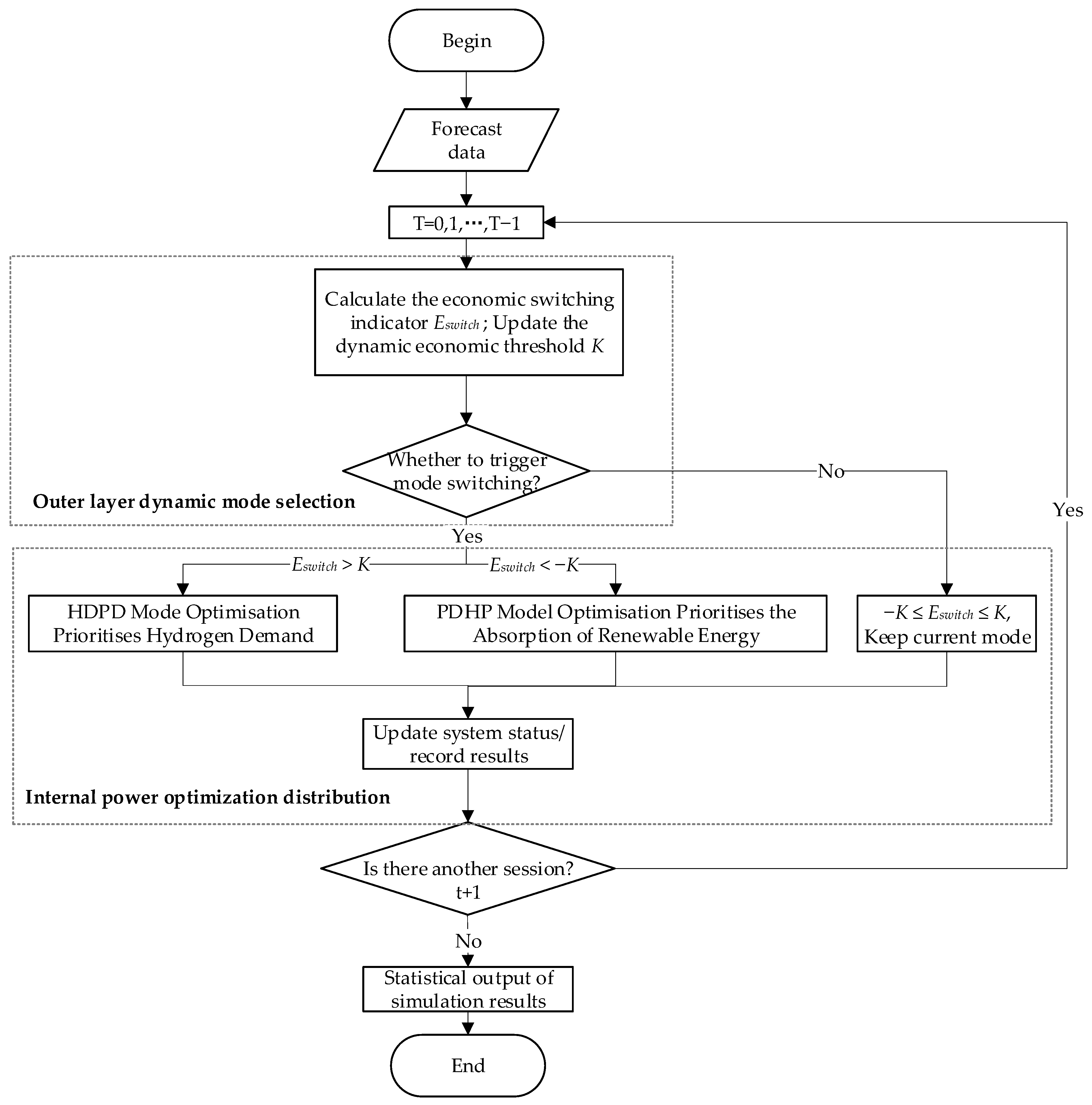
The final switching logic is as follows: if E switch > K , the system switches to HDPD mode; if E switch < K , it switches to PDHP mode; if E switch K , it maintains the original mode.
This mechanism achieves intelligent, stable, and economically optimal mode switching decisions in complex operating environments through the dynamic integration of multi-dimensional factors.

3.3. System Implementation of Bi-Level Optimization Architecture

This section provides a framework-level summary of the aforementioned modeling and decision-making mechanisms. As illustrated in Figure 3, the system adopts a two-layer optimization structure comprising outer-layer pattern decision-making and inner-layer power allocation. This approach balances holistic decision-making with granular scheduling, enabling efficient, economical, and stable operation within complex operational environments.
  • Forecast data input: the system receives renewable energy output forecasts, hydrogen demand forecasts, and time-series data for electricity prices and hydrogen prices. The simulation model introduces random disturbance to enhance the authenticity, but it uses a deterministic optimization method; that is, each run generates a set of input data containing randomness and then assumes that the set of data is perfectly predicted for optimization decision. This method cannot quantify the impact of uncertainty on the quality of decision-making because the optimization process assumes that future data is known, but it can show the performance of the system in scenarios containing fluctuations and extreme events.
  • Outer-layer mode switching decision: based on HEETI exponential Equation (25) to determine the current economic state combined with the dynamic threshold K t  to trigger mode switching and output the operational mode for the current period (HDPD or PDHP).
  • Inner-layer power optimization allocation: based on the operational mode determined by the outer-layer decision, the inner layer employs differentiated algorithms for precise power allocation:
    In HDPD mode, solve the MILP model of Equations (15)–(19) to ensure hydrogen supply constraints;
    In PDHP mode, solve the heuristic optimization of Equations (20)–(24) to maximize renewable energy utilization.
  • System status updates and logging: update hydrogen storage levels, equipment start/stop status, number of electrolyzer units in operation and their operating modes, cumulative costs, etc. The switching frequency n switch  is transmitted back for threshold adjustment in the subsequent period, forming an adaptive closed-loop system.
  • Recursive sequence and result output: the recursive process cycles through subsequent time periods, ultimately compiling key metrics for each operational mode, including total costs, hydrogen production volume, hydrogen production costs, renewable energy consumption rate, electricity purchase-to-sale ratio, and carbon emissions reduction.
This methodology decomposes the complex scheduling problem of electro-hydrogen systems into two relatively independent and separately optimizable sub-problems by decoupling outer-layer mode switching decisions from inner-layer power allocation optimization. This reduces optimization complexity while enabling differentiated algorithm matching to mode characteristics. Centered on economic optimization, it comprehensively evaluates key economic and operational metrics under both current and forecasted scenarios, whilst implementing real-time adjustments based on factors including price volatility, renewable energy fluctuations, mode switching frequency, and system state. Theoretically achievable outcomes include the following: raising the switching threshold during periods of significant market or resource volatility to minimize losses from frequent transitions; conversely, lowering the switching threshold when operational conditions are relatively stable and the system approaches its boundary states to enhance responsiveness.

4. Results and Discussion

4.1. Simulation Settings

To validate the proposed methodology, a wind–solar–hydrogen integrated system was simulated based on the optimization framework in [37]. The system configuration that comprises 494 MW PV, 296 MW wind power, and an 18-unit modular electrolyzer array was determined as the optimal renewable-to-hydrogen ratio for northern China’s typical resource conditions.
The economic parameters in Table 5 are derived from Chinese market data for 2024–2025. Electricity prices, based on typical daily profiles published by the National Energy Administration, range from USD 21 to USD 98 per MWh. Hydrogen prices draw from the China Hydrogen Energy Alliance’s 2024 industry report, with a range of USD 5.2 to 6.3 per kg. The carbon price is set at 14 USD per ton CO2, reflecting the 2024 average from the national carbon emission trading system.
Operational constraints include a grid connection capacity of 400 MW with a ramp rate limit of 80 MW per hour, a daily on-grid quota of 6000 MWh to simulate transmission limits, a minimum online duration of 3 h for grid stability, and a hydrogen market absorption ceiling of 15,000 kg per period to represent local demand saturation. A green hydrogen premium of USD 0.35 per kg is applied to incentivize low-carbon production, consistent with China’s 2025 renewable fuel subsidy policies.
The decision mechanism parameters are configured to differentiate between HDPD and PDHP operational modes, as summarized in Table 6. Penalty structures further reflect mode-specific priorities, and renewable tracking penalties are applied to enforce power-following objectives across both modes.
To test the economic performance of different operating logics in a market environment and verify the necessity and superiority of the dynamic switching mechanism, the simulation compares three operating logics: (1) PDHP mode; (2) HDPD mode; and (3) the proposed economic trade-off dynamic switching mode that uses the HEETI index and the adaptive threshold K to determine mode switching.
The simulation period is 48 consecutive hours, with a time step of 1 h. The time window can capture the day and night cycle and the influence of the next day, while maintaining the computability [33]. In all scenarios, the technical and market parameters listed in Table 4, Table 5 and Table 6 are used. PDHP and HDPD are each simulated as fixed modes to provide baseline performance metrics; the dynamic switching scenario runs the outer-layer HEETI decision to select the active mode each hour and then runs the corresponding inner-layer optimizer.

4.2. Results Analysis

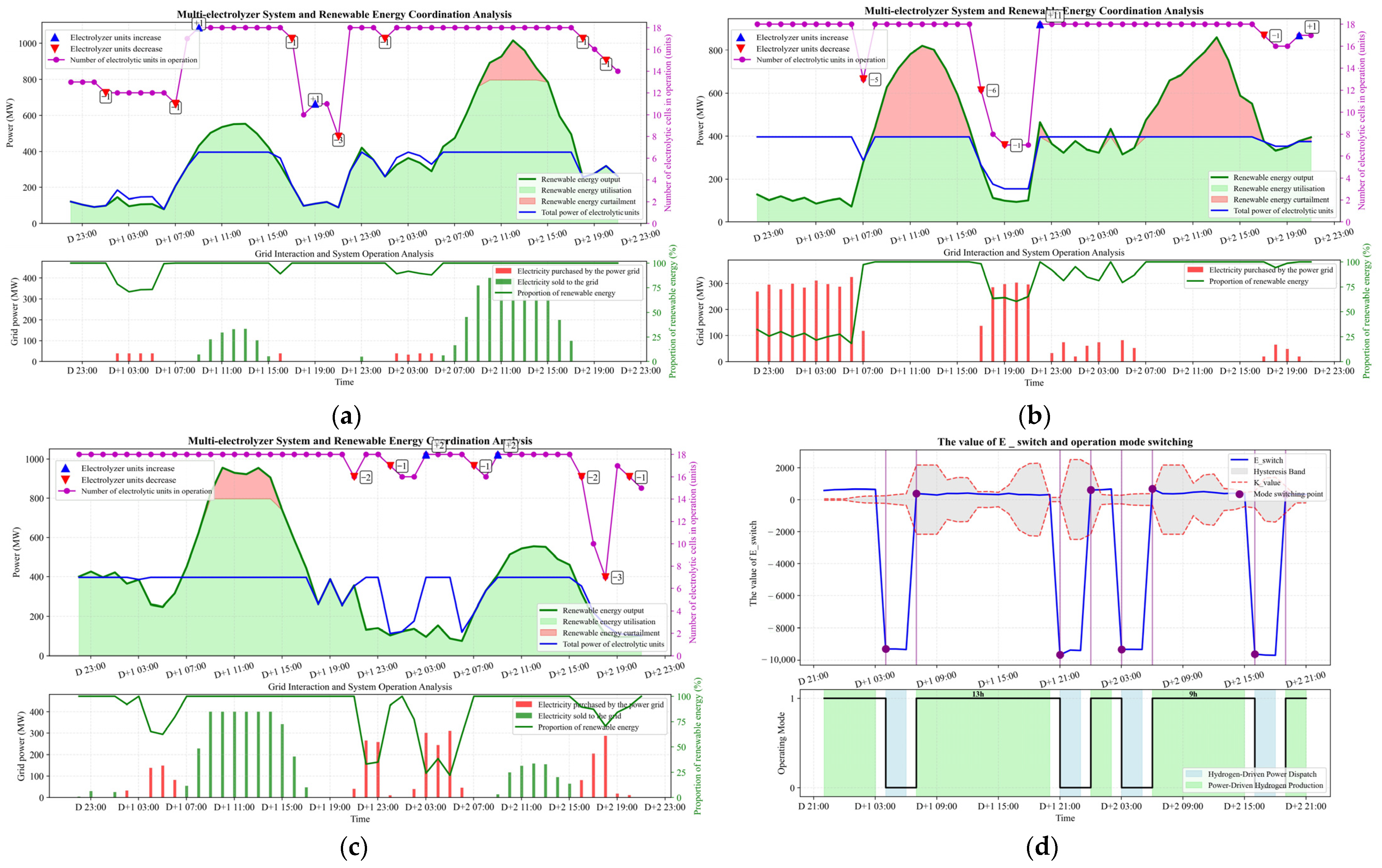
Simulation runs were conducted to optimize the solution for the three scenario modes set for the case study. Figure 4 shows the power distribution, renewable energy utilization rate, electrolyzer system deployment strategy, grid interaction, etc., under the three operating modes.
In Figure 4a, under PDHP mode, renewable energy is prioritized for consumption. During peak wind and solar power generation periods, such as 7:00–16:00 on D + 1 and 9:00–15:00 on D + 2, when the electrolyzer cannot fully consume the energy even at full load, electricity is sold to the grid to achieve energy arbitrage; During low-output periods (e.g., from 17:00 on D + 1 to 5:00 on D + 2), the number of operating electrolysis is reduced (from 18 to 6) to avoid high-cost electricity purchases. As shown in Figure 4b, in HDPD mode, stable hydrogen production is the primary objective, with full-capacity operation maintained for most of the time. During periods of insufficient renewable energy (e.g., from 18:00 on the current day to 6:00 on D + 1), electricity must be purchased from the grid to compensate for the shortfall, resulting in increased electricity purchase costs.
As shown in Figure 4c, by combining the operational characteristics of the two modes and switching between them based on mode preferences, both the utilization rate of renewable energy and hydrogen production are optimized. Figure 4d records the system’s automatic mode switching based on economic switching criteria and dynamic thresholds. The system automatically switches modes eight times during the simulation period based on the comparison results between the HEETI index E switch and the dynamic threshold K . For example, at 02:01 on D + 1, due to low electricity prices and sufficient hydrogen storage ( E switch < − K ), the system switched to PDHP mode to generate higher revenue through electricity sales. The system operated in PDHP mode for 68.75% of the total runtime, demonstrating its flexibility in responding to market fluctuations.
At the same time, the indicator results are recorded in Table 7.
The simulation results demonstrate that the proposed dynamic switching mode achieves significant overall performance advantages. Economically, the method attains the optimal total system cost, which is 10.6% and 16.3% lower than those of PDHP and HDPD modes, respectively. In terms of hydrogen production, the proposed method significantly reduces the LCOH to 0.25 USD/kg, which is 34.2% lower than HDPD mode. At the same time, it increases hydrogen production by 14.4% compared to PDHP mode, overcoming the latter’s output limitation.
Environmentally, the proposed mode also performs strongly. It maintains a high renewable energy utilization rate of 96.3%, which is comparable to PDHP mode (96.2%) and 31.1% higher than HDPD mode (73.5%). In terms of energy optimization, this high utilization rate signifies a substantial reduction in renewable energy curtailment. The system effectively captures and utilizes nearly all available renewable generation, minimizing energy waste. Carbon emission reduction reaches 3.25 million kg CO2, exceeding PDHP and HDPD modes by 1.8% and 25.9%, respectively. Moreover, the green hydrogen proportion reaches 87.5%, striking a robust balance between PDHP (97.5%) and HDPD (81.3%) modes.
Overall, the proposed dynamic switching mode, through intelligent operational strategies, achieves an optimal balance across multiple dimensions, including hydrogen production economics, production scale, renewable energy utilization efficiency, and environmental benefits, thereby overcoming the limitations of single operation modes and demonstrating superior comprehensive performance.
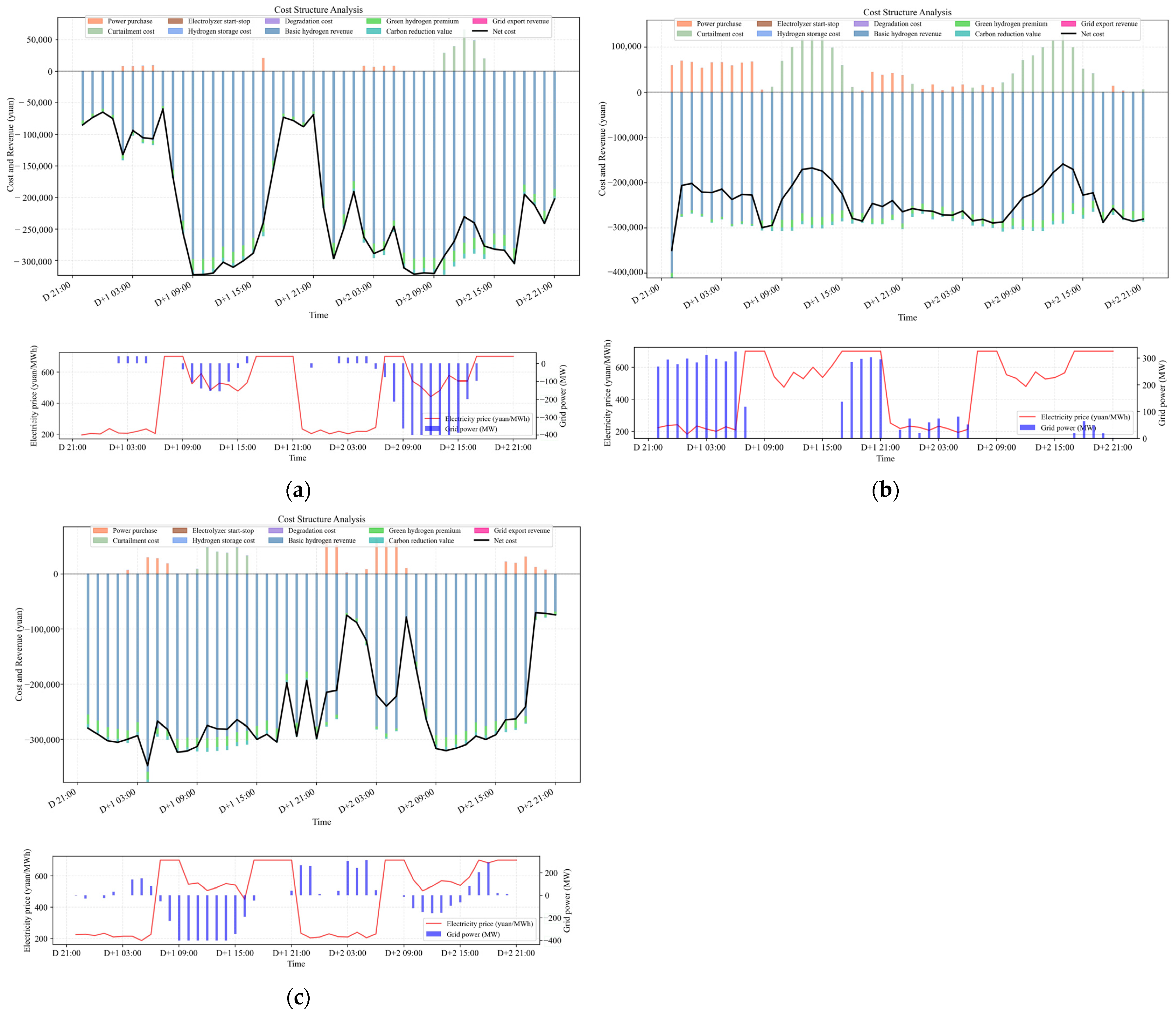
Figure 5 provides a further analysis from the perspective of cost composition. All modes demonstrate rational market behavior in response to electricity price signals: increasing grid electricity purchases (for hydrogen production or storage) during off-peak periods and reducing electricity purchases while increasing electricity sales during peak periods. The dynamic switching mode (Figure 5c) maximizes the utilization of electricity price fluctuations through intelligent mode selection, achieving the lowest total cost and highest net profit.

4.3. Counterfactual Test Analysis

To quantitatively assess the effectiveness of the decision-making mechanism, this study conducted counterfactual tests at all eight pattern switching points, simulating the consequences of making opposite decisions. The opportunity cost is defined as the difference between the counterfactual optimal path and the actual path income, reflecting the additional benefits brought about by the dynamic switching strategy. The opportunity costs at all nine decision points were negative, with the statistical results shown in Table 8:
The opportunity costs of the nine switching points are all negative, and the effective switching rate reaches 100%, indicating that the current scheduling decision mechanism shows extremely high economy and accuracy in actual operation. Taking decision point 2 as an example, the detailed results of the sub-indicators are shown in Table 9:
As shown in Table 9, at 02:01 on D + 1, the actual decision (PDHP) demonstrated a significant advantage over the counterfactual decision (HDPD) in terms of key economic indicators. Under the PDHP model, hydrogen production reached 290.3 metric tons, an increase of 6.4 metric tons or +2.2% compared to the HDPD model. This resulted in a base hydrogen sales revenue of USD 1.859 million, which was USD 48.59 thousand or +2.7% higher, establishing it as the primary source of the revenue advantage.
In terms of costs, the PDHP model’s basic operating cost of USD 69.01 thousand was USD 10.42 thousand higher than the USD 58.59 thousand under HDPD. Despite this, the PDHP strategy secured superior overall economic performance by strategically reducing the number of operating electrolyzers and avoiding hydrogen production during the high-cost electricity periods characteristic of this time interval.
The impact of environmental premium factors is minimal, with the difference in green hydrogen premiums and carbon reduction value across different decisions being less than 0.1%, indicating that the primary drivers of current decisions are the fundamental electricity–hydrogen price differential and operational costs rather than environmental premiums. This result validates that the HEETI index can effectively capture market signals, ensuring the system maintains optimal performance in economic decision-making.

5. Conclusions

This study investigates the multi-mode operation optimization of a hydrogen–electricity synergistic system integrating the HEETI index and adaptive threshold decision-making through system modeling and simulation validation. It also quantifies the decision-making advantages of dynamic switching strategies using counterfactual testing. The main research conclusions are as follows:
  • The PDHP mode achieves the lowest hydrogen production cost of 0.063 USD/kg and the highest renewable energy absorption rate of 96.19%, making it particularly suitable for scenarios prioritizing cost minimization and renewable utilization.
  • The HDPD mode maintains the highest hydrogen output of 318 metric tons, thereby ensuring supply stability for applications with stringent hydrogen demand. This supply assurance, however, comes at the expense of a higher levelized cost of hydrogen, which reaches 0.38 USD/kg.
  • The proposed dynamic switching mechanism demonstrates superior comprehensive performance by achieving an optimal multi-objective balance: 16.3% cost reduction compared to HDPD, and 14.4% hydrogen output increase compared to PDHP, while maintaining 96.34% renewable energy utilization and 0.25 USD/kg LCOH.
  • Counterfactual validation confirms the effectiveness of the decision-making mechanism, with all switching points yielding positive net gains, demonstrating that the HEETI index reliably captures market signals for economic optimization. Furthermore, policy factors, such as green hydrogen premiums and carbon reduction value, contributed marginally within the current model. Future refinement should focus on core economic and operational variables to enhance the model’s practicality and interpretability.
Although the case study is based on a specific regional market, the core methodology—dynamic mode switching guided by the HEETI index—is universally applicable. The framework can be deployed in any electricity–hydrogen market by updating local price data and policy parameters, offering a practical reference for both academia and industry.
There are several directions that can be further deepened in this study: (1) system robustness through uncertainty quantification; (2) sensitivity analysis to electricity–hydrogen price ratios and policy variations; and (3) extended engineering considerations such as integrating grid constraints, equipment degradation models, and multi-timescale coordination. These efforts will enhance system flexibility, deepen hydrogen–electricity integration, and boost resilience under extreme conditions.

Author Contributions

J.L.: writing—original draft, methodology; P.Z.: conceptualization, methodology, administration; S.D.: writing—review and editing; Q.W.: formal analysis, conceptualization. All authors have read and agreed to the published version of the manuscript.

Funding

This research received no external funding.

Institutional Review Board Statement

Not applicable.

Informed Consent Statement

Not applicable.

Data Availability Statement

The original contributions presented in this study are included in the article. Further inquiries can be directed to the corresponding author.

Conflicts of Interest

The authors declare that they do not have any conflicts of interest.

Abbreviations

The following abbreviations are used in this manuscript:
HDPDHydrogen-driven power dispatch
PDHPPower-driven hydrogen production
HEETIHydrogen–electricity economic trade-off index

References

  1. Li, J.L.; Li, G.H.; Liang, D.X.; Ma, S.L. Review and prospect of renewable energy hydrogen production technology under “Dual-Carbon Target”. Distrib. Energy 2021, 6, 1–9. [Google Scholar]
  2. Huang, L.L.; Song, B.S.; Wang, H.; Li, H.; Lin, D.J. Application scenarios, development status and challenges of hydrogen-electricity coupling. China Resour. Compr. Util. 2024, 42, 129–133. [Google Scholar]
  3. Alnuwaiser, A.; Rabia, M.; Elsayed, A.M. Bismuthyl chloride/poly(m-toluidine) nanocomposite seeded on poly-1H-pyrrole photocathode for green hydrogen generation. Open Phys. 2024, 22, 20240111. [Google Scholar] [CrossRef]
  4. Buttler, A.; Spliethoff, H. Current status of water electrolysis for energy storage, grid balancing and sector coupling via power-to-gas and power-to-liquids: A review. Renew. Sustain. Energy Rev. 2018, 82, 2440–2454. [Google Scholar] [CrossRef]
  5. Jia, H.S.; Zhang, H.Q.; Jiang, H.; Liu, G.J.; Liu, W.Z. Configuration and optimal dispatch of renewable energy electrolytic hydrogen production system. Water Power 2025, 51, 105–112+118. [Google Scholar]
  6. Ding, X.; Feng, T.; He, G.L.; Hu, T.; Liu, Y.j. Research progress of the influence of wind power and photovoltaic of power fluctuation on water electrolyzer for hydrogen production. Energy Storage Sci. Technol. 2022, 11, 3275–3284. [Google Scholar]
  7. Liao, Y.X.; Dong, Y.R.; Sun, X.; Tang, X.; Zhang, Z.; Wang, S.Y.; Tan, J.P. Integrated energy management platform for renewable energy hydrogen production. South. Energy Constr. 2022, 9, 47–52. [Google Scholar]
  8. Wang, X.; Meng, X.; Nie, G.; Li, B.; Yang, H.; He, M. Optimization of hydrogen production in multi-electrolyzer systems: A novel control strategy for enhanced renewable energy utilization and electrolyzer lifespan. Appl. Energy 2024, 376, 124299. [Google Scholar] [CrossRef]
  9. Liao, P.W.; Liu, Q.H.; Pan, A.; Wang, J.Y.; Fu, X.G.; Yang, S.Y.; Yu, H. Wind-powered hydrogen production system considering uncertainty: A multi-time scale operation strategy. CIESC J. 2025, 76, 2743–2754. [Google Scholar]
  10. Yuan, T.J.; Wan, Z.; Wang, J.J.; Zhang, D.; Jiang, D.F. Day-ahead output plan of hydrogen production system considering electrolyzer start-stop characteristics. Electr. Power 2022, 55, 101–109. [Google Scholar]
  11. Chen, K.; Peng, H.W.; Zhang, J.F.; Chen, P.; Ruan, J.; Li, B.; Wang, Y. Optimized demand-side day-ahead generation scheduling model for a wind–photovoltaic–energy storage hydrogen production system. ACS Omega 2022, 7, 43036–43044. [Google Scholar] [CrossRef]
  12. Jin, G.; Huang, K.; Yang, C.; Xu, J. Day-ahead scheduling of microgrid with hydrogen energy considering economic and environmental objectives. Energy Rep. 2024, 12, 1303–1314. [Google Scholar] [CrossRef]
  13. Wang, Y.; Tian, R.; Zheng, S.; Lu, C.; Zhou, S. Multi-objective optimal scheduling of islands considering offshore hydrogen production. Sci. Rep. 2025, 15, 27371. [Google Scholar] [CrossRef]
  14. Alanazi, M.; Alanazi, A.; Alruwaili, M. Optimal stochastic scheduling of a hybrid photovoltaic/hydrogen storage-based fuel cell system in distribution networks using dynamic point sampling and adaptive weighting. Int. J. Hydrogen Energy 2025, 180, 151680. [Google Scholar] [CrossRef]
  15. Aatabe, M.; Jenkal, W.; Mosaad, M.I.; Hussien, S.A. Stochastic control for sustainable hydrogen generation in standalone PV–battery–PEM electrolyzer systems. Energies 2025, 18, 3899. [Google Scholar] [CrossRef]
  16. Ye, J.; Wang, X.; Hua, Q.; Sun, L. Deep reinforcement learning based energy management of a hybrid electricity-heat-hydrogen energy system with demand response. Energy 2024, 305, 131874. [Google Scholar] [CrossRef]
  17. Ma, R.R.; Zhao, X.L.; Zhang, R.D. Business model analysis of hydrogen integrated utilization stations under new power system. Sci. Technol. Manag. Res. 2024, 44, 183–191. [Google Scholar]
  18. Glenk, G.; Reichelstein, S. Economics of converting renewable power to hydrogen. Nat. Energy 2019, 4, 216–222. [Google Scholar] [CrossRef]
  19. Wang, J.; Yang, M.; Yan, Y.L.; Xie, Y.B.; Zhang, J.; Hou, H.; Xie, C.J. Multi-dimensional business operation model and development strategy for electricity-hydrogen complementary synergy system. South. Energy Constr. 2025, 12, 130–142. [Google Scholar] [CrossRef]
  20. Shaner, M.R.; Atwater, H.A.; Lewis, N.S.; McFarland, E.W. A comparative technoeconomic analysis of renewable hydrogen production using solar energy. Energy Environ. Sci. 2016, 9, 2354–2371. [Google Scholar] [CrossRef]
  21. Parra, D.; Zhang, X.; Bauer, C.; Patel, M.K. An integrated techno-economic and life cycle environmental assessment of power-to-gas systems. Appl. Energy 2017, 193, 440–454. [Google Scholar] [CrossRef]
  22. Yang, K.; Deng, Y.; Li, C.; Yi, D.; Liu, Y.; Hu, B.; Shao, C. Optimized operation of integrated electricity–HCNG systems with distributed hydrogen injecting. IET Gener. Transm. Distrib. 2024, 18, 2897–2909. [Google Scholar] [CrossRef]
  23. Zhang, X.T.; Ge, Y.Y.; Yao, H.Y.; Yuan, T.J. Operation control strategy of hydrogen production electrolyzers based on particle swarm optimization. Therm. Power Gener. 2023, 52, 115–122. [Google Scholar]
  24. Chen, L.L.; Nian, H.; Zhao, J.Y.; Fan, C.X.; Zhou, J.; Shi, S.C. Energy management optimization for renewable hydrogen production with multiple electrolyzers. Electr. Power Eng. Technol. 2024, 43, 2–10. [Google Scholar]
  25. Zhou, T.; François, B. Energy management and power control of a hybrid active wind generator for distributed power generation and grid integration. IEEE Trans. Ind. Electron. 2011, 58, 95–104. [Google Scholar] [CrossRef]
  26. Zou, P.; Lin, H.; Zhou, X.; Zou, Y.; Li, Y.; Yan, G.; Duan, X.; Cai, J. Control strategies for multi-electrolyzer alkaline hydrogen generation systems improving renewable energy utilization and electrolyzer lifespan. Renew. Energy 2025, 253, 123628. [Google Scholar] [CrossRef]
  27. Song, D.X.; Wang, S.L.; Miao, J.; Xiang, B. Technical economy discussion and cost analysis of renewable energy hydrogen production. Sino-Glob. Energy 2023, 28, 24–29. [Google Scholar]
  28. Zhang, W.T.; Zhou, J.H.; Zhang, R.Z.; Wang, L.J.; Xu, G. Optimal strategy for alkaline electrolyzer clusters in wind-solar hydrogen production considering energy consumption characteristics. Chem. Ind. Eng. Prog. 2024, 43, 6119–6128. [Google Scholar]
  29. International Renewable Energy Agency (IRENA). Green Hydrogen Cost Reduction: Scaling Up Electrolysers to Meet the 1.5 °C Climate Goal; IRENA: Abu Dhabi, United Arab Emirates, 2020. [Google Scholar]
  30. Dongfang Securities. Hydrogen Energy Industry Special Research III: Hydrogen Production Electrolyzer; Dongfang Securities: Shanghai, China, 2023. [Google Scholar]
  31. Guo, X.; Zhu, H.; Zhang, S. Overview of electrolyser and hydrogen production power supply from industrial perspective. Int. J. Hydrogen Energy 2024, 49, 1048–1059. [Google Scholar] [CrossRef]
  32. Makhsoos, A.; Kandidayeni, M.; Pollet, G.B.; Boulon, L. Proton exchange membrane water electrolyzers degradation models review: Implications for power allocation and energy management. J. Power Sources 2025, 655, 238003. [Google Scholar] [CrossRef]
  33. Rozzi, E.; Grimaldi, A.; Minuto, F.D.; Lanzini, A. Model complexity and optimization trade-offs in the design and scheduling of hybrid hydrogen-battery systems. Energy Convers. Manag. 2025, 344, 120306. [Google Scholar] [CrossRef]
  34. Shahzad, S.; Alsenani, R.T.; Alrumayh, O.; Altamimi, A.; Kilic, H. Adaptive hydrogen buffering for enhanced flexibility in constrained transmission grids with integrated renewable energy system. Int. J. Hydrogen Energy 2025, 144, 637–651. [Google Scholar] [CrossRef]
  35. Gökay, B.; Alper, Y.; Recep, Ç. A new Fuzzy & Wavelet-based adaptive thresholding method for detecting PQDs in a hydrogen and solar-energy powered EV charging station. Int. J. Hydrogen Energy 2023, 48, 6855–6870. [Google Scholar]
  36. Yang, P.; Chen, Z.; Tang, W.; Liu, Z.; He, B. An adaptive prediction method for ultra-short-term generation power of power system based on the improved long- and short-term memory network of sparrow algorithm. Energy Inform. 2025, 8, 84. [Google Scholar] [CrossRef]
  37. Wei, S.; Wenjin, Z.; Qi, L.; Yu, Z.; Han, Y.; Bai, Z. Capacity configuration optimization for green hydrogen generation driven by solar-wind hybrid power based on comprehensive performance criteria. Front. Energy Res. 2023, 11, 1256463. [Google Scholar] [CrossRef]
Figure 1. Platform architecture and connection relationship.
Sustainability 17 10987 g001
Figure 2. Flowchart of optimization strategy for the number of electrolytic units put into operation.
Sustainability 17 10987 g002
Figure 3. Decision-making optimization process flowchart.
Sustainability 17 10987 g003
Figure 4. (a) Operational analysis diagram of PDHP; (b) operational analysis diagram of HDPD; (c) operational analysis diagram of economic trade-off dynamic switching mode; (d) record of switching between two operating modes according to the method described in this paper.
Sustainability 17 10987 g004
Figure 5. (a) Cost composition and electricity price–purchase and sale correlation under the PDHP model; (b) cost composition and electricity price–purchase correlation under the HDPD model; (c) cost composition and electricity price–purchase and sale correlation under mode switching.
Sustainability 17 10987 g005
Table 1. List of symbols.
SymbolDescriptionSymbolDescription
t Time period index (h) e g r i d Grid emission factor (t CO2/MWh)
i Electrolyzer unit index (i = 1, 2, …, N) C g r i d ( t ) Grid purchase cost (USD)
P R E S ( t ) Total renewable output (MW) C c u r t ( t ) Curtailment penalty (USD)
P u s e d ( t ) Actual utilized renewable power (MW) C start ( t ) Startup cost (USD)
P c u r t ( t ) Curtailed power (MW) C s t o r a g e ( t ) Storage cost (USD)
N Total number of electrolyzer units C s l a c k ( t ) Demand gap penalty (USD)
P e l e c ( t ) Total electrolyzer power (MW) C s t a b ( t ) Power stability cost (USD)
P e l e c , i ( t ) Power consumption of unit i (MW) R H 2 ( t ) Hydrogen sales revenue (USD)
P e l e c , i , max Rated power of unit i (MW) R g r e e n ( t ) Green H2 premium (USD)
P e l e c , i , min Minimum power of unit i (MW) R g r i d , s e l l ( t ) Grid sales revenue (USD)
u i ( t ) Operating status of unit i (0 = off, 1 = on) R c a r b o n ( t ) Carbon reduction value (USD)
y i ( t ) Startup command for unit i (0/1) E switch ( t ) HEETI index (USD)
R i Maximum ramp rate of unit i (MW/h) E B ( t ) Basic economic comparison (USD/MWh)
T min Minimum runtime requirement (h) S F H 2 ( t ) Storage state factor (USD)
η e l e c , i t Electrolysis efficiency of unit i (kg H2/MWh) R F ( t ) Renewable consumption factor (USD)
η e l e c , 0 Initial efficiency (kg H2/MWh) C F ( t ) Carbon reduction factor (USD)
N cycles Number of start–stop cycles P T F ( t ) Price trend factor (USD)
α t i m e ,   α c y c l e ,   α d e n s i t y ,   α t e m p Degradation coefficients S C ( t ) Switching cost (USD)
H 2 , p r o d ( t ) Hydrogen production (kg) K ( t ) Adaptive threshold
H 2 , s t o r e d ( t ) Hydrogen storage level (kg) K b a s e ,   K f r e q ,   K var ,   K r Threshold coefficients
H 2 , d e m a n d ( t ) Hydrogen demand (kg) β s t o r ,   β u t i l Storage/utilization correction factors
H 2 , max Maximum storage capacity (kg) α t Forecast adjustment coefficient
H 2 , min Minimum storage capacity (kg) r R E S ( t ) Renewable power ratio
P g r i d , b u y ( t ) Power purchased from grid (MW) N t a r g e t ( t ) Target number of active units
P g r i d , s e l l ( t ) Power sold to grid (MW) N o p t i m a l ( t ) Calculated optimum number of operating electrolytic units
P g r i d , c a p Grid connection capacity (MW) N c u r r e n t ( t ) Number of electrolytic units currently in operation
v b u y ( t ) ,   v s e l l ( t ) Binary variables for buy/sell status P t a r g e t ( t ) Target electrolyzer power (MW)
R g r i d Grid ramp rate limit (MW/h) J H 2 HDPD objective (minimize cost) (USD)
c e l e c ( t ) Electricity purchase price (USD/MWh) J E PDHP objective (maximize revenue) (USD)
p H 2 ( t ) Hydrogen price (USD/kg) LCOH Levelized cost of hydrogen (USD/kg)
Δ t Time step duration (h) U t i l r a t e Renewable utilization rate (%)
p c a r b o n Carbon price (USD/t CO2) C u r t r a t e Curtailment rate (%)
e H 2 , c o n v Conventional H2 emissions (t CO2/t H2) CO 2 , red Total CO2 reduction (kg)
Table 2. Basic equipment parameter settings.
SymbolParameterValueUnit
N Number of units18
P e l e c , m a x , i Unit rated power22.0MW
P e l e c , min , i Unit minimum power6.6MW
R i Maximum ramp rate2.0MW/h
T m i n Minimum runtime3.0h
η e l e c , 0 Initial efficiency18.0kg H2/MWh
C s t a r t t Startup cost1028USD/event
H 2 , m a x Maximum capacity61,400kg
H 2 , m i n Minimum capacity6140kg
C s t o r a g e t Unit storage cost0.0085USD/(kg·h)
Table 3. Comparison of HDPD and PDHP baseline modes.
AspectHDPDPDHP
Primary objectiveMinimize total cost while satisfying hydrogen demand.Maximize net revenue while maximizing renewable utilization.
Optimization methodMixed-integer linear programming (MILP).Heuristic allocation with forecasting.
Decision priority1. Meet the basic hydrogen demand;
2. Minimize grid purchase;
3. Balance equipment wear.
1. Maximize renewable absorption;
2. Arbitrage grid sales;
3. Adjust H2 output dynamically.
Hard constraint H 2 , p r o d ( t ) H 2 , d e m a n d t (Equation (16)). P R E S t + P g r i d , b u y t = P e l e c t + P g r i d , s e l l t + P c u r t t  
(Equation (21)).
Renewable priorityUse renewables first (Equations (18) and (19));
buy grid if insufficient.
Absorb all available renewables;
sell surplus.
Electrolyzer
dispatch
Determine   P elec   t from demand;
select units.
Adjust   N target t   based   on   P R E S ( t ) forecast
(Equations (22) and (23)).
Table 4. Components of HEETI.
FactorSymbolEconomic MeaningDirectionFormula
Basic economic comparison E B t Revenue comparison: H2 sales versus grid sales per MWh±Equation (26)
Hydrogen
storage state
S F H 2 t Shortage risk penalty: low storage level prompts shift to HDPD± Segmented   weight   based   on   H 2 , s t o r e d H 2 , max
Renewable consumption R F t Incentive   to   absorb   high   P R E S t periods + ( for   HDPD   if   r R E S t high) Function   of   r R E S t (Equation (27))
Carbon reduction value C F t Monetized CO2 abatement via carbon pricing+Equation (28)
Price trend P T F t Expected future price movements (suppress premature switch)±Equation (29)
Switching cost S C t Equipment wear and mode change penaltyEquations (30)–(32)
Table 5. External market parameter setting.
SymbolParameterValueUnit
P g r i d , c a p Connection capacity400MW
R g r i d Ramp rate limit80MW/h
c e l e c t Electricity purchase price21–98USD/MWh
p H 2 ( t ) Hydrogen selling price5.2–6.3USD/kg
p c a r b o n Carbon trading price14USD/ton CO2
e g r i d Grid emission factor0.6Ton CO2/MWh
e H 2 , c o n v Conventional H2 emissions10.0Ton CO2/ton H2
Table 6. Decision mechanism parameter setting.
Cost ComponentHDPDPDHPUnit
C c u r t  weight42.263.4USD/MWh
C s l a c k    weight169.0112.7USD/kg
Renewable tracking penalty70.4USD/MWh
Table 7. Performance metric results for each mode.
ModePDHPHDPDThe Method Proposed in This Paper
Indicator
Total cost (USD 104)−165.13−156.93−182.54
Hydrogen production (103 kg)35.4944.7940.62
LCOH (USD/kg)0.060.380.25
Renewable energy consumption rate (%)13.5710.3513.55
Green hydrogen ratio (%)13.7311.4512.32
Carbon emission reduction (106 kg CO2)0.450.360.46
Table 8. Opportunity cost statistics of each decision point under counterfactual simulation.
Decision PointTimeThe Original DecisionCounterfactual DecisionOpportunity Cost (USD 104)Opportunity Cost (%)
1D 23:01HDPDPDHP−3.41−1.9
2D + 1 02:01PDHPHDPD−3.81−2.1
3D + 1 05:01HDPDPDHP−3.62−2.0
4D + 1 07:01PDHPHDPD−1.03−0.6
5D + 1 21:01HDPDPDHP−1.59−0.9
6D + 2 00:01PDHPHDPD−0.25−0.1
7D + 2 03:01HDPDPDHP−0.69−0.4
8D + 2 06:01PDHPHDPD−1.66−0.9
9D + 2 21:01PDHPHDPD−1.33−0.7
Table 9. Technical indicator statistics at 02:01 on D + 1.
IndicatorOriginal Decision (PDHP)Counterfactual (HDPD)
Hydrogen production (103 kg)290.3283.9
Basic hydrogen income (USD 104)185.19181.02
Green hydrogen premium (USD 104)8.938.94
Carbon emission reduction value (USD 104)3.263.25
Basic operating costs (USD 104)6.915.86
Renewable energy consumption (MW)18,943.5218,934.28
Carbon emissions (kg)1116913
Disclaimer/Publisher’s Note: The statements, opinions and data contained in all publications are solely those of the individual author(s) and contributor(s) and not of MDPI and/or the editor(s). MDPI and/or the editor(s) disclaim responsibility for any injury to people or property resulting from any ideas, methods, instructions or products referred to in the content.