
Article

Developing a Simulation-Based Traffic Model for King Abdulaziz University Hospital, Saudi Arabia

by
Mohaimin Azmain
,
Alok Tiwari
*,
Jamal Abdulmohsen Eid Abdulaal
and
Abdulrhman M. Gbban
Department of Urban and Regional Planning, Faculty of Architecture and Planning, King Abdulaziz University, Jeddah 21589, Saudi Arabia
*
Author to whom correspondence should be addressed.
Sustainability 2025, 17(24), 10985; https://doi.org/10.3390/su172410985
Submission received: 10 October 2025 / Revised: 1 December 2025 / Accepted: 2 December 2025 / Published: 8 December 2025

Abstract

Transportation management within university campuses presents distinct challenges due to highly fluctuating traffic patterns. King Abdulaziz University (KAU), which attracts over 350,000 trips daily, is experiencing substantial congestion-related issues. This study focuses specifically on King Abdulaziz University Hospital (KAUH), a major trip generator on campus characterized by significant temporal variations in travel demand. The objective of this research is to develop a validated and operational traffic demand model using PTV VISUM 2025. A four-step framework was implemented, where campus gates were defined as trip production sources and 13 parking areas were designated as trip attractions. The morning peak-hour, identified as 7:15 AM to 8:15 AM, was selected for analysis due to the highest observed inflow of vehicles. Traffic surveys were conducted at seven bidirectional stations along key links to support Origin–Destination (O–D) matrix estimation and calibration. Both static and dynamic traffic assignment methods were applied to assess model performance. Model validity was evaluated using the R2 statistic, percentage deviations, and the GEH measure of fit. The results demonstrate that both the equilibrium static assignment and the dynamic stochastic assignment achieved strong levels of accuracy, with R2 = 0.98 and 86% of links exhibiting GEH values below 5, alongside average GEH scores of 3.2 and 2.7, respectively. This dual-model approach provides a robust analytical foundation for KAU, enabling long-term strategic planning through static assignment outputs and supporting short-term, peak-hour operational management through dynamic assignment results.

1. Introduction

Universities serve as microcosms of urban environments, accommodating diverse populations and vibrant activity centers. Owing to their unique land-use characteristics and distinct travel-demand patterns, campus traffic assessment has emerged as a critical area of research with substantial interdisciplinary importance. The performance and impact of a transportation system are highly dependent on its geographic context. Universities located in remote areas are typically situated near essential facilities, services, and housing, enabling convenient access for students [1], whereas campuses embedded within dense urban settings face substantially different mobility constraints. Consequently, campus transportation studies present valuable opportunities for both macro- and micro-scale modeling of regional networks, characterized by diverse trip-making behaviors, multiple transportation modes, and complex parking dynamics [2].
According to Ross and Brown, a widespread challenge in many academic institutions is the absence of a coherent and comprehensive campus transportation plan [3]. This may stem from limitations in staffing, administrative initiative, or strategic foresight; however, the issue persists and requires timely intervention before escalating into an unsustainable situation. Addressing campus transportation difficulties therefore necessitates a thorough understanding of commuting patterns, traffic dynamics, and infrastructure requirements.
Traffic-flow forecasting models have historically played an essential role in rational planning frameworks, particularly during periods of rapid motorization, an issue that continues to affect both developed and developing nations [4]. To effectively evaluate and mitigate increasing traffic pressures, a comprehensive understanding of current travel patterns is indispensable. Forecasting total passenger demand, along with examining interactions among competing transportation modes, is fundamental for the planning, analysis, and management of transport facilities. In this regard, the traditional four-step modeling (FSM) framework provides a structured, data-driven, and adaptive methodology for planners and policymakers [5].
Furthermore, effective traffic survey analysis is crucial for advancing transportation planning efforts and supporting sustainable urban development strategies [6]. With recent technological advancements, traffic simulation has become a powerful tool for analyzing transportation problems, enabling the visualization and prediction of future scenarios. Simulation-based traffic modeling facilitates realistic representations of vehicle movements, while modern dynamic computational systems can replicate roadway conditions to diagnose issues and test operational or infrastructural interventions for improving traffic flow [7].
However, with over 117,096 students in 2022 and 24 faculties, King Abdulaziz University (KAU) functions as a major educational and research hub within Jeddah, located near the old airport area [8]. The main campus encompasses a 50 km internal street network, 18,193 parking spaces, and more than 450 buildings featuring diverse land uses—including academic, administrative, recreational, residential, and green spaces [9]. This extensive activity footprint generates over 350,000 commuting trips per day [10], resulting in substantial traffic congestion, particularly during peak-hours. The limited use of public and non-motorized transportation modes, combined with a heavy reliance on private automobiles, further intensifies congestion challenges across Saudi Arabia [11].
Within the campus, King Abdulaziz University Hospital (KAUH) is located in the northwestern sector, occupying approximately 235,000 m2. It is directly accessible through Gates 1, 2, and 3, whereas other main gates are situated farther from the hospital boundary, though some vehicular inflow also occurs through Gates 4, 5, and 7. The KAUH zone is characterized by diverse land uses and highly variable traffic demand throughout the year. It includes hospital and clinical facilities, research centers, faculty buildings, and administrative units. As the campus is situated within an urban center, it generates substantial travel demand for students, faculty, and staff [11]. Moreover, the university’s strategic plans for expanding academic programs are expected to further increase traffic volumes in the coming years [10].
Over recent years, travel demand on and around the campus has continued to rise and is expected to increase further as new developments emerge in the surrounding area. This growth is driven in part by nearby facilities such as the Haramain high-speed railway station, shopping centers, medical complexes, and expanding residential neighborhoods [12]. Accordingly, it is essential to develop a traffic model capable of assessing traffic conditions under varying circumstances so that campus authorities can formulate effective policies to anticipate and manage traffic patterns, particularly during peak-hours.
The primary objective of this study is to develop a simulation-based traffic model of the KAUH area using Static Traffic Assignment (STA) and Dynamic Traffic Assignment (DTA) methodologies within PTV VISUM. The goal is to construct a calibrated traffic demand model, based on the standard Four-Step Model (FSM), that can support strategic decision-making and enhance operational efficiency across the KAUH network over time. This need is heightened by the complex operational challenges and substantial traffic volumes observed during peak periods.
Previous campus traffic models have largely focused on major arterial roads, often excluding the full internal campus street network and providing limited interpretation or validation of traffic assignment outcomes. As a result, these models have been unable to adequately represent the traffic dynamics of high-demand zones such as KAUH. To address this limitation, the present study develops a comprehensive FSM-based traffic model in PTV VISUM that integrates the entire street network, including all access routes to parking areas and restricted links controlled by campus security during peak-hours.
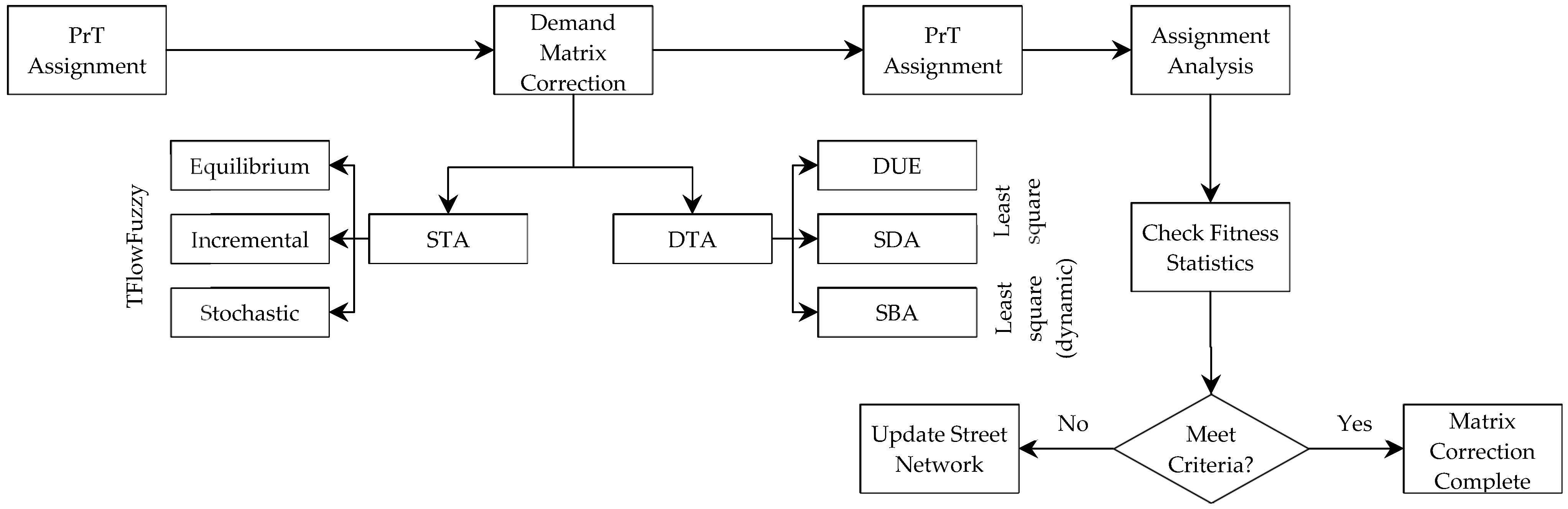
The research process began with a literature review of prior studies on KAU’s transportation system to identify methodological gaps. The dataset used in the analysis was compiled and tabulated, and the methodological framework applied in PTV VISUM is presented in Figure 1. The modeling procedure involved defining key parameters and functions, followed by the execution of both static and dynamic traffic assignments. Subsequently, the demand matrix correction procedures for each assignment type were applied, and the criteria used to evaluate assignment performance are discussed.
The Results Section presents link-based outcomes and compares observed and modelled traffic volumes for each assignment type following demand matrix correction, supported by goodness-of-fit analyses using regression measures and the GEH statistic. The Discussion Section then elaborates on how the calibrated assignment results can assist the campus security department in achieving both long-term strategic planning objectives and short-term operational efficiency, with particular reference to the key intersection near KAUH Gate 2. This section also contrasts the proposed model with previous VISUM-based studies, emphasizing the improvements achieved in terms of accuracy, network representation, and practical applicability. The study’s limitations and potential avenues for future development are briefly outlined in the Discussion, and the concluding remarks are presented in the final section.

2. Literature Review

Considering the campus as a micro-scale representation of a regional transportation system, Huang et al. conducted an extensive study on the University at Buffalo (North Campus), which encompasses 1192 acres with 146 buildings and is served by substantial vehicular activity [2]. Their research employed an advanced agent-based simulation model using the Transportation Analysis and Simulation System (TRANSIMS), incorporating 24 h traffic count data from nine entry/exit points, class schedules, and parking lot occupancy records. Using a two-stage algorithm to generate Origin–Destination (O–D) matrices and estimate parking lot occupancies, the model achieved a low mean percentage error, indicating high agreement with observed traffic patterns. A hypothetical scenario assessing increased travel demand highlighted that limited parking capacity under rising volumes reinforces the need for enhanced parking and traffic management strategies.
In contrast to this large-scale approach, the present study focuses specifically on parking facilities within the KAUH area, where campus gates were defined as origin zones and parking areas as destination zones. Based on these O–D pairs, simulations were conducted using peak-hour traffic data collected from gate entrances and internal road links, with link count data subsequently used to validate the traffic assignment results.
A comparable study conducted at Sharjah University City by Hamad and Obaid developed a tour-based travel demand forecasting model using PTV VISUM to replicate activity-based travel patterns and validate baseline year estimates for future demand prediction [13]. To reduce vehicular volumes and enhance sustainable mobility, the researchers evaluated two strategies: enforcing parking permits and establishing a park-and-ride system. The parking permit scenario demonstrated superior effectiveness in mitigating congestion.
Similarly, the present research adopts the Four-Step Modelling (FSM) approach within VISUM to assess current traffic patterns inside the KAUH area. The baseline scenario was evaluated using both static and dynamic traffic assignments, enabling campus administrators to better anticipate travel demand at critical locations and implement proactive traffic management interventions. Both this study and the aforementioned examples utilize the GEH statistic to validate assignment outcomes. The GEH test, developed by Geoffrey E. Havers, quantifies goodness of fit between observed and modelled traffic volumes by incorporating both relative and absolute deviations [14].
To further examine traffic conditions across the KAU campus, Ali and Jamalallail selected 20 random count locations to measure traffic volumes on various streets and assess congestion levels [9]. Their GIS-based flow analysis led to recommendations including schedule adjustments, increased investment in public transport, lane reductions for private vehicles, and the development of alternative intra-campus routes to alleviate peak-hour pressures. In another related study, Ali and Sindi employed PTV VISUM to develop a travel demand model for the KAU campus, treating gates as origin zones and parking spaces as destinations. Traffic count data collected between 6:00 AM and 9:00 AM were used to evaluate peak-hour demand. Their model showed the highest accuracy under user equilibrium assignment (81%), followed by incremental (80%) and dynamic assignments (79%) when validated against field observations [10].
The internal street network of KAU operates under a one-way traffic system, incorporating several link interchanges and turning loops at specific locations. In their VISUM network modeling, Ali and Sindi represented bidirectional traffic using centerlines with a single node, an approach that omitted these interchanges and loops and consequently limited the model’s ability to accurately predict traffic volumes following assignment. Moreover, their study applied equilibrium, incremental, and dynamic assignment methods without integrating any demand matrix correction procedures, thereby constraining the accuracy and reliability of the resulting link volumes.
In contrast, the present research models the street network with a detailed node–link structure that explicitly represents the one-way system for both inbound and outbound traffic, including movements of cars and buses within the KAUH area (Figure 2). This enhanced network representation substantially improves the accuracy of traffic assignment outcomes. The study employs the GEH statistic and compares three static and three dynamic assignment methods separately to determine which models produce the most reliable forecasts. The resulting model effectively captures travel patterns and supports informed traffic management and decision-making, particularly during peak-hour conditions. By integrating insights derived from both static and dynamic assignment results, the study provides a dual modeling framework that facilitates the development of sustainable, data-driven traffic control strategies for the KAUH area.
At present, no structured traffic management system is implemented by the campus security department. During periods of heavy congestion, most notably during the morning peak, security personnel temporarily restrict specific turning movements or close selected gates. These reactive measures, however, are insufficient, as recurring congestion at KAU can lead to delays of up to 50 min even for short-distance trips. To address such issues, Sindi proposed a conceptual travel demand modeling framework consisting of four stages [12]. This framework emphasized the importance of defining the appropriate time period for analysis and utilizing both micro- and macro-simulation tools, namely PTV VISSIM and VISUM, to develop effective traffic management solutions.
A traffic demand model for KAU was first developed more than a decade ago using VISUM, in which each building was designated as a trip-attracting zone. That model focused on AM and PM peak-hours and relied on survey data collected from students, along with land-use parameters and trip rates for non-educational buildings, to forecast travel demand [12,15]. In contrast, the present study identifies parking locations, rather than faculty buildings, as the primary trip attractors. This modification yields a more realistic representation of travel behavior within the campus, as reflected in the resulting trip assignment patterns.
A key distinction between this study and previous modeling efforts lies in both the data collection methodology and the level of network detail implemented within the VISUM environment. The proposed model prioritizes peak-hour traffic count data from gate entrances, exits, and intermediate road links to support accurate calibration and validation, instead of relying predominantly on interview-based estimates. Earlier KAU models lacked detailed representations of link interchanges and turning loops, as they employed simplified bidirectional centerline configurations. This limitation reduced the precision and practical applicability of their assignment results. Furthermore, past studies relied solely on equilibrium assignment to estimate link volumes, without comparing alternative static methods or incorporating dynamic assignment techniques.
In contrast, the present study adopts a dual modeling approach to support informed decision-making. It evaluates model performance across multiple static and dynamic assignment types, while defining the AM peak-hour (7:15 AM to 8:15 AM) as the period of highest traffic demand—consistent with previous research [15]. Following the standard FSM framework in VISUM, both static and dynamic assignments were applied to generate a calibrated and operational traffic model. By addressing the methodological shortcomings and limited network detail of earlier models, this study provides a more rigorous and comprehensive evaluation of campus traffic conditions during peak-hours.
By validating both static and dynamic assignment outputs, the proposed framework equips the university administration with actionable insights to forecast and implement targeted traffic management strategies. This supports informed, data-driven decision-making aimed at achieving both short- and long-term operational goals in a sustainable and efficient manner.

3. Datasets and Methods

3.1. Data

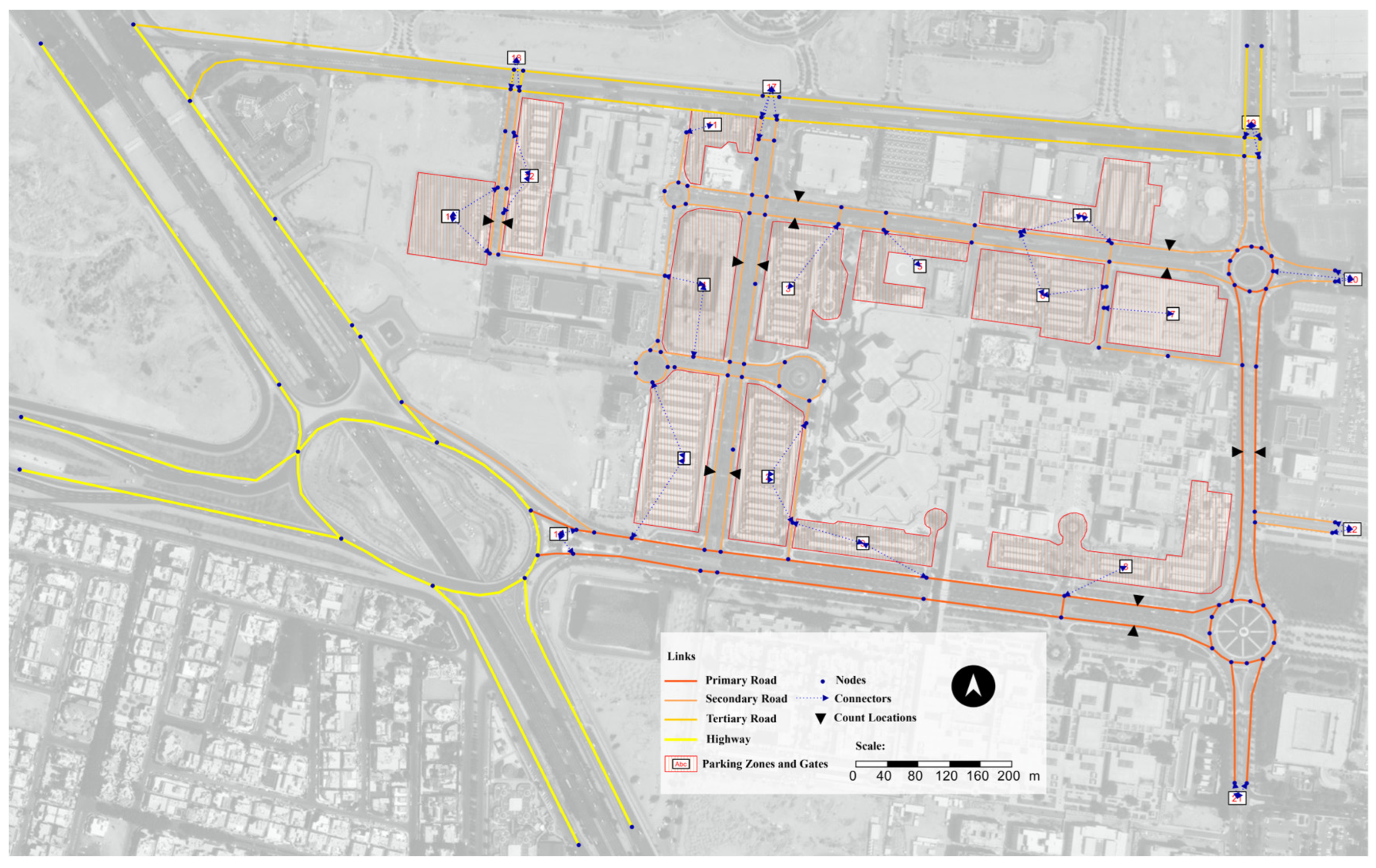
To develop the demand model, transportation supply, land-use, and traffic data were collected [13]. Thirteen parking areas within the KAUH zone were identified as illustrated in Figure 2. Parking areas were considered trip attractors, whereas gate entrances were treated as trip generators. Parking occupancy and traffic counts from gates and internal road links (for both cars and buses) were recorded during the morning peak-hour over three consecutive working days, from 6 to 8 April 2025. Only a small number of buses entered through Gates 1, 7, and 5 during the peak-hour.
Table 1 summarizes the attributes collected to validate and refine the network configuration, as illustrated in Figure 2. These attributes include lane counts, turn restrictions, designated bus routes, and inflow limitations such as those applied at Gate 3.
Parking capacities across the 13 parking areas are summarized in Table 2. Parking occupancy within the KAUH area was monitored during peak-hours, and link-based traffic counts were collected simultaneously to support model validation using the GEH statistic.
Table 3 presents the average car traffic counts recorded over the three-day period, along with the corresponding bus traffic data. To reduce day-to-day variability, traffic count data from the three days were averaged, and outliers exceeding ±15% deviation were removed prior to model calibration.
For the transportation network, the street layout of the study area was extracted from OpenStreetMap (OSM), which includes key road attributes such as travel direction and link capacity. These attributes were used to compute trip flows during the analysis period. The network dataset was further validated through on-site surveys and modified where necessary, including correcting the number of lanes, restricting specific interlink movements, defining designated bus routes, and limiting traffic inflow from Gate 3.
For assessing the simulation-based assignment (SBA), which is dynamic in nature, traffic count data at 15 min intervals were used to generate four separate demand matrices, enabling detailed visualization of traffic conditions and vehicle movements throughout the street network. Traffic data collected from gate locations and internal road links are summarized in Table 3.

3.2. Methods

This study aimed to develop a simplified yet operational traffic demand model using PTV VISUM. By integrating land-use data, including parking areas, gate locations, and traffic count records, the model was designed to support campus administrators in identifying congestion hotspots and implementing proactive traffic management measures. At present, no structured traffic management system exists within the campus; during congestion, the security department typically deploys temporary blockades, an approach that is reactive and often ineffective. Consequently, an evidence-based traffic simulation model is essential to guide the security department in formulating strategic and operational traffic policies.
Both static and dynamic assignment methods were employed to estimate traffic flows on road links for cars and buses, enabling a comparative assessment of which assignment approach is most suitable under varying traffic conditions throughout the year. The proposed methodology began with data collection, followed by network environment setup in VISUM, application of the standard Four-Step Model (FSM) to compute trip assignments, and subsequent model calibration and validation. The sequential steps undertaken in this research are presented in Figure 1.
Within VISUM, the study implemented a structured procedure sequence to generate calibrated traffic assignment results and produce the corresponding reports. The sequence consisted of the following steps: Trip Generation → Calculate PrT Skim Matrix → Estimate Gravitational Parameters (KALIBRI) → Trip Distribution → PrT Assignment → PuT Assignment → Demand Matrix Correction (Car) → Demand Matrix Correction (Bus) → PrT Assignment → PuT Assignment → Assignment Analysis (Car) → Assignment Analysis (Bus) → Reporting PuT Counts.
Bus trips operate according to timetable-based schedules from specific gates (1, 5, and 7). Accordingly, a separate demand matrix was incorporated to compute the initial traffic volumes along designated bus routes. After executing these sequential procedures, the final assignment results were obtained for both Static Traffic Assignments (STAs) and Dynamic Traffic Assignments (DTAs). The details of each step are described in the following subsections.

3.2.1. Network Setup

All road network nodes and links were imported from the OpenStreetMap (OSM) dataset. In accordance with university administration guidelines, all internal campus links were assigned a speed limit of 40 km/h. The links were classified as primary, secondary, or tertiary roads, and the number of lanes and link capacities were adjusted to reflect real-world conditions.
To evaluate traffic conditions within the KAUH area, 13 parking areas and 7 gate entrances were identified. Four of these gates provide direct access to parking zones, while the remaining gates connect indirectly via internal road links. Accordingly, seven zones were defined as trip origins (gates), and thirteen zones were defined as trip destinations (parking areas) within the transport network [16].
In VISUM, the “Zone” tool was activated, and zones were created and linked using the “Insert Mode” function. A demand model was then established by specifying the model code, name, type, and transport mode. For this study, the standard Four-Step Model (FSM) was selected.
Because the study focuses on a campus environment, all trips were classified as Home-Based Education (HBE), with private car trips constituting the primary demand segment. Approximately 98% of campus trips are made by private car [10], and thus private transport was the main focus of the model. Public transport (bus) was also incorporated, as bus routes operate on fixed timetables and use specific gates. A separate bus demand matrix was therefore included to compute bus volumes along designated routes.
Production and attraction values for the gates and parking areas were entered after defining the demand strata. All zones and gates were connected to their respective access nodes via connectors. To insert connectors, the “Connectors” tool was activated, and connections were drawn using “Insert Mode.” Figure 2 illustrates the nodes, street network, zones, connectors, and traffic count locations used in constructing the demand model.

3.2.2. Trip Generation

As a fundamental component of travel demand modeling, trip generation estimates the number of trips originating from or attracted to a specific location [17]. This process determines the trips that begin or end in each zone based on the activity levels within the surrounding geographic area [18].
In this research, parking areas and gate locations were defined as trip origins and destinations. Trip generation was the first step implemented from the “Calculate” tab to establish the FSM framework in VISUM. To compute the total incoming and outgoing trips for each zone, a demand stratum was created, and production and attraction values derived from survey data were entered. For matrix balancing, total trip production was treated as Home-Based Education (HBE) trips. The procedure was then executed to generate the total trip productions and attractions across all zones.
An essential intermediate component of traffic models is the skim matrix, which represents interzonal travel time and cost [19]. After generating total trips, a skim matrix was computed [16]. This was performed by selecting the “Calculate PrT skim matrix” function within the procedure sequence. For this study, the skim matrix was generated using “t0” as the path selection parameter, “Mean over path volume” as the weighting method, and “Trip distance” as the calculation basis. The designated procedure was executed to produce the final skim matrix.

3.2.3. Trip Distribution

The gravity model in VISUM provides two alternative utility functions for estimating trip distribution. The Estimate Gravitational Parameter (KALIBRI) function is used to calibrate these utility functions [20]. In this study, the previously generated skim matrix was supplied as input to determine the appropriate utility function, with the coefficient initially set to 1.
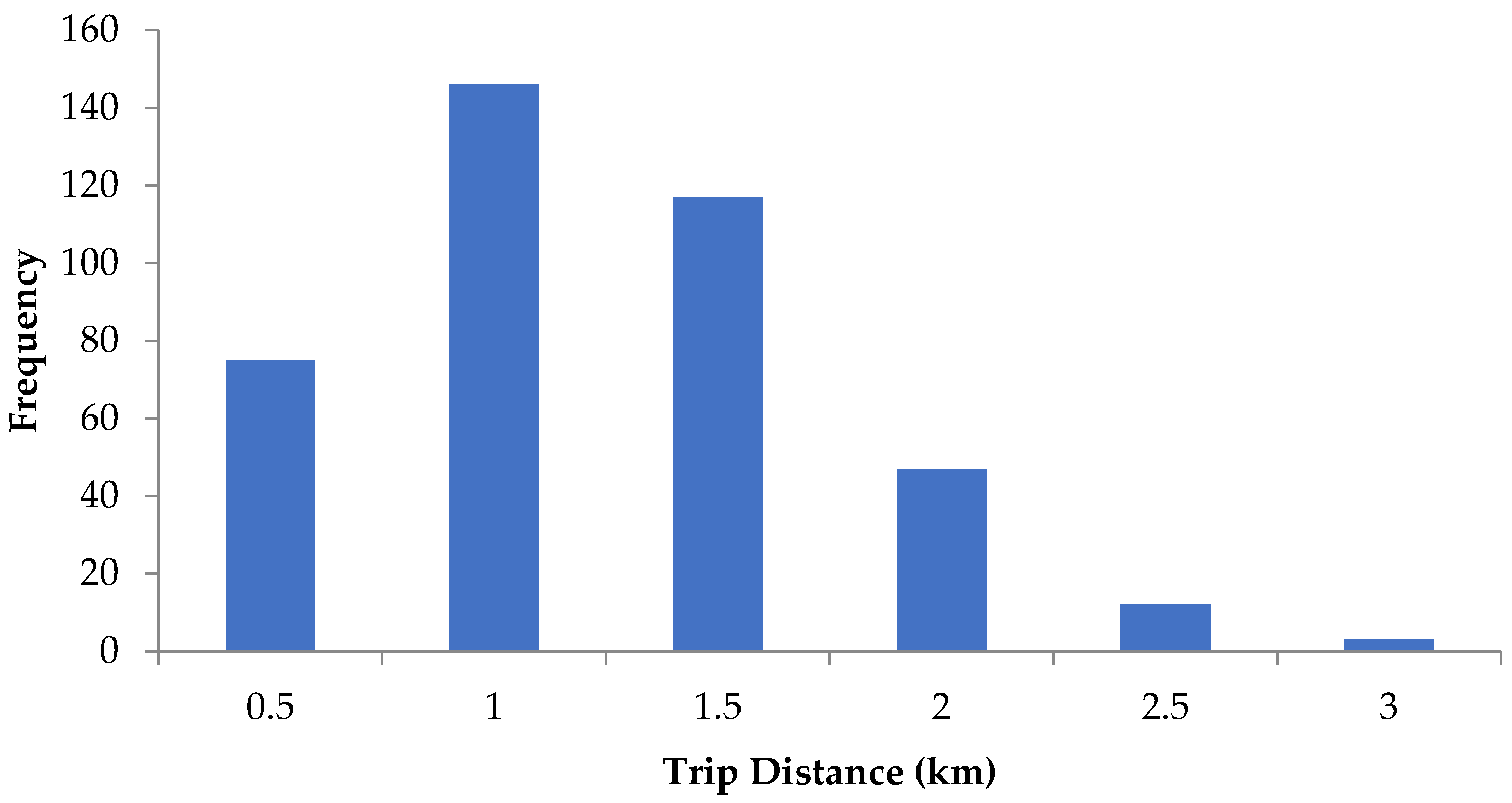
To analyze how trip distance influences trip distribution, a histogram was developed to identify the maximum interzonal distances and their corresponding frequencies within the study network. Table 4 presents the total number of trips across defined distance ranges, while Figure 3 illustrates the spatial extent of the KAUH area. To simplify the demand model and improve interpretability, an exponential utility function was adopted. This function assumes an exponential decay in utility with increasing distance, offering a more realistic and behaviorally consistent representation of trip distribution patterns [17].
In VISUM, the skim matrix generated from the “Calculate PrT skim matrix” step is uploaded without transformation. The class limits and corresponding shares were defined as shown in Table 4, and trips were then computed automatically based on the trip distances between gate origins and parking destinations. Within the “Function type” tab, the logit model was selected, using no weighting and retaining the default maximum of 50 iterations for the KALIBRI calibration process.
The equation used to compute the utility function was as follows:
f U i j = e ( β . U i j )
Here, U i j is the distance between origin zone i and destination zone j . e ( β . U i j ) is the exponential decay term suggesting that as travel distance or time increases, the utility decreases exponentially, where β > 0 and controls how quickly utility decays as the travel distance increases which means the larger the β is, travelers are more sensitive to distance, whereas smaller β means the travelers are less sensitive. Sensitivity analysis of the decay coefficient (β) showed model stability within ±0.05 variation, confirming robustness.
Trip distribution allocates trip productions and attractions across zones to determine how trips originating in one zone are distributed to other zones, incorporating factors such as trip length, travel time, and directional patterns within the network [21]. In this study, a gravity model was employed to estimate trip flow patterns during the distribution stage [22].
In VISUM, the software generates a demand matrix from the traffic matrix F i j using the defined O–D pairs. Gravity models apply distribution parameters within the utility function to represent travelers’ sensitivity to trip distance and other impedance factors. These parameters are calibrated by comparing the predicted demand for each O−D pair with observed demand to achieve an optimal fit [20].
The general form of the gravity-based trip distribution model is expressed as:
F i j = k i j . Q i . Z j .   f U i j
where F i j is the traffic flows from zone i to zone j . Q i is the origin zone i and Z j is the destination zone j . k i j is the scaling (attractiveness) factor for O-D pair between zones i and j, subject to the conditions:
j = 1 n F i j = Q i   and   i = 1 n F i j = Z j
where n is the number of zones.
The logit function type defined in the previous step was retained. In VISUM, the “Trip distribution” procedure under the demand model folder was executed to compute the initial distribution matrix.

3.2.4. Trip Assignment

Trip assignment connects O–D trips with specific routes for each mode of transport [23]. At this stage, interzonal trips are distributed across the available paths within the network, with route choice influenced by factors such as travel time, monetary cost, and level of service [24]. As a core component of transportation planning, trip assignment provides a fundamental framework for estimating traffic demand within street networks. Static Traffic Assignment (STA) methods have long been used in planning and policy analysis, particularly for infrastructure investment and demand management decisions [25].
PTV VISUM offers multiple STA methods that distribute O−D flows based on different assumptions regarding user behavior [20]. While STA generates results over the entire analysis period, Dynamic Traffic Assignment (DTA) captures temporal variations in traffic demand and accounts for changes in route choice and congestion levels throughout the modeled time horizon [26]. After the trip distribution matrix was computed, it was used as input to estimate traffic volumes on each network link during the assignment stage.
  • Static Traffic Assignment (STA)
STA is a widely used and preferred tool in strategic transport planning due to its simplicity and ability to analyze large-scale network [27]. Among the available STA methods in PTV VISUM, Equilibrium (EQL), Incremental (INC), and Stochastic (STO) assignments were considered to evaluate distribution of O-D pairs in the street network.
Equilibrium is achieved when no driver can reduce their travel time by changing routes [28]. It follows Wardrop’s First Principle, which states that the travel costs of all used routes are equal and less than those of unused routes [29].
Unlike equilibrium assignment, incremental assignment distributes trips by dividing the total travel demand into smaller segments and assigning each segment iteratively, updating travel times after each step. This approach partially accounts for congestion effects while maintaining computational efficiency.
In contrast, stochastic assignment accounts for variations in drivers’ perception of travel cost, recognizing that drivers may have different experiences on the same route and may lack complete information about all available paths [27].
To compute the assignment results for each STA type in VISUM, a procedure sequence was created by selecting “Prt Assignment” from the “Assignments” folder. Each static assignment includes a set of parameters that can be adjusted within VISUM; however, in this research, all parameters were retained as default, as the model produced no error during the assignment operation.
For EQL assignment, the classical convergence criteria were selected, with a maximum of 100 iterations and a minimum gap of 0.0001 in the termination condition (default settings).
For INC assignment, the O−D demand share per iteration step was divided as 33%, 33%, and 34%, respectively.
For STO assignment, the maximum number of iterations was set to 10 as global termination condition. The smoothing of routing volumes was maintained as default, and the method of successive averages (MSA) was selected to compute smoothed impedances.
All remaining parameters were left at their default settings to perform each static assignment and compute the trip distribution matrix.
  • Dynamic Traffic Assignment (DTA)
In street networks, traffic intensity fluctuates over time due to variations in travel demand. PTV VISUM offers several dynamic assignment methods, including Dynamic User Equilibrium Assignment (DUE), Dynamic Stochastic Assignment (DSA), and Simulation-Based Assignment (SBA), each addressing limitations of static models by explicitly incorporating temporal changes in travel patterns [30].
To address the constraints of purely static approaches, the DUE model in VISUM integrates the temporal dimension of traffic flow rather than focusing solely on spatial allocation. The DUE method subdivides the assignment period into 5–15 min intervals, thereby producing a more realistic representation of time-dependent travel behavior.
The DSA model explicitly accounts for the time required to complete trips within the network without restricting the analysis to fixed time-interval lengths for travel demand. It generates outputs in terms of traffic volumes and route impedances, providing insights into temporal variations in congestion [20].
The SBA method directly links travel time to traffic congestion in computing assignment results, illustrating how increased inflows lead to higher congestion levels and reduced speeds. Unlike STA models, SBA integrates traffic flow with congestion indicators such as speed reduction, queue formation, and delay [31]. It also enables detailed route-choice analysis and provides animated visualizations of vehicle movements across the entire analysis period, supporting the evaluation of individual driver behavior and advanced traffic management strategies [30].
To compute assignment results for each DTA method in VISUM, a procedure sequence, similar to, that used for STA was created; however, several key parameters specific to dynamic modeling were configured.
For both the DUE and SBA models, the assignment period was defined as 7:15 AM to 8:15 AM, followed by a one-hour post-assignment period. The time horizon was divided into four 15 min intervals for trip balancing, while all other parameters remained at default settings.
For the DSA model, the assignment period and interval length were defined similarly to the DUE, using 1 h intervals, with most parameters also retained at their default values.
For example, in the DUE model, the maximum anticipated cost and cost discretization factor for shortest path computation were set to 100 and 0.01, respectively. Additionally, the default termination conditions included a maximum of 100 iterations and a relative deviation threshold of 0.001.
Similarly, in the spill-back section, the maximum number of iterations and the relative deviation were set to 20 and 0.001, respectively. In addition, a maximum of 50 iterations with a minimum gap of 0.01 was defined as the termination condition. The random seed for simulation was set to 1, and the volume-balancing method was configured as cost-proportional based on the O–D pairs. All remaining parameters were retained at their default settings to execute each dynamic assignment model and compute the trip distribution matrix effectively.

3.2.5. Origin–Destination Matrix Correction and Validation

Matrix correction methods are used to adjust the O–D matrix so that it aligns with observed traffic count data, incorporating factors such as trip production, trip attraction, and zone connectivity. Previous studies have demonstrated that these correction techniques are reliable when initial demand estimates are influenced primarily by generation errors, although distribution errors are generally more challenging to correct using link count data alone [32].
Traffic survey data collected at each station were used to create two user-defined attributes in VISUM. For static assignments, total observed traffic counts for the full analysis period were entered as input. For dynamic assignments, the sub-attribute type was defined according to the analysis time intervals. Accordingly, 15 min interval counts from 7:15 AM to 8:15 AM were used for matrix correction.
Following execution of the “PrT Assignment” procedure in VISUM (subsequent to the trip distribution step), demand matrix correction was performed. The TFlowFuzzy method was selected for static assignments, while Least Squares was applied for both DUE and DSA, and Least Squares (Dynamic) was used for SBA.
The TFlowFuzzy method was applied to all static assignments because it provides flexible adjustment capabilities, accommodates uncertainty in traffic flows, and enables adaptive calibration. For DUE and DSA, the Least Squares method was used because it minimizes discrepancies between observed and modeled traffic volumes, ensuring accurate calibration for time-dependent demand (in this case, 15 min intervals). For the simulation-based assignment, the “Least Squares (Dynamic)” procedure was employed to optimize complex, time-varying simulations and improve alignment between real-world traffic behavior and modeled outputs [20].
This step was executed by creating a procedure sequence titled “Demand Matrix Correction” from the Matrices folder. After running the matrix correction procedures for both STA and DTA (for cars and buses), the PrT Assignment and PuT Assignment procedures were executed again to visualize the updated trip volumes for the analysis period.
VISUM includes an integrated analysis tool capable of generating graphs and summary tables from assignment results. Accordingly, the Assignment analysis function was selected from the Assignment folder to evaluate the goodness of fit between modeled and observed traffic data. Once the analysis outputs satisfied the established acceptance criteria, the modeled network was updated to complete the matrix correction process.
Figure 4 illustrates the Origin–Destination Matrix Estimation (ODME) procedure used in this research. The ODME process was iteratively executed until changes in link flows were less than 2% across consecutive runs, ensuring model stability and convergence.
Following ODME, the traffic assignment outputs from both static and dynamic models underwent validation. The GEH statistic is a widely used measure in travel demand modeling to assess the accuracy of model predictions by comparing simulated link volumes with observed traffic counts across the street network [13].
The GEH values were calculated by comparing the survey data collected at each station with the modeled link volumes generated during the simulation process. The GEH equation is termed as the following:
G E H = 2 ( M O ) 2 M + O
where M represents the modeled traffic volume and O denotes the observed traffic volume collected from the traffic survey. The criteria for interpreting GEH scores derived from the assignment results are presented in Table 5 [33,34]. According to the Design Manual for Roads and Bridges (DMRB) guidelines [35], at least 85% of the volumes in a validated traffic model should exhibit GEH values below 5.0, indicating a satisfactory level of model accuracy.
PTV VISUM provides an integrated analysis procedure capable of generating lists and charts to visualize assignment results. For this purpose, a procedure sequence was created with the analysis basis set to “Links”, since the traffic survey data were collected from road links. The model attributes were defined as “Volume PrT [veh] (AP)” and “Volume PuT [veh] (AP)”, representing the total assigned traffic volume over the entire analysis period. The observed volumes were entered as “Count_PrT” and “Count_PuT”, which had been created earlier as user-defined attributes within the Links tab.
These procedures were executed with all other parameters retained at their default settings. The resulting outputs, including the coefficient of determination (R2), Root Mean Squared Error (%RMSE), slope, and prediction intervals (Y-intercept), were generated in both graphical and tabular formats.
Additionally, VISUM includes a reporting functionality that automatically produces detailed assignment summaries. To utilize this feature, the “Reporting PuT counts” module was added from the AddIn folder, enabling the execution of reporting procedures for both private transport and public transport. This process generated graphs and GEH statistics, facilitating a comparative evaluation of modeled versus observed volumes for each Static Traffic Assignment (STA) and Dynamic Traffic Assignment (DTA) method separately.

4. Results

The results generated from both static and dynamic assignment models were evaluated to determine the suitability of the proposed approach for practical implementation and to assess the extent to which the model accurately reflects real traffic conditions. The analysis primarily focused on comparing modeled and observed traffic volumes for cars, using the R2 statistic to assess model accuracy and validating performance through GEH scores.
For buses, both STA and DTA methods produced comparable outcomes, which is expected given the limited number of bus trips during the peak-hour relative to private vehicles. This observation reinforces the dominant influence of private transport on overall traffic flow patterns within the campus network.

4.1. Static Traffic Assignments (STAs)

The assignment results were generated after performing demand matrix correction, where the STA outputs represented the assigned traffic volumes on each link. In this section, the results from the three STA methods, Equilibrium Assignment (EQL), Incremental Assignment (INC), and Stochastic Assignment (STO), were evaluated. In VISUM, the resulting traffic assignments can be viewed in the network editor, where each link displays information such as capacity, speed, and assigned traffic volume for the entire analysis period.
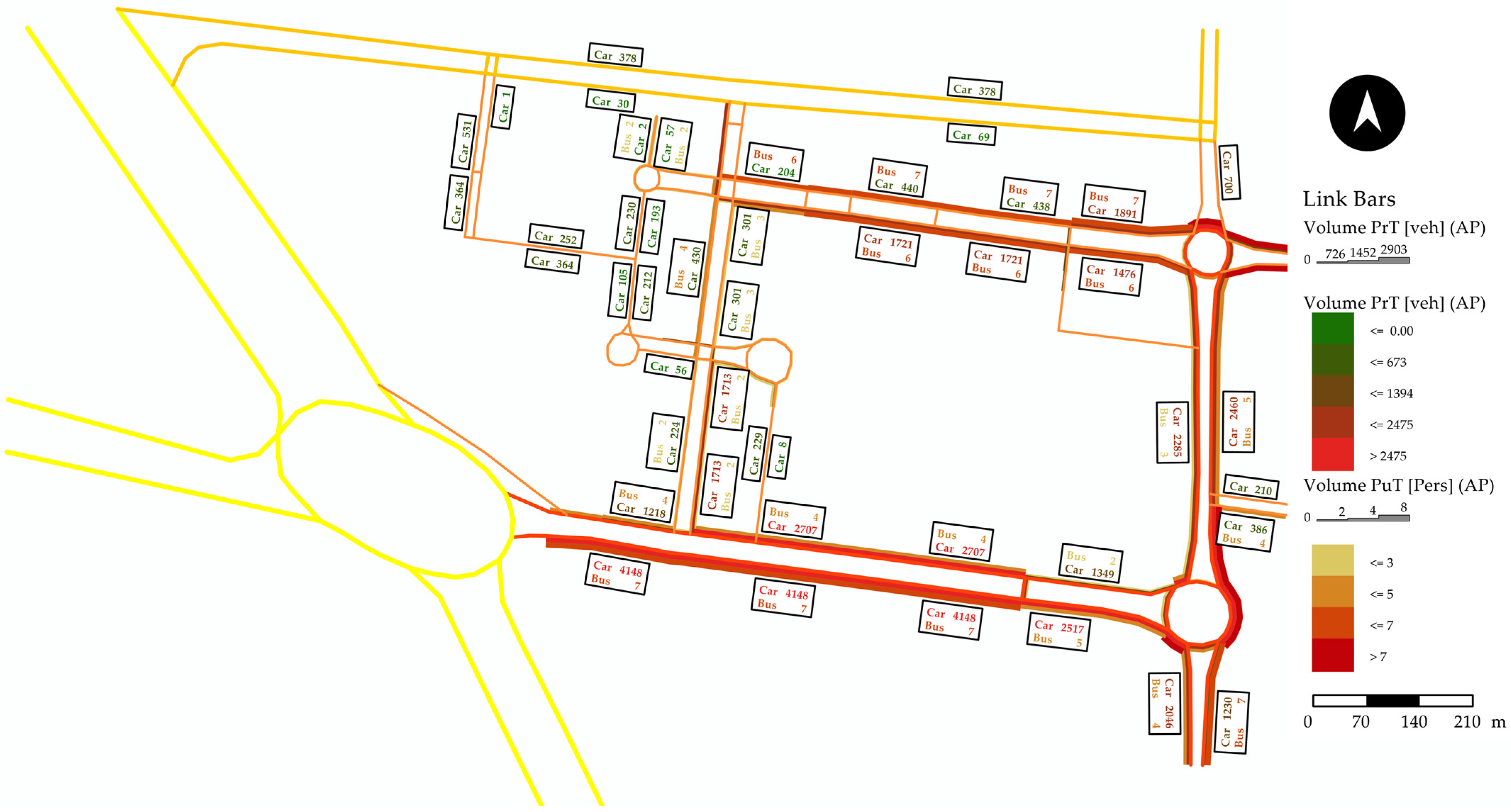
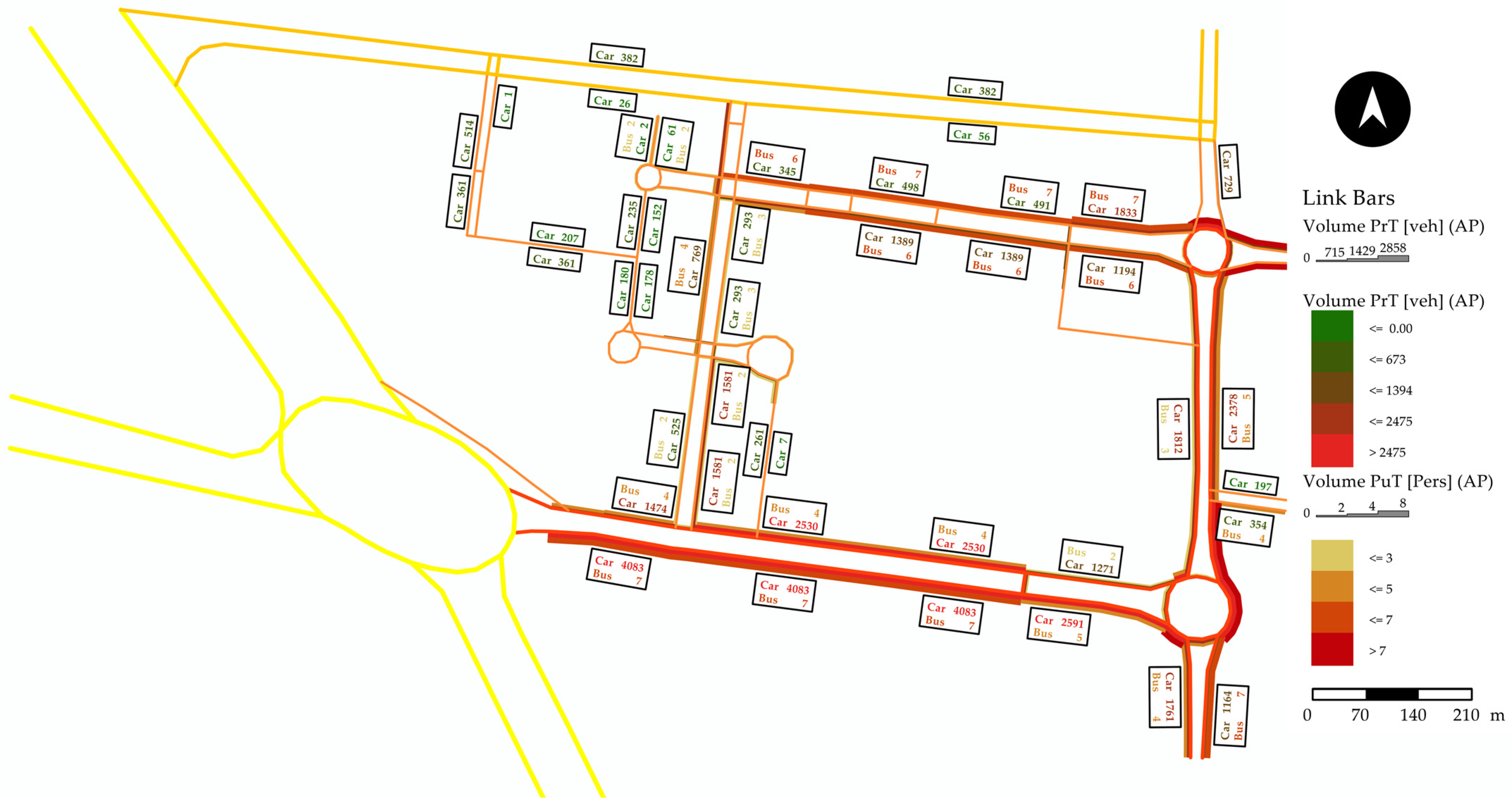
After completing all procedures, traffic assignment results were produced across the street network for both cars and buses. Figure 5 illustrates the output from the EQL assignment, while the INC and STO assignments were computed separately using the same procedures.
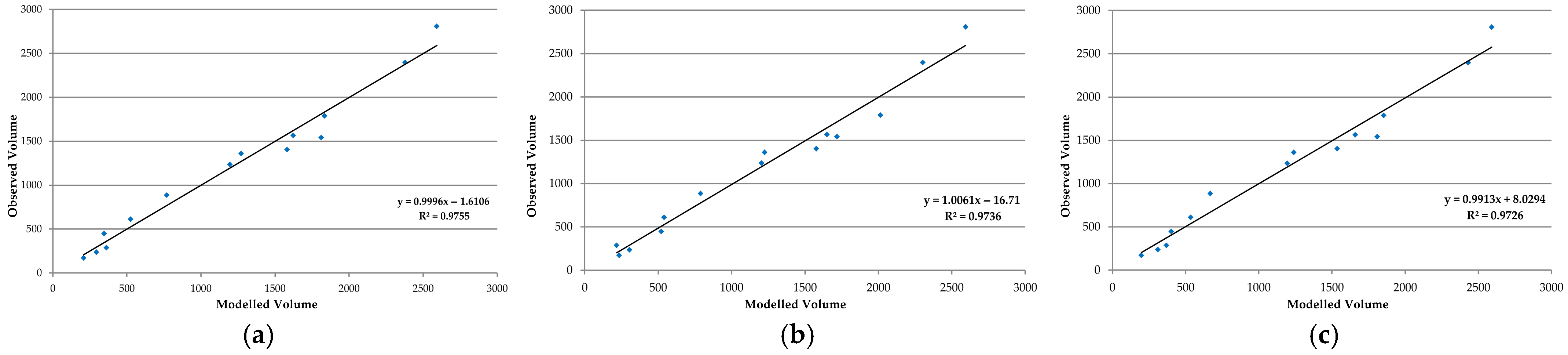
Although all three static assignment methods produced similar aggregate results following demand matrix correction, notable differences emerged in their performance metrics. The EQL method achieved the highest coefficient of determination (R2 = 0.98) and the lowest average GEH value (3.2), with 86% of link volumes satisfying the GEH < 5 criterion and an average deviation of 25%. Figure A1 and Table A1 present the pre-correction results for the EQL assignment.
For the INC assignment, a larger proportion of links fell within the acceptable GEH threshold, with 93% of GEH values less than 5. Although the R2 value (0.97) was slightly lower than that of EQL, the method demonstrated strong consistency across the network. The STO method produced a similar R2 value (0.97) with an average GEH of 3.4, and 86% of links meeting the GEH < 5 criterion.
Across all three STA methods, average deviations ranged between 11% and 12%, while weighted deviations ranged between 8% and 9%, indicating that higher-volume links generally exhibited lower relative errors. Overall, all STA methods captured traffic volumes with a high degree of accuracy, with R2 values ranging from 0.97 to 0.98, and each method meeting the calibration benchmarks for average GEH values.
However, the EQL method demonstrated the strongest overall correlation and the lowest mean error for the busiest links, whereas the INC method produced the highest proportion of GEH-compliant link volumes. Figure 6 presents the comparison between observed and modeled traffic volumes to assess the goodness of fit for STAs.
This research also evaluated link performance across the street network by conducting traffic surveys at seven stations (Table 3).
The comparison between observed and modeled link volumes revealed both strong fits and notable discrepancies. For example, at Station 2 (S2) on Ali Al Murtada Street northbound (NB), deviations were minimal, ranging from −1% under the EQL method to +4% under INC, relative to the observed volume of 2398 vehicles. All three STA methods produced GEH values below 1.0, indicating an excellent model fit. Similarly, at Station 3 (S3) on Al-Malae’b Street westbound (WB), deviations were −3%, with GEH values less than 1.1, further confirming a high level of accuracy.
In contrast, several links exhibited more significant discrepancies. The southbound (SB) approach at S2 showed an overestimation of +15% under both the EQL and STO methods, where the observed volume of 1543 vehicles increased to approximately 1800 in the model, yielding high GEH values of 6.6 and 6.5, respectively. However, the INC method reduced this error to +10%, with a GEH value of 4.3, which falls within the acceptable threshold.
At Station 4 (S4) on Al-Malae’b Street westbound (WB), the STO assignment underpredicted the traffic volume by −25%, resulting in a GEH value of 7.9. By comparison, the EQL and INC methods produced smaller underpredictions of −13% (GEH = 4.0) and −11% (GEH = 3.4), respectively. Conversely, at S1 on Al Ehtifalat Street, all assignment methods performed well, with GEH values meeting the acceptable threshold (≈4.2). Table 6 summarizes all surveyed and modeled volumes across the seven stations and reports the corresponding deviations and GEH values for each STA method. Overall, 86% of links achieved GEH ≤ 5, confirming satisfactory calibration in accordance with DMRB standards.
Considering both network-wide and individual link metrics, the EQL assignment demonstrated the strongest performance among the three STA methods. EQL achieved the highest R2 value and the lowest weighted deviation, indicating the best overall model fit for major roads surrounding the KAUH area. It also met the average GEH requirement (3.2 < 5.0) and exceeded the 85% calibration benchmark. Although the INC method produced a slightly higher proportion of links with GEH < 5.0, it exhibited higher weighted deviations and a marginally lower R2 value compared to EQL. Based on these metrics, the EQL method provided the most reliable estimation of peak-hour volumes on arterial roads, an essential consideration for analyzing congestion patterns and optimizing signal timing around the KAUH area.

4.2. Dynamic Traffic Assignment (DTAs)

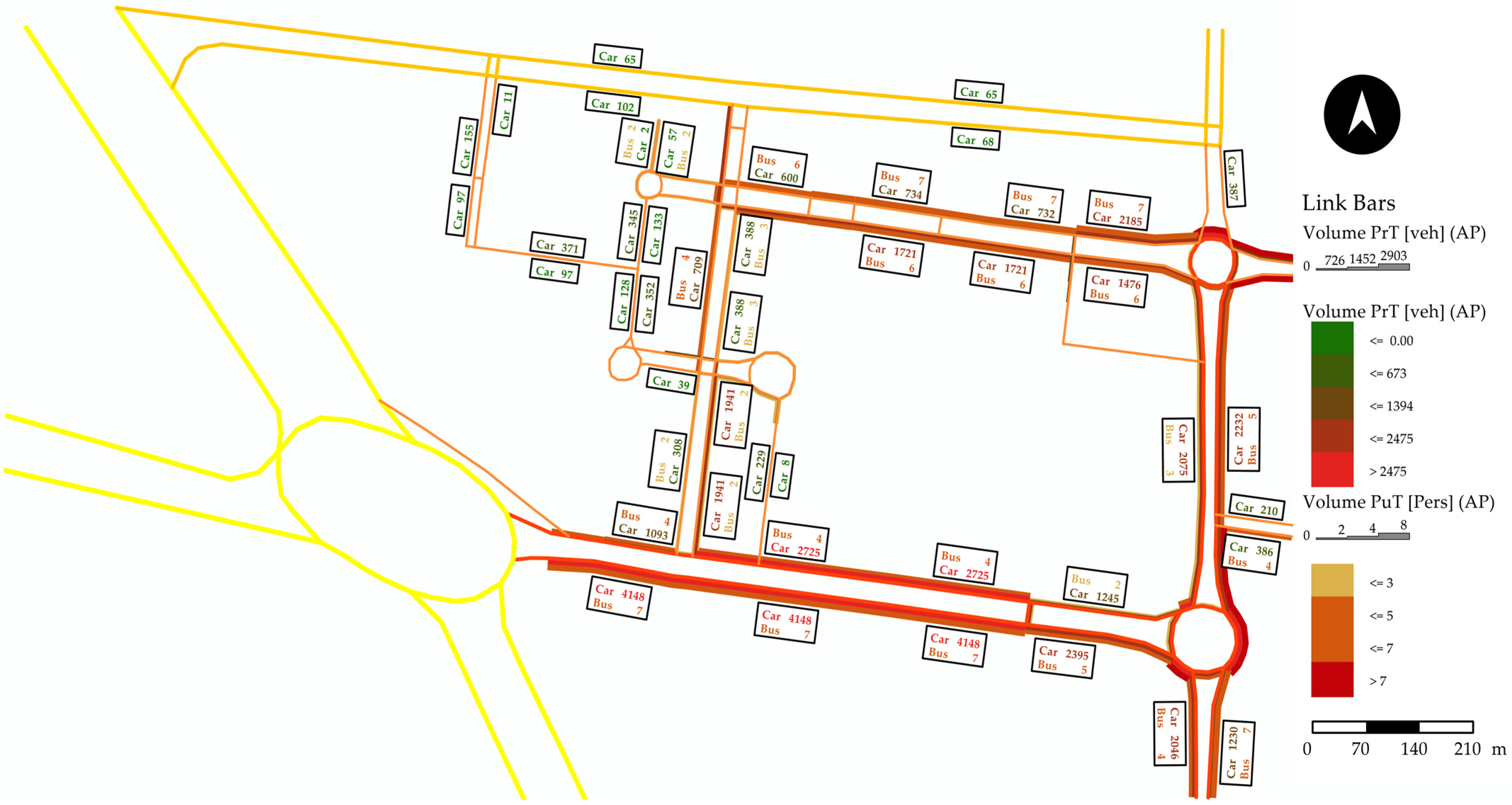
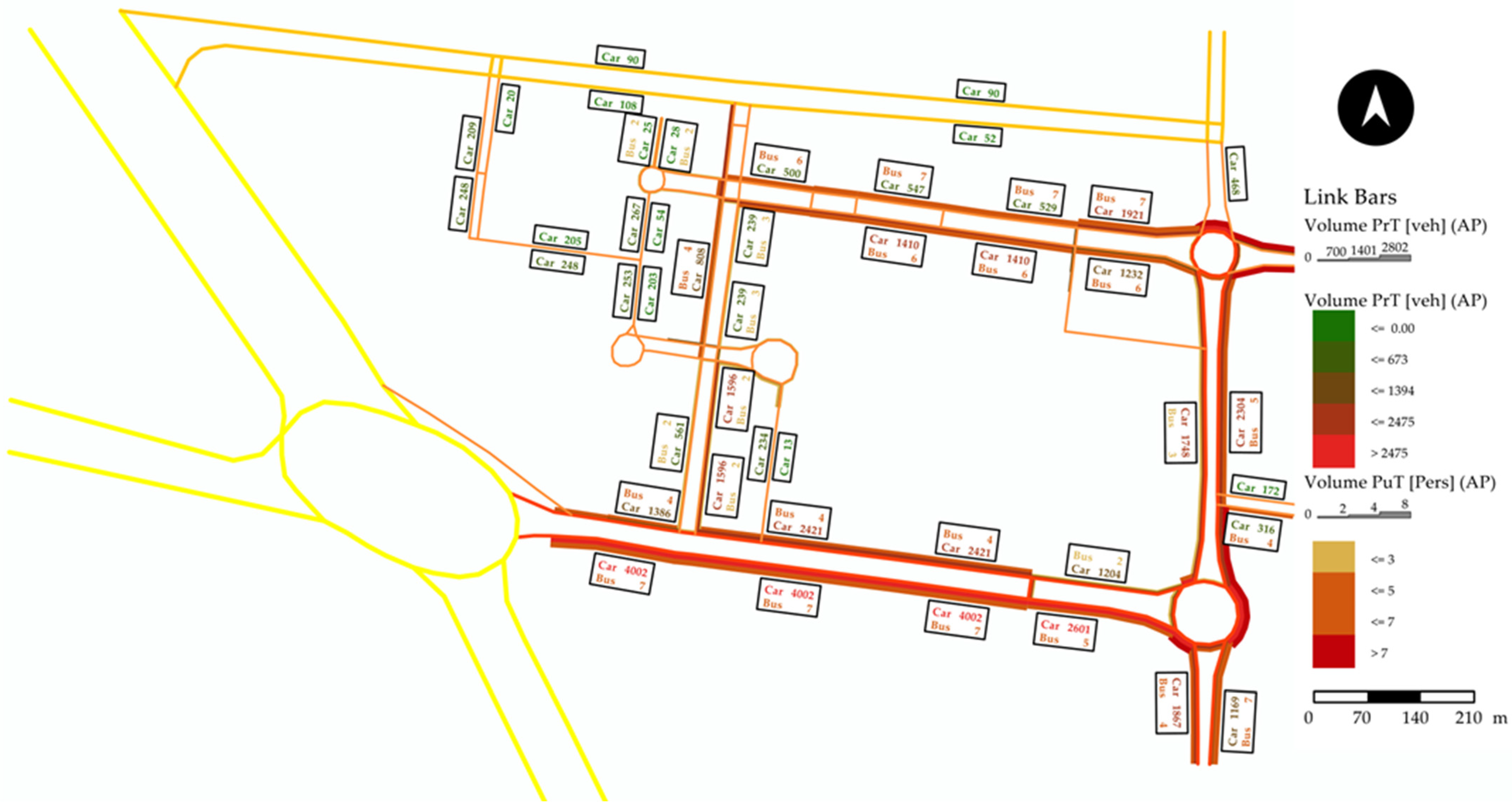
Building upon the static assignment results, dynamic traffic assignments (DTAs) were evaluated to capture temporal variations during the same peak-hour period. Following a similar framework, three DTA methods were implemented in VISUM. Traffic counts at 15 min intervals were required to compute assignment results for all three methods. After completing the sequential modeling steps shown in Figure 1, the outputs were visualized following matrix correction and validation. Figure 7 illustrates the results of the Dynamic Stochastic Assignment (DSA). Similarly, the DUE and SBA assignments were generated to determine which method most accurately represented traffic patterns within and around the KAUH area.
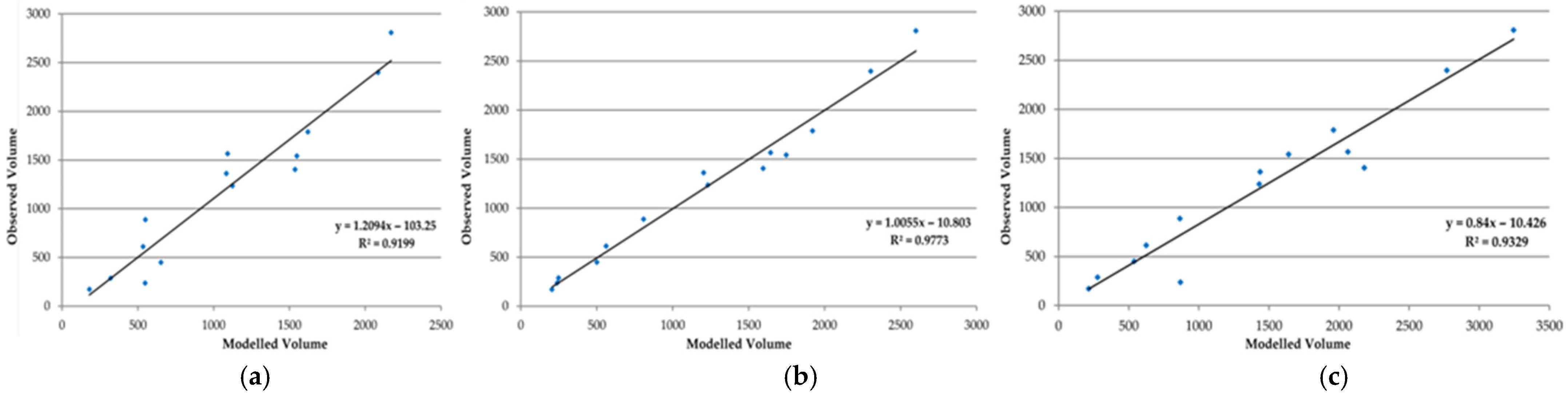
When evaluating the goodness of fit, DUE produced the weakest overall performance with an R2 value of 0.92. It also resulted in a high average GEH value (6.7) and only 50% of link volumes meeting the GEH < 5.0 criterion. In addition, the average and weighted deviations were the largest among the DTAs, 19% and 17%, respectively, indicating both underestimation and overestimation across several links.
In contrast, the SDA method demonstrated the strongest calibration performance, producing an R2 value of 0.98, the lowest average GEH (2.7), and 86% of links under the GEH threshold. The average deviation (8%) and weighted deviation (7%) were also the smallest, indicating strong agreement with observed traffic flows. Prior to demand matrix correction, however, SDA produced an R2 value of 0.86, an average GEH of 9.2, and an average deviation of 28%. Figure A2 and Table A2 present the SDA results before matrix correction.
The SBA demonstrated relatively weak performance, yielding an R2 value of 0.93, an average GEH of 6.8, and only 57% of links achieving GEH < 5.0 after demand matrix correction. The average deviation (17%) and weighted deviation (14%) were comparatively high, particularly on major roads near the KAUH area. Figure 8 shows the observed versus modeled volumes for assessing goodness of fit for the DTAs.
Individual link evaluations revealed both matching flows and significant discrepancies across stations. For example, at S2 on Ali Al Murtada Street, the observed southbound (SB) flow yielded a near-perfect match, with a GEH of 0.1, while DUE and SBA overestimated the flow by +12% and +6%, respectively. At S7 on Sahha Street, SBA closely reflected the SB flow with a deviation of –3% and a GEH of 0.6.
Significant discrepancies were detected at S5 on Hospital Street (northbound), where DUE overestimated flows by +57% (GEH = 15.6) and SBA by +73% (GEH = 26.8), whereas SDA closely matched the observed flow. Likewise, for the eastbound (EB) movement at S1, DUE underestimated volumes by –23% and SBA overestimated by +13%, resulting in high GEH values of 12.8 and 7.8. In contrast, SDA produced a reasonable deviation of –7% with a GEH value of 4.0.
Table 7 summarizes all surveyed and modeled volumes from the seven stations along with deviations and GEH values for the DTA methods.
Assessing the assignment results, DUE emphasized network-wide equilibrium but exhibited poor accuracy, with large errors in several individual link performances. These discrepancies significantly affected the GEH values, leaving only 50% of links within the acceptable threshold. Although SBA produced a relatively high R2 value of 0.93, it showed substantial discrepancies on major links, such as the Hospital Street (northbound) approach, where it overestimated traffic by +73% error.
In contrast, the SDA method outperformed both DUE and SBA, achieving a high R2 value (0.98), balanced local accuracy, low deviations, and approximately 86% of link GEH values below 5.0. Based on these results, SDA provided the most reliable outputs and is therefore recommended for traffic assessment in the KAUH area. Its strong performance offers a robust foundation for scenario analysis and future travel demand estimation.

4.3. Comparative Evaluation of STAs and DTAs

The evaluation of bus trips within the proposed KAUH model demonstrated consistently strong performance, with minimal discrepancies between observed and modeled volumes across all assignment types. Bus operations on campus follow fixed timetables, with services scheduled at regular intervals (15–30 min). For instance, two daily trips from Gate 5 serve the King Fahd Medical Research Center (KFMRC), the main hospital building, and the Faculty of Pharmacy. Additional routes operating from Gates 1 and 7 primarily serve female students, while a limited number of trips accommodate hospital staff.
Due to these fixed and infrequent routes, variations in assignment methods and demand matrix corrections had minimal influence on the results. Observed and modeled volumes aligned closely across most stations, with 0% deviation recorded at several locations, including Ali Al Murtada Street and Hospital Street. The largest deviation, 33% at the Hospital Street NB approach, corresponded to a GEH value of 0.6, indicating only slight underestimation by the model.
Importantly, all GEH values for bus flows remained below 1, confirming that the model accurately reflects actual bus traffic conditions. Table 8 presents the performance results of all STA and DTA methods for bus trips.
Considering the overall performance of both static and dynamic models, the STA methods outperformed most DTA methods, achieving R2 values between 0.97 and 0.98, with the exception of SDA, which also reached 0.98. The STAs produced lower average GEH values (3.2–3.5) compared to DUE and SBA, both of which exceeded 6.7. SDA was the only dynamic method that achieved a low average GEH value (2.7).
At the link level, the STA methods showed average deviations of 11–12% and weighted deviations of 8–9%, whereas the DUE and SBA methods produced substantially higher deviations, ranging from 17–19%. In contrast, SDA demonstrated strong agreement with STA performance, yielding an average deviation of 8% and a weighted deviation of 7%, reaffirming its suitability as the preferred DTA method for the KAUH area.
However, slight deviations were observed in minor traffic flows under the STA methods, even though these methods captured the major road segments with a high degree of accuracy. In contrast, the DTA assessments, particularly the SDA, provided superior accuracy for both major and minor approaches. SDA effectively reproduced complex traffic patterns, such as the Hospital Street northbound movement, where all STA methods consistently overestimated volumes.
Overall, while STA models remain reliable tools for long-term, network-wide planning and calibration, the SDA method offers a more realistic representation of dynamic traffic conditions. This is especially valuable in areas characterized by heavy traffic demand, queuing, and temporal variability, such as the KAUH street network.

5. Discussion, Limitation and Scope

Campus planners increasingly rely on both static and dynamic traffic models to address evolving mobility challenges within university environments. Bustillos et al. applied a DTA-based simulation at the University of Texas at El Paso, incorporating multimodal travel and parking constraints, and demonstrated how drivers respond when entering the campus core; their work showed that DTA can provide integrated and reliable solutions for complex traffic problems [36]. Similarly, Hamad and Obaid developed tour-based VISUM models to evaluate parking policies at the University of Sharjah, finding that their model effectively assessed strategies such as parking permits and park-and-ride systems [13]. Collectively, these examples highlight that detailed demand models, whether static or dynamic, can support campus authorities in parking management, route planning, scheduling, and modal-shift decision-making.
In the present study, parking areas within the KAUH zone were treated as trip attractors, allowing the evaluation of parking utilization and its influence on traffic flows during peak-hour periods. Because the KAU campus contains a major hospital, daily traffic patterns exhibit far greater variability than those in typical academic settings. Patients with acute medical needs arrive from diverse parts of the city, resulting in irregular demand surges. Consequently, the traffic model developed in this study must incorporate alternative assignment procedures to support evidence-based, sustainable traffic management decisions.
Previous research conducted at KAU primarily employed FSM-based forecasting or basic GIS analyses. Ali and Sindi implemented an FSM-based VISUM model and achieved 81% accuracy relative to field data [10], while Ali and Jamalallail generated GIS-based traffic maps without detailed modeling or validation [9]. Sindi proposed the use of simulation-based approaches for future work but did not implement them [12]. By contrast, the current study developed a dual-approach traffic demand model that incorporates both STAs and DTAs, explicitly capturing temporal variations and dynamic congestion patterns. Accordingly, the model provides campus authorities with a more realistic assessment of congestion, queue formation, and route choice behavior around the KAUH area.
Among the static assignments, the EQL method consistently delivered the strongest performance, exhibiting the highest accuracy and the lowest deviations between observed and modeled volumes. Because EQL assumes that traffic reaches equilibrium and distributes optimally across the network, it performs well under steady-state peak-hour conditions. In practical terms, EQL’s strong accuracy on the major arterials surrounding the KAUH area can support the security department in optimizing signal timing, managing gate operations, and planning for long-term parking capacity. It may also assist in adjusting academic and administrative schedules for nearby facilities, such as the College of Tourism, the Faculty of Applied Medical Sciences, KFMRC, and other administrative buildings, to help balance peak-hour traffic demand.
The EQL results also highlight systematic overestimation patterns present in other assignment methods, particularly along Hospital Street. Because the short distance between Gate 2 and nearby parking areas often leads to rapid queue spillback onto adjacent tertiary roads, understanding this congestion behavior is essential for designing more effective gate-entry regulations. To better capture short-term variability and rapid fluctuations in flow, this study also evaluated dynamic assignment models. Among these, SDA performed substantially better than both DUE and SBA due to its ability to model time-dependent variability and randomness in driver behavior. Unlike DUE, which assumes perfect knowledge and predictable route choices, SDA incorporates stochastic elements that more accurately reflect actual conditions experienced by daily commuters. Given that students, staff, and patients are familiar with recurring peak-hour congestion patterns around KAUH, SDA captured these temporal dynamics more effectively.
The assignment outputs can also support short-term operational strategies. For example, temporary movement restrictions may be applied during peak times at the intersection near Gate 2, such as prohibiting eastbound traffic on Al-Malae’b Street from continuing straight toward KFMRC and instead diverting vehicles via Hospital Street. Additionally, merging movements between Hospital Street and Al-Malae’b Street require careful regulation due to the unsignalized nature of the intersection. Previous traffic models for KAU calibrated only volume–delay function (VDF) parameters to match peak-hour volumes and did not address temporal variations in flow. In contrast, this study calibrated both static and dynamic assignments using observed link data and validated them using GEH statistics, addressing limitations identified by Bustillos et al., who emphasized the need to move beyond simple static assignments when modeling route-choice behavior [36].
Nevertheless, the study acknowledges that both DUE and SBA could potentially perform better if the modeled street network were expanded. Dynamic assignment methods typically yield stronger results in large-scale networks, where congestion dynamics, spillover effects, and route interdependencies are more pronounced [31]. Additionally, temporal resolution is a critical aspect of DTA models. Campus traffic is highly peaked and strongly influenced by class schedules, examination periods, and hospital-related activities. These conditions make STA insufficient for capturing short-duration fluctuations, reinforcing the need for incorporating DTAs into the modeling framework.
To support sustainable mobility, this study also incorporated bus operations, despite the overall low modal share of public transport on campus. The dominance of single-occupancy vehicles continues to be a major contributor to congestion. Increasing bus frequency during peak periods, expanding routes, and improving schedule coordination could reduce private car dependence and mitigate traffic buildup. Insights from the model can guide future improvements in public transport policies and inform decisions aimed at optimizing bus operations around campus gates.
Despite the advancements achieved through this dual-model framework, several limitations remain. Two of the DTA methods (DUE and SBA) did not meet benchmark accuracy levels. DTAs require detailed temporal demand profiles and are highly sensitive to assumptions regarding departure time distributions, value of time, and driver behavior parameters. While microsimulation platforms can capture such interactions more accurately, VISUM’s macrosimulation environment does not model them in full behavioral detail. Additionally, the study area was limited to the KAUH surroundings, and the VISUM training version constrained the number of nodes (≤500) and zones (≤30), limiting the extent of the network that could be represented.
Future work should broaden the scope of the model by incorporating a more comprehensive representation of public transport operations, integrating real-time sensor data to enhance multimodal dynamics, and developing simulation-based adaptive control strategies. The study area should also be expanded beyond the KAUH zone. Additionally, microsimulation approaches should be employed to analyze critical congestion hotspots, such as intersections, roundabouts, and high-demand links, with greater precision during peak-hours.

6. Conclusions

This research developed a calibrated and operational traffic demand model for the KAUH area by integrating both static and dynamic traffic assignment techniques. The primary contribution is a validated and practical modeling framework that provides KAU administration with a dual-tiered decision-support tool for long-term strategic planning and short-term operational management at critical intersections and roundabouts.
Among the assignment procedures, the EQL method achieved the strongest network-wide fit and is therefore recommended for rapid evaluations and broad strategic assessments. However, because static traffic assignments (STAs) represent the entire analysis period without capturing time-dependent fluctuations, they may underestimate or overestimate flows on minor links and fail to fully represent peak-period queuing.
Dynamic assignments addressed these limitations. In particular, the SDA method consistently reproduced observed flows along critical hospital corridors, achieving the lowest deviations and GEH values among all dynamic traffic assignments (DTAs). SDA’s ability to capture temporal variability and realistic driver behavior makes it especially suitable for operational planning around KAUH, where peak-hour congestion and queue spillback are frequent.
Based on the findings, a three-step workflow is recommended for campus authorities:
  • Use STA (EQL, followed by INC or STO if necessary) for baseline forecasting, scenario scoping, and rapid sensitivity testing.
  • Apply SDA for operational design, including optimization of gate controls, signal timing, parking allocations, and scheduling adjustments during the 7:15–8:15 AM peak hour.
  • Increase public transport usage by expanding bus frequency and routes to reduce private car dependence and improve network performance.
The calibrated model, supported by gate and link counts and validated using GEH statistics, offers a reliable foundation for proactive congestion management. For example, regulating traffic movements at the Gate 2–Hospital Street intersection could reduce queue spillback and improve flow continuity. Campus planners can also adjust trip productions and attractions within the model to test future scenarios for both long-term development and short-term operational responses.
Future research should focus on incorporating multimodal demand, implementing microsimulation to capture detailed behavioral interactions, and expanding the study area to cover the full campus network. These enhancements will further improve model accuracy and support sustainable traffic management. Nonetheless, the proposed framework already provides a robust, evidence-based approach to assist campus traffic authorities in ensuring efficient access to KAU Hospital and improving overall mobility within the campus.

Author Contributions

M.A. and A.T. conceptualized the study. M.A. and J.A.E.A. developed the methodology, while M.A. implemented the software, conducted the model validation, and performed the formal analysis. J.A.E.A. assisted in data curation and validation. A.T. and A.M.G. provided resources and supervision throughout the research process. M.A. prepared the original draft of the manuscript, and A.T., J.A.E.A. and A.M.G. contributed to the review and editing of the final version. Visualization and simulation outputs were prepared by M.A.; A.T. oversaw project administration, and A.M.G. secured the funding that supported this research. All authors have read and agreed to the published version of the manuscript.

Funding

The project was funded by KAU Endowment (WAQF) at King Abdulaziz University, Jeddah, Saudi Arabia. The authors, therefore, acknowledge with thanks WAQF and the Deanship of Scientific Research (DSR) for technical and financial support.

Institutional Review Board Statement

Not applicable.

Informed Consent Statement

Not applicable.

Data Availability Statement

The data presented in this study are available on request from the corresponding author.

Conflicts of Interest

The authors declare no conflicts of interest.

Appendix A

Figure A1. Static equilibrium (EQL) traffic assignment result before demand matrix correction.
Sustainability 17 10985 g0a1
Table A1. Equilibrium assignment result before demand matrix correction.
StationLinksObserved
Volume
Modelled
Volume
Deviation (%)GEH
Values
Street NameDirection
S1Al Ehtifalat StreetEB28092395−15%8.1
WB13621245−9%3.2
S2Ali Al Murtada StreetSB1543207526%12.5
NB23982232−7%3.4
S3Al-Malae’b StreetEB1789218518%8.9
WB1236147616%6.5
S4EB44960025%6.6
WB1566204523%11.3
S5Hospital StreetSB887709−20%6.3
NB23838839%8.5
S6SB612308−50%14.2
NB1404194128%13.1
S7Sahha StreetSB28897−66%13.7
NB17237154%12.1
Figure A2. Dynamic stochastic traffic assignment (SDA) result before demand matrix correction.
Sustainability 17 10985 g0a2
Table A2. Dynamic Stochastic assignment (SDA) result before demand matrix correction.
StationLinksObserved VolumeModelled VolumeDeviation (%)GEH
Values
Street NameDirection
S1Al Ehtifalat
Street
EB28092517−10%5.7
WB13621349−1%0.4
S2Ali Al Murtada StreetSB1543228532%17
NB239824603%1.3
S3Al-Malae’b
Street
EB178918915%2.4
WB1236147616%6.5
S4EB449204−55%13.6
WB1566194219%9
S5Hospital StreetSB887430−52%17.8
NB23830121%3.8
S6SB612224−63%19
NB1404171318%7.8
S7Sahha StreetSB28836421%4.2
NB17225232%5.5

References

  1. Göçer, O.; Göçer, K. The Effects of Transportation Modes on Campus Use: A Case Study of a Suburban Campus. Case Stud. Transp. Policy 2019, 7, 37–47. [Google Scholar] [CrossRef]
  2. Huang, S.; Guo, L.; Yang, Y.; Casas, I.; Sadek, A. Dynamic Demand Estimation and Microscopic Traffic Simulation of a University Campus Transportation Network. Transp. Plan. Technol. 2012, 35, 449–467. [Google Scholar] [CrossRef]
  3. Ross, G.; Brown, R. University Campus Transportation Planning. In Proceedings of the Eighth University Planning Conference, Cape Town, South Africa, 21–22 September 1978; Available online: https://www.researchgate.net/publication/215445216_University_Campus_Transportation_Planning (accessed on 2 October 2025).
  4. Barnes, G.; Davis, G. Understanding Urban Travel Demand. Minneapolis: Center for Transportation Studies; University of Minnesota: Minnesota, MN, USA, 1999. [Google Scholar]
  5. Ghodmare, S.; Yadav, G. Transportation Planning Using Conventional Four Stage Modeling. Turk. J. Comput. Math. Educ. 2021, 12, 2891–2897. [Google Scholar]
  6. Salisu, U.; Oyesiku, O. Traffic Survey Analysis: Implications for Road Transport Planning in Nigeria. LOGI—Sci. J. Transp. Logist. 2020, 11, 12–22. [Google Scholar] [CrossRef]
  7. Dorokhin, S.; Artemov, A.; Likhachev, D.; Novikov, A.; Starkov, E. Traffic simulation: An analytical review. In Proceedings of the VIII International Scientific Conference Transport of Siberia, Novosibirsk, Russia, 22–27 May 2020. [Google Scholar]
  8. Al-Filali, I.; Abdulaal, R.; Melaibari, A. A Novel Green Ocean Strategy for Financial Sustainability (GOSFS) in Higher Education Institutions: King Abdulaziz University as a Case Study. Sustainability 2023, 15, 7246. [Google Scholar] [CrossRef]
  9. Ali, B.; Jamalallail, F. GIS Based Traffic Flow Analysis in King Abdulaziz University, Saudi Arabia. Int. J. Sci. Res. 2019, 12, 688–696. [Google Scholar]
  10. Ali, H.; Sindi, A. Travel Demand Model for Universities—Case Study: King Abdulaziz University. In Proceedings of the International African Conference on Current Studies, Tripoli, Libya, 10–11 February 2023; pp. 377–390. [Google Scholar]
  11. Al-Mosaind, M. Traffic Conditions in Emerging University Campuses: King Saud University, Riyadh, Saudi Arabia. J. Sustain. Dev. 2014, 7, 204–213. [Google Scholar] [CrossRef]
  12. Sindi, A. Conceptual Intelligent Travel Demand Modelling Framework for Universities—Case Study: King Abdulaziz University. In Proceedings of the 2nd International Conference on Civil and Environmental Engineering (ICCEE 2022), Online, 6–7 January 2022. [Google Scholar]
  13. Hamad, K.; Obaid, L. Tour-based Travel Demand Forecasting Model for a University Campus. Transp. Policy. 2022, 117, 118–137. [Google Scholar] [CrossRef]
  14. Dabbas, H.; Friedrich, B. Estimating Traffic Demand of Different Transportation Modes using Floating Smartphone Data. Transp. A Transp. Sci. 2024, 1–27. [Google Scholar] [CrossRef]
  15. King Abdulaziz University. KAU Traffic Model; King Abdulaziz University: Jeddah, Saudi Arabia, 2011. [Google Scholar]
  16. Atanasova, V.; Angjelevska, B.; Krstanoski, N.; Cvetanovski, I. Calculation of Transport Demand by Applying Software Package PTV Vision VISUM. Int. Sci. J. Mach. Technol. Mater. 2017, 11, 137–140. [Google Scholar]
  17. ITE; Meyer, M. Transportation Planning Handbook, 4th ed.; John Wiley & Sons Incorporated: Hoboken, NJ, USA, 2016; Available online: https://content.e-bookshelf.de/media/reading/L-7956797-0086b3b1b0.pdf (accessed on 8 October 2025).
  18. TRB Travel Demand Forecasting: Parameters and Techniques; National Academy of Sciences: Washington, DC, USA, 2012; Available online: https://nap.nationalacademies.org/catalog/14665/travel-demand-forecasting-parameters-and-techniques (accessed on 8 October 2025).
  19. Tian, Y.; Chiu, Y.; Chai, C. Sunsetting Skim Matrices: A Trajectory-Mining Approach to Derive Travel Time Skim Matrix in Dynamic Traffic Assignment for Activity-Base Model Integration. J. Transp. Land Use 2020, 13, 413–428. [Google Scholar] [CrossRef]
  20. PTV Group. PTV Visum Manual 2025; PTV Group: Karlsruhe, Germany, 2024. [Google Scholar]
  21. Kolbl, R. A Bio-Physical Model of Trip Generation/Trip Distribution; University of Southampton: Southampton, UK, 2000; Available online: https://eprints.soton.ac.uk/464173/1/755854.pdf (accessed on 6 October 2025).
  22. Martinez, O.; Garcia, J.; Kumar, N. The Gravity Model as a Tool for Decision Making. Some Highlights for Indian Roads. In Proceedings of the 14th Conference on Transport Engineering, Online, 6–8 July 2021; pp. 333–339. [Google Scholar]
  23. Flesser, M. Analysis of Traffic Flows Caused by Kingston Campus, University of Rhode Island. Master’s Thesis, University of Rhode Island, South Kingstown, RI, USA, 2020. [Google Scholar]
  24. Yadav, G.; Ghodmare, S. Transportation Planning Using Conventional Four Stage Modeling: An Attempt for Identification of Problems in a Transportation System. Int. J. Sci. Res. Sci. Technol. 2021, 8, 556–567. [Google Scholar] [CrossRef]
  25. Akamatsu, T. A Dynamic Traffic Equilibrium Asignment Paradox. Transp. Res. Part B Methodol. 2000, 34, 515–531. [Google Scholar] [CrossRef]
  26. Elimadi, M.; Abbas-Turki, A.; Koukam, A.; Dridi, M.; Mualla, Y. Review of Traffic Assignment and Future Challenges. Appl. Sci. 2024, 14, 683. [Google Scholar] [CrossRef]
  27. Saw, K.; Katti, B.; Joshi, G. Literature Review of Traffic Assignment: Static and Dynamic. Int. J. Transp. Eng. 2015, 2, 339–347. [Google Scholar]
  28. Kaufman, D.; Smith, R.; Wunderlich, K. User-Equilibrium Properties of Fixed Points in Dynamic Traffic Assignment. Transp. Res. Part C 1998, 6, 1–16. [Google Scholar] [CrossRef][Green Version]
  29. Lee, E.; Oduor, P. Using Multi-Attribute Decision Factors for a Modified All-or-Nothing Traffic Assignment. ISPRS Int. J. Geo-Inf. 2015, 4, 883–899. [Google Scholar] [CrossRef]
  30. Shahrier, H.; Arunakirinathan, V.; Hossain, F.; Habib, M. Developing an Integrated Activity-Based Travel Demand Model for Analyzing the Impact of Electric Vehicles on Traffic Networks and Vehicular Emissions. J. Transp. Res. Rec. 2024, 2679, 1403–1421. [Google Scholar] [CrossRef]
  31. Chiu, Y.; Bottom, J.; Mahut, M.; Paz, A.; Balakrishna, R.; Waller, T.; Hicks, J. Dynamic Traffic Assignment: A Primer (Transportation Research Circular); Transportation Research Board: Washington, DC, USA, 2011. [Google Scholar]
  32. Skarphedinsson, A. Evaluating a Simplified Process for Developing a Four-Step Transport Planning Model in VISUM—Application on the Capital Area of Reykjavik; Lunds University: Lund, Sweden, 2013. [Google Scholar]
  33. Feldman, O. The GEH Measure and Quality of the Highway Assignment Models. In Proceedings of the European Transport Conference 2012, Glasgow, UK, 8–10 October 2012; Available online: https://aetransport.org/public/downloads/V7AGa/5664-5218a2370407f.pdf (accessed on 5 October 2025).
  34. Oketch, T.; Carrick, M. Calibration and Validation of a Micro-Simulation Model in Network Analysis. In Proceedings of the 84th Transportation Research Board Annual Meeting, Washington, DC, USA, 2005; Available online: http://tsh.ca/pdf/TRB05_paper05_1938_final.pdf (accessed on 5 October 2025).
  35. Klein, T.; Lowa, S. Applying Measures of Modelling Quality to a National Time Series: A Benchmark for Transport Demand Models. Transp. Plan. Technol. 2019, 42, 679–695. [Google Scholar] [CrossRef]
  36. Bustillos, B.; Shelton, J.; Chiu, Y. Urban University Campus Transportation and parking planning through a dynamic traffic. Transp. Plan. Technol. 2011, 34, 177–197. [Google Scholar] [CrossRef]
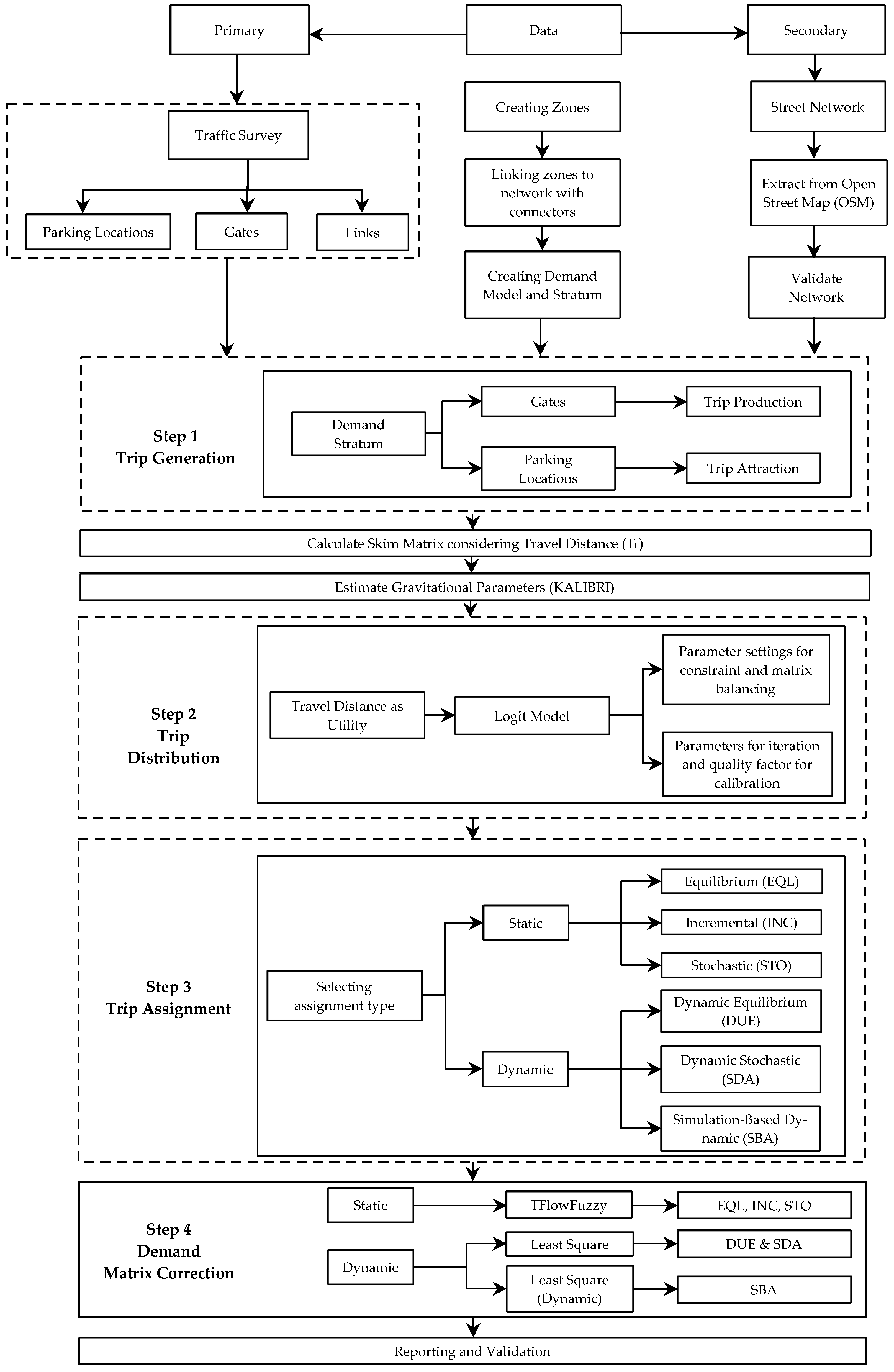
Figure 1. Research Methodology.
Sustainability 17 10985 g001
Figure 2. VISUM environment within KAUH area.
Sustainability 17 10985 g002
Figure 3. Frequency of O−D Distances within (0−3) km Range.
Sustainability 17 10985 g003
Figure 4. Origin–Destination matrix correction procedure.
Sustainability 17 10985 g004
Figure 5. Static equilibrium (EQL) traffic assignment result.
Sustainability 17 10985 g005
Figure 6. Model validation plots for STAs: (a) equilibrium (b) incremental and (c) stochastic assignments.
Sustainability 17 10985 g006
Figure 7. Dynamic stochastic assignment (SDA) result.
Sustainability 17 10985 g007
Figure 8. Comparison of observed and modelled volumes for DTAs: (a) dynamic user-equilibrium (DUE), (b) dynamic stochastic assignment (SDA) and (c) simulation-based dynamic assignment (SBA).
Sustainability 17 10985 g008
Table 1. Data collected from physical survey to validate OSM network.
DataTypesRemarks
Street NetworkPrimary3 lanes
Secondary2 lanes
Tertiary3 lanes
Highway4 to 6 lanes
Bus Routes--
GatesEntrances and exits7
Parking AreasOpen and Multistoried13
Survey Stations Intermediate links in both directions7
Table 2. Capacity of the parking areas at KAUH.
Parking
Location
P1P2P3P4P5P6P7P8P9P10P11P12P13
Capacity618516321116714635296836819442251284358
P = Parking.
Table 3. Traffic count data from gate locations and road links.
GateG1G2G2AG3G5G7PRY
Dir.EntExtEntExtEntExtEntExtEntExtEntExtEntExt
Time07:15 to 07:30
TC8901944961837301022941222375644732
Time07:30 to 07:45
TC9743885992064201173471123426177449
Time07:45 to 08:00
TC114436147516502011237412735672512467
Time07:45 to 08:15
TC122844449614431015632114738277814463
Time07:15 to 08:15
Total4236138720666819480487133650813172684389211
StationS1S2S3S4S5S6S7
Dir.WBEBSBNBWBEBWBEBSBNBSBNBSBNB
Time07:15 to 07:30
TC19164632433642927290368195521164076140
Time07:30 to 07:45
TC38167437062339429794412231641473796736
Time07:45 to 08:00
TC354702355863501321121401213601902958950
Time08:00 to 08:15
TC436787494576465346144385248621593237146
Time07:15 to 08:15
Total13622809154323981789123644915668872386121404288172
Dir. = Direction, G = Gate, PRY = Preliminary Year Building, Ent = Entrance, Ext = Exit, TC =Traffic count, S = Station, WB = Westbound, EB = Eastbound, SB =Southbound, NB = Northbound.
Table 4. Number of trips within distance ranges.
FromToShareCumulative ShareNumber of Trips
00.50.18750.18751788
0.510.3650.5553480
11.50.29250.8452789
1.520.11750.961120
22.50.030.9925286
2.530.0075172
Table 5. Evaluation criteria for using GEH values.
CriteriaInterpretation
GEH ≤ 5.0Good Match—Indicates an excellent or good match between modelled and observed volumes (within acceptable calibration limits)
5.0 < GEH < 10.0Reasonable Match—Indicates a moderate discrepancy. The fit is borderline acceptable and warrants investigation or model adjustment to improve accuracy
GEH > 10.0Needs Improvement—Indicates a poor match between model and reality indicates significant problem with the model or data that requires corrective action
Table 6. GEH statistic results for static assignments (STAs).
StationLinksObserved VolumeModelled VolumeDeviation (%)GEH Values
Street NameDirectionEQLINCSTOEQLINCSTOEQLINCSTO
S1Al Ehtifalat StreetEB2809259125932591−8%−8%−8%4.24.24.2
WB1362127112251238−7%−10%−9%2.53.83.4
S2Ali Al
Murtada Street
SB154318121717180815%10%15%6.64.36.5
NB2398237823012431−1%−4%1%0.420.7
S3Al-Malae’b
Street
EB17891833201318532%11%3%15.11.5
WB1236119412031194−3%−3%−3%1.20.91.2
S4EB449345521401−23%14%−11%5.23.32.3
WB15661622164816583%5%6%1.42.12.3
S5Hospital
Street
SB887769789668−13%−11%−25%4.13.47.9
NB23829330431019%22%23%3.444.3
S6SB612525541534−14%−12%−13%3.72.93.3
NB140415811577153511%11%9%4.64.53.4
S7Sahha
Street
SB28836121736820%−25%22%44.54.4
NB17220723519717%27%13%2.54.41.8
EQL = equilibrium assignment, INC = incremental assignment, STO = stochastic assignment.
Table 7. GEH statistic results for dynamic assignments (DTAs).
StationLinksObserved VolumeModelled VolumeDeviation (%)GEH Values
Street NameDirectionDUESDASBADUESDASBADUESDASBA
S1Al Ehtifalat StreetEB2809217126013245−23%−7%13%12.847.9
WB1362108412041437−20%−12%5%7.94.42
S2Ali Al
Murtada Street
SB15431548174816410%12%6%0.15.12.5
NB2398208523042769−13%−4%13%6.61.97.3
S3Al-Malae’b
Street
EB1789162119211961−9%7%9%4.13.14
WB1236112512321431−9%0%14%3.20.15.4
S4EB44965350053931%10%17%8.72.34
WB1566109216452063−30%5%24%13211.7
S5Hospital
Street
SB887549808865−38%−9%−2%12.62.70.7
NB23854823986957%0%73%15.60.126.8
S6SB612535561625−13%−8%2%3.22.10.5
NB14041537159621809%12%36%3.5518.3
S7Sahha
Street
SB28832024827810%−14%−3%1.82.40.6
NB1721802052154%16%20%0.62.43.1
DUE = dynamic user equilibrium assignment, SDA = dynamic stochastic assignment, SBA = simulation-based dynamic assignment.
Table 8. GEH statistic results of traffic assignments for buses.
StationLinksObserved
Volume
Modelled
Volume
Deviation (%)GEH
Values
Street NameDirection
S1Al Ehtifalat StreetEB4520%0.5
WB220%0
S2Ali Al
Murtada Street
SB330%0
NB550%0
S3Al-Malae’b
Street
EB5617%0.4
WB6714%0.4
S4EB660%0
WB550%0
S5Hospital
Street
SB440%0
NB2333%0.6
S6SB220%0
NB220%0
Disclaimer/Publisher’s Note: The statements, opinions and data contained in all publications are solely those of the individual author(s) and contributor(s) and not of MDPI and/or the editor(s). MDPI and/or the editor(s) disclaim responsibility for any injury to people or property resulting from any ideas, methods, instructions or products referred to in the content.