
Article

Research on Effect of the Digital Economy on Agricultural Carbon Emission Reduction-Based on the Moderating Effect of Institutional Quality

by
Zhaoyang Wang
and
Bin Guan
*
School of Economics, Shandong Normal University, Jinan 250358, China
*
Author to whom correspondence should be addressed.
Sustainability 2025, 17(24), 10984; https://doi.org/10.3390/su172410984
Submission received: 26 September 2025 / Revised: 14 November 2025 / Accepted: 18 November 2025 / Published: 8 December 2025

Abstract

This study empirically examines the role of institutional quality in enabling agricultural carbon emission reductions through the digital economy, utilizing panel data from 252 prefecture-level cities in China spanning from 2000 to 2023. It addresses the long-standing oversight of institutional quality in this field. Findings reveal that institutional quality not only directly reduces agricultural carbon emission intensity but also exerts emission-reduction effects by influencing the digital economy’s impact on agricultural carbon emissions. As institutional quality improves from poor to excellent, the role of the digital economy in enabling agricultural carbon emission reductions exhibits a nonlinear expansion, confirming the moderating effect of institutional quality. Optimizing the institutional environment and enhancing institutional quality not only effectively promotes the carbon emission reduction role of the digital economy but also directly reduces agricultural carbon emissions.

1. Introduction

In the context of globalization and informatization, the digital economy has emerged as a new engine of economic growth, with its integration into traditional industries gaining increasing prominence. In agriculture, digital technologies have improved production efficiency and supported sustainable development by enabling accurate data acquisition, efficient resource allocation, and advanced information systems. Although the digital economy offers multiple benefits to agriculture [1], its net impact on agricultural carbon emissions remains contested. First, the widespread adoption of digital technologies inherently increases emissions through substantial energy demands during infrastructure deployment and operation [2]. Moreover, institutional heterogeneity in deployment costs may exacerbate this carbon footprint. Second, spatial disparities in economic development and technological capacity generate significant variation in realized emission-reduction outcomes [3].
Institutional frameworks shape resource allocation and policy implementation, thereby moderating the effectiveness of digital technologies in reducing agricultural carbon emissions. High-quality institutions enhance resource allocation efficiency by strengthening market price signals, which can yield Pareto-efficient outcomes [4]. A stable and transparent policy environment can attract greater private investment in agricultural digitalization, thereby accelerating infrastructure development and service system upgrading [5]. Advanced digital infrastructure and service systems, in turn, enable the transition to low-carbon agricultural practices, ultimately reducing carbon emission intensity [6]. However, the literature on how institutional mechanisms moderate the digital economy’s effect on agricultural carbon reduction remains limited, with little attention to underlying pathways. Addressing this gap, we examine the mechanisms by which institutions modulate the digital economy’s contribution to agricultural carbon emission reduction. We test these mechanisms using panel data from 252 prefecture-level cities in China over the period 2000–2023.
This study makes three principal contributions. First, it proposes an institution–technology–resource (ITR framework) to elucidate how institutions shape agricultural carbon emissions in the digital economy. Within this framework, we demonstrate that institutions strengthen farmers’ human capital, ease resource constraints, and upgrade agricultural technology adoption. Second, we address a critical gap in the literature, which has largely neglected the moderating role of institutions in the digital economy–agricultural carbon emissions nexus. Using mediation and moderated mediation models, we provide robust evidence of institutions’ positive moderating effect and identify specific transmission channels. Third, we derive policy implications for optimizing institutional environments to accelerate the integration of digital technologies with low-carbon agriculture. These findings offer both theoretical insights and actionable policy guidance for achieving green agricultural transformation.

2. Literature Review

2.1. Mechanisms of the Digital Economy’s Impact on Agricultural Carbon Emissions

The digital economy has transformed agricultural production and management practices through enhanced data analytics, resource allocation, and information technologies [7,8]. Prior studies have mainly examined how digital technologies reshape production processes and reorganize agricultural supply chains [9]. For instance, Internet of Things (IoT) systems enable real-time monitoring of temperature, humidity, and light, thereby facilitating precision irrigation and fertilization that minimize input waste and emissions per unit of output [10]. Big data analytics supports optimized planting decisions, reducing fertilizer and pesticide application while increasing yields and lowering carbon intensity (Carbon intensity refers to the amount of carbon dioxide or other greenhouse gas emissions generated per unit of economic activity, such as gross domestic product (GDP), industrial value added, or output. It is commonly used to measure the environmental impact of economic activities in a country, region, or industry, particularly their potential contribution to climate change. Carbon intensity serves as a crucial indicator reflecting the relationship between economic growth and environmental protection. A lower carbon intensity implies fewer greenhouse gas emissions per unit of economic value created, signifying greater efficiency and environmental sustainability within the economy. In agriculture, the definition of carbon intensity varies, but most studies accept carbon emissions per unit of agricultural output as the standard metric. This study also adheres to this definition.) [11]. Blockchain improves supply-chain transparency, whereas e-commerce platforms expand market access—both mechanisms shorten supply chains, enhance logistics efficiency, and reduce life-cycle carbon intensity [12]. Empirical evidence consistently indicates an inverse relationship between digital economy development and agricultural carbon intensity (defined as CO2-equivalent emissions per unit of agricultural output value). Using Chinese provincial panel data for 2013–2020, Liu et al. (2023) show that rural digital penetration significantly reduces carbon intensity [13], a finding corroborated by Yang (2023) and Liu & Ying (2024) [14,15]. Research on digital finance further suggests that it alleviates credit constraints, accelerates technology adoption, and lowers carbon intensity [16].
The impact of the digital economy on agricultural carbon emissions is not uniformly negative but exhibits threshold effects. Recent studies identify multiple threshold variables, including GDP per capita [17], digital technology penetration, and farmers’ income [18]. Digital agriculture is itself energy-intensive, particularly across data acquisition, transmission, and processing stages [19]. Global data centers now consume 1–1.5% of electricity—a share that continues to rise—representing a non-negligible source of indirect (Scope 2) carbon emissions [20]. Regional heterogeneity in infrastructure and human capital further generates markedly different emission-reduction outcomes. In developed regions with mature digital infrastructure, these technologies significantly curb agricultural carbon intensity [21]. In contrast, less-developed regions face infrastructural and human-capital constraints that substantially attenuate these environmental gains [22].
Although consensus exists on the emission-reduction potential of the digital economy, the underlying transmission channels remain contested. A growing literature identifies four primary mechanisms: industrial chain upgrading [23]; technological progress and economies of scale [24,25]; improved agricultural social services [22,26], which generate spatial spillovers to neighboring regions [27]; alleviation of financial and resource constraints that accelerate green-technology adoption [28,29,30]. A parallel strand emphasizes multi-stage feedback loops: digital economy penetration stimulates agricultural technology innovation, which raises adoption rates and, in turn, reinforces further digital investment [31,32]. These reinforcing dynamics are most pronounced at intermediate stages of digital development [33]. Finally, cross-sector evidence indicates that agricultural technology gains primarily stem from knowledge spillovers originating in industry-wide digital applications [34,35].

2.2. Impact of Institutional Arrangements on Agricultural Carbon Emissions

Institutions shape resource allocation efficiency as a critical channel through which both market and digital technologies affect agricultural carbon intensity. Although institutions do not directly dictate factor endowments, they govern resource allocation by strengthening market price signals [36]. High-quality institutions mitigate market failures and align resource allocation with true scarcity signals, thereby preventing misallocation [37]. Conversely, in weak institutional environments, even productive investments—including digital infrastructure and green technologies—can result in suboptimal resource use and elevated carbon intensity [37].
Institutional quality determines the productivity of production factors and shapes environmental outcomes in agriculture. High-quality institutions amplify factor productivity, whereas weak institutions distort incentives and exacerbate negative environmental externalities [38]. Robust institutions enhance agricultural sustainability through multiple channels. First, comprehensive legal and regulatory frameworks standardize production practices, curbing pollution and carbon emissions [39]. Second, stringent environmental regulations limit excessive fertilizer and pesticide use, directly lowering carbon intensity [40]. Third, streamlined administrative procedures reduce transaction costs, spur green innovation, and improve resource-use efficiency [41]. Conversely, institutional voids generate severe information asymmetry, raising market-search costs and inducing suboptimal input decisions [41]. Critically, weak institutions can undermine the emission-reduction potential of digital technologies, transforming a putative carbon sink into an unintended source of higher carbon intensity.

2.3. Critical Analysis

Although a growing literature documents the emission-reduction potential of the digital economy in agriculture, three critical gaps persist. First, transmission mechanisms remain contested and fragmented, with studies proposing disparate mediators (e.g., industrial chain upgrading, technological innovation, scale economies). Second, no unified theoretical framework exists to integrate these channels into a coherent causal chain from digitalization to carbon intensity. Third, and most critically, the moderating role of institutional quality has been largely overlooked, despite its theoretical centrality in shaping technology diffusion and resource allocation.
While theoretical work suggests that high-quality institutions optimize resource allocation and amplify green-technology gains, empirical evidence on their interaction with the digital economy remains scarce. Institutional quality likely serves as a binding constraint on the digital economy’s ability to deliver agricultural carbon reductions. In distorted institutional environments, even advanced digital tools may fail to diffuse, rendering expected carbon benefits unattainable. Addressing these gaps, this study provides the first city-level evidence from China (252 prefecture-level cities, 2000–2023) on how institutional quality moderates the digital economy–agricultural carbon intensity nexus.

3. Theoretical Analysis and Research Hypotheses

3.1. Institutional Context

Developing new-quality productive forces is an intrinsic requirement and key focus for advancing high-quality development. As the most dynamic, fastest-growing, and most far-reaching sector in modern economic development, the digital economy plays a vital role in enhancing new growth drivers, elevating development resilience, and facilitating the dual circulation of domestic and international markets. Technologies such as the internet, big data, and cloud computing are accelerating innovation and increasingly integrating into all aspects of socioeconomic development. As early as 2016, during the 36th Group Study Session of the Political Bureau of the 18th CPC Central Committee, General Secretary Xi Jinping emphasized the need to expand and strengthen the digital economy to open up new space for economic development. The 2018 Central Economic Work Conference further stressed accelerating the construction of infrastructure for 5G, artificial intelligence, and industrial internet. The 2024 Central Economic Work Conference reiterated the importance of leveraging scientific and technological innovation to drive the development of new productive forces, actively employing digital and green technologies to transform and upgrade traditional industries. Developing the digital economy and leveraging its transformative role in upgrading traditional industries has now been elevated to a national strategy.
China has emerged as a global frontrunner in digital agriculture, propelled by sustained policy commitments and substantial public investment. Since 2015, the central government has promulgated over 20 high-level strategies, including the Digital Rural Strategy (2019–2025) and the Smart Agriculture Action Plan (2024–2028), which channel significant fiscal resources into rural digital infrastructure. China’s digital economy and associated infrastructure rank among the world’s most advanced. Yet, China’s agricultural carbon intensity exceeds that of most developed economies. This juxtaposition reveals a paradox: world-leading digital deployment coexists with persistent environmental inefficiencies. This contradiction raises a fundamental question: why has rapid digital transformation not yielded commensurate reductions in agricultural carbon emissions? Mounting evidence indicates that institutional quality—rather than mere technological availability—constitutes the binding constraint, shaping the depth of technology adoption, resource allocation efficiency, and, ultimately, environmental outcomes.

3.2. Research Hypotheses

3.2.1. Mechanisms by Which the Digital Economy Improves Agricultural Carbon Emissions

From the perspective of resource allocation theory, the digital economy reduces agricultural carbon intensity primarily by reallocating production factors toward higher marginal productivity and minimizing input inefficiencies. In a frictionless market, resources flow to their highest-value uses, generating Pareto-efficient outcomes. However, agricultural factor markets are typically plagued by information asymmetry, high transaction costs, and distorted price signals—conditions that digital technologies directly mitigate. Digital platforms dramatically lower search and bargaining costs, enabling near-real-time factor mobility [42]. Big data analytics further optimizes input combinations, shifting production closer to the efficient frontier and lowering carbon intensity per unit of output [43].
Indirectly, the digital economy accelerates agricultural decarbonization by reconfiguring the entire agricultural value chain. First, digital technologies enhance supply-chain transparency, significantly increasing producers’ environmental consciousness and market demand for sustainable products. This heightened demand incentivizes widespread adoption of low-carbon practices. Consequently, accelerated adoption of low-carbon technologies establishes a self-reinforcing cycle of sustainability. Digital platforms expedite knowledge diffusion, eliminating spatiotemporal barriers and markedly improving farmers’ technological literacy and human capital [44]. Second, the digital economy catalyzes financial innovation [45], delivering essential capital for low-carbon agricultural transitions. Leveraging big-data analytics, financial institutions achieve precise credit assessment [46], substantially lowering financing barriers and alleviating capital constraints [47]. This unlocks capital flows critical for R&D and large-scale deployment of low-carbon technologies. Finally, the digital economy drives agriculture toward technology-intensive, precision, and intelligent paradigms through data-driven infrastructures. Data-driven precision agriculture simultaneously optimizes resource efficiency and slashes carbon emissions, yielding synergistic economic and environmental gains. Based on the above analysis, the following research hypotheses are proposed:
Hypothesis 1:
The digital economy directly reduces agricultural carbon emissions intensity.
Hypothesis 2:
The digital economy reduces agricultural carbon emissions intensity by improving farmers’ human capital, alleviating agricultural resource constraints, and enhancing agricultural production technology levels.

3.2.2. Direct and Indirect Effects of Institutional Quality Improvement on Agricultural Carbon Emissions

The Institutional-Technology-Resource Synergy Framework (ITRSF) elucidates the dynamic interplay of technological advancement, institutional reconfiguration, and resource reallocation [48,49,50,51]. High-quality institutions serve as the fulcrum, lowering transaction costs, refining regulatory frameworks, and streamlining resource allocation to catalyze digital-technology adoption. Digital technologies—exemplified by IoT, big data, and AI-driven analytics—reengineer agricultural production, slashing both resource inputs and carbon emissions. Optimized resource reallocation accelerates green-technology diffusion and interregional coordination by mobilizing human, physical, and financial capitals with unprecedented efficiency. Institutions orchestrate a self-reinforcing triad: high-quality governance dismantles adoption barriers, technological breakthroughs amplify resource efficiency, and optimized allocation drives down carbon intensity, collectively propelling sustainable agricultural systems.
High-quality institutions directly curtail agricultural carbon intensity by slashing transaction costs and enforcing standardized, low-carbon production protocols. Acting as the cornerstone of decarbonization governance, they drive down carbon intensity via transaction-cost compression and behavioral lock-in toward low-carbon practices. Transaction-cost economics posits that information asymmetry, technological opacity, and contractual uncertainty impose prohibitive frictions on agricultural transactions—from search and training to compliance monitoring [52]. High-quality institutions dismantle these frictions by boosting transparency, fortifying contract enforcement, and streamlining market regulations [53]. For example, robust environmental regulations and secure land-tenure regimes standardize agrochemical application, thereby eliminating input waste and directly slashing carbon intensity. Institutions further ignite self-reinforcing cycles by standardizing practices, capping high-carbon inputs, and optimizing allocation efficiency. In digital agriculture, they slash default risks through unified resource governance and cross-agent coordination, thereby locking in low-carbon trajectories. Conversely, institutional deficits trigger severe resource misallocation via regulatory voids and policy distortions, sabotaging decarbonization efforts. Hypothesis 3a can be proposed: Institutional quality exerts a significant negative effect on agricultural carbon intensity.
High-quality institutions indirectly slash agricultural carbon intensity by catalyzing digital-economic growth and rectifying resource misallocation. They amplify the digital economy’s decarbonization efficacy through accelerated technology diffusion and allocation efficiency. High-quality institutions dismantle adoption frictions via targeted policy incentives and digital infrastructure rollout, propelling IoT, big-data, and AI penetration across agroecosystems. These technologies reengineer input regimes via precision agriculture and AI-driven decision systems, slashing agrochemical and energy footprints while driving down carbon intensity. Concurrently, robust institutions recalibrate government–market boundaries, correcting market-failure-induced distortions and channeling digital finance and smart machinery toward optimal deployment [54]. Conversely, institutional deficits—manifest in persistent asymmetry and support vacuums—choke technology diffusion, blunting the digital economy’s decarbonization potential. In extremis, technological misuse under institutional failure can trigger carbon-emission rebound. High-quality institutions furnish guardrails for digital technologies, which in turn recalibrate resource allocation, jointly propelling agriculture onto a low-carbon trajectory. Thus, Hypothesis 3b can be proposed: Institutional quality exerts a significant negative effect on agricultural carbon intensity mediated by digital-economic expansion.
Hypothesis 3a:
Institutional quality exerts a significant negative effect on agricultural carbon intensity.
Hypothesis 3b:
Institutional quality exerts a significant negative effect on agricultural carbon intensity mediated by digital-economic expansion.

3.2.3. The Regulatory Effect of Institutional Quality on Agricultural Carbon Emissions

High-quality institutions powerfully moderate the digital economy’s decarbonization impact by amplifying farmers’ human capital and technology-adoption propensity. Functioning as a critical catalyst, they potentiate the digital economy’s decarbonization efficacy by elevating farmers’ digital literacy and environmental cognition. Robust institutions accelerate digital-skill diffusion via refined training ecosystems, eradicate the urban–rural digital chasm, and dramatically uplift farmers’ human capital and adoption propensity. They enforce equitable resource allocation across educational domains [55]. Especially in peripheral regions, they obliterate digital exclusion via scalable online platforms and remote training, thereby catalyzing green innovation and propelling technology-anchored agricultural modernization. High-quality institutions further magnetize external capital and accelerate low-carbon technology spillovers into rural hinterlands. This dual mechanism turbocharges agricultural modernization while amplifying the digital economy’s decarbonization potential.
High-quality institutions amplify the digital economy’s decarbonization potency by broadening its rural penetration and enforcing Pareto-optimal resource allocation. They turbocharge digital technologies’ efficacy through razor-sharp market regulations, accelerated rural digital rollout, and policy-orchestrated resource accessibility. Targeted incentives under these institutions catapult adoption of digital inclusive finance and smart machinery, radically optimizing agro-resource flows. Digital inclusive finance, supercharged by this governance, obliterates financing bottlenecks, ignites low-carbon technology uptake, and slashes both energy and pollution footprints. Institutional architectures fast-track science-to-market translation via industry–academia synergies, delivering leapfrog gains in precision and efficiency. Acted by recalibrating government–market interfaces, high-quality institutions neutralize market failures, lock in first-best resource utilization, and propel agriculture onto a decarbonized trajectory. Ultimately, they furnish ironclad guardrails for digital diffusion while simultaneously optimizing allocation, jointly catapulting agriculture into a low-carbon, intelligent paradigm.
Hypothesis 4:
Institutional quality significantly strengthens the negative effect of the digital economy on agricultural carbon intensity (positive moderation).

3.3. Model Diagram

Figure 1 delineates the theoretical framework governing the nexus between the digital economy and agricultural carbon emission intensity. The diagram illustrates the direct decarbonization mechanism and the indirect pathways mediated by human capital, resource constraints, and technological advancement. Crucially, it highlights the moderating role of institutional quality, which not only directly mitigates carbon intensity but also modulates the efficacy of the digital economy in driving green agricultural transformation. This framework also synthesizes the interactive dynamics of the institution–technology–resource triad.

4. Methodology

4.1. Sample Selection

We assemble a panel of 252 Chinese prefecture-level cities spanning 2000–2023. Data are sourced from authoritative repositories, including the China City Statistical Yearbook, China Rural Statistical Yearbook, China Statistical Yearbook, China High-Tech Industry Statistical Yearbook, China Financial Yearbook, and CSMAR Database. Cities with ≥3 missing core variables are excluded. Gaps ≤3 years are linearly interpolated; longer gaps are forecasted via ARIMA. Outliers were removed, followed by three-period moving-average smoothing. The final panel comprises 252 cities with 48,384 valid observations.

4.2. Model Specification and Variable Definition

4.2.1. Model Specification

The specification of the basic model:
C a r b o n E m e s i t = β 0 + β 1 D i g i t a l E c o i t + β 2 I n s t i t u Q u a i t + γ i t × C o n t r o l V a r i a b l e i t + μ i + δ t + e i t
The moderation effect model is set as follows:
C a r b o n E m e s i t = β 0 + β 1 D i g i t a l E c o i t + β 2 I n s t i t u Q u a i t + β 3 D i g i t a l E c o i t × I n s t i t u Q u a i t + γ i t × C o n t r o l V a r i a b l e i t + μ i + δ t + e i t
We test moderated mediation following Hayes’ PROCESS framework [56], using 5000-iteration bias-corrected bootstrapping for index confidence intervals [57]. All non-ratio variables are log-transformed to mitigate skewness and facilitate elasticity interpretation. Hausman tests systematically reject random effects (p < 0.001); we therefore estimate two-way fixed effects (city × year) throughout.

4.2.2. Variable Definitions

This study selects agricultural carbon emission intensity as the dependent variable. The core explanatory variable is the level of digital economic development, while the key explanatory variable is institutional quality. For mediating variables, farmer human capital level is measured by average years of education per capita, while mitigation of agricultural resource constraints is measured by average per capita agricultural loans, and agricultural production technology is measured by average agricultural mechanization level. For the consideration of robustness and minimizing regional factor differences, we introduce two control variables: average per capita farmer income and fiscal support for agriculture, as shown in Table 1.
Agricultural carbon intensity serves as the dependent variable. The focal predictor is digital-economic development; institutional quality enters as primary moderator. Mediators comprise (i) human capital (mean years of schooling), (ii) financial-resource alleviation (per capita agricultural loans, 2010 CNY), and (iii) mechanization (total machinery power/ha). Controls include per capita farmer income (2010 CNY) and agricultural fiscal subsidies/GDP, plus city- and year-fixed effects (Table 1).
Agricultural carbon intensity is the outcome variable. Carbon metrics comprise aggregate emissions and intensity metrics (emissions per hectare). Aggregate metrics suit absolute accounting; intensity metrics enable cross-sectional and temporal benchmarking. Here, digital-economic progress acts as a technology shock that boosts land productivity rather than contracting output, thereby targeting intensity rather than aggregate emissions—a pattern consistent with China’s rising total emissions yet falling intensity. Following Panchasara et al. [59], we account for seven sources—nitrogen fertilizers, pesticides, plastic film, diesel, tillage, irrigation, and livestock farming—using IPCC-aligned coefficients.
The calculation of total carbon emissions is defined as:
T o t a l C a r E m s s = i = 1 j c i T i  
While T o t a l _ C a r b E m s s represents the total carbon emissions, i denotes the selected agricultural carbon emission source, and T denotes the total agricultural activities or production inputs. Considering model robustness, the agricultural carbon emission intensity is defined as:
C a r b E m s s = T o t a l C a r E m s s A r g r i  
where A r g r i represents the total agricultural output value.
Digital-economic development is the focal predictor. It captures the multidimensional penetration of digital technologies into infrastructure, industrial ecosystems, and governance (see ref. [60] for conceptual mapping). Following established protocols [60], we construct a composite index from four domains (infrastructure, industry, inclusion, innovation) and 12 sub-indicators (e.g., broadband penetration, e-commerce turnover/GDP). Principal component analysis (PCA, see Appendix B) extracts the first component (explaining 88.4% of variance) as our digital-economic index. Full indicators are reported in Table 2.
Institutional quality is proxied by a prefecture-level marketization index. We extend the Fan et al. China Marketization Index (The China Marketization Index, developed by scholars including Fan Gang, aims to quantify the relative progress of market-oriented reforms across China’s provinces, autonomous regions, and municipalities. It employs principal component analysis (PCA) to synthesize the index, utilizing statistical and survey data to calculate a composite score ranging from 0 to 10 (with the highest-scoring province in the base period receiving 10 points). This index system encompasses five key dimensions: (1) Government-market relations, assessing the degree of government intervention, such as fiscal autonomy, tax burden, and bank credit support for private enterprises; (2) Development of the non-state economy, measuring the share of private enterprises, including the number of private businesses and the proportion of individual industrial and commercial households; (3) Product market development, examining commodity market openness including agricultural product marketization rates, industrial product price marketization, and fair competition in imports and exports; (4) Factor market development, analyzing the marketization levels of labor, land, technology, and capital, such as labor mobility, land transaction marketization, and wage formation mechanisms; (5) Development of market intermediary organizations and the legal environment, focusing on supporting systems like property rights protection, judicial fairness, and the number of law firms and accounting firms. Since 2000, this index has employed approximately 20 foundational indicators (with minor adjustments across years) to provide dynamic comparisons of regional marketization progress, emphasizing relative levels rather than absolute standards. It is widely used in studying China’s economic reform process and regional disparities. This paper applies its calculation framework to derive the index at the prefecture-level city administrative tier in China.) [61]—originally provincial—from 2000 to 2023 to 252 prefecture-level cities using night-light-calibrated apportionment and sub-provincial survey microdata. The index aggregates five domains: (i) government–market relations, (ii) non-state economy, (iii) product-market development, (iv) factor-market liberalization, and (v) legal-intermediary maturity. Higher values denote sharper government–market boundaries and reduced distortive interventions.
Mediators comprise three channels: (i) human capital, measured as mean years of schooling per rural resident, which enhances cognitive readiness for digital agro-technologies; (ii) financial-resource alleviation, proxied by per capita agricultural loans (2010 CNY), reflecting digital inclusive finance’s capacity to ease liquidity constraints and lower adoption barriers; and (iii) mechanization intensity, calculated as total machinery power per hectare (kW ha−1), capturing digital-driven capitalization that boosts precision-farming efficiency, curbs energy use, and directly improves carbon intensity through IoT-enabled equipment and smart machinery deployment.
Controls comprise (i) per capita farmer income (2010 CNY), capturing local purchasing power and technology-affordability gradients, and (ii) agricultural fiscal subsidies as a share of GDP, accounting for policy-induced distortions in input intensity and green-technology uptake. Both mitigate omitted-variable bias from unobserved regional heterogeneity, thereby strengthening identification and robustness in the two-way fixed-effects framework.

4.3. Descriptive Statistical Analysis

Descriptive statistics (Table 3) reveal a mean agricultural carbon emission intensity of 1.813 t CO2-equivalent per 10,000 CNY of output value across the 24-year study period. A wide range (0.136–7.789) underscores pronounced spatial heterogeneity in emission intensity. Decomposition analysis confirms that these disparities arise from both cross-regional differences and inter-annual fluctuations. The digital economy development index averages 5.629 (SD = 1.834; range: 1.433–10.369), reflecting marked regional disparities in digital transformation progress and highlighting the need for targeted policy interventions in lagging areas. Institutional quality, the key moderating variable, averages 0.853 (range: 0.126–2.331), with the majority of regions clustered in the mid-range. Nonetheless, a subset of regions achieves exceptionally high scores, exerting a positive spillover effect on neighbouring provinces.

5. Empirical Research

5.1. The Basic Empirical Model Results

This study employs a short panel comprising 30 Chinese prefectures over 24 years (2000–2023), with the time dimension (T = 24) substantially smaller than the cross-sectional dimension (N = 30). Accordingly, a two-way fixed-effects (TWFE) model is adopted. By incorporating both prefecture and year fixed effects, the TWFE specification controls for time-invariant prefecture characteristics (e.g., topography and baseline economic structure) as well as nationwide shocks, thereby mitigating omitted variable bias and facilitating causal identification of the effects of the digital economy and institutional quality on agricultural carbon intensity. This approach is particularly suitable for disentangling these effects amid pronounced cross-prefecture heterogeneity.
Nevertheless, conventional TWFE estimators may fail to address cross-sectional dependence and spatial spillovers. In the context of agricultural carbon emissions, spatially contiguous prefectures often exhibit strong spillovers driven by technology diffusion, resource mobility, and policy mimicry. To account for contemporaneous correlation, serial correlation, and heteroskedasticity, we further employ panel-corrected standard errors (PCSEs) following Beck and Katz (1995) [62]. The PCSE estimator yields robust standard errors that accommodate groupwise heteroskedasticity and spatial dependence arising from uneven digital penetration and heterogeneous agricultural production patterns. Results are reported in Table 4.

5.2. Mechanism Analysis

5.2.1. Role of the Digital Economy

As shown in Table 4, the digital economy—the core explanatory variable—exerts a negative effect on agricultural carbon emission intensity across all eight model specifications. Models (1) and (2) estimate the direct effect of the digital economy in the absence of institutional quality and its interaction term. The corresponding coefficients are negative and statistically significant at the 1% level. Given that the digital economy index is constructed via principal component analysis with higher values denoting greater development, a one-standard-deviation increase in the index is associated with a significant reduction in carbon intensity relative to the sample mean. This confirms that digital economy development serves as a powerful driver of agricultural decarbonization.
Model (2) re-estimates the baseline specification using panel-corrected standard errors (PCSE). Although the point estimate shifts marginally to −0.365, it remains significant at the 1% level, confirming the robustness of the negative effect to corrections for contemporaneous correlation and heteroskedasticity. This robust negative association underscores the pivotal role of the digital economy in driving agricultural decarbonization. Models (5)–(8) augment the specification by including institutional quality and its interaction with the digital economy to test its moderating role. Across these models, the main effect of the digital economy remains negative and significant at the 1% level (β ranging from −0.396 to −0.323), whereas the interaction term is positive and significant at the 5% level. These patterns indicate that high-quality institutions partially offset the carbon-reducing effect of digitalization, possibly by altering incentive structures for technology adoption. Collectively, the results provide strong support for Hypothesis 1: digital economy development significantly reduces agricultural carbon intensity, primarily by optimizing production processes and enhancing resource-use efficiency.

5.2.2. The Role of Institutional Quality

Models (3) and (4) introduce institutional quality as an additional regressor and employ panel-corrected standard errors (PCSE) to address groupwise heteroskedasticity and contemporaneous correlation. The coefficient on institutional quality is negative and significant at the 5% level in both specifications (β = −0.155, SE = 0.074 in Model 3; β = −0.183, SE = 0.089 in Model 4). Ceteris paribus, a one-standard-deviation increase in institutional quality is associated with a15.5–18.3% reduction in carbon intensity relative to the sample mean. This effect remains robust in Models (5)–(8) after inclusion of the digital economy interaction term (β ranging from −0.201 to −0.179). Collectively, these estimates lend strong support to Hypothesis 3a: higher institutional quality significantly mitigates agricultural carbon intensity.

5.2.3. The Moderating Role of Institutional Quality

Models (7) and (8) incorporate the interaction between the digital economy and institutional quality to test its moderating role. The interaction term is negative and statistically significant at the 5% level in both the TWFE (Model 7: β = −0.043, SE = 0.021) and PCSE (Model 8: β = −0.068, SE = 0.030) specifications. This implies that higher institutional quality significantly promotes the carbon-reducing effect of the digital economy. Quantitatively, a one-standard-deviation increase in institutional quality reduces the carbon intensity mitigation associated with a one-standard-deviation increase in the digital economy by 6.8 percentage points under TWFE and 4.3 percentage points under PCSE. These results strongly corroborate Hypothesis 4, demonstrating that high-quality institutions act as a force multiplier for digital-driven agricultural decarbonization, likely by reducing information asymmetry, strengthening contract enforcement, and accelerating green technology diffusion.

5.3. Robustness Test Analysis

To verify the robustness of our baseline findings, we implement five complementary tests. First, we estimate a dynamic panel model that includes the first lag of agricultural carbon intensity using the two-step system GMM estimator (Arellano–Bover/Blundell–Bond, 1995/2001 [63,64]), which addresses potential Nickell bias and endogeneity of the lagged dependent variable. Second, we incorporate province-specific linear time trends (province × year fixed effects) to absorb unobserved time-varying provincial policies. Third, we randomly discard 50% of the observations and re-estimate the baseline specification on the remaining subsample. Fourth, we adjust the time window to eliminate the impact of window selection on conclusions. Fifth, we winsorize all continuous variables at the 1st and 99th percentiles to attenuate outlier influence. Results, reported in Appendix A, confirm that the negative effect of the digital economy, the negative main effect of institutional quality, and their significantly negative interaction term remain statistically significant at the 1% level and economically meaningful across all specifications.

5.3.1. Dynamic Panel Model

Column (1) of Table 5 reports estimates from a two-step system GMM (SYS-GMM) dynamic panel specification that includes the first lag of agricultural carbon intensity (β = −0.064 ***, SE = 0.021). This approach, following Blundell and Bond (1998) [65], simultaneously addresses Nickell bias, potential endogeneity of the digital economy and institutional quality, and residual autocorrelation. All three coefficients of interest remain negative and significant at the 1% (main effects) or 5% (interaction) level: Digital Economy (β = −0.299 ***, SE = 0.137), Institutional Quality (β = −0.179 ***, SE = 0.076), and their interaction (β = −0.059 **, SE = 0.023). Point estimates deviate by less than 14% from the baseline TWFE/PCSE results, while the Endogeneity test (F = 15.334) and Weak instrumental variable test (F = 28.765) corroborate instrument exogeneity and the absence of weak IVs. Quantitatively, a one-standard-deviation increase in institutional quality amplifies the carbon intensity reduction induced by a one-SD increase in the digital economy by an additional 5.9 percentage points. These findings survive dynamic adjustment and stringent endogeneity controls, lending further causal support to Hypotheses 1, 3a, and 4.

5.3.2. Incorporating Province-Time Fixed Effects

Our baseline TWFE specification controls for prefecture and year fixed effects but may still confound province-level time-varying policies. Provincial governments frequently roll out coordinated digital and environmental regulations synchronously, inducing cross-prefecture common shocks that standard TWFE cannot fully absorb. We therefore augment the model with province × year fixed effects, fully saturating unobserved time-varying provincial confounders [66]. This high-dimensional strategy yields considerably cleaner causal estimates by purging province-specific macroeconomic and policy shocks.
As presented in Model (2), the inclusion of province-by-year fixed effects reveals a significantly negative direct effect of the digital economy on agricultural carbon emission intensity (p < 0.01). Such findings demonstrate that, even after accounting for province-specific time trends, digital economy development continues to significantly reduce agricultural carbon emission intensity. The result corroborates the positive role of the digital economy in reducing agricultural carbon emissions, thereby supporting Hypothesis 1. The coefficient on institutional quality is likewise significantly negative (p < 0.01). Furthermore, the interaction term between institutional quality and the digital economy is also significant (p < 0.01). This suggests that a robust institutional environment amplifies the carbon emission reduction effects of the digital economy, enabling more effective mitigation of agricultural carbon intensity during digital transformation. These results lend further support to Hypotheses 3a and 4, confirming that institutional quality positively moderates the effect of the digital economy on agricultural carbon emission reduction.

5.3.3. Random 50% Sampling

Randomly subsampling 50% of the observations provides a stringent test of whether the baseline results are sensitive to particular sample composition, thereby enhancing confidence in the reliability and generalizability of the estimates. Specifically, we randomly drew 3024 city-year observations (50% of the full sample) and re-estimated the model on this subsample. Results are reported in Model (3). In this 50% random subsample, the coefficients on both the digital economy and institutional quality remain negative and highly significant (p < 0.01), consistent with a strong negative association with agricultural carbon emission intensity. The interaction term displays identical sign and significance, confirming the positive moderating role of institutional quality and providing further support for Hypotheses 1, 3a, and 4.

5.3.4. Adjusting the Time Window

Restricting the sample period serves as a critical robustness check. The baseline analysis covers 2000–2023. Although a 24-year panel is standard in econometric studies, both the digital economy and institutional environment have experienced profound structural shifts over this period. In particular, institutional reforms have accelerated since the 18th National Congress of the CPC in 2012, accompanied by rapid marketization. To isolate more recent policy regimes and mitigate the influence of early-period heterogeneity, we re-estimate the model using data from 2014 to 2023. This shorter window minimizes short-term noise while focusing on the post-reform era, thereby providing a stronger test of long-term consistency. Results are reported in Model (4). Compared with the baseline estimates in Table 4, the coefficients on the digital economy and institutional quality retain the same negative sign and remain highly significant, differing only in magnitude. These patterns reaffirm the robustness of our core findings.

5.3.5. Truncating the 5th Percentile

Winsorization at extreme percentiles is a standard approach in applied econometrics to mitigate the influence of outliers, widely adopted in economics and finance. By replacing values beyond prespecified percentiles with those at the threshold, this procedure attenuates outlier influence without sacrificing observations, thereby strengthening estimation robustness. We therefore winsorize all continuous variables at the 1st and 99th percentiles. Data quality was particularly precarious during the formative years of China’s digital economy. Similarly, early-stage marketization introduced measurement errors that could otherwise distort coefficient estimates. Persistent regional disparities—coastal provinces far outpacing inland counterparts—further compromise the representativeness of aggregate indices. Consequently, national-level indices of the digital economy and institutional quality may mask substantial subnational heterogeneity.
Although our sample spans 24 years (2000–2023) across 252 prefecture-level cities—a substantial panel—this dataset remains vulnerable to outliers. Even a few such outliers can unduly sway coefficient estimates, introducing bias. Winsorization effectively curbs this influence, bolstering the robustness of our inferences. Extant literature affirms that, although winsorization modifies extreme observations, it largely preserves the sample’s distributional properties. This approach retains most of the original information, rendering it a compelling robustness check. Results from this specification appear in Model (5). The coefficients on the digital economy, institutional quality, and their interaction all retain negative signs and high significance (p < 0.01), reaffirming the robustness of our baseline results.

6. Further Discussion: The Nonlinear Impact of the Digital Economy on Agricultural Carbon Emissions

6.1. The Test of Direct Impact Concerning Digital Economy

While the baseline regressions confirm a negative effect of the digital economy on agricultural carbon emission intensity, they do not disentangle whether this arises from direct channels, indirect pathways via mediating factors, or both. To elucidate the underlying mechanisms and test Hypothesis 2, we conduct further analyses. Given potential endogeneity in the relationship between the digital economy and agricultural carbon emissions—stemming from reverse causality or omitted variables—we introduce instrumental variables and apply two-stage least squares (2SLS) estimation.
The selection of instrumental variables must satisfy two key conditions: relevance (strong correlation with the endogenous regressor, here institutional quality) and exogeneity (no direct correlation with the outcome variable, agricultural carbon emission intensity). We select government expenditure on science and technology as the instrument, which proxies local policy support for innovation and digital economy advancement, thereby correlating strongly with digital economy development. This relevance stems from high-quality institutions fostering R&D and digital infrastructure via targeted fiscal outlays. Second, the instrument satisfies exogeneity, as it neither directly affects nor is affected by agricultural carbon emission intensity. Specifically, such expenditures primarily bolster R&D and infrastructure, with short-term effects manifesting predominantly in technological supply rather than directly altering agricultural practices or emission levels. Moreover, their allocation is governed by national policies and budgets, insulated from short-term feedback loops involving local agricultural emissions, thereby fulfilling exogeneity. Employing this instrument addresses potential endogeneity from reverse causation or omitted confounders, yielding more credible estimates of the digital economy’s impact on agricultural carbon emissions. Table 5 additionally reports specifications incorporating the instrumental variable, province-year fixed effects, and 5% winsorization.
The first-stage regression yields a significantly positive coefficient for government science and technology expenditure on institutional quality. Endogeneity and weak instrument tests affirm the instrument’s validity, as evidenced by the reported F-statistics. Model (1) of Table 5 reports the instrumental variable estimates. These estimates show that, after accounting for potential mediators, the coefficient on the digital economy—while larger in magnitude (less negative) than in the baseline—remains negative and highly significant (p < 0.01). Specifications incorporating province-year fixed effects (Model 2) and winsorization (Model 3) further substantiate the robustness of these findings. This reinforces Hypothesis 1, confirming that digital economy development mitigates agricultural carbon emission intensity.

6.2. Testing the Mediating Effect of Digital Economy on Agricultural Carbon Emissions

We employed bootstrapping with 500 replications (with replacement) to assess the indirect effects of the digital economy. Results from the mediation analysis, reported in Table 6, reveal that the digital economy’s influence on agricultural carbon emissions transcends direct effects. It additionally exerts indirect effects through alleviating resource constraints in agriculture and elevating production technology. Specifically, with per capita years of education as the mediator, the indirect effect proves insignificant (p = 0.362). This suggests that, although digital economy development may improve farmers’ educational levels, such enhancements do not primarily drive reductions in agricultural carbon emissions. Though seemingly counterintuitive, the results confirm the insignificance of this mediated pathway. One plausible explanation is that per capita years of schooling inadequately proxies the human capital accruals from digital economy growth, a metric that remains contentious in the literature.
In contrast, the indirect effects of the digital economy—via alleviating resource constraints and elevating agricultural production technology—prove significant. The indirect pathways mediated by per capita agricultural loans and average total agricultural machinery power are statistically significant (p < 0.01). This underscores that digital finance development effectively mitigates funding constraints in agriculture, thereby improving capital access. In turn, this enables investments in environmentally sustainable and efficient production techniques, thereby lowering carbon emissions per unit output. Results in Table 6 further corroborate that digital technology adoption enhances agricultural mechanization and eases financial resource constraints, consequently reducing carbon emission intensity in agriculture. Thus, Hypothesis 2 receives partial support.

6.3. Testing the Intermediary Effect on the Digital Economy

Conventional mediation analyses presume that the mediator operates purely as an intermediary, devoid of direct influence on the outcome variable. This assumption, however, does not hold here. The digital economy exerts both direct and indirect effects on agricultural carbon emission intensity. To bolster the robustness and credibility of our estimates, we implement bootstrapping. Through repeated resampling with replacement from the original data, we compute statistics for each bootstrap sample to derive confidence intervals, yielding more precise and robust inferences.
Mediation analyses reported in Table 7 reveal a significantly negative direct effect of institutional quality on agricultural carbon emission intensity (p < 0.01). A robust institutional environment thus directly mitigates agricultural carbon emission intensity. The total effect coefficient for institutional quality is −0.179, substantiating its role in lowering agricultural carbon emission intensity. The indirect effect coefficient is −0.033, highlighting the digital economy’s mediating role between institutional quality and agricultural carbon emission intensity. Regions with superior institutional quality generally feature advanced information infrastructure, transparent policies, and effective legal frameworks, thereby laying a strong foundation for digital technology adoption in agriculture. Institutional quality not only catalyzes digital economy development but also safeguards agriculture’s green transformation.

6.4. Testing the Moderating Effect of Institutional Quality

The foregoing analyses establish that institutional quality mitigates agricultural carbon emission intensity while positively moderating the digital economy’s negative effect on agricultural carbon emissions. Moreover, with the digital economy acting as a mediator between institutional quality and agricultural carbon emission intensity, variations in institutional quality substantially shape the digital economy’s impact on this outcome. Following Preacher (2007) [67], we evaluate the indirect effects at varying levels of institutional quality: the mean minus two standard deviations (mean − 2 SD), the mean, and the mean plus two standard deviations (mean + 2 SD). Specifically, we assess how these levels modulate the strength of the digital economy’s indirect effect. Employing bootstrapping with 500 replications, results are reported in Table 8.
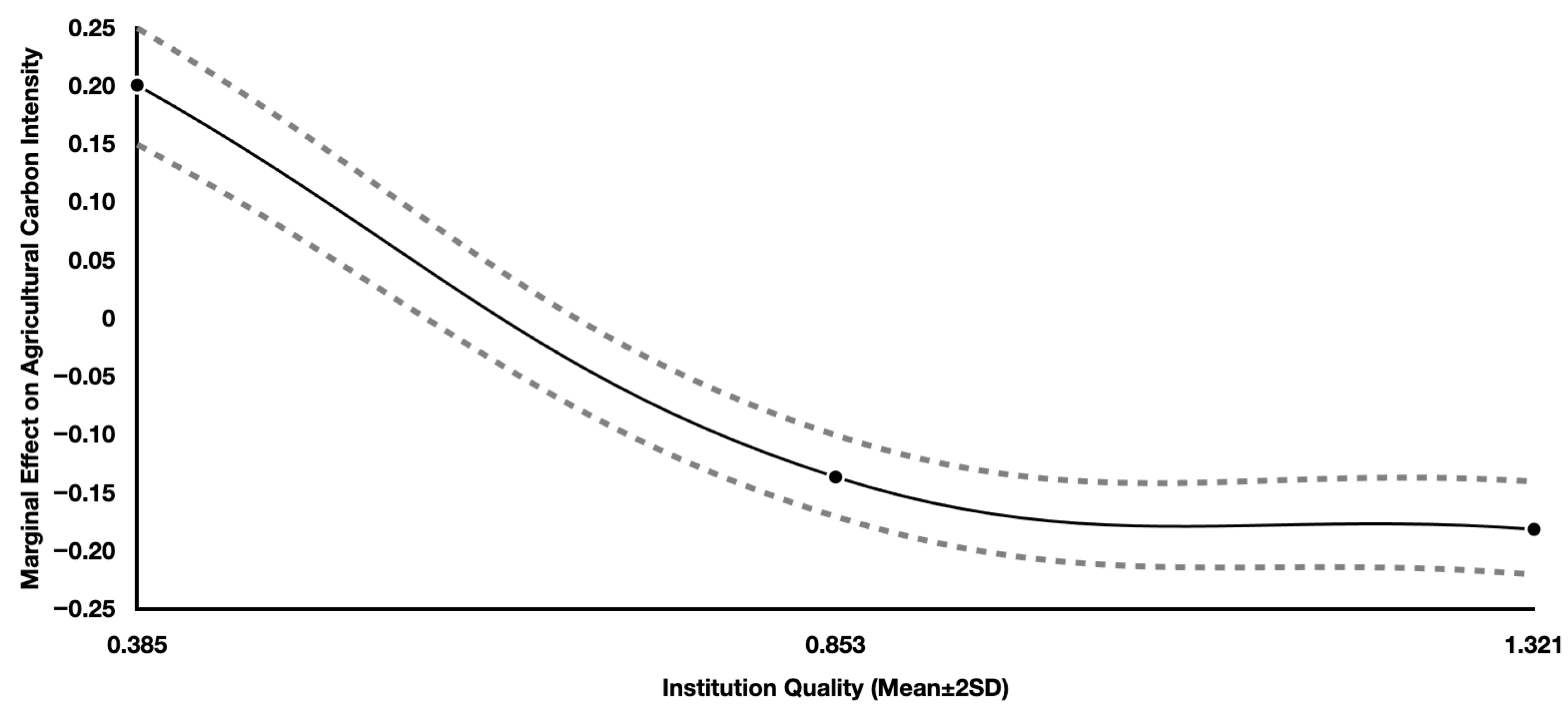
Results reveal a non-linear conditional indirect effect of institutional quality, wherein its magnitude initially diminishes before transitioning from positive to negative with rising institutional quality. Figure 2 depicts the trend of this change. Specifically, at low institutional quality (mean − 2 SD = 0.385), the coefficient on the digital economy is 0.201 and statistically significant (p < 0.05). This implies that, under suboptimal institutional conditions, digital economy development not only fails to mitigate but actually exacerbates agricultural carbon emission intensity. One plausible explanation is that, in regions with inferior institutional quality, digital technology adoption encounters substantial barriers—including inadequate infrastructure and skewed policy incentives—resulting in inefficient or misaligned integration of the digital economy into agriculture, thereby elevating carbon emission intensity.
In contrast, at the mean institutional quality (mean = 0.853), the coefficient on the digital economy declines to −0.181 (p < 0.001), signifying a pronounced emission reduction effect. Here, the institutional environment begins to amplify the digital economy’s emission reduction effects, thereby further attenuating agricultural carbon emission intensity. At this juncture, governmental policy support, legal protections, and enhancements to social services foster conducive conditions for digital technology adoption. This, in turn, accelerates agricultural digital transformation, optimizes resource allocation, and curtails superfluous energy use and pollution. At high institutional quality (mean + 2 SD = 1.321), the coefficient on the digital economy becomes −0.181 (p < 0.01), with increased magnitude and sustained significance. This demonstrates that, in a superior institutional setting, the digital economy further mitigates agricultural carbon emission intensity. At this level, institutional quality not only propels broad digital technology adoption but also advances agriculture’s green transition through refined market mechanisms and regulated firm conduct, yielding mutual gains in economic and environmental domains.

7. Conclusions and Shortage

7.1. Research Conclusions

Our findings reveal the following: (1) The digital economy exerts both direct and indirect effects on agricultural carbon emission intensity. Direct effects arise from optimizing input factor allocations and streamlining information flows, whereas indirect effects operate via alleviating resource constraints and advancing agricultural production technologies. However, the mediating role of the digital economy in elevating rural human capital is statistically insignificant. (2) The digital economy mediates the association between institutional quality and agricultural carbon emission intensity. Institutional quality furnishes the foundational framework for digital economy development and its agricultural applications, thereby reducing carbon emission intensity. (3) Institutional quality nonlinearly moderates the digital economy’s effect on agricultural carbon emission intensity. In regions with inferior institutional quality, firms encounter substantial barriers to digital technology utilization, stemming from deficient information infrastructure, incomplete legal frameworks, and inefficient governance. This impedes the digital economy from fully harnessing its potential to facilitate agricultural emission reductions. As institutional quality improves, the digital economy increasingly unleashes its capacity to enable agricultural carbon abatement, thereby propelling agriculture’s green transition. A superior institutional environment amplifies the digital economy’s negative impact on agricultural carbon emission intensity via diverse channels.

7.2. Policy Implications

Bolstering digital infrastructure is pivotal for advancing agricultural digital transformation. The expansion of the digital economy hinges on resilient digital infrastructure. Investments in rural infrastructure are crucial to enable farmers’ seamless access to and adoption of digital technologies. Policymakers should prioritize optimizing extant digital infrastructure, investing in rural broadband and data centers, offering targeted subsidies for upgrades such as 5G and IoT, and promoting precision agriculture alongside intelligent machinery to curtail chemical inputs and mitigate carbon emissions.
Enhancing legal and institutional frameworks is essential to foster the sustainable development of digital agriculture. Institutional quality serves as a pivotal moderator of the digital economy’s influence on agricultural carbon emissions. Policymakers should refine agricultural environmental regulations and land tenure systems, implement stringent oversight for high-emission activities, and standardize technology deployment via policy directives and awareness initiatives to avert resource misallocation.
Refining the policy landscape is imperative for propelling agriculture’s green transformation. Establishing inter-agency coordination mechanisms can integrate resources across agriculture, science and technology, and environmental protection sectors, enabling the formulation of tailored emission reduction strategies that foster policy coherence. Introducing fiscal incentives, such as tax breaks and subsidies, can spur corporate investment in low-carbon R&D and accelerate market uptake. Developing inclusive financial products and digital training platforms can elevate farmers’ digital proficiency and promote awareness of sustainable production methods.

7.3. Limitations and Future Research

A primary limitation of this study lies in the choice of indicators. As noted previously, the absence of robust metrics for farmers’ human capital precludes a comprehensive examination of the pathway through which the digital economy augments human capital. In practice, agricultural producers have reaped substantial benefits from developments in digital economy, including shifts in production paradigms and the cultivation of market-oriented cognition. However, the “average years of schooling” metric fails to encapsulate this transformation, despite its profound implications for agricultural practices and consequent carbon emissions. Future research will undertake such analyses as more refined indicators become available. To account for inter-city heterogeneity and spatial spillovers, future work will employ spatial econometric models. Where feasible, household-level microdata will also be leveraged to enrich the empirical analysis.

Author Contributions

Methodology, B.G.; Writing—original draft, Z.W.; Writing—review & editing, B.G.; Project administration, B.G. All authors have read and agreed to the published version of the manuscript.

Funding

This research received no external funding.

Institutional Review Board Statement

Not applicable.

Informed Consent Statement

Not applicable.

Data Availability Statement

The data presented in this study are available on request from the corresponding author.

Conflicts of Interest

The authors declare no conflict of interest.

Appendix A

Table A1. Robustness Tests.
VariablesDynamic Panel (1)Province-Time Variable (2)Random 50% (3)Adjust Time (4)Shrinkage (5)
Carbon emission intensity−0.064 ***
First-order lag
(0.021)
Digital Economy−0.299 **−0.340 **−0.348 **−0.375 **−0.406 ***
(0.137)(0.138)(0.141)(0.146)(0.139)
Institutional Quality−0.179 **−0.199 **−0.188 ***−0.202 ***−0.214 ***
(0.076)(0.096)(0.065)(0.069)(0.055)
Digital Economy × Institutional Quality−0.059 **−0.046 ***−0.061 **−0.073 **−0.088 ***
(0.023)(0.016)(0.027)(0.031)(0.021)
Constant2.985 ***1.874 *3.654 *3.9844.033
(0.867)(1.106)(2.156)(3.511)(3.621)
Control VariablesControlControlControlControlControl
Individual EffectControlControlControlControlControl
Time EffectControlControlControlControlControl
Endogeneity test F value15.33422.364--34.845
Weak instrumental variable test F value28.76526.432--16.872
Std in Parentheses. * represents a 10% significance level, ** represents a 5% significance level, and *** represents a 1% significance level.

Appendix B

Table A2. KMO and Bartlett’s Test of Sphericity.
TestValuedfp-Value
Kaiser–Meyer–Olkin (KMO) Test0.892--
Bartlett’s Test of Sphericity18,247.33660.000
Table A3. Principal Component Analysis (PCA) Results for Digital Economy Index.
ComponentEigenvalueProportion of Variance ExplainedCumulative Proportion
Factor 17.95288.40%88.40%
Factor 20.6136.80%95.20%
Factor 30.2873.20%98.40%
Factor 40.0981.10%99.50%
Other<0.05<0.6% each100.00%

References

  1. Yu, W. Spatial spillover effects and heterogeneity analysis of digital economy on regional carbon emission reduction performance. Ind. Technol. Econ. 2024, 43, 82–91. [Google Scholar]
  2. Guo, F.; Ren, Y.; Chai, Z. Digital infrastructure construction and urban carbon emissions under the “dual carbon” goals: A quasi-natural experiment based on the “Broadband China” pilot policy. China’s Econ. Probl. 2023, 5, 164–180. [Google Scholar] [CrossRef]
  3. Lu, J.; Guo, J. Digital economy empowers the carbon emission reduction effect of green agricultural development. J. Jiangxi Univ. Financ. Econ. 2024, 3, 78–90. [Google Scholar] [CrossRef]
  4. Mao, Q.; Xv, J. Intermediate goods trade liberalization, institutional environment, and productivity evolution. World Econ. 2015, 38, 80–106. [Google Scholar] [CrossRef]
  5. Zeng, Y.; Song, Y.; Lin, X.; Fu, C. Discussion on Several Issues in China’s Digital Village Construction. China’s Rural. Econ. 2021, 4, 21–35. [Google Scholar]
  6. Chen, W.; Wu, Y. Digital economy development, digital divide and income gap between urban and rural residents. South. Econ. 2021, 11, 1–17. [Google Scholar] [CrossRef]
  7. Chen, X.; Li, Y.; Song, L.; Wang, Y. Digital Economy Theoretical System and Research Outlook. Manag. World 2022, 38, 208–224+213–216. [Google Scholar] [CrossRef]
  8. Tian, G.; Zhang, X. Digital economy, non-agricultural employment and social division of labor. Manag. World 2022, 38, 72–84+311. [Google Scholar] [CrossRef]
  9. Wen, T.; Chen, Y. The integrated development of digital economy and agricultural and rural economy: Practical models, practical obstacles and breakthrough paths. Agric. Econ. Issues 2020, 7, 118–129. [Google Scholar] [CrossRef]
  10. Wang, Q.; Yang, J. Research on digital new productivity and high-quality development of my country’s agriculture. J. Shaanxi Norm. Univ. (Philos. Soc. Sci. Ed.) 2023, 52, 61–72. [Google Scholar] [CrossRef]
  11. Garrett, K.A. Big data insights into pest spread. Nat. Clim. Change 2013, 3, 955–957. [Google Scholar] [CrossRef]
  12. Singh, S.; Alam, P.; Kumar, P.; Kaur, S. Internet of things for precision agriculture applications. In Proceedings of the 2019 Fifth International Conference on Image Information Processing (ICIIP), Shimla, India, 15–17 November 2019; pp. 420–424. [Google Scholar]
  13. Liu, Z.; Zhang, X.; Wei, W. The Impact of Rural Digital Economy Development on Agricultural Carbon Emissions: A Panel Data Analysis Based on 29 Provinces. J. Jiangsu Univ. (Soc. Sci. Ed.) 2023, 25, 20–32+47. [Google Scholar] [CrossRef]
  14. Liu, Y.; Xu, S. Research on the impact of digital economy development on China’s agricultural carbon emissions. China’s Agric. Resour. Reg. Plan. 2025, 46, 1–12. [Google Scholar]
  15. Yang, X.; Wang, Y.; Wang, J. The impact and mechanism of digital rural development on agricultural carbon emission intensity. Stat. Decis. Mak. 2023, 39, 66–71. [Google Scholar] [CrossRef]
  16. Shen, Y.; Hong, C. Digital inclusive finance and green and low-carbon development of agriculture: Level measurement and mechanism testing. Financ. Theory Pract. 2023, 1, 45–60. [Google Scholar]
  17. Wu, H.; Wang, B.; Lu, M.; Irfan, M.; Miao, X.; Luo, S.; Hao, Y. The strategy to achieve zero-carbon in agricultural sector: Does digitalization matter under the background of COP26 targets? Energy Econ. 2023, 126, 106916. [Google Scholar] [CrossRef]
  18. Wang, Q.; Sun, J.; Pata, U.K.; Li, R.; Kartal, M.T. Digital economy and carbon dioxide emissions: Examining the role of threshold variables. Geosci. Front. 2024, 15, 101644. [Google Scholar] [CrossRef]
  19. Uddin, M.; Darabidarabkhani, Y.; Shah, A.; Memon, J. Evaluating power efficient algorithms for efficiency and carbon emissions in cloud data centers: A review. Renew. Sustain. Energy Rev. 2015, 51, 1553–1563. [Google Scholar] [CrossRef]
  20. Bose, R.; Roy, S.; Mondal, H.; Chowdhury, D.R.; Chakraborty, S. Energy-efficient approach to lower the carbon emissions of data centers. Computing 2021, 103, 1703–1721. [Google Scholar] [CrossRef]
  21. Li, J.; Zhanag, Y. Mechanism and Empirical Study on the Impact of Digital Economy on Agricultural Carbon Emissions. J. South-Cent. Univ. Natl. (Humanit. Soc. Sci.) 2024, 44, 139–148+187. [Google Scholar] [CrossRef]
  22. Huang, Y.; Li, X.; Chi, J.; Wang, Y. Study on the spatial spillover and threshold effect of rural digitalization on agricultural carbon emission intensity. J. Kunming Univ. Sci. Technol. (Nat. Sci. Ed.) 2024, 49, 180–191. [Google Scholar] [CrossRef]
  23. Shi, W. The impact mechanism of rural digital economy on agricultural carbon emissions: An empirical study on the mediating effect of rural industrial integration development. J. Yunnan Agric. Univ. (Soc. Sci.) 2024, 18, 57–64. [Google Scholar]
  24. Chen, W.H.; Geng, F.Y.; Zhang, H.S. Research on the impact of digital economic development on carbon emission efficiency of planting industry: Empirical test based on mediation and threshold effects. Chin. J. Eco-Agric. (Chin. Engl.) 2024, 32, 919–931. [Google Scholar]
  25. Yang, C.; Ji, X.; Cheng, C.; Liao, S.; Obuobi, B.; Zhang, Y. Digital economy empowers sustainable agriculture: Implications for farmers’ adoption of ecological agricultural technologies. Ecol. Indic. 2024, 159, 111723. [Google Scholar] [CrossRef]
  26. Chen, Z.; Tan, C. The impact of digital economic development on agricultural carbon emissions and its temporal and spatial effects. Sci. Technol. Manag. Res. 2023, 43, 137–146. [Google Scholar]
  27. Tian, Y.; Liao, H. Research on the impact and mechanism of digital economy on agricultural carbon emissions. Reform 2024, 9, 84–99. [Google Scholar]
  28. Li, J.; Sun, Z.; Zhou, J.; Sow, Y.; Cui, X.; Chen, H.; Shen, Q. The impact of the digital economy on carbon emissions from cultivated land use. Land 2023, 12, 665. [Google Scholar] [CrossRef]
  29. Zhong, R.; He, Q.; Qi, Y. Digital economy, agricultural technological progress, and agricultural carbon intensity: Evidence from China. Int. J. Environ. Res. Public Health 2022, 19, 6488. [Google Scholar] [CrossRef]
  30. Su, P.; Wang, L. Spatial effects and mechanisms of digital inclusive finance’s impact on China’s agricultural carbon emission intensity. Resour. Sci. 2023, 45, 593–608. [Google Scholar]
  31. Song, C.; Liu, Q.; Song, J.; Ma, W. Impact path of digital economy on carbon emission efficiency: Mediating effect based on technological innovation. J. Environ. Manag. 2024, 358, 120940. [Google Scholar] [CrossRef] [PubMed]
  32. Qi, Z.; You, Y. The Impact of the Rural Digital Economy on Agricultural Green Development and Its Mechanism: Empirical Evidence from China. Sustainability 2024, 16, 3594. [Google Scholar] [CrossRef]
  33. Yan, Y.; Zhang, H.; Zhang, M. Study on the Impact of Digital Financial Inclusion on Low-Carbon Agricultural Development in Guizhou Province—Empirical analysis based on two-way fixed effects model and mediated effects model. Procedia Comput. Sci. 2024, 242, 428–435. [Google Scholar] [CrossRef]
  34. Fang, D. The Impact of the Digital Economy on Energy Utilization Efficiency in Chinese Cities: A Perspective Based on Technological Empowerment and Spillover Effects. Resour. Sci. 2023, 45, 296–307. [Google Scholar] [CrossRef]
  35. Guo, A.; Chang, C.; Zhang, Y. The impact of the development of digital economy industry in the Yangtze River Economic Belt on innovation efficiency—Based on the perspective of technological diversification and technological spillover. Econ. Syst. Reform 2024, 2, 96–103. [Google Scholar]
  36. Lin, Y.; Gong, Q. Development strategy and economic system selection. Manag. World 2010, 3, 5–13. [Google Scholar]
  37. Yu, Y.; Lu, W. Analysis of Factors Influencing the Advantages of High-Tech Industrial Agglomeration—Based on Empirical Data from 30 Provinces and Cities in China. Mod. Manag. Sci. 2017, 8, 3–5. [Google Scholar]
  38. Li, Q.; Gao, N.; Wei, W. Research on the impact of new energy industry agglomeration on economic growth. J. Xihua Univ. (Philos. Soc. Sci.) 2016, 35, 62–67. [Google Scholar]
  39. Schneider, S.A. A reconsideration of agricultural law: A call for the law of food, farming, and sustainability. William Mary Environ. Law Policy Rev. 2009, 34, 935. [Google Scholar]
  40. Adelman, D.E.; Barton, J.H. Environmental regulation for agriculture: Towards a framework to promote sustainable intensive agriculture. Stanf. Environ. Law J. 2002, 21, 3–43. [Google Scholar]
  41. Li, D.D.; Rishi, M.; Bae, J.H. Green official development Aid and carbon emissions: Do institutions matter? Environ. Dev. Econ. 2021, 26, 88–107. [Google Scholar] [CrossRef]
  42. Zhang, J. Research on Digital Economy Empowering Urban-Rural Integration Development. Ph.D. Thesis, Jilin University, Changchun, China, 2023. [Google Scholar]
  43. Li, Y.; Tui, Z.; Ma, C. Digital Economic Development and Rural Revitalization: From the Perspective of Factor Flow and Absorption Capacity. Bus. Econ. Res. 2024, 14, 88–91. [Google Scholar]
  44. Qin, C.; Fan, Z.; Yu, S. Digital Economy and Agricultural and Rural Modernization: A Study Based on the Prefectural-Level City Level. J. Zhongnan Univ. Econ. Law 2024, 4, 108–119. [Google Scholar] [CrossRef]
  45. Gouvea, R.; Kapelianis, D.; Montoya, M.-J.R.; Vora, G. The creative economy, innovation and entrepreneurship: An empirical examination. Creat. Ind. J. 2021, 14, 23–62. [Google Scholar] [CrossRef]
  46. Wang, W.; He, T.; Li, Z. Digital inclusive finance, economic growth and innovative development. Kybernetes 2023, 52, 3064–3084. [Google Scholar] [CrossRef]
  47. Zhang, X.; Wan, G.; Zhang, J.; He, Z. Digital economy, financial inclusion and inclusive growth. China Econ. 2020, 15, 92–105. [Google Scholar]
  48. Zhang, Y.; Tang, X.; Yang, J. Synergies of technological and institutional innovation driving manufacturing transformation: Insights from northeast China. J. Knowl. Econ. 2025, 16, 1014–1048. [Google Scholar] [CrossRef]
  49. Kottemann, J.E. Technological-Institutional Synergy and the Extent of National E-Governments. Int. J. Public Adm. 2011, 34, 436–446. [Google Scholar] [CrossRef]
  50. Zhang, C.; Dhaliwal, J. An investigation of resource-based and institutional theoretic factors in technology adoption for operations and supply chain management. Int. J. Prod. Econ. 2009, 120, 252–269. [Google Scholar] [CrossRef]
  51. Orlikowski, W.J.; Barley, S.R. Technology and institutions: What can research on information technology and research on organizations learn from each other? MIS Q. 2001, 25, 145–165. [Google Scholar] [CrossRef]
  52. Nagle, F.; Seamans, R.; Tadelis, S. Transaction cost economics in the digital economy: A research agenda. Strateg. Organ. 2025, 23, 351–365. [Google Scholar] [CrossRef]
  53. Olofin, O.P. Digital economy, institutional quality and economic growth in selected countries. Central Bank Niger. J. Appl. Stat. 2023, 14, 25–46. [Google Scholar] [CrossRef]
  54. Qi, J.; Ren, Y. Digital Economy Development, Institutional Quality and Upstreamness of Global Value Chains. Front. Econ. China 2022, 17, 24. [Google Scholar]
  55. Ainscow, M.; Dyson, A.; Goldrick, S.; West, M. Developing Equitable Education Systems; Routledge: London, UK, 2013. [Google Scholar]
  56. Hayes, A.F.; Preacher, K.J. Statistical mediation analysis with a multicategorical independent variable. Br. J. Math. Stat. Psychol. 2014, 67, 451–470. [Google Scholar] [CrossRef]
  57. Hayes, A.F.; Scharkow, M. The relative trustworthiness of inferential tests of the indirect effect in statistical mediation analysis: Does method really matter? Psychol. Sci. 2013, 24, 1918–1927. [Google Scholar] [CrossRef]
  58. Fan, G.; Wang, X.; Zhang, L. Annual report 2000: Marketization index for China’s provinces. China World Econ. 2001, 5, 1–12. [Google Scholar]
  59. Panchasara, H.; Samrat, N.H.; Islam, N. Greenhouse gas emissions trends and mitigation measures in Australian agriculture sector—A review. Agriculture 2021, 11, 85. [Google Scholar] [CrossRef]
  60. Cui, K.; Feng, X. Research on the Design of a Digital Economy Indicator System for Rural Areas from the Perspective of Digital Village Construction. Agric. Mod. Res. 2020, 41, 899–909. [Google Scholar] [CrossRef]
  61. Fan, G.; Wang, X.L.; Zhu, H.P. China Marketization Index—2011 Report on the Relative Progress of Marketization in Various Regions; Economic Science Press: Beijing, China, 2011. [Google Scholar]
  62. Beck, N.; Katz, J.N. What to do (and not to do) with time-series cross-section data. Am. Political Sci. Rev. 1995, 89, 634–647. [Google Scholar] [CrossRef]
  63. Arellano, M.; Bover, O. Another look at the instrumental variable estimation of error-components models. J. Econom. 1995, 68, 29–51. [Google Scholar] [CrossRef]
  64. Blundell, R.; Bond, S.; Windmeijer, F. Estimation in dynamic panel data models: Improving on the performance of the standard GMM estimator. In Nonstationary Panels, Panel Cointegration, and Dynamic Panels; Elsevier Science: Kidlington, UK, 2001; pp. 53–91. [Google Scholar]
  65. Blundell, R.; Bond, S. Initial conditions and moment restrictions in dynamic panel data models. J. Econom. 1998, 87, 115–143. [Google Scholar] [CrossRef]
  66. Xu, H.; Li, Y.; Lin, W.; Li, Y. Government fiscal decentralization and haze and carbon reduction: Evidence from the fiscal Province-Managing-County reform. Environ. Res. 2024, 252, 119020. [Google Scholar] [CrossRef] [PubMed]
  67. Preacher, K.J.; Rucker, D.D.; Hayes, A.F. Addressing moderated mediation hypotheses: Theory, methods, and prescriptions. Multivar. Behav. Res. 2007, 42, 185–227. [Google Scholar] [CrossRef] [PubMed]
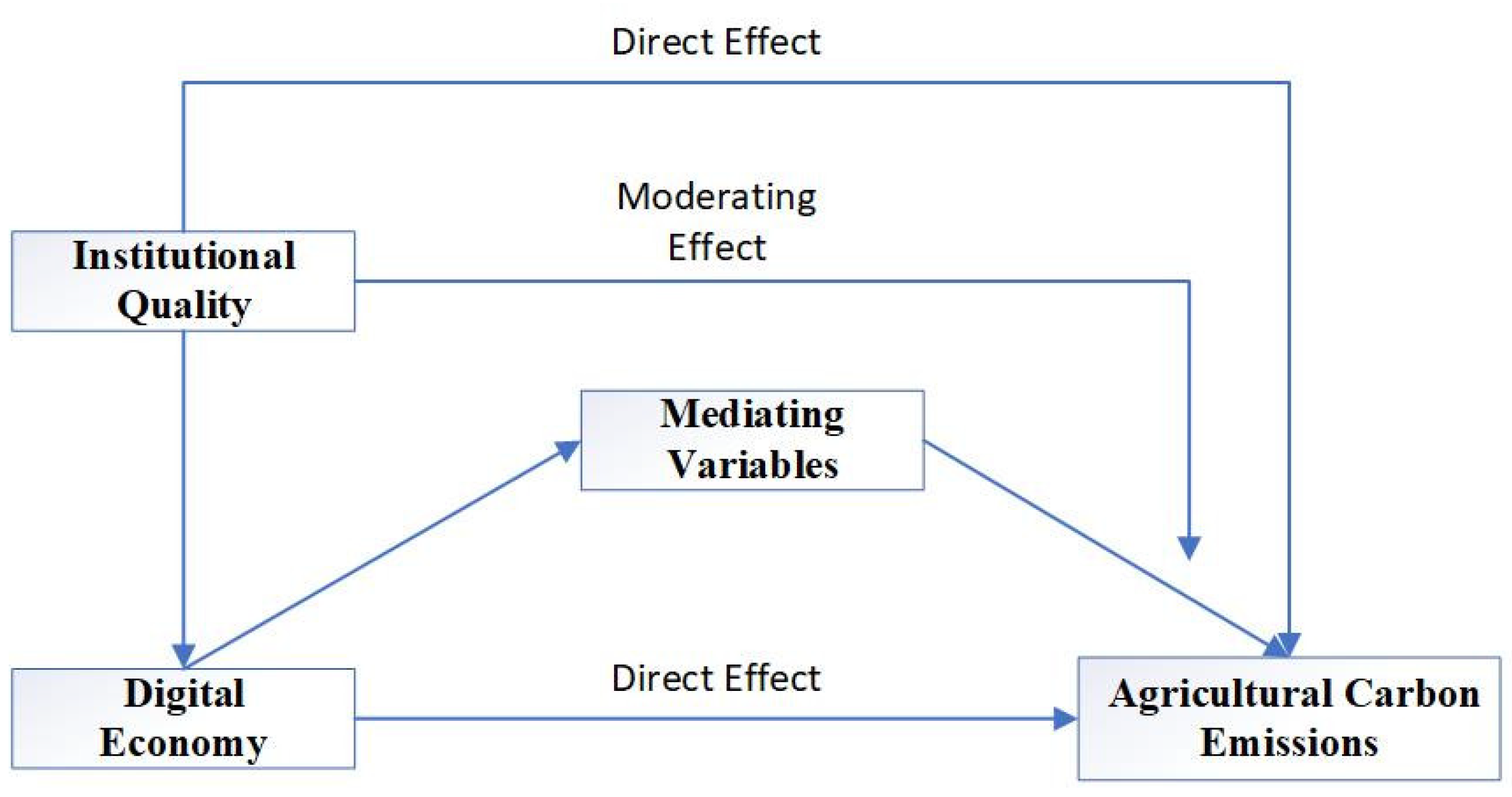
Figure 1. Model Diagram.
Sustainability 17 10984 g001
Figure 2. Marginal Effect Plot of Digital Economy.
Sustainability 17 10984 g002
Table 1. Definition of Variables.
TypeDefinitionSignNote.
Explained VariableCarbon Emission Intensity C a r b o n _ E m s s Total carbon emissions divided by total agricultural output value
Explanatory VariableDigital Economy D i g i t a l _ E c o Regional digital economy development level, obtained by reducing the dimensionality of a series of indicators.
Institutional Quality I n s t i t u _ Q u a Referencing the marketization index published by Fan Gang et al. (2011), the same indicators were used to calculate the data [58].
Mediating VariableYears of Education Per Capita E d u Average years of education per farmer. Data for some prefectures and cities is unavailable, so provincial data is used instead.
Agricultural Loans Per Capita I n d e x Total agricultural loans/rural population
Average Total Power of Agricultural Machinery A g r _ T e c h Total agricultural machinery power divided by total agricultural output value
Control Variable Per Capita Income of Farmers I n c o m e Per capita income of farmers
Financial Support for Agriculture A g r _ F i n a Total agricultural, forestry and water expenditure
Table 2. Digital Economy Measurement Indicators.
Primary IndicatorSecondary IndicatorsMeasuring Criteria
Digital InfrastructureInternet penetration rateNumber of Internet Access Users
Mobile phone ownershipNumber of Mobile Phone Users
Rural radio and television coveragePercentage of Population with Access to Radio and Television
Digital IndustryInformation IndustryNumber of Employees in Information Transmission, Computer Services, and Software
Telecommunications industryTotal Telecommunications Business Volume
Digital InnovationNew technology R&D capabilityNumber of Intellectual Property Applications
R&D investmentExpenditure on Science and Technology
Digital Financial InclusionDigital finance coverage breadthDigital Inclusive Finance Coverage Index
Digital finance usage depthDigital Inclusive Finance Penetration Index
Digitalization levelDigital Inclusive Finance Digitalization Level
Table 3. Descriptive Statistics.
VariablesObsMeanStdMinMax
Carbon Emission Intensity60481.8130.9870.1367.789
Digital Economy60485.6291.3691.43310.369
Institutional Quality60480.8530.2340.1262.331
Average Years of Education per Capita60486.6631.0693.21112.69
Average Agricultural Loan Amount per Farmer60487.6211.9860.55315.698
Average Agricultural Total Power60481.9870.3690.2014.965
Average Income Level per Farmer60488566.1232136.7811569.3218,954.36
Fiscal Support for Agriculture60486123.6691875.691369.23314,256.98
Table 4. Results of Basic Regression Model.
VariablesFE
(1)
PCSE (2)FE
(3)
PCSE
(4)
FE
(5)
PCSE
(4)
FE
(7)
PCSE
(8)
Digital Economy−0.385 ***−0.365 *** −0.323 ***−0.336 ***−0.357 ***−0.396 ***
(0.081)(0.126) (0.116)(0.124)(0.121)(0.133)
Institutional Quality −0.155 **−0.183 **−0.179 **−0.183 *−0.195 **−0.201 **
(0.074)(0.089)(0.091)(0.109)(0.097)(0.101)
Digital Economy × Institutional Quality −0.043 **−0.068 **
(0.021)(0.030)
Constant2.541 *−2.227 **1.3232.361 *2.087 *−1.851 **1.794 **2.169 *
(1.365)(1.087)(1.021)(1.333)(1.087)(0.774)(0.811)(1.185)
Control VariablesControlControlControlControlControlControlControlControl
Individual EffectControlControlControlControlControlControlControlControl
Time EffectControlControlControlControlControlControlControlControl
Obs60486048604860486048604860486048
R20.6120.5970.6090.6130.7010.6550.6340.695
Std in Parentheses. * represents a 10% significance level, ** represents a 5% significance level, and *** represents a 1% significance level.
Table 5. Test of the Direct Effect of the Digital Economy.
VariablesIV REG
(1)
Province-Time Variable (2)Winsorize
(3)
Digital Economy−0.202 ***−0.198 ***−0.185 ***
(0.055)(0.065)(0.036)
Institutional Quality−0.152 ***−0.163 ***−0.155 ***
(0.021)(0.054)(0.017)
Digital Economy × Institutional Quality−0.069 **−0.081 **−0.097 ***
(0.033)(0.0413)(0.026)
Constant1.845 **2.361 **3.339 *
(0.851)(0.949)(2.013)
Control VariablesControlControlControl
Individual EffectControlControlControl
Time EffectControlControlControl
Endogeneity test F value15.69822.69436.325
Weak instrumental variable test F value32.68817.69819.846
Std in Parentheses. * represents a 10% significance level, ** represents a 5% significance level, and *** represents a 1% significance level.
Table 6. Test of the Mediating Effect.
Explanatory VariableMediating VariableFunctional DecompositionObservation CoefficientBootstrap
Std
Z Valuep ValueConfidence Interval
LowerUp
Digital EconomyAverage years of Education per capitaDirect Effect−0.2570.032−8.0060.000−0.320−0.194
Indirect Effect−0.1360.101−1.3470.362−0.3340.062
Agricultural loans per capitaDirect Effect−0.1860.069−2.7150.000−0.320−0.052
Indirect Effect−0.2770.122−2.2700.000−0.516−0.038
Average Agricultural Total Mechanical PowerDirect Effect−0.1920.071−2.7040.000−0.331−0.053
Indirect Effect−0.2230.098−2.2760.000−0.415−0.031
Table 7. The Mediating Effect Test.
Explanatory VariableFunctional DecompositionCoefficientBootstrap
Std
Z Value p-ValueConfidence Interval
LowerUp
Institutional QualityTotal Effect−0.1790.029−6.1720.000−0.236−0.122
Direct Effect−0.1460.047−3.1060.000−0.238−0.054
Table 8. Test of the Moderating Effects of Institutional Quality.
Explanatory VariableComputing NodeComputing ValueCoefficientBootstrap StdZ-Valuep-ValueConfidence Interval
LowerUp
Institutional Qualitymean − 2 × sd0.3850.2010.0345.9240.0000.1350.268
mean0.853−0.1360.016−8.5000.000−0.167−0.105
Mean + 2 × sd1.321−0.1810.029−6.2410.000−0.238−0.124
Disclaimer/Publisher’s Note: The statements, opinions and data contained in all publications are solely those of the individual author(s) and contributor(s) and not of MDPI and/or the editor(s). MDPI and/or the editor(s) disclaim responsibility for any injury to people or property resulting from any ideas, methods, instructions or products referred to in the content.