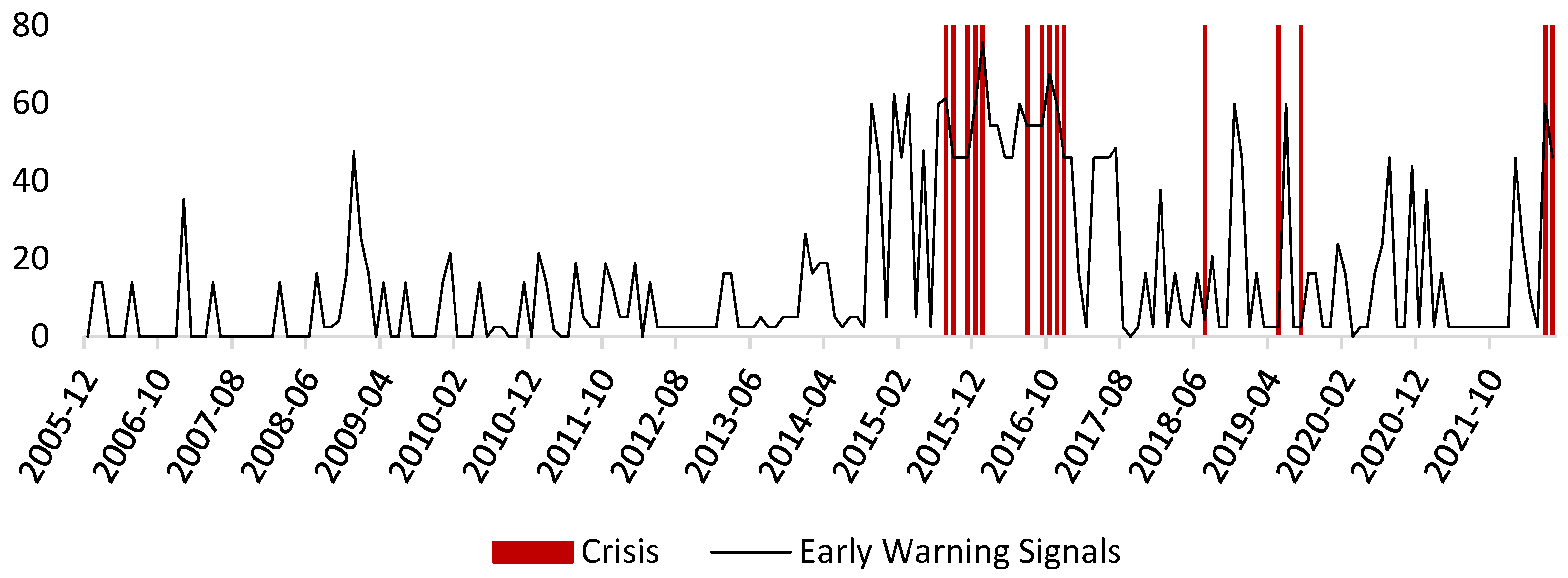
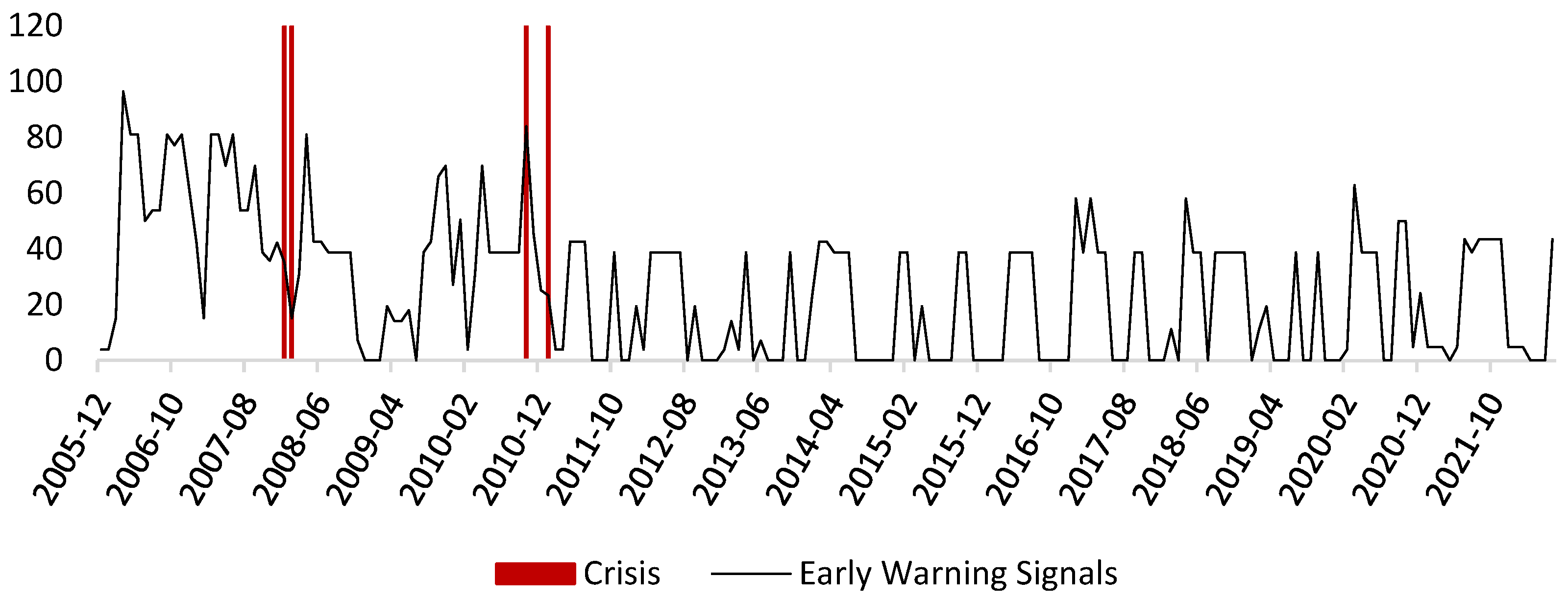
Developing a Sustainable Risk Warning Framework for Short-Term Cross-Border Capital Flows: Empirical Analysis Based on Heterogeneous Exchange Rate Expectations


Abstract
1. Introduction
2. Literature Review
2.1. Risk Warning of Cross-Border Capital Flows
2.2. Heterogeneous Exchange Rate Expectations
2.3. Research Gaps
3. Establishment of a Short-Term Cross-Border Capital Flow Early Warning Model
3.1. Model Selection and Early Warning Principles
3.1.1. Risk Event Identification
3.1.2. Optimal Threshold Screening of Early Warning Indicators
3.1.3. Signal Generation Based on Optimal Thresholds
3.1.4. Constructing the Early Warning Signal Aggregation Composite Index
Simple Aggregation Method
Weighted Aggregation Method
3.2. Selection of Early Warning Indicators
3.2.1. Weighted Heterogeneous Expectation Indicator
3.2.2. Traditional Indicators
4. Construction of the Weighted Heterogeneous Exchange Rate Expectation Indicator
4.1. Foreign Exchange Market Equilibrium Model Construction
4.1.1. Heterogeneous Exchange Rate Expectations of Foreign Exchange Traders
4.1.2. Optimal Foreign Currency Asset Holdings
4.1.3. Dynamic Adjustment of Heterogeneous Traders’ Proportions
4.1.4. Model Solution
4.2. Data and Descriptive Statistics
4.3. Parameter Estimation of the Equilibrium Model
4.4. Measurement Results of Weighted Heterogeneous Exchange Rate Expectation
5. Empirical Analysis of an Early-Warning System for Short-Term Cross-Border Capital Flows in China
5.1. Data Description
5.2. Risk Events Identification
5.3. Optimal Threshold Analysis of Early Warning Indicators
5.4. Early Warning Analysis
5.4.1. Using Simple Aggregation Composite Index
5.4.2. Using Weighted Aggregation Composite Index
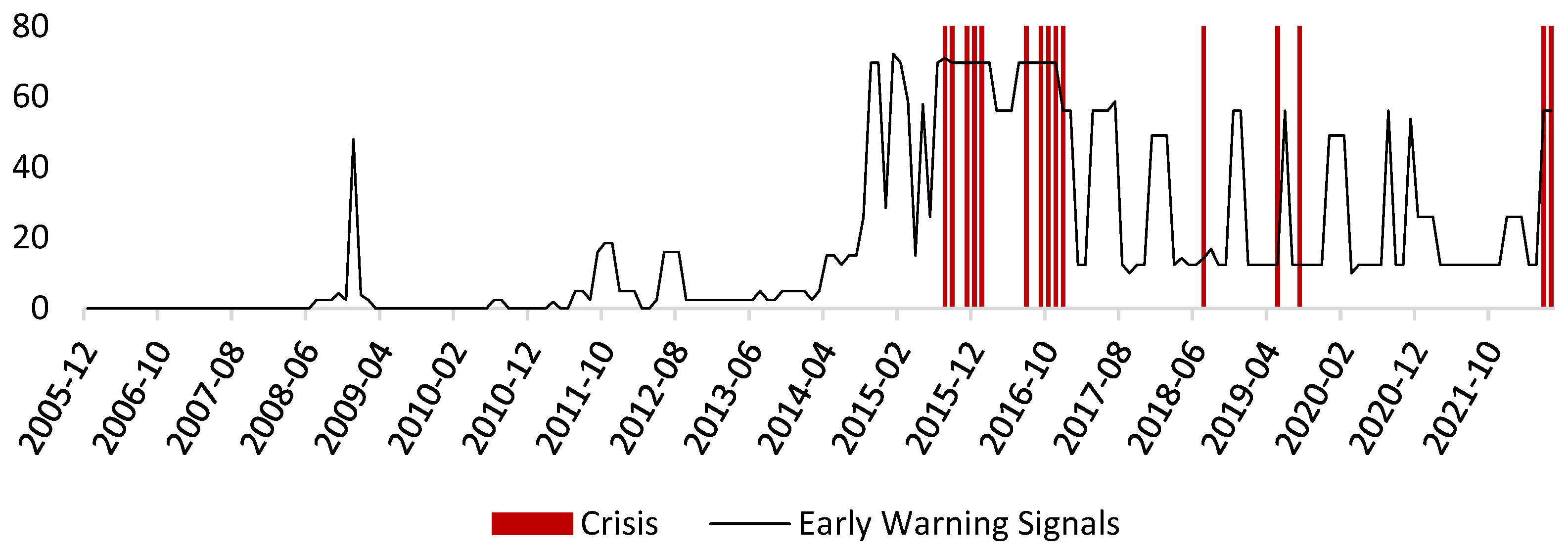
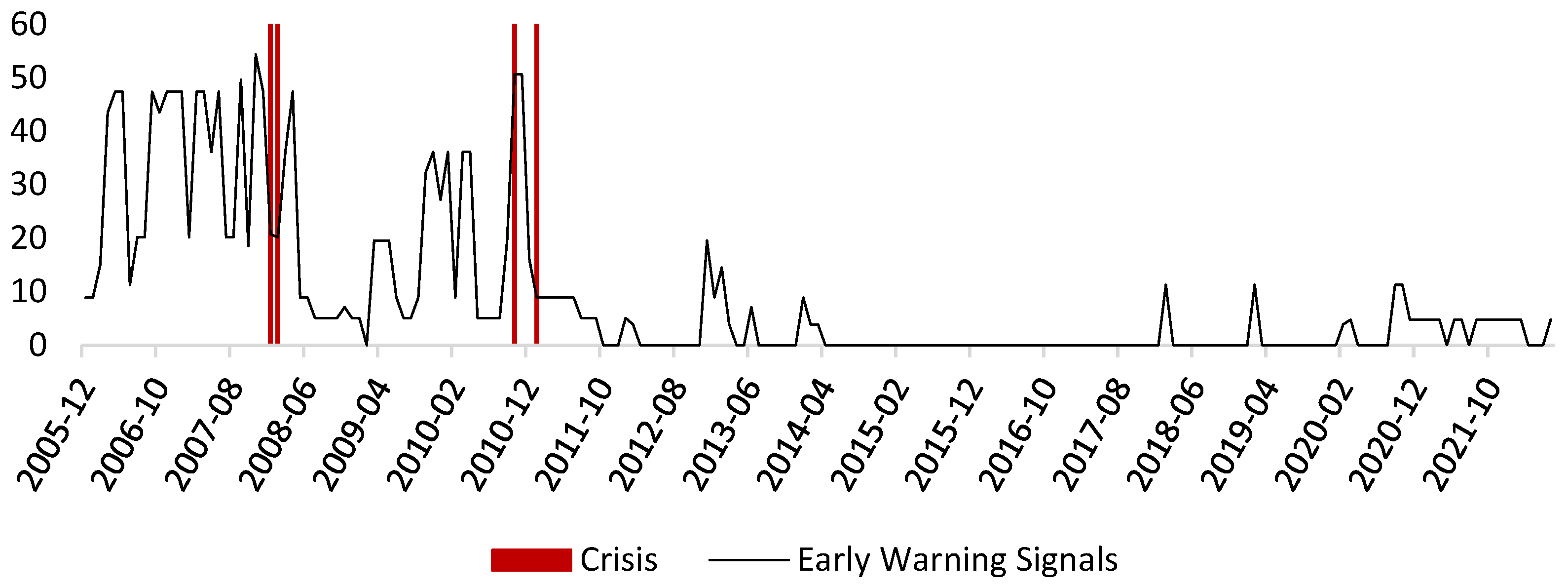
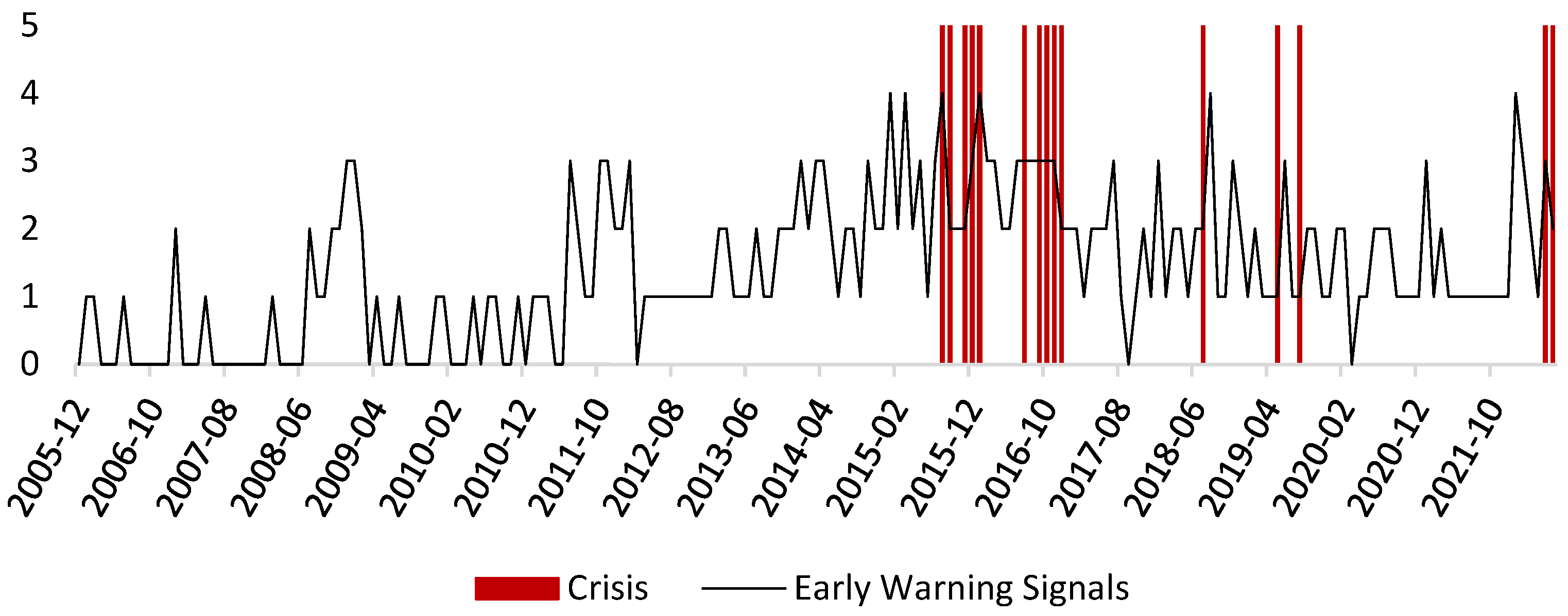
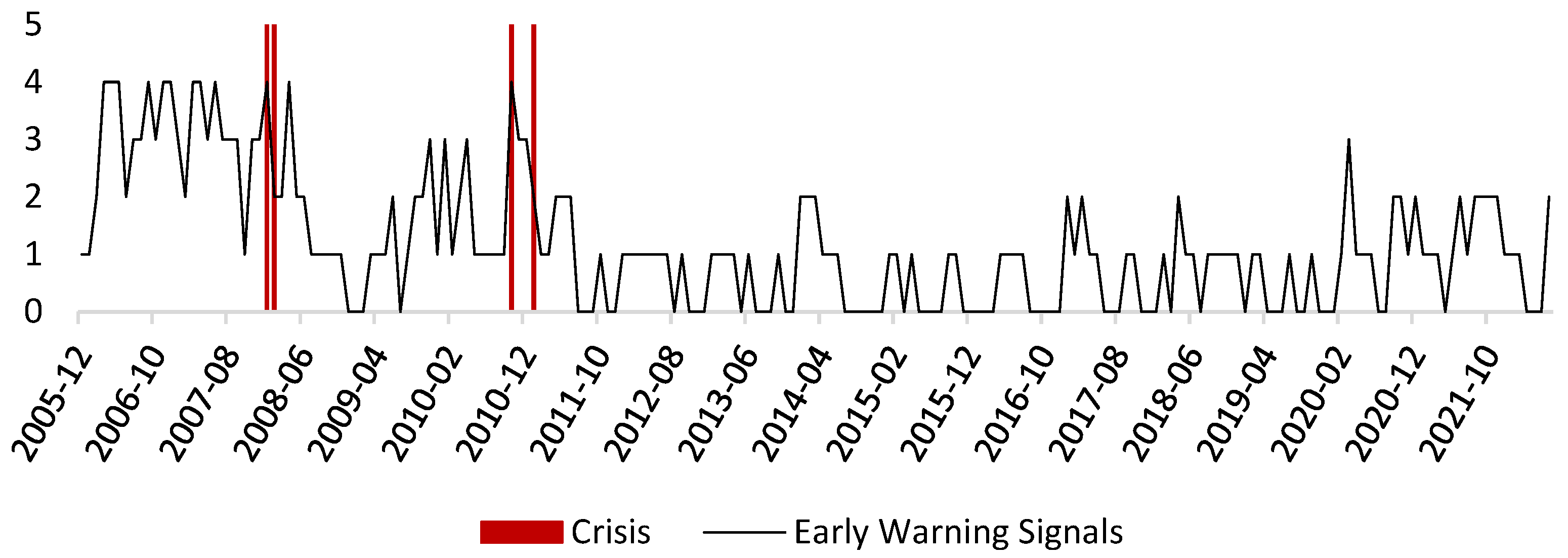
5.4.3. Robustness Checks of the Early-Warning System
5.5. Sustainable Features of the Short-Term Cross-Border Capital Flow Risk Warning Framework
6. Conclusions and Implications
Author Contributions
Funding
Institutional Review Board Statement
Informed Consent Statement
Data Availability Statement
Conflicts of Interest
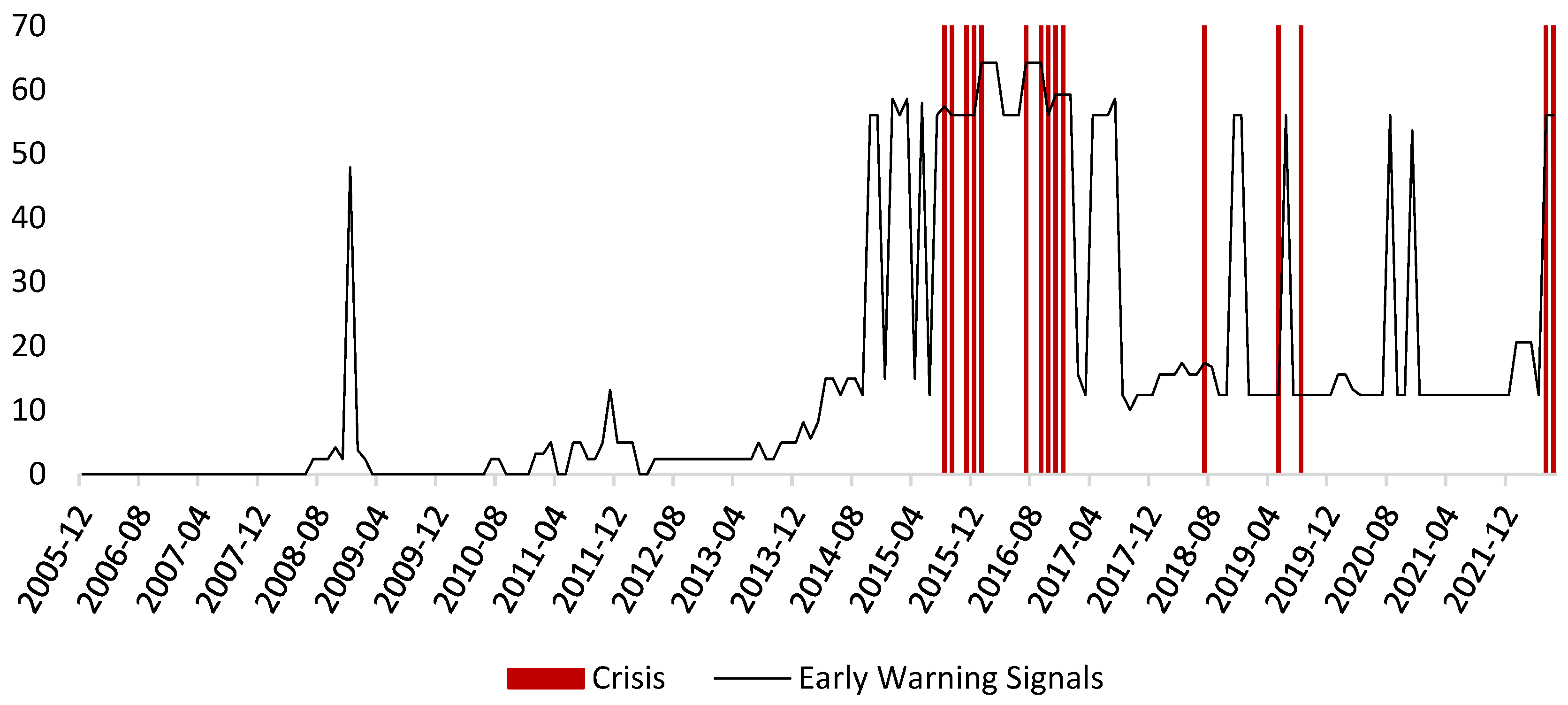
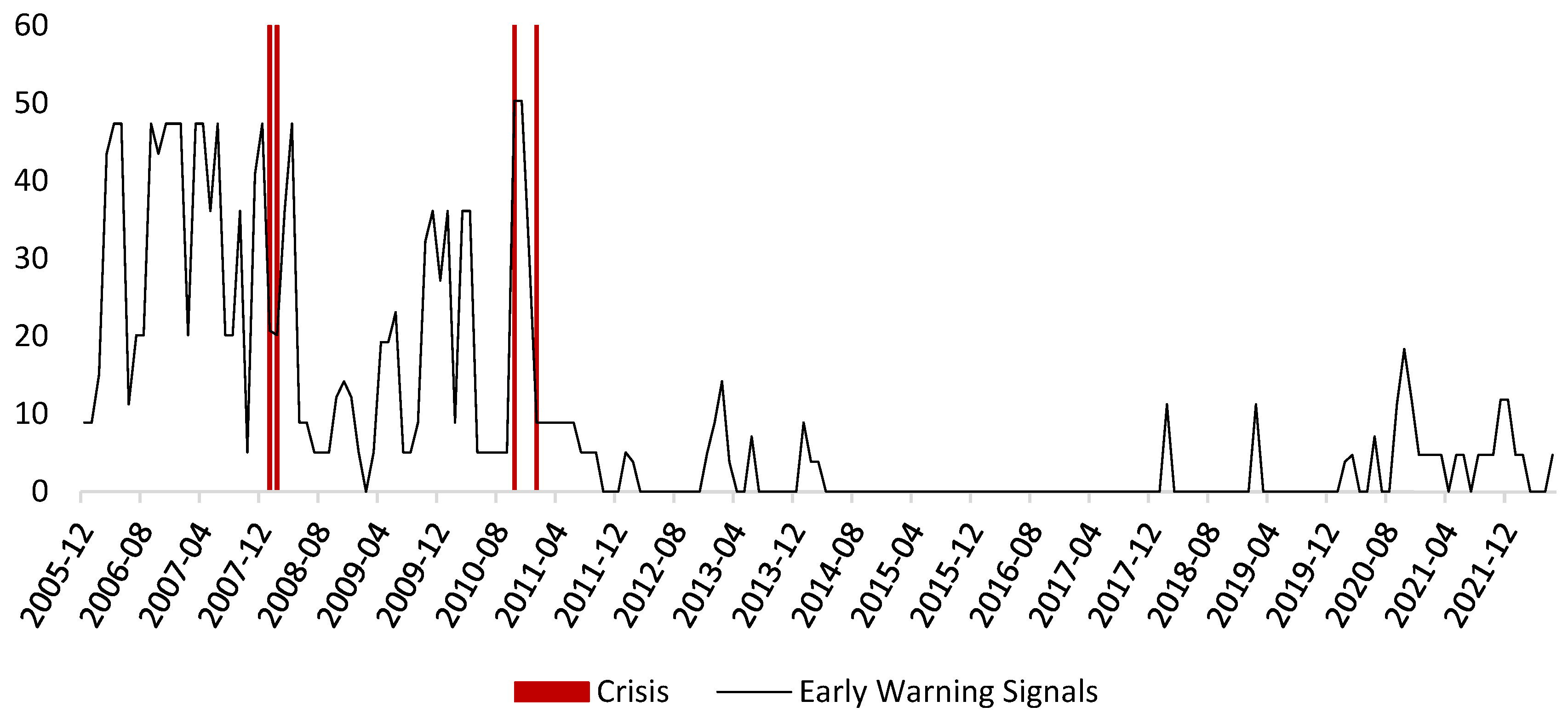
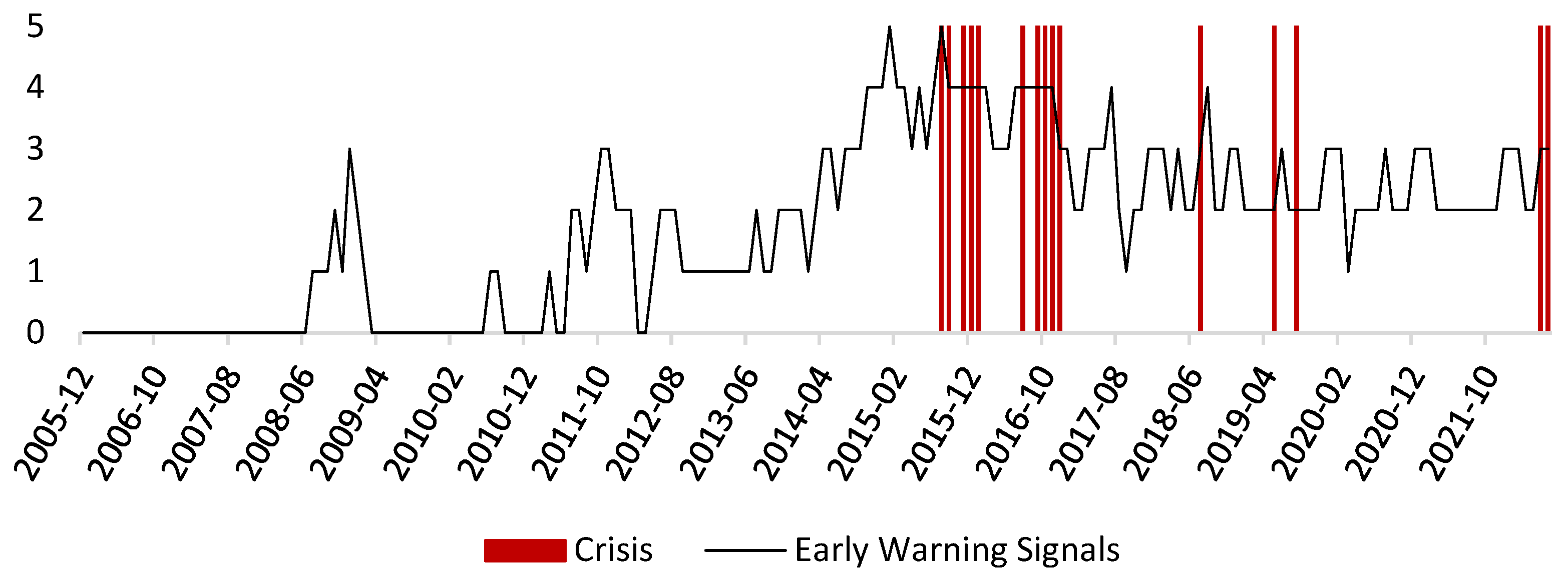
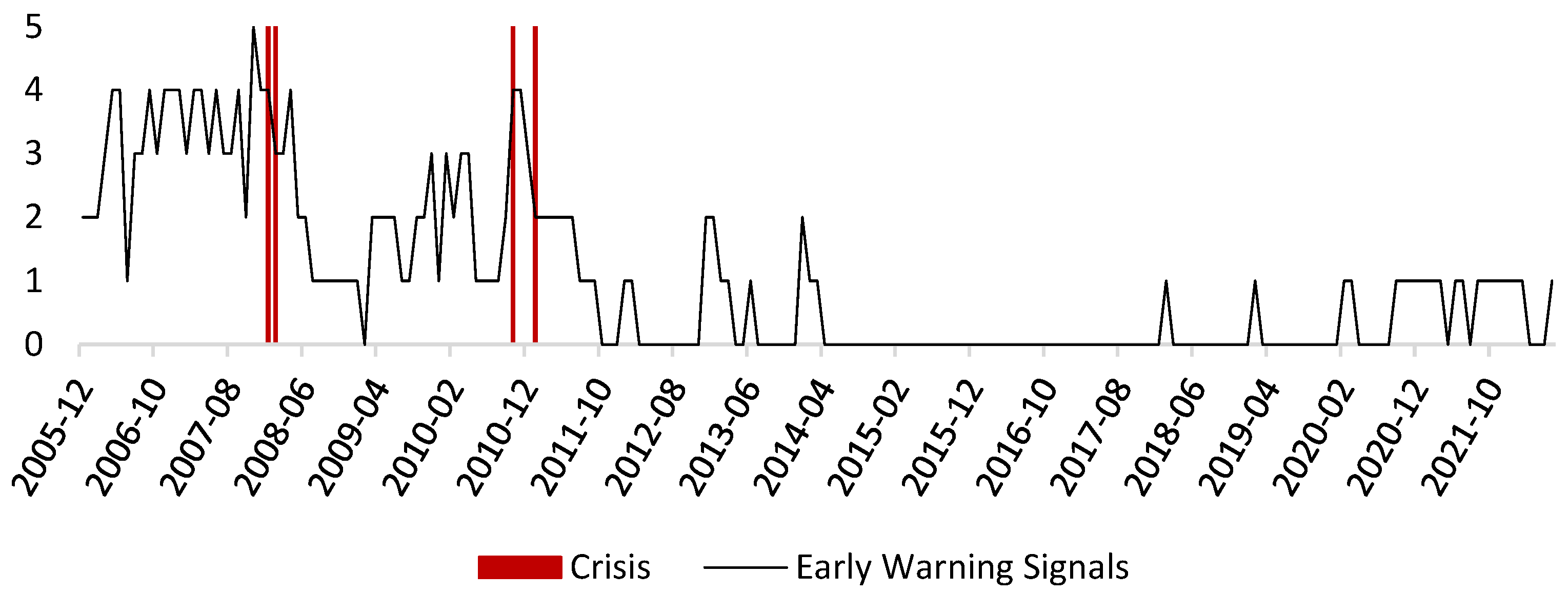
Appendix A. Robustness Check Figures
Appendix A.1. Robustness Check Based on the Constant Interpolation Method


Appendix A.2. Robustness Check Based on Stationarity-Adjusted Indicators


References
- Mendoza, E.G. Sudden Stops, Financial Crises, and Leverage. Am. Econ. Rev. 2010, 100, 1941–1966. [Google Scholar] [CrossRef]
- Gourinchas, P.O.; Obstfeld, M. Stories of the Twentieth Century for the Twenty-First. Am. Econ. J. Macroecon. 2012, 4, 226–265. [Google Scholar] [CrossRef]
- Kaminsky, G.; Lizondo, S.; Reinhart, C.M. Leading Indicators of Currency Crises. IMF Staff. Pap. 1998, 45, 1–48. [Google Scholar] [CrossRef]
- Feng, Y.; Wu, C.-F. Research on Currency Crisis Early Warning Systems. J. Syst. Manag. 2002, 8–11. Available online: https://kns.cnki.net/kcms2/article/abstract?v=35M_ufc67ztyDRyfBV8zX9z1w2SPxjOjopXbrPKMWFi7rRb2a6jsy0cyeT-oF2GVSkJsZSvuEqJojsct2MCOE8f1G60eq_27KUk5IYJK8iST0ujFjuCOB2FRp1aRMd-nUFoGQb3NxuZF6c2ZBW5o71Diu0dSZSP5Ftk_R0iITQgRyihvE85JA-bC8FF60U64&uniplatform=NZKPT (accessed on 3 December 2025). (In Chinese).
- Xu, D.; Shi, Z. An Improved KLR Signal Analysis Method and Its Application. J. Quant. Technol. Econ. 2007, 124–132. Available online: https://kns.cnki.net/kcms2/article/abstract?v=7DUETwKSFy51N-5gsDrbcHH3G2KzpwY8-PNBQyxIBkCzAAkxZaP-6AFFF6xu8B6nW6voCHjzOqCrXHKB3qX7ZdkKTquaUwov-myZE8cMvN5KC3Z54hb6_uelUrCab3_Plb6TntcHz9oOaSPi6NKuQcQML6yO-qV9E2c0TjITKv4ZvAXyfR21qA==&uniplatform=NZKPT&language=CHS (accessed on 3 December 2025). (In Chinese).
- Hao, J.; Li, J.; Feng, Q.; Sun, X. Research on Early Warning Methods for Financial Crises Based on Spillover Effects. Chin. J. Manag. Sci. 2023, 31, 35–45. [Google Scholar] [CrossRef]
- Frankel, J.A.; Rose, A.K. Currency Crashes in Emerging Markets: An Empirical Treatment. J. Int. Econ. 1996, 41, 351–366. [Google Scholar] [CrossRef]
- Berg, A.; Pattillo, C. Predicting Currency Crises: The Indicators Approach and an Alternative. J. Int. Money Financ. 1999, 18, 561–586. [Google Scholar] [CrossRef]
- Tsai, B.H. An Early Warning System of Financial Distress Using Multinomial Logit Models and a Bootstrapping Approach. Emerg. Mark. Financ. Trade 2013, 49 (Suppl. S2), 43–69. [Google Scholar] [CrossRef]
- Omotosho, B.S. Modelling Currency Crises in Nigeria: An Application of Logit Model. Res. J. Financ. Account. 2013, 4, 126–131. [Google Scholar] [CrossRef]
- Lian, F. Research on the Financial Crisis Early Warning of Emerging Market Countries: Empirical Test Based on Logit Model. J. Technol. Econ. Manag. 2021, 67–71. Available online: https://kns.cnki.net/kcms2/article/abstract?v=7DUETwKSFy6l-1vTgzAJJAhdNdpcocWklw1-2DJXumNoFFw-87VWSubsNs4k5yjww2Mw1cjBCKhu7oC1MKZ1TCnJqwg-S32sJ2V_5iXhqbAbBkW3jwnSDVYCcDvXKoXdt4K79VIlUYo4HnEdbOtTVneC8KOe9raRI9dJLzdABKLx1QjTBzUWtA==&uniplatform=NZKPT&language=CHS (accessed on 3 December 2025). (In Chinese).
- Sachs, J.D.; Tornell, A.; Welasco, A. Financial Crises in Emerging Markets: The Lessons from 1995. Brook. Pap. Econ. Act. 1996, 1996, 147–215. [Google Scholar] [CrossRef]
- Nag, A.; Mitra, A. Neural Networks and Early Warning Indicators of Currency Crisis. Reserve Bank India Occas. Pap. 1999, 20, 183–222. [Google Scholar]
- Lin, C.-S.; Khan, H.A.; Chang, R.-Y.; Wang, Y.-C. A New Approach to Modeling Early Warning Systems for Currency Crises: Can a Machine-Learning Fuzzy Expert System Predict the Currency Crises Effectively? J. Int. Money Financ. 2008, 27, 1098–1121. [Google Scholar] [CrossRef][Green Version]
- Fioramanti, M. Predicting Sovereign Debt Crises Using Artificial Neural Networks: A Comparative Approach. J. Financ. Stab. 2008, 4, 149–164. [Google Scholar] [CrossRef]
- Wang, K.-D. Financial Crisis Early Warning Models and Leading Indicator Selection. Fin. Regul. Res. 2019, 84–100. [Google Scholar] [CrossRef]
- Feng, Q.; Chen, H.; Jiang, R. Analysis of early warning of corporate financial risk via deep learning artificial neural network. Microprocess. Microsyst. 2021, 87, 104387. [Google Scholar] [CrossRef]
- Alshater, M.M.; Kampouris, I.; Marashdeh, H.; Atayah, O.F.; Banna, H. Early Warning System to Predict Energy Prices: The Role of Artificial Intelligence and Machine Learning. Energy 2022, 345, 129733. [Google Scholar] [CrossRef]
- Zhang, Y.-P.; Sun, G. Theoretical and Empirical Analysis of Financial Crisis Early Warning Systems. Stud. Int. Financ. 2003, 32–38. Available online: https://kns.cnki.net/kcms2/article/abstract?v=35M_ufc67zsiLv7ua3n-c9Sq8eg2BjaFNIPFUG5xw3n0aikQhBkIDpvP5P7FBxVamZKr4Jvmh08zj_oMF8xtiVswz_K-Kqey5iPGPb15DEciwG6RmF077cu1gJ3GvYsWII6njzc1XlfqN4ngJn6l3KUsMfrTIlZExXUAlQvecgvI7syjCGkGCKYFH4JTO7Ho&uniplatform=NZKPT (accessed on 3 December 2025). (In Chinese).
- Li, W.; Qiao, Z.-Y.; Liu, G.-C. Research on the Monitoring and Early Warning Index System for Cross-Border Capital Flows in China. Fin. Theory Pract. 2013, 56–59. Available online: https://kns.cnki.net/kcms2/article/abstract?v=35M_ufc67zuRH4YqJjWnDtJZzvLnaYJdBQ0kSAq1o46y2d749zcfexeP6O-hWvgIGDMdVlqsNxGnuLCSYUi4_D4qHYaNYrytwRlp4ZVneTC-0EhVnBhRI3F-xKKTthSS2U0sBmmDlC-uC_dVvuPSVn2AT0Yq3wYo6oWYC4A_Hu6cNwxQPnAtXkKjWmIqzW10&uniplatform=NZKPT (accessed on 3 December 2025). (In Chinese).
- Zhang, G.-T. Factors of Cross-Border Capital Flows in Emerging Market Countries: An Empirical Study Based on Factor Analysis. World Econ. Stud. 2016, 42–61+135–136. (In Chinese) [Google Scholar] [CrossRef]
- Chen, W.-D.; Wang, Y.-X. Construction and Application of a Monitoring and Early Warning System for Cross-Border Capital Flows. Stud. Int. Financ. 2017, 65–74. (In Chinese) [Google Scholar] [CrossRef]
- Yan, B.-Y. Pro-Cyclicality, Early Warning Indicators and Countercyclical Management of Cross-Border Capital Flows in China. J. Financ. Res. 2018, 22–39. Available online: https://kns.cnki.net/kcms2/article/abstract?v=7DUETwKSFy44OVD3gRjvb8mwS6QL9bGL8hhJrZN0K6CQgjqNQFj9MOFNcDM421LrOntu4JO-eyDxI3hn3Ru0BxXRxgngtDj4Vg_sBW62lGVAMu-P2oqYkZ04NOJT7wI3VKFIW2-rs2_971cSrsYLi3hBprWB1iGu8tfbHAp4nq3hytES7qYPBA==&uniplatform=NZKPT&language=CHS (accessed on 3 December 2025). (In Chinese).
- Tan, X.; Wang, X.; Zhang, B. Abnormal Fluctuation Risk Warning of Capital Flows: Based on Machine Learning Perspective. Mod. Econ. Sci. 2023, 45, 13–27. [Google Scholar]
- Frankel, J.A.; Froot, K.A. Short-Term and Long-Term Expectations of the Yen/Dollar Exchange Rate: Evidence from Survey Data. J. Jpn. Int. Econ. 1987, 1, 249–274. [Google Scholar] [CrossRef][Green Version]
- Allen, H.; Taylor, M.P. Charts, Noise and Fundamentals in the London Foreign Exchange Market. Econ. J. 1990, 100, 49–59. [Google Scholar] [CrossRef]
- De Grauwe, P.; Markiewicz, A. Learning to Forecast the Exchange Rate: Two Competing Approaches. J. Int. Money Financ. 2013, 32, 42–76. [Google Scholar] [CrossRef][Green Version]
- Cavaglia, S.; Verschoor, W.F.; Wolff, C.C. Further Evidence on Exchange Rate Expectations. J. Int. Money Financ. 1993, 12, 78–98. [Google Scholar] [CrossRef]
- MacDonald, R.; Marsh, I.W. Currency Forecasters Are Heterogeneous: Confirmation and Consequences. J. Int. Money Financ. 1996, 15, 665–685. [Google Scholar] [CrossRef]
- MacDonald, R. Expectations Formation and Risk in Three Financial Markets: Surveying What the Surveys Say. J. Econ. Surv. 2000, 14, 69–100. [Google Scholar] [CrossRef]
- Sims, C.A. Implications of Rational Inattention. J. Monet. Econ. 2003, 50, 665–690. [Google Scholar] [CrossRef]
- Manzan, S.; Westerhoff, F.H. Heterogeneous Expectations, Exchange Rate Dynamics and Predictability. J. Econ. Behav. Organ. 2006, 64, 111–128. [Google Scholar] [CrossRef]
- Pojarliev, M.; Levich, R.M. Trades of the Living Dead: Style Differences, Style Persistence and Performance of Currency Fund Managers. J. Int. Money Financ. 2010, 29, 1752–1775. [Google Scholar] [CrossRef]
- Jongen, R.; Verschoor, W.F.; Wolff, C.C.; Zwinkels, R.C. Explaining Dispersion in Foreign Exchange Expectations: A Heterogeneous Agent Approach. J. Econ. Dyn. Control 2012, 36, 719–735. [Google Scholar]
- De Grauwe, P.; Dewachter, H. A Chaotic Model of the Exchange Rate: The Role of Fundamentalists and Chartists. Open Econ. Rev. 1993, 4, 351–379. [Google Scholar] [CrossRef]
- Sordi, S.; Dávila-Fernández, M.J. Investment Behaviour and “Bull & Bear” Dynamics: Modelling Real and Stock Market Interactions. J. Econ. Interact. Coord. 2020, 15, 867–897. [Google Scholar]
- Gürkaynak, R.S.; Kara, A.H.; Kısacıkoğlu, B.; Lee, S.S. Monetary Policy Surprises and Exchange Rate Behavior. J. Int. Econ. 2021, 130, 103443. [Google Scholar] [CrossRef]
- Goda, T.; Torres García, A.; Larrahondo, C. Real Exchange Rates and Manufacturing Exports in Emerging Economies: The Role of Sectoral Heterogeneity and Product Complexity. Econ. Model. 2024, 160, 1057–1082. [Google Scholar]
- Li, X.-F.; Li, Q.-J. Research Progress on Exchange Rate Expectations in the Foreign Exchange Market. Econ. Perspect. 2009, 102–107. Available online: https://kns.cnki.net/kcms2/article/abstract?v=35M_ufc67zv_ivhCnbWumM3IF9TOzFTU5YBOPUsNt7JvikwR-HX41qGb3x_oEHjW0m4dqbZgRdAPhWGrfXZ9JU9tAQxMV4ez41g5Z6xSKqzJX-T7goMufQh4y6LXGIRmu_Nz4W3xyjqAecS0eMrc1oOBcNmhoCS2NO2HL-UV2w5VK9zLVGdAEuuGr2yLxpca&uniplatform=NZKPT (accessed on 3 December 2025). (In Chinese).
- Li, X.-F.; Qian, L.-Z.; Li, Q.-J. Research on the Characteristics of RMB Exchange Rate Expectations: Empirical Analysis Based on Survey Data. Stud. Int. Financ. 2011, 47–58. Available online: https://kns.cnki.net/kcms2/article/abstract?v=35M_ufc67ztEHAIJPSDnCdiHzJrBRvII0mWbiuyRS5wM0yF9w7qrHklX9_iuh3bYYU3V5wjPJ8pGuHnuntmqFHk4abSPwomFJ6WaaKApauH0y4Zr1J7GgDOjRmCDniER9idteMGDsK3VFqHjLn0YwJfSQTZGalK-hcLW-cUkEf2qSKeAg_RVyR61E7K2tCK5&uniplatform=NZKPT (accessed on 3 December 2025). (In Chinese).
- Xie, Z.-D. A Behavioral Finance Exchange Rate Pricing Model Based on Trader Heterogeneity Expectations. Fin. Theory Pract. 2013, 11–14. Available online: https://kns.cnki.net/kcms2/article/abstract?v=35M_ufc67zs3eGvCbIX9ZjGISRzAYAyeCR_7s4Cc8yb4PVewByNuPS-rjdoPXrrQ8rPvxx0H8EoqKJqETpudHF5zFTHltijD8KI5K6VYmX4o7iXCqYoZAgzWQvOPVrtYJbwM0l1Sd3lDDbp9pa1IX-My8Ev3feTKZHifbGnNClwV7UhF6tvdpqCADZ-saSk5&uniplatform=NZKPT (accessed on 3 December 2025). (In Chinese).
- Li, X.-P.; Wu, C.-F. Carry Trade, Heterogeneous Expectations, and Micro-Determination of Exchange Rates. J. Manag. Sci. China 2018, 21, 1–11. Available online: https://kns.cnki.net/kcms2/article/abstract?v=35M_ufc67zuyiVzQaxacRMmepIRRUhgPPLnZDevydF50ODY1u2eA2mHcN5AxMGrfRdaMF2GElAGCXFU1ollLwGUuTKKZAAIs203bCoy1FZz1zSD8LuKiKCoyHVJ_3XApxzfIW7tm0BPKWPnxLC6eIpVYjgMt2oi-QjfRNxilyR7JgrPxSTXU5Q==&uniplatform=NZKPT&language=CHS (accessed on 3 December 2025). (In Chinese).
- Gu, Y.; Guo, S.-Y. The Impact Mechanism and Effect of Exchange Rate Communication on RMB Exchange Rate Expectations from the Perspective of Heterogeneous Expectations: Empirical Research Based on Bloomberg Survey Data. Econ. Sci. 2018, 31–43. (In Chinese) [Google Scholar] [CrossRef]
- Zhang, Q.; Wu, K.J.; Tseng, M.L. Exploring Carry Trade and Exchange Rate toward Sustainable Financial Resources: An Application of the Artificial Intelligence UKF Method. Sustainability 2019, 11, 3240. [Google Scholar] [CrossRef]
- Zhang, Q.; Ran, Q. The Dynamic Effects of Heterogeneous Exchange Rate Expectations on China’s Short-Term International Capital Flow: An Application on Time-Varying Parameter Model. World Econ. Stud. 2021, 12, 86–102, 134. (In Chinese) [Google Scholar] [CrossRef]
- Li, X.; Wang, N.; Duan, J.; Shi, W. Exchange Rate Stability and Expectation Management under Heterogeneous Expectations. Int. Rev. Financ. Anal. 2024, 95 Pt B, 103453. [Google Scholar] [CrossRef]
- Eichengreen, B.; Rose, A.; Wyplosz, C. Contagious Currency Crises: First Tests. Scand. J. Econ. 1996, 98, 463–484. [Google Scholar] [CrossRef]
- Calvo, A.G.; Reinhart, C. When Capital Inflows Come to a Sudden Stop: Consequences and Policy Options. In Reforming the International Monetary and Financial System; Kenen, P., Swoboda, A., Eds.; International Monetary Fund: Washington, DC, USA, 2000; pp. 175–201. [Google Scholar]
- Peng, H.; Zhu, X. Multiple Motivations and Impacts of Short-Term Capital Flows: A Dynamic Analysis Based on the TVP-VAR Model. Econ. Res. J. 2019, 54, 36–52. [Google Scholar]
- Xie, J.-X.; Yang, C.-L.; Deng, C. Research on Monitoring and Responding to the Risk of Abnormal Cross-Border Capital Flows in China: Based on the Framework of Deep Capital Flows at Risk. Int. Econ. Trade Res. 2025, 41, 72–87. (In Chinese) [Google Scholar] [CrossRef]
- Reinhart, C.M.; Montiel, P. The Dynamics of Capital Movements to Emerging Economies During the 1990s. In Short-Term Capital Flows and Economic Crises; Oxford University Press: Oxford, UK, 2001. [Google Scholar]
- Kraay, A. Search of the Macroeconomic Effects of Capital Account Liberalization; The World Bank: Washington, DC, USA, 1998. [Google Scholar]
- Spronk, R.; Verschoor, W.; Zwinkels, R. Carry Trade and Foreign Exchange Rate Puzzles. Eur. Econ. Rev. 2013, 60, 17–31. [Google Scholar] [CrossRef]
- Chen, F.-X.; Guo, L.-Y.; Zhao, Y.-L. RMB Exchange Rate Premium, Financial Market Risk and Foreign Exchange Settlement and Sale of Banks. J. Stat. Inf. 2022, 37, 52–63. Available online: https://link.cnki.net/urlid/61.1421.C.20221102.1836.004 (accessed on 3 December 2025). (In Chinese).
- Byrne, J.P.; Korobilis, D.; Ribeiro, P.J. Exchange Rate Predictability in a Changing World. J. Int. Money Financ. 2016, 62, 1–24. [Google Scholar] [CrossRef]
- Dominguez, K.; Hashimoto, Y.; Ito, T. International Reserves and the Global Financial Crisis. J. Int. Econ. 2012, 88, 388–406. [Google Scholar] [CrossRef]
- Yang, S.; Liu, Z. Capital Flight and China’s Realistic Choices. J. Financ. Res. 2000, 73–79. Available online: https://kns.cnki.net/kcms2/article/abstract?v=tsj_6yYi9c6RJahrZXiteuUF8gGk7WWgsgdj9K0iB1KBt3w9ifCSVZfl1SV81Q91GMbaPXV-yXMzh6reQ_gTsKPo-VN9Tz8bKGTd4zgBUbNoIrEPf8XNlFwWlT2ZnPs8pkQi9Eqq6_OHt25rQkooODPojs9p2XxplKdDOeMFbK8kwxC0EcAuHQ==&uniplatform=NZKPT&language=CHS (accessed on 3 December 2025). (In Chinese).



| Indicator Name | Symbol | Measurement | Key References |
|---|---|---|---|
| Weighted Heterogeneous Exchange Rate Expectation | Weighted index reflecting heterogeneous RMB expectations among FX market participants (see Section 4) | [35,45,53] | |
| Manufacturing Purchasing Managers’ Index | Monthly PMI value reflecting macroeconomic conditions | [51] | |
| Trade Deviation Index | Calculated as Equation (1) | [23] | |
| Current Account Balance | Current account value in balance of payments | [52] | |
| Arbitrage Investment Balance | Δ(Securities investment + Other investments) | [52] | |
| Interest Rate Differential | Domestic interest rate minus U.S. rate | [51] | |
| Willingness to Pay Foreign Exchange | Foreign exchange payment purchase rate | [54] | |
| Willingness to Hold Foreign Exchange | Foreign exchange income settlement rate | [54] |
| Variable | Mean | S.D. | Minimum | Maximum | ADF t-Statistic |
|---|---|---|---|---|---|
| 6.732 | 0.497 | 6.104 | 8.076 | −2.797 * | |
| 6.839 | 0.374 | 6.257 | 7.865 | −2.828 * | |
| 0.010 | 0.015 | 0.000 | 0.052 | −2.180 | |
| 0.034 | 0.013 | 0.010 | 0.078 | −4.276 *** | |
| 303.075 | 205.932 | −320.020 | 979.410 | 0.176 | |
| −88.486 | 458.663 | −1156.598 | 1090.417 | −3.128 ** |
| Parameter | Coefficient Estimate | Standard Error | t-Statistic | p-Value |
|---|---|---|---|---|
| 0.706 *** | 0.096 | 7.369 | 0.000 | |
| 1.559 *** | 0.032 | 48.274 | 0.000 | |
| −6.764 *** | 0.289 | −23.377 | 0.000 | |
| 0.088 ** | 0.038 | 2.303 | 0.022 | |
| 6.915 *** | 1.948 | 3.551 | 0.000 | |
| −0.201 ** | 0.097 | −2.080 | 0.039 | |
| −17.812 *** | 2.004 | −8.888 | 0.000 | |
| −0.002 * | 0.001 | −1.704 | 0.090 | |
| 0.001 | 0.000 | 1.505 | 0.134 | |
| Taylor inequality coefficients | 0.008 | |||
| 0.949 | ||||
| Adj. | 0.946 | |||
| Indicator | Symbol | Mean | S.D. | Min | Max | Skewness | Kurtosis | ADF t-Statistic |
|---|---|---|---|---|---|---|---|---|
| Short-Term Cross-Border Capital Flows | −1825.224 | 3779.254 | −15,651.900 | 5231.253 | −1.023 | 1.729 | −5.059 *** | |
| Weighted Heterogeneous Exchange Rate Expectation | 0.0943 | 0.147 | −0.165 | 0.526 | 0.448 | −0.455 | −2.779 * | |
| NDF-based forward premium | −0.005 | 0.076 | −0.213 | 0.251 | 0.701 | 1.420 | −3.960 *** | |
| Manufacturing Purchasing Managers’ Index | 51.386 | 2.718 | 35.700 | 59.200 | −1.152 | 7.913 | −6.005 *** | |
| Trade Deviation Index | −0.050 | 0.160 | −0.756 | 0.286 | −0.881 | 2.239 | −4.166 *** | |
| Current Account Balance | 195.416 | 112.018 | −139.259 | 461.719 | −0.324 | 0.542 | −2.280 | |
| Arbitrage Investment Balance | −25.191 | 152.121 | −382.049 | 283.221 | −0.410 | −0.456 | −4.510 *** | |
| Interest Rate Differential | −0.011 | 0.337 | −1.264 | 1.229 | −0.357 | 3.348 | −10.637 *** | |
| Willingness to Pay Foreign Exchange | 0.518 | 0.082 | 0.331 | 0.768 | −0.038 | −0.127 | −3.410 ** | |
| Willingness to Hold Foreign Exchange | 0.569 | 0.112 | 0.362 | 0.815 | −0.053 | −1.228 | −0.782 |
| Indicator | Symbol | Optimal Threshold | Noise-to Signal Ratio | Effective-Signal Probability | Noise-Signal Probability | Early Warning Capability |
|---|---|---|---|---|---|---|
| Weighted Heterogeneous Exchange Rate Expectation | 0.287 | 0.391 | 0.203 | 0.079 | 0.652 | |
| NDF-based forward premium | 0.038 | 0.440 | 0.338 | 0.149 | 0.625 | |
| Manufacturing Purchasing Managers’ Index | 52.000 | 0.422 | 0.987 | 0.416 | 0.635 | |
| Trade Deviation Index | −0.178 | 0.023 | 0.432 | 0.010 | 0.970 | |
| Current Account Balance | 62.367 | 0.314 | 0.189 | 0.059 | 0.700 | |
| Arbitrage Investment Balance | −320.947 | 0.122 | 0.081 | 0.010 | 0.857 | |
| Interest Rate Differential | 0.630 | 0.550 | 0.054 | 0.030 | 0.571 | |
| Willingness to Pay Foreign Exchange | 0.688 | 0.733 | 0.014 | 0.010 | 0.500 | |
| Willingness to Hold Foreign Exchange | 0.573 | 0.100 | 0.892 | 0.089 | 0.880 |
| Indicator | Symbol | Optimal Threshold | Noise-to Signal Ratio | Effective-Signal Probability | Noise-Signal Probability | Early Warning Capability |
|---|---|---|---|---|---|---|
| Weighted Heterogeneous Exchange Rate Expectation | −0.083 | 0.089 | 0.365 | 0.033 | 0.826 | |
| NDF-based forward premium | −0.113 | 0.141 | 0.115 | 0.016 | 0.750 | |
| Manufacturing Purchasing Managers’ Index | 54.300 | 0.037 | 0.442 | 0.016 | 0.920 | |
| Trade Deviation Index | 0.070 | 0.259 | 0.596 | 0.155 | 0.620 | |
| Current Account Balance | 394.691 | 0.141 | 0.058 | 0.008 | 0.750 | |
| Arbitrage Investment Balance | 209.335 | 0.071 | 0.115 | 0.008 | 0.857 | |
| Interest Rate Differential | −0.939 | 0.141 | 0.058 | 0.008 | 0.750 | |
| Willingness to Pay Foreign Exchange | 0.387 | 0.211 | 0.039 | 0.008 | 0.667 | |
| Willingness to Hold Foreign Exchange | 0.640 | 0.198 | 0.904 | 0.179 | 0.681 |
Disclaimer/Publisher’s Note: The statements, opinions and data contained in all publications are solely those of the individual author(s) and contributor(s) and not of MDPI and/or the editor(s). MDPI and/or the editor(s) disclaim responsibility for any injury to people or property resulting from any ideas, methods, instructions or products referred to in the content. |
© 2025 by the authors. Licensee MDPI, Basel, Switzerland. This article is an open access article distributed under the terms and conditions of the Creative Commons Attribution (CC BY) license (https://creativecommons.org/licenses/by/4.0/).
Share and Cite
Zhang, Q.; Wang, X. Developing a Sustainable Risk Warning Framework for Short-Term Cross-Border Capital Flows: Empirical Analysis Based on Heterogeneous Exchange Rate Expectations. Sustainability 2025, 17, 10965. https://doi.org/10.3390/su172410965
Zhang Q, Wang X. Developing a Sustainable Risk Warning Framework for Short-Term Cross-Border Capital Flows: Empirical Analysis Based on Heterogeneous Exchange Rate Expectations. Sustainability. 2025; 17(24):10965. https://doi.org/10.3390/su172410965
Chicago/Turabian StyleZhang, Qian, and Xiangru Wang. 2025. "Developing a Sustainable Risk Warning Framework for Short-Term Cross-Border Capital Flows: Empirical Analysis Based on Heterogeneous Exchange Rate Expectations" Sustainability 17, no. 24: 10965. https://doi.org/10.3390/su172410965
APA StyleZhang, Q., & Wang, X. (2025). Developing a Sustainable Risk Warning Framework for Short-Term Cross-Border Capital Flows: Empirical Analysis Based on Heterogeneous Exchange Rate Expectations. Sustainability, 17(24), 10965. https://doi.org/10.3390/su172410965