
Article

A Study on Psychospatial Perception of a Sustainable Urban Node: Semantic–Spatial Mapping of User-Generated Place Cognition at Hakata Station in Fukuoka, Japan


1
Department of Urban Design, Graduate School of Human-Environment Studies, Kyushu University, Fukuoka 819-0395, Japan
2
Faculty of Human Environment Studies, Kyushu University, Fukuoka 819-0395, Japan
*
Author to whom correspondence should be addressed.
Sustainability 2025, 17(24), 10959; https://doi.org/10.3390/su172410959
Submission received: 6 November 2025 / Revised: 2 December 2025 / Accepted: 4 December 2025 / Published: 8 December 2025
(This article belongs to the Special Issue Advanced Studies in Sustainable Urban Planning and Urban Development)

Abstract

Reducing reliance on private vehicles, optimizing public spaces, and adopting low-carbon, energy-efficient practices are essential strategies for advancing sustainable urban development. This study investigates user perceptions and spatial experiences at Hakata Station in Fukuoka, Japan, by analyzing online reviews collected over 1 year. The results indicate that: (1) Using TF–IDF vectorization and K-means clustering (K = 5), five major semantic themes were identified, and a chi-square test (χ2(16) = 632.00, p < 0.001) confirmed their strong correspondence with the station’s five functional zones. This revealed a cognitive mapping effect between users’ semantic structures and spatial functions. (2) Six environmental psychology indicators—Wayfinding Usability, Crowding Density, Seating and Rest Availability, Functional Convenience, Environmental Quality, and Information Legibility—were established. Logistic regression showed that only Functional Convenience significantly predicted positive sentiment (OR = 31.6, p = 0.05), underscoring the emotional influence of smooth circulation and well-integrated commercial facilities. (3) Process-intensive areas exhibited emotional accumulation and cognitive strain, while restorative zones reduced mental fatigue; moderate spatial concealment enhanced exploration, and a shared social atmosphere fostered belongingness. The findings elucidate the psychological correspondence between semantic structures and spatial functions, providing user-centered indicators for urban node design that promote comfort, accessibility, and urban sustainability.

1. Introduction

1.1. Research Background

Urban nodes play a pivotal role in sustainable urban development, influencing not only the efficiency of population and logistics flows but also the accessibility between nodes and the quality of user experiences. In recent years, global trends in smart transportation and green urban planning have increasingly emphasized user-centered design as a means to enhance urban resilience, inclusivity, and accessibility [1,2], aligning with the United Nations Sustainable Development Goal (SDG) 11 for safe, inclusive, and sustainable cities [3]. In this context, environmental psychology has long provided theoretical foundations for architectural and urban design studies [4]. As the primary transportation gateway in the Kyushu region, Hakata Station functions not only as a transportation hub but also as a focal point for commerce, social interaction, and cultural exchange (Figure 1). Its spatial characteristics and environmental psychology significantly shape passenger satisfaction and behavioral patterns.
However, despite its strategic role, the psychological experiences of multilingual and multicultural users within such complex urban nodes remain insufficiently understood. Within such a major urban node, cross-cultural differences in spatial familiarity become particularly salient. Online reviews from non-local and international visitors frequently mention feelings of disorientation or describe the station environment as crowded or chaotic. These recurring observations suggest that user perceptions are shaped not only by spatial form but also by cultural expectations and prior environmental experiences, underscoring the need for a user-centered understanding of diverse psychological responses in multilingual urban contexts.

1.2. Literature Review

1.2.1. Environmental Psychology and Spatial Perception

A wide range of theories in environmental psychology underscore the close interrelationships among spatial perception, perceived environmental quality, and emotional responses [5,6]. Extending the scope of psychology, recent work has highlighted the influence of lighting and color composition on users’ affective and visual experiences in built environments [7]. Similarly, Hsu (2014) further demonstrated that the composition and harmony of environmental colors significantly affect emotional experience and landscape preference, suggesting that chromatic balance plays a crucial role in shaping users’ visual comfort and affective response [8]. In a related context, Hung et al. (2021) extended the application of attention restoration and preference matrix theories to urban parks, revealing that multisensory perception and natural stimuli significantly enhance emotional recovery and spatial preference within dense urban settings [9]. Rushton’s theory of revealed space preference further explains that spatial behavior manifests individuals’ underlying preference structures toward environmental opportunities [10]. Furthermore, some studies have refined the theoretical framework of environmental behavior by emphasizing the mutual shaping between human actions and spatial environments, suggesting that the continuous dialogue between people and space jointly constructs users’ spatial experiences [11]. Within the environmental behavior tradition [12], Kaplan and Kaplan’s preference framework [13], Nasar’s research on environmental aesthetics [14], Lynch’s theory of the image of the city [15], and Canter’s place theory [16,17] all highlight the profound influence of the physical environment, activity types, and social meanings on user cognition and preference formation [18]. More recent perspectives have revisited the aesthetic dimensions of spatial preference, emphasizing the role of mystery in sustaining user curiosity and engagement within complex urban settings [19]. In addition, Cheng (2022) further clarified that moderate visual complexity enhances users’ landscape preference by maintaining perceptual interest without causing cognitive overload, suggesting that balanced intricacy fosters aesthetic appreciation and emotional engagement in urban environments [20].

1.2.2. User Experience in Transit and Commercial Environments

Research on marketplace and commercial environments demonstrates that the configuration of circulation, visual composition, and spatial hierarchy significantly influences both behavioral duration and user preference [21,22,23]. Comparable studies on underground commercial environments have also demonstrated that spatial configuration and sensory stimuli strongly shape emotional comfort and behavioral patterns [24]. Complementing these findings, Wu (2013) further analyzed the construction and representation of consumer spaces in the Eslite Underground Mall at Taipei Station, illustrating how spatial narratives, retail atmosphere, and circulation experiences collectively shape users’ emotional engagement and place perception [25]. Similarly, empirical studies on intercity transportation systems have emphasized the psychological correlates of passenger behavior and environmental perception, demonstrating that travel experience is closely linked with spatial organization and service quality [26]. These studies collectively demonstrate the multifaceted nature of spatial perception; however, their reliance on controlled settings or monolingual samples limits their capacity to capture the diverse, real-world experiences of users in multilingual transit environments.
Emerging cognitive perspectives, in turn, refine these models by identifying how demographic factors, such as aging, alter spatial perception and environmental interaction [27]. This age-related variation in navigation and spatial cognition has also been empirically confirmed, showing that older adults rely more on geometric or landmark-based cues during wayfinding [28]. Beyond navigation ability, leisure motivation, and spatial preference, older adults’ emotional and environmental needs also reveal distinct patterns, emphasizing the importance of designing restorative and socially engaging spaces for aging populations [29]. Complementary evidence from neuropsychological research further demonstrates that aging is associated with a decline in spatial pattern separation—the neural process that enables individuals to distinguish between similar spatial contexts [30]. Consistent with these findings, comparative studies in everyday environments reveal that younger and older people exhibit distinct spatial practices and environmental preferences, shaped by their differing perceptual and mobility capabilities [31]. These developments bridge environmental psychology with cognitive neuroscience, enriching the understanding of human–environment interactions [32,33]. However, most empirical studies have relied on conventional approaches, such as surveys or interviews, and have often been restricted to single-language cohorts. Consequently, such approaches fall short of representing the perceptions of users with diverse cultural and linguistic backgrounds, underscoring the need for multilingual empirical analyses. These limitations highlight the need for methods that can capture multilingual user experiences in large, complex transit environments. For multilingual, data-driven approaches, recent studies have increasingly leveraged user-generated content and natural language processing to examine spatial perception.
Thus, although prior research has examined user experiences in transport hubs and attempted to apply environmental psychology frameworks to urban design, existing studies remain insufficient in capturing the heterogeneous perceptions of multilingual and multicultural users in globalized transit environments.

1.2.3. Multilingual UGC and NLP Approaches to Spatial Cognition

In particular, few studies have empirically integrated multilingual user-generated content (UGC) [34] with natural language processing (NLP) [35] methods to assess psychospatial perceptions in real-world station contexts [35,36,37]. Early investigations into online review behavior have demonstrated that user-generated evaluations strongly influence decision-making and perception formation, suggesting that digital feedback reflects authentic cognitive and emotional tendencies toward physical environments [38]. These methodological constraints underscore the need for a multilingual, NLP-based approach capable of linking user narratives to spatial structures, particularly in complex transit environments such as Hakata Station. However, existing studies rarely incorporate multilingual data or integrate semantic analysis with spatial-functional mapping, leaving the psychospatial perceptions of diverse users in complex transit environments insufficiently understood.

1.3. Research Purpose and Contributions

In summary, three critical research gaps remain. First, multilingual and multicultural user perceptions in major transportation hubs remain underexplored due to the predominance of monolingual, survey-based approaches. Second, no empirical framework systematically links semantic themes derived from UGC to the functional spatial organization of transit nodes. Third, environmental psychology indicators have not been quantitatively extracted from large-scale multilingual narratives, limiting an integrated understanding of how environmental attributes shape emotional responses in real-world settings. To address these gaps, this study aims to achieve three objectives:
(1)
To identify major semantic themes in multilingual user-generated narratives and examine their correspondence with Hakata Station’s functional zones using TF–IDF vectorization, K-means clustering, and chi-square analysis.
(2)
To construct six environmental psychology indicators from multilingual UGC and evaluate their effects on emotional valence through logistic regression, particularly emphasizing the role of Functional Convenience.
(3)
To analyze psychospatial patterns across spatial areas—including emotional accumulation, cognitive strain, restorative effects, exploratory engagement, and social belonging—to derive user-centered design insights for sustainable urban nodes.
This study addresses this gap by analyzing 1 year of multilingual Google Maps reviews of Hakata Station and applying semantic clustering in conjunction with environmental psychology indicators to link user narratives to spatial functional divisions (Table A1).
This study makes three key contributions. First, it advances theory by operationalizing environmental psychology constructs using multilingual user-generated content, demonstrating that psychospatial perceptions can be quantitatively captured through large-scale, naturally occurring narratives. Second, it contributes methodologically by integrating TF–IDF vectorization, K-means clustering, chi-square spatial correspondence analysis, and logistic regression into a unified semantic–spatial framework, offering an analytical pipeline that has not been previously applied to transit environments. Third, it provides practical implications by identifying how emotional comfort, cognitive load, exploratory engagement, and social atmosphere vary across functional station zones, thereby providing evidence-based guidelines for user-centered, sustainable transit-node design.

2. Materials and Methods

2.1. Research Area and Subjects

This study focused on the first floor of Hakata Station in Fukuoka City, Japan, which constitutes the core and most densely circulated area of the station complex. Hakata Station is the largest and busiest transportation hub in Kyushu, integrating the Shinkansen, JR conventional lines, the municipal subway, long-distance buses, and local buses, and is also home to large-scale commercial facilities (Hakata Hankyu, AMU Plaza) and public rest areas. As with other large-scale underground arcades, such as those surrounding Taipei Main Station, the spatial configuration and mixed commercial functions strongly influence users’ circulation patterns and behavioral clustering. As the primary gateway for both international and domestic passengers, its spatial configuration and service experience exert a significant influence on users’ psychological perceptions and behavioral patterns. Therefore, this research employed both non-intrusive on-site observation and user-generated online reviews for analysis.
The research subjects comprised all users who posted reviews of Hakata Station on Google Maps between 29 April 2023, and 29 April 2024 (with a ±1-month allowance). This observation period was selected to capture the recovery of international tourism in the post-COVID-19 era, thereby ensuring that the data reflect contemporary user behavior and experiences.
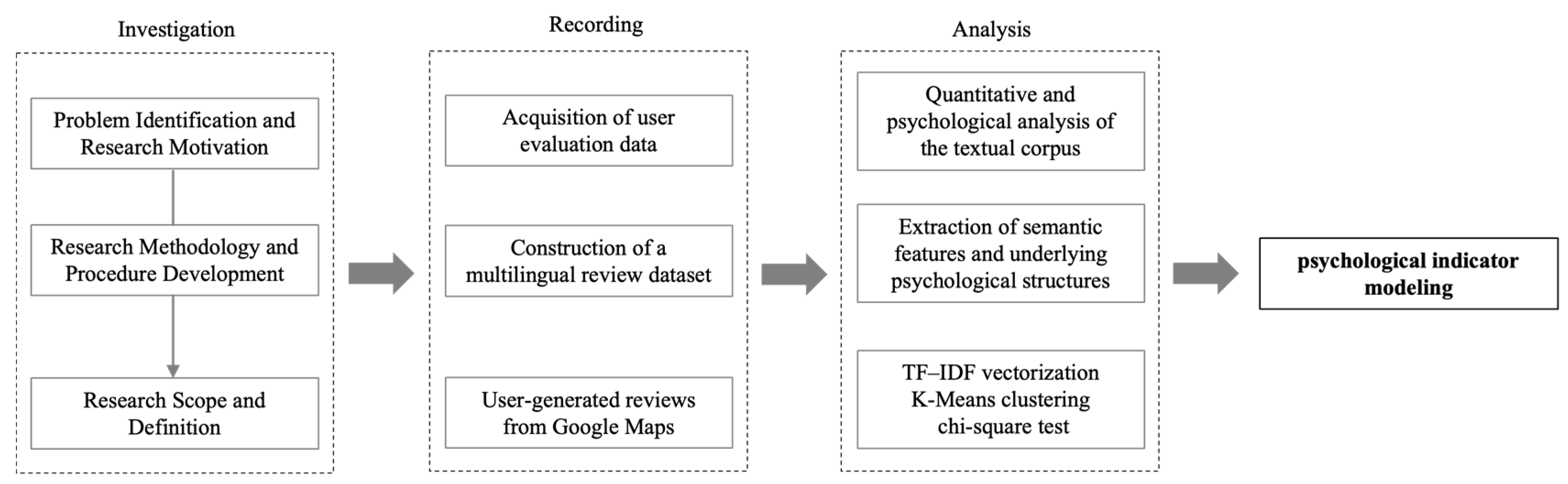
The overall research process is illustrated in Figure 2. It summarizes the study’s sequential procedures, including problem identification, data acquisition, and analytical validation, corresponding to the three stages of Investigation, Recording, and Analysis.

2.2. Data Sources and Collection Procedure

The dataset was obtained from publicly available Google Maps reviews by searching for the term “Hakata Station” and associated facility names (including dining, commercial, and transportation sub-nodes). A hybrid approach combining the Google Maps API and manual screening was applied. A total of 607 raw reviews were collected and filtered using the following criteria: reviews posted between 29 April 2023, and 29 April 2024 (with a tolerance of ±1 month due to the platform’s lack of precise posting dates). Reviews written in multiple languages, including Japanese, Chinese, English, and Korean, were retained in their original language and translated. Reviews irrelevant to the station environment or containing only ratings without textual content were excluded. Personally identifiable information (PII) such as usernames and profile photos was removed. Reviews lacking substantive textual content were eliminated.
Each review was assigned to a single functional zone based on its primary context; reviews that mentioned multiple zones were classified according to the dominant narrative. This ensured a robust mapping between semantic clusters and physical spatial configurations. To ensure accurate multilingual processing, the language of each review was first identified based on the original language labels provided by the Google Maps platform. All reviews were manually checked by the researchers to verify whether the assigned language label was appropriate. Reviews containing mixed-language expressions or unclear linguistic indicators were reassessed and either reassigned or excluded if the original language could not be reliably determined. This manual verification step is particularly suitable for short, colloquial user-generated reviews, where platform labels combined with human judgment can achieve higher accuracy than automated classification tools.
All reviews were translated into English using multiple AI-based translation tools (Google Translate and ChatGPT) to establish a consistent linguistic basis for subsequent text preprocessing and semantic analysis. The translated texts were then manually reviewed to ensure semantic fidelity and interpretive accuracy. Special attention was given to spatial descriptors (e.g., “crowded,” “混雑 (congested),” “busy”), evaluative adjectives, and context-specific expressions related to environmental quality, wayfinding, crowding, and affective responses. When ambiguous or potentially inaccurate translations were identified, the corresponding translations were manually revised to preserve their intended meaning.

2.3. Semantic Consistency Check

To minimize potential cross-linguistic semantic drift, a semantic consistency check was performed on all multilingual reviews included in the dataset. The procedure involved two independent rounds of comparison by the same researcher to evaluate whether key environmental and affective meanings were preserved between the original and translated texts. Particular attention was given to spatial descriptors, evaluative adjectives, and context-dependent expressions related to wayfinding, crowding, and environmental quality. Any discrepancies identified across rounds were further reviewed and resolved through targeted revision. Only reviews whose translated meanings could be reliably validated were retained for analysis.
After these multilingual preprocessing procedures, the language distribution in the final valid dataset was as follows: Japanese (63%), English (16%), Chinese (8%), Korean (11%), and others (2%). After filtering and validation, 158 reviews remained for analysis. Given that the study site is located at Hakata Station in Japan, where the user population is predominantly Japanese-speaking, the higher proportion of Japanese-language reviews is consistent with the site-specific linguistic profile of the station’s actual users. This imbalance does not affect analytical validity, as all multilingual reviews underwent full manual translation verification and a two-round semantic consistency check, ensuring that spatial and affective meanings were preserved across languages.

2.4. Functional Zoning and Review Mapping

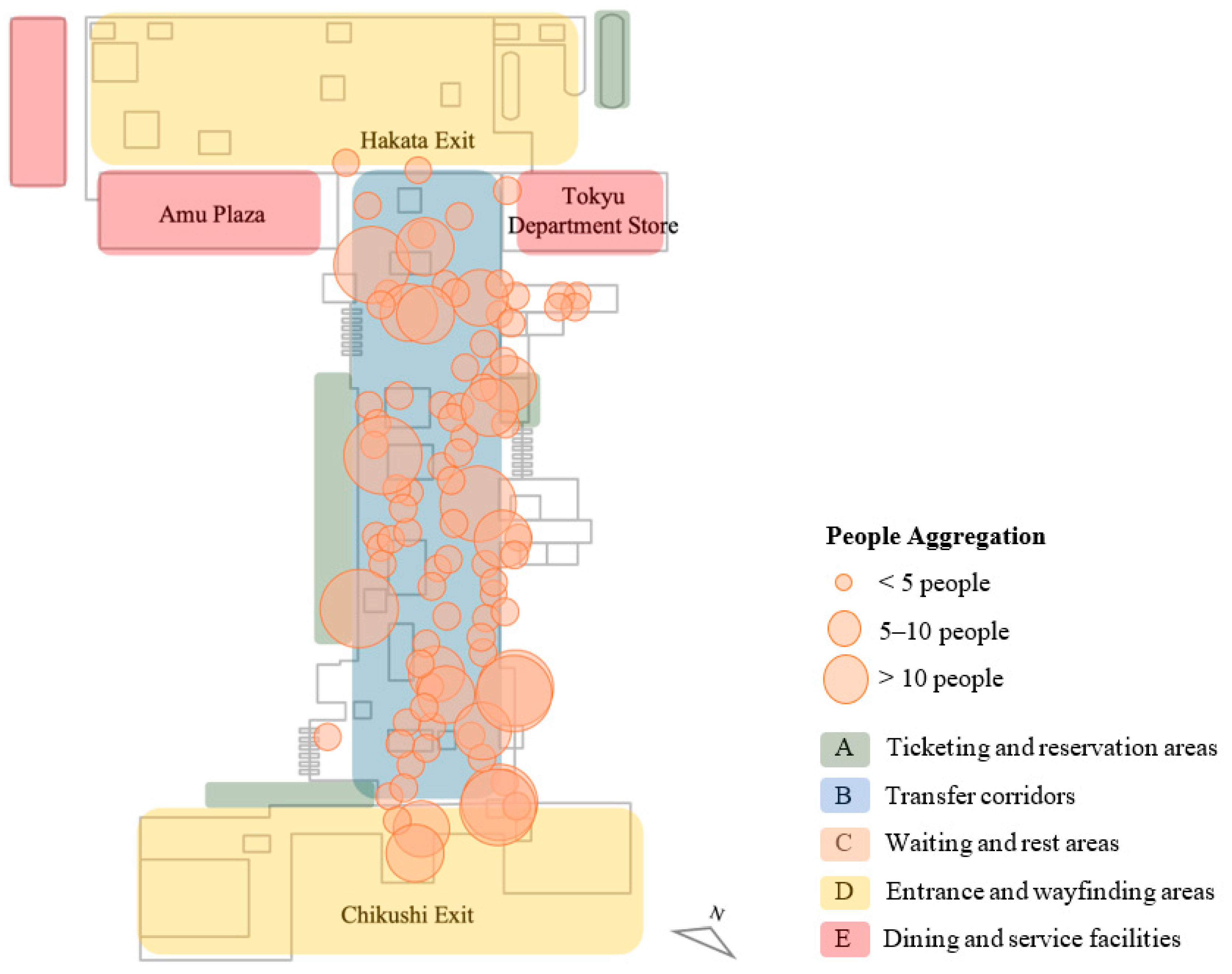
Based on the official station floor plans and comprehensive on-site observations, the first floor of Hakata Station was divided into five functional zones. User-generated reviews were subsequently mapped to these zones according to the spatial context described in each review, enabling the integration of semantic content with spatial configuration (Figure 3).
To further reinforce the quantitative foundation of the zoning framework, this study developed a pedestrian-density proxy derived from the multilingual user-review corpus. Consistent with established mobility research employing user-generated content (UGC), crowding-related lexical items (e.g., “crowded,” “busy,” “混雑 (congested),” “人多い (crowded/many people),” “擁擠 (crowded/packed),” “붐비다 (jam-packed)”) were systematically identified within each review and normalized by total review length. The normalized frequencies of these terms were then aggregated at the functional-zone level to serve as an indirect yet quantifiable indicator of perceived pedestrian density (Table 1).
This semantic proxy provides a reproducible, user-centered approximation of environmental load and complements the qualitative interpretation of floor-plan configuration used in delineating the zoning structure. The resulting values exhibit clear between-zone contrasts, with Zones A and B displaying the highest perceived density and Zone E the lowest, thereby empirically substantiating the functional distinction between circulation-oriented and stay-oriented spaces.

2.5. Semantic Analysis and Clustering Procedure

Recent advances in NLP, particularly the use of term frequency–inverse document frequency (TF–IDF) vectorization and K-means clustering, have enabled the extraction of semantic features from large-scale online review datasets [39,40]. In parallel, sentiment-based review analysis has been applied in digital platforms to capture users’ affective tendencies and contextual attitudes [41]. Such emotion-oriented approaches demonstrate the potential of integrating opinion mining into spatial and psychological research frameworks. Building on this direction, applied studies have further applied sentiment analysis to Google Maps review systems to enhance recommendation accuracy and contextual understanding of user experiences [40]. Such integration illustrates how NLP-driven emotion analysis can be directly linked with spatial perception and service evaluation in real-world settings. Text preprocessing included language detection, encoding standardization (UTF-8), tokenization, stop word removal, and normalization. Reviews were then vectorized using the Term Frequency–Inverse Document Frequency (TF–IDF) method, which emphasizes discriminative keywords that appear frequently in individual documents but rarely across the corpus, while down-weighting ubiquitous function words (e.g., the, is). In this study, TF–IDF features were restricted to the top 1000 terms to ensure computational stability. The normalized term frequency (NormTF) and the term frequency–inverse document frequency (TF–IDF) were used to quantify the relative importance of each word within the multilingual review corpus, as defined in Equations (1) and (2). These techniques allow the identification of semantic patterns across spatial zones, which can subsequently be tested for correspondence with functional divisions using statistical methods. At the same time, standardized lexical frequency measures enable the transformation of reviews into quantifiable indicators of environmental psychology, which can be further examined through correlation and regression analyses to evaluate their effects on emotions and preferences.
N o r m T F i = f w i T o t a l n u m b e r o f w o r d s i n t h e r e v i e w
where f ( w i ) is the frequency of the i -th word ( w i ) appearing in the review, and NormTFi is the normalized term frequency of word w i within the review.
T F I D F t , d = T F t , d × log   N D F t
where TF(t, d) is the term frequency of word t in document d, DF(t) is the number of documents containing term t, and N is the total number of documents.
To avoid arbitrarily removing low-frequency but potentially meaningful descriptors, no TF–IDF threshold (e.g., min_df or frequency cutoff) was applied. Instead, stability tests were conducted by varying the vocabulary size (500, 1000, and 2000 top TF–IDF terms). Among these settings, the 1000-term vocabulary yielded the most coherent and interpretable clustering structure, striking an effective balance between semantic coverage and noise reduction. Smaller vocabularies excluded informative mid-frequency terms, whereas larger vocabularies introduced noise from fragmented or idiosyncratic expressions. Thus, the 1000-term setting was selected as the final configuration for semantic clustering.
To mitigate instability caused by high-dimensional sparse matrices, Truncated Singular Value Decomposition (Truncated SVD) was applied to obtain a more compact latent semantic representation while preserving the corpus’s underlying structure. K-means clustering was then conducted with multiple random initializations.
Based on preliminary tests and Silhouette evaluation, K = 5 was determined as the optimal number of clusters. Repeated initializations yielded consistent cluster assignment patterns. Multiple K values (K = 3–7) were tested, and K = 5 yielded the highest and most stable Silhouette scores across 20 random initializations. Alternative validity indices (Davies–Bouldin and Calinski–Harabasz) also showed local optima at K = 5, supporting the robustness of the clustering solution. Higher K values produced fragmented themes, whereas lower K values merged semantically distinct patterns, further supporting the interpretability of K = 5. In this study, the number of SVD components was determined through preliminary sensitivity testing, which compared solutions across a range of component sizes (50–150). Results showed that semantic cluster assignments remained stable within this range, and 100 components were adopted as a balanced setting that preserved semantic structure while preventing overfitting.
K-means was used to partition the dataset into non-overlapping groups, maximizing intra-cluster similarity and inter-cluster dissimilarity through iterative updates of cluster centroids until convergence. The optimization process can be mathematically expressed as shown in Equation (3), where the algorithm minimizes the total within-cluster variance. The five resulting clusters were interpreted as distinct semantic themes representing users’ perceptions and behavioral tendencies (Table 2). Each cluster was labeled by high-frequency terms and contextual meanings, resulting in five semantic themes: Passenger flow and crowding, Entrance impression, Ticketing and reservation processes, Waiting and rest experiences, and Commercial convenience.
arg C min k = 1 K x i C k   x i μ k 2
where C = { C 1 ,   C 2 ,   ,   C K } is the set of K clusters, represents the data point (e.g., a review vector) assigned to cluster C k , μ k is the centroid of cluster k , x i μ k 2 denotes the squared Euclidean distance between each data point and its cluster centroid, and arg m i n C indicates the optimization process that minimizes the total within-cluster variance.
To examine the relationship between semantic themes and functional zones, chi-square tests were performed. Reviews were mapped to spatial zones either by POS-based identification or manual coding. Cross-tabulation and chi-square analysis (χ2 = 632.00, df = 16, p < 0.001) (4) demonstrated a highly significant association between semantic clusters and spatial zones, far exceeding what would be expected by random distribution. In other words, the spatial distribution of different semantic clusters varied substantially across zones. For instance, Cluster 1 was primarily concentrated in the transfer corridors (Zone B), while Cluster 4 was more prevalent in the dining and commercial areas (Zone E). This finding indicates a strong structural correspondence between users’ psychological semantics and the spatial functions of the station environment. The lexicons were constructed using a combined top-down and bottom-up strategy. First, theoretical constructs from environmental psychology were used to define the conceptual boundaries of each indicator (top-down). Second, all multilingual terms appearing in the validated corpus were screened and grouped according to semantic relevance (bottom-up). Candidate keywords were required to appear in at least three reviews and to exhibit consistent contextual usage. The final lexicons were refined through iterative manual verification to ensure coherence between theory-driven definitions and corpus-derived linguistic patterns.
x 2 = O E 2 E
where χ 2 is the chi-square statistic representing the degree of discrepancy between the observed and expected frequencies, O is the observed frequency in each cell of the contingency table, E is the expected frequency in each cell calculated under the null hypothesis, and denotes the summation over all categories or cells.

2.6. Environmental Psychology Indicators and Hypothesis Testing

Drawing upon environmental psychology theories and the S–O–R model, six indicators were constructed to capture users’ psychospatial responses: wayfinding usability, crowding density, seating and rest availability, functional convenience, environmental quality, and information legibility [42]. These indicators were operationalized using a dictionary-based approach, in which keywords for each construct were identified in reviews and normalized by review length. Indicator scores were subsequently analyzed using Pearson correlation and logistic regression to examine their associations with emotional valence.
log   ρ 1 ρ = β 0 + β 1 I k
where p is the probability of an event (e.g., a review belonging to a specific cluster or category), p 1 p represents the odds of the event occurring, log p 1 p is the log-odds (logit) transformation, used to model a binary outcome, β 0 is the intercept term of the model, β 1 is the regression coefficient associated with the independent variable I k , and I k denotes the explanatory variable (e.g., the presence of a specific spatial or semantic feature).
Drawing upon environmental psychology theories and the S–O–R model, six indicators were constructed to capture users’ psychospatial responses: wayfinding usability, crowding density, seating and rest availability, functional convenience, environmental quality, and information legibility [42]. These indicators were operationalized using a dictionary-based approach, in which keywords for each construct were identified in reviews and normalized by review length. Indicator scores were subsequently analyzed using Pearson correlation and logistic regression to examine their associations with emotional valence. The keyword dictionaries were developed using a combined top-down and bottom-up procedure. First, each indicator was defined based on established concepts in environmental psychology— including wayfinding behavior, perceived crowding, environmental comfort, functional attributes, and information legibility. Empirical evidence from transit research further supports these constructs; for example, visual search behavior strongly influences wayfinding efficiency [43], and signage readability is a critical component of universal design principles in complex transit environments, especially for elderly users [44,45].
Multilingual terms in the corpus were then extracted and categorized based on their semantic relevance to each indicator. The dictionaries were iteratively refined through manual review to ensure alignment between theoretical definitions and corpus-derived linguistic patterns. The complete keyword dictionaries for all six indicators are provided in Supplementary Table S1. To ensure full transparency, all keywords were derived exclusively from the validated multilingual corpus (N = 158), with no external lexicons incorporated. This procedure ensured that the final dictionaries reflected both (1) theory-driven conceptual boundaries and (2) empirically observed user narratives. These six indicators correspond to widely recognized dimensions in environmental psychology and spatial perception. Their conceptualization is consistent with classical frameworks such as Kaplan and Kaplan’s preference theory, Nasar’s environmental aesthetics, and universal design principles for transit wayfinding. Accordingly, the corpus-derived keyword dictionaries were anchored in theoretically validated perceptual dimensions, ensuring that indicator construction was conceptually grounded rather than based on arbitrary lexical grouping.

2.7. Methodological Innovation and Advantages

This study advances psychospatial research by integrating user-generated content (UGC), NLP-based semantic analysis, and the quantitative construction of environmental psychology indicators within a unified analytical framework. The methodology incorporates multilingual review processing—including full translation verification and cross-linguistic semantic consistency checks—ensuring the reliability of meaning extraction across languages.
The proposed end-to-end pipeline, spanning semantic clustering to the development of theory-grounded psychological indicators, provides a transparent and reproducible approach that can be readily applied to other transit hubs and high-density urban environments. Unlike traditional methods that rely predominantly on surveys or monolingual datasets, this multi-layered framework enables cross-linguistic quantification of user perceptions, reduces linguistic and cultural bias, and enhances both the ecological validity and representativeness of findings.
By leveraging naturally occurring multilingual UGC, the approach offers a scalable and low-cost means of evaluating spatial design performance and psychospatial conditions. As such, the framework contributes methodological innovation to the study of urban mobility environments and supports user-centered strategies for sustainable station design and low-carbon urban development.
To ensure reproducibility, all computational procedures were conducted in Python (Version 3.10.4). Semantic vectorization, clustering, and dimensionality reduction (TF–IDF, K-means, Truncated SVD) were performed using scikit-learn (Version 1.3.0), while text preprocessing was carried out using NLTK (Version 3.8.1). Automatic language identification was conducted with the langdetect library (Version 1.0.9). Google Maps reviews were collected directly from the Google Maps platform (maps.google.com). Multilingual translation was performed using Google Translate (translate.google.com) and ChatGPT (openai.com/ChatGPT). All statistical analyses—including Pearson correlations, chi-square tests, and logistic regression—were conducted using Python and scikit-learn.

3. Results

This section presents the main findings of the semantic analysis and statistical tests, organized into three subsections.

3.1. Correspondence Between Semantic Clusters and Functional Zones

3.1.1. Term Frequency–Inverse Document Frequency (TF–IDF) Vectorization

Using TF–IDF vectorization and K-means clustering (K = 5), five principal semantic clusters were identified (Table 3):
  • C0: Passenger flow and crowding;
  • C1: Entrance impressions;
  • C2: Ticketing and reservation processes;
  • C3: Waiting and rest experiences;
  • C4: Commercial convenience.
To move beyond descriptive enumeration, the clusters were interpreted in relation to temporal mobility rhythms (based on posting timestamps) and on-site spatial affordances. This interpretive approach allowed the clusters to be understood as situated cognitive responses shaped by weekday commuter pressure and weekend leisure-oriented behavior.
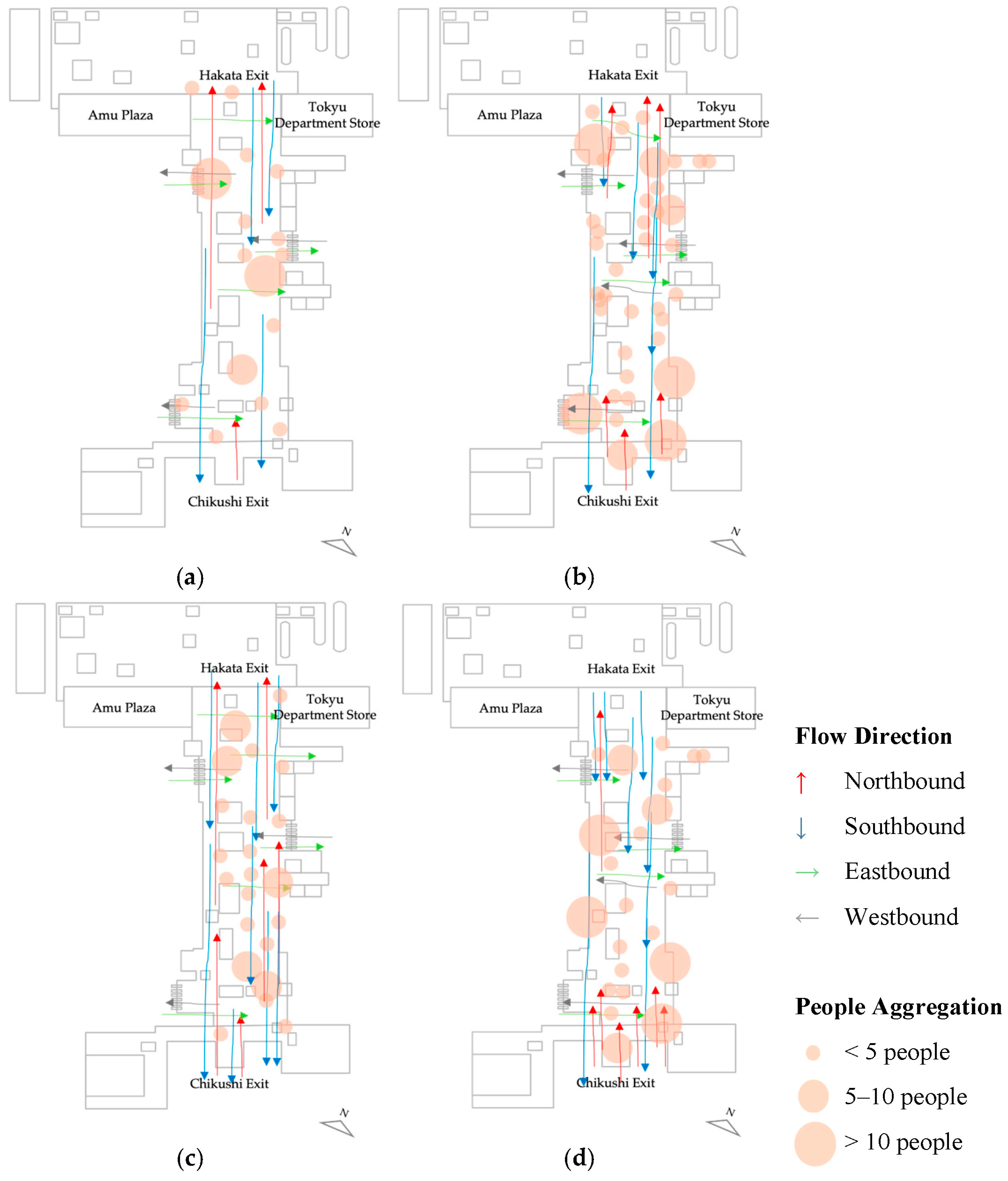
These temporal contrasts, interpreted qualitatively by grouping reviews by weekday and weekend timestamps and through field observations, enrich the understanding of how high-intensity transit flows compress semantic diversity, whereas slower-paced weekend activities expand perceptual themes toward comfort, exploration, and commercial engagement. To complement the semantic clustering analysis, supplementary on-site behavioral observations were qualitatively conducted to document user aggregation and circulation patterns on the first floor of Hakata Station. As shown in Figure 4, weekday and weekend movements exhibited distinct directional flows and density contrasts between the Hakata and Chikushi exits, revealing temporal shifts in spatial use. These observed flow patterns directly reinforce the semantic clustering results, confirming that linguistic expressions in UGC correspond to lived spatial behaviors.
On weekday mornings, qualitative field observations showed that commuter flows dominated, characterized by high perceived movement intensity but low spatial aggregation. Most users moved swiftly through the transfer and circulation zones (Zones A and B), forming clear directional tendencies toward ticket gates and platforms. The most congested points occurred near rail entrances and exits, reflecting time-pressured, efficiency-oriented mobility. This pattern aligns with the dominance of Cluster C0 in Zones A and B, indicating that concerns related to movement efficiency and crowding emerge most strongly under temporal pressure. By weekday afternoons, although overall flow volume did not necessarily decrease, spatial aggregation and dwell-related behaviors became more pronounced, particularly in areas associated with resting, waiting, or commercial activities. Despite this increase in localized gathering, circulation along major pathways remained highly concentrated, preserving a flow-oriented spatial structure centered on throughput rather than extended stay. This coexistence of greater afternoon aggregation and persistent linear circulation is consistent with the continued dominance of Cluster C0, suggesting that even outside commuting hours, passenger cognition remained focused on movement efficiency.
In contrast, weekends showed an opposite behavioral rhythm. On weekend mornings, tourists and leisure travelers prevailed, with movement characterized by moderate flow and moderate aggregation. While total visitors increased, their purposes diversified—shopping, dining, and sightseeing—resulting in more multi-directional movement patterns throughout the station. By weekend afternoons, flow volume appeared lower, while spatial aggregation was subjectively higher, particularly in dining and rest zones (Zones C and E). These areas became localized hubs, forming noticeable stationary clusters rather than transitory flows, as observed qualitatively on-site. This behavioral inversion mirrors Clusters C3 and C4, which emphasize rest, comfort, and commercial convenience—dominant themes in Zones C and E.
Overall, the contrast between weekday and weekend behavior, as revealed through timestamp grouping and field observations, demonstrates a temporal inversion in movement and gathering within the same urban node: weekdays prioritize functional mobility and directional efficiency, whereas weekends emphasize social interaction, comfort, and psychological restoration. This temporal shift illustrates how sustainable transit environments balance spatial efficiency with affective engagement, achieving a dynamic equilibrium between movement and meaning. These findings collectively show that semantic clusters are not isolated textual artifacts but are embedded reflections of users’ psychospatial experiences across different temporal phases. The weekday–weekend movement observations served as behavioral triangulation to support the semantic–spatial interpretation of the clusters. Weekday congestion patterns concentrated in Zone B aligned with crowding-related expressions in Cluster C0, while weekend dwell patterns in Zones C and E corresponded with experiential and commercial themes represented in Clusters C3 and C4. The field observation results were used solely to reinforce the interpretation of semantic–spatial correspondence, serving as supplementary evidence rather than as an independent analytical dataset.

3.1.2. The K-Means Clustering Method

Cross-tabulation and chi-square tests revealed a significant association between semantic clusters and the five functional zones on the first floor of Hakata Station (χ2(16) = 632.00, p < 0.001). The distribution was as follows:
  • C0 was highly concentrated in the transfer corridors (Zone B);
  • C2 appeared exclusively in the ticketing area (Zone A);
  • C3 was mainly located in the waiting and rest areas (Zone C);
  • C1 was closely associated with the entrance hall (Zone D);
  • C4 was predominantly concentrated in the commercial and dining spaces (Zone E).
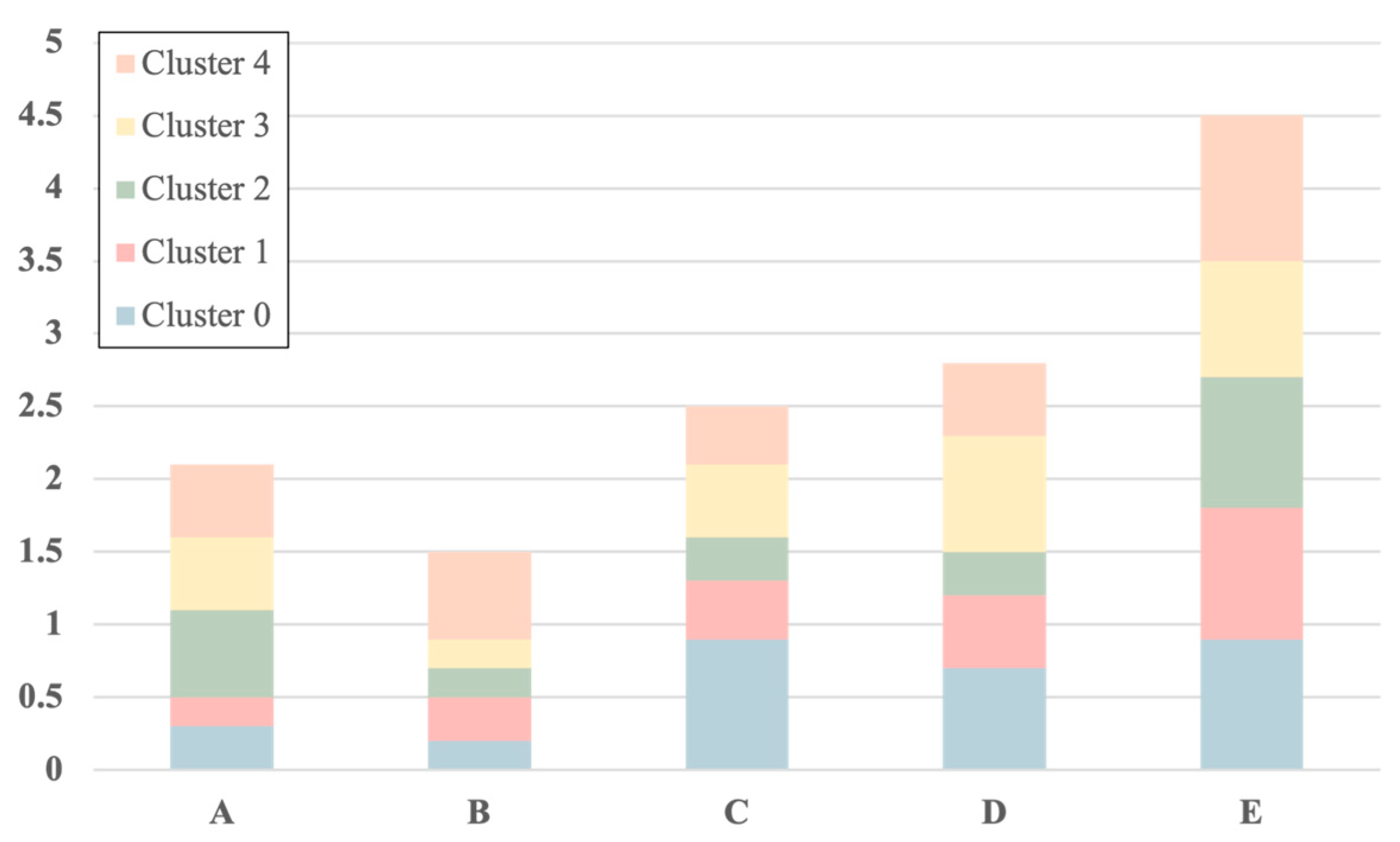
Zones A and B exhibited the narrowest semantic bandwidths, each shaped predominantly by a single functional concern. By contrast, Zones C–E displayed markedly greater semantic richness, capturing a more diverse range of perceptual themes related to rest, exploration, and commercial engagement. This gradient illustrates not only a shift in users’ perceptual focus but also a parallel expansion of cognitive diversity as spatial affordances increase (Figure 5).
Zone E showed the strongest cumulative semantic intensity among all zones, driven most prominently by C4 and followed by C0, C1, C2, and C3. Such elevated accumulation indicates that multifunctional environments heighten the overlap of psychological demands—encompassing flow regulation, spatial identity formation, experiential comfort, and commercial activity. This pattern aligns with theoretical assertions that greater spatial complexity promotes broader semantic and cognitive responses. Zone D exhibited the second-highest cumulative intensity, dominated by C3 with supplementary contributions from C0 and moderate inputs from C1 and C4. These distributions suggest that users in entrance areas prioritize impressions of overall spatial quality, service facilities, and comfort-related features.
In Zone C, semantic expressions were primarily shaped by C0, followed by C3, with moderate involvement of C1 and C4. This configuration reflects a composite psychological appraisal wherein waiting areas simultaneously accommodate flow-related pressures, restorative needs, and commercial convenience. In comparison, Zones A and B showed the lowest cumulative intensities. Zone A was clearly dominated by C2, accompanied by moderate contributions from C3 and C4, while C0 and C1 played minor roles. This pattern indicates that procedural efficiency is the central determinant of user experience in this area. Zone B, conversely, was characterized most strongly by C4 and moderately by C1, with consistently low intensities for C0, C2, and C3. Contrary to common assumptions that transfer corridors are primarily influenced by crowding or navigational load, the findings indicate that users’ perceptions in this zone are driven more by adjacent commercial activities and convenience. The low scores for C0, C2, and C3 further suggest that procedural and wayfinding pressures are not major stressors in this context.
Taken together, these findings demonstrate a coherent semantic–spatial logic in user-generated reviews, revealing how individuals cognitively negotiate functional, restorative, and commercial demands across station environments. Prior behavioral mapping research has shown that environmental affordances and social activities similarly generate spatially differentiated patterns of vitality [46], reinforcing the cross-contextual robustness of the semantic–spatial correspondences observed in this study.

3.2. Environmental Psychology Indicators and Emotional Responses

3.2.1. Positive Emotion Proportions and Observed Versus Expected Values

Across the five spatial zones, emotional valence showed a clear gradient from function-driven areas to leisure-oriented environments, revealing how spatial affordances shape psychological appraisals. As shown in Table 4, Zone A exhibited a balanced distribution of positive and negative comments, reflecting users’ frustration with queueing bottlenecks and procedural delays. This evenly split pattern suggests that task-oriented stressors suppress emotional positivity, consistent with environmental psychology findings on cognitive load in constrained circulation environments.
In contrast, Zone B displayed a predominantly positive tone (≈78%), indicating that clear circulation paths, predictable flows, and effective signage contributed to smoother wayfinding. This shift from procedural stress (Zone A) to navigational clarity (Zone B) demonstrates how spatial legibility can regulate user stress levels and restore affective balance. Zones C and D showed over 80% positive evaluations, driven by comfortable seating, open waiting spaces, and strong spatial identity at entrances. These results highlight how restorative functions and high-quality first impressions are central to positive emotional appraisals in high-mobility environments. Finally, Zone E produced the highest proportion of positive comments (≈90%), reflecting the strong influence of retail and dining amenities on emotional satisfaction.
The concentration of commercial services appears to promote hedonic value and experiential comfort, amplifying users’ positive emotional tone more than any other spatial zone. Beyond sentiment proportions, the chi-square results further reveal structured associations between semantic clusters and functional zoning. Large deviations between observed and expected counts (Table 5, Table 6 and Table 7) demonstrate that emotional expressions are not randomly distributed but correspond systematically to spatial affordances. For instance, Cluster C0 in Zone B (54 observed vs. ≈18 expected) confirms that crowding and flow-related stressors dominate in transfer corridors. Similarly, Cluster C2’s concentration in Zone A (10 observed vs. ≈0.63 expected) reflects strong user dissatisfaction with ticketing and reservation processes, supporting the interpretation that procedural friction intensifies negative affect.
Conversely, the prominence of C3 in Zone C (10 observed vs. ≈0.63 expected) illustrates that static rest settings play a crucial role in psychological restoration, as reviews recurrently mentioned comfort, spaciousness, and quietness. In Zone D, the concentration of C1 (21 observed vs. ≈2.79 expected) indicates that entrance environments act as emotionally charged loci of first impression and spatial identity. Finally, the strong overrepresentation of C4 in Zone E (63 observed vs. ≈57.12 expected) shows that diverse food and retail offerings substantially elevate user’s emotional experiences, reflecting the tight connection between commercial accessibility and positive sentiment.
Taken together, these distributions demonstrate that emotional responses in UGC are spatially structured and closely aligned with zone-specific functional characteristics. They further suggest that users’ psychological evaluations follow the operational and experiential logic embedded within each area. These relationships are associative rather than causal, consistent with the qualitative and semantic nature of UGC data.

3.2.2. Correlation and Predictive Effects of Environmental Psychology Indicators

Building upon the spatial clustering and chi-square results presented earlier, this section further examines how users’ psychological perceptions and emotional responses correspond to different functional zones within Hakata Station. Based on the previously identified semantic–spatial correspondence, Table 8 summarizes the normalized mean values of six environmental psychology indicators across the five functional zones. The results show that functional convenience achieved the highest scores in Zones A and E, reflecting its superior circulation efficiency and commercial accessibility. In contrast, Zones Cand exhibited higher values for rest-related indicators, consistent with their restorative and dwell-oriented spatial characteristics (Table 8 and Table 9). To further elucidate the relationship between psychosocial attributes and emotional responses, Table 3 presents the sentiment distribution of user reviews across spatial zones. The proportion of positive emotions gradually increases from functional zones (A–B) to leisure-oriented zones (C–E), indicating that comfort, convenience, and environmental quality are the main factors influencing positive emotional experiences.
Pearson correlation analysis revealed that most environmental psychology indicators were positively associated with positive emotions; however, logistic regression results showed that only functional convenience had a statistically significant predictive effect on positive emotions (OR = 31.6, p = 0.05). Although most psychosocial indicators showed weak-to-moderate positive correlations with emotional valence (r < 0.2), only functional convenience reached statistical significance in the regression model (Logit = 3.45, p = 0.05). This suggests that while several psychosocial factors contribute to emotional experiences, functional efficiency remains the dominant predictor of positive affect. Overall, the findings indicate that smooth spatial circulation and convenient commercial facilities play a crucial role in enhancing users’ emotional experiences (Table 8).

3.3. Semantic Patterns Across Functional Zones

Semantic analysis further revealed distinct psychospatial preference patterns across functional zones, revealing how users’ emotional tone and cognitive focus shifted in response to spatial affordances. Flow-oriented areas, such as ticketing spaces and transfer corridors (Zones A and B), were characterized by reviews containing terms such as “queue,” “crowded,” “confusing circulation,” and “long waiting time. “These repeated references indicate high cognitive load and time pressure, demonstrating that procedural and navigational friction points evoke negative emotional tendencies. This pattern aligns with the strong clustering of C0 and C2 in Zones A and B, reinforcing that efficiency-related stress dominates user experiences in movement-dependent environments.
Restorative areas, primarily the waiting and dining spaces in Zones C and E, corresponded to reviews emphasizing “comfortable,” “spacious,” “pleasant,” “quiet,” and “clean. “These descriptors illustrate that static, dwell-oriented environments promote psychological restoration and positive emotional regulation. This finding is consistent with the high positive-emotion ratios and semantic clustering of C3 and C4 in these areas.
A third pattern reflected exploratory motivation. Reviews from transitional passages occasionally included terms such as “interesting,” “curious,” “hidden,” “corner,” and “new discovery. “These expressions suggest that moderately enclosed pathways may encourage exploratory engagement, especially at the interface between transfer corridors and commercial zones, forming a functional “flow–exploration boundary.” Although explicit social-interaction terms appeared less frequently, references such as “waiting together,” “many people,” or shared queueing situations signaled a subtle sense of collective presence. This aligns with the environmental psychology literature on place identity, which shows that social attachment and shared meanings influence emotional appraisal even in high-mobility contexts [47].
Overall, these psychospatial patterns demonstrate that multilingual UGC captures differentiated emotional tone, cognitive load, exploratory interest, and social atmosphere across functional zones. Together, they provide evidence that user perception in large transit hubs is spatially encoded and highly sensitive to functional and experiential attributes.

4. Discussion

This study applied user-generated content (UGC) and natural language processing (NLP) to examine the semantic structures and psychospatial perceptions of users within the first floor of Hakata Station in the post-pandemic period. The results identified a robust correspondence between semantic clusters and functional spatial zones, indicating that linguistic expressions in multilingual reviews accurately reflect users’ lived spatial experiences. These findings validate the central hypothesis that semantic patterns extracted from UGC can serve as reliable proxies for users’ psychological appraisals within high-mobility urban environments.

4.1. Alignment with Existing Theories

The study’s findings align closely with core theories in environmental psychology and spatial cognition [13,14,15], which emphasize the interdependence among spatial perception, affective response, and environmental legibility. The semantic distinctions observed across zones—ranging from efficiency-oriented impressions in ticketing and circulation areas to comfort-oriented evaluations in resting and commercial spaces—correspond well with established knowledge on how functional affordances shape cognitive load and emotional outcomes. These findings also resonate with Lynch’s concept of imageability, showing that entrance areas (Zone D) elicit strong identity-based impressions, and with Nasar’s work on environmental aesthetics, which highlights the role of sensory coherence and complexity in shaping emotional valence.

4.2. Divergence and Added Contributions

Unlike previous studies that rely primarily on surveys or monolingual datasets, this study demonstrates that multilingual UGC can capture heterogeneous, naturally occurring psychospatial perceptions within a major transit hub. Moreover, while earlier research often emphasized environmental quality or aesthetics as primary determinants of emotional responses, this study found that functional convenience was the only indicator showing significant predictive power, revealing a distinct affective mechanism specific to high-density mobility environments.
Importantly, the patterns revealed in this study extend beyond environmental psychology into the domain of cultural urbanism. The prominence of efficiency, order, and predictable circulation in movement-dominant areas reflects broader Japanese urban cultural paradigms that prioritize smooth mobility and clear spatial organization. Conversely, the emphasis on comfort, spaciousness, and social atmosphere in static zones reflects the parallel cultural value placed on restorative micro-environments within dense urban contexts. The semantic distribution across zones, therefore, captures not only functional differentiation but also culturally embedded expectations regarding how urban spaces should support both instrumental and affective needs.
From a sustainability perspective, the findings illuminate the integrated roles of affective comfort and sustainable mobility within large transit hubs. When users perceive that spatial design simultaneously meets the demands of efficiency, clarity, and psychological well-being, urban nodes can contribute to social resilience rather than serving merely as transport conduits. This synthesis aligns with the principles of SDG 11, which underscore the need for inclusive, accessible, and emotionally supportive urban environments.
Furthermore, this study highlights the methodological value of integrating computational linguistics with environmental psychology. The consistent mapping between semantic clusters and spatial functions demonstrates the feasibility of using multilingual UGC as a scalable, ecologically valid data source for assessing psychospatial conditions. This approach complements traditional survey- or interview-based assessments, which are often constrained by sample size, language homogeneity, or recall bias.
Looking ahead, future research may advance these findings by integrating semantic analysis with behavioral evidence such as pedestrian trajectories, movement density analysis, or gaze-tracking to construct a Psychospatial Semantic Map capable of quantitatively validating the correspondence between linguistic patterns and in situ behaviors. Such a multimodal framework would enhance both theoretical understanding and practical design applications, enabling more precise, evidence-based spatial optimization. Additionally, comparative studies across cities or countries could evaluate the cultural specificity of the patterns observed here, contributing to globally applicable, user-centered design guidelines for sustainable urban nodes.

5. Future Research Directions

Future research can extend the analytical framework of this study in several directions. First, expanding the scale and linguistic diversity of multilingual user-generated content (UGC) datasets would allow more robust cross-cultural comparisons of psychospatial perception, particularly in complex transit nodes serving heterogeneous user groups. Second, integrating behavioral evidence—such as GPS mobility traces, pedestrian-flow analytics, or systematic on-site behavioral observations—would further validate the semantic–spatial correspondences identified in this study and provide deeper insight into real-time user interactions within station environments. Third, advances in natural language processing, including transformer-based embedding models and multimodal language models, offer opportunities to improve cross-linguistic semantic representation and reveal more nuanced emotional and contextual patterns.
Because this study was designed to strengthen a qualitatively grounded framework through the incorporation of quantitative analyses, future work may extend this direction by adopting more sophisticated quantitative methods. Approaches such as multivariate regression, structural equation modeling (SEM), or mixed-methods designs could clarify causal pathways and mediating mechanisms linking semantic expressions, environmental psychology indicators, and emotional responses. Such analytical refinements would not only deepen the quantitative dimension of this research but also enhance the external validity and generalizability of psychospatial indicators. Additionally, future studies may incorporate more advanced clustering validation techniques—such as gap statistics, elbow methods, or ARI/NMI metrics—when larger and more quantitatively oriented datasets become available.
Beyond methodological expansion, future studies may also examine sustainability and inclusivity perspectives in greater detail by investigating how different demographic groups—such as older adults, international travelers, and passengers with mobility or sensory impairments—perceive and interact with transit environments. Evaluating the effects of accessibility interventions, digital wayfinding systems, or policy-driven spatial improvements would provide evidence on how spatial affordances influence emotional well-being and mobility equity. Finally, conducting cross-city or cross-country comparative studies across major transportation hubs could enhance external validity and help develop empirically grounded, user-centered design guidelines for sustainable urban nodes.

6. Conclusions

6.1. Validation of Semantic Clusters and Spatial Zones

By applying TF–IDF vectorization and K-means clustering (K = 5), five major semantic themes, Passenger flow and crowding, Entrance impressions, Ticketing and reservation processes, Waiting and rest experiences, Commercial convenience, were identified and statistically validated through a chi-square test (χ2(16) = 632.00, p < 0.001). This result not only ruled out the possibility of random distribution but also provided empirical evidence for a clear cognitive mapping between functional zones and user-generated semantic structures.

6.2. Quantifying Environmental Psychology Indicators

Six environmental psychology indicators, Wayfinding usability, Crowding density, Seating and rest availability, Functional convenience, Environmental quality, and Information legibility, were operationalized using standardized lexical frequency measures (TF per word) and examined through Pearson correlations and univariate logistic regression. Functional convenience emerged as the only indicator with a statistically significant predictive effect on positive emotions (OR = 31.6, p = 0.05), whereas other indicators showed positive but non-significant tendencies. This finding underscore passengers’ sensitivity to smooth processes and commercial amenities and highlights the central role of functional convenience in shaping subjective emotional experiences.

6.3. Psychospatial Preferences Reflected in User Reviews

Semantic patterns in multilingual user reviews revealed distinct Psychospatial preferences aligned with functional zones. Process-oriented areas (Zones A and B) showed high-frequency negative terms such as “queue,” “crowded,” and “confusing circulation,” indicating frustration and anxiety under high cognitive load. Restorative zones (Zone C, E) were dominated by positive terms such as “comfortable,” “spacious,” and “pleasant,” reflecting not only functional adequacy but also reduced cognitive fatigue. Additional patterns emerged: (1) process fluency acted as an affective regulator during ticketing and transfers; (2) lighting frequently mentioned in food/convenience areas subtly prolonged dwell time and fostered further exploration; (3) moderate enclosure and meandering paths at transfer corridors elicited exploratory motivation; (4) even low-frequency references to social interaction conveyed implicit collective presence and belonging through shared waiting or queueing experiences.

Supplementary Materials

The following supporting information can be downloaded at: https://www.mdpi.com/article/10.3390/su172410959/s1, Table S1: Psychospatial Keyword Dictionary.

Author Contributions

Conceptualization, C.T.; methodology, C.T.; formal analysis, C.T.; data curation, C.T.; writing—original draft preparation, C.T.; writing—review and editing, S.Z.; visualization, C.T.; supervision, S.Z. All authors have read and agreed to the published version of the manuscript.

Funding

This research was funded by the Japan–Taiwan Exchange Association, grant number 35087.

Institutional Review Board Statement

Not applicable.

Informed Consent Statement

Not applicable.

Data Availability Statement

The data supporting the findings of this study are available from the author upon reasonable request.

Acknowledgments

The author gratefully acknowledges the financial support provided by the Japan–Taiwan Exchange Association during the study period.

Conflicts of Interest

The authors declare no conflicts of interest.

Appendix A

Table A1. Representative multilingual user review samples with cluster, spatial zone, and sentiment classification. This table lists five representative multilingual user reviews selected from the valid dataset (N = 158). The samples were chosen to illustrate variations in language, cluster classification, spatial zone, and sentiment polarity. The complete dataset is provided in the Supplementary Materials.
IDUsable Comment (5/158/607)LanguageClusterSpatial ZoneSentimentConfidence
1도시인구에 비해 크고 인파 엄청남. 신칸센.KR0BPositive0.98
2Needs to be more modernEN1DPositive0.62
3The station itself is relatively well signed, Shink platforms are the higher numbers, but there are plenty of boards showing the departure times. …EN3CPositive0.98
4Long queues for reservations, but can just help u reserve for 1 journey! Just ask passengers to queue up again.EN2ANegative0.94
5お土産屋さんが多数あり、お土産をここで 全て買えるで便利です。JP4EPositive0.83

References

  1. La Paix, L.; Geurs, K.T. Train Station Access and Train Use: A joint Stated and Revealed Preference Choice Modelling Study. In Accessibility, Equity and Efficiency; Edward Elgar Publishing: Cheltenham, UK, 2016; pp. 144–166. [Google Scholar]
  2. Ho, R.; Au, W.T. Scale Development for Environmental Perception of Public Space. Front. Psychol. 2020, 11, 596790. [Google Scholar] [CrossRef] [PubMed]
  3. Kong-Jian, Y. Approaches and Effectiveness of Sustainable Environment and Development Planning. J. Nat. Resour. 1998, 13, 8–15. [Google Scholar]
  4. Chang, H.-S. Environmental Psychology for Architecture; Tianyuan City Culture Affairs: Taipei, Taiwan, 1996.
  5. Barker, R.G. Ecological Psychology: Concepts and Methods for Studying the Environment of Human Behavior; Stanford University Press: Stanford, CA, USA, 1968. [Google Scholar]
  6. Lei-Ching, H.; Kung-Hsia, Y. Environmental Psychology: Environment, Perception, and Behavior; Wunan Books Publishing Co., Ltd.: Taipei, Taiwan, 2005. [Google Scholar]
  7. Chen, P.-J. Exploring the Relationships Between Colors in Lighting and Environment on Emotional Experience and Visual Preference. Master’s Thesis, National Taiwan University, Taipei City, Taiwan, 2024. [Google Scholar]
  8. Hsu, W.-C. The Effect of Environmental Color Composition and Harmony on Emotional Experience and Landscape Preference. Master’s Thesis, National Taiwan University, Taipei City, Taiwan, 2014. [Google Scholar]
  9. Hung, S.-H.; Chung, W.-L.; Chang, C.-Y. The Lungs in the Urban-Using attention restorative theory, preference matrix, and eight perceived dimensions to discuss the environmental design and configuration of Daan Forest Park. Landsc. Archit. Q. 2021, 28–39. [Google Scholar]
  10. Rushton, G. Analysis of spatial behavior by revealed space preference. Ann. Assoc. Am. Geogr. 1969, 59, 391–400. [Google Scholar] [CrossRef]
  11. Bin, L. Theories and Extensions of Environmental Behavior in Environmental Behavior Studies. Archit. J. 2008, 30–33. [Google Scholar]
  12. Lee, W.-Y. The Effect of Facility in the Open Space on Waiting Behavior. Master’s Thesis, Chung Yuan Christian University, Taoyuan City, Taiwan, 2009. [Google Scholar]
  13. Kaplan, R.; Kaplan, S. The Experience of Nature: A Psychological Perspective; Cambridge University Press: Cambridge, UK, 1989. [Google Scholar]
  14. Nasar, J.L. The Evaluative Image of the City. J. Am. Plan. Assoc. 1990, 56, 41–53. [Google Scholar] [CrossRef]
  15. Lynch, K. The Image of the City; The M.I.T. Press: Cambridge, MA, USA, 1960. [Google Scholar]
  16. Canter, D. The Psychology of Place. In Readings on the Psychology of Place; Routledge: Abingdon, UK, 2023; pp. 70–75. [Google Scholar]
  17. Lee, Y.-J. Cognitive Map and Preference Matrix-An Introduction to the Study of Environmental Psychology. J. Build. Plan. Natl. Taiwan Univ. 1990, 5, 133–140. [Google Scholar] [CrossRef]
  18. Simonet, M.; Vater, C.; Abati, C.; Zhong, S.; Mavros, P.; Schwering, A.; Raubal, M.; Hölscher, C.; Krukar, J. Probing mental representations of space through sketch mapping: A scoping review. Cogn. Res. Princ. Implic. 2025, 10, 59. [Google Scholar] [CrossRef]
  19. Zheng, B.-Y. Re-Examining the Relationships Between Mystery and Landscape Preference. Master’s Thesis, National Taiwan University, Taipei City, Taiwan, 2019. [Google Scholar]
  20. Cheng, Y.-C. Relationships Between Visual Complexity and Landscape Preference. Master’s Thesis, National Taiwan University, Taipei City, Taiwan, 2022. [Google Scholar]
  21. Wang, L.-H. Consumers’ Visual Preference in Mall Shopping. Master’s Thesis, National Taipei University of Technology, Taipei City, Taiwan, 2013. [Google Scholar]
  22. Kuo, W.-L. The Effects of Spatial Attributes on Consumers’ Shopping Time at the Night Market: Case Studies of Feng Chia Night Market in Taichung City, Taiwan and Nishijin Market in Fukuoka City, Japan. Master’s Thesis, Feng Chia University, Taichung, Taiwan, 2003. [Google Scholar]
  23. Lin, S.-C.; Chen, H.-H.; Lin, W.K.; Lee, P.-H. Formulizing the Mental Model for Customer’s Expectation of Consuming Experience: A Prospective of Environmental Psychology. J. E-Bus. 2018, 20, 33–63. [Google Scholar] [CrossRef]
  24. Luan, S.-C. A Study of Environmental Psychology of the Commercial space—A Case Study of the Food Courts of Department Store in Taipei. Master’s Thesis, Chung Yuan Christian University, Taoyuan City, Taiwan, 2012. [Google Scholar]
  25. Wu, S.H. The Construction and Representation of Consumption Space in Taipei Main Station Eslite Underground Mall. J. Soc. Sci. Public Aff. Univ. Taipei 2013, 60–91. [Google Scholar]
  26. Chi, P.-C.; Chang, H.-L. Measuring the Passengers’ Behavior and Related Psychological Influence on Patronizing Intercity Public Transportation Service. Master’s Thesis, National Chiao Tung University, Hsinchu City, Taiwan, 2003. [Google Scholar]
  27. Bécu, M.; Sheynikhovich, D.; Tatur, G.; Agathos, C.P.; Bologna, L.L.; Sahel, J.-A.; Arleo, A. Age-related preference for geometric spatial cues during real-world navigation. Nat. Hum. Behav. 2020, 4, 88–99. [Google Scholar] [CrossRef]
  28. Gazova, I.; Laczó, J.; Rubinova, E.; Mokrisova, I.; Hyncicova, E.; Andel, R.; Vyhnalek, M.; Sheardova, K.; Coulson, E.J.; Hort, J. Spatial navigation in young versus older adults. Front. Aging Neurosci. 2013, 5, 94. [Google Scholar] [CrossRef]
  29. Ying-Ren, C. A Study on the Relationships Among Leisure Motivation, Leisure Participation, and Leisure Environment Preference of the Elderly. Master’s Thesis, Chaoyang University of Technology, Taichung County, Taiwan, 2005. [Google Scholar]
  30. Holden, H.M.; Hoebel, C.; Loftis, K.; Gilbert, P.E. Spatial pattern separation in cognitively normal young and older adults. Hippocampus 2012, 22, 1826–1832. [Google Scholar] [CrossRef]
  31. Puhakka, R.; Poikolainen, J.; Karisto, A. Spatial practises and preferences of older and younger people: Findings from the Finnish studies. J. Soc. Work. Pract. 2015, 29, 69–83. [Google Scholar] [CrossRef]
  32. Bhi, H.-D. Resources in Environmental Psychology. J. Build. Plan. Natl. Taiwan Univ. 1989, 4, 115–136. [Google Scholar] [CrossRef]
  33. Irvin, K. How Far, by Which Route and Why? A Spatial Analysis of Pedestrian Preference. J. Urban Des. 2008, 13, 81–98. [Google Scholar] [CrossRef]
  34. Tas, D.; Sanatani, R.P. Geo-located aspect based sentiment analysis (ABSA) for crowdsourced evaluation of urban environments. arXiv 2023, arXiv:2312.12253. [Google Scholar] [CrossRef]
  35. Diniz, M.L.C.; Boeing, L.P.; Carvalho, W.S.; Duarte, R.B. Natural Language Processing, Sentiment Analysis, and Urban Studies: A Systematic Review. In Proceedings of the XXVII International Conference of the Ibero-American Society of Digital Graphics, Punta del Este, Uruguay, 29 November–1 December 2023. [Google Scholar] [CrossRef]
  36. Gholamnia, M.; Eslamirad, N.; Sajadi, P.; Zarin, Z.; Pilla, F. Leveraging large language models for citizen-centric urban accessibility analysis: A case study using Airbnb reviews in Dublin. Spat. Inf. Res. 2025, 33, 43. [Google Scholar] [CrossRef]
  37. Tori, F.; Tori, S.; Keseru, I.; Ginis, V. Performing sentiment analysis using natural language models for urban policymaking: An analysis of Twitter data in Brussels. Data Sci. Transp. 2024, 6, 5. [Google Scholar] [CrossRef]
  38. Chien, M.-H. What Makes an Online Review Helpful to Consumers? Master’s Thesis, Chaoyang University of Technology, Taichung City, Taiwan, 2013. [Google Scholar]
  39. Lin, S.-C. Extraction and Analysis of Research Topics Based on NLP Technologies. In Proceedings of the Research on Computational Linguistics Conference XV, Hsinchu, Taiwan, September 2003; pp. 231–255. Available online: https://aclanthology.org/volumes/O03-1/ (accessed on 1 December 2025). (In Chinese).
  40. Tsai, C.-C. Sentiment Analysis with Google Map Reviews and Recommender System. Master’s Thesis, National Taiwan University of Science and Technology, Taipei, Taiwan, 2022. [Google Scholar]
  41. Chiu, C. Review Application of Aspect Based Sentiment Analysis. Master’s Thesis, National Central University, Taoyuan City, Taiwan, 2020. [Google Scholar]
  42. Tsai, C.-Y.; Zhao, S. A Study on the Spatial Structure of Urban Nodes and the Psychological Impact of Users’ Environment–A Case Study of the Hakata Station, Fukuoka. In Proceedings of the 14th International Symposium on City Planning and Environmental Management in Asian Countries, Fukuoka, Japan, 11–13 January 2025; pp. 1–8. [Google Scholar]
  43. Suzuki, T.; Okazaki, J.; Tokunaga, T. Visual Search in Way-Finding at Subway Stations. J. Archit. Plan. Archit. Inst. Jpn. 2001, 66, 163–170. [Google Scholar] [CrossRef]
  44. Lin, P.-N. A Study on a Universal Design Perspective to Review the Indicator System Design–The Case Study of MRT Taipei Main Station and Station Front Metro Mall. Master’s Thesis, National Taipei University of Technology, Taipei City, Taiwan, 2009. [Google Scholar]
  45. Kuan, M.-Y. With a Perspective of Universal Design to Review the Demand of the Aged Using Transferring Sign System of Taipei Main Station. Master’s Thesis, National Taipei University of Technology, Taipei City, Taiwan, 2012. [Google Scholar] [CrossRef]
  46. Mu, B.; Liu, C.; Mu, T.; Xu, X.; Tian, G.; Zhang, Y.; Kim, G. Spatiotemporal fluctuations in urban park spatial vitality determined by on-site observation and behavior mapping: A case study of three parks in Zhengzhou City, China. Urban For. Urban Green. 2021, 64, 127246. [Google Scholar] [CrossRef]
  47. Chunping, Z.; Jianxin, Z. Place Identity: An Analysis from the Perspective of Environmental Psychology. Adv. Psychol. Sci. 2011, 19, 1387–1396. [Google Scholar]
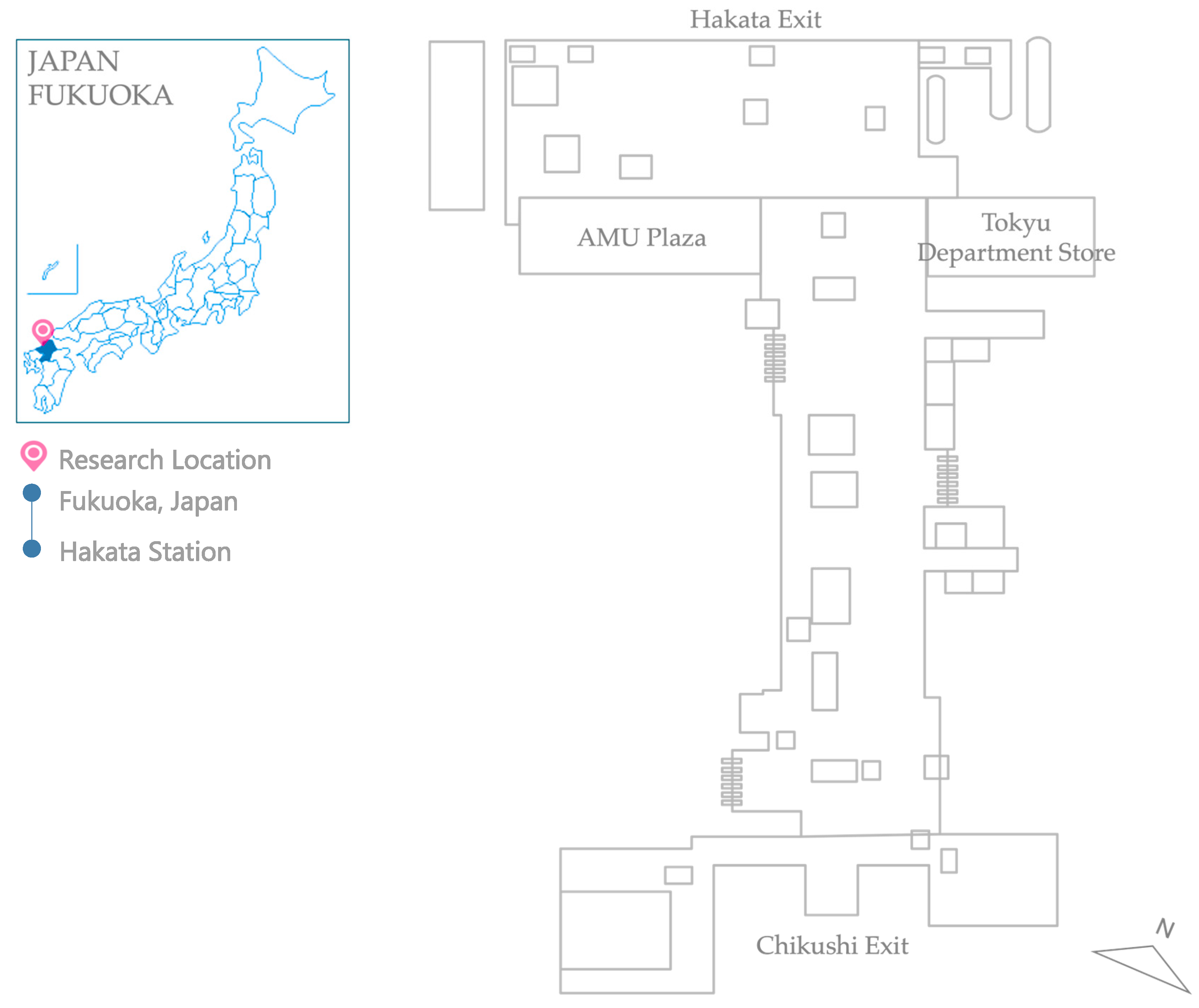
Figure 1. Research scope (Scale approx. 1:2500).
Sustainability 17 10959 g001
Figure 2. Research structure.
Sustainability 17 10959 g002
Figure 3. Review mapping by functional zones on the first floor of Hakata Station (Scale approx. 1:2500).
Sustainability 17 10959 g003
Figure 4. Analysis of User Aggregation and Movement (Scale approx. 1:4000). (a) Weekday Mornings; (b) Weekday Afternoons; (c) Weekend Mornings; (d) Weekend Afternoons.
Sustainability 17 10959 g004
Figure 5. Cumulative Proportion of Semantic Clusters across Zones. The “cumulative semantic intensity” in Figure 5 was calculated by summing the normalized cluster proportions within each functional zone. For each zone, the proportion of reviews assigned to each semantic cluster (C0–C4) was computed, and the sum of these proportions represents the cumulative intensity. This value reflects the overall concentration of semantic expressions in a zone and allows comparison of semantic richness across spatial areas. Cumulative intensity” refers to the aggregated frequency of indicator-related terms appearing in each spatial zone, normalized by the total number of reviews in that zone.
Sustainability 17 10959 g005
Table 1. Pedestrian-Density Proxy values across functional zones.
ZoneFunctional Area DescriptionPedestrian-Density Proxy (per 100 Chars)
ATicketing & Reservation Area1.82
BTransfer Corridors/
Main Passageways
3.04
CWaiting/Open Rest Areas0
DEntrance/Navigation Nodes1.44
EDining & Amenity Zone0.53
Table 2. Summary of semantic clusters with theme labels and example keywords.
Cluster IndexTheme LabelExample Keywords
0Passenger flow and crowdingpeople, crowded, congestion, design, walkways
1Entrance impressionslobby, entrance, scale, impression, landmark
2Ticketing and reservation processestickets, booking, queues, waiting, services
3Waiting and rest experiencesrest, comfort, relaxation, clean, tidy
4Commercial conveniencefood, dining, shopping, stores, convenient
Table 3. Top 10 representative user review samples and TF–IDF scores by semantic cluster.
ClusterUser ReviewTF–IDF Score
0Quite a crowded station, especially during rush hours.2.00
0It gets really crowded here.1.08
1It’s always so crowded.1.00
1The station is huge.1.00
0The connection between JR and the subway is bad.1.00
4There aren’t enough restrooms.1.00
1Not enough bathrooms, seriously.1.00
1Pretty average.1.00
0Always packed with people.1.00
1Just an ordinary station.1.00
0Very clean but always crowded.1.00
0Always full of people.1.00
0The biggest station in Kyushu, with lots of shops and train lines.1.00
0Crazy crowded during rush hours.1.00
0Always packed with people.1.00
4The atmosphere is lively.1.00
0A busy area with lots going on.1.00
3Pretty big space.1.00
3It’s a major station.1.00
4Subway access is easy.0.97
4Transportation is super convenient.0.95
4There are lots of souvenir shops around.0.94
4Plenty of restaurants here.0.89
4So many shops everywhere.0.85
4Really convenient.0.71
1Beautiful place.0.71
1Coming to Hakata always feels energetic.0.71
1Always feels comfortable using this station.0.71
4It’s close to the airport, which is great.0.71
4Gets super crowded during winter holidays.0.71
1The staff here are awesome.0.71
1This is the heart of Kyushu.0.71
3Right at the center of Kyushu.0.58
2Had to wait in a long line when booking.0.58
3Hakata Station is huge.0.58
2A bit of a hassle sometimes.0.58
3Taking the train can be tricky.0.58
3You’ll see lots of locals and tourists.0.58
3It’s a large-scale station.0.58
3The staff are friendly.0.58
2Even for first-timers, it should be easier to understand.0.58
2They only help with one-way ticket bookings.0.58
2Makes passengers line up repeatedly.0.58
2You have to exit the gate to buy a new ticket when transferring to the Shinkansen.0.58
2Needless to say.0.45
2Speechless.0.45
2So now I use other stations to pick up my tickets carefully.0.45
2It’s the biggest terminal station in Kyushu.0.45
3Feels nostalgic coming back.0.41
3More and more rail lines are opening—it’s getting even more convenient.0.41
This table lists the top ten representative review samples in each semantic cluster ranked by their TF–IDF weights, representing the primary semantic characteristics of each group. All terms were preprocessed through language detection, tokenization, and normalization (including case and width standardization, and the removal of stop words, numbers, URLs, and other noise). The inverse document frequency (IDF) was estimated based on the entire corpus, and TF–IDF values were computed for each review. Within each cluster, the mean TF–IDF was aggregated and ranked in descending order. In cases of identical TF–IDF weights, words were further ranked by within-cluster frequency, and if still tied, by lexicographical order. If fewer than ten valid terms were identified in a cluster, only the available terms were listed. For readability, only representative Top 10 review samples are shown in the main text; the full TF–IDF outputs and weights are available in the Supplementary Materials.
Table 4. Sentiment distribution of user reviews across spatial zones.
Spatial ZoneNegativePositivePositive Ratio (%)Negative Ratio (%)
A: Ticketing and reservation areas555050
B: Transfer corridors 124277.822.2
C: Waiting and rest areas 288020
D: Entrance and wayfinding areas 31885.714.3
E: Dining and service facilities 65690.39.7
Table 5. Cross-tabulation of observed review counts by semantic cluster and spatial zones.
ClusterZone AZone BZone CZone DZone E
0054000
1000210
2100000
3001000
4000063
Table 6. Expected review counts by semantic cluster and spatial zone.
ClusterZone AZone BZone CZone DZone E
03.4218.463.427.1821.53
11.337.181.332.798.37
20.633.420.631.333.99
30.633.420.631.333.99
43.9921.533.998.3757.12
Table 7. Chi-square contribution matrix between semantic clusters and spatial zones.
ClusterZone AZone BZone CZone DZone E
03.4268.463.427.1821.53
11.337.181.33118.798.37
2138.633.420.631.333.99
30.633.42138.631.333.99
43.9921.533.998.3757.12
Table 8. Normalized mean indicators of psychosocial attributes by functional zoning.
Functional ZoningWayfinding
Usability
Crowding
Density
Seating and Rest
Availability
Functional
Convenience
Environmental
Quality
Information
Legibility
A00.0300.2800
B0.110.0400.070.010.01
C000.070.0500
D0.0200.05000
E0.010.0100.120.010
Table 9. Correlation and logistic regression results between psychosocial attributes and emotional valence.
Functional ZoningPearsonLogitp
Wayfinding Usability0.041.90.31
Crowding density −0.01−0.510.64
Seating and rest availability 0.020.790.53
Functional convenience 0.183.450.05
Environmental quality 0.010.230.87
Information legibility 0.031.10.42
Disclaimer/Publisher’s Note: The statements, opinions and data contained in all publications are solely those of the individual author(s) and contributor(s) and not of MDPI and/or the editor(s). MDPI and/or the editor(s) disclaim responsibility for any injury to people or property resulting from any ideas, methods, instructions or products referred to in the content.