Review

Microbial Synergistic Interactions in Mixed Cultures for Improved and Sustainable Power Generation in Microbial Fuel Cells: A Review

by
Asmamaw Abat Getu
1,2,
Wubliker Dessie
3,
Juvens Sugira Murekezi
1,2,
Md Sourav Sarker
1,2,
Geng Chen
1,2,
Oluwadamilola Oluwatoyin Hazzan
1,2 and
Yong Xiao
1,2,4,*
1
State Key Laboratory of Regional and Urban Ecology, Institute of Urban Environment, Chinese Academy of Sciences, Xiamen 361021, China
2
University of Chinese Academy of Sciences, Beijing 100049, China
3
Hunan Engineering Technology Research Center for Comprehensive Development and Utilization of Biomass Resource, College of Chemistry and Bioengineering, Hunan University of Science and Engineering, Yongzhou 425199, China
4
Xiamen Key Laboratory of Physical Environment, Institute of Urban Environment, Xiamen 361021, China
*
Author to whom correspondence should be addressed.
Sustainability 2025, 17(24), 10942; https://doi.org/10.3390/su172410942
Submission received: 4 November 2025 / Revised: 28 November 2025 / Accepted: 4 December 2025 / Published: 7 December 2025
(This article belongs to the Section Energy Sustainability)

Abstract

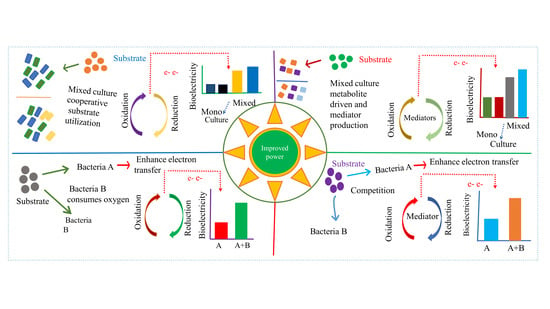
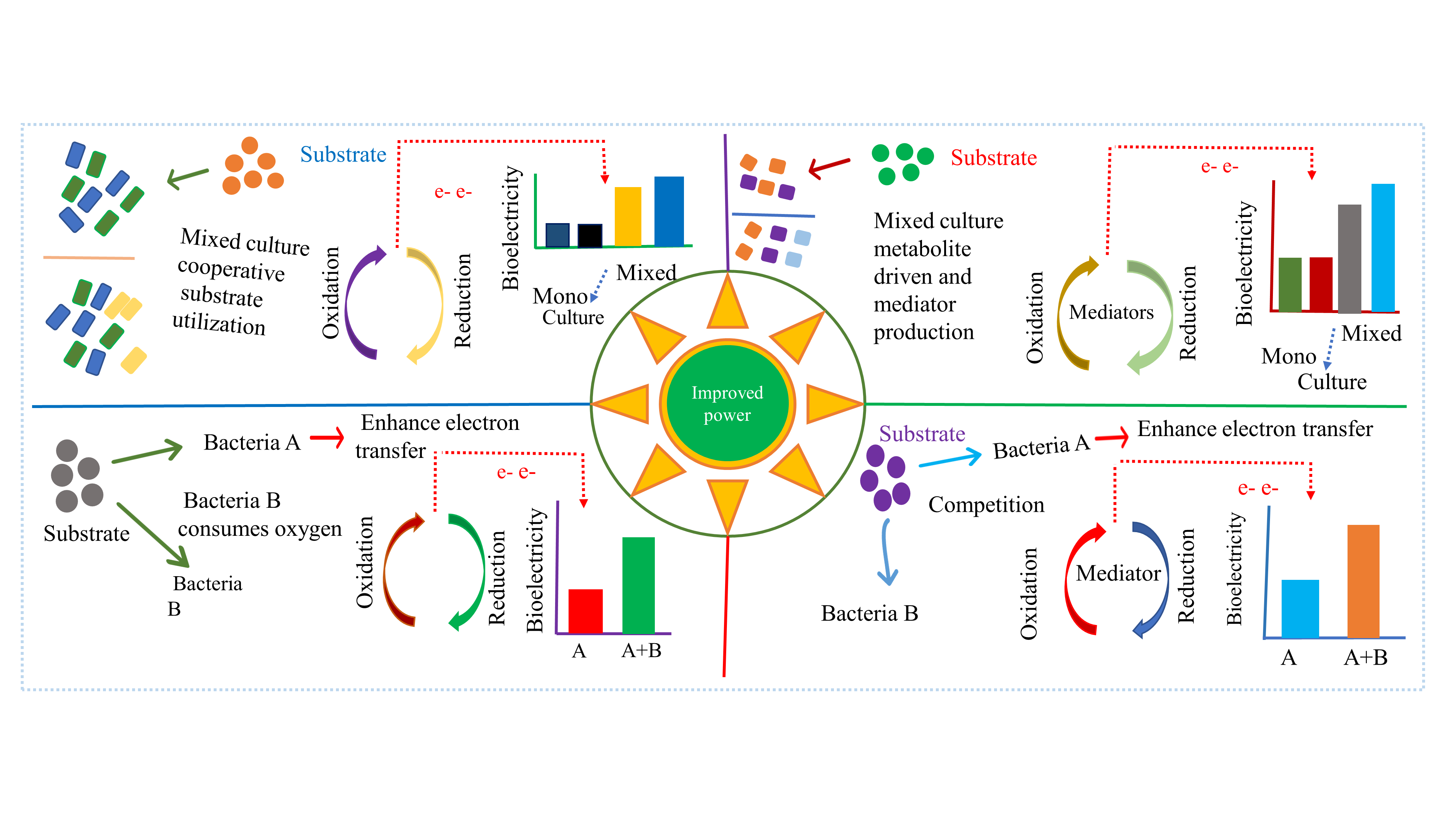
Nonrenewable energy sources dominate global energy production, but their depletion and environmental impact pose serious challenges. The need for alternative and eco-friendly energy sources is increasingly evident. In this regard, utilizing knowledge gained from natural microorganisms to generate bioelectricity is a promising solution via microbial fuel cells (MFCs). Microbial fuel cells are an environmentally friendly technology that generates power from diverse organic substrates through the ‘catalytic’ activity of microorganisms. Although, MFCs still generate relatively low power, various scale-up studies have shown noticeable improvements in power output. Among the available strategies, mixed-culture systems are the simplest, sustainable, and direct way to improve bioelectricity production. However, the mixed culture microbial synergistic interactions and competition that drive power generation remain poorly understood. To address this, the objective of this review is to assess how synergistic interactions and metabolic networks within mixed microbial cultures enhance bioelectricity generation in microbial fuel cells. This review also explores the mixed-culture microbial fuel cell system as a promising renewable technology with potential applications in sustainable energy production.

Graphical Abstract

1. Introduction

The global depletion of natural resources, such as fossil fuels and petrochemical products, is a major concern. Their utilization contributes to climate change and leads to detrimental environmental effects [1]. Currently, most industries and domestic houses rely on electricity from these non-renewable sources, which has been predicted to lead to a global energy crisis. As a result, there is an increasing need to explore renewable, sustainable, environmentally friendly alternative energy sources. Among emerging solutions, microbial fuel cells (MFCs) are systems that utilize electrogenic bacteria to convert chemical energy into electricity, with applications in biomass degradation, wastewater treatment, and clean energy production [2,3,4]. However, low power output limits their applications [5], and strategies to enhance performance include genetic engineering [6], porous carbon electrodes [7], conductive polymer coatings [8], metallic nanoparticles [9,10], artificial electron mediators [11], pure cultures, and mixed cultures. Among these, mixed-culture systems are especially efficient due to their readily available electricity-producing substrates, active exoelectrogens, and consistent provision of electron shuttles [12]. They also offer greater resilience and adaptability to fluctuating conditions [13,14] and can metabolize diverse complex substrates, unlike pure cultures, which are limited and less adaptable [15,16]. Despite this potential, knowledge on microbial synergy in mixed-culture MFCs remains limited.
A community’s microbial associations can be of many different kinds, such as parasitic, amensalistic, neutralistic, communalistic, antagonistic, and synergistic interactions. In binary systems, interactions can generally be classified as cooperative or competitive, based on their influence on both the acting and receiving populations [17]. When the recipient gains an advantage from the actor’s presence, the interaction is deemed cooperative, which can be categorized into mutualism (benefiting both participants) and altruism (benefiting the recipient while disadvantaging the actor). In contrast, if the recipient experiences harm, the interaction is competitive, taking the form of selfishness (benefiting the actor) or spite (causing harm to both the actor and the recipient). In biofilms, interactions are typically categorized as synergistic or antagonistic [18]. Synergism, the most widely examined type, describes cooperative microbial interactions that generate outcomes exceeding the combined effects of each microorganism acting alone [19,20,21]. Conversely, antagonism refers to an interaction in which one microbial species suppresses or adversely affects another species coexisting in the same environment [22].
Recent studies have focused on synergistic microbial consortia to enhance the cost-effectiveness and resilience of MFCs [14,23,24]. The defined co-culture of Bacillus subtills B1 and Pseudomonas aeruginosa B2, which produces a power density of 6.3 Wm−3 and a 970 mV of open-circuit voltage through complementary metabolism, is a prime example. P. aeruginosa B2 produced electricity via rhamnolipids, while B. subtilis B1 produced surfactin for the degradation of crude oil [25]. Similarly, when Chlorella vulgaris was added, the power density of the co-cultures of Escherichia coli and P. aeruginosa was enhanced to 248 mWm−2 [23]. In another study, in a three-strain culture system comprising Cellulomonas gilvus LSC-8, B. subtilis C9, and Geobacter sulfurreducens PCA, bioelectricity was generated using carboxymethyl cellulose (CMC). In comparison to the other co-culture systems (C. gilvus lsc-8 + B. subtilis C9, C. gilvus Lsc-8 + G. sulfurreducens PCA, and B. subtilis C9 + G. sulfurreducens PCA) using CMC and monoculture of G. sulfurreducens PCA using acetate, respectively, the ternary culture accomplished a current density of 796 ± 30 μAcm−2, which was 22.36, 1.57, 1.43, and 1.47 times higher. In this ternary consortium, G. sulfurreducens PCA is used to produce current, whereas C. gilvus Lsc-8 breaks down CMC to produce acetate and riboflavin as an electron mediator. Meanwhile, the addition of B. subtilis C9 enhanced the breakdown of CMC and generated additional riboflavin to increase G. sulfurreducens PCA’s ability to create bioelectricity utilizing acetate [26]. This review explores the mechanisms by which mixed culture enhances power generation in MFCs, evaluates the impact of microbial antagonism, challenges, and future directions, and provides conclusions that underscore the essential role of microbial synergy in enhancing MFC performance for a sustainable source of energy.

2. Extracellular Electron Transfer (EET) in Microbial Synergy in MFCs

EET is the process by which microorganisms exchange electrons with external electron donors or acceptors that cannot cross the cell boundary, such as metal compounds in their natural environment [27] or electrodes in bioelectrochemical systems [28]. The efficiency of these electron transfer processes determines the power output and stability of MFCs. One of the main challenges in MFC technology is the limited efficiency of electron transfer between the MFC and the electrodes [29]. Electron transfer from microbial cells to the electrode is facilitated by the help of exogenous mediators, but these compounds can be hazardous, expensive, unstable, and require continuous addition to the system. In contrast, mixed cultures of microbial interaction naturally secrete endogenous mediators as a result of the interactions among different microbes. These redox-active compounds facilitate EET by serving as mediators that transfer electrons to the electrode. Naturally, various microorganisms secrete endogenous mediators that aid EET. P. aeruginosa produces phenazines such as pyocyanin and phenazine-1-carboxamide, while S. oneidensis MR-1 secretes flavins like riboflavin and flavin mononucleotide. B. subtilis and Clostridium acetobutylicum release flavin- and quinone-like metabolites. Yeasts such as Saccharomyces cerevisiae can also produce extracellular redox-active molecules. A novel redox mediator, FeNC-RM, was investigated in anaerobic digestion using a mixed culture in 2024 [30].

3. Mechanisms for Mixed Cultures to Enhance Power Generation in MFCs

Microbial consortia are inherently linked by complex metabolic interactions [31]; understanding these complex metabolic interactions remains a major challenge in microbial fuel cell (MFC) research. Among the diverse interspecies relationships, cooperative interactions, including mutualism [32,33], syntropy [12,24,34,35], and commensalism [36], along with competitive dynamics [37,38,39], play pivotal roles in shaping the overall performance of MFC microbial communities.

3.1. Cooperative Substrate Utilization Through Microbial Synergy

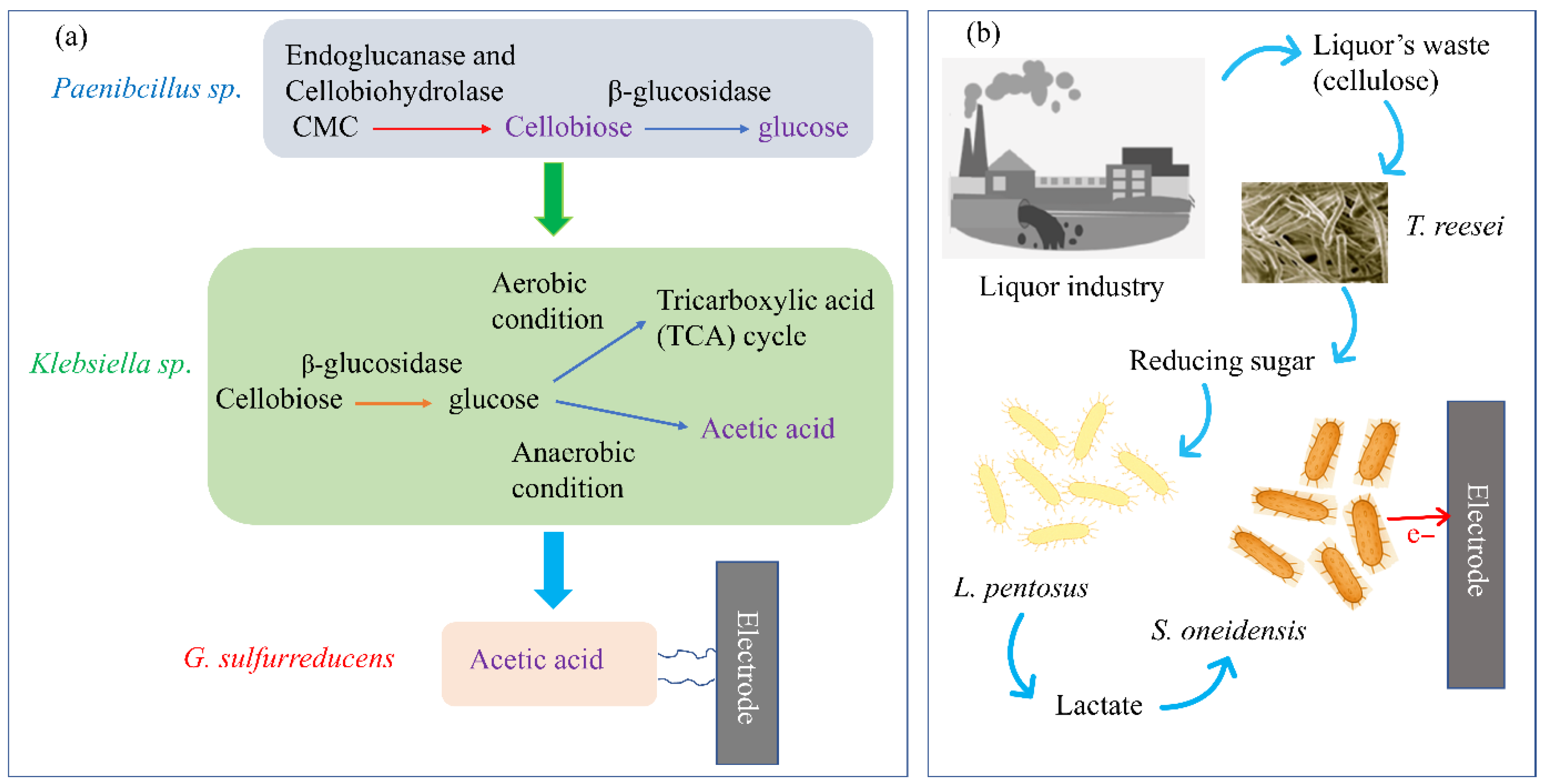
Microbial synergy is the cooperative interaction between microbes that produces a greater combined effect than each microbe can achieve alone. Mixed electrogenic MFCs leverage diverse microbial communities to metabolize various substrates, often achieving higher bioelectricity generation efficiency than pure cultures [15]. A major challenge in MFCs is the degradation of complex substrates like the biomass of lignocellulose, the most common carbohydrate found in nature [6,40]. Although cellulose, the main component of lignocellulose, is composed entirely of glucose units and can be readily metabolized by many microorganisms, no single microbe can both degrade cellulose and efficiently transfer electrons to the anode. This restriction limits lignocellulosic biomass’s direct application in MFCs, making it necessary to employ strategies such as microbial consortia or pretreatment processes to improve substrate accessibility and electron transfer. For instance, Ren et al. [41] built an MFC using a synthetic co-culture of C. cellulolyticum, a cellulolytic bacterium, and G. sulfurreducens, an exoelectrogenic bacterium. This system achieved the highest power densities of 59.2 mWm−2 and 143 mWm−2 by using various types of cellulose. Similarly, Jiang et al. [32] developed a ternary consortium of Paenibacillus sp., Klebsiella sp., and G. sulfurreducens PCA, where each microbe played a distinct role: cellulose hydrolysis, glucose fermentation, and acetate-driven electricity generation, respectively, as shown in Figure 1a. This system attained a high-power density of 1146 ± 28 mWm−2. Another investigated by Cao et al. [42] utilized Cellulomonas Lsc-8 and G. sulfurreducens PCA, where Cellulomonas Lsc-8 degraded cellulose into acetate and secreted riboflavin, while Geobacter utilized the acetate for power generation, yielding 492.05 ± 52.63 mWm−2 with CMC and even higher performance with raw corn stover reaching 592 μAcm−2. Moreover, Mishra and Chhabra [43] achieved a power density of 7.8 Wm−3 using Bacillus licheniformis and Shewanella putrefaciens, where Bacillus degraded xylan into fermentable sugars for Shewanella.
Yeast-based co-cultures have demonstrated significant potential in MFC applications. According to Shrivastava and Sharma [44], co-culturing of S. cerevisiae and Pichia fermentans, which synergistically utilized wheat straw hydrolysate, achieved a power density of 77.5 mWm−2, exceeding individual strains.
Beyond bacterial consortia, fungal–bacterial synergies have emerged as a promising strategy for bioenergy production through cooperative substrate utilization. As explained in Figure 1b, a notable example is a synthetic three-species consortium comprising Trichoderma reesei, Lactobacillus pentosus, and S. oneidensis for bioelectricity production from cellulosic biomass. In this system, T. reesi hydrolyzes cellulose into fermentable sugars, which L. pentosus converts to lactate, and S. oneidensis utilizes the lactate for electricity generation. The baseline consortium achieved 40.39 mWm−2, but power output surged to 453.52 mWm−2 after enhancing S. oneidensis’s electron transfer capability [45]. Similarly, Lin et al. [46] employed a glucose-fed MFC that was inoculated with S. oneidensis MR-1 and Saccharomyces cerevisiae, increasing the peak power density from 71.52 mWm−2 to 123.4 mWm−2. The resolution of the carbon source constraint for external electron supply was credited with this improvement. The limited metabolic capacity of single microorganisms often restricts complete glycerol degradation and electricity generation in MFCs, whereas mixed synthetic microbial consortia can overcome these limitations. Kim et al. [47] demonstrated this by co-culturing S. oneidensis MR-1 and Klebsiella pneumoniae J2B in the MFC system using glycerol as the substrate, achieving 97% glycerol utilization along with current generation, a result that could not be attained with S. oneidensis MR-1 alone. Notably, the consortium efficiently consumed the acidic byproducts lactate and acetate for electricity production; in contrast, these compounds were produced in pure K. pneumoniae J2B cultures. This synergy suggests that K. pneumoniae J2B metabolizes glycerol into intermediates that S. oneidensis MR-1 further oxidizes, leveraging the electrode as a source of electrons for enhanced energy recovery.
Beyond lignocellulose and simple sugars, microbial consortia have also been employed for degrading complex pollutants to produce electricity. Sharma et al. [48] demonstrated that a well-known co-culture of Pseudomonas putida and P. aeruginosa could break down methyl red dye into intermediates like benzoic acid, enabling P. aeruginosa to generate 7.3 Wm−3. Similarly, Sharma et al. [49] reported that Enterococcus faecalis and P. aeruginosa synergistically enhanced power output to 7.4 Wm−3 in wastewater-fed MFCs.
Figure 1. (a) In a cooperative ternary system, Paenibacillus sp. degrades cellulose to sugars, Klebsiella sp. converts them to organic acids, and G. sulfurreducens uses these acids to reduce the anode [based on Jiang eta al. [32] and resketched by the authors]. (b) A three-species consortium where T. reesei breaks down cellulose to sugars, L. pentosus ferments them to lactate, and S. oneidensis oxidizes lactate to generate electricity [resketched according to Tang et al. [45] and redrawn by the authors].
Sustainability 17 10942 g001

3.2. Metabolite-Enabled Mutualistic Interaction and Biosynthesis of Mediators

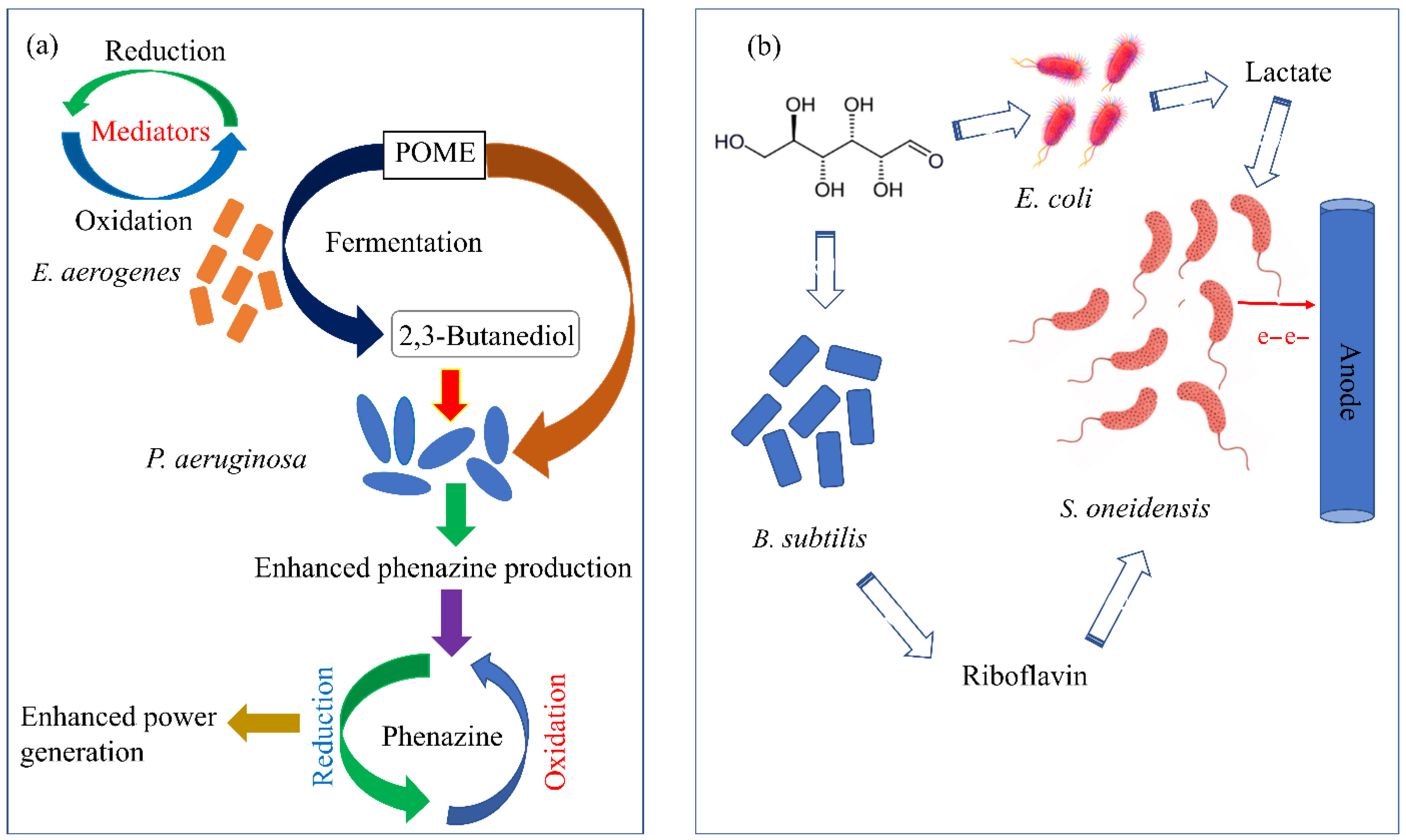
In mixed cultures, microbial interactions improve environmental adaptability by enabling the degradation of diverse substrates, supporting mediator synthesis, and allowing power generation to occur simultaneously. This metabolic versatility arises from synergistic interactions within the microbial community, where some species break down complex compounds into intermediates that others can use. In addition, some microbes secrete electron transfer mediators (ETMs) that enhance EET efficiency, further improving MFC performance [12,24,50]. For example, in comparison to the individual monocultures, a coculture of P. aeruginosa 14 and Enterobacter aerogenes produced an astounding 14-fold increase in current density. This cooperative improvement was ascribed to metabolic processes whereby P. aeruginosa 14 was induced to make pyocyanin by E. aerogenes’ fermentation of glucose to produce 2,3-butanediol, which improved electron transfer and current generation in the MFC, as shown in Figure 2a. Furthermore, the current generation doubled in 2,3-butanediol-fed P. aeruginosa compared to glucose-fed MFCs due to the overproduction of electron shuttle mediators called phenazines [51]. Similarly, a co-culture of E. coli and P. aeruginosa demonstrated a 37% increase in power generation compared to pure E. coli cultures. This enhancement was ascribed to P. aeruginosa’s capacity to generate a variety of redox mediators, which increased electron transfer performance and improved the MFC’s overall performance [52]. Microbial synergistic interactions studied in MFCs as shown in Table 1.
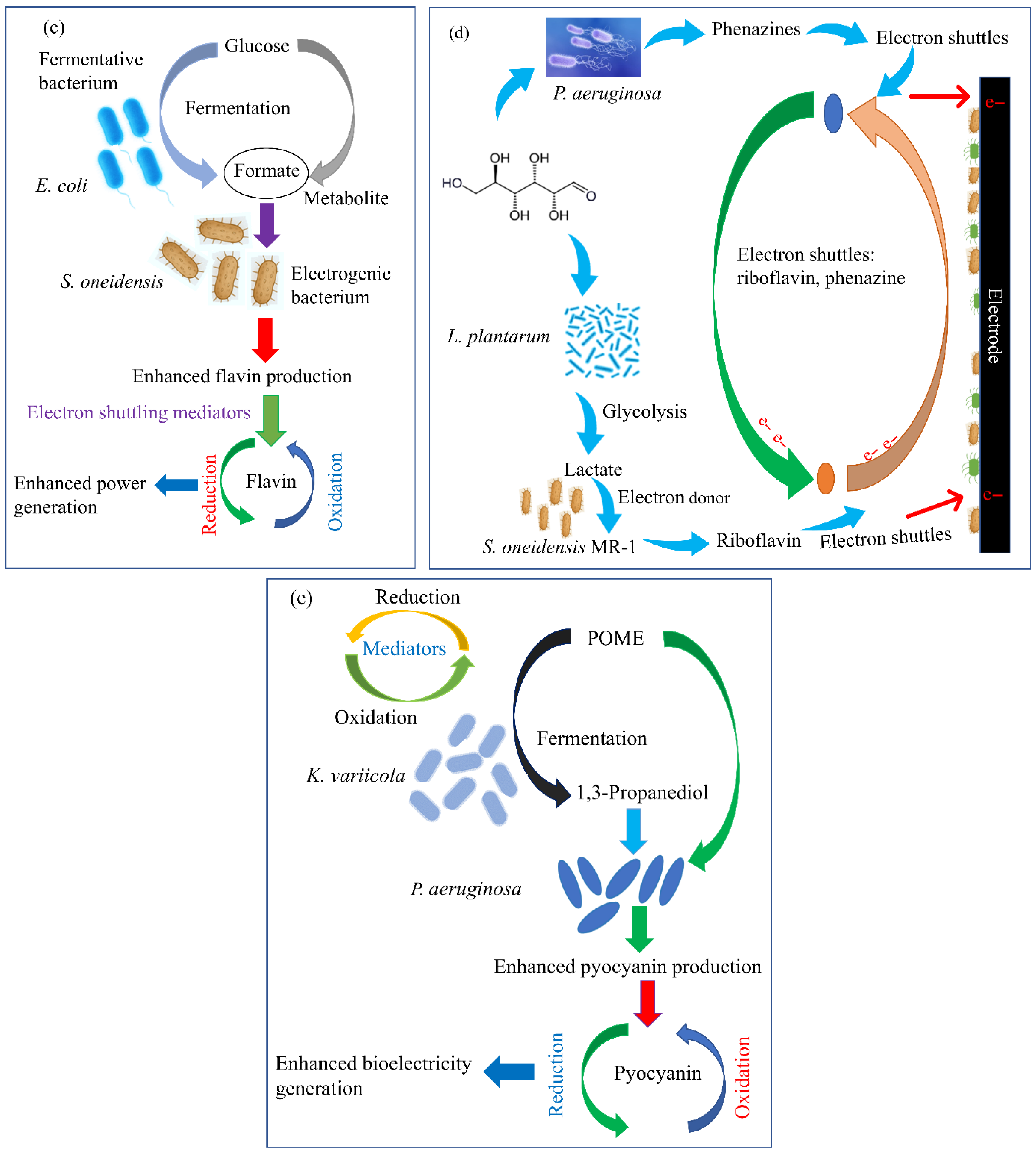
S. oneidensis MR-1 is among the most extensively researched electrogenic bacteria, with a strong preference for simple substrates, particularly lactate, serving as an electron donor for current production [53]. As indicated in Figure 2b, for instance, a synthetic consortium comprising three microbial species was engineered to optimize the distribution of energy flows and metabolism. In this arrangement, B. subtilis secretes riboflavin, which acts as an electron shuttle and increases the efficiency of electron transfer, while E. coli lactate serves as an electron donor for S. oneidensis. S. oneidensis then produced electrical energy by using both lactate and riboflavin. This consortium reached a maximum output voltage of ~550 mV, exceeding both monoculture and two-species systems [54]. Likewise, Wang et al. [55] illustrated a molecular model of the two bacteria’s synergistic interaction, in which E. coli breaks down glucose to create formate, a metabolite that S. oneidensis uses as a carbon source. As a result, S. oneidensis uses formate to increase the production of flavin mediators, which improves electron transfer efficiency and power output in MFCs as shown in Figure 2c. As indicated in Figure 2d, in a similar vein, a rationally designed three-species consortium comprising P. aeruginosa, Lactobacillus plantarum, and S. oneidensis MR-1 generated a peak power density of 207 mWm−2 with glucose as a substrate. This power density was 3.1, 9.3, and 59.3 times greater than that produced by the monocultures of S. oneidensis MR-1, L. plantarum, and P. aeruginosa, respectively. L. plantarum fermented glucose into lactic acid, which acted as an electron donor for S. oneidensis MR-1. Meanwhile, P. aeruginosa produced phenazines that promoted electron transfer and enhanced biofilm formation by S. oneidensis MR-1 [12]. A similar mechanism was observed in a synthetic consortium of S. oneidensis MR-1 and riboflavin-producing B. subtilis RH33 produced a maximum power density of 277.4 mWm−2, which was 4.9 and 40.2 times higher than that of S. oneidensis MR-1 and B. subtilis RH33 alone, respectively. The enhancement was attributed to the riboflavin-mediated electron transfer facilitated by the co-culture [56]. Finally, Yang et al. [18] investigated the riboflavin route from B. subtilis into an E. coli bacterium to achieve an excess of flavins from S. oneidensis, which might improve a flavin-shuttling EET in synthetic consortia co-cultured by B. subtilis and S. oneidensis. Thus, compared to its pure culture-inoculated MFC counterparts, the synthetic co-culture inoculated in xylose-fed MFC achieved a maximum power generation of 728.6 mWm−2.
Recent studies show that yeast–bacteria co-cultures can greatly enhance MFC performance through cooperative interactions that promote the biosynthesis of redox mediators, which in turn facilitate EET. The synergistic interaction between yeast and bacteria in MFCs was investigated by Islam et al. [24], who demonstrated that the addition of the electron mediator producing bacterium K. pneumoniae considerably increased MFC power production of MFCs inoculated with the yeast Lipomyces starkeyi, significantly enhanced the power generation of MFCs inoculated with the yeast Lipomyces starkeyi. The highest power production of MFCs inoculated with K. pneumoniae and L. starkeyi was three and six times more, respectively, than that of MFCs injected with the yeast or bacteria alone. It has been hypothesized that yeast cells can effectively utilize the reduced electron-shuttle mediators released by bacteria to enhance power generation in MFCs. This study demonstrated that a viable strategy for improving MFC power generation could be the deliberate creation of artificial bacterial yeast consortia. Similarly, an MFC incorporating an anodic inoculum composed of a co-culture of S. cerevisiae and B. subtilis showed a significant increase in power output. This improvement was attributed to the synergistic interaction between the two microorganisms: B. subtilis secreted riboflavin, which acted as an electron mediator for S. cerevisiae-driven electron transfer, while S. cerevisiae supplied both carbon and electron sources to B. subtilis, thereby enhancing the overall electrochemical performance [16].
Moreover, synthetic mixed microbial consortia have been constructed to improve the efficiency of MFCs and enhance wastewater treatment performance. As reported by Sarmin et al. [57], a mixed culture of P. aeruginosa, Klebsiella variicola, and S. cerevisiae treated palm oil mill effluent (POME), achieving 500 mWm−2, which was 5–10 times more than that of pure cultures, through bacterial electron-shuttling mediators that enabled yeast-to-electrode transfer. Similarly, the co-culture of Serratia marcescens AATB1 and K. pneumoniae AATB2 enhanced power generation, as S. marcescens degraded septic tank wastewater (STWW) to release electron-shuttling metabolites such as lumiflavine, 6-hydroxyflavone, and caryophyllene, which K. pneumoniae utilized to sustain EET and maximize energy output [58]. Furthermore, microbial fuel cells fed with wastewater containing POME showed enhanced performance with cocultures compared to monocultures due to synergistic metabolic interactions. The coculture of P. aeruginosa and K. variicola achieved a 3-fold increase in power output, as K. variicola’s production of 1, 3-propanediol stimulated P. aeruginosa to enhance pyocyanin-mediated EET, as illustrated in Figure 2e. Similarly, the coculture of K. variicola and Bacillus cereus showed a 2.8-fold enhancement, where K. variicola produced 2, 5-di-tert-butyl-1,4-benzoquinone, which served as an electron mediator for B. cereus, significantly improving EET efficiency [13,24].
Figure 2. (a) Mutualism between P. aeruginosa and E. aerogenes based on metabolites. (b) The ternary system employs division of labor to generate electricity [based on Liu et al. [54] and resketched by the authors]. (c) Synergistic association between S. oneidensis and E. coli [55] and resketched by the authors. (d) The three bacterial species’ division of work improves the production of power [based on Han et al. [12] and redrawn by the authors]. (e) schematic illustration of P. aeruginosa and K.variicola’s mutualistic relationship [based on Islam et al. [59] and resketched by the authors].
Sustainability 17 10942 g002aSustainability 17 10942 g002b
Table 1. Bioelectricity production efficiency in monocultures and mixed microbial consortia.
Mixed CultureSubstrateEfficiency of Pure Culture (a)Efficiency of Pure Culture (b)Efficiency of Pure Culture (c)Efficiency of
Mixed Cultures
Reference
S. oneidensis (a) and
E. coli (b)
Glucose0.3 µAcm−20.28 µAcm−2 2.0 µAcm−2[55]
S. oneidensis MR-1 (a),
L. plantarum (b), and P. aeruginosa (c)
Glucose67.2 mWm−222.4 mWm−23.5 mWm−2207 mWm−2[12]
S. marcescens AATB1 (a) and K. pneumoniae AATB2 (b)STWW728.85 ± 36 mAm−2,
341.65 ± 17 mWm−2
642.19 ± 32 mAm−2,
257.51 ± 12 mWm−2
NA869.11 ± 43 mAm−2, 398.69 ± 19 mWm−2[58]
P. aeruginosa (a) and
K. variicola (b)
POME5.8 Wm−35.2 Wm−3NA14.78 Wm−3[24,59]
P. aeruginosa (a) and
E. aerogenes (b)
Glucose3.25 ± 0.14 mAcm−22.53 ± 1.3 mAcm−2NA46.53 ± 6.4 mAcm−2[51]
K. pneumoniae (a) and
L. starkeyi (b)
Glucose4.36 Wm−32.67 Wm−3NA12.87 Wm−3[21]
K. variicola (a) and
B. cereus (b)
POME5.2 Wm−34.1 Wm−3NA11.8 Wm−3[13,24]
S. oneidensis MR-1 (a) and B. subtilis RH33 (b) Sodium lactate56.9 mWm−26.9 mWm−2NA277.4 mWm−2[56]
S. oneidensis MR-1 (a) and E. coli (b)Xylose92.8 mWm−291.76 mWm−2NA728.6 mWm−2[18]
Note: NA = Not applicable, STWW = Septic tank wastewater, POME = Palm oil mill effluent.

3.3. Microbial Interspecies Competition

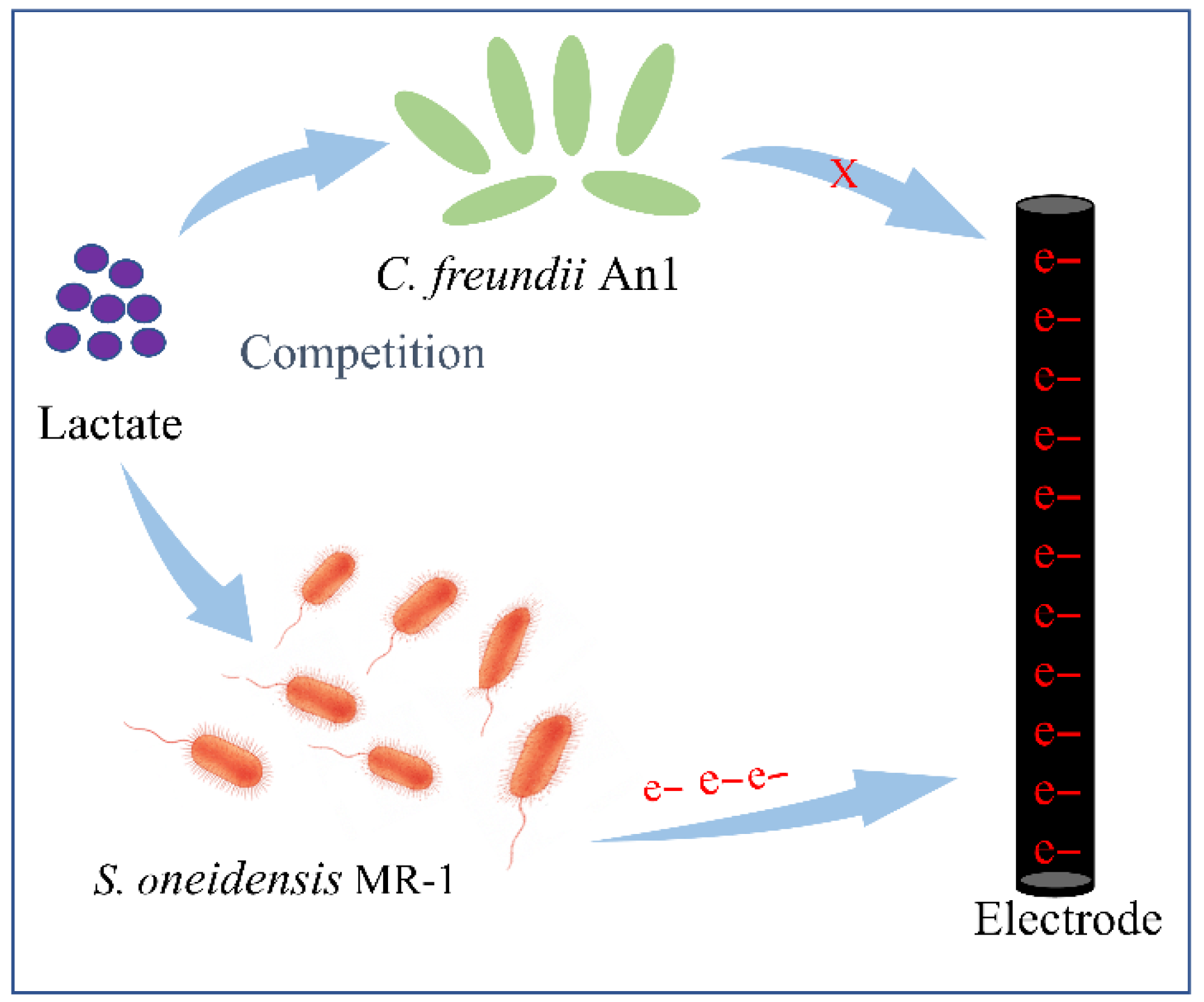
In MFCs, interspecies competition for shared substrates plays a pivotal role in shaping metabolic dynamics and electron transfer efficiency. When electroactive species compete for the same carbon source, the resulting selective pressure can trigger adaptive responses in exoelectrogens, such as accelerated metabolic activity or shifts in electron transfer mechanisms. Interestingly, this competition often indirectly enhances power generation by promoting the dominance of more efficient exoelectrogenic strains. As shown in Figure 3, a notable example is the co-culture of S. oneidensis MR-1 and Citrobacter freundii An1; as reported by Xiao et al. [39], the mixed-culture system of S. oneidensis MR-1 showed a sixfold increase in current density, reaching 38.4 μAcm−2 compared to its pure culture, even though C. freundii An1 outcompeted it in the planktonic phase. This substantial enhancement in electricity generation was driven by interspecies substrate competition, which imposed competitive pressure on S. oneidensis MR-1. To outcompete C. freundii An1, the strain responded by increasing its metabolic activity and creating strong biofilms on the electrode surface. Smoother electron flow was made possible by the increased flavin secretion and EET electrons generated by the increased metabolic activity. This created a positive feedback loop that strengthened S. oneidensis MR-1’s dominance at the anode and improved the overall system performance.

3.4. Enhancing the Stability of Synthetic Microbial Communities

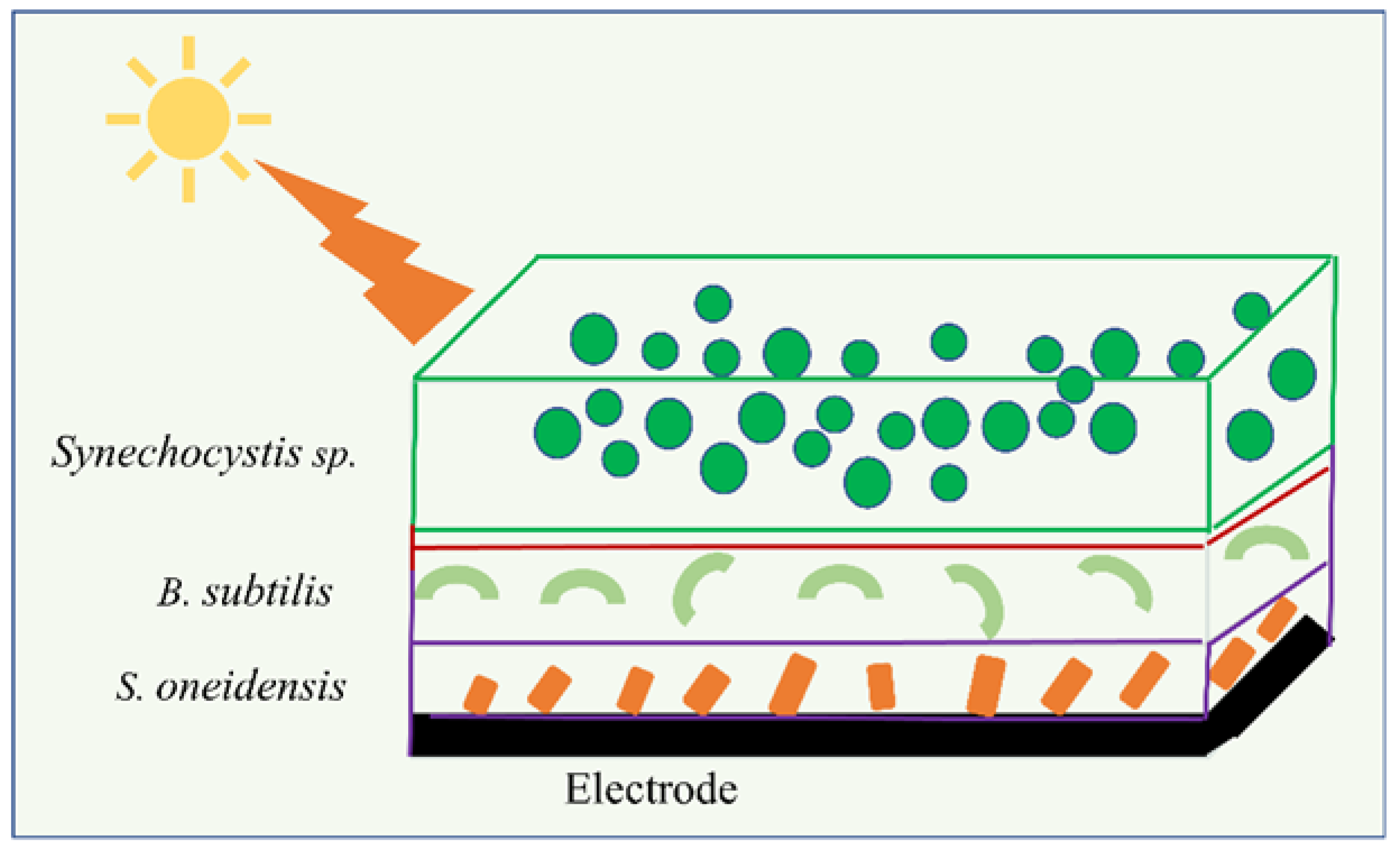
The utilization of microbial consortia in biotechnology and bioenergy has been driven by the idea that microorganisms naturally exist in structured communities that improve their viability and long-term stability. However, because non-spatially structured mixed cultures face uneven competition in homogeneous laboratory settings, the majority of artificially created consortia fail to sustain long-term function. So, to enhance the stability of microbial communities, researchers have developed various innovative strategies, with ecological niche optimization playing a crucial role. This approach strategically organizes the spatial arrangement of microbial strains to reduce competitive interference and optimize resource utilization. In contrast to conventional division-of-labor strategies that focus solely on functional specialization among species, ecological niche optimization emphasizes the physical arrangement of strains to reduce spatial competition and strengthen cooperative interactions, as shown in Figure 4. A prime example is the three-dimensional structured consortium developed by Liu et al. [60]. In this system, Synechocystis sp. PCC 6803 in the topmost layer performs photosynthesis to produce organic substrates, B. subtilis in the middle layer converts these substrates into riboflavin, and S. oneidensis near the base electrode utilizes riboflavin as an electron shuttle for efficient electricity generation. This well-designed spatial arrangement achieves a power density of 60 μWcm−2 and a current density of 120 μAcm−2, enabling the exchange of metabolites without direct physical contact. Compared to traditional monocultures, this configuration greatly improves system stability and supports long-term, self-sustaining power generation.

3.5. Microbial Cooperation via Oxygen Depletion

Oxygen serves as a ubiquitous and vital metabolic electron acceptor in practical MFC applications. The influence of oxygen on anode biofilms has received considerable attention due to its widespread availability and is selectively hazardous to anode-respiring bacteria (ARB). During the inoculation of pure-culture ARB, oxygen has been shown to exert a harmful effect on anaerobic ARB such as Geobacter [61]. Whereas, in mixed-culture ARB, oxygen influences anode formation and current generation in complicated ways [62,63].
Direct oxygen injection into the anode chamber caused nearly complete voltage loss with a double-chamber membrane MFC equipped with a cation exchange membrane [64]. Similarly, Oxygen crossover from the air cathode increased when electrode spacing was decreased from 2 to 1 cm, lowering power density from 811 to 423 mWm−2 in a mono-chamber MFC [65]. In addition, Yang et al. [66] reported that the inner region of the aerobic anode biofilm generated current, whereas the outer region was responsible solely for oxygen consumption. As a result, the diffusion of the electron donor through the outer layer became the constraint for bioanode performance, causing current generation to decline as the biofilm matured.
Furthermore, studies have demonstrated that synergistic microbial interactions can improve power output by using oxygen to create an anaerobic environment for other strains. It was shown that a co-culture of G. sulfurreducens and E. coli enhanced MFC performance, achieving a power density of 918 mWm−2, considerably higher than that of G. sulfurreducens alone [67]. E. coli improved the system by scavenging residual oxygen to maintain anaerobic conditions, which promoted G. sulfurreducens biofilm formation and electron transfer. Metabolomic analysis further revealed that E. coli consumption of oxygen and succinate directly boosted G. sulfurreducens current output [68].

4. Microbial Antagonism on MFC Performance

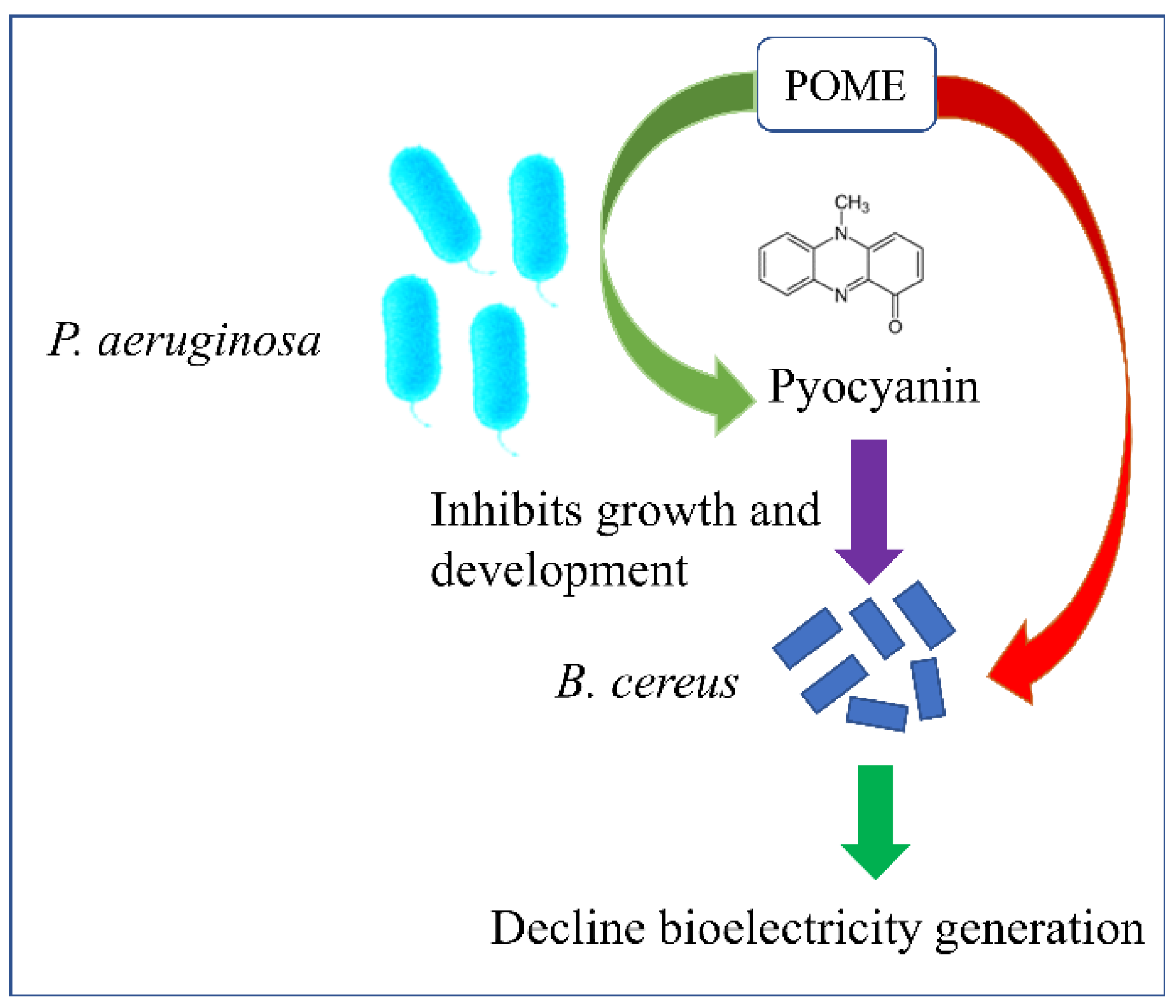
Many antagonistic mechanisms operate by producing harmful compounds such as toxins, antibiotics, antimicrobial peptides, and other antimicrobial substances, which suppress the growth of other microorganisms [69,70]. These antagonistic and metabolically conflicting interactions within microbial communities can significantly impair the electricity output in mixed-culture MFCs [24,71]. Although underexplored, a few studies have highlighted the negative impact of microbes’ antagonism on MFC output [24,57]. For instance, Islam et al. [24] found that the co-cultivation of B. cereus and P. aeruginosa in MFCs produced reduced power compared to monocultures, a result linked to the production of pyocyanin by P. aeruginosa, which suppresses both the establishment of biofilms and microbial growth, as shown in Figure 5. Likewise, Sarmin et al. [57] studied that an MFC inoculated with S. cerevisiae and K. variicola delivered less power than one inoculated with P. aeruginosa and K. variicola when treating POME wastewater, suggesting antagonistic interference between S. cerevisiae and K. variicola. Similarly, research has shown that certain microbial metabolites, such as 2,4-diacetylphloroglucinol (DAPG) from Pseudomonas protegens, can hinder processes like the Formation of biofilms and sporulation in B. subtilis [72]. In another case, S. putrefaciens (ATCC1 BAA1097) achieved a power density of 1.47 Wm−2 in synthetic wastewater-fed MFCs, whereas a mixed culture produced only 1.16 Wm−2 [73]. Additionally, co-cultures of Microbacterium sp. to Paenibacillus sp., and Deinococcus sp. led to a substantial decline in power generation due to antagonistic effects that reduced electron transfer and increased internal resistance, although the exact mechanisms remain unclear [74]. Furthermore, Ben Abdallah et al. [75] investigated that putative lipopeptide, secondary metabolites generated by Bacillus amyloliquefaciens, retarded the growth of Agrobacterium tumefaciens. In addition, Simoes et al. [76] found that Pseudomonas fluorescens and B. cereus exhibited hostile behavior in both biofilm and planktonic environments.

5. Limitations of the Study

In this review, only peer-reviewed and published articles written in English were included. Unpublished studies, non-English sources, conference proceedings, theses, and preprints were excluded. In addition, there is a limited number of published studies on microbial interspecies competition and strategies enhancing the stability of microbial communities to improve power generation, resulting in insufficient supporting references.

6. Challenges, Gaps, Future Direction, and Opportunities for Industrial Applications

Challenges: The major barriers to applying MFC technology are still its low power outputs. Even though many studies have reported that MFCs power generation and process effectiveness are adequate for implementation, all of these results were obtained on a lab scale. In the future, many researchers will face challenges related to stability, long-term performance, efficiency, and scaling up procedures from the lab to full scale.
Gaps: Alternative energy sources and cleaner conversion technologies are urgently needed due to the growing worldwide energy consumption and environmental impact of fossil fuel-based production. MFC technology represents a promising green energy solution that could play a key role in the transition from based on fossil fuel-based systems to sustainable energy sources. Numerous studies have sought to enhance MFC performance using advanced or costly materials and external mediators to improve system efficiency. However, a comprehensive understanding of mixed-culture microbial interaction, particularly interspecies relationships such as cross-feeding, syntrophy, and competitive dynamics, remains limited.
Future directions: From this review, we propose the following future directions to guide further research and development in this field.
  • A continuous interdisciplinary research approach that spans microbial physiology, microbiology, electrochemistry, synthetic biology, and process engineering, etc., will be essential for turning the innovations into practical technologies for industrial and environmental applications.
  • Future work will focus on the careful selection of high-performance exoelectrogenic strains and a better understanding of their intricate relationships.
  • The cooperative interactions between binary or mixed cultures of exoelectrogenic and non-exoelectrogenic microbes can enhance bioelectricity generation in MFC, but these interactions are less studied compared to work focusing only on exoelectrogens. This will help in designing microbial mixed cultures that can achieve higher stability and maximum power output.
  • Researchers will investigate new novel strains and use consortia with more than three microbes based on the growth ratio that helps improve power generation in MFCs.
  • Most studies have focused on mixed-culture microbial cooperation, but more research is needed on microbial interspecies competition to improve bioelectricity generation.
  • In addition, microbial synergies can be strategically utilized for bioremediation, enabling the simultaneous removal of contaminants and production of bioelectricity. Integrating optimized microbial consortia into MFC systems not only enhances energy recovery but also improves economic feasibility, paving the way for the transition of MFCs from laboratory-scale concepts to scalable, real-world solutions for clean energy and environmental management.
Opportunities for industrial applications: Mixed-culture microbial consortia in MFCs offer significant opportunities for industrial applications because they can simultaneously treat wastewater and generate sustainable electricity. The metabolic diversity within mixed microbial consortia enables the degradation of complex and variable industrial waste streams, including those that release high loads of organic pollutants. This makes them suitable for industry sectors such as food and beverage processing, dairies, slaughterhouses, sugar and starch factories, breweries, tanneries, textile manufacturing, agricultural activities, pulp and paper production, and petrochemical industries. These synergistic microbial interactions enhance electron transfer, improve power output, and provide greater operational stability compared to monoculture systems, which is essential for continuous industrial processes. Moreover, mixed-culture MFCs can be integrated into existing wastewater treatment infrastructure, offering a cost-effective and energy-efficient alternative to conventional treatment methods that typically consume large amounts of energy. Their operation under mild conditions further increases their practicality for real-world deployment. In addition to generating renewable bioelectricity, mixed-culture MFCs contribute to environmental sustainability by reducing sludge production, lowering greenhouse gas emissions, and supporting circular economy strategies through waste-to-energy conversion.

7. Conclusions

The dependence on fossil fuels such as wood, coal, diesel, petrol, and other petrochemical products has accelerated the depletion of these limited natural resources, raising concerns about future shortages. To address this issue, it is essential to develop sustainable technologies that can serve as alternatives to conventional energy sources. One of the promising approaches is the MFCs, which generate bioelectricity using mixed-culture microbial synergistic interaction. In this review, we concluded that synergistic interactions within mixed microbial cultures significantly enhance MFC performance, whereas antagonistic interactions can reduce it. Key mechanisms to enhance MFC performance include cooperative substrate utilization, metabolite-enabled mutualism, and biosynthesis of redox mediators that sustain continuous electron shuttling, together with enhanced biofilm stability; interspecific competition further shapes power output. Optimizing these biological synergies offers a promising pathway toward more efficient and practical MFC applications.

Author Contributions

Conceptualization, A.A.G. and Y.X.; software, A.A.G., W.D. and M.S.S.; validation, Y.X.; investigation, A.A.G.; resources, G.C.; data curation, A.A.G. and W.D.; visualization, A.A.G. and Y.X.; Funding acquisition and supervision, Y.X.; writing the original draft, A.A.G.; writing—review and editing, A.A.G., W.D., J.S.M., M.S.S., G.C. and O.O.H.; project administration, Y.X. All authors have read and agreed to the published version of the manuscript.

Funding

This work was supported by the National Natural Science Foundation of China (Grant No. 22276183); the Natural Science Foundation of Fujian Province for Distinguished Young Scholars (Grant No. 2021J06036); the Institute of Urban Environment, Chinese Academy of Sciences (Grant No. IUE-JBGS-202212); the Youth Innovation Promotion Association of the Chinese Academy of Sciences (Grant No. Y2022082); and the Chinese Government Scholarship (China Scholarship Council).

Institutional Review Board Statement

Not applicable.

Informed Consent Statement

Not applicable.

Data Availability Statement

No new data were created or analyzed in this study.

Acknowledgments

The authors sincerely acknowledge the Institute of Urban Environment at the University of the Chinese Academy of Sciences in China, which offered administrative and infrastructure support that allowed the authors to access various articles.

Conflicts of Interest

The authors declare that they have no known competing financial interests or personal relationships that could have appeared to influence the work reported in this paper.

Abbreviations

The following abbreviations are used in this review:
ARBAnode-respiring bacteria
CMCCarboxymethyl cellulose
DAPG2,4-diacetylphloroglucinol
EETExtracellular electron transfer
ETMsElectron transfer mediators
MFCMicrobial fuel cell
MFCsMicrobial fuel cells
NANot applicable
POMEPalm oil mill effluent
STWWSeptic tank wastewater

References

  1. Kabeyi, M.J.B.; Olanrewaju, O.A. Sustainable energy transition for renewable and low carbon grid electricity generation and supply. Front. Energy Res. 2022, 9, 743114. [Google Scholar] [CrossRef]
  2. Elmaadawy, K.; Liu, B.; Hassan, G.; Wang, X.; Wang, Q.; Hu, J.; Hou, H.; Yang, J.; Wu, X. Microalgae-assisted fixed-film activated sludge MFC for landfill leachate treatment and energy recovery. Process Saf. Environ. Prot. 2022, 160, 221–231. [Google Scholar] [CrossRef]
  3. Ren, Z.; Ji, G.; Liu, H.; Yang, M.; Xu, S.; Ye, M.; Lichtfouse, E. Accelerated start-up and improved performance of wastewater microbial fuel cells in four circuit modes: Role of anodic potential. J. Power Sources 2022, 535, 231403. [Google Scholar] [CrossRef]
  4. Thapa, B.S.; Pandit, S.; Patwardhan, S.B.; Tripathi, S.; Mathuriya, A.S.; Gupta, P.K.; Lal, R.B.; Tusher, T.R. Application of microbial fuel cell (MFC) for pharmaceutical wastewater treatment: An overview and future perspectives. Sustainability 2022, 14, 8379. [Google Scholar] [CrossRef]
  5. Palacios, P.A.; Kleikamp, H.; Nielsen, J.L.; Jensen, M.B.; Bentien, A.; Kofoed, M.V. Quinone-mediated extracellular electron transfer processes in ex situ biomethanation reactors. Bioresour. Technol. Rep. 2023, 24, 101671. [Google Scholar] [CrossRef]
  6. Liang, B.; Yang, J.; Meng, C.-F.; Zhang, Y.-R.; Wang, L.; Zhang, L.; Liu, J.; Li, Z.-C.; Cosnier, S.; Liu, A.-H. Efficient conversion of hemicellulose into high-value product and electric power by enzyme-engineered bacterial consortia. Nat. Commun. 2024, 15, 8764. [Google Scholar] [CrossRef] [PubMed]
  7. Bian, B.; Shi, D.; Cai, X.; Hu, M.; Guo, Q.; Zhang, C.; Wang, Q.; Sun, A.X.; Yang, J. 3D printed porous carbon anode for enhanced power generation in microbial fuel cell. Nano Energy 2018, 44, 174–180. [Google Scholar] [CrossRef]
  8. Yu, Y.-Y.; Wang, Y.-Z.; Fang, Z.; Shi, Y.-T.; Cheng, Q.-W.; Chen, Y.-X.; Shi, W.; Yong, Y.-C. Single cell electron collectors for highly efficient wiring-up electronic abiotic/biotic interfaces. Nat. Commun. 2020, 11, 4087. [Google Scholar] [CrossRef] [PubMed]
  9. Cao, B.; Zhao, Z.; Peng, L.; Shiu, H.-Y.; Ding, M.; Song, F.; Guan, X.; Lee, C.K.; Huang, J.; Zhu, D. Silver nanoparticles boost charge-extraction efficiency in Shewanella microbial fuel cells. Science 2021, 373, 1336–1340. [Google Scholar] [CrossRef]
  10. Gaffney, E.M.; Minteer, S.D. A silver assist for microbial fuel cell power. Science 2021, 373, 1308–1309. [Google Scholar] [CrossRef]
  11. Simoska, O.; Gaffney, E.M.; Lim, K.; Beaver, K.; Minteer, S.D. Understanding the properties of phenazine mediators that promote extracellular electron transfer in Escherichia coli. J. Electrochem. Soc. 2021, 168, 025503. [Google Scholar] [CrossRef]
  12. Han, J.-Y.; Zhang, H.-L.; Guo, H.; Liu, A.-Q.; Nawab, S.; Liu, N.; Hui, M.; Zhai, D.-D.; Yong, Y.-C. A rational designed synthetic three-species alliance system for synergetic improvement on power generation from microbial fuel cell. Chem. Eng. J. 2024, 481, 148366. [Google Scholar] [CrossRef]
  13. Islam, M.A.; Ong, H.R.; Ethiraj, B.; Cheng, C.K.; Khan, M.M.R. Optimization of co-culture inoculated microbial fuel cell performance using response surface methodology. J. Environ. Manag. 2018, 225, 242–251. [Google Scholar] [CrossRef]
  14. Jiang, Y.; Dong, W.; Xin, F.; Jiang, M. Designing synthetic microbial consortia for biofuel production. Trends Biotechnol. 2020, 38, 828–831. [Google Scholar] [CrossRef]
  15. Cao, Y.; Mu, H.; Liu, W.; Zhang, R.; Guo, J.; Xian, M.; Liu, H. Electricigens in the anode of microbial fuel cells: Pure cultures versus mixed communities. Microb. Cell Factories 2019, 18, 39. [Google Scholar] [CrossRef]
  16. Ren, J.; Li, N.; Du, M.; Zhang, Y.; Hao, C.; Hu, R. Study on the effect of synergy effect between the mixed cultures on the power generation of microbial fuel cells. Bioengineered 2021, 12, 844–854. [Google Scholar] [CrossRef] [PubMed]
  17. Zhang, S.; Merino, N.; Okamoto, A.; Gedalanga, P. Interkingdom microbial consortia mechanisms to guide biotechnological applications. Microb. Biotechnol. 2018, 11, 833–847. [Google Scholar] [CrossRef] [PubMed]
  18. Yang, Y.; Wu, Y.; Hu, Y.; Cao, Y.; Poh, C.L.; Cao, B.; Song, H. Engineering electrode-attached microbial consortia for high-performance xylose-fed microbial fuel cell. ACS Catal. 2015, 5, 6937–6945. [Google Scholar] [CrossRef]
  19. Song, H.; Ding, M.-Z.; Jia, X.-Q.; Ma, Q.; Yuan, Y.-J. Synthetic microbial consortia: From systematic analysis to construction and applications. Chem. Soc. Rev. 2014, 43, 6954–6981. [Google Scholar] [CrossRef]
  20. D’Souza, G.; Shitut, S.; Preussger, D.; Yousif, G.; Waschina, S.; Kost, C. Ecology and evolution of metabolic cross-feeding interactions in bacteria. Nat. Prod. Rep. 2018, 35, 455–488. [Google Scholar] [CrossRef]
  21. Islam, M.A.; Ethiraj, B.; Cheng, C.K.; Yousuf, A.; Thiruvenkadam, S.; Prasad, R.; Rahman Khan, M.M. Enhanced current generation using mutualistic interaction of yeast-bacterial coculture in dual chamber microbial fuel cell. Ind. Eng. Chem. Res. 2018, 57, 813–821. [Google Scholar] [CrossRef]
  22. Che, S.; Men, Y. Synthetic microbial consortia for biosynthesis and biodegradation: Promises and challenges. J. Ind. Microbiol. Biotechnol. 2019, 46, 1343–1358. [Google Scholar] [CrossRef]
  23. Aiyer, K.S. Synergistic effects in a microbial fuel cell between co-cultures and a photosynthetic alga Chlorella vulgaris improve performance. Heliyon 2021, 7, e05935. [Google Scholar] [CrossRef] [PubMed]
  24. Islam, M.A.; Karim, A.; Mishra, P.; Dubowski, J.J.; Yousuf, A.; Sarmin, S.; Khan, M.M.R. Microbial synergistic interactions enhanced power generation in co-culture driven microbial fuel cell. Sci. Total Environ. 2020, 738, 140138. [Google Scholar] [CrossRef] [PubMed]
  25. Sharma, K.; Singh, V.; Pandit, S.; Thapa, B.S.; Pant, K.; Tusher, T.R. Isolation of biosurfactant-producing bacteria and their Co-culture application in microbial fuel cell for simultaneous hydrocarbon degradation and power generation. Sustainability 2022, 14, 15638. [Google Scholar] [CrossRef]
  26. Gao, S.-C.; Mai, T.-F.; Ding, Y.; Wang, Z.-W.; Fan, X.-X.; Zhang, Y.; Liu, G.-W.; Liu, Y. In-situ secreted riboflavin and cellulase enhanced energy of Geobacter sulfurreducens PCA using carboxymethyl cellulose by constructing the ternary culture. J. Environ. Chem. Eng. 2025, 13, 116313. [Google Scholar] [CrossRef]
  27. Jiang, Y.; Shi, M.; Shi, L. Molecular underpinnings for microbial extracellular electron transfer during biogeochemical cycling of earth elements. Sci. China Life Sci. 2019, 62, 1275–1286. [Google Scholar] [CrossRef]
  28. Kim, B.; Baek, G.; Kim, C.; Lee, S.Y.; Yang, E.; Lee, S.; Kim, T.; Nam, J.-Y.; Lee, C.; Chae, K.-J. Progress and prospects for applications of extracellular electron transport mechanism in environmental biotechnology. ACS EST Eng. 2024, 4, 1520–1539. [Google Scholar] [CrossRef]
  29. Elangovan, K.; Saravanan, P.; Campos, C.H.; Sanhueza-Gómez, F.; Khan, M.M.R.; Chin, S.Y.; Krishnan, S.; Viswanathan Mangalaraja, R. Outline of microbial fuel cells technology and their significant developments, challenges, and prospects of oxygen reduction electrocatalysts. Front. Chem. Eng. 2023, 5, 1228510. [Google Scholar] [CrossRef]
  30. Wang, X.; Han, M.; Li, W.; Liu, X.; Lv, L.; Gao, W.; Liu, X.; Sun, L.; Liang, J.; Zhang, G. Enhanced anaerobic digestion of landfill leachate based on a novel redox mediator: Synergistic mechanism of enhancing extracellular electron transfer. Chem. Eng. J. 2024, 490, 151649. [Google Scholar] [CrossRef]
  31. Ponomarova, O.; Patil, K.R. Metabolic interactions in microbial communities: Untangling the Gordian knot. Curr. Opin. Microbiol. 2015, 27, 37–44. [Google Scholar] [CrossRef] [PubMed]
  32. Jiang, Y.; Song, R.; Cao, L.; Su, Z.; Ma, Y.; Liu, Y. Harvesting energy from cellulose through Geobacter sulfurreducens in unique ternary culture. Anal. Chim. Acta 2019, 1050, 44–50. [Google Scholar] [CrossRef]
  33. Cestellos-Blanco, S.; Chan, R.R.; Shen, Y.-X.; Kim, J.M.; Tacken, T.A.; Ledbetter, R.; Yu, S.; Seefeldt, L.C.; Yang, P. Photosynthetic biohybrid coculture for tandem and tunable CO2 and N2 fixation. Proc. Natl. Acad. Sci. USA 2022, 119, e2122364119. [Google Scholar] [CrossRef]
  34. Mahto, K.U.; Das, S. Electroactive biofilm communities in microbial fuel cells for the synergistic treatment of wastewater and bioelectricity generation. Crit. Rev. Biotechnol. 2025, 45, 434–453. [Google Scholar] [CrossRef]
  35. Ratheesh, A.; Sreelekshmy, B.R.; T R, A.K.; Sasidharan, S.; Basheer, R.; Nair, K.S.; Nair, A.J.; Shibli, S.M.A. Integrated Bioelectrochemical Conversion of Bacillus subtilis-Pretreated Sugar Cane Bagasse: Metabolic Profile Optimization for Enhanced Microbial Fuel Cell Efficiency and Sustainable Biorefinery Applications. ACS Appl. Bio Mater. 2025, 8, 4924–4936. [Google Scholar] [CrossRef] [PubMed]
  36. Liu, X.; Zhan, J.; Jing, X.; Zhou, S.; Lovley, D.R. A pilin chaperone required for the expression of electrically conductive Geobacter sulfurreducens pili. Environ. Microbiol. 2019, 21, 2511–2522. [Google Scholar] [CrossRef] [PubMed]
  37. Deter, H.S.; Lu, T. Engineering microbial consortia with rationally designed cellular interactions. Curr. Opin. Biotechnol. 2022, 76, 102730. [Google Scholar] [CrossRef]
  38. Tsoi, R.; Dai, Z.; You, L. Emerging strategies for engineering microbial communities. Biotechnol. Adv. 2019, 37, 107372. [Google Scholar] [CrossRef]
  39. Xiao, Y.; Chen, G.; Chen, Z.; Bai, R.; Zhao, B.; Tian, X.; Wu, Y.; Zhou, X.; Zhao, F. Interspecific competition by non-exoelectrogenic Citrobacter freundii An1 boosts bioelectricity generation of exoelectrogenic Shewanella oneidensis MR-1. Biosens. Bioelectron. 2021, 194, 113614. [Google Scholar] [CrossRef]
  40. Abolore, R.S.; Jaiswal, S.; Jaiswal, A.K. Green and sustainable pretreatment methods for cellulose extraction from lignocellulosic biomass and its applications: A review. Carbohydr. Polym. Technol. Appl. 2024, 7, 100396. [Google Scholar] [CrossRef]
  41. Ren, Z.; Ward, T.E.; Regan, J.M. Electricity production from cellulose in a microbial fuel cell using a defined binary culture. Environ. Sci. Technol. 2007, 41, 4781–4786. [Google Scholar] [CrossRef]
  42. Cao, L.; Sun, H.; Ma, Y.; Lu, M.; Zhao, M.; Li, E.; Liu, Y. Analysis and enhancement of the energy utilization efficiency of corn stover using strain Lsc-8 in a bioelectrochemical system. Microb. Cell Factories 2023, 22, 54. [Google Scholar] [CrossRef]
  43. Mishra, A.; Chhabra, M. Co-culturing Chlorella vulgaris and Cystobasidium oligophagum JRC1 in the microbial fuel cell cathode for lipid biosynthesis. Environ. Sci. Pollut. Res. 2024, 31, 57338–57345. [Google Scholar] [CrossRef]
  44. Shrivastava, A.; Sharma, R.K. Evaluation of co-culture system to produce ethanol and electricity from wheat straw hydrolysate using Saccharomyces cerevisiae and Pichia fermentans. Biomass Convers. Biorefinery 2024, 14, 9407–9416. [Google Scholar] [CrossRef]
  45. Tang, R.; Zhang, B.; Dai, L.; Wang, Y.; Xin, G.; Liu, Z.; Li, F.; Song, H. Engineering Artificial Three-Species Microbial Consortium to Produce High-Power Bioelectricity from Discarded Cellulosic Biomass of Liquor Industry. ACS Sustain. Chem. Eng. 2024, 12, 17992–18003. [Google Scholar] [CrossRef]
  46. Lin, T.; Bai, X.; Hu, Y.; Li, B.; Yuan, Y.J.; Song, H.; Yang, Y.; Wang, J. Synthetic Saccharomyces cerevisiae-Shewanella oneidensis consortium enables glucose-fed high-performance microbial fuel cell. AIChE J. 2017, 63, 1830–1838. [Google Scholar] [CrossRef]
  47. Kim, C.; Song, Y.E.; Lee, C.R.; Jeon, B.-H.; Kim, J.R. Glycerol-fed microbial fuel cell with a co-culture of Shewanella oneidensis MR-1 and Klebsiella pneumonae J2B. J. Ind. Microbiol. Biotechnol. 2016, 43, 1397–1403. [Google Scholar] [CrossRef] [PubMed]
  48. Sharma, K.; Pandit, S.; Mathuriya, A.S.; Gupta, P.K.; Pant, K.; Jadhav, D.A. Microbial electrochemical treatment of methyl red dye degradation using co-culture method. Water 2023, 15, 56. [Google Scholar] [CrossRef]
  49. Sharma, K.; Pandit, S.; Thapa, B.S.; Pant, M. Biodegradation of Congo red using co-culture anode inoculum in a microbial fuel cell. Catalysts 2022, 12, 1219. [Google Scholar] [CrossRef]
  50. Zhou, L.; Tang, T.; Deng, D.; Wang, Y.; Pei, D. Isolation and electrochemical analysis of a facultative anaerobic electrogenic strain Klebsiella sp. SQ-1. Pol. J. Microbiol. 2024, 73, 143–153. [Google Scholar] [CrossRef]
  51. Venkataraman, A.; Rosenbaum, M.A.; Perkins, S.D.; Werner, J.J.; Angenent, L.T. Metabolite-based mutualism between Pseudomonas aeruginosa PA14 and Enterobacter aerogenes enhances current generation in bioelectrochemical systems. Energy Environ. Sci. 2011, 4, 4550–4559. [Google Scholar] [CrossRef]
  52. Montoya-Vallejo, C.; Gil Posada, J.O.; Quintero-Díaz, J.C. Enhancement of electricity production in microbial fuel cells using a biosurfactant-producing Co-culture. Molecules 2023, 28, 7833. [Google Scholar] [CrossRef]
  53. Li, F.; An, X.; Wu, D.; Xu, J.; Chen, Y.; Li, W.; Cao, Y.; Guo, X.; Lin, X.; Li, C. Engineering microbial consortia for high-performance cellulosic hydrolyzates-fed microbial fuel cells. Front. Microbiol. 2019, 10, 409. [Google Scholar] [CrossRef]
  54. Liu, Y.; Ding, M.; Ling, W.; Yang, Y.; Zhou, X.; Li, B.-Z.; Chen, T.; Nie, Y.; Wang, M.; Zeng, B. A three-species microbial consortium for power generation. Energy Environ. Sci. 2017, 10, 1600–1609. [Google Scholar] [CrossRef]
  55. Wang, V.B.; Sivakumar, K.; Yang, L.; Zhang, Q.; Kjelleberg, S.; Loo, S.C.J.; Cao, B. Metabolite-enabled mutualistic interaction between Shewanella oneidensis and Escherichia coli in a co-culture using an electrode as electron acceptor. Sci. Rep. 2015, 5, 11222. [Google Scholar] [CrossRef] [PubMed]
  56. Liu, T.; Yu, Y.Y.; Chen, T.; Chen, W.N. A synthetic microbial consortium of Shewanella and Bacillus for enhanced generation of bioelectricity. Biotechnol. Bioeng. 2017, 114, 526–532. [Google Scholar] [CrossRef] [PubMed]
  57. Sarmin, S.; Tarek, M.; Roopan, S.M.; Cheng, C.K.; Khan, M.M.R. Significant improvement of power generation through effective substrate-inoculum interaction mechanism in microbial fuel cell. J. Power Sources 2021, 484, 229285. [Google Scholar] [CrossRef]
  58. Thulasinathan, B.; Ebenezer, J.O.; Bora, A.; Nagarajan, A.; Pugazhendhi, A.; Jayabalan, T.; Nainamohamed, S.; Doble, M.; Alagarsamy, A. Bioelectricity generation and analysis of anode biofilm metabolites from septic tank wastewater in microbial fuel cells. Int. J. Energy Res. 2021, 45, 17244–17258. [Google Scholar] [CrossRef]
  59. Islam, M.A.; Ethiraj, B.; Cheng, C.K.; Yousuf, A.; Khan, M.M.R. An insight of synergy between Pseudomonas aeruginosa and Klebsiella variicola in a microbial fuel cell. ACS sustain. Chem. Eng. 2018, 6, 4130–4137. [Google Scholar] [CrossRef]
  60. Liu, L.; Mohammadifar, M.; Elhadad, A.; Tahernia, M.; Zhang, Y.; Zhao, W.; Choi, S. Spatial Engineering of Microbial Consortium for Long-Lasting, Self-Sustaining, and High-Power Generation in a Bacteria-Powered Biobattery. Adv. Energy Mater. 2021, 11, 2100713. [Google Scholar] [CrossRef]
  61. Lin, W.; Coppi, M.V.; Lovley, D. Geobacter sulfurreducens can grow with oxygen as a terminal electron acceptor. Appl. Environ. Microbiol. 2004, 70, 2525–2528. [Google Scholar] [CrossRef]
  62. Fan, Y.; Han, S.-K.; Liu, H. Improved performance of CEA microbial fuel cells with increased reactor size. Energy Environ. Sci. 2012, 5, 8273–8280. [Google Scholar] [CrossRef]
  63. Quan, X.-C.; Quan, Y.-P.; Tao, K. Effect of anode aeration on the performance and microbial community of an air–cathode microbial fuel cell. Chem. Eng. J. 2012, 210, 150–156. [Google Scholar] [CrossRef]
  64. Oh, S.; Kim, J.; Joo, J.-H.; Logan, B. Effects of applied voltages and dissolved oxygen on sustained power generation by microbial fuel cells. Water Sci. Technol. 2009, 60, 1311–1317. [Google Scholar] [CrossRef]
  65. Cheng, S.; Liu, H.; Logan, B.E. Increased power generation in a continuous flow MFC with advective flow through the porous anode and reduced electrode spacing. Environ. Sci. Technol. 2006, 40, 2426–2432. [Google Scholar] [CrossRef]
  66. Yang, J.; Cheng, S.; Li, P.; Huang, H.; Cen, K. Sensitivity to oxygen in microbial electrochemical systems biofilms. iScience 2019, 13, 163–172. [Google Scholar] [CrossRef] [PubMed]
  67. Qu, Y.; Feng, Y.; Wang, X.; Logan, B.E. Use of a coculture to enable current production by Geobacter sulfurreducens. Appl. Environ. Microbiol. 2012, 78, 3484–3487. [Google Scholar] [CrossRef] [PubMed]
  68. Bourdakos, N.; Marsili, E.; Mahadevan, R. A defined co-culture of Geobacter sulfurreducens and Escherichia coli in a membrane-less microbial fuel cell. Biotechnol. Bioeng. 2014, 111, 709–718. [Google Scholar] [CrossRef] [PubMed]
  69. Granato, E.T.; Meiller-Legrand, T.A.; Foster, K.R. The evolution and ecology of bacterial warfare. Curr. Biol. 2019, 29, R521–R537. [Google Scholar] [CrossRef]
  70. Cooper, R.M.; Tsimring, L.; Hasty, J. Inter-species population dynamics enhance microbial horizontal gene transfer and spread of antibiotic resistance. eLife 2017, 6, e25950. [Google Scholar] [CrossRef]
  71. Li, M.; Zhou, M.; Tian, X.; Tan, C.; McDaniel, C.T.; Hassett, D.J.; Gu, T. Microbial fuel cell (MFC) power performance improvement through enhanced microbial electrogenicity. Biotechnol. Adv. 2018, 36, 1316–1327. [Google Scholar] [CrossRef]
  72. Powers, M.J.; Sanabria-Valentín, E.; Bowers, A.A.; Shank, E.A. Inhibition of cell differentiation in Bacillus subtilis by Pseudomonas protegens. J. Bacteriol. 2015, 197, 2129–2138. [Google Scholar] [CrossRef]
  73. Varanasi, J.L.; Nayak, A.K.; Sohn, Y.; Pradhan, D.; Das, D. Improvement of power generation of microbial fuel cell by integrating tungsten oxide electrocatalyst with pure or mixed culture biocatalysts. Electrochim. Acta 2016, 199, 154–163. [Google Scholar] [CrossRef]
  74. Guo, X.; Zhan, Y.; Chen, C.; Zhao, L.; Guo, S. The influence of microbial synergistic and antagonistic effects on the performance of refinery wastewater microbial fuel cells. J. Power Sources 2014, 251, 229–236. [Google Scholar] [CrossRef]
  75. Ben Abdallah, D.; Frikha-Gargouri, O.; Tounsi, S. Bacillus amyloliquefaciens strain 32a as a source of lipopeptides for biocontrol of Agrobacterium tumefaciens strains. J. Appl. Microbiol. 2015, 119, 196–207. [Google Scholar] [CrossRef] [PubMed]
  76. Simoes, M.; Simões, L.C.; Pereira, M.O.; Vieira, M.J. Antagonism between Bacillus cereus and Pseudomonas fluorescens in planktonic systems and in biofilms. Biofouling 2008, 24, 339–349. [Google Scholar] [CrossRef] [PubMed]
Figure 3. Competition for lactate as a substrate between S. oneidensis MR-1 and C. freundii An1 to enhance bioelectricity generation.
Sustainability 17 10942 g003
Figure 4. Stabilizing the synthetic consortium through niche regulation: Synechocystis sp. Produce organic substrates, B. subtilis converts them into riboflavin, and S. oneidensis uses the riboflavin as an electron shuttle for electricity generation.
Sustainability 17 10942 g004
Figure 5. Pyocyanin produced by P. aeruginosa inhibits B. cereus, leading to reduced bioelectricity production.
Sustainability 17 10942 g005
Disclaimer/Publisher’s Note: The statements, opinions and data contained in all publications are solely those of the individual author(s) and contributor(s) and not of MDPI and/or the editor(s). MDPI and/or the editor(s) disclaim responsibility for any injury to people or property resulting from any ideas, methods, instructions or products referred to in the content.