Article

Integrating Revised Ecosystem Service Value, Ecological Sensitivity and Circuit Theory to Construct an Ecological Security Pattern in the UANSTM, China

1
School of Geography and Tourism, Xinjiang Normal University, Urumqi 830054, China
2
Research Center for Urban Development of Silk Road Economic Belt, Xinjiang Normal University, Urumqi 830054, China
*
Author to whom correspondence should be addressed.
Sustainability 2025, 17(23), 10880; https://doi.org/10.3390/su172310880
Submission received: 30 October 2025 / Revised: 30 November 2025 / Accepted: 2 December 2025 / Published: 4 December 2025

Abstract

In the rapidly changing Urban Agglomeration on the Northern Slope of the Tianshan Mountains (UANSTM), urbanization and oasis ecosystem degradation have intensified the need for ecological security planning. However, traditional ecosystem service assessments often struggle to capture the spatial heterogeneity of these fragile landscapes. This study integrates revised ecosystem service value (RESV), ecological sensitivity, and circuit-theory-based connectivity analysis to identify ecological sources and construct an ecological security pattern (ESP). Results indicate: From 2000 to 2020, land conversion among exposed areas, irrigated farmland, and grassland dominated regional change, with 5902 km2 of exposed land converting to grassland and 4554 km2 to irrigated farmland. RESV declined initially but rose overall from 1104 to 1255 billion yuan, yielding a net increase of about 14%. Ecologically sensitive areas were concentrated in the northeast, covering roughly 19,300 km2 and dominated by irrigated farmland. In total, 23 ecological sources, 47 ecological corridors, 28 ecological barrier points, and 61 ecological bottleneck points were identified, forming the basis for a targeted point–line–area protection strategy to guide ecological zoning and restoration. This study provides scientific basis for ecological conservation and territorial spatial planning in arid urban clusters. Nonetheless, limitations related to data resolution and indicator selection remain. Future research should incorporate higher-resolution ecological data and scenario-based simulations to further refine ESP construction.

Graphical Abstract

1. Introduction

The rapid development of urbanization, the transformation of land use, and increasing resource consumption have imposed considerable pressure on ecosystems and the ecological environment [1]. These issues are especially pronounced in arid and semi-arid zones, which make up about 40% of the Earth’s land surface and receive under 450 mm of rainfall each year [2]. Water scarcity, intensified soil salinization, and highly fragmented ecological landscapes exacerbate ecological risks and pressures during economic development [3], highlighting the need to strengthen ecological security research in such regions [4]. The Ecological Security Pattern (ESP) reflects the integrity and health of natural ecosystems [5]. The 2005 Millennium Ecosystem Assessment (MA) Report also emphasized that the degradation of ecosystem services (ESs) poses threats to both regional and global ecological security [6]. Therefore, the urgency of protecting ecosystems and maintaining ecological stability has increasingly attracted public and governmental attention, becoming a priority for regional development and environmental governance.
Globally, cities in arid regions such as Central Asia also face ecological degradation driven by rapid urban expansion and economic development. For example, landscape vulnerability in South Africa has intensified under the influence of extreme climatic conditions [7], and ecological pressure in the five Central Asian countries has continued to rise throughout their economic development [8]. In Asia, regions such as the Tarim River Basin [9], the Loess Plateau [10], and the Hexi Corridor [11] similarly demonstrate the ecological importance and fragility of arid and semi-arid environments. These cases collectively highlight that urban agglomerations in arid regions are among the most ecologically vulnerable systems worldwide. In the case of the Urban Agglomeration on the Northern Slope of the Tianshan Mountains (UANSTM), the unique “mountain–oasis–desert” landscape formed by meltwater from the Tianshan Mountains exists under extreme aridity. At the same time, as the economic core area of Xinjiang, the region experiences significant tension between intense human activities and the limited ecological carrying capacity. Therefore, its ecological conditions demand urgent attention.
ESPs play a vital role in safeguarding regional ecological stability. They help restrain urban expansion, improve the configuration of ecological land use, and serve as an important guide for ecological restoration [12]. Studies on ecological security patterns have shifted from focusing mainly on habitat and biodiversity protection to incorporating ecological processes, evaluations of ecosystem services, and the enhancement of landscape connectivity [13]. In terms of research directions, studies on ecological security can generally be divided into: ecological security index assessments based on the “pressure-state-response” (PSR) model [14], ecosystem health evaluations [15], ecological quality assessments [16], and ecosystem service trade-offs and synergies [17].
Regarding specific research methods, the “source area-resistance surface-corridor” framework has become the primary paradigm for constructing regional ecological security structures [18]. Ecological source areas are habitat patches of high significance to regional ecological security, typically identified based on the ES functions [19], ESV, ecological sensitivity landscape connectivity [20], and land use/land cover (LUCC) types. Ecological corridors are linear ecological pathways that facilitate biodiversity conservation and the regulation of ES functions. These narrow, vegetation-dominated routes provide essential movement pathways for wildlife, supporting species dispersal and ecological flows [21]. The identification of ecological corridors typically relies on the Minimum Cumulative Resistance (MCR) model [22] and circuit theory [23]. While the MCR model emphasizes the least-cost path, it is limited to a single optimal route, whereas circuit theory simulates multi-directional flows, analogous to electrical current diffusion, making it more suitable for capturing ecological processes in actual landscapes [24].
As a strategic gateway of the Belt and Road Initiative, the UANSTM plays a critical role in connecting Central Asia and shaping ecological and socioeconomic dynamics across Xinjiang [25]. Situated within the transitional zone of the mountain–oasis–desert system, the region exhibits pronounced ecological heterogeneity [26], including strong landscape fragmentation, heightened exposure to wind–sand processes along desert margins, and an exceptional reliance on meltwater from the Tianshan Mountains as its primary ecological lifeline. As a key ecological shield in northwestern China, the ecological security of the UANSTM is fundamental to maintaining the stability of oasis ecosystems and supporting sustainable regional development. Under the combined pressures of climate change and intensive human activities [27], the region is confronted with severe ecological risks such as water scarcity, land desertification, and increasing habitat fragmentation. These challenges underscore the urgent need to enhance regional ecological security through scientifically grounded ecological planning. At present, most ESP constructions rely on single indicators, which fail to capture the ecological heterogeneity of arid oasis urban agglomerations. In addition, ecological corridor construction is predominantly based on the MCR model, lacking the capacity to simulate ecological flows and identify critical ecological nodes. Furthermore, the unique landscape structure of the UANSTM necessitates an ESP framework specifically tailored to regional characteristics. Therefore, this paper establishes the UANSTM ecological security pattern for the first time based on RESV and ecological sensitivity, guided by the theory of the shortest plank in a barrel. The main objectives are as follows: (1) to examine the spatial distribution and spatiotemporal evolution of ESV in the UANSTM from 2000 to 2020; (2) to identify ecologically sensitive areas in accordance with the region’s environmental characteristics; and (3) to explore optimization pathways for the ESP from the dual perspectives of ecological value and ecological sensitivity. By integrating ESV and ecological sensitivity within a circuit-theory framework, this study advances ESP research in arid urban agglomerations. The findings provide scientific support for ecological protection, ecological restoration, and territorial spatial planning in the UANSTM, thereby contributing to sustainable regional development.

2. Materials and Methods

2.1. Study Areas

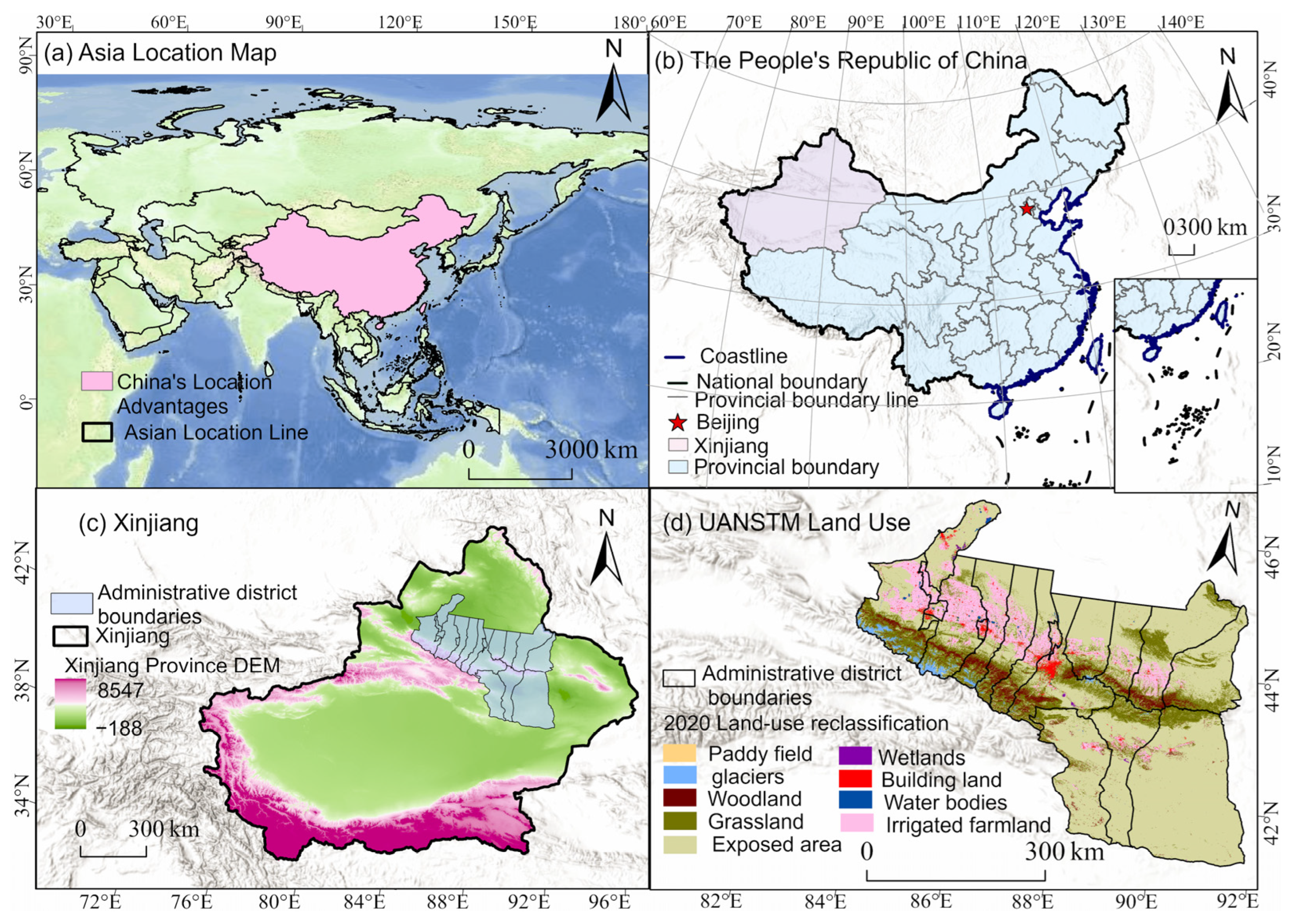
The UANSTM is situated between the Junggar Basin to the north and the Tianshan Mountains to the south, with a total area of 215,400 km2 (Figure 1). It encompasses Urumqi, Changji Hui Autonomous Prefecture, Turpan, Karamay, Huyanghe, Kuytun, Shihezi, Wujiaqu, Wusu, and Shawan. Identified in China’s 13th Five-Year Plan, the UANSTM is one of the country’s 19 key urban clusters and one of only two frontier urban clusters prioritized for national development. As a core urban agglomeration along the Belt and Road Initiative, the UANSTM plays an irreplaceable role in promoting stability and development in Xinjiang’s border regions [28].
Ecologically, the UANSTM belongs to an oasis urban cluster in arid regions, situated within the arid–oasis transition zone, and characterized by a distinctive “mountain–oasis–desert” landscape. The region receives less than 300 mm of annual precipitation, while potential evapotranspiration far exceeds this, creating a pronounced water–energy imbalance [29]. Land cover in the UANSTM is dominated by deserts, grasslands, and irrigated farmland, with overall low vegetation cover and significant spatial heterogeneity. The natural environment is further compromised by prevalent soil erosion, desertification, and salinization, making the region highly sensitive to climatic and human-induced disturbances. Rapid urban expansion, industrial development, and population concentration further intensify land-use pressures, fragmenting habitats and exacerbating ecological risks. These combined factors highlight the ecological vulnerability of the UANSTM and underscore the urgent need for constructing a science-based ecological security pattern for sustainable regional development.

2.2. Data Sources

Multiple datasets were employed in this study to support the assessment of LUCC, ESV, ecological sensitivity, and the construction of ecological resistance surfaces. The primary land cover dataset was GLC (Global Land Cover Data), which covers the period from 2000 to 2020 at a spatial resolution of 30 m. Resample land use data to nine primary categories (paddy fields, irrigated farmland, grassland, woodland, exposed land, building land, wetlands, glaciers, water bodies). Supplementary datasets, including NPP, NDVI, population, GDP, NLI, elevation, soil erosion, and accessibility indicators (railways, motorways, and water bodies), were used to derive ecological sensitivity and resistance surfaces (Table S1). All datasets were projected to the UTM Zone 47N coordinate system using ArcGIS 10.8 and resampled to a spatial resolution of 1000 m to ensure consistency across all analyses.

2.3. Conceptual Framework

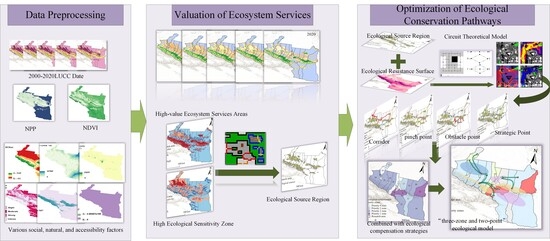
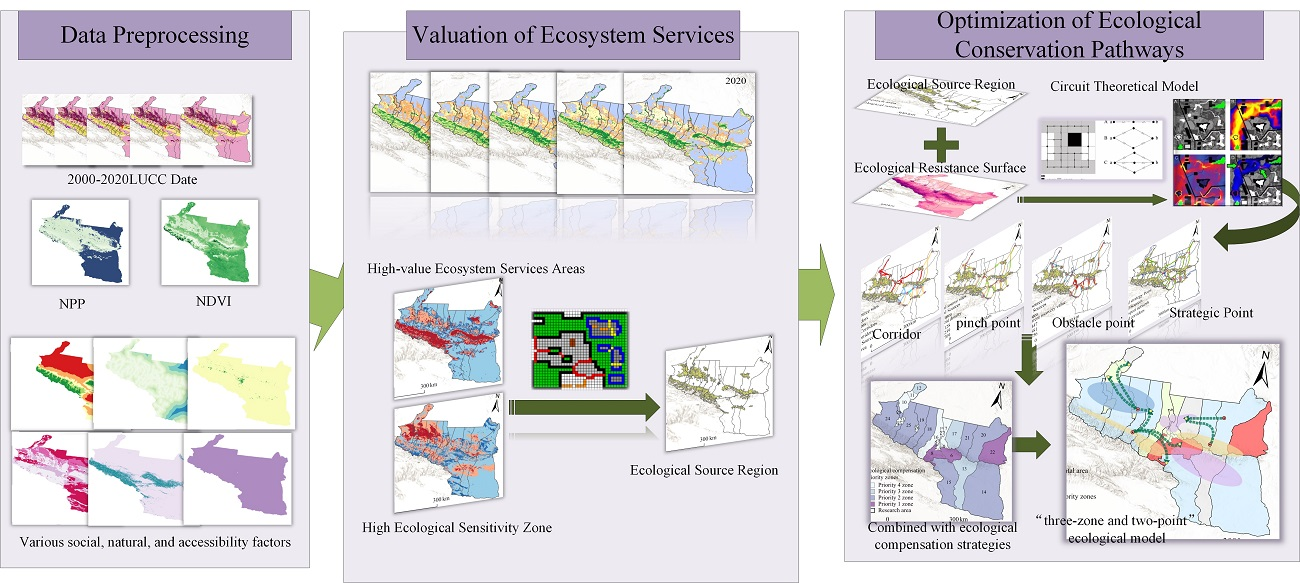
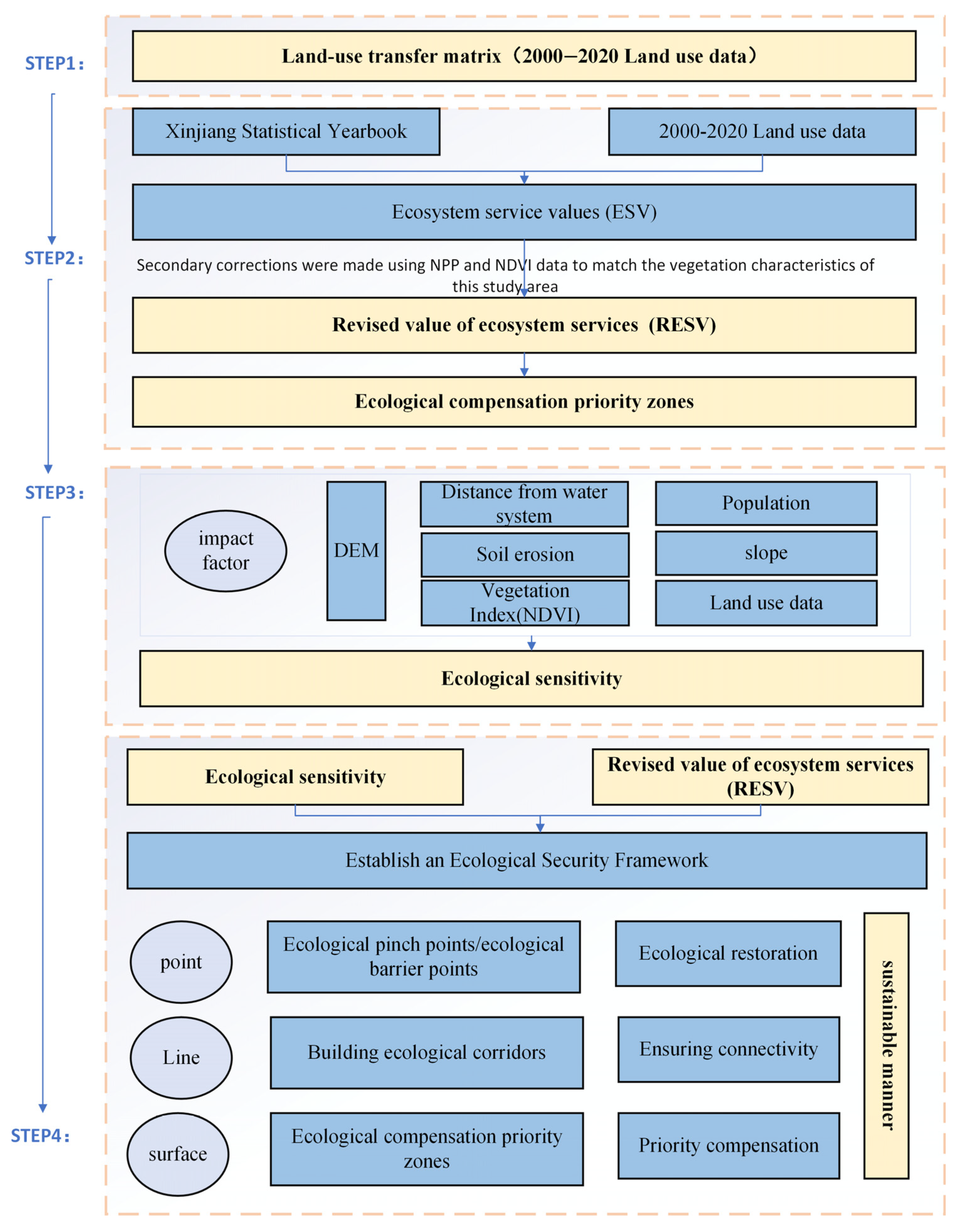
This study develops an integrated “point–line–surface” framework for ecological security management and pathway optimization. To clarify the overall structure of this study, Figure 2 illustrates the research concept and framework adopted in this paper.

2.4. Land Use Transition Matrix

The LUCC transition matrix illustrates both the direction and extent of changes between various LUCC categories, enabling quantitative analysis of LUCC changes. Its mathematical formulation is as follows:
R ij = R 11 R 1 n R n 1 R nn
Within the equation, Rij denotes the area (km2) of LUCC type i in the study area at the start of the period that has been converted to LUCC type j by the end of the period. Here, i (i = 1, 2, 3, …, n) refers to the initial LUCC types, j (j = 1, 2, 3, …, n) means the final LUCC types, and n indicates the total amount of LUCC types.

2.5. Estimation of ESV

This study employs the equivalent factor table developed by Xie with adjustments based on expert knowledge to ensure alignment between ES equivalence coefficients and the study area’s characteristics [30]. Following the principle of local suitability, the coefficients were revised using grain market values specific to Xinjiang, derived from the Xinjiang Statistical Yearbook and the Compilation of National Agricultural Product Costs and Benefits. According to the guideline that one standard ES unit equals one-seventh of the economic value of food production per hectare of farmland [31], the unit ESV equivalent was calculated as 1644.94 CNY/ha. This value was then used to update the ESV coefficients for each LUCC category (Table 1). For building land, the ESV coefficient was set to zero. The formula is:
E f = 1 7 j p m j n j d j M
V C i = i n E f × E y
E S V = i n A i × V C i
In the equation, Ef denotes the correction coefficient for the unit area based on the primary food crops in the study area (CNY/ha); j refers to the type of the i-th food crop; p denotes the total number of grain crop varieties; mj represents the average sown area of the j-th food crop (hm2); nj denotes the average price per kilogram of the j-th food crop (CNY/kg) and dj indicates the yield per unit area of the j-th food crop (tons); and M represents the total sown area of the main food crops in the study area. VCi represents ESV coefficient (CNY/ha) for the i-th LUCC category; Ey represents the unit area standard ESV equivalence (CNY/ha); and Ai refers to the area (in hm2) of the i-th LUCC type.

2.6. Revised ESV

Since the current calculation of ESV relies heavily on equivalence factors and LUCC data, the accuracy of LUCC data significantly influences ESV estimation. To improve precision, this study further refines the ecosystem service value (RESV) by incorporating NPP and NDVI data, following established approaches in the literature [32]. This adjustment ensures that the ESV better reflects the spatial and ecological characteristics of the study area. The formula is as follows:
R E S V i = E S V i × a i
a = 1 2 × ( N i N m e a n + F i F m e a n )
F i = Y i Y min Y max Y min
In the formula, RESVi represents the revised ecosystem service value for unit i; ESVi represents the ecosystem service value for unit i; ai is the modification coefficient for unit i; Fi and Ni represent the vegetation coverage (FVC) and NPP for unit i; Nmean and Fmean represent the average values of NPP and FVC across the entire study area, respectively; Ymin and Ymax denote the minimum and maximum NDVI values within the study area.

2.7. Sensitivity Verification Coefficient for ESV

The coefficient of sensitivity (CS), derived from the concept of elasticity in economics, reflects the relative change in ESV in response to a change in the value coefficient (VC) [33]. A CS greater than 1 indicates that ESV is elastic with respect to the VC, while a CS less than 1 suggests inelasticity. This metric helps assess the appropriateness of the selected VC for the study area.
C S = ( R E S V k R E S V z ) / R E S V z ( V C i k V C i z ) / V C i z
In the formula, RESVk and RESVz represent ESV before and after adjustment, respectively, while VCik and VCiz represent ESV equivalency coefficients before and after adjustment.

2.8. Ecological Sensitivity Approach

Ecological sensitivity describes the degree to which an ecosystem is susceptible to human impacts and environmental variations, reflecting the likelihood of ecological degradation in a specific area [34]. It is typically assessed using a composite index that integrates multiple influencing factors. The evaluation model for the ecological sensitivity composite index is as follows:
S = i = 1 n R i × T i
In the formula, S represents ecological sensitivity; Ri denotes the weight of the i-th evaluation factor; Ti represents the normalized value of the i-th evaluation factor; and n indicates the number of evaluation factors.

2.9. Ecological Sensitivity Evaluation Index System

This research integrates both social and environmental factors to assess the ecological sensitivity of the UANSTM using the Analytic Hierarchy Process (AHP). To ensure the reliability of the AHP-derived weights, the consistency of the judgment matrix was tested using the Consistency Ratio (CR). The calculated CR value was 0.0718, which is below the acceptable limit of 0.1, demonstrating that the matrix satisfies the consistency criterion. The indicator selection was based on two principles: (1) relevance to ecological vulnerability in arid–oasis transition zones, and (2) extensive support from existing research. The analysis identifies seven influencing factors: elevation [35], NDVI [36], slope [37], soil erosion, population, proximity to major water systems, and LUCC types (Table 2). Paper classifies the indicators into four levels based on the natural break method.

2.10. Construction of Ecological Corridors

This study identifies ecological source areas by overlaying regions with high and very high RESVs and those with high ecological sensitivity. Since species movement is influenced by both natural and human-induced landscape resistance, nine indicators representing anthropogenic, natural, and accessibility dimensions were selected based on previous studies [37]. An ecological resistance surface (ERS), which quantifies the degree of hindrance to species migration and ecological flows [38], was constructed using the expert scoring method and weighted via the AHP (Table 3). To ensure reliability in the weighting process, the judgment matrix was subjected to a consistency test. The resulting CR was 0.0747, which is below the acceptable threshold of 0.1, confirming that the expert evaluations are internally consistent and suitable for generating the final resistance weights.
To identify ecological corridors, circuit theory was applied using the Linkage Mapper tool 2.0.0 in ArcGIS to simulate least-cost paths (LCPs). When constructing corridors, the most common approach is to select “Build Network and Map Linkages” in the linkage mapper; check the box to determine adjacent core areas; build the core area network (cost-weighted & Euclidean methods); calculate cost-weighted distances and minimum cost paths; and standardize and link corridors [39]. Finally, based on the natural discontinuity method, corridors were classified by resistance value into key corridors (<1.74), important corridors (1.74–2.05), and general corridors (>2.05).
Ecological pinch points are key bottlenecks within ecological flow networks that are essential for sustaining regional connectivity and enabling species movement. These areas are typically characterized by higher current density within the ecological network [40], and often occur as narrow corridors resulting from high resistance in surrounding landscapes [41]. As they frequently serve as essential routes for species migration, the ecological protection of pinch points is crucial for sustaining overall landscape connectivity. In this study, pinch points were identified using the Pinchpoint Mapper tool based on circuit theory, with the “all-to-one” option selected for analysis. The cost-weighted corridor width is set at 1000 m. The outcomes were divided into three categories using the natural breakpoint method, with the area of high current density identified as the ecological threshold (0.24).
Ecological barriers refer to areas that impede species migration within a region [42]. By calculating cumulative current restoration values and removing significant barriers, it is possible to enhance regional ecological connectivity [43], thereby offering valuable insights for landscape planning. This study employed the Linkage Mapper to generate ecological corridors, upon which the Barrier Mapper was then used to extract barrier locations. Potential barrier areas were identified using a moving-window search within a 1000–2000 m radius. The results were categorized into three groups based on the natural breakpoint method, with the upper range of current recovery values serving as the ecological threshold (0.882).

2.11. Ecological Compensation Priority

The Ecological Compensation Priority Zones (ECPS) is the ratio of non-market RESV per unit area to GDP per unit area within the study area, which reflects the urgency of ecological compensation in a given region [44]. It helps identify which areas should be prioritized for economic development to maximize benefits when government funding is limited. This paper uses 2020 RESV and GDP for calculations. The expression is as follows:
E C P S = R E S V n G D P
In the formula: ECPS represents the regional ECPS index, and RESVn represents the non-market service value in the regional RESV. A higher ECPS value signifies that ecological compensation exerts a stronger influence on regional economic development, implying that such areas should receive compensation with greater urgency.

2.12. Moran’s I Analysis

Moran’s I is a global indicator used to measure the degree of similarity between adjacent spatial units, quantifying whether observed spatial patterns are clustered, dispersed, or randomly distributed. The index formula is:
I = p i = 1 n i = 1 n w i j × i = 1 n i = 1 n w i j ( y i y a ) ( y j y a ) i = 1 n ( y i y a ) 2
In the formula: I is the global Moran’s I index; yi and yj are the values of the i-th and j-th RESV cells; wij is the spatial weight matrix between cell i and cell j; ya is the mean value of the RESV; (yi − ya) represents the deviation between the estimated value and the mean value on cell i; and n denotes the total number of samples.

3. Results

3.1. LUCC Change Analysis of the UANSTM

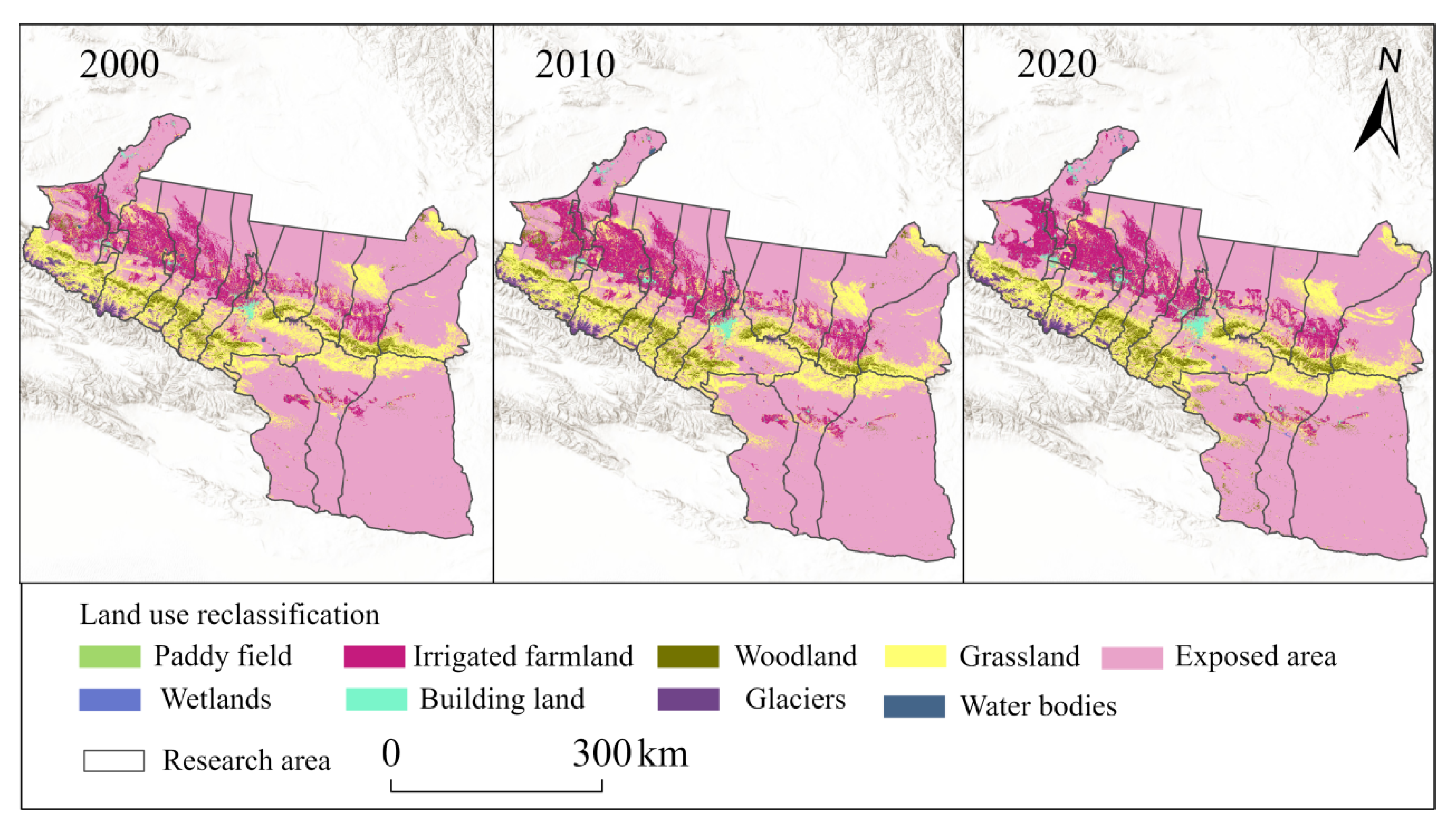
The land cover distribution of the UANSTM from 2000 to 2020 is dominated by exposed land, grassland, and irrigated farmland (Figure 3). Exposed land constitutes roughly 65% of the region’s total area and is predominantly distributed along its northern and southern edges. Grasslands cover about 17% of the area and are primarily distributed in the transitional zones between irrigated farmland and exposed land as well as between woodland and exposed land. Irrigated cropland accounts for 10.8% of the region’s total area and is primarily distributed in the northwestern section of the UANSTM. Between 2000 and 2020, both exposed land and grassland exhibited a noticeable decline, while the areas of other land cover types either increased or remained relatively stable.
Between the 2000s and 2020s, significant land use changes were observed mainly in exposed land, grasslands, and irrigated farmland. Specifically, exposed land was converted to grassland covering 5902 km2, to irrigated farmland covering 4554 km2, and to woodland covering 797.9 km2. Conversely, grassland areas transitioned into exposed land (5260 km2), irrigated farmland (1825 km2), and woodland (1458 km2). Irrigated farmland was also converted back into exposed land, totaling 2487 km2. Overall, exposed land and grasslands exhibited a declining trend, while irrigated farmland increased during the study period (Figure S1). These transitions suggest a dynamic equilibrium: while portions of grassland and irrigated farmland degraded into exposed land, some areas of exposed land were subsequently restored or developed into grassland and irrigated farmland. Efforts to safeguard both natural vegetation and farming productivity driven by ecological protection strategies in Xinjiang are likely responsible for this observed trend. Additionally, it was observed that paddy fields and wetlands experienced minimal change. The limited conversion of paddy fields may be attributed to their specific cultivation practices, which reduce the likelihood of degradation. Moreover, both paddy fields and wetlands constitute only a small proportion of the total land area. Wetlands, in particular, exhibit high ecological stability due to their resistance to evaporation and drying, leading to relatively stable land use and land cover dynamics over time.

3.2. RESV

3.2.1. Spatial Distribution Pattern of RESV in the UANSTM

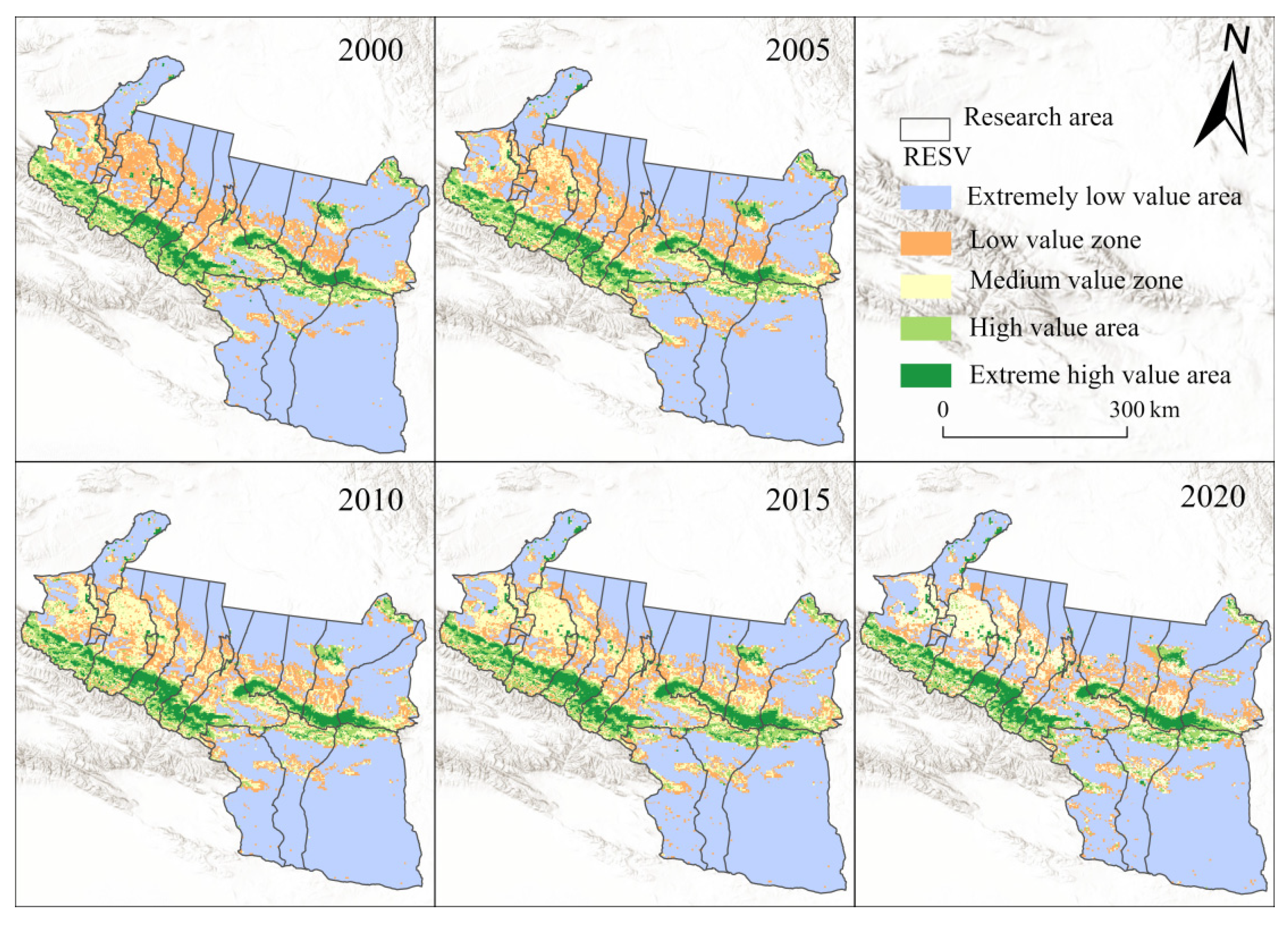
Using a 3 km × 3 km grid, the RESV of the UANSTM was estimated for the period 2000–2020 (Figure 4). From a temporal perspective, the RESV exhibited an overall increasing trend, characterized by a slight decline during the first five years followed by a sustained rise. Compared with 2000, the RESV in 2005 decreased by 1.45%. Subsequently, the values increased by 8.96% from 2005 to 2010 and by 5.19% from 2010 to 2015. Between 2015 and 2020, the growth rate slowed markedly, with only a small change during this period. The total RESVs for 2020, 2015, 2010, 2005, and 2000 were 1247.27 billion yuan, 1247.28 billion yuan, 1185.69 billion yuan, 1088.22 billion yuan, and 1104.22 billion yuan, respectively, with a 20-year average of 1176.01 billion yuan.
From a spatial perspective, areas with high and very high RESVs were predominantly distributed in the central and southwestern regions of the UANSTM, especially in the vicinity of the Tianshan Mountains. Together, the high- and very-high-value RESV zones comprised 14.87% of the entire study area, and the dominant LUCC type within these zones was woodland. Conversely, areas with low RESVs were mainly distributed across the bare land belts situated along the northern and southern edges of the UANSTM, collectively covering 56.99% of the entire region. Medium-value zones were mainly distributed in the central region, where irrigated farmland is the dominant LUCC type.
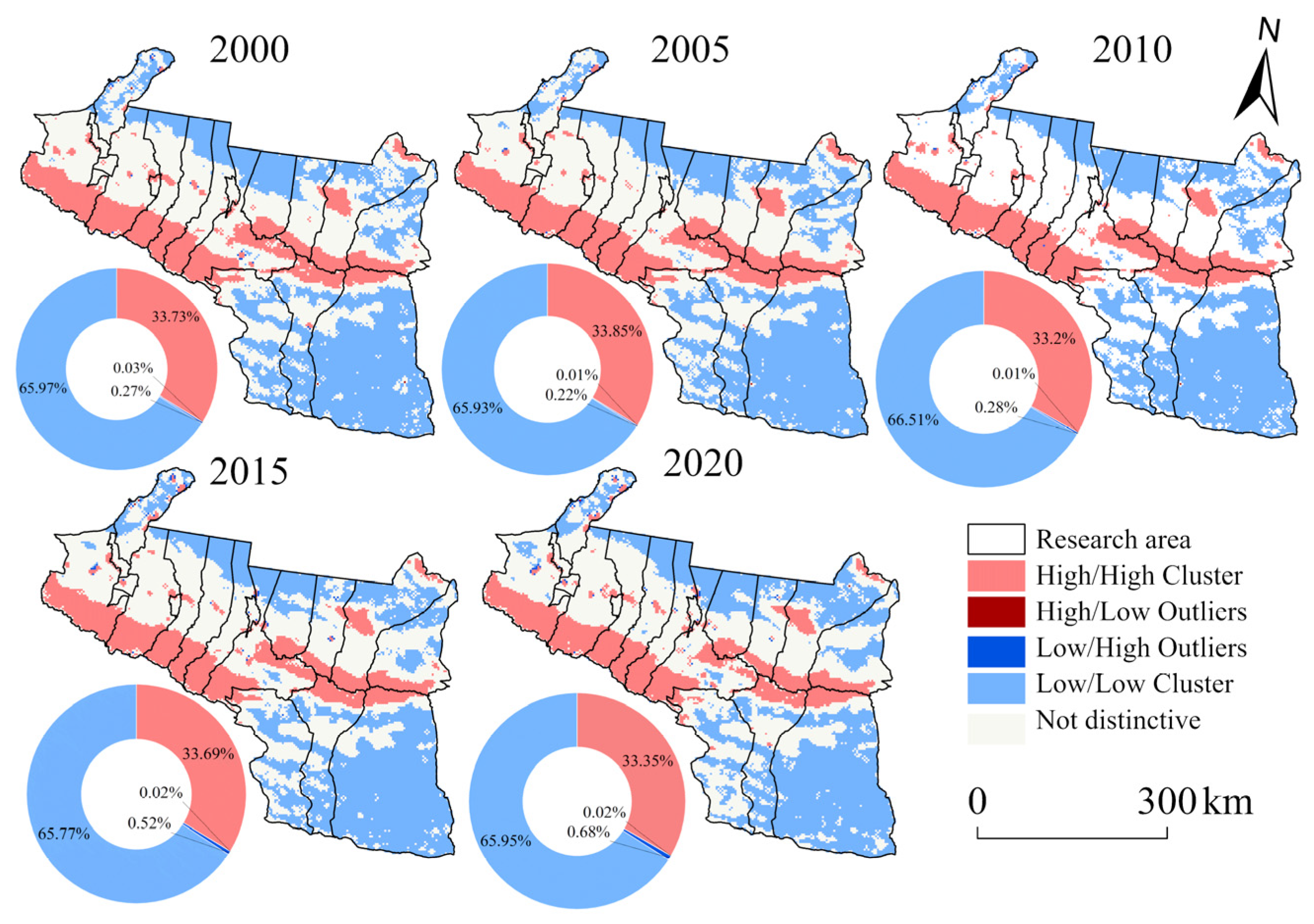
The results of the spatial autocorrelation analysis (Figure 5) show that the Moran’s I values for all years were greater than zero, indicating strong positive spatial autocorrelation. Specifically, Moran’s I values were 0.830 (2000), 0.835 (2005), 0.814 (2010), 0.773 (2015), and 0.751 (2020). All Z-scores exceeded 2.58, and all p-values were <0.01, suggesting that the probability of the observed clustering occurring by random chance is less than 1%. The LISA cluster maps demonstrate that RESV was mainly characterized by high–high and low–low clusters, and these spatial patterns were generally consistent with the distribution of high- and low-value RESV zones, showing only minor fluctuations throughout the study period.

3.2.2. Validation of Elasticity Coefficient for RESV

The accuracy of the RESV was verified by adjusting the equivalence factors by ±50% for each LUCC type. The results showed that all CS values were less than 1 (Table 4), indicating that the RESV is relatively insensitive to variations in the equivalence factors. This suggests that the evaluated RESV is robust and applicable to the study area.

3.2.3. ECPS in the UANSTM

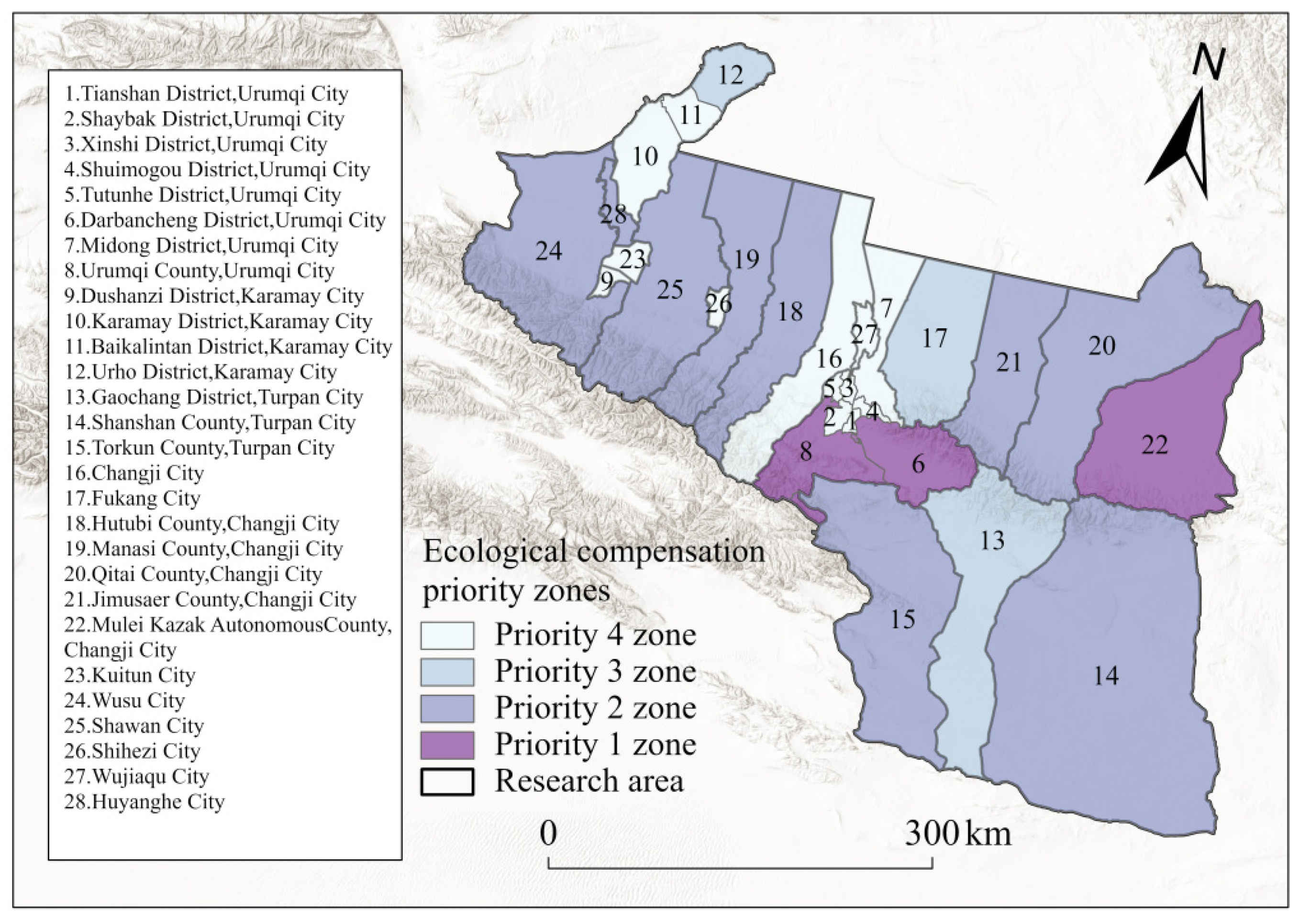
Based on the previously calculated RESV of the UANSTM, the non-market values (excluding food production and raw material production) were compared with GDP to determine the Ecological Compensation Priority Zones. As shown in Figure 6, the areas with the highest priority are Dabancheng District, Mulei Kazakh Autonomous County, and Urumqi County, with Dabancheng District having the highest priority. These areas exhibit relatively strong ecosystem service capacity but weaker economic performance, implying that they bear high opportunity costs while providing key ecological functions. Therefore, they should be prioritized for ecological compensation to offset such costs and support more balanced regional development. In contrast, Xinshi District, Tianshan District, and Shayibak District showed the lowest ECPS values, characterized by stronger economic development but comparatively lower ecosystem service conditions. These districts are thus identified as ecological payment zones. Overall, the ECPS framework aims to allocate limited compensation funds more efficiently by enabling economically developed areas to support ecologically important but economically constrained regions, thereby promoting coordinated and sustainable development across the UANSTM.

3.3. Ecological Sensitivity

Spatial Distribution Pattern of Ecological Sensitivity in the UANSTM

By weighting and overlaying the ecological sensitivity factors, the ecological sensitivity of the UANSTM was evaluated. This study selected seven factors: elevation, slope, NDVI, population, soil erosion, LUCC, and distance to water systems. The regions were classified into four categories: low, medium, high, and very high using the natural breaks method.
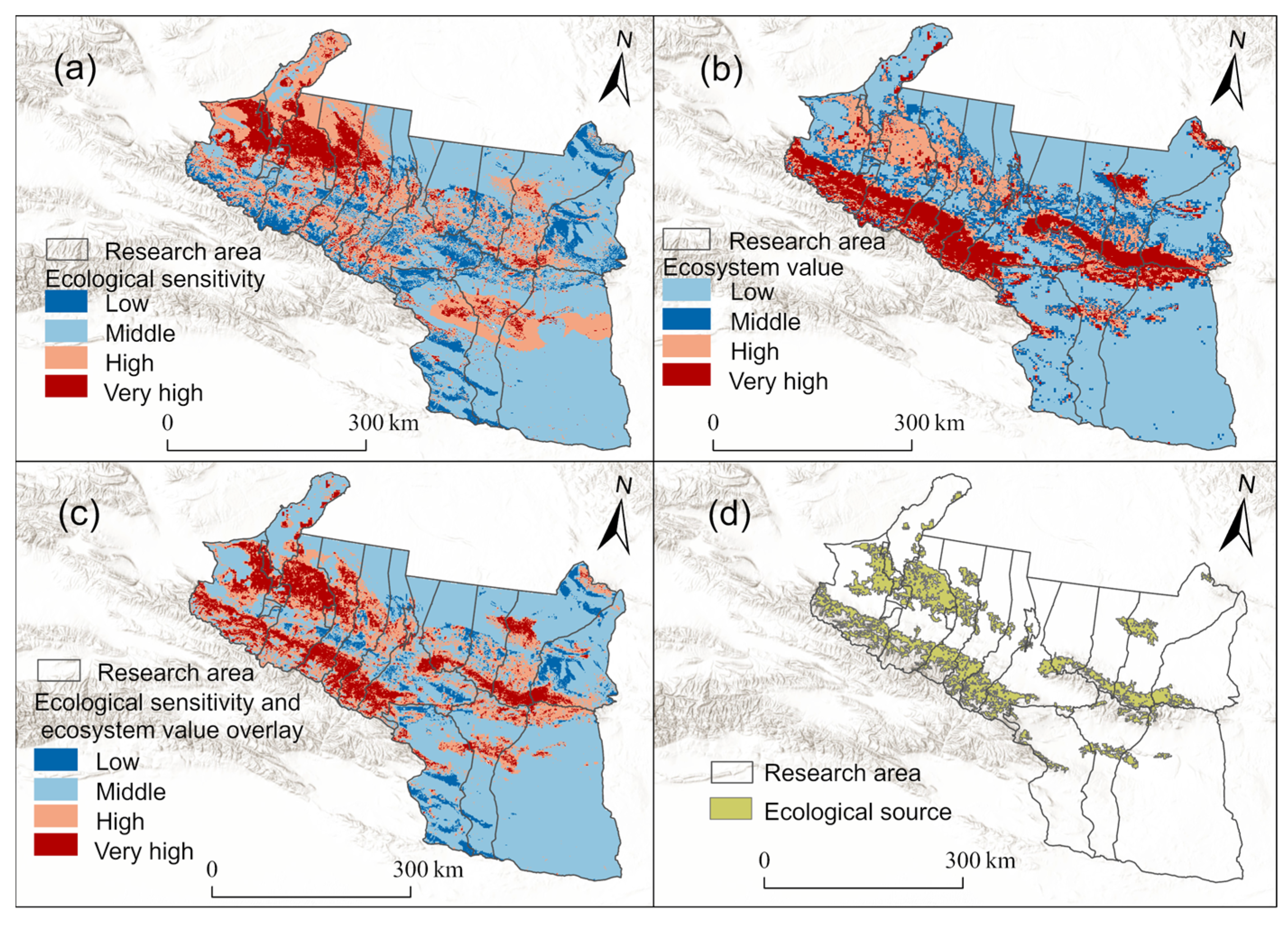
As shown in Figure 7a, areas exhibiting very high ecological sensitivity are chiefly distributed in the northwestern part of the UANSTM and within the Turpan region, where irrigated farmland is the dominant LUCC type. These agricultural landscapes are associated with relatively intensive human use, and certain farming practices may contribute to vegetation degradation and increased landscape heterogeneity, thereby intensifying ecological disturbance. High-sensitivity zones are also distributed in the northwest, around the outer margins of the very high–sensitivity patches in Turpan, and in belt-like patterns across the high-altitude central area; the LUCC in these zones is primarily composed of irrigated farmland, grassland, and woodland. In contrast, low-sensitivity areas are extensively found in the eastern part of the UANSTM and are dominated by exposed land.
About 19,300 km2 of land within the UANSTM was designated as having very high sensitivity. These areas are mainly concentrated in Wusu, Huyanghe, Shawan, and Manas, comprising 9.80% of the total research area. The high-sensitivity zones span 51,600 km2, largely concentrated in the southeastern, central, and Turpan regions, representing 26.27% of the total area. Medium sensitivity areas comprise the majority, covering 103,000 km2 or 52.46% of the total. Regions with low sensitivity cover a relatively small area, comprising just 11.47% of the total land. In general, the ecological sensitivity of the UANSTM is moderately high, with most regions classified as having medium to high sensitivity.

3.4. ESP

3.4.1. Distribution of Ecological Source Areas in the UANSTM

Overlay analyses of RESV and ecological sensitivity were conducted to identify ecologically important areas, as shown in Figure 7c. Regions with high and very high RESV, in combination with areas of very high ecological sensitivity, were selected for identifying ecological source areas. It is evident that ecologically significant areas are primarily located in the northeastern and central parts of the UANSTM region, as well as within the Turpan Oasis. A total of 1711 ecological source areas were identified within the UANSTM, covering an area of 2.69 × 10⁴ km2, which accounts for approximately 12.46% of the total study area.
Considering the fragmented distribution of the ecological source areas identified, and based on regional characteristics of the UANSTM as well as previous studies, this paper selects the top 30% of the area as the primary ecological source sites, totaling 23 areas. The total area of these selected ecological source regions is 2.65 × 10⁴ km2, as shown in Figure 7d. Geographically, these ecological source areas are primarily concentrated in the Tianshan mountain region, with additional distributions in the northeastern and central regions of the UANSTM and the Turpan oasis.

3.4.2. Construction of ESP for the UANSTM

In this study, a total of ten social, natural, and accessibility factors were selected, weighted, and overlaid to construct a comprehensive resistance surface (Table 3). As illustrated in the figure, regions with high resistance values are mainly located in the mountainous and elevated areas of the UANSTM (Figure S2). These areas are difficult to access and are densely developed, which poses significant barriers to species migration and ecological flows. In contrast, the northern and southern portions of the UANSTM are characterized by relatively flat terrain and lower human disturbance, offering more favorable conditions for ecological connectivity.

3.4.3. Ecological Corridor Distribution in the UANSTM

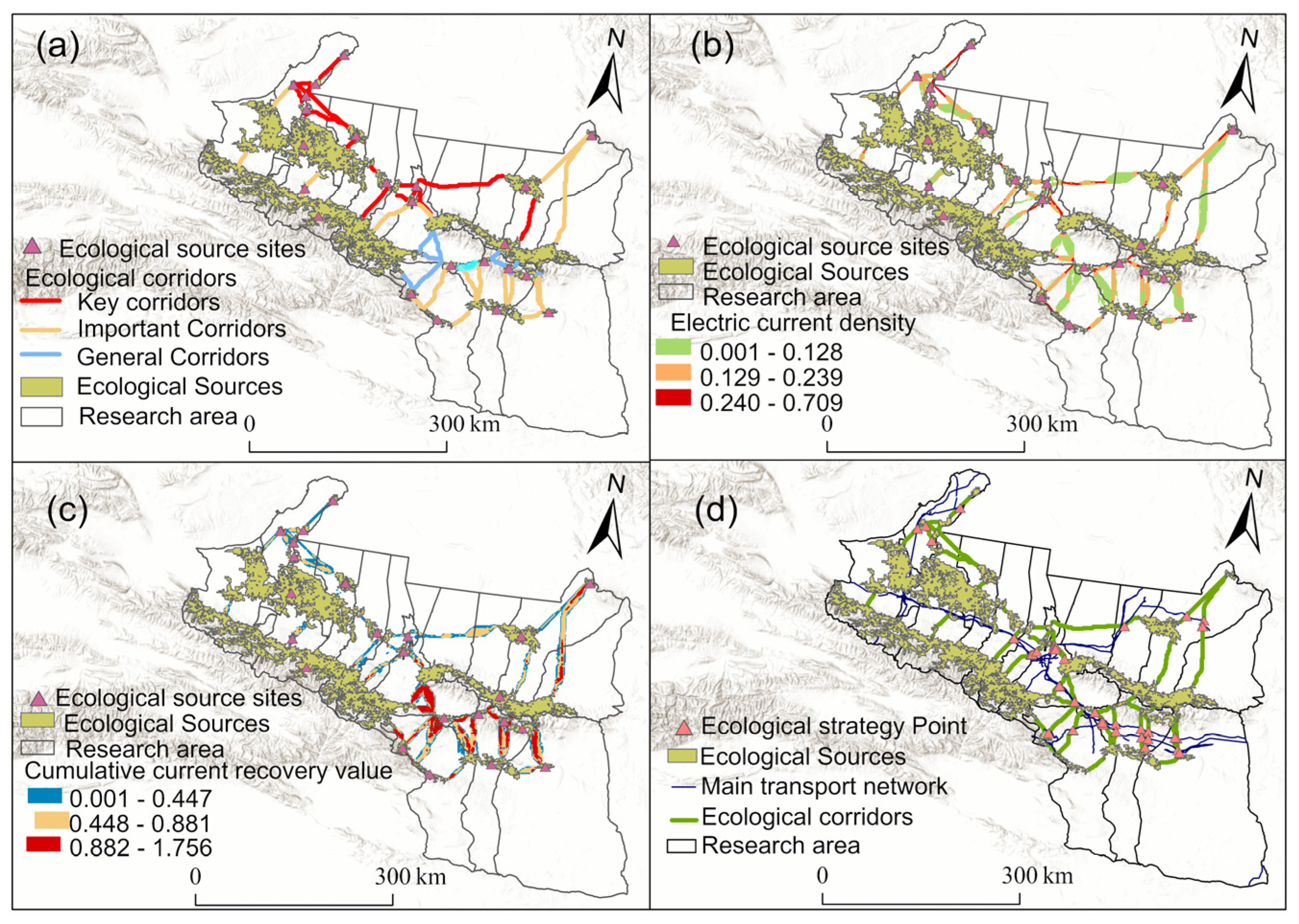
In this research, the Linkage Mapper extension in ArcGIS was employed to extract ecological corridors across the UANSTM. Using the least-cost path model, 47 optimal corridors were mapped, totaling roughly 1800 km in length. Based on the natural discontinuity method, corridors were classified by resistance value into key corridors (<1.74), important corridors (1.74–2.05), and general corridors (>2.05). More specifically, the analysis identified 18 critical corridors measuring 637.65 km in total, another 18 important corridors with a combined length of 905.25 km, and 11 general corridors adding up to 260.22 km (Figure 8a). As illustrated in the figure, the corridors are predominantly located in areas with relatively flat terrain and low resistance values. The ecological corridors in the Karamay Metropolitan Area and the Wuchang–Changji Five-City Metropolitan Area are primarily classified as critical, serving to connect the core urban centers in the central region of the UANSTM. The important corridors, which are generally longer, are mainly distributed in areas such as Qitai County, Mulei Kazak Autonomous County, and Turpan, where resistance values are relatively low. These corridors primarily link ecological source areas within the Tianshan Mountain region to adjacent source patches. In contrast, general corridors are mostly found in areas with higher resistance values, including Urumqi City and regions near the Tianshan Mountains in Turpan. Overall, the ecological source areas within the UANSTM are effectively connected to surrounding, relatively fragmented landscape patches through this corridor network.

3.4.4. The UANSTM Key Ecological Node Distribution

According to the Circuit Theory Pinchpoint Mapper, ecological pinch points are those sites exhibiting peak current density values. Based on natural divisions, the study categorized the findings into three levels, with ecological pinch points representing the highest priority areas. Across the UANSTM, 76 ecological pinch points were detected, collectively encompassing about 887 km2. These pinch points are relatively dispersed across the region’s ecological corridors, as illustrated in Figure 8b, with major concentrations observed in Karamay City and the Changji Hui Autonomous Prefecture. Most pinch points appear near the ends of ecological corridors and commonly coincide with wildlife migration routes, which are generally associated with lower resistance areas. The LUCC in these areas is primarily composed of exposed area (474.17 km2), irrigated farmland (200.34 km2), and grassland (167.34 km2). These ecological pinch points serve as critical migration pathways for wildlife, making them essential for biodiversity conservation. Consequently, it is vital to strengthen protective measures and limit human development activities in these zones. These key areas are of great significance for the construction of the ESPs and for maintaining overall landscape connectivity.
The Barrier Mapper tool was employed to calculate accumulated current recovery values, which were then classified into three groups using natural breaks. High-value regions were identified as ecological barriers. Within the UANSTM region, 51 ecological barriers were delineated, covering a total area of 3222 km2, with individual barrier sizes ranging from 5 km2 to 730 km2. These barriers are predominantly located in high-resistance areas, especially within Urumqi City and Turpan, as shown in Figure 8c. The dominant LUCC types in these regions are exposed area (2527 km2) and grassland (595.68 km2). Restoring ecological barriers is crucial for improving regional connectivity. In low-resistance areas, protection should be prioritized, with restoration as a supplementary strategy. In contrast, in high-resistance areas, restoration efforts should take precedence to enhance vegetation coverage and connectivity.
By overlaying ecological corridors with major transportation routes (including railways, highways, and national roads), 56 ecological strategy points were identified, as illustrated in Figure 8d. These points are primarily located at grassland intersections, border zones, irrigated farmland, and exposed areas. Ecological strategy points represent vulnerable zones where ecological corridors intersect with transportation infrastructure. Without effective protection and management, these areas are at high risk of ecological fragmentation. Therefore, these points warrant targeted conservation strategies to mitigate potential conflicts between infrastructure development and ecological connectivity.

4. Discussion

The UANSTM is the core area of the Silk Road Economic Belt and plays a crucial role in the sustainable development of Xinjiang. ESP of UANSTM is of paramount importance for both the ecological conservation and economic growth of Xinjiang. Moreover, it holds significant scientific value for the formulation of regional sustainable development strategies and territorial spatial planning.

4.1. Green Contribution of High-Altitude Forests from the Viewpoint of RESV in the UANSTM

High-altitude forests serve as critical ecological pillars in arid regions, making substantial contributions to water conservation, carbon sequestration, and soil protection [45]. The Tianshan Mountains function as an essential ecological barrier for the UANSTM, safeguarding regional water supplies while maintaining oasis stability and ecosystem diversity [46]. RESV results indicate that these alpine forests constitute the core ecological value zone of the UANSTM and represent one of the principal ecological source areas underpinning the region’s ESP.
This study employs a 3 km × 3 km grid to calculate RESV for the UANSTM. Results indicate that water bodies exhibit the highest unit value among land types, followed by wetlands, glaciers, and forested areas. These high-value lands are predominantly distributed in the mountainous regions of the Tianshan Mountains, closely aligning with the distribution of high-value RESV zones and high-high clustering areas. Quantitative analysis reveals that most areas exceeding the upper quintile threshold for RESV are situated within mountainous regions. This indicates that high-elevation forested areas significantly influence both the distribution of UANSTM’s RESV and underlying ecological processes. In the mountain forests of UANSTM, Schrenk’s spruce is the dominant coniferous tree species [47]. The biological characteristics of Schrenk’s spruce enable it to play a vital role in carbon sequestration, nitrogen fixation, oxygen production, climate regulation, and ecological conservation [48]. These characteristics further confirm the substantial ecological value and potential of alpine woodlands in the UANSTM.
Over the past two decades, the RESV of UANSTM has exhibited a generally increasing trend, which aligns with findings from other studies [49], rising from 110.422 billion yuan in 2000 to 125.465 billion yuan in 2020—an increase of 13.62%, or approximately 15.043 billion yuan. This trend is consistent with the observed expansion of forest land, wetlands, and water bodies in LUCC. It also aligns with the ecological conservation initiatives implemented in Xinjiang, such as the “Three-North” Shelterbelt Program [50], the windbreak and sand-control projects along the oasis margins of the Junggar Basin [51] (e.g., in Qitai County and Mulei Kazakh Autonomous County), soil salinization control in oasis agricultural areas [52], and the establishment of ecological protection redlines. Collectively, these measures indicate that ecological restoration efforts have contributed to the enhancement of RESV.
In summary, high-altitude woodlands are not only vital ecological assets but also essential for ensuring the ecological security of arid oasis urban clusters. Therefore, it is imperative to maintain and protect the ecological environment and quality of these high-altitude woodlands.

4.2. Applicability of the ESV Adjustment Method in the UANSTM Region

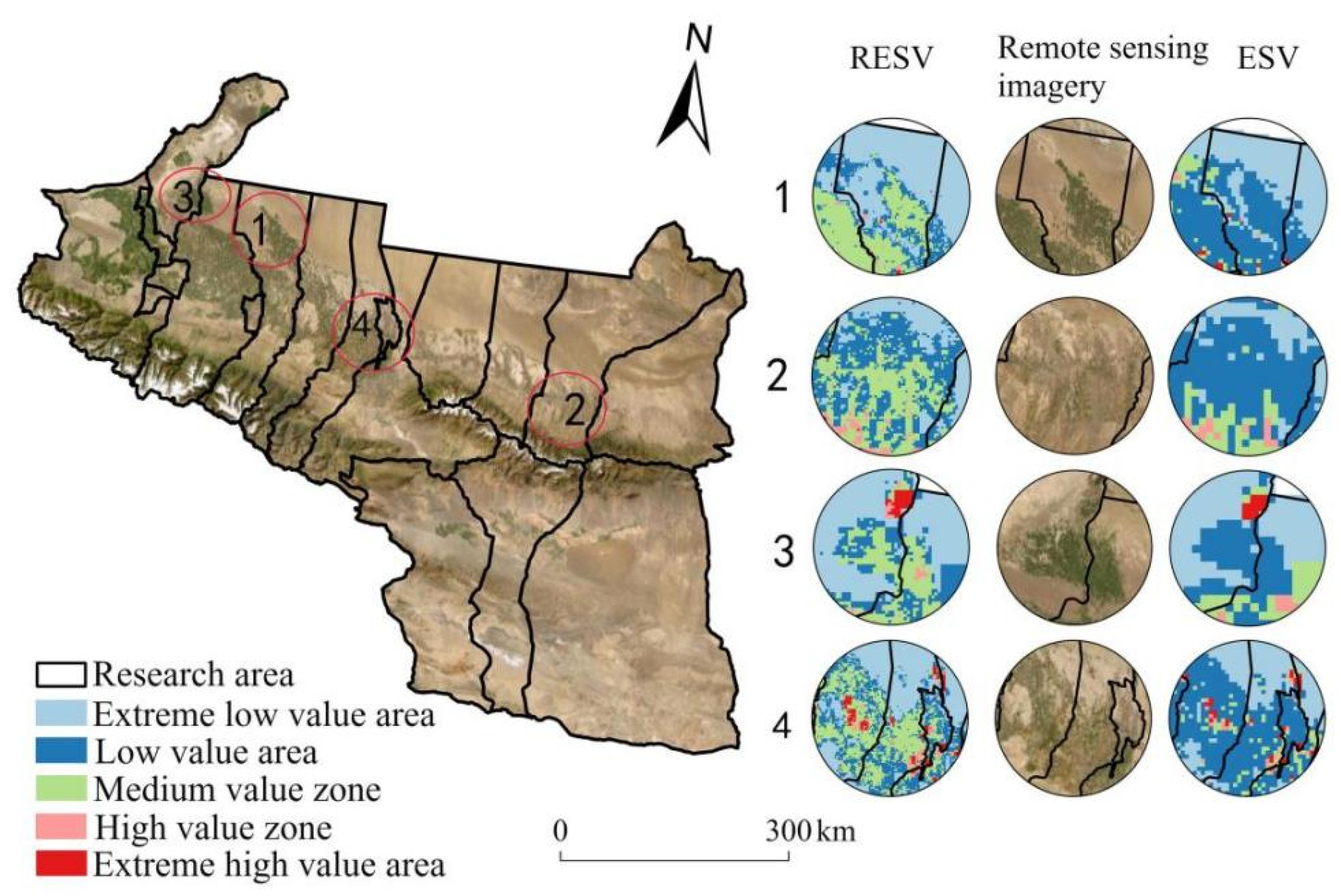
In this study, the estimation of ESV was improved by applying a method proposed by Li, which integrates NPP and NDVI data into the traditional equivalence factor approach originally developed by [53]. Comparing ESV with RESV adjusted by incorporating NPP and NDVI, as well as with actual remote sensing imagery, reveals that the median zone of RESV aligns more closely with the greenland boundaries in the actual imagery (Figure 9). This confirms that the spatial component of ESV estimated through this assessment method better reflects the characteristics of actual green land-cover patterns, particularly in arid oasis urban clusters like UANSTM with their unique “mountain–oasis–desert” landscape.
A quantitative comparison was conducted between the results before and after correction. Taking the year 2020 as an example, the ESV was 122.145 billion yuan, whereas the RESV reached 125.465 billion yuan, representing an overall increase of 3.32 billion yuan. Conversely, some time points showed a decline after correction. For instance, in 2005, the ESV was 116.931 billion yuan, while the RESV decreased to 108.822 billion yuan, indicating a reduction of 8.11 billion yuan. These findings suggest that the secondary correction using NPP and NDVI does not simply increase or decrease ESV uniformly; instead, it adjusts the estimates based on the initial ESV and the actual vegetation and land-cover characteristics of the region, thereby producing more accurate valuation results.
From the perspective of the spatial distribution of ESV grades, the average proportions of extremely low, low, medium, high, and extremely high values were calculated across the five periods before and after correction. The results show that, compared with the ESV, the RESV exhibits increases of 4.27%, 1.61%, and 1.88% in the proportions of medium-value, low-value, and extremely high-value areas, respectively. In contrast, the proportions of low-value and high-value areas decreased by 2.31% and 5.45%, respectively. These changes indicate that incorporating NPP and NDVI data captures the spatial heterogeneity of UANSTM more effectively than relying solely on equivalent value coefficients. Although the correction cannot eliminate all uncertainties, it provides a more regionally responsive framework for ESV estimation, and the method appears to be well-suited for ecosystem service valuation assessments in the UANSTM region.

4.3. ESP Optimization Path for Oasis Urban Agglomerations in Arid Areas

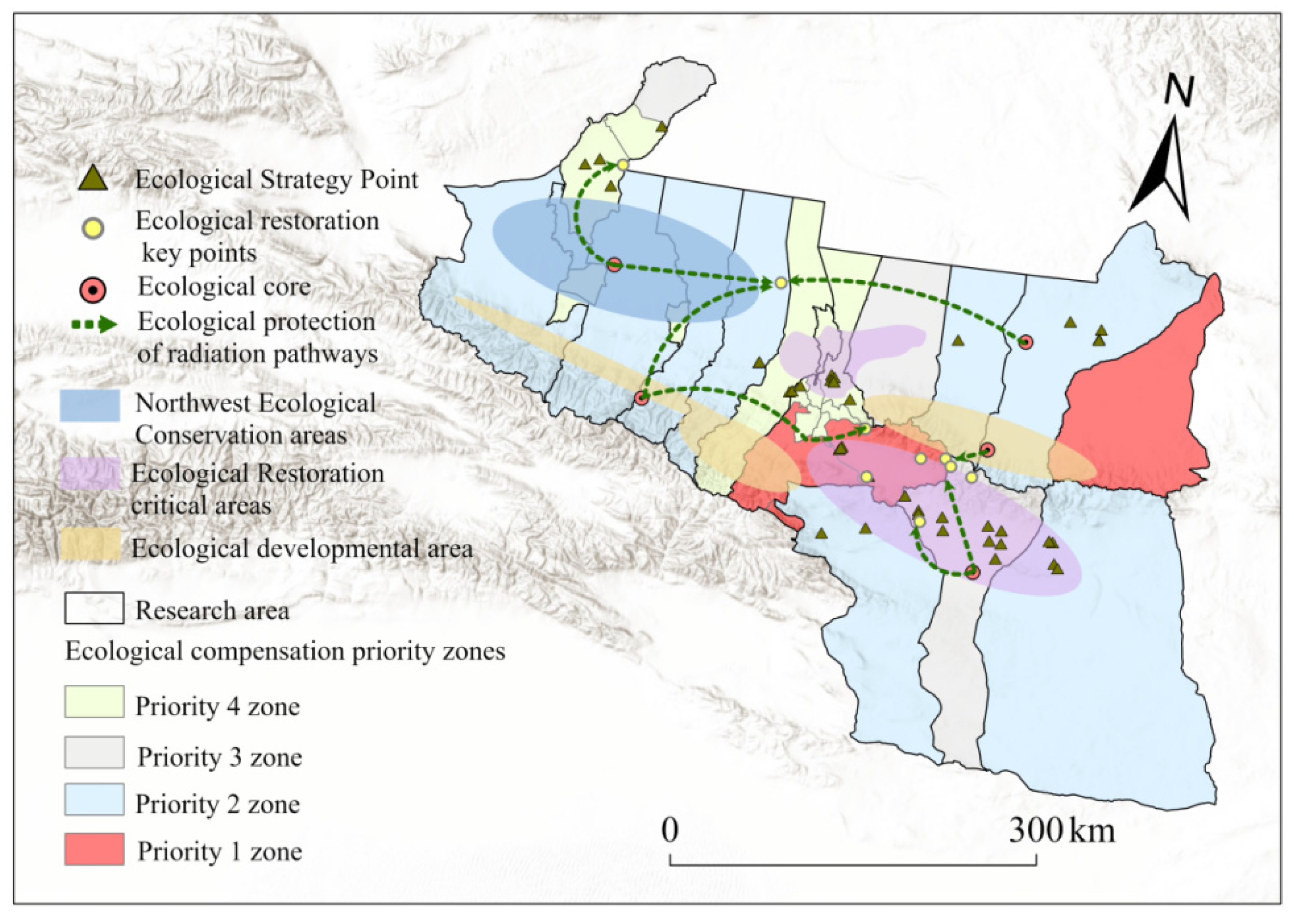
Based on the construction of the ESP for the USNSTM and integrating RESV and ecological sensitivity, this study develops a systematic “point–line–area” ecological protection strategy tailored to the terrain and ecological processes of the UANSTM (Figure 10). This framework aims not only to delineate spatial priorities but also to provide an operational pathway for ecological radiation development across this arid oasis region.
Ecological compensation priority zones represent the “area” dimension, identifying regions for prioritized development. Ecological corridors correspond to the “line” perspective, forming connectivity channels that facilitate interregional ecological exchange and support high-quality environmental development and biodiversity conservation. Ecological barrier points and pinch points reflect the “point” perspective, identifying key restoration areas that enhance regional ecological connectivity and ensure long-term ecosystem sustainability.
The Ecological Development Areas of the UANSTM are mainly distributed in the high-altitude forest areas of the Tianshan Mountains. These zones exhibit strong capacities for soil retention and water supply, experience relatively limited human disturbance, and thus maintain comparatively intact ecosystems. The administrative units covering these areas are also designated as priority zones for ecological compensation. Accordingly, they should receive stringent ecological protection as well as sustained financial support for conservation. Beyond safeguarding ecosystem integrity, the steep terrain in these mountainous zones requires close attention to natural-hazard risks, including vegetation degradation, outbreaks of forest diseases and pests, and wind erosion on exposed slopes. Therefore, we recommend implementing real-time environmental monitoring based on remote sensing, delineating and enforcing ecological redlines, and establishing early-warning systems for extreme climatic events. These measures will help maintain ecological stability and further enhance the ecological resource potential of this region.
The Northwest Ecological Conservation Area, located in the northwestern portion of the UANSTM, is dominated by irrigated cropland, high ecological sensitivity, and medium RESVs. The region’s flat terrain and high concentration of human activity render its ecosystems particularly vulnerable. Improper land use practices, such as expanding cultivated areas, overexploiting water resources, or inadequate soil conservation, exacerbate soil erosion, intensify drought stress, and trigger land degradation. Therefore, this region holds substantial ecological restoration potential. Focusing ecological management efforts here can improve the structure and resilience of the broader oasis ecosystem. Moreover, given the region’s agricultural significance, optimizing ecological conditions will directly support regional food security and promote sustainable development.
The Ecological Restoration Critical Areas are located in the central part of the UANSTM, where a large number of ecological bottlenecks and barriers are concentrated. Eliminating these ecological barriers and managing bottleneck areas are crucial for enhancing landscape connectivity and improving regional ecological security. Strengthening corridor connectivity, particularly at points where ecological flow is hindered, can enhance wildlife migration pathways and promote biodiversity recovery. In this area, operational strategies should include targeted vegetation restoration, windbreak construction, soil stabilization, and drought-resistant landscape engineering. Coupling ecological compensation policies with mandatory ecological protection regulations can further improve the efficiency of restoration actions. Integrating restoration practices with adaptive management will accelerate ecological quality improvements in these high-priority zones.
Ecological pinch points and barrier points serve as critical regulators within the regional ecological network. Their spatial intersections often represent urgent ecological restoration sites, where small-scale but precise interventions can significantly enhance network functionality. These areas should be prioritized for restoration due to their direct influence on ecological connectivity. In addition, where ecological corridors intersect with transportation infrastructure, ecological strategic points are formed. Such locations demand careful mitigation measures—such as constructing wildlife passages, vegetated overpasses, and ecological buffer zones—while avoiding routing major ecological radiation paths directly through high-disturbance zones to minimize human impact.
The five largest contiguous ecological source areas within the study region were designated as ecological core zones. The convergence zones between ecological bottlenecks and ecological pinch points were identified as key ecological restoration points. These locations serve both as barriers impeding species movement and as essential pathways for species dispersal, making them areas requiring urgent ecological conservation and restoration. Leveraging the core zones’ radiating influence, we propose eight ecological protection pathways that bypass high-resistance regions. These pathways aim to enhance connectivity, guide restoration toward critical areas, and optimize landscape configuration to strengthen ecological security throughout the UANSTM. Accelerated, targeted, and efficient restoration efforts are required in these zones. Comprehensive ecological restoration and protection strategies must be developed to achieve enhanced ecological security for UANSTM.

4.4. Limitations and Future Prospects

This study demonstrates that combining ecological sensitivity with RESV provides a regionally grounded ESP framework that more effectively pinpoints priority areas for protection, restoration, and compensation, thereby strengthening evidence-based policy and land-use zoning in arid oasis systems. However, several limitations remain in this research.
First, the LUCC-based RESV estimation and the refined land cover classifications improved accuracy, but uncertainties remain due to classification limitations and the reliance on equivalence factors. Further refinement could incorporate higher-resolution land cover datasets and dynamic ecological parameters. Furthermore, research on ecological pinch points and barriers in the UANSTM remains insufficient. Future studies could combine the findings of this research with field surveys to better understand the causes of these pinch points and barriers and to develop more effective solutions.
Second, the optimization of the ESP in this study is not exhaustive. Future research could consider other factors, such as regional dominant industries, population composition, and transportation accessibility, to create a more detailed, targeted, and region-specific optimization model. This would provide a more comprehensive framework for enhancing ecological security and guiding sustainable development in the region. At the same time, we are considering introducing multi-scenario simulations to explore UANSTM’s ESP under different scenario modes.

5. Conclusions

This study analyzes land use changes over a 20-year period based on LUCC data, focusing mainly on transitions among grassland, exposed areas, and irrigated farmland. Exposed areas were converted to grassland (5902 km2), irrigated farmland (4554 km2), and woodland (797.9 km2). Construction land continued to expand, while changes in other land categories were relatively minor. Overall, the LUCC evidence reveals a clear pattern of “exposed area, grassland, and irrigated farmland” bidirectional transitions.
Based on land use data, adjusted equivalent factor tables, and NPP/NDVI data, the RESV of UANSTM from 2000 to 2020 was assessed. Results indicate an average RESV of 11.76 × 10² billion yuan over the 20-year period. Overall, it shows an upward trend. Water bodies exhibited the highest unit RESV, while woodland demonstrated the highest overall RESV. High-value RESV zones were primarily distributed in the high altitude areas of the UANSTM, whereas low-value zones were mainly found in exposed areas. Ecologically highly sensitive areas within the UANSTM were predominantly located in the northwestern irrigated farmland, which also represents areas of intense human activity and fragile ecological environments.
The study also identified 23 ecological source areas, 47 optimized ecological corridors, 28 ecological pinch points, and 61 ecological bottleneck points. Based on the ESP, this study proposed a “point-line-area” ecological conservation strategy, dividing the region into three functional zones and identifying two key ecological development nodes along with eight ecological conservation radiation pathways. The ecological conservation plan emphasizes restoration in priority areas while ensuring long-term ecosystem connectivity through sustainable ecological corridors. These findings provide crucial evidence for ecological asset management and restoration, laying the foundation for developing targeted conservation measures.

Supplementary Materials

The following supporting information can be downloaded at: https://www.mdpi.com/article/10.3390/su172310880/s1, Figure S1. Land-use conversion shifts in the UANSTM. Figure S2. Resistance Surface of the UANSTM. Table S1. Sources of data. Table S2. Grading criteria for evaluation factors of ecological sensitivity index. Table S3. CS for RESV. Table S4. Factors for Constructing the UANSTM.

Author Contributions

Conceptualization, Methodology, Writing—original draft, X.A.; Conceptualization, Methodology, Supervision, Funding acquisition, Writing—review & editing, A.K.; Software, Investigation, X.Z.; Methodology, N.S.; Writing—review & editing, Y.Z. and B.S. All authors have read and agreed to the published version of the manuscript.

Funding

This study was supported by National Natural Science Foundation of China, grant number NO. 42361030. This study was supported by the Autonomous Region Social Science Fund Project, grant number 2025BJL040.

Institutional Review Board Statement

Not applicable.

Informed Consent Statement

Not applicable.

Data Availability Statement

The original contributions presented in this study are included in the article/Supplementary Materials. Further inquiries can be directed to the corresponding author.

Acknowledgments

I would like to thank all of the laboratory personnel who assisted and provided me with data as well as research methods, as well as my field research companions, as well as obtaining funding for the project, and all of the researchers of the data. Additionally, I thank the reviewers and journal editors for their comments and suggestions that led to the improvement of the manuscript!

Conflicts of Interest

The authors declare no conflicts of interest.

Abbreviations

The following abbreviations are used in this manuscript:
ESPThe Ecological Security Pattern
ESsecosystem services
UANSTMUrban Agglomeration on the Northern Slope of the Tianshan Mountains
ESVecosystem service value
NPPnet primary productivity
NDVInormalized difference vegetation index

References

  1. Wu, K.; Xing, A.; Wei, G.; Xin, H.; Wei, Y.; Su, L.; Zhou, J. Evaluation of Coupling Coordination Degree between Tourism Urbanization and Ecosystem Services in Urban Agglomerations in the Yellow River Basin. Sci. Rep. 2025, 15, 22427. [Google Scholar] [CrossRef] [PubMed]
  2. Li, X.; Li, Y.; Zhang, Z.; Li, X. Influences of Environmental Factors on Leaf Morphology of Chinese Jujubes. PLoS ONE 2015, 10, e0127825. [Google Scholar] [CrossRef] [PubMed]
  3. Aguiar, M.R.; Sala, O.E. Patch Structure, Dynamics and Implications for the Functioning of Arid Ecosystems. Trends Ecol. Evol. 1999, 14, 273–277. [Google Scholar] [CrossRef] [PubMed]
  4. Zhuang, Q.; Shao, Z.; Huang, X.; Zhang, Y.; Wu, W.; Feng, X.; Lv, X.; Ding, Q.; Cai, B.; Altan, O. Evolution of Soil Salinization under the Background of Landscape Patterns in the Irrigated Northern Slopes of Tianshan Mountains, Xinjiang, China. Catena 2021, 206, 105561. [Google Scholar] [CrossRef]
  5. Ouyang, X.; Wang, Z.; Zhu, X. Construction of the Ecological Security Pattern of Urban Agglomeration under the Framework of Supply and Demand of Ecosystem Services Using Bayesian Network Machine Learning: Case Study of the Changsha–Zhuzhou–Xiangtan Urban Agglomeration, China. Sustainability 2019, 11, 6416. [Google Scholar] [CrossRef]
  6. Millennium Ecosystem Assessment. Ecosystems and Human Well-Being: Scenarios Vol. 2; Island Press: Washington, DC, USA, 2005. [Google Scholar]
  7. Guo, X.; Zhang, Z.; Zhang, X.; Bi, M.; Das, P. Landscape Vulnerability Assessment Driven by Drought and Precipitation Anomalies in Sub-Saharan Africa. Environ. Res. Lett. 2023, 18, 064035. [Google Scholar] [CrossRef]
  8. Li, J.-X.; Chen, Y.-N.; Xu, C.-C.; Li, Z. Evaluation and Analysis of Ecological Security in Arid Areas of Central Asia Based on the Emergy Ecological Footprint (EEF) Model. J. Clean. Prod. 2019, 235, 664–677. [Google Scholar] [CrossRef]
  9. Wang, L.; Chang, J.; He, B.; Guo, A.; Wang, Y. Analysis of Oasis Land Ecological Security and Influencing Factors in Arid Areas. Land Degrad. Dev. 2023, 34, 3550–3567. [Google Scholar] [CrossRef]
  10. Guo, J.; Feng, P.; Xue, H.; Xue, S.; Fan, L. A Framework of Ecological Security Patterns in Arid and Semi-Arid Regions Considering Differences Socioeconomic Scenarios in Ecological Risk: Case of Loess Plateau, China. J. Environ. Manag. 2025, 373, 123923. [Google Scholar] [CrossRef]
  11. Pan, N.; Du, Q.; Guan, Q.; Tan, Z.; Sun, Y.; Wang, Q. Ecological Security Assessment and Pattern Construction in Arid and Semi-Arid Areas: A Case Study of the Hexi Region, NW China. Ecol. Indic. 2022, 138, 108797. [Google Scholar] [CrossRef]
  12. Peng, J.; Liu, Y.; Li, T.; Wu, J. Regional Ecosystem Health Response to Rural Land Use Change: A Case Study in Lijiang City, China. Ecol. Indic. 2017, 72, 399–410. [Google Scholar] [CrossRef]
  13. Liu, D.; Chang, Q. Ecological Security Research Progress in China. Acta Ecol. Sin. 2015, 35, 111–121. [Google Scholar] [CrossRef]
  14. Shi, X.; Jiang, X.; Liu, Y.; Wu, Q.; Zhang, Y.; Li, X. Evaluation of the Evolution of the Ecological Security of Oases in Arid Regions and Its Driving Forces: A Case Study of Ejina Oasis in China. Sustainability 2024, 16, 1942. [Google Scholar] [CrossRef]
  15. Shen, W.; Li, Y.; Qin, Y. Research on the Influencing Factors and Multi-Scale Regulatory Pathway of Ecosystem Health: A Case Study in the Middle Reaches of the Yellow River, China. J. Clean. Prod. 2023, 406, 137038. [Google Scholar] [CrossRef]
  16. Yuan, B.; Fu, L.; Zou, Y.; Zhang, S.; Chen, X.; Li, F.; Deng, Z.; Xie, Y. Spatiotemporal Change Detection of Ecological Quality and the Associated Affecting Factors in Dongting Lake Basin, Based on RSEI. J. Clean. Prod. 2021, 302, 126995. [Google Scholar] [CrossRef]
  17. Liang, S.; Yang, F.; Zhang, J.; Xiong, S.; Xu, Z. Assessment and Management Zoning of Ecosystem Service Trade-Off/Synergy Based on the Social–Ecological Balance: A Case of the Chang-Zhu-Tan Metropolitan Area. Land 2024, 13, 127. [Google Scholar] [CrossRef]
  18. Fu, Y.; Zhang, W.; Gao, F.; Bi, X.; Wang, P.; Wang, X. Ecological Security Pattern Construction in Loess Plateau Areas—A Case Study of Shanxi Province, China. Land 2024, 13, 709. [Google Scholar] [CrossRef]
  19. Zhang, L.; Peng, J.; Liu, Y.; Wu, J. Coupling Ecosystem Services Supply and Human Ecological Demand to Identify Landscape Ecological Security Pattern: A Case Study in Beijing–Tianjin–Hebei Region, China. Urban Ecosyst. 2017, 20, 701–714. [Google Scholar] [CrossRef]
  20. Wang, Z.; Shi, P.; Zhang, X.; Tong, H.; Zhang, W.; Liu, Y. Research on Landscape Pattern Construction and Ecological Restoration of Jiuquan City Based on Ecological Security Evaluation. Sustainability 2021, 13, 5732. [Google Scholar] [CrossRef]
  21. Hao, Z.; Gao, J.-X.; Xie, G.D.; Zou, C.X.; Jin, Y. Ecological corridor. J. Ecol. Rural. Environ. 2019, 35, 137–144. [Google Scholar] [CrossRef]
  22. Zhang, S.; Jiang, H.; Yu, H.; Feng, X.; Fan, M. Construction of Landscape Ecological Network Based on MCR Risk Assessment Model: A Case Study of Liaoning Province, China. Ecol. Indic. 2024, 166, 112549. [Google Scholar] [CrossRef]
  23. Wang, Y.; Qu, Z.; Zhong, Q.; Zhang, Q.; Zhang, L.; Zhang, R.; Yi, Y.; Zhang, G.; Li, X.; Liu, J. Delimitation of Ecological Corridors in a Highly Urbanizing Region Based on Circuit Theory and MSPA. Ecol. Indic. 2022, 142, 109258. [Google Scholar] [CrossRef]
  24. Peng, J.; Yang, Y.; Liu, Y.; Hu, Y.; Du, Y.; Meersmans, J.; Qiu, S. Linking Ecosystem Services and Circuit Theory to Identify Ecological Security Patterns. Sci. Total Environ. 2018, 644, 781–790. [Google Scholar] [CrossRef] [PubMed]
  25. Zhang, X.; Kasimu, A.; Liang, H.; Wei, B.; Aizizi, Y. Spatial and Temporal Variation of Land Surface Temperature and Its Spatially Heterogeneous Response in the Urban Agglomeration on the Northern Slopes of the Tianshan Mountains, Northwest China. Int. J. Environ. Res. Public Health 2022, 19, 13067. [Google Scholar] [CrossRef] [PubMed]
  26. Wei, X.; Abulizi, A.; Yuan, L.; Wang, J.; Bai, S.; Tang, S.; Yerkenhazi, A. A Study on Ecological Risk Identification Based on Ecosystem Service Supply and Demand in Xinjiang. Sci. Rep. 2025, 15, 28575. [Google Scholar] [CrossRef]
  27. Zheng, Y.; Liu, H.; Zhuo, Y.; Li, Z.; Liang, C.; Wang, L. Dynamic Changes and Driving Factors of Wetlands in Inner Mongolia Plateau, China. PLoS ONE 2019, 14, e0221177. [Google Scholar] [CrossRef]
  28. Fang, C.L. Strategic Thinking and Spatial Layout for the Sustainable Development of Urban Agglomeration in Northern Slope of Tianshan Mountains. Arid. Land Geogr. 2019, 42, 1–11. [Google Scholar]
  29. Zhang, Q.; He, J.; Ren, C.; Chang, C.; Tang, W.; Ju, X.; Saitiniyaz, A.; Guo, X.; Cui, L.; Liu, L. Sensitive Shrubland and Unique Urbanization Patterns: The Key to Understanding Emerging Towns Growth in Arid Regions. Environ. Monit. Assess. 2025, 197, 273. [Google Scholar] [CrossRef]
  30. Xie, G.; Zhang, C.; Zhang, L.; Chen, W.; Li, S. Improvement of the Evaluation Method for Ecosystem Service Value Based on per Unit Area. J. Nat. Resour. 2015, 30, 1243–1254. [Google Scholar] [CrossRef]
  31. Wang, L.-J.; Luo, G.-Y.; Ma, S.; Wang, H.-Y.; Jiang, J.; Zhang, J.-G. Integrating Landscape Ecological Risk into Ecosystem Service Value Assessment: A Case Study of Nanjing City, China. Ecol. Indic. 2023, 154, 110625. [Google Scholar] [CrossRef]
  32. Li, L.; Huang, X.; Wu, D.; Yang, H. Construction of Ecological Security Pattern Adapting to Future Land Use Change in Pearl River Delta, China. Appl. Geogr. 2023, 154, 102946. [Google Scholar] [CrossRef]
  33. Kreuter, U.P.; Harris, H.G.; Matlock, M.D.; Lacey, R.E. Change in Ecosystem Service Values in the San Antonio Area, Texas. Ecol. Econ. 2001, 39, 333–346. [Google Scholar] [CrossRef]
  34. Ouyang, Z.-Y.; Wang, X.; Miao, H. China’s Eco-Environmental Sensitivity and Its Spatial Heterogeneity. Acta Ecol. Sin. 2000, 20, 9–12. [Google Scholar]
  35. Wei, B.H.; Kasimu, A.; Reheman, R.; Zhao, Y.Y. Ecological Carrying Capacity Evolution and Ecological Sensitivity Analysis of Urban Agglomeration in the Northern Slope of Tianshan Mountains. Acta Ecol. Sin. 2022, 43, 1399. [Google Scholar]
  36. Chen, M.; Xu, X.; Tan, Y.; Lin, Y. Assessing Ecological Vulnerability and Resilience-Sensitivity under Rapid Urbanization in China’s Jiangsu Province. Ecol. Indic. 2024, 167, 112607. [Google Scholar] [CrossRef]
  37. Xu, Y.; Liu, R.; Xue, C.; Xia, Z. Ecological Sensitivity Evaluation and Explanatory Power Analysis of the Giant Panda National Park in China. Ecol. Indic. 2023, 146, 109792. [Google Scholar] [CrossRef]
  38. Peng, J.; Pan, Y.; Liu, Y.; Zhao, H.; Wang, Y. Linking Ecological Degradation Risk to Identify Ecological Security Patterns in a Rapidly Urbanizing Landscape. Habitat. Int. 2018, 71, 110–124. [Google Scholar] [CrossRef]
  39. McRae, B.H.; Kavanagh, D.M. Linkage Mapper Connectivity Analysis Software; The Nature Conservancy: Seattle, WA, USA, 2011. [Google Scholar]
  40. McRae, B.H.; Dickson, B.G.; Keitt, T.H.; Shah, V.B. Using Circuit Theory to Model Connectivity in Ecology, Evolution, and Conservation. Ecology 2008, 89, 2712–2724. [Google Scholar] [CrossRef]
  41. Wang, X.; Zhao, P.; Long, Y.X.; Song, W.; Liu, X. Identification of Key Areas of Land Space Ecological Protection and Restoration Based on the Pattern of Ecological Security in Guangdong, Hong Kong and Macau. Acta Ecol. Sin. 2022, 42, 450–461. [Google Scholar] [CrossRef]
  42. McRae, B.H.; Hall, S.A.; Beier, P.; Theobald, D.M. Where to Restore Ecological Connectivity? Detecting Barriers and Quantifying Restoration Benefits. PLoS ONE 2012, 7, e52604. [Google Scholar] [CrossRef]
  43. Xu, J.; Wang, J.; Xiong, N.; Chen, Y.; Sun, L.; Wang, Y.; An, L. Analysis of Ecological Blockage Pattern in Beijing Important Ecological Function Area, China. Remote Sens. 2022, 14, 1151. [Google Scholar] [CrossRef]
  44. Dai, Q.W. Study on the Spatial Selection of Ecological Compensation Objects: A Case Study of Water Conservation of Grasslands in Gannan Tibetan Autonomous Prefecture. J. Nat. Resour. 2010, 25, 415–425. [Google Scholar]
  45. Man, Z.; Zhang, J.; Liu, J.; Liu, L.; Yang, J.; Cao, Z. Process-Based Modeling of Phenology and Radial Growth in Pinus Tabuliformis in Response to Climate Factors over a Cold and Semi-Arid Region. Plants 2024, 13, 980. [Google Scholar] [CrossRef] [PubMed]
  46. Lu, Y.; Xu, X.; Zhao, J.; Han, F. Spatiotemporal Evolution of Mountainous Ecosystem Services in an Arid Region and Its Influencing Factors: A Case Study of the Tianshan Mountains in Xinjiang. Land 2022, 11, 2164. [Google Scholar] [CrossRef]
  47. Gong, L.; Chen, X.; Zhang, X.; Yang, X.; Cai, Y. Schrenk Spruce Leaf Litter Decomposition Varies with Snow Depth in the Tianshan Mountains. Sci. Rep. 2020, 10, 19556. [Google Scholar] [CrossRef]
  48. Zhu, H.; Gong, L.; Ding, Z.; Li, Y. Effects of Litter and Root Manipulations on Soil Carbon and Nitrogen in a Schrenk’s Spruce (Picea Schrenkiana) Forest. PLoS ONE 2021, 16, e0247725. [Google Scholar] [CrossRef]
  49. Kang, L.; Jia, Y.; Zhang, S. Spatiotemporal Distribution and Driving Forces of Ecological Service Value in the Chinese Section of the “Silk Road Economic Belt”. Ecol. Indic. 2022, 141, 109074. [Google Scholar] [CrossRef]
  50. Wang, Q.; Zhang, B.; Zhang, Z.; Zhang, X.; Dai, S. The Three-North Shelterbelt Program and Dynamic Changes in Vegetation Cover. J. Resour. Ecol. 2014, 5, 53–59. [Google Scholar] [CrossRef]
  51. Rui, H.; Luo, B.; Wang, Y.; Zhu, L.; Zhu, Q. Quantitative Impacts of Climate Change and Human Activities on Grassland Growth in Xinjiang, China. Front. Plant Sci. 2025, 15, 1497248. [Google Scholar] [CrossRef]
  52. Zhang, W.-T.; Wu, H.-Q.; Gu, H.B.; Feng, G.-L.; Ze, W.; Sheng, J.-D. Variability of Soil Salinity at Multiple Spatio-Temporal Scales and the Related Driving Factors in the Oasis Areas of Xinjiang, China. Pedosphere 2014, 24, 753–762. [Google Scholar] [CrossRef]
  53. Xie, L.; Wang, H.; Liu, S. The Ecosystem Service Values Simulation and Driving Force Analysis Based on Land Use/Land Cover: A Case Study in Inland Rivers in Arid Areas of the Aksu River Basin, China. Ecol. Indic. 2022, 138, 108828. [Google Scholar] [CrossRef]
Figure 1. Schematic diagram of the UANSTM. (a) China’s location in Asia. (b) Map of China. (c) Location map of Xinjiang. (d) Land use map of the UANSTM.
Sustainability 17 10880 g001
Figure 2. Technical Roadmap.
Sustainability 17 10880 g002
Figure 3. Characteristics of spatial distribution of LUCC types in the UANSTM.
Sustainability 17 10880 g003
Figure 4. Spatial distribution of RESV in the UANSTM.
Sustainability 17 10880 g004
Figure 5. RESV Aggregation Map at UANSTM Grid Scale.
Sustainability 17 10880 g005
Figure 6. The distribution of ECPS in the UANSTM.
Sustainability 17 10880 g006
Figure 7. (a) Spatial and temporal distribution of ecological sensitivity in the UANSTM. (b) RESV in the UANSTM. (c) Spatial distribution of RESV and ecological sensitivity. (d) Identification of ecological sources in the UANSTM.
Sustainability 17 10880 g007
Figure 8. (a) Distribution of Graded Ecological Corridors in the UANSTM, (b) Distribution of Ecological Pinch Points in the UANSTM, (c) Distribution of Ecological Obstacles in the UANSTM, (d) Distribution of Ecological Strategic Points in the UANSTM.
Sustainability 17 10880 g008
Figure 9. Comparison of ESV after correction.
Sustainability 17 10880 g009
Figure 10. Optimization path of the ESP of the UANSTM.
Sustainability 17 10880 g010
Table 1. Modified ESV Equivalent Factors (CNY/ha).
Functional TypeTypeWoodlandGrasslandPaddy FieldIrrigated FarmlandWater BodiesGlaciersWetlandsExposed
Area
Building Land
Supply ServiceFood Producing378.34383.822237.121398.201315.950.00838.920.000.00
Raw material production875.93564.76148.04657.98378.340.00822.470.000.00
Water supply452.36312.54−4326.1932.9013,636.543553.074260.390.000.00
Regulation servicesGas regulation2870.421984.891825.881102.111266.60296.093125.3932.900.00
Climate regulation8582.475247.36937.62592.183766.91888.275921.780.000.00
Purify the environment2545.541732.67279.64164.499129.41263.195921.78164.490.00
Hydrographic regulation6073.943843.684474.23444.13168,178.5611,728.4239,856.9049.350.00
Support ServicesSoil maintenance3491.392418.0616.451694.291529.790.003799.8132.900.00
Maintain nutrient cycling267.30186.43312.54197.39115.150.00296.090.000.00
Biological diversity3182.962198.74345.44213.844194.5916.4512,945.6832.900.00
Cultural servicesAesthetic landscape1394.09970.51148.0498.703108.93148.047780.5716.450.00
Sum30,114.7419,843.466398.816596.21206,620.7916,893.5285,569.78328.990.00
Table 2. Grading criteria for evaluation factors of ecological sensitivity index.
Assessment FactorLowerMiddleHighVery HighWeights
Slope (°)<55–1515–25>250.0798
LUCCBuilding land/Exposed areaCultivation of landGrasslandWoodland/Water systems0.1623
NDVI<0.30.3–0.50.5–0.7>0.70.2324
Soil erosion11, 21, 3112, 22, 2313, 23, 3324, 260.1171
Distance to water system (m)>30001600–3000800–1600<8000.0532
DEM (m)<400400–15001500–3500>35000.3096
Population>85732903–8573572–2903<5720.0455
Table 3. Constructing a Resistance Surface Factor Weighting.
Resistance Surface FactorResistance Value
12345Weight
DEM<687687–12311231–19771977–3000>30000.2184
Slope (°)<4.1594.159–12.47712.477–22.73722.737–33.551>33.5510.0631
NDVI<0.1280.128–0.2600.260–0.4470.447–0.646>0.6460.0566
LUCCExposed areaGrassland/Cultivated landWoodlandWaterBuilding land0.2330
Population<417417–19731973–51895189–10,701>10,7010.0957
Night Lights<19.60519.605–44.48844.488–85.96085.960–137.384<137.3840.0710
GDP<11.86811.868–121.577121.577–1503.1541503.154–2396.152>2396.1520.1246
Distance to railway>16,000.33616,000.336–8383.4338383.433–3557.9963557.996–1286.118<1286.1180.0413
Distance to road>16,050.55816,050.558–8707.4158707.415–3540.7103540.710–1287.833<1287.8330.0635
Distance to water system>14,175.17614,175.176–8935.5148935.514–3534.5793534.579–1229.906<1229.9060.0326
Table 4. Sensitivity Verification of RESV.
Year20002005201020152020
Woodland0.16220.17220.18970.17450.1833
Grassland0.58000.57250.54330.53970.4980
Paddy field0.00020.00030.00030.00020.0008
Irrigated farmland0.10910.11620.13320.21020.1502
Water bodies0.07360.06140.06230.07600.0916
Glaciers0.03010.03210.03120.02650.0272
Wetlands0.00400.00410.00430.00550.0165
Exposed area0.04080.04110.03570.03260.0325
Disclaimer/Publisher’s Note: The statements, opinions and data contained in all publications are solely those of the individual author(s) and contributor(s) and not of MDPI and/or the editor(s). MDPI and/or the editor(s) disclaim responsibility for any injury to people or property resulting from any ideas, methods, instructions or products referred to in the content.