Article

Study on the Climate Sensitivity Transition Matrix Growth Model of Liaodong Oak Stand in Qingyang City

Qingyang Forestry Science Research Institute, Qingyang 745000, China
*
Author to whom correspondence should be addressed.
Sustainability 2025, 17(23), 10864; https://doi.org/10.3390/su172310864
Submission received: 11 October 2025 / Revised: 23 November 2025 / Accepted: 26 November 2025 / Published: 4 December 2025

Abstract

The Liaodong oak (Quercus wutaishanica Mayr) is dominant in the composition scheme in Qingyang City, and its growth performance and management practices have long been central concerns of forest management. However, the long cycles and complex dynamics of forest development make accurate prediction difficult, thereby constraining the design of optimal silvicultural strategies. To remedy the slow growth and suboptimal timber quality of Q. wutaishanica plantations—while fostering large-diameter trees, increasing merchantable yield and the output of high-value timber, and enhancing forests’ carbon-sequestration and oxygen-release services—there is an urgent need for a rigorous predictive framework. Using data from the sixth, seventh, and eighth National Forest Resource Inventories, we developed a transition-matrix growth model comprising growth, ingrowth, and mortality sub-models. With this model, we selected representative plots and simulated 25-year trajectories of stand diameter-class structure and growing stock under three climate scenarios (RCP2.6, RCP4.5, RCP8.5). Results indicate divergent trends in growing stock among scenarios; under RCP2.6, stands attain higher growing stock, a more balanced diameter-class distribution, and a markedly larger number of large-diameter trees. Moreover, Q. wutaishanica exhibits relatively stable growth throughout the simulation horizon. Overall, the transition-matrix model effectively captures short-term stand dynamics, fills a regional research gap for Qingyang City, and provides a robust evidence base for subsequent science-based forest management.

1. Introduction

Forests, as the largest terrestrial ecosystem, play key environmental roles. They help mitigate climate change by sequestering carbon and releasing oxygen, regulating the water cycle, conserve water, and prevent soil erosion. Forests also reduce flood risks and support biodiversity, maintaining ecological balance [1,2,3]. Liaodong oak (Quercus wutaishanica Mayr), a native and foundation species of China’s warm-temperate deciduous broadleaf forests, possesses substantial ecological and economic value and plays a pivotal role in maintaining forest ecosystem structure and function primarily concentrated in the northeastern, northern, northwestern, and southwestern provinces of China, with occasional occurrences in northern Korea [4,5]. Its ecophysiological traits confer notable adaptability, stand stability, and multifunctionality [1,6]. Stands of Liaodong oak harbor rich biodiversity and provide critical habitat for numerous plant and animal species; they also deliver irreplaceable ecosystem services, including water regulation, soil conservation and nutrient retention, regional microclimate moderation, and carbon balance maintenance [7,8,9]. As a high-quality hardwood, its timber is strong and durable, suitable for furniture, flooring, and mining supports (pit props), while branches and tops serve as an important source of fuelwood—together underpinning considerable economic value [10]. Consequently, science-based management of Liaodong oak resources to achieve synergistic gains in both ecological benefits and economic returns is a key priority for sustainable forestry.
Qingyang City, located in eastern Gansu Province at the core of the Loess Plateau, is marked by complex landforms, thick loess mantles, pronounced soil erosion, and an arid to semi-arid climate, resulting in notable ecological fragility and sensitivity. Through long-term ecological restoration and forestry initiatives—especially the Three-North Shelterbelt Program, the Grain-for-Green Program (conversion of cropland to forest/grassland), and the Natural Forest Protection Program—the city has undertaken large-scale afforestation [11,12,13]. Forest and grassland resources have increased substantially: forestland now totals 874,900 ha and grassland 889,800 ha, with a forest cover of 26.30% and an integrated grassland vegetation cover of 78.51% [14]. Nevertheless, relative to other regions of China, Qingyang’s forest resources remain at a comparatively low level. Given its strong drought tolerance, edaphic hardiness, and high adaptability to Loess Plateau conditions, the Liaodong oak has become a principal and pioneer species for plantation establishment in the region. Unlike naturally regenerated secondary forests, Liaodong oak plantations in Qingyang are the product of active ecological restoration and goal-oriented silviculture, characterized by specified planting densities, age structures, spatial configurations, and management objectives (e.g., soil and water conservation, timber production, bioenergy, and landscape recreation) [15,16]. Accurately capturing their growth dynamics, structural evolution, and responses to environmental drivers and management interventions is fundamental to precise, efficient, and sustainable management—an urgent practical need for consolidating ecological gains, improving forest quality, and advancing regional green development.
Forest ecosystems are characterized by long growth cycles, which pose substantial challenges for the scientific design of optimal management prescriptions. To address this difficulty, forest growth models have been developed. Du et al. (2021) [17] developed a transition-matrix growth model for oak in Shanxi Province, while Ou et al. (2019) [18] developed an individual-tree growth model for the Larch–Spruce–Fir mixed forest in Jilin Province. This framework employs mathematical and statistical methods to quantify forest dynamics, providing essential tools for predicting future stand conditions and evaluating the effects of silvicultural regimes [19,20,21,22]. Contemporary growth modeling approaches fall broadly into three categories: stand-level models, individual-tree models, and transition-matrix models. Stand-level models use aggregate stand attributes—such as mean diameter at breast height (DBH), mean height, basal area, and growing stock—as state variables for prediction. They are well suited to even-aged plantations with simple species compositions. However, their predictive accuracy is often limited, and they struggle to represent within-stand structural changes (e.g., diameter-class distributions); consequently, their applicability to structurally complex uneven-aged or mixed-species stands is poor [22]. By contrast, individual-tree models simulate the growth of each tree and its interactions with environmental and competitive factors. These models are advantageous for projecting the dynamics of uneven-aged mixed stands and can deliver detailed tree-level information, but their development and application typically require highly resolved mapped-tree data (e.g., spatial coordinates and size relationships). The high cost of data acquisition restricts their broader use in large-scale management planning [23,24,25,26].
In contrast, the transition matrix model is widely used in forest growth forecasting due to its favorable balance between prediction accuracy and implementation cost [27,28,29,30]. For example, Du et al. (2023) established a climate sensitivity transition matrix growth model for the natural Pinus massoniana forest in Hunan Province and simulated the future forest growth and development conditions [31]. In 2023, Gao et al. (2023) developed a transition matrix growth model for the natural forests in Jiangxi Province, filling the gap in the research on natural forest growth models in the region [32]. The core advantage of this model lies in dividing the stand into discrete states (typically based on diameter class) and using a transition probability matrix to describe the changes in the stand’s state over specific time intervals, such as transitioning to a larger diameter class, maintaining the current diameter class, or mortality. Compared to the two methods mentioned earlier, this approach effectively captures the dynamic evolution of stand structure, particularly the diameter-class distribution, which is essential for formulating thinning and intermediate harvesting strategies (especially for lower canopy thinning) and optimizing target tree cultivation. Especially considering the significant topographic variations in the Qingyang region, where forestry surveys require substantial human and material resources, this method effectively reduces survey costs while providing an accurate understanding of forest growth conditions and enabling precise growth predictions. Through this method, the data requirements are relatively flexible and efficient, typically based on repeated tree measurements within fixed plots, significantly reducing data acquisition costs. For plantations such as Liaodong oak in Qingyang City, where initial density, age structure, and management objectives are well defined, the transition matrix model can accurately simulate the long-term trajectory of diameter-class structure under various management interventions (e.g., different thinning regimes), providing robust quantitative support for density control, rotation period determination, and target yield forecasting.
This study aims to address the urgent need for precise medium- to long-term management and structural optimization of Liaodong oak plantations in Qingyang City. Given the limitations of existing regional and fine-scale growth models, particularly those that struggle to simulate stand structural dynamics effectively, this research seeks to develop a climate-sensitive transition matrix growth model specifically for Liaodong oak plantations in Qingyang. The primary objective is to predict the short-term growth conditions of these plantations, focusing on Liaodong oak as the dominant species. Additionally, this study aims to explore the key relationships between tree growth, mortality, ingrowth, and their driving factors. By filling the gap in quantitative forecasting tools for stand structural dynamics in the region, the results will provide essential support for precise density regulation and long-term forest management. Ultimately, the study will offer theoretical and methodological insights for improving forest quality and advancing sustainable forestry practices, contributing to the consolidation of regional ecological achievements and promoting high-quality forestry development.

2. Materials and Methods

2.1. Study Area

Qingyang City is located in the easternmost part of Gansu Province, at the junction of Shaanxi, Gansu, and Ningxia, situated between 106°20′–108°45′ E and 35°15′–37°10′ N. It is a typical city in the heart of the Loess Plateau, known as the “Granary of Eastern Gansu,” and serves as a key node in the national “Guanzhong Plain Urban Agglomeration.” Qingyang has a temperate monsoon climate, with annual precipitation ranging from 480 to 660 mm and an average annual temperature of 10.3 °C [33,34]. The dominant soil type is loessial soil, and the topography features a general gradient from northwest to southeast, with elevations ranging from 885 to 2082 m.

2.2. Data and Methods

2.2.1. Data Collection

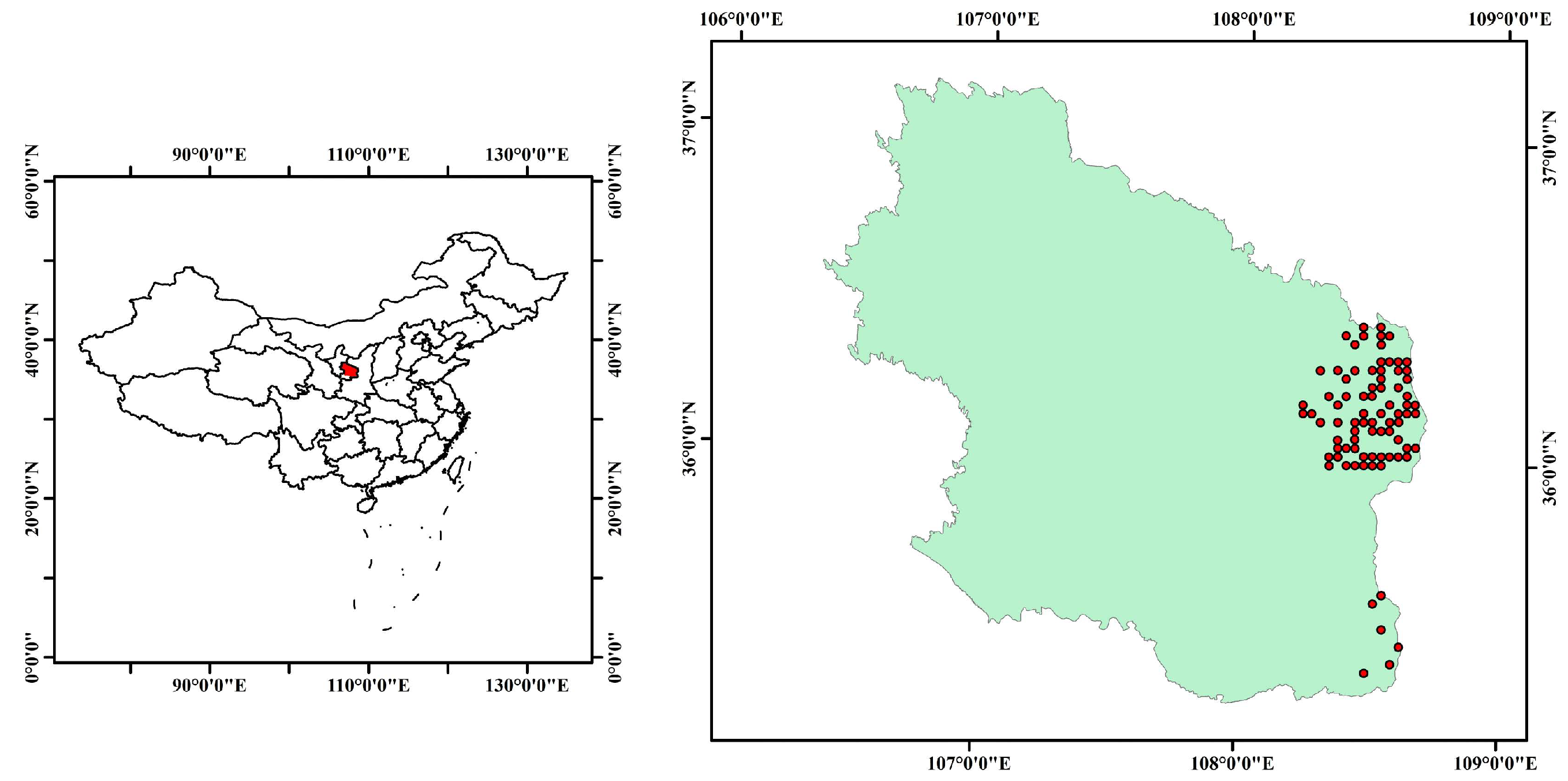
This study utilizes data from the sixth (2006), seventh (2011), and eighth (2016) National Forest Resource Inventories (CNFI) in Qingyang City. The survey data were collected from permanent sample plots, which are remeasured every five years, and the survey was organized by the National Forestry and Grassland Administration and the Qingyang Forestry and Grassland Bureau. The plots are distributed within a 4 km × 8 km grid, with each plot covering an area of 0.067 hm2 (Figure 1). Each tree within the plots is tagged and numbered for future remeasurement. The survey includes measurements of diameter at breast height (DBH), slope, aspect, and origin. Specific plot statistics are shown in Table 1. A total of 87 permanent sample plots dominated by Liaodong oak were selected for this study, of which 60 plots were randomly chosen for constructing the transition matrix growth model, and 27 plots were used for model validation (Figure 1). Each plot has not been affected by any human disturbances or fires.

2.2.2. Statistical Analysis

In constructing the model, we explicitly accounted for diversity across diameter classes as well as species diversity. Candidate predictors were screened using stepwise regression to achieve the best-performing specification. Multicollinearity in the growth, ingrowth, and mortality submodels was diagnosed with the variance inflation factor (VIF) [28,35].
The general form of the transition-matrix model is:
y t + 1   =   G t y t     h t   +   R t   +   ϵ t
In the expression, yt = [yijt] represents the number of surviving trees of species i (where i = 1, 2, 3, …, sp) and diameter class j (where j = 1, 2, 3, …, dc) at time t. Similarly, ht = [hijt] represents the number of trees of species i and diameter class j that were harvested at time t; if no harvesting occurred at time t the value is recorded as 0. Rt denotes the number of trees that grew to the minimum diameter class during a specific time interval (e.g., 5 years), and ϵt represents the random error.
The functions G and R are defined as follows:
G   =   G 1 G 2 G m ,   Gi   =   α i 1 b i 1 α i 2 b i , n 2 α i , n 1 b i , n 1 α in R   =   R 1 R 2 R m ,   R i   =   R i 0 0
The variable αij represents the probability that a tree of species i and diameter class j remains in the same diameter class during the interval, while bij represents the probability that a tree of species i and diameter class j grows into the next diameter class j + 1 during the time interval from t to t + 1. The relationship between αij and bij can be expressed as follows:
α ij   =   1     b ij   m ij
In the equation, the parameter mij represents the mortality rate. In the originally proposed transition matrix growth model, these parameters were considered to be fixed and constant. However, this approach has limitations in long-term forecasting, as growth, mortality, and diameter class transitions cannot remain stable indefinitely [36]. To improve the model’s predictive capability, other variables such as species diversity and diameter class diversity have been incorporated into the model [37]. In this study, the independent variables include species diversity (H1), diameter class diversity (H2), diameter at breast height (DBH), and cross-sectional area at breast height (B).
The parameter bij can be determined by dividing the growth amount (gij) by the width of the diameter class (5 cm in this study).
The growth amount (gij) is calculated using the following formula:
log g ij   +   1 = γ i 1 + γ i 2 D   +   γ i 3 H 1 + γ i 4 H 2 + γ i 5 B   +   γ i 6 MAT   +   γ i 7 M A P + μ ij
In the equation, D represents the diameter at breast height of the tree, H1 represents species diversity, H2 represents diameter class diversity, SLcos represents slope × cos(aspect) [38], γ denotes the parameter, and μij represents the error term.
The calculation formulas for H1 and H2 are as follows [31]:
H 1   =   i = 1 m B i B ln ( B i B )
H 2 = j = 1 n B j B ln ( B j B )
Bi and Bj represent the cross-sectional area at breast height of tree species i and diameter class j, respectively, while B denotes the total cross-sectional area at breast height of all trees in the plot. In this study, four tree species groups were defined: Liaodong oak, Chinese arborvitae, maple, and other species. Trees representing less than 5% of the total were grouped and labeled as “other species”.
Since the number of trees entering the next diameter class is always greater than or equal to zero, the Tobit model was used for the calculation [39].
R = Ω β i X i σ i β i X i +   σ i ω β i X i σ i
β i X i = β i 1 + β i 2 N i + β i 3 B +   β i 4 H 1 + β i 5 H 2 + β i 6 MAT + β i 7 MAP +   v i
In the equation, Ni represents the number of trees per hectare of species i; Ω and ω are the standard normal cumulative distribution function and probability density function, respectively; and σi is the standard deviation of the residuals vi obtained from the parameter β estimation.
The mortality distribution of the stand follows a binomial distribution, so the mortality rate mij is calculated using the Probit model [31]:
m ij   =   M ij T   =   1 T Ω ( δ i 1 + δ i 2 D   +   δ i 3 B   +   δ i 4 H 1 + δ i 5 H 2 + δ i 6 SLcos   +   ξ ij )
In the equation, Mij represents the mortality probability of tree species i in diameter class j within time T, where δi is the parameter and ξij is the error term. Table 2 lists the definitions of each variable.
The short-term forecast results (5 years) were compared with the actual survey results from the Eighth National Forest Resources Inventory (CNFI) of Qingyang City. To assess the model’s accuracy, the predicted cross-sectional area at breast height for each plot was compared with the measured cross-sectional area at breast height. The root mean square error (RMSE) and mean absolute error (MAE) were calculated as indicators for evaluating the model’s accuracy.
RMSE = 1 m n = 1 m ( y ^ n y n ) 2
MAE = 1 m n = 1 m | y ^ n y n |
In the equation, yn represents the predicted value, ŷn represents the actual measured value, and m represents the sample size.

2.2.3. Forest Growth Prediction

Based on the established transition matrix growth model, we used Climate AP (v2.30) to predicted forest growth over the next 25 years under different climate scenarios (RCP2.6, RCP4.5, and RCP8.5) [40]. The RCP2.6 scenario envisions significant global efforts to reduce greenhouse gas emissions, with a peak in emissions expected by 2020, followed by a sharp decline. This pathway aims to limit global warming to between 1.5 °C and 2 °C above pre-industrial levels by the year 2100, requiring rapid changes in energy systems, land use, and technological advancements. On the other hand, RCP4.5 presents a more moderate trajectory, where emissions peak around 2040 and subsequently decrease, stabilizing atmospheric concentrations by the latter half of the century. This scenario would result in an approximate global temperature rise of 2.5 °C by 2100. RCP8.5, often referred to as the “business-as-usual” scenario, assumes that emissions will continue to increase throughout the century, potentially leading to severe climate consequences and temperature rises exceeding 4 °C by 2100. This scenario is characterized by high population growth, slow economic progress, and continued dependence on fossil fuels.

3. Results

3.1. Model Parameters and Validation Results

As a rule of thumb, VIF < 5 indicates negligible multicollinearity; in this study, all selected covariates had VIF values < 5 [17]. Since no tree mortality was observed during the actual survey, we did not establish a mortality model in this study.
The results of the study indicate that diameter at breast height (DBH, D) shows a positive correlation with both mean annual precipitation (MAP) and tree growth. In contrast, the cross-sectional area at breast height (B) exhibits a significant negative correlation with mean annual temperature (MAT) and growth. For the majority of tree species, growth is negatively correlated with species diversity (H1), while the relationship with diameter class diversity (H2) varies, showing either a positive or negative correlation depending on the species (Table 3). R2 represent the Nagelkerke’s pseudo r-squared and logLik represent the log-likelihood value.
Based on the results of the transition model (Table 4), species diversity (H1) is positively correlated with the transition, while diameter class diversity (H2) shows a negative correlation with the majority of tree species. The cross-sectional area at breast height (B) is negatively correlated with tree transitions. Mean annual temperature (MAT) is negatively correlated with the transition of Chinese arborvitae, but positively correlated with the transition of the other tree species groups. Mean annual precipitation (MAP) shows a significant negative correlation with the transition of Chinese arborvitae, while it is significantly positively correlated with the transitions of Liaodong oak and other tree species groups. logSigma represent log of the standard deviation of residuals.
By calculating the RMSE and MAE, we found that the transition matrix growth model developed in this study performed well (RMSE = 1.32 m2/ha, MAE = 0.96 m2/ha).

3.2. Forest Dynamic Growth Prediction

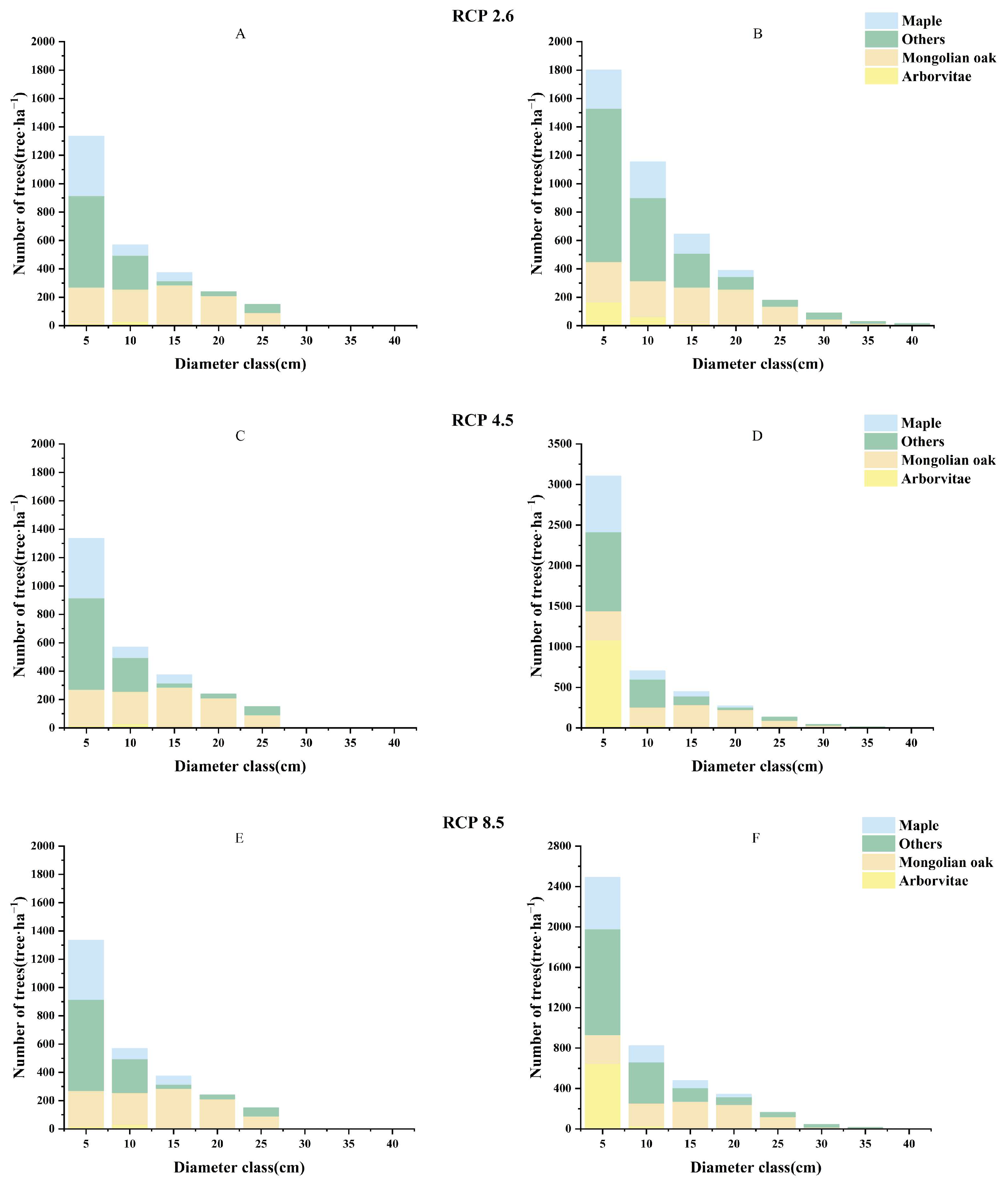
Based on the growth forecast results, we can observe that tree density exhibits different patterns under various climate scenarios. In the early stages of the forecast, Chinese arborvitae occupies a small proportion of the stand, while Liaodong oak dominates. As the growth simulation progresses, under the RCP2.6 scenario, the stand contains a small number of large-diameter trees, with a relatively low proportion of Chinese arborvitae. In contrast, under the RCP4.5 and RCP8.5 scenarios, there are almost no large-diameter trees, and the number of small-diameter Chinese arborvitae trees is higher compared to the RCP2.6 scenario (Figure 2).
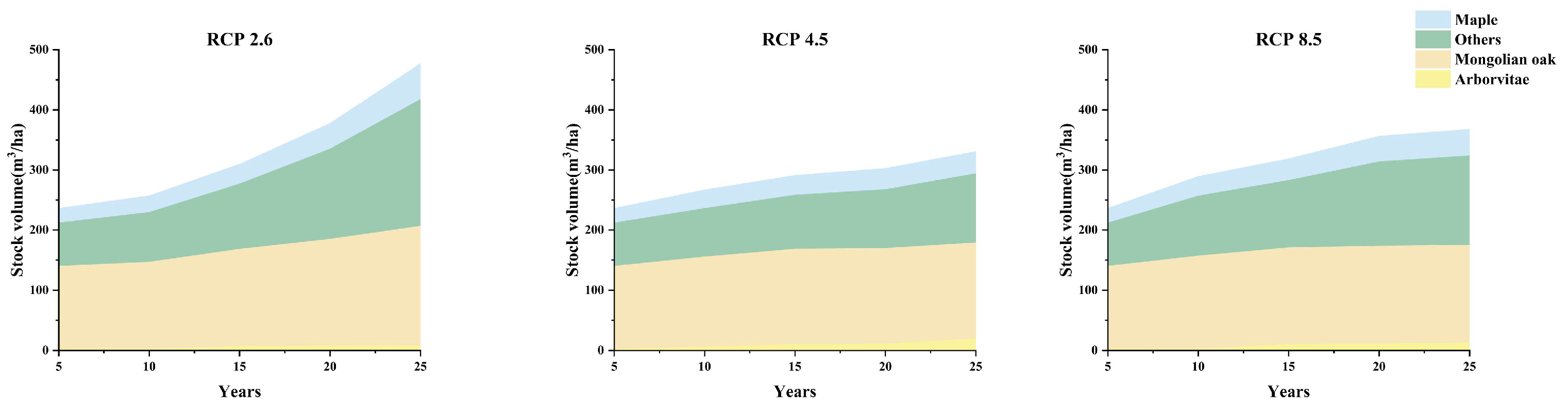
We also simulated the changes in forest volume under different climate scenarios. We found that under the RCP2.6 scenario, forest volume showed a significant increase after 10 years of simulation, whereas under the RCP4.5 and RCP8.5 scenarios, the growth was more stable (Figure 3). The main reason for this difference is the noticeable increase in volume for other species. The changes in the volume of the other tree species groups showed no significant differences across the various climate scenarios.

4. Discussion

4.1. Parameters of the Transition Matrix Growth Model

Based on the growth model results, diameter at breast height (DBH, D) and mean annual precipitation (MAP) are positively correlated with tree diameter growth. In contrast, the cross-sectional area at breast height (B) shows a negative correlation with tree growth. Species diversity (H1) is positively correlated with the growth of maple, but negatively correlated with the growth of the other tree species. Diameter class diversity (H2) is positively correlated with the growth of Chinese arborvitae and maple, but negatively correlated with the growth of Liaodong oak and the other tree species group (Table 3).
Many researchers have drawn similar conclusions. They attribute this phenomenon to the principle of niche competition, where interactions between tree species promote the efficient use of resources, thereby facilitating the growth in tree diameter. As the diameter at breast height (DBH) increases, trees’ competitive ability for resources also improves [41,42,43]. The increase in cross-sectional area at breast height (B) has been found to suppress forest growth, which is consistent with the findings of Rozendaal. The increase in B intensifies competition for resources among trees, especially leading to a significant reduction in the growth of trees with smaller diameters [44]. In addition, oak species, as climax tree species, do not have a growth advantage in their early stages. Instead, they accumulate growth energy in the forest understory. After receiving sufficient nutrients and light, they grow rapidly and occupy the canopy layer. This species is more sensitive to growth conditions [45,46].
The relationship between diameter class diversity (H2) and tree growth varies depending on the tree species. Similar results were reported in Du’s study [17], where her research on the climate sensitivity transition matrix model of oak species in Shanxi Province indicated that the growth of most tree species showed a significant negative correlation with H2, while poplar demonstrated a significant positive correlation with H2. She attributed this phenomenon to the theory of niche complementarity [47,48], which suggests that different tree species respond uniquely to competition from other species [35], resulting in varying correlation patterns.
MAP shows a significant positive correlation with tree growth, while MAT demonstrates a significant negative correlation. Our findings align with many existing studies. Li, in his analysis of the International Tree Ring Data Bank (ITRDB) data, found that tree growth in most regions showed a positive correlation with precipitation, especially in arid areas [49]. Additionally, many researchers have found that an increase in temperature could lead to a decrease in precipitation, resulting in drought conditions that subsequently inhibit tree growth. Gustafson, in his study of Oconto County, Wisconsin, found that unless the temperature increase is moderate or accompanied by a significant rise in precipitation, higher temperatures will not enhance tree growth [50]. We acknowledge the concerns regarding the significant differences in MAT (1.3 °C) and MAP (160 mm) observed in our study, which exceed typical levels of climate change. However, it is important to note that this study focuses on Qingyang City, a relatively small and localized region, which may exhibit more pronounced intra-regional variability. While these differences are substantial, they do not necessarily reflect the broader global climate change scenario but rather the specific conditions of our study area. We have accounted for these variations in our model, and while we recognize the potential for extrapolation challenges, we believe the results remain valuable within the context of regional forest management and growth forecasting. We suggest that caution be exercised when applying the model beyond the study area, and further validation using broader climate datasets could help refine its applicability in other regions.
Based on the results, it is evident that H1 is positively correlated with tree transition (Table 4). Many studies have found that species diversity promotes tree growth and transitions, and they attribute this to the theory of niche competition. Different species combinations enhance the forest ecosystem, allowing the stand to better utilize available resources [47,51]. In contrast, H2 shows a negative correlation with tree transitions for the majority of species. Meng’s study on natural forests in Chongqing found similar results, attributing this to the structural diversity of the stand [52]. The presence of larger diameter trees increases competition, as these trees have a stronger ability to compete for light, water, and nutrients, which hinders the regeneration of smaller diameter trees, particularly seedlings.
The relationships between MAT, MAP, and the different tree species groups can be summarized based on the distinction between coniferous and broadleaf species. Coniferous species, such as Chinese arborvitae, exhibit a significant negative correlation with both MAT and MAP in terms of regeneration, while broadleaf species show a significant positive correlation with these climate factors. Due to their sensitivity to climate, conifers are more vulnerable to temperature and precipitation changes, with high temperatures leading to mortality and affecting regeneration. However, many authors have noted that natural regeneration is complex and influenced by many factors [53,54,55]. For instance, Maleki et al. (2024) [55] conducted a study in boreal mixed forests in western Quebec, Canada, and found that aspen (Populus tremuloides), which regenerates via root suckers, was largely unaffected by most climate scenarios.

4.2. Forest Dynamic Growth Simulation

At the beginning of the simulation, arborvitae was almost absent. By the end of the simulation, arborvitae was only found in the small-diameter tree class, particularly under the RCP4.5 scenario, where its proportion among small-diameter trees was the highest. This situation may arise because arborvitae, as a drought-tolerant species, grows relatively slowly [56]. As the forest undergoes succession and renewal, the slower-growing Chinese arborvitae lacks a competitive advantage in resource competition against larger diameter trees and dominant canopy species, resulting in its presence only in the small-diameter tree class. In the climate prediction process, it was found that the RCP4.5 scenario has the lowest mean annual precipitation (502.2 mm). Although numerous studies suggest that a decrease in precipitation would reduce forest regeneration [57,58], arborvitae, being a drought-tolerant species, is less affected by these dry conditions compared to other species [59]. As a result, its regeneration and growth capacity are not significantly impacted in this dry environment. In contrast, the proportion of other species in the smallest diameter class showed a decline to varying degrees.
As the simulation progressed, the forest volume in all three scenarios showed a gradual increase, primarily due to changes in the volume of other tree species groups. The volume of Liaodong oak, Chinese arborvitae, and maple remained relatively stable throughout the simulation, with little to no change observed in the later stages. Among the three climate scenarios, the RCP2.6 scenario exhibited more pronounced changes in the volume of other tree species groups. Under the RCP2.6 scenario, the average temperature was the lowest (9.5 °C), and the average precipitation was the highest (744.2 mm). Similarly to our results, numerous studies have shown that increased precipitation is beneficial for tree growth [49,60,61]. Vlam also noted that rising temperatures could slow down tree growth [61]. Particularly under water-limited conditions, an increase in temperature may intensify water evaporation, thereby restricting tree growth. Therefore, the lower temperature and higher precipitation in the RCP2.6 scenario help promote the increase in forest volume, especially in the growth of other tree species groups.

5. Conclusions

This study developed a transition matrix growth model to predict forest growth dynamics in Qingyang City, addressing a significant gap in forest growth modeling for the region. The model, despite lacking direct tree mortality data, successfully simulates short-term changes in forest structure, including tree growth and species composition. The findings underscore the importance of this model in enhancing forest management strategies, providing valuable insights for more precise and sustainable practices. Although the model improves the accuracy of growth predictions, the absence of mortality models for certain species and the relatively low R2 value highlight areas for further development. Future research should explore the integration of machine learning techniques and mixed-effects models to enhance the model’s accuracy and applicability. This study demonstrates the potential of transition matrix models in forest growth prediction and their crucial role in supporting ecological restoration and forest management decisions.

Author Contributions

Conceptualization, X.L.; methodology, L.X.; validation, N.W. and H.Z.; investigation, X.L.; data curation, L.X.; writing—original draft preparation, L.X.; writing—review and editing, X.L. All authors have read and agreed to the published version of the manuscript.

Funding

This research was funded by Gansu Province Key R&D Program—Social Development Category (Project No. 23YFFM0001); Gansu Province Ecological Civilization Construction Key R&D Special Project (Project No. 24YFFA040).

Data Availability Statement

The data presented in this study are available upon reasonable request from the corresponding author. The data are not publicly available due to privacy restrictions.

Acknowledgments

The authors would like to thank their colleagues at the Qingyang Forestry Science Research Institute.

Conflicts of Interest

The authors declare no conflicts of interest.

References

  1. Führer, E. Forest functions, ecosystem stability and management. For. Ecol. Manag. 2000, 132, 29–38. [Google Scholar] [CrossRef]
  2. Ali, A. Forest stand structure and functioning: Current knowledge and future challenges. Ecol. Indic. 2019, 98, 665–677. [Google Scholar] [CrossRef]
  3. Brockerhoff, E.G.; Barbaro, L.; Castagneyrol, B.; Forrester, D.I.; Gardiner, B.; González-Olabarria, J.R.; Lyver, P.O.B.; Meurisse, N.; Oxbrough, A.; Taki, H. Forest biodiversity, ecosystem functioning and the provision of ecosystem services. Biodivers. Conserv. Biol. 2017, 26, 3005–3035. [Google Scholar] [CrossRef]
  4. Wang, Y.; Xu, C.; Wang, Q.; Jiang, Y.; Qin, L. Germplasm Resources of Oaks (Quercus L.) in China: Utilization and Prospects. Biology 2023, 12, 76. [Google Scholar] [CrossRef] [PubMed]
  5. Chen, Q.-W.; Liu, M.-J.; Lyu, J.; Li, G.; Otsuki, K.; Yamanaka, N.; Du, S. Characterization of dominant factors on evapotranspiration with seasonal soil water changes in two adjacent forests in the semiarid Loess Plateau. J. Hydrol. 2022, 613, 128427. [Google Scholar] [CrossRef]
  6. Shugart, H.; Saatchi, S.; Hall, F. Importance of structure and its measurement in quantifying function of forest ecosystems. J. Geophys. Res. Biogeosci. 2010, 115, G00E13. [Google Scholar] [CrossRef]
  7. Bengtsson, J.; Nilsson, S.G.; Franc, A.; Menozzi, P. Biodiversity, disturbances, ecosystem function and management of European forests. For. Ecol. Manag. 2000, 132, 39–50. [Google Scholar] [CrossRef]
  8. Pearce, D.W. The economic value of forest ecosystems. Ecosyst. Health 2001, 7, 284–296. [Google Scholar] [CrossRef]
  9. Keleş, S. An assessment of hydrological functions of forest ecosystems to support sustainable forest management. J. Sustain. For. 2019, 38, 305–326. [Google Scholar] [CrossRef]
  10. Sun, L.; He, L.; Wang, G.; Jing, H.; Liu, G. Natural vegetation restoration of Liaodong oak (Quercus liaotungensis Koidz.) forests rapidly increased the content and ratio of inert carbon in soil macroaggregates. J. Arid Land 2019, 11, 928–938. [Google Scholar] [CrossRef]
  11. Li, H.; Xu, F.; Li, Z.; You, N.; Zhou, H.; Zhou, Y.; Chen, B.; Qin, Y.; Xiao, X.; Dong, J. Forest changes by precipitation zones in northern china after the three-north shelterbelt forest program in China. Remote Sens. 2021, 13, 543. [Google Scholar] [CrossRef]
  12. Li, M.-m.; Liu, A.-t.; Zou, C.-j.; Xu, W.-d.; Shimizu, H.; Wang, K.-y. An overview of the “Three-North” Shelterbelt project in China. For. Stud. China 2012, 14, 70–79. [Google Scholar] [CrossRef]
  13. Qiang, W.; Zhang, B.; Zhang, Z.; Zhang, X.; Dai, S. The Three-North Shelterbelt Program and dynamic changes in vegetation cover. J. Resour. Ecol. 2014, 5, 53–59. [Google Scholar] [CrossRef]
  14. Li, J.; Zhang, J.; Wang, X.; Wang, G. Long term observation of fractional vegetation cover in Qingyang of Gansu Province and its response to climate change. Atmosphere 2022, 13, 288. [Google Scholar] [CrossRef]
  15. Laudon, H.; Sponseller, R.A.; Lucas, R.W.; Futter, M.N.; Egnell, G.; Bishop, K.; Ågren, A.; Ring, E.; Högberg, P. Consequences of more intensive forestry for the sustainable management of forest soils and waters. Forests 2011, 2, 243–260. [Google Scholar] [CrossRef]
  16. Jafarzadeh, A.A.; Mahdavi, A.; Shamsi, S.R.F.; Yousefpour, R. Assessing synergies and trade-offs between ecosystem services in forest landscape management. Land Use Policy 2021, 111, 105741. [Google Scholar] [CrossRef]
  17. Du, X.; Chen, X.; Zeng, W.; Meng, J. A climate-sensitive transition matrix growth model for uneven-aged mixed-species oak forests in North China. Forestry 2021, 94, 258–277. [Google Scholar] [CrossRef]
  18. Ou, Q.; Lei, X.; Shen, C.J.F. Individual tree diameter growth models of larch–spruce–fir mixed forests based on machine learning algorithms. Forests 2019, 10, 187. [Google Scholar] [CrossRef]
  19. Porté, A.; Bartelink, H. Modelling mixed forest growth: A review of models for forest management. Ecol. Model. 2002, 150, 141–188. [Google Scholar] [CrossRef]
  20. Shifley, S.R.; He, H.S.; Lischke, H.; Wang, W.J.; Jin, W.; Gustafson, E.J.; Thompson, J.R.; Thompson, F.R., III; Dijak, W.D.; Yang, J. The past and future of modeling forest dynamics: From growth and yield curves to forest landscape models. Landsc. Ecol. 2017, 32, 1307–1325. [Google Scholar] [CrossRef]
  21. Falkowski, M.J.; Hudak, A.T.; Crookston, N.L.; Gessler, P.E.; Uebler, E.H.; Smith, A.M. Landscape-scale parameterization of a tree-level forest growth model: A k-nearest neighbor imputation approach incorporating LiDAR data. Can. J. For. Res. 2010, 40, 184–199. [Google Scholar] [CrossRef]
  22. Burkhart, H.; Tomé, M. Modeling Forest Trees and Stands; Springer: Berlin/Heidelberg, Germany, 2012. [Google Scholar]
  23. Mabvurira, D.; Miina, J. Individual-tree growth and mortality models for Eucalyptus grandis (Hill) Maiden plantations in Zimbabwe. For. Ecol. Manag. 2002, 161, 231–245. [Google Scholar] [CrossRef]
  24. Palahí, M.; Pukkala, T. Optimising the management of Scots pine (Pinus sylvestris L.) stands in Spain based on individual-tree models. Ann. For. Sci. 2003, 60, 105–114. [Google Scholar] [CrossRef]
  25. Pukkala, T.; Lähde, E.; Laiho, O. Using optimization for fitting individual-tree growth models for uneven-aged stands. Eur. J. For. Res. 2011, 130, 829–839. [Google Scholar] [CrossRef]
  26. Subedi, N.; Sharma, M. Individual-tree diameter growth models for black spruce and jack pine plantations in northern Ontario. For. Ecol. Manag. 2011, 261, 2140–2148. [Google Scholar] [CrossRef]
  27. Ek, A.R.; Monserud, R.A. Performance and comparison of stand growth models based on individual tree and diameter-class growth. Can. J. For. Res. 1979, 9, 231–244. [Google Scholar] [CrossRef]
  28. Liang, J.; Zhou, M.; Verbyla, D.L.; Zhang, L.; Springsteen, A.L.; Malone, T. Mapping forest dynamics under climate change: A matrix model. For. Ecol. Manag. 2011, 262, 2250–2262. [Google Scholar] [CrossRef]
  29. Ma, W.; Domke, G.M.; D’Amato, A.W.; Woodall, C.W.; Walters, B.F.; Deo, R.K. Using matrix models to estimate aboveground forest biomass dynamics in the eastern USA through various combinations of LiDAR, Landsat, and forest inventory data. Environ. Res. Lett. 2018, 13, 125004. [Google Scholar] [CrossRef]
  30. Rosa, R.; Soares, P.; Tome, M. Evaluating the Economic Potential of Uneven-Aged Maritime Pine Forests. Ecol. Econ. 2018, 143, 210–217. [Google Scholar] [CrossRef]
  31. Du, X.; Wang, X.; Meng, J. A Climate-Sensitive Transition Matrix Growth Model for Masson Pine (Pinus massoniana Lamb.) Natural Forests in Hunan Province, South-Central China. Forests 2023, 14, 1539. [Google Scholar] [CrossRef]
  32. Gao, Y.; Li, L.; Du, X.; Meng, J. A Transition-Matrix Growth Model and Equilibrium Curve for Natural Forests in Jiangxi Province. Forests 2023, 14, 2038. [Google Scholar] [CrossRef]
  33. Liu, C.; Yu, B.; Zhu, Y.; Liu, L.; Li, P. Measurement of Rural Residents’ Mobility in Western China: A Case Study of Qingyang, Gansu Province. Sustainability 2019, 11, 2492. [Google Scholar] [CrossRef]
  34. Zhang, M.; Tang, X. Quantification and Analysis of Factors Influencing Territorial Spatial Conflicts in the Gully Region of the Loess Plateau: A Case Study of Qingyang City, Gansu Province, China. Sustainability 2025, 17, 3552. [Google Scholar] [CrossRef]
  35. Liang, J. Dynamics and management of Alaska boreal forest: An all-aged multi-species matrix growth model. For. Ecol. Manag. 2010, 260, 491–501. [Google Scholar] [CrossRef]
  36. Liang, J.; Picard, N. Matrix Model of Forest Dynamics: An Overview and Outlook. For. Sci. 2013, 59, 359–378. [Google Scholar] [CrossRef]
  37. Liang, J.; Buongiorno, J.; Monserud, R.A.; Kruger, E.L.; Zhou, M. Effects of diversity of tree species and size on forest basal area growth, recruitment, and mortality. For. Ecol. Manag. 2007, 243, 116–127. [Google Scholar] [CrossRef]
  38. Stage, A.R. An Expression for the Effect of Aspect, Slope, and Habitat Type on Tree Growth. For. Sci. 1976, 22, 457–460. [Google Scholar] [CrossRef]
  39. Tobin, J. Estimation of Relationships for Limited Dependent Variables. Econometrica 1958, 26, 24–36. [Google Scholar] [CrossRef]
  40. Wang, T.; Hamann, A.; Spittlehouse, D.L.; Murdock, T.Q. ClimateWNA—High-resolution spatial climate data for western North America. J. Appl. Meteorol. Climatol. 2012, 51, 16–29. [Google Scholar] [CrossRef]
  41. Fargione, J.; Tilman, D.; Dybzinski, R.; Lambers, J.H.; Clark, C.; Harpole, W.S.; Knops, J.M.; Reich, P.B.; Loreau, M. From selection to complementarity: Shifts in the causes of biodiversity-productivity relationships in a long-term biodiversity experiment. Proc. Biol. Sci. 2007, 274, 871–876. [Google Scholar] [CrossRef]
  42. Liang, J.; Crowther, T.W.; Picard, N.; Wiser, S.; Zhou, M.; Alberti, G.; Schulze, E.-D.; McGuire, A.D.; Bozzato, F.; Pretzsch, H.; et al. Positive biodiversity-productivity relationship predominant in global forests. Science 2016, 354, aaf8957. [Google Scholar] [CrossRef]
  43. Marquard, E.; Weigelt, A.; Roscher, C.; Gubsch, M.; Lipowsky, A.; Schmid, B. Positive biodiversity-productivity relationship due to increased plant density. J. Ecol. 2009, 97, 696–704. [Google Scholar] [CrossRef]
  44. Rozendaal, D.M.A.; Phillips, O.L.; Lewis, S.L.; Affum-Baffoe, K.; Alvarez-Davila, E. Competition influences tree growth, but not mortality, across environmental gradients in Amazonia and tropical Africa. Ecology 2020, 101, e03052. [Google Scholar] [CrossRef]
  45. Chang, W.; Li, J.; Wu, J.; Zhang, J.; Yu, Y.; Sun, H.; Wen, Y. Study on the relationship between net primary productivity and site quality in Japanese larch plantations in mountainous areas of eastern Liaoning. PeerJ 2024, 12, e17820. [Google Scholar] [CrossRef]
  46. Li, H.-J.; Zhang, Z.-B. Effect of rodents on acorn dispersal and survival of the Liaodong oak (Quercus liaotungensis Koidz.). For. Ecol. Manag. 2003, 176, 387–396. [Google Scholar] [CrossRef]
  47. Young, B.; Liang, J.; Stuart Chapin, F. Effects of species and tree size diversity on recruitment in the Alaskan boreal forest: A geospatial approach. For. Ecol. Manag. 2011, 262, 1608–1617. [Google Scholar] [CrossRef]
  48. Madrigal-González, J.; Ruiz-Benito, P.; Ratcliffe, S.; Calatayud, J.; Kändler, G.; Lehtonen, A.; Dahlgren, J.; Wirth, C.; Zavala, M.A. Complementarity effects on tree growth are contingent on tree size and climatic conditions across Europe. Sci. Rep. 2016, 6, 32233. [Google Scholar] [CrossRef]
  49. Li, T.; He, B.; Chen, D.; Chen, H.W.; Guo, L.; Yuan, W.; Fang, K.; Shi, F.; Liu, L.; Zheng, H.; et al. Increasing Sensitivity of Tree Radial Growth to Precipitation. Geophys. Res. Lett. 2024, 51, e2024GL110003. [Google Scholar] [CrossRef]
  50. Gustafson, E.J.; Miranda, B.R.; De Bruijn, A.M.G.; Sturtevant, B.R.; Kubiske, M.E. Do rising temperatures always increase forest productivity? Interacting effects of temperature, precipitation, cloudiness and soil texture on tree species growth and competition. Environ. Model. Softw. 2017, 97, 171–183. [Google Scholar] [CrossRef]
  51. Kahmen, A.; Renker, C.; Unsicker, S.B.; Buchmann, N. Niche Complementarity for Nitrogen: An Explanation for the Biodiversity and Ecosystem Functioning Relationship? Ecology 2006, 87, 1244–1255. [Google Scholar] [CrossRef]
  52. Meng, X.; Ma, Z.; Xia, Y.; Meng, J.; Bai, Y.; Gao, Y. A Study on the Growth Model of Natural Forests in Southern China Under Climate Change: Application of Transition Matrix Model. Forests 2024, 15, 1947. [Google Scholar] [CrossRef]
  53. Yamamoto, S.-I. Forest gap dynamics and tree regeneration. J. For. Res. 2000, 5, 223–229. [Google Scholar] [CrossRef]
  54. Swaine, M.D.; Hall, J.B. The mosaic theory of forest regeneration and the determination of forest composition in Ghana. J. Trop. Ecol. 1988, 4, 253–269. [Google Scholar] [CrossRef]
  55. Maleki, K.; Marchand, P.; Charron, D.; Bergeron, Y. Seedling recruitment in response to stand composition, interannual climate variability, and soil disturbance in the boreal mixed woods of Canada. J. Veg. Sci. 2024, 35, e13237. [Google Scholar] [CrossRef]
  56. Ji, J.; Kokutse, N.; Genet, M.; Fourcaud, T.; Zhang, Z. Effect of spatial variation of tree root characteristics on slope stability. A case study on Black Locust (Robinia pseudoacacia) and Arborvitae (Platycladus orientalis) stands on the Loess Plateau, China. CATENA 2012, 92, 139–154. [Google Scholar] [CrossRef]
  57. Petrie, M.; Wildeman, A.; Bradford, J.B.; Hubbard, R.; Lauenroth, W. A review of precipitation and temperature control on seedling emergence and establishment for ponderosa and lodgepole pine forest regeneration. For. Ecol. Manag. 2016, 361, 328–338. [Google Scholar] [CrossRef]
  58. Liu, J. Progress in research on the effects of environmental factors on natural forest regeneration. Front. For. Glob. Change 2025, 8, 1525461. [Google Scholar] [CrossRef]
  59. Wang, Y.; Wei, W.; Yang, X.; Chen, L.; Yang, L. Drought-tolerance physiology and drought-tolerance of plants typical of Hilly-Gullied area of Loess Plateau. J. Ecol. Rural Environ. 2011, 27, 56–61. [Google Scholar]
  60. Morales, M.S.; Villalba, R.; Grau, H.R.; Paolini, L. Rainfall-Controlled Tree Growth in High-Elevation Subtropical Treelines. Ecology 2004, 85, 3080–3089. [Google Scholar] [CrossRef]
  61. Vlam, M.; Baker, P.; Bunyavejchewin, S.; Zuidema, P. Temperature and rainfall strongly drive temporal growth variation in Asian tropical forest trees. Oecologia 2013, 174, 1449–1461. [Google Scholar] [CrossRef]
Figure 1. Distribution of sample sites in Qingyang City.
Sustainability 17 10864 g001
Figure 2. Prediction in the number of trees of different species under various climate scenarios (2043). (A) The current stand diameter distribution. (B) Simulated terminal stand diameter distribution under the RCP2.6 scenario. (C) The current stand diameter distribution. (D) Simulated terminal stand diameter distribution under the RCP4.5 scenario. (E) The current stand diameter distribution. (F) Simulated terminal stand diameter distribution under the RCP8.5 scenario.
Sustainability 17 10864 g002
Figure 3. Prediction in different tree species volume under different climate scenarios (2018−2043).
Sustainability 17 10864 g003
Table 1. Overview of the Stand Characteristics in the Study Plots.
DBH (cm)B (m2/ha)H1H2MAT (°C)MAP (mm)
Max110.5034.201.092.0410.26660.20
Min5.001.6500.588.92496.60
Mean12.4716.470.631.499.59556.67
SD7.136.640.280.310.2331.49
Table 2. Variable explanations in the transition matrix growth model.
VariableDefinition
g (cm)The annual increment in tree diameter at breast height (DBH) over 5 years (in centimeters)
M (%)The 5-year mortality rate of trees
R (trees/ha)The number of trees (per hectare) that reach the minimum measurement diameter class within 5 years
D (cm)Tree diameter (centimeters)
B (m2/ha)The average cross-sectional area at breast height per hectare (square meters per hectare)
H 1 Species diversity
H 2 Size diversity
MAT (°C)Annual average temperature
MAP (mm)Annual average precipitation
Table 3. The statistical analysis of the parameters in the diameter growth model.
Liaodong OakChinese ArborvitaeMapleOthers
Intercept2.59 × 100 ***2.32 × 100 *−6.14 × 10−11.63 × 100 ***
D1.44 × 10−2 ***1.85 × 10⁻² ***8.37 × 10⁻³ ***1.81 × 10⁻² ***
H1−4.47 × 10⁻² ***−3.56 × 10⁻¹ ***2.09 × 10⁻¹ ***−2.43 × 10⁻¹ ***
H2−2.97 × 10⁻¹ ***2.89 × 10⁻¹ ***2.49 × 10⁻¹ ***−6.77 × 10⁻² ***
B−1.04 × 10⁻² ***−1.34 × 10⁻² ***−4.79 × 10⁻³ ***5.33 × 10⁻³ *
MAT−2.15 × 10⁻¹ ***−3.21 × 10⁻¹ ***−8.16 × 10⁻²−1.71 × 10⁻¹ ***
MAP8.01 × 10−4 ***1.83 × 10⁻³ **2.07 × 10⁻³ ***6.27 × 10⁻⁴ *
AIC4209.15303.00313.15799.18
BIC4260.95336.52349.81841.44
R20.310.210.210.50
logLik−2096.58−143.50−148.58−391.59
Notes: Level of significance: * p < 0.10; ** p < 0.05; *** p < 0.01.
Table 4. The statistical analysis of the parameters in the recruitment model.
Liaodong OakChinese ArborvitaeMapleOthers
Intercept−1.49 × 10³ ***4.30 × 10³ ***−6.59 × 100−1.11 × 10³ ***
N1.52 × 10−1 ***2.16 × 10⁻²−6.40 × 10⁻² ***−9.49 × 10⁻² ***
H11.69 × 102 ***1.75 × 10² ***8.33 × 101 ***2.38 × 10² ***
H23.00 × 101 **−1.31 × 101−6.27 × 101 ***−4.81 × 101 ***
B−1.59 × 101 ***1.12 × 101 ***−2.03 × 100 ***−2.02 × 100 ***
MAT1.43 × 102 ***−2.99 × 10² ***2.99 × 101 *6.96 × 101 ***
MAP3.77 × 10−1 ***−3.09 × 100 ***−1.72 × 10−11.00 × 100 ***
logSigma25.23 × 100 ***4.27 × 100 ***4.35 × 100 ***4.62 × 100 ***
AIC54,641.914690.518679.4017,562.32
BIC54,694.254724.328717.3617,605.53
R20.280.520.220.32
logLik−27,312.96−2337.25−4331.7−8773.16
Notes: Level of significance: * p < 0.10; ** p < 0.05; *** p < 0.01.
Disclaimer/Publisher’s Note: The statements, opinions and data contained in all publications are solely those of the individual author(s) and contributor(s) and not of MDPI and/or the editor(s). MDPI and/or the editor(s) disclaim responsibility for any injury to people or property resulting from any ideas, methods, instructions or products referred to in the content.