1. Introduction
The pursuit of green agriculture has become a prominent issue on the global agenda, attracting sustained scholarly attention from diverse disciplinary perspectives [
1,
2]. High-quality farmland underpins the sustainability of agricultural production. Yet, the long-term and intensive application of chemical pesticides has degraded soils, exacerbated environmental pollution, and left excessive residues in food crops, thereby undermining the stability of agricultural ecosystems. Among available green technologies, biopesticides stand out for their potential to reduce reliance on pesticides and pesticide residues, offering an important route toward the ecological transformation of agriculture [
3,
4]. While many countries have shown a willingness to adopt progress in promoting biopesticide use, chemical pesticides still dominate farmers’ pest-control practices, and large-scale adoption of biopesticides remains elusive [
5,
6]. Why have farmers been reluctant to make a large-scale transition to greener biopesticides?
As the ultimate users of agricultural inputs and key participants in technology diffusion, farmers’ adoption decisions largely determine the extent to which pesticide use can be reduced and ecological outcomes improved. Gaining more profound insight into the factors shaping farmers’ willingness to adopt biopesticides is therefore essential for identifying workable strategies that advance sustainable, environmentally sound agricultural development [
7]. Most existing studies on farmers’ adoption of biopesticides and other green agricultural technologies primarily emphasize economic benefits [
8]. Some scholars argue that farmers’ behavior should be understood through a behavioral lens, as psychological factors also influence their adoption of green technologies [
9]. They have employed the theory of planned behavior, the technology acceptance model, the diffusion of innovations theory, and incentive models to explain farmers’ adoption of green technologies [
10,
11,
12]. However, few existing studies have incorporated psychological factors, such as farmers’ time preference for returns and their perceived value of biopesticides, to analyze the mechanisms underlying farmers’ adoption of biopesticides.
As one of the world’s leading agricultural producers, China’s pesticide use has significant implications for both domestic and global goals of sustainable agriculture, ecological protection, and food security. In 2015, the Ministry of Agriculture and Rural Affairs introduced the Action Plan for Zero Growth in Pesticide Use by 2020 and implemented a range of green pest management initiatives. From 2021 to 2025, the No. 1 Central Document has consistently highlighted the need to promote green pest control technologies, curb agricultural non-point source pollution, reduce and optimize fertilizer and pesticide use, and strengthen controls on pesticide residues in agricultural products. While no official data exist on biopesticide application, their use can be gauged from market share: as of October 2024, 2082 biopesticide products had been registered, accounting for only 4.35% of all pesticide registrations. Understanding the causes of this slow uptake is essential for advancing pesticide reduction and alleviating non-point source pollution.
Using survey data from farmers in Sichuan Province and drawing on intertemporal choice theory, this study employs an ordered probit model to examine how time preference affects the willingness to adopt biopesticides. The results show that farmers with a stronger orientation toward future returns are significantly more likely to adopt, a finding that holds under a robustness check. Building on perceived value theory, the analysis moves beyond purely economic considerations to investigate three perception dimensions closely linked to pesticide use and farmers’ decision-making. Time preference is found to influence the perceived value of biopesticides in terms of ecological improvement, intergenerational health protection, and food safety assurance, with mediating effects accounting for 22.90%, 57.18%, and 26.14% of the total effect, respectively. Heterogeneity analysis further reveals that the influence of time preference weakens as educational attainment increases, and that larger cultivated areas reduce its impact on large-scale farmers’ willingness to adopt.
This study offers two main contributions. First, from the perspective of agricultural technology characteristics, it examines the relatively underexplored role of farmers’ time preferences in their adoption of biopesticides. Prior research often measures time preference through individual discount rates, implicitly assuming that adoption decisions hinge solely on a trade-off between present and future income. Such an approach neglects the non-economic attributes of pesticide technologies, including their ecological benefits, long-term impacts, and public-good nature. By incorporating time preference into farmers’ technological cognition, we analyze how it shapes choices in green production practices, thereby extending micro-level psychological research on technology adoption in agriculture.
Second, while most existing studies emphasize mechanisms tied to economic returns, far less attention has been paid to farmers’ perceived value of ecological pesticides. Drawing on perceived value theory, we assess willingness to adopt biopesticides from three dimensions: enhancing the ecological environment, safeguarding intergenerational health, and ensuring food safety. This perspective clarifies the role of non-economic motivations in the diffusion of green technologies and provides theoretical guidance for designing promotion strategies that align with farmers’ perceptions.
The remainder of this paper is organized as follows.
Section 2 is the literature review.
Section 3 presents the theoretical analysis and research hypotheses.
Section 4 describes the data sources and model specification.
Section 5 reports the empirical results and provides a partial discussion.
Section 6 and
Section 7 are the discussion and conclusion.
2. Literature Review
2.1. Analysis of Factors Shaping Time Preferences and the Adoption of Biopesticides
Numerous studies have examined how to encourage farmers to adopt biopesticides, highlighting both internal and external influences. Internal factors include personal attributes, farming practices, household resources, risk preference, information capability, and production objectives, while external factors involve dissemination channels, subsidies, and training programs [
13,
14,
15,
16,
17]. Overall, the existing literature underscores the role of resources, information accessibility, and policy support in shaping farmers’ adoption of biopesticides. Nevertheless, much of this research conceptualizes biopesticides as technologies that yield immediate effects within a single production cycle, paying insufficient attention to their intertemporal attributes.
Unlike single-season practices with immediate benefits, biopesticide returns accumulate over time, rewarding sustained investment. Chemical pesticides provide immediate pest control upon application, whereas biopesticides usually take three to four days for their effects to become apparent. Overuse of biopesticides helps restore ecological balance, suppress severe pest outbreaks, and lower the risk of recurrence [
18]. Owing to these attributes, biopesticide use can be viewed as a long-term investment that requires farmers to balance short-term gains against benefits accruing at various points in the future [
19]. Differences in farmers’ time preferences thus substantially influence decisions on green production practices [
20,
21]. Farmers with a stronger orientation toward future outcomes are more willing to commit to green projects with lengthy investment and return cycles [
22,
23]. Moreover, people tend to adopt a longer-term perspective on health and environmental benefits than on monetary gains [
24].
Farmers’ pest control decisions aim to maximize profits and reduce risks, weighing options over different time horizons against their resources, traits, and preferences. Therefore, analyzing the low adoption rate of biopesticides requires examining the alignment between their intertemporal attributes and farmers’ preference structures.
2.2. Analysis of Perceived Value and Heterogeneity
The concept of perceived value was formally introduced by Zeithaml [
25], who argued that it reflects consumers’ subjective evaluation of a product, based on a trade-off between the benefits received and the costs incurred. Previous studies have mainly employed perceived value theory in areas such as corporate management, green consumption, food safety, and pesticide packaging disposal [
26,
27,
28,
29,
30]. These works largely adopt a consumer-oriented perspective, examining individuals’ value perceptions and attitudes toward products and services to predict subsequent behavioral intentions.
Interestingly, the previous literature on green technology adoption has predominantly viewed farmers as technology adopters, rarely examining them as consumers of biopesticides. Economic factors remain central to farmers’ production decisions, but they are not the only consideration. Toma and Mathijs [
31] showed that farmers’ perceptions of environmental risks are strongly linked to their likelihood of shifting toward organic farming. As both producers and consumers, farmers weigh the environmental and health implications of pesticide use, particularly given their unavoidable exposure to chemical pesticides. Concerns for personal health, together with social and ecological responsibility, influence their choices [
32,
33]. With rising living standards and the progress of green development in rural areas, farmers’ ecological awareness has increased [
34]. Farmers who perceive that biological pesticides can deliver economic, ecological, and health benefits may be more inclined to adopt them. Therefore, evaluating the role of time preference in the adoption of green agricultural technologies solely from the perspective of technology adopters is incomplete.
Although perceived value may shape the relationship between time preference and the willingness to adopt biopesticides, its influence is unlikely to be consistent across all farmer groups. Variations in resource endowments, farm size, risk-bearing capacity, and access to information lead farmers to weigh short- and long-term benefits differently. Adoption of intertemporal agricultural technologies also varies by farm scale: larger operations, with more abundant capital and higher absolute returns, often show greater willingness to prioritize long-term benefits [
35,
36]. Moreover, higher levels of education are generally associated with greater openness to experimentation and risk-taking, which, in turn, increases the likelihood of adopting new technologies [
37,
38].
3. Research Framework and Hypotheses Development
Drawing on time preference theory and perceived value theory, this study develops an analytical framework—“time preference–perceived value–adoption willingness”—to examine how time preference influences farmers’ willingness to adopt biopesticides. Within this framework, time preference affects adoption behavior by influencing farmers’ perceived value of the technology.
3.1. Time Preference Theory
Time preference refers to an individual’s psychological tendency to assess future utility when making intertemporal choices. Samuelson [
39] formalized this tendency through the concept of the “discount rate,” providing a quantitative means to represent time preference. Individuals with a lower discount rate assign greater weight to future benefits, whereas those with a higher discount rate place relatively less weight on them.
Farmers’ willingness to adopt biopesticides reflects a trade-off between present and future utility. One dimension concerns their ecological pest control benefits: for example, using beneficial insects to suppress pests or employing fungi to inhibit pathogens can reduce reliance on chemical pesticides and improve the quality of agricultural products [
40]. Another dimension lies in their positive externalities, as sustained application can protect the environment, enhance food safety, and safeguard the health of both agricultural workers and future generations [
41]. Unlike chemical pesticides, biopesticides operate through ecological processes to achieve pest control, meaning that these benefits materialize only gradually and require medium- to long-term use. Farmers’ time preferences thus shape how they value these benefits, influencing their willingness to adopt the technology.
Specifically, farmers who prioritize immediate returns are more affected by outcome and time uncertainty, leading them to place less weight on the future benefits of biopesticides and to prefer chemical pesticides instead. In contrast, farmers who attach greater importance to future returns tend to place a higher value on the additional environmental and health benefits from long-term use of biopesticides, making them more inclined to adopt these technologies. Based on this reasoning, we propose the following hypothesis:
H1. Farmers who value future returns are more likely to adopt biopesticide technologies than those who prioritize immediate returns.
3.2. Perceived Value Theory
According to Zeithaml’s perceived value theory, consumer decision-making reflects a trade-off between the perceived benefits and perceived costs of a product or service. In the agricultural context, empirical studies indicate that perceived value significantly shapes farmers’ willingness to invest in land and influences their production decisions [
32]. When farmers are acutely aware of the negative externalities associated with chemical pesticides, they tend to reduce their use or abandon them altogether, choosing environmentally friendly biopesticides as an alternative [
42].
In intertemporal decision-making, perceived value incorporates a temporal dimension, with individual time preferences shaping how value is assessed over different time horizons. Those who value future returns place greater weight on the long-term benefits of products and services, whereas those who emphasize immediate returns focus more on short-term gains. Evidence from Jing et al. [
43] shows that farmers with stronger future-oriented preferences assign higher perceived value to contract farming than those prioritizing immediate returns. A similar pattern emerges in pesticide choice: the rapid efficacy of chemical pesticides enhances their short-term perceived value, but long-term use leads to resistance and environmental pollution, reducing it. In contrast, the slower action of biopesticides lowers their short-term perceived value, while their enduring benefits, such as reduced input costs and environmental protection, enhance their long-term appeal.
Based on perceived value theory, farmers decide whether to adopt a technology by weighing its perceived benefits against its perceived costs. Because biopesticides require sustained use to establish a virtuous cycle of pest control and to generate economic returns, farmers who value future gains tend to believe that these products can yield higher profits over time. This belief enhances their perceived value of biopesticides and increases their willingness to adopt them to achieve anticipated outcomes.
In recent years, perceived value theory has been applied with growing frequency in agricultural economics, particularly in studies of farmers’ behaviors and attitudes, where perceived value is often classified into economic, environmental, and social dimensions [
44,
45,
46]. Given the inherent characteristics of chemical pesticides, this study argues that prolonged use can pose problems for the ecological environment, intergenerational health, and food safety.
Given the intrinsic characteristics of pesticide inputs, this study divides farmers’ perceived value of biopesticides into three dimensions: environmental value, intergenerational health value, and food safety value. Time preference affects these dimensions by altering how future outcomes are discounted, thereby altering the relative weight and importance of each.
First, the environmental value pathway. The ecological benefits of biopesticides, such as improving soil quality and maintaining ecosystem stability, are long-term and exhibit characteristics of public goods [
47]. The Value–Belief–Norm (VBN) theory argues that individuals’ environmental values and sense of responsibility can motivate pro-environmental behavior [
48]. From a behavioral economics perspective, this reflects an intrinsic social preference that extends beyond the conventional cost–benefit framework, in which individuals care not only about private returns but also about their contributions to collective goods such as environmental quality [
49]. The extent to which this mechanism operates depends on how much individuals value future outcomes. Farmers who have a stronger preference for the future are more likely to take ecological improvements into account in their decisions, thereby strengthening their sense of environmental responsibility and enhancing their perceived environmental value. In contrast, more impatient farmers apply higher discount rates to future benefits and are more inclined to overlook the long-term importance of environmental value. In this way, time preference increases farmers’ sensitivity to ecological returns and reinforces the role of environmental value in adoption decisions.
Second, the residues of chemical pesticides may accumulate in soil and water, creating latent and intergenerational health risks [
50]. The Health Belief Model (HBM) emphasizes that individuals’ perceptions of the severity of and susceptibility to health threats directly influence the likelihood of engaging in preventive behavior [
51]. These perceptions are influenced by time preference, which, in turn, shapes health behaviors [
52]. When a person exhibits a more patient time preference, they apply lower discount rates to potential risks affecting their children and future generations [
53]. This makes them more inclined to view long-term health damage as an immediate concern, thereby strengthening their motivation to take preventive action. Such heightened awareness of future health risks leads farmers to place greater value on the role of biopesticides in safeguarding intergenerational health.
Finally, the ultimate consequence of pesticide use is closely tied to food safety [
54]. The risks associated with food safety are often hidden and delayed, making them difficult to detect in the short term. Protection Motivation Theory (PMT) suggests that when individuals face potential threats, their protective behavior depends on how they evaluate the threat’s severity and the effectiveness of available responses [
55]. Farmers with stronger patient time preferences are less likely to discount future risks, making them more sensitive to potential threats to food safety and more confident that adopting biopesticides can effectively reduce the risk of residues. This emphasis on preventing future losses, together with a positive evaluation of preventive measures, strengthens the importance of food safety in their decision-making process.
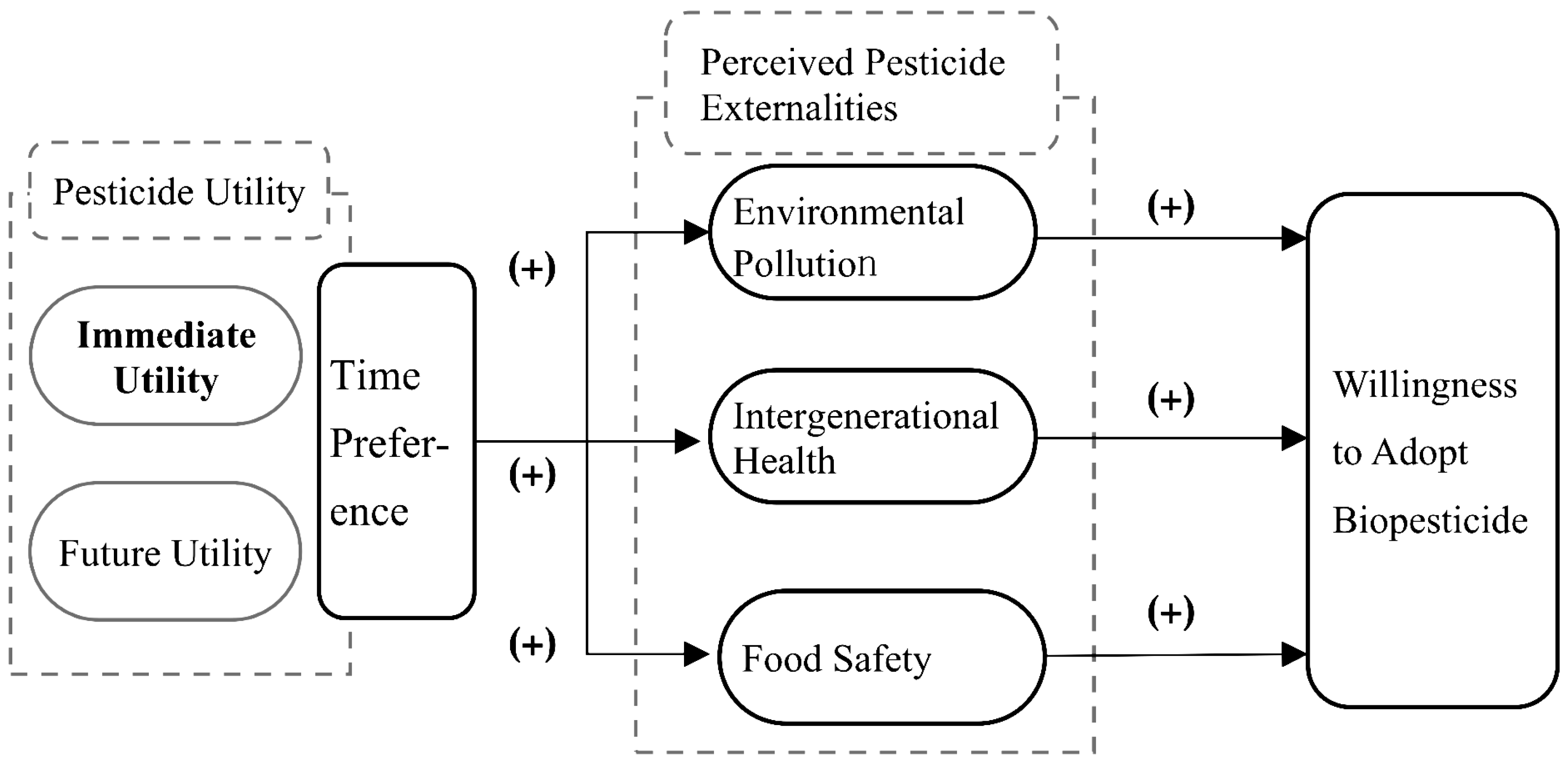
In general, time preference significantly influences farmers’ perceptions of different value dimensions by altering their discount rates for future ecological benefits, intergenerational health risks, and food safety concerns. Patient farmers are more likely to consider long-term value, thus forming a stronger sense of value in terms of environmental responsibility, health investment, and food safety protection, and thus showing a higher willingness to adopt biopesticides [
56,
57] (
Figure 1). We therefore propose the following hypotheses:
H2. Farmers’ time preference influences their perception of the environmental harm caused by chemical pesticides, thereby increasing their willingness to adopt biopesticides.
H3. Farmers’ time preference influences their perception of the intergenerational health risks posed by chemical pesticides, thereby increasing their willingness to adopt biopesticides.
H4. Farmers’ time preference influences their perception of food safety issues caused by chemical pesticides, thereby increasing their willingness to adopt biopesticides.
4. Data Sources and Model Specification
4.1. Data Sources
The empirical data for this study come from a structured household survey conducted by the Research Group on Green Pest Control between June and August 2021 in Sichuan Province. Drawing on the spatial variation in the adoption intensity of biological control technologies across the province, we employed a stratified random sampling approach to select six townships as study sites. Within each township, two to four administrative villages were randomly chosen, resulting in a survey network covering 16 villages in total. Among these sites, Xilai Town and Heshan Subdistrict, both located in counties designated as National Demonstration Zones for Green Prevention and Control of Crop Diseases and Pests, serve as core pilot areas for biopesticide application and have the highest levels of policy promotion. In Datong Town and Quejia Town, only a few villages have introduced biopesticides, and promotion efforts remain in an early exploratory stage. The situation in Pingle Town and Jiaguan Town lies between these two cases, with adoption levels somewhat lower than in Xilai Town and Heshan Subdistrict but markedly higher than in Datong Town and Quejia Town (
Table 1).
To ensure the authenticity and validity of the data, the study first recruited master’s and doctoral students as enumerators. It provided them with training to guarantee accurate comprehension of the questionnaire and a standardized explanation of its items. Second, before the formal survey, the research team conducted three pilot surveys in Xilai Town, Pujiang County; Linjiang Community, Qionglai City; and Datong Town, Nanchong City, distributing a total of 36 questionnaires. The questionnaire was subsequently revised and refined based on the pilot results. Finally, during the formal survey, a one-on-one interview approach was used to maintain the independence of farmers’ responses. The sample farmers primarily cultivated cash crops such as kiwifruit, citrus, tea, and mulberry. In total, 314 questionnaires were collected, of which 289 passed the validity screening, resulting in an effective response rate of 92.04%.
4.2. Sample Characteristics
Table 2 reports the basic characteristics of the surveyed farmers. In terms of individual attributes, the largest share of respondents is aged 46–60, reflecting the aging trend of China’s agricultural labor force. Women account for 35.99% of the sample; as men are typically the primary labor force in household production activities, they are generally more familiar with pesticide procurement channels and application techniques, which contributes to the higher proportion of male respondents. Overall, respondents’ education levels are relatively low. Regarding operational characteristics, most surveyed farmers are smallholders. More than half have a household pluriactivity ratio (non-agricultural income/total income) exceeding 33%. The majority of households report an annual total income of less than RMB 120,000. To provide a fuller and more transparent description,
Table 2 also presents the categorical distributions of the Likert-scale measures, including willingness to adopt, perceived environmental value, perceived intergenerational health value, and perceived food safety value. Reporting both distributions and summary statistics clarifies the ordinal nature of these variables and facilitates comparability with prior studies.
4.3. Variable Selection
4.3.1. Dependent Variable
The dependent variable in this study is farmers’ willingness to adopt biopesticides. To measure it, farmers were first provided with information on the characteristics of both biopesticides and chemical pesticides to ensure their understanding. They were then asked directly about their willingness to adopt biopesticides. Responses were recorded on a five-point scale, ranging from 1 (“very unwilling”) to 5 (“very willing”). Overall, the surveyed farmers demonstrated a strong inclination toward adoption, with 75.78% indicating that they were willing to use biopesticides.
4.3.2. Key Explanatory Variable
The core explanatory variable in this study is farmers’ time preference. While previous research has often estimated the discount rate from respondents’ answers to intertemporal decision-making questions, the economic discount rate is not well-suited for analyzing environmental issues [
58]. Therefore, this study employs the Consideration of Future Consequences (CFC) scale to measure farmers’ time preference. The CFC score is inversely related to time preference; in other words, a more substantial concern for future outcomes reflects a lower time preference. Conversely, individuals who place greater emphasis on immediate outcomes exhibit a higher time preference rate, which corresponds to a higher discount rate [
59,
60,
61].
It is worth noting that the pilot survey revealed that farmers found the wording of the original scale difficult to understand, which substantially affected the quality of their responses. In practice, many farmers had difficulty understanding the abstract wording of the original CFC items and the 7-point Likert scale. Their attitudes were not sufficiently nuanced, and the 7-point scale was often confusing. To address this, interviewers used concrete agricultural examples, and the items were contextualized with a pesticide application scenario. We also simplified the response format to a 5-point Likert scale, which improved farmers’ comprehension and response consistency. After several rounds of revision, the final version in this study measures farmers’ concern for the future consequences of pesticide use through four questions set within a pesticide-purchasing scenario, thereby estimating their time preference in pesticide purchasing decisions. The questions are as follows: (1) “I often choose pesticides based solely on their immediate pest-control effect”; (2) “When purchasing pesticides, I often consider their long-term impacts in various aspects”; (3) “I take the potential adverse consequences of pesticide application seriously, even if such consequences may not occur”; and (4) “I believe that the mere possibility of future harm from pesticides should not lead to choosing a pesticide with less effective immediate pest control.”
Using the expert scoring method, we calculated the average score of the four items to represent farmers’ time preference (with Items 2 and 3 under the CFC-F attribute reverse-coded). The scores ranged from 1 to 5, with higher values indicating a stronger emphasis on future outcomes.
4.3.3. Control Variables
Consistent with previous studies, this paper incorporates both individual characteristics and production–operation characteristics of farmers as control variables. The individual characteristics include gender, age, years of education, and risk preference [
62,
63]. Risk preference is measured by asking: “If you unexpectedly received an income of RMB 100,000 and had an opportunity to invest it, with a 50% probability of doubling the investment and a 50% probability of losing half of it, how much of the RMB 100,000 would you choose to invest?” Respondents were required to provide an amount between 0 and RMB 100,000, with larger amounts indicating stronger risk preference. The production–operation characteristics include the household’s pluriactivity ratio, cultivated land area, participation in agricultural cooperatives, and adoption of physical pest control techniques [
64,
65]. Among these, cultivated land area is expressed in logarithmic form to reduce heteroskedasticity, mitigate distributional skewness, and lessen the influence of extreme values.
4.3.4. Mediating Variables
This study uses three mediating variables: perceived environmental value, perceived intergenerational health value, and perceived food safety value. Farmers were asked to indicate their level of agreement with the following statements: (1) “I recognize the value of long-term biopesticide application for improving the environment”; (2) “I recognize the value of long-term biopesticide application for protecting the health of future generations”; and (3) “I recognize the value of long-term biopesticide application for ensuring food safety.” Responses were recorded on a five-point scale from 1 (“strongly disagree”) to 5 (“strongly agree”), with higher scores indicating a more substantial perceived value of long-term biopesticide application.
It is important to clarify that farmers’ knowledge literacy is not equivalent to the concept of perception as defined in this study. For instance, in the survey, some farmers acknowledged that long-term pesticide use can lead to environmental pollution, yet reported not having personally observed such pollution from chemical pesticides in their daily lives and attributed the surrounding environmental degradation to other causes. During the interviews, enumerators highlighted this distinction to respondents to ensure the accuracy of their answers. In summary, the variable definitions and descriptive statistics are reported in
Table 3.
4.4. Model Specification
First, this study focuses on the mechanism by which farmers’ time preferences affect their willingness to adopt biopesticides. Willingness to adopt is measured using a self-assessment scale, in which respondents assign a score from 1 to 5, with higher scores indicating stronger willingness to adopt. Given this measurement, willingness to adopt biopesticides is treated as an ordered variable. Accordingly, an ordered probit model is employed for the analysis, and the regression model is specified as follows:
Here,
denotes the unobservable latent variable representing farmers’ subjective willingness to adopt biopesticides.
is the explanatory variable,
represents all control variables,
is the constant term,
and
are the coefficients to be estimated, and
is a random error term following a normal distribution. The probability of a farmer exhibiting a certain level of adoption willingness is related to the unobservable variable, defined as follows:
denotes the threshold parameters for farmers’ willingness to adopt biopesticides, with < < < . The variable takes values of 1, 2, 3, 4, or 5, corresponding to five levels of attitude toward adopting biopesticides: “very unwilling,” “unwilling,” “neutral,” “willing,” and “very willing,” respectively.
In addition, because the ordered probit model is nonlinear, its coefficients cannot be directly interpreted as marginal changes. Therefore, we compute the average marginal effects (AMEs) of the explanatory variables. For an ordered probit model, the marginal effect of a covariate
(the
-th element of the vector
) on the probability of outcome
is given by:
where
denotes the standard normal density function. Since this derivative depends on the values of all covariates, we report average marginal effects, defined as the sample average of these individual marginal effects:
represents the average change in the probability of outcome associated with a one-unit increase in the explanatory variable , holding other variables at their observed values. For binary covariates, marginal effects are computed as the discrete change in probability when the variable shifts from 0 to 1.
Second, to test the three influence pathways, given that perceived value is a psychological construct, we follow the mediation-effect testing procedure recommended by Wen and Ye [
66] and examine the impact pathways of perceived environmental value, perceived intergenerational health value, and perceived food safety value.
Here, denotes the farmer’s perceived value of biopesticides in terms of the environment, health, and food safety; , , are the coefficients to be estimated; , are the constant term; , are random error terms; and the meanings of the other variables are the same as in Equation (1).
5. Empirical Analysis
5.1. Impact of Time Preference on Willingness to Adopt
To empirically assess the effect of farmers’ time preference on their willingness to adopt biopesticides, the ordered probit model specified in Equation (1) is estimated. The regression results are reported in
Table 4.
This study uses the ordered probit model’s results as the benchmark. The coefficient of time preference (0.524) is significant at the 1% level, indicating that time preference has a positive effect on farmers’ willingness to adopt biopesticides. Holding other factors constant, farmers with a stronger preference for future returns place greater value on the benefits from the long-term application of biopesticides. Consequently, they are more willing to forego the immediate but “destructive” effects of chemical pesticides and instead view biopesticides as a long-term investment. In contrast, farmers with a stronger present preference prioritize short-term utility, and the relatively long period required for biopesticides to become effective further leads them to undervalue their future benefits, thereby reducing their willingness to adopt.
The marginal effects results show that, on average across all farmers in the sample, a one-unit increase in time preference (i.e., being more future-oriented by one point) decreases the probability of being “very unwilling” to adopt biopesticides by 0.012 and “unwilling” by 0.061, while increasing the probability of being “very willing” by 0.150. These results suggest that time preference plays a significant positive role in diminishing farmers’ negative or hesitant attitudes toward adoption, thereby providing empirical support for Hypothesis H1.
We also report the regression results from the ordered logit model. In both the ordered probit and ordered logit specifications, the coefficients are positive and statistically significant at the 1% level, suggesting that the main conclusion is robust. In addition, the pluriactivity ratio, the adoption of physical pest control techniques, and participation in cooperatives all positively affect farmers’ willingness to adopt biopesticides. However, the magnitude of these effects varies.
5.2. Impact Pathways of Time Preference
The stepwise coefficient testing method is applied to examine, separately, the mediating effects of perceived environmental value, perceived intergenerational health value, and perceived food safety value of biopesticides. The detailed estimation results are reported in
Table 5.
Combining the results from
Table 4 and
Table 5, the coefficient of time preference in Model (1) (0.450) and the coefficient of perceived environmental value in Model (2) (0.291) are both statistically significant at the 1% level, producing a mediating effect of 0.131. In addition, the coefficient of time preference in Model (2) (0.441) remains statistically significant at the 1% level, indicating that the direct effect of time preference is also significant. These results confirm the mediating role of perceived environmental value, which accounts for 22.90% of the total effect.
These findings suggest that, compared with farmers who prioritize immediate outcomes, those with a future-oriented time preference place greater value on the perceived environmental benefits of biopesticides in mitigating environmental pollution, thereby showing a higher willingness to adopt them, which supports Hypothesis H2. In Model (3), the coefficient of time preference (0.358) is positive and statistically significant at the 5% level, indicating that future-oriented farmers assign greater perceived value to the benefits of biopesticides in safeguarding intergenerational health. In Model (4), the coefficient of perceived intergenerational health value (0.682) is statistically significant at the 1% level, from which a mediating effect of 0.244 is calculated, confirming the mediating role of intergenerational health perception and providing support for Hypothesis H3. The perceived impact of pesticides on intergenerational health accounts for 57.18% of the total effect, indicating that perceptions of intergenerational health play a substantial role in explaining how time preference influences farmers’ willingness to adopt biopesticides.
In Model (5), the coefficient of time preference (0.376) is positive and statistically significant at the 5% level, suggesting that future-oriented farmers place greater value on the perceived role of biopesticides in preventing food safety incidents. The coefficient of perceived food safety value (0.317) is also statistically significant at the 1% level, yielding a mediating effect of 0.119, which accounts for 26.14% of the total effect. These findings provide empirical support for Hypothesis H4.
The above results indicate that time preference shapes farmers’ perceived value of biopesticides, thereby affecting their willingness to adopt them. Farmers with a future-oriented time preference assign greater perceived value to biopesticides, particularly for long-term environmental improvement, protection of intergenerational health, and assurance of food safety, thereby demonstrating a stronger willingness to adopt. By contrast, farmers with a present-oriented time preference place a lower value on biopesticides and consequently show less willingness to adopt them.
Second, the mediating effects of the three dimensions of perceived value are not uniform. The pathway through perceived intergenerational health value accounts for the most significant proportion, at 57.18%. In contrast, the effects through perceived environmental value and perceived food safety value are similar, at 22.90% and 26.14%, respectively. When assessing the negative impacts of production technologies, farmers tend to place the greatest emphasis on health outcomes, followed by concerns about social value dimensions such as environmental quality and food safety.
At the same time, farmers’ awareness of environmental pollution and food safety issues indicates that their decision-making reflects not only economic considerations but also ecological reasoning. As productivity improves and living standards rise, alongside the rollout of region-wide initiatives to reduce pesticide use and enhance efficiency, farmers’ attention has shifted beyond the economic returns of new technologies to encompass environmental concerns and social responsibility.
Furthermore,
Table 6 reports the bootstrap results based on 3000 random resamples. The 95% confidence intervals for both the mediating and direct effects of the three perception types exclude zero, thereby providing additional evidence for the robustness of the impact pathways.
5.3. Heterogeneity in the Effects of Time Preference
5.3.1. Educational Level
Prior studies have found that farmers with more years of schooling are more likely to prefer environmentally friendly pesticide use when selecting agricultural technologies [
67,
68]. However, in this study, farmers’ educational attainment is not significantly associated with their willingness to adopt biopesticides (see
Table 4). One possible explanation is that variations in time discounting across different education groups attenuate the overall average treatment effect. To test this, an interaction term between time preference and educational level is introduced into the model.
As shown in Column (1) of
Table 7, the interaction term between time preference and educational level is negative and statistically significant, with a sign opposite to that of time preference. This indicates that as years of schooling increase, the influence of time preference on farmers’ decisions to adopt biopesticides tends to diminish.
A plausible explanation is that farmers with higher levels of education possess a richer stock of knowledge and stronger information-processing skills, enabling them to integrate information from policy, market, and technological domains more effectively in their adoption decisions. In line with human capital theory, more educated farmers generally have greater capacity to acquire and process information, and their choices are therefore grounded in rational analysis and external evidence rather than being shaped primarily by subjective time preference. Education also enhances farmers’ awareness of future returns and risks, leading them to base judgments on a comprehensive assessment of costs and benefits rather than relying solely on future orientation. This helps to explain the diminishing marginal effect of time preference. In other words, education partly “substitutes” for time preference, as the decisions of more educated farmers are more knowledge-driven than psychologically driven.
In contrast, farmers with lower levels of education face cognitive constraints, leading them to rely more on immediate psychological utility. This interaction between human capital and behavioral preferences illustrates the mechanism through which heterogeneity in decision-making emerges in the adoption of agricultural technologies.
5.3.2. Cultivated Area
Cultivated Area constitutes an important constraint on the diffusion of agricultural technologies, significantly influencing farmers’ willingness to adopt biopesticides. Numerous studies have documented that, compared with smallholders engaged in fragmented farming, large-scale operators are more inclined to adopt green production technologies. Given the disparities in resource endowments and expected returns from cultivated land between these two groups, it is worth examining whether the effect of time preference on adoption willingness varies across planting areas. To address this, the model includes an interaction term between time preference and the logarithm of planting area.
As shown in Column (2) of
Table 7, the interaction term between time preference and planting area is negative and statistically significant at the 1% level, with a sign opposite to that of time preference. This indicates that larger farm size tends to attenuate the influence of time preference on farmers’ willingness to adopt biopesticides.
From the viewpoint of economies of scale and risk diversification theory, large-scale farmers generally have stronger capital reserves and greater risk-bearing capacity, and their adoption of green technologies depends more on institutional support, market returns, and cost accounting, with greater emphasis on macro-level policies and resource allocation than on psychological preferences. For smallholders, differences in time preference are critical when weighing short-term benefits against long-term ecological outcomes. In contrast, large-scale farmers, endowed with greater resources, tend to base their decisions on economic rationality, thereby reducing the marginal influence of time preference. Thus, large-scale operations to some extent weaken the driving effect of time preference, as the scale of production itself provides both a buffer mechanism and the capacity for long-term investment.
5.4. Robustness Tests
This study employs farmers’ willingness to pay (WTP) for biopesticides as a proxy for their adoption willingness. Following a briefing on the relevant characteristics of biopesticides, respondents were asked whether they would accept a price premium over chemical pesticides.
WTP is measured on a 6-point scale from 1 to 6, with higher scores indicating greater willingness to pay. A score of 0 denotes unwillingness to purchase biopesticides, i.e., non-adoption. A score of 1 indicates acceptance of a 10% cost increase relative to chemical pesticides. Each additional point on the scale corresponds to a further 10% increase in the maximum cost the farmer is willing to bear. A score of 6 reflects acceptance of a price increase exceeding 50%.
Table 8 presents the estimation results. Column (1) reports the binary probit estimates with farmers’ willingness to pay (WTP) for biopesticides as the dependent variable, while Column (2) presents the ordered probit results. In both models, time preference positively affects WTP, indicating that a stronger future orientation increases farmers’ willingness to pay for biopesticides.
Based on the ordered probit model in Column (2), Columns (3)–(9) report the estimated marginal effects. Holding other control variables at their mean values, each one-point increase in the time preference score reduces the probability of being “unwilling to pay” for biopesticides by 0.071, significantly lowers the probability of a “10–20%” WTP, and increases the probability of a “40–50%” or “more than 50%” WTP. These results indicate that a stronger future orientation reduces low WTP and increases high WTP, reinforcing the conclusion that farmers with stronger future-oriented preferences are more willing to pay to adopt biopesticides. Compared with adoption willingness, the somewhat weaker significance of time preference in the WTP model reflects the conceptual difference between the two measures. Both capture farmers’ attitudes toward biopesticides, but adoption willingness represents a relatively unconstrained intention, whereas cost considerations and budget constraints shape WTP. These constraints may weaken the effect of time preference, yet the results are consistent with the baseline regression and confirm its robustness.
To verify the robustness of our results, we re-estimated the models using ordered logit and also computed bootstrap standard errors (1000 replications). The results remain qualitatively consistent across these alternative specifications, suggesting that our findings are not sensitive to distributional assumptions or the choice of estimator (
Table 9).
6. Discussion
The results demonstrate that farmers’ time preferences significantly influence their willingness to adopt biopesticides, with those oriented toward future benefits more likely to adopt these technologies. Regarding the assessment of farmers’ income preferences, previous studies have emphasized the role of farmers’ risk preferences in the adoption of green agricultural technologies [
69,
70]. Research on time preference has primarily focused more on psychology and economics [
71,
72]. Building on this foundation, the present study extends the scope of time preference theory by incorporating intertemporal choice into the analytical framework of agricultural economics. In doing so, it advances our understanding of the psychological mechanisms underpinning the adoption of environmentally friendly technologies. Historically, Chinese smallholders operated under a subsistence-oriented production logic, emphasizing immediate returns and stable livelihoods [
73]. With the advancement of marketization and green agriculture, however, farmers now face decisions shaped by policy directives, market incentives, and social expectations. Within this evolving context, some farmers adopt a longer-term perspective and are more willing to use biopesticides for sustained ecological and health benefits. These divergent orientations not only illustrate the heterogeneity of farmer decision-making during the transition of smallholder economies but also underscore the distinct role of psychological factors in shaping pathways toward sustainable agricultural transformation.
The results show that time preference affects adoption decisions by shaping farmers’ perceptions of environmental value, intergenerational health, and food safety. Ajzen’s Theory of Planned Behavior is one of the most influential frameworks in social psychology [
74], and many studies have used it to analyze farmers’ adoption of green technologies through attitudes, subjective norms, and perceived behavioral control [
11,
74,
75]. Few, however, have examined biopesticide adoption from the perspective of perceived value theory. Previous analyses have mainly focused on farmers’ attitudes, endowments, and social environment [
76,
77,
78,
79], while neglecting their subjective perceptions of the value of green technologies. Applying perceived value theory to biopesticide adoption moves beyond the singular “producer” logic and also views farmers as “consumers” in the market. In this framework, future-oriented farmers are more likely to recognize the long-term benefits of biopesticides for environmental protection, intergenerational health, and food safety, thereby strengthening their adoption intentions. This finding underscores the dual identity of farmers and offers a new theoretical perspective on their behavior.
Interestingly, we find that the effect of time preference diminishes among farmers with larger production scales and higher levels of education. The literature review suggested that these groups are more likely to adopt green agricultural technologies, a conclusion consistent with common reasoning: they are generally more rational, place greater weight on long-term returns, and thus should be more inclined to adopt biopesticides [
80]. Yet a vital nuance emerges. Compared with smallholders, these farmers tend to be more profit-driven. Because their production inputs are substantial, cost pressures are high, and agricultural activities are fragile, these farmers’ production decisions often prioritize maximizing current returns and utility [
81,
82,
83]. As a result, the green technologies they adopt are more likely to be those that show immediate effects, rather than biopesticides whose benefits accrue over time. Moreover, such farmers are typically more sensitive to macro-level factors such as price fluctuations and subsidy policies, and their decisions are guided more by institutional and market conditions than by psychological considerations [
84,
85]. In contrast, smallholders, constrained by limited resources and information, are more likely to be influenced by personal time preferences and other psychological factors.
In addition, this study has certain limitations. The analysis is based on 289 farmer questionnaires collected from six townships in Sichuan Province, with the sample mainly consisting of cash crop farmers. While this research setting provides a clear perspective for examining the psychological mechanisms underlying farmers’ adoption of green technologies, it also reminds us to be cautious about the generalizability of the findings. Farmers cultivating different crops exhibit variations in their decision-making logic. For example, those in major grain-producing regions may adopt decision-making approaches that differ from those of farmers engaged in cash crop cultivation. Future studies could expand the survey to a broader range and include more diverse types of farmers to test further and enrich the findings of this study.
7. Conclusions
Drawing on field survey data from Sichuan Province and modeling willingness to adopt biopesticides as an ordered outcome, this study applies an ordered probit framework to estimate the impact of farmers’ individual time preferences on their willingness to adopt. It further examines the mediating roles of perceived environmental value, perceived intergenerational health value, and perceived food safety value, thereby offering a detailed account of the mechanisms through which time preference operates. The main findings are as follows:
First, time preference exerts a significant positive influence on adoption willingness: farmers who place greater weight on future returns are more likely to adopt biopesticides. Second, time preference shapes adoption decisions by altering the perceived value of three externalities generated by biopesticides—environmental improvement, intergenerational health protection, and food safety assurance—whose mediating effects account for 22.90%, 57.18%, and 26.14% of the total effect, respectively. These findings indicate that farmers incorporate considerations of environmental quality, intergenerational health, and food safety into their decisions, rather than relying solely on economic rationality. Third, the influence of time preference varies by farmers’ educational level and planting area: it is weaker among those with more years of schooling, and larger planting areas attenuate its effect on large-scale farmers’ willingness to adopt biopesticides.
To promote the adoption of biopesticides and accelerate the diffusion of green pest control technologies, the following policy recommendations are proposed. First, traditional and new media should be used to expand farmers’ access to information and help them better understand the long-term differences between chemical pesticides and biopesticides. Extension programs should stress the advantages of biopesticides in protecting individual health, safeguarding future generations, and supporting sustainable development, while also making clear the risks of chemical overuse, such as soil degradation, biodiversity loss, food safety concerns, and intergenerational health impacts. Emphasizing the natural and environmentally friendly attributes of biopesticides can demonstrate their potential to reduce cross-generational health risks at the source, create a safer environment, and provide a sustainable agricultural foundation, thereby encouraging farmers to make more rational, forward-looking production decisions. Second, adopt differentiated extension strategies tailored to farmers’ educational background, agricultural experience, and farm size. For experienced farmers, reinforce adoption by improving use and application practices. For more educated farmers, promote adoption through policy outreach and knowledge training. For less experienced or less educated farmers, use demonstrations and guidance to build willingness. Finally, targeted subsidies should be provided for green biopesticide technologies to lower adoption costs. The subsidy scheme can be differentiated by farm size, pesticide use, or the proportion of green production, while setting a maximum amount per household to avoid overreliance and resource waste. In addition, subsidy levels should be linked to the actual effectiveness of biopesticide use, such as the area certified under green production, to strengthen the incentive effect and improve the efficiency of policy funds.
Author Contributions
Conceptualization, Y.Y.; Methodology, C.X. and Y.Y.; Formal analysis, Y.Y.; Data curation, Y.Y.; Writing—original draft, C.X.; Writing—review and editing, C.X. and Y.Y. All authors have read and agreed to the published version of the manuscript.
Funding
This research was funded by the Key Research Base of Philosophy and Social Sciences of Chengdu—Research Base for Promoting Common Prosperity in the New Era grant number GTFY2023008.
Institutional Review Board Statement
This study is waived for ethical review as this study is based on a farmer household survey conducted in Sichuan Province, China. The survey involved collecting farmers" perceptions and self-reported adoption behavior through structured questionnaires. It did not involve any medical intervention, clinical treatment, or the collection of biological samples. According to the regulations of Southwestern University of Finance and Economics and in line with national guidelines on social science research in China, such socioeconomic surveys do not require approval from a medical Institutional Review Board. Instead, the research followed the ethical standards for social science surveys, including the following: Informed consent was obtained from all subjects involved in the study. Participation was voluntary, and respondents were free to withdraw at any time. All data were anonymized and kept strictly confidential, used only for academic research. This complies with the Declaration of Helsinki (1975, revised 2013) principles, particularly with respect to respect for participants, informed consent, and data protection by Western China Economic Research Institute, Southwestern University of Finance and Economics.
Informed Consent Statement
Informed consent for participation was obtained from all subjects involved in the study.
Data Availability Statement
The data presented in this study are available on request from the corresponding author (The data used in this study were collected from a survey conducted. Due to privacy and confidentiality concerns, the data are not publicly available).
Conflicts of Interest
The authors declare no conflicts of interest.
References
- Boix-Fayos, C.; De Vente, J. Challenges and potential pathways towards sustainable agriculture within the European Green Deal. Agric. Syst. 2023, 207, 103634. [Google Scholar] [CrossRef]
- Llewellyn, D. Does global agriculture need another green revolution? Engineering 2018, 4, 449–451. [Google Scholar] [CrossRef]
- Pretty, J.; Bharucha, Z.P. Sustainable intensification in agricultural systems. Ann. Bot. 2014, 114, 1571–1596. [Google Scholar] [CrossRef] [PubMed]
- Stenberg, J.A. A conceptual framework for integrated pest management. Trends Plant Sci. 2017, 22, 759–769. [Google Scholar] [CrossRef]
- Tambo, J.A.; Liverpool-Tasie, L.S.O. Are farm input subsidies a disincentive for integrated pest management adoption? Evidence from Zambia. J. Agric. Econ. 2024, 75, 740–763. [Google Scholar] [CrossRef]
- Sola, P.; Mvumi, B.M.; Ogendo, J.O.; Mponda, O.; Kamanula, J.F.; Nyirenda, S.P.; Stevenson, P.C. Botanical pesticide production, trade and regulatory mechanisms in sub-Saharan Africa: Making a case for plant-based pesticidal products. Food Secur. 2014, 6, 369–384. [Google Scholar] [CrossRef]
- Bakker, L.; Sok, J.; Van Der Werf, W.; Bianchi, F.J.J.A. Kicking the habit: What makes and breaks farmers’ intentions to reduce pesticide use? Ecol. Econ. 2021, 180, 106868. [Google Scholar] [CrossRef]
- Xiang, P.; Guo, J. Understanding farmers’ intentions to adopt pest and disease green control techniques: Comparison and integration based on multiple models. Sustainability 2023, 15, 10822. [Google Scholar] [CrossRef]
- Delaroche, M. Adoption of conservation practices: What have we learned from two decades of social-psychological approaches? Curr. Opin. Environ. Sustain. 2020, 45, 25–35. [Google Scholar] [CrossRef]
- Bagheri, A.; Bondori, A.; Allahyari, M.S.; Surujlal, J. Use of biologic inputs among cereal farmers: Application of the technology acceptance model. Environ. Dev. Sustain. 2021, 23, 5165–5181. [Google Scholar] [CrossRef]
- Despotović, J.; Rodić, V.; Caracciolo, F. Factors affecting farmers’ adoption of integrated pest management in Serbia: An application of the theory of planned behavior. J. Clean. Prod. 2019, 228, 1196–1205. [Google Scholar] [CrossRef]
- Garini, C.S.; Vanwindekens, F.; Scholberg, J.M.S.; Wezel, A.; Groot, J.C. Drivers of adoption of agroecological practices for winegrowers and influence from policies in the province of Trento, Italy. Land Use Policy 2017, 68, 200–211. [Google Scholar] [CrossRef]
- Brodt, S.; Klonsky, K.; Tourte, L. Farmer goals and management styles: Implications for advancing biologically based agriculture. Agric. Syst. 2006, 89, 90–105. [Google Scholar] [CrossRef]
- Liu, E.M.; Huang, J. Risk preferences and pesticide use by cotton farmers in China. J. Dev. Econ. 2013, 103, 202–215. [Google Scholar] [CrossRef]
- Liu, Y.; Shi, R.; Peng, Y.; Wang, W.; Fu, X. Impacts of technology training provided by agricultural cooperatives on farmers’ adoption of biopesticides in China. Agriculture 2022, 12, 316. [Google Scholar] [CrossRef]
- Möhring, N.; Wuepper, D.; Musa, T.; Finger, R. Why farmers deviate from recommended pesticide timing: The role of uncertainty and information. Pest Manag. Sci. 2020, 76, 2787–2798. [Google Scholar] [CrossRef]
- Tambo, J.A.; Mugambi, I.; Onyango, D.O.; Uzayisenga, B.; Romney, D. Using mass media campaigns to change pesticide use behaviour among smallholder farmers in East Africa. J. Rural Stud. 2023, 99, 79–91. [Google Scholar] [CrossRef]
- Barzman, M.; Bàrberi, P.; Birch, A.N.E.; Boonekamp, P.; Dachbrodt-Saaydeh, S.; Graf, B.; Hommel, B.; Jensen, J.E.; Kiss, J.; Kudsk, P.; et al. Eight principles of integrated pest management. Agron. Sustain. Dev. 2015, 35, 1199–1215. [Google Scholar] [CrossRef]
- Marenya, P.; Smith, V.H.; Nkonya, E. Relative preferences for soil conservation incentives among smallholder farmers: Evidence from Malawi. Am. J. Agric. Econ. 2014, 96, 690–710. [Google Scholar] [CrossRef]
- Rong, R.; Gnagey, M.; Grijalva, T. “The less you discount, the more it shows you really care”: Interpersonal discounting in households. J. Econ. Behav. Organ. 2018, 154, 1–23. [Google Scholar] [CrossRef]
- Schleich, J.; Gassmann, X.; Meissner, T.; Faure, C. A large-scale test of the effects of time discounting, risk aversion, loss aversion, and present bias on household adoption of energy-efficient technologies. Energy Econ. 2019, 80, 377–393. [Google Scholar] [CrossRef]
- Lades, L.K.; Laffan, K.; Weber, T.O. Do economic preferences predict pro-environmental behaviour? Ecol. Econ. 2021, 183, 106977. [Google Scholar] [CrossRef]
- Mao, H.; Zhou, L.; Ying, R.; Pan, D. Time preferences and green agricultural technology adoption: Field evidence from rice farmers in China. Land Use Policy 2021, 109, 105627. [Google Scholar] [CrossRef]
- Boonmanunt, S.; Lauer, T.; Rockenbach, B.; Weiss, A. Field evidence on the role of time preferences in conservation behavior. J. Environ. Econ. Manag. 2020, 104, 102368. [Google Scholar] [CrossRef]
- Zeithaml, V.A. Consumer perceptions of price, quality, and value: A means–end model and synthesis of evidence. J. Mark. 1988, 52, 2–22. [Google Scholar] [CrossRef]
- Itani, O.S.; Kassar, A.N.; Loureiro, S.M.C. Value get, value give: The relationships among perceived value, relationship quality, customer engagement, and value consciousness. Int. J. Hosp. Manag. 2019, 80, 78–90. [Google Scholar] [CrossRef]
- Lalicic, L.; Weismayer, C. Consumers’ reasons and perceived value co-creation of using artificial intelligence-enabled travel service agents. J. Bus. Res. 2021, 129, 891–901. [Google Scholar] [CrossRef]
- Li, M.; Wang, J.; Chen, K.; Wu, L. Willingness and behaviors of farmers’ green disposal of pesticide packaging waste in Henan, China: A perceived value formation mechanism perspective. Int. J. Environ. Res. Public Health 2020, 17, 3753. [Google Scholar] [CrossRef]
- Suphasomboon, T.; Vassanadumrongdee, S. Toward sustainable consumption of green cosmetics and personal care products: The role of perceived value and ethical concern. Sustain. Prod. Consum. 2022, 33, 230–243. [Google Scholar] [CrossRef]
- Yuan, C.; Wang, S.; Yu, X. The impact of food traceability system on consumer perceived value and purchase intention in China. Ind. Manag. Data Syst. 2020, 120, 810–824. [Google Scholar] [CrossRef]
- Toma, L.; Mathijs, E. Environmental risk perception, environmental concern and propensity to participate in organic farming programmes. J. Environ. Manag. 2007, 83, 145–157. [Google Scholar] [CrossRef]
- Ataei, P.; Gholamrezai, S.; Movahedi, R.; Aliabadi, V. An analysis of farmers’ intention to use green pesticides: The application of the extended theory of planned behavior and health belief model. J. Rural Stud. 2021, 81, 374–384. [Google Scholar] [CrossRef]
- Kouser, S.; Qaim, M. Valuing financial, health, and environmental benefits of Bt cotton in Pakistan. Agric. Econ. 2013, 44, 323–335. [Google Scholar] [CrossRef]
- Zhang, L.; Li, X.; Yu, J.; Yao, X. Toward cleaner production: What drives farmers to adopt eco-friendly agricultural production? J. Clean. Prod. 2018, 184, 550–558. [Google Scholar] [CrossRef]
- Gong, S.; Wang, B.; Yu, Z. Whether the use of the internet can assist farmers in selecting biopesticides or not: Evidence from the largest rice-producing province in China. Sustainability 2022, 14, 16354. [Google Scholar] [CrossRef]
- Khan, M.; Damalas, C.A. Farmers’ willingness to pay for less health risks by pesticide use: A case study from the cotton belt of Punjab, Pakistan. Sci. Total Environ. 2015, 530, 297–303. [Google Scholar] [CrossRef]
- Kalfas, D.; Kalogiannidis, S.; Papaevangelou, O.; Melfou, K.; Chatzitheodoridis, F. Integration of technology in agricultural practices towards agricultural sustainability: A case study of Greece. Sustainability 2024, 16, 2664. [Google Scholar] [CrossRef]
- Wangithi, C.M.; Muriithi, B.W.; Belmin, R. Adoption and dis-adoption of sustainable agriculture: A case of farmers’ innovations and integrated fruit fly management in Kenya. Agriculture 2021, 11, 338. [Google Scholar] [CrossRef]
- Samuelson, P.A. A note on measurement of utility. Rev. Econ. Stud. 1937, 4, 155–161. [Google Scholar] [CrossRef]
- Rahman, M.S.; Norton, G.W.; Rashid, M.H.A. Economic impacts of integrated pest management on vegetable production in Bangladesh. Crop Prot. 2018, 113, 6–14. [Google Scholar] [CrossRef]
- Silva, V.; Yang, X.; Fleskens, L.; Ritsema, C.J.; Geissen, V. Environmental and human health at risk—Scenarios to achieve the Farm to Fork 50% pesticide reduction goals. Environ. Int. 2022, 165, 107296. [Google Scholar] [CrossRef]
- Abdollahzadeh, G.; Sharifzadeh, M.S.; Damalas, C.A. Perceptions of the beneficial and harmful effects of pesticides among Iranian rice farmers influence the adoption of biological control. Crop Prot. 2015, 75, 124–131. [Google Scholar] [CrossRef]
- Jing, H.; Li, Z.; Jennifer, I.F.F.T.; Ruiyao, Y. The role of time preferences in contract breach: Evidence from Chinese poultry farmers participating in contract farming. J. Integr. Agric. 2023, 22, 623–641. [Google Scholar] [CrossRef]
- Cao, H.; Li, F.; Zhao, K.; Qian, C.; Xiang, T. From value perception to behavioural intention: Study of Chinese smallholders’ pro-environmental agricultural practices. J. Environ. Manag. 2022, 315, 115179. [Google Scholar] [CrossRef] [PubMed]
- Leduc, G.; Billaudet, L.; Engström, E.; Hansson, H.; Ryan, M. Farmers’ perceived values in conventional and organic farming: A comparison between French, Irish and Swedish farmers using the Means–End Chain approach. Ecol. Econ. 2023, 207, 107767. [Google Scholar] [CrossRef]
- Suvittawat, A. Investigating farmers’ perceptions of drone technology in Thailand: Exploring expectations, product quality, perceived value, and adoption in agriculture. Agriculture 2024, 14, 2183. [Google Scholar] [CrossRef]
- Institute for European Environmental Policy. Exploring the Benefits of Biocontrol for Sustainable Agriculture. Available online: https://ibma-global.org/wp-content/uploads/2021/06/IEEP-Exploring-the-benefits-of-biocontrol-for-sustainable-agriculture-2021.pdf (accessed on 1 October 2025).
- Stern, P.C. New Environmental Theories: Toward a coherent theory of environmentally significant behavior. J. Soc. Issues 2000, 56, 407–424. [Google Scholar] [CrossRef]
- Fitzsimmons, J.; Peterson, H.H.; Lavoie, N. Farmers’ pro-social motivations and willingness-to-accept in markets with public goods. Am. J. Agric. Econ. 2025, 2025, 1–30. [Google Scholar] [CrossRef]
- Pathak, V.M.; Verma, V.K.; Rawat, B.S.; Kaur, B.; Babu, N.; Sharma, A.; Dewali, S.; Yadav, M.; Kumari, R.; Singh, S.; et al. Current status of pesticide effects on environment, human health and its eco-friendly management as bioremediation: A comprehensive review. Front. Microbiol. 2022, 13, 962619. [Google Scholar] [CrossRef]
- Rosenstock, I.M. Historical origins of the health belief model. Health Educ. Monogr. 1974, 2, 328–335. [Google Scholar] [CrossRef]
- Fuchs, V.R. Time preference and health: An exploratory study. In Economic Aspects of Health; Fuchs, V.R., Ed.; University of Chicago Press: Chicago, IL, USA, 1982; pp. 93–120. Available online: https://www.nber.org/books-and-chapters/economic-aspects-health/time-preference-and-health-exploratory-study (accessed on 1 October 2025).
- Brown, H.; van der Pol, M. The role of time preferences in the intergenerational transfer of smoking. Health Econ. 2014, 23, 1493–1501. [Google Scholar] [CrossRef]
- Zhou, W.; Li, M.; Achal, V. A comprehensive review on environmental and human health impacts of chemical pesticide usage. Emerg. Contam. 2025, 11, 100410. [Google Scholar] [CrossRef]
- Rogers, R.W. A protection motivation theory of fear appeals and attitude change. J. Psychol. 1975, 91, 93–114. [Google Scholar] [CrossRef] [PubMed]
- Grandjean, P.; Landrigan, P.J. Neurobehavioural effects of developmental toxicity. Lancet Neurol. 2014, 13, 330–338. [Google Scholar] [CrossRef] [PubMed]
- Huang, Y.; Luo, X.; Li, Z. Substitution or complementarity: Why do rice farmers use a mix of biopesticides and chemical pesticides in China? Pest Manag. Sci. 2022, 78, 1630–1639. [Google Scholar] [CrossRef]
- Loewenstein, G.; O’Donoghue, T.; Frederick, S. Time discounting and time preference: A critical review. J. Econ. Lit. 2002, 40, 351–401. [Google Scholar] [CrossRef]
- Joireman, J.; Balliet, D.; Sprott, D.; Spangenberg, E.; Schultz, J. Consideration of future consequences, ego-depletion, and self-control: Support for distinguishing between CFC-Immediate and CFC-Future sub-scales. Pers. Individ. Dif. 2008, 45, 15–21. [Google Scholar] [CrossRef]
- Joireman, J.; Shaffer, M.J.; Balliet, D.; Strathman, A. Promotion orientation explains why future-oriented people exercise and eat healthy: Evidence from the two-factor consideration of future consequences-14 scale. Pers. Soc. Psychol. Bull. 2012, 38, 1272–1287. [Google Scholar] [CrossRef]
- Joireman, J.; Sprott, D.E.; Spangenberg, E.R. Fiscal responsibility and the consideration of future consequences. Pers. Individ. Dif. 2005, 39, 1159–1168. [Google Scholar] [CrossRef]
- Gao, Y.; Zhao, D.; Yu, L.; Yang, H. Influence of a new agricultural technology extension mode on farmers’ technology adoption behavior in China. J. Rural Stud. 2020, 76, 173–183. [Google Scholar] [CrossRef]
- Li, H.; Wang, C.; Chang, W.Y.; Liu, H. Factors affecting Chinese farmers’ environment-friendly pesticide application behavior: A meta-analysis. J. Clean. Prod. 2023, 409, 137277. [Google Scholar] [CrossRef]
- Barnes, A.P.; Soto, I.; Eory, V.; Beck, B.; Balafoutis, A.; Sánchez, B.; Gómez-Barbero, M. Exploring the adoption of precision agricultural technologies: A cross-regional study of EU farmers. Land Use Policy 2019, 80, 163–174. [Google Scholar] [CrossRef]
- Hu, Y.; Li, B.; Zhang, Z.; Wang, J. Farm size and agricultural technology progress: Evidence from China. J. Rural Stud. 2022, 93, 417–429. [Google Scholar] [CrossRef]
- Wen, Z.; Ye, B. Analyses of mediating effects: The development of methods and models. Adv. Psychol. Sci. 2014, 22, 731–745. [Google Scholar] [CrossRef]
- Anugwa, I.Q.; Onwubuya, E.A.; Chah, J.M.; Abonyi, C.C.; Nduka, E.K. Farmers’ preferences and willingness to pay for climate-smart agricultural technologies on rice production in Nigeria. Clim. Policy 2021, 22, 112–131. [Google Scholar] [CrossRef]
- Sui, Y.; Gao, Q. Farmers’ endowments, technology perception, and green production technology adoption behavior. Sustainability 2023, 15, 7385. [Google Scholar] [CrossRef]
- Simutowe, E.; Ngoma, H.; Manyanga, M.; Silva, J.V.; Baudron, F.; Nyagumbo, I.; Thierfelder, C. Risk aversion, impatience, and adoption of conservation agriculture practices among smallholders in Zambia. Heliyon 2024, 10, e26460. [Google Scholar] [CrossRef]
- Rizzo, G.; Migliore, G.; Schifani, G.; Vecchio, R. Key factors influencing farmers’ adoption of sustainable innovations: A systematic literature review and research agenda. Org. Agric. 2024, 14, 57–84. [Google Scholar] [CrossRef]
- Kim, J. The effects of time preferences on cooperation: Experimental evidence from infinitely repeated games. Am. Econ. J. Microecon. 2023, 15, 618–637. [Google Scholar] [CrossRef]
- Lanier, J.; Miao, B.; Quah, J.K.H.; Zhong, S. Intertemporal consumption with risk: A revealed preference analysis. Rev. Econ. Stat. 2024, 106, 1319–1333. [Google Scholar] [CrossRef]
- Achmad, B.; Sanudin; Siarudin, M.; Widiyanto, A.; Diniyati, D.; Sudomo, A.; Hani, A.; Fauziyah, E.; Suhaendah, E.; Widyaningsih, T.S.; et al. Traditional Subsistence Farming of Smallholder Agroforestry Systems in Indonesia: A Review. Sustainability 2022, 14, 8631. [Google Scholar] [CrossRef]
- Ajzen, I. The theory of planned behavior. Organ. Behav. Hum. Decis. Process. 1991, 50, 179–211. [Google Scholar] [CrossRef]
- Rezaei, R.; Safa, L.; Damalas, C.A.; Ganjkhanloo, M.M. Drivers of farmers’ intention to use integrated pest management: Integrating theory of planned behavior and norm activation model. J. Environ. Manag. 2019, 236, 328–339. [Google Scholar] [CrossRef] [PubMed]
- Bagheri, A.; Bondori, A.; Damalas, C.A. Modeling cereal farmers’ intended and actual adoption of integrated crop management (ICM) practices. J. Rural Stud. 2019, 70, 58–65. [Google Scholar] [CrossRef]
- Lou, S.; Zhang, B.; Zhang, D. Foresight from the hometown of green tea in China: Tea farmers’ adoption of pro-green control technology for tea plant pests. J. Clean. Prod. 2021, 320, 128817. [Google Scholar] [CrossRef]
- Rezaei, R.; Safa, L.; Ganjkhanloo, M.M. Understanding farmers’ ecological conservation behavior regarding the use of integrated pest management—An application of the technology acceptance model. Glob. Ecol. Conserv. 2020, 22, e00941. [Google Scholar] [CrossRef]
- Sharifzadeh, M.S.; Damalas, C.A.; Abdollahzadeh, G.; Ahmadi-Gorgi, H. Predicting adoption of biological control among Iranian rice farmers: An application of the extended technology acceptance model (TAM2). Crop Prot. 2017, 96, 88–96. [Google Scholar] [CrossRef]
- Gao, J.; Gai, Q.; Liu, B.; Shi, Q. Farm size and pesticide use: Evidence from agricultural production in China. China Agric. Econ. Rev. 2021, 13, 912–929. [Google Scholar] [CrossRef]
- Ma, M.; Lin, J.; Sexton, R.J. The transition from small to large farms in developing economies: A welfare analysis. Am. J. Agric. Econ. 2022, 104, 111–133. [Google Scholar] [CrossRef]
- Song, K.; Tang, Y.; Zang, D.; Guo, H.; Kong, W. Does digital finance increase relatively large-scale farmers’ agricultural income through the allocation of production factors? Evidence from China. Agriculture 2022, 12, 1915. [Google Scholar] [CrossRef]
- Wu, H.; Hao, H.; Lei, H.; Ge, Y.; Shi, H.; Song, Y. Farm size, risk aversion and overuse of fertilizer: The heterogeneity of large-scale and small-scale wheat farmers in Northern China. Land 2021, 10, 111. [Google Scholar] [CrossRef]
- Tittonell, P.; Piñeiro, G.; Garibaldi, L.A.; Dogliotti, S.; Olff, H.; Jobbagy, E.G. Agroecology in large scale farming—A research agenda. Front. Sustain. Food Syst. 2020, 4, 584605. [Google Scholar] [CrossRef]
- Yang, X.; Wang, F.; Meng, L.; Zhang, W.; Fan, L.; Geissen, V.; Ritsema, C.J. Farmer and retailer knowledge and awareness of the risks from pesticide use: A case study in the Wei River catchment, China. Sci. Total Environ. 2014, 497, 172–179. [Google Scholar] [CrossRef]
| Disclaimer/Publisher’s Note: The statements, opinions and data contained in all publications are solely those of the individual author(s) and contributor(s) and not of MDPI and/or the editor(s). MDPI and/or the editor(s) disclaim responsibility for any injury to people or property resulting from any ideas, methods, instructions or products referred to in the content. |
© 2025 by the authors. Licensee MDPI, Basel, Switzerland. This article is an open access article distributed under the terms and conditions of the Creative Commons Attribution (CC BY) license (https://creativecommons.org/licenses/by/4.0/).