Article

The Impact of Geopolitical Risks on the ESG Performance of Chinese Multinational Enterprises: The Moderating Role of Firm-Specific Advantages and Country-Specific Advantages

1
School of Geography and Planning, China Regional Coordinated Development and Rural Construction Institute, Sun Yat-sen University, Guangzhou 510275, China
2
School of Economics, Jinan University, Guangzhou 510632, China
*
Author to whom correspondence should be addressed.
Sustainability 2025, 17(23), 10748; https://doi.org/10.3390/su172310748
Submission received: 1 September 2025 / Revised: 6 November 2025 / Accepted: 19 November 2025 / Published: 1 December 2025

Abstract

Geopolitical risk (GPR) poses a significant obstacle to the achievement of sustainable development goals, yet its nuanced impact on the environmental, social, and governance (ESG) performance of multinational enterprises (MNEs) remains insufficiently examined. This study explores the influence of GPR on ESG performance by utilizing a comprehensive dataset of 12,699 subsidiaries of Chinese MNEs. The empirical results reveal an inverted U-shaped relationship between GPR and ESG performance: at moderate levels of geopolitical risk, firms tend to proactively improve their ESG practices as a risk management strategy. However, as GPR intensifies beyond a certain threshold, this approach loses its effectiveness, leading to deteriorating ESG outcomes. Further investigation uncovers the moderating roles of firm-specific advantages (FSAs) and country-specific advantages (CSAs). Robust FSAs equip firms with a greater capacity to uphold ESG standards under rising geopolitical uncertainty, while high CSAs strengthen subsidiaries’ incentives to engage in ESG activities to buffer against external political threats. Subgroup analyses demonstrate that service-oriented MNEs, state-owned enterprises, and subsidiaries operating in high-income countries are particularly susceptible to the negative consequences of heightened GPR. By shedding light on the complex interplay between geopolitical risk and corporate sustainability, this study extends the ESG literature and provides practical implications for researchers, corporate strategists, and policymakers aiming to foster resilient and responsible global business operations.

1. Introduction

Since the end of the Cold War, geopolitical risk (GPR) has remained a persistent and evolving threat to global peace, stability, and sustainable development. While traditional forms of interstate conflict have diminished in frequency, modern geopolitical tensions, ranging from trade wars and sanctions to territorial disputes, continue to generate widespread uncertainty across economic, social, and environmental domains. Economically, GPR significantly slows down global economic growth and disrupts the networks of cross-border capital, technology, and labor exchange. Socially, it exacerbates poverty and causes humanitarian crises. Environmentally, GPR has been shown to increase the volatility of global energy markets and undermine the implementation of corporate environmental, social, and governance (ESG) practices [1,2]. In recent years, geopolitical conflicts such as the Russia–Ukraine war, the Israel–Palestine conflict, and the China–U.S. trade war have posed significant challenges to multinational enterprises (MNEs) in their pursuit of sustainable development objectives. According to the World Investment Report by the United Nations Conference on Trade and Development (UNCTAD), global ESG investment has been severely affected by rising geopolitical instability. Between 2022 and 2023, global investment in sectors aligned with the Sustainable Development Goals (SDGs) declined by 10%. In developing countries, foreign direct investment (FDI) in renewable energy decreased by 5%, while investment in water, sanitation, and hygiene dropped by 17%.
Against this backdrop, multinational enterprises (MNEs), owing to their significant influence over economic output, social welfare, and environmental sustainability, serve as crucial intermediaries through which geopolitical risks affect the realization of the Sustainable Development Goals (SDGs). According to Forbes, the combined market capitalization of the world’s top 50 MNEs exceeded $26.5 trillion—more than one-quarter of global GDP. Data from the AMNE database indicates that, as of 2016, MNEs account for more than 18% of global carbon emissions. Similarly, the U.S. Bureau of Economic Analysis reports that U.S. MNEs employed over 44 million individuals worldwide in 2022 and generated $7.0 trillion in value added. These firms also contribute significantly to global emissions; in 2009, their overseas operations released 0.51 gigatons of CO2, accounting for 1.5% of total global emissions. In smaller economies, the environmental footprint of MNEs can be even more concentrated. Luis et al. (2019) [3] found that U.S. MNEs were responsible for over 48% of producer-responsibility carbon emissions in Ireland and over 31% in Luxembourg. The significance of MNEs is growing, particularly in emerging markets. China, for instance, has seen its outward FDI stock rise dramatically, moving from the 16th largest in the world in 2006 to the 3rd in 2023. The environmental impact of Chinese MNEs has also grown substantially. Zhang et al. (2020) [4] estimate that, by 2016, the carbon emissions of Chinese MNEs in sectors such as retail and electronics manufacturing had surpassed those of their U.S. counterparts. These statistics underscore the critical role MNEs play in advancing global sustainable efforts, especially in terms of pollution reduction, employment security, and the alleviation of poverty and inequality.
Given the intertwined nature of GPR and MNEs’ ESG performance, scholars and practitioners have placed increasing emphasis on the need for robust tools to measure these variables. Crucial advancements have emerged in recent years. Caldara and Iacoviello (2022) [5] introduced an influential GPR index based on newspaper-based textual analysis, capable of capturing landmark geopolitical events such as the Cuban Missile Crisis and U.S. conflicts with Iran and North Korea. Building on this approach, the GDELT Event Database provides a dynamic, geolocated archive of over 300 types of events, from protests and riots to diplomatic exchanges and peace efforts. These developments have enabled researchers to construct real-time indicators of geopolitical risk with high spatial and temporal granularity, offering new possibilities for forecasting capital markets’ movements, investment decisions, and energy price fluctuations. Simultaneously, the evaluation of ESG performance has evolved substantially since its formal recognition at the 2004 UN General Assembly [6]. ESG rating agencies such as ASSET4, KLD, IVA, and Sustainalytics have developed increasingly sophisticated metrics to access corporate behavior in environmental, social, and governance domains. The rigor and standardization of these assessments have improved markedly in recent years [7], helping to reduce information asymmetry between investors and firms, ease financial constraints, and promote green innovation and social responsibility [8].
Despite recent methodological advancements, the relationship between geopolitical risk (GPR) and the ESG performance of multinational enterprises (MNEs) remains insufficiently understood and underdeveloped in theory. Existing literature predominantly adopts a linear and often binary perspective, either arguing that GPR enhances ESG performance by compelling firms to establish legitimacy, or asserting that GPR undermines ESG efforts by increasing operational costs and uncertainty. These opposing views tend to overlook the heterogeneity of both geopolitical risk and MNEs.
Furthermore, MNEs’ strategic responses to GPR are likely moderated by both internal firm-specific advantages (FSAs), such as firm size, technological capabilities, or financial resilience, and external country-specific advantages (CSAs), including host-country institutional quality, market size, and regulatory frameworks. Large corporations and small- and medium-sized enterprises (SMEs) may adopt different adaptive strategies. Even within the same firm, strategic choices may vary across geopolitical contexts and the strategic significance of different host countries. This study aims to bridge these gaps by examining how GPR influences the ESG performance of Chinese MNEs, with particular attention given to the heterogeneity of risk intensity and the moderating roles of FSAs and CSAs. Utilizing a panel dataset of Chinese A-share listed firms from 2006 to 2022, we integrate data from the CSMAR, GDELT, and BloomESG databases to construct a comprehensive empirical framework. Grounded in the FSA–CSA theoretical model, we employ fixed-effects regression, moderation analysis, difference-in-difference (DID), and propensity score matching combined with DID (PSM-DID) techniques to isolate causal relationships and explore conditional effects.
Most prior studies have examined the relationship between geopolitical risk (GPR) and corporate ESG performance from a single perspective. However, they often overlook the heterogeneity among multinational enterprises, particularly in terms of resource endowment, internationalization strategy, and institutional environment. Moreover, existing research provides limited insight into the underlying mechanisms shaping this relationship. This study extends the literature by offering novel non-linear insights. Under moderate levels of GPR—such as diplomatic non-recognition or regulatory scrutiny—Chinese multinational enterprises tend to strengthen their ESG practices to enhance legitimacy and build stakeholder trust in host countries. In contrast, under high-intensity GPR—for example, diplomatic breakdowns, military exercises, or large-scale violent incidents—firms are more likely to reduce ESG investments, leading to a decline in sustainable performance.
Furthermore, firms possessing stronger firm-specific advantages (FSAs) in financial services are better equipped to maintain ESG commitments amid turbulence. When GPR remains at a manageable level, favorable country-specific advantages (CSAs) in host nations, such as cost–benefit structures, further motivate firms to engage in ESG activities. From a managerial perspective, MNEs should strengthen their risk management strategies and adopt differentiated approaches tailored to varying levels of geopolitical risk. From a policy standpoint, it is essential to acknowledge the detrimental effects of geopolitical instability on sustainable development and to promote international cooperation aimed at conflict resolution and risk mitigation.

2. Literature Review and Theoretical Framework

Scholarly investigations related to the relationship between geopolitical risk (GPR) and environmental, social, and governance (ESG) performance can be categorized into two streams. The first strand focuses directly on the impact of GPR on corporate ESG performance. This body of literature provides extensive empirical evidence, revealing that GPR can either hinder or motivate ESG engagement. However, these studies often overlook the heterogeneity of multinational enterprises, particularly in terms of their resource endowments, internationalization strategies, and institutional environments, and offer limited insight into the underlying mechanisms that shape this relationship. The second strand emphasizes the heterogeneity of MNEs, focusing on the different motivations and capabilities firms possess in pursuing ESG initiatives. This line of research provides an explanatory framework that distinguishes firm-specific and country-specific determinants of ESG performance. Nevertheless, empirical applications of this framework remain limited.
This study bridges these two strands of literature by integrating insights from both. Drawing on the FSA–CSA framework, we develop a comprehensive model that explains how geopolitical risk influences the ESG performance of MNEs, while accounting for firm characteristics and external environmental conditions.

2.1. The Impact of GPR on Corporate ESG

The concept of ESG was introduced by the United Nations in 2004 as a framework for evaluating corporate sustainability practices [6], and was further reinforced by the 2030 Agenda for Sustainable Development. ESG includes a wide range of corporate practices aimed at environmental responsibility, social equity, and sound governance. These include efforts in emission reductions [9], product and service innovation through eco-innovation [10], and waste management [11,12]; social initiatives such as employee well-being [13], occupational health and safety, training and development [14], workforce diversity and promotion opportunities [15], and community engagement [16]; and governance strategies such as board diversity [11], executive alignment with sustainability goals [17], and climate risk disclosure [18].
At the same time, geopolitical risk (GPR)–defined as the political, economic, and environmental threats emerging from conflicts, violence, power struggles, and international tensions—has been identified as a major disruptor of ESG progress [19]. According to the Global Risks Report published by the World Economic Forum, GPR has surpassed environmental degradation to become the foremost global concern. In the context of multinational enterprises, GPR introduces operational uncertainty, supply chain vulnerability, and financial volatility-factors that can significantly reshape corporate ESG behavior.
Empirical studies present two opposing yet not mutually exclusive perspectives on how firms respond to GPR. On the one hand, GPR may deter ESG investments, as firms seek to minimize risk and conserve resources amid heightened uncertainty [20]. On the other hand, GPR may stimulate ESG performance, as firms attempt to strengthen legitimacy, appease stakeholders, and hedge against reputational or regulatory fallout [21].
Numerous empirical findings support the former argument. Clance et al. (2019) [22], using a dataset of 17 developed countries from 1899 to 2013, found that geopolitical conflict increased the risk of economic recessions, which in turn discouraged long-term corporate investments. Amosh et al. (2024) [23], analyzing panel data from 5082 MNEs between 2011 and 2020, found that terrorist incidents had a significant negative effect on ESG performance. Sabbaghi (2024) [24] demonstrated that ESG-rated stocks in emerging markets were particularly vulnerable to GPR shocks, with slower market response compared to developed markets. Similarly, Basnet et al. (2022) [25] showed that, during the Russia–Ukraine conflict, high-ESG firms were more likely to exit the Russian market. The average ESG score of firms that exited was 68.44, suggesting that geopolitical crises may force the withdrawal of more responsible firms, leading to a scenario of “bad money driving out good.”
Conversely, a growing body of research supports the view that MNEs may intensify ESG practices as a strategic response to geopolitical threats. Fiorillo et al. (2024) [21] argued that well-structured ESG strategies can enhance firm legitimacy and mitigate reputational damage in volatile environments. Belcaid (2024) [1], using a non-linear autoregressive distributed lag (NARDL) model, found that ESG investment served as a risk-hedging mechanism in Morocco, with ESG-related performance improving during periods of elevated GPR. This is especially pertinent for MNEs operating in environmentally or socially sensitive sectors, where proactive ESG initiatives–such as adopting clean energy or promoting human rights–can contribute to geopolitical conflict de-escalation and foster better diplomatic relations between host and home countries.
Recent empirical evidence also highlights the financial and operational resilience of firms with high ESG performance during geopolitical crises. Tsang et al. (2023) [7] examined the financial impact of three major Russia–Ukraine war events on the top 100 firms in the S&P 500 Index, finding that firms with strong ESG scores exhibited greater supply chain resilience and experienced smaller declines in stock returns, averaging a 5% drop during the event windows. Similarly, Fiorillo et al. (2024) [21] found that high ESG performance firms in the U.S., Japan, and the U.K. were better able to weather stock price crashes during times of geopolitical stress.
Firm-level studies also suggest that ESG engagement tends to increase under high-GPR conditions. Chun et al. (2024) [26], in a study of Korean conglomerates from 2011 to 2019, found that firms increased ESG activities during periods of geopolitical instability, particularly those investing more heavily in R&D and marketing. Reyad (2024) [27] observed a similar trend among firms in Eastern European, while Kuai and Wang (2024) [28] reported that Chinese MNEs improved ESG transparency during periods of political tension, thereby reducing information asymmetry and attracting socially responsible investors. These findings emphasize the dual role of ESG as both vulnerability and a strategic asset in political unstable environment. High-ESG firms may be more exposed to international scrutiny and stakeholder expectations, yet they also tend to benefit from greater investor confidence, enhanced legitimacy, and access to diversified financing [29,30].
Overall, while the empirical findings on the relationship between GPR and ESG performance in MNEs are rich and diverse, they also pose challenges for forming a unified understanding of how GPR influences corporate ESG outcomes.

2.2. Heterogeneity of Multinational Enterprise and ESG Investment Strategies

The theoretical foundation of ESG performance in MNEs is primarily grounded in stakeholder theory, institutional theory, and the resource-based view. These frameworks provide an explanatory basis for understanding both the motivations behind ESG investment and the mechanisms through which GPR influences ESG outcomes. Stakeholder theory posits that corporations are accountable not only to shareholders but to a broader range of stakeholders, including employees, local communities, regulators, and civil society. For MNEs, particularly those operating in diverse and often volatile host-country environments, ESG engagement becomes a strategic mechanism to secure support of these stakeholders. High ESG performance can mitigate internal and external conflicts, enhance corporate reputation and reduce operational risks [31]. The resource-based view emphasizes the importance of intangible assets—such as brand reputation, relational capital, and trust—as sources of sustained competitive advantage. ESG performance contributes significantly to the development and protection of these strategic assets [32]. Firms with strong ESG profiles are better positioned to build long-term relational advantages that are difficult for competitors to imitate. Meanwhile, institutional theory emphasizes the role of regulatory frameworks, normative pressures, and cultural expectations in shaping corporate behavior. ESG performance is therefore influenced by legal requirements, social norms, and international standards, such as the Global Reporting Initiative (GRI), the Sustainability Accounting Standards Board (SASB), and the Task Force on Climate-Related Financial Disclosures (TCFD). Moreover, MNEs are not only passive recipients of institutional pressures but also active agents, capable of diffusing ESG practices into host-country institutions. High-ESG performance firms may serve as role models, shaping the expectations and behaviors of local firms through demonstrated effects.
While these three theoretical perspectives provide a comprehensive foundation for the strategic significance of ESG performance, they often overlook the dimension of firm-level heterogeneity. Not all MNEs possess the same motivations, resources, or capabilities to pursue ESG objectives, especially under the influence of GPR. This heterogeneity becomes particularly pronounced among MNEs from emerging markets, such as China, where firms differ widely in ownership structure, strategic orientation, international experience, and position within the global value chain. For example, Chinese MNEs include state-owned enterprises, large private enterprises, suppliers embedded in the global value chain, and entrepreneurial firms pursuing expansion to access strategic assets. Some firms—often referred to as “natural global MNEs”—possess strong internal capabilities and international orientation from inception, while others are small and medium-sized enterprises focusing on niche markets.
Taxonomies developed within international business literature help conceptualize these differences. OLI paradigm typology divides multinational corporations into resource-seeking, market-seeking, efficiency-seeking, and strategic asset-seeking types based on their investment motivations [33]. Mathews (2006) [34] introduced the Linkage–Leverage–Learning (LLL) paradigm to explain the behavior of emerging market MNEs, which often lack traditional ownership advantages and seek to compensate through internationalization. From this view, many Chinese MNEs engage in internationalization, not to exploit, but to build capabilities [35]. Evidence includes Geely’s acquisition of Volvo and Lenovo’s acquisition of IBM’s PC division. Another influential framework is provided by Rugman and Verbeke (2011) [36], who classify MNEs according to the interplay between firm-specific advantages (FSAs) and country-specific advantages (CSAs). Their typology includes four categories: high FSA–high CSA, high FSA–low CSA, low FSA–high CSA, and low FSA–low CSA firms.
Despite the richness of these theoretical models, ESG-related research has not fully integrated these taxonomies into empirical analyses of GPR effects. There remains a significant gap in understanding of how MNE heterogeneity influences ESG behavior under geopolitical uncertainty.

2.3. Theoretical Framework and Hypotheses

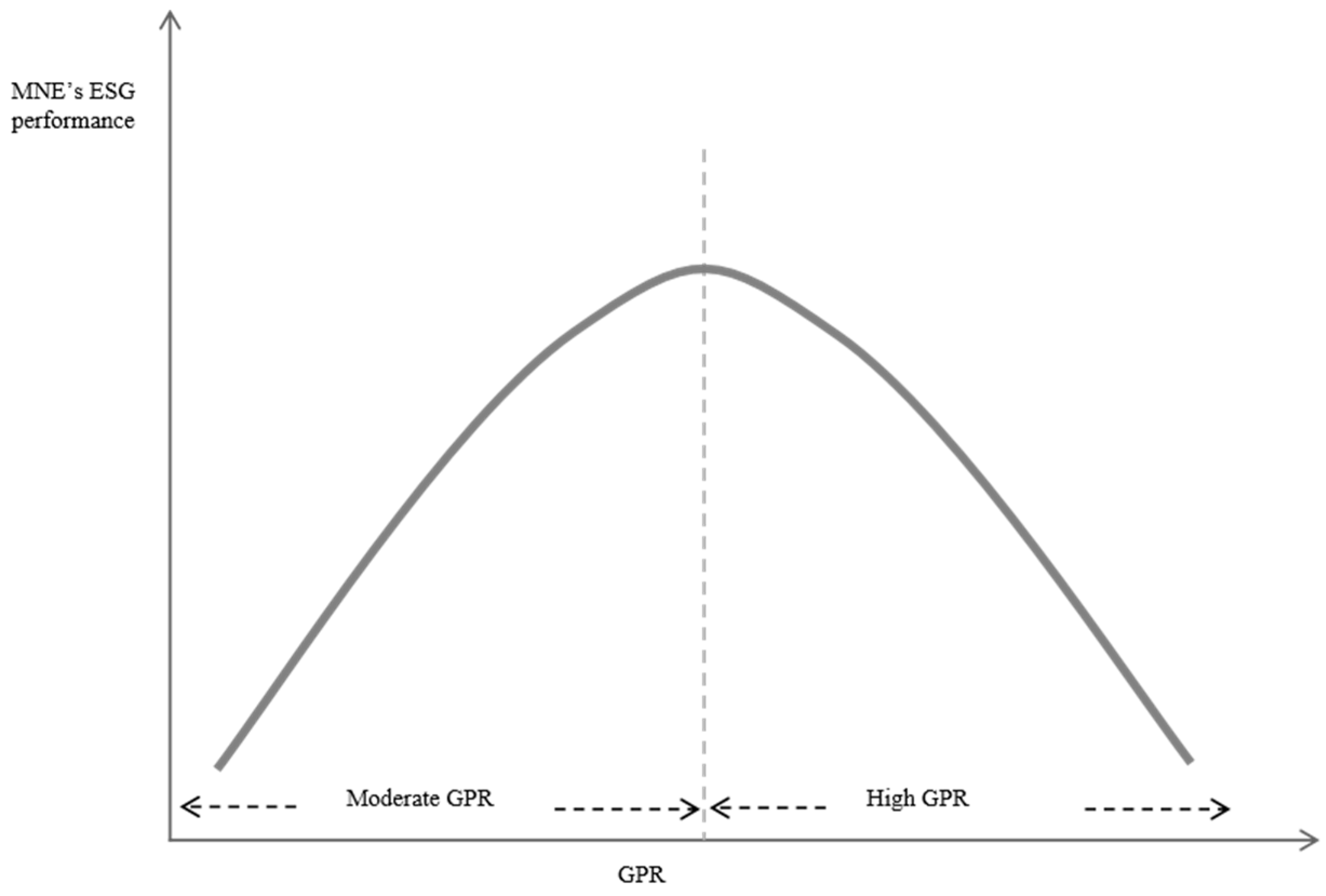
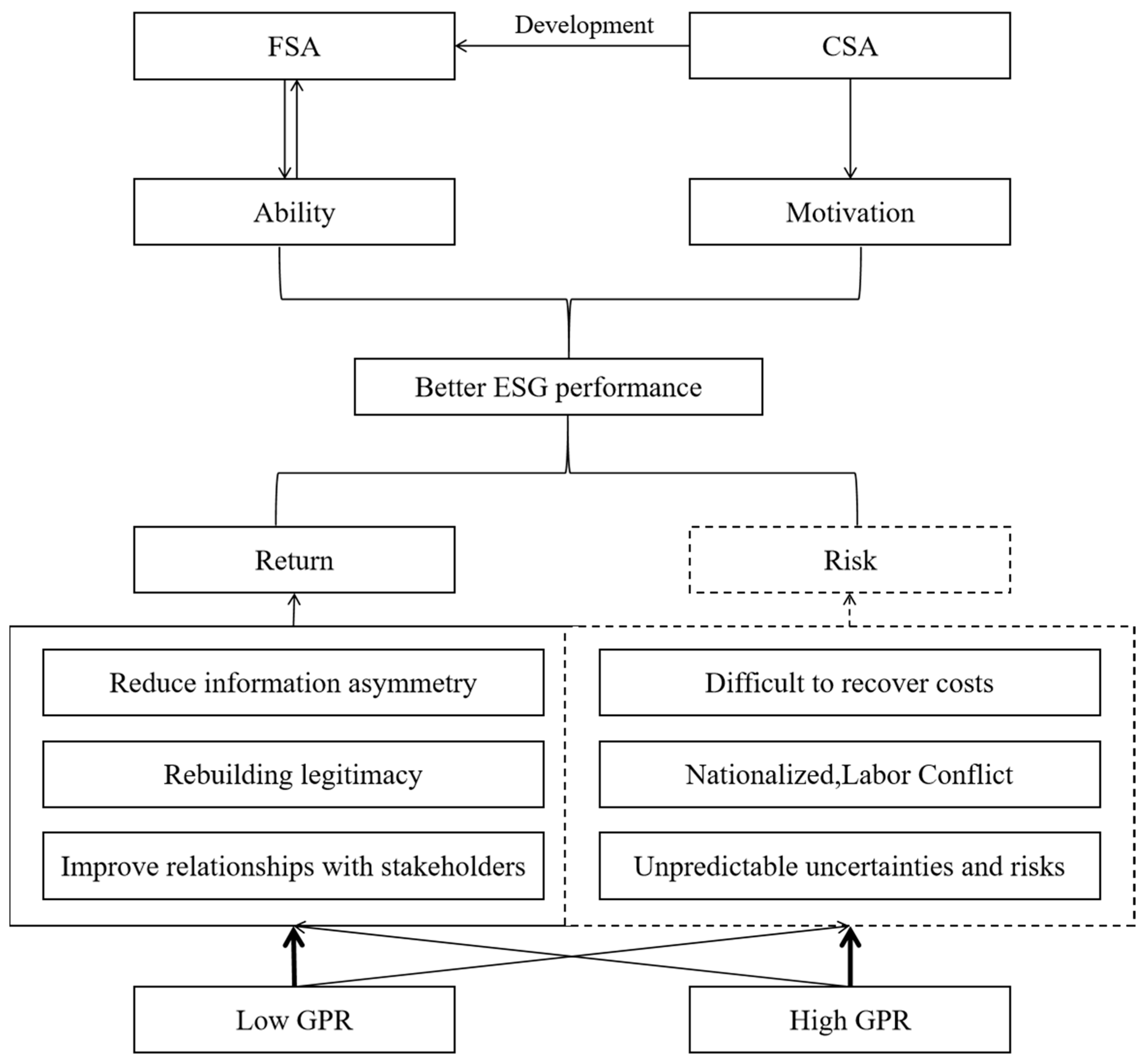
Theoretical systems such as stakeholder theory, institutional theory (Ghoul et al., 2017) [37], and the resource-based view provide systematic explanations for the necessity of ESG strategy (Figure 1). These frameworks emphasize several reasons for the importance of ESG performance, including but not limited to the following: (1) ESG performance is closely related to the risks faced by MNEs in host countries. MNEs with high ESG performance are more likely to build mutually beneficial relationships with their stakeholders, enhancing their legitimacy (Ellili and Daoud, 2022) [38]. On the other hand, moderate ESG performance can lead to ongoing tensions with local stakeholders, posing long-term operational risks in host countries. (2) ESG disclosure can reduce information asymmetry between investors and firms (Amir and Serafeim, 2018) [39]. MNEs with high ESG performance may face fewer financing constraints as they are more attractive to investors. (3) Good ESG performance is associated with higher productivity, stronger competitive advantage, and improved financial performance (Eduardo and Caracuel, 2021; Ferraz et al., 2016) [14,40]. In such firms, stakeholders often share common values, which foster a unified strategic vision and greater motivation for sustainable development. As such, ESG investment can be seen as a strategic tool for achieving long-term, stable growth in host countries.
However, GPR can introduce significant uncertainty for MNEs [2,41], thereby influencing ESG decision-making. It is important to emphasize that the level of GPR can determine the extent of its impact. International events reflect GPR range from political reform and diplomatic negotiations to military confrontations and non-traditional large-scale violence. Under moderate-level GPR, MNEs may face increased pressure from the host country to demonstrate legitimacy. In response, firms may improve their ESG performance to mitigate investment risks—for example, by improving labor standards, reducing carbon emissions, or enhancing community engagement. In such scenarios, GPR and the ESG performance are positively correlated.
However, in cases of high-level GPR—such as armed conflict, violent protests, or military standoffs between home and host countries—this strategy may no longer be effective. Even strong ESG commitments may not prevent backlash from the host government or the public. In these circumstances, firms may reduce ESG investment or withdraw from the market entirely.
Based on the above analysis, we propose hypothesis H1:
H1. 
Geopolitical risk and ESG performance of multinational enterprises exhibit an inverted U-shaped relationship.
To further refine our theoretical framework, we draw on the FSA–CSA matrix developed by Rugman and Verbeke (2003) [42], which has become a widely accepted model for analyzing MNEs’ behavior. In this framework, FSAs refer to unique, inimitable resources and capabilities that enable firms to overcome the “liability of foreignness” (LOF) in host markets. CSAs refer to location-based advantages rooted in either the home or host country—such as resource endowments, market size, or institutional quality. An MNE’s international investment strategy depends on both its motivation and capability to invest, both of which are shaped by its FSAs and CSAs of the host country.
Strong ESG performance can enhance productivity and competitive advantages, and can reduce investment risks in host countries. MNEs with large FSAs are typically better equipped to allocate resources toward ESG improvement. In turn, better ESG outcomes help internalize the locational advantages of host countries as part of the firm’s overall competitive advantage.
Moreover, host countries with higher standards for environmental protection, labor rights, and governance tend to encourage stronger ESG commitments from MNEs. Emerging market MNEs, which may lack the ownership advantages of developed-country counterparts, often use international expansion to acquire or leverage host-country CSAs. In such cases, CSAs become particularly critical, and host markets with stronger CSAs often demand higher ESG compliance. To establish legitimacy and market access, these MNEs may be especially motivated to improve their ESG performance. In short, FSAs determine the firm’s capability to enhance ESG performance, while CSAs shape their motivation to do so.
From a corporate strategy perspective, ESG investment reduces information asymmetry with investors, builds legitimacy, and strengthens stakeholder relationships. However, ESG efforts are not risk-free. When MNEs encounter opposition from host-country governments or the public—such as during nationalization, labor disputes, or other crises—even strong ESG performance may fail to alleviate tensions. In such cases, ESG strategies may prove ineffective.
As an exogenous factor, GPR indirectly affects corporate decision-making by shifting the risk–return profile of ESG performance. Under moderate GPR, the returns of ESG efforts increase due to enhanced legitimacy and reduced exposure to external shocks. In contrast, under high GPR, risks outweigh benefits, potentially discouraging firms from committing further resources—even when ESG investments align with strategic intentions (Figure 2).
Based on the above analysis, we propose the following hypotheses:
H2a. 
FSA is positively correlated with the ESG performance of multinational enterprises.
H2b. 
CSA is positively correlated with the ESG performance of multinational enterprises.
During periods of GPR, MNEs may adopt different strategies to manage risks. For example, under conditions of moderate geopolitical risk, firms may enhance ESG performance to ease pressure from host-country stakeholders and strengthen their legitimacy. Conversely, under high geopolitical risk, firms may adopt a contraction strategy.
FSA influence not only an MNE’s ability to improve ESG performance, but also its capacity to withstand geopolitical risks. High-FSA firms generally exhibit stronger risk resistance. They possess greater resource reserves, allowing them to maintain or improve ESG efforts during moderate levels of GPR. In addition, such firms tend to be more competitive and less replaceable in host-country markets, which strengthens their bargaining power. As a result, they are less likely to exit markets during periods of heightened geopolitical tension and are more likely to invest in ESG initiatives for long-term strategic reasons. Finally, high-FSA firms often have more international experience, making them better equipped to coordinate global resources and minimize the losses resulting from GPR.
CSA, by contrast, relates to the driving force behind ESG investment. In host countries with high CSA, MNEs are more inclined to invest in ESG performance, especially during periods of moderate geopolitical risk. Conversely, during high-risk periods, firms are more likely to exit low-CSA markets, which are often perceived as less stable or strategically valuable.
High-CSA host countries tend to offer greater political stability, encouraging MNEs to maintain long-term commitments and improve ESG performance. In contrast, low-CSA countries often present a more volatile geopolitical environment, discouraging firms from making substantial ESG investments during times of risk. Based on the above analysis, we propose the following additional hypotheses:
H3a. 
FSA positively moderates the relationship between GPR and the ESG performance of multinational enterprises.
H3b. 
CSA positively moderates the relationship between GPR on the ESG performance of multinational enterprises.


3. Method and Data

3.1. Variables and Data Sources

3.1.1. Explained Variable

ESG performance ( E S G i t ). This study uses the Bloomberg ESG score, which has become one of the most widely adopted sources for ESG evaluation in empirical research [43]. The Bloomberg ESG dataset covers more than 2000 fields, categorized into three core dimensions: environment, society, and governance. In this study, the ESG score of firm i in year t is employed as the proxy indicator for corporate ESG performance.

3.1.2. Core Explanatory Variable

Geopolitical Risk Index ( G P R i j t ). To construct this variable, we utilize event data from the Global Database of Events, Language, and Tone (GDELT)—a real-time global monitoring system that applies artificial intelligence and natural language processing to extract structured event data from news reports published in over 100 languages. Each record in the GDELT database includes nearly 60 attribute fields such as time, location, parties involved, and event type. In this paper, events are coded according to the Conflict and Mediation Event Observations (CAMEO) framework, which categorizes them into 20 distinct action types and assigns corresponding Goldstein scores (−10 to 10) to them. The Goldstein score of conflict events is less than 0, while the Goldstein score of cooperation events is greater than 0. Following the geopolitical risk measurement approach of Huang et al. (2015) [44], we use conflict events with Goldstein scores less than zero as the fundamental data for constructing the geopolitical risk index. The absolute value is used to represent the severity of the geopolitical risks faced by multinational companies in the host country. Since the time series scale of our panel data is annual, we sum up all geopolitical events from January 1 to December 31 of year t according to the reporting frequency and the corresponding Goldstein score, and then take the natural logarithm of the summed data. The higher the absolute value of the Goldstein score, the more non-repeated reports, and the higher the geopolitical risk index between the host and home country (Table 1).

3.1.3. Firm-Specific Advantages

Productivity advantage ( T F P _ F S A i t ). In the field of international business, it is widely accepted that MNEs must overcome the liability of foreignness when entering a foreign market. To do so, MNEs rely on firm-specific advantages (FSAs), capabilities such as superior productivity, innovation capacity, and marketing strength. Bhaumik et al. (2016) [45] pointed out that total factor productivity (TFP) is a commonly used proxy indicator for FSAs. We adopt the Levinsohn and Petrin (LP) method to estimate TFP. The LP improves upon the Olley and Pakes (OP) [46] approach by using intermediate product inputs (rather than investment) as a proxy for unobserved productivity shocks, thereby addressing simultaneity bias more effectively. The necessary data is obtained from the CSMAR database listed company database.
R&D advantage ( R & D _ F S A i t ). In examining the firm-specific advantages (FSAs) of Korean multinational enterprises, Lee et al. (2012) [47] employed R&D intensity as a proxy indicator for FSAs. Following their approach, we use the natural logarithm of listed firms’ R&D expenditures as a proxy variable for R&D advantage. This variable reflects firms’ investments in innovation and technological progress. The data is obtained from the CSMAR database.
Overseas operating advantage ( E x p _ F S A i t ). In addition to total factor productivity (TFP) and R&D expenditures, international operating experience is also an important indicator of multinational enterprises’ firm-specific advantages (FSAs) [48]. The natural logarithm of overseas revenue of listed companies is used as a proxy for overseas operating advantage. Data is drawn from the CSMAR database.

3.1.4. Country-Specific Advantages

Host-country market advantage ( M a r k e t _ C S A j t ). According to the OLI paradigm, the location advantages that attract international investment include factors such as market potential, labor force, natural resources, and strategic assets [33]. Building on this theoretical framework, we employ four variables—host-country market advantage, host-country technological advantage, labor force advantage of host countries, and host-country resource advantage—to measure CSAs. We use the natural logarithm of per capita GDP in the host country as a proxy for the host country’s market advantage. Data is obtained from the World Bank.
Host-country technological advantage ( R & D _ C S A j t ). The natural logarithm of the ratio of R&D expenditure to GDP in the host country serves as a proxy for technological advantage. Data are sourced from the World Bank.
Labor force advantage of host countries ( L a b o r _ C S A j t ). The natural logarithm of the total labor force of the host country is used to represent the labor force advantage of host countries. Data are obtained from the World Bank. The total labor force comprises all persons aged 15 and over who meet the International Labor Organization’s definition of the economically active population: all persons who contribute labor to the production of goods and services at any given time. This includes both employed and unemployed persons. While countries vary in their treatment of members of the armed forces, seasonal workers, or part-time workers, the labor force generally includes members of the armed forces, the unemployed, and first-time jobseekers. It excludes household workers and other unpaid caregivers and workers in the informal sector.
Host-country resource advantage ( Re s o u r c e _ C S A j t ). We use the natural logarithm of the percentage of ores and metals in total merchandise exports as a proxy for the natural resource endowment of the host country. Data is sourced from the World Bank.

3.1.5. Control Variables

Total revenue ( r e n e n u e i t ). In examining the determinants of ESG performance, most studies employ a standard set of control variables. In addition to incorporating FSAs and CSAs as both control and moderating variables, our model also follows prior research by including total revenue, ownership, and enterprise size as control variables [49,50,51,52,53]. We include the natural logarithm of total corporate revenue as a control variable to account for firm-level operational scale. Data is from the CSMAR database.
Ownership ( O w n e r s h i p i t ). To control for the influence of ownership structure, we introduce a binary variable: state-owned enterprises (SOEs) are recorded as 1, while enterprises without state-owned shares are coded as 0. Data is sourced from the CSMAR database.
Enterprise size ( S i z e _ F S A i t ). We use the natural logarithm of the total number of employees as a proxy for firm size. Data is from the CSMAR database.

3.2. Empirical Model

3.2.1. Panel Data Fixed Effects Model

To estimate the effect of geopolitical risk on the ESG performance of Chinese MNEs, we employ a panel data fixed effects model, which is particularly suitable for controlling for unobservable heterogeneity. This approach mitigates bias arising from time-invariant firm-, industry-, and region-specific factors that are not directly observable but may influence ESG performance. Specifically, individual fixed effects ε i can eliminate the impact of omitted variables that are different between individuals but remain unchanged over time, industry fixed effects ε t can eliminate the impact of omitted variables that change with the industry but remain unchanged for each individual, and province fixed effects ε k can eliminate the impact of omitted variables that change with the province but remain unchanged for each individual. Controlling fixed effects can ensure that the regression model obtains more effective results. We conduct Hausman tests to compare fixed effect, random effect, and pooled OLS models. The test results show that the fixed effect model has best performance (as shown in the Section 4). Therefore, we use the fixed effect model as the baseline empirical strategy. The main regression model is specified as follows:
E S G i j t = β 0 + β 1 G P R j t + β 2 G P R j t 2 + β F S A _ x i t + β C S A _ x j t + β x i j t + ε i + ε k + ε t
Among them, E S G i j t represents the ESG score of enterprise i investing in country j in year t; G P R j t represents the geopolitical risk index between country j and China in year t; and x i j t represents the control variable. In addition, we use β 1 and β 2 to identify the non-linear impact of GPR on the ESG performance of multinational enterprises.

3.2.2. Multiple-Period DID

The difference-in-difference (DID) approach is a widely used method for addressing endogeneity problems, particularly those arising from omitted variable bias. The basic idea behind DID is to construct a double difference statistic reflecting the policy effect by comparing the change in outcomes over time between a control group and a treatment group. Specifically, DID eliminates time-invariant differences between the two groups by differencing out the pre-treatment gap.
In this study, GPR is treated as exogenous shock, given that it is a macro-level variable and largely outside the control of individual firms. Therefore, the DID model and the PSM-DID model have strong applicability. We classify geopolitical risk into two categories—high-geopolitical-risk and moderate-geopolitical-risk—and define treatment status accordingly. Specifically, if firm i investing in country j experiences a high-GPR event from the year of entry up to t, it is assigned to the high-risk treatment group G P R _ h i g h j t = 1 ; otherwise, it is included in the control group. Similarly, if firm i investing in country j encounters a moderate-GPR event from its establishment to year t, it is included in the moderate-risk treatment group G P R _ m o d j t = 1 ; otherwise it is included in the control group. Given that firms may experience GPR shocks at different points in time, the study employs a multiple-period DID model, which captures staggered treatment timing across firms and countries. The model setting of the endogeneity test part is as follows:
Endogeneity test of high-geopolitical-risk events:
E S G i j t = β 0 + β 1 G P R _ h i g h j t + β F S A _ x i t + β C S A _ x j t + β x i j t + ε i + ε k + ε t
Endogeneity test of moderate-geopolitical-risk events:
E S G i j t = β 0 + β 1 G P R _ m o d j t + β F S A _ x i t + β C S A _ x j t + β x i j t + ε i + ε k + ε t

3.2.3. PSM-DID

The PSM-DID method combines propensity score matching (PSM) with the difference-in-difference (DID) technique to address sample selection bias and strengthen causal inference in a quasi-experimental setting. This integrated approach was first proposed by Heckman et al. (1997) [54], who argued that PSM can be used to construct a more comparable control group for the DID framework. Since then, the PSM-DID has been widely used in research under quasi-natural experimental conditions. In the context of this study, which examines the effect of geopolitical risk on the ESG performance of multinational companies, the issue of selection bias is particularly crucial. Firms exposed to GPR may differ systematically from those that are not—for instance, they may be more capable of dealing with risks. To mitigate this issue, we use propensity score matching to pair firms that experienced GPR with observationally similar firms that did not, based on observable characteristics such as firm size, ownership type, productivity, and industry. The core idea of PSM is to calculate the propensity score—the probability of receiving the treatment (GPR exposure)—given a set of covariates. Firms in the treatment group and control groups are then matched based on these scores. Although PSM-DID helps solve the problem of sample self-selection, it is not without limitations. Statistical concerns such as “self-matching” or “mismatching of special class variables” may affect result robustness. Therefore, we treat the PSM-DID estimation as a robustness check for the baseline DID results.
To ensure rigor, we apply a year-by-year matching strategy, include all control variables as covariates in the model, and exclude unmatched samples to obtain an unbalanced panel data. The matched sample is then analyzed using the same DID model as described in Section 3.2.2 to regress the matched samples.

3.2.4. Moderation Effect Model

This section investigates the moderating effects of FSA and CSA on the relationship between GPR and ESG performance, in line with hypotheses H3a and H3b. That is, FSA and CSA will affect not only the ESG performance of multinational enterprises, but also the extent to which GPR affects the ESG performance of multinational enterprises, which will be reflected in the coefficient of the cross-product term β k . Since the impact of high geopolitical risk and moderate geopolitical risk on the ESG performance of multinational enterprises is heterogeneous, we tested the moderating effect of FSA and CSA on G P R _ h i g h j t and G P R _ l o w j t . When β k and β 1 have the same sign, FSA or CSA will strengthen the impact of GPR on the ESG performance of multinational enterprises. When β k and β 1 have opposite signs, FSA or CSA will weaken the impact of GPR on the ESG performance of multinational enterprises. The specific regression model is as follows:

E S G i j t = β 0 + β 1 G P R _ h i g h j t + β k F S A _ x i t k × G P R _ h i g h j t + β k F S A _ x i t k + β x i j t + ε i + ε k + ε t
E S G i j t = β 0 + β 1 G P R _ m o d j t + β k F S A _ x i t k × G P R _ m o d j t + β k F S A _ x i t k + β x i j t + ε i + ε k + ε t
E S G i j t = β 0 + β 1 G P R _ h i g h j t + β k C S A _ x i t k × G P R _ h i g h j t + β C S A _ x j t + β x i j t + ε i + ε k + ε t
E S G i j t = β 0 + β 1 G P R _ m o d j t + β k C S A _ x i t k × G P R _ m o d j t + β C S A _ x j t + β x i j t + ε i + ε k + ε t

4. Results

4.1. Descriptive Statistics

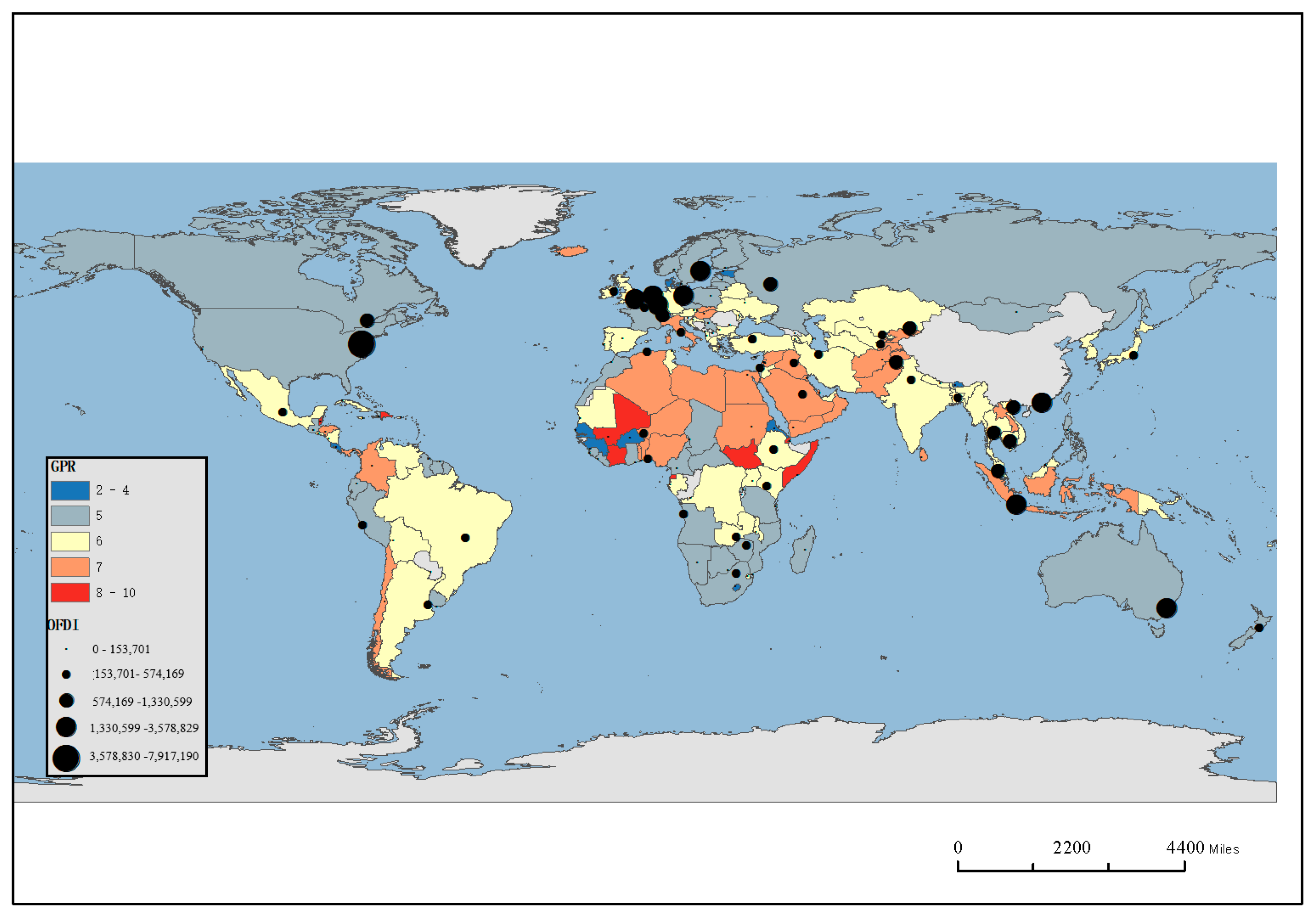
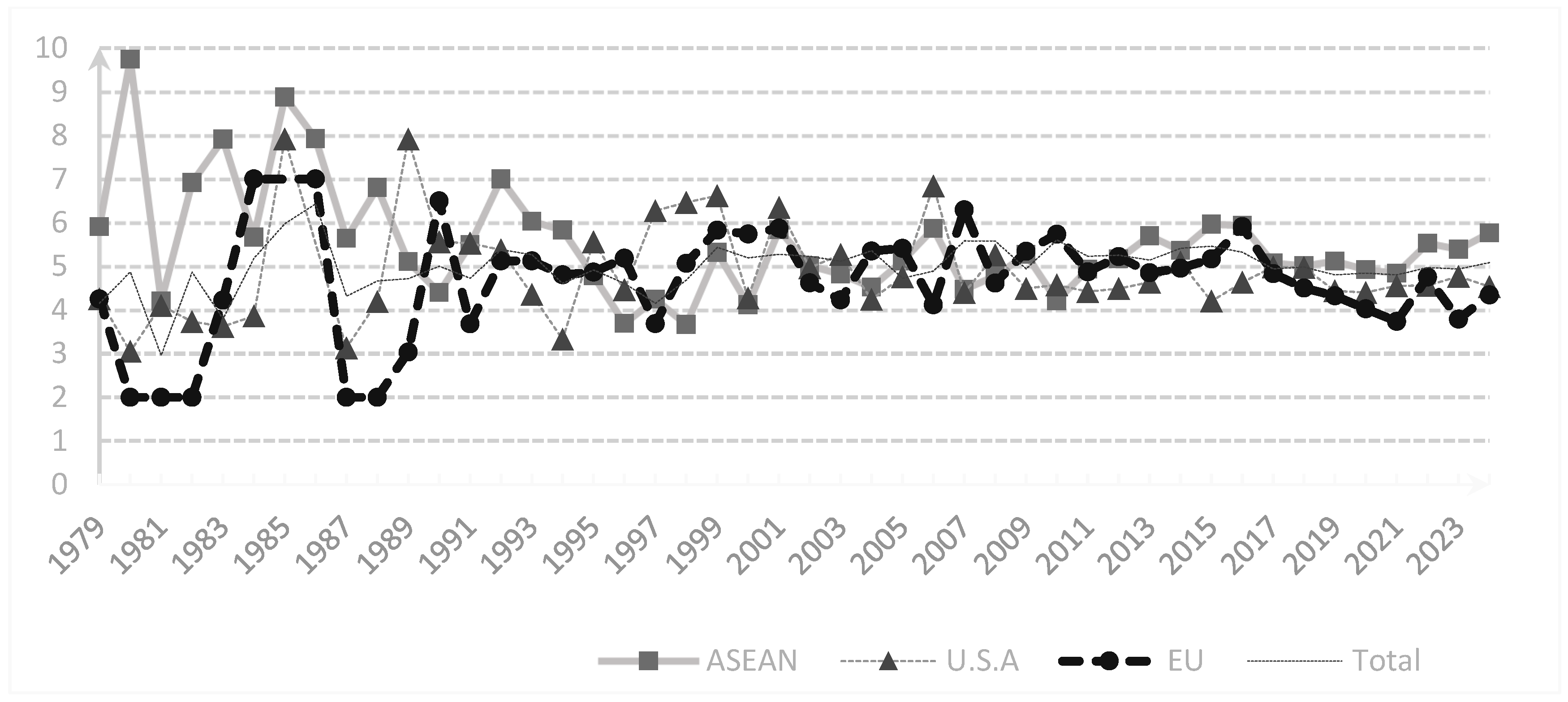
To illustrate the GPR exposure of Chinese MNEs, we first analyze the distribution of China’s outward foreign direct investment (OFDI) stock across host countries with varying levels of geopolitical risk (Figure 3). Based on China’s bilateral GPR data and cumulative OFDI stock (1979–2023), the evidence reveals that China’s OFDI is mainly concentrated in regions with relatively moderate geopolitical risks, but a non-negligible portion is also present in higher-risk environments. For example, the average GPR between mainland China and Hong Kong is 2.899, while China’s OFDI stock in Hong Kong reached US$1,588,673.84 million, accounting for 57.69% of China’s total global OFDI stock. In contrast, the average GPR between China and the European Union is 4.780, with an OFDI stock of US$101,192.5 million, accounting for 3.674% of China’s global total. The average GPR between China and the United States is 4.668, with an OFDI stock of US$79,171.9 million (2.875% of the total).
Interestingly, China also maintains significant OFDI exposure to regions with high GPR. The average GPR between China and ASEAN is 5.291—higher than China’s average GPR of 5.078—yet China’s OFDI stock in ASEAN is US$154.6626 billion, or 5.616% of its global total. In addition, China holds smaller OFDI positions in countries with GPR scores greater than 6, such as Equatorial Guinea, Belize, Mali, Cote d’Ivoire, Iraq, Niger, Afghanistan, Colombia, Saudi Arabia, etc. These high-risk locations account for 1.27% of China’s OFDI stock in the world (Figure 4). These patterns are consistent with prior findings in the international business literature [55].

4.2. Main Regression Model

Table 2 presents the results of the main regression model, examining the relationship between geopolitical risk and the ESG performance of Chinese MNEs. We performed VIF tests on all regression equations. The test results showed that VIF was much smaller than 10, which indicated that there was no multicollinearity problem in all regression equations. After controlling for firm-level characteristics—including total revenue, ownership type, and firm size—we observe a statistically significant inverted U-shaped relationship between geopolitical risks and the ESG performance. The coefficient on GPR is positive, while the coefficient on its squared term is negative, both significant at the 1% level, providing strong support for hypothesis H1.
Upon the further inclusion of firm-specific advantages (FSAs) and host-country-specific advantages (CSAs) as explanatory variables, the inverted U-shaped relationship remains robust. The inflection point of this non-linear relationship lies between GPR = 0.989 and GPR = 2.632. According to the Goldstein Scale used for GPR classification, this inflection range corresponds to geopolitical events such as “Disapprove” and “Investigate”. Under these moderate-risk scenarios, MNEs are more likely to improve ESG performance. However, when faced with more serious geopolitical disruptions—such as “Reduce relations”, “Exhibit military posture”, or “Use of unconventional mass violence”—MNEs are more likely to withdraw or reduce ESG investments to manage risk exposure.
In addition, the results lend strong support to hypothesis H2a and hypothesis H2b. Specifically, we find that firm-specific advantages—including productivity, R&D intensity, and overseas operation experience—positively contribute to ESG performance. Similarly, host-country advantages—such as market development, R&D intensity, and labor advantages—are also positively associated with ESG performance of enterprises.

4.3. Heterogeneous Regression

To further explore the robustness and contextual variability of the relationship between geopolitical risk (GPR) and ESG performance, we conduct a series of heterogeneous regressions based on host-country income level, investment region, industry type, geographic origin of the MNE, and ownership structure (Table 3). Using the World Bank’s income classification, we divide the sample into two groups. Group 1 includes high-income countries (regression results shown in Column 2 of Table 3). Group 2 includes upper-middle-income, lower-middle-income, and low-income countries (Column 3 of Table 3). In addition, we examine three of China’s most important investment destinations (the United States, the European Union, and ASEAN) (Yang & Bathelt, 2023) [56]. The results show that the inverted U-shaped curve between GPR and ESG performance has different inflection points in different countries. The impact of GPR on the ESG performance of MNEs is more statistically significant in low-income host countries. Among the three major host regions—the USA, the EU, and ASEAN—the ESG performance of Chinese MNEs investing in ASEAN is relatively more strongly affected by GPR.
Heterogeneity analyses based on industry, province, and ownership type reveal that the ESG performance of service-sector MNEs is more negatively affected by geopolitical risks than by the manufacturing of MNEs, with the inflection point of the inverted U-shaped relationship occurring earlier (Table 4). The heterogeneity of the regression coefficients was assessed using seemingly unrelated regression (SUR). No significant differences were observed in the response of MNEs’ ESG performance to geopolitical risks between firms located in eastern regions and those in central and western regions, and the SUR test confirmed the absence of coefficient heterogeneity. For non-state-owned MNEs, the inflection point of the inverted U-shaped curve appeared earlier, indicating a stronger sensitivity to geopolitical risks; the heterogeneity of the regression coefficients in this case was also examined using SUR. This may be because manufacturing MNEs possess stronger FSAs than service MNEs, MNEs located in eastern regions have stronger FSAs than those in central and western regions, and state-owned MNEs exhibit stronger FSAs than privately owned MNEs.

4.4. Endogeneity Test

In order to overcome the potential endogeneity problem—particularly the risk of reverse causality—we adopt the PSM-DID method. While GPR is inherently a macro-level phenomenon largely exogenous to firm-level decision-making, this robustness check ensures our findings are not biased by pre-existing differences between treated and control firms. Referring to the research results in the main regression model, we classify events with a geopolitical risk index greater than or equal to 4 as high-geopolitical-risk events, and events with a geopolitical risk index less than 4 as moderate-geopolitical-risk events. Using these thresholds, we classify firms into treatment and control groups. When company j experienced a high-geopolitical-risk event from its establishment to t years, we include it G P R _ h i g h j t = 1 in the treatment group; otherwise, it is included in the control group. When company j experienced a moderate-geopolitical-risk event from its establishment to t years, we include it G P R _ m o d j t = 1 in the treatment group; otherwise, it is included in the control group. To avoid confounding effects, we exclude firms that experienced both high- and moderate-GPR events during the observation period. Following the approach of T Beck and R Levine (2010) [57], we perform one-to-one nearest neighbor matching and match the study samples year by year. Table 5 shows the matching results of PSM. The results of PSM show that there are no statistically significant pre-treatment differences in ESG performance between the treatment and control groups in most years, supporting the validity of the PSM procedure.
As presented in Table 6, the regression results provide clear evidence of the non-linear relationship between GPR and ESG performance. Specifically, exposure to moderate geopolitical tensions, such as diplomatic disapproval or investigation, tends to enhance the ESG performance of MNEs. In contrast, high-intensity conflicts, including diplomatic deterioration, military posturing, or acts of mass violence, are associated with a decline in ESG performance. The regression results of the DID model and the PSM-DID model passed the endogeneity test, supporting hypothesis H1.
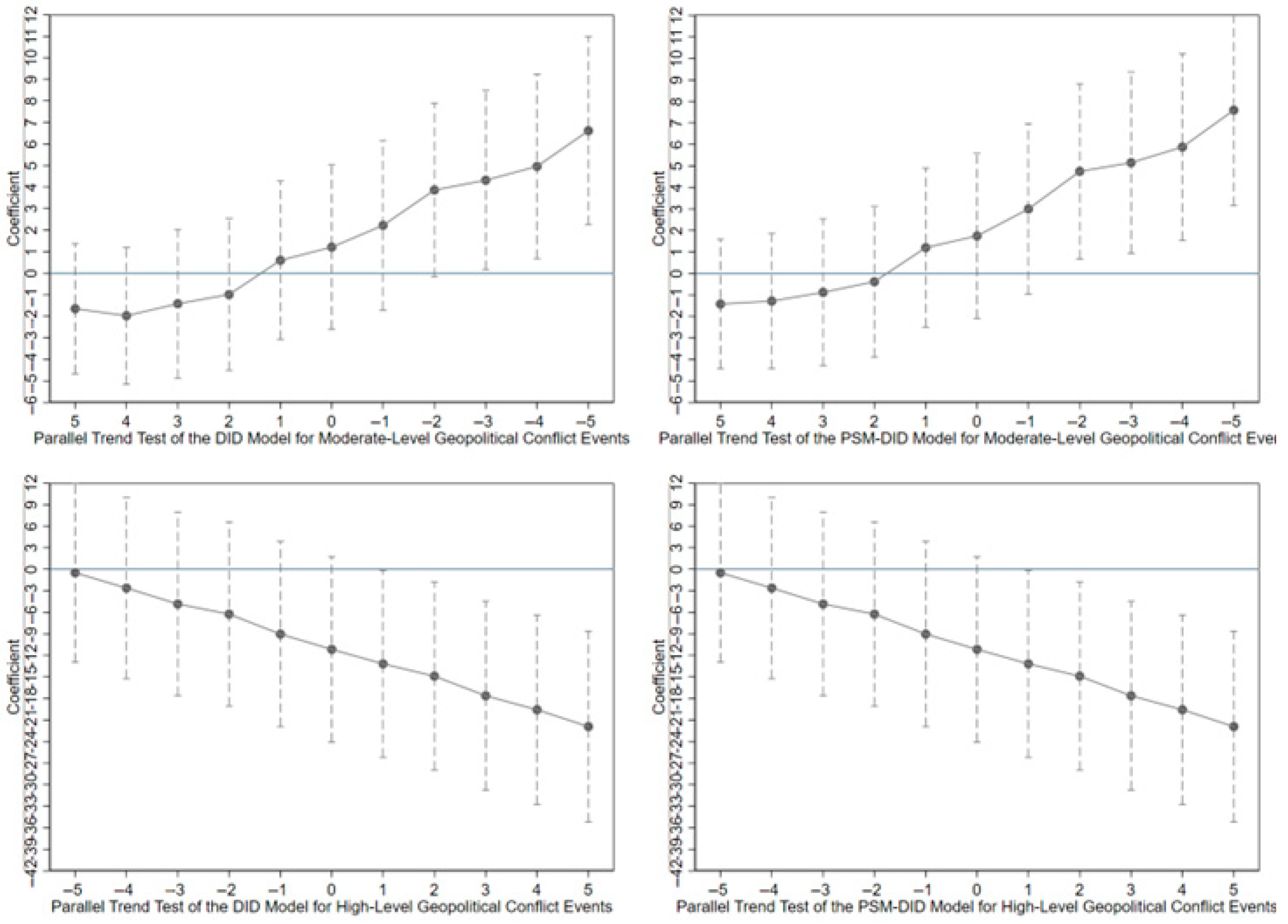
We conducted parallel trend tests for four models (Figure 5): the DID model under moderate-intensity geopolitical conflicts, the PSM-DID model under moderate-intensity geopolitical conflicts, the DID model under high-intensity geopolitical conflicts, and the PSM-DID model under high-intensity geopolitical conflicts. The results indicate that all models satisfy the parallel trend assumption. Specifically, there are no significant differences between the treatment and control groups before the onset of the treatment effect, while after the occurrence of the treatment effect, the differences between the two groups remain persistently stable over time.

4.5. Moderating Effect Model

To further explore the conditional relationship between GPR and ESG performance, we examine the moderating effects of FSA and CSA in Table 7 and Table 8. The results show that FSA significantly moderates the effect of GPR on ESG performance. MNEs with stronger FSAs are better equipped to manage the dual pressures of geopolitical risk and sustainability demands. This outcome supports hypothesis H3a. The stronger the FSA, the more capable the MNEs are of improving their ESG performance to cope with geopolitical risks. Specifically, they have stronger capabilities and more resources to engage in green technology innovation, reduce pollution, improve labor treatment, and fulfill social responsibilities. Stronger firm-specific advantages indicate that ESG investment is more feasible as a hedging strategy for GPR4. In addition, MNEs with stronger FSA have stronger bargaining power and are less likely to exit the host-country market under the impact of high geopolitical risks. They are more likely to engage in ESG investment to reshape legitimacy for long-term strategic considerations.

5. Conclusions and Discussion

This study investigates the impact of host-country GPR on the environmental, social, and governance (ESG) performance of MNEs, using a unique dataset of 12,699 subsidiaries of Chinese MNEs operating globally between 2006 and 2022. The key findings are threefold: First, we find a non-linear, inverted U-shaped relationship between GPR and ESG performance. Specifically, under moderate-geopolitical-risk conditions—such as Disapprove or Investigate—MNEs tend to improve ESG performance to enhance the legitimacy of their operations in the host country. Conversely, under high-geopolitical-risk scenarios, including the reduction in diplomatic relations, demonstrations of military force, or episodes of large-scale violence, MNEs tend to reduce ESG investments to mitigate exposure and operational risk. These findings are robust across multiple empirical strategies, including panel fixed effects, DID, and PSM-DID models. Second, heterogeneous analysis shows that the inflection point of the inverted U-shaped curve differs by firm and host-country characteristics. State-owned multinational enterprises, service industry MNEs, and MNEs investing in high-income countries exhibit earlier inflection points, suggesting they are more sensitive to GPR shocks and more likely to reduce ESG engagement when risk intensifies. Third, we find that FSA and CSA act as important moderators of the GPR–ESG relationship. Firms with stronger FSAs are better able to maintain ESG performance in high-risk settings and are more proactive in moderate-risk contexts. Similarly, host countries with stronger CSAs encourage MNEs to invest more in ESG when geopolitical risks are low.
Theoretically, this study bridges two perspectives in the literature: one emphasizing ESG as a legitimacy-enhancing strategy in response to geopolitical uncertainty, and the other highlighting the deterrent effects of GPR on corporate sustainability investment. By building on the FSA–CSA framework, we further argue that the effect of GPR on ESG is contingent on both internal firm resources and the institutional environment of host countries. Moreover, variations by industry, ownership structure, and investment destination underscore the multidimensional nature of this relationship. This integrative perspective advances our understanding of how geopolitical dynamics interact with corporate sustainability practices across borders.
Despite the robust findings, several limitations should be acknowledged: (1) Scope of research subjects: Our research focuses exclusively on Chinese MNEs, which constrains generalizability across national contexts. Comparative studies across home countries could offer a more comprehensive picture of how different institutional contexts shape ESG strategies in response to GPR. (2) Sample constraints: Our sample includes only A-share listed companies from the Shanghai and Shenzhen Stock Exchanges. While this ensures high-quality, audited data, it excludes smaller, unlisted firms—such as “born-global” SMEs—that often operate in niche markets (Mathews et al., 2006) [34]. (3) Methodological constraints: Although we employ robust econometric techniques—including PSM-DID and moderation models—potential endogeneity concerns (e.g., omitted variable bias and sample selection bias) cannot be entirely ruled out. Moreover, geopolitical risk (GPR) does not arise in a vacuum. MNE investment may serve as a mitigating force for GPR, facilitating the exchange of personnel, capital, technology, and knowledge, which in turn may reshape international relations. Such bidirectional effects are difficult to quantify in empirical models, but they represent a promising direction for future research.
Our findings generate several key insights: (1) The complex role of GPR in shaping ESG performance: The relationship between GPR and ESG performance is context-dependent and non-linear. On the one hand, strong ESG performance may alleviate the negative effects of geopolitical tensions, prompting MNEs to increase ESG investments during periods of heightened risk [21]. This conclusion is supported by studies such as Belcaid’s (2024) [1] analysis of Morocco, Fiorillo et al.’s (2024) [21] research on listed companies in the U.S., Japan, and the U.K. rated by Refinitiv, Chun et al. (2024) [26] on Korean firms, Reyad (2024) [27] on Eastern European enterprises, and Kuai et al. (2024) [28] on Chinese companies. On the other hand, MNEs may also reduce ESG investment in the face of high GPR to minimize exposure to political and operational risks. This outcome is supported by studies including Basnet et al. (2022) [25] on firms operating in Russia, Amosh et al. (2024) [23] on a global sample of 5082 companies, and Sabbaghi (2024) [24] on both emerging and developed markets. We argue that these seemingly contradictory findings are due to insufficient consideration of the heterogeneity of GPR, MNE characteristics, and host-country environments. Future research should emphasize heterogeneity effects and underlying mechanisms. (2) Implications for corporate strategy: From a managerial standpoint, MNEs should strengthen their risk management capabilities, particularly through differentiated approaches to different levels of GPR. In moderate-GPR environments, ESG investments can play a key role in enhancing corporate legitimacy. In high-GPR contexts, other forms of risk mitigation strategies may be necessary. Our sub-sample analysis indicates that firms that remain operational in host countries respond more sensitively to GPR than those that exit, suggesting that effective GPR management may constitute a critical competitive advantage for MNEs. (3) Implications for policymakers: For policymakers, it is essential to recognize the adverse impacts of GPR on sustainable development and to promote international cooperation aimed at conflict resolution and risk reduction.

Author Contributions

Conceptualization, Z.G., J.Z. and Y.L.; methodology, Z.G. and J.Z.; software, Z.G. and J.Z.; validation, Z.G., Y.L. and R.Y.; formal analysis, Z.G.; investigation, Z.G. and J.Z.; resources, Y.L.; data curation, Z.G. and J.Z.; writing—original draft preparation, Z.G. and J.Z.; writing—review and editing, Y.L.; visualization, Z.G. and R.Y.; supervision, Y.L.; project administration, Y.L.; funding acquisition, Y.L. All authors have read and agreed to the published version of the manuscript.

Funding

This research was funded by National Natural Science Foundation of China grant number 42271180.

Institutional Review Board Statement

Not applicable.

Informed Consent Statement

Not applicable.

Data Availability Statement

The data used in this study are available from the corresponding author upon reasonable request.

Conflicts of Interest

The authors declare no conflict of interest.

References

  1. Belcaid, K. Morocco’s Green Shield: ESG Stock Performance under Global Climate, Economic, Geopolitical and Oil Uncertainties. Sustain. Futures 2024, 8, 100250. [Google Scholar] [CrossRef]
  2. Wang, K.-H.; Su, C.-W.; Umar, M. Geopolitical Risk and Crude Oil Security: A Chinese Perspective. Energy 2021, 219, 119555. [Google Scholar] [CrossRef]
  3. López, L.-A.; Cadarso, M.-Á.; Zafrilla, J.; Arce, G. The Carbon Footprint of the US Multinationals’ Foreign Affiliates. Nat. Commun. 2019, 10, 1672. [Google Scholar] [CrossRef]
  4. Zhang, Z.; Guan, D.; Wang, R.; Meng, J.; Zheng, H.; Zhu, K.; Du, H. Embodied Carbon Emissions in the Supply Chains of Multinational Enterprises. Nat. Clim. Chang. 2020, 10, 1096–1101. [Google Scholar] [CrossRef]
  5. Caldara, D.; Iacoviello, M. Measuring Geopolitical Risk. Am. Econ. Rev. 2022, 112, 1194–1225. [Google Scholar] [CrossRef]
  6. Halbritter, G.; Dorfleitner, G. The Wages of Social Responsibility—Where Are They? A Critical Review of ESG Investing. Rev. Financ. Econ. 2015, 26, 25–35. [Google Scholar] [CrossRef]
  7. Tsang, S. Getting China Right. Survival 2023, 65, 43–54. [Google Scholar] [CrossRef]
  8. Zhang, H.; Lai, J. Greening through ESG: Do ESG ratings improve corporate environmental performance in China? Int. Rev. Econ. Financ. 2024, 96, 103726. [Google Scholar] [CrossRef]
  9. Çankaya, S.Y.; Sezen, B. Economic Impacts of Closed-Loop Supply Chains. In The Circular Economy and Its Implications on Sustainability and the Green Supply Chain; IGI Global: Hershey, PA, USA, 2019; pp. 100–118. [Google Scholar]
  10. Fernando, Y.; Jabbour, C.J.C.; Wah, W.-X. Pursuing Green Growth in Technology Firms through the Connections between Environmental Innovation and Sustainable Business Performance: Does Service Capability Matter? Resour. Conserv. Recycl. 2019, 141, 8–20. [Google Scholar] [CrossRef]
  11. Gull, A.A.; Atif, M.; Ahsan, T.; Derouiche, I. Does Waste Management Affect Firm Performance? International Evidence. Econ. Model. 2022, 114, 105932. [Google Scholar] [CrossRef]
  12. Xu, D.; Corbet, S.; Lang, C.; Hu, Y. Understanding Dynamic Return Connectedness and Portfolio Strategies among International Sustainable Exchange-Traded Funds. Econ. Model. 2024, 141, 106864. [Google Scholar] [CrossRef]
  13. Liang, H.; Renneboog, L.; Vansteenkiste, C. Cross-Border Acquisitions and Employment Policies. J. Corp. Financ. 2020, 62, 101575. [Google Scholar] [CrossRef]
  14. Ferraz, F.A.D.; Gallardo-Vazquez, D. Measurement Tool to Assess the Relationship between Corporate Social Responsibility, Training Practices and Business Performance. J. Clean. Prod. 2016, 129, 659–672. [Google Scholar] [CrossRef]
  15. Bristy, H.J.; How, J.; Verhoeven, P. Gender Diversity: The Corporate Social Responsibility and Financial Performance Nexus. Int. J. Manag. Financ. 2021, 17, 665–686. [Google Scholar] [CrossRef]
  16. Prayogo, D. Measuring Corporate Social Responsibility for Local Communities in Mining, Oil and Gas Industries, the Case of Indonesia. J. Econ. Sustain. Dev. 2013, 4, 59–68. [Google Scholar]
  17. Chouaibi, Y.; Rossi, M.; Zouari, G. The Effect of Corporate Social Responsibility and the Executive Compensation on Implicit Cost of Equity: Evidence from French ESG Data. Sustainability 2021, 13, 11510. [Google Scholar] [CrossRef]
  18. Bose, S.; Burns, N.; Minnick, K.; Shams, S. Climate-linked Compensation, Societal Values, and Climate Change Impact: International Evidence. Corp. Gov. Int. Rev. 2023, 31, 759–785. [Google Scholar] [CrossRef]
  19. Alam, A.; Banna, H.; Alam, A.W.; Bhuiyan, M.B.U.; Mokhtar, N.B. Climate Change and Geopolitical Conflicts: The Role of ESG Readiness. J. Environ. Manag. 2024, 353, 120284. [Google Scholar] [CrossRef]
  20. Broadstock, D.C.; Chan, K.; Cheng, L.T.; Wang, X. The Role of ESG Performance during Times of Financial Crisis: Evidence from COVID-19 in China. Financ. Res. Lett. 2021, 38, 101716. [Google Scholar] [CrossRef] [PubMed]
  21. Fiorillo, P.; Meles, A.; Pellegrino, L.R.; Verdoliva, V. Geopolitical Risk and Stock Price Crash Risk: The Mitigating Role of ESG Performance. Int. Rev. Financ. Anal. 2024, 91, 102958. [Google Scholar] [CrossRef]
  22. Clance, M.W.; Gupta, R.; Wohar, M.E. Geopolitical Risks and Recessions in a Panel of Advanced Economies: Evidence from over a Century of Data. Appl. Econ. Lett. 2019, 26, 1317–1321. [Google Scholar] [CrossRef]
  23. Al Amosh, H.; Khatib, S.F.; Ananzeh, H. Terrorist Attacks and Environmental Social and Governance Performance: Evidence from Cross-country Panel Data. Corp. Soc. Responsib. Environ. Manag. 2024, 31, 210–223. [Google Scholar] [CrossRef]
  24. Sabbaghi, O. The United Nations Sustainable Development Goals and Global Finance: Recent Evidence. Corp. Soc. Responsib. Environ. Manag. 2024, 31, 4020–4033. [Google Scholar] [CrossRef]
  25. Basnet, A. Disarming Khampa Guerrillas by the Nepal Government: A Politico-Historical Perspective. J. Political Sci. 2022, 22, 1–13. [Google Scholar] [CrossRef]
  26. Chun, H.; Moon, B. Do Firms Increase ESG Activities during Periods of Geopolitical Risk? Evidence from Korean Business Groups. Borsa Istanb. Rev. 2024, 24, 1393–1401. [Google Scholar] [CrossRef]
  27. Reyad, H.M.; Ayesha, M.; Iqbal, M.M.; Zariyawati, M.A. The Role of ESG in Enhancing Firm Resilience to Geopolitical Risks: An Eastern European Perspective. Bus. Strateg. Dev. 2024, 7, e70027. [Google Scholar] [CrossRef]
  28. Kuai, Y.; Wang, H. Geopolitical Risk and Corporate ESG Performance: Evidence from China. Emerg. Mark. Financ. Trade 2025, 61, 1010–1029. [Google Scholar] [CrossRef]
  29. Gelb, D.S.; Strawser, J.A. Corporate Social Responsibility and Financial Disclosures: An Alternative Explanation for Increased Disclosure. J. Bus. Ethics 2001, 33, 1–13. [Google Scholar] [CrossRef]
  30. Marc, W.; Mark, R. The Essential Link between ESG Targets & Financial Performance. Harv. Bus. Rev 2022, 100, 128–137. [Google Scholar]
  31. Vergne, J.-P.; Wernicke, G.; Brenner, S. Signal Incongruence and Its Consequences: A Study of Media Disapproval and CEO Overcompensation. Organ. Sci. 2018, 29, 796–817. [Google Scholar] [CrossRef]
  32. Jiang, Y.; Klein, T.; Ren, Y.-S.; Duong, D. Global Geopolitical Risk and Corporate ESG Performance. J. Environ. Manag. 2024, 370, 122481. [Google Scholar] [CrossRef]
  33. Dunning, J.H. The Eclectic (OLI) Paradigm of International Production: Past, Present and Future. Int. J. Econ. Bus. 2001, 8, 173–190. [Google Scholar] [CrossRef]
  34. Mathews, J.A. Dragon Multinationals: New Players in 21st Century Globalization. Asia Pac. J. Manag. 2006, 23, 5–27. [Google Scholar] [CrossRef]
  35. Cantwell, J.; Mudambi, R. MNE Competence-creating Subsidiary Mandates. Strateg. Manag. J. 2005, 26, 1109–1128. [Google Scholar] [CrossRef]
  36. Rugman, A.M.; Verbeke, A.; Nguyen, Q.T. Fifty Years of International Business Theory and Beyond. Manag. Int. Rev. 2011, 51, 755–786. [Google Scholar] [CrossRef]
  37. Ghoul, S.E.; Guedhami, O.; Kim, Y. Country-Level Institutions, Firm Value, and the Role of Corporate Social Responsibility Initiatives. J. Int. Bus. Stud. 2017, 48, 360–385. [Google Scholar] [CrossRef]
  38. Ellili, N.O.D. Impact of Environmental, Social and Governance Disclosure on Dividend Policy: What Is the Role of Corporate Governance? Evidence from an Emerging Market. Corp. Soc. Responsib. Environ. Manag. 2022, 29, 1396–1413. [Google Scholar] [CrossRef]
  39. Amel-Zadeh, A.; Serafeim, G. Why and How Investors Use ESG Information: Evidence from a Global Survey. Financ. Anal. J. 2018, 74, 87–103. [Google Scholar] [CrossRef]
  40. Duque-Grisales, E.; Aguilera-Caracuel, J. Environmental, Social and Governance (ESG) Scores and Financial Performance of Multilatinas: Moderating Effects of Geographic International Diversification and Financial Slack. J. Bus. Ethics 2021, 168, 315–334. [Google Scholar] [CrossRef]
  41. Dissanayake, R.; Wu, Y. Geopolitical Risk and Corporate Innovation. Available at SSRN 3722797. 2021. Available online: https://ssrn.com/abstract=3722797 (accessed on 31 August 2025).
  42. Rugman, A.M.; Verbeke, A. Extending the Theory of the Multinational Enterprise: Internalization and Strategic Management Perspectives. J. Int. Bus. Stud. 2003, 34, 125–137. [Google Scholar] [CrossRef]
  43. Buchanan, B.; Cao, C.X.; Chen, C. Corporate Social Responsibility, Firm Value, and Influential Institutional Ownership. J. Corp. Financ. 2018, 52, 73–95. [Google Scholar] [CrossRef]
  44. Huang, T.; Wu, F.; Yu, J.; Zhang, B. Political Risk and Dividend Policy: Evidence from International Political Crises. J. Int. Bus. Stud. 2015, 46, 574–595. [Google Scholar] [CrossRef]
  45. Bhaumik, S.K.; Driffield, N.; Zhou, Y. Country Specific Advantage, Firm Specific Advantage and Multinationality–Sources of Competitive Advantage in Emerging Markets: Evidence from the Electronics Industry in China. Int. Bus. Rev. 2016, 25, 165–176. [Google Scholar] [CrossRef]
  46. Olley, S.; Pakes, A. The Dynamics of Productivity in the Telecommunications Equipment Industry; National Bureau of Economic Research: Cambridge, MA, USA, 1992. [Google Scholar]
  47. Lee, I.H.; Rugman, A.M. Firm-Specific Advantages, Inward FDI Origins, and Performance of Multinational Enterprises. J. Int. Manag. 2012, 18, 132–146. [Google Scholar] [CrossRef]
  48. Adarkwah, G.K.; Malonæs, T.P. Firm-Specific Advantages: A Comprehensive Review with a Focus on Emerging Markets. Asia Pac. J. Manag. 2022, 39, 539–585. [Google Scholar] [CrossRef]
  49. Kong, D.; Shu, Y.; Wang, Y. Corruption and Corporate Social Responsibility: Evidence from a Quasi-Natural Experiment in China⋆. J. Asian Econ. 2021, 75, 101317. [Google Scholar] [CrossRef]
  50. Fang, M.; Nie, H.; Shen, X. Can Enterprise Digitization Improve ESG Performance? Econ. Model. 2023, 118, 106101. [Google Scholar] [CrossRef]
  51. Cronqvist, H.; Yu, F. Shaped by Their Daughters: Executives, Female Socialization, and Corporate Social Responsibility. J. Financ. Econ. 2017, 126, 543–562. [Google Scholar] [CrossRef]
  52. Ferrell, A.; Liang, H.; Renneboog, L. Socially Responsible Firms. J. Financ. Econ. 2016, 122, 585–606. [Google Scholar] [CrossRef]
  53. Di Giuli, A.; Kostovetsky, L. Are Red or Blue Companies More Likely to Go Green? Politics and Corporate Social Responsibility. J. Financ. Econ. 2014, 111, 158–180. [Google Scholar] [CrossRef]
  54. Heckman, J.J.; Ichimura, H.; Todd, P.E. Matching as an Econometric Evaluation Estimator: Evidence from Evaluating a Job Training Programme. Rev. Econ. Stud. 1997, 64, 605–654. [Google Scholar] [CrossRef]
  55. Bussy, A.; Zheng, H. Responses of FDI to Geopolitical Risks: The Role of Governance, Information, and Technology. Int. Bus. Rev. 2023, 32, 102136. [Google Scholar] [CrossRef]
  56. Yang, R.; Bathelt, H. How Outward FDIs Affect Income: Experiences from Chinese City-Regions. ZFW–Adv. Econ. Geogr. 2023, 67, 47–64. [Google Scholar] [CrossRef]
  57. Beck, T.; Levine, R.; Levkov, A. Big Bad Banks? The Winners and Losers from Bank Deregulation in the United States. J. Financ. 2010, 65, 1637–1667. [Google Scholar] [CrossRef]
Figure 1. The Relationship Between GPR and ESG Performance of Multinational Corporations.
Sustainability 17 10748 g001
Figure 2. ESG performance of multinational enterprises under the FSA–CSA framework. Note: authors elaborate based on the FSA–CSA framework. The dotted line indicates a negative impact, and the solid line indicates a positive impact.
Sustainability 17 10748 g002
Figure 3. Overseas distribution of Chinese multinational enterprise and the GPR index between China and host countries. Note: Based on the GDELT database and the “2023 Statistical Bulletin of China’s Outward Foreign Direct Investment”, created using ArcGIS 10.2.
Sustainability 17 10748 g003
Figure 4. Evolution of GPR between China and major host countries over time. Note: Based on the GDELT database.
Sustainability 17 10748 g004
Figure 5. Parallel trend test results. Note: The dashed line in the figure represents the 95% confidence interval.
Sustainability 17 10748 g005
Table 1. Comparison of Goldstein score and geopolitical risk index.
Event TypeGPR Index
Investigate2
Demand5
Disapprove2
Reject4
Threaten6
Protest6.5
Exhibit force posture7.2
Reduce relations4
Coerce7
Assault9
Fight10
Use unconventional mass violence10
Table 2. Main regression model.
Panel Data Fixed Effects
G P R j t −0.253 *** 0.089 0.179 ** 0.120 * 0.097 *
(0.028) (0.067) (0.087) (0.067) (0.093)
G P R j t 2 −0.045 *** −0.034 *** −0.044 *** −0.039 ***
(0.008) (0.010) (0.008) (0.011)
T F P _ F S A i t 6.757 *** 5.462 ***
(0.319) (0.346)
R & D _ F S A i t 3.342 *** 2.662 ***
(0.239) (0.248)
F S T S _ F S A i t 2.044 *** 1.601 ***
(0.107) (0.116)
M a r k e t _ C S A j t 0.048 0.081 **
(0.032) (0.040)
R & D _ C S A j t 8.275 *** 5.143 ***
(0.518) (0.585)
L a b o r _ C S A j t 79.777 *** 58.173 ***
(3.566) (3.993)
Re s o u r c e _ C S A j t −1.046 *** −0.562 **
(0.177) (0.222)
r e n e n u e i t 0.592 *** 0.589 *** 0.903 *** 0.123 *** 0.410 ***
(0.035) (0.035) (0.054) (0.039) (0.055)
S i z e i t 4.991 *** 4.984 *** 1.516 *** 3.713 *** 1.594 ***
(0.251) (0.251) (0.319) (0.240) (0.318)
O w n e r s h i p i t −1.198 *** −1.196 *** −0.436 ** −0.484 *** −0.038
(0.168) (0.168) (0.186) (0.172) (0.199)
_ c o n s −24.413 *** −24.807 *** −57.851 *** −1323.331 *** −1003.940 ***
(3.730) (3.729) (3.558) (58.634) (65.835)
OBS34,75034,75018,59725,88813,853
Within R20.3260.3270.4450.4430.498
Individual fixed effectsYesYesYesYesYes
Province fixed effectsYesYesYesYesYes
Industry fixed effectsYesYesYesYesYes
Note: The numbers in brackets represent heteroskedastic autocorrelation robust standard errors. * denotes statistical significance at the 10% level, ** denotes statistical significance at the 5% level, and *** denotes statistical significance at the 1% level.
Table 3. Heterogeneity test based on host country.
High IncomeLow IncomeUSAEUASEAN
G P R j t 0.060 0.708 *** 19.011 0.526 *** 3.067 **
(0.098) (0.240) (15.707) (0.197) (1.609)
G P R j t 2 −0.049 *** −0.078 *** −2.244 * −0.079 *** −0.313 **
(0.012) (0.026) (1.659) (0.020) (0.151)
T F P _ F S A i t 5.202 *** 5.063 *** 2.234 *** 5.146 *** 4.117 ***
(0.372) (0.901) (0.671) (0.832) (0.927)
R & D _ F S A i t 2.511 *** 2.396 *** 0.888 *** 2.060 *** 3.229 ***
(0.272) (0.538) (0.537) (0.594) (0.640)
F S T S _ F S A i t 1.399 *** 2.034 *** −0.269 1.672 *** 1.177 ***
(0.126) (0.237) (0.252) (0.254) (0.316)
M a r k e t _ C S A j t 0.139 *** −0.146 −0.332 ** 0.320 *** −0.300 **
(0.043) (0.093) (0.147) (0.121) (0.117)
R & D _ C S A j t 8.575 *** −0.051 29.261 *** 12.025 *** 1.496
(0.848) (0.698) (3.854) (1.724) (0.934)
L a b o r _ C S A j t 57.791 *** 64.706 *** 112.694 *** 56.296 *** 64.505 ***
(5.214) (5.533) (16.461) (13.951) (9.195)
Re s o u r c e _ C S A j t −0.640 *** 0.434 *** 8.781 *** 5.354 *** −3.124 ***
(0.239) (0.652) (2.026) (1.851) (1.155)
r e n e n u e i t 0.306 *** 0.605 *** −0.335 ** 0.456 *** 0.162
(0.060) (0.148) (0.150) (0.102) (0.168)
S i z e i t 1.573 *** 1.670 *** 1.739 *** 0.341 2.711 ***
(0.347) (0.610) (0.623) (0.888) (0.882)
O w n e r s h i p i t 0.029 0.237 0.260 0.949** 0.229
(0.219) (0.427) (0.487) (0.397) (0.559)
_ c o n s −981.179 *** −1200.621 *** −2219.994 *** −970.415 *** −1116.005 ***
(84.941) (94.980) (298.146) (225.056) (148.002)
O B S 11,3222531172326831536
Within R20.5100.5190.6450.5180.502
Individual fixed effectsYesYesYesYesYes
Province fixed effectsYesYesYesYesYes
Industry fixed effectsYesYesYesYesYes
Note: The numbers in brackets represent heteroskedastic autocorrelation robust standard errors. * denotes statistical significance at the 10% level, ** denotes statistical significance at the 5% level, and *** denotes statistical significance at the 1% level.
Table 4. Heterogeneity tests based on industry, province, and ownership.
Manufacturing
Industry
Service IndustryEastern RegionCentral and Western RegionsState-OwnedPrivate-Owned
G P R j t 0.080 0.115 0.127 0.033 0.059 0.083
(0.117) (0.152) (0.104) (0.194) (0.244) (0.106)
G P R j t 2 −0.038 *** −0.042 ** −0.043 *** −0.015 * −0.021 * −0.040 ***
(0.013) (0.019) (0.012) (0.023) (0.024) (0.012)
T F P _ F S A i t 5.165 *** 5.849 *** 5.211 *** 6.890 *** 4.280 *** 5.699 ***
(0.431) (0.603) (0.383) (0.815) (0.633) (0.435)
R & D _ F S A i t 2.021 *** 3.710 *** 2.417 *** 4.288 *** 1.873 *** 2.752 ***
(0.325) (0.394) (0.273) (0.616) (0.577) (0.295)
F S T S _ F S A i t 1.822 *** 1.197 *** 1.753 *** 0.878 *** 2.339 *** 1.411 ***
(0.149) (0.182) (0.130) (0.197) (0.216) (0.121)
M a r k e t _ C S A j t 0.083 * 0.092 0.078 * 0.128 * 0.346 *** 0.043
(0.050) (0.065) (0.046) (0.077) (0.103) (0.043)
R & D _ C S A j t 6.201 *** 4.227 *** 5.153 *** 5.045 *** 2.922 *** 5.694 ***
(0.929) (0.692) (0.658) (1.183) (1.188) (0.689)
L a b o r _ C S A j t 63.230 *** 52.376 *** 58.306 *** 59.924 *** 48.309 *** 61.575 ***
(5.628) (6.011) (4.499) (8.212) (8.078) (4.500)
Re s o u r c e _ C S A j t −0.212 −1.152 *** −0.270 −1.645 *** −2.067 *** −0.127
(0.304) (0.329) (0.236) (0.562) (0.564) (0.254)
r e n e n u e i t 0.526 *** 0.260 *** 0.423 *** 0.308 ** 0.584 *** 0.347 ***
(0.093) (0.058) (0.058) (0.151) (0.111) (0.059)
S i z e i t 1.816 *** 0.619 1.780 *** −0.061 1.056 *** 1.747 ***
(0.364) (0.681) (0.334) (0.951) (0.447) (0.420)
O w n e r s h i p i t 0.533 ** −1.018 *** 0.161 −0.354
(0.227) (0.374) (0.228) (0.383)
_ c o n s −1118.305 *** −900.533 *** −1008.938 *** −1037.101 *** −826.225 ** −1064.381 ***
(93.316) (97.410) (74.158) (135.911) (133.920) (73.938)
O B S 8818503510,8483005306510,788
Within R20.5040.4770.5070.4760.6450.468
Individual fixed effectsYesYesYesYesYesYes
Province fixed effectsYesYesYesYesYesYes
Industry fixed effectsYesYesYesYesYesYes
Note: The numbers in brackets represent heteroskedastic autocorrelation robust standard errors. * denotes statistical significance at the 10% level, ** denotes statistical significance at the 5% level, and *** denotes statistical significance at the 1% level.
Table 5. PSM Model Results.
G P R _ mod j t G P R _ h i g h j t
VariableDifferenceT-StatDifferenceT-Stat
2008Unmatched−0.513 (−0.700) −0.021 (−0.030)
ATT0.399 (0.280) −1.983 (−1.430)
2009Unmatched0.354 (0.400) 0.043 (0.060)
ATT4.114 ** (2.530) 2.038 (0.670)
2010Unmatched−0.519 (−0.560) −0.617 (−0.510)
ATT−0.799 (−0.680) −0.234 (−0.130)
2011Unmatched0.554 (0.550)0.395 (0.400)
ATT2.331 (1.450) 1.127 (0.760)
2012Unmatched−0.465 (−0.640) −0.714 (−1.100)
ATT1.824 (1.210) 4.089 * (1.770)
2013Unmatched0.381 (0.470) 0.879 (1.240)
ATT1.488 (1.120) 1.635 (1.400)
2014Unmatched0.288 (0.370) −0.220 (−0.210)
ATT1.399 (1.220) 0.668 (0.320)
2015Unmatched0.110 (0.190) −0.602 (−0.760)
ATT−1.197 (−1.360) 0.271 (0.280)
2016Unmatched0.797 (1.360) −0.472 (−0.560)
ATT1.250 (1.240) −0.496 (−0.370)
2017Unmatched1.068 * (1.850) −0.475 (−0.580)
ATT−1.213 (−0.990) 0.919 (0.610)
2018Unmatched0.852 (1.410) −1.597 * (−1.670)
ATT0.776 (0.670) −0.519 (−0.360)
2019Unmatched0.246 (0.440) −1.575 ** (−2.300)
ATT0.033 (0.040) −1.649 (−1.510)
2020Unmatched0.835 * (1.740) −0.221 (−0.490)
ATT−1.417 (−1.190) 0.066 (0.050)
2021Unmatched−0.732 (−1.190) −1.008 (−1.520)
ATT−0.342 (−0.330) −1.346 (−1.170)
Note: * denotes statistical significance at the 10% level, ** denotes statistical significance at the 5% level, and *** denotes statistical significance at the 1% level.
Table 6. Endogeneity test results.
DID ModelPSM-DID Model
G P R _ m o d j t 2.079 ** 1.565 ***
(0.184) (0.288)
G P R _ h i g h j t −0.393 ** −0.543 ***
(0.159) (0.315)
T F P _ F S A i t 5.017 *** 1.008 5.035 *** 0.812 ***
(0.239) (0.175) (0.391) (0.508)
R & D _ F S A i t 2.945 0.205 2.281 *** −0.109 ***
(0.259) (0.178) (0.408) (0.473)
F S T S _ F S A i t 1.760 0.073 ** 1.274 *** −0.393 ***
(0.091) (0.073) (0.152) (0.175)
M a r k e t _ C S A j t −0.141 −0.025 −0.309 *** −0.133 ***
(0.047) (0.031) (0.068) (0.087)
R & D _ C S A j t 6.269 *** −0.771 2.515 *** 0.107 ***
(0.363) (0.271) (0.684) (0.660)
L a b o r _ C S A j t 74.919 −2.874 74.107 *** 1.526 ***
(2.184) (2.071) (3.885) (5.767)
r e n e n u e i t 0.470 0.068 0.294 ** 0.069 ***
(0.063) (0.046) (0.122) (0.135)
S i z e i t 0.690 *** 0.483 *** 1.084 *** 1.340 ***
(0.205) (0.142) (0.334) (0.420)
O w n e r s h i p i t −0.183 *** 0.618 −1.028 0.104 ***
(0.195) (0.135) (0.304) (0.317)
_ c o n s −1251.266 *** 47.046 −1241.454 *** −24.109 ***
(35.014) (34.468) (62.755) (92.969)
O B S 10,60913,21342692873
Within R20.444 0.685 0.398 0.554
Individual fixed effectsYesYesYesYes
Time fixed effectsYesYesYesYes
Note: The numbers in brackets represent heteroskedastic autocorrelation robust standard errors. * denotes statistical significance at the 10% level, ** denotes statistical significance at the 5% level, and *** denotes statistical significance at the 1% level.
Table 7. The moderating effect of FSA on GPR and ESG performance.
DID Model
G P R _ m o d j t −9.948 *** 0.211 0.460 ***
(0.870) (0.182) (0.109)
G P R _ h i g h j t −11.769 *** −0.538 ** −0.153
(1.031) (0.229) (0.134)
T F P _ F S A i t 0.403 *** 0.074
(0.105) (0.126)
R & D _ F S A i t 0.084 0.090
(0.170) (0.170)
F S T S _ F S A i t 0.349 *** 0.322 ***
(0.046) (0.071)
T F P _ F S A i t × G P R _ m o d j t 1.103 *** 1.236 ***
(0.091) (0.110)
R & D _ F S A i t × G P R _ m o d j t 0.174 0.284
(0.172) (0.199)
F S T S _ F S A i t × GPR _ m o d j t 0.002 * 0.033 *
(0.055) (0.074)
T F P _ F S A i t × GPR _ h i g h j t
R & D _ F S A i t × G P R _ h i g h j t
F S T S _ F S A i t × G P R _ h i g h j t
r e n e n u e i t 0.104 *** 0.090 ** 0.211 *** 0.103 *** 0.093 ** 0.211 ***
(0.021) (0.039) (0.021) (0.021) (0.039) (0.021)
S i z e i t 0.732 *** 0.994 *** 1.060 *** 0.732 *** 1.006 *** 1.062 ***
(0.073) (0.128) (0.067) (0.073) (0.128) (0.067)
O w n e r s h i p i t 0.517 *** 0.522 *** 0.486 *** 0.504 *** 0.514 *** 0.477 ***
(0.080) (0.129) (0.078) (0.081) (0.129) (0.078)
_ c o n s 6.951 *** 2.847 ** 4.386 *** 9.820 *** 2.980 ** 4.595 ***
(1.374) (1.404) (1.107) (1.498) (1.404) (1.108)
O B S 32,24914,60034,750 ***32,24914,60034,750
Within R20.710 0.676 0.704 0.710 0.676 0.704
Individual fixed effectsYesYesYesYesYesYes
Time fixed effectsYesYesYesYesYesYes
Note: The numbers in brackets represent heteroskedastic autocorrelation robust standard errors. Note: * denotes statistical significance at the 10% level, ** denotes statistical significance at the 5% level, and *** denotes statistical significance at the 1% level.
Table 8. The moderating effect of CSA on GPR and ESG performance.
DID Model
G P R _ m o d j t 0.579 * 0.354 *** −3.073 ***
(0.336) (0.126) (1.004)
G P R _ h i g h j t −0.154 −0.043 −0.169
(0.136) (0.154) (0.140)
M a r k e t _ C S A j t −0.025 −0.055
(0.027) (0.020)
R & D _ C S A j t −0.798 *** −0.868 ***
(0.188) (0.187)
L a b o r _ C S A j t 1.472 1.312
(0.945) (0.944)
M a r k e t _ C S A i t × G P R _ m o d j t −0.016
(0.036)
R & D _ C S A i t × G P R _ m o d j t 0.389 ***
(0.129)
L a b o r _ C S A i t × GPR _ m o d j t 0.213 ***
(0.060)
M a r k e t _ C S A i t × GPR _ h i g h j t 0.043 ***
(0.012)
R & D _ C S A i t × G P R _ h i g h j t 0.447 ***
(0.127)
L a b o r _ C S A i t × G P R _ h i g h j t 0.029 ***
(0.007)
r e n e n u e i t 0.140 *** 0.093 *** 0.142 *** 0.140 *** 0.093 *** 0.142 ***
(0.021) (0.023) (0.021) (0.021) (0.023) (0.021)
S i z e i t 1.070 *** 0.893 *** 1.083 *** 1.071 *** 0.893 *** 1.086 ***
(0.070) (0.076) (0.071) (0.070) (0.076) (0.071)
O w n e r s h i p i t 0.481 *** 0.619 *** 0.489 *** 0.476 *** 0.612 *** 0.485 ***
(0.080) (0.089) (0.081) (0.080) (0.089) (0.081)
_ c o n s 6.630 *** 8.860 *** −17.826 6.969 *** 9.025 *** −15.183
(1.194) (1.216) (15.583) (1.182) (1.216) (15.567)
O B S 32,77826,25731,62232,77826,25731,622
Within R20.704 0.699 0.705 0.704 0.699 0.705
Individual fixed effectsYesYesYesYesYesYes
Time fixed effectsYesYesYesYesYesYes
Note: The numbers in brackets represent heteroskedastic autocorrelation robust standard errors. * denotes statistical significance at the 10% level, ** denotes statistical significance at the 5% level, and *** denotes statistical significance at the 1% level.
Disclaimer/Publisher’s Note: The statements, opinions and data contained in all publications are solely those of the individual author(s) and contributor(s) and not of MDPI and/or the editor(s). MDPI and/or the editor(s) disclaim responsibility for any injury to people or property resulting from any ideas, methods, instructions or products referred to in the content.