Global Innovations in Sustainable Pharmaceutical Packaging in the Last 25 Years: A Scoping Review


Abstract
1. Introduction
Research Aim and Objectives
- To identify and analyse relevant papers concerning sustainable packaging
- To discuss sustainable ways to improve pharmaceutical packaging
- To describe the barriers to sustainable pharmaceutical packaging and how to manage those barriers.
2. Methods
2.1. Study Design
2.2. Inclusion Criteria
- (1)
- Studies relating to innovations in sustainable pharmaceutical packaging, following the definitions included in the introduction.
- (2)
- Studies published in the English language.
- (3)
- Studies published between 2000 and 2025.
- (4)
- Studies with full text availability.
2.3. Search Strategy
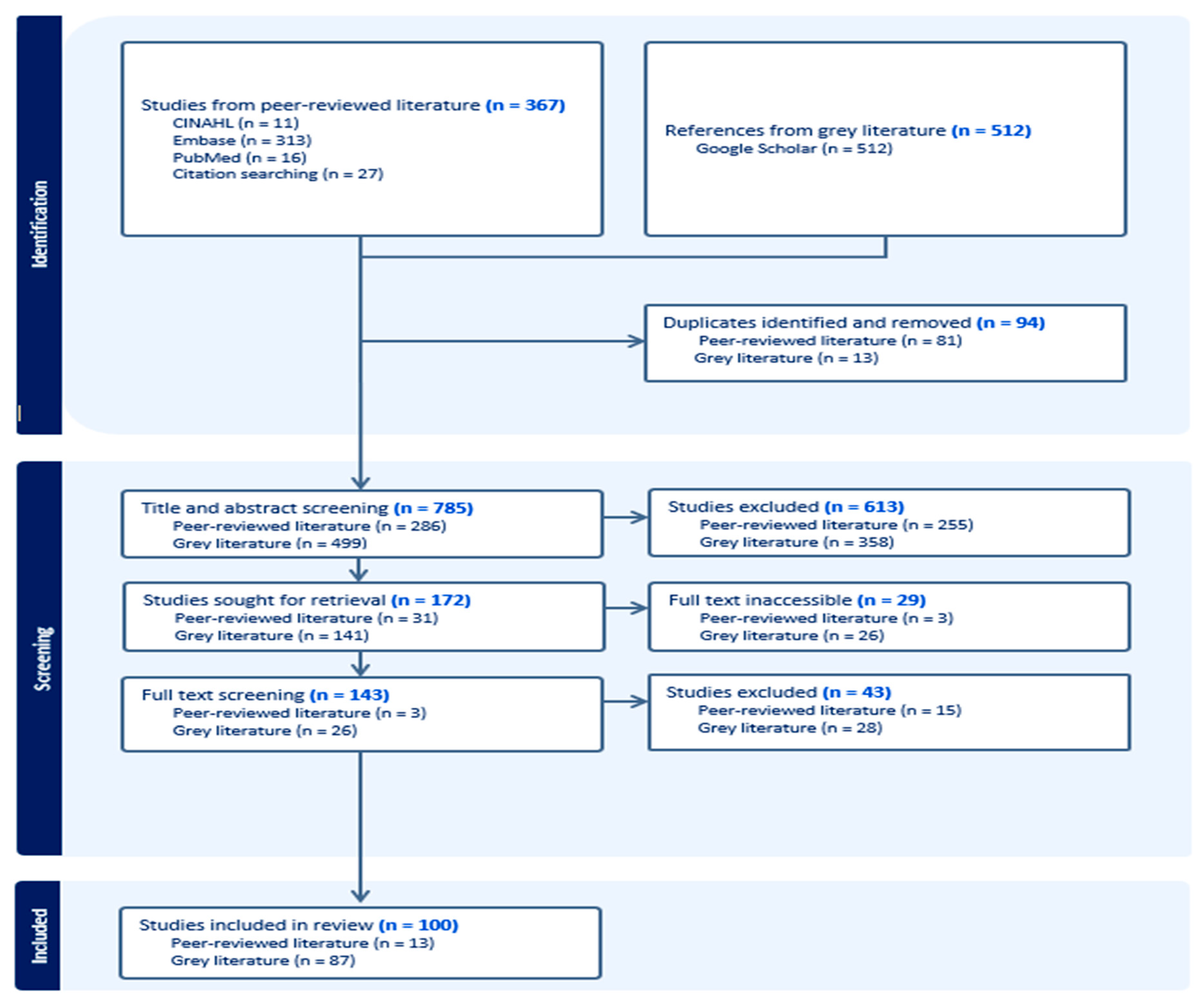
2.4. Evidence Source Selection
2.5. Data Extraction
2.6. Data Analysis
3. Results
3.1. Evidence Sources Identified
3.2. Study Descriptions
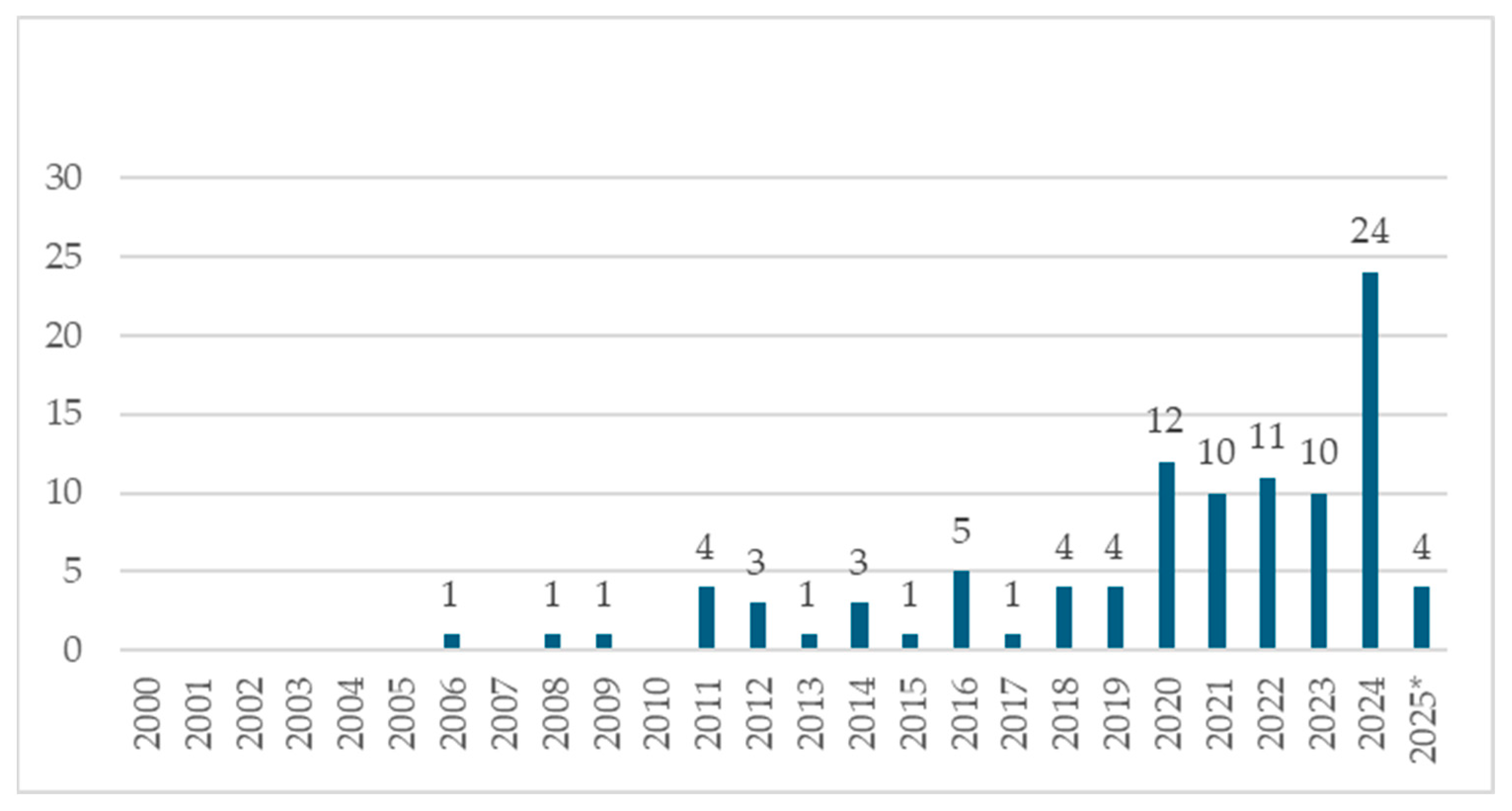
3.2.1. Studies by Year of Publication
3.2.2. Geographical Distribution of Studies
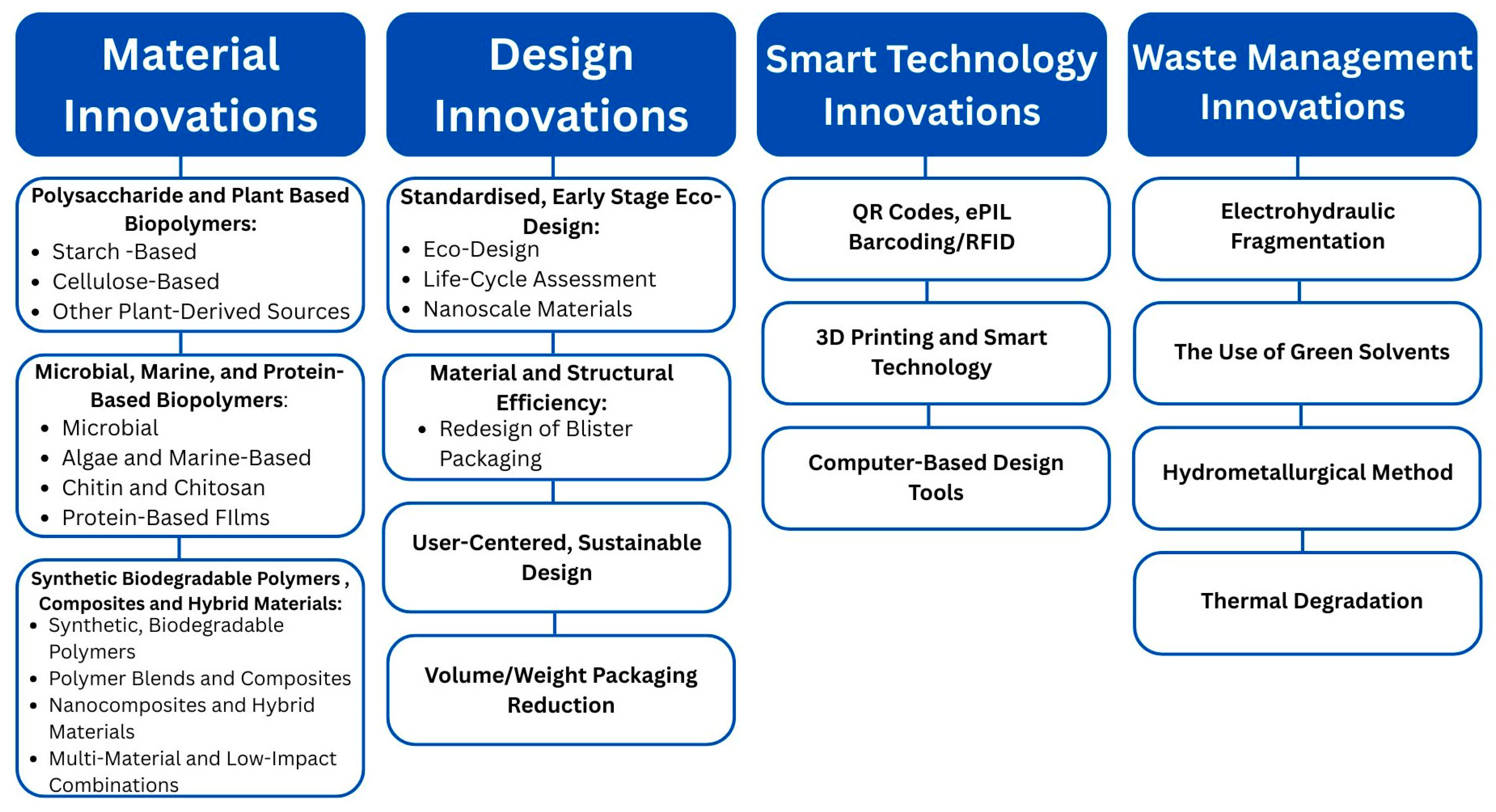
3.3. Global Innovations
3.4. Material Innovations
3.4.1. Plant-Based Packaging Materials
3.4.2. Algae-Based Packaging Materials
3.5. Design Innovations
3.5.1. Packaging Volume/Weight Reduction
3.5.2. Use of Lifecycle Assessment Tools for Eco Design
3.6. Smart Technology Innovations
3.6.1. The Use of the e-PIL/QR Codes
3.6.2. The Use of Computer-Based Tools for Packaging Eco-Design
3.7. Waste Management Innovations
3.8. Challenges and Implications
4. Discussion
4.1. Sustainable Material Innovations
4.2. Design Innovations
4.3. Smart Technology Innovations
4.4. Waste Management Innovations
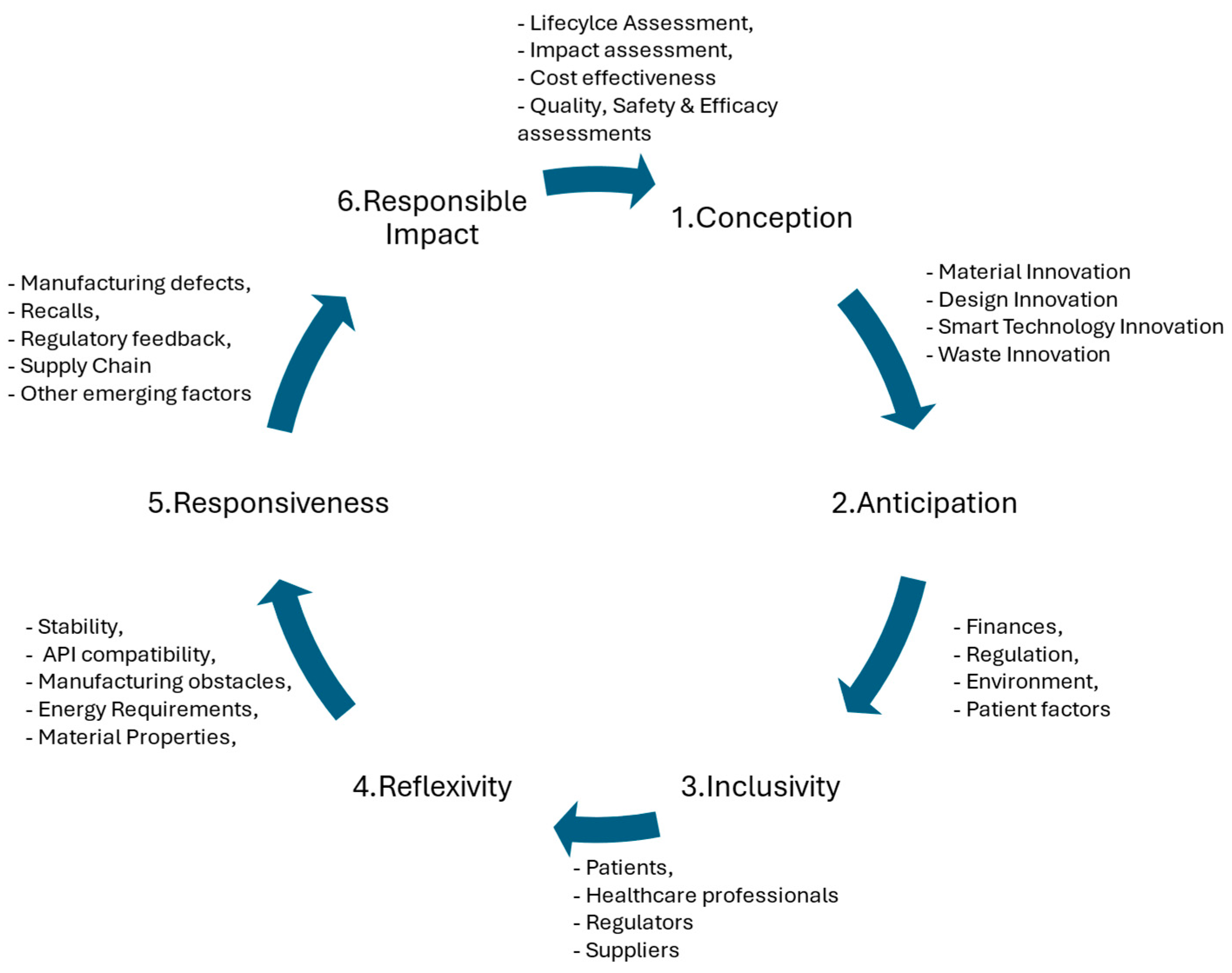
4.5. Responsible Packaging Framework
4.6. Strengths, Limitations and Future Research
4.7. Comparative Analysis
5. Conclusions
Supplementary Materials
Author Contributions
Funding
Institutional Review Board Statement
Informed Consent Statement
Data Availability Statement
Acknowledgments
Conflicts of Interest
References
- Zadbuke, N.; Shahi, S.; Gulecha, B.; Padalkar, A.; Thube, M. Recent trends and future of pharmaceutical packaging technology. J. Pharm. Bioallied Sci. 2013, 5, 98–110. [Google Scholar] [CrossRef]
- Andrady, A.L.; Neal, M.A. Applications and societal benefits of plastics. Philos. Trans. R. Soc. Lond. B Biol. Sci. 2009, 364, 1977–1984. [Google Scholar] [CrossRef]
- Eurpak. The History of Pharmaceutical Packaging, Between Change and Innovation—Eurpack. Available online: https://eurpack.it/?lang=en (accessed on 16 November 2025).
- Statistica. 2025. Available online: https://www.statista.com/statistics/1287120/global-plastic-pharmaceutical-packaging-market-size/2025 (accessed on 16 November 2025).
- From Fossil Fuels to Plastic Addiction: Unveiling the Hidden Link Impacting Our World 2025. Available online: https://www.earthday.org/from-fossil-fuels-to-plastic-addiction-unveiling-the-hidden-link-impacting-our-world/ (accessed on 16 November 2025).
- Nayanathara Thathsarani Pilapitiya, P.G.C.; Ratnayake, A.S. The world of plastic waste: A review. Clean. Mater. 2024, 11, 100220. [Google Scholar] [CrossRef]
- United Nations. Plastics—Fueling Oil Demand, Climate Change and Pollution. 2025. Available online: https://www.un.org/en/climatechange/science/climate-issues/plastics (accessed on 16 November 2025).
- Gökelma, M.; Diaz, F.; Çapkın, İ.Y.; Friedrich, B. A Viability Study of Thermal Pre-Treatment for Recycling of Pharmaceutical Blisters. Sustainability 2024, 16, 8968. [Google Scholar] [CrossRef]
- United Nations. Sustainability. 2025. Available online: https://www.un.org/en/academic-impact/sustainability (accessed on 16 November 2025).
- Stilgoe, J.; Owen, R.; Macnaghten, P. Developing a framework for responsible innovation. Res. Policy 2013, 42, 1568–1580. [Google Scholar] [CrossRef]
- Understanding the Environmental Impact of the Pharmaceutical Industry. 2025. Available online: www.techtarget.com/pharmalifesciences/feature/Understanding-the-environmental-impact-of-the-pharmaceutical-industry (accessed on 16 November 2025).
- Okereke, M. How pharmaceutical industries can address the growing problem of climate change. J. Clim. Change Health 2021, 4, 100049. [Google Scholar] [CrossRef]
- The 17 Sustainable Development Goals. 2025. Available online: https://sdgs.un.org/goals (accessed on 16 November 2025).
- Climate Action. Race to Zero. 2025. Available online: https://climateaction.unfccc.int/Initiatives?id=Race_to_Zero (accessed on 16 November 2025).
- European Commission. The European Green Deal; European Commission: Brussels, Belgium, 2025; Available online: https://commission.europa.eu/strategy-and-policy/priorities-2019-2024/european-green-deal_en (accessed on 16 November 2025).
- European Commission. Regulation (EU) 2025/40 of the European Parliament and of the Council. 2025. Available online: https://eur-lex.europa.eu/eli/reg/2025/40 (accessed on 16 November 2025).
- European Commission. Directive (EU) 2018/851 of the European Parliament and of the Council. 2018. Available online: https://eur-lex.europa.eu/eli/dir/2018/851/oj/eng (accessed on 16 November 2025).
- Irish Statute Book. No. 282/2014—European Union (Packaging) Regulations 2014. Available online: https://www.irishstatutebook.ie/eli/2014/si/282 (accessed on 16 November 2025).
- Page, M.J.; McKenzie, J.E.; Bossuyt, P.M.; Boutron, I.; Hoffmann, T.C.; Mulrow, C.D.; Shamseer, L.; Tetzlaff, J.M.; Akl, E.A.; Brennan, S.E.; et al. The PRISMA 2020 statement: An updated guideline for reporting systematic reviews. BMJ 2021, 372, n71. [Google Scholar] [CrossRef]
- Munn, Z.; Peters, M.D.J.; Stern, C.; Tufanaru, C.; McArthur, A.; Aromataris, E. Systematic review or scoping review? Guidance for authors when choosing between a systematic or scoping review approach. BMC Med. Res. Methodol. 2018, 18, 143. [Google Scholar] [CrossRef] [PubMed]
- Braun, V.; Clarke, V. Using thematic analysis in psychology. Qual. Res. Psychol. 2006, 3, 77–101. [Google Scholar] [CrossRef]
- Abdul Khalil, H.P.S.; Davoudpour, Y.; Saurabh, C.K.; Hossain, M.S.; Adnan, A.S.; Dungani, R.; Paridah, M.T.; Islam Sarker, M.Z.; Fazita, M.R.N.; Syakir, M.I.; et al. A review on nanocellulosic fibres as new material for sustainable packaging: Process and applications. Renew. Sustain. Energy Rev. 2016, 64, 823–836. [Google Scholar] [CrossRef]
- Singh, A.; Sharma, P.; Malviya, R. Eco Friendly Pharmaceutical Packaging Material. World Appl. Sci. J. 2011, 14, 1703–1716. [Google Scholar]
- Al-Oqla, F.M.; Alaaeddin, M.H.; Hoque, M.E.; Thakur, V.K. Biopolymers and Biomimetic Materials in Medical and Electronic-Related Applications for Environment–Health–Development Nexus: Systematic Review. J. Bionic Eng. 2022, 19, 1562–1577. [Google Scholar] [CrossRef]
- Anjimoon, S.; Sobti, R.; A, J.; Kumar, A.; Parashar, S.; Hussien, R. Revolutionizing Packaging and Consumer Products: Exploring the Potential of Biodegradable Materials. In Proceedings of the International Conference on Renewable Energy, Green Computing and Sustainable Development, Hyderabad, India, 22–23 December 2023; Volume 472. [Google Scholar] [CrossRef]
- Bumbudsanpharoke, N.; Harnkarnsujarit, N.; Gilchrist, J.F.; Ko, S.; Keawpetch, T. The Rise of Nanotechnology in Pharmaceutical and Healthcare Packaging: Applications and Future Prospective. Packag. Technol. Sci. 2024, 38, 3–31. [Google Scholar] [CrossRef]
- Denisa, C.; Popa, M. Trends on Pharmaceutical Packaging Materials. Sci. Bull. Ser. F Biotechnol. 2019, 23, 136–141. [Google Scholar]
- Pedrosa de Oliveira, D.; Costa, J.S.R.; Oliveira-Nascimento, L. Sustainability of blisters for medicines in tablet form. Sustain. Chem. Pharm. 2021, 21, 100423. [Google Scholar] [CrossRef]
- Ge, L.; Zhu, M.; Li, X.; Xu, Y.; Ma, X.; Shi, R.; Li, D.; Mu, C. Development of active rosmarinic acid-gelatin biodegradable films with antioxidant and long-term antibacterial activities. Food Hydrocoll. 2018, 83, 308–316. [Google Scholar] [CrossRef]
- Goel, P.; Arora, R.; Haleem, R.; Shukla, S.K. Advances in Bio-degradable Polymer Composites-Based Packaging Material. Chem. Afr. 2023, 6, 95–115. [Google Scholar] [CrossRef]
- Ji, Y.; Shen, D.E.; Young, E.K.; Goins, C.L.; Reynolds, J.R.; Shofner, M.L.; Meredith, J.C. Optimization of spray-coated nanochitin/nanocellulose films as renewable oxygen barrier layers via thermal treatment. Mater. Adv. 2022, 3, 8351–8360. [Google Scholar] [CrossRef]
- Kaur, R.; Pathak, L.; Vyas, P. Biobased polymers of plant and microbial origin and their applications—A review. Biotechnol. Sustain. Mater. 2024, 1, 13. [Google Scholar] [CrossRef]
- Tapadar, S.; Durgaprasad, K. A Review on Biodegradable Cellulose Based Bio films as a Viable Packaging Material in Pharmaceutical and Food Industry. Indian J. Nat. Sci. 2024, 14, 67321–67328. [Google Scholar]
- Kumar, S. Applications of Biodegradable Pharmaceutical Packaging Materials: A Review. Middle-East J. Sci. Res. 2012, 12, 699–706. [Google Scholar]
- Lomartire, S.; Gomes, L.; Cotas, J.; Marques, J.C.; Pereira, L.; Gonçalves, A.M.M. Chapter 8—Algae-Based Bioplastics: Expanding algal Polymers as Materials for Industrial Applications. In Algae Materials; Arunkumar, K., Arun, A., Raja, R., Palaniappan, R., Eds.; Academic Press: Cambridge, MA, USA, 2023; pp. 133–156. [Google Scholar]
- Lomartire, S.; Marques, J.C.; Gonçalves, A.M.M. An Overview of the Alternative Use of Seaweeds to Produce Safe and Sustainable Bio-Packaging. Appl. Sci. 2022, 12, 3123. [Google Scholar] [CrossRef]
- Mondal, S. Chapter 11—Nanocellulose Reinforced Polymer Nanocomposites for Sustainable Packaging of Foods, Cosmetics, and Pharmaceuticals. In Sustainable Nanocellulose and Nanohydrogels from Natural Sources; Mohammad, F., Al-Lohedan, H.A., Jawaid, M., Eds.; Elsevier: Amsterdam, The Netherlands, 2020; pp. 237–253. [Google Scholar]
- Leonardo, P. Packaging Materials: Past, Present and Future. Curr. Mater. Sci. 2024, 17, 275–279. [Google Scholar] [CrossRef]
- Paraschiv, G.I.; Condrea, E.; Olteanu, V. Biodegradable and Compostable Products—Essential Components for the Development of a Sustainable Bioeconomy. Ovidius Univ. Ann. Econ. Sci. Ser. 2020, 20, 211–218. [Google Scholar]
- Pathak, A.; Rao, N.R.; Grover, P.; Sharma, V.; Malik, A.; Rawat, A.P.; Singh, S.; Maurya, A. Ecofriendly pharmaceutical packaging material: A review. Mater. Today Proc. 2024, 103, 423–431. [Google Scholar] [CrossRef]
- Popović, K.; Živanović, S.; Jevtić, I. Biopolymer Packaging Materials in the Pharmaceutical Industry. AIDASCO Rev. 2024, 2, 46–56. [Google Scholar] [CrossRef]
- Rane, L.R.; Savadekar, N.R.; Kadam, P.G.; Mhaske, S.T. Preparation and Characterization of K-Carrageenan/Nanosilica Biocomposite Film. J. Mater. 2014, 2014, 736271. [Google Scholar] [CrossRef]
- Ran, X.; Qu, Y.; Wang, Y.; Cui, B.; Shen, Y.; Li, Y. Enhanced UV-Blocking Capabilities of Polylactic Acid Derived from Renewable Resources for Food and Drug Packaging: A Mini-Review. J. Compos. Sci. 2023, 7, 410. [Google Scholar] [CrossRef]
- Sabet, M. Exploring biodegradable polymer composites for sustainable packaging: A review on properties, manufacturing techniques, and environmental impacts. Iran. Polym. J. 2025, 34, 123–142. [Google Scholar] [CrossRef]
- Saha, T.; Hoque, M.E.; Mahbub, T. Chapter 13—Biopolymers for Sustainable Packaging in Food, Cosmetics, and Pharmaceuticals. In Advanced Processing, Properties, and Applications of Starch and Other Bio-Based Polymers; Al-Oqla, F.M., Sapuan, S.M., Eds.; Elsevier: Amsterdam, The Netherlands, 2020; pp. 197–214. [Google Scholar]
- Satam, C.C.; Irvin, C.W.; Lang, A.W.; Jallorina, J.C.R.; Shofner, M.L.; Reynolds, J.R.; Meredith, J.C. Spray-Coated Multilayer Cellulose Nanocrystal—Chitin Nanofiber Films for Barrier Applications. ACS Sustain. Chem. Eng. 2018, 6, 10637–10644. [Google Scholar] [CrossRef]
- Shah, K.; Singh, D.; Agrawal, R.; Garg, A. Eco Friendly Pharmaceutical Packaging. Curr. Green Chem. 2025, 12, 2–14. [Google Scholar] [CrossRef]
- Singh, P.; Sharma, A.; Rathee, A.; Puri, V.; Chopra, H.; Nagpal, M.; Kaur, M.; Malik, T. Revolutionizing packaging: Bioplastics for superior food and pharmaceutical solutions. Polym. Polym. Compos. 2024, 32, 09673911241305184. [Google Scholar] [CrossRef]
- Yu, Z.; Ji, Y.; Bourg, V.; Bilgen, M.; Meredith, J.C. Chitin- and cellulose-based sustainable barrier materials: A review. Emergent Mater. 2020, 3, 919–936. [Google Scholar] [CrossRef]
- Zala, T.; Hardi, J. Biodegradable Packaging for Pharmaceuticals. World J. Pharm. Res. 2020, 9, 18080. [Google Scholar]
- Zamruddin, N.D.; Salleh, K.M.; Mutalib, H.A.A. Insight to critical role of surface tension for cellulose-based film: A review. Int. J. Biol. Macromol. 2025, 303, 140680. [Google Scholar] [CrossRef]
- Zhao, M.; Zhang, W.; Ruan, C.-Q.; Zeng, K. Carboxymethyl cellulose/layered double hydroxide nanocomposite films with high barrier property and transparency. Cellulose 2024, 31, 7493–7505. [Google Scholar] [CrossRef]
- Adeyeye, E.; New, B.J.M.; Chen, F.; Kulkarni, S.; Fisk, M.; Coleman, J.J. Sustainable medicines use in clinical practice: A clinical pharmacological view on eco-pharmaco-stewardship. Br. J. Clin. Pharmacol. 2022, 88, 3023–3029. [Google Scholar] [CrossRef]
- Moermond, C.T.A.; Puhlmann, N.; Pieters, L.; Matharu, A.; Boone, L.; Dobbelaere, M.; Proquin, H.; Kümmerer, K.; Ragas, A.M.J.; Vidaurre, R.; et al. Eco-pharma dilemma: Navigating environmental sustainability trade-offs within the lifecycle of pharmaceuticals—A comment. Sustain. Chem. Pharm. 2025, 43, 101893. [Google Scholar] [CrossRef]
- Safrai, M.; Elly, D.; Gruber, N.; Stern, B.; Kabiri, D.; Shapira, M. Paper waste and carbon emissions from oral contraceptive leaflets. PLoS ONE 2024, 19, e0312505. [Google Scholar] [CrossRef] [PubMed]
- Kumar, S.; DeGroot, R.; Choe, D. Rx for smart hospital purchasing decisions: The impact of package design within US hospital supply chain. Int. J. Phys. Distrib. Logist. Manag. 2008, 38, 601–615. [Google Scholar] [CrossRef]
- Ionescu, A.-M.; Cazan, C. Pharmaceutical Waste Management: A Comprehensive Analysis of Romanian Practices and Perspectives. Sustainability 2024, 16, 6571. [Google Scholar] [CrossRef]
- Chordiya, S.V.; Garge, B.M. Innovative Packaging of Medicines. IP Int. J. Aesthetic Health Rejuvenation 2019, 2, 72–76. [Google Scholar]
- Falconnier-Williams, O.C.; Taeschner, W.; Hille, A.; Falconnier, A.D.; Haefeli, W.E. Untapped options to reduce waste from blister packaging for tablets and capsules. Eur. J. Clin. Pharmacol. 2024, 80, 151–161. [Google Scholar] [CrossRef] [PubMed]
- Waghmare, S.G. Unveiling the Ecological Fallout of Pharmaceutical Waste: Unraveling Risks and Consequences. Int. J. Ingenious Res. Invent. Dev. 2024, 3, 10801900. [Google Scholar] [CrossRef]
- Bassani, F.; Rodrigues, C.; Marques, P.; Freire, F. Ecodesign approach for pharmaceutical packaging based on Life Cycle Assessment. Sci. Total Environ. 2022, 816, 151565. [Google Scholar] [CrossRef]
- García González, A. Exploring the Effects of Plastic-Free Packaging in the Pharmaceutical Industry. Master’s Thesis, Lund University, Lund, Sweden, 2020. [Google Scholar]
- Camilleri, T.; Farrugia, P.; Refalo, P. A User-Centred Design Support Framework to Develop Aesthetically Pleasing and Sustainable Over-the-Counter Pharmaceutical Packaging. Proc. Des. Soc. 2022, 2, 333–342. [Google Scholar] [CrossRef]
- Raju, G.; Sarkar, P.; Singla, E.; Singh, H.; Sharma, R.K. Comparison of environmental sustainability of pharmaceutical packaging. Perspect. Sci. 2016, 8, 683–685. [Google Scholar] [CrossRef]
- Bassani, F.; Rodrigues, C.; Freire, F. Life cycle assessment of pharmaceutical packaging addressing end-of-life alternatives. Waste Manag. 2024, 175, 1–11. [Google Scholar] [CrossRef] [PubMed]
- Chen, Z.; Lian, J.Z.; Zhu, H.; Zhang, J.; Zhang, Y.; Xiang, X.; Huang, D.; Tjokro, K.; Barbarossa, V.; Cucurachi, S.; et al. Application of Life Cycle Assessment in the pharmaceutical industry: A critical review. J. Clean. Prod. 2024, 459, 142550. [Google Scholar] [CrossRef]
- Navajas, A.; Uriarte, L.; Gandía, L.M. Application of Eco-Design and Life Cycle Assessment Standards for Environmental Impact Reduction of an Industrial Product. Sustainability 2017, 9, 1724. [Google Scholar] [CrossRef]
- Belboom, S.; Renzoni, R.; Verjans, B.; Léonard, A.; Germain, A. A life cycle assessment of injectable drug primary packaging: Comparing the traditional process in glass vials with the closed vial technology (polymer vials). Int. J. Life Cycle Assess. 2011, 16, 159–167. [Google Scholar] [CrossRef]
- Klemenčić, M. The Optimisation of Sustainable Procedures for the Designing and Recycling of Pharmaceutical Cardboard packaging. Master’s Thesis, University of Zagreb, Zagreb, Croatia, 2024. [Google Scholar]
- Salmenperä, H.; Kauppi, S.; Dahlbo, H.; Fjäder, P. Increasing the Circularity of Packaging along Pharmaceuticals Value Chain. Sustainability 2022, 14, 4715. [Google Scholar] [CrossRef]
- Pareek, V.; Khunteta, A. Pharmaceutical packaging: Current trends and future. Int. J. Pharm. Pharm. Sci. 2014, 6, 480–485. [Google Scholar]
- Akram, A.; Khanna, A.; Shukla, V.K.; Sharma, N. Recent Advancements in Pharmaceutical Packaging and Regulatory Aspects. J. Packag. Technol. Res. 2025, 9, 1–17. [Google Scholar] [CrossRef]
- Bauer, E.J. Pharmaceutical Packaging Handbook; Taylor & Francis: Abingdon, UK, 2016; pp. 1–585. [Google Scholar]
- Machiels, J.; Appeltans, R.; Bauer, D.K.; Segers, E.; Henckens, Z.; Van Rompaey, W.; Adons, D.; Peeters, R.; Geiβler, M.; Kuehnoel, K.; et al. Screen Printed Antennas on Fiber-Based Substrates for Sustainable HF RFID Assisted E-Fulfilment Smart Packaging. Materials 2021, 14, 5500. [Google Scholar] [CrossRef]
- McGlinchey, Y.; Iqbal, J.; Trubetskaya, A.; Thenarasu, M.; McDermott, O. Design for green lean six sigma to improve sustainability in the pharmaceutical industry—A case study. Prod. Manuf. Res. 2025, 13, 2461010. [Google Scholar] [CrossRef]
- Rydzkowski, T.; Wróblewska-Krepsztul, J.; Thakur, V.K.; Królikowski, T. Current trends of intelligent, smart packagings in new medical applications. Procedia Comput. Sci. 2022, 207, 1271–1282. [Google Scholar] [CrossRef]
- Wyres, C. Environmental packaging waste regulations. Pharm. Technol. Eur. 2006, 18, 21–22. [Google Scholar]
- Sirkas, K.; Juppo, A.; Miettinen, M.; Siven, M. Could paper package leaflet be left out from hospital products? Explor. Res. Clin. Soc. Pharm. 2022, 7, 100176. [Google Scholar] [CrossRef]
- Agarwal, V.; Halli, P.; Helin, S.; Tesfaye, F.; Lundström, M. Electrohydraulic Fragmentation of Aluminum and Polymer Fractions from Waste Pharmaceutical Blisters. ACS Sustain. Chem. Eng. 2020, 8, 4137–4145. [Google Scholar] [CrossRef]
- Yaren Çapkın, İ.; Gökelma, M. A review on characterization and recyclability of pharmaceutical blisters. Clean. Waste Syst. 2023, 4, 100082. [Google Scholar] [CrossRef]
- Nikolić, B.; Nikolić, N.; Milošević, A.; Milošević-Georgiev, A. Opportunities for sustainable waste management in the pharmaceutical industry declaration of competing interest. Arh. Farm. 2024, 74, 832–851. [Google Scholar] [CrossRef]
- Nieminen, J.; Anugwom, I.; Kallioinen, M.; Mänttäri, M. Green solvents in recovery of aluminium and plastic from waste pharmaceutical blister packaging. Waste Manag. 2020, 107, 20–27. [Google Scholar] [CrossRef]
- Wang, C.-Q.; Wang, H.; Liu, Y.-N. Separation of aluminum and plastic by metallurgy method for recycling waste pharmaceutical blisters. J. Clean. Prod. 2015, 102, 378–383. [Google Scholar] [CrossRef]
- Ibrahim, I.D.; Sadiku, E.R.; Hamam, Y.; Kupolati, W.K.; Ndambuki, J.M.; Jamiru, T.; Eze, A.A.; Snyman, J. Recent Recycling Innovations to Facilitate Sustainable Packaging Materials: A Review. Recycling 2023, 8, 88. [Google Scholar] [CrossRef]
- Dalal, S.P.; Dalal, P.; Motiani, R.; Solanki, V. Experimental investigation on recycling of waste pharmaceutical blister powder as partial replacement of fine aggregate in concrete. Resour. Conserv. Recycl. Adv. 2022, 14, 200076. [Google Scholar] [CrossRef]
- Baranwal, J.; Barse, B.; Fais, A.; Delogu, G.L.; Kumar, A. Biopolymer: A Sustainable Material for Food and Medical Applications. Polymers 2022, 14, 983. [Google Scholar] [CrossRef]
- Ibrahim, I.D.; Hamam, Y.; Sadiku, E.R.; Ndambuki, J.M.; Kupolati, W.K.; Jamiru, T.; Eze, A.A.; Snyman, J. Need for Sustainable Packaging: An Overview. Polymers 2022, 14, 4430. [Google Scholar] [CrossRef] [PubMed]
- Mogany, T.; Bhola, V.; Bux, F. Algal-based bioplastics: Global trends in applied research, technologies, and commercialization. Environ. Sci. Pollut. Res. Int. 2024, 31, 38022–38044. [Google Scholar] [CrossRef] [PubMed]
- The Association of the British Pharmaceutical Industry. Recycling Pharmaceutical Packaging. Available online: https://www.abpi.org.uk/reputation/sustainability-in-the-pharmaceutical-industry/recycling-pharmaceutical-packaging/ (accessed on 16 November 2025).
- Peeriga, R.; Manubolu, K. Design Strategies for Waste Reduction and Enhanced Recyclability. In Pharmaceutical Packaging; Springer Nature: Singapore, 2025; pp. 179–228. [Google Scholar]
- Pharmatrends. Part 3: How to Reduce Pharma Packaging Costs: Choose Lid Foils with the Right Aluminum Thickness. 2019. Available online: https://pharma-trends.com/2019/10/09/how-to-reduce-pharma-packaging-costs-choose-lid-foils-with-the-right-aluminum-thickness/ (accessed on 16 November 2025).
- European Commission. Directive 2001/83/EC; European Commission: Brussels, Belgium, 2001; Available online: https://eur-lex.europa.eu/eli/dir/2001/83/oj/eng (accessed on 16 November 2025).
- Carbonbright. The Cost of a Life Cycle Assessment (LCA) 2025. Available online: https://carbonbright.co/the-cost-of-a-life-cycle-assessment-lca (accessed on 16 November 2025).
- EMA. Environmental Risk Assessment of Medicinal Products for Human Use—Scientific Guideline. 2025. Available online: https://www.ema.europa.eu/en/environmental-risk-assessment-medicinal-products-human-use-scientific-guideline (accessed on 16 November 2025).
- Skogman-Lindqvist, C.; Lapatto-Reiniluoto, O.; Sirviö, M.; Sivén, M. Benefits and challenges of electronic package leaflet (ePL) —Review of ePL pilots in hospital settings in Europe. Eur. J. Pharm. Sci. 2023, 191, 106605. [Google Scholar] [CrossRef] [PubMed]
- European Medicines Agency (EMA). Electronic Product Information (ePI) Pilot Report: Experience Gained from Creation of ePI during Regulatory Procedures for EU Human Medicines; European Medicines Agency: Amsterdam, The Netherlands, 2024. [Google Scholar]
- Perkola, N.; Äystö, L.; Hagström, M.; Kauppi, S.; Fjäder, P. Pharmaceutical residues in plastic tablet containers: Impacts on recycling and the environment. Waste Manag. 2024, 189, 159–165. [Google Scholar] [CrossRef] [PubMed]
- European Federation of Pharmaceutical Industries and Associations (EFPIA). White Paper on Climate Change: Accelerating Action Across the Pharmaceutical Industry; EFPIA: Brussels, Belgium, 2020. [Google Scholar]
- Naughton, B.; Sue, D.; Iakovleva, T. Responsible impact and the reinforcement of responsible innovation in the public sector ecosystem: Cases of digital health innovation. J. Responsible Innov. 2023, 10, 2211870. [Google Scholar] [CrossRef]
- World Resources Forum. The ENKORE Project Seeks to Develop an Eco-Design Framework for Single-Use Medical Devices and Packaging. Available online: https://www.wrforum.org/projects/the-enkore-project-seeks-to-develop-an-eco-design-framework-for-single-use-medical-devices-and-packaging/ (accessed on 5 June 2025).
- Puhlmann, N.; Abbate, E.; Kümmerer, K.; Oomen, A.G.; Ragas, A.M.J.; Moermond, C. Applicability of the European Commission’s framework on safe and sustainable by design to the pharmaceutical sector. Sustain. Chem. Pharm. 2024, 42, 101845. [Google Scholar] [CrossRef]
- Ganguly, S.; Tang, X.S. 3D Printing of High Strength Thermally Stable Sustainable Lightweight Corrosion-Resistant Nanocomposite by Solvent Exchange Postprocessing. ACS Sustain. Chem. Eng. 2025, 13, 423–435. [Google Scholar] [CrossRef]



| Regulatory Challenges: | Implications: | Solutions: |
| Current guidelines for the authorisation of medicinal products, such as Directive 2001/83/EC, are outdated regarding sustainability. | Lack of clear guidance or incorporation of sustainable packaging alternatives for the pharmaceutical industry. | Revision of Directive 2001/83/EC to incorporate environmental performance criteria in packaging approval. |
| Regulatory frameworks for the incorporation of biopolymers are lacking. | Deters pharmaceutical industries from developing sustainable biopolymers for use in pharmaceutical packaging. | Creation of harmonised guidelines for biopolymer-based packaging through collaboration between researchers, regulators and industry. |
| Regulatory gaps exist in the definition of compostability and biocompostability for pharmaceutical packaging. | Hinders the development of innovative compost facilities to cater for sustainable pharmaceutical packaging. | Establishment of an EU-wide definition of compostability and biocompostability, and investment into industrial composting infrastructure. |
| Regulations surrounding printing PILs hinder the transition to e-PILs and QR code-based systems. | A product will not achieve EMA (MA)without the product containing a printed PIL. | Amendment to the EU Regulations to implement QR codes and e-PILs on pharmaceutical packaging. |
| There is a lack of standardised medication take-back programmes throughout Europe. | Due to the difficult recycling techniques required for pharmaceutical blisters, without take-back programmes, pharmaceutical blisters are most likely incinerated or landfilled. | Implementation of EU-coordinated take-back schemes funded through EPR contributions from pharmaceutical companies. |
| Safety Challenges: | Implications: | Solutions: |
| Packaging materials must ensure the quality, safety and efficacy of medicinal products throughout their shelf-life. | Sustainable innovations cannot compromise their protective function. | Development of multi-layer sustainable packaging systems that maintain barrier protection and reduce plastic content, while accelerating real-time stability testing for new sustainable materials. |
| Biopolymers often underperform when compared to traditionally used plastics in terms of mechanical strength, thermal resistance and barrier properties. | There is an increased risk of microbial contamination and a reduction in the shelf-life of pharmaceuticals, which is undesirable. | Continued research and development into next-generation biopolymers, which improved mechanical and thermal resistance. |
| The lifespan of sustainable monolayer blisters is less than that of traditional multi-layer blisters. | This may question the overall sustainability of monolayer blisters. | Improvement of moisture-resistant and oxygen-barrier coatings specifically designed for monolayer blister films. |
| Digital innovations such as the e-PIL may exclude elderly users, partially sighted or the blind or those in areas with limited internet access. | This limits the effectiveness of e-PILs if patients cannot access critical product information. | Implementation of dual access information systems, where a patient can obtain a printed PIL upon request. |
| Economic Challenges: | Implications: | Solutions: |
| High production and infrastructure costs are associated with sustainable materials and advanced processing techniques | Pharmaceutical companies are less likely to adopt more sustainable approaches if it comes with high costs, in the absence of regulation. | Government subsidies and tax incentives to reduce initial costs. |
| Recycling of mixed material packaging can result in complex and costly separation procedures. | High costs deter the widespread adoption of recycling of pharmaceutical blisters. | Implementation of Extended Producer Responsibility schemes to support the cost of collection and recycling. |
| Transitioning to biodegradable packaging requires substantial initial investments. | High investments also require long-term cost reduction, impacting other areas of the pharmaceutical industry. | Adoption of a phased transition strategy, allowing gradual integration of biodegradable packaging alongside conventional materials. |
| Other Challenges: | Implications: | Solutions: |
| Lack of public awareness and stakeholder cooperation. | This hinders sustainable packaging implementation and waste management solutions. | Public education led by health authorities and pharmacies to increase awareness of sustainable packaging and proper disposal. |
| Poor waste systems and limited take-back programmes. | Eliminates a circular economy for pharmaceutical packaging. | Establishment and accessibility of take-back programme points in pharmacies, clinics, and health centres. |
| Lack of infrastructure for sustainable alternatives and limited suppliers. | Results in slow change and long lead times. | Government and EU funding grants to accelerate the scaling of green manufacturing technologies. |
Disclaimer/Publisher’s Note: The statements, opinions and data contained in all publications are solely those of the individual author(s) and contributor(s) and not of MDPI and/or the editor(s). MDPI and/or the editor(s) disclaim responsibility for any injury to people or property resulting from any ideas, methods, instructions or products referred to in the content. |
© 2025 by the authors. Licensee MDPI, Basel, Switzerland. This article is an open access article distributed under the terms and conditions of the Creative Commons Attribution (CC BY) license (https://creativecommons.org/licenses/by/4.0/).
Share and Cite
Jackman, S.; Mc Guinness, P.; Brennan, L.; Pereira, R.; Tyrrell, A.; Barry, A.M.; Brennan, C.; Naughton, B.D. Global Innovations in Sustainable Pharmaceutical Packaging in the Last 25 Years: A Scoping Review. Sustainability 2025, 17, 10716. https://doi.org/10.3390/su172310716
Jackman S, Mc Guinness P, Brennan L, Pereira R, Tyrrell A, Barry AM, Brennan C, Naughton BD. Global Innovations in Sustainable Pharmaceutical Packaging in the Last 25 Years: A Scoping Review. Sustainability. 2025; 17(23):10716. https://doi.org/10.3390/su172310716
Chicago/Turabian StyleJackman, Sophie, Peter Mc Guinness, Lia Brennan, Ruby Pereira, Anne Tyrrell, Anna Maria Barry, Cait Brennan, and Bernard D. Naughton. 2025. "Global Innovations in Sustainable Pharmaceutical Packaging in the Last 25 Years: A Scoping Review" Sustainability 17, no. 23: 10716. https://doi.org/10.3390/su172310716
APA StyleJackman, S., Mc Guinness, P., Brennan, L., Pereira, R., Tyrrell, A., Barry, A. M., Brennan, C., & Naughton, B. D. (2025). Global Innovations in Sustainable Pharmaceutical Packaging in the Last 25 Years: A Scoping Review. Sustainability, 17(23), 10716. https://doi.org/10.3390/su172310716