How Events Empower the Countryside: A Study of Rural Household Livelihoods in Traditional Villages of Ethnic Mountainous Areas Influenced by Guizhou’s “Village Super League”


 ,
,  ,
,
Abstract
1. Introduction
2. Materials and Methods
2.1. Study Area
2.2. Data Sources
2.3. Research Methods
2.3.1. Construction of Livelihood Capital Evaluation Index System
2.3.2. Livelihood Capital Measurement
3. Results
3.1. Livelihood Characteristics of Rural Households in Traditional Villages Tourism Destinations Under the Influence of Guizhou’s “Village Super League”
3.1.1. The Overall Level and Structure of Rural Household Livelihood Capital
- Among the five typical village samples, indicator S2 (Skill training opportunities) had the highest mean value (M = 0.0466), indicating that households had greater access to skill training. In contrast, indicator N2 (Whether ecological resource utilization changed after tourism development) showed a very low mean (M = 0.0050) and a minimal standard deviation (SD = 0.0010), jointly indicating that tourism development has had little to no impact on ecological practices and that this non-change is consistent across households. Conversely, S4 (Social connections) exhibited a considerable standard deviation (SD = 0.0837), pointing to notable disparities in social networks across the sample.
- In terms of entropy and weight, S4 (Social connections) exhibited the lowest entropy value (0.6664) and highest indicator weight (0.2048), establishing it as the pivotal capital for households to benefit from tourism. Conversely, N2 (Whether ecological resource utilization changed after tourism development) had the highest entropy value (0.9898) and the lowest indicator weight (0.0052), indicating that the current tourism model has not profoundly altered core ecological resource patterns, such as agricultural production and land use. Other indicators with relatively high weights included S2 (Skill training opportunities, 0.1731), S1 (Social organization participation, 0.1449), and P3 (Tourism operation area, 0.1136), while P1 (Household housing type, 0.0069) and H3 (Health status of household members, 0.0072) were assigned much lower weights.
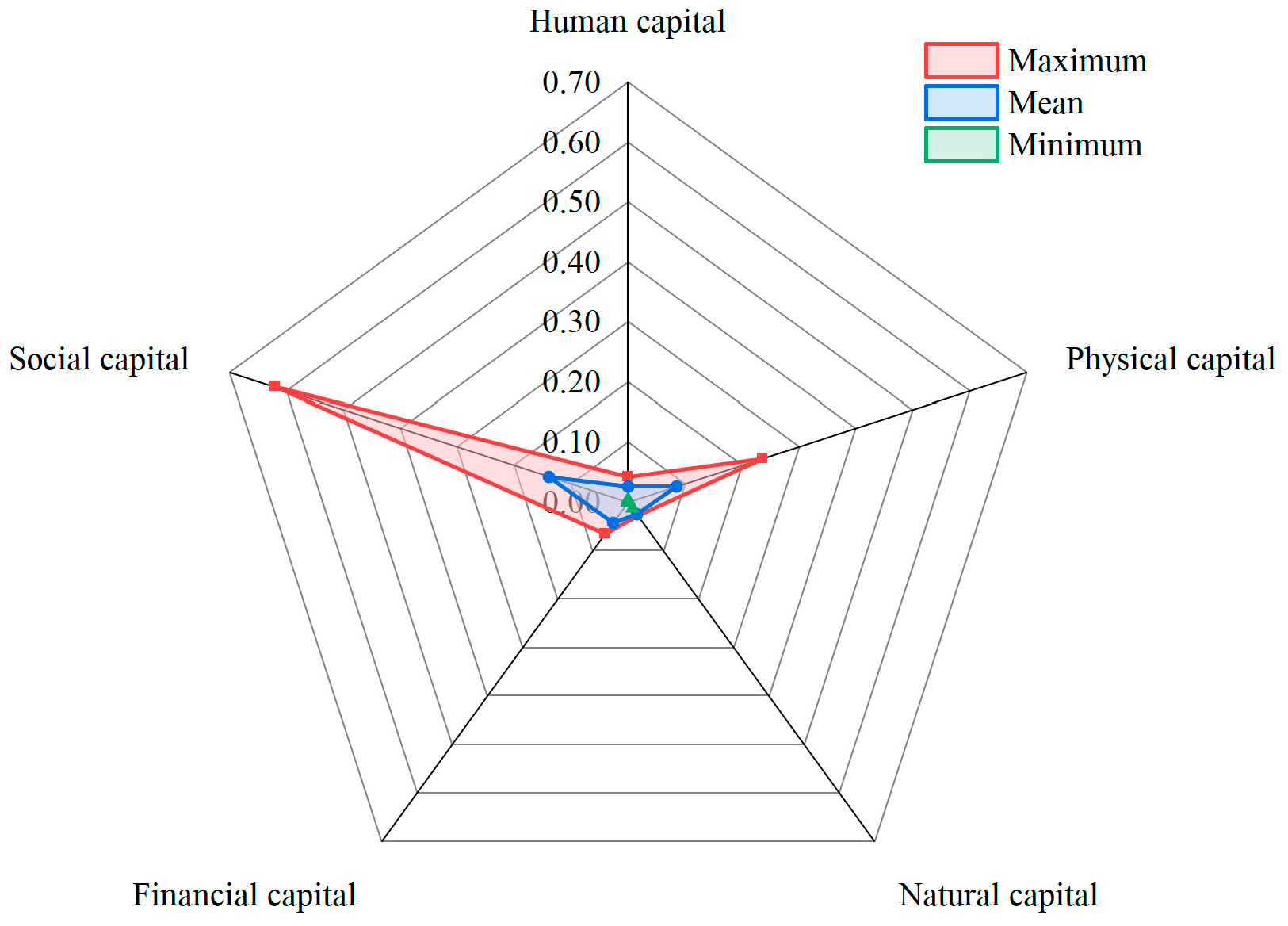
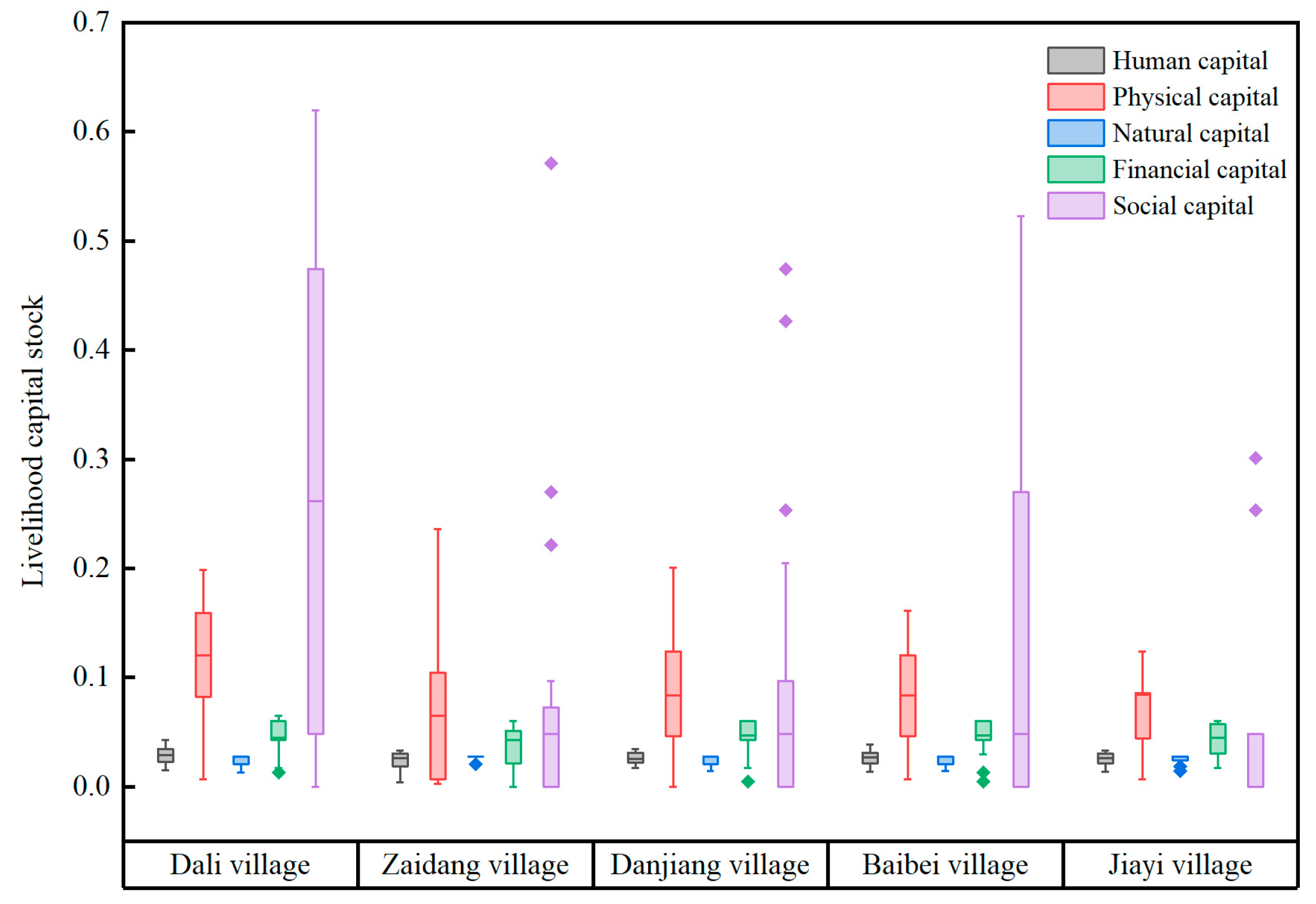
- The weights assigned to the five types of livelihood capital were, in descending order: social capital (0.6193), material capital (0.2386), financial capital (0.0647), human capital (0.0499), and natural capital (0.0275). Regarding the comprehensive evaluation scores for individual indicators, S2 (Skill training opportunities = 4.8471), S4 (Social connections = 4.5069), and P4 (Types of new media communication devices = 3.0563) recorded the highest values. In contrast, indicators including H3 (Health status of household members = 0.4877), N2 (Whether ecological resource utilization changed after tourism development = 0.5180), P1 (Household housing type = 0.5810), and H2 (Educational attainment of labor force = 0.6196) received the lowest scores. This order was mirrored in the mean composite scores for the five capital categories (Figure 2), with social capital (0.1391) scoring the highest, followed by material capital (0.085), financial capital (0.0429), human capital (0.0261), and natural capital (0.0245).
3.1.2. Village Variation Patterns in Household Livelihood Capital
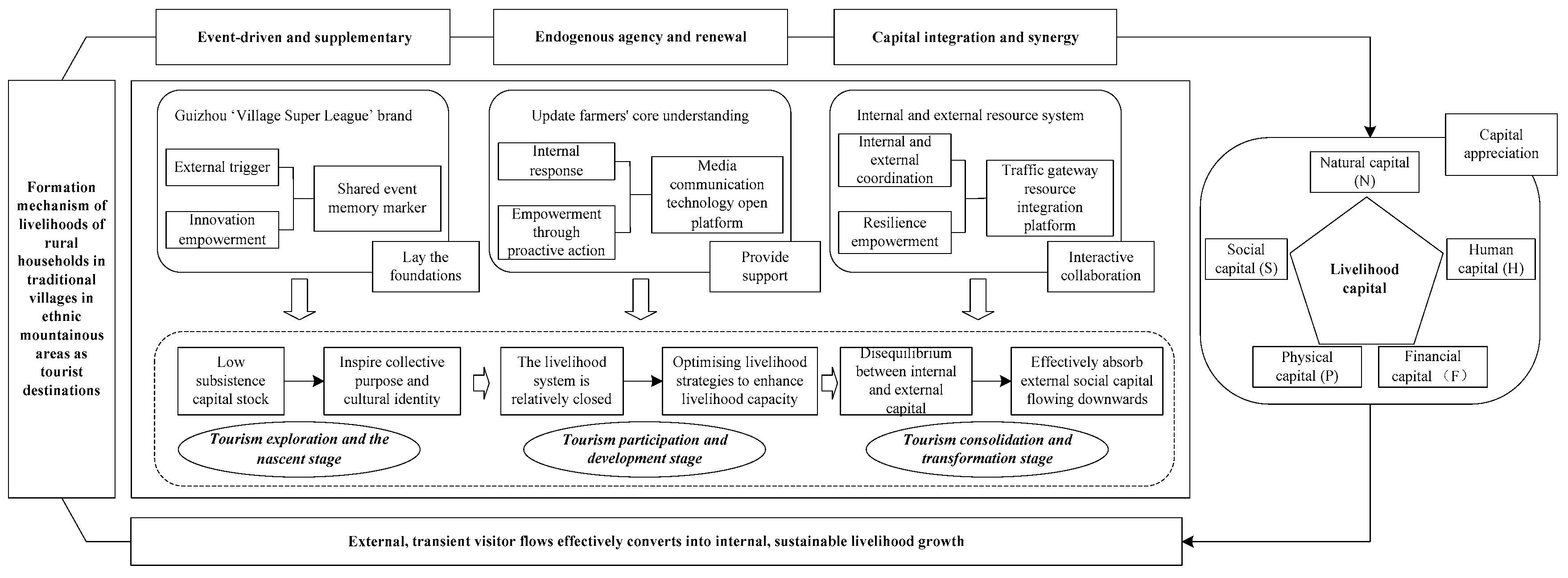
3.2. Formation Mechanism of Household Livelihoods in Traditional Tourism Villages Under the Influence of Guizhou’s “Village Super League”
3.2.1. Event-Driven and Supplementary: External Triggers and Innovation Empowering Household Livelihoods
“We currently leverage the village collective economy to mobilize participation in the ‘Village Super League’ because we recognize that having our own football team will bring numerous benefits—creating jobs and establishing a powerful platform for promoting our village.” (Director Meng, Jiayi Village)
“We have Dong Grand Song choirs in almost every village—including senior, middle-aged, youth, male, and female groups. In fact, each village typically maintains four or five choirs. Our approach to tourism is guided by the principle that ‘song nourishes the soul, and meals nourish the body.’ Accordingly, we charge for performances based on group size, primarily to preserve our spiritual culture, allowing visitors to come and experience it.” (Secretary Liu, Zaidang Village)
3.2.2. Endogenous Agency and Renewal: Internal Responses and Active Empowerment of Household Livelihoods
“Talent is the cornerstone of development, and the preservation of our culture depends on it. Therefore, we encourage skilled villagers to apply for official recognition as intangible cultural heritage inheritors, which helps us build a structured talent development framework. Furthermore, inheritors at the prefectural level and above qualify for annual government subsidies.” (Secretary Luo, Baibei Village)
3.2.3. Capital Integration and Synergy: Internal-External Linkages and Resilience Empowering Household Livelihoods
“In recent years, numerous film crews have proactively reached out to use our village as a location for short videos. Members of our singing troupe are occasionally invited to participate as performers. Moreover, young and middle-aged villagers who have saved capital while working as migrants are now returning to start businesses. This allows everyone to earn an income locally, without having to leave home.” (Yang, Deputy Secretary of Dali Village)
4. Discussion
5. Conclusions
Author Contributions
Funding
Institutional Review Board Statement
Informed Consent Statement
Data Availability Statement
Acknowledgments
Conflicts of Interest
Abbreviations
| DFID | Department for International Development |
| PRA | Participatory Rural Appraisal |
| SLA | Sustainable Livelihoods Analysis |
| AHP | Analytic Hierarchy Process |
| PCA | Principal Component Analysis |
Appendix A
- Area of Contracted Farmland: ________ mu
- Changes in Ecological Resource Utilization After Tourism Development (Multiple choices possible):□ Farmland converted to tourism land (Area: ________ mu)□ Forestland/water bodies developed into scenic spots□ No change □ Other ________
- Encountered environmental problems due to tourism development in the past three years (e.g., pollution, ecological damage)?□ Yes □ No
- Household Housing Type:□ Traditional timber stilt house □ Brick-timber structure □ Brick-concrete structure□ Other ________; Total number of rooms: ________
- Household Room Area:□ (0–70] m2 □ (70–140] m2 □ (140–210] m2 □ 210 m2 and above
- Tourism Operation Area:□ (0–70] m2 □ (70–140] m2 □ (140–210] m2 □ 210 m2 and above
- Types of New Media Communication Devices:□ 1 type □ 2 or more types (e.g., mobile phones, computers, cameras, drones)
- Number of Household Members: ________ persons
- Number of Main Labor Force (aged 18–60) in Household: ________ persons
- Household Employment Structure:Farming: □ 0 persons □ 1 person □ 2 persons □ 3 persons or moreMigrant Work: □ 0 persons □ 1 person □ 2 persons □ 3 persons or moreTourism Employment: □ 0 persons □ 1 person □ 2 persons □ 3 persons or moreOther: ________
- Household Education Status:Junior high school or below: □ 0 persons □ 1 person □ 2 persons □ 3 persons or moreHigh school/Technical secondary school: □ 0 persons □ 1 person □ 2 persons □ 3 persons or moreAssociate degree (College) or above: □ 0 persons □ 1 person □ 2 persons □ 3 persons or more
- Household Member Health Status in the Past Three Years:□ Chronic illness □ Frequent illness □ Occasional illness □ Rarely ill □ Excellent health
- Mastery of Intangible Cultural Heritage Skills within Household:Master ________ skill(s) (e.g., Dong Grand Song, batik, Lusheng instrument making).
- Main Sources of Annual Household Income (Rank by proportion):Agriculture: ________%Tourism-related (Homestay, catering, handicrafts, etc.): ________%Migrant Work: ________%Other (e.g., government subsidies): ________%
- Change in Total Annual Household Income in the Past Three Years: (Before and after “Village Super League”)□ Percentage change in household annual income over the past three years (Significant increase□ Slight increase □ Largely unchanged □ Slight decrease □ Significant decrease
- When your household faces economic difficulties, whom or which channels do you typically seek help from? (Multiple choices possible)□ Borrow from fellow villagers or relatives □ Borrow from migrant workers in the city□ Borrow from township cadres □ Government assistance□ Bank loans □ Local enterprises □ Loan sharks □ Other ________
- Does the household participate in the following organizations? (Multiple choices possible):□ Village Super League football team/cheerleading squad □ Tourism cooperative□ Intangible cultural heritage association □ None
- Skill Training Opportunities:□ Yes □ No
- Level of Participation in Village Collective Decision-Making in the Past Three Years:□ Frequently participate □ Occasionally participate □ Do not participate
- Presence of Relatives or Friends Employed in Public Institutions, such as Village Committees or Township Governments:□ Yes □ No
References
- Zhao, X.Y. Sustainable livelihoods research from the perspective of geography: The present status, questions and priority areas. Geogr. Res. 2017, 36, 1859–1872. [Google Scholar]
- Miani, A.M.; Karami Dehkordi, M.; Siamian, N.; Lassois, L.; Tan, R.; Azadi, H. Toward sustainable rural livelihoods approach: Application of grounded theory in Ghazni province, Afghanistan. Appl. Geogr. 2023, 154, 102915. [Google Scholar] [CrossRef]
- Shi, H.T.; Ren, S.N.; Fan, H.; Yu, L.S. The impact of livelihood capital on the pro-environmental behavior of indigenous residents in the Qinling National Park creation area: An analysis based on the perspective of fairness perception. J. Nat. Resour. 2024, 39, 2335–2349. [Google Scholar] [CrossRef]
- Kong, X.S.; Jiang, X.J.; Cheng, P. Correlation analysis between multi-dimensional poverty reduction and construction land expansion in eleven concentrated and contiguous poverty-stricken areas in China. China Land Sci. 2023, 37, 125–136. [Google Scholar]
- Hu, Z.T.; Zhao, X.Y. The impact of livelihood resilience on subjective well-being of farmers in out-of-poverty mountainous areas: A case study of the Longnan mountainous area. Hum. Geogr. 2025, 40, 1–11. [Google Scholar] [CrossRef]
- Ran, X.Y.; Wei, F.Q.; Ma, W.S.; Yang, L.J. Evaluation of symbiotic coordination and interaction between settlement development and cultural inheritance of traditional villages in Guanzhong. Arid Land Geogr. 2024, 47, 1431–1442. [Google Scholar] [CrossRef]
- Chambers, R.; Conway, G. Sustainable Rural Livelihoods: Practical Concepts for the 21st Century; Institute of Development Studies: Brighton, UK, 1992. [Google Scholar]
- DFID. Sustainable Livelihood Guidance Sheets-Comparing Development Approaches; Department for International Development (DFID): London, UK, 2002. Available online: https://www.dfid.gov.uk/ (accessed on 1 November 2025).
- Shi, J.; Xian, Z.; Zhu, T.; Kang, X. Research on livelihood capital, endogenous development momentum and sustainable livelihoods of relocated farmers. Int. Rev. Econ. Financ. 2025, 102, 104259. [Google Scholar] [CrossRef]
- Li, L.; Yang, X.Z. Evaluation and spatial pattern of farmers’ livelihood capital in corridor-type rural tourism areas: A case study of the Dabie mountain national landscape. Sci. Geogr. Sin. 2021, 41, 340–349. [Google Scholar] [CrossRef]
- Ifejika Speranza, C.; Wiesmann, U.; Rist, S. An indicator framework for assessing livelihood resilience in the context of social–ecological dynamics. Glob. Environ. Change 2014, 28, 109–119. [Google Scholar] [CrossRef]
- Jia, Y.Y.; Hu, J.; Liu, D.J.; Xu, X. Resilience assessment and scale correlation of rural settlements in mountainous ethnic tourism destinations. Econ. Geogr. 2022, 42, 194–204. [Google Scholar] [CrossRef]
- Ma, L.; Zhang, Q.; Wästfelt, A.; Wang, S. Understanding the spatiality of the rural poor’s livelihoods in Northeast China: Geographical context, location and urban hierarchy. Appl. Geogr. 2023, 152, 102865. [Google Scholar] [CrossRef]
- Qin, X.N.; Du, X.T.; Wang, Y. Genetic mapping construction and pattern analysis of rural livelihood space embedded with tourism industry: A case study of Matao village in Shandong Province. Geogr. Geo-Inf. Sci. 2024, 40, 97–105. [Google Scholar] [CrossRef]
- Fu, S.P.; Zhao, X.F. On the recreation of living space of targeted poverty reduction. J. Nanjing Agric. Univ. (Soc. Sci. Ed.) 2015, 15, 8–16. [Google Scholar]
- Hernández-Núñez, H.E.; Gutiérrez-Montes, I.; Bernal-Núñez, A.P.; Gutiérrez-García, G.A.; Suárez, J.C.; Casanoves, F.; Flora, C.B. Cacao cultivation as a livelihood strategy: Contributions to the well-being of Colombian rural households. Agric. Hum. Values 2022, 39, 201–216. [Google Scholar] [CrossRef]
- Gautam, Y.; Andersen, P. Rural livelihood diversification and household well-being: Insights from Humla, Nepal. J. Rural Stud. 2016, 44, 239–249. [Google Scholar] [CrossRef]
- Feng, X.; Shi, X.M.; Zhao, Z.B. Impact of geographical indication agricultural products on farmers’ livelihood vulnerability and well-being: A case study of the dryland plateau of the yellow river basin. Geogr. Res. 2024, 43, 2702–2720. [Google Scholar]
- Li, T.; Cai, S.; Singh, R.K.; Cui, L.; Fava, F.; Tang, L.; Xu, Z.; Li, C.; Cui, X.; Du, J.; et al. Livelihood resilience in pastoral communities: Methodological and field insights from Qinghai-Tibetan Plateau. Sci. Total Environ. 2022, 838, 155960. [Google Scholar] [CrossRef]
- Yan, J.Z.; Wu, Y.Y.; Zhang, Y.L.; Zhou, S.B.; Shi, Y.L. Livelihood diversification of peasants and nomads of eastern transect in Tibetan Plateau. Acta Geogr. Sin. 2009, 64, 221–233. [Google Scholar] [CrossRef]
- Zhang, J.; Wang, T.; Wu, J.; Qiao, X.Z.; Hu, H.S. Research on the farmers’ livelihood effect of rural tourism development in old revolutionary areas under the goal of common prosperity. J. Nat. Resour. 2023, 38, 545–560. [Google Scholar] [CrossRef]
- Wang, W.; Zhao, X.; Li, H. How effective is poverty alleviation relocation in enhancing farmers’ livelihoods? Insights from a livelihood system perspective. Habitat Int. 2025, 166, 103592. [Google Scholar] [CrossRef]
- Wang, W.J.; Zhao, X.Y.; Li, H. The impact mechanism of poverty alleviation relocation on farmers’ livelihood space in poor mountainous areas: A case of Longnan mountainous area. Econ. Geogr. 2022, 42, 165–174. [Google Scholar] [CrossRef]
- Wang, Y.Q.; Li, G.P.; Yan, B.Q. The impact of sustainable livelihood of residents in the national key ecological function areas based on ecological compensation. Ecol. Econ. 2022, 38, 171–175. [Google Scholar]
- Yang, Z.; Liu, C.Q.; Wang, P.P.; Zhu, Q.J.; Li, X.S.; Jiang, P.F. Farmers’ livelihood variation in corridor tourism area and its influencing factors. Acta Geogr. Sin. 2025, 80, 523–544. [Google Scholar] [CrossRef]
- Liu, J.L.; Ma, H.Q.; Xi, J.C.; Li, Z.; Li, W. The measurement and influencing factors of livelihood resilience in heritage tourism destinations: A case study of Pingyao ancient city, Shanxi province. Tour. Trib. 2023, 38, 70–83. [Google Scholar] [CrossRef]
- Zhang, A.P.; Hou, B.; Ma, N. Community residents’ perception of tourism impacts and their participation attitude in agricultural heritage sites: A case study of Hani terraces. Hum. Geogr. 2017, 32, 138–144. [Google Scholar] [CrossRef]
- Liu, R.; Xu, J.B.; Wang, L.L.; Xie, S.Y.; Qiao, H.F. Research on the influence mechanism of participating in tourism on farmers’ livelihood vulnerability. J. Northwest Univ. (Nat. Sci. Ed.) 2024, 54, 650–664. [Google Scholar] [CrossRef]
- Wang, Y.N.; Lu, X.; Zhang, X.B. The mechanism and improvement path of rural perceived resilience from the perspective of farmers: A case study of Qufu city, Shandong province. Acta Geogr. Sin. 2024, 79, 321–336. [Google Scholar]
- Wang, M.J.; Zhang, B.Y.; Meng, K.; Yuan, H.W.; Tang, J.X. Path exploration and mechanism analysis of villagers’ livelihood transition intention in the early stage of tourism development. Trop. Geogr. 2023, 43, 2203–2215. [Google Scholar] [CrossRef]
- Zhang, P.; Zhou, G.H.; Yu, H.W.; Wu, G.Z. Study on the willingness and impact mechanism of tourism livelihood transformation in traditional villages: A case study of Longbizui village, Merong town, Guzhang county. Hum. Geogr. 2024, 39, 181–192. [Google Scholar] [CrossRef]
- Li, S.J.; Ceng, C.; Hu, X.Y.; Zhan, D.; Zhan, L. Impacts of tourism intervention on farmers’ emotional adaptation and village heterogeneity in agricultural heritage sites: A case study of four villages in Ziquejie terraces region. J. Nat. Resour. 2025, 40, 2633–2651. [Google Scholar] [CrossRef]
- Shu, X.L.; Chen, Y.; Wang, M.L.; Wu, Z.D.; Shan, S.X.; Liu, D.Q. Long-term popularity mechanism of rural sports-themed internet-famous tourism destinations: A case study of “Village Super League” in Guizhou. Econ. Geogr. 2025, 45, 249–259. [Google Scholar] [CrossRef]
- Luo, Y.; Wang, J.Z.; Zhao, J.T. Rural Sports: The profound knowledge behind the new buzzword. Xinhua Dly. Telegr. 2024, 10, 1–2. [Google Scholar] [CrossRef]
- Sun, J.X.; Zhou, M.; Wang, Y.N. A theoretical construction of the generation of traditional village resource value: Based on the framework of “technology-institution-subject”. J. Nat. Resour. 2024, 39, 1924–1939. [Google Scholar] [CrossRef]
- Dickson, T.J.; Darcy, S.; Walker, C. A case of leveraging a Mega-Sport event for a sport participation and sport tourism legacy: A prospective longitudinal case study of Whistler Adaptive Sports. Sustainability 2021, 13, 170. [Google Scholar] [CrossRef]
- de Sousa-Mast, F.R.; Reis, A.C.; Vieira, M.C.; Sperandei, S.; Gurgel, L.A.; Pühse, U. Does being an Olympic city help improve recreational resources? Examining the quality of physical activity resources in a low-income neighborhood of Rio de Janeiro. Int. J. Public Health 2017, 62, 263–268. [Google Scholar] [CrossRef]
- Perić, M.; Đurkin, J.; Wise, N. Leveraging Small-Scale Sport Events: Challenges of organising, delivering and managing sustainable outcomes in rural communities, the case of Gorski Kotar, Croatia. Sustainability 2016, 8, 1337. [Google Scholar] [CrossRef]
- Han, G.S.; Zhang, J.; Huang, Y.W.; Yin, L.J. Evaluation of difference in rural residents’ conception on tourism impact: A case study of Tiantangzhai scenic spot. Sci. Geogr. Sin. 2011, 31, 1525–1532. [Google Scholar]
- Wu, J.; Cao, Q.; Ouyang, W.; Chen, B.; Su, Y.; Xie, W.; Liu, S. Evolutionary patterns and influencing factors of livelihood resilience in tourism-dependent communities affected by an epidemic: An empirical study in the Wulingyuan scenic area, China. Sustainability 2025, 17, 2937. [Google Scholar] [CrossRef]
- Xiang, H.Y.; He, F.; Zhou, G.H.; Zou, M.X. Evaluation of the sustainable livelihoods of farming households in traditional village tourism areas: A case study of four typical traditional villages in Chenzhou city, Hunan province. Prog. Geogr. 2023, 42, 884–897. [Google Scholar] [CrossRef]
- Xu, Y.; Bao, J.G. A study of farmer’ livelihoods in “Azheke plan”: Based on the DFID sustainable livelihood framework. Trop. Geogr. 2022, 42, 867–877. [Google Scholar] [CrossRef]
- Yang, R.; Ge, Y.S.; He, Q.F.; Lin, Y.C. Collaborative revitalization mechanism of linear cultural heritage: Construction of cultural symbol system in traditional villages along the South China Historical Trail. Tour. Trib. 2025. [Google Scholar] [CrossRef]
- Deng, X.H.; Ya, X.Y.; Pu, B.W. The value, mechanism and path of national sports events in forging a strong sense of community for the Chinese nation. J. Phys. Educ. 2025, 32, 39–45. [Google Scholar] [CrossRef]
- Wang, Z.Y.; Zhou, X.; Wang, Z.W.; Wang, Y.Q.; Deng, Z.P. How does rural brand identity reconstruction contribute to rural revitalization? An exploratory case study based on the “village super league” in Guizhou. Manag. World 2025, 41, 93–112. [Google Scholar] [CrossRef]
- You, M.L.; Wang, P.; Zhang, Z.B. Impact mechanism of rural sports tourism on local residents’ livelihood decision: A case study of Y village. J. Wuhan Sports Univ. 2024, 58, 47–55. [Google Scholar] [CrossRef]
- Zhang, Y.; Zhao, W. Social capital’s role in mitigating economic vulnerability: Understanding the impact of income disparities on farmers’ livelihoods. World Dev. 2024, 177, 106515. [Google Scholar] [CrossRef]
- Luo, Z.; An, N.; Li, L.; Wang, M. How mega events redefine rurality? CunBA and the (re)production of rurality in China. J. Rural Stud. 2024, 112, 103473. [Google Scholar] [CrossRef]
- Molnar, G.; Kanemasu, Y. Playing on the global periphery: Social scientific explorations of rugby in the Pacific Islands. Asia Pac. J. Sport Soc. Sci. 2014, 3, 175–185. [Google Scholar] [CrossRef]
- Chepkemei, C. Sporty moments and tourism development: The involvement of local community in sports events hosting. J. Hosp. Tour. Manag. 2023, 6, 67–84. [Google Scholar] [CrossRef]
- Yang, C. Research on the Strategies for Rural Revitalization Through Sporting Events: A Case Study of the “Village Super League” in Rongjiang County, Guizhou Province. Master’s Thesis, Chengdu Sport University, Chengdu, China, 2025. [Google Scholar] [CrossRef]



| Survey Item | Category | Sample Size | Proportion |
|---|---|---|---|
| Age | 18–30 years | 11 | 10.6% |
| 31–45 years | 38 | 36.5% | |
| 46–60 years | 38 | 36.5% | |
| 61 years and above | 17 | 16.3% | |
| Gender | Male | 46 | 44.2% |
| Female | 58 | 55.8% | |
| Education | Illiterate | 21 | 20.2% |
| Elementary school | 39 | 37.5% | |
| Junior High School | 18 | 17.3% | |
| High School; Vocational School; Technical School | 16 | 15.4% | |
| Junior colleges; Bachelor’s degree and above | 10 | 9.6% | |
| Household size | 1–2 persons | 4 | 3.8% |
| 3–5 persons | 85 | 81.7% | |
| 6 persons or more | 15 | 14.5% |
| Primary Indicator | Secondary Indicator | Indicator Definition and Assignment | Indicator Weight | Indicator Attributes |
|---|---|---|---|---|
| Natural Capital (N) | Household contracted farmland area (N1) | No cultivation or fallow = 0; (0, 1] mu = 0.25; (1, 5] mu = 0.5; (5, 10] mu = 0.75; 10 mu and above = 1 | 0.0131 | + |
| Whether ecological resource utilization changed after tourism development (N2) | Yes = 1, No = 0 | 0.0052 | − | |
| Has environmental issues arisen due to tourism development in the past three years (N3) | Yes = 1, No = 0 | 0.0092 | − | |
| Physical Capital (P) | Household housing type (P1) | Traditional timber stilt house = 1; Brick-timber structure = 0.75; Brick-concrete structure = 0.5; Other = 0.25 | 0.0069 | + |
| Household room area (P2) | (0–70] m2 = 0.25; (70–140] m2 = 0.50; (140–210] m2 = 0.75; 210 m2 and above = 1 | 0.0784 | + | |
| Tourism operation area (P3) | [0–70] m2 = 0.25; (70–140] m2 = 0.50; (140–210] m2 = 0.75; 210 m2 and above = 1 | 0.1136 | + | |
| Types of new media communication devices (P4) | 1 type = 0.5; 2 or more types = 1 (e.g., mobile phones, computers, cameras, drones) | 0.0397 | + | |
| Human Capital (H) | Number of household laborers (H1) | Number of laborers per household | 0.0189 | + |
| Educational attainment of labor force (H2) | Illiterate = 0; Elementary school = 0.25; Junior High School = 0.5; High school or vocational school =0.75; College or above = 1 | 0.0089 | + | |
| Health status of household members (H3) | Chronic illness = 0; Frequent illness = 0.25; Occasional illness = 0.5; Rarely ill = 0.75; Excellent health = 1 | 0.0072 | + | |
| Mastery of intangible cultural heritage skills (H4) | Number of skills mastered by household (e.g., Dong Grand Song, Dong Opera, Dong Pipa, Miao embroidery, batik, Lusheng) | 0.0149 | + | |
| Financial Capital (F) | Diversity of household income sources (F1) | Number of household income sources (e.g., agriculture, tourism operations, tourism-related employment, migrant labor) | 0.0255 | + |
| Change in household annual income over the past three years (F2) | Percentage change in household annual income over the past three years (Significant increase = 1; Slight increase = 0.75; Largely unchanged = 0.5; Slight decrease = 0.25; Significant decrease = 0) | 0.0141 | + | |
| Access to borrowing channels (F3) | 1 channel = 0.5; 2 or more channels = 1 (e.g., bank loans, borrowing from relatives/friends, government subsidies, loan sharks) | 0.0251 | + | |
| Social Capital (S) | Social organization participation (S1) | Number of social organizations joined (e.g., village football teams, cheerleading squads, tourism cooperatives, intangible cultural heritage associations) | 0.1449 | + |
| Skill training opportunities (S2) | Available = 1; Unavailable = 0 | 0.1731 | + | |
| Decision-making participation (S3) | Participation in collective decision-making within villages over the past three years (frequent participation = 1; occasional participation = 0.5; no participation = 0) | 0.0965 | + | |
| Social connections (S4) | Presence of relatives or friends employed in public institutions, such as village committees or township governments (Yes = 1; No = 0) | 0.2048 | + |
| Villages | Honorary Title | Households and Population | Tourism Development Stage and Related Information |
|---|---|---|---|
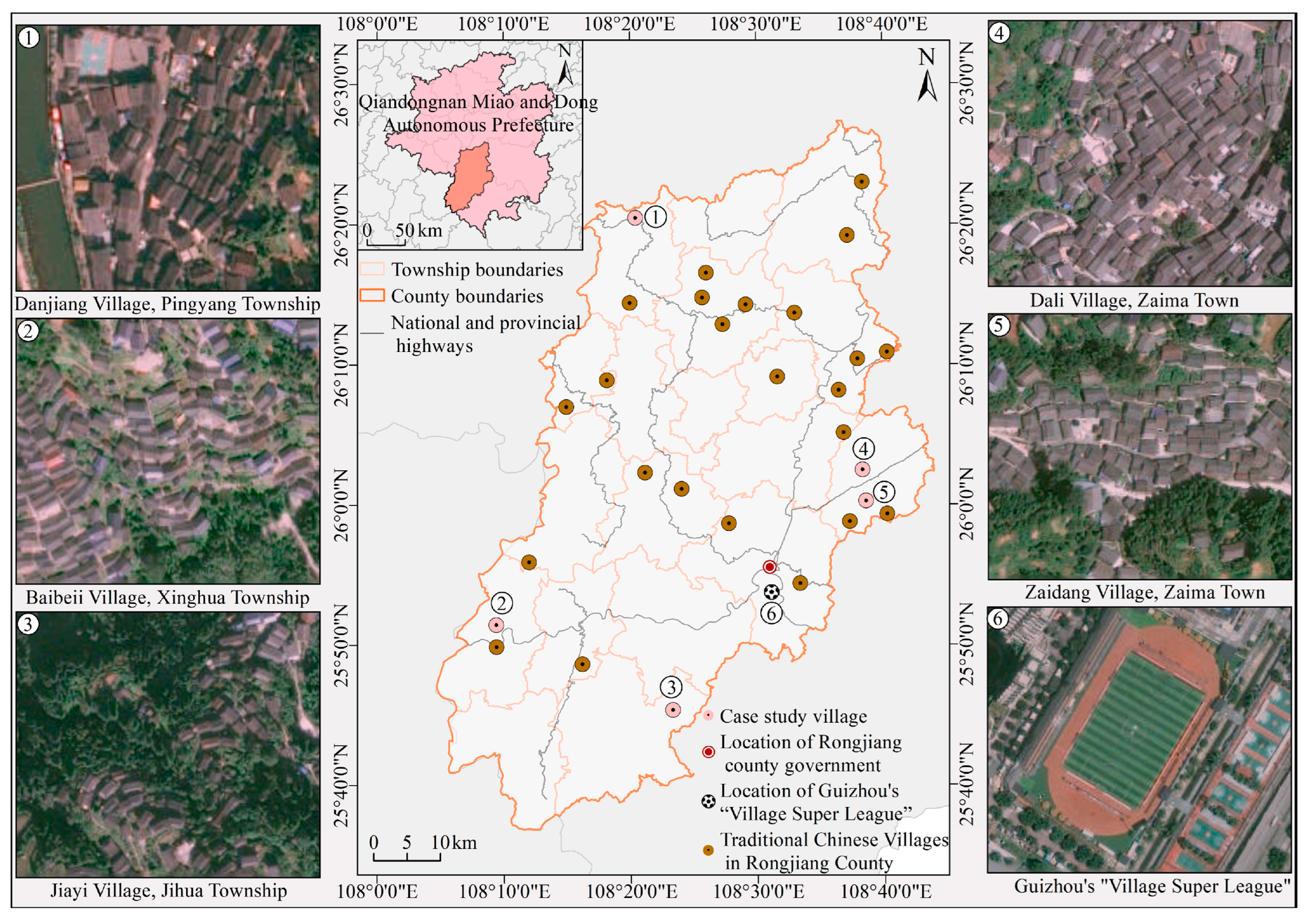
| Dali village | First batch of China’s Traditional Villages; First batch of Provincial Key Villages for Rural Tourism; Seventh batch of National Key Cultural Heritage Sites; National AAA-Rated Tourist Attraction. | 324 households, 1342 residents | Consolidation and Transformation Stage:Tourism development in the area began in 2012. Following the viral success of Guizhou’s “Village Super League” in 2023, the sector experienced rapid growth, receiving nearly 100,000 visitors in 2024, with daily visitor numbers peaking at 8000. The number of homestays surged from 18 in 2022 to 64 registered establishments, providing over 500 beds. Notably, 90% of these homestays are independently owned and operated by local villagers. |
| Zaidang village | First batch of China’s Traditional Villages; Third batch of Provincial Key Rural Tourism Villages; Ethnic Characteristic Village. | 265 households, 1277 residents | Exploratory and Emergent Stage: Tourism development in the village began in 2016. Since 2023, leveraging the popularity of Guizhou’s “Village Super League” to attract visitors, the sector has experienced significant growth. In 2024, tourist numbers increased by over 30 percent compared to the previous year. The village has also established over ten regular Dong Grand Song performance choirs. |
| Danjiang village | China’s Fourth Batch of Traditional Villages; Second Batch of National Key Rural Tourism Villages; China’s Ethnic Minority Characteristic Village; National Forest Health Resort Base; National AAA-Rated Tourist Attraction. | 179 households, 770 residents | Participation and Development Stage: Tourism development in the village began in 2016. It achieved explosive growth in 2022 through new media promotion and welcomed 641,000 visitors in 2024. The village now boasts 25 homestays and 16 farmhouse restaurants, with collective economic income exceeding 600,000 yuan. |
| Baibei village | First batch of China’s Traditional Villages; Fifth batch of Provincial Key Rural Tourism Villages. | 441 households, 2206 residents | Participation and Development Stage: Tourism development in the village started relatively late but gained significant momentum in 2023. Capitalizing on the “Village Super League,” the community developed the “Bai Bei in the Clouds” brand identity, registered a series of trademarks, and launched products such as Miao King Hand-Rubbed Chili Paste and Sour Soup. Since this promotional shift, the village has received over 200,000 visitors, generating more than 400,000 yuan in collective income. |
| Jiayi village | China’s Fourth Batch of Traditional Villages; Fourth Batch of Provincial Key Rural Tourism Villages; One of Qiandongnan Prefecture’s Top-Ten “Most Beautiful Red Army Villages”. | 379 households, 1698 residents | Exploratory and Emergent Stage: The village began developing tourism in 2019. It possesses significant resources, including revolutionary heritage sites such as the former headquarters of the Red Seventh Army, as well as terraced field ecosystems. In 2023, by capitalizing on the “Village Super League” trend, the village expanded its homestay capacity to 19 units, generating annual dividends of 610,000 yuan. |
Disclaimer/Publisher’s Note: The statements, opinions and data contained in all publications are solely those of the individual author(s) and contributor(s) and not of MDPI and/or the editor(s). MDPI and/or the editor(s) disclaim responsibility for any injury to people or property resulting from any ideas, methods, instructions or products referred to in the content. |
© 2025 by the authors. Licensee MDPI, Basel, Switzerland. This article is an open access article distributed under the terms and conditions of the Creative Commons Attribution (CC BY) license (https://creativecommons.org/licenses/by/4.0/).
Share and Cite
Luo, K.; Yang, F.; Sun, J.; Luo, J.; Cui, J.; Kong, X.; Chen, X.; Wang, Y.; Huang, S. How Events Empower the Countryside: A Study of Rural Household Livelihoods in Traditional Villages of Ethnic Mountainous Areas Influenced by Guizhou’s “Village Super League”. Sustainability 2025, 17, 10715. https://doi.org/10.3390/su172310715
Luo K, Yang F, Sun J, Luo J, Cui J, Kong X, Chen X, Wang Y, Huang S. How Events Empower the Countryside: A Study of Rural Household Livelihoods in Traditional Villages of Ethnic Mountainous Areas Influenced by Guizhou’s “Village Super League”. Sustainability. 2025; 17(23):10715. https://doi.org/10.3390/su172310715
Chicago/Turabian StyleLuo, Keru, Fangqin Yang, Jianwei Sun, Jing Luo, Jiaxing Cui, Xuesong Kong, Xiaojian Chen, Ya Wang, and Shuyang Huang. 2025. "How Events Empower the Countryside: A Study of Rural Household Livelihoods in Traditional Villages of Ethnic Mountainous Areas Influenced by Guizhou’s “Village Super League”" Sustainability 17, no. 23: 10715. https://doi.org/10.3390/su172310715
APA StyleLuo, K., Yang, F., Sun, J., Luo, J., Cui, J., Kong, X., Chen, X., Wang, Y., & Huang, S. (2025). How Events Empower the Countryside: A Study of Rural Household Livelihoods in Traditional Villages of Ethnic Mountainous Areas Influenced by Guizhou’s “Village Super League”. Sustainability, 17(23), 10715. https://doi.org/10.3390/su172310715