Creating an Urban Green Space Database in Hat Yai Municipality, Thailand



Abstract
1. Introduction
Literature Review
2. Methodology
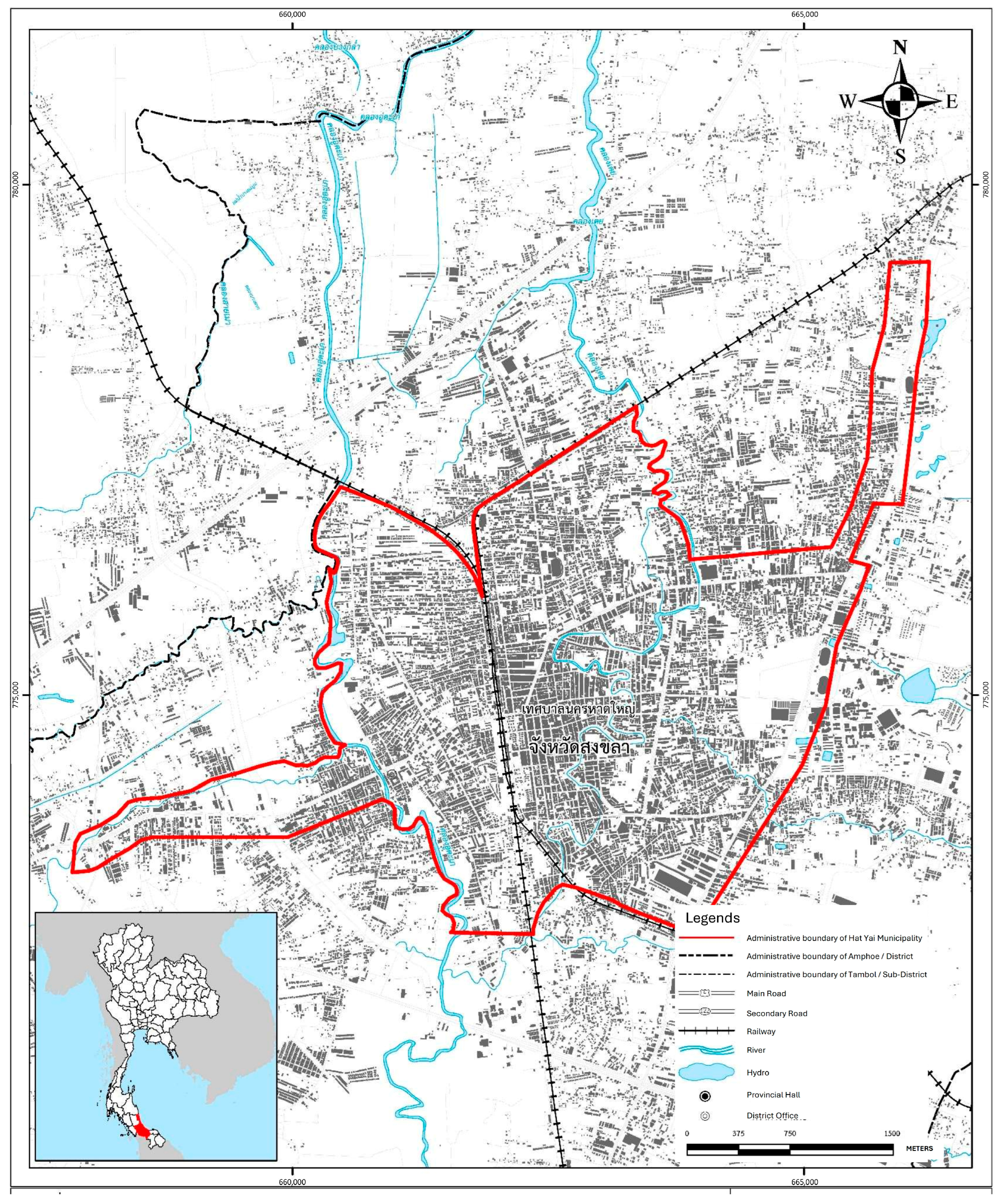
2.1. Study Area
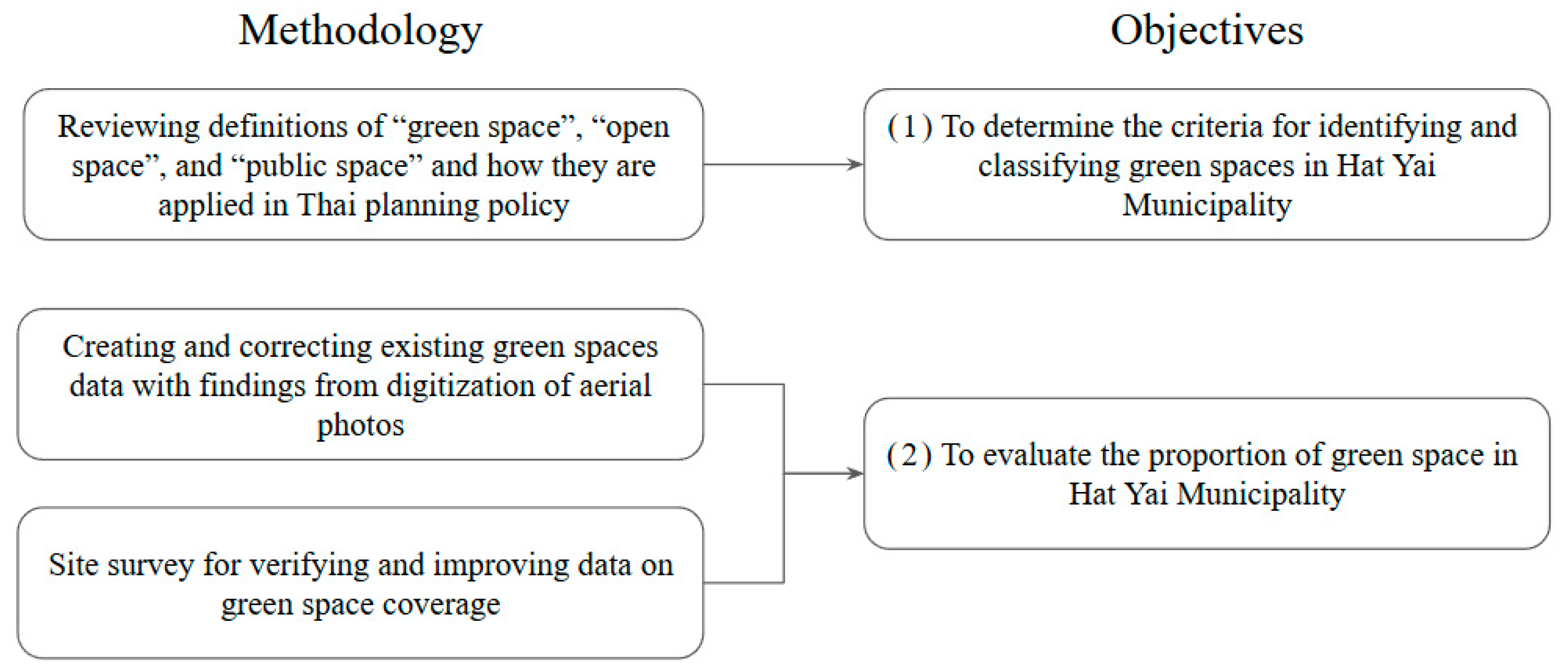
2.2. Research Methodology
2.2.1. Selecting a Green Space Framework from Thailand
- Green Space: The Urban Planning Act defines “green space” as “areas predominantly covered with vegetation, either naturally occurring or human-made, to provide a good environment for cities or communities. Examples include forests, public parks, green belts, and tree-lined areas along rivers, roads, and railways. This does not include agricultural land.”
- Public Space: The Urban Planning Act defines “public space” as “areas open to the public for multipurpose use, facilitating social interaction, economic exchange, and cultural expression within a diverse society.”
- Open Space: The Urban Planning Act defines “open space” as “areas devoid of structures that help to reduce the density of the surrounding environment, such as communities, villages, and cities. Open spaces enhance the aesthetics of the area and contribute to public satisfaction. Additionally, open spaces have multiple benefits, including recreation, transportation, and environmental conservation.”
- (1)
- Green space for recreation and landscape aesthetics;
- (2)
- Linear green space;
- (3)
- Functional green space;
- (4)
- Other green spaces;
- (5)
- Conservation green space;
- (6)
- Special green space.
- (1)
- Open space for recreation and environmental quality preservation;
- (2)
- Open space for preserving environmental quality along rivers and canals;
- (3)
- Open space for maintaining natural drainage patterns;
- (4)
- Retention areas for flood prevention;
- (5)
- Open space for protecting coastal and wetland environmental quality;
- (6)
- Open space for general environmental quality preservation.
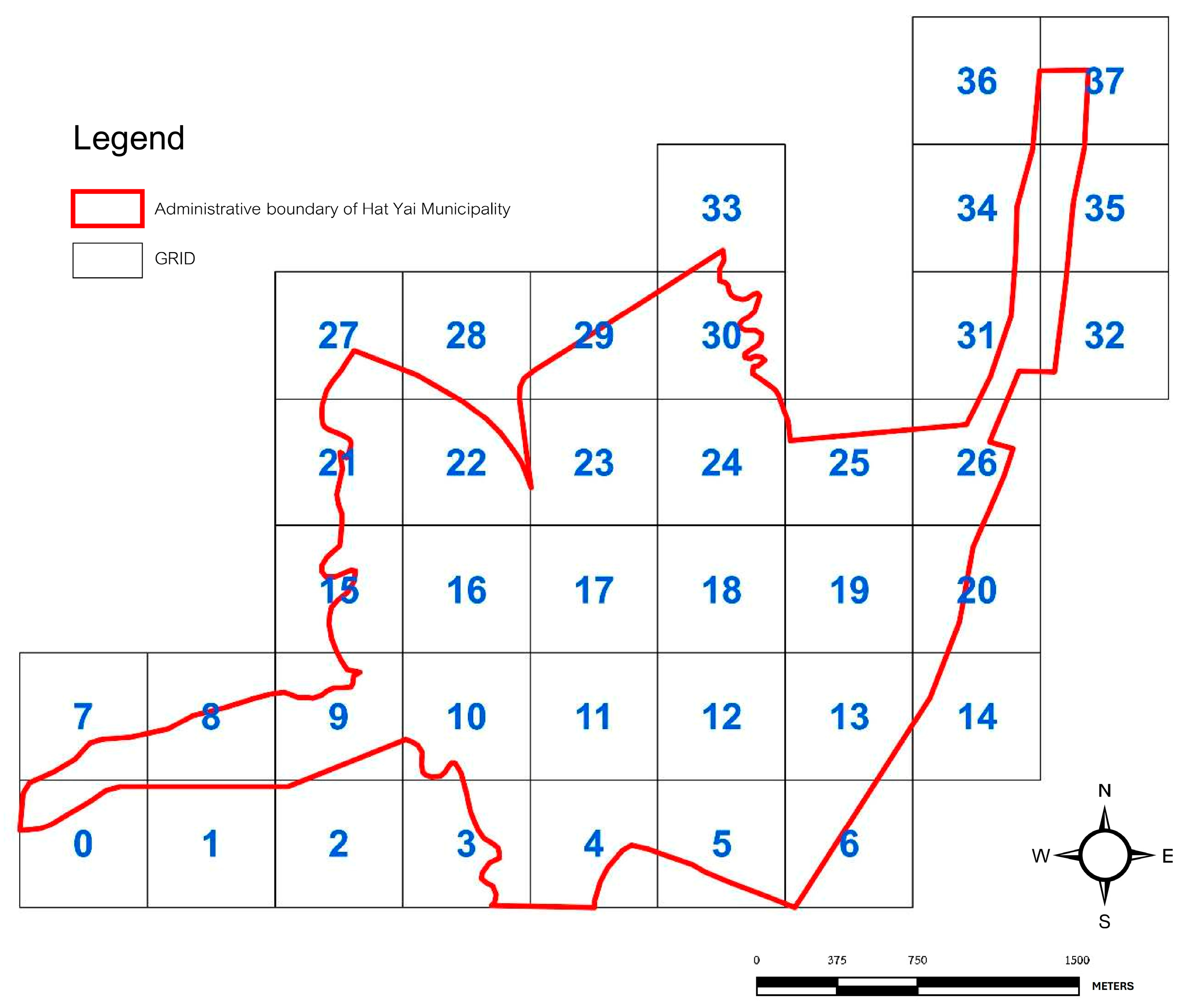
2.2.2. Aerial Image Analysis
2.2.3. Site Surveys
3. Results
3.1. Aerial Image Analysis Results
3.2. Site Survey and Data Compilation
4. Discussion
4.1. Usefulness of the ONEP Framework
4.2. Limitations and Further Research Directions
5. Conclusions
Author Contributions
Funding
Institutional Review Board Statement
Informed Consent Statement
Data Availability Statement
Acknowledgments
Conflicts of Interest
References
- Elmqvist, T.; Setälä, H.; Handel, S.N.; van Der Ploeg, S.; Aronson, J.; Blignaut, J.N.; de Groot, R. Benefits of restoring ecosystem services in urban areas. Curr. Opin. Environ. Sustain. 2015, 14, 101–108. [Google Scholar] [CrossRef]
- Ulrich, R.S.; Simons, R.F.; Losito, B.D.; Fiorito, E.; Miles, M.A.; Zelson, M. Stress recovery during exposure to natural and urban environments. J. Environ. Psychol. 1991, 11, 201–230. [Google Scholar] [CrossRef]
- Maas, J.; Verheij, R.A.; Groenewegen, P.P.; de Vries, S.; Spreeuwenberg, P. Green space, urbanity, and health: How strong is the relation? J. Epidemiol. Community Health 2006, 60, 587–592. [Google Scholar] [CrossRef] [PubMed]
- Chiesura, A. The role of urban parks for the sustainable city. Landsc. Urban Plan. 2004, 68, 129–138. [Google Scholar] [CrossRef]
- United Nations. Transforming Our World: The 2030 Agenda for Sustainable Development. Available online: https://sustainabledevelopment.un.org/post2015/transformingourworld (accessed on 1 June 2025).
- Office of the National Economic and Social Development Board. The Twelfth National Economic and Social Development Plan (2017–2021); Office of the Prime Minister: Bangkok, Thailand, 2017. [Google Scholar]
- Office of the National Economic and Social Development Board. Progress Report on Thailand’s Sustainable Development Goals 2016–2020. Available online: https://e-library.moc.go.th/book-detail/20764 (accessed on 1 June 2025).
- Hat Yai Municipality. Green City Action Plan 2017–2027. Available online: https://www.hatyaicity.go.th/files/com_networknews/2017-08_329665d5b2cf7f1.pdf (accessed on 20 July 2025).
- Choosuk, A.; Thitinanthakorn, M.; Rattanaphithakchon, M. Urbanization Process of Hat Yai City. Available online: https://www.tei.or.th/thaicityclimate/public/work-17.pdf (accessed on 7 June 2025).
- Swanwick, C.; Dunnett, N.; Woolley, H. Nature, Role and Value of Green Space in Towns and Cities: An Overview. Built Environ. 2023, 29, 94–106. [Google Scholar] [CrossRef]
- World Health Organization. Urban Green Spaces: A Brief for Action; World Health Organization: Copenhagen, Denmark, 2017. [Google Scholar]
- European Environment Agency (EEA). Green Infrastructure and Territorial Cohesion: The Concept of Green Infrastructure and Its Integration into Policies; European Environment Agency: Copenhagen, Denmark, 2011; Available online: https://www.eea.europa.eu/en/analysis/publications/green-infrastructure-and-territorial-cohesion (accessed on 11 November 2025).
- Cohen-Shacham, E.; Walters, G.; Janzen, C.; Maginnis, S. (Eds.) Nature-Based Solutions to Address Global Societal Challenges; IUCN: Gland, Switzerland, 2016; 97p. [Google Scholar]
- Natural England. Urban Greening Factor for England User Guide; Natural England: Bridgwater, UK, 2023. [Google Scholar]
- Brilhante, O.; Klaas, J. Green City Concept and a Method to Measure Green City Performance over Time Applied to Fifty Cities Globally: Influence of GDP, Population Size and Energy Efficiency. Sustainability 2018, 10, 2031. [Google Scholar] [CrossRef]
- Ruttirago, P. Quality Assessment and Management Guidelines for Recreational Green Areas in Hat Yai Municipality and Kho Hong Town Municipality, Hat Yai District, Songkhla Province. Doctoral Dissertation, Prince of Songkhla University, Songkhla, Thailand, 2014. [Google Scholar]
- Ruttirago, P. Accessibility of recreational green spaces in Hat Yai Municipality, Songkhla. SDU Res. J. (Sci. Technol.) 2013, 6, 127–137. [Google Scholar]
- Hassan, H. Budget-Conscious Malaysians Flock to Hat Yai for Holiday as Prices Rise at Home. Available online: https://www.straitstimes.com/asia/se-asia/budget-conscious-malaysians-holiday-in-hat-yai-with-train-service-from-kl-proving-a-hit (accessed on 7 June 2025).
- Supharatid, S. The Hat Yai 2000 flood: The worst flood in Thai history. Hydrol. Process. 2006, 20, 307–318. [Google Scholar] [CrossRef]
- Department of Provincial Administration. Available online: https://stat.bora.dopa.go.th (accessed on 20 July 2024).
- Middleton, C.; Pratomlek, O. Flooding disaster, people’s displacement, and state response: A case study of Hat Yai municipality. In Climate Change, Disasters, and Internal Displacement in Asia and the Pacific, 1st ed.; Routledge: London, UK, 2020; pp. 1–22. [Google Scholar]
- Department of Public Works and Town and Country Planning. Urban Planning Standards and Criteria 2006. Available online: https://www.dpt.go.th/th/dpt-standard/download?did=3814&filename=std_plan2549.pdf (accessed on 4 March 2022).
- Department of Public Works and Town and Country Planning. Building Control Act B.E. 2522 (1979); Government of Thailand: Bangkok, Thailand, 1979. [Google Scholar]
- Office of Natural Resources and Environmental Policy and Planning. Green Space Development Manual; Chiang Mai University: Chiang Mai, Thailand, 2006. [Google Scholar]
- Department of Public Works and Town and Country Planning. Urban Planning Act B.E. 2566 (2023); Government of Thailand: Bangkok, Thailand, 2023. [Google Scholar]
- GISTDA. Visual Interpretation of Satellite Data. Geo-Informatics and Space Technology Development Agency (Public Organization). Available online: https://www.gistda.or.th/news_view.php?n_id=2400&lang=TH (accessed on 7 June 2025).



| Green Space | Public Space | Open Space |
|---|---|---|
| ONEP [24] | Building Control Act [23] | DPT [22] |
| “Outdoor and semi-outdoor areas where the land is partially or entirely covered with vegetation on permeable soil, which may also include built structures. These areas, whether located within urban green spaces or outside urban areas, can be either public or private, accessible for public use.” | “Areas that are open or permitted for public access or use as passageways, regardless of whether a fee is charged.” | “Open spaces bring nature into urban areas for community wellbeing and environmental quality, creating enjoyment and reducing stress. These are land uses that do not generate economic revenue but provide social benefits.” |
| Definitions in the Urban Planning Act B.E. 2566 [25] | ||
| “Areas predominantly covered with vegetation, whether naturally occurring or human-made to provide a good environment for cities or communities. Examples include forest areas, public parks, green belts, areas with trees along rivers, roads, and railways. This does not include agricultural land.” | “Areas open to the public for multipurpose uses, facilitating social interaction, economic exchange, and cultural expression amidst the diversity of society.” | “Areas without built structures that help to reduce the density of the surrounding environment, such as communities, villages, and cities. Open spaces enhance the aesthetics of the area and contribute to public satisfaction. Additionally, open spaces have multiple benefits, including recreation, transportation, and environmental conservation.” |
| Green Space Classification of ONEP | Open Space Classification of DPT | Observations by the Author |
|---|---|---|
| Green space for recreation and scenic beauty | Open space for developing and preserving environmental quality for recreational and aesthetic purposes. | These spaces are utilized in a manner consistent with public aesthetic enjoyment. |
| Linear green space (green space along public utilities, such as areas along land routes, median strips, railway areas, and areas along waterways) | Open space for preserving environmental quality along riverbanks and canals, and to manage natural drainage systems. | The definition of open space here does not include sidewalks, and riverbanks can be non-green space. |
| Functional green space, such as agricultural fields, parking spaces, drainage, or waste disposal areas | Open space for conserving natural drainage conditions. | The definition of functional green space includes economic uses, whereas the open space definition focuses only on water management uses. |
| Water retention area for flood prevention | ||
| Other green spaces, such as vacant lots | N/A | There is no corresponding open space category that includes abandoned, undeveloped, or unutilized land. |
| Green space for conservation | Open space for preserving environmental quality | The green space classification is broader, while the open space classification separates water-related biomes. |
| Open space for preserving environmental quality along coastlines and in wetlands | ||
| Special Green Areas (e.g., Living Natural Museums, Natural Plant Learning Centers) | N/A | There is no corresponding open space category for the source of natural education services. |
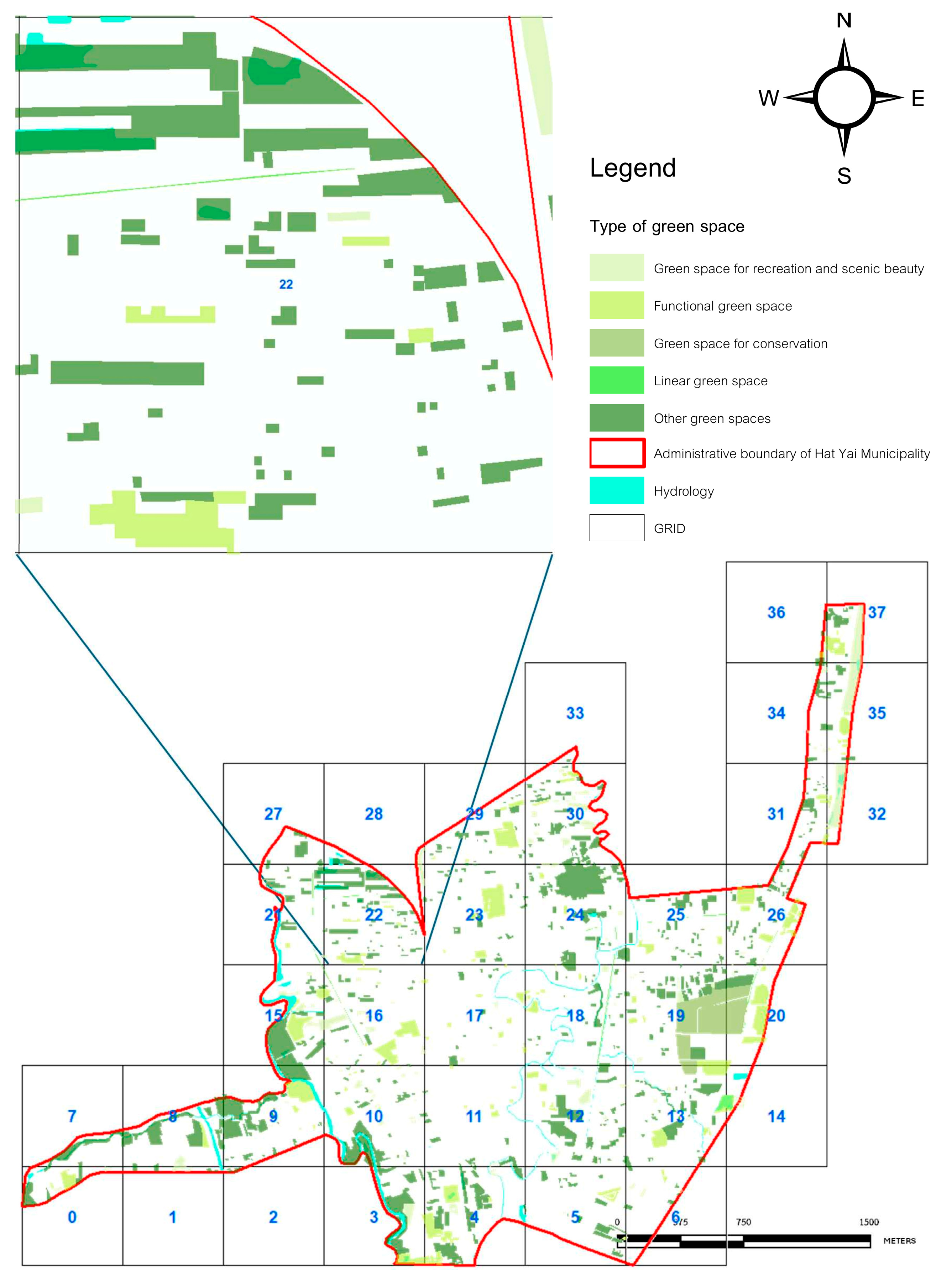
| Type of Green Space | Amount | Size (km2) |
|---|---|---|
| Green space for recreation and scenic beauty | 115 | 0.42 |
| Functional green space | 135 | 0.90 |
| Green space for conservation | 4 | 0.33 |
| Linear green space | 36 | 0.29 |
| Other green spaces | 523 | 2.22 |
| Total | 813 | 4.16 |
Disclaimer/Publisher’s Note: The statements, opinions and data contained in all publications are solely those of the individual author(s) and contributor(s) and not of MDPI and/or the editor(s). MDPI and/or the editor(s) disclaim responsibility for any injury to people or property resulting from any ideas, methods, instructions or products referred to in the content. |
© 2025 by the authors. Licensee MDPI, Basel, Switzerland. This article is an open access article distributed under the terms and conditions of the Creative Commons Attribution (CC BY) license (https://creativecommons.org/licenses/by/4.0/).
Share and Cite
Marome, W.; Mainn, P. Creating an Urban Green Space Database in Hat Yai Municipality, Thailand. Sustainability 2025, 17, 10679. https://doi.org/10.3390/su172310679
Marome W, Mainn P. Creating an Urban Green Space Database in Hat Yai Municipality, Thailand. Sustainability. 2025; 17(23):10679. https://doi.org/10.3390/su172310679
Chicago/Turabian StyleMarome, Wijitbusaba, and Pachara Mainn. 2025. "Creating an Urban Green Space Database in Hat Yai Municipality, Thailand" Sustainability 17, no. 23: 10679. https://doi.org/10.3390/su172310679
APA StyleMarome, W., & Mainn, P. (2025). Creating an Urban Green Space Database in Hat Yai Municipality, Thailand. Sustainability, 17(23), 10679. https://doi.org/10.3390/su172310679