Article

Double Agglomeration of the Agricultural Industry, Technological Innovation, and Farmers’ Agricultural Incomes: Evidenced by the Citrus Industry


1
Faculty of Management, Sichuan Agricultural University, Chengdu 611130, China
2
Faculty of Business, Sichuan Agricultural University, Chengdu 611830, China
*
Author to whom correspondence should be addressed.
Sustainability 2025, 17(23), 10651; https://doi.org/10.3390/su172310651
Submission received: 3 September 2025 / Revised: 17 November 2025 / Accepted: 19 November 2025 / Published: 27 November 2025

Abstract

Against the backdrop of the rapid development of digital technologies, such as mobile internet, big data, and cloud computing, the geographical agglomeration of industries is gradually shifting toward virtual agglomeration. In this paper, we examine the effect of both geographical and virtual agglomeration of the agricultural industry on farmers’ agricultural income, and we focus on the transmission mechanism of technological innovation in this process. In the empirical section, using the citrus industry as an example, we employed a moderated mediation effect model for verification and derived the following conclusions: (1) Both geographical and virtual agglomeration of the agricultural industry promote an increase in farmers’ agricultural income by enhancing technological innovation, respectively. (2) Virtual agglomeration of the agricultural industry has a negative moderating effect on the relationship between geographical agglomeration and farmers’ agricultural income, that is, virtual agglomeration alleviates the “crowding effect” and to some extent substitutes for geographical agglomeration. (3) In the mechanism where geographical agglomeration in the agricultural industry increases farmers’ agricultural income through technological innovation, virtual agglomeration has a positive moderating effect. This paper is important for enabling farmers to share the benefits of the digital economy and achieve continuous growth in agricultural income. It is also important for the sustainable development goals adopted by the United Nations, such as eliminating poverty (SDG1), eliminating hunger (SDG2), promoting sustainable economic growth and full employment (SDG8), and promoting innovation (SDG9).

1. Introduction

In the context of global economic integration and the increasing intensity of market competition, industries of the same type increasingly tend to cluster in specific regions. Industrial agglomeration first appeared in the industrial sector. However, with the continuous progress of agricultural industrialization and modernization, agricultural industrial agglomeration has gradually emerged and evolved. In China, since the implementation of the reform and opening-up policy, the spatial agglomeration phenomenon and development trend of agriculture have intensified [1,2]. The agricultural industry shows a relatively prominent “core-periphery” spatial layout model [3]. Agricultural industrial agglomeration has occurred in many regions. For instance, there is the vegetable industry in Shouguang, Shandong; the potato industry in Dingxi, Gansu; and the flower industry in Dounan, Yunnan. Existing studies show that agricultural industrial geographical agglomeration promotes sustainable industry development through fostering technological innovation, improving labor productivity, and expediting information dissemination, thereby effectively increasing farmers’ income [4,5,6].
In recent years, rapid advancements in new technologies such as mobile Internet, big data, and cloud computing have led human society into the information era. The development of emerging technologies has created a new spatial form—virtual cyberspace. Fast-evolving digital technologies continuously challenge traditional agricultural production methods, industrial organizational forms, and transaction models. Because digital technologies increasingly penetrate and integrate into every aspect of agricultural production, the traditional geographical agglomeration of the agricultural industry is inevitably transitioning toward cyberspace agglomeration, thus forming a trend of virtual agglomeration. In practice, across China, Taobao Villages, Hema Villages, JD Farms, and similar entities centered around agricultural industrial clusters have frequently emerged. Agricultural-related apps such as Yimutian and Nongguanjia have been successively launched. E-commerce platforms such as JD.com, Taobao, and Pinduoduo have also actively established China’s Specialties Halls, Agricultural Assistance Halls, and Rural Revitalization and Poverty Alleviation Channels, which focus on agricultural clusters. National e-commerce sales of agricultural products increased from CNY158.9 billion in 2017 to CNY 531.4 billion in 2023 [7], with an average annual growth rate of 56%. Against this backdrop, an important question emerges: What effect will the geographical and virtual dual agglomeration of the agricultural industry have on farmers’ agricultural incomes? To date, scholars have not yet conducted systematic and in-depth research on this issue.
This study primarily examines the influence of the geographical and virtual dual agglomeration of the agricultural industry on farmers’ agricultural incomes, with a particular focus on investigating the mediating mechanism of technological innovation. Compared to existing research, the distinctiveness and innovative aspects of this paper are as follows. First, by integrating economic agglomeration theory and the sociological “space of flows” theory, we propose the concept of “virtual agglomeration.” This approach compensates for deficiencies in the existing literature, where the concept of “virtual agglomeration” does not adequately reflect industry and geographical characteristics. Therefore, we clarify the conceptual framework of geographical agglomeration, virtual agglomeration, and industrial agglomeration. Second, we expand the scope of research on virtual agglomeration. Existing research on virtual agglomeration has predominantly focused on the manufacturing sector, with limited discussion of its applicability in the agricultural industry. We examine the effect of virtual agglomeration on farmers’ agricultural incomes from the perspective of the characteristics of the agricultural industry, thus broadening the scope of research on virtual agglomeration. Third, we not only separately analyze the mechanisms through which geographical agglomeration and virtual agglomeration affect farmers’ agricultural incomes, but also incorporate both into a unified research framework. By doing so, we examine the effect of dual agglomeration and technological innovation on farmers’ agricultural incomes, making a marginal contribution to the academic community’s comprehensive understanding of the relationship between agricultural industrial agglomeration and farmers’ incomes. As digital technology advances rapidly, this study holds significant value for advancing the agricultural sector’s adoption of cutting-edge technologies to achieve sustainable development and drive sustained increases in farmers’ income.
The remainder of this paper is organized as follows: Section 2 provides a comprehensive review of the existing literature and defines the concepts of agro-industrial double agglomeration; Section 3 presents some research hypotheses based on the theoretical analysis; Section 4 selects some variables and determines the model applied in this paper; Section 5 analyzes the results of the empirical test on the basis of Section 4, including baseline regression analysis, robustness tests, endogeneity tests and mechanism tests. Finally, the conclusions and limitations of the study and possible future research directions are shown.

2. Literature Review and Concept Definition

2.1. Literature Review

In the literature on the impact of agricultural industry geographic agglomeration on farmers’ income, most scholars agree that agro-industrial geographical agglomeration can integrate agricultural production, processing, and sales processes [8], strengthen cooperation between agricultural enterprises and farmers [9], and promote information exchange [10]. Therefore, these factors can increase farmers’ income.
There are relatively few studies on the effect of virtual agglomeration in the agricultural industry on farmers’ income. The two main bodies of literature closely related to this topic are as follows. The first is research on the effect of the Internet on farmers’ income. The literature shows that the Internet promotes farmers’ effective connection with the market, enhances human capital accumulation, strengthens financial support, improves the level of social capital, and accelerates technology promotion, thereby increasing farmers’ income [11,12,13,14]. The second is research on the effect of agricultural product e-commerce on farmers’ income. Scholars find that agricultural product e-commerce enables farmers to directly face consumers, thereby improving price transparency and expanding the market scope, thus increasing farmers’ income [15,16,17].

2.2. Concept Definition

Academic research on the geographical agglomeration of the agricultural industry has a long history. The concept is relatively unified, referring to the dynamic process in which interrelated agricultural economic entities gradually concentrate in geographical space. This process drives the aggregation of physical elements, such as human resources, capital, and materials, in geographical space.
Compared with geographical agglomeration, research on virtual agglomeration began relatively late. Most scholars hold that virtual agglomeration denotes the agglomeration of geographically dispersed production factors on various virtual network platforms [18,19]. This definition uses independent network platforms as the connection points. As long as various enterprises join the network platform, virtual agglomeration is achieved.
This paper does not adopt this definition, as it discards geographical and industrial characteristics, and emphasizes the agglomeration of all enterprises on virtual network platforms. It cannot be regarded as the virtual agglomeration of “the agricultural industry,” nor does it reflect the geographical environment on which agricultural production relies. Drawing on the concept of “space of flows” proposed by sociologist Manuel Castells [20], we put forward a definition of the virtual agglomeration of the agricultural industry. “Flow space” is an electronic network space constructed by simulating reality through computer technology, communication technology, Internet technology, and other related technologies. Essentially, flow space is a mapping of geographical space, and it is a mirror image of geographical space in the virtual network based on simulation and digital technology. Therefore, the flow space constructed by virtual reality technology coexists with and complements the geographical space composed of physical matter, and presents a unique “dual” spatial landscape of the information society [21]. People living in this environment have dual identities as citizens and netizens, and local spaces also have two different forms of expression: street networks and the Internet, physical stores and online stores, physical banks and online banks, hospitals and remote medical services.
Based on the theory of flow space, the concentration of various physical elements, such as people, capital, and materials, in geographical space is called “geographical agglomeration,” while the concentration of various virtual elements, such as industrial information, electronic funds, and virtual economic entities, in flow space is called “virtual agglomeration.” Because flow space is the mapping of geographical space, the information nodes in flow space correspond to cities and towns in geographical space. Therefore, when virtual elements concentrate at the information nodes in flow space, they are actually concentrated in the geographical space mapped by these nodes. Thus, industrial dual agglomeration refers to the dynamic process in which both physical and virtual elements related to an industry gradually concentrate in geographical space (which is the mapping of flow space information nodes). The concept of industrial agglomeration includes both geographical agglomeration and virtual agglomeration. The similarities between them are that industrial elements “agglomerate” in the same local space. The differences, however, are in the nature of the agglomerated elements and the spaces that accommodate these elements. Nevertheless, both are included in industrial agglomeration and represent distinct spatial configurations of resources related to the same industry.
Therefore, this paper proposes the concept of virtual agglomeration of the agricultural industry, which refers to the process in which virtual elements, such as agricultural industry information, electronic currency, electronic virtual agricultural enterprises, and electronic virtual agricultural product consumers, concentrate at information nodes in the flow space. This concept simultaneously reflects both the industrial and geographical characteristics of agriculture, and it can effectively interpret the agglomeration situation of virtual elements in the agricultural industry.

3. Theory and Hypotheses

The essence of industrial agglomeration is the concentration of economic entities within a specific space—either geographical space or cyberspace—which creates “proximity” among these entities. In the agricultural industry, geographical agglomeration forms because unique natural conditions allow agricultural entities to concentrate production in a particular geographical space, resulting in “geographical proximity” among them. Virtual agglomeration in the agricultural industry forms because the development of advanced information technology encourages agricultural entities to gather in flow space, creating “virtual proximity.” In this context, although agricultural entities cannot interact face to face, they can exchange information in real time through the Internet. With the rapid development of transportation and logistics industries, “virtual proximity” has become increasingly important. Another essence of industrial agglomeration is the increase in the “density” of various industrial factors within a geographical space. A higher density indicates a greater degree of industrial agglomeration. Therefore, industrial agglomeration inherently has a “scale” attribute. The aggregation of many agricultural entities increases the production scale, market scale, and information scale of the agglomeration area.
Industrial agglomeration provides economic organizations with “proximity” and “scale,” which promote technological innovation. The “proximity” of agricultural organizations increases information exchange, and the “scale” creates a strong knowledge and technology accumulation effect. Additionally, “proximity” helps innovation subjects establish long-term and stable innovation cooperation relationships, which supports the improvement of innovation capabilities.
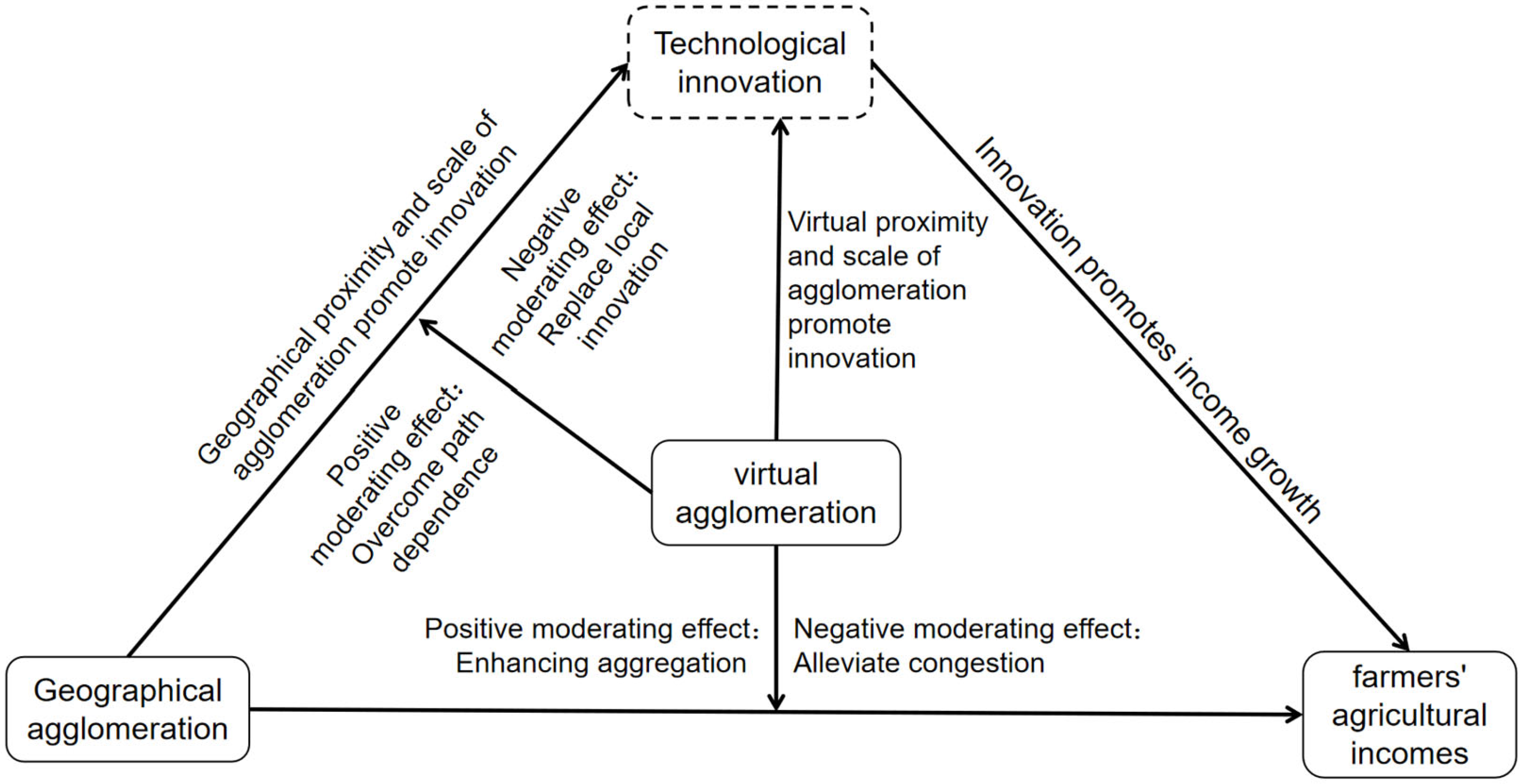
To investigate the mechanism through which dual agglomeration in the agricultural industry affects farmers’ agricultural income, this study conducts a three-step analysis: (1) examining the impact of geographical agglomeration on farmers’ agricultural income and testing the mediating pathway “geographical agglomeration → technological innovation → agricultural income”; (2) examining the impact of virtual agglomeration on farmers’ agricultural income and testing the mediating pathway “virtual agglomeration → technological innovation → agricultural income”; (3) integrating geographical agglomeration, virtual agglomeration, technological innovation, and agricultural income into a unified analytical framework to assess the moderating role of virtual agglomeration on the “geographical agglomeration–technological innovation–agricultural income” relationship. The theoretical derivation is shown in Figure 1.

3.1. Geographical Agglomeration of the Agricultural Industry, Technological Innovation, and Farmers’ Agricultural Incomes

3.1.1. Geographical Agglomeration of the Agricultural Industry and Farmers’ Agricultural Incomes

The geographical agglomeration of the agricultural industry increases farmers’ agricultural income by expanding the market scale. The expansion of the market scale mainly refers to the growth of both market space and demand scale. The geographical agglomeration of the agricultural industry can bring together small-scale, scattered farmers and larger-scale agricultural enterprises. Regarding market space, small farmers can use the marketing channels of large enterprises to sell their agricultural products to more distant markets, including national and international markets. Regarding demand scale, primary agricultural products are no longer only used for final consumption but may also serve as raw materials to produce various agricultural processing products with higher added value, thus expanding the demand scale for primary agricultural products. For example, Lemon Town in Anyue, Sichuan Province, is a well-known lemon industrial cluster across the country. Enterprises within the area have processed lemons into products such as lemon facial masks, lemon vitamin C lotion, and lemon lozenges, significantly expanding the market demand for lemons. Additionally, many enterprises within the area have engaged in sales cooperation, continuously broadening sales channels and exporting Anyue lemons overseas [22].
From the perspective of individual farmers, during the production stage, the geographical agglomeration of the agricultural industry increases farmers’ agricultural income because it accelerates the dissemination of information and technology, improves the industrial chain, and forms economies of scale [23]. Geographical agglomeration strengthens face-to-face communication among farmers and increases their exchanges and learning with agricultural experts and enterprises. This process enables farmers to adopt new varieties and technologies in a timely manner, which enhances production efficiency and expands agricultural income. Zhang Zhexi conducted a study based on survey data collected from vegetable-producing regions in Liaoning and Shanxi provinces, finding that industrial agglomeration enhances labor productivity through Marshallian externalities [24]. Additionally, geographical agglomeration gathers many agricultural material suppliers, providing farmers with more choices and greater bargaining power to reduce production costs. Furthermore, geographical agglomeration increases the number of agricultural production service providers. This situation allows small farmers to expand their production scale and improve production efficiency by adopting agricultural production services, thus increasing agricultural income. Wei Yiman’s study, based on panel data from 30 Chinese provinces between 2010 and 2020, reveals that agricultural industrial agglomeration improves farmers’ production efficiency by facilitating the provision of production services [25]. Du Jianjun’s empirical analysis, using panel data from 275 Chinese cities from 1999 to 2013, demonstrates that agricultural industrial agglomeration generates increasing returns to scale through internal economies of scale at the household level [26].
In the sales process, geographical agglomeration is conducive to the creation of regional brands, thereby enhancing the popularity and market share of characteristic agricultural products. Geographical agglomeration also facilitates the formation of specialized agricultural product wholesale markets, thus creating convenient sales channels. The improvement of brand awareness and the expansion of sales channels can form marketing advantages and market networks for agricultural products, enabling farmers to increase their product sales revenue. Huang Feng conducted a study using data from 292 prefecture-level cities in China between 2011 and 2020. The results show that geographical agglomeration areas enhance farmers’ planting enthusiasm and increase agricultural income through the price premium associated with geographically indicated brands [27].
Based on this, Hypothesis 1 is proposed: The geographical agglomeration of the agricultural industry can increase farmers’ agricultural income.

3.1.2. Agricultural Industrial Geographical Agglomeration Enhances Farmers’ Agricultural Income Specifically Through Technological Innovation

The theory that geographical agglomeration promotes technological innovation is relatively clear. This is because geographical agglomeration provides important spatial and organizational forms for technological innovation. First, by means of complementary specialized resources, reducing supply costs, and achieving input–output market specialization, it can directly promote the generation of agricultural innovation activities and accelerate the development of innovation. Second, the concentration of related enterprises and institutions, such as universities, research institutions, and government service departments, in geographical space can produce a strong cumulative effect of knowledge and technology, providing an important source of power and material basis for innovation. Third, with the increase in the number of various business entities in the agglomeration area, market competition intensifies, forcing enterprises to continuously carry out technological and product innovation. Fourth, the characteristics of local networking, mutual benefit and symbiosis, and resource sharing of agricultural industrial geographical agglomeration are conducive to the establishment of innovation networks and the establishment of long-term and stable innovation collaboration relationships and mechanisms by innovation subjects. Fifth, the rapid dissemination and diffusion of knowledge, experience, and technology in the agglomeration area strengthen the integration and collision of technology and knowledge among innovation subjects, stimulate innovation activities, and enhance regional innovation capabilities. The research of scholars such as Schmitz, Borah and Bora, and Wei Longbao shows that geographical agglomeration in different countries and different agricultural industries all have the effect of promoting innovation [28,29,30].
When a geographical agglomeration area has advanced production techniques and superior product varieties, it is easier for farmers to master new technologies and adopt new varieties. This situation helps maintain the market competitiveness of their products and allows them to earn more agricultural income. Li Jing’s research demonstrates that agricultural industrial clusters promote sustained income growth among farmers by accelerating the diffusion of knowledge and technology [31].
Based on this, we propose Hypothesis 2: agricultural industrial geographical agglomeration promotes farmers’ income growth by enhancing regional innovation capacity.

3.2. Virtual Agglomeration of the Agricultural Industry, Technological Innovation, and Farmers’ Agricultural Incomes

3.2.1. Virtual Agglomeration of the Agricultural Industry and Farmers’ Agricultural Incomes

With the strong accommodating capacity of the flow space, virtual agglomeration connects many farmers, agricultural enterprises, consumers, and research institutes. It plays an important role in expanding the market scale and highlighting the advantages of rural areas, which is conducive to the production and sales of farmers and helps increase their agricultural income.
Virtual agglomeration expands the market scale of agricultural products. The absence of boundaries allows the flow space to agglomerate almost an unlimited number of agricultural enterprises and farmers. Digital trade enables any producer agglomerated in the flow space to obtain any quantity of intermediate inputs available in the network market. At the same time, the output of any producer can immediately become the intermediate input for other producers or final product. Therefore, the agricultural products produced by one producer face the entire market. At this point, the market scale effect of intermediate inputs can be infinitely magnified, no longer limited to the restricted space of geographical agglomeration, which greatly expands the sales range and scale of agricultural products.
From the perspective of individual farmers, in the production stage, virtual agglomeration gathers many agricultural materials suppliers, production service providers, online marketing enterprises, and other related actors online. This process gives farmers more choices, greater bargaining power, and access to better industrial services, which expands production scale and improves production efficiency. Additionally, virtual agglomeration facilitates the real-time dissemination of information, enabling efficient communication among farmers and between farmers and related enterprises. This environment is conducive to farmers obtaining market information and collaborating with enterprises, thereby affecting agricultural production and increasing agricultural income. Zhang Qing’s research reveals that virtual agglomeration generates agglomeration effects by promoting knowledge spillovers, enhancing economies of scale, and reducing transaction costs [32].
In the sales process, the flow space has overcome geographical area restrictions. Its strong linking ability connects consumers who are far apart. Agricultural products from geographical agglomeration areas can be sold throughout the country and even the world through online trade. In addition, the rapid development of transportation, logistics, and other industries, together with the increasing convenience of online payment, has led to rapid development in agricultural product e-commerce, thereby increasing farmers’ agricultural income. Furthermore, through virtual agglomeration, farmers can directly access the final consumer market, communicate with consumers at any time and place, obtain market information about agricultural products, and adjust production and decision-making accordingly to provide products that meet consumers’ expectations. This process forms a “long tail effect” and increases sales revenue. The research of scholars such as Luo Qianfeng, Qiao Huanhuan, and others shows that the development of agricultural product e-commerce can significantly increase farmers’ income [17,33].
Based on this, we propose Hypothesis 3: Virtual agglomeration of the agricultural industry is conducive to the increase in farmers’ agricultural income.

3.2.2. Agricultural Industrial Virtual Agglomeration Enhances Farmers’ Agricultural Income Specifically Through Technological Innovation

First, the principle that geographical agglomeration creates technological externalities also applies to virtual agglomeration. The “virtual proximity” generated by virtual agglomeration changes the traditional face-to-face information dissemination path and enables real-time, rapid information sharing through Internet technology. Agricultural research institutes, agricultural enterprises, farmers, and other related entities are extensively agglomerated in the flow space. They disseminate knowledge at multiple time points and through multiple channels by establishing portal websites, technical forums, technical message boards, and other platforms, and by using short videos, pictures, animations, and other methods. This approach effectively shortens the time lag of knowledge diffusion and increases both the breadth and depth of knowledge dissemination. Furthermore, knowledge and information dissemination in the flow space takes a networked form, moving from “one-to-one” to “one-to-many” in the dissemination mode. When one knowledge diffusion path fails, adjacent paths can replace it, which ensures the stability and efficiency of knowledge diffusion. Therefore, virtual agglomeration accelerates the transmission of information, knowledge, and experience among enterprises. In addition, enterprises can obtain, analyze, and mine data at any time and from any location through web crawler technology and big data technology. Compared with information obtained through geographical agglomeration, this information has greater capacity, broader dimensions, and higher precision. Extensive knowledge spillover is the foundation for enhancing the innovation ability of human capital and improving the innovation ability of enterprises.
Second, the unbounded development of virtual agglomeration accommodates an increasing number of participants, including both agricultural enterprises and cross-industry enterprises, forming Jacobs’ technological externalities. The diversified agglomeration enables different innovation subjects to achieve cross-industry boundary interconnection and information sharing. This process promotes collaborative innovation among different innovation subjects in the agricultural value chain and enhances the overall innovation capacity of the agricultural industry.
Third, virtual agglomeration accommodates many consumers. The dynamic perceptibility of communication between agricultural enterprises and consumers enables enterprises to provide differentiated services based on customer demands, meeting consumers’ differentiated requirements for health, greenness, high quality, and off-season products. This shift transforms agricultural enterprises from a single product supply innovation model to a “product + service” demand-oriented innovation model, achieving diversification of innovation participants and openness of the innovation model. Wang Ruyu, Xiao Wenxue, and Chen Bin have demonstrated that virtual agglomeration fosters enterprise innovation through reduced management costs and accelerated knowledge spillovers [34,35,36].
Virtual agglomeration brings together online agricultural enterprises, non-agricultural enterprises, research institutes, consumers, and other innovative entities on a larger scale, which enhances regional innovation capabilities. The improvement of regional innovation capabilities allows farmers to access more advanced agricultural technologies. This development is conducive to agricultural production and sales, and it helps farmers earn more agricultural income.
Based on this, we propose Hypothesis 4: Agricultural industrial virtual agglomeration promotes farmers’ income growth by enhancing regional innovation capacity.

3.3. The Moderating Effect of Virtual Agglomeration on the Impact of Geographical Agglomeration on Farmers’ Agricultural Income

3.3.1. Geographical Agglomeration, Virtual Agglomeration of Agricultural Industry and Farmers’ Agricultural Income

As mentioned earlier, geographical agglomeration of the agricultural industry can expand the market scale and facilitate the construction of geographical indication brands, thereby increasing farmers’ agricultural income. Virtual agglomeration can enhance this mechanism and promote the increase in farmers’ agricultural income.
Geographical agglomeration expands the local market scale by concentrating agricultural product wholesalers and establishing agricultural product wholesale markets, whereas virtual agglomeration expands the national market scale. The strong linking ability of flow space promotes the development of e-commerce, which allows agricultural products from agglomeration areas to be sold nationwide through online trade. This process greatly expands the market scale of agricultural products and thus increases agricultural income. In addition, geographical agglomeration areas, because of their unique natural resources and solid industrial foundations, are more likely to establish well-known geographical indication brands. Virtual agglomeration then publicizes these advantageous geographical indication brands nationwide, which further enhances the brand awareness of specialty agricultural products, increases product sales, and enables farmers to earn more income. Yan Yurui’s study, based on panel data from 610 Chinese counties between 2005 and 2021, demonstrates that rural e-commerce development strengthens the certification of geographical indication agricultural products in advantageous production regions, thereby boosting farmer income [37].
New classical trade theory shows that the spatial heterogeneity of production factors gives different regions distinct factor endowments. Each region should fully use its comparative advantages and form regionally specialized industrial agglomeration. Agricultural industrial geographical agglomeration areas often include both inherent natural advantages and developed industrial advantages. However, the closed nature of traditional rural areas limits the unique comparative advantages of geographical agglomeration areas to a relatively small geographical range. With the spread of the Internet, the flow space breaks through geographical limitations and constraints, allowing geographical agglomeration areas to show their unique comparative advantages in the flow space. Virtual agglomeration highlights the agglomeration advantages of geographical agglomeration areas, increases the market competitiveness of characteristic agricultural products, encourages farmers to expand production scale and improve production efficiency, and leads to higher agricultural income.
On the other hand, scholars such as Weber, Lesch, and Krugman have all pointed out that, while industrial agglomeration has positive agglomeration effects, it may also create “crowding effects” in certain aspects [38,39,40]. When geographical agglomeration reaches a certain stage, shortages of land, labor, and other resources in the agglomeration area increase the cost for additional agricultural enterprises to move in because of geographical space limitations. Advanced digital technology achieves the borderless nature of cyberspace, which not only prevents virtual agglomeration from creating “crowding effects,” but also effectively alleviates the “crowding effects” caused by excessive geographical agglomeration. Enterprises do not have to move into geographical agglomeration areas; they can establish connections with producers in the agglomeration area through flow space and still enjoy some agglomeration advantages. For example, providers of production services, such as pruning and irrigation, pest control, and agricultural machinery leasing, do not have to move into the geographical agglomeration area; they can connect with farmers in the agglomeration area through flow space to provide production services. Financial enterprises, such as banks and insurance companies, do not have to move into the geographical agglomeration area either; they can provide financial services to farmers in the agglomeration area through digital finance. Agricultural product processing enterprises can also connect with farmers in the agglomeration area through flow space and carry out cooperation. Therefore, virtual agglomeration may, to some extent, replace geographical agglomeration. Liu Yan’s study on virtual agglomeration in China’s forestry sector reveals that it expands both production and living spaces, enhances resource allocation through real-time interaction data between producers and consumers, and mitigates the “crowding effect” associated with geographical agglomeration [41].
Based on this, we propose the following hypotheses:
Hypothesis 5: Agricultural industrial virtual agglomeration has a significant moderating effect on the relationship between geographical agglomeration and farmers’ agricultural income.
Hypothesis 5-1: Agricultural industrial virtual agglomeration has a positive moderating effect on the relationship between geographical agglomeration and farmers’ agricultural income.
Hypothesis 5-2: Agricultural industrial virtual agglomeration has a negative moderating effect on the relationship between geographical agglomeration and farmers’ agricultural income, that is, virtual agglomeration alleviates the “crowding effect” and to some extent substitutes for geographical agglomeration.

3.3.2. Geographical Agglomeration, Virtual Agglomeration, Technological Innovation and Farmers’ Agricultural Income in the Agricultural Industry

The geographical agglomeration of the agricultural industry increases knowledge exchange and innovation collaboration among innovation subjects by forming “geographical proximity,” which promotes technological innovation. In this process, virtual agglomeration has a positive regulatory effect. This occurs because virtual agglomeration overcomes geographical restrictions, allowing innovation subjects to conduct exchanges and cooperation on a larger scale.
The spatial boundaries of specific geographical locations confine the geographical agglomeration of the agricultural industry within a relatively closed rural environment, which imposes significant limitations on the types, quantities, and scales of industries that can be accommodated. The agricultural technologies that develop in these areas also exhibit local characteristics. The same natural environment, external culture, and policy environment make technological innovation within the cluster more prone to North’s “path dependence” [42]. When external shocks cannot effectively enter this closed-loop system, path dependence decreases the iteration rate of technological updates and hinders technological innovation and dissemination. Virtual agglomeration is conducive to breaking the path dependence of information and technology diffusion, introducing new external technologies and knowledge to the geographical agglomeration area, and improving the technological innovation efficiency of the agglomeration area. Heo and Lee [43] found that the unique linkage effect, diffusion effect, and spillover effect of virtual agglomeration have a positive effect on technological progress. Guo Xiaorui [44] used panel data from 30 regions in China to examine the effect of virtual agglomeration on the technological lock-in effect. The results show that virtual agglomeration promotes the unlocking of the technological lock-in effect by accelerating knowledge spillover. Shi Yanwen’s study of the vegetable industry cluster in Shouguang, Shandong Province, demonstrates that the relational network among local enterprises facilitates the absorption and diffusion of innovation resources within the cluster. Furthermore, overseas peer firms linked through virtual agglomeration introduce heterogeneous innovation information, thereby overcoming internal “innovation lock-in” and enhancing the cluster’s innovation performance [45].
On the other hand, because virtual agglomeration enables information and technology to be disseminated without time lag in the flow space, geographically agglomerated enterprises can learn the most advanced production technologies in the flow space. This process allows technological innovation to iterate on a broader scale. Technologies that previously required local research and development because of geographical space limitations can now be directly acquired through information dissemination in the flow space. Therefore, in terms of technological innovation, virtual agglomeration may also replace geographical agglomeration to a certain extent, avoiding inefficiency and waste in research and development.
Based on this, we hypothesize that virtual agglomeration has a moderating effect on the relationship between geographical agglomeration and technological innovation. Combined with Hypothesis 2 (geographical agglomeration enhances farmers’ agricultural income through technological innovation), we propose the following hypotheses:
Hypothesis 6: In the mechanism where geographical agglomeration in the agricultural industry increases farmers’ agricultural income through technological innovation, virtual agglomeration has a significant moderating effect.
Hypothesis 6-1: In the mechanism where geographical agglomeration in the agricultural industry increases farmers’ agricultural income through technological innovation, virtual agglomeration has a positive moderating effect.
Hypothesis 6-2: In the mechanism where geographical agglomeration in the agricultural industry increases farmers’ agricultural income through technological innovation, virtual agglomeration has a negative moderating effect, meaning that virtual agglomeration substitutes for geographical agglomeration to a certain extent.

4. Research Design

4.1. Industrial Selection: A Case Study of the Citrus Industry

China is one of the earliest countries in the world to cultivate citrus fruits, with a history of more than 4000 years. Relying on favorable natural conditions and reasonable management planning, the citrus industry in China has developed rapidly. The area under cultivation, output, and per capita consumption have all increased continuously, and exports have grown significantly. Citrus fruits have become the fruit with the largest planting area and highest output for fresh consumption in China, and they have consistently ranked first in global production among all citrus-producing countries and regions.
At present, China has established several citrus production advantage zones, including the upper and middle reaches of the Yangtze River citrus belt, the South China citrus belt, the coastal citrus belt of Zhejiang, Fujian, and Guangdong, and the Yunnan–Guizhou Plateau citrus belt. In 2023, regions with citrus orchard areas exceeding 3333 hm2 include Guangxi, Hunan, Sichuan, and Jiangxi. Regions with citrus orchard areas ranging from 1333 to 3333 hm2 include Guangdong, Hubei, Chongqing, and Fujian. Regions with citrus orchard areas ranging from 667 to 1333 hm2 include Yunnan, Guizhou, and Zhejiang. In terms of output, the top five provinces in citrus production in 2023 were Guangxi, Hunan, Sichuan, Guangdong, and Hubei. These provinces together produced nearly 70% of the country’s citrus. Therefore, the citrus industry in China shows a clear trend of agglomeration. Furthermore, the development of the citrus industry in China is highly guided and controlled by the government, with a high degree of commercialization, and it is one of the most important economic crops in the country. Therefore, the citrus industry is highly representative. In this study, we use the citrus industry as an example to examine the effect of agricultural industrial agglomeration on farmers’ agricultural income.

4.2. Data Sources

This study examines provincial-level data, with the research period spanning 2013–2022. The sample includes 18 provinces, municipalities, or autonomous regions for which citrus planting data appear in the “China Agricultural Statistical Yearbook.” We obtain data on the virtual agglomeration of the citrus industry and farmers’ income from citrus planting in each province from the IFinD financial database. Information on citrus patent technologies is retrieved from the IncoPat database. The other data were obtained from the China Stock Market and Accounting Research Database (CSMAR), Economy Prediction and System Data Platform (EPS), China Population and Employment Statistical Yearbook, China Statistical Yearbook, China Rural Statistical Yearbook, China Financial Yearbook, National Bureau of Statistics, statistical yearbooks of each province, and relevant government websites. Among them, CSMAR and EPS are two major professional data platforms widely used in domestic academic research.

4.3. Variable Selection and Descriptive Statistics

4.3.1. The Explained Variable

We take the average income from citrus planting by farmers in each province as the explained variable, measured by “per capita income—crop planting—citrus” in the iFinD database. This indicator only reflects the agricultural income that farmers obtain from citrus planting and does not include income from other agricultural operations. Because the database only provides data from 2013 onward, we use data from 2013 and later for the research.

4.3.2. The Explanatory Variable

The explanatory variable is the geographical agglomeration degree of the citrus industry. Currently, the main methods for measuring industrial agglomeration in the academic literature include the Herfindahl Index, industry concentration index, spatial Gini coefficient, Hoover localization coefficient, Ellison–Glaeser Index, Spatial Herfindahl–Hirschman Index, Size–Concentration Relationship Index, total specialization index, and location entropy. Each method has advantages and disadvantages and is suitable for different research topics. The Herfindahl Index, industry concentration index, spatial Gini coefficient, Hoover localization coefficient, and Ellison–Glaeser Index are industrial indicators. These mainly measure the overall agglomeration degree of a certain industry and are generally used to compare differences in the agglomeration degree of different industries. These five indicators do not include a spatial dimension and cannot measure the agglomeration situation of a certain industry in a specific region. The Spatial Herfindahl–Hirschman Index, Size–Concentration Relationship Index, total specialization index, and location entropy are spatial indicators, used to measure the agglomeration degree of industries in a specific area. Among these, the Spatial Herfindahl–Hirschman Index and Size–Concentration Relationship Index require data from all industries in a specific area to measure the overall industrial agglomeration level of that area, and cannot measure the agglomeration level of a specific industry in a specific region. However, the location entropy can consider both spatial and industrial characteristics and can measure the agglomeration degree of a specific industry in a specific area. Therefore, it is the most suitable for this study. Thus, we use the location entropy, with the citrus planting area as the core variable, for measurement. The specific calculation is as follows:
diaggre i = citrus   planting   area   in   Province   i total   sown   area   of   crops   in   Province   i / citrus   planting   area   in   18   provinces total   sown   area   of   crops   in   18   provinces

4.3.3. The Moderating Variable

The moderating variable is the virtual agglomeration degree of the citrus industry, which we measure using the location entropy, with the sales amount of citrus e-commerce as the core variable. The specific calculation is as shown in Formula (2). The higher the e-commerce sales in a region, the more virtual elements are concentrated in this region, including electronic funds, industrial information, virtual consumers, virtual producers, etc. Thus, the degree of virtual agglomeration is higher.
xuaggre i = citrus   e   -   commerce   sales   in   province   i E   -   commerce   sales   of   agricultural   products   in   province   i / citrus   e   -   commerce   sales   in   18   province E - commerce   Sales   of   agricultural   products   in   18   provinces

4.3.4. The Mediating Variable

The mediating variable is technological innovation, measured by the number of patent technologies related to citrus in each province. We obtained the data from the IncoPat database. In this study, we searched for patents in the “Agriculture, Forestry, Animal Husbandry and Fishery” category that included the keyword “citrus” in their descriptions, titles, uses, and effects. We then read and screened each patent individually to determine the number of patent technologies related to citrus in each province.

4.3.5. The Control Variable

Drawing on the research of Li Jing and Wang Liying [46,47], we include the level of agricultural economic development, the level of agricultural mechanization, the level of fruit industry development, farmers’ loans, and rural public services as control variables.
To reduce the effect of heteroskedasticity, the relevant model variables were taken as logarithms; to avoid the interference of extreme values, the data were subjected to a tailing process from 1% to 99%. The variables and their descriptive statistics are shown in Table 1.

4.4. Model Framework

4.4.1. Benchmark Model

The panel regression model for the effect of geographical agglomeration and virtual agglomeration of the citrus industry on farmers’ agricultural income is shown as Equation (3):
income it = α 0 + α 1 diaggre it / xuaggre it + α 2 C O N i t + μ i + ε 1
In the equation, incomeit is the explained variable, representing the average income from citrus cultivation of farmers in each province; diaggreit represents the geographical agglomeration degree of the citrus industry in each province; xuaggreit represents the virtual agglomeration degree of the citrus industry in each province; CONit represents a series of control variables; μi is the fixed effect of the year; ε1 is the random error term; α0 represents the constant term; α1 and α2 represent the variable coefficients.

4.4.2. Mediation Effect Model

Based on the benchmark model, technological innovation plays a mediating role between the geographical agglomeration and virtual agglomeration of the citrus industry and the agricultural income of farmers. The mediating effect model is shown as Equation (4):
pate it = β 0 + β 1 di a g g r e i t / xu a g g r e i t + β 2 C O N i t + μ i + ε 2 i n c o m e it = γ 0 + γ 1 d i a g g r e i t / xu a g g r e i t + γ 2 p a t e i t + γ 3 C O N i t + μ i + ε 3
In the equation, pateit is the mediating variable, representing technological innovation.

4.4.3. Moderation Effect Model

1.
Geographical agglomeration, virtual agglomeration and farmers’ agricultural income
Virtual agglomeration plays a moderating role in the relationship between geographical agglomeration and farmers’ agricultural income. The moderating effect model is shown as Equation (5):
i n c o m e i t = ω 0 + ω 1 d i a g g r e i t + ω 2 xu a g g r e i t + ω 3 d i a g g r e i t × x u a g g r e i t + ω 4 C O N i t + μ i + ε 4
In the equation, xuaggreit is the moderating variable, representing the virtual agglomeration degree of the citrus industry. The interaction term diaggreit × xuaggreit represents the interaction between geographical agglomeration and virtual agglomeration. If the coefficient ω3 is significant, there is a significant moderating effect.
2.
Geographical agglomeration, virtual agglomeration and technological innovation
Virtual agglomeration plays a moderating role in the relationship between geographical agglomeration and technological innovation. The moderating effect model is shown as Equation (6).
pate it = δ 0 + δ 1 d i a g g r e i t + δ 2 xu a g g r e i t + δ 3 d i a g g r e i t × x u a g g r e i t + δ 4 C O N i t + μ i + ε 4
In the equation, pateit represents the number of patent technologies related to citrus in each province.

4.4.4. Moderated Mediation Model

Model (4) verified that geographical agglomeration enhances farmers’ agricultural income through technological innovation. To verify whether virtual agglomeration plays a moderating role in this process, we set up a moderated mediation model. The model is shown as Equation (7).
income it = θ 0 + θ 1 d i a g g r e i t + θ 2 x u a g g r e i t + θ 3 p a t e i t + θ 4 d i a g g r e i t × x u a g g r e i t + θ 5 C O N i t + μ i + ε 5
The direct impact of the geographical agglomeration of the citrus industry on the agricultural income of farmers is given as θ1 + θ4xuaggreit; the indirect impact of the geographical agglomeration of the citrus industry on the agricultural income of farmers is given as (δ1 + δ3xuaggre)γ2.

5. Empirical Analysis

5.1. Geographical Agglomeration, Technological Innovation, and Farmers’ Agricultural Incomes

5.1.1. Benchmark Model: Geographical Agglomeration and Farmers’ Agricultural Incomes

The benchmark model is used to verify the effect of geographical agglomeration of the agricultural industry on farmers’ agricultural income. For model selection, we use the Hausman test to examine whether the fixed effect model is appropriate. The results show that the chi2 statistic is 56.03 and the p-value is 0.000, which indicates that the fixed effect model should be used. We then select the time fixed, individual fixed, and two-way fixed effect models. Based on the test results and the characteristic of a relatively small number of sample provinces, we choose the time fixed effect model. Finally, we conduct a collinearity test for the model. The VIF values of all variables are less than 4, which shows that there is no serious multicollinearity in the model.
The model test results are presented in Table 2. Model (1) serves as the benchmark model. The test results show that the effect of geographical agglomeration on farmers’ agricultural income is significantly positive at the 1% level. The coefficient of geographical agglomeration is 0.122, indicating that a 1% increase in its standard deviation is associated with a 3.09% (this calculation is based on the coefficient (0.122), the standard deviation (2.2) of geographical agglomeration, and the mean level of farmers’ agricultural income (8.68): 0.122 × 2.2 ÷ 8.68 = 3.09%) rise in farmers’ agricultural income relative to the mean. Regarding the control variables, the level of agricultural economic development, the level of agricultural mechanization, the level of fruit industry development, farmers’ loans, and rural public services all show significant positive effects on farmers’ agricultural income. The development of the agricultural economy is conducive to the development of the citrus industry. Agricultural mechanization helps improve farmers’ production efficiency. The development of the fruit industry promotes the production and sales of citrus. The issuance of loans is beneficial for farmers to expand their production scale. Increasing rural public services can reduce the production costs of farmers. These factors are conducive to farmers’ production of citrus and help increase income from citrus production.
We conducted the robustness test by replacing the core variable. We constructed location entropy using the output value of citrus in each province as the core indicator to measure the degree of geographical agglomeration (The specific calculation is shown in Formula (8)). We then regressed the benchmark model again. The regression results are shown in model (2). The results show that the coefficient of geographical agglomeration and agricultural income remains significantly positive at the 1% level, indicating that the conclusion that geographical agglomeration increases farmers’ agricultural income is robust. Hypothesis 1 is verified.
di a g g g r e 1 i = Citrus   Output   Value   in   Province   i Output   Value   of   Crop   Cultivation   in   Province   i / Citrus   Output   Value   in   18   Provinces Output   Value   of   Crop   Cultivation   in   18   Provinces
To avoid endogeneity issues, we used the instrumental variable method for testing. The empirical approach to addressing endogeneity is to select the lagged variable of the endogenous variable as the instrumental variable [48]. Following the practices of scholars such as Zhao Yan and Li Peiyu [49,50], we used the lagged variable of geographical agglomeration as the instrumental variable. We conducted the endogeneity test using two-stage least squares (2SLS) and used cluster-robust standard errors to eliminate issues such as serial correlation and heteroscedasticity, ensuring the accuracy and validity of the estimation results. The estimation results are shown in models (3) and (4). Model (3) presents the test results of the first stage of the 2SLS method, where the instrumental variable and the independent variable of geographical agglomeration are significantly correlated at the 1% level. Model (4) shows the regression results of the second stage, where the correlation between geographical agglomeration and agricultural income remains significant at the 1% level, and the relationships between other control variables and the dependent variable are also basically the same as those in the main regression.
To assess the validity of the instrumental variables, we first apply fixed effects demeaning to remove time-invariant unobserved heterogeneity. This transformation relaxes the exclusion restriction requirements by eliminating persistent error components that are constant over time, thereby enhancing the plausibility of instrument exogeneity. The instrumental variable approach is then implemented in this transformed model to conduct the estimation and validation. The test results include the following: ① The Anderson canonical correlation LM statistic in the underidentification test is 168.72 (p = 0.0000), indicating that there is no underidentification problem with the instrumental variables. ② In the Weak identification test, the Cragg–Donald Wald F statistic is 22000, exceeding the critical value of 16.38 for the 10% maximal IV size threshold, indicating that the instrumental variables are not weakly identified. ③ The endogeneity test yields a p-value of 0.7156, suggesting no endogeneity in the geographical agglomeration variable. ④ This finding is further confirmed by the traditional Hausman test, which produces a p-value of 1.0000, indicating that the geographical agglomeration variable does not have endogeneity. Therefore, it is also appropriate to use OLS (Ordinary Least Squares) for verification.

5.1.2. Mediation Effect Model: Geographical Agglomeration, Technological Innovation, and Farmers’ Agricultural Incomes

Based on the benchmark model, we use the mediating effect model to examine the mediating role of technological innovation. The test results appear in Table 3. In Model (6), geographical agglomeration and citrus patent technology are significantly positively correlated at the 1% level. This result shows that geographical agglomeration in the citrus industry can promote the invention of citrus patent technology. The coefficient of geographical agglomeration is 4.62, indicating that a 1% increase in its standard deviation is associated with a 3.42-fold rise in the number of patent technologies relative to the mean. In Model (7), the coefficients of geographical agglomeration and patent technology are both significantly positive. The mediating effect accounts for 11.36% of the total effect of geographical agglomeration on farmers’ agricultural income (the coefficient of geographical agglomeration is 0.122 in Model (5), 4.62 in Model (6), and the coefficient of patent technology is 0.003 in Model (7); the mediating effect ratio is calculated as (4.62 × 0.003)/0.122 = 11.36%). This finding indicates that patent technology plays a partial mediating role in the relationship between geographical agglomeration and farmers’ agricultural income. Therefore, Hypothesis 2 is verified.
To make the test results more robust, a bootstrap test was used to again verify the mediation effect. In the test, the bootstrap sample was selected as 1000, and the regression results are shown in Table 4. The results showed that the indirect effects (mediating effect) were significant at the 1% level, thus verifying Hypothesis 2.

5.2. Virtual Agglomeration, Technological Innovation, and Farmers’ Agricultural Incomes

5.2.1. Benchmark Model: Virtual Agglomeration and Farmers’ Agricultural Incomes

The benchmark model is used to verify the effect of virtual agglomeration of the agricultural industry on farmers’ agricultural income. For model selection, we use the Hausman test to examine whether the fixed effect model is appropriate. The results show that the chi2 statistic is 50.62 and the p-value is 0.000, which indicates that the fixed effect model should be used. To maintain consistency with the geographical agglomeration model and based on the test results, the time fixed effect model is ultimately chosen for verification. Finally, we conduct a collinearity test for the model. The VIF values of all variables are less than 4, which shows that there is no serious multicollinearity in the model.
The model test results are presented in Table 5. Model (8) serves as the benchmark model. The test results show that the effect of virtual agglomeration on farmers’ agricultural income is significantly positive at the 1% level. The coefficient of virtual agglomeration is 0.119, indicating that a 1% increase in its standard deviation is associated with a 2.63% rise in farmers’ agricultural income relative to the mean. The virtual agglomeration of the citrus industry can promote the increase in agricultural income. Hypothesis 3 is verified.
We conduct a robustness test by changing the measurement method of the core variable. The essence of industrial agglomeration is the “density” issue of various factors in geographical space. The greater the density per unit space, the more concentrated the industry. We construct an index from the perspective of “density” to measure the virtual agglomeration degree, dividing the e-commerce sales of citrus in each province by the area of citrus orchards in each province. The result represents the e-commerce sales of citrus per unit area. A larger value indicates more e-commerce sales, and more virtual elements such as electronic funds, virtual consumers, and industrial information are gathered, which means a greater virtual agglomeration degree. The specific calculation is shown in Formula (9). Then, we regress the benchmark model again, and the regression results are shown in Model (9). According to the test results, the effect of virtual agglomeration on farmers’ agricultural income remains significantly positive at the 1% level, indicating that the conclusion that virtual agglomeration of the citrus industry can increase farmers’ agricultural income is robust.
xu a g g r e 1 i = Citrus   E - commerce   Sales   Revenue   in   Province   i Citrus   orchard   area   in   Province   i
We used the lagged variable of virtual agglomeration as an instrumental variable to address endogeneity. The estimation results are shown in models (10) and (11). Model (11) demonstrates that the correlation between virtual agglomeration and agricultural income remains significant at the 1% level, and the relationships between other control variables and the dependent variable are also the same as those in the main regression.
To assess the validity of the instrumental variables, we first apply fixed effects demeaning to remove time-invariant unobserved heterogeneity, and then implement the instrumental variable method using the transformed data. The test results include: ① The first-stage regression results show that the coefficient of IVX is statistically significant (coefficient = 0.998, p = 0.000), providing strong evidence that the instrumental variable is strongly correlated with the endogenous variable. ② The Anderson canonical correlation LM statistic in the underidentification test is 168.544 (p = 0.0000), indicating that there is no underidentification problem with the instrumental variables. ③ In the Weak identification test, the Cragg–Donald Wald F statistic is 19000, exceeding the critical value of 16.38 for the 10% maximal IV size threshold, indicating that the instrumental variables are not weakly identified. ④ The endogeneity test yields a p-value of 0.3717, suggesting no endogeneity in the virtual agglomeration variable; ⑤ this finding is further confirmed by the traditional Hausman test, which produces a p-value of 0.9930, indicating that the virtual agglomeration variable does not have endogeneity.

5.2.2. Mediation Effect Model: Virtual Agglomeration, Technological Innovation, and Farmers’ Agricultural Incomes

Based on the benchmark model, we use the mediating effect model to examine the mediating role of technological innovation. The test results appear in Table 6. In Model (13), virtual agglomeration and citrus patent technology are significantly positively correlated. This result shows that virtual agglomeration in the citrus industry can promote the invention of citrus patent technology. The coefficient of virtual agglomeration is 4.12, indicating that a 1% increase in its standard deviation is associated with a 2.66-fold rise in patent technologies relative to the mean. In Model (14), the coefficients of virtual agglomeration and patent technology are both significantly positive at the 1% level. The mediating effect accounts for 17.31% of the total effect of virtual agglomeration on farmers’ agricultural income. This finding indicates that patent technology plays a partial mediating role in the relationship between virtual agglomeration and farmers’ agricultural income. Therefore, Hypothesis 4 is verified.
To make the test results more robust, a bootstrap test was used to again verify the mediation effect. In the test, the bootstrap sample was selected as 1000, and the regression results are shown in Table 7. The results showed that the indirect effects (mediating effect) were significant at the 1% level.

5.3. The Moderating Effect of Virtual Agglomeration on the Relationship Between Geographical Agglomeration and Farmers’ Agricultural Income

5.3.1. Moderation Effect Model: Geographical Agglomeration, Virtual Agglomeration and Farmers’ Agricultural Income

Model (15) verified the moderating effect of virtual agglomeration on the relationship between geographical agglomeration and farmers’ agricultural income. To avoid severe multicollinearity in the model, we centered the core variables. Table 8 shows the regression results. Geographical and virtual agglomeration are both positively and significantly associated with farmers’ agricultural income. However, their interaction term is negatively significant at the 1% level, suggesting that virtual agglomeration substitutes for geographical agglomeration in boosting agricultural income. Agricultural enterprises that originally needed to move into geographical agglomeration areas can deliver a range of services to farmers in geographical agglomeration areas through the Internet, so they do not have to move into geographical agglomeration areas. This alleviates the “crowding effect” of geographical agglomeration, and therefore, virtual agglomeration has a substitution effect on geographical agglomeration. Hypothesis 5-2 is verified.
We conducted robustness tests using two methods. First, we replaced the core variable, recalculated geographical agglomeration using Formula (8), and conducted the regression again. The test results were consistent with the main regression, indicating that virtual agglomeration plays a negative moderating role between geographical agglomeration and farmers’ agricultural income. Second, we changed the verification method and used group regression to verify the moderating effect of virtual agglomeration. We sorted the virtual agglomeration degree from small to large, then grouped and regressed the samples in the first and last one-third separately. The results showed that the relationship between geographical agglomeration and agricultural income was significantly positive in the group with a smaller virtual agglomeration degree, while it was negative and not significant in the group with a larger virtual agglomeration degree. These findings indicate that virtual agglomeration has a certain negative moderating effect.

5.3.2. Moderation Effect Model: Geographical Agglomeration, Virtual Agglomeration and Technological Innovation

Model (19) verified the moderating effect of virtual agglomeration on the relationship between geographical agglomeration and technological innovation. The results show that geographical agglomeration has a significant positive effect on patenting activity, and the interaction term is also positively significant, indicating that virtual agglomeration enhances the reinforcing role of geographical agglomeration in fostering technological innovation. Virtual agglomeration, which relies on advanced information technology, enhances the exchange and dissemination of knowledge, information, and technology, strengthens the knowledge accumulation effect, and enables innovation entities in geographically agglomerated areas to strengthen cooperation. Therefore, virtual agglomeration reinforces the relationship between geographical agglomeration and technological innovation.
We conducted robustness tests using two methods. First, we replaced the core variable, recalculated virtual agglomeration using Formula (9), and conducted the regression again. The test results were consistent with the main regression, indicating that virtual agglomeration plays a positive moderating role between geographical agglomeration and technological innovation. Second, we changed the verification method and used group regression. We partitioned the sample into two subsamples following the procedure outlined in Section 5.3.1 and re-estimated the regressions. The results showed that the relationship between geographical agglomeration and technological innovation was significantly positive at the 1% level in both subsample models. To compare the differences in variable coefficients among the models, the coefficient difference test based on the Seemingly Unrelated Regression Estimation (SUR) was used. However, since STATA does not support such test for panel data, the individual effects in the model were first removed manually, and then the OLS estimation was used. Finally, the coefficient difference test based on the Seemingly Unrelated Regression Estimation (SUR) was used. The results showed that the chi2 statistic was 7.71 and the p-value was 0.0055, demonstrating significant differences between the two models. These findings indicate that virtual agglomeration has a certain positive moderating effect on the relationship between geographical agglomeration and technological innovation. The regression results are shown in Table 9.

5.3.3. Moderated Mediation Model

We use the Bootstrap program, with 1000 samplings and a 95% confidence interval, to conduct a moderated mediation effect test. To reduce the collinearity problem in the model, we centered the core variables. The regression results are shown in Table 10. The interaction term between geographical and virtual agglomeration is significantly positive (confidence interval excludes zero), indicating that virtual agglomeration exerts a significant positive moderating effect in the pathway linking geographical agglomeration → technological innovation → agricultural income. At the mean level of virtual agglomeration, the mediating effect of technological innovation is 0.064. When virtual agglomeration is one standard deviation below the mean, this effect decreases to 0.045; when it is one standard deviation above the mean, the effect increases to 0.0830. This pattern demonstrates that higher levels of virtual agglomeration strengthen the mediating role of technological innovation. Virtual agglomeration has a positive moderating effect on the relationship between geographical agglomeration, technological innovation, and farmers’ agricultural income. Thus, Hypothesis 6-1 is supported. We conducted a robustness test by replacing the core variables and re-measuring virtual agglomeration using Formula (9) for regression. The results are consistent with the main regression, indicating that the research conclusion is robust.

6. Conclusions and Discussions

6.1. Conclusions

This study uses the citrus industry as an example to examine the effect of the dual agglomeration of agricultural industries on farmers’ agricultural income. Based on theoretical research and empirical analysis, we reach the following conclusions.
First, geographical agglomeration promotes an increase in farmers’ agricultural income by enhancing technological innovation. The “geographical proximity” created by geographical agglomeration strengthens cooperation and communication among innovation subjects, and the “scale” effect enhances the cumulative effect of knowledge and technology. This process promotes the improvement of innovation capacity in the agglomeration area, which enables farmers in the agglomeration area to master advanced production technologies and adopt superior agricultural varieties, thus increasing agricultural income.
Second, virtual agglomeration of the agricultural industry promotes an increase in farmers’ agricultural income by enhancing technological innovation. Virtual agglomeration allows information and knowledge to be transmitted without time lag in the flow space, which strengthens cooperation and communication among innovation subjects that are far apart. Therefore, a higher degree of virtual agglomeration in a region leads to higher innovation capacity, which prompts farmers to adopt advanced technologies and superior varieties, thereby increasing agricultural income.
Third, virtual agglomeration of the agricultural industry plays a negative moderating role in the relationship between geographical agglomeration and farmers’ agricultural income. Specifically, virtual agglomeration can alleviate the “crowding effect” formed by geographical agglomeration. Economic entities outside the geographical agglomeration area that want to benefit from the industrial advantages of the agglomeration area must move into the agglomeration area, which easily leads to the “crowding effect” of industrial agglomeration. Virtual agglomeration, supported by advanced information technology, enables economic entities located far away to maintain communication and cooperation with farmers in the agglomeration area without relocating, allowing them to share the advantages of agglomeration. Therefore, virtual agglomeration alleviates the “crowding effect” caused by geographical agglomeration.
Fourth, virtual agglomeration of the agricultural industry plays a positive moderating role in the relationship between “geographical agglomeration—technological innovation—farmers’ agricultural income.” Virtual agglomeration breaks through geographical restrictions, enabling innovation subjects in the geographical agglomeration area to communicate and cooperate on a larger scale. They receive a large amount of knowledge and information, which promotes technological innovation and drives an increase in farmers’ agricultural income.

6.2. Discussions

The findings of this study are subject to certain limitations:
(1)
This study focuses on the citrus industry, and its findings are primarily applicable to crop farming rather than livestock industry. The agglomeration of livestock industry in China is highly complex and strongly policy-driven. the government promotes it to meet demand but restricts its agglomeration scale and location due to environmental concerns. Therefore, industrial agglomeration in livestock industry requires dedicated investigation.
(2)
Although dual agglomeration in agriculture promotes farmers’ agricultural income, sustained agglomeration may also generate adverse effects. Regarding geographical agglomeration, the widespread cultivation of a single crop increases systemic risk: if abnormal climate, pest outbreaks, or shifts in market demand affect the primary product, entire regional farming communities face severe losses. Furthermore, continuous monoculture can degrade soil structure, while excessive use of pesticides and fertilizers may lead to soil acidification and compaction, ultimately diminishing land quality. Regarding virtual agglomeration, farmers engaging in online sales confront brand identity conflicts between individual brands and government-backed geographical indication (GI) brands. GI brands, officially recognized and promoted by authorities, carry strong institutional credibility. As farmers often link their brand promotion to GI labels, it becomes difficult to establish distinct brand identities. High product similarity and weak branding intensify competition, potentially triggering price wars that result in “increased production without increased income.” Additionally, farmers and family farms possess limited bargaining power relative to large e-commerce platforms. Platform-led promotional events frequently require substantial discounts, further eroding profit margins.
(3)
The empirical results indicate that both geographical and virtual agglomeration significantly enhance technological innovation; however, the impact of such innovation on agricultural income remains limited (coefficients: 0.003 and 0.005 in Model 7 and Model 14). This limited impact stems from two main factors:
Due to data limitations, we use patent counts as a proxy for innovation; however, this measure underestimates the breadth of agricultural innovation. First, agricultural innovation encompasses more than technological advances—it includes process and management innovations (e.g., new crop rotation systems), product innovations (e.g., value-added processing of primary agricultural goods), organizational and institutional innovations (e.g., emerging models such as “shared agriculture”), and social or knowledge-based innovations (e.g., novel agricultural extension approaches). Since patents mainly cover machinery and chemicals, many innovations—especially process changes—are inherently non-patentable. Second, patent counts fail to capture the adoption and diffusion of innovations. A patented technology with no users has little impact, whereas widely adopted non-patented practices—such as effective farm management techniques—can generate substantial gains. Third, as a major agricultural nation with highly diverse agro-ecological and socio-economic conditions, China’s agricultural innovation is often characterized by adaptive refinement and local adaptation of existing technologies rather than by original, patentable inventions. Consequently, relying on patent counts likely underestimates rural innovation vitality. Therefore, our empirical findings are conservative, and the true mediating role of agricultural innovation is likely greater than what the results suggest.
Unlike industrial agglomeration, agricultural agglomeration involves two key actors: enterprises and farmers. Farmers control essential resources—land and labor—and can engage in large-scale production through family farms. As independent economic agents bearing full responsibility for their profits and losses, farmers should be recognized as core participants in agricultural agglomeration, on par with enterprises. However, significant disparities exist in resource endowments between the two groups. Enterprises possess substantial financial capital, technical expertise, and managerial capabilities, enabling rapid access to agglomeration benefits such as knowledge spillovers, technological innovation, and economies of scale. In contrast, Chinese farmers typically operate on small, fragmented plots due to historical reasons, resulting in low production efficiency and limited agricultural income. This has driven many young rural workers to cities, leaving an aging, part-time farming population. The remaining rural workforce often has low educational attainment and limited capacity to adopt new technologies or improved crop varieties. Given their constraints in financial and human capital, farmers face major barriers to benefiting directly from agglomeration effects.
Thus, both geographical and virtual agglomeration generate significant innovation effects; however, the impact of such innovation on farmers’ income remains minimal—consistent with empirical observations. These findings raise a critical question: under the goal of “common prosperity,” how can farmers benefit from industrial agglomeration and digital economic development? Given that the primary beneficiaries of agglomeration effects are enterprises, what policies should the government adopt to strengthen enterprise-farmer linkages and turn business growth into higher farmers’ income? Addressing these questions will constitute the focus of our future research.

6.3. Research Significance

Although this study has certain limitations, its rigorous and in-depth analysis offers substantial theoretical and practical contributions. First, it proposes the concept of virtual agglomeration with both industrial and geographical characteristics, incorporates virtual agglomeration into the research scope of industrial agglomeration, and develops a conceptual system that includes geographical agglomeration, virtual agglomeration, and industrial agglomeration. In doing so, we improve the research framework of industrial agglomeration. Second, technological innovation drives the sustainable development of the agricultural industry. This study investigates the dual agglomeration of agriculture—examining its effects on innovation and income enhancement—and confirms that such agglomeration serves as an effective pathway to achieving sustainable industry development. The findings provide a theoretical basis for policymakers to support agglomeration and long-term sector sustainability. Finally, this paper is important for enabling farmers to share the benefits of the digital economy and achieve continuous growth in agricultural income. It is also important for the sustainable development goals adopted by the United Nations, such as eliminating poverty (SDG1), eliminating hunger (SDG2), promoting sustainable economic growth and full employment (SDG8), and promoting innovation (SDG9).

Author Contributions

Writing—original draft preparation, Y.D.; writing—review and editing, G.F.; supervision and funding acquisition, K.Z. All authors have read and agreed to the published version of the manuscript.

Funding

This research was funded by the Humanities and Social Sciences Research Fund of the Ministry of Education of China (grant No. 22YJC790181) and the National Natural Science Foundation of China (NSFC) (Grant No. 72203156).

Data Availability Statement

The data presented in this study are available on request from the corresponding authors.

Conflicts of Interest

The authors declare no conflicts of interest.

References

  1. Zeng, G.P.; Luo, H.Y.; Cao, Y.Q. Spatial Econometric Analysis of Agricultural Regional Economic Development in China. Stat. Decis. 2011, 9, 100–102. [Google Scholar] [CrossRef]
  2. Wu, Y.M. Estimation of Input-Output Elasticity of Agricultural Production Factors in China’s Regions: An Empirical Study Based on Spatial Econometric Model. Chin. Rural Econ. 2010, 6, 25–37. [Google Scholar] [CrossRef]
  3. Gao, F. Regional Changes in China’s Grain Production: 1978–2003. Manag. World 2005, 9, 70–87. [Google Scholar] [CrossRef]
  4. Zeng, G.; Ding, Y.C. Does Agglomeration Externality Promote County-level Industrial Growth? An Empirical Study Based on the Agro-food Processing Industry in Hubei Province. World Agric. 2021, 3, 120–130. [Google Scholar] [CrossRef]
  5. Li, B.W.; Xing, L.R.; Xu, X. Can Agricultural Production Agglomeration Promote Farmers’ Income Growth? Empirical Evidence from Freshwater Aquaculture. J. Agrotech. Econ. 2019, 5, 39–51. [Google Scholar] [CrossRef]
  6. Zhang, Z.X.; Mu, Y.Y. Research on the Income-Increasing Effect of Agricultural Industrial Agglomeration from a Spatial Perspective: An Empirical Study Based on Specialized Vegetable Villages. J. Agrotech. Econ. 2018, 7, 19–32. [Google Scholar] [CrossRef]
  7. The Data is from the China Stock Market & Accounting Research Database. Available online: https://data.csmar.com/ (accessed on 28 May 2025).
  8. Tang, L.Y.; Zeng, G. The Relationship between Spatial Agglomeration of China’s Citrus Industry and Farmers’ Income. Jiangsu Agric. Sci. 2016, 44, 535–539. [Google Scholar] [CrossRef]
  9. Petrova, L.I.; Glubokova, N.Y.; Akhmadeev, R.G. The inductiveness of agricultural village-type cluster creation in developing countries. Etikonomi 2021, 20, 297–308. [Google Scholar] [CrossRef]
  10. Wei, L.B.; Li, J. Analysis of the Impact of Cooperative Relationships among Agricultural Industrial Cluster Subjects on the Income of Farmers and Associated Enterprises: A Case Study of Anhui Province. J. Jiangxi Univ. Financ. Econ. 2015, 1, 75–83. [Google Scholar] [CrossRef]
  11. Luo, Q.F.; Zhao, Q.F. Research on the Impact and Mechanism of Internet Use on the Income Growth of Rural Households. Econ. Rev. 2022, 39, 34–44. [Google Scholar] [CrossRef]
  12. Pan, B.X.; Ding, Z.Y. The Impact of Internet Use on the Agricultural Income of Rural Households: A Study Based on the Perspectives of Agricultural Credit Availability and Social Capital. J. Financ. Theory Pract. 2023, 11, 76–86. Available online: https://link.cnki.net/urlid/41.1078.F.20231208.1134.014 (accessed on 5 June 2025). (In Chinese).
  13. Zhu, S.B.; Xiong, F.X.; Zhu, J. The Impact of Internet Use on the Income of Rural Households: A Study Based on the Mediating Effect of Social Capital. J. Agro-For. Econ. Manag. 2022, 21, 518–526. [Google Scholar] [CrossRef]
  14. Yang, J.Q.; Zhang, J.C.; Yu, F.Z. Internet Use, Agricultural Production Efficiency and the Intrinsic Development of Rural Revitalization. J. Huazhong Agric. Univ. Soc. Sci. 2023, 5, 53–65. [Google Scholar] [CrossRef]
  15. Shen, D. Research on the Interactive Relationship between the Agglomeration of Agricultural Products E-Commerce and Regional Economic Development in Northeast China. Ph.D. Thesis, Jilin University, Changchun, China, 2021. [Google Scholar] [CrossRef]
  16. Chen, X.Q.; Wang, Z. Discussion on the Implementation Path of Rural E-commerce Poverty Alleviation under the Background of “Internet +”. Theor. J. 2017, 5, 94–96. Available online: https://kns.cnki.net/kcms2/article/abstract?v=xhAGsX4BfX7QTIwgtfAqmmbvmo-RP3ISlWSfSAdXvjtG5hT-Ee1ydrISKcbSE3wJ_rtWkkKhQ3YBBhQPI_k_d5CxNGeP6JZ15su1PKEBKxkT14xA2xM--SS-F8J6APCJ5-NPEBvLNH-fZsPc58NH8le44cF0yVaMsClK7w84XecZd4g-rsf3Jg==&uniplatform=NZKPT&languag (accessed on 5 June 2025). (In Chinese).
  17. Qiao, H.H. Research on the Impact of Agglomeration of Agricultural Products E-Commerce on the Income Gap Between Urban and Rural Residents: Based on the Mediating Effect Test of Internet Informationization. J. Commer. Econ. 2022, 7, 90–93. Available online: https://kns.cnki.net/kcms2/article/abstract?v=LAxyzr1RAmolqS-r_zV9Z0GJ5xtDXFapC49RbVmMaVZ43m0hlirQGpvIfPXT5CfckMFXtpwB854ABsJOXO5WjuOZb-wN0lAhuHcVfBoCp8WwpKRde0duHBK1DgsMWt4v9nsa7BaEhBybd6HEOETa9rjYqawjeksbWLUthtfQboZOB1uIxTPNjw==&uniplatform=NZKPT&languag (accessed on 5 June 2025). (In Chinese).
  18. Zhuang, B.D.; Liu, X.H. On the Phenomenon and Model of Virtual Clusters in E-commerce. Sci. Technol. Manag. Res. 2009, 29, 449–451. Available online: https://kns.cnki.net/kcms2/article/abstract?v=0eC8MkjONMEalzo6r-XpTl3pcUx17-1iGDCtgsUJeoIhvs5ZyCfIGdqzUZO4ZCCMVpJ9i0-76fGLVw8bGgyPSeiXmRr6yxZaPadcA5zM_R2oudanvJsESXa1Yy1oFecUFkkC4q3AqEGPhtdfaW2KUlRMjEiPqj8KstBx9ZIsKWZgDfyZDDXMyw==&uniplatform=NZKPT&languag (accessed on 5 June 2025). (In Chinese).
  19. Pang, J.T.; You, D.M. Research on the Risk Avoidance Path of Regional Industrial Economic Development in China: Based on the Perspective of Virtual Industrial Clusters. Econ. Geogr. 2011, 31, 805–809. [Google Scholar] [CrossRef]
  20. Manuel, C. The Informational City, 1st ed.; Jiangsu People’s Publishing House: Nanjing, China, 2001; pp. 38–51. ISBN 9787801495327. [Google Scholar]
  21. Liu, S.J. Structural Changes and Evolution Trends of Network Society, 1st ed.; China Renmin University Press Co., Ltd.: Beijing, China, 2019; pp. 162–190. ISBN 9787300272702. Available online: https://thinker.cnki.net/bookstore/book/bookdetail?bookcode=9787300272702000&type=book (accessed on 5 June 2025).
  22. Wu, H. Research on the Development Issues and Countermeasures of Anzhou Lemon Industry. Master’s Thesis, Chongqing Southwest University, Chongqing, China, 2020. [Google Scholar] [CrossRef]
  23. Sun, Q.Y. The Impact of Agricultural Industrial Agglomeration on the High-Quality Development of Agricultural Economy: An Empirical Study Based on Technological Progress and Scale Economy. Bus. Obs. 2025, 11, 57–59. [Google Scholar] [CrossRef]
  24. Zhang, Z.X.; Mu, Y.Y. Research on the Production Effects and Enhancement Paths of Agricultural Industrial Agglomeration. Econ. Rev. 2018, 35, 80–86. [Google Scholar] [CrossRef]
  25. Wei, Y.M. Agricultural Production Services Agricultural Industrial Agglomeration and Agricultural Labor Productivity: An Empirical Study Based on the PVAR Model. Anhui Agric. Sci. 2023, 51, 205–209. [Google Scholar] [CrossRef]
  26. Du, J.J.; Xie, J.P.; Liu, B.M. Agricultural Industrialization and Agricultural Labor Productivity in China: An Empirical Study Based on Data from 275 Cities. Financ. Econ. Res. 2020, 46, 49–63. [Google Scholar] [CrossRef]
  27. Huang, F.; Qiao, G.Y.; Dai, S.H.; Li, X.Z. The Impact of Agricultural Product Geographical Indication Construction on Farmers’ Income: An Empirical Analysis Based on 292 Prefecture-level Cities in China. Chin. J. Agric. Resour. Reg. Plan. 2025, 46, 143–155. [Google Scholar] [CrossRef]
  28. Schmitz, H. Small shoemakers and fordist giants: Tale of a supercluster. World Dev. 1995, 23, 9–28. [Google Scholar] [CrossRef]
  29. Borah, J.; Bora, D.; Neog, M. Impact assessment of cluster frontline demonstration programme on toria for income enhancement of farmers in baksa district of assam. Mysore J. Agric. Sci. 2023, 57, 154–159. Available online: https://uasbangalore.edu.in/images/2023-4th-Issue/16.pdf (accessed on 5 June 2025).
  30. Wei, L.b.; Li, J. Analysis of the Agglomeration and Technological Efficiency of China’s Tea Industry. Econ. Issues Exp. 2014, 2, 58–62. Available online: https://kns.cnki.net/kcms2/article/abstract?v=LAxyzr1RAmqJuPOfHqF0d12KCrscp679qhiocqOOi20wawyl3OvrViBw-Do9tFsjL3uC-AetL6XTHzmuHwlnkJJxAmViNvcLcmmxHq-3Q3wJmyagyDgs0aEj6PbEui7Vz-eaKzEM71tMR0OSYgjH1G2wR_MKZBZb5m6VI7eH3CabasMPgverNg==&uniplatform=NZKPT&languag (accessed on 5 June 2025).
  31. Li, J.; Dong, C.Y. Research on the Mechanism and Optimization Strategies for Agricultural Cluster Industry to Empower Farmers’ Continuous Income Growth under the Context of Common Prosperity. J. Southwest For. Univ. 2025, 9, 49–55. Available online: https://kns.cnki.net/kcms2/article/abstract?v=9jT59j8Ji07IC1AFc-Dsv6OF-Mg5Lz5DmnEid4CD_1ghYoyiFwCxBvy5H_l4iHdeSgP2p6Ah0lzY3CiGoim8xqK3rxjf8TcEg1uUzBq0aPyv-AdXdO9ZT0ytDBQukJ-BNY4mJBidZ-vlItBvhdHqOnK6EgNTw714Yn_KysHe5gG-kwM49X-gDg==&uniplatform=NZKPT&languag (accessed on 5 June 2025). (In Chinese).
  32. Zhang, Q.; Ru, S.F.; Zhao, Z.N. How Does Virtual Agglomeration Affect the High-Quality Development of Manufacturing Enterprises? Econ. Manag. Stud. 2024, 45, 58–75. [Google Scholar] [CrossRef]
  33. Luo, Q.f.; Hu, W.; Zhao, Q.F. How Does E-commerce Operation Promote Farmers’ Income Increase?—Based on the Data of China Rural Revitalization Comprehensive Survey (Crrs). Econ. Manag. 2023, 37, 1–8. Available online: https://link.cnki.net/urlid/13.1032.f.20230606.1043.002 (accessed on 5 June 2025). (In Chinese).
  34. Wang, R.Y.; Zhuo, Z.L. The Impact of Virtual Agglomeration on Enterprise Innovation Efficiency. Sci. Technol. Manag. Res. 2024, 44, 168–176. [Google Scholar] [CrossRef]
  35. Xiao, W.X.; Fan, D.C. The Power of “Going Deep into Reality” in Digital Economy: Research on the Impact of Virtual Agglomeration on the Innovation and Development of Manufacturing Enterprises. Soft Sci. 2024, 12, 85–92. [Google Scholar] [CrossRef]
  36. Chen, B.; He, S. Virtual Agglomeration in the Digital Economy Era and Manufacturing Technological Innovation: Empirical Evidence from Urban Agglomerations in China. South. Econ. 2023, 8, 72–92. [Google Scholar] [CrossRef]
  37. Yan, Y.R.; Zhang, J.T. The Effect of Geographical Indication Agricultural Product Certification on Farmers’ Income Increase: Evidence from Poverty Alleviation Counties. CN Rur. Obs. 2025, 3, 23–45. [Google Scholar] [CrossRef]
  38. Weber, A. Theory of the Location of Industries, 1st ed.; The Commercial Press: Beijing, China, 1997; pp. 12–37. ISBN 978-7-100-08255-6. Available online: https://www.cp.com.cn/book/e8d2724d-a.html (accessed on 5 June 2025).
  39. Losch, A. The Economics of Location, 1st ed.; The Commercial Press: Beijing, China, 2010; pp. 55–87. ISBN 9787100072687. Available online: https://www.cp.com.cn/book/537d024f-7.html (accessed on 5 June 2025).
  40. Krugman, P. Geography and Trade, 1st ed.; Peking University Press: Beijing, China, 2002; pp. 28–41. ISBN 9787300247366. [Google Scholar]
  41. Liu, Y.; Luo, M.C. Research Progress on Forest Industry Agglomeration—Also Discussing the Impact of Virtual Agglomeration on the Forest Industry. For. Econ. Issues 2021, 41, 665–672. [Google Scholar] [CrossRef]
  42. North, D.C. Institutions, Institutional Change and Economic Performance, 1st ed.; Cambridge University Press: Cambridge, UK, 1990; pp. 48–63. ISBN 9780521394161. [Google Scholar]
  43. Heo, P.S.; Lee, D.H. Evolution of the linkage structure of ict industry and its role in the economic system: The case of Korea. Inf. Technol. Dev. 2019, 51, 405–426. [Google Scholar] [CrossRef]
  44. Guo, X.R. Research on the Impact of Virtual Agglomeration in the Digital Age on Promoting Regional Breakthrough from Technological Lock-in. China Bus. Rev. 2023, 15, 67–72. [Google Scholar] [CrossRef]
  45. Shi, Y.W.; Li, E.L.; Li, X.J.; Ren, S.X. Innovation Channels and Spillover Effects of Agricultural Cluster Industries: A Case Study of the Vegetable Cluster Industry in Shouguang, Shandong Province. Prog. Geogr. 2019, 38, 861–871. [Google Scholar] [CrossRef]
  46. Li, J. The Impact of Agricultural Indust rial Agglomeration in Western Regions on Farmers’ Income: Based on the Moderating Effect of Regional Industrialization Level. Econ. Rev. 2023, 40, 45–54. [Google Scholar] [CrossRef]
  47. Wang, L.Y.; Ding, S.Y.; Liu, H.P. Rural Industrial Integration and Farmers’ Income Growth: An Empirical Study Based on Spatial Effects and Threshold Effects. J. Zhejiang Agric. Sci. 2021, 33, 761–776. [Google Scholar] [CrossRef]
  48. Lin, Y.F.; Cai, F. China’s Miracle: Development Strategy and Economic Reform, 2nd ed.; Shanghai People’s Publishing House: Shanghai, China, 1999; pp. 27–40. ISBN 9787543235960. [Google Scholar]
  49. Zhao, Y.; Chen, Y.F.; Hua, J.G. Research on the Impact of Industrial Agglomeration on the Green Total Factor Productivity of Dairy Farming. Chin. J. Agric. Res. Reg. Plan. 2025, 46, 38–50. [Google Scholar] [CrossRef]
  50. Li, P.Y.; Lu, J.P. Research on the Impact of Agricultural Industrial Agglomeration on High-Quality Agricultural Development in Gansu Province. J. Yunnan Agric. Univ. 2024, 18, 81–89. [Google Scholar] [CrossRef]
Figure 1. The Relationships among Geographical Agglomeration, Virtual Agglomeration, Technological Innovation and Farmers’ Agricultural Income.
Sustainability 17 10651 g001
Table 1. Variable Definition and Descriptive Statistics.
CategoryVariableSymbolDefinitionMeanSDMinMax
Explained variablefarmers’ income from citrus cultivationincomeThe logarithm of the average income from citrus cultivation by farmers in each province.8.680.995.5610.40
Explanatory variablegeographical agglomeration degree of citrus industrydiaggreLocation entropy with citrus planting area as the core variable.5.952.200.608.49
Moderating variablevirtual agglomeration degree of citrus industryxuaggreLocation entropy with the sales amount of citrus e-commerce as the core variable.3.991.920.346.88
mediating variabletechnological innovationpateThe logarithm of the number of patents related to citrus plus one.2.971.320.005.28
Control variableslevel of agricultural economic developmentagriproGross product of the primary industry/regional gross domestic product0.100.050.000.24
level of agricultural mechanizationmachiGross power of agricultural machinery/area of agricultural land (kW/ha)2.822.210.829.23
level of fruit industry developmentareaOrchard area/total sown area of crops0.120.080.010.35
farmers’ loansloanThe logarithm of the loan amount of farmers7.851.124.2810.16
rural public servicesexpendiThe logarithm of the Expenditure on Agriculture, Forestry, and Water Affairs15.60.514.116.4
Table 2. Benchmark regression, robustness test and endogeneity test.
Benchmark ModelRobustness TestEndogeneity Test
Model (1)Model (2)Model (3) Stage I Model (4) Stage II
IncomeIncomeDiaggreIncome
diaggre0.122 *** 0.122 ***
(0.010) (0.004)
diaggre1 0.135 ***
(0.010)
IVD 0.995 ***
(0.007)
machi0.150 ***0.177 ***0.013 **0.150 ***
(0.011)(0.011)(0.005)(0.006)
area0.165 ***0.202 ***0.0190.165 ***
(0.027)(0.025)(0.012)(0.012)
expendi7.788 ***7.661 ***0.0657.789 ***
(0.736)(0.678)(0.315)(0.763)
loan0.228 ***0.231 ***0.0150.228 ***
(0.029)(0.027)(0.014)(0.044)
agripro0.570 ***0.578 ***−0.031 ***0.570 ***
(0.023)(0.021)(0.006)(0.015)
_cons−9.097 ***−9.121 ***−0.108−9.101 ***
(1.014)(0.934)(0.434)(0.920)
N180180180180
adj.R20.8550.8680.9950.855
Note: ***, **, and * indicate significance levels of 1%, 5%, and 10%, respectively; inside the parentheses is the robust standard error.
Table 3. Results of the mediating effect of technological innovation.
Model (5)Model (6)Model (7)
IncomePateIncome
diaggre0.122 ***4.620 ***0.110 ***
(0.010)(0.630)(0.012)
pate 0.003 **
(0.001)
machi0.150 ***0.7370.148 ***
(0.011)(0.690)(0.011)
area0.165 ***−3.832 **0.176 ***
(0.027)(1.681)(0.028)
expendi7.788 ***7.9927.766 ***
(0.736)(45.104)(0.729)
loan0.228 ***2.4770.222 ***
(0.029)(1.782)(0.029)
agripro0.570 ***2.625 *0.563 ***
(0.023)(1.385)(0.023)
_cons−9.097 ***−53.123−8.956 ***
(1.014)(62.172)(1.006)
N180180180
adj.R20.8550.2690.869
Note: ***, **, and * indicate significance levels of 1%, 5%, and 10%, respectively; inside the parentheses is the robust standard error.
Table 4. Bootstrap test results.
EffectsezpLower Limit
Confidence Interval
Upper Limit Confidence Interval
Technological innovationdirect effect0.0680.0193.6200.0000.0310.105
indirect effect0.0410.0094.4700.0000.0230.059
Table 5. The impact of virtual agglomeration on farmers’ agricultural income.
Benchmark ModelRobustness TestEndogeneity Test
Model (8)Model (9)Model (10) Stage IModel (11) Stage II
IncomeIncomeXuaggreIncome
xuaggre0.119 *** 0.120 ***
(0.013) (0.006)
xuaggre1 0.165 ***
(0.031)
IVX 0.998 ***
(0.007)
machi0.137 ***0.120 ***0.0040.138 ***
(0.012)(0.014)(0.005)(0.008)
area0.331 ***0.276 ***0.0070.332 ***
(0.032)(0.036)(0.021)(0.018)
expendi7.532 ***7.132 ***0.6247.535 ***
(0.810)(0.926)(0.383)(0.848)
loan0.211 ***0.258 ***−0.0030.209 ***
(0.033)(0.037)(0.015)(0.050)
agripro0.429 ***0.451 ***0.0020.428 ***
(0.025)(0.028)(0.016)(0.015)
_cons−7.856 ***−7.271 ***−0.985−7.860 ***
(1.108)(1.267)(0.644)(1.011)
N180180180180
adj.R20.8510.8340.9940.851
Note: ***, **, and * indicate significance levels of 1%, 5%, and 10%, respectively; inside the parentheses is the robust standard error.
Table 6. Results of the mediating effect of technological innovation.
Model (12)Model (13)Model (14)
IncomePateIncome
xuaggre0.119 ***4.120 ***0.100 ***
(0.013)(0.755)(0.013)
pate 0.005 ***
(0.001)
machi0.137 ***0.0820.137 ***
(0.012)(0.719)(0.012)
area0.331 ***2.0560.321 ***
(0.032)(1.915)(0.031)
expendi7.532 ***−2.8077.546 ***
(0.810)(47.753)(0.780)
loan0.211 ***2.0520.201 ***
(0.033)(1.920)(0.031)
agripro0.429 ***−2.481 *0.441 ***
(0.025)(1.464)(0.024)
_cons−7.856 ***−4.653−7.834 ***
(1.108)(65.323)(1.066)
N180180180
adj.R20.8510.2260.876
Note: ***, **, and * indicate significance levels of 1%, 5%, and 10%, respectively; inside the parentheses is the robust standard error.
Table 7. Bootstrap test results.
EffectsezpLower Limit
Confidence Interval
Upper Limit Confidence Interval
technological innovationdirect effect0.0720.0213.3800.0010.0300.113
indirect effect0.0400.0084.9600.0000.0240.056
Table 8. Results of the moderating effect of virtual agglomeration.
Moderation EffectRobustness TestGroup Regression
Model (15)Model (16)Model (17)Model (18)
IncomeIncomeIncome/id1=0Income/id1=1
c_diaggre0.058 **
(0.024)
c_xuaggre0.047 **
(0.023)
c_diaggre*c_xuaggre−0.026 ***
(0.007)
c_diaggre1 0.122 ***
(0.019)
c_xuaggre −0.001
(0.019)
c_diaggre1*c_xuaggre −0.014 **
(0.007)
diaggre 0.126 ***−0.041
(0.030)(0.071)
machi0.136 ***0.168 ***0.145 ***0.147 ***
(0.012)(0.012)(0.021)(0.039)
area0.207 ***0.184 ***0.1200.229 ***
(0.038)(0.032)(0.075)(0.076)
expendi7.264 ***7.436 ***7.681 ***9.151 ***
(0.730)(0.681)(1.810)(2.422)
loan0.243 ***0.245 ***0.197 ***−0.105
(0.029)(0.028)(0.052)(0.135)
agripro0.540 ***0.588 ***0.622 ***−0.098
(0.031)(0.028)(0.052)(0.174)
_cons−7.481 ***−8.066 ***−8.921 ***−4.312
(1.014)(0.940)(2.588)(2.990)
N1801806060
adj.R20.8590.8680.9260.683
***, **, and * indicate significance levels of 1%, 5%, and 10%, respectively; inside the parentheses is the robust standard error.
Table 9. Results of the moderating effect of virtual agglomeration.
Moderation EffectRobustness TestGroup Regression
Model (19)Model (20)Model (21)Model (22)
PatePatePate/id1=0Pate/id1=1
c_diaggre7.874 ***
(1.512)
c_xuaggre−2.550 *
(1.438)
c_diaggre*c_xuaggre1.208 **
(0.464)
c_diaggre 13.171 ***
(1.779)
c_xuaggre1 −19.610 ***
(3.943)
c_diaggre*c_xuaggre1 7.793 ***
(1.620)
diaggre 2.946 ***20.587 ***
(0.600)(3.526)
machi1.355 *−0.091−0.947 **9.863 ***
(0.726)(0.667)(0.433)(1.937)
area−6.241 **−10.523 ***−6.658 ***5.087
(2.390)(2.146)(1.522)(3.786)
expendi32.86592.863 **−135.089 ***378.278 ***
(45.366)(45.325)(36.572)(120.752)
loan1.9020.3167.915 ***−28.840 ***
(1.817)(1.726)(1.060)(6.713)
Agripro4.388 **7.538 ***0.17411.795
(1.909)(1.740)(1.042)(8.692)
_cons−69.603−161.209 **153.725 ***−574.994 ***
(63.050)(63.511)(52.295)(149.084)
N1801806060
adj.R20.2930.3480.7220.273
***, **, and * indicate significance levels of 1%, 5%, and 10%, respectively; inside the parentheses is the robust standard error.
Table 10. Moderated mediation effect test.
EffectsezpLower Limit
Confidence Interval
Upper Limit Confidence Interval
Main regressionindirect_low0.0450.0222.0300.0420.0020.089
indirect_mean0.0640.0272.3600.0180.0110.117
indirect_high0.0830.0332.5300.0110.0190.147
total0.0190.0082.2300.0250.0020.035
Robustness testindirect_low0.0450.0221.9900.0460.0010.089
indirect_mean0.0930.0392.3800.0170.0160.170
indirect_high0.1420.0582.4400.0150.0280.256
total0.0480.0202.4900.0130.0100.087
Disclaimer/Publisher’s Note: The statements, opinions and data contained in all publications are solely those of the individual author(s) and contributor(s) and not of MDPI and/or the editor(s). MDPI and/or the editor(s) disclaim responsibility for any injury to people or property resulting from any ideas, methods, instructions or products referred to in the content.