
Article

A Numerical Investigation on the Performance and Sustainability Analysis of Conventional and Finned Air-Cooled Solar Photovoltaic Thermal (PV/T) Systems

1
Fırat Customs and Foreign Trade Regional Directorate, 44900 Malatya, Türkiye
2
Department of Mechanical Engineering, Faculty of Engineering, Inonu University, 44280 Malatya, Türkiye
*
Authors to whom correspondence should be addressed.
Sustainability 2025, 17(23), 10638; https://doi.org/10.3390/su172310638
Submission received: 21 September 2025 / Revised: 2 November 2025 / Accepted: 6 November 2025 / Published: 27 November 2025
(This article belongs to the Special Issue Sustainable Analysis and Application of Solar Thermal Systems)

Abstract

The increasing global demand for sustainable energy has increased the importance of solar photovoltaic thermal (PV/T) systems, which simultaneously increase electrical efficiency by removing excess heat and utilizing it for beneficial purposes. Although the addition of fins is generally known to increase efficiency, the influence of Z-finned geometries on PV/T system performance has not yet been fully characterized. In this study, the performance of conventional (PV/T-C) and Z-finned (PV/T-F) air-cooled PV/T systems was numerically investigated through comprehensive energy, exergy, and sustainability analyses. Simulations were conducted using ANSYS Fluent 2025 R1. The results revealed that, compared to the PV/T-C system, the PV/T-F system achieved an increase of 17.18% in overall efficiency. Furthermore, the incorporation of fins enhanced the overall exergy efficiency by 2.57% and improved the sustainability index by 0.32%. The findings demonstrate that Z-shaped fins improve the overall, exergy, and sustainability performances of air-cooled PV/T systems under the climatic conditions of Malatya, Türkiye. This study highlights the critical role of fin geometry in enhancing PV/T system performance and contributes valuable insights for the design of more efficient and sustainable solar energy systems.

1. Introduction

Sustainability represents the balance among three interrelated dimensions: environmental, economic, and social. Environmental sustainability ensures the long-term stability of ecosystems through the responsible use of their components. Economic sustainability focuses on efficient resource management and the maintenance of long-term economic viability, while social sustainability aims to create inclusive and resilient communities that enhance human well-being [1,2,3].
The relationship between sustainability dimensions, focusing on energy, is illustrated in Figure 1. Each dimension is assessed through specific indicators such as energy efficiency, carbon footprint, biodiversity, and waste management [4]. Environmental indicators include energy efficiency, renewable energy share, and emission reduction; social indicators address education, healthcare access, and equality; and economic indicators reflect GDP growth, green investment, and resource efficiency [5].
Energy is a central factor linking the environment and sustainable development. Energy production and use are directly associated with climate change, air pollution, and deforestation. Therefore, achieving sustainable development requires prioritizing energy sources with minimal environmental impact [6].
The Sustainable Development Goal (SDG) 7 aims to ensure universal access to affordable, reliable, sustainable, and modern energy by 2030. Its key objectives include expanding access, increasing the share of renewable energies in the global mix, and doubling improvements in energy efficiency. Solar energy plays a crucial role in achieving SDG 7 by reducing dependence on fossil fuels and enabling clean energy transitions [7]. Solar photovoltaic (PV) systems, the fastest growing renewable technology, directly contribute 3 to SDG 7’s dimensions—accessibility, affordability, reliability, and sustainability—through both centralized and decentralized applications [8].
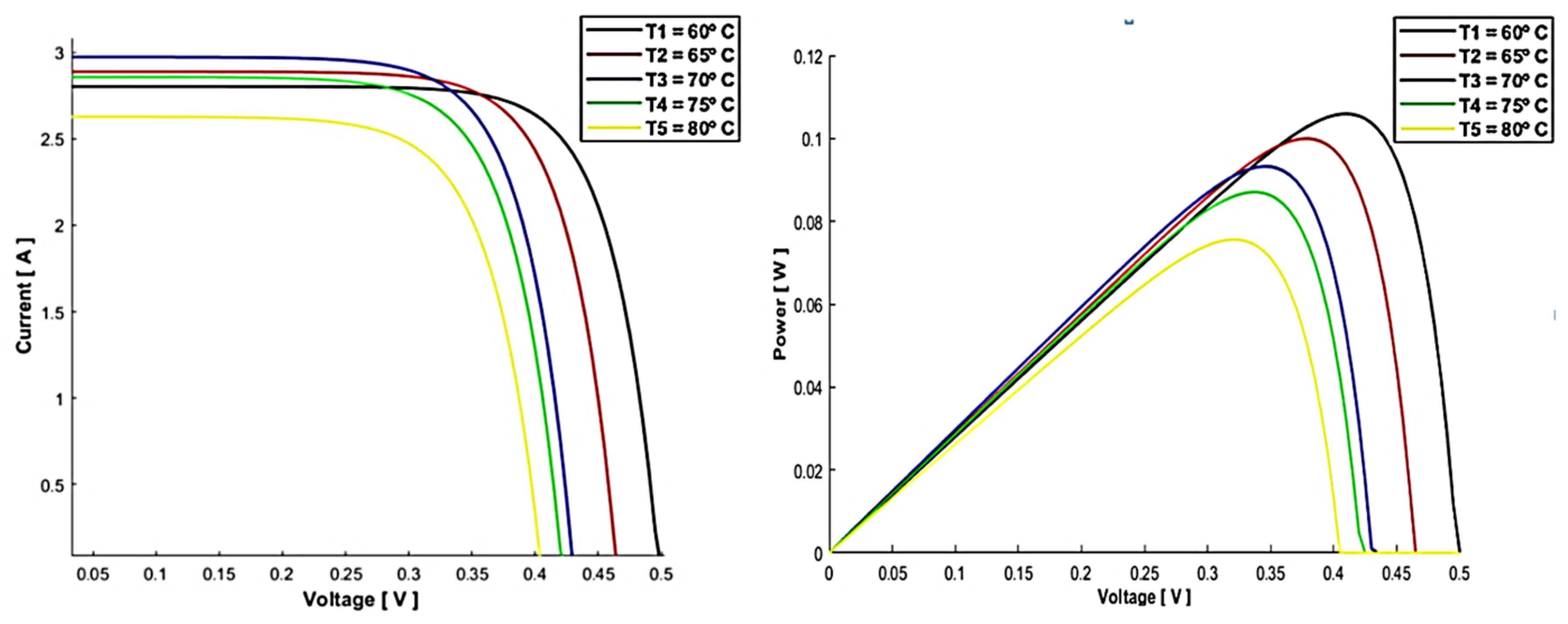
Photovoltaic (PV) devices, which have no moving parts and produce no noise or pollution, use the photovoltaic effect to convert solar radiation into electricity through a solid-state semiconductor cell [9,10]. Although PV systems are widely used, their performance is affected by temperature, dust, cloud cover, wind speed, cell technology, and solar irradiance [11]. While visible sunlight in PV systems effectively converts the incoming light spectrum into electrical energy, infrared radiation, in particular, causes the cells to heat up. This increase in the temperature of the PV cell negatively affects electrical efficiency by reducing the overall power output [12,13]. The efficiency of the PV cell decreases by 0.2% to 0.5% with each increase in temperature; the variation in current and power with voltage at different PV cell temperatures is shown in Figure 2 [14].
To solve this problem, photovoltaic thermal (PV/T) systems have been developed to remove excess heat and utilize it beneficially, thereby increasing electrical efficiency. These systems make use of the excess heat generated by PV modules to supply additional thermal energy for applications such as air heating ventilation systems, hot water generation, and drying. PV/T systems contribute to sustainability because they simultaneously provide thermal and electrical efficiency [15,16].
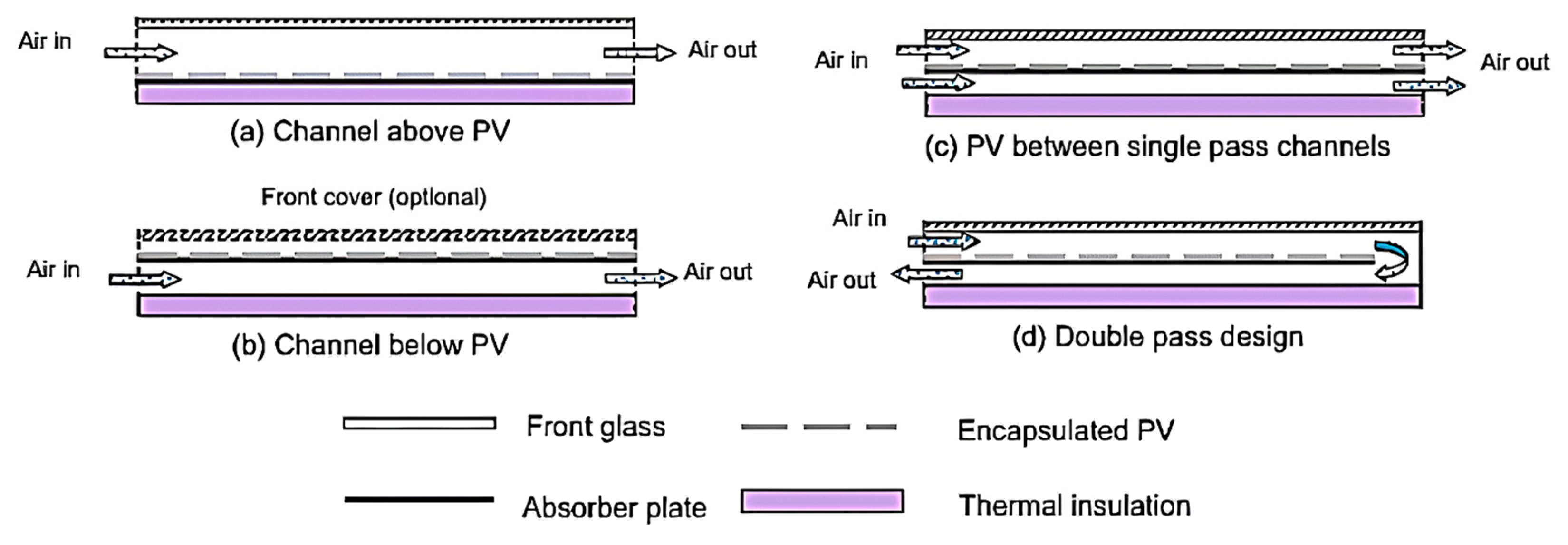
Although there are many classifications of PV/T systems, they are generally classified according to the collector type (flat and concentrator), the coolant (air, water, air–water, nanofluid, etc.), and the material (phase change materials, etc.) [17]. Although systems using liquid as a coolant in PV/T systems are more efficient than air-based systems, air-based systems are preferred due to their lower cost and ease of operation. PV/T air systems are simple and economical. In these systems, heat is removed from the system by forced or natural airflow. Forced systems provide better convective and conductive heat transfer than natural systems. However, fan power in forced systems reduces net electrical gain. Chow [18] divided PV/T air systems into four categories based on the location of the duct (Figure 3): (a) channel above PV; (b) channel below PV; (c) PV between single pass channels; and (d) double pass design. The efficiency of these systems varies depending on the geometric design, mass flow rate, use of fins, and the packing factor of the PV module. This study conducted research on an air-cooled PV/T air system where the channel is located below the PV.
Extensive research has been conducted to improve the electrical and thermal efficiencies of PV/T systems through various design modifications such as glazing [19,20,21], channel configuration [22,23,24], fins [25,26,27,28,29,30,31,32,33,34], and other enhancement devices [35,36,37].
Studies on glazing generally reveal higher thermal efficiencies and moderate improvements in electrical output. Agrawal and Tiwari [19] experimentally analyzed a glazed PV/T air collector through energy and exergy assessments, estimating a 1.8-year payback period and a CO2 reduction of 16.5 tons over a 30-year lifespan. Singh et al. [20] investigated the effects of channel width and depth, air velocity, glass and Tedlar thickness, and inlet air temperature on a PV/T system, finding an optimum thermal efficiency of 14% and an optimum electrical efficiency of 11%. Hussain and Kim [21] investigated air–water-cooled PV/T systems in two different configurations: glass–glass and glass–PV backsheets. They determined that the annual electrical and total thermal efficiencies in the glass–glass configuration were 14.31% and 52.22%, respectively, while the annual electrical and total thermal efficiencies in the glass–PV backsheet configuration decreased to 13.92% and 48.25%, respectively.
Several researchers have explored the impact of channel geometry on the performance of PV/T systems. Slimani et al. [22] investigated and compared three different PV/T air collectors: single pass, double pass, and glass. It was determined that the double pass collector performed better in terms of daily energy production. Soliman [23] numerically analyzed five PV/T system configurations in which air and water passed above and/or below the PV panel: (i) air above and water below, (ii) air above and below, (iii) air only above, (iv) air only below, and (v) water only below. The total energy efficiency of the system reached a maximum value of 90% when water was applied as the coolant at the bottom of the panel, while air was used at the top. Tang et al. [24] investigated an air-cooled PV/T system with slotted deflector channels, finding that the integration of metal foam improved thermal, electrical, and overall efficiencies by 3.03–7.69%, 0.60–2.31%, and 3.63–8.45%, respectively.
The role of fin utilization in improving heat transfer and overall efficiency of PV/T systems has been explored by some investigators. Özakin and Kaya [25] analyzed the energy and exergy performance of an air-based PV/T system with empty channels, sparse fins, and frequent fins. Compared to empty channels, the use of sparse and frequent fins increased the exergy efficiency of polycrystalline and monocrystalline panels by 70% and 30%, respectively, and their thermal efficiency by 55% and 70%, respectively. The panel surface temperature decreased by 10–15 °C. Mojumber et al. [26] tested a PV/T collector with fins (0–4) and a single pass, considering different mass flow rates (0.02–0.04 kg/s) and radiation levels (200–700 W/m2). Thermal efficiency of 56.19% was obtained with four fins and maximum airflow and radiation. Murtadha et al. [27] examined PV panel cooling using longitudinal and S-shaped fins, revealing panel temperature reductions of 11.9% and 9.6%, respectively. An experimental and numerical study was conducted by Arslan et al. [28,29] on a PV/T system with fins. Energy and exergy analyses were performed at different mass flow rates for Ankara, Türkiye. The average electrical efficiency was found to be between 13.56% and 13.98%, while thermal efficiency was found to be between 37.10% and 49.5%, respectively. Aktaş et al. [30] investigated experimentally and numerically a PV/T system with a perforated copper plate design. Ansys Fluent was employed to perform the numerical analysis of the system. The PV/T system achieved a maximum electrical efficiency of 17.62% and an average of 15.63%, whereas the corresponding thermal efficiencies reached 76.75% and 43.68%, respectively. The PV/T system’s payback period was calculated to be 6.1 years. Can et al. [31] performed both experimental and numerical investigations on a PV/T system incorporating waste aluminum. The results indicated that the system attained thermal efficiencies between 33% and 50%, while the electrical efficiency ranged from 11% to 13%. The use of waste aluminum effectively reduced the module temperature, leading to a notable improvement in overall energy performance. Diwania et al. [32] analyzed a V-groove air-cooled PV/T system under various climatic conditions in Ghaziabad, India, using the matrix inversion method. Theoretical and experimental results showed electrical, thermal, and overall efficiencies of 10.26–10.39%, 41.57–41.78%, and 51.81–52.17%, respectively. Kabeel et al. [33] conducted a study on the optimization of a dual air inlet PV/T system equipped with trapezoidal fins. The effects of varying fin parameters were analyzed using CFD with the k–ε turbulence model. The proposed system attained electrical and thermal efficiencies of 13.8% and 31.8%, respectively, highlighting its potential for enhanced sustainability. Yu et al. [34] designed an air-cooled PV/T system integrating micro heat pipes and serrated fins, optimizing performance under varying irradiance, temperature, and airflow conditions. Electrical and thermal efficiencies of 12.59% and 19.5% were obtained for the optimal configuration.
Several researchers have also examined the performance characteristics of PV/T systems using heat transfer enhancement methods other than those listed above. Almuwailhi and Zeitoun [35] compared natural and forced convection cooling in PV systems, showing that forced airflow at 3 m/s enhanced daily energy output and efficiency by 4.4% and 4%, respectively. Tahmasbi et al. [36] numerically analyzed an air-cooled PV/T system with porous metal foam, examining the effects of layer thickness, solar flux, and Reynolds number. Results indicated that the porous layer enhanced electrical efficiency by 3–4% and thermal efficiency by 10–40%, although excessive thickness (above half the channel height) reduced performance. Deokar et al. [37] developed an active cooling system using thermal grease and mild steel chips to enhance PV panel efficiency and reuse waste heat. With an air velocity of 5.2 m/s, electrical efficiency improved by 12.3% relative to the uncooled PV system, and the cell temperature was reduced by 16.1 °C.
Although extensive research has been conducted on enhancing PV/T system performance through glazing, channel design, and various fin geometries, most studies have focused primarily on thermal and electrical efficiencies while overlooking the integration of exergy and sustainability analyses. Moreover, the influence of advanced fin configurations—particularly Z-shaped fins—on the combined electrical, thermal, and environmental performance of air-cooled PV/T systems has not been comprehensively investigated. Some previous studies have investigated various fin geometries—such as straight, longitudinal, and S-shaped fins—to enhance the thermal performance of PV/T systems. However, the Z-shaped fin configuration proposed in this study introduces a distinctive mechanism for improving convective heat transfer and temperature uniformity. The alternating geometry of the Z-fin generates periodic flow redirection and controlled turbulence zones within the air channel, effectively disrupting the thermal boundary layer without causing a significant pressure drop. This results in enhanced heat transfer coefficients and more uniform cooling of the PV surface, leading to higher energy, exergy, and sustainability performance compared to other fin designs reported in the literature. Therefore, the Z-fin concept represents a novel and efficient enhancement strategy rather than a repetition of existing fin configurations. Furthermore, there are very few studies examining the performance of Z-finned PV/T systems under specific local climatic conditions. Therefore, this study aims to fill these gaps in the literature by performing a detailed numerical and thermal analysis of conventional and Z-finned air-cooled PV/T systems, including energy, exergy, and sustainability assessments under the climatic conditions of Malatya, Türkiye.
In this study, the performance of conventional and finned air-cooled photovoltaic thermal (PV/T) systems was numerically investigated, and energy, exergy, and sustainability analyses were conducted. The main objectives of the study are outlined as follows:
¬
To develop numerical modeling of conventional PV/T-C systems and Z-fin PV/T-F systems using ANSYS Fluent software.
¬
To analyze the temperature and velocity distributions of relevant components of PV/T-C and Z-fin PV/T-F systems using CFD and evaluate them by presenting visual results.
¬
To develop thermal modeling of conventional PV/T-C systems and Z-fin PV/T-F systems.
¬
To perform energy, exergy, and sustainability analyses of conventional PV/T-C systems and Z-fin PV/T-F systems.
¬
To conduct a comparative analysis of PV/T-C and Z-fin PV/T-F systems in terms of electrical efficiencies, thermal efficiencies, total efficiencies, exergy efficiencies, sustainability indexes, life cycle emissions, CO2 emission prices, levelized costs of energy, and payback periods.
¬
To compare the electrical, thermal, exergy, and sustainability performances of PV/T-C and PV/T-F systems under local climate conditions (Malatya, Türkiye).
The present study is organized as follows: Section 2 presents a description of the PV/T system. It details the components, parameters, and technical specifications of the air-cooled PV/T system. Thermal modeling and numerical modeling of the PV/T-C and Z-fin PV/T-F systems are also given in this section. Section 2 also gives the definition of electrical efficiency, thermal efficiency, overall efficiency, exergy efficiency, sustainability index, and environmental analysis. Section 3 analyzes and discusses the results. Firstly, validation of numerical results is given. Then, the comparison of the Z-shaped finned PV/T-F system with the PV/T-C system is presented. The section also presents the performance results of PV/T-C and PV/T-F systems under the climatic conditions of Malatya, Türkiye. Finally, Section 4 provides the main findings of this study.

2. Materials and Methods

This study was conducted to numerically investigate the effects of Z-shaped fins on the performance of air-cooled solar photovoltaic thermal (PV/T) systems. The numerical validation of the proposed model was performed by comparing its predictions with experimental data available in the literature.

2.1. Description of PV/T System

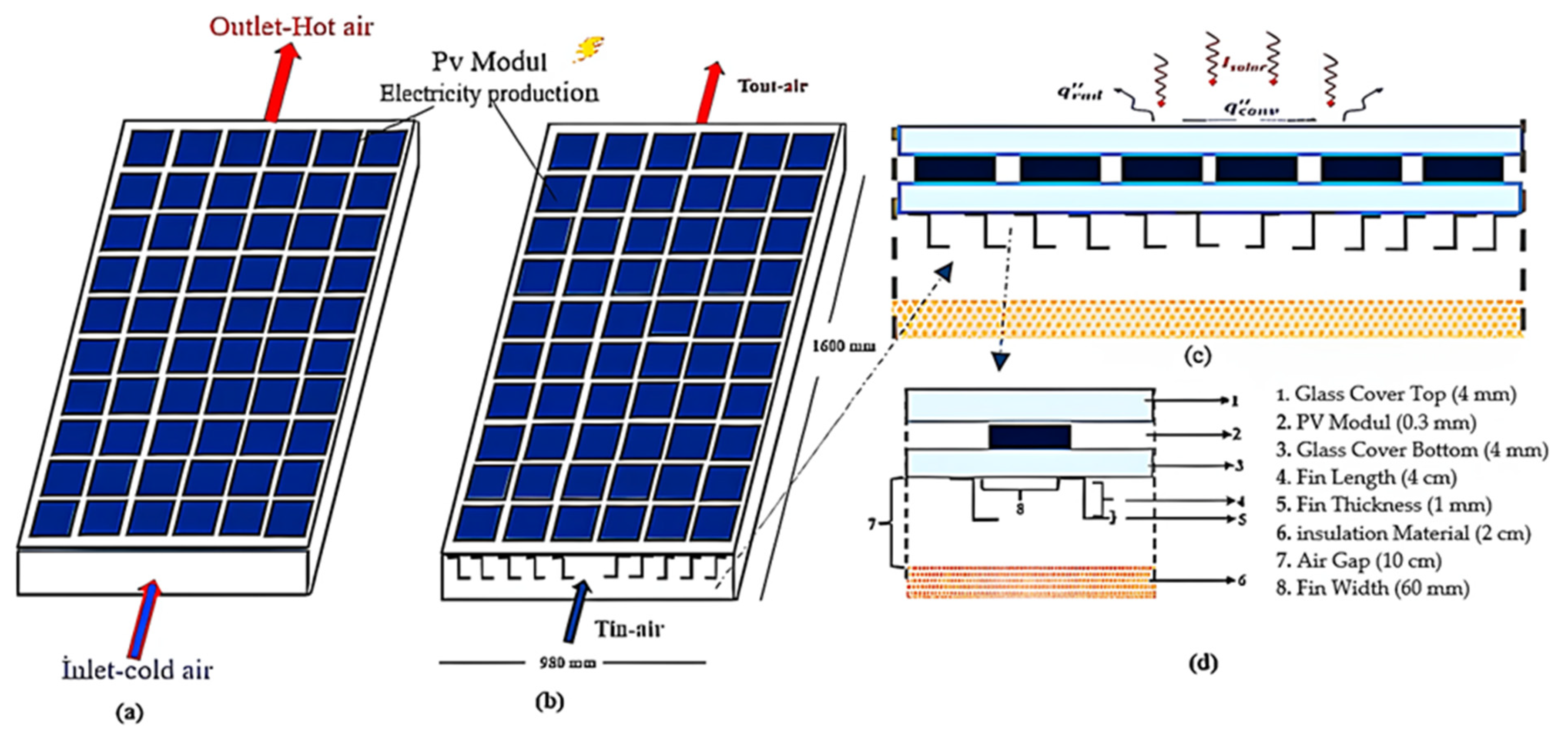
The schematic view of the PV/T system under consideration is given in Figure 4. Figure 4a shows a conventional PV/T system (PV/T-C) and Figure 4b shows a finned PV/T system (PV/T-F). Figure 4c,d shows the technical details of the PV/T system.
The PV/T system consisted of six layers (Figure 3c,d): (i) tempered glass, (ii) PV cells, (iii) tempered glass, (iv) fin, (v) air channel, and (vi) insulation. In the PV/T system, the solar cells were placed between two 4 mm thick panes of glass. There were 60 solar cells and they were each 0.3 mm thick. In this study, a 60-cells monocrystalline module was utilized as part of a hybrid PV/T collector system. The collector dimensions were 1600 mm × 980 mm, with a total area of 1.5245 m2. The channel height was 10 cm, and the bottom and sides were insulated with a 2 cm layer of insulation. The entire system was covered with a 1 mm thick aluminum layer [28].
The PV/T-F system had 12 copper fins with a Z-shaped profile, each with a fin height of 4 mm and thickness of 1 mm. The components and parameters of the PV/T air collector and the technical specifications are listed in Table 1.

2.2. Mathematical Modeling

2.2.1. Thermal Modeling
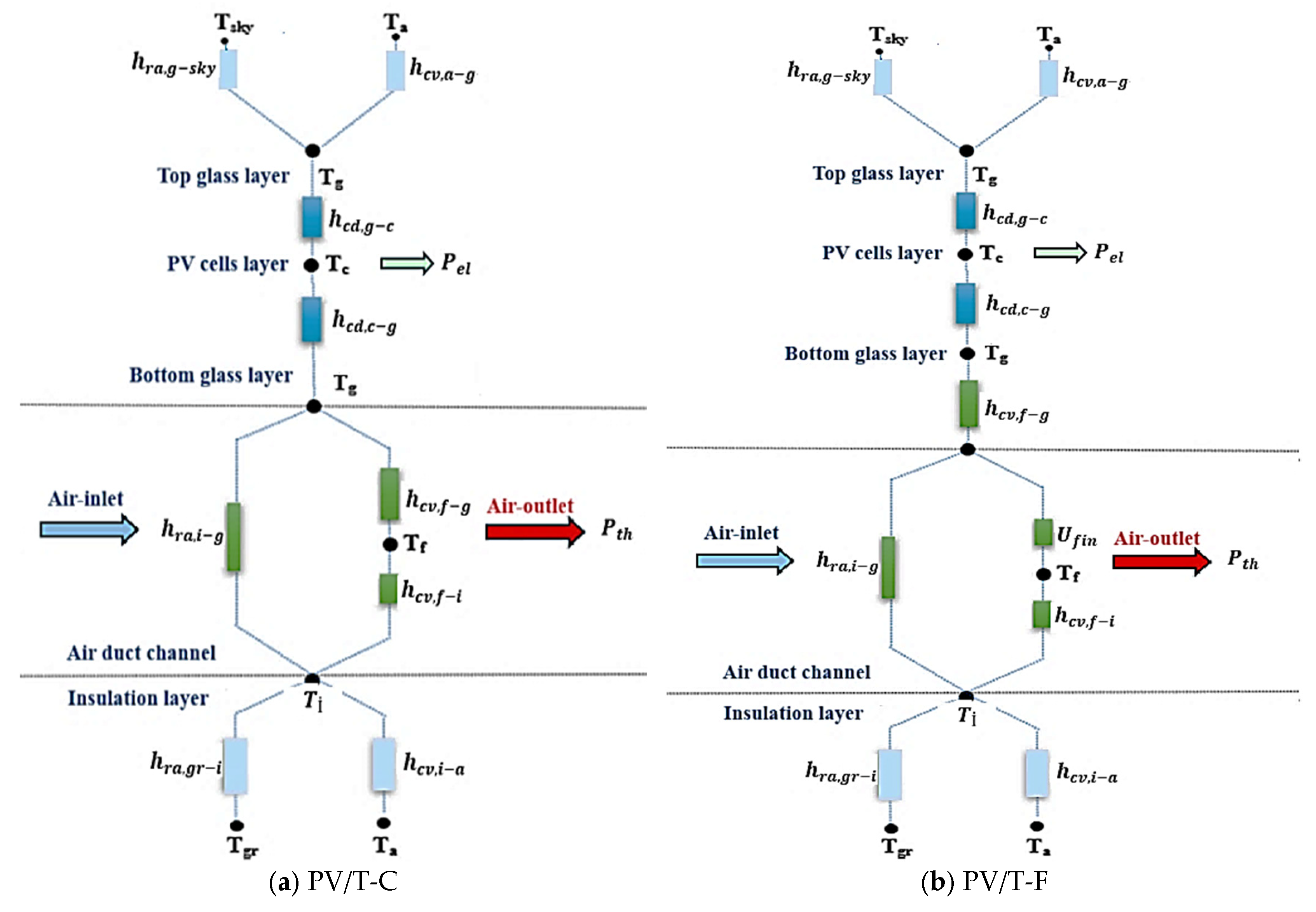
Heat balance equations corresponding to each component were employed to construct the thermal model of the PV/T system [38]. The thermal resistance model of the PV/T system is shown in Figure 5. Figure 5a shows a conventional PV/T system (PV/T-C) and Figure 5b shows a finned PV/T system (PV/T-F).
The energy conservation principle was employed to evaluate the internal temperature and the electrical and thermal performance of the system. Accordingly, phase-specific power balance equations were applied to the PV/T collector. This approach enabled a comprehensive analysis of the energy conversion processes within the system, including both power input and output [39,40].
Figure 5. Schematic representation of thermal resistances in the PV/T system [41].
Sustainability 17 10638 g005
The heat balance for each PV/T system component was formulated as follows [40]:
  • Top glass:
The energy balance for outer glass layer is expressed by Equation (1) considering radiative, convective, and conductive heat transfer coefficients hra,g−sky, hcv,a−g, and hcd,g−c [30,42]:
M g C g d T g d t = A ( α g G + h r a , g s k y T s k y T g + h c v , a ( T a T g ) h c d , g c ( T g T c ) )
where αg denotes the absorptivity of the glass cover (dimensionless), A is the collector surface area [m2], G represents the solar irradiance incident on the surface [W/m2], and Cg is the specific heat of glass [Jkg−1K−1]. T s k y   is the sky temperature, calculated from ambient temperature by Equation (2) via the Swinbank relation [43]:
T s k y = 0.0552 T a m b 1.5
The radiative heat transfer coefficient between the glass cover and the sky is formulated as follows [39]:
h r a , g s k y = σ ε g ( T s k y + T g ) ( T s k y 2 + T g 2 )
The convective heat transfer coefficient due to wind is expressed as [44,45]:
h c v , a = 2.8 + 3 V w
The heat transfer coefficient between adjacent layers n and m of the solar collector is determined using Equation (5):
  h c d , n m = 1 ( ( λ n / k n ) + ( λ m / k m )
where λ is the layer thickness [m], and k is the thermal conductivity [Wm−1K−1].
  • PV solar cells:
The mathematical definition of the PV cell layer is explained by Equation (6):
M c C c d T c d t = A ( τ g α c G F + h c d , g c T g T c + h c d , c g ( T c T g ) ) P e l
where Mc and Cc represent the mass [kg] and the specific heat capacity [Jkg−1K−1] of the PV cell layer, respectively. The parameters α c and τ g correspond to the solar cell’s absorptivity and the glass transmittance. The constant F = 0.82   denotes the packing factor of the PV module.
  • Bottom glass:
The differential energy balance for the bottom glass is given by Equation (7):
M g C g d T g d t = A . ( τ c τ g α g G F + τ g α g G 1 F + h c d , c g T C T g h c v , f g ( T g T f ) T g T i )
Mg and Cg denote the mass [kg] and the specific heat capacity [Jkg−1K−1] of the glass layer.
  • The air flowing in the duct:
The energy balance for the air fluid in PV/T-C system is given in Equation (8):
M f C f d T f d t = A h c v , f g T g T f + A h c v , f i T f T i P t h
where M f   and C f   denote the mass k g   and specific heat capacity [Jkg−1K−1] of the fluid, while T f   is the temperature of the fluid [K].
The energy balance of air in the PV/T-F system is expressed by Equation (9):
  M f C f d T f d t = A h c v , f g T g T f + A U f i n T c T f A h c v , f i T f T i P t h
M f   and C f   denote the mass k g   and specific heat capacity [Jkg−1K−1] of the fluid, while T f   is the temperature of the fluid [K].
The thermal power output of the system is expressed as follows:
P T H = m ˙ f C f Δ T f = m ˙ F C f ( T f , o u t T f , i n )
m ˙ f denotes the mass flow rate of the fluid [kg s−1], while T f , in and T f , out represent the inlet and outlet fluid temperatures, respectively.
The finned surface’s overall heat transfer coefficient [W m−2 K−1] is as follows [40]:
U f i n = N A f i n ( 2 k f i n A f i n L h c v , f i n ) 0.5 t a n h ( M H )
N denotes the number of fins, H represents the fin height, and A fin defines the total fin surface area contributing to heat transfer. The M parameter is obtained from Equation (12):
M = 2 L . h c v , f i n k f i n A f i n 0.5
where k f i n and L represent the thermal conductivity and the length of the fins along the collector, respectively.
The Nusselt number, used to evaluate the convective heat transfer coefficient, is expressed in Equation (13):
h c v , f i n = N u k f D h
kf denotes the thermal conductivity of the fluid [W m−1 K−1] and D h   is the channel’s equivalent diameter [m], which is obtained as follows:
  D h = 4 ( WH ) 2 ( W + H )
To determine the heat transfer coefficient in the channel formed by the rear surface of the collector’s absorber plate in the turbulent flow regime, the Nusselt number can be calculated with Equation (15) when the turbulent flow regime (Re > 2300) is [46]:
N u = 0.023 R e 0.8 P r 0.4
The dimensionless Prandtl number is determined as follows:
P r = μ C p   k
where µ denotes the fluid’s dynamic viscosity [kg/m.s], Cp is the specific heat capacity at constant pressure [Jkg−1K−1], and kf is the fluid’s thermal conductivity [Wm−1K−1].
The Reynolds number, an important dimensionless parameter characterizing fluid flow, is given by Equation (17):
R e = D h V ν
where V denotes the mean fluid velocity [ms−1] and ν represents the kinematic viscosity coefficient [m2s−1].
  • Thermal insulation:
For the insulation layer, the dynamic equation is expressed as Equation (18):
M i C i d T i d t = A h r a , i g T i T g h c v , i a ( T i T a ) h r a , g r i T i T g r h c v , f i ( T i T f )
where Mi and Ci correspond to the insulation layer’s mass [kg] and specific heat capacity [Jkg−1K−1].
The bottom glass–insulation layer radiative heat transfer coefficient is defined by the following expression [38]:
h r a , i g = σ T s k y + T g T s k y 2 + T g 2 1 ε g + 1 ε i 1
The coefficient of radiative heat transfer between the PV/T ground and the insulation layer is expressed as follows:
h r a , g r i = 0.5 σ ε i 1 + cos φ ( T g r + T i ) ( T g r 2 + T i 2 )
where φ represents the tilt angle of the PV/T system [rad].

2.2.2. Numerical Modeling

Computational fluid dynamics (CFD) simulations are an effective method for simulating mechanical systems and analyzing fundamental physical phenomena relevant to engineering applications. The PV/T system was numerically modeled using Ansys 2025 R1, a versatile CFD platform capable of simulating fluid flow, heat and mass transfer, chemical reactions, and related processes. The creation of the geometric structure and modeling of the PV/T system were developed in Ansys Design Modeler, and the numerical models were validated against experimental data reported in the literature. The solution steps in the Ansys program are shown in Figure 6.
Creating the Geometric Structure
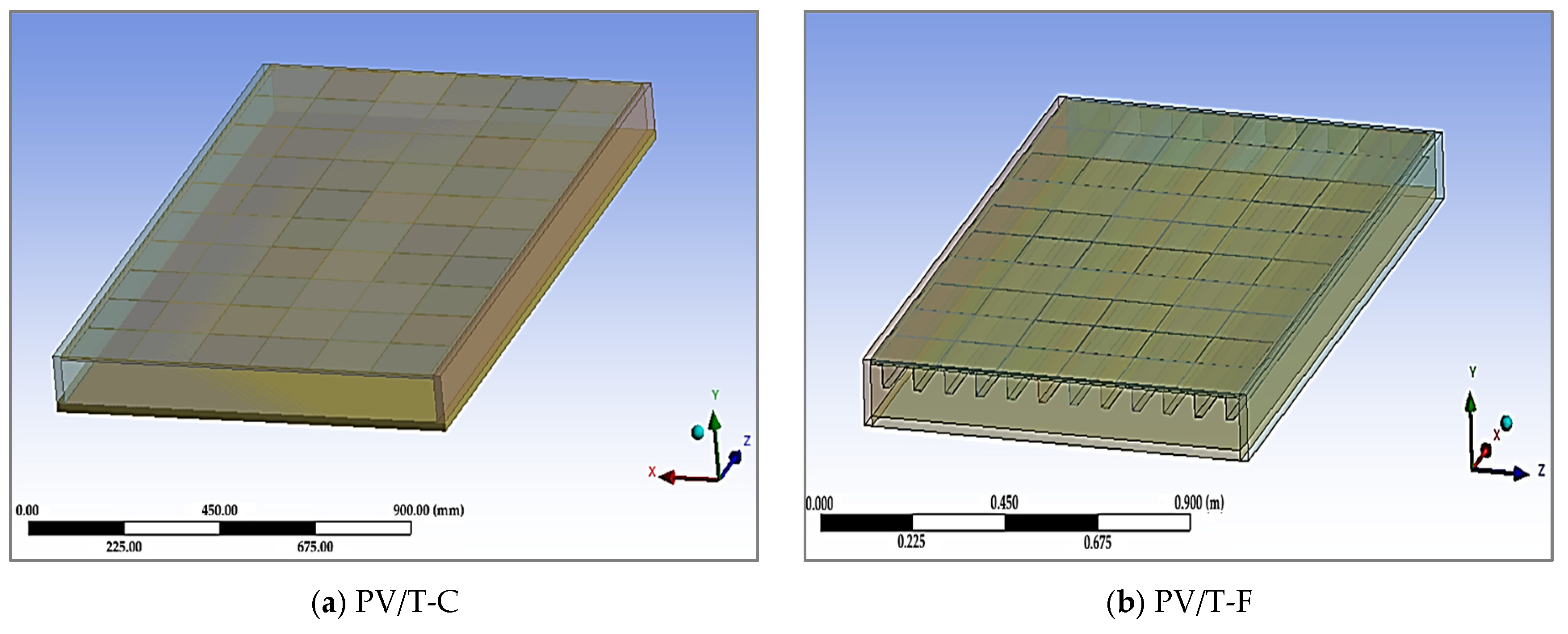
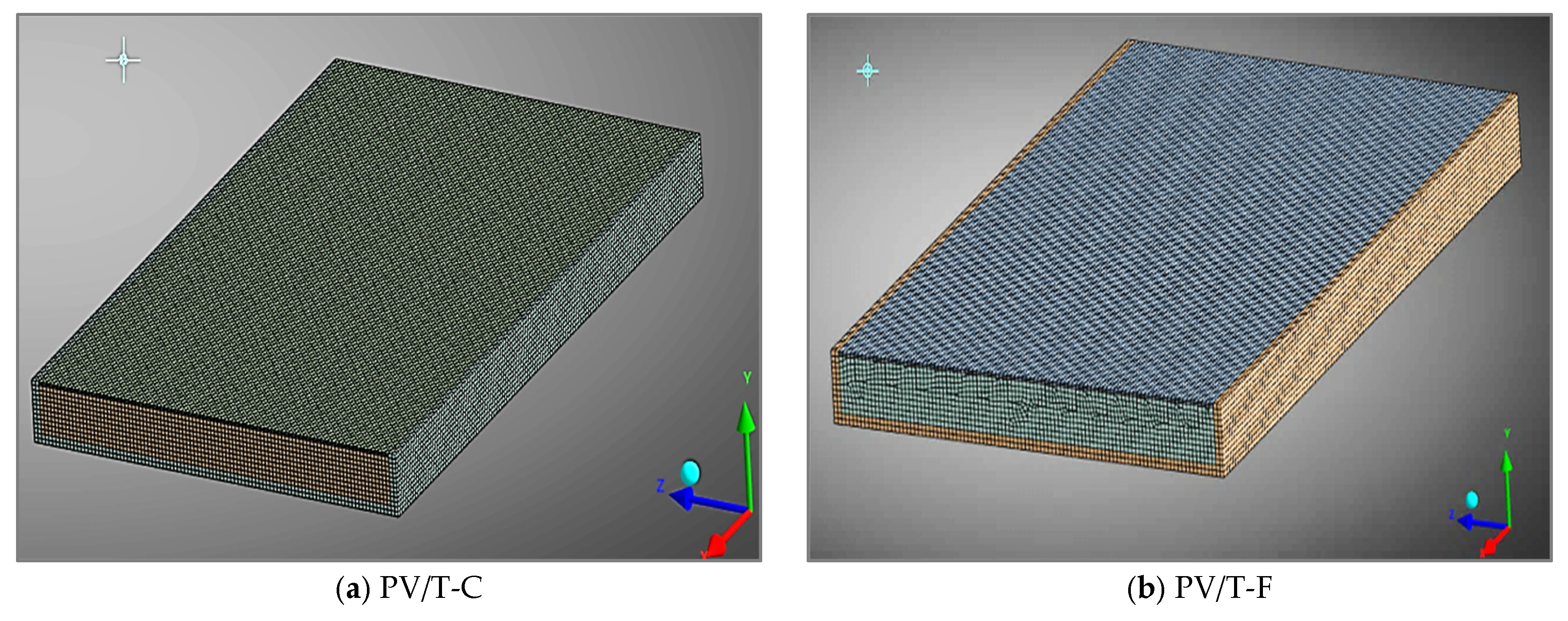
The examined PV/T-C and PV/T-F systems were modeled with ANSYS Design Modeler software, and the created geometric structures are given in Figure 7.
Creating the Mesh Structure
The construction of the computational grid, composed of computational cells, constitutes a crucial step in CFD analysis and is achieved by partitioning the geometric domain into a network of the elements and nodes available [47]. There is a positive correlation between the accuracy of the simulation results and the number of elements or nodes used in meshing the model. Smaller mesh elements within the transition and boundary zones increase the precision in resolving gradients of the boundary layer and temperature field [30]. Creating a very fine mesh using small elements produces more accurate results but increases the solution time. Therefore, an optimal mesh structure is essential for calculating accurate results in a short time [48]. Skewness, element quality, aspect ratio, and orthogonal values are available in the Ansys program to indicate mesh quality. In this study, skewness value was used as the basis for mesh quality assessment. The closer this value is to zero, the better the model’s mesh quality (Table 2) [49].
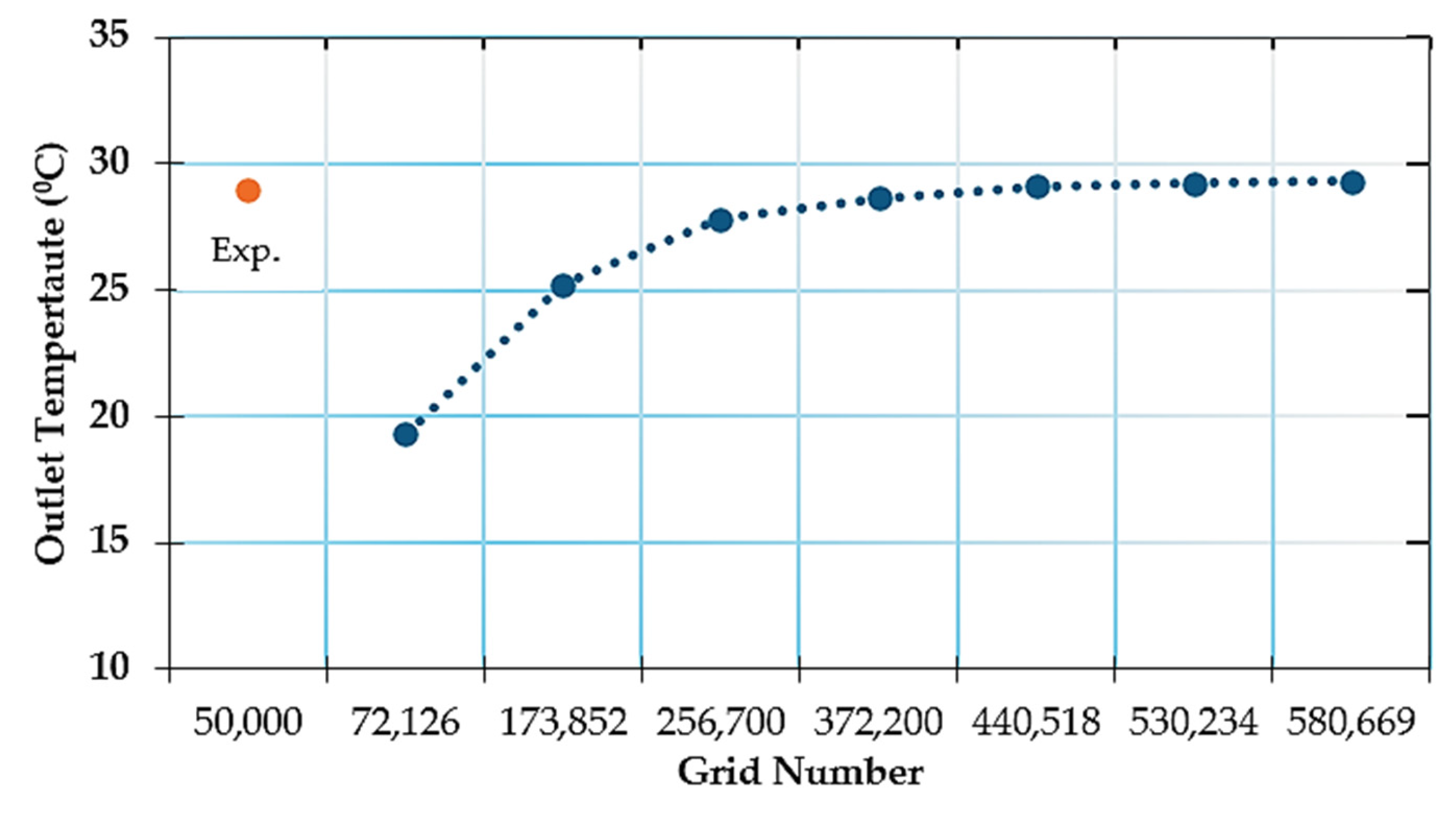
In this study, the mesh structure was created under program control using 3D linear Hex elements and using fine mesh transitions. The fine mesh configuration demonstrated superior accuracy and coherence in predicting heat transfer, velocity, and temperature distributions inside the collector influenced by a bulge geometry. Element size was adjusted until the average skewness value reached 0.08. Figure 8 confirmed convergence at ~580,669 cells for outlet temperature (~29.3 °C). The created network structure is shown in Figure 9.
Initial and Boundary Conditions
After creating the network structure, initial and boundary conditions were determined. Before moving on to the solution phase, the surfaces where the air inlet and outlet would be located in the model needed to be named. The area where the air would enter the PV/T system was designated “inlet-air”, and the area where the air would exit was designated “outlet-air”. Data from the experimental study, which were used as the reference boundary conditions for model validation, were used. A heat flux boundary condition was applied to the top surface of the upper glazing. In all parametric studies, the inlet air velocity was 2.5 m/s, the outdoor air temperature was 25 °C, and the solar radiation was 1000 W/m2. While analyzing the performance of PV/T-C and PV/T-F systems under local climate conditions, the average climate data for Malatya, Türkiye for the years 1946–2024 were used.
This study was conducted based on the following assumptions:
¬
For the PV/T system, the solar panel received an average heat flux, whereas all other boundaries were considered adiabatic [50].
¬
The inlet air velocity was assumed to be uniform, and a pressure condition was applied at the outlet.
¬
The physical properties of the materials were considered constant [51].
¬
The fin absorber material was assumed to be homogeneous, and a uniform heat transfer coefficient (Ufin) was applied to the entire surface of the fins.
¬
The ambient temperature was to be uniform around the collector [52].
¬
Heat losses from the PV-T collector frame were considered negligible [53,54].
¬
No leakage in the channel was assumed.
¬
Air was treated as an ideal gas, and its thermophysical properties were considered uniform along the entire channel [55].
Solving Governing Equations
The continuity, momentum, and energy equations are given below [30]:
  • Continuity Equation:
ρ / t + ρ V = 0
  • Momentum Equations:
( ρ u ) / t + ρ u V = p / x + μ u + ρ g x
( ρ v ) ) / t + ρ v V = p / y + μ v + ρ g y
( ρ w ) ) / t + ρ w V = p / z + μ w + ρ g z
  • Energy Equation:
ρ c p ( d T / d t ) + T V = k T
The analysis includes a detailed 3D CFD model of the PV-T collector, fluid dynamics, and heat transfer [56]. Air was employed as the working fluid, and the energy equation was activated under steady-state conditions. The convergence for the residual velocity components in the continuity equation was set to 10−6. The finite volume method, in combination with a second-order upwind scheme, was applied to solve the continuity, momentum, and energy equations, with the SIMPLE algorithm used for their discretization.
The standard k–ε model, which provided quite accurate results in many studies, was preferred as a turbulence model [28,30,33,38]. The k–ε model belongs to the Reynolds-averaged Navier–Stokes (RANS) turbulence model family. Alongside the conservation equations, the transport equations for turbulent kinetic energy (k) and its dissipation rate (ε) were solved [55,57]. The turbulent kinetic energy k is given in Equation (26):
t ρ k + x i ρ k u i = x j μ + μ t σ k k x j + P k + P b ρ ε Y m + S k
The transport equation for the dissipation ε is given as:
t ρ ε + x i ρ ε u i = x j μ + μ t σ ε ε x j + C 1 ε ε k P k + C 3 ε P b C 2 ε ρ ε 2 k + S ε
Pk is the turbulent kinetic energy generated by the mean velocity shift, Pb is production due to the lift force, Sε is the user-defined source, σ is the turbulent Prandtl number, and C1, C2, C3, and Cμ are the model coefficients. Model constants are listed in Table 3 [57].

2.3. Electrical Efficiency

The electricity generation efficiency of a PV/T is related to the panel temperature and the data at standard test conditions. This relationship could be shown by Equation (28) [58]:
E P P P V / T = G A P V / T   n P V , r e f   [ 1 B r T c e l l T r e f ]
The values of ηPV,ref, Br, and Tref are 0.12, 0.00356 K−1, and 20 °C, respectively, based on the characteristics of the PV module [28,29], while Tcell was obtained from numerical simulation results. Furthermore, the panel’s electrical efficiency was calculated according to Equation (29) [59]:
n e l = E P P P V / T G A P V / T

2.4. Thermal Efficiency

The thermal energy analysis of the PV/T air collector was determined based on the inlet and outlet air temperatures. The average value of the outlet air temperature was obtained from the simulation. Furthermore, the useful heat and thermal efficiency could be determined using Equation (30) and Equation (31), respectively [60,61]:
Q u = m a ˙ c a ( T a , o u t T a , i n )
n t h = Q U G ı A P V / T
where m ˙ a can be rewritten as ρaAinVa.

2.5. Overall Energy Efficiency

The overall energy efficiency, combining electrical and thermal contributions, was formulated in Equation (32), with 0.38 indicating the plant factor that quantifies the conversion efficiency from electrical to thermal energy [61,62]:
n e n , o v e r a l l = n e l   0.38 + n t h

2.6. Exergy Analysis and Sustainability Index

Exergy represents the amount of work, mass, or energy flow that a system can deliver when brought into equilibrium with the reference environment [63]. Exergy analysis helps identify the location, type, and extent of waste and losses, and helps reduce system inefficiencies. Exergy analysis is highly beneficial in optimizing the thermal and electrical conversions of PV-T collectors [44].
Equations (33) and (34) express the exergy associated with solar energy at the system’s inlet and outlet, respectively [64]:
  E x , i n = A G 1 4 3 T a T s + 1 3 T a T s 4
E ˙ x , o u t = Q ˙ l o s s 1 T a T c e l l
T s (K) denotes the sun’s temperature (5770 K), Tcell (K) represents the PV/T collector’s cell temperature, and Q ˙ l o s s is the heat loss [30].
Exergy balance is defined by Equations (35)–(39) [65]:
E ˙ x , i n E ˙ x , o u t = E ˙ x . d
E ˙ x , i n ( E ˙ x , t h + E ˙ x , P V ) = E ˙ x d
  E ˙ x t h = Q ˙ u 1 T a T o u t
E ˙ x , P V = n e l A G 1 4 3 T a T s + 1 3 T a T s 4
E ˙ x , P V / T = E ˙ x , t h + E ˙ x , P V
E ˙ x . d (W) is the exergy destruction.
The PV/T system’s exergy efficiency was calculated as follows [66]:
n e x = 1 E ˙ x , d E ˙ i n = E ˙ x , o u t E ˙ x , i n
The sustainability index (SI) was calculated as follows [61]:
S I = 1 1 n e x
A higher sustainability index indicates a reduced environmental footprint and promotes sustainable development. When designing a PV/T air collector system, preference is given to systems with a higher sustainability index.

2.7. Techno-Economic and Environmental Analysis

This study examined the life cycle emissions of CO2 (LCEs), a component of lifecycle analysis (LCA), to measure the environmental impacts of PV/T systems. This analysis facilitated product sustainability and redesign [67]. The annual LCE value could be determined using the CO2 emission coefficient ( y C O 2 ) corresponding to the reference energy system evaluated through the LCA method:
L C E C O 2 = y C O 2 f i r s t m o n t h L a s t m o n t h E P P P V / T 0.38 + Q u m o n t h
The CO2 emission value ( y C O 2 ) for the reference energy system is 4.35 × 10⁻² kgCO2/kWh [68].
Carbon pricing, also referred to as CO2 pricing, is a policy mechanism through which governments assign a monetary cost to greenhouse gas emissions to mitigate climate change. This economic instrument incentivizes emitters to reduce fossil fuel consumption, the primary contributor to global warming. The carbon pricing was computed according to the following expression [69]:
C C O 2 = L C E C O 2   e p C O 2
e p C O 2 is the CO2 emission price and is equal to 0.0145 USD/kgCO2.
The levelized cost of energy (LCOE) quantifies the present value of total lifetime expenditures, including initial investment cost (IC), operation and maintenance (O&M) expenses, and salvage value (SV), normalized by the total energy produced throughout the system’s operational lifetime. It serves as a widely accepted metric for comparing various generation technologies and is typically expressed in terms of USD/kWh or USD/MWh. In general, LCOE could be calculated as follows [61,70]:
L C O E = C R F I C + O & M S V E P P P V / T 0.38 + Q u   a n n u a l
where IC is initial investing cost [USD], O&M is the system operation and maintenance costs [USD], and SV is revenue from end-of-life equipment [USD]. The capital recovery factor (CRF) was determined as follows:
C R F = r ( 1 + r ) n ( 1 + r ) n 1  
where r is the interest rate [%] and n is the system lifetime [years]. In this study, r = 8% and n = 20 years were taken [71]. O & M was calculated as follows:
O & M = 0.05   C R F   I C 1 + r n 1 r 1 + r n
SV was evaluated using the following equation [61]:
S V = 0.20 × I C 1 + r n  
Based on the current prices of components in Türkiye, including PV modules, inverters, fans, manifolds, fin materials (copper), insulation, sensors, and connectors, the initial investment cost of the PV/T-C system was estimated at approximately USD 320, while that of the PV/T-F system was approximately USD 327 [72,73,74,75,76,77,78].
The payback period (PBT) refers to the duration required for the cumulative annual cash flow, accounting for the time value of money, to equal the initial investment. PBT was obtained using the following equation [79]:
  t t p a y b a c k ( c e l ( E P P P V / T ) ) a n n u a l + c t h   ( Q u a n n a u l ) ) + S V a n n u a l O & M a n n u a l 1 + r t = I C
where c e l   is electricity tariffs [USD/kWh] and c t h   is heat tariffs which the thermal energy produced by the collector is assumed to be equivalent to the heat obtainable from LP gas combustion [USD/kWh]. For Malatya, Türkiye, the local unit costs of electricity ( c e l ) and thermal energy ( c t h ) were taken as 0.055614 USD/kWh and 0.0262331 USD/kWh, respectively [80,81].

2.8. Statistical Validation of the Numerical Model

The simulation model developed in this study was validated through a comparison with the experimental results reported by Arslan et al. [28,29], which utilized a 300 W air-cooled PV/T air collector incorporating a monocrystalline photovoltaic module. The mean square error (MSE) and Pearson correlation coefficient (R) parameters were employed to compare the simulation results obtained in this study with the experimental results obtained by Arslan et al. [28,29]. The mean square error (MSE) and Pearson correlation coefficient (R) are given below:
M S E = 1 n i = 1 n Y i X i 2
R = i = 1 n X i X ¯ · Y i Y ¯ i = 1 n X i X ¯ 2 . i = 1 n ( Y i Y ¯ ) 2
where Y i and X i are the predicted and actual values, respectively, and n is the number of observations. X ¯ represents the mean of the actual values (Xi) and Y ¯ represents the mean of the predicted values (Yi). The Pearson correlation coefficient expresses the statistical relationship between two continuous variables. The coefficient takes values between −1 and +1. Correlation coefficients close to +1 reflect a strong positive association between the variables, while coefficients near 0 denote weak or no correlation, and values approaching −1 indicate a strong negative relationship [82]. It is desirable for the mean squared error to be as close to 0 as possible.

3. Results and Discussion

3.1. Validation of Numerical Result

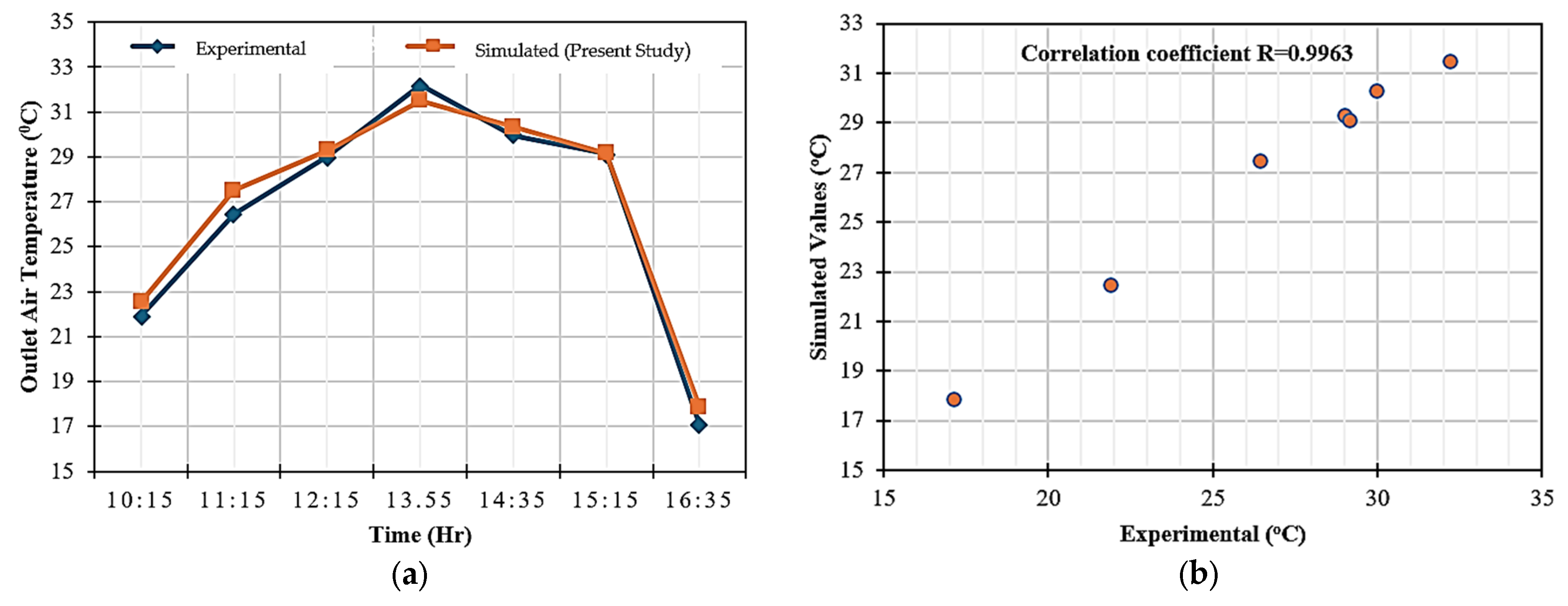
The numerical simulation model developed in this study was validated by comparing it with the results of the experimental study conducted by Arslan et al. [28,29]. The simulation study used data obtained from an experimental study conducted by Arslan on 3 November 2019, under the mass flow rate of 0.04553 kg/s. Table 4 presents the simulated outlet air temperatures along with their corresponding experimental measurements for the test day.
Figure 10 illustrates the comparison results, indicating a strong agreement between the experimental and simulated curves. For the outlet air temperature, the MSE and R are 0.40 and 0.9963, respectively. These results indicate that there is a very good agreement between the numerical simulation results and experimental results.
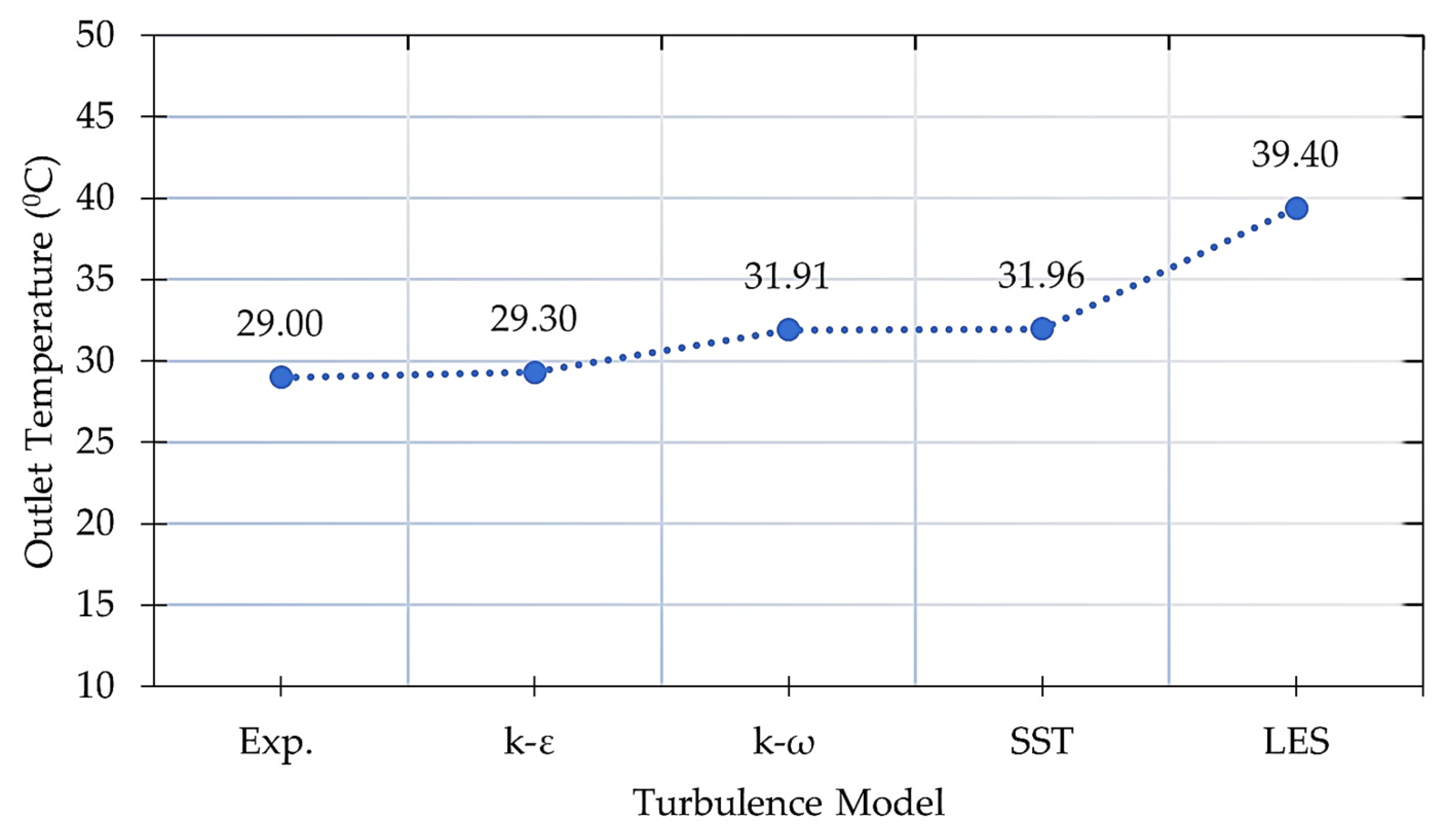
The mesh density and turbulence model selection results are presented in Table 5. As shown in the table, when the mesh size is 72,126 elements for the k–ε model, the deviation between the numerical and experimental results is 33.41%. Increasing the mesh size to 580,669 elements reduces this deviation to 1.03%. Consequently, a mesh size of 580,669 elements is adopted for all subsequent numerical simulations. Using this mesh configuration, the outlet temperatures predicted by the k–ε, k–ω, SST, and LES models are 29.30 °C, 31.91 °C, 31.96 °C, and 39.40 °C, respectively, as illustrated in Figure 11. Since the k–ε turbulence model yields results that most closely match the experimental data, it is selected as the preferred turbulence model for the numerical analyses conducted in this study.

3.2. Comparison of PV/T-C and PVT-F Systems

In this section, the results for a conventional photovoltaic thermal (PV/T-C) system and a Z-shaped copper fin PV/T-F system are given. The temperature distributions, velocity distributions, electrical efficiencies, thermal efficiencies, overall efficiencies, exergy efficiencies, and sustainability indexes of both systems are presented comparatively.

3.2.1. Temperature Distributions

This section examines the distributions of top glass temperatures, PV cell temperatures, channel top surface temperatures, channel mid-section temperatures, and outlet section air temperatures of PV/T-C and PV/T-F systems.
Top Glass Temperature
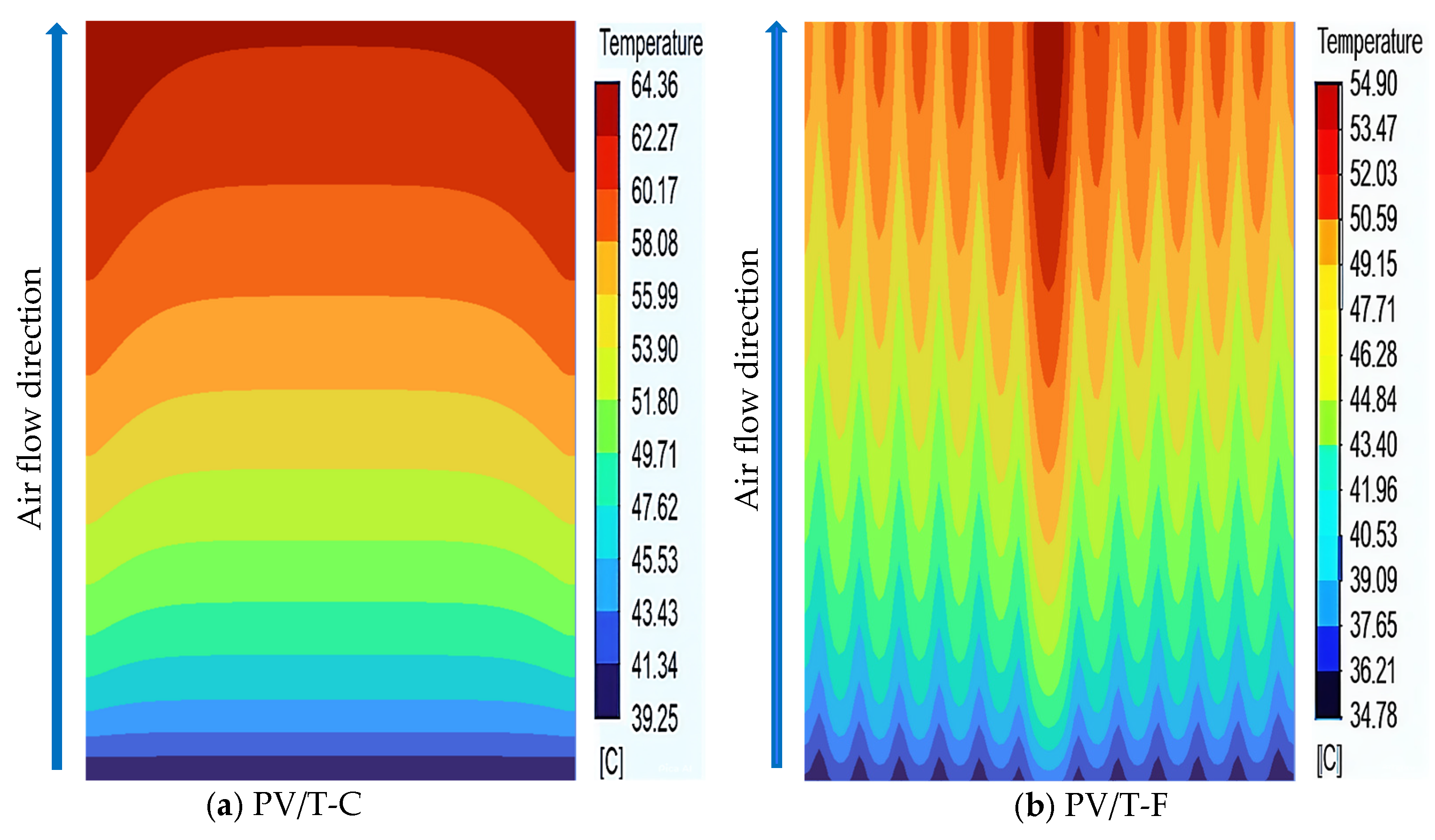
Figure 12 shows the temperature distribution of the top glass surface of PV/T systems. The temperature distribution of the top glass surface of the PV/T-C system is given in Figure 12a, while the temperature distribution of the top glass surface of the PV/T-F system is given in Figure 12b. In the PV/T-C system, the temperature is 39.25 °C at the bottom of the upper glass and reaches 64.36 °C at the top. The temperature contour ranges increase as one move towards the top. In the PV/T-F system, the temperature begins at 34.78 °C at the bottom of the upper glass and reaches 54.90 °C at the top. It is observed that the surface temperatures in the direction of airflow are higher than those along the fins. This is attributed to the fins enhancing heat transfer through conduction. The highest temperatures are seen in the center of the panel. A comparison of Figure 12a,b indicates that the temperatures in the PV/T-F system are generally lower than those in the PV/T-C system. This difference is approximately 5 °C in the lower sections of the PV/T-F system and reaches approximately 10 °C at the top.
The Average PV Cell Temperature
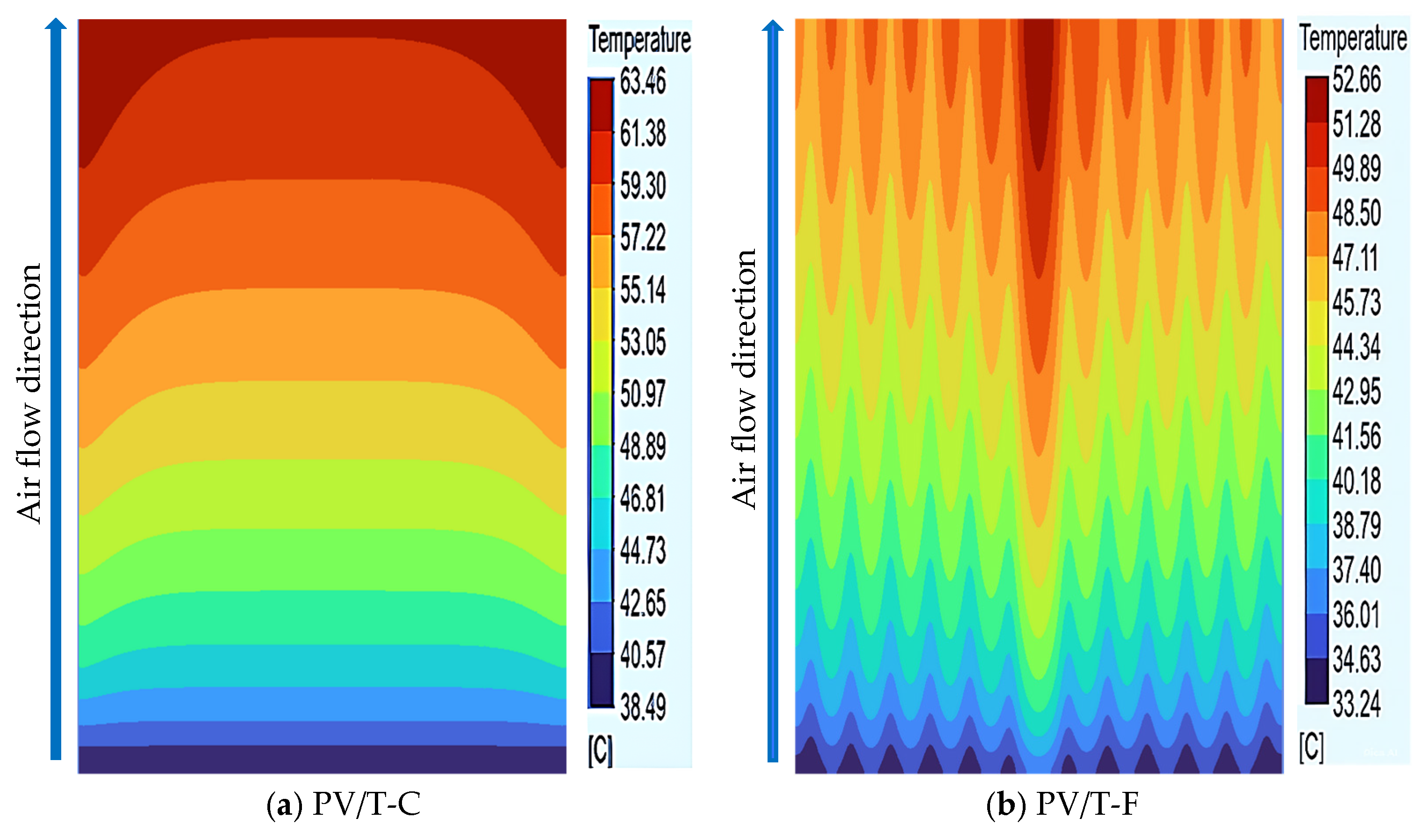
Figure 13 shows the temperature distribution of the PV cell surfaces of PV/T systems. The temperature distribution of the PV cell surfaces of the PV/T-C system is given in Figure 13a, while the temperature distribution of the PV cell surfaces of PV/T-F systems is given in Figure 13b. In the PV/T-C system, the PV cell temperature is 38.49 °C at the bottom of the upper glass and reaches 63.46 °C at the top. The average PV cell temperature is 50.24 °C. The temperature contour ranges increase as one move towards the top. In the PV/T-F system, the temperature begins at 33.24 °C at the bottom of the upper glass and reaches 52.66 °C at the top. The average PV cell temperature is 43.59 °C. It is observed that the cell temperatures in the direction of airflow are higher than those along the fins. This is attributed to the fins enhancing heat transfer through conduction. The highest temperatures are seen in the center of the panel.
A comparison of Figure 13a,b indicates that the PV cell temperatures in the PV/T-F system are generally lower than those in the PV/T-C system. This difference is approximately 5 °C in the lower sections of the PV/T-F system and reaches approximately 10 °C at the top. The use of fins in the PV/T-F system reduced the average PV cell temperature by approximately 6.65 °C compared to that of the PV/T-C system
Channel Top Surface Temperature
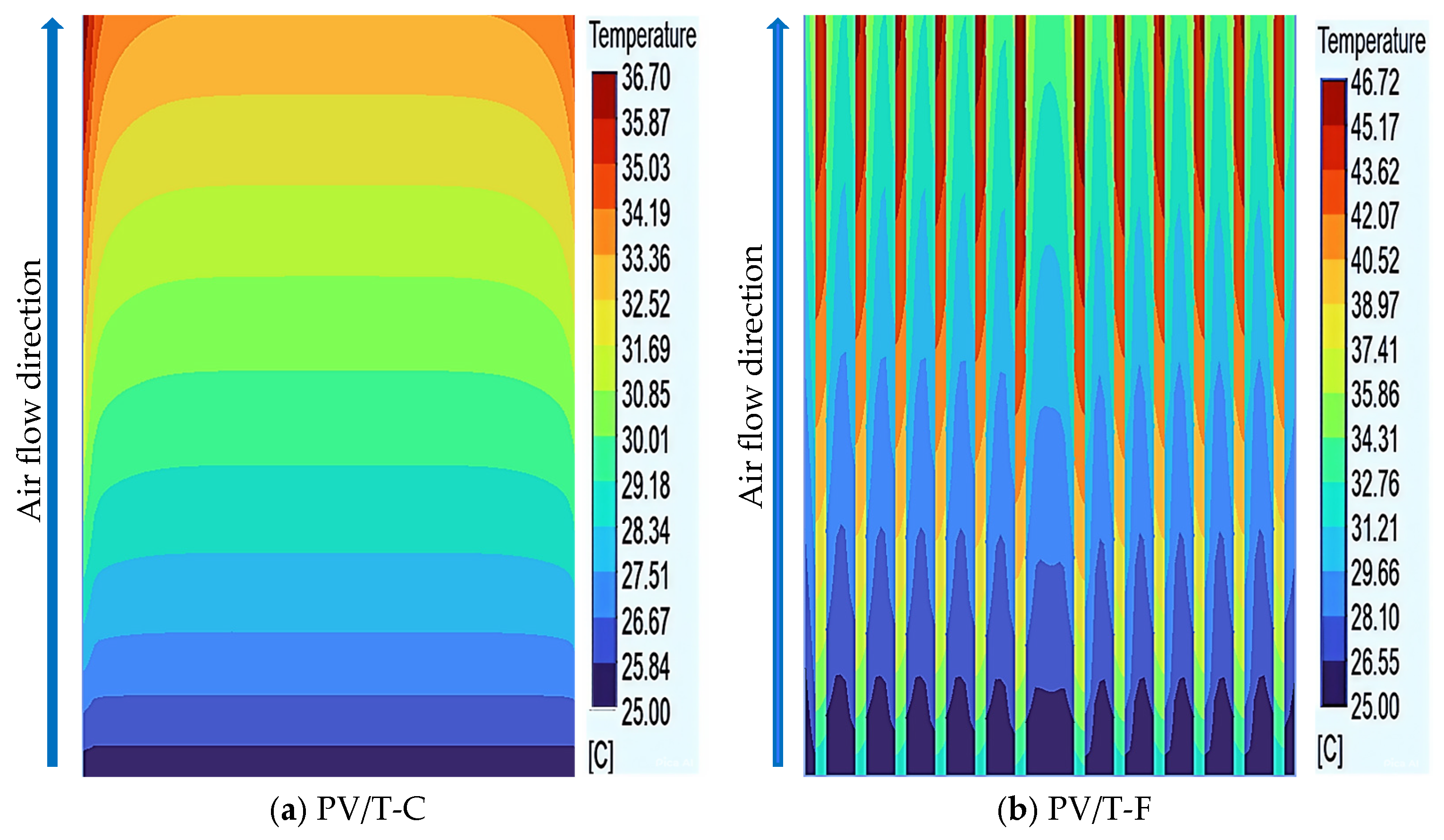
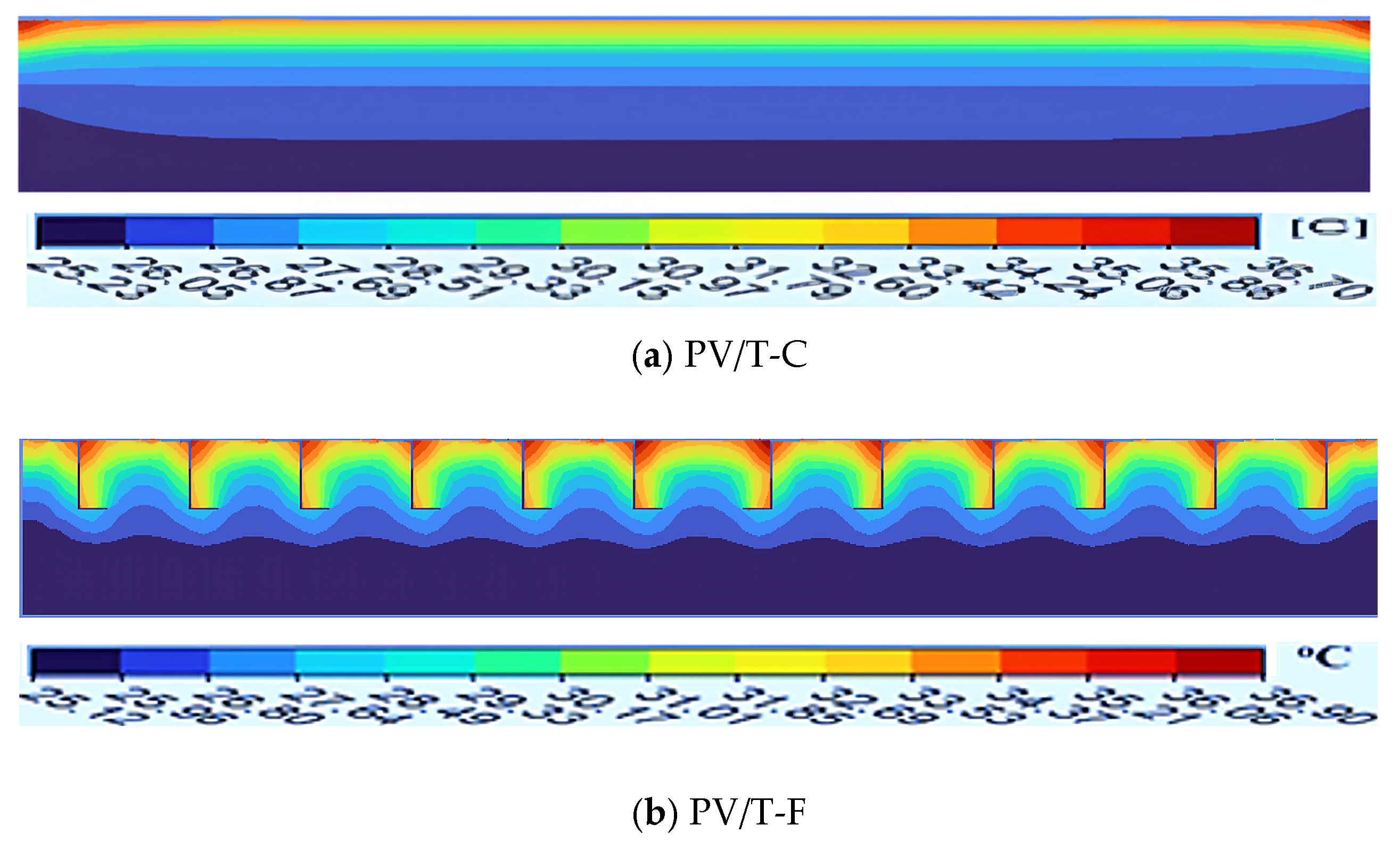
Figure 14 shows the temperature distribution of the channel top surface of PV/T systems. The temperature distribution of the channel top surfaces of the PV/T-C system is given in Figure 14a, while the temperature distribution of the PV channel top of the PV/T system is given Figure 14b. In the PV/T-C system, the channel top surface temperature is 25.00 °C at the bottom of the upper glass and reaches 36.70 °C at the top. In the PV/T-F system, the temperature begins at 25.00 °C at the bottom of the upper glass and reaches 46.72 °C at the top. It is observed that the surface temperatures in the direction of airflow are higher than those along the fins. This is attributed to the fins enhancing heat transfer through conduction. The highest temperatures are seen in the center of the panel. A comparison of Figure 14a,b shows that the temperatures in the PV/T-F system are generally higher than those in the PV/T-C system. While the channel top surface temperature equals the air inlet temperature of 25 °C in the lower sections of both the PV/T-C and PV/T-F systems, the channel top surface temperature of the PV/T-F system is approximately 10 °C higher than the PV/T-C system in the upper sections.
Channel Mid-Section Temperature
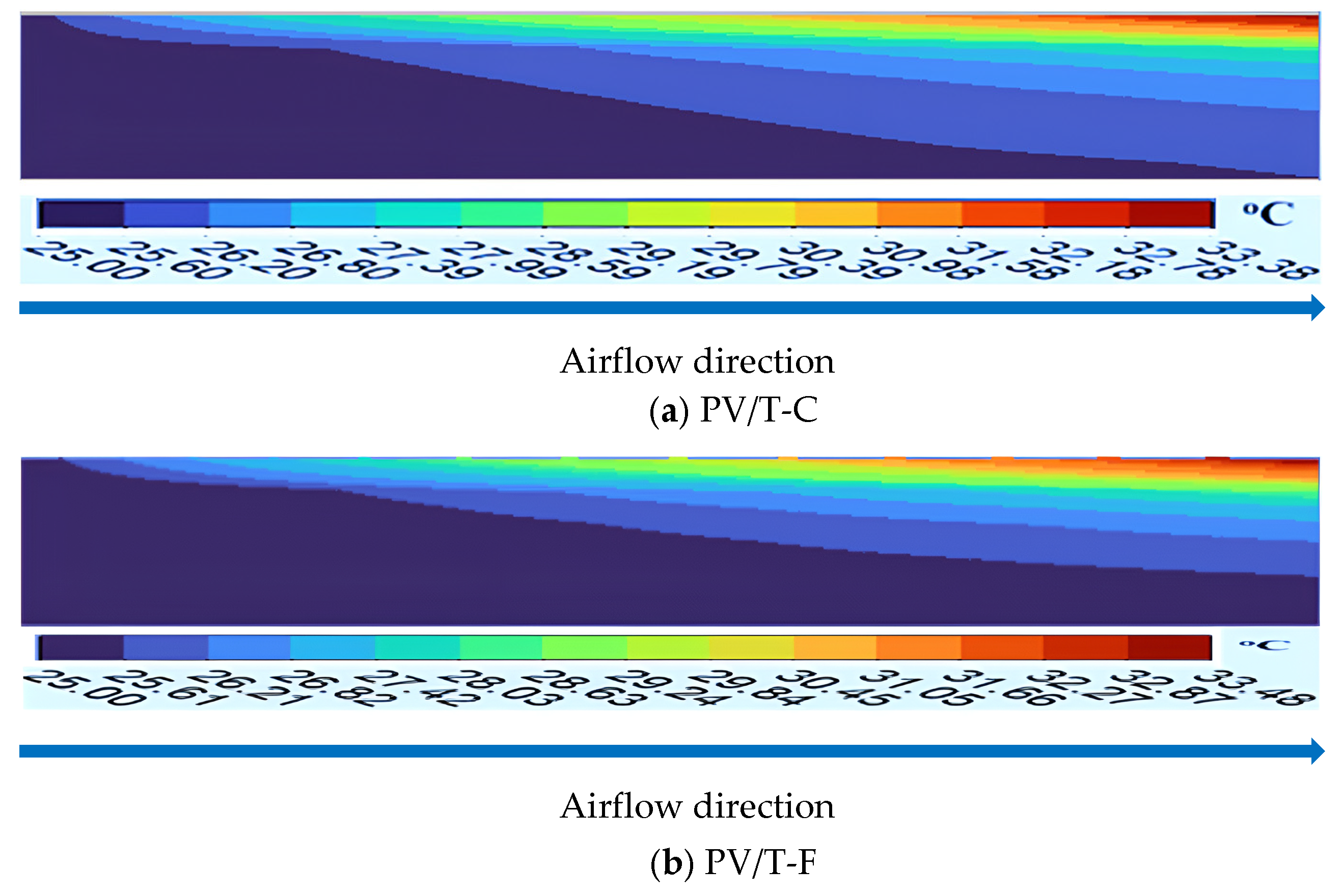
The temperature distributions along the longitudinal mid-section of the channel are shown in Figure 15. The temperature distribution of the PV/T-C mid-section is shown in Figure 15a, while the temperature distribution of the PV/T-F system mid-section is shown in Figure 15b. In the PV/T-C system, air enters the channel at 25 °C and reaches 33.38 °C in the upper sections of the exit section. In the PV/T-F system, these temperatures remain approximately the same (25 °C and 33.48 °C); however, a significant difference in the temperature distributions is observed.
Outlet Air Temperature Distribution
Figure 16 shows the temperature distributions at the channel exit cross-sections of the PV/T-C and PV/T-F systems. In the PV/T-C system, air temperatures range from 25.23 °C to 36.7 °C, with an average air temperature of 27.31 °C. Temperatures decrease from the upper to the lower surface of the channel. In the PV/T-F system, air temperatures range from 25.12 °C to 36.9 °C, with an average air temperature of 27.77 °C. Figure 16b clearly shows the temperature profiles around the fins. Additionally, it is observed that the fins and the air surrounding the fins have higher temperatures.
Fin Temperature Distribution
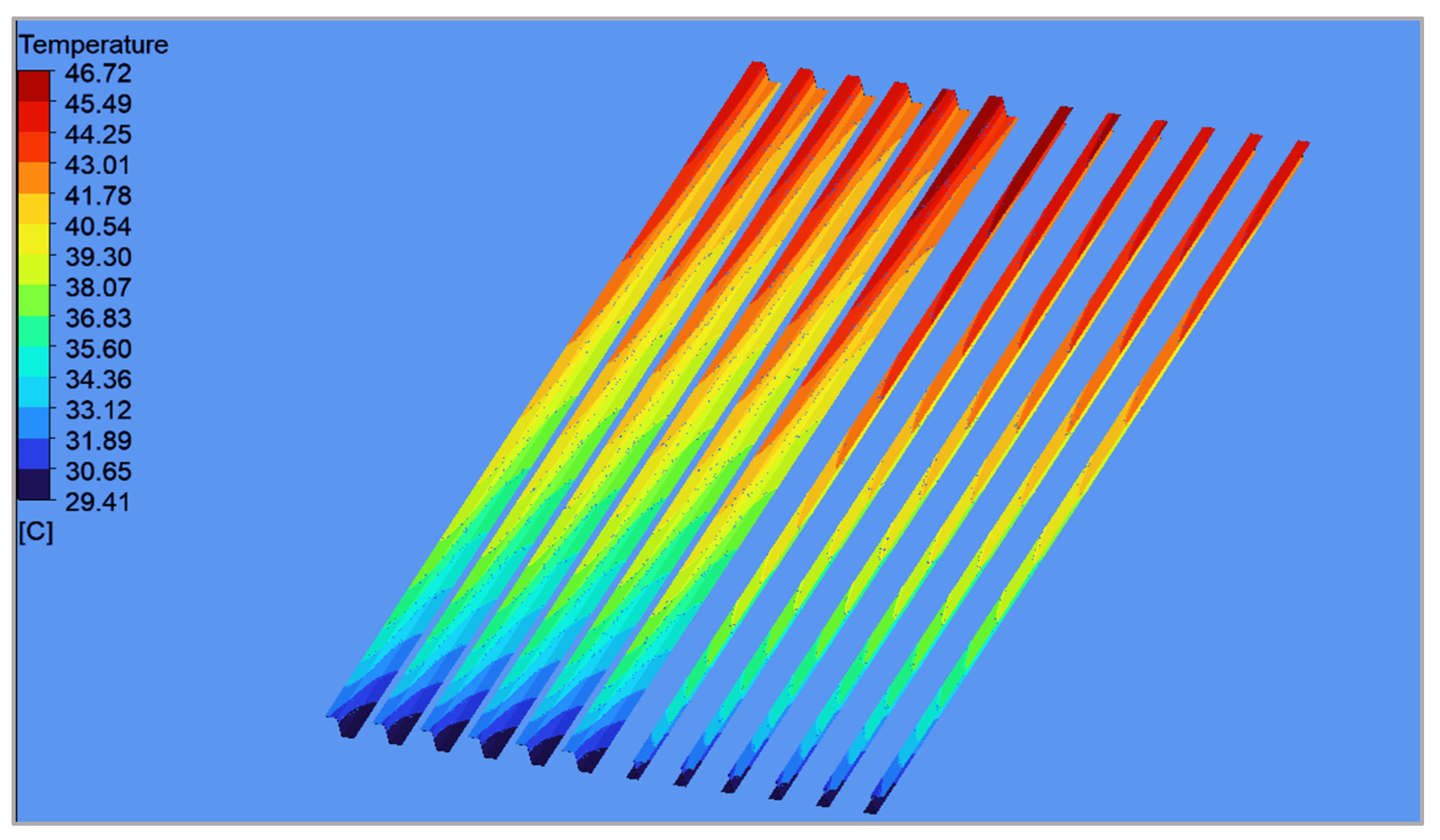
The temperature distribution across the fins of the PV/T-F system is shown in Figure 17. Fin temperatures range from 29.41 to 46.72 °C. Fin temperatures increase from the channel inlet to the outlet.

3.2.2. Velocity Distributions

The Velocity Distributions of the Longitudinal Mid-Section of the Channel
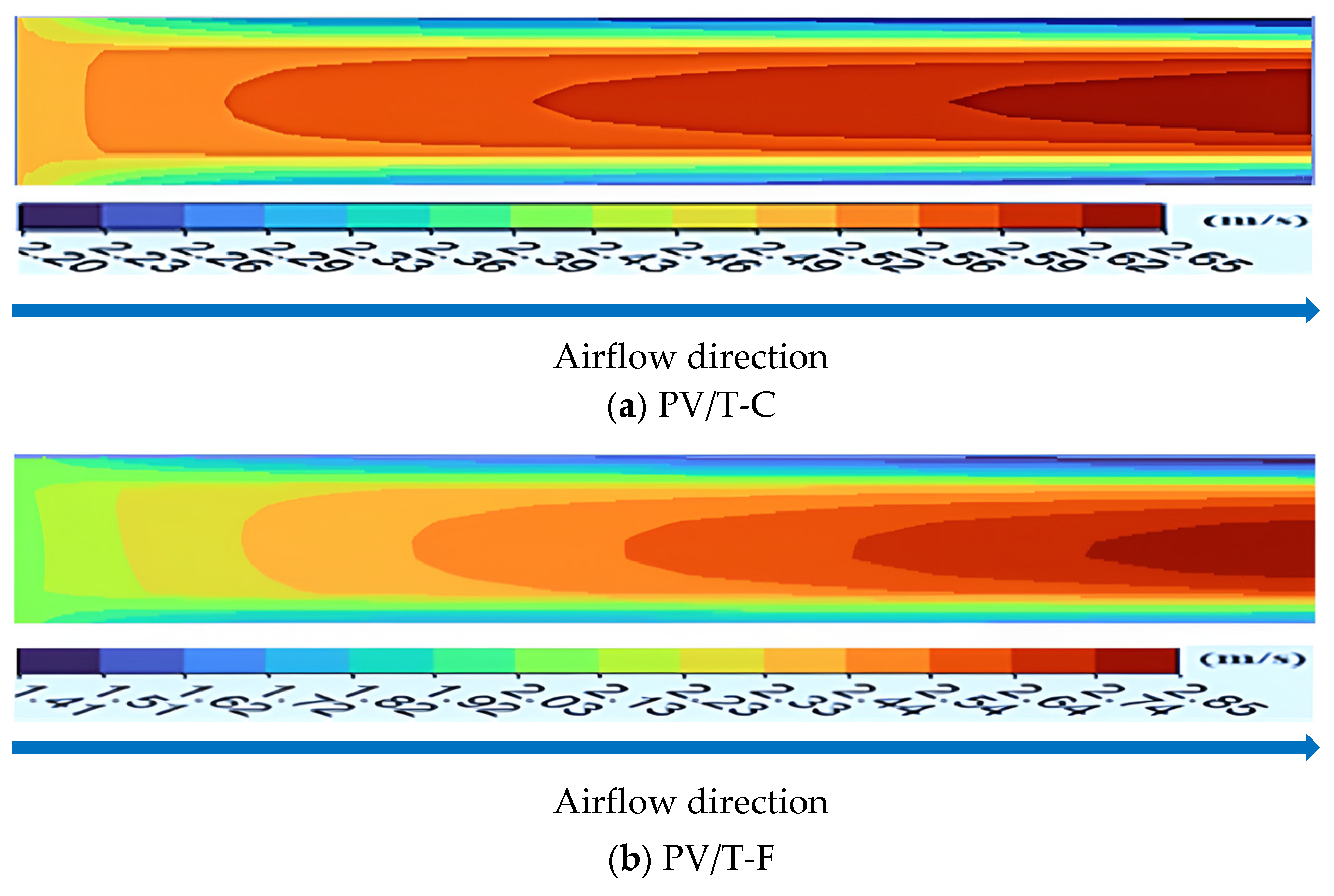
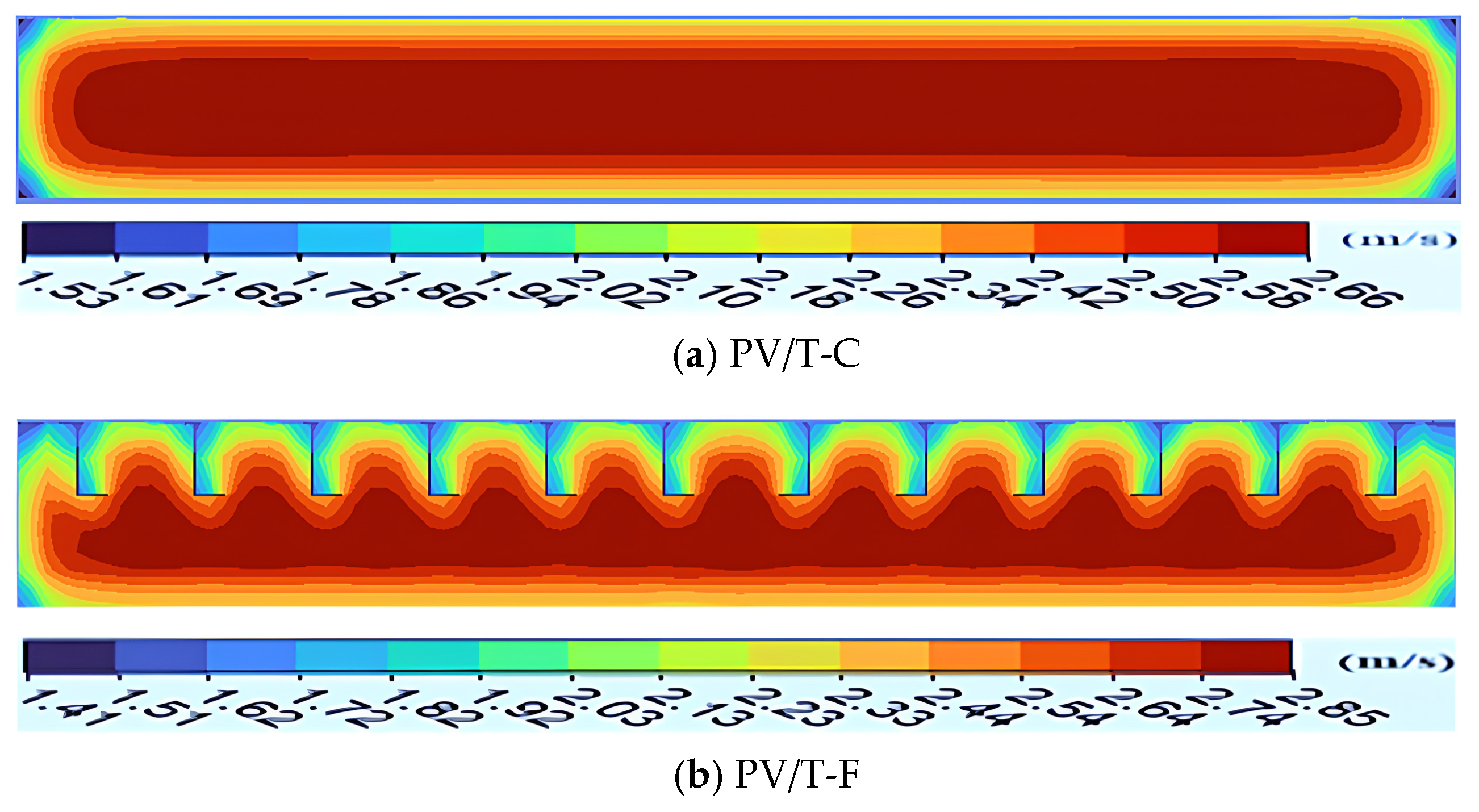
The velocity distributions of the longitudinal mid-section of the channel are shown in Figure 18. In the PV/T-C system, air enters the channel with a velocity of 2.5 m/s, and the velocities vary between 2.20 and 2.65 m/s (Figure 18a). The highest velocities occur in the center of the channel (maximum 2.65 m/s), while the velocities decrease in the wall areas (minimum 2.20 m/s) due to the development of the boundary layer. In the PV/T-F system, air enters the channel with a velocity of 2.5 m/s, and the maximum velocity is around 2.85 m/s (Figure 18b). The minimum velocity in the wall areas decreases to 1.41 m/s.
Outlet Air Velocity Distribution
Figure 19 shows the velocity profiles at the channel exit cross-section of PV/T systems. In the PV/T-C system, velocity increases from the channel walls to the center of the channel (Figure 19a). Velocities range between 1.53 m/s and 2.66 m/s. In the PV/T-F system, air velocity decreases due to friction around the fins and on the walls, reaching maximum levels in the channel center regions. Velocities range between 1.41 m/s and 2.85 m/s. One of the reasons for the higher exit air velocity compared to finless systems is the reduced cross-sectional area due to the fins.

3.2.3. Electrical Efficiency, Thermal Efficiency, and Overall Efficiency

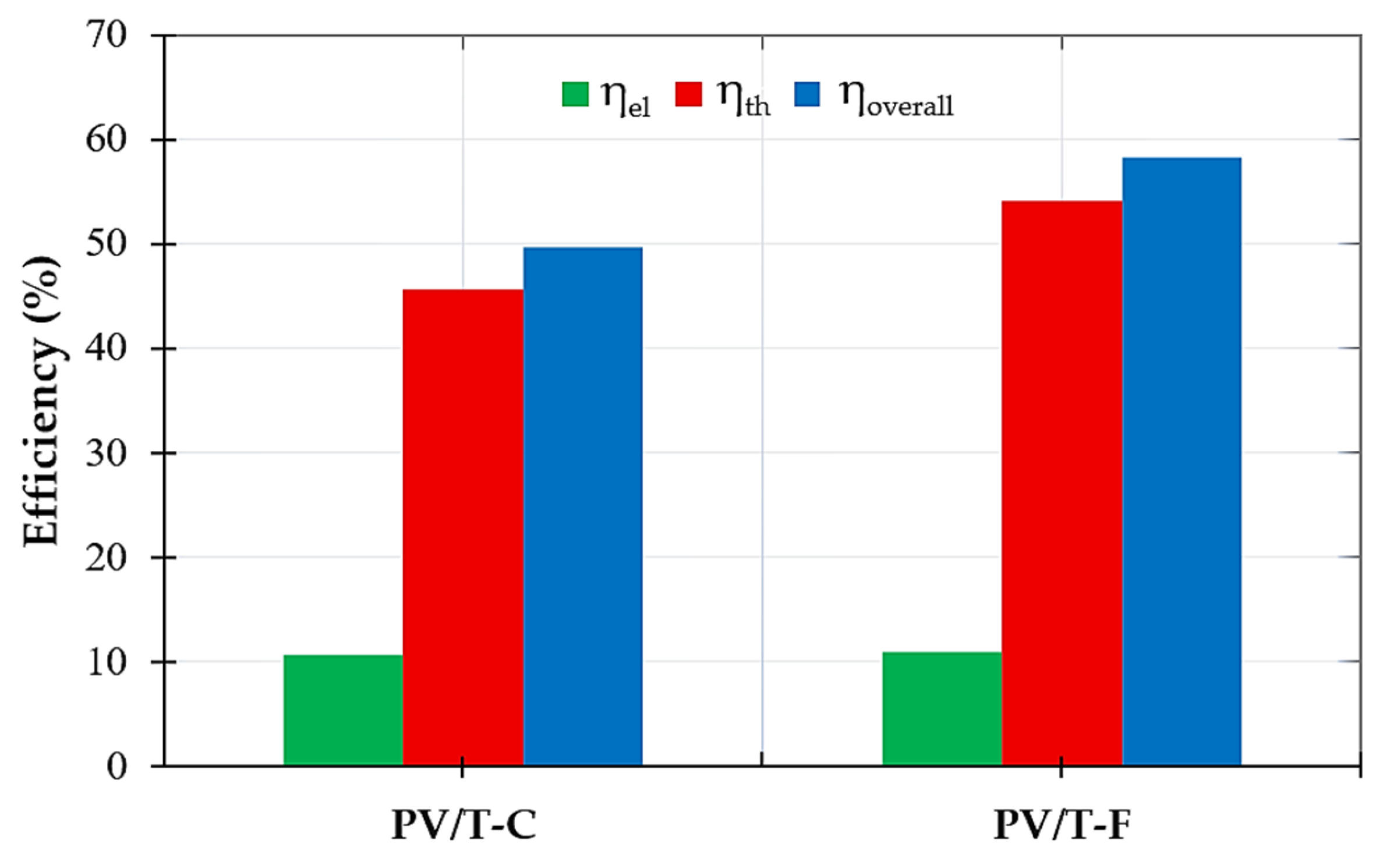
The electrical, thermal, and overall efficiencies of PV/T-C and PV/T-F systems are given in Figure 20. The electrical efficiency of the PV/T-C system is 10.71%, thermal efficiency is 45.66%, and overall efficiency is 49.72%. The electrical efficiency of the PV/T-F system is 10.99%, thermal efficiency is 54.08%, and overall efficiency is 58.26%. When the PV/T-C and PV/T-F systems are compared, it is seen that the electrical efficiency, thermal efficiency, and overall efficiencies of the PV/T-F system are higher than those of the PV/T-C system. Electrical efficiency increases by 2.61%, thermal efficiency by 18.44%, and overall efficiency by 17.18%.

3.2.4. Exergy Efficiency and Sustainability Index

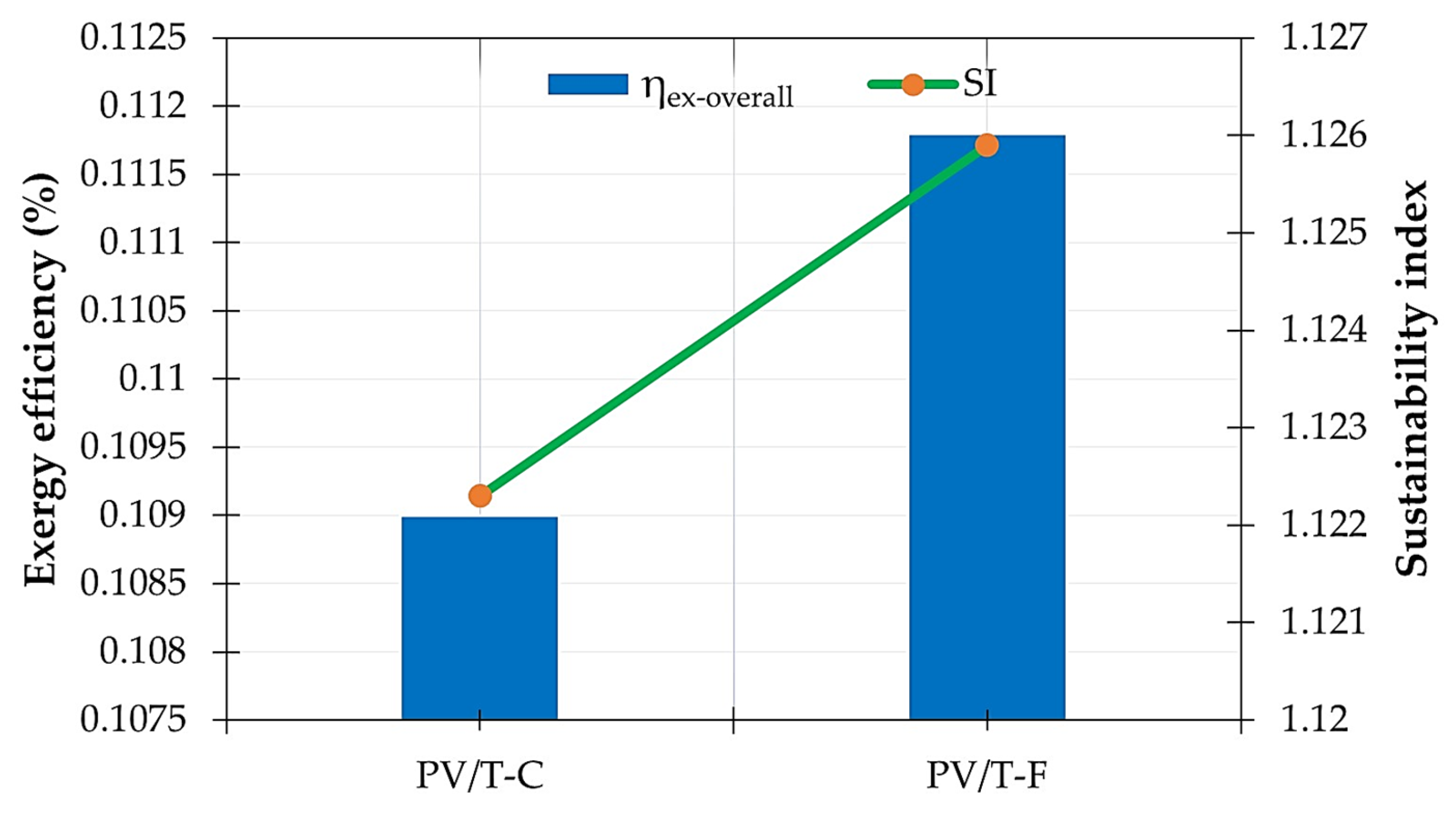
Figure 21 shows the overall exergy efficiencies and sustainability indexes of the PV/T-C and PV/T-F systems. The exergy efficiency of the PV/T-C system is 10.90%. The overall exergy efficiency of the PV/T-F system is 11.18%. It is observed that the use of fins in the PV/T-F system increases the overall exergy efficiency by 2.57%. The sustainability index of the PV/T-C system is 1.1223. The sustainability index of the PV/T-F system is 1.1259. It is observed that the use of fins in the PV/T-F system increases the sustainability index by 0.32%.

3.3. Use of PV/T-C and PV/T-F Systems in Malatya Province Climatic Conditions

3.3.1. Climatic Conditions of Malatya Province

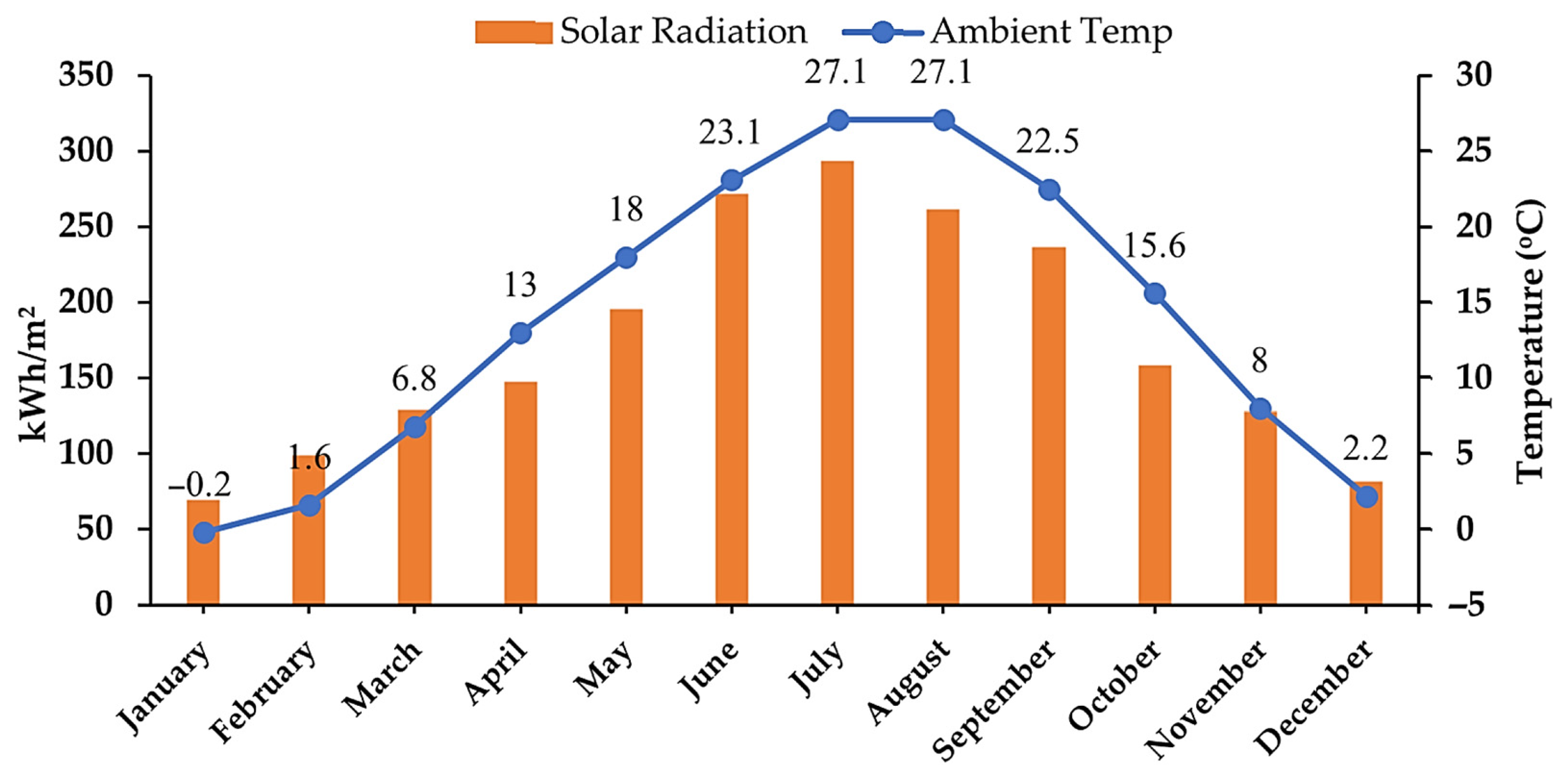
Figure 22 presents the monthly average outdoor air temperature and solar radiation values for Malatya province. The lowest outdoor air temperature is −0.2 °C in January and the highest is 27.1 °C in July and August, with an annual average of 13.7 °C. The lowest solar radiation value is 69.39 kWh/m2 in January and the highest is 293.85 kWh/m2 in July, with an annual average of 172.64 kWh/m2.

3.3.2. The Outlet Air Temperature

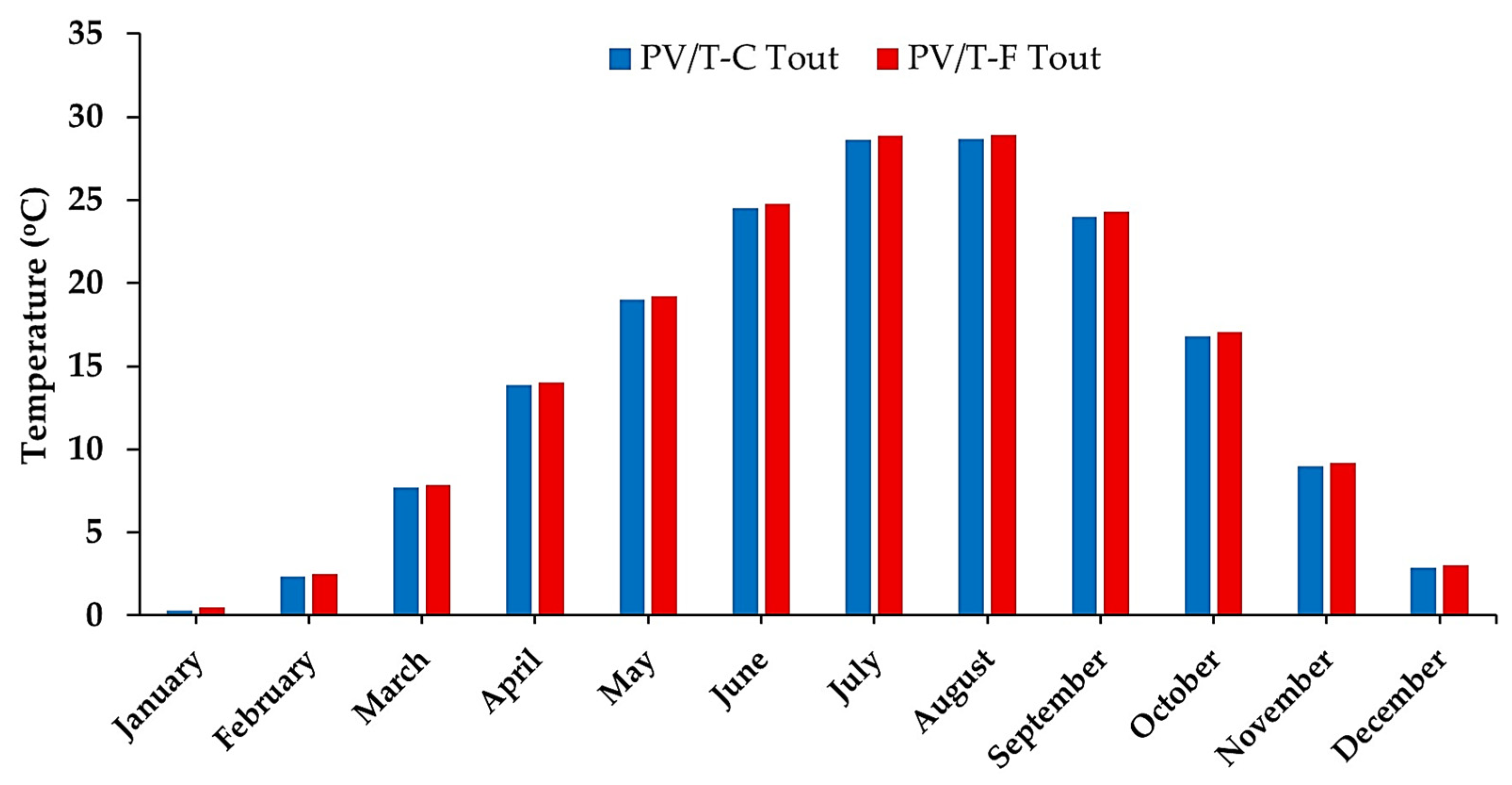
Figure 23 shows the outlet air temperature data for the PV/T-C and PV/T-F systems. In the PV/T-C system, the lowest outlet air temperature is 0.394 °C, the highest outlet air temperature is 28.65 °C, and the average outlet air temperature is 16.32 °C. In the PV/T-F system, the lowest outlet air temperature is 0.51 °C, the highest outlet air temperature is 28.95 °C, and the average outlet air temperature is 16.55 °C. An examination of Figure 23 indicates that the duct air outlet temperature values in the PV/T-F system are higher than those in the PV/T-C system.

3.3.3. The Average PV Cell Temperature

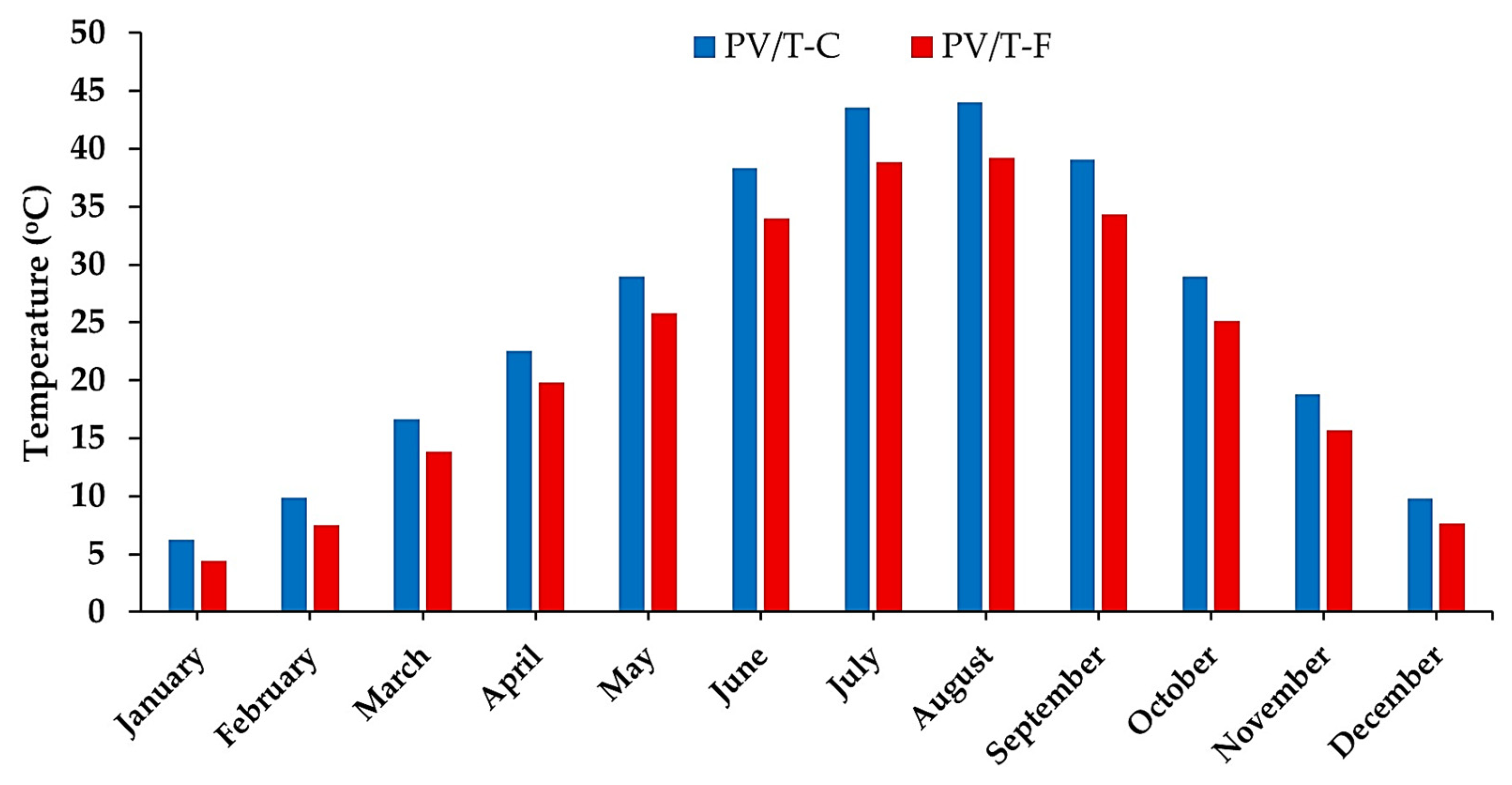
Figure 24 shows the average PV cell temperature for PV/T-C and PV/T-F systems. In the PV/T-C system, the lowest average PV cell temperature is 6.29 °C in January and the highest temperature is 44.04 °C in August. The average PV cell temperature for the PV/T-C system is determined as 27.48 °C.
In the PV/T-F system, the lowest average PV cell temperature is 4.43 °C in January and the highest temperature is 39.2 °C in August. The average PV cell temperature for the PV/T-F system is found to be 16.55 °C. It is determined that the use of fins in the PV/T-F system reduces the annual average PV cell temperature by 3.51 °C, or 12.77%, compared to the conventional system.

3.3.4. The Useful Heat of the Outlet Air

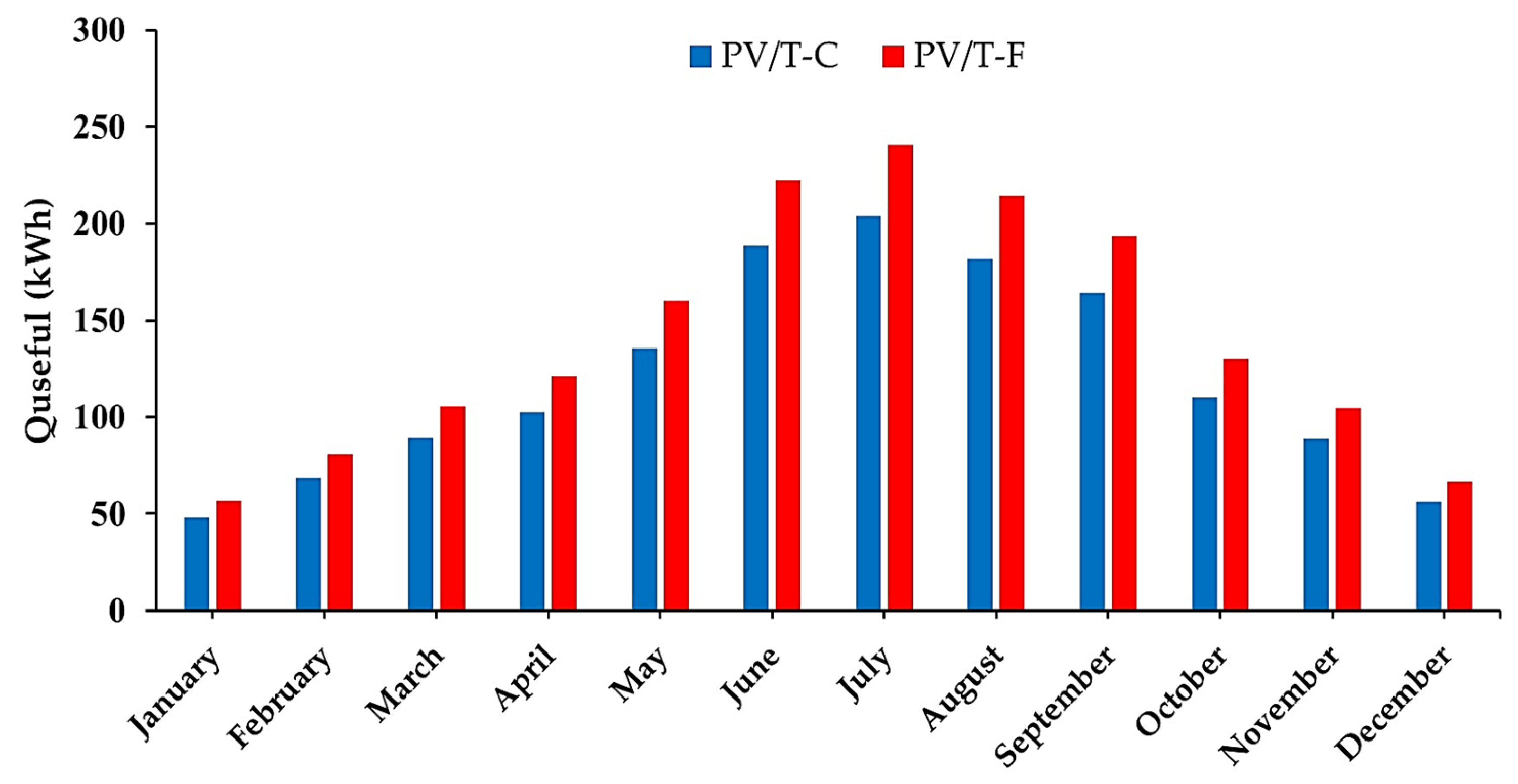
Figure 25 shows the useful heat of the outlet air for the PV/T-C and PV/T-F systems. In the PV/T-C system, the lowest useful heat of the outlet air is 48.11 kWh in January, and the highest useful heat is 203.84 kWh in July. The average useful heat of the outlet air for the PV/T-C system is determined as 119.79 kWh. In the PV/T-F system, the lowest useful heat of the outlet air was 56.85 kWh in January, and the highest useful heat of the outlet air was 240.75 kWh in August. The average useful heat of the outlet air for the PV/T-C system is determined as 141.45 kWh. The useful heat of the outlet air in the PV/T-F system was higher than in the PV/T-C system. As solar radiation increases, the highest useful heat of the outlet air also increases.

3.3.5. The Monthly Electrical Energy Generation

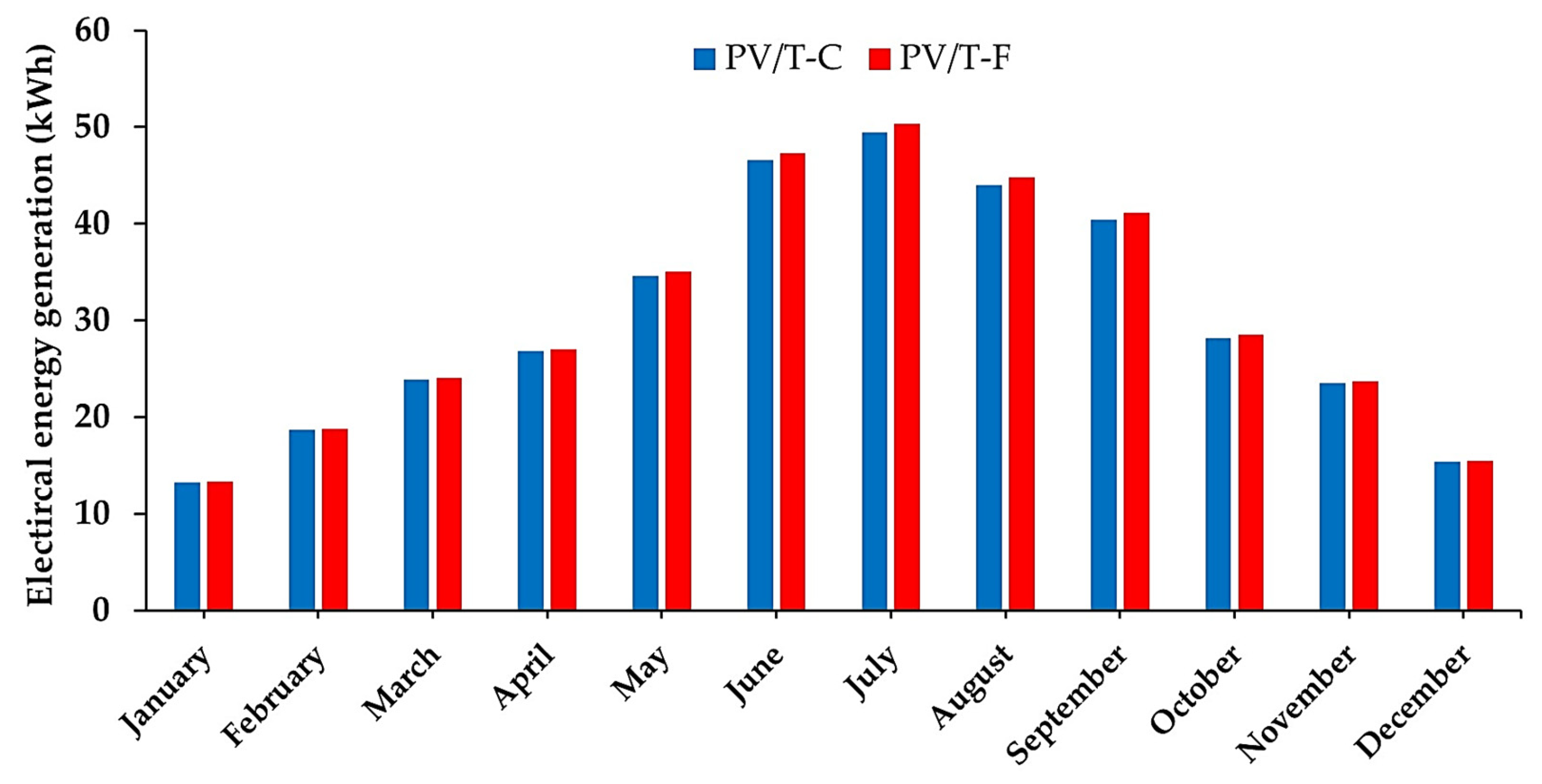
Figure 26 shows the electrical energy generation for the PV/T-C and PV/T-F systems. In the PV/T-C system, the lowest electrical energy generation is 13.28 kWh in January, and the highest electrical energy generation is 49.50 kWh in July. The average monthly electrical energy generation for the PV/T-C system is determined as 30.41 kWh. In the PV/T-F system, the lowest electrical energy generation is 13.36 kWh in January, and the highest electrical energy generation is 50.35 kWh in August. The average monthly electrical energy generation for the PV/T-F system is determined as 30.82 kWh. The electrical energy generation in the PV/T-F system was higher than in the PV/T-C system. As solar radiation increases, electrical energy generation also increases.

3.3.6. The Annual Electrical, Thermal, and Overall Energy Generation

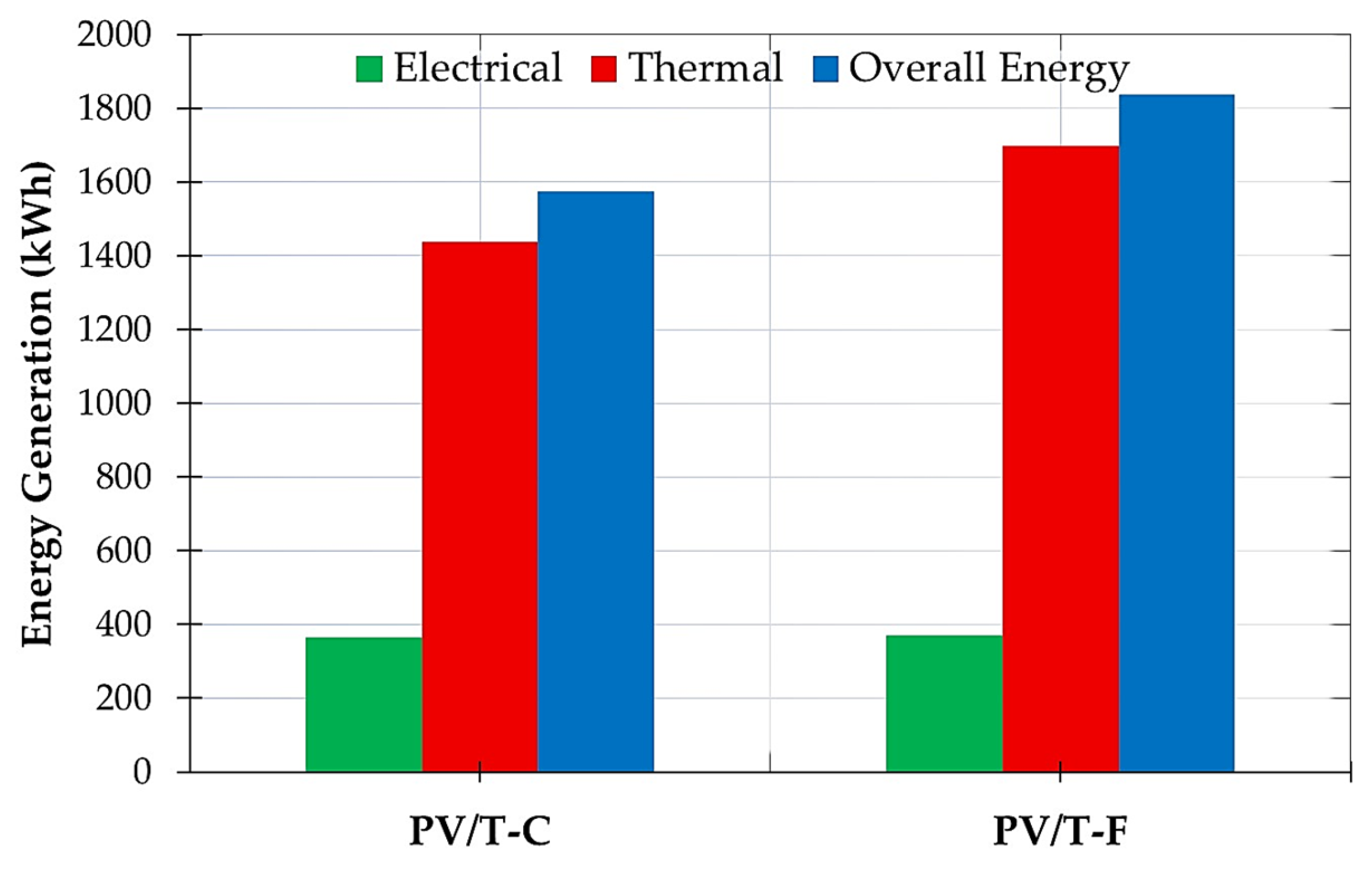
The annual electricity generation, annual useful heat generation, and annual overall energy generation of the PV/T-C and PV/T-F systems are shown in Figure 27. The annual electrical energy generation in the PV/T-C system is 364.07 kWh, the useful heat generation is 1437.07 kWh, and the overall energy generation is 1575.42 kWh. The annual electrical energy generation in the PV/T-F system is 369.78 kWh, the useful heat generation is 1697.34 kWh, and the overall energy generation is 1837.86 kWh. The annual total electricity, useful heat, and total energy generations in the PV/T-F system are higher than in the PV/T-C system. This is because the fins provide better cooling of the PV module, resulting in higher electrical energy generation and a more efficient transfer of excess heat to the fluid air.

3.3.7. The Annual Electrical, Thermal, and Overall Efficiency

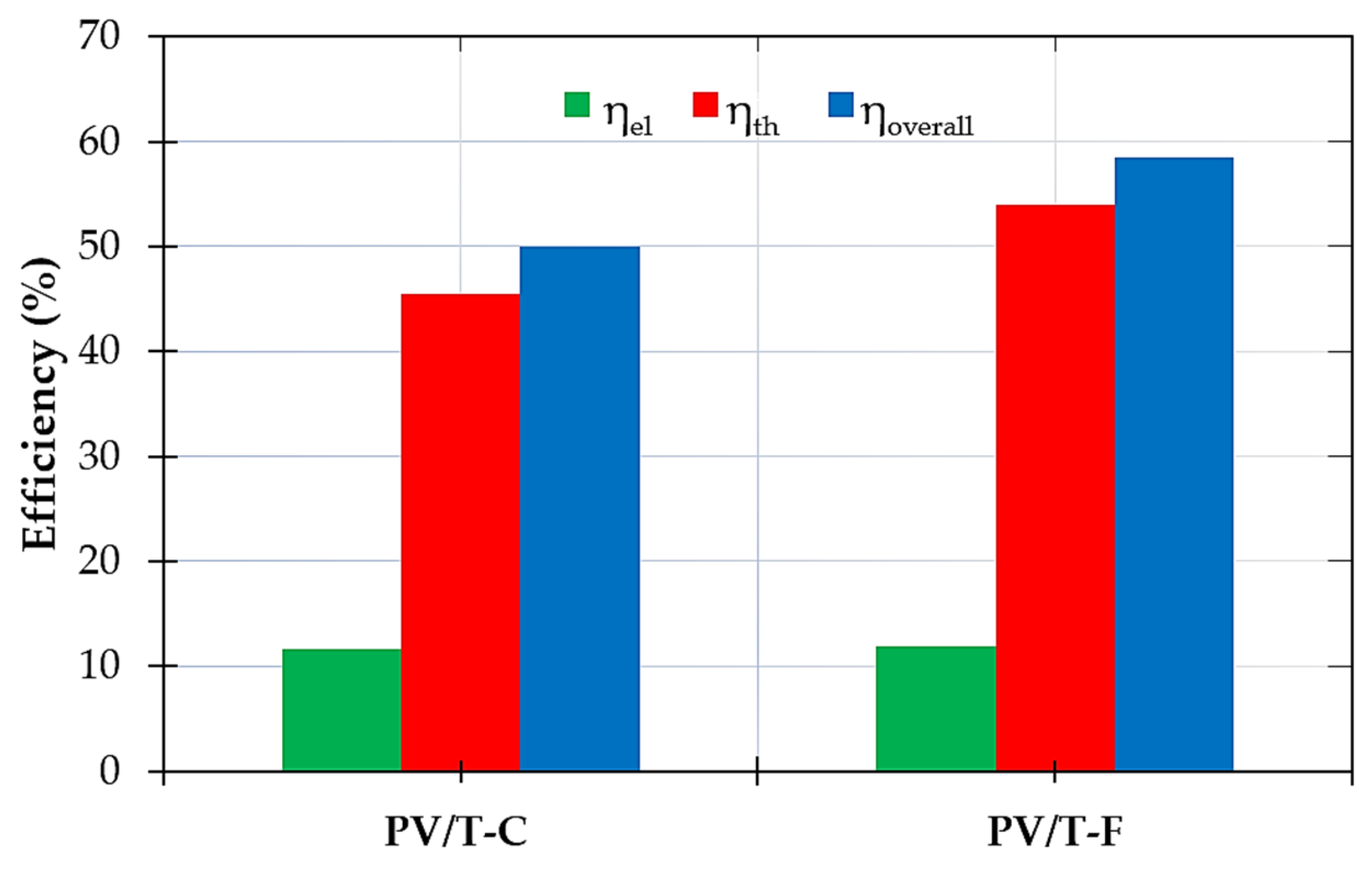
Figure 28 shows the annual electrical efficiency (ηel), annual thermal efficiency (ηth), and annual overall efficiencies (ηoverall) of the PV/T-C and PV/T-F systems. The annual electrical efficiency is 11.70%, thermal efficiency is 45.50%, and overall efficiency is 49.95% in the PV/T-C system. The annual electrical efficiency is 11.84%, thermal efficiency is 54%, and overall efficiency is 58.5% in the PV/T-F system. The annual electrical, thermal, and overall efficiency of the PV/T-F system are higher than the efficiencies of the PV/T-C system. Electrical efficiency increased by 1.20%, thermal efficiency by 18.68%, and overall efficiency by 17.12%.

3.3.8. The Exergy Efficiency and Sustainability Index

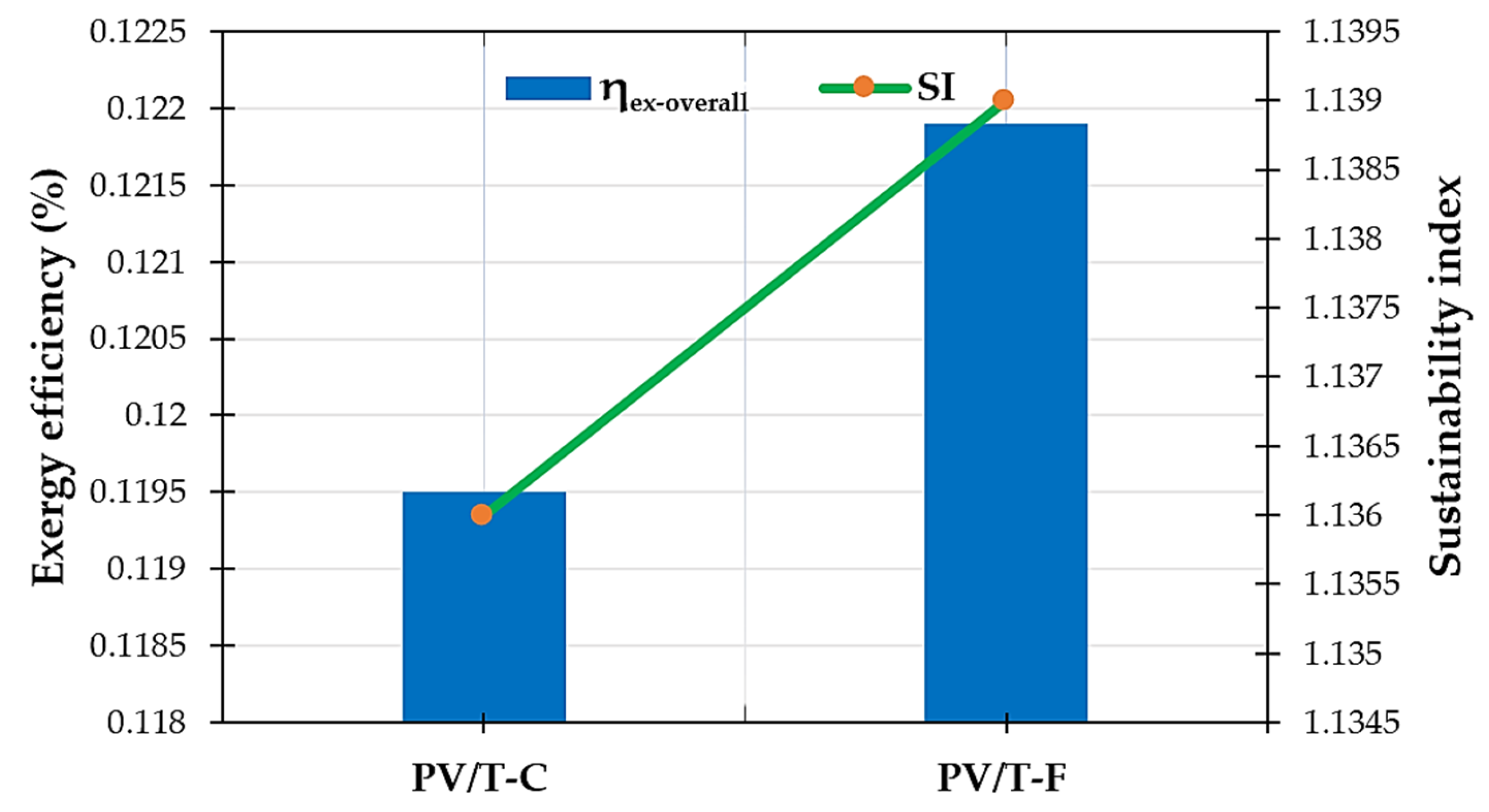
The annual overall exergy efficiency and sustainability indexes of the PV/T-C and PV/T-F systems are given in Figure 29.
The annual overall exergy efficiency of the PV/T-C system is 11.95%, and the sustainability index is 1.136. The annual overall exergy efficiency of the PV/T-F system is 12.19%, and the sustainability index is 1.139. It is found that the use of fins in the PV/T-F system increases the overall exergy efficiency by 2.01% and the sustainability index by 0.26%.

3.3.9. Techno-Economic and Environmental Analysis

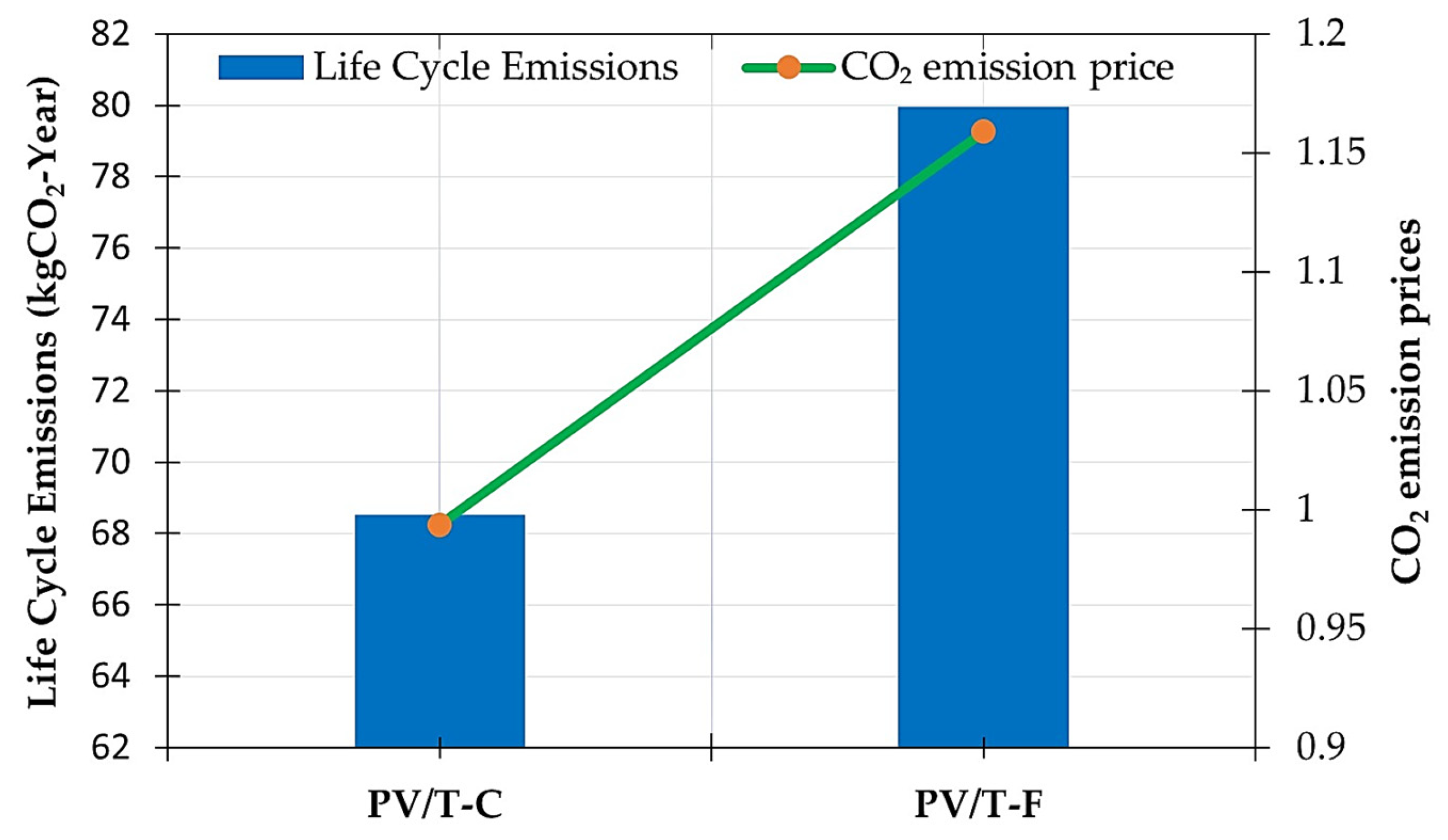
The annual CO2 reductions and CO2 emission prices throughout the life cycle of PV/T systems are given in Figure 30. With the use of a PV/T-C system, an annual reduction in CO2 emissions occurs of 68.53 kg. This reduction increases for the PV/T-F system, reaching 79.95 kg per year. The PV/T-F system reduces CO2 emissions by 11.42 kg per year compared to the PV/T-C system. On the other hand, CO2 emission prices are found to be 0.99 USD/year for the PV/T-C system and 1.16 USD/year for the PV/T-F system. The lower CO2 emissions and higher CO2 emission prices of the PV/T-F system can be attributed to the higher annual electricity, heat, and power generation of the PV/T-F system.
The economic analysis of the two PV/T systems shows differences in both the levelized cost of energy and the investment payback periods. The PV/T-F system exhibits a lower levelized cost of energy (LCOE) of 0.0182 USD/kWh compared to 0.0208 USD/kWh for the PV/T-C system, indicating higher economic efficiency in energy production. Furthermore, the payback period for the PV/T-F system is 6.9 years, which is shorter than the 7.8 years observed for the PV/T-C system, reflecting a faster return on the initial investment. These findings indicate that integrating fins into the PV/T-F configuration not only improves energy, exergy, and sustainability performance but also enhances overall economic benefit.

3.4. Comparison of PV/T-C and PV/T-F Systems

A general comparison of PV/T-C and PV/T-F systems in terms of outlet air temperature, average PV cell temperature, outlet air useful heat, monthly electrical energy generation, annual electrical/thermal/total energy generation, electrical/thermal/overall efficiencies, exergy efficiency/sustainability index, and lifetime emissions/CO2 emission price parameters is shown in Table 6. This table provides direct and easy access to the comparison results of PV/T-C and PV/T-F systems in terms of all parameters.

3.5. Comparisons with the Literature Study

This study presents the performance and sustainability analyses of conventional and finned air-cooled PV/T systems. The results are compared with those reported in previous studies on air-cooled PV/T systems. Various studies on PV/T cooling reported in the literature are summarized in Table 7, and the numerical results obtained in this study are also included for comparison.
The electrical efficiency was determined as 11.70% for the PVT-C system and 11.84% for the PVT-F system. In comparison, Slimani et al. [22] reported 10.65%, Diwania et al. [32] 10.26%, Arslan et al. [28,29] 15.52%, Can et al. [31] 11.57–13.17%, and Tang et al. [24] 12.1–14.7%. These results indicate that the electrical efficiencies obtained in this study are consistent with the literature.
The thermal efficiency was found to be 45.50% for the PVT-C system and 54.00% for the PVT-F system. The literature values include 44% (Slimani et al. [22]), 35.88% (Arslan et al. [28,29]), 34.52–43.68% (Aktaş et al. [30]), 33.41–49.62% (Can et al. [31]), and 41.57% Diwania et al. [32]. Accordingly, the thermal efficiencies reported in this study are in good agreement with previous findings.
Exergy analysis yielded efficiencies of 11.95% for the PVT-C system and 12.19% for the PVT-F system. The literature values include 12.8–17.6% (Agrawal and Tiwari [19]), 17.12–18.05% (Arslan et al. [28,29]), 29.77% (Aktaş et al. [30]), 13.97–14.58% (Cetina-Quinones et al. [61]), and 12.89–13.36% (Fudholi et al. [83]). These results confirm that the exergy efficiencies obtained in this study are consistent with the literature.
Regarding sustainability, the sustainability index was calculated as 1.136 for the PVT-C system and 1.139 for the PVT-F system. In comparison, Cetina-Quinones et al. [61] reported 1.162–1.171, and Fudholi et al. [83] 1.15–1.17. Therefore, the sustainability indexes obtained in this study are consistent with previously reported values.

4. Conclusions

In this study, the performances of conventional (PV/T-C) and Z-finned (PV/T-F) air-cooled PV/T systems were numerically investigated through comprehensive energy, exergy, and sustainability analyses. Simulations were conducted using ANSYS Fluent 2025 R1.
The comparative results demonstrate that the addition of fins notably enhances the heat transfer rate, thereby lowering PV cell temperatures and improving overall system efficiency. Specifically, the finned PV/T system achieves a reduction of approximately 6.65 °C in average cell temperature and exhibited higher outlet air temperature compared to the conventional configuration. As a result, the electrical, thermal, and overall efficiencies increase by 2.61%, 18.44%, and 17.18%, respectively. Furthermore, the exergy efficiency improves by about 2.57%, while the sustainability index increases by approximately 0.32%, indicating that fin integration contributes not only to better energy utilization but also to improving system sustainability.
The study also presents the performance results of conventional and finned air-cooled photovoltaic thermal (PV/T) systems under the local climatic conditions of Malatya province, Türkiye. On an annual basis, the finned PV/T system yields 2.01% higher exergy efficiency and 0.26% higher sustainability index relative to the conventional design, while reducing CO2 emissions by approximately 11.42 kg per year. The PV/T-F system achieves a lower LCOE of 0.0182 USD/kWh and a shorter payback period of 6.9 years compared to 0.0208 USD/kWh and 7.8 years for the PV/T-C system, indicating superior economic performance.
These results confirm that finned PV/T systems provide an effective means to enhance both energy recovery and environmental performance. Overall, integrating fin structures into air-cooled PV/T modules can be considered a promising design approach for achieving sustainable and efficient solar energy conversion. Future studies should focus on investigating alternative fin geometries, flow configurations, and material options to identify the most optimal designs under diverse climatic conditions and operational parameters.

Author Contributions

E.I.: Conceptualization, Methodology, Software, Validation, Visualization, Formal analysis, Investigation, Writing. M.Y.: Conceptualization, Methodology, Investigation, Supervision, Writing. All authors have read and agreed to the published version of the manuscript.

Funding

This research was supported by the Inonu University Scientific Research Projects Coordination Unit (BAP) (No. 4350).

Institutional Review Board Statement

Not applicable.

Informed Consent Statement

Not applicable.

Data Availability Statement

Data will be made available on request.

Conflicts of Interest

Author Edip Imik was employed by the company Fırat Customs and Foreign Trade Regional Directorate. The remaining authors declare that the research was conducted in the absence of any commercial or financial relationships that could be construed as a potential conflict of interest.

Abbreviations

The following abbreviations are used in this manuscript:
AArea (m2)
Br Temperature coefficient of the PV cell (K−1)
CSpecific heat (J.Kg−1 K−1)
C C O 2 Enviroeconomic factor (USD/year)
DDiameter
E X ˙ Exergy
c e l Electricity tariffs (USD/kWh)
c t h Heat tariffs (USD/kWh)
e p C O 2 Emission price of CO2 (USD/kgco2)
FPacking factor
GSolar radiation (W·m−2)
hCoefficient of heat transfer (W/m2·K)
kThermal conductivity (W/m·K)
LCElife cycle emissions (kgCO2)
LCOELevelized cost of energy (USD/kWh)
MMass (kg)
m ˙ Flow rate of mass (kg/s)
NuNusslet number
PrPrandtl number
PVPhotovoltaic panel
PV/TPhotovoltaic thermal
PV/T-CConventional photovoltaic thermal
PV/T-FFinned photovoltaic thermal
QuUseful energy gain (W)
ReReynolds number
SISustainability index
TTemperature (K)
VVelocity (m/s)
Greek symbols
αAbsorptivity
ηEnergy Efficiency
ρDensity (kg/m3)
σStefan–Boltzmann constant (W/m2·K4)
εEmissivity
µDynamic viscosity (kg/m·s)
δThickness (m)
τTransmissivity of glass cover
Subscripts
aambient
csolar cell
cdconduction
cvconvection
elelectrical
ftransfer fluid
outoutlet
gglass cover
grground
raradiative
ttime
ththermal

References

  1. Muniz, R.N.; da Costa Júnior, C.T.; Buratto, W.G.; Nied, A.; González, G.V. The Sustainability Concept: A Review Focusing on Energy. Sustainability 2023, 15, 14049. [Google Scholar] [CrossRef]
  2. Fischer, D.; Brettel, M.; Mauer, R. The three dimensions of sustainability: A delicate balancing act for entrepreneurs made more complex by stakeholder expectations. J. Bus. Ethics 2020, 163, 87–106. [Google Scholar] [CrossRef]
  3. Philippidis, G.; Sartori, M.; Ferrari, E.; Marek, R. Waste not, want not: A bio-economic impact assessment of household food waste reductions in the EU. Resour. Conserv. Recycl. 2019, 146, 514–522. [Google Scholar] [CrossRef] [PubMed]
  4. Casem, What Is Sustainability? Available online: https://www.casem.com.tr/surdurulebilirlik-nedir/ (accessed on 24 September 2025).
  5. Winss. What Sustainability Indicators Exist Now and Should Be Used? Available online: https://www.winssolutions.org/what-sustainability-indicators-exist-now-and-should-be-used/ (accessed on 24 September 2025).
  6. Rosen, M.A. Energy Sustainability: A Pragmatic Approach and Illustrations. Sustainability 2009, 1, 55–80. [Google Scholar] [CrossRef]
  7. United Nations. Goal 7: Ensure Access to Affordable, Reliable, Sustainable and Modern Energy for All; United Nations Sustainable Development: New York, NY, USA; United Nations: New York, NY, USA, 2015; Available online: https://www.un.org/sustainabledevelopment/energy/ (accessed on 12 October 2025).
  8. Sova Solar. Solar Energy: A Beacon for Sustainable Development Goals (SDGs). Sova Solar Blog, 3 September 2024. Available online: https://sovasolar.com/solar-energy-a-beacon-for-sustainable-development-goals-sdgs/ (accessed on 12 October 2025).
  9. Smets, A.; Jäger, K.; Swaaıj, O.I.R.V.; Zeman, M. Solar Energy: The Physics and Engineering of Photovoltaic Conversion, Technologies and Systems, 1st ed.; UIT Cambridge: Cambridge, UK, 2015; pp. 27–33. Available online: https://books.google.com.tr/books?hl=tr&lr=&id=gj7JEAAAQBAJ&oi=fnd&pg=PR1&dq=Energy:+The+Physics+and+Engineering+of+Photovoltaic+Conversion,+Technologies+and+Systems&ots=Mt-8DOTBUd&sig=ElDxu43yxqBcOsiHx_mcnz-kggs&redir_esc=y#v=onepage&q=Energy%3A%20The%20Physics%20and%20Engineering%20of%20Photovoltaic%20Conversion%2C%20Technologies%20and%20Systems&f=false (accessed on 24 September 2025).
  10. Sharma, A. A comprehensive study of solar power in India and World. Renew. Sustain. Energy Rev. 2011, 15, 1767–1776. [Google Scholar] [CrossRef]
  11. Meral, M.E.; Diner, F. A review of the factors affecting operation and efficiency of photovoltaic based electricity generation systems. Renew. Sustain. Energy Rev. 2011, 15, 2176–2184. [Google Scholar] [CrossRef]
  12. Oni, M.; Mohsin, A.S.M.; Rahman, M.M.; Hossain Bhuian, M.B. A comprehensive evaluation of solar cell technologies associated loss mechanisms, and efficiency enhancement strategies for photovoltaic cells. Energy Rep. 2024, 11, 3345–3366. [Google Scholar] [CrossRef]
  13. Krauter, S. Increased electrical yield via water flow over the front of photovoltaic panels. Sol. Energy Mater. Sol. Cells 2004, 82, 131–137. [Google Scholar] [CrossRef]
  14. Ahmed, M.T.; Rashel, M.R.; Abdullah-Al-Wadud, M.; Hoque, T.T.; Janeiro, F.M.; Tlemcani, M. Mathematical Modeling, Parameters Effect, and Sensitivity Analysis of a Hybrid PVT System. Energies 2024, 17, 2887. [Google Scholar] [CrossRef]
  15. El Hadi Attia, M.; Abdel-Aziz, M.M.; Khelifa, A. A numerical approach to enhance the performance of double-pass solar collectors with finned photovoltaic/thermal integration. Appl. Therm. Eng. 2025, 268, 125974. [Google Scholar] [CrossRef]
  16. Namdar, H.; Rossi di Schio, E.; Semprini, G.; Valdiserri, P. Photovoltaic-thermal solar-assisted heat pump systems for building applications: A technical review on direct expansion systems. Energy Build. 2025, 334, 115516. [Google Scholar] [CrossRef]
  17. Babu, C.; Ponnambalam, P. The role of thermoelectric generators in the hybrid PV/T systems: A review. Energy Convers. Manag. 2017, 151, 368–385. [Google Scholar] [CrossRef]
  18. Chow, T.T. A review on photovoltaic/thermal hybrid solar technology. Appl. Energy 2010, 87, 365–379. [Google Scholar] [CrossRef]
  19. Agrawal, S.; Tiwari, G.N. Performance analysis in terms of carbon credit earned on annualized uniform cost of glazed hybrid photovoltaic thermal air collector. Sol. Energy 2015, 115, 329–340. [Google Scholar] [CrossRef]
  20. Singh, S.; Agarwal, S.; Tiwari, G.N.; Chauhan, D. Application of genetic algorithm with multi-objective function to improve the efficiency of glazed photovoltaic thermal system for New Delhi (India) climatic condition. Sol. Energy 2015, 117, 153–166. [Google Scholar] [CrossRef]
  21. Hussain, M.I.; Kim, J.T. Performance evaluation of photovoltaic/thermal (Pv/t) system using different design configurations. Sustainability 2020, 12, 9520. [Google Scholar] [CrossRef]
  22. Slimani, M.E.A.; Amirat, M.; Kurucz, I.; Bahria, S.; Hamidat, A.; Chaouch, W.B. A detailed thermal-electrical model of three photovoltaic/thermal (PV/T) hybrid air collectors and photovoltaic (PV) module: Comparative study under Algiers climatic conditions. Energy Convers. Manag. 2017, 133, 458–476. [Google Scholar] [CrossRef]
  23. Soliman, A.M. A Numerical Investigation of PVT System Performance with Various Cooling Configurations. Energies 2023, 16, 3052. [Google Scholar] [CrossRef]
  24. Tang, K.; Song, Z.; Jia, B.; Xue, Y.; Zhang, X. Enhancing the Performance of Air-Based Photovoltaic/Thermal (PV/T) Heaters Using Baffles and Metal Foam. Int. Commun. Heat Mass Transf. 2025, 169, 109574. [Google Scholar] [CrossRef]
  25. Özakin, A.N.; Kaya, F. Effect on the Exergy of the PVT System of Fins Added to an Air-Cooled Channel: A Study on Temperature and Air Velocity with ANSYS Fluent. Sol. Energy 2019, 184, 561–569. [Google Scholar] [CrossRef]
  26. Mojumder, J.C.; Chong, W.T.; Ong, H.C.; Leong, K.Y.; Abdullah-Al-Mamoon. An experimental investigation on performance analysis of air type photovoltaic thermal collector system integrated with cooling fins design. Energy Build. 2016, 130, 272–285. [Google Scholar] [CrossRef]
  27. Murtadha, T.K.; Alalwany, A.A.H.; Hussein, A.A. The effect of installing different arrangements of aluminum fins on the photovoltaic performance. Int. J. Appl. Sci. Eng. 2023, 20, 1–10. [Google Scholar] [CrossRef]
  28. Arslan, E.; Aktas, M.; Can, O.F. Experimental and numerical investigation of a novel photovoltaic thermal (PV/T) collector with the energy and exergy analysis. J. Clean. Prod. 2020, 276, 123255. [Google Scholar] [CrossRef]
  29. Arslan, E. Design and Analysis of a New-Generation Solar-Powered Photovoltaic-Thermal Drying System. Ph.D. Thesis, Gazi University Institute of Science, Ankara, Türkiye, 2020. [Google Scholar]
  30. Aktaş, A.; Koşan, M.; Aktekeli, B.; Güven, Y.; Arslan, E.; Aktaş, M. Numerical and experimental investigation of a single-body PVT using a variable air volume control algorithm. Energy 2024, 307, 132793. [Google Scholar] [CrossRef]
  31. Can, O.F.; Arslan, E.; Kosan, M.; Demirtas, M.; Aktas, M.; Aktekeli, B. Experimental and numerical assessment of PV-TvsPV by using waste aluminum as an industrial symbiosis product. Sol. Energy 2022, 234, 338–347. [Google Scholar] [CrossRef]
  32. Diwania, S.; Siddiqui, A.S.; Agrawal, S.; Kumar, R. Performance Assessment of PVT-Air Collector with V-Groove Absorber: A Theoretical and Experimental Analysis. Heat Mass Transf. 2021, 57, 665–679. [Google Scholar] [CrossRef]
  33. Kabeel, A.E.; Attia, M.E.H.; Khelifa, A.; Kabeel, A.A.; Bady, M. Investigating the Impact of Trapezoidal Fin Length, Thickness, and Positions on the Performance of Photovoltaic Panels with Dual-Inlet Air Cooling. Appl. Therm. Eng. 2025, 279, 127755. [Google Scholar] [CrossRef]
  34. Yu, W.; Lei, Y.; Wang, G.; Chan, W.; Wang, T.; Tian, Y. Simulation and Optimization on a Novel Air-Cooled Photovoltaic/Thermal Collector Based on Micro Heat Pipe Arrays. Appl. Therm. Eng. 2024, 255, 127755. [Google Scholar] [CrossRef]
  35. Almuwailhi, A.; Zeitoun, O. Investigating the cooling of solar photovoltaic modules under the conditions of Riyadh. J. King Saud Univ. Eng. Sci. 2023, 35, 123–136. [Google Scholar] [CrossRef]
  36. Tahmasbi, M.; Siavashi, M.; Norouzi, A.M.; Doranehgard, M.H. Thermal and electrical efficiencies enhancement of a solar photovoltaic-thermal/air system (PVT/air) using metal foams. J. Taiwan Inst. Chem. Eng. 2021, 124, 276–289. [Google Scholar] [CrossRef]
  37. Deokar, V.H.; Bindu, R.S.; Potdar, S.S. Active cooling system for efficiency improvement of PV panel and utilization of waste-recovered heat for hygienic drying of onion flakes. J. Mater. Sci. Mater. Electron. 2021, 32, 2088–2102. [Google Scholar] [CrossRef]
  38. Omeroglu, G. CFD analysis and electrical efficiency improvement of a hybrid PV/T panel cooled by forced air circulation. Int. J. Photoenergy 2018, 2018, 9139683. [Google Scholar] [CrossRef]
  39. Nasri, H.; Sahlaoui, K.; Oueslati, H.; Taghouti, H.; Mami, A. Experimental Comparative Study between PV Solar Collector and Hybrid PV/T Air Collector. In Proceedings of the 2022 IEEE International Conference on Electrical Sciences and Technologies in Maghreb (CISTEM), Tunis, Tunisia, 26–28 October 2022. [Google Scholar]
  40. Nasri, H.; Riahi, J.; Vergura, S.; Taghouti, H. Experimental Validation of the Electrical Performance for PVT Air Collector. In Proceedings of the 2023 International Conference on Electrical, Computer and Energy Technologies (ICECET), Cape Town, South Africa, 16–17 November 2023. [Google Scholar] [CrossRef]
  41. Nasri, H.; Riahi, J.; Oeslati, H.; Taghouti, H.; Vergura, S. Performance Analysis and Optimization of a Channeled Photovoltaic Thermal System with Fin Absorbers and Combined Bi-Fluid Cooling. Computation 2024, 12, 188. [Google Scholar] [CrossRef]
  42. Assoa, Y.B.; Sauzedde, F.; Boillot, B. Numerical parametric study of the thermal and electrical performance of a BIPV/T hybrid collector for drying applications. Renew. Energy 2018, 129, 121–131. [Google Scholar] [CrossRef]
  43. Swinbank, W.C. Long-wave radiation from clear skies. Q. J. R. Meteorol. Soc. 1963, 89, 339–348. [Google Scholar] [CrossRef]
  44. Sarhaddi, F.; Farahat, S.; Ajam, H.; Behzadmehr, A. Exergetic Performance Assessment of a Solar Photovoltaic Thermal (PV/T) Air Collector. Energy Build. 2010, 42, 2184–2199. [Google Scholar] [CrossRef]
  45. Farshchimonfared, M.; Bilbao, J.I.; Sproul, A.B. Full Optimization and Sensitivity Analysis of a Photovoltaic–Thermal (PV/T) air System Linked to a Typical Residential Building. Sol. Energy 2016, 136, 15–22. [Google Scholar] [CrossRef]
  46. Ni, J.; Li, J.; Wei, A.; Zhu, T. Performance Analysis of Nanofluid-Based Spectral Splitting PV/T System in Combined Heating and Power Application. Appl. Therm. Eng. 2018, 129, 1160–1170. [Google Scholar] [CrossRef]
  47. Ansys, Inc. CFX-Solver Theory Guide; Release 2021 R2; Ansys: Canonsborg, SC, USA, 2021; pp. 1–10. [Google Scholar]
  48. Enterfea, Correct Mesh Size—A Quick Guide! Available online: https://enterfea.com/correct-mesh-size-quick-guide (accessed on 17 May 2025).
  49. Udemy, CFD Engineer Training. Available online: https://www.udemy.com/course/ansys-fluent-aks-analizleri-uygulamalaryla-cfd-egitimi/learn/lecture/18047423#overview (accessed on 17 March 2025).
  50. Khanjari, Y.; Pourfayaz, F.; Kasaeian, A.B. Numerical investigation on using of nanofluid in a water-cooled photovoltaic thermal system. Energy Conv. Manag. 2016, 122, 263–278. [Google Scholar] [CrossRef]
  51. Zhou, F.; Ji, J.; Cai, J.; Yu, B. Experimental and numerical study of the freezing process of flat-plate solar collector. Appl. Therm. Eng. 2017, 118, 773–784. [Google Scholar] [CrossRef]
  52. Cristofari, C.; Notton, G.; Canaletti, J.L. Thermal behavior of a copolymer PV/Th solar system in low flow rate conditions. Sol. Energy 2009, 83, 1123–1138. [Google Scholar] [CrossRef]
  53. Gunjo, D.G.; Mahanta, P.; Robi, P.S. Exergy and energy analysis of a novel type solar collector under steady state condition: Experimental and CFD analysis. Renew. Energy 2017, 114, 655–669. [Google Scholar] [CrossRef]
  54. Ebrahim Ghasemi, S.; Akbar Ranjbar, A. Numerical thermal study on effect of porous rings on performance of solar parabolic trough collector. Appl. Therm. Eng. 2017, 118, 807–816. [Google Scholar] [CrossRef]
  55. Amber Dunne, N.; Liu, P.; Anas, F.A.; Elbarghthi, A.F.A.; Yang, Y.; Drowak, V.; Wen, C. Performance evaluation of a solar photovoltaic-thermal (PV/T) air collector system. Energy Convers. Manag. X 2023, 20, 100466. [Google Scholar] [CrossRef]
  56. Tiwari, A.; Sodha, M.S. Performance evaluation of solar PV/T system: An experimental validation. Sol. Energy 2006, 80, 751–759. [Google Scholar] [CrossRef]
  57. Cousteix, J. Aircraft Aerodynamic Boundary Layers. In Encyclopedia of Physical Science and Technology, 3rd ed.; Meyers, R.A., Ed.; Elsevier: Amsterdam, The Netherlands, 2003; pp. 301–317. [Google Scholar] [CrossRef]
  58. Wang, K.; Herrando, M.; Pantaleo, A.M.; Markides, C.N. Markides, Technoeconomic assessments of hybrid photovoltaic-thermal vs. conventional solar-energy systems: Case studies in heat and power provision to sports centres. Appl. Energy 2019, 254, 113657. [Google Scholar] [CrossRef]
  59. Kumar, N.M.; Gupta, R.P.; Mathew, M.; Jayakumar, A.; Singh, N.K. Performance, energy loss, and degradation prediction of roof-integrated crystalline solar PV system installed in Northern India. Case Stud. Therm. Eng. 2019, 13, 100409. [Google Scholar] [CrossRef]
  60. Kalogirou, S.A. Solar Energy Engineering: Processes and Systems, 3rd ed.; Academic Press: London, UK, 2013; pp. 180–185. [Google Scholar]
  61. Cetina-Quiñones, A.J.; Polanco-Ortiz, I.; Alonzo, P.M.; Hernandez-Perez, J.G.; Bassam, A. Innovative heat dissipation design incorporated into a solar photovoltaic thermal (PV/T) air collector: An optimization approach based on 9E analysis. Therm. Sci. Eng. Prog. 2023, 38, 101635. [Google Scholar] [CrossRef]
  62. Adun, H.; Adedeji, M.; Dagbasi, M.; Bamisile, O.; Senol, M.; Kumar, R. A numerical and exergy analysis of the effect of ternary nanofluid on performance of Photovoltaic thermal collector. J. Therm. Anal. Calorim. 2021, 145, 1413–1429. [Google Scholar] [CrossRef]
  63. Nazri, N.S.; Fudholi, A.; Mustafa, W.; Yen, C.H.; Mohammad, M.; Ruslan, M.H.; Sopian, K. Exergy and improvement potential of hybrid photovoltaic thermal/ thermoelectric (PVT/TE) air collector. Renew. Sustain. Energy Rev. 2019, 111, 132–144. [Google Scholar] [CrossRef]
  64. Hussain, F.; Othman, M.Y.H.; Sopian, K.; Yatim, B.; Ruslan, H.; Othman, H. Design development and performance evaluation of photovoltaic/thermal (PV/T) air base solar collector. Renew. Sustain. Energy Rev. 2013, 25, 431–441. [Google Scholar] [CrossRef]
  65. Kazemian, A.; Taheri, A.; Sardarabadi, A.; Ma, T.; Passandideh-Fard, M.; Peng, J. Energy, exergy and environmental analysis of glazed and unglazed PVT system integrated with phase change material: An experimental approach. Sol. Energy 2020, 201, 178–189. [Google Scholar] [CrossRef]
  66. Sardarabadi, M.; Hosseinzadeh, M.; Kazemian, A.; Passandideh-Fard, M. Experimental investigation of the effects of using metal-oxides/water nanofluids on a photovoltaic thermal system (PVT) from energy and exergy viewpoints. Energy 2017, 138, 682–695. [Google Scholar] [CrossRef]
  67. Brusseau, M.L. Sustainable development and other solutions to pollution and global change. In Environmental and Pollution Science, 3rd ed.; Brusseau, M.L., Pepper, I.L., Gerba, C.P., Eds.; Elsevier: Amsterdam, The Netherlands, 2019; pp. 585–603. [Google Scholar] [CrossRef]
  68. Milousi, M.; Souliotis, M.; Arampatzis, G.; Papaefthimiou, S. Evaluating the environmental performance of solar energy systems through a combined life cycle assessment and cost analysis. Sustainability 2019, 11, 2539. [Google Scholar] [CrossRef]
  69. Caliskan, H. Energy, exergy, environmental, enviroeconomic, exergoenvironmental (EXEN) and exergoenviroeconomic (EXENEC) analyses of solar collectors. Renew. Sustain. Energy Rev. 2017, 69, 488–492. [Google Scholar] [CrossRef]
  70. Mohammadi, K.; Naderi, M.; Saghafifar, M. Economic feasibility of developing grid-connected photovoltaic plants in the southern coast of Iran. Energy 2018, 156, 17–31. [Google Scholar] [CrossRef]
  71. SHURA Energy Transition Center. Roof-Top Solar Energy Potential in Buildings—Financing Models and Policies for the Implementation of Roof-Top Solar Energy Systems in Turkey; SHURA Energy Transition Center: Istanbul, Türkiye, 2020; Available online: https://shura.org.tr/wp-content/uploads/2020/04/SHURA-2020-04-Binalarda-Cati-Ustu-Gunes-Enerjisi-Potansiyeli.pdf?utm_source (accessed on 15 October 2025).
  72. Atakale. Tommatech 300 W Monocrystalline Solar Panel—Product Page; Atakale Solar Energy: Kirikkale, Türkiye, 2025; Available online: https://www.atakale.com.tr/index.php?route=product/product&product_id=77 (accessed on 15 October 2025).
  73. SolarAVM. Orbus 300 W Modified Sine Wave 24 V Inverter—Product Page; SolarAVM: Ankara, Turkey, 2025; Available online: https://solaravm.com/orbus-300-watt-inverter-modifiye-sinus-24v (accessed on 15 October 2025).
  74. BVN Air. Official Website; BVN Air: Arnavutköy, Türkiye, 2025; Available online: https://bvnair.com/ (accessed on 15 October 2025).
  75. Robiz.net. Official Website; Robiz.net: Kocaeli, Türkiye, 2025; Available online: https://robiz.net (accessed on 15 October 2025).
  76. Fan Market. Flexible Air Ducts—Product Category; Fan Market: Istanbul, Türkiye, 2025; Available online: https://www.fanmarketi.com/kategori/fleks-hava-kanali (accessed on 15 October 2025).
  77. Investing.com. Copper Futures—Current Price and Market Data; Investing.com: Nicosia, Cyprus, 2025; Available online: https://tr.investing.com/commodities/copper (accessed on 15 October 2025).
  78. Flextab. Insulation: Istanbul, Turkey. 2025. Available online: https://www.flextab.com.tr/ (accessed on 15 October 2025).
  79. Good, N.; Martínez Ceseña, E.A.; Mancarella, P. Business Cases. In Energy Positive Neighborhoods and Smart Energy Districts: Methods, Tools, and Experiences from the Field; Monti, A., Pesch, D., Ellis, K., Mancarella, P., Eds.; Academic Press: Amsterdam, The Netherlands, 2016; pp. 159–226. [Google Scholar] [CrossRef]
  80. Aksa Fırat Electric. Useful Links; Aksa Fırat Electric: Malatya, Türkiye, 2025; Available online: https://www.aksafirat.com/Iletisim/YararliLinkler (accessed on 15 October 2025).
  81. Aksa Malatya Natural Gas Distribution, Co. Aksa Doğalgaz Malatya—Service Area Information. Available online: https://www.aksadogalgaz.com.tr/Dogal-Gaz-Dagitim-Bolgelerimiz/Aksa-Dogalgaz-Malatya (accessed on 15 October 2025).
  82. Yousif, J.H.; Kazem, H.A.; Alattar, N.N.; Elhassan, I.I. A Comparison Study Based on Artificial Neural Network for Assessing PV/T Solar Energy Production. Case Stud. Therm. Eng. 2019, 13, 100407. [Google Scholar] [CrossRef]
  83. Fudholi, A.; Zohri, M.; Rukman, N.S.B.; Nazri, N.S.; Mustapha, M.; Yen, C.H.; Mohammad, M.; Sopian, K. Exergy and sustainability index of photovoltaic thermal (PVT) air collector: A theoretical and experimental study. Renew. Sustain. Energy Rev. 2019, 100, 44–51. [Google Scholar] [CrossRef]
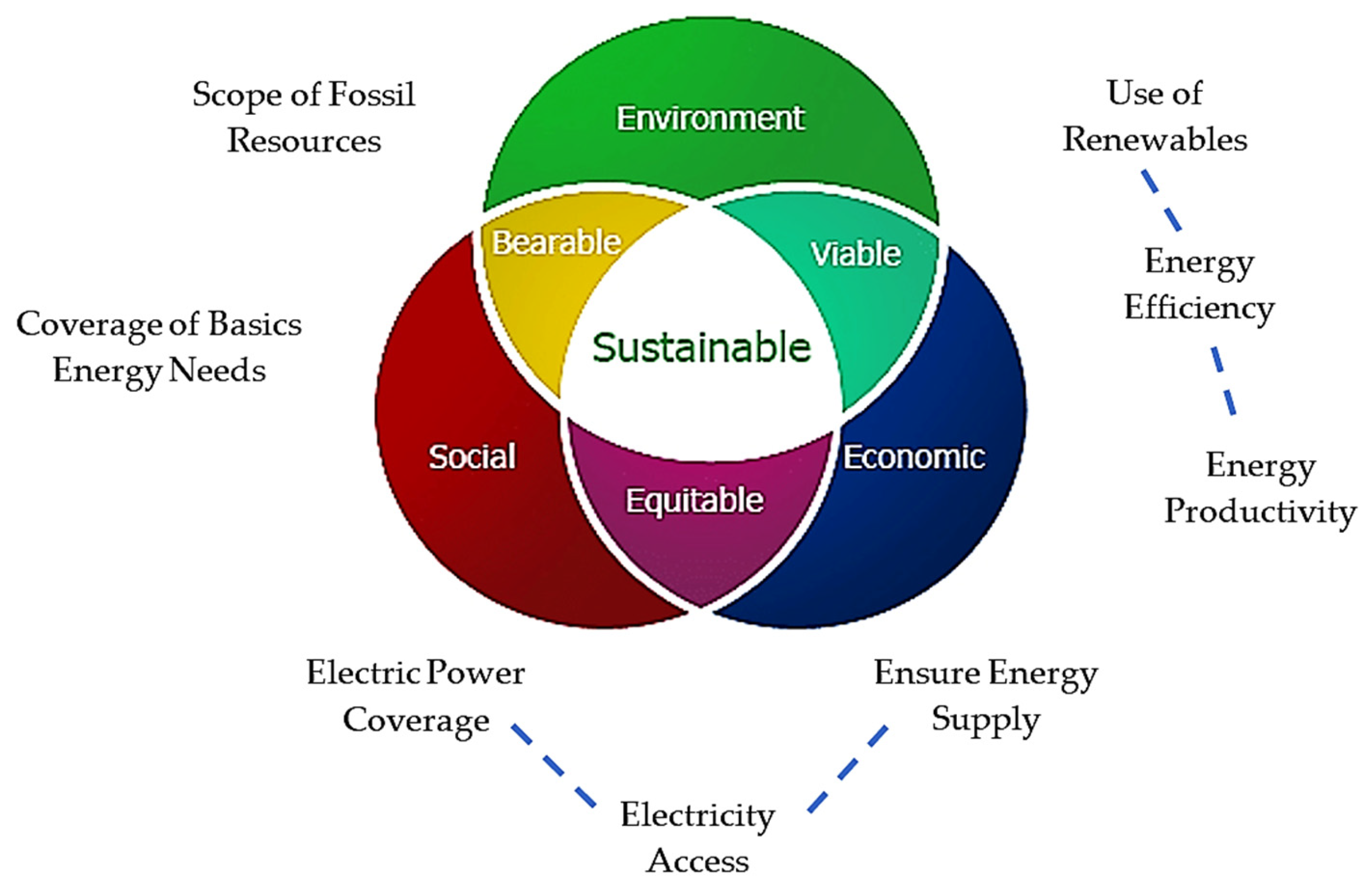
Figure 1. Interconnection of sustainability dimensions [1].
Sustainability 17 10638 g001
Figure 2. Variation in current and power with voltage at different PV cell temperatures [14].
Sustainability 17 10638 g002
Figure 3. Longitudinal cross-sections of some common PVT/air collector designs [18].
Sustainability 17 10638 g003
Figure 4. Schematic of the air-cooled solar photovoltaic thermal (PV/T) system: (a) PV/T-C; (b) PV/T-F; (c) front view of PV/T-F; (d) layers and dimensions.
Sustainability 17 10638 g004
Figure 6. The solution steps of the numerical model.
Sustainability 17 10638 g006
Figure 7. Creation of the geometric structure for the PV/T systems.
Sustainability 17 10638 g007
Figure 8. Variation in the outlet temperature with the number of grids of the solution domain, compared with experimental results [28,29].
Sustainability 17 10638 g008
Figure 9. Three-dimensional grid generation of the PV/T systems.
Sustainability 17 10638 g009
Figure 10. Comparison of numerical and experimental results [28,29] of the PV/T collector: (a) outlet air temperature; (b) correlation coefficient.
Sustainability 17 10638 g010
Figure 11. Comparison of the turbulence models used in this study with the experimental results [28,29].
Sustainability 17 10638 g011
Figure 12. Temperature contours of the top glass for the PV/T system.
Sustainability 17 10638 g012
Figure 13. Temperature contours of the PV cells for the PV/T systems.
Sustainability 17 10638 g013
Figure 14. Temperature contours of the channel top surface for the PV/T systems.
Sustainability 17 10638 g014
Figure 15. Temperature contours of the longitudinal mid-section of the channel for the PV/T systems.
Sustainability 17 10638 g015
Figure 16. Temperature contours of the outlet section of the channel for the PV/T systems.
Sustainability 17 10638 g016
Figure 17. The temperature distribution across the fins of the PV/T-F system.
Sustainability 17 10638 g017
Figure 18. Velocity contours of the longitudinal mid-section of the channel for the PV/T systems.
Sustainability 17 10638 g018
Figure 19. Velocity contours of the outlet section of the channel for the PV/T systems.
Sustainability 17 10638 g019
Figure 20. Comparison of the electrical, thermal, and overall efficiencies of PV/T-C and PV/T-F systems.
Sustainability 17 10638 g020
Figure 21. Comparison of the exergy efficiency and sustainability index of PV/T-C and PV/T-F systems.
Sustainability 17 10638 g021
Figure 22. Monthly average ambient air temperature and solar radiation values in Malatya province.
Sustainability 17 10638 g022
Figure 23. Monthly variations in the outlet air temperature of PV/T-C and PV/T-F systems in Malatya climatic conditions.
Sustainability 17 10638 g023
Figure 24. Monthly variations in the average PV cell temperature of PV/T-C and PV/T-F systems in Malatya climatic conditions.
Sustainability 17 10638 g024
Figure 25. Monthly variations in the useful heat of the outlet air of PV/T-C and PV/T-F systems in Malatya climatic conditions.
Sustainability 17 10638 g025
Figure 26. Monthly variations in the electrical energy generation of PV/T-C and PV/T-F systems in Malatya climatic conditions.
Sustainability 17 10638 g026
Figure 27. Comparison of the annual electrical, thermal, and overall electricity generation of PV/T-C and PV/T-F systems in Malatya climatic conditions.
Sustainability 17 10638 g027
Figure 28. Comparison of the annual electrical, thermal, and overall efficiency of PV/T-C and PV/T-F systems in Malatya climatic conditions.
Sustainability 17 10638 g028
Figure 29. Comparison of the exergy efficiency and sustainability index of PV/T-C and PV/T-F systems in Malatya climatic conditions.
Sustainability 17 10638 g029
Figure 30. Comparison of the life cycle emissions and CO2 emission price of PV/T-C and PV/T-F systems in Malatya climatic conditions.
Sustainability 17 10638 g030
Table 1. Components, parameters, and technical specifications of PV/T air collector [28,29].
ComponentParameterSymbolValueUnit
PV/T CollectorCollector AreaApvt1.5245m2
Collector LengthL1.6m
Collector Widthw0.98m
Collector Depth δ0.1m
Tampered GlassThicknessδg0.004m
Specific Heat Capacitycpg500J/kgK
Densityρpg3000Kg/m3
Emissivityεg0.92-
Absorptivityαg0.05-
Conductivitykg1.8W/mK
PV ModuleThicknessδpv0.0003m
Specific Heat Capacitycpv677J/kgK
Densityρpv2330Kg/m3
Emissivityεpv0.88-
Absorptivityαpv0.95-
Conductivitykpv148W/mK
Transmissivityτpv0.88-
Reference Solar Efficiencyηpv0.12-
FinThicknessδf0.001m
Specific Heat Capacitycf381J/kgK
Densityρf8978Kg/m3
Conductivitykf388W/mK
InsulationThicknessδins0.02m
Specific Heat Capacitycins880J/kgK
Densityρins15Kg/m3
Emissivityεins0.05-
Conductivitykins0.041W/mK
Table 2. A range of mesh skewness values for quality assessment [49].
Sustainability 17 10638 i001
ExcellentVery GoodGoodAcceptableBadUnacceptable
0–0.250.25–0.500.50–0.800.80–0.940.95–0.970.98–1.00
Table 3. Constant values for the standard k–ε model.
ConstantValue
C μ 0.09
C 1 1.92
C 2 1.44
σ k  (Prandtl Number)1
σ ϵ 1.3
Table 4. The simulated and experimental shapes of outlet air temperature during the test day.
HourAmb. Air Temp. (°C)Solar Radiation
(W/m2)
Exp. Air Outlet Temperature (°C)Sim. Air Outlet
Temperature (°C)
10:159.280221.922.5
11:1512.192626.4427.5
12:1513.49572929.3
13.5515.993832.1931.5
14:3515.686729.9530.33
15:1516.2376829.1329.15
16:3511.9435717.117.88
Table 5. Mesh independence study and turbulence model validation.
Grid Numberk–ε k–ω SSTLES
72,12619.3121.0221.0625.95
173,85225.2427.4927.5433.93
256,70027.8230.3030.3537.40
372,20028.6431.1931.2438.50
440,51829.1031.6831.7439.11
530,23429.2231.8231.8839.28
580,66929.3031.9131.9639.39
Exp. Air Outlet Temperature (°C) [28,29]29.0029.0029.0029.00
Percentage Error (%)1.0310.0310.2125.83
Table 6. A general comparison of PV/T-C and PV/T-F systems in terms of all parameters considered.
ParameterUnitPV/T-CPV/T-FChange (%)
Outlet Air Temperature °C16.3216.551.41
Average PV Cell Temperature°C27.4823.97−12.77
Outlet Air Useful HeatkWh119.76141.4518.11
Annual Electrical GenerationkWh364.07369.781.57
Annual Useful Heat GenerationkWh1437.071697.3418.11
Annual Total Energy GenerationkWh1575.421837.8616.66
Electrical Efficiency-10.7110.992.61
Thermal Efficiency-45.6654.0818.44
Overall Efficiency-49.7258.2617.18
Exergy Efficiency-11.9512.192.01
Sustainability Index -1.1361.1390.26
Life Cycle Emissionskg68.5379.9516.66
CO2 Emission PriceUSD/year0.991.1617.17
Levelized Cost of Energy (LCOE)USD/kWh0.02080.0182−12.5
Payback PeriodYear7.86.9−11.54
Table 7. Comparison of air-cooled PV/T systems in this study and the literature.
NoAuthor/sYearCountryType of StudyEfficiency (%)Sustainability Index
Thermal ElectricalExergy
1Singh et al. [20]2015IndiaNumerical56.5414.1514.87-
2Agrawal and Tiwari [19]2015IndiaExperimental--12.8–17.6-
3Mojumber et al. [26]2016MalaysiaExperimental56.1913.75--
4Slimani et al. [22]2017AlgeriaExp. and Num.4410.65--
5Özakin and Kaya [25]2019TürkiyeExp. and Num.33–65 25–48-
6Fudholi et al. [83]2019MalaysiaExp. and Num.--12.89–13.361.15–1.17
7Hussain and Kim [21]2020KoreaNumerical48.25–52.2213.92–14.31 -
8Arslan et al. [28,29]2020Ankara,
Türkiye
Exp. and Num.35.8815.5217.12–18.05-
9Deokar et al. [37]2021IndiaExperimental-13.5–14.7--
10Tahmasbi et al. [36]2021IranNumerical85---
11Diwania et al. [32]2021IndiaNumerical41.5710.26--
12Can et al. [31]2022Diyarbakir, TürkiyeExp. and Num.33.41–49.6211.57–13.17--
13Almuwailhi and Zeitoun [35]2023Saudi ArabiaExperimental-13.9–16 -
14Murtadha et al. [27]2023JordanExperimental 20.7–21.11 -
15Cetina-Quinones et al. [61]2023MexicoNumerical23.34–27.9213.16–13.4313.97–14.581.162–1.171
16Aktaş et al. [30]2024Ankara,
Türkiye
Exp. and Num.34.52–43.6813.42–15.6329.77-
17Yu et al. [34]2024ChinaNumerical19.512.59 -
18Kabeel et al. [33]2025EgyptNumerical31.813.8--
19Tang et al. [24]2025ChinaNumerical46.5–58.512.1–14.7--
20Imik and Yilmaz [this study]2025Malatya,
Türkiye
NumericalPV/T-C: 45.50
PV/T-F: 54.00
PV/T-C: 11.70
PV/T-F: 11.84
PV/T-C: 11.95
PV/T-F: 12.19
PV/T-C: 1.136
PV/T-F: 1.139
Disclaimer/Publisher’s Note: The statements, opinions and data contained in all publications are solely those of the individual author(s) and contributor(s) and not of MDPI and/or the editor(s). MDPI and/or the editor(s) disclaim responsibility for any injury to people or property resulting from any ideas, methods, instructions or products referred to in the content.