Prioritizing Sustainability in Ethno-Tourism: An AHP Assessment of Rural Villages in the Balkans

 ,
,  ,
,  ,
,  ,
,  and
and 
Abstract
1. Introduction
2. Literature Review
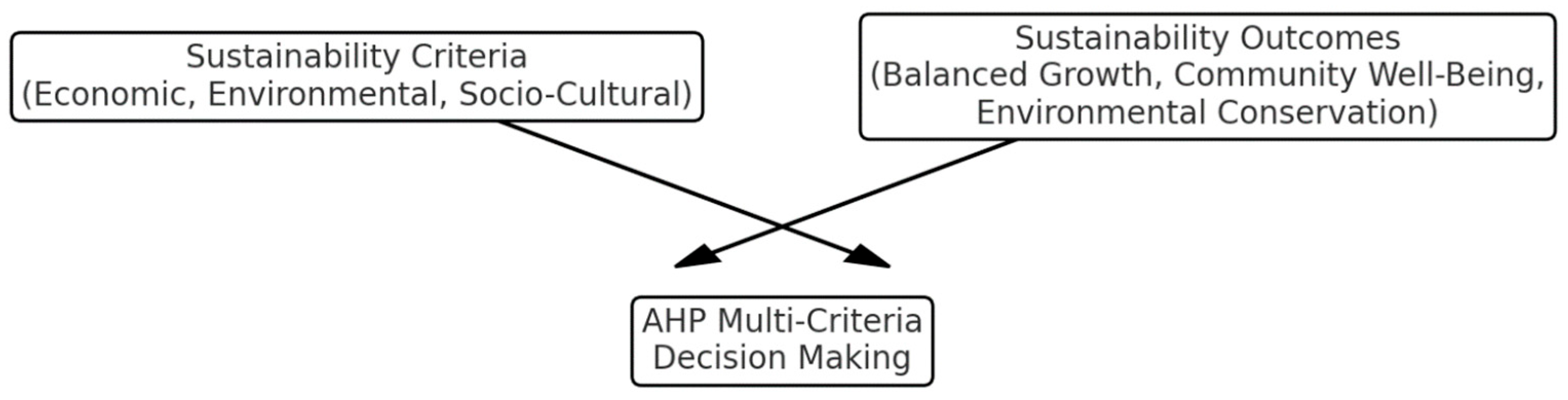
Analytical Framework
3. Materials and Methods
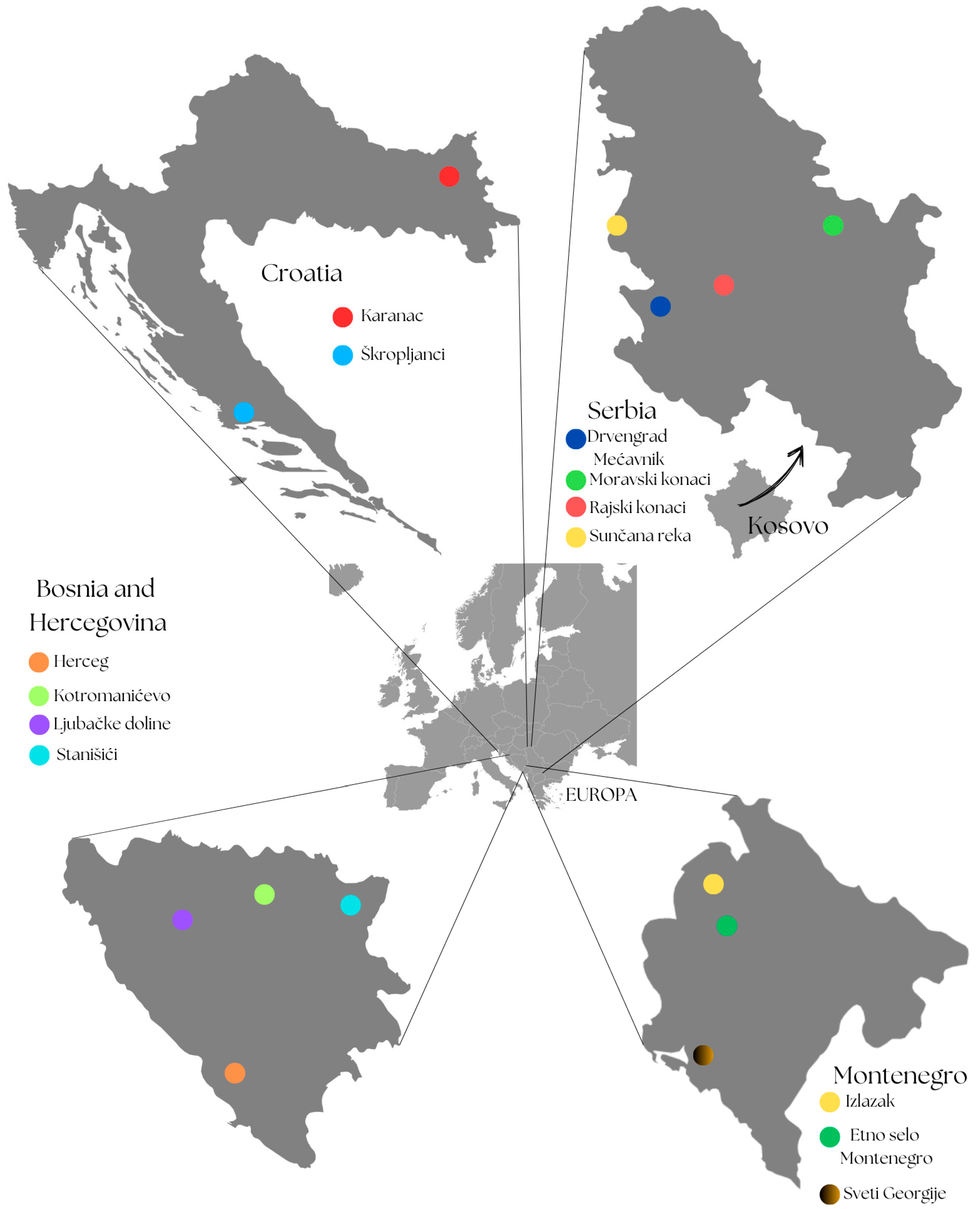
3.1. Study Area
3.2. Data Acquisition
3.3. Variable Selection and Application of AHP Methodology
Structure of the AHP Model
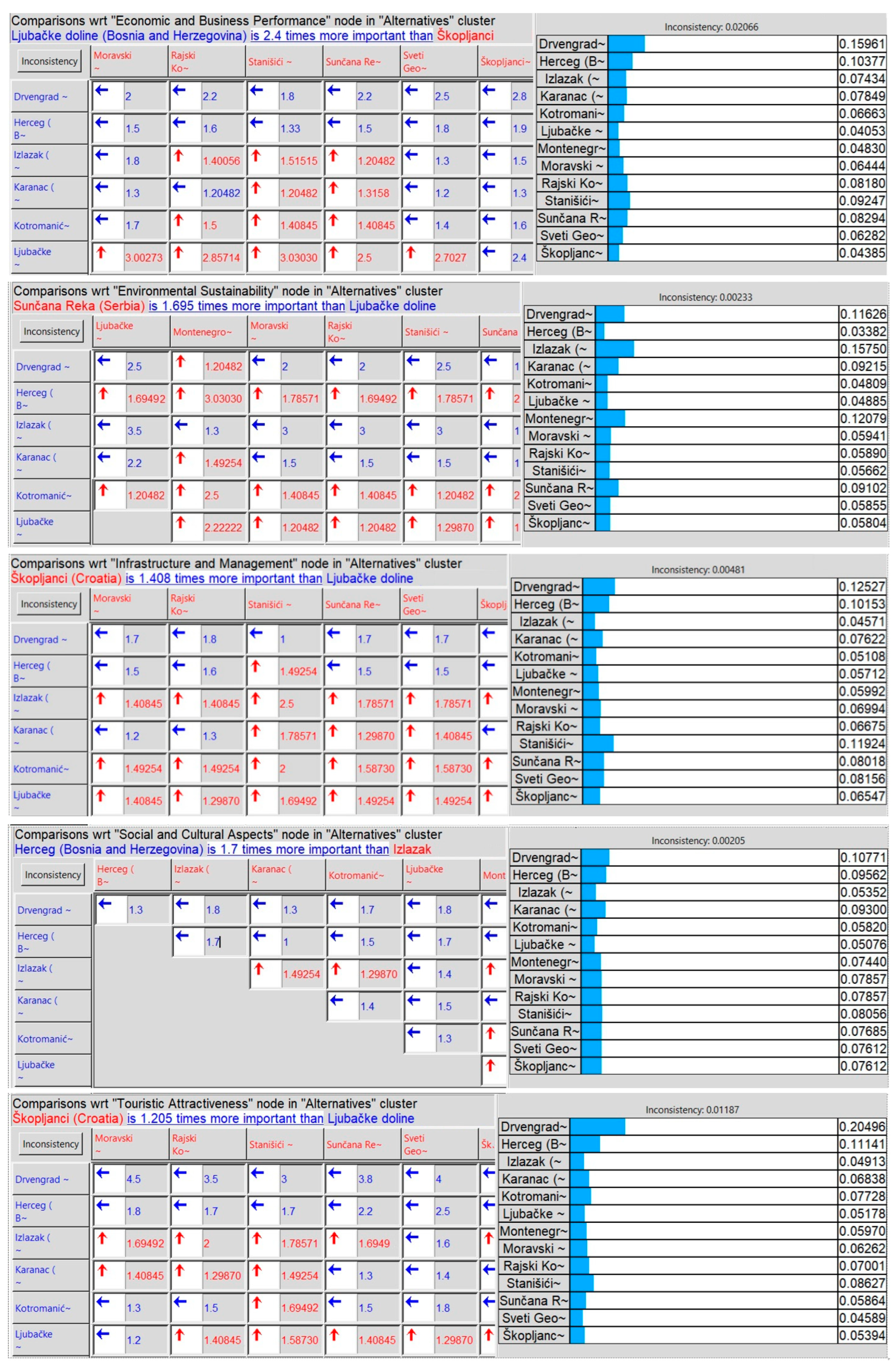
- Pairwise comparisons of criteria and alternatives
- Calculation of weights and evaluation of alternatives
- Consistency validation
4. Results
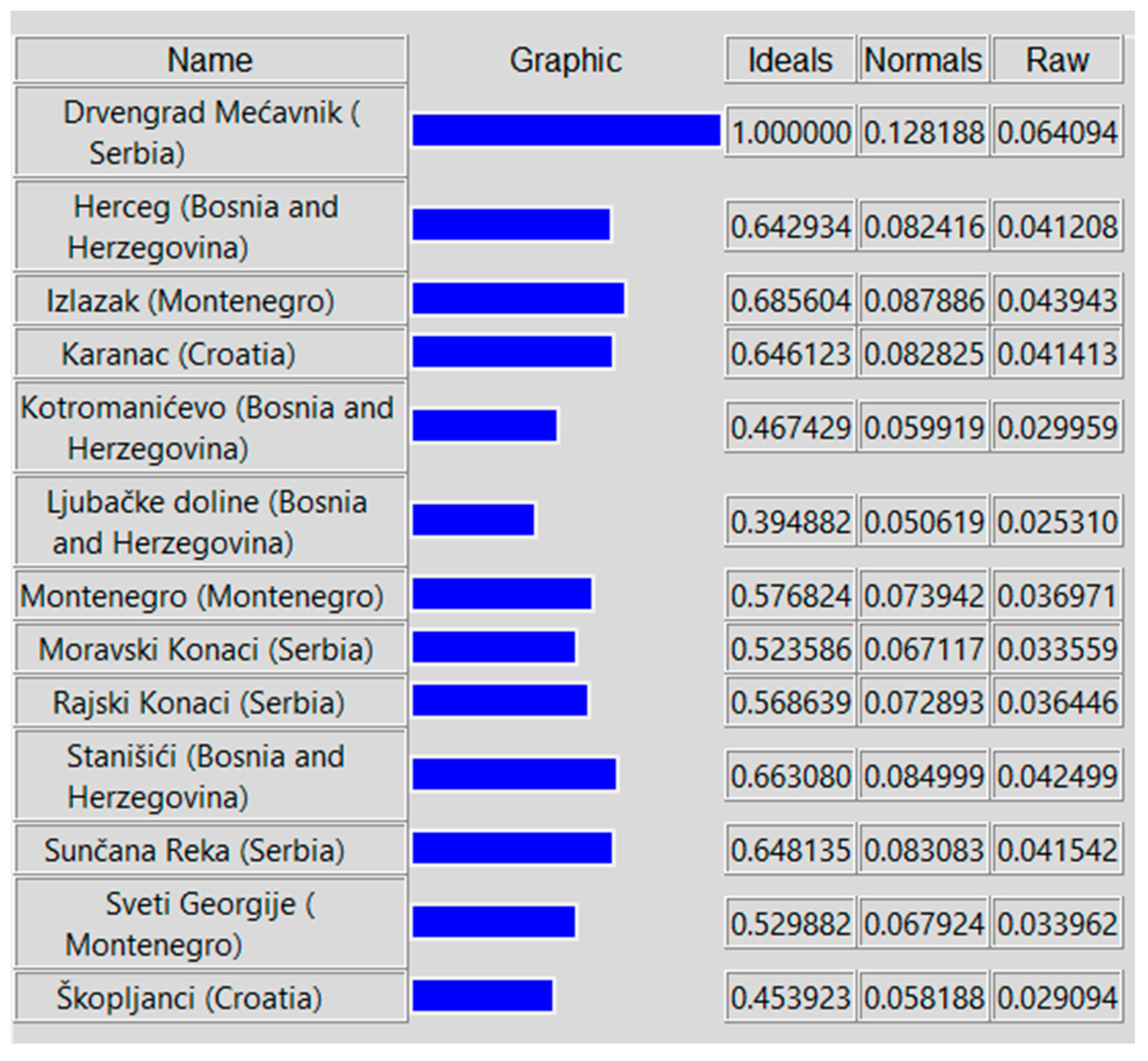
4.1. Final Priority Display
4.2. Sensitivity Analysis
5. Discussion
5.1. Interpretation of Key Findings and Implications for Sustainable Ethno Tourism
5.2. Scenario Analysis and Methodological Considerations
- Scenario 1: Emphasis on sustainable tourism
- Scenario 2: Emphasis on Infrastructure
5.3. Contributions, Practical Implications, and Methodological Limitations
6. Conclusions
Author Contributions
Funding
Institutional Review Board Statement
Informed Consent Statement
Data Availability Statement
Acknowledgments
Conflicts of Interest
Abbreviations
| AHP | Analytic Hierarchy Process |
| SWOT | Strengths, Weaknesses, Opportunities, and Threats |
| CI | Consistency Index |
| CR | Consistency Ratio |
| UNWTO | United Nations World Tourism Organization |
| TOPSIS | Technique for Order Preference by Similarity to Ideal Solution |
| PROMETHEE | Preference Ranking Organization Method for Enrichment Evaluation |
References
- Wu, J.; Hu, M.; Fu, X.; Deng, H.; Wu, G. Income impacts of rural household livelihood strategies: Insights from Chongqing, Southwest China. Int. J. Sustain. Dev. World Ecol. 2025, 32, 341–354. [Google Scholar] [CrossRef]
- Huang, L.; Yang, L.; Tuyến, N.T.; Colmekcioglu, N.; Liu, J. Factors influencing the livelihood strategy choices of rural households in tourist destinations. J. Sustain. Tour. 2022, 30, 875–896. [Google Scholar] [CrossRef]
- Prevolšek, B.; Maksimović, A.; Puška, A.; Pažek, K.; Žibert, M.; Rozman, Č. Sustainable development of ethno-villages in Bosnia and Herzegovina—A multi criteria assessment. Sustainability 2020, 12, 1399. [Google Scholar] [CrossRef]
- Panić, A.; Vujko, A.; Knežević, M. Economic indicators of rural destination development oriented to tourism management: The case of ethno villages in Western Serbia. Hotel. Tour. Manag. 2025, 13, 81–97. [Google Scholar] [CrossRef]
- Kljuno, A.H.; Halilovic, M. The phenomenon of ethno villages in Bosnian rural tourism. Herit. Sustain. Dev. 2022, 4, 122–133. [Google Scholar] [CrossRef]
- Nedeljković, M.; Puška, A.; Krstić, S. Multicriteria approach to rural tourism development in Republic of Srpska. Eкoнoмuкa noљonpuвpeдe 2022, 69, 13–26. [Google Scholar] [CrossRef]
- Raspor, A.; Peršič, K.T.; Kleindienst, P.; Mastilo, Z.; Borojević, D.; Miletić, V. A case study of ethno village in Slovenia and Bosnia and Herzegovina. Econ. Innov. Econ. Res. J. 2020, 8, 89–102. [Google Scholar] [CrossRef]
- Puška, A.; Šadić, S.; Maksimović, A.; Stojanović, I. Decision support model in the determination of rural touristic destination attractiveness in the Brčko District of Bosnia and Herzegovina. Tour. Hosp. Res. 2020, 20, 387–405. [Google Scholar] [CrossRef]
- Zaburaeva, K.S. Ethnocultural heritage of the North-Eastern Caucasus as a factor of eco-tourism development. J. Mt. Sci. 2024, 21, 2810–2824. [Google Scholar] [CrossRef]
- Kunasekaran, P.; Gill, S.S.; Ramachandran, S.; Shuib, A.; Baum, T.; Herman Mohammad Afandi, S. Measuring sustainable indigenous tourism indicators: A case of Mah Meri ethnic group in Carey Island, Malaysia. Sustainability 2017, 9, 1256. [Google Scholar] [CrossRef]
- Dernoi, L.A. Farm tourism in Europe. Tour. Manag. 1983, 4, 155–166. [Google Scholar] [CrossRef]
- Chan, J.H.; Zhang, Y.; McDonald, T.; Qi, X. Entrepreneurship in an indigenous community: Sustainable tourism and economic development in a newly inscribed UNESCO world heritage site. In Indigenous People and Economic Development; Routledge: Abingdon, UK, 2016; pp. 189–204. [Google Scholar]
- Žibert, M.; Prevolšek, B.; Pažek, K.; Rozman, Č.; Škraba, A. Developing a diversification strategy of non-agricultural activities on farms using system dynamics modelling: A case study of Slovenia. Kybernetes 2022, 51, 33–56. [Google Scholar] [CrossRef]
- Ungaya, G.C. East Africa Community Regional Tourism Policy: The Nexus between Cultural Heritage and Socio-economic Development of the Maasai Community in Serengeti-Mara Ecosystem. J. Kenya Natl. Comm. UNESCO 2024, 5. [Google Scholar] [CrossRef]
- Nguyen, K.T.; Murphy, L.; Chen, T. Segmentation of ethnic tourists and their interaction outcomes with hosts in the Central Highlands, Vietnam. Adv. Southeast Asian Stud. 2024, 17, 105–133. [Google Scholar] [CrossRef]
- Mamani-Flores, A.; Apaza-Ticona, J.; Calatayud-Mendoza, A.P.; Calderón-Torres, A.; Maquera-Maquera, Y.; Velasquez-Sagua, H.L.; Flores-Chambilla, S.G. The Exercise of Experiential Rural Tourism in the Population Nucleus of an Andean Community in Peru. J. Ecohumanism 2024, 3, 5203–5217. [Google Scholar] [CrossRef]
- Shao, D.; Zoh, K. Analysis of spatial distribution characteristics and driving factors of ethnic-minority villages in China using geospatial technology and statistical models. J. Mt. Sci. 2024, 21, 2770–2789. [Google Scholar] [CrossRef]
- Butler, R.; Hinch, T. (Eds.) Tourism and Indigenous Peoples: Issues and Implications; Routledge: Abingdon, UK, 2007. [Google Scholar]
- Chen, P.; Kong, X. Tourism-led commodification of place and rural transformation development: A case study of Xixinan village, Huangshan, China. Land 2021, 10, 694. [Google Scholar] [CrossRef]
- Cohen, E. Authenticity and commoditization in tourism. Ann. Tour. Res. 1988, 15, 371–386. [Google Scholar] [CrossRef]
- Williams, L.K.; Gonzalez, V.V. Indigeneity, sovereignty, sustainability and cultural tourism: Hosts and hostages at ʻIolani Palace, Hawai’i. J. Sustain. Tour. 2017, 25, 668–683. [Google Scholar] [CrossRef]
- Acuña Medina, D.I.; Gañán Rojo, P.F.; Arango Alzate, S.B. Etnoturismo: Una aproximación a las oportunidades y amenazas que implica para las culturas indígenas. Cuad. De Tur. 2019, 43, 17–38. [Google Scholar] [CrossRef]
- UNWTO. Statistical Framework for Measuring the Sustainability of Tourism (SF-MST): Final Draft. 2024. Available online: https://unstats.un.org/UNSDWebsite/statcom/session_55/documents/BG-4a-SF-MST-E.pdf (accessed on 13 March 2025).
- Recchini, E. Official Statistics for Measuring the Sustainability of Tourism: The UNWTO Initiative; Proceedings e Report; Firenze University Press: Firenze, Italy; Genova University Press: Genova, Italy, 2023; pp. 47–52. [Google Scholar]
- Demonja, D.; Gredičak, T. Contribution to the research on rural resorts in the function of tourism products and services distribution: The Example of the Republic of Croatia. East. Eur. Countrys. 2015, 21, 137–151. [Google Scholar] [CrossRef]
- Medojevic, J.; Milosavljevic, S.; Punisic, M. Paradigms of rural tourism in Serbia in the function of village revitalisation. Hum. Geogr. 2011, 5, 93. [Google Scholar] [CrossRef]
- Kluczek, A. Application of multi-criteria approach for sustainability assessment of manufacturing processes. Manag. Prod. Eng. Rev. 2016, 7, 62–78. [Google Scholar] [CrossRef]
- Hunter, C. Sustainable tourism as an adaptive paradigm. Ann. Tour. Res. 1997, 24, 850–867. [Google Scholar] [CrossRef]
- Pope, J.; Annandale, D.; Morrison-Saunders, A. Conceptualising sustainability assessment. Environ. Impact Assess. Rev. 2004, 24, 595–616. [Google Scholar] [CrossRef]
- Schianetz, K.; Kavanagh, L.; Lockington, D. Concepts and tools for comprehensive sustainability assessments for tourism destinations: A comparative review. J. Sustain. Tour. 2007, 15, 369–389. [Google Scholar] [CrossRef]
- Saaty, T.L. How to make a decision: The analytic hierarchy process. Eur. J. Oper. Res. 1990, 48, 9–26. [Google Scholar] [CrossRef]
- Saaty, T.L. The analytic hierarchy process (AHP). J. Oper. Res. Soc. 1980, 41, 1073–1076. [Google Scholar]
- Prevolšek, B.; Gačnik, M.B.; Rozman, Č. Applying integrated data envelopment analysis and analytic hierarchy process to measuring the efficiency of tourist farms: The case of Slovenia. Sustainability 2023, 15, 4314. [Google Scholar] [CrossRef]
- Bhattacharya, P.; Al Aziz, R.; Karmaker, C.L.; Bari, A.M. A fuzzy synthetic evaluation approach to assess the risks associated with municipal waste management: Implications for sustainability. Green Technol. Sustain. 2024, 2, 100087. [Google Scholar] [CrossRef]
- Roussel, Y.; Audi, M. Exploring the Nexus of Economic Expansion, Tourist Inflows, and Environmental Sustainability in Europe. J. Energy Environ. Policy Options. 2024, 7, 28–36. [Google Scholar]
- Ivars-Baidal, J.A.; Vera-Rebollo, J.F.; Perles-Ribes, J.; Femenia-Serra, F.; Celdrán-Bernabeu, M.A. Sustainable tourism indicators: What’s new within the smart city/destination approach? J. Sustain. Tour. 2023, 31, 1556–1582. [Google Scholar] [CrossRef]
- Pasanchay, K.; Schott, C. Community-based tourism homestays’ capacity to advance the Sustainable Development Goals: A holistic sustainable livelihood perspective. Tour. Manag. Perspect. 2021, 37, 100784. [Google Scholar] [CrossRef]
- Saaty, T.L.; Zoffer, H.J.; Vargas, L.G.; Guiora, A. The Analytic Hierarchy Process: Beyond “Getting to Yes” in Conflict Resolution. In Overcoming the Retributive Nature of the Israeli-Palestinian Conflict; Springer International Publishing: Cham, Switzerland, 2021; pp. 17–29. [Google Scholar] [CrossRef]
- United Nations Geospatial Information Section. Map of the World. United Nations. Available online: https://www.un.org/geospatial/content/map-world-0 (accessed on 20 October 2025).
- Lane, B. What is rural tourism? J. Sustain. Tour. 1994, 2, 7–21. [Google Scholar] [CrossRef]
- Bramwell, B.; Lane, B. Critical research on the governance of tourism and sustainability. J. Sustain. Tour. 2011, 19, 411–421. [Google Scholar] [CrossRef]
- Ivars-Baidal, J.A.; Celdrán-Bernabeu, M.A.; Mazón, J.N.; Perles-Ivars, Á.F. Smart destinations and the evolution of ICTs: A new scenario for destination management? Curr. Issues Tour. 2019, 22, 1581–1600. [Google Scholar] [CrossRef]
- Keller, K.; Mátyás, S.; Hegedűs, M.; Kaszás, N.; Rahmat, A.F.; Dávid, L.D. Updating the tourism organizational assessment scale. J. Infrastruct. Policy Dev. 2024, 8, 3811. [Google Scholar] [CrossRef]
- Roberts, L.; Sharpley, R. Rural Tourism–10 Years On. Int. J. Tour. Res. 2004, 6, 119–124. [Google Scholar]
- Crouch, G.I.; Ritchie, J.B. Tourism, competitiveness, and societal prosperity. J. Bus. Res. 1999, 44, 137–152. [Google Scholar] [CrossRef]
- Geng, Y.; Zhao, S.; Zhang, X.; Li, J.; Yan, Y.; Gao, J. Bibliometric analysis of sustainable rural tourism. Humanit. Soc. Sci. Commun. 2025, 12, 788. [Google Scholar] [CrossRef]
- Gössling, S.; Hall, C.M.; Scott, D. Tourism and Water. Available online: https://www.degruyterbrill.com/document/doi/10.21832/9781845415006/html (accessed on 13 May 2025). [CrossRef]
- Buckley, R. Sustainable tourism: Research and reality. Ann. Tour. Res. 2012, 39, 528–546. [Google Scholar] [CrossRef]
- Serio, R.G.; Giuliani, D.; Dickson, M.M.; Espa, G. Going green across boundaries: Spatial effects of environmental policies on tourism flows. arXiv 2025, arXiv:2504.03608. [Google Scholar] [CrossRef]
- Richards, G. Cultural tourism: A review of recent research and trends. J. Hosp. Tour. Manag. 2018, 36, 12–21. [Google Scholar] [CrossRef]
- Timothy, D.J. Cultural Heritage and Tourism: An Introduction; Channel View Publications: Bristol, UK, 2011; Volume 4. [Google Scholar]
- Turčinović, M.; Vujko, A.; Stanišić, N. Community-led sustainable tourism in rural areas: Enhancing wine tourism destination competitiveness and local empowerment. Sustainability 2025, 17, 2878. [Google Scholar] [CrossRef]
- Butler, R. Tourism destination development: The tourism area life cycle model. Tour. Geogr. 2025, 27, 599–607. [Google Scholar] [CrossRef]
- Sharpley, R. Tourism Development and the Environment: Beyond Sustainability? Routledge: Abingdon, UK, 2009. [Google Scholar]
- Pato, M.L.; Duque, A.S. Mapping Innovation and Sustainability in Rural Tourism: A Bibliometric Approach. Sustainability 2025, 17, 2574. [Google Scholar] [CrossRef]
- Saputra, P.E.D.; Srinadi, I.G.A.M.; Susilawati, M.; Kencana, I.P.E.N.; Octavanny, M.A.D.; Gandhiadi, G.K. Wakatobi Development Priorities as A Sustainable Tourism Destination Using the Analytical Hierarchy Process Method. Int. J. Educ. Res. 2024, 1, 51–66. [Google Scholar] [CrossRef]
- Tsaur, S.H.; Wang, C.H. The evaluation of sustainable tourism development by analytic hierarchy process and fuzzy set theory: An empirical study on the Green Island in Taiwan. Asia Pac. J. Tour. Res. 2007, 12, 127–145. [Google Scholar] [CrossRef]
- Szabo, Z.K.; Szádoczki, Z.; Bozóki, S.; Stănciulescu, G.C.; Szabo, D. An Analytic Hierarchy Process Approach for Prioritisation of Strategic Objectives of Sustainable Development. Sustainability 2021, 13, 2254. [Google Scholar] [CrossRef]
- Stofkova, J.; Krejnus, M.; Stofkova, K.R.; Malega, P.; Binasova, V. Use of the analytic hierarchy process and selected methods in the managerial decision-making process in the context of sustainable development. Sustainability 2022, 14, 11546. [Google Scholar] [CrossRef]
- Saaty, T.L.; Vargas, L.G. Decision Making in Economic, Political, Social, and Technological Environments with the Analytic Hierarchy Process; RWS Publications: Pittsburgh, PA, USA, 1994; Volume 7. [Google Scholar]
- Stanić Jovanović, S.; Ilić, B.; Miletović, N. Is Rural Tourism a Chance for Development and Revitalisation of Aranđelovac Municipality? In Sustainable Agriculture and Rural Development V: Book of Abstracts; Institute of Agricultural Economics: Belgrade, Serbia, 2024. [Google Scholar]
- Drvengrad. 2025. Available online: https://mecavnik.info/ (accessed on 13 March 2025).
- Etno Selo Herceg. 2025. Available online: https://etno-herceg.com/en/home/ (accessed on 13 May 2025).





| Country | Ethno Villages |
|---|---|
| Croatia | Karanac, Škopljanci |
| Serbia | Drvengrad Mećavnik, Moravski konaci, Rajski konaci, Sunčana reka, |
| Bosnia and Hercegovina | Herceg, Kotromanićevo, Ljubačke doline, Stanišići |
| Montenegro | Izlazak, Etno selo Montenegro, Sveti Georgije |
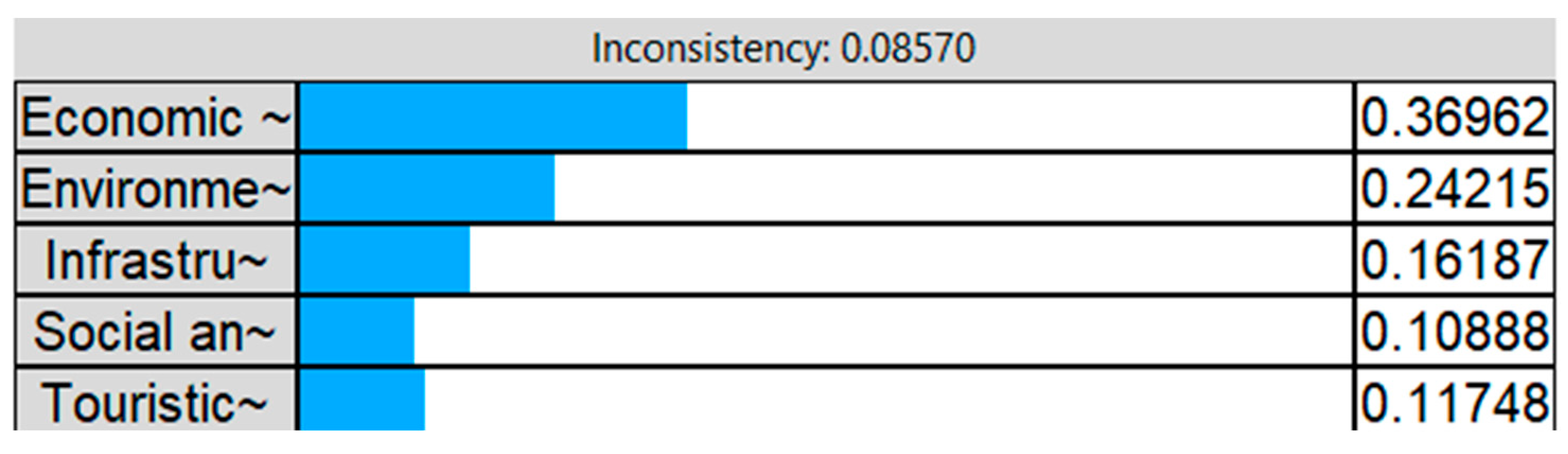
| Criterion | Weight (Priority) | Value Significance |
|---|---|---|
| Economic and business performance | 0.3696 (36.96%) | The most important criterion—economic performance—has the greatest impact on the sustainability of an ethno-village. This includes income generation, profitability, employment opportunities, and overall financial stability. |
| Environmental sustainability | 0.2421 (24.21%) | The second most important criterion, reflecting the environmental impact of the ethno-village, the adoption of sustainable practices, and the preservation of natural resources. |
| Infrastructure and management | 0.1618 (16.18%) | A moderately important criterion encompassing accessibility, accommodation quality, road connectivity, and investments in infrastructure. |
| Touristic attractiveness | 0.1175 (11.75%) | Less influential than economic or environmental sustainability but still crucial for visitor engagement and experience. This includes cultural attractions, unique experiences, and visitor programs. |
| Social and cultural aspects | 0.1088 (10.88%) | The least influential criterion in this analysis, yet still relevant—it includes the preservation of traditions, community involvement, and cultural heritage protection. |
Disclaimer/Publisher’s Note: The statements, opinions and data contained in all publications are solely those of the individual author(s) and contributor(s) and not of MDPI and/or the editor(s). MDPI and/or the editor(s) disclaim responsibility for any injury to people or property resulting from any ideas, methods, instructions or products referred to in the content. |
© 2025 by the authors. Licensee MDPI, Basel, Switzerland. This article is an open access article distributed under the terms and conditions of the Creative Commons Attribution (CC BY) license (https://creativecommons.org/licenses/by/4.0/).
Share and Cite
Gačnik, M.B.; Pelaez-Verdet, A.; Cerezo-Medina, A.; Prevolšek, B.; Rozman, Č.; Škraba, A. Prioritizing Sustainability in Ethno-Tourism: An AHP Assessment of Rural Villages in the Balkans. Sustainability 2025, 17, 9980. https://doi.org/10.3390/su17229980
Gačnik MB, Pelaez-Verdet A, Cerezo-Medina A, Prevolšek B, Rozman Č, Škraba A. Prioritizing Sustainability in Ethno-Tourism: An AHP Assessment of Rural Villages in the Balkans. Sustainability. 2025; 17(22):9980. https://doi.org/10.3390/su17229980
Chicago/Turabian StyleGačnik, Maja Borlinič, Antonio Pelaez-Verdet, Alfonso Cerezo-Medina, Boris Prevolšek, Črtomir Rozman, and Andrej Škraba. 2025. "Prioritizing Sustainability in Ethno-Tourism: An AHP Assessment of Rural Villages in the Balkans" Sustainability 17, no. 22: 9980. https://doi.org/10.3390/su17229980
APA StyleGačnik, M. B., Pelaez-Verdet, A., Cerezo-Medina, A., Prevolšek, B., Rozman, Č., & Škraba, A. (2025). Prioritizing Sustainability in Ethno-Tourism: An AHP Assessment of Rural Villages in the Balkans. Sustainability, 17(22), 9980. https://doi.org/10.3390/su17229980