Article

Coupling Effect of the Energy–Economy–Environment System in the Yangtze River Economic Belt

1
College of Ocean and Geography, Yancheng Teachers University, Yancheng 224007, China
2
Ginling College, Nanjing Normal University, Nanjing 210097, China
3
Gulf Coast Research and Education Center, University of Florida, Tampa, FL 22598, USA
*
Author to whom correspondence should be addressed.
These authors contributed equally to this work.
Sustainability 2025, 17(22), 9941; https://doi.org/10.3390/su17229941
Submission received: 3 October 2025 / Revised: 25 October 2025 / Accepted: 31 October 2025 / Published: 7 November 2025

Abstract

The Energy–Economy–Environment (3E) nexus within basin economic zones has received significant scholarly attention. As a major river basin economic belt in China, the Yangtze River Economic Belt (YREB) serves as an important case for examining the status and drivers of coordinated 3E development. The findings of this study may also offer valuable insights for promoting sustainable development in river basin economies globally. Encompassing 11 provinces and municipalities, the YREB represents not only a vital socioeconomic region in China but also one of the nation’s largest energy consumers, facing considerable environmental pressures. Using panel data spanning 2009–2019, this study applies the coupling coordination degree (CCD) model, spatial Durbin model, and Moran’s I to assess the coordination level of the 3E system in the YREB. The main findings are as follows: (1) The CCD demonstrated a trend that was fluctuating but generally on the rise throughout the study period. Higher values were observed in eastern provinces and lower ones in western provinces, which reveals a distinct east–west spatial gradient. (2) A significantly positive spatial correlation was observed in provincial 3E coordination, although this correlation fluctuated and showed a slowly weakening trend over time. Local spatial clustering patterns also shifted, marked by the persistence of high-high clusters, an increase in low-low clusters, and the emergence of low-high outliers. (3) Estimates from the spatial Durbin model indicate that urbanization, automobile consumption, and foreign trade exert positive overall effects on the CCD, whereas industrial structure exerts a negative overall effect. Environmental policy is not statistically significant in the static model but shows a negative overall effect when the CCD is lagged by one period.

1. Introduction

Against the backdrop of global warming, energy security challenges, and ecological degradation, sustainable development has become an urgent global imperative. Central to this effort is understanding the interrelationship among energy, economy, and environment—collectively referred to as the Energy–Economy–Environment (3E) System [1]. These three components are deeply interdependent, and their coordinated development is essential for fostering high-quality economic growth, preserving ecological integrity, and guiding regions toward a green and sustainable trajectory [2,3,4]. Accordingly, research on 3E system coordination has attracted growing interest among scholars and policymakers [5]. In its capacity as the world’s second-largest economy as well as a leading energy producer and consumer, China has witnessed heightened conflicts between energy scarcity and escalating demand amid its rapid industrialization and economic growth [6]. Unsustainable energy practices have further aggravated environmental pollution, regional imbalances, and industrial overconcentration [7]. In response to this, the Chinese government has put into practice a range of measures to rebalance the 3E system, including the “13th Five-Year Plan for Energy Development”, which set a binding cap on national energy consumption, and the subsequent “carbon peak” and “carbon neutrality” pledges, aimed at curbing greenhouse gas emissions and advancing sustainable economic models.

The Yangtze River Economic Belt (YREB)—the world’s largest inland river basin economy—offers a compelling context for analyzing these issues [8]. Accounting for more than 40% of China’s GDP and population, the YREB spans approximately 2.05 million square kilometers across 11 provinces and municipalities. Nevertheless, the region’s heavy historical reliance on coal—with fossil fuels constituting over 40% of its energy mix—along with low energy efficiency and an extensive growth model, has hindered sustainable development. Moreover, pronounced intra-regional disparities in economic performance, environmental quality, and resource utilization further challenge coordinated progress [9,10,11]. The regional scope of the Yangtze River Economic Belt (YREB) is shown in Figure 1.
To analyze such multi-system interactions, the concept of “coupling”, originally from physics, has been widely applied in sustainability science. Coupling coordination models, including the Coupling Coordination Degree (CCD) model, enable researchers to quantify inter-system dynamics and identify synergistic states [12,13,14,15].
This study investigates the coordinated development and spatiotemporal evolution of the 3E system in the YREB from 2009 to 2019 using spatial autocorrelation analysis and the CCD model. It makes three key theoretical contributions: (1) it employs a spatial Durbin model to identify determinants of the CCD, informing strategies for high-quality regional development; (2) it reveals spatiotemporal evolution patterns of the CCD, showcasing China’s advances in sustainable development and offering references for other major river basin economies; and (3) it enriches the 3E system evaluation framework by introducing a CCD indicator system structured around the DPSIR model. The paper proceeds as follows: Section 2 conducts a literature review and identifies research gaps. Section 3 outlines the sources of data, research methods, and indicator development. Section 4 presents results from the empirical analysis. Section 5 discusses the findings while validating their robustness. Section 6 offers conclusions and notes limitations of the research.

2. Literature Review

Scholars have conducted extensive research on the 3E system, primarily focusing on two areas: (1) the conceptualization of the 3E system and the interrelationships between its subsystems and (2) its construction and practical application.

2.1. Concept of 3E System and the Relationships Between Subsystems

Early research on the interrelations among energy, economy, and environment primarily focused on binary systems, giving rise to two prominent pairings: energy–economy and environment–economy. Research on the energy–economy nexus has uncovered different interaction patterns between energy consumption and economic growth. For example, in the United States, energy consumption scale has grown in tandem with GNP expansion, which is consistent with the “conservation hypothesis” [16]. Conversely, the “increase hypothesis” posits that improvements in energy efficiency can reduce consumption and boost productivity [17]. Within the economy–environment binary system, the Environmental Kuznets Curve (EKC) first identified an inverted U-shaped relationship between economic development and environmental quality [18], suggesting that environmental degradation initially worsens but later improves with economic growth. However, subsequent studies have also documented other types of curvilinear relationships within this binary framework [19].
With advancements in multidisciplinary research and methodologies, the scope of economic studies expanded from binary to ternary systems. Beyond the EKC, econometric models were increasingly employed to analyze the relationships between the economy and a wider range of variables. The proposal of the Porter Hypothesis provided fresh perspectives for the study of economic growth within the context of energy and the environment. Rubashkina [20], for example, adopted a quantitative approach to demonstrate how environmental regulations can foster economic growth through innovation-driven effects. Zhang [21] tested the resource curse hypothesis using the FGLS model, finding evidence of its prevalence across Chinese regions. To further advance the application of multivariate coupling theory in economic research, the Coupling Coordination Degree (CCD) model was subsequently proposed [22].

2.2. Construction and Practical Application of the 3E System

With the aim of combining economic growth and trade liberalization, economists have introduced the environment into growth models as a production factor—analyzing its impact pathways and investigating the effects and mechanisms of interaction between economic growth and the environment [23]. Nevertheless, owing to the complexity, non-equilibrium, and uncertainty intrinsic to the low-carbon energy transition within ecological macroeconomic models, it becomes essential to evaluate the energy–economy–environment (3E) system in line with the factors demanded by new economic methodologies. This includes focusing on the comparability of model results and their policy interpretations, alongside incorporating the impact factors of energy and environment that bridge sustainability and macroeconomics [24]. In addressing modeling and planning issues of energy related to economic, political, and social development, Ahmadi [25] integrated thermal energy, environmental, and economic factors to analyze the interactive effect of thermal power generation on the economy and environment. Chen [26] developed a 3E system coordination evaluation model to assess the economic growth of the Yangtze River Delta and thoroughly analyze its dynamic evolution.
Furthermore, as the application of 3E systems becomes more widespread, evaluation of regional system coordination is increasingly common. Most mainstream research in China is based on national or provincial levels, with less focus on regional-level studies [10,27]. Many studies also improve the existing 3E system CCD model, for example, by combining it with a spatially lagged multivariate discrete gray prediction model for future trend analysis [28], using a pressure-state-response (PSR) based evaluation model [29], or applying entropy-weighted fuzzy matter-element theory [30]. Building on this, some scholars have advanced 3E system research by exploring influencing factors of subsystems. This includes studying factors affecting carbon neutrality within the 3E system [31]. Xin [32] utilized a structural equation model to analyze data from China’s manufacturing industry and explore the relationship between corporate social responsibility (CSR) and environmental performance. Similarly, Asif et al. [33] used structural equation modeling and a sample from developing countries to study energy and its influencing factors.

2.3. Summary

Current research on the theory and internal mechanisms of the 3E system has reached a relatively mature stage and is extensively applied at national and provincial levels. However, there is a scarcity of studies focusing on regional perspectives. Moreover, while the influencing factors of the economic, energy, and environmental subsystems have been widely discussed, few studies treat the 3E system as a whole to explore its integrated influencing factors.
The harmonious interaction of the 3E system is crucial for fostering sustainable economic growth within the Yangtze River Economic Belt (YREB). Recognized as one of China’s three primary strategies for regional coordinated development in the 13th Five-Year Plan, the YREB’s development necessitates an integrated analysis. Nonetheless, substantial developmental disparities persist among the 11 provinces and municipalities that constitute the belt. Analyzing the influence relationships within each province can help low-coordination areas improve their situation, thereby raising the region’s overall coordination level. In addition, when current scholars study the spatial relationship of CCD in regions, most measure it using Moran’s I and conduct dynamic analysis, but they typically do not quantify the relevant influencing factors. This paper applies a spatial econometric model, together with Moran’s I, to analyze the degree of influence of these factors and conducts further effect decomposition. Lastly, methods such as the dynamic Spatial Durbin Model, replacement matrices, and alternative sample periods are used to test the robustness of the results.

3. Data and Methodology

3.1. Data Sources

The data samples are panel data of 11 provinces (cities) spanning 2009 to 2019. To eliminate the effects of price fluctuations, all variables with monetary values were converted to constant 2009 prices. Conversions involving foreign currencies used the annual average exchange rate. The dataset for this analysis was compiled from the China Statistical Yearbook, the China Energy Statistical Yearbook, and the statistical yearbooks of the respective provinces and cities in the YREB. To ensure data integrity, any missing values were addressed through the application of interpolation.

3.2. Method Principles

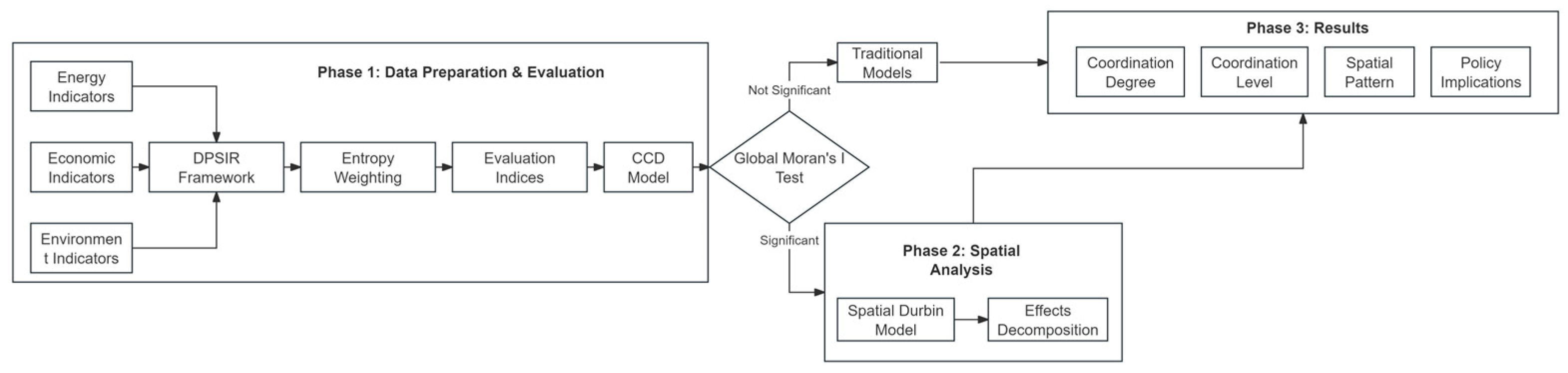
The following methods and models are mainly used in this article for research, and the research ideas are shown in Figure 2:
(1) Coupling coordination degree. As a well-established metric for assessing coordination quality among interacting systems, the CCD is widely used in 3E studies [15,30,34]. This paper employs the CCD to investigate the coordinated development of the Energy–Economy–Environment system.
(2) Entropy method. To enhance the credibility and accuracy of the weighting process, the entropy method was employed for index assignment. This objective approach, as utilized in the studies by Dong et al. [35], minimizes the influence of personal judgment—a significant limitation of subjective methods—and is a well-established technique in the field.
(3) Moran’s I. Developed for spatial analysis, Moran’s I is an index that quantifies the pattern of spatial dependence, indicating whether geographic data is clustered, dispersed, or random. It was proposed by P.A.P. Moran, a Geography of the United States, in 1950. Through Moran’s I, the similarity or difference of data in spatial distribution can be quantitatively analyzed. In addition, the existence of spatial aggregation is also a prerequisite for using spatial econometric models.
(4) Spatial econometrics. During the measurement of the total effects, the spatial econometrics could decompose the indirect and direct effects further, compared to the traditional measurement methods. The following are its advantages: first of all, the spatial Panel data can more accurately reflect the spillover effects of samples in space and time than the ordinary Panel data; in addition, spatial econometric models can accurately grasp the pathways and mechanisms of spillover effects by incorporating spatial weighting matrices, rather than simply weighting explanatory variables as proxy variables for spillovers; thirdly, the spatial weighting matrix can reflect the total effect, direct effect, and especially the direction of spillover effect, rather than simply one-way spillover; last but not least, the role of the explained variable with its spatial lag term could be studied through spatial econometrics.

3.3. Models Construction

3.3.1. The Construction of Index System

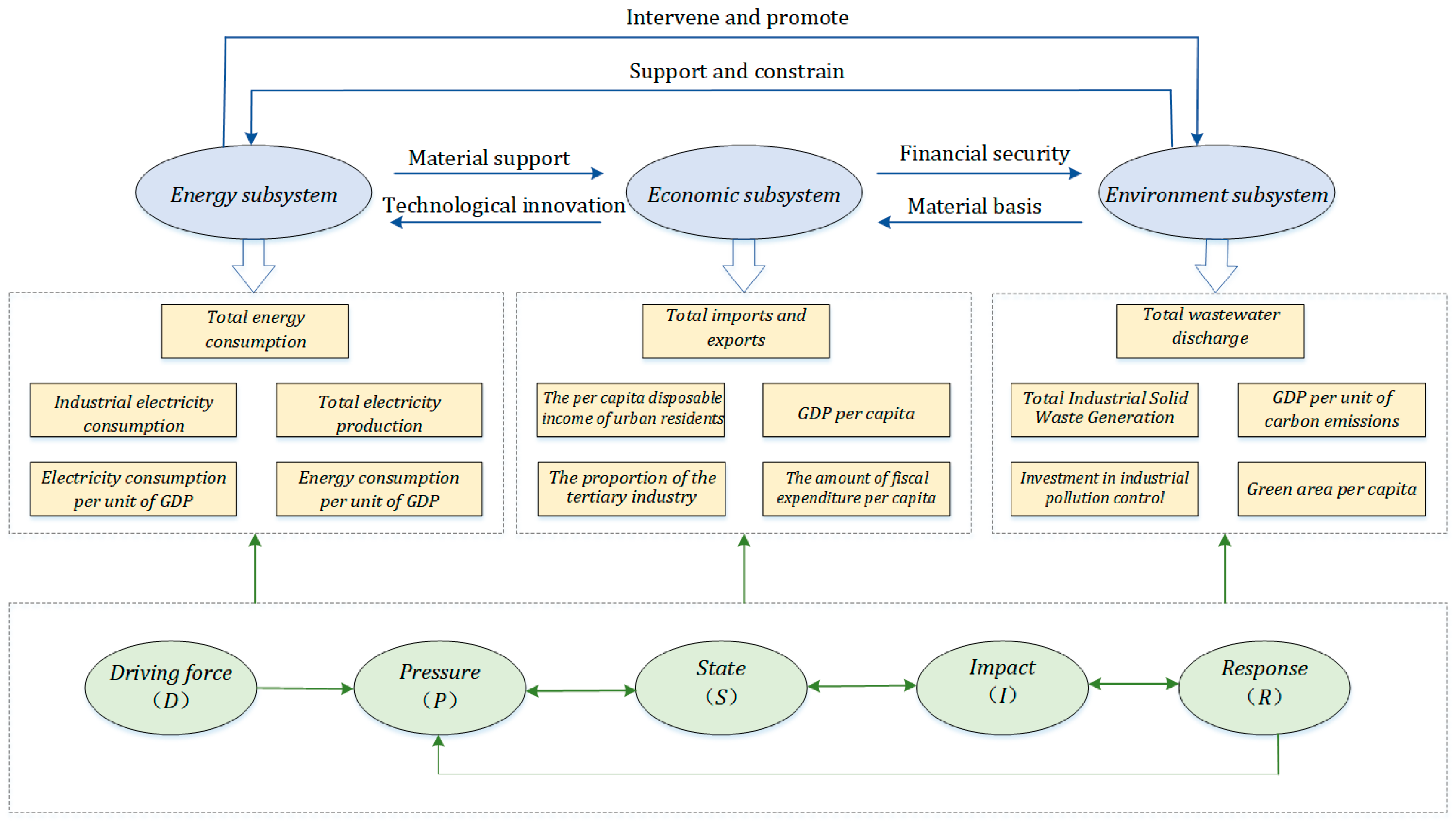
This research adopts the DPSIR (Driving Force-Pressure-State-Impact-Response) framework, drawing upon the studies of Ye et al. [15] and Liu et al. [7], to develop the evaluation index system for 3E coordination in the YREB. The DPSIR model is a well-documented approach in sustainability science [36,37,38], valued for its integration of the strengths found in both the DSR and PSR frameworks. Based on this framework and considering the specific conditions of the YREB, 15 indicators were selected across the five DPSIR dimensions to reflect the characteristics of the 3E system, as detailed in Table 1. In the table, “+” denotes a positive indicator and “−” a negative one. The structure of the entire evaluation indicator system for the 3E-CCD is illustrated in Figure 3.
The selection of indicators comprehensively drew upon assessment practices from authoritative domestic and international institutions, as well as relevant academic research. To reflect the energy efficiency priorities of the International Energy Agency (IEA) and the National Bureau of Statistics [39], indicators like “total energy consumption” and “energy consumption per unit of GDP” were identified as core measures of pressure and impact within the energy subsystem. Similarly, “industrial electricity consumption” and “total electricity production” were included to represent the system’s internal structure and supply status, as they are common variables in energy-economic system studies [40]. In the economic subsystem, “GDP per capita” and “total import and export volume” were adopted as classic driver and state indicators to measure regional economic scale and openness, both of which are widely applied in studies on economic growth quality [41]. The “share of the tertiary industry” reflects the level of economic structural optimization and upgrading, representing a key dimension in sustainable development assessment. For the environmental subsystem, the indicator selection focused on pollution pressure and governance response. “Total industrial wastewater discharge” and “industrial solid waste generation” serve as direct indicators of environmental pressure and are frequently used in regional environmental performance assessments [42]. “Carbon emissions per unit of GDP” comprehensively reflects the efficiency of low-carbon economic development, with its validity supported by relevant IPCC reports [43]. Meanwhile, “industrial pollution control investment” and “per capita green space area” directly demonstrate the intensity of societal and governmental environmental governance responses, forming a crucial basis for evaluating policy effectiveness.

3.3.2. The Calculation of Indicator Weights

The entropy method was employed to calculate the evaluation index values for the 3E system, and the calculation procedure encompasses the following steps.
① The process of normalizing data metrics:
Positive indicators:
X θ i j = X θ i j min ( X j ) max ( X j ) min ( X j ) , 1 i n ; 1 j m
Negative indicators:
X θ i j = max ( X j ) X θ i j max ( X j ) min ( X j ) , 1 i n ; 1 j m
where X θ i j and X θ i j denote the standardized result and raw index data of n indicators for the i provinces (cities) in the θ year, respectively; max ( X j ) , min ( X j ) refer to the maximum and minimum values of the j indicator; m and n are the number of indicators and the total number of provinces (cities) in the YREB, respectively.
② Identify the weights of each indicator:
P θ i j = X θ i j θ r i n X θ i j
③ The information entropy value of each j indicator is calculated as follows:
E j = k θ r i n P θ i j ln P θ i j
where k = 1 ln r n , where r is the number of years, m and n are the number of cities; 0 E j 1 ; when P i j = 0 , P i j ln P i j = 0 .
④ The information utility value of the j indicator is calculated as follows:
D j = 1 E j
⑤ The weights of each indicator is calculated as follows:
W j = D j j = 1 m D j
⑥ Each subsystem’s comprehensive evaluation value is calculated as follows:
S θ i = j m X θ i j W j T
where S θ i refers to the final combined appraisal value, W j refers to the weight.

3.3.3. Coupling Coordination Degree Model

The coupled coordination degree model constructed in this paper is as follows:
C = U 1 U 2 U 3 U 1 + U 2 + U 3 / 3 1 3
① Establish an 3E coupling model, and then compute the coupling coordination degree C . The specific formulas are provided below:
T = α U 1 + β U 2 + λ U 3
where U 1 , U 2 and U 3 represent the energy, economy, and environment system of each province (city), respectively.
② In order to better illustrate the degree of coordinated development of the 3E system among YREB provinces (cities), this paper constructs a coupled coordination degree model as follows:
D = C T
where D represents the CCD; T is the coupling coordination degree of 3E system of each province (city); α , β and λ are the weights of the 3E system, respectively. With reference to the findings of Luo [39] and other scholars, let α = β = λ = 1 / 3 . The CCD is categorized into four distinct stages, as detailed in Table 2.

3.3.4. Spatial Analysis Model

The exploratory spatial data analysis (ESDA) model serves to analyze the spatial dependence of the 3E system’s CCD. It is categorized into global and local statistical models, where the former typically applies Global Moran’s I to detect spatial heterogeneity and homogeneity of the CCD across regions.
I = n i = 1 n j = 1 n W i j ( X i X - ) ( X j X - ) i = 1 n j = 1 n W i j ( X i X - ) 2
Moran’s I can only assess the spatial correlation between regions, thus limiting its ability to capture the correlation that exists among these areas. To address the aforementioned issue, local Moran’s I can be used to observe changes in regional information, so as to determine whether it is smooth or abrupt.
I i = X i j 1 n W i j X j
where n is the number of 11 provinces; X i and X j are the degree between provinces (cities), respectively; X j refers to the average value; and W i j refers to the spatial weight matrix; Moran’s I ∈ [−1, 1].

3.3.5. Spatial Durbin Model Principle

By integrating spatial lags of the dependent variable and the predictors, the Spatial Durbin Model (SDM) explicitly accounts for spatial dependence in the data [44]. This specification allows the model to account not only for the spillover effects of the dependent variable itself but also for the potential spillover effects originating from the independent variables in neighboring regions [45]. This framework is particularly suited to analyzing the 3E system’s coordination, as a region’s development is likely influenced not only by the overall development of its neighbors but also directly by specific policies and economic structures in those adjacent areas. Consequently, the SDM provides a more comprehensive analytical framework than models that consider only spatial dependence in the dependent variable (e.g., the Spatial Autoregressive Model, SAR) or only in the error term (e.g., the Spatial Error Model, SEM), as it can more fully capture these complex spatial dependency mechanisms and mitigate estimation biases caused by omitted spatial variables [46,47].
Given these theoretical advantages and following rigorous preliminary tests on our data, this paper employs the SDM to delve into the factors influencing the 3E-CCD of the YREB. After conducting additional tests on the data, this paper delves into the factors influencing the 3E CCD system’ of YREB by establishing the Spatial Durbin Model (SDM).
C C D i t = ρ 0 + β 1 I n d i t + β 2 E n p i t + β 3 F t r i t + β 4 U r b i t + β 5 A u c i t + β 6 W I n d i t + β 7 W E n p i t + β 8 W F t r i t + β 9 W U r b i t + β 10 W A u c i t + μ i + ϕ t + ε i t
where C C D i t represents the 3E system’s CCD of region i in year t ; I n d i t is the ratio of the total value of the secondary industry to GDP of region i in year t ; E n p i t is the proportion of environmental protection expenditure in general budget of region i in year t ; F t r i t is total import and export trade of region i in year t ; U r b i t is Proportion of urban population of region i in year t ; A u c i t is Per capita car ownership of region i in year t ; W is the economic distance matrix; μ i and ϕ t represent the time and individual fixed effects; and the random error term is represented by ε i t . The variable explanations involved in this model are shown in Table 3.
(1) Industrial Structure
The evolution of a nation’s industrial structure is intrinsically linked to its economic growth. Industrial upgrading enhances resource allocation efficiency and is instrumental in ensuring steady economic and social progress. Moreover, shifts in industrial structure have profound and interactive implications for economic output, energy consumption, and environmental quality.
(2) Environmental Policy
Environmental challenges have long posed a significant constraint on economic development. The implementation of environmental policies not only safeguards the ecosystem but also enhances resource utilization efficiency and productivity. By promoting technological innovation and green growth, such policies provide a sustainable foundation for long-term economic development.
(3) Foreign Trade
Trade is the engine of economic growth, because foreign trade can not only increase total output by expanding external demand, but can also facilitate exchange for capital goods needed for economic development through export trade, as well as the procurement of advanced technology and management experience. For developing countries, it is instrumental in optimizing traditional economic structures and improving energy efficiency. However, in China, export trade has been characterized by high energy consumption, leading to a rapid surge in energy use. Consequently, the associated energy development and production processes generate significant environmental pollution, presenting a challenge to sustainable development.
(4) Urbanization Rate
As an inevitable trend in social development, urbanization exerts its influence through two primary channels: socio-cultural and industrial-economic. Socio-culturally, it transforms mindsets and elevates living standards, which in turn alters production and consumption patterns, fostering a culture of energy conservation and green low-carbon awareness. Industrially, population concentration promotes economic modernization and intensification, accelerating development through agglomeration effects. Consequently, while urbanization poses challenges to ecological and energy systems, it also drives economic growth and can potentially encourage a shift towards more sustainable practices.
(5) Automobile Consumption
Automobile consumption is a telling indicator of the balance within the 3E system. Rising automobile ownership reflects improved living standards but simultaneously increases reliance on energy. Furthermore, vehicle use leads to exhaust pollution, highlighting the tension between environmental, energy, and economic objectives. Therefore, reforming the automobile industry and developing new energy vehicles are crucial for reducing pollution and primary energy waste.

4. Results Analysis

4.1. Coupling Coordination Degree

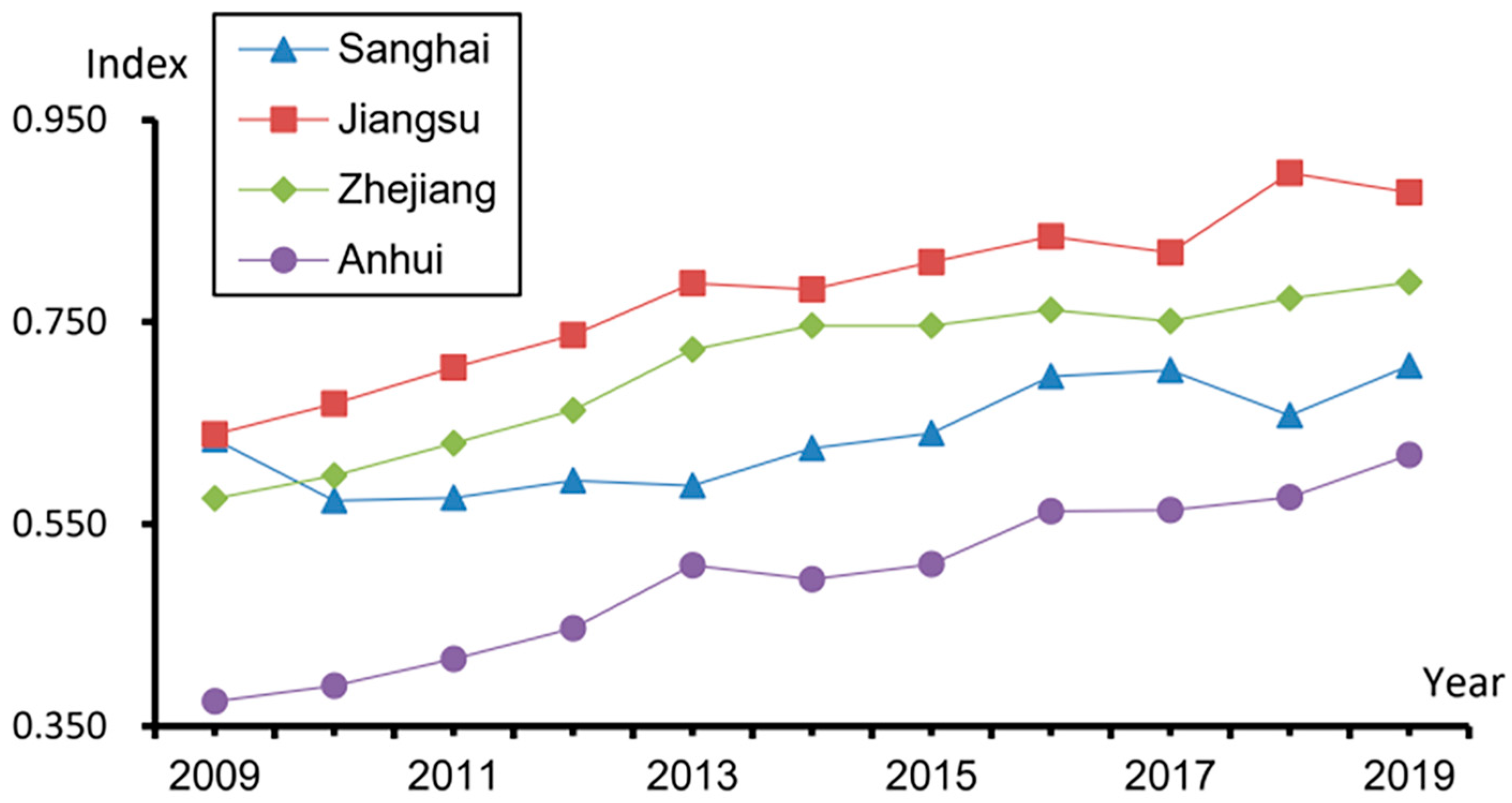
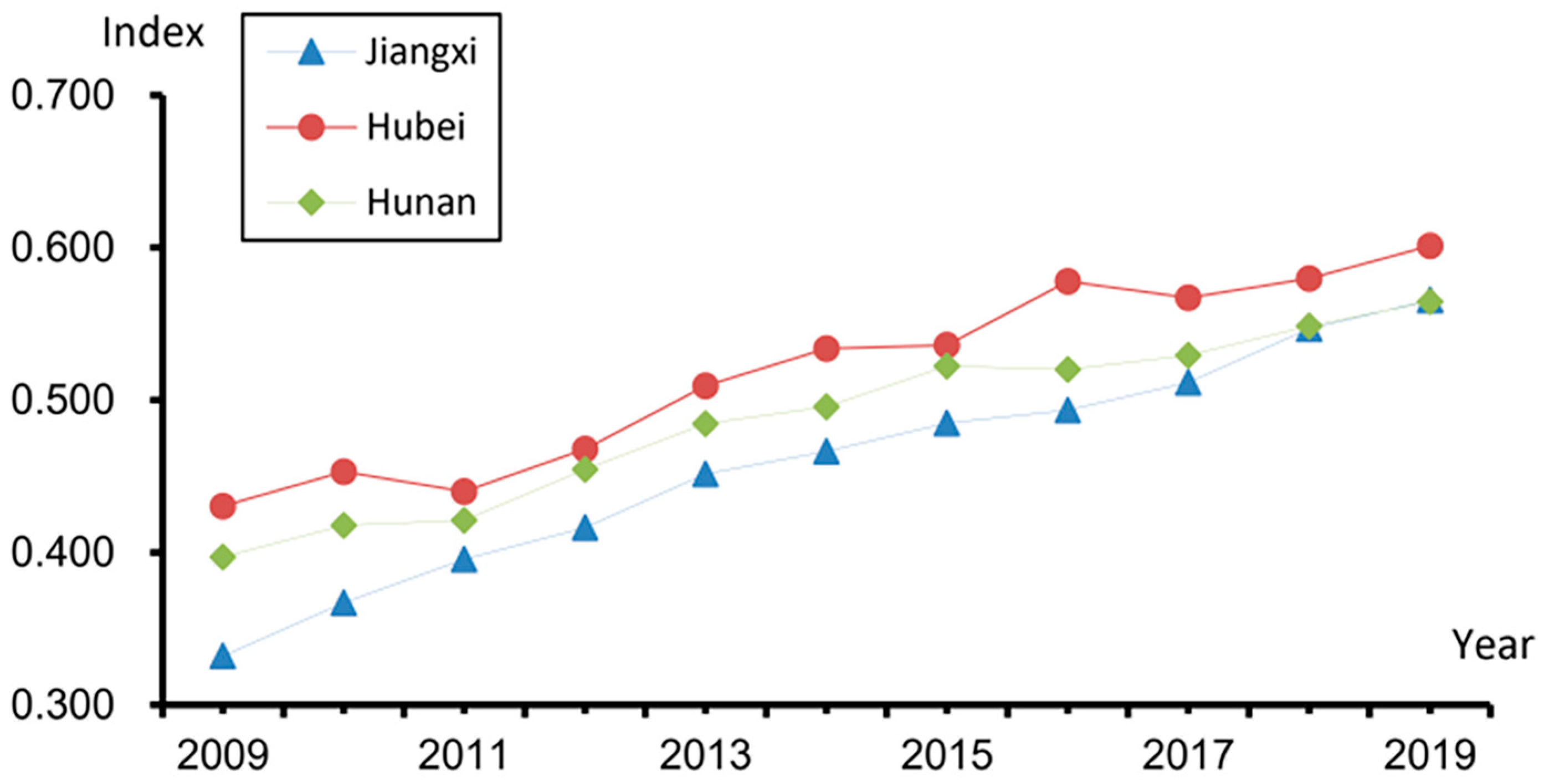
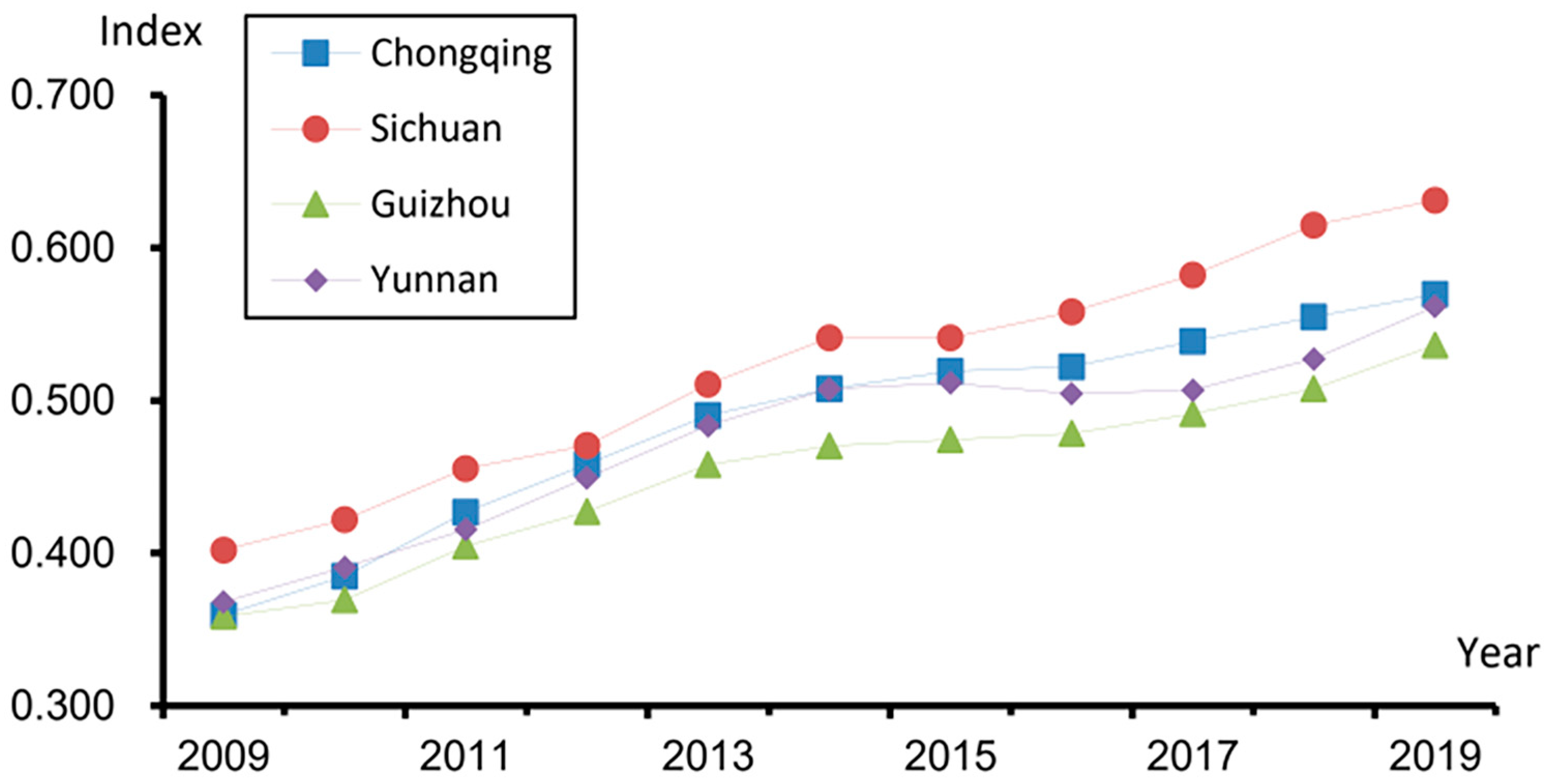
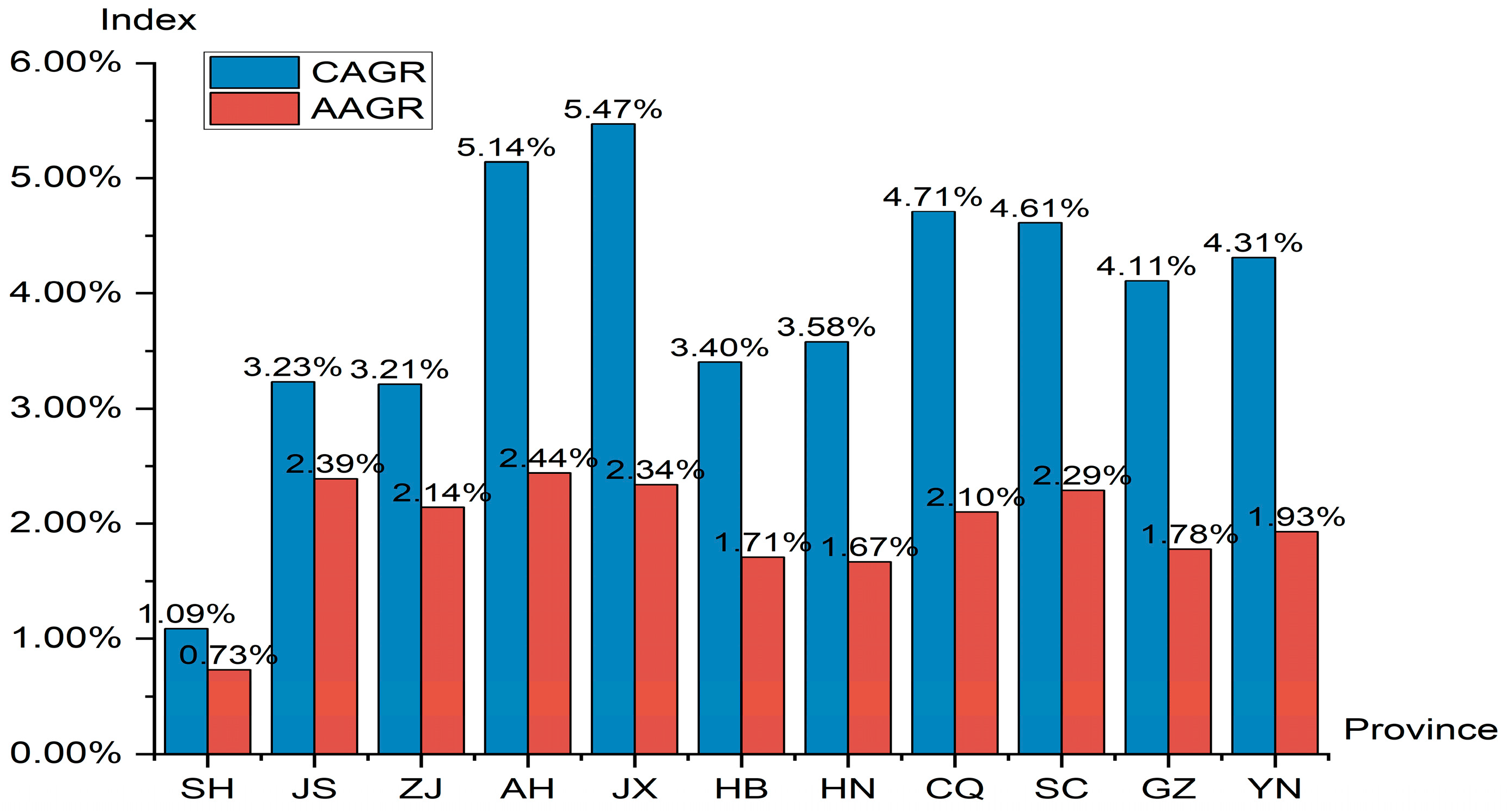
Using the methodology outlined in Formulas (1)–(10) and the dataset from Table 1 to Table 3, the regional CCD was derived for the YREB. The results are summarized in Table 4 and visually illustrated in the subsequent figures (Figure 4, Figure 5, Figure 6 and Figure 7).
As illustrated in Figure 4, Figure 5 and Figure 6, the sample mean of the CCD rose from 0.443 in 2009 to 0.638 in 2019, and the range of change is as high as 44.02%, showing an overall upward trend. At the provincial level, the Compound Annual Growth Rate (CAGR) of Jiangxi and Anhui far exceeded that of other provinces, reaching 5.47% and 5.14%, respectively. In terms of absolute values, the sample averages of Jiangsu, Zhejiang, and Shanghai all fell within the range of 0.6 to 0.8 (0.778, 0.705, and 0.636, respectively), placing them in the highly coordinated stage. Notably, although Jiangsu’s CCD was significantly higher than that of other provinces, its CAGR was relatively modest at 3.23%, surpassing only that of Shanghai and Anhui. This can be attributed to the fact that Jiangsu’s CCD had already transitioned from a medium to a high and then to an extreme coordination stage (above 0.8) after 2015. At such a high level, further rapid growth becomes inherently more difficult. Manifesting as an “east-high, west-low” distribution, the CCD across the YREB provinces shows a distinct spatial pattern. A gradual decline in coordination is observable from the eastern coastal zones to the central and western hinterlands, mirroring the regional disparities in economic development.
From a provincial perspective, significant variation in CCD levels is observed. This is primarily reflected in the fact that, aside from the high-CCD agglomeration of Jiangsu-Zhejiang-Shanghai, the differences among the other provinces are not substantial. However, it is noteworthy that the CAGR of the other eight provinces has increased faster than that of Jiangsu, Zhejiang, and Shanghai, demonstrating a steady upward trend. This phenomenon can likely be linked to the increased emphasis on regional innovation by governments at all levels in the central and western regions, focusing on transforming economic models and intensifying environmental protection efforts—initiatives that have positively contributed to CCD growth.

4.2. Ternary Coupled Spatial Auto-Correlation

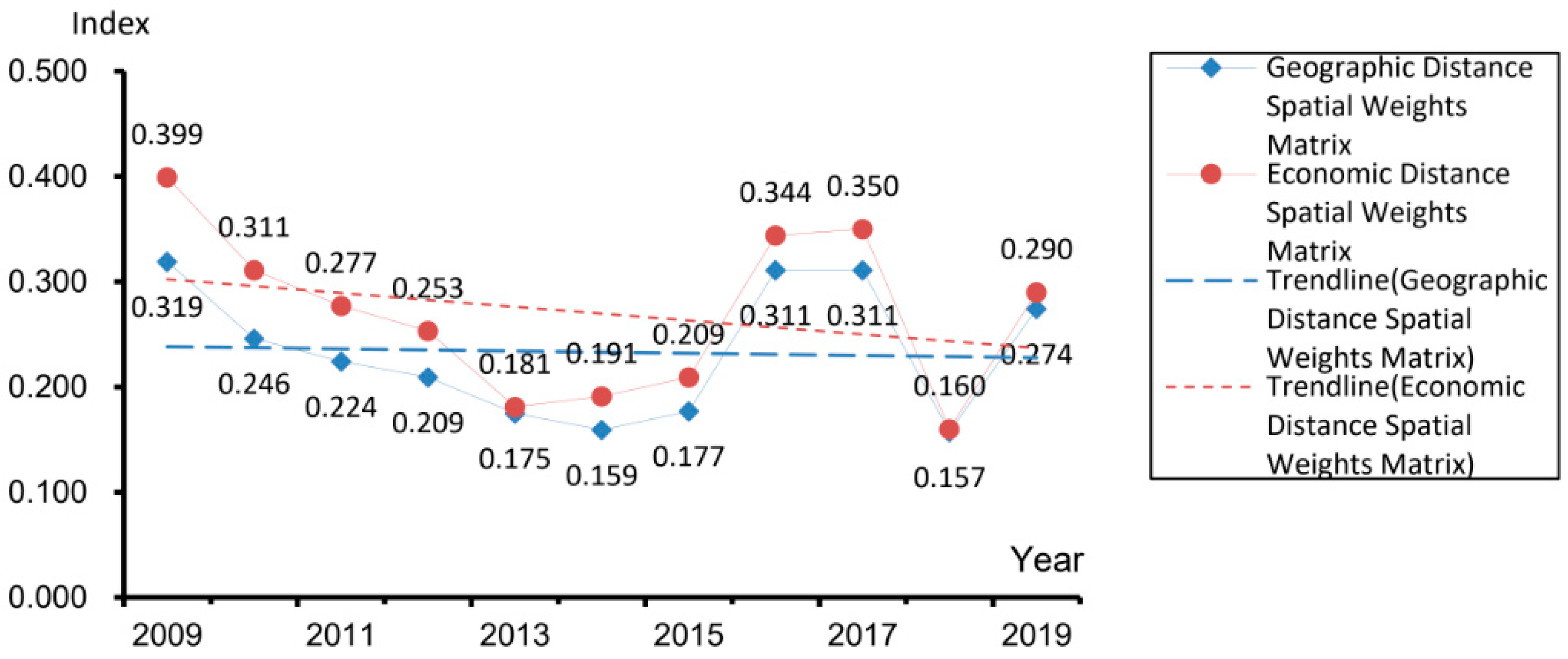
The presence of significant positive spatial autocorrelation in the 3E system’s CCD across the YREB is affirmed by the Global Moran’s I results under both geographical and economic-geographical spatial weight matrices (Table 5). These matrices were constructed for spatial econometric analysis to reflect provincial disparities, and the robustly positive and statistically significant values confirm this spatial dependency.
According to Figure 8, the trend of Moran’s I is basically the same in both the spatial matrix of geographic weights and the spatial matrix of economic geography, both showing a “W”. From the trend line, the economic geospatial matrix demonstrates that a general downward trend is indicated in the spatial correlation of provinces, while geographical weight spatial matrix shows a flat trend; from the numerical changes of the two lines, the Moran Index of the YREB is highly variable, and its spatial correlation reached a historical low in 2018, at 0.157 and 0.160, respectively, followed by a slight rebound. Despite the increase in spatial correlation, the value never exceeds the maximum point. In addition, the Moran index calculated after considering economic factors is significantly higher than the Moran index calculated by only considering geographical distance, which indicates that considering economic linkages among provinces (cities) can better fit the economic development level among regions in YREB.

4.3. Local Moran’s I

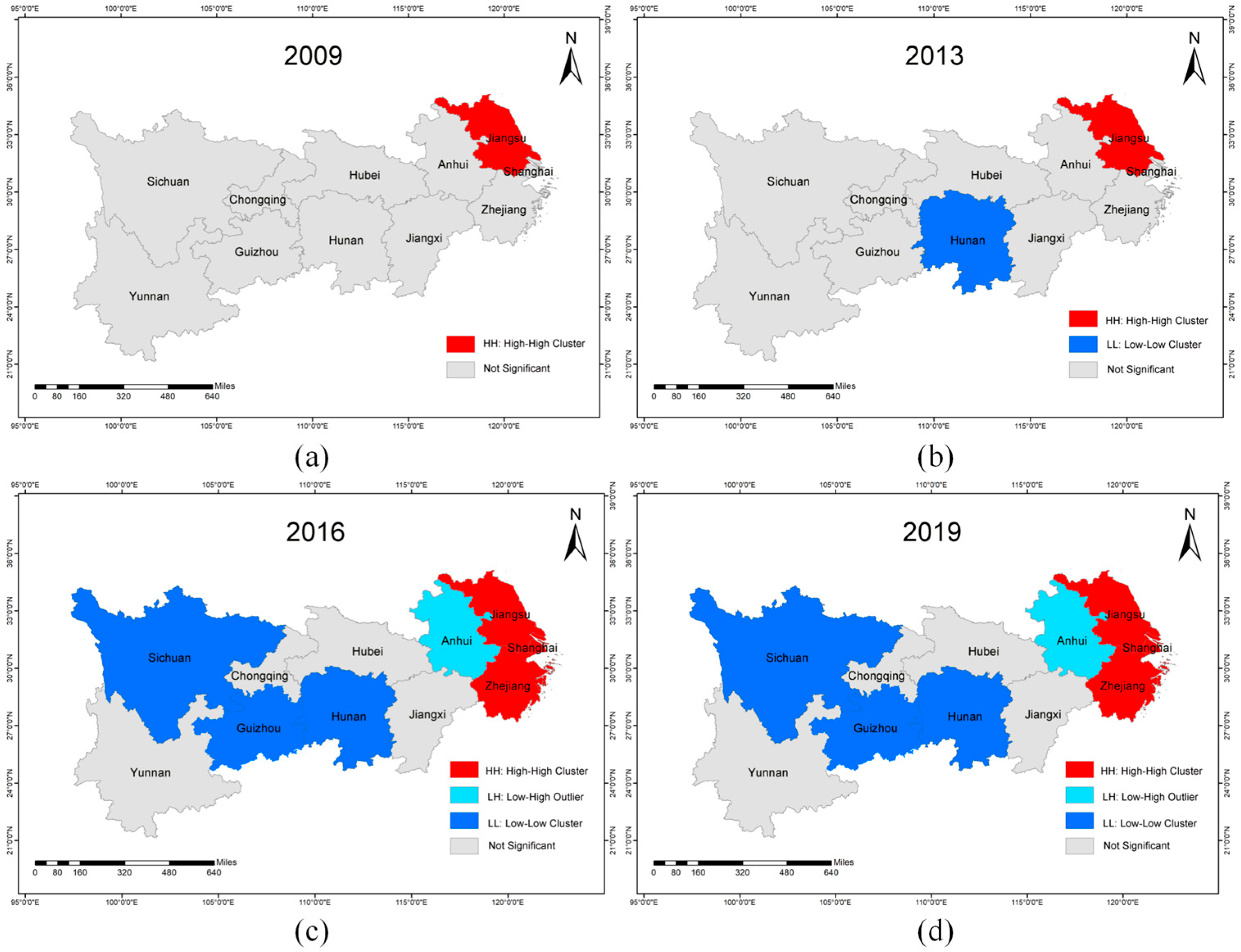
While it is useful for detecting overall spatial clustering, the global Moran’s I lacks the granularity to reveal the specific attributes of local spatial correlations. Therefore, this work chooses to construct local Moran index models, which can take detailed measurements. This paper constructs the Lisa cluster map and Lisa significance map by GeoDa 1.22 and ArcGIS 10.8 and classifies the three factors’ coupling correlation characteristics into five categories based on local Moran’s I and Lisa cluster map: “high-high (H-H)” clustering refers to regions of high CCD adjacent to the high observation areas; “high-low” (H-L) clustering refers to regions with high observed values surrounded by low-value areas; “low-high” (L-H) aggregation refers to low-observed regions surrounded by high-observed regions; “low-low” (L-L) aggregation refers to low-valued regions surrounded by low-valued regions; “insignificant” shows no spatial correlation between the observed region and the adjacent area. Figure 9 shows the Lisa cluster map for 2009, 2016, 2016, and 2019.
As shown in Figure 9, the spatial correlation within the Yangtze River Economic Belt (YREB) has undergone significant changes over time. The following is a detailed discussion by year: ① In 2009, Jiangsu and Shanghai exhibited a close economic-geographic connection, as evidenced by their High-High (HH) clustering. In contrast, spatial associations were insignificant for most other provinces in the region. The high-value clusters in Figure 9a, concentrated in eastern provinces like Jiangsu and Zhejiang, epitomize the outcomes of long-term national policy dividends such as the “Coastal Opening Strategy” [48]. These policies have cultivated modern industrial systems centered on high-end manufacturing and the digital economy, fostering agglomeration through policy-guided industrial chain coordination and efficient factor allocation [49]. ② In 2013, while Shanghai and Jiangsu maintained their HH clustering, Hunan Province emerged as a Low-Low (LL) cluster. Figure 9b reflects a different developmental logic. Driven by the “Central Region Rise” strategy, these inland regions leveraged their labor and resource advantages to absorb industrial transfers from the east, forming distinctive clusters in equipment manufacturing and electronics. This represents a spatial phase of functional complementarity within the national industrial chain [50]. ③ In 2016, the spatial pattern evolved further. Jiangsu, Shanghai, and Zhejiang all became HH clusters. Anhui became a High-Low cluster, which can be attributed to its Coupling Coordination Degree (CCD) of 0.563, still lagging behind Jiangsu (0.835), Zhejiang (0.762), and Shanghai (0.696). Simultaneously, Sichuan, Guizhou, and Hunan formed LL clusters. The low-value clusters in western regions (Figure 9c) reveal the challenges of path dependence. Despite infrastructure investments under initiatives like “Western Development,” these areas remain constrained by single-industry structures and insufficient innovation capacity, resulting in weak spatial spillovers [51]. ④ In 2019, the basic pattern of local spatial correlation remained largely similar to that in 2016. Throughout the sample period, Hubei, Jiangxi, Chongqing, and Yunnan did not demonstrate significant spatial correlation effects. Notably, the “heterogeneous clusters” in Figure 9d, characterized by high economic development levels but diffuse geography, can be linked to emerging “multi-centered networked” strategies. The functional spillovers within mega-regions like the Chengdu-Chongqing Economic Circle are fostering complex, polycentric spatial organizations that transcend traditional agglomeration models [52].
In summary, these shifting clustering patterns provide a spatial map of China’s regional policy effects and industrial evolution. Future differentiated policies must account for the distinct institutional-industrial logic underlying each cluster type to enhance the precision of regional coordination efforts [53]. Furthermore, the analysis of the index reveals that regions with higher economic levels tend to exhibit a higher degree of agglomeration of the three elements. The spatial spillover effect of HH clustering means that high-quality economic development in core areas can radiate and drive innovation in surrounding regions, thereby fostering regional economic stability and improving the innovativeness of neighboring provinces. By contrast, in areas with relatively weak economic development foundations, the CCD was lower, and their spatial driving effect on surrounding areas was less significant.

4.4. Spatial Durbin Model

Supported by the significant spatial spillover effects indicated by the Global Moran’s I, this study proceeded to develop a spatial econometric model using the economic distance matrix. The model selection process began with a Hausman test in STATA 17.0 on the 2009–2019 panel data, which rejected the null hypothesis. Subsequently, the LM, LR, and Wald tests were performed (Table 6). Following Anselin’s sequential principle (Wald > LR > LM), the Spatial Durbin Model (SDM) with dual fixed effects for both time and individual was ultimately selected.
(1) Direct effect: From Table 7, it can be seen that passing the significance test at the level of 1%, both urbanization and automobile consumption had a positive impact on the CCD of the 3E system. Nevertheless, there is no significant impact on the CCD of 3E system in the YREB by implementation of environmental policies. The industrial structure and the foreign trade inhibit the CCD of 3E system, with the regression coefficients being negative at the 1% and 5% levels, respectively.
(2) Indirect effects: As seen in Table 7, foreign trade and industrial structure are the most significant, followed by urbanization rate, while environmental policy and automobile consumption are not significant. The analysis reveals that foreign trade and urbanization are drivers of positive spatial spillovers. In contrast, the structure of industry inhibits neighboring regions, exhibiting a negative spillover effect.
(3) Total effect: From Table 7, evidently, while the automobile consumption and foreign trade passed the significance test at 5%, both rate of urbanization and industrial structure passed at the level of 1%. The regression coefficients for foreign trade, urbanization rate, and automobile consumption are positive, indicating that these factors can promote the coordination of 3E system. On the other hand, indicating that an inhibitory role is played by the industrial structure in the coordinated and coupled development of the 3E system in the YREB, a negative regression coefficient was observed for the industrial structure.

5. Discussion

5.1. Discussion on Methodological Improvements

To study the 3E system, contemporary scholars have applied numerous methods. To analyze the dynamic evolution trend and the spatial layout of the CCD in the 3E system of China, Luo [54] applied the grey prediction GM (1,1) model; Ye et al. [15] constructed a 3E coupled coordinated development evaluation system based on the DPSIR theoretical model, taking into account the sustainable development strategy and spatio-temporal heterogeneity of carbon neutrality in the indicator system, and further built a strategic sustainable development space (3E3S) development model for energy conservation, environmental protection, and carbon neutrality; Li et al. [55] investigated the association between the efficiency of the 3E system and the digital economies of EU countries using panel threshold models and benchmark regression models; To explicitly discuss the interactions among the economic, energy, and environmental subsystems, Wu [56] combined the geographic information system with the system dynamics model to conduct a spatiotemporal analysis of the CCD of the 3E system.
When traditional scholars study this problem, they often either display the size of spatial correlation on the map using Moran’s I and analyze the temporal trend as representative of the spatio-temporal characteristics of the region, or employ traditional panel regression models to study relevant factors. Due to the limited use of spatial econometrics, it is difficult to quantify the magnitude of spatial indirect effects. This article decomposes spatial effects into direct and indirect effects, which allows for a more sufficient quantification of the impact on the local environment and better demonstrates these influences. In addition, when using spatial econometric models, static Spatial Durbin Models are often used, but few scholars use dynamic Spatial Durbin Models. This omission may lead to certain factors appearing insignificant due to lag effects. For example, the “embrace policy” in this article is not significant in the static SDM, whereas its indirect effect in the dynamic SDM is −3.521, the largest among all variables. Ignoring the influence of this variable would cause significant bias. Finally, this article selects two matrices, one considering economic factors and the other not. The R2 and Log-Likelihood of the former are 0.2766 and 355.7027, respectively; The latter are 0.1501 and 357.4997, respectively. According to statistics, the larger the R2, the better the equation fitting; the smaller the Log-Likelihood, the better the equation fitting. That is to say, a matrix that considers economic factors can better reflect the relevant influencing factors.

5.2. Robustness Test and Discussion About Spatial Regression Analysis

5.2.1. Sample Size Constraints

This analysis utilizes a panel dataset from 2009 to 2019, comprising 121 observations across 11 YREB provinces and municipalities. Although this sample captures the region’s essential features, the modest number of cross-sectional units (N = 11) could pose challenges to the robustness of spatial econometric estimations, potentially leading to fluctuations in Moran’s I or increased sensitivity in local spatial correlation outcomes.
Nevertheless, comprehensive validation evidence indicates that the core conclusions of this paper exhibit robust validity. First, across all examined years, the global Moran’s I index remained positive and passed statistical significance tests under both spatial weighting matrices (Table 5). Crucially, index values derived from the economic geography matrix consistently exceeded those from the pure geographic distance matrix, revealing systematic differences in spatial dependencies. This confirms that the findings are not dominated by random factors or sample biases. Second, the spatiotemporal evolution paths depicted in the LISA clustering maps (Figure 8) align closely with actual regional economic development patterns. For instance, the “high-high” agglomeration zone gradually expanded from Shanghai and Jiangsu to Zhejiang, mirroring the advancement of the Yangtze River Delta integration strategy and providing empirical support for localized spatial patterns. Finally, to mitigate estimation biases from sample limitations, this study incorporates economic geography matrices into the spatial Durbin model framework for comparative analysis with traditional geographic matrices. Furthermore, robustness tests will be conducted using dynamic spatial Durbin models.

5.2.2. Robustness Test

For ensuring robustness of results of the spatial regression analysis, the following three methods were applied by this study.
① Robustness test based on dynamic SDM. Considering that the CCD of the 3E system may have time-dependent effects, this paper builds a dynamic SDM for robustness testing. Table 8 presents the results.
② Robustness test based on economic distance spatial weight matrix. To address the potential for empirical results to vary with different spatial weight matrices, this study conducts a robustness check by constructing an alternative economic spatial weight matrix based on per capita GDP. The corresponding results are provided in Table 9.
③ Robustness test based on different sample periods. This paper divides 2009–2019 into two sample periods, 2009 to 2013 and 2014 to 2019, and conducts a robustness test on them. Table 10 presents the results.
The findings of this study are confirmed to be robust, as the robustness checks yield results largely consistent with the main regression analysis. Building upon this foundation, the paper proceeds to provide a specific discussion on the influencing factors of the 3E system CCD in the YREB.
(1) The 3E system CCD in YREB is indirectly, directly, and overall significantly affected negatively by the industrial structure. Firstly, the secondary industry accounts for a high proportion relatively in the YREB, with the manufacturing and the heavy industries sectors generating a huge quantum of pollutant and waste discharge. Secondly, with the characteristic of high consumption of energy by the secondary industry, a tremendous amount of pressure is exerted on the supply and consumption of energy. Moreover, it has the potential to worsen the depletion and scarcity of natural resources while also influencing ecosystems and biodiversity. Finally, the unreasonable industrial structure may also lead to socioeconomic inequality, concentrating wealth and resources in specific regions.
(2) The direct, indirect, and overall effects of environmental protection policies on the 3E system CCD in YREB are not significant in the static SDM. Still, they are significantly negative in the dynamic SDM (see Table 10). This dynamic negative outcome can be reasonably explained by the dual mechanisms commonly observed in environmental regulations: “cost lag transmission” and “delayed innovation compensation.”
From the perspective of firm-level micro-responses, to comply with environmental policy requirements, firms must incur substantial irreversible sunk costs—such as purchasing pollution control equipment like desulfurization and denitrification systems or restructuring clean production processes. These costs do not fully materialize in the current period; typically, they lag by one accounting cycle before being fully reflected in operational performance data. Concurrently, each one-standard-deviation increase in environmental regulation intensity reduces firms’ R&D expenditure share by 0.8–1.2%. This misallocation of resources toward compliance is particularly pronounced in regions during the initial implementation phase [57], explaining why static models fail to capture immediate effects while dynamic models identify delayed negative impacts. This pattern aligns closely with the dynamic implications of the Porter hypothesis. Both U.S. manufacturing panel data and empirical findings from China’s industrial sectors indicate that the innovation compensation effect of environmental policies exhibits a 3–5 year lag: in the short term (1–2 years), firms lack sufficient technological reserves, leading to declining industry profitability as compliance costs crowd out other expenditures; only after technological learning effects accumulate sufficiently can innovation gains gradually offset earlier cost pressures [58].
This universal mechanism is particularly pronounced in the Yangtze River Economic Belt. The region’s specific industrial and ecological profile acts as an amplifier. As a hotbed for China’s energy-intensive and polluting sectors—including chemical manufacturing, steel production, and shipbuilding—local enterprises inherently bear compliance adjustment costs that exceed the national average. Data from the region’s high-tech manufacturing sector indicates that within 1–2 years after policy implementation, economic efficiency in this industry declined by 1.8%, significantly exceeding the national average during the same period. Additionally, stricter ecological restoration requirements in the basin (such as the Yangtze River fishing ban and shoreline pollution source tracing and remediation) extend ecological recovery timelines by 30–50% compared to ordinary regions, further prolonging the duration of short-term negative effects [59]. The spatial linkage effects of environmental policies in the Yangtze River Economic Belt can be referenced in the study by Xiao Yanfei et al. [60]. Based on a spatial Durbin model, this research found that strengthened environmental regulations in the short-term trigger inter-regional shifts in industrial chains. This leads to a dual dilemma: contraction of upstream high-energy-consuming industries and insufficient growth in mid-to-downstream environmental industries. Ultimately, this manifests as significant negative regional effects in the dynamic SDM model. However, this negative impact is not permanently entrenched: as the Yangtze River Economic Belt advances its green technology innovation pilot programs, it is projected that within 3–5 years, the full release of innovation compensation effects and the emergence of basin-wide collaborative governance outcomes will gradually steer the 3E system toward coordinated development. Thus, the analysis lends empirical weight to adopting a tailored approach, where environmental policy is differentiated as a “transition period for upstream regions + demonstration phase for mid- and downstream regions” [61].
(3) The direct effect of foreign trade on the 3E system CCD in the YREB is significantly negative. This is mainly because, although international trade provides more market opportunities and resources, promotes economic growth, and creates employment, trade activities still consume large amounts of energy in logistics, transportation, processing, and manufacturing. Thus, high volumes of import and export trade can lead to increased energy demand. In addition, trading activities can increase environmental pollution. For example, large-scale logistics transportation and production activities may generate substantial carbon dioxide emissions and other pollutants, negatively affecting air and water resources. However, the indirect effect of foreign trade is significantly positive. The primary reason is that export trade facilitates the transfer of technology and knowledge, promoting the adoption and innovation of environmentally friendly technologies. International trade can also promote the effective allocation of resources, enabling optimal utilization of resources on a global scale. Furthermore, some countries enforce environmental standards through trade, prompting others to improve environmental management and reduce pollution. Since the indirect effect is much higher than the direct effect, the overall impact of foreign trade is significantly positive.
(4) In the YREB, urbanization exerts strong positive effects on the 3E system’s CCD, which are manifest in direct, indirect, and total terms. As a driver of sustained and healthy economic development, urbanization aligns with the goals of sustainable development. It promotes labor market expansion and increased mobility, thereby providing more employment opportunities and labor resources for the economy. Furthermore, urbanization facilitates the agglomeration of capital and technology, which enhances production efficiency, innovation capacity, and industrial upgrading, all of which contribute to economic growth. Consequently, an increased urbanization rate helps improve environmental conditions and effectively mitigates carbon emissions. At the same time, the advancement of urbanization optimizes the energy structure, improves energy efficiency, and reduces overall energy consumption.
(5) Only the direct effect of automobile consumption is significant and positive. Stimulating the prosperity of the consumer market, automobile consumption has promoted the development of employment and ancillary industries. However, the surge in automobile consumption also poses challenges to energy security and supply, as vehicles relying on traditional fuels increase the demand for petroleum resources. At the same time, automobile consumption has impacted negatively the environment, exhaust emissions cause air pollution and climate change, and road construction may cause damage to land and ecosystems. Therefore, promoting and popularizing new energy vehicles can help reduce dependence on traditional energy sources, mitigate exhaust emissions, and lessen environmental pollution.

5.3. Discussion and Comparison of Research Conclusions

Our findings generally align with prior research, such as Wang et al. [62], Liu et al. [7], and Liu et al. [12], particularly regarding the broad patterns of the 3E system’s Coupling Coordination Degree (CCD). However, discrepancies emerge in specific provincial rankings. For instance, contrary to Chen [26] who reported Anhui having the highest CCD, followed by Shanghai, with Zhejiang and Jiangsu being relatively low, our study ranks them as Jiangsu > Zhejiang > Shanghai > Anhui. These minor variations are likely attributable to differing methodological preferences among scholars in selecting indicators and assigning weights across the 3E subsystems.
This study advances beyond simply confirming the established east-high, west-low gradient in the 3E system’s coordination. We develop a comprehensive framework integrating static characteristics, dynamic evolution, and spatial correlation. Our dynamic Spatial Durbin Model (SDM) reveals a critical, time-lagged effect of environmental policies: while insignificant immediately, they exert a significantly negative total effect after one period—an insight static analyses cannot capture. Spatial analysis further uncovers a distinct “clustering-diffusion” pattern. The coordination core initially located in Jiangsu-Shanghai evolved into a consolidated high-high agglomeration across Jiangsu-Zhejiang-Shanghai, contrasting with persistent low-low clusters in the west. This pattern indicates that advanced eastern clusters radiate innovative spillovers, whereas western ones show weak external diffusion. More critically, we identify a novel cross-regional conflict: short-term environmental policies, by relocating polluters, can create a scenario where “neighboring areas gain income at the cost of local environmental deterioration.” This mechanism offers a new external explanation for the persistent western lag. Finally, by quantifying the strongest direct positive effect from urbanization and the negative overall effect from industrial structure, we pinpoint the core drivers of the regional disparity. Thus, our key contribution is a spatiotemporally explicit mechanistic explanation for the gradient’s existence and persistence.
Although 3E system research is extensive, a holistic exploration of the factors influencing its CCD remains limited. To address this, we employed the Spatial Durbin Model (SDM) for a refined analysis. Our results indicate that the immediate impact of environmental policy on the CCD is not statistically significant, with only its one-period lagged term producing a significant negative total effect. This finding contrasts with Dong et al. [35], who argued for a significant positive impact. The disparity may be attributed to the varying timeframes of policy implementation and their differing short- versus long-term effects. In the short term, environmental policies may promote the relocation of polluting enterprises to neighboring regions. Consequently, while neighboring areas might see an initial income increase, the local environment may deteriorate due to an influx of pollution, thereby hindering coordinated development. In the long run, however, increased local income can facilitate investment in green innovation, forcing local enterprises to undergo green transformation and potentially enhancing 3E system coordination—a dynamic that underscores the importance of a spatiotemporal perspective.

6. Conclusions

Through an investigation of the spatio-temporal evolution and coordination of the 3E system in the Yangtze River Economic Belt (YREB) between 2009 and 2019, this study arrives at the following conclusions:
(1) Overall, the coupling coordination degree (CCD) of the 3E system across the YREB shows a general upward trend. Shanghai exhibited the lowest growth rate, while Jiangxi showed the largest increase. Notable disparities persist, with Jiangsu, Zhejiang, and Shanghai significantly outperforming others and reaching “extreme” or “high coordination,” while most other provinces remain at a “moderate coordination” level. Global Moran’s I analysis indicates a significant positive spatial correlation in CCD, though this correlation fluctuated and exhibited a slowly declining trend. Local Moran’s I analysis reveals considerable shifts in local spatial clustering, forming a “high-high” agglomeration in Jiangsu, Zhejiang, and Shanghai, with “low-low” clusters in Sichuan, Guizhou, and Hunan by 2019. According to the spatial Durbin model, automobile consumption, foreign trade, and urbanization rate exert positive overall effects on CCD, with urbanization having the most significant direct impact. In contrast, industrial structure exerts a negative overall effect, and environmental policy was not statistically significant in the static model.
(2) For the YREB, provinces should adopt differentiated strategies to promote coordinated yet distinctive development. It is advisable to strengthen ecological civilization demonstration zones, advance green manufacturing, optimize energy structures, and cultivate emerging industries. To address spatial correlation fluctuations, enhancing regional factor mobility and strengthening cross-regional energy linkages are crucial. Spatial and industrial coordination led by the Yangtze River Delta core should be strengthened, allowing it to exert a radiating effect on central and western regions, which should in turn phase out outdated capacity and accelerate their transition.
(3) While specific to the YREB, the findings hold broader relevance. The mechanisms identified—such as the roles of urbanization, industrial structure, and spatial spillovers—are applicable to other major river basins (e.g., the Mississippi, Rhine) facing similar economy–energy–environment challenges. The spatial econometric methods employed also offer a transferable framework for analyzing such transboundary regions, highlighting the universal importance of place-based policies and cross-regional coordination for sustainable basin management.
(4) This study’s findings and their methodological context point to clear pathways for future inquiry. Our work concentrated on a core set of drivers, meaning factors like technological innovation lie beyond its present scope but are crucial for a more comprehensive understanding. Similarly, the methodological choices—including the entropy method for weighting and specific spatial matrices—provide a solid foundation, yet comparing them with alternatives (e.g., AHP or other spatial definitions) represents a primary avenue for validating and extending our results. The current analysis also sets the stage for future work to probe the long-term and nonlinear threshold effects of environmental policies. We thus envision subsequent research that incorporates broader variables, employs alternative methodological frameworks, and delves deeper into these intricate dynamic relationships.

Author Contributions

H.C. determined the research framework of the paper and designed the specific research program. M.C. and Q.W. built the model and analyzed the data. J.L. collected data and wrote the literature review. All authors have read and agreed to the published version of the manuscript.

Funding

This research was financially supported by: (1) Jiangsu Office of Philosophy and Social Science (22GLC012); (2) National Natural Science Foundation of China (41901244); (3) Qing Lan Project of Jiangsu Province of China; (4) Nanjing Normal University (“Young and Middle-aged Leading Talents” Training Program).

Data Availability Statement

The data of this study are available from the corresponding author upon request.

Conflicts of Interest

The authors declare no conflict of interest.

References

  1. Ma, X.J.; Fan, Y.J.; Shi, F.; Song, Y.Q.; He, Y. Research on the relation of Economy-Energy-Emission (3E) system: Evidence from heterogeneous energy in China. Environ. Sci. Pollut. Res. 2022, 29, 62592–62610. [Google Scholar] [CrossRef] [PubMed]
  2. Rauf, A.; Liu, X.X.; Amin, W.; Ozturk, I.; Rehman, O.U.; Sarwar, S. Energy and ecological sustainability: Challenges and panoramas in belt and road initiative countries. Sustainability 2018, 10, 2743. [Google Scholar] [CrossRef]
  3. Han, H.; Li, H.M.; Zhang, K.Z. Spatial-temporal coupling analysis of the coordination between urbanization and water ecosystem in the Yangtze River Economic Belt. Int. J. Environ. Res. Public Health 2019, 16, 3757. [Google Scholar] [CrossRef]
  4. Wang, J.; Zhai, T.L.; Lin, Y.F.; Kong, X.S.; He, T. Spatial imbalance and changes in supply and demand of ecosystem services in China. Sci. Total Environ. 2019, 657, 781–791. [Google Scholar] [CrossRef]
  5. Bilgen, S.; Sarikaya, I. Contribution of efficient energy use on economy, environment, and sustainability. Energy Sources Part B-Econ. Plan. Policy 2016, 11, 1166–1172. [Google Scholar] [CrossRef]
  6. Cao, C.L.; Guo, K.X.; Zhang, Q.; Li, X.Y. Characteristics of coordinated evolution of regional energy-economy-environment coupling system: A case study of Ningbo City. Sci. Technol. Rev. 2020, 38, 70–77. [Google Scholar]
  7. Liu, J.; Tian, Y.; Huang, K.; Yi, T. Spatial-temporal differentiation of the coupling coordinated development of regional energy-economy-ecology system: A case study of the Yangtze River Economic Belt. Ecol. Indic. 2021, 124, 107394. [Google Scholar] [CrossRef]
  8. Yang, G.S.; Xie, Q.H. Study on Spatial and Temporal Differentiation of Green Water Resources Efficiency in the Yangtze River Economic Belt. Resour. Environ. Yangtze Basin 2019, 28, 349–358. [Google Scholar]
  9. Peng, Z.M.; Wu, H.H. Energy consumption, ecological pollution and industrial transformation and upgrading in the Yangtze River Economic Belt. Yangtze River Basin Resour. Environ. 2022, 31, 1694–1704. [Google Scholar]
  10. Zhao, F.; Xu, P. Spatial and temporal evolution of carbon emission intensity of energy consumption in the Yangtze River Economic Zone and the factors affecting it. Yangtze River Basin Resour. Environ. 2023, 32, 2225–2236. [Google Scholar]
  11. Fang, C.L.; Zhou, C.H.; Wang, Z.B. Sustainable development strategy and priorities of spatially differentiated development of urban agglomerations along the Yangtze River Economic Belt. Prog. Geogr. 2015, 34, 1398–1408. [Google Scholar] [CrossRef]
  12. Liu, Y.B.; Liu, W.; Yan, Y. A perspective of ecological civilization: Research on the spatial coupling and coordination of the energy-economy-environment system in the Yangtze River Economic Belt. Environ. Monit. Assess. 2022, 194, 403. [Google Scholar] [CrossRef] [PubMed]
  13. Wang, F. Research on synergistic development of ecosystems and economic systems based on the coupled coordination degree model—Taking Beijing-Tianjin-Hebei region as an example. Hubei Soc. Sci. 2021, 6, 64–72. [Google Scholar]
  14. Li, Z.; Chen, Y.; Zhang, L.Y.; Wang, W.J.; Wu, J. Coupling coordination and spatial-temporal characteristics of resource and environmental carrying capacity and high-quality development. Front. Environ. Sci. 2022, 10, 971508. [Google Scholar] [CrossRef]
  15. Ye, J.; Tian, L.X.; Zhou, Y.W. Regional Energy-Economy-Environment Coupling Coordinated Development System Driven by Carbon Peaking and Carbon Neutralization over 13 Cities in Jiangsu Province. Sustainability 2023, 15, 1588. [Google Scholar] [CrossRef]
  16. Kraft, J.; Kraft, A. On the Relationship between Energy and GNP. J. Energy Dev. 1978, 3, 401–403. [Google Scholar] [CrossRef]
  17. Birol, F.; Keppler, J.H. Prices, technology development and the rebound effect. Energy Policy 2000, 28, 457–469. [Google Scholar] [CrossRef]
  18. Grossman, G.; Krueger, A. Economic growth and the environment. Q. J. Econ. 1995, 110, 353–377. [Google Scholar] [CrossRef]
  19. Gazi, A.; Uddin, K.A.; Gow, J. Does Ecological Footprint Impede Economic Growth? An Empirical Analysis Based on the Environmental Kuznets Curve Hypothesis. Aust. Econ. Pap. 2016, 55, 301–316. [Google Scholar] [CrossRef]
  20. Rubashkina, Y.; Galeotti, M.; Verdolini, E. Environmental regulation and competitiveness: Empirical evidence on the Porter Hypothesis from European manufacturing sectors. Energy Policy 2015, 83, 288–300. [Google Scholar] [CrossRef]
  21. Zhang, H.J. Resource curse, factor flow and coordinated development of economy. Stat. Decis. 2022, 38, 93–96. [Google Scholar]
  22. Horton, A. Causal Economics: A new pluralist framework for behavioral economics that advances theoretical and applied foundations. Heliyon 2019, 5, e01342. [Google Scholar] [CrossRef] [PubMed]
  23. Lopez, R. The environment as a factor of production: The effects of economic growth and trade liberalization. J. Environ. Econ. Manag. 1994, 27, 163–184. [Google Scholar] [CrossRef]
  24. Hafner, S.; Anger-Kraavi, A.; Monasterolo, I.; Jones, A. Emergence of New Economics Energy Transition Models: A Review. Ecol. Econ. 2020, 177, 106779. [Google Scholar] [CrossRef]
  25. Ahmadi, G.; Toghraie, D.; Akbari, O. Energy, energy and environmental (3E) analysis of the existing CHP system in a petrochemical plant. Renew. Sustain. Energy Rev. 2018, 99, 234–242. [Google Scholar] [CrossRef]
  26. Chen, D.L. Evaluation of the coordination degree of energy-environment-economy system in the Yangtze River Delta region under the open economy environment. Mod. Econ. Discuss. 2020, 12, 74–79. [Google Scholar]
  27. Li, L.; Deng, P.; Ding, X.T.; Sun, J.W.; Hong, X.F. Interaction mechanism and spatial effect of cross-regional haze pollution based on a multisectoral Economy-Energy-Environment (3E) model and the evidence from China. Integr. Environ. Assess. Manag. 2023, 19, 1525–1543. [Google Scholar] [CrossRef]
  28. Wang, H.P.; Zhang, Z. A spatial lagged multivariate discrete grey model for forecasting an economy-energy-environment system. J. Clean. Prod. 2023, 404, 136922. [Google Scholar] [CrossRef]
  29. Liu, Y.G.; Wang, S.X. Comprehensive Evaluation of Coordination Degree of 3E System in Shaanxi Province Based on Entropy Weight-PSR Model. Environ. Prot. Sci. 2018, 44, 42–49. [Google Scholar]
  30. An, G.X.; Yao, S. Evaluation on Coordinated Development of 3E system in Shandong Province Based on Fuzzy Matter-element Model and Coefficients of Entropy. Henan Sci. 2015, 12, 2211–2216. [Google Scholar]
  31. Chun, Y.T.; Zhang, J.; Sun, B.D. Evaluation of carbon neutrality capacity based on a novel comprehensive model. Environ. Sci. Pollut. Res. 2022, 30, 3953–3968. [Google Scholar] [CrossRef]
  32. Xin, Y.; Dilanchiev, A.; Esmira, G.; Ai, F. Assessing the nexus between corporate social responsibility and environmental performance: A way forward towards sustainable development. Energy Environ. 2023, 36, 32–53. [Google Scholar] [CrossRef]
  33. Asif, M.H.; Zhongfu, T.; Dilanchiev, A.; Irfan, M.; Eyvazov, E.; Ahmad, B. Determining the influencing factors of consumers’ attitude toward renewable energy adoption in developing countries: A road map toward environmental sustainability and green energy technologies. Environ. Sci. Pollut. Res. Int. 2023, 30, 47861–47872. [Google Scholar] [CrossRef]
  34. Chen, D.R.; Liu, Y. Evaluation model of energy-economy-environment (3E) system coordinating degree: Empirical analysis on China regionally. IOP Conf. Ser. Earth Environ. Sci. 2019, 237, 042037. [Google Scholar] [CrossRef]
  35. Dong, Q.Y.; Zhong, K.Y.; Liao, Y.J.; Xiong, R.L.; Wang, F.B.; Pang, M. Coupling coordination degree of environment, energy, and economic growth in resource-based provinces of China. Resour. Policy 2023, 81, 356–357. [Google Scholar] [CrossRef]
  36. Hubeau, M.; Marchand, F.; Coteur, I. A new agri-food systems sustainability approach to identify shared transformation pathways towards sustainability. Ecol. Econ. 2017, 131, 52–63. [Google Scholar] [CrossRef]
  37. Wang, Z.Y.; Fu, X.T. Scheme simulation and predictive analysis of water environment carrying capacity in Shanxi Province based on system dynamics and DPSIR model. Ecol. Indic. 2023, 154, 110862. [Google Scholar] [CrossRef]
  38. Fang, X.Y.; Lu, L.J.; Li, Y.; Hong, Y.L. A Driver-Pressure-State-Impact-Response study for urban transport resilience under extreme rainfall-flood conditions. Transp. Res. Part D 2023, 121, 103819. [Google Scholar] [CrossRef]
  39. International Energy Agency. World Energy Outlook 2023; IEA Publications: Paris, France, 2023; Available online: https://www.iea.org/reports/world-energy-outlook-2023 (accessed on 2 October 2025).
  40. Stern, D.I. The Role of Energy in Economic Growth. Ann. N. Y. Acad. Sci. 2011, 1219, 26–51. [Google Scholar] [CrossRef]
  41. Barro, R.J. Determinants of Economic Growth in a Panel of Countries. Ann. Econ. Financ. 2003, 4, 231–274. [Google Scholar]
  42. OECD. Environmental Performance of Agriculture in OECD Countries Since 1990; OECD Publishing: Paris, France, 2008. [Google Scholar] [CrossRef]
  43. Lanoie, P.; Laurent-Lucchetti, J.; Johnstone, N.; Ambec, S. Environmental Policy, Innovation and Performance: New Insights on the Porter Hypothesis. J. Econ. Manage. Strategy 2011, 20, 803–842. [Google Scholar] [CrossRef]
  44. Lesage, J.P.; Pace, R.K. Introduction to Spatial Econometrics; CRC Press: Boca Raton, FL, USA, 2009. [Google Scholar]
  45. Wang, Q.; Zhang, F. The Effects of Trade Openness on Decoupling Carbon Emissions from Economic Growth—Evidence from 182 Countries. J. Clean. Prod. 2021, 279, 123838. [Google Scholar] [CrossRef]
  46. Chen, M.; Chen, H. Spatiotemporal coupling measurement of industrial wastewater discharge and industrial economy in China. Environ. Sci. Pollut. Res. 2021, 28, 46319–46333. [Google Scholar] [CrossRef]
  47. Deng, X.; Liang, L.; Wu, F.; Wang, Z.; He, S. A Review of the Balance of Regional Development in China from the Perspective of Development Geography. J. Geogr. Sci. 2022, 32, 3–22. [Google Scholar] [CrossRef]
  48. He, C.; He, S.; Mu, E.; Peng, J. Environmental Economic Geography: Recent Advances and Innovative Development. Geogr. Sustain. 2022, 3, 152–163. [Google Scholar] [CrossRef]
  49. Chen, J.; Xie, L. Industrial Policy, Structural Transformation and Economic Growth: Evidence from China. Front. Bus. Res. China 2019, 13, 18. [Google Scholar] [CrossRef]
  50. Liu, Y.; Zhang, X.; Pan, X.; Ma, X.; Tang, M. The Spatial Integration and Coordinated Industrial Development of Urban Agglomerations in the Yangtze River Economic Belt, China. Cities 2020, 104, 102801. [Google Scholar] [CrossRef]
  51. He, S.; Fang, C.; Zhang, W. A Geospatial Analysis of Multi-Scalar Regional Inequality in China and in Metropolitan Regions. Appl. Geogr. 2017, 88, 199–212. [Google Scholar] [CrossRef]
  52. Wei, Y.D.; Xiao, W.; Wu, Y. Polycentric Urban Development in China: Dimensions, Effects, and Policies. Chin. Geogr. Sci. 2025, 35, 1030–1044. [Google Scholar] [CrossRef]
  53. Luo, F.Z.; Zhang, N.N. Analysis on spatio-temporal coupling coordination of China’s inter-provincial Energy use-Economic development-Environmental protection system. Environ. Pollut. Control. 2020, 42, 884–889. [Google Scholar]
  54. Li, S.J.; Wang, W.; Wang, L.M.; Wang, G. Digital Economy and 3E Efficiency Performance: Evidence from EU Countries. Sustainability 2023, 15, 5661. [Google Scholar] [CrossRef]
  55. Wu, D.S.; Ning, S. Dynamic assessment of urban economy-environment-energy system using system dynamics model: A case study in Beijing. Environ. Res. 2018, 164, 70–84. [Google Scholar] [CrossRef]
  56. Shabegian, R.J.; Gray, W.B. What Determines Environmental Performance at Paper Mills? The Roles of Abatement Spending, Regulation, and Efficiency. Top. Econ. Anal. Policy 2003, 3, 1–27. [Google Scholar] [CrossRef]
  57. Porter, M.E.; van der Linde, C. Toward a New Conception of the Environment-Competitiveness Relationship. J. Econ. Perspect. 1995, 9, 97–118. [Google Scholar] [CrossRef]
  58. Wang, J.; Wang, Y.W. How Does Digital Finance Development Affect Manufacturing Carbon Intensity? China Popul. Resour. Environ. 2022, 32, 1–11. [Google Scholar]
  59. Xiao, Y.F.; Yin, H.; Liao, S.H. Local and Neighbor Effects of Environmental Regulation on Interregional Division of Industrial Chain: Empirical Analysis of Chemical Industry in the Yangtze River Economic Belt. Econ. Geogr. 2021, 41, 116–125. [Google Scholar]
  60. Dong, Q.; Tan, W.J.; Zheng, J.Y.; Xie, J.P. Technology Convergence of Digital and Real Economy Industries and Corporate New Quality Productive Forces: New Evidence Based on Machine Learning and Text Analysis. J. Shanghai Univ. Financ. Econ. 2025, 27, 18–33. [Google Scholar]
  61. Wang, L.Y.; Chen, H.; Chen, S.Y. Dynamic evolution and empirical analysis of Energy-economy-environment-Society coupling and coordinated development at City Level: A case study of Jiangsu Province. J. Beijing Inst. Technol. Soc. Sci. Ed. 2022, 24, 51–64. [Google Scholar] [CrossRef]
  62. Chen, L.M.; Deng, L.L. Measurement of Coordination Degree of China’s 3E System and Analysis of Its Influencing Factors. Stat. Decis. 2012, 16, 126–129. [Google Scholar]
Figure 1. Study area.
Sustainability 17 09941 g001
Figure 2. Analytical Framework for 3E System Coupling Coordination Degree Research.
Sustainability 17 09941 g002
Figure 3. DPSIR framework model diagram.
Sustainability 17 09941 g003
Figure 4. CCD of the upper reach provinces.
Sustainability 17 09941 g004
Figure 5. CCD of the middle reach provinces.
Sustainability 17 09941 g005
Figure 6. CCD of the lower reach provinces.
Sustainability 17 09941 g006
Figure 7. The increase in the CCD among provinces in the YREB. Note: (1) SH, JS, ZJ, AH, JX, HB, HN, CQ, SC, GZ, YN are short for Shanghai, Jiangsu, Zhejiang, Anhui, Jiangxi, Hubei, Hunan, Chongqing, Sichuan, Guizhou, Yunnan. (2) CAGR is short for Compound annual growth rate; AAGR is short for Average Annual Growth Rate.
Sustainability 17 09941 g007
Figure 8. Spatial Moran Index of the YREB from 2009 to 2019.
Sustainability 17 09941 g008
Figure 9. Cluster map of each province (a) 2009, (b) 2013, (c) 2016, and (d) 2019 in YREB. Note: HH: High-High cluster (a high value surrounded primarily by high values). LL: Low-Low cluster. LH: Low-High outlier (a low value surrounded by high values). HL: High-Low outlier (a high value surrounded by low values).
Sustainability 17 09941 g009
Table 1. Coordinated evaluation index system of 3E system.
Criterion LayerTheoryIndicatorsUnitSymbol
(+/−)
Energy subsystemPressureTotal energy consumptionTons of standard coal
StateIndustrial electricity consumptionBillion KWH+
StateTotal electricity productionBillion KWH
ImpactElectricity consumption per unit of GDPKWH/yuan
ImpactEnergy consumption per unit of GDPTons of standard coal/yuan
Economic subsystemDriving forceTotal imports and exportsBillion yuan+
StateThe per capita disposable income of urban residentsYuan+
StateGDP per capitaYuan+
ImpactThe proportion of the tertiary industry%+
ResponseThe amount of fiscal expenditure per capitaYuan+
Environment subsystemPressureTotal wastewater dischargeTen thousand ton
PressureTotal Industrial Solid Waste GenerationTen thousand ton
StateGDP per unit of carbon emissionsYuan/ton+
ResponseInvestment in industrial pollution controlTen thousand yuan+
ResponseGreen area per capitaSqm/person+
Table 2. Coordination level classification of C and D.
CClassificationDClassification
0 ≤ C < 0.3Separation stage0 ≤ D < 0.3Mild coordination
0.3 ≤ C < 0.6Antagonism stage0.3 ≤ D < 0.6Moderate coordination
0.6 ≤ D < 0.8Run-in stage0.6 ≤ D < 0.8High coordination
0.8 ≤ D < 1.0Coupling stage0.8 ≤ D < 1.0Extreme coordination
Table 3. Variable Description.
SymbolVariablesDefinition
Interpreted variable C C D Coupling Coordination Degree-
Explanatory variable I n d Industrial structureThe ratio of the total value of the secondary industry to GDP/%
E n p Environmental policyThe proportion of environmental protection expenditure in general budget expenditure/%
F t r Foreign tradeTotal import and export trade/yuan
U r b Urbanization rateProportion of urban population/%
A u c Automobile consumptionPer capita car ownership/vehicle/person
Table 4. The regional 3E CCD system of YREB.
Province20092010201120122013201420152016201720182019Mean
Shanghai0.6340.5730.5760.5930.5880.6250.6400.6960.7020.6570.7070.636
Jiangsu0.6390.6690.7050.7370.7880.7820.8090.8350.8190.8970.8780.778
Zhejiang0.5750.5980.6300.6620.7220.7460.7460.7620.7510.7740.7890.705
Anhui0.3750.3900.4170.4470.5090.4950.5100.5630.5640.5760.6180.497
Jiangxi0.3320.3670.3950.4160.4510.4660.4850.4930.5110.5470.5660.457
Hubei0.4300.4530.4400.4680.5090.5340.5360.5780.5670.5800.6010.518
Hunan0.3970.4180.4210.4540.4840.4950.5220.5200.5290.5480.5640.487
Chongqing0.3590.3850.4270.4580.4900.5080.5190.5220.5390.5550.5690.485
Sichuan0.4020.4220.4550.4700.5100.5410.5410.5580.5820.6150.6310.521
Guizhou0.3580.3690.4040.4270.4580.4700.4740.4780.4910.5080.5360.452
Yunnan0.3680.3910.4150.4490.4830.5080.5110.5040.5070.5270.5610.475
Mean0.4430.4580.4810.5080.5450.5610.5720.5920.5970.6170.6380.546
Table 5. Spatial Moran Index of the YREB from 2009 to 2019.
Geographic Weight Spatial MatrixEconomic Geospatial Matrix
YearMoran’s IStandard DeviationZ-Test Valuep-ValueMoran’s IStandard DeviationZ-Test Valuep-Value
20090.3190.1323.1720.002 *** 0.3990.1373.6390.000 ***
20100.2460.1292.6830.007 ***0.3110.1343.0600.002 ***
20110.2240.1252.5930.010 **0.2770.1312.8820.004 ***
20120.2090.1242.4950.013 **0.2530.1292.7290.006 ***
20130.1750.1202.2920.022 ** 0.1810.1262.2300.026 **
20140.1590.1252.0790.038 **0.1910.1302.2330.026 **
20150.1770.1232.2560.024 **0.2090.1292.4030.016 **
20160.3110.1273.2330.001 ***0.3440.1333.3480.001 ***
20170.3110.1283.2130.001 ***0.3500.1333.3770.001 ***
20180.1570.1152.2460.025 **0.1600.1212.1510.031 **
20190.2740.1223.0700.002 ***0.2900.1283.0560.002 ***
Notes: **, *** indicate that they passed the 5% and 1% significance tests, respectively.
Table 6. LM, LR and Wald test results.
TestsStatistical Quantitiesp-Value
LM error1.0780.299
Robust LM error0.1550.694
LM lag5.5510.018
Robust LM lag4.6270.031
LR Test (SAR)10.7000.030
LR Test (SEM)10.4600.033
Wald Test (SAR)10.6700.031
Wald Test (SEM)11.3600.045
Table 7. SDM double fixed model estimation results and effect decomposition.
Coefficient W × x Direct EffectIndirect EffectTotal Effect
I n d −0.629 ***−1.465 ***−0.526 ***−0.814 ***−1.34 ***
E n p 0.225−0.6490.256−0.594−0.338
F t r −0.0920.713 ***−0.155 **0.557 ***0.402 **
U r b 0.431 ***1.148 ***0.361 ***0.654 **1.015 ***
A u c 0.5740.4660.535 ***0.1070.642 **
rho−0.58587 ***
sigma2_e 0.00015 ***
R-square0.1501
Log-Likelihood357.4997
Notes: **, *** indicate that they passed the 5% and 1% significance tests, respectively.
Table 8. Regression coefficients and spatial term coefficients.
VariablesDynamic Spatial
Durbin Model
Economic Geospatial Matrix2009–2013 Period2014–2019 Period
I n d −0.484 ***−0.653 ***−0.189 *−0.669 ***
E n p 0.012−0.2261.580 **−0.265
F t r −0.136 **−0.058−0.161 **0.255 ***
U r b 0.279 **0.402 ***1.127 ***0.492 *
A u c 0.592 ***0.640 ***1.343 ***0.184
W I n d −0.426 **−1.827 ***−0.278−2.271 ***
W E n p −2.896 ***−2.1260.857−2.207
W F t r 0.623 ***0.815 **0.5001.833 ***
W U r b 0.579 **1.027 *2.306 ***1.312
W A u c −1.021 ***0.8202.122 **−0.866
rho0.216 **−0.949 ***−1.152 ***−1.538 ***
sigma2_e 0.00024 ***0.00015 ***0.00007 ***0.00008 ***
R-square0.11070.27660.53070.2086
Log-Likelihood331.7284355.7027180.2190209.2295
Notes: *, **, *** indicate that they passed the 10%, 5%, and 1% significance tests, respectively.
Table 9. Direct, indirect, and total effects.
VariablesDynamic Spatial Durbin ModelEconomic Geospatial Matrix
Direct EffectIndirect EffectTotal EffectDirect EffectIndirect EffectTotal Effect
I n d −0.511 ***−0.685 ***−1.196 ***−0.530 ***−0.767 ***−1.298 ***
E n p −0.164−3.521 ***−3.686 ***−0.078−1.222−1.300
F t r −0.1010.728 ***0.626 ***−0.138 **0.536 ***0.398 **
U r b 0.321 **0.818 *1.139 **0.348 ***−0.4030.751 **
A u c 0.519 ***−1.115 **−0.5960.593 ***0.1350.729 *
Notes: *, **, *** indicate that they passed the 10%, 5%, and 1% significance tests, respectively.
Table 10. Direct, indirect, and total effects.
Variables2009–2013 Period2014–2019 Period
Direct EffectIndirect EffectTotal EffectDirect EffectIndirect EffectTotal Effect
I n d −0.473 **−0.432 *−0.905 **−0.452 ***−0.728 **−1.180 ***
E n p 0.865−0.6580.2080.006−1.039−1.033
F t r −0.287 ***0.386 **0.0990.0210.809 ***0.830 ***
U r b 0.652 ***0.5921.244 **0.432 *0.3240.756 *
A u c 0.962 ***0.3471.310 ** 0.335−0.670−0.335
Notes: *, **, *** indicate that they passed the 10%, 5%, and 1% significance tests, respectively.
Disclaimer/Publisher’s Note: The statements, opinions and data contained in all publications are solely those of the individual author(s) and contributor(s) and not of MDPI and/or the editor(s). MDPI and/or the editor(s) disclaim responsibility for any injury to people or property resulting from any ideas, methods, instructions or products referred to in the content.