
Comparative Assessment of Finnish University Campus Transformation Using New European Bauhaus–Inspired Sustainability Indicators


Abstract
1. Introduction
1.1. Research Context: Circular Campus Redevelopment in Finland as a Model for Climate-Responsive Knowledge Cities
1.2. Research Aim and Hypothesis
- To what extent do the sustainability strategies of Finnish university campuses align with the spatial and cultural criteria of the NEB Compass?
- How effective are the implemented circular and climate strategies in responding to future urban, environmental, and social challenges?
- What gaps exist in the implementation of SDG and NEB frameworks, and what recommendations can be made for advancing the spatial transformation of academic campuses?
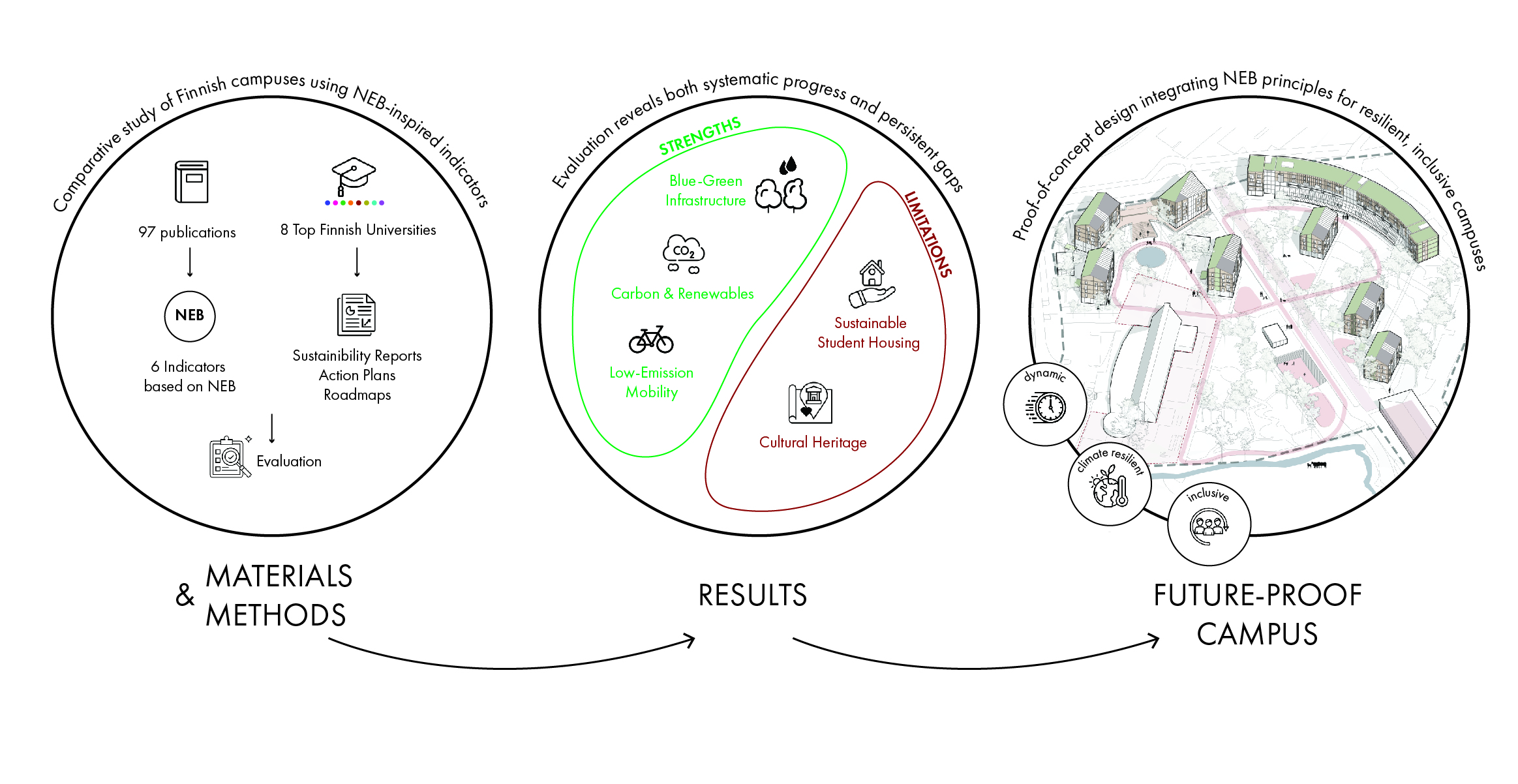
- to map and synthesize existing campus sustainability strategies;
- to operationalize NEB-inspired indicators for comparative evaluation;
- to assess the strengths, weaknesses, and gaps across eight Finnish campuses.
1.3. Literature Review
1.3.1. Challenges and Future-Proofing Needs of Finnish University Campuses
- Housing shortages, affordability, and internationalization—Growing inflows of international students increase demand for affordable housing, particularly in metropolitan areas. Rising rental costs and limited availability exacerbate social exclusion risks [18,26,36]. These pressures highlight the importance of campus-area housing policies as part of sustainability strategies.
- Aging infrastructure, energy efficiency, and digital transition—Many Finnish campuses must retrofit or redevelop older buildings with poor energy performance, while simultaneously investing in renewable energy systems, hybrid learning technologies, and campus-wide digital infrastructure. These needs create significant financial and technical barriers to decarbonization [21,37]. Such challenges highlight the importance of systematic, information-based campus management to support long-term decision-making [38].
1.3.2. Dominant Research Trends in Sustainable Campus Development
1.3.3. Integration of NEB Principles in Campus Development Literature
- Sustainability: Moving beyond quantitative carbon accounting toward processes that prioritize circularity, regeneration, and the systemic integration of blue-green infrastructure.
- Inclusiveness: Shifting from broad social impact metrics to concrete processes of co-creation, social integration, and ensuring accessibility and cultural diversity are reflected in the built environment.
- esthetics and Quality of Experience: Emphasizing that functional design must harmonize with cultural heritage, reinforce place identity, and deliver a high quality of life—dimensions often overlooked by purely technical assessments. In this study, esthetics are therefore understood in the NEB sense—as a holistic quality integrating environmental performance, cultural continuity, and sensory experience of place.
2. Materials and Methods
2.1. Sample Selection and Data Sources
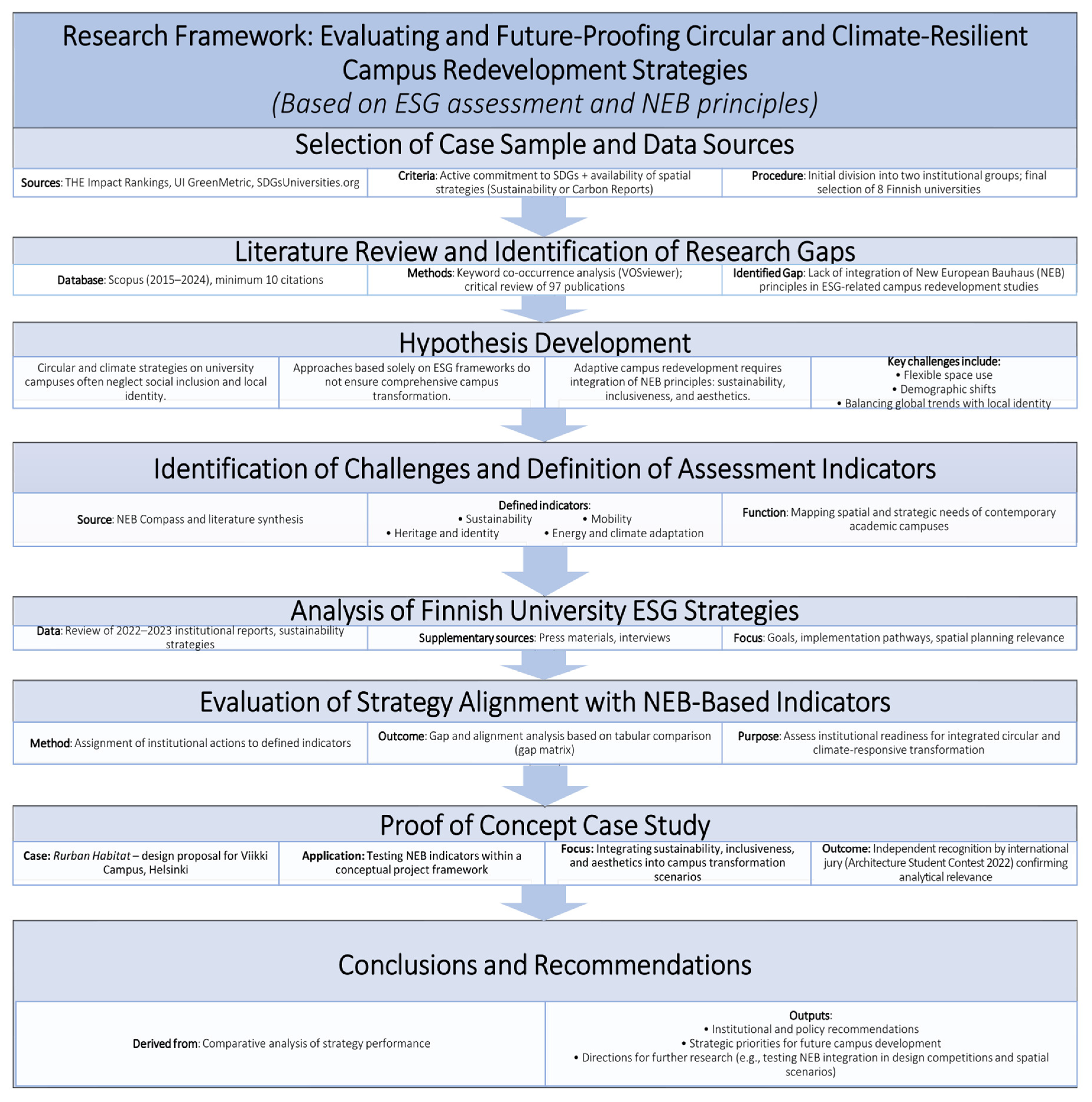
2.2. Methodology
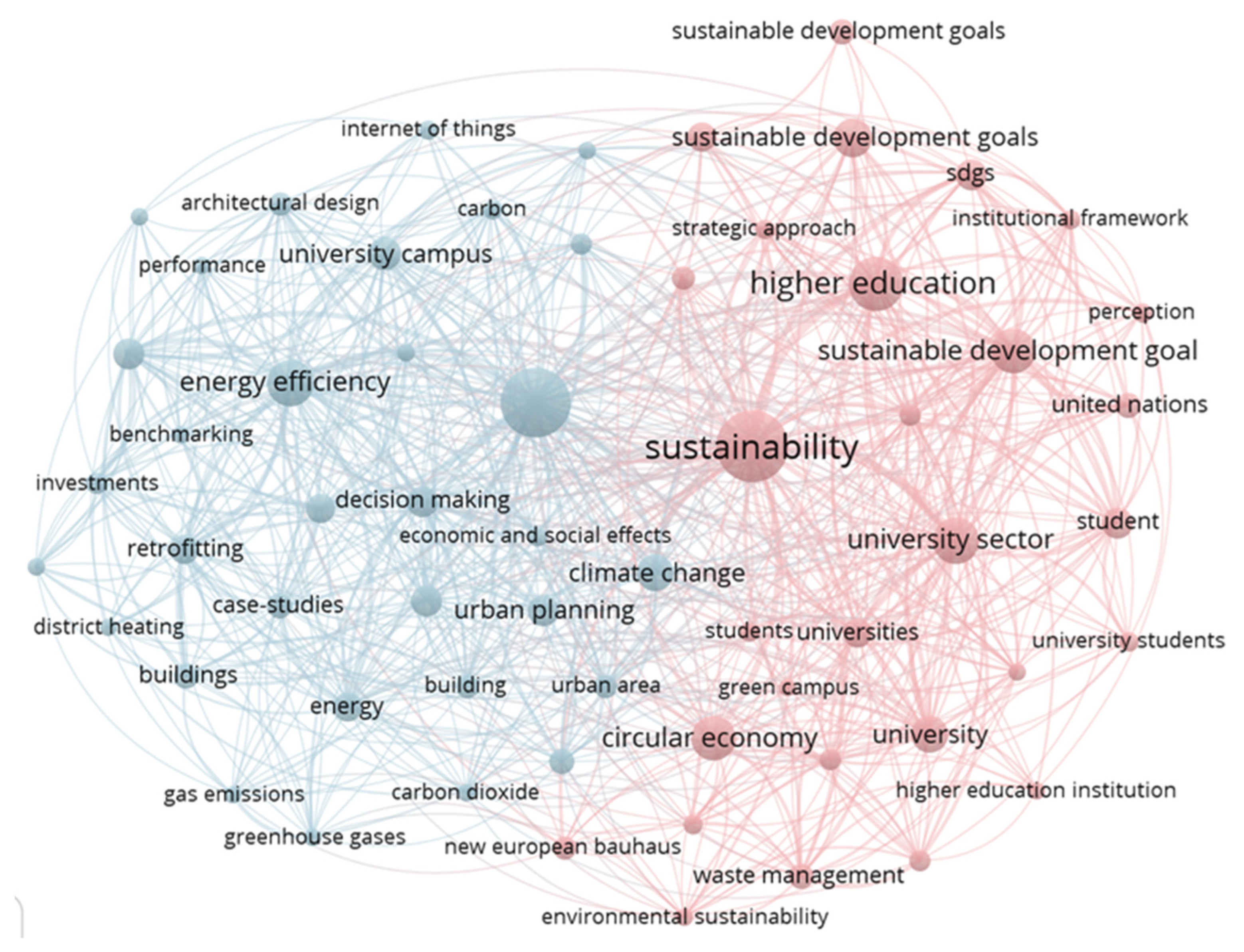
2.3. Bibliometric Mapping and Literature Review Procedure
2.4. Defining Evaluation Indicators
2.5. Comparative Evaluation Procedure
2.6. Strategy Assessment and Gap Mapping: Finnish Campus Sustainability Plans and a Conceptual NEB-Based Case
3. Results
3.1. Institutional Strategies and Scope of Analysis
3.1.1. Monitoring and Planning of Sustainable Development
3.1.2. Selection of the Area of Analysis
- Sustainable Campus Strategies (SCS)—official strategic documents, climate roadmaps, and action plans issued by universities;
- Sustainable Campus Actions (SCA)—specific initiatives described in institutional reports (SCR) as well as actions published on university websites and in supplementary sources.
3.2. Comparative Results by Indicator
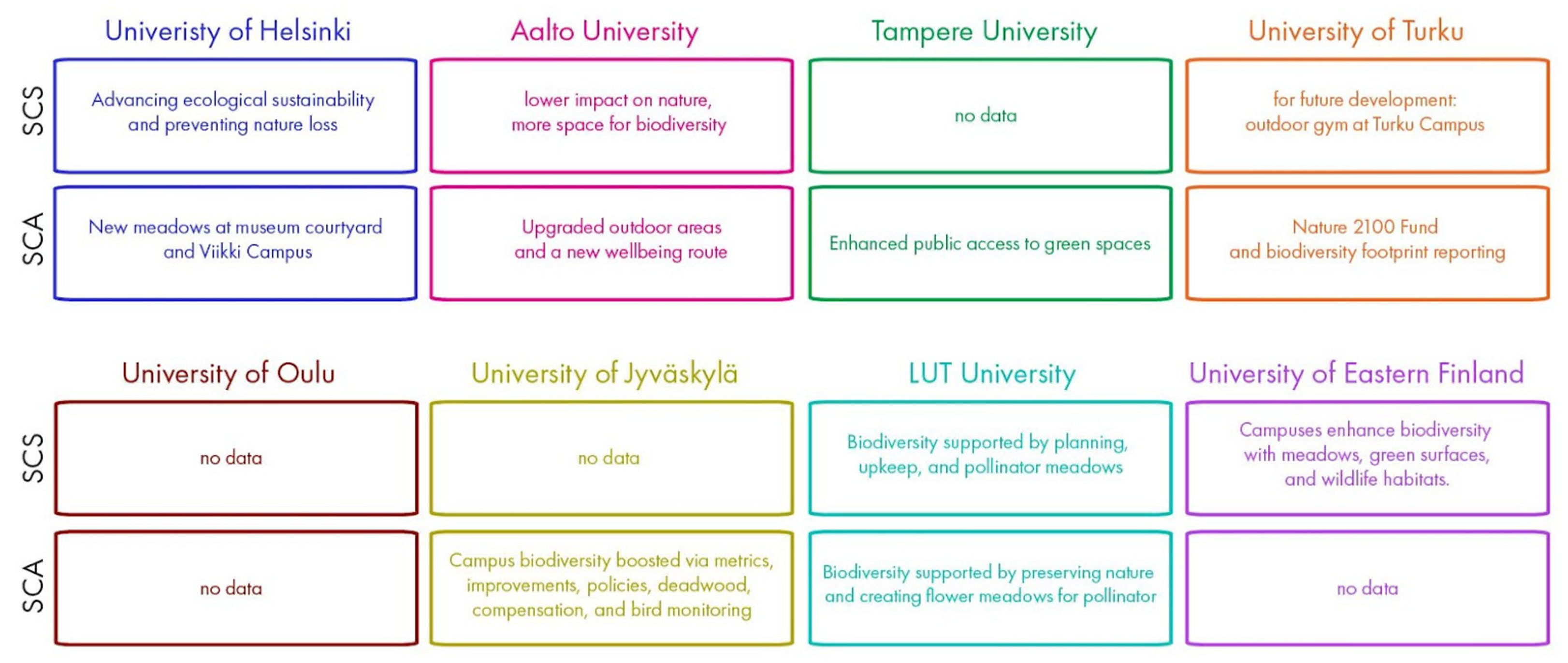
3.2.1. Blue-Green Infrastructure
Summary and NEB Alignment
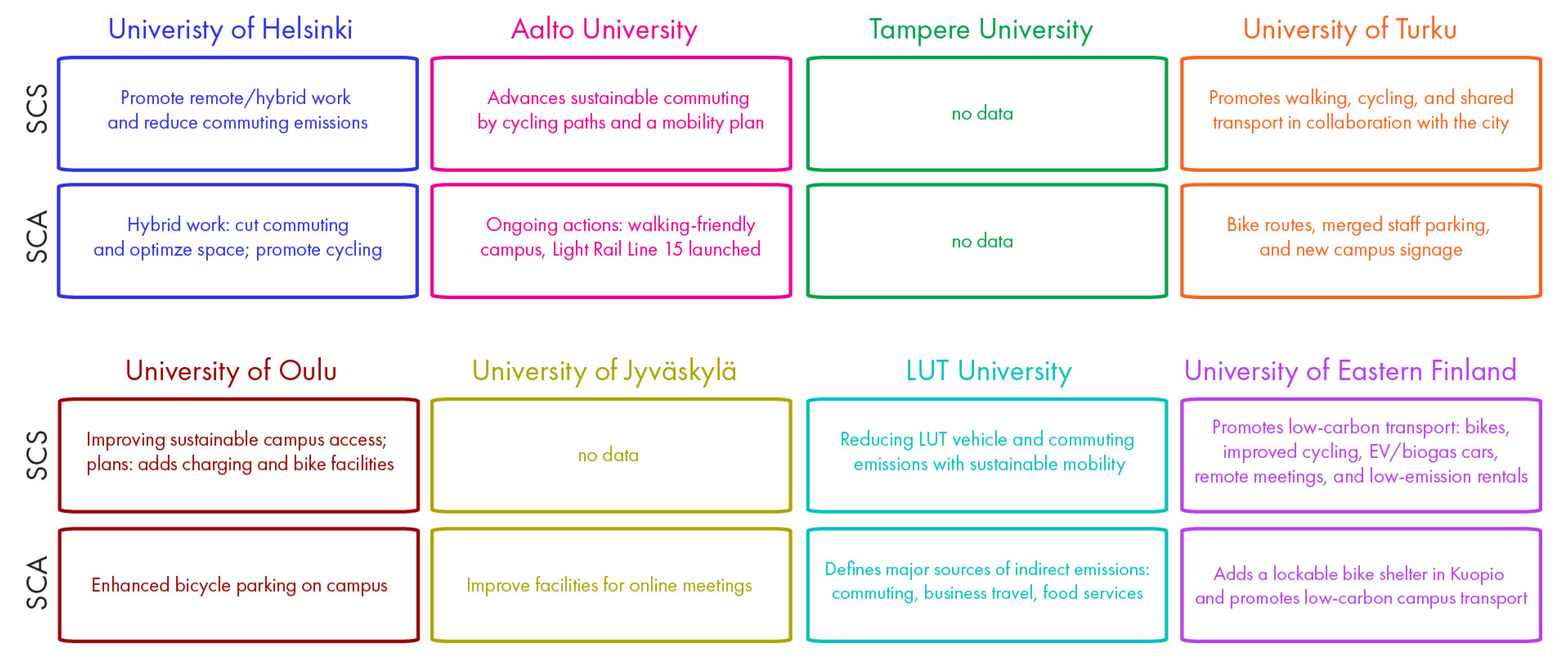
3.2.2. Low-Emission Mobility
- promoting cycling and walking;
- supporting public transport;
- reducing the need for travel through remote/hybrid work and online meetings;
- replacing campus fleet and private vehicles with low- or zero-emission alternatives.
Summary and NEB Alignment
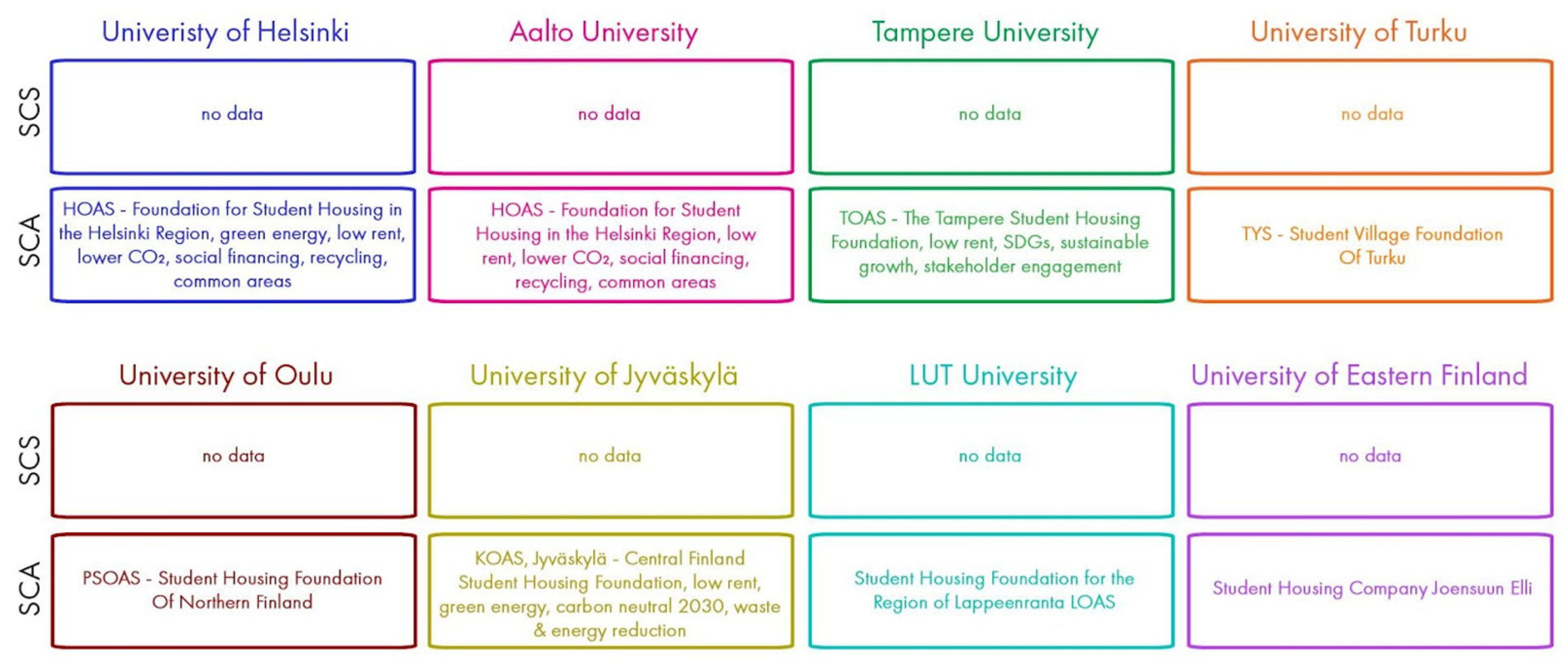
3.2.3. Sustainable Student Housing
Summary and NEB Alignment
3.2.4. Carbon Footprint Reduction and Renewable Energy
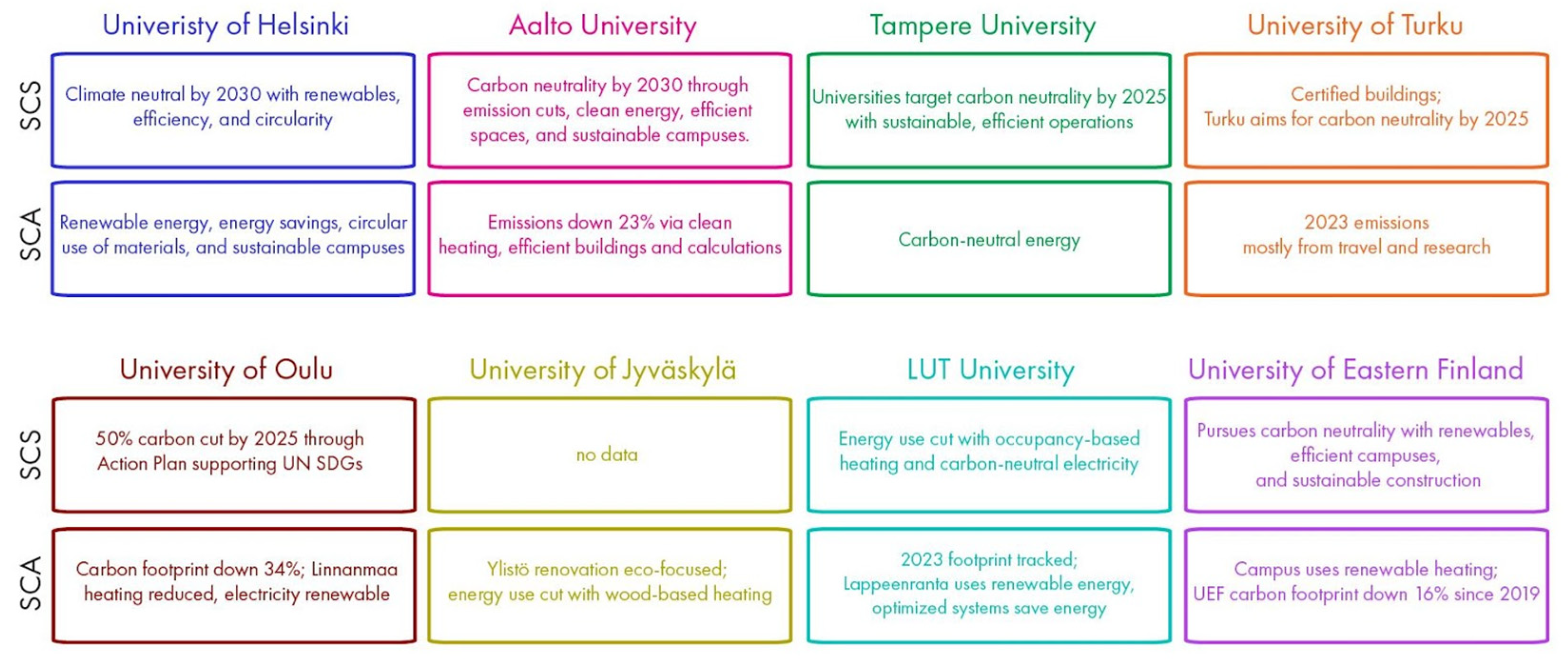
- increasing the share of renewable energy (4/8 universities—Helsinki, Aalto, Tampere, Eastern Finland),
- ensuring carbon-neutral electricity and district heating (3/8—Helsinki, LUT, Eastern Finland),
- reducing emissions through renovation and sustainable construction, including reuse of materials, recycling, adaptability, modularity, and space optimization (4/8—Helsinki, Aalto, Turku, Eastern Finland),
- setting carbon neutrality targets for 2025–2030 (5/8—Helsinki, Aalto, Tampere, Turku, Oulu).
Summary and NEB Alignment
3.2.5. Preservation of Cultural Heritage Amidst Globalization
3.3. Synthesis of Cross-Indicator Findings
- Key Strength: Assigned where an indicator received a High (H) rating or where it represented the highest score achieved by the university across the entire set of indicators.
- Key Weakness: Assigned where an indicator received a Low (L) rating or No Public Evidence (NR) rating, or represented the lowest overall score achieved by the university within the assessment framework.
3.4. Summary of Indicators-Based Results
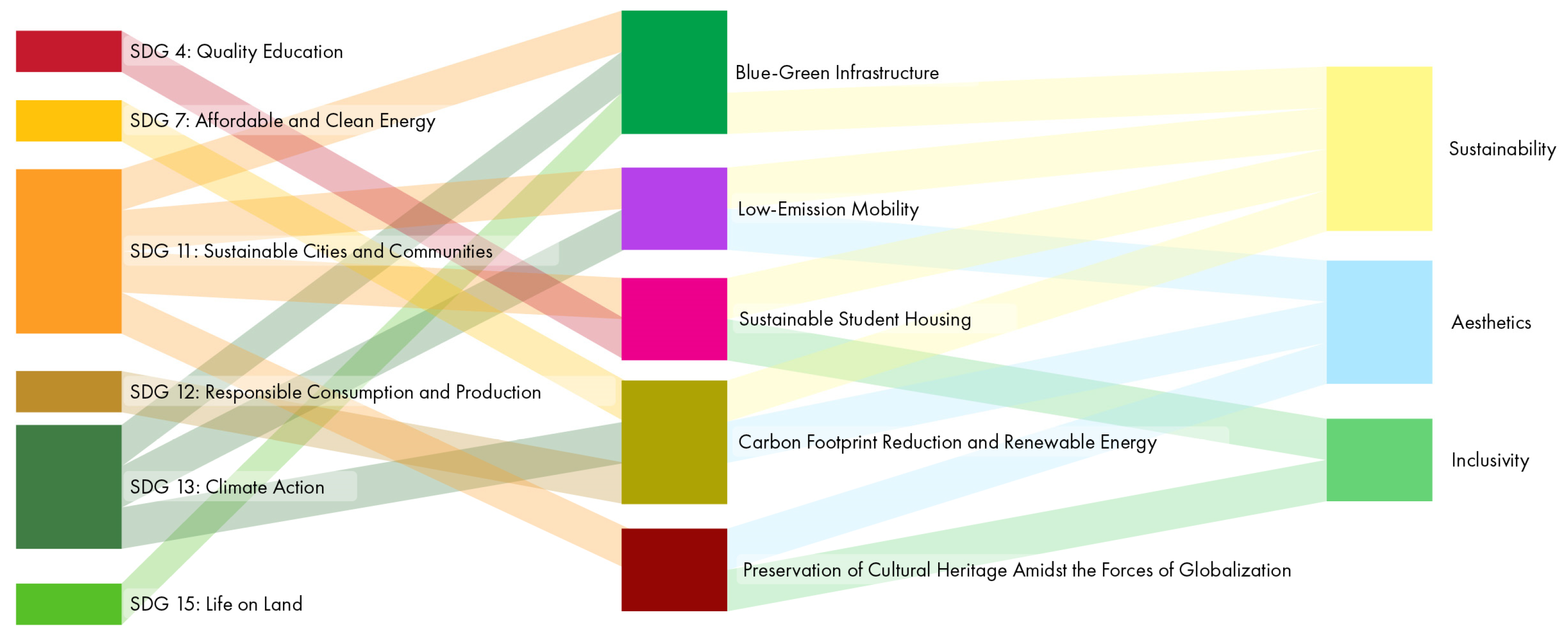
3.5. Synergies and Tensions Between NEB and SDG/ESG Frameworks
3.6. Illustrative Conceptual Case: Rurban Habitat Project
3.6.1. Selection of the Subject of Analysis
3.6.2. Project Analysis
4. Discussion
4.1. Synthesis of Results and Theoretical Contribution
4.2. Practical and Policy Implications
- Measurement and quality: introduce proxy indicators for beauty, inclusion, and accessibility or embed spatial quality audits; establish a shared national/inter-university template for biodiversity and inclusivity metrics to improve comparability and accountability.
- Governance and integration: integrate external housing providers into university sustainability reporting; embed adaptive reuse and cultural-heritage protection in campus masterplans (SDG 11.4; NEB “beautiful”); create cross-unit sustainability taskforces to integrate environmental, social, and spatial policies and monitor NEB indicator implementation.
- Collaboration and scaling: mandate inclusive mobility audits co-developed with municipalities; incentivize Living Labs/Campus Design Labs to scale modular construction, circular material reuse, and blue-green infrastructure; scale strong energy/mobility policies (Aalto, LUT, Helsinki) and leverage partnerships such as at Viikki.
4.3. Proof-of-Concept Case and Transferable Lessons
4.4. Limitations and Transferability
5. Conclusions
Author Contributions
Funding
Institutional Review Board Statement
Informed Consent Statement
Data Availability Statement
Acknowledgments
Conflicts of Interest
Abbreviations
| HEI | Higher Education Institution |
| HOAS | Helsinki Student Housing Foundation |
| KOAS | Central Finland Student Housing Foundation (Jyväskylä) |
| LOAS | Lappeenranta Student Housing Foundation |
| NEB | New European Bauhaus |
| PSOAS | Student Housing Foundation of Northern Finland (Oulu) |
| SCA | Sustainable Campus Actions |
| SCR | Sustainable Campus Reports |
| SCS | Sustainable Campus Strategies |
| SDG | Sustainable Development Goal |
| TOAS | Tampere Student Housing Foundation |
| TYS | Turku Student Village Foundation |
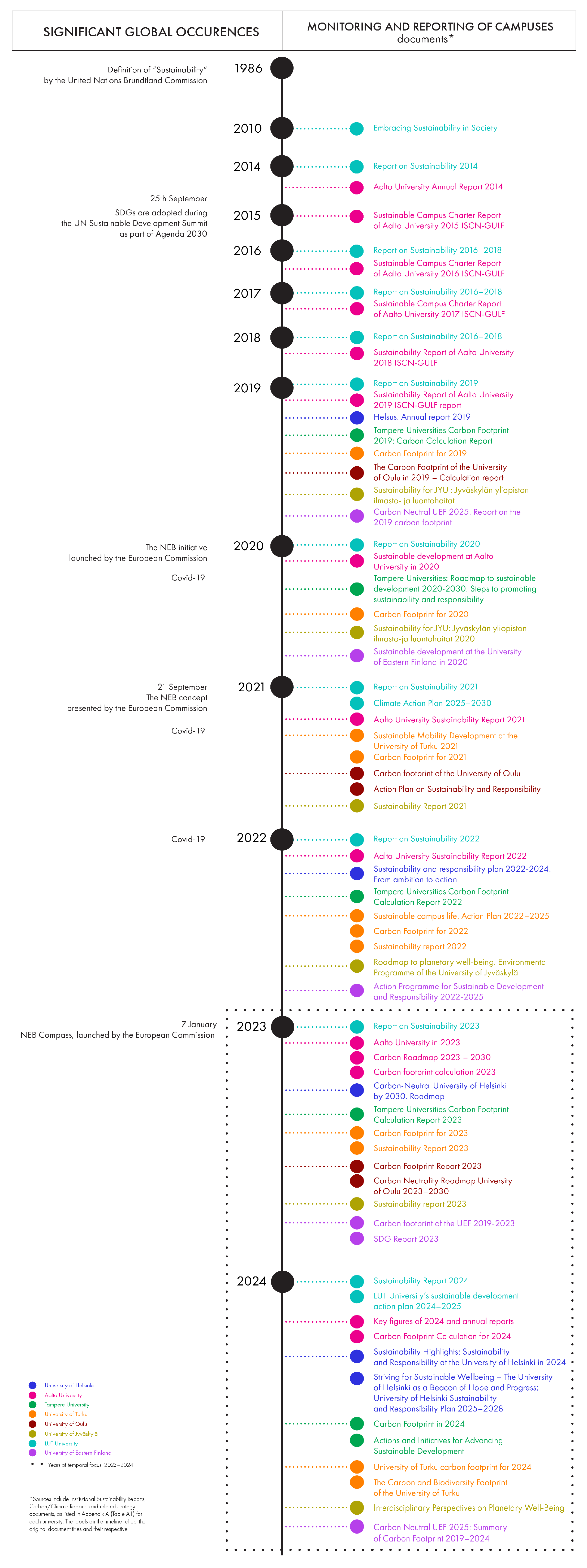
Appendix A. Source Documents on Sustainability Reporting and Strategic Planning in Finnish Higher Education (2010–2024)

| Year | University | Document |
|---|---|---|
| 2010 | LUT University | Embracing Sustainability in Society [125] |
| 2014 | LUT University | Report on Sustainability 2014 [128] |
| Aalto University | Aalto University Annual Report 2014 [129] | |
| 2015 | Aalto University | Sustainable Campus Charter Report of Aalto University 2015 ISCN-GULF [130] |
| 2016 | LUT University | Report on Sustainability 2016–2018 [131] |
| Aalto University | Sustainable Campus Charter Report of Aalto University 2016 ISCN-GULF [132] | |
| 2017 | LUT University | Report on Sustainability 2016–2018 [131] |
| Aalto University | Sustainable Campus Charter Report of Aalto University 2017 ISCN-GULF [133] | |
| 2018 | LUT University | Report on Sustainability 2016–2018 [131] |
| Aalto University | Sustainability Report of Aalto University 2018 ISCN-GULF [134] | |
| 2019 | LUT University | Report on Sustainability 2019 [135] |
| Aalto University | Sustainability Report of Aalto University 2019 ISCN-GULF report [136] | |
| University of Helsinki | Helsinki Institute of Sustainability Science (HELSUS). Annual Report 2019 [137] | |
| Tampere University | Tampere Universities Carbon Footprint 2019: Carbon Calculation Report [138] | |
| University of Turku | Carbon Footprint for 2019 [139] | |
| University of Oulu | The Carbon Footprint of the University of Oulu in 2019—Calculation report [140] | |
| University of Jyväskylä | Sustainability for JYU: Jyväskylän yliopiston ilmasto-ja luontohaitat [141] | |
| University of Eastern Finland | Carbon Neutral UEF 2025: Report on the 2019 carbon footprint [142] | |
| 2020 | LUT University | Report on Sustainability 2020 [143] |
| Aalto University | Sustainable development at Aalto University in 2020 [144] | |
| Tampere University | Tampere Universities: Roadmap to sustainable development 2020–2030. Steps to promoting sustainability and responsibility [145] | |
| University of Turku | Carbon Footprint for 2020 [139] | |
| University of Jyväskylä | Sustainability for JYU: Jyväskylän yliopiston ilmasto-ja luontohaitat 2020 [146] | |
| University of Eastern Finland | Sustainable development at the University of Eastern Finland in 2020 [147] | |
| 2021 | LUT University | Report on Sustainability 2021 [148] |
| Climate Action Plan 2025–2030 [99] | ||
| Aalto University | Aalto University Sustainability Report 2021 [149] | |
| University of Turku | Sustainable Mobility Development at the University of Turku 2021 [93] | |
| Carbon Footprint for 2021 [139] | ||
| University of Oulu | Carbon footprint of the University of Oulu [150] | |
| Action Plan on Sustainability and Responsibility [151] | ||
| University of Jyväskylä | Sustainability Report 2021 [152] | |
| 2022 | LUT University | Report on Sustainability 2022 [153] |
| Aalto University | Aalto University Sustainability Report 2022 [154] | |
| University of Helsinki | Sustainability and responsibility plan 2022–2024. From ambition to action [155] | |
| Tampere University | Tampere University–Carbon Footprint of Tampere Universities Community 2022 [156] | |
| University of Turku | Sustainable campus life. Action Plan 2022–2025 [157] | |
| Carbon Footprint for 2022 [139] | ||
| University of Jyväskylä | Sustainability report 2022 [158] | |
| Roadmap to planetary well-being. Environmental Program of the University of Jyväskylä [159] | ||
| University of Eastern Finland | Action Program for Sustainable Development and Responsibility 2022–2025 [88] | |
| 2023 | LUT University | Report on Sustainability 2023 [86] |
| Aalto University | Aalto University in 2023 [96] | |
| Carbon Roadmap 2023–2030 [94] | ||
| Carbon footprint calculation 2023 [115] | ||
| University of Helsinki | Carbon-Neutral University of Helsinki by 2030. Roadmap [100] | |
| Tampere University | Tampere Universities Carbon Footprint Calculation Report 2023 [114] | |
| University of Turku | Carbon Footprint for 2023 [139] | |
| University of Oulu | Sustainability Report 2023 [97] | |
| Carbon Footprint Report 2023 [160] | ||
| Carbon Neutrality Roadmap University of Oulu 2023–2030 [161] | ||
| University of Jyväskylä | Sustainability report 2023 [158] | |
| University of Eastern Finland | Sustainable Development Goals in the University of Eastern Finland in 2023 [98] | |
| 2024 | LUT University | LUT University’s sustainable development action plan 2024–2025 [162] Sustainability Report 2024 [163] |
| Aalto University | Carbon Footprint Calculation for 2024 [164] Key figures of 2024 and annual reports [165] | |
| University of Helsinki | Sustainability Highlights: Sustainability and Responsibility at the University of Helsinki in 2024 [166] Striving for Sustainable Well-being—The University of Helsinki as a Beacon of Hope and Progress: University of Helsinki Sustainability and Responsibility Plan 2025–2028 [167] Carbon Footprint in 2024 [168] | |
| Tampere University | Sustainability and Responsibility Report of Tampere University 2024 [169] Actions and Initiatives for Advancing Sustainable Development [170] | |
| University of Turku | University of Turku carbon footprint for 2024 [139] Turun yliopiston hiilija luontojalanjälki (The Carbon and Biodiversity Footprint of the University of Turku) [171] | |
| University of Jyväskylä | Interdisciplinary Perspectives on Planetary Well-Being [172] | |
| University of Eastern Finland | Carbon Neutral UEF 2025: Summary of Carbon Footprint 2019–2024 [173] |
Appendix B. Qualitative Scoring Rubric and Campus Evaluation Tables
- Table A2 introduces the qualitative scoring rubric and evidence criteria applied across all indicators to ensure methodological transparency and consistency.
- Table A3 defines the overall assessment categories (Strong, Good, Balanced, Mix) and explains their corresponding coding logic.
- (1)
- Blue-Green Infrastructure,
- (2)
- Low-Emission Mobility,
- (3)
- Sustainable Student Housing,
- (4)
- Carbon Footprint Reduction and Renewable Energy, and
- (5)
- Preservation of Cultural Heritage Amidst the Forces of Globalization.
| Qualitative Level | Definition/Coding Criteria | Illustrative Examples |
|---|---|---|
| High (H) | Strong, comprehensive, and implemented measures with clear monitoring mechanisms, quantitative targets, and evidence of follow-up or revision. Actions or strategies are explicitly institutionalized and integrated into long-term campus frameworks. | SCS: Climate neutrality roadmap with defined target year and carbon accounting methodology; biodiversity plan with quantified goals and monitoring schedule. SCA: Operational solar installations or geothermal systems; published annual carbon footprint data; functioning biodiversity monitoring programs. |
| Medium (M) | Partial or planned actions; limited implementation or monitoring. Policies are defined but lack measurable outcomes or institutional anchoring. Evidence of intent exists but is not yet systemic. | SCS: Sustainability plan mentioning renewable energy or mobility goals without indicators or deadlines. SCA: Pilot projects (e.g., trial bike-sharing, rain gardens) without follow-up reporting; isolated student or faculty initiatives not reflected in university policy. |
| Low (L) | Generic or declarative references to sustainability; minimal institutional engagement. No specific actions, metrics, or monitoring. | SCS: Broad statements such as “the university supports sustainable mobility” or “values cultural heritage” without supporting measures. SCA: Occasional events without continuity or documentation of impact. |
| No Reported Evidence (NR) | No publicly available data or documentation found. Topic not mentioned in strategic or operational materials. | SCS: Absence of the topic in strategy, roadmap, or policy documents. SCA: No reference in sustainability reports, websites, or institutional publications (2020–2024). |
| Qualitative Level | Coding Guidance | Qualitative Definition |
|---|---|---|
| STRONG (S) | Minimum three indicators rated High (H) and no indicator rated NR | The university implements comprehensive and institutionally embedded sustainability strategies (SCS and SCA) across at least three indicators. Actions are coherent, cross-sectoral, and supported by long-term frameworks and continuous innovation. |
| Good (G) | Majority of indicators rated Medium (M), with at least one rated High. No more than one rated Low/NR | SCS and SCA are in place across most indicators, including at least one area of high performance. Implementation is consistent but partly at the pilot or developmental stage, with limited reporting or institutional integration in some areas. |
| Balanced (B) | Combination of Medium (M) and Low (L) ratings, possibly one or two High (H), but not predominant | The university demonstrates mixed progress, with a few well-developed areas and several at moderate or early stages. Policies and initiatives vary in scope, depth, and maturity across indicators. |
| Mix (MIX) | Large discrepancies across indicators (e.g., presence of both High/Medium and NR/Low), indicating inconsistency or gaps in evidence | Institutional efforts are highly uneven. One or two areas show advanced development, while others lack clear actions or evidence. The overall approach appears fragmented and lacks a coherent strategic direction. |
| Blue-Green Infrastructure | |||
|---|---|---|---|
| University | SCS | SCA | |
| SCR | Other | ||
| University of Helsinki | Advancing ecological sustainability and preventing nature loss [89] (p. 8) [155] (p. 37) | Meadow in the Natural History Museum courtyard [89] (p. 57) | No data |
| Two new meadows at Viikki Campus [89] (p. 57) | |||
| Aalto University | Lower impact on nature, more space for biodiversity [94] (pp. 2, 16) | Improved campus outdoor areas [91] (p. 7) | The Well-being Route 2023 on the Otaniemi campus promotes mental and physical wellness through a dedicated path [92] |
| Well-being route opened in spring 2023 for mental health day [91] (p. 18) | |||
| Tampere University | No data | No data | Enhanced public access to green spaces [174] |
| University of Turku | For future development: outdoor gym at Turku Campus [93] (p. 10) | No data | Nature 2100 Fund (2021)—supports biodiversity and forest restoration [175] |
| Biodiversity footprint reporting and metrics development (2022) [139] | |||
| University of Oulu | No data | No data | No data |
| University of Jyväskylä | No data | Biodiversity footprint reporting and metrics (2019–2023) [90] (pp. 6–9) | New meadow to support biodiversity [176] |
| Annual biodiversity improvements on campus [90] (p. 14) | More deadwood added for insect habitats [177] | ||
| Updated campus green area policy [90] (p. 14) | |||
| More deadwood added to support biodiversity [90] (p. 14) | |||
| Ecological compensation through nature-based actions [90] (p. 23) | |||
| Public encouraged to record bird songs and observations [90] (p. 23) | |||
| LUT University | Biodiversity considered in procurement and campus planning [86] (p. 6) | No data | Biodiversity will be supported by preserving natural elements and converting grass areas into flower meadows for pollinators [87] |
| Nature-friendly elements preserved in maintenance [87] | |||
| Grass areas converted to flower meadows for pollinators [87] | |||
| University of Eastern Finland | Campuses aim to support urban biodiversity with diverse species [88] (p. 9) | No data | No data |
| Grasslands transformed into meadows [88] (p. 14) | |||
| Paved areas replaced with permeable surfaces [88] (p. 14) | |||
| Monocultures replaced by diverse stormwater and butterfly gardens [88] (p. 14) | |||
| Nesting boxes, insect hotels, and deadwood added [88] (p. 14) | |||
| Low-Emission Mobility | |||
|---|---|---|---|
| University | SCS | SCA | |
| SCR | Other | ||
| University of Helsinki | Promoting remote and hybrid work [100] (p. 9) | Hybrid work guidelines to cut commuting and optimize space; remote tools used for recruitment [89] (p. 62) | No data |
| Over half of commutes are by car—current status [100] (p. 9) | Over 206,000 km cycled in bike-a-thons [89] (p. 7) | ||
| Goal: minimize emissions from commuting [100] (p. 5) | |||
| Aalto University | Promote sustainable commuting [94] (p. 12) | Ongoing: Accessible walking campus [94] (p. 12) | Campus bikes for staff, HSL city bikes, and two bike service points [95] |
| Ongoing: Sustainable mobility action plan [94] (p. 12) | Ongoing: Bicycle-friendly infrastructure [94] (p. 12) | Investment in showers, changing rooms, and bike storage [95] | |
| Aalto leads in sustainable mobility with easy access to cycling and walking paths [94] (p. 19) | Light Rail Line 15 launched [96] (p. 20) | ||
| Most of the Aalto community commutes by public transport [94] (p. 19) | |||
| Tampere University | No data | No data | No data |
| University of Turku | The University promotes sustainable commuting (cycling, public transport) and collaborates with Turku to improve campus accessibility and bike use [157] (p. 5) | Bicycle-friendly routes (2023–2024) [93] (p. 4) | No data |
| Merged staff parking zones (2023) [93] (p. 7) | |||
| The campus encourages walking, offers more bikes for staff, and supports shared commuting options like car-pooling [157] (p. 5) | Added signage on Turku campus (2023) [93] (p. 8) | ||
| University of Oulu | We are improving campus access via public transport, cycling, and walking, with bike facilities and reduced car usage by renting [157] | Enhanced bicycle parking on campus [97] (p. 15) | No data |
| The 2025 action plan includes car charging stations, bike storage, and e-bike subsidies [140,161] (p. 15) | |||
| University of Jyväskylä | No data | Improve facilities for online meetings [90] (p. 13) | No data |
| LUT University | Reducing emissions from LUT-owned vehicles [99] (p. 5) | No data | Major sources of indirect emissions: staff/student commuting, business travel, and campus food services (28.9%) [178] |
| Solutions to lower commuting carbon footprint (e.g., remote workdays, sustainable mobility, rental bikes at Lappeenranta, potential pick-up site in Lahti, bike parking, and improved facilities) [99] (pp. 11–12) | |||
| University of Eastern Finland | Students and staff encouraged to use low-carbon transport [88] (p. 9) | The University of Eastern Finland built a new lockable bike shelter on the Kuopio campus [98] (p. 21) | Students and staff are encouraged to use low-carbon transport to campus [179] |
| Shared campus bicycles for staff (ongoing) [88] (p. 19) | |||
| Improved cycling conditions (more racks, covered parking, better facilities) and city bikes available [88] (p. 19) | |||
| Sufficient charging stations for electric cars; support for biogas car stations [88] (p. 19) | |||
| Enhanced remote meeting facilities [88] (p. 20) | |||
| Low-emission options for rental cars considered [88] (p. 21) | |||
| University cars replaced with low-emission vehicles as leases expire [88] (p. 19) | |||
| Sustainable Student Housing | |||
|---|---|---|---|
| University | SCS | SCA | |
| SCR | Other | ||
| University of Helsinki | No data | Installation of solar and geothermal systems in research accommodation buildings in Tvärminne and Hyytiälä [100] (p. 10) | HOAS—Foundation for Student Housing in the Helsinki Region [102] Average rent kept at €14.60/m2 (below Helsinki average) Received social financing from Kuntarahoitus for seven projects. Carbon footprint reduced by almost 28% compared to 2022. Introduced seven waste bins in new housing units. Added versatile common areas in properties [109] |
| Aalto University | No data | No data | HOAS—Foundation for Student Housing in the Helsinki Region [102] Average rent kept at €14.60/m2 (below Helsinki average) Received social financing from Kuntarahoitus for seven projects. Carbon footprint reduced by almost 28% compared to 2022. Introduced seven waste bins in new housing units. Added versatile common areas in properties [109] |
| Tampere University | No data | No data | TOAS—The Tampere Student Housing Foundation [103] Provided ~25% of student housing below market rents. Developed and maintained functional, appropriately sized, and affordable apartments. Promoted sustainable development in line with UN SDGs (clean energy, sustainable cities, responsible consumption, climate action, partnerships) Invested in long-term, sustainable growth of housing stock. Actively involved staff and stakeholders in sustainability initiatives [110] |
| University of Turku | No data | No data | TYS—Student Village Foundation of Turku [104] Reduced carbon footprint to 2963 tonnes in 2023 (~23% less than 2022, ~29% less than 2020). Increased energy efficiency and use of renewable energy (solar panels in Nummenranta and Block 5 of Student Village). No new construction or major renovations in 2023, contributing to emission reduction. Maintained a high occupancy rate (97.8%) and an average tenancy of 2 years 4 months. Monitored tenant satisfaction monthly and received high ratings for service, apartment quality, and communication [112] |
| University of Oulu | No data | No data | PSOAS—Student Housing Foundation of Northern Finland [105] |
| University of Jyväskylä | No data | No data | KOAS, Jyväskylä—Central Finland Student Housing Foundation [106] Affordable housing, community engagement, support for international students, non-profit operations, below-market rents, high occupancy, energy-efficient maintenance, renewable energy, green district heating, solar power, lifecycle assessments, carbon neutrality by 2030, waste and energy reduction programs [111] |
| LUT University | No data | No data | Student Housing Foundation for the Region of Lappeenranta LOAS [107] |
| University of Eastern Finland | No data | No data | Student Housing Company Joensuun Elli [108] |
| Carbon Footprint Reduction and Renewable Energy | |||
|---|---|---|---|
| University | SCS | SCA | |
| SCR | Other | ||
| University of Helsinki | 10% energy from own renewables [100] (p. 7) | 2.5% own renewable energy [89] (p. 7) | |
| Purchased electricity and district heating are carbon neutral [113] (pp. 28–29) | 100% purchased electricity is carbon neutral [89] (p. 8) | ||
| Energy use −15% (vs 2019) [113] (p. 26) | Carbon footprint 2019–2021; neutrality roadmap 2030 [89] (p. 50) | ||
| Phase-out of fossil heating fuels [113] (p. 31) | Solar and geothermal at Tvärminne, Hyytiälä [89] (p. 52) | ||
| Energy efficiency saved 45 MWh [89] (p. 52) | |||
| Circular economy practices in place [155] (p. 37) | Electricity −1.8%, total energy −0.5% (vs. 2022) [89] (p. 52) | ||
| Ruskeasuo demolition: 90% material recycling target [89] (p. 56) | |||
| Improved carbon footprint; neutrality by 2030 [155] (p. 34–36) | New Kumpula campus supports circularity and neutrality [89] (p. 56) | ||
| Research stations shifting from oil to geothermal; district heating solutions explored; new sites assessed for geothermal potential [113] (p. 15) | Timber-framed building at Hyytiälä Forestry Station [89] (p. 56) | ||
| Aalto University | Carbon neutral by 2030; 50% GHG reduction [94] (p. 2) | Finland’s and district heating emission factors fell in 2023, lowering energy-related emissions [115] (p. 11) | No data |
| Campus as a carbon-neutral living lab by 2030 [94] (p. 2) | Espoo properties have used emission-free district heating via Fortum Ecoheat since 2022 [115] (p. 17) | ||
| −25% emissions in new builds, −15% in renovations (vs. Business as Usual) [94] (p. 12) | Overall GHG emissions decreased due to improved calculations and reduction measures [115] (p. 30) | ||
| 20% lower energy use, zero energy emissions [94] (p. 12) | Key savings came from standardized indoor temperatures, optimized ventilation, and enhanced heat recovery [91] (p. 18) | ||
| Efficient space use, sustainable campus, low-carbon construction [94] (p. 12) | Energy-related CO2 emissions dropped 23% to 3299 tCO2-eq in 2023 [91](p. 18) | ||
| Focus on clean energy, green procurement, and reduced consumption [94] (p. 12) | |||
| Tampere University | Tampere Universities target carbon neutrality by 2030 [180] | Electricity and mostly district heating are carbon neutral [114] (p. 5) | |
| Campuses are energy- and resource-efficient, supported by sustainable maintenance [180] | |||
| Emission reductions are part of daily operations [145] (p. 8) | |||
| University of Turku | New SYK buildings are BREEAM-certified; emissions offset with Gold Standard credits [157] (p. 4) | No data | Total 2023 emissions: 8600 tCO2-eq; business travel, air traffic, and research made up 85%+ [139] |
| University of Turku targets carbon neutrality by 2025, tracking and reducing emissions since 2019 [139] | |||
| University of Oulu | Goal: 50% carbon reduction from 2019 by 2025, monitored annually [181] | Carbon footprint down 33.6% from 2019 (19,072 tCO2-eq) [97] (p. 13) | No data |
| Everyday Action Plan promotes environmental responsibility and well-being [181] | Linnanmaa campus district heating use fell 18.9% since 2019 [97] (p. 14) | ||
| Supports UN SDGs 7, 9, 11, 12, 13, and 17 [181] | Electricity is renewable and emission-free; SYK Oy offsets emissions [97] (p. 14) | ||
| University of Jyväskylä | No data | Ylistö campus renovation planned with CO2 and biodiversity in mind [90] (p. 12) | No data |
| SYK and JYU cut energy use; SYK uses wood-based ALVA district heating [90] (p. 12) | |||
| LUT University | Heating optimized based on occupancy, supporting remote work [99] (p. 7) | 2023 carbon footprint reported with improved calculations [86] (pp. 27–37) | No data |
| Electricity use reduced; Lappeenranta campus runs on carbon-neutral power, Lahti campus encouraged to do the same [99] (pp. 8–9) | Lappeenranta campus fully on renewable energy; 4% from solar panels [86] (p. 30) | ||
| Lighting, ventilation, and facility use optimized to save energy [86] (p. 26) | |||
| University of Eastern Finland | UEF aims for full carbon neutrality (scope 1–3) through avoidance, reduction, and compensation [88] (p. 9) [179] | Campus heating uses 100% renewable district heating [98] (p. 16) | No data |
| Campuses are modern, energy-efficient, and space-optimized [88] (p. 9) [179] | UEF carbon footprint down 16% since 2019 [98] (p. 26) | ||
| Electricity is 100% renewable; solar use is growing [88] (p. 12) | |||
| Heat and electricity are reduced via efficient solutions and management [88] (p. 12) | |||
| Facilities optimized with multifunctional workspaces [88] (p. 12) | |||
| Construction and renovation follow sustainable principles [88] (p. 12) | |||
| Preservation of Cultural Heritage Amidst the Forces of Globalization | |||
|---|---|---|---|
| University | SCS | SCA | |
| SCR | Other | ||
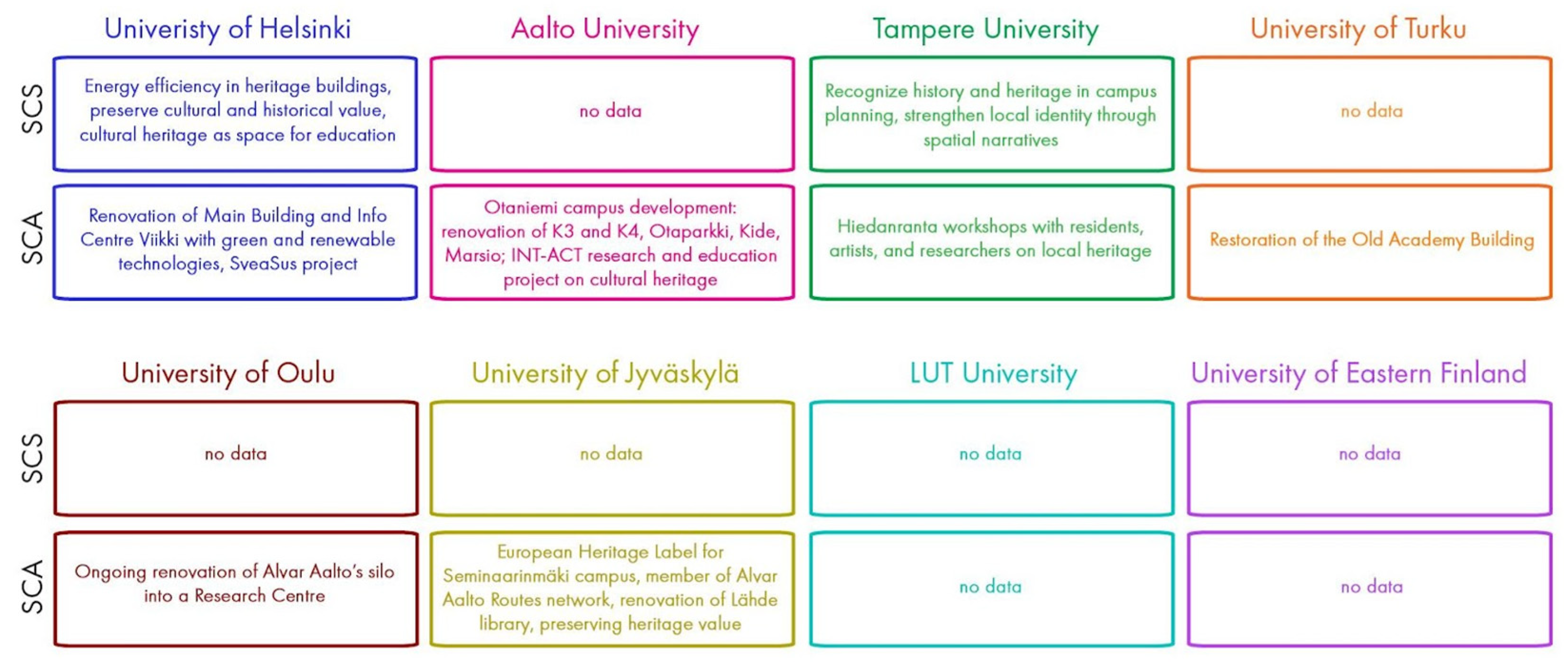
| University of Helsinki | Planned integration of energy-efficient solutions in buildings of cultural and historical value [100] (p.19) | Renovation of historic Main Building, applying energy-efficient and renewable technologies [113] (p. 19) | The SveaSus educational project on cultural heritage (Suomenlinna—UNESCO) as a learning environment for sustainable development. [117] |
| Aalto University | No data | Continuation of the development of the Otaniemi campus; modernization of buildings K3 (Design Factory, Aalto Ventures Program, Startup Sauna) and K4 (laboratories), construction of the Otaparkki parking facility, and new buildings: Kide (Technology Research Center) and Marsio (Arts and Media Education) [91] (p. 34) | Ongoing: the INT-ACT research and educational project, focusing on tangible and intangible cultural heritage as a tool for education and social dialog [118] |
| Tampere University | Planned recognition of the history and heritage of university buildings as an element of campus development [116] (p. 4) | No data | No data |
| University of Turku | No data | No data | No data |
| University of Oulu | No data | Ongoing: renovation of the Alvar Aalto silo and its transformation into a Research Center, the project combines the preservation of modernist architecture with advanced digital documentation technologies and public education [119] | |
| University of Jyväskylä | No data | The Seminaarinmäki campus has been awarded the European Heritage Label. The University’s membership in the Alvar Aalto Routes network highlights its commitment to the preservation of modernist architectural heritage [89] (p. 4) | No data |
| LUT University | No data | No data | No data |
| University of Eastern Finland | No data | No data | No data |
References
- Findler, F.; Schönherr, N.; Lozano, R.; Reider, D.; Martinuzzi, A. The Impacts of Higher Education Institutions on Sustainable Development: A Review and Conceptualization. Int. J. Sustain. High. Educ. 2019, 20, 23–38. [Google Scholar] [CrossRef]
- Shiel, C.; Leal Filho, W.; do Paço, A.; Brandli, L.L. Evaluating the Engagement of Universities in Capacity Building for Sustainable Development in Local Communities. Eval. Program Plan. 2016, 54, 123–134. [Google Scholar] [CrossRef]
- Alshuwaikhat, H.M.; Abubakar, I. An Integrated Approach to Achieving Campus Sustainability: Assessment of the Current Campus Environmental Management Practices. J. Clean. Prod. 2008, 16, 1777–1785. [Google Scholar] [CrossRef]
- Storms, K.; Simundza, D.; Morgan, E.; Miller, S. Developing a Resilience Tool for Higher Education Institutions: A Must-Have in Campus Master Planning. J. Green Build. 2019, 14, 187–198. [Google Scholar] [CrossRef]
- Ellen MacArthur Foundation. Towards a Circular Economy: Business Rationale for an Accelerated Transition; Ellen MacArthur Foundation: Cowes, UK, 2015; Available online: https://www.ellenmacarthurfoundation.org/towards-a-circular-economy-business-rationale-for-an-accelerated-transition (accessed on 8 November 2025).
- Kirchherr, J.; Reike, D.; Hekkert, M. Conceptualizing the Circular Economy: An Analysis of 114 Definitions. Resour. Conserv. Recycl. 2017, 127, 221–232. [Google Scholar] [CrossRef]
- Hopff, B.; Nijhuis, S.; Verhoef, L.A. New Dimensions for Circularity on Campus—Framework for the Application of Circular Principles in Campus Development. Sustainability 2019, 11, 627. [Google Scholar] [CrossRef]
- Herth, A.; Verburg, R.; Blok, K. The Innovation Power of Living Labs to Enable Sustainability Transitions: Challenges and Opportunities of On-Campus Initiatives. Creat. Innov. Manag. 2024, 34, 427–442. [Google Scholar] [CrossRef]
- Liu, H.-Y.; Lee, H.-C. The Carbon Inventory of the Reuse Phase’s Life Cycle: The Example of the Reconstruction of a Zero-Carbon Campus on an Unused Military Camp. Sustainability 2022, 14, 1064. [Google Scholar] [CrossRef]
- Nasir, T.; Raza, S.; Abrar, M.; Muqeet, H.A.; Jamil, H.; Qayyum, F.; Cheikhrouhou, O.; Alassery, F.; Hamam, H. Optimal Scheduling of Campus Microgrid Considering the Electric Vehicle Integration in Smart Grid. Sensors 2021, 21, 7133. [Google Scholar] [CrossRef]
- Kuittinen, M.; Häkkinen, T. Reduced Carbon Footprints of Buildings: New Finnish Standards and Assessments. Build. Cities 2020, 1, 182–197. [Google Scholar] [CrossRef]
- Government of Finland. Finland’s Integrated Energy and Climate Plan (NECP): Towards Carbon Neutrality by 2035; Ministry of Economic Affairs and Employment: Helsinki Finland, 2019. [Google Scholar]
- European Commission. The European Green Deal: Striving to be the First Climate-Neutral Continent; European Commission: Brussels, Belgium, 2019; Available online: https://commission.europa.eu/strategy-and-policy/priorities-2019-2024/european-green-deal_en (accessed on 8 November 2025).
- Government of Finland. Parliament Adopted Acts That Will Reduce Emissions from Building and Promote Digitalisation; Ministry of the Environment: Tokyo, Japan, 2023; Available online: https://valtioneuvosto.fi/en/-/1410903/parliament-adopted-acts-that-will-reduce-emissions-from-building-and-promote-digitalisation (accessed on 2 September 2025).
- Ahonen, V.L.; Woszczek, A.; Baumeister, S.; Helimo, U.T.; Jackson, A.K.; Kopsakangas-Savolainen, M.; Kääriä, J.; Lehtonen, T.; Luoranen, M.; Pongrácz, E.; et al. Carbon Neutral Higher Education Institutions: A Reality Check, Challenges and Solutions. Int. J. Sustain. High. Educ. 2024, 25, 293–315. [Google Scholar] [CrossRef]
- Karvinen, M.; Löyttyniemi, M. Nordic higher education institutions joined forces to support sustainable development. AMK-lehti/UAS 2015, 1, 2. Available online: https://uasjournal.fi/tutkimus-innovaatiot/nordic-higher-education-institutions-joined-forces-to-support-sustainable-development/ (accessed on 8 November 2025).
- Ministry of the Environment, Finland. Annual Climate Report 2023; Ministry of the Environment: Helsinki, Finland, 2023; Available online: https://ym.fi/en/annual-climate-report (accessed on 8 November 2025).
- Delclós, C.; Vidal, L. Beyond Renovation: Addressing Europe’s Long Housing Crisis in the Wake of the COVID-19 Pandemic. Eur. Urban Reg. Stud. 2021, 28, 519–525. [Google Scholar] [CrossRef]
- Wetzstein, S. The Global Urban Housing Affordability Crisis. Urban Stud. 2017, 54, 3159–3177. [Google Scholar] [CrossRef]
- Le Goix, R.; Ysebaert, R. Unequal Housing Affordability Across European Cities: The ESPON Housing Database, Insights on Affordability in Selected Cities in Europe. Cybergeo Eur. J. Geogr. 2021. [Google Scholar] [CrossRef]
- Attia, S.; Alphonsine, P.; Amer, M.; Ruellan, G. Towards a European Rating System for Sustainable Student Housing: Key Performance Indicators (KPIs) and a Multicriteria Assessment Approach. Environ. Sustain. Indic. 2020, 7, 100052. [Google Scholar] [CrossRef]
- Pleace, N.; Culhane, D.; Granfelt, R.; Knutagård, M. The Finnish Homelessness Strategy—An International Review. Available online: https://eprints.whiterose.ac.uk/id/eprint/213242/ (accessed on 2 September 2025).
- Kaakinen, J. Housing First: The Finnish Model. Available online: https://shs.cairn.info/journal-vie-sociale-2018-3-page-167?lang=en (accessed on 2 September 2025).
- Munro, M.; Turok, I.; Livingston, M. Students in Cities: A Preliminary Analysis of Their Patterns and Effects. Environ. Plan. A 2009, 41, 1805–1825. [Google Scholar] [CrossRef]
- Martino, E.; Li, A.; Bentley, R. Becoming Infrastructured: International Graduate Researchers and Precarious Housing. Int. J. Hous. Policy 2025, 25, 1–20. [Google Scholar] [CrossRef]
- Franz, Y.; Gruber, E. The Changing Role of Student Housing as Social Infrastructure. Urban Plan. 2022, 7, 457–469. [Google Scholar] [CrossRef]
- Zhang, Z.; Fisher, T.; Feng, G. Assessing the Rationality and Walkability of Campus Layouts. Sustainability 2020, 12, 10116. [Google Scholar] [CrossRef]
- Yigitcanlar, T.; O’Connor, K.; Westerman, C. The Making of Knowledge Cities: Melbourne’s Knowledge-Based Urban Development Experience. Cities 2016, 66, 22–32. [Google Scholar] [CrossRef]
- United Nations. Higher Education Sustainability Initiative (HESI). United Nations Department of Economic and Social Affairs: New York, NY, USA. Available online: https://sdgs.un.org/HESI (accessed on 4 September 2025).
- United Nations Framework Convention on Climate Change. Paris Agreement. United Nations. 2015. Available online: https://unfccc.int/sites/default/files/english_paris_agreement.pdf (accessed on 8 November 2025).
- Sachs, J.D.; Kroll, C.; Lafortune, G.; Fuller, G.; Woelm, F. Sustainable Development Report 2022: From Crisis to Sustainable Development: The SDGs as Roadmap to 2030 and Beyond; Cambridge University Press: Cambridge, UK, 2022. [Google Scholar] [CrossRef]
- Torchia, D.; Fresta, J.; Corazza, L.; Certomà, C. New European Bauhaus for a Circular Economy and Waste Management: The Lived Experience of a Community Container Garden at the University of Turin. Sustainability 2023, 15, 914. [Google Scholar] [CrossRef]
- Hector, P.; Kohtala, C. Experimenting with Sustainability Education: The Case of a Student-Driven Campus Initiative in Finland. Local Environ. 2021, 27, 1415–1430. [Google Scholar] [CrossRef]
- Friman, M.; Salminen, J. Climate Actions at Häme University of Applied Sciences (HAMK), Finland. In IOP Conference Series: Earth and Environmental Science; IOP Publishing: Bristol, UK, 2023; Volume 1194, p. 012018. [Google Scholar] [CrossRef]
- Valks, B.; Arkesteijn, M.H.; Den Heijer, A.C.; Vande Putte, H.J.M. Smart Campus Tools—Adding Value to the University Campus by Measuring Space Use Real-Time. J. Corp. Real Estate 2018, 20, 103–116. [Google Scholar] [CrossRef]
- Bellini, O.E.; Gambaro, M.; Gullace, M.T.; Figueira, M.F. Digital Infrastructure for Student Accommodation in European University Cities: The “HOME” Project. In Urban Book Series; Springer: Cham, Switzerland, 2023. [Google Scholar] [CrossRef]
- Skrzyzowski, V.d.S.; Farinhas, F.N.; Teixeira, M.C.F.d.C.; Barros, M.V.; Salvador, R.; Neto, S.C.; Lermen, F.H. Mapping Drivers, Barriers, and Trends in Renewable Energy Sources in Universities: A Connection Based on the SDGs. Sustainability 2024, 16, 6583. [Google Scholar] [CrossRef]
- den Heijer, A.C. Managing the University Campus: Information to Support Real Estate Decisions; Eburon Academic Publishers: Delft, The Netherlands, 2011. [Google Scholar]
- Sulmov, K.; Borisova, N.; Borodina, L. Regional Universities Facing Dilemma? Between Scylla of Globalization and Charybdis of Localization. Int. Trends 2017, 15, 49. [Google Scholar] [CrossRef]
- Plevoets, B.; Van Cleempoel, K. Adaptive Reuse of the Built Heritage: Concepts and Cases of an Emerging Discipline; Routledge: London, UK, 2019. [Google Scholar] [CrossRef]
- Alghamdi, N.; den Heijer, A.; de Jonge, H. Assessment Tools’ Indicators for Sustainability in Universities: An Analytical Overview. Int. J. Sustain. High. Educ. 2017, 18, 84–115. [Google Scholar] [CrossRef]
- Dawodu, A.; Akinwolemiwa, B.; Ayo-Vaughan, E. Campus Sustainability Research: Indicators, Dimensions, and Challenges. Heliyon 2022, 8, e11560. [Google Scholar] [CrossRef]
- Lad, N.; Akerlof, K.L. Assessing Campus Sustainability Literacy and Culture: How Are Universities Doing It and to What End? Front. Sustain. 2022, 3, 927294. [Google Scholar] [CrossRef]
- den Heijer, A.; Curvelo Magdaniel, F.T.J. Inter-University Knowledge Transfer in (Sustainable) Campus Management: An Exploratory Study for Campus NL. In Proceedings of the European Real Estate Society (ERES) Conference 2024, Milan, Italy, 26–29 June 2024. [Google Scholar] [CrossRef]
- Boeri, A.; Turillazzi, B.; Sabatini, F.; Sassenou, L.-N.; Manella, G. The Threefold Role of the University in Fostering the Energy Transition: The Case of Bologna and Its Cesena Campus. Energies 2024, 17, 3751. [Google Scholar] [CrossRef]
- Altınkaya Genel, Ö.; den Heijer, A.C.; Arkesteijn, M.H. Continuous briefing for the future university campus: An evidence-based approach to match spatial supply and demand. Prop. Manag. 2025, 43, 58–81. [Google Scholar] [CrossRef]
- Flórez-Parra, J.M.; López-Pérez, M.V.; López-Hernández, A.M.; Arco-Castro, M.L. Determinants of the Dissemination of Economic, Social and Environmental Information at the University Level in the Context of Commitment to the Sustainable Development Goals. Sustain. Dev. 2024, 32, 1925–1939. [Google Scholar] [CrossRef]
- Vergani, F. Higher education institutions as a microcosm of the circular economy. J. Clean. Prod. 2024, 435, 140592. [Google Scholar] [CrossRef]
- Martínez-Acosta, M.; Vázquez-Villegas, P.; Mejía-Manzano, L.A.; Soto-Inzunza, G.V.; Ruiz-Aguilar, K.M.; Kuhn Cuellar, L.; Caratozzolo, P.; Membrillo-Hernández, J. The implementation of SDG12 in and from higher education institutions: Universities as laboratories for generating sustainable cities. Front. Sustain. Cities 2023, 5, 1158464. [Google Scholar] [CrossRef]
- Serrano-Bedia, A.-M.; Pérez-Pérez, M. Transition towards a Circular Economy: A Review of the Role of Higher Education as a Key Supporting Stakeholder in Web of Science. Sustain. Prod. Consum. 2022, 31, 82–96. [Google Scholar] [CrossRef]
- du Preez, M.; Arkesteijn, M.H.; den Heijer, A.C.; Rymarzak, M. Campus Managers’ Role in Innovation Implementation for Sustainability on Dutch University Campuses. Sustainability 2022, 14, 16251. [Google Scholar] [CrossRef]
- Alawneh, R.; Jannoud, S.; Rabayah, A.; Ali, S. Developing a novel index for assessing and managing the contribution of sustainable campuses to achieve UN SDGs. Sustainability 2021, 13, 11770. [Google Scholar] [CrossRef]
- Salguero-Puerta, L.; Leyva-Díaz, J.C.; Cortés-García, F.J.; Molina-Moreno, V. Sustainability Indicators Concerning Waste Management for Implementation of the Circular Economy Model on the University of Lome (Togo) Campus. Int. J. Environ. Res. Public Health 2019, 16, 2234. [Google Scholar] [CrossRef]
- Lin, Y.; Persson, J.; Alpizar, F.; Johansson, C.; Krankowski, A.; Böttcher, J. Evaluating Energy Retrofits of Historic Buildings in a University Campus Using Real Options. Sustain. Cities Soc. 2023, 95, 104602. [Google Scholar] [CrossRef]
- Del Borghi, A.; Spiegelhalter, T.; Moreschi, L.; Gallo, M. Carbon-Neutral-Campus Building: Design versus Retrofitting of Two University Zero Energy Buildings in Europe and in the United States. Sustainability 2021, 13, 9023. [Google Scholar] [CrossRef]
- Purcell, W.M.; Henriksen, H.; Spengler, J.D. Universities as the Engine of Transformational Sustainability toward Delivering the Sustainable Development Goals: “Living Labs” for Sustainability. Int. J. Sustain. High. Educ. 2019, 20, 1343–1357. [Google Scholar] [CrossRef]
- Rosado-García, M.J.; Kubus, R.; Argüelles-Bustillo, R.; García-García, M.J. A New European Bauhaus for a Culture of Transversality and Sustainability. Sustainability 2021, 13, 11844. [Google Scholar] [CrossRef]
- Bilić, B.; Šmit, K. Evaluation of the New European Bauhaus in Urban Plans by Land Use Occurrence Indicators: A Case Study in Rijeka, Croatia. Buildings 2024, 14, 1058. [Google Scholar] [CrossRef]
- Vladykina, N.; Uribe, A.C.; Ahlava, A. School as a Service: Platform for Learning in Upper Secondary Education Operating on Aalto University Campus. In Proceedings of the 5th IEEE International Smart Cities Conference (ISC2), Espoo, Finland, 14–17 October 2019; pp. 303–309. [Google Scholar] [CrossRef]
- Kayo, G.; Suzuki, N. On-site Energy Management by Integrating Campus Buildings and Optimizing Local Energy Systems—Case Study of the Campus in Finland. J. Sustain. Dev. Energy Water Environ. Syst. 2016, 4, 347–359. [Google Scholar] [CrossRef]
- Bungau, C.C.; Bungau, C.; Toadere, M.T.; Prada-Hanga, I.F.; Bungau, T.; Popescu, D.E.; Prada, M.F. Solutions for an Ecological and Healthy Retrofitting of Buildings on the Campus of the University of Oradea, Romania, Built Starting from 1911 to 1913. Sustainability 2023, 15, 6541. [Google Scholar] [CrossRef]
- Guo, W.; Ding, Y.; Yang, G.; Liu, X. Research on the Indicators of Sustainable Campus Renewal and Reconstruction in Pursuit of Continuous Historical and Regional Context. Buildings 2022, 12, 1508. [Google Scholar] [CrossRef]
- Saifi, Y. Role of universities in preserving cultural heritage in areas of conflict. Int. J. Cult. Policy 2020, 27, 866–880. [Google Scholar] [CrossRef]
- Hong, Y. Influence of architectural heritage on the identity and present-day value of American-designed universities’ campuses in Asia. Built Herit. 2020, 4, 15. [Google Scholar] [CrossRef]
- Poor, J.P.; Snowball, J.D. The valuation of campus built heritage from the student perspective: Comparative analysis of Rhodes University in South Africa and St. Mary’s College of Maryland in the United States. J. Cult. Herit. 2010, 11, 145–154. [Google Scholar] [CrossRef]
- Dziubaniuk, O.; Heikkinen, M.; Heikkinen, A.; Mäkinen, L. Sensemaking of sustainability in higher educational institutions through the lens of discourse analysis. Int. J. Sustain. High. Educ. 2024, 25, 1085–1102. Available online: https://www.emerald.com/ijshe/article/25/5/1085/1224712/Sensemaking-of-sustainability-in-higher (accessed on 8 November 2025). [CrossRef]
- Borsatto, J.M.L.S.; Marcolin, C.B.; Abdalla, E.C.; Amaral, F.D. Aligning community outreach initiatives with SDGs in a higher education institution with artificial intelligence. Clean. Responsible Consum. 2024, 12, 100160. [Google Scholar] [CrossRef]
- Diaz, A.E.; Potvin, A. EDS Integrated Approach for Sustainability (EDS-IA): Campus as a Living Laboratory experience. In Universities as Living Labs for Sustainable Development: Supporting the Implementation of the Sustainable Development Goals; Leal Filho, W., Azeiteiro, U.M., Alves, F., Molthan-Hill, P., Lange Salvia, A., Pretorius, R., Shiel, C., Eds.; Springer: New York, NY, USA, 2020; pp. 275–292. [Google Scholar] [CrossRef]
- Hugo, H.; Espinoza, F.; Morales, I.; Ortiz, E.; Pérez, S.; Salcedo, G. Delta Project: Towards a Sustainable Campus. Sustainability 2018, 10, 3695. [Google Scholar] [CrossRef]
- NEB Compass 2023: Publications Office of the European Union. New European Bauhaus compass. Publications Office of the European Union. 2023. Available online: https://new-european-bauhaus.europa.eu/system/files/2023-01/NEB_Compass_V_4.pdf (accessed on 8 November 2025).
- NEB Progress Report 2023: Publications Office of the European Union. 2023. New European Bauhaus Progress Report. Publications Office of the European Union. 2023. Available online: https://eur-lex.europa.eu/resource.html?format=PDF&uri=cellar%3A397ee761-963e-11ed-b508-01aa75ed71a1.0001.02/DOC_3 (accessed on 8 November 2025).
- THE. Impact Rankings 2024. Available online: https://www.timeshighereducation.com/rankings/impact/overall/2024 (accessed on 2 September 2025).
- UI GreenMetric. Overall Rankings 2024. Universitas Indonesia. Available online: https://greenmetric.ui.ac.id/rankings/overall-rankings-2024 (accessed on 2 September 2025).
- SDGsUniversities. The World University Rankings for Sustainability. Available online: https://sdgsuniversities.org (accessed on 2 September 2025).
- University of Helsinki. Helsingin Yliopisto Osallistuu Kansallisiin Energiansäästötalkoisiin–Koko Yliopistoyhteisöä Kannustetaan Mukaan [The University of Helsinki Participates in National Energy-Saving Efforts–The Entire University Community Is Encouraged to Join]. University of Helsinki. 2022. Available online: https://www.helsinki.fi/fi/uutiset/vastuullisuus-ja-kestavyys-yliopistolla/helsingin-yliopisto-osallistuu-kansallisiin-energiansaastotalkoisiin-koko-yliopistoyhteisoa-kannustetaan-mukaan (accessed on 18 October 2025).
- Sitra. World-Class Sustainable Solutions from Finland. Finnish Innovation Fund Sitra. 2017. Available online: https://arkisto.sitra.fi/wp/wp-content/uploads/2017/04/World_class_sustainable_solutions_from_Finland.pdf (accessed on 2 September 2025).
- Finnish Government. Carbon-Neutral Finland 2035. Ministry of Finance, Treasury Finland. 2024. Available online: https://www.treasuryfinland.fi/investor-relations/sustainability-and-finnish-government-bonds/carbon-neutral-finland-2035/ (accessed on 2 September 2025).
- Yin, R.K. Case Study Research and Applications: Design and Methods, 6th ed.; Sage Publications: Thousand Oaks, CA, USA, 2017. [Google Scholar]
- Sabatier, P.A.; Mazmanian, D. The Implementation of Public Policy: A Framework of Analysis. Policy Stud. J. 1980, 8, 538–560. [Google Scholar] [CrossRef]
- Gibson, R.B.; Hassan, S.; Holtz, S.; Tansey, J.; Whitelaw, G. Sustainability Assessment: Criteria and Processes; Earthscan: Abingdon-on-Thames, UK, 2005. [Google Scholar] [CrossRef]
- Pragya; Padmanabhan, J. A critical review of sustainability assessment tools for higher education institutions. Int. J. Sustain. High. Educ. 2025. [Google Scholar] [CrossRef]
- van Eck, N.J.; Waltman, L. Software Survey: VOSviewer, a Computer Program for Bibliometric Mapping. Scientometrics 2010, 84, 523–538. [Google Scholar] [CrossRef]
- NEB Investment Guidelines 2024: Publications Office of the European Union. New European Bauhaus Investment Guidelines. Publications Office of the European Union. 2024. Available online: https://new-european-bauhaus.europa.eu/system/files/2024-07/NEB%20Investment%20Guidelines.pdf (accessed on 8 November 2025).
- NEB Toolbox 2024: Publications Office of the European Union. New European Bauhaus Toolbox. Publications Office of the European Union. 2024. Available online: https://ecwt.eu/toolkits/new-european-bauhaus-toolbox/ (accessed on 8 November 2025).
- Blomkvist, J.; Hallin, A. Prototyping: Designing the process of implementing change. In Proceedings of the 22nd Innovation and Product Development Management Conference (IPDMC), Copenhagen, Denmark, 14–16 June 2015. [Google Scholar]
- Heiskanen, S. (Ed.) LUT University Sustainability Report 2023; LUT University: Lappeenranta, Finland, 2024; pp. 1–37. Available online: https://www.lut.fi/sites/default/files/media/documents/LUT-University-Sustainability-Report-2023.pdf (accessed on 25 February 2025).
- LUT University. Sustainability on Our Campuses. Available online: https://www.lut.fi/en/about-us/sustainable-development-and-responsibility/sustainability-our-campuses (accessed on 25 February 2025).
- University of Eastern Finland. Eight Steps into the Future–Action Programme for Sustainable Development and Responsibility 2022–2025; University of Eastern Finland: Joensuu, Finland; Kuopio, Finland, 2022; pp. 1–32. Available online: https://www.uef.fi/en/sustainable-development (accessed on 19 February 2025).
- University of Helsinki. Sustainability and Responsibility Report 2023; University of Helsinki: Helsinki, Finland, 2024; pp. 1–70. Available online: https://www.helsinki.fi/assets/drupal/2024-09/307222_HY_KEVA_raportti_2023_EN_lowres_0.pdf (accessed on 7 April 2025).
- University of Jyväskylä. Towards Planetary Well-Being: Sustainability Report 2023; University of Jyväskylä: Jyväskylä, Finland, 2023; pp. 1–24. Available online: https://www.jyu.fi/en/file/jyu-sustainability-report-2023 (accessed on 13 May 2025).
- Aalto University. Aalto University Annual Board Report and Financial Statements 2023; Aalto University: Espoo, Finland, 2024; pp. 1–38. Available online: https://www.aalto.fi/sites/default/files/2024-03/Aalto-Annual-board-report-and-financial-statements-2023.pdf (accessed on 8 April 2025).
- Aalto University. Aalto University’s Wellbeing Route. Available online: https://www.aalto.fi/en/campus/aalto-universitys-wellbeing-route (accessed on 24 February 2025).
- Pulli, P. Sustainable Mobility Development at the University of Turku 2021–; University of Turku: Turku, Finland, 2024; pp. 1–11. Available online: https://www.utu.fi/sites/default/files/public%3A//media/file/UTU_sustainable%20campus%20mobility.pdf (accessed on 24 February 2025).
- Aalto University. Carbon Roadmap 2023–2030; Aalto University: Espoo, Finland, 2024; pp. 1–25. Available online: https://www.aalto.fi/sites/default/files/2024-06/Carbon-calculations-and-roadmap2023_17062024_3.pdf (accessed on 24 February 2025).
- Aalto University Campus & Real Estate. Sustainable Campus. Available online: https://acre.aalto.fi/en/about-us/sustainable-campus (accessed on 23 March 2025).
- Aalto University. Aalto University in 2023; Aalto University: Espoo, Finland, 2024; pp. 1–25. Available online: https://www.aalto.fi/sites/default/files/2024-03/Aalto-University-in-2023.pdf (accessed on 23 March 2025).
- University of Oulu. Sustainability Report 2023; University of Oulu: Oulu, Finland, 2024; pp. 1–28. Available online: https://ouluyo.oncloudos.com/aski/202431759.PDF (accessed on 23 March 2025).
- University of Eastern Finland. Sustainable Development Goals in the University of Eastern Finland in 2023; University of Eastern Finland: Joensuu, Finland; Kuopio, Finland, 2023; pp. 1–34. Available online: https://www.uef.fi/en/sustainable-development (accessed on 19 February 2025).
- Lappeenranta-Lahti University of Technology (LUT). LUT University’s Climate Action Plan 2021–2024; LUT University: Lappeenranta, Finland, 2021; pp. 1–16. Available online: https://www.lut.fi/sites/default/files/media/documents/LUT%2520University%2527s%2520Climate%2520Action%2520Plan_1.pdf (accessed on 25 February 2025).
- University of Helsinki. Carbon-Neutral University of Helsinki by 2030–Roadmap; University of Helsinki: Helsinki, Finland, 2023; pp. 1–13. Available online: https://www.helsinki.fi/assets/drupal/2023-04/HY_Tiekartta_2030_EN.pdf (accessed on 16 February 2025).
- SOA RY. Student Housing Foundations and Companies Under the Student Housing Foundation of Finland. Available online: https://www.soa.fi/en/home.html (accessed on 4 September 2025).
- HOAS. Foundation for Student Housing in the Helsinki Region. Available online: https://hoas.fi/ (accessed on 15 February 2025).
- TOAS. The Tampere Student Housing Foundation. Available online: https://toas.fi/ (accessed on 15 February 2025).
- TYS. Student Village Foundation of Turku. Available online: https://tys.fi/ (accessed on 15 February 2025).
- PSOAS. Student Housing Foundation of Northern Finland. Available online: https://www.psoas.fi/ (accessed on 15 February 2025).
- KOAS. Central Finland Student Housing Foundation, Jyväskylä. Available online: https://www.koas.fi/ (accessed on 15 February 2025).
- LOAS. Student Housing Foundation for the Region of Lappeenranta. Available online: https://www.loas.fi/ (accessed on 15 February 2025).
- Elli, J. Student Housing Company. Available online: https://www.joensuunelli.fi/ (accessed on 15 February 2025).
- HOAS. Sustainability Report 2023 (Vastuullisuusraportti 2023); Hoas: Helsinki, Finland, 2024; pp. 1–69. Available online: https://hoas.fi/en/2024/06/12/sustainability-report-2023/ (accessed on 16 February 2025).
- TOAS. Vastuullisuusraportti 2023; Tampereen Opiskelija-Asuntosäätiö: Tampere, Finland, 2024; Available online: https://toas.fi/vastuullisuusraportti-2023/ (accessed on 16 February 2025).
- KOAS. Annual and Sustainability Report 2023; Central Finland Student Housing Foundation: Jyväskylä, Finland, 2024; pp. 1–27. Available online: https://www.koas.fi/wp-content/uploads/2024/05/koas-toimintakertomus-2023-web.pdf (accessed on 15 February 2025).
- TYS. Annual and Sustainability Report 2023; Turku Student Village Foundation: Turku, Finland, 2024; pp. 1–50. Available online: https://tys.fi/wp-content/uploads/2024/06/TYS_Annual_and_Sustainability_Report_2023.pdf (accessed on 16 February 2025).
- University of Helsinki. Carbon-Neutral University of Helsinki by 2030; University of Helsinki: Helsinki, Finland, 2023; pp. 1–53. Available online: https://www.helsinki.fi/assets/drupal/2023-05/HY_Tiekartta_taustapaperi_EN.pdf (accessed on 7 April 2025).
- Viskari, E.-L.; Asikainen, E.-L. Tampereen Korkeakouluyhteisön Hiilijalanjälki 2023–Carbon Footprint at Tampere Universities; Tampereen Yliopisto & Tampereen Ammattikorkeakoulu: Tampere, Finland, 2024; pp. 1–15. Available online: https://content-webapi.tuni.fi/proxy/public/2024-11/tampereen_korkeakouluyhteison_hiilijalanjalki_2023_0.pdf (accessed on 8 April 2025).
- Aalto University. Carbon Footprint Calculation 2023; Aalto University: Espoo, Finland, 2024; pp. 1–32. Available online: https://www.aalto.fi/sites/default/files/2024-06/Carbon-footprint-calculation-2023_-17062024_3.pdf (accessed on 16 February 2025).
- Tampere University. Campus Development Strategy 2020–2030; Tampere University: Tampere, Finland, 2020; pp. 1–10. Available online: https://content-webapi.tuni.fi/proxy/public/2024-10/campusdevelopmentstrategy_2020-2030_a5_en_web.pdf (accessed on 18 May 2025).
- Wolff, L.-A.; Heikkilä, E.; Kaihovirta, H.; Savijärvi, M.; Wallinheimo, K.; Mikander, P.; Slotte, A.; Schaffar-Kronqvist, B.; Vivitsou, M. Sustainable World Heritage Learning Through a Phenomenon-based Approach (SveaSus); University of Helsinki: Helsinki, Finland; pp. 1–37. Available online: https://www.helsinki.fi/en/researchgroups/diversity-multilingualism-and-social-justice-in-education/research/general-education-educational-leadership-and-higher-education/sveasus-sustainable-world-heritage-learning-through-a-phenomenon-based-approach (accessed on 18 May 2025).
- Masoodian, M.; Aula, I.; Vieira, R.; Rodrigues, Á.; Santos, I.; Diniz, A.; Campos, C.; Prezado, R.; Rocha, L. Preserving Intangible Cultural Heritage of Megalithic Sites Using Immersive Mobile XR. In SIGGRAPH 2025 Conference Proceedings; ACM Press: Vancouver, BC, Canada, 2025; pp. 1–3. Available online: https://avcd.aalto.fi/publications.html (accessed on 18 May 2025).
- Christele, H. Alvar Aalto’s Silo to be Transformed into Research Centre Promoting Architectural Preservation in Oulu, Finland. ArchDaily, 9 March 2021. Available online: https://www.archdaily.com/958257/alvar-aaltos-silo-to-be-transformed-into-research-centre-promoting-architectural-preservation-in-oulu-finland (accessed on 18 May 2025).
- Architektura & Biznes. Rurban Habitat. Projekt: Strauchmann & Tadel; Architektura & Biznes: Kraków, Poland, 2024; pp. 1–10. Available online: https://www.architekturaibiznes.pl/rurban-habitat-strauchmann-tadel,40730.html (accessed on 5 September 2025).
- Saint-Gobain. Rules, Organization and Legal Terms. Architecture Student Contest 2024; Saint-Gobain International: Helsinki, Finland, 2023; pp. 1–16. Available online: https://architecture-student-contest.saint-gobain.com/sites/architecture-student-contest.saint-gobain.com/files/documents/ASC%202024%20-%20Rules%20%26%20Organization%20Guide_0.pdf (accessed on 5 September 2025).
- Strauchmann, M.; Tądel, A. Rurban Habitat—Integrated Campus Redevelopment for Viikki, Helsinki; Architecture Student Contest (ASC) 2024—Poland National Stage; Saint-Gobain: Courbevoie, France, 2024; Available online: https://architecture-student-contest.saint-gobain.com/project/2024/poland/rurban-habitat (accessed on 11 November 2025).
- Kumdokrub, T.; Carson, S.; You, F. Cornell University campus metabolism and circular economy using a living laboratory approach to study major resource and material flows. J. Clean. Prod. 2023, 421, 138469. [Google Scholar] [CrossRef]
- Ernste, H. Framing Universities as Knowledge Cities: The Case of Utrecht. Eur. Plan. Stud. 2019, 27, 1760–1777. [Google Scholar] [CrossRef]
- Lappeenranta University of Technology. Embracing Sustainability in Society 2010; Lappeenranta University of Technology: Lappeenranta, Finland, 2011; pp. 1–12. Available online: https://www.lut.fi/sites/default/files/media/documents/LUT_Embracing_Sustainability_in_Society_2010.pdf (accessed on 25 February 2025).
- Orzhel, O.; Trofymenko, M.; Porkuian, O.; Stoyka, A. Displaced Universities in Ukraine: Challenges and Optimal Development Models. Eur. J. Educ. 2023, 58, 629–646. [Google Scholar] [CrossRef]
- Stuckrath, R.; Chappin, E.; Worrell, E. What Drives Successful Campus Living Labs? Sustainability 2025, 17, 5506. [Google Scholar] [CrossRef]
- Römpötti, E.; Kasurinen, M. Report on Sustainability 2014; Lappeenranta University of Technology: Lappeenranta, Finland, 2014; pp. 1–32. Available online: https://www.lut.fi/sites/default/files/media/documents/LUT_sustainability_report_2014.pdf (accessed on 25 February 2025).
- Aalto University. Aalto University Annual Report 2014; Unigrafia: Helsinki, Finland, 2015; pp. 1–64. Available online: https://www.aalto.fi/sites/default/files/2018-06/aalto_university_board_report_2014_1.pdf (accessed on 16 February 2025).
- Aalto University. Sustainable Campus Charter Report of Aalto University 2015 ISCN-GULF; Aalto University: Espoo, Finland, 2015; pp. 1–8. Available online: https://www.aalto.fi/sites/default/files/2018-06/sustainabilityreport_aalto_university_2015.pdf (accessed on 16 February 2025).
- Lappeenranta University of Technology. Report on Sustainability 2016–2018; Lappeenranta University of Technology: Lappeenranta, Finland, 2019; pp. 1–11. Available online: https://www.lut.fi/sites/default/files/media/documents/LUT-Sustainability-report-2016-2018.pdf (accessed on 25 February 2025).
- Aalto University. Sustainable Campus Charter Report of Aalto University 2016 ISCN-GULF; Aalto University: Espoo, Finland, 2016; pp. 1–9. Available online: https://www.aalto.fi/sites/default/files/2018-06/sustainability_at_aalto_university_2016_fi.pdf (accessed on 16 February 2025).
- Aalto University. Sustainable Campus Charter Report of Aalto University 2017 ISCN-GULF; Aalto University: Espoo, Finland, 2017; pp. 1–7. Available online: https://www.aalto.fi/sites/default/files/2018-06/sustainable_campus_charter_report_2017_en.pdf (accessed on 16 February 2025).
- Aalto University. Sustainability Report of Aalto University 2018 ISCN-GULF. Sustainable Campus Charter Report; Aalto University: Espoo, Finland, 2018; pp. 1–10. Available online: https://www.aalto.fi/sites/default/files/2019-03/Aalto%20University%20Sustainability%20report%202018%20high-res.pdf (accessed on 16 February 2025).
- Lappeenranta University of Technology. Report on Sustainability 2019; Nurkka, A., Koikkalainen, K., Krupka, M., Lehvo, A., Eds.; LUT University: Lappeenranta, Finland, 2020; pp. 1–14. Available online: https://www.lut.fi/sites/default/files/media/documents/LUT%20Report%20on%20Sustainability%202019.pdf (accessed on 25 February 2025).
- Aalto University. Sustainability Report of Aalto University 2019. ISCN-GULF Report; Aalto University: Espoo, Finland, 2019; pp. 1–16. Available online: https://www.aalto.fi/sites/default/files/2020-03/Aalto%20Sustainability%20Report%202019_hires_0.pdf (accessed on 16 February 2025).
- Helsinki Institute of Sustainability Science (HELSUS). Annual Report 2019; Helsinki Institute of Sustainability Science, University of Helsinki: Helsinki, Finland, 2019; pp. 1–16. Available online: https://www.helsinki.fi/assets/drupal/2022-01/helsus_annual_report_2019.pdf (accessed on 9 February 2025).
- Tolvanen, K. Tampere Universities Carbon Footprint 2019: Carbon Calculation Report; Tampere University of Applied Sciences: Tampere, Finland, 2021; pp. 1–20. Available online: https://content-webapi.tuni.fi/proxy/public/2022-05/hiiliraportti20201920en2c20saavutettava.pdf (accessed on 16 February 2025).
- University of Turku. Environmental Footprint. Available online: https://www.utu.fi/en/university/sustainability-and-responsibility/environmental-footprint (accessed on 18 February 2025).
- University of Oulu. Carbon Footprint of the University of Oulu. Available online: https://www.oulu.fi/en/projects/carbon-footprint-university-oulu (accessed on 18 February 2025).
- El Geneidy, S.; Alvarez Franco, D.; Baumeister, S.; Halme, P.; Helimo, U.; Kortetmäki, T.; Latva-Hakuni, E.; Mäkelä, M.; Raippalinna, L.-M.; Vainio, V.; et al. Sustainability for JYU: Jyväskylän yliopiston ilmasto-ja luontohaitat. In Wisdom Letters; School of Resource Wisdom: Jyväskylä, Finland, 2021; Available online: http://urn.fi/URN:NBN:fi:jyu-202104232476 (accessed on 16 February 2025).
- Eskelinen, M. Carbon Neutral UEF 2025: Report on the 2019 Carbon Footprint; University of Eastern Finland: Joensuu, Finland, 2021; pp. 1–36. Available online: https://www.uef.fi/en/sustainable-development (accessed on 19 February 2025).
- Lappeenranta University of Technology. Report on Sustainability 2020; Koikkalainen, K., Krupka, M., Eds.; LUT University: Lappeenranta, Finland, 2021; pp. 1–18. Available online: https://www.lut.fi/sites/default/files/media/documents/LUT%20Sustainability%20Report%202020_0.pdf (accessed on 25 February 2025).
- Aalto University. Sustainable development at Aalto University in 2020; Aalto University: Espoo, Finland, 2020; pp. 1–8. Available online: https://www.aalto.fi/sites/default/files/2021-05/Sustainability%20report%20of%20Aalto%20University%202020.pdf (accessed on 16 February 2025).
- Tampere University. Roadmap to Sustainable Development 2020–2030; Tampere University: Tampere, Finland, 2023; pp. 1–16. Available online: https://content-webapi.tuni.fi/proxy/public/2023-03/tampere_university_roadmap_to_sustainable_development_2020-2030-2.pdf (accessed on 16 February 2025).
- Vainio, V.; El Geneidy, S. Sustainability for JYU: Jyväskylän Yliopiston Ilmasto—Ja Luontohaitat 2020; JYU Reports; Jyväskylän Yliopisto: Jyväskylä, Finland, 2021; p. 13. Available online: https://jyx.jyu.fi/handle/123456789/79201 (accessed on 16 February 2025).
- University of Eastern Finland. University of Eastern Finland Publishes Its First Report on Sustainable Development. Available online: https://www.uef.fi/en/article/university-of-eastern-finland-publishes-its-first-report-on-sustainable-development (accessed on 19 February 2025).
- Lappeenranta-Lahti University of Technology (LUT). Sustainability Report 2021; LUT University: Lappeenranta, Finland, 2022; pp. 1–16. Available online: https://www.lut.fi/sites/default/files/media/documents/LUT-Sustainability-report-2021-A4-FINAL_1.pdf (accessed on 25 February 2025).
- Aalto University. Aalto University Sustainability Report 2021; Aalto University: Espoo, Finland, 2021; pp. 1–15. Available online: https://www.aalto.fi/sites/default/files/2022-05/Aalto%20sustainability%20report_2.pdf (accessed on 16 February 2025).
- Kiehle, J.; Hilli, M. The Carbon Footprint of the University of Oulu: Data Collection 2021; University of Oulu: Oulu, Finland, 2022; pp. 1–15. Available online: https://www.oulu.fi/en/projects/carbon-footprint-university-oulu (accessed on 18 February 2025).
- University of Oulu. Action Plan on Sustainability and Responsibility; University of Oulu: Oulu, Finland, 2021; pp. 1–28. Available online: https://www.oulu.fi/en/news/university-oulus-first-action-plan-sustainability-and-responsibility-has-been-published (accessed on 18 February 2025).
- University of Jyväskylä. Sustainability Report 2021; University of Jyväskylä: Jyväskylä, Finland, 2021; pp. 1–16. Available online: https://www.jyu.fi/en/file/jyu-sustainability-report-2021pdf (accessed on 16 February 2025).
- Lappeenranta-Lahti University of Technology (LUT). Sustainability Report 2022; LUT University: Lappeenranta, Finland, 2023; pp. 1–24. Available online: https://www.lut.fi/sites/default/files/media/documents/LUT-Sustainability-report-2022-final-1.pdf (accessed on 25 February 2025).
- Björkstrand, M.; Hintze, F.; Impiö, J.; Järvinen, J.; Kähkönen, E.; Linna, S.; Paukkeri, I.; Pihkala, A.; Pylkkönen, T.; Ruoho, E.; et al. Aalto University Sustainability Report 2023; Aalto University: Espoo, Finland, 2023; pp. 1–20. Available online: https://www.aalto.fi/sites/default/files/2023-09/306210_AALTO_vastuullisuusraportti_2023_EN.pdf (accessed on 16 February 2025).
- University of Helsinki. Sustainability and Responsibility Plan 2022–2024; University of Helsinki: Helsinki, Finland, 2022; pp. 1–42. Available online: https://www.helsinki.fi/assets/drupal/2022-03/HY_KEVA_Ohjelma_EN.pdf (accessed on 16 February 2025).
- Viskari, E.-L.; Nurminen, M.; Asikainen, E.; Tienhaara, P. Tampere University—Carbon Footprint of Tampere Universities Community 2022; Tampereen Yliopisto; Tampereen ammattikorkeakoulu: Tampere, Finland, 2023; pp. 1–19. Available online: https://content-webapi.tuni.fi/proxy/public/2023-10/tuni-hiilijalanjalkiraportti-2022.pdf (accessed on 16 February 2025).
- University of Turku. Sustainable Campus Life. Action Plan 2022–2025; University of Turku: Turku, Finland, 2022; pp. 1–16. Available online: https://www.utu.fi/sites/default/files/public%3A/media/file/Sustainable%20Campus%20Life_Action%20Plan%202022-2025.pdf (accessed on 16 February 2025).
- University of Jyväskylä. Sustainability Report 2022; University of Jyväskylä: Jyväskylä, Finland, 2023; pp. 1–24. Available online: https://www.jyu.fi/en/file/jyu-sustainability-report-2022pdf (accessed on 16 February 2025).
- University of Jyväskylä. Roadmap to Planetary Well-being–Environmental Programme of the University of Jyväskylä 2022–2030; University of Jyväskylä: Jyväskylä, Finland, 2023; pp. 1–18. Available online: https://www.jyu.fi/sites/default/files/2023-08/jyu-roadmap-to-pw_en.pdf (accessed on 4 April 2025).
- Kiehle, J.; Hilli, M. The Carbon Footprint of the University of Oulu: Data Collection 2023; University of Oulu: Oulu, Finland, 2024; pp. 1–22. Available online: https://www.oulu.fi/en/projects/carbon-footprint-university-oulu (accessed on 18 February 2025).
- Hosseinian, A. Carbon Neutrality Roadmap: University of Oulu 2023–2030; University of Oulu: Oulu, Finland, 2022; pp. 1–28. Available online: https://www.oulu.fi/en/projects/carbon-footprint-university-oulu (accessed on 18 February 2025).
- LUT University. Sustainability Report 2024; Heiskanen, S., Ed.; LUT University: Lappeenranta, Finland, 2025; pp. 1–31. Available online: https://www.lut.fi/sites/default/files/media/documents/Sustainability-report-2024-final.pdf (accessed on 4 September 2025).
- Aalto University. Carbon Footprint Calculation for 2024; Aalto University: Espoo, Finland, 2025; pp. 1–70. Available online: https://www.aalto.fi/sites/default/files/2025-05/Aalto-Hiilijalanjalki-2024.pdf (accessed on 4 September 2025).
- LUT University’s Sustainable Development Action Plan 2024–2025. Available online: https://www.lut.fi/sites/default/files/media/documents/LUT-sustainability-action-plan-2024-2025.pdf (accessed on 25 February 2025).
- University of Helsinki. Sustainability Highlights: Sustainability and Responsibility at the University of Helsinki in 2024; University of Helsinki: Helsinki, Finland, 2025; pp. 1–55. Available online: https://www.helsinki.fi/assets/drupal/2025-06/308210%20HY%20KEVA%20raportti%202024%20EN%20lowres.pdf (accessed on 4 September 2025).
- University of Helsinki. Striving for Sustainable Wellbeing–The University of Helsinki as a Beacon of Hope and Progress: University of Helsinki Sustainability and Responsibility Plan 2025–2028; University of Helsinki: Helsinki, Finland, 2025; pp. 1–33. Available online: https://www.helsinki.fi/assets/drupal/2025-03/UH_Sustainability_and_Responsibility_Plan_2025_2028.pdf (accessed on 4 September 2025).
- University of Helsinki. Living within Planetary Boundaries at the University of Helsinki. Available online: https://www.helsinki.fi/en/about-us/sustainability-and-responsibility/sustainable-and-equal-campus/living-within-planetary-boundaries-university (accessed on 4 September 2025).
- Tampere University. Sustainability and Responsibility Report of Tampere University 2024; Tampere University: Tampere, Finland, 2025; pp. 1–33. Available online: https://content-webapi.tuni.fi/proxy/public/2025-10/sustainability-and-responsibility-report-of-tampere-university-2024-corrected-102025.pdf (accessed on 4 September 2025).
- Tampere University. Actions and Initiatives for Advancing Sustainable Development; Tampere University: Tampere, Finland, 2025; Available online: https://content-webapi.tuni.fi/proxy/public/2025-06/kestavyystekojen-raportti-2024-online-eng.pdf (accessed on 4 September 2025).
- Aalto University. Annual Board Report and Financial Statements 2024; Aalto University: Espoo, Finland, 2025; pp. 1–39. Available online: https://www.aalto.fi/sites/default/files/2025-04/Annual-Board-Report-2024.pdf (accessed on 16 February 2025).
- Vainio, V.; Kotiaho, J.S.; Mäkinen, J.; Ollikainen, L.; Pokkinen, K.; Räikkönen, J.; Siika-aho, P.; Sääksjärvi, I.E.; Wahlsten, A.; El Geneidy, S. Turun Yliopiston Hiili–Ja Luontojalanjälki; JYU Reports 42; Jyväskylän Yliopisto: Jyväskylä, Finland, 2024; pp. 1–64. [Google Scholar] [CrossRef]
- Elo, M.; Hytönen, J.; Karkulehto, S.; Kortetmäki, T.; Kotiaho, J.S.; Puurtinen, M.; Salo, M. (Eds.) Interdisciplinary Perspectives on Planetary Well-Being; Routledge: London, UK, 2024; pp. 1–292. [Google Scholar] [CrossRef]
- Eskelinen, M. Carbon Neutral UEF 2025: Summary of Carbon Footprint 2019–2024; University of Eastern Finland: Joensuu, Finland, 2025; pp. 1–10. Available online: https://www.uef.fi/en/sustainable-development (accessed on 4 September 2025).
- Tampere Universities. Sustainable Actions on Campuses. Available online: https://www.tuni.fi/en/about-us/tampere-university/sustainable-development-tampere-university (accessed on 24 February 2025).
- University of Turku. Nature2100 Fund. Available online: https://www.utu.fi/en/university/sustainability-and-responsibility/nature2100fund (accessed on 24 February 2025).
- University of Jyväskylä. Biodiversity on Campus. Available online: https://www.jyu.fi/en/jyvaskyla-university-museum/botanical-garden/biodiversity-on-campus (accessed on 15 February 2025).
- University of Jyväskylä. Deadwood Gardens. Available online: https://www.jyu.fi/en/jyvaskyla-university-museum/botanical-garden/biodiversity-on-campus/deadwood-gardens (accessed on 15 February 2025).
- LUT University. Carbon Footprint. Available online: https://www.lut.fi/en/about-us/sustainable-development-and-responsibility/carbon-footprint (accessed on 23 March 2025).
- University of Eastern Finland. Sustainable Development. Available online: https://www.uef.fi/en/sustainable-development (accessed on 19 February 2025).[Green Version]
- Tampere Universities. Ecological Responsibility. Available online: https://sites.tuni.fi/tau-sustainable-development-report/sustainability-report-2020/ecological-responsibility (accessed on 16 February 2025).
- University of Oulu. Sustainable Campuses. Available online: https://www.oulu.fi/en/university/sustainability-and-responsibility/sustainable-campuses (accessed on 15 February 2025).



| No | Research Area | Dominant Trends | Identified Gaps | Key References |
|---|---|---|---|---|
| 1 | Sustainable campus management: sustainability strategies and circular economy | Integration of circular economy and sustainability strategies in campus management and reporting | Lack of research on the impact of sustainability strategies on campus identity and cultural context | [2,38,44,45,46,47,48,49,50,51,52,53] |
| 2 | Climate adaptation of academic campuses | Strategies for carbon footprint reduction, implementation of blue-green infrastructure, and campus carbon neutrality | Lack of long-term evaluations of adaptation effectiveness | [7,54,55,56] |
| 3 | New European Bauhaus (NEB) | Integration of NEB principles into smart city planning and academic campus design | Lack of studies on the practical implementation of NEB in university sustainability strategies and SDG deployment | [32,57,58] |
| 4 | Finnish University Campuses | Finland recognized as a leader in carbon neutrality and sustainable development strategies | Lack of research focused on Nordic universities in relation to the circular economy and NEB adaptation | [11,33,34,59,60] |
| 5 | Place identity and cultural heritage | Integration of historical and cultural values into campus regeneration strategies; development of regenerative heritage concepts; preservation of traditional architecture and place-based cultural identity | Limited studies on campus identity; insufficient analysis of NEB values implementation in historical and socio-cultural contexts | [61,62,63,64,65] |
| 6 | Social participation and inclusiveness | University campuses as co-created spaces involving users; application of “Living Labs” models | Limited research on the actual engagement of academic communities in transformation processes | [33,43,47,66,67,68,69] |
| Challenges and Future-Proofing Needs of Finnish University Campuses | NEB Principles | Indicator | Description |
|---|---|---|---|
| Rising climate-related risks necessitate resilient water management, flood prevention, and blue-green infrastructure | Sustainability | Blue-Green Infrastructure for Climate Resilience | Integration of natural ecosystems into campus design to support climate adaptation, biodiversity, and water resource management. |
| Need for improved connectivity and low-emission transport | Sustainability, Esthetics | Low-Emission Mobility | Campus-wide promotion of active mobility, bicycle infrastructure, and shared electric transport to reduce emissions and improve accessibility. |
| Rising demand for affordable and sustainable student housing amid housing crises and energy inefficiency | Sustainability, Inclusivity | Sustainable Student Housing | Provision of energy-efficient, affordable, and socially inclusive student accommodations aligned with circular principles. |
| Need for decarbonization and resilient energy systems through renewables, smart grids, and energy upgrades | Sustainability, Esthetics | Carbon Footprint Reduction and Renewable Energy Integration | Adoption of renewable energy and carbon-reduction technologies, including energy-efficient buildings and smart infrastructure. |
| Balancing internationalization with local identity, heritage protection, and civic engagement | Esthetics, Inclusivity | Cultural Heritage and Community Integration | Integrating local cultural heritage with inclusive campus planning and regional engagement to foster place-based identity and resilience. |
| Evaluation Table | Overall | |||||
|---|---|---|---|---|---|---|
| University | Blue-Green Infrastructure | Low-Emission Mobility | Sustainable Student Housing | Carbon Footprint Reduction and Renewable Energy | Preservation of Cultural Heritage Amidst the Forces of Globalization | |
| University of Helsinki | H | H | M | H | H | S |
| Aalto University | H | H | L | H | H | S |
| Tampere University | L | NR | L | M | L | MIX |
| University of Turku | M | H | L | M | NR | B |
| University of Oulu | NR | M | L | H | L | MIX |
| University of Jyväskylä | H | L | L | M | L | B |
| LUT University | M | M | L | H | NR | B |
| University of Eastern Finland | M | H | L | H | NR | B |
| University | Key Strength | Key Weakness |
|---|---|---|
| University of Helsinki | Blue-Green Infrastructure | Sustainable Student Housing |
| Low-Emission Mobility | ||
| Carbon Footprint Reduction and Renewable Energy | ||
| Preservation of Cultural Heritage Amidst the Forces of Globalization | ||
| Aalto University | Blue-Green Infrastructure | Sustainable Student Housing |
| Low-Emission Mobility | ||
| Carbon Footprint Reduction and Renewable Energy | ||
| Preservation of Cultural Heritage Amidst the Forces of Globalization | ||
| Tampere University | Carbon Footprint Reduction and Renewable Energy | Low-Emission Mobility |
| Blue-Green Infrastructure | ||
| Sustainable Student Housing | ||
| Preservation of Cultural Heritage Amidst the Forces of Globalization | ||
| University of Turku | Low-Emission Mobility | Preservation of Cultural Heritage Amidst the Forces of Globalization |
| Sustainable Student Housing | ||
| University of Oulu | Carbon Footprint Reduction and Renewable Energy | Blue-Green Infrastructure |
| Sustainable Student Housing | ||
| Preservation of Cultural Heritage Amidst the Forces of Globalization | ||
| University of Jyväskylä | Blue-Green Infrastructure | Low-Emission Mobility |
| Sustainable Student Housing | ||
| Preservation of Cultural Heritage Amidst the Forces of Globalization | ||
| LUT University | Carbon Footprint Reduction and Renewable Energy | Preservation of Cultural Heritage Amidst the Forces of Globalization |
| Sustainable Student Housing | ||
| University of Eastern Finland | Low-Emission Mobility | Preservation of Cultural Heritage Amidst the Forces of Globalization |
| Carbon Footprint Reduction and Renewable Energy | Sustainable Student Housing |
| Evaluation Indicator (NEB-Aligned) | Project-Based Implementation in Rurban Habitat |
|---|---|
| Blue-Green Infrastructure for Climate Resilience | • Green roofs and façades, community gardens, and water retention systems |
| • Biodiversity protection and climate adaptation strategies | |
| • Landscape-sensitive design minimizing ecosystem disruption | |
| • NEB dimensions: Sustainability + Esthetics | |
| Low-Emission Mobility | • Reduction in car traffic through woonerfs and shared mobility hubs |
| • Development of pedestrian and cycling infrastructure | |
| • Bicycle storage, repair workshops, and car-sharing facilities • NEB dimensions: Sustainability + Inclusivity | |
| Sustainable Student Housing | • Energy-efficient, accessible multi-family housing |
| • Modular layouts adaptable to diverse user needs, including persons with disabilities | |
| • Ground floors dedicated to local services and shared community spaces | |
| • NEB dimensions: Sustainability + Inclusivity | |
| Carbon Footprint Reduction and Renewable Energy | • Geothermal systems, photovoltaics, and passive bioclimatic solutions |
| • Reuse of construction materials and recycling of resources (water, waste heat) | |
| • Explicit application of life-cycle assessment (LCA) criteria in design • NEB dimensions: Sustainability + Esthetics | |
| Cultural Heritage in Globalization | • Preservation of Finnish architectural and landscape identity |
| • Integration of cultural archetypes (sauna, gardens, community facilities) | |
| • Adaptive reuse of existing office building and museum | |
| • Architectural simplicity, conservation of vistas, and tree cover | |
| • NEB dimensions: Esthetics + Inclusivity |
Disclaimer/Publisher’s Note: The statements, opinions and data contained in all publications are solely those of the individual author(s) and contributor(s) and not of MDPI and/or the editor(s). MDPI and/or the editor(s) disclaim responsibility for any injury to people or property resulting from any ideas, methods, instructions or products referred to in the content. |
© 2025 by the authors. Licensee MDPI, Basel, Switzerland. This article is an open access article distributed under the terms and conditions of the Creative Commons Attribution (CC BY) license (https://creativecommons.org/licenses/by/4.0/).
Share and Cite
Komarzyńska-Świeściak, E.; Strauchmann, M.A.; Tądel, A.U. Comparative Assessment of Finnish University Campus Transformation Using New European Bauhaus–Inspired Sustainability Indicators. Sustainability 2025, 17, 10425. https://doi.org/10.3390/su172210425
Komarzyńska-Świeściak E, Strauchmann MA, Tądel AU. Comparative Assessment of Finnish University Campus Transformation Using New European Bauhaus–Inspired Sustainability Indicators. Sustainability. 2025; 17(22):10425. https://doi.org/10.3390/su172210425
Chicago/Turabian StyleKomarzyńska-Świeściak, Elżbieta, Magdalena Anna Strauchmann, and Aleksandra Urszula Tądel. 2025. "Comparative Assessment of Finnish University Campus Transformation Using New European Bauhaus–Inspired Sustainability Indicators" Sustainability 17, no. 22: 10425. https://doi.org/10.3390/su172210425
APA StyleKomarzyńska-Świeściak, E., Strauchmann, M. A., & Tądel, A. U. (2025). Comparative Assessment of Finnish University Campus Transformation Using New European Bauhaus–Inspired Sustainability Indicators. Sustainability, 17(22), 10425. https://doi.org/10.3390/su172210425